
In Aalten, 34 Stolpersteine (stumbling stones) are laid across twelve addresses. A Stolperstein is a memorial stone placed in the pavement in front of the house from which people were deported by the Nazis to extermination camps during World War II. When you see such a stone—usually unexpectedly—with the name of a victim, you are momentarily reminded of how millions became victims of systematic murder during that war.
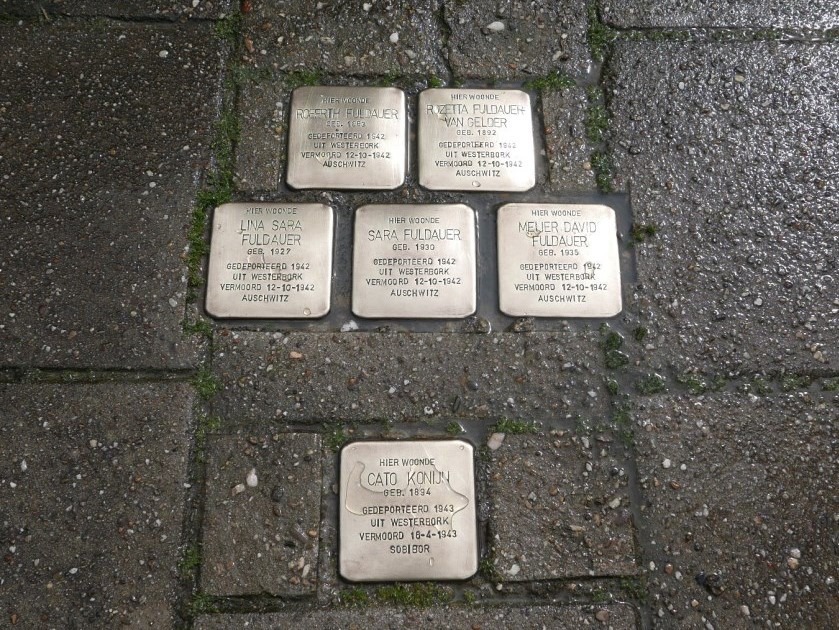
The stones have a surface area of 10 by 10 cm. A brass plate is affixed to the top, into which the name, year of birth, date of deportation, and the place and date of death are stamped. Each stone serves as a memorial to a single victim: a person who lived in that very spot and was deported from there, never to return.
Originator
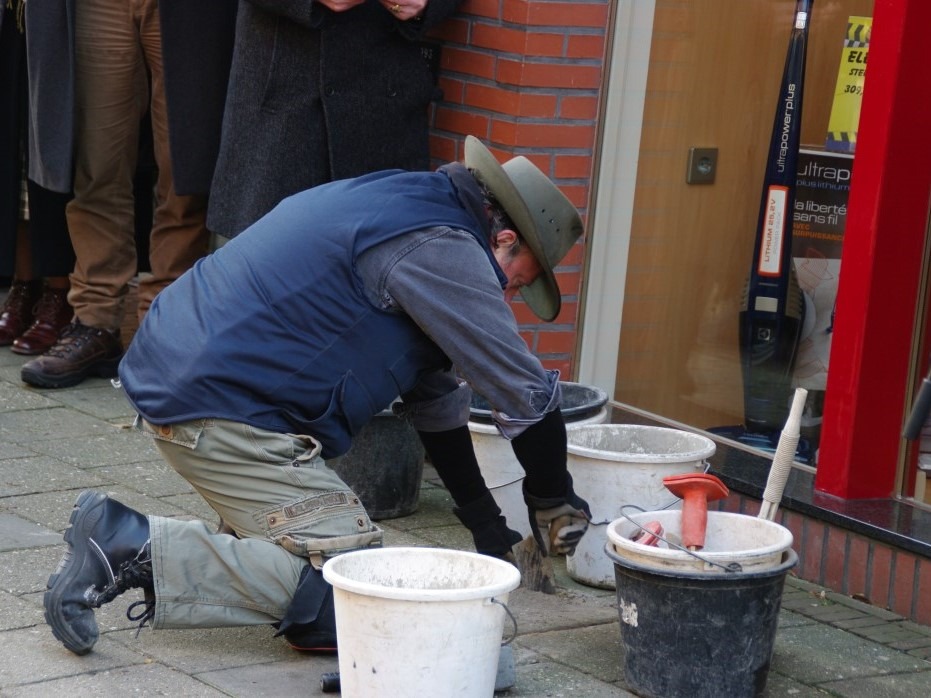
The Stolpersteine project was conceived by the German artist Gunter Demnig. He deliberately kept the size of these ‘stones of offence’ small, requiring one to bow down to read the inscriptions.
Demnig began laying the first Stolperstein in 1997 in the Berlin district of Kreuzberg. Today, Stolpersteine can be found in many countries. Gunter Demnig thus gives every victim their own individual monument. His motto is: “A person is only forgotten when his or her name is forgotten.”
Initially, he made all the stones himself, as he felt mass production conflicted with the project’s ethos. However, forced by the project’s rapid growth, he is now assisted by an artist friend. He insists on personally laying the first stones in any given location. The remaining stones are now usually installed by municipal pavers.
Stolpersteine in Aalten
In Aalten, 34 Stolpersteine have been laid at the following addresses:
- ’t Dal 1: Levi Salomon Schaap, Ella Schaap-Philips, Eliazar Hars Schaap, Frits Landau, Amalia Landau-Lorch
- Dijkstraat 10a: Levie van Gelder, Jula van Gelder-Landau, Arnold van Gelder
- Eerste Broekdijk 51: Roberth Fuldauer, Rozetta Fuldauer-van Gelder, Lina Sara Fuldauer, Sara Fuldauer, Meijer David Fuldauer, Cato Konijn
- Grevinkweg 5: Sally Fuldauer, Regina Fuldauer-de Jong
- Haartsestraat 64: Wijnand Andriesse
- Hogestraat 3: Jacob ten Bosch en Jansje ten Bosch-Bouwman
- Hogestraat 13: Moritz Cohen, Bernhard Cohen, Karoline Japhet-Eppstein
- Hogestraat 55/1: Albert Lewy, Friederika Lewy-ten Bosch, Berta Mathilde Lewy
- Hogestraat 94: Salomon Goedhart, Philippina Lea Goedhart-Rosenburg
- Landstraat 41: Johannes der Weduwen
- Lichtenvoordsestraatweg 17: Philip van Gelder, Elise van Gelder-Cohen, Jozef Backs
- Stationsstraat 24: Abraham van Gelder, Reintjen van Gelder-de Jong
- Vellegendijk 17: Hendrik Wiggers
In one instance, the stone could not be placed in front of the victim’s residence because the building (Industriestraat 4) no longer exists, nor is there a pavement where it could be installed. Therefore, this stone was laid in front of the synagogue.
- Stationsstraat 7: Johanna Cohen-Juchenheim