Bernard Huinink served as an alderman (wethouder) for the PvdA (Labour Party) in Aalten for many years. Consequently, his nickname was ‘Rooien Huunink’ (Red Huinink). The turbulent council meetings involving Willem te Gussinklo (alias ‘Piepkes Willem’) of the AR (Anti-Revolutionary Party) became legendary.
Bernard Huinink was born on 11 February 1886 in Aalten (Hogestraat 64), the son of Herman Huinink and Janna Geertruid Obrink. On 8 February 1912, he married Grada Wilhelmina Schepers in Aalten. They settled in Ormelstraat.
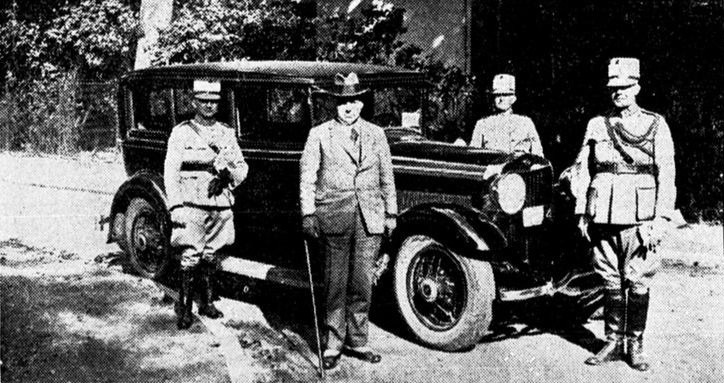
In 1919, at the age of 33, Bernard Huinink took his seat on the Aalten municipal council. He would hold that seat for nearly 45 years, initially for the SDAP and later for the PvdA. In September 1959, he celebrated his 40th anniversary as a council member and received a Royal distinction. In 1964, Huinink, the ‘father of the council’ (nestor), stood down ‘on account of his advanced age’ (77). He was succeeded by his 37-year-old son, Jan Huinink, of Admiraal de Ruyterstraat 21, who was the manager of the local PTT office (postal and telecommunications).
Bernard Huinink being invested with a Royal distinction by Mayor E.S. van Veen.
During the Eighty Years’ War, the population of East Gelderland was regularly plagued by roaming armies. Plundering, extortion, and rape drove the farmers and villagers to despair. Jan Holstein was the Bailiff of Aalten at the time, and although he was largely powerless, he did stand up for the people of Aalten and did his best to put an end to the looting.
In 1588, peace negotiations were underway between the Duke of Parma and Queen Elizabeth of England, the latter of whom also attempted to involve the States. Referring to this, Holstein wrote to Gotfried Gerardi, advisor to the lady of the manor of Anholt: “I only hope that the long-desired peace may be established; then these poor sheep might find courage again. For the most part, they plow the land with the cows they have left and work like mules. We are deep in debt and can no longer obtain money; my credit has also run out. May God grant us a solution before the harvest, so that the grain can be safely gathered. Otherwise, I would not know what to do.”
G.H. Rots wrote in 1938 about how Jan Holstein lost his life:
Manor ‘t Walfort, Jan de Beijer, 1743
“The Bailiff of Aalten, Jan or Johan Holstein, who repeatedly stood up for the population of Aalten, died in a peculiar manner. We read in ‘Het Oude Kerspel Winterswijk’ that on June 11, 1589, a christening feast was held at the home of a certain Grevink at ‘t Walfort near Aalten, where the Bailiff of Aalten was present, serving as the child’s godfather. Also present were the Lords of ‘t Walfort and Lintelo (the Lords of Lintelo were also the owners of ‘t Walfort).
The Bailiff of Aalten had received a promotion; following the death of ‘Hendrik van den Bungard’, he had become the Land Clerk of the Lordship of Bredevoort. This appears to have been a thorn in the side of the Lords of Lintelo; at any rate, a dispute began on the subject, during which Holstein noticed that the Van Lintelo brothers were not easy men to deal with.
Holstein attempted to leave the banquet table unnoticed and slipped under the table. He crawled on hands and knees toward the door and made a quick escape. However, Diederik van Lintelo noticed this, pursued Holstein, and hurled all sorts of insults at him. The argument escalated. Holstein maintained that the Lady of the Manor had the right to appoint Land Clerks, while Diederik van Lintelo attributed that right to the Nobles of the Lordship. This resulted in a physical altercation, during which Diederik van Lintelo drew a short sword and wounded Holstein. The injury was so severe that the Bailiff died three days later.”
This case was brought before the Bredevoort court on August 5 of that year. The accused was not present. He had fled to Bocholt and was hiding there. He was sentenced to death in absentia and ordered to pay a fine of 1,000 guilders to the Lady of the Manor. To collect this money, the tenants of Diederik van Lintelo were informed that they had to pay their rent to the Lady’s steward until the sum of the fine was collected.
Those tenants were ‘Ruwenhoeven’, Hendrik Penmenger, ‘Winkelhorstinck’, ‘Swijtinck’, ‘Lanckhof’, ‘den Herinck’, and ‘den Poll’. Through the mediation of several influential persons, including the Prior of Schaer Monastery, Johanna van Dort, and Hendrik and Clara van Lintelo, efforts were made to obtain a pardon. That pardon was granted, but he was still required to pay the fine.
Herman Poelhuis, the bailiff of Dinxperlo, was appointed as the bailiff of Aalten. It appears this was a temporary appointment, as in 1605, Lubbert Spaltman is mentioned as the bailiff of Aalten.”
Sources
Het oude kerspel Winterswijk, by B. Stegeman, 1927 (Delpher)
‘Uit Aalten’s verleden’, by G.H. Rots, Aaltensche Courant, March 4, 1938 (Delpher)
The late-medieval Merfelt Cellar belonged to a borgmanhuis (townhouse of a knight) where Adolf van Merfelt, a borgman of Bredevoort, resided in former times. The cellar of this townhouse is both rare and ancient. The method by which it was vaulted is highly unusual for a private dwelling: it features four cross vaults with a central supporting pillar.
In 2014, the Merfelt Cellar was nominated for the Aalten Municipality Heritage Prize. The reason for the nomination was the meticulous care and respect for historical character and the use of authentic materials during its restoration.
The restoration work on the cellar took place over several years. The highlight of the project was the repair of the vaulting, which ensured the long-term stability of the cross vaults.
According to its wall anchors, the original Ambthuis (Administrative House) dated from 1699. For a century, it served as the centre of power for the Heerlijkheid (Lordship) of Bredevoort. The Ambthuis was also known as the Mauritshuis, as Prince Maurice had clearly left an unforgettable impression on the local inhabitants.
Chief Court
Following the gunpowder tower disaster of 1646, the town and lordship of Bredevoort had been left without an ambthuis (a building combining a courthouse and a town hall). It would take over fifty years before a new one was constructed. The building was likely connected to the Misterpoort, the city gate situated opposite the house. The building also served as the hoofdgerecht (chief court) of the lordship. While courts existed in Aalten and Winterswijk as well, serious offences were always tried in Bredevoort, with the drost (bailiff) presiding as judge.
The cellars contained several dungeons (cachots), cells, and a torture chamber equipped with the necessary implements. Those sentenced to death were held in a cell devoid of daylight and fresh air. If a suspect refused to confess, the threat of the torture chamber was often enough to secure a plea of guilt. Sentences were traditionally pronounced on ’t Zand. In the case of a death sentence, the condemned was immediately taken to the Galgenbulte (Gallows Hill) on the Hollenberg for execution. Usually, this meant hanging from the gallows that had stood there for centuries, waiting for its victims. It is said that the gallows could be seen from the Aalterpoort. For the local population, such executions were a sensation, and people from all over Bredevoort and Aalten would turn out to witness the event.
Other Functions
After the French period, the building lost its original function and was used for various purposes, including as a shop for the Catholic cooperative. This cooperative was founded by the workers’ association in 1920. In the past, Catholics would frequent this shop, while those of other faiths would go to the other cooperative further down Landstraat.
The Ambthuis was demolished around 1963. The cellars of the Ambthuis, which included two prison cells, were still located beneath the shop. In 1964, the foundation stone was laid for the construction of the Betting furniture store on this site. This building was in turn demolished in 2009, after Betting moved to new premises on Prins Mauritsstraat.
New Construction
Today, the site of the old Ambthuis is occupied by a care apartment complex consisting of twenty apartments and a restaurant. The new building was again given the name ‘Ambthuis’. In terms of its exterior, the new building bears many similarities to its illustrious predecessor. A replica of the historic sundial was attached to the building, and a replica of the bandstand was placed in front of it. An original gable stone from the old Ambthuis was built into the front facade, bearing the inscription: “Die kan lide haet en nijt, die overwint in korten tijd” (He who can endure hate and envy, shall overcome in a short time).
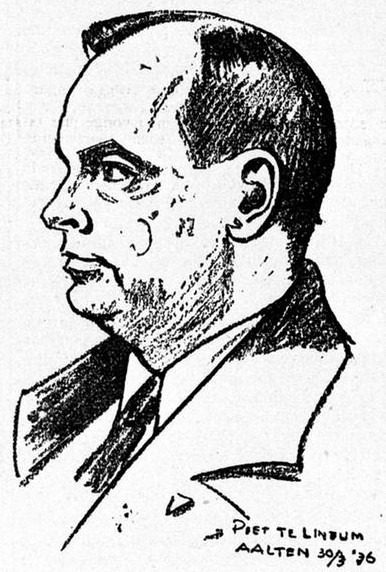
Ambthuis Bredevoort, painted by Willy WalvoortLandstraat side of the old Ambthuis in Bredevoort, ‘Anno 1699’.Cellar of the Ambtshuis, drawing by Piet te LintumThe new ‘Ambthuis’ in Bredevoort
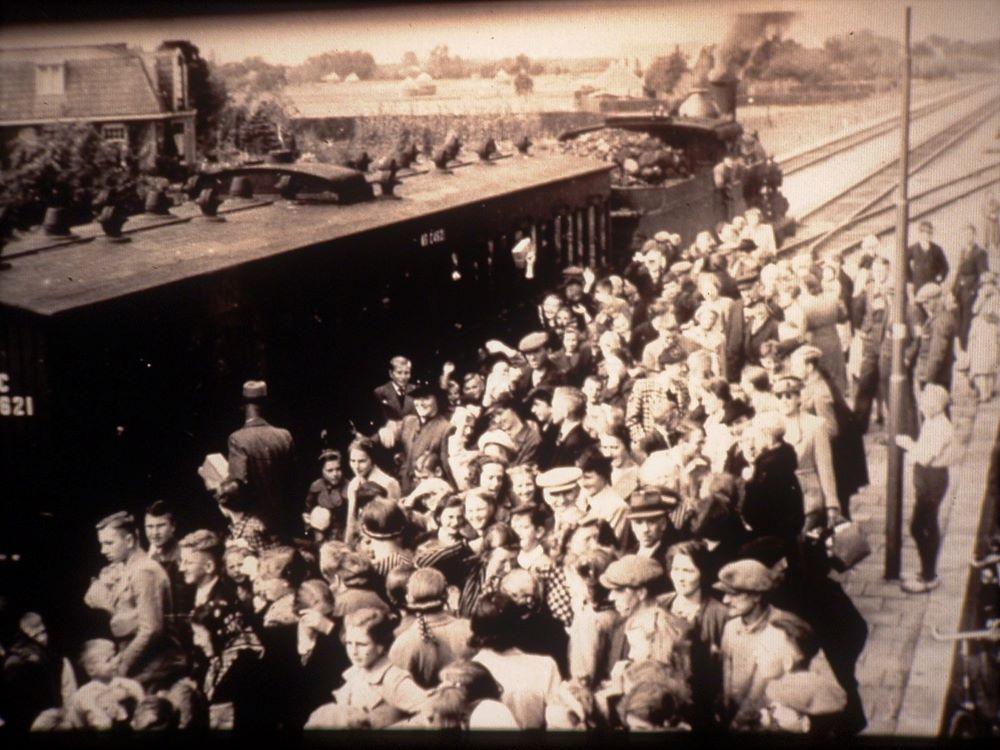
In April 1939, a border guard detachment of 36 men was stationed in Aalten, housed in farms. Sand filled tubes are placed here and there as obstacles. Around 1 September, at the beginning of the Second World War, several hundred residents of Aalten left by train for the various garrison places. On 9 May 1940, the municipal architect was instructed to install barricades on several roads.
On 10 May, German army units thundered into Aalten. The soldiers stationed around farms offer no resistance. A few days later, Dutch prisoners of war are seen being transported to Germany in open trucks. Four people from Aalten are killed at the Grebbeberg. A group of five hundred returned prisoners of war are enthusiastically welcomed in the party building and then travel on by train.
Two hundred and fifty Rotterdam children stayed here in the summer months. This was also the case in 1941. A lot of (young) people go to work in Germany because it earns well. There is already a lot on the coupon. Food production comes under control, for which Aalten is divided into three districts, each under a local office holder.
In the summer of 1942, the first people in hiding came to Aalten to evade the Arbeidseinsatz. Shortly before, the first group of employees of Dutch Button Works in Bredevoort had themselves photographed neatly in their suits with a view to employment in Germany. A group from the Driessen textile factory is also deployed.
About five hundred Scheveningen evacuees found shelter here in January 1943. Almost all of them belong to the Reformed Church. In Winterswijk there are eight hundred, all Reformed. Once every three weeks a Scheveningen pastor stays here who also leads a church service.
Hostages
The Germans increased the pressure to get men to dig. The most intimidating thing was the detention of 12 hostages on October 18. The next day, 550 men leave for Zevenaar. Ten days later, another seven men are taken hostage and 250 people report. The pastors and R.C. clergy had made an appeal to ‘show mercy and charity towards those who are in immediate danger of death’.
By circular, a representative group of municipal residents insists on a repayment scheme. It will come. A pastor in Zevenaar will be there at all times for support and spiritual care. But there is also a clandestine stencil circulating with the call to ask oneself ‘whether it is responsible to cooperate in the enemy’s defences, as a result of which many more than eleven human lives (…) will soon be lost.’
The last months
A few moments from the last three dark months: Individual food collectors keep coming, but a committee ‘Aid to the West’ also manages to collect a few cartloads of mainly grain. Doctor Der Weduwen succeeds in transferring sick people from camp Rees to the emergency hospital in Avondvrede on the Hogestraat. Serious cases go to the hospital set up in the boys’ boarding school in Harreveld. Der Weduwen is killed when his car is shot at from the air.
A drama is taking place around a resistance group that is hiding in the abandoned farm ‘De Bark‘. Close to the door, in ‘Somsenhuus‘, Germans were billeted while seven Allied pilots were in hiding there. The total number of soldiers in Aalten at this time is estimated at about four thousand.
Liberation
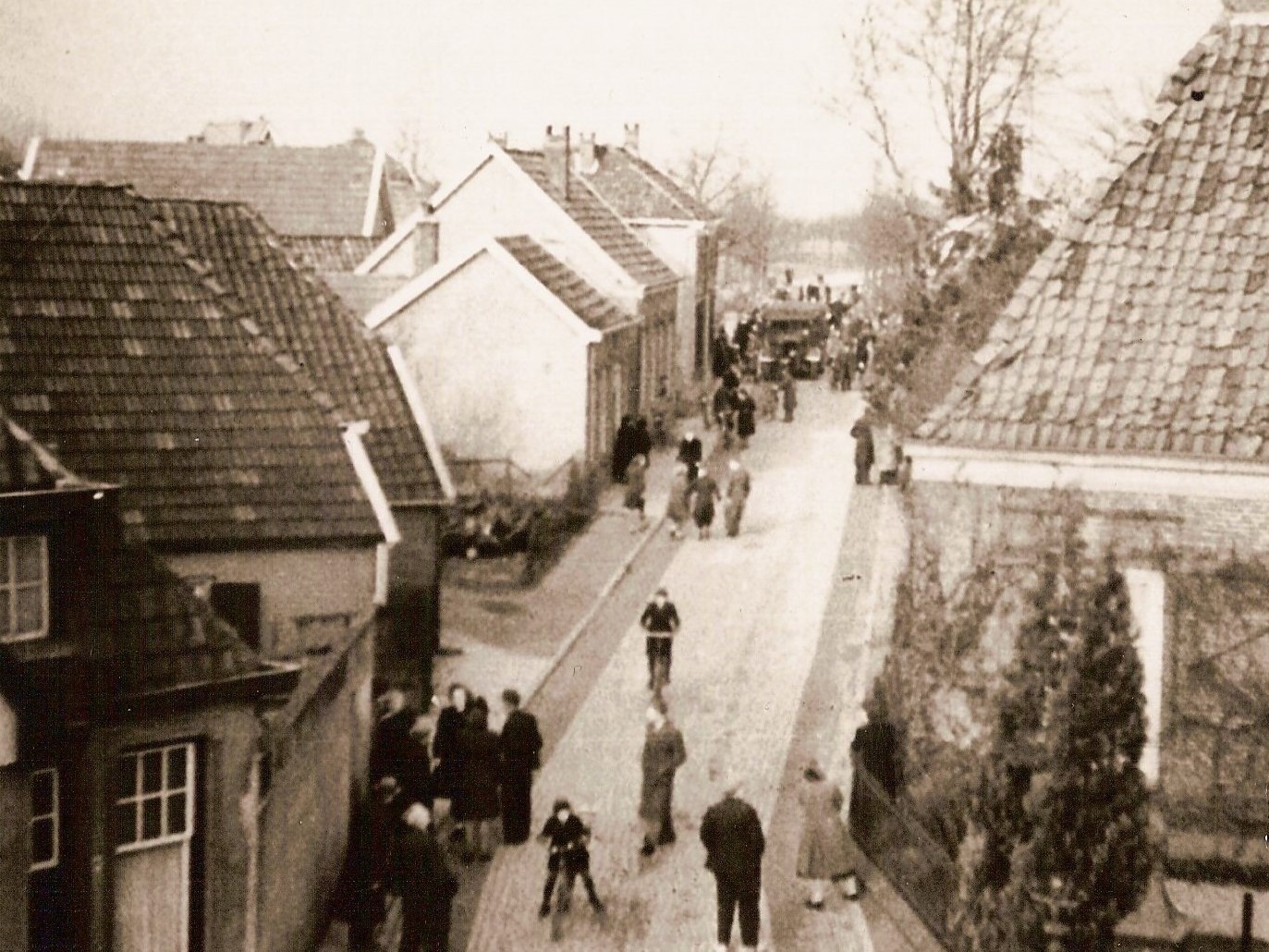
In the last days of March, it is clear that the denouement is near. How hard will there be fighting? Many leave the village, others seek protection in their shelter. There were still German soldiers roaming around. Then, on Good Friday, March 30, early in the morning, the English tanks rolled into Aalten from Germany. Here and there, Germans still put up fierce resistance. Ten British were killed on that day, in Barlo seven people were killed in a grenade hit in an air-raid shelter. Sadness and joy, Aalten has been liberated.
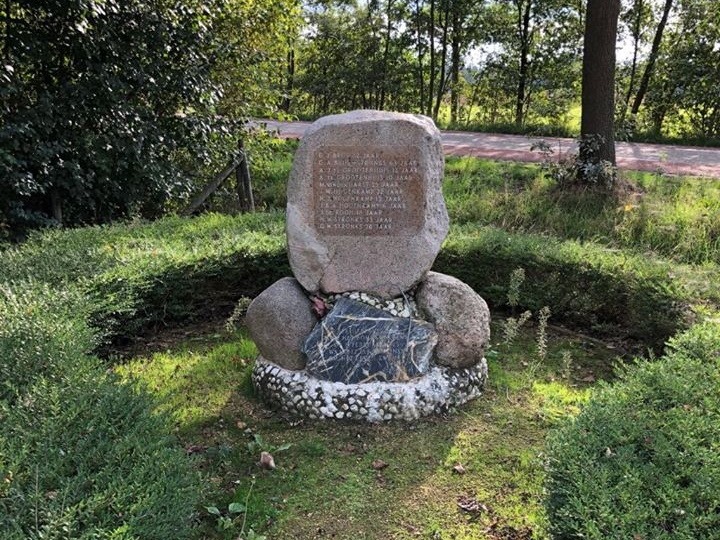
In 2015, as part of the commemorations for 70 years of liberation, a commemorative column was placed at the Old General Cemetery in Aalten to honour all local soldiers who fought on and around the Grebbeberg in May 1940. Seven servicemen from Aalten lost their lives during the conflict. Their names and photographs have been immortalised on the column.
The text on the column reads:
Soldiers from Aalten in May 1940
In the early morning of 10 May 1940, German troops invaded the neutral Netherlands. For our country, this marked the beginning of World War II. Mobilised Dutch soldiers took up positions in several lines of defence, including the Grebbe Line. Fierce fighting took place in the main resistance strip on and around the Grebbeberg near Rhenen.
Photo: R. Neerhof, 2025
Most soldiers survived the battle and were able to return to Aalten, often after a brief period as prisoners of war. Seven families remained in a state of uncertainty for some time. Eventually, they received the tragic news that their sons would not be returning; they had fallen in battle. Their lives were devastated by this great loss. At this site, all Aalten soldiers who fought in May 1940 are remembered.
Many residents of the Achterhoek, including a considerable number of young men from Aalten, were assigned to the 8th Infantry Regiment (8 R.I.). This unit played a vital role in the defence of the Grebbeberg. The poorly trained and equipped soldiers fought an unequal battle against an overwhelming enemy. Bravely, they attempted to hold their ground for as long as possible. The Germans, with awe, referred to the hill as ‘Der Teufelsberg’ (The Devil’s Mountain). Nevertheless, our country was forced to capitulate on 14 May 1940.
Gunter Demnig placing the first Stolpersteine in Aalten
In Aalten, 34 Stolpersteine (stumbling stones) are laid across twelve addresses. A Stolperstein is a memorial stone placed in the pavement in front of the house from which people were deported by the Nazis to extermination camps during World War II. When you see such a stone—usually unexpectedly—with the name of a victim, you are momentarily reminded of how millions became victims of systematic murder during that war.
The stones have a surface area of 10 by 10 cm. A brass plate is affixed to the top, into which the name, year of birth, date of deportation, and the place and date of death are stamped. Each stone serves as a memorial to a single victim: a person who lived in that very spot and was deported from there, never to return.
Originator
The Stolpersteine project was conceived by the German artist Gunter Demnig. He deliberately kept the size of these ‘stones of offence’ small, requiring one to bow down to read the inscriptions.
Demnig began laying the first Stolperstein in 1997 in the Berlin district of Kreuzberg. Today, Stolpersteine can be found in many countries. Gunter Demnig thus gives every victim their own individual monument. His motto is: “A person is only forgotten when his or her name is forgotten.”
Initially, he made all the stones himself, as he felt mass production conflicted with the project’s ethos. However, forced by the project’s rapid growth, he is now assisted by an artist friend. He insists on personally laying the first stones in any given location. The remaining stones are now usually installed by municipal pavers.
Stolpersteine in Aalten
In Aalten, 34 Stolpersteine have been laid at the following addresses:
’t Dal 1: Levi Salomon Schaap, Ella Schaap-Philips, Eliazar Hars Schaap, Frits Landau, Amalia Landau-Lorch
Dijkstraat 10a: Levie van Gelder, Jula van Gelder-Landau, Arnold van Gelder
Eerste Broekdijk 51: Roberth Fuldauer, Rozetta Fuldauer-van Gelder, Lina Sara Fuldauer, Sara Fuldauer, Meijer David Fuldauer, Cato Konijn
Grevinkweg 5: Sally Fuldauer, Regina Fuldauer-de Jong
In one instance, the stone could not be placed in front of the victim’s residence because the building (Industriestraat 4) no longer exists, nor is there a pavement where it could be installed. Therefore, this stone was laid in front of the synagogue.
Huisstededijk, IJzerlo (just before the Keizersbeek bridge)
The ‘Flying for Peace’ (Vliegen voor de Vrede) monument is a commemorative memorial located on Huisstededijk in the Aalten rural district of IJzerlo. The monument was erected in memory of the crash of a British bomber during World War II, which came down in a nearby potato field on the night of 26 June 1943.
On that particular night, over 400 British bombers flew over the Achterhoek on a mission to bomb the petrochemical industry in Gelsenkirchen. One of these aircraft, a Short Stirling BK767 of 214 Squadron, Royal Air Force, with seven crew members on board, had taken off just before midnight on 25 June.
At approximately 01:20, the aircraft was set ablaze by night fighter pilot Oberleutnant Ludwig Meister, flying a Messerschmitt Bf 110 G-4 that had recently scrambled from Venlo airfield. The Stirling crashed into a potato field between the farms of the Van Lochem family on Huisstededijk and the Ter Horst family on Veldweg.
Of the seven crew members, only two survived the crash. They were later captured near Hemden and spent the remainder of the war in German prisoner-of-war camps. The other five crew members perished and were buried following a brief ceremony on 29 June 1943 at Berkenhove Cemetery in Aalten.
The following day, many Aalten residents flocked to the cemetery. On the middle grave, members of the underground resistance laid a wreath with ribbons bearing the text: “Gebroken vleugels, onsterfelijke roem” (Broken wings, immortal fame). By order of the occupying forces, these words had to be removed, but they live on through the monument today.
Survivors (taken prisoner): • F/O K.A. Nielson • Sgt E.G. Taylor
The Monument
In 2003, a monument was unveiled at the spot where one of the crew members’ bodies was found, near the cycle bridge over the stream on Huisstededijk. The creator, Wim Westerveld, gave it the name ‘Flying for Peace’ and designed an artwork containing multiple layers of symbolism.
The monument consists of a white stone sphere topped with a metal sculpture that, from certain angles, represents a dove and, from others, flames. The sphere rests on a metal pipe angled into the ground, to which a plaque is attached. One of the two survivors, navigator Edwin Taylor (born 1922), was present at the unveiling of the monument.
Significance
The sculpture represents the Earth with a dove of peace on top, symbolising the desire for peace. However, from certain viewpoints, the dove transforms into flames, symbolising the tragic event of the crash and the fiery dedication of the crew to their mission. The flames also refer to the fire of the bomb load the aircraft was carrying. The broken wings on the monument are a symbol of the crew’s abruptly ended mission.
The monument serves not only as a memorial to the crew of Stirling BK767 but also conveys a broader message. It acts as a warning against war and reminds us of the freedom we enjoy today. It calls upon us to cherish this freedom and to grant it to others as well.
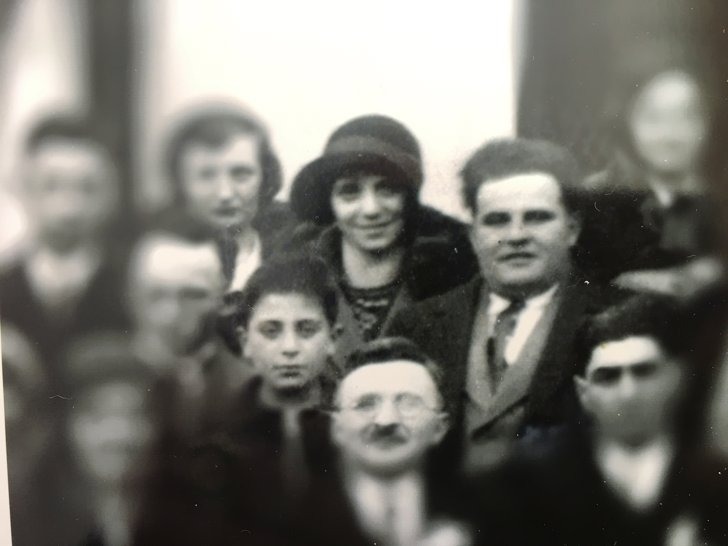
Bernard Leezer (57) lives in Aalten in the Achterhoek. Although he ran a butcher’s shop for twenty-six years, he does not really consider himself a butcher. He is a father of three sons and a daughter, and a grandfather of two. A conversation about meat, hiding from the Nazis, and football
“Both my parents have passed away. My father was a cattle dealer and my mother came from a well-to-do family in Wilhelmshaven in Northern Germany. She didn’t really suit my father at all. He was a stubborn man from Groningen who didn’t care much for etiquette. It caused friction. If my father came home and forgot to wash his hands before dinner, all hell would break loose. Of course, he wasn’t the type to just let himself be pushed around, so he’d fight back. And then my mother would say: ‘Na und wie bist du denn, wie bist du denn überhaupt?’ Mother spoke German at home. She spoke fluent Dutch too, but she hardly ever used it. I was raised bilingual.”
“My mother’s father was a horse dealer. She always used to go to the tennis court in a pony and trap. Anyone who did that back then belonged to the upper class. That’s why I always say my parents only met out of necessity. She fled to the Netherlands in 1932 with her two children—both my father and mother had been married before. My father had six children from his first marriage. Two of his children, one with a husband and child, were gassed. I am the only child from the second marriage.”
“My mother was a dominant woman. She always protected her own children, while my father’s children had to take a back seat. They had to fend for themselves from an early age. Of course, it wasn’t easy for them to accept a woman who wasn’t their mother either. Father was the kind of man who, for the sake of peace, would just think: Never mind. Let it be.”
“I was heavily influenced by my mother. If I wanted to go on holiday, she would say: ‘Du brauchst nicht so weit weg, wenn etwas passiert. When you are old enough, you will look for a wife and go to work.’ I became a butcher against my will. I actually wanted to be a pilot. Mother wouldn’t hear of it. So a butcher it was, but I’m not really a butcher at heart. I’m too emotional. I am against ritual slaughter because I believe an animal has the right to be stunned. God gave us the animals. Fair enough, but does a beast have to suffer that much pain before we scoff it down?”
“The first Jews to be rounded up were the Fuldauers. They lived right near us. They were taken away by PC Dijke from Aalten. He was a small, fanatical bloke. The Fuldauer family walked along packed to the rafters, and he walked in front, loosely wheeling his bicycle by his side, leading those people to the community hall. That’s where the Jews were gathered before being transported to Westerbork. People were standing outside the slaughterhouse, and they said: ‘Alright Dijke, you can keep that up all day, can’t you?’ Then my mother said: ‘It’s time. We have to leave.’ After the war, that Dijke fellow came into our shop once. I walked around the counter and said: ‘Get out, Dijke, and never come back, or we’ll cleave you in two.’ He was the man who took away the first Jidden from Aalten, and he just strolled in as if nothing had happened.”
“Kees Ruizendaal, nicknamed Zwarte Kees (Black) Kees)—also a policeman, but a good one—helped us find a hiding place. He was later executed by firing squad in Doesburg. First, I stayed with my half-sister Helga at the Klein-Entink farm, and later with my parents at Hendrik Groot-Nibbelink’s place on the Stroete in Lintelo. We were hidden with three orphans. They were practically children themselves. Drika, the oldest, was 26; Hendrik and Bernard were in their early twenties. To me, they are heroes. You know what would have happened to them if we’d been caught. They were Christian people. They did what they did out of love, not for the money. I think about that often. I find what they did incredible. Hendrik passed away last year. The vicar gave a beautiful sermon. I went and sat in the refreshment room. I felt that if I looked at the vicar, I’d get such a massive lump in my throat. I couldn’t well let myself go like that as a grown man, could I?”
“While we were in hiding, I used to go outside with Hendrik at night once it was dark. Next to the farmhouse stood an old apple tree. It leaned terribly and had to be propped up. Between the props was a tiny patch of land. If Hendrik had sown rye that day, for instance, I would go and sow rye on that little patch of land at night. He was my great role model; that’s why I was so heartbroken when the man died. He was like a father to me.”
“I spent a lot of time with the cows or with the horse. The Germans requisitioned Lies—that was her name—at one point. She was a right handful. She bit and kicked everyone except me. I could practically sleep right next to her. Hendrik managed to fetch Lies back because the Germans couldn’t control her. I was so happy she was back. At least I could cuddle her again. Drika used to play games with me. My father was too old to play with me. He was terrified that something would happen to me. I don’t know if he would have survived it. He was completely barmy about me. Later on, when I started going out and came home late, he could never go to sleep. He always stayed awake and would say: ‘Where on earth is that boy?’ My mother was more down-to-earth.”
“For a while—when it became too dangerous at Groot-Nibbelink’s—we also stayed with the Pennings family in Varsseveld. They were a very devout Christian family. During the war, he would go to Delft with a horse and cart to fetch glass. He sat on the box with the reins in one hand and a Bible in the other. Pennings had nine children. I often sit by the brook now, thinking: what must have gone through that man’s mind. He had to keep the peace in his family, keep us calm, and keep a cool head himself. The house was searched once at Pennings’ place. We were hidden under the straw along with sixteen other Jews and people from the underground resistance. One of those ‘blacks’ [NSB/collaborators] stood with his great boots right on my mother’s hand. He crushed her whole hand. Pennings was downstairs playing the organ: Abide with Me. Every time I hear that hymn, it takes me right back.”
“We hid with true Christians, and later I went to a Christian school. But I never felt the urge to become a Christian. My half-sister Helga joined the Reformed Church. Well, that took a few drops of water, but that was about the extent of it. Truly, you can have a stable full of Trakehner and Hanoverian horses, but if you put an Arabian among them, it stands out. You cannot deny who you are. The first thing people say is: ‘That’s a real Jewish trick.’ At home, my father and mother kept Jewish life alive for me. My mother wasn’t particularly pious. My father was orthodox. His whole life, even during the war, he never ate gasser (non-kosher meat). You are a Jid, and there’s no escaping it. I’ve always said: ‘I was born a Jid, and I’ll die a Jid.’”
“I couldn’t live in Israel because of the heat, but when I’m in Eretz, I love it. We go there regularly because our daughter lives there. When I go to shul here, I think pff, but there I think it’s wonderful. Afterwards, you stand around having a nice little schmooze with a group. You can’t do that here anymore. You could before the war. Before the war, about a hundred Jews lived in Aalten. After the war, we struggled to form a minyan. It’s just a completely different atmosphere. You can’t imagine walking down the street in Aalten wearing a kippah nowadays.”
“I can’t say I was frightened at the time. I can only remember that after the war, when I was at school, I was scared to death of the postman. I went to the Groen van Prinsterer school. It was an old-fashioned school with a very long corridor, with the toilets at the far end. If I came out of the toilet and Mr Terbrake was standing at the other end of the corridor in his postman’s uniform, I’d be rooted to the spot because I thought I’d seen a ‘black’. That’s what happens when you’ve spent years being told: ‘They’ll kill you.’ Terbrake would quickly go to Miss Jonker and say: ‘Bennie’s frozen at the end of the corridor.’ She would come and get me. She’d put an arm around me and take me back to class.”
“The Groen van Prinsterer was a fantastic school. It was a Christian school. I never once heard the word ‘Jew’ used as an insult there. It was quite a different story at the public school. I had to have remedial lessons because at eleven years old, I couldn’t even read or write. While in hiding, we did read little booklets, and when the war ended, my father said: ‘He reads like there’s no tomorrow.’ But you mustn’t forget that if you read me a booklet like that a thousand times, I’ll eventually know it by heart. At first, they fell for it, but the moment a different book was put in front of me, I couldn’t make head or tail of it.”
“During the war, I wasn’t aware that it was a matter of life or death. No one can tell me that an eight-year-old boy understands that. We were told: ‘You mustn’t go outside because people are walking around out there who will kill you.’ That doesn’t really sink in for a child. You can tell a dog a thousand times: ‘Leave that alone.’ And eventually, it won’t touch it anymore. But as for why it’s forbidden—it doesn’t understand that.”
Aaltensche Courant, 4 May 1945
“During the final period of the war, we stayed with Hendrik on the Stroete again. We lived there for the first few months after the liberation too, because we no longer had a house. My mother went looking for her furniture. She managed to get a lot of it back. My father took out a loan from a Christian church. He was a bit casual about paying it back; years later, we still received a final notice. Right after the war, he put an advert in the newspaper: ‘After two and a half years in hiding, I am reopening my butcher’s shop’. My father wasn’t a good butcher. He was a cattle dealer. A proper trader. Very much a case of: one, two, up you get, just sign for that beast.”
“After primary school, I went to the technical secondary school. I didn’t want to go at all, but my mother said: ‘Du sollst ein Handwerk lernen.’ I ended up getting a whole load of diplomas. Alongside that, I always did a lot of sport: tennis, hockey, and football. My father wouldn’t give me money for football boots. ‘You’ll just have to earn it,’ he said. I always had to help my father, but I never got paid for it. My brother-in-law ran an emergency slaughterhouse. If there was an emergency slaughter in the middle of the night, he’d ring and wake me up, and I’d go and help him. I didn’t get any money for that either, but I did get the head, the tongue, the udder, and the liver, and I sold those. That’s how I bought my football boots.”
“I played as a semi-professional for De Graafschap. I moved from Aalten Football Club to Winterswijk Football Club. WVC was an elitist club. Because I went to school in Winterswijk and was in the school team, I caught people’s eyes. When I moved from Aalten to Winterswijk, I was called a ‘rotten Jew’. Why? I was turning my back on Aalten. WVC was an elite club, and they hated them. I was a really fast right winger. But I was very slightly built. They only had to tap my ankle and I’d go rolling over thirty-four times. Later on, I played centre-forward too. I was actually too small for it, but I’d always go tumbling to the ground, and that would get the referee on our side. I played two seasons for De Graafschap, until one day I was kicked out of the match by Dick Tol, nicknamed ‘the gnarled’.”
Leezer butcher’s shop, Peperstraat (1975)
“In the end, I ran a butcher’s shop for 26 years. Looking back now, I say: ‘I’d never want to do it again.’ A hundred grams of this, a hundred grams of that. Never again, though I did have some fun. Especially in the early sixties, we got a lot of German customers. Meat was cheaper in the Netherlands than in Germany. You had to be careful not to give the Germans preferential treatment, otherwise you’d get earfuls from the Dutch. Dutch customers were always served immediately by my assistant or my wife. Even if there were three Germans ahead of them, a Dutch person was served first. I’d make a joke of it and say: ‘Kurt, ich hilf dir’.”
“In the evenings, the restaurant owners from Bocholt would come in and order ten or fifteen racks of pork chops. There were a few customs officers who always came to get meat. They never had to pay. When they came by, they’d say: ‘Blimey, I’m on duty again tonight.’ And then in the evening, I’d get in my little Opel, take out the spare wheel, put the racks of chops in, and pop right over the border. I could always drive straight through. My wife knew nothing about it, and I thought: what she doesn’t know won’t hurt her. It was a time of adventure and wheeling and dealing.”
In 1964, during excavation work for the construction of a new workshop on the premises of the Klein Nibbelink smithy, various items were discovered, including remnants of walls, moat fill, wooden posts, and an iron fire grate. However, the most impressive find was a Spanish sword from the Eighty Years’ War, bearing the inscription ‘Tholeta’, the Latin name for the city of Toledo in Spain.
Johan Klein Nibbelink currently has the sword in his possession and tells about it in the video below.
Nieuwe Winterswijksche Courant, 12 October 1964
Sources
Nieuwe Winterswijksche Courant, 12 October 1964 (Delpher)
The war memorial on the Wheme was erected in memory of all fellow citizens who died during the occupation years as a result of acts of war. The memorial also commemorates the liberation.
The establishment of the memorial was an initiative of the Monument Foundation 1940-1945 committee. Immediately after the liberation, the population of Aalten felt the need to honour the war victims with a monument.
The monument consists of a statue of a male figure with a woman and child. The sculpture of French limestone is placed on a terrace. The pedestal consists of masonry, concrete and natural stone. The memorial is 1 meter 31 high, 1 meter 43 wide and 90 centimeters deep.
The group faces south from where the tribulation, but also the deliverance, came. Artist Bé Thoden van Velzen described the sculpture as follows: “… representing man, woman and child, as a symbol of the entire Dutch people, expectantly looking forward to liberation, unbowed and unweakened.”
Especially in the final years of the war, several residents of Aalten were arrested by the Germans and transferred to a camp. Upon arrival at the camp, all their belongings were taken from them. It appears that efforts are currently being made to return the objects confiscated at the time, insofar as they are still present in the former camps. We now share a remarkable incident regarding this:
In January 1944, numerous young men were taken prisoner one morning at the Reformed Westerkerk. They were first transferred to Amersfoort. Among them was Mr. H. Stronks from Dale. He had to hand over all his belongings, including his wristwatch. Stronks was subsequently wounded during a bombardment of the Soesterberg airfield, was admitted to a hospital, and managed to escape from there.
Mr. J. Tolkamp from Barlo, who was arrested on the same morning and also transferred to Amersfoort, was put on transport to Neuengamme in September. Upon leaving the camp, he received several belongings back, including a wristwatch. Tolkamp claimed that this watch was not his property but belonged to Stronks. However, the camp guards insisted that Tolkamp take the watch anyway. He then did so.
Upon arrival in Neuengamme, all belongings had to be handed over again. Everyone’s belongings were placed in a small bag, on which the prisoner number was noted, after which the bag was thrown into a large drawer. It was thought that they would likely never see any of it again.
In the meantime, Mr. Tolkamp had stayed in four different German camps and returned to Aalten after the liberation. On Saturday, Mr. Tolkamp received word that he could collect a package at the Social Affairs Office in Aalten. It turned out that this package came from Neuengamme. It was the same bag in which his belongings had been placed at the camp. Even the camp number — 48769 — was still on it.
In the bag were two rings made by Mr. Tolkamp in Amersfoort and a wristwatch. It turned out to be the watch of Mr. Stronks, who was highly surprised when, after six years, he received back his property, which he had long since written off. However, Mr. Tolkamp did not receive his clothes back, nor the confiscated money.
During his visit to East Gelderland next week, Prince Bernhard will also visit the old fortress of Bredevoort. Bredevoort has been a pledged city of the House of Orange since Frederick Henry conquered it for the States, and the current members of the House of Orange still hold the title of Lord of Bredevoort. In connection with this, we recently visited Bredevoort, where we had an interview with one of the local historians, who shared interesting details about the past of this ancient town.
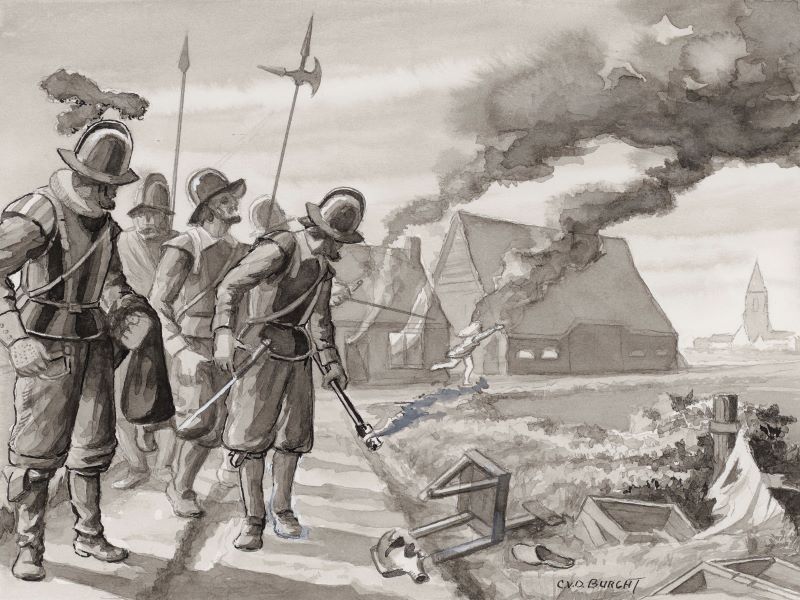
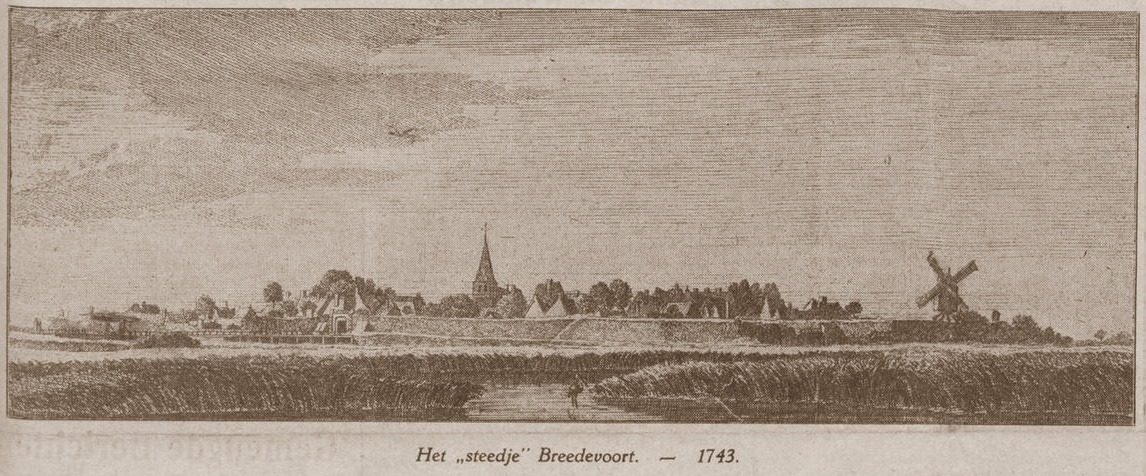
Little is known about the earliest history of Bredevoort. It was traditionally a possession of the Lords of Anholt. It is likely that a church was established around the 14th century near the castle, which probably dated back to much earlier times. The region was impoverished, which was hardly surprising, as bands of wandering soldiers regularly moved back and forth robbing and plundering, with the defenseless rural inhabitants suffering the most. During the Eighty Years’ War, before the Twelve Years’ Truce, it even occurred that the residents of Winterswijk had to seek safety within the walls of Bredevoort.
The conquest by Prince Maurice
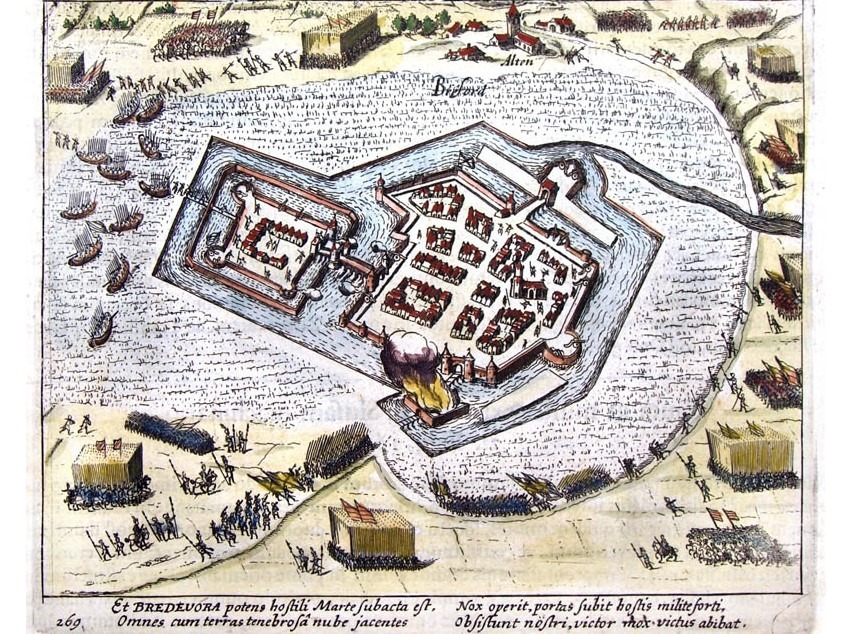
In 1598, Prince Maurice laid siege to Bredevoort and captured it after a siege; however, Bredevoort paid a heavy price for its newly acquired freedom, as the entire town burned down, with the exception of the Castle, which stood on the site where the Dutch Reformed school is now located. To replace the Church, which also burned down completely at that time, the Church that still stands in Bredevoort today was built. A unique feature of this Church is that the tower, unlike those of other churches, was not built next to the Church but on top of it, resting entirely on an oak base. During the upcoming church restoration, this will be replaced with concrete. The historical value of this Church is also evident from the fact that it is listed as a national monument, meaning this institution will also contribute to the restoration costs.
Around 1600, Bredevoort changed hands again as the Spaniards retook possession of the fortress. To them, Bredevoort was nothing more than a den of thieves from which they terrorized the region. This situation lasted until 1627, when the States commissioned Frederick Henry to reconquer Bredevoort. He performed his task in such a manner that the States, in appreciation of his services, granted him the Seigniory of Bredevoort as private property. From that time on, the House of Orange has always held the title of Lord of Bredevoort.
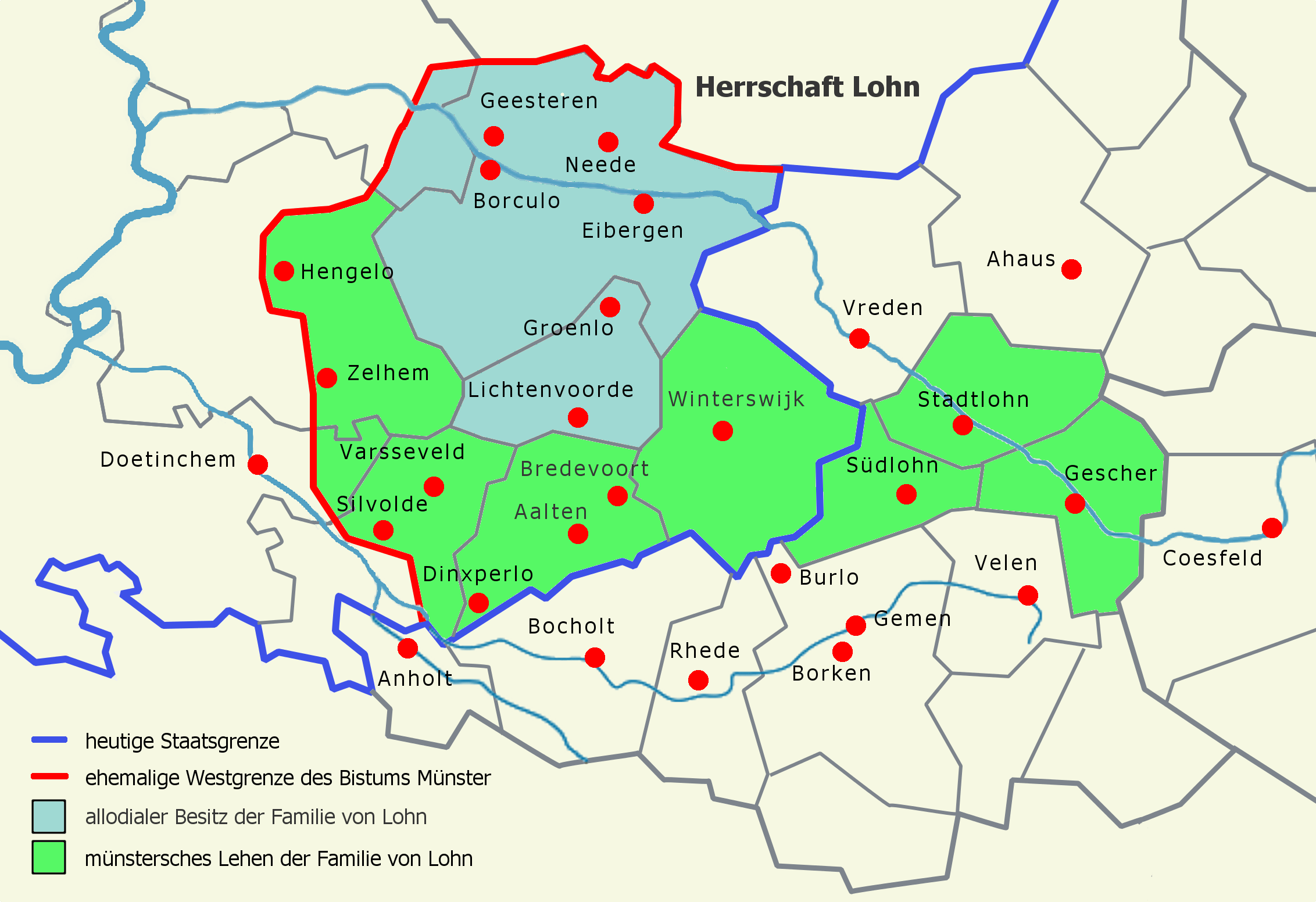
This also explains why East Gelderland, specifically Winterswijk, Aalten, and Dinxperlo, extends so far into Germany. This entire area belonged to the Seigniory of Bredevoort and thus came into the possession of the House of Orange, and consequently the Netherlands, with the conquest of Bredevoort.
One might wonder why Frederick Henry did not also conquer Anholt, which was also connected to Bredevoort, but the explanation lies in the fact that the Lords of Anholt were related to the House of Orange, and he likely spared them for that reason.
Seigniorial rights
Through the possession of Bredevoort, the House of Orange acquired Seigniorial Rights here, such as the milling right. This meant that within the Seigniory of Bredevoort, milling was only permitted at the mill in Bredevoort, the watermill at De Pol in Aalten, and the watermill near Den Helder in Winterswijk. Regarding the milling right, it is known that in 1868, an official lease agreement signed by Frederick himself was still in the possession of the Heusinkveld family in Bredevoort, granting them the right to lease the mill in Bredevoort from generation to generation. It is a pity that this lease agreement has been lost.
Naturally, other members of the House of Orange were also Lords of Bredevoort. Well-known stewards came from the Roelvink family, which is still known today, and some of its members later served as Mayor of Aalten.
William V in Bredevoort
It is known that Stadtholder William V also once visited Bredevoort. The minutes of the Dutch Reformed Church mention that he donated several Golden Riders for the poor of Bredevoort.
The French Period
During the French period, everything belonging to the Seigniory was sold. Large-scale landownership, as it is still known today around Winterswijk, dates from that time. Entire areas were then sold for sometimes only a few guilders. Some of the new owners found themselves in difficulty with their newly acquired property because they were unable to cultivate everything, so they planted forests instead; thus, large areas of forest near Winterswijk date from that time, which is consistent with the fact that most of the Winterswijk forest is approximately 150 years old. After the French period, the House of Orange never regained these lands, so they have only held the title since then.
The House of Orange does not appear to have made any official visits to Bredevoort since that time, likely because Bredevoort is relatively poor in historical buildings and institutions. However, that the ties were never completely severed was evident in 1900 when H.M. Queen Wilhelmina made ƒ 100 available for the restoration of the Church in Bredevoort.
H.R.H. Prince Bernhard in East Gelderland
Yesterday, the final day of H.R.H. Prince Bernhard’s visit to East Gelderland flew by once again as the Prince’s open Cadillac traveled under the radiant summer sun through one of the most scenic parts of our country, past ripening grain, busy farmers, cheering and singing schoolchildren, and an enthusiastic population; once again, the Wilhelmus sounded many times, and the Prince raised his hand in greeting countless times with a charming smile on his tanned face; once again, it became a true triumphal procession.
On this third day, H.R.H. departed from Ruurlo, arriving in Zieuwent around a quarter to nine at the farmhouse of farmer Weelink, which dates from 1737. After the Prince had briefly toured the farm, he proceeded at pace to Harreveld, where a group of young people waited in suspense at the Roman Catholic Reformatory; surrounded by hundreds of pupils from the Reformatory, H.R.H. was received and addressed by the chairman of the Reformatory board.
Lichtenvoorde prepared a grand welcome for H.R.H.; many thousands, again adorned with the national colors, saw the procession arrive in the thousand-year-old town, preceded by ten motorcyclists from the local Motor Club. The Prince stepped out in front of the Roman Catholic rectory. Inside the rectory, the Prince listened for about fifteen minutes to the Pastor-Dean of Groenlo, who gave a presentation on Roman Catholic spiritual life in East Gelderland.
Preceded once again by the Lichtenvoorde motorcyclists, the procession left the old town. At the border of the municipality of Aalten, Mayor E. S. van Veen took a seat beside the Prince, and they proceeded to Bredevoort, the old pledged city of the House of Orange; the Prince stopped here for only a few moments, where he spoke briefly with baker Helmink.
Two cousins meet on the boat after not having seen each other for 13 years
Great joy prevailed on Wednesday in the Neerhof and Lievers families when their sons returned home safe and healthy after 13 and 2½ years of service in the Far East, respectively. Maypoles and greenery, waving flags—everything pointed to a joyful return. We had the pleasure of hearing some details from both young men.
Henk Neerhof
First, we hear from Private H. Neerhof, K.N.I.L. We found Henk surrounded by family members and friends, and upon our request to tell us something about his experiences, we were told the following:
„After my training in Nijmegen, I left for the Indies in August 1935, destined for Bandoeng. Until the Japanese invasion, I was always stationed here in garrison. After a hard struggle, I was taken prisoner of war along with many others and transferred to the well-known penal camp at Tjilatjap. Here we got to know the Japanese as a cringing, submissive people, brutal and sadistic in their actions, but also deathly afraid of their superiors.
After this time in the camp, we were transferred to Thailand and here the path of suffering began: working on the ‘death line’, the Burma Railway, which lasted 1½ years. From here I was taken to Japan, where I spent two years as a miner in the coal mines on the island of Kyushu. It is easy to understand that this time was also far from rosy.
Japanese internment card Hendrik Neerhof, source: National Archive
There I finally experienced the liberation in 1945, a liberation I will never forget. It was the Americans who delivered us from all that misery. With our exhausted bodies, we jumped and danced. Americans, great guys! It was simply exhilarating.
KNIL soldiers working on the Burma Railway
Everyone was transferred to Nagasaki on an American aircraft carrier, the city that had been hit by the atomic bomb some time before. The effect of this was terrible; everything had virtually disappeared, it was a scorched remnant of a city, covered with a thick layer of ash. From here I was finally dispatched to Balikpapan, where I had a good time. Here I was incorporated into a normal company again.
And now I am home again, with six months’ leave. I felt really strange towards everything here; it is so small and narrow-minded, you really have to get used to it again. I am happy to be home. The festive reception, everything decorated, and a serenade from the A.O.V.—it was wonderful.”
Finally, Henk mentioned that he will return to the Indies again. We wish him a very pleasant leave and, for later, a good voyage and a safe arrival in the Indies.
Jan Lievers
As the second returnee from the Indies, we were able to greet Private 1st Class Jan Lievers. Jan left for the Indies as a volunteer in October 1945 and was assigned to I-8-R.I. After training in Ermelo, Jan ended up in Malacca via England, as the first Dutch troops were not yet allowed to set foot on Indonesian soil. Stationed in an old rubber plantation at Lubok Kiab, he underwent heavy jungle training.
At the end of February 1946, they set foot ashore at Batavia, the first Dutch brigade to arrive in the Indies. After serving in and around Batavia, he participated in the police action from Padang.
Jan was able to tell us much about the beauty and splendor of our Indies; that alone would be enough to fill a book. He had a lot of contact with the native population, who were generally very well-disposed towards our boys. „I consider it a privilege that I was able to experience all this,” Jan said, „I will always have pleasant memories of my time in service.”
Aaltensche Courant, 11 June 1948
Besides the joyful entry into Aalten, Jan was especially struck by the extraordinary reception given to the returning soldiers in IJmuiden and Amsterdam. Thousands of people were out on the streets; it was grand. „I am, of course, very happy to be home again; it is now a matter of getting back to work as soon as possible.” We also wish Jan all the best and much happiness in the future.
Return from the East
De Graafschapper, 5 July 1948
On Saturday, our fellow townsmen, the volunteers Stronks (Haart 10) and Weevers (1st Broekdijk), returned from the Indies. Mr. Neerhof (Trompstraat) also returned. He stayed in the tropics for 13 years. Upon his return, the A.O.V. performed a serenade. We hope to return to this in more detail in tomorrow’s edition.
Home again after 13 years
De Graafschapper, 6 July 1948
In 1935, the brothers H. and J.H. Neerhof left for the Indies as members of the KNIL. Now, after 13 years, both have returned home safely. Because of this special event, we paid them a visit to congratulate them on their safe return. It appeared that both had led a quiet and good life until 1942.
When the war broke out, both were taken prisoner of war. Both ended up at the so-called Death Railway, the railway line from Thailand to Indo-China. One on one side and the other on the other side. However, they never had the opportunity to speak to each other there. J.H. Neerhof then went to Indo-China, where he remained until the end of the war. He was full of praise for the treatment he received from the French there.
H. Neerhof was transferred from Thailand to Japan, where he went to work in the coal mines of Kyushu. After the capitulation, he was transferred via Nagasaki—where he saw the destruction caused by the atomic bomb—to the Philippines. In Manila, he spent 2 months in quarantine with the Americans. After that, he returned to the Indies, where his brother had also returned in the meantime.
On April 23, they met again in Batavia for the first time in 13 years. About 6 weeks ago, H. Neerhof came home, and on Saturday, J.H. Neerhof arrived. Both stated they were very moved by the homecoming prepared for them here. A fantastic homecoming, as they stated several times.
The memorial for people in hiding (Onderduikersmonument) on Stationsstraat is an expression of gratitude from those who were once in hiding to the people of Aalten for their hospitality, and to the members of the Resistance who were the driving force behind finding accommodation for them.
The monument consists of a brick memorial wall with a fountain. A bronze plaque and two sculpted fragments of natural stone are set into the memorial wall.
The monument was unveiled on 4 October 1947 by Mrs D.G. Wikkerink-Eppink, the wife of Resistance leader Hendrik Jan (Ome Jan) Wikkerink.
The text on the plaque reads (translated from Dutch):
PRESENTED TO THE MUNICIPALITY OF AALTEN BY PERSONS IN HIDING WHO DURING THE YEARS OF OCCUPATION 1940-1945 FOUND A SAFE HAVEN HERE.
The sculpted fragments bear the text of Psalm 91:5 and 6.
The text of the left fragment reads:
THOU SHALT NOT BE AFRAID FOR THE TERROR BY NIGHT, NOR FOR THE ARROW THAT FLIETH BY DAY; NOR FOR THE PESTILENCE THAT WALKETH IN DARKNESS, NOR FOR THE DESTRUCTION THAT WASTETH AT NOONDAY.
The text of the right fragment reads:
FOR HE SHALL COVER THEE WITH HIS FEATHERS, AND UNDER HIS WINGS SHALT THOU TRUST.
The sculpture on the left depicts three studded boots belonging to the barbarian horde, threatening to trample a young, sprouting fruit. This symbolises the overwhelming force and occupation, portraying the vulnerability of young life that continues to germinate despite the danger. The fragment on the right depicts a pelican with outspread wings, protecting its nest and young. The pelican is a Christian symbol of total self-sacrifice; according to legend, the bird feeds its young with its own blood. It symbolises the contribution of the resistance in the struggle against the occupier. The waning swastika in the background represents the transience of the threat.
The Oosterkerk in Aalten houses a monumental stained-glass window dating from 1946. The window was gifted by a committee from the Reformed Church of Rotterdam-Kralingen, on behalf of the churches and the Jewish community, as a token of thanks for the assistance provided by the people of Aalten during World War II to those in hiding (onderduikers), Jewish fellow citizens, the starving, and hundreds of children from Rotterdam.
Rev. Thomas Delleman (1898–1977)
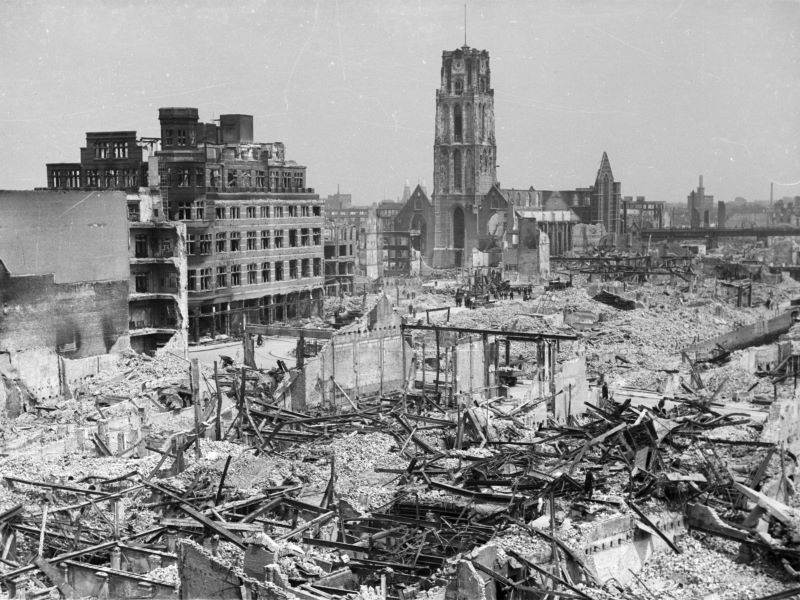
Thomas Delleman (1898–1977) served as a minister in Aalten from 1930 to 1938 before moving to Rotterdam-Kralingen. Following the Bombing of Rotterdam in May 1940, he took the initiative to arrange for children from his new parish to stay in Aalten for a holiday. During the war years, a total of approximately 800 children from Rotterdam were taken in by host families in Aalten.
Delleman contributed in other ways as well. He ensured that young men wishing to evade the Arbeitseinsatz (forced labour) could go into hiding in Aalten. Furthermore, in 1943, around 500 evacuees from Scheveningen were accommodated in Aalten. During the ‘Hunger Winter’, trains carrying food regularly departed from Aalten for the west of the country.
This dedication made a profound impression in Rotterdam and led to the formation of a committee after the liberation to thank the people of Aalten.
Origin of the Commemorative Window
Initially, the intention was to place the window in the Westerkerk, as more than forty young men had been arrested there during a roundup (razzia) in 1944. However, all the windows in the Oosterkerk had been shattered after a V1 rocket landed nearby in January 1945. Consequently, it was decided to install the window in the Oosterkerk instead.
The window was designed by the Rotterdam artist Marius Richters (1878–1955) and executed by glazier Henri van Lamoen (1900–1949). With a height of eight metres and a width of over three metres, it is one of the largest stained-glass windows in the Achterhoek. Richters utilised bold colours and clear, almost narrative scenes that express both the threat of war and the warmth of the relief efforts.
The window was installed in the front facade of the Oosterkerk and officially unveiled by Rev. Delleman on 13 July 1946. The ceremony was broadcast live on the radio by the NCRV.
Design
The window is over eight metres high and three metres wide, set within a trifora.
Commemorative Window in the Oosterkerk, Aalten
At the top: The coat of arms of the Netherlands with the motto “Je maintiendrai”. Below this is the Dutch Maiden, holding the flag in her right hand and a burning torch in her left. On either side stand a farmer and a bricklayer, referring to the post-war reconstruction.
Central: A farmer and his wife, symbolising the people of Aalten, surrounded by children and a person in hiding. From both sides, German soldiers with bayonets march into the scene.
Bottom left: Emaciated women and children pleading for help.
Bottom right: A group of people who have been helped, returning home supplied with foodstuffs.
Bottom centre: The coat of arms of Aalten featuring the linden tree and the coat of arms of the House of Orange, with a scroll reading: “Uit dankbaarheid voor hulp in oorlogstijd, soli Deo gloria” (In gratitude for help in wartime, to God alone the glory). Biblical texts are incorporated elsewhere in the window.
In 1947, two side windows were added to either side of the main window. These feature the symbols of the four Evangelists, images of Moses and Isaiah, and at the bottom, the coats of arms of Rotterdam, Scheveningen, Utrecht, Amsterdam, Kralingen, and a Star of David.
At the base of the side windows are lines of verse by Muus Jacobse (pseudonym of the poet Klaas Heeroma):
Maar als ik leven mag tot de bevrijding en juichen op het overwinningsfeest, God, doe mij dan dit weten, wat voorbijging aan nood en leed is niet vergeefs geweest.
(But if I may live until the liberation and rejoice at the victory feast, God, then let me know this: that the hardship and suffering which passed was not in vain.)
Current Status
The commemorative window can still be seen in the Oosterkerk. When the church was repurposed as a residential care location in 2021, it was formally agreed that the window would be preserved. This ensures the window remains not only an artwork of exceptional scale but also a lasting war monument and a tangible reminder of the aid and hospitality offered by Aalten during World War II.
Quite unexpectedly, H.M. the Queen paid a visit to our municipality. On Wednesday afternoon, the cars carrying H.M. the Queen, her secretary, Miss Geldern, and her secretary, Mr. Kohnstam, arrived from the direction of Dinxperlo and stopped in front of the home of the alderman of Aalten, Mr. H. J. Wikkerink, better known in illegal circles by the name of “Oome Jan”.
“Oome Jan” has a respectable record of service in the underground movement during the years of occupation and currently resides in his workshop “Nooit Gedacht”, as the Germans, out of rage that they could not capture “Oome Jan”, set fire to his house next door. The Wikkerink family had been informed of the royal visit only moments before.
Her Majesty, who arrived around one o’clock, stayed for more than half an hour in the home of “Oome Jan” and enjoyed a cup of tea with relish. Meanwhile, several prominent workers from the illegal movement had gathered in the living room and were soon engaged in a busy conversation with Her Majesty.
H.M. leaves the emergency dwelling “Nooitgedacht” in Aalten
From the conversations, it appeared that She was already aware of the important work carried out here in the Achterhoek during the war years, and She inquired with interest about various details. Both “Oome Jan” and Messrs. Lichtenberg of the L.O. and Allersma of the K.P. spoke of the underground work and the dangerous tasks that had to be completed. They also recalled the spontaneous cooperation of the population and the aid to the West in the form of wagonloads of rye bread, which were sent at a very low price.
A charming detail was also the presence of Mrs. Jedwab with her young son, who at the time had been left as a foundling on the doorstep of “Oome Jan’s” home while the parents were in hiding. This Jewish boy was then lovingly taken in and given the name Willem Herfstink, as autumn had just made its entry that day. Rev. Kuijper also spoke of the razzia, which was held on January 29, 1944, in the Reformed Church, during which 42 people in hiding were arrested and only a few were able to escape. The mayor, who was also present at “Oome Jan’s”, also shared some information about the events of the past years.
Originally, it had been H.M.’s intention during her journey through these regions to visit the “Somsenhuus”, the farm of Mr. Prinsen in IJzerlo, where so much underground work was performed in recent years. Members of the K.P. found shelter here for a long time, as did a number of English pilots who awaited liberation here. This farm burned down after the liberation due to a lightning strike. This visit did not take place. Between Dinxperlo and Aalten, the cars turned into a side road near the Prinsenboschje, where the party had some refreshments in the car.
A massive crowd had gathered in front of “Oome Jan’s” home, where the monarch was heartily cheered. Upon her departure, the Wilhelmus was enthusiastically sung. This day will surely remain long in the memory of “Oome Jan” and his comrades, who so often risked their lives in the struggle against the oppressor and did so much for our people and fatherland.
Now that the emergency hospital in Aalten is closing its doors, it is fitting for us to pause for a few moments to reflect on the origin and work of this institution, which served as a blessed outcome for countless Dutch forced labourers and prisoners from concentration camps. As is known, the initiative for its founding was taken under the auspices of the Red Cross, by Dr J. der Weduwen and Mr Cl. Driessen.
Staff of the Aalten Emergency Hospital
The necessity for its establishment became acutely apparent at the end of November, when some of the victims of the train bombardment near Bocholt had to be admitted in Aalten. When Dr J. der Weduwen arrived at the Avondvrede retirement home on 5 December 1944 with 22 liberated prisoners from Rees, the situation presented nearly insurmountable difficulties. Beds, food, and trained staff—everything was lacking.
The residents of the home, on that memorable St. Nicholas Eve for the ex-prisoners, brotherly shared their pancakes, oliebollen (doughnuts), and chocolate (!) with the newcomers. By exerting every effort, they succeeded in providing the battered patients with proper care. Mr and Mrs Ditmarsch, deeply moved by the fate of these people, did everything possible.
With emotion, many will remember Sister A. Bol, who died of diphtheria and performed true miracles for her patients during this time. After her death, it proved necessary, given the danger of contagion, to attach expert personnel to the emergency hospital. Sister Schaafsma and Sister Doesburg were entrusted with the management under the supervision of Dr P. Hogenkamp, who took over the medical work of Dr der Weduwen following the tragic passing of this beloved doctor.
Avondvrede Retirement Home, Hogestraat, Aalten
Although more space was made available at Avondvrede, the capacity of the hospital proved too small, as one also had to take into account war victims from the local area; therefore, the hospital was relocated to the Patrimonium building. In cooperation with the U.V.V., I.K.O., and the Red Cross, the material side of the work was taken care of. After the final bombardment, the Patrimonium building became unusable, and it was decided to liquidate the hospital, as the majority of the patients, under the leadership of Sister Schaafsma, preferred to leave for the North.
Sister Doesburg remained at her post with a few patients, and the hospital was moved back to Avondvrede. From there, they departed once more—joined by a number of victims from the bombardment in Bocholt—to the building on the Lichtenvoordsestraat, which still serves as an emergency hospital today. About twenty patients were housed in the cellars there. Enormous support was received from the surrounding hamlets.
De Graafschapper, 14 July 1945
In the beginning, the conditions were extremely primitive. Later, everything improved. Special praise is due to the girls of Aalten, who performed nursing work without any prior training. Just before the liberation, some victims of the liberation battles were admitted. An unforgettable moment was, of course, the arrival of the first ‘Tommy’ (British soldier) who was brought into the hospital.
And now the work has come to an end. The large stream of repatriates, for whom they had prepared as their final task, did not arrive, and the now well-equipped emergency hospital is disappearing in these coming days. (Why not make it a permanent hospital?) A piece of Aalten’s war history is hereby concluded, but many will continue to remember this work with gratitude.
On Friday, another session of the Military Court was held in the council chamber of the town hall. Major Jhr. Mr. van Nispen tot Sevenaer served as president, while Mr. Arriëns acted as military prosecutor.
Behind closed doors, the case against H.A. v. T. was handled first; he was sentenced to 1 year in prison for a sex offense, of which 8 months were suspended with a probation period of 3 years.
Also behind closed doors, the case of F.K. Meijnen was heard, who was sentenced to 9 months in a reform school for looting. The defense counsel in this case was Mr. Voorink from Winterswijk. A. Meijnen, who had stolen cigars and tobacco while clearing rubble from a bombed house, was sentenced after a plea by Mr. Voorink to 3 months in prison with a probation period of 2 years.
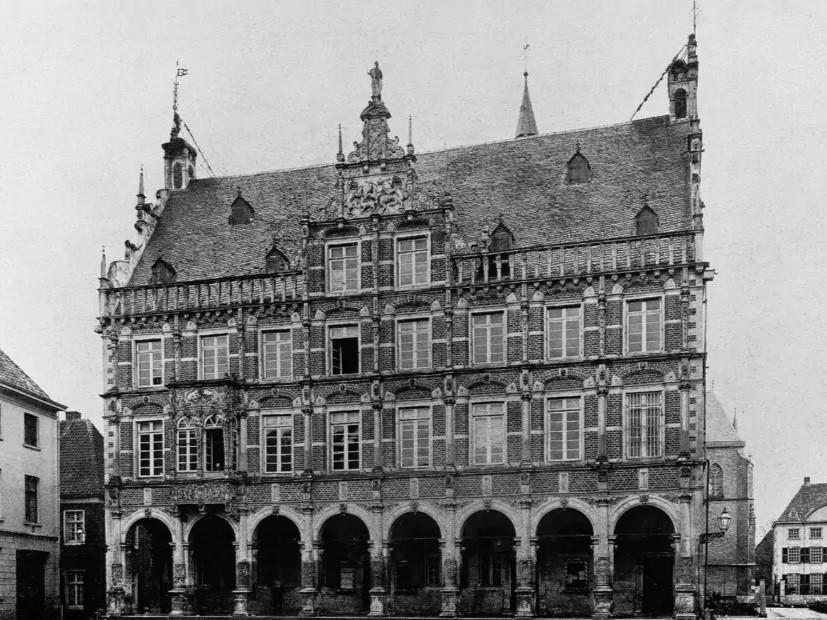
The Town Hall on the Markt in Aalten
E.J. ter Heurne is accused of having taken a lady’s bicycle belonging to Miss J.W. Wesselink. The defendant denies taking the bicycle. According to him, he stored the vehicle after it had been abandoned by an SS man. In view of the bicycle requisitioning, he removed the tires and the saddle. This occurred in October 1944. Miss D. Kuijntjes is heard as a witness for the defense, confirming the defendant’s account. She had even ridden the bicycle.
A debate ensued between the defense counsel and the court regarding the circumstances of this case. No clarity could be reached, as the stolen bicycle was only taken months after October. The case is therefore adjourned to hear several more witnesses.
Meanwhile, M. Wensink appears before the court to answer for the fact that he gave 4 kg of bacon for a stolen bicycle. The defendant denied knowing that the bicycle was stolen property, which the military prosecutor did not find very credible, given the demand: 3 months suspended with a probation period of 2 years and a fine of ƒ 500. The court, however, judged otherwise and acquitted the defendant.
A certain Melitz, an SS man, appeared to have stored a nice amount of fertilizer. Now that he has disappeared, a number of farmers examined the matter and brought the fertilizer to their lands. This brought them before the court, which sentenced them to fines ranging from ƒ 25 or 25 days, while one was acquitted. After mutual consultation, they immediately “opened their purses.” At least it wasn’t a black market price.
H.J. te Grotenhuis needed several items, including a bread knife, a pair of bloomers, and a few cow halters, and stole these from various people. This is the same person who recently attacked an N.B.S. man with a knife during his arrest after escaping. Te Grotenhuis did not make a very reliable impression and is apparently not fully accountable for his actions. The court evidently took this into account and sentenced him to 6 months in prison.
After this, the case of E.J. ter Heurne was resumed. The bicycle was wheeled in and examined by the owner, Miss Wesselink. She declared that it was indeed her bicycle. A.J. Wentink, heard as a witness, stated that he had seized the bicycle in question from ter Heurne. He also recognized the bicycle. The defense witness Miss Kuijntjes also came to view the bicycle and could only partially recognize it. The bicycle she saw at ter Heurne’s in October was in better condition. After the municipal supervisor R. Hoogeveen was also heard as a witness in this case, the military prosecutor demanded a prison sentence of 2 years. The court reduced it by half, so ter Heurne will have to serve 1 year for this offense. Arnoldus Florentinus Voorink also pleaded in this case.
The following defendants have quite a lot on their conscience. A sheep was stolen and slaughtered; about 50 eggs were snatched, as well as a number of chickens and a quantity of tobacco leaves still in the field. Suspected of this are the brothers A.H. and H.J. Bettink in association with H. Dibbets, who in turn, together with T.W. Jansink, stole sheep’s wool and, with one of the Bettink brothers, approximately 500 kg of potatoes.
Messrs. Bettink and Dibbets also worked for their own account. For instance, H.J. Bettink pilfered two shirts, a pair of socks, and a quantity of tobacco while clearing rubble at the house of F.J. te Linde; H. Dibbets took a watch, a shirt, a pair of socks, spools of sewing thread, and a deck of playing cards. Finally, the father of the brothers, H.J. Bettink Sr., was the underlying cause of the thefts of the sheep and the potatoes and had to answer for intentional incitement.
The boys readily confessed to the charges, but Bettink Sr. declared that everything was a lie. The claim that he had encouraged the thefts was pure fabrication. On the contrary, he had always set a good example for the boys and forbidden them to steal. This statement caused quite some hilarity, given the man’s record. The sentences were far from lenient. A.H. Bettink received 3 years, with credit for time served in pre-trial detention.
T.W. Jansink was sentenced to 6 months, while a report will still be issued regarding H. Dibbets on the possibility of placing him in a youth prison. A psychiatric report will be issued for H.J. Bettink Jr., as he was considered to have significantly diminished responsibility. H.J. Bettink Sr. reaped the bitter fruits of his good intentions and will not be able to keep his sons on the right path for the next few years. He was sentenced to 4 years.
Next to stand trial as a victim of his own good intentions was E.J. van de Lende, who, while clearing rubble from the house of F.J. te Linde, had taken a pair of men’s trousers, a piece of lining fabric, and a remnant to keep them safe and out of the hands of the Germans. This happened on 24 March. In the meantime, however, a skirt had already been made from the fabric, which the court took very seriously. He had also forgotten to return the items. The goods were only returned once the case was in the hands of the police. This forgetfulness cost him 8 months in prison, and the goods must be returned.
At the conclusion of the session, the president, Major Jhr. Mr. van Nispen tot Sevenaer, paid tribute to Sergeant Bruggeman, whose excellent work and very good official reports greatly facilitated the work of the court.
I can imagine that as a former Achterhoeker, born and raised in our beautiful region, you are very curious about news from our region and how we are all doing here. It will be a pleasure for me to inform you from time to time of what has happened here and what is going to happen. Let me start by telling you that we have generally come off well here in our Achterhoek. The Tommies who came in here from the direction of Bocholt just before Easter were amazed by the friendly, apparently still prosperous country. into which, after the debris fields of Germany, they were suddenly transferred.
Liberation parade Stationsstraat, 1945
“You see here again an undamaged house,” said one to me, “and you see friendly people again, who laugh and wave at you! We have experienced that differently in recent months” Still, it was not given to us as a gift, don’t think so. The last six months in particular have been quite haunted here. Also in the political field. It was raid after raid. Greens, blacks, land guards, Gestapo, S.S., we have experienced all that beauty in its different variations here. Anyway, you have experienced that yourself in the city. so you know all about it. Let me rather tell you how we celebrated the liberation here, when it became known that our entire people was freed from slavery.
I can tell you best about Aalten, where I happened to experience it myself, but I am sure that the same enthusiasm prevailed throughout the Achterhoek. You should come to Winterwijk today, which was worn out for a hotbed of the party, right? It only now becomes clear what a “thin” layer of the population there actually kept the terror going, because there is no municipality in the Achterhoek, where you see flags as exuberantly as right there.
‘Uncle’ Jan Wikkerink
The music was immediately on his feet, you get that. In the afternoon a whole procession with children and the elderly followed through the decorated streets and it was a joy to hear a Dutch march again. The case stopped for a moment in front of Jan Wikkerink’s house. You may remember them from school in the past. And otherwise I just say “Uncle Jan”, then at least every person in hiding in the Achterhoek knows who it is. Well, that musical tribute at his doorstep was, in my opinion, exactly right. Because that’s just an ordinary contractor, isn’t it? but what a lot that man has achieved during the war years, so secretly gone.
He was quietly district head of the National Organization for People in Hiding and made sure that all those boys stayed alive and, if possible, out of the hands of the slave hunters. He and his men housed countless people there, (you know that there in Aalten they have the name hadden. dat there were as many people in hiding as inhabitants?) and where it was necessary to provide all those people with ration cards, not only city people, but also a lot of Jews and everything else, with the Gestapo on their heels, den Achterhoek came fleeing in. In cooperation with the Knock teams, many distribution offices in our area have been honored with a fruitful visit and Oome Jan always had the quiet, cautious leadership of them.
Dela Wikkerink-Eppink with Aron Jedwab alias Willem Herfstink
It was therefore no surprise when one night a child was abandoned on his doorstep. After all, he knew what to do with everything and everyone and he was simply the big placement agency, apparently also for babies. Anyway, the little one didn’t have to go far, he stayed at the same address, i.e. on the other side of the front door, where he was lovingly welcomed. It was exactly on the 21st of September and so the foundling was officially registered at the town hall the next morning with a straight face under the name Willem Herfstink . (After all, the suffix “ink” means “the son of” in Achterhoeksch). But on the first day of the liberation, the “Son of Autumn” returned to his own address, namely to the Jew master, who was very happy with his wife that they had kept their little one safe in such a dangerous time. You understand that that card was again pierced with real Achterhoek cleverness. The doctor had taken the child of the parents in hiding straight to Uncle Jan, who was already waiting for it behind the door.
It was a shock to the whole region when they finally got hold of Uncle Jan. If the whole region heard about it as soon as possible, because the captivity lasted only a few hours. The knock team could have put it right sooner, but they had to wait a while for the doctor for the chloroform and the sergeant on duty of the military police also had to rehearse how he should be intoxicated as really as possible. But then it was done, only the doctor was still busy for an hour and a half to call the good sergeant back to life, because the boys had worked him a bit too enthusiastically with the chloroform-dot.
Dr. der Weduwen
The quiet figure of Uncle Jan had since disappeared from sight, but he now had so much more time for his illegal work. The Germans were furious as usual and knew nothing better to do than to throw a few hand grenades into his house in impotent rage, which of course burned down in the end. But better the house than Uncle Jan, everyone said comforted, and so the music of the week was a spontaneous tribute from the whole population. And it was certainly also with the approval of the whole village, when later a few songs were played in front of the house of the late Dr. of the Widows, who gave so much clandestine help and in particular was a lifesaver for many boys in the camps of Bocholt and Rees. The Achterhoek knows how to celebrate, but also to sympathize with those for whom the party is impossible due to harrowing memories.
At the end of my letter, I will tell you one more example of this, which will do you good. It was in one of the rural districts that the music association went around the farms with blaring festivities. But there was a shadow over this rural district. On the last day before the liberation, a direct hit in an air-raid shelter had snatched five children from one family, with two older evacuees, from their lives. The site of that disaster was on the main road, where the procession passed. But a hundred yards from that place the music fell silent, and they went on in silence. And there at that burned-out shelter that chorale of the 103rd Psalm was played in the moving silence of all neighbors: Like the grass is our ephemeral life… Then they quietly moved on and only at a great distance from that place the festive music was resumed.
I am writing this to you because I know it will do you good. The war has not hardened us and made us numb. There is still room in the heart of the Achterhoek for compassion and quiet piety.
Deze website gebruikt cookies voor een optimale ervaring en analyse van bezoekgegevens. Ga je hiermee akkoord? Zonder toestemming werken sommige onderdelen van de site mogelijk minder goed.
Functioneel
Always active
De technische opslag of toegang is strikt noodzakelijk voor het legitieme doel het gebruik mogelijk te maken van een specifieke dienst waarom de abonnee of gebruiker uitdrukkelijk heeft gevraagd, of met als enig doel de uitvoering van de transmissie van een communicatie over een elektronisch communicatienetwerk.
Voorkeuren
De technische opslag of toegang is noodzakelijk voor het legitieme doel voorkeuren op te slaan die niet door de abonnee of gebruiker zijn aangevraagd.
Statistieken
De technische opslag of toegang die uitsluitend voor statistische doeleinden wordt gebruikt.De technische opslag of toegang die uitsluitend wordt gebruikt voor anonieme statistische doeleinden. Zonder dagvaarding, vrijwillige naleving door je Internet Service Provider, of aanvullende gegevens van een derde partij, kan informatie die alleen voor dit doel wordt opgeslagen of opgehaald gewoonlijk niet worden gebruikt om je te identificeren.
Marketing
De technische opslag of toegang is nodig om gebruikersprofielen op te stellen voor het verzenden van reclame, of om de gebruiker op een site of over verschillende sites te volgen voor soortgelijke marketingdoeleinden.