
‘THE ATTACK ON AALTEN’
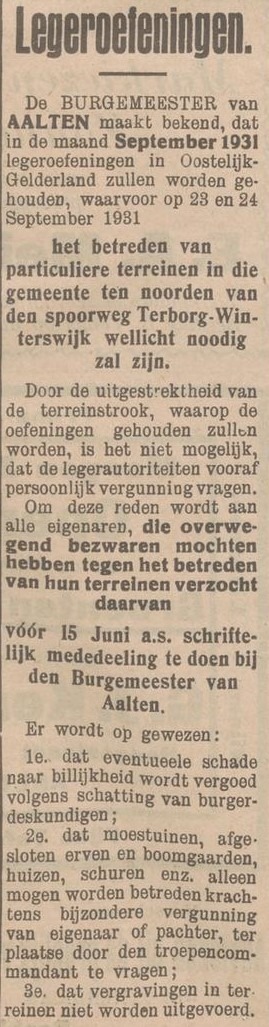
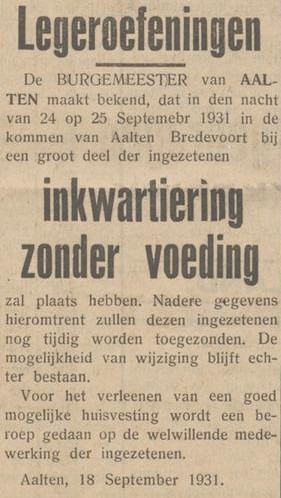
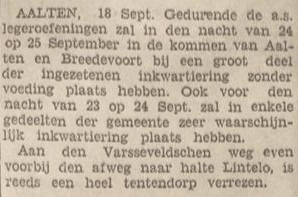
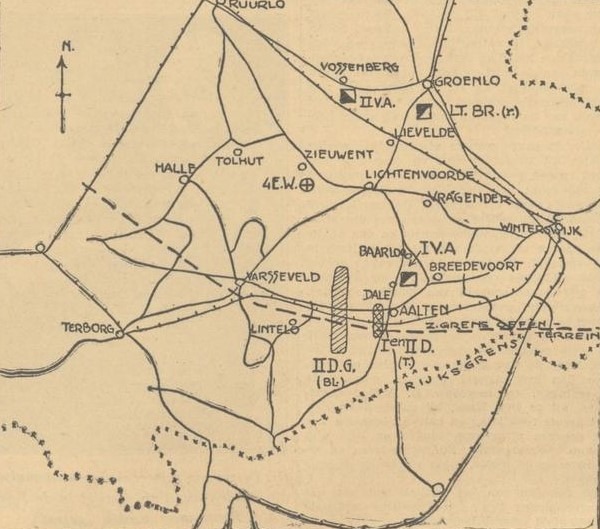
At the end of September 1931, large-scale army exercises took place in the Achterhoek, in which the municipality of Aalten also formed part of the battlefield. Troops were billeted with civilians, and a complete tent camp was erected on the Varsseveldsestraatweg in Lintelo. The simulated skirmishes attracted many curious spectators, and the press reported extensively. Below are several fragments from newspaper articles of that time.
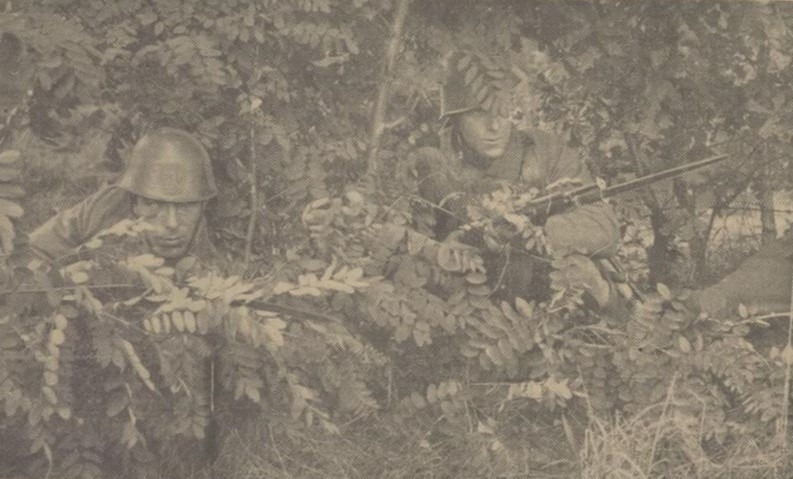
Wednesday and this morning, our town was the centre of the manoeuvres. All day long, the aircraft circled above this area, and from the railway line to the North, straight through the Wolboom and the Aalter Esch, it was one continuous line of outposts and machine-gun groups.
Half of Aalten, as well as a very large number of strangers, visited the “front”. We also noticed a great many German cars. Night fell without an encounter having taken place. The posts remained in position and spent the night in so-called “dog kennels” on a thick layer of straw and provided with a few blankets. In some parts of the village, where the Red troops lay close to the houses, coffee was brewed all night long, and in many families there, not much sleep was had.
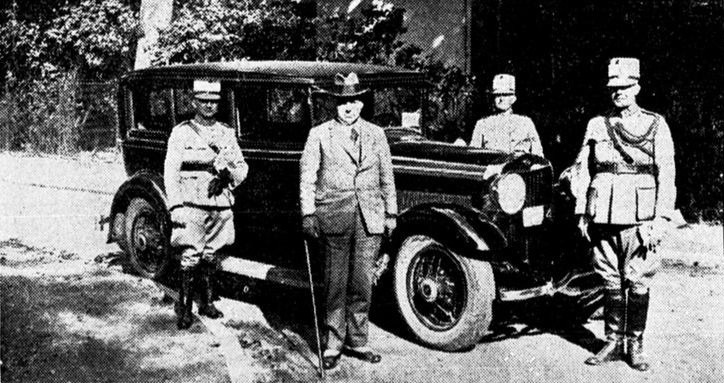
When we stood on the Aalter Esch at nine o’clock, Blue had gained combat contact and heavy firing was also heard in the North. The Red outposts lay with one or two men in a bundle of straw like birds in a nest. It might have appeared as if they had just crawled out of a strange egg, but that was not the case; they had lain on that windy height all night.
Blue could not advance further for the time being and this, as we know, was not the intention either. After all, the decision was to be forced to the North and South of Aalten.
By a field kitchen
A sergeant-messmaster writes to us from the battlefield: It was three o’clock in the morning on Wednesday when the 10th and 22nd Infantry Regiments departed from Ede with all vehicles by train to take up the defensive position of the Red party near Aalten. The organisation — truly no small feat with such nocturnal transport en masse — proved to be in excellent order and everything proceeded with the greatest regularity, so that troops and baggage train arrived promptly at the agreed time of 6:15 AM in Aalten.
The morale among the troops is high, to which the well-filled bread bag (bread, cheese, and extra currant buns) certainly contributes its share. Moreover, the weather is beautiful, and nothing boosts the morale of the troops as much as good weather and good food.
“As long as the rations are in order, messmaster,” said a giant of a fellow from the troops in his sturdy Rotterdam dialect, “then we’ll manage the hauling.” And my cooks see to it that the rations are in order. Just outside Aalten, a set of field kitchens is stationed, and the personnel, one cook and two assistant cooks for each kitchen, are already busy ensuring that the coffee is ready at 12 o’clock and that a large quantity of hutspot is ready for the hungry troops by about five o’clock.
The fires are burning; in one pot of my field kitchen, the water for the coffee is boiling, and in the other pot, the carrots and onions are already beginning to simmer, as the cook calls it. Now, this afternoon, the potatoes still need to be boiled, the boiled meat mashed in with fat, and the troops can enjoy a hearty meal.
To the front
At 10 o’clock, the order came to “line up as close as possible to the respective company,” and so the field kitchen, while the pot was tended to during the journey, moved to a small outdoor café near Aalten, where we positioned ourselves under the trees, “covered from enemy aircraft” as it is called. Our men are in the defensive position and, beaming with pleasure because they have a “line,” are waiting in the sun for the enemy. And when the coffee was brought to them promptly at 12 o’clock, the unanimous verdict was that these manoeuvres weren’t so bad after all.
The bustle in Aalten
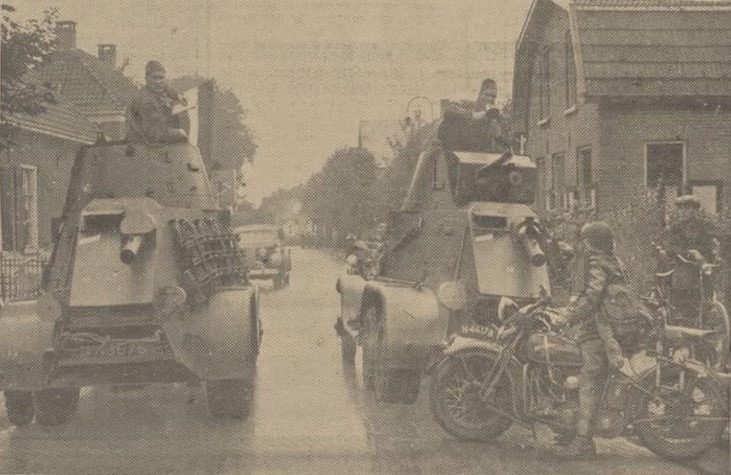
The otherwise so quiet and peaceful Aalten is now full of the clamour of war. Aircraft hum above the village and engage in mock dogfights, which all villagers watch with the greatest attention. But the field kitchens with the increasingly dirty cooks also attract attention. Motorcycles and cars with umpires shoot through the villages with loud bangs, and an extensive staff of military police ensures that the abnormally heavy traffic does not cause any accidents.
Distributing food
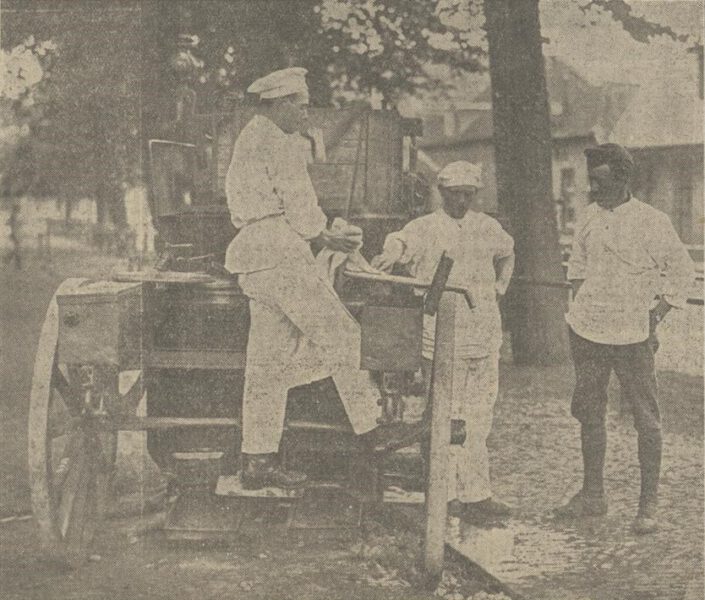
Five o’clock! The field kitchen heads out onto the country roads with a full pot of hutspot to deliver food to the company in its various units, the sections. The vehicle is greeted with cheers everywhere. The soldiers have a hearty hunger, despite the easy job in the defensive position. The food is excellent and sufficient, so there are no complaints or grumbling. On the contrary, jokes and quips fly back and forth.
There is only one concern left among the troops: where will we sleep tonight and when must we get up again. And that is precisely a question that cannot be solved for the time being, because the troops are in a so-called alarm position and a message could arrive at any moment that they must move forward or backward, and then instead of sleeping in quarters, it will be sleeping in small tents, with the possibility that just as the troops have fallen asleep, they receive word to depart elsewhere again.
Surprising things were unfolding there in the North. The Blue Reconnaissance Department, which had set out from Vossenberg towards Winterswijk, found Vragender occupied by Red and had established itself in Lichtenvoorde, the most important road junction North of Aalten. There, the Light Brigade now found itself missing out. It had received orders from the Red commander to occupy Lichtenvoorde, but encountered the Blue Reconnaissance Department there, which could still hold out for a while.
The commander of Red began to fear the threat to his Northern flank. He called upon his Grenadiers, who for this occasion were swift-footed, and who were hastily dispatched from Groenlo in Ford vehicles via Winterswijk towards Bredevoort to extend the Northern flank there. They took up positions on either side of the Bredevoort—Lichtenvoorde road, North of Barlo, just past the three-way junction.
End of exercise
Today, Thursday morning, the Blue troops advanced strongly, so that eventually the Red army had to retreat to the Lichtenvoorde road. After 11:30 AM, there was not much more for the very numerous public to see. Most had certainly thought that a major attack was still to come, but the army leadership apparently felt it was enough and nothing more happened. Particularly fine were the performances of the aircraft, which cruised incessantly above Aalten.
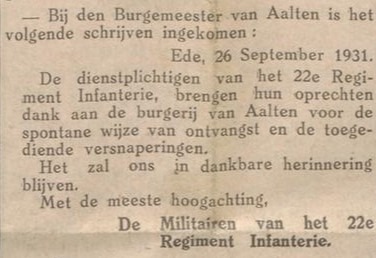
At 12 o’clock, the manoeuvres came to an end. Throughout the afternoon and evening, there was a great bustle in the streets of troops departing again, either to the station here, where long passenger and freight trains were formed and departed all afternoon and night, or on foot to Winterswijk to catch the train there. A large part remains here tonight, so there is a great deal of billeting. Tomorrow, peace will gradually return to the village.
Sources
via Delpher:
- Aaltensche Courant, 5 June 1931
- De Graafschapper, 18 September 1931
- Nieuwe Hoornsche Courant, 18 September 1937
- De Nederlander, 18 September 1937
- Zutphensche Courant, 19 September 1931
- Provinciale Overijsselsche en Zwolsche Courant, 24 September 1931
- De Maasbode, 25 September 1931
- De Zuid-Willemsvaart, 24 September 1931
- De Graafschapbode, 25 September 1931
- De Graafschapbode, 25 September 1931
- Aaltensche Courant, 29 September 1931