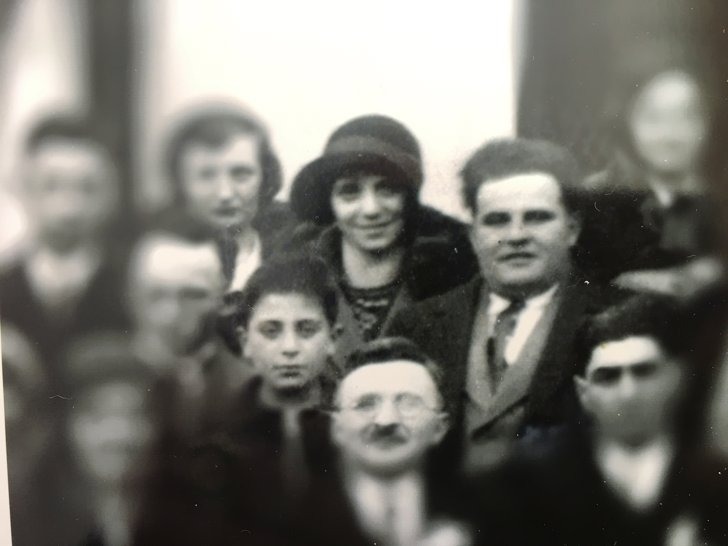
During World War II, the Jewish couple Frits and Amalia Landau lived in Aalten. Their lives ended tragically when they were executed by the resistance due to Frits’ dangerous behaviour. Their bodies were presumably buried in the countryside surrounding Aalten, but the exact location remains unknown to this day.
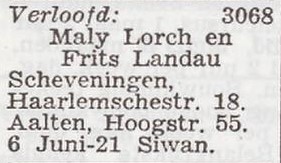
Frits Landau was born on 28 November 1905 in Aalten. He became a travelling salesman and remained unmarried for a long time. On 6 June 1942, he became engaged to Amalia Lorch, known as Maly, born on 20 December 1902 in Bocholt. They married in August of that same year and moved in with the Schaap family at ‘t Dal 1 in Aalten.
Soon, they were forced into hiding. From 1 April 1943, Gelderland was officially to be Juden-frei, Juden-rein (free of Jews). The Aalten population register states that Frits & Amalia departed on 17 March 1943, with no destination recorded. They subsequently stayed at two different hiding addresses, most recently with the Van Eerden family at the farm De Maote in the rural district of Dale.
Unpredictable and dangerous behaviour
It is said that Frits Landau was an alcoholic with a short temper, which led to unpredictable and dangerous behaviour. Reportedly, he did not make things easy for his hosts; he harassed young ladies and demanded his drinks every evening. He was accustomed to a luxurious lifestyle, yet in 1943, alcohol was barely available on the farms.
On several occasions, Frits threatened to betray his hiding places in order to buy his own freedom from the Nazis—at least, he assumed this would succeed. Twice, such attempts were thwarted at the very last minute.
Amalia and Frits Landau-Lorch (photo: Aalten Vooruit)Het Joodsche Weekblad, 5 June 1942
Liquidation by the resistance
Because he was considered a safety risk to other people in hiding by the local resistance, the decision was made to execute him to protect other fugitives and their helpers. The Council of Resistance and even local clergy discussed how to deal with him. Ome Jan Wikkerink proposed keeping Frits under permanent guard by other hiders and pilots. This did not happen, however, as several young resistance members took the initiative to eliminate him themselves.
They told the Landau couple that they would be taken to another hiding address in Vragender—a suitable excuse to get Amalia to come along with Frits. Incidentally, the intention was to separate Frits and Maly, as they wanted to spare her this fate. However, Frits refused to cooperate with being separated, and thus Maly was drawn into his fate.
Frits and Amalia Landau-Lorch were liquidated and buried in the countryside of Aalten by the local resistance in late 1943 or early 1944.
Location unknown
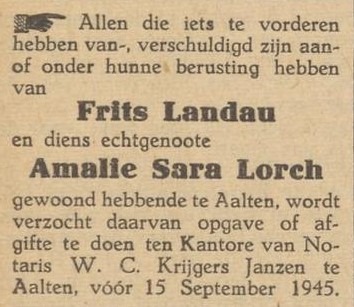
Aaltensche Courant, 28 August 1945
Opinions differ regarding the exact place and date of the liquidation. According to one theory, Frits and Amalia were killed on the Schaarsheide, close to the Nazarethdijk. Another theory points to the Daalse Goor.
The burial site of the Landau couple has been searched for several times, with the aim of giving them a reburial in the Jewish cemetery, but so far without result.
During a search on the Schaarsheide, a lady’s shoe and three rusted shovels were found. Investigation indicated that the shoe likely dates from the 1930s. It is plausible that the first burial site was discovered there. According to those involved, the bodies were later reburied. At the time, everything had to be done quickly, and apparently, it was later decided that the original burial site was unsuitable. During the clearing of the first grave, the lady’s shoe was supposedly left behind. Afterward, the mortal remains were reburied elsewhere, but where is unknown.
The most recent search took place in 2023. In a small patch of forest between Aalten and Lichtenvoorde, twelve experienced amateurs searched for the bodies of Frits and Amalia. Using detectors, they searched at various frequencies for different materials, but no human remains were found.
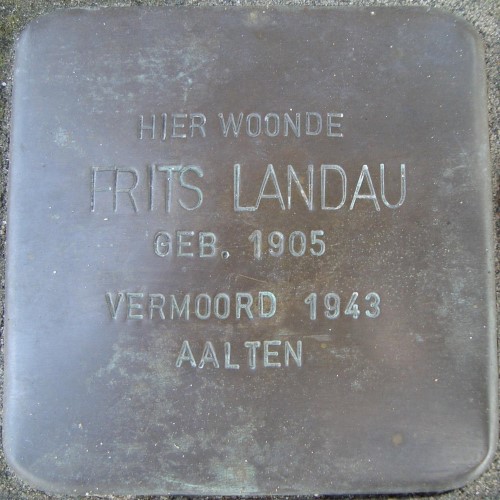
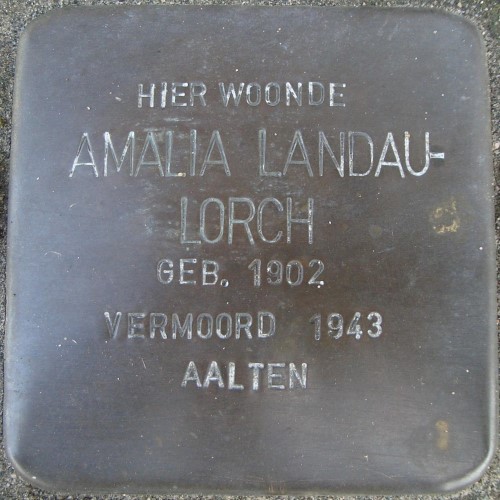
On 13 April 2016, two Stolpersteine (stumbling stones) for Frits and Amalia Landau-Lorch were laid at their last official residential address at ‘t Dal.
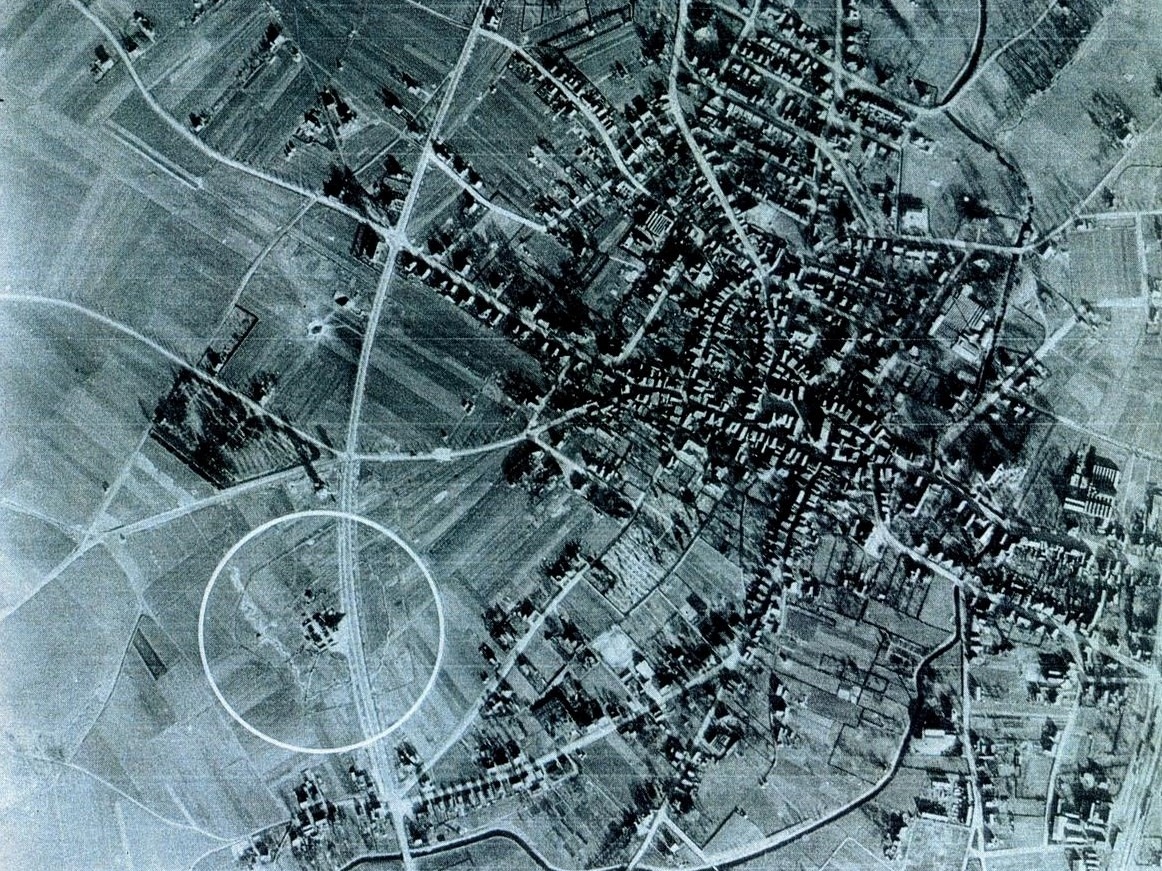
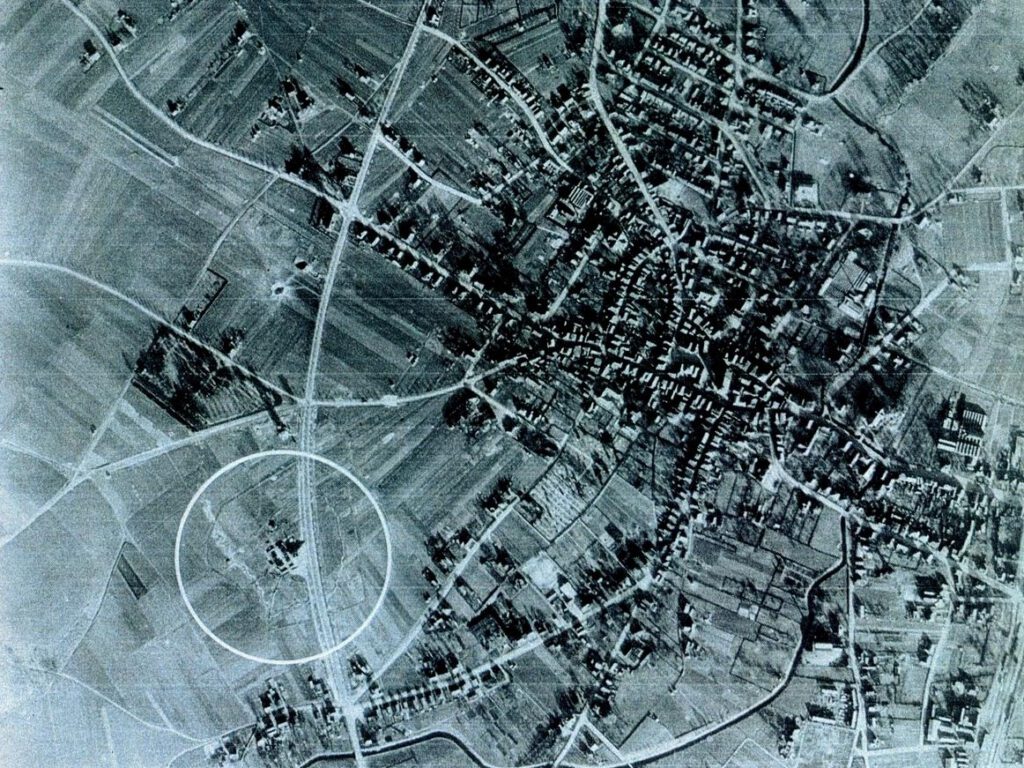
During World War II, the Germans constructed a Freya-type radar station on the outskirts of the village of Aalten. The location was situated north of the Ringweg, approximately halfway between the Tolhuis (tollhouse) and the water tower. This radar site was part of an extensive air defence system operated by the Luftwaffe.
The radar system, named after the Germanic goddess Freya, had been developed by the Germans in the late 1930s. It was capable of detecting enemy aircraft at a distance of approximately 150 kilometres.
The radar installation was situated on a site with a circumference of about 800 metres, surrounded by a system of trenches and barbed-wire fencing. Additionally, anti-aircraft artillery was present on the site.
Location Freya Radarstation, Aalten (1945)
There was a large radar unit, consisting of a red brick base, approximately seven by seven metres and three metres high. Mounted on top was the antenna, a metal framework measuring six by six metres. The large, square antenna screen could be rotated manually to the desired direction.
There was also a smaller radar unit, which lacked a brick base. Furthermore, there were approximately ten wooden barracks on the site, measuring four by six metres and painted green, used to house the personnel.
The immediate surroundings of the radar site were declared a Sperrgebiet (restricted area). The Ringweg was closed to pedestrians from the Tolhuis to the water tower. Signs marked “Militäre Werke” were placed in these areas. Cars and cyclists were permitted to drive through, but stopping or dismounting was strictly forbidden.
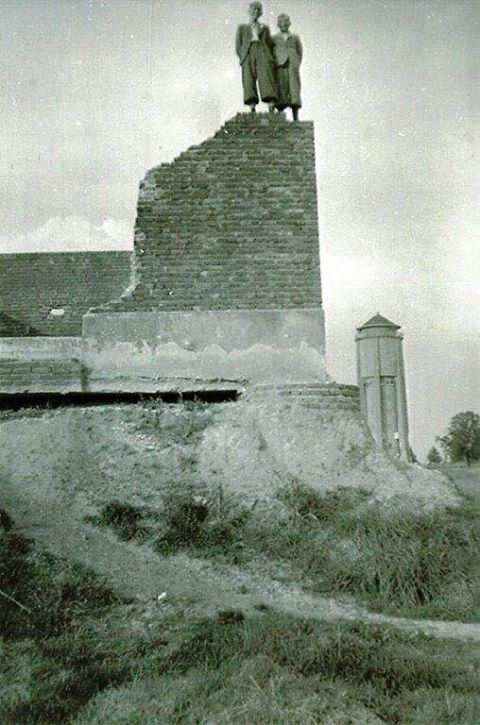
The Freya radar site in Aalten was constructed at the end of the summer of 1942. The site was abandoned in the autumn of 1944. Traces of the radar site, such as the concrete and brick housing for the antenna screen, remained visible until the early 1950s.
Features
Cadastral no.
L-583
Function
Radarstation
Year of construction
1942
Demolition
1950s
Remnants of the Freya Radar installation in Aalten, with the water tower in the background
Sources
Britse littekens in Aaltense bodem, feiten en achtergronden over de bevrijding op 30 maart 1945, Wim Rhebergen
During World War II, host families in Aalten provided shelter to approximately 800 children from heavily bombed Rotterdam. The initiative was spearheaded by Rev. Th. Delleman, a minister in Kralingen who had recently served in Aalten. Thanks to his dedication and the networks of both church communities, Rotterdam children were able to find temporary respite in the Achterhoek – far removed from the violence of war.
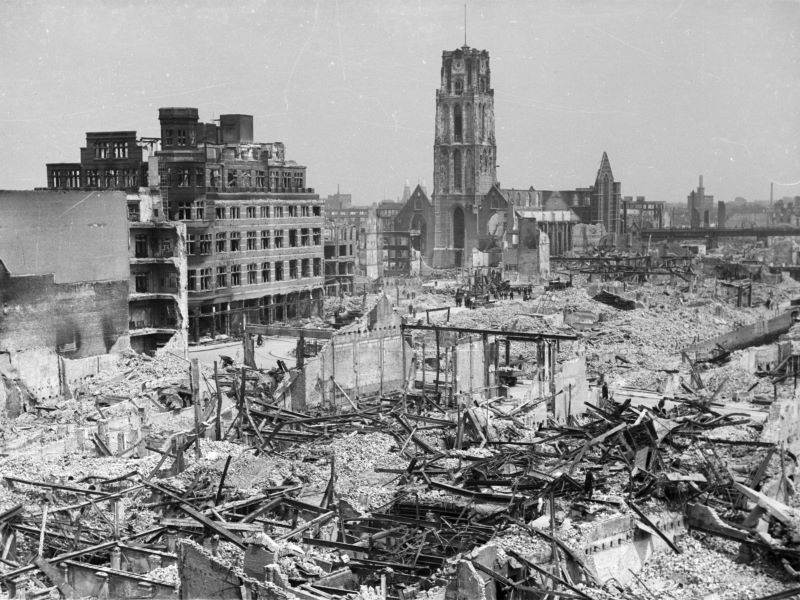
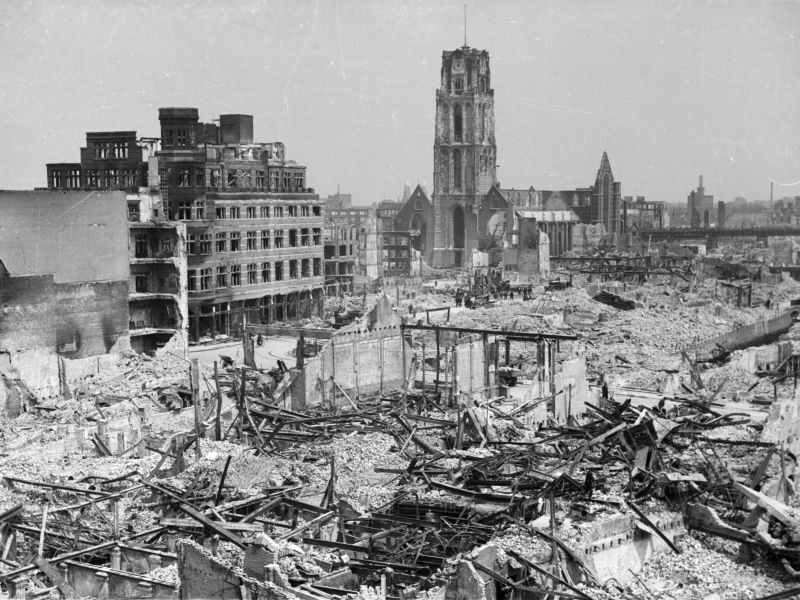
Rotterdam after the German bombardment of 14 May 1940
In May 1940, Rotterdam was struck by a devastating German bombardment. Almost the entire historical city centre was destroyed. In the Kralingen district, Reverend Thomas Delleman witnessed the consequences first-hand. He saw how, above all, the children were scarred by fear and grief.
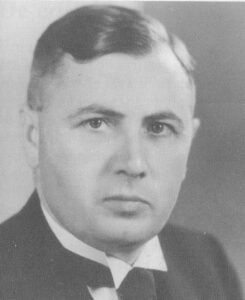
Rev. Th. (Thomas) Delleman (1898–1977)
Amidst this chaos, Delleman decided to take action. He knew the Achterhoek well: from 1930 to 1938, he had been a minister in Aalten, where he had experienced the hospitality of the local people. He believed that a temporary stay in the peaceful surroundings of Aalten would benefit the children – a place where silence and care could help them forget the war for a moment.
A committee was soon formed with the support of deacons and congregation members from both Rotterdam and Aalten. In July 1940, the first groups of children departed for the Achterhoek, where they were placed with host families.
Over the course of the war, an estimated 800 children from Rotterdam were cared for in Aalten and the surrounding area. Upon their departure for home, they often took gifts with them: eggs, bacon, rye bread, and sometimes even live animals. Later, the visits were supported by local diaconates. The last group of children travelled back to Rotterdam in February 1945. However, the connection remained: many children continued to return to their Achterhoek host families annually long after the war had ended.
A Wartime Letter
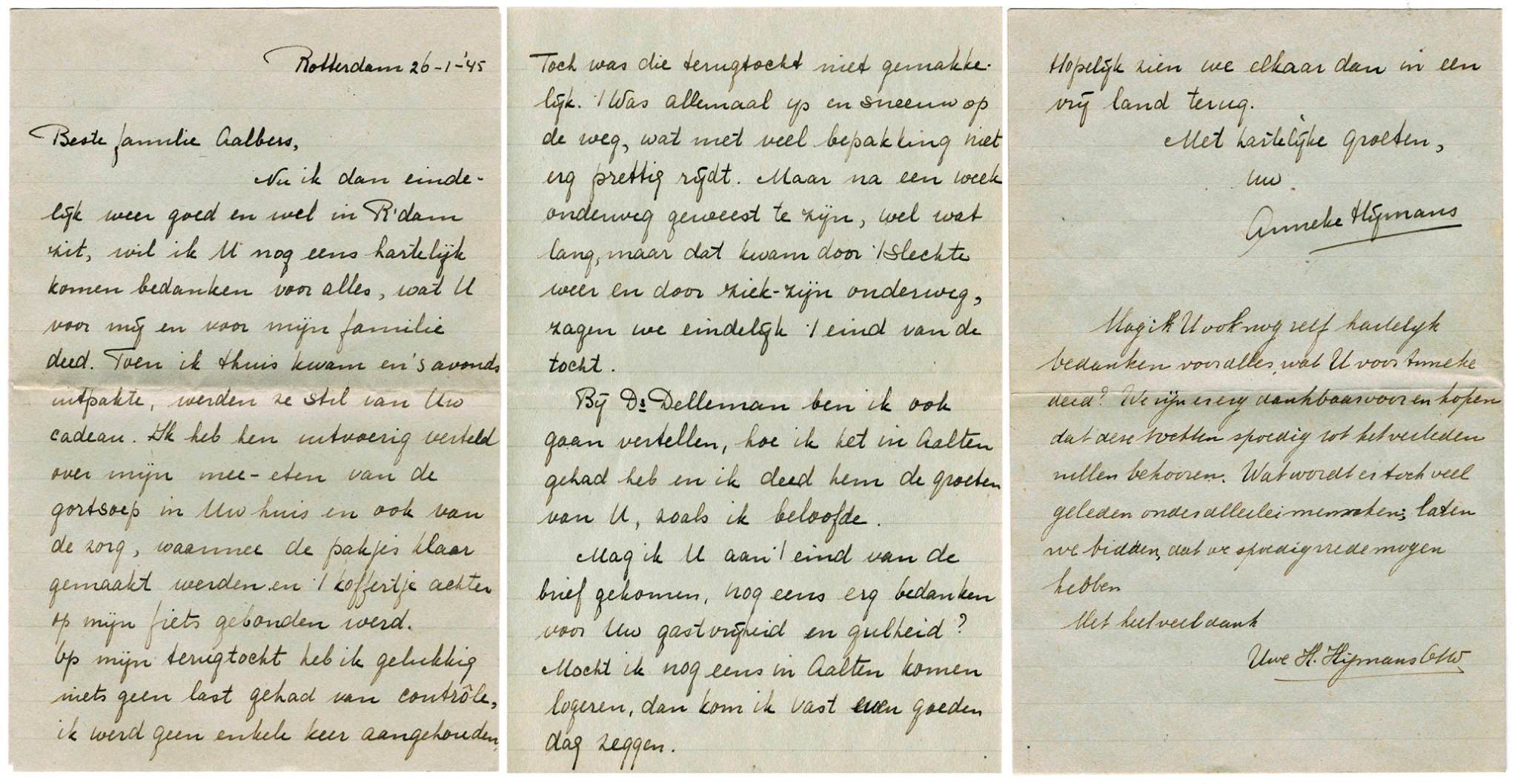
One of the children who came to Aalten thanks to Rev. Delleman was Anneke Hijmans. She stayed with the Aalbers family at ‘t Slat farm in IJzerlo. After her stay, she cycled back to Rotterdam in a single week. Shortly thereafter, on 26 January 1945, she wrote a letter to her host family — a personal document filled with memory and gratitude.
Letter from Anneke Hijmans to the Aalbers family in IJzerlo:
Letter from Anneke Hijmans to the Aalbers family in IJzerlo (image courtesy of Bea ter Maat-Aalbers)
Commemorative Window as Thanks
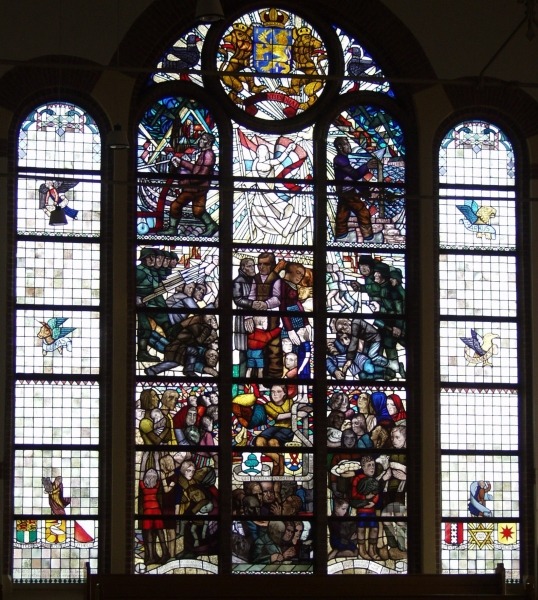
After the war, a committee was formed in the Reformed Church of Kralingen to present a commemorative window to the citizenry of Aalten on behalf of the collective churches and the Jewish community. It was a lasting gift in gratitude for the hospitality offered during the war years.
The window, designed by artist Marius Richters, depicts among other scenes how Aalten farmers and families welcomed children from Rotterdam. It was installed in the Oosterkerk in Aalten and officially unveiled on 13 July 1946 by Rev. Delleman himself.
Commemorative Window in the Oosterkerk, Aalten
Newspaper reports
‘Rotterdammertjes’ in Aalten
“Thanks to the benevolent hospitality of the Aalten Community, we were enabled to send approximately 100 children, largely from afflicted Rotterdam, to Aalten,” stated Mr B. Hoving in the Rotterdamsche Kerkbode. These children are now enjoying the peaceful rest and excellent care that Aalten offers them, far away from their devastated city.
Rotterdamsch Nieuwsblad, 17 August 1940
The ‘Rotterdammertjes’ Depart
Six weeks ago, we published a photograph of the arrival of the first ‘Rotterdammertjes’. This morning, the departure took place. At ‘Elim‘, the Reformed children bid their farewells. Each child was presented with a lovely souvenir of this holiday: a fountain pen and pencil in a case, kindly provided by Mr F. Buesink, ‘Febea’.
It was a scene of cheerful bustle. The children appeared in ‘full regalia’—which, in this context, meant with an average of three times as much luggage as they had arrived with. Naturally, there were all sorts of boxes, parcels, and bags filled with apples and pears (how fortunate that they are all ripe just now), as well as bouquets of various flowers, which, together with bunches of heather, are intended to provide a hearty welcome home. One child was so fortunate as to have stayed with a friendly baker, with the result that the little one was sent home with a currant loaf almost as large as the ‘Rotterdammertje’ itself!
There was an unprecedented crowd at the station; it was estimated that over 500 people were present. Rev. Th. Delleman spoke a brief word of thanks on behalf of all groups. He had not dared to hope that Aalten would have been so hospitable. “Rotterdam has been impoverished in many things, but your love has made us rich. Never shall Rotterdam forget the benevolence shown to her children.”
De Graafschapper, 30 August 1940
‘Rotterdammertjes’ return after a four-week holiday in Aalten
Loud cheering erupted from the special train that brought 128 children from afflicted Rotterdam families back to the ‘Maas City’ on Friday afternoon around four o’clock. The waving and shouting children would have liked nothing more than to jump straight out of the train windows to greet their mothers, brothers, and sisters, and to tell them all about their time in the Gelderland Achterhoek, in the friendly village of Aalten.
No sooner had they spotted one another than the children began to show what they had received from their foster parents. Almost all of them carried a box of flowers and gifts; one had received a rabbit, another a chicken, and one ‘Rotterdammertje’ had even been treated to a currant loaf… a metre long! Furthermore, everyone had received a fountain pen and a propelling pencil as a memento of their stay in Aalten.
The citizenry of Aalten has certainly spoilt the ‘Rotterdammertjes’. People had spontaneously approached the Diaconate of the Dutch Reformed Church with the request to send children from affected families, to provide them with a carefree month-long holiday. During this long holiday, thanks to the minister, Rev. Klijn, and the headteacher, Mr Hopman, the children visited numerous beautiful spots in the Achterhoek, while film afternoons also provided the necessary variety.
It goes without saying that the children thoroughly enjoyed themselves in Aalten. The acquaintance seems to have been mutually appreciated, as many Aalten foster parents invited the children to spend their holiday with them again next year upon their departure.
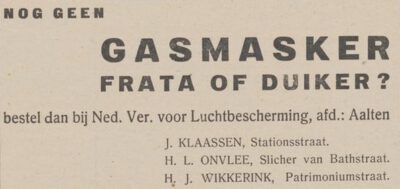
In the local Sociëteit (Social Club) last Saturday afternoon, an exhibition was opened by the Netherlands Association for Air Raid Protection (Nederl. Vereen. voor Luchtbescherming), to which the municipal executive, military officers, heads of various departments, and the boards of several associations had been invited.
The chairman of the Aalten branch, Mr Klaassen, extended a warm welcome to those present and expressed his sincere gratitude to the Mayor and Aldermen, the head of the Air Raid Protection Service, the board of the Sociëteit, and others for their cooperation in making this exhibition a success. The speaker announced that the Mayor was prevented from opening the exhibition due to a minor indisposition, and that Alderman Te Gussinklo had kindly agreed to deliver the opening address.
Mr Te Gussinklo began by apologising for the fact that he actually knew very little about air raid protection. He regretted that no better term had been found in the Netherlands, for “we do not protect the air, but rather protect the people from the dangers that come from the sky during a war via aircraft with their destructive bombs that bring death and ruin.” He questioned whether the population of Aalten, and of the Netherlands, was sufficiently aware of its duty in this regard. The answer, he stated, must be: no, the majority certainly are not. Therefore, it is very useful and very necessary that the Aalten branch has organised this exhibition.
It is often said that the army must be brought to the people, but the speaker also wished to posit that air raid protection must be brought to the people. It is highly necessary that the Dutch public knows more about this. For this reason, the Aalten municipal executive has strongly applauded this visual instruction. The speaker expressed his hope that this free exhibition would attract many visitors. Now that the war has continued for some time, interest has somewhat waned and might otherwise slumber further. However, when we consider that between 1,000 and 2,000 bombs are being dropped daily on a country in Northern Europe, we must wholeheartedly agree that this information is not unnecessary. To be forewarned is to be forearmed.
The speaker congratulated the board on the magnificent way this exhibition was arranged and therewith declared the exhibition open. After tea was served, a tour was conducted under the guidance of one of the gentlemen from the board of the Netherlands Association for Air Raid Protection.
De Graafschapper, 28 March 1941
Everything was clearly explained, and the numerous visual representations—both in pictures and in reality—of air hazards, their effects, and the measures taken against them, will certainly clarify much for all visitors that might not have been fully understood simply by reading booklets. Posters show us the varying population densities of different countries, the effects of high-explosive, incendiary, and gas bombs, the measures taken by the authorities and those that can be taken by citizens, etc. etc.
We see various gas masks, lanterns, a model of a cluttered attic compared to an attic as it ought to be, a model air-raid shelter, etc. etc. The clear explanations were listened to with great interest. It is to be hoped that this exhibition, which remains open until Tuesday and is entirely free to the public, will be well attended.
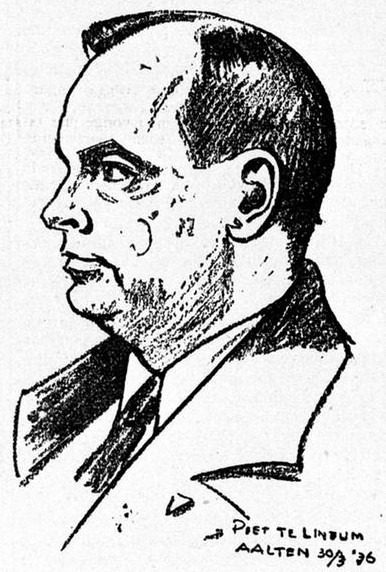
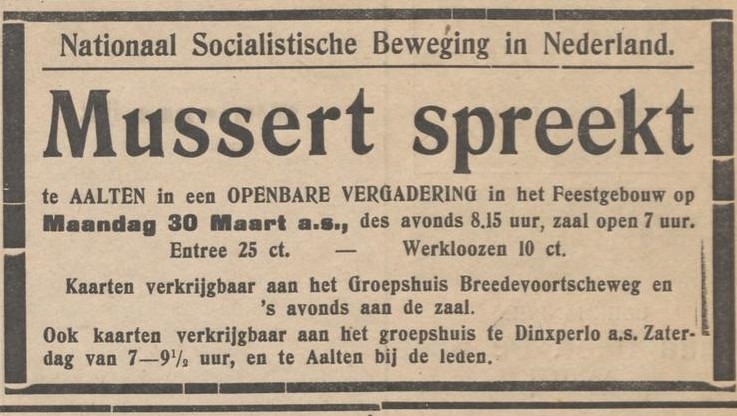
On Monday evening, a public meeting of the Nat.-Soc. Bew. (National Socialist Movement) in the Netherlands was held here in the Community Hall, where the leader of this Movement, Ir. A.A. Mussert, took the floor. There was an extraordinary amount of interest in this lecture. The entire Community Hall was occupied to every corner. A very large portion of the visitors had come from the surrounding towns, Winterswijk, Dinxperlo, etc.
Aaltensche Courant, 27 March 1936
The stage was neatly decorated in the colors orange-white-blue and supplemented with plants. The well-known emblems were also displayed in the hall. After the doors were closed at 8:15 PM and Mr. Mussert was received with the customary greeting, he immediately took the floor.
My fellow countrymen, perhaps there are some among you who think that I have come to Aalten to make you national socialists, but I cannot do that. You either are one, or you are not. It depends on what you feel in your heart. Gauge your own heart. If it tells you that what I have said is good, and you believe that we must take this path, then join us. Why am I a national socialist? Because I cannot live in such a mess. We desire things to be as good as possible. We cannot bring you a utopia. But things can and must be different! I shall justify myself to you by showing you how things are now.
I want to speak to you about the moral and material decline. First about the material decline, because it is easier to understand. No one can say that we have been living in a time of progress for the last 20 years. How poorly the farmers are doing. Every day they sink deeper into the pit. Go to Drenthe, to the cities, and see the decline in all classes of society. The unemployed, who learned about the 8-hour day from the S.D.A.P. (Social Democratic Workers’ Party). There are currently 500,000 who have brought it down to zero hours.
The moral decline: See the lack of discipline, the decline of religion. Where is the joy of work, the joy of life? Present-day society says: clothes make the man. That is how one is judged. They can keep the clothes; I want the human being! People are idling away nowadays. Professional expertise hardly exists anymore. Indeed, professional expertise is even often a curse.
Unreliability! Who is still reliable in this world! My fellow countrymen, who is to blame for this? You too will have heard it said here: it is God’s will that man perishes. No, that is blasphemy. We have had no droughts, no floods, etc., that destroyed everything. No. We have had enough of everything, so much even that we had to take it to the manure heap.
Stupid people have made such a mess of it, and we must try to make it better, and it can be better. The system of government is focused on democracy, and it masters the principle of divide and rule.
The country of democracy par excellence is the United States, and there is only one value left there: the dollar. Everything has its price there! And that is the extreme of democracy. Fortunately, we are not that far yet here.
Here they all promise something. If you vote for so-and-so, this and that will happen! That is simply impossible! Since 1920, the gentlemen of the right have governed. Two gentlemen, an Anti-Revolutionary and a Roman Catholic, go out together. One speaks for the R.C. and says, what would the R.C. church be without the R.C. State Party and says: vote R.C.! The other does the same for the A.-Revolut. in Goes. The next day they tell each other that they both did well, and so it has been for years and years!
Now that the N.S.B. is everywhere, the government wants to get rid of proportional representation and return to electoral districts. I shall be curious to see if they manage to do so.
Originally, democracy was well-intentioned. What has become of it, however? For 150 years, people have been working on liberty, equality, and fraternity. Liberty! I stand here in a gray shirt. I am not allowed to stand here in a black shirt, because then I am a danger to the state! In a gray shirt, I am not!
Fraternity! That does not exist at all. Equality consists of the fact that once every 4 years, by placing a dot, you can say which political party you belong to. The national socialist state will be a state of work, hard work. There will then be workers and rabble! Democracy lives off the dictatorship of the political parties. We will no longer tolerate that tyranny of the political parties.
In 1914, when I had to serve, they did not ask me which political party I belonged to. They only asked me that when they dismissed me from my office. Just as we were only Dutchmen then, we should surely be able to be so in normal times as well. The S.D.A.P. has turned from red to pink, and it is moving toward orange. They are getting to the point where, before they eat a pastry, they sing the Wilhelmus while standing!!
The gentlemen in The Hague also speak to the people through the radio now. Be calm, go to sleep peacefully tonight. Dad will look after you! The speaker would like to say to the gentlemen in The Hague: stay in parliament, then the people understand you best. We should have the feeling: state and people are one, but it is not so.
Education is also no longer good. Thousands of guilders are lost annually to vandalism. The people are no longer being educated. There is no longer a future. Where are we heading? Such is the situation! Those who still have something for themselves and otherwise have no interest in anything do not interest me. I need the people who do feel responsibility and want to help build up.
In the first place, we must become a people again! We must start by looking at our own people, to tidy them up. Then we will have done enough for the time being. Let us not interfere with the Abyssinians. There is enough to do here. One is national when one is prepared to make sacrifices for one’s nation. We have a task. This nation must not perish, but for that, we must first feel like a people again. Are we militarists? No, we are only Dutchmen and we want to sacrifice ourselves for the country when necessary, but then with good equipment.
We have 2 warships that were already outdated 20 years ago. I would rather not say how they are now. But when we send you out, it will not be on old scrap metal, but with modern ships. That is also the underlying cause of the mutiny on the “Zeven Provinciën”. That is our militarism. We shall, however, not force anyone to become a soldier who does not wish to do so for reasons of principle.
Once again, the beginning of everything must be: Ensure that you first become a people again! It is about one’s place in society, and democracy can never bring you this. Especially not in the countryside. There are more votes in Amsterdam than in the whole of Groningen, Friesland, and Drenthe. We want everyone, depending on the position they hold, to take their place within their people. The 8,000 miners will have their voice as a corporation, as will the farmers, etc. A people can only be great when everyone performs their task, not for themselves, but for the benefit of the entire people.
What we do is very ordinary; we are no longer mocked, but now feared. Not by the people, but by the government, because we want to make the people one again. That is why our black shirt had to go! But it will return, fellow countrymen, and in much greater numbers than they think!!
Applause.
When the Jews in Germany were dismissed from their offices, the Dutch shed liters of crocodile tears! But when Dutchmen were dismissed from their offices, they thought it was fine! The entire press is ruled by money, by democracy! This regime is perishing and the new rulers will be the national socialists or the communists. We always go straight ahead, we shall always speak the truth, also in “Volk en Vaderland“!
Yes indeed, in “Volk en Vaderland”. If it contains something that is not true, we shall take it back, but when I am asked to write somewhat softer words, I am not at home. We must cut out the wounds. Each of us individually means nothing, but collectively, when we feel like one people again, we can achieve something and we will achieve something. That is the meaning of national socialism. Steady as she goes!!
After the break, various written questions received were answered in detail by the speaker. Then, the 1st and 8th verses of the Wilhelmus were sung while standing.
De Graafschapper, 7 April 1936
Letters to the Editor. Outside the responsibility of the Editorial Board
The fact that Ir. A.A. Mussert, the General Leader of the National Socialist Movement, has spoken in Aalten, gives me cause for the following remarks. I would have preferred to explain the following facts in a debate, but we know the staging of N.S.B. meetings: no debate, but an opportunity to ask written questions. If no questions are submitted, some are quickly fabricated; if difficult questions are asked, then by chance so many questions have come in that there is no time left for those difficult questions. Moreover, as a pre-eminent expert in N.S.B. affairs, I am denied access to the meetings, let alone a debate. A foretaste of the Mussert regime!
I begin by repeating my offer to any group of the N.S.B. to fully inform members and the public in a public meeting about everything that may interest them, namely about farmer deception, bossism, corruption, dishonesty, and immorality within the N.S.B. I am afraid, however, that no single group of the N.S.B., knowing what appalling conditions within the N.S.B. I would bring to light, will dare to accept my offer, and therefore I must make use of your hospitality to at least rescue a few points from oblivion.
The officials of the N.S.B. in the Achterhoek have spent more than a year trying to persuade Mr. Mussert to speak at a public meeting in Aalten. Mr. Mussert did not feel much for it as long as the circles in the Achterhoek, Zutphen, Winterswijk, and Doetinchem did not bring money into the coffers. For the N.S.B. needs a lot of money every month. While the leaders are always muttering about the fascist “serving and sacrificing,” they let themselves be paid handsomely by the N.S.B.
Mr. Mussert receives a salary of ƒ 8,000 plus emoluments, Mr. C. van Geelkerken ƒ 4,000, although as a clerk at the Provincial Registry of Utrecht he never earned more than ƒ 2,400. Rev. van Duyl receives ƒ 2,400 salary from the N.S.B. on top of his salary as a minister. Not all N.S.B. bosses are paid so generously. At the District House in Arnhem, for example, a former police officer works. The man has no pension or redundancy pay and is on the dole. If everything were normal with this man, he would not need to be on the dole; he would be in receipt of a salary, redundancy pay, or a pension.
I cannot be clearer, but it is the kind of people with whom Mr. Mussert prefers to surround himself. This man earns five guilders a week from the N.S.B. Until recently, he was a sergeant in Mr. Mussert’s glorious W.A. (Stormtroopers). Naturally, he cannot live on ƒ 5 per week, and therefore he is also on the dole. Until recently, he did not report his N.S.B. wages to Social Services. He does this on the advice of high-ranking N.S.B. officials. Of course, that man is exposed to criminal prosecution every day; he always has one leg in prison.
For me, the aggravating factor is that Mr. Mussert is aware of this, for I have written to him personally. At the District House in Arnhem alone, I could point out three such cases. They are, of course, only a small percentage of the members who are paid for their work. Their “sacrifice” is then set as an example to those hundreds of misled people who are truly so naive as to believe that all members perform the tasks assigned to them without payment.
In Dinxperlo, for example, a group house was built by the unemployed which, now that it is finished, is hardly used. Those unemployed were not compensated a single cent for their labor by the N.S.B., and these poor wretches were set as an example by the N.S.B. in all other places for the members as proof of self-sacrifice. Would these misled people want to perform the same work for free again if they knew that in the large cities all labor is paid for by the N.S.B., such as canvassing and distribution?
I once attended a meeting with Mr. Mussert where the possibility of making workers members of the N.S.B. was discussed. Mr. Mussert believed that we could try to make workers members, but we should leave the “scum” alone. In this context, Mr. Mussert meant the unemployed by “scum,” of whom the N.S.B. supposedly already had enough.
A similar expression was once uttered by the provincial election leader of the N.S.B. for Gelderland, Mr. J. Frowein in Oosterbeek, during the propaganda campaign for the Provincial Council elections last year. “What use are those unemployed to you as members? You can’t let them do anything or you have to pay for it.” Mr. Mussert also knows this, because it was reported to Utrecht by an unemployed person. Without result, however, for Mr. Frowein, together with his brother, Mr. F.W. Frowein, pays two thousand guilders in membership fees per year to the N.S.B., and Mr. Mussert is careful with such members, while that ƒ 2,000 for the aforementioned wealthy men is merely a kind of insurance premium in case the N.S.B. actually comes to power!
Some time ago, I attended a meeting of the N.S.B. in Winterswijk with Mr. Mussert as the preacher. It was still in the time when the N.S.B. was on the rise, when many in their despair and decline saw salvation in that N.S.B. Thus, the meeting was also attended by many country folk. It was a cold evening and the hall was poorly heated. Some older people still had their caps on when Mr. Mussert appeared on the stage. The first thing he barked into the hall was: “caps off.”
You see, such high-handed behavior from a supposedly well-bred person toward simple people who, after a hard day’s work, take the trouble to attend a meeting, reflects the mentality of the General Leader of the N.S.B.
Those cap-wearers, that scum, do not interest him because they cannot pay membership fees from which the often very substantial salaries of the N.S.B. bosses can be paid. I must not abuse the hospitality of your paper. I could fill columns with facts that would demonstrate the insincerity and the charade of the N.S.B.
I could point out how the N.S.B. in the cities is against the Cooperative, yet in the countryside does not dare to agitate against the agricultural Cooperatives; how the N.S.B. itself has no agricultural program but hopes to parasitize on the Drenthe success of a farmers’ organization like “Landbouw en Maatschappij”; how, for example, in the Achterhoek, in places like Winterswijk, Varsseveld, Doetinchem, and Dinxperlo, farmers’ meetings were held under the name of “Landbouw en Maatschappij,” while those meetings were requested, prepared, and settled, and the risk borne by the N.S.B.; how the N.S.B. works with different demagogic means in every region or city because everywhere and always the interests of stakeholders supporting the N.S.B. with money must be spared, etc. etc.
I end with a very topical proof of the insincerity of the N.S.B. In the Achterhoek, too, many meetings have been held with the butcher Roelofsen as speaker about the pig crisis scandals. The N.S.B. deemed it necessary to repeatedly announce in “Volk en Vaderland” that the N.S.B. had nothing to do with Mr. Roelofsen’s campaign. A falsehood, for Mr. R. was paid by the N.S.B. for this work and received all the data for his campaign from the N.S.B. Mr. R. was somewhat careless in his campaign and received police reports and finally a prison sentence.
I personally have seen the letter in which Mr. R. was informed on behalf of Mr. Mussert that he would no longer receive a salary. He received that letter on the day he was arrested in Rotterdam to serve his first sentence. Sensitive, isn’t it? Yes, is it pleasant to sacrifice for the N.S.B. and be a martyr!!
In the meantime, he was sentenced again by the Court in Zutphen to 5 months in prison. Having appealed this, he sought legal assistance from one of his comrades in Arnhem, an N.S.B. lawyer. This “comrade,” however, asked for such a high fee for his help that Mr. R. could not pay it. He did not receive help from Mr. Mussert or from Headquarters either. Is it any wonder that he had had enough of the N.S.B. and resigned his membership himself?
In the session of the Senate, the N.S.B. member Count de Marchant et d’Ansembourg (also not an unemployed person) is severely rebuked by the agricultural expert Ruijter, and the Roelofsen case is also brought up. What does the Count have to answer to this?: “Mr. Roelofsen was expelled because, despite warnings, it was no longer possible to work with him.” A Count does not lie, does not speak untruths. Let me put it very parliamentarily: The Count is mistaken; Mr. Roelofsen was never warned, was never expelled as a member; he resigned as a member of the N.S.B. himself in my presence!
But let this Roelofsen case be an instructive lesson for all residents of the Achterhoek. Sacrificing and serving, wonderful, if the leaders set the example. Socialism, wonderful, but then also for the unemployed or any other “scum” whatsoever. And no criticism of others until things are so pure within one’s own Movement or organization that one has the right to exercise criticism. In my opinion, the N.S.B. is the very last political party that has the right to throw dirt at others.
Deze website gebruikt cookies voor een optimale ervaring en analyse van bezoekgegevens. Ga je hiermee akkoord? Zonder toestemming werken sommige onderdelen van de site mogelijk minder goed.
Functioneel
Always active
De technische opslag of toegang is strikt noodzakelijk voor het legitieme doel het gebruik mogelijk te maken van een specifieke dienst waarom de abonnee of gebruiker uitdrukkelijk heeft gevraagd, of met als enig doel de uitvoering van de transmissie van een communicatie over een elektronisch communicatienetwerk.
Voorkeuren
De technische opslag of toegang is noodzakelijk voor het legitieme doel voorkeuren op te slaan die niet door de abonnee of gebruiker zijn aangevraagd.
Statistieken
De technische opslag of toegang die uitsluitend voor statistische doeleinden wordt gebruikt.De technische opslag of toegang die uitsluitend wordt gebruikt voor anonieme statistische doeleinden. Zonder dagvaarding, vrijwillige naleving door je Internet Service Provider, of aanvullende gegevens van een derde partij, kan informatie die alleen voor dit doel wordt opgeslagen of opgehaald gewoonlijk niet worden gebruikt om je te identificeren.
Marketing
De technische opslag of toegang is nodig om gebruikersprofielen op te stellen voor het verzenden van reclame, of om de gebruiker op een site of over verschillende sites te volgen voor soortgelijke marketingdoeleinden.