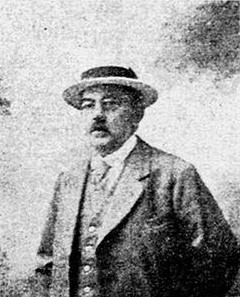
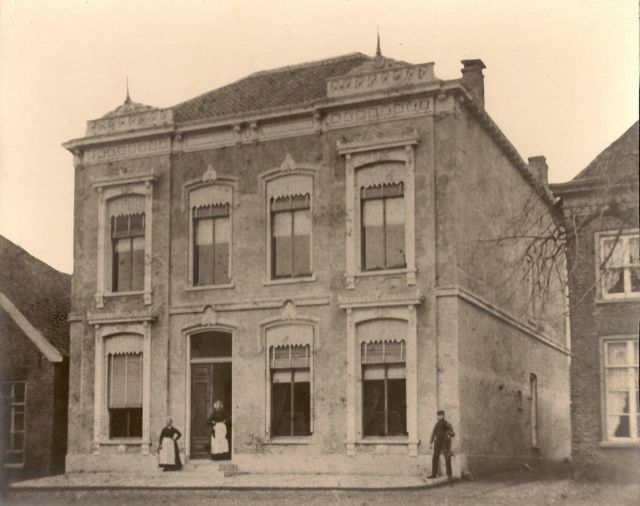
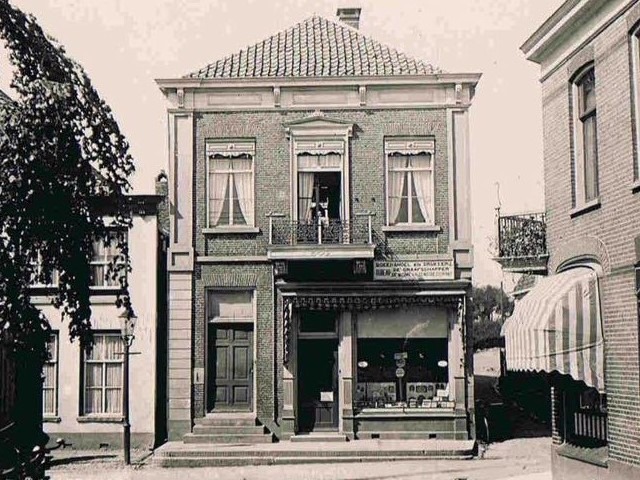
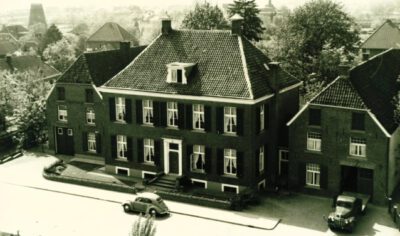
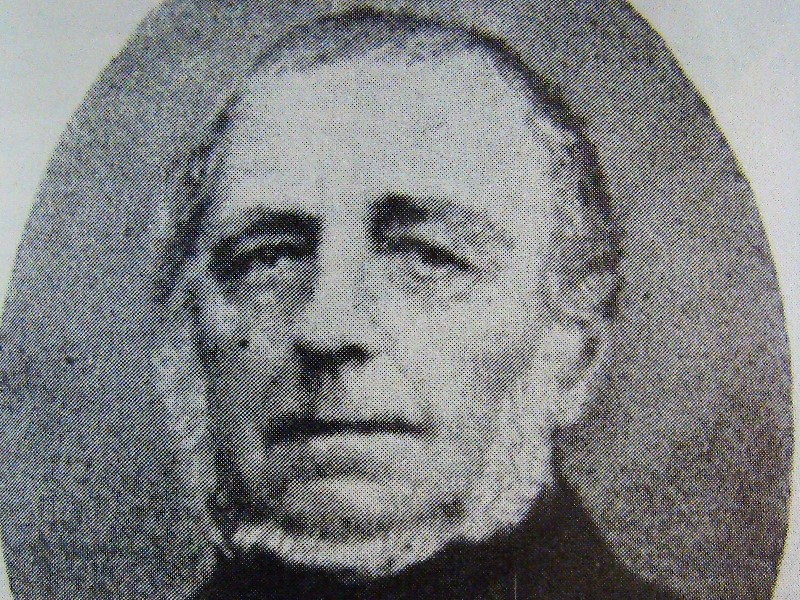
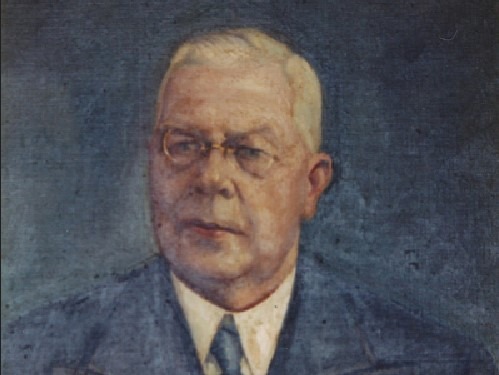
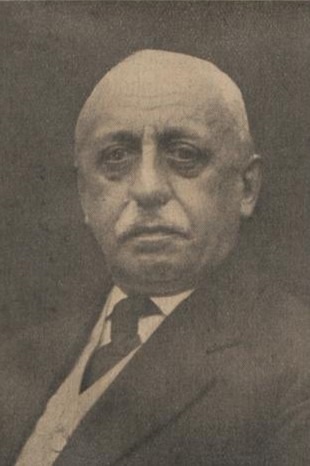
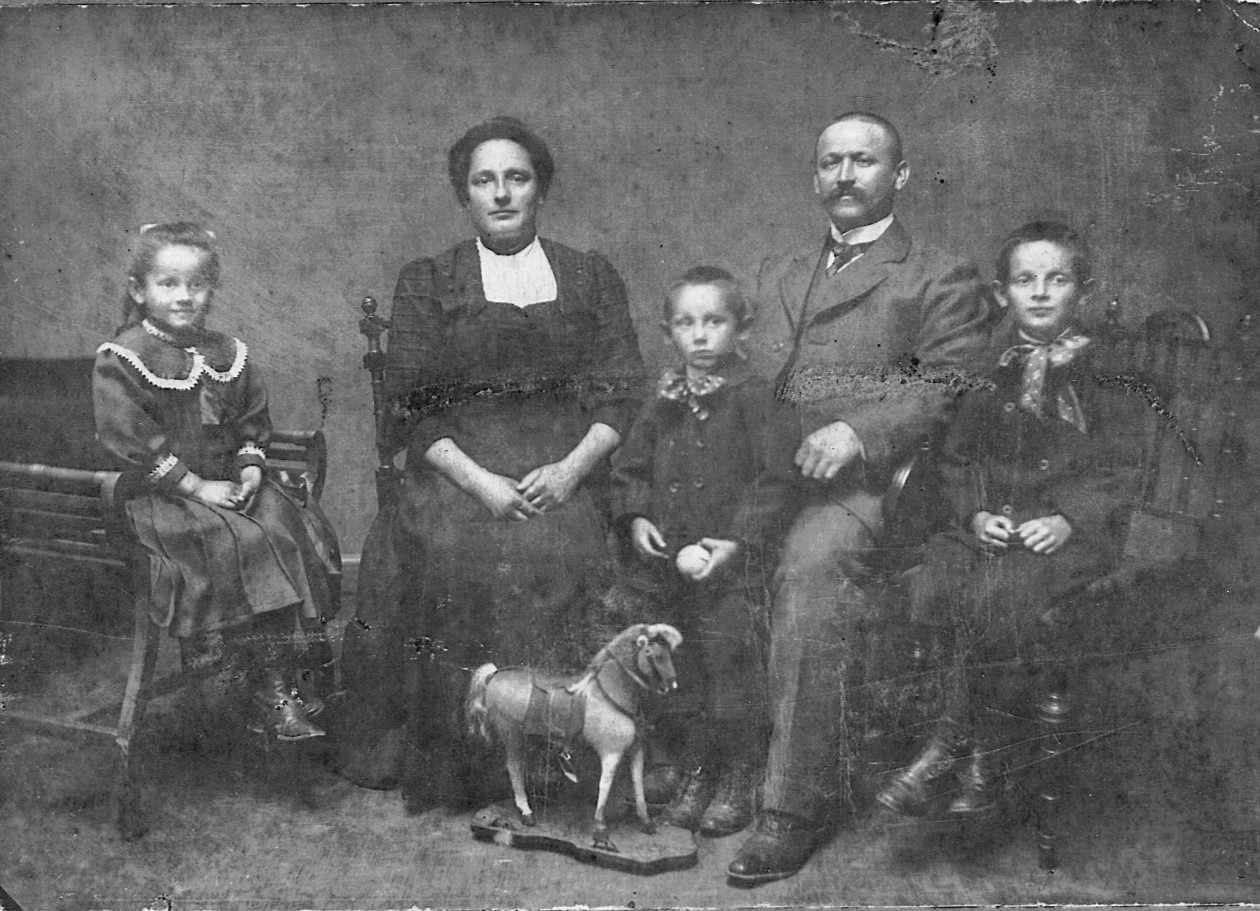
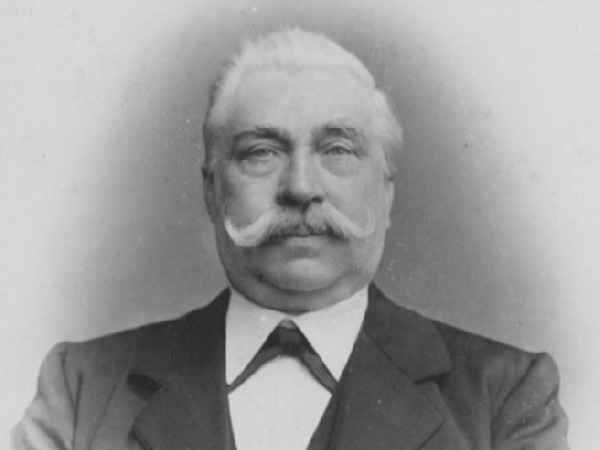
Pieter Hendrikus Boer was born on 2 September 1862 in Hollandscheveld, in the municipality of Hoogeveen. On 1 April 1899, he married Margaretha Dorothea Harjes, who was twelve years his junior. He passed away on 22 January 1927 and was buried at the Old Cemetery on the Varsseveldsestraatweg.
Although his surname appeared in the official archives as ‘Boer’, he named his printing business in Aalten ‘De Boer’. Perhaps because this name is much more common and everyone referred to him that way regardless?
Obituary
It had already been known for some time that Mr P.H. de Boer was seriously indisposed, yet it must have come as an unexpected shock to many when it was announced on Saturday evening that the patient had passed away. Mr De Boer, known locally as “De Boer van de Krante” (De Boer of the Newspaper), was a highly prominent and well-known figure in our town and the neighbouring municipalities.
In October 1894, he and his brother started the first printing business in Aalten on a very modest scale in the Ormelstraat. Originally, they only published a small church service notice sheet (Predikbeurtenblaadje), but in 1896 the Aaltensche Courant appeared for the first time. A few years later, this newspaper was also published under the titles Dinxperlosche-, Lichtenvoordsche- and Varsseveldsche Courant.
From the Ormelstraat, the business was relocated to the house where Mr Wagterveld currently resides. Later still, it moved to the Kruisstraat, the current premises, where manual power eventually had to make way for motorised power. In 1902, a branch was established in Winterswijk, and the Nieuwe Winterswijksche Courant began publication. Meanwhile, the bookshop also flourished increasingly, transforming a small enterprise into a substantial business.
In his family life, Mr De Boer was not so fortunate. The passing of his wife and his only daughter affected him deeply. It was perhaps due to these circumstances that an outsider might have gained the impression of a quiet, reserved personality. However, those who knew Mr De Boer more closely knew that beneath it all beat a warm heart for his children, his staff, and various institutions in which the deceased took an interest. With the passing of Mr De Boer, Aalten has lost a fine citizen.
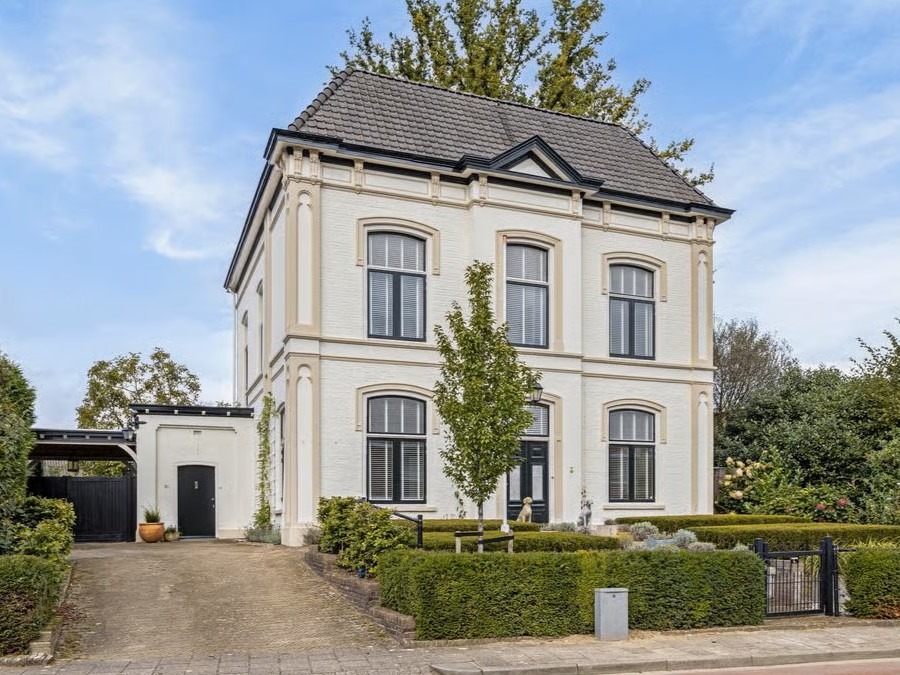
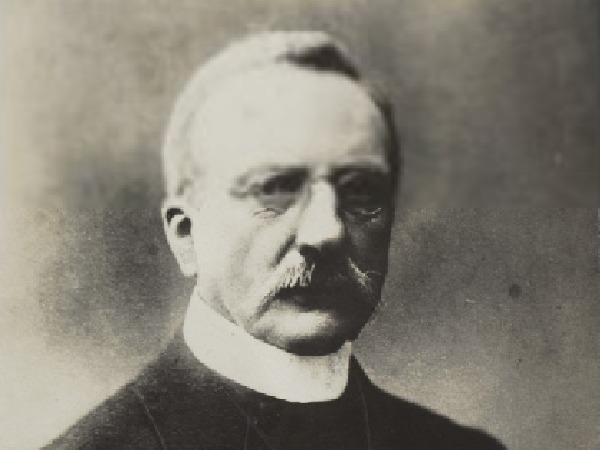
Barend Johannis (Bernard) Manschot was born on 17 August 1850 in Prinsenstraat in Aalten, the son of Gerrit Willem Manschot (a blacksmith) and Johanna Geertruid Becking. On 18 July 1878, Bernard married Maria Harting (born in Breda, 4 December 1848) in Utrecht. A son and a daughter were born from this marriage.
In 1871, Bernard Manschot and his brother-in-law Abraham (Bram) ten Dam founded a comb factory on Damstraat in Aalten. Bernard and Bram lived opposite each other on Bredevoortsestraatweg; Bernard in the white villa at number 51, and Bram across the road, in the house that now characterises the Van Panhuis physiotherapy clinic.
Bernard Manschot passed away on 27 June 1920, at the age of 69.
On Wednesday afternoon, the mortal remains of Mr B. J. Manschot were carried to the grave. Once the coffin had been lowered, Mr Slicher van Bath spoke a brief word of farewell and gratitude. “You now enjoy the rest,” the speaker noted, “which you so richly deserve. Yet we would have so gladly kept you in our midst a little longer, where you were driven by such noble principles in all your deeds.
We have learned much from your wisdom and benefited from the goodness of your heart. We shall have to miss all of this now. But we will not forget you. The spiritual seeds you have sown will remain within us, and we shall endeavour to follow your example in all the noble and grand things you have done.
We have not come here to proclaim your praises. You would not wish to accept them here. You were too humble for that. However, we must not forget to express our gratitude for what you have done for the Departement tot nut van ’t algemeen (Society for the Public Good). For more than 30 years, you served as its secretary, devoting your utmost strength and devotion to this institution.
For more than 30 years, you ran the nursery school. Through your dedication, it has become what it is today. We shall sorely miss you there as well. Yet we will not lose heart, but will continue to walk in your footsteps, hoping to do so with your life’s motto: Excelsior, excelsior!
Once again, our heartfelt thanks on behalf of the Department, also on behalf of the children of the nursery school who have now grown into adulthood, and on behalf of the parents of the children for all the kindness you have shown. We would no longer wish to be without the institution founded by you. Sleep peacefully!”
Visibly moved, Mr Ten Dam then thanked everyone, also on behalf of his niece, including the workmen who had paid their final respects to the unforgettable deceased.
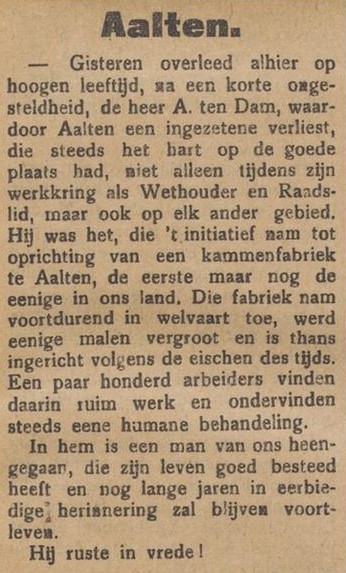
Abraham (Bram) ten Dam was born on 14 July 1834 in Kerkstraat in Aalten, the son of silversmith Harmen Jan ten Dam and Petronella Johanna Gerber. On 6 June 1861, he married Elisabeth Manschot.
In 1871, Abraham and his brother-in-law Bernard Manschot founded a comb factory on Damstraat in Aalten: Ten Dam & Manschot. They lived opposite each other on Bredevoortsestraatweg; Bram in the house that now characterises the Van Panhuis physiotherapy clinic, and Bernard in the white villa across the road. Bram’s son (and successor), Herman, commissioned the construction of the house at Bredevoortsestraatweg 52.
Ten Dam also served as a local councillor and alderman in the municipality of Aalten.
Abraham ten Dam passed away on 1 February 1915, at the age of 80, and was buried at the Old Cemetery in Aalten.
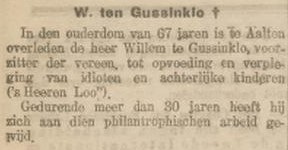
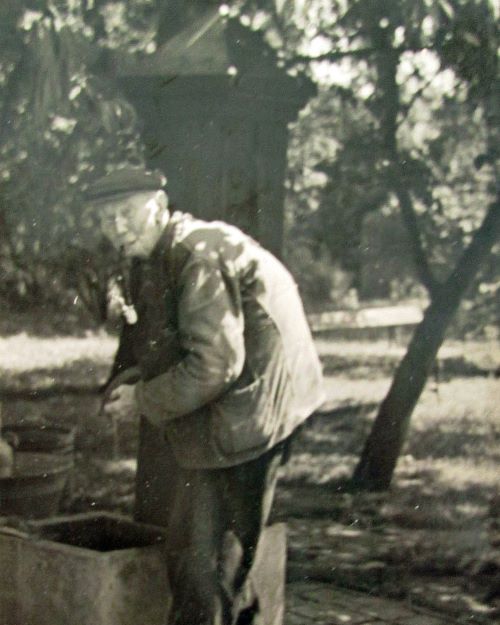
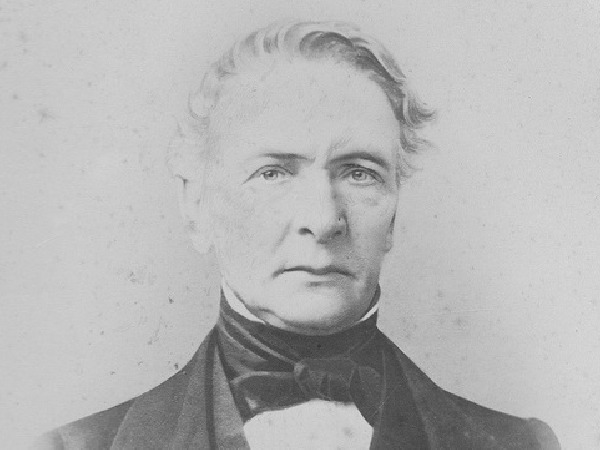
Willem te Gussinklo Sr. (1852–1920) was one of the key figures in the history of the horn-working industry in Aalten. Initially, he made German pipes and handles for walking sticks and umbrellas. Later, he focused on the production of buttons.
Willem te Gussinklo was born on 13 November 1852 at house number 284 (Markt 3) in Aalten, the son of shopkeeper Willem te Gussinklo and Josina Aleida Mierdink. On 26 May 1887, he married Maria Jacoba Gangel (a sister of the Reverend Gangel). Around 1890, they moved into a stately villa on Willemstraat.
Willem learned the craft of horn working from his brother-in-law, Gerrit Peters. Together with Wessel Becking, he started a pipe factory. However, in 1884 their paths crossed and they went their separate ways. Following the unsuccessful partnership with Becking, Willem te Gussinklo manufactured German pipes and handles for walking sticks and umbrellas.
Buttons
Around 100 years ago, companies had emerged in Germany and England that manufactured buttons from horn. Inspired by this example, Willem began making horn buttons in 1905, a first for the Netherlands. Soon afterwards, his son Willem te Gussinklo Jr. (known as ‘Piepkes Willem’) joined the company, developing into an innovative entrepreneur.
Te Gussinklo’s first factory was located at ’t Dal in Aalten, which is now Willemstraat.
Willem te Gussinklo Sr. passed away on 21 June 1920 and is buried at the Old Cemetery on Varsseveldsestraatweg in Aalten.
Willem te Gussinklo Jr. (1888–1969), nicknamed ‘Piepkes Willem’, was one of the key figures in the history of the horn-working industry in Aalten. He was the director of Dutch Button Works in Bredevoort.
Willem te Gussinklo Jr. was born on 18 May 1888 at house number 239a in Aalten, which is approximately where the JAWI garage is located today. He was the son of pipe manufacturer Willem te Gussinklo (Sr.) and Maria Jacoba Gangel (a sister of the Reverend Gangel). On 7 July 1914, Willem Jr. married Engelina Arriana van Houte in Zwolle (Overijssel).
Johan Bernard Anton (known as Anton) Driessen (Bocholt, December 5, 1797 – Aalten, March 7, 1879) was a prominent textile manufacturer in Aalten. Anton descended from a textile dynasty in Bocholt. His father Herman (1765–1817) was also a textile manufacturer, as was his brother Peter Driessen (1756–1843), who also served as an alderman and second mayor of Bocholt.
After their father’s death, Anton and his younger brother Joseph founded the textile company ‘Gebrüder Driessen‘. In 1826, Anton and Joseph Driessen submitted a request to King William I to establish a textile factory in Aalten. The motives for the Driessen brothers’ request were the increased import duties in the Netherlands. They had chosen Aalten ‘as this place was best suited for this purpose‘.
They requested permission to establish a fustian weaving mill and bleachery, as well as a cotton spinning mill and dye works. The Driessen brothers were granted permission for the establishment on the condition that it be located within the village center of Aalten.
Not long after, their cousin Heinrich Driessen also requested permission from the King, which was likewise granted.
In Aalten
Anton moved to Aalten in 1826. He initially lived with Meijerink in the Kerkstraat. His brother Joseph remained in Bocholt, where they maintained a branch office.
The company started “in the Barn and Garden Room of Mr. Bonninghoff”. This most likely referred to the house at Markt 18 belonging to the justice of the peace G.J. te Gussinklo, who had purchased the Borninkhof farm in 1804. Owners were often referred to by the name of their farm.
For the processing of the yarn, Anton Driessen relied on the many home workers living in the area. Furthermore, the municipal report of 1826 mentions, among other things: “Several households have settled here, primarily from Bocholt“. The report for 1827 mentions for the first time that, alongside agriculture as the primary source of livelihood, much fustian was woven for the manufacturers from Bocholt. There were approximately 218 fustian weavers at that time, “performing the work in their homes“.
On November 22, 1827, Anton Driessen married Isabella Dees in Bocholt.
In that same year, the cotton spinning mill was moved from Bonninghoff’s barn and garden room to a better-equipped building in the center of the village. Driessen had purchased a house there from Manus Scholten, located at the site of the current address Landstraat 25.
Opregte Haarlemsche Courant, 29 November 1827Markt 18, AaltenLandstraat 25, Aalten
However, the relocation did not proceed without incident. Two neighbors, the schoolmaster H. Schotman and the farmer W. Obrink, submitted a formal objection to the municipal council, fearing noise nuisance and fire hazards. The municipality, however, rejected their objections. The two neighbors did not leave it at that and subsequently addressed their grievances to the Governor of the province of Gelderland. However, the Governor also saw no reason to give “any follow-up” to their objections.
At the end of 1827, Anton Driessen was able to begin converting the house into a spinning mill. The new premises had an upper floor, which, along with the ground floor, was designated as workspace. Machines were installed on both levels.
Beekhuize
Villa ‘Beekhuize’, Dijkstraat 14, Aalten
In 1833, Anton wished to build a new residence. To this end, he had purchased a house from the Degenaar heirs at the end of the Landstraat—now called Dijkstraat. He intended to demolish that house and build a new, modern residence with a warehouse, barn, and stables on the site. For this, however, he required more space than the existing plot. Anton Driessen submitted a plan to the municipal council with the request, “since the beautification of a Village is always one of the most pleasant duties of a Local government, to kindly grant the same, and consequently to support the undersigned in his intention as much as possible”.
To realize Anton’s plans, both the stream and the street had to be diverted. Furthermore, a new bridge was required. Because the piles of the old bridge had almost decayed, the construction of the new bridge was not only highly necessary, but according to Driessen, the relocation was also less costly. In addition to diverting the stream and building a new bridge, Driessen also needed land for his plans. To this end, he exchanged a piece of land with the municipality. Negotiations regarding these matters lasted several years.
In March 1835, Driessen was able to begin construction. For the production of the necessary bricks, he had meanwhile requested permission to establish a brickyard on the Schaarsheide and to excavate a three-hectare site. Due to the poor state of the roads in East Gelderland at that time, it was more practical and economical to set up a field kiln near the construction site than to purchase bricks elsewhere.
The stately villa that Anton Driessen had built on the current Dijkstraat is known to every resident of Aalten as Beekhuize.
‘Geweven goed. De textielgeschiedenis van Aalten en Bredevoort’ (Woven Goods: The Textile History of Aalten and Bredevoort), H. de Beukelaer and J.G. ter Horst
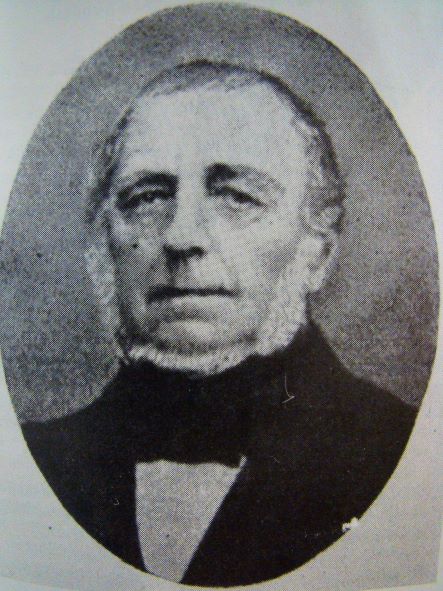
Johann Heinrich Joseph (known as Heinrich) Driessen (Bocholt, 10-07-1794 – Aalten, 04-07-1879) was a prominent textile manufacturer in Aalten. Heinrich descended from a Bocholt textile dynasty. He was the only son of Peter Driessen and Maria Hölscher. His father held a distinguished position in the Prussian town, just across the border from Aalten. In addition to being a textile manufacturer, he served there as a magistrate and, from 1797 to 1811, as deputy mayor.
Heinrich received a thorough education at the Jesuit College in Amsterdam and spoke excellent French, so that in 1812, when Napoleon’s troops passed through Bocholt, he was the only one capable of acting as an interpreter between the municipal authorities and the French generals.
Peter Driessen & Sohn
In 1810, Heinrich joined his father’s business. On December 2, 1820, he married Lisette Sträter in Rheine (Germany), a descendant of another prominent textile family. They had nine sons and two daughters. In 1826, he was entrusted with the management of the firm Peter Driessen & Sohn.
In that same year, his cousins Anton and Joseph Driessen submitted a request to King William I to establish a textile factory in Aalten, which was granted by William I. Not long after, Heinrich Driessen also requested permission from the King to settle in Aalten. The firm Peter Driessen & Sohn also received the requested establishment permit.
In Aalten
His father Peter continued to live in Bocholt while his son Heinrich settled in Aalten. He initially lived with the Meijerink family on Kerkstraat, one of the few remaining Catholic families in Aalten, in the same building as his cousin Anton Driessen.
In Aalten, Heinrich established a branch of his father Peter Driessen’s fustian trade and hand-spinning mill. They already owned the necessary land in Aalten and Varsseveld, and in 1826 he expanded his activities to Groenlo. There, Heinrich had purchased a house from De Heyder. That house was converted into a spinning mill. He made the yarn spun there available to home weavers who processed it into cloth.
Opregte Haarlemsche Courant, 7 December 1820Nederlandsche Staatscourant, 30 August 1851
Heinrich was an enterprising man. By 1832, he had approximately 500 linen weavers in Aalten and the surrounding area working for him, and three years later, along with Blijdenstein in Enschede, he was among the largest fustian manufacturers in the eastern Netherlands. He was one of the first in the Netherlands to utilize steam in his bleachery.
‘Den veursten Dreessen’
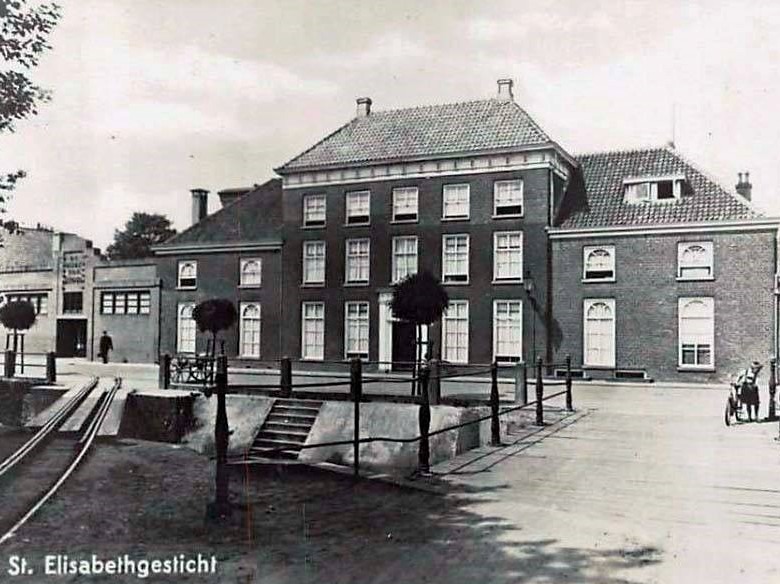
In 1837, he had a grand residence built at the beginning of Dijkstraat. For this reason, he was popularly known as ‘den veursten Dreessen’ (the front Driessen), while his cousin Anton, who built Beekhuize a little further along, was called ‘den achtersten Dreessen’ (the rear Driessen). Heinrich’s eldest son, Theodoor, laid the first stone on June 29, 1837. Business premises were also located at the residence, primarily serving as storage for yarns and woven fabrics. These fabrics were transported by a wagon, often pulled by an ox, to the bleachery in Dale. The driver bore the fitting nickname Ossen Willem (Oxen William). After Heinrich’s death, the house was repurposed as a convent.
Heinrich’s house on Dijkstraat, later St. Elizabeth’s Convent
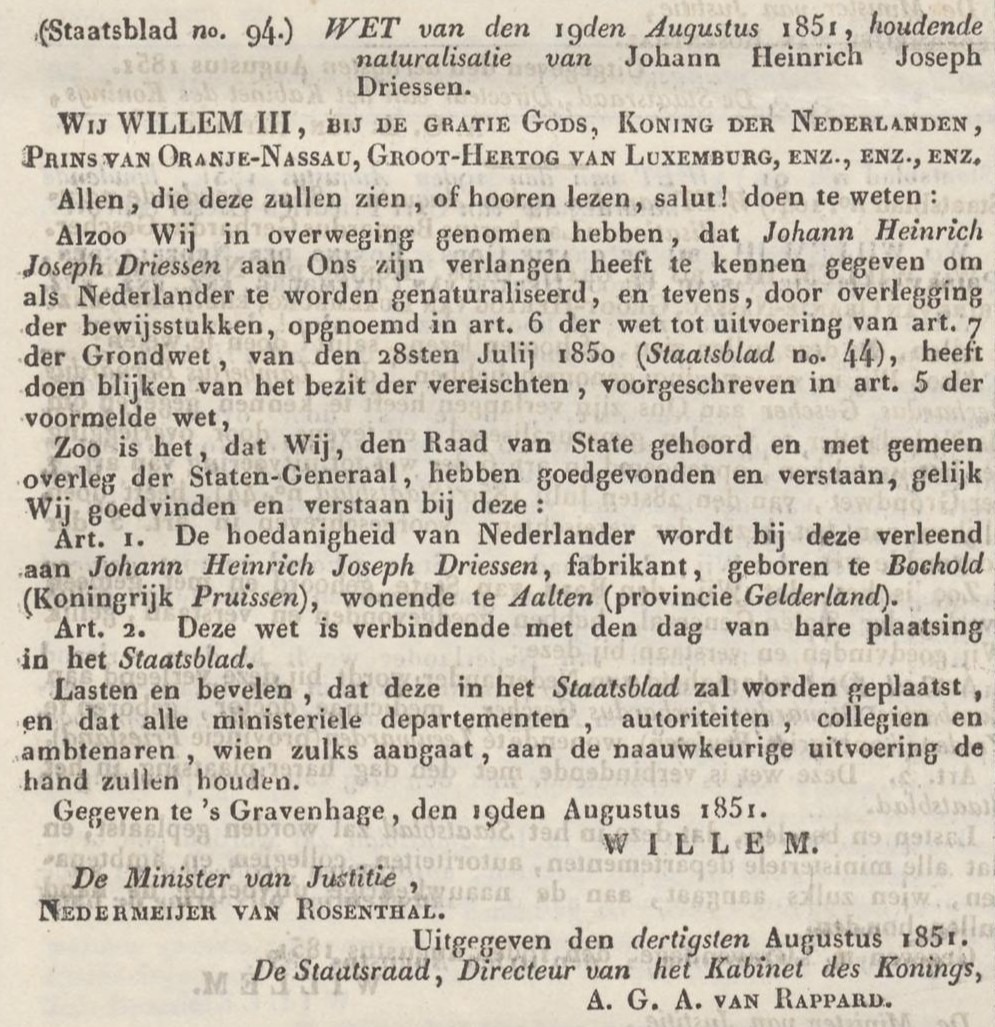
Following his father’s death in 1843, Heinrich became the sole owner of Peter Driessen & Sohn. His eldest son Theodor (1821-1878) was then placed in charge of the management in Bocholt. In 1851, King William III granted Heinrich Dutch nationality.
In 1849, Heinrich established a steam spinning mill on Hogestraat in Aalten, the first of its kind in the Achterhoek region. This was soon expanded with several ‘power looms’ (steam-driven weaving looms). After this factory burned down on the night of August 19 to 20, 1859, he did not rebuild the business.
Algemeen Handelsblad, 22 August 1859
To Leiden
Heinrich shifted his focus to Leiden. There, in 1846, together with his nephew (his sister’s son), the soap boiler Ignatz van Wensen, he had purchased the declining textile printing and dyeing works De Heyder & Co., later known as the Leidsche Katoenmaatschappij (Leiden Cotton Company). He had his second son Louis (1823-1904) come over from England to take charge in Leiden. With the knowledge he had acquired in Manchester, Louis soon managed to make the company profitable.
Heinrich’s son Eduard (1824-1895) continued to look after the company’s interests in Aalten. Initially, the bleachery there remained operational, but over time Eduard primarily focused on the trade in cotton and yarns. The branch in Bocholt, managed by Theodor, was closed after he and his brother Peter (1832-1895) started a blue-dyeing and printing works there in 1854, named the firm Theodor and Peter Driessen.
Catholic
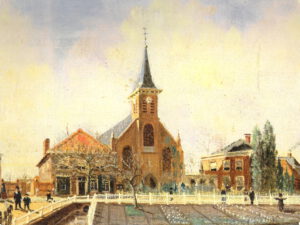
Old Roman Catholic church on Dijkstraat, destroyed by fire in 1893
The Driessen family was also of great significance to the Aalten Catholic community, which had been a minority in the Reformed village since the Reformation of 1596. Not only through their prestige and influence, but also through various donations from the Driessens, the Catholic church in Aalten was able to grow into a fully-fledged church community. Both Heinrich and his cousin Anton played important roles as churchwardens and overseers of the poor, roles that were continued by their descendants.
Heinrich Driessen was very strong-willed in his conduct and often followed his own path in ecclesiastical matters as well. For instance, during the disputes between the Catholics and the Reformed in 1842 regarding the ringing of the bells. Pastor G.H.J. Wansing of Aalten wrote a letter about this to the Archpriest of Gelderland, M. Terwindt, which was co-signed by the churchwardens Th.W. Meijerink, H. Vulting, and A. Driessen. Heinrich Driessen, although a member of the church board, had not signed this letter and addressed two personal letters to Terwindt himself.
What stands out in these letters is that he stated, among other things, that the pastor seemed a priori prejudiced against Aalten and expressed the hope that the Aalten parish would receive a new shepherd who would be to everyone’s liking. He requested Terwindt to take his reflections into consideration when making his choice and assured him that he preferred to employ everything that was conducive to the honor of their holy religion. But at the same time, Driessen wrote that—because the old pastor showed him the greatest respect and because he himself esteemed the pastor as a man whose moral conduct could serve as an example to an entire province—he trusted that it would also please the Archpriest that the contents of the letters never be disclosed to others.
New church
A subsequent problem arose when it was decided around 1853 to build a new church. This led to serious disagreements within the church board. For instance, churchwarden Heinrich Driessen again found it necessary to act independently by contacting the Archbishop behind the backs of the other board members. In a letter to the Archbishop, he referred to the approval the latter had given to the plans for the construction of the church, on the condition that the confessional or confessionals be placed inside the church and not in the sacristy or in separate extensions on the side walls. Based on that condition, a plan had been sent to the King for approval.
However, during Driessen’s absence, the tendering for the church had taken place, in which an extension was nevertheless planned, contrary to the archiepiscopal approval. An extension to the church for the purpose of the confessional would, according to Heinrich, only disfigure a church. He had tried to convince the pastor of this, but had not succeeded. Driessen preferred to see the confessional inside the church, as was common in the Münsterland, rather than in an extension. According to him, the error could still be rectified, even though the masonry on that side was already in full swing. In his letter to the Archbishop, he therefore requested that instructions be given to the church board as soon as possible. The outcome of the matter is unknown. This action, however, is characteristic of Heinrich Driessen, who was apparently accustomed to getting his way and took the necessary steps on his own initiative to achieve it.
Wealthy
At the end of his life, Heinrich was a wealthy man. He held shares in spinning mills in Enschede, Gronau, and Rheine. Rheine was his wife’s birthplace, and her relatives managed textile enterprises there. Furthermore, he owned many lands and farms in the vicinity of Aalten, Varsseveld, and Bocholt.
Heinrich reached the advanced age of nearly 85 years. Several of his children and grandchildren entered the textile industry.
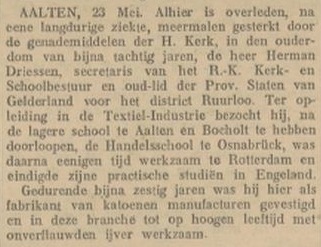
Josephus Walter Julius Driessen (Aalten, 07-01-1870 – Aalten, 12-12-1938) was a textile manufacturer who contributed significantly to the Aalten community.
Jos. Driessen is buried at the old R.C. cemetery on Piet Heinstraat in Aalten.
His significance to Aalten was evident from the report published by De Graafschapbode following his passing:
How is Mr. Driessen doing? This question was asked day after day over the last few weeks; at times the answer would be: “Today the condition is slightly more favorable”, but then again: “Things are not so well at ‘t Blik!” Yet, whoever asked the question, it was always followed by: “It is to be hoped that he recovers and may be spared for a few more years for his family, his factory, and for our municipality!” Alas, it was not meant to be! In recent days, the condition became increasingly serious, and on Monday evening, the news reached us that Mr. Jos. Driessen had passed away from us forever.
The news of Mr. Driessen’s passing will be received with great sadness in wide circles. Naturally, it is first and foremost a great blow to his family, his children, and grandchildren, for whom the deceased was the center—the great magnet within the family circle who drew everyone to him and who so loved to gather the entire family around him. With what interest and warmth he shared in the lives of his married children’s families. How all the grandchildren adored their Grandpa!
The weaving mill, founded on April 1, 1894, was brought to great prosperity over the years through his energy. From a “little weaving shed,” as Mr. Driessen himself called it, the factory steadily increased in size under his leadership and developed—in recent years with the cooperation of his sons—into the flourishing N.V. Herman Driessen & Zn., which, in addition to its weaving mill, now also has its lingerie, ready-to-wear, and knitwear departments. Until recently, it was the nearly 69-year-old director who was always the first at the office in the morning. Always punctual and hardworking himself, he rightly expected the same from the staff. Furthermore, Mr. Driessen Sr. was always interested in the interests of all who worked in the business, and not only in the interests of the employees themselves, but also in those of their families, all of whom he knew exactly. Proof of this is certainly the medical care for staff and family members as arranged at H. Driessen & Zn. The entire staff, from high to low, will learn of the passing of their eldest leader with great regret, and the eldest director will surely be greatly missed in the factory every day.
In addition to business concerns, which became increasingly large and difficult especially in the post-war years and demanded more and more of him, Mr. Driessen showed great interest in everything concerning his place of residence. Since its founding on December 14, 1898, he was a board member and very soon became chairman of the association “Aaltens Belang.” This association was especially his great love and for which he performed an immense amount of work. The chairman always came forward with new proposals and new ideas in the interest of, or for the beautification of, our town and the Achterhoek in general.
What has been achieved in the 40 years of this association’s existence is largely due to his initiative. How Mr. Driessen had looked forward for years to the 40th anniversary of A. B. on December 14 of this year!
Alas! Instead of a festive commemoration, the association is plunged into deep mourning. The board of “Aaltens Belang” will terribly miss its energetic chairman. In addition to this association, Mr. Driessen held the chairmanship of the “Oudheidkamer Aalten” and of the association for hospital nursing “Steunt Elkander,” both of which also had his warm interest. Furthermore, Mr. Driessen was a director of the Geld. Westf. Stoomtram Mij. and vice-chairman of the Supervisory Board of the Coöp. Middenstandsbank Aalten, a board member of the Prov. Geldersche V.V.V., vice-chairman of the B.V.L., and a member or board member of numerous other associations. Mr. Driessen was also briefly a member of the Provincial Council of Gelderland. Mr. Driessen would not easily be absent from a meeting of one of these associations, and telling of his character is what one of his children claimed of him: “Pa is not happy unless he has at least 3 meetings a week!” Mr. Driessen took the lead at numerous official festivals and events. His fellow members of these various committees know how every program item was prepared minute by minute, but also how the program could then finally be executed exactly and the event succeeded.
On August 30, 1930, the mayor informed Mr. Driessen that H. M. the Queen had appointed him a Knight in the Order of Orange-Nassau. This was a recognition of Mr. Driessen’s great merits, in which countless residents rejoiced along with him and his family. In September 1937, the 40th anniversary of N.V. H. Driessen & Zn., as well as the 40th wedding anniversary of Mr. and Mrs. Driessen—Beckmann, was commemorated with great splendor. On this occasion, it was again evident in a spontaneous and heartfelt manner how authorities, citizens, staff, and business relations shared in this jubilee. These were unforgettable days for Mr. Driessen, which he was fortunately still able to experience in good health.
During the last year, but especially the last few months, things were no longer going well. However difficult it was for the so industrious Mr. Driessen, he had to withdraw more and more from his work and take rest. Even sooner than initially expected, his ailment increased in severity and the end came.
With Mr. Jos. Driessen, a resident has passed away who loved his place of residence very much and to whom Aalten owes a great deal. His name will surely remain in grateful memory for many for a long time. The solemn funeral service will take place this coming Friday morning.
Bernardus Gerhardus Vaags was born on 19 June 1855 at Dijkstraat 9 in Aalten, the son of Gerrit Willem Vaags and Willemina Geertruid Becking. He was the co-founder of the Becking & Vaags pipe factory and additionally held various civic and social positions. He passed away on 5 May 1936.
On 20 August 1891, he married Hermanna Johanna Petronella ten Dam in Aalten. The couple settled at Landstraat 12. Three children were born from this marriage: Gerrit Willem (1893), Elisabeth (1896) and Abraham (1902).
Vaags co-founded the Becking & Vaags pipe factory in Aalten, which developed into a flourishing enterprise within the horn-working industry – a sector that was unique within the Netherlands. When the company’s export opportunities declined after the First World War, the business was liquidated.
Alongside his commercial activities, Vaags was highly active in the community: he was a board member of the Aalten Branch of the Maatschappij tot Nut van ’t Algemeen (Society for the Public Good), and for many years served as its treasurer and representative at the general meetings. He also held the positions of chairman and secretary of the local Reading Society and was a warm supporter of the Public Library.
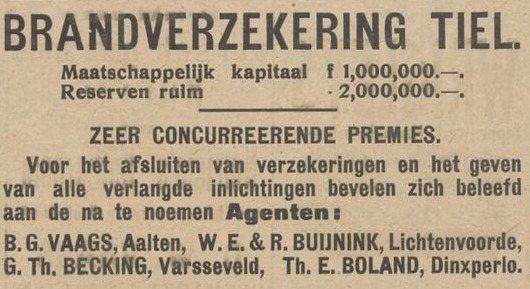
Furthermore, he dedicated himself to the Ten Hietbrink’s Bewaarschool (nursery school) and served as an agent for the Nederlandse Maatschappij voor Brandverzekering (Netherlands Fire Insurance Company) in Tiel, a position he held for more than 45 years.
Bernardus Gerhardus Vaags passed away in Aalten on 5 May 1936 at the age of 80. His funeral took place at the Old Cemetery on Varsseveldsestraatweg.
Bernardus Gerhardus Vaags (1855–1936)Aaltensche Courant, 2 April 1926
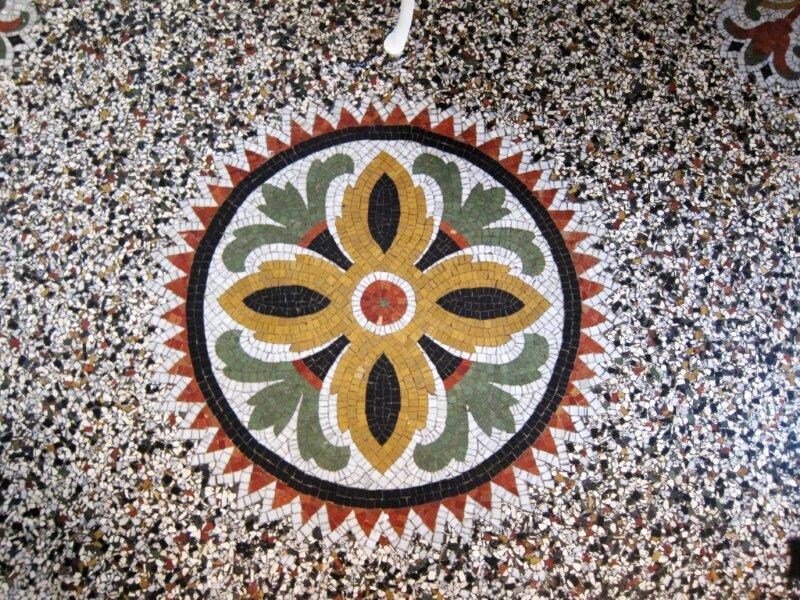
For more than a century, members of the Monasso family have been crafting terrazzo floors in the Achterhoek. The family ended up in Aalten in 1915, after fleeing from Bocholt, Germany, during World War I. Their origins lie in the Northern Italian region of Friuli.
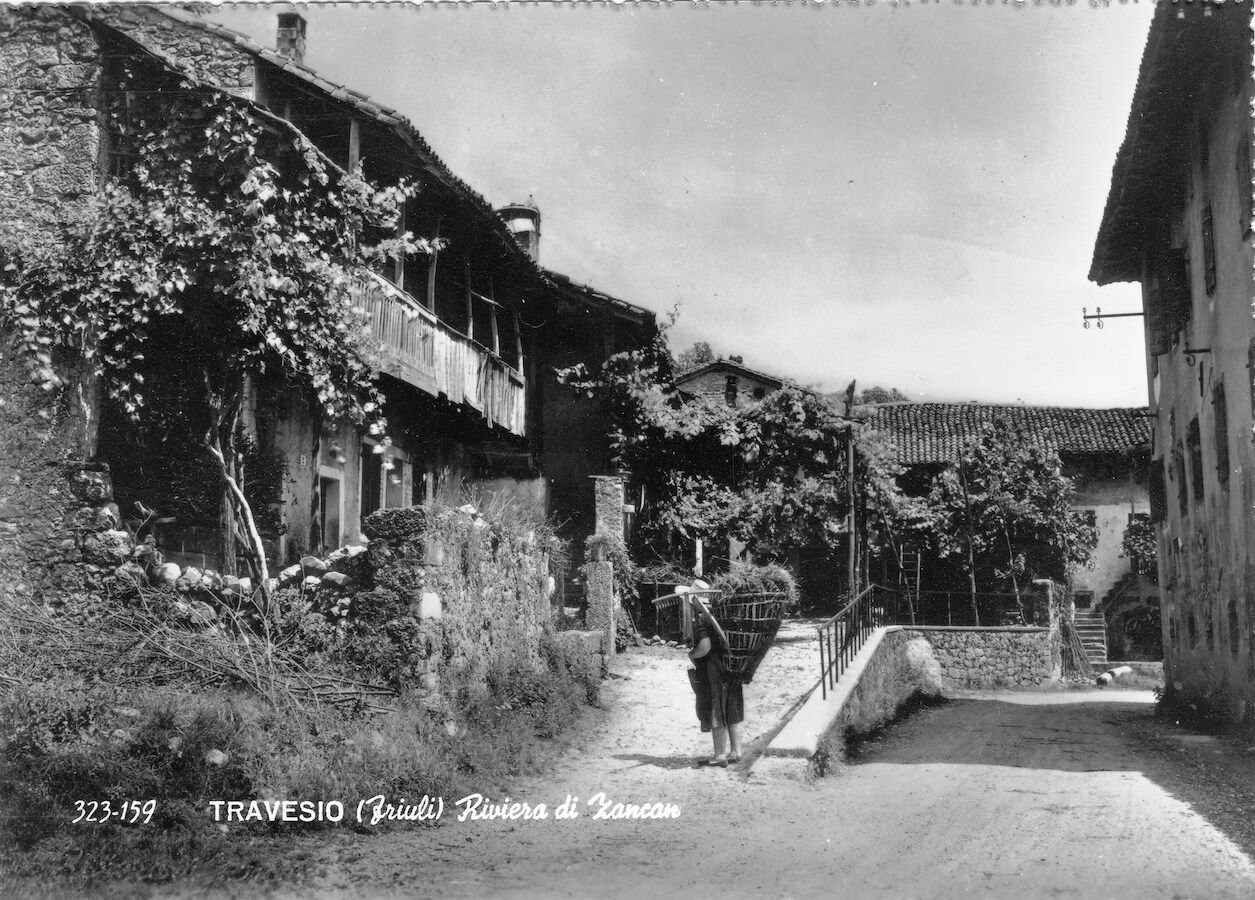
The family hails from the mountain village of Travesio, in the Friuli region. It was an impoverished area plagued by poor soil, earthquakes, floods, and high taxes. Many inhabitants left to find work elsewhere. Friulians were known as skilled craftsmen—foresters, carpenters, stonemasons, and terrazzo workers.
The First Generation
In 1868, Pietro Monasso married Maria Bortolucci in Travesio. They had three sons and four daughters. All three sons learned the terrazzo craft in Italian cities. One of them, Felice Monasso, was once repairing stairs at St Mark’s in Venice as a boy. He received a banknote worth about twenty guilders—a staggering amount for the time—from the newly arriving Pope Leo XIII. He did not spend it, but kept it as a relic.
The three brothers were Giovanni (1869–1939), Felice (1871–1962), and Antonio (1876–1967). They left Friuli at a young age: Giovanni and Antonio at age eleven, and Felice at fourteen.
The village of Travesio in Friuli, Northern Italy, ca. 1900
Work in Germany
Giovanni travelled with fellow villagers to the Balkans to learn the carpentry trade. Felice worked first in Frankfurt, including at the large Odorico terrazzo company, which employed hundreds of Friulian workers. Giovanni and Antonio later joined him in Germany.
From Frankfurt, the brothers went to Münster, where their cousin Bortolucci ran a terrazzo business. They worked there as master journeymen, and there was plenty of work in Westphalia and the Netherlands. On the advice of their boss, they established themselves in 1896 in Bocholt, just across the border from Aalten. There, they started a terrazzo firm together.
The enterprise flourished. This was the era when wealthy textile barons in Bocholt were building grand houses. With their terrazzo work, the Monassos embellished many a villa on the prestigious Bahnhofstraße. The three families lived together with their staff in a large building on Münsterstraße in Bocholt.
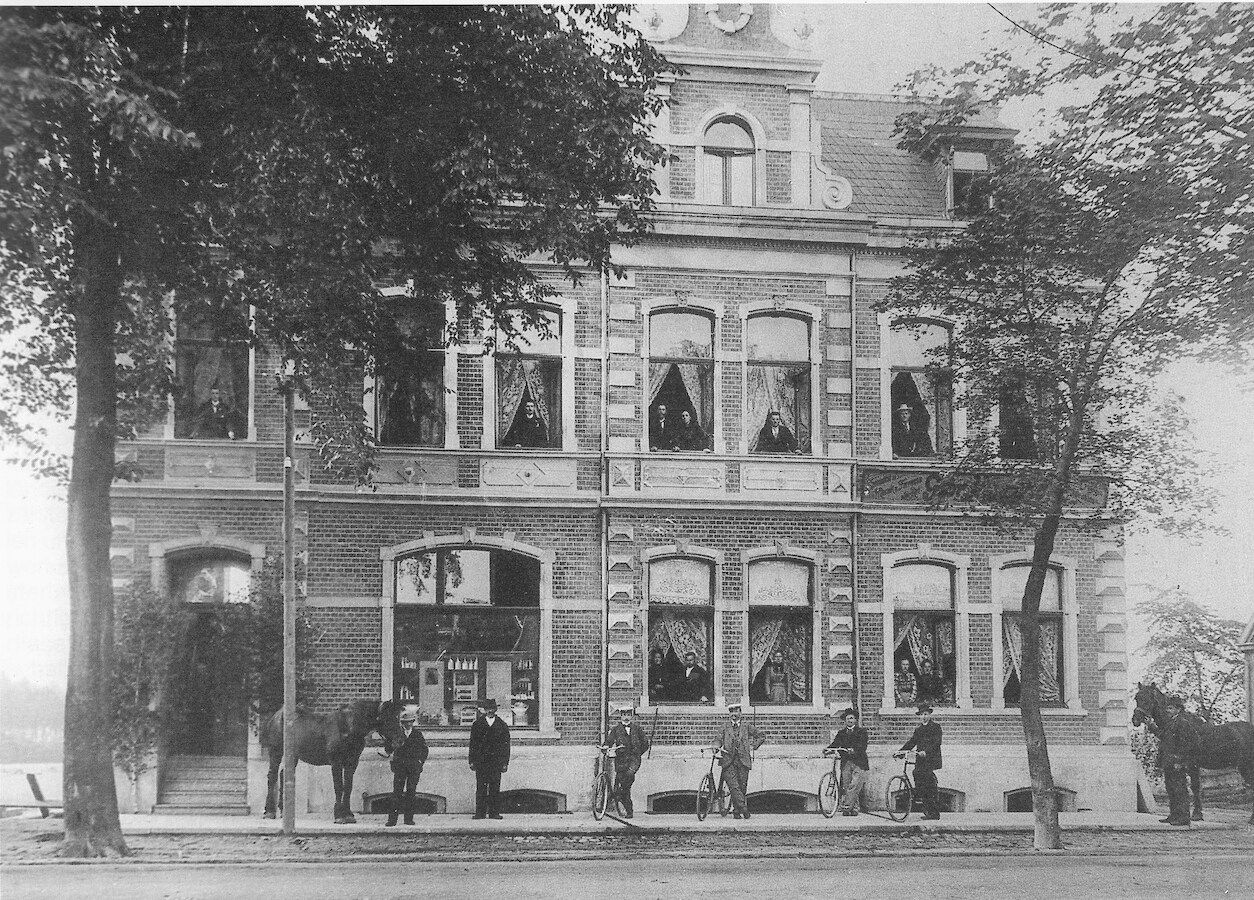
Members of the three Monasso families, the landlord, and journeymen in front of and inside their home on Münsterstraße in Bocholt
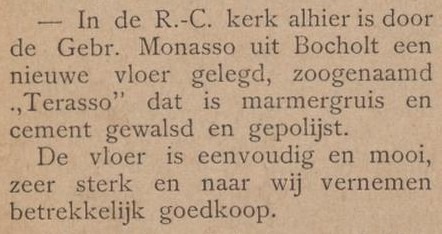
The firm ‘Gebrüder Monasso’ had plenty of work, including in the Achterhoek. As early as 1897, they laid a terrazzo floor in the Catholic St George’s Church in Bredevoort.
Aaltensche Courant, 29 October 1898
On 22 November 1899, Giovanni Monasso married Angela Chivilò (1879–1951) in Italy. Together they had four sons and two daughters.
Flight to Aalten (1915)
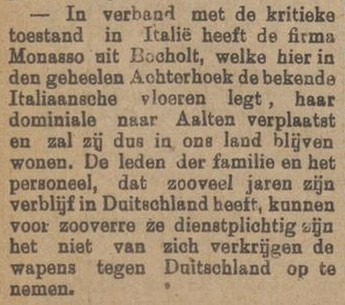
World War I began on July 28, 1914. Italy sided with the Allies, and the Germans saw this as a betrayal. An anti-Italian atmosphere emerged in Germany. Italian workers were insulted and sometimes even mistreated on construction sites. The three Monasso families decided to flee to Aalten, just across the border in the neutral Netherlands. In effect, they were asylum seekers.
Nieuwe Winterswijksche Courant, 22 May 1915
It was a somber procession that departed Bocholt for Aalten before dawn on 19 May 1915. A horse and cart full of household goods was followed by twenty Italians. Three children remained behind in Bocholt: two because they were too ill to travel and one because he wanted to finish his year at the gymnasium.
In Aalten, they spent the first night at Vultink’s lodging house on Dijkstraat. The following day, Giovanni and Antonio moved into a house on Landstraat, and Felice into Bredevoortsestraatweg. Antonio and his wife found a home on Haartsestraat shortly thereafter. The then Mayor Monnik arranged for residency permits. The children who had stayed behind joined their families later.
A New Life in Aalten
Giovanni demonstrated his entrepreneurial spirit by registering within a few days at Sociëteit Schiller, where local businessmen met. His brothers followed a week later. Within a short time, the Monassos were working again. They laid floors in homes, shops, schools, and churches in Aalten and the surrounding area, bringing in skilled terrazzo workers from Italy as staff.
Giovanni Monasso (1869–1939) and his family
They did not yet use machines or electric tools; everything was made by hand. Terrazzo floors were laid on-site, which was arduous work. Stairs, countertops, and other components were made in the workshop using moulds and were subsequently installed in kitchens or halls.
Around 1920, Giovanni established his business on Parallelweg in Aalten. In the mid-1950s, they moved to the adjacent Staringstraat, where a new showroom was opened in 1969.
Felice established a terrazzo business in Winterswijk in 1922; Antonio followed in 1932 with a branch in Doetinchem.
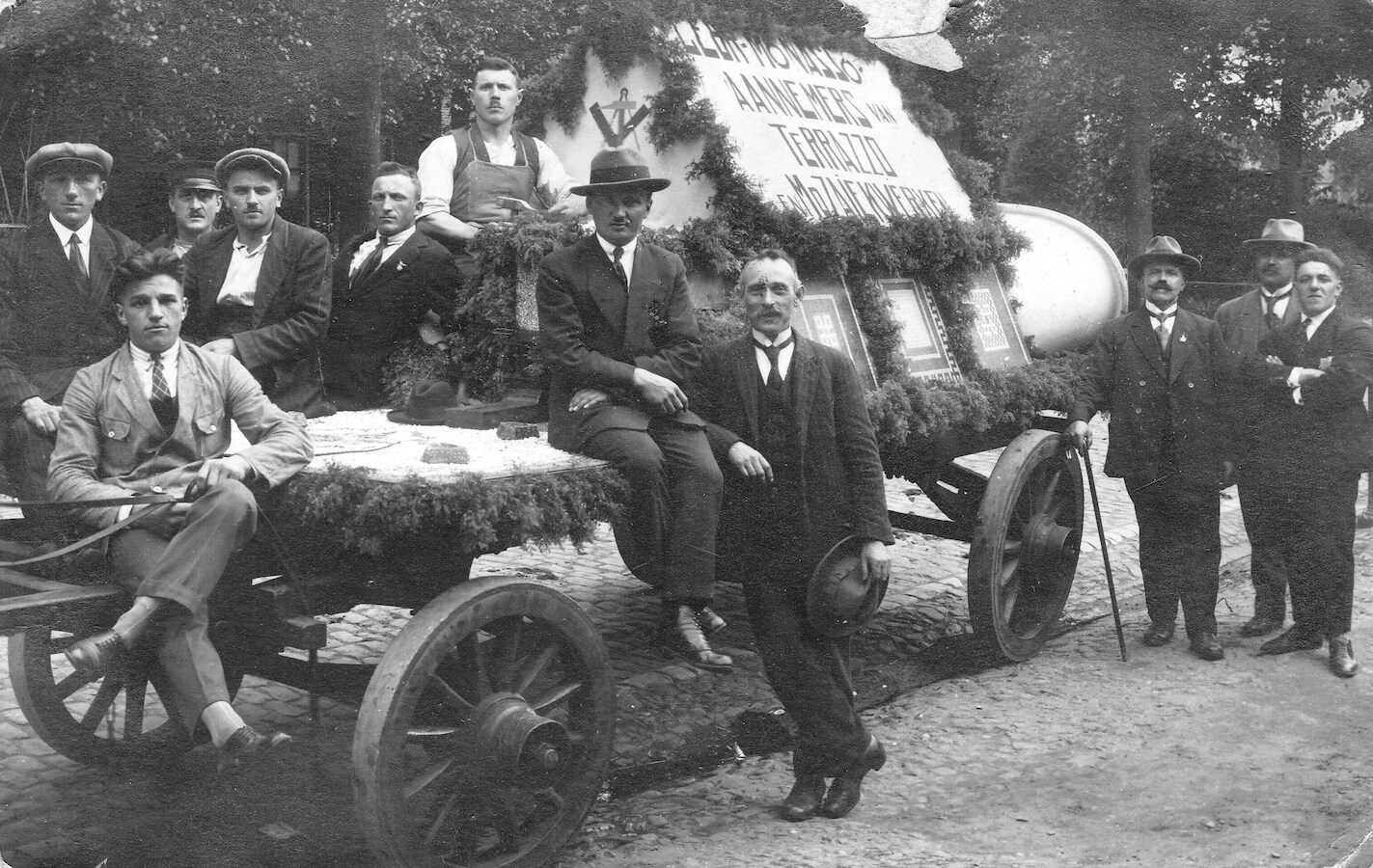
Aalten, 1924 – Members of the Monasso family with a float used in a parade where craftsmen presented themselves
Later Generations
The second and third generations also remained active in the craft. In the decades following World War II, sons and grandsons took over the work. All four of Giovanni’s sons became terrazzo workers and married Dutch women.
Business thrived for decades. In the 1960s and 1970s, demand decreased due to the rise of synthetic floors and steel countertops. Nevertheless, the family business endured. The Monassos combined traditional techniques with modern methods, specialising not only in floors but also in worktops, thresholds, window sills, and restorations.
Current Company in Aalten
In 1982, Richard Monasso, Giovanni’s grandson, took over the company in Aalten. The business moved to Industriestraat. In the 21st century, terrazzo became popular once again. Richard Monasso now works on exclusive projects at home and abroad; his work can be found in a department store in London, a restaurant in Paris, and a villa in Greece.
Willem Monasso
In 1996, Willem Monasso, son of Giovanni Monasso and Angela Chivilò, spoke about his youth:
Wilhelm Franz Joseph (Willem) Monasso (1916–2001) was born in Aalten but returned to Italy with his mother as a child. They lived with an uncle who owned grape plantations. He attended primary school there. He did not learn Italian there, but so-called Furlan, a regional language that differs as much from Italian as Frisian does from Dutch.
At the age of ten, they returned to the Netherlands. Back in Aalten, Willem had to start again in the first grade. He left school after the fourth grade to enter the terrazzo trade.
On his mother’s side, the Monasso family owned a wine bottling plant and a silk plantation. They regularly had barrels of white wine from their region of origin in Italy shipped over. The first barrel always went to the parish priest of Aalten.
During World War II, Willem was the only Aalten resident allowed to have a radio because he held Italian nationality. Naturally, the occupiers did not allow him to listen to the English ‘Oranje’ station, but he did so in secret anyway, along with half the neighborhood.
Willem Monasso could tell captivating stories about his former work in the perfect Aalten dialect. Initially, countertops were made on-site in a formwork built by a carpenter. Later, this was done in the workshop, and they were transported to their destination by a small truck. The terrazzo technique requires great craftsmanship and is incredibly labour-intensive. Throughout the region, many beautiful Monasso floors can still be found in churches, hospitals, monasteries, schools, and scholten farms.
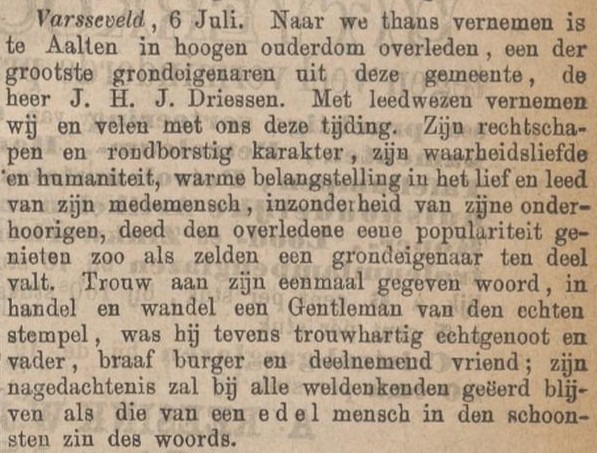
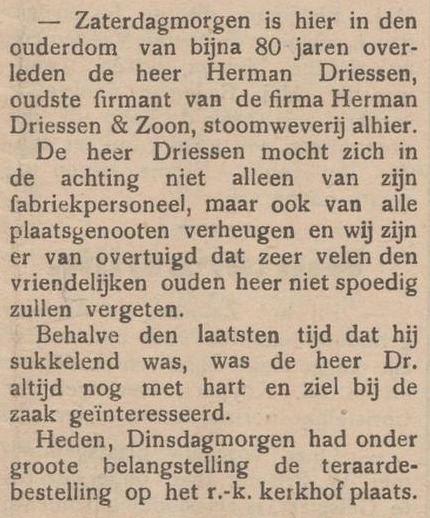
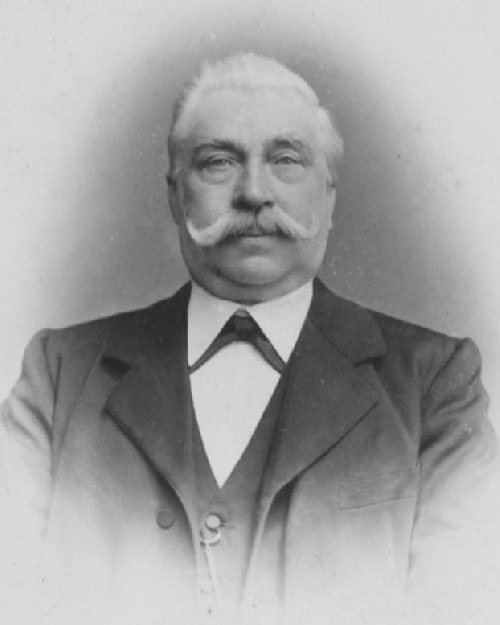
Herman Anton Frans Carl Maria Driessen (Aalten, 1831-09-22 – Aalten, 1911-05-20) was a textile manufacturer of great significance to Aalten’s textile history. He was the son of textile manufacturer Anton Driessen and Isabella Dees. In 1862, he married Anna Maria Theodora Mühren, a merchant’s daughter, in Neuenkirchen near Rheine (Germany).
Around 1863, he and his wife moved into a newly built house on the corner of Landstraat and Hoekstraat, at the location where his father had operated a cotton mill from 1827 to 1862.
In 1893, Herman Driessen retired from the management of Gebroeders Driessen. Together with his son Joseph, he founded a modern steam weaving mill with 34 looms at ‘het Blik’ on Hofstraat: the NV Stoomweverij Herman Driessen & Zoon, often abbreviated as HDZ. Alongside the factory, Herman’s new home was also built: the stately Villa Beukenhof.
Deze website gebruikt cookies voor een optimale ervaring en analyse van bezoekgegevens. Ga je hiermee akkoord? Zonder toestemming werken sommige onderdelen van de site mogelijk minder goed.
Functioneel
Always active
De technische opslag of toegang is strikt noodzakelijk voor het legitieme doel het gebruik mogelijk te maken van een specifieke dienst waarom de abonnee of gebruiker uitdrukkelijk heeft gevraagd, of met als enig doel de uitvoering van de transmissie van een communicatie over een elektronisch communicatienetwerk.
Voorkeuren
De technische opslag of toegang is noodzakelijk voor het legitieme doel voorkeuren op te slaan die niet door de abonnee of gebruiker zijn aangevraagd.
Statistieken
De technische opslag of toegang die uitsluitend voor statistische doeleinden wordt gebruikt.De technische opslag of toegang die uitsluitend wordt gebruikt voor anonieme statistische doeleinden. Zonder dagvaarding, vrijwillige naleving door je Internet Service Provider, of aanvullende gegevens van een derde partij, kan informatie die alleen voor dit doel wordt opgeslagen of opgehaald gewoonlijk niet worden gebruikt om je te identificeren.
Marketing
De technische opslag of toegang is nodig om gebruikersprofielen op te stellen voor het verzenden van reclame, of om de gebruiker op een site of over verschillende sites te volgen voor soortgelijke marketingdoeleinden.