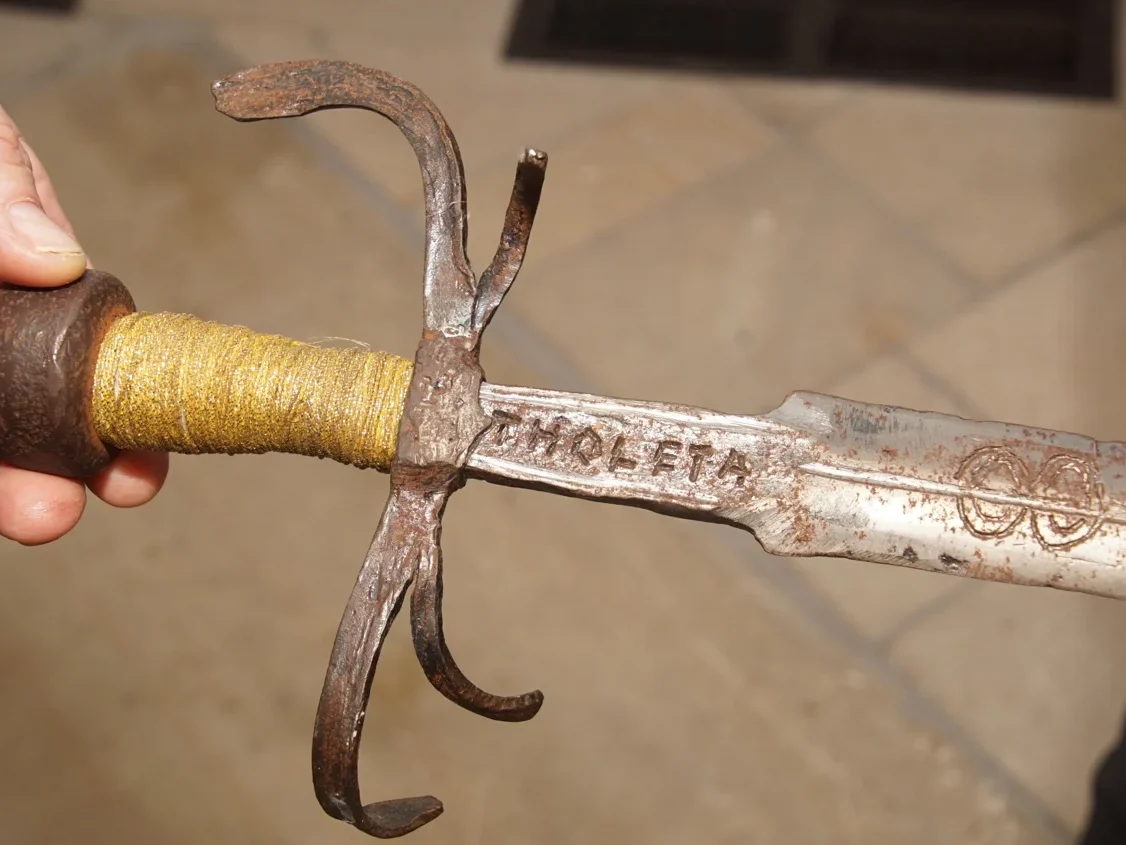
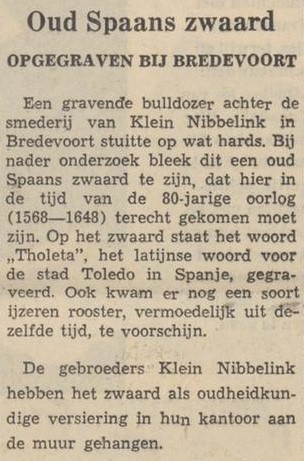
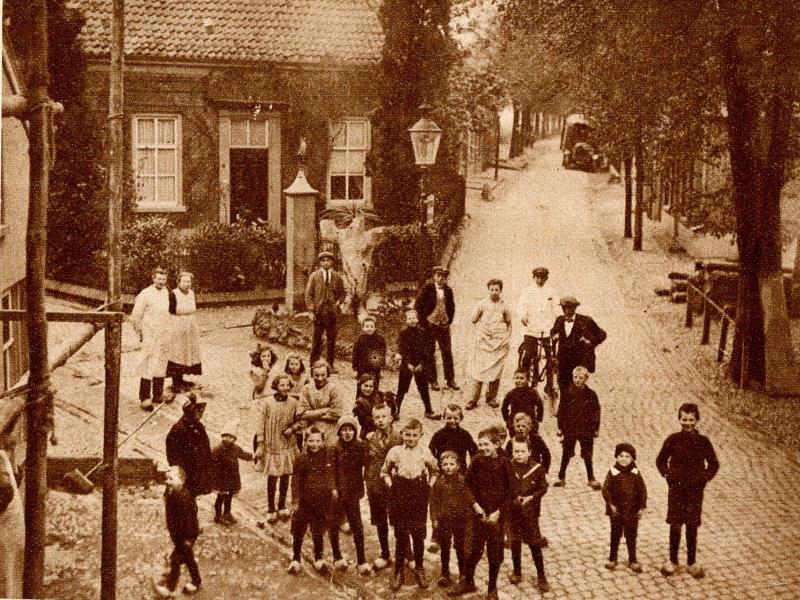
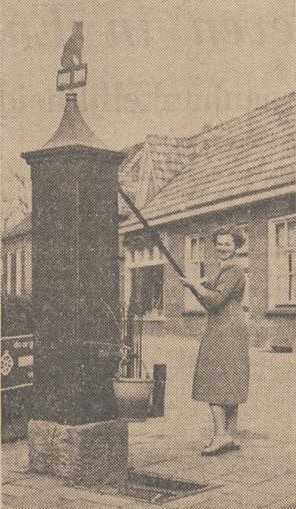
In 1964, during excavation work for the construction of a new workshop on the premises of the Klein Nibbelink smithy, various items were discovered, including remnants of walls, moat fill, wooden posts, and an iron fire grate. However, the most impressive find was a Spanish sword from the Eighty Years’ War, bearing the inscription ‘Tholeta’, the Latin name for the city of Toledo in Spain.
Johan Klein Nibbelink currently has the sword in his possession and tells about it in the video below.
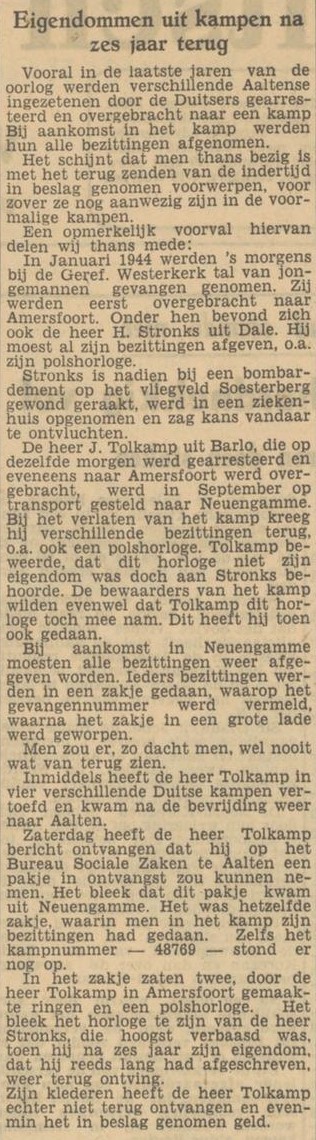
Nieuwe Winterswijksche Courant, 12 October 1964
Sources
Nieuwe Winterswijksche Courant, 12 October 1964 (Delpher)
Workers will then earn around ƒ 15,000 – Smaller towns (including Winterswijk-Aalten) merged into large cities – Further industrial revolution with possibilities currently beyond imagination!
One can indulge in the most elaborate fantasies regarding the rise in labor productivity in the near future, but with normal, steady development over the next 37 years, real income per capita will be 2.5 to 3 times greater than in 1963. The amount available for spending exceeds our imagination: a worker currently earning ƒ 6,000 per year will then have more than ƒ 15,000 to spend.
Prof. P. de Wolff, director of the Central Planning Bureau, presented this as a topic for discussion to the participants of the “Netherlands in the Year 2000” conference of the Netherlands Discussion Centre in Oosterbeek. He had calculated that by the year 2000, the population of our country would number 20 million souls. Prof. Jac. P. Thijsse of the Institute of Social Studies in The Hague also based his work on this figure. In his plans, he concluded, among other things, that by 2000, perhaps 95 percent of the population would live in cities. These people would not only live in cities, but according to his vision, there would be many cities in the Netherlands outside the Randstad Holland with 750,000 to one million inhabitants. He had assumed a density of 50 people per hectare. This relatively high population density need not hinder the “livability” of the cities, as this is a matter of quality in urban planning and housing construction.
The Netherlands in the year 2000, according to Prof. Jac. P. Thijsse
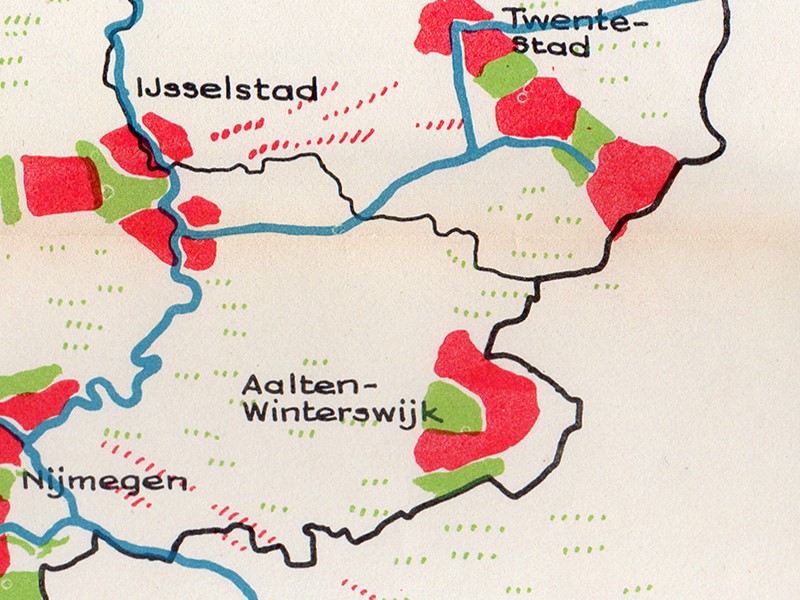
Prof. Thijsse stated that to accommodate the expected population growth, it is necessary to begin building 125,000 homes per year immediately. Using a map of the Netherlands in 2000, he showed that cities are hubs within an area with a radius of fifty kilometers. He had also formed “ring cities” from, among others, Apeldoorn, Deventer, and Zutphen; Arnhem-Nijmegen; Winterswijk-Aalten; and Enschede-Hengelo-Almelo, disregarding provincial borders. He also anticipated that national borders would no longer exist by then. In this regard, he pointed to the large city formed by the towns of Sittard, Geleen, Heerlen, the German city of Aachen, and the surrounding areas.
According to Prof. Thijsse, not a single airport in our country is in the right location. He had projected the major airport of 2000 onto the Wadden Sea, which was yet to be reclaimed. If the Netherlands maintains its function, as currently derived from transport to and from the European hinterland, Prof. Thijsse envisioned new port and industrial areas in the Western Scheldt and on the land yet to be reclaimed between Den Helder and Wieringen.
In his economic vision for the future, Prof. de Wolff assumed that no major conflicts or enormous depressions would occur in the coming 37 years. He calculated that if productivity increases by 2.7 to 3.25 percent per year and working hours are reduced to 35 hours per week, gigantic tasks must be completed in the Netherlands, given the then-altered composition of the workforce.
How the industrial revolution will proceed cannot yet be foreseen, but this development will be completely different from what is currently imagined. Perhaps certain types of labor will become so scarce that, for example, clothes will no longer be washed but thrown away, and washing dishes will likewise no longer be feasible. Perhaps people will then have to perform auxiliary tasks themselves during part of their free time, such as washing cars and painting houses. Prof. de Wolff also saw major tasks for the government and could find no room to lower taxes over the next 37 years. Not even if the defense budget were to disappear because the concept of war had become obsolete.
On Monday, a group of ladies and gentlemen will gather at the sociëteit in Aalten who, although completely unknown to one another and coming from various parts of the country, need no introduction. For the simple reason that their names are identical. Short and sweet: Vaags. After years of genealogical research and months of administrative preparation, the Vaags reunion will finally become a reality. And where better to hold it than in Aalten, where the forefather of all those named Vaags first saw the light of day?
Chemist from Geleen established family tree
That was nearly two hundred and fifty years ago. We may accept this on the authority of someone who has investigated it all in meticulous detail. A Vaags, naturally. Specifically, a certain P.B. Vaags from Geleen, a 35-year-old chemist at the state mines. This Vaags from Limburg was able to make grateful use of the oldest data when constructing a family tree, as collected at the beginning of the last war by the late Mr A.A. Vreede, whose daughter currently resides in Dinslaken.
He was busy with it for years, making enquiries at home and abroad, obtaining and processing official data from municipal registries where available, and occasionally chatting with various individuals. Thus, a booklet gradually emerged that is interesting not only to the Vaags family. A briefly described family history that reaches back centuries.
Forefather Voogedes
The forefather of all those named Vaags originally lived in Bocholt, where he was born on 8 April 1693. After his marriage to the Aalten beauty Hanna Degenaar, the couple settled in Aalten. That forefather was actually named Voogedes. Their son Jannes Petrus, born on 23 January 1718, eventually came to be called Vaags after name changes to Voegts, Vaegts, and the like. All currently living members of the Vaags family descend from this later assessor and churchwarden.
From this Dutch forefather and his marriage to Berendina Lankhof, seven branches lead through the centuries to the current generation. Two of them have already died out. There are therefore five remaining. However, by human calculation, one of these will disappear again in the short term, as the last scion of the so-called G-branch is an unmarried man in The Hague.
Then there remain the P-branch, the H-branch, the J-branch, and the B-branch. According to the research by Mr Vaags from Geleen, a respectable number of branches or twigs have emerged from these lines. Currently, there are 232 living members of the Vaags family, of whom 153 live in Gelderland (63.4 per cent in the Achterhoek) and the rest are scattered across all parts of the country, as well as 14 in Canada, 7 in Rhodesia, 4 in Norway, and 1 in South Africa. They are people from all ranks and stations of life.
Planting trees
The group of reunionists who will gather next Monday at 11 o’clock in the morning for greetings and introductions will certainly be very diverse. Naturally, not all of them will attend. During the day there will be about 90, and in the evening approximately 120. After a communal lunch, four Vaags trees will be planted in the afternoon on the ‘t Walfort estate, one for each still growing and flourishing branch: these trees will be handed over to the municipal executive for maintenance. Afterwards, there will be an opportunity to walk around Aalten and, for example, take a look at the old “ancestral homes”. In the evening, there will be a more festive gathering.
Should any outsider feel the urge to infiltrate this reunion with a simple introductory murmur: “Vaags, pleased to meet you”, they should be advised that all reunionists wear a neat bow, differing in colour according to the branch to which they belong. Furthermore, Mr Vaags from Geleen has found something of a code to make the family tree clear. And that code can really only be deciphered if you are in possession of such a Vaags family book. But for that, of course, you must be a Vaags.
A week later, Dagblad Tubantia writes about the course of the reunion:
Vaags reunion became a pleasant family celebration
The reunion of the Vaags family in Aalten yesterday became a joyful and pleasant gathering. Most of the Vaagses and semi-Vaagses knew each other due to their various Achterhoek residences, yet several kinsmen had also come from afar. But soon after the reception, at eleven o’clock yesterday morning in the Sociëteit, they were what one calls “en famille”. The word “Vaags” was heard a hundred and one times during the mutual introductions. Then there was some searching and feeling amongst the foliage of the family tree to determine if they might be directly related. The bows worn by the reunionists, in the colours orange, red, white, and blue, were an excellently functioning aid in this regard.
Four trees planted at ‘t Walfort
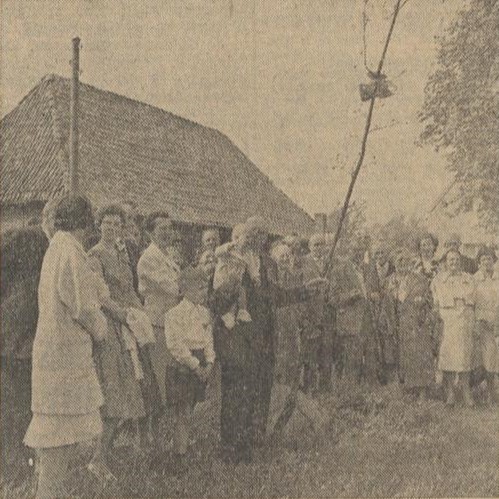
One of the four Vaags trees, that of the orange branch, is planted near the remains of ‘t Walfort castle.
Yesterday, during mutual conversations at the table or over a drink, there was plenty of browsing through the family tree that the animator of this reunion, Mr P.B. Vaags from Geleen, has so solidly established. The fact that everyone was related to everyone else was not enough to satisfy everyone. People wanted to know to what extent that kinship went. And for this, the booklet by the Vaags from Limburg with its handy coding was indispensable.
Quite rightly, the chairman of the working committee, Mr J.B. Vaags (from Winterswijk), outlined the merits of that work in his welcoming speech. And it did not stop there. One of the Aalten reunionists had crafted a neat miniature family tree with the four main branches in colours, and this was presented to Mr Vaags from Geleen as a lasting memento of his work and the reunion that resulted from it.
A special word of welcome was extended to Mr and Mrs Brinkmann-Greeve, the clerical couple from Dinslaken. Mr Greeve had collected the first genealogical data on the Vaags family at the beginning of the war, and Mr Vaags from Geleen built upon this data in his later research. Mrs Vreede said in her response, also on behalf of her husband, that she considered it a great honour to be able to attend this reunion.
With that, the official part was temporarily at an end. People chatted for a while and then went to the lunch table.
In four groups
The afternoon began with the second official part, the planting of four Vaags trees on the ‘t Walfort estate. With this, the Vaagses hope to have given symbolic form to the memory of their reunion for a very long time. The approximately one hundred reunionists set off on foot, by bus, or by car to the (now) municipal estate. A better place could hardly have been chosen; after all, the resident of what remains of the old castle is also related to the Vaagses.
There, the saplings provided with an orange, red, white, or blue bow (one for each still vigorous branch of the family) received their destination, surrounded by the corresponding kinsmen. For a moment, the large Vaags family split into four groups. But after Mayor Van Veen had accepted the trees into municipal care with a few friendly words, unity was quickly restored. Afterwards, people walked pleasantly around Aalten, visited an old “ancestral home” here and there, and ate together. And in the evening, de Heikneuters entertained the family, which had by then become somewhat more numerous, for a few pleasant hours with a song, a chat, and some music.
“A small effort, I thought….”
P.B. Vaags from Geleen
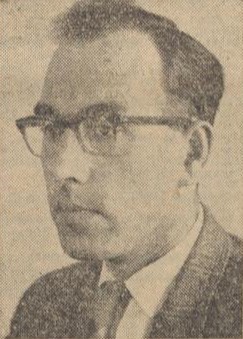
The man who essentially made the reunion of the Vaags family possible through his genealogical research, Mr P. B. Vaags, may live in Geleen in Limburg, but is a true Achterhoeker by birth. His grandfather was from Aalten, and his father and he himself come from Eibergen.
“The name Vaags has intrigued me for a long time, especially because you hardly encounter it elsewhere in the country. I thought it would be a small effort to trace all family members. But I certainly underestimated that. I began by simply examining a series of old giro and telephone directories for the name Vaags – you have to start somewhere – and it soon became apparent that the tree was growing thicker and thicker. I wrote to various people, went to talk to baker Vaags in Aalten, and once I had got that far, the work would not let me go.”
All in all, it took a year and a half before the family tree, complete with all branches and twigs, stood tall and firm. Then the organisational work for the reunion could begin. But the Vaags from Geleen did not involve himself with that. That was more the work of the VVV secretary, who is very skilled in such matters.
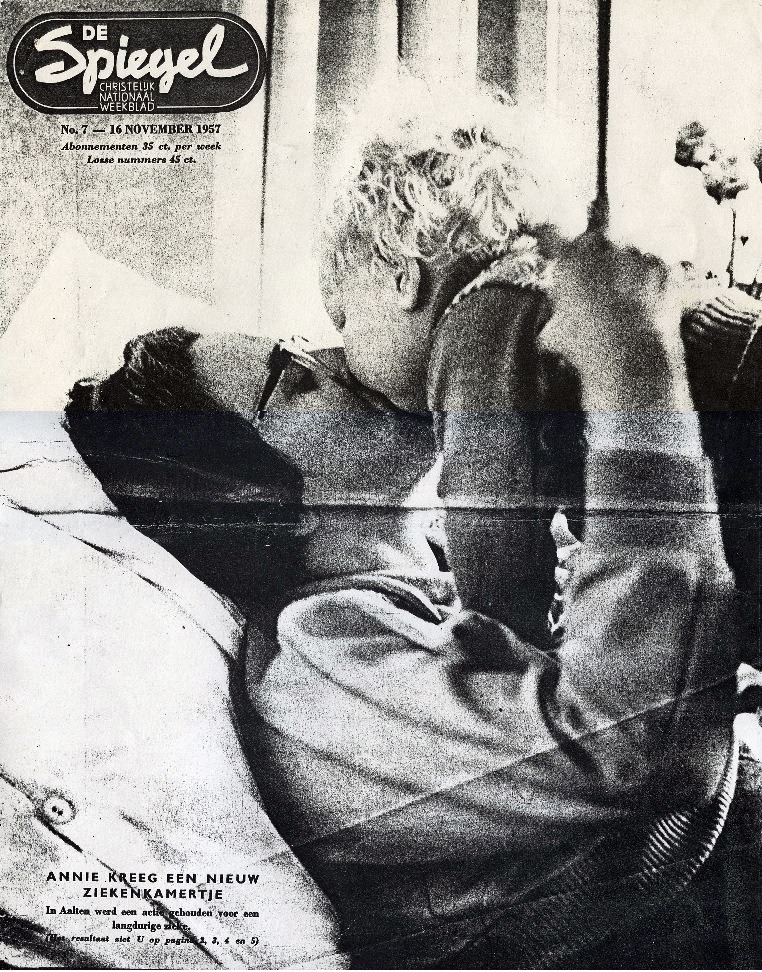
Christian National Weekly De Spiegel, November 16, 1957
Slowly and carefully, she was lifted out of the ambulance. Strong men’s arms carried the stretcher step by step across the yard, where some withered leaves were driven along by the fresh autumn wind until their progress was halted by the wire mesh stretched around the chicken run. Step by step the men went further, past the people who had sought some shelter from the wind under the roof of the open barn. And Annie smiled at all those people, for it was a particularly joyful day for her. Today she received her new, own little room! And these people and many more had seen to that.
The stretcher was set down. Annie looked aside and then… then suddenly there was a tear in her eye, which she hastily wiped away. But another one came, and another… Oh, this – no, she had not expected this after her absence! A whole new little house with two French doors through which she saw a new table – and chairs – and her little radio stood next to her bedstead on a brand-new bookcase and then a beautiful lamp – and… and… once again the emotion became too much for her and as she was carried inside, she let her tears of joy and gratitude flow freely…
Would there be no solution!
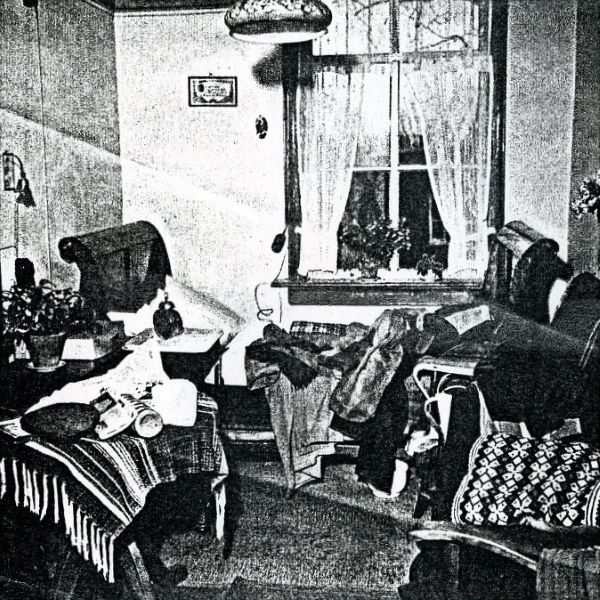
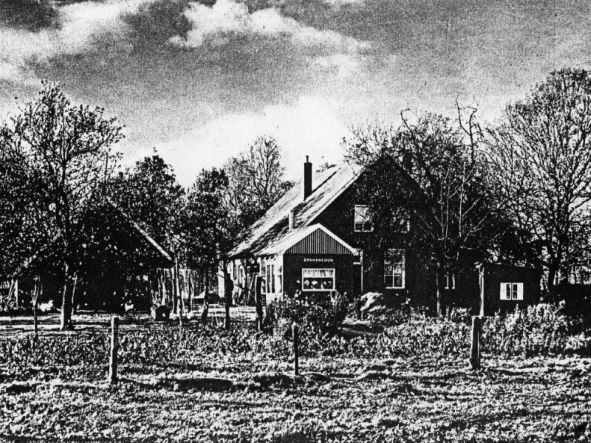
It must have been about half a year ago that Hendrik Arentsen, clothier in Aalten, visited Annie Smees for the umpteenth time. She had been bedridden for so long, so very long – for as many as fifteen years – and humanly speaking, no cure was possible anymore. Arentsen looked around. The room where the sickbed stood was pleasant enough in terms of space, but he knew it was damp and that at ten o’clock in the morning, the sun bid farewell to Annie for the day.
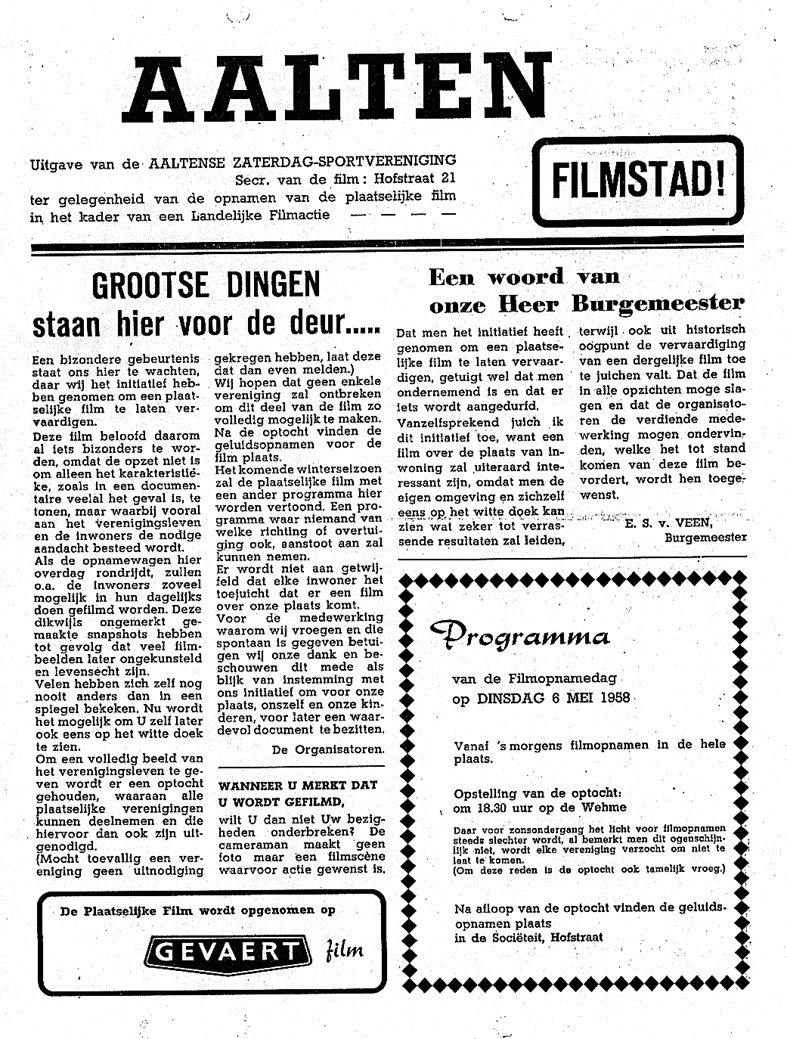
The story of Annie Smees and Operation Sunshine in De Spiegel, November 16, 1957
The girl needed sunshine, and she did not receive it in this room.
What a pity, the clothier thought, that this girl, who already sees so little of the outside world, cannot receive a bit more sunshine. Could no solution be found for that? Could no other room be found? Would no other room be available for the girl? – He talked about it with father and mother Smees, but these elderly people did not know either. After all, had it not gone well for so many years? For three months of each year, Annie had lain in the small garden house, and for the rest of each year, she lay in this room.
Was there then no other place at all in the farmhouse where Annie’s bedstead could face south? “Our bedroom,” said mother Smees, “but then again, that has no window looking south.” Well, that became more difficult. Especially since the farmhouse is not owned by the Smees family. Nevertheless, Mr. Arentsen kept thinking about it. Annie had to have sunshine. If only he and all those friends, family, and acquaintances who visited her regularly could give her that! It had to be possible somehow.
Donations poured in
And it worked! It worked much better than Annie’s friends had expected. For when permission was given to exchange the room of father and mother with that of Annie and to furnish it as a cozy sickroom with a large window, a chimney, wallpaper, and floor covering, then the donations poured in.
At birthdays and weddings, from private individuals and businesspeople, everyone who belonged to Annie’s family, friends, and acquaintances was immediately prepared to respond to Arentsen’s appeal and to contribute a stone (or sometimes a large stone) to the costs that had to be incurred. Thus Operation “Sunshine” was born, and the amount of one thousand guilders involved in the improvement and furnishing of the room was soon exceeded and grew to two thousand guilders!
But that was wonderful! Why, Annie’s friends thought, should we not do it completely right at once? Let us give her a whole new little room as a gift! And while talking, they finally came up with the idea of having a removable, portable, and double-walled wooden house made. After all, mother, the only one who cared for her day and night, was already nearly sixty-nine years old, and if Annie ever had to be nursed by someone else, she could beautifully take her little house with her.
Because people love her
So it was decided, and so it happened. The little house was built and its interior furnished. Girls from the Christian Agricultural Domestic Science School of Aalten bought and made the curtains from their saved money, the teachers provided them with hand-printed motifs, the Orange-Green Cross donated the rug, the Luimes firm gave, in addition to a financial contribution, the beautiful bookcase on which the modern radio set could stand, which Annie had previously received from a reader of De Spiegel after an appeal for postcards had appeared in our magazine and these people had visited Annie personally.
Furthermore, there were gifts and donations from… oh no, let us mention no more names, for otherwise we might skip someone, and besides, it is not at all the intention of all Annie’s friends that their names be made known. These gifts, this bringing of sunshine to a girl who has been struggling with her back since she was eleven or twelve years old due to an unfortunate fall while playing, where surgical intervention could be of no avail, all this selfless love and this tangible sympathy was given to her because people love her, because they wanted to put into practice the neighborly love commanded by the Lord Jesus.
Touching neighborly love
This report should therefore be seen in that light. Amidst all the misery to be found in this world, the devouring of one another through jealousy or feelings of hatred, the shouting of “I won’t stand for that!”, the… well, all that ugly and nasty stuff that so many people inflict on their neighbor, in the midst of that, this beautiful thing, this giving of touching neighborly love, suddenly happens in the Gelderland Achterhoek.
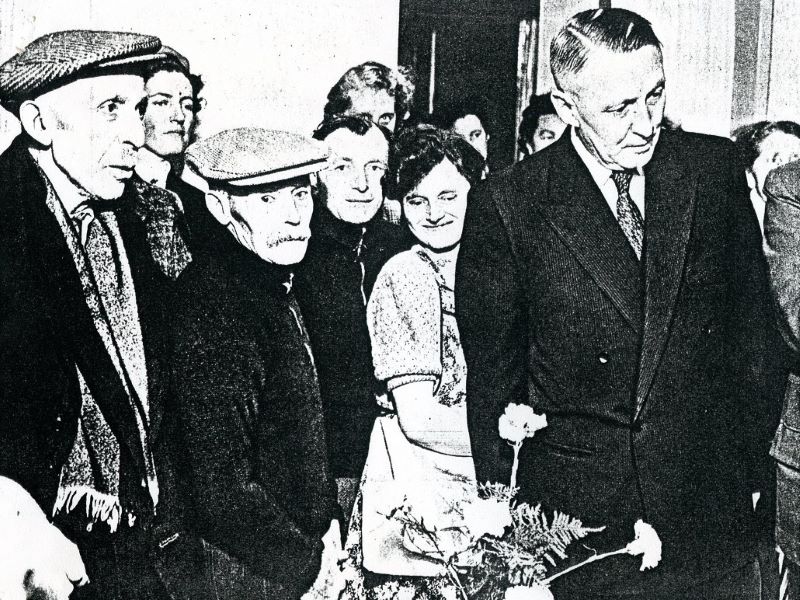
When the mayor of Aalten and Mr. Arentsen spoke, the little room was full of family and friends.
“It is by no means the intention to squeeze money out of you,” Mrs. Te Loo from Bredevoort wrote to us, “but we found this spontaneous sympathy for the sick Annie Smees so lovely and so heartwarming that we thought: we must write this to De Spiegel. It could be an example for others.” And so it is indeed!
Before Annie arrived with the ambulance, we took a look around. We saw her previous sickroom, where almost no sun comes and from which she saw practically nothing of the road. The road, which is already a long way from the farmhouse. The room is also located entirely on the other side of the house, so that Annie also saw nothing of the activities performed by her parents, brother, and sister around the farmhouse, and as a result, she also had little contact with her housemates.
We also looked at her “summer house,” which stands in the garden. It is no larger than a gazebo. If her bedstead was in it, one chair could fit with difficulty. Moreover, it was not easy for her mother to have to go outside once every night during the three months that Annie lay there.
Unencumbered property
No, then her new room is better in every respect. Through a door, the little house is directly connected to her parents’ bedroom, Annie has a better view of the road and the yard, and the sun can shine in unhindered from morning until late in the afternoon.
When she was carried inside – as we already wrote – several family members and friends were there to be present at the handover. We saw the mayor of Aalten, her physician, Dr. H. Knol with his wife, Alderman Te Roele, the chairwoman of the Red Cross, Aalten branch, Mrs. Van Egmond, and many more. They all came to congratulate Annie on her new residence and to listen to the deed that Mayor Van Veen read out and handed to her. It contained the following:
“On this day, the first of Nov. 1957, was transferred in unencumbered property by the Honorable (“yes, that is me, Annie, how do you like that?” the mayor laughed) E.S. van Veen, mayor of the municipality of Aalten, to Miss Annie Smees, Heurne 4, also municipality of Aalten, a double-walled and tile-roofed wooden building, measuring over three by four meters, with double windows, mantelpiece, asbestos chimney, tiled terrace, electrical installation with accessories, balatum, carpet with two rugs, chair, bench, table, book furniture, lamp, oil heater with 200-liter tank. All this is the result of a campaign conducted among friends, family, and interested parties under the motto ‘Operation Sunshine’.”
Mother Smees also had to shake many hands and receive congratulations.
A blessing to many
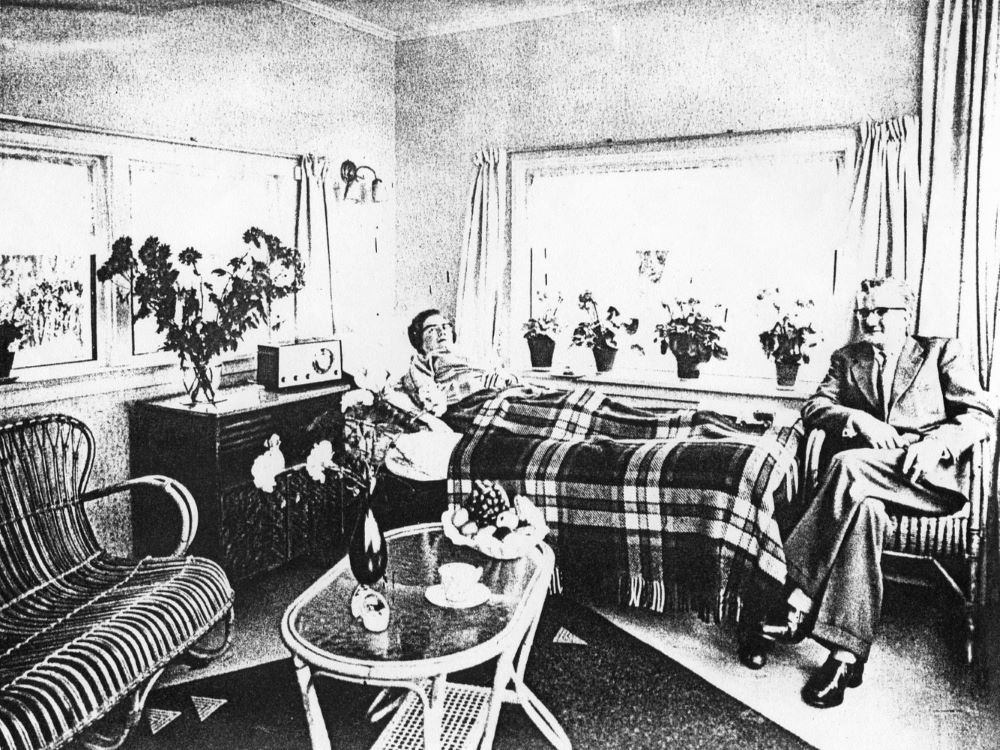
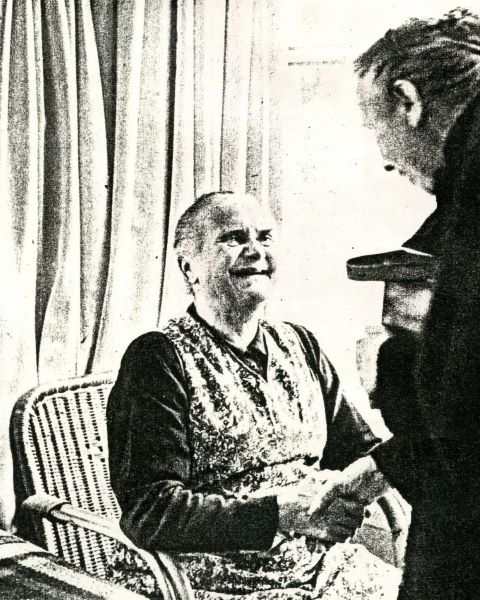
Annie Smees in her new little room, on the right Mr. H. Arentsen.
“It has overwhelmed Anneke,” said her parish minister, Rev. R. Siertsema, “therefore she cannot find words to thank you all and has requested me to do so.” “Let us also not forget,” Mayor E.S. van Veen said a little later, “that although Annie has this cross to bear, she nevertheless manages to let many who visit her go away again with a joyful and grateful heart. Unconsciously, she has been a blessing to many people, and I am sure she will continue to be so.”
Annie lay there perfectly happy, the red cyclamens bloomed on the windowsill, flowers scented the whole room, and her folded hands lay in the mild light of the joyfully shining autumn sun.
The original article is also available as a PDF (click here).
Annie and her sister Mina moved in 1970 to a sheltered housing unit of the Cederhof, Hogestraat 80. The sickroom then served as a storage room for several more years.
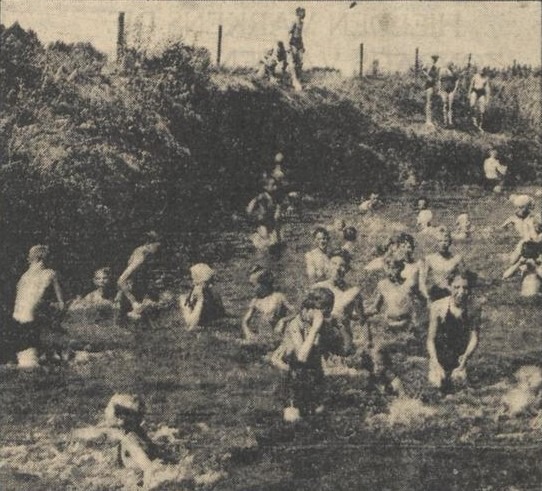
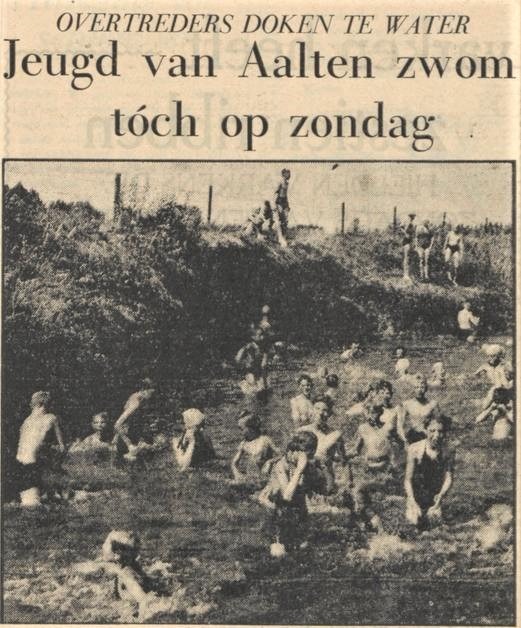
Sunday, July 7, 1957, was a sweltering day. Consequently, many residents of Aalten wished to take a cooling dip in the ‘t Walfort swimming pool. At the time, however, it was not permitted to open the pool on Sundays. Hundreds of residents disagreed and marched to the pool that afternoon. The youth climbed over the fence, and older residents forced entry into the pool. Moments later, the crowd dove into the refreshing water, and the hastily summoned police were powerless to intervene!
Stampede at ‘t Walfort
Nieuwe Winterswijksche Courant, July 8, 1957
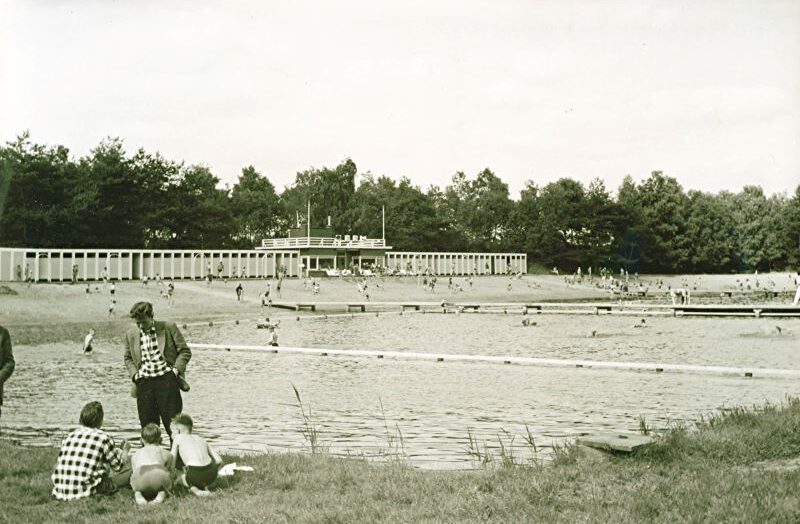
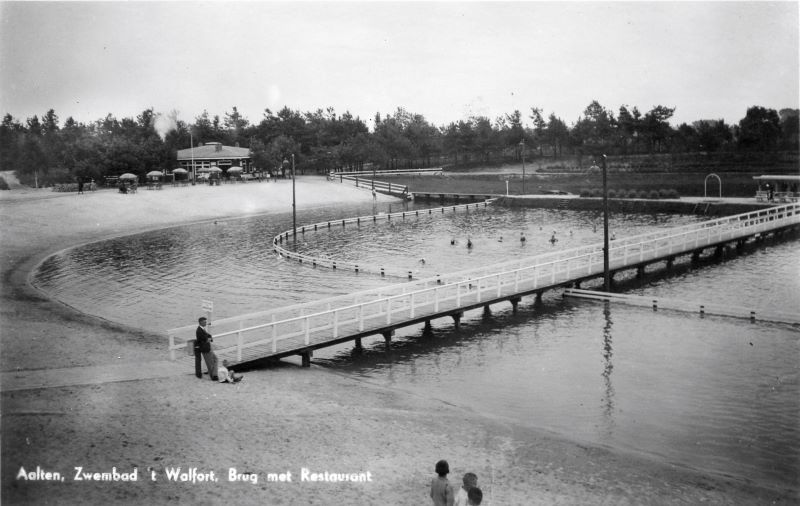
Aalten possesses a beautiful natural swimming pool, ‘t Walfort. However, swimming is not permitted on Sundays. The predominantly right-wing Christian municipal council recently decided, by a majority of a few votes, that the pool must remain closed on Sundays. This decision has greatly irritated a large portion of the Aalten population, who do not share the motives behind this resolution. This irritation was further exacerbated last Sunday by the extreme heat, which created a longing for a cooling bath.
On Sunday afternoon, young and old alike flocked to ‘t Walfort in great numbers, where they initially stood before the closed gate, protesting against the municipal executive for withholding this pool from the more liberal Protestant segment of the population, as well as Catholics, Jews, etc., while it was sweltering. Soon, the youth began climbing over the pool’s enclosure, and before long, older individuals were kicking in the wooden fences to force access to the pool. Moments later, the entire crowd—numbering in the hundreds—dove into the refreshing water.
When the hastily summoned police and several board members of the pool arrived, they were faced with a fait accompli! The police could do very little; it was impossible for them to get all those people out of the water. Finally, Alderman Obbink of the Anti-Revolutionary Party (A.R.) delivered a speech, which, however, fell on deaf ears. The people simply held fundamentally different views than the municipal executive and continued swimming calmly.
De Volkskrant, July 8, 1957
After several hours of swimming, the pool board made another appeal to the swimmers: they had had their chance, and the pool had to be closed again. This appeal was successful: in a sporting manner, everyone left the pool, and shortly thereafter, Sunday rest was restored to the swimming pool. However, the municipal executive of Aalten is faced with a problem; it is now clear that, regardless of how this matter is framed on principle, a large part of the population disagrees and believes that the interference with their freedom on Sundays goes too far.
Naturally, the municipal executive made its decision to keep the swimming pool closed on Sundays based on grounds that were serious to many council members. However, Alderman Obbink promised “to look into this matter once more” for those who cannot share the Council’s fundamental considerations.
Aalten Swimming Pool remains closed on Sundays
Tubantia, July 9, 1957
Archive photo of ‘t Walfort swimming pool, for illustration purposes
At the proposal of the Mayor and Aldermen of Aalten, this body met with the board of the “‘t Walfort” swimming pool to discuss the incidents of last Sunday, when the youth of Aalten stormed the pool. The pool board indicated that it fully respects the council’s decision to keep the pool closed on Sundays and that it condemns Sunday’s actions; the latter in contrast to rumors suggesting that the pool board had cooperated with the demonstration.
The municipality will issue a serious warning during the course of this week against entering the swimming pool on Sundays. The necessary measures will be taken. We further understand that the council factions of the K.V.P., P.v.d.A., and Gemeentebelangen will not submit a new proposal to open “‘t Walfort” on Sundays this season. Since no new proposal can be expected from other parties either, it is almost certain that the pool will remain closed on Sundays this season.
Warning
Tubantia, July 11, 1957
The acting mayor of Aalten, Alderman W.B. Obbink, has announced following the demonstration that took place on and around the swimming pool on Sunday that, should the disturbances recur, they will not hesitate to take criminal measures. This publication was issued following a statement from the board of ‘t Walfort. It reads as follows: “The board of the ‘t Walfort’ bathing and swimming facility, meeting on July 8, 1957, discussed the disturbances that occurred on and around the swimming pool last Sunday. It deeply regrets this reaction to a decision that was reached in a perfectly legal manner and unanimously expresses its disapproval of this subversive conduct. It strongly urges the population, especially the youth, to respect the Council’s decision, to refrain from vandalism, and to comply with the decision in a sporting manner.”
Aalten Council revises decision
Tubantia, April 16, 1958
This coming summer, residents of Aalten will be able to go swimming in their own ‘t Walfort pool at four o’clock on warm Sunday afternoons. Last night, the municipal council decided that the pool will be open from 3:00 PM to 7:00 PM on summer Sundays. A corresponding proposal, submitted on behalf of the K.V.P. and Gemeentebelangen factions, was adopted after a calm debate by 9 votes to 6.
The decision itself was not a surprise, but the relatively large majority the proposal received was. Unlike last June, when a similar proposal was rejected by 8 votes to 7, all three Christian Historical (C.H.) council members now voted in favor. The Anti-Revolutionary Party (A.R.) remained steadfastly opposed. As is well known, last summer, a few weeks after the council’s rejection, ‘t Walfort was stormed by hundreds of Aalten residents on a sweltering Sunday afternoon, after which swimming took place for several hours.
Disturbed peace of mind jeopardizes Sunday rest
Last night’s debate did not open any new perspectives. It was essentially a brief repetition of the arguments that were presented extensively and sometimes passionately on June 30 of last year. This time, the council finished its discussion within half an hour. Mr. Luiten, faction leader of the A.R., called it less than edifying that another proposal to open the swimming pool on summer Sunday afternoons has already been submitted.
If we were to make a different decision now, people might think we are giving in to opposition from the streets. He once again explained the pros and cons, admitting that mass swimming in the stream creates unacceptable conditions, but stated he did not see why, in a municipality like Aalten with its wealth of natural beauty, the swimming pool must also be open on Sundays. In his view, a piece of Sunday rest is lost because of it.
Mr. H.L. Obbink (C.H.) clarified why he would take a different position this time than last year. The events of that time proved that the peace of mind of the population can be so disturbed if the swimming pool remains closed that the Sunday rest itself could be jeopardized. This had led him to decide to revise his position. Mr. Huinink (Labor) again raised the argument of Sunday labor in the service of the police, railways, etc., which is also performed by Anti-Revolutionaries.
Archive photo of ‘t Walfort swimming pool, for illustration purposes
(“Only necessary labor,” Mr. Heinen stipulated), and called the attitude of the A.R. typically Aalten. In a municipality like Varsseveld, the situation is quite different. What was proclaimed 50 years ago no longer applies today. He believed that the Sunday rest would not be jeopardized by the opening of the swimming pool.
Not through resistance
Mr. Wijkamp (K.V.P.) stated that the irregularities of last summer were not the reason for bringing the proposal forward again; it was already certain then that another attempt would be made before the new swimming season.
After Mr. Brethouwer (C.H.) explained why he would vote in favor (“swimming in the stream at Lintelo certainly does not benefit the Sunday rest”), Mr. Heinen (A.R.) expressed his surprise at the changed attitude of Mr. Obbink and especially of the K.V.P., which a few years ago was even opposed to mixed swimming. Mr. Lurvink (K.V.P.) replied that moral welfare was certainly as important as the sanctification of the Sabbath. After brief replies, in which Mr. Wijkamp requested strict police action against swimming in the stream, the vote was taken.
After Mayor Van Veen announced the result, Mr. Ter Linde (P.v.d.A.) addressed the population over the heads of the council with a request to make appropriate use of the swimming pool and to prevent any excesses. The Mayor and Aldermen will now consult further with the swimming pool board regarding the implementation of the decision.
Sources
Nieuwe Winterswijksche Courant, July 8, 1957 (via delpher.nl)
Winter 1951 in the Netherlands, an important meeting about a burning issue. A meeting that may have escaped the attention of the Dutch people and certainly did not have a report in the press, but whose results have been no less drastic in the life of a family, rooted by generations in the familiar surroundings of our beautiful Graafschap. The meeting was a family gathering of the Kortens at the parental farm “Lensink” below Aalten.
The subject is familiar to many families in the Dutch countryside: what to do when the children grow up, get married and want to stand on their own two feet, have their own farm? A problem, although not new, but increasingly topical as the population increases, land is lost due to the construction of industries and the construction of roads, expansion of cities and airports. A problem for which no reclamations can provide a solution, tragic because of its unsolvability in its own country.
Lensink
“Lensink” is a farm, twelve hectares in size, where father Korten and his family already got the most out of it. A farm, which gives an existence to one family, but can no longer be divided. Under the roof of the familiar farm, a decision was made on that day of 1951. If no solution could be found in their own country, they would try it across the borders. Many had already gone before, including to Canada, also from their own area. And the reports heard from overseas about the experiences there raised hopes that perhaps a solution to their problem would be found.
It must have been a melancholy farewell in the autumn of that year. Farewell to the farm, the familiar surroundings, to the children who stayed behind because other ties bound them in the old country. A melancholy perhaps hidden behind the excitement of the big event and the nervousness of the preparations, but also gilded by the expectations of an uncertain future. Have those expectations been met? Was the solution found in Canada that was no longer available in the Netherlands?
In the autumn of 1955, four years after leaving the Netherlands, Korten will answer that question in the affirmative. In his cautious way, he will point out what was achieved at that time, with an open eye for the difficulties that lie ahead, but also with confidence in his own abilities and grateful for the horizons that have been opened up for him and especially for his children. Perhaps there will be those who, seeing the results, say that it is easy to achieve success with such a bunch of big children. But does that make any difference? In the Netherlands it might have been achieved only partially or never. The young families will have to struggle longer to get this far, may have to make more sacrifices for it and have more difficult early years. But they have the strength of youth.
How Korten is doing now
The Korten family, who after careful consultation exchanged the familiar farm in Aalten for an unknown future in Canada, were allowed to call themselves owners of a spacious wooden house and 45 hectares of land after two years.
In October 1951, the family arrived in Canada and traveled on to a small town in Southern Ontario, not far from Hamilton. An old acquaintance from Aalten made sure that the family found work and shelter on a fruit farm, while a place was found for the family of a married son on a farm nearby. Korten stayed there for two years. The children were given work in fruit and tobacco cultivation, where good wages are earned during the summer through long days. The joint income was saved and in the summer of 1953 the time had already come to look around for companies for sale.
By that time, Korten will have become accustomed to the big difference between the Netherlands and Canada, where farms are offered for sale in abundance. Good and bad, cheap and expensive, big and small. He drove around with his sons for many hours, visiting companies, before he had made his choice. The available financial resources imposed limitations, the company had to be large enough for his family and offer development opportunities for the future…
If someone had told Korten before his departure from the Netherlands that he could once again call a vast vineyard his own, he would have laughed at him. But that unexpected happened, because in November, barely two years after his departure, the family moved into a farm, large 45 hectares, half of which were with grapes; the company that Korten had chosen. One can imagine that it means quite a change for a Dutch farmer of the mixed farm when he exchanges his place among the cows for a life in the middle of the vines, especially if he has no experience with grape growing.
The Kortens were in that position. A lot of adaptation was demanded of them again, much was and still has to be learned. Neighbors in this region, where many grapes are grown, gave advice and Korten now also knows that he can turn to the Information Service for advice. The pruning in the winter, tethering in the spring, the watering and tillage, the harvest, everything was new and strange. Gradually they grow into it and learn the tricks of the trade and the demands it makes.
Warden’s and Niagara’s, Concords, Fredonia’s and Diamond’s, grape varieties that each require their own care, are names that no longer sound strange to them. And that’s what this company needs more than anything else: expertise. Several times during the last few years it has changed hands, it was neglected and polluted when it was moved into. Production is still below normal, which is not only due to the fact that most of the vineyard is still young and not at full production. Pruning should be improved and old trunks removed. The buildings should be refurbished, but in Korten’s eyes that can wait a while. First production must be brought up to standard. And that already requires enough time and capital.
For his sales, Korten has a contract with a wine factory in the area. The price he receives for his grapes is fixed in the spring and is different for the varieties. Over the past year, these prices ranged from $80 to $100 per ton. These grapes are processed into wines and grape juices. Some varieties are more popular than others and Korten can count himself lucky with a considerable variety in the varieties on his farm, which ensures that he is more assured of good sales than when only a few varieties are grown. He sells a small part of the harvest as hand grapes to wholesalers or directly to the public. Although he can charge more for this, it also takes more work and time to prepare the baskets. Moreover, this sales are very limited.
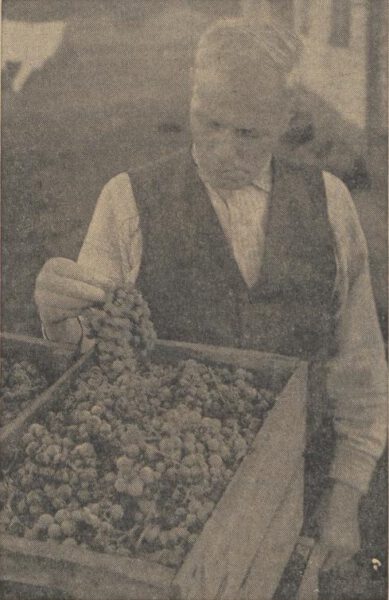
Over the years, Johannes B. Korten has become a real grape connoisseur, who manages his extensive vineyard with care and consultation.
Grape cultivation is subject to significant risks, such as frost and hail damage, plant diseases, bird and insect damage, against which the grower can only partially insure or arm himself. Sales do not cause Korten any headaches and he gets a good price for his product. For sales, the Canadian grape grower is to a considerable extent dependent on exports to the United States, where production is regularly increasing. However, much has already been done in the field of marketing organization by grape growers’ associations.
However, it does not look like there will be any major difficulties in marketing in the future. On the Niagara Peninsula, where Canadian grape cultivation is concentrated and where Korten has his business, the same phenomenon is occurring that our own country knows so well: more and more land is being taken up for industrialization and the area cultivated with grapes is also declining. This region, so ideally suited for climate and soil type, has a great attraction for industry due to its location in a densely populated part of this country and the presence of excellent transport facilities. Although this development is not in the general interest of fruit cultivation in this region and there is talk of setting up regional plans to steer this in the right direction, it means a guarantee for the grower for sales in the future.
In addition to the vineyards, the company has more than 20 hectares of arable land and grassland. Originally, this was all in grass, but Korten only has two dairy cows and two heifers and decided to tear up part of the grassland. On the arable land, he now grows wheat, oats, corn and tomatoes, the last crop on a supply contract with a cannery. The cattle are also in such a state that he would like to keep more cows, especially because he needs the manure so much on the farm. But he is not yet sufficiently well equipped to be able to put money into this now. It is still “all hands on deck” to meet the obligations that have been entered into with the purchase of the company and also to develop the company.
The boys work with others whenever they can be missed, either in the construction company or in tobacco cultivation. Despite the heavy burdens, however, there is the satisfaction of building a life and the confidence in a future without fear of the problem that drove them to Canada: what are the boys going to do? There is now sufficient space for development on their own farm and beyond. Mother Korten now makes her own wine, not much but from “own cultivation” and good taste, to taste on special occasions. And on those occasions, she and her husband will sometimes reminisce about the time in Aalten, on the “Lensink”, where a son now holds sway and a young family grows up.
Do you have interesting stories about family members who emigrated from Aalten to Canada? Send us a message!
Four years ago, Marinus Rhebergen from Aalten left for Canada and he is currently on holiday in his hometown for a few months.
“Canada is, it is said, the land of unlimited opportunities, but don’t think that every immigrant in Canada will become rich in a few years. Don’t even think that everyone who emigrates to Canada will have acquired a position there within a few years, as it would never have been possible in the Netherlands. There are exceptions, there are people who are extremely lucky and have acquired a strong position within a few years, but…. They remain exceptional cases.”
This is according to Marinus Rhebergen from the Richterinkstraat in Aalten, who emigrated to Canada four years ago and returned yesterday for a holiday stay in Aalten, where his parents and other relatives live. Four years ago, Marinus left, together with his friend Constant de Jong, also from Aalten. It was actually a bit of an adventure for Marinus and Constant. Both had jobs and both were single. They did not have many worries. The unknown attracted them and they did not lack entrepreneurial spirit. One day we left, just like that, hoping for a blessing.
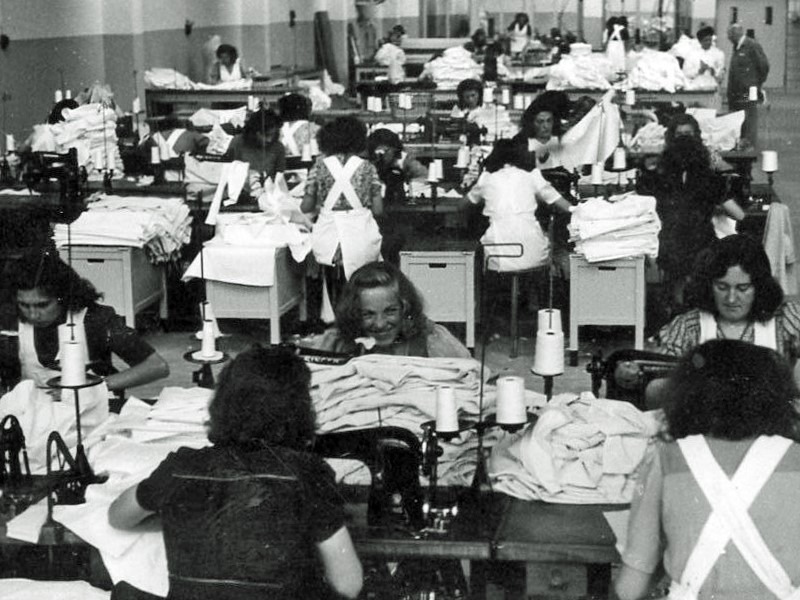
“When we arrived in Canada,” Marinus told us, “we had to get some money in our pockets. After we came ashore, we decided to step into the first factory we saw. It was a textile factory. Beforehand we had “tossed”, where it turned out in such a way that, if only one man was needed, it would be my turn first. I was lucky in that first factory. The director – an Englishman – could use people. He spoke highly of the good relations that had always existed between the English and the Dutch people. Of course I was wise enough not to talk about the wars with England. After a few days, the director came to tell me that he also had work for my friend. That’s how we both started working in the same company.”
Pamphlet to welcome Dutch immigrants, 50s. Canadian Museum of Immigration at Pier 21.
In the office
However, Marinus did not want to stay in the textile factory. He looked for a job in an office and finally succeeded in a place in the north of Ontario. “I had a good job there,” Marinus said. “There was one objection to it; I was the only Dutchman in that place and that was not pleasant. The mentality of the Canadians is very different from that of the Dutch and when push comes to shove, you will always remain Dutch there. Whether you like it or not, you always keep your Dutch sense of sociability and community practice.”
Marinus has now gone to Aalten. For how long? Oh, he doesn’t know that yet. He is not tied to anything. He has quit the job in Canada. His boss there gave him a beautiful certificate and said that the office chair is ready for him at all times. However, Marinus does not want to be isolated among the Canadians again as a Dutchman. Somewhere else in Canada, he will soon try his luck again.
Getting ahead
Marinus has spoken to numerous Dutch people in Canada in the past four years, including several former Aalten residents. They are doing pretty well, of course some better than others. “In general,” says Marinus, “someone who has a small business or a small farm in the Netherlands should not think that he will be able to work in Canada within a few years. Many who were so-called small self-employed in the Netherlands, are also self-employed in Canada. If one wants to take giant steps on the road to fortune, one must fully adapt to the Canadians. That means, adopting their good qualities, but also the bad ones. Then one gets a lot of relationships and that is of enormous importance, but not moral.
Constant de Jong, who left at the same time as Marinus, still works in the same factory. He was less able than Marinus to change, because he married there a few years after arriving in Canada. And Constant is a man with Dutch responsibility; A married man should not go on adventures. Marinus has remained loyal to the bachelor life.
Voortman family
Marinus Rhebergen often visited the Voortman family in Canada. This was not only caused by the fact that there are four boys in this family, with whom it is pleasant to talk, the wife of Voortman Sr. comes from Aalten. Mr. Voortman, who was a widower, remarried in Hamilton to Ms. Cato te Brake, who left for Canada a few years ago. The Voortman family, says Marinus Rhebergen, first lived in Picton for a number of years. After several years of hard work and considerable savings, Mr. Voortman decided to buy his own house.
He succeeded in Hamilton, where there was a large house for sale in the center of the city. Mr. Voortman became the owner of this building and decided to furnish it partly as a guest house. Business went very well almost from the start. According to Marinus Rhebergen, this was mainly due to the good reputation that the boarding house received. They were mainly unmarried Dutch immigrants, who boarded with the Voortman family.
They had a good time there. Not only was good food and drink provided, but a lot of attention was also paid to creating a cozy atmosphere. In general, the Canadian boarding houses do not excel in conviviality. The Canadians are less fond of domestic traffic than the Dutch and this is also evident from the design of their homes.
Boarding houses
Especially the unmarried Dutch immigrant does not have an easy time in Canada. Financially, if he knows how to get things done, he can get by, but earning money alone does not make the emigration successful, one must also feel at home in the new environment.
Unmarried people in Canada are dependent on boarding houses. “That’s not all,” says Marinus. “There is almost no domestic traffic and you miss the cozy atmosphere of the Dutch families. The Dutch immigrants also often have boarders, but one drawback is that a Dutch family sometimes has eight to ten boarders. That sometimes makes the flush thin.”
The young people, who have their boarding house with the Voortman family, all feel at ease in Canada and that is also the case with the young men, who spend a few pleasant hours here in the evening after work.
Other immigrants from Aalten
Marinus Rhebergen also met many other immigrants in Canada. Of course, he mainly visited Dutch people from Aalten. Mr . J. Bierman from Lintelo initially worked on a farm in southern Ontario for a few years. A few years ago, he bought a farm in Cochrane, in northern Ontario. The land was cheap and is good. A disadvantage is that people live quite lonely in the north and that the winter is long there. Mr. Bierman mainly grows a lot of potatoes. The farm is about 500 hectares in size.
Mr . G.C. Stronks, formerly living on the Hogestraat in Aalten, works in Burlington on a market garden. He is currently building a house himself.
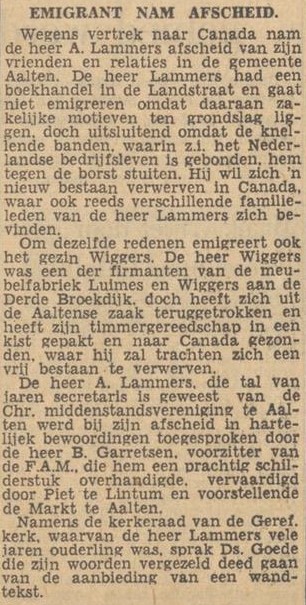
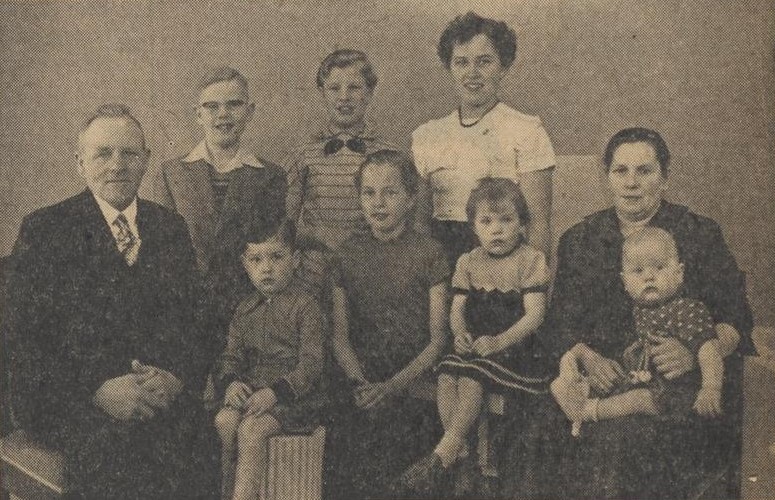
Mr . Ant. Lammers, who had a bookstore in Aalten on the Landstraat, lives with his family in Hamilton. Mr. Lammers was first a pioneer for a few years, but now has permanent work in a printing house and bookstore. So he has ended up back in his own industry.
Mr . J. Wiggers, one of the directors of the furniture factory Luimes and Wiggers in Aalten, has been living in Smithfield near Trenton for several years. Mr. Wiggers is a craftsman who is also greatly appreciated for his work in Canada. He has mainly focused on taking care of interiors of homes. He has built a beautiful house for his own family. Mr. Wiggers takes on the finishing of homes in Canada.
Mr . H. Winkelhorst, who lived in Aalten on the Koopmanstraat, now owns a farm in Smithfield. He has now bought the company, which he had rented for several years.
Mr. Bertus Prinzen, who ran a grocery store on the Hogestraat in Aalten, and was one of the first emigrants from Aalten, has a large farm in Jarvis – a cattle farm. Mr. Prinsen has numerous positions in public life in Jarvis. He is a source of information for many immigrants.
Mr. Bernard Prinsen from IJzerlo, has a good farm in Bloomfield near Picton. It is a mixed farm. His son also works on the farm, after he had first worked for the General Motors for a few years.
Mr. Willem Prinzen, who lived in Aalten on the Willemstraat, works for a construction company, together with one of his sons. His other sons also have good work. The W. Prinsen family lives in Bloomfield, where they have bought a house. In Aalten, Mr. Prinsen was a wholesaler in textiles.
The brothers Geert, Arie and Wim Lammers from Aalten have found well-paid work in Canadian factories.
Do you have interesting stories about family members who emigrated from Aalten to Canada? Send us a message!
As scratchy and as cheerful as she left Aalten six months ago to visit her relatives in Canada, Mrs. wed. Lammers-Bulsink, better known in Aalten as “grandma Lammers”, arrived back at her home in the Willemstraat.
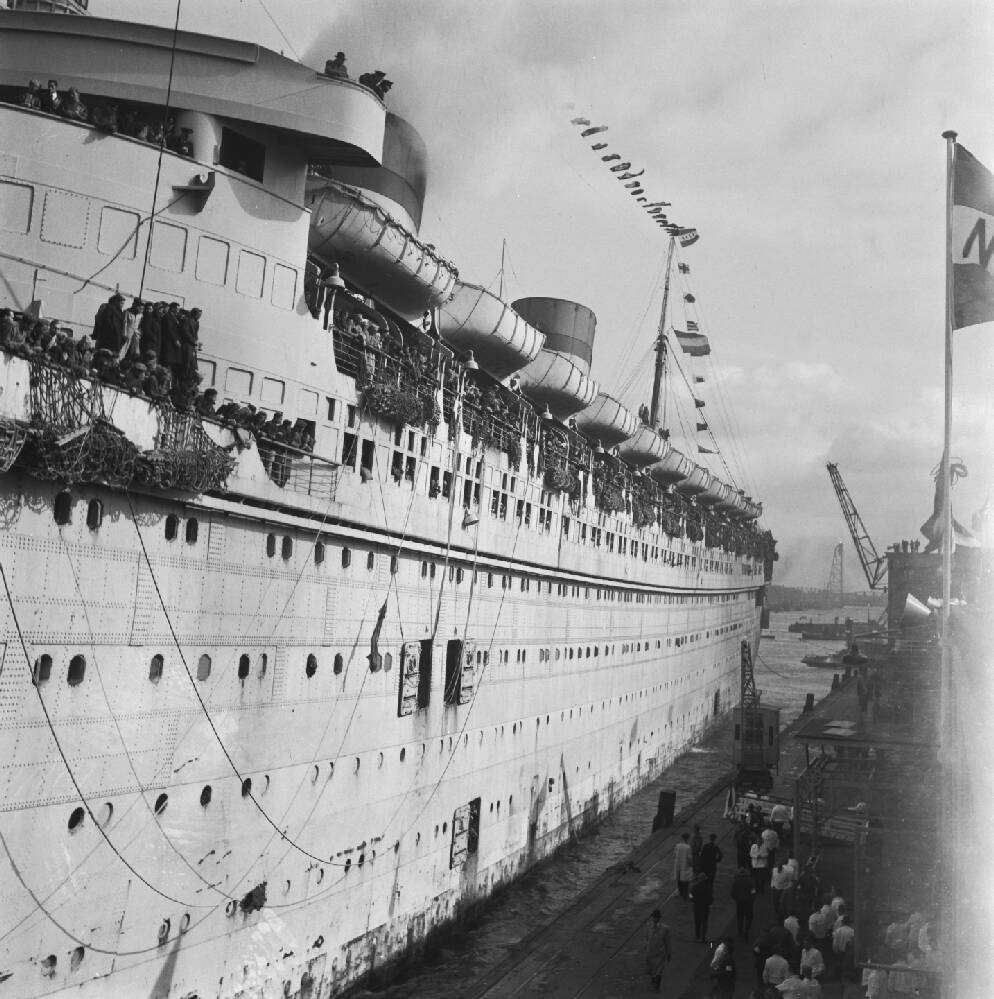
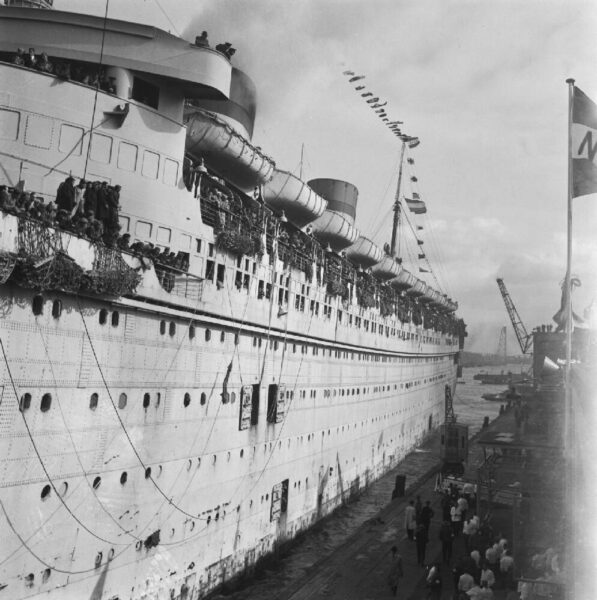
On November 30 of last year, this energetic woman, of whom one can hardly believe that she will turn 84 this year, left with the Rhine Dam to Canada to visit her children, grandchildren and great-grandchildren, who emigrated to Canada after the war and had written several times in letters: “Grandma, you should be able to see, how we have it here”.
Granny Lammers, after some consideration, accepted this invitation and left for Canada at the end of last year. She visited her many family members, who had a hard time imagining that “granny” really came to watch, and also gave her eyes a good feast. She also met other former Aalten residents in Canada. The visit of their elderly mother and grandmother was a surprise for the children and grandchildren in Canada, bigger than one could have imagined there.
Granny Lammers, who had a pleasant time in Canada, traveled back on May 14 with the Rijndam. Yesterday she arrived in Rotterdam, where she was picked up by her children. She then drove by car to Aalten, where she arrived last night at seven o’clock. She had to shake many hands of family, neighbors and acquaintances upon arrival. She had had a good time in Canada, she said.
Last night, the Lammers family, who live in the Netherlands, met in an intimate circle in the “Irene” building. There grandma told about her experiences and she knew how to do this in a very entertaining way, so that everyone could get an idea of the circumstances under which the “Canadian branch” of the Lammers family lives.
When grandma Lammers left Aalten, she took an audio tape with her for the family in Canada, on which words spoken by the Aalten family members were recorded. The playing of this tape caused a lot of joy and surprise in the Canadian family circle. Granny Lammers also brought a soundtrack from Canada. For example, last night in the family meeting, the voices of the relatives in Canada were heard. It turned out that many had not yet forgotten the Aalten dialect.
Do you have interesting stories about family members who emigrated from Aalten to Canada? Send us a message!
Herman Prinzen family (9 people) emigrates to Argentina
Herman Prinzen and his family, who will set sail for Argentina the day after tomorrow.
“That will be the last coffee you receive from us,” says Herman Prinzen from IJzerlo near Aalten, as he places a steaming cup of coffee on the table. It is quiet in the large kitchen of the “Linquenda” farm—a kitchen that appears larger than ever before because practically no paintings remain on the walls. An attempt was made to decorate the wall somewhat with an old, weathered mirror, which was not particularly successful, and otherwise, only a lone Biblical daily calendar hangs on the wallpaper.
Through the kitchen window, one can look out over the IJzerlo es, which lies flat and bare, trying to bask in the meager rays of sunlight. The wind fiercely blows the loose sand from the fields across the plowed land. Herman Prinzen, the 48-year-old farmer, stares outside. “We have lived here for about eighteen years now,” he says, perhaps more to himself than to us. “We won’t be here for eighteen days anymore, not even eight….”
Learning Spanish was not easy
“In Argentina, they speak Spanish!” says one of Prinzen’s young daughters. “Have you ever heard anyone speak Spanish?” “No,” we must confess. “Has Saint Nicholas never visited you then? He comes from Spain, doesn’t he?” “Spanish is a difficult language,” says Prinzen. “Leerink—Wim Leerink, so to speak, from Kerkstraat in Aalten—taught us some Spanish. Boy, it wasn’t easy, and we still don’t know much of it.” “But come,” he continues, turning his gaze away from the es that has been shrouded in drifting sand for hours—“my work there is done”—“I will tell you about our upcoming emigration.”
And then farmer Herman Prinzen begins his story. It is a story whose essence will bring a radical change to his life, and not only to his, but to that of his wife, Mrs. Prinzen-Kämink, and their seven children, the oldest of whom is sixteen and the youngest not yet a year old, crowing with delight in the stroller. “You know Grandpa Brunsveld,” Prinzen notes. “Everyone here knows Grandpa Brunsveld, after all. He is a born and bred IJzerlo man, and when it is his birthday, many people come to visit.”
“That was on November 24 of last year. My wife and I were sitting and talking with him late in the afternoon when Mr. Kämink, a cousin of my wife, also came in. Kämink is a senior board member of the Christian Emigration Center, and you can imagine that the conversation soon turned to emigration. Not long ago, Kämink had visited Argentina and several other countries to inform himself about the immigration possibilities there.” “Perhaps there is a perspective for you there as well,” he said.
“We didn’t think much more about it, but a few days later we received a letter from him. He had indeed been thinking about it. To be brief, he wrote that in Argentina, at the Protestant Christian school, there is a boarding house for which they are looking for a caretaker. “Is that something for you?” he wrote. That question was not as strange as it might seem at first glance. After all, here in IJzerlo I am primarily a farmer, but for ten years I was also the caretaker of the community building “Ons aller belang.” The white smock was already in the suitcase….”
“Is our task here perhaps finished?”
“That letter from Kämink never let go of my wife and me. There is, Kämink wrote, an urgent need for a caretaker. We are not the kind of people—neither my wife nor I—who are afraid to leave for another country or to face a somewhat unknown future. We viewed Kämink’s letter from a matter of principle. Like this: “Is it perhaps the case that our task here, in the Aalten rural district of IJzerlo, is finished and that a new future and a new task await us in another and foreign land?” “Yes,” says Mrs. Prinzen, “that is how we approached this matter.”
“Now, you must not think,” Prinzen continues, “that the problem was simple for us. We have lived in this farmhouse for many years together with my wife’s parents, who have now grown old. Would it be right for us to leave and leave our parents alone in the evening of their lives?” “You understand, this is a “heavy” matter to consider.”
“However, our parents said: “If you believe that there is a future for you and the children in Argentina, then you certainly must not let that pass because of us. We must not hold you back, even though we are old. We trust that if you are given a task in Argentina, we will also be cared for.” When our parents accepted this so faithfully, I said that evening: “What do you think, wife, how should we handle this?” “We should just go, Herman,” she said. “Everything is being made easy for us….” That was around Christmas.”
The boat departs Thursday
“We then wrote to Kämink in Hoogeveen, and he arranged everything else. This coming Thursday we depart by boat. We will be traveling for about four weeks. Then we will arrive in Buenos Aires, the capital of Argentina. We then have to travel another eight hours by bus before we reach Tres Arroyos, our new place of residence. As I said, I will become the caretaker of a boarding house there. It is located 50 meters from the school and ten minutes from the church. So we are not moving to an uninhabited region.”
“Many immigrants live in Tres Arroyos, by the way. They are not recent immigrants. There are quite a few whose parents or grandparents already immigrated to Argentina, yet they have, as I have read in letters I received from Argentina, always maintained the Dutch national character. Even at school, lessons in the Dutch language are still given for a few hours a week. The head of the school wrote that to me.”
“Usually about eighty children stay in the boarding house. The distance from home to school is too great to travel daily, and therefore the children stay in the boarding house from April to December. They have four months of vacation, from December through March. Then they go home. Those are the summer months in Argentina. During that vacation, I have the opportunity to work in agriculture in Argentina. Two of our daughters, Christina and Johanna, are going to work in the boarding house in Tres Arroyos. One stays at home to help mother, and the others either go to school or stay at home because they are still too young for school. We have four girls and three boys. That is the whole story.”
“Whether we are dreading it? No, not anymore,” says Prinzen. “We have made the decision and now believe that our life’s path will be continued over there, in Argentina. The same sun shines there as here in the IJzerlo es, and the same God reigns there as in the Netherlands. We have had a few busy days. Almost everything is packed now, however. A few more days and then we go.” “Oh yes, you might want to know what will happen to our parents? They are also being cared for. Our trust has not been put to shame, because a cousin of ours, Wim Kämink, is getting married on May 6 and will come to live here on the farm. He will not only take care of the business but also, together with his wife, look after his grandpa and grandma. So, in this respect too, everything will turn out well. We are very grateful for that.”
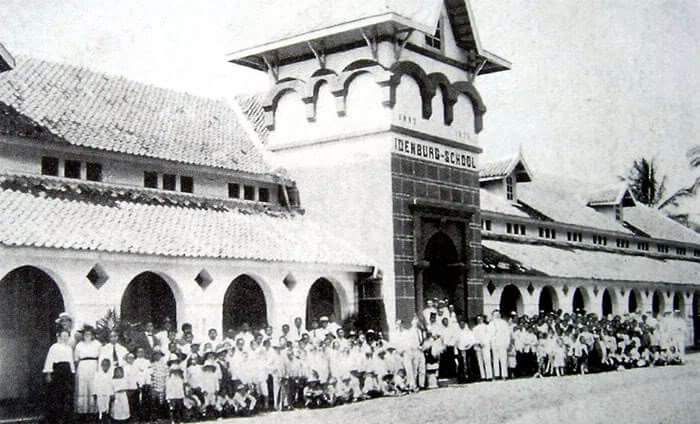
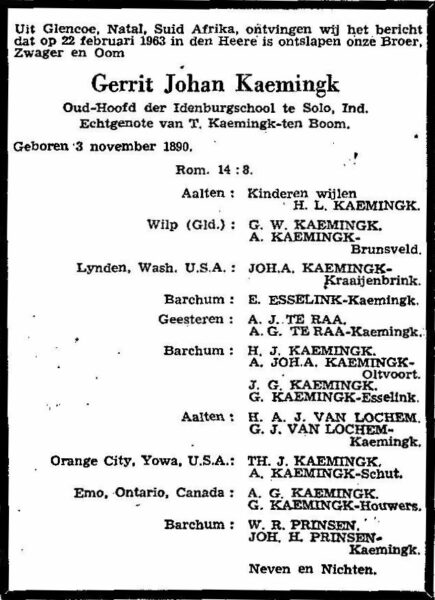
Gerrit Johan Kaemingk was born on November 2, 1890, at Overbeek in IJzerlo, son of Theodor Johann Kaemingk and Johanna Hendrika Pennings. In 1917, the then 27-year-old teacher left the Netherlands to work in the ‘far Indies’.
The journey was indeed very long, as World War I had blocked the normal travel routes. After a four-month journey via Iceland, America, Honolulu, Japan, and China, he finally reached his ideal. There, he became, among other things, head of the Idenburg School in Solo (Surakarta).
After twenty years, he retired and set out on another journey. On his way to the Netherlands, he wanted to see South Africa. He arrived there in 1937. And because he did not yet consider himself ‘worn out’, he became a temporary teacher there. Before he could realize his plan to return to the Netherlands, World War II broke out.
As a result, it was not until the summer of 1953 that he saw his native country again. The twice-retired teacher stayed temporarily in Hoogeveen with his brother Gerrit Willem Kaemingk (1887-1979), who was then chairman of the Christian Emigration Center in Drenthe.
Invention of electric education, the ‘Elucator’
Once back in the Netherlands, Kaemingk presented his invention, namely ‘electric education’. He called his method “Elucator“, a combination of electricity and educator (or educator). He had applied for a patent for his invention in South Africa. It worked as follows:
Using a battery, a low-voltage current is passed through two insulated pointing sticks. With one stick, a location is pointed out on a map, and with the other, one of the place names listed in a row on the right of the map. If the correct location is pointed out, this is signaled by a light or sound signal. Conversely, one can also search for the correct location for a given place name.
In addition to geography, Kaemingk had also designed maps for subjects such as drawing, language instruction, reading lessons, botany, and history. In total, about 50 maps could be compiled. The Elucator and its accessories could be carried in a handy box that easily fit into a briefcase. With this, he had developed an educational method that was said to have several advantages. For instance, the teacher would have become (virtually) redundant. The child could study alone at home or in class, and any error was immediately corrected.
Gerrit Johan Kaemingk and Truus ten Boom (photo: Kaemingk family)Idenburg School, Solo (Surakarta), Dutch East Indies Obituary Gerrit Johan Kaemingk
The Elucator was considered particularly suitable for (countries such as) South Africa, where children living in remote areas found it difficult to attend a school. However, a number of educational experts in Utrecht, who were introduced to Mr. Kaemingk’s invention, were also enthusiastic. Children found the Elucator to be ‘a relatively inexpensive parlor game with many possibilities’. The visual connection, which was directly established here between an object and a word, a plant and its name, or a sum and its result, seemed to ‘have a very favorable effect on the child’s comprehension’.
Back to South Africa
After his visit to the Netherlands, he returned to South Africa, where two of his sons-in-law had a farm. He passed away on February 22, 1963, in Glencoe, Natal, South Africa.
HARRY KRAAYENBRINK from Sioux Center in America, one of the most solidly built corporals in the American army of occupation in Germany, is a farmer in civilian life. Before he joined the company, he worked on his father’s farm (160 ha) in Sioux Center. In the American army there will be more soldiers who are well in the hands of the team, but there will not be many who, like Harry Kraayenbrink, can have a chat with a colleague from the Achterhoek without any difficulty.
That’s how it is with Harry: Forty-one years ago, Hendrik Kraayenbrink and Leide Nijman emigrated from Sinderen near Varsseveld. The couple had seven children, five boys and two girls and father Kraayenbrink believed that there would be no work for his boys in the Netherlands, at least if they wanted to become farmers.
That is why he had been planning to emigrate to America for years, but his wife opposed this intention. Until 1912. Then she could no longer cope and gave in: the Kraayenbrink family was going to America. Mother Leide (born in IJzerlo) was not at all happy with it. She went to America because her husband wanted it and because she wanted to stay with her children, but she didn’t feel like it at all.
Dialect
Once they arrived in America, father Kraayenbrink and his family were doing well. Over the years, they had their own company. But, no matter how prosperous it went, mother Leide could not forget Sinderen and the Achterhoek. For her, there was no better country than the Netherlands and no more excellent region than the Achterhoek in Gelderland. Mother Leide resolved never to forget her beautiful Achterhoek, nor the Achterhoek dialect. She also resolved never to learn to speak English and she held on to that until her death – now four years ago.
Mother Kraayenbrink continued to speak the Gelderland dialect. Anyone who wanted to talk to her had to learn Achterhoeks and otherwise… Well, then the conversation didn’t go on.
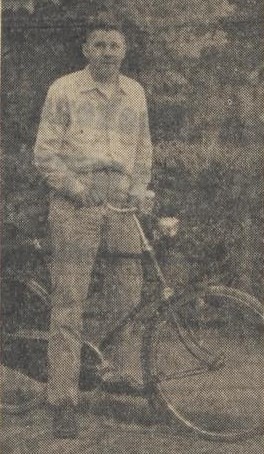
Harry Kraayenbrink has borrowed a bicycle in Aalten. On this bike he has crossed the Gelderse Achterhoek in recent days and visited his family.
Benjamin
The youngest son of the Kraayenbrink family was about sixteen months old when they left Sinderen. It was born as Bernard Willem Kraayenbrink, but he was called Benjamin or Ben.
Benjamin had to go to school in America with his brothers and sisters. It was a school where lessons were taught in English. So the children started to speak English, but that did not stop mother Kraayenbrink from continuing to speak Achterhoeks at home. That is why the children spoke two languages: English and Achterhoek dialect.
Benjamin Kraayenbrink became a man. Then the day came that Benjamin asked his parents for permission to marry Jeanette van Roekel. Jeanette was a girl whose parents lived in America, but whose ancestry came from the Netherlands. The latter contributed in no small way to mother Leide giving permission for the marriage. Jeanette was in any case of Dutch descent.
The years came one after the other. Benjamin and Jeanette, who had started their own farm not far from Hendrik Kraayenbrink’s farm, had a family: seven children were born there: four girls and three boys. Harry Kraayenbrink was the oldest.
Especially the eldest children often went to their grandmother and she told her grandchildren of the Netherlands, of the Gelderse Achterhoek, of Sinderen and of Aalten, where family lived. But grandmother continued to speak Achterhoeks, also to her grandchildren, who gradually also learned the Gelderland dialect during “private lessons” that they received unnoticed from their grandmother from their grandmother.
The grandchildren thought they spoke the Dutch language, but they sometimes noticed that grandmother also spoke another language. They heard that when she read from the Bible.
Four years ago, grandmother died and when the eldest grandchildren think of her, they think of the Achterhoek dialect and of the beautiful forests and the beautiful cornfields in the Gelderland Achterhoek, about which she has told so often and so beautifully.
In Germany
The previous year, Harry had to go into service. He was sent to Germany and thanks to the fact that an aunt – aunt Hanne – had maintained the relationship with the family in Aalten and Sinderen through correspondence, Harry was given addresses. Who knows, maybe he had the opportunity to go to the Netherlands. That opportunity came. Harry was given a leave of thirteen days. He boarded the train in Frankfurt and via Arnhem he traveled to Aalten, where he arrived with the last train, in the middle of the night. He thought it was too strange to visit his family so late. Harry spent the night in a hotel and the hotel owner made sure that one of the family members, Mr . H.A. Nijman from Aalten, was called, who came to pick Harry up.
In the past few days, Harry has been looking at the Achterhoek. He has seen where his grandparents lived and where they went to church, where his father was baptized and where his grandmother worked in the fields. Harry has also discovered that he does not speak Dutch, but the Achterhoek dialect. He has had a lot of ease from the fact that his grandmother stubbornly held on to her own regional language.
Amsterdam
Harry thinks the Achterhoek is beautiful, just as beautiful as his grandmother always said. Next week he will go to Amsterdam for a few days. He wants to see the capital of the Netherlands, where, as grandmother has always said, it is just as busy as in the big cities of America…
Another six months and then Harry will have finished military service. He is not sorry. “I don’t want to go back to my house and help my father on the farm”. But first, Harry wants to see Amsterdam. He just hopes that he can understand the people there, because of course they don’t speak Achterhoek and Harry doesn’t understand Dutch very well, but he will try to get by in Amsterdam with the Achterhoek dialect.
“Maybe she laughs at me in Amsterdam and thinks, what kind of farmer is that, who can’t speak Dutch. She still has a lot of fun, because I’m also a farmer, an American farmer…”
Biography of Harry Lester Kraayenbrink
Harry Lester Kraayenbrink was born on February 20, 1930 in Sioux Center, Iowa, the son of Ben and Jeanette (Van Roekel) Kraayenbrink. He grew up on a farm near Sioux Center and graduated from Sioux Center High School in 1947.
On February 26, 1952, Harry enlisted in the U.S. Army during the Korean War and was stationed in Germany. After his honorable discharge on February 9, 1954, he returned to his birthplace.
On 20 April 1956, Harry married Wilma Cleveringa. He worked at the Sioux Center Co-op and the Sioux Center Lumberyard. In 1959, the couple moved to Maurice, where Harry farmed for six years before moving to a farm north of Sioux Center. This is where Harry and Wilma raised their four daughters.
In 1988, Harry retired. He had many hobbies and interests, including woodworking, carpentry, golf, fishing, biking, pool, and playing cards at the Senior Center. He and Wilma also enjoyed trips to visit family and trips to the lakes.
Harry passed away on December 15, 2017 at the age of 87 at the Royale Meadows Care Center in Sioux Center. He was buried in Memory Gardens Sioux Center Cemetery.
“I will be very pleased if you try to speak to me in Dutch,” Wilhelmina te Slaa from Lyndhurst – a city in the United States – said to us four years ago when we were talking to her in the living room of the Somsen family, Hogestraat Aalten. That was Friday, August 5, 1949. A few days earlier, Ms. Wilhelmina te Slaa arrived in the Netherlands and because it was precisely in the period in which the question of Indonesia was in the center of attention in the Netherlands, but also abroad, we wanted to receive from Ms. in Slaa we would like to know what people in America thought about the Netherlands and the relations with Indonesia.
What Ms. te Slaa at the time, is irrelevant here. We have almost forgotten about it and the image of Miss te Slaa has also faded in our minds. Only occasionally, when we leaf through our photo album, did we suddenly remember this hefty lady with dark glasses, sparkling eyes, this lady who could talk so pleasantly and could speak English and Dutch so nicely.
Major relief operation for disaster area
In 1911 Wilhelmina te Slaa, together with her parents and her sisters Grada, Hanna, Betje and Drika and her brother Dirk went to America. In 1949 she was in the Netherlands for a few weeks and then she went back to her school in Lyndhurst, where she teaches American youth.
However, that she has not forgotten the Netherlands is proven by several important events in her life and that has also recently become apparent. Miss Wilhelmina te Slaa has, immediately after the news of the disaster that has struck the Netherlands on February 1, organized a relief action for the affected in the Netherlands. In the Washington School at Lyndhurst she gave a speech to the youth. She told of the suffering that has affected many in the Netherlands and she gave an enthusiastic speech about the small country by the sea, her native country.
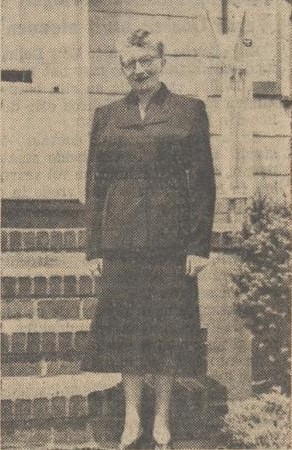
Miss Wilhelmina in Slaa in front of her home
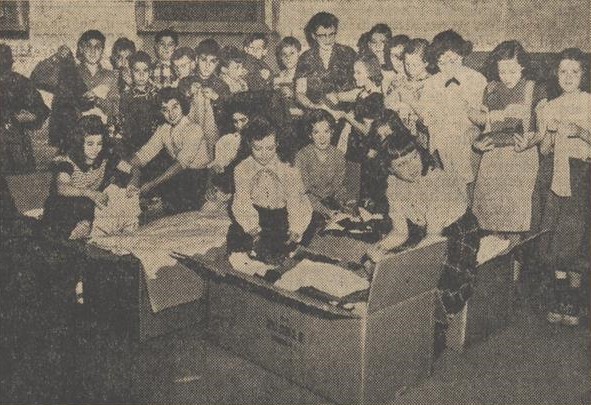
“We have to bring clothes together for the people in the Netherlands,” said Ms. in Slaa and she didn’t have to say that twice. All students of the school were in favor of the plan and they went to work. A collection of clothes began in Lyndhurst. Miss te Slaa personally took the lead. Anyone who wanted to miss clothes could give it to one of the pupils, and there were many in Lyndhurst who responded to the call of Miss Slaa. “Operation Holland” called Ms. in Slaa the action. The local press in Lyndhurst cooperated every possible way to stimulate “Operation Holland” and even went so far in its zeal that it wrote that the popular miss in Slaa had been born in the region that had been flooded by the disaster… The latter was a bit exaggerated, because Aalten is still high and dry on the quietly rippling Slinge.
Crates full of goods to the Netherlands
The result of the action was that one crate after another could be packed with goods. This work was done by the pupils of Miss te Slaa in one of the annexes of the Washington School and when all the crates were packed – Yes, to whom was it to be sent then? Miss te Slaa didn’t know. She still knows a lot about the conditions in the Netherlands, but after all, it has been 42 years since she left the Netherlands as a girl of barely eleven years old. However, Miss te Slaa knew that the flooded areas were in the vicinity of Rotterdam and therefore she sent the coffins to the deaconies of various denominations in the Maasstad.
Miss Wilhelmina in Slaa with the pupils of the Washington School in Lyndhurst. The goods collected for the victims of the flood disaster in the Netherlands are packed.
Miss te Slaa has shown that, although she is American in her entire life, she has always kept a great place for the Netherlands in her heart. It is not the first time in the past forty-two years that Miss te Slaa has organized an aid campaign for the Netherlands. She also knows how to get things done and in that respect she shows that she has as much entrepreneurial spirit as her father, Berend te Slaa, the carpenter from Hoogestraat from Aalten who in 1911 became the topic of conversation in many families in Aalten because he had taken it into his head to go to the United States with his wife and offspring.
“I didn’t like that at all at the time,” Miss te Slaa told us four years ago and neither did my brother and sisters. “I had just completed six classes of primary school in the Netherlands and in America, because I didn’t know a word of English – except for yes and no – I had to start again in the first grade. However, after two years I had gone through the entire school and I spoke English like the best. I trained as a teacher, graduated and worked successively in different schools. I like it quite a bit. In my spare time, I go to a university, because I want to try to get a doctorate.”
As said, miss te Slaa has a warm heart for the Netherlands. This became apparent on 10 May 1940, the day on which the Netherlands was overwhelmed by the Germans. No sooner had Miss te Slaa in the U.S. heard the news of the raid on the radio than she called the Dutch embassy. “The Netherlands has been raided,” she said to the ambassador, “what do you have to do for me?”
Organizing on a large scale
“You are the first to call about this,” the ambassador replied. Miss te Slaa did not wait long for an organized relief campaign. She immediately began to organize. Friends and acquaintances were made enthusiastic about her plan and started under her leadership with the manufacture of garments for the merchant navy. Miss te Slaa constantly expanded the campaign. More and more women’s clubs and organizations from all over America were called in, so that the relief effort took on a tremendous size. The merchant navy did not need everything that was made for a long time. However, Miss te Slaa did not slow down the enthusiasm, she rather encouraged it. And so it was possible that, shortly after the liberation of the Netherlands, crates full of garments could be sent to the Netherlands, which were gratefully accepted here.
The work of Miss te Slaa not only attracted the attention of numerous women’s organizations in the U.S., the Dutch government also knew about her work and it was a great satisfaction for “this Dutch American” when H.M. Queen Wilhelmina sent her the “Badge for Social Work” from London. However, it did not stop with this badge. During the war years, Princess Juliana came to speak personally with Miss te Slaa about her work. This meeting took place in New York. Afterwards, Miss te Slaa also had a meeting with Queen Wilhelmina, during which the relief work and its organization were discussed. Miss te Slaa is entirely the type of an American woman; a woman who goes through life purposefully, but after having lived in America for 42 years, her heart beats as strongly for the Netherlands as it used to, when Willemientje te Slaa sang at a school in Aalten: “Do you know the land, the sea snatched…”
Wilhelmina te Slaa was born on November 12, 1899 at the Hogestraat 24 in Aalten, daughter of carpenter Berend te Slaa and Berendina Gezina Somsen. On November 24, 1911, the Te Slaa family left Aalten and emigrated to the United States.
Wilhelmina te Slaa died on September 25, 1981 in Ridgewood, New Jersey. The local newspaper wrote after her death:
MIDLAND PARK – Wilhelmina te Slaa, 81, died Friday at the Valley Hospital, Ridgewood. Born in the Netherlands, she came to the United States at age 11, living for many years in Prospect Park before moving to Midland Park five years ago. She was a retired teacher of the Eastern Christian system for 23 years. She was a member of the Midland Park Christian Reformed Church and was a graduate of Calvin College, Michigan, and had attended Columbia and Rutgers universities. She also taught the blind at the North Jersey Training School, Totowa. She is survived by several nieces and nephews. Arrangements are by J.H. Olthuis Funeral Home, 159 Godwin Ave. John Goodrich Sr.
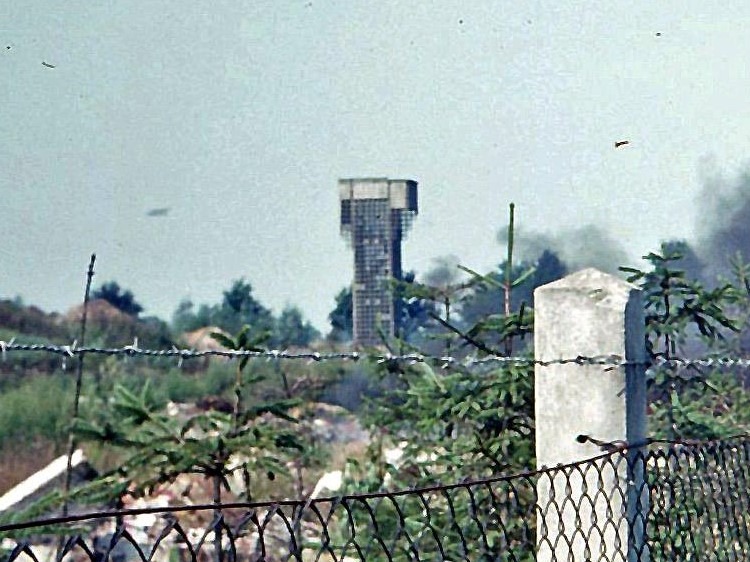
The Air Watchtower in Aalten was a concrete watchtower that was part of the national network of air watchtowers that was established in the Netherlands during the Cold War. The tower was located on the Koningsweg, on the outskirts of the village, and was intended to detect enemy aircraft flying lower than the radar systems could detect.
The Aalten air watchtower was a so-called ‘honeycomb construction tower’, recognizable by its characteristic honeycomb structure, a construction that offered both stability and strength. The tower, built of reinforced concrete, was fourteen meters high and the head of the tower was an open observation cabin with a hiding corner to protect against shrapnel. Neighboring municipalities such as Varsseveld and Winterswijk also had high lookouts, but not as characteristic as those in Aalten.
Searching for the enemy
The air watchtower in Aalten, codenamed ‘Isaac 1’, was inaugurated in 1953, at a time when the tension of the Cold War led to heightened preparedness. The tower was part of a network of 276 lookouts spread throughout the Netherlands and fell under the Air Guard Service Corps (KLD), a part of the Royal Netherlands Air Force that was under the Air Defense command. The Aalten tower was part of the command center KLD Deventer.
The purpose of the towers was to visually detect enemy, especially Russian, aircraft that flew below 200 meters and therefore remained out of range of radar equipment.
Crew and equipment
The crew of the tower consisted of two men who, regardless of the weather conditions, observed the airspace. Women were excluded from these tasks at the time. The crew members wore uniforms and were equipped with headphones and a mouth microphone. The observation was done with the help of a tripod equipped with a scope and a pointing needle. The ranks in the Aalten air guard consisted of soldier, soldier first class, corporal and sergeant. Mr. H.J. Prinzen from Aalten was local commander for a while.
The crew was trained to warn the surrounding towers in case of emergency and via a hotline also the command center. The staff was in an underground, nuclear-free bunker in Deventer. The tower was not continuously manned; only during exercises. Every two weeks there was a theory evening for aircraft recognition at a location in Aalten or Winterswijk.
Recruitment of volunteers
On May 20, 1953, a recruitment meeting was held by the Air Guard Service in the Society on the Hofstraat in Aalten. Commander Ruseler from Deventer provided information to the men who had been called up for this purpose. As an incentive to sign up, exemption from military service or participation in the Population Protection was offered. A number of men volunteered and joined the KLD.
Removal and demolition
With the advent of more modern control systems and improved radar equipment, the need for visual perception became smaller and smaller in the 1960s. This eventually led to the dissolution of the Air Guard Service. The Aalten air watchtower was demolished in 1970, a spectacle that attracted a lot of interest from the local population. The heavy concrete foundation of the tower is still hidden underground and is a silent reminder of this chapter in history.
In 1939, the water supply in Aalten underwent a major improvement with the installation of a mains drinking water network by the N.V. “Waterleiding Oostelijk Gelderland” (Eastern Gelderland Water Supply Company), in cooperation with the Aalten municipal council. Before that time, the people in the village of Aalten obtained their water from so-called neighbourhood pumps, one or more of which stood in the various streets. These pumps were owned by the municipality, and there were very few people in the village who had a pump of their own inside the house.
The Kattenberg pump, circa 1925
Each pump was used by an average of ten or twelve families, and one can well imagine that during periods of severe drought – when, in the long run, the pumps began to yield mud instead of water – this occasionally gave rise to friction among the female neighbourhood residents. Any disputes that arose, however, were usually settled within a short space of time by the “pumpmaster”. The neighbourhood residents, who were also responsible for the maintenance of the pump, were appointed as pumpmaster in rotation. The pumpmaster also collected the contributions towards the expenses from his fellow users.
However, the use of some pumps had to be prohibited because the water was harmful to health. When later, upon closer inspection, the pump water in general proved to contain constituents that were less favourable to health, this was all the more reason to proceed with the installation of a mains drinking water network.
One advantage of the former pumps was that they stood in the street. In the past, even more so than today, the inhabitants of the village of Aalten kept the street in front of their own houses clean. The pumps came in very handy for this, as they had the water for scrubbing the street close at hand.
Until recently, there was also a pump standing on the Markt (Market Square) in Aalten. Regrettably, the municipal council had this pump dismantled last year, presumably because it was in a dilapidated state. Had this pump been restored, however, a small piece of history would have been preserved in the centre of Aalten.
Whilst the houses in the village of Aalten are connected to the water mains, this is not yet the case in the hamlets (buurtschappen). It is true that in the hamlet of Lintelo, persistent efforts have been made in recent years to persuade the W.O.G. to connect a large number of farmers and others in this hamlet, but although the W.O.G. was in principle sympathetic to the idea, the execution of the plans foundered on the high costs of installation and operation.
One street pump remaining
One street pump remained standing in Aalten, namely the pump on the Kattenberg. When their pump was under threat, the residents of this neighbourhood put their heads together and decided to try to preserve the pump from a folkloric perspective. In this they succeeded, and voluntary contributions were subsequently raised to thoroughly do up the pump, on which no maintenance work had been carried out in recent years.
Now, no one should think that the residents of the Kattenberg are conservative and do not want mains water. That is by no means the case; all have connected their homes to the W.O.G. network, but they nevertheless wish to retain the pump because, as they say, adapting a well-known proverb, they do not want to throw the pump out with the pump water. And it seems to us that they are quite right.
Mrs Vieberink-Bennink — better known in Aalten as Annie Bennink — recently moved to Gendringen with her husband. Shortly, probably next week, the young couple hope to emigrate to Canada, where Mr Vieberink will become a farm manager in New Brunswick. These past few days, Annie Bennink was back home at her parental house on the Kattenberg, and on that occasion she wished — in all probability for the last time — to have another go at the handle of the old, familiar pump on the Kattenberg, of which her father is now pumpmaster. It was on that occasion that we took the picture reproduced here.
“On the border of two worlds”, Annie Bennink tries the old pump one last time
Other Village Pumps
We have examined countless old photographs to trace the locations where neighborhood pumps once stood in Aalten. The overview below is still a ‘work in progress’ and subject to change. If you know of any other locations to supplement this list, please leave a comment at the bottom of this page.
Lately, there has been much talk about emigration. It is a longing for adventure that makes many look forward to a new homeland! Emigration can be a bitter necessity. Which factors play a role in the emergence of plans to emigrate? From the municipality of Aalten in East Gelderland, very many are departing for another country. We have investigated the causes and motives, and we wrote this article as a result.
When, shortly after the liberation, our people began to realize that with the current population growth there would eventually no longer be employment for many in our own country, the government spoke reassuring words and argued that the solution to the problem lay largely in industrialization. The word industrialization became a kind of magic word with which the looming specter of unemployment could be combated. Indeed, new industries have been established, including in rural areas, but this industrial establishment does not provide a definitive solution.
One of the reasons for this is that not enough factories are being established to provide work for everyone. Industrialization in rural areas is not actually progressing as desired. The number of workers who are in fact redundant in the villages and in the rural districts is much larger than one might think at first glance. In the past half-century, farms have been split several times, sometimes in two, but also in three, depending on the number of children who had to find work in the agricultural sector. Now, as far as splitting is concerned, one is practically at one’s wit’s end. Therefore, it was reasoned, other work should be made available, especially for the sons of farmers.
Thus, the idea of industrial establishment in rural areas arose. This industrialization has only partially succeeded and, as many expect, will not provide the solution in the future either, for where, one wonders, is the money for the large investments to come from? After all, nowadays one must bear the great risk associated with establishing a new industry oneself, while, when profits are made, the tax authorities claim a significant portion of them. Industrialization thus becomes anything but an attractive proposition.
Not to the factory…
Another side of the matter is that transferring workers from the agricultural sector to industry is not easy. Many from the countryside hesitate to work in a factory, where one must stay indoors practically all day and where, it is feared, a significant part of one’s own independence disappears. In Dinxperlo, for example, several industries were established after the war, but not enough workers can be found in the town itself, although according to statistics, they are present.
Here we naturally touch upon another side of the problem, namely that on many small farms there are more workers than necessary for performing the tasks on those farms. The consequence of this is that the income from the farm must serve to support four or five adults, while normally there is only a profitable existence to be found for at most two full-fledged workers.
From an economic perspective, it is entirely logical that emigration is the result of the situation described above. People foresee that, especially in large families, it will eventually be impossible to earn a living in agriculture, while they shrink back from industry or see no prospects there, given the current financial difficulties and the government’s policy.
When one also considers that in 1886 the Doleantie in Aalten caused many to move from the Dutch Reformed Church to the later Reformed Church, one understands all the better why we drew certain conclusions above.
On an even larger scale
In Aalten, emigration is currently the order of the day. From many families, one or more persons have departed since the liberation. They wrote letters about their findings in the new homeland, and the result is that family members, as well as neighbors, were also inspired to emigrate. Furthermore, those who have already emigrated often arrange for work in the new country.
Many have already departed from Aalten for Canada this year, but, as we were informed, more than 200 people will follow in 1951. These are not only farmers but also businesspeople. The latter no longer feel like working for the tax authorities, as some of them confided to us. Added to this is the fact that they no longer see future opportunities for their children and ultimately want to provide for this future themselves, rather than seeing it as a task for the state.
Most emigrants have so far departed for Canada, but several have also already gone to New Zealand and Australia. As a rule, the men go to these latter countries alone first, find work and a home there, and then have their wives and children join them. Next year, many more residents of Aalten will depart. If the conditions for emigration are not changed, a large exodus from Aalten is expected to take place in 1952.
It is striking that in certain regions of our country, emigration is greater than in other areas. The cause? It appears that in East Gelderland, the most emigrants in recent years have departed from Aalten. Although several important industries are also found there, Aalten is for the most part agricultural. Farm splitting is no longer possible there. Emigration is the talk of the town.
Upon closer inspection, it is notable that practically all emigrants from Aalten belong to the Reformed Churches, which in this town of approximately 14,000 inhabitants has more than 5,000 members. However, in other places in East Gelderland as well, most prospective emigrants belong to the Reformed Churches. Are there causes to be identified for this as well?
No material regarding this matter is available in statistics or from opinion research, but it appears that most emigrants come from certain circles. In general, members of the Reformed Churches are members of the Anti-Revolutionary Party, the party that has offered the greatest opposition to post-war government policy. Moreover, the future of the children is also a driving force here. These arguments—no prospects and no employment for the children—consistently emerge in an investigation into the motives and causes of emigration.
History
There is, at least as far as Aalten is concerned, a third cause. This lies in history. Around the middle of the last century, a large emigration from East Gelderland took place to the United States of America, primarily from Aalten and Winterswijk. The main causes then were the great impoverishment and unemployment during and after the Napoleonic era (the failure of the potato crop in 1845 and later years had been a disaster), which made many look for a better existence. People had heard that opportunities for this existed in America, especially through the cultivation of lands issued by the State for that purpose.
Furthermore, many from Aalten and Winterswijk belonging to the “Seceders” participated in the emigration due to the restriction of religious freedom imposed on them by the government and because of the treatment they experienced from many fellow citizens due to their religious standpoint. For instance, the lease of a farm or land was repeatedly terminated for the “Seceders.”
A large group of them departed in 1845. However, on Lake Erie, their ship caught fire and all those on board perished in the flames or in the water. They had almost reached the destination of their journey. A large number of members of the seceded congregation of the Keurhorst near Varsseveld were among these emigrants.
In 1853, 25 emigrants departed from Aalten. In 1854, however, the number already amounted to 194, while 39 departed in 1855. We provide some figures for the following years below: 1856: 62, 1857: 50, 1858: 44, 1868: 118, 1869: 206, 1870: 36, and 1879: 84. The population of the municipality of Aalten at that time was approximately 5,000. It is therefore no wonder that almost all old Aalten residents have family in America.
Travelogue of a Dutch emigrant, Hendrik Jan Tuininga, who visits the old homeland –and also Aalten – with his wife and daughter .
In the last 4 years, many former Dutchmen living in America have made this trip, either over England or by “Holland America Line“. Many of these have no urge to report in a newspaper about what trip they had, or how they found the old homeland with their family and friends. And yet, if there is anyone who wants to do the pleasure of the “Friend of the People” to report something about it, I never skip reading such travel descriptions. For the latter reason, and because the Friend of the People also wants to give its readers of such a nature, I have also proceeded to recount our journey, which my wife and I and our youngest daughter Gertrude, did with the three of us, here.
Departure from Orange City
Arrival of the Nieuw Amsterdam in Rotterdam (1946)
On Friday afternoon about 2 o’clock we were leaving Orange City, when our son Harry van Boyden picked us up and brought us on the train in the evening, which left 6.01 from Sheldon. In Madison the train stopped for coffee for 20 minutes, it was then 5.10 a.m. It was wet everywhere on the land. We stopped for a few days with our son in Chicago, and after seeing some peculiarities, we went by train to Hoboken, and stopped another night in Paterson, and saw New York a little, and went on board the “Nieuw Amsterdam” on the 28th of April, a huge ship, 700 feet long and 108 feet wide. I think this boat is 60 to 70 feet high from the steering bridge to the waterline.
We heard that the Society had made 16 million last year. The travel costs are high, but the food and service is rata. In 1908 we gave 200 guilders for a ticket per person from Rotterdam to Rock Valley, lowa, then 80 dollars and per second class. The weather was also nice, and one has this free of charge, and then one can enjoy the other thing. One then makes pleasant acquaintance with many passengers, with some so that one never forgets each other. We had Sunday morning service of the Word, by a businessman.
It was Saturday morning, May 6, when we moored at the pier in Rotterdam of the Holland America Line. First our luggage checked by the commies and then our return tickets were arranged. Then we saw my sister Mrs. W. Obbink van Aalten soon and after having lunch in a café, we went together to the Maas station by taxi, to get off at 4 o’clock in the afternoon at Aalten, Gelderland.
Aalten
In Aalten and surrounding villages we saw many houses missing among the others, which had been bombed and many where they were building and many were also finished. The ordinances there are such that when a new house is built, it must be absolutely modern. But in old houses, even if they are neat houses, almost everything is still primitive. In Arnhem, where there was also so much bombing, almost everything has been rebuilt.
In Aalten we went to church on Sundays, where so many boys were picked up by the Germans on a Sunday afternoon for the labour camps. In Aalten, street sermons are held every Saturday evening at half past eight in the summer, in turn; one Saturday evening by the pastor of the Geref. Church, Mr. Jan Nawijn and the following Saturday evening by one of the Darbist brothers. I enjoyed both.
There are three large church buildings in Aalten that belong to the Reformed; a large Reformed church; a Darbist meeting and a Roman Catholic church and a Synagogue. As far as I know, there are none in Aalten who belong to the resigned. Aalten is religious in every way.
The surroundings of Aalten are beautiful. I have never seen such a tree growth anywhere. Oak trees so beautiful and straight and a whole beautiful avenue.
The conditions of the worker have improved enormously compared to 50 years ago. At a certain age, they are provided with a pension. The civil servants with 55 years, the ordinary workman 60 and 65 and then it is not allowed to work with others, which is paid. There is also a free Saturday afternoon in the Netherlands. Almost everything can be bought freely again, everything, except coffee. People live generously again, a big difference from the past. Cake and candy are well used. Coffee is scarce and is therefore drunk with 8/10ths hot milk.
There was a nervous thought about the Communists. And they all wanted to go to America. We have recommended it to few.
Amsterdam
We visited the capital of the Netherlands, Amsterdam. This is one of the most beautiful cities in Holland, with its four large long canals, Prinsengracht, Keizergracht, Heerengracht and Singel and with its many bridges. Is there any city in the world that has so many bridges? Amsterdam can regulate its own water level, because it has a complete lock system.
Amsterdam’s Jewish quarter is deserted. I was told, people who lived in that neighborhood, that in the evening and at night one could hear women and children screaming when the Germans picked up carloads to Germany. And on the way, I was told, they put a hose in the tank or truck where they were sitting and let it go full throttle, so that they arrived dead in Germany, and were immediately consumed in ovens.
The houses in the Jodenbreestraat are still there. One can see that what wanted to burn was demolished during the war years. And yet Israel is blind, and has a lid on her face. Hope in the Lord, you remnant, if Israel is in need, there will be deliverance. His goodness is very great. He will once set all Israel free from iniquities on the prayers of the remnant (from Ps. 130).
Friesland
On a Sunday morning we went by bus to Makkum for church. Here we saw a rather famous shipyard, whose director did business with Palestine Jews. Four 70-ton fishing boats were now made. One was ready and would sail to Palestine the next day under its own power, with a Jewish crew and a Jewish David’s flag on.
We spent a lot of time in Bolsward, where family lived there and many friends from my school youth and also until I was eighteen, where we sailed to Amsterdam as turnsmen. Where now Mr. Jurian Kok is captain and owner. The ship that Kok bought from my father and is now 50 years old is still sailing. It was a great pleasure to see the forecastle and aft cabin for the last time.
We also spent a day with Ulbe Faber and watched in Wieringermeer. Much has been suffered there, but God also helped out of it by restoring the flooded polder and allowing rich crops to grow again.
Back home
After having enjoyed a lot with my wife’s brother Klaas van der Kooi and wife in Longerhou, we went from there to Aalten at the end of June and then again on the Holland America Line in Rotterdam, to leave June 30 with the Veendam, at 3 o’clock in the afternoon. We had great friends on the outward journey. On the return trip we will not soon forget friends Mr. Bakker of Amsterdam and Mrs. van der Lely of Naaldwijk.
We are back in Orange City. If we can do it again, we won’t stop it. It was also beautiful at sea both trips. If you go and can, go in the spring. Holland is a beautiful country, and its spring is typical.
Especially in the final years of the war, several residents of Aalten were arrested by the Germans and transferred to a camp. Upon arrival at the camp, all their belongings were taken from them. It appears that efforts are currently being made to return the objects confiscated at the time, insofar as they are still present in the former camps. We now share a remarkable incident regarding this:
In January 1944, numerous young men were taken prisoner one morning at the Reformed Westerkerk. They were first transferred to Amersfoort. Among them was Mr. H. Stronks from Dale. He had to hand over all his belongings, including his wristwatch. Stronks was subsequently wounded during a bombardment of the Soesterberg airfield, was admitted to a hospital, and managed to escape from there.
Mr. J. Tolkamp from Barlo, who was arrested on the same morning and also transferred to Amersfoort, was put on transport to Neuengamme in September. Upon leaving the camp, he received several belongings back, including a wristwatch. Tolkamp claimed that this watch was not his property but belonged to Stronks. However, the camp guards insisted that Tolkamp take the watch anyway. He then did so.
Upon arrival in Neuengamme, all belongings had to be handed over again. Everyone’s belongings were placed in a small bag, on which the prisoner number was noted, after which the bag was thrown into a large drawer. It was thought that they would likely never see any of it again.
In the meantime, Mr. Tolkamp had stayed in four different German camps and returned to Aalten after the liberation. On Saturday, Mr. Tolkamp received word that he could collect a package at the Social Affairs Office in Aalten. It turned out that this package came from Neuengamme. It was the same bag in which his belongings had been placed at the camp. Even the camp number — 48769 — was still on it.
In the bag were two rings made by Mr. Tolkamp in Amersfoort and a wristwatch. It turned out to be the watch of Mr. Stronks, who was highly surprised when, after six years, he received back his property, which he had long since written off. However, Mr. Tolkamp did not receive his clothes back, nor the confiscated money.
German workers received a pound of coffee for Christmas; Dutch staff later received a rixdollar…
While one of the German girls employed at a textile factory in Aalten was recently the cause of a sensational incident (she defaced the Dutch flag with a swastika), German textile workers in Aalten have once again been the catalyst for an event that has caused quite a stir in the quiet village, as two textile factories were involved.
Sixteen German girls are employed at a textile factory in Dijkstraat. As Christmas approached, they began to ponder a surprise they could provide for their relatives across the border. It had to be coffee, was the general opinion!
Girls at work at the Driessen textile factory, Hofstraat. Photo for illustrative purposes.
The German girls enlisted the help of a staff member from Aalten, who knew just how to manage it. He, in turn, went to a businessman who proved able and willing to supply 16 pounds of coffee—one pound for each of the German girls. That evening, the girls cheerfully headed home by bus with their coffee. However, on that same bus were 19 female workers from a textile factory in Hofstraat.
Understandably, they were none too pleased that their friends could take coffee home for “Weihnachten” while they could not. The matter was promptly raised the following day with the management in Hofstraat. They felt they could do little else but promise each of their German workers a pound of coffee as well. And the 19 pounds of coffee indeed materialised.
But the difficulties did not end there! The Dutch staff had caught wind of the Christmas gift and now began to demand coffee too. After all, coffee is an item that has been very scarce in this country of late. The management of the Hofstraat factory restored industrial peace by giving every staff member a bonus of ƒ2.50. With that, the whole matter seemed to be settled.
However, with so many people involved, it was almost inevitable that the police and the C.C.D. (Central Investigation Service) would hear of the case. The latter has since launched an investigation, which has already led to an official report (proces-verbaal) being filed against the management of the textile factory in Hofstraat. A second report followed for the granting of a bonus without the permission of the Board of Government Mediators. An official report has also been filed against the shopkeeper involved.
We understand that the reason the German girls were able to export the coffee is that the Dutch customs, contrary to standing orders, allowed the coffee to pass; it was apparently assumed that it could be exported freely as long as its value was below ƒ15. The German customs had already promised the German girls that they would make an exception in view of the approaching Christmas holiday.
The 19-year-old K. from IJzerlo was severely assaulted in 1949 by the 21-year-old K. from Aalten.
Dagblad Tubantia, 8 September 1949
Aaltensche Courant, 23 September 1949
Dagblad Tubantia, 10 December 1949
Aaltensche Courant, 17 March 1950
Beheer toestemming
Deze website gebruikt cookies voor een optimale ervaring en analyse van bezoekgegevens. Ga je hiermee akkoord? Zonder toestemming werken sommige onderdelen van de site mogelijk minder goed.
Functioneel
Always active
De technische opslag of toegang is strikt noodzakelijk voor het legitieme doel het gebruik mogelijk te maken van een specifieke dienst waarom de abonnee of gebruiker uitdrukkelijk heeft gevraagd, of met als enig doel de uitvoering van de transmissie van een communicatie over een elektronisch communicatienetwerk.
Voorkeuren
De technische opslag of toegang is noodzakelijk voor het legitieme doel voorkeuren op te slaan die niet door de abonnee of gebruiker zijn aangevraagd.
Statistieken
De technische opslag of toegang die uitsluitend voor statistische doeleinden wordt gebruikt.De technische opslag of toegang die uitsluitend wordt gebruikt voor anonieme statistische doeleinden. Zonder dagvaarding, vrijwillige naleving door je Internet Service Provider, of aanvullende gegevens van een derde partij, kan informatie die alleen voor dit doel wordt opgeslagen of opgehaald gewoonlijk niet worden gebruikt om je te identificeren.
Marketing
De technische opslag of toegang is nodig om gebruikersprofielen op te stellen voor het verzenden van reclame, of om de gebruiker op een site of over verschillende sites te volgen voor soortgelijke marketingdoeleinden.