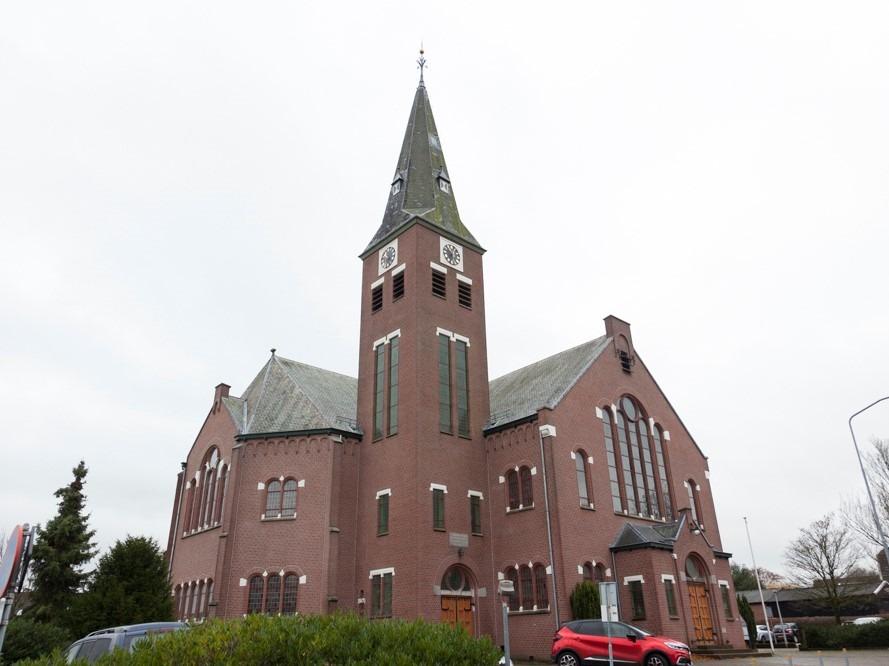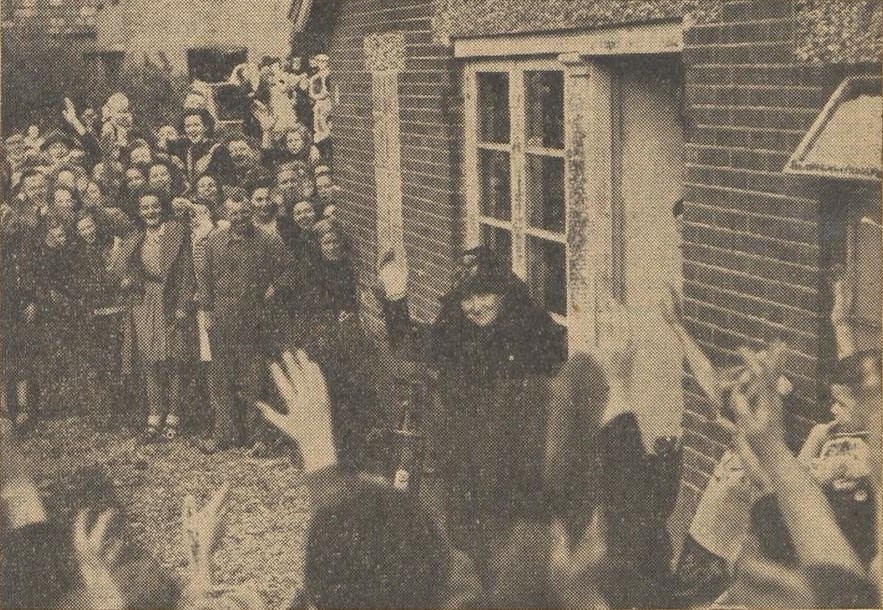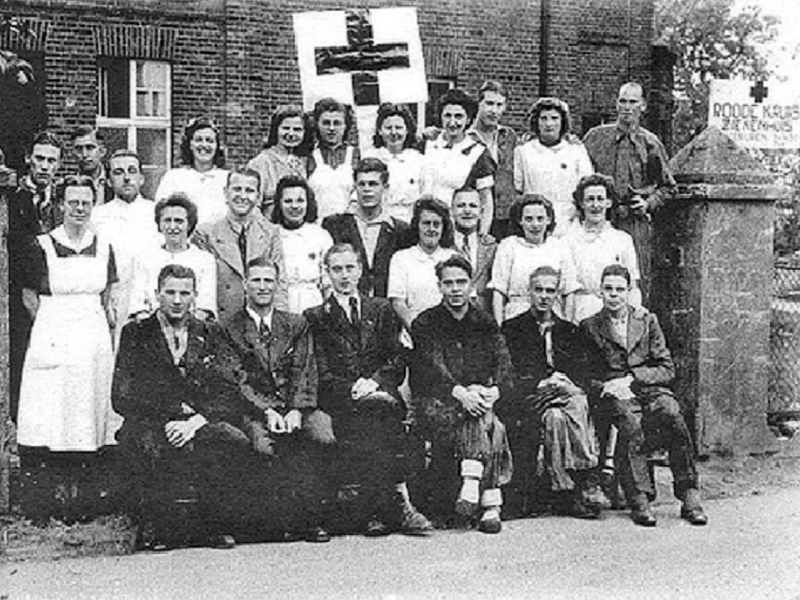
At the end of 1922, the residents of Aalten sent food aid to the destitute population of the neighboring German city of Bocholt.
Germany’s defeat in World War I had profound consequences. In 1919, the Allies forced Germany to accept full responsibility for the war, and enormous reparations were imposed on the country. The staggering debt burden to the Allies led to hyperinflation and a severe economic crisis. This resulted in extreme poverty and famine for the majority of the German population.
On September 28, 1922, the municipal council of Aalten decided to help the destitute population of the neighboring German city of Bocholt, “in recognition of the good that Aalten enjoyed from this industrial city before the war.” The aid consisted of sending foodstuffs that were available here in abundance.
On November 17, the Aaltensche Courant reported:
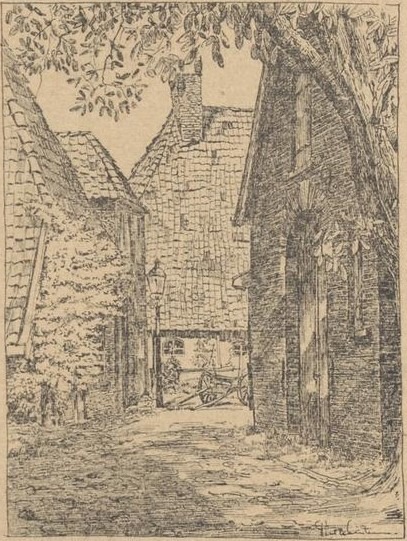
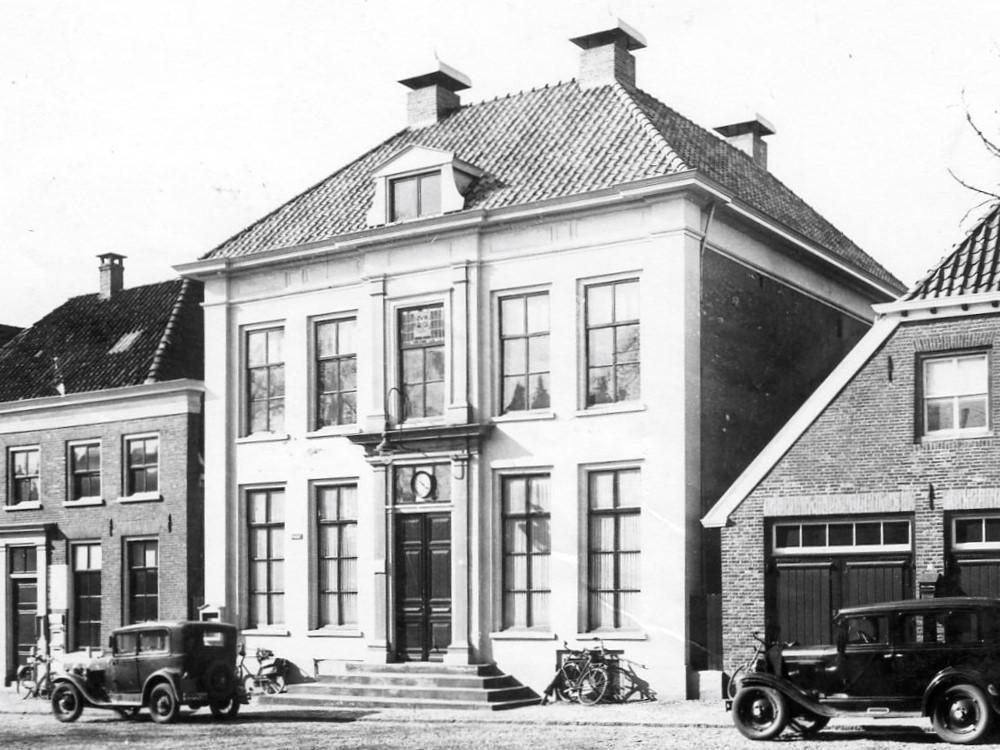
Old Town Hall of Bocholt, for illustration
“This morning, the second shipment of food, collected by the citizens of the municipality of Aalten, left for Bocholt. In the following weeks, the residents of the municipality of Aalten gathered several more shipments of food and sent them to Bocholt. On Tuesday, seven wagons carrying potatoes, cabbage, rye, etc., crossed the border, while two more transports are scheduled to depart next week. That these efforts are received with great joy requires no explanation, given the dire need, and this humane act will certainly contribute to the resumption of friendly relations (broken by the war) with our neighbors.”
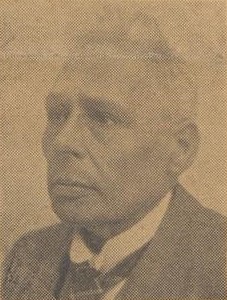
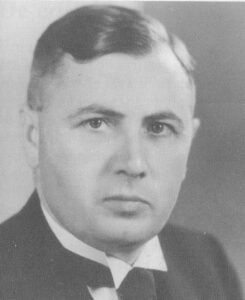
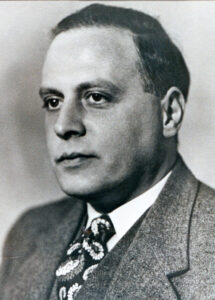
Dr. Schmitz, Mayor of Bocholt
Ten days later, the Zutphense Courant wrote:
“Nov 26 – During the council meeting of the border city of Bocholt, the mayor delivered a speech to express his gratitude for the great sacrifice made by the population of the municipality of Aalten to provide the poor of the city of Bocholt with all kinds of foodstuffs such as potatoes, flour, fat, vegetables, etc. Fourteen wagonloads had already been received, which the Aalten farmers brought to Bocholt themselves. The mayor regarded this assistance from the Dutch border residents as a sign of rapprochement toward their German neighbors.”
At the end of May 1918, the first reports appeared in Dutch newspapers regarding a ‘mysterious illness’ in Spain. Although its origins likely lay elsewhere, it was soon referred to as the Spanish Flu. This pandemic held the country in its grip for nearly two years and claimed 38,000 lives. In 1920, the disease vanished as enigmatically as it had arrived.
The municipality of Aalten did not escape the Spanish Flu either. The number of fatalities here is estimated at approximately 60, out of a population of roughly 10,000 at the time.
Newspaper reports
Aalten, 16 October 1918 – “The Spanish sickness is increasing in scale in Aalten. In many households, one or more family members are confined to bed. It is also markedly noticeable in schools, where many children are absent. Consequently, the Christian school on Breedevoortsestraat has been closed. Fortunately, the illness has not yet taken a malignant course. Lung conditions have only occurred in a few individuals.” De Standaard
Cartoon from 1918–1919. Newspaper clipping, collection Scheltema
Aalten, 29 October 1918 – “The Spanish flu, which at first was sometimes spoken of jestingly, is now appearing alarmingly in places. So too here in our municipality. Among the very numerous cases, several have resulted in death, sometimes so suddenly that people pass away within a few days. Indeed, the number of reported deaths at the town hall here has never been as high in a single day as was the case yesterday, when no fewer than eleven death certificates were filed. There is general widespread sympathy for the households where death has made such an unexpected entrance.”
Bredevoort, 29 October 1918 – “Whereas until now the Spanish flu was actually only known by name here, as people were recovered within a couple of days, it has now become quite different and has taken on a more serious character. Already several victims have died of this illness, while many are seriously ill. The public school was closed yesterday (Monday morning).” Aaltensche Courant
Aalten, 5 November 1918 – “The flu continues to rage here with the same severity and claim its victims. Yesterday, four persons in this municipality died of the disease.” De Graafschapper
Aalten, 20 February 1919– “In the municipality of Aalten, the Spanish flu has now broken out for the third time. The illness has been confirmed in many families, with some cases already resulting in death.” Arnhemsche Courant
Aalten, 5 March 1919– “The Spanish flu continues to demand sacrifices in Aalten. The number of cases remains significantly high, while numerous deaths occur.” Arnhemsche Courant
Miracle Cures
Entrepreneurs also saw commercial opportunities and sold all kinds of remedies for the flu, such as ‘Abbey Syrup’, which was essentially nothing more than sugar water with cinnamon. Other promoted treatments included “sublimate injections, fumigations with nitrous acid, eucalyptus oil, sugar beets…”
Advertisement in De Graafschapper, 27 December 1918
During WW I, Aalten offered shelter to many foreign refugees.
It was 28 July 1914 when the First World War broke out. Two days later, the Netherlands declared its neutrality. As a result, we were spared the great horrors of this war. However, the Netherlands soon faced an entirely different problem: refugees. Many escaped prisoners of war, deserters, and civilians arrived from the surrounding countries to find a safe haven here. This was also the case in Aalten.
Newspaper reports
“Italian refugees. In Aalten, the presbytery and the pastor’s house of the Christian Reformed congregation have been reserved for some Italian families who have fled from Germany.” Het Vaderland, 22 May 1915
“We received word from the eastern border: That it is by no means easy for escaped prisoners of war to cross the border is evident from a report by the Feldwebel (sergeant) stationed near the hamlet of Kotten on the border of the municipality of Winterswijk. He stated that in the last few weeks, no fewer than 70 fugitives have been apprehended in the border zone along the municipalities of Winterswijk and Aalten. Nevertheless, during that same period, approximately 20 prisoners of war—Frenchmen, Russians, Belgians, and also an Englishman—managed to reach Dutch territory in that area.” Arnhemsche Courant, 25 March 1916
“Aalten, 29 Dec. The number of refugees, prisoners of war, deserters and civilians who have arrived here across the border in recent days is very large. No less than 25 Russians arrived here who had worked in the coal mines in Germany. All were transported to Rotterdam. In addition, 17 Poles, two of whom had their wives and children with them. They had come from Courland and had worked in the mines for a wage of 9 to 10 marks a day; The poor diet had forced them to move to our country. They had had a very difficult journey. Furthermore, 4 deserters and 1 escaped French prisoner of war arrived. On Wednesday another French prisoner of war arrived here, who had escaped with two others from a prison camp in Germany. One of them was shot before he reached the border, and the other wounded and taken prisoner. Yesterday afternoon two more Russians and a German deserter arrived and this morning another German deserter reported to the border guard.” Zutphensche Courant, 30 December 1916
“Saturday evening, and Sunday morning, 9 Russian Poles, a Belgian and a Russian cavalryman-non-commissioned officer crossed the border at Aalten.” Het Nieuws van den Dag, 16 January 1917
“In Aalten we crossed the border and left for Amsterdam on Monday a German deserter with his wife, two children and a servant. The woman was born in Argentina.” The News of the Day, 23 January 1917
“At Aalten three German deserters and three French soldiers who had escaped from the camp at Mühlheim came across the border on Sunday. Among these six was the guard of the said camp, who had acted as a guide for the refugees.” The News of the Day, 20 November 1917
“In Aalten, two French prisoners of war crossed the border on Saturday. They had escaped from a camp in Friedrichsfeld.” Het Nieuws van den Dag, 10 June 1918
“Today, Friday, 316 French, 22 Belgian and 2 Italian prisoners of war were expected here from Winterswijk.” Aaltensche Courant, 29 November 1918
French refugees in the Festivities Building
Towards the end of the First World War, a second wave of refugees started from northern France, mainly of French, but also Belgian citizens.
Friday, September 27, 1918 – In northern France, the German occupying forces had called on the population of some 250 towns and villages, which were located between the Hindenburg Line established by the Germans and the border with Belgium, to leave their homes. Heavy fighting was expected now that the Allies pushed the Germans back towards Belgium, so it would be better to evacuate the region. Those who responded to the call often traveled on foot through occupied Belgium, taking their meager possessions with them. The Netherlands had promised to provide temporary shelter to a large group.
Saturday, October 26, 1918 – Arnhem was a place of passage for French refugees. At 18:00, 350 refugees arrived here. They would be transferred to Borculo, Groenlo and Aalten the next day. On Sunday evening, another 800 to 900 refugees arrived, who would go to various places in Gelderland on Monday. Members of a certain group wore bands of the same color around their arm as a distinguishing sign.
Zondag 27 oktober 1918 – ‘t Was een roerige zondag voor het normaal zo rustige Aalten. Zaterdag had de burgemeester bericht ontvangen dat in zijn gemeente, evenals in andere plaatsen in Gelderland, een groot aantal vluchtelingen, mannen en vrouwen, moest worden ondergebracht. In allerijl werd een vergadering bijeengeroepen van het in 1914 opgerichte Comité tot Hulp van Vluchtelingen. Besloten werd dat de mannen in gebouw Elim en de vrouwen en kinderen in het Feestgebouw zouden worden ondergebracht. Voorts werden de nodige maatregelen getroffen, om de vluchtelingen van eten en drinken te voorzien.
Zondagmiddag 13.00 uur had zich een grote menigte mensen bij het station verzameld. Op het perron bevonden zich de leden van de brandweer, om de nodige hulp bij het overbrengen van de gasten te verlenen. ’t Was een lange trein die behalve voor Aalten ook een honderd vluchtelingen voor Winterswijk en Groenlo vervoerde. De begeleider, een koopman uit Antwerpen, stapte uit en nodigde de 108 mannen die hij begeleidde uit om zijn voorbeeld te volgen. Per vier stelde men zich op, de bagage werd op een vrachtwagen geladen, en zo begaf zich de stoet, omringd door een grote menigte, naar het Feestgebouw.
Feestgebouw, (Festival Hall), Aalten
Salle Maréchal Foch
For the occasion, the Festival Hall was renamed ‘Salle Maréchal Foch‘, after France’s famous commander-in-chief.
Everything here was neatly arranged as a sleeping place for the strangers. Long tables were placed, where meals could take place. On a table were jugs of the fire brigade, which could serve as a washing set. Some refugees were so tired that they immediately lay down on their army bed of straw. No wonder, because they had all walked from Lille or Tourcoing to Brussels the week before. In the Belgian capital they were actually destined for German service, but through a ruse – most of them had a false pass – they, with thousands of others, managed to cross the Dutch border.
After the guests had refreshed themselves with coffee and bread, their names were recorded with place of residence and profession. There were: a stationmaster and two teachers, the three of whom were appointed as the regulation committee, to whom the refugees could turn with requests and complaints.
“Réfugiés Français et Belges, Salle Maréchal Foch, Aalten (Hollande), 22-11-1918”
Of course, many of them felt the need to let their relatives know that they were safe and sound in the hospitable Netherlands. That is why paper and ink were made available to them, while the gentlemen Johs. Driessen and Jongen made sure that they could exchange their foreign currency for Dutch money. Thanks to the action of the committee, under the excellent leadership of Ms. Hesselink could be served lunch at 18:00, which the French enjoyed.
Certain measures had been taken to maintain order. For example, everyone had to be inside at 21:00 in the evening and the cafes were not allowed to serve them liquor.
According to the supervisor, the refugees would not stay longer than 14 days under any circumstances. They would be brought back to their homeland as soon as possible via Zeeland through liberated Belgium. Negotiations about this were already underway. It would be four weeks.
Tuesday, October 29, 1918 – Two days after their arrival, three of the refugees housed in Aalten decided to flee. After breakfast they had left the building packed and bagged, with directions from Aalten, via Varsseveld and Terborg to Arnhem. However, they were tracked down by the police and brought back to ‘t Feestgebouw.
Italians
In een interview met burgemeester Monnik vertelt deze nog over Italiaanse krijgsgevangenen, die in de fabriek der N.V. Textiel Mij. waren ondergebracht: “Met die Italianen beleefden we nog wat eigenaardigs. We hadden ze allemaal wat van onze prachtige zeep, waarvan we toen een heelen voorraad hadden, gegeven om zich eens frisch te kunnen wasschen, maar den volgenden dag was alle zeep door de Italianen opgegeten!“
End of the First World War
Monday, November 11, 1918 – In a forest near the French town of Compiègne, about eighty kilometers north of Paris, the armistice was concluded that ended the First World War. The more than 40,000 French refugees in the Netherlands were able to return home. This was quite a logistical organization, so it would take until January 1919 before the last French could leave. In addition, the Germans released their prisoners of war, and of course they also wanted to return to their homeland as soon as possible. A huge stream of refugees started, partly via the Netherlands.
Zaterdag 16 november 1918 – In Aalten werd alles in gereedheid gebracht om de stroom Engelse vluchtelingen, die vanuit Duitsland werd verwacht, te kunnen ontvangen. In de scholen en andere gebouwen werd daartoe alles ingericht zodat er 900 man geborgen kon worden. De rest zou worden doorgezonden naar omliggende gemeenten. Om de orde te handhaven was er in Aalten een compagnie infanterie van het 22e regiment uit Ede gearriveerd. De soldaten werden ondergebracht in de openbare school aan de Herenstraat alsmede in de Chr. School aan de Bredevoortsestraatweg. De Nieuwe Aaltensche Courant voegde hieraan toe: “Voor ons anders zoo stille dorp een heele drukte!“.
Tuesday, November 19, 1918 – Nieuwe Aaltensche Courant: “On the eastern border, the camp management, in anticipation of the throngs of prisoners of war, who are now being released in Germany and want to return to their homeland on their own, was no longer in control of the situation. To prevent fermentation, a deputation came to ‘s-Heerenberg to discuss transport. In order to guide the stream into a good bed, the Dutch army command has determined that Belgians and French may only pass through the narrowest strip of Limburg on our land, at the other points they will be irrevocably relegated. Only English people are admitted there. Concentration camps are being prepared in ‘s-Heerenberg, Aalten, Dinxperlo and Winterswijk.”
In Aalten, refugees from the German prison camps also crossed the border. On Saturday, November 16, a group of 21 French refugees managed to reach Aalten. They had even already found their way to the Festival Building, where they greeted their compatriots with joy. To their disappointment, however, they were informed that they would be sent back to Germany because of the above-mentioned decision. They understandably didn’t feel like it, but they had to. As a farewell, they asked to be allowed to sing the Marseillaise with their brothers from the Festival Hall, which was granted to them by the commander.
In a supplement to the above-mentioned report, the same newspaper nevertheless reported that “The initially taken decision to send the French who arrived here back to Germany has been withdrawn, so that they can be forwarded from here to Rotterdam.”
Word of thanks on departure from Aalten
Friday, November 29, 1918 – Aaltensche Courant: “So we have lost our French guests again! On Tuesday the prisoners of war and Wednesday morning the refugees left the Festivities, where the following grateful speech was given by Mr. Lopes:
“Mr. Commander. We are about to leave our camp, which you yourself have baptized “Salle Maréchal Foch,” thus showing your sympathy for France and your admiration for him who led us to victory.
Before leaving, we will repeat to you that by your benevolence and by the devotion with which you have done your difficult work so well, you have won the esteem of all the refugees. And our stay here has not always been very pleasant, because it was not feasible for you to give us all the pleasures that we hope to find again in our family; but you have done the impossible to soften our fate.
We have come to Dutch soil, M. the Commander, especially to escape the forced labor against our fatherland, against our brothers, against our fathers, against our children. We have found a refuge in this quiet country, where we have been able to recover from the fatigues and inconveniences of our long journey. If the Netherlands had offered us nothing but this satisfaction, that we know we are safe from forced labour, we would already owe it a great debt of gratitude.
But we have other reasons to keep pleasant memories of the municipality of Aalten, because at first we could think of a fairly cool reception, in the sequel we saw that the great majority of the population was well-disposed towards us. Moreover, we have material proofs of this: corrections, successively made to our lodgings, blankets have been distributed, the hall has been heated, the evening meal has been improved, soap has been distributed, postcards have been provided free of charge, smoking in the dining room has been permitted, cigars have been distributed, everyone has received a guilder, books, illustrated sheets have been donated, various games, underwear and superwear and clogs have been given, repaired shoes, mended undergarments and outerwear, yes, you gave parties and lectures, offered little memories, etc.
Moreover, the members of the Bureau, during their visits to thank the generous donors and in their friendship with several respectable families, were very surprised to find, so close to the German border, many people who knew the French language, even subscribed to newspapers from our country.
So, M. the Commandant, we will keep our stay in Aalten in pleasant memories. We will never forget a benevolence and a devotion that nothing could slacken, whatever the objections that had to be overcome. This sincere and heartfelt gratitude, of which we assure you, is the expression of the feelings of all the réfugiés in the ‘Maréchal Foch’ hall; it is unanimously brought to you (you may be proud of it!). Although we would like to thank you personally, we must not forget Mr. Chief Deputy, the entire Fire Brigade and also the police. To us, they were more friends than guards.
And as for the kind ladies who have so often honored us with her presence, and even voluntarily made themselves our servant maids at all our meals, they have reminded us too much of our wives, our mothers, our sisters, our betrothed, for us to forget them. But it is impossible for us to mention the names of all those who have taken an interest in the improvement of our lot. We therefore ask you, M. de C., to be our interpreter for these people, to thank them on behalf of the Bureau, on behalf of all comrades, on behalf of our families, on behalf even of the three twin cities of Lille, Roubaix, Tourcoing, from which we almost all come and where French and Belgians have learned to live on good terms. working side by side, one of one’s minds, long before the common suffering.
And, now that we are going to leave for our hearths, allow us to cry out loudly: Long live M. the Commander! Long live Aalten! Long live the Netherlands! Long live Belgium! Long live France!”
It has become quite empty in our streets. We were already used to seeing groups of red-trousers, or yellow- and grey-trimmed warriors in front of the shop windows. To Rotterdam by rail, they go there today, Friday, on the boat that takes them to France. How happy they will be when they can see the coast of Picardy again! No doubt the ladies, who have helped all the time that the refugees stayed here, with the distribution and distribution of the food, will be remembered by them with gratitude for a long time to come, and our brave fire brigade no less.”
French frustrations
It will come as no surprise that the conditions in which the refugees were housed were not ideal. Nor that frustrations arose after a while among some of the refugees. What is remarkable is the following publication in the Nieuwe Aaltensche Courant of 3 January 1919, more than a month after the departure of the French refugees:
“Aalten enjoyed the honor, probably for the first time, to be mentioned in the French Chamber, in the discussion of the situation of the French refugees in the Netherlands. It was said by one of the deputies that forty thousand refugees in our country are literally starving. Isn’t it beautiful? See here a sketch of the situation:
“Our refugees are housed in stables and barns, without heating and without beds. They sleep on dirty straw. Under the arrangements made, the mayors must arrange for the supply at the expense of the Relief Commission. Unfortunately, the lack of organization is felt everywhere. Everywhere it is a “pan”! Items that are requested will not be delivered. For every step, for every complaint, six instances are needed, so that everything goes into disarray. Women and children are shivering from the cold here, without coal, without warm clothes. For days there is no meat, the weakest succumb to lack of care. The bread provided by the Dutch government is inedible.”
We do not know how care was arranged in other places. But we do know that this description does not fit the treatment as the refugees have received in Aalten. Now it is not impossible that here and there the organization was not immediately punctual – would the French, in the same circumstances, have fared better? – but ‘dying of hunger and cold’ will, we trust, turn out to be a horrible exaggeration.”
In addition, the French delegate reported:
“Several French refugees, who were housed in Aalten, have lost their patience and sent the following ultimatum to our representative by telegraph: “Two hundred refugees, powerful men from Lille, Roubaix and Tourcoing, demand immediate repatriation. They will leave on foot on Thursday, if no solution is found by then.”
To whom is the blame that the refugees lost their patience? In no case to the Dutch authorities. Those who had quietly left before their time have themselves stated in a letter to the chief of the fire brigade that their departure was not caused by undue treatment or care, but solely by the fact that they longed to return to their hometown.
We hope that our government will provide a resounding protest against the false rumors spread on this subject by enemies of our country. Let them inform the French authorities themselves, so that they are not exclusively dependent on the information of the French embassy in The Hague, which is so well informed of the actual situation, that the following message has been received here in the last few days: “The French refugees who are staying in Aalten may leave on January 15th.” While they have already arrived in their respective homes in northern France a few weeks ago!“
For more than a century, members of the Monasso family have been crafting terrazzo floors in the Achterhoek. The family ended up in Aalten in 1915, having fled from Bocholt, Germany, during the First World War. Their origins lie in the North Italian region of Friuli.
The family hails from the mountain village of Travesio, in the Friuli region. It was an impoverished area plagued by poor soil, earthquakes, floods, and high taxes. Many inhabitants left to find work elsewhere. Friulians were known as skilled craftsmen—foresters, carpenters, stonemasons, and terrazzo workers.
The First Generation
In 1868, Pietro Monasso married Maria Bortolucci in Travesio. They had three sons and four daughters. All three sons learned the terrazzo craft in Italian cities. One of them, Felice Monasso, was once repairing stairs at St Mark’s in Venice as a boy. He received a banknote worth about twenty guilders—a staggering amount for the time—from the newly arriving Pope Leo XIII. He did not spend it, but kept it as a relic.
The three brothers were Giovanni (1869–1939), Felice (1871–1962), and Antonio (1876–1967). They left Friuli at a young age: Giovanni and Antonio at age eleven, and Felice at fourteen.
The village of Travesio in Friuli, Northern Italy, c. 1900
Work in Germany
Giovanni travelled with fellow villagers to the Balkans to learn the carpentry trade. Felice worked first in Frankfurt, including at the large Odorico terrazzo company, which employed hundreds of Friulian workers. Giovanni and Antonio later joined him in Germany.
From Frankfurt, the brothers went to Münster, where their cousin Bortolucci ran a terrazzo business. They worked there as master journeymen, and there was plenty of work in Westphalia and the Netherlands. On the advice of their boss, they established themselves in 1896 in Bocholt, just across the border from Aalten. There, they started a terrazzo firm together.
The enterprise flourished. This was the era when wealthy textile barons in Bocholt were building grand houses. With their terrazzo work, the Monassos embellished many a villa on the prestigious Bahnhofstraße. The three families lived together with their staff in a large building on Münsterstraße in Bocholt.
Members of the three Monasso families, the landlord, and journeymen in front of and inside their home on Münsterstraße in Bocholt
The firm ‘Gebrüder Monasso’ had plenty of work, including in the Achterhoek. As early as 1897, they laid a terrazzo floor in the Catholic St George’s Church in Bredevoort.
Aaltensche Courant, 29 October 1898
On 22 November 1899, Giovanni Monasso married Angela Chivilò (1879–1951) in Italy. Together they had four sons and two daughters.
Flight to Aalten (1915)
The First World War began on 28 July 1914. Italy sided with the Allies, which the Germans viewed as a betrayal. An anti-Italian atmosphere developed in Germany; Italian workers were insulted and sometimes even assaulted on construction sites. The three Monasso families decided to flee to Aalten, just across the border in the neutral Netherlands. In effect, they were asylum seekers.
Nieuwe Winterswijksche Courant, 22 May 1915
It was a somber procession that departed Bocholt for Aalten before dawn on 19 May 1915. A horse and cart full of household goods was followed by twenty Italians. Three children remained behind in Bocholt: two because they were too ill to travel and one because he wanted to finish his year at the gymnasium.
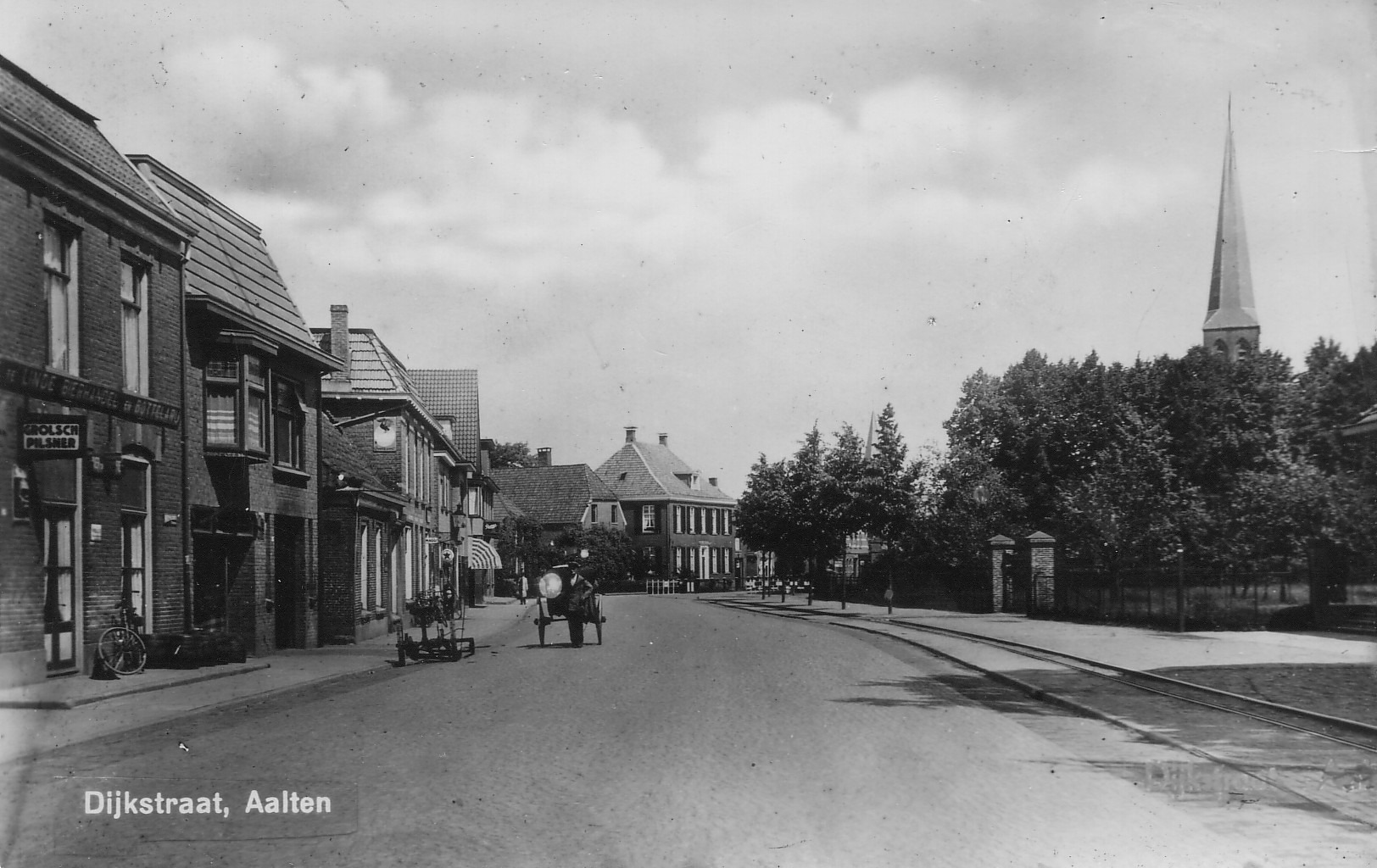
In Aalten, they spent the first night at Vultink’s lodging house on Dijkstraat. The following day, Giovanni and Antonio moved into a house on Landstraat, and Felice into Bredevoortsestraatweg. Antonio and his wife found a home on Haartsestraat shortly thereafter. The then Mayor Monnik arranged for residency permits. The children who had stayed behind joined their families later.
A New Life in Aalten
Giovanni demonstrated his entrepreneurial spirit by registering within a few days at Sociëteit Schiller, where local businessmen met. His brothers followed a week later. Within a short time, the Monassos were working again. They laid floors in homes, shops, schools, and churches in Aalten and the surrounding area, bringing in skilled terrazzo workers from Italy as staff.
Giovanni Monasso (1869–1939) and his family
They did not yet use machines or electric tools; everything was made by hand. Terrazzo floors were laid on-site, which was arduous work. Stairs, countertops, and other components were made in the workshop using moulds and were subsequently installed in kitchens or halls.
Around 1920, Giovanni established his business on Parallelweg in Aalten. In the mid-1950s, they moved to the adjacent Staringstraat, where a new showroom was opened in 1969.
Felice established a terrazzo business in Winterswijk in 1922; Antonio followed in 1932 with a branch in Doetinchem.
Aalten, 1924 – Members of the Monasso family with a float used in a parade where craftsmen presented themselves
Later Generations
The second and third generations also remained active in the craft. In the decades following the Second World War, sons and grandsons took over the work. All four of Giovanni’s sons became terrazzo workers and married Dutch women.
Business thrived for decades. In the 1960s and 1970s, demand decreased due to the rise of synthetic floors and steel countertops. Nevertheless, the family business endured. The Monassos combined traditional techniques with modern methods, specialising not only in floors but also in worktops, thresholds, window sills, and restorations.
Current Company in Aalten
In 1982, Richard Monasso, Giovanni’s grandson, took over the company in Aalten. The business moved to Industriestraat. In the 21st century, terrazzo became popular once again. Richard Monasso now works on exclusive projects at home and abroad; his work can be found in a department store in London, a restaurant in Paris, and a villa in Greece.
Willem Monasso
In 1996, Willem Monasso, son of Giovanni Monasso and Angela Chivilò, spoke about his youth:
Wilhelm Franz Joseph (Willem) Monasso (1916–2001) was born in Aalten but returned to Italy with his mother as a child. They lived with an uncle who owned grape plantations. He attended primary school there. He did not learn Italian there, but so-called Furlan, a regional language that differs as much from Italian as Frisian does from Dutch.
At the age of ten, they returned to the Netherlands. Back in Aalten, Willem had to start again in the first grade. He left school after the fourth grade to enter the terrazzo trade.
On his mother’s side, the Monasso family owned a wine bottling plant and a silk plantation. They regularly had barrels of white wine from their region of origin in Italy shipped over. The first barrel always went to the parish priest of Aalten.
During the Second World War, Willem was the only resident of Aalten allowed to own a radio because he held Italian nationality. Naturally, the occupiers forbade him from listening to the English ‘Oranje’ station, but he did so in secret, along with half the neighbourhood.
Willem Monasso could tell captivating stories about his former work in the perfect Aalten dialect. Initially, countertops were made on-site in a formwork built by a carpenter. Later, this was done in the workshop, and they were transported to their destination by a small truck. The terrazzo technique requires great craftsmanship and is incredibly labour-intensive. Throughout the region, many beautiful Monasso floors can still be found in churches, hospitals, monasteries, schools, and scholten farms.
Until the beginning of the 20th century, German money was the daily means of payment in Aalten. This was due on the one hand to the lively trade with Germany and on the other because many residents of Aalten worked in the textile factories in Bocholt. They were paid in German money and put this into circulation in Aalten.
In 1937, G.H. Rots described in a series of articles how things were done in Aalten in former times. For instance, he wrote about the local payment transactions:
“…Speaking of agio, that was caused by the German money that was in circulation here and was the daily means of payment. It was such that Dutch currency was rarely seen. If one needed ‘Dutch money’, for example for taxes, one had to go to a few individuals who ran large businesses to exchange German money. Until the beginning of this century, the circulation of German money in our municipality was still common.
When the government wanted to take measures to prohibit that circulation, many people resisted. The association ‘Aalten’s Belang’ became involved, and within that association, a fierce struggle arose over the abolition or retention of German money. In Hotel De Roskam, owned by Mr. Voorderman, well-attended meetings were held. Those who conducted a lot of trade with Germany or had German customers in their shops saw a significant disadvantage in the abolition of German money.
Aaltensche Courant, 26 November 1910
That trade with Germany was quite busy. There were almost no border restrictions, and on the Bocholt market days, numerous merchants went there to sell their wares. And those who worked in Germany also naturally received their wages in German money and put this back into circulation in our municipality. One should therefore not think too lightly of it. And at one of the meetings of Aalten’s Belang, it came to heated debates, and even the continued existence of the association was jeopardized as a result of this issue. Finally, the abolition was introduced in July 1914, and the population adapted to it.”
A very rare 20-mark gold coin from 1888, shown here for illustrative purposes.Aaltensche Courant, 29 October 1904Aaltensche Courant, 2 May 1919
Source
‘From Aalten’s Past’, by G.H. Rots, Aaltensche Courant, 31 December 1937 (via Delpher)
We frequently read or hear about “Plan 1913”. What is meant by that? It is the plan or intention to festively commemorate the joyous event of 100 years ago. Is there reason for this? Those who still ask this provide proof that they have forgotten what they learned at school regarding the history of our fatherland. The only thing that can be offered as an excuse is that for many, their school years lie far behind them and oral tradition is no longer heard.
It was in 1863, when the fiftieth anniversary of the Netherlands’ Independence was celebrated in Aalten, that things were quite different. Back then, there was hardly a family where one did not hear from the lips of grandparents about the sad times our ancestors lived through as long as the French were in charge here. Incidents that had personally affected a family were recounted, but now, 50 years later, much of that is covered by the veil of oblivion.
Aalten decorated on the occasion of 100 years of independence, 1913
In general, therefore, we wish to recall a few facts that history has recorded. The 17th century (1600–1700) is called the “Golden Age” of our history; the 18th century (1700–1800), the “century of decay”.
What was the cause of that decay? People began to rest on the laurels achieved by their ancestors. A spirit of enterprise was no longer to be found. In idleness, people began to enjoy the accumulated wealth and were afraid to give up anything that might contribute to the promotion of the country’s prosperity. No funds were made available for the army and navy, and the prestige of the once-mighty Republic of the United Netherlands dwindled from year to year.
In the eyes of other European states, we no longer counted. Furthermore, dissatisfaction with the administration arose, fuelled by the revolutionary spirit that manifested itself in France—so much so that the revolutionaries, called Patriots, acted hostily towards Stadtholder William V and his supporters, called Orangists.
The French Period
When the great Revolution had taken place in France, and the revolutionaries had put the King and Queen to death, the Patriots called in the help of the French to drive out the Stadtholder here as well. In 1795, they marched into our country with a large army and were received with cheers by the revolutionaries.
The government was unable to stop them because the army was not properly equipped and the fortifications were dilapidated. The money needed for their maintenance had been cut, but now they could give the French 100 million guilders, which they demanded for the help and assistance they had provided. William V fled to England, and his opponents took the place of the former government officials.
Now, the French could have left again, but they did not think of it. Time and again, when the French soldiers here were well-fed and clothed, they were exchanged for a ragged, starving bunch, to recover their strength here at the expense of the citizenry. Their influence on the course of affairs in this country meanwhile increased more and more, until they took the entire administration into their own hands.
In France, there was great confusion until it finally succeeded for a lawyer’s son from Corsica, named Napoleon Bonaparte, to create some order. He was a brave general and a capable warrior, who defeated the armies of the states that had declared war on France and prescribed humiliating peace terms to his enemies. In 1804, he had himself proclaimed Emperor, and two years later he sent his brother, Louis Napoleon, here to rule over our country as King.
Heavy Sacrifices
The alliance with France cost us heavy sacrifices. The English, who were at war with the French, now became our enemies as well and took possession of almost all our colonies and robbed our merchant ships, which meant our trade was as good as gone. One already had to pay a quarter of one’s income in taxes, and yet Napoleon demanded more.
Napoleon had had his brother Louis proclaimed king here in the expectation that he would submit entirely to his will. However, he was disappointed in this. Louis came here with the intention of promoting the prosperity of his kingdom as much as possible and protecting the people from further oppression. He showed this, among other things, by refusing to introduce conscription and by tacitly allowing smuggling with England.
To hit England, Napoleon had strictly forbidden all trade with that country. Now that Louis did not support him enough in this, he forced him to abdicate (1810), and Holland was annexed by France. Our country now became a French province and thus ceased to be an independent kingdom. The government was now organised on a French footing. The Dutch language had to gradually disappear. French had to be learned in schools, and newspapers also had to appear in French.
An army of customs officers occupied the coast and ensured that when a ship with English goods arrived, the cargo was burned. Indische goods, such as coffee, tea, tobacco, and rice, rose astonishingly in price as a result. The impoverished citizenry managed with a decoction of toasted rye bread instead of using coffee, and instead of tobacco, people smoked walnut leaves. To replace sugar, people set themselves to making sugar from the sweet sap of beets.
Many wealthy citizens became poor, and those who had to live off their interest, as well as numerous orphanages and charitable institutions, suffered want when Napoleon had the interest on the national debt “tiered”—that is, he only acknowledged one-third of it. Those who, for example, were entitled to 300 guilders in interest only received 100 guilders. No more was earned, but more had to be paid, causing poverty to pinch; hundreds of houses were sold for demolition, magnificent country estates were disposed of for a trifle, horses and carriages were abolished, and servants dismissed. In Amsterdam, grass grew on the streets.
Fighting for Napoleon
But the Frenchman did not just take goods; he also demanded blood. Napoleon needed soldiers to fight for him in all corners of Europe and now forced our boys to serve in his armies. He introduced conscription, which for us was something unheard of. In our previous wars, there were always enough volunteers to defend the fatherland, but now it was determined by lot who had to take up arms. Thus, numerous families saw their beloved relatives head off to foreign lands, never to see them again.
Yet no one dared to complain, or they would make the acquaintance of prison. Secret spies crept around everywhere to pick up every suspicious word, and the police often forced their way into homes and opened letters to hear someone’s opinion of the Emperor. Books and newspapers were not allowed to appear before they had been approved.
Yet this oppression also had its good side. The people now forgot their old party squabbles and felt united again and yearned for salvation. Napoleon’s power had reached its peak. Only England and Russia still defied him; otherwise, he ruled over all of Europe. Russia, too, would now feel his blows. With an army of more than half a million, he marched thither, but for every twenty soldiers, nineteen died miserably in Russia’s snowfields. The approximately fifteen thousand Dutchmen also never returned to their fatherland.
“Oranje boven” (Orange up/Long live Orange)
After this outcome, the Counts of Hogendorp, Van Limburg Styrum, and Van der Duijn van Maasdam secretly hatched plans to shake off the French yoke. After the Battle of Leipzig, in which Napoleon was defeated, the signal for the uprising was given by adorning oneself with the orange colour, which was previously punishable by death. The French soldiers watched, bewildered, and did not have the courage to resist.
Prussia and the Cossacks offered help, and on 15 November 1813, the cry “Oranje boven” already rang through Amsterdam’s streets, and two days later in The Hague. On 21 November, Van Hogendorp and Van der Duijn van Maasdam accepted the provisional government, and on 30 November, the Prince of Orange, son of the expelled Stadtholder William V, set foot on land at Scheveningen, where he was cheered by the crowd with unprecedented enthusiasm. Two days later, he was proclaimed Sovereign Prince in Amsterdam.
The French slunk away, and the Netherlands was free. That is one hundred years ago now, and all that time we have been spared from enemies crossing our borders. There is, therefore, reason to festively commemorate the Netherlands’ deliverance with thanks to God. Let us value our freedom, for no greater disaster can befall a people than when they are dominated by strangers. At the centenary of our independence to be celebrated within the municipality of Aalten on 28 August next, let our age-old motto therefore ring out loudly: “Oranje boven”.
In 1910, a tram line was opened from Lichtenvoorde to Bocholt, via Bredevoort and Aalten. In 1953, the tram line was discontinued and the tracks were broken up.
Around the turn of the 20th century, hundreds of Aalten residents crossed the border every day to work in one of the textile factories in the neighbouring German city of Bocholt. In all weathers, they travelled on foot, by bicycle, or by horse and carriage. Some took up to three hours to cover the (roughly) ten kilometres between home and work, both in the morning and in the evening!
Plans
As early as 1880, there were plans to extend the Lichtenvoorde–Groenlo tram line to Aalten, Varsseveld, and Terborg. By 1893, there were plans for a horse-drawn tram line from Groenlo to Lichtenvoorde, Bredevoort, Aalten, and Dinxperlo/Bocholt. In 1899, the final plan was eventually drawn up for two steam tram lines: from the Lichtenvoorde-Groenlo station to Zeddam and to Bocholt. To this end, the Geldersch-Westfaalsche Stoomtram-Maatschappij (GWSM) was established in 1905, with its head office in Lichtenvoorde.
The Bocholter Volksblatt wrote on 1 October 1907:
Holländische Arbeiter in Bocholt
“Yesterday evening, a local citizen on his way back from Aalten to Bocholt, as he informs us as a loyal subscriber, took the pleasure of counting the workers returning by bicycle from Bocholt to the border. On his way from the Kreuzkapelle to the Holtwicker Bach, he counted no fewer than 276 cyclists; he also encountered a large wagon which was also transporting workers, estimated at perhaps 40–50. In this respect, therefore, the Bocholt–Aalten light railway certainly does not have such bad prospects for ridership, especially since there will undoubtedly be many more workers who wish to come here for work.”
A year later, on 4 November 1908, the same newspaper wrote:
Dampfeisenbahn Bocholt–Aalten
“After long negotiations, the Bocholt manufacturers and other interested parties have finally succeeded, through the subscription of large sums of money, in ensuring that the Bocholt–Aalten light railway is now being built. It has now been entered into the commercial register of the local district court under Geldersch-Westfälische Dampfeisenbahn-Gesellschaft AG in Lichtenvoorde in the Kingdom of the Netherlands, with a branch office in Bocholt. Hundreds of Dutch workers are employed in the local factories, who have had to cover the approximately 3-hour journey to Holland on foot or by bicycle, every morning and evening, in wind and weather. Construction of the railway will be commenced immediately.”
Festive Opening
In 1909, construction of the tram line began. However, the work suffered significant delays as a result of a major flood near Bredevoort that year. Finally, the tram line was festively opened on 29 April 1910.
It soon became apparent that only the Aalten–Bocholt section was a successful part of the GWSM. However, due to the outbreak of World War I, the border crossing was closed, making it impossible for transport to continue from Aalten to Bocholt. When this route was resumed in 1915, there were far fewer passengers than before, and it was therefore shut down completely in 1916.
From the 1920s onwards, passenger services between Aalten and Lichtenvoorde were largely operated by motor trams. This continued until 1933, when buses from the Veldhuis company began operating. After the 1930s, only freight transport proved successful (with the exception of the Aalten–Bocholt section).
In 1953, the tram line came to an end and the rails were broken up.
Steam tram Gelderland No. 406 in AaltenSteam tram at Aalten train station (photo courtesy of Hans Schutte)Patrimoniumstraat, AaltenGraafschapbode, 19 February 1910
Stops
Below is a list of stops between Lichtenvoorde and Bocholt that were located within the municipality of Aalten (click here for a list of all stops):
The German city of Bocholt lies approximately twelve kilometers south of Aalten. At the end of the 19th and the beginning of the 20th century, Bocholt grew into an important center of the textile industry. This flourishing industrial city attracted many workers from the border region.
Hundreds of border workers from Aalten, Bredevoort, and surrounding rural districts found employment there, especially in the numerous textile factories and in construction.
In 1904, Prof. Dr. H. Blink wrote: “Every day, as many as 150 workers go from Aalten to Bocholt; rough, large wagons, covered with white hoods in the rain and drawn by two horses, bring the workers to Bocholt every morning and carry them back in the evening.”
Thanks to the Aalten population register, in which the employer was also regularly recorded around 1900, we know of many workers that they worked in Bocholt and for which company.1
De Graafschapbode, 4 December 1897
Who were the people working in Bocholt?
In the overview below, you will find the names of many border workers from the municipality of Aalten who were employed in Bocholt around 1900, including their profession and employer. Perhaps some of your ancestors are among them? Please note: this overview is not exhaustive.
Below is an overview of companies in Bocholt where workers from Aalten were employed around 1900. This list is also incomplete:
Franz Beckmann & Cie.
Cotton mill
Founded in 1895, this firm grew into one of the city’s largest spinning mills. The company was acquired by the firm Flender in 1967. The original factory building has been renovated and restored to its former glory.
Founded in 1873 on Kaiser-Wilhelm-Straße. In 1897, a dye works and a fabric finishing department were added on Frankenstraße. In 1921, the firm was removed from the commercial register.
The first large industrial enterprise in Bocholt, founded in 1857. After a fire in 1888, the factory was replaced by a larger new building. The company ceased operations in 1978. The 34-meter-high chimney was preserved and now stands in the middle of the Arkaden shopping center.
Around 1900, the firm Wwe. B. Messing was active in Bocholt as a producer of cotton waste. The factory was located in the current Weber Quartier, behind the Kinodrom on the river Aa.
Founded in 1864. No further information available.
Brauerei Tangerding
Steam beer brewery
The Hirsch-Brauerei of Franz Tangerding in Bocholt-Stenern produced various types of beer, soft drinks, and fruit lemonades. The ruins of the original brewhouse from 1896 are still present on the former brewery site.
“At the entrance of the current Karolingerstraße stood the factory of Cosman Cohen, and further south were the factories of Gebr. Weyl and Braunschweig.”
In 1859, Josef Philipp Beckmann started a steam weaving mill on Kreuzstraße with his sons. In 1891, the company split into J. Beckmann Nachfolger and Heinrich Beckmann Söhne. Both companies later merged again into IBENA.
Founded in 1862 on Kaiser-Wilhelm-Straße. In 1897, the factory burned down. A new factory was built at Industriestraße 7. In 1929, the weaving mill was sold to the neighboring company H. Beckmann Söhne and is now owned by IBENA.
In 1898, the Aktiengesellschaft Baumwollspinnerei Rothe Erde had a factory built between Werther Straße and the Aa. The spinning mill with the adjacent weaving mill was one of the largest companies in the city.
From 1857, Ludwig Schwartz had several steam weaving and spinning mills built on his estate Haus Woord. After his death, the company was continued by his widow Theodora Schwartz and later by their sons. The firm ended its activities in 1971. The current Schwartzstraße in Bocholt serves as a reminder of this textile enterprise.
The firm Vagedes was located in the Biemenhorst district. In 1990, the company was on the verge of liquidation. Two former employees then founded Setex-Textil and continued Vagedes’ activities.
In 1889, Max Hugo von Velsen, former director of Ludwig Schwartz’s spinning mill, founded his own cotton spinning mill. The factory, located between the Westend and the river Aa, included a spinning mill, twisting mill, and finishing department. The company closed in 1934.
Below you will find a map showing the (presumed) locations of the aforementioned factories in Bocholt.
Interesting facts
Commuters from Aalten crossed the border six days a week, mostly on foot, by bicycle, or by horse and carriage. In 1910, relief came with the construction of a tram line between Aalten and Bocholt, which significantly shortened travel time. Working days were long: 12 to 14 hours was no exception.
Border workers from Aalten received their wages in German Marks. This money was circulated in the local Aalten economy. Around 1900, German money was therefore the daily currency in Aalten. However, this was formally prohibited in 1914.
Those who wish to learn more about the history of the textile industry in Bocholt can visit the LWL-Museum Textilwerk. Here, the city’s rich textile past is brought to life with original machinery and various exhibitions.
The Almshouse (‘Gasthuis’) was an institution run by the Reformed diaconate (charitable board) located on what was then Gasthuisstraat, now known as Haartsestraat, in Aalten.
On the 1832 land registry map (cadastre) shown on the right, the exact location is visible, situated approximately where Haartsestraat 14 to 18 stands today.
Bovenstaande foto toont de Gasthuisstraat rond 1900. Rechts, voorbij de burgemeesterswoning – het latere postkantoor – zien we nog net een gedeelte van het Gasthuis. Helemaal achteraan zien we ook nog net het Luutenshuus.
The Almshouse contained ten rooms on the street side and ten on the garden side, each with a floor area of 17 to 22 m². Each room was equipped with two box-beds (bedsteden). Occupants shared a privaat (toilet) between several rooms. In the garden, many residents also kept a ‘sikkestal’ (a small shed for a goat).
The residents were not only among the poorest members of the population but were also generally the least educated. Consequently, the Almshouse and its surroundings were frequently the scene of shouting matches and petty quarrels. The residents were often the targets of harassment by the local youth of Aalten.
One of the residents would deliver wheelbarrows of fine white sand door-to-door for a penny, which people used to strew across their stone floors. Once he had earned a few pence, he would quickly spend it on a borrel (a small glass of gin) before starting to ‘save up’ for the next one.
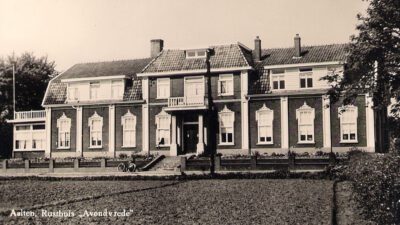
In 1904 werd het Gasthuis afgebroken. De oudjes er op dat moment nog woonden verhuisden naar het Rusthuis aan de Hogestraat.
Owners
This overview is incomplete.
Year
Plot
Owner
Description
1832
I1116 – I1135
the Reformed Poor of Aalten
House Numbering
In the population register, every room or household is listed on a separate family card. The overview below provides links to the first family card in the population register for each period that corresponds to the almshouse on Haartsestraat. From there, one can browse further to find all residents for that specific timeframe.
An extensive table listing all residents is planned for the future to assist genealogists in identifying former occupants. Please note: records may contain errors.
Aalten had vroeger ook nog een katholiek gasthuis. Het Armenpad tussen de Hogestraat en de Stationsstraat, één van de typisch Aaltense Gängeskes, herinnert hier nog aan.
Features
Cadastral no.
I-8761/8762/ 13144/13140
Function
Almshouse
Year of construction
unknown
Demolition
1904
Land Registry 1832, Source: hisgis.nlFragment cadastral map, 1905Zutphensche Courant, 19 March 1883Nieuwe Winterswijksche Courant, 25 May 1904Aaltensche Courant, 9 July 1904
The Armenpad, which connects Hogestraat and Stationsstraat, is one of the typical Aalten Gängeskes (alleys). The name recalls the Roman Catholic almshouse that once stood here.
This almshouse consisted of eight rooms, each measuring 4 by 4 meters, and was located on the grounds of Dr. Hartman. The residents received support from the Roman Catholic Church, which provided them with clothing and food. Additionally, they had a small garden where they could, for example, keep a goat. The almshouse came to an end in 1937, when the Hartman family decided to no longer allow the residents to live on their land.1
Around 1912, the eight dwellings were reconfigured into four dwellings.
Besides the Catholic almshouse, Aalten formerly also had a Reformed almshouse on what is now Haartsestraat.
14 m² house & yard (8x) including house numbers, between brackets after plot number)
1894
I-4581
the Roman Cath. poor of Aalten
1.600 m² almshouse, barn & yard
1913
I-4581
the Roman Cath. poor of Aalten
1,700 m² house, almshouse, barn and yard
1914
I-5615 I-5616
the Roman Cath. poor of Aalten
40 m² almshouse 1.660 m² house, barn and farmland
Residents
The overview below contains a link to the corresponding family card in the population register for each period and room/household from 1860 to 1910.56 What we noticed: it appears that residents occasionally changed rooms; the residents were mostly single women (widows); and many had Bocholt as their place of birth. Our research is still ongoing, errors excepted!
Wyoming Native Shoshone, c. 1868/1869 – Photo: A.J. Russell, Beinecke Library Collection, Yale University
In the course of the 19th century , more than 1500 people from Aalten emigrated to the United States. Many of them settled in Sheboygan County in the state of Wisconsin. Some later moved further west, to states such as Iowa, Minnesota, Nebraska and Wyoming. These areas had been inhabited for centuries by indigenous peoples, then called “Indians”. This sometimes led to tensions, as is evident from a story of the Somsen family, whose ancestors came from Aalten.
Immigrants and indigenous inhabitants regularly lived close to each other and also traded. Indigenous inhabitants exchanged fur for blankets, tobacco or other goods. Sometimes there were also conflicts between the original and the new inhabitants, especially over land, cattle or other possessions. In that context, the following family story from the descendants of an emigrant family in Aalten takes place.
The disputed horse of Henry Somsen
Henry John Somsen (1852–1936)
Hendrik Jan Somsen and Johanna Berendina Rensink, from the Japikshuis in IJzerlo, emigrated to America in 1851 with their four children and settled in Sheboygan. Their fifth child was born there in 1852: Henry John.
Around 1890, Henry lived with his family on a farm about ten miles north of Cokeville in the state of Wyoming. During that period, an incident took place with a group of indigenous inhabitants. His daughter Olive Somsen later described this in a biography of her father:
One day, Henry and his wife were away from home, while their three eldest children – Henry of twelve, Olive of ten and Frank of eight – had to look after the house.
A group of Indians stopped near the house. One of them came to the house and declared that a certain horse in the meadow belonged to him, and when they left he wanted to take the horse with him. The children knew that their father had bought the animal from a Native American trader a few days earlier, and they were determined not to let the horse be taken.
Frank, the youngest, climbed on the horse and rode it to the river, where he hid among the willow bushes. His little sister Olive hid in the cellar, while the eldest son, Henry, mounted another horse and rushed to Cokeville, where his parents were; about ten miles south.
The main group of Indians took the road to Cokeville, while two went along the river in search of Frank with the horse. They found him and, while holding bows and arrows at the ready, forced him to ride in front of them.
Eldest son Henry arrived in Cokeville after a quick drive and warned his father. Shortly afterwards they drove back to the farm with a number of armed men. On the way they met the group of Indians, with Frank on the horse in front.
They urged the Indians to stop and listened to their story. It is possible that the Indian, who had sold the horse to Somsen, had stolen it from the Indian who now claimed it. Anyway, they arrested the entire group and took them to Cokeville. The next day, their case went to court. He decided that Somsen would keep his horse and the Indian was assigned another horse.
Do you also know a story of an emigrant family from Aalten? Let us know!
During the French occupation of our country (1795-1813), a significant change occurred in the existing legal order. After the Netherlands was annexed to France by Napoleon Bonaparte in 1810, French legislation was also introduced here.
Justice of the Peace Court
By Imperial Decree of July 9, 1810, the Netherlands was divided into departments, districts, cantons, and municipalities. A justice of the peace court was established in every main town of a canton, including Aalten. The canton of Aalten consisted of the municipalities of Aalten and Dinxperlo.
The task of the justice of the peace was to resolve conflicts peacefully before they were brought before a ‘real’ judge, in order to save a great deal of expense. In addition, the justice of the peace had the authority to handle small, low-cost cases. Other powers of the justice of the peace lay primarily in personal and family law.
Cantonal Court
In 1838, the legal system was reorganized again, and the justice of the peace was replaced by the cantonal judge. The justice of the peace courts of Aalten and Winterswijk were then merged into the Aalten cantonal court. This court covered the fourth canton of the third district (Zutphen) of the Gelderland Court of Appeal and was classified as a fifth-class subdistrict court based on the Act of July 1, 1830.
The Aalten cantonal court held its sessions in the town hall on the Markt. In 1861, a cantonal house of detention was built in Prinsenstraat, with six cells and a jailer’s residence.
The Aalten cantonal court was abolished in 1877. From that moment on, the municipalities of Aalten and Winterswijk belonged to the canton of Groenlo. The municipality of Dinxperlo was transferred to the canton of Terborg.
Archive
In 1968, the archive of the former Aalten cantonal court was transferred to the State Archives in Gelderland, along with the oldest part of the Groenlo archive. In 1961, the transfer of the Public Prosecution Service archive, which was still located in the Aalten town hall, took place.
Wax seal of the Aalten cantonal court (photo: Hans Schutte)Nederlandsche Staatscourant, November 6, 1828
Judges and clerks of the justice of the peace and cantonal court in Aalten 1811-1877 (still incomplete)
In the 19th century, hundreds of Aalten residents emigrated to the United States in search of land, work and a better life. A number of them are known to have participated in the American Civil War. As far as is known, they all served in the armies of the Northern states (the Union).
The American Civil War (1861–1865) was an armed conflict in the United States between the Northern states (the Union) and the Southern states (the Confederacy). Bloody battles and campaigns took place in many states. The war began with a Confederate attack on Fort Sumter, South Carolina, on April 12, 1861. In June 1865, the last Confederate armies surrendered, and the Union emerged victorious.
Former Aalten fighters
The following list is probably not yet complete:
Jan Derk Ansink (Barlo, 30-04-1840 – 02-07-1868) ‘John Ansink’ enlisted on 06-08-1862 with the 108th New York Volunteer Infantry Regiment, company E, in Rochester, Monroe County, NY. He was wounded in action on 03-07-1863 during the Battle of Gettysburg. In May or June 1864 he was transferred to Company A of the 21st Regiment of the Veteran Reserve Corps. After the Civil War he was discharged on 07-06-1865 in Trenton, NJ.
Gerrit Hendrik Duenk (IJzerlo, 19-07-1825 – Milwaukee, WI, 14-08-1883) ‘Gerritt H Duenk’ served from 20-08-1862 to 10-06-1865 in the 24th Wisconsin Infantry Regiment, company I. He retired on the orders of the War Department. In 1883, he was eligible for admission to a National Home for Disabled Volunteer Soldiers. He suffered from rheumatism. At the time, he lived with his wife Clara and three children under the age of 16 in Milwaukee, WI, where he worked as a laborer. On 31-05-1883 he was admitted to the home. On 14-08-1883 he was found dead; he had drowned in the Milwaukee River. He was buried a day later.
Gerrit Jan Duenk (IJzerlo, 23-09-1845 – Milwaukee, WI, 19-04-1897) ‘Garrett Dunck’ served from 15-08-1862 to 10-06-1865 in the 24th Wisconsin Infantry Regiment, company E. He was wounded on 02-06-1864 in Georgia, in the vicinity of Dallas, New Hope Church and Allatoona Hills. After the Civil War he was fired on 10-06-1865.
Hendrik Huibert van Eest (Velp, 12-09-1837 – Springfield, IL, 26-03-1865) He reported on 28-02-1865 in Overisel, MI as a soldier. He was incorporated into the 24th Michigan Infantry Regiment, company K on 01-03-1865. Died on 26-03-1865 in Camp Butler, Springfield, IL.
aren’t Jan Geurink (IJzerlo, 24-03-1822 – Sheboygan, WI, 21-02-1899) At his grave is a GAR marker (Grand Army of the Republic) that indicates that he fought in the American Civil War.
Gradus Heinen (Aalten, 19-10-1827 – Holland, WI, 24-10-1908) ‘Grades Heinen’ enlisted on 21-08-1862 with the 27th Wisconsin Volunteer Infantry Regiment, company F. This regiment left Milwaukee, WI, on 16-03-1863 for Columbus, KY. Gradus was injured at Jenkins’ Ferry, AR. This happened during one of the bloodiest battles of the Civil War, fought on 29/30-04-1864 at the swollen Saline River, after days of heavy rainfall. After the Civil War he was fired on 29-08-1865.
Derk Hendrik Kappers (Aalten, 10-01-1827 – Madison, WI, 17-03-1864) He enlisted on 16-09-1861 as a soldier in the 1st Wisconsin Infantry Regiment, company H. He served until he died of an illness on 17-03-1864 in Madison, WI.
Antonij ter Maat (Dale, 07-02-1836 – Columbus, KY, 04-06-1863) He enlisted, together with his brother Jan Hendrik, on 21-08-1862 in the 27th Wisconsin Volunteer Infantry Regiment, company F. He became ill and died.
Jan Hendrik ter Maat (Dale, 25-03-1841 – Memphis, TN, 03-10-1863) He enlisted, together with his brother Antonij, on 21-08-1862 in the 27th Wisconsin Volunteer Infantry Regiment, company F. He became ill and died.
Lammert Reimes (Aalten, 21-11-1834 – New Jersey, 08-08-1912) ‘Lambert Reymers’ was enlisted in 1861 as a soldier in the 2nd Delaware Infantry Regiment, company I. He served throughout the Civil War.
Gerrit Jan te Slaa (Lintelo, 20-10-1831 – Missouri, 30-08-1863) He enlisted on 21-08-1862 in the 27th Wisconsin Volunteer Infantry Regiment, company F. He became ill and died on a hospital boat moored in the Mississippi near Helena, Arkansas.
Bernadus Vervelde (Aalten, 16-02-1816 – Sherman, NY, 08-04-1891) ‘Benardus Felton’ reported on 22-08-1862 in Westfield, NY as a soldier. On 24-09-1862 he was assigned to the 154th New York Infantry Regiment, company E. On 02-05-1863 he was taken prisoner of war in Virginia during the Battle of Chancellorsville. On 14-05-1863 he was released on parole at City Point, VA. On 21-05-1864 he was dismissed due to disability. His son Derk Jan (called ‘Garrett J Felton’ in the US) also fought in the Civil War.
Derk Jan Vervelde (Haart, 16-02-1843 – Ripley, NY, 05-09-1903) ‘Garrett J. Felton’ reported on 31-07-1862 in Westfield, NY as a soldier. On 15-08-1862 he was assigned to the 112th New York Volunteer Infantry Regiment, company E. On 30-07-1864 he was wounded during the Siege of Petersburg. On 06-07-1865 he was discharged from service at Lovell Hospital, Portsmouth Grove, RI. His father, ‘Benardus Felton’, also fought in the Civil War.
Arnoldus Johannes Zweerink (Aalten, 09-01-1834 – Petersburg, VA, 31-03-1865) He enlisted in the 6th Wisconsin Infantry Regiment, Company I, as a soldier on 21-10-1864. Company I consisted of men from Brown and Vernon counties in Wisconsin. The 6th Wisconsin Regiment was part of the famous Iron Brigade during the war. “Noldus” Zweerink was killed during the Battle of White Oak Road.
Do you have more information about (above or other) Aalten emigrants who fought in the American Civil War? Comment below or send us a message!
Between 1845 and 1880, hundreds of emigrants from Aalten and Winterswijk settled in Clymer, a town in the west of the state of New York. In 1854, Berend Hendrik Legters and his family also left for the United States, with Clymer as their final destination. A sinister story is still circulating within the family about their journey…
Berend Hendrik Legters was born on 18 January 1827 at Klein Goorhuis in Heurne in Aalten. In the mid-30s, the family moved to Nieuw Hoornenborg on the Haart. After the death of his mother, his father remarried in 1845 and they moved to the Koks farm in Ratum.
On 18 June 1847 Berend Hendrik, a weaver by profession, married Anna Catharina Hellekamp (Miste, 31 August 1810). They went to live at her parental home, Hellekamp in Miste. In June 1854 they left for America with their two young sons, together with the Oonk-Kortschot couple, who also lived at Hellekamp.
The crossing to New York took a long time and was tough. It became too much for Anna Catharina; after 30 days at sea, she died, just days before they were to arrive in New York. Berend Hendrik had seen what happened to the bodies of deceased passengers: they were given a watery grave. He wanted to spare his wife that fate. So he and his travel companions came up with a ruse. They pretended that Anna was seriously ill and thus hid the fact that she had died. Despite illness, you were counted on with the food. An additional advantage was that they now had an extra portion of their own!
Once they arrived in New York, they had to leave the ship via the gangway. They held the deceased between them and put her arms over their shoulders. Carefully they kicked her legs so that it looked like she was walking herself. The trick worked and they managed to get her off board safely.
They had her buried in the first cemetery they came across, with the intention of having her remains later transferred to their final destination, Clymer. However, in the first few years, they did not have the means to do so. When they finally had enough money saved, they returned to pick her up. But unfortunately, they could not find the grave again…
After widower Berend Hendrik had settled in Clymer with his two sons, he asked the pastor what he should do. On his advice, he remarried to Gesina Berendina “Minnie” Schreurs (Barlo, 20 April 1820), widow of Gradus Kobus. She died in 1865 and Berend Hendrik married again, this time to Geertruida Johanna “Kate” Schreurs (Winterswijk, 13 December 1840). Berend Hendrik (Henry) Legters died on 25 January 1910 in Clymer.
The above representation of this story is based on the sources mentioned below. However, these sources contain varying information about the course of events. We have combined the (in our opinion) most plausible information into the above version. Additions/corrections are welcome!
From 1852 to 1919, the Aalten electoral district was one of the sixteen Gelderland electoral districts for the Provincial Council. The district comprised the municipalities of Aalten, Winterswijk, and Dinxperlo and held three seats.
Following the constitutional revision of 1848, which for the first time enabled direct elections of the Provincial Council under census suffrage (voting rights for men who met a certain income requirement)1 – and the Provincial Act of 1850, Gelderland was divided into sixteen districts in 1852, including Aalten.2
With the introduction of universal male suffrage in 1917 and the Elections Act of 1919, the elections of April 10, 1919, were the first to use proportional representation within a single province-wide constituency, after which the Aalten electoral district ceased to exist.3
Origin and background
During the reign of King William I (1772–1843), provincial governments were appointed bodies in which nobility and local notables held seats without election. It was only with the constitutional revision of 1848 that members of the Provincial Council could be directly elected, albeit still on the basis of census suffrage. 1
Establishment of the Aalten electoral district
In 1850, the Provincial Act came into effect, which determined, among other things, how members of the Provincial Council were elected. Two years later, the Act regulating the division of provinces into electoral districts of November 5, 1852 (Bulletin of Acts and Decrees No. 197) established the final division: Gelderland was split into sixteen electoral districts, including Aalten. 2
Abolition and transition to proportional representation
The constitutional revision of 1917 introduced universal male suffrage and heralded the abolition of the district system. The Elections Act of 1919 put an end to small electoral districts and introduced a single province-wide constituency with proportional representation in all provinces. This system was first applied during the Gelderland elections of April 10, 1919, at which point the Aalten electoral district ceased to exist. 3
Delegates
Some well-known Council members representing the Aalten electoral district: 1
In 1847, a large group of people from the Achterhoek departed for America, hoping for a better life. Among them were dozens of residents from Aalten. Just before they reached their final destination, their ship, the ‘Phoenix’, caught fire on Lake Michigan. An estimated 250 to 300 people lost their lives.
Memorial plaque for the Phoenix disaster, Sheboygan
The beautiful wooden boat named ‘Phoenix’ was only two years old when it steamed toward the west coast of Lake Michigan on November 20, 1847, carrying approximately 175 Dutch passengers, 23 crew members, and an unknown number of other occupants. The emigrants on board came from Winterswijk, Aalten, Varsseveld, Apeldoorn, Holten, and various other places. A day later, they were to reach their Promised Land in Sheboygan after an exhausting voyage. Children were put to sleep in the cabins for the last time.
On November 11, the Phoenix had departed from Buffalo to sail via Lake Erie and Lake Huron to Lake Michigan. Only thirty miles from their destination, the Phoenix entered the harbor of Manitowoc. Some cargo was unloaded, but when the captain noticed the weather conditions were too stormy, he kept his ship in the harbor until the lake would calm down. The crew went ashore. Some claimed they were intoxicated upon their return.
At one o’clock in the morning, with the lake calm and the night filled with stars, the Phoenix departed for the final leg of the journey to Sheboygan. Due to the heavy load, the boilers overheated, but the crew treated the matter lightly. However, around four o’clock in the morning, thick smoke and the stench of smoldering wood emerged from the engine room, and the alarm was raised.
Burn or drown
Painting of the Phoenix disaster
Vain attempts were made on board the Phoenix to extinguish the fire with buckets of water. But the wooden vessel soon burned like a torch. Two lifeboats were lowered into the water, with which 43 occupants managed to cover the five miles to the coast—one using a wooden shoe as an oar; twenty-five of them were Dutch.
The remaining passengers had two options: burn or drown. They jumped into the water but stood no chance. The water was ice-cold, and they became hypothermic within minutes. Even if one could swim, any attempt to reach the shore was futile.
An estimated two hundred and fifty to three hundred people died, including nearly 100 children. It is remarkable how the handful of surviving emigrants still managed to start a new life. They had no choice.
Residents of Oud-Aalten on the Phoenix
In the middle of the last century, many people from the Achterhoek left for religious reasons. They were mostly dissenters from the Dutch Reformed Church who no longer felt at home here due to their liberal thinking. This was also true for the Achterhoek passengers on the Phoenix, including the Aalten residents Brusse, Navis, and Krajenbrink from the rural district of Lintelo.
From oral tradition, the names of fourteen people from Aalten who became victims of the disaster are known. Regarding others, one is left in the dark. They departed from Aalten on August 16, 1847, together with 78 others. However, conservative estimates suggest that fifty to seventy-five residents of Aalten perished.
A list of (possible) passengers of the Phoenix and who likely did or did not survive the disaster can be found on the website dutchgenealogy.nl by Yvette Hoitink.
Podcasts and documentary
From left to right: cameraman Maarten Schellekens, documentary filmmaker Diny van Hoften, Mary Risseeuw from Sheboygan, and podcaster Joske Meerdink.
At the end of 2020, Winterswijk podcast creator Joske Meerdink from Omroep Gelderland accidentally came across the story of the Phoenix disaster. She was surprised that she did not know the story and noticed that the Phoenix disaster was also relatively unknown to her fellow villagers. Consequently, she decided to delve into the story.
During her search, Joske, together with documentary filmmaker Diny van Hoften, visited Sheboygan, where they spoke with descendants of the disaster’s survivors. They also joined a shipwreck hunter to search for remains of the Phoenix (and found them!).
Her search resulted in a series of podcasts and a two-part documentary. These can be heard and viewed at Omroep Gelderland.
The documentary that Omroep Gelderland broadcast in early 1998 about the Phoenix disaster can also be seen here. In the documentary, made by Sacha Barraud, a group from the Achterhoek, including Aalten resident Evert Smilda, is followed as they travel to Sheboygan in late 1997 to attend the 150th anniversary commemoration of the Phoenix disaster.
Emigration to North America
During the 19th century, thousands of people left the Achterhoek region to build a new life in the United States. Many residents also departed from Aalten, searching for freedom, land, and new opportunities.
The ‘t Walfort Estate lies between Aalten and Bredevoort. Historically, it was part of the ‘t Walfort Manor (Havezathe) and comprises woodlands, hedgerows, and wooded banks. The boundaries of the estate were marked by so-called hunting posts (jachtpalen). Today, 13 of these posts are still visible; one of them stands on the former driveway to the manor and is therefore not on the boundary of the hunting grounds. It is presumed that more posts originally surrounded ‘t Walfort.
According to the re-enacted Hunting Act of 1814, hunting grounds had to be demarcated with posts bearing the text “private hunt of” (private jagt van) followed by the owner’s name. These hunting posts marked the extent of his hunting territory.
A description by the Gelders Genootschap mentions that the hunting posts were placed around 1837/1838 by the then owner, Baron Jan van Pallandt van Walfort (1776–1844). He lived in Arnhem on the Klarenbeek estate and also purchased Angerenstein and Rennenenk in Arnhem. He was also a member of the Provincial Executive (Gedeputeerde Staten) of Gelderland.
The hunting posts are made of red sandstone, presumably sourced from quarries in the vicinity of the Weser or the Main rivers. Their total length is 2.5 to 3 metres. The posts are rectangular (approx. 25 x 20 cm) with chamfered corners. The top is a four-sided pyramid. In terms of finish, they are gefrijnd: horizontally ribbed. On one side, there is a rectangular, smoothly finished field containing the text: “Havezate Walvoort of Walfort Privative Jacht”. Several of the remaining posts are either damaged or have been shortened.
The hunting posts have been designated as a municipal monument by the municipality of Aalten.2
Map of the Free Hunting Grounds of Walfort Manor, 1836
All hunting posts in a row
The numbers of the photographs correspond with the numbers on the map above.
After the Allied powers definitively defeated Napoleon in 1815, the Northern and Southern Netherlands were unified. The new Kingdom of the Netherlands was ruled by King William I. However, problems soon arose between the south and the north. There were significant political, economic, cultural, and religious differences.
The Belgian Revolt in Brussels (1830), by Gustave Wappers
National Militia Call-up
On February 15, 1827, the Provincial Gazette of Gelderland published a Decree in which 460 men from Gelderland, including twelve from Aalten, were summoned to appear at the ‘Government Building’ in Arnhem at 8:00 AM on February 27 as reservists of the National Militia. As of March 1, they were required to be ‘under arms.’ A number of them would not return alive.
More residents of Aalten served, as evidenced by the decorations awarded later (see further on in this article). However, we do not yet have a complete overview of them. Further information is therefore welcome.
The Ten Days’ Campaign
In August 1830, the Belgians revolted. At the end of September, an army was sent from the North to restore order. The Belgian resistance proved more stubborn than expected, and after a few days, the army was forced to withdraw from Brussels.
To avenge this defeat, King William I sent a larger force to Belgium on August 2, 1831. France decided to intervene and sent an army of 40,000 men to the Southern Netherlands. Consequently, William I withdrew his army. All in all, the conflict had lasted 10 days.
The Ten Days’ Campaign took place from August 2–12, 1831. The military operation was led by Prince William of Orange (the later King William II), who agreed to an armistice on August 12, 1831, after the Belgians surrendered Leuven. In the following week, the Dutch troops withdrew to North Brabant. Only the Citadel of Antwerp remained occupied under the command of Chassé (‘General Bayonet’) until the capitulation in December 1832.
In 1937, G.H. Rots wrote in the Aaltensche Courant about the Ten Days’ Campaign:
“Peace arrived, and the population returned to their labors. But peace would not last forever. The struggle between the Northern and Southern provinces ignited, and known as the ten days’ campaign, battle had to be joined once more. Once again, young men from Aalten marched off to join the struggle. This conflict was not particularly bloody, and most returned safely to their homes.”
Those who had participated in that ten days’ campaign received a medal. In our youth, there were two veterans in Aalten who wore this decoration. During national festivities, they would be seated in a landau, drawn by two horses, and took the place of honor in the procession. The names of these last Aalten veterans were Lorijn and Loohuis. The medal of the latter is now in the possession of Mr. J.S.S. Prins.”
The Citadel of Antwerp
Marshal Gérard and the French princes pay their respects to General Chassé amidst the ruins of the citadel.
Shortly after the uprising in 1830, a portion of the Dutch military had retreated to Antwerp. At the end of October, General Chassé concentrated them in the citadel. This garrison was reinforced after August 1831. On December 24, 1832, General Chassé surrendered to the French army, which had been called to aid by the Belgians, following heavy artillery bombardments and a 25-day siege.
The French Marshal Gérard also demanded the important Scheldt forts Lillo and Liefkenshoek. These were no longer under Chassé’s command, so they could not be negotiated. Gérard then offered the choice between surrendering the forts or taking the soldiers to France as prisoners of war. Only William I could provide a solution. He refused.
Prisoners of War
On December 29 and 30, 1832, over 4,500 Dutch soldiers departed for Northern France as prisoners of war. However, because France and the Netherlands were not at war with each other, they were effectively hostages. The journey took eight days of marching through Zwijndrecht, Melsele, St.-Niklaas, Lokeren, Deinze, Desselgem, Kortrijk, Menen, Ypres, Vlamertinge, Poperinge, Steenvoorde, and Cassel. On January 5, Saint-Omer was reached via Arques. Part of the Infantry continued to Béthune, another part with the Artillery and Engineers to Hesdin, and the Navy to Aire.
The La Barre barracks in Saint-Omer, where a large portion of the Dutch soldiers remained in captivity.
On May 21, 1833, the Convention of London brought about a partial lifting of the state of war. The prisoners of war were to be released. On June 8, four French frigates, three corvettes, and one brig set sail from Dunkirk for Vlissingen. A day later, they made landfall in Vlissingen and marched to Middelburg that same day.
It would take until 1838 before the Dutch King William I sullenly threw in the towel. With the signing of the Treaty of London in 1839, the separation of Belgium became a fact.
Awards
All those who had been under arms and were deemed to have participated in the military operations during the Ten Days’ Campaign were decorated with the Metal Cross. This commemorative medal, also known as the ‘Hasselt Cross,’ was awarded in recognition of their proven loyalty to King and Fatherland. The bronze crosses were struck from the metal of the cannons captured from the Belgian Army of the Meuse during the Battle of Hasselt on August 8, 1831.
By Royal Decree of May 31, 1833, King William I of the Netherlands instituted the Antwerp Medal 1832. This was to be awarded as a “reward to those who, during the siege of the Citadel of Antwerp in the period from November 28 to December 24, 1832, served in the citadel and subordinate forts (Vlaamsche Hoofd, Burcht, Zwijndrecht, and Austruweel), as well as on the flotilla on the Scheldt before Antwerp.”
Decorated Aalten residents
A number of Aalten residents are known to have been decorated with the Metal Cross (MK) for their participation in the Ten Days’ Campaign and/or the Citadel Medal (CM) for the defense of the Antwerp citadel. Below are the names and decorations currently known to us.
MK: Jan Anthonij Bekink (1812-1898), woonde in de Peperstraat.
MK: Joan Henricus (Jan Hendrik) Bennink (1807-1832), woonde aan de Prinsenstraat. Hij was flankeur bij het 2e Bataillon der 14e Afdeling Infanterie toen hij overleed in een hospitaal te ‘s-Hertogenbosch.
MK: Dirk Jan Hoornenborg (1807-1876), geboren op Nieuw Hoornenborg op de Haart, woonde sinds ca. 1845 in Gorssel en overleed in Kring van Dorth.
MK: Johannes Christianus Kötcher (1807-1876), lived in Bredevoort.
MK: Hendrik Jan Loohuis (1812-1905), woonde de laatste jaren van zijn leven in Rusthuis Avondvrede.
MK: Petrus Bernardus Smit (1807-1876), woonde aan de Hogestraat.
MK+CM: Tonij Stapelkamp (1807-1889), woonde aan de Hogestraat.
CM: Paulus Lorijn (1811-1899), kwam in 1844 uit Wageningen naar Aalten en woonde achtereenvolgens op de Piepert, Heurne en het RK gasthuis aan de Hogestraat.
CM: Roelof Somsen (1808-1891), woonde op boerderij Pennings in Dale.
The decorations of Tonij Stapelkamp: the Citadel Medal and the (large) named medal issued later by the Commission of Gratitude; on the right, the Bronze Cross of the Ten Days’ Campaign (photo submitted by A. Stapelkamp).Zutphensche Courant, 30 November 1882Aaltensche Courant, 1 April 1899Zutphensche Courant, 8 October 1890Nieuws van den Dag, 9 August 1898Rotterdamsch Nieuwsblad, 9 June 1905
In 1937, G.H. Rots described in a series of articles how things transpired in Aalten in former times. Regarding the years of the French occupation, he wrote:
“During the French period, Aalten enjoyed the blessings (?) of French rule. The slogan ‘Liberty, Equality, and Fraternity’ was prevalent at the time, and the liberty tree was planted on the Market Square in Aalten. A new municipal government was appointed, new laws and regulations were established; in short, a different spirit blew through the government buildings. The Batavian Republic was founded, and the House of Orange was finished.
French soldiers were also billeted in Aalten, with all the associated calamities. Although the majority were pro-Orange, people did not dare to express their opinions, and the new regime was accepted. This situation lasted from 1795 to 1799. Secretly, a large part of the population loathed the French occupation.
False hope
Then, in 1799, rumors circulated that a Dutch nobleman, A.R. van Heeckeren, also known as Suideras, had crossed the eastern borders at the head of a large army as a liberator and was victoriously driving the French out of the villages.
In other parts of the country, there were also incursions by the English and Russians, who were engaged in war with the French, and thus also with the Batavian Republic. The Orange supporters regained courage, and when Suideras marched into Winterswijk on September 5 and allowed the Orange flag to flutter from the tower once more, Aalten also prepared to receive the liberator.
Great excitement took hold of the population. A certain Jan Derk Hoopman arrived with an axe and already began to chop down the liberty tree. In the afternoon, Suideras arrived in Aalten. The bells were rung. A large crowd welcomed the liberator while singing and dancing. People adorned themselves with Orange, believing that the suffering was finally over. It proved to be a false hope, for the French did not allow themselves to be easily defeated by Suideras.
By the following day, word arrived that a French army was approaching, and indeed, the French General Girod arrived in Aalten with his troops. Jan Derk Hoopman fled, and likely many others took to their heels as well, as house searches were conducted and heavy punishments were meted out. The joy had thus been short-lived. High taxes had to be paid, and earnings were meager.
The ministers held religious services in the open air. For instance, Reverend Westerbeek van Eerten climbed onto a farm cart and encouraged his fellow believers, who had gathered near the ‘De Pol‘ house.
A state of decline set in. The pressure of French rule became increasingly heavy. Young men had to draw lots for French conscription, and when Napoleon needed soldiers for his campaign to Russia, Aalten also had to provide a contingent. They left, never to return. Their remains rest beneath the soil of the Russian steppes, or they perished in the cold waters of the Berezina.
Liberation
Until 1813. Napoleon was defeated in the Battle of the Nations at Leipzig. The Prussians entered our country. The Prince of Orange arrived in our country from England, and once again the cry was ‘Orange Above’. There was jubilation in Aalten once more. The bells were rung again, and now the Orange flag would continue to fly.
One of the Orange scions, Prince Frederick, was at school in Berlin. Having heard of the revolution in the Netherlands, he traveled by stagecoach to The Hague. The route followed the great postal road, which we have described previously. The border crossing took place at the Heurne, and when the population heard that Prince Frederick would pass through Aalten, they went to meet the carriage, unhitched the horses, and pulled the coach through Aalten amidst loud cheering as far as the Zelhemseweg, to the spot where the lime tree stands. Well, that tree was planted then as a memorial to that event, and later the lime tree was established as the official coat of arms of Aalten.
Once more, the boys from Aalten would have to march against the French. When Napoleon escaped from Elba and equipped a large army to reclaim his former glory, the Netherlands had to place its army alongside the allies against him. Young men from Aalten also fought in the Battle of Waterloo. We know what became of Napoleon’s fate then. It had been his final convulsion.”
Prince Frederik of the Netherlands (1797–1881)
Source
‘From Aalten’s Past’, by G.H. Rots, Aaltensche Courant, 11 March 1938 (via Delpher)
The Galgenbulte (Gallows Hill) on the Hollenberg, also known as Klaeskesbulte, was formerly the site where the gallows were erected. This was where condemned criminals, witches, and other scum drew their final breath.
The execution site was strategically located along the road from Aalten to Bredevoort. The hill was excavated in 1939 to widen the main road.
Vehmic Court
During the medieval period, a veemgericht (Vehmic court) was established on the Hollenberg, near the ’t Walfort manor. This was a special court whose sessions were held in the open air near a thicket known as ‘Sleehegge’. Four times a year, justice was administered here at sunrise.
A nearby small farmstead is called Galgenhutte. It is said that the equipment for the executions was stored there in a small building. According to local lore, those sentenced to death were permitted to eat their final meal there.
Berend de Dücker
In 1430, Free Count Berend de Dücker, then the mayor of Bocholt, presided over the court here. He led the Vehmic court for 60 years. This Berend was notorious for his severe sentencing, frequently condemning individuals to hanging. The condemned person was hanged with a noose made of willow withes by three anonymous veemschepenen (Vehmic jurors).
A well-known threat used by parents for disobedient children, which persisted until the 20th century, was: ‘De Düker zal ow halen‘ (The Dücker will get you).
Records from the ‘Administrative Organisation of the Lordship of Bredevoort’ indicate that the residents of Kempink and Goorhuis in Heurne were responsible for transporting the convicted criminal to the Hollenberg after the sentence had been read at ’t Zand in Bredevoort. By order of the officer, they were also required, without exception, to transport the gallows, wheel, cross, and other instruments of execution to the site.
By the end of the sixteenth century, the Vehmic court at ’t Walfort had disappeared. It is the only location in the Netherlands where the existence of a Vehmic court has been proven.
Verdict Klaas Nijman
Klaas Nijman
On 3 October 1729, following a trial in Bredevoort and sentencing at ’t Zand, Klaas Nijman—32 years old and born in the district of Bocholt—was executed on the Hollenberg. He was a ‘beggar and vagabond’ accused of violent theft, arson, and other offences. Although he had been banished from various places, he continually returned. As a deterrent to others, he was strangled on the Hollenberg and subsequently set on fire.
On 12 February 1770, Harmen Brunsink was executed on the Hollenberg. He lived at the Vosheurne farm in Lintelo and had murdered ‘Aunt’ Hendersken Tannemaat. Harmen did not get along with this live-in aunt of his wife. He claimed to alerted neighbours that she had fallen, but the number and nature of the injuries made his story unbelievable.
Harmen was sentenced to death. The executioner bound him to a wooden cross; first his legs and then his arms were broken. He was subsequently beheaded with an axe. His body was placed on a wheel atop a pole and secured with chains. His head was placed on a stake above it to deter others.
“The fact that death sentences were carried out even after the time of the Vehmic court proves that the end came for many a condemned soul in the vicinity of ’t Walfort. To the right of the road to Bredevoort, hidden under brushwood and trees, is a small mound. That is where the gallows were erected. When someone was to be executed, a number of men were officially summoned to form a circle around the place of execution. This was in case the noose should break or the condemned should break free; the circle of men stood hand-in-hand to prevent escape.
After a long period in which no more death sentences were passed, the last gallows is said to have been erected at the beginning of the last [19th] century. The condemned man was named Klaësken, and surrounded by the circle-closers, he went in procession to the gallows. It seems, however, that they wanted to give the man a chance to flee, for when they reached the Walfortallee, they said to him: ‘That is the road to Prussia.’ The man did not take the hint, and on the hill, as the last in a line of condemned men, he met his end on the gallows. That is why that small mound is still called the Klaëskesbulte.”
‘From Aaltens past’, by G.H. Rots, Aaltensche Courant, 4 February 1938 (Delpher)
Beheer toestemming
Deze website gebruikt cookies voor een optimale ervaring en analyse van bezoekgegevens. Ga je hiermee akkoord? Zonder toestemming werken sommige onderdelen van de site mogelijk minder goed.
Functioneel
Always active
De technische opslag of toegang is strikt noodzakelijk voor het legitieme doel het gebruik mogelijk te maken van een specifieke dienst waarom de abonnee of gebruiker uitdrukkelijk heeft gevraagd, of met als enig doel de uitvoering van de transmissie van een communicatie over een elektronisch communicatienetwerk.
Voorkeuren
De technische opslag of toegang is noodzakelijk voor het legitieme doel voorkeuren op te slaan die niet door de abonnee of gebruiker zijn aangevraagd.
Statistieken
De technische opslag of toegang die uitsluitend voor statistische doeleinden wordt gebruikt.De technische opslag of toegang die uitsluitend wordt gebruikt voor anonieme statistische doeleinden. Zonder dagvaarding, vrijwillige naleving door je Internet Service Provider, of aanvullende gegevens van een derde partij, kan informatie die alleen voor dit doel wordt opgeslagen of opgehaald gewoonlijk niet worden gebruikt om je te identificeren.
Marketing
De technische opslag of toegang is nodig om gebruikersprofielen op te stellen voor het verzenden van reclame, of om de gebruiker op een site of over verschillende sites te volgen voor soortgelijke marketingdoeleinden.