
Christian National Weekly De Spiegel, November 16, 1957
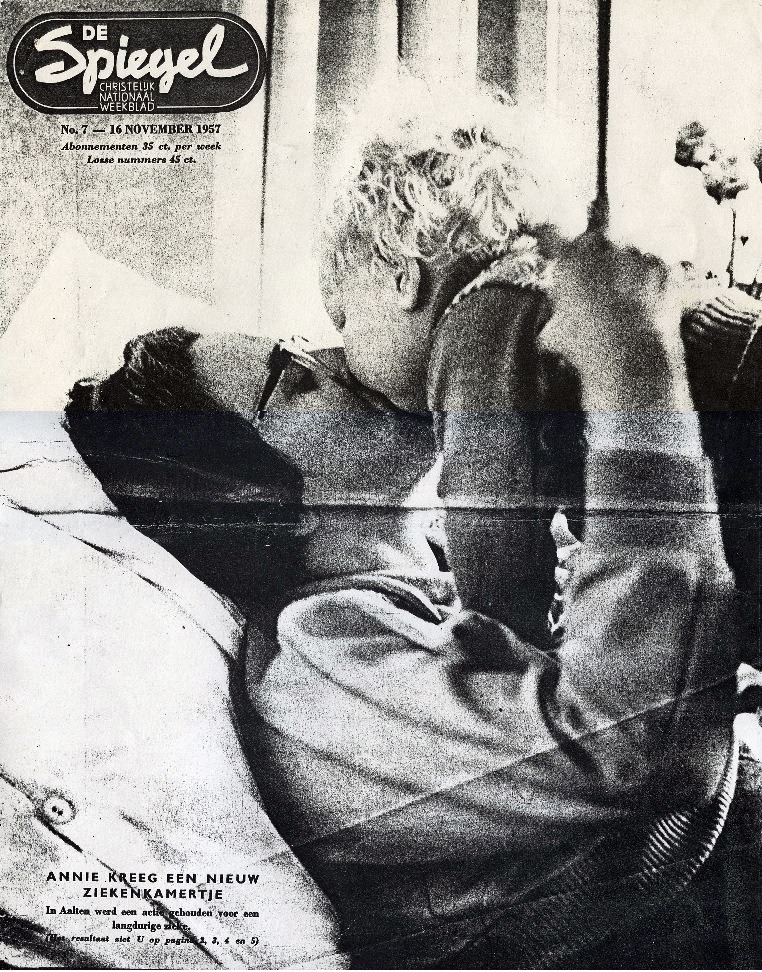
Slowly and carefully, she was lifted out of the ambulance. Strong men’s arms carried the stretcher step by step across the yard, where some withered leaves were driven along by the fresh autumn wind until their progress was halted by the wire mesh stretched around the chicken run. Step by step the men went further, past the people who had sought some shelter from the wind under the roof of the open barn. And Annie smiled at all those people, for it was a particularly joyful day for her. Today she received her new, own little room! And these people and many more had seen to that.
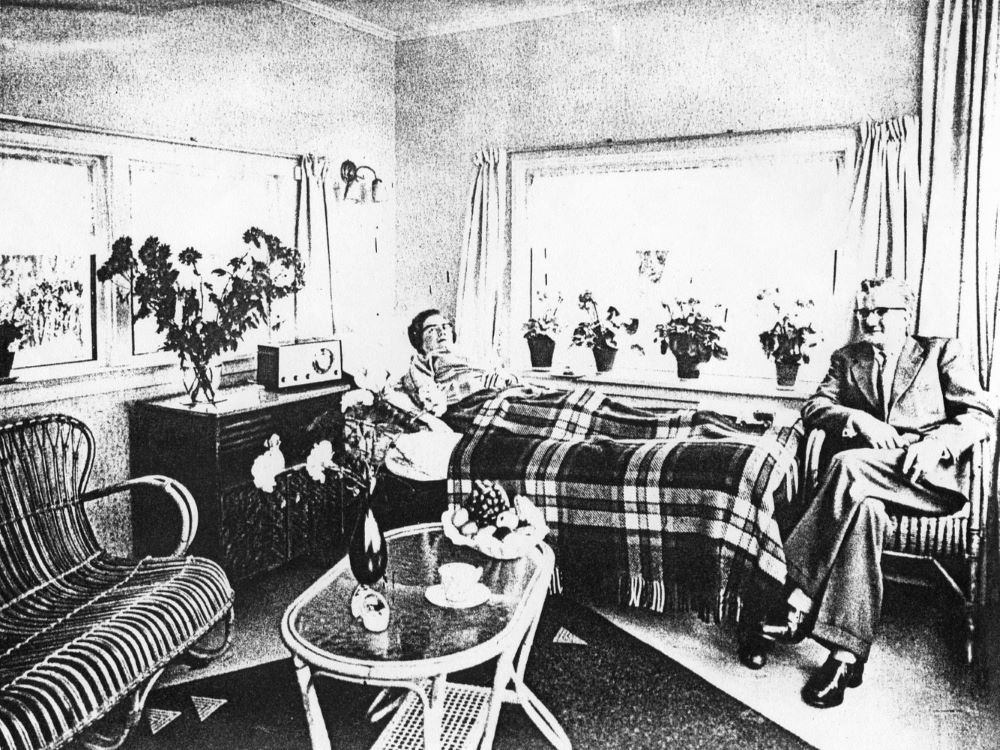
The stretcher was set down. Annie looked aside and then… then suddenly there was a tear in her eye, which she hastily wiped away. But another one came, and another… Oh, this – no, she had not expected this after her absence! A whole new little house with two French doors through which she saw a new table – and chairs – and her little radio stood next to her bedstead on a brand-new bookcase and then a beautiful lamp – and… and… once again the emotion became too much for her and as she was carried inside, she let her tears of joy and gratitude flow freely…
Would there be no solution!
It must have been about half a year ago that Hendrik Arentsen, clothier in Aalten, visited Annie Smees for the umpteenth time. She had been bedridden for so long, so very long – for as many as fifteen years – and humanly speaking, no cure was possible anymore. Arentsen looked around. The room where the sickbed stood was pleasant enough in terms of space, but he knew it was damp and that at ten o’clock in the morning, the sun bid farewell to Annie for the day.
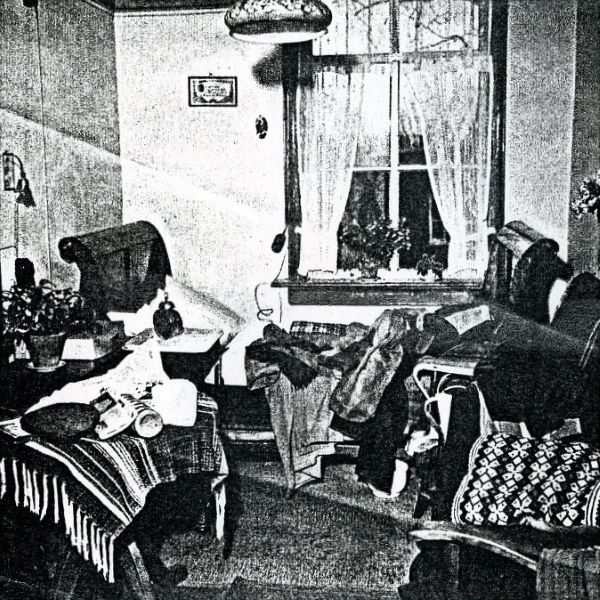
What a pity, the clothier thought, that this girl, who already sees so little of the outside world, cannot receive a bit more sunshine. Could no solution be found for that? Could no other room be found? Would no other room be available for the girl? – He talked about it with father and mother Smees, but these elderly people did not know either. After all, had it not gone well for so many years? For three months of each year, Annie had lain in the small garden house, and for the rest of each year, she lay in this room.
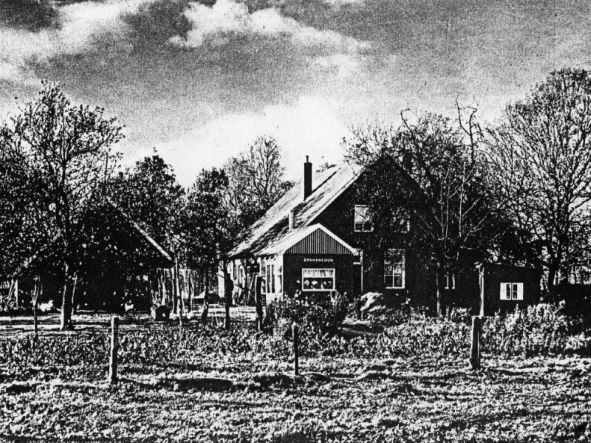
Was there then no other place at all in the farmhouse where Annie’s bedstead could face south? “Our bedroom,” said mother Smees, “but then again, that has no window looking south.” Well, that became more difficult. Especially since the farmhouse is not owned by the Smees family. Nevertheless, Mr. Arentsen kept thinking about it. Annie had to have sunshine. If only he and all those friends, family, and acquaintances who visited her regularly could give her that! It had to be possible somehow.
Donations poured in
And it worked! It worked much better than Annie’s friends had expected. For when permission was given to exchange the room of father and mother with that of Annie and to furnish it as a cozy sickroom with a large window, a chimney, wallpaper, and floor covering, then the donations poured in.
At birthdays and weddings, from private individuals and businesspeople, everyone who belonged to Annie’s family, friends, and acquaintances was immediately prepared to respond to Arentsen’s appeal and to contribute a stone (or sometimes a large stone) to the costs that had to be incurred. Thus Operation “Sunshine” was born, and the amount of one thousand guilders involved in the improvement and furnishing of the room was soon exceeded and grew to two thousand guilders!
But that was wonderful! Why, Annie’s friends thought, should we not do it completely right at once? Let us give her a whole new little room as a gift! And while talking, they finally came up with the idea of having a removable, portable, and double-walled wooden house made. After all, mother, the only one who cared for her day and night, was already nearly sixty-nine years old, and if Annie ever had to be nursed by someone else, she could beautifully take her little house with her.
Because people love her
So it was decided, and so it happened. The little house was built and its interior furnished. Girls from the Christian Agricultural Domestic Science School of Aalten bought and made the curtains from their saved money, the teachers provided them with hand-printed motifs, the Orange-Green Cross donated the rug, the Luimes firm gave, in addition to a financial contribution, the beautiful bookcase on which the modern radio set could stand, which Annie had previously received from a reader of De Spiegel after an appeal for postcards had appeared in our magazine and these people had visited Annie personally.
Furthermore, there were gifts and donations from… oh no, let us mention no more names, for otherwise we might skip someone, and besides, it is not at all the intention of all Annie’s friends that their names be made known. These gifts, this bringing of sunshine to a girl who has been struggling with her back since she was eleven or twelve years old due to an unfortunate fall while playing, where surgical intervention could be of no avail, all this selfless love and this tangible sympathy was given to her because people love her, because they wanted to put into practice the neighborly love commanded by the Lord Jesus.
Touching neighborly love
This report should therefore be seen in that light. Amidst all the misery to be found in this world, the devouring of one another through jealousy or feelings of hatred, the shouting of “I won’t stand for that!”, the… well, all that ugly and nasty stuff that so many people inflict on their neighbor, in the midst of that, this beautiful thing, this giving of touching neighborly love, suddenly happens in the Gelderland Achterhoek.
“It is by no means the intention to squeeze money out of you,” Mrs. Te Loo from Bredevoort wrote to us, “but we found this spontaneous sympathy for the sick Annie Smees so lovely and so heartwarming that we thought: we must write this to De Spiegel. It could be an example for others.” And so it is indeed!
Before Annie arrived with the ambulance, we took a look around. We saw her previous sickroom, where almost no sun comes and from which she saw practically nothing of the road. The road, which is already a long way from the farmhouse. The room is also located entirely on the other side of the house, so that Annie also saw nothing of the activities performed by her parents, brother, and sister around the farmhouse, and as a result, she also had little contact with her housemates.
We also looked at her “summer house,” which stands in the garden. It is no larger than a gazebo. If her bedstead was in it, one chair could fit with difficulty. Moreover, it was not easy for her mother to have to go outside once every night during the three months that Annie lay there.
Unencumbered property
No, then her new room is better in every respect. Through a door, the little house is directly connected to her parents’ bedroom, Annie has a better view of the road and the yard, and the sun can shine in unhindered from morning until late in the afternoon.
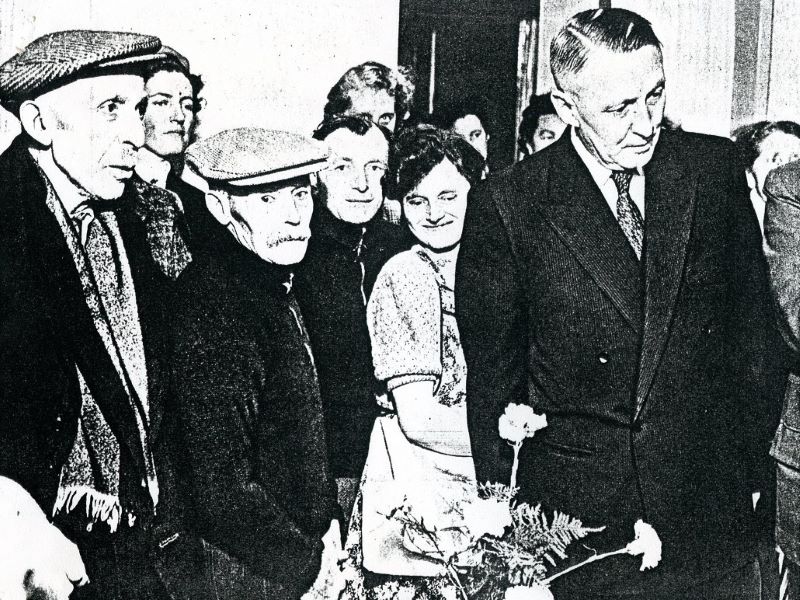
When she was carried inside – as we already wrote – several family members and friends were there to be present at the handover. We saw the mayor of Aalten, her physician, Dr. H. Knol with his wife, Alderman Te Roele, the chairwoman of the Red Cross, Aalten branch, Mrs. Van Egmond, and many more. They all came to congratulate Annie on her new residence and to listen to the deed that Mayor Van Veen read out and handed to her. It contained the following:
“On this day, the first of Nov. 1957, was transferred in unencumbered property by the Honorable (“yes, that is me, Annie, how do you like that?” the mayor laughed) E.S. van Veen, mayor of the municipality of Aalten, to Miss Annie Smees, Heurne 4, also municipality of Aalten, a double-walled and tile-roofed wooden building, measuring over three by four meters, with double windows, mantelpiece, asbestos chimney, tiled terrace, electrical installation with accessories, balatum, carpet with two rugs, chair, bench, table, book furniture, lamp, oil heater with 200-liter tank. All this is the result of a campaign conducted among friends, family, and interested parties under the motto ‘Operation Sunshine’.”
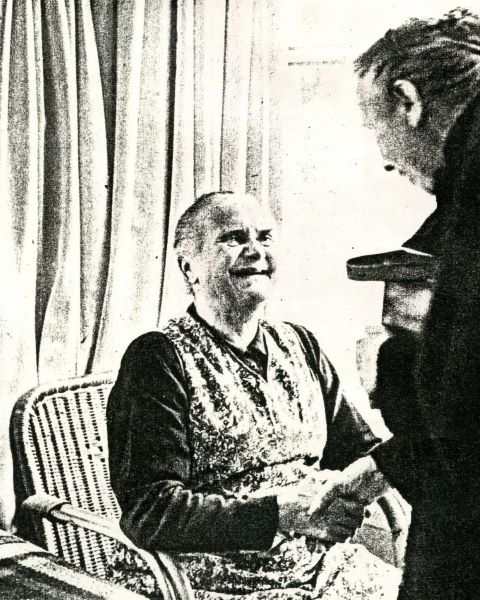
A blessing to many
“It has overwhelmed Anneke,” said her parish minister, Rev. R. Siertsema, “therefore she cannot find words to thank you all and has requested me to do so.” “Let us also not forget,” Mayor E.S. van Veen said a little later, “that although Annie has this cross to bear, she nevertheless manages to let many who visit her go away again with a joyful and grateful heart. Unconsciously, she has been a blessing to many people, and I am sure she will continue to be so.”
Annie lay there perfectly happy, the red cyclamens bloomed on the windowsill, flowers scented the whole room, and her folded hands lay in the mild light of the joyfully shining autumn sun.
The original article is also available as a PDF (click here).
Annie and her sister Mina moved in 1970 to a sheltered housing unit of the Cederhof, Hogestraat 80. The sickroom then served as a storage room for several more years.