
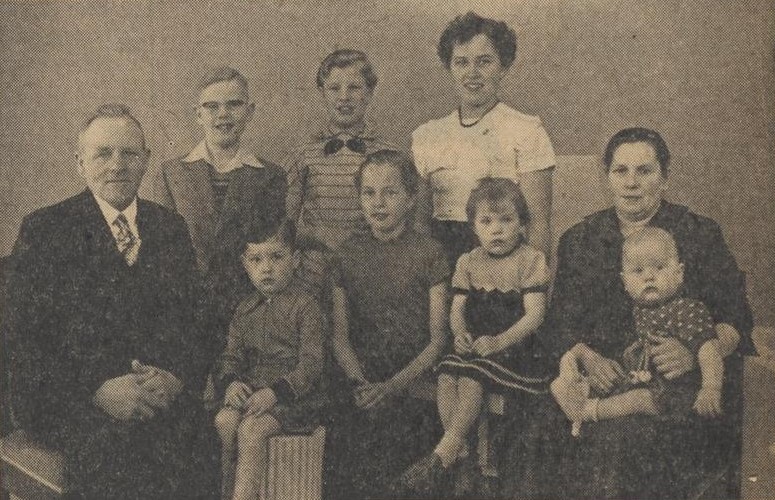
Dagblad Tubantia, April 26, 1955
Herman Prinzen family (9 people) emigrates to Argentina
“That will be the last coffee you receive from us,” says Herman Prinzen from IJzerlo near Aalten, as he places a steaming cup of coffee on the table. It is quiet in the large kitchen of the “Linquenda” farm—a kitchen that appears larger than ever before because practically no paintings remain on the walls. An attempt was made to decorate the wall somewhat with an old, weathered mirror, which was not particularly successful, and otherwise, only a lone Biblical daily calendar hangs on the wallpaper.
Through the kitchen window, one can look out over the IJzerlo es, which lies flat and bare, trying to bask in the meager rays of sunlight. The wind fiercely blows the loose sand from the fields across the plowed land. Herman Prinzen, the 48-year-old farmer, stares outside. “We have lived here for about eighteen years now,” he says, perhaps more to himself than to us. “We won’t be here for eighteen days anymore, not even eight….”
Learning Spanish was not easy
“In Argentina, they speak Spanish!” says one of Prinzen’s young daughters. “Have you ever heard anyone speak Spanish?” “No,” we must confess. “Has Saint Nicholas never visited you then? He comes from Spain, doesn’t he?” “Spanish is a difficult language,” says Prinzen. “Leerink—Wim Leerink, so to speak, from Kerkstraat in Aalten—taught us some Spanish. Boy, it wasn’t easy, and we still don’t know much of it.” “But come,” he continues, turning his gaze away from the es that has been shrouded in drifting sand for hours—“my work there is done”—“I will tell you about our upcoming emigration.”
And then farmer Herman Prinzen begins his story. It is a story whose essence will bring a radical change to his life, and not only to his, but to that of his wife, Mrs. Prinzen-Kämink, and their seven children, the oldest of whom is sixteen and the youngest not yet a year old, crowing with delight in the stroller. “You know Grandpa Brunsveld,” Prinzen notes. “Everyone here knows Grandpa Brunsveld, after all. He is a born and bred IJzerlo man, and when it is his birthday, many people come to visit.”
“That was on November 24 of last year. My wife and I were sitting and talking with him late in the afternoon when Mr. Kämink, a cousin of my wife, also came in. Kämink is a senior board member of the Christian Emigration Center, and you can imagine that the conversation soon turned to emigration. Not long ago, Kämink had visited Argentina and several other countries to inform himself about the immigration possibilities there.” “Perhaps there is a perspective for you there as well,” he said.
“We didn’t think much more about it, but a few days later we received a letter from him. He had indeed been thinking about it. To be brief, he wrote that in Argentina, at the Protestant Christian school, there is a boarding house for which they are looking for a caretaker. “Is that something for you?” he wrote. That question was not as strange as it might seem at first glance. After all, here in IJzerlo I am primarily a farmer, but for ten years I was also the caretaker of the community building “Ons aller belang.” The white smock was already in the suitcase….”
“Is our task here perhaps finished?”
“That letter from Kämink never let go of my wife and me. There is, Kämink wrote, an urgent need for a caretaker. We are not the kind of people—neither my wife nor I—who are afraid to leave for another country or to face a somewhat unknown future. We viewed Kämink’s letter from a matter of principle. Like this: “Is it perhaps the case that our task here, in the Aalten rural district of IJzerlo, is finished and that a new future and a new task await us in another and foreign land?” “Yes,” says Mrs. Prinzen, “that is how we approached this matter.”
“Now, you must not think,” Prinzen continues, “that the problem was simple for us. We have lived in this farmhouse for many years together with my wife’s parents, who have now grown old. Would it be right for us to leave and leave our parents alone in the evening of their lives?” “You understand, this is a “heavy” matter to consider.”
“However, our parents said: “If you believe that there is a future for you and the children in Argentina, then you certainly must not let that pass because of us. We must not hold you back, even though we are old. We trust that if you are given a task in Argentina, we will also be cared for.” When our parents accepted this so faithfully, I said that evening: “What do you think, wife, how should we handle this?” “We should just go, Herman,” she said. “Everything is being made easy for us….” That was around Christmas.”
The boat departs Thursday
“We then wrote to Kämink in Hoogeveen, and he arranged everything else. This coming Thursday we depart by boat. We will be traveling for about four weeks. Then we will arrive in Buenos Aires, the capital of Argentina. We then have to travel another eight hours by bus before we reach Tres Arroyos, our new place of residence. As I said, I will become the caretaker of a boarding house there. It is located 50 meters from the school and ten minutes from the church. So we are not moving to an uninhabited region.”
“Many immigrants live in Tres Arroyos, by the way. They are not recent immigrants. There are quite a few whose parents or grandparents already immigrated to Argentina, yet they have, as I have read in letters I received from Argentina, always maintained the Dutch national character. Even at school, lessons in the Dutch language are still given for a few hours a week. The head of the school wrote that to me.”
“Usually about eighty children stay in the boarding house. The distance from home to school is too great to travel daily, and therefore the children stay in the boarding house from April to December. They have four months of vacation, from December through March. Then they go home. Those are the summer months in Argentina. During that vacation, I have the opportunity to work in agriculture in Argentina. Two of our daughters, Christina and Johanna, are going to work in the boarding house in Tres Arroyos. One stays at home to help mother, and the others either go to school or stay at home because they are still too young for school. We have four girls and three boys. That is the whole story.”
“Whether we are dreading it? No, not anymore,” says Prinzen. “We have made the decision and now believe that our life’s path will be continued over there, in Argentina. The same sun shines there as here in the IJzerlo es, and the same God reigns there as in the Netherlands. We have had a few busy days. Almost everything is packed now, however. A few more days and then we go.” “Oh yes, you might want to know what will happen to our parents? They are also being cared for. Our trust has not been put to shame, because a cousin of ours, Wim Kämink, is getting married on May 6 and will come to live here on the farm. He will not only take care of the business but also, together with his wife, look after his grandpa and grandma. So, in this respect too, everything will turn out well. We are very grateful for that.”
Reading tip: blog by Lara Droogleever Fortuyn from 2017: “In Tres Arroyos, cheese and meat come together”
