In the 19th and early 20th centuries, many Dutch people lived in appalling conditions. During the course of the 19th century, this prompted citizens and workers to establish public housing associations.
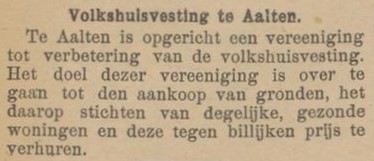
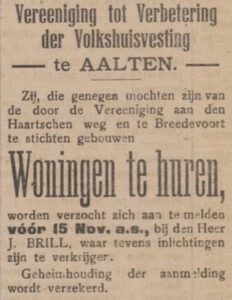
In 1912, a committee was formed in Aalten under the leadership of Mayor Monnik to establish an association for the improvement of public housing. The establishment took place the following year.
Celebrations at Volkshuisvesting
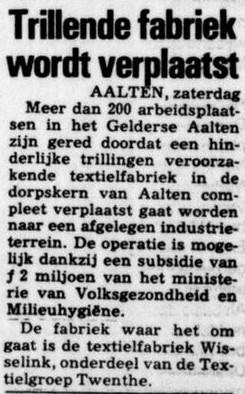
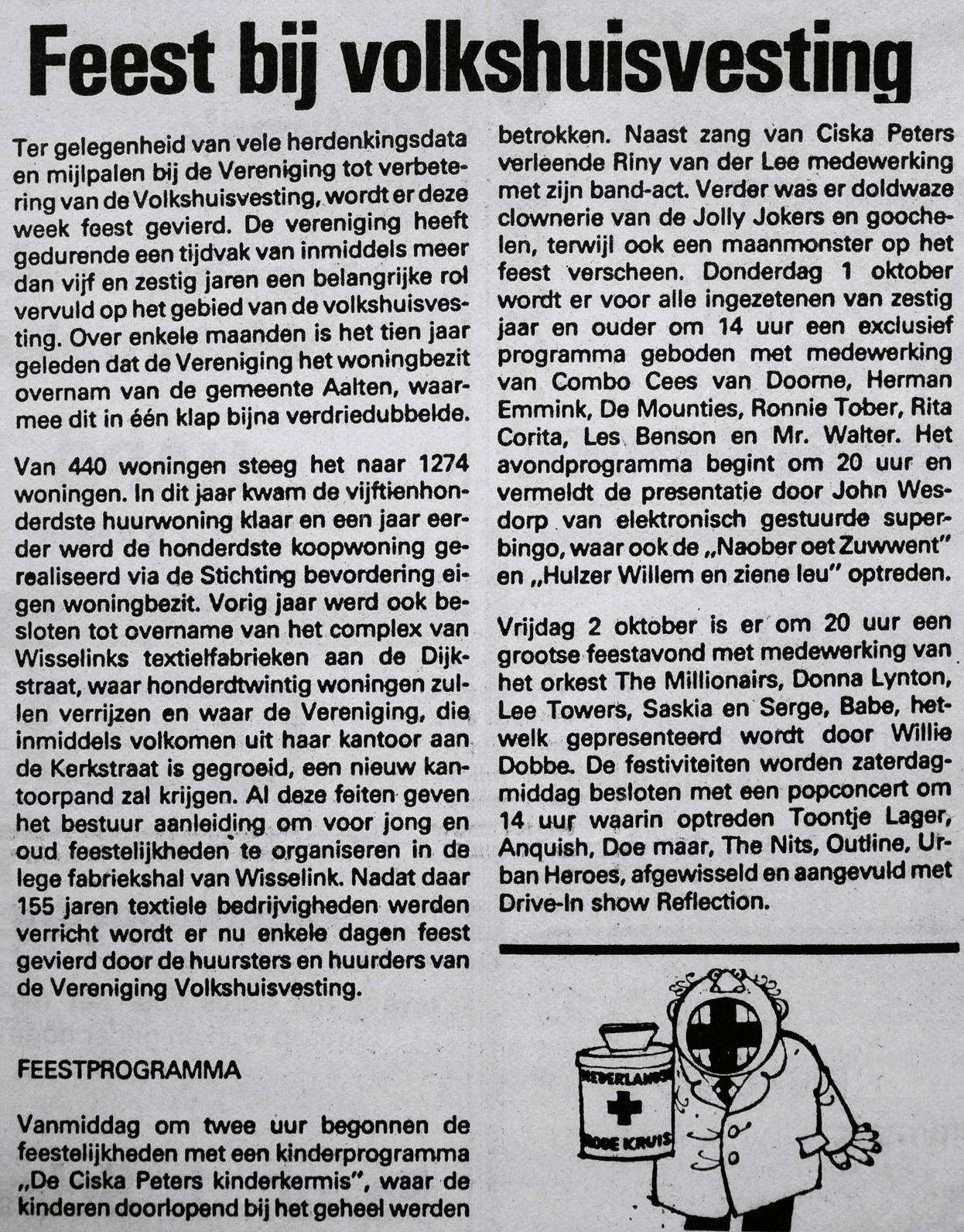
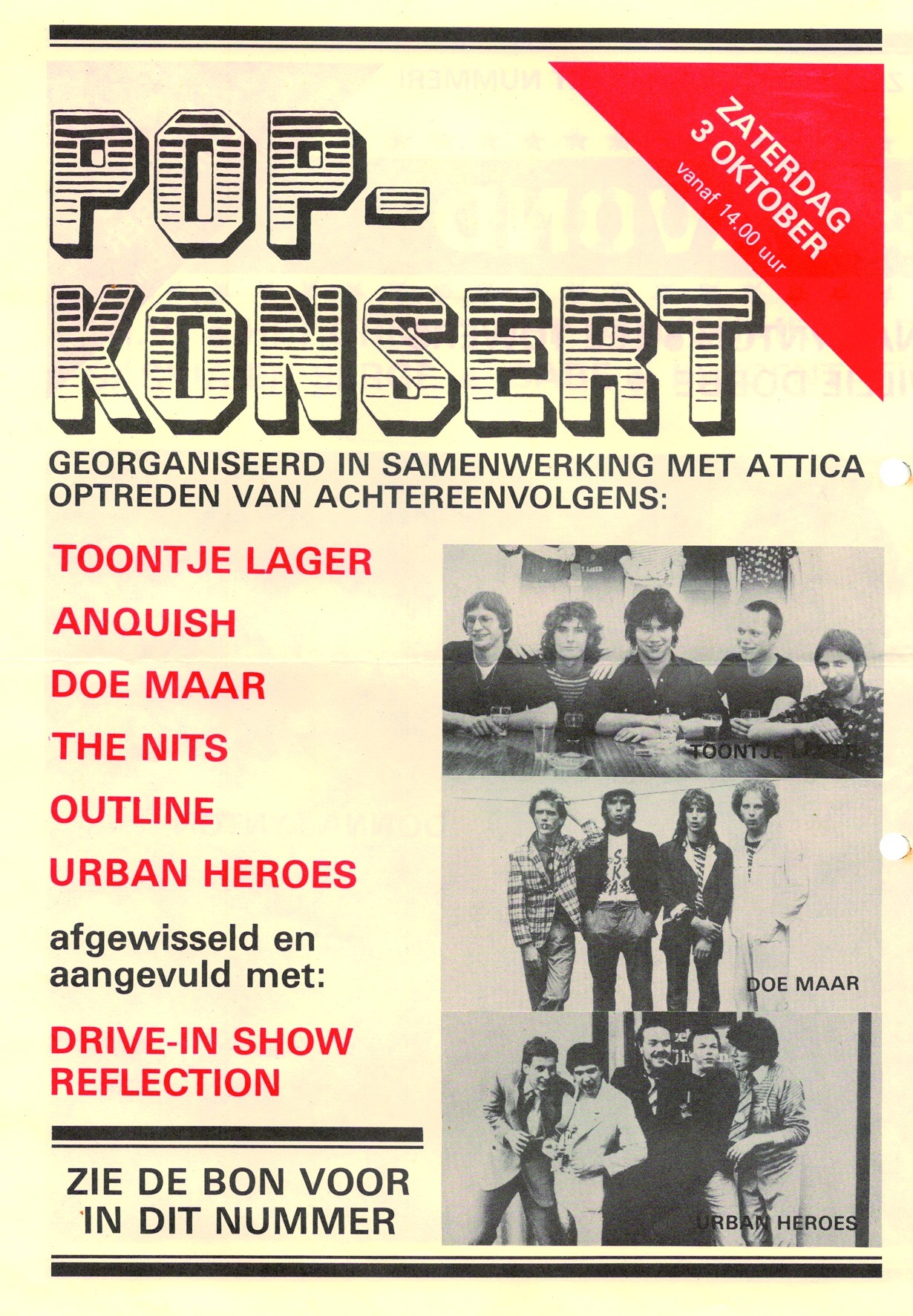
In 1981, the Wisselink textile factory on the Dijkstraat moved to the industrial estate. On the vacated site, 120 homes were built, the current Driessenshof. However, before the former weaving mill was demolished, the ”Vereniging tot Verbetering der Volkshuisvesting’ (Association for the Improvement of Public Housing) organised an extensive programme of festivities there for the people of Aalten:
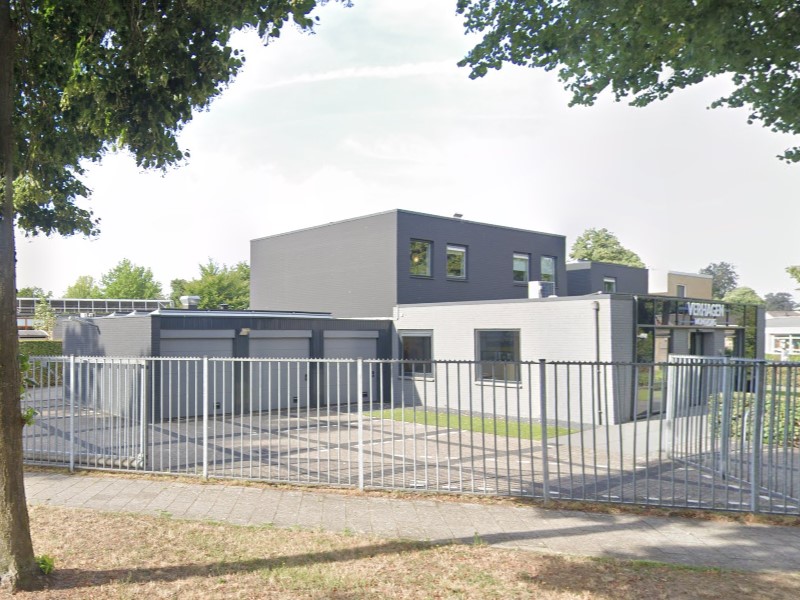
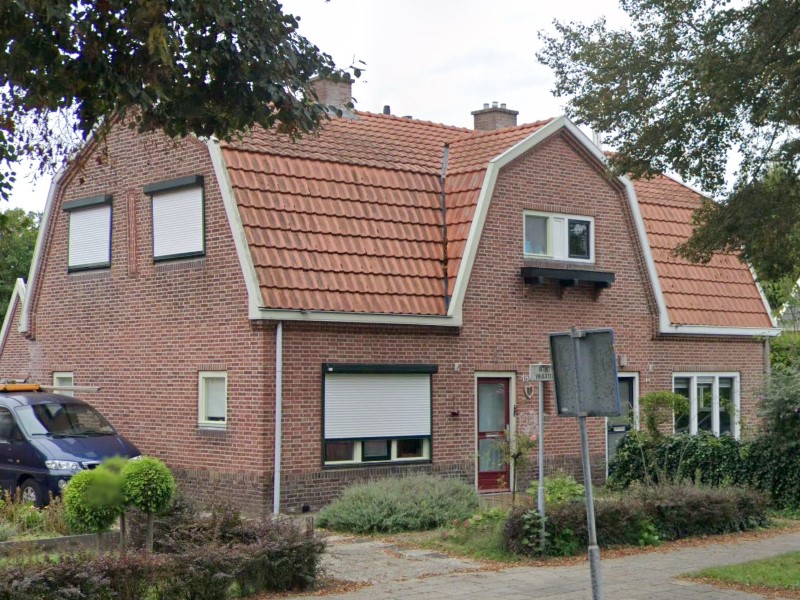
Polstraat-16-18, Aalten (photo: Google Streetview)Provinciale Geldersche en Nijmeegsche Courant, 18 March 1913Aaltensche Courant, 29 October 1913
De Woonplaats
In 1995, the associations in Aalten, Groenlo, and Winterswijk, which together owned 6,700 homes, decided to merge under the name De Woonplaats. A few years later, a merger followed with De Volkswoning in Enschede (5,100 homes). Two years later, the head office moved from Groenlo to Enschede. In 2022, De Woonplaats owned almost 17,000 homes, of which approximately 2,300 were in the municipality of Aalten.
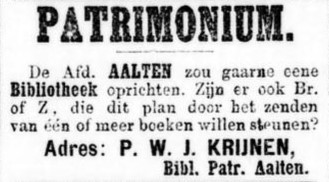
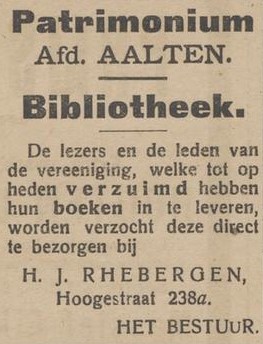
The history of the library in Aalten begins in 1894. In that year, the Aalten branch of the Christian workers’ union Patrimonium already began lending books to members. It was, therefore, not yet a public library. At the end of 1893, P.W.J. Krijnen placed an appeal in De Standaard to donate books for the library. Krijnen was a teacher and lived in the Hoekstraat.
Agricultural Library
In the Netherlands at that time, libraries and reading rooms were established in several places, usually organised according to the prevailing social and religious beliefs of the day.
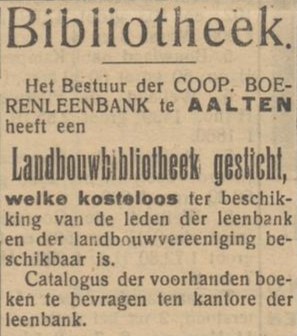
In 1922, the Coop. Boerenleenbank in Aalten founded an Agricultural Library for members of the bank and the agricultural association. The aim was to provide the agricultural section of the Aalten population with the opportunity to increase their knowledge. How long this library existed and what happened to its collection is currently unknown to us.
Patrimonium
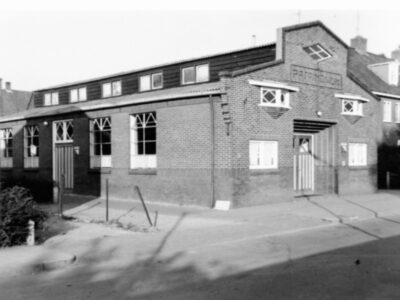
In 1926, the first stone was laid for the Patrimonium building on the Hofstraat. The Christian folk library was located at the back of that building.
On 6 December 1960 Dagblad Tubantia reported:
On 10 December, the new Christian library in Aalten, furnished according to modern requirements, will be officially opened, and the new lending system will be introduced under the guidance of qualified library technical staff. This marks the end of an era in which much hard work was done to provide Aalten with good library facilities.
Patrimonium Building, Hofstraat 5
The Christian Folk Library „Patrimonium” has been active in this field for many years and has seen this work grow into a significant cultural contribution to the community in Aalten. The book loans, rising from 8,400 in 1951 to around 30,000 in 1960, speak volumes. The foundation board was mindful of this development and recognised that the existing provision had become insufficient to meet the ever-increasing interest. The board turned to the Central Rural Library for Gelderland.
The C.P.G. carried out the coordinating work and, after the board of „Patrimonium” had decided to erect a new building, was able to furnish the library according to the requirements set out in the national subsidy conditions. Because the library can now fully meet the requirements with its new setup, it can make use of the services of the Central Rural Library.
Relocations
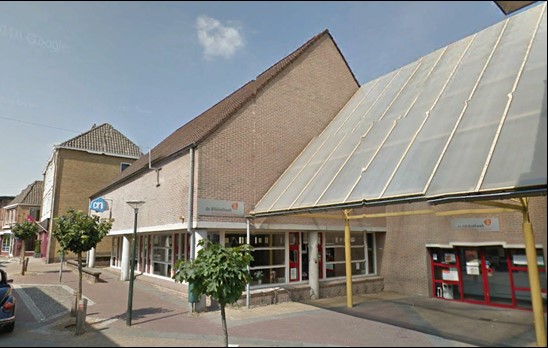
In the early 1990s, the Aalten library moved to a new building at Hogestraat 10. Above the library, the Albert Heijn supermarket was located. The differences in elevation in the centre of Aalten made it possible for both the library and the supermarket above it to have their entrances on the ground floor, the latter at the higher-situated De Hoven.
In 2021, the library moved again. This time from the Hogestraat to a building on the Lage Blik, where the Aldi supermarket was previously located.
As a garrison town, Bredevoort has had a civic guard, or markmen’s guild, since the Middle Ages. At that time, civic guards were established as local militias intended to guarantee the order and safety of the citizens.
After the civic guards were officially disbanded in 1901, voluntary markmen’s guilds emerged in many places. These had a more folkloric character and organized events such as marksmen’s festivals, the fair, and the king shoot. Many markmen’s guilds also have a brass band and/or flag wavers.
Wilhelmina Markmen’s Guild
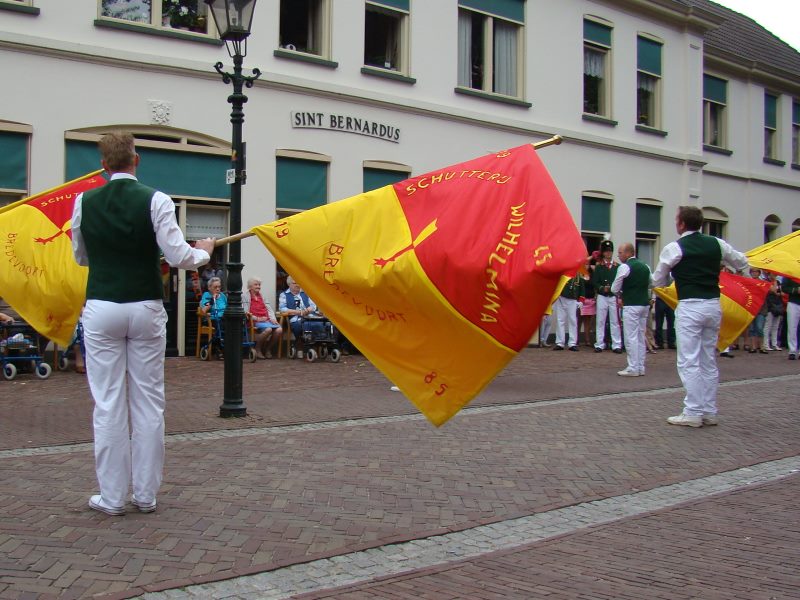
Today, Bredevoort still has a markmen’s guild, namely the Wilhelmina Markmen’s Guild. The first written mention in which this markmen’s guild is referred to by name was found in the Aaltensche Courant of October 25, 1905. It is assumed that the association had already existed for some time by then. During that same period, Bredevoort appears to have had as many as two markmen’s guilds.
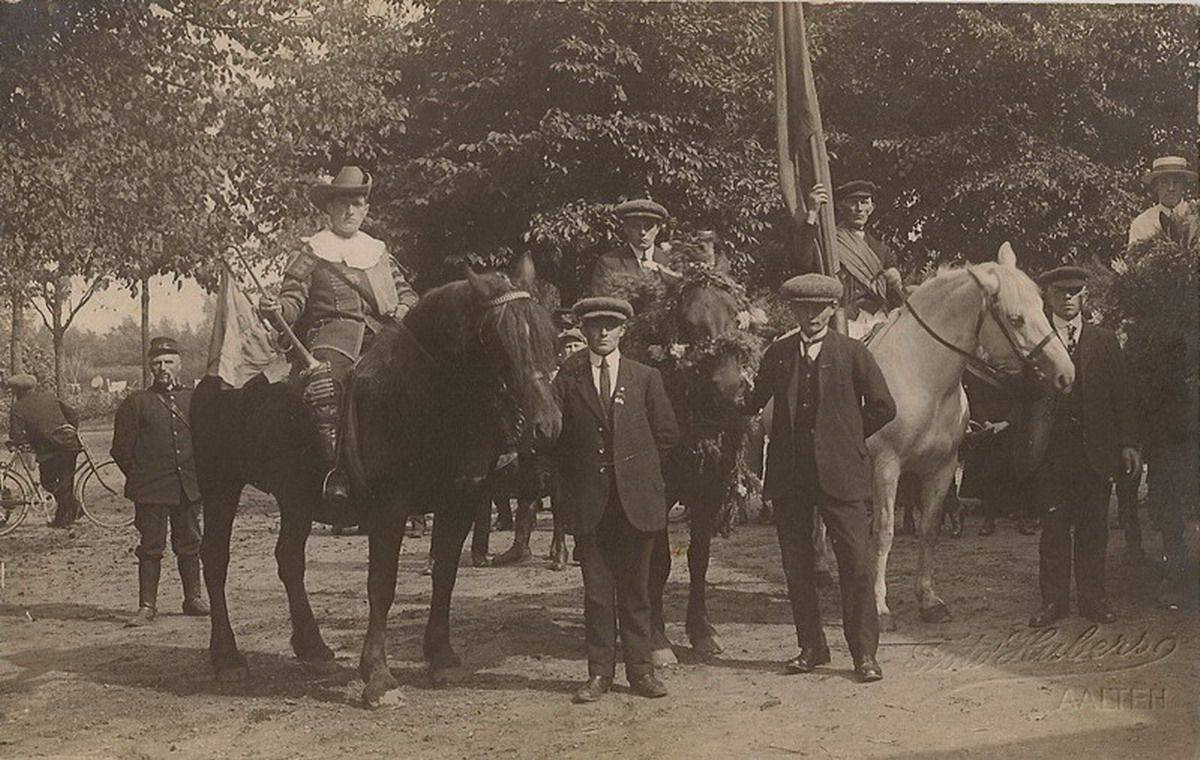
The association possibly owes its founding to the year 1898, when the coronation of Queen Wilhelmina was celebrated exuberantly. In Bredevoort, a committee was established for this occasion that organized various festivities. These consisted of a fair and a procession of riders with banners. Additionally, a so-called Wilhelmina tree was planted on the Markt square in honor of Wilhelmina’s birthday. Afterward, a marksmen’s festival took place, with the king shoot as the main event. This tradition is still kept alive during the annual folk and marksmen’s festival held in June.
Restart
During World War II, the association was banned and the banners were destroyed by the occupiers. Immediately after the war in 1945, the Wilhelmina Markmen’s Guild Bredevoort was officially (re-)established. In 2020, the markmen’s guild celebrated its 75th anniversary.
The banners of the Wilhelmina Markmen’s Guild feature a crow’s foot, the coat of arms of the Satink family. In the 18th century, Benjamin Satink (1704–1769) was the acting bailiff of the Lordship of Bredevoort, commissary of the national warehouses, and military auditor.
The Wilhelmina Markmen’s Guild plays an active role in the Bredevoort community. The markmen’s guild’s flag wavers perform serenades at members’ anniversaries and organize the reveille, early in the morning, and the king shoot during the annual fair. The ‘headquarters’ is the markmen’s house on Boterstraat.
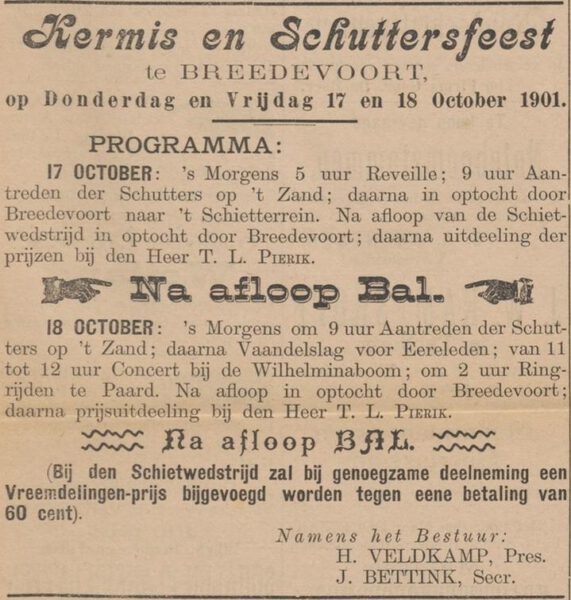
Wilhelmina Markmen’s Guild, BredevoortAaltensche Courant, 12 October 1901
40th Anniversary
In 1985, the Wilhelmina Markmen’s Guild in Bredevoort celebrated its 40th anniversary (after its re-establishment):
The Wilhelmina Markmen’s Guild occupies a special place in the Bredevoort community and is an integral part of special events in the old town. On October 12, the markmen’s guild celebrates its 40th anniversary. In reality, Bredevoort has had a markmen’s guild for much longer. This is evidenced, among other things, by four old banners that are still held in honor and date from the end of the last century.
“An outsider wouldn’t give a penny for them and would throw the whole lot with the rags. But for the members of the markmen’s guild, they are worth their weight in gold,” says the current chairman of the markmen’s guild, Hans Wensink from Boterstraat in Bredevoort. This 58-year-old resident of Bredevoort has been chairman for 30 years and also experienced the founding in 1945. “Perhaps we should speak of a re-establishment. It was after World War II, and during the war, the markmen’s guild was disbanded. However, on October 17, 1945, the markmen’s guild once again became a reality.”
Hans Wensink remembers well that Hendrik Frenken was the first commander. A man with a magnificent commanding voice. “When he gave the command: “battalion forward,” the R’s rolled out so beautifully,” Hans Wensink recalls. He also remembers that during marksmen’s festivals, Frenken did not allow himself to be addressed simply by his name. You had to call him captain, no matter how well you knew him. “That was the atmosphere at the markmen’s guild. After the Frenken period ended, J. van Merkenstein took over command, and now it is D. Dibbets who gives the orders.”
Core group The markmen’s guild has always had a core group. After the war, there were only the old banners. These were later replaced because it was a pity to continue using them. Uniforms also arrived only later. In 1959, the traditional marksmen’s festival came to an end when it was decided to collaborate with the Folk Festival to create a joint celebration.
The markmen’s house has changed over time, but now they are back at their old base, Café Munsterbrug. The banners, however, are “maintained” by Mother Wensink. She meticulously ensures that everything is handled correctly. The 90-year-old is an enthusiastic supporter of the markmen’s guild. She can also tell stories about the markmen’s guild that was active in Bredevoort at the beginning of this century. Her husband, who passed away in 1938, was already an adjutant with the markmen’s guild in 1913 and rode on horseback with the group. In those days, ranks in the markmen’s guild were purchased. People came from far and wide to the markmen’s guild in Bredevoort. Mrs. Wensink also knows that the oldest banner dates from 1898 and was waved by Wubbels Sr., who also had three sons who were flag wavers.
“Ma” Wensink also ensures that the marksmen receive their coffee and bread on time during the bird shoot. In the past 40 years, it has happened seven times that the title of marksman king has gone to the Wensink family. “Then it is a real marksmen’s festival; I leave everything as it is and go to the markmen’s house,” says the elderly resident of Bredevoort.
Celebration The markmen’s guild has 160 members, 40 of whom are “active.” The executive board consists of: Hans Wensink, chairman; Hans Piek, secretary; Engelbert Ebbers, treasurer. On Saturday, October 12, attention will be given to the 40th anniversary.
A reception will be held at the Munsterbrug markmen’s house from 3:00 PM to 5:00 PM, and in the evening, there will be a party for the members. “Whatever may change in the coming years, the markmen’s guild must be held in honor. This is something that was started by our ancestors. We must not tear that down. We must be careful with the traditions and customs,” says Hans Wensink.
In 2022, a jubilee book was published, titled ‘Schutterij Wilhelmina Bredevoort’, written by Jos Wessels.
Marksmen’s guilds, or civic guards, were established in the Middle Ages as local militias intended to guarantee the order and safety of citizens. In 1815, a law was passed stipulating that three percent of men between the ages of 18 and 50 were liable for service in the civic guard. In 1827, this was changed to two percent of men between the ages of 25 and 34.
In 1901, the civic guards were officially disbanded and replaced by a Landwehr (reserve army), which consisted of conscripts and volunteers. Later, voluntary marksmen’s guilds were established in many places, which anyone could join.
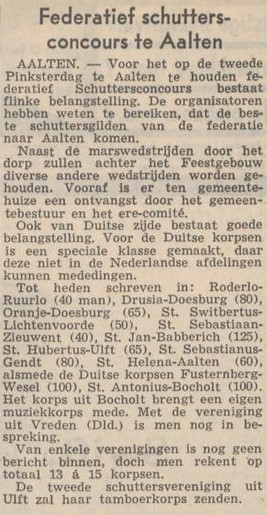
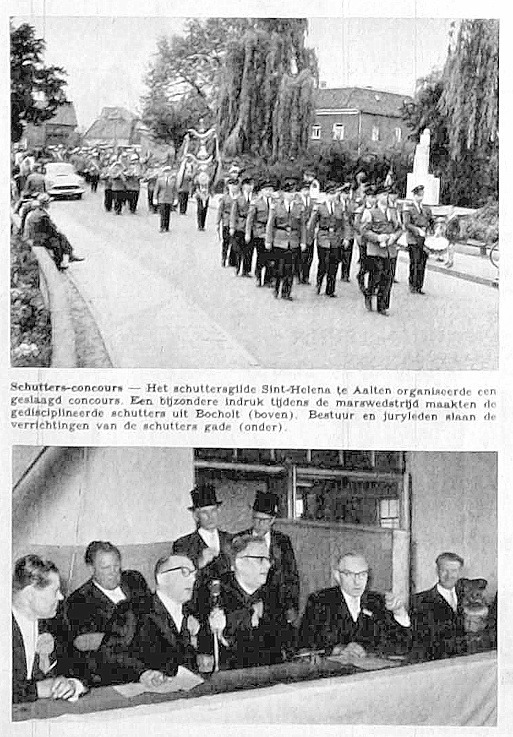
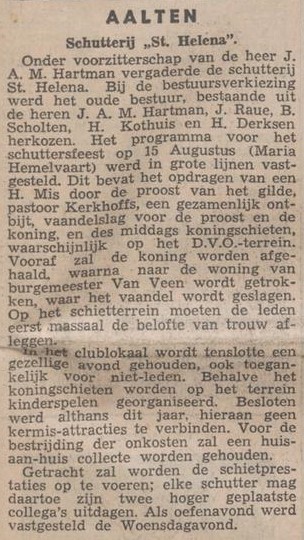
In 1906, the marksmen’s guild in Aalten was instrumental in the establishment of the Community Hall. In the decades that followed, we were unable to find any mentions of the Aalten marksmen’s guild in the Delpher online newspaper archive. It was not until the early 1950s that we found several mentions again, regarding the St. Helena Marksmen’s Guild.
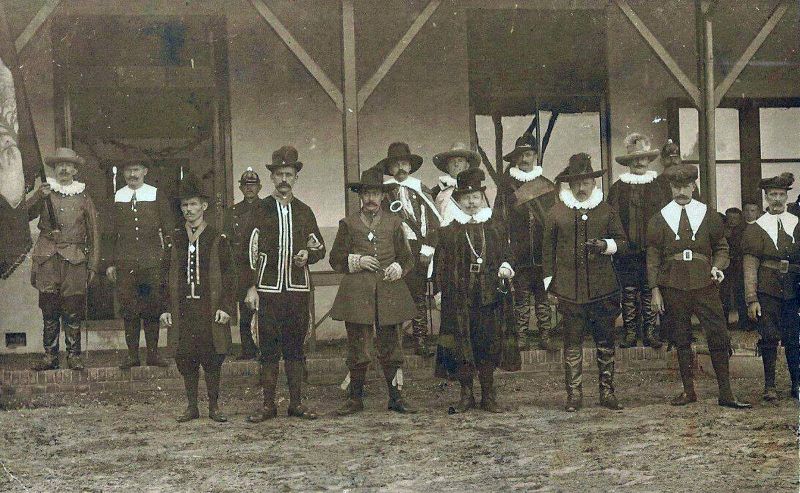
Aalten Marksmen’s Guild in front of the Community Hall, early last century (photo via H. Schutte)
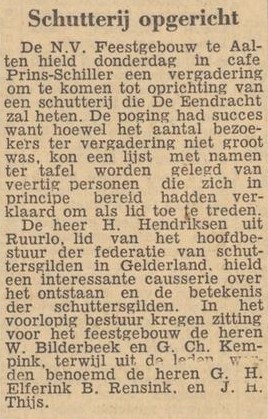
However, in 1957, a report also appeared regarding the establishment of a marksmen’s guild by the NV Community Hall in Aalten, which was to be named ‘De Eendracht’. Exactly how this fits together remains unclear to us for the time being.
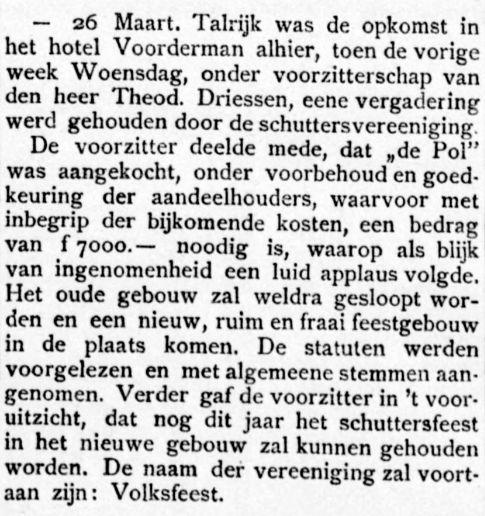
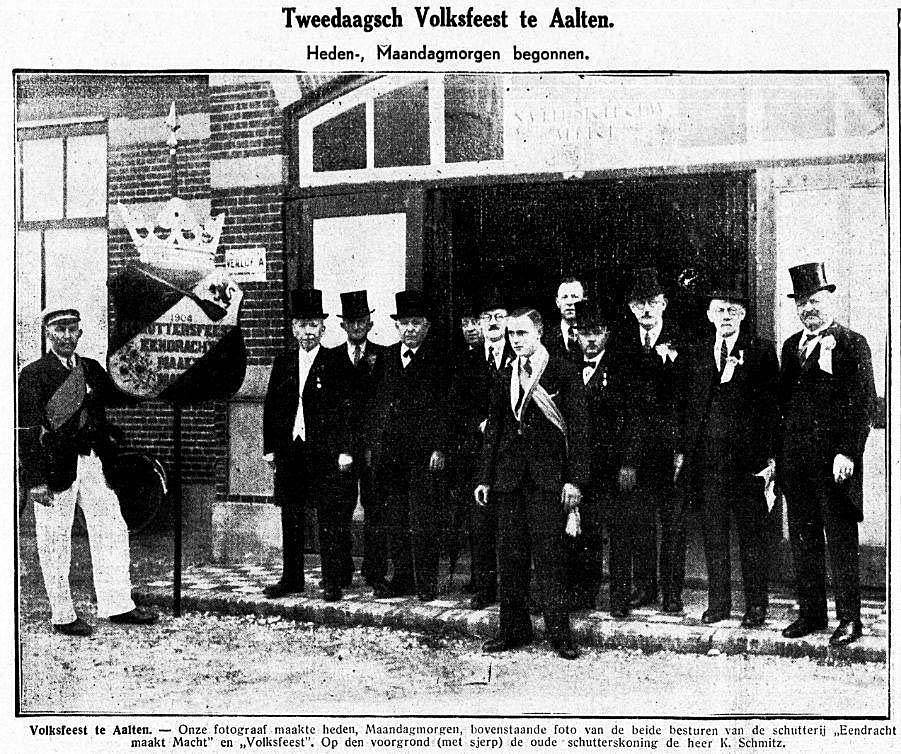
In September 1973, a ‘Volksfeest Committee’ was established, formed by the merger of the Community Hall, the Marksmen’s Guild, and the Fair Committee. This later became the ‘Aalten Volksfeest Foundation’.
This page includes several photos and newspaper articles of and about the Aalten marksmen’s guilds that we have collected over recent years. We hope to receive more information in order to write a more complete history of the Aalten marksmen’s guilds in the future.
Zutphens Dagblad, 13 June 1952Dagblad Tubantia, 10 May 1957
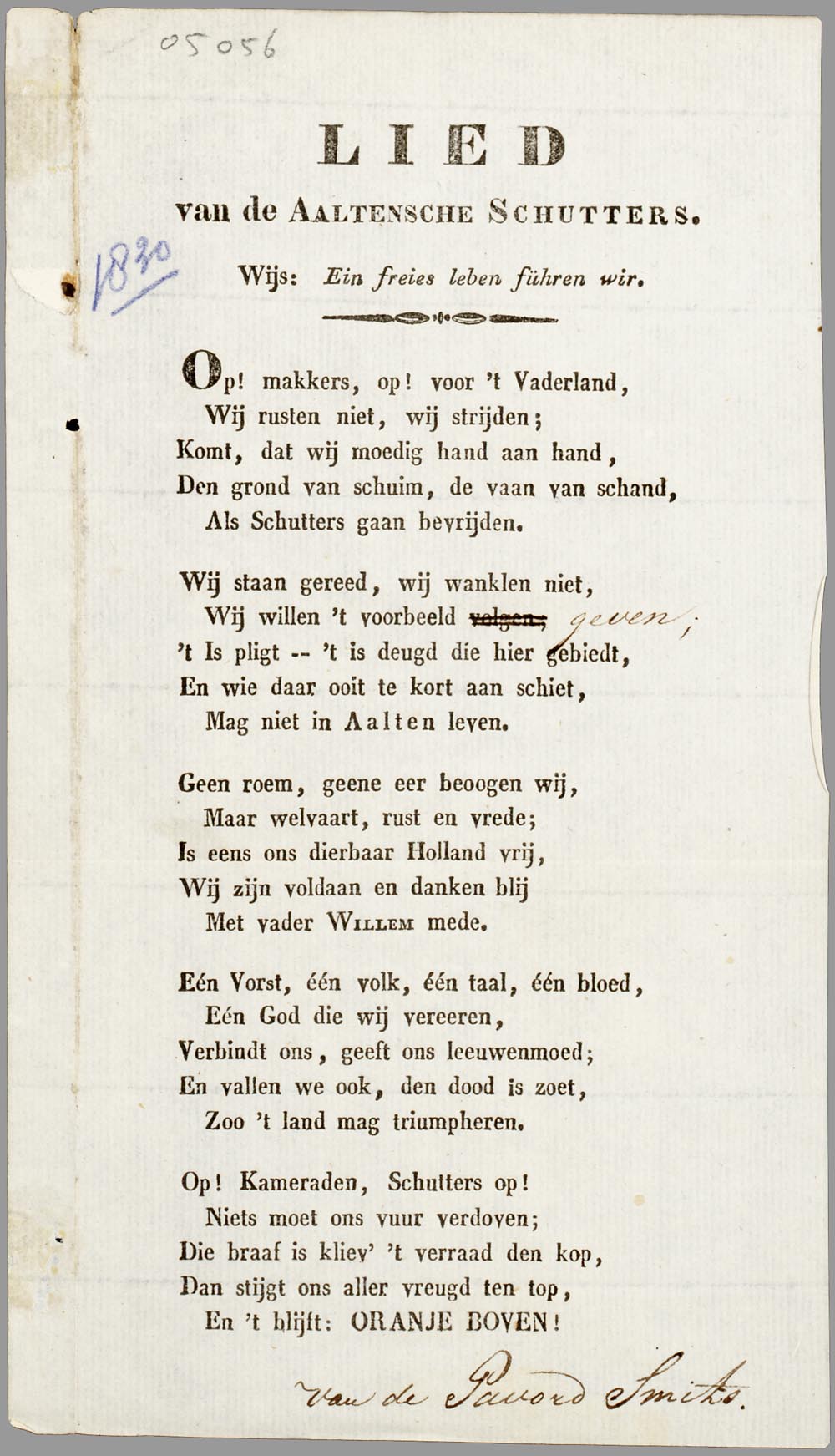
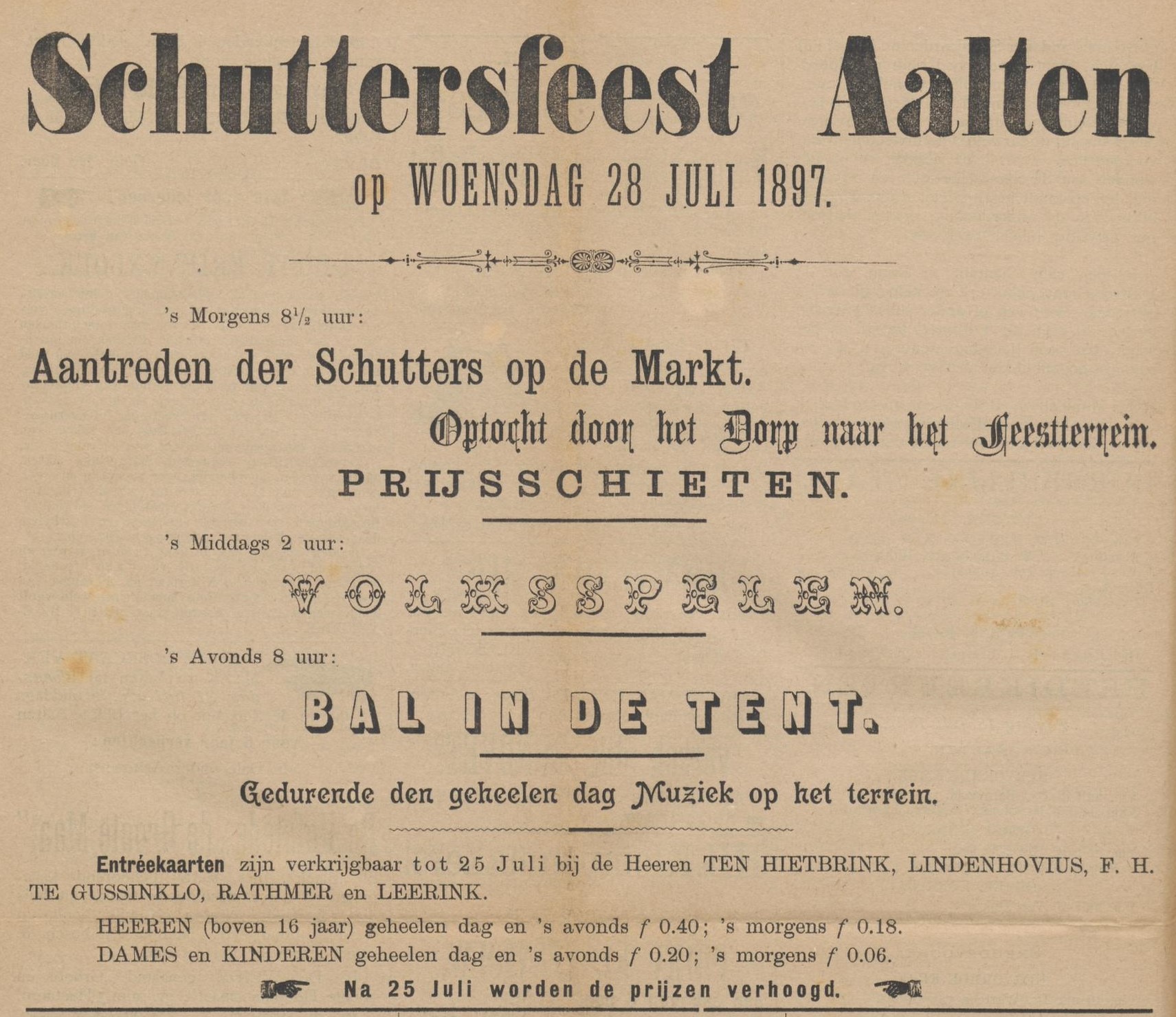
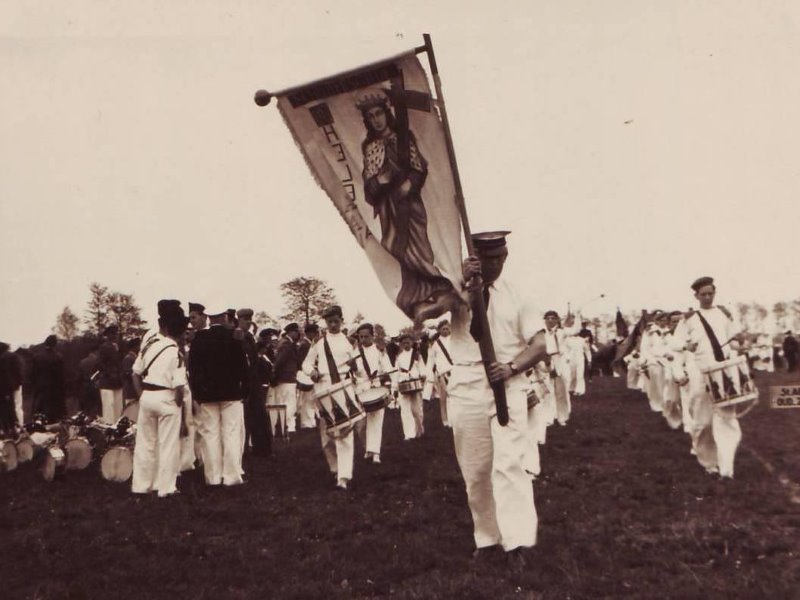
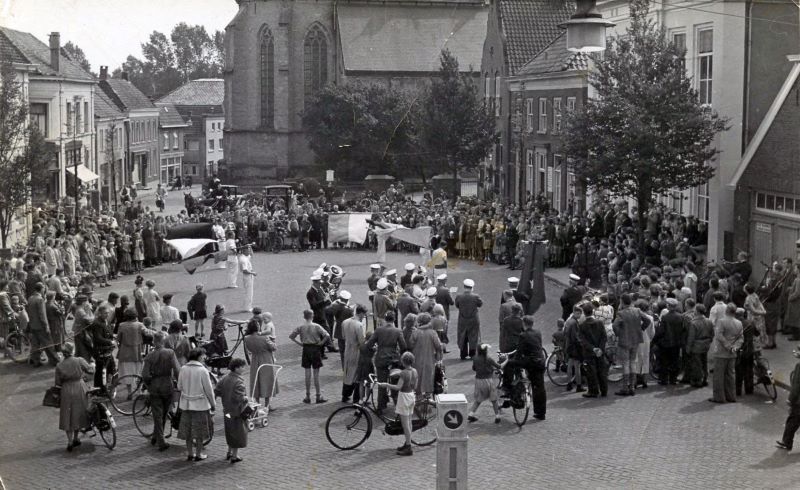
Weekblad voor Aalten, Breedevoort, enz., 17 July 1897St. Helena Markmen’s Guild, year unknown (photo via A. Wolterink-Jansen) Aalten Markmen’s Guild, year unknown (photo via H. Schutte)Folk festival in Aalten, 1936Flag waving at Markt square, year unknown
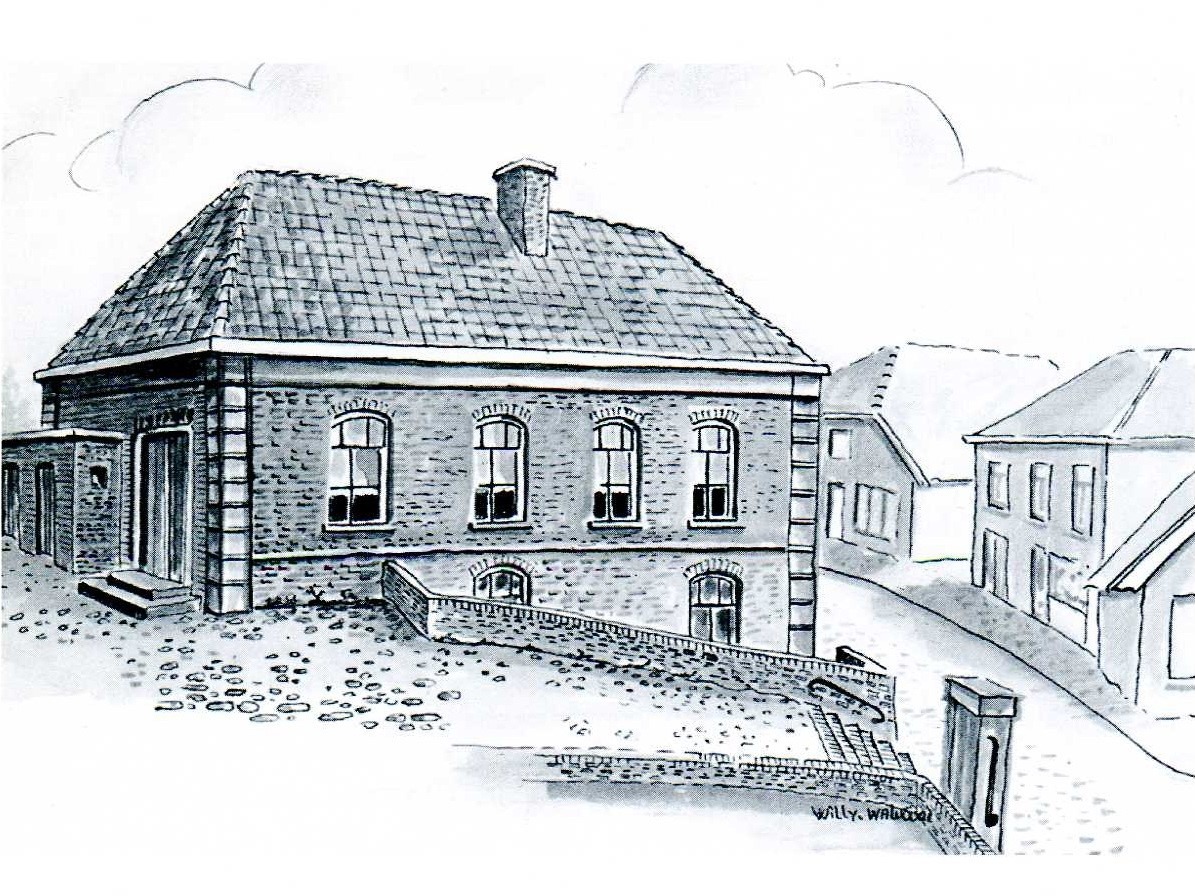
The first known predecessor of a police station in Aalten can be found on Landstraat, in the building that currently houses Ter Maat barbershop.
The accompanying drawing of the building in question was made by the Aalten artist Willy Walvoort, who passed away in 2018. He wrote: “The village school in 1824. Above: the entrance was on the church hill. Below: on Landstraat, the night watch, prison, and fire brigade.”
It is (as yet) unknown until when the night watch and/or constables had their headquarters here. We also do not yet know which other addresses served as police stations before 1941.
Public Primary School Landstraat, by Willy Walvoort
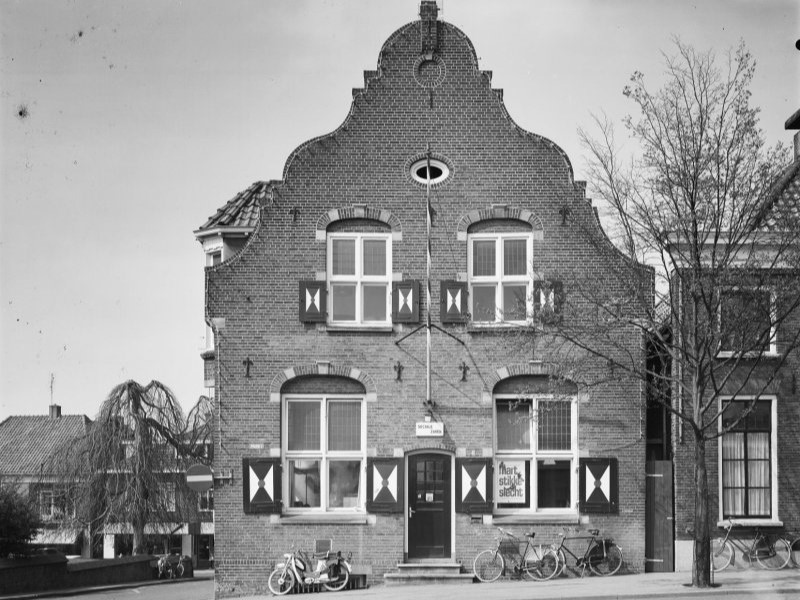
Markt 3, Aalten (1972)
Markt 3
In 1941, the Aalten municipal police moved into the characteristic building with the elegant bell gable at Markt 3. When the station was put into use, Chief Constable Wijnands was the head of the Aalten police. In 1947, the municipal police transitioned into the national police.
After the war, the municipal services suffered from a lack of space. In 1949, the municipality of Aalten therefore purchased a building on the opposite side of the Markt (number 4) to house the police station.
The Social Services office was housed in Markt 3. Today, the building is still part of the Aalten town hall.
Markt 4
The building at Markt 4 was privately inhabited before the war and had a notorious reputation in Aalten during the war, as it had served as the clubhouse for the NSB (National Socialist Movement). After the war, the building fell under the Management department of the Council for the Restoration of Rights. They sold the building to the municipality of Aalten in 1949, and the local police station was established there.
In 1969, the Tubantia newspaper reported that the municipality of Aalten had informed the Government Buildings Agency that they were terminating the lease of the police station. The municipal services were once again bursting at the seams and desperately needed the space. The police moved to a new station on Polstraat.
Shortly before the move, the garage collapsed behind the police station, which was located on Peperstraat.
The building at Markt 4 now houses the catering establishment De Geste.
Markt 4, Aalten
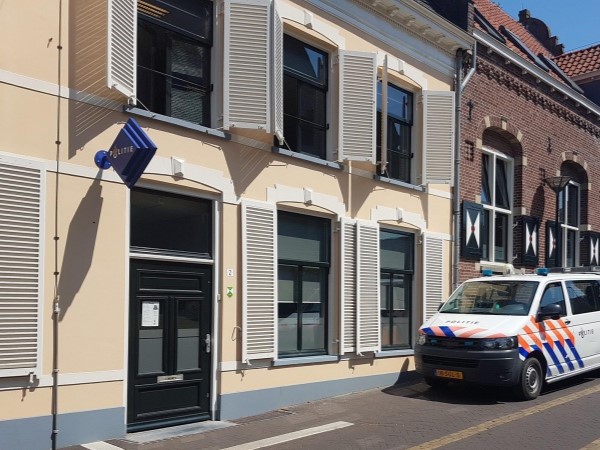
Polstraat 36, in the year 2022 (source: Google Streetview)
Polstraat 36
As early as February 1963, the site on the corner of Polstraat and Bonifaciusstraat was purchased by the municipality of Aalten, including the small farmhouse of the widow Scholten. It was likely already the intention then to demolish it and realize a new police station and a number of houses on the site.
In 1965, the Aalten municipal council discussed the private sale of a section of the building plot, measuring 1,500 square metres, for the construction of a group and district office for the National Police (Rijkspolitie) in Aalten.
It would take until the early 1970s before the new police station was completed. The Aalten police remained stationed here until 2018, when they moved to the Köstersbulte. A dental practice has since established itself in the former police station on Polstraat.
Köstersbulte 2
Since 2018, the police have had a support point in the town hall, with its own entrance on Köstersbulte. The support point serves as a workplace for community officers during their shifts. There are no official opening hours. If someone wishes to file a report, for example, it is advised to make an appointment.
The association Aaltens Belang was founded on 14 December 1898 by a number of local dignitaries. The association’s objectives included campaigning for a better connection with Bocholt, the improvement of public transport, the installation of urinals on the Market Square and at the edges of the village, and improvements to both the postal service and housing.
The board consisted of thirteen members, matching the number of seats on the Aalten municipal council at the time. “Why,” it was argued, “should Aaltens Belang make do with fewer?”
The board took a broad view of its objectives. They also dedicated themselves to matters such as the operation of a commercial evening school and a tourist information office (VVV), the management of the local Loohuisbos nature reserve, and the organisation of trade fairs or the annual outing for the elderly.
Merged into the VVV
In its early years, the association was instrumental in establishing both the first refuse collection service and the Museum Frerikshuus. In later years, the association focused primarily on organising activities and providing information regarding tourism and recreation. When these tasks were professionalised and transferred to a new VVV (Tourist Office) organisation, the association merged into it in the mid-1980s.
Bench, Loohuisbos, and Nannielaantje
To mark its 25th anniversary in 1923, the Aaltens Belang association presented the local community with a stone bench. This bench can still be found today along the footpath by the Slinge stream, near the bridge on Polstraat, behind the De Slinger primary school.
In 1928, Aaltens Belang saved the Loohuisbos (‘Loohuis Forest’)—an area of 21 hectares—by purchasing it before it could be cleared for cultivation. However, the association could not raise the necessary funds and subsequently sold the property to the Society for the Preservation of Nature Monuments (Vereniging tot Behoud van Natuurmonumenten). As a result, it was preserved as a piece of the historic Achterhoek landscape.
When the farmstead Het Smees was sold by the heirs of Slichter van Bath in 1934, Aaltens Belang entered into discussions with the buyer. There were fears that the “well-known and naturally beautiful” Nannielaantje (Nannie’s Lane) would disappear. Thanks to the efforts of Aaltens Belang, this popular lane was fortunately preserved.
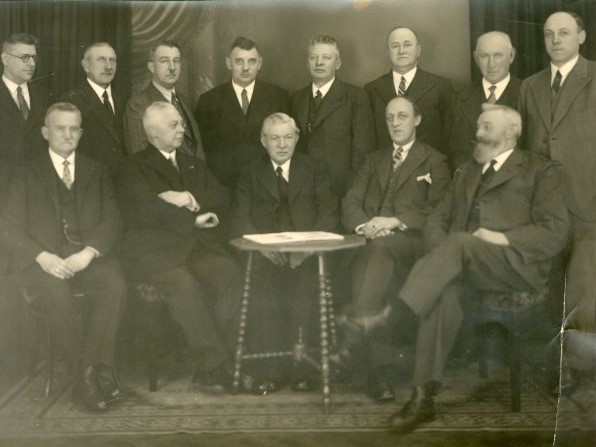
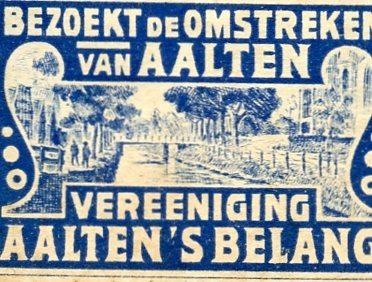
The board of ‘Aaltens Belang’ in 1923, on the occasion of its 25th anniversary. Seated L-R: J. Beernink, Jos Driessen (Chairman), H. ten Dam (Vice-Chairman), G.W. Vaags (Secretary), A.H. Bulten. Standing L-R: R. de Boer, H.J. Vreede, W. te Gussinklo, M. Ackerman, G.A. Wieland, G.J. Prinsen, A.J. Vaags, J.H. van Lochem. Seal of Aaltens Belang
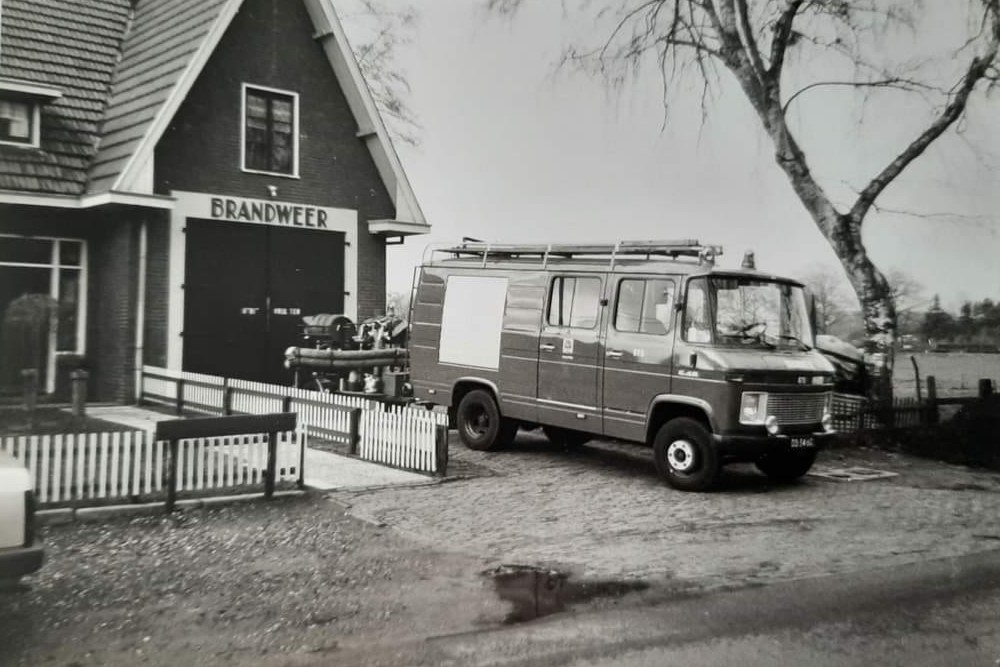
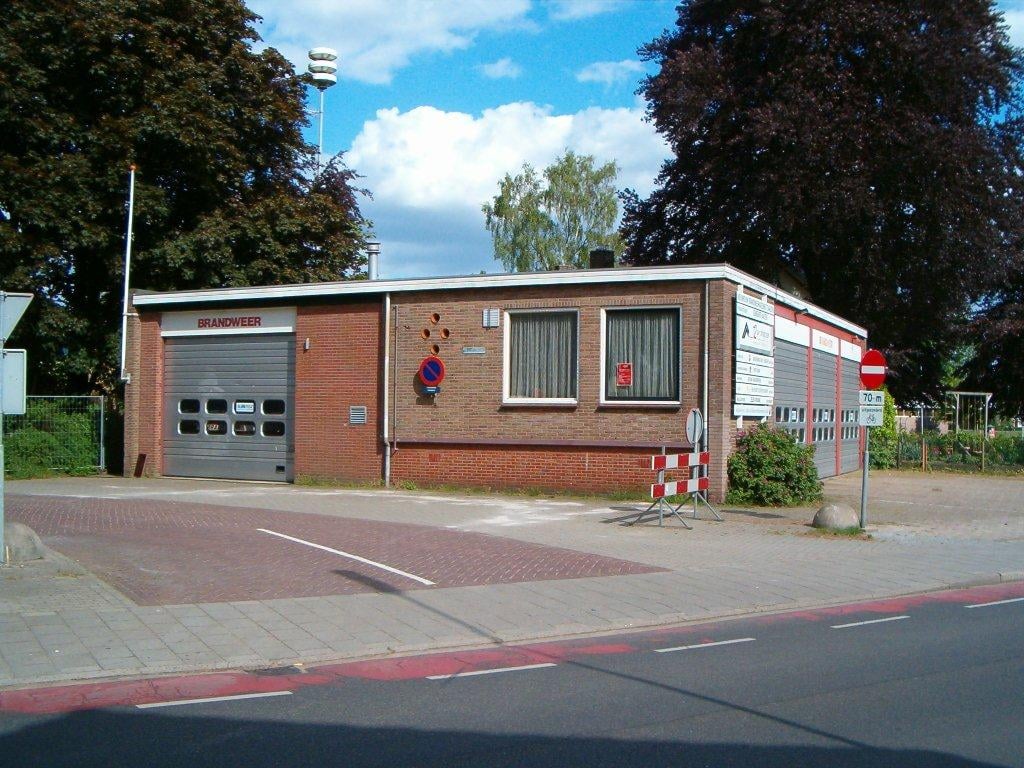
The photograph above shows the former house (partially visible) with the adjacent garage of the Bredevoort volunteer fire brigade, close to the Grote Gracht. Willem Kobus, a gravedigger by trade, lived in that house. When he retired, he moved to Tramstraat. Willem Demkes and his family then moved into the fire station property.
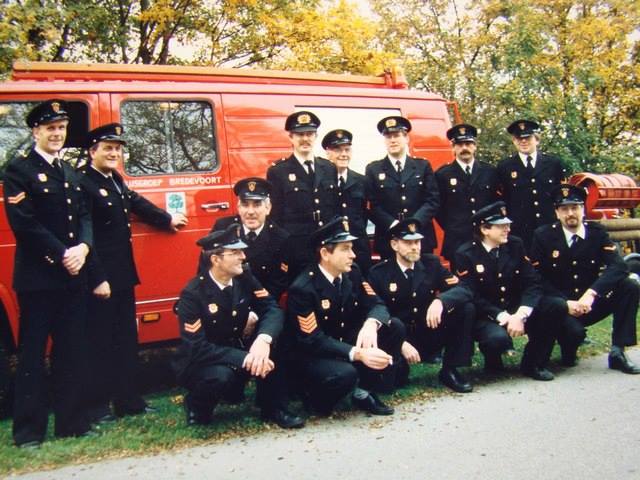
The photograph below dates from 1987. In that year, shortly before the ‘Bredevoort 800’ celebrations, the fire brigade was disbanded by the Municipality of Aalten. The firefighters resigned en masse.
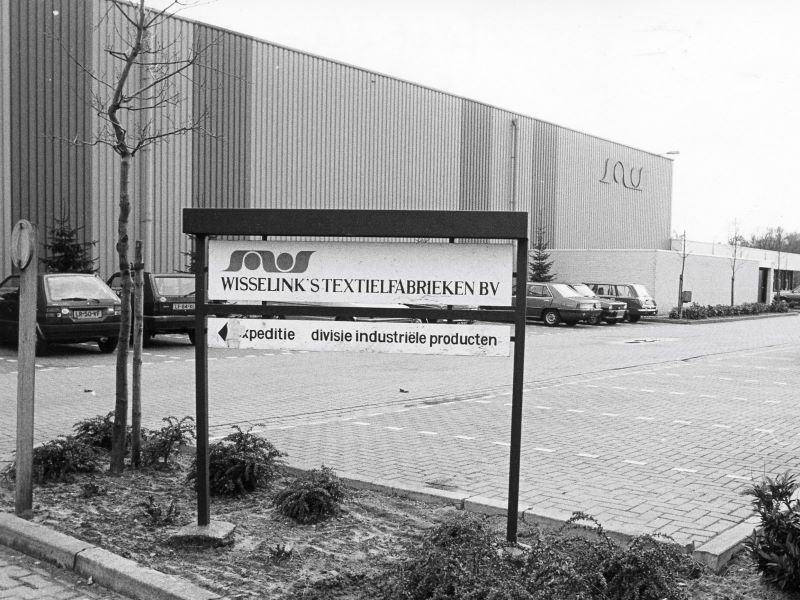
The textile weaving mill Wisselink Textiles, formerly Gebr. Driessen, had been part of the Textielgroep Twente since 1960. They manufactured products such as technical textiles, tent canvases, and flag bunting. For years, the company was located on Dijkstraat, but its presence in the village centre caused excessive noise and vibration nuisance.
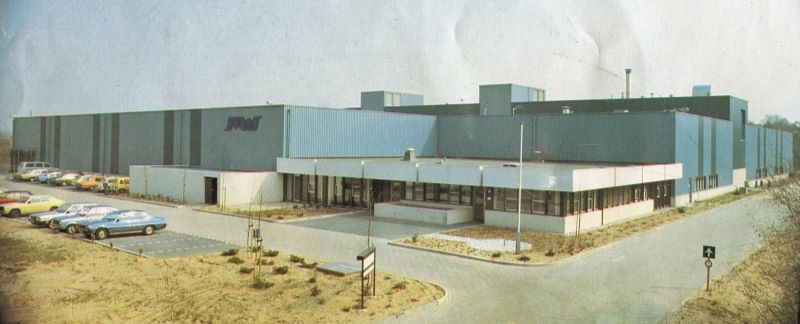
Consequently, the factory relocated in 1981 to new premises on Eerste Broekdijk, within the ’t Broek industrial estate. Its sister company, Koala Tricotagefabriek, moved to Industriestraat. This relocation ensured the preservation of over 200 jobs.
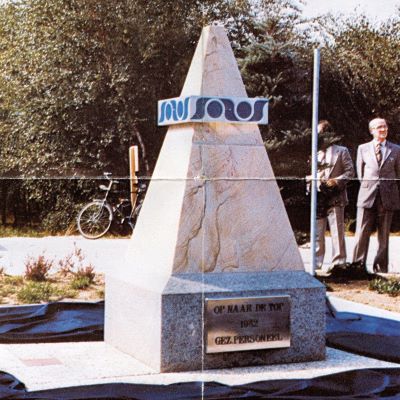
The official opening of the new building was performed by the then Queen’s Commissioner for Gelderland, Mr Geertsema. The collective staff presented the company with a pyramid-shaped sculpture with a flattened top, inscribed: ‘OP NAAR DE TOP’ (Onwards to the Top). However, Wisselink never quite reached that summit.
The Most Modern in Europe
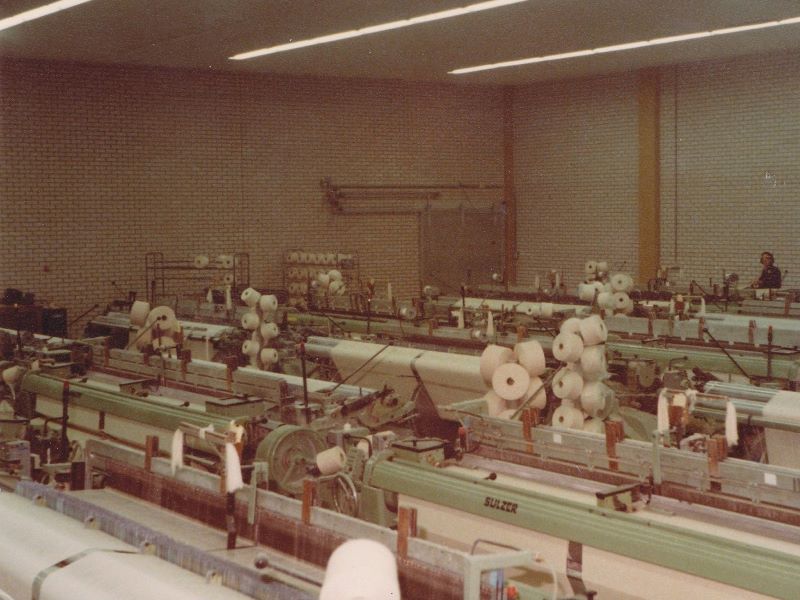
At the time, the new weaving mill was by far the most modern in Europe. It initially housed 76 state-of-the-art Sulzer projectile weaving machines and 20 older Picanol looms. The directors were, in succession, Messrs Schukkink, Van der Gronden (interim), Defourney, and Brouwer.
The company organised several staff parties a year. Highlights included sports days with sister companies from Enschede, Weerselo, Hengelo, and Bree (Belgium). The group’s centenary celebration at the Theaterhotel in Almelo was also a grand event. Wisselink had its own shooting club, ‘WIA’ (Wisselink Textiel Aalten), which was affiliated with the Aalten Shooting Association.
Despite the festivities, the textile industry demanded hard work: shift work, dust, and noise… above all, a lot of noise!
Takeover and Closure
Eventually, Wisselink faced financial difficulties. By 1997, the workforce had dwindled to 93 people—significantly fewer than in previous years. Following several painful reorganisations, the curtain finally fell in 2002. The company was taken over by the German firm Setex. A year later, the entire production was moved to the headquarters in Dingden, Germany. On 31 March 2003, the Aalten factory closed, and the building on Eerste Broekdijk was left vacant.
Some years after the closure, the premises were purchased by Kaemingk Season Decorations. The former production facility was repurposed as a warehouse. In 2015, the building was demolished and replaced by a new, larger warehouse built by Kaemingk.
Invention
On 16 August 1980, the Dutch newspaper De Telegraaf reported on a new invention by the Wisselink textile factory:
‘Schulp’ without buttons designed for soldiers
In the future, soldiers can literally crawl into their shells (schulp). ‘Schulp’ is the name of the tent developed for the army by order of the Ministry of Defence. It is a two-person, single-roof tent for mobile use—quick to pitch and lightweight.
The latter is thanks to a new type of tent canvas, KSOOI/Wetfold, an invention by the Wisselink textile factory in Aalten. It is a lightweight cotton fabric provided with a so-called multi-porous coating (MPC).
Bivouacking becomes a lot easier because of it. The unique feature of this canvas is that it does not leak if touched during a rain shower or if it is folded and packed while soaking wet.
Thanks to an ingenious tensioning system, only two pegs are needed to set up the shelter. What more could a soldier want during field exercises in harsh weather conditions?
It is not just soldiers who can benefit from the tent designed by Mick Schmidt; a civilian version was also produced. It was awarded the 1986-’87 ANWB prize for the best tent design of the year.
Perhaps the greatest advantage of the tent is that it does not consist of two halves. There is not a single button on it. The only thing that might cause an argument is which of the two has to carry the thing on their knapsack.
Video
In 1990, FilmAalten made film recordings inside the Wisselink textile weaving mill:
De Telegraaf, 16 August 1980Wisselink’s Textielfabrieken BV, Aalten (1982)Staff gift at the opening of the new factoryWeaving mill, November 1982 (Photo: Clemens Wijkamp)
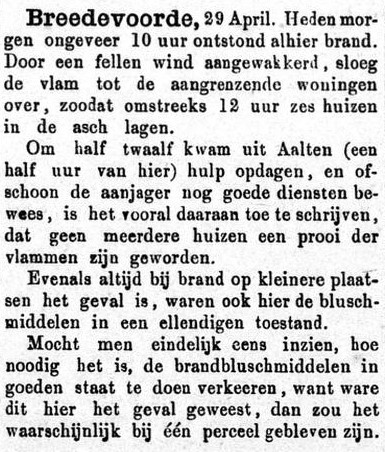
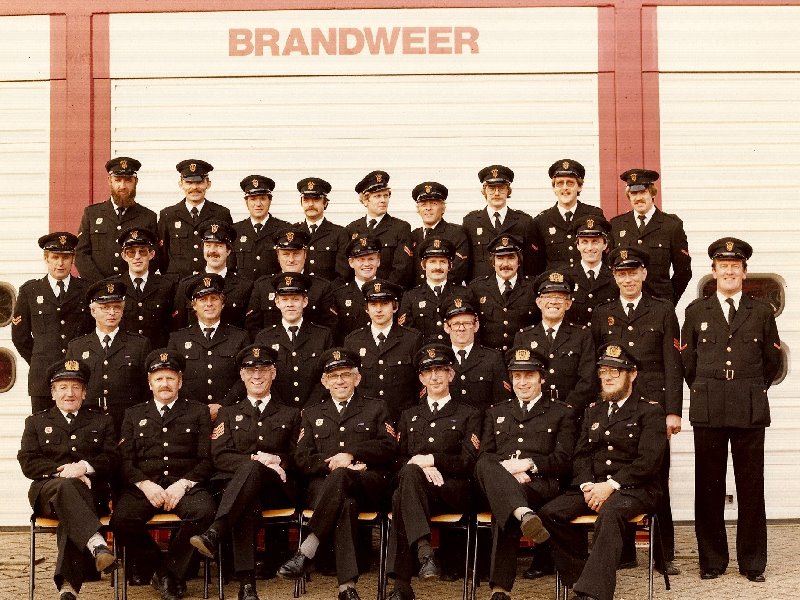
In 1889, the ‘Regulation on the Fire Engine Service and the extinguishing of fires in the municipality of Aalten’ was established by the municipal council. Article 1 of that regulation states: ‘Every male resident from the 18th up to and including the 59th year of age is, subject to the exceptions to be mentioned hereafter, called upon and liable for service with the fire engines’. The fire brigade therefore consisted entirely of volunteers, appointed and dismissed by the Board of Mayor and Aldermen.
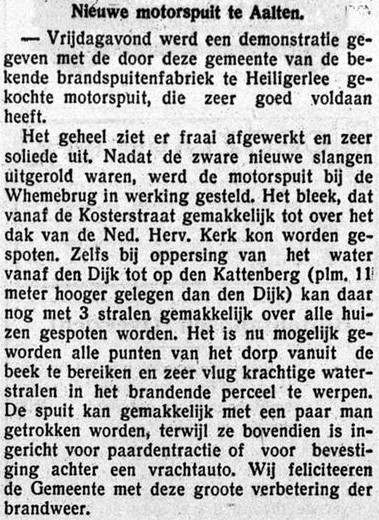
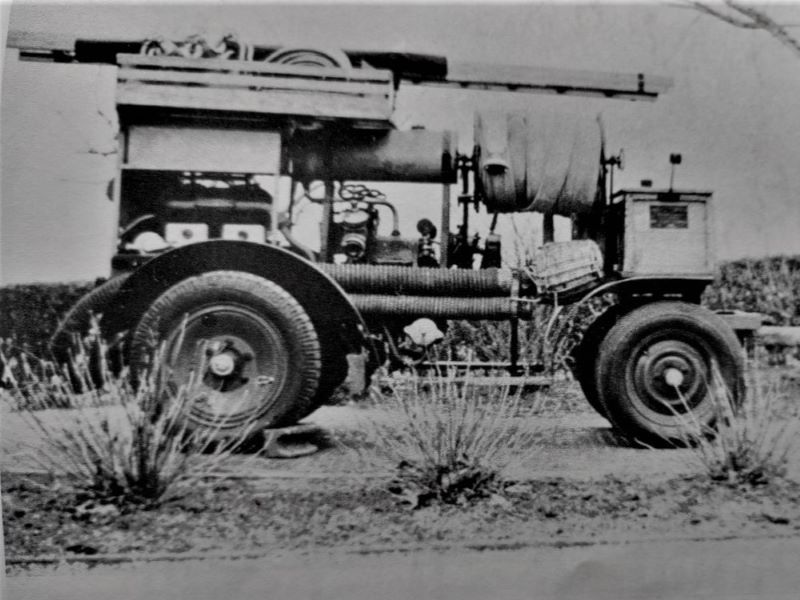
On June 19, 1925, the first meeting of the newly appointed corps of Firemasters took place. Over time, the available equipment was modernized. For example, a motorized pump was purchased in 1930, followed by an ‘auto-tractor’ in 1933, which made it possible to transport this pump to the fire.
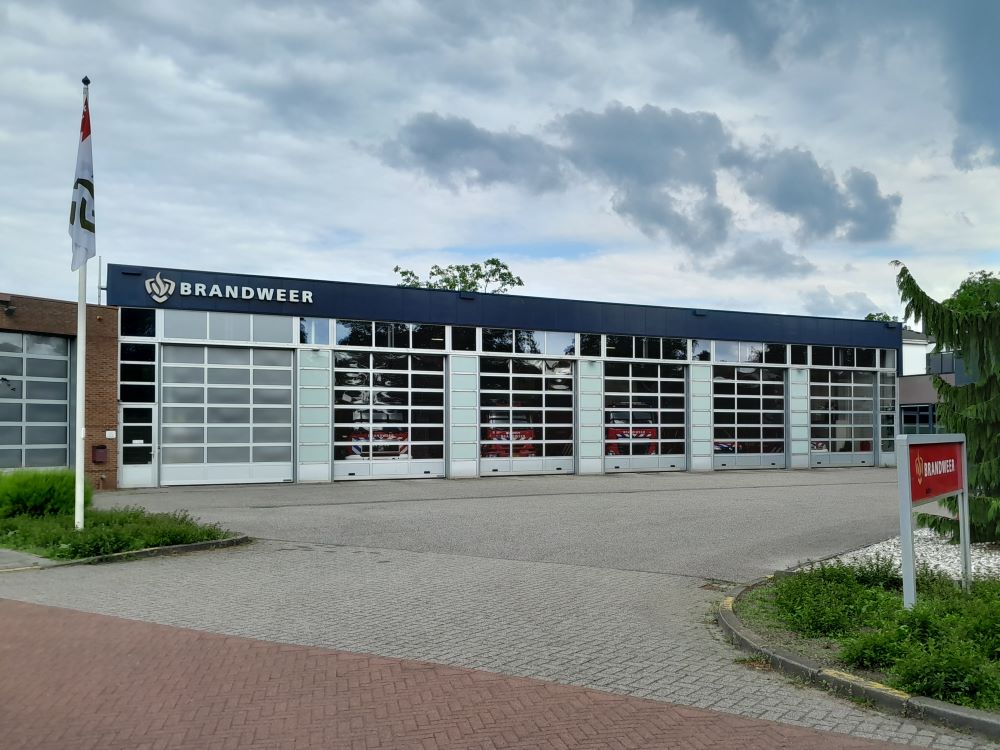
During the eighties and nineties of the last century, increasingly close cooperation developed between the fire brigades in the Achterhoek and the Cooperation Association of East Gelderland, known as the Achterhoek Region from 1995 onwards.
In 1987, the Bredevoort fire group, which until then had been part of the corps, was disbanded. A centralization of command structures in Doetinchem was established, so that the Aalten volunteer fire brigade lost its actual independence.
The fire brigade in the 19th century
In 1937, G.H. Rots described in a series of articles how things were done in Aalten in former times. Regarding the Fire Brigade, he wrote:
“The performance of the modern fire brigade, as was again evident during the large factory fire in Winterswijk, makes our thoughts return to the primitive fire-extinguishing methods of former days. A fire brigade did exist in the middle of the last century, and in their own way, they made serious attempts to fight a fire or prevent it from spreading, but they had to make do with the tools they had.
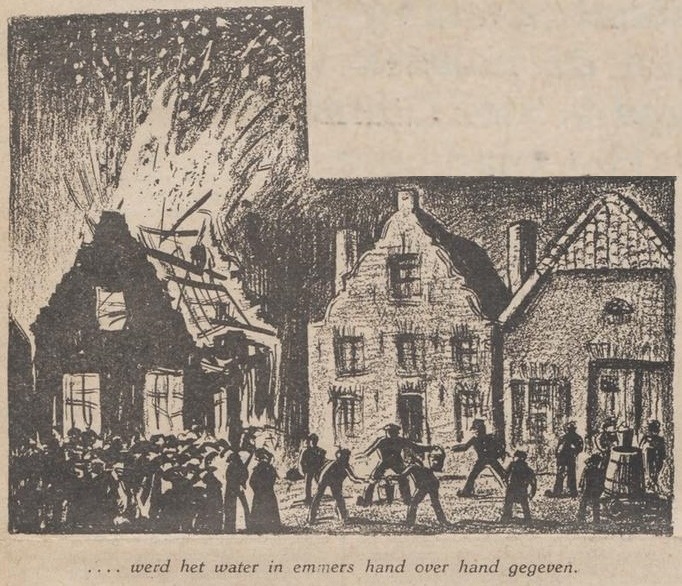
The first form of firefighting was to throw buckets of water onto the fire. From existing wells and pumps, the water was passed in buckets from hand to hand. When the well was empty, one had to wait until the supply was replenished. If the fire broke out near the stream, one could, of course, continue scooping. There were reserve wells where a quantity of water was always kept, and on the Market Square stood a row of large barrels filled with water on mobile chassis, which were immediately driven to the scene of the disaster by a designated driver.
The introduction of hand pumps brought some improvement. The water could now be sprayed at least ten meters high to keep roofs and houses wet. Later still, another improvement came with the addition of the so-called booster, a suction and pressure pump placed at the water supply, which forced the water through hoses to the pump engines. Behind the town hall were the buildings for storing these fire-extinguishing tools.
The firemasters (for an organized fire brigade had already existed for many years) had as a sign of their dignity a copper rod, a kind of scepter, or an oval copper plate, which adorned the chest of the firemaster in the event of a fire.
The many fires that plagued Aalten caused the city council to look for ways to prevent fire, for the new lamps fed with petroleum, which had to serve for lighting in the evenings on the threshing floor near hay and straw, were dangerous. An article was added to the police regulation, mandating that in the vicinity of hay or straw, on threshing floors and in stables, workshops, etc., where highly flammable material was present, lighting had to be done with closed lanterns. Whether it helped much? Fires continued to occur regularly thereafter, and each time one heard the dismal sound of the fire bell.”
Fire engines
The website ‘Brandweer Voertuigen Online’ contains an overview of fire vehicles that served with Dutch fire brigades, including Aalten and Bredevoort:
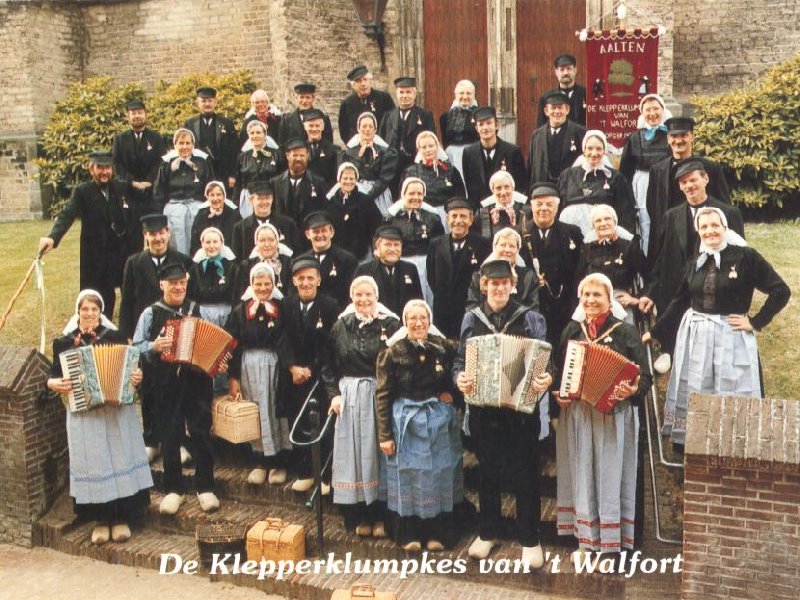
The Klepperklumpkes van ’t Walfort was a folkloristic dance group from Aalten. The group was founded on 10 May 1954 with the objective of preserving Gelderland’s regional folklore for future generations. Members of the group were dressed in authentic Gelderland (Achterhoek) traditional costume, as it was worn around 1900.
The dance repertoire consisted of approximately 35 traditional dances, mostly from the Achterhoek and Twente regions, which also date back to that era. The most well-known dances include the Driekesman, Pot met bonen (Pot of beans), and the Hôksebarger, performed, of course, in polished wooden clogs.
A Welcome Guest
The Klepperklumpkes was an active association. Over the past decades, they performed in various institutions, at street markets, and in many countries. They were a welcome guest at festivals in Belgium, Denmark, Germany, England, France, Austria, Slovakia, Spain, Sweden, and Switzerland, among others. They even performed in China.
During their peak years, the Klepperklumpkes organised a large international festival in Aalten every four years, featuring many foreign guests. These guests were hosted by local families, providing many with a unique introduction to the international dancers and their respective folklore.
In their final years, the dance group rehearsed in the hall of café Setz.
After nearly 70 years, the Klepperklumpkes disbanded in 2022. In their final years, the number of activities had gradually declined; many members were getting older, physical stamina was decreasing, and there was a lack of new members joining.
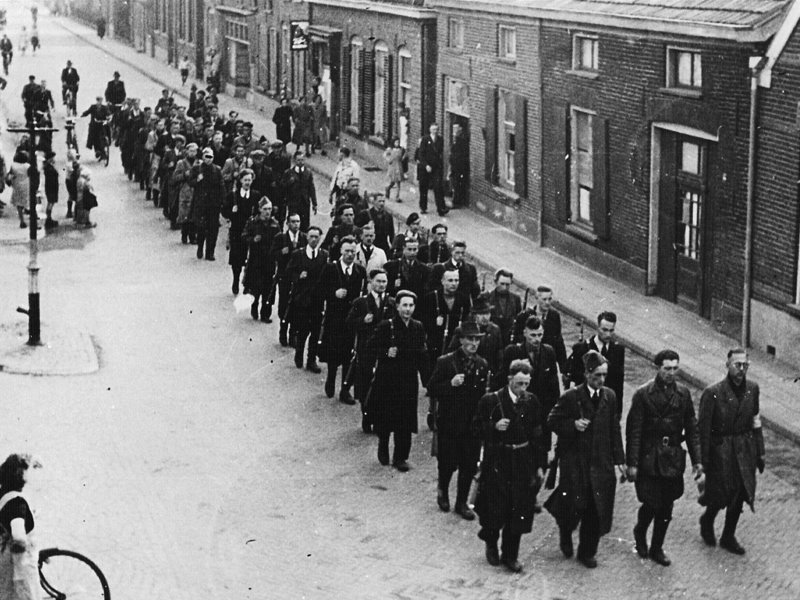
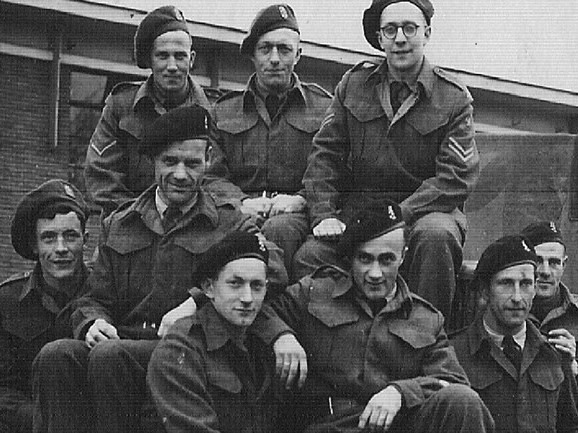
During the liberation of the Achterhoek, the Dutch National Battalion was established in Aalten on 15 April 1945. A unit that consisted of members of former Achterhoek assault groups, at that time officially called Binnenlandse Strijdkrachten (Domestic Forces), and people in hiding who had found a safe haven in Aalten and the surrounding area. The men had volunteered after a call from the Canadians. In no time they had about 400 war volunteers at their disposal, good for three companies.
Everyone knows the Princess Irene Brigade. Founded in 1941 and consisting of Dutch soldiers who had escaped to England, Dutch volunteers who were already abroad and so-called Engelandvaarders; men who made the crossing to England on their own to fight against the Germans from there. The Irene Brigade moved north from the invasion beaches, fought in France, Belgium and Zeeland and fought its last battles in the Bommelerwaard near Hedel shortly before the liberation. Less well known is the ‘Achterhoek’ unit that fought with the Canadians during their advance to the north.
Photo: Foto Garretsen, J. Bloemendal
Photo: A.Ph. de Keijzer
Canadians ask for and get help
The Dutch National Battalion (DNB) had its home base in the Julianaschool in Aalten, renamed ‘Prins Bernhard Kazerne’ for the occasion. With their knowledge of the area, the members of the DNB provided valuable services to the Canadians. Equipped and armed by the Canadians, the soldiers of the DNB advanced up the IJssel, via Doesburg, Steenderen and Gorssel.
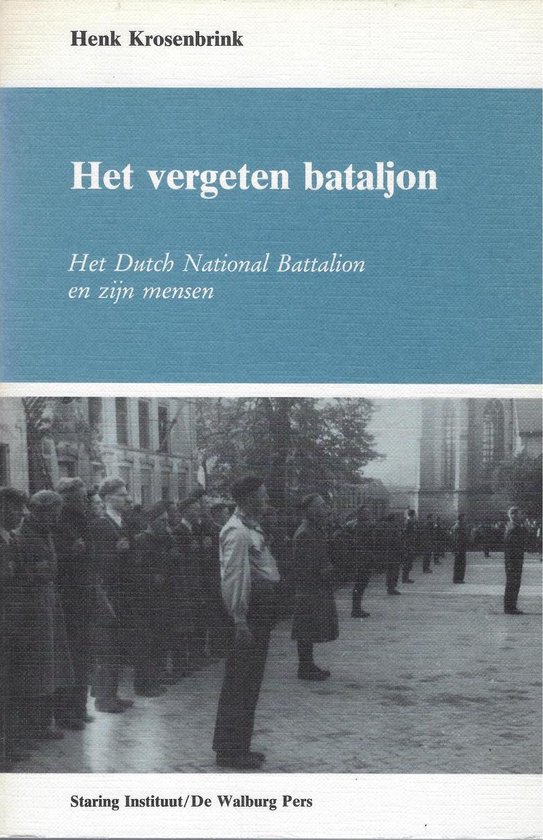
The men guarded the bridges over the IJssel and moved on to Apeldoorn. “Fierce fighting and fierce resistance,” says Arnold Somsen, member of the DNB, from Aalte in the book ‘The Forgotten Battalion’, published by the Staring Institute. “After that, it was now the end of April, the liberation army moved in the direction of Harderwijk, Bunschoten and Spakenburg. We were housed in a school. Standing guard in the evening. The Germans were still in Eemnes. So close by. Gunfights and hand grenades back and forth…”
After the liberation, the DNB was assigned to the Infantry Regiment of the Royal Netherlands Army. With that, the ‘Aalten’ battalion officially ceased to exist.
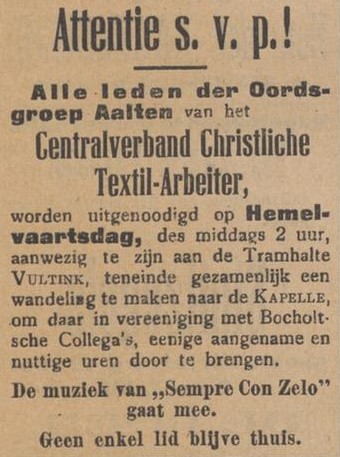
At the beginning of the 20th century, hundreds of Aalten residents crossed the border to Bocholt daily to work in the textile factories there. In all weathers, they went on foot, by bicycle, or by horse and carriage. Some took as long as three hours to cover the (roughly) ten kilometers between home and work, both morning and evening! In 1910, a tram line to Bocholt was opened, allowing them to commute much faster and more comfortably from then on.
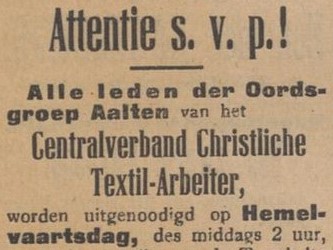
Aalten even had its own branch of a German textile union, the Zentralverband Christliche Textilarbeiter, Aalten Local (Ortsgruppe). They met regularly in various cafés in Aalten. We found a number of reports on this subject on Delpher:
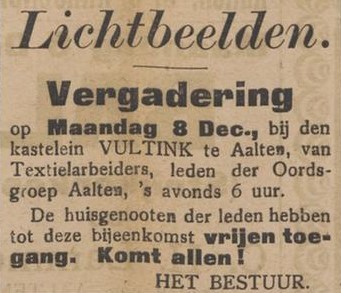
Aaltensche Courant, 10 December 1913:
On Monday evening, the Aalten Local of the Zentral-Verband Christl. Textilarbeiter Deutschland held a members’ meeting, to which family members of the organized workers were also admitted. Our friends from Bocholt had brought a magic lantern for this occasion, with which various scenes from the cottage industry, which was still very prevalent in Germany, were shown.
Seeing these things, one can understand that a cry of horror arose, especially in Germany, when these most deplorable conditions came to light a few years ago through that large exhibition of cottage industry held in Berlin.
From all this, it became clear that there is still a great deal of good work for legislators to do to improve the deeply sad lives of thousands who are forced by low wages to lead such a miserable existence.
Mr. Mensink, from Enschede, then spoke pithily to those present, emphasizing that only a firm and solid organizational life can ultimately put an end to these abuses. One of the board members present expressed a heartfelt word of thanks to the propagandists, with which the meeting concurred.
Aaltensche Courant, 6 December 1913Aaltensche Courant, 20 May 1914
Aaltensche Courant, 12 September 1914:
On Thursday morning, a well-attended meeting of the Aalten Local of the Zentralverband Christl. Textilarbeiter Deutschland was held in the café of the license holder te Linde. In his opening remarks, Mr. Ommering announced that, after much effort, the board had succeeded in establishing contact with their German colleagues and that the discussions held had led to the members of the Aalten Local also being able to count on support. This support will be paid out next Monday morning from 9:00 to 9:30 AM to members whose names begin with the letters A through M, and from 9:30 to 10:00 AM for the others; and that the support would certainly have been paid out earlier if the measures taken at the border by Dutch and German authorities had not intervened so disruptively.
Subsequently, Mr. Mensink from Enschede explained the great benefit of being organized, which is brilliantly highlighted in these particularly difficult days for workers. The speaker explained in a very accessible discourse the difficulties workers face in these sad times, as well as those that the leaders of organizations have to struggle through, and concluded by urging that the members of the organization, also in their own interest, have a duty to support the organizational boards by remaining unconditionally loyal to the organization.
Aaltensche Courant, 16 September 1914:
On Monday morning, the war and emergency support was paid out to the members of the Aalten Local of the Zentralverband Christl. Textilarbeiter Deutschland. Although it had taken some time due to the closing of the borders, for many, under these circumstances, it was a significant amount that was paid out to them.
If we are well-informed, the total payout that morning amounted to about 500 marks. We may safely assume that this payout brought a joyful mood to many a household.
Let us hope, then, that the benefit of being organized is thoroughly recognized, that many who are still distant will join the organization later when the war has spent its fury, and that those few who had to be disappointed due to very poor contribution payments will mend their ways.

#/media/Bestand:Bredevoort_schutterij_Wilhelmina.JPG)