
Several theories circulate regarding the origin of the name Aalten. But what are they based on and how credible are they? Old Aalten delved into history to discover more about this.
We begin with the oldest historical mentions of Aalten, as these may contain clues about the origin of the name. Next, we examine what toponomy (the study of place names) can teach us about this. We then discuss several theories regarding the origin and meaning of the name Aalten and conclude with our findings.
Earliest mentions
There are several medieval documents containing a reference to Aalten, with varying spellings. The best-known mentions are Aladna and Aladon, after which the Aladnaweg and a school are named. Below is an overview of historical mentions, including a reference to the oldest known source.
| 828 | A charter from 828 describes how a certain Geroward donated all his possessions, including those in Aladna, to the St. Martin’s Church in Utrecht on February 7 of that year. Little is known about Geroward’s identity, but he was presumably a Frankish nobleman in the service of the Carolingian Emperor Louis the Pious, son of Charlemagne.1 |
| 1138/ 1139 | In 1138 or 1139, Godschalk of Versnevelde (Varsseveld), with the consent of his brother Count Gerhard (II) of Lohn, enters into an exchange agreement with the canons of the St. Mary’s Church in Rees. He transfers an estate in Megchelen near Gendringen, including associated hunting rights, two fields, a meadow, and nine serfs of both sexes. In exchange, he receives a property in Alethnin, with all yields and seven serfs.2 |
| 1152 | In 1152, Count Godschalk (II) of Lohn, son of Gerhard II, reached a settlement with Bishop Frederick II of Münster. Godschalk claimed authority over the parishes of Lon, Winethereswik, Aladon, Versnevelde, Selehem, and Hengelo on the basis of his comital title. The bishop held a different view, after which it was formally established that Godschalk did not hold these territories in his own right, but was to administer them as a liegeman of the bishop.3 |
| 1188 | In 1188, during the reign of the Holy Roman Emperor Frederick I, priest Everhardus, chaplain to Count Henry of Dalen and Diepenheim, compiled an inventory of Henry’s feudal (vassal) and allodial (free) possessions. The feudal properties were recorded under the parishes to which they belonged, including Ecberghe, Gronlo, Winterswic, Nehde, Ghesterne, Lochem, Almen, Dotinchem, Zelhem, and Althen.4 |
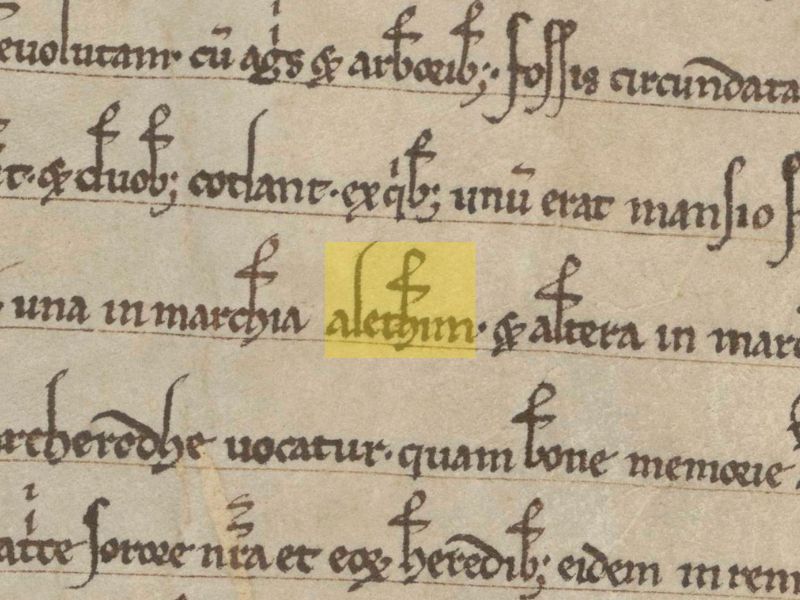
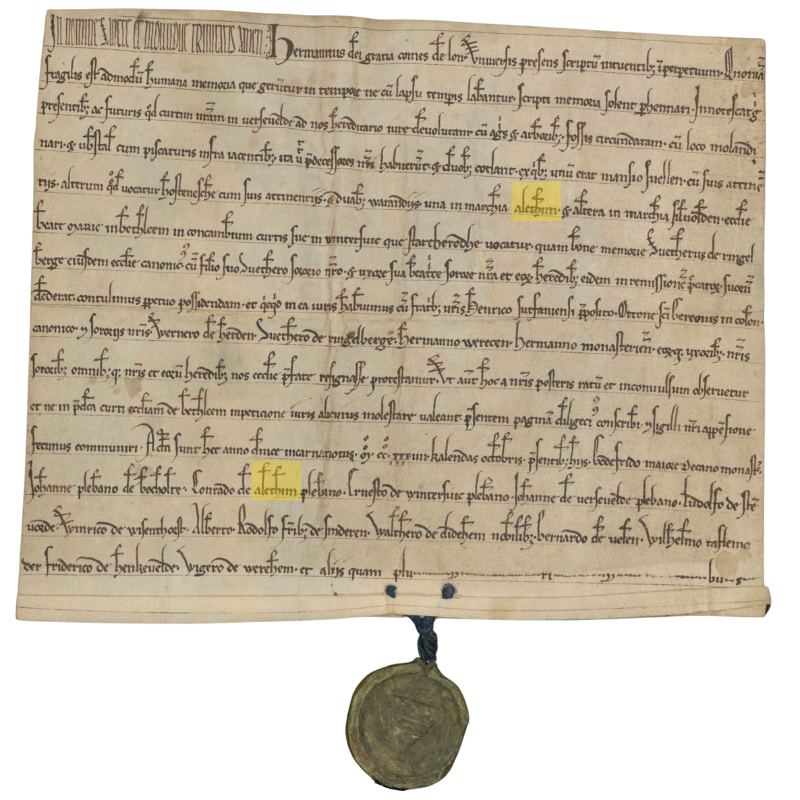
| 1234 | In 1234, Count Herman (I) of Lohn, Lord of Bredevoort, together with his brothers Henry, provost of Zutphen, and Otto, canon of St. Gereon in Cologne, as well as his brothers-in-law Werner van Herden, Sweder van Ringelberg, Herman Werecen, Herman van Munster and their spouses, and all their further heirs, entered into an exchange with the Bethlehem Monastery. In this agreement, the monastery receives from the count, among other things: duabus warandiis, una in marchia Alethim et altera in marchia Silvolden (two hunting grounds; one in the mark of Aalten and the other in the mark of Silvolde). Witnesses include the parish priests Johannes from Bocholte, Conradus from Alethim, Ernestus from Winterswic, and Johannes from Versevelde.5 |
| 1254 | In 1254, mention is made of the “curtis Grevinkhof sita in parochia Alethe“ (the estate Grevinkhof, situated in the parish of Aalten): Gotscalco de Reme receives from Otto van Loon in castle-fief the curtis Grevinkhof in Aalten, with the mill and further appurtenances, with the exception of the timber court. Present here Gerardus Canoninicus “frater domini G. de Reme”.6 |
| 1313 | In a register of churches belonging to the Diocese of Münster from the year 1313, the following parishes, currently located in the Netherlands, are mentioned: Alten, Dinxperle, Eiberghe, Gheesteren, Grolle, Hengelo, Neede, Seelfwalde, Selehem, Versevelde and Wynterswik.7 |
| 1386 | Derich Willemssoen van Lyntloe has been granted Varenvelde in parish Alten, sabbato na Briccii ep. (17 November) 1386.7 |
| 1409 | Derk van Linteloe and his children Derk and Herman, declare to have sold to Johan Rensynck the estate ten Nygenhues, located in the hamlet of Lynteloe under Aelten and held in fief from the Lordship of Borculo, 1409 July 24 (in vigilia beati Jacobi apostoli maioris).8 |
Toponymy and sound development
Toponymy, or the study of place names, is a branch of linguistics that studies place names and seeks to explain their origins.9 A generally accepted principle within toponymy is that the sound development of a name is more reliable than its spelling, as written mentions in pre-modern times were inconsistent and influenced by scribes, dialects, and time-bound conventions. The sound of a name, by contrast, usually remains more consistent and therefore offers better insight into the original pronunciation and meaning.
Now, we are not toponymists, but when we view the sound development of the earliest mentions of Aalten chronologically, we believe we recognize a pattern:
Aladna → Alethnin → Aladon → Althen → Alethim → Alethe → Alten → Aelten → Aalten
For a period of four centuries (9th-13th century), these mentions consist of three syllables, starting with ‘ala’ or ‘ale’, followed by a d or t, and in most cases ending with an n. Although the spelling varies, the sound structure remains largely consistent. From the 13th/14th century onwards, we see that the second syllable gradually disappears and that the name corrupts into Althen/Alten/Aelten/Aalten.
Theories on origin and meaning
Below we discuss the best-known theories regarding the origin and meaning of the name Aalten.
Place on a hill
A frequently cited theory states that the name Aalten is derived from the Latin altus, meaning ‘height’. This explanation seems primarily based on the fact that Aalten originated on a hill and the phonetic similarity between altus and Aalten. However, there is no historical or linguistic evidence for this theory. Furthermore, this explanation does not take into account the sound development in the oldest known mentions of the name.
Homestead by the altar
Another theory suggests that Aalten was inhabited around 150 BC by Angles from the area that is now Berkelland. According to this explanation, the name is derived from the Anglian ael (altar, place of sacrifice) and thun (garden, enclosed yard). This would lead to Aelthun, or ‘homestead by the altar.’10 This explanation is also speculative and does not fit the sound pattern of the medieval mentions of the name.
Plant or tree name
In Gelderse plaatsnamen verklaard, Gerald van Berkel states that the name Aalten may be related to a plant or tree name and refers to the Old Norse alað (nourishment, food), aldin (edible tree fruit), or alda (fruit-bearing oak).11 Although there is no direct evidence for this explanation, it does fit the sound pattern of the medieval mentions.
Place by the water
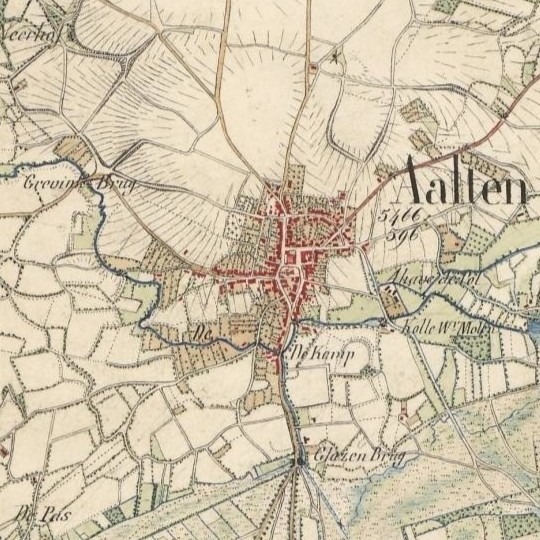
In Prehistorische waternamen Maurits Gysseling suggests that the name Aalten is derived from the Indo-European Alatanā, meaning “situated in a bend of a stream”.12 In the case of Aalten, this would refer to the Slingebeek. Van Berkel, however, calls this theory far-fetched in Gelderse plaatsnamen verklaard.
Place name researcher Bas Kloens disagrees. In his study on place names and their origins, Valkuilen in de Plaatsnaamkunde, he states that it is actually “abundantly clear” that Aalten, like many other similar place names, owes its name to its location on a watercourse or stream.13
Conclusion
No single theory regarding the origin of the place name Aalten can be supported with hard evidence or completely ruled out. It remains, therefore, largely a matter of speculation. Nevertheless, we lean towards the theories of Gysseling and Kloens, who state that Aalten owes its name to its location on a watercourse, namely the Slingebeek.
Furthermore, despite Van Berkel’s skepticism, a connection with the Indo-European Alatanâ, which bears a strong resemblance to Aladna, seems plausible to us.
In short, although not scientifically proven, our nomination for the most plausible explanation for the origin and meaning of the name Aalten goes to Place by the water / situated in a bend of a stream.
Footnotes
- Aladna in the Year 828 ↩︎
- Knipping, R. (1901) Die Regesten der Erzbischöfe von Köln im Mittelalter, p.62 ↩︎
- Sloet, L.A.J.W. (1872) Oorkondenboek der Graafschappen Gelre en Zutfen, p.292 ↩︎
- Sloet, L.A.J.W. (1872) Oorkondenboek der Graafschappen Gelre en Zutfen, p.371 ↩︎
- Gelders Archief, archive number 0314, Bethlehem Monastery near Doetinchem ↩︎
- Geldersche volks-almanak voor het jaar 1889, p.17 ↩︎
- Leenacten van Gelre en Zutphen 1376-1402 (Delpher) ↩︎
- Gelders Archief, archive number 0312, Nazareth or Schaer Monastery near Bredevoort ↩︎
- Wikipedia, Toponymy ↩︎
- Kranenburgia, Anglicana ↩︎
- Berkel, van, G. (2017) Gelderse plaatsnamen verklaard, p.16 ↩︎
- Gysseling, M. (1982) Prehistorische waternamen, p.35, 55-56 ↩︎
- Kloens, B. (2009) Valkuilen in de plaats-Naamkunde, p.179, 197-198, 286, 313, 333, 518 ↩︎