
Aaltensche Courant, 2 October 1934
The glorious weather of the past few days—true summer weather, with plenty of sunshine and mild temperatures—is still luring many people out to the woods and heath. Walkers and those in more of a hurry, venturing out by bicycle, often choose the beautiful Zelhemseweg (the present-day Romienendiek, ed.), the old Hessenweg, for their excursions.
On Friday, there was something else to enjoy alongside the natural beauty. A number of young men were labouring along the soft, sandy road, pulling a cart laden with strange-looking contraptions. Pausing occasionally to catch their breath, they chatted and gestured animatedly. Clearly, something special was underway. Anyone wishing to satisfy their curiosity could only do so at the cost of a fair walk. The group pushed ever further, pulling or pushing with renewed zeal after every short rest. Upon reaching the Schaapskooi (sheepfold), the column turned right, and they halted at the edge of the woods on the heights above the flat, reclaimed terrain, where flowering lupins still painted bright, brilliant yellow spots on the brownish-grey surface here and there.
There was no more catching of breath. Now, busy activity: nimble hands carefully took the mysterious objects from the cart and laid them out meticulously on the beautiful heathland according to a set plan. Pliers, wrenches, bolts, and nuts were produced. With care and deliberation, the various items were connected; the work began to take shape. What was about to happen here?
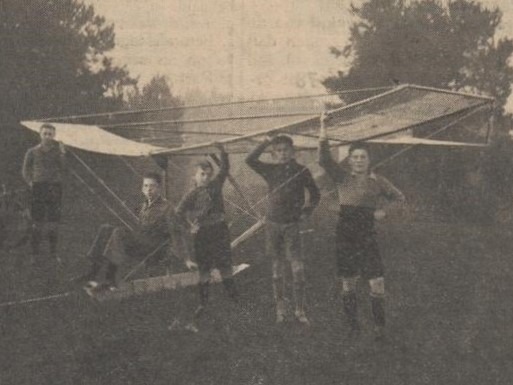
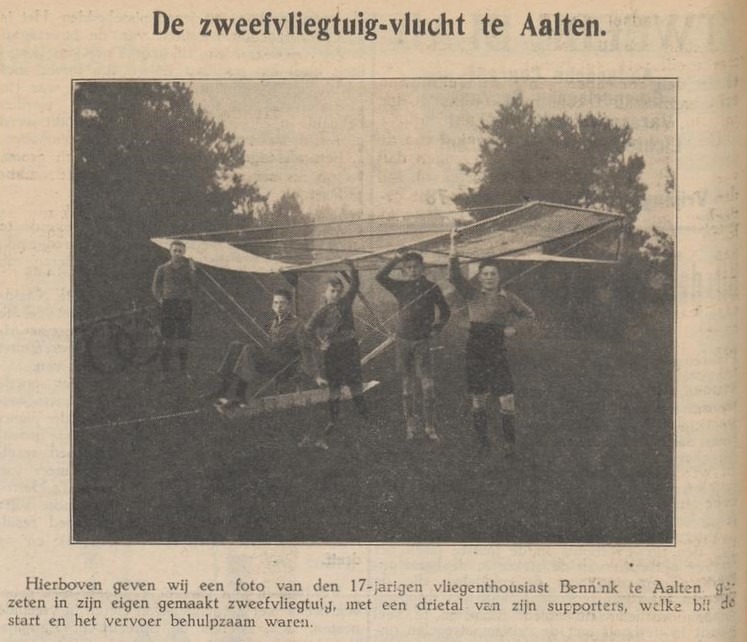
A kind of sledge with a seat, and in front of it a swivelling stick where the feet could be placed. Behind that, a pair of upright tubes, firmly attached to the sledge. Next, it was the turn of a few large, flat pieces: a construction of tube and slats, covered with linen and paper, approximately 9 metres long and well over a metre wide. With combined effort, these pieces were placed on the upright tubes and secured with bolts. Tension wires ensured the correct alignment. The whole structure now took the shape of a large bird. All that remained was the tail, which was also soon attached, and before us stood a glider—perhaps not constructed to all requirements, but a very decent one nonetheless—with an elevator and rudder on the tail, albeit without ailerons on the rear of the wings.
Everything was checked thoroughly one last time, nuts were tightened again, tension wires were adjusted slightly, and then the first test was to be carried out. The tow cable—in this case, a number of inner tubes—was attached, the device was dragged to the edge of the slope, and the pilot took his place on the sledge. Feet on the ‘steering’, checking briefly if it worked, and yes, it worked fine. The rudders responded to the slightest pressure of the foot.
Now, the great moment had arrived. Expectations were high. Would it succeed? One part of the helpers positioned themselves behind the machine to hold it back; another part went to the tow cable and pulled, pulled with all their might to achieve the greatest possible tension. After all, the greater the speed at take-off, the greater the chance of lifting off the ground. The wind, too, played a part. However, it was nowhere to be seen; it was absolutely still.
They decided to give it a try regardless. The helpers pulled harder; one more tug, and with a whistling sound, the rubber cable, stretched to its limit, snapped. A mixture of sadness and amusement: sadness over the setback, amusement at the helpers who bit the dust, rolling down the slope head over heels. Soon, however, the cable was repaired. An experience richer, they started again, this time with a little less energy. Then the pilot’s command: “Let go.”
With a jerk, the contraption lurched forward and glided along the ground for a distance, even lifting slightly. But there was no talk of gliding yet. Back to the starting point. The elevator was adjusted to be a bit steeper, and they started again. And yes, it went better. The aircraft clearly lifted off the ground, but it landed somewhat uncomfortably a bit further on. Without too much damage, however.
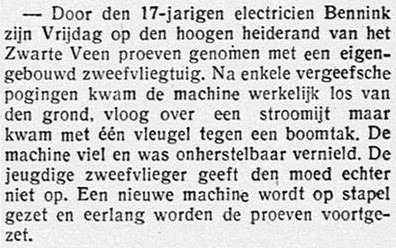
Back to the starting point once more. The third time’s the charm. Once again, the helpers pulled with all their might, the command “Let go” sounded again, and again the bird surged forward, now with the elevator even steeper, and yes, now it was going up. This silent bird glided over a stream, but one of its wings struck a tree branch. The wing snapped off, and like a bird shot in flight, the machine slid down and hit the ground with a crash, irreparably damaged.
Months of labour in spare hours had been destroyed in one fell swoop. The still-usable material was dismantled and loaded back onto the handcart, and a less enthusiastic troop returned to the village. Less enthusiastic than on the way there, but the constructor, the 17-year-old electrician Bennink, was not discouraged. After all, it had worked! It must be possible with a home-built, but slightly better-constructed device of more stable build. Plans for this were already being made, and this indicates that we will likely see this enterprising young man make another attempt in some time. Taught by experience, a subsequent attempt will surely have a better chance of success.
The builder of the glider, Jan Bennink, lived on the Kattenberg in Aalten. Ninety years later, a home-built glider by Jan Bennink was discovered near his childhood home, in the attic of a building on the Lichtenvoordsestraatweg where a friend of his lived at the time. Perhaps this friend hid it as a precaution shortly after the outbreak of World War II, after Bennink had been questioned at the police station about his flying hobby.
Sources
- Aaltensche Courant, 2 October 1934 (Delpher)
- Aaltensche Courant, 5 October 1934 (Delpher)
- De Graafschapbode, 3 October 1934 (Delpher)
- De Gelderlander, 10 July 2024 (Gelderlander.nl)