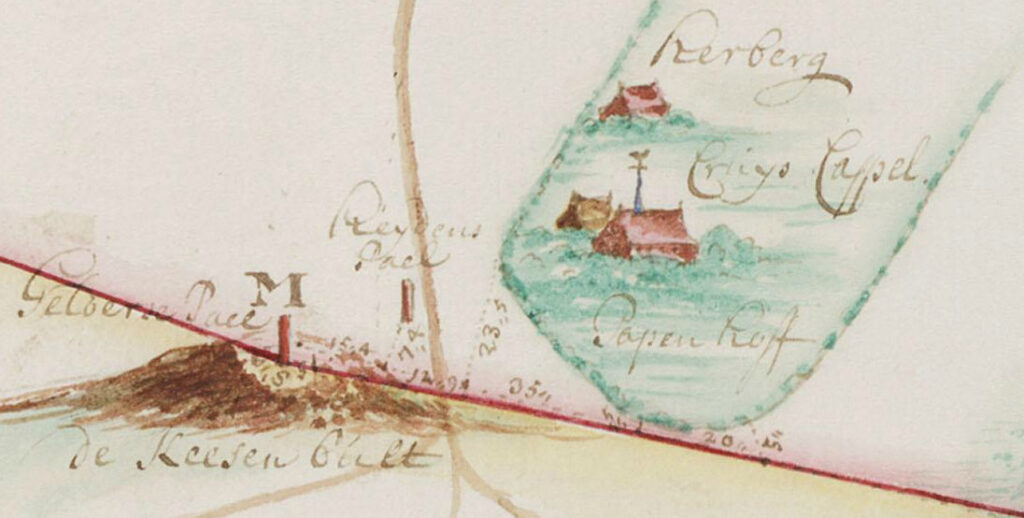
Kiefteweg / Veenhuisweg, Heurne
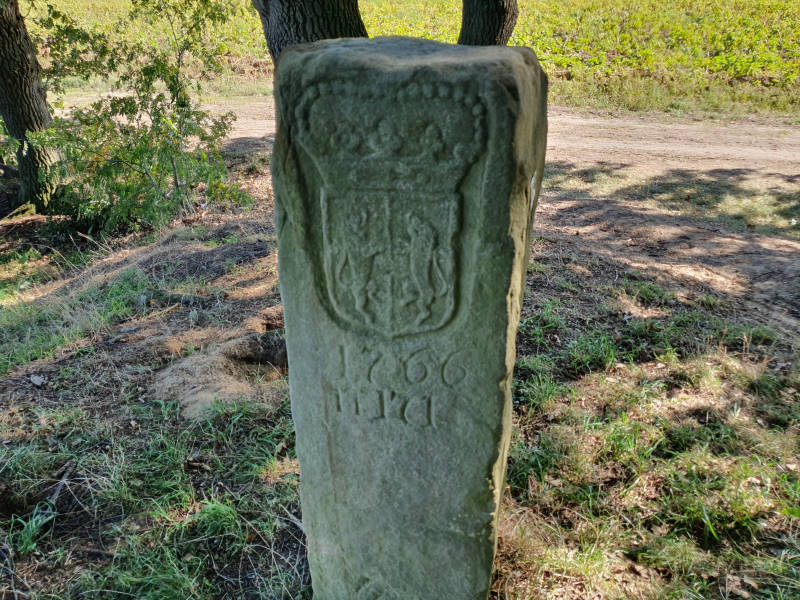
The Kesenbult is a small hill at the end of the Kiefteweg, near the green border crossing between the Netherlands and Germany. Atop the hill stands a centuries-old boundary stone, crafted from Bentheim sandstone. The stone bears the coats of arms of Guelders and Münster, the year 1766, and the number 171. It has thus marked a formerly important border crossing for more than 250 years.
Trade route and border crossing
In the 18th century, the Kiefteweg – which used to be called Bodendijk – formed part of the trade route between the Duchy of Guelders and the Bishopric of Münster. Not only commercial travellers passed through here, but also royal couriers, or messengers (boden). The name Bodendijk refers to these couriers.
Cross Chapel
In addition to trade and transit, the Kesenbult also played a role in religious life. During the period of Calvinism (1675–1799), when Catholic worship was banned in the Dutch Republic, Catholics from Aalten and Bredevoort crossed the border here.
Some two hundred metres across the border stood the Cross Chapel (Kruiskapel), built in 1675 on the Reyerding estate by order of the Bishop of Münster, Bernhard van Galen (popularly known as Bommen Berend). The timber, octagonal chapel became the religious focal point for exiled Catholics.
According to tradition, worshippers travelled to the chapel in workwear and carrying their tools, so as not to be recognised as churchgoers.
Present-day significance
The Cross Chapel has since vanished, but the boundary stone on the Kesenbult remains. It serves as a reminder of centuries of trade, religion, and border traffic between Aalten and the Münsterland. As such, the Kesenbult still forms a tangible symbol of the shared history on both sides of the border.