Category: Religion

  • Aalten in the Middle Ages

    Aalten in the Middle Ages

    Historical sources reveal that Aalten was mentioned in 1152 as the parish of Aladon1. This indicates that a church existed at that time, which was presumably located on the same site as the current Old Helenakerk. A mention from 828 (Aladna)2 is not undisputed, although such an early dating for Aalten is certainly possible from an archaeological perspective. Indeed, traces of human habitation from that period have been found both at De Hoven and on the Damstraat.

    Burial Ground

    In the late 19th and early 20th centuries, a large number of objects were collected during excavation work on Damstraat. Among the finds are 15 pots of widely varying shapes, some of which are beautifully decorated.

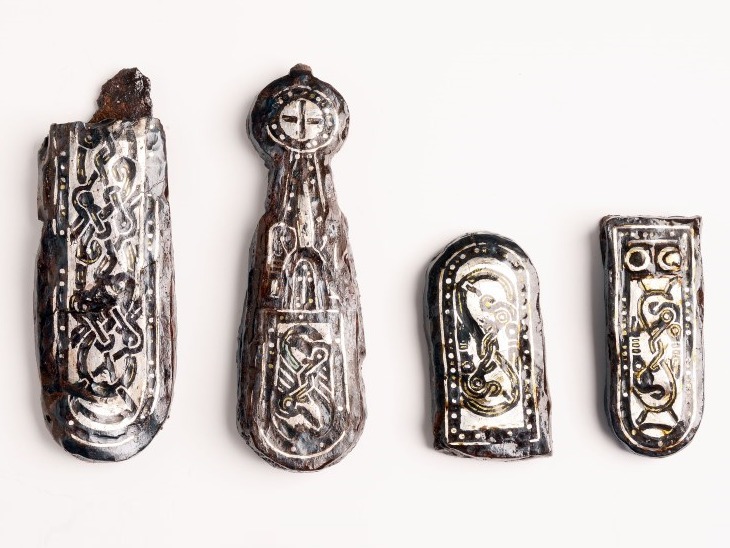
    In 1932, under the direction of Professor A.E. van Giffen, a burial ground was uncovered in Aalten behind the Manschot factory, now Manschotplein. Spearheads, stirrups, a shield boss, several small pots, and ten silver links from a belt were found.3 It is not unlikely that these finds originate from the grave of a single warrior.

    Part of the Damstraat was likely a Merovingian-Frankish burial ground around the year 800. The Merovingians were a dynasty of Frankish kings. The site has been heavily disturbed by house construction.
    Medieval Cellar

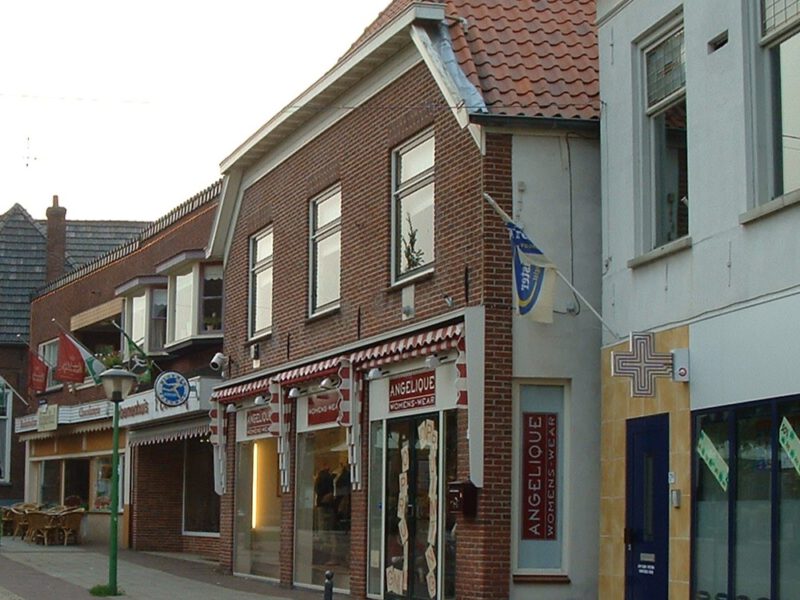
    Naturally, a burial ground is associated with a settlement. You will understand that we were very curious about where this settlement was located. In recent decades, a working group from the archaeological society A.D.W. has closely monitored excavation and construction activities in and around the current center of Aalten. In 1981, this resulted in the discovery of a cellar from the 12th century. The find was made in the renovated premises of what was then the Welkamp company (Bredevoortsestraatweg 5). No remains were found of the farmhouse of which the cellar was a part. However, the cellar itself yielded a wealth of information.
    Because the cellar had been destroyed by fire, all objects present at the time of the fire were recovered within it. A total of six pots were found which, given their size, must have been used as storage jars. Unfortunately, five of the six pots were broken. A handle from a saucepan, in the shape of an animal head, was also found. Iron slag and a piece of lime indicate a smithy in the vicinity. It is possible that two hinges found were manufactured in this smithy.

    Bone remains showed that horses, sheep or goats, cattle, and pigs were kept. Charred grain remains of oats, wheat, and rye were found in a soil sample. With this find, the mention from 1152 was archaeologically confirmed. Several imported shards from Germany point to a dating in the second quarter of the 12th century.4

    Settlement

    Although this find was important in itself, no traces had yet been found of the older settlement associated with the burial ground. However, during the redevelopment of De Hoven in December 1982, traces of a Frankish-Merovingian settlement were discovered. The remains of a sunken hut from the 9th century5 are an indication that Aalten already existed at that time, albeit under a different name.

    A sunken hut should be imagined as a rectangular pit topped by a gable roof. Usually, these sunken huts had a craft function (e.g., a weaving hut) or a storage function. Only the larger ones were possibly also used as dwellings.
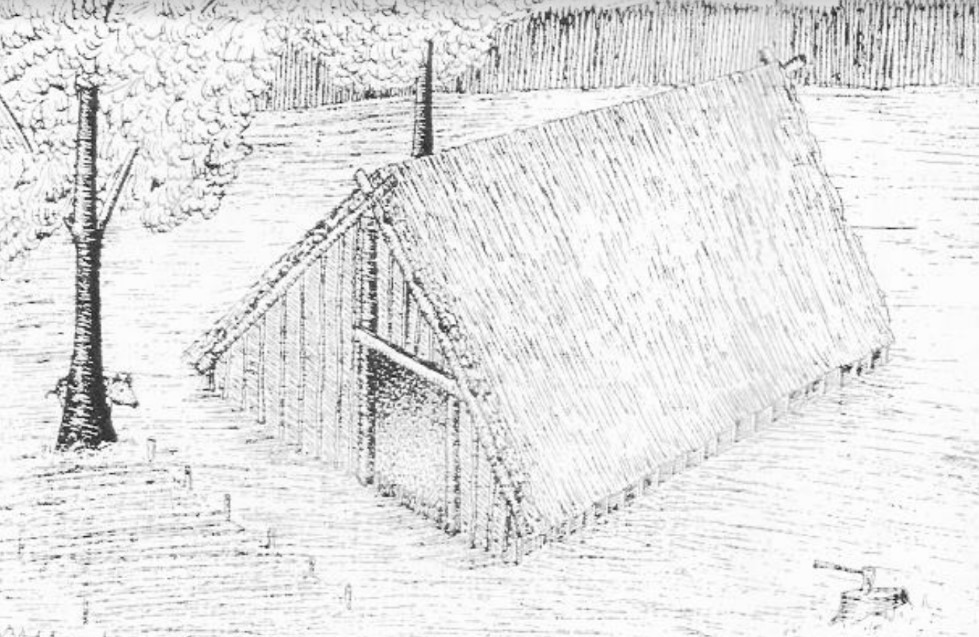
    After the sunken hut was abandoned, the pit was used as a refuse pit. A large number of bones from the same livestock as in the cellar find were discovered here. The discovery of bone remains from a deer indicates a minor role for hunting. Furthermore, charred grains and seeds such as barley, rye, emmer wheat (a prehistoric grain type), oats, lentils (possibly peas or vetch), pale-yellow hemp-nettle, goosefoot, and sheep’s sorrel were found.

    From the fact that pottery types found in the sunken hut also occur in the burial ground, we may conclude that both are contemporaneous. It is therefore not far-fetched to assume that the people who lived at De Hoven buried their dead at the current Damstraat.

    Second Find

    In December 1992, during work at De Hoven, not far from the previous site, remains of a sunken hut were found again, this time probably dating from the 8th century. This sunken hut was found on the grounds of De Hoven where road builder Jaartsveld was carrying out excavation work for the construction of a new parking lot.6

    This sunken hut was quite small and had almost certainly been the workshop of a weaver. A groove on the side of the pattern found indicated where the loom had stood. Spindle whorls and clay balls that served as weights for the loom were also found. The sunken hut was smaller than the one discovered in 1982. That one may have been a hut where a family lived.
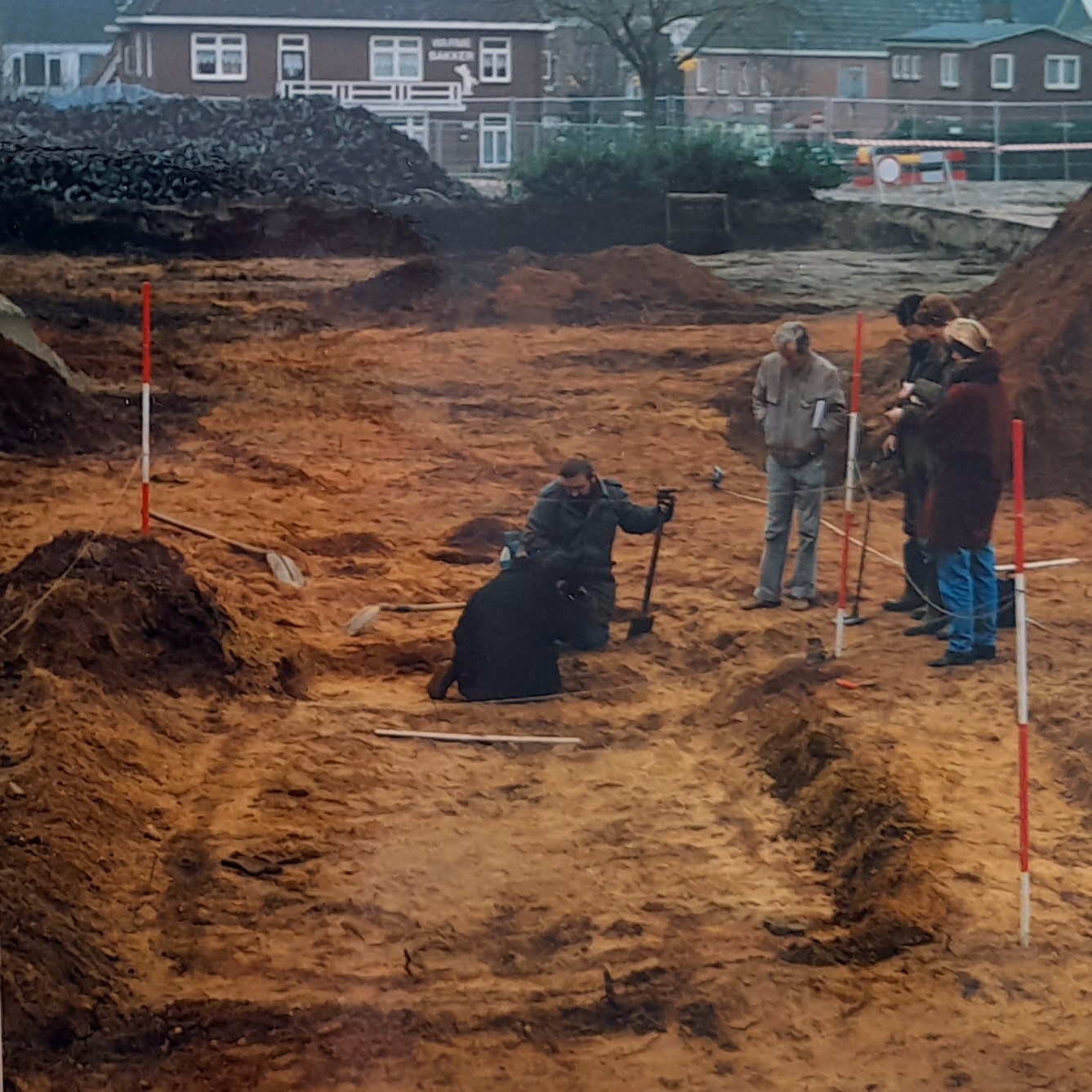
    Willem Doodeheefver, one of the amateur archaeologists involved in the research, told a reporter:

    “You know it is an area in the vicinity of which something has been found before. You could see it very clearly during the excavation. Suddenly, in the red sand, the black imprints became visible where posts used to stand. That is always a huge surprise.”

    The National Service for Archaeological Heritage (ROB) recognized the importance of the finds and asked the Soil Research Working Group of the Archaeological Society A.D.W. to continue the investigation. An employee of Jaartsveld specifically returned from vacation to further excavate the site using a loader. Several new finds were made during this process. Many of the aforementioned finds can be viewed in the museum on the Markt.

    Origin of the place name

    Several theories circulate regarding the origin of the name Aalten. But what are they based on and how credible are they? Old Aalten delved into history to discover more about this.

    Read the full article: Origin of the place name Aalten.

  • Aladna in the Year 828

    Aladna in the Year 828

    From historical sources, we know that Aalten was mentioned in 1152 as the parish of Aladon.1 However, there are indications that the village may have been mentioned much earlier, namely as Aladna in a charter from 828.2 Whether this mention actually refers to the current Aalten is still a subject of discussion. Nevertheless, archaeologists consider such an early dating certainly possible. Indeed, traces of human habitation from that time have been found both at De Hoven and on Damstraat.3 In this article, we delve into this ancient mention and examine two different theories.

    The deed of gift of Geroward

    The charter from 828 describes how, on February 7 of that year, a certain Geroward donated all his possessions, including those in Aladna, to the St. Martin’s Church in ‘Traiectum Veteri’ (Utrecht). Little is known about Geroward’s identity, but he must have been a man of standing. He was presumably a Frankish nobleman in the service of the Carolingian Emperor Louis the Pious, son of Charlemagne.

    The original charter has not been preserved. What we know about it comes from later copies and transcriptions. The most important source is the ‘Cartulary of Radboud’, compiled in the Abbey of Egmond in the 12th or 13th century. This register contains copies of charters related to the Diocese of Utrecht. Later, this collection was included in the ‘Oorkondenboek van het Sticht Utrecht tot 1301’, compiled by S. Muller Fz. and H.T. Obreen.

    Below are the Latin text and the English translation of the charter in question.


    Source text

    Dum unusquisque presens seculum inhabitat, necessitate nimia cogitur, ut finem suum Dei solo judicio previdere et preoccupare bonis operibus studeat, ne eum inopinata et improvisa mors inveniat.

    Idcirco ego Gerouuardus, filius Landuuardi, trado ad ecclesiam sancti Martini, in Traiecto Veteri constituta[m], quicquid mihi hereditatis jure accessit in villa Langhara et in Ellenuuih et in Aladna et in Uuazefelde et in Humelle et in Theodon et in Hesim et in Asnon, cum omnibus adjacentiis, pratis, pascuis, silvis, aquis aquarumve decursibus, necnon et mancipia, quorum hec existunt vocabula: Feginuuard et uxor ejus Liutburn, Meginrauan et uxor ejus Vuerinhild, Albuuard et mater ejus Sigiuuih, Uulfbald et Hadagrim, Grimbald et uxor ejus Adaluuih, Garoberd et uxor ejus Folcuuihc, Arnolf et uxor ejus Adalgard, Saxani et uxor ejus Harduuih Vuerinbald et mater ejus Gerild, Heiegbrath et uxor ejus Meginfrid, Vuarbald et uxor ejus Geruuih, Adalgod et Marcuui, Saxini et Radini, Vulfini et uxor ejus Liuduuar, Odilgard et filius ejus Heriman, Aldric et filius ejus Landric, Gelo et Marcrad, Hungrim et uxor ejus Liuduuih, Aluuih et Seolo, Egbald et Tadhild.

    Acta est autem publice in villa Embrici, anno XV imperii domni Hludouuici imperatoris, incarnationis vero Dominice anno DCCCXXVIII, die VII Idus Februarii, coram testibus, qui hanc traditionem presentialiter confirmatam viderunt similiter et vestituram, quorum nomina subter notantur.

    Signum Gerouuardi, traditionem hanc peragentis.

    [The signs of] Hrauanuuardi, Egisgeri, Sigiberti, Gerberti, Theodansi, Albrici, Albuuardi, Ildiradi, Odilbaldi, Otberti, Roduuigi, Uuerinherdi, Friduberti, Vuibodonis, Ledradi, Geroldi, Gerici, Vuendilberti, Gerharii, Hildirad, Reinheri, Rodberti, Uuarmundi, Aldgeri, Vualonis, Rodhardies, Meinhardi, Hrauaningi, Egelberti, Gerbodi.

    Ego Geraccarus jubente domno meo Friderico episcopo scripsi et subscripsi.

    Translation

    While every man dwells in this earthly life, he is driven by a great necessity to foresee his end only through God’s judgment and to prepare for it through good works, lest death overtake him unexpectedly and unprepared.

    Therefore, I, Geroward, son of Landward, transfer to the church of Saint Martin, located in Old Traiectum, everything that has come to me by hereditary right in the villages of Langhara, Ellenwih, Aladna, Wazefelde, Humelle, Theodon, Hesim, and Asnon, with all associated lands, meadows, pastures, forests, waters, and watercourses.

    Likewise, I transfer the serfs, whose names are as follows: Feginward and his wife Liutburn, Meginravan and his wife Werinhild, Albward and his mother Sigiwih, Wulfbald and Hadagrim, Grimbald and his wife Adalwih, Garoberd and his wife Folcwih, Arnolf and his wife Adalgard, Saxani and his wife Hardwih, Werinbald and his mother Gerild, Heiegbrath and his wife Meginfrid, Warbald and his wife Gerwih, Adalgod and Marcwi, Saxini and Radini, Wulfini and his wife Liudwar, Odilgard and her daughter Heriman, Aldric and his son Landric, Gelo and Marcrad, Hungrim and his wife Liudwih, Alwih and Seolo, Egbald and Tadhild.

    This transfer took place publicly in the settlement of Embrici, in the fifteenth year of the reign of Emperor Louis (Hludowicus), and in the year 828 after the incarnation of our Lord, on February 7, in the presence of witnesses who confirmed this transfer and the associated settlement. Their names are listed below.

    The mark of Geroward, who performs this transfer.

    [The marks of] Hravanward, Egisger, Sigibert, Gerbert, Theodans, Albric, Albward, Ildirad, Odilbald, Otbert, Rodwig, Werinherd, Fridubert, Vuibodo, Ledrad, Gerold, Geric, Vuendilbert, Gerhari, Hildirad, Reinher, Rodbert, Warmund, Aldger, Vualo, Rodhardies, Meinhard, Hravaning, Egelbert, Gerbod.

    I, Geraccarus, have written and signed this by order of my lord, Bishop Frederick.


    Where was ‘Aladna’ located?

    There are two theories regarding the exact location of the places mentioned in the charter:

    1. The Hamaland theory: According to this view, Geroward’s possessions were located in the area that would later become known as the Carolingian county of Hamaland. The place names mentioned in the deed are linked by historians to contemporary locations in the Liemers and the Achterhoek. Within this theory, ‘Aladna’ is identified as the current Aalten.
    2. The North French theory: Another interpretation suggests that the mentioned places were not in the Netherlands, but in Northern France. In this scenario, Aladna would refer to the current Alette, a place in the Pas-de-Calais department. The other place names from the charter would also be located in this area.4

    Interpretations of the place names in both theories:

    Latin nameHamaland theoryNorthern-France theory
    Traiectum VeteriUtrechtTournehem-sur-la-Hem
    LangharaLangerak (near Doetinchem)Longuerecque
    EllenwihHeelwegHerlincourt
    AladnaAaltenAlette
    WazefeldeVarsseveld or Dwarsfeld near AnholtNesles
    HumelleHummeloWimille
    TheodonDidamTodincthun/Thérouanne
    Hesimthe Kniphees farmstead near ‘s-HeerenbergHées
    AsnonAzewijnAssonval
    EmbriciEmmerichEmbry

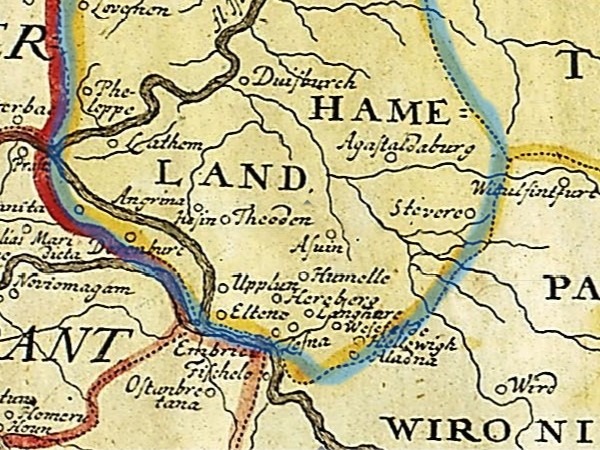
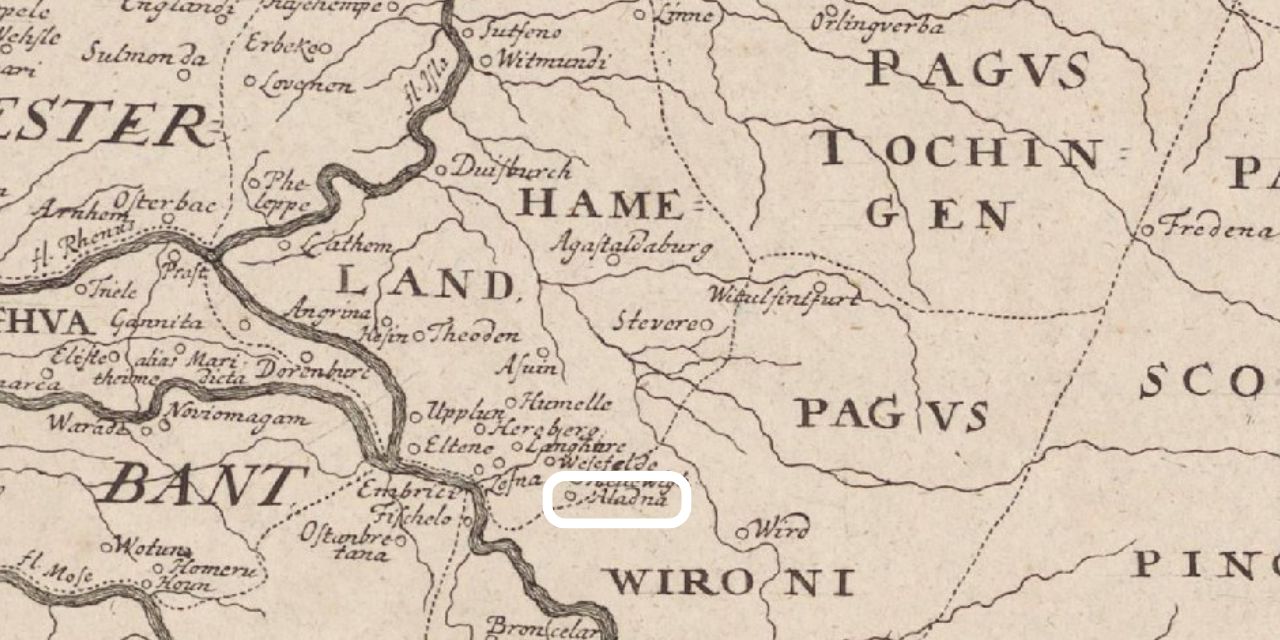
    In the eastern regions of the Netherlands, however, it is assumed that the Hamaland theory is the most likely. It is not without reason that the municipality of Aalten named a road after this mention: the Aladnaweg. And in the municipality of Montferland, a street is named after Geroward: the Gerwardstraat in Klein-Azewijn. The theory is centuries old: around 1730, Johann Friedrich Falken created a historical map of ‘the Netherlands in late Roman times’, on which he drew the county of Hamaland, including Aladna.

    Conclusion

    The mention of Aladna in 828 remains an interesting subject of discussion. Many people consider the Hamaland theory to be the most likely explanation (or is that perhaps mainly wishful thinking?), but the North French interpretation cannot be entirely ruled out. Hopefully, future archaeological and historical research can provide more clarity regarding this early mention.

    Origin of the place name

    Several theories circulate regarding the origin of the name Aalten. But what are they based on and how credible are they? Old Aalten delved into history to discover more about this.

    Read the full article: Origin of the place name Aalten.