
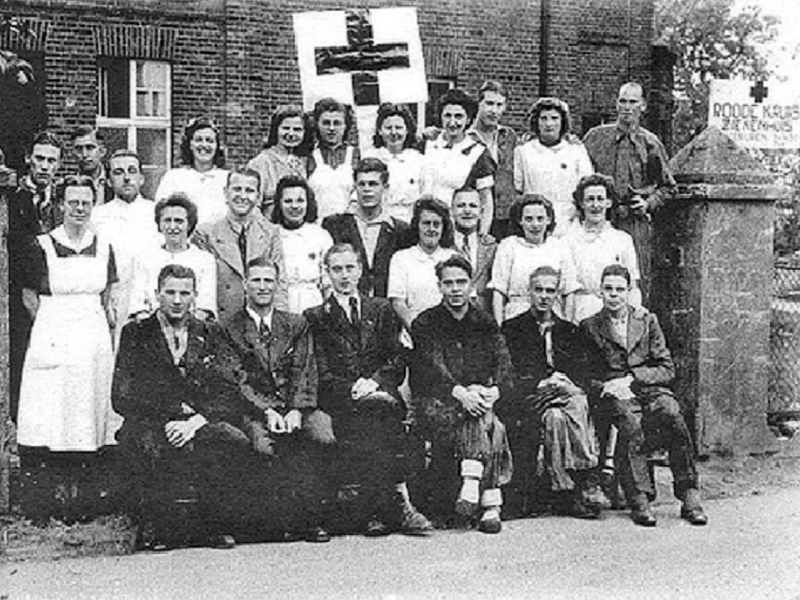
De Graafschapper, 25 July 1945
Now that the emergency hospital in Aalten is closing its doors, it is fitting for us to pause for a few moments to reflect on the origin and work of this institution, which served as a blessed outcome for countless Dutch forced labourers and prisoners from concentration camps. As is known, the initiative for its founding was taken under the auspices of the Red Cross, by Dr J. der Weduwen and Mr Cl. Driessen.
The necessity for its establishment became acutely apparent at the end of November, when some of the victims of the train bombardment near Bocholt had to be admitted in Aalten. When Dr J. der Weduwen arrived at the Avondvrede retirement home on 5 December 1944 with 22 liberated prisoners from Rees, the situation presented nearly insurmountable difficulties. Beds, food, and trained staff—everything was lacking.
The residents of the home, on that memorable St. Nicholas Eve for the ex-prisoners, brotherly shared their pancakes, oliebollen (doughnuts), and chocolate (!) with the newcomers. By exerting every effort, they succeeded in providing the battered patients with proper care. Mr and Mrs Ditmarsch, deeply moved by the fate of these people, did everything possible.
With emotion, many will remember Sister A. Bol, who died of diphtheria and performed true miracles for her patients during this time. After her death, it proved necessary, given the danger of contagion, to attach expert personnel to the emergency hospital. Sister Schaafsma and Sister Doesburg were entrusted with the management under the supervision of Dr P. Hogenkamp, who took over the medical work of Dr der Weduwen following the tragic passing of this beloved doctor.
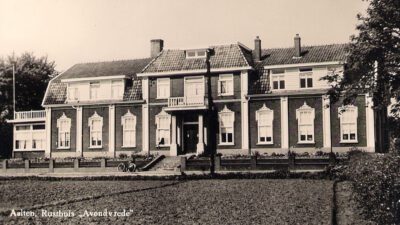
Although more space was made available at Avondvrede, the capacity of the hospital proved too small, as one also had to take into account war victims from the local area; therefore, the hospital was relocated to the Patrimonium building. In cooperation with the U.V.V., I.K.O., and the Red Cross, the material side of the work was taken care of. After the final bombardment, the Patrimonium building became unusable, and it was decided to liquidate the hospital, as the majority of the patients, under the leadership of Sister Schaafsma, preferred to leave for the North.
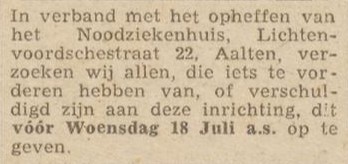
Sister Doesburg remained at her post with a few patients, and the hospital was moved back to Avondvrede. From there, they departed once more—joined by a number of victims from the bombardment in Bocholt—to the building on the Lichtenvoordsestraat, which still serves as an emergency hospital today. About twenty patients were housed in the cellars there. Enormous support was received from the surrounding hamlets.
In the beginning, the conditions were extremely primitive. Later, everything improved. Special praise is due to the girls of Aalten, who performed nursing work without any prior training. Just before the liberation, some victims of the liberation battles were admitted. An unforgettable moment was, of course, the arrival of the first ‘Tommy’ (British soldier) who was brought into the hospital.
And now the work has come to an end. The large stream of repatriates, for whom they had prepared as their final task, did not arrive, and the now well-equipped emergency hospital is disappearing in these coming days. (Why not make it a permanent hospital?) A piece of Aalten’s war history is hereby concluded, but many will continue to remember this work with gratitude.