
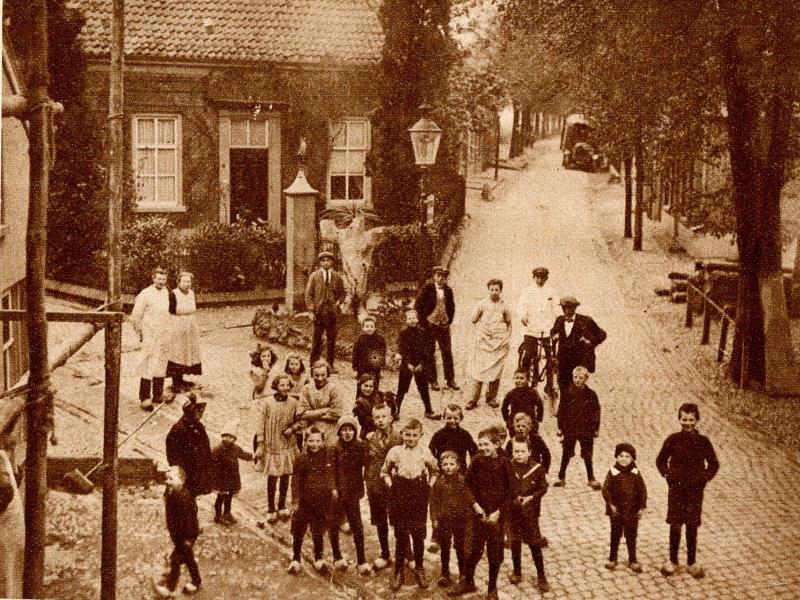
In 1939, the water supply in Aalten underwent a major improvement with the installation of a mains drinking water network by the N.V. “Waterleiding Oostelijk Gelderland” (Eastern Gelderland Water Supply Company), in cooperation with the Aalten municipal council. Before that time, the people in the village of Aalten obtained their water from so-called neighbourhood pumps, one or more of which stood in the various streets. These pumps were owned by the municipality, and there were very few people in the village who had a pump of their own inside the house.
Each pump was used by an average of ten or twelve families, and one can well imagine that during periods of severe drought – when, in the long run, the pumps began to yield mud instead of water – this occasionally gave rise to friction among the female neighbourhood residents. Any disputes that arose, however, were usually settled within a short space of time by the “pumpmaster”. The neighbourhood residents, who were also responsible for the maintenance of the pump, were appointed as pumpmaster in rotation. The pumpmaster also collected the contributions towards the expenses from his fellow users.
However, the use of some pumps had to be prohibited because the water was harmful to health. When later, upon closer inspection, the pump water in general proved to contain constituents that were less favourable to health, this was all the more reason to proceed with the installation of a mains drinking water network.
One advantage of the former pumps was that they stood in the street. In the past, even more so than today, the inhabitants of the village of Aalten kept the street in front of their own houses clean. The pumps came in very handy for this, as they had the water for scrubbing the street close at hand.
Until recently, there was also a pump standing on the Markt (Market Square) in Aalten. Regrettably, the municipal council had this pump dismantled last year, presumably because it was in a dilapidated state. Had this pump been restored, however, a small piece of history would have been preserved in the centre of Aalten.
Whilst the houses in the village of Aalten are connected to the water mains, this is not yet the case in the hamlets (buurtschappen). It is true that in the rural district of Lintelo, persistent efforts have been made in recent years to persuade the W.O.G. to connect a large number of farmers and others in this hamlet, but although the W.O.G. was in principle sympathetic to the idea, the execution of the plans foundered on the high costs of installation and operation.
One street pump remaining
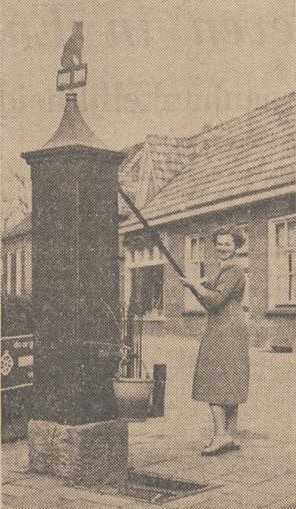
One street pump remained standing in Aalten, namely the pump on the Kattenberg. When their pump was under threat, the residents of this neighbourhood put their heads together and decided to try to preserve the pump from a folkloric perspective. In this they succeeded, and voluntary contributions were subsequently raised to thoroughly do up the pump, on which no maintenance work had been carried out in recent years.
Now, no one should think that the residents of the Kattenberg are conservative and do not want mains water. That is by no means the case; all have connected their homes to the W.O.G. network, but they nevertheless wish to retain the pump because, as they say, adapting a well-known proverb, they do not want to throw the pump out with the pump water. And it seems to us that they are quite right.
Mrs Vieberink-Bennink — better known in Aalten as Annie Bennink — recently moved to Gendringen with her husband. Shortly, probably next week, the young couple hope to emigrate to Canada, where Mr Vieberink will become a farm manager in New Brunswick. These past few days, Annie Bennink was back home at her parental house on the Kattenberg, and on that occasion she wished — in all probability for the last time — to have another go at the handle of the old, familiar pump on the Kattenberg, of which her father is now pumpmaster. It was on that occasion that we took the picture reproduced here.
Other Village Pumps
We have examined countless old photographs to trace the locations where neighbourhood pumps once stood in Aalten. The overview below is still a ‘work in progress’ and subject to change. If you know of any other locations to supplement this list, please leave a comment at the bottom of this page.
- Bredevoortsestraatweg, outside number 31
- Damstraat, outside numbers 1 and 21
- Haartsestraat, outside number 1 (Puttegang)
- Hogestraat, outside numbers 2, 33 and 48
- Kerkstraat, outside number 10
- Landstraat, outside numbers 4, 21 and 28
- Lichtenvoordsestraatweg, outside number 13 (Kattenberg)
- Markt, outside number 4
- Prinsenstraat, outside numbers 20, 30 and 41