
NRC Handelsblad, 11 August 1986
A new wandering editor encounters remnants of Achterhoek nationalism.
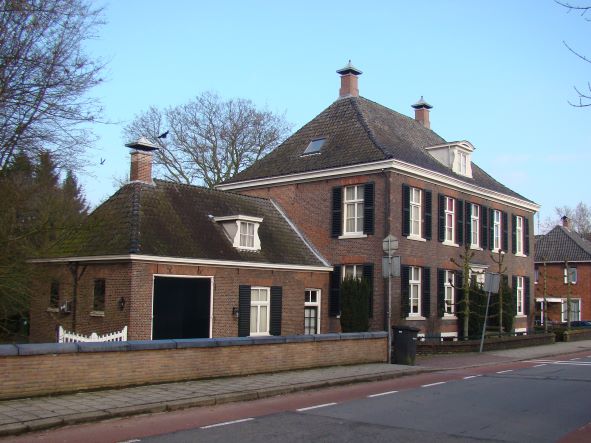
By HENRI BEUNDERS — “The world ended at Arnhem! Long after we came to live here in 1969, friends who called to say they wanted to visit us would ask: ‘Can we bring anything for you?’” Mrs. Pruim says it with a mocking smile, but an indignation that has still not faded shines through.
For two months now, she and her husband—once a lawyer in The Hague and for many years a subdistrict judge in Terborg—have been running a guesthouse in their grand 1826 building “Beekhuize” in Aalten. They never want to return to the west. “The people of the Achterhoek are very tolerant, warm, and hospitable. Here, many cases end in a settlement,” says Pruim while serving breakfast.
Is the IJssel a greater barrier than the national border they live so close to? Anyone walking through the Heelweg in Dinxperlo for a while—left sidewalk Netherlands, right sidewalk Germany—would almost think so. People walk, cycle, and shop across the border as if it does not exist. Mrs. Pruim gets her small breakfast rolls in Bocholt. The customs officers hardly even come out of their booths for the passers-by anymore.
The subdistrict judge therefore never has to deal with border problems. “Well, never—recently a trunk had to be opened. There was a woman inside. ‘I always lie in the trunk when I go out for a drive with my husband,’ she had said. She simply didn’t have a passport. She certainly got a fine for that.”
Backward
However, people in Aalten do not have much regard for the Germans. The exchange of information does not amount to much. In Aalten, an advertising flyer from Bocholt drops through the letterbox; in the “Grenspost” corner, De Graafschapbode reports that the Anholt windmill has sails again. Whether this is because Aalten is Protestant-Reformed and Münsterland is Catholic? No one knows. Perhaps, as some Aalteners believe, it is the mentality reflected, for example, in the placard the Germans hung at the Heurne-Aalten border crossing before the football final in Mexico: “Jetzt betreten Sie das Land des Weltmeisters”. A Dutch customs official gleefully recounts how they were quick to scribble the word “vice” in between afterwards. “Everyone thought it was wonderful that they had lost.”
Except for those from the west, the IJssel also remains a border to another world for many residents of the Achterhoek. The appreciation for that other world has changed significantly lately. “In the past, everything that came from the west was beautiful. Without three apartment blocks, you were considered a backward village. Because of that, much beauty was destroyed,” Mrs. Pruim believes. That time seems to be over. The wave of nostalgia that hit the banks of the IJssel after the storm surge of modernization managed to save some old beauties just in time. Driving around here, you see how people everywhere are busy relaying winding and sloping streets with cobblestones in the village centers, and how the cultural regional renaissance is in full swing.
“We’ll put barbed wire by the IJssel. The people from the west aren’t coming in anymore!” Little more is heard from the Achterhoek “Nationalists” who uttered this threatening language a few years ago—it was the breeding ground for the success of the pop group Normaal. At the harvest festival in De Heurne, a hamlet between Aalten and Dinxperlo, an occasional individual nevertheless walks around with a “paspoart” issued by the Road voor Achterhooks Belang in their pocket. But for most, this disguised sense of inferiority seems to have long since given way to a firmly anchored pride in their own identity.
In the maize landscape, half a hectare of rye has been grown on the small field for demonstrations of mowing with a scythe, binding sheaves, flail threshing, plowing, and harrowing. People laugh and make jokes when even some elderly farmers appear to have almost forgotten these old techniques. Only the hands of the basket and cap maker still move quickly and routinely; they never gave up their craft. The countless telephoto lenses, video, and Super-8 cameras with which the more than 1,500 locals and tourists are filming each other suggest that the harvest festival in De Heurne is already in the dubious transition phase from genuine folk fun to tourist attraction.
Klootschieten
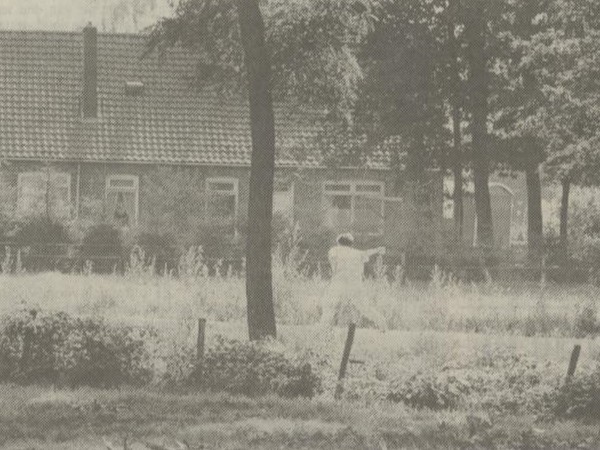
Searching for an expression of revived folklore not yet discovered by the masses, one of the countless colorful tree posters (fair, motocross, variety show—you name it, it’s announced on a beech or oak) points to the border south of Winterswijk. There, almost the entire rural district, more than 80 men, women, and children, has turned out to participate in the klootschieten competitions.
Two teams of 5 or 6 members each try to complete the four-kilometer course through the beautiful ‘bocage landscape’ between Woold, Kotten, and Achterwoold in as few shots as possible. It is not difficult to see why ”t aole spel’ (the old game) is regaining popularity so quickly.
Anyone who can throw can play klootschieten. A rake is placed across the road, one takes a short run-up to that point, and throws the wooden, lead-weighted ‘tennis ball’ of about half a kilogram as far as possible down the street. The others run after it shouting “Astubleef” (if you please); one cheers over his throw of at least 80 meters. “You’re just throwing your hat at it,” calls another who has to search for his predecessor’s kloot in the maize on the other side of the ditch.
At the Esselinkhaar farm, the thermoses are ready on a kitchen table. They are halfway through, time for a break. Organizer Massop of the Winterswijk Klootschieters Association addresses the enthusiastic but inexperienced newcomers warningly once more. “This course is insured, but one must watch out better when a throw is made, because a kloot can hit hard.” As proof, he shows his shin where six months ago a kloot, bouncing over this same stretch of brick road, slammed into it. He is still troubled by it. That is why only coffee is served. “In the past, it was ‘boozing and more boozing,’ which invariably led to trouble.” That was also, he explains, the reason why this cheap entertainment of the ‘common folk’ was often banned in the past.
The fact that the word has since mainly provoked laughter—“there’s no balls to it” the subdistrict judge had assured—no longer bothers Massop. “It is a serious sport. Our federation therefore refused to give in to the Dutch Sports Federation, which wanted us to call it ‘shot put’.” And he presses a flyer and a sticker into one’s hand. ‘Klootschieters do it on the road’. Next year, the national championships, in the cradle of Twente, will be held in the Achterhoek for the first time. For the Kotten border residents, it is primarily a Sunday game. “The weather is nice, you see each other again, it’s sociable,” says one of the women serving coffee. “Next week we have horse teams here.”
Tyrolean Evening
The small amount of alcohol is more than made up for in the evening at the Tyrolean evening organized by the Winterswijk branch of “Jong Gelre” at camping Nieuw Beusink. A good 40 barrels of Grolsch, 200 glasses per barrel, have been brought in for the expected 800 visitors. People sit at long tables, they dance, they drink, the noise gradually swells, but it remains convivial. The Grensland Muzikanten play the Egerländer music by Ernst Mosch that is so popular here. Young and old dance to it. The Achterhoek formation Free Sense plays something more modern and louder for the second half of the evening. Shortly after midnight, the group starts Bob Marley’s “Stir It Up”. “The beer is gone! Oh, how I’m gutted, the beer is gone,” the singer sings. A normal summer weekend along the Achterhoek border is over.
“One must watch out better when a throw is made, because a kloot can hit hard.” (Photo NRC Handelsblad/Vincent Mentzel)