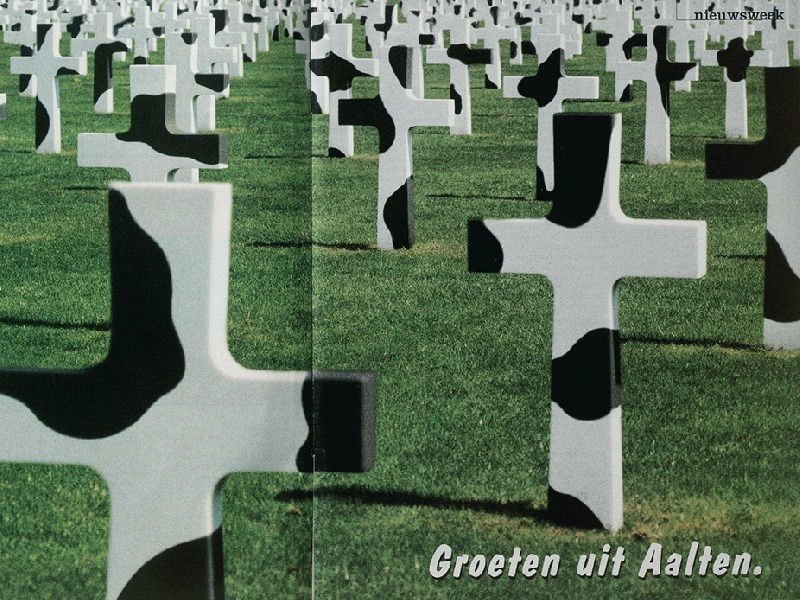
On 11 April 1996, Aalten was briefly global news. At the Kropveld-Schipstal Aalten (KSA) abattoir, 64,000 British calves were to be culled. This was carried out by order of the Ministry of Agriculture due to the potential contamination with ‘mad cow disease’, or BSE.
Never before in Dutch history had calves been transported to the abattoir with such spectacle as the first 108 head of cattle brought to Aalten from the Veluwe that day. The operation, which was to last six weeks, caused a great stir in the Netherlands and beyond.
For KSA, the slaughter of the 64,000 calves was a massive, and certainly financially attractive, job. The company normally slaughtered 2,000 calves weekly for the Japanese market. Those operations were suspended for six weeks for this special commission, during which approximately 10,000 calves had to be slaughtered per week.
Demonstrations
The lorries in which the animals made their way to the slaughterhouse were escorted by two riot police control vehicles. Upon arrival at KSA, they were met by a crowd of activists and curious onlookers. Members of animal welfare organisations, such as the Vegetarian Association, Lekker Dier, and PETA, had taken up positions at the abattoir fence with banners and sandwich boards. A funeral wreath hung on the metal gate, wooden crosses lay on the street, and the protesters wore black clothing.
As the first three lorry combinations carrying calves approached the iron gate of KSA, the jeering of the crowd swelled. “Murderers, murderers”, chanted a motley mixture of animal rights activists and local teenagers towards the drivers. Half a minute later, the gate slammed shut again. The slaughter could begin.
The private security service hired by the KSA management after a bomb threat had been received at the company the day before ensured that none of the protesters could enter the abattoir grounds. When the gate was closed again, a young PETA sympathiser collapsed and gave free rein to her tears. A group of locals reacted indifferently to the silent grief. Pointing at the piercing the girl had had placed through her lower lip, a corpulent Aalten resident lisped: “A piece of rope through that ring and she wouldn’t look out of place among those calves…”
Press conference
On the day of the arrival of the first British calves, a press centre was set up in café De Driesprong. Mayor Tijme Bouwers presided over the press conference. The municipality of Aalten provided logistical measures to clear the way for the dozens of lorries delivering thousands of calves daily. KSA director H. Swinkels emphasised that stringent safety measures had been taken regarding the potential risks of contamination.
To see for themselves that the slaughter was painless for the animals and, due to the measures taken, risk-free for the staff, journalists were allowed a look inside the abattoir later that afternoon. Wearing special overalls that were destroyed after use, the tour led past the slaughter hall and the specially refrigerated storage silos for the blood. This viscous mass—a total of 450,000 litres—was transported by tanker to Rotterdam to be incinerated. The carcasses were sent daily in sealed containers to companies in Son and the Frisian town of Bergum.
After a number of hectic days, peace returned to Aalten.

Leave a Reply