In former times, November was the season for slaughtering. At that time, slaughtering did not yet take place at slaughterhouses, but simply on the farmer’s yard. It was usually outsourced to a ‘home slaughterer’, a butcher who performed the slaughter at the client’s home. Regarding home slaughtering in Aalten and the customs surrounding it, G.H. Rots wrote the following in 1937:
“The busiest and most significant days of the year were when slaughtering had to take place. When November arrived in the land, the slaughtering period began. The ‘wieme’ (drying rack) was empty, and in every household, people thought about slaughtering one or more pigs or a ‘small beast’. The home slaughterers had their hands full.
If the slaughtering had taken place in the morning, the ‘fat-praisers’ would arrive around half past eleven. The neighbors would then judge whether the ‘kidneys were well-covered in fat’. The thickness of the bacon was estimated, and finally the lady of the house appeared with the ‘bottle’, for teetotalers were unknown in those days. On slaughter days, people made sure they had something ‘in the bottle’. The slaughterers received their first ‘drink’ in the morning, the fat-praisers in the afternoon, and in the evening came the great celebration: the slaughter visit.”
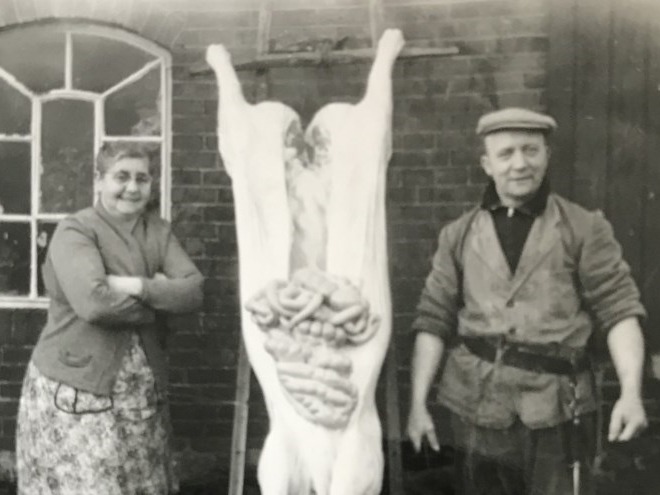
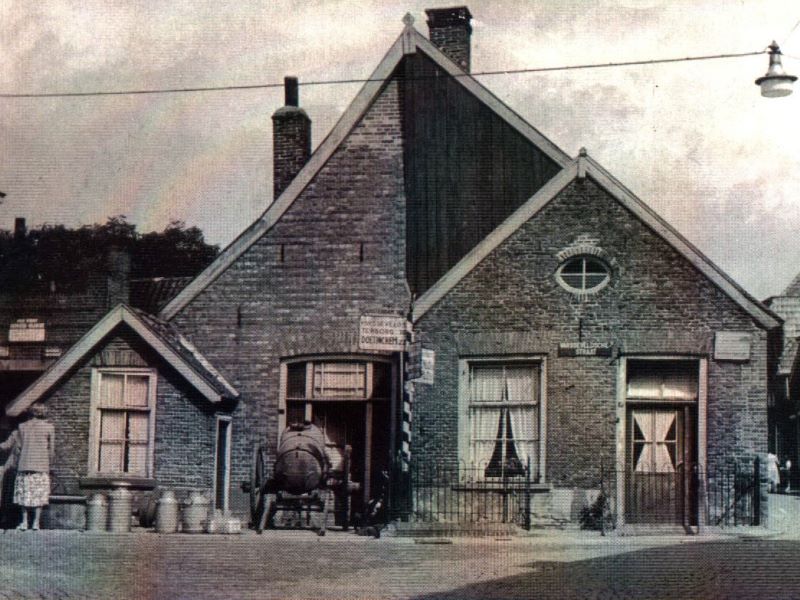
Drika Wijnveen-Stapelkamp and home slaughterer Bertus ter Maat
How the slaughtering process worked
In the 1950s and 1960s, it was still permitted to perform home slaughtering yourself. A large boiler pot with plenty of water was brought to a boil. The pig was killed using a captive bolt pistol, which fired a pin into its head. The pig became unconscious. The animal’s throat was then slit, and the blood was collected in a special flat pan.
The pig was cleaned and doused with boiling water so that the hair could be removed more easily, a process known as ‘scraping’ the pig. The animal was then hung from a ‘ladder’ and cut open.
The entrails were collected in a large tub. The intestines were cleaned. First, they were rinsed with water and then scraped clean so they could be used to make sausage. The intestines were tied shut with sausage pins and hung from the ceiling.
Every part of the pig was used. The head meat was used to make ‘head cheese’ or brawn. The sausages and hams were hung from the ceiling to dry. Slaughtering and processing a pig took a week of work but provided meat for personal use for an entire year. One way to prevent meat from spoiling was salting. The meat was placed in a tub of salt, and the salt was rubbed thoroughly into the meat. Meat could also be preserved in canning jars. This allowed the meat to be kept for many months.
A well-known home slaughterer in Aalten and the surrounding area was Bertus ter Maat. The above interview with the then 77-year-old Aalten resident was filmed in 1991 by FilmAalten.
Slaughter visit
Regarding the slaughter visit, Rots wrote: “Those slaughter visits were the social evenings for the population. Neighbors would gather and enjoy each other’s company. It began with a cup of coffee and a rusk. Then the bottle appeared on the table. On those evenings, the events of the time were discussed. One person knew this, another had heard that, and a third had ‘recently read the newspaper’, and thus knew for certain. And the women told each other the secrets of the civil registry and related matters. Meanwhile, the hostess would invite them again: ‘Have another drink’. ‘The pigs turned out well’. And finally, when it was time to go home, everyone was in the merriest of moods.
One should not imagine that all the pigs that had been fattened were intended for personal use, as you can understand. At least one pig had to be sold, and from the other that was kept, the hams or gammons were also sold, because keeping the hams yourself ‘was just for the sake of using them up’; no, they had to be turned into cash. And if a heifer or ‘bull’ was slaughtered, the nagelhout (smoked beef) was certainly sold. There were several buyers who salted and smoked these finer meats and sent them to the larger towns. The money the pigs brought in was often intended for the payment of hay, mortgage interest, etc., or at least for extraordinary expenses.”
Sources
‘From Aalten’s Past’, by G.H. Rots, Aaltensche Courant, 5 November 1937 (via Delpher)
Photo: collection Leo van der Linde, with thanks to Anton Stapelkamp
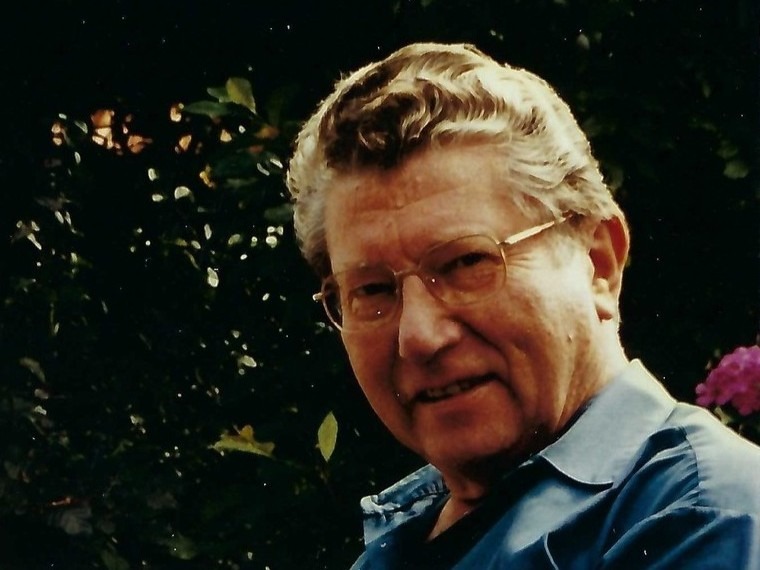
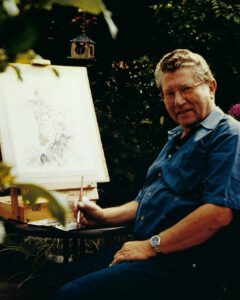
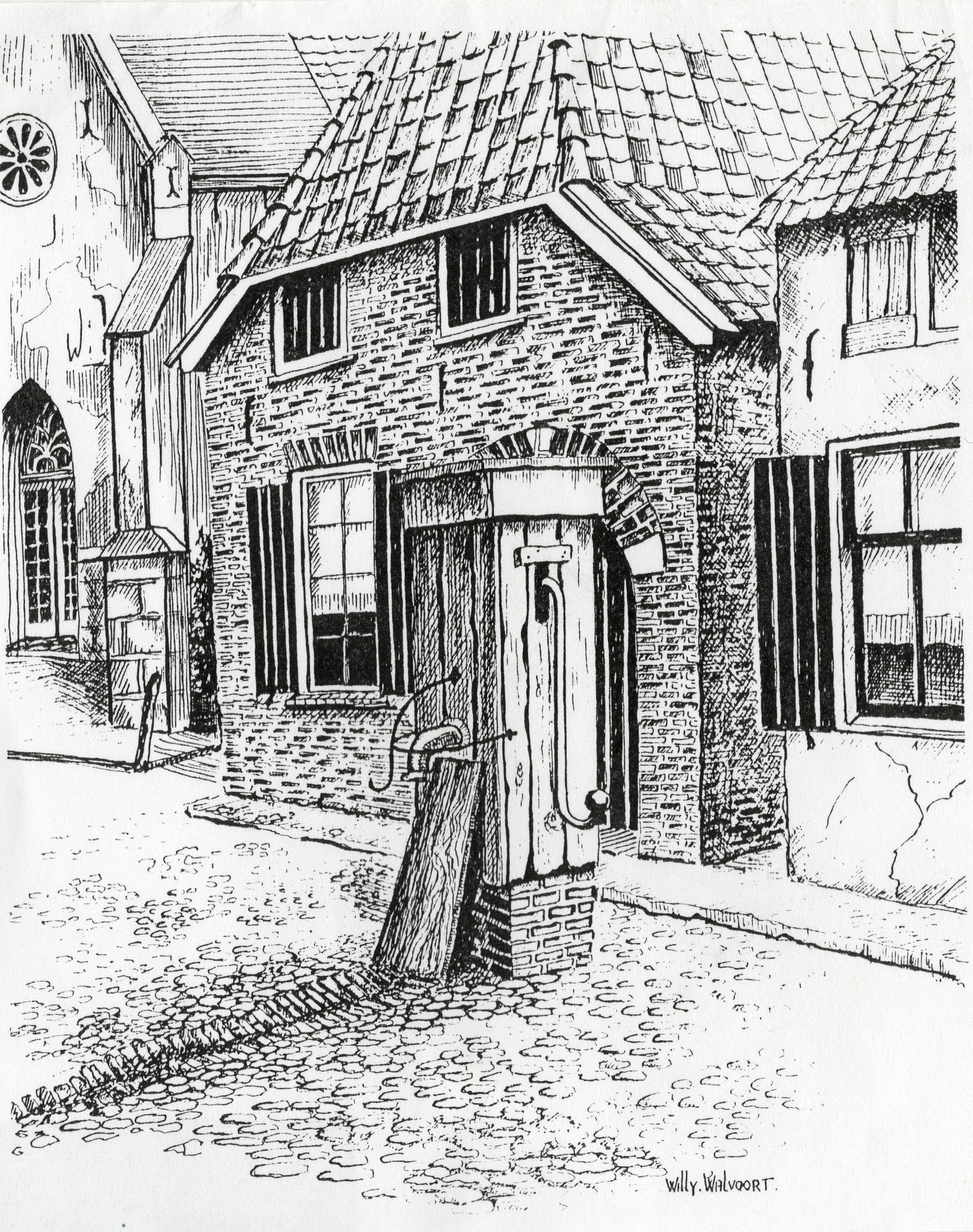
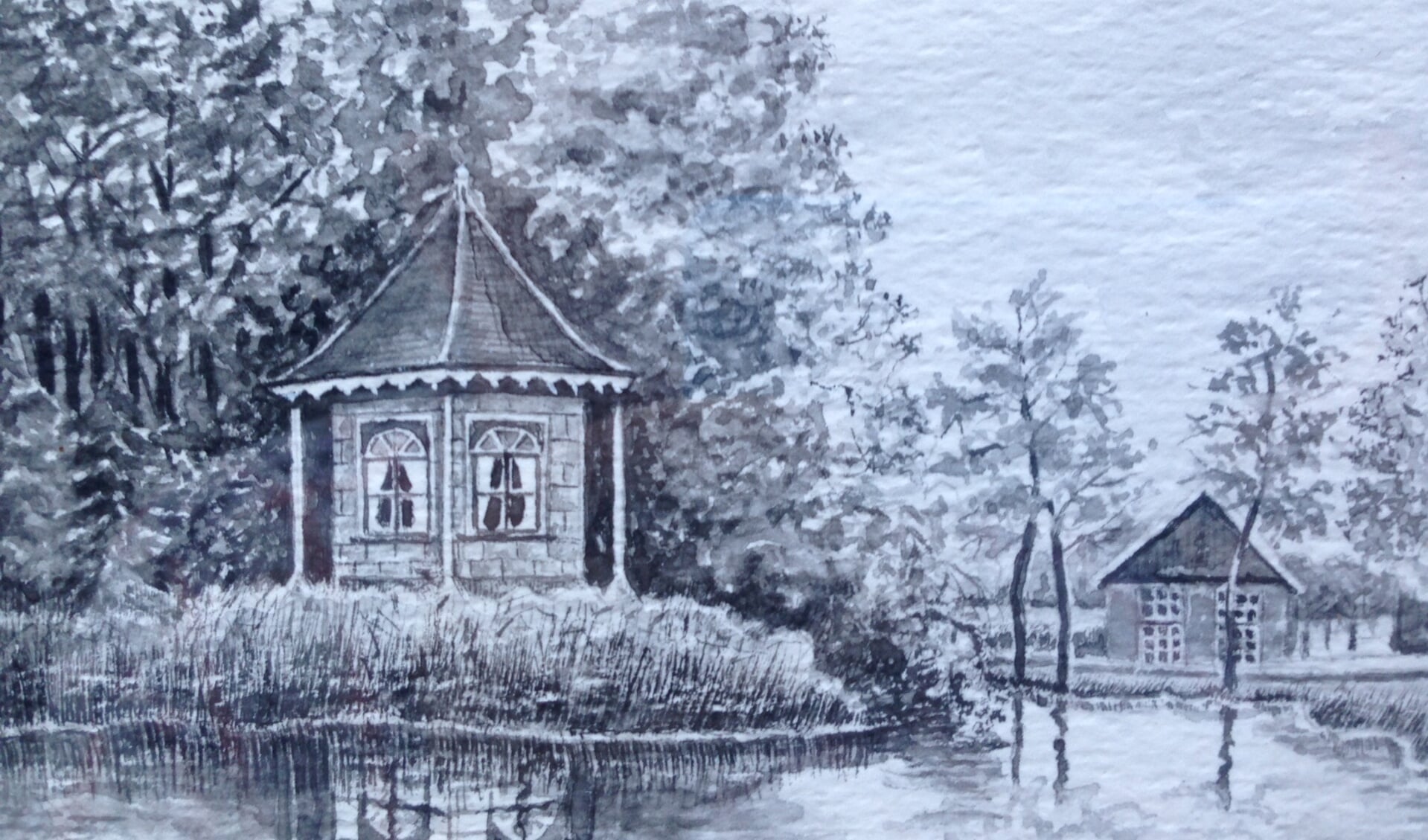
Jan Willem (Willy) Walvoort was born on July 17, 1935, in Aalten, as the son of factory worker Johannes Walvoort and Berendina Geertruida Prinsen. He worked professionally as a maintenance man for the Vereniging Volkshuisvesting (later De Woonplaats), but gained local fame as a draftsman and painter. Walvoort captured numerous locations in Aalten, Bredevoort, and the surrounding area. He passed away on January 16, 2018, at the age of 82.
Willy Walvoort (1935–2018)
Youth, education, and profession
Walvoort showed an interest in drawing and painting from an early age. Mr. Siebrands of the Public Primary School in Aalten advised Walvoort’s parents to send their son to the Art Academy. However, his parents were not in favor of this. They considered it more important to “learn a good trade to earn a living.”
After primary school, he attended the Technical School, training in carpentry and masonry. Subsequently, he specialized in technical drawing. His career led him to the Volkshuisvesting, where he worked as a maintenance man for many years.
Oeuvre of drawings, paintings, and illustrations
Alongside his work, Walvoort steadily built an oeuvre consisting primarily of pen drawings and paintings featuring recognizable village and cityscapes. In a 1999 interview, he named the Achterhoek painter Piet te Lintum as his greatest inspiration—“the painting ambassador of the Achterhoek”. Modest as he was, Willy stated in an interview that an excessive amount of talent is not required to draw and paint. “If you are willing and able to put a lot of love and time into it, you will go a long way!”
Walvoort gained fame as a book illustrator in 1995. He illustrated the reissue of Henk Krosenbrink’s novel Het Beloofde Land (The Promised Land). In 1997, he provided the cover illustration for Jos Wessels’ book: Nazareth en zijn katholieken (Nazareth and its Catholics). Nout Wellink, then president of the Dutch Central Bank and born in Bredevoort, was presented with the first copy.
Final years and passing
In the final stage of his life, Walvoort spent some time in a nursing home in Varsseveld. He passed away on January 16, 2018; the funeral took place in private. Hundreds of drawings and paintings in private and local collections keep the memory of this artist alive.
Gallery
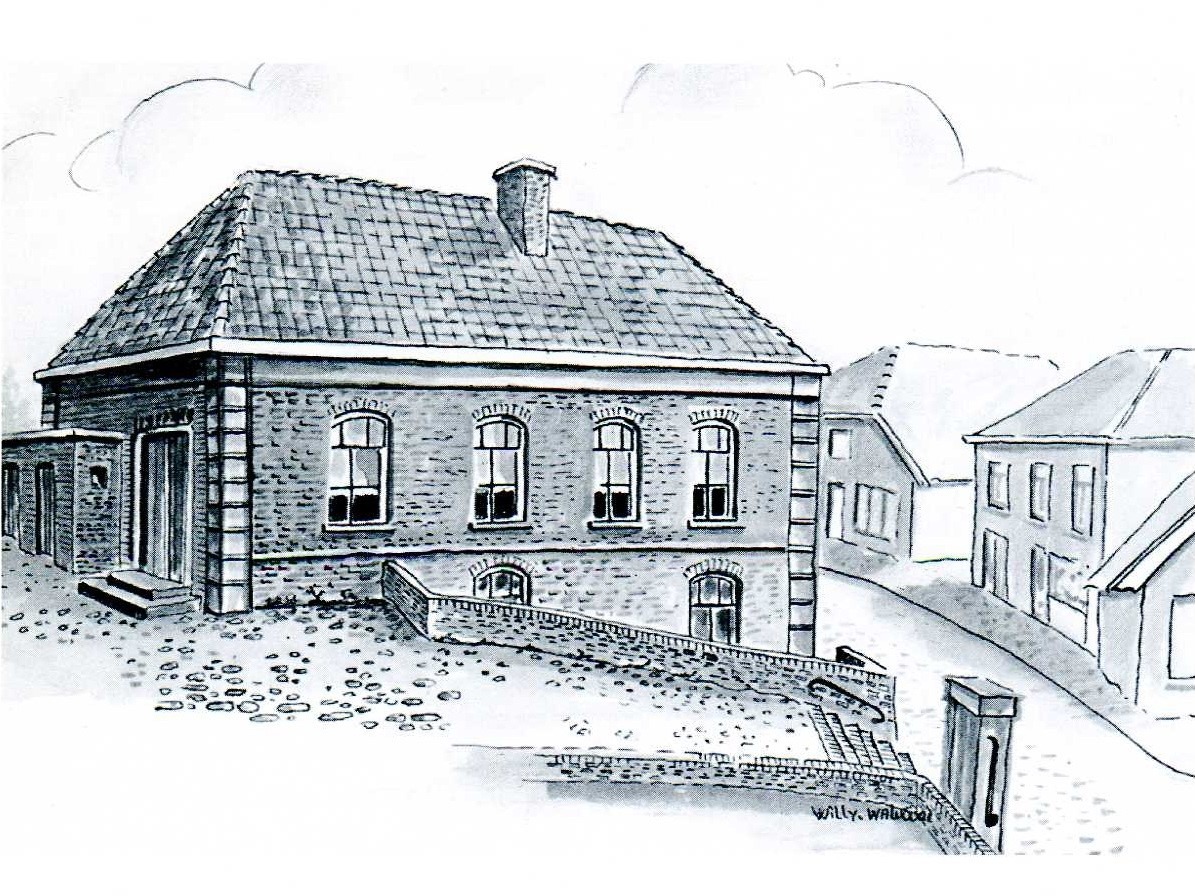
A selection of work by Willy Walvoort:
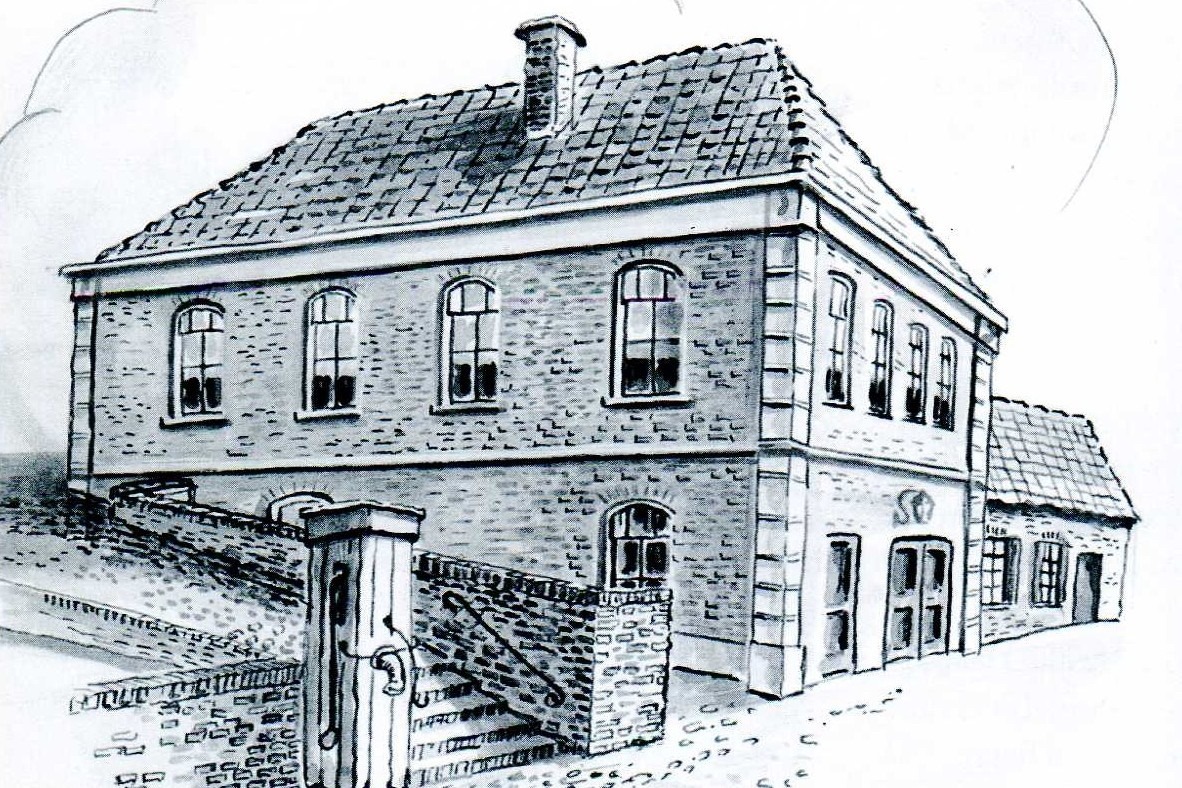
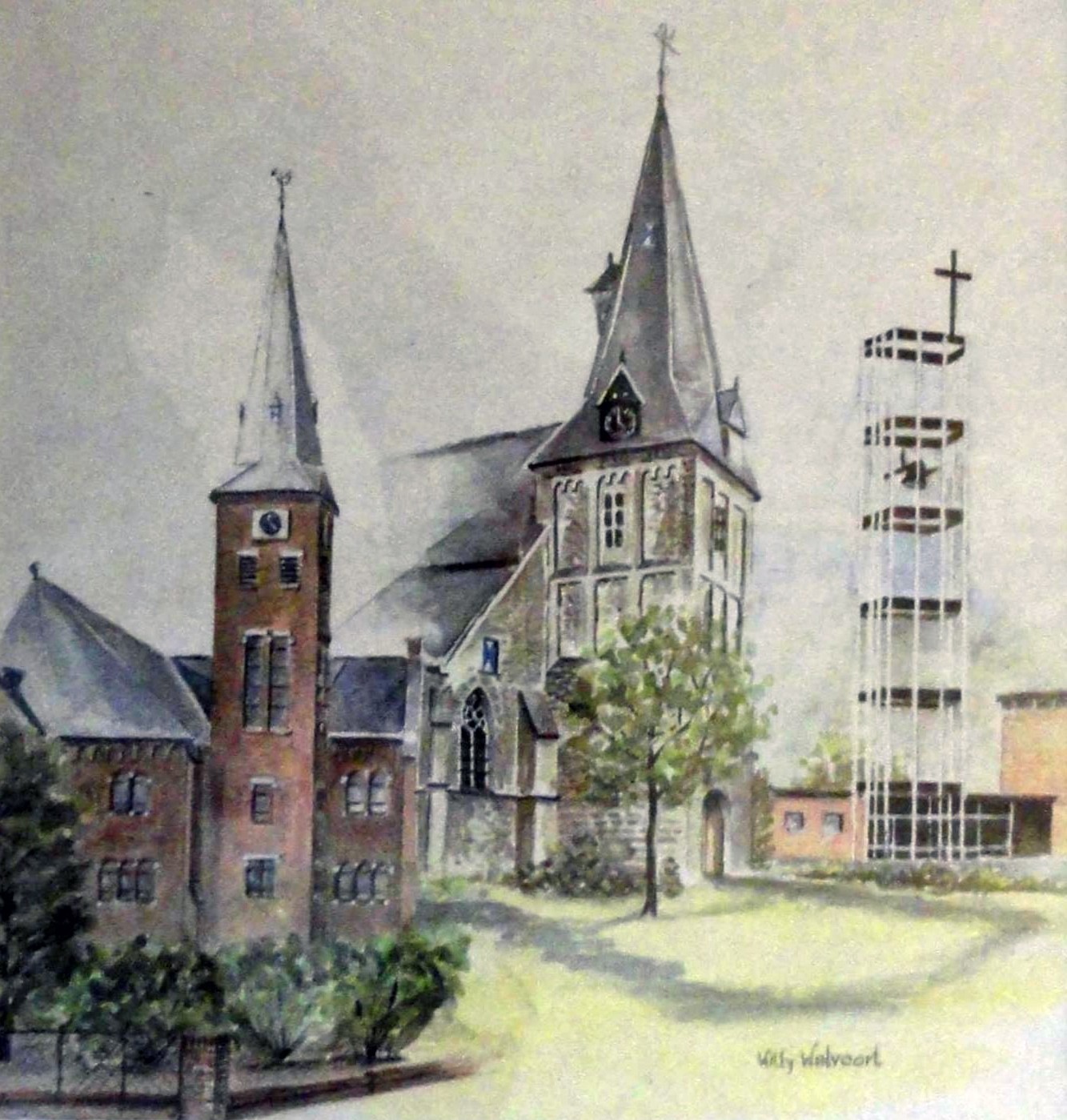
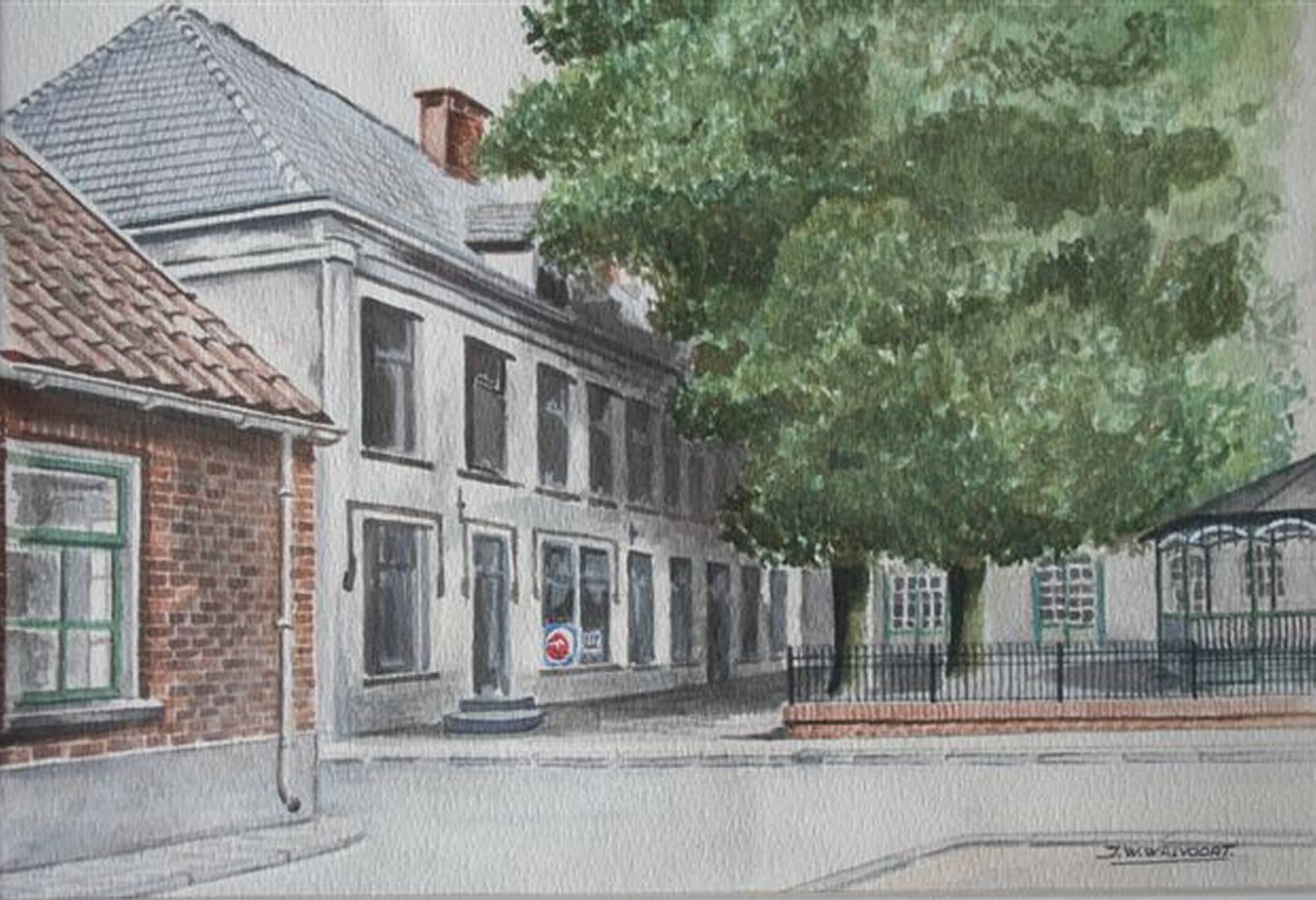
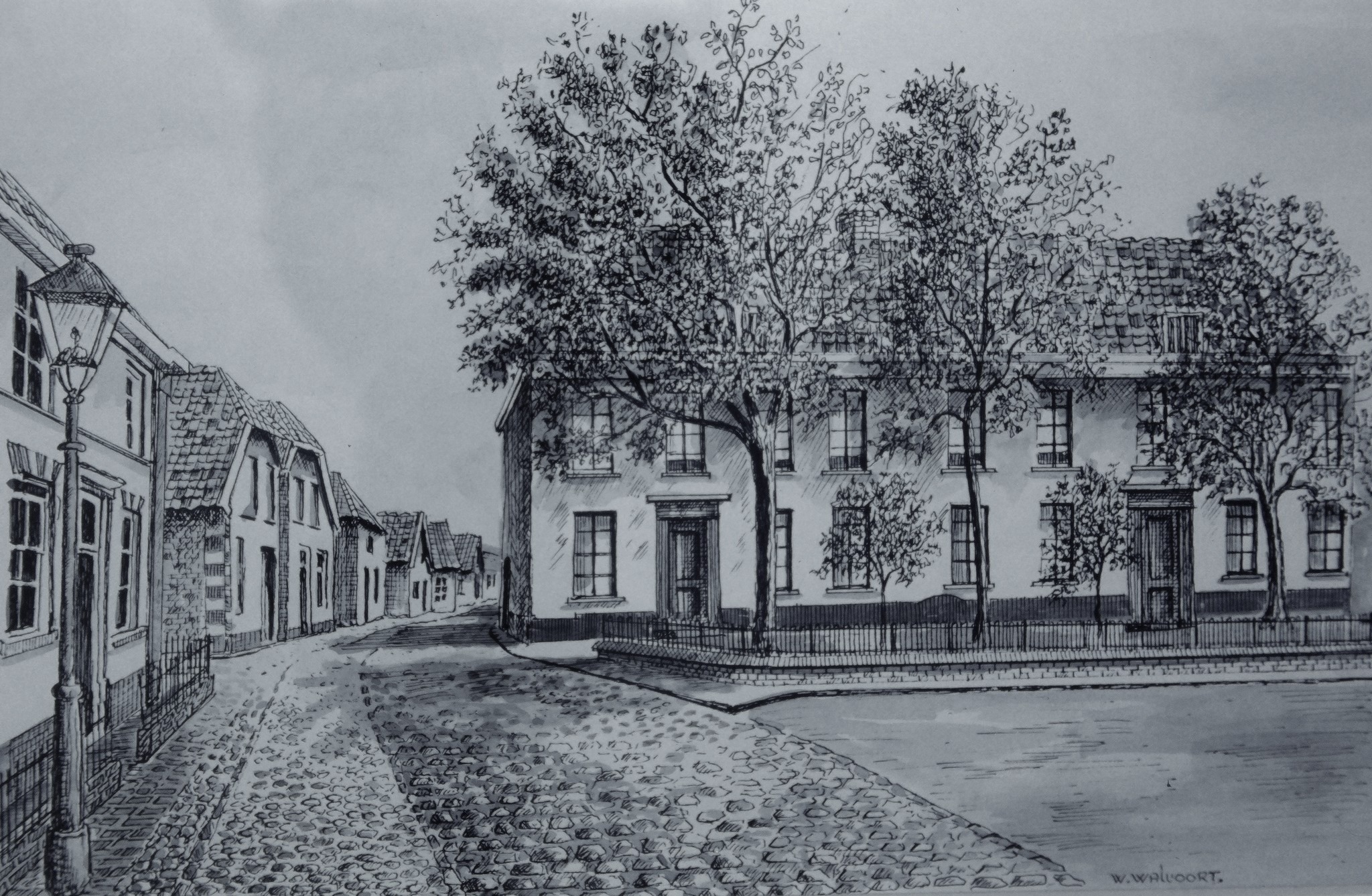
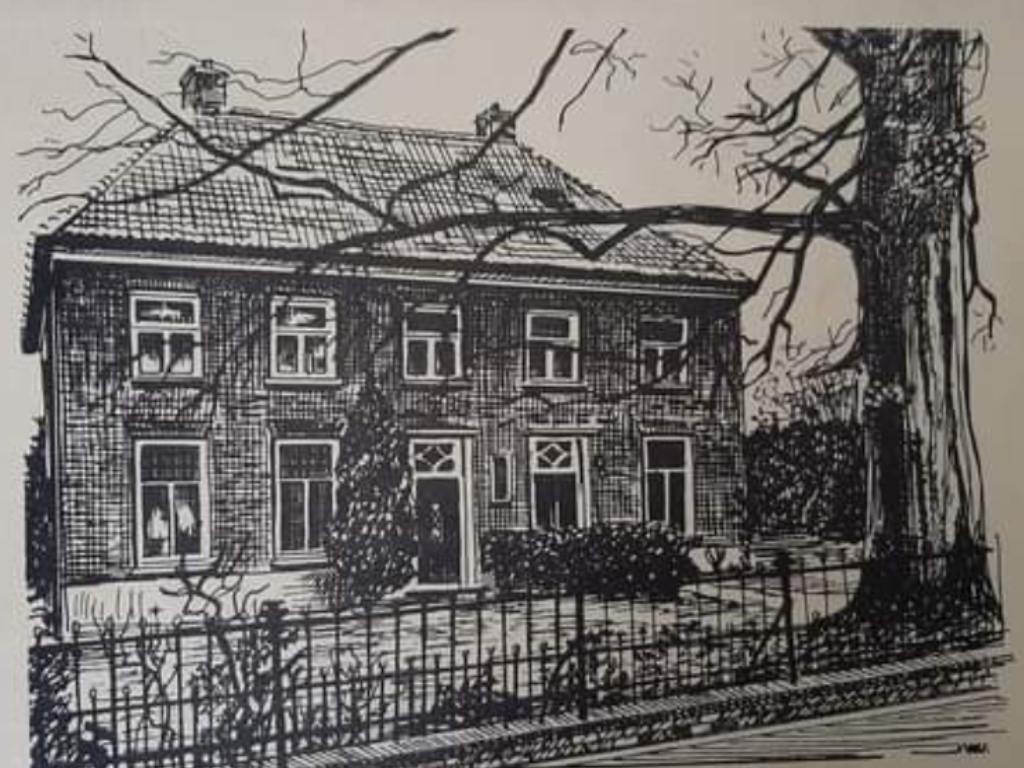
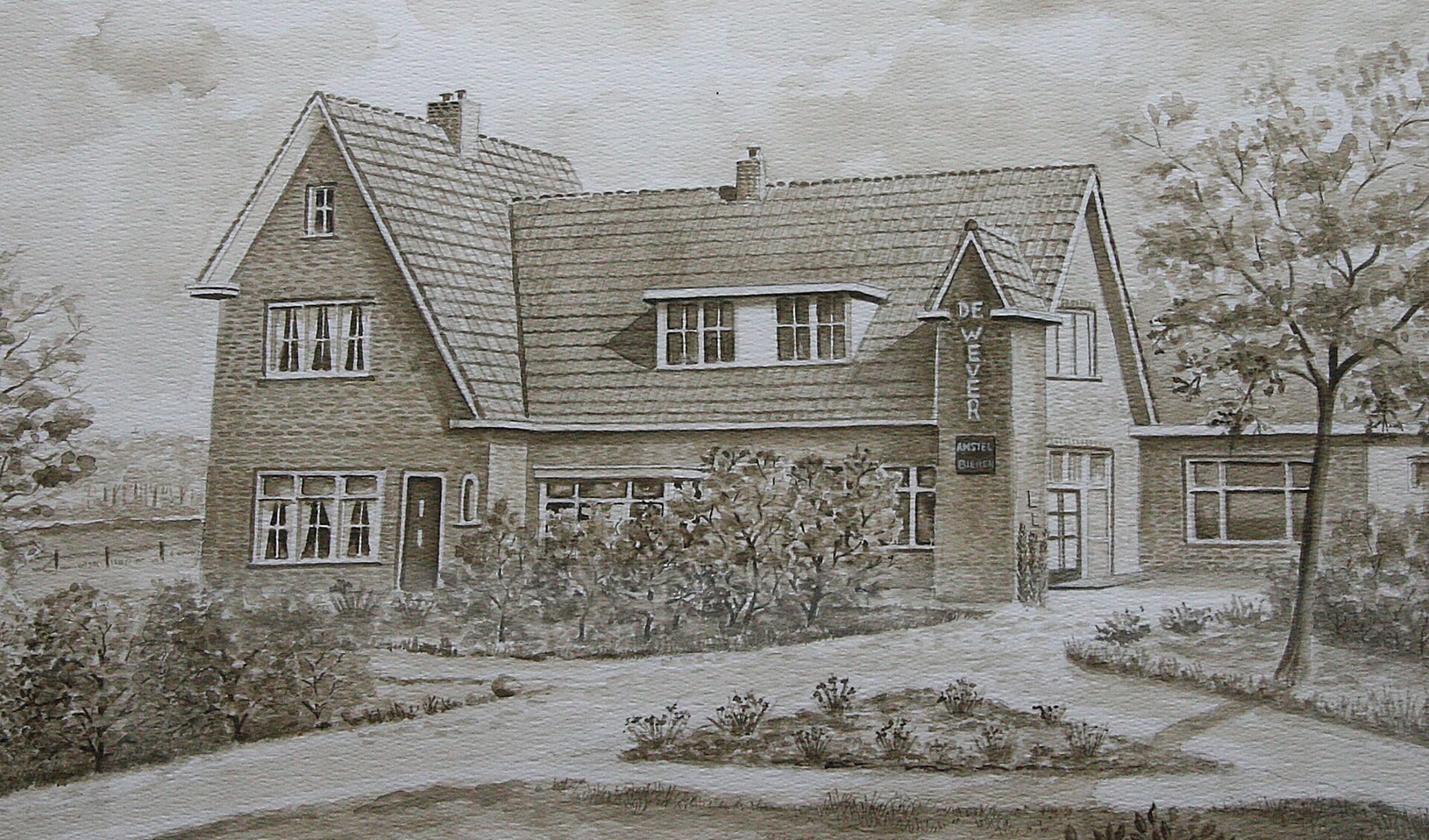
The village school on Landstraat in Aalten in 1824The village school on Landstraat in Aalten in 1824Three Protestant churches in AaltenThe Ambthuis in BredevoortThe Ambthuis in BredevoortMarkt, BredevoortTea house Bredevoort‘t Meestershuus on Geurdenstraat in AaltenDe Wever (later Schepersveld, now Suzie’s Farm), Haart
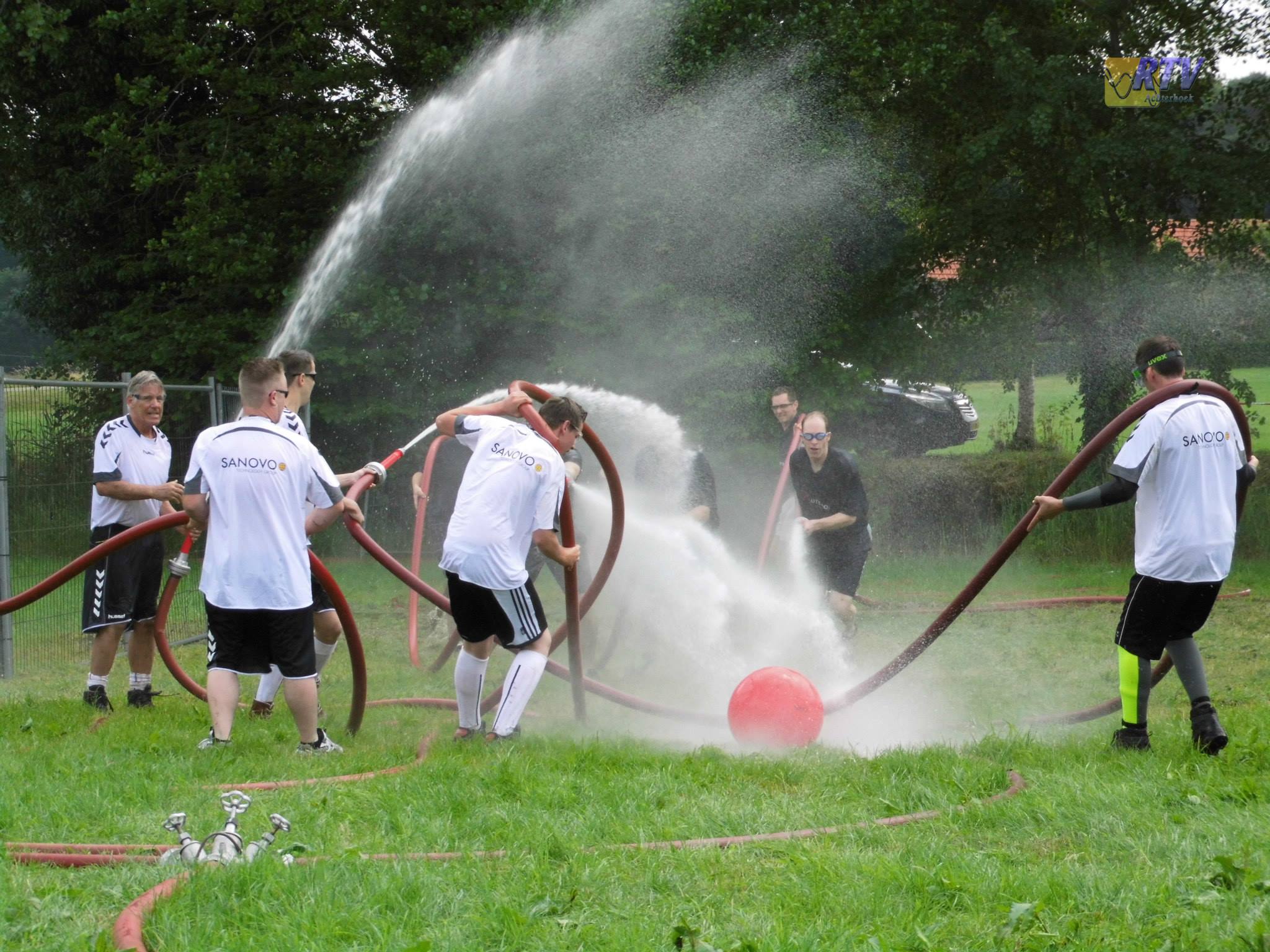
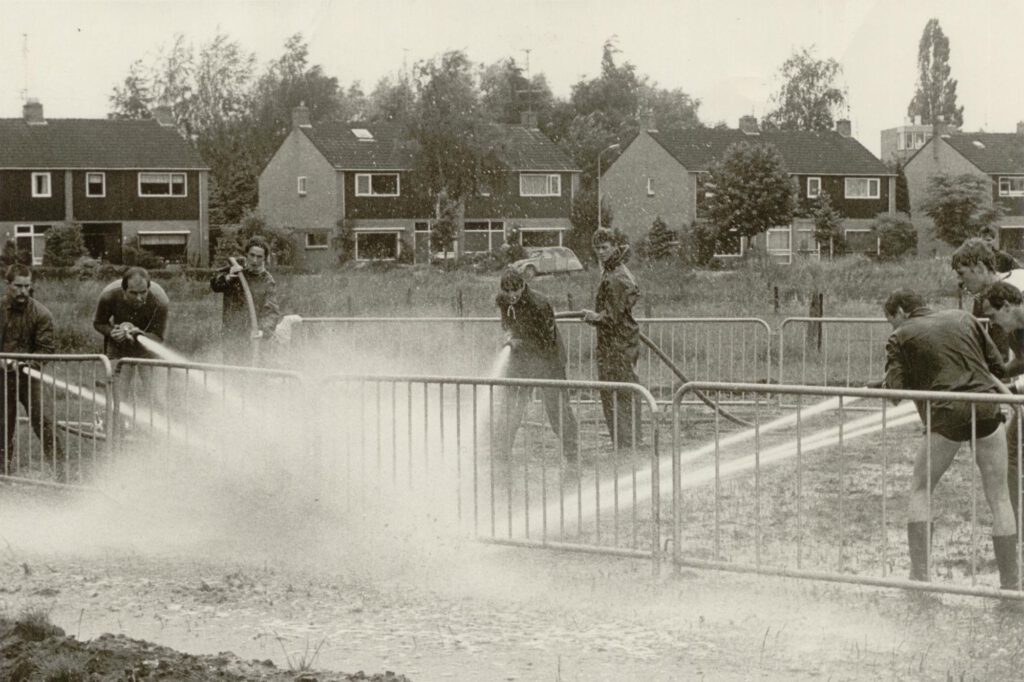
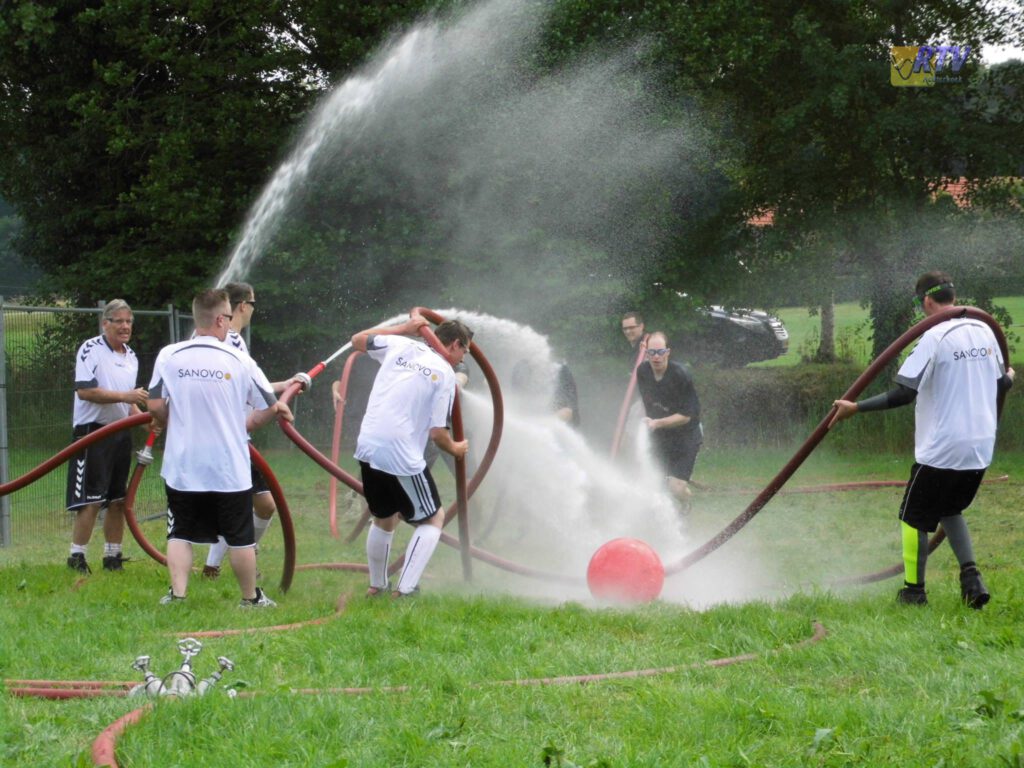
Spuitbal was an annual recurring event organised by the Aalten Fire Brigade from 1981 to 2016. Each year, this water-filled spectacle attracted many participants and spectators.
Game Setup
In Spuitbal, two teams of six people competed against each other. Each team operated three fire hoses and tried to push a large ball into the opponents’ goal using powerful jets of water. Each hose was operated by a pair: the front player aimed the jet at the ball, while the rear player had to ensure there were no kinks in the hose. The team that scored the most goals in six minutes won.
Spuitbal tournament at De Ahof (photo: Colenbrander family, via Leo van der Linde)
Spuitbal Aalten, 2015 (photo: RTV Achterhoek)
In the early years, the Spuitbal tournament was organised at various locations, including at De Ahof. In later years, the event took place at Camping Lansbulten on the Eskesweg. The necessary water was pumped from the nearby stream.
In 2008, no fewer than six women’s teams and thirty men’s teams took part. Many teams returned every year, such as De Flippers, De Pimpels, De Pollekes, Atlantic, Schiller, ’t Noorden, and Jong Gelre.
The 36th (and, as of yet, final) edition took place in 2016. In 2017, the event was cancelled due to insufficient interest, and it has not returned since.
Video
On YouTube, various videos can be found of Spuitbal in Aalten, such as the video below from Jong Gelre from 2012.
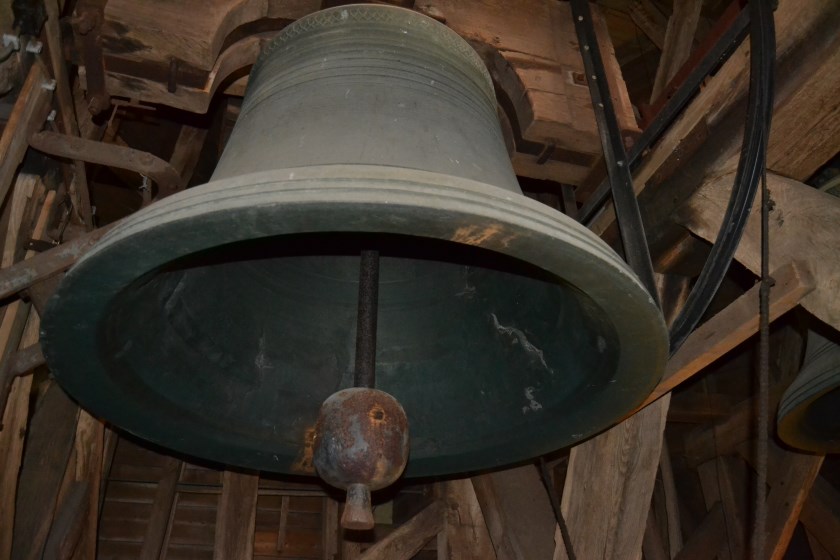
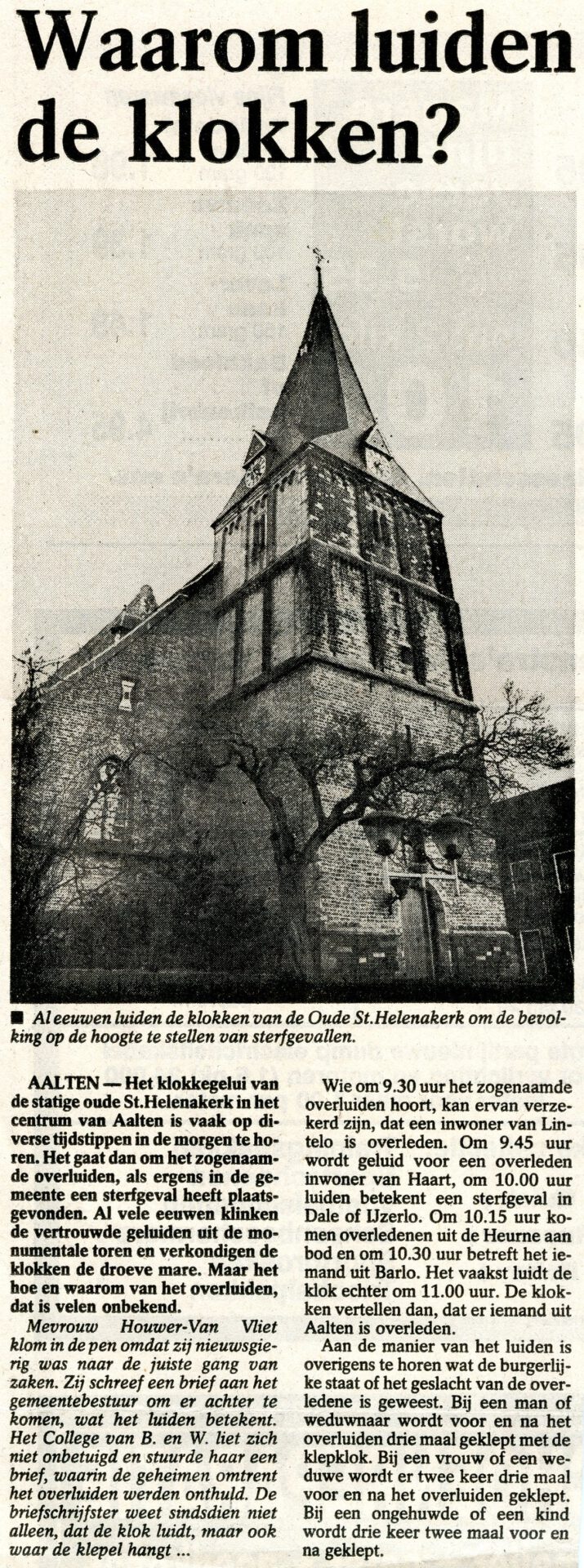
For centuries, the bells of the Oude Sint Helenakerk in Aalten have tolled to inform the population of deaths, the so-called ‘overluiden’.
It frequently happens that the bells of Old St Helen’s Church are tolled at various times in the morning. In the past, this occurred more often than it does today. In former times, almost everyone knew what this signified. Based on the time and the number of strokes, people could deduce in which rural district someone had died, as well as whether it was a child, a woman, or a man, and whether the deceased was married or unmarried.
The custom of tolling the bells when a death has occurred is called ‘overluiden’. For many centuries, the sound of bells has emanated from the monumental tower of the church on weekdays. Many people pause for a moment and think: memento mori.
The bells of Old St Helen’s Church on the Market Square in Aalten are still used for this solemn moment, always in consultation with the next of kin. The ‘overluiden’ can be performed for all deceased persons, not just for members of the Protestant Congregation.
Significance
If the bells are tolled at 9:30 AM, it concerns a resident of the rural district of Lintelo. If it occurs at 9:45 AM, someone from de Haart has passed away. At 10:00 AM, the bells toll for a death in Dale or IJzerlo, and at 10:15 AM for someone from the Aaltense Heurne. If it concerns someone from Barlo, the time is 10:30 AM. Often the bells toll at 11:00 AM, which signifies the ‘overluiden’ of a deceased person from the village of Aalten.
For a man or widower, the clapper bell is struck three times before and after the tolling. For a woman or widow, the clapper bell is struck twice three times before and after the tolling. For an unmarried person or a child, this occurs three times twice before and after the tolling.
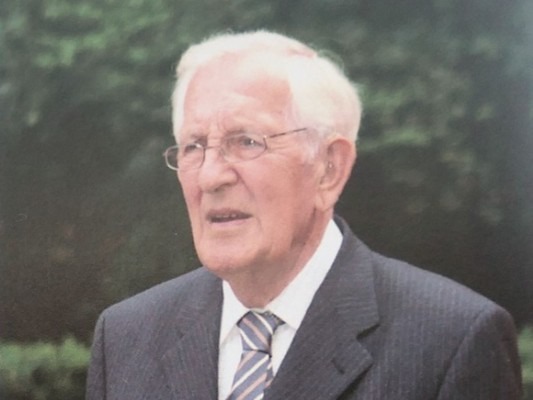
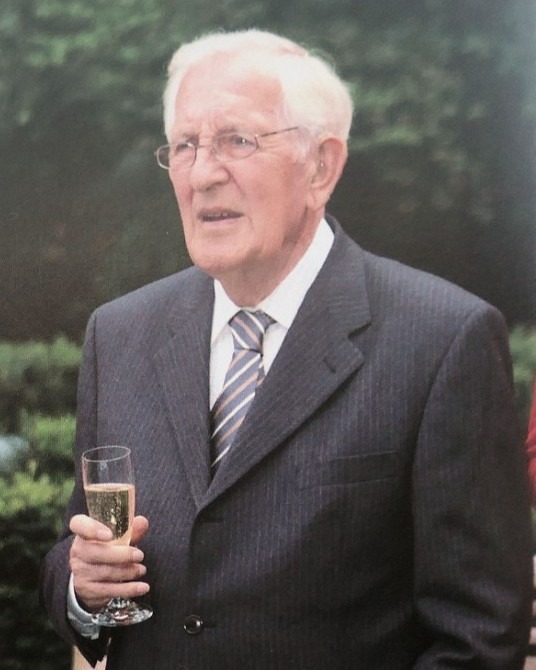
Antonie (Anton) Kuijsten (1917–2007) was a teacher and headteacher in Aalten, as well as a self-taught woodcarver, draughtsman and watercolourist. From its founding until his retirement, he led the Reformed (Hervormde) School Aalten-Zuid (later renamed De Broekhof). His surname is also frequently spelt as Kuysten.
Kuijsten was born on 5 October 1917 in Huizen. His mother passed away when he was eight years old, but thanks to the way his father supported the family and the live-in housekeeper who remained with them for a long time, he still enjoyed a happy childhood.
After graduating from the teacher training college (kweekschool) in Amsterdam, Kuijsten taught at various locations, including Naarden, Muiden, Rheden—where he met his future wife—and Zutphen. During the final months of the occupation, he went into hiding to avoid being forced to work for the occupying forces. On 11 April 1947, he married Hendrina Groenewoud in Rheden.
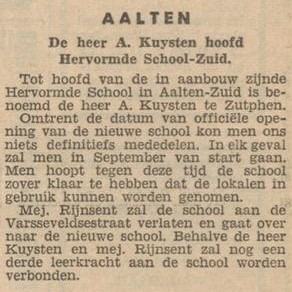
Upon the opening of the 2nd Dutch Reformed School Aalten-Zuid in 1954 (which later became the Broekhofschool), he was appointed as headteacher. Kuijsten was renowned as a storyteller who brought history lessons to life “as if he had been there himself”. By 1967, the family was living at Wilhelminastraat 4 in Aalten. He was also highly active within the Protestant Church: for over twenty years, he led the children’s church services in Aalten-Zuid, and he served as an elder for a period of time.
Alongside his teaching career, Kuijsten developed his skills as a self-taught woodcarver, draughtsman and painter. In addition to watercolours, he produced drawings using liquid watercolour (ecoline). He also created items such as birthday calendars. He is featured in the book Kunstig Aalten (2021), an overview of artists from Aalten compiled by Leo van der Linde.
The sudden death of his wife in 1987 was a profound loss. For several years, he laid down his brush and pencil, though he fortunately managed to resume his creative work later on. In the final phase of his life, he faced frail health. Following an admission to the hospital in Winterswijk and a short stay at the ’t Hoge Veld care home, he ultimately passed away in hospital. The funeral took place on 1 December 2007, following a thanksgiving service at the Old Helenakerk in Aalten. He was laid to rest at the Berkenhove cemetery.
Anton Kuysten (1917–2007)Zutphens Dagblad, 10 May 1954
Gallery
A selection of works by Anton Kuijsten:
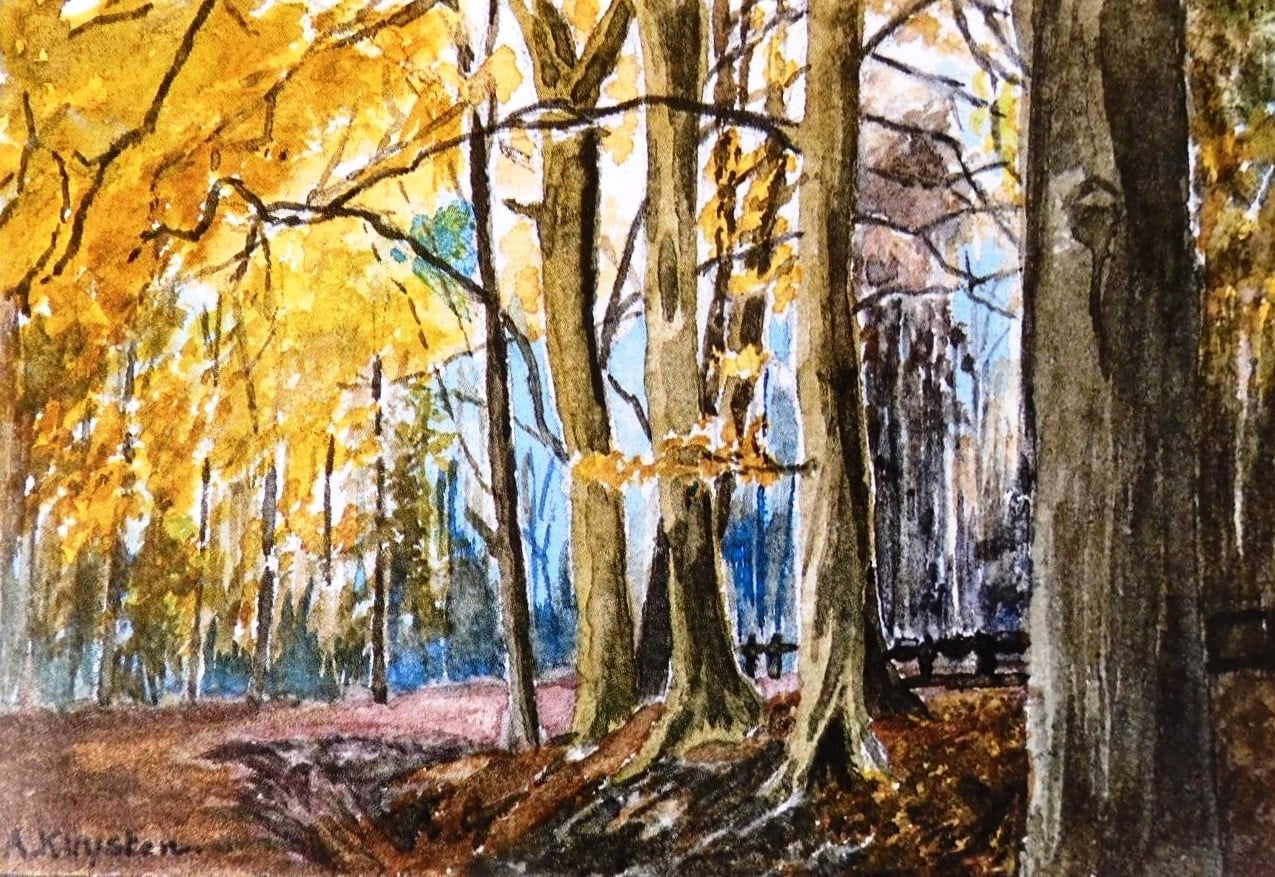
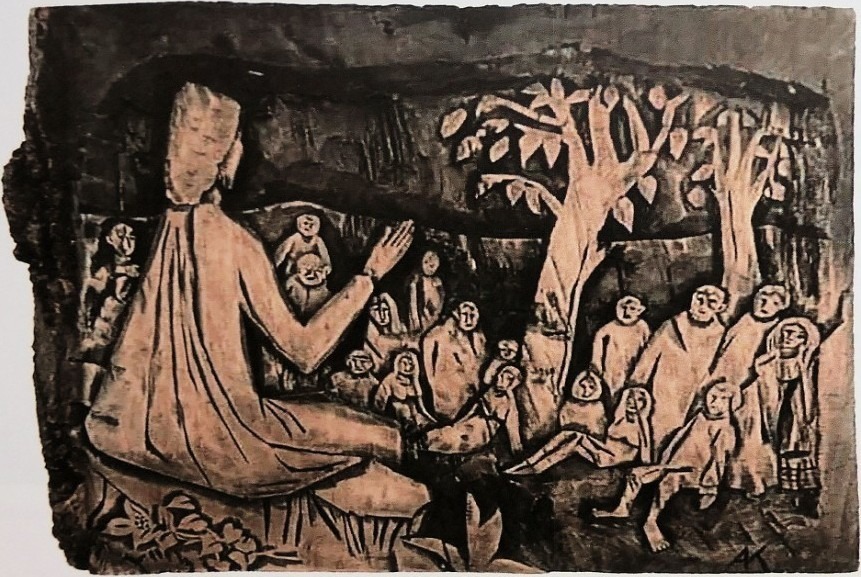
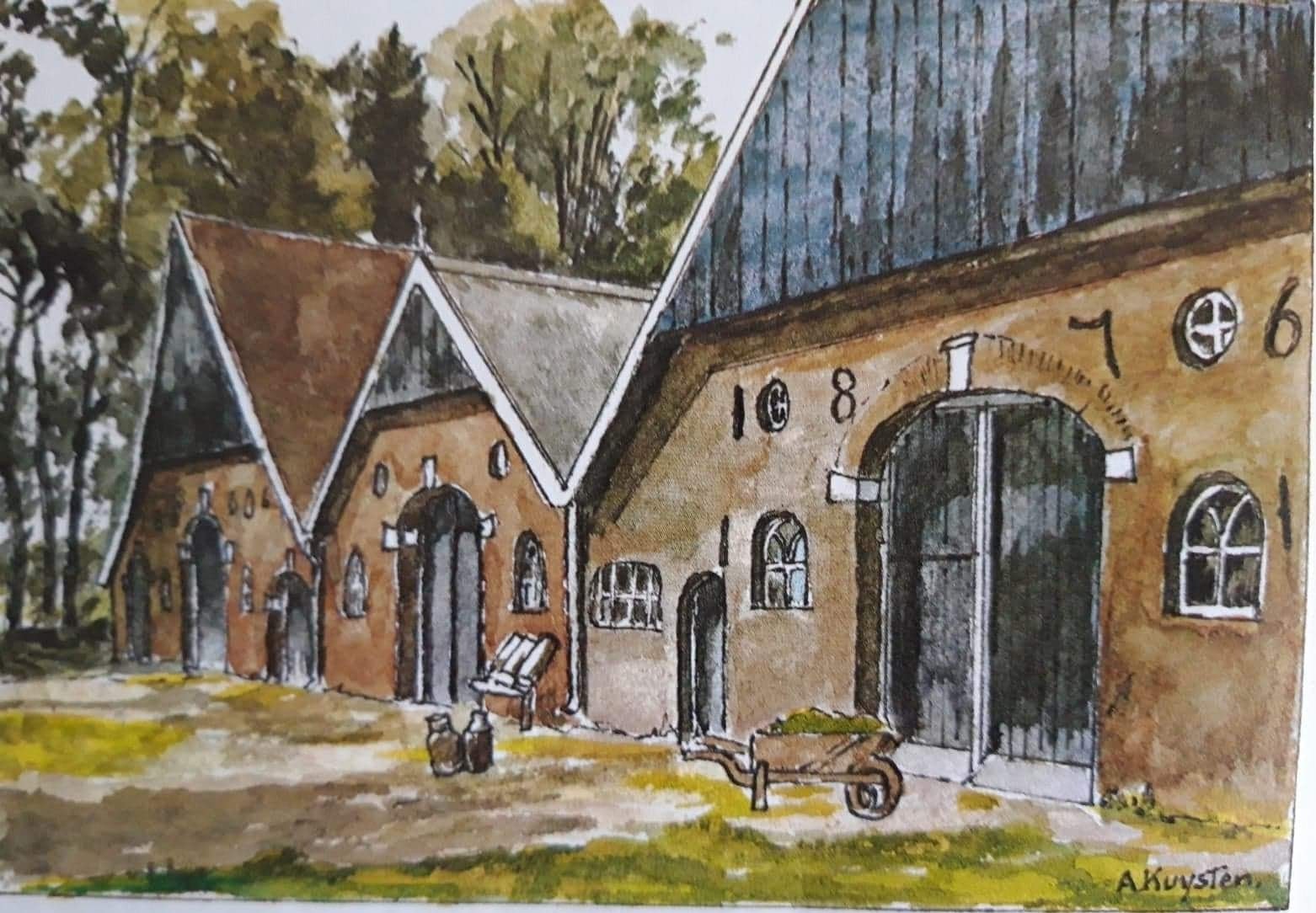
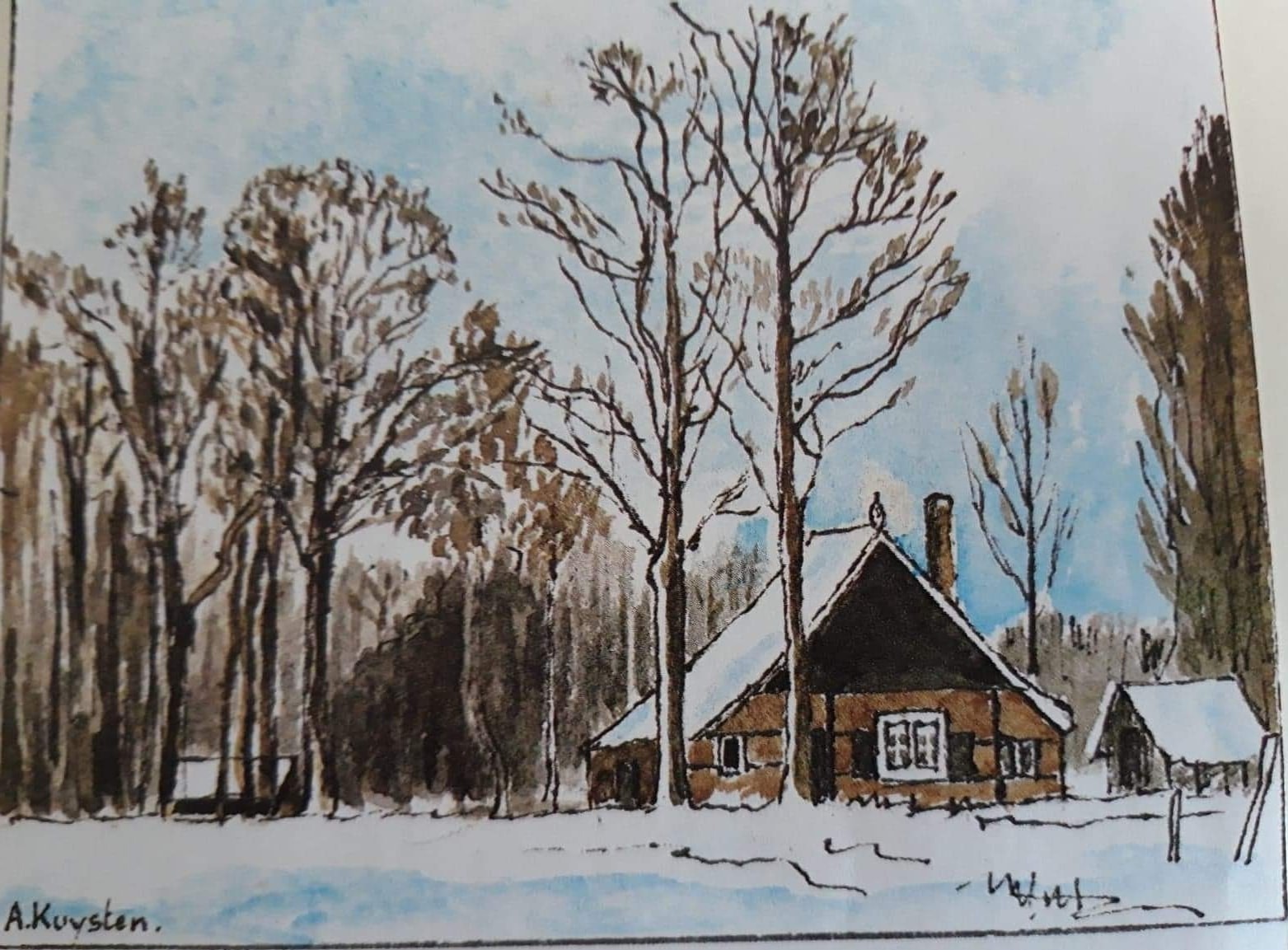
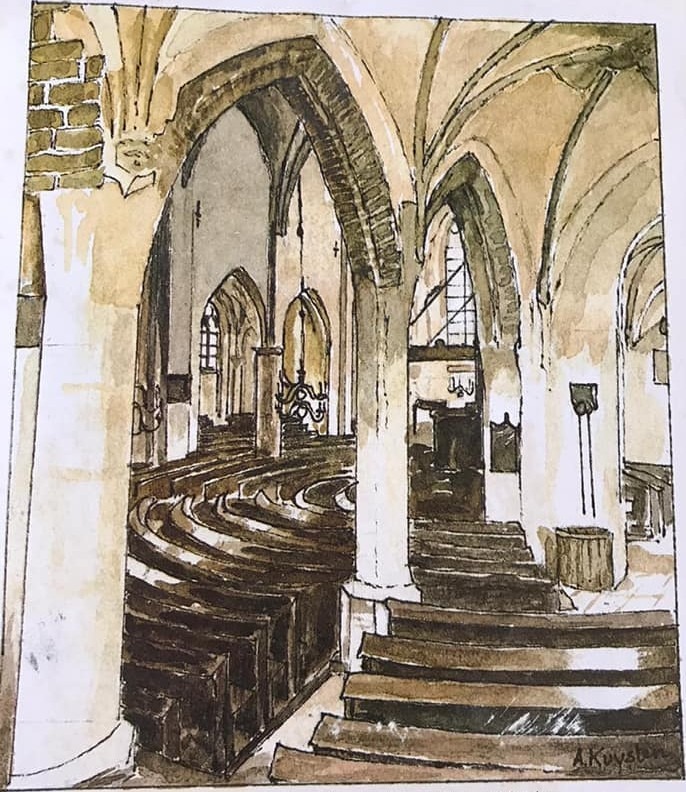
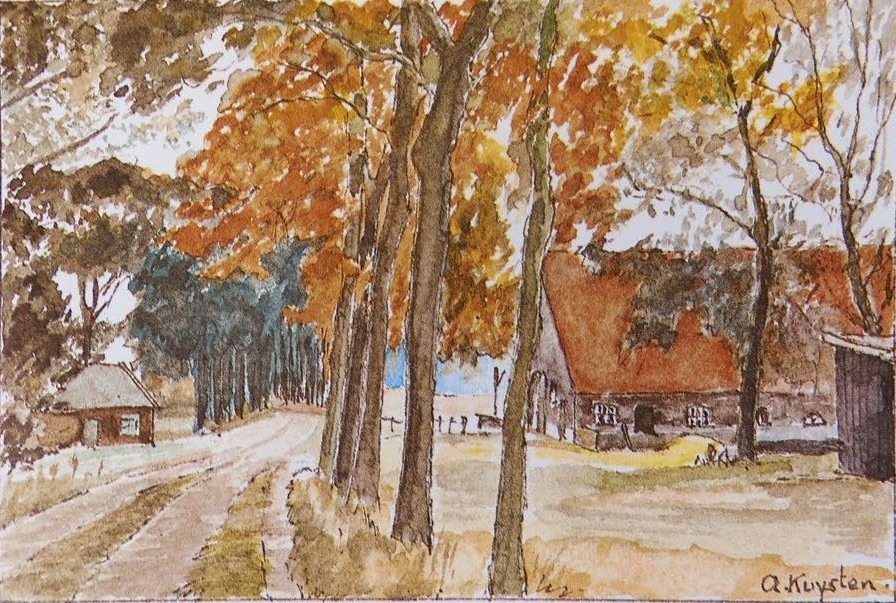
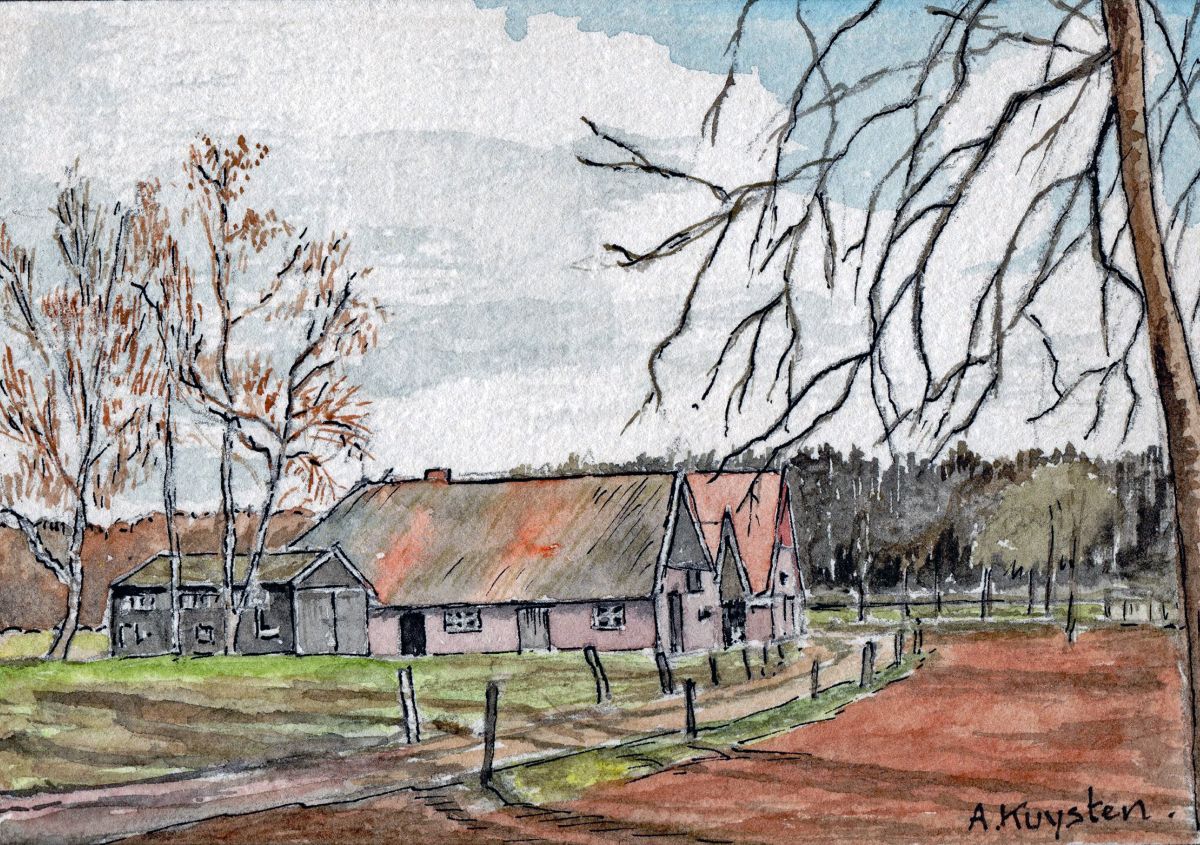
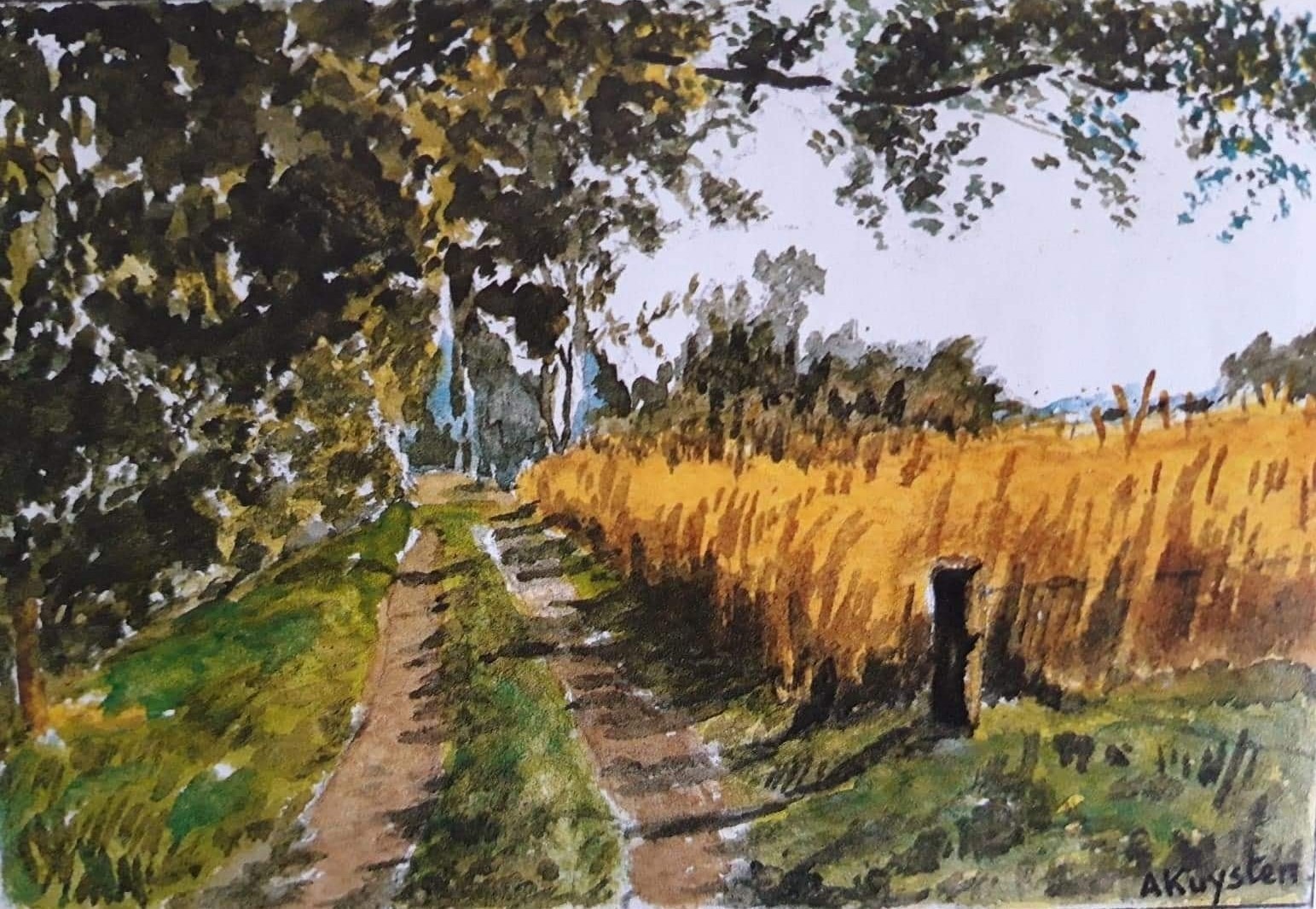
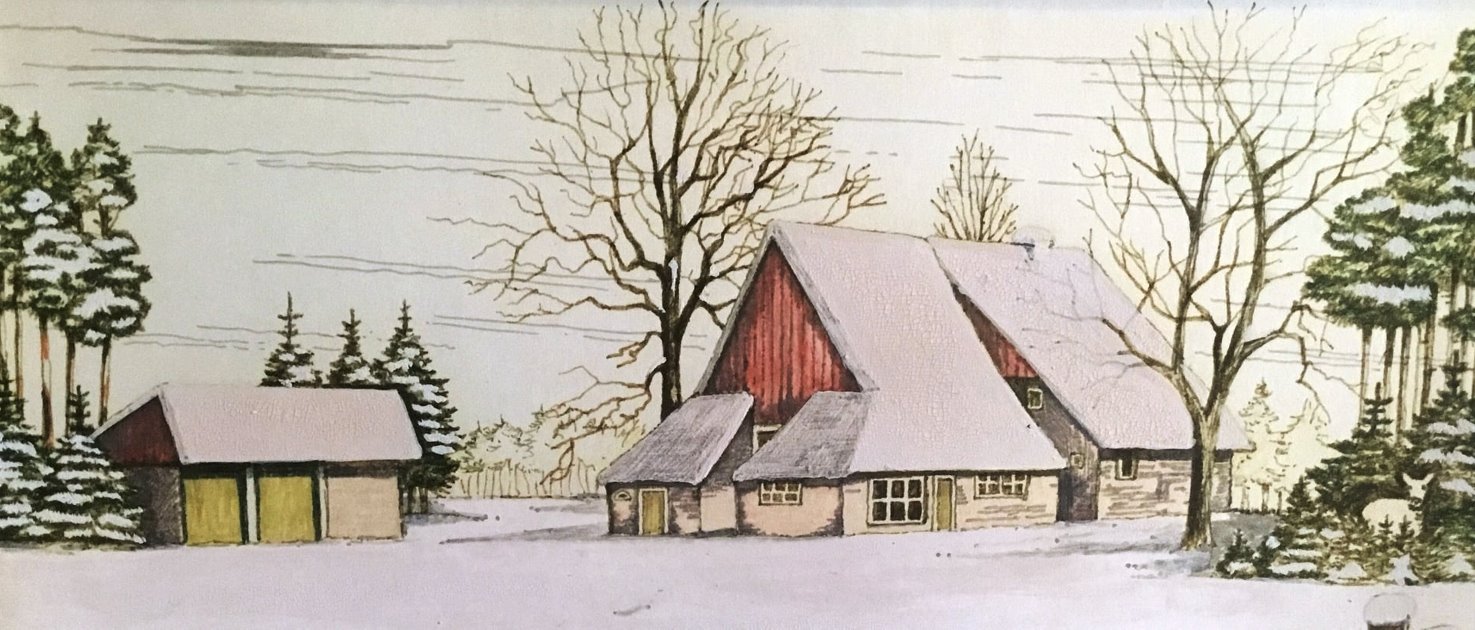
The Kloosterbos (Monastery Woods) near BredevoortThe Sermon on the Mount, woodcarving‘Beestman’ farmhouse on the Haart near Aalten (rear view)Eskes farmhouse in winter on the Haart in AaltenInterior of the Big or St Helen’s Church in Aalten, south sideHijinkdijk, HaartAkkermateweg, LinteloCountry lane on the Akkermateweg in Aalten
Joop and Truus Doodeheefver were an artist couple who moved from Amsterdam to Aalten in 1973 and remained active there for decades. In Aalten, Joop (1924–2001) focused on drawings and transparent watercolours of landscapes and farms. Truus (1928–2004) created portraits, animal figures and independent work in bronze, aluminium and wood. They regularly exhibited together within the region and further afield.
Johannes Christoffel (Joop) Doodeheefver was born in Amsterdam on 6 June 1924. He trained in the studio of Nel Fernhout and worked for approximately thirty years as a designer-colourist at his father’s wallpaper factory, the firm Rath & Doodeheefver. In 1945, he married Truus Kremer.
Geertruida Jeannette Frederika (Truus) Kremer was born in Leiden on 15 February 1928. Shortly afterwards, the family moved to Amsterdam. She learned sculpting from Adrianus Remiëns and married Joop Doodeheefver in 1945.
Move to Aalten
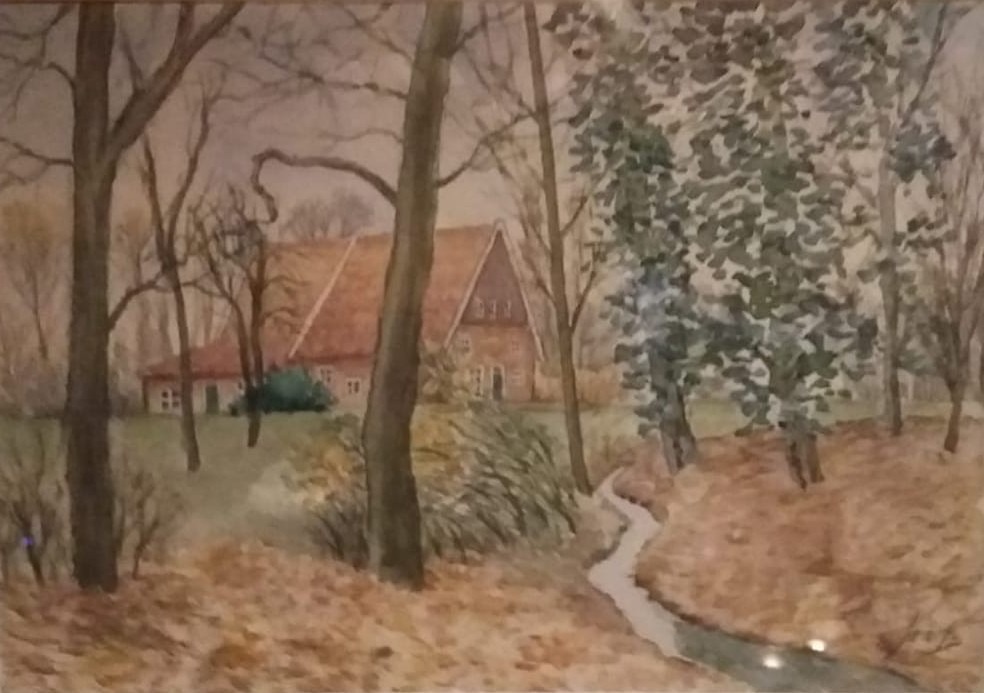
The couple had long cherished the desire to one day leave hectic Amsterdam behind and settle in the “as yet unspoilt east”. In 1973, they put their words into action and settled with their family at the monumental farmhouse De Kiefte in the Aalten hamlet of Heurne.
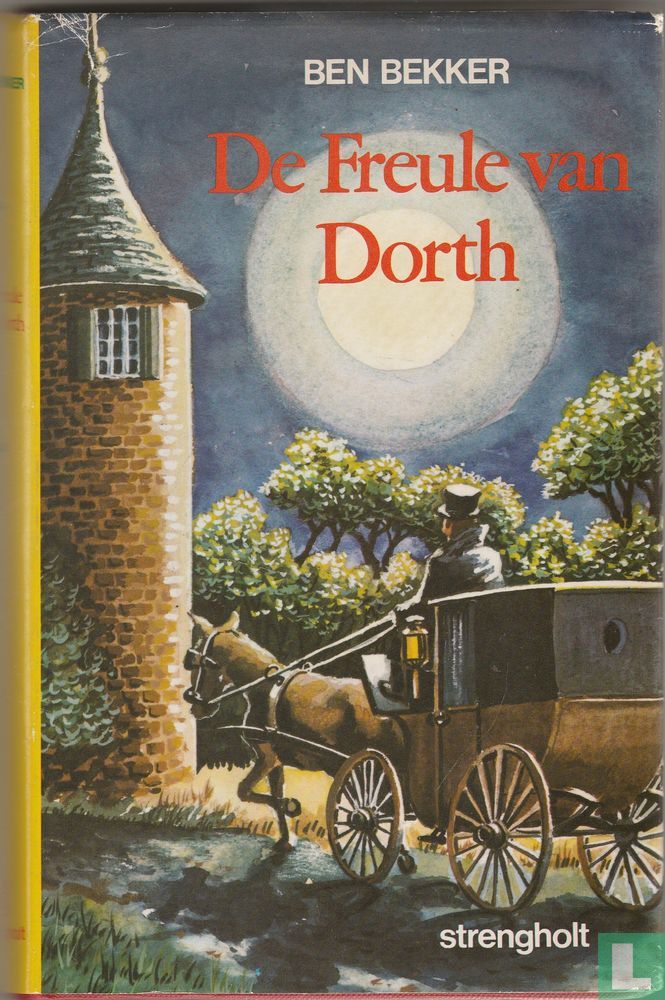
Here, Joop dedicated himself to sketching and painting watercolours of the surrounding landscapes and farms. He also undertook a great deal of commissioned work to capture objects, individuals and landscapes for future generations. Additionally, he provided the illustrations for the book De Freule van Dorth (The Noblewoman of Dorth), written by Ben Bekker (1974).
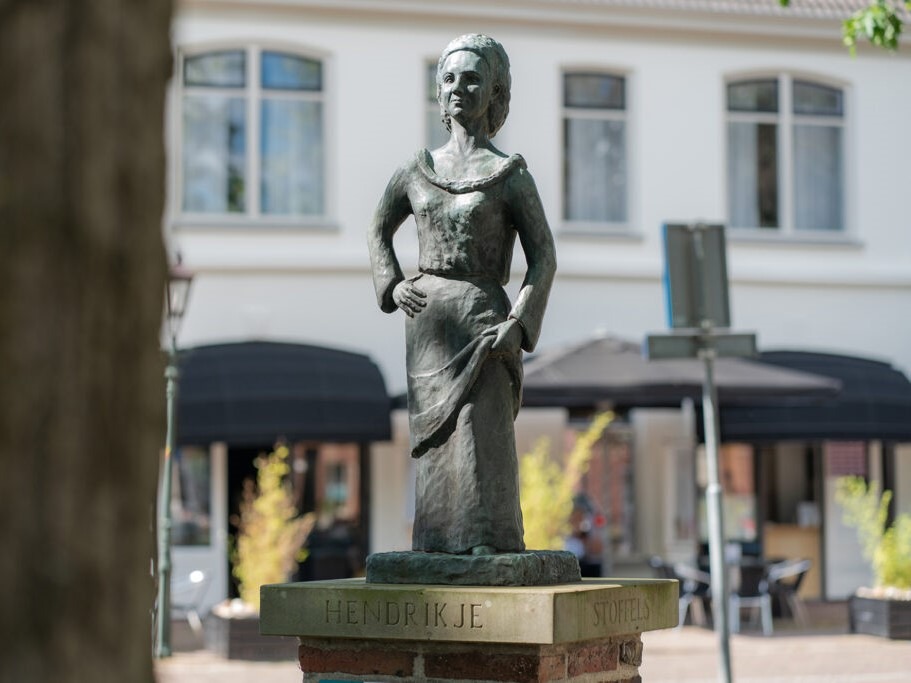
Truus sculpted naturalistic portraits and animal figures, and also produced woodcarvings. A well-known piece by her hand is the statuette of Hendrickje Stoffels at ’t Zand in Bredevoort (1977).
They exhibited successfully both jointly and individually, both in the Netherlands and abroad.
Gallery
A selection of works by Joop and Truus Doodeheefver:
Hendrickje Stoffels, Bredevoort (Truus Doodeheefver)Small stream behind De Kiefte (Heurne), by Joop DoodeheefverDe Freule van Dorth, written by Ben Bekker and illustrated by Joop Doodeheefver (1974)
Aalten has a large number of farms with their own names. In the 1967 address book of the municipality of Aalten, about 480 are mentioned. Almost all of these names are unique. To avoid confusion, it was logical to give a farm a name that did not yet exist. However, one finds, for example, the Oude Loo and the Nieuwe Loo, Groot Kampe and Klein Kampe, even ‘t Paske, Groot Paske, Klein Paske and Nieuw Paske. These are often farms that previously formed a single homestead but were split into parts during division among children. Names with “Olde” or “Oude” then point to the original house.
When one examines those names, an interesting discovery is made. They can be divided into different groups. For instance, there is a group of names from which one can deduce what the vegetation around the yard used to be like and in what kind of environment the farm was established. Another group points to the trade that was practiced there in the past alongside agriculture and livestock farming. Many farmers, and especially the small-scale ones, had enough time to do something on the side to earn a bit extra, which was often necessary.
The practice of giving names to farms is very old. In the verpondingskohier (tax register) of 1647/50, the persons who had to pay the ‘verponding’ (a land tax) are recorded under Aalten, as well as under Bredevoort. But under the rural districts, the names of the farms are mentioned, followed by the names of the residents. Thus, we have a list of homesteads that existed at that time. Many of the current names already appear in it.
One must possess a very great imagination to be able to picture what the Aalten landscape looked like centuries ago. Nine-tenths of the land consisted of heath, forest, and swamp. The cultivable area was small and was only used for growing vegetables and a few cereal crops. Most farms were small: ‘stedekes’. Division of the common lands, artificial fertilizer, and better drainage put an end to the ‘prange’ and ‘marode’ (hardship and misery) of the farmer.
The following names require an explanation: Bokkel, called Buclo in 1284, beech forest. The Walfort was previously called the Waldenvort, a ford (through the Slinge) near the Wald (the forest). Similarly, Walvoort on the Haart, with a ford through the Keizersbeek.
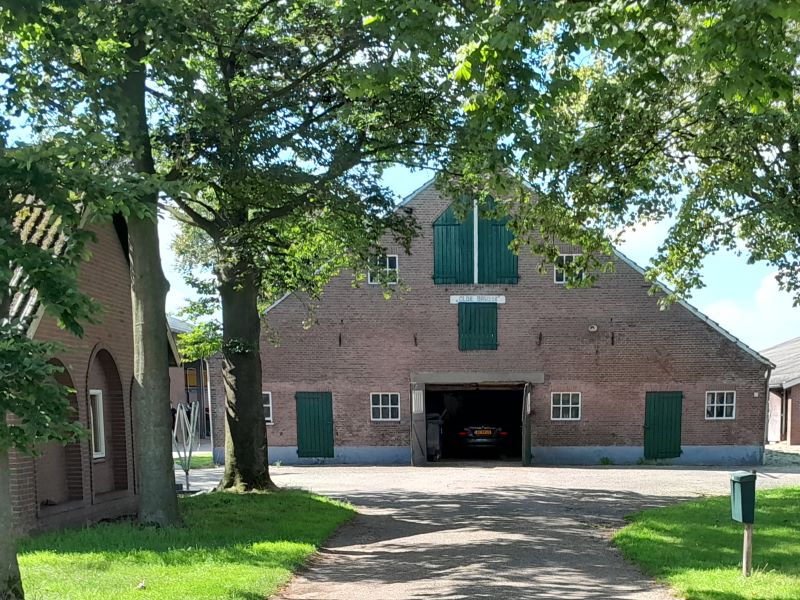
’t Olde Brusse, Lintelo
The name Voorst (from forestis) was used for a forest in which hunting was not allowed; it was the private hunting ground of the king or the lord. The site of the Snoeijenbos was cleared in the forest. Brusse is formed from: Brusch, brushwood, ‘t Hagt and the Heegt: forest of low wood, perhaps consisting of hawthorn bushes.
The Slehegge may recall the blackthorn, ‘t Heggeltje: a small ‘hagt’. The Hakstege was located on a narrow path (stege) through the ‘hagt’. The Rieste owes its name to the brushwood (rijshout). The Heisterkamp was established on a site where much brushwood grew.
In 1386, the name Varenvelde appears, and later also the Verrevelt, which is now the Vervelde. The Veernhof also originated in a field full of ferns. The Tente owes its name to the ‘tente’, the common tansy. The Greute recalls the ‘gruit’, the bog myrtle, with which beer was fermented and which grew on marshy ground, as did the reed, which is found in the name the Riete. Waste uncultivated land, ‘vage’, is found in Vaags.
One should not have a grand conception of these heights. An elevation of half a meter was already called a ‘bult’, a ‘horst’, or a ‘heuvel’. These heights offered no protection whatsoever against the damp environment. The houses were very damp.
Names like De Bulte, Bultink and De Heuvel speak for themselves. De Brink (brinc) was a grass-covered elevation. De Bree (from bride) is considered a field on the ‘es’ (open field). Drenthel (originally Drenthelo): forest on an elevation. Haartman and Haartelink: a ‘haart’ is a high-lying heathland. Hengeveld (heng, slope), Hillen (hil, hill), Hoopman, the Klinke (hilly heathland with puddles and pools here and there).
De Horst (an elevation covered with low wood), Leemhorst, Seinhorst, Stokhorst and Winkelhorst. Leeland (lee, hill, also a place of judgment), the Limbarg (loam mountain?). De Pol: a small sand hill that stood out like an island above the surroundings. Pikpolle (pec, poverty): a meager hut on a ‘pol’.
Tammel (in 1384 Tanbulen): pine forest on a ‘bult’? Hondorp: village, mound, elevation the size of a ‘hont’, a unit of area. The Westendorp also points to an elevation. Wierkamp: ‘wier’, ‘wierde’, elevation protruding above a wet environment.
Farms located in or near a swamp
The largest part of the municipality of Aalten used to be swamp. Only the Bocholt–Vragender ridge protruded above the marshes. These ‘broeken’ (marshlands) were created because the small rivers the Slinge, the Zilverbeekje, and the Keizersbeek could not sufficiently drain the water. That is why so many farms have a swamp name, such as Goorhuis, Goorman, Goorzicht, Moorveld, the Stroete (marshy wasteland), Veenemaat, Groot and Klein Veenhuis, ‘t Veentje, Wijnveen (‘winne’ farm, farm in the peat), Hagenbroek (a marshland with hawthorn bushes), Kortenbroek (a marshland with short grass and therefore infertile land), the Woerd (woert, low-lying land).
Bolandsweide (bol, soft, marshy, mud). The Nonhof (in 1281 den Honhof) and the Hennepe (in 1284 Honepe), both names formed from “hoen” and “huun”. Luiten, popularly Luten, was low-lying poor land, ‘lute’, while Maris represented much the same: swamp. Glieuwe: ‘gliede’, black shiny soil, peat. Somsenhuus: ‘somp’, marshy land. Pietenpol (in 1640 Pytenpoel): ‘pitte’, pit, hollow, thus a pool in a low place, De Put (hollow, pool. ‘t Slaa: ‘slade’, heath pool, swamp. Te Sligte (in 1384 Schlichte): flat swamp. Mager: poor, meager land. The Navis possessed a damp meadow; ‘nate’, wet and ‘vis’, Wisch, ‘wiese’, meadow. Near Amerongen, the medieval residential tower the Matewisch still stands.
Pietenpol, Haart
Camp names
Stapelkamp, Heurne
A number of names end in -kamp. Originally, the ‘kampen’ were small pieces of land that had been cleared of brushwood and trees in the forests, thus reclaimed forest. Later, the word ‘kamp’ acquired the meaning of field.
Only a few names recall the reclamation of wastelands. Nijland, Nijveld, Nijhof, Nieuwkamp, Nieuwe Weide. The Bijvanck, what was ‘caught’ or taken additionally. Te Brake also points to reclamation, the ‘breaking’ of the wasteland. Ruwhof: ‘rude’, ‘rode’, reclaimed land.
Farms that recall passes, gates, tolls, etc.
A ‘pas’ is a passage in a ‘landweer’ (defensive earthwork), a wooded bank. The resident of the nearby farm had to ‘oppassen’ (watch out), supervise the persons entering. Such a farm sometimes bore the name “Pasop”. Along the Romienendiek, for example, lie the Paske, the Pasop and the Paskerhut: the residents had to keep an eye on the persons who entered the ‘marke’ (common land) through the Wolboom and the Zwarte Veen. On the border with the Varsseveld area near the Varsseveldseweg, there is also a Pas. On the Varsseveld side, the Loerdijk and the Kijkuit are located here. The ‘marken’ were well protected.
Among those who also had to take the ‘marke’ under their care was the resident of the Markerink, formerly called March-ward-inck. A ‘werde’ was a watch post, a place where one had to supervise the intruding unsavory elements. A similar activity was expected of the Ligterink, which in 1435 was called Licht-werd-inck: the watching apparently felt rather light there. The duty of keeping watch also lay with the Kuier and the Kuierman: ‘koeren’, ‘kuren’ meant “looking out”.
Did the ‘schutte’, who had to seize (schutten) the livestock from another ‘marke’ that had intruded into their own ‘marke’, live on the Schuttenkamp, and did such a person also live on the Man-schot-weide? Recalling the tolls are Slotboom, the Stokkert, ‘t Bonte Hek, Klaphekke, ‘t Tolhuis, Tolkamp and Tolder (toll collector).
Memories of the church
De Pater, ‘t Klooster (named after the Schaer monastery), Kerkhof (a farm of the church), Kerkkamp, Neerhof (den Heerhof, inhabited by the monks), De Kloeze, hermit, perhaps also Klaus. Kosters custerie: the proceeds of this property were for the sexton.
Beestman (herdsman), the Scheper (shepherd), Sweenen (swineherd), Fukker (breeder), Peerdeboer (horse farmer), ‘t Villeken (where dead animals were skinned and the hides were tanned), Baten (‘beten’, the tanning of hides). The Brasse (brewery), Pakkebier (‘backe’, also brewery), Schenk (public house, tavern) and Slikkertap (a tap in the ‘slik’, swamp).
Brethouwer (should we interpret ‘bret’ here in the sense of board, thus someone who made boards?), the Klumper and Klompenhouwer (‘houwen’ is chopping or carving), Kolstee (place where charcoal was burned), Kuiper (cooper), Draaijer (turner), Kappers, Kleuver (recalling the chopping and splitting of wood), the Smid and ‘t Smees (formerly Smedeserve). Papiermolen, the Olde Mölle, ‘t Olde Mulder, the Görter (groat-maker, hulling miller), Te Roele (in 1640 ten Rule – ‘rullen’, hulling of grain, hulling mill).
Bouwhuis Wever, ‘t Klooster
Den Blauwen (blue-dyeing of linen), the Wever (weaver), Bouwhuis Wever, Weversborg, the Pellewever (weaver who wove finer goods, such as damask and table linen), Schreurs, Snieder and Snijdershuis (tailors). Kremer (peddler) and Klodde (ragman). Speelman (someone who cheered up the parties with a musical instrument) and the Piepert (piper, flute player). Krieger (inhabited by a soldier? In 1640, a soldaetencamp also occurred in Barlo).
Farm names ending in -ink etc.
About forty farm names end in -ink. These largely point to the possession, to the estate of a certain person. They are mainly composed of a personal name + -ink. Lists of proper names that occurred in the Middle Ages have been compiled from all possible archival documents, and based on these lists, a number of farm names can be explained.
Hoenink, Huinink and Hunink were located in a ‘hoen’, a ‘huun’, a swamp. Another explanation that we must take into account, according to the CBG Center for Family History, is that names like Hoenink and Huinink go back to the Germanic personal name Huno.
However, there are a number of names that cannot be traced back to personal names. They clearly refer to something else. These are: Bekink (located near a brook), Bultink (located on a ‘bult’), Doornink (located in or near a thorn forest), Eekink (located on a site with oaks), Essink (located on an ‘Es’), Heijink (located on the heath), Kempink (located near or in a ‘kamp’), Haartelink (located on a ‘Haart’). Rengelink can indicate a “rinc”, which was a place of judgment. On the Borninckhof, the Haartse Wetering originates, so there are springs there. On the former Richterink, the judge held his proceedings.
There was a time when the meaning of the suffix -ink was no longer understood. People then began to form names with “stedeke” and “goet”. Thus we find, for example, Heijnengoet, Goossenstedeke, etc. In later usage, the words ‘stedeken’ and ‘goet’ were omitted. Freriksgoet became Freriks, Rutgerstedeken became Rutgers. Here again many farm names formed from personal names: Freers, Freriks, Bullens (from Bullo), Ebbers (from Ebbo), Goosen (Goosen, Goos), Heinen (Hein), Lammers (Lammo), Lievers (Lieven), Lindert (Lindert), Lubbers (Lubbert), Reinders (Reinder), Rutgers (Rutger), Wiggers and Wiechers (from Wigger), Wubbels (from Wubbel), Wolters (Wolter) and Rikkert (Rico).
In addition to the farms classified in the groups above, there are a few others that deserve special mention: the Tuunte was surrounded by a ‘tuun’, a woven fence, as were the Vreman and the Vreveld. The Zigtvrede had some preferential rights in the annual distribution of the ‘marke’ lands. One of these farms was called Seegvreden in 1640, named after the ‘seege’, the goat. The Hegge was surrounded by a hedge. The Sonderen also had rights; a part of the common land could be used for private use. That part was separated (afgezonderd) from the ‘marke’. The Meijnen was also part of the common ‘marke’.
The Haverland and the Haverkamp had the duty to supply oats (haver) to the lord or church, etc. On the Hemelmaat, justice was administered; a ‘hegemael’, a ‘heimael’, was a space surrounded by a hedge where a ‘mael’, a court session, was held. The Akkermaat owes its name to a meadow that could be mown in one day, and the Maandag to the piece of land that could be plowed in one day with the shared livestock. A former name would therefore have been: Mendag. The Hogewind should actually have been called the Hogewend, because this was the high end of the land where the plow was turned (gewend).
The Grotenhuis provides information about the size of the house and the Nieuwenhuis (in 1640 Nijenhuis) points to a then newly built dwelling, just like Nijboer. The Lankhof and Scheel indicate the shape of the land: long and crooked. The Korten (in 1640 Kortenstedeken) had only a short piece of land. The Heurne had the shape of a horn, a tapering piece of land, as did the Timp and the Timpert. Sad was the state of the Prange, the Marode and the Drommelder, which three names can all be translated as misery.
The Smol was “small and insignificant”. Could the Huikert have been a hay meadow or is it a distortion of the popular name Huik for Hugo? The Botervat: butter meadow? The Westendorp, the Oosterbosch, the Oosterhoeve and the Oosterman derive their names from the cardinal directions towards which they are oriented. Agriculture is indicated by: Bouwlust, Bouwhuis and the Bovelt (building field). Is the Hillo (Heiligelo?) a memory of paganism or was it a ‘lo’ on a ‘hil’ (hill)? The Leste Stuver was formerly an inn near Bredevoort where traveling people could squander their last penny.
Boerkoel, G.A.W., The Names of Aalten’s Farms, published in the Oostgelders Tijdschrift voor Genealogie en Boerderijonderzoek (1984, nr. 2, pag. 1), edited and supplemented by Remco Neerhof (Old Aalten). Some farm names appear more than once in the municipality of Aalten; in such cases, the hyperlink provided usually refers to the oldest known farm.
An ‘oorman’, sometimes referred to as ‘oormenneke’, is a room that was built onto some (village) farmhouses, where the elderly parents of the residents lived out their final years. Today, one might use the term ‘granny annex’ or ‘sheltered housing’. Sometimes, an oorman was also rented by a single person. It was a small room measuring approximately two by two and a half metres, in which a box bed (alkoof) served as a sleeping area.
The last oorman in Aalten was located at numbers 38/40 Hogestraat.
Regarding the origin of the term oorman, E.M. Smilda writes the following in Aalten en Bredevoort in oude ansichten:
“In my view, the name oorman should certainly not be considered as being derived from the idea that ‘just as a person’s ears protrude, so an oorman is an extension protruding from the farmhouse’. On the contrary, it is named after the occupant, as is customary in this region. Spelt more accurately, the little dwelling is called an oirman. In one of his plays, [the famous Dutch poet] Vondel has a character ask: ‘Do you then have no oir?’ By oir, heir is meant. In the end-room built onto a farmhouse, the older man who did indeed have an oir could spend the final years of his life. He was the oirman, lived there, still helped out a bit here and there, and received free board and lodging. In the whole of the Netherlands, this original name oirman occurs exclusively in Aalten.”
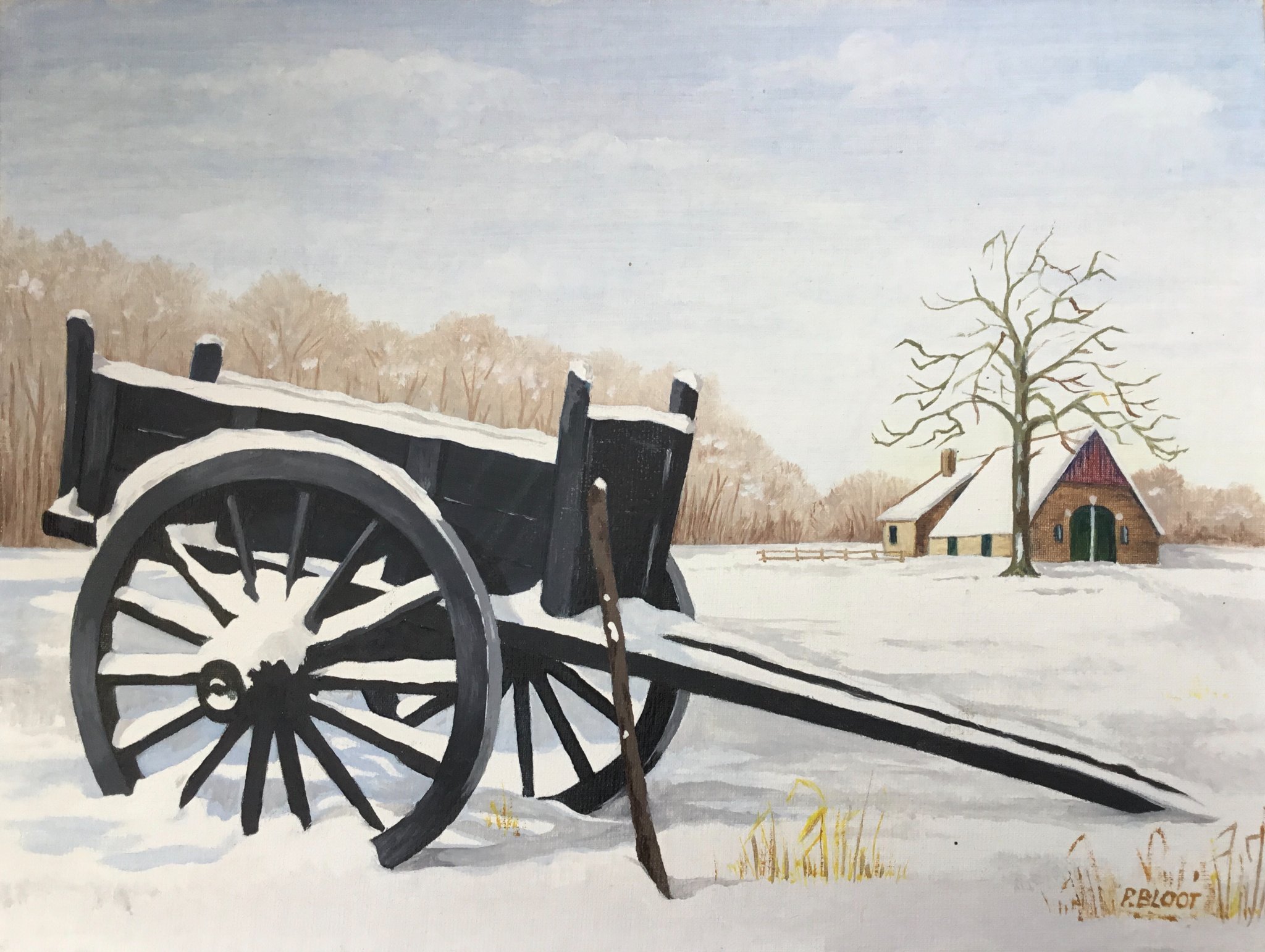
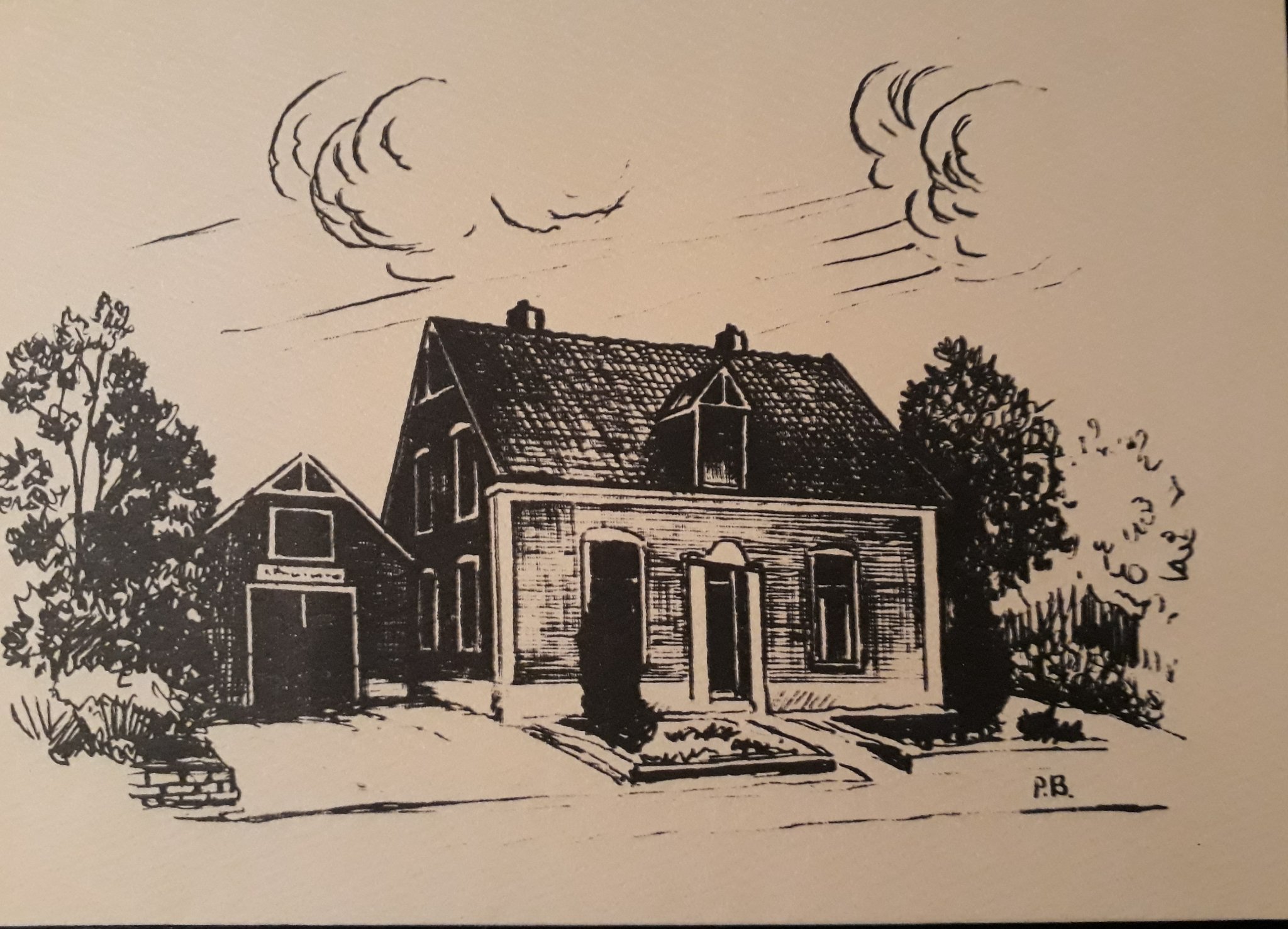
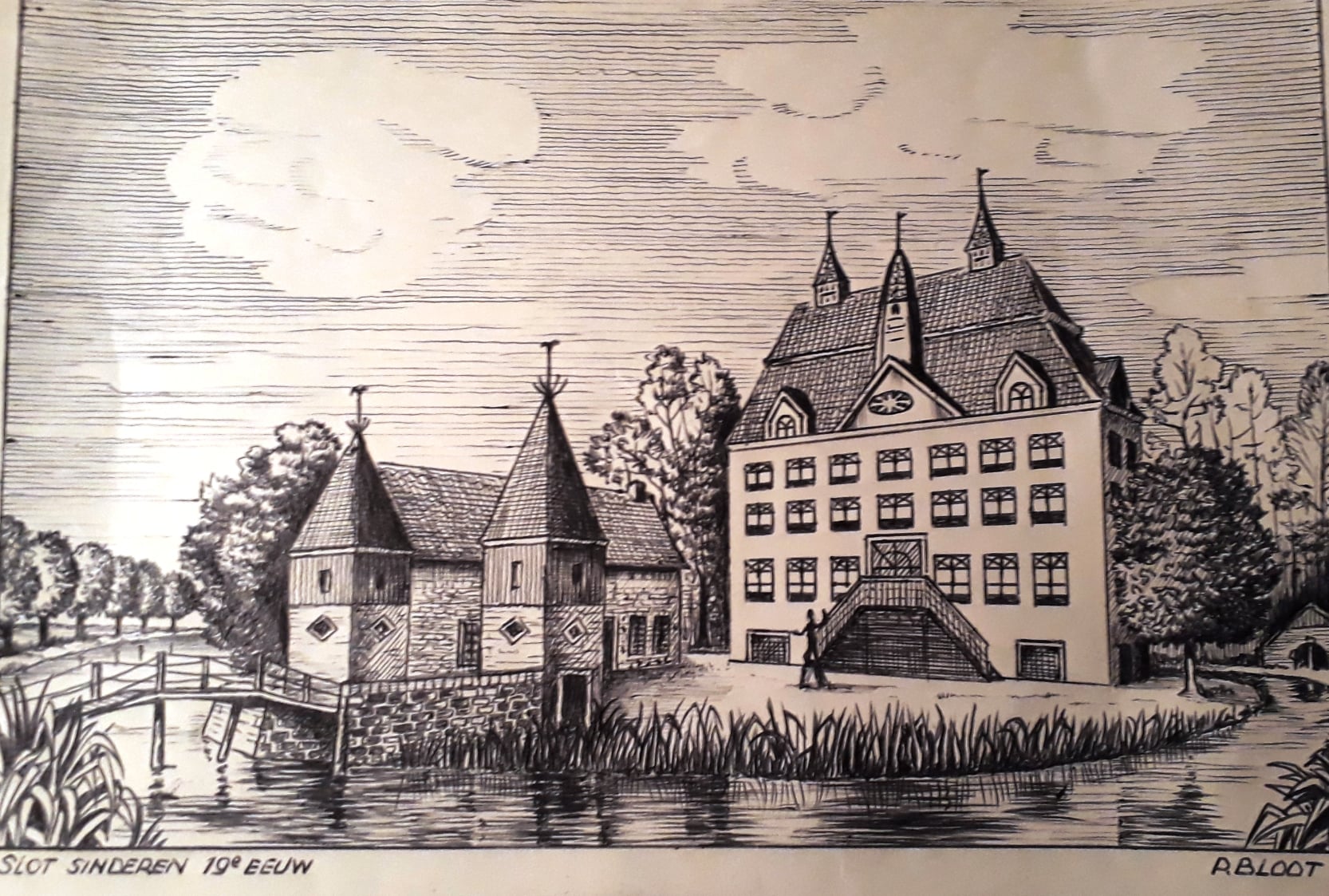
Pieter (Piet) Bloot (1924–1982) came to Aalten from the bombed city of Rotterdam in the summer of 1940 as a sixteen-year-old boy. On the initiative of the Calvinist (gereformeerde) minister Th. Delleman—formerly a minister in Aalten and later in Rotterdam-Kralingen—an appeal was published in the Aalten church magazine to offer Rotterdam children from affected families a carefree summer holiday. Piet was one of the fortunate ones.
What began as a holiday turned into a five-year stay. During this period, Bloot worked in the horn industry in Aalten. Because he had a passion for drawing, he returned to Rotterdam after the liberation, where he studied commercial drawing at the Academy of Fine Arts.
However, Piet could no longer settle in Rotterdam and returned to the Achterhoek region at the end of 1947. He went to work for the electrical installation company ERBA Van Lochem in Aalten. In September 1949, he met Johanna Wildenbeest, who was born at the De Kiefte farmhouse in De Heurne. They married in 1952 and had three children.
In the early 1950s, Bloot and his colleague Leendert Rhebergen started their own business at the bottom of the Hogestraat: Rhebergen en Bloot, an electrical installation company with a shop selling electrical appliances.
Piet Bloot passed away on 30 January 1982, aged 57, and was buried at the Berkenhove cemetery.
Publications
In 2016, the Fagus publishing house released Zo ik niet had geloofd, brieven van mijn moeder (Had I Not Believed: Letters from My Mother), based on around 160 letters and postcards his mother had sent him from Rotterdam between 1940 and 1945, supplemented by his own memories. Bloot is also featured in Kunstig Aalten (2021), an overview of artists from Aalten compiled by Leo van der Linde.
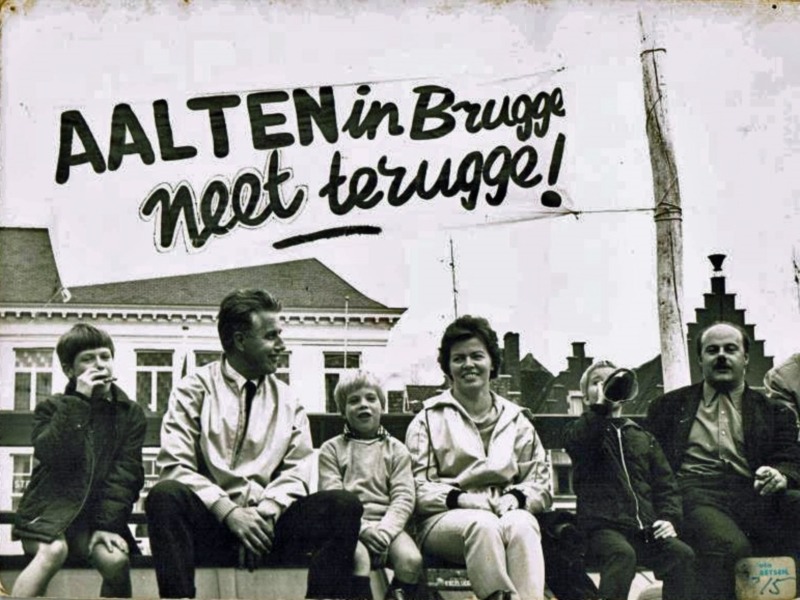
In 1968, Aalten put itself on the map by participating in the popular TV event ‘Zeskamp’ (Hexathlon). At the time, the municipality had approximately 12,000 inhabitants. The textile industry was in decline, and outside the built-up area, farming remained the primary way of life. During this period, Aalten was a pillarized village. However, Zeskamp appears to have brought about a turning point.
Zeskamp was a sporting event organized by the NCRV and the Belgian BRT, which they broadcast live on TV. At the time, it attracted millions of viewers, making it one of the most-watched TV programs. There were participants from six different locations: three from the Netherlands and three from Belgium.
Residents participated en masse and with great enthusiasm. People of various religious and ideological backgrounds worked together. For the first time, they truly met and got to know one another. In this way, imaginary walls were broken down.
The competitions were held on six Saturday evenings, each time in one of the participating locations. In Aalten, the Market Square served as the arena.
Ultimately, Aalten advanced to the final in Zutphen and won! The participants were honored with a parade through the village.
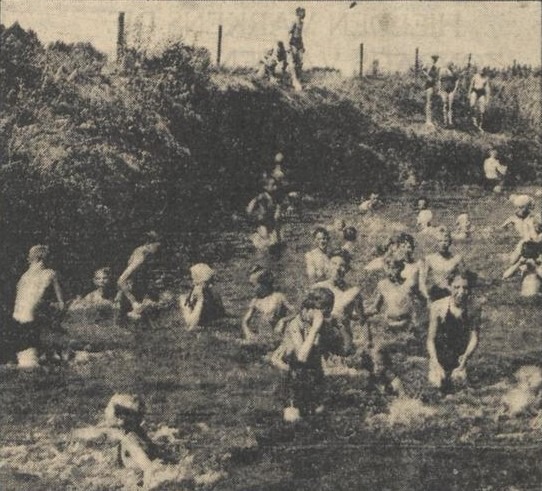
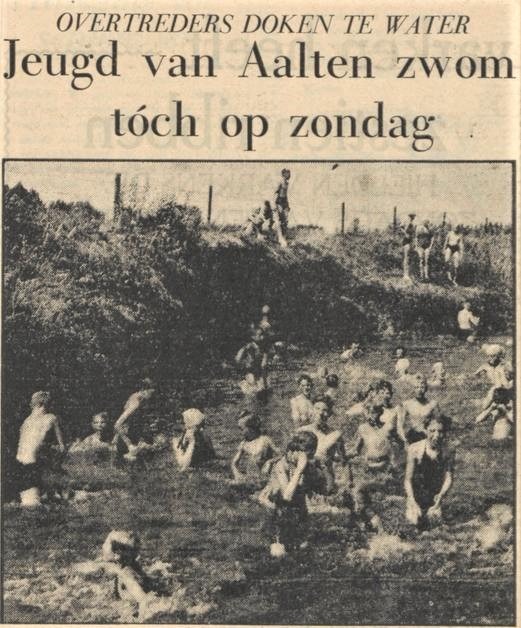
Sunday, July 7, 1957, was a sweltering day. Consequently, many residents of Aalten wished to take a cooling dip in the ‘t Walfort swimming pool. At the time, however, it was not permitted to open the pool on Sundays. Hundreds of residents disagreed and marched to the pool that afternoon. The youth climbed over the fence, and older residents forced entry into the pool. Moments later, the crowd dove into the refreshing water, and the hastily summoned police were powerless to intervene!
Stampede at ‘t Walfort
Nieuwe Winterswijksche Courant, July 8, 1957
Aalten possesses a beautiful natural swimming pool, ‘t Walfort. However, swimming is not permitted on Sundays. The predominantly right-wing Christian municipal council recently decided, by a majority of a few votes, that the pool must remain closed on Sundays. This decision has greatly irritated a large portion of the Aalten population, who do not share the motives behind this resolution. This irritation was further exacerbated last Sunday by the extreme heat, which created a longing for a cooling bath.
On Sunday afternoon, young and old alike flocked to ‘t Walfort in great numbers, where they initially stood before the closed gate, protesting against the municipal executive for withholding this pool from the more liberal Protestant segment of the population, as well as Catholics, Jews, etc., while it was sweltering. Soon, the youth began climbing over the pool’s enclosure, and before long, older individuals were kicking in the wooden fences to force access to the pool. Moments later, the entire crowd—numbering in the hundreds—dove into the refreshing water.
When the hastily summoned police and several board members of the pool arrived, they were faced with a fait accompli! The police could do very little; it was impossible for them to get all those people out of the water. Finally, Alderman Obbink of the Anti-Revolutionary Party (A.R.) delivered a speech, which, however, fell on deaf ears. The people simply held fundamentally different views than the municipal executive and continued swimming calmly.
De Volkskrant, July 8, 1957
After several hours of swimming, the pool board made another appeal to the swimmers: they had had their chance, and the pool had to be closed again. This appeal was successful: in a sporting manner, everyone left the pool, and shortly thereafter, Sunday rest was restored to the swimming pool. However, the municipal executive of Aalten is faced with a problem; it is now clear that, regardless of how this matter is framed on principle, a large part of the population disagrees and believes that the interference with their freedom on Sundays goes too far.
Naturally, the municipal executive made its decision to keep the swimming pool closed on Sundays based on grounds that were serious to many council members. However, Alderman Obbink promised “to look into this matter once more” for those who cannot share the Council’s fundamental considerations.
Aalten Swimming Pool remains closed on Sundays
Tubantia, July 9, 1957
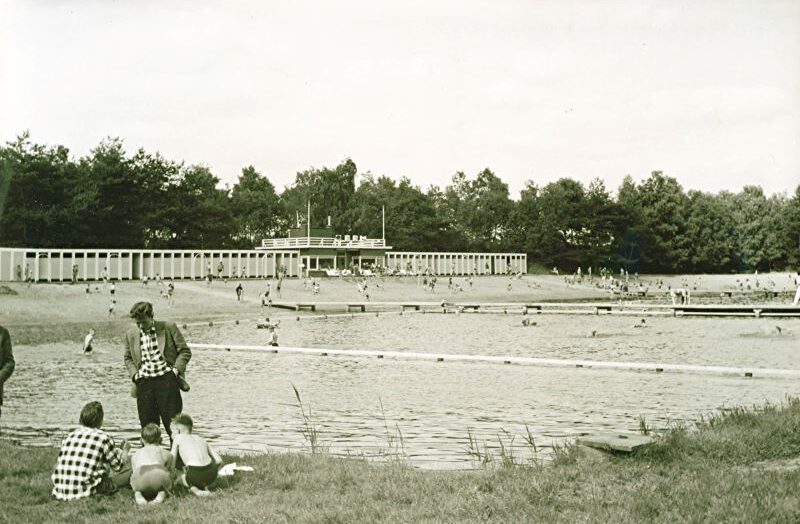
Archive photo of ‘t Walfort swimming pool, for illustration purposes
At the proposal of the Mayor and Aldermen of Aalten, this body met with the board of the “‘t Walfort” swimming pool to discuss the incidents of last Sunday, when the youth of Aalten stormed the pool. The pool board indicated that it fully respects the council’s decision to keep the pool closed on Sundays and that it condemns Sunday’s actions; the latter in contrast to rumors suggesting that the pool board had cooperated with the demonstration.
The municipality will issue a serious warning during the course of this week against entering the swimming pool on Sundays. The necessary measures will be taken. We further understand that the council factions of the K.V.P., P.v.d.A., and Gemeentebelangen will not submit a new proposal to open “‘t Walfort” on Sundays this season. Since no new proposal can be expected from other parties either, it is almost certain that the pool will remain closed on Sundays this season.
Warning
Tubantia, July 11, 1957
The acting mayor of Aalten, Alderman W.B. Obbink, has announced following the demonstration that took place on and around the swimming pool on Sunday that, should the disturbances recur, they will not hesitate to take criminal measures. This publication was issued following a statement from the board of ‘t Walfort. It reads as follows: “The board of the ‘t Walfort’ bathing and swimming facility, meeting on July 8, 1957, discussed the disturbances that occurred on and around the swimming pool last Sunday. It deeply regrets this reaction to a decision that was reached in a perfectly legal manner and unanimously expresses its disapproval of this subversive conduct. It strongly urges the population, especially the youth, to respect the Council’s decision, to refrain from vandalism, and to comply with the decision in a sporting manner.”
Aalten Council revises decision
Tubantia, April 16, 1958
This coming summer, residents of Aalten will be able to go swimming in their own ‘t Walfort pool at four o’clock on warm Sunday afternoons. Last night, the municipal council decided that the pool will be open from 3:00 PM to 7:00 PM on summer Sundays. A corresponding proposal, submitted on behalf of the K.V.P. and Gemeentebelangen factions, was adopted after a calm debate by 9 votes to 6.
The decision itself was not a surprise, but the relatively large majority the proposal received was. Unlike last June, when a similar proposal was rejected by 8 votes to 7, all three Christian Historical (C.H.) council members now voted in favor. The Anti-Revolutionary Party (A.R.) remained steadfastly opposed. As is well known, last summer, a few weeks after the council’s rejection, ‘t Walfort was stormed by hundreds of Aalten residents on a sweltering Sunday afternoon, after which swimming took place for several hours.
Disturbed peace of mind jeopardizes Sunday rest
Last night’s debate did not open any new perspectives. It was essentially a brief repetition of the arguments that were presented extensively and sometimes passionately on June 30 of last year. This time, the council finished its discussion within half an hour. Mr. Luiten, faction leader of the A.R., called it less than edifying that another proposal to open the swimming pool on summer Sunday afternoons has already been submitted.
If we were to make a different decision now, people might think we are giving in to opposition from the streets. He once again explained the pros and cons, admitting that mass swimming in the stream creates unacceptable conditions, but stated he did not see why, in a municipality like Aalten with its wealth of natural beauty, the swimming pool must also be open on Sundays. In his view, a piece of Sunday rest is lost because of it.
Mr. H.L. Obbink (C.H.) clarified why he would take a different position this time than last year. The events of that time proved that the peace of mind of the population can be so disturbed if the swimming pool remains closed that the Sunday rest itself could be jeopardized. This had led him to decide to revise his position. Mr. Huinink (Labor) again raised the argument of Sunday labor in the service of the police, railways, etc., which is also performed by Anti-Revolutionaries.
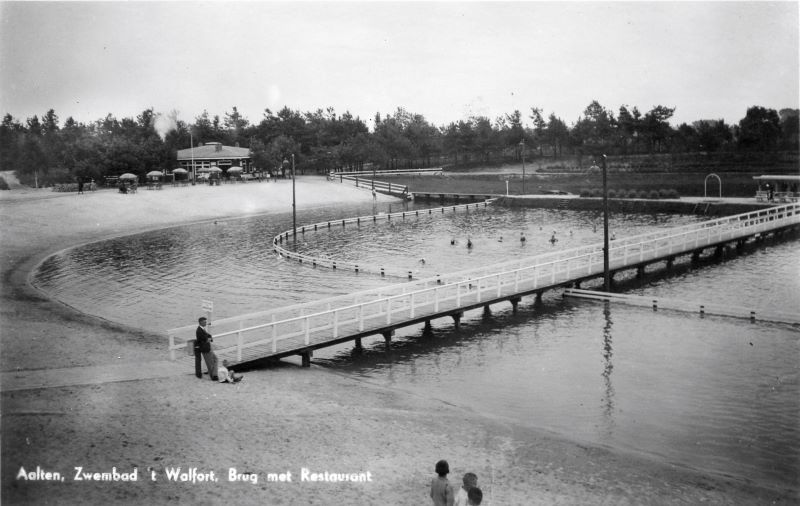
Archive photo of ‘t Walfort swimming pool, for illustration purposes
(“Only necessary labor,” Mr. Heinen stipulated), and called the attitude of the A.R. typically Aalten. In a municipality like Varsseveld, the situation is quite different. What was proclaimed 50 years ago no longer applies today. He believed that the Sunday rest would not be jeopardized by the opening of the swimming pool.
Not through resistance
Mr. Wijkamp (K.V.P.) stated that the irregularities of last summer were not the reason for bringing the proposal forward again; it was already certain then that another attempt would be made before the new swimming season.
After Mr. Brethouwer (C.H.) explained why he would vote in favor (“swimming in the stream at Lintelo certainly does not benefit the Sunday rest”), Mr. Heinen (A.R.) expressed his surprise at the changed attitude of Mr. Obbink and especially of the K.V.P., which a few years ago was even opposed to mixed swimming. Mr. Lurvink (K.V.P.) replied that moral welfare was certainly as important as the sanctification of the Sabbath. After brief replies, in which Mr. Wijkamp requested strict police action against swimming in the stream, the vote was taken.
After Mayor Van Veen announced the result, Mr. Ter Linde (P.v.d.A.) addressed the population over the heads of the council with a request to make appropriate use of the swimming pool and to prevent any excesses. The Mayor and Aldermen will now consult further with the swimming pool board regarding the implementation of the decision.
Sources
Nieuwe Winterswijksche Courant, July 8, 1957 (via delpher.nl)
Several excerpts from the Java-bode, December 22, 1956
Christmas: A Christian holiday, yet many customs originate from paganism. In modified forms, they have withstood the test of time.
Already several days before Christmas, a festive mood awakens in people, reaching its peak during the Christmas days. It is no coincidence that the Christmas tree, holly, and mistletoe are popular then, and that Christmas bread, Christmas wreaths, and other Christmas pastries enhance the festive joy. It is seldom considered that such items and customs originate from ancient paganism.
In the past, our ancestors celebrated the Yule feast around this time, the festival of fertility, in honor of the return of the light. The shortest day had passed, and the days began to lengthen again. Sacrificial meals were held, and sacrificial fires blazed high in the sacred forests. Christmas is a Christian holiday, but all those customs emerged from pagan soil and have, more or less modified, remained and been adopted by modern man.
It is difficult to link Christmas customs to a specific day, as what occurs here on Christmas Day takes place elsewhere on December 26th or even on Epiphany. Some customs, such as eating certain types of cookies and pastries, are in vogue throughout that entire period between Christmas and Epiphany. In general, it can be said that in the rural Netherlands, Christmas Day is the holy day, a day of reflection and meditation, while Boxing Day is used more as a day for going out or visiting.
Achterhoek
Among the elderly in the Achterhoek, the superstition still lives that on Christmas Eve “Derk met de bèèr” rides around, destroying everything left lying outside. In many places, all agricultural tools are still stored in the barn and the yard is cleaned…
In many families in the Achterhoek, something extra is eaten on Christmas Eve, and this custom is reminiscent of the old name “dikkevretsavond” (gluttony evening). In farming families, pancakes fried with sausage are often served. A mocking rhyme that points to an extra treat goes: “Kasaventjen, Kasaventjen, dan gaat ‘t er bie ons op. Dan slacht mien va ‘nen pekkelhering en ik, ik kriege de kop”.
In Aalten, people eat “pilleweggeskes” on Christmas Eve, small spherical “weggen” (loaves) on which two dough pills are placed in a cross shape. Children still know an old begging song: “Pilleweggen-aovend, offert geld, Geft de kleine kinder wat, Geft de groten ‘ne schop vör ‘t gat!”
The aforementioned two dough pills in a cross shape did not originally belong on this Christmas pastry. They were placed there when the common people no longer understood the name “pilleweg.” A “pil” is a godchild or baptized child, and the “pillegift” in the form of a “pillewegge” was a baptismal gift. It was also a reminder of the pagan bread offering made to ward off the demons of the childbed. Anise, caraway, and cinnamon drove the gods away with their strong scent.
The fact that “pillewegen” are given as gifts on Christmas Eve likely finds its origin in the veneration of Mary as a woman in labor. The custom of eating walnuts on Christmas Eve in the cozy domestic family circle (in Aalten, for example) is still in vogue.
In 1937, G.H. Rots described in a series of articles in the Aaltensche Courant how life used to be in Aalten in former times. Regarding the historical belief in witches, he wrote:
“According to popular belief, witches held gatherings at night, and in the Aalter Esch there was a specific spot where these nocturnal assemblies took place. That piece of land, located approximately halfway between the Linde and the Lichtenvoordsche road, was called the ‘heksenbeddestêe’. It was a piece of no man’s land to which no one laid claim.”
Anyone reading about what transpired in this field is stunned by the stories of witches and ghosts that circulated in earlier times. It reached such an extent that even educated people believed in witchcraft, and the authorities of those days intervened in this ‘evil,’ punishing those found guilty of sorcery.
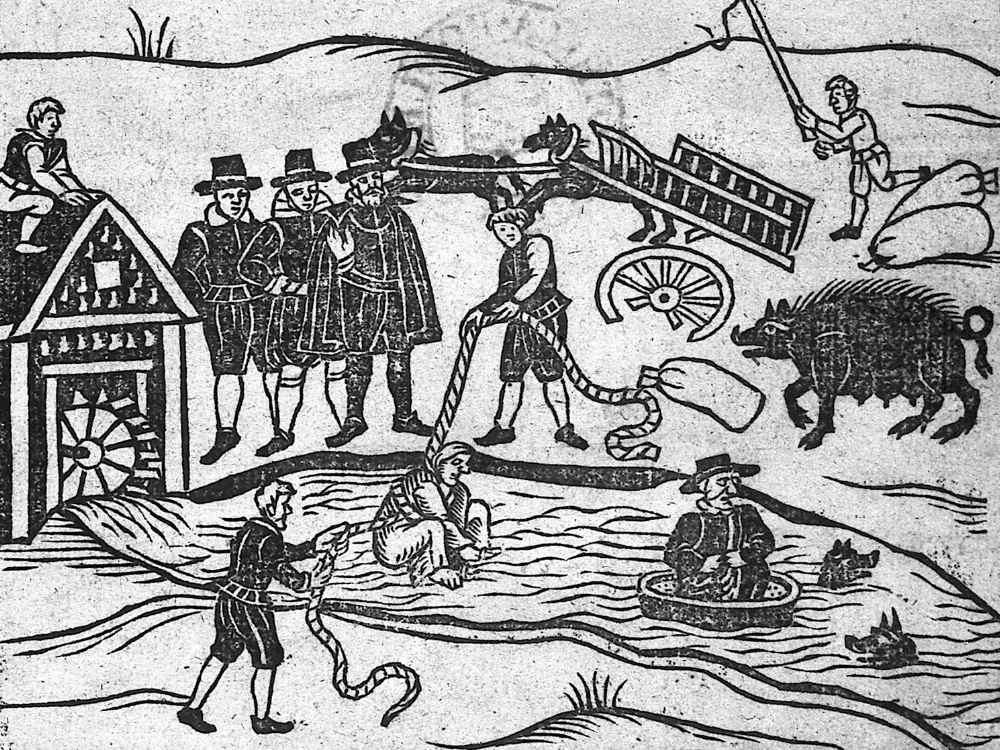
To determine whether an accused person was innocent or guilty, the so-called water trial was applied: the victim was thrown into the water. If they floated, they were deemed a witch; if they sank, then what? Then they were not a witch, but they usually drowned. It was believed that those who could perform witchcraft could transform themselves into animals. Illnesses among livestock or even among people were often attributed to witches. If the milk had a blue tint, or if a clump of hair was found in a calf’s or cow’s stomach, it was all blamed on the witches.
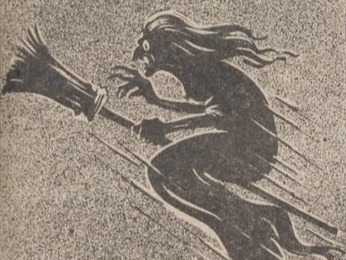
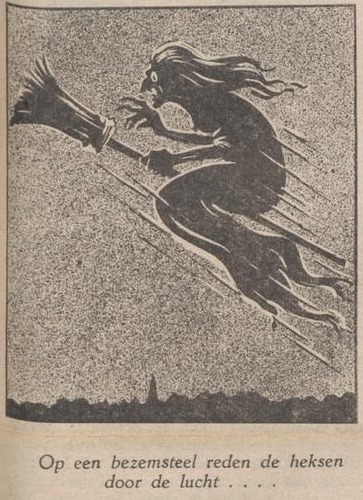
There were even people who believed themselves capable of witchcraft, claiming they had regular audiences with the devil. Witches were said to ride through the air on broomsticks and gather at the ‘beddestae’ in the Aaltenschen Esch to celebrate their nightly festivals. It should be said to the credit of the spiritual leaders of those days that they, at least, did not believe in it and repeatedly pointed out the absurdity of witchcraft to the population.
However, what is once deeply rooted is not easily dislodged, and so it took years, even centuries, before the superstition vanished. The authorities, primarily at the urging of the clergy, engaged in the suppression of witchcraft. They employed methods that were terrifying. If it was believed that someone could perform witchcraft or claimed to do so, the most severe measures were taken. Often the victims paid with their lives; even stakes were erected for burning.
Shivers down the spine
The old night watchmen could tell eerie stories of what they had experienced at night. The listener of these tales would feel ‘the shivers down their spine.’ For instance, it was told that ‘behind the hedges in the Heuksken,’ a woman dressed in white wandered every night. And then there was that mysterious light in the charnel house at the cemetery. Occasionally, mysterious animals were encountered that made the streets of Aalten unsafe. Furthermore, there were the ‘omens’ of fire. If a fire broke out in the village, one of the night watchmen had sometimes seen a ‘red glow’ above the site of the fire weeks in advance.
Berent Sweenen
Around 1600, a certain Berent Sweenen lived in Barlo. His neighbor, Geerdt Luiten, accused him of witchcraft. Luiten’s cows, pigs, and horses had regularly died of ‘unnatural sickness’ or sorcery. In the stomach of one of the cows he had cut open, ‘toads and snakes’ were found. Furthermore, Berent Sweenen’s sister ‘was also a witch.’ The whole place was hexed, and Luiten had already gone to Lichtenvoorde to complain. Berent Sweenen was summoned before the authorities and had to listen to all these accusations.
Luiten brought forward a new accusation. It was no longer possible to churn butter in his house. The cause: a hex by Sweenen. Another neighbor, Bernt Tolkamp, recounted that he had drunk buttermilk at Sweenen’s and had become ‘dreadfully ill’ from it. Tolkamp’s daughter had also fallen ill, likewise hexed by Sweenen.
More witnesses were called, namely Geerdt Winkelhorstink and Johan Merkerdink. They could only state that Sweenen had long been regarded as a sorcerer. Personally, however, they had not been troubled by him. A certain Herman Olthuys provided further incriminating testimony. Other neighbors recounted that they had hosted Berent Sweenen, who was a tailor, in their homes and that he had told them he could perform witchcraft. Eleven witnesses then took the oath and declared, invoking ‘God and His Holy Gospel,’ that what they had asserted was the truth.
Berent Sweenen, the simple tailor, maintained his innocence, but he stood alone. Eventually, under the weight of all those accusations, he gave in and said that he had understood the art of witchcraft for some 18 to 20 years. His fate was sealed, and given the punishments of those days, his head likely fell under the executioner’s axe. One case among many.
People pondered much. During the long winter evenings by primitive lighting, they saw all sorts of strange things. They heard wondrous tales, and when the old man sat in the corner by the hearth, he was asked to tell stories; then the tales of ghosts and witches would emerge, and at night in their sleep, people heard all kinds of sounds. The mystery of the unknown. That unknown, that mysteriousness, unsettled the people, and the case of Sweenen in Barlo is not unique.
Fourteen years earlier, the Bailiff of Bredevoort had already written to the Lady of the Pledge that witchcraft in Aalten was taking on ever greater proportions. One can conclude from this that the governing officials—the intellectuals of those days—also believed that witches existed. The fight against the ‘evil’ was therefore not conducted by convincing people that ‘witches’ cannot exist, but by the extermination of the individuals who carried out the evil.”
Aleida Voesters
“We wish to share one more case to provide an accurate picture of the dismal conditions in those days. It concerns a woman named Aleida Voesters. She was accused of witchcraft and thrown into prison, but was released when she promised to reform and paid a monetary fine. However, once the population views someone in a negative light, their reputation is ruined.
So it was for this woman. The population would not leave her in peace. The cup overflowed when a certain Wessel Wassink, a tailor by trade, claimed that he had fled from Mrs. Voesters’ house because he had heard devils quarreling there. The rumor reached the authorities again, and they deliberated on how to deal with this woman. The ‘executioner’ told the Bailiff that he knew a way to intervene with forceful measures. The woman was imprisoned again and transported to Bredevoort. She was thrown into the water and… she floated; she did not sink. Proof that she could perform witchcraft. They pushed her down with a long pole, but it seems that the excessive women’s clothing of those days prevented her from sinking.
The woman was then tortured with extreme cruelty. She was to be made an example. She was tied to a ladder and flogged, but the woman maintained that she could not perform witchcraft. Two days later, she was stretched on the rack again. But she did not confess. They tied a rope to her hands and hung her from a beam. At that moment, the pitiable woman let out a sound as if three men’s voices had called out. Immediately thereafter, her neck was broken. Her body was burned on a stake, made of wood that the farmers were expressly required to supply for that purpose. Such were the witch trials.”
Milk Witch
In a legal document from the Court of Bredevoort dating from 1533, we find the following story: The couple Gert and Lise Stapelkamp have a church pew in the Saint Helen’s Church in Aalten, which they claim was originally purchased by Gert’s mother, Sine Stapelkamp. However, the couple Koep and Nale Heinen claim it is their pew. During the service, Nale called Lise a ‘molkentoversche‘ (a witch who hexes cows) three times, after which Lise struck back. A significant disturbance in the church!
Sources
‘From Aalten’s Past’, by G.H. Rots, Aaltensche Courant, 26 November 1937 (Delpher)
‘From Aalten’s Past’, by G.H. Rots, Aaltensche Courant, 11 March 1938 (Delpher)
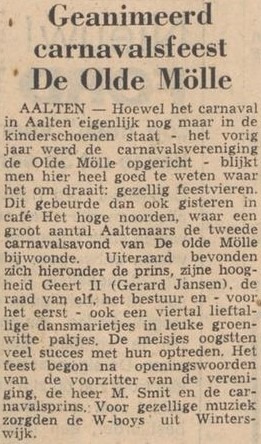
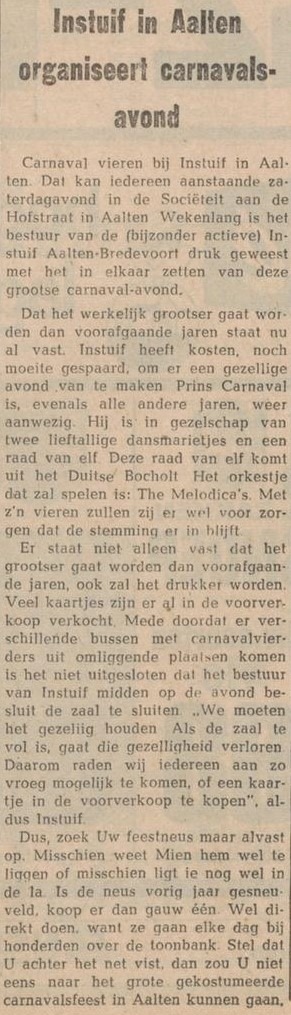
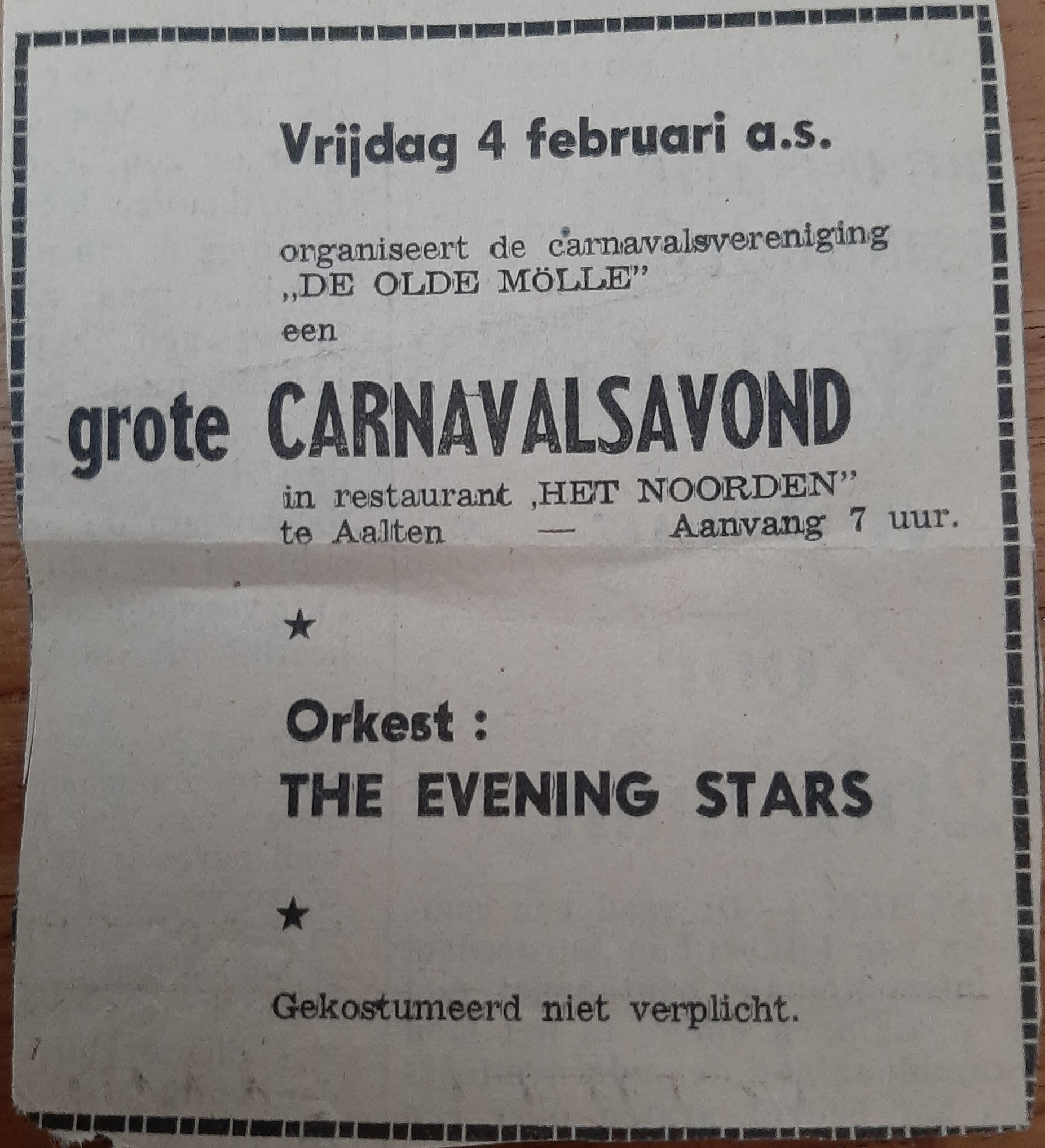
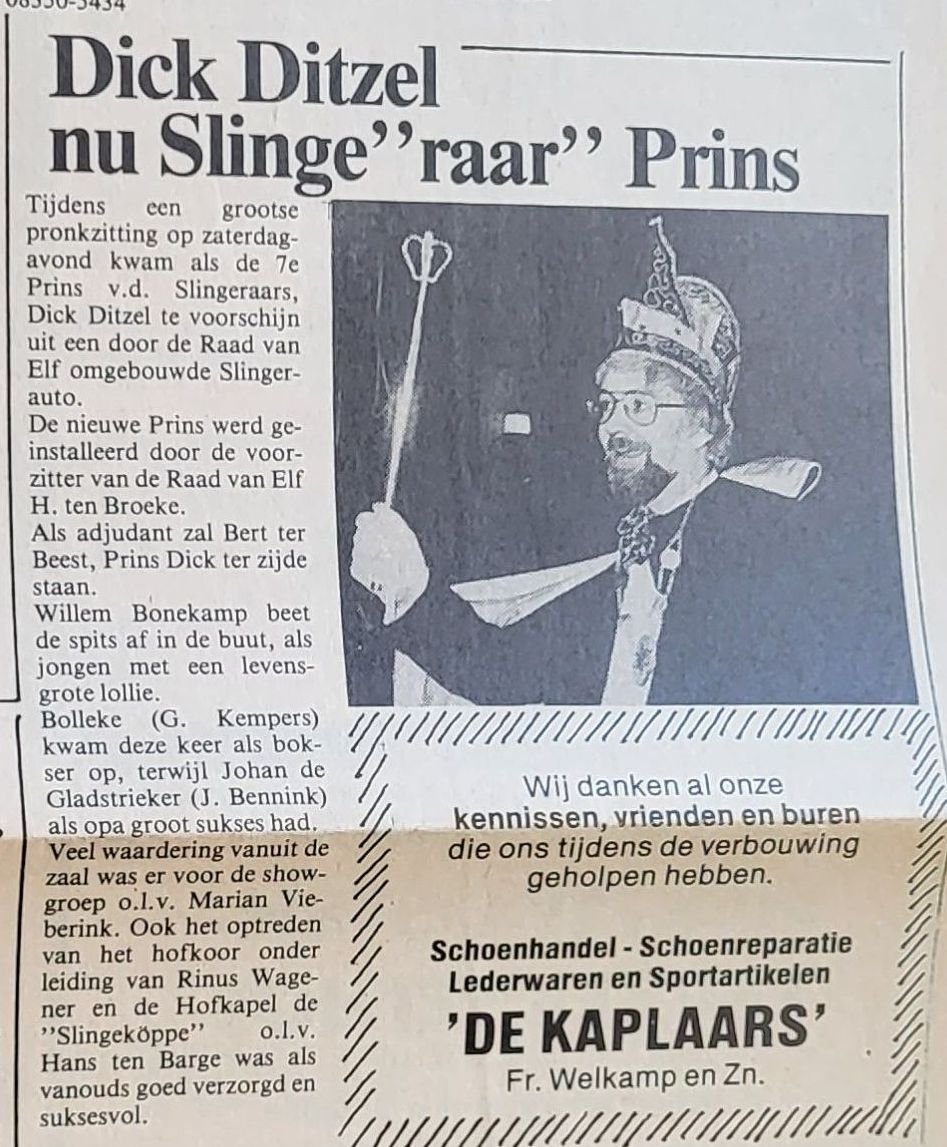
In large parts of the country, Carnival is celebrated seven weeks before Easter.In Aalten, this is not so much the case. Carnival is traditionally a Catholic festival, and Aalten has remained predominantly Protestant since the Reformation. Nevertheless, Carnival was also celebrated in Aalten in the past.
Carnival is originally a Christianized pagan folk festival traditionally celebrated only by Catholics. In parts of Gelderland, Carnival is celebrated exuberantly every year, while in many other parts it is not celebrated at all. These regional cultural differences often date back to the Reformation and the Eighty Years’ War (1568-1648). During this conflict, regions emerged that quickly aligned with the Protestant rebels. Other regions held on to the Catholic faith of the legitimate sovereign and Duke of Guelders for a long time.
For instance, the Lordship of Bredevoort was conquered in 1597 by the Calvinist Maurice of Nassau. He subsequently made the entire region from Aalten to Winterswijk Protestant. His half-brother Frederick Henry did not definitively conquer Groenlo from the Catholic sovereign until 1627. In the preceding years, the Catholic faith was able to take deeper root in the society of Groenlo and its surroundings thanks to the Counter-Reformation.
Carnival in Aalten
Nevertheless, Carnival was also celebrated in Aalten in the past. In 1937, G.H. Rots described in a series of articles how things were done in Aalten in earlier times. For example, he dedicated a section to ‘vastenoavond’, or Carnival:
“If we look at the cheerful things again, the first thing people in the village concerned themselves with was ‘vastenoavond’. However, compared to the Carnival festivities in southern parts of the country, it was very modest here. There was music in a few cafés, and a few people also appeared on the streets in jester costumes. Characteristic, however, was the custom of the youth walking around with a so-called ‘foekepot’. This was a tin canister over which a dried piece of pig’s bladder was stretched. In the middle was a small hole, into which a small wooden stick fitted. By pushing this stick up and down, a humming sound was produced, and so on Shrove Tuesday one could hear the dull sound of foeke-foeke-foeke. They sang the following song with it:
Rummie-pottery, rummie-pottery, give me a penny and I’ll go by. I’ve no money to buy bread, I’ve walked so long with the rummie-pot. Rummie-pottery, rummie-pottery, give me a penny and I’ll go by.
The penny was usually given, and the ‘Shrove Tuesday fools’ did good business.”
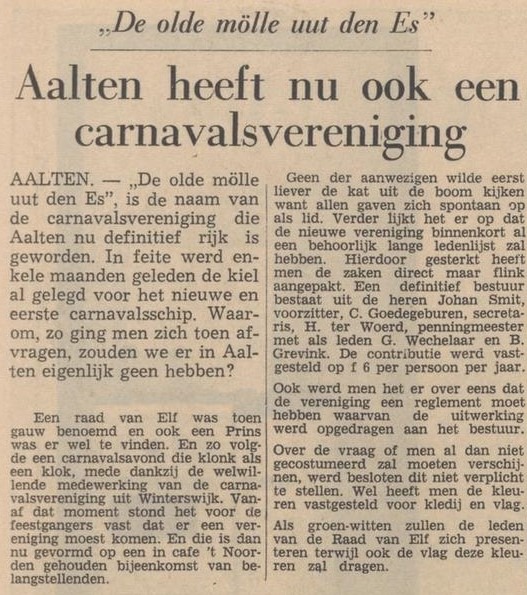
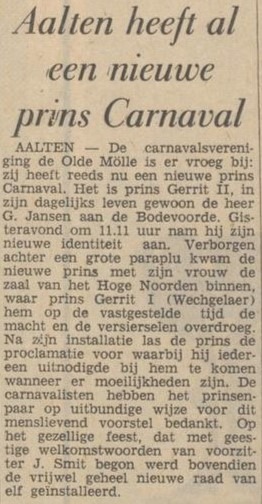
Aalten even had three Carnival associations: De Slinge-raars, Spuit Elf, and De Olde Mölle.
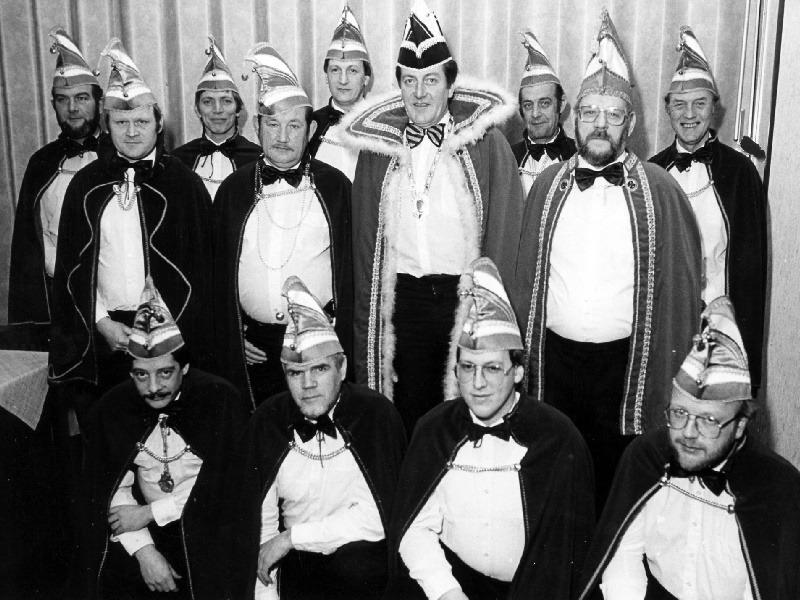
Carnival society ‘De Olde Mölle’ (The Old Mill), Aalten – Carnival prince Jan, his adjutant and the Council of Eleven.
Nowadays, Carnival in Aalten is only celebrated by the children of the St. Jozefschool, the only remaining Catholic primary school in the village. Other residents of Aalten who wish to celebrate Carnival are forced to go to places such as Groenlo (Grolle), ‘s-Heerenberg (Waskuupstad), or Doetinchem (Leutekum).
Newspaper reports
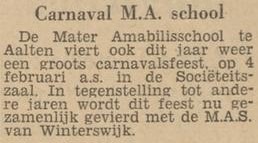
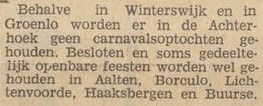
De Maasbode, 5 February 1913Carnival Mater Amabilis School, Aalten – Dagblad Tubantia, 30 January 1961Dagblad Tubantia, 24 February 1965Dagblad Tubantia, 9 April 1965
Dagblad Tubantia, 12 November 1965Dagblad Tubantia, 18 February 1966
In 1937, G.H. Rots described how life used to be in Aalten in a series of articles. Among other topics, he devoted a section to the traditional farming life of the past.
“The rural districts of Aalten formed an inseparable whole with the village. The villagers needed the farmer, and conversely, the farmers of the rural districts sought contact with the villagers. The roads were far from good, and due to the narrow wheel rims, the sandy paths had much to endure. Water drainage was poorly regulated, and maintenance left much to be desired. And yet those roads had to be used at the cost of much horse and ox flesh. For most farmers formerly kept oxen, which were used as draft animals for the wagons and carts. Progress was made at a slow pace: if I do not arrive today, then tomorrow; slow but steady, for the ox was a strong draft animal. After serving as a draft animal for several years, it was led to the slaughterhouse.”
Primitive
“The entire farming operation was, of course, primitive; there was no chemical fertilizer, resulting in much lower soil yields. Group stables were unknown, and chicken coops did not exist ‘on the farm.’ The chickens spent the nights with the cows in the stable. Some poles had been installed there, and the entire flock of poultry would trot up the ‘chicken rack’ in the evening. And when the days were short, they hardly ever came down. Egg production occurred only in the summer, and even then not in great quantities. The cattle also did not look as flourishing as they do today. One had to feed what one’s own soil produced. Everything was ‘pro rata,’ in proportion, but much less and less productive than nowadays.”
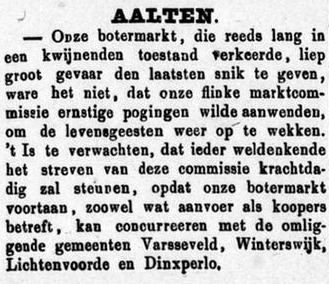
Butter factories did not exist; the milk was soured in cream pots and churned by hand. On some farms, that chore was performed by a dog. The churning dog had to walk in a large wheel, which set it in motion, and via an axle connection, it moved the churning mechanism. The kneaded butter was shaped into ‘welters,’ and then the housewife would take it to the market. In Aalten, the butter market was behind the Town Hall. However, this market did not enjoy a flourishing period, as the shopkeeper was also a willing buyer. With a closed purse, one could then buy groceries, and large suppliers received cash in addition. The eggs also brought in some money, but as mentioned, production was not that large.”
Botermarkt (Buttermarket) – De Graafschapbode, 21 July 1888
‘Koojonges’
“Many small farmers went to work for daily wages, and some also had a weaving room where a bit was earned. Everything, of course, had to be performed by manual labor; machines were unknown. Every farmer (who was not a day laborer) therefore had at least one head farmhand and a ‘cow boy.’ And those ‘cow boys’ usually came from the village.”
It was the custom that boys from working-class families, before learning a trade or craft, first went to ‘the farmer’ for a few years. Working-class families in the village were usually quite blessed with children, and when a boy was 10 or 11 years old, he had to go to ‘the farmer’ for ‘room and board.’ It was then said: “then he will learn decency immediately.” In any case, the boys learned the first principles of the farming business, which served them well in later life.
For full-fledged farmhands and maidservants, the wages were also not very high. Thirty or fifty guilders per year, but they would occasionally receive clothing as well. A few shirts, a few ‘brunten’ (a type of apron), wooden shoes, and some other necessities. That was the entire wage of the maidservant. In the spring they had a holiday, the so-called ‘spinning week.’ Then they would spend a week at home with their mother. The wages of the farmhands were slightly higher, but still very low by modern standards. And do not count on having much free time or short days. We already mentioned that the threshing flail had to be taken up as early as four o’clock in the morning.”
Nutrition
“For their own nutrition, more was enjoyed from the farm than is the case today. In the first place, everyone grew a quantity of buckwheat. Buckwheat flour was suitable for pancakes. And invariably, pancakes were baked every morning, usually with a ‘slice of bacon’ in them. The cooking oil was also a product of their own cultivation. The rapeseed was taken to the oil miller, and a few large jars of rapeseed oil and a number of rapeseed cakes were collected again a few weeks later. The cakes were excellent cattle feed, a treat for freshly calved cows.”
The food was otherwise as simple as possible, yet nutritious. Home-baked bread, for many farmers had their own baking oven and baked their own bread. The only delicacy was ‘rice porridge with brown sugar,’ usually a meal for Sunday evenings or when visitors came. A large bowl full of ‘rice porridge’ was placed in the middle of the table. Every person sitting at the table received a spoon, and then the eating began. Decency required that one dip the spoon shallowly into the firm porridge, so as not to give the impression that one was after the tastiest top layer with brown sugar. If someone was nevertheless so bold, people would soon think: “He is also mowing the sods.” Eating eggs was done only on Easter Sunday. Then sometimes more were consumed than was good for the stomach.”
“When the harvest was in and the potatoes were dug, there was reason for joy; then a domestic party was arranged and they had ‘stubble-end.’ This party was limited to the household members and workers who had assisted with the harvest. That the farming industry had to contend with economic difficulties is evident from the fact that many families sold their farms and sought a new existence in the New World in America. With a few exceptions, none have returned, and they have achieved greater prosperity in their new fatherland.”
Land prices were low here, and especially wild land was not expensive. For a hundred guilders per hectare, one could already buy wild land, for there were plenty of forests and heathlands, and where there are now lush meadows and excellent farmland, there were formerly vast forests, heathlands, and wild land. The rural district of Haart in particular was very heavily forested.”
When chemical fertilizer made its entry into the farming business, a turn for the better occurred. Wild lands were reclaimed, forests were cleared, water drainage was better regulated, and numerous workers found employment in the reclamation and cultivation of wild lands. The livestock population increased, the quality of the cattle improved, agricultural courses gave tips and instructions for effective fertilization, and one new farm after another was built. Old-fashioned stables were changed, and nowadays the building style of a farm is quite different from before.”
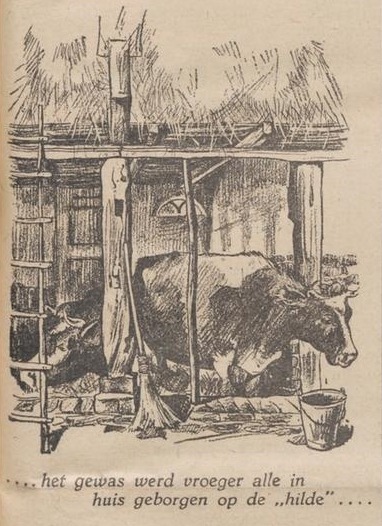
The crops were formerly all stored indoors, ‘on the beams’ and ‘on the loft,’ while now ‘stack heaps’ can be seen everywhere, sheltering the harvest. Among the villagers, too, there was a change in economic and social relations, and agriculture was practiced less. Manure piles had to be cleared away, modern industry arrived, and gradually conditions became more modern.”
Moving house
“On the rare occasion that a farmer moved, this took place on ‘Saint Peter’s Day,’ February 22nd. All belongings were loaded onto the neighbors’ wagons, and the entire procession moved from the old house to the new or different farmstead. The neighbor women had already gone ahead to the new home, had cleaned it, and had lit the fire. In the local dialect, this was called ‘vuur beün’ (preparing the fire).”
When the new residents arrived, the coffee was already brewed, and the newcomers could immediately refresh themselves with a nice cup of coffee. The neighbors helped that day; one dropped something here, another there; it was a colossal bustle. As a crowning touch, the ‘moving-in meal’ followed later, which again did not lack for spirited drinks.”
Moving house
Deaths
Funeral
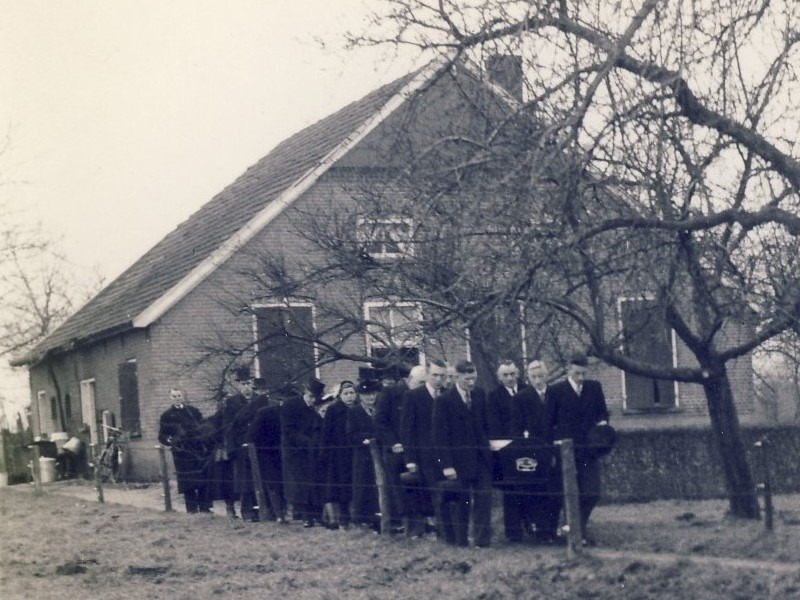
“In the event of a death, the neighbors were immediately notified; the neighbor women laid out the corpse, which was so-called ‘verhaenekleed’ (shrouded). The nearest neighbors then acted as the primary representatives of the residents. The nearest neighbor woman took over the tasks of the housewife, and the neighbor man those of the master of the house. These customs were the same among the villagers, and even now in the rural districts, that old custom is maintained.”
In the past, there was the so-called ‘funeral beer.’ After the funeral, the residents of the rural district went to one or another café in the village. There they rested from the tiring journey and beer was served. Generally, that beer was not of the very best quality in the past, and it was a sort of brown liquid that one was given to drink. In that café, they took leave of one another and everyone went their own way.”
The funeral procession of the local residents consisted of the cart on which the corpse was transported. This was uncovered. Then followed a number of “canvas carts,” high carts with white hoods. If there was a death in the village, one of the neighbors had to go around the ‘rot’ (neighborhood group) in the morning to warn the people that they ‘had to come to load at eleven o’clock.’ It was usually quite busy there at eleven o’clock, for it was the custom that the ‘nearest neighbor’ went around with the ‘bottle.’ The corpse was carried from the house of the deceased to the cemetery by the neighbors, and again gin was involved, for the pallbearers were given a restorative beforehand.”
Visit
“In the month of May, there were many farm visits. Then friends, family, and acquaintances were invited, and the farmsteads swarmed with visitors. The lands were inspected, the livestock criticized; it was more like a small-scale exhibition. These visits were also always held whenever something had been built. The building material had been fetched by the “neighbors” from the brickworks or storage sites, and a party crowned it all. That neighborly help was something traditional and was also indispensable; people supported each other mutually. Together, they performed what one could not manage alone, and especially during family events, neighborly help was indispensable.”
“During the long winter evenings, people often went on neighborhood visits, and the slaughter visits were also a real night out for the residents of the rural districts. The large sod fire (sods were light peats, the top layer of a peat layer) spread a pleasant warmth when one sat close to it, and then the master of the house sat with his chair tilted back before one side of the mantelpiece, and the neighbor before the other. The conversation then concerned the business, the cows, and the pigs. The visitors smoked for free, and when the pipe had to be lit, a glowing coal was taken from the fire with the tongs.”
The home butcher
The depression in the hearth plate, where the actual heart of the fire was located, was called ‘rake’ or ‘vuurrake.’ The ‘blowpipe,’ the tongs, and the fire spoon were the tools that hung beside the fire. Above the fire, a large chimney breast was built out, which served as a smoke catcher. It was also the storage place for everything one wanted to keep dry, including the gunpowder and the powder horn, for every farmer had a gun, a muzzle-loader, which had to be loaded with powder. Poaching was in the farmer’s blood. He would occasionally outsmart a hare or a rabbit.”
Illustration: Piet te Lintum
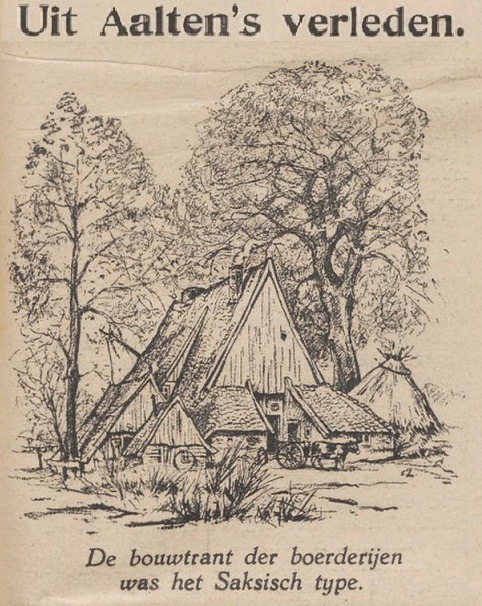
The architectural style of the old farms was the Saxon type. In very old houses, the living space for humans and animals was not separated. In most, there was a partition wall, sometimes of stone, sometimes of so-called ‘wand,’ a wickerwork of wood, plastered with loam on both sides. The box beds were mostly all installed in the kitchen, and one can imagine the situations that arose as a result.”
When clothes had to be mended or made new, the tailor from the village came to the house to perform those tasks, and in the evening he would clatter back to the village with the pressing iron and the pressing board in his hands. When May arrived, the farmer could earn an extra income by peeling wood. Around the fields were wooded banks on which oak coppice was grown. When this wood had reached a thickness of approx. 5 cm, it was cut, and because it was ‘in sap’ in May, it was peeled, i.e., stripped of its bark. The wood was chopped to a length of about 1 meter, and then it was laid over another piece of wood and beaten until the bark or crust came loose. The bark was dried and taken to tanneries, where it was processed into tannin. The wood that remained was called ‘schelhout’ (peeled wood) and was a very popular fuel.”
Another resource to increase income was the burning of charcoal. Some had acquired skill in this, and these charcoal burners had their customers everywhere. In the autumn, the farmers moved with the cattle to the fields. Entire fields were overgrown with spurrey, a crop sown after the rye. The cattle were put on the ‘tether’: a pole was driven into the ground, to which a wooden pole with an iron bracket was attached, and fastened to the cow chain or rope. The cattle could then graze a certain section, and each time the cattle had to be ‘tethered further.’”
Market
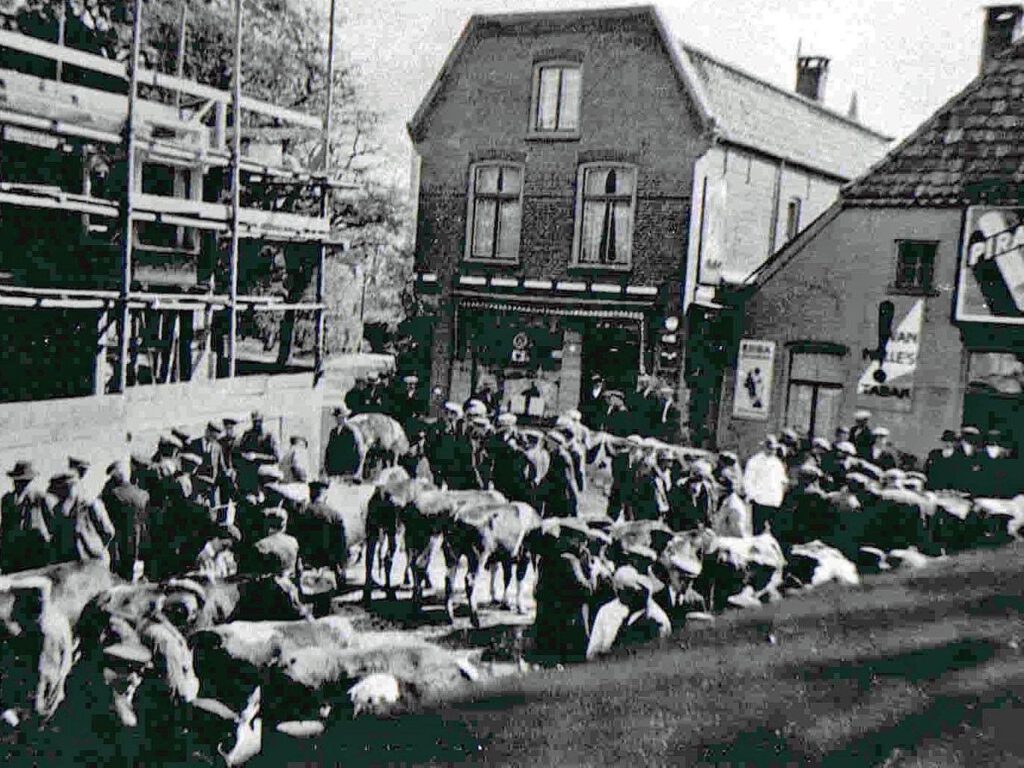
“When it was market day, people went to the market; if there was livestock to be sold, it was transported to the market, for cattle trading only happened at the market. The Aalten cattle market was therefore very well attended. People became informed about the prices of oxen and other cattle; they heard all sorts of news at the market, which in turn provided subject matter for conversation in the domestic circle.”
The annual fairs were the major event in the life of the population. First there was the May market, in the autumn the Fair, and on December 6th the Saint Nicholas market. Then it was a bustle of great importance in the village. In the morning, the married couples went from home to the market. The cattle market was overcrowded, and in the inner market, there was no lack of stalls and sellers of all kinds of household items. Well-known figures were the quacks who sold herbs, which were said to cure most diseases. The tooth-pullers also usually had good business.”
Veemarkt (Cattle Market) Aalten, around 1934
At those annual fairs, there was dance music in most inns. The young people went to the market in the afternoon. The farm girls first strolled past the stalls, bought something to their liking, and finally grouped together. Then the boys appeared, and they tried to find each other to go out this evening. Some had already made appointments beforehand. These ‘had the sods dry already,’ for in the local dialect, if one had someone’s promise to celebrate the annual fair together, it was said: ‘then one had the sods dry.’ When it was nine o’clock in the evening, and there were still girls who received no proposal, then the chance for them was gone and they had to return home alone. Thus the first marriage bonds were often formed, and the first meeting at the annual fair was decisive for their entire lives.”
Source
‘From Aalten’s Past’, by G.H. Rots, Aaltensche Courant, 12 & 19 November 1937 (via Delpher: part III & part IV)
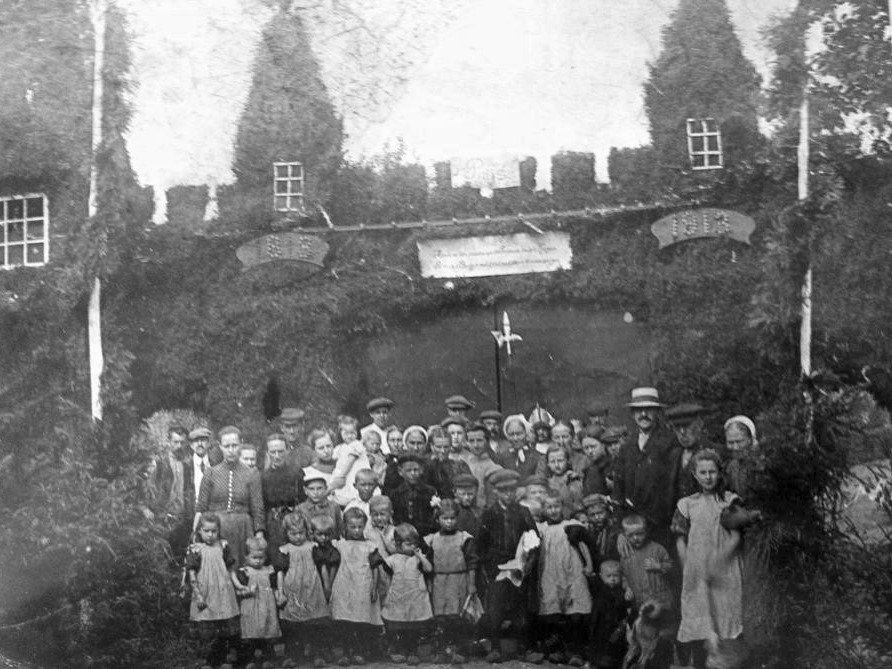
We frequently read or hear about “Plan 1913”. What is meant by that? It is the plan or intention to festively commemorate the joyous event of 100 years ago. Is there reason for this? Those who still ask this provide proof that they have forgotten what they learned at school regarding the history of our fatherland. The only thing that can be offered as an excuse is that for many, their school years lie far behind them and oral tradition is no longer heard.
It was in 1863, when the fiftieth anniversary of the Netherlands’ Independence was celebrated in Aalten, that things were quite different. Back then, there was hardly a family where one did not hear from the lips of grandparents about the sad times our ancestors lived through as long as the French were in charge here. Incidents that had personally affected a family were recounted, but now, 50 years later, much of that is covered by the veil of oblivion.
Aalten decorated on the occasion of 100 years of independence, 1913
In general, therefore, we wish to recall a few facts that history has recorded. The 17th century (1600–1700) is called the “Golden Age” of our history; the 18th century (1700–1800), the “century of decay”.
What was the cause of that decay? People began to rest on the laurels achieved by their ancestors. A spirit of enterprise was no longer to be found. In idleness, people began to enjoy the accumulated wealth and were afraid to give up anything that might contribute to the promotion of the country’s prosperity. No funds were made available for the army and navy, and the prestige of the once-mighty Republic of the United Netherlands dwindled from year to year.
In the eyes of other European states, we no longer counted. Furthermore, dissatisfaction with the administration arose, fuelled by the revolutionary spirit that manifested itself in France—so much so that the revolutionaries, called Patriots, acted hostily towards Stadtholder William V and his supporters, called Orangists.
The French Period
When the great Revolution had taken place in France, and the revolutionaries had put the King and Queen to death, the Patriots called in the help of the French to drive out the Stadtholder here as well. In 1795, they marched into our country with a large army and were received with cheers by the revolutionaries.
The government was unable to stop them because the army was not properly equipped and the fortifications were dilapidated. The money needed for their maintenance had been cut, but now they could give the French 100 million guilders, which they demanded for the help and assistance they had provided. William V fled to England, and his opponents took the place of the former government officials.
Now, the French could have left again, but they did not think of it. Time and again, when the French soldiers here were well-fed and clothed, they were exchanged for a ragged, starving bunch, to recover their strength here at the expense of the citizenry. Their influence on the course of affairs in this country meanwhile increased more and more, until they took the entire administration into their own hands.
In France, there was great confusion until it finally succeeded for a lawyer’s son from Corsica, named Napoleon Bonaparte, to create some order. He was a brave general and a capable warrior, who defeated the armies of the states that had declared war on France and prescribed humiliating peace terms to his enemies. In 1804, he had himself proclaimed Emperor, and two years later he sent his brother, Louis Napoleon, here to rule over our country as King.
Heavy Sacrifices
The alliance with France cost us heavy sacrifices. The English, who were at war with the French, now became our enemies as well and took possession of almost all our colonies and robbed our merchant ships, which meant our trade was as good as gone. One already had to pay a quarter of one’s income in taxes, and yet Napoleon demanded more.
Napoleon had had his brother Louis proclaimed king here in the expectation that he would submit entirely to his will. However, he was disappointed in this. Louis came here with the intention of promoting the prosperity of his kingdom as much as possible and protecting the people from further oppression. He showed this, among other things, by refusing to introduce conscription and by tacitly allowing smuggling with England.
To hit England, Napoleon had strictly forbidden all trade with that country. Now that Louis did not support him enough in this, he forced him to abdicate (1810), and Holland was annexed by France. Our country now became a French province and thus ceased to be an independent kingdom. The government was now organised on a French footing. The Dutch language had to gradually disappear. French had to be learned in schools, and newspapers also had to appear in French.
An army of customs officers occupied the coast and ensured that when a ship with English goods arrived, the cargo was burned. Indische goods, such as coffee, tea, tobacco, and rice, rose astonishingly in price as a result. The impoverished citizenry managed with a decoction of toasted rye bread instead of using coffee, and instead of tobacco, people smoked walnut leaves. To replace sugar, people set themselves to making sugar from the sweet sap of beets.
Many wealthy citizens became poor, and those who had to live off their interest, as well as numerous orphanages and charitable institutions, suffered want when Napoleon had the interest on the national debt “tiered”—that is, he only acknowledged one-third of it. Those who, for example, were entitled to 300 guilders in interest only received 100 guilders. No more was earned, but more had to be paid, causing poverty to pinch; hundreds of houses were sold for demolition, magnificent country estates were disposed of for a trifle, horses and carriages were abolished, and servants dismissed. In Amsterdam, grass grew on the streets.
Fighting for Napoleon
But the Frenchman did not just take goods; he also demanded blood. Napoleon needed soldiers to fight for him in all corners of Europe and now forced our boys to serve in his armies. He introduced conscription, which for us was something unheard of. In our previous wars, there were always enough volunteers to defend the fatherland, but now it was determined by lot who had to take up arms. Thus, numerous families saw their beloved relatives head off to foreign lands, never to see them again.
Yet no one dared to complain, or they would make the acquaintance of prison. Secret spies crept around everywhere to pick up every suspicious word, and the police often forced their way into homes and opened letters to hear someone’s opinion of the Emperor. Books and newspapers were not allowed to appear before they had been approved.
Yet this oppression also had its good side. The people now forgot their old party squabbles and felt united again and yearned for salvation. Napoleon’s power had reached its peak. Only England and Russia still defied him; otherwise, he ruled over all of Europe. Russia, too, would now feel his blows. With an army of more than half a million, he marched thither, but for every twenty soldiers, nineteen died miserably in Russia’s snowfields. The approximately fifteen thousand Dutchmen also never returned to their fatherland.
“Oranje boven” (Orange up/Long live Orange)
After this outcome, the Counts of Hogendorp, Van Limburg Styrum, and Van der Duijn van Maasdam secretly hatched plans to shake off the French yoke. After the Battle of Leipzig, in which Napoleon was defeated, the signal for the uprising was given by adorning oneself with the orange colour, which was previously punishable by death. The French soldiers watched, bewildered, and did not have the courage to resist.
Prussia and the Cossacks offered help, and on 15 November 1813, the cry “Oranje boven” already rang through Amsterdam’s streets, and two days later in The Hague. On 21 November, Van Hogendorp and Van der Duijn van Maasdam accepted the provisional government, and on 30 November, the Prince of Orange, son of the expelled Stadtholder William V, set foot on land at Scheveningen, where he was cheered by the crowd with unprecedented enthusiasm. Two days later, he was proclaimed Sovereign Prince in Amsterdam.
The French slunk away, and the Netherlands was free. That is one hundred years ago now, and all that time we have been spared from enemies crossing our borders. There is, therefore, reason to festively commemorate the Netherlands’ deliverance with thanks to God. Let us value our freedom, for no greater disaster can befall a people than when they are dominated by strangers. At the centenary of our independence to be celebrated within the municipality of Aalten on 28 August next, let our age-old motto therefore ring out loudly: “Oranje boven”.
Wilhelm Albertus (Willem) Lammers (Aalten, 1857 – Ginneken, 1913) was a Dutch painter with a remarkable specialisation: poultry scenes. Until the end of the 19th century, hardly any attention was paid to the living conditions of poultry. Chickens typically slept in a farm barn or in trees. The painter managed to capture this vividly on canvas.
Lammers was born on 3 April 1857 at the Schulenkamp farm in the Dale hamlet near Aalten, as the son of Albertus Lammers and Theodora Huls. The family moved several times within Aalten – first to Kerkstraat, then to Dijkstraat and Hoekstraat. Willem Lammers was initially a shoemaker by trade. In 1880, he left for Gaanderen, and a few years later, he lived in Amsterdam.
In 1887, the Court-Martial in ‘s-Hertogenbosch sentenced him to four months of military detention for desertion. Upon his registration, his occupation was recorded as painter, his religion as Roman Catholic, his height as 1.66 m, with blonde hair, blue eyes, and a curly beard.
On 24 July 1890, Lammers married Wilhelmina van den Akker in Breda. The couple lived briefly in Aalten (Dijkstraat) and moved to Breda in April 1891. Eight children were born there: seven daughters—one of whom was stillborn—and one son. Lammers passed away on 4 February 1913 in Ginneken (municipality of Breda).
Arts
As an artist, Lammers was self-taught. He worked mainly in oil on canvas or panel, mostly in small to medium formats. His scenes depict chickens, chicks, and cockerels in their daily environment: around the feeding area, by the haystack, or inside a barn. He signed his work as “W.A. Lammers”, “W. Lammers”, or with the monogram “W.L.”.
Wilhelm Albertus Lammers (1857–1913)De Volkskrant, 4 April 1939
Gallery
A selection of the work of Wilhelm Albertus Lammers:
Chicks, chickens, and a cockerelStable interior with a farmer’s wife and poultryA cockerel and three hensChickens, a cockerel, and peacocks in the farmyardHerders with cattleCockerelsPoultry in the stableSmall livestock on a farmStill life of kitchen utensils
Traveling—whether through one’s own country or abroad—is a pastime of all ages and all peoples. Traveling and the writing of travelogues also took place in Overijssel. The Deventer scholar Mr. G. Dumbar wrote extensively about our country in the 18th century, including Gelderland. In the ‘Tegenwoordige Staat van alle Volkeren’ (Gelderland section), he describes towns and villages in the Achterhoek, from which we derive several insights. Starting at Borculo and moving toward Lichtenvoorde, we shall recount how Dumbar viewed the old lands of the County.
Much has changed; the heathlands and peat bogs have largely disappeared. The treacherous sandy tracks have been replaced by excellent paved roads. The impoverished, hut-like farmhouses have been transformed into proper dwellings for both man and livestock. Many forests have likewise vanished, and along with this progression over the last two centuries, numerous noble houses have gone as well. Towns and villages have changed, yet not so much that they have lost the prominence they already held to this day.
Illustration by Piet te Lintum from the article ‘Boerenleven‘
The Lordship of Bredevoort
From Neede, he moves on to the Lordship of Bredevoort, of which we read that it is of great antiquity. In 1245, the Castle of Bredevoort was granted as a fief by Herman, Count of Loon, to Otto of Nassau, Count of Gelre and Zutphen. William, Duke of Jülich and Gelre, pledged the fief in 1388 to Hendrik van Gemen for three thousand French Shields. Jacob van Bronckhorst later held the same right of pledge with the consent of the States of Gelderland. However, having chosen the side of the enemy in 1580, the town, along with the castle and the Lordship of Bredevoort, was given to Prince William I. His descendants still held the Lordship in 1741.
The Town of Bredevoort
As for the town of Bredevoort, conditions in 1741 were better than they are today. At that time, it was home to the bailiff and the Richter, as well as two deputies, a Stadtholder, an Advocate-Fiscal, a Landscribe, and a Commander. Furthermore, several officers resided there. All these high-ranking gentlemen spent a great deal of money in the small town, which must have appeared very distinguished at the time. The common man living in the villages of Winterswijk—notably the largest village in all of Gelderland at the time!—Aalten, and Dinxperlo, had to dance to the tune of the bailiff of Bredevoort and his clique.
Bredevoort itself was said to be very strong in 1741. The surrounding lands consisted entirely of marshland, where no one dared to venture. Moreover, three companies of infantry were stationed there; where all these people were sheltered remains a mystery to me.
The citizens of Bredevoort made the outsiders from Winterswijk and Aalten feel that they were of a superior class. When it was bitterly cold in winter and the frost was hard, the people of Aalten and Winterswijk were required to come and chop ice for the ice cellars. The mail had to be delivered by the men of Winterswijk and Aalten for nothing. Additionally, a wagonload of twig brooms had to be delivered to Bredevoort every year. If a hunt for thieves, robbers, vagabonds, or wolves was to be held, the people of Aalten and Winterswijk were allowed to beat the bushes and carry the rifles, while enduring the insults of the gentlemen. How the people of Winterswijk and Aalten must have rejoiced when the French in 1795 put an end to this state of affairs.
Meanwhile, we now write 1951, and it must be said: the two Cinderellas, Winterswijk and Aalten, have become fine maidens since 1741 and are in a state of glowing prosperity. It is, however, the irony of history that the stepmother, Bredevoort, is now sometimes treated somewhat stepmotherly herself. When one walks across her uneven cobblestone streets, one cannot help but feel pity for the outgrown lady of two centuries ago.
Aalten Surpassed Bredevoort
Markt Square, Aalten by Jan de Beijer, 1743
When the modern textile industry emerged, Aalten was the favorite. The Driessen family from Bocholt were the founders of Aalten’s rise, establishing themselves here as early as 1826. They attracted other industries. Although there were some dark pages in the previous century, Aalten turned the tables and is now the leader in the former Lordship of Bredevoort. Naturally, the municipality currently faces concerns as great as those of its sister municipalities, but that does not change the fact that Aalten has truly come into its own.
It is, meanwhile, astonishing how much marshland, how many vast heaths, and how many wild forests existed in 1741. If history had not been faithfully recorded and if we did not have more sources at our disposal, one could hardly believe that such conditions existed. Today, one sees prosperous lands and lush pastures that are a delight to the eye.
What we have described here is approximately all that is told of the Achterhoek. It is little. However, one must not forget that in 1741, someone from Amsterdam regarded the region we have described as a kind of jungle, which he preferred to stay as far away from as possible. It is therefore quite understandable that in earlier centuries, the population of East Gelre was much more closely related to Germany in economic and geographical terms than to the Dutch West. The attitude of the Germans has brought about a great change in this regard in recent years.
One of the last known witch trials in Bredevoort, and perhaps even in the Netherlands, was the trial of Marry Hoernemans in 1675. She successfully passed the water ordeal, after which she walked home with her head held high, her innocence proven once and for all.
In the seventeenth century, it was believed that witches were women who had made a pact with the devil. They were said to have received supernatural powers in exchange for renouncing God and His saints. It was believed that witches could, for example, churn butter from a ditch, make people infertile, or cause crops to fail.
Women who fell outside social norms – for instance, unmarried women without children – ran an increased risk of being accused of witchcraft. In the event of unexplained occurrences, such as illness or fire, they were often singled out as the culprits. It was then up to the accused to prove her innocence, often through a witch trial.
A certain Marry, the second wife of Hendrik Hoernemans, lived in Bredevoort in 1675. From his first marriage, Hendrik had a son named Jan. As often happens, the stepson did not get along well with his stepmother, and they frequently quarrelled. Jan repeatedly told others that his stepmother was a witch.
Marry was furious about this accusation and went to court. She presented the problem but added that she did not want the judge to punish her stepson. However, she requested to undergo a so-called water ordeal to prove she was not a witch. The judge deemed it unnecessary: “Surely everyone knows you are not a witch,” he said. “Your son surely didn’t mean it that way and made those remarks in his anger.” Marry, however, was not to be swayed. She was determined to pass the test.
At her insistence, the judge agreed, and on 26 July 1675, the water ordeal was carried out. As was customary in witch trials, Marry was completely stripped. Her hands and feet were bound together, and the executioner, along with his assistant, threw her into the water three times.
Marry sank like a stone every time, and if she hadn’t been pulled up repeatedly, she would certainly have drowned. According to folk belief, a real witch would float because she was supported by the devil. Marry sank – and was therefore not a witch. Afterwards, Marry dressed and went home satisfied without saying another word. It was now proven that she was not a witch and that her stepson was a liar.