Emigrants from Aalten to the US
The cradle of the Achterhoek family Navis is located in the Aalten hamlet of Lintelo. The oldest known mention of the name is in 1529, when Hendrik Naeves from Lintelo delivers two tijnshoenderen to his lord of Anholt. In 1997, the Navis farm had been inhabited by the Navis family for eight generations. Ancestors Jan Navis and Hermken in Bokkel leased the farm in 1730 as a church site of the NH church in Aalten.
Among the many emigrants who have exchanged our region for faraway places (especially North America) in recent centuries, there were also several descendants of Jan and Hanneken Navis. The following is a summary of what we know about these descendants of the Navis genus.
Christiaan Navis
The first known emigrant from the Navis family was Christiaan Navis (Aalten, 12-02-1797), son of Jan Navis and Sophia Blekking. He married on 11-02-1824 in Winterswijk with Johanna Hendrika Linzij (Oeding (D), 13-11-1803). They had six children between 1824 and 1841. In 1844 they lived on ‘Tiggeloven‘ in the hamlet of Dorpbuurt below Winterswijk and in that year they left for North America, where they arrived in New York on 27-07-1844 with the ship ‘De Hoop’. Christiaan gave as profession: stonemason.
Their eldest child, Jan Willem Navis (1824), did not go to America, but left for Prussia. Their second child, Janna Sophia Navis (1826), left for Aalten according to the population register, but cannot be found there. Perhaps she changed her mind and joined the trip to America after all. About 1846 she married in Clymer, NY with Jan Willem Bekerink (Ratum, 1821). She died in 1892 and was buried in Fontanelle, Iowa.
Daughter Christina Navis (1829) married about 1855 in the US with Jan Hendrik Verink (Kotten, 1810) and died in 1895 in Muscatine, Iowa, where she was also buried. Of the other three children, it is not yet known how they fared.
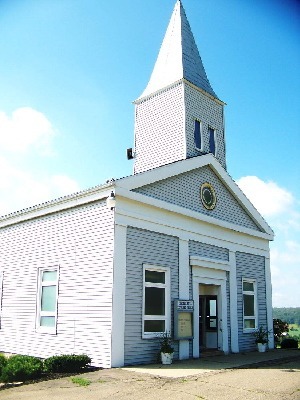
They purchased 25 acres of land in Clymer, NY on Clymer-Sherman Road, lot 60. They later sold this to their son-in-law Jan Willem Bekerink. In 1854, he gave up a quarter of an acre of land for 15 dollars to build the Clymer Hill Church on it. The church was consecrated on September 13, 1854.
Later, the entire family moved to Muscatine, Iowa.
Janna Geertruid Elisabeth Navis
She was born on 20-01-1808 in Lintelo, daughter of Hendrik Jan Navis and Antonetta Elisabeth Hoftijzer. She married on 25-08-1831 in Varsseveld with Lammert Rademaker (1806) and died on 20-01-1888 in Milwaukee, Wisconsin.
Children of Hendrik Jan Navis and Janna Liefting

Willemina Navis, born on 20-03-1794 in Lintelo, widow of Derk Jan Navis, remarried in 1827 to Roelof Doornink and they left for North America in November 1846 .
Derk Willem Navis, born on 26-07-1801 in Lintelo, married on 08-07-1826 in Aalten with Johanna Rexwinkel (1802). They left with their seven children and are then almost 80-year-old mother Janna Liefting to North America in August 1847 . On 21-11-1847 they all died on Lake Michigan, in the disaster with the propeller steamer Phoenix.
Evert Navis, born on 04-02-1809 in Lintelo, widower of Willemina Janssen, remarried on 29-05-1845 in Aalten with Berentjen Navis, his niece, born on 30-04-1813 in Lintelo (Marode) and daughter of Geert Navis and Harmina Lammers. They left for North America in October 1846 .
Berend Hendrik Naves
Born on 05-06-1839 in Lintelo (Marode), son of aren’t Naves and Dersken Tieltjes (nephew of Berentje, Derk Willem and Evert Navis). He married on 13-05-1869 in Aalten with Willemina Johanna Ormel (1847) from De Heurne and in September 1869 they left for North America.
aren’t Jan Navis
Born on 01-12-1828 in Lintelo (Nieuw Navis), son of Garrit Jan Navis and Johanna Geertruid Heesen and cousin by marriage of Willemina Navis on father’s side. He married on 06-12-1851 in Dinxperlo with Aleida Theodora te Kampe (1820). They left for North America in 1854 together with their one-year-old daughter Theodora Johanna.
Children of Berend Hendrik Navis and Johanna Huenink
Arend Jan Navis, (1841-1924), left on 17-12-1859 for Prussia where he married Elisabeth Blecking in 1869 in Wertherbruch. They founded a German branch under the name Naves.
Gerrit Jan Navis, born on 13-02-1854 in Aalten, left in September 1869 from the farm Den Bosch on the Haart to North America. He married in 1876 in Sheboygan with Hendrica Graven, born in 1852 in Town of Holland as the daughter of previous emigrants, namely Berent Graven and Aleida Berendina Snoeyenbosch from Aalten. They had seven descendants in America. Gerrit Jan died on 07-11-1927 in Sheboygan.
The riddle surrounding Henry Navis
When compiling ‘The Navis family 1838-1975’, an overview booklet of a Navis family in America, it was still unclear to the family who their founders Henry Navis and Hendrika Klein Hesseling were or where they came from.
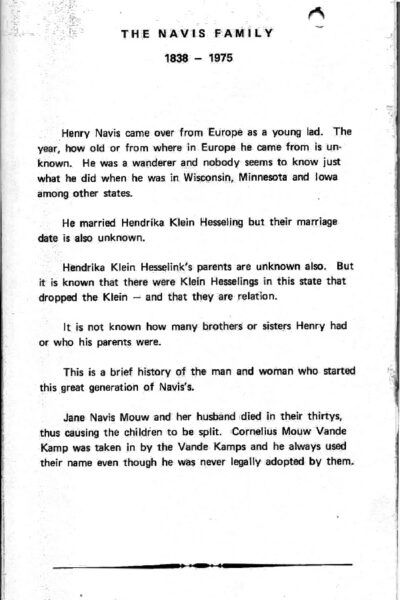
This can be read in the following excerpt from this booklet:
“Henry Navis, came from Europe as a young man. The year, how old he was or where he came from is unknown. He was a drifter, and no one seemed to know what he was doing when he was in Wisconsin, Minnesota, and Iowa and other states.
He married Hendrika Klein Hesseling, but their wedding date is also unknown. The parents of Hendrika Klein Hesselink are also unknown. What is known is that there were Klein Hesselings in this state who dropped the word Klein and that there is a band.
It is not known how many brothers and sisters Henry had or who his parents were. This is in short the history of the man and woman who started this great generation of Fishing.”
Riddle solved
Between 1982 and 1983, the mystery surrounding the ancestry of Henry Navis and his wife Hendrika Kleinhesselink was solved by genealogical research and communicated to the descendants in America. They were thrilled that after so many years there had been clarity about the origins of their founders in the US.
Henry Navis was born on 30-09-1838 as Gerrit Hendrik Navis in the Binnenheurne near Varsseveld, as son of Gerrit Willem Navis and Dersken ter Horst. His grandparents were Geert Navis and Hermina Lammers, brother and sister-in-law of Hendrik Jan Navis and Janna Liefting (see previous emigrants). His father Gerrit Willem died in October 1856, when Gerrit Hendrik was 18 years old. Shortly afterwards he disappeared from home and was reported as ‘absent‘ in the population register of Varsseveld. He died on 16-06-1922 in America.
Hendrika Kleinhesselink was born on 03-07-1830 in Dinxperlo, as a daughter of Jannes Kleinhesselink and Theodora ter Horst. Her father died in 1850 and his widow left for North America with her eight children in April 1856 . Hendrika Kleinhesselink died on 29-09-1903 in America. It is known from the descendants in the US that Henry, after the death of his wife, went wandering again.
Children of Gradus Navis and Dersken Vreemen
Gerrit Jan Navis, born on 10-07-1845 in Lintelo, left in April 1882, unmarried, for North America. He was followed in July of the same year by his brother with his family and his sister with her son:
Bernardus Navis, born on 13-04-1841 in Lintelo, married on 01-06-1876 in Aalten to Berendina Frederika Fukkink (1857) with their sons Gradus Theodorus (1877) and aren’t Jan (1881). aren’t Jan married in the US with emigrant daughter Minnie Voskuil (1881).
Hendrika Johanna Navis, born on 16-01-1837 in Lintelo, unmarried mother of Jan Willem Navis (1858). Jan Willem married Dina Johanna Harmelink (Lintelo, 1864) in Kansas in 1887.
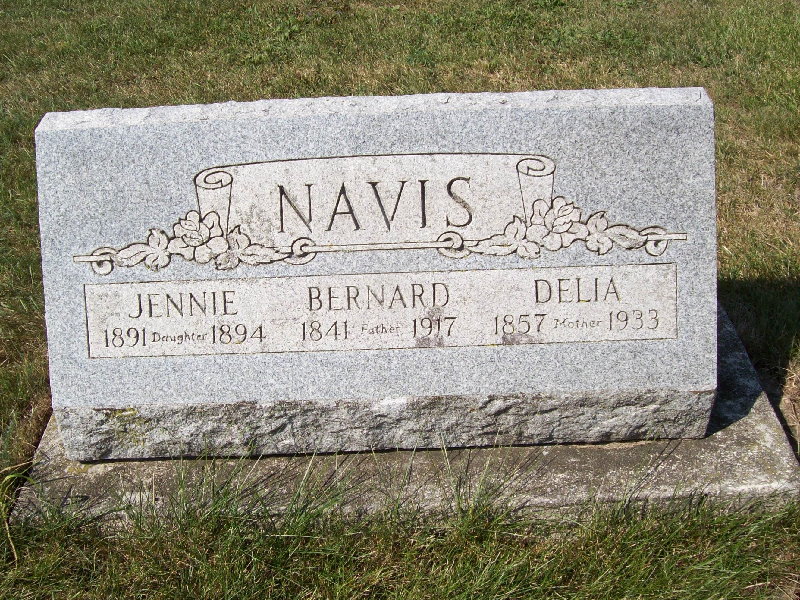
The whole family lived together at ‘t Boske until their emigration, with the exception of Jan Willem, who was a servant at ‘t Spieker. Gerrit Jan married Janna Aleida Krozenbrink (Barlo, 1861) in Wisconsin in 1884. He died in 1915 and was buried in Baldwin, Wisconsin.
Post-war emigrants
In 1948, Derk Willem Navis (1917-2003), son of Johan Albertus Navis and Dela Nijman (from the Arend branch), left for America together with his wife Antonia Wubbels (1918-1999) and two children. He had been a military police officer and settled in Wyoming, Minnesota as a salesman of building materials. Two more children were born in America.
Sources
- Genealogy Navis \u2012 Henk Navis, Lichtenvoorde
- Achterhoek Ancestors
- Heritage Centre Achterhoek and Liemers
- Emigrants \u2012 G.H. Ligterink, 1981
- WieWasWie (WhoWasWho)
- “Roots in the Achterhoek”, by Henk Harmsen, 1997 [p.6]