In the 19th century, thousands of Achterhoekers emigrated to the United States in search of land, freedom and new opportunities. Among them was the Huinink family from Dale.
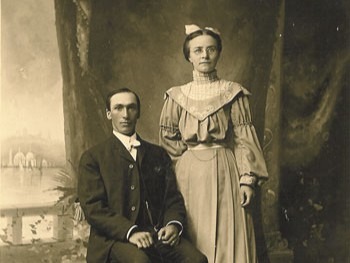
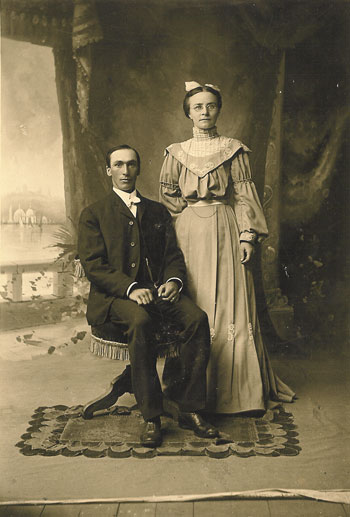
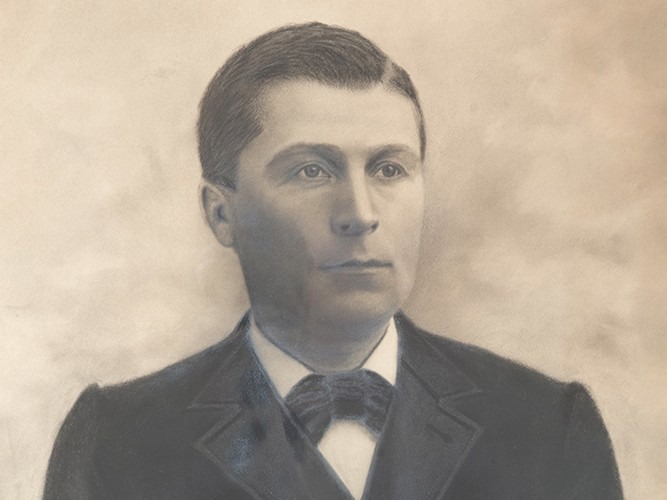
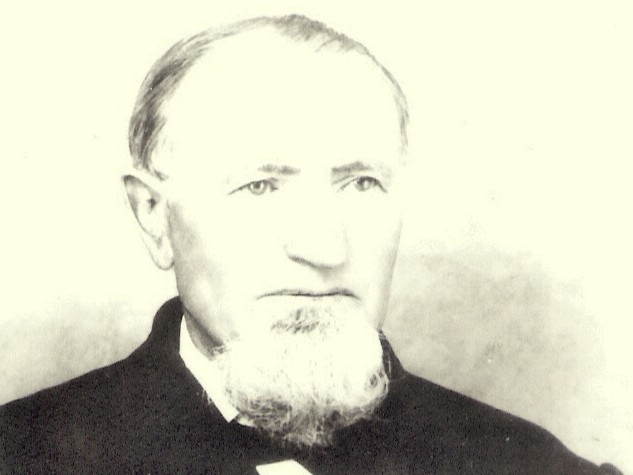
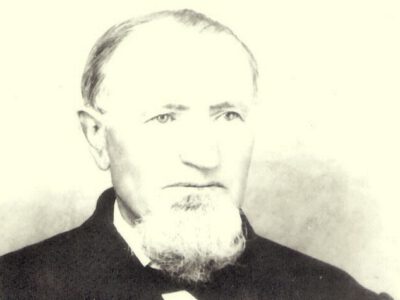
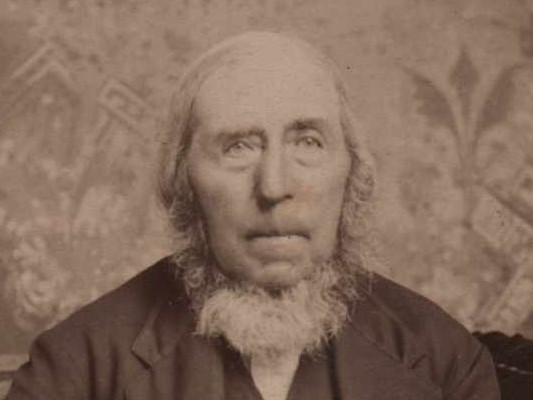
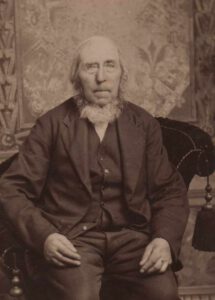
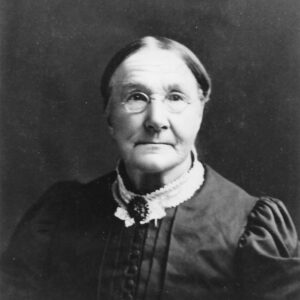
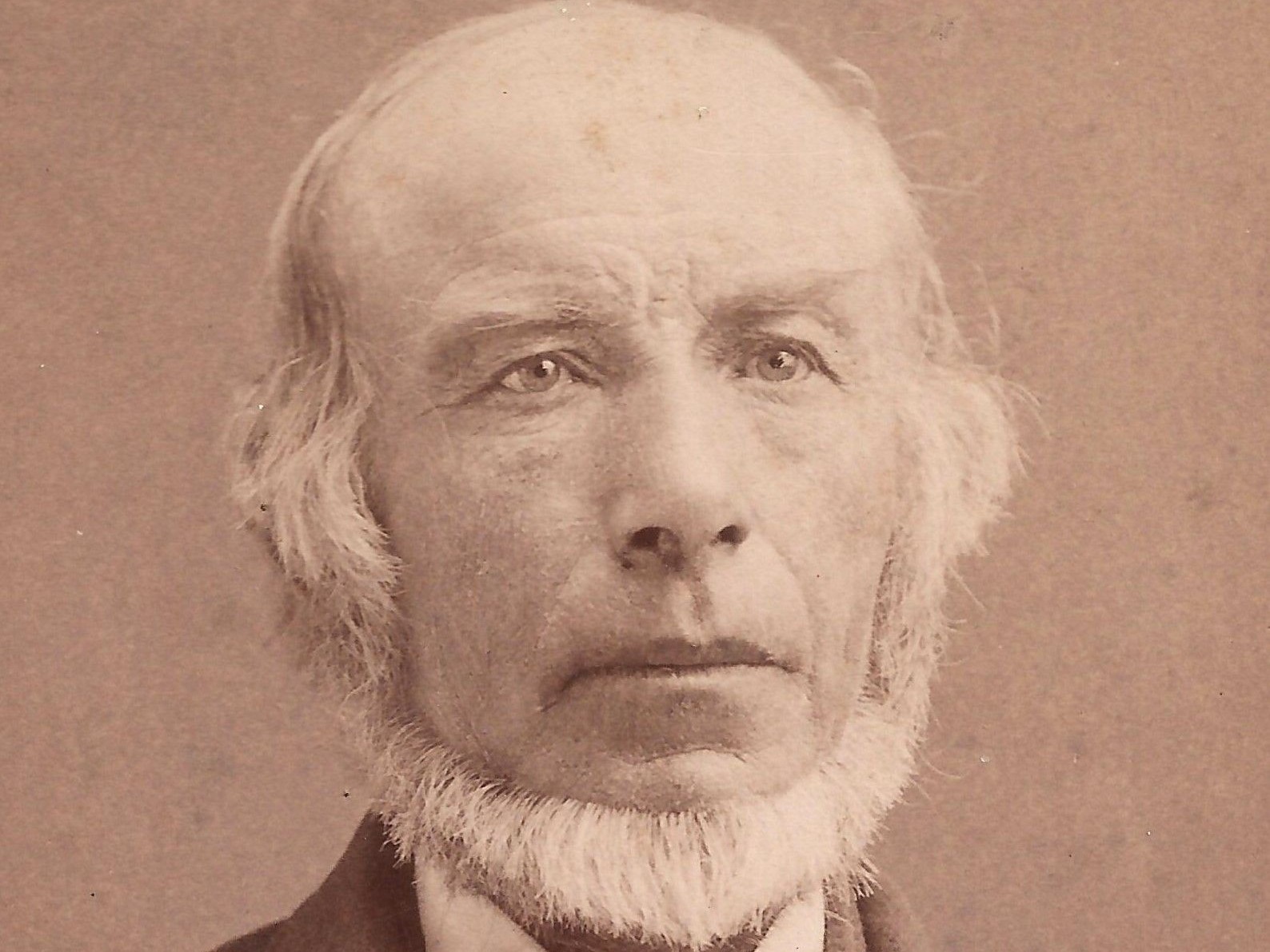
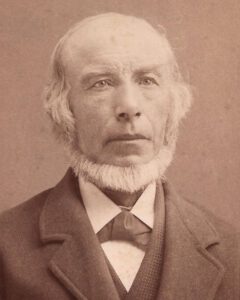
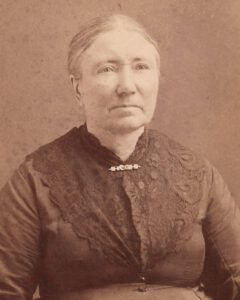
Derk Willem Huinink and Catharina Jentink (photo: Dutch Genealogy)
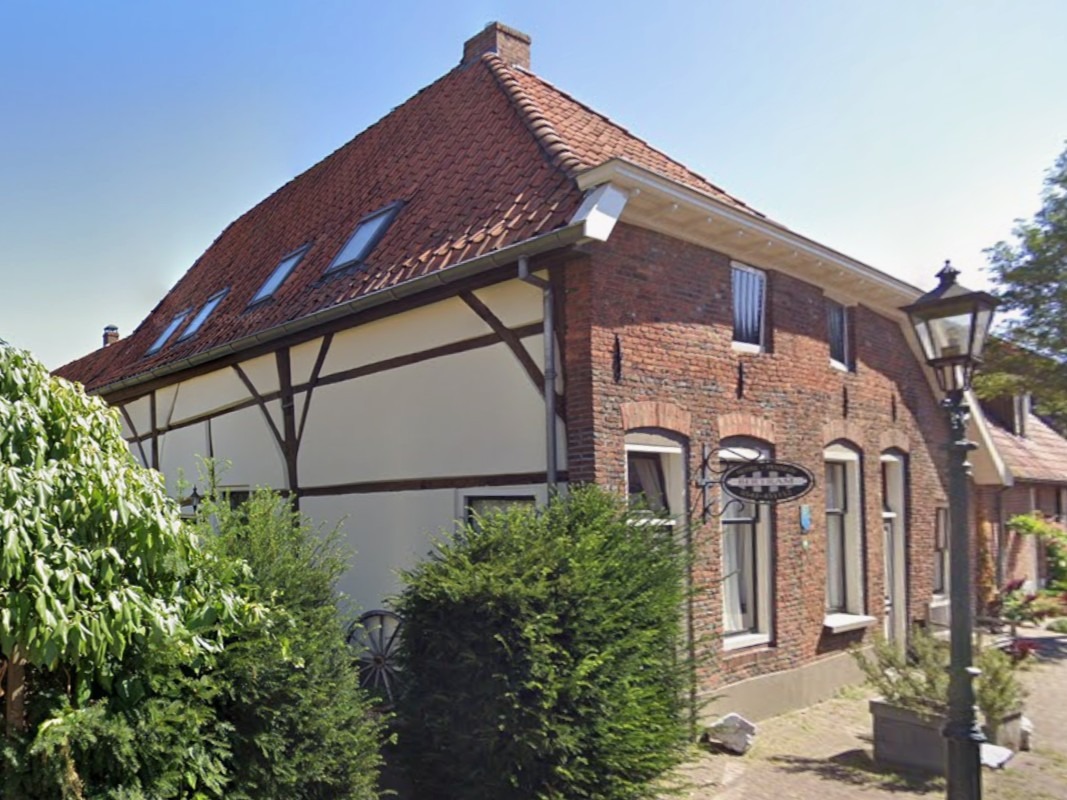
Derk Willem Huinink was born on March 9, 1827, at the (Oude) Maas farm in the Aalten rural district of Dale. He was a son of Jan Berend Huinink and Berendina Heesen. His father initially worked as a teacher but later switched to farming. The couple had five sons and two daughters. Mother Berendina died on August 1, 1848.
Derk Willem attended primary school and helped on the parental property. At the age of seventeen he learned the weaver’s trade, which he combined with work on the farm for ten years.
On 28 May 1858 he married Catharina Jentink, daughter of Hendrik Jan Jentink and Dora Hendrika Lammers. She was also born in Dale, on November 20, 1834. She was one of ten children, four sons and six daughters, six of whom emigrated with their parents to the New World. The Jentink family settled in Lima, Wisconsin.
Derk Willem’s sister, Janna Willemina Huinink, married Jan Berend Schepers on the same day.
Emigration to America
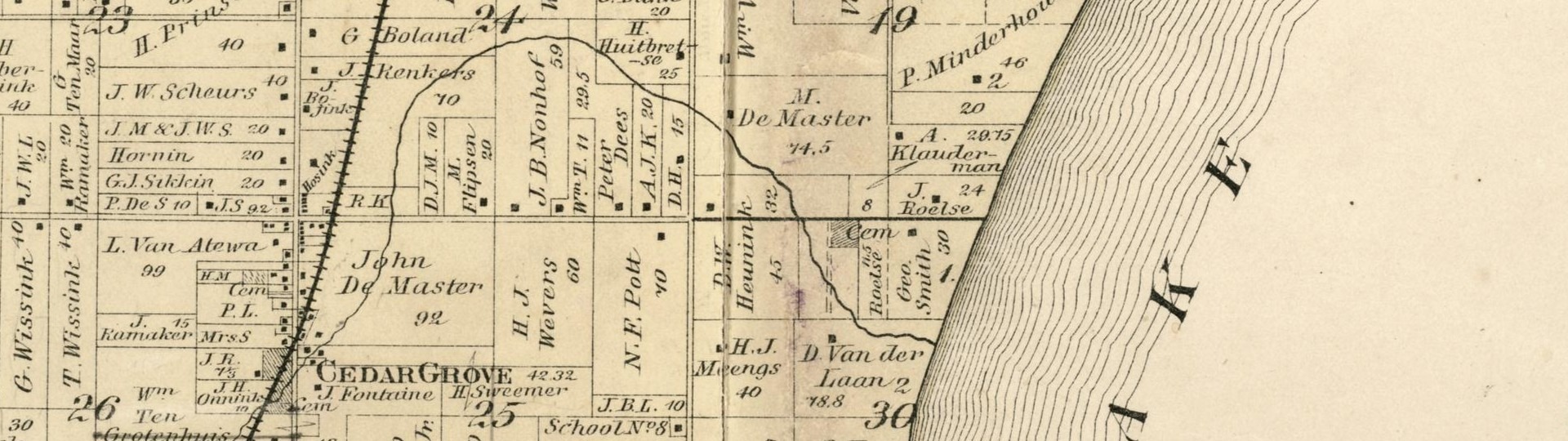
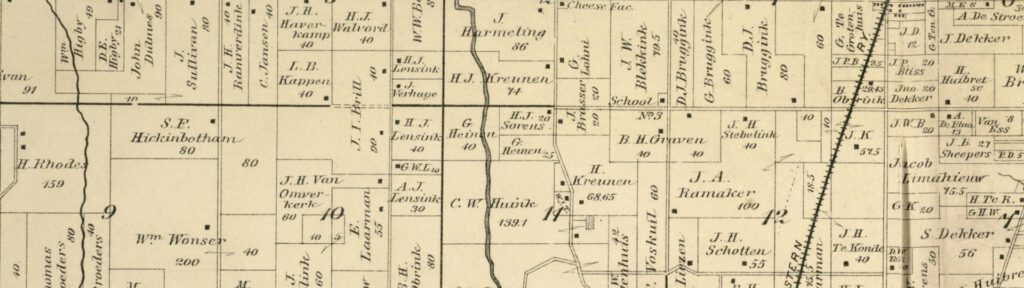
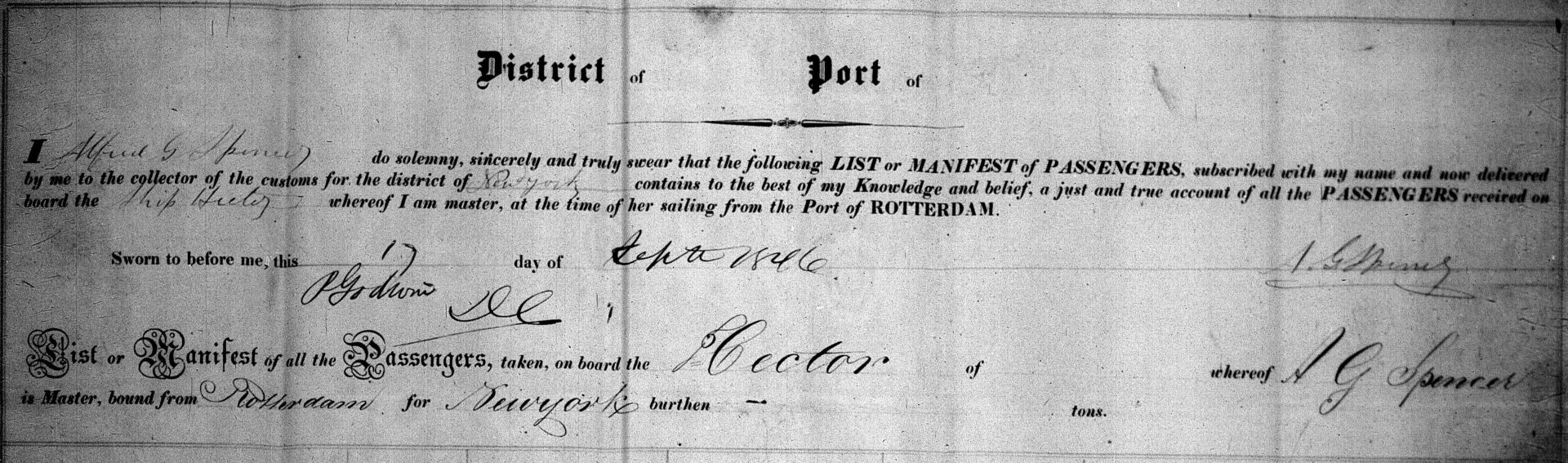
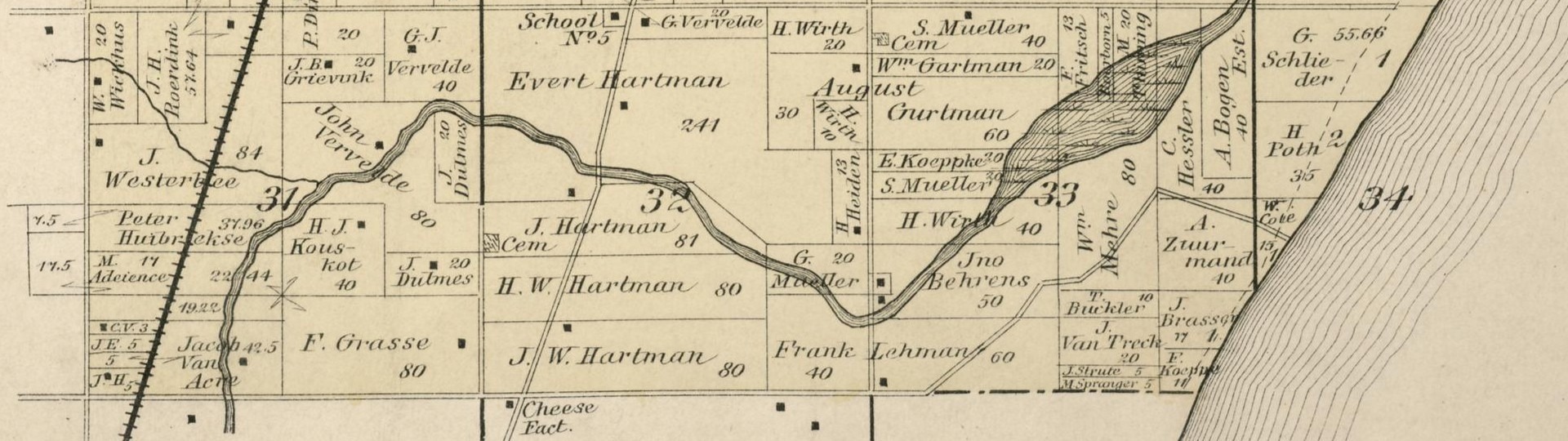
In the summer of 1869, Derk Willem, his father, wife and children left via Liverpool on the steamship Nestorian to North America. After eleven days, they arrived in Quebec and traveled on to Sheboygan County. On July 25, they reached Amsterdam (Sheboygan County). In the spring of 1870, Huinink bought 72 acres (29 hectares) of land in section 19 for $2,000. Later he added another 5 acres (2 hectares).
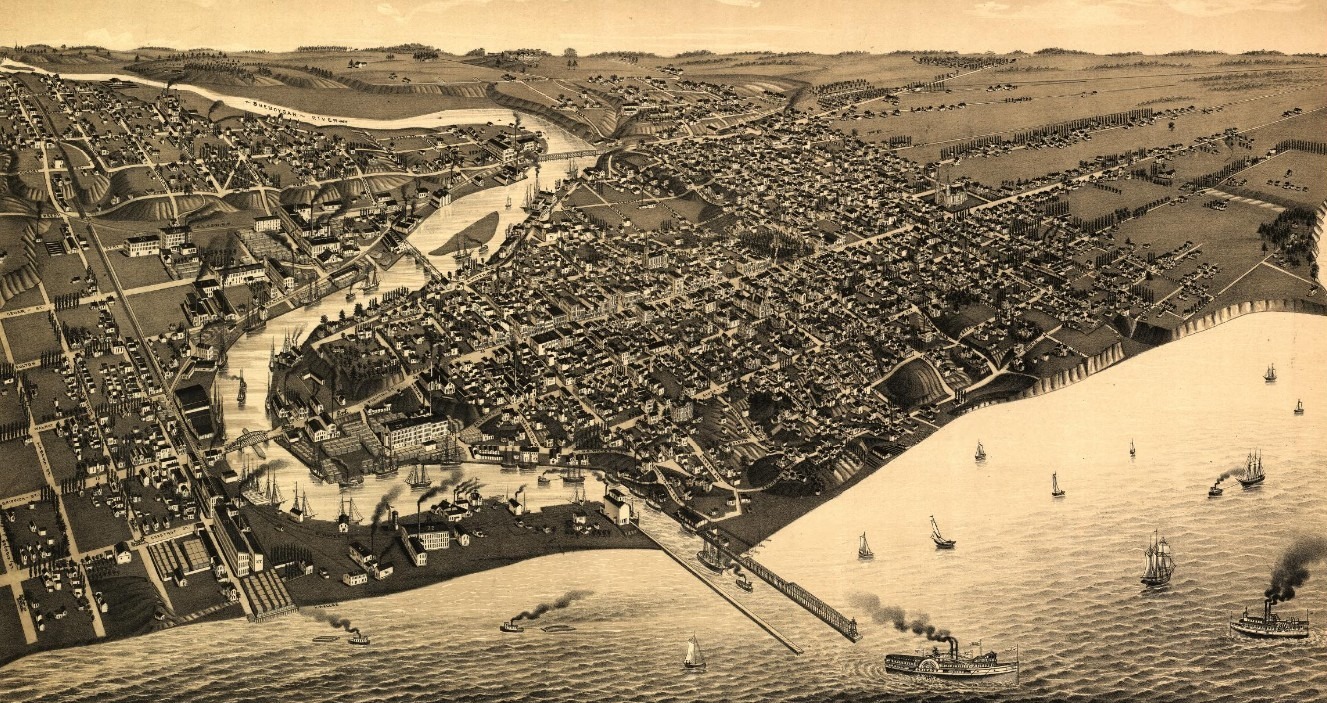
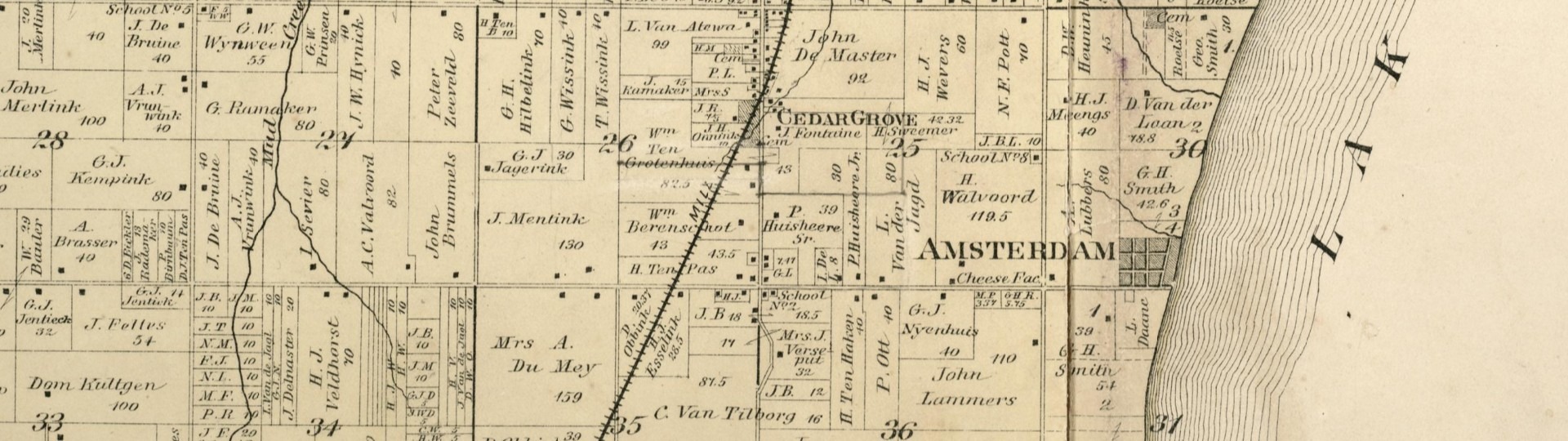
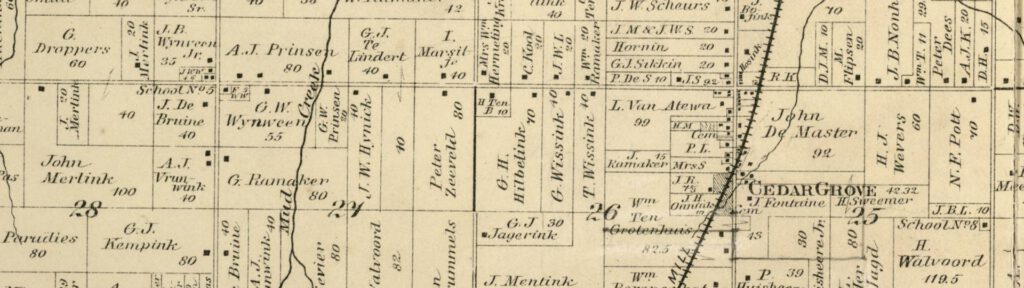
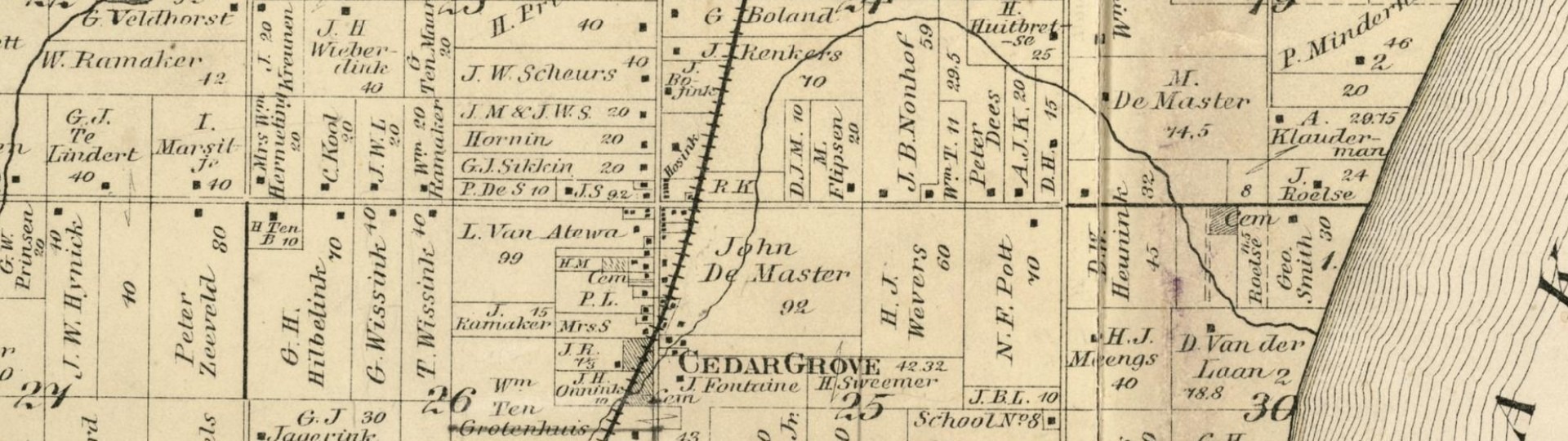
Map of Holland Township, Sheboygan, 1889 (image: University of Wisconsin–Madison)
Family life and work
Derk Willem and his wife built up a thriving farm with hard work. They had nine children:
Jan Berend (born 20 May 1859), businessman in Cedar Grove
Dora Hendrika (Aalten, 22 June 1861), married to farmer John Lohuis
Hendrik Jan (born 15 October 1863), cheesemaker in Cedar Grove
Christiaan (born 22 April 1866), veterinarian
Berendina Gesiena (born 22 April 1868), married Harry Scott
John William (born June 3, 1871), first child born in America
Garret John (Cedar Grove, 25 May 1875)
Catherina Wilhelmina (Cedar Grove, 6 December 1876)
Derk William Jr. (Holland, 30 July 1880)
Community and death
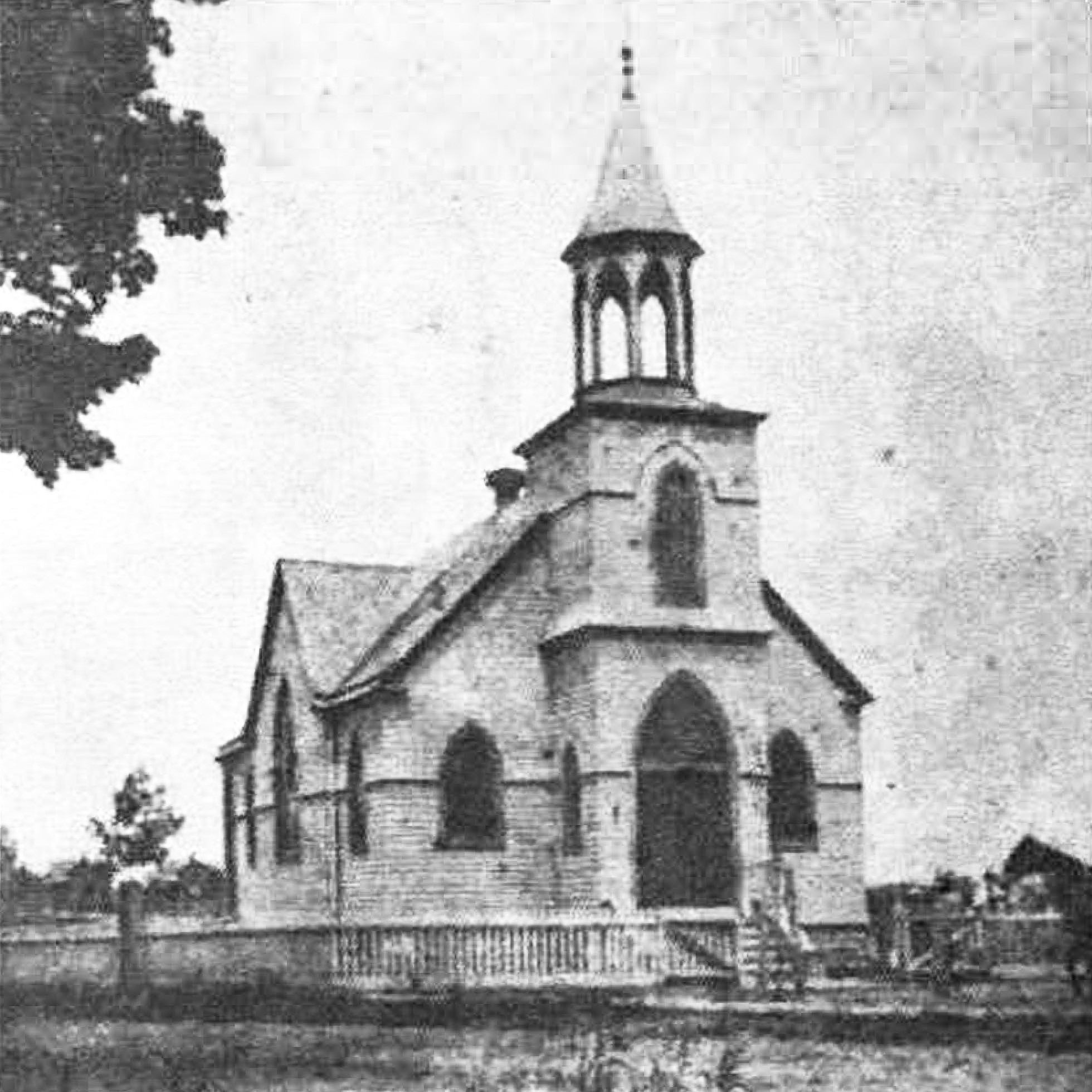
The Huinink family (also spelled Huenink in America) was a member of the Presbyterian Church. Derk Willem played an active role in this and was an elder for more than nineteen years. Both he and his sons voted politically for the Republican Party, which was common among Protestant immigrants in the Midwest at the time.
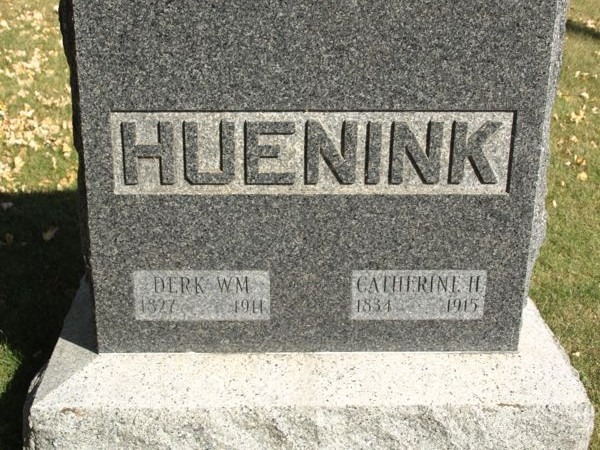
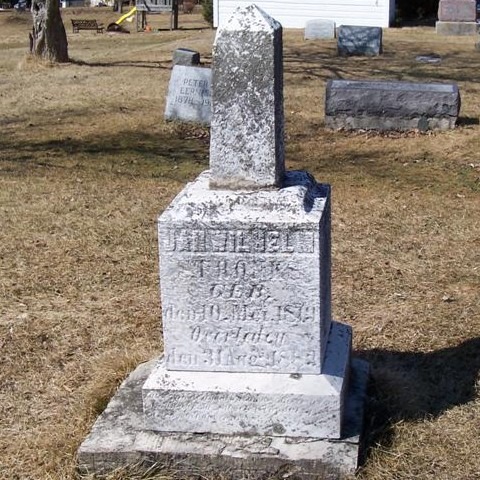
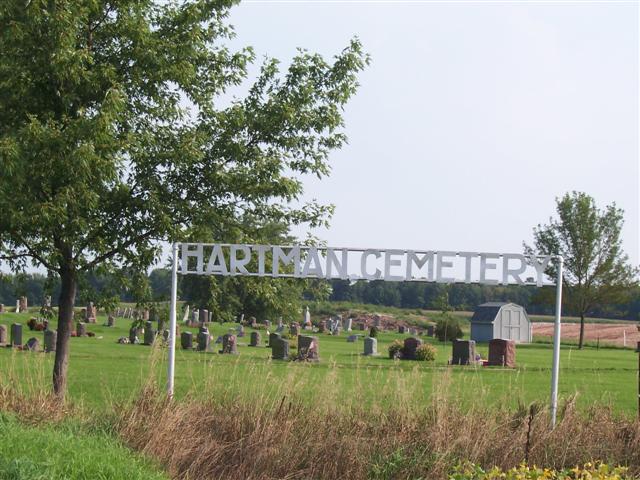
Derk Willem Huinink died in Cedar Grove in 1911 and Catharine four years later. They are both buried at Presbyterian Cemetery in Holland, Sheboygan.
Grave Derk Willem Huinink and Catharina Jentink, Presbyterian Cemetery, Holland, Sheboygan (photo: FindAGrave)
In the summer of 1869, a life-changing adventure began for more than a hundred Aalten residents. On board the steamship Nestorian, bound for Quebec, were hundreds of emigrants, including families from Aalten and the surrounding area. For them, this was the beginning of a new life in America, far away from the agricultural crisis and the limited future opportunities in the Achterhoek.
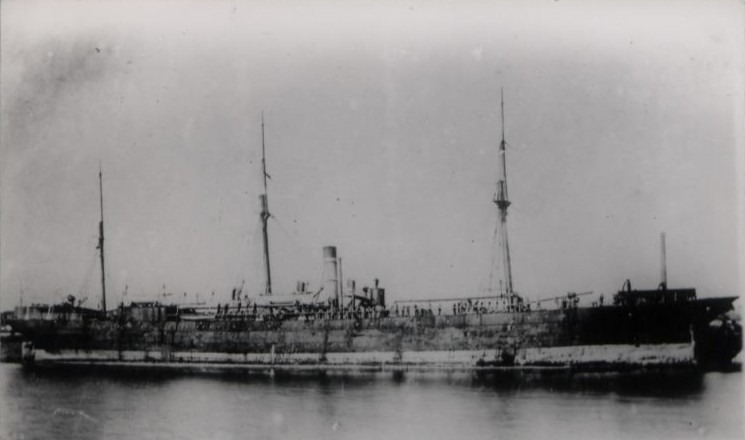
The Nestorian was an iron steamship of the Allan Line (officially the Montreal Ocean Steamship Company), built in 1866 in Glasgow. The ship was about 97 meters long and 12 meters wide. For extra safety, the ship had three masts with sails, in case the steam engine failed. There was room for 115 passengers in first class and 600 in third class (the tween deck).
The choice for the Allan Line and Québec
Steamship Nestorian (1867)
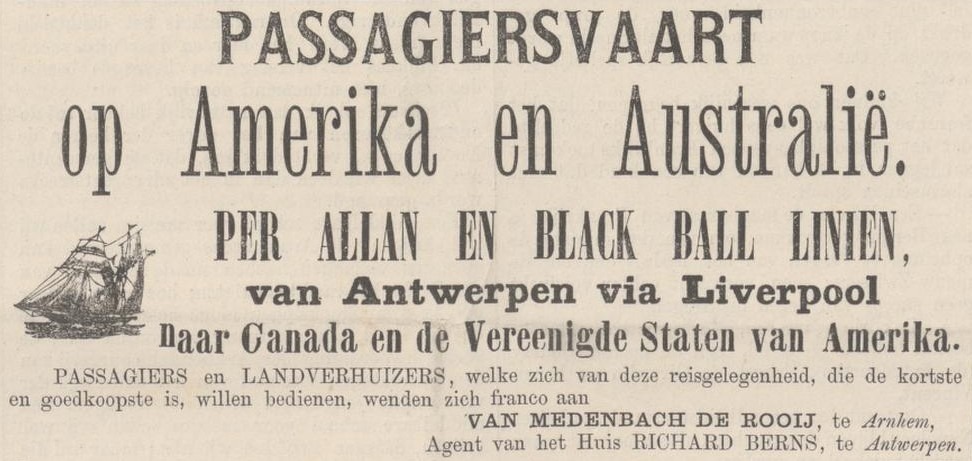
Around 1869, the Allan Line advertised intensively in Dutch regional newspapers. Local intermediaries, such as in Arnhem, acted as sub-agents for the main agency in Antwerp. The shipping company convinced Achterhoekers with two strong arguments:
The shortest sea route By sailing to Quebec instead of New York, emigrants spent less time on the open ocean. Once the ship reached the Straits of Belle Isle, they sailed the rest of the way on the sheltered Saint Lawrence River.
The cheapest option Between 1860 and 1890, Liverpool was a popular port of departure for European emigrants due to its lower rates. Poorer emigrants were willing to tolerate the inconveniences of shipping through England in order to save on the transatlantic ticket. A ticket for the crossing (tween deck/steerage) cost about 60 to 80 guilders around 1869.
Arnhemsche Courant, 11 September 1869
The journey and the route
Including the journey from the Achterhoek and the transfer in England, an emigrant was on the road for about 2.5 to 3 weeks. Here’s what their trip must have looked like:
To Antwerp
Achterhoek emigrants first traveled by horse and cart to a suitable pick-up point, such as Zevenaar or Arnhem. From 1855 it was possible to travel from there to Antwerp. In Antwerp, the emigrants were received by the agent of the Allan Line.
The crossing to England
In Antwerp they changed to a boat to Hull (England), a crossing of 12-24 hours. From Hull they took the train to Liverpool (4-6 hours). At that time, Liverpool was the heart of the flow of emigrants to America, with offices of shipping companies, agents and emigrant houses where travelers could wait for their departure.
Where to stay in Liverpool
Representatives of the Allan Line picked them up on arrival in Liverpool and took them to guest houses, often owned by the shipping company. Emigrants spent one to ten days there, waiting for their ship to the US or Canada.
Departure from Liverpool
The Nestorian departed from the Prince’s Landing Stage in Liverpool. The crossing from Liverpool to Quebec took an average of 10 to 12 days.
Stay on board the Nestorian
Although the Nestorian was known as a solid and fast steamship, luxury was hard to find. Most emigrants from the Achterhoek traveled in the ‘tween deck (steerage), where families slept in large, stuffy rooms in wooden cages with straw mattresses.
The ticket price included the legally required rations (soup, potatoes, bread and salty meat). Passengers had to bring their own tin plate, cup and cutlery.
The days were filled with card games, singing, praying, and talking about the future in America. There was a ship’s doctor on board, but resources were limited. Seasickness was universal, and infectious diseases spread quickly in the poorly ventilated dormitories. In outbreaks, the sick were isolated.
Arrival and onward to Wisconsin
On July 19, 1869 , the Nestorian reached the port of Quebec. The passenger list included well-known names from Aalten such as Eppink, Huinink, Jentink, Neerhof and Wassink. However, the journey was not over yet.
From Quebec, the emigrants traveled west to Sarnia (Ontario) by Grand Trunk Railway . There they transferred to a steamer that transported them across the Great Lakes (Lake Huron and Lake Michigan). This trip took 1 to 2 days, depending on the weather and connections.
Eventually, they set foot in the harbor of Sheboygan, Wisconsin. Most emigrants from Aalten settled in this region. In later years, some of these families moved further west to the fertile lands of Iowa and Minnesota, among others.
During the 19th century, thousands of people left the Achterhoek region to build a new life in the United States. Many residents departed from Aalten as well. What began as a religiously motivated exodus grew into a broader emigration movement that continued well into the 20th century. In search of freedom, land, and new opportunities, people from Aalten found a new home on the other side of the ocean.
The wave of emigration began around 1844, initially driven by religious motives. Many of the first emigrants belonged to the Afgescheidenen (Seceders): Protestants who broke away from the Dutch Reformed Church and organized their own congregations. In the Netherlands, they were often persecuted or socially excluded, prompting many to seek their fortunes elsewhere.
Economic concerns and lack of space
In addition to religious persecution, the economic situation played a significant role. In the second half of the 19th century, the situation in the rural Achterhoek became increasingly difficult. Crop failures, unemployment, and poverty forced many families to make drastic choices.
Demographic pressure also played a part. The countryside was becoming increasingly crowded. Most of the wasteland had been reclaimed by then, and available farmland had become scarce. Consequently, for many sons of farmers, there was no prospect of owning their own farm. In America, where land became available cheaply or even for free through initiatives like the Homestead Act (1862), an independent life beckoned.
From the Achterhoek alone, six to seven thousand people emigrated within fifty years—nearly a third of the rural population.
From Aalten to Wisconsin – and beyond
A significant portion of the emigrants from Aalten settled in Sheboygan County in the state of Wisconsin. This region attracted many Dutch people due to its fertile soil, employment opportunities in agriculture, and the presence of existing faith communities.
In and around places like Cedar Grove, Oostburg, and Sheboygan, close-knit communities of Dutch-speaking migrants emerged. Over time, some people from Aalten moved further west to states like Iowa, Minnesota, and Nebraska, seeking cheap farmland and more economic opportunities.
In addition to the Midwest, emigrants from Aalten also settled in the states of New York, New Jersey, and Michigan. In cities like Paterson and Grand Rapids, flourishing Dutch neighborhoods arose, often with a strong religious character. Emigrants established their own churches, schools, and social institutions there.
Not all emigrants reached their destination. A tragic example is the disaster involving the steamship Phoenix in 1847 on Lake Michigan, in which an estimated 250 to 300 Dutch emigrants perished—including dozens from Aalten.
A lasting bond
Today, the traces of this emigration are still visible. Surnames from Aalten can still be found in communities in Wisconsin and elsewhere in the US. In genealogical and historical research, these emigration movements form an important link between the Achterhoek and the United States.
List of emigrants from Aalten
There is a list of over 1,600 emigrants from Aalten and Bredevoort who emigrated to the United States:
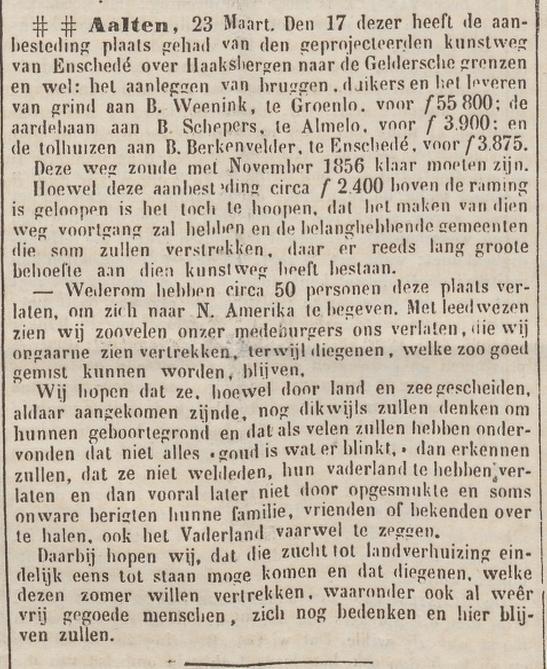
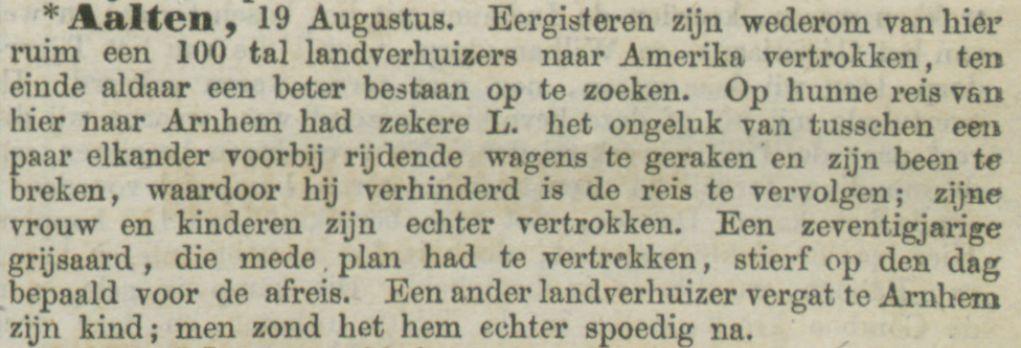
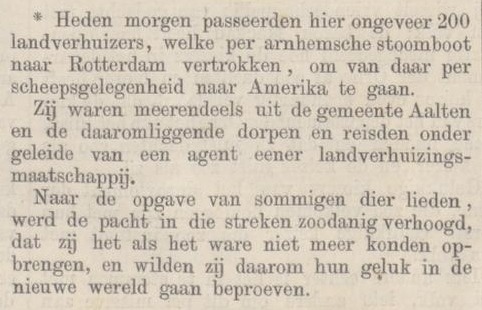
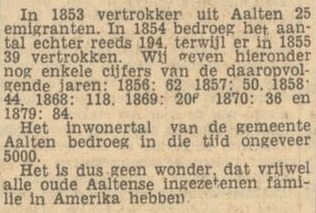
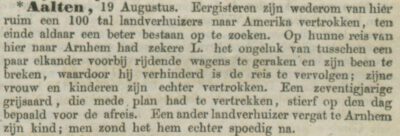
Many 19th-century emigrants from the Achterhoek settled in the vicinity of Sheboygan, Wisconsin (pictured here in a drawing from 1885)De Grondwet, 24 March 1854Nieuwe Rotterdamsche Courant, 19 August 1854Arnhemsche Courant, 3 July 1869Dagblad Tubantia, May 12, 1951
In the 19th century, hundreds of Aalten residents emigrated to the United States in search of land, work and a better life. A number of them are known to have participated in the American Civil War. As far as is known, they all served in the armies of the Northern states (the Union).
The American Civil War (1861–1865) was an armed conflict in the United States between the Northern states (the Union) and the Southern states (the Confederacy). Bloody battles and campaigns took place in many states. The war began with a Confederate attack on Fort Sumter, South Carolina, on April 12, 1861. In June 1865, the last Confederate armies surrendered, and the Union emerged victorious.
Former Aalten fighters
The following list is probably not yet complete:
Jan Derk Ansink (Barlo, 30-04-1840 – 02-07-1868) ‘John Ansink’ enlisted on 06-08-1862 with the 108th New York Volunteer Infantry Regiment, company E, in Rochester, Monroe County, NY. He was wounded in action on 03-07-1863 during the Battle of Gettysburg. In May or June 1864 he was transferred to Company A of the 21st Regiment of the Veteran Reserve Corps. After the Civil War he was discharged on 07-06-1865 in Trenton, NJ.
Gerrit Hendrik Duenk (IJzerlo, 19-07-1825 – Milwaukee, WI, 14-08-1883) ‘Gerritt H Duenk’ served from 20-08-1862 to 10-06-1865 in the 24th Wisconsin Infantry Regiment, company I. He retired on the orders of the War Department. In 1883, he was eligible for admission to a National Home for Disabled Volunteer Soldiers. He suffered from rheumatism. At the time, he lived with his wife Clara and three children under the age of 16 in Milwaukee, WI, where he worked as a laborer. On 31-05-1883 he was admitted to the home. On 14-08-1883 he was found dead; he had drowned in the Milwaukee River. He was buried a day later.
Gerrit Jan Duenk (IJzerlo, 23-09-1845 – Milwaukee, WI, 19-04-1897) ‘Garrett Dunck’ served from 15-08-1862 to 10-06-1865 in the 24th Wisconsin Infantry Regiment, company E. He was wounded on 02-06-1864 in Georgia, in the vicinity of Dallas, New Hope Church and Allatoona Hills. After the Civil War he was fired on 10-06-1865.
Hendrik Huibert van Eest (Velp, 12-09-1837 – Springfield, IL, 26-03-1865) He reported on 28-02-1865 in Overisel, MI as a soldier. He was incorporated into the 24th Michigan Infantry Regiment, company K on 01-03-1865. Died on 26-03-1865 in Camp Butler, Springfield, IL.
aren’t Jan Geurink (IJzerlo, 24-03-1822 – Sheboygan, WI, 21-02-1899) At his grave is a GAR marker (Grand Army of the Republic) that indicates that he fought in the American Civil War.
Gradus Heinen (Aalten, 19-10-1827 – Holland, WI, 24-10-1908) ‘Grades Heinen’ enlisted on 21-08-1862 with the 27th Wisconsin Volunteer Infantry Regiment, company F. This regiment left Milwaukee, WI, on 16-03-1863 for Columbus, KY. Gradus was injured at Jenkins’ Ferry, AR. This happened during one of the bloodiest battles of the Civil War, fought on 29/30-04-1864 at the swollen Saline River, after days of heavy rainfall. After the Civil War he was fired on 29-08-1865.
Derk Hendrik Kappers (Aalten, 10-01-1827 – Madison, WI, 17-03-1864) He enlisted on 16-09-1861 as a soldier in the 1st Wisconsin Infantry Regiment, company H. He served until he died of an illness on 17-03-1864 in Madison, WI.
Antonij ter Maat (Dale, 07-02-1836 – Columbus, KY, 04-06-1863) He enlisted, together with his brother Jan Hendrik, on 21-08-1862 in the 27th Wisconsin Volunteer Infantry Regiment, company F. He became ill and died.
Jan Hendrik ter Maat (Dale, 25-03-1841 – Memphis, TN, 03-10-1863) He enlisted, together with his brother Antonij, on 21-08-1862 in the 27th Wisconsin Volunteer Infantry Regiment, company F. He became ill and died.
Lammert Reimes (Aalten, 21-11-1834 – New Jersey, 08-08-1912) ‘Lambert Reymers’ was enlisted in 1861 as a soldier in the 2nd Delaware Infantry Regiment, company I. He served throughout the Civil War.
Gerrit Jan te Slaa (Lintelo, 20-10-1831 – Missouri, 30-08-1863) He enlisted on 21-08-1862 in the 27th Wisconsin Volunteer Infantry Regiment, company F. He became ill and died on a hospital boat moored in the Mississippi near Helena, Arkansas.
Bernadus Vervelde (Aalten, 16-02-1816 – Sherman, NY, 08-04-1891) ‘Benardus Felton’ reported on 22-08-1862 in Westfield, NY as a soldier. On 24-09-1862 he was assigned to the 154th New York Infantry Regiment, company E. On 02-05-1863 he was taken prisoner of war in Virginia during the Battle of Chancellorsville. On 14-05-1863 he was released on parole at City Point, VA. On 21-05-1864 he was dismissed due to disability. His son Derk Jan (called ‘Garrett J Felton’ in the US) also fought in the Civil War.
Derk Jan Vervelde (Haart, 16-02-1843 – Ripley, NY, 05-09-1903) ‘Garrett J. Felton’ reported on 31-07-1862 in Westfield, NY as a soldier. On 15-08-1862 he was assigned to the 112th New York Volunteer Infantry Regiment, company E. On 30-07-1864 he was wounded during the Siege of Petersburg. On 06-07-1865 he was discharged from service at Lovell Hospital, Portsmouth Grove, RI. His father, ‘Benardus Felton’, also fought in the Civil War.
Arnoldus Johannes Zweerink (Aalten, 09-01-1834 – Petersburg, VA, 31-03-1865) He enlisted in the 6th Wisconsin Infantry Regiment, Company I, as a soldier on 21-10-1864. Company I consisted of men from Brown and Vernon counties in Wisconsin. The 6th Wisconsin Regiment was part of the famous Iron Brigade during the war. “Noldus” Zweerink was killed during the Battle of White Oak Road.
Do you have more information about (above or other) Aalten emigrants who fought in the American Civil War? Comment below or send us a message!
In the middle of the 19th century, the Piek family lived in the Gasthuisstraat in Bredevoort. Father Jan Derk Piek and mother Geertruid Wamelink had six children: three sons and three daughters. In 1857, the family emigrated to the United States. After arriving in New York, they traveled by boat via the Hudson River and the Erie Canal to Rochester, in the north of the state of New York.
Shortly before the outbreak of the American Civil War, Jan Derk settled in Rochester as a carpenter. The family name was anglicized to Pike. His son Jan Berend Piek (1847–1927), who became known in the US as John Barnabas Pike, followed in his father’s footsteps. In 1873, he founded the John B. Pike Company . The first office was located at Minerva Place in downtown Rochester and specialized in fine carpentry.
Known buildings and growth
The company grew into a considerable construction company. Some well-known projects include the Rochester Museum and Science Center, the Rochester Savings Bank, Midtown Plaza (one of the first indoor shopping malls in the US), the archive building of the International Museum of Photography and the striking headquarters of the Security Trust Bank, also known as The Temple, which was demolished in the early 1980s.
The company also built schools, hospitals, bridges, highways, tunnels and industrial complexes outside the region, from Maine to Florida and even as far as Vancouver, Canada.
Although the construction of the First Dutch Reformed Church in Brighton (1891) was not carried out by Pike, John B. Pike was closely involved in the project as a member of the building committee. He worked together with, among others, Arend Willem Hoopman (1843–1928).
Business takeover and continuation
In 1907, the company moved to a new office on One Circle Street in Rochester, where it is still located today. In 1915, John Derek Pike, son of John B., took office as president of the now renamed John B. Pike & Son.
John B. Pike died on January 18, 1927, at the age of 79, and was buried in Mount Hope Cemetery in Rochester.
His company continued to exist and continued to grow under the leadership of his descendants. More than 150 years after its founding, the company still exists, now under the name Pike Construction Services, with more than 500 employees and several branches in the states of New York and Florida.
Gasthuisstraat 5, BredevoortJan Berend Piek alias John Barnabas Pike (1847-1927)First Dutch Reformed Church of Brighton, 1891The new building of the John B. Pike Company on Circle Street, 1907
Emigrants from Aalten and Bredevoort in New York
The Piek family from Bredevoort was not the only one to settle in the state of New York. In total, at least a hundred emigrants from Aalten and Bredevoort are buried in this state, at least forty of whom are buried in Monroe County, which includes Rochester.
On 11 July 1856, Hendrik Walvoord (1801–1865) lost his only son Gerrit Jan, who drowned in Lake Michigan at the age of 30. In his will, Henry reserved an acre of land (about 0.4 acres) for a family cemetery in section 26 of Holland Township. As the will stated:
“First, I give and bequeath to the children of my son Gerrit Jan Walvoord (deceased) and to their children who may be born and their grandchildren, great-grandchildren, in a word to the descendants of the said children of my son Gerrit Jan Walvoord (deceased), an acre of land lying and located in the County of Sheboygan and the State of Wisconsin, known and described as follows: …” (then the exact location is described).
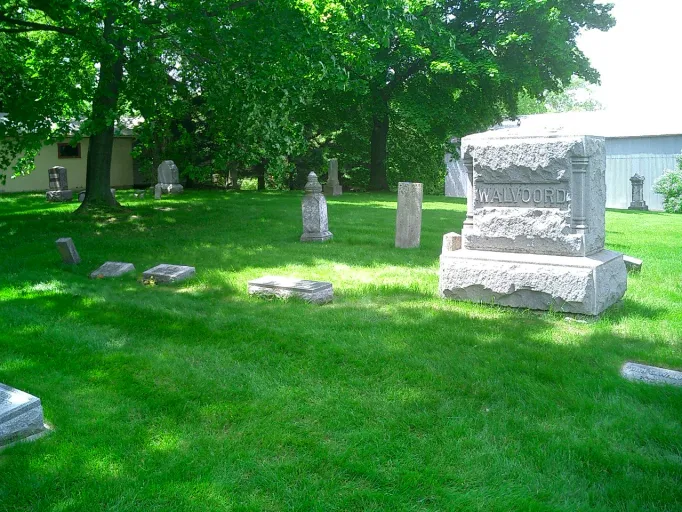
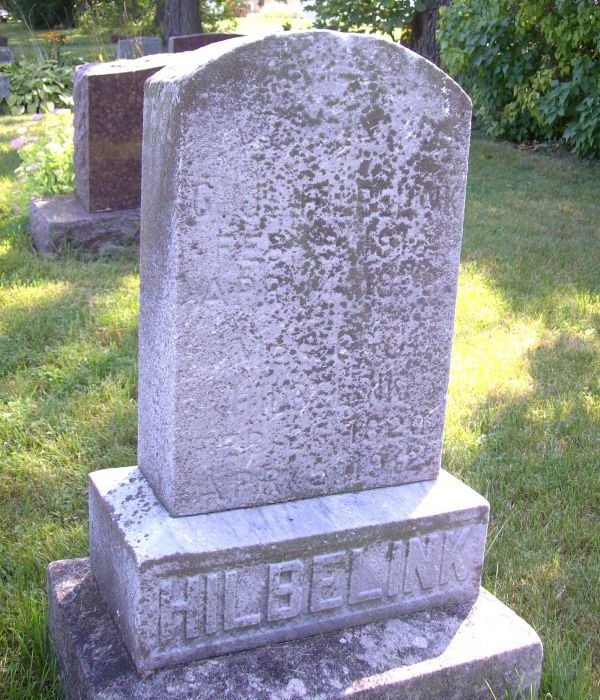
So according to Henry’s will, every descendant of Gerrit Jan Walvoord (“down to posterity”) could be buried on this family plot. Over time, Walvoord Cemetery was surrounded by Cedar Grove as the village grew. Today, the cemetery is located in downtown Cedar Grove on Main Street.
Over time, some families buried their deceased on this plot without formal rights, possibly because it was one of the few cemeteries at the time, next to an old indigenous cemetery near Amsterdam on Lake Michigan. A number of Sheboygan’s pioneers are buried here.
In the 1960s, Harriet Vollbrecht-Walvoord and her aunt Louise Walvoord counted more than a hundred marked graves. Today, barely half of that remains. According to Harriet, the city of Cedar Grove quietly removed tombstones for years. Where these have gone is unknown.
Walvoord family section of Walvoord Cemetery, located in the middle of the cemetery, circa 1960.
Under Wisconsin state law, after five years of neglect, a cemetery becomes the responsibility of the local government. This law aims to protect old cemeteries without a maintenance fund. Cedar Grove was apparently unwilling to pay for the maintenance and approached family members with the request to deposit money in a trust for the maintenance. It is unknown how much was collected. The last burial before this action was Willard Anthony Walvoord in 1986.
Although Cedar Grove forbade further burials by law, because of the original will, which laid down the right to perpetual burial, it was decided to allow burials of direct descendants of Gerrit Jan Walvoord.
Koreen Elizabeth Toutenhoofd (daughter of Meta Marie Walvoord and Andrew Toutenhoofd) was buried at Walvoord Cemetery on 1 January 1996, as was Kathryn Louise Walvoord (daughter of Anthony J. Walvoord and Ann Vogt), on 23 May 2002. Both were unmarried and were buried with their families.
Description of the site
East of the Walvoord Monument to the pavement: no graves.
South-south-east (left and behind the monument): graves clearly marked.
North-north-east (on the right and in front of the monument): graves also well marked.
Northeast corner near the street: tombstones of G. Lammers and family are missing.
West of the monument (rear of the plot): most of the tombstones have disappeared.
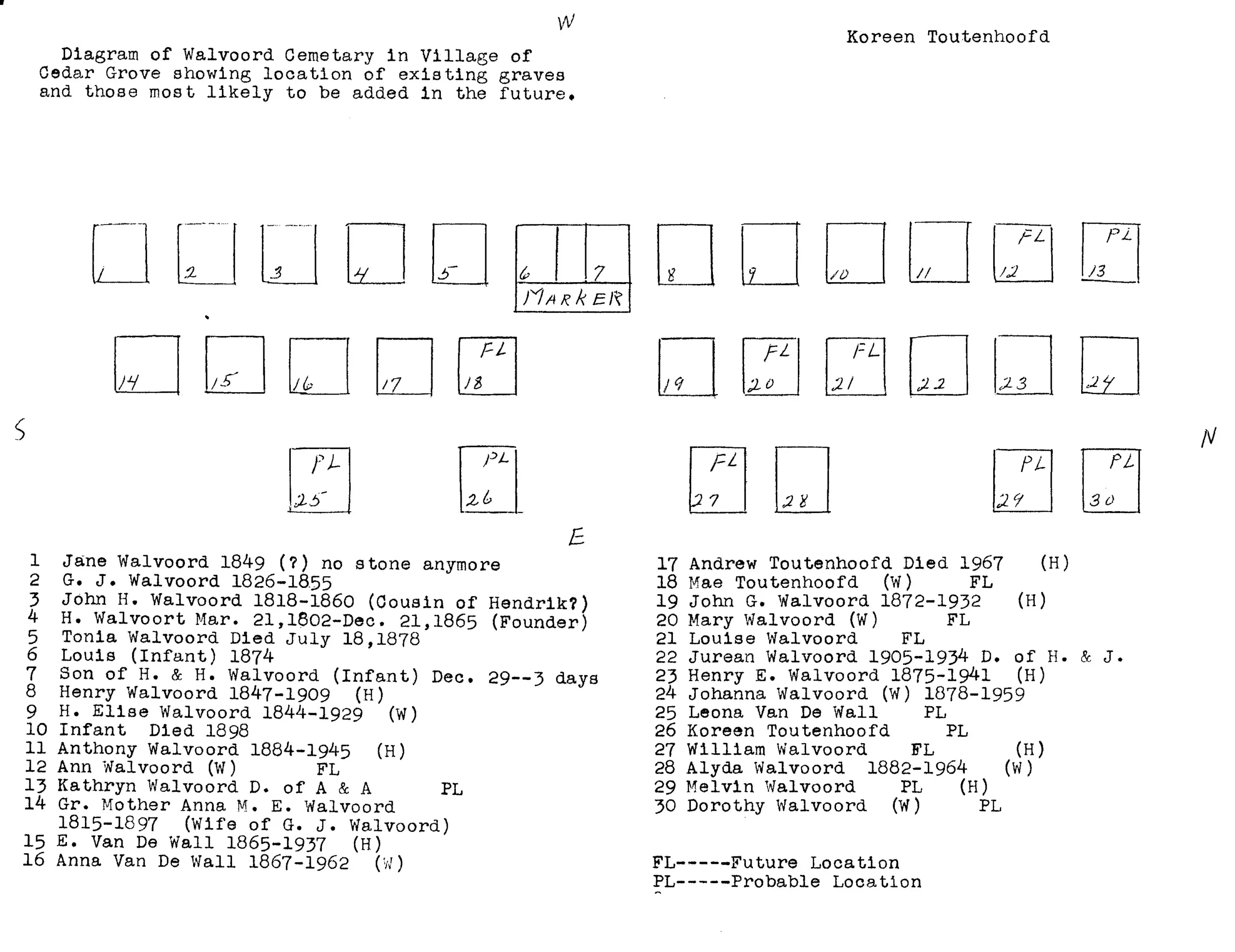
The following is a list of surviving tombstones, compiled in the 1960s by Louise Walvoord (1883–1969), Koreen Toutenhoofd (1902–1996) and Harriet Vollbrecht-Walvoord (1913–2006):
In the 19th century, thousands of Achterhoekers emigrated to the United States in search of land, freedom and new opportunities. Among them was the Ruesink family from Lintelo. They were among the early European pioneers who settled in Sheboygan County, Wisconsin.
The Ruesink family lived on the Akkermaat farm in the rural district of Lintelo near Aalten. The family consisted of father Jan Willem Ruesink, mother Grada Christina Rensink, four sons (one of whom died shortly after birth) and three daughters.
The family emigrated to America in 1855. They left Rotterdam on August 2 on a ship and arrived in New York after 42 days. They traveled on to Milwaukee, where Jan Willem Ruesink worked for more than two years as a foreman in a lime kiln, with a wage of one dollar a day, later increased to $1.25.
In the US, the Ruesink couple had another son and two daughters.
Establishment in Holland Township
In the spring of 1857 the family settled in Holland Township, on the farm of D.A. Walvoord. Jan Willem worked there for more than two and a half years, mainly cutting wood for transport via the pier of Amsterdam (Wisconsin). He then bought 10 acres (4 ha) of land for $200, and added another 10 acres six years later for $150. In 1882, he retired from working life and moved to Gibbsville, where he enjoyed his old age.
Jan Willem Ruesink was considered one of the hardest working immigrants in Sheboygan County. It is estimated that he cut about 2800 “cords” of wood (more than 10,000 m³) in his lifetime, for which he received between 32 and 75 cents per cord.
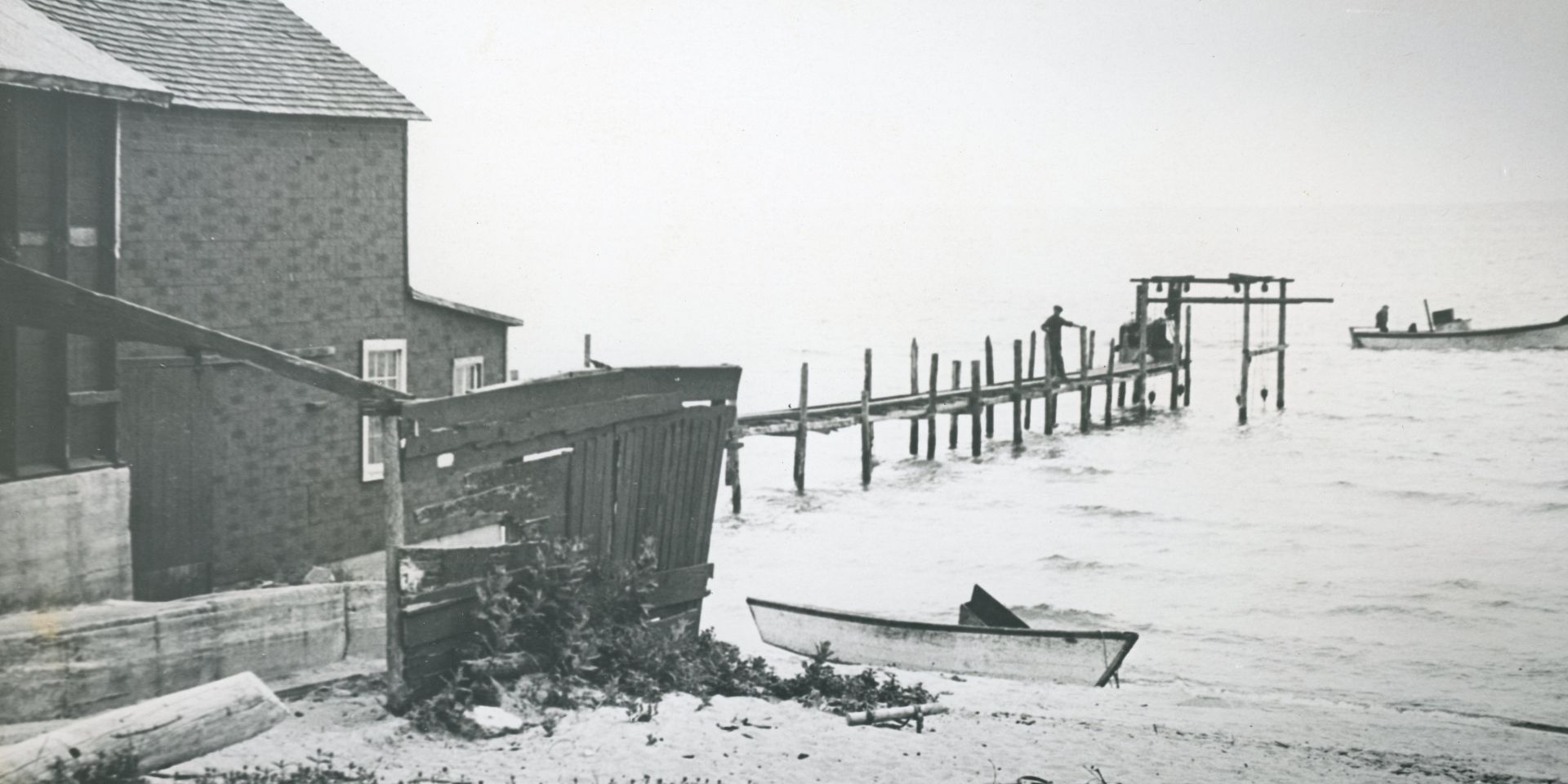
Pier near Amsterdam, Sheboygan, circa 1930 (Photo Sheboygan County Historical Research Center)
From farmhand to shopkeeper
Son Evert Ruesink, born on August 17, 1852 in Lintelo, arrived with his family in Holland Township at the age of five. He would live there for the rest of his life. At the age of fourteen he started working as a servant for Harmen Jan te Selle (1844-1919), a farmer in Holland Township, where he stayed for two years. He then worked for six years in Fond du Lac County.
By living frugally, he had saved $800. With those savings, Evert started a shop in Gibbsville. After about eight years, he sold the business and switched to horticulture, a business he ran for five years. In the autumn of 1887 he took over Henry Merion’s company in Oostburg, where he continued his entrepreneurship.
Evert married on December 11, 1878 in Holland, Sheboygan, with Janna (“Jane”) Heinen, daughter of Gradus Heinen and Willemina Wisselink. Janna was born on April 19, 1858 in Holland Township. The couple had five children.
Community and death
Evert Ruesink was considered a self-made man: he started as a day laborer and worked his way up with diligence, perseverance and thrift to become a respected entrepreneur in Sheboygan County. Evert and Jane were members of the Dutch Reformed Church, and politically, Evert, like his father, was a supporter of the Republican Party.
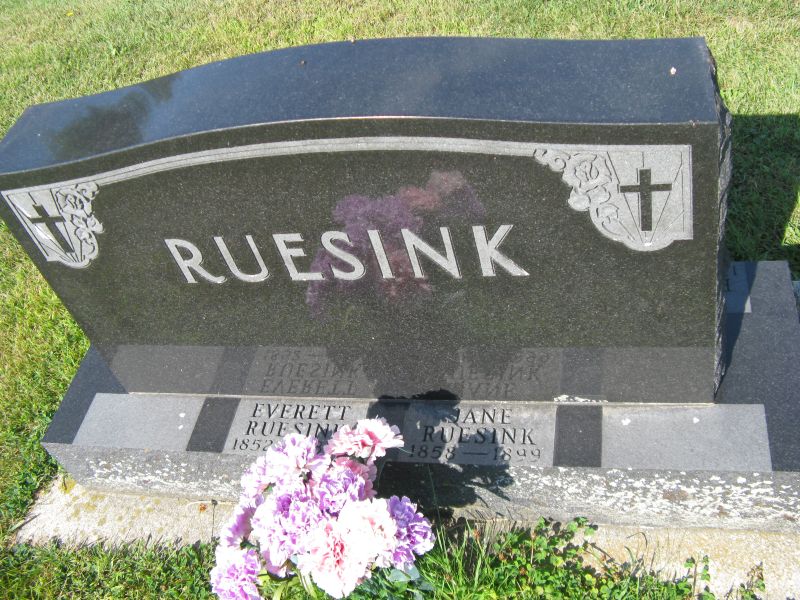
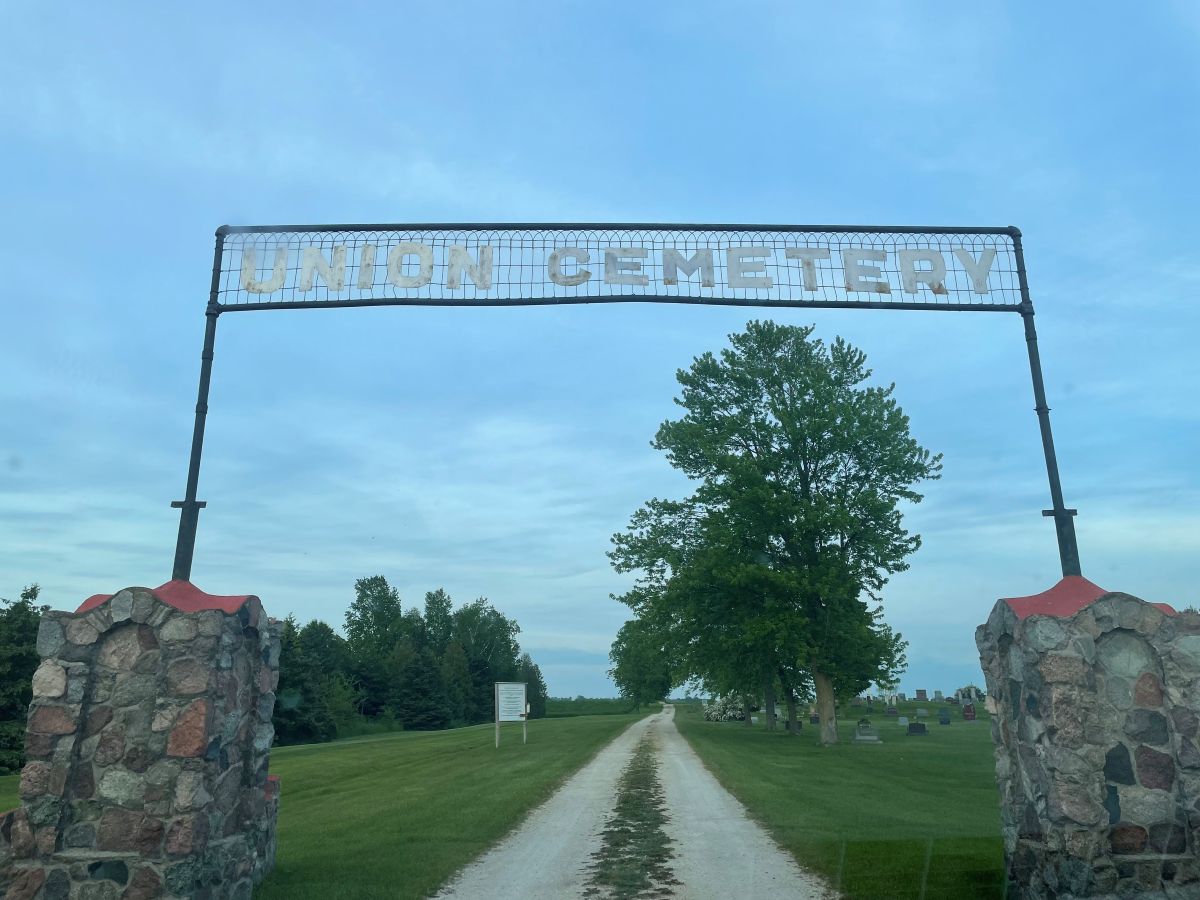
Evert Ruesink died in 1898, only 45 years old. Jane followed him to the afterlife almost a year and a half later. Both were buried at Union Cemetery in Oostburg, Sheboygan County.
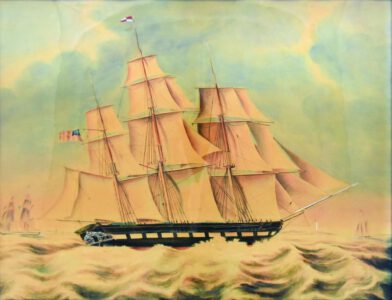
In 1854, a large group of emigrants from Aalten emigrated to the United States by ship. They were part of a broader emigration stream from the Achterhoek in the 19th century. One of the ships on which these emigrants traveled to America was the sailing ship Leila, which departed from Rotterdam in that year.
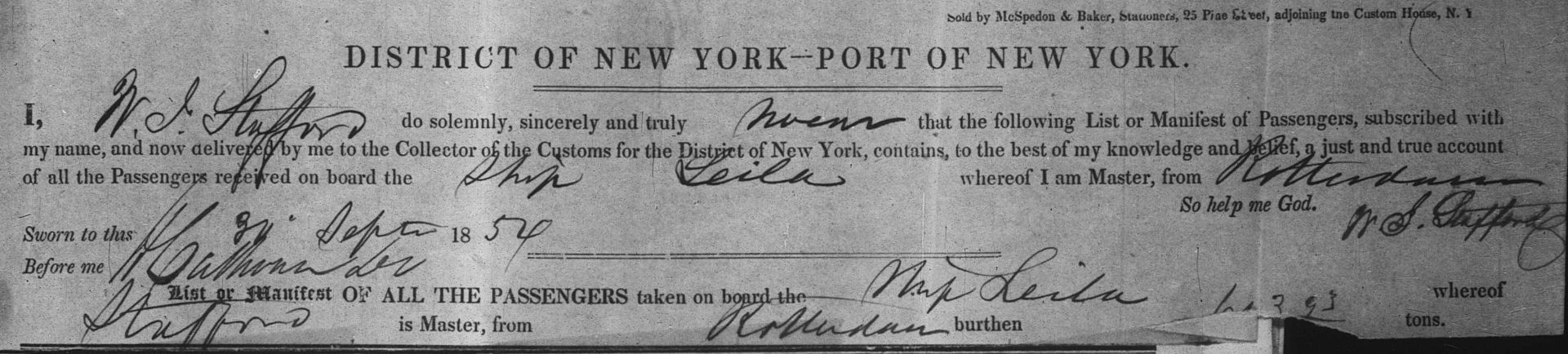
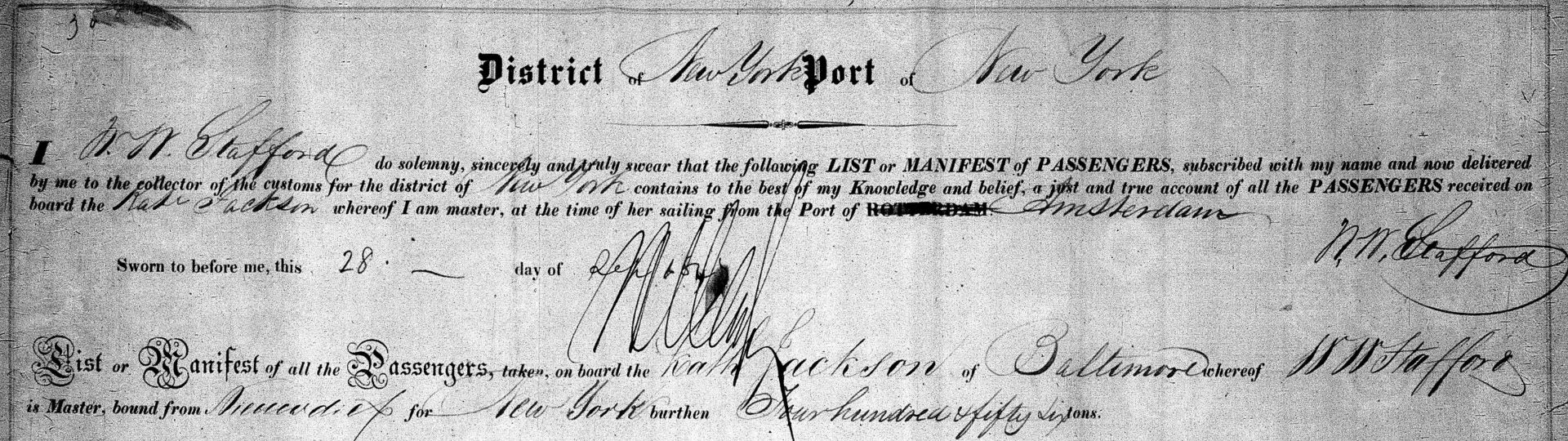
The ship sailed at the end of August 1854 and had 234 passengers on board. The captain of the ship was W.J. Stafford.
According to the passenger list, more than half – about 120 passengers – came from Aalten and more than 50 from other parts of the Netherlands. The majority of the remaining passengers came from Bavaria.
Heading of the Leila’s passenger list, Rotterdam–New York, 1854
On September 30, 1854, the Leila arrived in New York City.
Three passengers died during the journey, two of whom were from Aalten:
Anna te Gantvoort, 34 years old, as a result of tubercoluse (1 September)
Jan Hondorp, 2 years old, as a result of ‘stomach complaints’ (September 26)
Apart from the information in the passenger list, no further technical or historical information has yet been found about the ship itself.
Gradus Heinen was born on 19 October 1827 on the Nijenhuis farm in Dale, the son of Jan Heinen and Harmina ten Brinke. On 21 July 1854 he married in Aalten with Willemina Wandrina Wisselink, who was born on 30 January 1826 on the Bullens farm in Barlo, as the daughter of Garrit Jan Wisselink and Johanna Nijeboer.
When Gradus married, he was a servant at geneverbrander (gin distiller) Salomon ten Bokkel in the Hoekstraat in Aalten.
A few weeks after their marriage, on 21 August 1854, Gradus, Willemina, Gradus’ brother Abraham with his wife Johanna Scholten and three of their children left Rotterdam for the New World on the three-masted Leila . Willemina’s brother Berend Hendrik Wisselink and his wife Fredrika Wamelink traveled with them.
The crossing
Gradus Heinen (1827–1908)
Gradus Heinen described the course of the journey in a letter to his family, dated October 31, 1854:
On 21 August, the group left Rotterdam for Hellevoetsluis. The next day, on August 22, the crossing to America began. However, the sea was turbulent, causing almost everyone on board to become seasick. Fortunately, the majority recovered within two days. The rest of the trip went well, with favorable weather. Of the approximately 224 passengers on board, three died during the crossing: the eldest daughter of the Gantvoort family and two children.
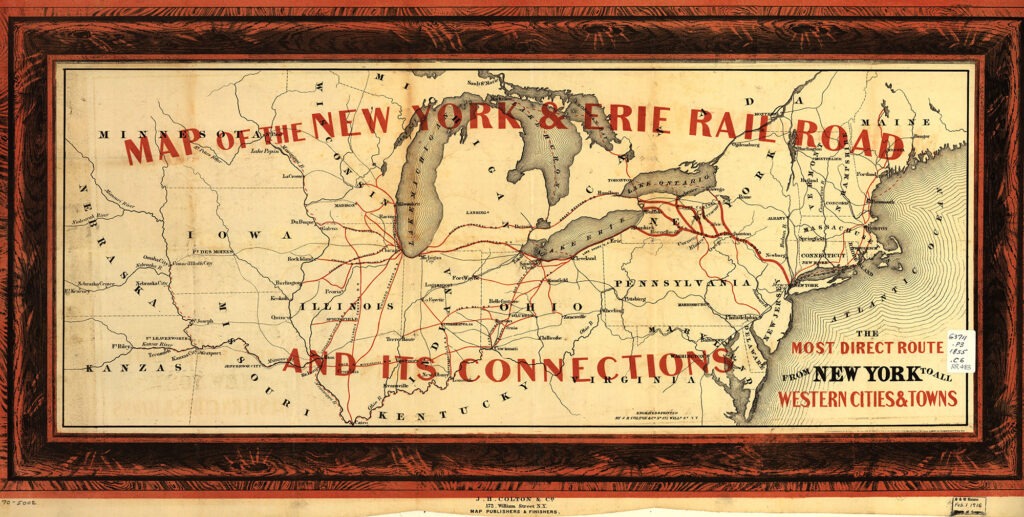
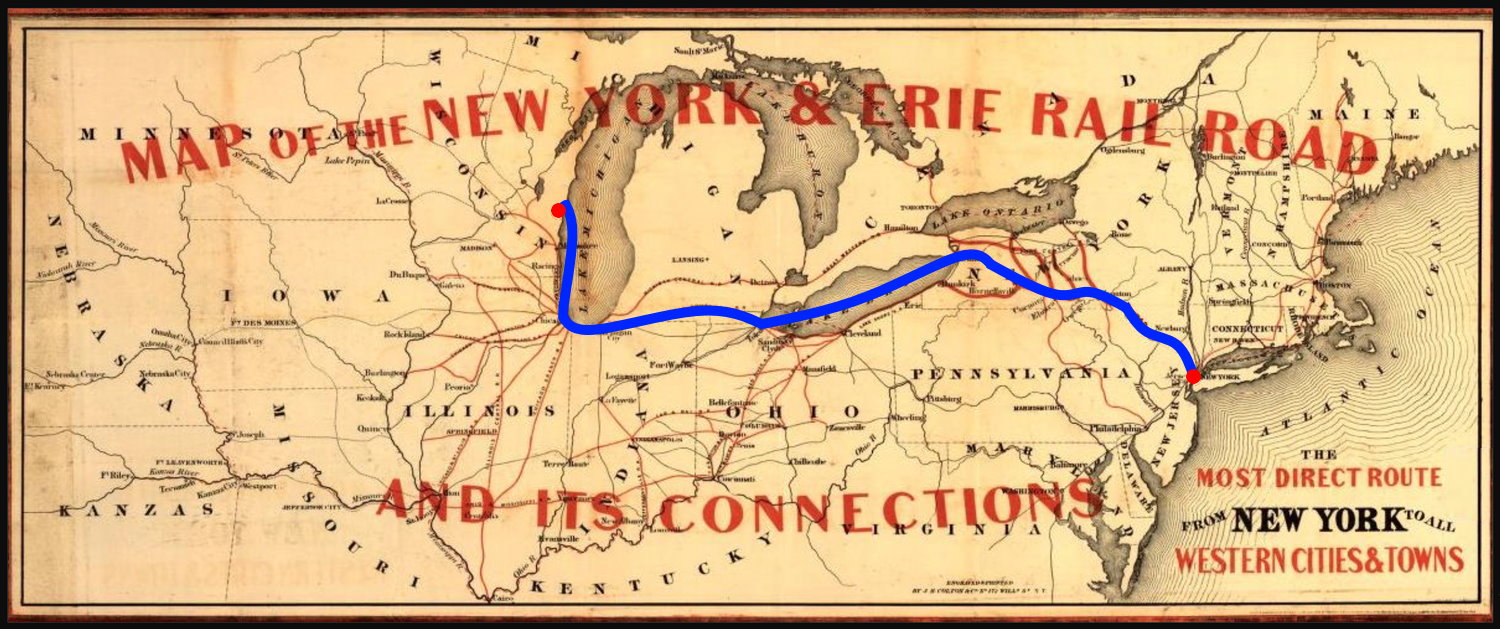
On the morning of September 29, they saw land. At five o’clock in the afternoon they arrived in New York. After one day they traveled on. First they sailed for two hours by steamer (presumably to Piermont, the starting point of the New York & Erie Railroad), followed by a train journey to Dunkirk. From there, they took another steamer to Toledo, traveled by train to Chicago, then by steamer to Milwaukee, and then by another steamer to Sheboygan. Finally, a two-hour journey followed, after which they reached their final destination in Lima Township.
There were three empty houses there, so they had shelter.
New York & Erie Railroad, 1855
Work and Daily Life in America
In his letters to family in the Netherlands, Gradus described how he went to work with his cousin Hendrik. He earned 25 shillings a day, including room and board. According to him, it was possible to earn as much in one day as in the Netherlands in a week, while the cost of living was lower. He also described the daily diet and the environment: little rye bread was eaten; wheat bread was common. Beef and pork were cheap, and potatoes were plentiful.
According to the compilation Dutch Immigrants to America, 1820–1880 by Robert P. Swierenga, Gradus was registered as a “servant” on arrival, he was classified as a “poor man”, and he gave the reason for emigration: “to join family and/or friends“.
Three letters from Gradus to his parents and siblings have been preserved. In all three he expressed his satisfaction with life in America. For example, on October 31, 1854, he wrote: “We have had no regrets. We have it better here than we have ever had in the Netherlands.”
On January 27, 1856, he reported: “We can now speak and understand English quite well. It’s a difficult language to learn, but not as difficult as people think in the Netherlands, because we live among Americans who are very nice people… We had a good time in the Netherlands, but here it is much better. That’s why I don’t want to go back to the Netherlands.”
And on December 6, 1856, he wrote: “The Americans are good people. We cannot thank the Lord enough for sending us to North America. We really have a good life here.”
Gradus also wrote about the cultivation of the land, the harvests, prices and the livestock. In his letter of 27 December 1856 he announced the birth of his firstborn: Johanna Harmina, born on 2 September 1856.
Veteran of the American Civil War
More than twenty former Aalten emigrants are known to have fought in the American Civil War (for the Northern states, or the Union). One of them was Gradus Heinen. On August 21, 1862, he enlisted in the 27th Wisconsin Volunteer Infantry Regiment, Company F. In March 1863, the regiment departed Milwaukee for Columbus, Kentucky.
Gradus was wounded at the Battle of Jenkins’ Ferry in Arkansas on April 30, 1864, one of the bloodiest battles of the war. On August 29, 1865, after the Civil War, Gradus was discharged from military service.
Location of the Battle of Jenkins’ Ferry (photo: Jerrye & Roy Klotz – Own work, CC BY-SA 3.0)
Holland Township
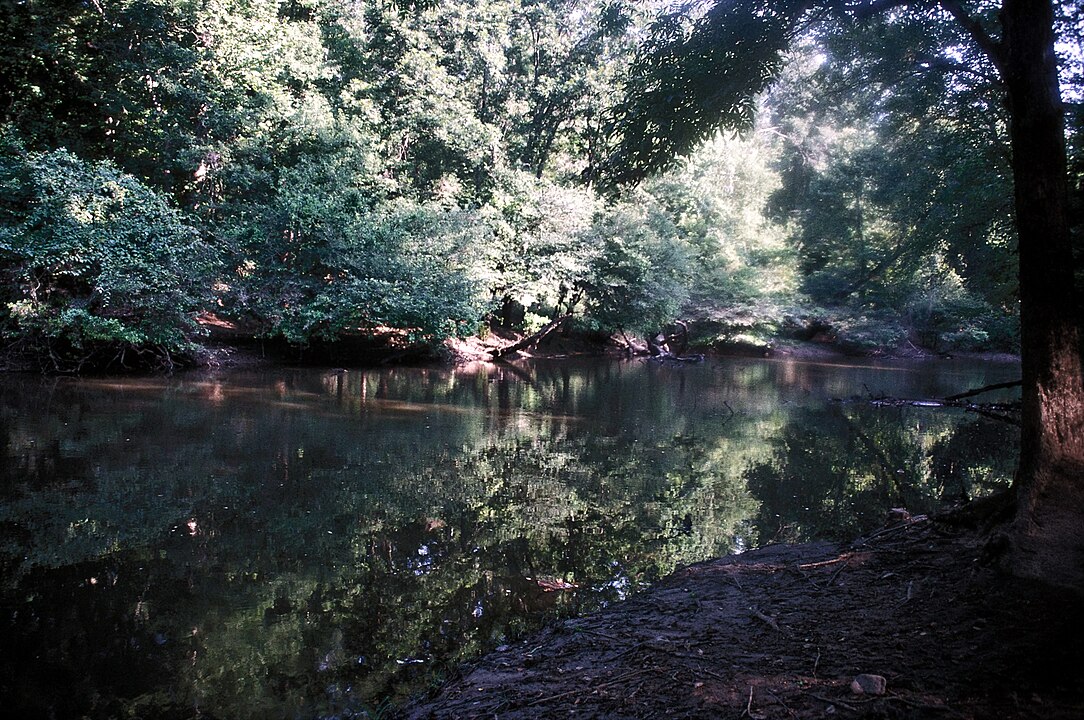
Gradus owned land in the 11th section of Holland Township, Sheboygan County — an estimated 50–60 acres, bisected by the Onion River. This land and the buildings on it passed on to subsequent generations of the Heinen family. A house on this land, which may have been built by Gradus himself, was still along Highway 32 in 2021, although it was clearly in need of a facelift.
Holland Township, Sheboygan, with in the middle the piece of land of ‘G. Heinen’ (1889)
Death and cemetery
Willemina died on 12 March 1879 and Gradus on 24 October 1908. Both died in Holland Township and were buried at Union Cemetery in Oostburg, Sheboygan.
After Gradus’ death, the local newspaper reported:
G.J. Heinen, who lived with his son Gerret Heinen, died last Saturday morning, after suffering a stroke a few weeks ago. The deceased was a Civil War veteran. He left behind two children, Gerret and Mrs. A. te Stroete, several grandchildren and four great-grandchildren. The funeral took place on Monday from the Reformed Church. Reverend Beckering led the service.”
In the 19th century, thousands of Achterhoekers emigrated to the United States in search of land, freedom and new opportunities. Among them was the Heebink family from Aalten. They were among the early European pioneers who settled in Sheboygan County, Wisconsin.
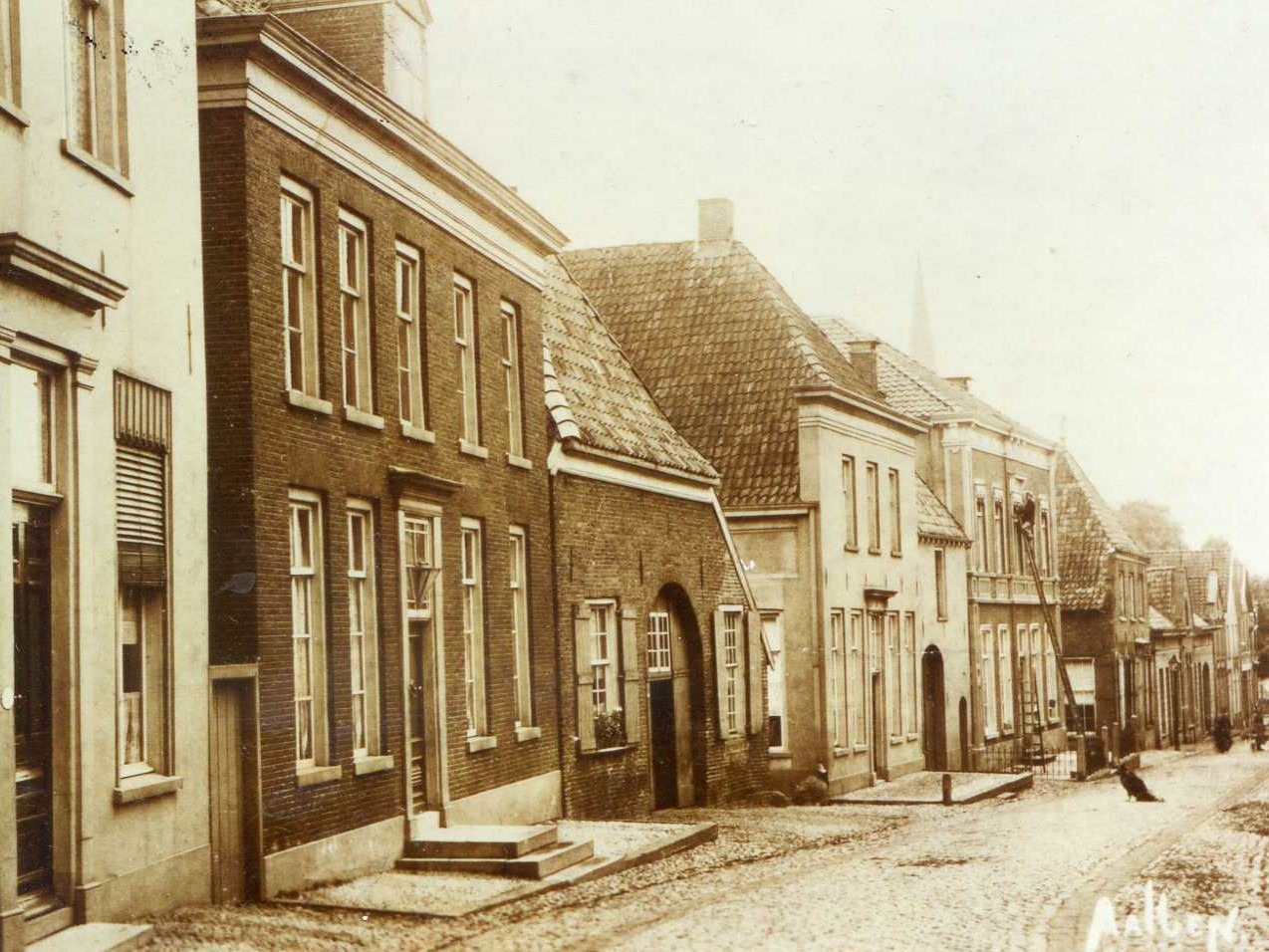
On the corner of the Kerkstraat and the present Hofstraat there was once a house where the Heebink family lived. In 1801 Gradus Heebink (Aalten, 1773) married Dersken te Stroete (Aalten, 1776). They lived in this house and used part of it as a tavern. Their ‘address’ was Aalten 5.
In the middle of the photo, with the round door: the Heebinkhuis in the Kerkstraat, Aalten
They had seven children, the first being a daughter, Elisabeth (1802). She was a vulnerable child with a deformity of the spine. This was followed by a son, Gerrit Jan (1804), named after his grandfather. He was a sturdy little fellow with all the traits of his Dutch origins. Little did they know that he would later become the father and grandfather of an entire community in America.
In 1806 daughter Hendrika was born and then another son, Derk Jan (1809). However, he died a week after his birth. This was followed by another son, Derk Hendrik (1810) and two daughters, Gerharda Johanna (1813) and Johanna Geertruid (1817).
To supplement the family income, Gradus also manufactured hats in addition to managing the tavern. Because it was customary for the eldest son to follow his father’s trade, Gerrit Jan also learned the trade of hatter. He became quite adept at it. Derk Hendrik served as an apprentice to a cooper and eventually followed that course.
Rear of the former Heebink house from the Hofstraat, ca. 1920
The other children helped in the house and in the garden, where they grew vegetables for the family. They also helped tend to a small plot of land outside the village boundaries, where rye and clover were grown as food for their two cows. These cows were grazed on the communal village meadow during the summer months.
Children in the poorer classes received very little education at the time. While Gerrit Jan learned to write legibly, he read poorly. This was partly due to a lack of practice and partly because he had poor eyesight.
Military service was compulsory at this time. In the period 1830-1833, Gerrit Jan served as a house guard in Breda for three years and four months. Belgium separated from the Netherlands in these years and it was one of its tasks to force apostates to be loyal to their country. Because Belgium was largely Catholic, many Dutch Catholics were positive about that country and their loyalty to the Netherlands was questioned.
Adult
The years had passed quickly for Gradus and Dersken and their family had grown up. Elizabeth had died in 1831 at the age of twenty-nine. She had always been frail because of her spinal weakness.
Hendrika was married in 1840 to Willem Heinen and they had a daughter named Johanna Aleida (1842).
Gerharda Johanna was married in 1845 to Lammert te Grotenhuis and they had two sons, Gerhardus Johannes (1847) and two daughters, Dersken (1849) and Tonia Johanna (1852). They would have another son in America, Lambertus or Bart (1856).
Derk Hendrik was married in Amsterdam in 1839 to Hendrika Geertruida van Buul. He had settled there as a cooper in the Jordaan. They had two sons, Gerhardus (1840) and Jan (1844). The eldest son had been very helpful to his parents and they depended on him for financial support to a large extent. He was a sailor and during one of his voyages he became very ill with dysentery. He died at sea and was buried in Batavia. The other son died during a storm on one of his voyages and was buried at sea. After the death of his first wife, Derk Hendrik remarried in 1850 to Elisabeth Fransiena Schagt. They had a daughter named Elisabeth Francina Hester (1853).
The youngest daughter, Johanna Geertruid, married Christoffel Schoemaker, who was also a hatter. They emigrated to America in 1848. He continued to make hats there for a while, until he became a Baptist minister. He was an inquisitive man and had an excellent command of three languages – English, Dutch and German. Joanna, his wife, died shortly after coming to America and was buried in Baltimore. Two sons were born, but they died at a young age.
After his return from military service, Gerrit Jan resumed his father’s millinery business and helped manage the inn. He became interested in a daughter of the Snoejenbos family named Johanna. She lived on the farm ‘Snoeijenbosch‘ on the Haart. They married in 1843. Gerrit Jan was thirty-nine years old at the time and Johanna twenty-four.
Gerrit Jan gradually took over his father’s business. It was common for the eldest son to continue his father’s business and support his parents during their advanced years. After the death of the parents, a settlement was reached with the other siblings for their share of the estate. Gradus was over the age of eighty and was happy to be relieved of business care.
Gerrit Jan and Johanna had four sons, Gerhardus Harmanus (1844), Herman (1846), Engelbert (1848) and Derk Johan (1852). Caring for four young sons was rather difficult for Johanna and her health suffered as a result. She became neurotic and was often ill. Gerrit Jan was a kind husband and father and helped in his calm, comforting way to share her burdens in any way she could.
America beckons
During this period in history, many Europeans became interested in the opportunities that America offered them and many families and entire communities emigrated across the Atlantic and settled in the United States. In August 1846 , Christiaan (Chris John) Snoeyenbos, Johanna’s youngest brother, had joined a group of emigrants on their way to America. He had settled in Oostburg, Wisconsin, and was now well established in the new country.
He wrote them letters, who were very enthusiastic about the opportunities in America. He urged them to come to America as well, where land was cheap and food plentiful, where the laws were so just and impartial that everyone had equal rights. Gerrit Jan and his wife became motivated and were up for it. However, they were afraid to share their wish with father Gradus, who lived with them. They believed that he was too old to undertake such a long and strenuous journey. So they carefully hid Christiaan’s letters from him. One day, Gradus found one of the letters and suggested that they also make plans to make the trip to America.
Gradus was as excited as a child about the emigration and began to make plans for the venture despite his advanced age. He collected his garden seeds and fishing nets for use in the new land. Unfortunately, his joy was short-lived. He contracted dysentery and became seriously ill. According to the doctor, he had only a few days to live. The plans for the trip were of course abandoned. Shortly before his death, Gradus called his children together and spoke to them. He told them that he wanted to be buried in his native country, which he loved, but that they should continue their emigration plans. Gradus Heebink died on August 13, 1854, just before their planned departure for the United States.
Nieuwe Rotterdamsche Courant, 19 August 1854
Despite the grief over the death of their kind, noble father, the Heebink family left a few days later, for their promised land. Before the emigrants left, a prayer meeting was held for them. Reverend Pape of the Reformed Church in Aalten held a farewell service. He stated that he understood the doubts and fears they would have for taking this step, but he encouraged them to have faith in God, who would help them overcome their difficulties and bring them safely to the promised land, America.
Cousins
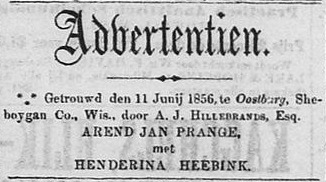
Sheboygan Newsman, June 24, 1856
In 1852, niece Hendrina Heebink (Varsseveld, 1818) also emigrated to America. She was a daughter of Christiaan Heebink – a brother of Gradus – and Dora Willemina Doornink. Until then, Hendrina had been employed as a maid by ‘surgeon and midwife’ Servaas van Leuven and his wife Henrietta Wilhelmina Christina Theodora Rost. Until her emigration, she lived with the Van Leuven family, on the Bredevoortsestraatweg (nowadays no. 7). Hendrina married in 1856 in Oostburg with Arend Jan Prange (Aalten, 1823).
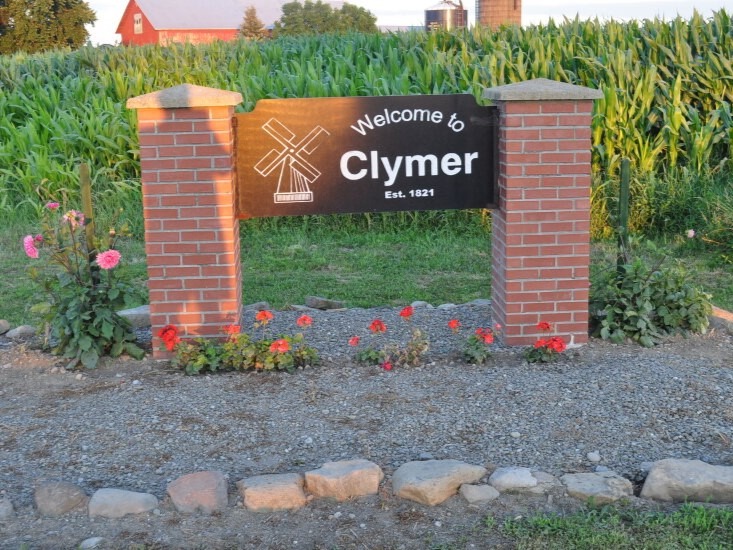
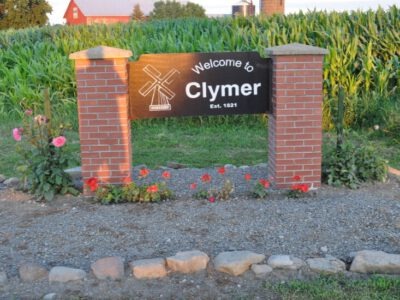
Her sister Elisabeth (Varsseveld, 1819) and brother Gerrit Jan (Vriezenveen, 1829) also emigrated to the US. Although it sounds plausible, it is not (yet) known to us whether they went together. Both married emigrants from Winterswijk. Elisabeth traveled to Sheboygan, just like Hendrina, but later moved to Iowa. Gerrit Jan ended up in Clymer, New York. His branch of the family is written as ‘Habink’ from 1860 onwards.
Across the Atlantic
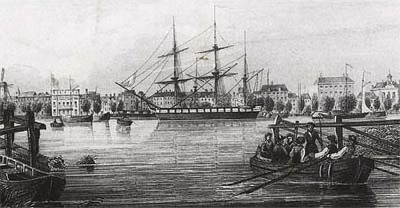
Port of Rotterdam, 19th century
The first part of their journey, from Aalten to Arnhem, they made in covered wagons and took ten hours. At Arnhem, they boarded a boat that took them to Rotterdam, where the ship that would take them across the Atlantic Ocean was anchored.
In Rotterdam they were met by Derk Hendrik Heebink, the brother of Gerrit Jan. He lived in Amsterdam, but had come to Rotterdam by train. He came to meet the ship in a small rowing boat and brought sweets and food as farewell gifts. This was a memorable day in their lives, August 18, 1854.
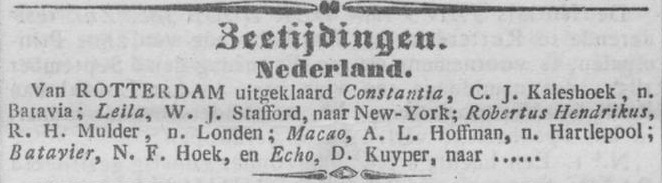
The ship was an English sailing ship named ‘Leila’, headed by Captain W.J. Stafford. There were three hundred and sixty passengers on board. Almost a third of them came from Aalten. The conditions on board were very unpleasant. The emigrants were tween deck passengers – the only type of accommodation offered. Before boarding, each passenger had to show their food to determine if it was sufficient for the trip.
Each family provided its own bedding. The bunk beds were hard and narrow. During a storm in which the boat rocked heavily, it was impossible to stay in the bunk beds. The water supply was kept on deck in large barrels. It tasted bad. The offer was limited and each passenger was only allowed to take a small part.
Rotterdamsche Courant, 23 August 1854
During such trips, deaths among travelers were no exception. Not even during this trip. On September 1, 1954, the thirty-four-year-old Anna Geertruid died in Gantvoort, according to the ship’s logbook of tuberculosis. It was common to encounter heavy storms at sea. One of them lasted two days. The ship was in total darkness and it was impossible to find anyone. Ten-year-old Gerhardus Harmanus (Gerrit) Heebink disappeared during this storm. When the captain gave the order to leave the deck, he was nowhere to be seen.
Mr. Vrieze searched all corners of the ship, but could not find him. The huge trap doors had to be closed without people knowing where Gerrit was. His parents were almost delirious, because they thought he had been washed off the deck into the ocean. There was no other option than to wait until the storm had passed to resume the search. The storm eventually ended and a sailor found him clinging to a rope with which he had saved himself during the storm. At another point, the boat hit a sandbar and all the passengers had to walk back and forth in an attempt to get it off the bank, which they eventually succeeded.
The journey became very tiring. Weeks dragged on in a month and they had not seen a land. The emigrants became concerned that their food supply would not be sufficient and they prayed daily that they would soon see land. Finally, on the forty-second day of their journey, word spread that land had been seen in the distance, and the passengers screamed with joy. At last America was in sight and on September 30, 1854, their long ocean voyage, which had lasted almost a month and a half, came to an end.
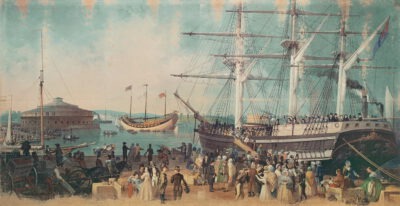
Arrival in New York
Port of New York, circa 1855, by Samuel Bell Waugh / Museum of the City of New York
Because the water was too shallow for the ‘Leila’ to get close to the coast, the passengers were loaded into smaller boats and brought ashore. Before they were allowed to disembark, doctors came on board to examine them and determine whether there was any pestilence or diseases among the emigrants. Everything was good and the emigrants were very happy and relieved when they finally set foot on land again.
One of the first problems on the spot was the difficulty of making themselves understood, because none of them spoke English. Gerrit Jan was fluent in German and because many people in America spoke this language, it helped them considerably. From that time on, he took charge and was the spokesman for the emigrants.
Their next problem was to get a hotel for the night and find storage space for their luggage and belongings. They were advised to go to a certain hotel, not far from the dock. It was a second-rate hotel, but they were happy with it because they were hungry and tired and unable to travel far. They also found a place to store their luggage.
After reaching the hotel, Gerrit Jan was negotiating with the manager, while the other fellow travelers were waiting in the lobby near the dining room. Bessie Vrieze and Gerrit Grotenhuis were very hungry and took a cracker. One of the waiters had been watching them and had angrily beaten the young people. Gerrit Jan heard their outbursts and came to their aid and hit the waiter on the head. The manager of the hotel was called and he scolded the waiter for being so impatient with the hungry children.
They had spent the night well in the hotel and then decided to continue their journey by train. When Gerrit Jan wanted to pay the hotel bill, the clerk tried to charge him too much. Gerrit Jan strongly objected and eventually came to a reasonable settlement. They were still some 1600 kilometers away from their final destination and many more challenges would await them along the way.
Transit to Sheboygan County
They took the train from New York to Buffalo. From Buffalo to Toledo, they made the journey by ship. Gerrit Jan earned food for himself and his family by heating the boat. When they reached Toledo, they abandoned ship and arranged passage by rail. There were no passenger carriages available and one had to sit in a freight car without seats. The journey from Toledo to Chicago took three days. The train stopped at stations along the way so that they could buy bread and coffee. However, their food supply was very scarce. If the train happened to stop near an apple orchard, they often picked apples.
The route, projected on a map from that time
After three days they arrived in Chicago. They expected more trouble because they did not speak English, but fortunately they met a compatriot in the depot. He was a man from Zeeland. He was eager to help them and arranged accommodation for the group in a first-class German hotel. Some emigrants decided that they could better guard their suitcases and luggage when camping in the open air, so these did not go to the hotel.
It necessarily took more time to cook their meals over their campfire. As a result, they were not ready to leave when it was time to board the ship that would take them to Sheboygan. The Heebink group had been taken from the hotel to the dock in a flat cart and arrived on time on board the ship, which left at eight o’clock. The others stayed behind for the next ship.
The ship was expected to stop in Milwaukee, but to the disappointment of their friends and relatives who were waiting there to greet them, it did not. Grace Decker was one of the people waiting on the Milwaukee pier. The emigrants reached their destination Sheboygan at midnight. They were taken to the old Wisconsin House, which was owned by a German hotelier, Joseph Schrage, who treated them very warmly.
It was now only ten miles to their destination, Oostburg. Gerrit Jan and little Gerrit Heebink decided to walk to Oostburg to the house of Chris John Snoeyenbos and spread the news of their arrival. Then wagons and ox carts could be brought to bring them from Sheboygan to Oostburg. They had not yet gone far when they bumped into one of their old friends from the Netherlands, Mr. Walfort. He was on horseback and agreed to return with them. He offered them his horse to ride. They took turns driving back to Oostburg.
Arrival in Oostburg
Since there were no means of communication at that time other than a slow postal service, the relatives and friends in Oostburg did not know the exact date of their arrival, but they had agreed that the first person to hear the news would blow on a ‘dinner horn’ and this would be passed on to those who lived further away from Sheboygan. Immediately after Gerrit Jan and little Gerrit arrived, this was done.
The first farm Gerrit Jan came to was that of the Te Stroete family. They were busy threshing grain, but stopped all work to welcome the newcomers. A car was found to take them to Chris Snoeyenbos’ house, their final destination. News of their arrival had spread and a caravan of chariots and carts had gathered to meet them. They quickly left for Sheboygan where they would meet the emigrants waiting there and take them to their various destinations.
The ten-mile journey was a long, slow ride, but for the emigrants it didn’t seem long, as it was the last leg of their long journey out of Europe. Their destination was almost in sight and their new home where long-separated brothers, sisters, relatives and friends awaited them. Finally they arrived and what a joyful meeting it was! The daily activities were put aside and the day was spent visiting and welcoming the newcomers. Greetings and memories were exchanged, plans were formulated and it was a day that would never be forgotten.
Pioneering
Now the challenge followed to help the emigrants find a home. Of course, it took a while before people could buy a farm or rent a house themselves. They were all eager to find a home of their own before winter came. Their friends and relatives were happy to share the little they had with them. This trait was characteristic among the early pioneers and soon living quarters were arranged for all of them.
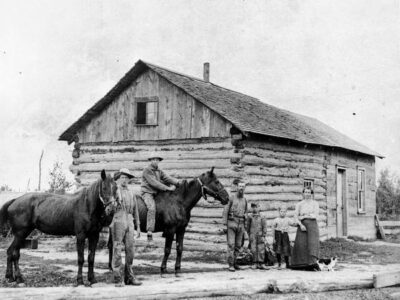
A 19th-century log cabin of Dutch emigrants in Wisconsin (not from the Heebink family)
Chris John Snoeyenbos offered the Heebinks a home with him. They gladly accepted until they were able to build a hut of their own. Gerrit Jan Heebink ran a country shop from 1855 to 1861 for the convenience of his neighbors and a small part of the house was intended for this purpose. He also bought thirty hectares of heavy timber land that they began to cultivate. Later he built a small hut for his family.
In the year 1856 Gerrit Jan and his wife Johanna had their fifth child. It was a son and they named him George.
These were difficult years – not only for the newcomers, but also for the older settlers. In 1857, they underwent a depression known as the Panic of 1857. Money was very scarce and everyone lived on cheap food. There was little food for the cattle. The pigs were fed with beech nuts, which were plentiful. The Heebinks managed to earn a reasonable living from their shop and their timber land and therefore did not suffer from it.
Civil war
Then came the Civil War (1861-1865). At first, it seemed that it would be short-lived, but the true circumstances were not yet known at the time. Depression struck the community – in fact, the whole country. Food was scarce. The crops had been disappointing. Spring wheat had been a total failure, so flour was scarce. Fortunately, Gerrit Jan had sown winter wheat and winter rye and both crops had yielded a decent yield. For example, he was better prepared than many of his neighbors. He was a generous, kind man, and when his customers couldn’t buy flour, he lent it to them until they could afford it.
The war dragged on. President Lincoln needed more men, so men were called up for the army. More and more of them left, until there was no one left to do the work on the farm and it was left to the women. They took care of the supplies, worked in the fields, and it was a common sight to see threshing crews made up entirely of women.
The war dragged on to the bitter end. There was great joy in this patriotic community when they heard that the Union had won. However, they mourned the many who had lost their lives in the war. The assassination of President Lincoln on April 14, 1865 caused everyone great grief, because they had looked up to him as the only leader who could bring order to this troubled period.
The excitement of the Civil War had barely subsided when Indian rebellions broke out in Minnesota and Wisconsin. Several massacres had been reported in Minnesota, and Wisconsin also feared attacks. Bridges to Sheboygan City were raised and guns were stationed at strategic points, but fortunately the reports proved false. However, the Sauk tribe did pass through the community and caused a lot of fear and anxiety – but little damage was actually done.
A Sauk Indian Chief came to Gerrit Jan’s shop and demanded ‘firewater’. He was summoned out of the store, but before he left he showed a long-bladed knife very threateningly. Gerrit Jan was not afraid and slammed the door behind him. However, his son Bart was so shocked that he fainted.
In 1862 Gerrit Jan and Johanna had their sixth and last child. It was their first and only daughter and they named her Johanna. The following year, their eldest son Gerhardus Harmanus (Gerrit) married Gertrude Lemmenes, also an emigrant, born in Meddo.
More than ten years after their departure from Aalten, they had not yet been forgotten there. In 1865, their niece Johanna Aleida Heinen (1842-1925) wrote in a letter to her family in America: “… for I am now so very alone here. I still pass your house all the time, and Uncle Heebink also has his, and I sometimes look into it with attention.”
Happy Valley
One of the other Aalten settlers in Oostburg was aren’t Jan (John) Westendorp, born in Dale. He had become interested in land in the western part of Wisconsin known as Happy Valley in St. Croix County, 500 miles away from Oostburg. John decided to explore this area, he came back with the message that there was excellent agricultural land for sale. He had bought a plot of land there and intended to settle there in the short term.
Shortly afterwards he took his wife, Willemina (ter Haar), and his family, together with their personal belongings, to his new farm. Chris John Snoeyenbos and Gerrit Heebink Jr. accompanied them on this journey. Not long after, Herman Heebink and Lammert Vrieze also got the urge to see this pioneer country and they too left for St. Croix County on April 1, 1869.
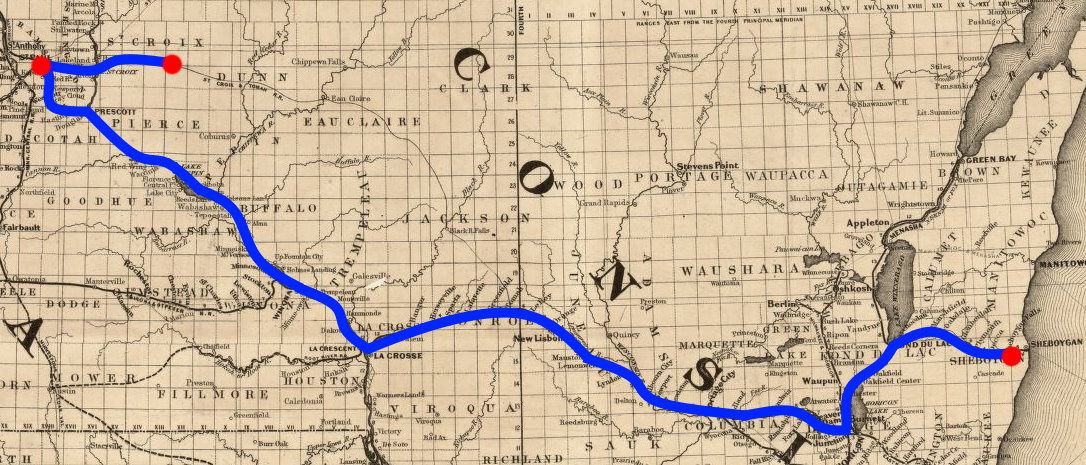
They went from Sheboygan Falls to Fond du Lac and then by train to La Crosse, where they took a boat to Prescott. There was so much ice in the river that the boat didn’t get any further than Winona, so they took a train from there. They didn’t know that the train went directly through Prescott, so they went on to St. Paul, Minnesota. The Milwaukee and St. Paul Railway was the only one in Minnesota at the time, extending only to St. Paul. There was a small, poorly built depot near the Wabasha Bridge, and a five-cent toll was collected to cross the bridge. This was in the year 1869, and St. Paul had a population of only eight thousand. They spent the night in St. Paul in a small German hotel on Third Street.
The route from Oostburg to Happy Valley
They left the next morning on foot for Happy Valley. When they reached Afton , they inquired at a farm how to cross the St. Croix River . The woman who opened the door was baking cookies and invited them to eat some of her warm cookies. They were so hungry and tired that this came to them as ‘manna from heaven’. The woman advised them to walk to the shore where they would find a trapper boat. They did so and waited for the treadle, which came at four o’clock. He was drunk and they were hesitant to cross with him, but it was their only alternative, so they decided to take the risk. In Hudson, they left their luggage and inquired about the way to Happy Valley. They were mistakenly directed to Pleasant Valley and after wandering back and forth for a mile they realized their mistake and returned to the main road.
The roads were wet and muddy, with crusts of ice and snow here and there. This made traveling on foot very difficult and forced them to rest regularly along the way. During one of their frequent rest periods, they heard a vehicle approaching in the distance. It was Chris McCabe and George Tubman who returned from Hudson with a truckload of rail studnails. They stopped to inquire where the boys were going, and when they learned it was John Westendorp in Happy Valley, they were invited to ride along while McCabe and Tubman walked. The tired boys were very grateful and would never forget their kindness. It gave them a very nice impression of their new neighbors.
At three o’clock in the morning they arrived at the Westendorp house in Happy Valley, tired, wet and almost exhausted. Because they had been on the road longer than they had expected, their money was almost gone – Herman had forty-three cents left and Lammert had two and a half dollars. They had walked no less than 70 kilometers. The Westendorp residents welcomed them warmly and gave Herman a job with them for a short time. The Herrick farm was for rent and Herman, Gerrit and Lammert decided to rent it. They each bought a yoke of oxen and rented three more yokes so that they could do their farm work well.
Baldwin, St. Croix
In 1869, St. Croix County was still very sparsely populated. Only a hundred people lived in Hammond. Four families lived on the eastern border of the township of Baldwin. Baldwin was more than 30 kilometers from Hudson’s transportation facilities, and people were anxiously awaiting the arrival of the railroad.
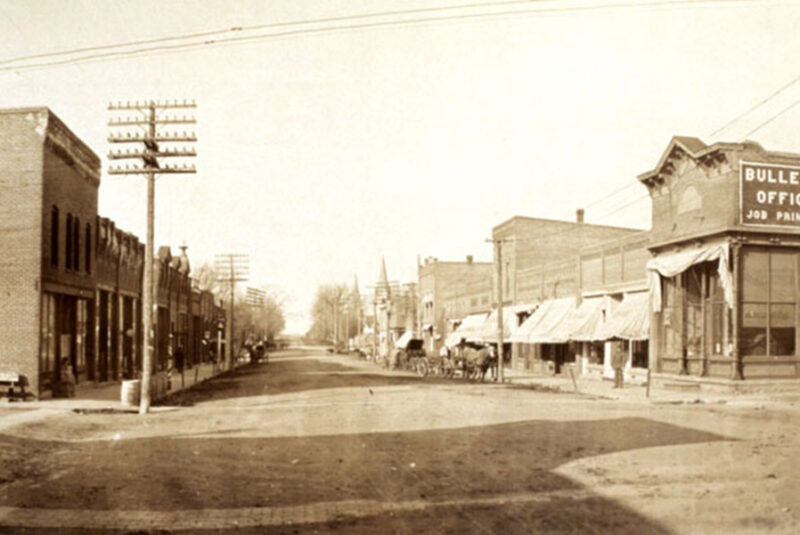
Main Street, Baldwin, November 1912
Herman Heebink and Lammert Vrieze soon found work. A strip of land from Woodville to Baldwin had to be cleared to make the railroad possible. They signed a contract to clear a space 30 meters wide and 20 meters of it had to be cleared of undergrowth. It was hard work to rid the land of pine trees and stumps and the felling of hardwood yielded little money, but they were happy with the little work that could be found.
For almost a year, Herman transported supplies for the stagecoach company and the railway. A beautiful road had been built for the stagecoach company. Because there was no other way to travel, the stagecoaches did good business.
On November 24, 1871, the first train with passengers from Menomonia arrived in Baldwin. This was a memorable day. In the years that followed, more and more buildings were erected in Baldwin. Shops, a hotel, a saloon, saw and grain mills and a small school of six by nine meters. The small settlement gradually began to take on all the characteristics of a village.
Moving house
In 1872 Herman had returned to visit Oostburg and took his brother Bart back with him. Then their mother came to visit them and Bart took her back to Oostburg. Bart tried to persuade his parents to sell their property there and return with him to St. Croix County and establish a house there. After careful consideration, they decided to do so and Herman began to build a small house for them. They left Oostburg on the day after Thanksgiving Day in 1872, with Derk Johan (John),George and Johanna. The Snoeyenbos family had organized a farewell party for them where they said goodbye to their friends, neighbors and relatives in Sheboygan County. Then they started their journey through Wisconsin to Baldwin.
They were brought to the station by their cousin Gerrit te Grotenhuis . All their personal belongings were packed into a wagon and they sat on the packed boxes. Because the travel conditions by train were very bad, it took two days to cover the relatively short distance from Oostburg to Baldwin. When they arrived in Baldwin, there was no one waiting for them, so they waited in the depot for Gerrit to come and pick them up. After some time, Herman and Gerrit arrived with a team of horses and a bobsleigh to take them to their new home.
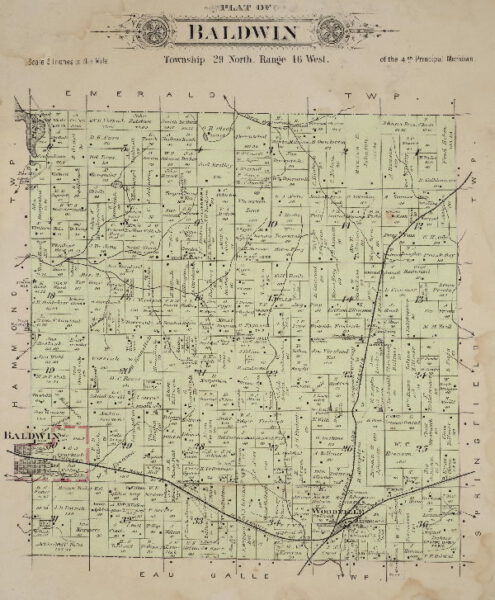
Map of Baldwin and surroundings from 1897 (click for a larger version). We come across many names from Aalten and Winterswijk.
Herman had bought ten acres of land a mile south of Baldwin and built a house for them there. There had been no time to finish the interior so Herman, Bart and John finished it for them. Later they bought Herman’s house.
Bart bought 22 hectares of land in Hammond, cleared the land and built buildings there. In 1874 Bart married Gertrude Brethouwer from Oostburg, also a daughter of emigrants from Aalten, namely Adrianus Brethouwer and Geziena Rensink. For a while he engaged in diversified agriculture and then sold the land again, to acquire 65 hectares elsewhere in Hammond. He cultivated it and built a comfortable house there in 1890. Bart grew the usual crops and specialized in Hereford cattle and Poland-China pigs. He also kept brown Leghorn fowl and bred horses. Bart was a staunch Democrat and served on the school board for Hammond and Baldwin for six years. He was a member of the Presbyterian Church.
A few years later, in 1877, his brother Herman married Dena te Stroete from Oostburg, emigrant daughter of Gerrit Jan te Stroete and Janna Geertruid Peters, born in Winterswijk. Herman, Gerrit and Bart had set up a small grocery and trading business in Baldwin and did good business.
In 1885 John married Plona van Driest from Cedar Grove, daughter of Zeeland emigrants. They spent the first year and a half of their marriage with John’s parents, after which they bought a farm two miles north of Baldwin.
Gerrit and Bart both lost their first wives. Gerrit remarried in 1886 to Alice Flipse, daughter of Zeeland emigrants, and Bart in the same year to Anna Maria (Mary) Esselink, born in Winterswijk.
End of an era
In the meantime, the health of pater familias Gerrit Jan Heebink gradually declined. Although he was not ill for long, he died on December 17, 1887. His wife and family missed him greatly, for he had been a kind, generous man, loved and respected by all.
Herman had withdrawn from the trading firm and had set up a small timber yard in Baldwin. George also married, namely in 1892 with Dena Hoopman, daughter of former Aalten residents Abraham Hoopman and Johanna Berendina Wentink. For the first year of their marriage, they lived in Baldwin and later moved to a farm near Dahl, five miles northeast of Baldwin, where some of their eight children were born.
After Gerrit Jan’s death, his widow, Johanna Sr., lived for a while with her daughter Johanna and George in their house south of Baldwin. Later they moved to Baldwin in the old Norby house. Here Johanna ran a small boarding house. Later, Johanna married Neal Beaton. He was a photographer and built an establishment in Hammond where they lived for several years.
Mother Johanna Heebink-Snoejenbos then took turns living with her sons. She was in very poor health and suffered from severe rheumatism. She was unable to walk for the last seven years of her life and became helpless as a child. She died on 20 October 1898. She had been a kind, sympathetic mother, but because of her high-strung, nervous temperament and emotional nature, she had suffered much at a time when hardships abounded.
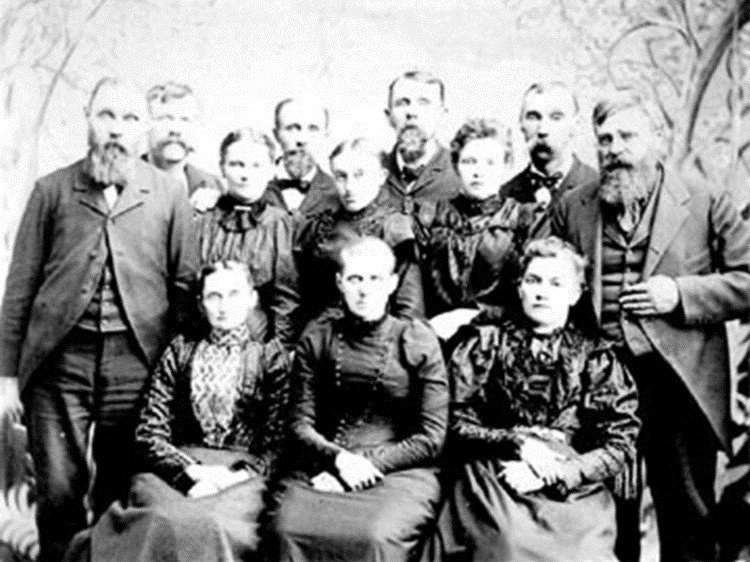
The Heebink children and their spouses (from left to right), standing: Herman, Neil Beaton, Johanna, Bart, Mary (Esselink), George, Dena (Hoopman), John and Gerrit. Seated: Dena (in Stroete), Plona (van Driest) and Alice (Flipse).
The twentieth century
The five brothers had all settled in the community in or around Baldwin. The trade and grocery trade flourished, but Gerrit had withdrawn as a partner and returned to agriculture. Bart retained his interest for a while, but the active work was taken over by Bart’s son, George B. Heebink.
John and George had a meat shop in Baldwin for a few years, but stopped to farm. George later moved to Souris, North Dakota. Johanna and Neil Beaton sold their photography shop and moved to Quebec, Canada (where Neil was born). Herman’s timber trade flourished.
After a short period of illness, Gerhardus Harmanus (Gerrit) died on March 16, 1910. His younger brother George died of colon cancer on December 9, 1919. Engelbert (Bart) died on April 9, 1934 as a result of kidney ailments. Herman reached the age of eighty-nine, after a short illness that eventually led to pneumonia from which he died on December 5, 1935. Derk Johan (John) died on 16 September 1940 in Baldwin. Johanna’s death in Canada in 1947 marked the end of this generation of Heebinks.
Around 1940, the offspring numbered almost 300 people. Most of them lived in Baldwin and the surrounding area. Many had also spread across Wisconsin, while others lived in North Dakota, Montana, Washington, Oregon, California, and West Virginia. Johanna’s children lived in different parts of Canada.
This story is largely based on ‘The Heebink History’, recorded in 1940 by Nell A. Heebink – daughter of Derk Johan (John) Heebink.
She wrote the following in her foreword:
“Family history details, unless recorded, are only stored in the minds and memories of our parents and ancestors. When they die, they are often lost to the current generation. In order to preserve a part of history for our current generation, I have collected anecdotes, stories and experiences in this booklet that may be of interest to them. It mainly relates to their former life in the Netherlands, migration to America, pioneering in eastern Wisconsin on the shores of Lake Michigan and their permanent settlement as a community in western Wisconsin. Herman and John Heebink have provided all the historical data in this booklet.”
This story was elaborated and published online in 1998 by descendant Joel Heebink and translated into Dutch in 2022 and supplemented by Remco Neerhof.
Between 1845 and 1880, hundreds of emigrants from Aalten and Winterswijk settled in Clymer, a town in the west of the state of New York. In 1854, Berend Hendrik Legters and his family also left for the United States, with Clymer as their final destination. A sinister story is still circulating within the family about their journey…
Berend Hendrik Legters was born on 18 January 1827 at Klein Goorhuis in Heurne in Aalten. In the mid-30s, the family moved to Nieuw Hoornenborg on the Haart. After the death of his mother, his father remarried in 1845 and they moved to the Koks farm in Ratum.
On 18 June 1847 Berend Hendrik, a weaver by profession, married Anna Catharina Hellekamp (Miste, 31 August 1810). They went to live at her parental home, Hellekamp in Miste. In June 1854 they left for America with their two young sons, together with the Oonk-Kortschot couple, who also lived at Hellekamp.
The crossing to New York took a long time and was tough. It became too much for Anna Catharina; after 30 days at sea, she died, just days before they were to arrive in New York. Berend Hendrik had seen what happened to the bodies of deceased passengers: they were given a watery grave. He wanted to spare his wife that fate. So he and his travel companions came up with a ruse. They pretended that Anna was seriously ill and thus hid the fact that she had died. Despite illness, you were counted on with the food. An additional advantage was that they now had an extra portion of their own!
Once they arrived in New York, they had to leave the ship via the gangway. They held the deceased between them and put her arms over their shoulders. Carefully they kicked her legs so that it looked like she was walking herself. The trick worked and they managed to get her off board safely.
They had her buried in the first cemetery they came across, with the intention of having her remains later transferred to their final destination, Clymer. However, in the first few years, they did not have the means to do so. When they finally had enough money saved, they returned to pick her up. But unfortunately, they could not find the grave again…
After widower Berend Hendrik had settled in Clymer with his two sons, he asked the pastor what he should do. On his advice, he remarried to Gesina Berendina “Minnie” Schreurs (Barlo, 20 April 1820), widow of Gradus Kobus. She died in 1865 and Berend Hendrik married again, this time to Geertruida Johanna “Kate” Schreurs (Winterswijk, 13 December 1840). Berend Hendrik (Henry) Legters died on 25 January 1910 in Clymer.
The above representation of this story is based on the sources mentioned below. However, these sources contain varying information about the course of events. We have combined the (in our opinion) most plausible information into the above version. Additions/corrections are welcome!
The Amsterdam pier in Sheboygan County, Wisconsin, was built around 1851 and was once an important transshipment point for lumber, agricultural products, and fish. With a length of about 300 meters, it provided access to the deep water of Lake Michigan. A lively community of Dutch immigrants, fishermen and traders arose around the pier. After the arrival of the railway in 1872, the pier fell into disrepair. Nowadays only a park remains on the water.
The construction of the pier
Who exactly built the pier of Amsterdam in 1851 is uncertain; some sources mention the Walvoords, others Gilbert Smith. The pier extended 300 meters into Lake Michigan from what is now called Amsterdam Road, and at the end had a depth of more than 6.5 meters — enough for the ships of the time. Initially, the pier was used for the export of wood, but soon also for agricultural products and fish. The village had many fishermen who derived their livelihood from the lake.
Dutch immigrant Hendrik Walvoord, one of the company’s administrators, and his son Garrit Jan Walvoord came to the area in 1849 with other family members. The Walvoord family opened a grocery store, where they offered food and general merchandise in exchange for local products such as firewood, barrel wood and fish.
Tragedy and setbacks
On July 11, 1856, a tragedy occurred. According to various sources, Garrit Jan Walvoord was either on his way to a dredger that had been hired to deepen the pier that morning, or he was measuring firewood. During this work, he fell off the pier, possibly because the wood started to move while he was scrambling over it. He was buried under water when some tree trunks fell on top of him and died. His wife Anna Maria Engel Nolton and his father continued the shop for a while.
But fate was not long in coming: in January 1857, the Walvoord shop was completely destroyed by fire and was not rebuilt. At the beginning of June 1858, the steam sawmill of Thompson, Tinsler and Watser also went up in flames.
Fishing pier near Amsterdam, Sheboygan, circa 1930 (Photo Sheboygan County Historical Research Center)
Growth and decline
Despite these setbacks, Amsterdam seems to have flourished for decades. At its peak, there were at least two shops, a blacksmith, an inn, a cooperage and a school. In 1872, everything changed: the Milwaukee, Lake Shore & Western Railway was built, but it ran inland via Cedar Grove. As a result, Amsterdam lost its transport function. Due to the disappearance of the wood supplies and the arrival of the railway, many residents moved to Cedar Grove. Some stayed, especially the fishermen.
In addition to the Smith family, other families also started fishing businesses. Names associated with this activity include: De Witt, De Zoute, Grotenhuis, Huibregtse, Ingelse, Kobes, Kolste, Moennig, Nath, Roerdink, Smies, Stokdijk, Van der Jagt, Van Drieste, Weiskamp, Westerbeke and Zuurmond.
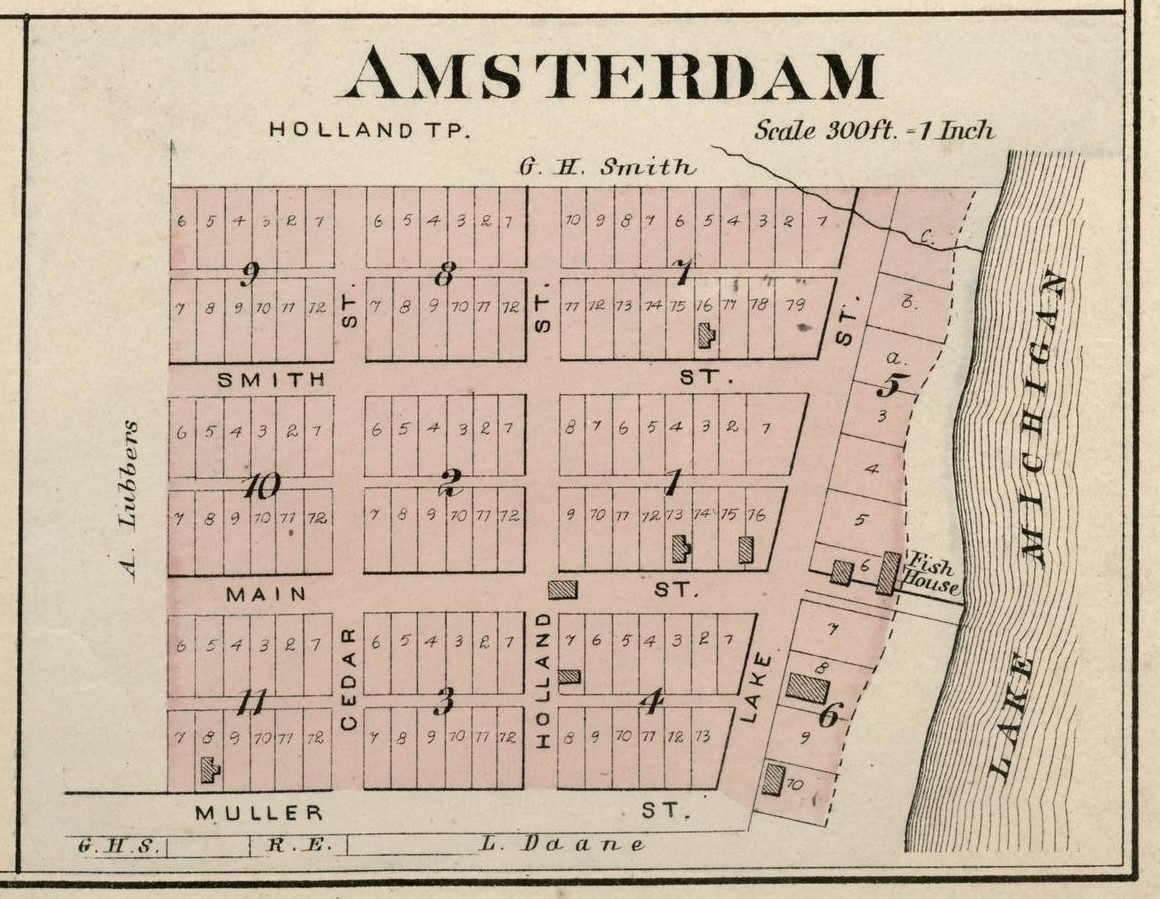
Plot plan Amsterdam, Sheboygan, by Charles M. Foote, 1889 (Photo Wisconsin Historical Society)
Rescue on the water
On March 18, 1906, Captain Delos Smith and his crew rescued more than 60 people from the burning steamer Atlanta on the fishing boat Tessler. They managed to pull the ship ashore just north of Amsterdam. Only sailor Michael Hickey did not survive: he jumped between the two ships and drowned.
The demise of the fishing industry
As timber stocks dwindled, fishing became the most important economic activity. In the beginning, fishing was done close to the coast with sailing boats and trawls. Later, they switched to pound-nets in deeper water, first with steam and later with gasoline engines. White fish and sturgeon were initially abundant, but later mainly herring, smelt and trout were caught. However, fish stocks declined sharply after the arrival of the sea lamprey in the 1930s. As a result, the once flourishing fishery slowly collapsed.
The Amsterdam of today
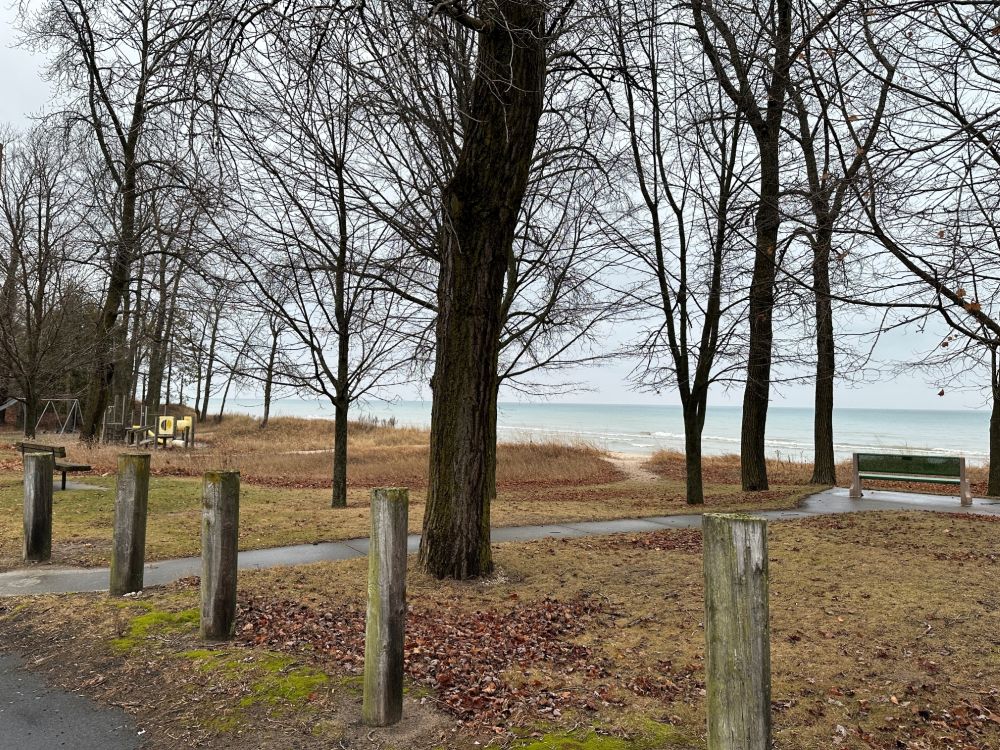
Little is left of the former village of Amsterdam today. The former site now houses a small park with a playground, picnic area and a boat ramp. What was once a bustling trading and fishing village is now a silent reminder of Wisconsin’s Dutch pioneering history.
Amsterdam Park and Beach, 2024 (Photo: Kendra A. Kennedy)
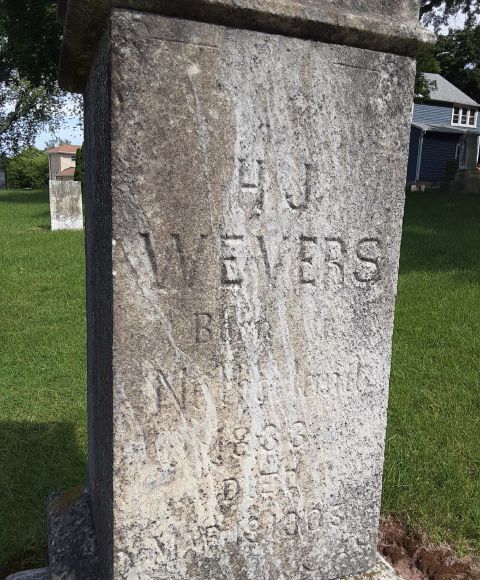
In the 19th century, thousands of Achterhoekers emigrated to the United States in search of land, freedom and new opportunities. Among them was Harmen Jan Wevers (1833–1905) from Barlo. He was one of the early Dutchpioneers who settled in the largely unexplored wilderness of Sheboygan County, Wisconsin.
Harmen Jan Wevers was born on April 20, 1833 on the Oonk farm in Barlo, as the son of Derk Wevers and Johanna Bloemers. He had a brother and three sisters.
Emigration and early years in America
In April 1849, at the age of sixteen, he left Rotterdam for the United States. The crossing took 64 days. After arriving in New York, he traveled via Buffalo, Pittsburgh, St. Louis and Chicago to Sheboygan County in Wisconsin.
Harmen Jan came to America on the same ship as Henry Walvoord, with whom he then worked as a servant for three years. After arriving in the US, Walvoord settled in Holland Township. For thirteen winters, Harmen Jan stayed with this pioneer, while he worked or went to school in the summer.
After he had saved enough, he bought a team of oxen and earned a living as a carter, including transporting wood to the pier of Amsterdam (Wisconsin).
Own farm in Holland Township
In 1854, Harmen Jan bought a piece of land of forty acres (over 16 hectares), largely untouched forest. With great dedication he managed to reclaim this area and turned it into a thriving farm. He later expanded his holdings to seventy acres (almost 28.5 hectares).
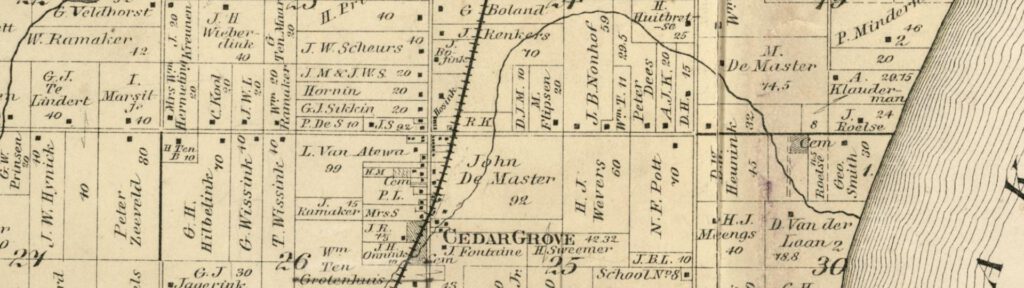
Amsterdam and Cedar Grove, Sheboygan County, with H.J. Wevers’ plot at the top right, 1889 (image: University of Wisconsin–Madison)
Harmen Jan saw how his new home region changed from a rugged wilderness to a fertile agricultural area. Through hard work, perseverance and dedication, he managed to build a thriving farm as a simple immigrant. He grew into a respected citizen and administrator in his community.
In 1894 two children of the family were still alive: Harmen Jan and his sister Johanna Geertruid (1828–1912), who was married to Albert Clanderman from Sheboygan.
Faith and Commitment to the End
Harmen Jan Wevers was an active and valued member of the Dutch Reformed Church in Cedar Grove. Politically, he was affiliated with the Republican Party. He held the position of Supervisor (municipal administrator) for many years.
From poor emigrant he managed to work his way up to become an independent farmer and respected citizen. Within Holland Township, he was known as one of the oldest and most reliable pioneers in the region.
Harmen Jan Wevers died on March 19, 1905, at the age of 71. He was buried at Walvoord Cemetery in Holland, Sheboygan County.
In 1847, a large group of people from the Achterhoek departed for America, hoping for a better life. Among them were dozens of residents from Aalten. Just before they reached their final destination, their ship, the ‘Phoenix’, caught fire on Lake Michigan. An estimated 250 to 300 people lost their lives.
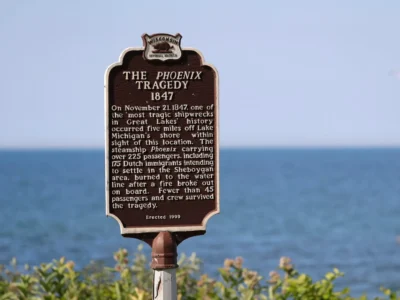
Memorial plaque for the Phoenix disaster, Sheboygan
The beautiful wooden boat named ‘Phoenix’ was only two years old when it steamed toward the west coast of Lake Michigan on November 20, 1847, carrying approximately 175 Dutch passengers, 23 crew members, and an unknown number of other occupants. The emigrants on board came from Winterswijk, Aalten, Varsseveld, Apeldoorn, Holten, and various other places. A day later, they were to reach their Promised Land in Sheboygan after an exhausting voyage. Children were put to sleep in the cabins for the last time.
On November 11, the Phoenix had departed from Buffalo to sail via Lake Erie and Lake Huron to Lake Michigan. Only thirty miles from their destination, the Phoenix entered the harbor of Manitowoc. Some cargo was unloaded, but when the captain noticed the weather conditions were too stormy, he kept his ship in the harbor until the lake would calm down. The crew went ashore. Some claimed they were intoxicated upon their return.
At one o’clock in the morning, with the lake calm and the night filled with stars, the Phoenix departed for the final leg of the journey to Sheboygan. Due to the heavy load, the boilers overheated, but the crew treated the matter lightly. However, around four o’clock in the morning, thick smoke and the stench of smoldering wood emerged from the engine room, and the alarm was raised.
Burn or drown
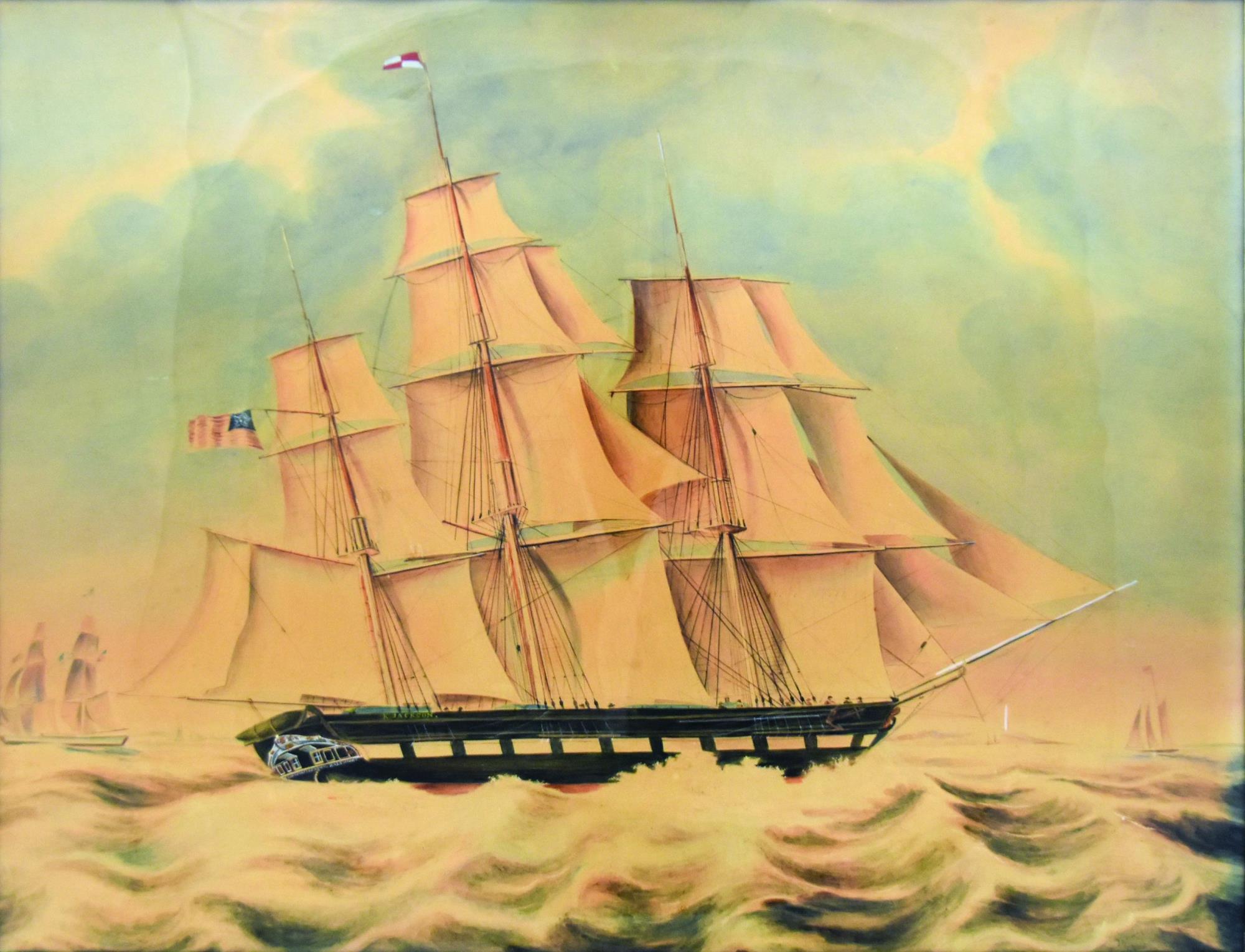
Painting of the Phoenix disaster
Vain attempts were made on board the Phoenix to extinguish the fire with buckets of water. But the wooden vessel soon burned like a torch. Two lifeboats were lowered into the water, with which 43 occupants managed to cover the five miles to the coast—one using a wooden shoe as an oar; twenty-five of them were Dutch.
The remaining passengers had two options: burn or drown. They jumped into the water but stood no chance. The water was ice-cold, and they became hypothermic within minutes. Even if one could swim, any attempt to reach the shore was futile.
An estimated two hundred and fifty to three hundred people died, including nearly 100 children. It is remarkable how the handful of surviving emigrants still managed to start a new life. They had no choice.
Residents of Oud-Aalten on the Phoenix
In the middle of the last century, many people from the Achterhoek left for religious reasons. They were mostly dissenters from the Dutch Reformed Church who no longer felt at home here due to their liberal thinking. This was also true for the Achterhoek passengers on the Phoenix, including the Aalten residents Brusse, Navis, and Krajenbrink from the rural district of Lintelo.
From oral tradition, the names of fourteen people from Aalten who became victims of the disaster are known. Regarding others, one is left in the dark. They departed from Aalten on August 16, 1847, together with 78 others. However, conservative estimates suggest that fifty to seventy-five residents of Aalten perished.
A list of (possible) passengers of the Phoenix and who likely did or did not survive the disaster can be found on the website dutchgenealogy.nl by Yvette Hoitink.
Podcasts and documentary
From left to right: cameraman Maarten Schellekens, documentary filmmaker Diny van Hoften, Mary Risseeuw from Sheboygan, and podcaster Joske Meerdink.
At the end of 2020, Winterswijk podcast creator Joske Meerdink from Omroep Gelderland accidentally came across the story of the Phoenix disaster. She was surprised that she did not know the story and noticed that the Phoenix disaster was also relatively unknown to her fellow villagers. Consequently, she decided to delve into the story.
During her search, Joske, together with documentary filmmaker Diny van Hoften, visited Sheboygan, where they spoke with descendants of the disaster’s survivors. They also joined a shipwreck hunter to search for remains of the Phoenix (and found them!).
Her search resulted in a series of podcasts and a two-part documentary. These can be heard and viewed at Omroep Gelderland.
The documentary that Omroep Gelderland broadcast in early 1998 about the Phoenix disaster can also be seen here. In the documentary, made by Sacha Barraud, a group from the Achterhoek, including Aalten resident Evert Smilda, is followed as they travel to Sheboygan in late 1997 to attend the 150th anniversary commemoration of the Phoenix disaster.
Emigration to North America
During the 19th century, thousands of people left the Achterhoek region to build a new life in the United States. Many residents also departed from Aalten, searching for freedom, land, and new opportunities.
In 1847, a large group of emigrants from Aalten emigrated to the United States by ship. They were part of a larger emigration flow from the Achterhoek in the 19th century. One of the ships on which these emigrants traveled to America was the sailing ship Katherine (Kath) Jackson, which departed from Amsterdam that year.
The ship ‘Katherine Jackson’, watercolour by M.A. Thomas, 1844 (collection Chesapeake Bay Maritime Museum)
The Kath Jackson was a three-master with a square transom and a length of approximately 38 meters. The ship was built in 1833 by Fickett & Thomas in New York.
The ship sailed at the end of August 1847 and had 171 passengers on board. According to the passenger list , about three-quarters of the passengers – 131 people – came from Aalten. The other passengers came from Eibergen, Zutphen, Winterswijk, Leiden and Germany, among others.
After embarkation in Amsterdam, the ship left the Netherlands via the Nieuwediep near Den Helder, from where the crossing of the Atlantic Ocean began. The captain of the ship was W.W. Stafford. On September 28, 1847, the Kath Jackson arrived in New York City.
The year before, the Kath Jackson had already brought a smaller group of people from Aalten to America, namely the Grootendorst / Scheenk family.
Heading of the Kath Jackson’s passenger list, Amsterdam–New York, 1847
In the 19th century, thousands of Achterhoekers emigrated to the United States in search of land, freedom and new opportunities. Among them were Evert Jan Duenk and Willemina Rensink from the hamlet of IJzerlo in Aalten. They were among the early European pioneers who settled in Sheboygan County, Wisconsin.
Evert Jan Duenk was born in Aalten on October 7, 1797, as the son of Hendrik Deunk and Aaltjen Siebelink. He married on 12 July 1818 in Aalten with Joanna Bernardina te Winkel (Bocholt, 1790), daughter of Joan Gerhard te Winkel and Theodora te Beest. They lived on the (Groot) Essink farm in IJzerlo.
On April 25, 1829, Joanna Bernardina died. A year later, on 6 May 1830, Evert Jan remarried in Aalten to Willemina Rensink (1809, born on the Groot Rensink farm in Lintelo on 31 March 1809, daughter of Jan Willem Rensink and Elisabeth Liesen.
On August 16, 1847, the family left the farm in IJzerlo and emigrated to the United States. However, Evert Jan failed to terminate the lease. He had also sold the cattle and all the things on the farm. He was summoned in the Netherlands for this and convicted in absentia.
Evert Jan and Willemina, with their seven children, departed from Amsterdam, boarded the ship Kath Jackson and arrived in New York City on September 28, 1847. On the list of emigrants from Aalten he is registered as a farmer, less well-off. The family settled in Sheboygan County.
Sheboygan Forward
We found some mentions of Evert Jan Duenk in the Sheboygan Nieuwsbode, “Organ of the Dutch in North America”:
Cow lost – Sheboygan Newsman, June 29, 1852
“some light bruises” – Sheboygan Nieuwsbode, August 7, 1855
Marital problems
At one point, Evert Jan and Willemina could no longer get along. This is evident from an advertisement that Evert Jan placed in the Sheboygan Nieuwsbode at the beginning of March 1860:
Sheboygan Newsman, March 7, 1860
“Naardemaal (because, ed.) WILLEMINA DUENK, my wife, has behaved in such a way that I can no longer live in peace with her, I forbid all persons to house or guarantee her on my account, as I will not pay any debts she incurs after this day. E.J. DUENK. Gibbsville, March 3, 1860.”
Gerrit Jan Hilbelink was born on 19 February 1813 on the Lensink farm in IJzerlo, the son of Arend Jan Hilbelink (1787–1865) and Hendrika Hoopman. On 1 October 1840 he married Garritjen te Bokkel, born on 27 February 1820 on the Groot Tammel farm in Lintelo, daughter of aren’t Jan Derk te Bokkel and Janna Tammel.
Emigration and settling in Holland Township
In August 1847, the Hilbelink family left Rotterdam for the United States. After a crossing of about four weeks, they arrived on Staten Island. From there they traveled on via Buffalo and the Great Lakes to Sheboygan (Wisconsin). They stayed there for only one night, and the next day they travelled by ox-cart to Holland Township, where they settled in section 27, on a piece of land that later became the property of Gerrit Jan te Lindert. They lived on this farm for about nine years.
Gerrit Jan Hilbelink (1813–1898)
Garritjen Hilbelink-Te Bokkel (1820-1912)
At the time, the area still consisted entirely of pristine forest, inhabited by wild animals such as wolves, bears and deer. The first years were tough: the land had to be completely reclaimed. There were few neighbors, although there was regular contact with the local indigenous population. In these rough conditions, Gerrit Jan and Garritjen built a new life.
In 1853, Gerrit Jan’s father also followed the family to America. He settled in Lima, where he spent the last years of his life.
Farm and community
In 1850, Gerrit Jan bought a piece of land of 40 acres (about 16 hectares) in section 26, where the family settled. The site was again densely wooded and had to be completely reclaimed. They built a log cabin in which their children grew up. He later expanded his holdings by another 40 acres. Although he later sold part of it, it grew into a well-functioning farm with a house and several barns. Gerrit Jan also contributed to the development of local infrastructure, such as roads, and other facilities.
Map of Holland Township, Sheboygan, 1889 (image: University of Wisconsin–Madison)
Offspring
Gerrit Jan and Garritjen had fourteen children together, four of whom were born in the Netherlands and ten in the United States. The four children born in the Netherlands died at a young age, as did one of the children in America. Nine children reached adulthood:
Hendrika (1849) married aren’t Jan Rensing in Newkirk, Iowa
Aren Jan Derk (1850) managed the parental business, married Janna Gesiena Sikkink
Jan William (1853), carpenter in Newkirk, married Agnes Koolbeck
Gerrit Jan Jr. (1858), carpenter in Milwaukee, married Jane Smies
Hannah (1860), married John W. Rauwerdink, farmer in Holland Township
Gertie (1863), married Jacob Leenhouse, carpenter in Milwaukee
Aleida (1866), married Gabe Ringoldus, also in Milwaukee
Community and death
Gerrit Jan and Garritjen were members of the Dutch Reformed Church in Cedar Grove, and were among the first members of this congregation. Politically, Gerrit Jan was a supporter of the Republican Party.
In 1894 Gerrit Jan and Garritjen were respectively 80 and 73 years old. Both were then in good physical and mental health, enjoying the fruits of their long and hard lives as pioneers in the New World.
Gerrit Jan Hilbelink died on 17 April 1898, his wife Garritjen on 5 April 1912. Both were buried in Cedar Grove Cemetery.
In the 19th century, thousands of Achterhoekers emigrated to the United States in search of land, freedom and new opportunities. Among them was the Stronks family from Dale. They were among the early European pioneers who settled in Sheboygan County, Wisconsin.
Jan Willem Stronks was born on April 27, 1817 on the Brunink farm in Dale, as the son of Garrit Jan Stronks and Garritjen Graven. In 1846 he emigrated to the United States. Jan Willem initially had insufficient means to travel on to the west, and therefore worked temporarily in the workshops of the railroads in Schenectady, New York. Shortly afterwards he moved on to Wisconsin.
As one of the first Dutch pioneers, they settled in Holland Township, where they bought twenty acres (about eight hectares) of forest land. The plot was still completely undeveloped. Through hard work and thrift, Jan Willem managed to work his way up to become a prosperous farmer. However, his health suffered greatly from the physical labor, and he died in 1883 at the age of 64. Grada died in 1898 at the age of 73. Both were faithful members of the Dutch Reformed Church.
Map of Cedar Grove in Holland Township, Sheboygan County, 1889 (image: University of Wisconsin–Madison)
A new life for the children
Of their nine children, three died at a young age. Six children reached adulthood:
Garrett John (1852–1908), Cedar Grove entrepreneur
Caroline (1860–1956), married Henry Meengs, shopkeeper in Cedar Grove
Hannah (1865–1943), married Henry Ramaker, also from Cedar Grove
Garrett John Stronks: From Farmer to Entrepreneur
Garrett John was born on March 21, 1852 in Holland Township. He grew up on his father’s farm. Due to Jan Willem’s fragile health, Garrett took charge of the farm at the age of fourteen. His education was limited; In total, he did not go to school for more than a year. After seven years, he decided to leave farm life behind and focus on trade.
In nearby Oostburg, he cut wood from the forest himself to build a shop of 18 by 28 feet (approx. 47 m²). He borrowed the starting capital from his father: 700 dollars. He knew nothing about trade, his ideas about what and how much to buy were rather vague, but despite these bumps he was determined to persevere.
He bought twice as many goods as he could afford in Milwaukee and suddenly the situation dawned on him: he had high debts, no customers, no experience and bills to pay. When he surveyed the state of affairs, he became so despondent that he had resolved never to buy anything again, if he could sell what he had.
But from the beginning, his business flourished; The people had confidence in him and supported his enterprise. The inhabitants of Oostburg had confidence in him and supported his enterprise. Within two weeks, Garrett was back in Milwaukee to buy more goods.
In 1875, he moved his business to Cedar Grove, where he opened the village’s second store. There he ran a successful shop for seventeen years. From 1979 he also started with grain trading, which he devoted himself to from 1892 onwards. In addition to his own grain warehouse and other real estate, he also owned 12 acres of farmland on the outskirts of Cedar Grove.
On October 21, 1885, Garrett John Stronks married Jessie Blanche Smith, daughter of Gilbert H. Smith. They had five children.
Community and death
Garrett was active in the Republican Party and served as postmaster of Cedar Grove during Benjamin Harrison’s presidency. He was considered one of the most prominent citizens of his community. His life story is that of a self-made man: started with nothing, but through commitment, courage and entrepreneurial spirit he has grown into a respected and prosperous inhabitant of Holland Township.
Garrett John Stronks died on February 29, 1908 and was buried in Cedar Grove Cemetery, just like his parents.
Grave Jan Willem & Grada Stunks in Cedar Grove, Sheboygan
In 1846, a large group of emigrants from Aalten emigrated to the United States by ship. They were part of a larger emigration flow from the Achterhoek in the 19th century. One of the ships on which these emigrants traveled to America was the sailing ship Hector, which departed from Rotterdam in that year.
The ship sailed at the end of August 1846 and had 190 passengers on board. According to the passenger list, 114 passengers were from the Netherlands, including at least 43 from Aalten. In addition, 72 passengers from Germany, three from France and one from Denmark were on board.
The captain of the ship was Alfred G. Spencer. On September 17, 1846, the Hector arrived in New York City.
Head of the Hector’s passenger list, Rotterdam–New York, 1846
In the 19th century, thousands of Achterhoekers emigrated to the United States in search of land, freedom and new opportunities. Among them was the Haartman family from Aalten. They were among the first European pioneers to settle in the largely unexplored wilderness of Sheboygan County, Wisconsin.
The Haartman family lived on the farm of the same name in the hamlet of Haart near Aalten. The family consisted of father Derk Jan Haartman, mother Hendrika te Bokkel, five sons and a daughter. In 1846 they left Rotterdam for America on the ship Hector . The crossing lasted 46 days and on September 17, they arrived in New York City.
After a short stay of six weeks in Rochester (New York), the family traveled via the Great Lakes to Milwaukee in Wisconsin. There, Derk Jan Haartman bought sixteen hectares of uncultivated land. Shortly afterwards, fate struck: illness struck the family, and mother Hendrika, three sons and the daughter died.
Sheboygan County Establishment
Together with his two remaining sons, Evert and Derk Jan jr., Derk Jan sr. on to Sheboygan County. In Wilson Township, they bought a piece of forest land in Section 32, for three dollars a hectare. The land had never been inhabited by white settlers before and had to be reclaimed from scratch.
The pioneer life was hard. They had little to eat, hardly any clothing, and no comfort at all. The family’s first home was a simple log cabin with a wooden floor and a stove pipe as a chimney. Many Native Americans still lived in the area, who usually did not cause a nuisance, but sometimes came to beg.
Map of Wilson Township, Sheboygan, 1889 (image: University of Wisconsin–Madison)
Wilderness survival
Milwaukee was the nearest trading center, but at the time it had only five hundred inhabitants. Sheboygan had three small shops and there were no churches or schools yet. The area consisted of dense pine forests and the roads had to be literally cleared by the settlers.
The colonists regularly needed provisions. Evert Haartman once walked to Milwaukee with the money he had collected in the neighborhood. With this he bought three barrels of flour, some meat and buckwheat flour. On his return, these foodstuffs were distributed sparingly among the inhabitants of the settlement. The only merchandise they could offer themselves were ash and cedar shingles, which they exchanged for food in Milwaukee.
Family and descendants
Evert Haartman, born on May 15, 1824, married on May 12, 1855 in Wilson Township with Janna Berendina (“Jane”) Beskers, born on July 25, 1830 on the Haverland farm in Henxel near Winterswijk. They had ten children; two sons and eight daughters. The family lived on a farm of almost 100 hectares, located four kilometers from the village of Oostburg and thirteen kilometers from Sheboygan.
Evert Haartman (1824-1910)
Janna Berendina Haartman-Beskers (1829-1896)
Evert was respected in the area as a man of principles and dedication. He served as Township Supervisor several times, supporting initiatives to promote education and community. The family was a member of the Dutch Reformed Church in Wilson Township, and Evert helped build three churches. His first vote as an American citizen was for Abraham Lincoln; since then, he has remained loyal to the Republican Party.
Derk Jan Haartman jr., Evert’s older brother, was born on July 18, 1821. He married on October 2, 1855 in Wilson Township with Aleida Gesiena Kortschot, born on September 20, 1838 on the Roerdink Kortschot farm (Roerdinkpoorthuis) in the Woold near Winterswijk. They also had ten children, four sons and six daughters.
Final resting place: Hartman Cemetery
Father Derk Jan Haartman died in 1860. Derk Jan Jr. died in 1889, Jane Beskers in 1896, and Evert himself in 1910. They were all buried at Hartman Cemetery in Wilson Township, a small family cemetery where other descendants and in-laws also found their final resting place.