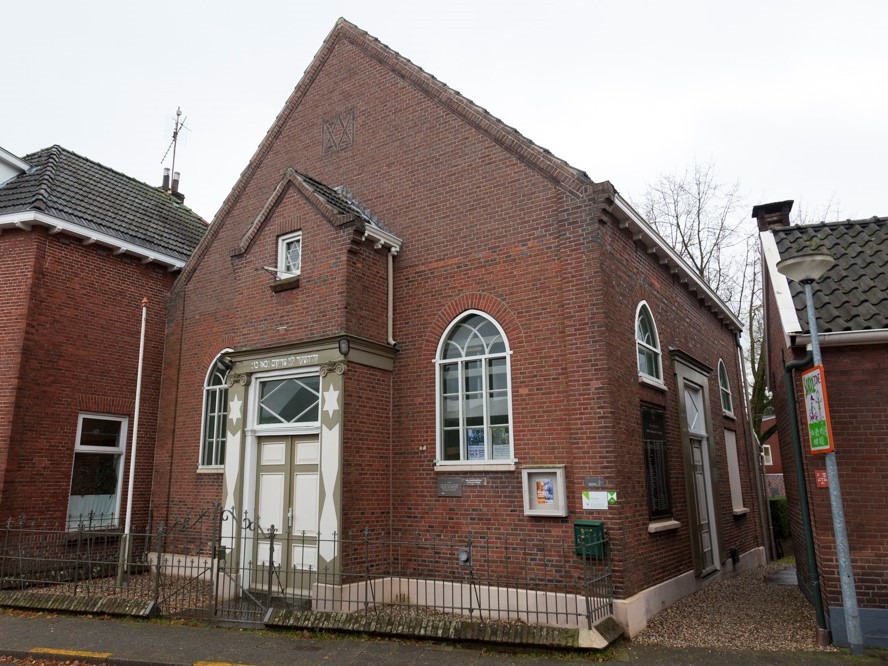
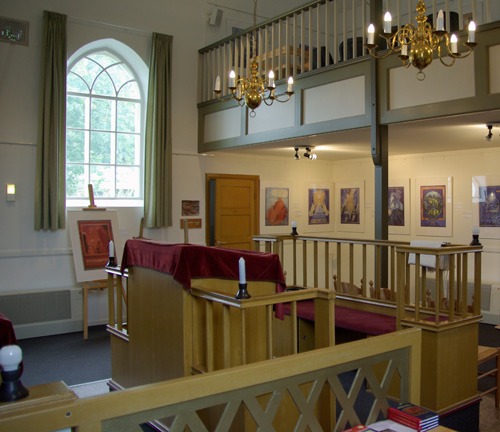
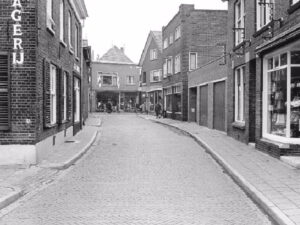
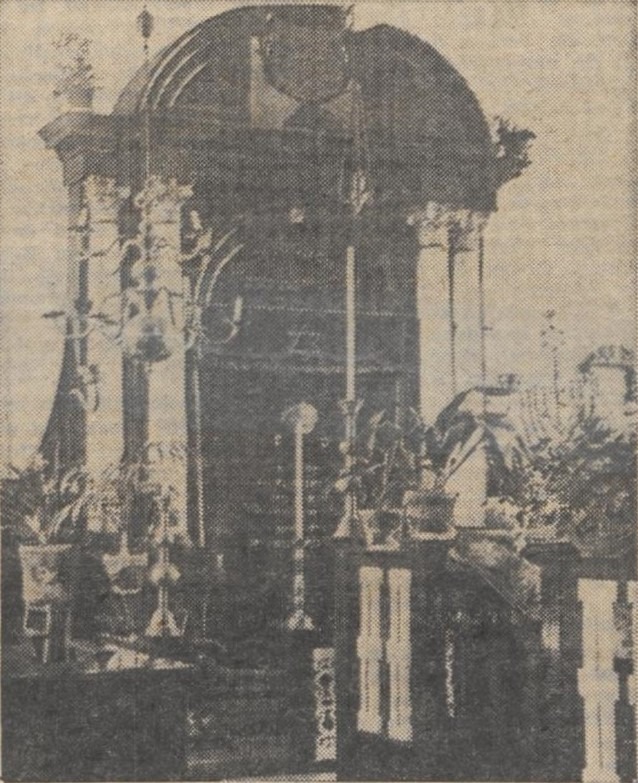
In the centre of Aalten is a small, well-restored, and beautifully furnished synagogue, which formed the centre of Jewish life in this Achterhoek municipality for nearly a century. The building is currently owned by a foundation, the Friends of the Aalten Synagogue.
By the mid-19th century, the Jewish congregation in Aalten had grown so much in number that a residential house became too small for the weekly Sabbath services. The community wanted their own shul, not only for religious services but also for the education of the youth. Consequently, a synagogue was built in 1857. It was a simple rectangular building with no architectural distinction, yet functional for the Jewish congregation in Aalten, which was still far from wealthy but strictly Orthodox. Nothing is known about the architect.
The synagogue became the centre of a lively community life, which lasted until the catastrophe that befell all Jewish communities during the years of the German occupation. The members of the congregation who were unable to go into hiding in time were deported and murdered.
World War II
During the occupation, two attempts were made to set fire to the synagogue. The synagogue was largely plundered and gutted to convert the building for ammunition storage. While the interior of the building was destroyed, the Torah scrolls and ritual objects were hidden in time and thus preserved. After the war, the scrolls of the law were returned to the building. The synagogue was repaired, funded by the proceeds from the sale of the chazzan’s house (since 1948, the congregation could no longer afford the salary for a cantor).
However, a large proportion of the congregation members who survived the war moved elsewhere, meaning the Jewish community had no chance to flourish again. Increasingly, they failed to achieve the required number of men (minyan) to hold services. The synagogue fell into disuse and was in danger of falling into decay.
Restoration
In 1984, the building was sold to the Friends of the Aalten Synagogue Foundation (Stichting Vrienden van de Aaltense Synagoge). This foundation took on the responsibility for a thorough restoration. On 29 December 1986, the synagogue was rededicated with a solemn Hanukkah celebration.
There are features well worth seeing on both the interior and the exterior. Inside, these include the Holy Ark, four Torah scrolls, the Tablets of the Law, the ner tamid, the menorah, the hanukkiah, the bimah, the women’s gallery, and the mikveh. On the exterior, these comprise the inscription above the door, the mezuzah, and the plaque on the right-hand side of the outer wall.
The Aalten synagogue can be visited regularly during the summer months.
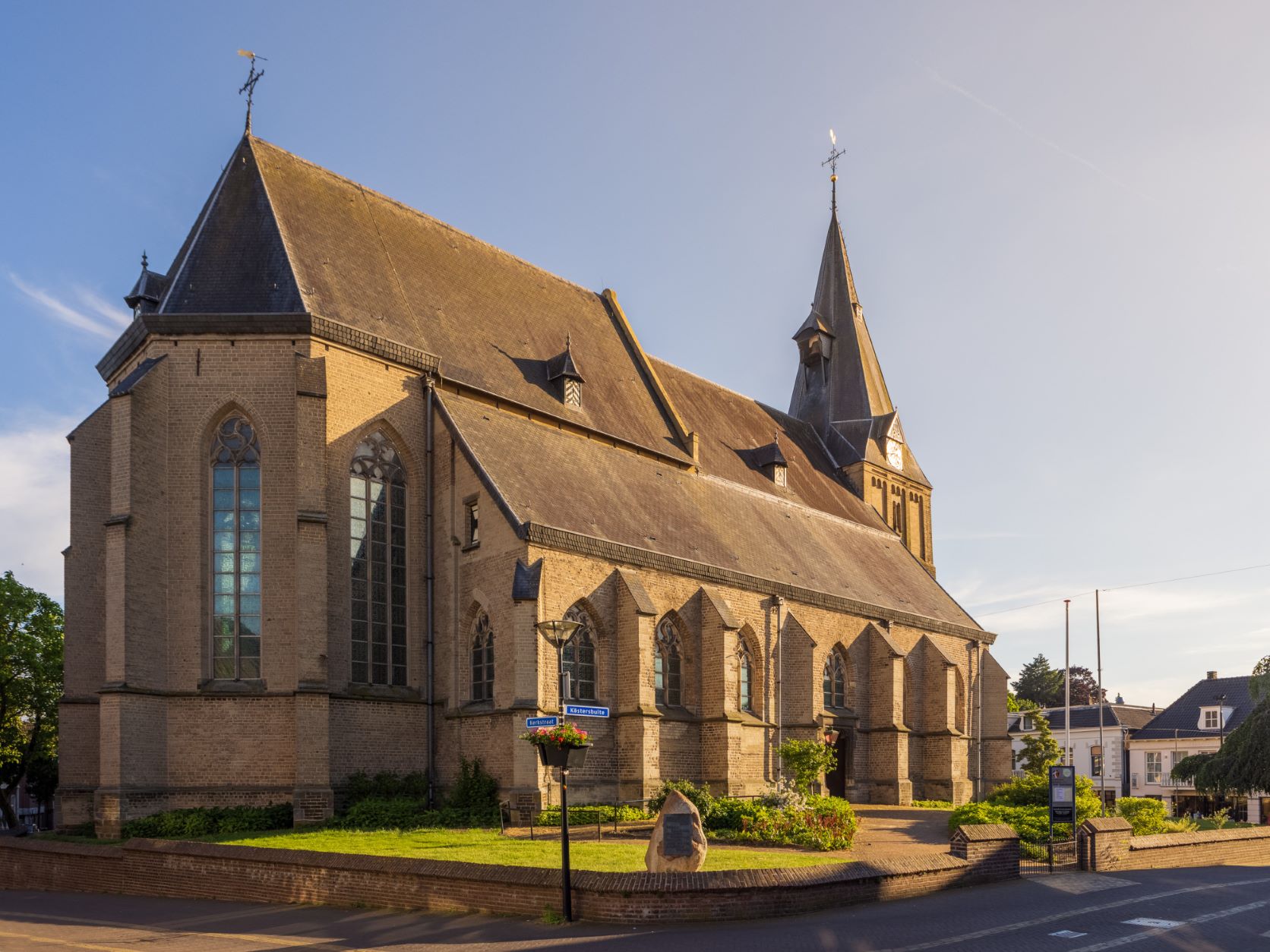
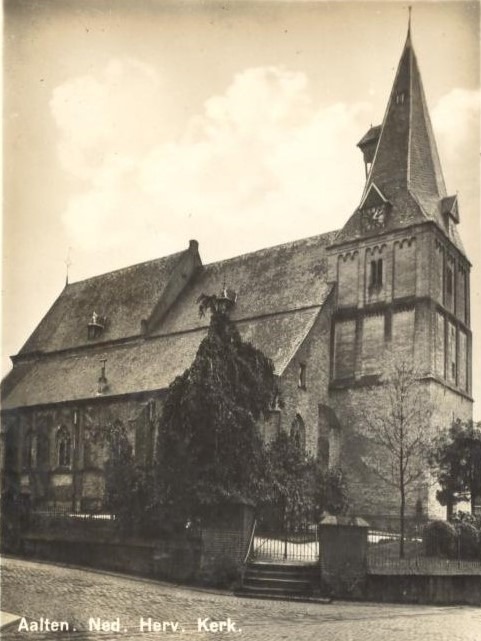
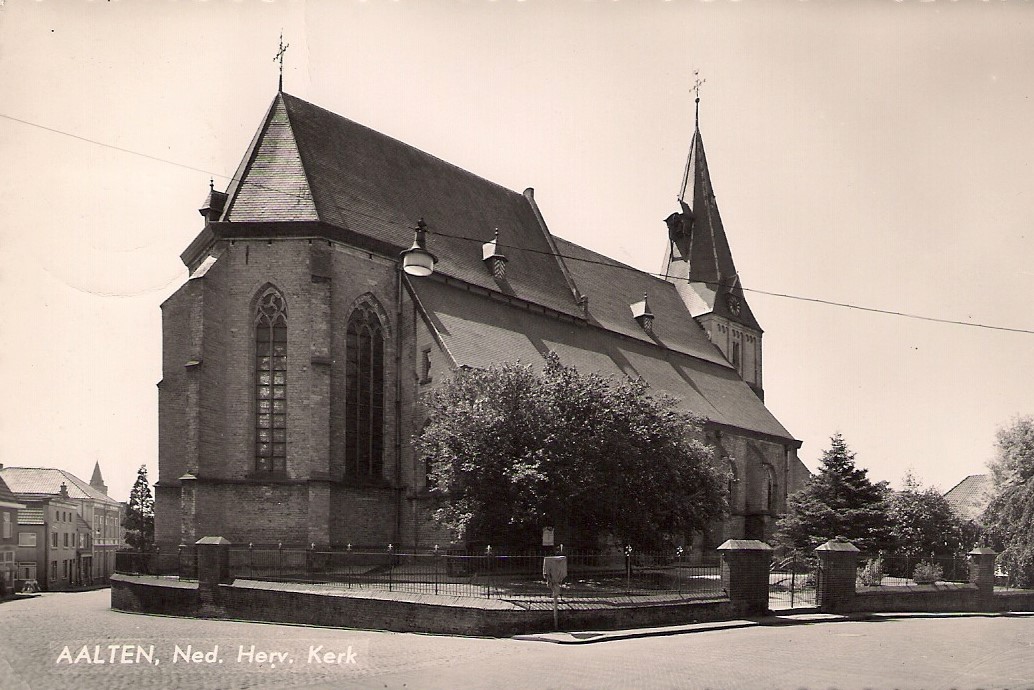
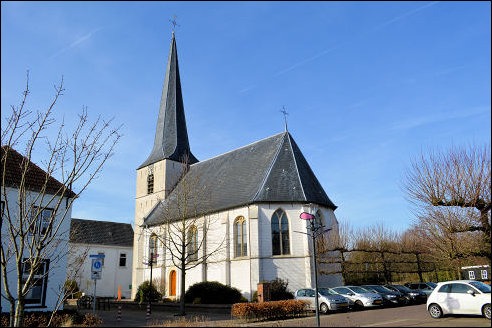
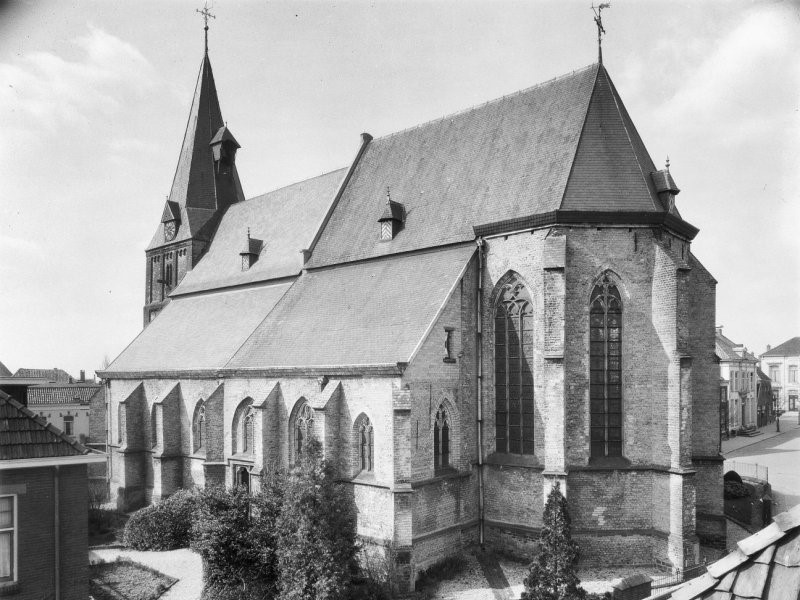
In the centre of Aalten, St Helen’s Church has stood for centuries as the oldest and most distinctive building in the town. This Late Gothic pseudo-basilica with its Romanesque tower is a monument of immeasurable historical and emotional significance. Countless residents of Aalten have been baptised and married here, found solace within its walls, and have been laid to rest from this church.
History
Around the year 800, when the Saxons were subjugated by Charlemagne, he decreed that every community should provide a so-called ‘hoofdhof’ (head court) for the construction of a church. In the settlement of Aladna, the ancient name for Aalten, this was likely a piece of land belonging to the later Havezate de Ahof.
The first small church on this site was presumably built in the Carolingian style, a precursor to Romanesque architecture. The church was dedicated to Saint Helen, the mother of the Roman Emperor Constantine the Great, who converted to Christianity.
In the 12th century, a Late Romanesque tower was added to this first church. The Romanesque architectural style is characterized by heavy, massive walls with small round-arched windows. In contrast to the later Gothic style, Romanesque architecture features little ornamentation. The tower is constructed entirely of tuff, a soft volcanic stone that was widely used in these regions at the time for building churches and castles. The spire takes the form of a so-called constricted needle spire.
Between 1470 and 1483, the three-aisled nave of the church was built, also from tuff. This part of the church was executed in the Late Gothic style, characteristic of the 15th century, with large windows featuring pointed arches that point, as it were, toward heaven. The higher choir on the east side of the church dates from the period between 1440 and 1450. In the late 15th and early 16th centuries, murals were applied to the vaults and walls.
Reformation
Until the end of the 16th century, the parish of Aalten fell under the Diocese of Münster. With the conquest of Bredevoort—the administrative center of the lordship of the same name to which Aalten belonged—by Prince Maurice on October 8, 1597, the Reformation also reached this region.
At that time, Pastor Theunissen, a native of Bocholt, served the Aalten church. He fiercely resisted the reform. According to tradition, however, he had to flee in 1601 to the Burlo monastery, or according to others, to Rhede. He later died in Warendorf, where the small but valuable monstrance he had taken from Aalten reportedly remained until the middle of the 19th century.
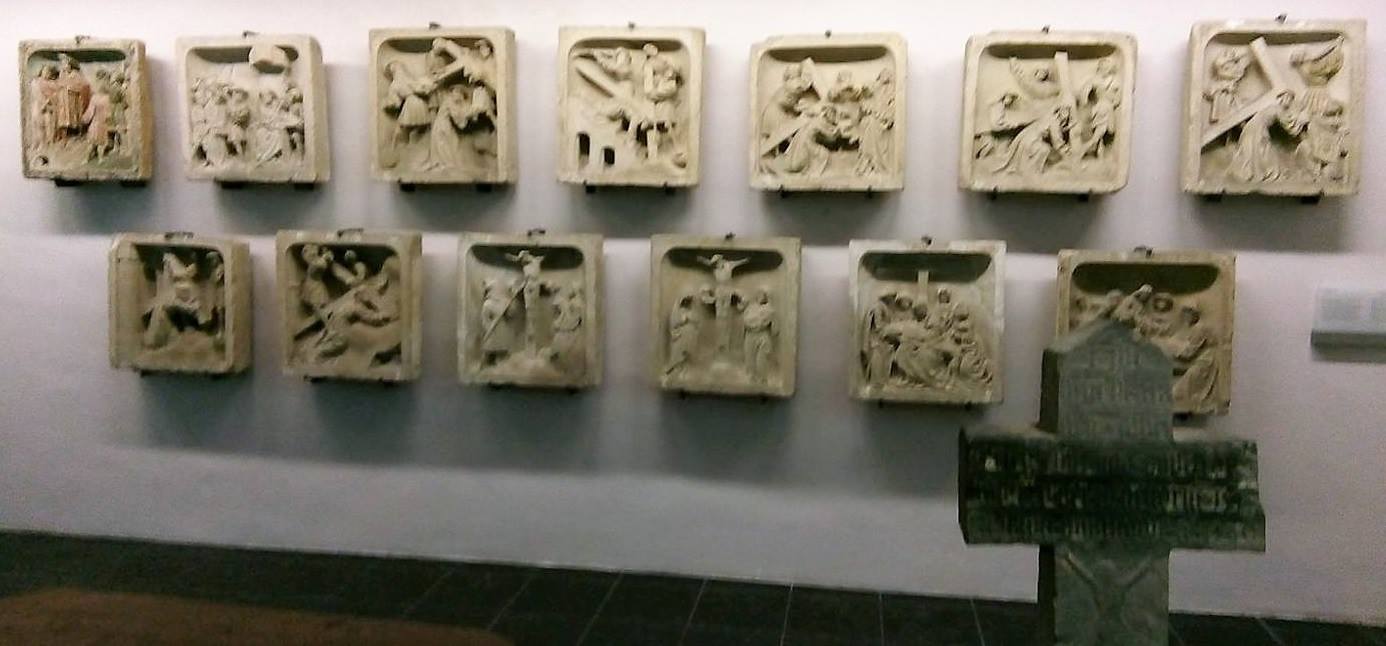
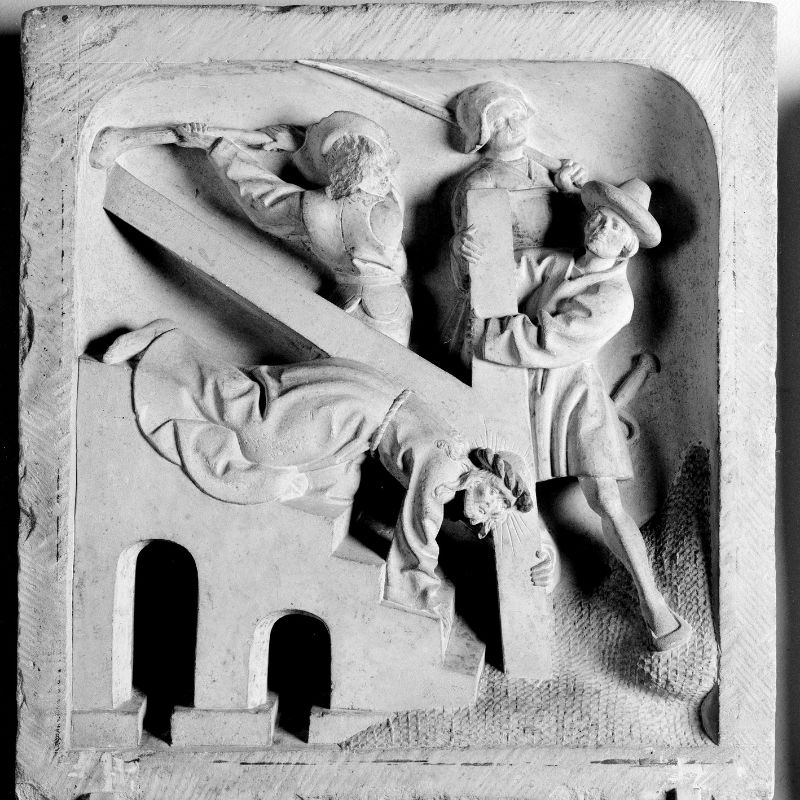
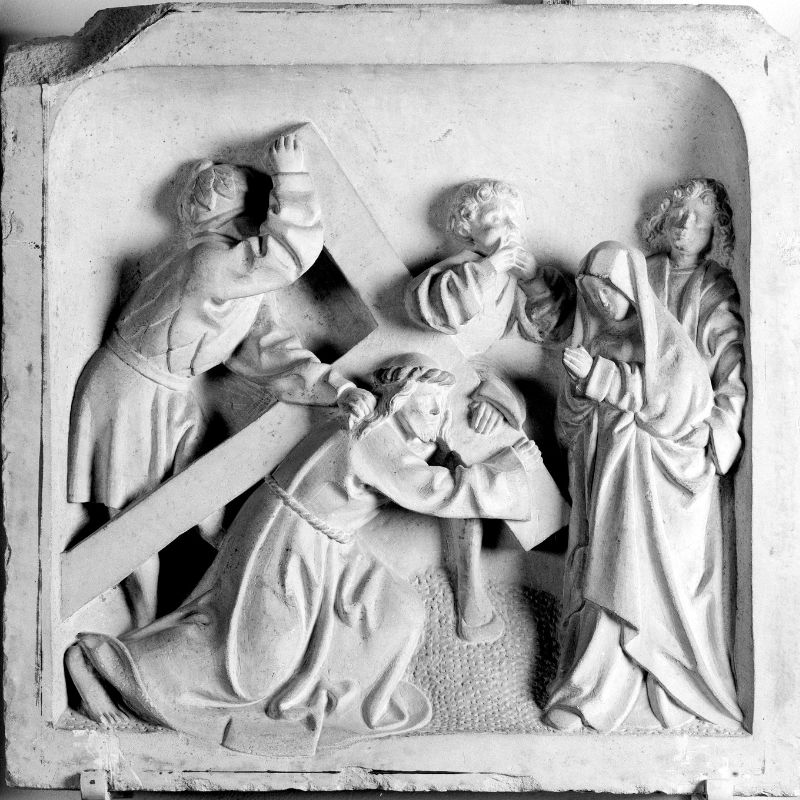
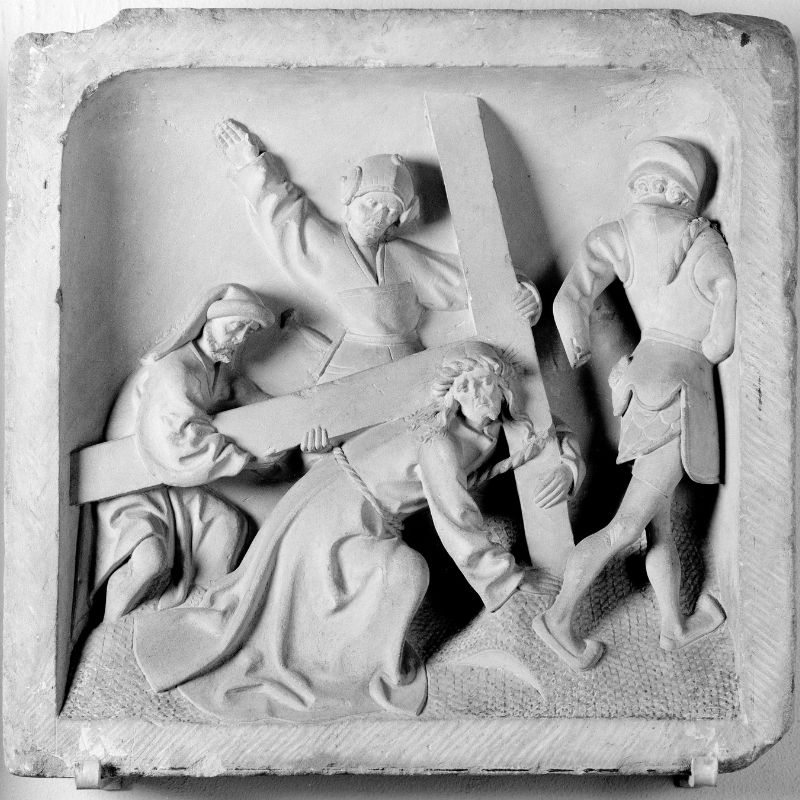
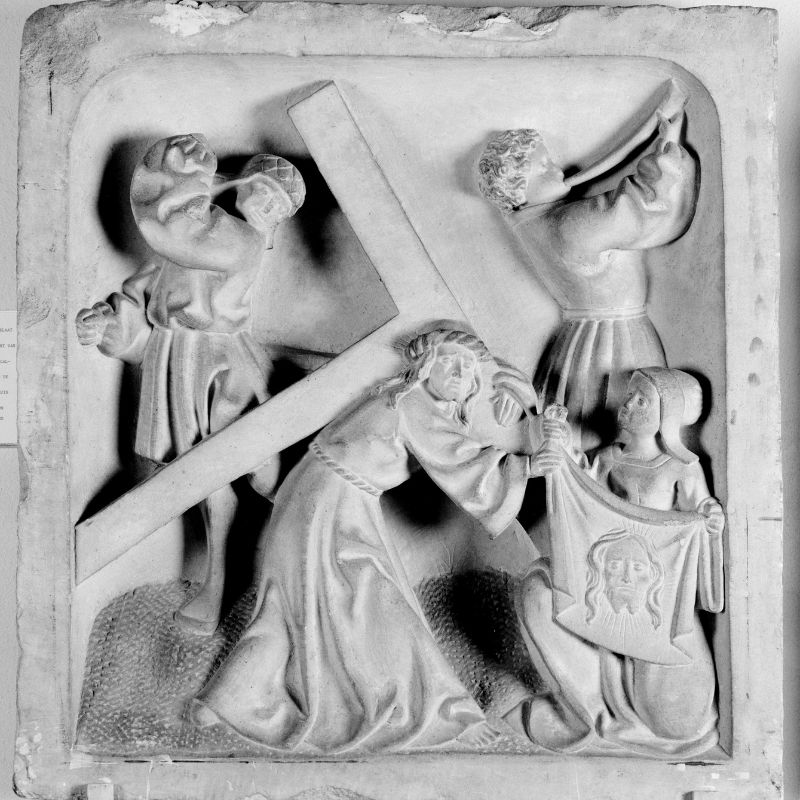
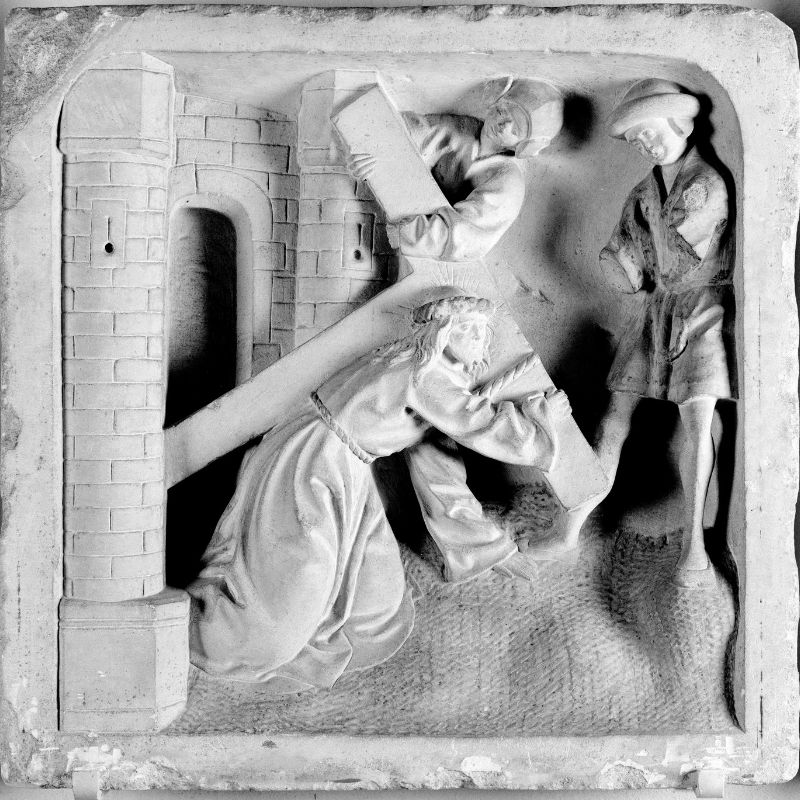
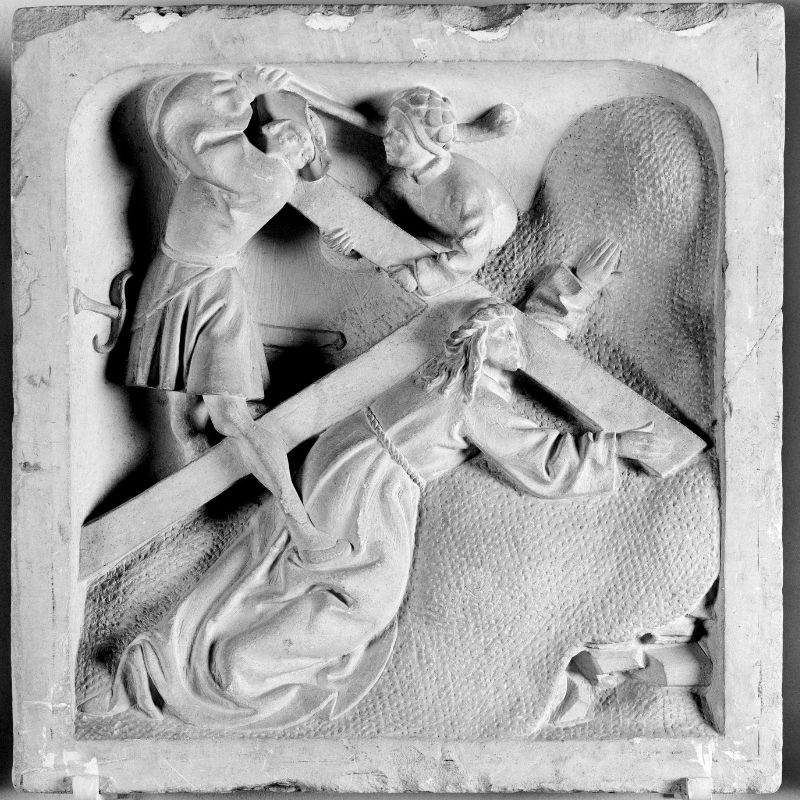
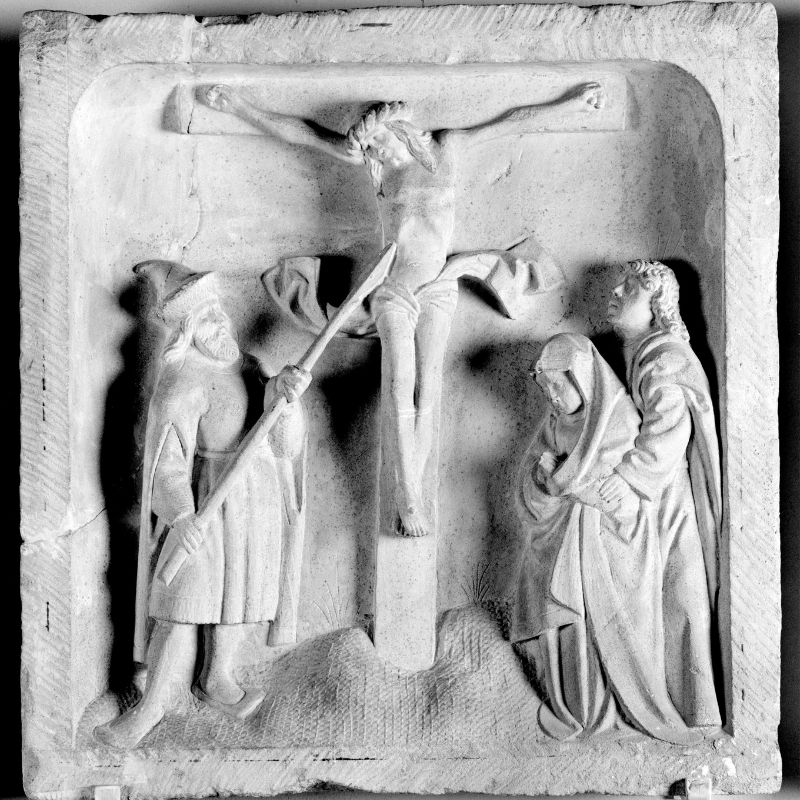
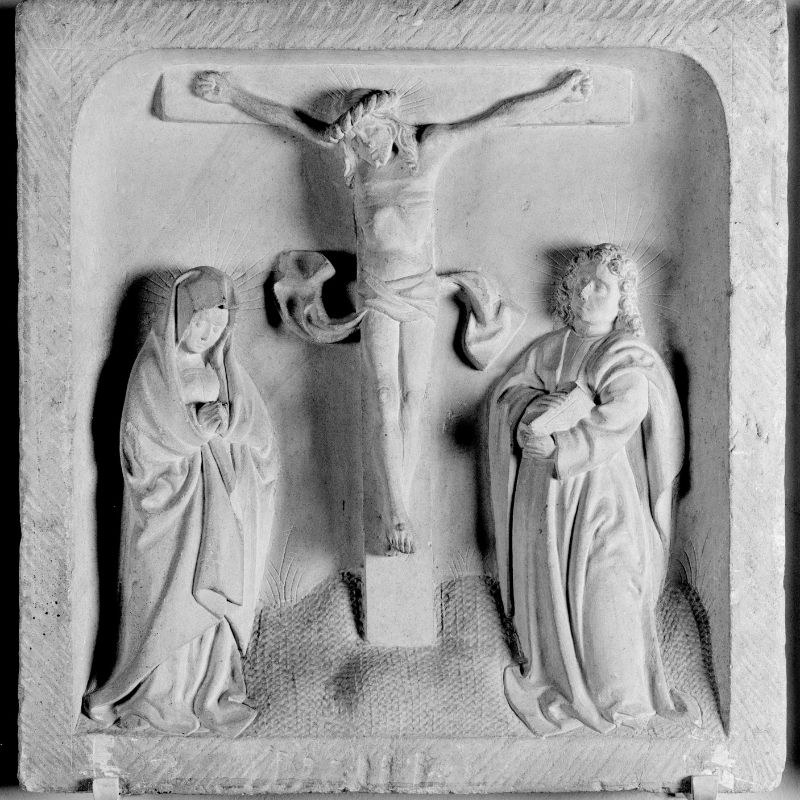
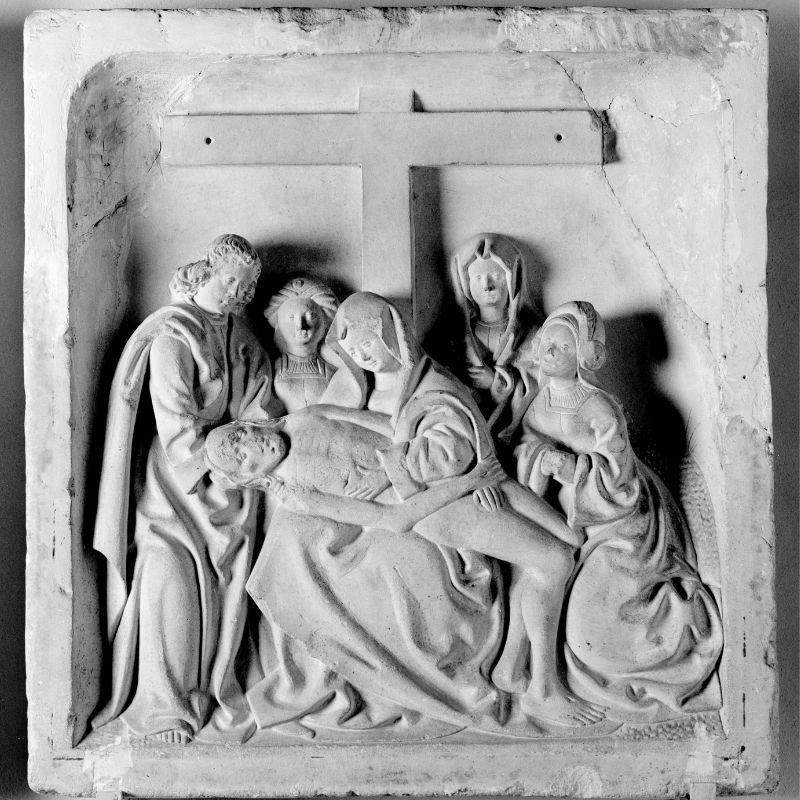
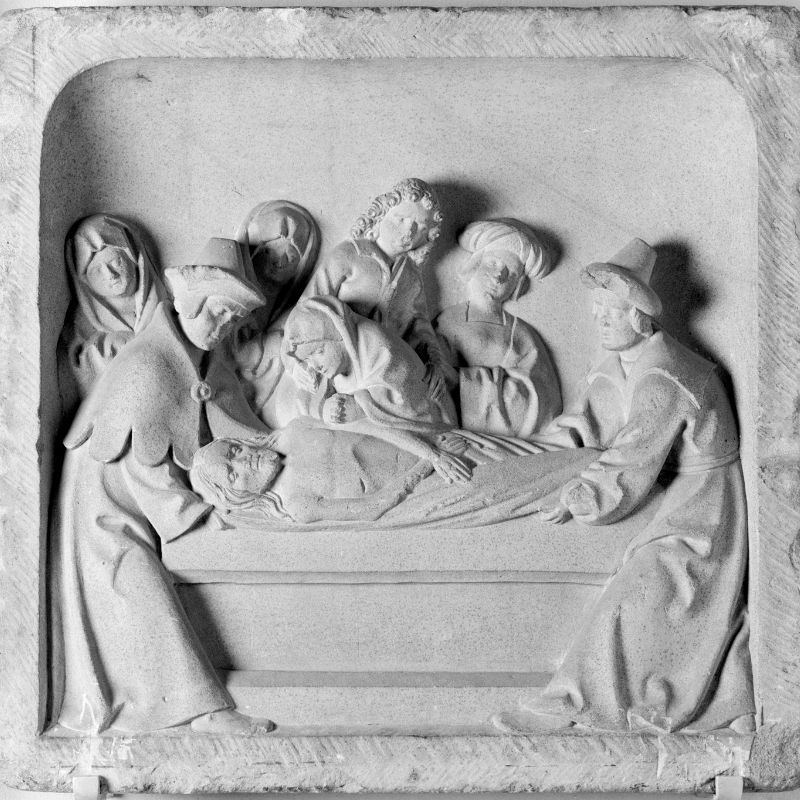
Presumably, shortly after 1597, the stone Stations of the Cross depicting the Passion of Christ were also removed. The stations, likely created around 1530 by the Westphalian sculptor Heinrich Brabender, disappeared but were rediscovered in the 19th century. Today, they can be admired in the Museum Catharijneconvent in Utrecht.
The then-chaplain of Aalten, Anthonius van Keppel, originally from Doetinchem, was mentioned in 1602 as the first minister of the Aalten church community, which had recently converted to Protestantism. How did this come about? To expand the Reformation to the countryside, the cooperation of the local Roman Catholic clergy was required. In 1598, many of them were summoned to appear at the classical assembly in Zutphen. The clergy from Aalten were also present. At this meeting, the attending pastors and vicars were required to renounce the Catholic religion and profess that the Reformed religion was the true one.
In the classical assembly of 1603 in Zutphen, the participants from Aalten, Winterswijk, and Zeddam declared their willingness to conform to the conditions set for them. By 1633, the number of members was sufficient to proceed with the establishment of a church council.
Shared use
After the conquest of the Achterhoek in 1672 by troops of the Bishop of Münster, the churches of Aalten, Winterswijk, and Dinxperlo were given to the Minorite fathers by the episcopal commissioner. The Reformed congregation in Aalten reached an agreement with the occupiers. This arrangement meant that Catholics and Protestants could use the church in Aalten alternately. However, a short time later, the use of the church building was forbidden to the Protestants. This situation did not last long. At Pentecost 1674, the Münster troops left Aalten and the church became available to the Reformed congregation once again.
Disturbances
In early 1750, the quiet town of Aalten was shaken by a series of striking religious phenomena. During church services, people burst into tears, sighed loudly, or collapsed as if they had lost consciousness. Some even spoke of encounters with angels or attacks by the devil. These events drew national attention and would go down in history as the Aaltense beroeringen (Aalten disturbances).
Doleantie (Schism)
In 1834, the movement of the so-called ‘Afscheiding’ (Secession)—manifesting through the departure of Rev. H. de Cock and the church council of Ulrum (Gr) from the Dutch Reformed Church—gained some following in Aalten. By 1840, the circle in Aalten had grown sufficiently to found a congregation. A few decades later, the movement of the so-called Doleantie emerged within the Dutch Reformed Church.
Restorations
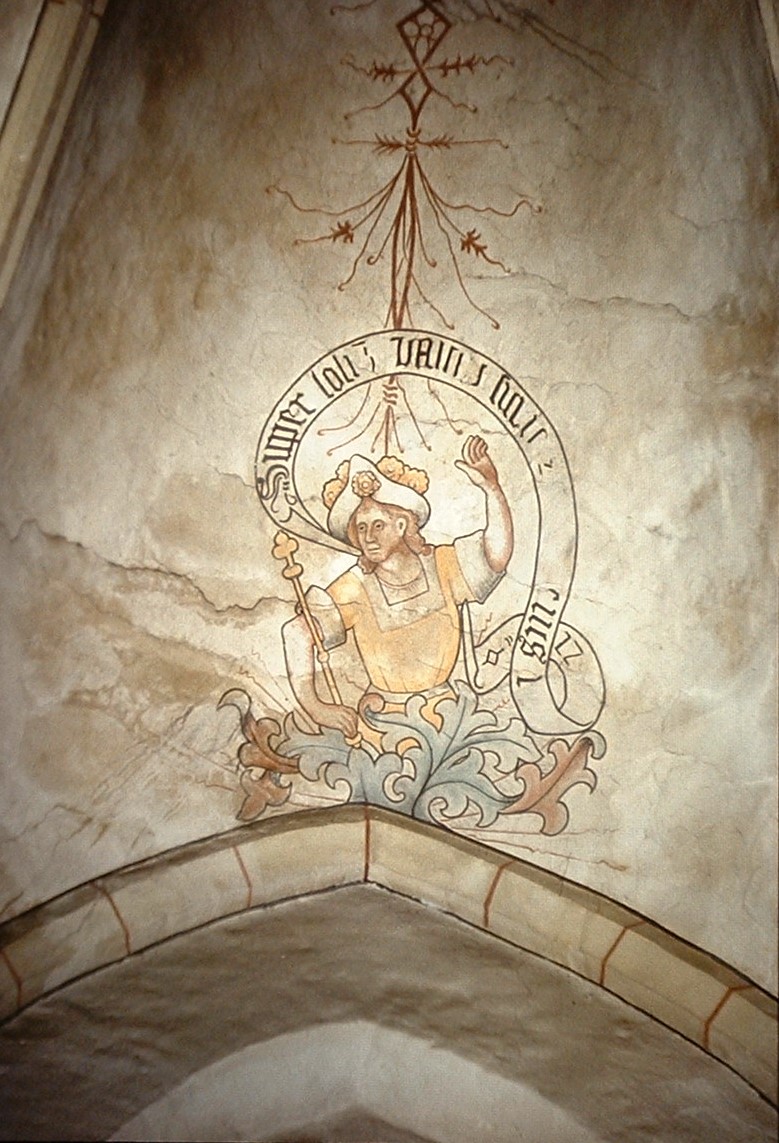
In 1973, the plaster layer in the church was restored. Beneath the six to seven layers of whitewash, exceptional paintings were discovered. These murals include depictions of the twelve apostles, a representation of the Last Judgment, the Coronation of Mary, and—highly unique in Western Europe—an image of Emperor Constantine the Great together with his mother Helena, the namesake of the church. The paintings were subsequently restored.
Burial vault
Also in 1973, carpenter Henk Heijnen discovered a burial vault under the choir during work, containing three coffins with human remains. The vault was quickly resealed by order of the church board, but before that happened, Heijnen had already climbed inside and accurately measured and photographed everything. In 2019, he completed a wooden replica of the burial vault.
Death knell
For centuries, the bells of the Oude Sint Helenakerk in Aalten have tolled at set times to inform the population of deaths, a practice known as ‘overluiden‘.
Owners
This overview is incomplete.
Year
Plot
Owner
Description
1832
I-1498
the Reformed Church of Aalten
3,060 m² church & yard
1862
I-2640
the Reformed Church of Aalten
2,966 m² church & yard
1882
I-3735
the Reformed Church of Aalten
2,924 m² church & yard
1911
I-5447
the Reformed Church of Aalten
2,938 m² church, catechism room & yard
1914
I-5613
the Reformed Church of Aalten
2,720 m² church & garden
1959
I-8339
the Reformed Church of Aalten
3,085 m² church, house & yard
1963
I-8941
the Reformed Church of Aalten
2,925 m² church, house, yard, park, part. community center, road
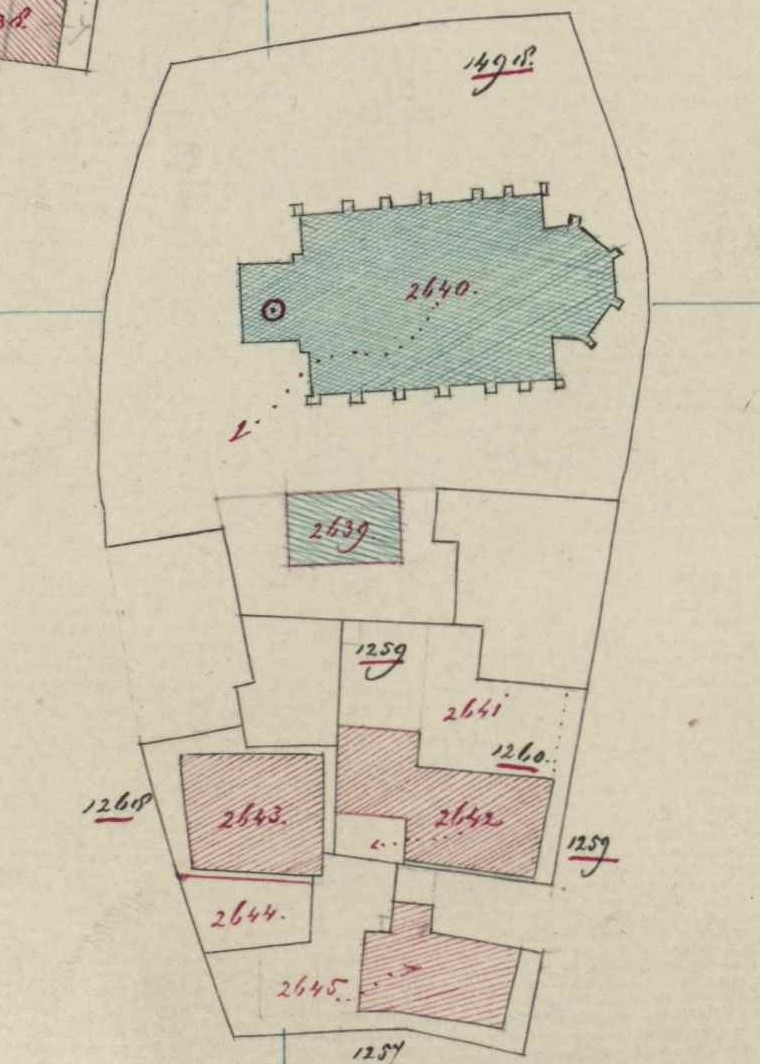
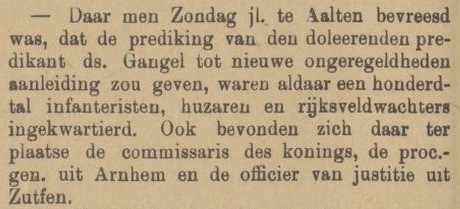
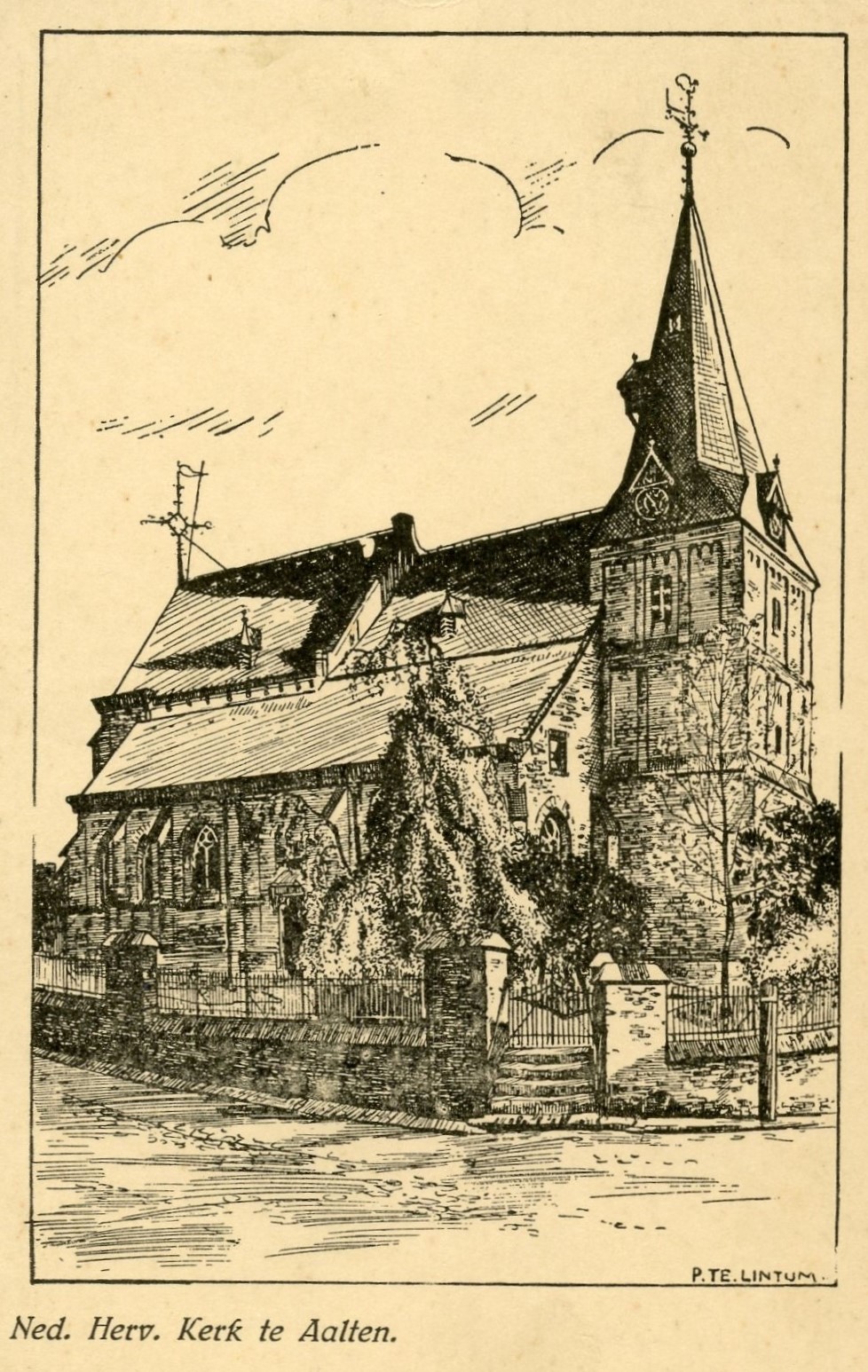
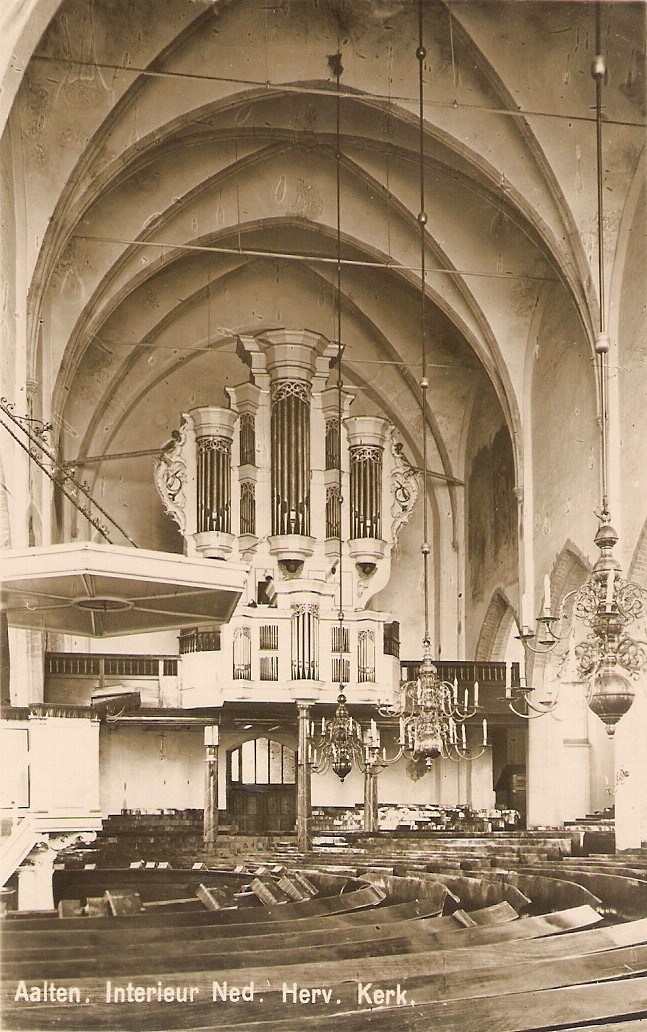
Fragment of cadastral map, 1862Tubantia, 16 March 1887Oude Helenakerk, Aalten, tekening door Piet te LintumInterior Old St Helen’s Church, AaltenMural in the Old St Helen’s Church
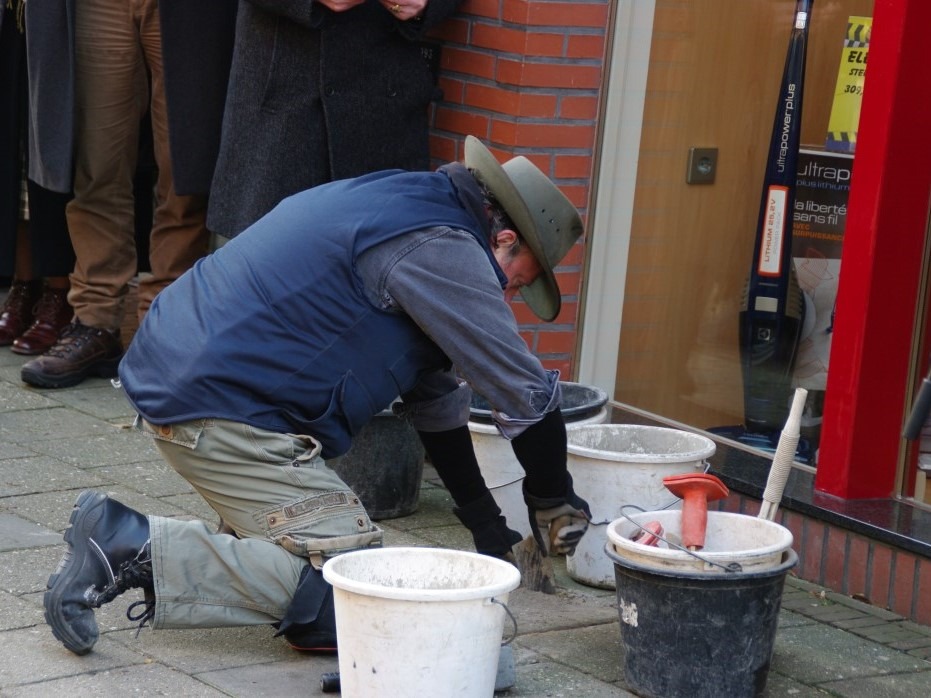
Gunter Demnig placing the first Stolpersteine in Aalten
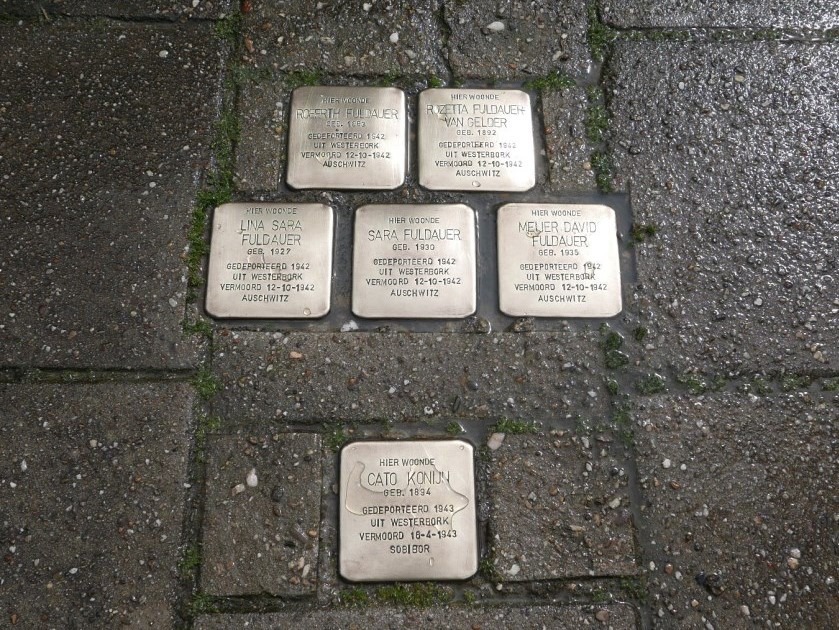
In Aalten, 34 Stolpersteine (stumbling stones) are laid across twelve addresses. A Stolperstein is a memorial stone placed in the pavement in front of the house from which people were deported by the Nazis to extermination camps during World War II. When you see such a stone—usually unexpectedly—with the name of a victim, you are momentarily reminded of how millions became victims of systematic murder during that war.
The stones have a surface area of 10 by 10 cm. A brass plate is affixed to the top, into which the name, year of birth, date of deportation, and the place and date of death are stamped. Each stone serves as a memorial to a single victim: a person who lived in that very spot and was deported from there, never to return.
Originator
The Stolpersteine project was conceived by the German artist Gunter Demnig. He deliberately kept the size of these ‘stones of offence’ small, requiring one to bow down to read the inscriptions.
Demnig began laying the first Stolperstein in 1997 in the Berlin district of Kreuzberg. Today, Stolpersteine can be found in many countries. Gunter Demnig thus gives every victim their own individual monument. His motto is: “A person is only forgotten when his or her name is forgotten.”
Initially, he made all the stones himself, as he felt mass production conflicted with the project’s ethos. However, forced by the project’s rapid growth, he is now assisted by an artist friend. He insists on personally laying the first stones in any given location. The remaining stones are now usually installed by municipal pavers.
Stolpersteine in Aalten
In Aalten, 34 Stolpersteine have been laid at the following addresses:
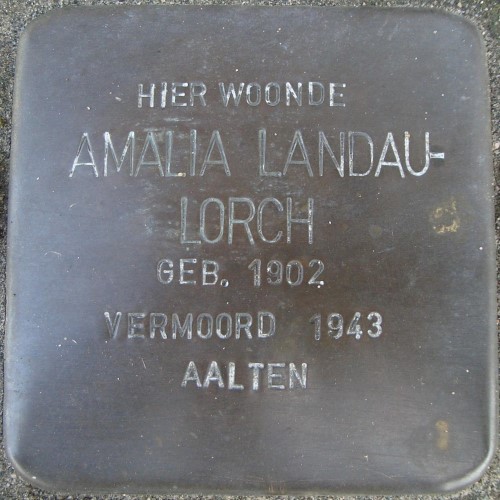
’t Dal 1: Levi Salomon Schaap, Ella Schaap-Philips, Eliazar Hars Schaap, Frits Landau, Amalia Landau-Lorch
Dijkstraat 10a: Levie van Gelder, Jula van Gelder-Landau, Arnold van Gelder
Eerste Broekdijk 51: Roberth Fuldauer, Rozetta Fuldauer-van Gelder, Lina Sara Fuldauer, Sara Fuldauer, Meijer David Fuldauer, Cato Konijn
Grevinkweg 5: Sally Fuldauer, Regina Fuldauer-de Jong
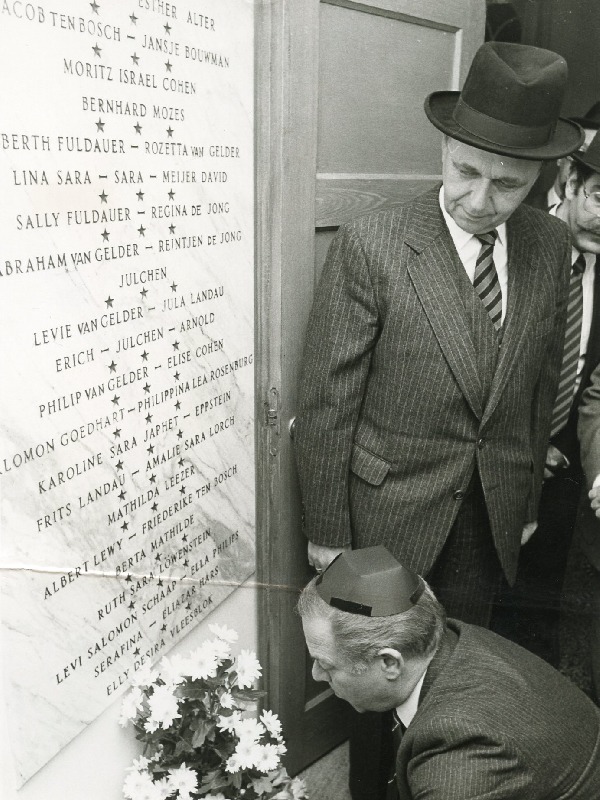
In one instance, the stone could not be placed in front of the victim’s residence because the building (Industriestraat 4) no longer exists, nor is there a pavement where it could be installed. Therefore, this stone was laid in front of the synagogue.
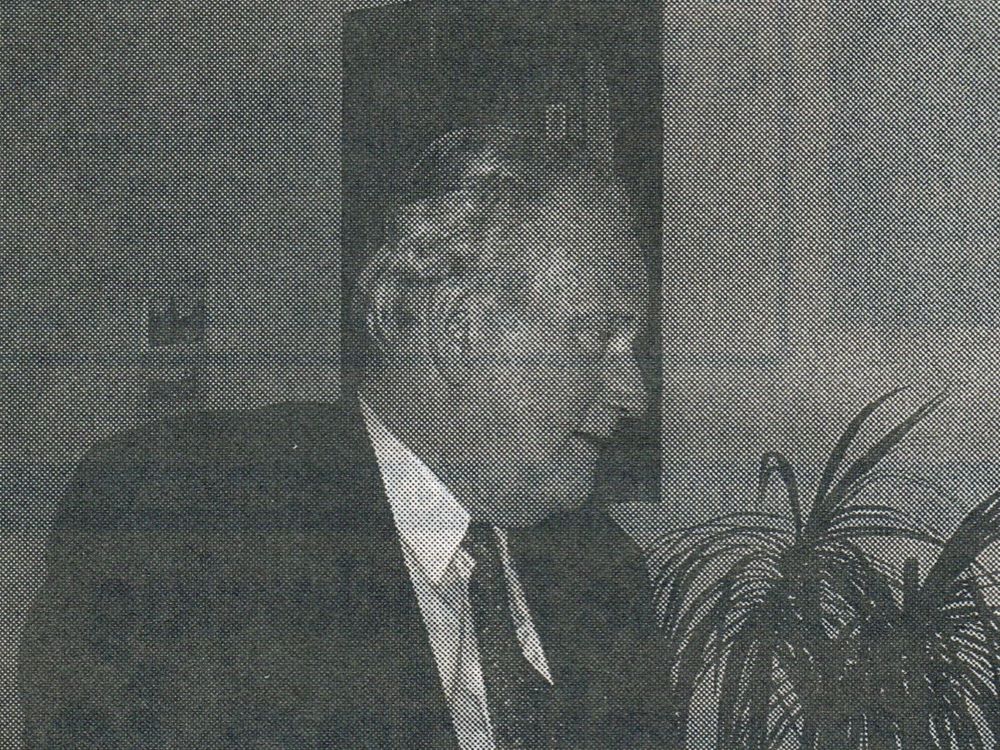
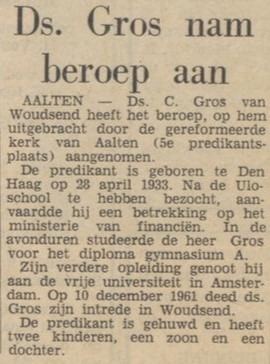
Cornelis (Cor) Gros was born on 28 April 1933, in The Hague, as the son of police officer Jacob Gros and Nieske Poortinga. After completing ULO secondary school, he began his career at the Ministry of Finance. In the evenings, he studied for his Gymnasium A diploma. He received his further education at the Vrije Universiteit Amsterdam. On 10 December 1961, Rev. Gros was inducted as a minister in Woudsend.
From 8 May 1966, Gros was associated with the Reformed Church of Aalten. He served here for 32 years until his retirement in 1998. At the end of April that year, he received a Royal decoration from Mayor Bouwers of Aalten.
In an interview with the regional weekly newspaper Achterhoek Nieuws, published on 22 April 1998, Gros shared his experiences: “I certainly had certain expectations. But what it truly means to be a minister, you only know once you are one. It can be disappointing. However, it can also, as in my case, be even more beautiful than you had expected.”
The fact that Gros became a minister is more or less thanks to the captivating way Cor Bruijn describes life on an island in the book Sil de Strandjutter. “As a boy of about ten, I read Sil de Strandjutter and I thought to myself: how do I get to such an island,” Gros said. “There were three possibilities: as a minister, as a doctor, or as a teacher. I knew quickly that it would be a minister.”
Dagblad Tubantia, 3 January 1966
In 1966, he moved with his family to Aalten, where he became the minister for the north-west district, a position he held throughout his career. “I am not a man who jumps through churches like a flea,” Gros explained. “And in Aalten, my family and I liked it so much that I didn’t want to leave. The people of Aalten are good people. I experience them as incredibly cordial. And they also know how to keep their distance, so I never felt like I was being lived by others.”
Gros enjoyed the interaction with the people in his district the most. “My life was dedicated to that,” he said. “I wanted to be there for them when they needed me and, in those situations, to be able to mean something to them in all modesty. Experience has shown that my presence was especially desired in sad situations. I tried to empathize with people, to listen a lot, and sometimes to speak. Pastoral care is for the most part listening. I have always done my work with satisfaction. The trust and gratitude that people gave me were incredibly great.”
Gros held numerous ecclesiastical positions at classical, provincial, and national levels. Among other roles, he was chairman of the Synod of Gelderland and of the Deputies for Spiritual Care Abroad. After his retirement, he was a board member of the local broadcaster De Lindeboom for many years, where he also presented several programs.
The last months of his life, Gros lived on Geurdenstraat in Aalten. He passed away on 21 August 2011, at the age of 78. The service of Word and prayer, preceding his funeral, took place in the Oosterkerk. Cor Gros was buried at Berkenhove cemetery.
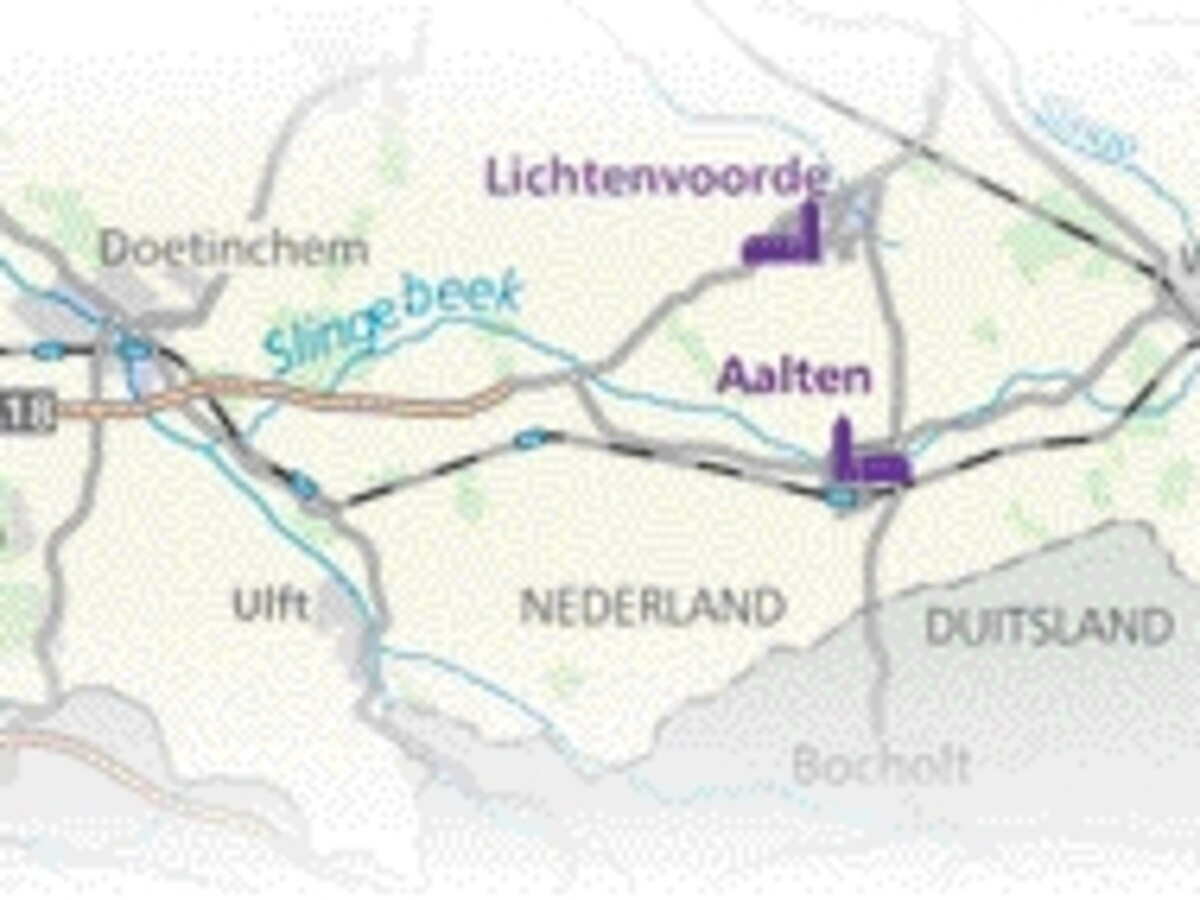
Two neighboring villages: one Catholic, the other Protestant. Does rivalry still exist? Trouw investigates. Today part 2: Aalten and Lichtenvoorde. Aalten is known as the ‘Jerusalem of the Achterhoek’ thanks to its many Reformed churches. Neighboring Lichtenvoorde, by contrast, lies in a Roman Catholic enclave.
Achterhoekers are not known for being pedantic. Except in Aalten. Those terraces on the Market in front of the Old St Helen’s Church? “That would have been considered blasphemy in Aalten in the past,” says Hans de Graaf. He was born in 1943 into a Roman Catholic family in neighboring Bredevoort. He has lived and attended church in Aalten for years. “As a child, you felt like you were a second-class citizen,” he recalls.
In the 1950s and 60s, Protestants dominated Aalten, divided into ‘de fienen’ (the fine) and ‘de groffen’ (the coarse). The Dutch Reformed were not as strict. They lived Biblically according to the ‘coarse’ line. The seceded Reformed, numerous in Aalten, however, followed orthodox dogmatics with ‘fine’ precision.
Jerusalem of the Achterhoek
‘Fienen’. You pronounce it with a long, drawn-out ‘ie’. Frits van Lochem does so too. In 1946, he was born into a Dutch Reformed family in Roman Catholic Lichtenvoorde, eight kilometers from Aalten. Between the two villages lies a rolling no-man’s-land. If you speak of Aalten in Lichtenvoorde, the conversation quickly turns to ‘those fienen’ and ‘the Jerusalem of the Achterhoek’. “We are more oriented towards Groenlo,” says Van Lochem.
A folk faith prevails in the Achterhoek. In daily life, it does not matter whether your ancestors remained Roman Catholic or eventually converted to Protestantism. The Achterhoek tradition of naoberschap (neighborliness) transcends the dogmas of Rome and Protestant synods. The area is divided like a checkerboard pattern into villages with slightly more Roman Catholics and those with slightly more Protestants.
Neighboring enclaves
Two neighboring enclaves form a major exception: the Reformed Aalten and the Roman Catholic strongholds of Groenlo and Lichtenvoorde. How did this come to be and what is their relationship? Hans de Graaf and Frits van Lochem can draw from their experiences as members of a religious minority. They do not know each other. Yet they once cycled past each other daily—one on the way to the Protestant secondary school in Aalten, the other to the Roman Catholic one in Lichtenvoorde.
The Johanneskerk (PKN) of Lichtenvoorde
Van Lochem enjoys being active for the community. He was once an alderman in Lichtenvoorde before the municipality merged with Groenlo to become Oost Gelre. Now he manages the administration of the Johanneskerk. As a Reformed boy, he had a pleasant childhood, he says. “Of course, you had a Protestant and a Roman Catholic school,” he says. “For secondary education, you had to go to Aalten. You simply went to a school of your own religion.”
For a time, there was a separate Protestant football club and gymnastics association. The Protestant drum band did not play at Lichtenvoorde festivities on Sundays, he remembers. But in Lichtenvoorde, where 90 percent of the people were Roman Catholic, people interacted normally. “My father was an upholsterer,” says Van Lochem. “The monastery was an important client. He wouldn’t have earned a living from Protestants alone.”
Protestants ‘determined everything’
As easily as the people of Lichtenvoorde bridged the pillarized differences, the dividing lines in Aalten must have been difficult. “Very little was allowed,” says De Graaf. “Dancing was impossible. As Roman Catholics, we had our own youth club. Many marriages resulted from that. You thought in the 1950s: those Protestants determine everything here. And then the swimming pool issue arose. A massive row! People cut open the barbed wire around the pool to be able to swim on Sundays. Nowadays, everything is different. A worldly wind blows through Aalten. Still.”
Lichtenvoorde and Groenlo were synonymous with a pleasant life for a Roman Catholic boy from Aalten. “There were the assembly days and the processions,” De Graaf remembers. Lichtenvoorde is frivolous with its flower parade, and Groenlo is known for its carnival. But for him, those places remained far away. In Aalten, during his youth, about 18 percent of the people were Roman Catholic. The Reformed identity weighed on everyone. The Roman Catholicism of ‘the enclave Groenlo and Lichtenvoorde’ was the subject of study for history teacher Thielen from Boxtel in 1966. Two developments explain how an enclave could arise, according to his book on ‘the enclave’.
Religious struggle
The struggle between the dioceses of Utrecht and Münster for control over this region lasted until 1823. The Bishop of Münster asserted himself quite strongly in the eastern Netherlands. Furthermore, around 1600, the Achterhoek had been the battlefield between the State armies of the House of Orange and the Spanish rulers. That struggle had left its religious marks.
In 1597, the army of Prince Maurice conquered the towns of Bredevoort and Groenlo from the Spaniards on behalf of the (Protestant) States-General in The Hague. But in 1606, the ‘States’ lost the fortress again. Although Prince Frederick Henry recaptured Groenlo in 1627, he could no longer win over most of the inhabitants to Protestantism. The Roman Catholic movement of the Counter-Reformation had taken root there. Nearby Lichtenvoorde, which had its own chapel since 1496, also remained loyal to Rome. And Münster.
Monumental
Frits van Lochem shows the white-plastered Johanneskerk from 1648. It is monumental. The church stands on the foundations of the Roman Catholic chapel from 1496. “It is one of the oldest Protestant churches in the Netherlands,” he says. The chapel fell into the hands of the Dutch Reformed minority after 1627, who were aligned with the new State authority. They wanted a less dilapidated house of worship. “Collections were held throughout the country for this church,” says Van Lochem. “Frederick Henry also paid. Donations came from as far as Amsterdam and its surroundings.”
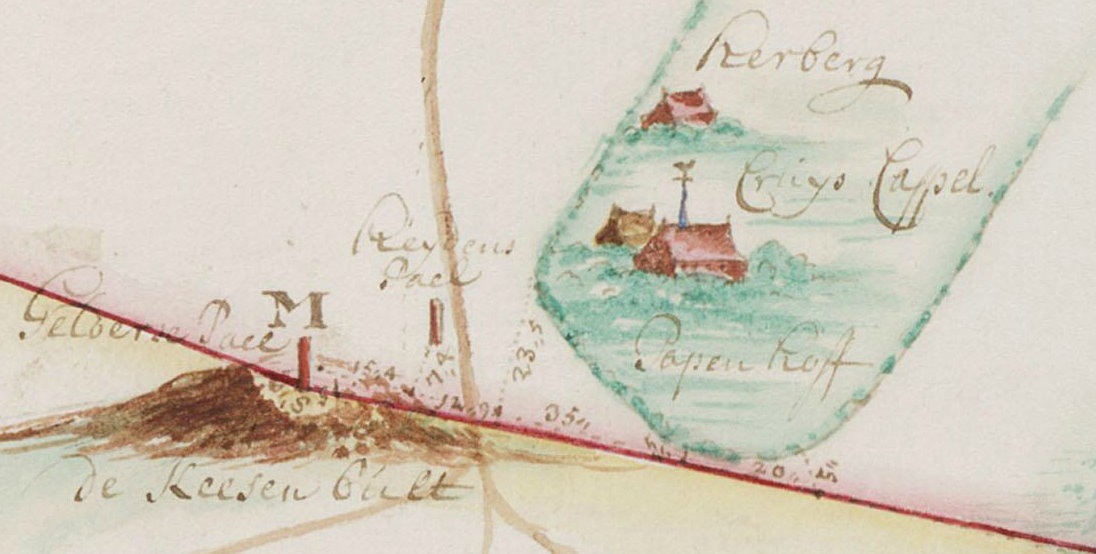
Old map with the Cross Chapel at Hemden, just across the border near Aalten
The Roman Catholics who remained in large numbers in Groenlo and Lichtenvoorde, as well as an Aalten minority, became dependent on the Kreuzkapellen (Cross Chapels) that were built in border villages like Zwillbrock, Hemden, and near the city of Bocholt. The ‘papists’ walked to the border of the Republic with the Münsterland. But in large parts of the Achterhoek, including Aalten, the priest suddenly became a minister and solemnly renounced all Roman ‘superstitions’. His flock then became Protestant as well, though not immediately with full conviction.
The nature of the Achterhoeker
The nature of the Achterhoeker is, as Reformed minister J.H. Jansen wrote in 1957, seemingly quite easy-going. They tend to wait and see, he stated in a sociological study of religious life in the Achterhoek. The community takes precedence over the individual, he observed. Scribe Flip de Bruijn of the Protestant Congregation of Lichtenvoorde can still identify with that observation in 2010. “The community here is so interwoven and there are so many mixed marriages,” he says. “There are no sharp contrasts. People accept each other without conflict.”
What then makes Aalten such an exception? In 1845, following the example of the Groningen minister De Cock, a portion of the Dutch Reformed in Aalten seceded. Subsequently, the Doleantie (1886-1892) found resonance in the Achterhoek, particularly in Aalten. From both schisms, the village gained the Christian Reformed and the Reformed Church. “The cause was that a beloved preacher ‘went along’ and was deposed by the classical board,” Jansen explained regarding the Doleantie in Aalten. “He took many families with him.”
Ecclesiastical diversity
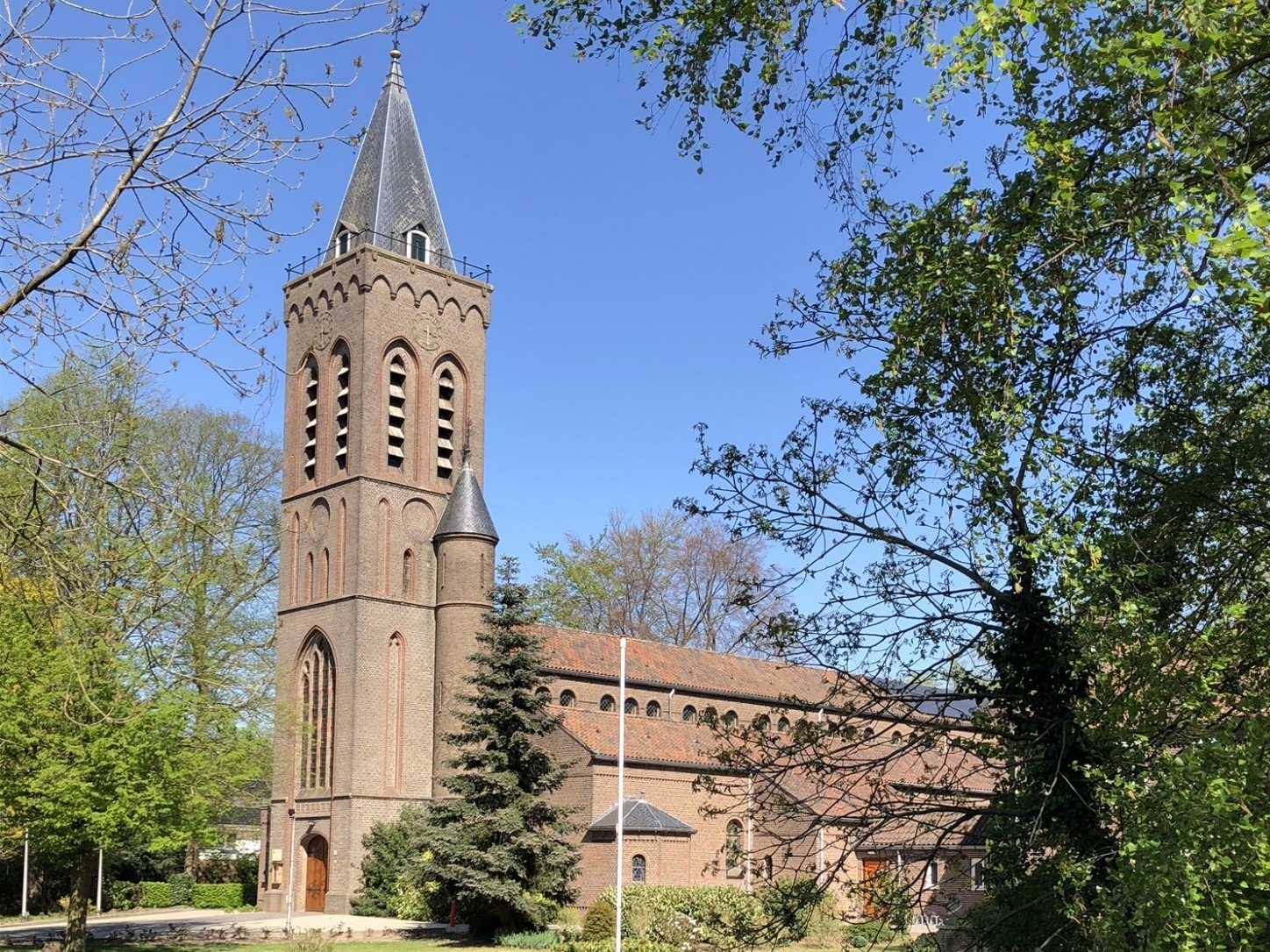
The Roman Catholic St Helen’s Church in Aalten
Most Achterhoek Protestants remained mildly Dutch Reformed. Aalten possesses an orthodoxy that now fits better with the ChristianUnion than the SGP. Members of the Reformed Association or the Restored Reformed are scarce in the Achterhoek, and the Reformed Congregations even more so. But the growing religious differences between Aalten and the rest of the region led to the nickname ‘Jerusalem of the Achterhoek’.
Hans de Graaf is familiar with that nickname. “What do they mean by it?” he wonders. If it refers to the ecclesiastical diversity of Aalten, he can imagine it. He himself delved into the Roman Catholic church history of the region. Aalten owes the survival of its Roman Catholic community to the arrival of the spinning and weaving mill of the German Driessen family in the nineteenth century, he is firmly convinced. “Our church community stands on the shoulders of a small group of pioneers,” he says.
Change
Anyone driving into Aalten today is alerted by black billboards on the access road to the fact that ‘God is love’ and that ‘He loves you too’. In the village, you will find a unique church: a bilingual evangelical congregation for Germans and Dutch people known as the Euregiokerk. ‘Two nations, one faith’ reads the large text on the facade of the formerly Reformed Westerkerk.
Hans de Graaf notices that Aalten is changing. “You can now easily organize something on a Sunday,” he says. “That is no longer an obstacle.” What has remained is the non-relationship with Lichtenvoorde. “The Aalten community does not look to the north,” he says. Yet, ecclesiastically, that will now be necessary. The Diocese of Utrecht recently merged nine parishes into one, so that Aalten now belongs with Lichtenvoorde and Groenlo. The Ludger Parish.
“As Roman Catholics in Aalten, we have a strong self-awareness,” says De Graaf. “That stems from the idea: ‘we are still here too!’ The small Catholic pillar made itself clearly heard in society. In Lichtenvoorde, almost everyone is Catholic. There is a different attitude there.” De Graaf misses that resilience in the large parish. He is taking on new projects himself. Together with Catholics and Protestants, he is developing a walking route from Zutphen to Münster, following in the footsteps of the ninth-century evangelist Ludger. After all, he brought the gospel to all Achterhoekers, didn’t he?
Ecumenism
It is a language that Frits van Lochem and Flip de Bruijn in Roman Catholic Lichtenvoorde would understand. To their great regret, the once lively ecumenical tradition is disappearing there. Less and less is done together. “Ecumenism is fading,” says De Bruijn. “We want to. But Rome does not prioritize ecumenism. Now that the parishes have been merged, you notice there is less time for it.”
Modern life in Lichtenvoorde largely exists without church attendance. On Sundays, you can shop there peacefully. Residents even shrug their shoulders at the Sunday opening of the supermarket, Van Lochem notes. No one here thinks of Aalten. There is more rivalry and at the same time kinship with ‘d’n Grolschen’ (Groenlo). The Protestant Congregation of Lichtenvoorde is now also looking in that direction for closer cooperation with the Dutch Reformed. “No, there are no ecclesiastical contacts with Aalten,” says De Bruijn.
There is little affinity with Protestant orthodoxy in Lichtenvoorde. Yet it is precisely those believers from Lichtenvoorde who want to work the Achterhoek, an ‘ecclesiastical white spot’, through their Christian bookstore ‘Licht’. It is closed today. “That belongs to the Reformed-Liberated, doesn’t it?” De Bruijn and Van Lochem ask each other. “They aren’t from here. They probably think there’s some evangelizing to be done here.”
‘Keislöppers’ and ‘de fienen’
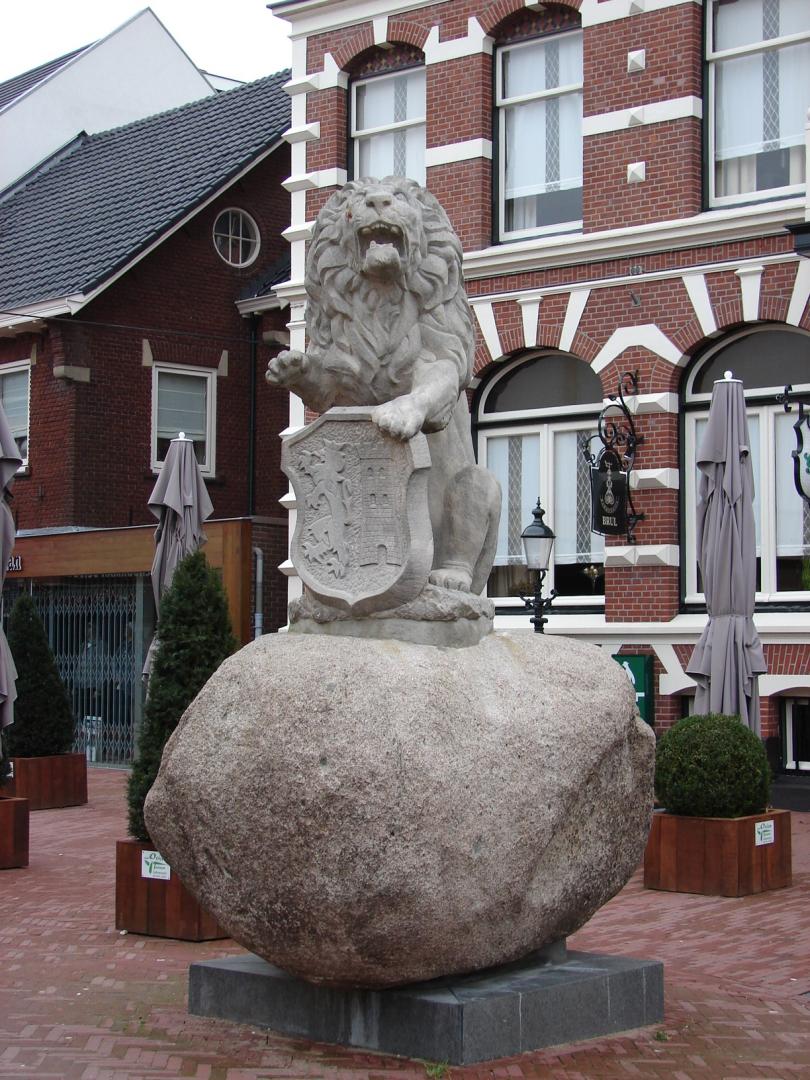
The boulder with the lion statue on the Market of Lichtenvoorde (photo: achterhoek.nl)
Lichtenvoorde is traditionally Roman Catholic. In 1496, the Lord of Bronckhorst founded a chapel there. On its foundations, the few Protestants built a new church in 1648 with ‘State funds’. In the nineteenth century, the town (now 13,000 inhabitants) received many migrant workers from Brabant for work in the shoe industry. To honor King William III’s 25th anniversary in office in 1874, these Roman Catholic shoemakers dragged a 20,000-kilogram boulder to the center and decorated it with a proud lion. They earned the people of Lichtenvoorde the nickname ‘keislöppers’ (boulder draggers).
Aalten grew over the past century from a small village into a central town with nearly 13,000 inhabitants. Since the nineteenth century, Aalten distinguished itself through church secessions that were almost non-existent elsewhere in the Achterhoek. Many proved sensitive to a more ‘fine’ (fijnzinniger), Reformed faith, which earned the people of Aalten the nickname ‘de fienen’. The village still has a relatively large number of Protestant and Evangelical churches. The ecclesiastical variety on such a small scale is unique in this border region. This gave Aalten the name ‘the Jerusalem of the Achterhoek’.
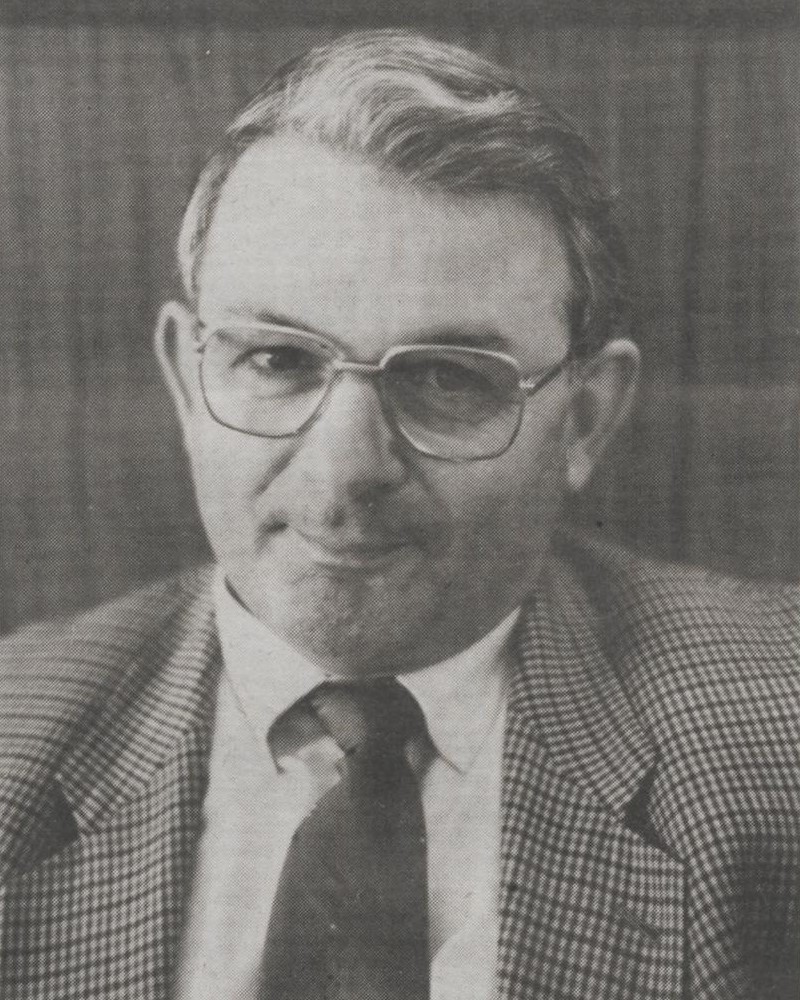
Bernard Leezer (57) lives in Aalten in the Achterhoek. Although he ran a butcher’s shop for twenty-six years, he does not really consider himself a butcher. He is a father of three sons and a daughter, and a grandfather of two. A conversation about meat, hiding from the Nazis, and football
“Both my parents have passed away. My father was a cattle dealer and my mother came from a well-to-do family in Wilhelmshaven in Northern Germany. She didn’t really suit my father at all. He was a stubborn man from Groningen who didn’t care much for etiquette. It caused friction. If my father came home and forgot to wash his hands before dinner, all hell would break loose. Of course, he wasn’t the type to just let himself be pushed around, so he’d fight back. And then my mother would say: ‘Na und wie bist du denn, wie bist du denn überhaupt?’ Mother spoke German at home. She spoke fluent Dutch too, but she hardly ever used it. I was raised bilingual.”
“My mother’s father was a horse dealer. She always used to go to the tennis court in a pony and trap. Anyone who did that back then belonged to the upper class. That’s why I always say my parents only met out of necessity. She fled to the Netherlands in 1932 with her two children—both my father and mother had been married before. My father had six children from his first marriage. Two of his children, one with a husband and child, were gassed. I am the only child from the second marriage.”
“My mother was a dominant woman. She always protected her own children, while my father’s children had to take a back seat. They had to fend for themselves from an early age. Of course, it wasn’t easy for them to accept a woman who wasn’t their mother either. Father was the kind of man who, for the sake of peace, would just think: Never mind. Let it be.”
“I was heavily influenced by my mother. If I wanted to go on holiday, she would say: ‘Du brauchst nicht so weit weg, wenn etwas passiert. When you are old enough, you will look for a wife and go to work.’ I became a butcher against my will. I actually wanted to be a pilot. Mother wouldn’t hear of it. So a butcher it was, but I’m not really a butcher at heart. I’m too emotional. I am against ritual slaughter because I believe an animal has the right to be stunned. God gave us the animals. Fair enough, but does a beast have to suffer that much pain before we scoff it down?”
“The first Jews to be rounded up were the Fuldauers. They lived right near us. They were taken away by PC Dijke from Aalten. He was a small, fanatical bloke. The Fuldauer family walked along packed to the rafters, and he walked in front, loosely wheeling his bicycle by his side, leading those people to the community hall. That’s where the Jews were gathered before being transported to Westerbork. People were standing outside the slaughterhouse, and they said: ‘Alright Dijke, you can keep that up all day, can’t you?’ Then my mother said: ‘It’s time. We have to leave.’ After the war, that Dijke fellow came into our shop once. I walked around the counter and said: ‘Get out, Dijke, and never come back, or we’ll cleave you in two.’ He was the man who took away the first Jidden from Aalten, and he just strolled in as if nothing had happened.”
“Kees Ruizendaal, nicknamed Zwarte Kees (Black) Kees)—also a policeman, but a good one—helped us find a hiding place. He was later executed by firing squad in Doesburg. First, I stayed with my half-sister Helga at the Klein-Entink farm, and later with my parents at Hendrik Groot-Nibbelink’s place on the Stroete in Lintelo. We were hidden with three orphans. They were practically children themselves. Drika, the oldest, was 26; Hendrik and Bernard were in their early twenties. To me, they are heroes. You know what would have happened to them if we’d been caught. They were Christian people. They did what they did out of love, not for the money. I think about that often. I find what they did incredible. Hendrik passed away last year. The vicar gave a beautiful sermon. I went and sat in the refreshment room. I felt that if I looked at the vicar, I’d get such a massive lump in my throat. I couldn’t well let myself go like that as a grown man, could I?”
“While we were in hiding, I used to go outside with Hendrik at night once it was dark. Next to the farmhouse stood an old apple tree. It leaned terribly and had to be propped up. Between the props was a tiny patch of land. If Hendrik had sown rye that day, for instance, I would go and sow rye on that little patch of land at night. He was my great role model; that’s why I was so heartbroken when the man died. He was like a father to me.”
“I spent a lot of time with the cows or with the horse. The Germans requisitioned Lies—that was her name—at one point. She was a right handful. She bit and kicked everyone except me. I could practically sleep right next to her. Hendrik managed to fetch Lies back because the Germans couldn’t control her. I was so happy she was back. At least I could cuddle her again. Drika used to play games with me. My father was too old to play with me. He was terrified that something would happen to me. I don’t know if he would have survived it. He was completely barmy about me. Later on, when I started going out and came home late, he could never go to sleep. He always stayed awake and would say: ‘Where on earth is that boy?’ My mother was more down-to-earth.”
“For a while—when it became too dangerous at Groot-Nibbelink’s—we also stayed with the Pennings family in Varsseveld. They were a very devout Christian family. During the war, he would go to Delft with a horse and cart to fetch glass. He sat on the box with the reins in one hand and a Bible in the other. Pennings had nine children. I often sit by the brook now, thinking: what must have gone through that man’s mind. He had to keep the peace in his family, keep us calm, and keep a cool head himself. The house was searched once at Pennings’ place. We were hidden under the straw along with sixteen other Jews and people from the underground resistance. One of those ‘blacks’ [NSB/collaborators] stood with his great boots right on my mother’s hand. He crushed her whole hand. Pennings was downstairs playing the organ: Abide with Me. Every time I hear that hymn, it takes me right back.”
“We hid with true Christians, and later I went to a Christian school. But I never felt the urge to become a Christian. My half-sister Helga joined the Reformed Church. Well, that took a few drops of water, but that was about the extent of it. Truly, you can have a stable full of Trakehner and Hanoverian horses, but if you put an Arabian among them, it stands out. You cannot deny who you are. The first thing people say is: ‘That’s a real Jewish trick.’ At home, my father and mother kept Jewish life alive for me. My mother wasn’t particularly pious. My father was orthodox. His whole life, even during the war, he never ate gasser (non-kosher meat). You are a Jid, and there’s no escaping it. I’ve always said: ‘I was born a Jid, and I’ll die a Jid.’”
“I couldn’t live in Israel because of the heat, but when I’m in Eretz, I love it. We go there regularly because our daughter lives there. When I go to shul here, I think pff, but there I think it’s wonderful. Afterwards, you stand around having a nice little schmooze with a group. You can’t do that here anymore. You could before the war. Before the war, about a hundred Jews lived in Aalten. After the war, we struggled to form a minyan. It’s just a completely different atmosphere. You can’t imagine walking down the street in Aalten wearing a kippah nowadays.”
“I can’t say I was frightened at the time. I can only remember that after the war, when I was at school, I was scared to death of the postman. I went to the Groen van Prinsterer school. It was an old-fashioned school with a very long corridor, with the toilets at the far end. If I came out of the toilet and Mr Terbrake was standing at the other end of the corridor in his postman’s uniform, I’d be rooted to the spot because I thought I’d seen a ‘black’. That’s what happens when you’ve spent years being told: ‘They’ll kill you.’ Terbrake would quickly go to Miss Jonker and say: ‘Bennie’s frozen at the end of the corridor.’ She would come and get me. She’d put an arm around me and take me back to class.”
“The Groen van Prinsterer was a fantastic school. It was a Christian school. I never once heard the word ‘Jew’ used as an insult there. It was quite a different story at the public school. I had to have remedial lessons because at eleven years old, I couldn’t even read or write. While in hiding, we did read little booklets, and when the war ended, my father said: ‘He reads like there’s no tomorrow.’ But you mustn’t forget that if you read me a booklet like that a thousand times, I’ll eventually know it by heart. At first, they fell for it, but the moment a different book was put in front of me, I couldn’t make head or tail of it.”
“During the war, I wasn’t aware that it was a matter of life or death. No one can tell me that an eight-year-old boy understands that. We were told: ‘You mustn’t go outside because people are walking around out there who will kill you.’ That doesn’t really sink in for a child. You can tell a dog a thousand times: ‘Leave that alone.’ And eventually, it won’t touch it anymore. But as for why it’s forbidden—it doesn’t understand that.”
Aaltensche Courant, 4 May 1945
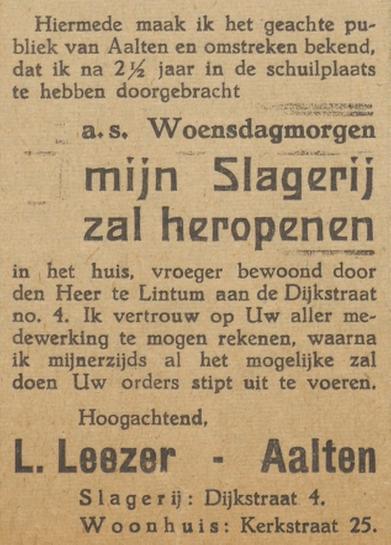
“During the final period of the war, we stayed with Hendrik on the Stroete again. We lived there for the first few months after the liberation too, because we no longer had a house. My mother went looking for her furniture. She managed to get a lot of it back. My father took out a loan from a Christian church. He was a bit casual about paying it back; years later, we still received a final notice. Right after the war, he put an advert in the newspaper: ‘After two and a half years in hiding, I am reopening my butcher’s shop’. My father wasn’t a good butcher. He was a cattle dealer. A proper trader. Very much a case of: one, two, up you get, just sign for that beast.”
“After primary school, I went to the technical secondary school. I didn’t want to go at all, but my mother said: ‘Du sollst ein Handwerk lernen.’ I ended up getting a whole load of diplomas. Alongside that, I always did a lot of sport: tennis, hockey, and football. My father wouldn’t give me money for football boots. ‘You’ll just have to earn it,’ he said. I always had to help my father, but I never got paid for it. My brother-in-law ran an emergency slaughterhouse. If there was an emergency slaughter in the middle of the night, he’d ring and wake me up, and I’d go and help him. I didn’t get any money for that either, but I did get the head, the tongue, the udder, and the liver, and I sold those. That’s how I bought my football boots.”
“I played as a semi-professional for De Graafschap. I moved from Aalten Football Club to Winterswijk Football Club. WVC was an elitist club. Because I went to school in Winterswijk and was in the school team, I caught people’s eyes. When I moved from Aalten to Winterswijk, I was called a ‘rotten Jew’. Why? I was turning my back on Aalten. WVC was an elite club, and they hated them. I was a really fast right winger. But I was very slightly built. They only had to tap my ankle and I’d go rolling over thirty-four times. Later on, I played centre-forward too. I was actually too small for it, but I’d always go tumbling to the ground, and that would get the referee on our side. I played two seasons for De Graafschap, until one day I was kicked out of the match by Dick Tol, nicknamed ‘the gnarled’.”
Leezer butcher’s shop, Peperstraat (1975)
“In the end, I ran a butcher’s shop for 26 years. Looking back now, I say: ‘I’d never want to do it again.’ A hundred grams of this, a hundred grams of that. Never again, though I did have some fun. Especially in the early sixties, we got a lot of German customers. Meat was cheaper in the Netherlands than in Germany. You had to be careful not to give the Germans preferential treatment, otherwise you’d get earfuls from the Dutch. Dutch customers were always served immediately by my assistant or my wife. Even if there were three Germans ahead of them, a Dutch person was served first. I’d make a joke of it and say: ‘Kurt, ich hilf dir’.”
“In the evenings, the restaurant owners from Bocholt would come in and order ten or fifteen racks of pork chops. There were a few customs officers who always came to get meat. They never had to pay. When they came by, they’d say: ‘Blimey, I’m on duty again tonight.’ And then in the evening, I’d get in my little Opel, take out the spare wheel, put the racks of chops in, and pop right over the border. I could always drive straight through. My wife knew nothing about it, and I thought: what she doesn’t know won’t hurt her. It was a time of adventure and wheeling and dealing.”
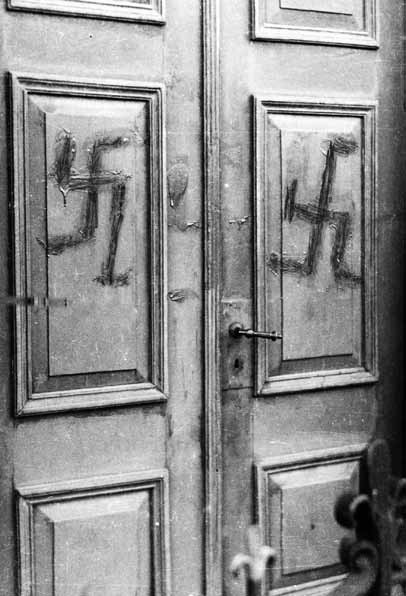
There is still a synagogue in Aalten. In recent weeks, one could read about it in both the national and international press. Seldom before can this Beth Haknesseth have been so much in the public eye. A procession of journalists has flocked to Aalten. “I can’t bear to see another journalist,” I noted from the lips of one of Aalten’s Jews. They travelled to Aalten because the synagogue has been defaced. It was but one incident among a multitude of anti-Semitic expressions reported in the Netherlands and abroad in recent weeks. One could have learned of those other incidents as well—though not in this publication. One simply cannot keep up with them all.
And not only that: anti-Semitism is not a question of us. It is a disease that proliferates and proliferates, usually in silence, occasionally openly. We ourselves are less upset as long as there is no survival involved, than the groups among whom the tumor rages. We ourselves have become more self-aware, more self-confident. On the one hand, it is because of the appalling that we had to go through only a generation ago — and what could happen to us even worse — because of the stimulating effect that the existence of the State of Israel exerts on us.
Synagogue in Aalten defaced
Perhaps these are the reasons that in Aalten there has been hardly any interest from our organizations — only Chief Rabbi E. Berlinger and the Permanent Committee showed their sympathy. The lack of interest on our part is in stark contrast to the dozens of letters that have been received from non-Jewish quarters. This can be read in one of the letters: “… Since the war, only since the war have many people, including myself, taken into account, not only what has been done to a part of our people in particular, without us having done or being able to do anything of significance against it (?)… And now this: what am I to do — how can we, non-Jewish fellow citizens, undo this insult, this terrible blow to the barely healed, so deeply damaged face. That’s the reason I have to write!!”.
In Aalten, people take note of the letters, of the verbal interest. Is it doing them good? Undeniably, it provides support. All the more fiercely one feels that there has been hardly any reaction from our side. What hardly causes a stir in the relatively large Jewish communities in the West, is still the talk of the town in Aalten. It is not surprising, the cold one is only small. What kind of support can one give each other? Not that there is fear, not at all. In Aalten, too, the defacing of the synagogue is considered an incident. But still…
Only nine families make up the chilly Aalten. Nine families with a total of 28 souls, seven of whom are children. They do not view the smearing of the shul, the destruction of the stones in the cemetery in Winterswijk with a shrug of the shoulders. Because there is a connection between one and the other. They are not unrelated facts. The police investigation has finally shown that those who caused destruction in the cemetery of Winterswijk are the same as those who smeared the synagogue in Aalten. It has been proven by comparison of the manuscripts and chemical investigations of the chalk that was used for chalking. But no matter how active the Aalten police are, there is no question yet that the active anti-Semites could be arrested.
Requirements only
There is another synagogue in Aalten. But shul services are held only sporadically on Shabbath. And only with shul services can one actively prove one’s Judaism in the small kehilloth . Until last year, the services still took place every Shabbath. But in the last five years, three shul visitors have died and some young people have left elsewhere. Only when these young people come over to Aalten is there sometimes a service on Shabbath. However, the synagogue is now only populated on Jamiem Towien.
The synagogue in Aalten, 1965
Nevertheless, Aalten still had its own chazan until 1948. He left for America. He was the last of the many excellent chazanim that this kehilla has known in its long history. Since his departure, one of the people from Aalten acted as Sjeliach Tsibboer. During the Jamiem Noraiem one of the young people comes from Amsterdam. It is no longer possible in Aalten to appoint his own chazan — apart from the question of where he should come from. The cold cannot pay his salary from the tax revenue.
“The Permanent Committee demands a share of this proceeds, the Arnhem district demands a share of the money. And people forget that we have to maintain our shul and that we have to take care of (our) large cemetery. Money is demanded of us, but what do we get in return? If we have a bar mitzvah, we have to beg for the arrival of a chazan. The bill will come later. If we need someone for a lewaje, the bill will be presented later: ƒ 0.25 per car kilometer, beyond the requirement that is not on the bill.”
Butcher knows better
There is another synagogue in Aalten. It is hardly used anymore. There is no more chazan. They have been to Aalten. Some were also mohel, most also sjocheet. This has sometimes led to skirmishes in Aalten. Because the four kosher butchers in pre-war Aalten did not agree with the shechete’s decisions. If the shochete said: the cow is treife, then the butchers knew better. The sjochetim then got all kinds of things thrown at their heads. One of them, Levi Gasan, small in stature and slender, was very afraid of the wrath of the butchers. When he found a cow treife, he quietly left the abattoir, ran the last few meters to the door and only then shouted: “The cow is treife!, because he expected to have a cleaver thrown at the head if he said it to the face of the butchers. His work plus the fear of life preservation was honored in those years with 1800 guilders a year. The respective chief rabbis did not exactly understand the butchers in Aalten either. Chief Rabbi Levisson in particular turned against them.
“The chief rabbis were authorities. If they held an inspection once every six months, people were nervous. They decided in more areas than they formally had to decide. They did not want butchers as parnassims. They kept an eye on the administrative decisions of the parnassim. They interfered with the salaries. And no one dared to contradict the chief rabbi”. Nevertheless, the Aalten parnassim often quarreled with the chief rabbi. They blamed them a lot. But these reproaches never reached the chief rabbi. He was back in Arnhem by then. On the heads of the chazanim the wrath of the parnassim was discharged. They received criticism in many areas: also that they did not provide sufficient education. It also happened because some church members had more knowledge than the chazan. Because there were many chewres in Aalten. They are no longer there. The children receive an hour of Jewish lessons every week. For youth meetings they have to travel to Winterswijk.
Things have sometimes been tough in Aalten. The taxes were low. Those who paid a dime more counted themselves among the prominent ones. Many rights were derived from that dime. In Shul people bid against each other to obtain a mitzvah. Partly because of this, the parnassim sometimes knew better what the income of the congregation members was than the inspector of taxes. Perhaps that is also why people were so committed to being elected parnas. The elections were in reality a get-together. But despite the battle for the kawod, there was great cohesion. The quarrel of one day was settled the next.
Quarrel
But there were frequent arguments. Because the Jewish community of Aalten consisted largely of cattle shochriem. On Friday evenings they quarreled with each other in shul because one had bought a cow from a farmer that had been promised to the other. On Shabbath morning, the quarrel was settled in shul. On Shabbath afternoon they visited each other, also to hear each other out. Shabbath evening people wished each other “gut woch”.
Aalten, which had eighty Jewish souls before the war and one hundred and forty souls shortly before the war; of whom many German refugees, was always a pious cold. “On Shabbath, all Jewish businesses were closed here. No Jew worked. That would not have been possible. The population had not taken that. It once happened that a Jewish representative of a Jewish firm from Amsterdam visited a shopkeeper on Shabbath in Aalten. He was thrown out of the store and his monster suitcase was thrown after him. “On Shabbath there is no Jew in my house,” he was shouted at. There is still a synagogue in Aalten…
M. KOPUIT
This article was written with the help of Mr. J. Weyel and Mr. S.I. de Haas of Aalten.
Throughout the centuries, the Church has been the bearer of culture. Especially in rural areas, the influence of the Church on cultural development has been very significant. Anyone wishing to learn about and research the history of a village can find a wealth of information in the church archives, as the Church has long stood as the center of village life.
Various influences have caused the Church to gradually relinquish this position and lose its central role. Large groups turned away from the Church, which had nothing more to offer them, and continued their lives outside of any ecclesiastical connection.
Church life had become stagnant and no longer brought people into contact with spiritual movements as it had done throughout the centuries. The church building still stood in the midst of the village community, but it no longer took part in the community itself. It had lost its evangelizing character. But our old Church has not weathered the storms of centuries for nothing. Now, too, it will find its place again in the heart of the community.
Community Center
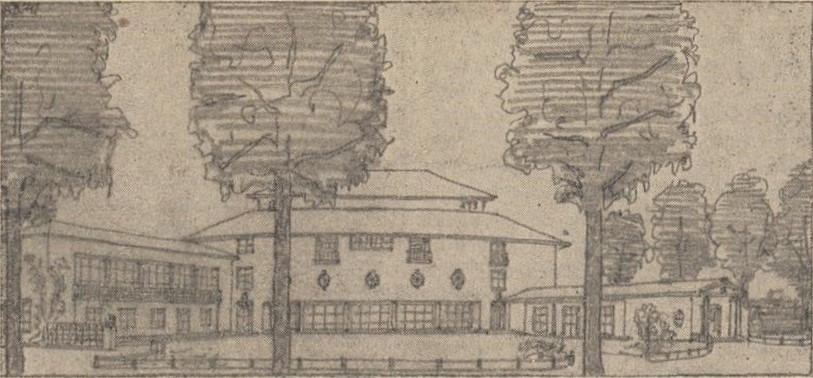
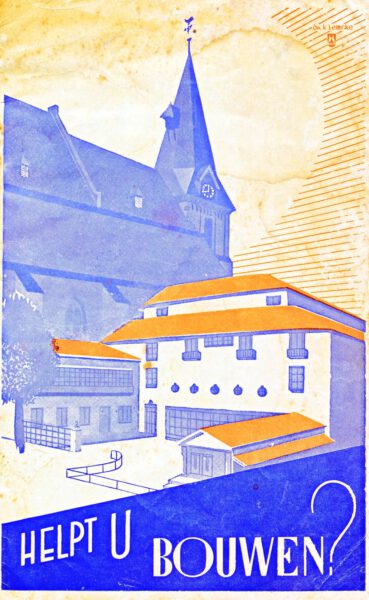
Viewed in this light, the plans for the “Community Center” in Aalten are of great significance. For here, the Church takes upon its shoulders a task of immense importance and great cultural value. It will not be an easy task to carry out this plan, but the Church has accomplished greater things. Once again, the Church will take up its cultural mission by establishing a “Community Center,” a building where community life can find a home and where there is also ample opportunity to organize pleasant evenings.
More and more, the conclusion is being reached that the halls currently available in Aalten are not fully suitable for this purpose, so that the opportunity to provide some guidance for recreation has been lacking until now.
No one who has observed rural recreation in recent years will deny that a certain degree of guidance or direction is necessary. The theater troupes that come to the villages are often third- or fourth-rate companies that can no longer attract audiences even in provincial towns and are now trying to earn their living in the villages. The way our boys and girls spend their free time is a problem that urgently requires a solution.
The plans
The committee appointed by the Churchwardens to prepare the plans for the establishment of such a building has already consulted with the Synodal Building Committee, “Church and World,” and the Reformed Youth Council. The architect, Ir. Boeken, has created a design that takes full account of the various purposes for which the building will be used. There will be a proper theater hall with a projection booth.
Regarding the availability of the building, the intention is to adopt a very broad perspective. Non-church organizations will also be able to use it, although the general guidelines of the Synod will be decisive. No decision has yet been made regarding the location where the building will be erected, although the Wheme is being strongly considered. It is hoped that architectural considerations will ensure it fits into the village atmosphere.
Thus, work is proceeding diligently on the plans for the establishment of this “Community Center.” And although it will likely be several years before the first stone can be laid, we must praise the initiative and courage of the Churchwardens for taking this step. On Sunday evening, at a congregational meeting, Rev. F.J. Pop, chairman of “Church and World,” will speak on the topic “Church and World and Community Center.”
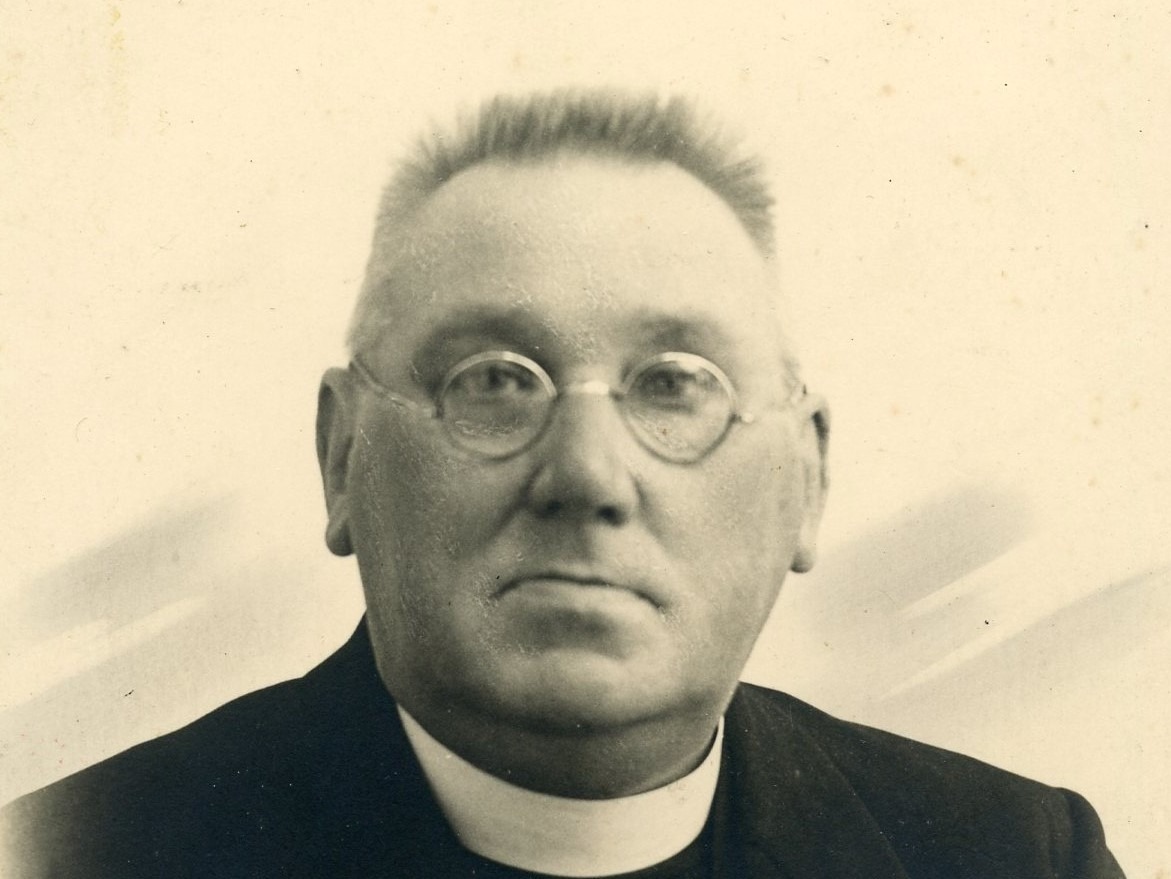
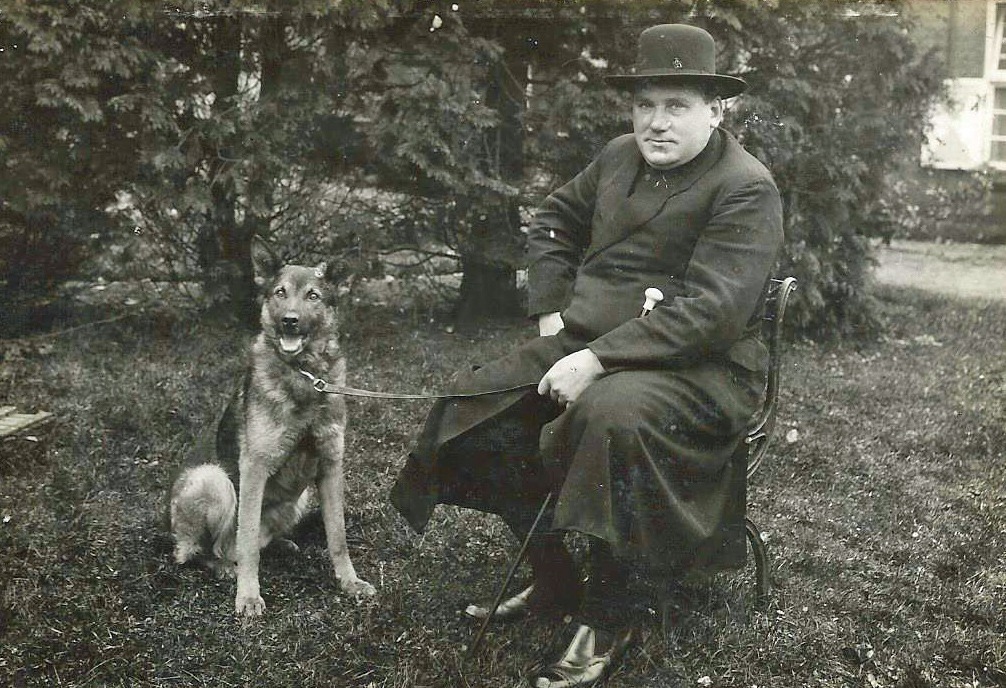
Pastor Christianus Franciscus Bonifatius van Rooijen (1876–1945) was a well-loved figure. He commanded great respect not only among his parishioners but also among the Jewish residents of Aalten. During his walks with his loyal German Shepherd, Frits, he would tip his hat and greet Jewish fellow citizens with a slight bow.
Bombing Raid
On the afternoon of Sunday, 28 January 1945, many people were gathered in the Roman Catholic Church for the Benediction (Lof). Suddenly, a number of ‘Jabos’ (Allied fighter-bombers) broke through the cloud cover and dropped their bomb load. On the Kemena, Admiraal de Ruijterstraat, and Stationsstraat, the damage was limited to property.
At the Roman Catholic Church, however, the consequences were more severe. One bomb fell in front of the church, and another struck the rectory. Panic ensued, and the blast pressure caused statues to fall from their niches and walls to collapse.
The churchgoers escaped unharmed, though they were covered in dust and many suffered bruises and abrasions. There was a massive bomb crater in front of the main entrance to the church. However, the bomb that had struck the rectory had more tragic consequences.
The pastor’s housekeeper, 57-year-old Johanna Maria Klein Rouweler, was severely injured and passed away a few days later in the emergency hospital in Harreveld. Pastor Van Rooijen also lost his life and was not discovered until hours later that night. His death touched the hearts of residents of all denominations, and his funeral at the Roman Catholic cemetery on Piet Heinstraat was attended by a great many people.
20th Anniversary of Priesthood
In 1936, Pastor Van Rooijen celebrated 20 years in the priesthood, and De Graafschapbode newspaper devoted an article to this anniversary:
“Tuesday, 8 December, will mark 20 years since the Reverend Pastor Van Rooijen was installed here as successor to Pastor Wubbels, who departed for Dalfsen. On this milestone in the pastoral life of Pastor Van Rooijen, we requested him to tell us a little about the past two decades. Although His Reverence did not consider 20 years an official milestone usually celebrated, he was kindly prepared to provide us with some information and to pose for our illustrator.
Pastor Van Rooijen was born on 13 February 1876 in Utrecht. After attending school there, he completed his studies at the Seminaries in Culemborg and Rijssenburg. His first post as curate was Oosterhout (Gelderland), a position he later exchanged for the Twente industrial centre of Enschede. From there, Curate Van Rooijen was installed as Parish Priest here on 8 December 1916.
Over the past 20 years, the jubilarian has experienced all the ups and downs—in recent years, especially many ‘downs’. He worked here alone until 23 August 1935. On that date, he received the assistance of Curate J. Snoeren.
When we speak of the ‘downs’, we know we have touched upon a subject very dear to His Reverence’s heart. It is well known, even among those of other faiths, that Pastor Van Rooijen personally does a great deal to alleviate the suffering of his parishioners, but also how indignant he often is when young people, who earn a decent wage, show so little willingness to contribute.
A well-known example is the daily provision of a free glass of milk to children at the Roman Catholic school who are in need. This milk distribution has been running for two years now and is undoubtedly of great benefit to the general health of the younger generation. The ‘Hulp in Nood’ (Help in Need) fund of the Roman Catholic Workers’ Association, to which members contribute a small weekly amount to assist one another in emergencies (childbirth, illness, etc.), is also an initiative of the jubilarian. In the previous financial year, 385 guilders were raised in this manner.
Pastor Van Rooijen was particularly satisfied with the house visits he and the curate have made over the past 14 days, with the twofold purpose of assessing the situation in various households and collecting donations for the provision of clothing, blankets, and, if possible, a Christmas gift for needy families. To date, these visits have already raised over 800 guilders—more than His Reverence had dared to hope. That this should be so successful precisely in this 20th year will undoubtedly bring the jubilarian great satisfaction.
We shall suffice by mentioning that in these 20 years, the Roman Catholic Church has received a hot-air heating system, and during this time, the fashion vocational school and various sports associations have flourished.”
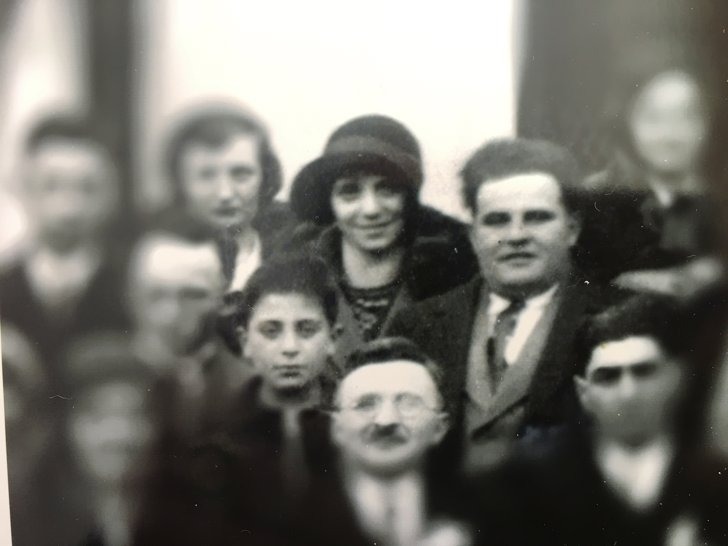
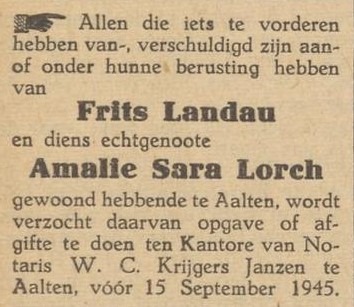
During World War II, the Jewish couple Frits and Amalia Landau lived in Aalten. Their lives ended tragically when they were executed by the resistance due to Frits’ dangerous behaviour. Their bodies were presumably buried in the countryside surrounding Aalten, but the exact location remains unknown to this day.
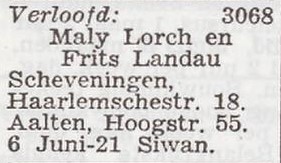
Frits Landau was born on 28 November 1905 in Aalten. He became a travelling salesman and remained unmarried for a long time. On 6 June 1942, he became engaged to Amalia Lorch, known as Maly, born on 20 December 1902 in Bocholt. They married in August of that same year and moved in with the Schaap family at ‘t Dal 1 in Aalten.
Soon, they were forced into hiding. From 1 April 1943, Gelderland was officially to be Juden-frei, Juden-rein (free of Jews). The Aalten population register states that Frits & Amalia departed on 17 March 1943, with no destination recorded. They subsequently stayed at two different hiding addresses, most recently with the Van Eerden family at the farm De Maote in the rural district of Dale.
Unpredictable and dangerous behaviour
It is said that Frits Landau was an alcoholic with a short temper, which led to unpredictable and dangerous behaviour. Reportedly, he did not make things easy for his hosts; he harassed young ladies and demanded his drinks every evening. He was accustomed to a luxurious lifestyle, yet in 1943, alcohol was barely available on the farms.
On several occasions, Frits threatened to betray his hiding places in order to buy his own freedom from the Nazis—at least, he assumed this would succeed. Twice, such attempts were thwarted at the very last minute.
Amalia and Frits Landau-Lorch (photo: Aalten Vooruit)Het Joodsche Weekblad, 5 June 1942
Liquidation by the resistance
Because he was considered a safety risk to other people in hiding by the local resistance, the decision was made to execute him to protect other fugitives and their helpers. The Council of Resistance and even local clergy discussed how to deal with him. Ome Jan Wikkerink proposed keeping Frits under permanent guard by other hiders and pilots. This did not happen, however, as several young resistance members took the initiative to eliminate him themselves.
They told the Landau couple that they would be taken to another hiding address in Vragender—a suitable excuse to get Amalia to come along with Frits. Incidentally, the intention was to separate Frits and Maly, as they wanted to spare her this fate. However, Frits refused to cooperate with being separated, and thus Maly was drawn into his fate.
Frits and Amalia Landau-Lorch were liquidated and buried in the countryside of Aalten by the local resistance in late 1943 or early 1944.
Location unknown
Aaltensche Courant, 28 August 1945
Opinions differ regarding the exact place and date of the liquidation. According to one theory, Frits and Amalia were killed on the Schaarsheide, close to the Nazarethdijk. Another theory points to the Daalse Goor.
The burial site of the Landau couple has been searched for several times, with the aim of giving them a reburial in the Jewish cemetery, but so far without result.
During a search on the Schaarsheide, a lady’s shoe and three rusted shovels were found. Investigation indicated that the shoe likely dates from the 1930s. It is plausible that the first burial site was discovered there. According to those involved, the bodies were later reburied. At the time, everything had to be done quickly, and apparently, it was later decided that the original burial site was unsuitable. During the clearing of the first grave, the lady’s shoe was supposedly left behind. Afterward, the mortal remains were reburied elsewhere, but where is unknown.
The most recent search took place in 2023. In a small patch of forest between Aalten and Lichtenvoorde, twelve experienced amateurs searched for the bodies of Frits and Amalia. Using detectors, they searched at various frequencies for different materials, but no human remains were found.
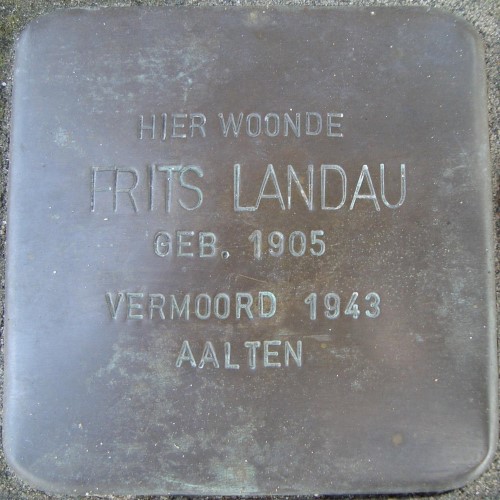
On 13 April 2016, two Stolpersteine (stumbling stones) for Frits and Amalia Landau-Lorch were laid at their last official residential address at ‘t Dal.
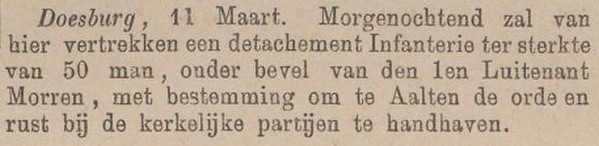
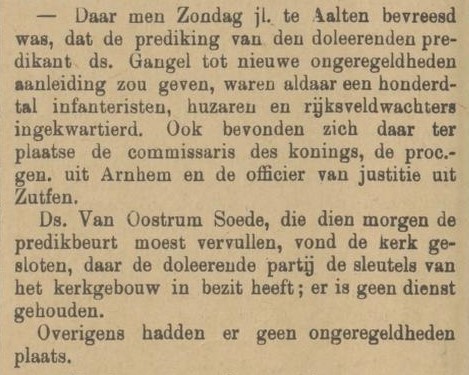
Every now and then, the newspapers report fragments about the withdrawal of Gangel with his consistory, of suspension, dismissal, the keeping of church doors closed, riot, soldiers, hussars, etc., etc., and with all that, the matter continues at a snail’s pace. When will this change? One says it will remain so, another that the church may well remain closed for another 6 weeks, a third speaks of compromising, but despite all that: no progress is made. What can be done about this?
A clear explanation of the matters, decisive action, indeed taking possession of the church. All well and good, but show us the way to achieve this. Well, through this writing, we wish to attempt to set you on the right track and point out the path the congregation must take.
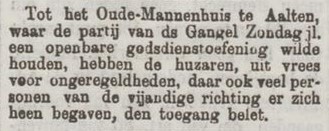
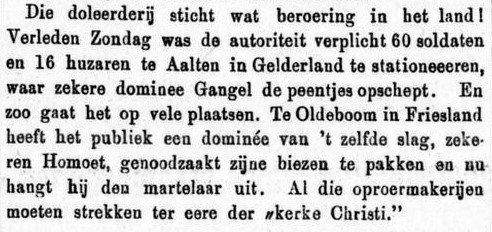
Mr. Gangel, former minister of the Dutch Reformed Congregation in Aalten, has seceded with his consistory, in other words, shaken off the Synodal yoke, as His Honor is pleased to call it. Previously, a part of the consistory, namely 3 persons who also functioned as churchwardens, resigned as members of the consistory, but retained their positions as churchwardens until the classical board, acting in the capacity of the consistory, suspended and later dismissed said gentlemen from their membership as members of the Dutch Reformed Church in Aalten.
It goes without saying that when someone has been dismissed as a member of the church, there can no longer be any question of being allowed or able to retain the management of the church, etc. After all, churchwardens are not owners of the church and its assets, but are merely elected by the notables as managers; see: General Regulations on the management of ecclesiastical assets and funds of the Reformed congregations in the Netherlands and the supervision thereof: 1 Oct. 1870.
These churchwardens are currently preventing the ministry of lawful ministers who must appear before the congregation, thereby withholding gifts from the poor and effectively preventing the collection of offerings for the maintenance of public worship.
For two Sundays now, the congregation has come to a closed church door, and twice lawful ministers have been prevented from performing their duties. We admire the calmness of the congregation in this matter, but we cannot guarantee that this will remain so for much longer. The parties are becoming increasingly sharp and hostile toward one another; it causes strife between members of the same household, and there is no longer any talk of brotherhood.
Who is the cause of this? None other than these churchwardens and the grieving consistory with their leader, Gangel.
But does the congregation have no rights? Certainly. The right rests with the members of the congregation, in the following manner: The lawful voting members elect the notables, the notables elect the churchwardens, and these take upon themselves the management. Where the churchwardens have now resigned of their own accord, or have been dismissed or removed from office, the election of new churchwardens must proceed without delay.
In the case of Aalten, the congregation will first have to supplement or completely renew the list of notables, and these new notables will appoint the Messrs. churchwardens. These new churchwardens take over the management from the old ones, and matters are settled. In the event of resistance to this lawful order, one can turn to the classical board and further to the provincial board.
If all this is of no avail, as seems to be the case in Aalten, and the dismissed churchwardens keep the doors of the communal property closed, then the members simply act as the rightful claimants and take possession of the church. By this, we do not mean to conquer the church by force, for there is no question of conquest when one is the rightful owner, but one should then call upon the judicial (civil) power. A church must not remain closed to the people on regular days of worship as long as there are churchgoers and lawful ministers to attend. See further on this the Church Regulations of 1 October 1870.
Dutch Reformed Church in Aalten Zutphensche Courant, 14 March 1887Zutphensche Courant, 14 March 1887Tubantia, 16 March 1887De Tijd, 16 March 1887Bataviaasch Handelsblad, 19 April 1887
At the beginning of 1750, the quiet village of Aalten was shaken by a series of remarkable religious phenomena. During church services, people burst into tears, sighed loudly, or collapsed as if they had lost consciousness. Some even spoke of encounters with angels or attacks by the devil. These events garnered national attention and would go down in history as the Aalten Commotions.
What happened in Aalten was not an isolated incident. A year earlier, a religious revival had begun in Nijkerk, which quickly gained national fame. The stories of these Nijkerk Commotions spread rapidly and also provided the breeding ground for a separate, intense movement in Aalten.
Impression of the Nijkerk Commotions by Reinier Vinkeles (1788, Atlas Van Stolk)
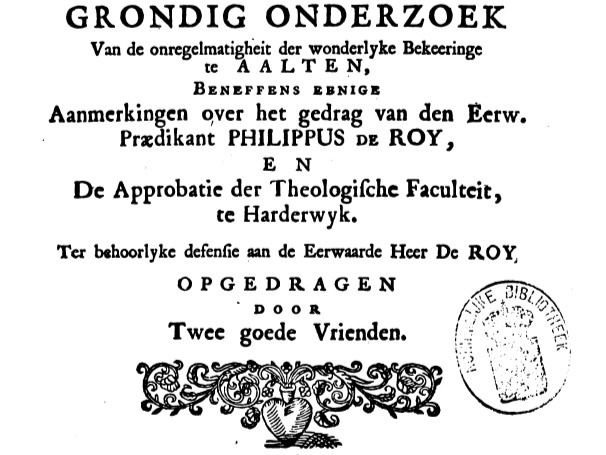
According to Reverend Philippus de Roy, who served the Reformed Congregation of Aalten at the time, there was a reluctance to repent and a ‘civil religion’ prior to these events, where people faithfully fulfilled their ecclesiastical duties, but faith was not “a matter of the heart.”
At the beginning of 1750, this suddenly changed. In a short period, hundreds of people in the congregation were deeply moved by a realization of their sins. This occurred in such an impressive manner that it spread “from house to house.” De Roy wrote about this:
“Now since the beginning of this year, God has revealed Himself in an outstanding (…) manner through His Spirit in our midst: and discovered hundreds of souls to themselves, by granting them a vivid understanding of the state of misery by nature.”
Intense emotions and physical phenomena
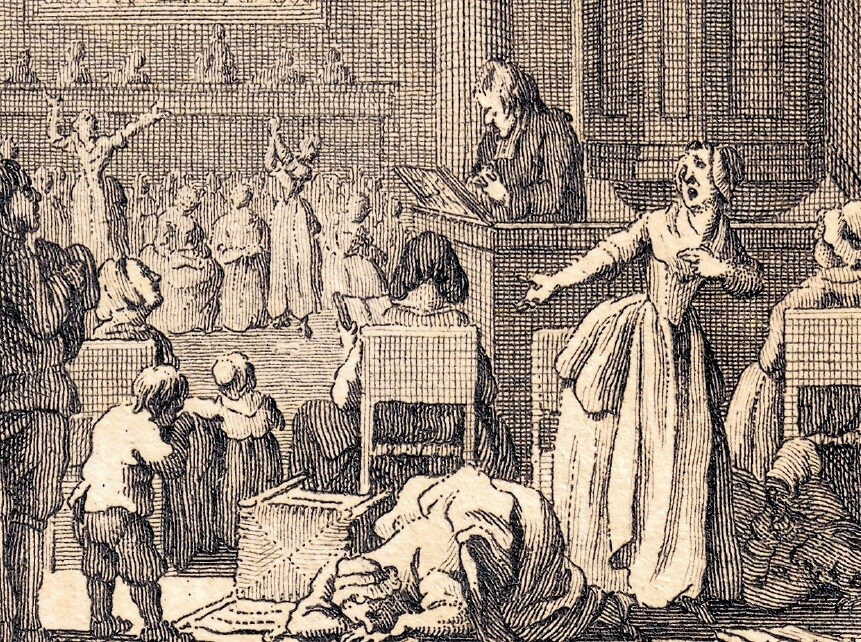
The revival was accompanied by extreme emotions and physical reactions. People became so fearful of God’s punishment that they felt they would “burst from anxiety” or as if their throats were being constricted. Sometimes they tore open their clothes to get air, but this did not help. Reports were made of “indescribable” sighing and groaning, and people trembled and shook throughout their entire bodies.
Some people were so overwhelmed that they fell to the ground and prayed loudly for forgiveness. A woman who fell to her knees during a meeting confessed her sins and pleaded on God’s promises. Later she explained that it was “impossible to restrain oneself because of the heavy burden of sin. Even if the whole world had been there, I would not have been able to keep quiet.” It was not uncommon for people to have to be transported home on carts after a meeting, as if they were wounded.
A village in turmoil
The influx of people was enormous. Church services and catechism classes, which were often held in homes, attracted so many people that the church was too small to accommodate all the visitors. The catechism classes, where the Sunday sermon was discussed, were the places where the commotion was most intense. During an outdoor gathering in May 1750, an “enormous emotion arose simply from the singing of a psalm”.
According to some reports, the number of those “moved” in Aalten was 1,700, even larger than in the more famous Nijkerk, where there were said to be 1,000. Such figures are difficult to verify, but they indicate the perceived scale of the movement.
Responses and the pamphlet war
The remarkable phenomena did not go undiscussed. A lively debate emerged in pamphlets and writings. Critics pointed to possible exaggeration and disorder in the worship services. De Roy responded to this criticism with a letter, addressed to an unknown lady, which was published in print. This booklet, Brief geschreven aan de WelEdele Juffer N.N. (Zutphen 1750), became a sensation: 5,000 copies were sold in three weeks, and a second edition followed as early as July 1750.
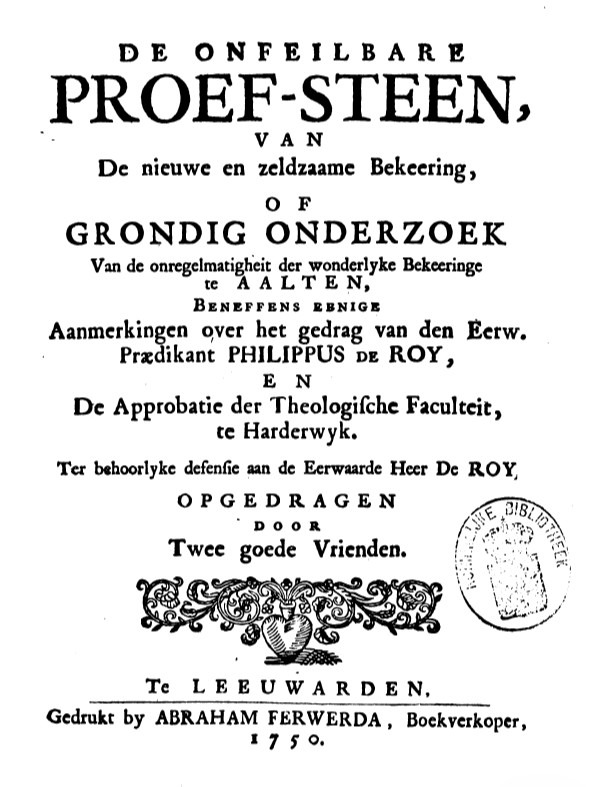
The success of this booklet provoked a critical response. In an anonymous pamphlet, De onfeilbare Proef-steen van De nieuwe en zeldzaame Bekeering (Leeuwarden 1750), the movement was fiercely attacked. Opponents accused the commotions of “fanaticism” and “religious enthusiasm.” De Roy did not leave this unanswered and wrote his own defense: De Feilbaarheid van den zo genaamde ONFEILBAREN PROEFSTEEN aangewezen (Zutphen 1750).
End of the commotions
The most intense phenomena in Aalten lasted only a few months. By around the summer of 1750, the intensity decreased. The meetings continued, but the massive emotional outbursts and dramatic scenes became increasingly rare. This pattern was similar to the commotions elsewhere in the Netherlands, such as in Nijkerk. Criticism from ministers, ecclesiastical boards, and anonymous pamphlets played a role in this and contributed to the movement slowly fading out.
Sources
M.J. Oosting, De Aaltense beroeringen in 1750, Aalten 1987
Philippus de Roy, Brief geschreven aan de WelEdele Juffer N.N., Zutphen 1750
De onfeilbare Proef-steen van De nieuwe en zeldzaame Bekeering, Leeuwarden 1750
Philippus de Roy, De Feilbaarheid van den zo genaamde ONFEILBAREN PROEFSTEEN aangewezen, Zutphen 1750
The Calvary Mount (Calvarieberg) was reportedly located on the highest part of the ‘Aaltense Es’ (a type of historical communal open field), near the present-day Berkenhove cemetery and the water tower. Historians suspect that in the Late Middle Ages, this spot formed the terminus of a Stations of the Cross featuring thirteen stone stations, which depicted the Passion of Christ.
A Calvary Mount, also known as a Mount of Calvary, is an artificial hill on which the crucifixion of Christ is depicted. The name refers to Golgotha (Calvaria = skull), the hill outside Jerusalem where, according to the Gospels, Jesus was crucified. Calvary Hills were common across large parts of Catholic Europe.
Stations of the Cross
Although the original location of the Aalten stations is unknown, historians believe that in the Late Middle Ages, the Stations of the Cross led upwards from the Oude Helenakerk (Old St Helen’s Church) across the es to Calvary Hill. One theory suggests that the first station stood near the Oude Helenakerk and that the remaining stations were positioned along the sloping path across the Aalten es. By walking from the church past the stations to Calvary Hill, Aalten believers could symbolically follow Jesus’s path to his execution.
The final station is thought to have been located near the current water tower, on one of the highest points in Aalten, which was also situated along the ancient trade route (volkerenweg) between Bocholt and Zutphen.
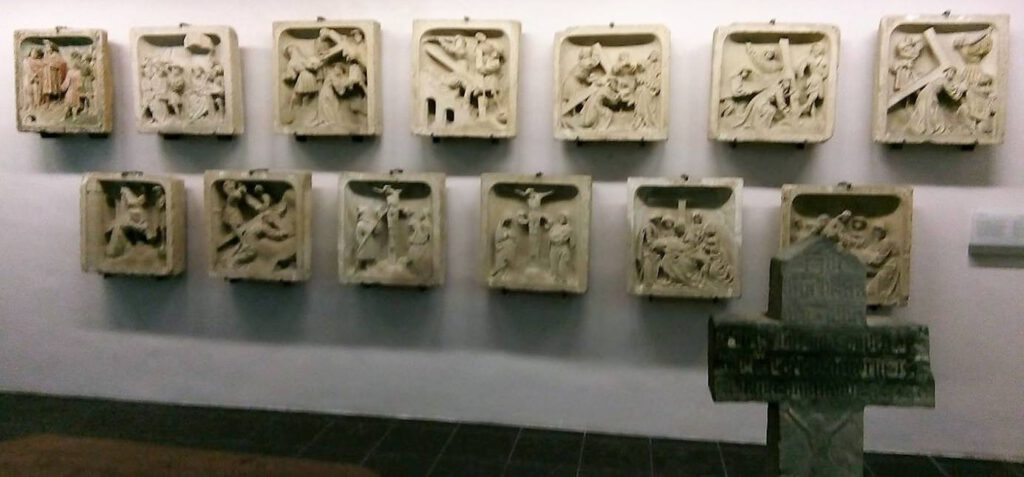
The 13 Aalten Stations of the Cross in the Museum Catharijneconvent in Utrecht
“den Berch van Calvarien”
A file from 1580–1581 has been preserved in the Gelders Archive in Arnhem: an inventory of the possessions of the Nazareth (Schaer) monastery near Bredevoort. Prior Johan van Vueren was commissioned by the Guelders authorities to survey the monastic lands. The possessions of Nazareth had been confiscated during the transition of Guelders to the Reformation. From then on, the revenues were used to fund the training of orthodox Protestant ministers and schoolmasters. On the Aalten Es, north of the village, lay a plot of land, about which Van Vueren noted:
“Master Sander ter Woert with his brother-in-law have (…) a piece of land situated in the Aalten Esche near the Berch van Calvarien, measuring 11 and a half schepel of sown land.”
Procession Park
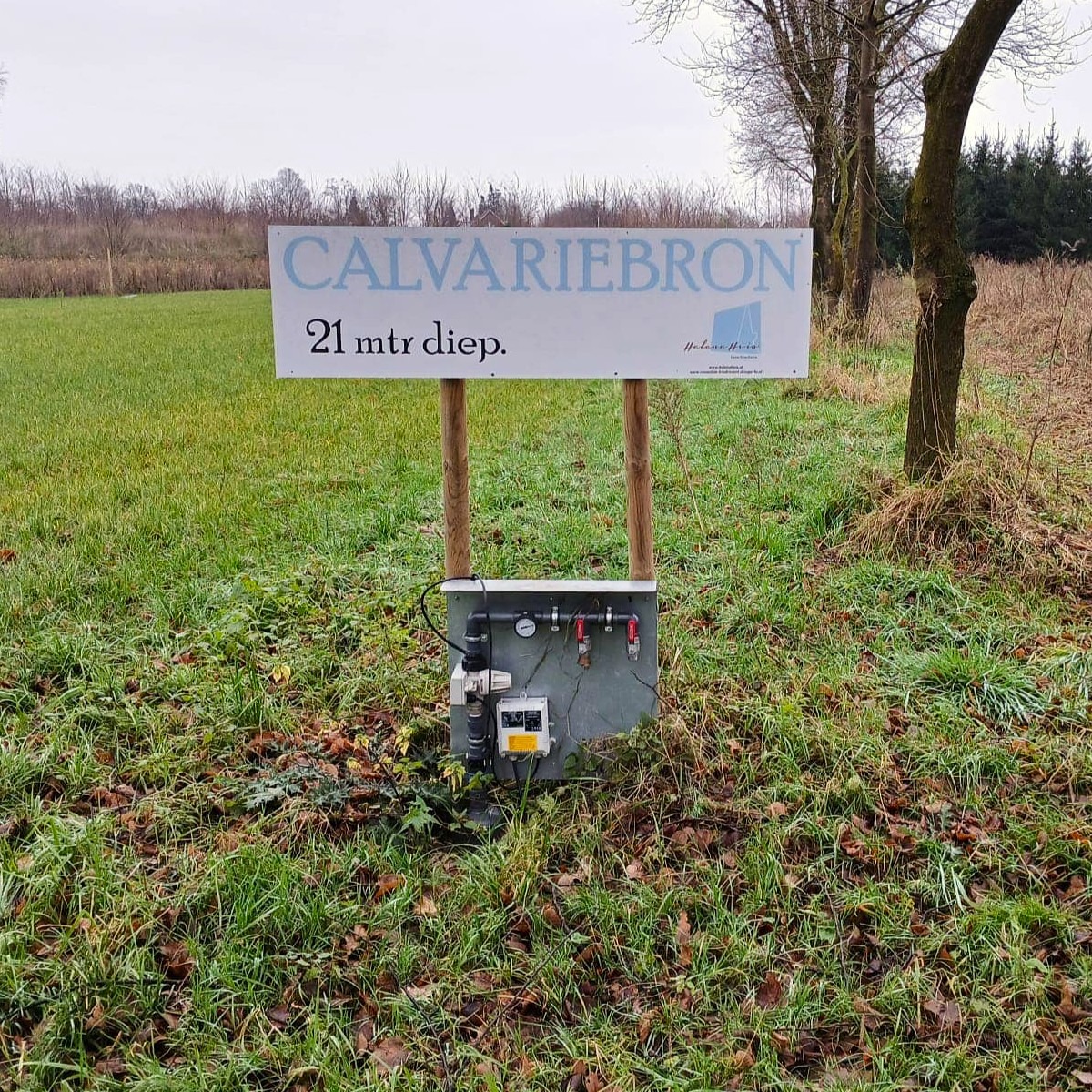
In 2023, plans emerged to create a procession park at the beginning of the Barloseweg, featuring replicas of the Aalten Stations of the Cross and Bible-related vegetation. For the maintenance of this park, a water tap was already installed, which has since been named the ‘Calvariebron’ (Calvary Spring).
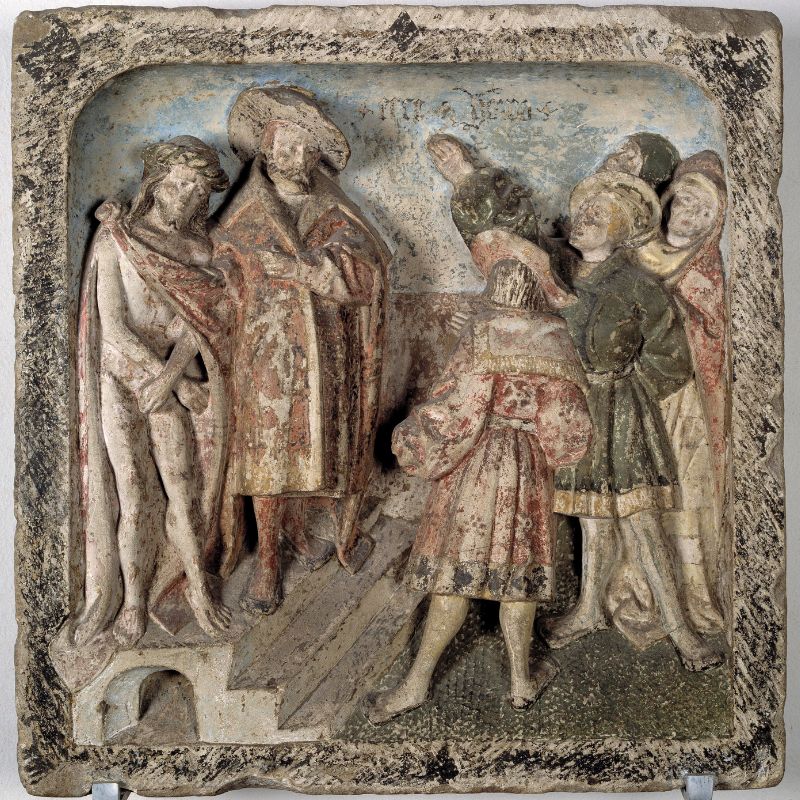
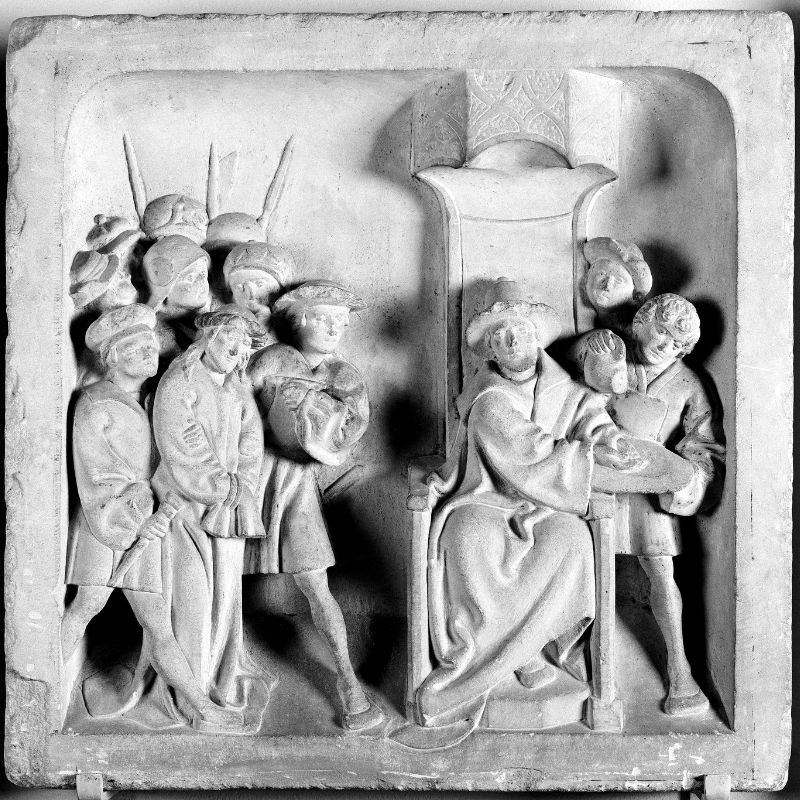
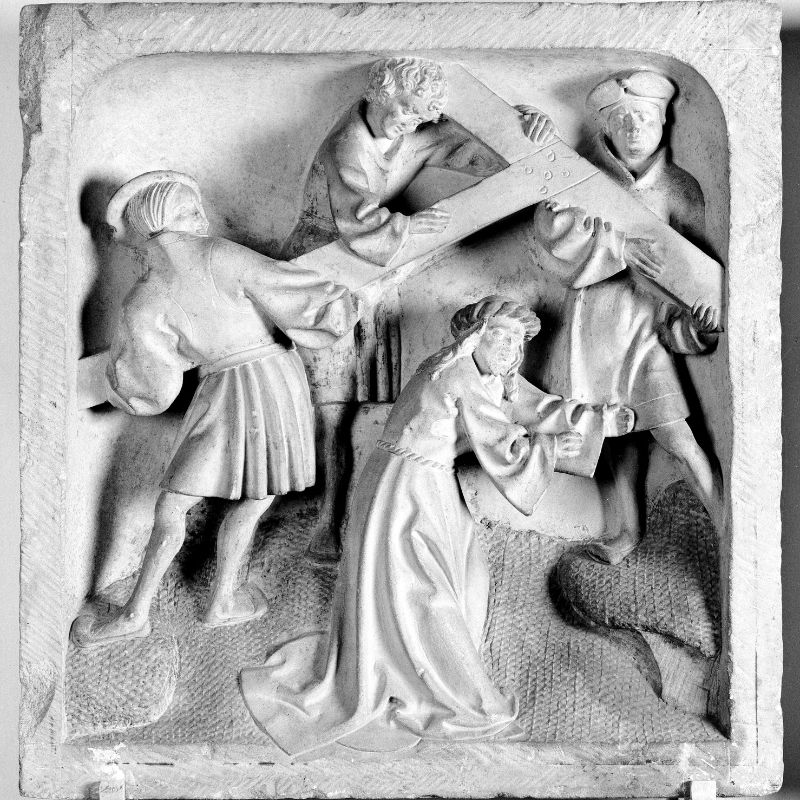
In the Late Middle Ages, a series of thirteen Stations of the Cross depicting the Passion of Christ was erected in Aalten. The stations are believed to have been crafted around 1530 by the Westphalian sculptor Heinrich Brabender. They vanished during the Reformation at the end of the 16th century, but were rediscovered in 1859. The Aalten Stations of the Cross are unique of their kind in the Low Countries. Today, they can be admired in the Museum Catharijneconvent in Utrecht.
Origin of the Devotion to the Stations of the Cross
Towards the end of the Middle Ages, devotion to the Stations of the Cross emerged as a means for the faithful to contemplate the suffering of Christ. The stations depicted the various events that took place during Christ’s journey to Mount Golgotha, where he was crucified. The earliest Stations of the Cross were established by pilgrims who had visited the Holy Land – present-day Israel. The stations were presumably intended to re-enact the journey and served as a status symbol for the founder. By reciting the corresponding prayers at each station, the faithful could earn indulgences, just as they would on an actual pilgrimage.
The Aalten Stations of the Cross
In the Late Middle Ages, thirteen stone Stations of the Cross were placed in Aalten. These square, sculpted reliefs are crafted from Baumberg sandstone, measure approximately 60 by 60 cm, and are about 10 cm thick.
The erection of the Aalten Stations of the Cross must be viewed within the context of the veneration of the Cross in this region, particularly in Westphalia, where Stations of the Cross were common in the Middle Ages. The reliefs were likely made around 1530 in Münster, which was an important centre for Westphalian sculpture at the time. The style of the stations bears a strong resemblance to the work of Johann Brabender, who took over his father Heinrich’s workshop in 1538. Similar stations were discovered in 1934 in the domestic chapel of Havixbeck Castle, near Münster.
The Van Lintelo family may have been involved in the founding of the Aalten Stations of the Cross. In the first half of the 16th century, father and son Evert van Lintelo served as drossards (bailiffs) of the Lordship of Bredevoort, under which Aalten fell. Bernhard van Lintelo (died 1511), a nephew of Evert senior and cousin of Evert junior, was a canon in Münster and a pilgrim to the Holy Land. Given that Evert senior died in 1529, it is a compelling assumption that he bequeathed money for the creation of the Aalten Stations of the Cross.
Calvary Mount
The original location of the Stations of the Cross is unknown. According to one theory, the stations were built into the churchyard wall or positioned along an access road to the church. Another theory suggests that the first station stood near the Oude Helenakerk (Old St Helen’s Church), while the remaining stations were placed along the sloping path through the Aalten Es (communal open field). The final station is thought to have been located near the current water tower, on one of the highest points in Aalten – a spot that was reportedly called Calvary Mount at the time.
In the Volontaire Protocollen (voluntary registers) of Bredevoort, a mention of the Stations of the Cross on the Aalten Es can be found dated 5 February 1638:
“(…) a piece of arable land (…) situated on the Aalten Esch by the Stations of the Cross (Kruijsswech), with one side adjacent to Bruijninck Land, with one end also adjacent to Bruininck Land, and the other end adjacent to the Heelweg (…)”
Disappearance and Rediscovery
Until the end of the 16th century, the parish of Aalten fell under the Bishopric of Münster. However, with the capture of Bredevoort – the administrative centre of the eponymous lordship to which Aalten belonged – by Prince Maurice on 8 October 1597, the Reformation began in this region as well. This led to the removal of Catholic symbols, including the Aalten Stations of the Cross.
The stations were preserved, however, albeit in an unexpected location. In 1800, the house at Kerkstraat 15 in Aalten was purchased by Roman Catholics, who converted the building into a presbytery and church. In 1859, the property was sold to the manufacturer Eduard Driessen, who had it demolished and rebuilt into a residence. It was on this occasion that the reliefs were discovered. They were found to have been placed upside down and used as a kitchen floor.
On 28 August 1870, Driessen donated the reliefs to the Archbishopric Museum in Utrecht.
Religious Heritage
Today, the Aalten Stations of the Cross form part of the permanent exhibition at the Museum Catharijneconvent in Utrecht. The reliefs are considered the most complete and earliest known example of Stations of the Cross in the Low Countries. As religious cultural heritage, they are of national significance and constitute an important part of the religious heritage of Aalten.
Below are the thirteen Aalten Stations of the Cross. The images are sourced from the website of the Museum Catharijneconvent in Utrecht, photographs by Ruben de Heer (click to enlarge).
01 | Ecce Homo: Pilate presents Christ to the people
02 | Christ is condemned by Pilate
03 | Christ is made to bear the Cross
04 | Christ falls from the steps of Pilate’s house
05 | Christ meets his mother Mary
06 | Simon of Cyrene helps Christ carry the Cross
07 | Christ meets Veronica
08 | Christ falls outside the city gate of Jerusalem
09 | Christ falls at the foot of Calvary Hill
10 | Longinus pierces the side of the deceased Christ
Deze website gebruikt cookies voor een optimale ervaring en analyse van bezoekgegevens. Ga je hiermee akkoord? Zonder toestemming werken sommige onderdelen van de site mogelijk minder goed.
Functioneel
Always active
De technische opslag of toegang is strikt noodzakelijk voor het legitieme doel het gebruik mogelijk te maken van een specifieke dienst waarom de abonnee of gebruiker uitdrukkelijk heeft gevraagd, of met als enig doel de uitvoering van de transmissie van een communicatie over een elektronisch communicatienetwerk.
Voorkeuren
De technische opslag of toegang is noodzakelijk voor het legitieme doel voorkeuren op te slaan die niet door de abonnee of gebruiker zijn aangevraagd.
Statistieken
De technische opslag of toegang die uitsluitend voor statistische doeleinden wordt gebruikt.De technische opslag of toegang die uitsluitend wordt gebruikt voor anonieme statistische doeleinden. Zonder dagvaarding, vrijwillige naleving door je Internet Service Provider, of aanvullende gegevens van een derde partij, kan informatie die alleen voor dit doel wordt opgeslagen of opgehaald gewoonlijk niet worden gebruikt om je te identificeren.
Marketing
De technische opslag of toegang is nodig om gebruikersprofielen op te stellen voor het verzenden van reclame, of om de gebruiker op een site of over verschillende sites te volgen voor soortgelijke marketingdoeleinden.