
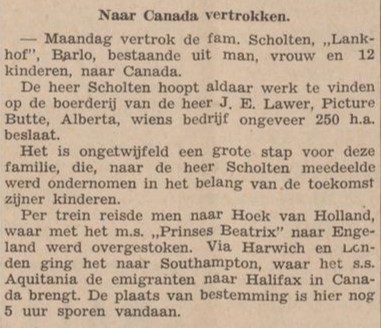
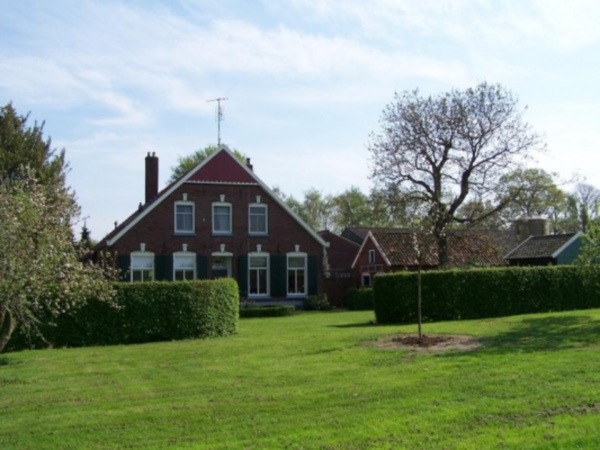
It was 1949 and the Scholten family, consisting of father Hendrik Willem Scholten, mother Grada Everdina Scholten-Kemink and their twelve (!) children, lived on “Lankhof” farm in Barlo. Of the twelve children, seven boys and five girls, the eldest was 22 and the youngest 7 years old.
Son Roelof, born in 1940, recalled in a 2015 interview the nervousness that prevailed in the family during World War II. It was a very dangerous time. They also hid people in the attic. The Germans often came to check if they could find anyone. When bombs fell at night, they all went to the air-raid shelter and protected themselves as best they could.
After the war, the Scholten couple felt the desire to seek their fortune in Canada, not primarily for their own future, but especially for that of their children. A major reason was the population growth in the Netherlands; the country was becoming full!
In the Achterhoek, too, almost all available land had already been brought into cultivation. While it was customary for the eldest son to take over his father’s farm, the other sons were unable to start their own businesses due to a lack of agricultural land. If they wanted to spread their wings, they had to seek their fortune elsewhere.
In 1949, the Scholten family decided to take the plunge and emigrate to Canada. Hendrik Willem leased out the business in Barlo, because you never knew. In case they became homesick, it was good not to burn all their bridges behind them.
The long journey
In the night from Sunday to Monday, March 7, 1949, the Scholten couple departed from Barlo with twelve children by train to Rotterdam. It was the first part of the long journey they still had ahead of them. For the move, they took an army truck and a trailer. On it were three wooden containers with their remaining possessions.
During the course of the morning, they embarked on the “Prinses Beatrix”, the ferry to Harwich. They were part of a group of 220 people from all parts of the country. They were mainly farmers with their families, who were going to start a new life on the other side of the Atlantic Ocean.
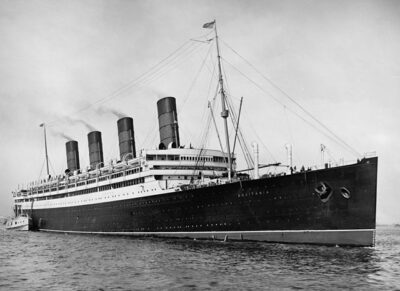
From Harwich, they traveled further by train to London, where the enterprising group stayed overnight. Then they went by ship to Southampton to transfer there to the “Aquitania”, a large passenger ship of the Cunard White Star Line.
The “Aquitania” was a 46,000-ton ship and was, after the “Queen ships”, also of the Cunard White Star Line, the largest ship in the world. It could carry 1,500 passengers and the crossing to Halifax in Canada took about six days. It was the only steamship in the world with four funnels. A minor detail? Certainly not! There was a time when emigrants insisted on sailing on ships with many funnels. Some travel agencies showed prospective travelers photos where an extra funnel had been added to a ship… The more funnels, the greater the safety, believed the inexperienced emigrants.
In any case, the 220 Dutch people in tourist class, with small dormitories for six to twelve people, would have a decent crossing. From Halifax, the Scholten family would then have to spend another five days on the train to reach their destination via Medicine Hat and Lethbridge: the town of Picture Butte in the Canadian province of Alberta.
Destination reached
The Scholten family arrived in Picture Butte by train on March 18. It was very cold. Upon arrival, it seemed as if all 500 residents of the town were present. Perhaps they thought World War III was starting when an army truck rolled out of the train car. They settled in two barracks just north of Picture Butte, on the farm of J.E. Lawlor.
The conditions in those barracks were not ideal. It was just as cold inside as it was outside. Father and mother slept in one of the barracks, which also contained the kitchen. The children all slept in the other barrack. Father placed double beds on top of each other with about 60 centimeters between them. The girls slept on one side and the boys on the other. There was a dressing area at the front.
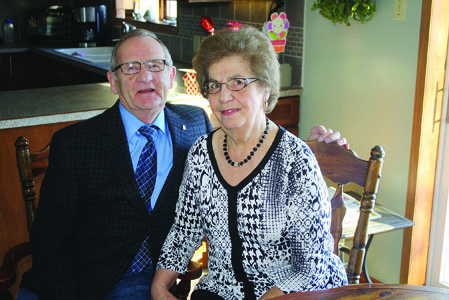
In the beginning, it was difficult. The wage was about $0.25 per hour. Father and mother worried a lot in those years about how they could buy enough food for the family. Although the local supermarkets, Woodruff and Stella-Lacey, were very helpful. They could buy on credit there and sometimes they even received something for free. But in the winter, there was very little work. The boys went to Burmis and worked there at the lumber yard. Even though they earned hardly any money, they at least had a place to stay, clothing, and food.
About three years after arriving in Canada, the Scholten family moved to another farm, just east of Picture Butte. They stayed there for a year and grew beets. Then, in 1953, Hendrik Willem bought a farm about seven kilometers from Picture Butte, with about 130 hectares of land. Roelof went to school in Picture Butte and also helped his father on the farm. Some of his brothers also became farmers, and some chose other professions. Two became teachers and moved to another part of Alberta. Roelof remained on his parents’ farm and helped his father with the farming work.
Hendrik Willem Scholten passed away in 1965 from pneumonia. Grada Everdina passed away in 1987, at the respectable age of 89.
Sources
- Aaltensche Courant, March 11, 1949 (Delpher)
- 2015 interview with son Roelof Scholten (1940)
- Zutphensch Dagblad, March 9, 1949 (Delpher)
- ‘Citizens of the Year’ (Sunny South News, January 5, 2016)