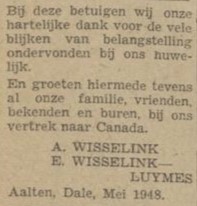
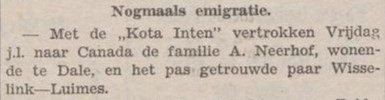
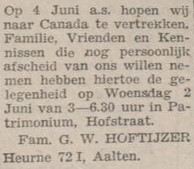
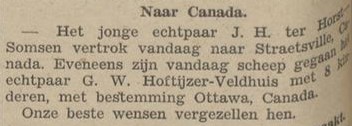
After the Second World War, several hundred people from Aalten emigrated to Canada. Here you will find a number of newspaper clippings on this subject, including advertisements from emigrants saying goodbye to their loved ones in the Netherlands.
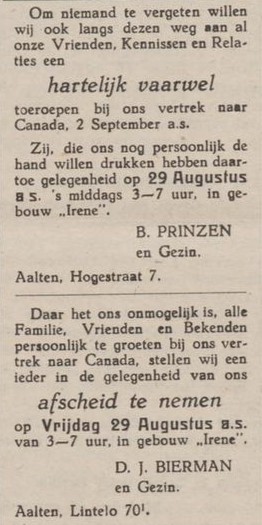
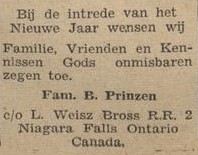
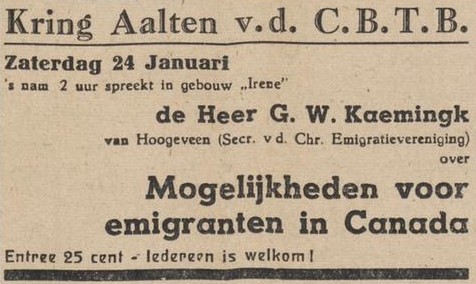
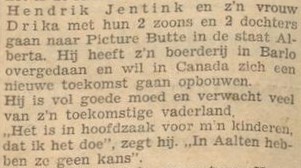
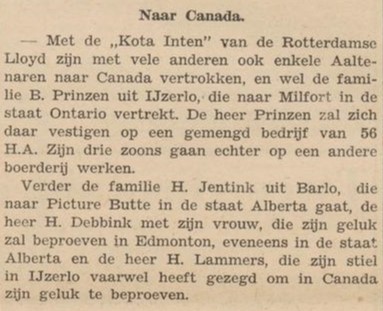
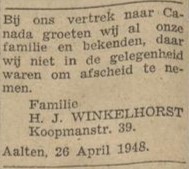
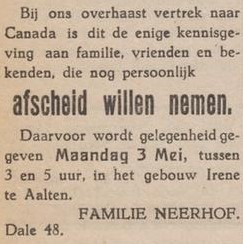
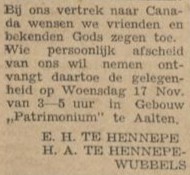
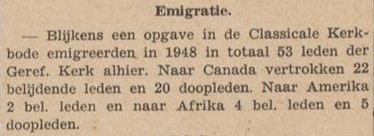
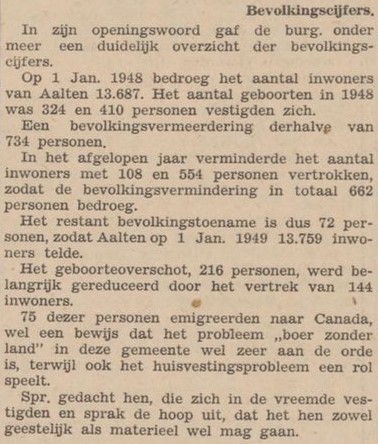
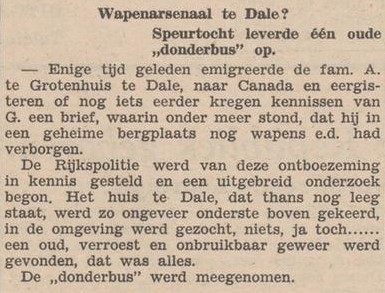
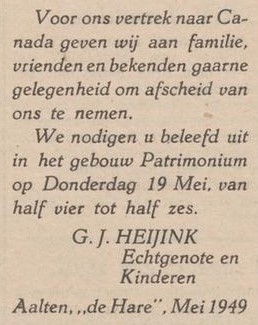
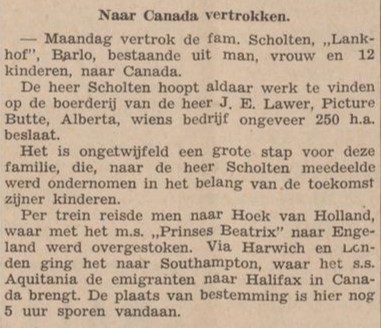
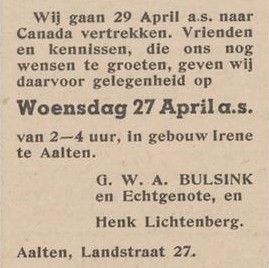
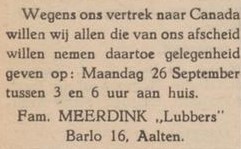
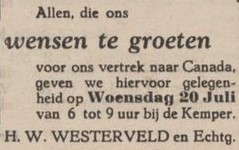
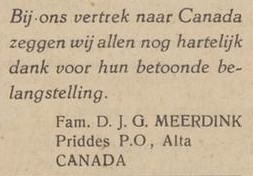
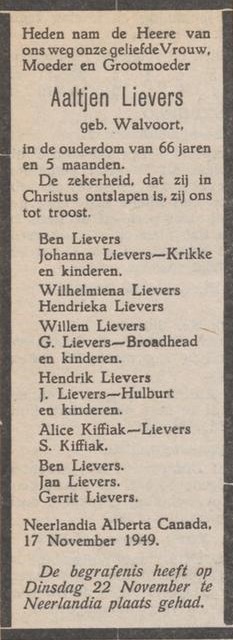
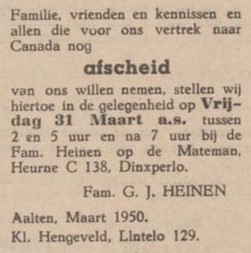
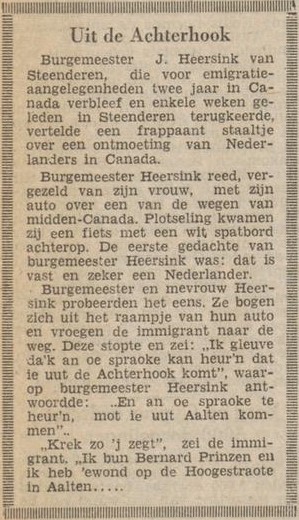
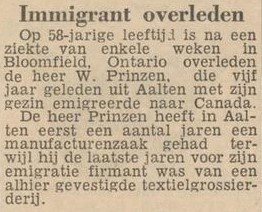
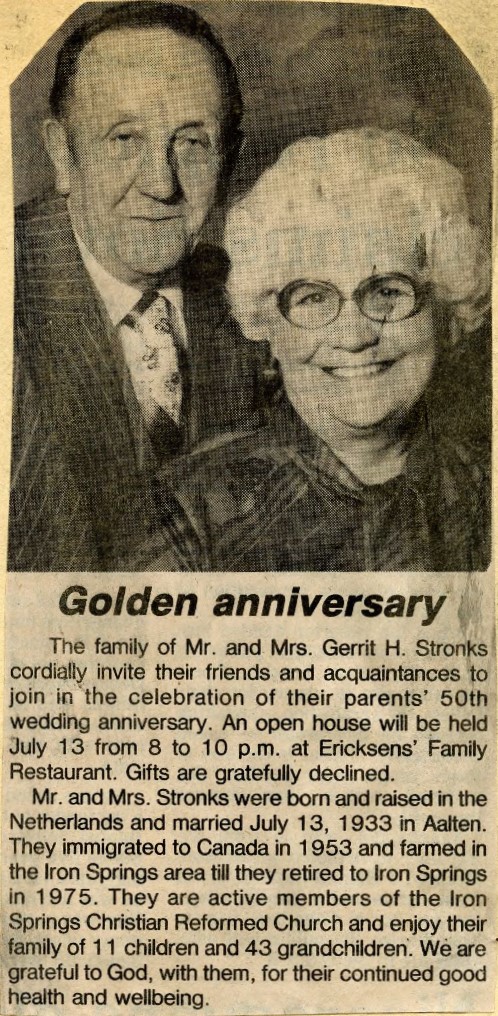
After the Second World War, several hundred people from Aalten emigrated to Canada. Here you will find a number of newspaper clippings on this subject, including advertisements from emigrants saying goodbye to their loved ones in the Netherlands.
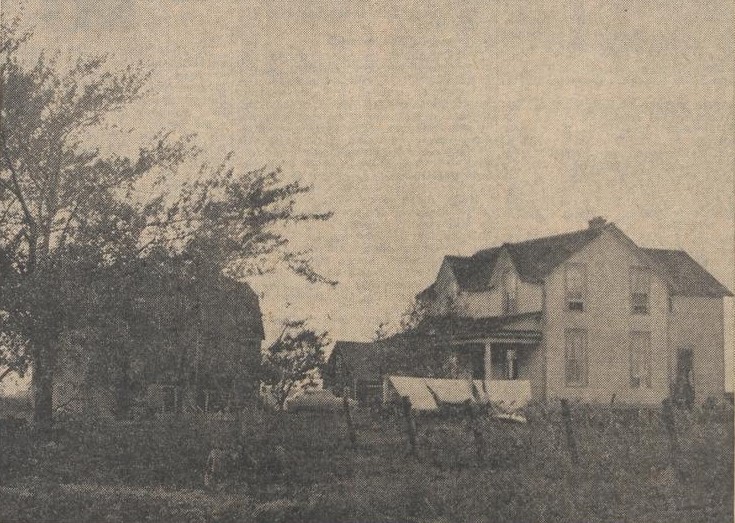
Zutphens Dagblad, 4 February 1956
Winter 1951 in the Netherlands, an important meeting about a burning issue. A meeting that may have escaped the attention of the Dutch people and certainly did not have a report in the press, but whose results have been no less drastic in the life of a family, rooted by generations in the familiar surroundings of our beautiful Graafschap. The meeting was a family gathering of the Kortens at the parental farm “Lensink” below Aalten.
The subject is familiar to many families in the Dutch countryside: what to do when the children grow up, get married and want to stand on their own two feet, have their own farm? A problem, although not new, but increasingly topical as the population increases, land is lost due to the construction of industries and the construction of roads, expansion of cities and airports. A problem for which no reclamations can provide a solution, tragic because of its unsolvability in its own country.
“Lensink” is a farm, twelve hectares in size, where father Korten and his family already got the most out of it. A farm, which gives an existence to one family, but can no longer be divided. Under the roof of the familiar farm, a decision was made on that day of 1951. If no solution could be found in their own country, they would try it across the borders. Many had already gone before, including to Canada, also from their own area. And the reports heard from overseas about the experiences there raised hopes that perhaps a solution to their problem would be found.
It must have been a melancholy farewell in the autumn of that year. Farewell to the farm, the familiar surroundings, to the children who stayed behind because other ties bound them in the old country. A melancholy perhaps hidden behind the excitement of the big event and the nervousness of the preparations, but also gilded by the expectations of an uncertain future. Have those expectations been met? Was the solution found in Canada that was no longer available in the Netherlands?
In the autumn of 1955, four years after leaving the Netherlands, Korten will answer that question in the affirmative. In his cautious way, he will point out what was achieved at that time, with an open eye for the difficulties that lie ahead, but also with confidence in his own abilities and grateful for the horizons that have been opened up for him and especially for his children. Perhaps there will be those who, seeing the results, say that it is easy to achieve success with such a bunch of big children. But does that make any difference? In the Netherlands it might have been achieved only partially or never. The young families will have to struggle longer to get this far, may have to make more sacrifices for it and have more difficult early years. But they have the strength of youth.
In October 1951, the family arrived in Canada and traveled on to a small town in Southern Ontario, not far from Hamilton. An old acquaintance from Aalten made sure that the family found work and shelter on a fruit farm, while a place was found for the family of a married son on a farm nearby. Korten stayed there for two years. The children were given work in fruit and tobacco cultivation, where good wages are earned during the summer through long days. The joint income was saved and in the summer of 1953 the time had already come to look around for companies for sale.
By that time, Korten will have become accustomed to the big difference between the Netherlands and Canada, where farms are offered for sale in abundance. Good and bad, cheap and expensive, big and small. He drove around with his sons for many hours, visiting companies, before he had made his choice. The available financial resources imposed limitations, the company had to be large enough for his family and offer development opportunities for the future…
If someone had told Korten before his departure from the Netherlands that he could once again call a vast vineyard his own, he would have laughed at him. But that unexpected happened, because in November, barely two years after his departure, the family moved into a farm, large 45 hectares, half of which were with grapes; the company that Korten had chosen. One can imagine that it means quite a change for a Dutch farmer of the mixed farm when he exchanges his place among the cows for a life in the middle of the vines, especially if he has no experience with grape growing.
The Kortens were in that position. A lot of adaptation was demanded of them again, much was and still has to be learned. Neighbors in this region, where many grapes are grown, gave advice and Korten now also knows that he can turn to the Information Service for advice. The pruning in the winter, tethering in the spring, the watering and tillage, the harvest, everything was new and strange. Gradually they grow into it and learn the tricks of the trade and the demands it makes.
Warden’s and Niagara’s, Concords, Fredonia’s and Diamond’s, grape varieties that each require their own care, are names that no longer sound strange to them. And that’s what this company needs more than anything else: expertise. Several times during the last few years it has changed hands, it was neglected and polluted when it was moved into. Production is still below normal, which is not only due to the fact that most of the vineyard is still young and not at full production. Pruning should be improved and old trunks removed. The buildings should be refurbished, but in Korten’s eyes that can wait a while. First production must be brought up to standard. And that already requires enough time and capital.
For his sales, Korten has a contract with a wine factory in the area. The price he receives for his grapes is fixed in the spring and is different for the varieties. Over the past year, these prices ranged from $80 to $100 per ton. These grapes are processed into wines and grape juices. Some varieties are more popular than others and Korten can count himself lucky with a considerable variety in the varieties on his farm, which ensures that he is more assured of good sales than when only a few varieties are grown. He sells a small part of the harvest as hand grapes to wholesalers or directly to the public. Although he can charge more for this, it also takes more work and time to prepare the baskets. Moreover, this sales are very limited.
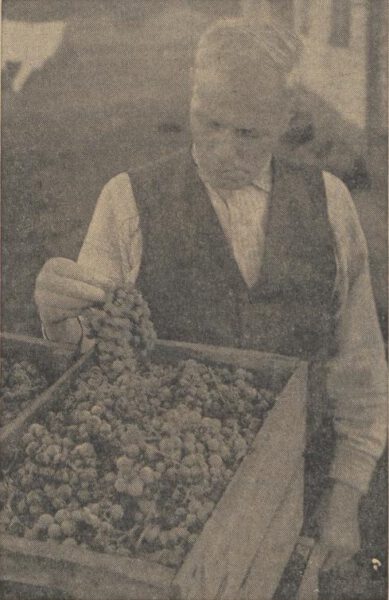
Grape cultivation is subject to significant risks, such as frost and hail damage, plant diseases, bird and insect damage, against which the grower can only partially insure or arm himself. Sales do not cause Korten any headaches and he gets a good price for his product. For sales, the Canadian grape grower is to a considerable extent dependent on exports to the United States, where production is regularly increasing. However, much has already been done in the field of marketing organization by grape growers’ associations.
However, it does not look like there will be any major difficulties in marketing in the future. On the Niagara Peninsula, where Canadian grape cultivation is concentrated and where Korten has his business, the same phenomenon is occurring that our own country knows so well: more and more land is being taken up for industrialization and the area cultivated with grapes is also declining. This region, so ideally suited for climate and soil type, has a great attraction for industry due to its location in a densely populated part of this country and the presence of excellent transport facilities. Although this development is not in the general interest of fruit cultivation in this region and there is talk of setting up regional plans to steer this in the right direction, it means a guarantee for the grower for sales in the future.
In addition to the vineyards, the company has more than 20 hectares of arable land and grassland. Originally, this was all in grass, but Korten only has two dairy cows and two heifers and decided to tear up part of the grassland. On the arable land, he now grows wheat, oats, corn and tomatoes, the last crop on a supply contract with a cannery. The cattle are also in such a state that he would like to keep more cows, especially because he needs the manure so much on the farm. But he is not yet sufficiently well equipped to be able to put money into this now. It is still “all hands on deck” to meet the obligations that have been entered into with the purchase of the company and also to develop the company.
The boys work with others whenever they can be missed, either in the construction company or in tobacco cultivation. Despite the heavy burdens, however, there is the satisfaction of building a life and the confidence in a future without fear of the problem that drove them to Canada: what are the boys going to do? There is now sufficient space for development on their own farm and beyond. Mother Korten now makes her own wine, not much but from “own cultivation” and good taste, to taste on special occasions. And on those occasions, she and her husband will sometimes reminisce about the time in Aalten, on the “Lensink”, where a son now holds sway and a young family grows up.
Do you have interesting stories about family members who emigrated from Aalten to Canada? Send us a message!

Dagblad Tubantia, 1955
Four years ago, Marinus Rhebergen from Aalten left for Canada and he is currently on holiday in his hometown for a few months.
“Canada is, it is said, the land of unlimited opportunities, but don’t think that every immigrant in Canada will become rich in a few years. Don’t even think that everyone who emigrates to Canada will have acquired a position there within a few years, as it would never have been possible in the Netherlands. There are exceptions, there are people who are extremely lucky and have acquired a strong position within a few years, but…. They remain exceptional cases.”
This is according to Marinus Rhebergen from the Richterinkstraat in Aalten, who emigrated to Canada four years ago and returned yesterday for a holiday stay in Aalten, where his parents and other relatives live. Four years ago, Marinus left, together with his friend Constant de Jong, also from Aalten. It was actually a bit of an adventure for Marinus and Constant. Both had jobs and both were single. They did not have many worries. The unknown attracted them and they did not lack entrepreneurial spirit. One day we left, just like that, hoping for a blessing.
“When we arrived in Canada,” Marinus told us, “we had to get some money in our pockets. After we came ashore, we decided to step into the first factory we saw. It was a textile factory. Beforehand we had “tossed”, where it turned out in such a way that, if only one man was needed, it would be my turn first. I was lucky in that first factory. The director – an Englishman – could use people. He spoke highly of the good relations that had always existed between the English and the Dutch people. Of course I was wise enough not to talk about the wars with England. After a few days, the director came to tell me that he also had work for my friend. That’s how we both started working in the same company.”

However, Marinus did not want to stay in the textile factory. He looked for a job in an office and finally succeeded in a place in the north of Ontario. “I had a good job there,” Marinus said. “There was one objection to it; I was the only Dutchman in that place and that was not pleasant. The mentality of the Canadians is very different from that of the Dutch and when push comes to shove, you will always remain Dutch there. Whether you like it or not, you always keep your Dutch sense of sociability and community practice.”
Marinus has now gone to Aalten. For how long? Oh, he doesn’t know that yet. He is not tied to anything. He has quit the job in Canada. His boss there gave him a beautiful certificate and said that the office chair is ready for him at all times. However, Marinus does not want to be isolated among the Canadians again as a Dutchman. Somewhere else in Canada, he will soon try his luck again.
Marinus has spoken to numerous Dutch people in Canada in the past four years, including several former Aalten residents. They are doing pretty well, of course some better than others. “In general,” says Marinus, “someone who has a small business or a small farm in the Netherlands should not think that he will be able to work in Canada within a few years. Many who were so-called small self-employed in the Netherlands, are also self-employed in Canada. If one wants to take giant steps on the road to fortune, one must fully adapt to the Canadians. That means, adopting their good qualities, but also the bad ones. Then one gets a lot of relationships and that is of enormous importance, but not moral.
Constant de Jong, who left at the same time as Marinus, still works in the same factory. He was less able than Marinus to change, because he married there a few years after arriving in Canada. And Constant is a man with Dutch responsibility; A married man should not go on adventures. Marinus has remained loyal to the bachelor life.
Marinus Rhebergen often visited the Voortman family in Canada. This was not only caused by the fact that there are four boys in this family, with whom it is pleasant to talk, the wife of Voortman Sr. comes from Aalten. Mr. Voortman, who was a widower, remarried in Hamilton to Ms. Cato te Brake, who left for Canada a few years ago. The Voortman family, says Marinus Rhebergen, first lived in Picton for a number of years. After several years of hard work and considerable savings, Mr. Voortman decided to buy his own house.
He succeeded in Hamilton, where there was a large house for sale in the center of the city. Mr. Voortman became the owner of this building and decided to furnish it partly as a guest house. Business went very well almost from the start. According to Marinus Rhebergen, this was mainly due to the good reputation that the boarding house received. They were mainly unmarried Dutch immigrants, who boarded with the Voortman family.
They had a good time there. Not only was good food and drink provided, but a lot of attention was also paid to creating a cozy atmosphere. In general, the Canadian boarding houses do not excel in conviviality. The Canadians are less fond of domestic traffic than the Dutch and this is also evident from the design of their homes.
Especially the unmarried Dutch immigrant does not have an easy time in Canada. Financially, if he knows how to get things done, he can get by, but earning money alone does not make the emigration successful, one must also feel at home in the new environment.
Unmarried people in Canada are dependent on boarding houses. “That’s not all,” says Marinus. “There is almost no domestic traffic and you miss the cozy atmosphere of the Dutch families. The Dutch immigrants also often have boarders, but one drawback is that a Dutch family sometimes has eight to ten boarders. That sometimes makes the flush thin.”
The young people, who have their boarding house with the Voortman family, all feel at ease in Canada and that is also the case with the young men, who spend a few pleasant hours here in the evening after work.
Marinus Rhebergen also met many other immigrants in Canada. Of course, he mainly visited Dutch people from Aalten. Mr . J. Bierman from Lintelo initially worked on a farm in southern Ontario for a few years. A few years ago, he bought a farm in Cochrane, in northern Ontario. The land was cheap and is good. A disadvantage is that people live quite lonely in the north and that the winter is long there. Mr. Bierman mainly grows a lot of potatoes. The farm is about 500 hectares in size.
Mr . G.C. Stronks, formerly living on the Hogestraat in Aalten, works in Burlington on a market garden. He is currently building a house himself.
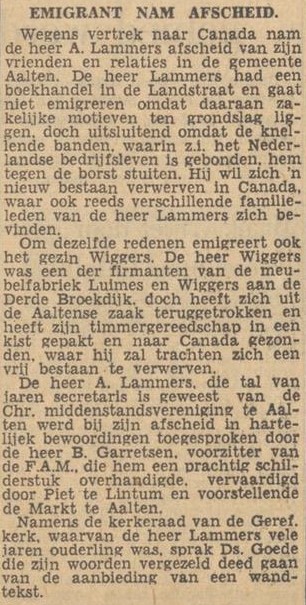
Mr . Ant. Lammers, who had a bookstore in Aalten on the Landstraat, lives with his family in Hamilton. Mr. Lammers was first a pioneer for a few years, but now has permanent work in a printing house and bookstore. So he has ended up back in his own industry.
Mr . J. Wiggers, one of the directors of the furniture factory Luimes and Wiggers in Aalten, has been living in Smithfield near Trenton for several years. Mr. Wiggers is a craftsman who is also greatly appreciated for his work in Canada. He has mainly focused on taking care of interiors of homes. He has built a beautiful house for his own family. Mr. Wiggers takes on the finishing of homes in Canada.
Mr . H. Winkelhorst, who lived in Aalten on the Koopmanstraat, now owns a farm in Smithfield. He has now bought the company, which he had rented for several years.
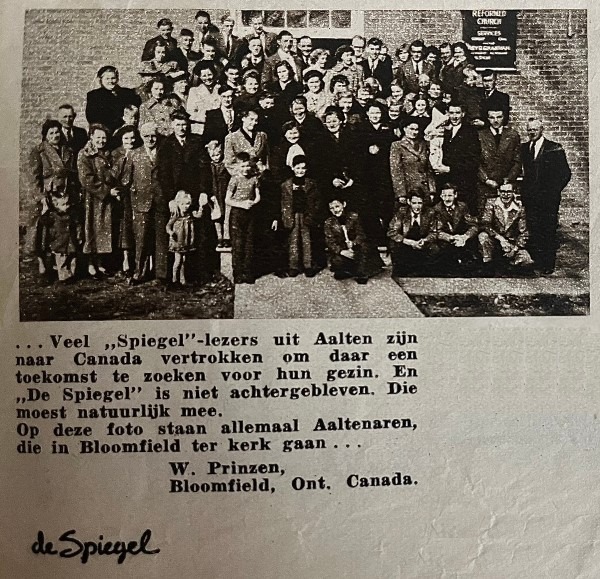
Mr. Bertus Prinzen, who ran a grocery store on the Hogestraat in Aalten, and was one of the first emigrants from Aalten, has a large farm in Jarvis – a cattle farm. Mr. Prinsen has numerous positions in public life in Jarvis. He is a source of information for many immigrants.
Mr. Bernard Prinsen from IJzerlo, has a good farm in Bloomfield near Picton. It is a mixed farm. His son also works on the farm, after he had first worked for the General Motors for a few years.
Mr. Willem Prinzen, who lived in Aalten on the Willemstraat, works for a construction company, together with one of his sons. His other sons also have good work. The W. Prinsen family lives in Bloomfield, where they have bought a house. In Aalten, Mr. Prinsen was a wholesaler in textiles.
The brothers Geert, Arie and Wim Lammers from Aalten have found well-paid work in Canadian factories.
Do you have interesting stories about family members who emigrated from Aalten to Canada? Send us a message!
As scratchy and as cheerful as she left Aalten six months ago to visit her relatives in Canada, Mrs. wed. Lammers-Bulsink, better known in Aalten as “grandma Lammers”, arrived back at her home in the Willemstraat.
On November 30 of last year, this energetic woman, of whom one can hardly believe that she will turn 84 this year, left with the Rhine Dam to Canada to visit her children, grandchildren and great-grandchildren, who emigrated to Canada after the war and had written several times in letters: “Grandma, you should be able to see, how we have it here”.
Granny Lammers, after some consideration, accepted this invitation and left for Canada at the end of last year. She visited her many family members, who had a hard time imagining that “granny” really came to watch, and also gave her eyes a good feast. She also met other former Aalten residents in Canada. The visit of their elderly mother and grandmother was a surprise for the children and grandchildren in Canada, bigger than one could have imagined there.
Granny Lammers, who had a pleasant time in Canada, traveled back on May 14 with the Rijndam. Yesterday she arrived in Rotterdam, where she was picked up by her children. She then drove by car to Aalten, where she arrived last night at seven o’clock. She had to shake many hands of family, neighbors and acquaintances upon arrival. She had had a good time in Canada, she said.
Last night, the Lammers family, who live in the Netherlands, met in an intimate circle in the “Irene” building. There grandma told about her experiences and she knew how to do this in a very entertaining way, so that everyone could get an idea of the circumstances under which the “Canadian branch” of the Lammers family lives.
When grandma Lammers left Aalten, she took an audio tape with her for the family in Canada, on which words spoken by the Aalten family members were recorded. The playing of this tape caused a lot of joy and surprise in the Canadian family circle. Granny Lammers also brought a soundtrack from Canada. For example, last night in the family meeting, the voices of the relatives in Canada were heard. It turned out that many had not yet forgotten the Aalten dialect.
Do you have interesting stories about family members who emigrated from Aalten to Canada? Send us a message!
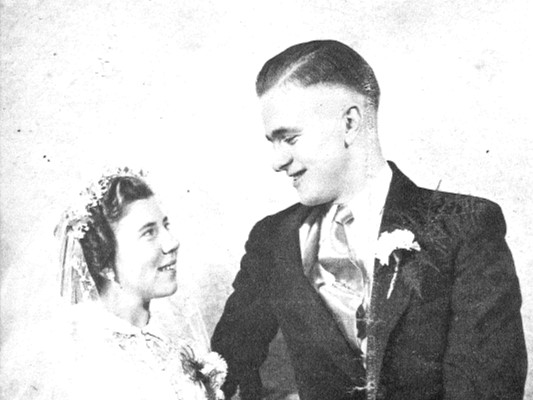
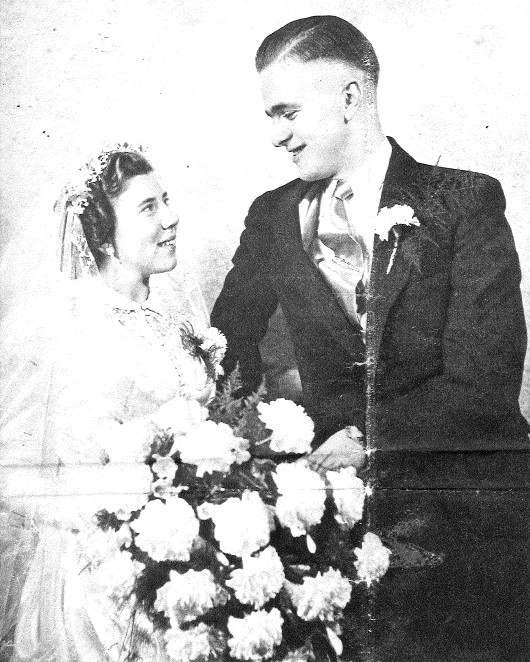
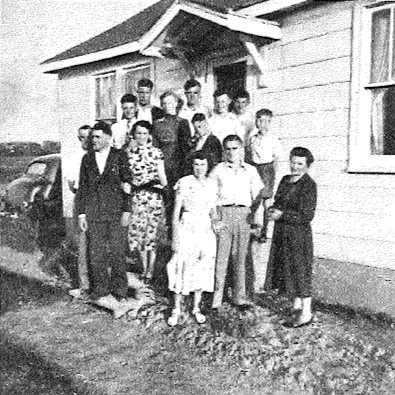
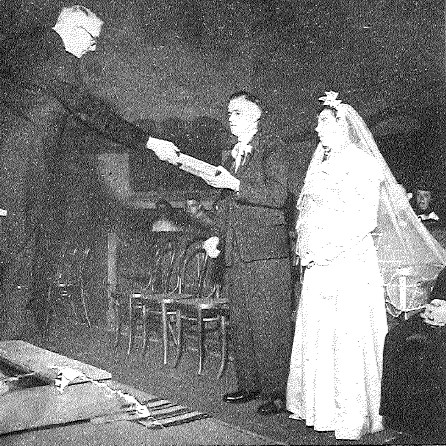
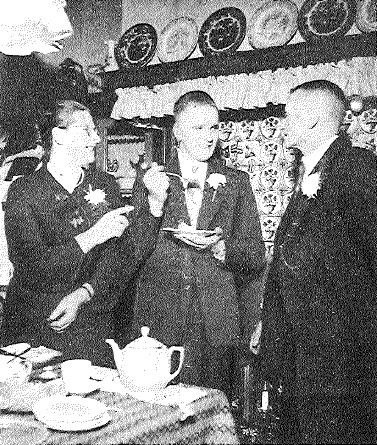
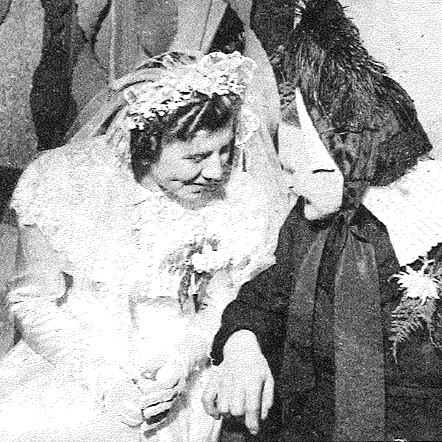
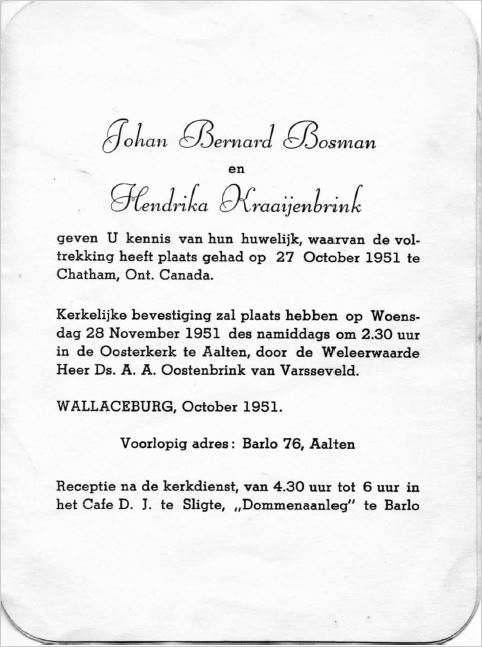
In 1951, Johan Bosman and Riek Kraaijenbrink briefly returned from Canada to their native region for the church blessing of their marriage in the Oosterkerk in Aalten.
We are sitting across from Johan Bosman from Barlo, a rural district in the municipality of Aalten. He has been away for over 2½ years as an emigrant in Canada; he is back in his native region for a short time. One can see that he has been abroad. It is noticeable in the generous cut of his clothing; it is also evident in the look in his eyes, which are clearly accustomed to larger proportions…
Characteristic in this regard is what he tells us about his arrival in Aalten by bus a few weeks ago: “Everything seemed incredibly small; the roads were so narrow and winding… I honestly thought the houses had all been pushed together…”
Today Johan Bosman is the groom! And Riek Kraayenbrink from Varsseveld, the girl he had already met before his departure for Canada, is the bride. Both had emigrated to Canada a few years ago—separately. They have returned together to have their marriage blessed in church here, in their native country.
There is a hunger for land in Aalten and the surrounding rural districts. For many farmers’ sons, there is no more land available, and therefore no means of subsistence. Consequently, many men and young families from Aalten and the surrounding area have already emigrated. And even now, many are ready to depart later this spring.
Johan Bosman left in April 1948, alone. Saying goodbye to home, and to his girl, had been difficult for him. But the prospect that Riek and her parents would also follow soon gave him courage. Johan worked alternately, on a freelance basis, sometimes on the land, sometimes in the factory. “You change jobs or professions quite easily there,” says Bosman. “Here, you don’t do that so quickly.”
In the meantime, Riek had crossed over to Canada in 1949 with her parents and six brothers. As soon as possible, the young lovers made an appointment to meet. But that is simply not so easy in a strange and large country. Love, however, makes one determined. Chatham, in Southern Ontario, was the meeting place. He traveled there from Montreal by train; she hitchhiked by car!
The girl found a position in Chatham, where she immediately had the opportunity to learn the English language. Johan went to work “nearby.” They celebrated their engagement within Riek’s family circle.
Their plan was to marry in the autumn of 1951. But in Aalten! Because they wanted to experience this great event in the familiar surroundings of their native region, amidst Johan’s family and mutual friends. Moreover, they felt this was still the best time for a visit to the Netherlands. Would it still be possible in a few years, when they might have more worries?
Johan requested his parents to arrange the necessary formalities for their marriage in Aalten. However, he received word back that a civil marriage ceremony was no longer possible for him in the Netherlands as a non-resident. The young couple then decided to have at least the church wedding take place in Aalten.
On October 27 last, they were married by law in Chatham. After that, they traveled to the Netherlands as soon as possible, where they arrived on November 22.
And on a stormy, dark autumn afternoon in December, the couple received the church blessing of their marriage in the Oosterkerk in Aalten. “Blessed is he whose help is the God of Jacob,” was the text that Rev. A.A. Oostenbrink, Reformed minister in Varsseveld, had chosen for his wedding sermon.
What must have gone through these young people’s minds during this solemn hour! Did the bride not think of her mother, who sympathized with her from afar, and of her father who was no longer able to experience this day? And will the groom, looking around the church, not have realized for a moment that this day, and this short stay in the Netherlands, signifies a final reunion with many who are sitting here around him?…
Yes, because they are going back! They enjoyed seeing parents and friends again; but staying here, no, that was no longer possible. The bride likes managing the household in Canada very much. “It’s all done more with electricity there,” she says. “Everything is arranged much more practically.”
To our question of whether the couple is already provided with a house in Canada, the groom answers: “We don’t have a house yet. If I can find a suitable farmer who has work for me, then we will find shelter on the farm. If I can find a good job at the factory, then we will rent a few rooms in the city. For newlyweds, there are still possibilities in Canada in this regard. But one day I hope to be able to buy a farm myself, because that is ultimately why I emigrated.”
These words characterize the man who speaks them. They characterize the man Johan Bosman, who is cut from the tough wood of emigration. They also characterize the situation in a country where there are opportunities, where there is still a future for young people…
Do you have interesting stories about family members who emigrated from Aalten to Canada? Send us a message!
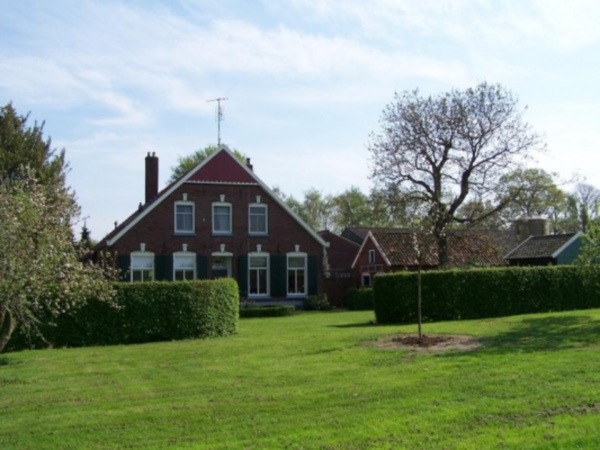
It was 1949 and the Scholten family, consisting of father Hendrik Willem Scholten, mother Grada Everdina Scholten-Kemink and their twelve (!) children, lived on “Lankhof” farm in Barlo. Of the twelve children, seven boys and five girls, the eldest was 22 and the youngest 7 years old.
Son Roelof, born in 1940, recalled in a 2015 interview the nervousness that prevailed in the family during World War II. It was a very dangerous time. They also hid people in the attic. The Germans often came to check if they could find anyone. When bombs fell at night, they all went to the air-raid shelter and protected themselves as best they could.
After the war, the Scholten couple felt the desire to seek their fortune in Canada, not primarily for their own future, but especially for that of their children. A major reason was the population growth in the Netherlands; the country was becoming full!
In the Achterhoek, too, almost all available land had already been brought into cultivation. While it was customary for the eldest son to take over his father’s farm, the other sons were unable to start their own businesses due to a lack of agricultural land. If they wanted to spread their wings, they had to seek their fortune elsewhere.
In 1949, the Scholten family decided to take the plunge and emigrate to Canada. Hendrik Willem leased out the business in Barlo, because you never knew. In case they became homesick, it was good not to burn all their bridges behind them.
In the night from Sunday to Monday, March 7, 1949, the Scholten couple departed from Barlo with twelve children by train to Rotterdam. It was the first part of the long journey they still had ahead of them. For the move, they took an army truck and a trailer. On it were three wooden containers with their remaining possessions.
During the course of the morning, they embarked on the “Prinses Beatrix”, the ferry to Harwich. They were part of a group of 220 people from all parts of the country. They were mainly farmers with their families, who were going to start a new life on the other side of the Atlantic Ocean.
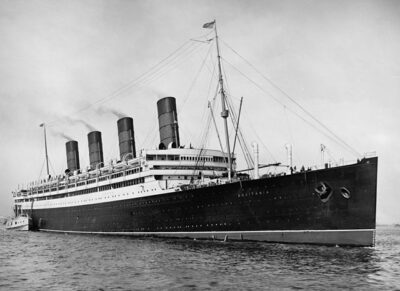
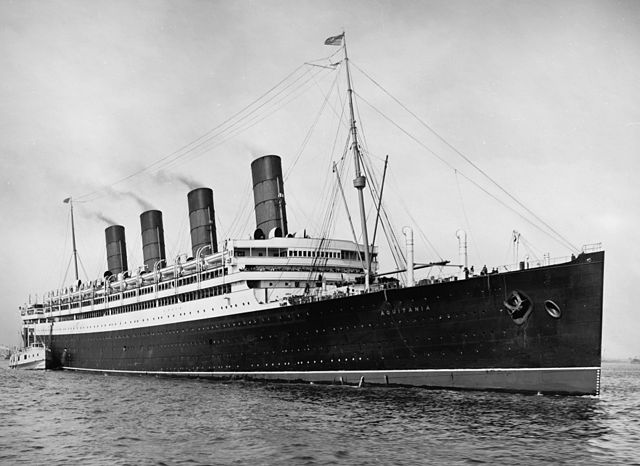
From Harwich, they traveled further by train to London, where the enterprising group stayed overnight. Then they went by ship to Southampton to transfer there to the “Aquitania”, a large passenger ship of the Cunard White Star Line.
The “Aquitania” was a 46,000-ton ship and was, after the “Queen ships”, also of the Cunard White Star Line, the largest ship in the world. It could carry 1,500 passengers and the crossing to Halifax in Canada took about six days. It was the only steamship in the world with four funnels. A minor detail? Certainly not! There was a time when emigrants insisted on sailing on ships with many funnels. Some travel agencies showed prospective travelers photos where an extra funnel had been added to a ship… The more funnels, the greater the safety, believed the inexperienced emigrants.
In any case, the 220 Dutch people in tourist class, with small dormitories for six to twelve people, would have a decent crossing. From Halifax, the Scholten family would then have to spend another five days on the train to reach their destination via Medicine Hat and Lethbridge: the town of Picture Butte in the Canadian province of Alberta.
The Scholten family arrived in Picture Butte by train on March 18. It was very cold. Upon arrival, it seemed as if all 500 residents of the town were present. Perhaps they thought World War III was starting when an army truck rolled out of the train car. They settled in two barracks just north of Picture Butte, on the farm of J.E. Lawlor.
The conditions in those barracks were not ideal. It was just as cold inside as it was outside. Father and mother slept in one of the barracks, which also contained the kitchen. The children all slept in the other barrack. Father placed double beds on top of each other with about 60 centimeters between them. The girls slept on one side and the boys on the other. There was a dressing area at the front.
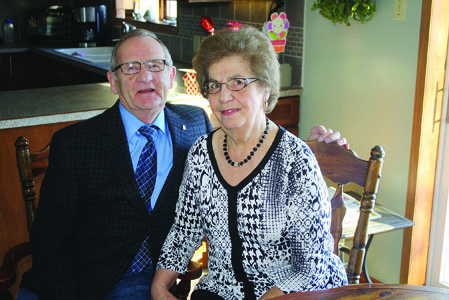
In the beginning, it was difficult. The wage was about $0.25 per hour. Father and mother worried a lot in those years about how they could buy enough food for the family. Although the local supermarkets, Woodruff and Stella-Lacey, were very helpful. They could buy on credit there and sometimes they even received something for free. But in the winter, there was very little work. The boys went to Burmis and worked there at the lumber yard. Even though they earned hardly any money, they at least had a place to stay, clothing, and food.
About three years after arriving in Canada, the Scholten family moved to another farm, just east of Picture Butte. They stayed there for a year and grew beets. Then, in 1953, Hendrik Willem bought a farm about seven kilometers from Picture Butte, with about 130 hectares of land. Roelof went to school in Picture Butte and also helped his father on the farm. Some of his brothers also became farmers, and some chose other professions. Two became teachers and moved to another part of Alberta. Roelof remained on his parents’ farm and helped his father with the farming work.
Hendrik Willem Scholten passed away in 1965 from pneumonia. Grada Everdina passed away in 1987, at the respectable age of 89.
De Graafschapper, 29 April 1948
The Exodus of Dutch emigrants to Canada does not seem to be coming to an end for the time being. All these people are here squeezed out of their narrow boundaries and swallowed up by the great country on the other side of the ocean, with its enormous surface area, for whom this population growth is no more than a drop in a bucket.
It is a strong belief in a good future and an indestructible enthusiasm for Canada with its enormous opportunities that stimulates the departure of these Dutch farmers. But it is also the spirit of their forefathers, the pioneers of the East and the West, that lives on in these tough workers of polder land and field and in which the true tractor’s blood of the Dutchman does not deny itself.
Every time a ship with emigrants leaves and we witness this departure, we are reminded of the well-known saying: “To say goodbye is to die a little.” Because for most of these emigrants, this departure means a forever farewell to the country where they once stood. And since it is not the worst part of our people that emirates, the departure is felt as a loss.
A lot of heart-touching scenes often take place here. Weeping mothers who can only tear themselves away from their sons with difficulty when they have to embark, but also fathers who say goodbye to their children with tears in their eyes, while the other family members usually have difficulty controlling themselves. This is not an exaggerated sentimentality. Rather, it is a demonstration of affection that leaves nothing to be desired in terms of authenticity.
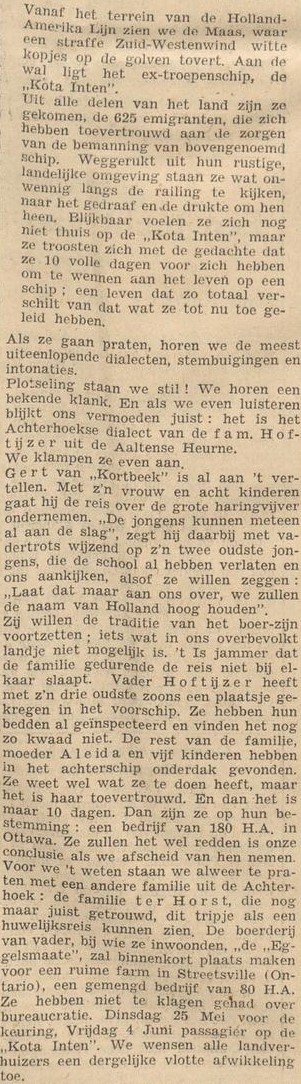
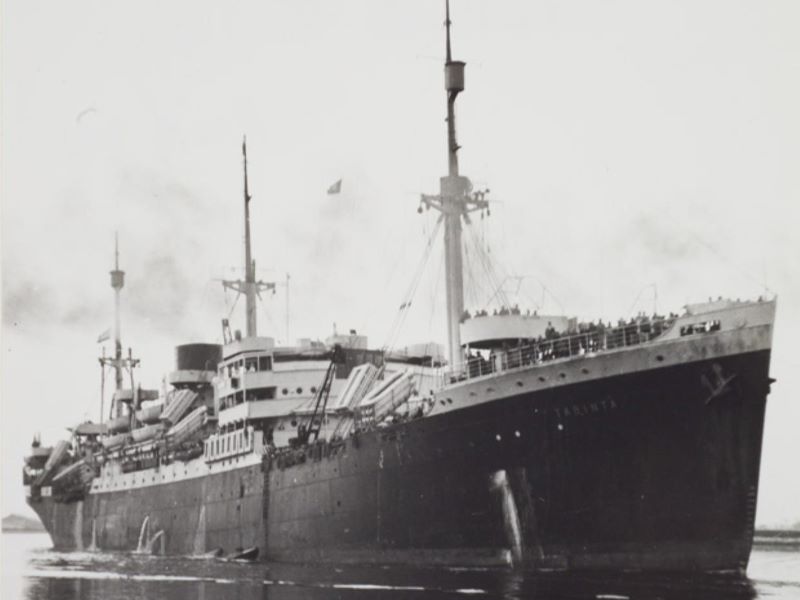
This time it is the “Tabinta” of the Mij. The Netherlands, which will bring a large contingent of emigrants to Canada. It is the second departure in a month to Canada, proof that progress is starting to be made in the implementation of the emigration plans. This year they hope to bring 10,000 people to Canada with the “Kota Inten” and the “Tabinta” and next year they even want to double this number.
Today is a particularly beautiful day for sailing. The emigrants have come to Rotterdam from all parts of the country and the Achterhoek is also represented.
Hendrik Winkelhorst from Aalten wants to take the big step and look for a livelihood in Canada. His wife Grada goes with him, of course, as do the three children: Willemien, Arie and Wim. Their destination is Ontario and they arrive at a mixed farm of 50 hectares. Hendrik has abandoned his brother, where he has been working as a driver lately, and he hopes to exchange his car for a tractor there. Here in Holland it became too scary for him. Too much bureaucracy. Things will get better in Canada, he believes. He will write to his family members when things are going well for him, but also when things are going badly for him. However, he is in good spirits. What others succeed in, he will also succeed.
The 22-year-old Albert te Winkel from Barlo meets us with a cheerful smile. He is not the least impressed by this departure. The Oosterink farm in Barlo will now have to do without him. He worked there for no less than 41/2 years. So he knows how to get things done, by the way he is one of ten at home and then you learn that early on, he says. He does not yet know at which farmer he will be put to work there. He does know the destination and that is West Meath, in Ontario. He also tells us that he will look for a wife in Canada. He thinks there are enough of them there. We wish him every success with this.
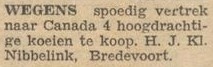
Blacksmith Klein Nibbelink from Bredevoort abandoned his forge today – to escort his son Hendrik out. Hendrik is already on the ship, but his father tells us that Hendrik is 24 years old and had his own company in Bredevoort. Henry saw little future here, but hopes to find it in Duchess in Alberta. Hendrik is not married yet, so he only has to take care of himself. Father Nibbelink believes that he will succeed.
Jan Hendrik Geurkink of the Krosenbrink in Miste, is the Benjamin of the Achterhoekers. He is only 18 years old, has worked at home on the farm and attended agricultural school. It is getting too stuffy for him here and although he is still very young, he wants to try it in Canada. His sister is not so sure that this will work, but in this case he can always come back, she says. Moreover, Jan Geurkink comes to the same farm as Hendrik Klein Nibbelink. There is plenty of work for both of them, because it is a mixed farm of 285 hectares.
There is also a person in hiding from Aalten on the boat. It is Maarten Schinkelshoek from Rotterdam, who had been in hiding in Aalten for a long time on the farm of the Wed. Luiten, “‘t Olde Mulder“. He learned a lot there and wants to put that into practice in Canada. He has already made friends with the other boys from Aalten. The three of them get along quite well.
Around 5 o’clock the “Tabinta” blows its steam whistle for the third time. This is the signal to leave. When the ship detaches itself from the quay, the Wilhelmus is played. As always, a solemn and moving moment, which the emigrants will not easily forget. Slowly the distance between the ship and the people left behind increases, until it disappears from sight forever. There they go, into the distances unknown to them. Our best wishes accompany them in this.
Our region has once again paid its toll on emigration. Several other Achterhoekers left for Canada with the Tabinta, but it was not possible for us to have a personal interview with all of them, nor did we have the names of all the Achterhoek emigrants at our disposal.
Do you have interesting stories about family members who emigrated from Aalten to Canada? Send us a message!
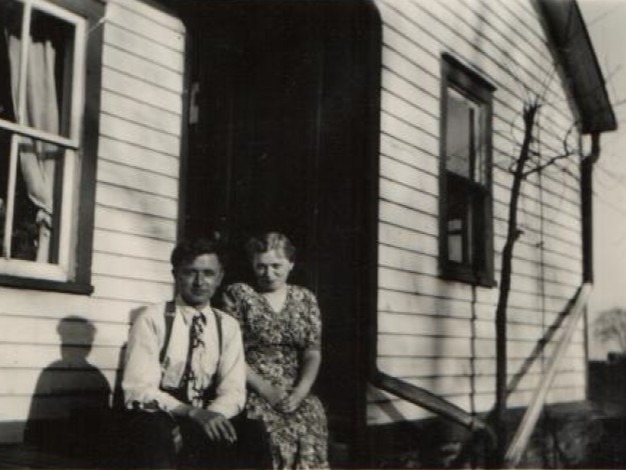
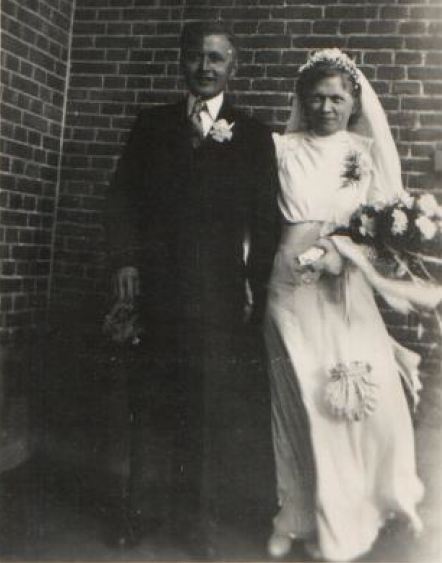
On June 8, 1918, Johan Hendrik ter Horst was born on the Egelsmaat farm in the rural district of Lintelo, near Aalten. Everdina Geertruida (Dien) Somsen was born on 6 November 1918 on the Olde Kleuver farm in the district Haart, also near Aalten. On April 1, 1948, Johan and Dien married in Aalten.
The young couple wanted to farm, but there was no room for them on either family farm – the older brothers took over the farm, as usual. So they had to find another farm, but that turned out not to be easy. When they were selected for a farm in the polder, they saw only one choice: to emigrate.
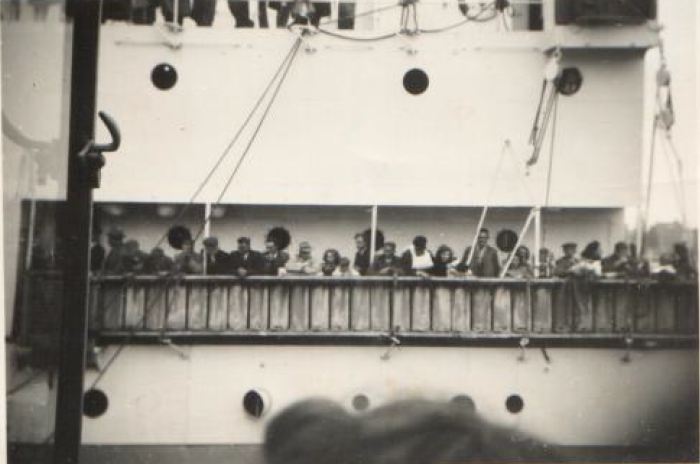
Shortly after their marriage, the young couple left for Canada by ship on June 4, 1948. They settled in the area around Chatham and Wilkesport, in the province of Ontario. There they ran a dairy farm during their working lives. Their marriage remained childless.
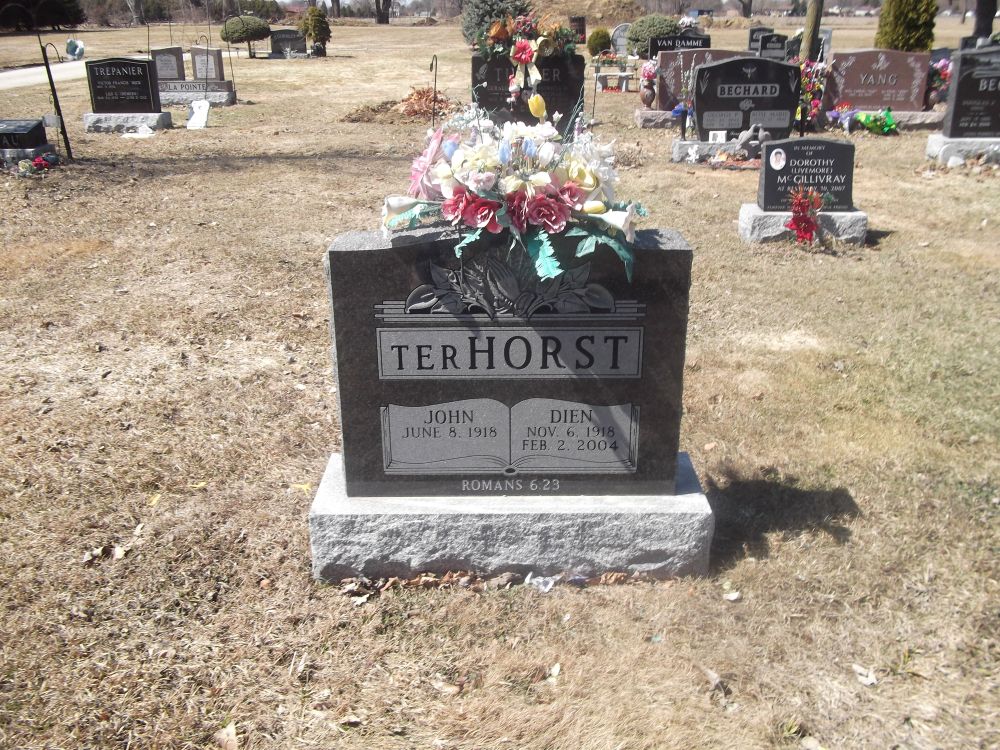
Dien died in 2004 and was given her final resting place in the cemetery of Wallaceburg, Ontario. Johan followed her in 2013 and was buried with his wife.
Do you have interesting stories about family members who emigrated from Aalten to Canada? Send us a message!

The list below contains emigrants from the municipality of Aalten who emigrated to Canada , most of them after the Second World War. Some of them have since died. We try to find their grave on findagrave.com as much as possible. This list is far from complete. Work in progress, errors reserved, additions and corrections are welcome!
| Achternaam | Voornaam | Geb.datum | Emigratie | Laatste NL adres | Graf |
|---|---|---|---|---|---|
| Aalbers | Gerhard H | 1952 | |||
| Aalbers | Gerharda A | 1952 | |||
| Aalbers | Jan Gerhard | 23-12-1913 | 1952 | Bowmanville, Ontario, CA | |
| Aalbers | Liza J | 1952 | |||
| Bierman | Derk Jan | 22-08-1910 | 1947 | Gendringseweg 11 | |
| Bokkel, te | Wander | 06-04-1932 | 1952 | Brandon, Manitoba, CA | |
| Bosman | Gerharda | 1951 | |||
| Bosman | Hendrika Willemina | 26-04-1935 | 1954 | Stoney Creek, Ontario, CA | |
| Bosman | Johan Bernard | 09-02-1928 | 1948 | Wallaceburg, Ontario, CA | |
| Brake, te | Catharina | 18-02-1905 | Burlington, Ontario, CA | ||
| Brake, te | Fredrika | 16-04-1905 | 1948 | Lichtenvoordsestraatweg 97 | Grande Prairie, Alberta, CA |
| Brederode, van | Hendrik Frederik | 27-10-1928 | 1953 | Stoney Creek, Ontario, CA | |
| Brusse | Gesina Hendrika | 06-05-1892 | 1951 | Edmonton, Alberta, CA | |
| Buesink | Johan | 29-03-1906 | 1951 | Strathroy, Ontario, CA | |
| Bulsink | Gerhard Willem Adolph | 03-02-1912 | 1949 | Mississauga, Ontario, CA | |
| Bussink | Herman | 22-05-1931 | 1952 | Brantford, Ontario, CA | |
| Bussink | Hermina | 20-09-1924 | 1951 | ||
| Bussink | Jan Hendrik | 14-08-1929 | 1952 | ||
| Debbink | Jan Hendrik | 15-01-1922 | 1948 | Millet, Alberta, CA | |
| Demkes | Bernard | 18-01-1915 | 1952 | Langley, British Columbia, CA | |
| Duenk | Arent Jan | 23-02-1927 | Leamington, Ontario, CA | ||
| Duenk | Arent Jan | 15-09-1930 | 1953 | Romienendiek 9 | Acton, Ontario, CA |
| Duenk | Gerrit Jan | 01-06-1901 | 1953 | Romienendiek 9 | Acton, Ontario, CA |
| Duenk | Jan Hendrik | 12-01-1922 | 1953 | Brooks, Alberta, CA | |
| Duenk | Johan Antoni | 14-12-1919 | 1953 | Romienendiek 9 | Palmerston, Ontario, CA |
| Duenk | Johannes | 21-12-1927 | Brooks, Alberta, CA | ||
| Ebbers | Johanna Elizabeth | 28-07-1913 | 1947 | Bloomfield, Ontario, CA | |
| Eeden, van der | Jan H | 1952 | |||
| Eelink | Janna Catharina | 02-12-1861 | 1912 | Kriegerdijk 2 | Edmonton, Alberta, CA |
| Eenink | Berendina Adriana | 12-07-1925 | 1951 | ||
| Eerden, van | Christina Gesina | 14-05-1926 | 1951 | Calgary, Alberta, CA | |
| Eerden, van | Jan Hendrik | 25-09-1932 | Calgary, Alberta, CA | ||
| Eerden, van | Johannes | 03-04-1924 | 1948 | La Glace, Alberta, CA | |
| Groot Nibbelink | Willem Bernard | 03-01-1926 | 1952 | Bloomfield, Ontario, CA | |
| Grotenhuis, te | Abraham | 29-03-1906 | South Gower, Ontario, CA | ||
| Haar, ter | Dina | 04-11-1905 | 1953 | Wellington, Ontario, CA | |
| Haar, ter | Gesina Christina | 10-02-1917 | 1952 | Bowmanville, Ontario, CA | |
| Harbers | Johan | 29-10-1921 | 1952 | Westville, Nova Scotia, CA | |
| Haverkamp | Arend Jan | 09-11-1929 | 1954 | Oude Begraafplaats, Aalten | |
| Haverkamp | Reinder | 1954 | |||
| Heersink | Geertruida | 07-10-1929 | 1954 | Limerick, Ontario, CA | |
| Heideman | Johan | 1951 | |||
| Heij | Cornelis Hendrik Jan | 24-08-1904 | 1952 | Bredevoortsestraatweg | Kitchener, Ontario, CA |
| Heij | Johan Herman | 1946 | 1952 | Bredevoortsestraatweg | |
| Heijink | Gerrit Jan | 08-12-1897 | 1949 | Haartsestraat 51 | Mitchell, Ontario, CA |
| Heijink | Mina | 01-05-1922 | Clinton, Ontario, CA | ||
| Heinen | Gerrit Jan | 1950 | Gendringseweg 36 | ||
| Heinen | Gesina Johanna | 02-04-1908 | 1954 | Burlington, Ontario, CA | |
| Heinen | Jan | 09-11-1928 | 1952 | Bloomfield, Ontario, CA | |
| Helmink | Johanna | 1951 | |||
| Hengeveld | Cornelis W | 1953 | |||
| Hennepe, te | Evert Hendrik | 29-02-1908 | 1948 | ||
| Hennepe, te | Johan | 30-05-1910 | Abbotsford, British Columbia, CA | ||
| Hiddink | Johannes | 1951 | |||
| Hoftijzer | Alida | 1948 | Hondorpweg 4 | ||
| Hoftijzer | Arnold Christiaan | 15-07-1904 | 1958 | Port Perry, Ontario, CA | |
| Hoftijzer | Bertram Korts | 28-03-1935 | Whitby, Ontario, CA | ||
| Hoftijzer | Bertram Korts | 10-03-1933 | 1948 | Hondorpweg 4 | Bayside, Ontario, CA |
| Hoftijzer | Bertus Johannes | 15-03-1919 | Ventnor, Ontario, CA | ||
| Hoftijzer | Dora Geertruida | 26-06-1937 | 1948 | Hondorpweg 4 | |
| Hoftijzer | Frans Hermanus | 31-01-1939 | 1958 | ||
| Hoftijzer | Gerard | 1948 | Hondorpweg 4 | ||
| Hoftijzer | Gerard Willem | 19-03-1908 | 1948 | Hondorpweg 4 | Stockdale, Ontario, CA |
| Hoftijzer | Hendrik Willem | 07-01-1939 | 1948 | Hondorpweg 4 | |
| Hoftijzer | Johannes | 08-11-1909 | 1958 | Trenton, Ontario, CA | |
| Hoftijzer | Johannes Jacobus | 24-02-1936 | 1948 | Hondorpweg 4 | Stockdale, Ontario, CA |
| Hoftijzer | Roelof | 10-06-1934 | 1948 | Hondorpweg 4 | |
| Horst, ter | Johan Hendrik | 08-06-1918 | 1948 | Wallaceburg, Ontario, CA | |
| Houwer | Gerharda Antonia | 26-05-1920 | 1948 | Millet, Alberta, CA | |
| Houwers | Johanna Hendrika | 18-05-1900 | Fingal, Ontario, CA | ||
| Huiskamp | Gerhard Willem | 17-06-1909 | 1947 | Bloomfield, Ontario, CA | |
| Huiskamp | Hendrik Willem | 05-12-1935 | 1947 | Bloomfield, Ontario, CA | |
| Hunink | Rieka B | 1951 | |||
| Jansen | Johannes T | 1952 | |||
| Janssen | Johanna | 16-03-1923 | Ventnor, Ontario, CA | ||
| Jentink | Christiaan Johan | 1942 | 1948 | Lichtenvoordsestraatweg 97 | |
| Jentink | Christine | 1946 | 1948 | Lichtenvoordsestraatweg 97 | Grande Prairie, Alberta, CA |
| Jentink | Hendrik Jan | 18-12-1902 | 1948 | Lichtenvoordsestraatweg 97 | Grande Prairie, Alberta, CA |
| Jentink | Hendrika Christina | 1934 | 1948 | Lichtenvoordsestraatweg 97 | |
| Jentink | Jan Hendrik | 27-03-1929 | 1948 | Lichtenvoordsestraatweg 97 | |
| Jentink | Johanna Everdina | 06-01-1904 | 1953 | Acton, Ontario, CA | |
| Jonge, de | Constant | 1951 | |||
| Kämink | Derk Arent Jan | 18-02-1907 | Bloomfield, Ontario, CA | ||
| Kämink | Dirk | 24-04-1946 | Belleville, Ontario, CA | ||
| Kämink | Wilhelmina | 24-06-1932 | 1954 | ||
| Kemink | Grada Everdina | 22-06-1898 | 1949 | Markerinkdijk 59 | Iron Springs, Alberta, CA |
| Klein Nibbelink | Hendrik | 1948 | |||
| Klijn Hesselink | Hendrik Willem Antonie | 07-09-1924 | 1951 | ||
| Klomps | Gerrit Jan | 17-03-1927 | 1952 | London, Ontario, CA | |
| Klomps | Johannes G | 1952 | |||
| Kok, de | Simon | 1952 | |||
| Konink | Liza Catharina | 01-02-1926 | Leamington, Ontario, CA | ||
| Korten | Anna Geertruida | 26-04-1926 | 1951 | Klokkemakersweg 10 | |
| Korten | Gerhardus Hendrikus | 27-03-1935 | 1951 | Klokkemakersweg 10 | Dunnville, Ontario, CA |
| Korten | Gesinus Albertus | 23-08-1931 | 1951 | Klokkemakersweg 10 | Vineland, Lincoln, Ontario, CA |
| Korten | Hendrik W | 1951 | |||
| Korten | J J | 1951 | |||
| Korten | Jan W | 1952 | |||
| Korten | Johannes Bernardus | 16-09-1895 | 1951 | Klokkemakersweg 10 | |
| Kuiperij | Hendrik W | 1951 | |||
| Lammers | Antonius | 22-05-1911 | 1952 | Hamilton, Ontario, CA | |
| Lammers | Dina Willemina | 10-04-1927 | Blenheim, Ontario, CA | ||
| Lammers | Evert J | 1951 | |||
| Lammers | Geert | 31-05-1926 | 1951 | Fonthill, Ontario, CA | |
| Lammers | Gerrit J | 20-04-1935 | 1954 | ||
| Lammers | Gesina | 23-06-1931 | 1952 | ||
| Lammers | Hendrik Jan | 10-06-1937 | 1952 | Burlington, Ontario, CA | |
| Lammers | Herman | 1948 | |||
| Lammers | Willem | 27-12-1927 | 1951 | ||
| Lammers | Willem | 1952 | |||
| Lichtenberg | Bernarda Antonetta | 03-02-1915 | 1949 | Landstraat 27, Aalten | Mississauga, Ontario, CA |
| Lichtenberg | Henk | 1949 | Landstraat 27, Aalten | ||
| Lievers | Aleida Grada | 27-11-1916 | 1953 | Palmerston, Ontario, CA | |
| Lievers | Berend | 30-12-1885 | 1911 | Bredevoortsestraatweg 97 | Neerlandia, Alberta, CA |
| Lievers | Gerharda Johanna | 10-10-1909 | 1913 | Haart 91b | Burnaby, British Columbia, CA |
| Lievers | Gerrit Jan | 29-04-1912 | 1913 | Haart 91b | Neerlandia, Alberta, CA |
| Lievers | Hendrik | 18-07-1888 | 1913 | Haart 91b | Neerlandia, Alberta, CA |
| Lievers | Jan Willem | 29-07-1908 | 1913 | Haart 91b | Ponoka, Alberta, CA |
| Lievers | Jansjen | 14-02-1891 | 1913 | Haart 91b | Neerlandia, Alberta, CA |
| Lievers | Johanna | 18-05-1909 | 1911 | Bredevoortsestraatweg 97 | Neerlandia, Alberta, CA |
| Lievers | Wilhelmina Hendrika | 13-01-1911 | 1911 | Bredevoortsestraatweg 97 | Neerlandia, Alberta, CA |
| Linde, te | Berendina | 04-08-1926 | 1948 | La Glace, Alberta, CA | |
| Linde, te | Gerrit Jan | 10-12-1921 | 1951 | Calgary, Alberta, CA | |
| Luijmes | Engelina | 07-08-1921 | 1948 | Bijnenweg 5 | Maple Ridge, British Columbia, CA |
| Luijmes | Gerrit T | 03-07-1932 | 1952 | ||
| Luijmes | Willem | 1952 | |||
| Luimes | Engelina Johanna | 04-07-1906 | Duncan, British Columbia, CA | ||
| Mateman | Hendrika Johanna | 19-04-1904 | South Gower, Ontario, CA | ||
| Meerdink | Derk Jan Gerhard | 20-02-1915 | 1949 | Meinenweg 7 | Surrey, British Columbia, CA |
| Neerhof | Albert Johan | 25-04-1927 | 1948 | Romienendiek 14 | Owen Sound, Ontario, CA |
| Neerhof | Antoon Christiaan | 28-03-1896 | 1948 | Romienendiek 14 | Tara, Ontario, CA |
| Neerhof | Arnold Christiaan | 11-11-1930 | 1948 | Romienendiek 14 | Trenton, Ontario, CA |
| Neerhof | Gesina Berendina | 10-11-1935 | 1948 | Romienendiek 14 | |
| Neerhof | Jan Bernard | 22-02-1933 | 1948 | Romienendiek 14 | Owen Sound, Ontario, CA |
| Neerhof | Willemina Aleida | 28-08-1921 | 1948 | Romienendiek 14 | Clinton, Ontario, CA |
| Nijman | Johanna Harmina | 21-08-1881 | 1911 | Polstraat 47a | |
| Nijman | Linus Johan | 17-05-1935 | 1958 | ||
| Onnink | Gesina Aleida | 06-02-1932 | 1952 | Listowel, Ontario, CA | |
| Ormel | Geertruida Willemina | 30-04-1909 | 1953 | Iron Springs, Alberta, CA | |
| Pennings | Willemina | 1904 | Colwood, British Columbia, CA | ||
| Prinsen | Aleida Harmina | 25-04-1898 | 1949 | Haartsestraat 51 | Mitchell, Ontario, CA |
| Prinsen | Bernard | 1952 | |||
| Prinsen | Evert | 16-01-1937 | |||
| Prinsen | Willem | 1952 | |||
| Prinzen | Bernard | 13-01-1899 | 1948 | Westendorpweg 6 | Picton, Ontario, CA |
| Prinzen | Bertus | 03-01-1906 | 1947 | Hogestraat 7 | Jarvis, Ontario, CA |
| Prinzen | Jan | 1951 | |||
| Prinzen | Willem | 17-07-1897 | Picton, Ontario, CA | ||
| Rensink | Grada W | 11-10-1936 | 1958 | ||
| Rensink | Hendrika Johanna | 28-01-1927 | Georgetown, Ontario, CA | ||
| Rhebergen | Marinus Bernhard | 05-10-1918 | 1951 | Whitby, Ontario, CA | |
| Rosier | A | 1954 | |||
| Rosier | Aaltje | 18-03-1928 | 1954 | ||
| Ruesink | M J | 1951 | |||
| Scholten | Arnold Gerhard | 03-06-1928 | 1949 | Markerinkdijk 59 | Collingwood, Ontario, CA |
| Scholten | Dirk Willem | 01-05-1931 | 1949 | Markerinkdijk 59 | Iron Springs, Alberta, CA |
| Scholten | Grada Everdina | 13-02-1935 | 1949 | Markerinkdijk 59 | |
| Scholten | Grada Johanna | 26-02-1930 | 1949 | Markerinkdijk 59 | |
| Scholten | Hans | 1949 | Markerinkdijk 59 | ||
| Scholten | Hendrik Willem | 07-05-1898 | 1949 | Markerinkdijk 59 | Iron Springs, Alberta, CA |
| Scholten | Hendrik Willem | 23-06-1936 | 1949 | Markerinkdijk 59 | Granum, Alberta, CA |
| Scholten | Hendrika Everdina | 18-09-1932 | 1949 | Markerinkdijk 59 | |
| Scholten | Hermanus Theodorus | 13-02-1927 | 1949 | Markerinkdijk 59 | |
| Scholten | Ina | 1949 | Markerinkdijk 59 | ||
| Scholten | Jan Willem Antonie | 09-11-1933 | 1949 | Markerinkdijk 59 | |
| Scholten | Roelof | 1940 | 1949 | Markerinkdijk 59 | |
| Scholten | Wilma | 1949 | Markerinkdijk 59 | ||
| Sikking | Adriana Johanna | 26-02-1910 | 1952 | Trenton, Ontario, CA | |
| Smees | Gerrit | 1952 | |||
| Smees | Johan H | 1952 | |||
| Smees | Theodora Hendrika | 15-12-1924 | 1952 | Westville, Nova Scotia, CA | |
| Somsen | Everdina Geertruida | 06-11-1918 | 1948 | Wallaceburg, Ontario, CA | |
| Stronks | Derk Jan | 10-12-1931 | 1954 | ||
| Stronks | Gerrit Christiaan | 27-01-1905 | 1954 | Burlington, Ontario, CA | |
| Stronks | Gerrit Hendrik | 29-09-1906 | 1953 | Iron Springs, Alberta, CA | |
| Teeuwsen | Johannes Christiaan | 04-01-1897 | 1951 | Edmonton, Alberta, CA | |
| Teeuwsen | Johannes Hendrik | 04-02-1931 | 1951 | Edmonton, Alberta, CA | |
| Teeuwsen | Wilhelmina Johanna | 18-10-1906 | 1958 | Port Perry, Ontario, CA | |
| Tolkamp | Hendrik Johan | 05-09-1903 | 1953 | Wellington, Ontario, CA | |
| Tolkamp | Hendrika Gezina | 05-12-1909 | Bloomfield, Ontario, CA | ||
| Tolkamp | Willem J | 07-07-1935 | 1954 | ||
| Vaags | Grada Dela | 29-03-1915 | 1948 | Trenton, Ontario, CA | |
| Veldhuis | Aleida | 01-02-1906 | 1948 | Hondorpweg 4 | Stockdale, Ontario, CA |
| Vreeman | Aleida Christina | 03-10-1913 | 1951 | Jarvis, Ontario, CA | |
| Vreeman | Herman Bernard | 31-08-1932 | 1952 | Brandon, Manitoba, CA | |
| Vrieze | Hendrik J | 1952 | |||
| Walvoort | Aaltjen | 22-05-1883 | 1911 | Bredevoortsestraatweg 97 | Neerlandia, Alberta, CA |
| Wassink | Lamberdina Willemina | 12-03-1906 | 1947 | Hogestraat 7 | Jarvis, Ontario, CA |
| Weenink | Tjitske Jacoba | 03-03-1931 | 1954 | Brampton, Ontario, CA | |
| Wesseling | Tieme | 1951 | |||
| Westerveld | Bernardus | 1918 | Clinton, Ontario, CA | ||
| Westerveld | Catrinus Willem | 01-02-1924 | 1952 | ||
| Westerveld | Dora Johanna | 12-01-1902 | 1948 | Westendorpweg 6 | Picton, Ontario, CA |
| Westerveld | Gerrit H | 08-12-1919 | 1954 | ||
| Westerveld | Hendrik Willem | 17-09-1922 | Georgetown, Ontario, CA | ||
| Westerveld | Johanna Geertruida | 09-01-1897 | 1951 | Klokkemakersweg 10 | |
| Westerveld | Johannes Willem | 12-05-1930 | Iona Station, Ontario, CA | ||
| Westervelt | Hendrika Grada | 09-10-1930 | 1952 | Bloomfield, Ontario, CA | |
| Wiggers | Jan Hendrik | 06-03-1919 | 1952 | Trenton, Ontario, CA | |
| Wijnveen | Aleida D | 03-05-1934 | 1954 | ||
| Wikkerink | Albert Hendrik | 11-06-1946 | Colwood, British Columbia, CA | ||
| Wikkerink | Berendina Hendrika | 14-02-1927 | 1953 | ||
| Wikkerink | Dela Gesina | 20-04-1934 | |||
| Wikkerink | Geziena Berendina | 23-09-1929 | Taber, Alberta, CA | ||
| Wikkerink | Hendrik | 26-02-1900 | Colwood, British Columbia, CA | ||
| Wikkerink | Hendrik Jan | 07-09-1927 | 1954 | Brampton, Ontario, CA | |
| Wikkerink | Jan Hendrik | 23-07-1926 | Abbotsford, British Columbia, CA | ||
| Wikkerink | Jan Hendrik | 30-12-1934 | Shawnigan Lake, British Columbia, CA | ||
| Wikkerink | Jan Willem | 06-02-1907 | Duncan, British Columbia, CA | ||
| Wikkerink | Jantje Gerharda | 02-06-1932 | 1951 | Fonthill, Ontario, CA | |
| Wikkerink | Lena Fredrika | 03-02-1931 | Taber, Alberta, CA | ||
| Wikkerink | Reind Gerrit | 03-08-1930 | 1953 | Stoney Creek, Ontario, CA | |
| Wikkerink | Wesselina | 06-09-1934 | Brighton, Ontario, CA | ||
| Wilde, de | Mietje | 1912 | 1952 | Bredevoortsestraatweg | Kitchener, Ontario, CA |
| Winkel, te | Albert | 27-05-1925 | 1948 | Fitzroy Harbour, Ontario, CA | |
| Winkel, te | Jan Derk | 28-02-1925 | Blenheim, Ontario, CA | ||
| Winkelhorst | Arie | 1948 | |||
| Winkelhorst | Gerrit J | 1951 | |||
| Winkelhorst | Hendrik Jan | 09-08-1910 | 1948 | Koopmanstraat 47 | |
| Winkelhorst | Willemina | 20-03-1942 | 1948 | ||
| Winkelhorst | Wim | 1948 | |||
| Wubbels | Hendrika Aleida | 27-05-1909 | 1948 |