
De Graafschapper, March 30, 1948
A few months ago, Johan Hoftiezer from the Aaltense Heurne was still working in the Noordoostpolder, and around that time his cousin Jan Hoftiezer, also from the Heurne, was still quietly milking the cows of farmer Westerveld from IJzerlo. Now, these two Aalten boys are looking at the black and white lines of the “Nieuw Amsterdam,” the flagship of the Holland-America Line, which will take them to America. On the occasion of their departure, both Hoftiezer families from “Meirika” and “‘t Oude Hondorp” came from Aalten to Rotterdam by bus last Friday to see Johan and Jan off.
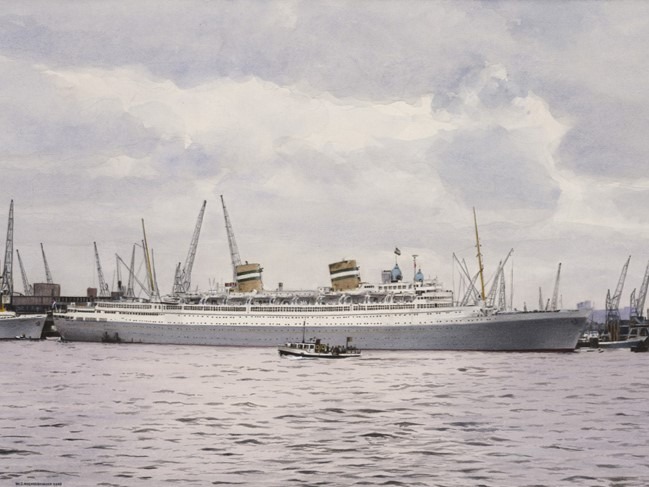
They stand somewhat awkwardly on the Wilhelminakade, marveling at the immense dimensions of this proud sea castle that will soon carry their two relatives to the other side of the ocean, to America, the land of unlimited possibilities. With hands above their heads, they peer over the waters of the Maas, which cuts Rotterdam in two like a silver snake, and their eyes seek out the busy shipping traffic on Rotterdam’s great river. Meanwhile, embarkation is in full swing, and Jan and Johan also prepare to go on board. “It is not easy,” says mother Hoftiezer, “to give up your child, but it is for his future and there are many more opportunities there.”
A moment later, we also go on board, as we wish to ask Johan and Jan a few more questions. Through a labyrinth of corridors and stairs, we finally reach the boat deck and find our future emigrants there. Johan worked in the Noordoostpolder for 2½ years. “It was good there,” he says, “but it would have taken another 5 or 6 years before I would have been eligible to lease a farm, and in Aalten you certainly stand no chance.”
Jan has always been a farmhand but has never sought work as far away as his cousin. “During the war I had to go into hiding, and after the war I worked in IJzerlo. Of course, I have no chance here in Holland either. We are not married and not even engaged, so we are not leaving behind weeping wives or fiancées.”
They further tell us that they are going to Woodstock, in the state of Minnesota. They previously corresponded with the Kruisselbrink family, who used to live at “Groot Kappers” and who have acted as their guarantors. They will be employed on a mixed farm of 200 hectares. “That is at least a bit larger than back home, because we only have 7 hectares at home,” Johan says laconically.
When the bell rings, visitors must leave the ship, and we take our leave of the two cousins. “Give everyone in Aalten our regards via the newspaper,” Johan asks, and we confirm this. Slowly, two tugboats begin to pull the colossus toward the middle of the river. Those staying behind on the quay wave scarves and handkerchiefs, and the “Nieuw Amsterdam” disappears into a haze of smoke. For the two Aalten boys, the journey to America has begun. They will have to work hard there, but we are convinced that they will uphold the name of their village, Aalten, in Minnesota. Safe travels, a prosperous voyage, and much success is wished to them.