
Overview
Toni Stapelkamp was a farmer’s son from the Heurne in Aalten. He served in the National Militia and was decorated for his participation in the Ten Days’ Campaign and the defence of the Citadel of Antwerp.
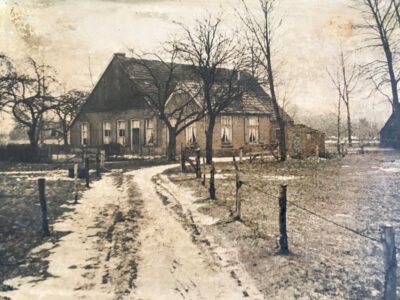
Toni (also spelled Tonij and Antonij) Stapelkamp was born on 30 July 1807, during the French period. He was the third son of Hendrik Willem Stapelkamp and Johanna Elisabeth Slotboom, and the great-great-grandfather of our current mayor, Anton Stapelkamp. Toni was the last Stapelkamp born on the farm of the same name in the Aalten Heurne.
In 1814, when Toni was only seven years old, his father passed away. This likely caused the family’s financial circumstances to deteriorate significantly, especially during a time when people were already suffering under the negative consequences of French rule. Stadtholder William V, the Lord of Bredevoort, had lost his rights, and consequently, Drossaard Van Palland had lost his position. The Stapelkamp farm was sold during this period.
Profession
As the youngest son, Toni had to find employment elsewhere at a very early age. Without the breadwinner, the small-scale Stapelkamp farm could not have fed so many mouths.
According to the 1809–1823 population register, he lived and worked at that time as a farmhand for Derk Jan Haartman on the Haartman farm in the Haart. He was at most fifteen years old then and may have left home as early as age twelve or thirteen. His older sister, Engelina, also lived and worked there as a maid.
It is notable that this Haartman sold his farm to the Te Roele family and emigrated with his family to the US in 1846 on the SS Hector. The Te Roele family still lives on the farm in 2022.
In the 1823–1838 population register, Toni is listed, still as a farmhand, with Jan Hendrik Drenthel on the Drenthel farm, also in the Haart, but now without his sister Engelina. In the population registers of 1838–1861, Toni is first listed as a labourer and later as a farmer (1860–1890).
Military Service and Awards
According to the Decree of 15 February 1827 published in the Provinciaal Blad van Gelderland, Toni was summoned to appear as a reservist of the National Militia at the ‘Government Building’ in Arnhem on 27 February at 08:00. Together with 223 other men—including five other men from Aalten—he had to serve in the 7th Infantry Division.
He had to report to his corps on 1 March. Municipal authorities were required to ensure that they were provided with leave passes. In addition to this 7th Infantry Division, 373 other men from Gelderland were called up for a 13th Infantry Division, also including five men from Aalten, a 4th Artillery Battalion with 59 men, and a 1st Field Artillery Battalion with 28 men.
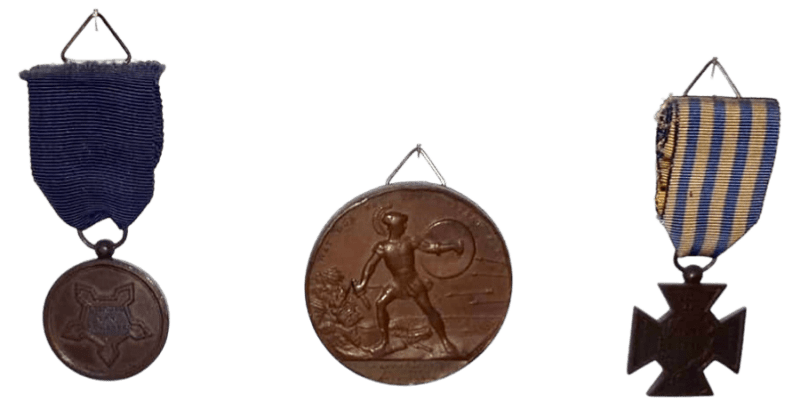
Toni received decorations for his service during the Belgian Revolt: specifically, his participation in the Ten Days’ Campaign in 1830 (the Bronze Cross) and the defence of the Citadel of Antwerp against French troops in 1832 (the Citadel Medal and the Medal of the Commission of Merit).
Marriage and Family Life
After his military career, Toni settled on the Lichterink farm in Barlo, where he worked as a farmhand. In 1839, he moved to the Wissink farm in Miste, also as a farmhand. He married the nearly 33-year-old Janna Geertruid Westerveld (1809–1887) from Dinxperlo on 7 May 1842, at the age of nearly 35. She was the widow of Derk Lammers.
The marriage certificate, drawn up by Mayor Roelvink, states that Toni and Janna were farmers. The certificate also notes that Toni, Janna, and three of the four witnesses—including his brother and Garrit Hendrik—could not read or write, “having never learned to do so”, as was the case for many in those days.
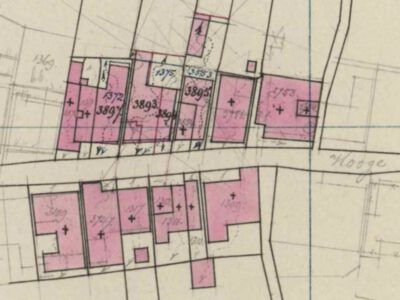
Toni moved in with her in 1842 at the residence on the Hogestraat (currently number 26). In addition to Toni and Janna, two daughters and a son from Janna’s first marriage were registered at this address: Aleida, Rebekka Berendina, and Evert Hendrik Lammers. Furthermore, Janna’s former mother-in-law, Elisabeth Loos, and Aleida Klompenhouwer, a seamstress, were listed as residents.
Toni and Janna had three children: Dora Willemina (1843–1924), Gerrit Jan (1846–1848), and Gerrit Jan (1849–1935), the great-grandfather of our mayor. In 1855, a stillborn child was born. From 1875, his daughter-in-law Hendrika te Sligte lived with them, as did the first three children.
In 1853, Janna had a will drawn up. A private deed shows that in 1862, Toni purchased “a small house with grounds, standing and situated on the Hoogestraat within the village of Aalten and known there cadastrally in Section I number 1372, one rod and thirty ells in size” for 150 guilders. One of the sellers was Jan Hendrik Schepers, who was imprisoned in Leeuwarden at the time. The mentioned plot concerns Hogestraat 26.
Later Life and Death
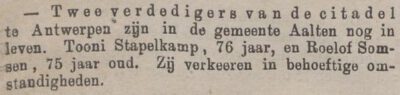
In a report dated 30 November 1882, Toni was mentioned as one of the last two surviving defenders of the Antwerp citadel. It is noted that both were living in “needy circumstances.” This is remarkable, given that his thirty-three-year-old son, Gerrit Jan, was living with him with his wife, and he surely must have had an income.
Toni outlived all his brothers and passed away on 8 December 1889, at the age of 82. The death registration was carried out by his naobers (neighbours) Derk Jan Heusinkveld (Hogestraat 28) and Berend te Slaa (Hogestraat 24). His wife, Janna, had already died in 1887 at the age of 78. Despite their late marriage, they still celebrated their golden wedding anniversary. That was something not many were granted in the nineteenth century on the impoverished Achterhoek countryside.
Toni must have heard about the ecclesiastical developments surrounding the Secession and the first seceded congregation in 1843. In the 1838–1851 population register, he was listed as Reformed, but in all subsequent records until his death, as Dutch Reformed. Around 1850, several Stapelkamp family members left with other seceded Achterhoekers for Iowa, Wisconsin, and Michigan in the United States.