Category: Population

  • Willem Massen

    Willem Massen

    Legionnaire from Aalten in the French Foreign Legion

    Willem Johan Marinus Anton Massen, known as Willem, was born on 2 March 1908 at Köstersbulte in Aalten, the son of Marinus Massen and Johanna Heinen. Before Willem’s first birthday, the family moved to Prinsenstraat 25.

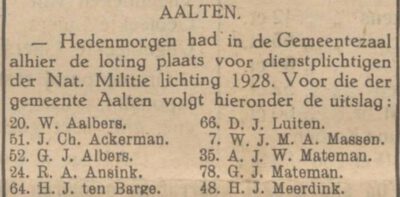
    He had a difficult childhood; his parents had been stripped of their parental rights. Willem’s father passed away on 4 March 1926. In August 1927, Willem was selected by ballot to carry out his military service in the Dutch army (the National Militia) in 1928.
    French Foreign Legion

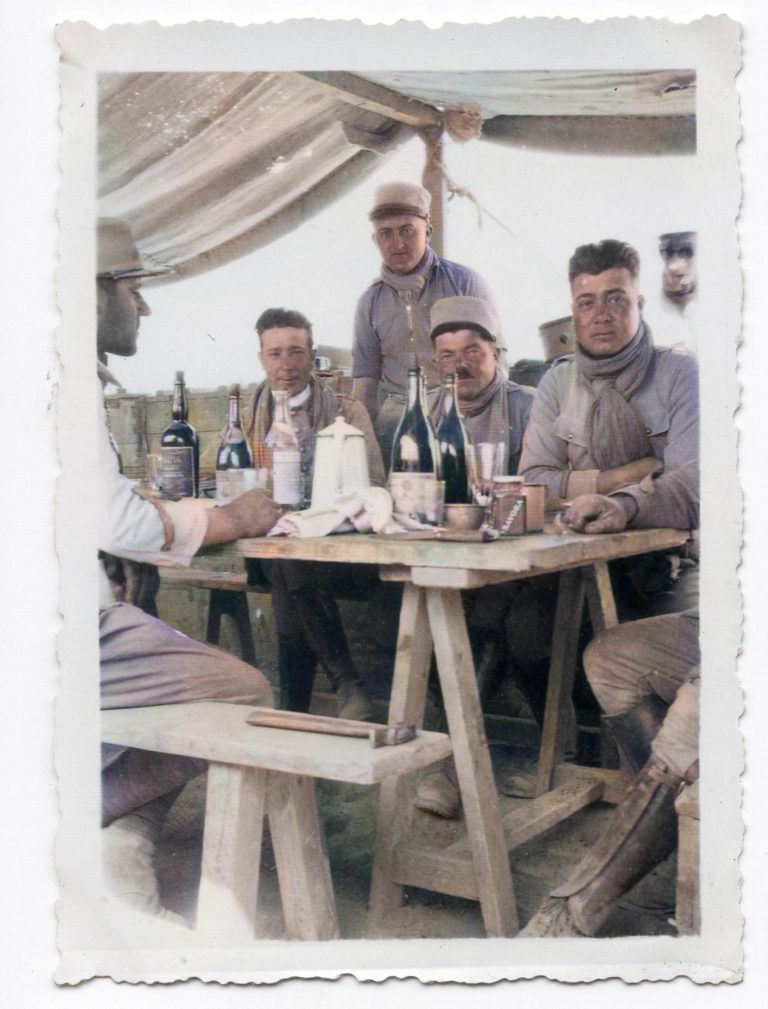
    Willem Massen evidently had adventurous blood, and he allowed an acquaintance to persuade him to sign up for the French Foreign Legion—an elite branch of the French Army consisting of military mercenaries from all over the world. At that time, when a Dutchman enlisted in the Foreign Legion, he lost his Dutch nationality and became stateless.

    Willem served in the Legion from 1930 to 1935, a period during which the unit was primarily deployed for ‘pacification’ and border patrols in the French colonies of North Africa, specifically Morocco and Algeria. The Legion was a melting pot of international volunteers, often seeking to escape their pasts, who led a harsh, disciplined existence under new identities in the rugged desert and mountain landscapes.

    Return to the Netherlands
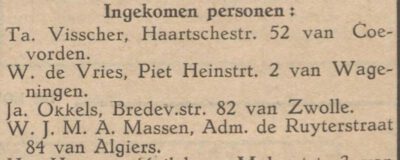
    It is likely that Willem Massen completed his five-year contract, as he returned to the Netherlands in 1935. On 10 January 1936, the Aaltensche Courant reported in the ‘Arrivals’ column that Willem Massen had arrived from Algiers. He settled at Admiraal De Ruyterstraat 84, his mother’s address.

    On 22 March 1943, the Twentsch Nieuwsblad reported that Willem had to appear in court for purchasing textiles without the legally required rationing coupons—a criminal offence under the rationing system controlled by the German occupier.

    AALTEN

    Without coupons. — On Friday, the Aalten tuckpointer W. J. M. A. Massen was summoned before the economic judge in Zutphen because he had purchased 1 tablecloth, 3 bedsheets, 3 pillowcases, and 47 towels without points. The Public Prosecutor demanded 4 months’ imprisonment, in addition to a fine of ƒ 200. The judge sentenced Massen in absentia to 1 month’s detention plus a ƒ 200 fine or 40 days’ detention, and forfeiture of the seized items, with acquittal of intent.

    „The Terror of the Achterhoek”

    Under this headline, the following report of a session at the Zutphen District Court appeared on 1 April 1947 in the Zutphensch dagblad voor Achterhoek en Veluwezoom:

    In the summer of 1946, the Achterhoek was repeatedly unsettled by burglaries and thefts. This changed when a pair of Aalten residents, known as “heavy boys” (hardened criminals), were caught and, in October, remanded in custody at the Zutphen House of Detention. On Friday, this duo had to answer to the Zutphen District Court, presided over by Mr A. H. van der Giesen. The summons charged them with acting together and in concert to steal a quantity of fabric—totalling some 600 metres in length—approximately 700 rolls of peppermint, 20 packets of fat, a quantity of yarn, and two coupons of corduroy (manchester), respectively belonging to N.V. Bontweverij in Bredevoort, F. J. W, J. D. Meijnen, and N.V. Confectiefabriek v/h D. Kamphuis and J. H. Platter.

    M. had confessed to the thefts immediately and continued to maintain before the court that he had acted alone. His comrade, B. K., likewise insisted that he had not taken part in these thefts. However, there were many indications that K. had also played a role.

    Firstly, there was the statement from Sergeant Klein Geltink that one man could not possibly have transported 600 m of fabric alone. Furthermore, the buyer of this fabric, J. S. from Aalten, stated that M. had been accompanied by B. K. And the man who had concealed the goods, J. A. K. from Aalten, stood by the statement he gave to the police: that M. and K. had brought the 600 m of fabric to him together, and that one or the other would subsequently come to collect portions of the stock. He had received 50 guilders for his trouble. The Public Prosecutor, Baron Mr Van der Feltz, demanded a prison sentence of 3 years for M. and K.; 1/2 year (with credit for time served) for J. S.; and 1 year for J. A. K., taking into account as an aggravating circumstance that the goods were intended for the black market. Jhr. Mr W. H. de Jonge appeared as defence counsel in the first two cases.

    In his [the counsel’s] view, legal proof of theft by K. had not been established. Undoubtedly the man had played a role in the matter, but in his view, he could be accused of nothing more than receiving stolen goods. For him, the defence requested an acquittal.

    The defendant M., who made a frank confession (ruiterlijke bekentenis), does not, in his [the counsel’s] view, deserve the heavy sentence demanded by the Prosecutor. The advocate outlined the man’s life story. His youth had been very difficult; his parents had been stripped of their parental rights. He had attended a weaving school, but evidently possessed adventurous blood and had been persuaded by an acquaintance to sign up for the Foreign Legion. The man had served in Morocco for five years and consequently lost his Dutch citizenship. He had found it very difficult to secure work in this country. The counsel understood that the court would impose a heavy sentence, but he requested, firstly, that the time spent in pre-trial detention be deducted and, furthermore, that a milder sentence be imposed than the one demanded by the Prosecutor.

    The Public Prosecutor felt that the defence should not present the case more favourably than it was. This man was known as “the terror of the Achterhoek”. He has 12 convictions on his criminal record. The Prosecutor was, however, willing to consider the request made by Mr De Jonge to allow the court-imposed sentence to be served in a State Labour Institution (rijkswerkinrichting). Verdict in 14 days.

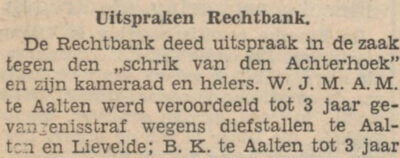
    Earlier, on 27 March 1947, the Algemeen Handelsblad had published a shorter report of this session under the headline “The Terror of the Achterhoek before the court”. It mentioned that M. was 39 years old and came from Aalten. Based on his traceable year of birth and place of origin, M. was therefore indeed Willem Massen.

    This was confirmed by the court’s verdict published 14 days later, which this time included all the initials of Willem Massen’s forenames.
    Naturalisation

    In 1965, Willem Massen submitted a request for naturalisation. His explanatory memorandum stated:

    17 Massen, Willem Johan Marinus Anton, born in Aalten (Gelderland) 2 March 1908, jointer, residing in Aalten, province of Gelderland:

    Willem Johan Marinus Anton Massen, nominated under 17, was born a Dutch citizen in Aalten in 1908. He lost his nationality by enlisting in the French Foreign Legion in 1930 without Royal consent. He has lived in the Netherlands again since 1935. His wife and children hold Dutch citizenship. As a jointer, he provides for himself and his family.

    In 1967, he lived at Haartsestraat 56 in Aalten. No further information is currently available regarding his family or the date of his death. If you have more information, please let us know!

    Ale Douma

    Willem Massen was not the only resident of Aalten to serve in the French Foreign Legion. In 1950, Ale Douma, then living in Aalten, submitted a request for naturalisation. Douma was born on 10 August 1908 in Dronrijp (Friesland), the son of Sjerp Douma and Elisabeth Schuurmans. He served in the Legion during the same period as Willem Massen (1930–1935).

    During the Second World War, Douma stayed in Germany, where he was imprisoned in concentration camps twice due to his assistance to French prisoners of war. In 1967, he lived with his wife Else on the ground floor of a duplex house on Huygensstraat, at number 49.

    Ale Douma passed away on 12 January 1986 and is buried at begraafplaats Berkenhove.
  • The Thomson-van Hopbergen family

    The Thomson-van Hopbergen family

    A military family with Scottish roots in Bredevoort

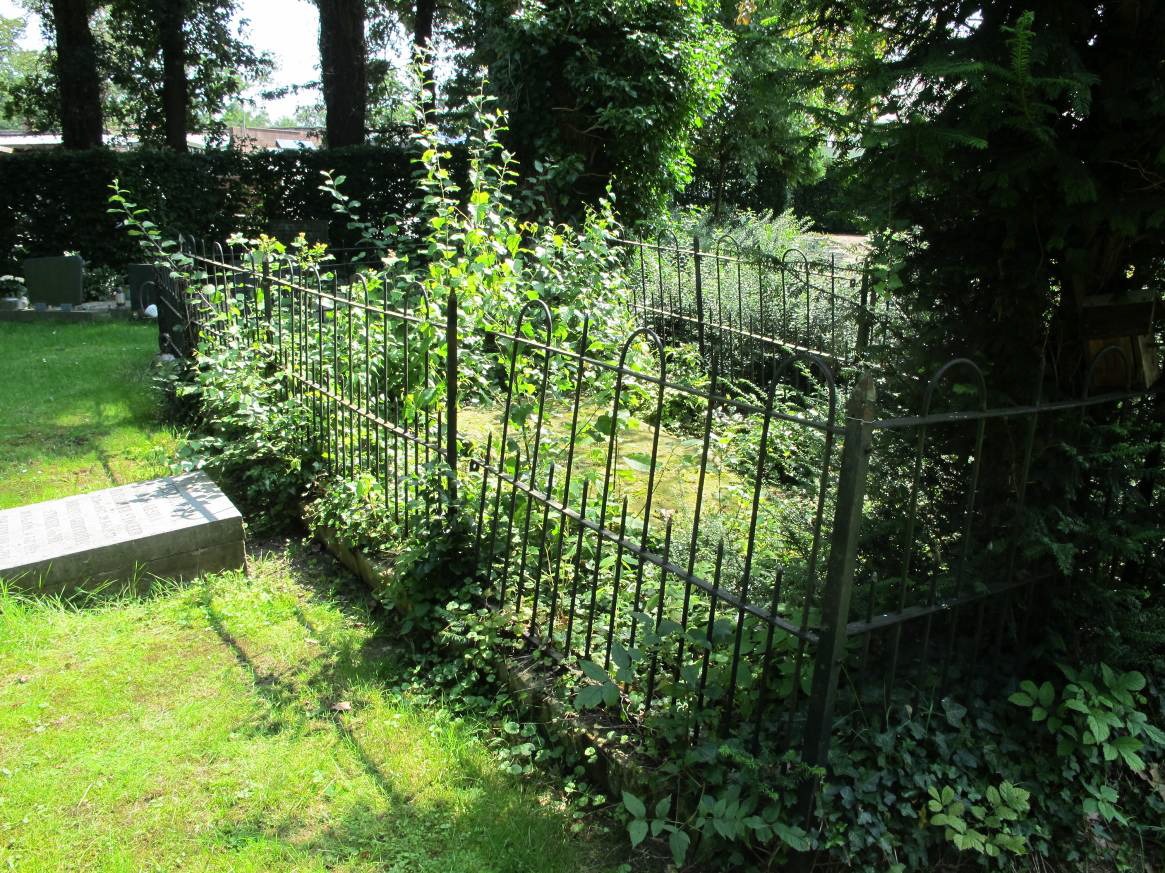
    The family grave of the Thomson-van Hopbergen family is located at the General Cemetery on the Prins Mauritsstraat in Bredevoort. Although the tombstone has been marked by erosion, the monument is a reminder of a family that played a prominent role in Dutch military history, national politics and literature.

    The legacy of the Scottish Brigade

    The family’s roots lie in the Scottish Brigade, a unit of British soldiers hired by the United Provinces in the 17th and 18th centuries. After their military service, many of them settled permanently in the Netherlands, including James Thomson. He was married to Mary Rinck; their children were baptized in Tournai and Breda at the beginning of the 18th century. The military tradition in the family continued into the 20th century.

    Location in Bredevoort

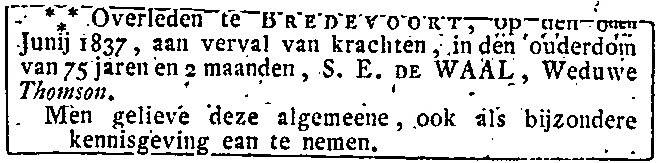
    The bond with Bredevoort arose in the early nineteenth century through a grandson of the ancestor, also named James . This retired captain, born in 1759 in Nijmegen, lived there on the Prinsenstraat with his wife Susanna Elisabeth de Waal. James died in 1828 and Susanna in 1837. The house with its contents was valued at ƒ 3,805,-.

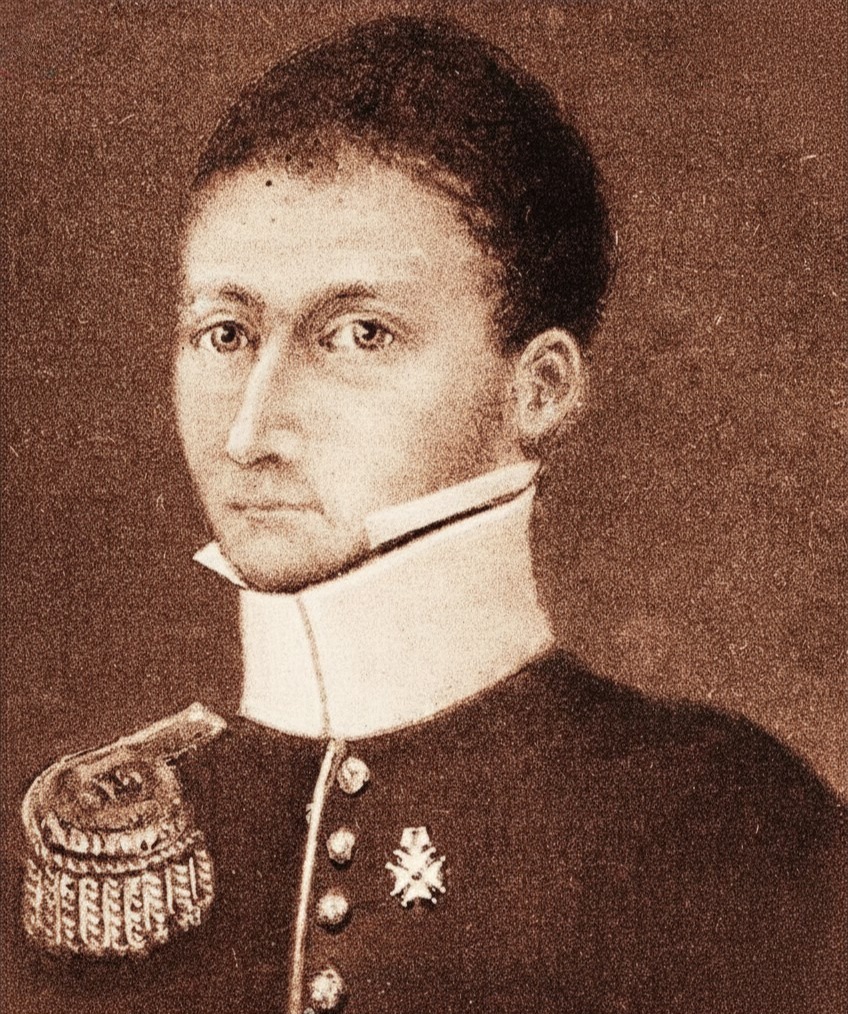
    Their son, Jan Jacob Thomson (1784–1858), born in Maastricht and living with his family in Fort Crèvecoeur near ‘s-Hertogenbosch, was the sole heir. Jan Jacob was a lieutenant colonel and had made a career during the Napoleonic Wars. For his efforts during the Battle of Waterloo in 1815, in which he was wounded, he was made a knight in the Military Order of William.

    In 1837 Jan Jacob entered into a second marriage with the 26 years younger Louiza Wilhelmina van Hopbergen (1810–1906) from Bredevoort. She was a daughter of the retired lieutenant Diederik Christoffel Hendricus van Hopbergen, also living on the Prinsenstraat. The family settled in Bredevoort.

    Jan Jacob Thomson died on 11 October 1858 and was buried in the family grave in Bredevoort. Louise also found her final resting place there.

    Louise’s brother Jacobus Wilhelmus van Hopbergen was also a lieutenant colonel and lived at Markt 18 in Aalten after his retirement.

    Offspring and social functions

    Several family members born in Bredevoort held social functions:

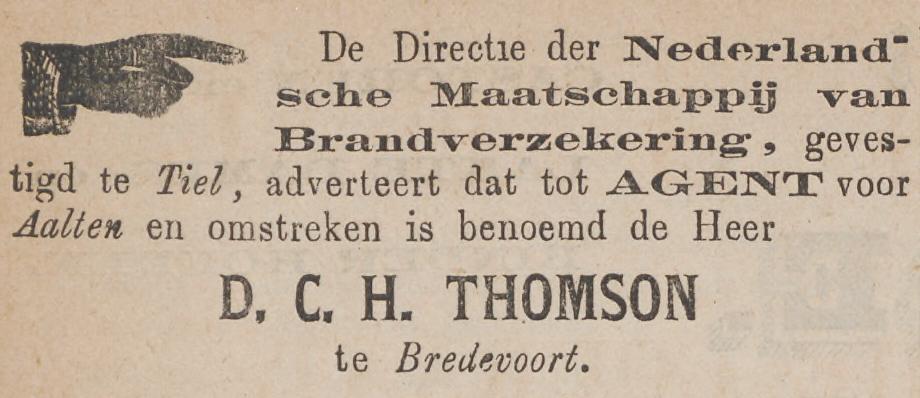
    Diderik Christoffer Hendrikus Thomson (1840–1891) became a letter collector (holder of the local post office) in Bredevoort and will also have been buried in the family grave.
    His son Jan Jacob Thomson (1882–1961) gained fame as a ‘poet-minister’. He was a pastor at the Dutch Protestant Union in Varsseveld and left behind an extensive oeuvre of poetry collections and literary-historical studies. After a turbulent and poetic life, he died in Baarn in 1961 and was buried there.
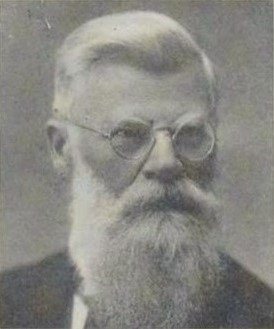
    Jacque Willem Lodewijk Thomson (1846–1914) was mayor of the municipality of Appeltern from 1877 until his death.
    Louis Thomson: Soldier and statesman

    One of the most striking descendants of the family is Lodewijk Willem Johan Karel Thomson (1869–1914), a grandson of Lieutenant Colonel Jan Jacob. Lodewijk was a military cartographer, was sent to Batavia and Aceh, was a military attaché during the Boer War in South Africa and a member of the House of Representatives.

    In 1914 he was sent to Albania, where he was killed in action in Durrës on 15 June 1914. Thomson was the first Dutch soldier to die during a peacekeeping mission. He was buried in Groningen.

    Heritage in decline

    Today, the funerary monument on the Prins Mauritsstraat is in a state of disrepair. Due to erosion and overdue maintenance, the inscriptions on the stone are becoming increasingly difficult to read. However, the grave is a monument to the connection of small Bredevoort with the great world history.

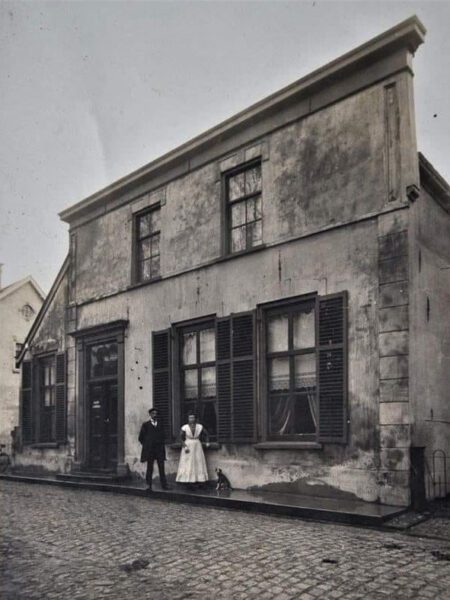
    Post Office Bredevoort, 1918, with Hendrik Christiaan den Hartogh and Antonia Theodora Krosenbrink
    Post office Bredevoort, 1918

    Sources


  • Jacobus Wilhelmus van Hopbergen

    Jacobus Wilhelmus van Hopbergen

    Ret. Lieutenant Colonel and former member of the Provincial Council of Gelderland

    Jacobus Wilhelmus van Hopbergen was born on July 16, 1817, in Ravenstein (municipality of Oss), son of retired lieutenant Diederik Christoffel Hendricus van Hopbergen and Maria Wilhelmina Frank. His parents presumably settled at Prinsenstraat 10 in Bredevoort around 1820.

    After his training and compulsory military service in the 3rd Infantry Regiment in Leeuwarden, where he reached the rank of titular lieutenant colonel, he married Adriana Pieternella Dillié (1816–1888) in Leeuwarden in 1848. They had four daughters; a son died shortly after birth.

    His older sister Louiza Wilhelmina (1810–1906) had married Lieutenant Colonel Jan Jacob Thomson (1784–1858) in 1837. They lived in his parental home in Bredevoort.

    Settling in Aalten

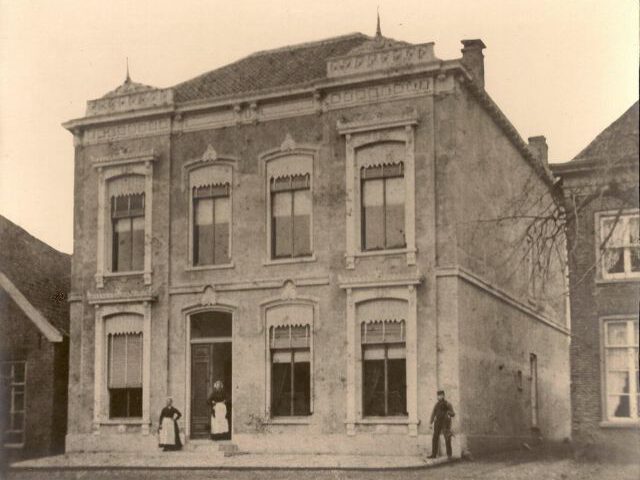
    In 1869, the Van Hopbergen family settled in Aalten, at the beginning of the Hogestraat. Shortly thereafter, Van Hopbergen purchased the plot at Markt 18 in Aalten and had a stately villa in eclectic style built there, including outbuildings for a carriage and staff.

    He derived his social status not only from his military career but also from his role as a representative of the Aalten electoral district in the Provincial Council of Gelderland.

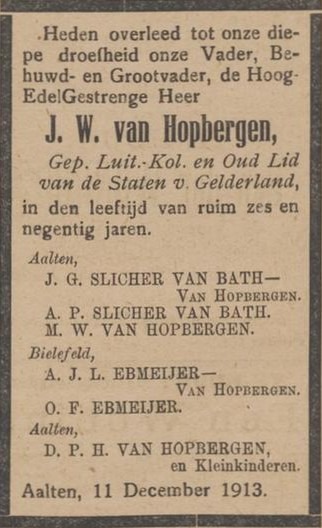
    On December 11, 1913, Jacobus Wilhelmus van Hopbergen passed away at the age of 96 in his villa at Markt 18 in Aalten. He found his final resting place at the Old Cemetery on the Varsseveldsestraatweg in Aalten.

    Obituary

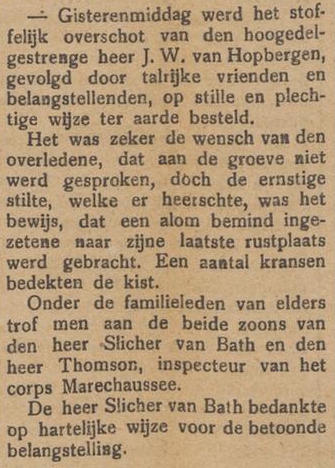
    On December 13, 1913, the Aaltensche Courant wrote:

    Yesterday, the Right Honorable Jacobus Wilhelmus van Hopbergen, retired Lieutenant Colonel of the Infantry in this country, born July 16, 1817, in Ravenstein, passed away here at a great age. He thus reached the age of over 96 years. We do not wish to provide a biography of this eminent man, as that would require a more refined pen than ours, but we merely wish to speak a brief word upon his passing.

    After his retirement, he settled in Aalten with his family approximately 50 years ago and very quickly earned the respect of all residents; he became a full citizen of his place of residence and worked diligently toward the progress of this town.

    Many who knew him in the prime of his life and learned to respect him have already departed from the earthly stage, yet a small circle remains who remember the straightforward, sincere Colonel. It was no wonder that he served for many years on the Provincial Council and the Municipal Council, and was a Churchwarden of the Reformed Congregation until he was forced to resign due to advanced age.

    Devoted heart and soul to liberal principles, he was always a diligent but honest fighter. What Mr. A. Willink was to Winterswijk, Mr. Van Hopbergen was to Aalten. He was very charitable toward the poor and the sick, supported in this by his family. We shall hold his memory in honor. A good and distinguished citizen has departed from us.

  • Where did your ancestors live?

    Where did your ancestors live?

    Do you have family history in Aalten or Bredevoort? Are you curious about the address where your ancestors lived, were born or died? With the help of old archives and handy search methods, you can link historic house numbers to contemporary addresses. We’ve put together a step-by-step guide to help you get started!

    In some old archives, the addresses of people were recorded. In the past, addresses consisted of the name of the core or rural district, followed by a house number. Partly because these house numbers have been changed several times over time, they cannot be directly compared with the current street name-house number combinations. 1

    Below we explain step by step how you can trace an old address and how you can then trace it back to a contemporary location. Success not guaranteed!

    Step 1: Find the old address

    There are various (online) sources in which you can find out where a person lived, where he or she was born and where the death took place. Please note that some data is not yet public due to privacy laws. 2

    WieWasWie.nl

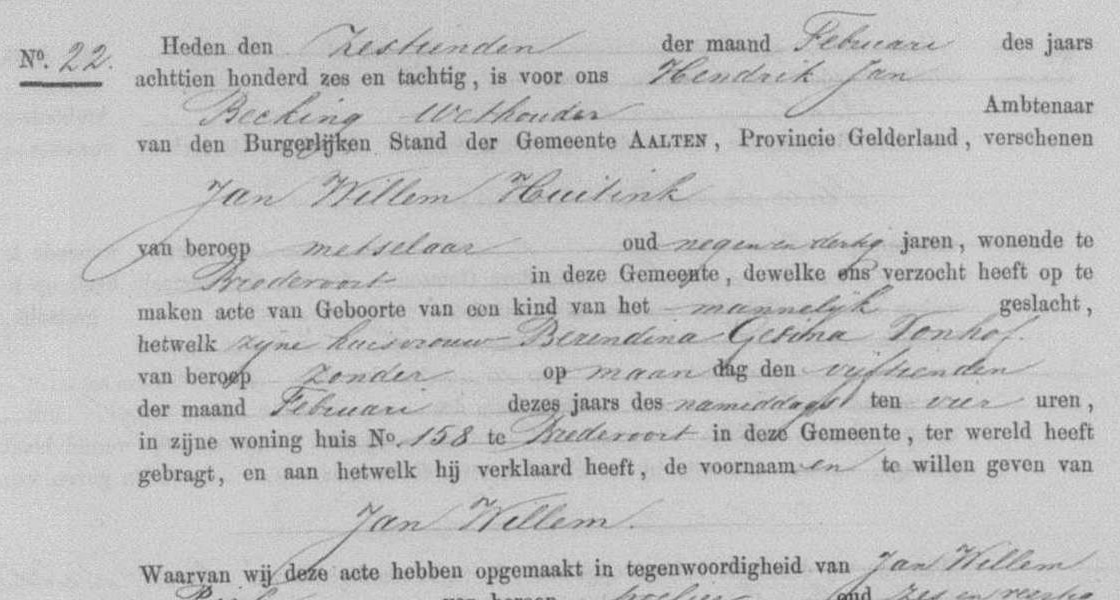
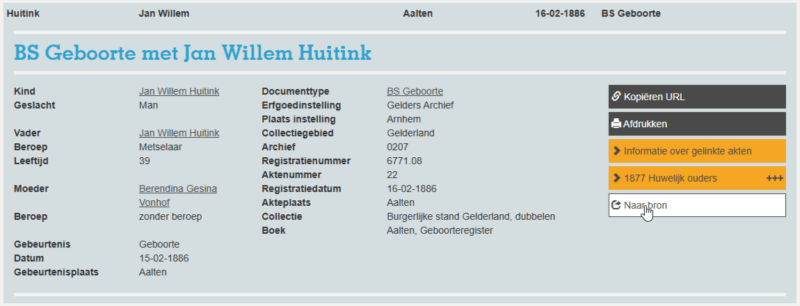
    The website WieWasWie.nl (‘Who Was Who’) contains information about births, marriages and deaths, among other things. But did you know that the search results often also contain a link to a scan of the original deed, including the address at the time?

    1. Go to: WieWasWie.
    2. Search by name and filter the results if necessary.
    3. Click a relevant result, and then click Go to source on the right.

      WieWasWie.nl
    4. View the scan and note the house number.
    5. Sometimes a series of scans will be displayed and you will have to look up the correct record in them. At the top of your screen is the Deed Number. Search the scans for the relevant deed and write down the house number.
    6. Continue to Step 2.

    Heritage Centre Achterhoek and Liemers (ECAL)

    On the ECAL website you can find scans of family cards from population registers in the Achterhoek. The public archive contains scans from the period from around 1823 to 1910.

    1. Go to ecal.nu.
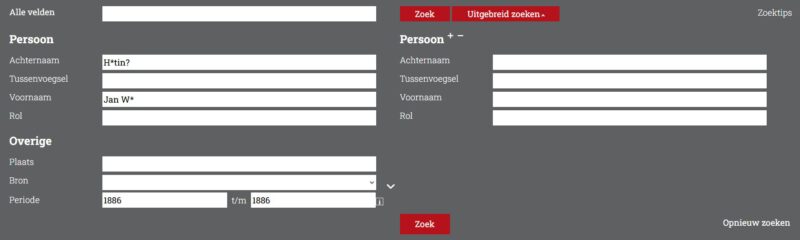
    2. Enter the Last Name and First Name . Tip: Use wildcards to find any spelling variants as well. 3
    3. Enter the year of birth in both fields under Period and click on ‘Search’.
    4. If necessary, filter by Plaats (note: Aalten, Bredevoort and rural districts fall under ‘Aalten’).
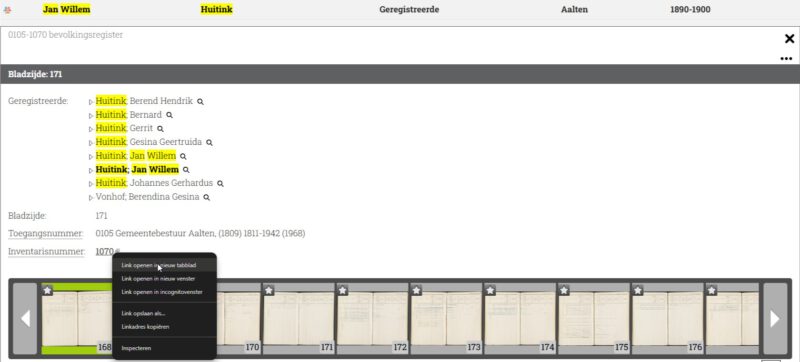
    5. The right-hand column shows the period to which the family card relates. This is important because house numbers can vary from period to period.
    6. Also check which core or hamlet the map relates to: Click on the relevant line and then on the Inventarisnummer (right mouse button, new tab). Remember the place and close the tab.

      ECAL search (2)
    7. Open the family card scan.
    8. Write down the house number and proceed to Step 2.

    Régistre Civique (1811–1813)

    During the French period, the Régistre Civique was introduced as a precursor to the population register. 4 Many persons included in this register also had their address (house number) mentioned.

    1. Go to hdcaalten.nl/digitaal-archief
    2. Download the index of the Régistre Civique Aalten 1811-1813 (pdf).
    3. Look in the PDF file to see if your ancestor is listed and if there is a house number.
    4. If so, make a note of the house number and proceed to Step 2.

    Older archives

    Older sources, such as the Verpondingskohier from 1650 and the Liberale Gifte from 1748, often mention not only the names of the residents, but – if they lived on a farm – also the name of the farm. Many of these farms still exist today and can be found at oldaalten.nl/boerderijen.

    Step 2: Find the current address

    1. Go to oldaalten.nl/huisnummering.
    2. Choose the relevant place or rural district.
    3. Search the table for the correct house number. To make it easier to search, you can sort the table by the relevant year/period.
    4. If the house number appears, you will find the current address there. If not, the house probably no longer exists. Surrounding house numbers may give you an idea of the approximate location.

    The above methods are not exhaustive, because in the archive world several roads lead to Old Aalten. For the overview, we have outlined the most important steps and done our best to explain everything as clearly as possible. We hope this helps you further. Good luck with your search!

  • Rev. Tjeerd Radsma

    Rev. Tjeerd Radsma

    Dutch Reformed Minister

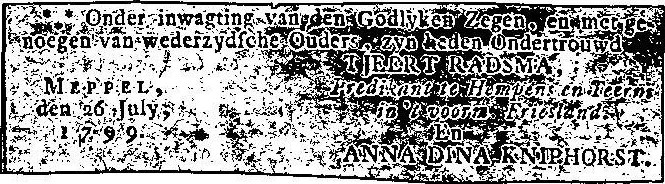
    Tjeerd Radsma was born on 20 February 1772 in Harlingen, the son of Hermanus Radsma and Aafke Steffanij. He married Anna Dina Kniphorst on 11 August 1799 in Meppel. Following her death in 1805, Radsma remarried on 6 October 1808 in Leeuwarden to Doedtje Nieuwenhuis, who had previously been married to Heert Jans Kingma.

    In 1812, Tjeerd Radsma was registered as a resident of Hempens, near Leeuwarden. He was the minister of Hempens and Teerns at the time. It is also noted that he had four children at that point. Three have been identified, all from his first marriage:

    1. Johanna (Hempens, 1800 – Aalten, 1847)
    2. Aafke (Hempens, 1801 – Aalten, 1824)
    3. Anna Dina (Hempens, 1805 – Meppel, 1806)

    To Aalten

    In 1817, at the age of 45, Radsma moved to Aalten as a minister. Five years later, on 11 August 1822, he commemorated his 25th anniversary in the ministry. On this occasion, he delivered a sermon based on 2 Corinthians 5:9. The opening sentence of the sermon read: “Every individual’s life presents times and days that are more remarkable than others and to commemorate these – provided their multitude does not weaken the impression too much – can be very useful.”

    Radsma lived in the Old Reformed Parsonage on the Wehmerstraat.

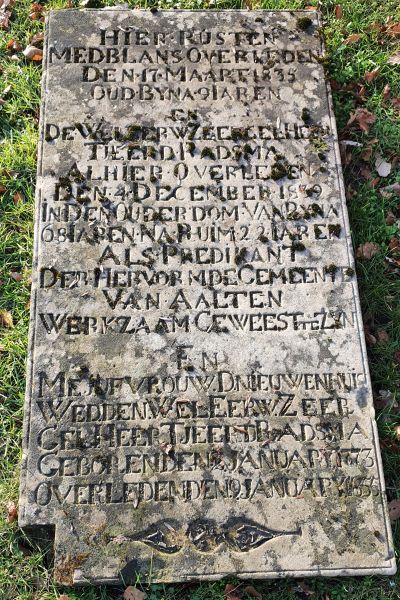
    Death and Grave

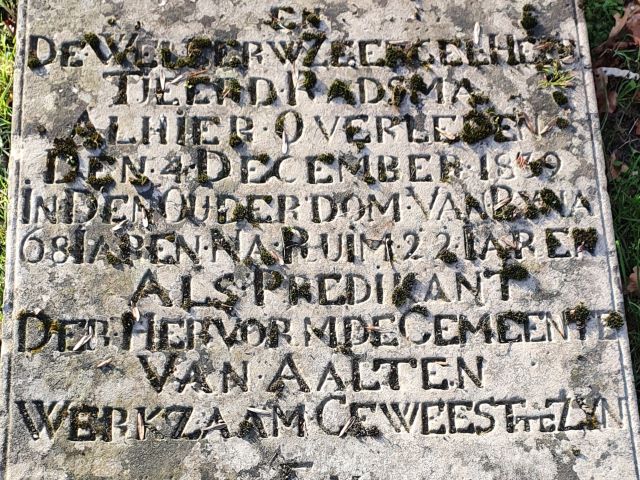
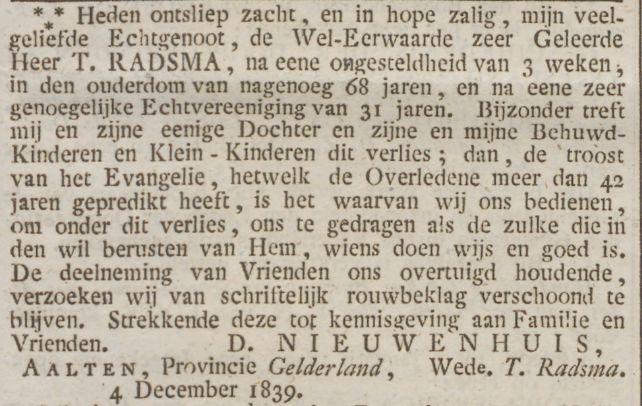
    Tjeerd Radsma passed away on 4 December 1839 in Aalten, at the age of 67. He was buried in the Old Cemetery on the Varsseveldsestraatweg. His gravestone is one of the oldest remaining funerary monuments there. Also interred in the same grave are his widow, Doedtje, who died in 1855, and her granddaughter, Maria Elizabeth Dodina Bianka Lans, who died in 1835 at the age of eight. Maria’s mother was Janke Kingma, a daughter of Doedtje from her first marriage.

  • Toni Stapelkamp

    Toni Stapelkamp

    Veteran of the Belgian Revolution

    Toni Stapelkamp was a farmer’s son from the Heurne in Aalten. He served in the National Militia and was decorated for his participation in the Ten Days’ Campaign and the defence of the Citadel of Antwerp.

    Toni (also spelled Tonij and Antonij) Stapelkamp was born on 30 July 1807, during the French period. He was the third son of Hendrik Willem Stapelkamp and Johanna Elisabeth Slotboom, and the great-great-grandfather of our current mayor, Anton Stapelkamp. Toni was the last Stapelkamp born on the farm of the same name in the Aalten Heurne.

    In 1814, when Toni was only seven years old, his father passed away. This likely caused the family’s financial circumstances to deteriorate significantly, especially during a time when people were already suffering under the negative consequences of French rule. Stadtholder William V, the Lord of Bredevoort, had lost his rights, and consequently, Drossaard Van Palland had lost his position. The Stapelkamp farm was sold during this period.

    Profession

    As the youngest son, Toni had to find employment elsewhere at a very early age. Without the breadwinner, the small-scale Stapelkamp farm could not have fed so many mouths.

    According to the 1809–1823 population register, he lived and worked at that time as a farmhand for Derk Jan Haartman on the Haartman farm in the Haart. He was at most fifteen years old then and may have left home as early as age twelve or thirteen. His older sister, Engelina, also lived and worked there as a maid.

    It is notable that this Haartman sold his farm to the Te Roele family and emigrated with his family to the US in 1846 on the SS Hector. The Te Roele family still lives on the farm in 2022.

    In the 1823–1838 population register, Toni is listed, still as a farmhand, with Jan Hendrik Drenthel on the Drenthel farm, also in the Haart, but now without his sister Engelina. In the population registers of 1838–1861, Toni is first listed as a labourer and later as a farmer (1860–1890).

    Military Service and Awards

    According to the Decree of 15 February 1827 published in the Provinciaal Blad van Gelderland, Toni was summoned to appear as a reservist of the National Militia at the ‘Government Building’ in Arnhem on 27 February at 08:00. Together with 223 other men—including five other men from Aalten—he had to serve in the 7th Infantry Division.

    He had to report to his corps on 1 March. Municipal authorities were required to ensure that they were provided with leave passes. In addition to this 7th Infantry Division, 373 other men from Gelderland were called up for a 13th Infantry Division, also including five men from Aalten, a 4th Artillery Battalion with 59 men, and a 1st Field Artillery Battalion with 28 men.

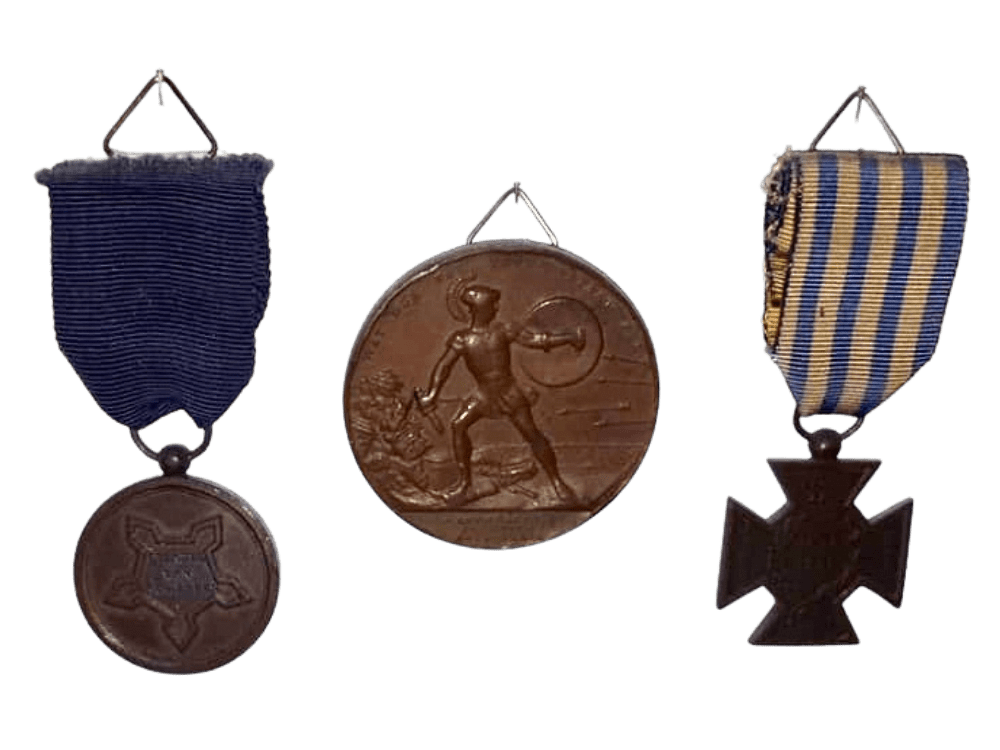
    Toni received decorations for his service during the Belgian Revolution: specifically, his participation in the Ten Days’ Campaign in 1830 (the Bronze Cross) and the defence of the Citadel of Antwerp against French troops in 1832 (the Citadel Medal and the Medal of the Commission of Merit).

    Marriage and Family Life

    After his military career, Toni settled on the Lichterink farm in Barlo, where he worked as a farmhand. In 1839, he moved to the Wissink farm in Miste, also as a farmhand. He married the nearly 33-year-old Janna Geertruid Westerveld (1809–1887) from Dinxperlo on 7 May 1842, at the age of nearly 35. She was the widow of Derk Lammers.

    The marriage certificate, drawn up by Mayor Roelvink, states that Toni and Janna were farmers. The certificate also notes that Toni, Janna, and three of the four witnesses—including his brother and Garrit Hendrik—could not read or write, “having never learned to do so”, as was the case for many in those days.

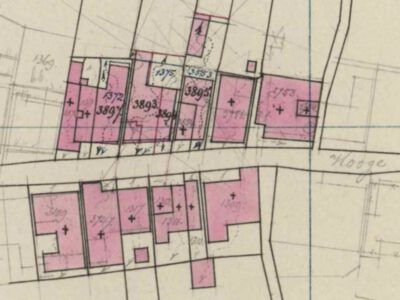
    Toni moved in with her in 1842 at the residence on the Hogestraat (currently number 26). In addition to Toni and Janna, two daughters and a son from Janna’s first marriage were registered at this address: Aleida, Rebekka Berendina, and Evert Hendrik Lammers. Furthermore, Janna’s former mother-in-law, Elisabeth Loos, and Aleida Klompenhouwer, a seamstress, were listed as residents.

    Toni and Janna had three children: Dora Willemina (1843–1924), Gerrit Jan (1846–1848), and Gerrit Jan (1849–1935), the great-grandfather of our mayor. In 1855, a stillborn child was born. From 1875, his daughter-in-law Hendrika te Sligte lived with them, as did the first three children.

    In 1853, Janna had a will drawn up. A private deed shows that in 1862, Toni purchased “a small house with grounds, standing and situated on the Hoogestraat within the village of Aalten and known there cadastrally in Section I number 1372, one rod and thirty ells in size” for 150 guilders. One of the sellers was Jan Hendrik Schepers, who was imprisoned in Leeuwarden at the time. The mentioned plot concerns Hogestraat 26.

    Later Life and Death

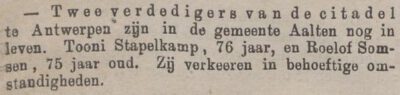
    In a report dated 30 November 1882, Toni was mentioned as one of the last two surviving defenders of the Antwerp citadel. It is noted that both were living in “needy circumstances.” This is remarkable, given that his thirty-three-year-old son, Gerrit Jan, was living with him with his wife, and he surely must have had an income.

    Toni outlived all his brothers and passed away on 8 December 1889, at the age of 82. The death registration was carried out by his naobers (neighbours) Derk Jan Heusinkveld (Hogestraat 28) and Berend te Slaa (Hogestraat 24). His wife, Janna, had already died in 1887 at the age of 78. Despite their late marriage, they still celebrated their golden wedding anniversary. That was something not many were granted in the nineteenth century on the impoverished Achterhoek countryside.

    Toni must have heard about the ecclesiastical developments surrounding the Secession and the first seceded congregation in 1843. In the 1838–1851 population register, he was listed as Reformed, but in all subsequent records until his death, as Dutch Reformed. Around 1850, several Stapelkamp family members left with other seceded Achterhoekers for Iowa, Wisconsin, and Michigan in the United States.

  • Régistre Civique

    Régistre Civique

    In the early 19th century, during the French occupation, a large-scale administrative reform was implemented in the Netherlands. One of the most significant changes was the introduction of the Régistre Civique, a civil register in which eligible male voters were recorded.

    The Régistre Civique was introduced under the reign of Napoleon Bonaparte, who annexed the Netherlands into the French Empire in 1810. The purpose of this registration was to obtain an overview of citizens who had the right to vote and were eligible for public office.

    Who was registered?

    The register contained the names of men who:

    • Were at least 21 years old;
    • Were not dependent on public charity;
    • Possessed sufficient property or income.

    For many residents of Aalten and Bredevoort, this meant that only the more affluent farmers, traders, and craftsmen were registered. Day laborers and small-scale farmers were excluded from the registration.

    From Régistre Civique to population register

    The introduction of the Régistre Civique was one of the first steps toward a more bureaucratic government structure in the Netherlands. After the departure of the French in 1813, the need for administrative registration remained. The Régistre Civique was eventually replaced by the population register, which provided a more complete overview of all residents, regardless of their social status.

    Historical value and genealogical research

    Today, the data from the Régistre Civique is a valuable source for genealogical research. Images (scans) and an index (transcription) of the Aalten register are available at Genealogiedomein.nl. For many individuals included in the register, the address (house number) is also mentioned, allowing us to know where they lived at the time.

    Please note: the Régistre Civique of Aalten (and likely those of other places as well) contains various inaccuracies. In particular, birth and baptismal dates for individuals not born or baptized in Aalten are often imprecise or even incorrect.

  • Number of inhabitants

    Number of inhabitants

    The population trend of the municipality of Aalten. Please note: in 2005, the former municipalities of Aalten and Dinxperlo were merged into the municipality of Aalten. This explains the significant jump in the number of inhabitants in that year.

    Do you have any additions to these figures (including source)? Please let us know!

    YearNumberSource
    1748 *3.298source
    18194.913source
    18506.166source
    18596.092source
    18756.350source
    18796.591
    18856.628source
    18916.831source
    19018.692
    19119.037source
    19159.441source
    19159.589source
    19169.769source
    19179.947source
    191810.000source
    192010.025source
    192210.179source
    192610.695source
    193011.000
    193611.860source
    193711.894source
    193912.000
    YearNumberSource
    194713.585source
    194813.687source
    194913.759source
    195214.058source
    195514.252source
    195614.344source
    195814.878source
    195915.000source
    196115.255source
    196416.000source
    196716.275source
    199618.546source
    200018.699source
    200418.998source
    200527.446source
    201027.500source
    202027.121source
    202227.105
    202327.249source
    202427.308source
    202527.603source

    Inhabitants per village / rural district

    Village / rural district201520202025
    Aalten12.72012.86013.140
    Bredevoort1.5901.6251.655
    Barlo595610570
    Dale975940925
    Haart740740710
    Heurne340365355
    IJzerlo615650635
    Lintelo1.0601.0751.115

    * On October 30, 1954, the Tubantia newspaper wrote about a sociographic study on “Settlements in Gelderland” written fifty years earlier by Prof. Dr. H. Blink:

    It is undoubtedly interesting to also examine how the development of the municipality of Aalten has progressed over the last fifty years. First, regarding the population. The figures provided by Prof. Blink in his report must refer to the village of Aalten (excluding the rural districts). After all, according to the census of 1748, the number of souls in the parish of Aalten was 3,298 in that year. Of these, 1,163 lived in the village of Aalten. In 1819, the population officially numbered 4,913, of which 692 lived in Bredevoort and the remainder in Aalten and the rural districts. In the course of fifty years, the population of Aalten (village) has nearly tripled. Currently, approximately 6,500 people reside in the village.

    Newspaper reports

  • Wolf Misslich († 1639)

    Wolf Misslich († 1639)

    Military officer and governor of Bredevoort

    Captain Wolf Misslich was the commander of the States’ garrison in Bredevoort during the early 17th century. In 1629, he participated in the capture of Wesel, for which he was rewarded by the States-General. Later that same year, he was appointed governor of the Lordship of Bredevoort. His substantial legacy to the poor established him as one of the greatest benefactors in the history of the town.

    From soldier to governor

    In August 1629, during the Eighty Years’ War, Gooswijn van der Lawick and Wolf Misslich (respectively the drossaard and military commander of Bredevoort) were ordered by Prince Frederick Henry to march to Emmerich with six hundred soldiers to participate in the capture of Wesel, a major fortified city then held by the Spanish.

    Misslich and his troops captured two Spanish redoubts on the Lippe. For his services, he received a gold medal valued at one hundred rijksdaalders from the States-General.1

    Following these military successes, Misslich was appointed governor of Bredevoort, a strategically located fortified town in the east of Gelderland.

    Family, legacy, and charity

    In a deed dated June 27, 1629, Misslich is referred to as “van Paterborn” (Paderborn), indicating his place of origin.2 He was initially married to Catharina van Jeveren; from this marriage, a daughter, Anna Margaretha, was born. Anna Margaretha married Captain Robert van Giffen; they had a daughter named Catharina. Both Anna Margaretha and her daughter passed away in the summer of 1639, shortly before Misslich himself. After the death of his first wife, Misslich remarried his maidservant, Nelleke Servaes.3

    In a will dated December 26, 1628, Misslich already demonstrated his philanthropic nature. In it, he bequeathed, among other things, 500 Carolus guilders to the poor of Emmerich; he named his daughter Anna Margaretha as the heir to the rest of his estate and also left five hundred guilders to his nephew (his namesake, Sergeant Wolf Misslich), three hundred guilders to his—then—maidservant Nelleken, and twenty rijksdaalders and a cloak to his servant Jurrien. 4

    His charitable work took further shape in the following years. In 1637, he purchased a house with a barn, garden, and appurtenances within the town of Bredevoort from the Deputies of the County of Zutphen, with the provision that the property would pass to the poor after his death.5 On July 13, 1639, he bequeathed 6,000 Carolus guilders to the New Orphanage in Zutphen and 100 rijksdaalders to the poor of Lochem.6

    However, the most well-known part of his legacy went to the poor of Bredevoort. According to his will, he left his house, garden, and associated lands to the city’s poor relief—a donation later estimated at 15,000 guilders, an exceptionally large sum for that time. This gift gave rise to the local saying: “The poor of Bredevoort are rich.” 7

    Misslich’s house was likely located near the Ambthuis. The rental income from the property was entirely dedicated to poor relief. Until the nineteenth century, the fund resulting from his legacy was still managed by the church’s deacons and provisors. In 1808, the fund still represented a value of over 6,000 guilders.

    One of the properties that passed to the poor of Bredevoort was the Erff und Guedt Lenckhoff in Aalten, which Misslich had purchased in 1638 from Count Georg Ernst van Limburg Stirum.8 This estate was situated in the area between the current Bodenvoor, Bredevoortsestraat, and Haartsestraat (later known as Lankhaverstegge) and extended to the Smees. The Lankhofstraat is named after it.

    Death

    On August 1, 1639, Misslich transferred part of his assets to his son-in-law Robert van Giffen, including an estate in Nieuw Vossemeer near Steenbergen and significant annuities in the Veluwe and Emmerich.9

    Shortly thereafter, Misslich passed away; on August 17, 1639, his will was opened.10 He was buried in Saint George’s Church in Bredevoort.11

    In 1661, he is still mentioned in the archives as “the stern and valiant governor” in connection with the sale of a house “for the benefit of the poor”.12

    Wolf Misslich was not only a capable military officer and administrator but also a man with a profound social conscience. His generous donations ensured that the poor of Bredevoort received support for generations. Nearly four centuries after his death, his name lives on in the history of the town he served.

  • Aron Jedwab (Willem Herfstink)

    Aron Jedwab (Willem Herfstink)

    Jewish ‘foundling’, born in hiding

    In the early morning of 21 September 1943, Piet Hoogenkamp, the assistant of the Aalten general practitioner and resistance fighter Joop der Weduwen, placed a package in front of the house with address Patrimoniumstraat 12 in Aalten. Resistance leader Hendrik Jan Wikkerink alias Uncle Jan lives at that address with his family. The doorbell rings.

    The package turns out to be a newborn baby. He is the son of Lena Jedwab-Kropveld and Yitzack Jedwab, rabbi (pastor) of the Jewish community in Aalten. From mid-1942 the couple was in hiding on the De Ronde farm of the Veldboom family in Lintelo. Resistance leader Uncle Jan and doctor Der Weduwen have agreed in advance to lay the foundling.

    Foundling

    Daughter Jo Wikkerink later told about this:

    “We knew that the delivery was coming and the baby would be brought to us. Father and mother only told the oldest three. The youngest knew nothing. They could not talk past their mouths. Father and mother waited in the dark room in the evening. It seemed to the neighborhood as if they had gone to bed. When the doorbell rang, they knew the baby was there. They got the youngest out of bed and shouted in surprise: “Come and see what is there now!”

    The Jewish child was therefore born in hiding and was registered three days later by Mrs. Dela Wikkerink-Eppink with the name ‘Willem Herfstink’ and registered as such in the birth register of the municipality of Aalten. The name was chosen symbolically. Willem refers to Queen Wilhelmina, Herfstink to the first day of autumn (21 September) and the Saxon suffix ‘ink’ means ‘belonging to the yard or family of’.

    Because only a few people – such as doctors – were allowed to be on the street at one o’clock in the morning, four o’clock in the morning was given as the time when the baby was found. This made the investigation into the origin of the child considerably more difficult. “I sometimes came home late at night with a big belly by train. Then I had ‘contraband’ with me as if I was heavily pregnant. When Wimke was put on the sidewalk, they said: “That’s what they say, but it must be one of the girls.”

    Declared Aryan

    The next day, the municipal doctor on duty, Dr. Knol, had to examine the foundling. The baby was not circumcised and therefore he issued the declaration that the child was 100% Aryan. “The next day father immediately went to Schepers, who lived diagonally across from us (he worked at Paske). Father knew: if I tell it there, everyone in Aalten will know it immediately. Behind us, next to Vossers, lived an NSB woman. She was on her knees in front of Wimke’s crib to see if he had any Aryan features.”

    Lennie and Yitzchak had meanwhile moved to another hiding place in Lintelo. In June 1944, the resistance moved them in a hay-covered wagon to the house of Bernard and Gesina Wevers in the hamlet of Dale, behind the Ring Road, just outside the village of Aalten.

    Initially, they did not want to take the Jedwab couple into their home because they were already sheltering evacuees. A minister of the Reformed Church changed the pious Calvinists’ minds: he preached that the persecuted should be helped.

    Bernard, a carpenter, built them a room behind the closet where they spent all their time. Mrs. Wevers cooked for her Jewish guests as much as possible according to kosher rules.

    In the meantime, Willem had been lovingly taken into the family of the Wikkerink family. Especially mother Dela and eldest daughter Lien Wikkerink took care of ‘Wimke’ as they called him. Dela Wikkerink regularly walked with the baby in the pram to the hiding place of the Jewish parents in Dale. She often took some fruit from the vegetable garden with her in her bag. There were people in Aalten who said: “What does Mrs. Wikker always have to do with Wevers?”

    Towards the end of the war, two German soldiers were billeted in the Wevers house. While the soldiers were in the house, Lena and Yitzack sat in chairs in their hidden room and were not allowed to move or make a sound, sometimes for days.

    After the war

    After the liberation in March 1945, the family was reunited and the little one was given his real name: Aron Jan Willem Jedwab. The name Willem remained and the second first name Jan refers to his rescuer Jan Wikkerink. Queen Wilhelmina came to Aalten soon after the war and visited the Wikkerink family to honour them for their actions in the resistance. Jo Bulsink-Wikkerink: “I can still see Wilhelmina. She slapped my grandfather on the shoulder and said: Wikkerink, you have a brave son.”

    The young child Willem hardly knew his own parents. Jo Wikkerink – the second daughter in the family – then moved in with the Jedwab family for a year, so that Willem could get used to his own parents and new environment a little easier. The Jedwab family emigrated to the US in 1947 and there they changed their surname to Jade.

    Patrimoniumstraat 12, Aalten
    Patrimoniumstraat 12, Aalten
  • Baptism, Marriage and Burial Books

    Baptism, Marriage and Burial Books

    In 1811, the Civil Registry was introduced in the Netherlands. Before that, important life events were recorded by church authorities in baptism, marriage and burial books (DTB books). In Aalten and Bredevoort, these registers were mainly kept by the Dutch Reformed Church (later the Dutch Reformed Church). In addition, Catholic baptismal records are available of the Cross Chapel in Hemden from 1706 onwards. These DTB registers are an indispensable source for genealogical research in the period before 1811.

    Unfortunately, DTB books are not always complete; Some books have been lost and the registration was not equally systematic everywhere. Moreover, in different places, these registers were started at different times.

    Available DTB books

    • Aalten (NDG): Baptism and marriage from 1665, death/burial from 1762.
    • Bredevoort (NDG): Baptisms and marriages from 1638/1639.
    • Shirts (RK): Baptisms from 1706 onwards.

    Baptismal books

    Contain the name of the person baptized, date of baptism and often the names of the parents and sometimes the witnesses. In older books, the name of the mother is often not mentioned. The date of baptism is not the same as the date of birth. Children were baptized as soon as possible after birth, often on the following Sunday. From 1772 onwards, the date of birth is also mentioned in Aalten.

    Wedding books

    Contain the names of the bride and groom, wedding date and sometimes additional details such as names of parents, witnesses and in case of remarriage the previous husband(s). Sometimes the date of the marriage announcement was noted instead of the actual wedding date.

    Burial books

    Contain, in addition to the burial date, the name of the deceased or only the relationship to the head of the family or farm, for example ‘Hendrik te Slaa zijn vrou’, ‘de vrou aan de Smoege’ or ‘een kint van Derk Neerhof’. In the burial book of Aalten for the period 1762-1811 the date of death is also noted, but this is not the case in all burial books.

    Symbols


    On Oud Aalten, symbols are sometimes used to indicate important facts of life. Here is an overview of these symbols and their meanings:

    *
    ~

    ✝︎
    ±
    <
    >
    Birth
    Baptism
    Marriage
    Death
    About (approximately)
    Before (date)
    After (date)

    DTB Book Transcriptions

    Various transcriptions of DTB registries are available for researchers, which facilitate the research. Transcriptions of DTB books in the Achterhoek are available on Genealogiedomein.nl.

    Tips for searching DTB registries

    • WhoWasWho: DTB data can also be found on WieWasWie.nl (events, names and dates). This can greatly facilitate the search, but also refer to the accompanying transcript for more information and context. WhoWasWho also offers links to the scan of the original register, on the website of the Gelderland Archives. Although this is very interesting to watch, the original handwritten texts are often difficult to read.
    • Variable spelling: Names were not always written consistently. Try variations in your search.
    • Surname changes: Before 1811, surnames of people were not always fixed. Especially in the countryside, it was not unusual for someone’s surname to change when moving to another farm.
    • Check dates carefully: The date of baptism is usually not the date of birth and the burial date is not the date of death.

    Additional resources

    In addition to DTB registers, other archives can provide useful information, such as member registers, tax registers, notarial deeds, military and judicial archives. The Achterhoek and Liemers Heritage Centre (ECAL), the Gelderland Archives and the website Genealogiedomein.nl are valuable sources for such research.

  • Bernard Huinink

    Bernard Huinink

    Council Member and Alderman

    Bernard Huinink served as an alderman (wethouder) for the PvdA (Labour Party) in Aalten for many years. Consequently, his nickname was ‘Rooien Huunink’ (Red Huinink). The turbulent council meetings involving Willem te Gussinklo (alias ‘Piepkes Willem’) of the AR (Anti-Revolutionary Party) became legendary.

    Bernard Huinink was born on 11 February 1886 in Aalten (Hogestraat 64), the son of Herman Huinink and Janna Geertruid Obrink. On 8 February 1912, he married Grada Wilhelmina Schepers in Aalten. They settled in Ormelstraat.

    Huinink passed away on 5 June 1970 and was buried at Berkenhove Cemetery.

    Royal Distinction

    In 1919, at the age of 33, Bernard Huinink took his seat on the Aalten municipal council. He would hold that seat for nearly 45 years, initially for the SDAP and later for the PvdA. In September 1959, he celebrated his 40th anniversary as a council member and received a Royal distinction. In 1964, Huinink, the ‘father of the council’ (nestor), stood down ‘on account of his advanced age’ (77). He was succeeded by his 37-year-old son, Jan Huinink, of Admiraal de Ruyterstraat 21, who was the manager of the local PTT office (postal and telecommunications).

    Bernard Huinink krijgt koninklijke onderscheiding opgespeld door burgemeester E.S. van Veen
    Bernard Huinink being invested with a Royal distinction by Mayor E.S. van Veen.

    Sources


  • Anton Driessen

    Textile manufacturer

    Johan Bernard Anton (known as Anton) Driessen (Bocholt, December 5, 1797 – Aalten, March 7, 1879) was a prominent textile manufacturer in Aalten. Anton descended from a textile dynasty in Bocholt. His father Herman (1765–1817) was also a textile manufacturer, as was his brother Peter Driessen (1756–1843), who also served as an alderman and second mayor of Bocholt.

    After their father’s death, Anton and his younger brother Joseph founded the textile company ‘Gebrüder Driessen‘. In 1826, Anton and Joseph Driessen submitted a request to King William I to establish a textile factory in Aalten. The motives for the Driessen brothers’ request were the increased import duties in the Netherlands. They had chosen Aalten ‘as this place was best suited for this purpose‘.

    They requested permission to establish a fustian weaving mill and bleachery, as well as a cotton spinning mill and dye works. The Driessen brothers were granted permission for the establishment on the condition that it be located within the village center of Aalten.

    Not long after, their cousin Heinrich Driessen also requested permission from the King, which was likewise granted.

    In Aalten

    Anton moved to Aalten in 1826. He initially lived with Meijerink in the Kerkstraat. His brother Joseph remained in Bocholt, where they maintained a branch office.

    The company started “in the Barn and Garden Room of Mr. Bonninghoff”. This most likely referred to the house at Markt 18 belonging to the justice of the peace G.J. te Gussinklo, who had purchased the Borninkhof farm in 1804. Owners were often referred to by the name of their farm.

    For the processing of the yarn, Anton Driessen relied on the many home workers living in the area. Furthermore, the municipal report of 1826 mentions, among other things: “Several households have settled here, primarily from Bocholt“. The report for 1827 mentions for the first time that, alongside agriculture as the primary source of livelihood, much fustian was woven for the manufacturers from Bocholt. There were approximately 218 fustian weavers at that time, “performing the work in their homes“.

    On November 22, 1827, Anton Driessen married Isabella Dees in Bocholt.

    In that same year, the cotton spinning mill was moved from Bonninghoff’s barn and garden room to a better-equipped building in the center of the village. Driessen had purchased a house there from Manus Scholten, located at the site of the current address Landstraat 25.

    However, the relocation did not proceed without incident. Two neighbors, the schoolmaster H. Schotman and the farmer W. Obrink, submitted a formal objection to the municipal council, fearing noise nuisance and fire hazards. The municipality, however, rejected their objections. The two neighbors did not leave it at that and subsequently addressed their grievances to the Governor of the province of Gelderland. However, the Governor also saw no reason to give “any follow-up” to their objections.

    At the end of 1827, Anton Driessen was able to begin converting the house into a spinning mill. The new premises had an upper floor, which, along with the ground floor, was designated as workspace. Machines were installed on both levels.

    Beekhuize

    In 1833, Anton wished to build a new residence. To this end, he had purchased a house from the Degenaar heirs at the end of the Landstraat—now called Dijkstraat. He intended to demolish that house and build a new, modern residence with a warehouse, barn, and stables on the site. For this, however, he required more space than the existing plot. Anton Driessen submitted a plan to the municipal council with the request, “since the beautification of a Village is always one of the most pleasant duties of a Local government, to kindly grant the same, and consequently to support the undersigned in his intention as much as possible”.

    To realize Anton’s plans, both the stream and the street had to be diverted. Furthermore, a new bridge was required. Because the piles of the old bridge had almost decayed, the construction of the new bridge was not only highly necessary, but according to Driessen, the relocation was also less costly. In addition to diverting the stream and building a new bridge, Driessen also needed land for his plans. To this end, he exchanged a piece of land with the municipality. Negotiations regarding these matters lasted several years.

    In March 1835, Driessen was able to begin construction. For the production of the necessary bricks, he had meanwhile requested permission to establish a brickyard on the Schaarsheide and to excavate a three-hectare site. Due to the poor state of the roads in East Gelderland at that time, it was more practical and economical to set up a field kiln near the construction site than to purchase bricks elsewhere.

    The stately villa that Anton Driessen had built on the current Dijkstraat is known to every resident of Aalten as Beekhuize.

    Grave

    Anton Driessen is buried in the old Roman Catholic cemetery on Piet Heinstraat in Aalten.

    Sources


    • Delpher
    • ‘Geweven goed. De textielgeschiedenis van Aalten en Bredevoort’ (Woven Goods: The Textile History of Aalten and Bredevoort), H. de Beukelaer and J.G. ter Horst
  • Adriaan Pieter Slicher van Bath

    Adriaan Pieter Slicher van Bath

    Notable

    Adriaan Pieter Slicher van Bath (Middelburg, 1838-06-07 – Aalten, 1933-11-18) was a local notable and benefactor who contributed significantly to the Aalten community. He had resided in Aalten since 1867 and married Johanna Geertruida (‘Nannie’) van Hopbergen (1849–1924) here in 1874. She was a daughter of the local landowner Major J.W. van Hopbergen (1817–1913).

    A street and a lane in Aalten are named after this couple. On the corner of the Slicher van Bathstraat and the Bredevoortsestraatweg, we still find their former residence, villa ‘Welgelegen‘. Furthermore, every resident of Aalten is familiar with the Nannielaantje, which runs across their former estate, the ‘Smees’ property.

    Offspring

    Their son Willem Antonie (‘Toon’) Slicher, born in 1881, and Anna Becking, born in 1883, married in Aalten in 1908 and were the parents of Professor B.H. Slicher van Bath in Wageningen. The title ‘Van Bath’, a small seigniory at Rilland-Bath in Zeeland, was intended to be inherited by B.H. Slicher’s uncle, but was transferred to his grandson by the grandfather for personal reasons.

    In memoriam

    On November 20, 1933, the Zutphense Courant published this report from Aalten:

    “After an illness of several months, our oldest resident, Mr. A.P. Slicher van Bath, passed away here on Saturday evening at the advanced age of 95.

    Mr. Slicher van Bath, who had already lived here for a normal lifetime, sailed a large part of the world’s oceans on a sailing ship in his younger years. After initially working at the Greenwich Observatory, he was sent out on behalf of English interests to conduct meteorological observations for the benefit of sailing. During these voyages, he visited St. Helena, the Cape of Good Hope, India, Australia, and Cape Horn, among others.

    After settling here, Mr. A.P. Slicher van Bath was very active in the interests of this region. Among other things, he provided the initial impetus for the establishment of the Geld. Overijselsche Mij. van Landbouw, the Coöp. Zuivelfabriek (Cooperative Dairy Factory), the gasfabriek (gasworks), and the Geld.-Overijs. Locaal Spoorweg (Local Railway). ‘Floralia’, which has now existed for over 50 years, owed its origin to Mr. Slicher. No effort or expense was too much for him when it concerned ‘Floralia’, and when he was no longer able to involve himself in its management, this association received his significant donations every summer.

    For many years, Mr. Slicher was chairman and later honorary chairman of the local department of ‘t Nut, and as such, the bewaarschool (nursery school) was his great passion. This institution also benefited from his substantial financial support every year.

    Mr. Slicher was also a member of the Provincial Council of Gelderland for several years. Furthermore, until his 90th year, the deceased was an observer for the Meteorological Institute in De Bilt and, until the present, a correspondent for ‘Arti et Amicitiae’.

    It is certainly noteworthy that Mr. Slicher’s memory remained excellent until the very end and that he continued to take an interest in all major world events.

    With the passing of Mr. Slicher van Bath, a very well-known Aalten personality is gone, and numerous associations and institutions will deeply miss his great support.

    The interment will take place on Wednesday afternoon at 3:00 PM at the Oude Begraafplaats (Old Cemetery) here.”

    Slichter van Bathstraat, Aalten – De Graafschapbode, 21 December 1934
    De Graafschapbode, 21 December 1934
  • Heinrich Driessen

    Heinrich Driessen

    Textile manufacturer – “den veursten Dreessen”

    Johann Heinrich Joseph (known as Heinrich) Driessen (Bocholt, 10-07-1794 – Aalten, 04-07-1879) was a prominent textile manufacturer in Aalten. Heinrich descended from a Bocholt textile dynasty. He was the only son of Peter Driessen and Maria Hölscher. His father held a distinguished position in the Prussian town, just across the border from Aalten. In addition to being a textile manufacturer, he served there as a magistrate and, from 1797 to 1811, as deputy mayor.

    Heinrich received a thorough education at the Jesuit College in Amsterdam and spoke excellent French, so that in 1812, when Napoleon’s troops passed through Bocholt, he was the only one capable of acting as an interpreter between the municipal authorities and the French generals.

    Peter Driessen & Sohn

    In 1810, Heinrich joined his father’s business. On December 2, 1820, he married Lisette Sträter in Rheine (Germany), a descendant of another prominent textile family. They had nine sons and two daughters. In 1826, he was entrusted with the management of the firm Peter Driessen & Sohn.

    In that same year, his cousins Anton and Joseph Driessen submitted a request to King William I to establish a textile factory in Aalten, which was granted by William I. Not long after, Heinrich Driessen also requested permission from the King to settle in Aalten. The firm Peter Driessen & Sohn also received the requested establishment permit.

    In Aalten

    His father Peter continued to live in Bocholt while his son Heinrich settled in Aalten. He initially lived with the Meijerink family on Kerkstraat, one of the few remaining Catholic families in Aalten, in the same building as his cousin Anton Driessen.

    In Aalten, Heinrich established a branch of his father Peter Driessen’s fustian trade and hand-spinning mill. They already owned the necessary land in Aalten and Varsseveld, and in 1826 he expanded his activities to Groenlo. There, Heinrich had purchased a house from De Heyder. That house was converted into a spinning mill. He made the yarn spun there available to home weavers who processed it into cloth.

    Heinrich was an enterprising man. By 1832, he had approximately 500 linen weavers in Aalten and the surrounding area working for him, and three years later, along with Blijdenstein in Enschede, he was among the largest fustian manufacturers in the eastern Netherlands. He was one of the first in the Netherlands to utilize steam in his bleachery.

    ‘Den veursten Dreessen’

    In 1837, he had a grand residence built at the beginning of Dijkstraat. For this reason, he was popularly known as ‘den veursten Dreessen’ (the front Driessen), while his cousin Anton, who built Beekhuize a little further along, was called ‘den achtersten Dreessen’ (the back Driessen). Heinrich’s eldest son, Theodoor, laid the first stone on June 29, 1837. Business premises were also located at the residence, primarily serving as storage for yarns and woven fabrics. These fabrics were transported by a wagon, often pulled by an ox, to the bleachery in Dale. The driver bore the fitting nickname Ossen Willem (Oxen William). After Heinrich’s death, the house was repurposed as a convent.

    Following his father’s death in 1843, Heinrich became the sole owner of Peter Driessen & Sohn. His eldest son Theodor (1821-1878) was then placed in charge of the management in Bocholt. In 1851, King William III granted Heinrich Dutch nationality.

    In 1849, Heinrich established a steam spinning mill on Hogestraat in Aalten, the first of its kind in the Achterhoek region. This was soon expanded with several ‘power looms’ (steam-driven weaving looms). After this factory burned down on the night of August 19 to 20, 1859, he did not rebuild the business.

    To Leiden

    Heinrich shifted his focus to Leiden. There, in 1846, together with his nephew (his sister’s son), the soap boiler Ignatz van Wensen, he had purchased the declining textile printing and dyeing works De Heyder & Co., later known as the Leidsche Katoenmaatschappij (Leiden Cotton Company). He had his second son Louis (1823-1904) come over from England to take charge in Leiden. With the knowledge he had acquired in Manchester, Louis soon managed to make the company profitable.

    Heinrich’s son Eduard (1824-1895) continued to look after the company’s interests in Aalten. Initially, the bleachery there remained operational, but over time Eduard primarily focused on the trade in cotton and yarns. The branch in Bocholt, managed by Theodor, was closed after he and his brother Peter (1832-1895) started a blue-dyeing and printing works there in 1854, named the firm Theodor and Peter Driessen.

    Catholic

    The Driessen family was also of great significance to the Aalten Catholic community, which had been a minority in the Reformed village since the Reformation of 1596. Not only through their prestige and influence, but also through various donations from the Driessens, the Catholic church in Aalten was able to grow into a fully-fledged church community. Both Heinrich and his cousin Anton played important roles as churchwardens and overseers of the poor, roles that were continued by their descendants.

    Heinrich Driessen was very strong-willed in his conduct and often followed his own path in ecclesiastical matters as well. For instance, during the disputes between the Catholics and the Reformed in 1842 regarding the ringing of the bells. Pastor G.H.J. Wansing of Aalten wrote a letter about this to the Archpriest of Gelderland, M. Terwindt, which was co-signed by the churchwardens Th.W. Meijerink, H. Vulting, and A. Driessen. Heinrich Driessen, although a member of the church board, had not signed this letter and addressed two personal letters to Terwindt himself.

    What stands out in these letters is that he stated, among other things, that the pastor seemed a priori prejudiced against Aalten and expressed the hope that the Aalten parish would receive a new shepherd who would be to everyone’s liking. He requested Terwindt to take his reflections into consideration when making his choice and assured him that he preferred to employ everything that was conducive to the honor of their holy religion. But at the same time, Driessen wrote that—because the old pastor showed him the greatest respect and because he himself esteemed the pastor as a man whose moral conduct could serve as an example to an entire province—he trusted that it would also please the Archpriest that the contents of the letters never be disclosed to others.

    New church

    A subsequent problem arose when it was decided around 1853 to build a new church. This led to serious disagreements within the church board. For instance, churchwarden Heinrich Driessen again found it necessary to act independently by contacting the Archbishop behind the backs of the other board members. In a letter to the Archbishop, he referred to the approval the latter had given to the plans for the construction of the church, on the condition that the confessional or confessionals be placed inside the church and not in the sacristy or in separate extensions on the side walls. Based on that condition, a plan had been sent to the King for approval.

    However, during Driessen’s absence, the tendering for the church had taken place, in which an extension was nevertheless planned, contrary to the archiepiscopal approval. An extension to the church for the purpose of the confessional would, according to Heinrich, only disfigure a church. He had tried to convince the pastor of this, but had not succeeded. Driessen preferred to see the confessional inside the church, as was common in the Münsterland, rather than in an extension. According to him, the error could still be rectified, even though the masonry on that side was already in full swing. In his letter to the Archbishop, he therefore requested that instructions be given to the church board as soon as possible. The outcome of the matter is unknown. This action, however, is characteristic of Heinrich Driessen, who was apparently accustomed to getting his way and took the necessary steps on his own initiative to achieve it.

    Wealthy

    At the end of his life, Heinrich was a wealthy man. He held shares in spinning mills in Enschede, Gronau, and Rheine. Rheine was his wife’s birthplace, and her relatives managed textile enterprises there. Furthermore, he owned many lands and farms in the vicinity of Aalten, Varsseveld, and Bocholt.

    Heinrich reached the advanced age of nearly 85 years. Several of his children and grandchildren entered the textile industry.

    Sources


    • Biografisch Woordenboek Gelderland
    • Annex to De Graafschapbode, 23 July 1937
    • Delpher
    • Nijver in het groen. Twee eeuwen industriële ontwikkeling in Achterhoek en Liemers, H. de Beukelaer
    • St.-Helena’s ommegang. De geschiedenis van de Aaltense katholieken, H. de Beukelaer
    • Geweven goed. De textielgeschiedenis van Aalten en Bredevoort, Aalten 1992, H. de Beukelaer en J.G. ter Horst
    • Stammbuch und Chronik der Familien Driessen, Giessing, van Wensen, Schwartz, Sträter, Hölscher, F. Schwartz
  • Gerard Tebroke

    Athlete

    Gerhardus Franciscus (Gerard) Tebroke was born on 9 November 1949 in Aalten, the second child in a family of four sons and one daughter. His parents, Hendrik Bernard Tebroke (1912–1987) and Grada Johanna Bijvank (born 1916), both came from Eibergen, where they had married in 1944. Gerard passed away unmarried on 19 March 1995.

    As a child, Gerard Tebroke from Aalten was so stiff that he was exempted from gymnastics classes in primary school. Nevertheless, he became one of the best Dutch athletes ever in the 5,000-metre and 10,000-metre events.

    Tebroke achieved many successes, but because he often pushed his body too hard during training, he was frequently injured and missed important sporting events, such as the Olympic Games in 1972 and 1976. However, his speed for that era was unprecedented. He held the Dutch record in the 10,000 metres for over 18 years and in the 5,000 metres for more than 22 years.

    In 1982, he decided to bid farewell to the sport. He retreated to a small farm in Silvolde with his dog and sheep, leading a reclusive life. Gerard Tebroke passed away in 1995 at the age of 45. Since then, the biennial Gerard Tebroke Memorialloop (a memorial run) has been held in Aalten as a tribute to him.

    Sources


  • Hendrickje Stoffels

    Rembrandt’s beloved

    Hendrickje Stoffels, Bredevoort

    Hendrickje Stoffels or Hendrickje Jegers (Bredevoort, 1626 – Amsterdam, July 1663) was a domestic servant and art dealer. For a period, she was the official employer of the Dutch painter Rembrandt van Rijn. She was also Rembrandt’s romantic partner, the mother of one of his three daughters (all of whom were named Cornelia), and possibly one of his models.

    Hendrickje Stoffels was born in Bredevoort in 1626 as the daughter of Stoffel Stoffelse and Mechteld Lamberts and grew up in the Muizenstraat. Her father was a sergeant under a captain from the Ploos van Amstel family. Stoffel was also a hunter for the castle at Bredevoort and was therefore also called Jeger. In common parlance, his children were called ‘Jegers’, but in official documents they were always referred to as ‘Stoffels’ (meaning son or daughter of Stoffel).

    Hendrickje had one sister and three brothers: Martijne Jegers, Hermen, Berent, and Frerick. She may also have had a sister named Margriete.

    Hendrickje’s father almost certainly passed away in July 1646, possibly as an unidentified victim of the gunpowder tower explosion in Bredevoort. It was likely due to this event that Hendrickje left for Amsterdam.

    Rembrandt’s partner

    From that time on, Hendrickje entered service as a maid for the already famous painter Rembrandt van Rijn, in what is now the Rembrandt House on Jodenbreestraat in Amsterdam. On July 16, 1649, Hendrickje was back in Bredevoort; she is mentioned as a baptismal witness in the Bredevoort Baptismal Register. It is possible that Rembrandt made the journey to Bredevoort with her. This may be evidenced by several etchings by Rembrandt from 1649 and 1650, the locations of which are unknown.

    Later, Hendrickje became Rembrandt’s partner, and in 1654 they had a daughter together, Cornelia. In 1658, she started an art shop together with Titus, Rembrandt’s son from his earlier marriage to Saskia van Uylenburgh, where they sold paintings, drawings, copper engravings, woodcuts, and curiosities.

    There are several paintings and prints by Rembrandt in which Hendrickje Stoffels is recognized. However, there is no single documented image of her. Furthermore, some experts believe that the portraits identified as Stoffels exhibit a wide variety of facial features. In any case, there are a number of works by Rembrandt from the period in which Stoffels lived with him that possibly depict the same woman.

    In 1663, a plague epidemic struck Amsterdam. Hendrickje Stoffels was likely also fatally affected by this disease, as she died in July of that year. She was buried on July 24, 1663, in a rented grave in the Westerkerk in Amsterdam.

    Statue on ‘t Zand

    On ‘t Zand in Bredevoort stands a statue of Hendrickje Stoffels, created by sculptor G.J.F. (Truus) Doodeheefver-Kremer. Before creating the statue on ‘t Zand, the artist conducted research, including at the Rijksmuseum, and chose to depict Hendrickje around the age of twenty, the period when she left Bredevoort for Amsterdam. The statue was unveiled on July 7, 1977.

    Hendrickje Stoffels – signboard at her birthplace in the Muizenstraat in Bredevoort
  • Joseph Driessen

    Joseph Driessen

    Textile manufacturer

    Josephus Walter Julius Driessen (Aalten, 07-01-1870 – Aalten, 12-12-1938) was a textile manufacturer who contributed significantly to the Aalten community.

    He was a son of Herman Anton Frans Carl Maria Driessen and Anna Maria Theodora Muhren, and a grandson of Anton Driessen. On September 7, 1897, he married Maria Anna Elisa Josepha Beckmann in Malmédy (Wallonia).

    Joseph Driessen was the director of Stoomweverij Herman Driessen & Zoon and resided in villa Beukenhof on ‘t Blik (now Hofstraat).

    Jos. Driessen is buried at the old R.C. cemetery on Piet Heinstraat in Aalten.

    His significance to Aalten was evident from the report published by De Graafschapbode following his passing:

    How is Mr. Driessen doing? This question was asked day after day over the last few weeks; at times the answer would be: “Today the condition is slightly more favorable”, but then again: “Things are not so well at ‘t Blik!” Yet, whoever asked the question, it was always followed by: “It is to be hoped that he recovers and may be spared for a few more years for his family, his factory, and for our municipality!” Alas, it was not meant to be! In recent days, the condition became increasingly serious, and on Monday evening, the news reached us that Mr. Jos. Driessen had passed away from us forever.

    The news of Mr. Driessen’s passing will be received with great sadness in wide circles. Naturally, it is first and foremost a great blow to his family, his children, and grandchildren, for whom the deceased was the center—the great magnet within the family circle who drew everyone to him and who so loved to gather the entire family around him. With what interest and warmth he shared in the lives of his married children’s families. How all the grandchildren adored their Grandpa!

    The weaving mill, founded on April 1, 1894, was brought to great prosperity over the years through his energy. From a “little weaving shed,” as Mr. Driessen himself called it, the factory steadily increased in size under his leadership and developed—in recent years with the cooperation of his sons—into the flourishing N.V. Herman Driessen & Zn., which, in addition to its weaving mill, now also has its lingerie, ready-to-wear, and knitwear departments. Until recently, it was the nearly 69-year-old director who was always the first at the office in the morning. Always punctual and hardworking himself, he rightly expected the same from the staff. Furthermore, Mr. Driessen Sr. was always interested in the interests of all who worked in the business, and not only in the interests of the employees themselves, but also in those of their families, all of whom he knew exactly. Proof of this is certainly the medical care for staff and family members as arranged at H. Driessen & Zn. The entire staff, from high to low, will learn of the passing of their eldest leader with great regret, and the eldest director will surely be greatly missed in the factory every day.

    In addition to business concerns, which became increasingly large and difficult especially in the post-war years and demanded more and more of him, Mr. Driessen showed great interest in everything concerning his place of residence. Since its founding on December 14, 1898, he was a board member and very soon became chairman of the association “Aaltens Belang.” This association was especially his great love and for which he performed an immense amount of work. The chairman always came forward with new proposals and new ideas in the interest of, or for the beautification of, our town and the Achterhoek in general.

    What has been achieved in the 40 years of this association’s existence is largely due to his initiative. How Mr. Driessen had looked forward for years to the 40th anniversary of A. B. on December 14 of this year!

    Alas! Instead of a festive commemoration, the association is plunged into deep mourning. The board of “Aaltens Belang” will terribly miss its energetic chairman. In addition to this association, Mr. Driessen held the chairmanship of the “Oudheidkamer Aalten” and of the association for hospital nursing “Steunt Elkander,” both of which also had his warm interest. Furthermore, Mr. Driessen was a director of the Geld. Westf. Stoomtram Mij. and vice-chairman of the Supervisory Board of the Coöp. Middenstandsbank Aalten, a board member of the Prov. Geldersche V.V.V., vice-chairman of the B.V.L., and a member or board member of numerous other associations. Mr. Driessen was also briefly a member of the Provincial Council of Gelderland. Mr. Driessen would not easily be absent from a meeting of one of these associations, and telling of his character is what one of his children claimed of him: “Pa is not happy unless he has at least 3 meetings a week!” Mr. Driessen took the lead at numerous official festivals and events. His fellow members of these various committees know how every program item was prepared minute by minute, but also how the program could then finally be executed exactly and the event succeeded.

    On August 30, 1930, the mayor informed Mr. Driessen that H. M. the Queen had appointed him a Knight in the Order of Orange-Nassau. This was a recognition of Mr. Driessen’s great merits, in which countless residents rejoiced along with him and his family. In September 1937, the 40th anniversary of N.V. H. Driessen & Zn., as well as the 40th wedding anniversary of Mr. and Mrs. Driessen—Beckmann, was commemorated with great splendor. On this occasion, it was again evident in a spontaneous and heartfelt manner how authorities, citizens, staff, and business relations shared in this jubilee. These were unforgettable days for Mr. Driessen, which he was fortunately still able to experience in good health.

    During the last year, but especially the last few months, things were no longer going well. However difficult it was for the so industrious Mr. Driessen, he had to withdraw more and more from his work and take rest. Even sooner than initially expected, his ailment increased in severity and the end came.

    With Mr. Jos. Driessen, a resident has passed away who loved his place of residence very much and to whom Aalten owes a great deal. His name will surely remain in grateful memory for many for a long time. The solemn funeral service will take place this coming Friday morning.

    Sources


  • Christiaan Casper Stumph

    Christiaan Casper Stumph

    Mayor (1811–1818)

    Christiaan Caspar Stumph was baptized in Aalten on February 14, 1745, as the son of Abraham Stumph and Elisabeth Ovink. On November 12, 1780, he married Jeanne Lesturgeon. They had at least one child, Abraham Antoni. This son drowned in the Slingebeek at the age of 34. Popular belief held that his death was related to a broken heart.

    In 1795, Stumph was accused of the attack on Ten Holte and imprisoned. He was released a month later as his guilt could not be proven.

    Stumph was a close friend of the Freule van Dorth, who was executed in Winterswijk in 1799. Seven hours before her death, she wrote him a letter: “My Dear Friend, I thank you very much for all the kindness shown to me in this life. I write [this] at 4 o’clock, thus 7 hours before [life] shall be taken from me by a bullet. The journey from Groenlo etc. is the cause of my death. I find in the same a reconciled God; comfort my Unfortunate Brother who is distressed for me until Death. Be so kind as to say an Eternal Farewell to all my acquaintances. J.M.C.J. van Dorth.

    The first mayor of Aalten

    Following the annexation of our country by France on July 10, 1810, the entire administrative power was restructured and centralized according to the French model. A departmental organization was established, headed by a prefect for the departments, a sub-prefect for the districts, and a maire (mayor) for the municipalities.

    On March 12, 1811, Christiaan Caspar Stumph was appointed maire of the Canton of Aalten. He is therefore considered the first mayor of the municipality of Aalten. He held this position until January 1, 1818, when a new administrative regulation was established.

    Stumph lived at the Smees. He was a person of independent means and an organist in Aalten, a man of integrity with many noble objectives. On May 14, 1819, at the age of 74, he married 30-year-old Caatjen Weversborg in Aalten. As far as is known, their marriage remained childless.

    Christiaan Casper Stumph was a man who frequently endeavored to put an end to existing abuses. One of his greatest grievances was the practice of burial inside the church or in the churchyard within the village. Indeed, this often led to unimaginable situations. On several occasions, subsidences occurred in the church floor, and the owners of these graves failed to carry out the necessary repairs. For weeks, the pews near the hole in question would be uninhabitable. Consequently, a regulation was established stating that churchwardens, in cases of negligence, were permitted to contract out the necessary repairs, whereby the plot in question would revert to the church.

    Burial mound at ‘het Smees’

    The condition of the cemetery around the church was also frequently poor. Because burials had not been conducted at a “sufficient” depth for a long time, bones regularly came to the surface. A bone collector gathered these remains from time to time for two bushels of rye per year and threw them into the “Beenhalle,” a small building in the churchyard on the Market side. If the stock became too large, it was cleared out, and the walls were cleaned and repaired where necessary.

    With the improvement of social conditions and higher hygiene standards, changes slowly but surely occurred in this area, including the obligation to make graves sufficiently deep. A law to prohibit burial within towns and villages, following foreign examples, could not yet find favor in our country. People could not bring themselves to take the major step of breaking with all traditions and leaving the dead “just anywhere in the ground” far outside the village.

    Stumph was a proponent of burial outside the village; he decided to have an “Outer Cemetery” created in one of the Smees meadows. In 1818, the foundation deed and will were drawn up. Christiaan Casper Stumph passed away on January 6, 1820. According to his last wish, he was buried at the old Smees. This site is still recognizable today as a burial mound, located on Nannielaantje.

    Mayor Stumph was succeeded by Mr. Arnoldus Florentinus Roelvink.

    Leestip


    ‘Van Maire Stumph tot Burgemeester Stapelkamp’, door Leo van der Linde

  • Pastor Van Rooijen

    Pastor Van Rooijen

    Parish Priest (1916-1945)

    Pastor Christianus Franciscus Bonifatius van Rooijen (1876–1945) was a well-loved figure. He commanded great respect not only among his parishioners but also among the Jewish residents of Aalten. During his walks with his loyal German Shepherd, Frits, he would tip his hat and greet Jewish fellow citizens with a slight bow.

    Bombing Raid

    On the afternoon of Sunday, 28 January 1945, many people were gathered in the Roman Catholic Church for the Benediction (Lof). Suddenly, a number of ‘Jabos’ (Allied fighter-bombers) broke through the cloud cover and dropped their bomb load. On the Kemena, Admiraal de Ruijterstraat, and Stationsstraat, the damage was limited to property.

    At the Roman Catholic Church, however, the consequences were more severe. One bomb fell in front of the church, and another struck the rectory. Panic ensued, and the blast pressure caused statues to fall from their niches and walls to collapse.

    The churchgoers escaped unharmed, though they were covered in dust and many suffered bruises and abrasions. There was a massive bomb crater in front of the main entrance to the church. However, the bomb that had struck the rectory had more tragic consequences.

    The pastor’s housekeeper, 57-year-old Johanna Maria Klein Rouweler, was severely injured and passed away a few days later in the emergency hospital in Harreveld. Pastor Van Rooijen also lost his life and was not discovered until hours later that night. His death touched the hearts of residents of all denominations, and his funeral at the Roman Catholic cemetery on Piet Heinstraat was attended by a great many people.

    20th Anniversary of Priesthood

    In 1936, Pastor Van Rooijen celebrated 20 years in the priesthood, and De Graafschapbode newspaper devoted an article to this anniversary:

    “Tuesday, 8 December, will mark 20 years since the Reverend Pastor Van Rooijen was installed here as successor to Pastor Wubbels, who departed for Dalfsen. On this milestone in the pastoral life of Pastor Van Rooijen, we requested him to tell us a little about the past two decades. Although His Reverence did not consider 20 years an official milestone usually celebrated, he was kindly prepared to provide us with some information and to pose for our illustrator.

    Pastor Van Rooijen was born on 13 February 1876 in Utrecht. After attending school there, he completed his studies at the Seminaries in Culemborg and Rijssenburg. His first post as curate was Oosterhout (Gelderland), a position he later exchanged for the Twente industrial centre of Enschede. From there, Curate Van Rooijen was installed as Parish Priest here on 8 December 1916.

    Over the past 20 years, the jubilarian has experienced all the ups and downs—in recent years, especially many ‘downs’. He worked here alone until 23 August 1935. On that date, he received the assistance of Curate J. Snoeren.

    When we speak of the ‘downs’, we know we have touched upon a subject very dear to His Reverence’s heart. It is well known, even among those of other faiths, that Pastor Van Rooijen personally does a great deal to alleviate the suffering of his parishioners, but also how indignant he often is when young people, who earn a decent wage, show so little willingness to contribute.

    A well-known example is the daily provision of a free glass of milk to children at the Roman Catholic school who are in need. This milk distribution has been running for two years now and is undoubtedly of great benefit to the general health of the younger generation. The ‘Hulp in Nood’ (Help in Need) fund of the Roman Catholic Workers’ Association, to which members contribute a small weekly amount to assist one another in emergencies (childbirth, illness, etc.), is also an initiative of the jubilarian. In the previous financial year, 385 guilders were raised in this manner.

    Pastor Van Rooijen was particularly satisfied with the house visits he and the curate have made over the past 14 days, with the twofold purpose of assessing the situation in various households and collecting donations for the provision of clothing, blankets, and, if possible, a Christmas gift for needy families. To date, these visits have already raised over 800 guilders—more than His Reverence had dared to hope. That this should be so successful precisely in this 20th year will undoubtedly bring the jubilarian great satisfaction.

    We shall suffice by mentioning that in these 20 years, the Roman Catholic Church has received a hot-air heating system, and during this time, the fashion vocational school and various sports associations have flourished.”

    Sources


    • Graafschapbode, 4 December 1936 (Delpher)