
Aaltensche Courant, 21 May 1948
Two cousins meet on the boat after not having seen each other for 13 years
Great joy prevailed on Wednesday in the Neerhof and Lievers families when their sons returned home safe and healthy after 13 and 2½ years of service in the Far East, respectively. Maypoles and greenery, waving flags—everything pointed to a joyful return. We had the pleasure of hearing some details from both young men.
Henk Neerhof
First, we hear from Private H. Neerhof, K.N.I.L. We found Henk surrounded by family members and friends, and upon our request to tell us something about his experiences, we were told the following:
„After my training in Nijmegen, I left for the Indies in August 1935, destined for Bandoeng. Until the Japanese invasion, I was always stationed here in garrison. After a hard struggle, I was taken prisoner of war along with many others and transferred to the well-known penal camp at Tjilatjap. Here we got to know the Japanese as a cringing, submissive people, brutal and sadistic in their actions, but also deathly afraid of their superiors.
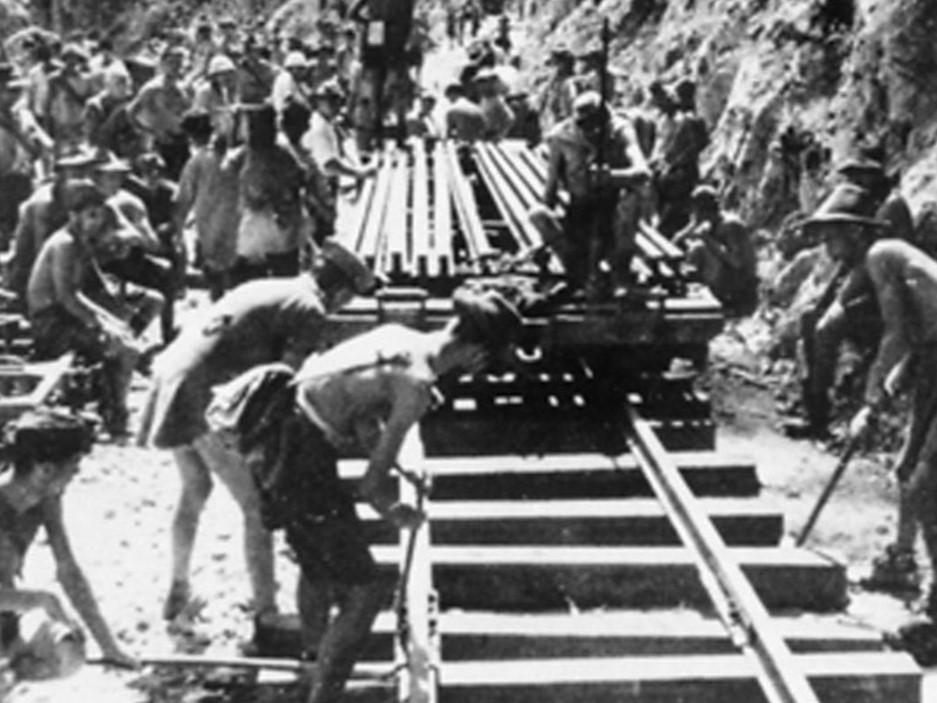
After this time in the camp, we were transferred to Thailand and here the path of suffering began: working on the ‘death line’, the Burma Railway, which lasted 1½ years. From here I was taken to Japan, where I spent two years as a miner in the coal mines on the island of Kyushu. It is easy to understand that this time was also far from rosy.
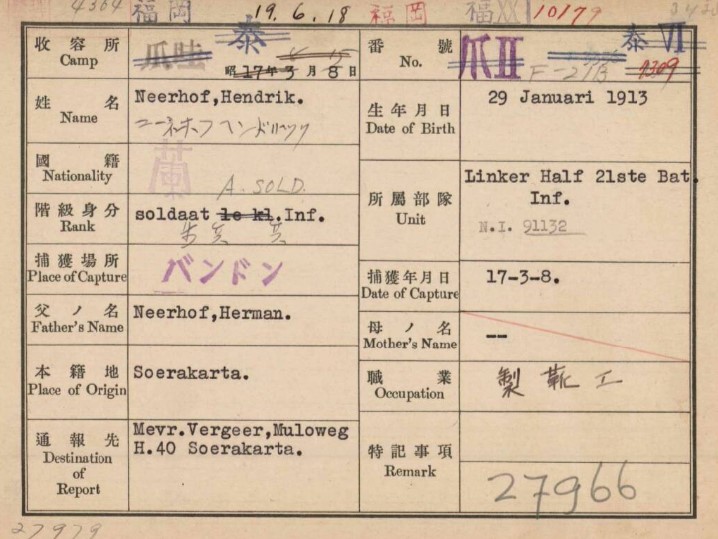
There I finally experienced the liberation in 1945, a liberation I will never forget. It was the Americans who delivered us from all that misery. With our exhausted bodies, we jumped and danced. Americans, great guys! It was simply exhilarating.
Everyone was transferred to Nagasaki on an American aircraft carrier, the city that had been hit by the atomic bomb some time before. The effect of this was terrible; everything had virtually disappeared, it was a scorched remnant of a city, covered with a thick layer of ash. From here I was finally dispatched to Balikpapan, where I had a good time. Here I was incorporated into a normal company again.
And now I am home again, with six months’ leave. I felt really strange towards everything here; it is so small and narrow-minded, you really have to get used to it again. I am happy to be home. The festive reception, everything decorated, and a serenade from the A.O.V.—it was wonderful.”
Finally, Henk mentioned that he will return to the Indies again. We wish him a very pleasant leave and, for later, a good voyage and a safe arrival in the Indies.
Jan Lievers
As the second returnee from the Indies, we were able to greet Private 1st Class Jan Lievers. Jan left for the Indies as a volunteer in October 1945 and was assigned to I-8-R.I. After training in Ermelo, Jan ended up in Malacca via England, as the first Dutch troops were not yet allowed to set foot on Indonesian soil. Stationed in an old rubber plantation at Lubok Kiab, he underwent heavy jungle training.
At the end of February 1946, they set foot ashore at Batavia, the first Dutch brigade to arrive in the Indies. After serving in and around Batavia, he participated in the police action from Padang.
Jan was able to tell us much about the beauty and splendor of our Indies; that alone would be enough to fill a book. He had a lot of contact with the native population, who were generally very well-disposed towards our boys. „I consider it a privilege that I was able to experience all this,” Jan said, „I will always have pleasant memories of my time in service.”
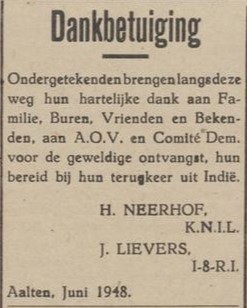
Besides the joyful entry into Aalten, Jan was especially struck by the extraordinary reception given to the returning soldiers in IJmuiden and Amsterdam. Thousands of people were out on the streets; it was grand. „I am, of course, very happy to be home again; it is now a matter of getting back to work as soon as possible.” We also wish Jan all the best and much happiness in the future.
Return from the East
De Graafschapper, 5 July 1948
On Saturday, our fellow townsmen, the volunteers Stronks (Haart 10) and Weevers (1st Broekdijk), returned from the Indies. Mr. Neerhof (Trompstraat) also returned. He stayed in the tropics for 13 years. Upon his return, the A.O.V. performed a serenade. We hope to return to this in more detail in tomorrow’s edition.
Home again after 13 years
De Graafschapper, 6 July 1948
In 1935, the brothers H. and J.H. Neerhof left for the Indies as members of the KNIL. Now, after 13 years, both have returned home safely. Because of this special event, we paid them a visit to congratulate them on their safe return. It appeared that both had led a quiet and good life until 1942.
When the war broke out, both were taken prisoner of war. Both ended up at the so-called Death Railway, the railway line from Thailand to Indo-China. One on one side and the other on the other side. However, they never had the opportunity to speak to each other there. J.H. Neerhof then went to Indo-China, where he remained until the end of the war. He was full of praise for the treatment he received from the French there.
H. Neerhof was transferred from Thailand to Japan, where he went to work in the coal mines of Kyushu. After the capitulation, he was transferred via Nagasaki—where he saw the destruction caused by the atomic bomb—to the Philippines. In Manila, he spent 2 months in quarantine with the Americans. After that, he returned to the Indies, where his brother had also returned in the meantime.
On April 23, they met again in Batavia for the first time in 13 years. About 6 weeks ago, H. Neerhof came home, and on Saturday, J.H. Neerhof arrived. Both stated they were very moved by the homecoming prepared for them here. A fantastic homecoming, as they stated several times.