Category: Bredevoort

  • Gasthuis (Almshouse) Bredevoort

    Gasthuis (Almshouse) Bredevoort

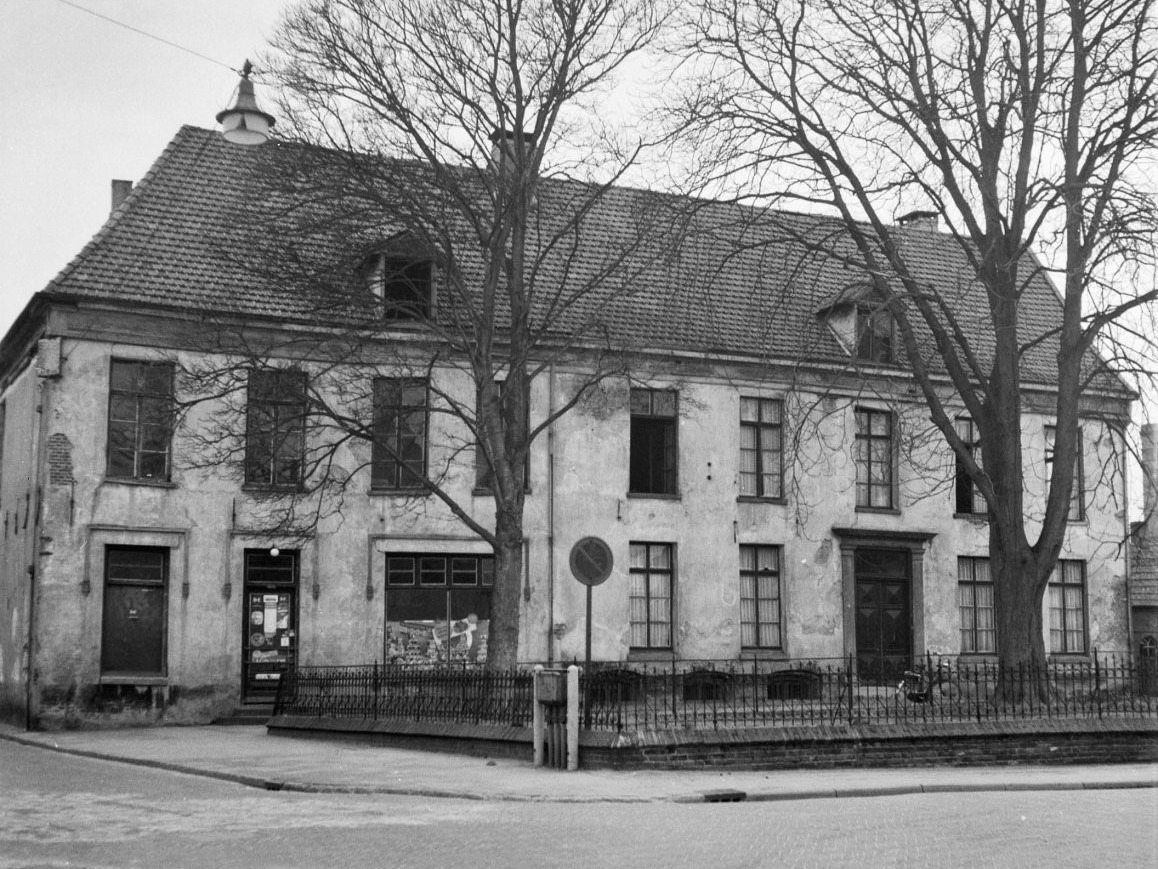
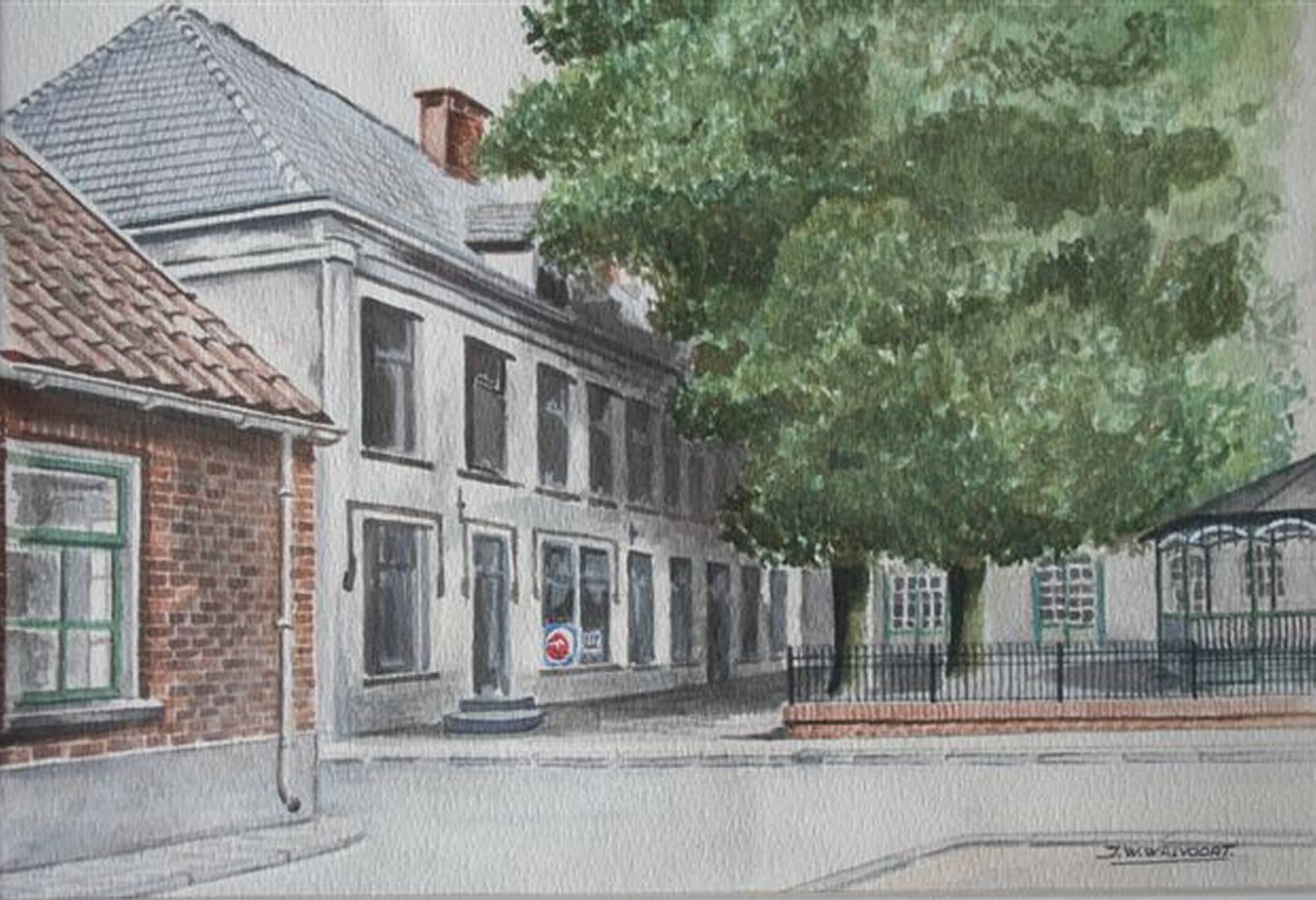
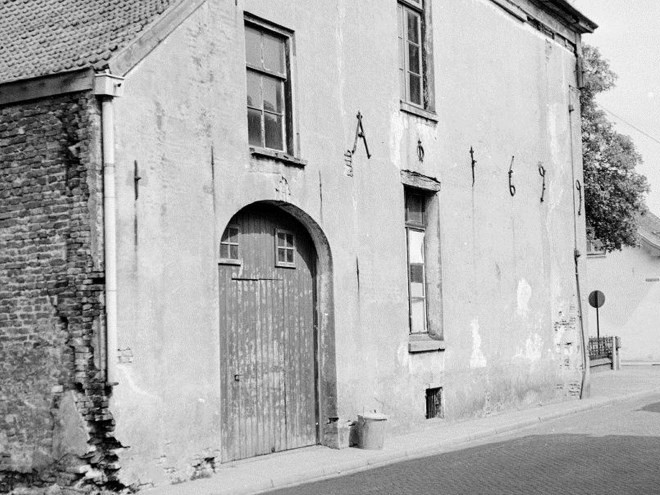
    For centuries, the Gasthuis (also referred to as the Armenhuis or almshouse) served as a refuge for the poor, the sick, and the elderly in Bredevoort. From 1641 until approximately 1930, the institution occupied various locations within the city walls. The current Gasthuisstraat owes its name to this establishment.

    The house of Misslich (Agnietenhuis)
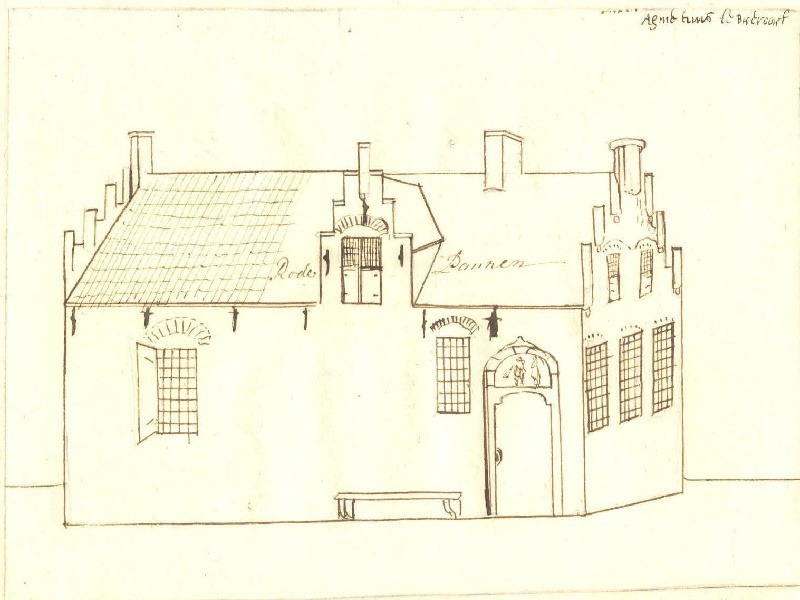
    The earliest known mention of an almshouse in Bredevoort dates to 1641. It occupied the old borgmanshuis (a fortified town house) and the orchard behind it, formerly belonging to Wolf Mislich, then Governor of the Lordship of Bredevoort. In 1639, Mislich drafted a will bequeathing his house and entire estate—valued at 15,000 guilders, a significant fortune at the time—to the poor relief of Bredevoort.

    Following his death in 1639, the will was executed, giving rise to the local saying: “De armen van Bredevoort bunt rieke” (The poor of Bredevoort are rich).

    The House of Misslich, also known as the Agnietenhuis, was presumably located in the vicinity of the later Ambthuis. Rental income from the property benefited the poor, and besides the Widow Mislich, two other families lived in the main house, while three smaller dwellings in the backyard were occupied by the needy.
    ‘t Walletje

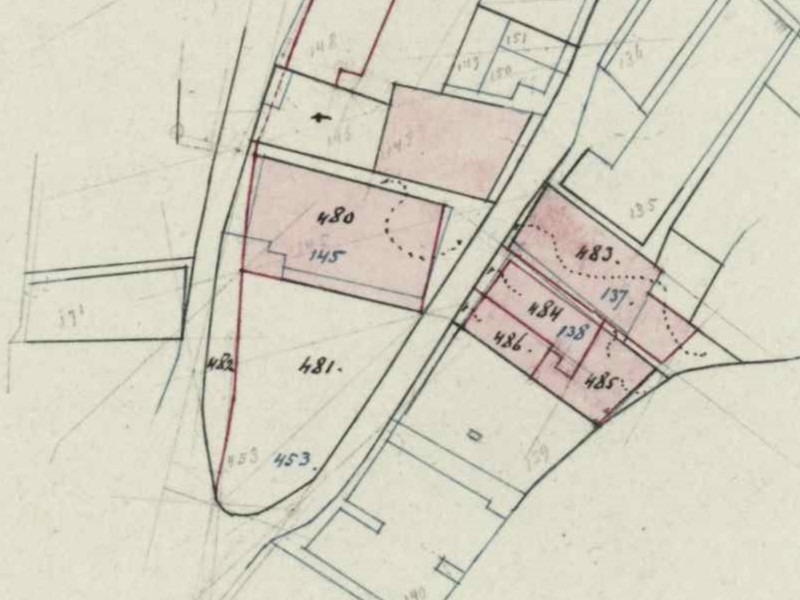
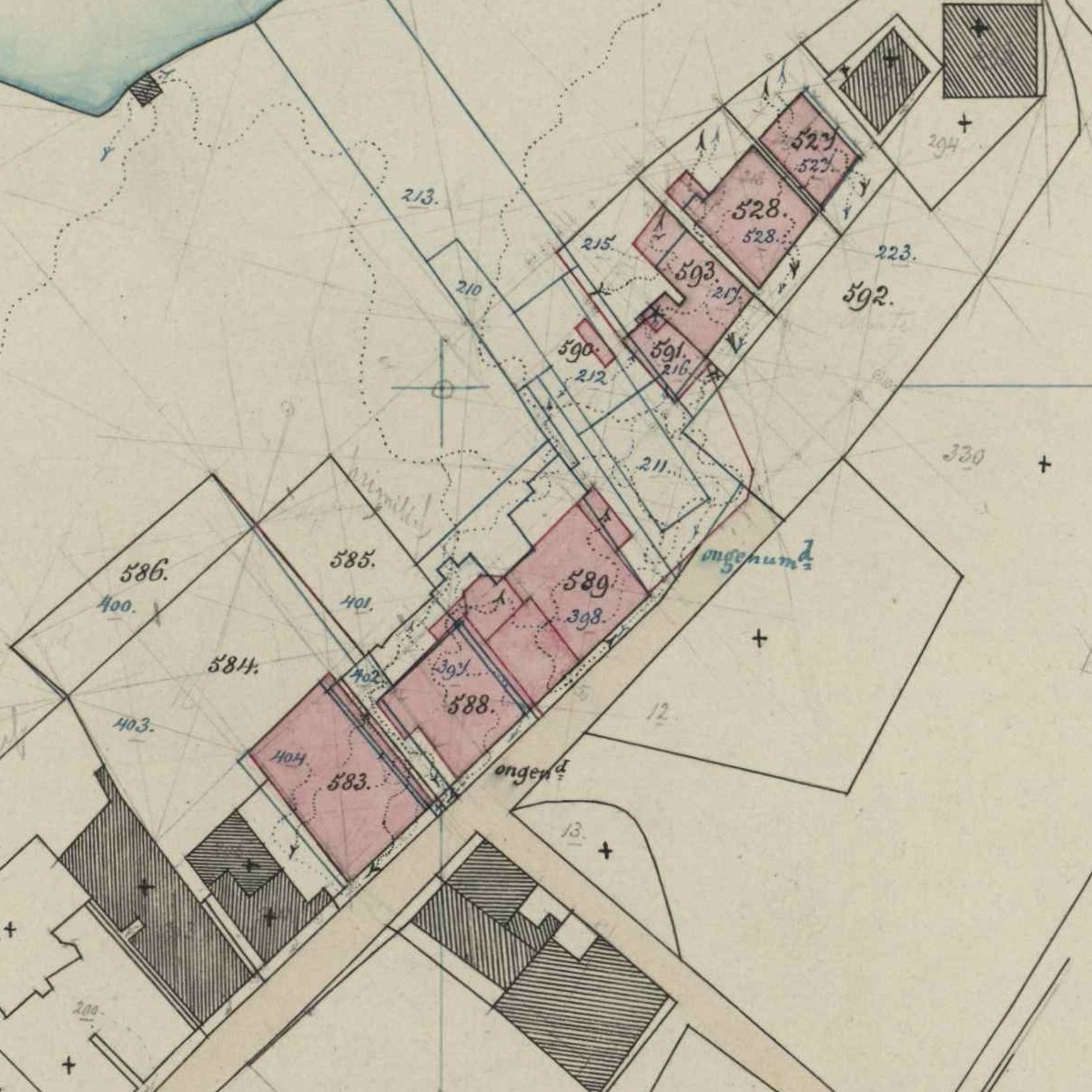
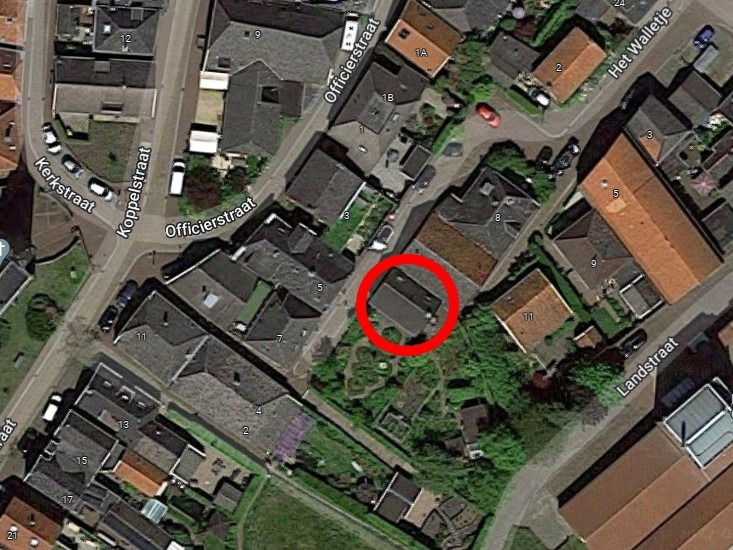
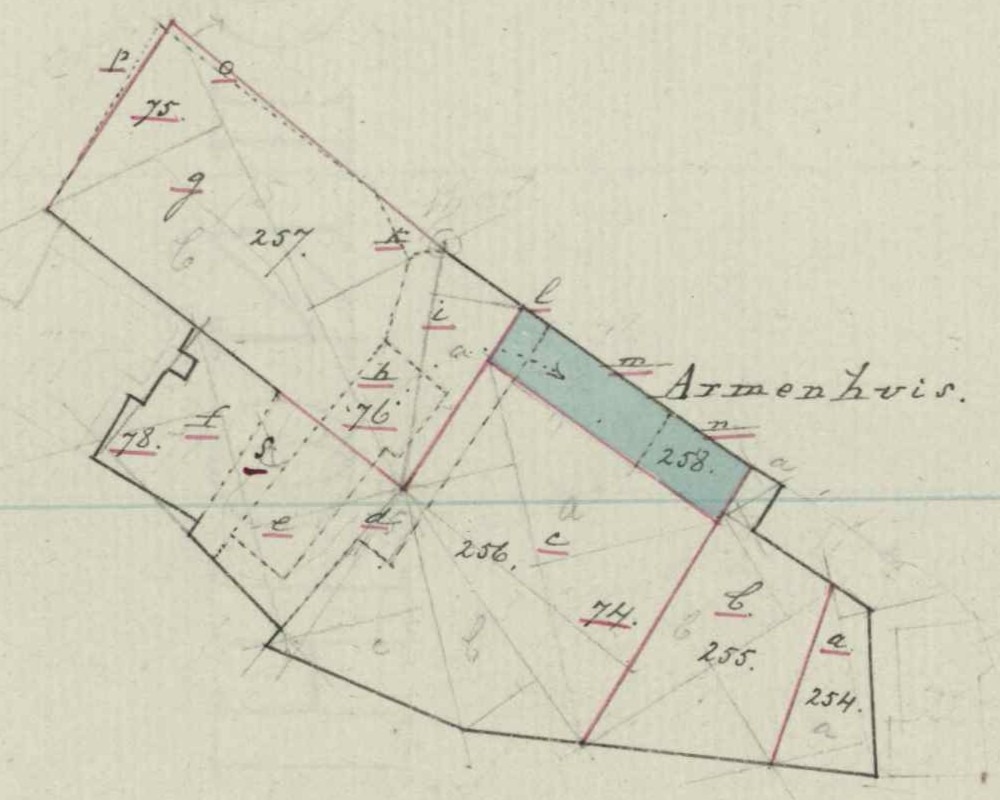
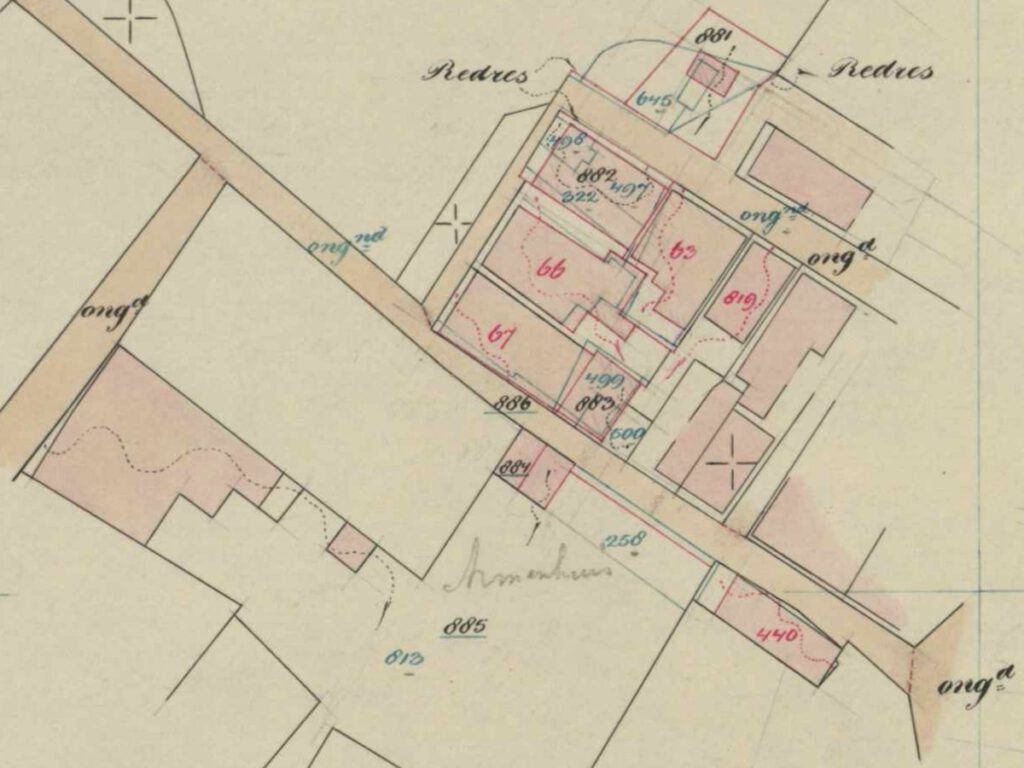
    Around 1800, records regarding the Mislich house become silent. An 1832 cadastral map shows the ‘Armen Gasthuis van Bredevoord’ located at ’t Walletje, in the extension of the Vismarkt (cadastral plots B126-B129). This complex consisted of four dwellings, ranging in size from 22 to 26 m².

    Gasthuisstraat

    The third and final almshouse was built in 1844 on the Gasthuisstraat and consisted of eight dwellings. The land was purchased from the Hof van Barnsveld, a former borgmanshuis.

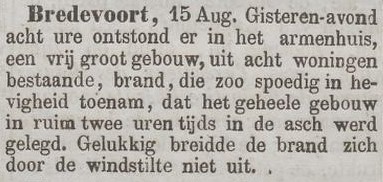
    On 14 August 1879, this building burned down completely, though it was subsequently repaired. In 1911, the almshouse underwent a thorough renovation, though it remained incomplete; the houses were eventually sold off and demolished one by one. In 1897, the Sint Bernardus building was purchased, where nursing care was provided around the turn of the century.
    Residents

    Population registers recorded each household on separate cards. Below is an overview of the inhabitants of the almshouse on the Gasthuisstraat over time:

    Period 1838-1850

    282828282828
    Maria Catharina Harmsen
    (Winterswijk, 26-01-1787)
    Johanna Hendrika Lindeman
    (Bredevoort, 04-12-1786)
    Andries Willemsen
    (Bredevoort, 14-08-1790)
    Janna Geertruid Meinen
    (Bredevoort, 06-01-1789)
    Jan Hendrik Duenk
    (Bredevoort, 17-10-1810)
    Fredrik Boom
    (Bredevoort, 24-03-1797)

    Period 1850-1860

    2828a28b28c28d28e28f28g
    Janna Geertruid Meinen
    (Bredevoort, 06-01-1789)
    Johanna Hendrika Lindeman
    (Bredevoort, 04-12-1786)
    Hendrikus Kempink
    (Bredevoort, 16-09-1815)
    Jan Hendrik Duenk
    (Bredevoort, 17-10-1810)
    Fredrik Boom
    (Bredevoort, 24-03-1797)
    Toni Blekking
    (Aalten, 15-07-1798)
    Andries Willemsen
    (Bredevoort, 14-08-1790)
    Gerrit Jan Sikking
    (Bredevoort, 14-10-1792)
    Hendrika Aleida Kalf
    (Aalten, 23-05-1822)
    Jan Willemsen
    (Bredevoort, 28-02-1802)

    Period 1860-1870

    2828a28b28c28d28e
    Hendrikus Kempink
    (Bredevoort, 16-09-1815)
    Jan Hendrik Duenk
    (Bredevoort, 17-10-1810)
    Hendrika Aleida Kalf
    (Aalten, 23-05-1822)
    Toni Blekking
    (Aalten, 15-07-1798)
    Jan Willemsen
    (Bredevoort, 28-02-1802)
    Gerrit Jan Sikking
    (Bredevoort, 14-10-1792)
    Grada Meinen
    (Aalten, 11-12-1797)

    Period 1870-1880

    30/130/230/330/430/530/630/730/8
    Mina Helmig
    (Bredevoort, 05-07-1824)
    Christina ten Pas
    (Winterswijk, 21-08-1812)
    Hendrikus Kempink
    (Bredevoort, 16-09-1815)
    Hendrika Aleida Kalf
    (Aalten, 23-05-1822)
    Jan Hendrik Duenk
    (Bredevoort, 17-10-1810)
    Janna Geertruid te Slaa
    (Winterswijk, 05-04-1802)
    Jan Willemsen
    (Bredevoort, 28-02-1802)
    Berendina Villekes
    (Bredevoort, 26-06-1800)
    Johanna Ribbink
    (Winterswijk, 01-08-1810)
    Theodora Berendina Grotenhuis
    (Henxel, 01-01-1829)
    Berendina Hijink
    (Lichtenvoorde, 19-06-1834)
    Derk Willem Bloemers
    (Woold, 10-02-1821)

    Period 1880-1890

    38/138/238/338/438/538/638/738/8
    Johanna Ribbink
    (Winterswijk, 01-08-1810)
    Berendina Hijink
    (Lichtenvoorde, 19-06-1834)
    Theodora Berendina Grotenhuis
    (Henxel, 01-01-1829)
    Christina ten Pas
    (Winterswijk, 21-08-1812)
    Jan Hendrik Duenk
    (Bredevoort, 17-10-1810)
    Derk Willem Bloemers
    (Woold, 10-02-1821)
    Gerritjen Duenk
    (Lichtenvoorde, 28-01-1824)
    Frans Julius Römer
    (Mittweida/D, 02-11-1815)
    Willemina Kwak
    (Wisch, 04-04-1829)
    Berendina Villekes
    (Bredevoort, 26-06-1800)
    Mina Helmig
    (Bredevoort, 05-07-1824)
    Hendrika Harmina Schoppers
    (Dale, 09-11-1821)
    Geertruid Kobus
    (Winterswijk, 02-08-1842)
    Jan Hendrik Grotenhuis
    (Henxel, 22-07-1832)
    Gerritjen Dina Scholtz
    (Aalten, 31-12-1834)
    Janna Berendina Dreijers
    (Aalten, 25-05-1833)

    Period 1890-1900

    30/130/230/330/430/530/630/730/8
    Johanna Ribbink
    (Winterswijk, 01-08-1810)
    Berendina Hijink
    (Lichtenvoorde, 19-06-1834)
    Geertruid Kobus
    (Winterswijk, 02-08-1842)
    Janna Berendina Dreijers
    (Aalten, 25-05-1833)
    Jan Hendrik Duenk
    (Bredevoort, 17-10-1810)
    Mina Helmig
    (Bredevoort, 05-07-1824)
    Gerritjen Duenk
    (Lichtenvoorde, 28-01-1824)
    Gerritjen Dina Scholtz
    (Aalten, 31-12-1834)
    Janna Geertruid te Wieske
    (Winterswijk, 11-11-1840)
    Gerrit Hendrik Mengerink
    (Neede, 07-01-1851)
    Harmen Jan Piek
    (Aalten, 09-03-1826)
    Maria Hendrika Slats
    (Aalten, 03-05-1823)
    Geertruid Kobus
    (Winterswijk, 02-08-1842)
    Gerrit Hendrik Piek
    (Vragender, 24-08-1834)
    Gerrit Hendrik Piek
    (Vragender, 24-08-1834)
    Janna Berendina Dreijers
    (Aalten, 25-05-1833)

    Period 1900-1910

    2727/327/427/527/627/7
    Janna Berendina Dreijers
    (Aalten, 25-05-1833)
    Harmen Jan Piek
    (Aalten, 09-03-1826)
    Maria Hendrika Slats
    (Aalten, 03-05-1823)
    Geertruid Kobus
    (Winterswijk, 02-08-1842)
    Gerrit Hendrik Piek
    (Vragender, 24-08-1834)
    Gerritjen Dina Scholtz
    (Aalten, 31-12-1834)
    Tonia Gesiena Oonk
    (Miste, 05-09-1869)
    Jan Derk Wilterdink
    (Miste, 02-11-1860)

    Period 1910-1920

    28/528/7
    Geertruid Kobus
    (Winterswijk, 02-08-1842)
    Gerritjen Dina Scholtz
    (Aalten, 31-12-1834)

    Owners

    Overview is incomplete.

    YearPlotOwnerDescription
    1832B-76Anthony Lurvink, merchant690 m² house, sched & garden
    1847B-258the Reformed Diaconate of Bredevoort199 m² almshouse & garden

    Sources


  • Old Cemetery Bredevoort

    Old Cemetery Bredevoort

    Prins Mauritsstraat, Bredevoort

    The Old Cemetery on Prins Mauritsstraat in Bredevoort was established around 1830, concurrently with the adjacent Jewish Cemetery. The site became available following the dismantling of the fortifications on the eastern side of the town.

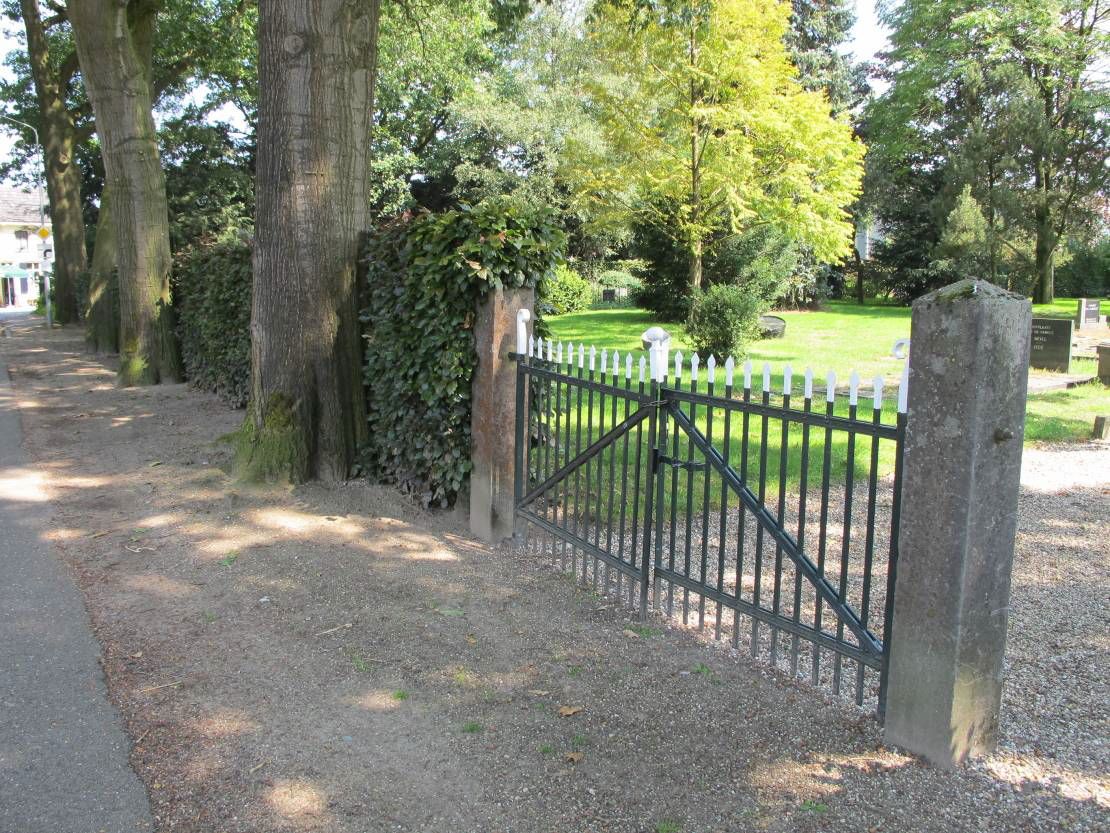
    The cemetery is characterised by an irregular floor plan, surrounded by beech hedges and tall trees. The oldest section is situated directly along Prins Mauritsstraat. In 1925, the southernmost strip was added to the cemetery. At the same time, a new entrance gate was installed, and a mortuary was built a few years later.

    Features


    Cadastral no.A-1144/1648
    FunctionCemetery
    Establishmentc. 1830
    ListedMunicipal
    monument

    Sources


    View the graves on Findagrave.

  • Kloosterhof Cemetery

    Kloosterhof Cemetery

    Kloosterdijk, Bredevoort

    The Kloosterhof Cemetery on the Kloosterdijk in Bredevoort was laid out in 1862–1863 and originally served as a Roman Catholic cemetery.

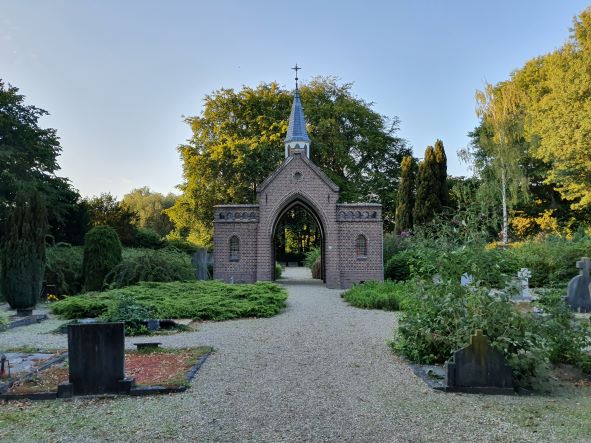
    The oldest, centrally located section features a symmetrical layout with a distinctive entrance gate, a mortuary that also functions as a workshop, and rows of graves facing a Calvary Cross at the rear of the site.

    In the 1980s, the cemetery was extended with a general section. In 1989, a mortuary building was also erected, providing facilities for the deceased to lie in state, for families to pay their last respects, and for offering condolences.

    In 2024, the Municipality of Aalten announced that part of the cemetery would be designated as a natural burial ground. This development aligns with modern wishes and needs regarding burial.

    Features


    Cadastral no.O-549/1146
    FunctionCemetery
    ListedMunicipal
    monument

    Sources


    View the graves on Findagrave.

  • Jewish Cemetery Bredevoort

    Jewish Cemetery Bredevoort

    Prins Mauritsstraat, Bredevoort

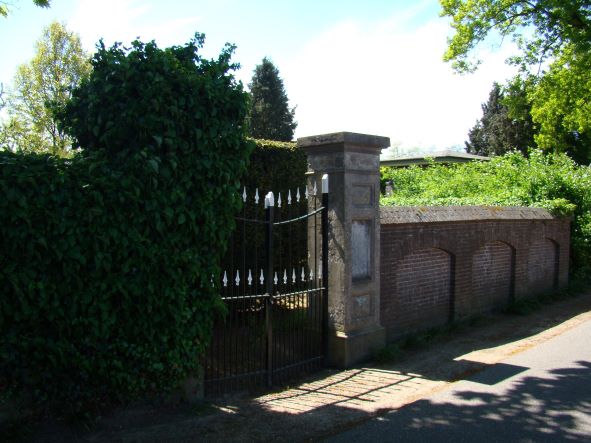
    The Jewish Cemetery on Prins Mauritsstraat in Bredevoort was established around 1830, concurrently with the adjacent general cemetery. The site became available following the dismantling of the fortifications on the eastern side of the town.

    The last Jews from Bredevoort to be interred at this cemetery were siblings Levi and Sara Sander. Both passed away in 1938, shortly after one another. The cemetery is not open to the public.

    Two Jewish cemeteries

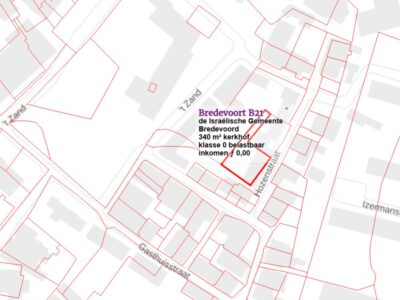
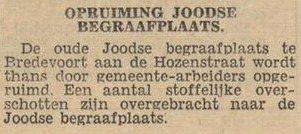
    Bredevoort once had two Jewish cemeteries. The oldest was located on the former castle grounds behind Hozenstraat 5. In 1953, this site was sold to the municipality of Aalten for housing construction. The remains and tombstones were then transferred to the second cemetery on the Prins Mauritsstraat.

    Maintenance and Restoration

    Initially, the cemetery was maintained by the municipality. Since 2018, volunteers from the Bredevoorts Belang association have been responsible for mowing the grass and keeping the walls and the 12 gravestones free of climbing plants. In 2022, restoration work began to repair cracks in the walls, renew the pointing, and refurbish the gate.

    Features


    Cadastral no.A-1143
    FunctionCemetery
    Establishmentc. 1830
    ListedMunicipal
    monument

    View the graves on Findagrave.

  • Dutch Button Works

    Dutch Button Works

    Misterstraat 39, Bredevoort (repurposed)

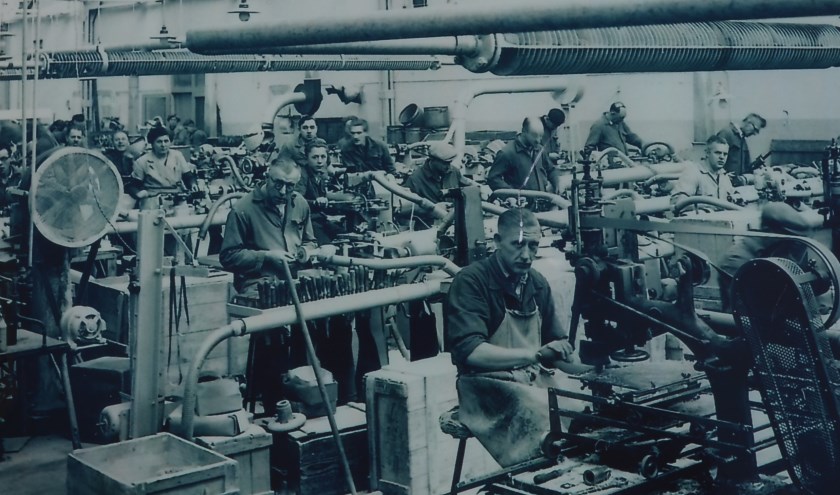
    Dutch Button Works was a button factory in Bredevoort that existed from 1884 until 1976. During its heyday, approximately 270 people were employed by the company; at the time of its closure, the workforce numbered about 44.

    The Horn Industry

    Several button industries already existed in the Netherlands during the 19th century. The oldest in this field was established in 1815, though it primarily produced fabric buttons, particularly linen ones. Around 1900, companies in Germany and England began producing buttons from horn. Following this example, Willem te Gussinklo began manufacturing horn buttons in 1905. This was a first for the Netherlands: the first factory for buffalo horn buttons. Soon, his son Willem te Gussinklo Jr. (known as “Piepkes Willem”) joined the firm, developing into an innovative entrepreneur.

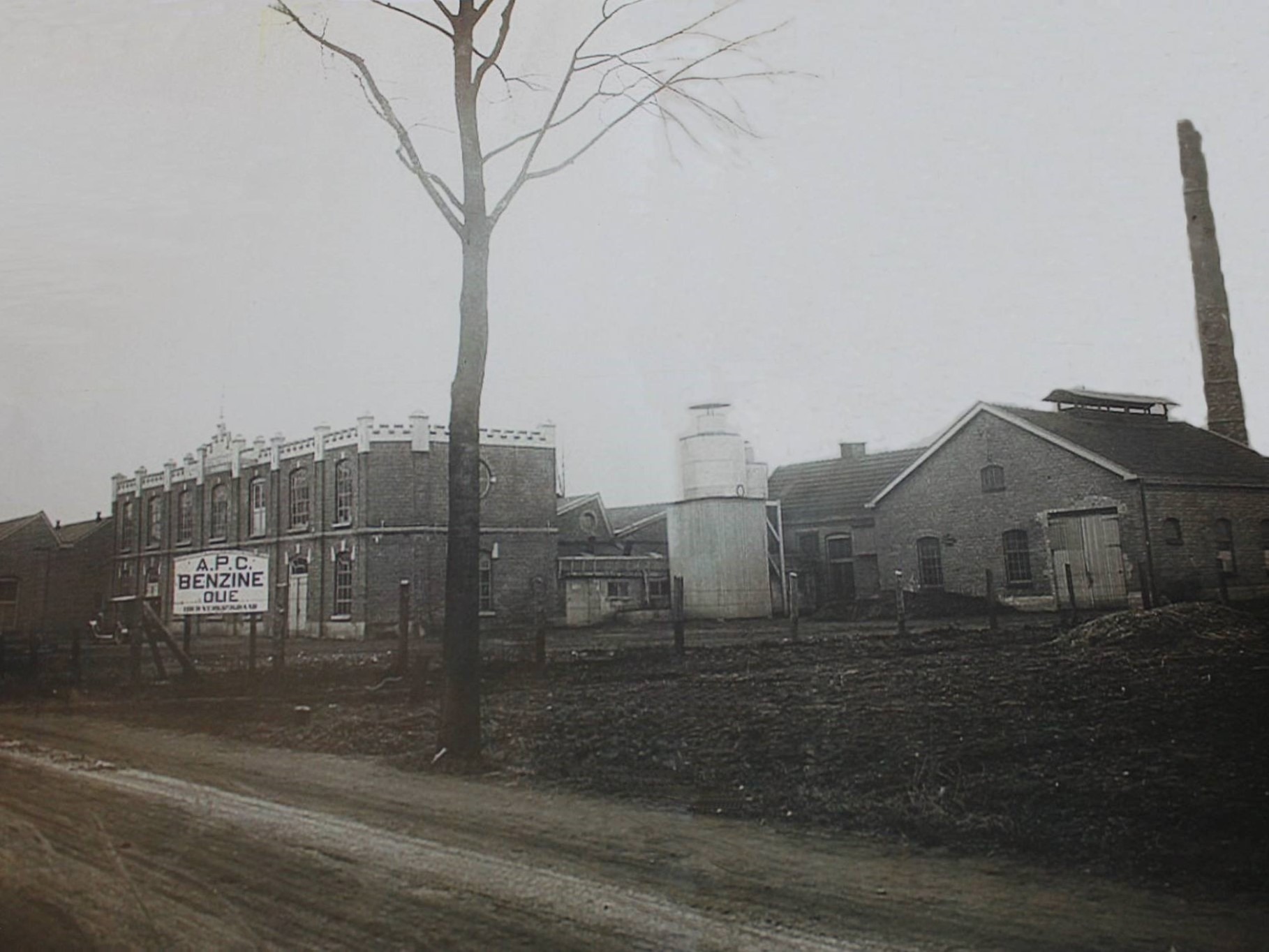
    Te Gussinklo’s first factory was located at ’t Dal in Aalten, today’s Willemstraat. Production was initially entirely manual, with buttons made one by one. Due to increasing demand, he purchased the old Van Eijck weaving mill in Bredevoort in 1924, where button production commenced.

    At that time, Bredevoort still had its own railway station. Every so often, a wagonload of horns would arrive from India, destined for the Bredevoort button industry. As the years passed, manufacturing became increasingly mechanised. Using machines built by the company’s own technicians, the product was eventually manufactured partly or entirely automatically. Slices, known as rondelles (blanks), were sawn from the horn. For this, both the solid tips of the buffalo horn and the hollow sections were utilised.

    Export

    The export of buttons was of great importance. Trade was primarily focused on English-speaking countries—England, Ireland, and North America—where Dutch Button Works enjoyed a fine reputation. Until the 1920s, the buttons produced were exclusively intended for men’s suits. However, when demand fell during the crisis of the early 1930s, ladies’ buttons were put into production as compensation, almost simultaneously with the manufacture of bone buttons. Bone buttons were intended for undergarments. Besides buttons, the factory in Bredevoort also manufactured walking sticks—specifically, the knob or handle and the tip were crafted from horn.

    A few years after the Ten Dam & Manschot comb factory in Aalten ceased operations, DBW also took up the production of combs. During World War II, the company shifted to processing domestic horn. Besides buttons, ashtrays and bird figurines were popular items. Stag horn was used to manufacture buttons for hunting jackets, and discs of stag horn were fashioned into small ashtrays or candle holders on rosewood bases.

    Before the war, DBW also had branches in Germany: in Berlin and Bocholt. After 1945, the company experienced a peak period. The third generation, W.A. te Gussinklo, joined the management. Demand for buttons was high. Many home workers were occupied with sewing buttons onto cards. The horn buttons found their way to garment factories. Sales representatives would travel with a “model jacket” made of various pieces of fabric sewn together—a multicoloured patchwork. On each piece of fabric, the most suitable buttons for that specific material were sewn.

    In 1959, the company celebrated its 75th anniversary. At that time, there were over a hundred employees, excluding home workers. Due to increasing automation, the company achieved high turnover with fewer staff. In the second half of the 1950s, horn was largely superseded by plastics. In 1963, the management of DBW, together with an English button factory, took over the largest button factory in Germany.

    Decline

    The company suffered a heavy blow in 1968 when the director, W.A. te Gussinklo, died at the age of 51, just six months before his father. He was succeeded by his wife, B.A. te Gussinklo-Zandbergen. When her son H.J. Gussinklo Ohmann completed his studies at the technical university in Eindhoven a year later, he also joined the management. By then, the production system was entirely focused on plastic buttons (polyester), which the company had started producing itself around 1960. In the long run, however, it proved extremely difficult to remain competitive. Despite great efforts to keep the company running, they were forced to close DBW in 1976.

    The municipality of Aalten purchased the complex in 1977, and it was resold to the firms Van Wezel and Voltman-Riviera. Later, the Albert ten Bruin car dealership was located here for many years.

    Repurposing

    At a municipal information evening in July 2008, the Vereniging Bredevoorts Belang (Bredevoort Interest Association) made a plea for the preservation and restoration of this characteristic building. They stated: “This building is the only remaining, tangible, and visible intact industrial heritage that Bredevoort still possesses, providing residents with a link to its extensive textile history. The factory building, still in its original state, has a striking, beautiful facade featuring the typical elements of an industrial building built in the third quarter of the nineteenth century.” The non-monumental parts were demolished in 2019. The monumental building has since been repurposed to house apartments and a supermarket.

    Features


    Cadastral no.A-2623
    FunctionButton factory
    Foundation1884
    Discontinuation1976
    ListedMunicipal
    monument
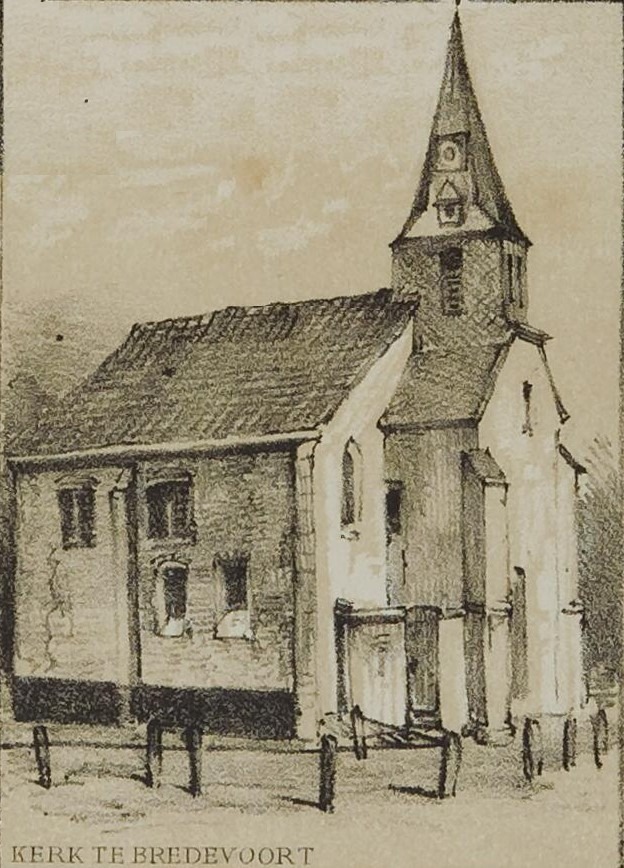
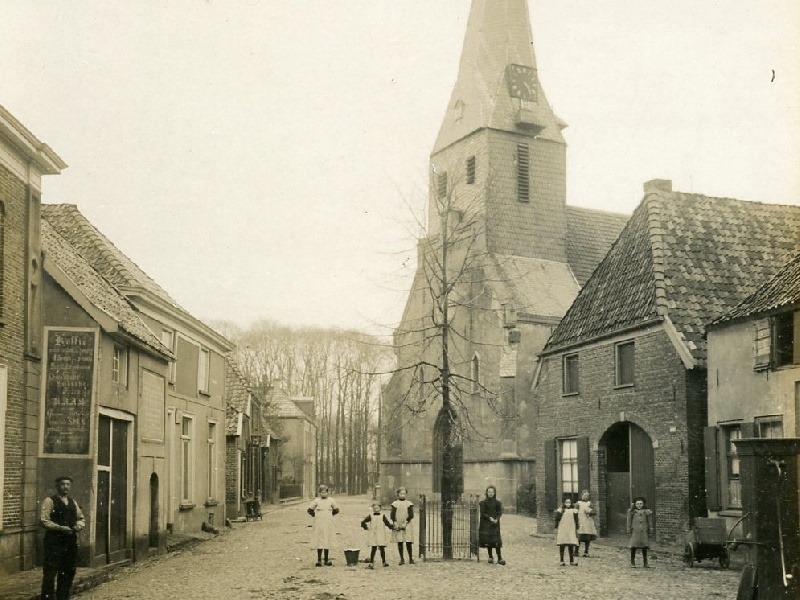
  • St George’s Church, Bredevoort

    St George’s Church, Bredevoort

    Markt 3, Bredevoort

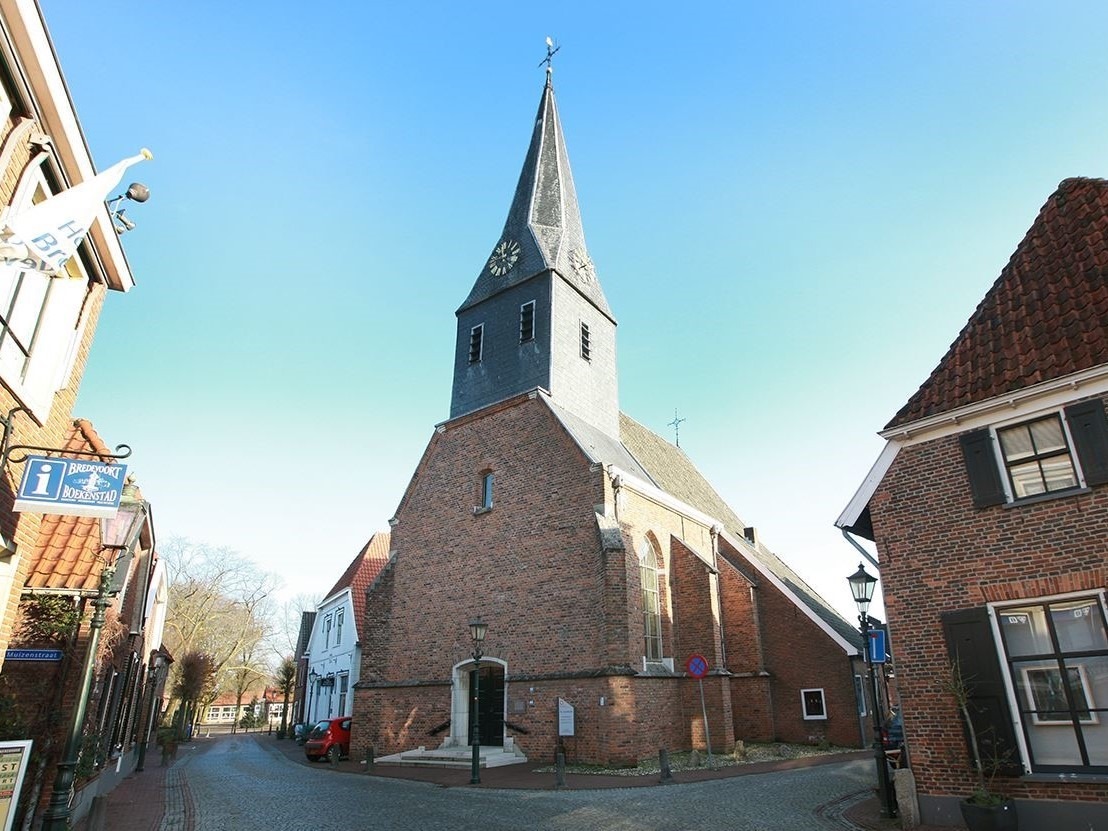
    The Sint-Joriskerk (Saint George’s Church) is a late-Gothic church in Bredevoort, the foundations of which date back to 1316. The church is dedicated to Saint George, the patron saint of the borgmannen (castellans) of Bredevoort. A characteristic feature is the tower’s finial: a statue of Saint George and the Dragon instead of a traditional weathercock. On the east side of the church, there is a so-called ‘melaatsenraampje'(leper window). In earlier times, worshippers with contagious diseases used this window to follow the mass.

    Early History

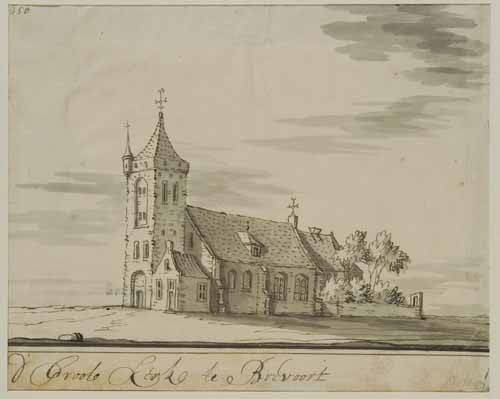
    The oldest foundations of the church date from 1316, and the building may have served as a chapel for the castle of Bredevoort in its earliest years. During the Siege of Bredevoort in 1597 by Prince Maurice, the old (and larger) church burned down completely, and the vaults collapsed. The following year, the people of Bredevoort submitted a request to the classis of Zutphen to build a new church: “Die van Bredeforts soln met request an desen quartier verzoekcken assistentie tott reaparatie hearder Kapellene” (Those of Bredevoort shall request assistance from this quarter for the repair of their chapel). Reconstruction in the Gothic style began in 1599.

    Expansions

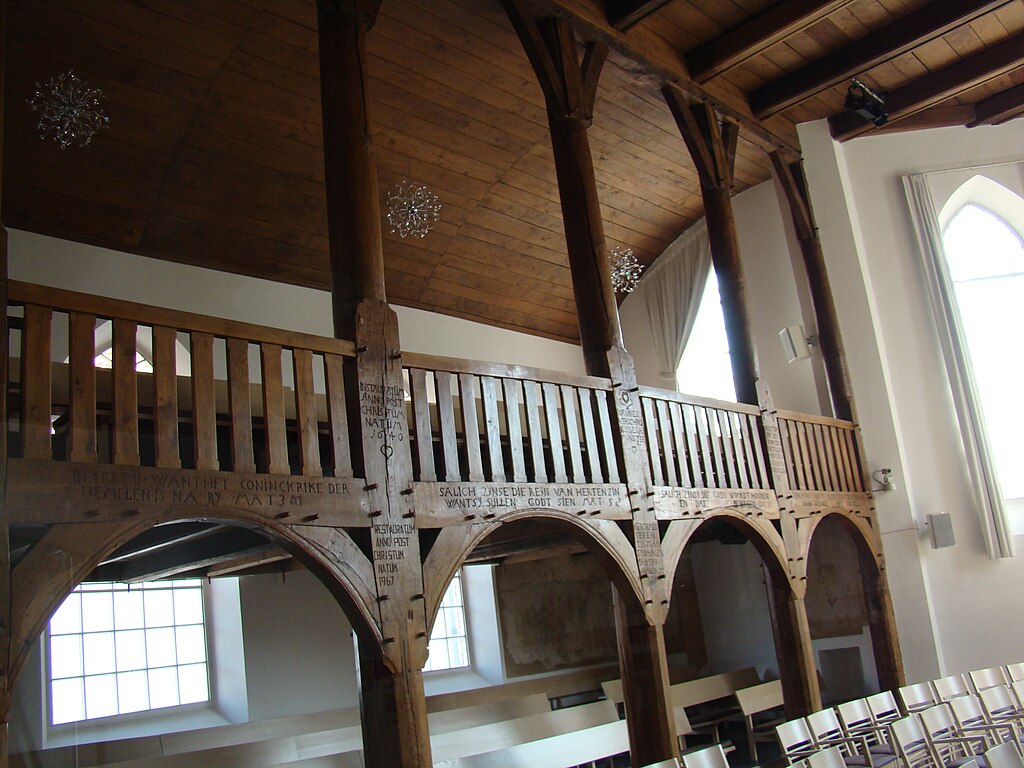
    Following the reconstruction, the church underwent various expansions. In 1600, after another fire, a tower was added. In 1639, the chapel was enlarged and broken out on the north side. Using the same stones, the wall was rebuilt several metres further out. Later expansions followed in the form of the boerenzolder (farmers’ loft) and the orgelzolder (organ loft). This extension, including the loft, is clearly visible. Biblical proverbs are inscribed in the beams of the farmers’ loft, such as: “Salich zijn se die rein van herte zin want sij zullen Godt zien” (Blessed are the pure in heart, for they shall see God).

    Powder Tower Disaster of 1646

    On 12 July 1646, lightning struck the castle’s powder tower. The resulting explosion destroyed a large part of the town, and forty people were killed. The castle was turned into a ruin, and the church also sustained significant damage. Eleven victims, including the Drost of Bredevoort, his wife, and eight of their children, were buried in the choir (the eastern part of the church).

    The church was rebuilt, though smaller than its predecessor. In 1672, Captain Satink donated a Rococo pulpit featuring his family coat of arms, as well as a copper lectern bearing the arms of the Holy Roman Empire.

    Renovations

    The church has undergone various renovations over the centuries. During the French period, features such as a wooden vault and a floor of Bentheimer sandstone were added. The church also received new pews, and the floor level was raised. In 1832, the church pews were painted white.

    In 1849, the wooden plank ceiling was replaced with a lime ceiling. In 1858, a catechism room was added, for which King William III donated 200 guilders. The walls of the church were re-plastered in 1868, and this plaster layer was removed again during the restoration of 1949. In 1869, the tower was repaired. In 1882, five stained-glass windows were replaced by cast-iron ones. Three years later, two more cast-iron examples were installed in the farmers’ loft.

    In 1889, the catechism room was extended with an annex. During a thorough renovation in 1896, the façade received new doors, a rose window, two small gable windows, and an iron cross. The commemorative stone is now placed on the inside of the wall of the organ loft. In 1920, the spire was renewed.

    Post-War Restorations

    After the Second World War, the church was in poor condition. Following a large-scale restoration, the church was put back into use in 1967. During a restoration in 2006, the subsided gravestones and the natural stone floor were repaired. It was discovered that a number of the stones had been laid upside down, likely during the French period; these have since been properly repositioned. During the work, several historical finds were made, including coins, human remains, and stained glass. Furthermore, a stone from the Republic of the Seven United Netherlands was found.

    Research revealed that two of the stones that had been laid upside down belonged to the Bredevoort Drost, Wilhelm van Haersolte, and his family. They perished along with almost all their children during the powder tower disaster of 1646. Only their son, Anthony, had survived the disaster. In 2010, his descendants donated 3,000 euros to the restoration committee.

    Bells and Clock

    The Sint-Joriskerk houses three bells. The oldest, a monumental klepklok (chiming bell) from 1454, was borrowed from the Schaer Monastery in 1596. After the monastery was destroyed during the siege of 1597, this bell remained in the church. Wilhelm van Haersolte tot Elsen donated the brandklok (fire bell), cast in 1644. The luidklok (ringing bell) dates from 1731 and, according to old tradition, is rung daily at 8:00, 12:00, and 21:00. Historically, the town gates were opened at 8:00 and closed at 21:00, and 12:00 was mealtime.

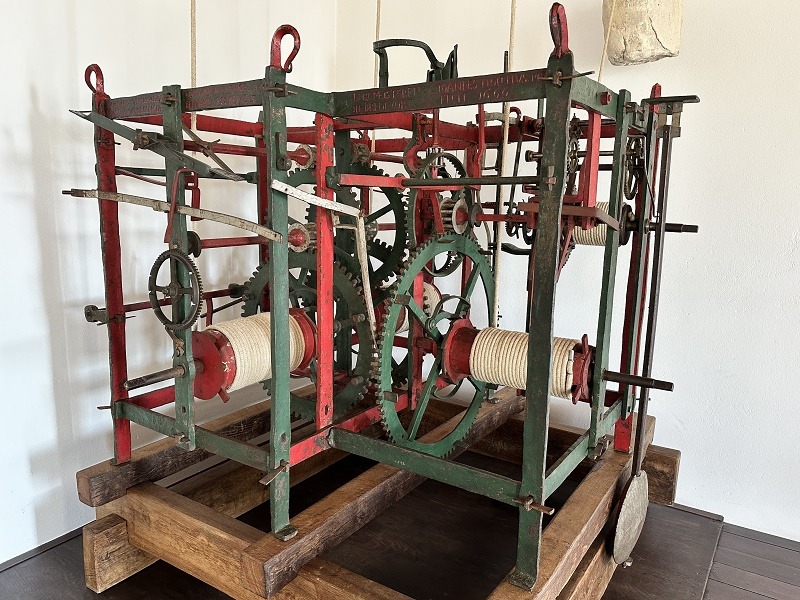
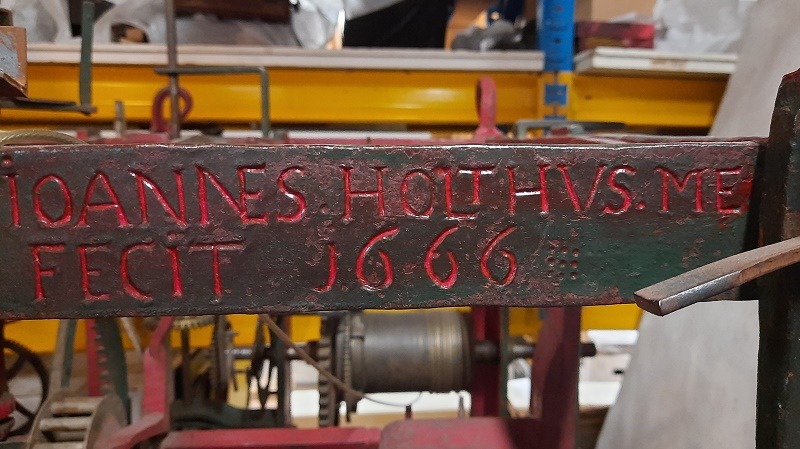
    In 1942, the church received a new clockwork. The old clockwork from 1666 will soon be on display in the Sint-Joriskerk again. In 1980, the small carillon of three bells was reinstalled.


    Owners

    Overview is incomplete.

    YearPlotOwnerDescription
    1832B-80de Hervormde Kerk Bredevoord280 m² church

    Features


    Cadastral no.B-1199
    FunctionChurch
    Year of construction14th/17th century
    MonumentNational Monument

    Sources


  • St Bernardus

    St Bernardus

    ‘t Zand 23, formerly ‘t Zand 15, Bredevoort

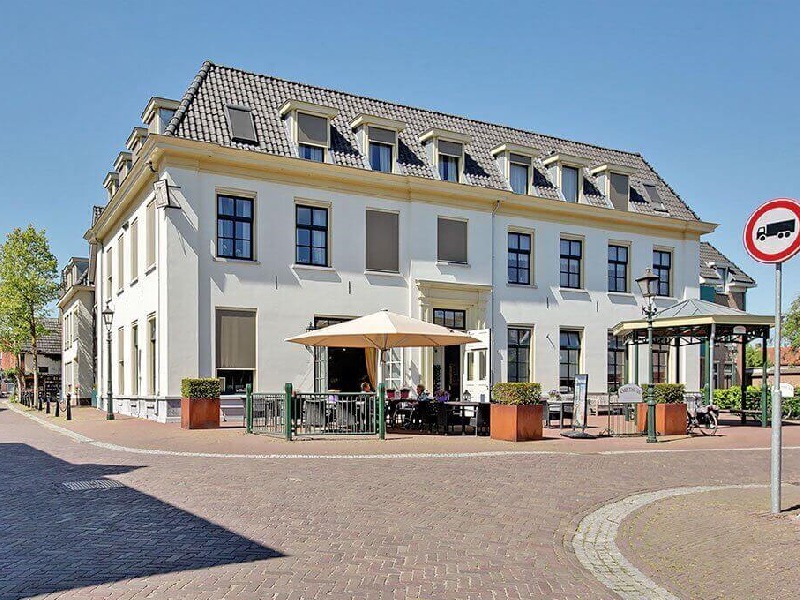
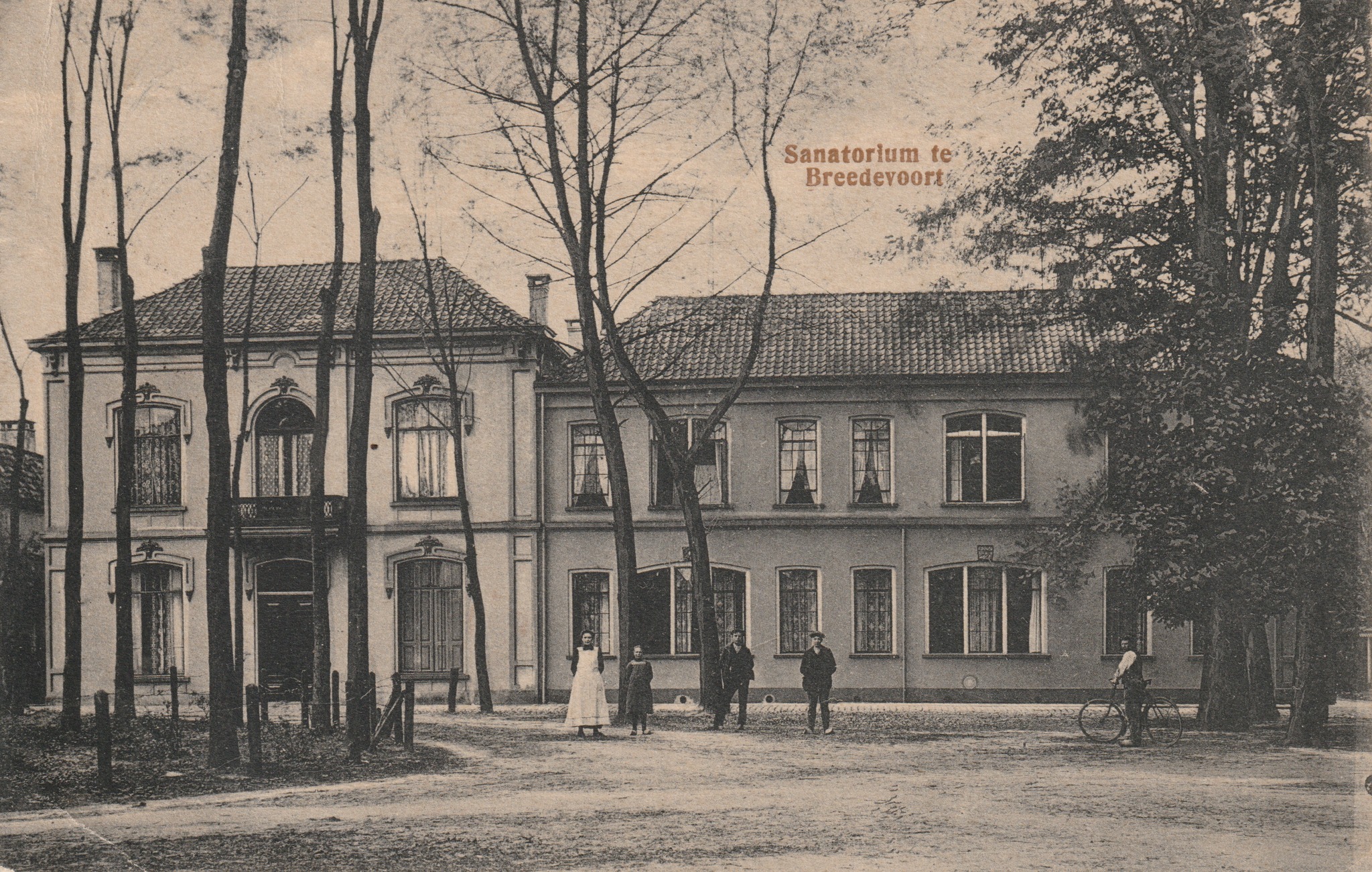
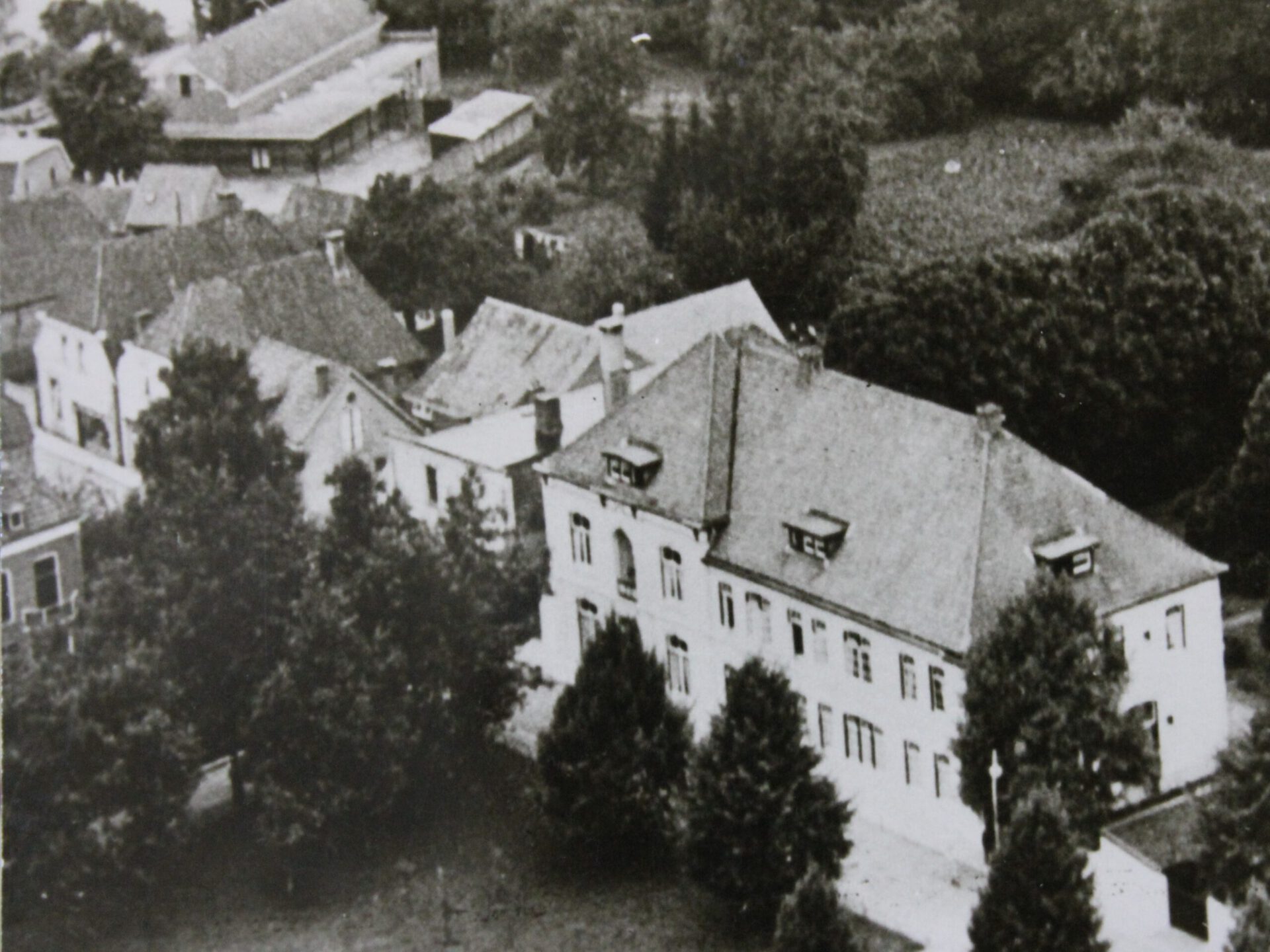
    St Bernardus House is a distinctive building on ’t Zand, the central square of Bredevoort. The building has a rich history, having served as a residence, a sanatorium, and a nursing home.

    The building was originally commissioned by Jan Satink, a lieutenant colonel in the States Army, Regiment of Nationals. It was erected on the site where the outer bailey of Bredevoort Castle once stood. In 1800, the house passed into the possession of the Roelvink family through inheritance. Arnoldus Florentinus Roelvink, a scion of this family, served as the mayor of Bredevoort from 1813.

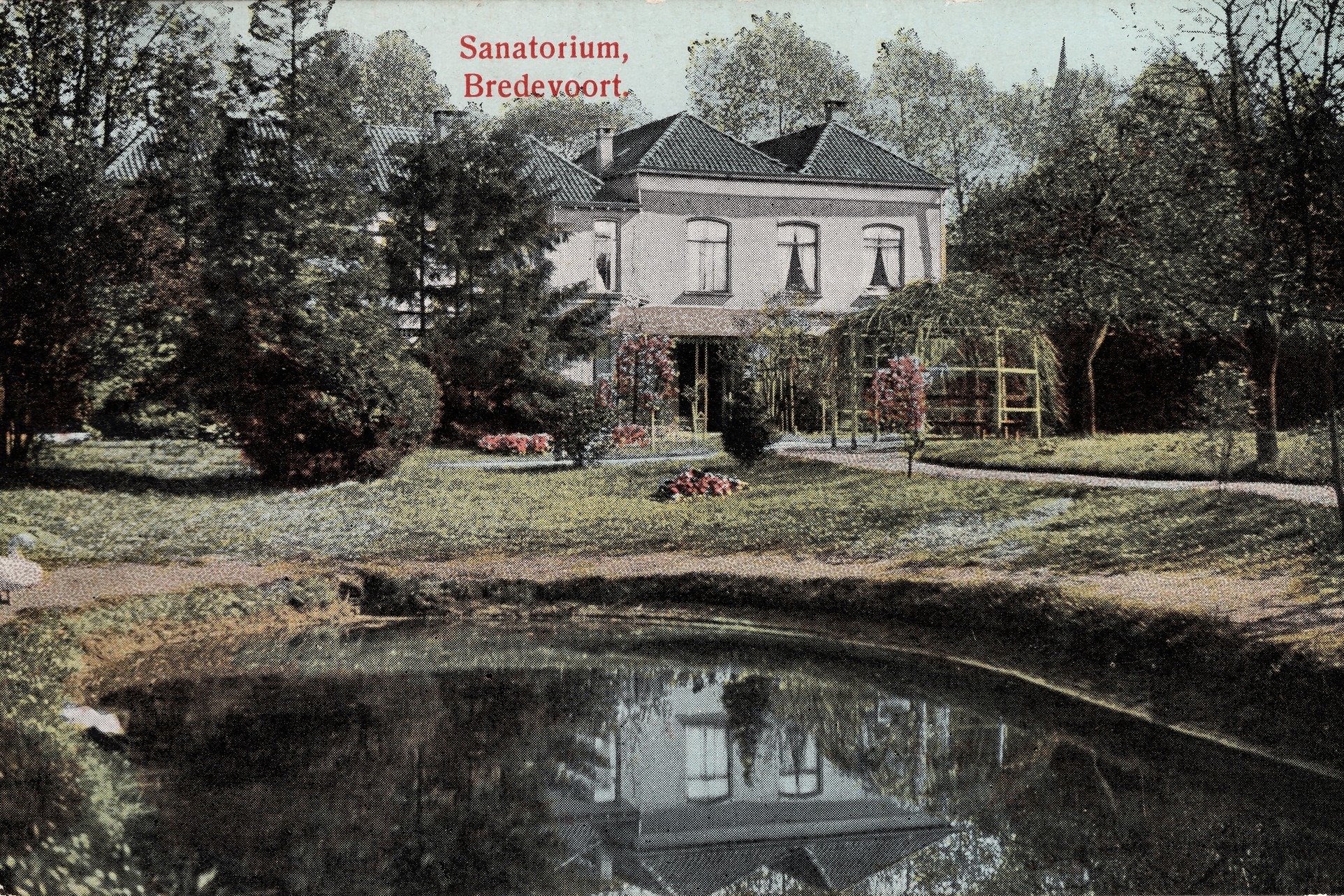
    In 1897, the building was purchased by Father Bernardus Mulders. The priest was a man of means and acquired the former steward’s house with his own funds. His goal, he wrote, was to offer “his poor children” a Catholic education. Because Catholic schools were costly at the time, he devised a clever solution: he brought nuns to Bredevoort, who established a convent and a sanatorium in the steward’s house. Nuns were an economical option as they received no salary, having dedicated their lives to God.

    Under the management of the Franciscan Sisters of Thuine, the ‘R.K. Sanatorium St. Bernardus Gesticht’ (Roman Catholic St. Bernardus Sanatorium Institute) was established. He named the convent-sanatorium after his own patron saint, Saint Bernard of Clairvaux. With the profits from the sanatorium, the priest started a primary school: the Sint Joannesschool.

    The sanatorium was intended for wealthy patients, as the nursing costs were high, ranging from f 1.50 to f 2.20 per day. Medical expenses and pharmacy costs were charged at 10 guilders per month. Second-class patients paid f 7.50.

    From 1907, people came to Bredevoort from all over the country to recover in the sanatorium. They often stayed for months. During the day, they would lie in bed in an open-air pavilion (lighal), even in winter, completely wrapped up. In the garden of Sint Bernardus—now the Vestingpark (Fortress Park)—there were at least ten of these pavilions, with their open sides facing the sun. Two of these have been preserved and are now designated as national monuments (rijksmonumenten).

    The sanatorium remained in use until 1933. Afterwards, the building was repurposed as a nursing home for the elderly. In 1938, the Sisters of Thuine were succeeded by the Sisters of St. Joseph from Amersfoort. The last sisters left Bredevoort in 1985.

    In 1988, a large-scale renovation and expansion of the building was carried out by the Stichting Verzorgingstehuis St. Bernardus (St. Bernardus Nursing Home Foundation). The nursing home eventually moved to the newly rebuilt Ambthuis in 2008.

    Since 2020, the building has had a new destination: it is used as the boutique hotel & brasserie De Heerlyckheid.


    Owners

    Overview is incomplete.

    YearPlotOwnerDescription
    1832B-209
    B-208
    Arnoldus Florentinus Roelvink,
    mayor of Aalten and
    Bredevoort in Bredevoort
    550 m² house & garden
    220 m² house & garden
    1877B-397
    B-380
    Bernard Andries Roelvink,
    clerk at the cantonal court
    235 m² house & garden
    552 m² house & garden
    1887B-588
    B-589
    Leonard Roelvink, mayor240 m² house & yard
    280 m² coach house, kitchen, stables & yard
    1898B-588
    B-589
    Hermann Schepers, schoemaker240 m² house & yard
    280 m² coach house, kitchen, stables & yard
    1901B-734R.C. church of Bredevoort21.023 m² house, sheds, yard & garden
    1909B-792R.C. church of Bredevoort13.373 m² house, hospital,
    shed & garden
    1952B-979R.C. church of Bredevoort13.538 m² house, stables,
    hospital & garden
    1988B-1265St. Verzorgingshuis Sint Bernardus 2.760 m² “BWT”

    Features


    Cadastral no.B-1963
    FunctionResidential property,
    Sanatorium,
    Retirement home,
    Hospitality
    Year of construction1764
    MonumentMunicipal
    monument

    Residents

    Period 1823-1850

    Bredevoort 45

    Arnoldus Florentinus Roelvink (Borculo, 23-12-1789), mayor
    Elzabé Maria Theodora ten Cate (Neede, 21 juli 1798)

    Bredevoort 46

    Theodora Sophia Roelvink (Bredevoort, 09-11-1760)

    Period 1838-1850

    Bredevoort 77

    Arnoldus Florentinus Roelvink (Borculo, 23-12-1789), mayor
    Elzabé Maria Theodora ten Cate (Neede, 21 juli 1798)

    Bredevoort 78

    Theodora Sophia Roelvink (Bredevoort, 09-11-1760)

    Period 1850-1860

    Bredevoort 77

    Arnoldus Florentinus Roelvink (Borculo, 23-12-1789), mayor
    Elzabe Maria Theodora ten Cate (Neede, 21 juli 1798)

    Bredevoort 78

    Theodora Sophia Roelvink (Bredevoort, 09-11-1760)

    Period 1860-1870

    Bredevoort 77

    Elzabe Maria Theodora ten Cate (Neede, 21 juli 1798)

    Bredevoort 78

    ?

    Period 1870-1880

    Bredevoort 84

    Elzabe Maria Theodora ten Cate (Neede, 21 juli 1798)

    Bredevoort 85

    Leonard Roelvink (Bredevoort, 30-04-1833), mayor
    Christina Paschen (Winterswijk, 27-03-1848)

    Period 1880-1890

    Bredevoort 101

    Elzabe Maria Theodora ten Cate (Neede, 21 juli 1798)

    Bredevoort 102

    Leonard Roelvink (Bredevoort, 30-04-1833), mayor
    Christina Paschen (Winterswijk, 27-03-1848)

    Period 1890-1900

    Bredevoort 85a

    Heinrich Nuijken (Gahlen/D, 11-09-1833)
    Anna Velthacke (Vreden/D, 16-05-1834)

    Bredevoort 85

    Christina Paschen (Winterswijk, 27-03-1848)

    Next residents:

    Hermann Schepers (Weseke/D, 17-08-1828), schoemaker
    Elisabeth Dieckmann (Alpen/D, 24-12-1840)

    Period 1900-1910

    Bredevoort 83a

    Heinrich Nuijken (Gahlen/D, 11-09-1833)
    Anna Velthacke (Vreden/D, 16-05-1834)

    Next residents:

    Catharina Niemeijer (Salzbergen/D, 28-11-1856)

    Here follows a long list of nurses and schoolteachers.

    Continued list of residents:

    Bredevoort 83a > 084

    More (a.o.) foster sisters, teachers, sisters of charity, as well as patients.

    Bredevoort 83 > 85

    Hermann Schepers (Weseke/D, 17-08-1828), schoemaker
    Elisabeth Dieckmann (Alpen/D, 24-12-1840)

    Period 1910-1920

    Bredevoort 84 > 60

    ?

    Bredevoort 85 > 61

    Hermann Schepers (Weseke/D, 17-08-1828), schoemaker
    Elisabeth Dieckmann (Alpen/D, 24-12-1840)

    Address directory 1934

    Bredevoort 60 > ‘t Zand 15

    St Bernard’s Institution

    Address directory 1967

    ‘t Zand 23

    St Bernard’s Institution

  • The Latin School in Bredevoort

    The Latin School in Bredevoort

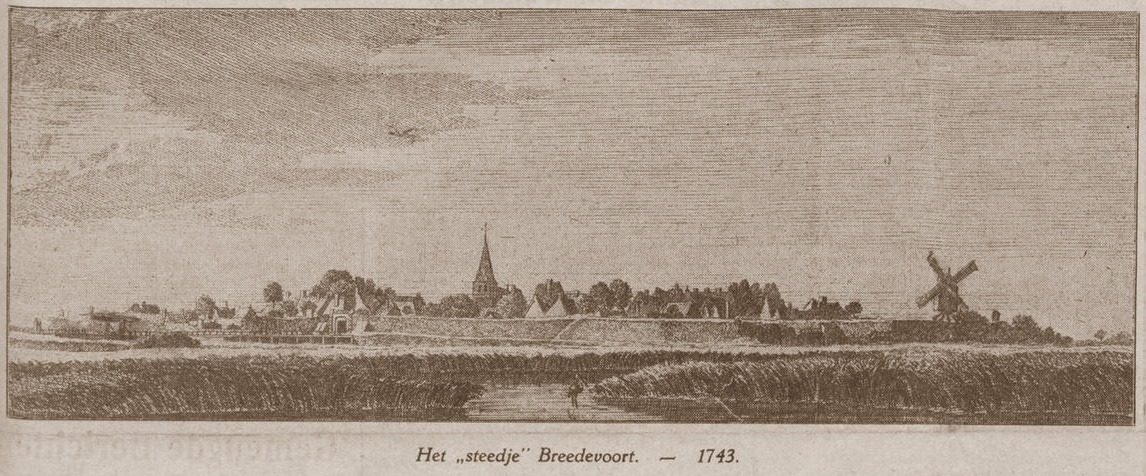
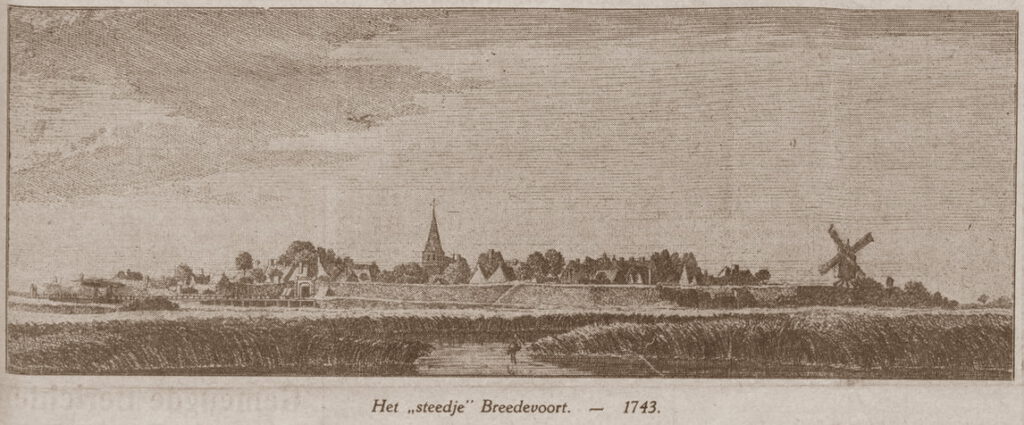
    Het steedje Breedevoort, 1743

    Bredevoort in 1743 by Jan de Beijer, for illustration purposes

    In the eighteenth century, the fortified town of Bredevoort was home to a Latin School — an educational institution where boys were prepared for a university or ecclesiastical career.1 Although no physical remains exist, several archival records offer a glimpse into the existence of this school.

    A teacher from Molsberg

    The first indication comes from the Oprechte Haerlemsche Courant of 1 November 1763, in which Lotharius Frederik Wurm advertises that he has been working as a praeceptor (teacher) in Bredevoort for two years. His appointment therefore dates from approximately 1761. He announces his intention to start a boarding school and offers lessons in Latin, High German, French, history, rhetoric, poetry, and psalm singing.2

    Less than a month later, on 26 November 1763, an almost identical advertisement appears in the Amsterdamsche Courant.3 A year after that, on 13 September 1764, another similar advertisement follows in the Oprechte Haerlemsche Courant.4 This shows that Wurm actively and repeatedly presented himself to recruit pupils.

    On 29 October 1765, he appears in the newspaper again, this time as rector of the Latin School in Bredevoort, appointed by “His Serene Highness the Hereditary Stadtholder.” In this capacity, he offered tuition in Latin, Greek, history, rhetoric, and poetry, alongside private lessons in French and High German.5

    Wurm originated from Molsberg, in the Electorate of Trier (now Germany). He married Elisabet Eliveret in Bredevoort on 9 August 1764.6 He passed away before September 1774, as Elisabet remarried at that time as the “widow of the late Lotharius Fredericus Wurm.” 7

    A schoolmaster with ecclesiastical duties

    On 26 March 1773, it is noted in the Marriage Register of the Dutch Reformed Congregation of Bredevoort that Alette Diemont, widow of schoolmaster Jan Hendrik Prevenier, is handing over the marriage register. The entry reads:

    “Anno 26 March 1773, received this booklet from Juffr. Alette Diemont, widow of the Schoolmaster of this city, Jan Hendrik Prevenier.”
    — signed: H. Conradi, senior sijn
    8

    This note confirms that Prevenier was a schoolmaster. The fact that he was in charge of the marriage register indicates that he was also responsible for maintaining church records — a task often performed in small towns by the schoolmaster or precentor.9

    Additionally, Prevenier is mentioned in other sources as the city steward (stadsrentmeester), responsible for the financial administration of Bredevoort.10 This makes it clear that he fulfilled a central role not only in education and the church, but also in the municipal administration. It is plausible that he was associated with the Latin School, as in small towns the roles of schoolmaster and teacher at the Latin School were often combined.11 While this is not explicitly recorded for Bredevoort, given the context, a combination of functions is highly likely.

    Location unknown

    The exact location of the Latin School in Bredevoort is unknown. It may have been no more than a room in or near the church, or the teacher’s residence — as was common elsewhere in small towns in Gelderland.12 The presence of such a facility in a small town like Bredevoort nonetheless indicates a relatively high level of education and culture in the 18th century.13

    Sources


    1. Latijnse School (Wikipedia) ↩︎
    2. Oprechte Haerlemsche Courant, 1 November 1763 (Delpher) ↩︎
    3. Amsterdamsche Courant, 26 November 1763 (Delpher) ↩︎
    4. Oprechte Haerlemsche Courant, 13 September 1764 (Delpher) ↩︎
    5. Oprechte Haerlemsche Courant, 29 October 1765 (Delpher) ↩︎
    6. Aalten, trouwboek, 9 August 1764 (Genealogiedomein) ↩︎
    7. Aalten, trouwboek, september 1774 (Genealogiedomein) ↩︎
    8. Bredevoort, trouwboek 1639-1981 (Genealogiedomein) ↩︎
    9. A.Th. van Deursen, Bavianen en Slijkgeuzen (1974) ↩︎
    10. Erfgoedcentrum Achterhoek en Liemers, Doetinchem. Toegang 0098 Drost en Geërfden van Bredevoort, 1608-1794 (Rekeningen van stadsrentmeester Jan Hendrik Prevenier; afgehoord 1773) ↩︎
    11. W. Frijhoff & M. Spies, 1650: Bevochten eendracht (1999) ↩︎
    12. A.J. van der Aa, Aardrijkskundig Woordenboek der Nederlanden (1839–1851) ↩︎
    13. J.L. van Zanden e.a., Nederland 1780–1914 (2000) ↩︎
  • Bredevoort Castle

    Bredevoort Castle

    ‘t Zand, Bredevoort (destroyed)

    Bredevoort Castle was a fortress in the heart of the eponymous town and former Lordship of Bredevoort in the County of Zutphen within the Duchy of Guelders. It was one of the most significant castles in Gelderland. During the 13th and 14th centuries, Bredevoort Castle played a major role in the struggle between Guelders and Münsterland.

    The castle was first mentioned in 1188 on a list of properties belonging to the Diocese of Cologne as “Castrum Breidervort“. At that time, the castle was a site of contention. Consequently, it had multiple owners, leading to a centuries-long struggle for control. In 1238, the castle came into the hands of Ludolf van Steinfurt and Herman van Lohn as a shared inheritance. The castle was to be fortified, with both parties sharing the costs. In 1278, the fortress was destroyed by Count Everhard I von der Mark during an act of revenge. Following this, the castle remained a ruin for 23 years. A deed of sale from 1284 refers to the “area castri Bredevort”.

    After years of conflict over Bredevoort between Münster and Guelders, the castle eventually returned to the hands of Count Herman van Lohn II in 1301. In that year, the bishops of Münster and Cologne pledged to assist Herman van Lohn with the restoration of the fortress. In the turbulent times that followed, the fortress frequently changed hands between Münster and Guelders through combat or sale. The bishops of Münster and Cologne were required to jointly fund the reconstruction of Bredevoort Castle.

    After centuries of fighting over the castle, the Bishop of Münster abandoned the struggle and sought peace negotiations. Following years of negotiation, peace was finally signed on June 28, 1326, with the Treaty of Wesel. This significant treaty was also signed by the cities of Zutphen, Groenlo, Emmerich, and Arnhem. As a result, Reinoud II of Guelders acquired the pledge of the jurisdictions in Winterswijk, Aalten, and Dinxperlo, as well as the County of Bredevoort. This move definitively incorporated the area into Gelderland.

    Floor plan

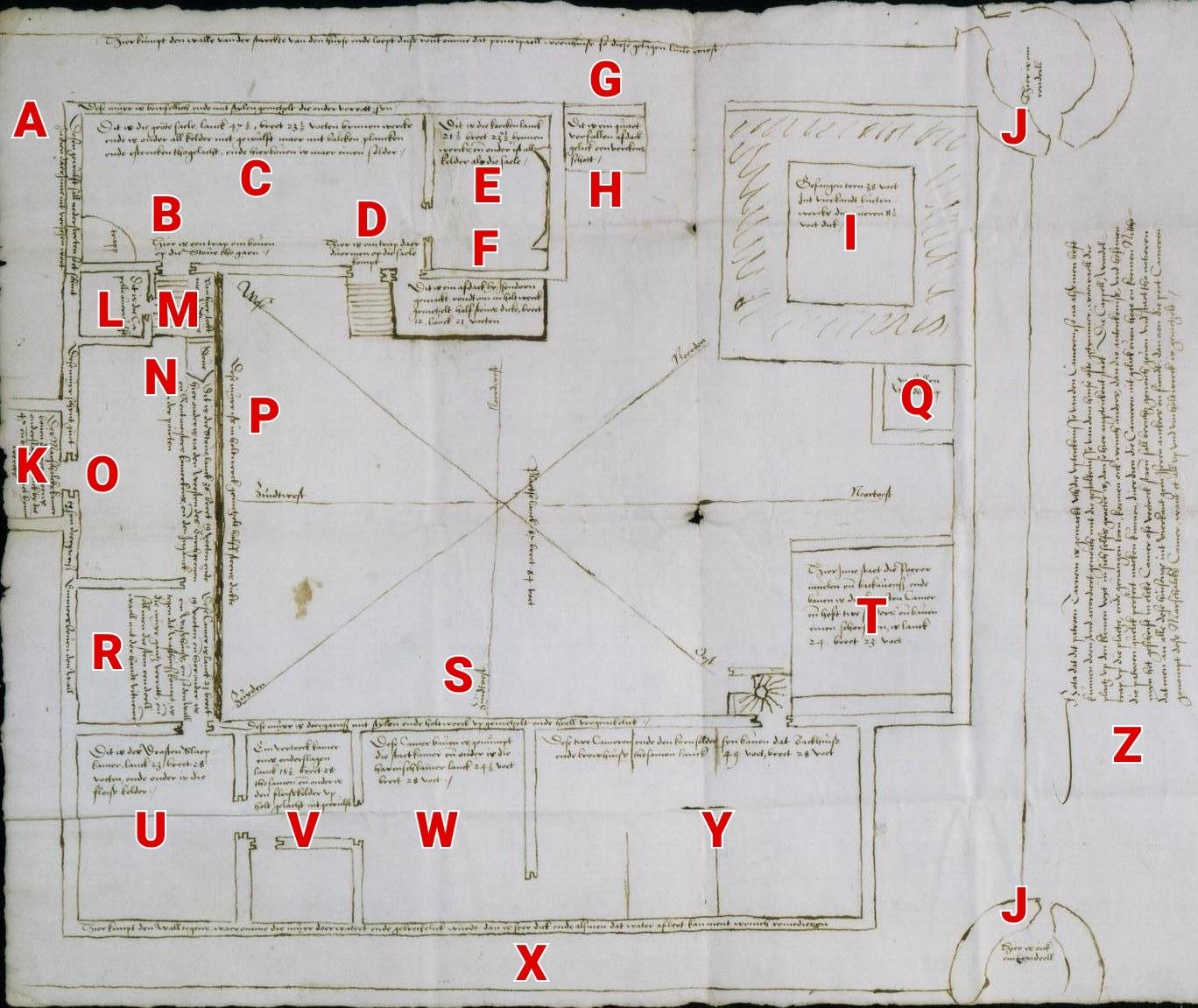
    In 1562, the lord of the manor of Bredevoort, Diederik van Bronckhorst-Batenburg, Lord of Anholt, commissioned a floor plan of the castle at Bredevoort. This plan also described the functions and structural condition of the various components. Measurements were recorded in Rhineland feet. A Rhineland foot is over 31 cm long. The castle was a rectangle measuring 42 m long and 36 m wide. The walls were approximately 65 cm thick. An earthen rampart surrounded the castle, with roundels at the corners. The rampart was approximately 2 m wide.

    Explanations of the descriptions on the floor plan (translated from old script):

    1. This vault will collapse if it is not repaired soon.
    2. Here is the staircase leading to the knights’ hall.
    3. This wall is dilapidated. The vertical beams are rotted at the bottom. This is a large hall: 47 feet long and 23 feet wide, measured from the inside. Beneath it is a cellar. The floor consists of beams and planks and is finished with floor tiles. There is only one attic above the hall.
    4. This is a staircase to enter the large hall.
    5. This is the kitchen, 21 feet long and 23 feet wide. Beneath it is a cellar of the same size as the cellar under the large hall.
    6. This shed was built by Drost Isendoorn. The walls are masonry set between beams.
    7. This is the rampart that runs around the castle.
    8. This is a very dilapidated shed, much like a pigsty.
    9. The prison tower. It is 38 feet square (measured from the outside). The walls are 8½ feet thick. [This tower was likely used later as a powder tower, Ed.]
    10. Here are two roundels.
    11. The Drost’s chamber (Maarschalcksekamer) above the gate. [The name ‘Maarschalckse kamer’ dates from the period 1534-1555 when Marshal Maarten van Rossum was Drost of Bredevoort, Ed.]
    12. This is the chapel.
    13. From here, the hearth of the knights’ hall is stoked.
    14. This is the knights’ hall. The room is 36 feet long and 19 feet wide. Below this are the rooms of the burgrave (castle warden) and the steward. The gate entrance is also located below here.
    15. This wall is in good condition, as far as it can be seen above the rampart.
    16. This wall is built between wooden beams and has a thickness of half a brick. [The bricks used were ‘kloostermoppen’ of approximately 14 cm in width, Ed.]
    17. A dilapidated spiral staircase.
    18. Another room. Below this is a laundry room. Because the rampart rests against the laundry room, the wall is rotted. The stones are loose.
    19. This wall is largely built between wooden beams and is very dilapidated.
    20. This contains the grain mill and the baking ovens. Above is the servant’s room, with two attics and a chimney.
    21. This is where the Drost sleeps. The room is 28 feet long and 23 feet wide. Beneath it is a meat cellar.
    22. This room is divided in two. The floor is made of wood. The meat cellar also lies beneath this area.
    23. This upper room is called the salon (state room, armory). Below it is the armor room.
    24. Here the rampart touches the wall, causing the wall to let in moisture and show defects. The wall is very thick, and if the water could be kept out, it would likely provide some improvement.
    25. These two rooms, as well as the granary, are located above the bakehouse and brewhouse.
    26. This drawing was made in Arnhem after everything was measured as accurately as possible. The drawing is fairly accurate. However, in reality, some parts are slightly larger than depicted here, such as the chapel, the spiral staircase in the courtyard, and the prison tower.

    External Appearance

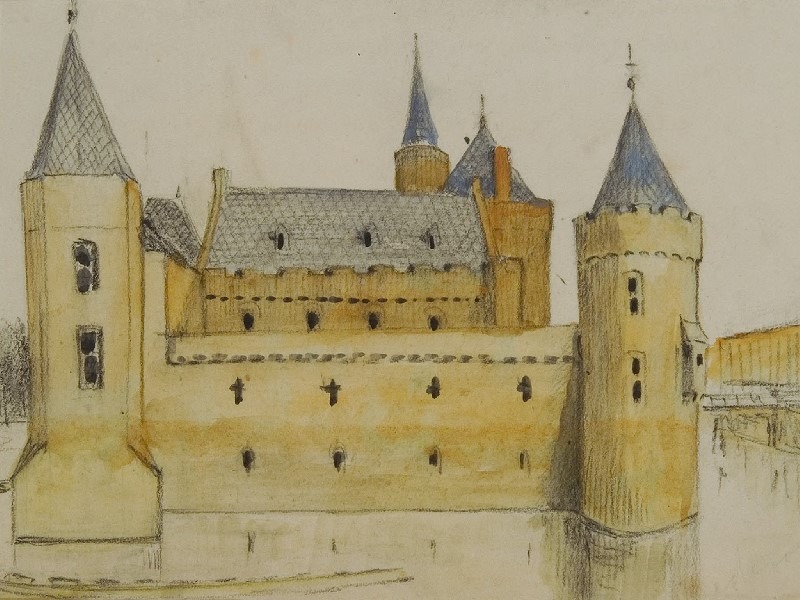
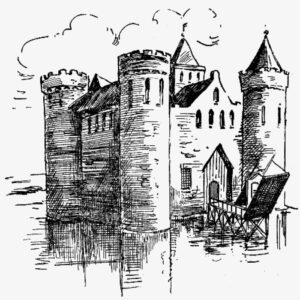
    Not much is known about exactly how Bredevoort Castle looked. While drawings of the castle exist, they are partly based on assumptions and imagination.

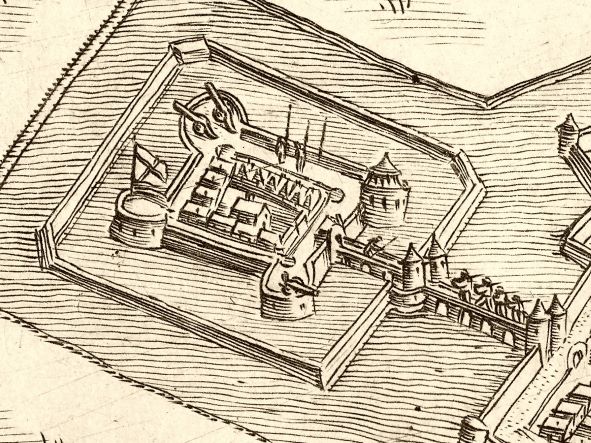
    The castle was built on a sandy ridge of approximately 42 x 26 meters, making it one of the larger castles in the Netherlands. Old maps show the main fortress to be a typical concentric castle, featuring double moats and a thick curtain wall. It included an outer bailey with heavy corner towers and a rectangular castle wall equipped with four corner towers, three of which were later lowered to become roundels.

    The castle and the town were separated by a double moat. Access to the castle from the town was via a bridge. One had to pass through two gates, the second of which was equipped with a barbican, and finally a gatehouse in the curtain wall before reaching the inner courtyard. Within the fortress, various buildings stood around a spacious inner court. These depictions changed over time, and the appearance and stature of the castle would have been altered frequently throughout the centuries due to conflict, war, city fires, and other causes.

    3D reconstruction of Bredevoort Castle, based on a drawing by Jacobus Craandijk from 1882.

    Destroyed

    The castle was heavily damaged by the Gunpowder Tower Disaster in 1646. Following this, the castle dominated the cityscape as a ruin for over 150 years until around the end of the 18th century. The last known mention of a visible ruin dates to 1791, recorded in the Bredevoort church council minutes when William V viewed the remains during his visit to Bredevoort. The main building (excluding the outer bailey, roundels, and curtain wall) had dimensions of approximately 42 x 36 meters. This made it one of the larger castles in the Netherlands.

    Remains

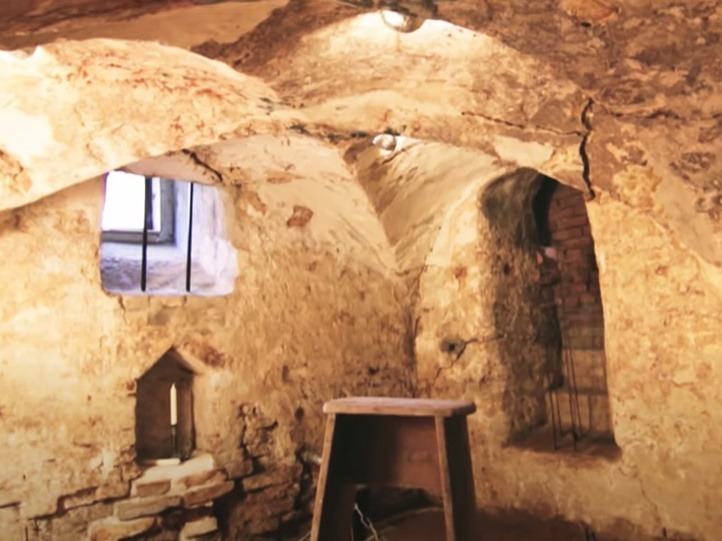
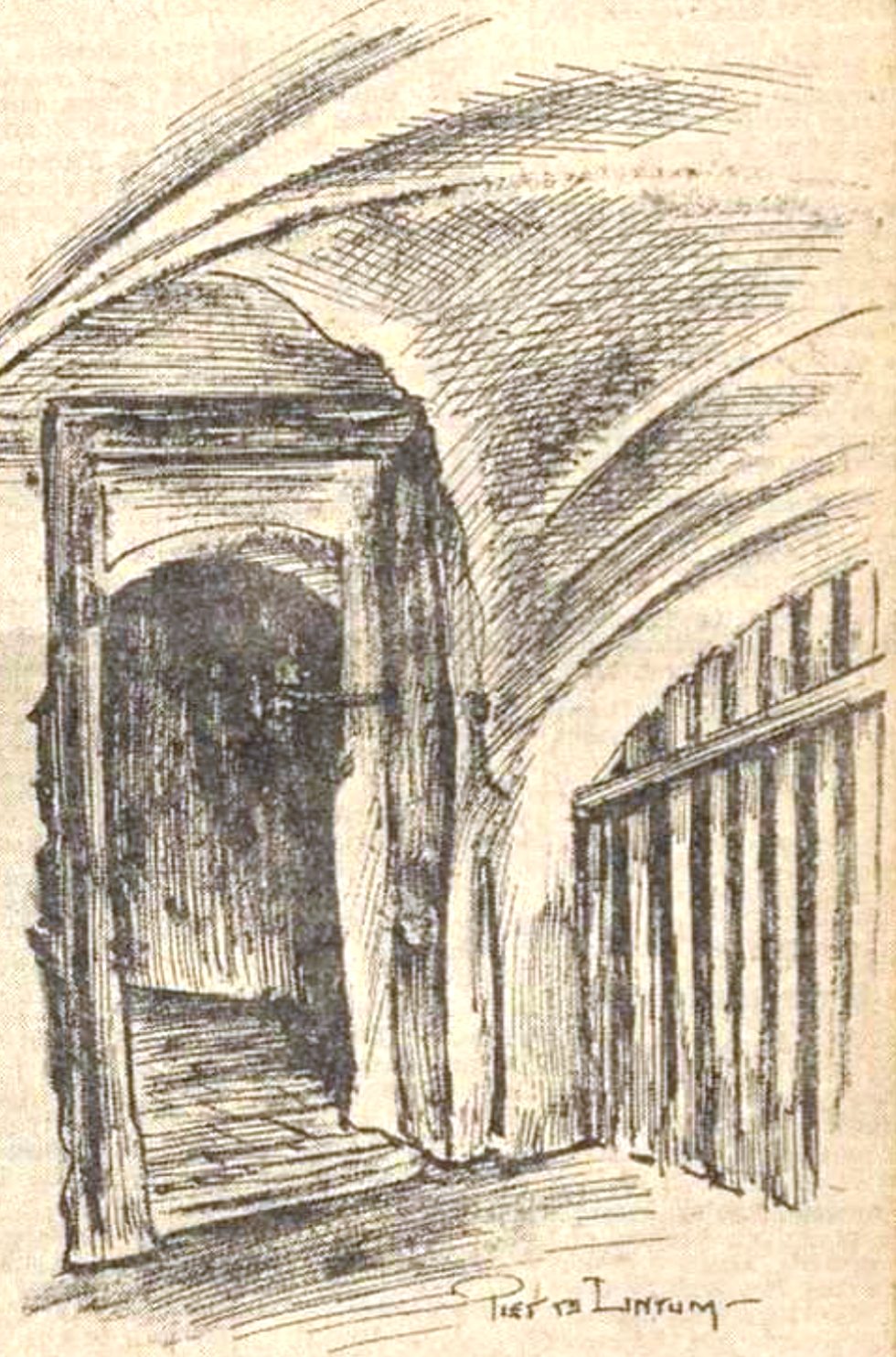
    Today, the remains of the castle—in the form of foundations, vaults, tunnels, and rubble—lie beneath and around the ‘t Zand square and the Hozenstraat in the heart of the town. In the spring of 2009, during archaeological research around the former school on ‘t Zand, part of the foundations was uncovered. Wall remains between 2.5 and 4 meters thick were found. On ‘t Zand square, foundations of the barbican were discovered. The contours of this gatehouse have been made visible in the paving with brass-colored bands.

    Sources