
Late in 1664, the Bredevoort church council commissioned Joannes Holthus to construct a new clockwork mechanism for the church tower, as the old one was worn out. It was installed in 1666, marking the beginning of an eventful history that ultimately concluded right where it once began: the Sint Joriskerk (St George’s Church) in Bredevoort.
In the year 1664, the Netherlands was still the Republic of the Seven United Provinces. Johan de Witt governed the country and Michiel de Ruyter ruled the high seas. In the eastern corner of Guelders lay the small town of Bredevoort. Joannes Verschage was the minister here, and Gerhard van Hengel and Bernard Ecckervelt served as the churchwardens.
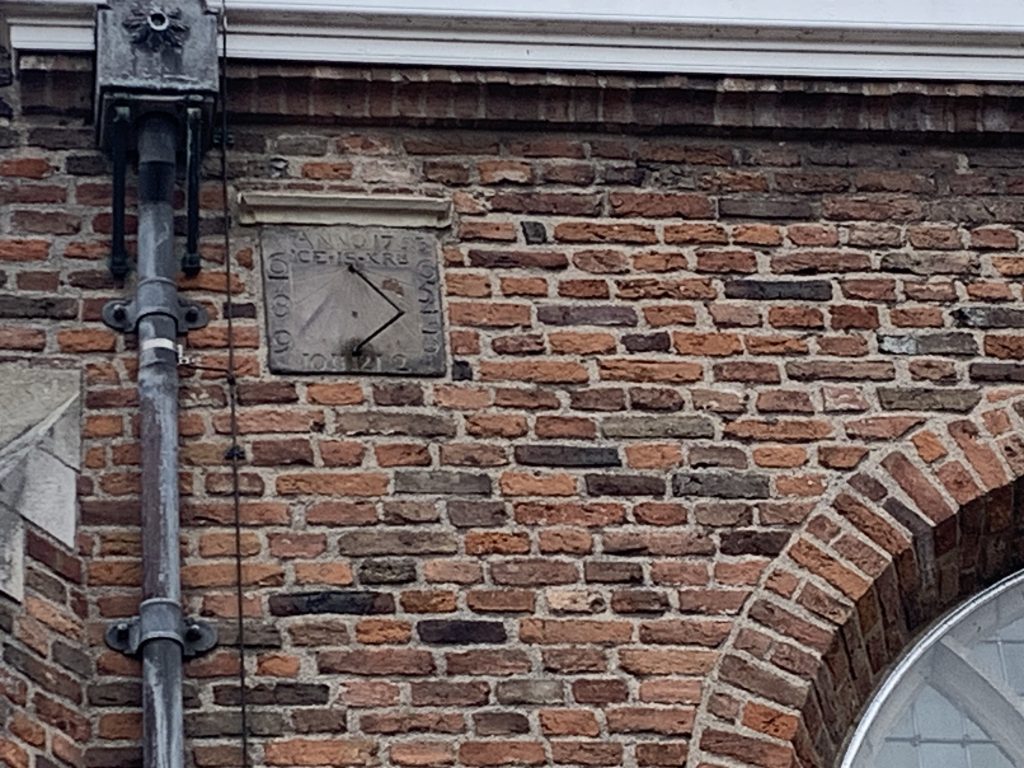
If you wanted to know roughly what time it was back then, you looked at the sundial which is still present on the exterior wall of the church. But if the sun was not shining, you depended on the clockwork in the church tower. However, that was not working well; it was dilapidated and out of order, according to the church management. A new clock was required.
Joannes Holthus
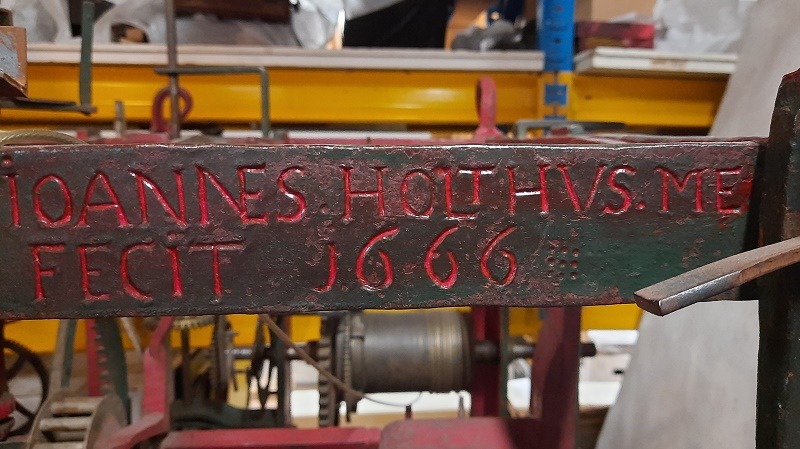
The church management entered into negotiations with clockmaker Joannes Holthus from Arnhem. In December 1664, they signed a contract stipulating that Holthus would deliver a clock within eighteen months that would strike the hours and half-hours. The agreed price was 300 Carolus guilders, of which 50 guilders was paid as an advance. The clock was delivered neatly on time; by the summer of 1666, it stood in the tower. Afterwards, however, it emerged that the agreed sum was insufficient.
In 1667, all parties signed for an additional sum of 228 guilders. Yet problems must have arisen regarding the payment. Holthus was forced to litigate in court. He fell into poverty, had to enter service somewhere, and had to leave or give up his children, ultimately dying in penury. Following his death, his daughter Jasperina continued the lawsuit until at least 1692. We do not know the outcome.
Through the centuries
After some time, a striking train was added to the turret clock, which also struck the quarters before and after the hour. A chime (voorspel) that announced the strikes was also introduced. This possibly occurred in 1680, a year that is engraved into the ironwork. In 1886, the clock was restored by Gerrit Jan Heinen from IJzerlo, who lived at the ‘Klokkemaker‘ farmstead.
Following nearly three centuries of faithful service, the clock was replaced in 1942 by a new mechanical turret clock. The old clock went to Aalten, where it spent a period gathering dust in the fire station. Afterwards, it ended up in the Aalten Oudheidkamer (historical museum), which was later incorporated into the Frerikshuus Museum and ultimately the Nationaal Onderduikmuseum. In 2017, the clock became a municipal monument.
Back to Bredevoort
However, the Bredevoort clock no longer fitted the museum’s concept, and an alternative location had to be found for it — preferably a place where the public could admire it. At the beginning of 2025, local interest group Bredevoorts Belang took over the turret clock. Reinstalling it in the tower of the Sint Joriskerk was no longer possible. The church’s interior committee proposed placing the clock in the church loft (boerenzolder), and the church council agreed.
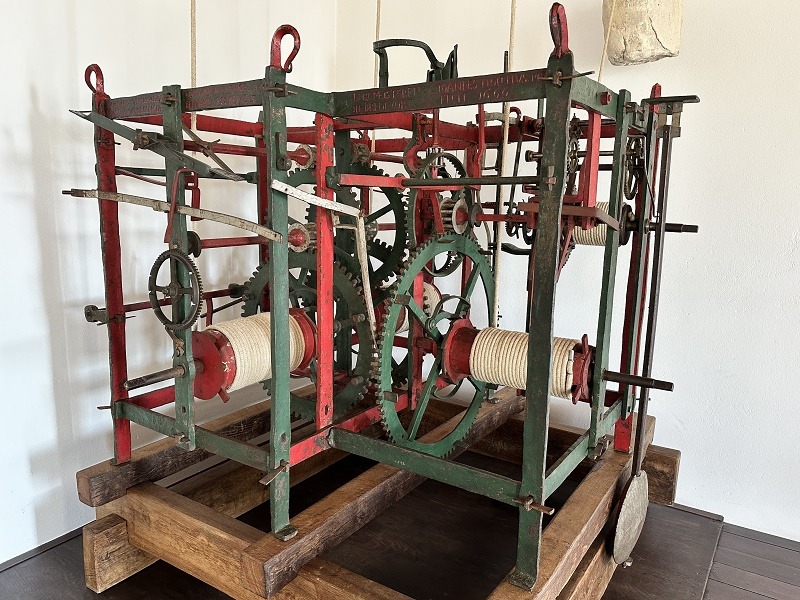
The 1666 clock by Joannes Holthus now takes pride of place in the church loft, and everything is still in working order!
Technical Description
The turret clock consists of two interconnected segments. The segment containing the striking trains is 120 cm long, 65 cm wide, and 104 cm high. The section with the time train (gaande werk) and the chime mechanism (speelwerk) is 81 cm long, 58 cm wide, and 104 cm high. The following texts have been applied to forged strips:
“JOANNES HOLTHUS ME FECIT (made me) 1666. JOANNES VERSCHAGÆ PASTOR HUIUS ECCLESIÆ (shepherd of this church) GERHARD VAN HENGEL DR. BERNARD ECCKERVELT KERKMEISTEREN IN BREDEVORT“.
The clock is equipped with a double striking train, which kept Bredevoort on time by striking on both the hours and the half-hours. Furthermore, fifteen minutes before and after the hours, four tones resonated from three bells.
The corner posts are decorated with a beautifully forged scroll. The connections consist primarily of cotter pins. The entire mechanism stands on a wooden platform (beun). A large block of sandstone functions as the driving weight; this stone is almost certainly original. The stone hangs from a rope of braided hemp, as does all the other ropework. The entire mechanism works perfectly.
The clock is described in the book: Achterhoekse klokken en uurwerkmakers, by J.L. Sellink, A.F. Abbink, and R.E. Wiggers, (ISBN 90-9003816-7). On page 8, Mr Wiggers writes about the clock, stating among other things: “The escapement consists of a Graham escapement with a tooth shape according to Schwilgué; this must have been built in after 1715. The chime, however, appears to be original and constructed directly in 1666. The current position for the time train is also authentic, and its winding arbor is likewise identical to the other three arbors.”