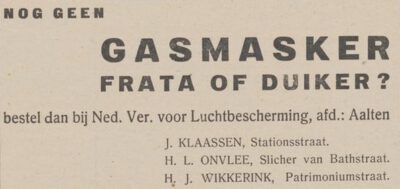
In the local Sociëteit (Social Club) last Saturday afternoon, an exhibition was opened by the Netherlands Association for Air Raid Protection (Nederl. Vereen. voor Luchtbescherming), to which the municipal executive, military officers, heads of various departments, and the boards of several associations had been invited.
The chairman of the Aalten branch, Mr Klaassen, extended a warm welcome to those present and expressed his sincere gratitude to the Mayor and Aldermen, the head of the Air Raid Protection Service, the board of the Sociëteit, and others for their cooperation in making this exhibition a success. The speaker announced that the Mayor was prevented from opening the exhibition due to a minor indisposition, and that Alderman Te Gussinklo had kindly agreed to deliver the opening address.
Mr Te Gussinklo began by apologising for the fact that he actually knew very little about air raid protection. He regretted that no better term had been found in the Netherlands, for “we do not protect the air, but rather protect the people from the dangers that come from the sky during a war via aircraft with their destructive bombs that bring death and ruin.” He questioned whether the population of Aalten, and of the Netherlands, was sufficiently aware of its duty in this regard. The answer, he stated, must be: no, the majority certainly are not. Therefore, it is very useful and very necessary that the Aalten branch has organised this exhibition.
It is often said that the army must be brought to the people, but the speaker also wished to posit that air raid protection must be brought to the people. It is highly necessary that the Dutch public knows more about this. For this reason, the Aalten municipal executive has strongly applauded this visual instruction. The speaker expressed his hope that this free exhibition would attract many visitors. Now that the war has continued for some time, interest has somewhat waned and might otherwise slumber further. However, when we consider that between 1,000 and 2,000 bombs are being dropped daily on a country in Northern Europe, we must wholeheartedly agree that this information is not unnecessary. To be forewarned is to be forearmed.
The speaker congratulated the board on the magnificent way this exhibition was arranged and therewith declared the exhibition open. After tea was served, a tour was conducted under the guidance of one of the gentlemen from the board of the Netherlands Association for Air Raid Protection.
De Graafschapper, 28 March 1941
Everything was clearly explained, and the numerous visual representations—both in pictures and in reality—of air hazards, their effects, and the measures taken against them, will certainly clarify much for all visitors that might not have been fully understood simply by reading booklets. Posters show us the varying population densities of different countries, the effects of high-explosive, incendiary, and gas bombs, the measures taken by the authorities and those that can be taken by citizens, etc. etc.
We see various gas masks, lanterns, a model of a cluttered attic compared to an attic as it ought to be, a model air-raid shelter, etc. etc. The clear explanations were listened to with great interest. It is to be hoped that this exhibition, which remains open until Tuesday and is entirely free to the public, will be well attended.
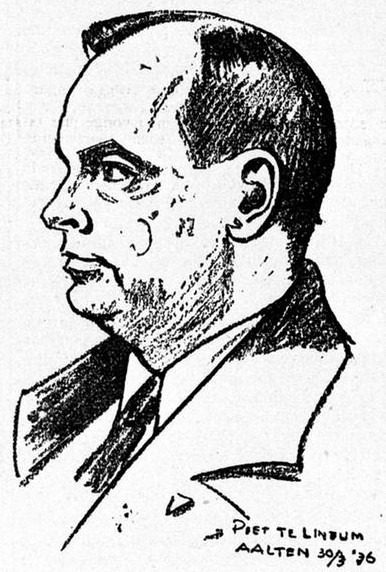
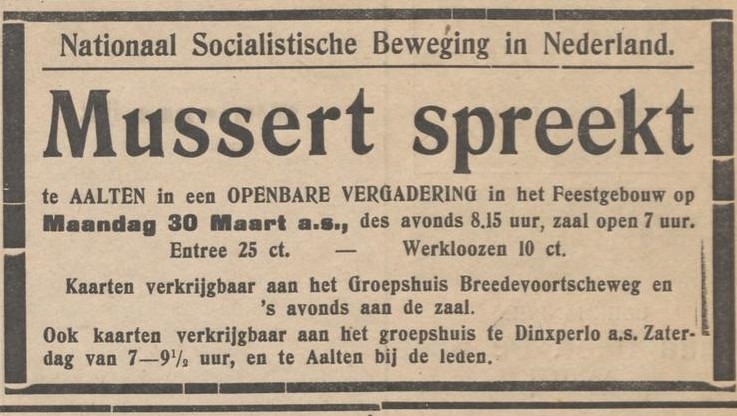
On Monday evening, a public meeting of the Nat.-Soc. Bew. (National Socialist Movement) in the Netherlands was held here in the Community Hall, where the leader of this Movement, Ir. A.A. Mussert, took the floor. There was an extraordinary amount of interest in this lecture. The entire Community Hall was occupied to every corner. A very large portion of the visitors had come from the surrounding towns, Winterswijk, Dinxperlo, etc.
Aaltensche Courant, 27 March 1936
The stage was neatly decorated in the colors orange-white-blue and supplemented with plants. The well-known emblems were also displayed in the hall. After the doors were closed at 8:15 PM and Mr. Mussert was received with the customary greeting, he immediately took the floor.
My fellow countrymen, perhaps there are some among you who think that I have come to Aalten to make you national socialists, but I cannot do that. You either are one, or you are not. It depends on what you feel in your heart. Gauge your own heart. If it tells you that what I have said is good, and you believe that we must take this path, then join us. Why am I a national socialist? Because I cannot live in such a mess. We desire things to be as good as possible. We cannot bring you a utopia. But things can and must be different! I shall justify myself to you by showing you how things are now.
I want to speak to you about the moral and material decline. First about the material decline, because it is easier to understand. No one can say that we have been living in a time of progress for the last 20 years. How poorly the farmers are doing. Every day they sink deeper into the pit. Go to Drenthe, to the cities, and see the decline in all classes of society. The unemployed, who learned about the 8-hour day from the S.D.A.P. (Social Democratic Workers’ Party). There are currently 500,000 who have brought it down to zero hours.
The moral decline: See the lack of discipline, the decline of religion. Where is the joy of work, the joy of life? Present-day society says: clothes make the man. That is how one is judged. They can keep the clothes; I want the human being! People are idling away nowadays. Professional expertise hardly exists anymore. Indeed, professional expertise is even often a curse.
Unreliability! Who is still reliable in this world! My fellow countrymen, who is to blame for this? You too will have heard it said here: it is God’s will that man perishes. No, that is blasphemy. We have had no droughts, no floods, etc., that destroyed everything. No. We have had enough of everything, so much even that we had to take it to the manure heap.
Stupid people have made such a mess of it, and we must try to make it better, and it can be better. The system of government is focused on democracy, and it masters the principle of divide and rule.
The country of democracy par excellence is the United States, and there is only one value left there: the dollar. Everything has its price there! And that is the extreme of democracy. Fortunately, we are not that far yet here.
Here they all promise something. If you vote for so-and-so, this and that will happen! That is simply impossible! Since 1920, the gentlemen of the right have governed. Two gentlemen, an Anti-Revolutionary and a Roman Catholic, go out together. One speaks for the R.C. and says, what would the R.C. church be without the R.C. State Party and says: vote R.C.! The other does the same for the A.-Revolut. in Goes. The next day they tell each other that they both did well, and so it has been for years and years!
Now that the N.S.B. is everywhere, the government wants to get rid of proportional representation and return to electoral districts. I shall be curious to see if they manage to do so.
Originally, democracy was well-intentioned. What has become of it, however? For 150 years, people have been working on liberty, equality, and fraternity. Liberty! I stand here in a gray shirt. I am not allowed to stand here in a black shirt, because then I am a danger to the state! In a gray shirt, I am not!
Fraternity! That does not exist at all. Equality consists of the fact that once every 4 years, by placing a dot, you can say which political party you belong to. The national socialist state will be a state of work, hard work. There will then be workers and rabble! Democracy lives off the dictatorship of the political parties. We will no longer tolerate that tyranny of the political parties.
In 1914, when I had to serve, they did not ask me which political party I belonged to. They only asked me that when they dismissed me from my office. Just as we were only Dutchmen then, we should surely be able to be so in normal times as well. The S.D.A.P. has turned from red to pink, and it is moving toward orange. They are getting to the point where, before they eat a pastry, they sing the Wilhelmus while standing!!
The gentlemen in The Hague also speak to the people through the radio now. Be calm, go to sleep peacefully tonight. Dad will look after you! The speaker would like to say to the gentlemen in The Hague: stay in parliament, then the people understand you best. We should have the feeling: state and people are one, but it is not so.
Education is also no longer good. Thousands of guilders are lost annually to vandalism. The people are no longer being educated. There is no longer a future. Where are we heading? Such is the situation! Those who still have something for themselves and otherwise have no interest in anything do not interest me. I need the people who do feel responsibility and want to help build up.
In the first place, we must become a people again! We must start by looking at our own people, to tidy them up. Then we will have done enough for the time being. Let us not interfere with the Abyssinians. There is enough to do here. One is national when one is prepared to make sacrifices for one’s nation. We have a task. This nation must not perish, but for that, we must first feel like a people again. Are we militarists? No, we are only Dutchmen and we want to sacrifice ourselves for the country when necessary, but then with good equipment.
We have 2 warships that were already outdated 20 years ago. I would rather not say how they are now. But when we send you out, it will not be on old scrap metal, but with modern ships. That is also the underlying cause of the mutiny on the “Zeven Provinciën”. That is our militarism. We shall, however, not force anyone to become a soldier who does not wish to do so for reasons of principle.
Once again, the beginning of everything must be: Ensure that you first become a people again! It is about one’s place in society, and democracy can never bring you this. Especially not in the countryside. There are more votes in Amsterdam than in the whole of Groningen, Friesland, and Drenthe. We want everyone, depending on the position they hold, to take their place within their people. The 8,000 miners will have their voice as a corporation, as will the farmers, etc. A people can only be great when everyone performs their task, not for themselves, but for the benefit of the entire people.
What we do is very ordinary; we are no longer mocked, but now feared. Not by the people, but by the government, because we want to make the people one again. That is why our black shirt had to go! But it will return, fellow countrymen, and in much greater numbers than they think!!
Applause.
When the Jews in Germany were dismissed from their offices, the Dutch shed liters of crocodile tears! But when Dutchmen were dismissed from their offices, they thought it was fine! The entire press is ruled by money, by democracy! This regime is perishing and the new rulers will be the national socialists or the communists. We always go straight ahead, we shall always speak the truth, also in “Volk en Vaderland“!
Yes indeed, in “Volk en Vaderland”. If it contains something that is not true, we shall take it back, but when I am asked to write somewhat softer words, I am not at home. We must cut out the wounds. Each of us individually means nothing, but collectively, when we feel like one people again, we can achieve something and we will achieve something. That is the meaning of national socialism. Steady as she goes!!
After the break, various written questions received were answered in detail by the speaker. Then, the 1st and 8th verses of the Wilhelmus were sung while standing.
De Graafschapper, 7 April 1936
Letters to the Editor. Outside the responsibility of the Editorial Board
The fact that Ir. A.A. Mussert, the General Leader of the National Socialist Movement, has spoken in Aalten, gives me cause for the following remarks. I would have preferred to explain the following facts in a debate, but we know the staging of N.S.B. meetings: no debate, but an opportunity to ask written questions. If no questions are submitted, some are quickly fabricated; if difficult questions are asked, then by chance so many questions have come in that there is no time left for those difficult questions. Moreover, as a pre-eminent expert in N.S.B. affairs, I am denied access to the meetings, let alone a debate. A foretaste of the Mussert regime!
I begin by repeating my offer to any group of the N.S.B. to fully inform members and the public in a public meeting about everything that may interest them, namely about farmer deception, bossism, corruption, dishonesty, and immorality within the N.S.B. I am afraid, however, that no single group of the N.S.B., knowing what appalling conditions within the N.S.B. I would bring to light, will dare to accept my offer, and therefore I must make use of your hospitality to at least rescue a few points from oblivion.
The officials of the N.S.B. in the Achterhoek have spent more than a year trying to persuade Mr. Mussert to speak at a public meeting in Aalten. Mr. Mussert did not feel much for it as long as the circles in the Achterhoek, Zutphen, Winterswijk, and Doetinchem did not bring money into the coffers. For the N.S.B. needs a lot of money every month. While the leaders are always muttering about the fascist “serving and sacrificing,” they let themselves be paid handsomely by the N.S.B.
Mr. Mussert receives a salary of ƒ 8,000 plus emoluments, Mr. C. van Geelkerken ƒ 4,000, although as a clerk at the Provincial Registry of Utrecht he never earned more than ƒ 2,400. Rev. van Duyl receives ƒ 2,400 salary from the N.S.B. on top of his salary as a minister. Not all N.S.B. bosses are paid so generously. At the District House in Arnhem, for example, a former police officer works. The man has no pension or redundancy pay and is on the dole. If everything were normal with this man, he would not need to be on the dole; he would be in receipt of a salary, redundancy pay, or a pension.
I cannot be clearer, but it is the kind of people with whom Mr. Mussert prefers to surround himself. This man earns five guilders a week from the N.S.B. Until recently, he was a sergeant in Mr. Mussert’s glorious W.A. (Stormtroopers). Naturally, he cannot live on ƒ 5 per week, and therefore he is also on the dole. Until recently, he did not report his N.S.B. wages to Social Services. He does this on the advice of high-ranking N.S.B. officials. Of course, that man is exposed to criminal prosecution every day; he always has one leg in prison.
For me, the aggravating factor is that Mr. Mussert is aware of this, for I have written to him personally. At the District House in Arnhem alone, I could point out three such cases. They are, of course, only a small percentage of the members who are paid for their work. Their “sacrifice” is then set as an example to those hundreds of misled people who are truly so naive as to believe that all members perform the tasks assigned to them without payment.
In Dinxperlo, for example, a group house was built by the unemployed which, now that it is finished, is hardly used. Those unemployed were not compensated a single cent for their labor by the N.S.B., and these poor wretches were set as an example by the N.S.B. in all other places for the members as proof of self-sacrifice. Would these misled people want to perform the same work for free again if they knew that in the large cities all labor is paid for by the N.S.B., such as canvassing and distribution?
I once attended a meeting with Mr. Mussert where the possibility of making workers members of the N.S.B. was discussed. Mr. Mussert believed that we could try to make workers members, but we should leave the “scum” alone. In this context, Mr. Mussert meant the unemployed by “scum,” of whom the N.S.B. supposedly already had enough.
A similar expression was once uttered by the provincial election leader of the N.S.B. for Gelderland, Mr. J. Frowein in Oosterbeek, during the propaganda campaign for the Provincial Council elections last year. “What use are those unemployed to you as members? You can’t let them do anything or you have to pay for it.” Mr. Mussert also knows this, because it was reported to Utrecht by an unemployed person. Without result, however, for Mr. Frowein, together with his brother, Mr. F.W. Frowein, pays two thousand guilders in membership fees per year to the N.S.B., and Mr. Mussert is careful with such members, while that ƒ 2,000 for the aforementioned wealthy men is merely a kind of insurance premium in case the N.S.B. actually comes to power!
Some time ago, I attended a meeting of the N.S.B. in Winterswijk with Mr. Mussert as the preacher. It was still in the time when the N.S.B. was on the rise, when many in their despair and decline saw salvation in that N.S.B. Thus, the meeting was also attended by many country folk. It was a cold evening and the hall was poorly heated. Some older people still had their caps on when Mr. Mussert appeared on the stage. The first thing he barked into the hall was: “caps off.”
You see, such high-handed behavior from a supposedly well-bred person toward simple people who, after a hard day’s work, take the trouble to attend a meeting, reflects the mentality of the General Leader of the N.S.B.
Those cap-wearers, that scum, do not interest him because they cannot pay membership fees from which the often very substantial salaries of the N.S.B. bosses can be paid. I must not abuse the hospitality of your paper. I could fill columns with facts that would demonstrate the insincerity and the charade of the N.S.B.
I could point out how the N.S.B. in the cities is against the Cooperative, yet in the countryside does not dare to agitate against the agricultural Cooperatives; how the N.S.B. itself has no agricultural program but hopes to parasitize on the Drenthe success of a farmers’ organization like “Landbouw en Maatschappij”; how, for example, in the Achterhoek, in places like Winterswijk, Varsseveld, Doetinchem, and Dinxperlo, farmers’ meetings were held under the name of “Landbouw en Maatschappij,” while those meetings were requested, prepared, and settled, and the risk borne by the N.S.B.; how the N.S.B. works with different demagogic means in every region or city because everywhere and always the interests of stakeholders supporting the N.S.B. with money must be spared, etc. etc.
I end with a very topical proof of the insincerity of the N.S.B. In the Achterhoek, too, many meetings have been held with the butcher Roelofsen as speaker about the pig crisis scandals. The N.S.B. deemed it necessary to repeatedly announce in “Volk en Vaderland” that the N.S.B. had nothing to do with Mr. Roelofsen’s campaign. A falsehood, for Mr. R. was paid by the N.S.B. for this work and received all the data for his campaign from the N.S.B. Mr. R. was somewhat careless in his campaign and received police reports and finally a prison sentence.
I personally have seen the letter in which Mr. R. was informed on behalf of Mr. Mussert that he would no longer receive a salary. He received that letter on the day he was arrested in Rotterdam to serve his first sentence. Sensitive, isn’t it? Yes, is it pleasant to sacrifice for the N.S.B. and be a martyr!!
In the meantime, he was sentenced again by the Court in Zutphen to 5 months in prison. Having appealed this, he sought legal assistance from one of his comrades in Arnhem, an N.S.B. lawyer. This “comrade,” however, asked for such a high fee for his help that Mr. R. could not pay it. He did not receive help from Mr. Mussert or from Headquarters either. Is it any wonder that he had had enough of the N.S.B. and resigned his membership himself?
In the session of the Senate, the N.S.B. member Count de Marchant et d’Ansembourg (also not an unemployed person) is severely rebuked by the agricultural expert Ruijter, and the Roelofsen case is also brought up. What does the Count have to answer to this?: “Mr. Roelofsen was expelled because, despite warnings, it was no longer possible to work with him.” A Count does not lie, does not speak untruths. Let me put it very parliamentarily: The Count is mistaken; Mr. Roelofsen was never warned, was never expelled as a member; he resigned as a member of the N.S.B. himself in my presence!
But let this Roelofsen case be an instructive lesson for all residents of the Achterhoek. Sacrificing and serving, wonderful, if the leaders set the example. Socialism, wonderful, but then also for the unemployed or any other “scum” whatsoever. And no criticism of others until things are so pure within one’s own Movement or organization that one has the right to exercise criticism. In my opinion, the N.S.B. is the very last political party that has the right to throw dirt at others.
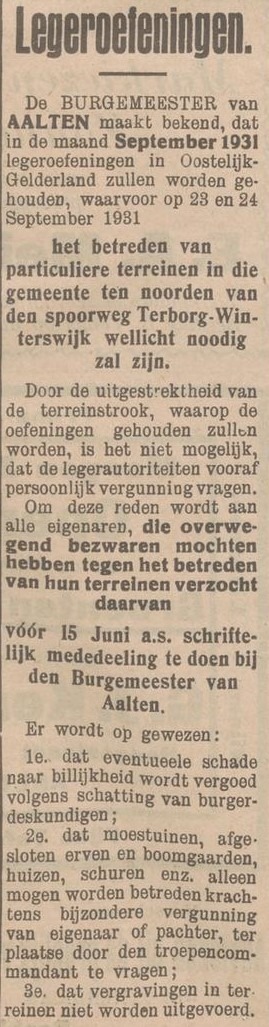
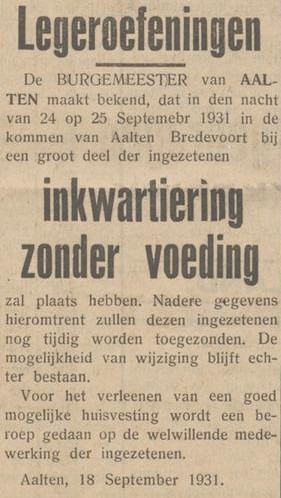
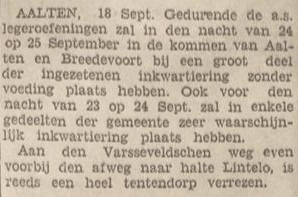
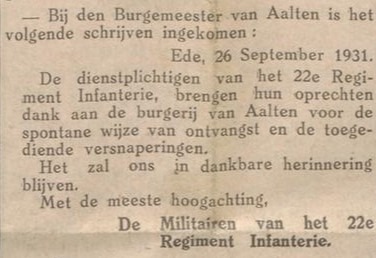
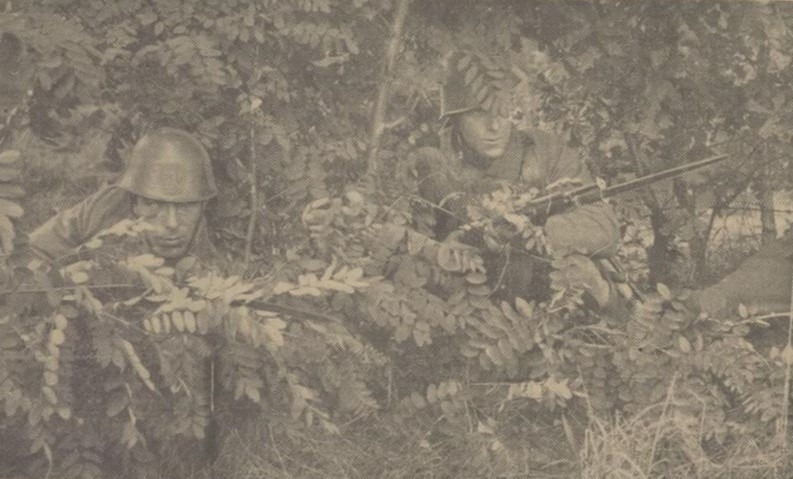
At the end of September 1931, large-scale army exercises took place in the Achterhoek, in which the municipality of Aalten also formed part of the battlefield. Troops were billeted with civilians, and a complete tent camp was erected on the Varsseveldsestraatweg in Lintelo. The simulated skirmishes attracted many curious spectators, and the press reported extensively. Below are several fragments from newspaper articles of that time.
Wednesday and this morning, our town was the centre of the manoeuvres. All day long, the aircraft circled above this area, and from the railway line to the North, straight through the Wolboom and the Aalter Esch, it was one continuous line of outposts and machine-gun groups.
Half of Aalten, as well as a very large number of strangers, visited the “front”. We also noticed a great many German cars. Night fell without an encounter having taken place. The posts remained in position and spent the night in so-called “dog kennels” on a thick layer of straw and provided with a few blankets. In some parts of the village, where the Red troops lay close to the houses, coffee was brewed all night long, and in many families there, not much sleep was had.
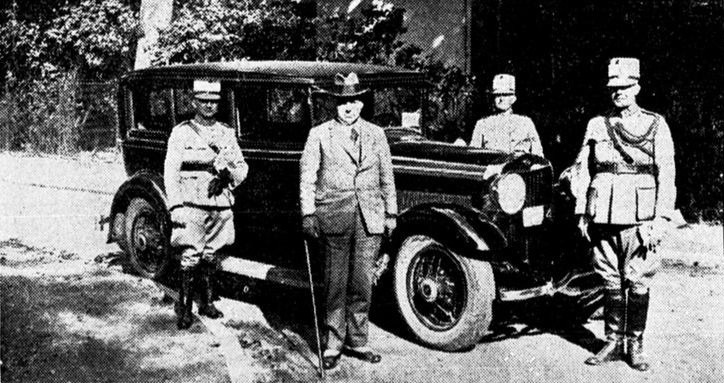
Minister Deckers to the front: the Minister of War with his car at Hotel Schiller in Aalten; accompanied by several staff officers
When we stood on the Aalter Esch at nine o’clock, Blue had gained combat contact and heavy firing was also heard in the North. The Red outposts lay with one or two men in a bundle of straw like birds in a nest. It might have appeared as if they had just crawled out of a strange egg, but that was not the case; they had lain on that windy height all night.
Blue could not advance further for the time being and this, as we know, was not the intention either. After all, the decision was to be forced to the North and South of Aalten.
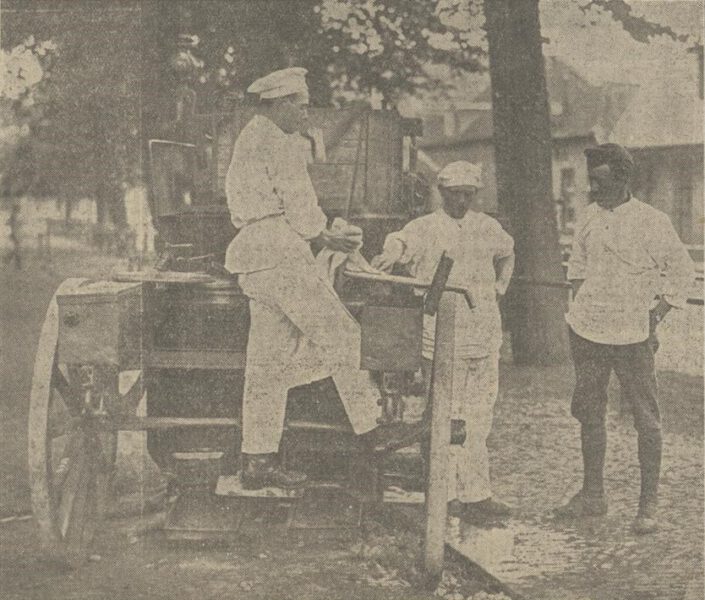
By a field kitchen
A sergeant-messmaster writes to us from the battlefield: It was three o’clock in the morning on Wednesday when the 10th and 22nd Infantry Regiments departed from Ede with all vehicles by train to take up the defensive position of the Red party near Aalten. The organisation — truly no small feat with such nocturnal transport en masse — proved to be in excellent order and everything proceeded with the greatest regularity, so that troops and baggage train arrived promptly at the agreed time of 6:15 AM in Aalten.
The morale among the troops is high, to which the well-filled bread bag (bread, cheese, and extra currant buns) certainly contributes its share. Moreover, the weather is beautiful, and nothing boosts the morale of the troops as much as good weather and good food.
“As long as the rations are in order, messmaster,” said a giant of a fellow from the troops in his sturdy Rotterdam dialect, “then we’ll manage the hauling.” And my cooks see to it that the rations are in order. Just outside Aalten, a set of field kitchens is stationed, and the personnel, one cook and two assistant cooks for each kitchen, are already busy ensuring that the coffee is ready at 12 o’clock and that a large quantity of hutspot is ready for the hungry troops by about five o’clock.
The fires are burning; in one pot of my field kitchen, the water for the coffee is boiling, and in the other pot, the carrots and onions are already beginning to simmer, as the cook calls it. Now, this afternoon, the potatoes still need to be boiled, the boiled meat mashed in with fat, and the troops can enjoy a hearty meal.
To the front
At 10 o’clock, the order came to “line up as close as possible to the respective company,” and so the field kitchen, while the pot was tended to during the journey, moved to a small outdoor café near Aalten, where we positioned ourselves under the trees, “covered from enemy aircraft” as it is called. Our men are in the defensive position and, beaming with pleasure because they have a “line,” are waiting in the sun for the enemy. And when the coffee was brought to them promptly at 12 o’clock, the unanimous verdict was that these manoeuvres weren’t so bad after all.
The bustle in Aalten
The otherwise so quiet and peaceful Aalten is now full of the clamour of war. Aircraft hum above the village and engage in mock dogfights, which all villagers watch with the greatest attention. But the field kitchens with the increasingly dirty cooks also attract attention. Motorcycles and cars with umpires shoot through the villages with loud bangs, and an extensive staff of military police ensures that the abnormally heavy traffic does not cause any accidents.
Aaltensche Courant, 5 June 1931De Graafschapper, 18 September 1931Zutphensche Courant, 19 September 1931Aaltensche Courant, 29 September 1931
Distributing food
The army cooks are busy satisfying so many eager mouths during the exercises
Five o’clock! The field kitchen heads out onto the country roads with a full pot of hutspot to deliver food to the company in its various units, the sections. The vehicle is greeted with cheers everywhere. The soldiers have a hearty hunger, despite the easy job in the defensive position. The food is excellent and sufficient, so there are no complaints or grumbling. On the contrary, jokes and quips fly back and forth.
There is only one concern left among the troops: where will we sleep tonight and when must we get up again. And that is precisely a question that cannot be solved for the time being, because the troops are in a so-called alarm position and a message could arrive at any moment that they must move forward or backward, and then instead of sleeping in quarters, it will be sleeping in small tents, with the possibility that just as the troops have fallen asleep, they receive word to depart elsewhere again.
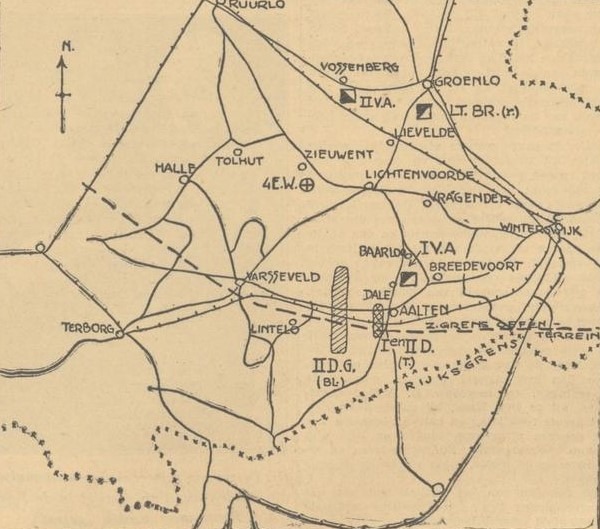
Surprising things were unfolding there in the North. The Blue Reconnaissance Department, which had set out from Vossenberg towards Winterswijk, found Vragender occupied by Red and had established itself in Lichtenvoorde, the most important road junction North of Aalten. There, the Light Brigade now found itself missing out. It had received orders from the Red commander to occupy Lichtenvoorde, but encountered the Blue Reconnaissance Department there, which could still hold out for a while.
The commander of Red began to fear the threat to his Northern flank. He called upon his Grenadiers, who for this occasion were swift-footed, and who were hastily dispatched from Groenlo in Ford vehicles via Winterswijk towards Bredevoort to extend the Northern flank there. They took up positions on either side of the Bredevoort—Lichtenvoorde road, North of Barlo, just past the three-way junction.
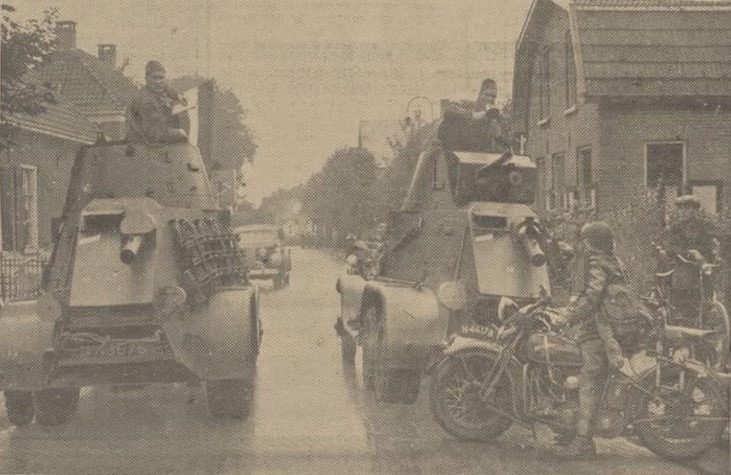
The armoured cars played a large part in the military operations during the manoeuvres held on Friday in the vicinity of Doesburg and Aalten
Two observers in position at a forward post during the army exercises held in Aalten and Doesburg on Friday
End of exercise
Today, Thursday morning, the Blue troops advanced strongly, so that eventually the Red army had to retreat to the Lichtenvoorde road. After 11:30 AM, there was not much more for the very numerous public to see. Most had certainly thought that a major attack was still to come, but the army leadership apparently felt it was enough and nothing more happened. Particularly fine were the performances of the aircraft, which cruised incessantly above Aalten.
At 12 o’clock, the manoeuvres came to an end. Throughout the afternoon and evening, there was a great bustle in the streets of troops departing again, either to the station here, where long passenger and freight trains were formed and departed all afternoon and night, or on foot to Winterswijk to catch the train there. A large part remains here tonight, so there is a great deal of billeting. Tomorrow, peace will gradually return to the village.
At the end of 1922, the residents of Aalten sent food aid to the destitute population of the neighboring German city of Bocholt.
Germany’s defeat in World War I had profound consequences. In 1919, the Allies forced Germany to accept full responsibility for the war, and enormous reparations were imposed on the country. The staggering debt burden to the Allies led to hyperinflation and a severe economic crisis. This resulted in extreme poverty and famine for the majority of the German population.
On September 28, 1922, the municipal council of Aalten decided to help the destitute population of the neighboring German city of Bocholt, “in recognition of the good that Aalten enjoyed from this industrial city before the war.” The aid consisted of sending foodstuffs that were available here in abundance.
On November 17, the Aaltensche Courant reported:
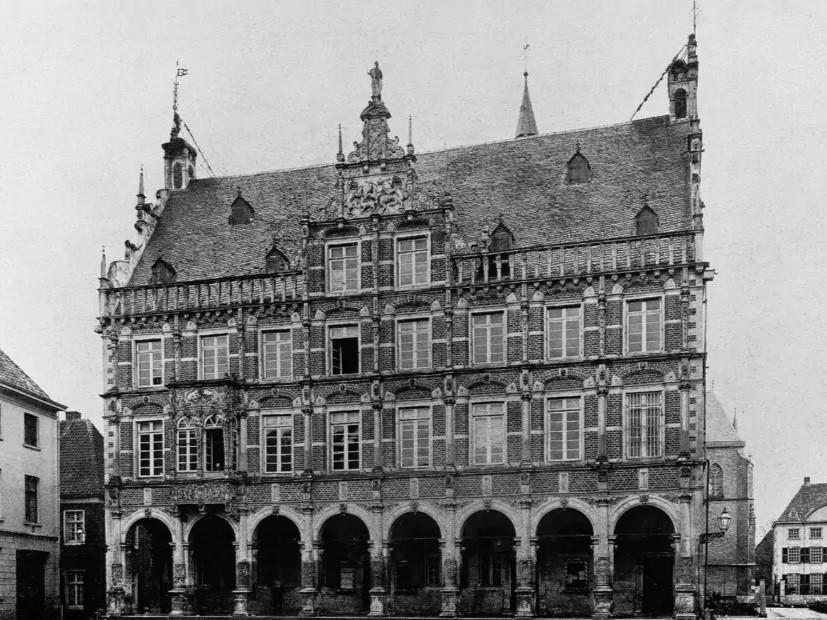
Old Town Hall of Bocholt, for illustration
“This morning, the second shipment of food, collected by the citizens of the municipality of Aalten, left for Bocholt. In the following weeks, the residents of the municipality of Aalten gathered several more shipments of food and sent them to Bocholt. On Tuesday, seven wagons carrying potatoes, cabbage, rye, etc., crossed the border, while two more transports are scheduled to depart next week. That these efforts are received with great joy requires no explanation, given the dire need, and this humane act will certainly contribute to the resumption of friendly relations (broken by the war) with our neighbors.”
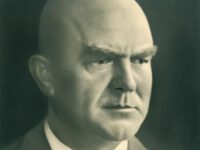
Dr. Schmitz, Mayor of Bocholt
Ten days later, the Zutphense Courant wrote:
“Nov 26 – During the council meeting of the border city of Bocholt, the mayor delivered a speech to express his gratitude for the great sacrifice made by the population of the municipality of Aalten to provide the poor of the city of Bocholt with all kinds of foodstuffs such as potatoes, flour, fat, vegetables, etc. Fourteen wagonloads had already been received, which the Aalten farmers brought to Bocholt themselves. The mayor regarded this assistance from the Dutch border residents as a sign of rapprochement toward their German neighbors.”
During the First World War, Aalten offered shelter to many foreign refugees.
It was 28 July 1914 when the First World War broke out. Two days later, the Netherlands declared its neutrality. As a result, we were spared the great horrors of this war. However, the Netherlands soon faced an entirely different problem: refugees. Many escaped prisoners of war, deserters, and civilians arrived from the surrounding countries to find a safe haven here. This was also the case in Aalten.
Newspaper reports
“Italian refugees. In Aalten, the Rectory and the minister’s residence of the Christian Reformed congregation have been made available for several Italian families who have fled from Germany.” Het Vaderland, May 22, 1915
“We are informed from the Eastern border: That it is not yet so very easy for escaped prisoners of war to cross the border may be evident from the fact that the Feldwebel, serving at the rural district of Kotten on the border of the municipality of Winterswijk, reported that in the last few weeks no fewer than 70 refugees were detained in the border strip located along the municipalities of Winterswijk and Aalten. Nevertheless, during that time, approximately 20 prisoners of war—French, Russians, Belgians, and also an Englishman—arrived on Dutch territory in that area.” Arnhemsche Courant, March 25, 1916
“Aalten, 29 Dec. The number of refugees, prisoners of war, deserters and civilians who have arrived here across the border in recent days is very large. No less than 25 Russians arrived here who had worked in the coal mines in Germany. All were transported to Rotterdam. In addition, 17 Poles, two of whom had their wives and children with them. They had come from Courland and had worked in the mines for a wage of 9 to 10 marks a day; The poor diet had forced them to move to our country. They had had a very difficult journey. Furthermore, 4 deserters and 1 escaped French prisoner of war arrived. On Wednesday another French prisoner of war arrived here, who had escaped with two others from a prison camp in Germany. One of them was shot before he reached the border, and the other wounded and taken prisoner. Yesterday afternoon two more Russians and a German deserter arrived and this morning another German deserter reported to the border guard.” Zutphensche Courant, 30 December 1916
“Saturday evening and Sunday morning, 9 Russian Poles, a Belgian, and a Russian cavalry non-commissioned officer crossed the border at Aalten.” Het Nieuws van den Dag, January 16, 1917
“In Aalten, a German deserter with his wife, two children, and a servant crossed the border and departed for Amsterdam on Monday. The wife was born in Argentina.” Het Nieuws van den Dag, January 23, 1917
“In Aalten, three German deserters and three French servicemen who had escaped from the camp at Muhlheim crossed the border on Sunday. Among this group of six was the guard of the aforementioned camp, who had acted as a guide for the refugees.” Het Nieuws van den Dag, November 20, 1917
“In Aalten, two French prisoners of war crossed the border on Saturday. They had escaped from a camp at Friedrichsfeld.” Het Nieuws van den Dag, June 10, 1918
“Today, Friday, the following were expected here from Winterswijk: 316 French, 22 Belgian, and 2 Italian prisoners of war.” Aaltensche Courant, November 29, 1918
French refugees in the Festival Hall
Towards the end of WW I, a second wave of refugees started from northern France, mainly of French, but also Belgian citizens.
Friday, September 27, 1918 – In northern France, the German occupying forces had called on the population of some 250 towns and villages, which were located between the Hindenburg Line established by the Germans and the border with Belgium, to leave their homes. Heavy fighting was expected now that the Allies pushed the Germans back towards Belgium, so it would be better to evacuate the region. Those who responded to the call often traveled on foot through occupied Belgium, taking their meager possessions with them. The Netherlands had promised to provide temporary shelter to a large group.
Saturday, October 26, 1918 – Arnhem was a place of passage for French refugees. At 18:00, 350 refugees arrived here. They would be transferred to Borculo, Groenlo and Aalten the next day. On Sunday evening, another 800 to 900 refugees arrived, who would go to various places in Gelderland on Monday. Members of a certain group wore bands of the same color around their arm as a distinguishing sign.
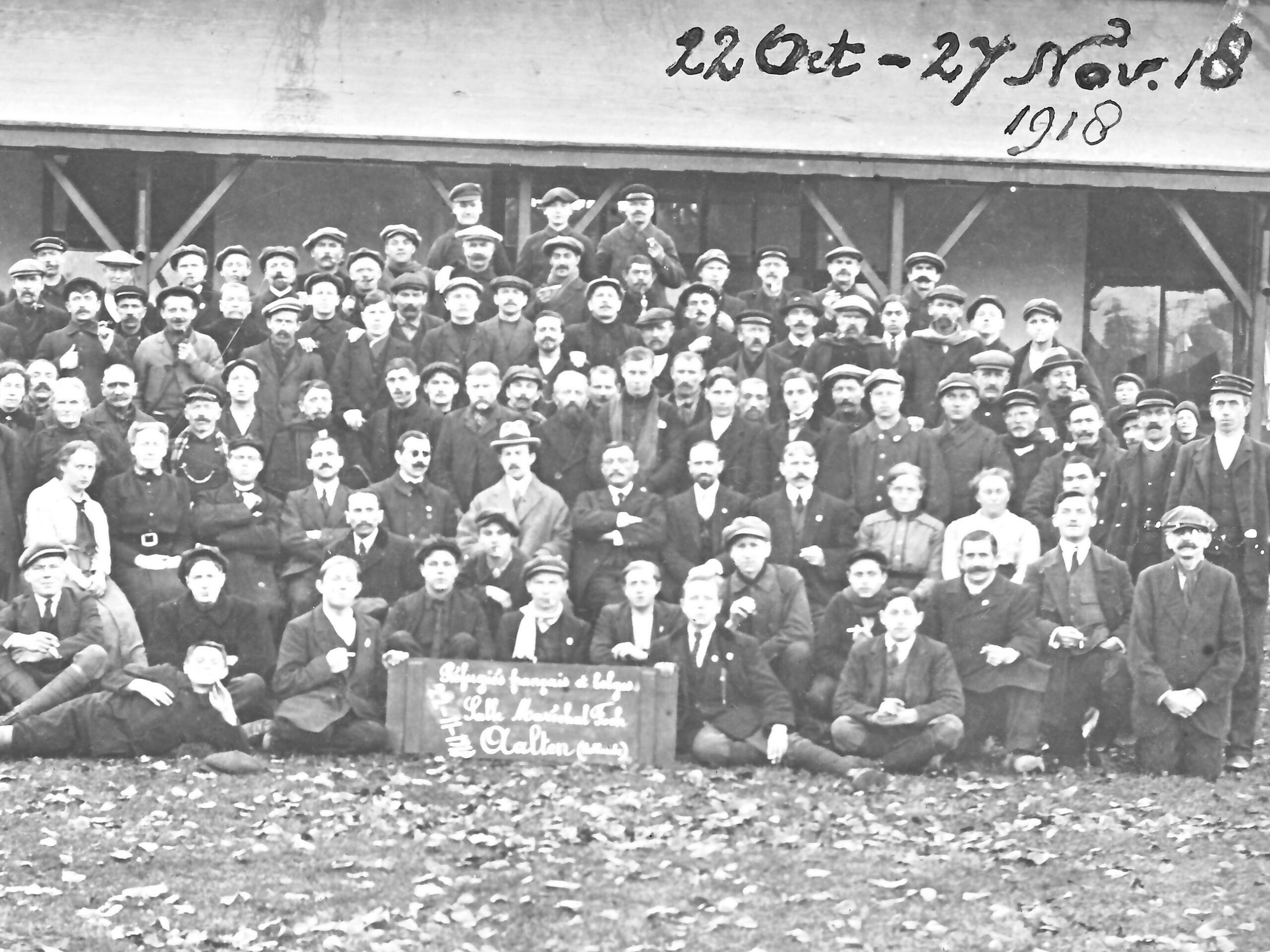
Sunday, October 27, 1918 – It was a turbulent Sunday for the normally quiet Aalten. On Saturday, the mayor had received word that a large number of refugees, both men and women, were to be accommodated in his municipality, as in other places in Gelderland. A meeting of the Committee for the Aid of Refugees, established in 1914, was hastily convened. It was decided that the men would be housed in the Elim building and the women and children in the Community Hall. Furthermore, the necessary measures were taken to provide the refugees with food and drink.
Sunday afternoon 13.00 hours a large crowd of people had gathered at the station . The members of the fire brigade were on the platform to provide the necessary assistance in transferring the guests. It was a long train that transported not only Aalten but also a hundred refugees for Winterswijk and Groenlo. The supervisor, a merchant from Antwerp, got out and invited the 108 men he accompanied to follow his example. Groups of four lined up, the luggage was loaded onto a truck, and so the procession, surrounded by a large crowd, made its way to the Festival Hall.
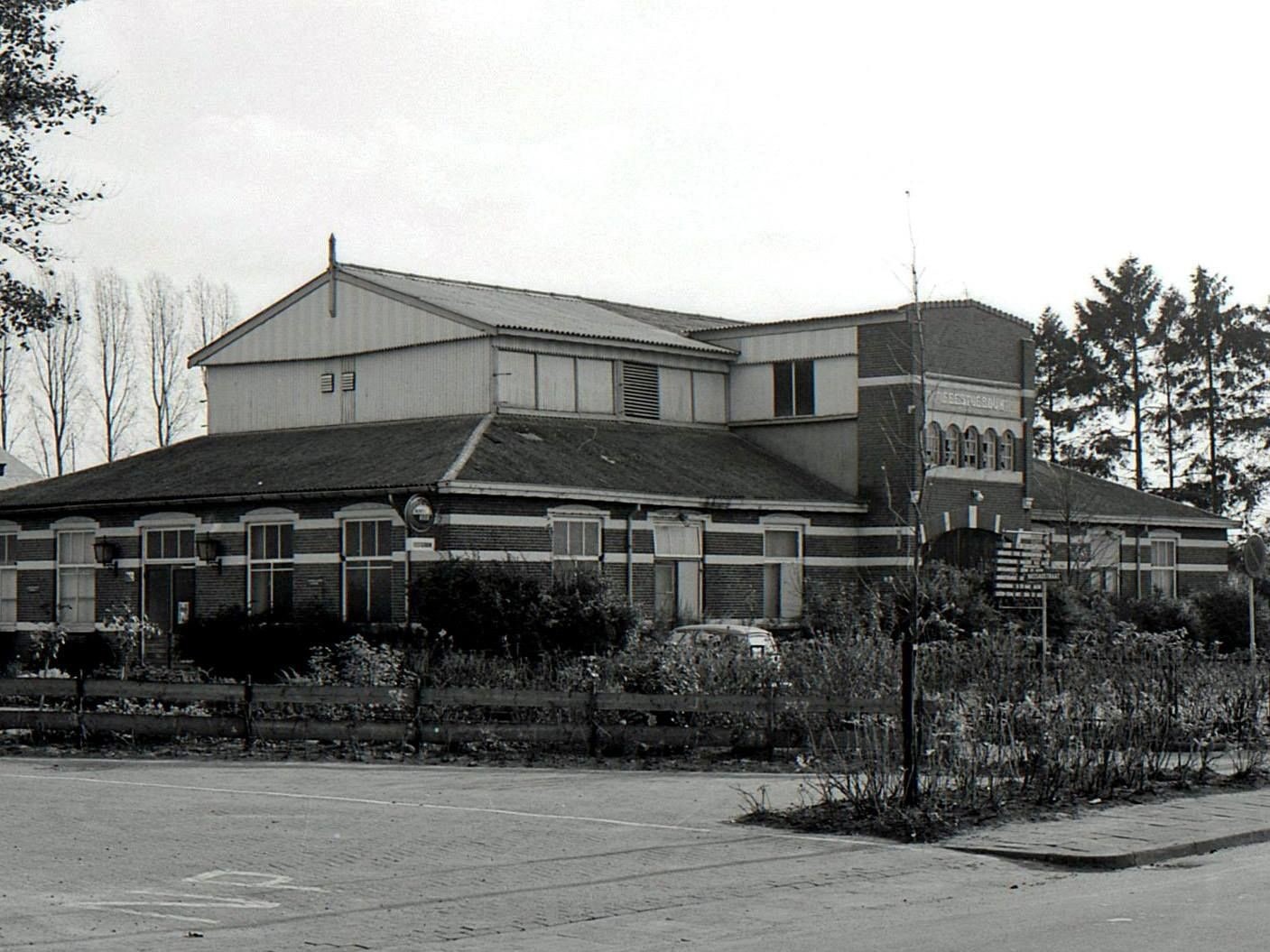
Feestgebouw, (Festival Hall), Aalten
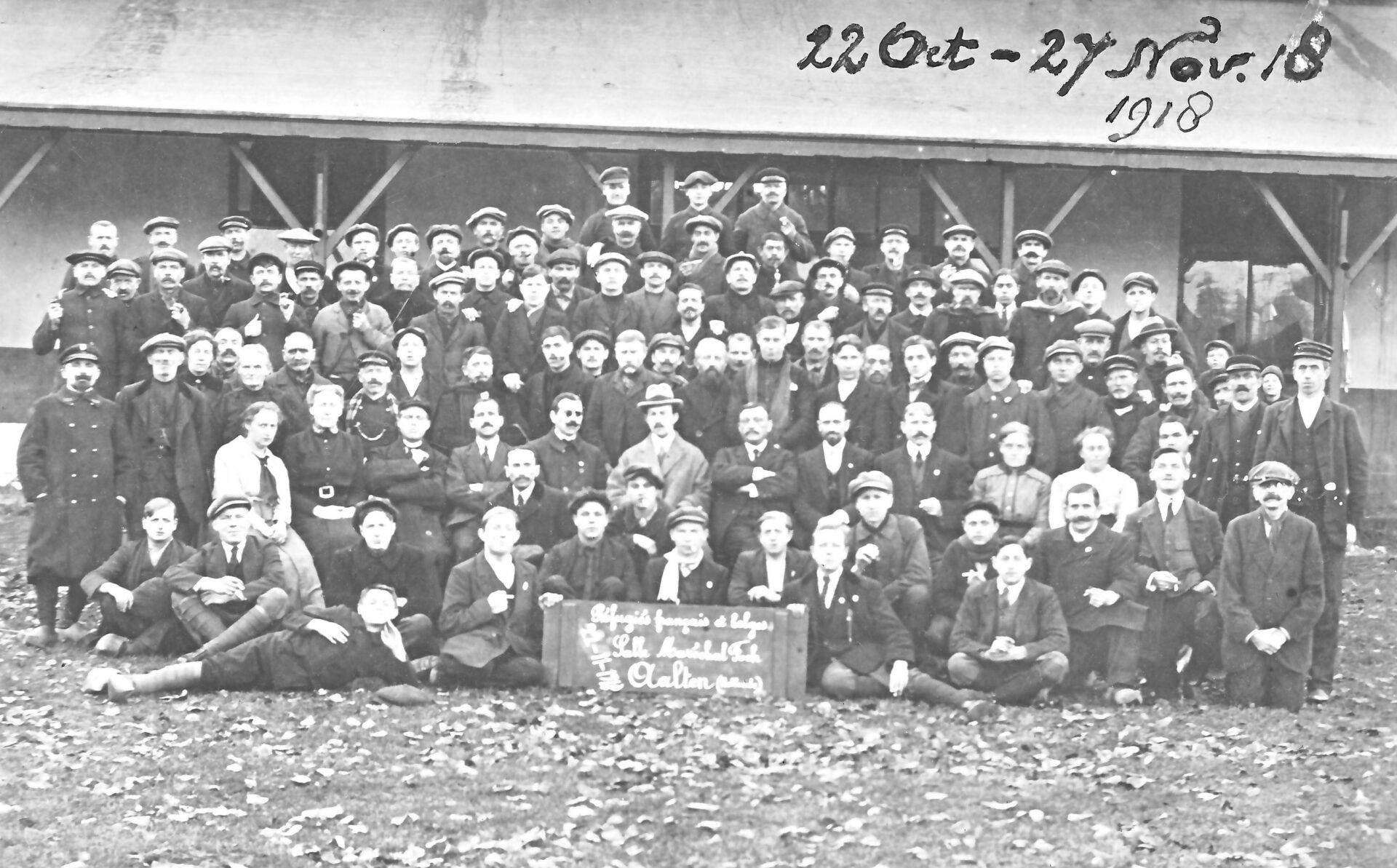
Salle Maréchal Foch
The Community Hall was renamed ‘Salle Maréchal Foch‘ for the occasion, after France’s renowned commander-in-chief.
Everything here was neatly arranged as a sleeping place for the strangers. Long tables were placed, where meals could take place. On a table were jugs of the fire brigade, which could serve as a washing set. Some refugees were so tired that they immediately lay down on their army bed of straw. No wonder, because they had all walked from Lille or Tourcoing to Brussels the week before. In the Belgian capital they were actually destined for German service, but through a ruse – most of them had a false pass – they, with thousands of others, managed to cross the Dutch border.
After the guests had refreshed themselves with coffee and bread, their names were recorded with place of residence and profession. There were: a stationmaster and two teachers, the three of whom were appointed as the regulation committee, to whom the refugees could turn with requests and complaints.
“Réfugiés Français et Belges, Salle Maréchal Foch, Aalten (Hollande), 22-11-1918”
Of course, many of them felt the need to let their relatives know that they were safe and sound in the hospitable Netherlands. That is why paper and ink were made available to them, while the gentlemen Johs. Driessen and Jongen made sure that they could exchange their foreign currency for Dutch money. Thanks to the action of the committee, under the excellent leadership of Ms. Hesselink could be served lunch at 18:00, which the French enjoyed.
Certain measures had been taken to maintain order. For example, everyone had to be inside at 21:00 in the evening and the cafes were not allowed to serve them liquor.
According to the supervisor, the refugees would not stay longer than 14 days under any circumstances. They would be brought back to their homeland as soon as possible via Zeeland through liberated Belgium. Negotiations about this were already underway. It would be four weeks.
Tuesday, October 29, 1918 – Two days after their arrival, three of the refugees housed in Aalten decided to flee. After breakfast, they had left the building with all their belongings, with directions from Aalten via Varsseveld and Terborg to Arnhem. However, they were caught by the police and brought back to the Community Hall.
Italians
In an interview with Mayor Monnik, he tells about Italian prisoners of war, who were killed in the factory of N.V. Textiel Mij. were accommodated: “We experienced something peculiar with those Italians. We had given them all some of our beautiful soap, of which we had a whole supply at the time, to be able to wash themselves fresh, but the next day all the soap was eaten by the Italians!”
End of the First World War
Monday, November 11, 1918 – In a forest near the French town of Compiègne, about eighty kilometers north of Paris, the armistice was concluded that ended the First World War. The more than 40,000 French refugees in the Netherlands were able to return home. This was quite a logistical organization, so it would take until January 1919 before the last French could leave. In addition, the Germans released their prisoners of war, and of course they also wanted to return to their homeland as soon as possible. A huge stream of refugees started, partly via the Netherlands.
Saturday, November 16, 1918 – In Aalten, everything was prepared to receive the stream of English refugees that was expected from Germany. In the schools and other buildings, everything was set up for this purpose so that 900 men could be housed. The rest would be forwarded to surrounding municipalities. To maintain order, a company of infantry of the 22nd regiment from Ede had arrived in Aalten. The soldiers were housed in the public school on the Herenstraat as well as in the Chr. School on the Bredevoortsestraatweg. The Nieuwe Aaltensche Courant added: “For our otherwise so quiet village a lot of hustle and bustle!“.
Tuesday, November 19, 1918 – Nieuwe Aaltensche Courant: “On the eastern border, the camp management, in anticipation of the throngs of prisoners of war, who are now being released in Germany and want to return to their homeland on their own, was no longer in control of the situation. To prevent fermentation, a deputation came to ‘s-Heerenberg to discuss transport. In order to guide the stream into a good bed, the Dutch army command has determined that Belgians and French may only pass through the narrowest strip of Limburg on our land, at the other points they will be irrevocably relegated. Only English people are admitted there. Concentration camps are being prepared in ‘s-Heerenberg, Aalten, Dinxperlo and Winterswijk.”
Refugees from German prison camps also crossed the border into Aalten. On Saturday, November 16, a group of 21 French refugees managed to reach Aalten. They had even already found their way to the Community Hall, where they joyfully greeted their compatriots. To their disappointment, however, they were informed that—due to the aforementioned decision—they would be sent back to Germany. Understandably, they were not keen on this, but it was mandatory. As a farewell, they asked to be allowed to sing the Marseillaise with their brothers from the Community Hall, which was granted by the commander.
In a supplement to the above-mentioned report, the same newspaper nevertheless reported that “The initially taken decision to send the French who arrived here back to Germany has been withdrawn, so that they can be forwarded from here to Rotterdam.”
Word of thanks on departure from Aalten
Friday, November 29, 1918 – Aaltensche Courant: “So we have lost our French guests once again! On Tuesday, the prisoners of war departed, and on Wednesday morning, the refugees left the Community Hall, where the following grateful speech was delivered by Mr. Lopes:
“Mr. Commander. We are about to leave our camp, which you yourself have baptized “Salle Maréchal Foch,” thus showing your sympathy for France and your admiration for him who led us to victory.
Before leaving, we will repeat to you that by your benevolence and by the devotion with which you have done your difficult work so well, you have won the esteem of all the refugees. And our stay here has not always been very pleasant, because it was not feasible for you to give us all the pleasures that we hope to find again in our family; but you have done the impossible to soften our fate.
We have come to Dutch soil, M. the Commander, especially to escape the forced labor against our fatherland, against our brothers, against our fathers, against our children. We have found a refuge in this quiet country, where we have been able to recover from the fatigues and inconveniences of our long journey. If the Netherlands had offered us nothing but this satisfaction, that we know we are safe from forced labour, we would already owe it a great debt of gratitude.
But we have other reasons to keep pleasant memories of the municipality of Aalten, because at first we could think of a fairly cool reception, in the sequel we saw that the great majority of the population was well-disposed towards us. Moreover, we have material proofs of this: corrections, successively made to our lodgings, blankets have been distributed, the hall has been heated, the evening meal has been improved, soap has been distributed, postcards have been provided free of charge, smoking in the dining room has been permitted, cigars have been distributed, everyone has received a guilder, books, illustrated sheets have been donated, various games, underwear and superwear and clogs have been given, repaired shoes, mended undergarments and outerwear, yes, you gave parties and lectures, offered little memories, etc.
Moreover, the members of the Bureau, during their visits to thank the generous donors and in their friendship with several respectable families, were very surprised to find, so close to the German border, many people who knew the French language, even subscribed to newspapers from our country.
So, M. the Commandant, we will keep our stay in Aalten in pleasant memories. We will never forget a benevolence and a devotion that nothing could slacken, whatever the objections that had to be overcome. This sincere and heartfelt gratitude, of which we assure you, is the expression of the feelings of all the réfugiés in the ‘Maréchal Foch’ hall; it is unanimously brought to you (you may be proud of it!). Although we would like to thank you personally, we must not forget Mr. Chief Deputy, the entire Fire Brigade and also the police. To us, they were more friends than guards.
And as for the kind ladies who have so often honored us with her presence, and even voluntarily made themselves our servant maids at all our meals, they have reminded us too much of our wives, our mothers, our sisters, our betrothed, for us to forget them. But it is impossible for us to mention the names of all those who have taken an interest in the improvement of our lot. We therefore ask you, M. de C., to be our interpreter for these people, to thank them on behalf of the Bureau, on behalf of all comrades, on behalf of our families, on behalf even of the three twin cities of Lille, Roubaix, Tourcoing, from which we almost all come and where French and Belgians have learned to live on good terms. working side by side, one of one’s minds, long before the common suffering.
And, now that we are going to leave for our hearths, allow us to cry out loudly: Long live M. the Commander! Long live Aalten! Long live the Netherlands! Long live Belgium! Long live France!”
It has become quite empty in our streets. We were already used to seeing groups of red-trousers, or yellow- and grey-trimmed warriors in front of the shop windows. To Rotterdam by rail, they go there today, Friday, on the boat that takes them to France. How happy they will be when they can see the coast of Picardy again! No doubt the ladies, who have helped all the time that the refugees stayed here, with the distribution and distribution of the food, will be remembered by them with gratitude for a long time to come, and our brave fire brigade no less.”
French frustrations
It will come as no surprise that the conditions in which the refugees were housed were not ideal. Nor that frustrations arose after a while among some of the refugees. What is remarkable is the following publication in the Nieuwe Aaltensche Courant of 3 January 1919, more than a month after the departure of the French refugees:
“Aalten enjoyed the honor, probably for the first time, to be mentioned in the French Chamber, in the discussion of the situation of the French refugees in the Netherlands. It was said by one of the deputies that forty thousand refugees in our country are literally starving. Isn’t it beautiful? See here a sketch of the situation:
“Our refugees are housed in stables and barns, without heating and without beds. They sleep on dirty straw. Under the arrangements made, the mayors must arrange for the supply at the expense of the Relief Commission. Unfortunately, the lack of organization is felt everywhere. Everywhere it is a “pan”! Items that are requested will not be delivered. For every step, for every complaint, six instances are needed, so that everything goes into disarray. Women and children are shivering from the cold here, without coal, without warm clothes. For days there is no meat, the weakest succumb to lack of care. The bread provided by the Dutch government is inedible.”
We do not know how care was arranged in other places. But we do know that this description does not fit the treatment as the refugees have received in Aalten. Now it is not impossible that here and there the organization was not immediately punctual – would the French, in the same circumstances, have fared better? – but ‘dying of hunger and cold’ will, we trust, turn out to be a horrible exaggeration.”
In addition, the French delegate reported:
“Several French refugees, who were housed in Aalten, have lost their patience and sent the following ultimatum to our representative by telegraph: “Two hundred refugees, powerful men from Lille, Roubaix and Tourcoing, demand immediate repatriation. They will leave on foot on Thursday, if no solution is found by then.”
To whom is the blame that the refugees lost their patience? In no case to the Dutch authorities. Those who had quietly left before their time have themselves stated in a letter to the chief of the fire brigade that their departure was not caused by undue treatment or care, but solely by the fact that they longed to return to their hometown.
We hope that our government will provide a resounding protest against the false rumors spread on this subject by enemies of our country. Let them inform the French authorities themselves, so that they are not exclusively dependent on the information of the French embassy in The Hague, which is so well informed of the actual situation, that the following message has been received here in the last few days: “The French refugees who are staying in Aalten may leave on January 15th.” While they have already arrived in their respective homes in northern France a few weeks ago!“
In 1918, the municipality of Aalten was defrauded of 60,000 guilders during the purchase of three wagons of hard soap that subsequently proved to be of worthless quality.
During World War I, the neutral Netherlands faced severe shortages of food, fuel, and numerous other goods. During the last two years of the war, a major shortage of soap also arose. Soap became scarce and expensive. The government intervened, partly because public health was threatened by the soap shortage. Soap factories were only permitted to produce so-called government soap. This could only be done sparingly, and therefore soap was rationed.
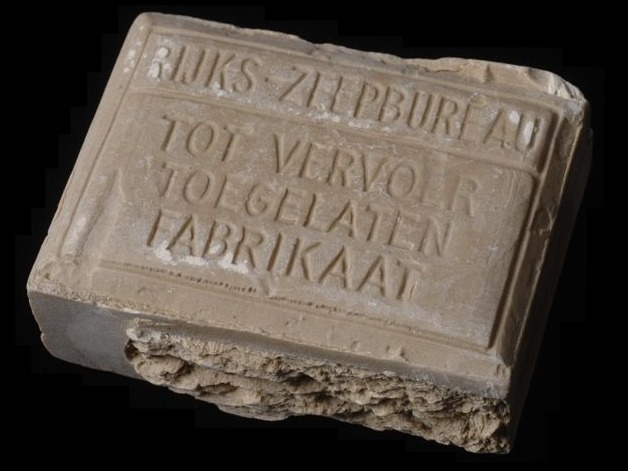
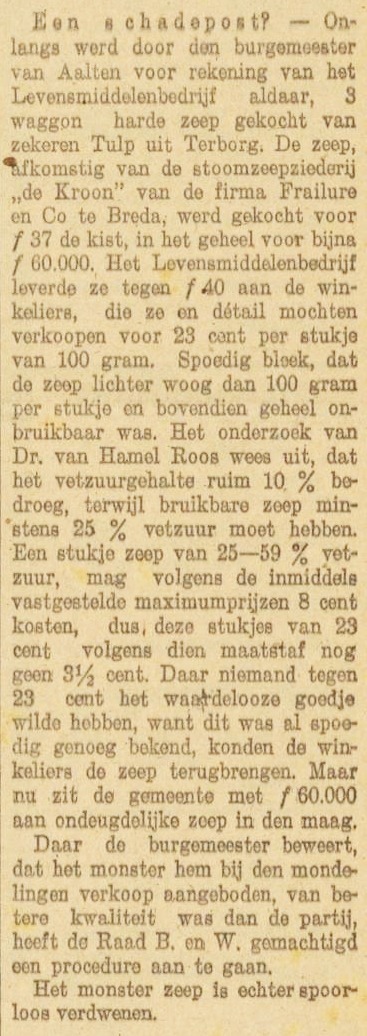
Sometimes fraudsters managed to pull off a major coup. The mayor of Aalten, A.J.W. Monnik, became a very naive victim of a well-known scam. On behalf of the municipal food company, he purchased three wagons of hard soap from a trader. The purchase price was ƒ 37 per crate. The local shopkeepers, who were to pay ƒ 40 per crate to the municipal food company, were then allowed to sell the soap for the retail price of 23 cents per 100-gram bar, which would have earned them a nice profit.
Worthless
But the plan fell through. It soon became apparent that the batch of soap had a very different composition than the sample the clever businessman had shown the mayor. The fatty acid content turned out to be only 10 percent, instead of the legally required minimum of 25 percent. According to the maximum prices established by the government in the meantime, such a bar of soap should only have cost 3½ cents.
It was no wonder that the housewives of Aalten left the shopkeepers stuck with their worthless goods en masse. The mayor had no choice but to take back the soap. The municipality bore the loss, which amounted to nearly ƒ 60,000.
Contradiction
Following this report, the firm De Fraiture & Co. in Breda, whose name was mentioned therein, declared that they knew neither the Mr. Tulp from Terborg mentioned as the seller nor the Food Company in Aalten. They also stated that they had never marketed bars of soap of approximately 100 grams and that, furthermore, they never manufactured soap with a fatty acid content lower than 20-25 percent. They were absolutely unaware of this matter. They suspected that a batch of their soap of the aforementioned quality or higher had been reprocessed into a poor quality by intermediaries.
Arnhemsche Courant, 6 July 1918
Sources
Soap scarcity in the Netherlands during World War I (1914–1918), by Rob Kammelar
We frequently read or hear about “Plan 1913”. What is meant by that? It is the plan or intention to festively commemorate the joyous event of 100 years ago. Is there reason for this? Those who still ask this provide proof that they have forgotten what they learned at school regarding the history of our fatherland. The only thing that can be offered as an excuse is that for many, their school years lie far behind them and oral tradition is no longer heard.
It was in 1863, when the fiftieth anniversary of the Netherlands’ Independence was celebrated in Aalten, that things were quite different. Back then, there was hardly a family where one did not hear from the lips of grandparents about the sad times our ancestors lived through as long as the French were in charge here. Incidents that had personally affected a family were recounted, but now, 50 years later, much of that is covered by the veil of oblivion.
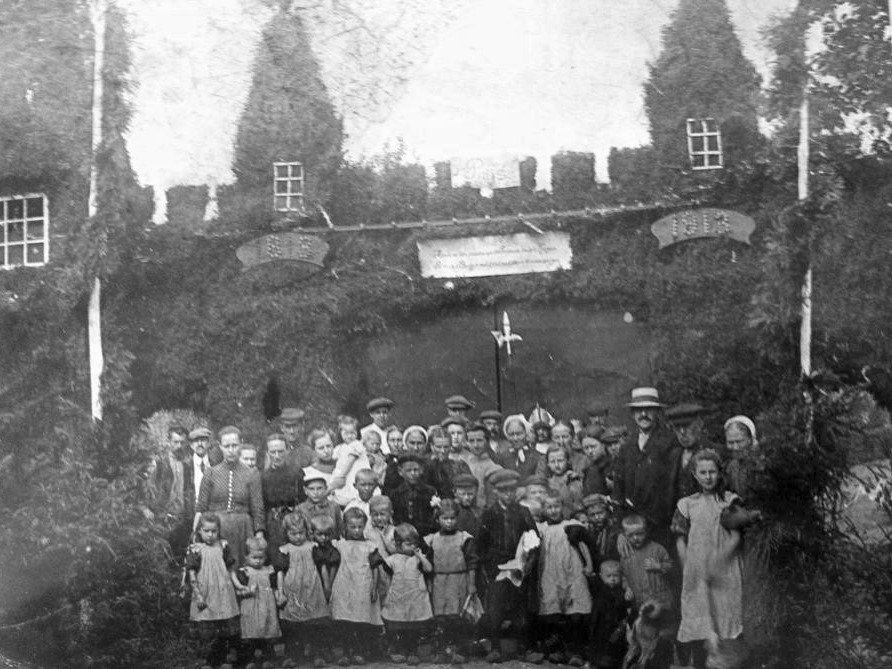
Aalten decorated on the occasion of 100 years of independence, 1913
In general, therefore, we wish to recall a few facts that history has recorded. The 17th century (1600–1700) is called the “Golden Age” of our history; the 18th century (1700–1800), the “century of decay”.
What was the cause of that decay? People began to rest on the laurels achieved by their ancestors. A spirit of enterprise was no longer to be found. In idleness, people began to enjoy the accumulated wealth and were afraid to give up anything that might contribute to the promotion of the country’s prosperity. No funds were made available for the army and navy, and the prestige of the once-mighty Republic of the United Netherlands dwindled from year to year.
In the eyes of other European states, we no longer counted. Furthermore, dissatisfaction with the administration arose, fuelled by the revolutionary spirit that manifested itself in France—so much so that the revolutionaries, called Patriots, acted hostily towards Stadtholder William V and his supporters, called Orangists.
The French Period
When the great Revolution had taken place in France, and the revolutionaries had put the King and Queen to death, the Patriots called in the help of the French to drive out the Stadtholder here as well. In 1795, they marched into our country with a large army and were received with cheers by the revolutionaries.
The government was unable to stop them because the army was not properly equipped and the fortifications were dilapidated. The money needed for their maintenance had been cut, but now they could give the French 100 million guilders, which they demanded for the help and assistance they had provided. William V fled to England, and his opponents took the place of the former government officials.
Now, the French could have left again, but they did not think of it. Time and again, when the French soldiers here were well-fed and clothed, they were exchanged for a ragged, starving bunch, to recover their strength here at the expense of the citizenry. Their influence on the course of affairs in this country meanwhile increased more and more, until they took the entire administration into their own hands.
In France, there was great confusion until it finally succeeded for a lawyer’s son from Corsica, named Napoleon Bonaparte, to create some order. He was a brave general and a capable warrior, who defeated the armies of the states that had declared war on France and prescribed humiliating peace terms to his enemies. In 1804, he had himself proclaimed Emperor, and two years later he sent his brother, Louis Napoleon, here to rule over our country as King.
Heavy Sacrifices
The alliance with France cost us heavy sacrifices. The English, who were at war with the French, now became our enemies as well and took possession of almost all our colonies and robbed our merchant ships, which meant our trade was as good as gone. One already had to pay a quarter of one’s income in taxes, and yet Napoleon demanded more.
Napoleon had had his brother Louis proclaimed king here in the expectation that he would submit entirely to his will. However, he was disappointed in this. Louis came here with the intention of promoting the prosperity of his kingdom as much as possible and protecting the people from further oppression. He showed this, among other things, by refusing to introduce conscription and by tacitly allowing smuggling with England.
To hit England, Napoleon had strictly forbidden all trade with that country. Now that Louis did not support him enough in this, he forced him to abdicate (1810), and Holland was annexed by France. Our country now became a French province and thus ceased to be an independent kingdom. The government was now organised on a French footing. The Dutch language had to gradually disappear. French had to be learned in schools, and newspapers also had to appear in French.
An army of customs officers occupied the coast and ensured that when a ship with English goods arrived, the cargo was burned. Indische goods, such as coffee, tea, tobacco, and rice, rose astonishingly in price as a result. The impoverished citizenry managed with a decoction of toasted rye bread instead of using coffee, and instead of tobacco, people smoked walnut leaves. To replace sugar, people set themselves to making sugar from the sweet sap of beets.
Many wealthy citizens became poor, and those who had to live off their interest, as well as numerous orphanages and charitable institutions, suffered want when Napoleon had the interest on the national debt “tiered”—that is, he only acknowledged one-third of it. Those who, for example, were entitled to 300 guilders in interest only received 100 guilders. No more was earned, but more had to be paid, causing poverty to pinch; hundreds of houses were sold for demolition, magnificent country estates were disposed of for a trifle, horses and carriages were abolished, and servants dismissed. In Amsterdam, grass grew on the streets.
Fighting for Napoleon
But the Frenchman did not just take goods; he also demanded blood. Napoleon needed soldiers to fight for him in all corners of Europe and now forced our boys to serve in his armies. He introduced conscription, which for us was something unheard of. In our previous wars, there were always enough volunteers to defend the fatherland, but now it was determined by lot who had to take up arms. Thus, numerous families saw their beloved relatives head off to foreign lands, never to see them again.
Yet no one dared to complain, or they would make the acquaintance of prison. Secret spies crept around everywhere to pick up every suspicious word, and the police often forced their way into homes and opened letters to hear someone’s opinion of the Emperor. Books and newspapers were not allowed to appear before they had been approved.
Yet this oppression also had its good side. The people now forgot their old party squabbles and felt united again and yearned for salvation. Napoleon’s power had reached its peak. Only England and Russia still defied him; otherwise, he ruled over all of Europe. Russia, too, would now feel his blows. With an army of more than half a million, he marched thither, but for every twenty soldiers, nineteen died miserably in Russia’s snowfields. The approximately fifteen thousand Dutchmen also never returned to their fatherland.
“Oranje boven” (Orange up/Long live Orange)
After this outcome, the Counts of Hogendorp, Van Limburg Styrum, and Van der Duijn van Maasdam secretly hatched plans to shake off the French yoke. After the Battle of Leipzig, in which Napoleon was defeated, the signal for the uprising was given by adorning oneself with the orange colour, which was previously punishable by death. The French soldiers watched, bewildered, and did not have the courage to resist.
Prussia and the Cossacks offered help, and on 15 November 1813, the cry “Oranje boven” already rang through Amsterdam’s streets, and two days later in The Hague. On 21 November, Van Hogendorp and Van der Duijn van Maasdam accepted the provisional government, and on 30 November, the Prince of Orange, son of the expelled Stadtholder William V, set foot on land at Scheveningen, where he was cheered by the crowd with unprecedented enthusiasm. Two days later, he was proclaimed Sovereign Prince in Amsterdam.
The French slunk away, and the Netherlands was free. That is one hundred years ago now, and all that time we have been spared from enemies crossing our borders. There is, therefore, reason to festively commemorate the Netherlands’ deliverance with thanks to God. Let us value our freedom, for no greater disaster can befall a people than when they are dominated by strangers. At the centenary of our independence to be celebrated within the municipality of Aalten on 28 August next, let our age-old motto therefore ring out loudly: “Oranje boven”.
After the Allied powers definitively defeated Napoleon in 1815, the Northern and Southern Netherlands were unified. The new Kingdom of the Netherlands was ruled by King William I. However, problems soon arose between the south and the north. There were significant political, economic, cultural, and religious differences.
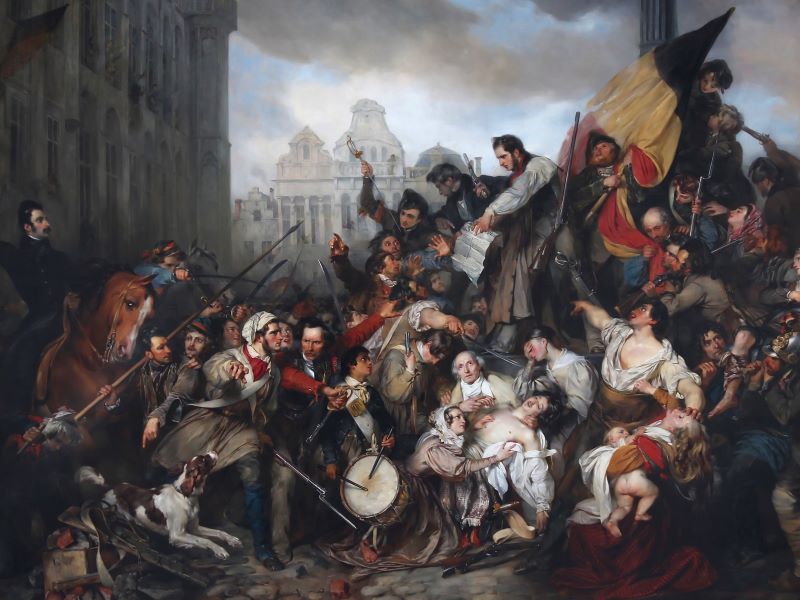
Belgian Revolution in Brussels, 1830. By Gustave Wappers
National Militia Call-up
On February 15, 1827, the Provincial Gazette of Gelderland published a Decree in which 460 men from Gelderland, including twelve from Aalten, were summoned to appear at the ‘Government Building’ in Arnhem at 8:00 AM on February 27 as reservists of the National Militia. As of March 1, they were required to be ‘under arms.’ A number of them would not return alive.
More residents of Aalten served, as evidenced by the decorations awarded later (see further on in this article). However, we do not yet have a complete overview of them. Further information is therefore welcome.
Ten Days’ Campaign
In August 1830, the Belgians revolted. At the end of September, an army was sent from the North to restore order. The Belgian resistance proved more stubborn than expected, and after a few days, the army was forced to withdraw from Brussels.
To avenge this defeat, King William I sent a larger force to Belgium on August 2, 1831. France decided to intervene and sent an army of 40,000 men to the Southern Netherlands. Consequently, William I withdrew his army. All in all, the conflict had lasted 10 days.
The Ten Days’ Campaign took place from August 2–12, 1831. The military operation was led by Prince William of Orange (the later King William II), who agreed to an armistice on August 12, 1831, after the Belgians surrendered Leuven. In the following week, the Dutch troops withdrew to North Brabant. Only the Citadel of Antwerp remained occupied under the command of Chassé (‘General Bayonet’) until the capitulation in December 1832.
In 1937, G.H. Rots wrote in the Aaltensche Courant about the Ten Days’ Campaign:
“Peace arrived, and the population returned to their labors. But peace would not last forever. The struggle between the Northern and Southern provinces ignited, and known as the ten days’ campaign, battle had to be joined once more. Once again, young men from Aalten marched off to join the struggle. This conflict was not particularly bloody, and most returned safely to their homes.”
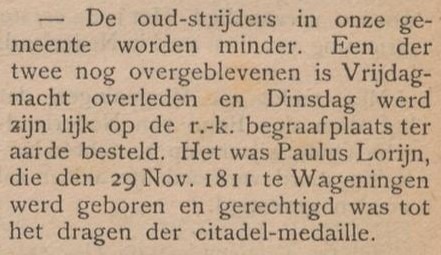
Those who had participated in that ten days’ campaign received a medal. In our youth, there were two veterans in Aalten who wore this decoration. During national festivities, they would be seated in a landau, drawn by two horses, and took the place of honor in the procession. The names of these last Aalten veterans were Lorijn and Loohuis. The medal of the latter is now in the possession of Mr. J.S.S. Prins.”
The Citadel of Antwerp
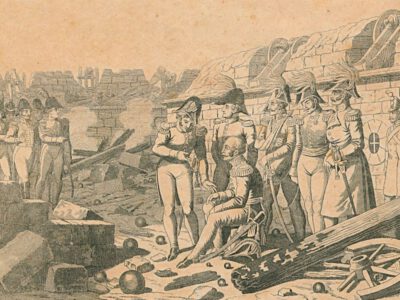
Marshal Gérard and the French princes pay their respects to General Chassé amidst the ruins of the citadel.
Shortly after the uprising in 1830, a portion of the Dutch military had retreated to Antwerp. At the end of October, General Chassé concentrated them in the citadel. This garrison was reinforced after August 1831. On December 24, 1832, General Chassé surrendered to the French army, which had been called to aid by the Belgians, following heavy artillery bombardments and a 25-day siege.
The French Marshal Gérard also demanded the important Scheldt forts Lillo and Liefkenshoek. These were no longer under Chassé’s command, so they could not be negotiated. Gérard then offered the choice between surrendering the forts or taking the soldiers to France as prisoners of war. Only William I could provide a solution. He refused.
Prisoners of War
On December 29 and 30, 1832, over 4,500 Dutch soldiers departed for Northern France as prisoners of war. However, because France and the Netherlands were not at war with each other, they were effectively hostages. The journey took eight days of marching through Zwijndrecht, Melsele, St.-Niklaas, Lokeren, Deinze, Desselgem, Kortrijk, Menen, Ypres, Vlamertinge, Poperinge, Steenvoorde, and Cassel. On January 5, Saint-Omer was reached via Arques. Part of the Infantry continued to Béthune, another part with the Artillery and Engineers to Hesdin, and the Navy to Aire.
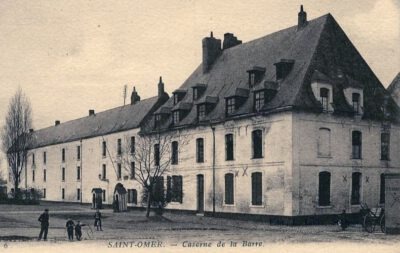
The La Barre barracks in Saint-Omer, where a large portion of the Dutch soldiers remained in captivity.
On May 21, 1833, the Convention of London brought about a partial lifting of the state of war. The prisoners of war were to be released. On June 8, four French frigates, three corvettes, and one brig set sail from Dunkirk for Vlissingen. A day later, they made landfall in Vlissingen and marched to Middelburg that same day.
It would take until 1838 before the Dutch King William I sullenly threw in the towel. With the signing of the Treaty of London in 1839, the separation of Belgium became a fact.
Awards and Recognition
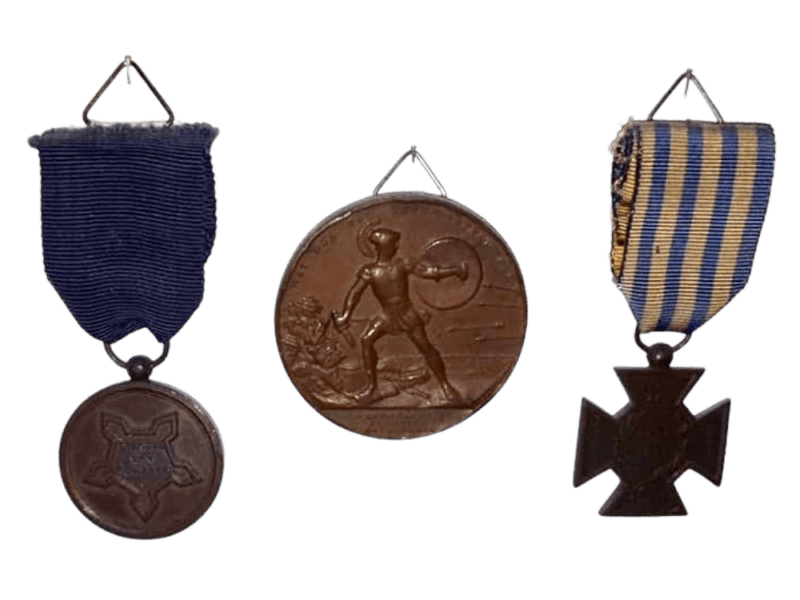
All those who had been under arms and were deemed to have participated in the military operations during the Ten Days’ Campaign were decorated with the Metal Cross. This commemorative medal, also known as the ‘Hasselt Cross,’ was awarded in recognition of their proven loyalty to King and Fatherland. The bronze crosses were struck from the metal of the cannons captured from the Belgian Army of the Meuse during the Battle of Hasselt on August 8, 1831.
By Royal Decree of May 31, 1833, King William I of the Netherlands instituted the Antwerp Medal 1832. This was to be awarded as a “reward to those who, during the siege of the Citadel of Antwerp in the period from November 28 to December 24, 1832, served in the citadel and subordinate forts (Vlaamsche Hoofd, Burcht, Zwijndrecht, and Austruweel), as well as on the flotilla on the Scheldt before Antwerp.”
Decorated Aalten residents
A number of Aalten residents are known to have been decorated with the Metal Cross (MK) for their participation in the Ten Days’ Campaign and/or the Citadel Medal (CM) for the defense of the Antwerp citadel. Below are the names and decorations currently known to us.
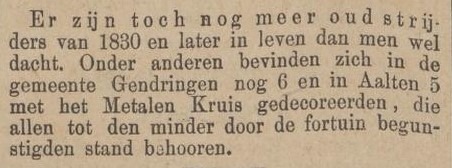
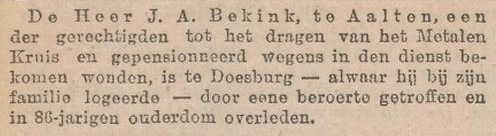
MK: Jan Anthonij Bekink (1812-1898), lived in the Peperstraat.
MK: Joan Henricus (Jan Hendrik) Bennink (1807-1832), lived on the Prinsenstraat. He was a flanker with the 2nd Battalion of the 14th Infantry Division when he passed away in a hospital in ‘s-Hertogenbosch.
MK: Dirk Jan Hoornenborg (1807-1876), born at Nieuw Hoornenborg on the Haart, lived in Gorssel from ca. 1845 and passed away in Kring van Dorth.
MK: Johannes Christianus Kötcher (1807-1876), lived in Bredevoort.
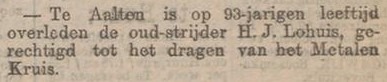
MK: Hendrik Jan Loohuis (1812-1905), lived the final years of his life in the Avondvrede Rest Home.
MK: Petrus Bernardus Smit (1807-1876), lived on the Hogestraat.
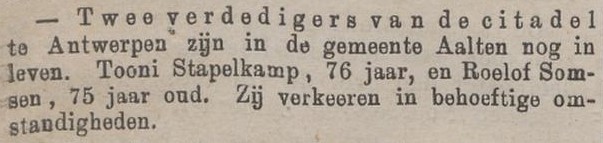
MK+CM: Tonij Stapelkamp (1807-1889), lived on the Hogestraat.
CM: Paulus Lorijn (1811-1899), came to Aalten from Wageningen in 1844 and lived successively at the Piepert, Heurne, and the Roman Catholic hospital on the Hogestraat.
CM: Roelof Somsen (1808-1891), lived on the Pennings farm in Dale.
Toni Stapelkamp’s decorations: the Citadel Medal and the later issued (large) personalized medal for the Commission of Acknowledgement; on the right, the Bronze Cross of the Ten Days’ Campaign (photo submitted by A. Stapelkamp)Zutphensche Courant, 30 November 1882Aaltensche Courant, 1 April 1899Zutphensche Courant, 8 October 1890Nieuws van den Dag, 9 August 1898Rotterdamsch Nieuwsblad, 9 June 1905
In 1937, G.H. Rots described in a series of articles how things transpired in Aalten in former times. Regarding the years of the French occupation, he wrote:
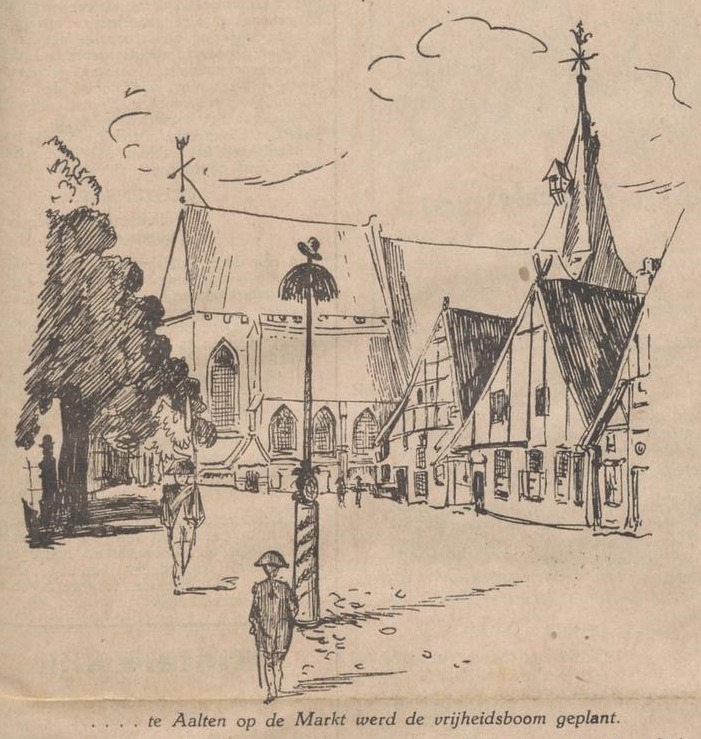
“During the French period, Aalten enjoyed the blessings (?) of French rule. The slogan ‘Liberty, Equality, and Fraternity’ was prevalent at the time, and the liberty tree was planted on the Market Square in Aalten. A new municipal government was appointed, new laws and regulations were established; in short, a different spirit blew through the government buildings. The Batavian Republic was founded, and the House of Orange was finished.
French soldiers were also billeted in Aalten, with all the associated calamities. Although the majority were pro-Orange, people did not dare to express their opinions, and the new regime was accepted. This situation lasted from 1795 to 1799. Secretly, a large part of the population loathed the French occupation.
Then, in 1799, rumors circulated that a Dutch nobleman, A.R. van Heeckeren, also known as Suideras, had crossed the eastern borders at the head of a large army as a liberator and was victoriously driving the French out of the villages.
In other parts of the country, there were also incursions by the English and Russians, who were engaged in war with the French, and thus also with the Batavian Republic. The Orange supporters regained courage, and when Suideras marched into Winterswijk on September 5 and allowed the Orange flag to flutter from the tower once more, Aalten also prepared to receive the liberator.
Great excitement took hold of the population. A certain Jan Derk Hoopman arrived with an axe and already began to chop down the liberty tree. In the afternoon, Suideras arrived in Aalten. The bells were rung. A large crowd welcomed the liberator while singing and dancing. People adorned themselves with Orange, believing that the suffering was finally over. It proved to be a false hope, for the French did not allow themselves to be easily defeated by Suideras.
By the following day, word arrived that a French army was approaching, and indeed, the French General Girod arrived in Aalten with his troops. Jan Derk Hoopman fled, and likely many others took to their heels as well, as house searches were conducted and heavy punishments were meted out. The joy had thus been short-lived. High taxes had to be paid, and earnings were meager.
The ministers held religious services in the open air. For instance, Reverend Westerbeek van Eerten climbed onto a farm cart and encouraged his fellow believers, who had gathered near the ‘De Pol‘ house.
A state of decline set in. The pressure of French rule became increasingly heavy. Young men had to draw lots for French conscription, and when Napoleon needed soldiers for his campaign to Russia, Aalten also had to provide a contingent. They left, never to return. Their remains rest beneath the soil of the Russian steppes, or they perished in the cold waters of the Berezina.
Liberation
Until 1813. Napoleon was defeated in the Battle of the Nations at Leipzig. The Prussians entered our country. The Prince of Orange arrived in our country from England, and once again the cry was ‘Orange Above’. There was jubilation in Aalten once more. The bells were rung again, and now the Orange flag would continue to fly.
One of the Orange scions, Prince Frederick, was at school in Berlin. Having heard of the revolution in the Netherlands, he traveled by stagecoach to The Hague. The route followed the great postal road, which we have described previously. The border crossing took place at the Heurne, and when the population heard that Prince Frederick would pass through Aalten, they went to meet the carriage, unhitched the horses, and pulled the coach through Aalten amidst loud cheering as far as the Zelhemseweg, to the spot where the lime tree stands. Well, that tree was planted then as a memorial to that event, and later the lime tree was established as the official coat of arms of Aalten.
Once more, the boys from Aalten would have to march against the French. When Napoleon escaped from Elba and equipped a large army to reclaim his former glory, the Netherlands had to place its army alongside the allies against him. Young men from Aalten also fought in the Battle of Waterloo. We know what became of Napoleon’s fate then. It had been his final convulsion.”
Prince Frederik of the Netherlands (1797–1881)
Source
‘From Aalten’s Past’, by G.H. Rots, Aaltensche Courant, 11 March 1938 (via Delpher)
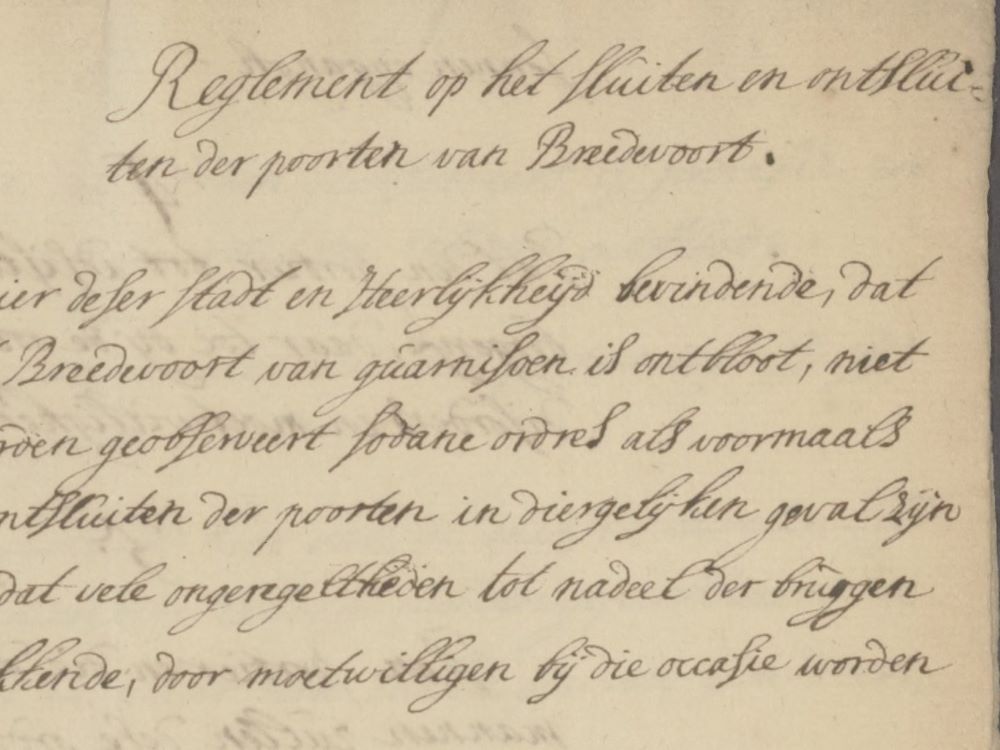
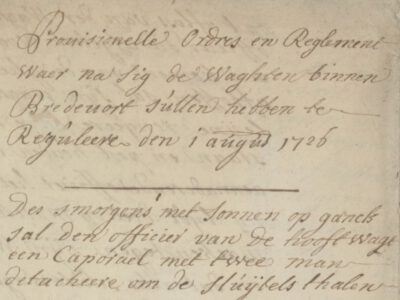
The text below is a transcription of the “Regulations on the closing and opening of the gates of Bredevoort” from 1759.
Fragment of the scanned document
The Officer of this town and Lordship, finding that since this town of Bredevoort has been devoid of a garrison, such orders as were previously given for the closing and opening of the gates in similar cases are not being properly observed, and even that many irregularities detrimental to the bridges and gates are being committed by malicious persons on those occasions1.
Therefore, in order to provide for this as much as possible, the following regulations on the closing and opening of the gates are hereby decreed and established, as is done by these presents in the following manner:
That in the evening at nine o’clock, after the ringing of the gate bell, the gatekeeper at the outermost bridge shall be required to call out three times whether anyone is still outside, and wait until those who have answered his call have been able to enter properly, and not close the gates before then; without anyone being admitted after that time, except for significant2 reasons. And after the closing has been completed, the keys shall immediately be brought by the gatekeeper to the house of the Mr. Land Writer pro tempore steward3.
The gatekeeper shall put the gates on the bolt or latch one hour after sunset and, before opening, may and shall be entitled to demand half a stiver from every passenger, one stiver from a cart and horse, and two stivers from a wagon, including the driver. And at nine o’clock, after the ringing of the bell, they must be closed entirely, as mentioned in the previous article.
That also in the morning the gates shall be opened half an hour before sunrise.
That the gatekeeper shall have four men from the citizenry for assistance, to be summoned for that purpose by the rotmeesters (squad leaders) each time, to prevent all disorders and acts of malice.
The gatekeeper and the men summoned for that purpose by the Rotmeesters shall strictly follow this order in the closing and opening of the gates and the raising of the bridges at the precise time in the morning and evening, on penalty4 of 6 stivers to be forfeited by each person who is absent and not present at the appointed hours, each time for the benefit of those present.
That besides the gatekeeper and assistants, no one, whoever they may be, shall dare5 to interfere with the closing and opening of the gates or the raising and lowering of the bridges, to lay hands upon them, or to commit even the slightest act of malice, on a fine of two gold guilders to be forfeited by each and every one of the offenders6, with parents being responsible for and paying the fines for their children.
And so that all the aforementioned shall be observed all the more exactly, the gatekeeper and assistants are recommended and at the same time ordered to pay close attention to all the aforementioned, and to report those offenders immediately, for which they shall benefit from one-third of the fine mentioned in the previous article.
That this order shall be observed provisionally for as long as this town shall be devoid of a garrison.
And an extract of this shall be given to the gatekeeper for his information7.
And so that no one may plead the slightest ignorance of this, it shall be published and posted where it is customary to do so.
Thus provisionally decreed within Bredevoort on June 11, 1759.
The text below is a transcription of the original handwritten regulations, as literal as possible, including variations in spelling, but with added punctuation to improve readability. The text contains a number of words or concepts that we did not recognize (highlighted in yellow) and may have been misinterpreted. Therefore: errors excepted and corrections are welcome.
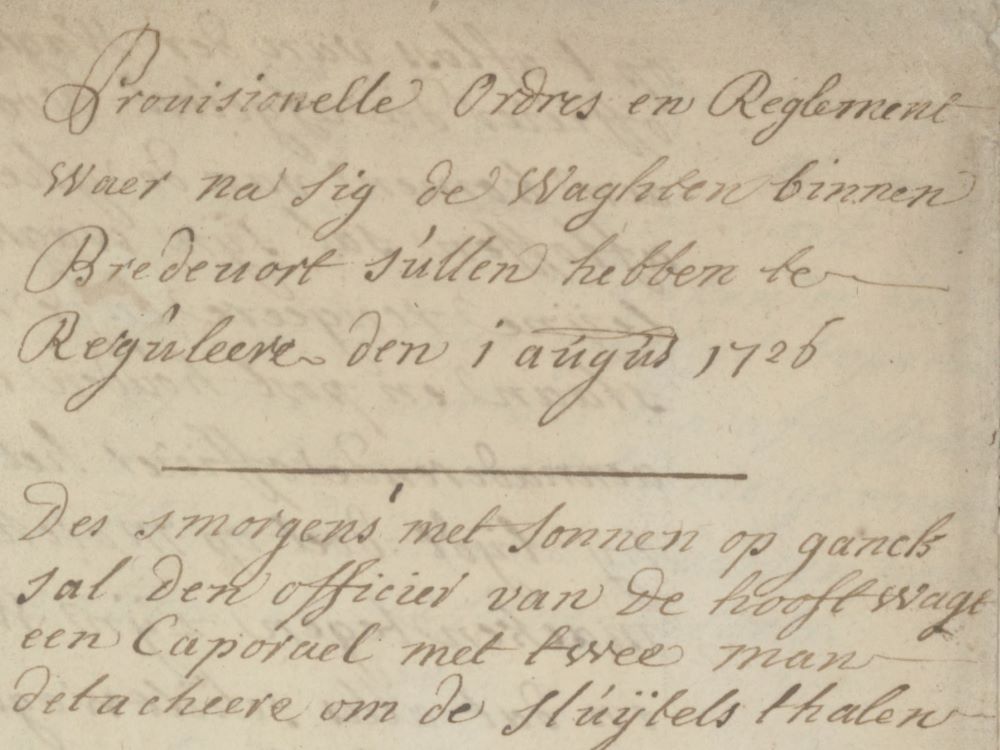
Fragment of the scanned document
Provisional Orders and Regulations according to which the guards within Bredevoort shall regulate themselves, August 1, 1726.
In the morning at sunrise, the officer of the main guard shall detach a corporal with two men to fetch the keys.
When the keys arrive, the officer shall arrange the guard under arms, have the march beaten, and detach the sergeant and as many men as shall be necessary. And at the Munsterspoort, the sergeant shall detach the corporal so that every time a drawbridge is lowered and the keys have passed, it is raised again until the field is scouted and the posts are set out.
The gates being opened, the keys shall be returned in the same manner as they were fetched.
Upon the changing of the guard, the officer being relieved shall, upon the arrival of the one who is to relieve him, arrange his guard in a line and have the march beaten and hold post until the approaching officer has the body of men he leads1 march up and form a front opposite his guard, and ensures all sentries are relieved and inspects whether anything is missing from the cannons and batteries2 and whether the guardhouses, sentry boxes, and the rampart are cleared of all filth and found in a state fit for duty, and whether the patrol sticks and whatever else is required for the guardhouses are present with the guard, and that the officer being relieved has handed over the orders observed at his post to the relieving officer. When all this is done and the sentries are relieved and have joined the guard, the relieved officer shall march off to the market and there thank the men; at the same time that the relieved troop marches off, the relieving officer, having arranged his men in a line, shall beat the march and take up post in the same place.
The sergeants of the guard shall remain at their posts for 24 hours. From the main guard only two men, and from the Munster Gate only one, may be given leave to fetch food, but from the opening of the gates in the morning until eight o’clock, as well as during the time when the sentries are relieved, none.
No soldiers are to be allowed outside the gates without a gate pass, written or signed by the Commander; the gate passes shall be held by the officer and, when the soldier returns, given back; if they do not return and the passes are collected, they shall be brought to the Commander with the evening report. The sergeant of the Munster Gate shall send the collected passes to the main guard.
The guards and sentries shall take good care that no damage is done to the timber or palisades on the national fortifications, nor any fishing done in the moats around, or grass mown on the ramparts or counterscarps, without a note or order from the Commander. Also, the sentries and patrols shall ensure that no elevation occurs on the excavated grounds around the fortifications, nor any trenches shifted, and that no filth is made on the ramparts.
The commanding officer of the main guard shall have all foreign passengers brought to the commander. The sergeant of the Munster Gate shall have the same brought to the main guard, but for persons of quality, he shall ask the servants for their names and status and where they are staying, and if they have no servant with them, he shall ask them directly and immediately inform the Commander.
In the afternoon from twelve to one o’clock and on Sundays during the sermon, the outermost drawbridges at the gates shall be raised.
The officer shall provide a written report to the Commander at twelve o’clock in the afternoon and in the evening after the closing of the gate. The parole and orders that may have been given to the guards that day residing there in the morning when relieved shall be reported verbally. The sergeant of the Munster Gate shall have a report made to the officer of the main guard at half past eleven in the morning, in the evening before the gate closes, and in the morning after the opening of the gate.
The sentries both at the barriers and on the ramparts shall call out to and warn one another when they see more than two or three men with arms, or more people than usual, approaching from outside. The sentries at the barrier shall immediately close it and raise the bridge, calling to the nearest sentry to have the guard come to examine the situation and report to the Commander as found. The guard shall ensure that a capable man is always stationed at the barriers.
No foreign passengers shall be allowed on the ramparts or works without special order from the Commander. The sentries shall also take heed that no one enters the faussebraye, and also that no disorder occurs outside or near their posts, such as the breaking of lines placed in the gardens, and they shall always carry their arms while walking and not smoke tobacco.
No foreign beggars shall be allowed into the city, and if any deserters should arrive very early in the morning, they shall remain in the main guard until they have been examined by the Commander.
The sentries shall not allow more than one at a time of the carts or wagons coming from outside to pass over the bridge. Also, no carts or wagons may be left standing before the guard or inside the gate, but a clear space must always be kept, both before the guard and the gates; care must also be taken that the national boat lies locked, inspecting it before the closing of the gates.
No beasts or horses are to be allowed on the fortifications; if any are found on the national works, they shall be brought to the guard and the release fee paid, according to the order of their Noble Mightinesses.
The Ceremonial is to be observed according to the Regulations.
In the evening at sunset, the officer, as a warning to the people who still wish to go out or in, shall have the roll-call beaten and detach a corporal with two men to fetch the keys. And when they arrive, the officer shall arrange the guard under arms, have the march beaten, and continue this until the gates are closed, and then set out the night posts and send the keys back to the Commander. Just as they were fetched when the gates were opened and closed, the officer himself shall be present to ensure that the gates are properly closed.
If a gate is opened at night, the officer shall take care that nothing other than the wicket of the barrier is opened and that once the keys have passed, it is closed again, just as as soon as the keys are over the drawbridge, it is immediately raised again, detaching the necessary men for that purpose. The wicket of the outermost barrier being opened, he shall have it inspected who is outside the gate and, if found to be in order, shall allow those for whom the gates were opened to enter, but taking care that no barrier is opened nor drawbridge lowered before the outermost is well closed and the officer is informed of what has occurred. For the Munster Gate, a corporal with four men from the main guard shall come.
The tattoo shall be beaten at half past nine in the summer and at nine o’clock in the winter.
In the evening, the officer shall have a corporal and two men inspect the inns and have the soldiers of the garrison go to their quarters; half an hour later, he shall inspect them again to see if any had dared to come there, and if so found, they shall be brought to the guard under arrest.
The corporals shall bring their sentries to their posts themselves by day and by night and ensure that the orders given are properly handed over at their posts; to that end, the corporals of the main guard shall inspect the sentry at the bastion, marching up as the sentries of his guard are relieved around the rampart, ensuring that everything is in good order and that no damage is done to the national works. The corporal at the Munster Gate shall march up with the sentry at the Mill Bastion and so forth, observing the rampart all around. What is mentioned in this article, and especially that the sentries of the Munster Gate are relieved at the stroke of eleven, they shall for that purpose stand the first posts from nine to ten o’clock in the morning and then relieve every two hours, namely from ten to twelve and so on.
The officer of the main guard shall send a man around the rampart every two hours, namely at half past ten, half past twelve, half past two in the morning and subsequently every two hours by day and by night, to ensure that no damage is done to the national works, whether by children whom he shall order off the rampart, or dogs or chickens or other harmful creatures which he shall shoot dead. This article shall also be observed by all corporals and sentries performing relief. The sergeant of the Munster Gate shall send a man around the rampart every two hours by day and by night, namely at half past eleven, half past one, half past three in the afternoon and subsequently every two hours.
The officer of the guard shall be responsible for ensuring that every sentry at his post knows all the orders that have been given so that they are properly executed3. To this end, the officers of the main guard shall inspect the posts of both the main guard and the Munster Gate and instruct them on all orders, just as the sergeant of the Munster Gate shall instruct his sentries and visit their posts, for which he shall be held accountable.
The officer on guard shall perform the grand round before twelve o’clock at night. The sergeant of the Munster Gate shall perform the visiting round between twelve and three, and the sergeant of the main guard shall perform the day round before the reveille.
The Commander or major, wishing to inspect the posts by day or by night, shall not need to go to the guard first but shall take with them the sentry for the Commander, who may be relieved for that time.
In case of alarm or fire, the Commander is to be informed immediately, and in the meantime, the officer of the guard shall detach the sergeant with six men there. The guard that is to mount shall first report to the main guard and the Company at the parade ground on the Sand.
All further orders not specified herein shall be regulated according to the ordinances and regulations established of old.
Article 21 of the guard is to be changed in so far that the sentries shall be relieved every hour at night and this shall continue until the guards are relieved in the morning; at the Aelterpoort to begin at eleven o’clock in the evening, until 12, until 1, until 2 and so on from hour to hour; at the Munster Gate to begin at half past ten in the evening, half past eleven, half past twelve and so on from hour to hour.
The officer of the guard shall ensure that the corporals themselves bring the sentries to their posts. And the corporals of the guards shall keep their route around the rampart from each gate, as ordered in Article 21, taking care that if a sentry is not found alert at their post, they shall be relieved and placed under arrest.
Gunpowder Tower Disaster Bredevoort 1646, 3D impression by Paul van Druten
On Sunday, July 12, 1646, around four o’clock in the afternoon, the gunpowder tower of Bredevoort Castle, containing 320 barrels of gunpowder, was struck by lightning. Forty people were killed and an unknown number were injured in the ensuing explosion.
The tower caught fire upon impact. The explosion was so violent that the Ambthuis (administrative house) also collapsed. The town suffered extensive damage from the explosion, and almost all houses lost their roof tiles and windows. The houses surrounding the castle had collapsed. For three days, survivors were sought beneath the rubble using shovels and pickaxes.
In 1938, G.H. Rots wrote a series of articles in the Aaltensche Courant about the history of the municipality of Aalten. Regarding the gunpowder tower disaster in Bredevoort, he wrote:
“The year 1646 was once again a disastrous year for Bredevoort. It was the 12th of July, and an oppressive heat hung over the town. Dark clouds gathered, and everything indicated that a severe thunderstorm was imminent. And indeed, lightning soon cleaved the sky, followed by heavy claps of thunder. And suddenly, a terrible blow, followed by a dreadful sound.
Lightning had struck the gunpowder tower, causing the gunpowder present (320 tons) to explode. The entire tower was blown apart, as was the nearby Ambthuis; tiles were torn from almost all houses, and windows were blown in by the air pressure. The number of deaths in that disaster amounted to 19 at the castle and the Ambthuis alone. There were also numerous deaths in other houses in the town.”
Bredevoort Castle in 1597
Victims
“The deceased included, among others, the Governor of the city Willem van Haersolte and his spouse, the Drostinne Cathrijne van Brakel and her eight children, and her niece Berentjen van Brakel. Furthermore, Joh. van Langen, lieutenant to Georg Ernst Count of Bronkhorst, and also his French mistress (sic) Jeanne van Sédan. An elderly woman present there, Maria Glazen, along with the manservant and the maid, were also among the victims.
The sentry on duty, named Hendrik Otterpoëll, was buried under the ruins. In other parts of the town, the house of Jan Stenneken was destroyed. He and his wife Marycken van der Halle were killed. The names of the dead in other parts of the town were Derk Trix, ensign, Harmen ter Male, F. zum Moorelagen, Bailiff of Winterswijk, and his wife Janne Beerninck, with her sister Christine Beerninck, widow of the late N. Brinkhorst, judge of Haaksbergen.
The house of Berent Grimme was destroyed; his wife and four children lost their lives. The house of Casper Evers was hit, under which three people were killed, named Arent Hamaeker, a child of Berent Maes, and a child of Herman Broekman. Under the house of Derrick ter Woerle Wiltschut, three of his children were killed, as well as the soldier Gerrit Jansen and Jan Schulten.
We have specifically mentioned these names because one might perhaps derive names of those living today from them.”
The deceased who lay under the rubble of the Ambthuis were laid out on July 15 at the home of the widow of the late minister D.J. Verhagen. The bailiff with his wife and eight children were buried on the morning of Thursday, July 16, in the choir of the St. George’s Church. It is not clear how many people remained under the rubble. In total, forty people died that day. The sources make no mention of the number of victims who were injured.
One son of Drost Wilhelm van Haersolte survived the disaster. Anthony, as he was named, happened not to be home that day: he was staying in Zwolle. He continued the family line in Zwolle and founded the Haersolte Almshouse there, which is assumed to be connected to the disaster in Bredevoort.
Sources
‘From Aalten’s past’, by G.H. Rots, Aaltensche Courant, 18 February 1938 (Delpher)
In earlier centuries, the population of Aalten regularly suffered from forced contributions. A forced contribution (brandschatting) is a (usually high) sum of money that a village or region had to pay to passing troops to prevent them from looting and burning the village or region.
The soldiers in question usually received irregular pay and were primarily paid from these forced contributions. If the amounts could not be raised, the troops felt entitled to looting and other misconduct. Since multiple armies often passed through a region during wartime, the imposition of this ‘war tax’ usually led to bitter poverty. Additionally, the population often suffered from roaming, dismissed mercenaries.
This practice plagued many areas not only in the Middle Ages, but also during various wars in the 16th, 17th, and 18th centuries. In the peripheral areas of the Republic of the Seven United Netherlands, for example, such as North Brabant, Limburg, and the eastern border regions, it led to a major economic and demographic decline during these centuries.
Looting, forced contributions, and rape by Spanish soldiers, by C. van der Burght (Source: Zeeland Archives)
Historical Description
In 1938, G.H. Rots wrote a series of articles in the Aaltensche Courant about the history of the municipality of Aalten. He wrote the following about forced contributions in Aalten:
“In the years before 1597, the year of the conquest of Bredevoort by Prince Maurice, Bredevoort had regularly been in the possession of the Spaniards. However, one should not think that there was peace and quiet in the Ambt of Bredevoort at that time. Troops regularly passed through and stayed in Bredevoort and the associated districts. The village of Aalten suffered particularly from these passing troops. There was little dispute over property rights. The soldiers simply took whatever they liked, and the Ambt of Aalten was repeatedly levied for forced contributions, i.e., ordered to hand over a number of horses, cows, or money to the passing troops.
One could also strike a deal with the marauding bands and prevent the seizure of livestock and horses by paying a sum of money. As evidence of how Aalten suffered under these repeated raids and robberies, the following is mentioned in that regard.
On March 2, 1582, English horsemen arrived in Aalten and took 16 people prisoner. These prisoners were released after paying a ransom of 2,000 guilders.
An honorable citizen named Hondarp, however, was transported to Zutphen but was later released for a ransom of 200 dalers. The son of the aforementioned Hondarp was taken prisoner on October 17 while he was in Doetinchem. He had ridden to Doetinchem on horseback, and it seems his appearance suggested he did not lack means, as he was able to regain his freedom upon payment of 100 dalers and the surrender of his horse.
On December 1 of that year, soldiers from Lochem arrived and demanded 100 dalers to prevent looting. Things did not go well for Hondarp, as on January 15, 1583, he was taken prisoner along with his wife and son. They could only extract 60 dalers from him, for which they finally regained their freedom. In March of that year, another group of soldiers from Doetinchem arrived and stole a number of horses ‘at the Pas’. The owners were able to buy them back for 51 dalers, except for the best horse, which the soldiers took with them.
On May 29, the people from Doetinchem returned and stole a horse and a cow, but this time no ransom was paid, probably with the thought: if they get no money, they won’t return so quickly. But the next day it was the same story again; 3 horses were stolen. The ransom decreased, as they only had to pay 9 dalers, with which the soldiers were satisfied.
However, looting was in the blood of the garrison at Doetinchem, as they repeatedly came to Aalten. On June 18, they stole three horses; the ransom was 13½ dalers.
On the 10th, they were back again, and now they demanded 3 horses, 2 cows, 2 heifers, and 3 bulls. The heifers were slaughtered and valued at 10 dalers. The rest were bought back for 10 imperial guilders and the bulls for 10 dalers.
On June 14, one horse was stolen, which was bought back for 3 dalers and 18 stuivers. It would get even worse, for only two days later, soldiers from Bergh, Doetinchem, and Nijmegen arrived and stole 41 horses, 4 oxen, 33 cows, and 37 head of barren cattle. Only a portion of these could be bought back for 674 dalers.
And now more robberies followed. On July 19, 20 horses were taken by soldiers from Bronckhorst. On August 11, another 6 horses. On September 14, soldiers from Ulft stole 3 cows, for which a ransom of 15 dalers was paid by the owner.
On September 17, a company of soldiers led by a certain Stael arrived and seized 11 cows, 40 horses, 40 head of large cattle, and 12 oxen. They took the best livestock with them, and the rest was bought back for 419 dalers. Until now, it had always been livestock, but on December 15, soldiers from Lochem arrived and demanded 8 horses and 2 carts of buckwheat. On March 15 of the following year, a carter with a wagon of rye, drawn by 2 horses, drove through the IJzerlo field. Some horsemen from Bergh and Doetinchem seized everything, and the carter saw his property taken away.
Now they began taking heads of households prisoner again. They were released for a ransom or in exchange for other prisoners languishing in the dungeon at Bredevoort. Immediately after Whitsun, a large raid was undertaken, and many horses and cows were seized and partially bought back. Subsequently, on June 9, June 20, and June 24, there were repeated raids and thefts of horses and livestock.
And the measure was not yet full. The population of Aalten had a hard time, for on July 13 and 14, 1584, 15 people were taken prisoner in the municipality of Aalten and 600 head of cattle and horses were stolen. The prisoners were released for a ransom of 1,100 guilders. Who can fathom the sorrow of the population in those days?
Because of all these mentioned raids, people became fearful. They hardly dared to go outside with a horse, ox, or other animal; danger lurked from all sides. Soldiers were stationed in all the surrounding fortresses, and whenever they needed something, they went out looting. It was in the middle of harvest time, but the farmers left the grain in the fields; why should they harvest? Soon the enemy and also the State soldiers would come—for in this regard it was ‘six of one and half a dozen of the other’—and steal their possessions.
There were also farmers who fled and tried to find a living in regions further to the east. Those who remained here complained to the village authorities, but what could they do! In those years, a certain Jan Holstein was the advocate (voogd) of Aalten. He addressed petitions to the Lady of Anholt. It seems, however, that she was also powerless to end the situation. It was wartime, and the soldiers, mostly mercenaries and volunteers, demanded money, food, and drink on time. And when the army leadership could not provide that on time, the soldiers tried to obtain it themselves through looting and robbery. The population became the victim.”
Billeting
“Added to all that misery was the fact that garrisons were relieved of soldiers by billeting them with farmers and village residents. The people themselves had almost nothing to eat, and when soldiers were billeted, they would act out if they did not receive enough food. If people had provisions, they were largely hidden, otherwise everything would be seized. To make matters worse, an extra tax was imposed on the population. The Lady of Anholt needed money, and the Stewards traveled around to collect the funds; but everywhere there was poverty and want.
Then it would seem as if peace would return, and nothing would be heard for a year. But suddenly it would flare up again. As in the summer of 1586, the looting began once more. The Aalten farmers then pursued the looters as far as Enschede and Oldenzaal. They wanted their stolen cattle back. They had to return empty-handed, and the suffering was almost unbearable.
One of the worst afflictions was when the soldiers brought their wives and children with them. Then they also had to be given something to eat. In January 1587, such a troop was to be partially billeted in Aalten. Fear struck the hearts of the population. It was heard that they were mercenaries from Wallonia in Belgium, who were notorious for their ferocity and cruelty. Outposts had already been sent out because it was suspected that Geuzen soldiers were in the vicinity. On a Sunday morning, such an outpost troop of 20 men arrived in Aalten, led by the landdrost Thieseling. They moved on to Bocholt, where a Spanish cavalry unit had arrived under the command of Colonel Taxis.
Reconnaissance had determined that no State or Geuzen soldiers were to be seen, and so it was agreed to ride back to Groenlo and then carry out the billeting. But between Aalten and Bocholt, they were suddenly ambushed by the Geuzen soldiers, and a fierce battle broke out. The Geuzen were victorious, and the fear remained. The dreaded billeting did not happen.
Near Bredevoort, there seem to have been fertile meadows in addition to marshes. Specifically, there was a town meadow at the Swanebroek and several private grazing lands. But in 1587, everything had been grazed bare by the enemies’ horses, the meadows were completely ruined by riding, and afterwards a period of rain came and everything was flooded, so that no hay could be harvested that year. While they had been spared billeting in the spring, in December of that year a large number of horsemen suddenly arrived from Groenlo and stole horses, cows, and pigs. Sixty molders of rye and buckwheat were also to their liking, along with 43 wagonloads of unthreshed grain.
On March 26, 1588, it was a number of State soldiers who looted in Aalten. Thus, the population was bitten first by the cat and then by the tomcat. The advocate of Aalten, Jan Holstein, wrote a letter on June 9, 1588, to Godfried Gerardi, advisor to the Lady of Anholt, in which he recalls the situation in Aalten. The harvest cannot be safely brought in. Citizens of Aalten have been taken prisoner and are being held hostage elsewhere. There is no money to ransom these people.
On July 4, 1588, an army of 2,000 infantrymen (foot soldiers) and 300 horsemen approached Aalten. They entered the village, and the residents fled fearfully into their houses. What would happen to them now? The command was held by the Spanish governor and field commander Verdugo and Count Herman van den Berg. It appeared, however, that they were just passing through towards Bocholt-Recklinghausen, so Aalten was spared billeting or robberies this time.
The Lady of Anholt considered ways to end the robberies. She needed money to pay the soldiers’ wages and therefore decided to introduce an extra levy (extra tax). But of course, you can’t pluck feathers from a frog. Aalten had to provide an extra 70 dalers, and the advocate of Aalten wrote to the Lady that he did not know how he would collect this sum, which had been easy to pay in the past, at this time. The population is starving, horses and cows are almost non-existent, and what remains is being stolen.
Yes, my readers, who can fathom the depth of misery of the unfortunate population, for not only the mentioned afflictions hit the people. It is as if everything conspired to complete the system of destruction, for while the crops promised somewhat of a good harvest, a violent storm arose accompanied by heavy hail and destroyed all the crops standing in the fields. How deeply our ancestors had to drain the cup of misery is indescribable and cannot be understood by us, who do complain about bad times.
For even more atrocities were to occur. The hordes of soldiers who roamed about and often indulged in strong drink threatened women and daughters with dishonor if they were not given what they demanded. In 1597, Bredevoort was taken by Prince Maurice. The change in government had come, but it did not bring the protection of home and property. It remained restless in the Ambt of Bredevoort. The fortunes of war fluctuated, but soldiers were soldiers; one group might be slightly better than the other, but on average they could all be painted with the same brush.”
Twelve Years’ Truce
“Only in 1609, when the Twelve Years’ Truce was made, could the population catch its breath again. With the changing fortunes of war, religious disputes had also flared up. As long as the Spanish domination existed, the Reformers could not show themselves openly. No sooner had the tide of war turned than the change in the churches also took place. The victors took measures against the vanquished that, in hindsight, are indefensible.
After the Twelve Years’ Truce, the conflict began to flare up again. In Groenlo, there was still a garrison of Spanish soldiers. That was a breeding ground for bad elements. They roamed the rural districts and again stole everything they could. The new Lord of this municipality, Prince Maurice and later Frederick Henry, was constantly petitioned for protection. Finally, on July 17, 1627, Frederick Henry decided to rush to the aid of his subjects in the County. A significant military force of 55 squadrons of cavalry, 168 companies of foot soldiers, and 75 cannons entered the County, coming from the direction of Emmerich. The siege of Groenlo was laid, and a fierce battle erupted there between besiegers and besieged.
After the siege had lasted a month, Frederick Henry took the city and thereby established the rule in the County. For thirty days, Frederick Henry stayed in Groenlo and visited the surrounding places. Aalten also received an official visit from Frederick Henry. He encouraged the population. Since then, a member of the House of Orange has never made an official visit to Aalten. If a street or square in Aalten ever needs to be named again, it might well be named after this liberator of Aalten territory. For afterwards, peace returned, except for small robberies compared to the past, until the peace was signed in 1648, ending the Eighty Years’ War.”
Gertrud van Myllendonk (1552–1612), also known as Geertruida van Millendonck, was a noble administrator in the German-Dutch border region. She was Lady of Drachenfels, Königswinter, and Anholt, and for thirty years the pledge-holder of the Lordship of Bredevoort (1582–1612).
Her reign took place in the midst of the Eighty Years’ War (1568–1648). While the region was torn apart by violence between Spain and the emerging Dutch Republic, she attempted to keep her territories out of the line of fire through a strict policy of neutrality. Although she was personally Roman Catholic and pro-Spanish, she took no side politically. In 1612, she transferred her rights over Bredevoort to Prince Maurice of Orange.
Early years and marriage
Gertrud van Myllendonk (1552–1612)
Gertrud van Myllendonk was born in 1552 at Myllendonk Castle, near Düsseldorf. She was the daughter of Dietrich von Myllendonk and Theodora van Bronckhorst-Gronsveld. Through her father, she inherited various properties and noble titles along the Rhine.
On 13 May 1576, Gertrud married Jacob van Bronckhorst-Batenburg, the Lord of Anholt, in Anholt. At that time, his family held the Lordship of Bredevoort in pledge. This meant they governed the castle, the town, and the surrounding area in exchange for substantial loans they had provided to the sovereign. The couple had three children:
Elisabeth van Bronckhorst-Batenburg (Aalten, February 1582 – 1629), married Willem van Ketteler, Lord of Lage, in 1613.
Family life was short-lived. Jacob fought in Spanish service and was severely wounded in September 1582 during fighting near Lochem. He succumbed to his injuries a short time later at the age of 29 at the Castle of Bredevoort. Gertrud was left a widow at the age of thirty with three young children.
Administration and neutrality policy
After her husband’s death in 1582, Van Myllendonk took over the administration of the Lordship of Anholt and the pledge of Bredevoort. During this period, the front between the Spanish and States armies ran straight through the Achterhoek. Although she was personally Roman Catholic and pro-Spanish, she chose a strictly neutral stance for strategic reasons to prevent looting and quartering in the countryside.
In doing so, she continued the policy of her father-in-law, Diederik van Bronckhorst-Batenburg. He had attempted to keep the territories out of the conflict by declaring that the Spanish king possessed no sovereign rights over Anholt and Bredevoort. Although the neutrality of Anholt was respected internationally, this did not apply to Bredevoort. Due to its strategic location and strong fortifications, Bredevoort remained a military target for both parties.
Administrative crisis in Winterswijk
Van Myllendonk’s reign was threatened not only by external armies but also by internal political tensions. In Winterswijk, which fell under the jurisdiction of the Lordship of Bredevoort, the pledge-holder was not without controversy.
A direct power struggle arose when Johan Rump was appointed as guardian of Winterswijk without her involvement. In response, the bailiff of Bredevoort appointed by Van Myllendonk took firm action: he had Rump arrested and installed a counter-candidate, Otto Volmer. This intervention led to escalation and unrest in the region. To de-escalate the situation, Van Myllendonk deployed her personal agent from Brussels and Antwerp, Gottfried Gerardi. Only after Jacob Vockink was installed as the new guardian did peace return to the Winterswijk administration.
“From the diary of Geertruid van Mijlendonk”, 18 June 1596
The Siege of Bredevoort in 1597 and the aftermath
Gertrud’s neutrality policy ultimately failed to hold when a Spanish garrison took possession of the Bredevoort fortress. Like the States’ military leadership, Gertrud wanted these troops gone as quickly as possible, but she did not receive permission for this from the Spanish Governor-General Parma.
During the Siege of Bredevoort in 1597, Prince Maurice of Orange surrounded the city with a States army. Gertrud made an urgent appeal to Maurice to respect her pledge rights and spare the city, but the Spanish occupiers refused to surrender. The subsequent shelling and the final assault caused enormous destruction in the city and at the castle.
Siege of Bredevoort, 1597
Despite this defeat, Gertrud continued to fight legally for her possessions. Successfully: in 1602, the States of Gelderland temporarily returned the Lordship of Bredevoort to her. Her eldest son, Dirk IV, then proposed a radical solution: the complete demolition (dismantling) of the fortifications of Bredevoort. His logic was that an undefendable city would no longer attract armies, which would provide peace for the local population. Prince Maurice and the States of Gelderland, however, put a stop to this. Maurice had gone to too much trouble to capture the strategic border barrier and rejected the demolition.
Transfer and death
Financial and political pressure on the pledge increased in the following years. On 20 October 1612, the States of Gelderland and Gertrud van Myllendonk reached a final agreement. The outstanding pledge was financially settled, and the Lordship of Bredevoort was officially transferred to Prince Maurice, who thereby became the new pledge-holder.
Just over a month after this transfer, on 23 November 1612, Gertrud van Myllendonk passed away at the age of sixty in Anholt. Her sons continued the noble titles, with her second son, Johan Jakob, later playing a prominent role as Imperial Field Marshal during the Thirty Years’ War.
Sources
H.A. Hauer: Breevoort can ick vergeten niet, second edition, 1993
The Capture of Bredevoort in 1572 was the conquest of the fortified town of Bredevoort by a Sea Beggar (Geuzen) army led by William van den Bergh during the Eighty Years’ War. The siege lasted from 9 June to 20 June and resulted in the successful seizure of the town by the besieging forces. This operation was part of William of Orange’s second invasion, aimed at opposing the ‘Spanish’ Army of Flanders.
During the Eighty Years’ War, Bredevoort was under Spanish authority. However, from the autumn of 1570, rumours circulated in the Achterhoek of an imminent attack by insurgents, known as the Geuzen. Until 1572, this remained merely a threat. Following the Capture of Brielle on 1 April 1572, Count William van den Bergh, the brother-in-law of William of Orange, assembled an army of approximately 5,000 men in Wesel. His objective was to undertake a campaign through the Achterhoek and along the IJssel. This campaign was marked by the plundering of churches and monasteries, among other targets.
Fortress Bredevoort, etching by Willem Baudartius (1606)
Siege
On 9 June, a trumpeter appeared before the city gate to demand the town’s surrender on behalf of William of Orange. The choice was simple: swear an oath of allegiance to the Prince, or face battle. The demand was accompanied by harsh warnings; should they choose to fight, the town would face an assault in which neither property nor life would be spared. The Drost (Bailiff), Jasper van Broeckhuijsen, replied that they first wished to await the opinion of the pandheer (mortgage holder), Dirk van Bronkhorst-Batenburg.
Meanwhile, William van den Bergh captured the city of Zutphen the following day and sent letters to the towns that had not yet been conquered, inviting them to Zutphen to swear the oath to the Prince. The Bailiff of Bredevoort advised the citizens to go, but this advice was not followed.
Van Broeckhuijsen eventually managed to convince the pandheer in Anholt that Bredevoort was incapable of defending itself against such superior numbers. Van Broeckhuijsen then travelled to Zutphen to negotiate. On 19 June, a treaty was concluded in which the house, town, and lordship were surrendered to the Prince, though the pandheer would retain his rights.
Bredevoort Castle, by Jacobus Craandijk
Capture
On 20 June, Bredevoort was captured and occupied by Gisbert van Heerde and his regiment of French troops. Jasper van Broeckhuijsen and all officials of the lordship were dismissed, and Jacob van der Capellen was subsequently installed as the new Bailiff. The remainder of the army advanced westward to capture Doetinchem. However, peace was short-lived.
In the meantime, Don Frederick was approaching with a large army for a punitive campaign, and by November, Bredevoort was once again a theatre of conflict. On 20 November, Jacob van Bronkhorst, son of the Lord of Anholt, retook the town for the pro-Spanish forces of the Duke of Alba and his son Don Frederick. A month later, the Geuzen plundered Bredevoort Castle, the Schaer Monastery, St George’s Church, and the St James’s Church in Winterswijk.
Following the Massacre of Zutphen, Van den Bergh fled to Germany, accompanied by the Geuzen who had been stationed in Bredevoort. They took five cannons and ammunition from the town. The pandheer Dirk van Bronkhorst-Batenburg now openly declared his Spanish sympathies. Bredevoort would remain under the Spanish flag until the siege of 1597 by Maurice of Nassau, the future Prince of Orange.
The fortified town of Bredevoort has a history dating back to (at least) the year 945. At that time, Bredevoort was nothing more than a passable crossing amidst a largely impenetrable swamp. It was, however, a very important passage, as Bredevoort was situated on the major trade route from Bocholt to Zutphen.
In the 13th and 14th centuries, Bredevoort developed further into an important fortified town. In 1350, Bredevoort was granted minting rights, and in 1388, it even officially received city rights, marking the first mention of the city of Bredevoort: ‘onse borch, huys ende stat tot Bredervoert‘ (our castle, house, and city at Bredevoort).
During the Eighty Years’ War (1568-1648), Bredevoort became involved in the fighting between the States and Spanish troops and was besieged and captured several times. After the siege by Maurice of Nassau (the later Prince of Orange) in 1597, a strong States garrison was stationed in the town. The bond with the Dutch Royal House has remained consistently strong over time. King Willem-Alexander still holds the official title ‘Lord of Bredevoort’.
Bastions of Bredevoort, map: hisgis.nl
The garrison town of Bredevoort became part of the eastern line of defense, and plans were subsequently made to reinforce the city. The fortress was strengthened and enlarged; a wide moat was constructed around the six bastions: Vreesniet, Treurniet, Onversaegt, Stoltenborg, Welgemoed, and Ossenkop.
The remains of the fortifications on the north-western side of Bredevoort were designated as a National Monument in 1967 (numbers 6874 and 6875).
Historical Description
In 1938, G.H. Rots wrote a series of articles in the Aaltensche Courant regarding the history of the municipality of Aalten. He wrote the following about the Bredevoort fortress:
“The historian Sloet mentions that ‘Breitenfurt’ was already spoken of in 945. In old documents, one also reads of ‘Breitenfurt’, ‘Breyden-Oort’, ‘Bredevoorde’, or ‘Breevoort’. In daily conversation, it is still sometimes called ‘Brevoort’. The word itself indicates a connection of higher grounds over low grounds, water, marshes, etc. For all around Bredevoort was low land, full of reeds and rushes, which was passable during very dry summers, and even then only on the highest parts. And there, between those marshes, was a raised mound upon which the strong fortress ‘Breevoort’ was built in earlier times. In diameter, it was approximately 300 meters, or about 10,000 m2. But a great deal has transpired on that small spot over the centuries.”
In the year just mentioned, 945, the town had to pay eight ounces of silver annually to the monastery in Fulda. Because the fortress was surrounded by marshes, it was one of the strongest strongholds and nearly impossible to capture. There were two access roads: the ‘Aalterpoort‘ on the north-west side, roughly where the Roman Catholic school stands today. The road through the Koppele was only constructed in the last century. Before then, one always had to take the detour around the Koppele. In the east was the ‘Misterpoort‘. Some writers also refer to it as the ‘Münsterpoort’.
The Lordship of Bredevoort included the jurisdictions of Aalten, Winterswijk, and Dinxperlo and was originally the possession of the bishops of Utrecht. One of the bishops, named Godefroy van Rhenen, founded the castle at Bredevoort, which stood on the site where ‘t Zand is now located. To this castle or court belonged several manorial estates, including the Havezate de Pol near Aalten. Several contributions regarding this manorial system and related matters have appeared, including in Mr. J. A. Nijhof’s book ‘Bijdrage tot de Vaderlandsche Geschiedenis’ (Contribution to National History), and it is also discussed at length in B. Stegeman’s well-known book ‘Het kerspel Winterswijk’. Anyone wishing to know more should consult that book in the library of the Gebr. de Boer company.
In 1238, the Counts of Loon came into possession of the Lordship. One of those counts, Herman van Loon, transferred the property as a fief in 1246 to Otto van Nassau, Count of Gelre and Zutphen. In the Battle of Tekelenburg in 1276, Herman van Loon was victorious; he captured his opponent, Count Engelbert van der Mark, and took him to the castle at Bredevoort.
That Count van der Mark soon met his end there; he died of boredom and homesickness. His son, however, Everhard van der Mark, took revenge and captured Bredevoort in 1278, destroying the castle and subsequently transporting his father’s body to Kappenberg. Through the intervention of the Bishop of Münster, Everhard, a peace treaty was soon established between Count Everhard van der Mark and Herman van Loon, in which the Count of Loon pledged not to rebuild the castle until he had made a two-year journey to the Holy Land (the days of the Crusades).
A short time later, another transaction seems to have taken place, for in 1284 the owner was Baldewinn van Steinfurt, who sold half of the property—namely the northern part of the castle with the associated lands in Aalten—to Bishop Everhard of Münster. However, the lineage of the Counts of Loon became extinct at the beginning of the 14th century, and when the last descendant was carried to the grave, discord arose over the inheritance. The then Bishop of Münster, Ludwig, and Reinald of Gelre both laid claim to the inheritance of the Counts of Loon. It even came to fighting, and both aforementioned potentates brought their armies into battle array, fighting each other to the death.
Reinald of Gelre had his sights set on Bredevoort, and in 1326, he entered the fortress victoriously. Peace was signed at Coesfeld, and by that peace treaty, Bredevoort became the property of Reinald of Gelre. In 1388, the Lordship was transferred as a pledge to Hendrik van Gemen, who had to pay the sum of 3,000 French shields, which was approximately 6,300 guilders in Dutch currency.
Later, with the consent of the States of Gelderland, the pledge was transferred to Jacob van Bronkhorst, Lord of Anholt. Finally, in 1580, the Lordship was transferred as a pledge to Prince William I. His successors continued this possession in the same manner. Finally, in 1732, upon the division of the inheritance of William III between the King of Prussia and William Charles Henry Friso, the Lordship of Bredevoort was awarded to the latter. It then formed part of the domains of the House of Orange-Nassau under the management of a steward, who reported annually to the Prince’s councilors and auditors.
The Prince appointed a drossaard (bailiff), as well as a judge with their deputies. A stadtholder, land scribe, and advocate-fiscal were also appointed. Every fortnight, a court day for civil matters was held in the Lordship for the four jurisdictions mentioned above. The courts consisted of the drossaard or his deputy, the land scribe or secretary, and two assessors or ‘keurnooten’. Furthermore, the government of the city of Bredevoort rested with two mayors.
As we have already noted, Bredevoort was a strong fortress due to its natural location. In addition to the castle, there were very good bastions. (A ‘gabion book’ of the former fortress is still kept in the State Archives depot in Arnhem. Anyone wishing to know more details should go and browse there).
While Bredevoort was a strong fortress due to its natural location, it was not a walled fortress until 1545. The well-known and famous commander Maarten van Rossum ensured that the fortress was further reinforced. Around the aforementioned year, he had the moat dug and a rampart constructed. The portion of the moat that still exists was therefore dug nearly 400 years ago. It must have been incredibly busy around the fortress. A few years ago, to combat unemployment, a large part of the moat was filled in with soil from the raised ramparts. A small piece of the rampart has been preserved as a historical site.
Inside the gates, the situation was also different than it is today. There were narrow streets and alleys. In the cellars of many houses, there were escape or shelter tunnels. During the demolition of an old cellar a few years ago, such a shelter tunnel was revealed. It is also claimed that there was an underground passage from ‘t Walfort Castle to Bredevoort. During previous excavations at ‘t Zand, such a passage is said to have been discovered. However, people did not dare to venture far into it due to the foul or toxic air present. It would be worthwhile to pay attention to this when digging sewers. That there were underground shelters is certain, but we doubt the existence of a connecting road as mentioned above.
Illustration by Jan de Beijer from 1743, featuring the Ossenkop bastion in the foreground and the Aalterpoort to its left
The noise of war and military activity echoed within the fortress for centuries. Even into the 18th century, three companies of infantry were garrisoned in Bredevoort under the command of a commander, who had a major under him. Especially during the Eighty Years’ War, things were intense in and around Bredevoort. In the late sixteenth century, the Spanish held the fortress. On the first of October 1597, Prince Maurice arrived before Bredevoort with his army. He summoned the garrison, which consisted of only two banners of infantry, to surrender. But they replied that they would keep their weapons for God and the King until their final breath. The Spanish relied on the natural strength of the fortress. Prince Maurice then laid siege to Bredevoort.
As mentioned, there were two access dikes to Bredevoort, but Prince Maurice had a third access road constructed through the Koppele. That road through the marsh was made with sand and brushwood. The sand was brought in bags by the soldiers. In just 8 days, that road, 500 paces in length, was completed. It was then possible to take a height across the moat, suitable for placing 20 pieces of artillery. A murderous fire was then opened upon the fortress. But the besieged defended themselves bravely, and many attackers were killed.
The fortress walls suffered greatly from the cannon fire, and several cracks and breaches had already appeared, yet the garrison still did not surrender. The moat was an obstacle to bringing troops to the front of the ramparts and walls. But Prince Maurice was resourceful, and he had his men build a floating bridge, a kind of cork or rush bridge. This was placed in the moat, providing access to the rampart and creating two points of attack. Count Solms led that attack on the eastern side, from the direction of the Broek. But the resistance was not yet broken. The besieged returned the enemy fire with cannon and muskets. The besiegers were also pelted with stones, and many stormers bit the dust. But it could not last much longer; the attacks became increasingly fierce until finally, a drummer from the city appeared on the wall and gave a signal that they wished to negotiate. But an enemy bullet struck him, and the drummer, who came with peaceful intentions, was killed by a bullet.
The inhabitants of the fortress renewed the attempt to negotiate. They held up sticks with hats, but the besiegers paid no attention to this. Then the women went onto the ramparts to testify to the will to surrender. It is incomprehensible that the besiegers still paid no heed to this. Did they fear a trap, or was it the cruelty of that era that demanded blood? In any case, Maurice’s sailors stormed the stone bastion, entered the fortress, and immediately killed 70 people. The survivors fled to the castle, which was immediately surrendered unconditionally by treaty on October 9th. Prince Maurice spared the lives of all, but stipulated a sum of money for his troops, which was later waived.
Except for the castle and 20 houses, all buildings, including the church, had burned down. The Spanish commander Domiaan Gardot was granted mercy, although he was initially to be executed. During the Spanish occupation, this Gardot had made himself hated by the citizenry.
Prince Maurice, who had entered the gates of Bredevoort victoriously, stayed in Bredevoort for only a few days. He moved further north. A few months earlier, he had taken Groenlo, and now he went via Groenlo to the Overijssel region to make conquests there. Bredevoort kept a small garrison, and the population worked with all their might to rebuild the burned houses. But hardly had the building begun when fire broke out again, and of the approximately 20 houses that had been spared during the siege, 14 burned down, leaving only 6 houses.
There was bitter suffering then. The church had to be rebuilt, but the means were lacking, and letters of appeal were sent to sister congregations for support. However, they did not lose heart. They began rebuilding the church and the burned houses, and gradually the town had habitable houses again. But it was and remained wartime, and dangers threatened from all sides.
In 1606, the Spanish appeared before the city again. It was Shrove Tuesday, and people wanted to celebrate in the city. The soldiers, in particular, were out on the town. There was celebration and merriment, and the soldiers drank heavily. And while they were having fun, the enemy crept up. The Spanish commander Du Terrail arrived quietly from Oldenzaal with 1,200 men and appeared before the city gates in the evening. The guard was on duty, and they were told that the newcomers were soldiers of Prince Maurice being pursued by the Spanish. They lied to the guard and even claimed they had captured a Spanish lieutenant. They requested permission to stay under the protection of the fortress. The guard sent a message to headquarters, and while deliberations were taking place there, it was realized they had been deceived. The population was already fleeing to the castle, and the Spanish were already storming the gates, blowing them up, and before anyone fully realized what was happening, the enemy army was already entering the town.
The Shrove Tuesday joy was cruelly disrupted. The Spanish soldiers killed everyone they encountered, including many women. The minister’s wife also fell victim to the killers. The castle, however, offered a safe refuge for the citizens and soldiers who had fled there. The bridge over the moat surrounding the castle was destroyed, making it temporarily safe within the thick walls. The Spanish were fired upon from the castle, and help also arrived from outside. Count Henry of Nassau appeared with an army from Zutphen and other fortresses, and on March 22nd, the Spanish were forced to surrender. The Spanish commander Du Terrail negotiated a free retreat, which was granted to him provided he returned the booty and prisoners that had already been transported to Oldenzaal. The Spanish did not show themselves again, and the worst suffering was over.
The year 1646 was another year of disaster for Bredevoort. It was July 12th, and an oppressive heat hung over the city. Dark clouds gathered, and everything indicated that a heavy thunderstorm was imminent. And indeed, lightning soon cleaved the sky, followed by heavy claps of thunder. And suddenly, a tremendous blast, followed by a terrible sound. Lightning had struck the gunpowder tower, causing the stored gunpowder (320 tons) to explode. The entire tower was blown apart, as was the nearby Administrative House (Ambthuis); tiles were ripped off almost all houses, and windows were blown in by the air pressure. The number of deaths in that disaster was 19 at the castle and the Administrative House alone. There were also numerous deaths in other houses in the city.
The year was 1672. War had broken out with the Bishop of Münster and Cologne, England, and France. The general-watchmaster of the Bishop of Münster crossed the borders with 2,000 men and laid siege to Bredevoort. The garrison consisted of 500 men, and 20 pieces of artillery stood on the ramparts. In the warehouse was a stock of 20 lasts of rye and 1,800 barrels of gunpowder. The commander of the garrison, Adriaan van Keppel, had repeatedly asked the Deputies of the County of Zutphen for reinforcements of supplies, but in vain. From June 13th to 18th, the fortress was bombarded. The garrison began to mutiny. The women in the city also began to grumble. Rumors spread that the Prince of Orange had been defeated with his army. Fear took hold of the garrison, and on June 18th, the city surrendered, although according to experts, this had not been necessary. The garrison marched away, and fortunately, no looting occurred.”
The year 2026 marks exactly seven centuries since the political map of the eastern Achterhoek was drawn. On 28 June 1326, the Treaty of Wesel and an astronomical mortgage sum put an end to the ‘Bredevoorter Fehde’ (the Feud of Bredevoort). Consequently, the Lordship of Bredevoort – including the jurisdictions of Aalten, Winterswijk, and Dinxperlo – came under Guelders control. This is a reconstruction of a bitter, four-year war of attrition that would change the region forever.
Anyone looking at the national borders around Aalten today will see a historical relic that leads straight back to the Middle Ages. The fact that this region belongs to Gelderland, rather than Germany, is due to geopolitical entanglements in the early fourteenth century. Until 1316, the border area was ruled by the Counts of Lohn. When Count Herman II of Lohn died childless that year, the county vanished, creating a power vacuum around the strategic castle of Bredevoort.
Even then, Bredevoort Castle was a flashpoint. Half of it had been held by the Bishopric of Münster since 1284; the other half was inherited by Otto of Ahaus in 1316. Troops belonging to Ludwig II, the Prince-Bishop of Münster, immediately occupied the entire castle. Although the Count of Guelders, Reinald I, also laid claim to the territory, he did not intervene militarily straight away. Instead, he concluded a three-year truce. It was only under his successor, Reinald II, that the conflict escalated into a true status war, with Guelders receiving active support from Count William III of Holland.
In the summer of 1322, Reinald II managed to capture Bredevoort Castle in a surprise attack. To offset the expenses incurred, he marched through the Münster lands with 700 knights and infantry, plundering as they went. This heralded a ruthless four-year guerrilla war.
Sleeping knights and a captured bishop
The conflict was characterised by lightning raids and heavy casualties. One of the most remarkable confrontations took place in March 1323 near the town of Dülmen. A military unit from Borken, supporting the Bishop of Münster, surprised the Guelders army while the knights were asleep. The Borken forces deliberately killed the knights’ horses. Encased in their heavy armour, the Guelders warriors were virtually defenceless without their mounts; 86 knights and squires were killed, and a hundred knights were captured for ransom.
However, the tables turned quickly. In May 1323, Prince-Bishop Ludwig II of Münster himself was captured by Engelbert II van der Mark, an ally of Guelders. The bishop was only released in November of that year, following the payment of an astronomical ransom of 5,000 silver marks.
Bredevoort Castle in 1597
The peace that followed was short-lived. As soon as the bishop was free, he recaptured Bredevoort. By 1324, the armies faced each other once more near Coesfeld. It had become a full-blown European conflict: Reinald II had assembled an army of 7,000 cavalry, backed by the King of Bohemia, the Counts of Flanders, Holland, Artois, Van der Mark, Jülich, and Van den Bergh, as well as the Bishops of Liège and Utrecht. Münster was supported by troops from Osnabrück, the Lords of Lippe, the Counts of Waldeck and Sayn, and a host of Frisians, Hessians, Thuringians, and Franks.
As the armies stood face-to-face near Coesfeld, a massive pitched battle loomed. However, King John of Bohemia and Count William III of Holland managed to persuade the sparring factions to reach a compromise, leading to the signing of a treaty on 1 September 1324. The Bishop of Utrecht subsequently delivered a binding, yet nuanced, arbitration on the claims in Deventer. Münster demanded that Guelders renounce its rights to Bredevoort, the Honborn jurisdiction, and the Reken estate. The Bishop of Utrecht ruled that both parties had to defer to the feudal overlord regarding Bredevoort. He was unable to rule on the remaining territories due to ancient feuds, though Münster was awarded 500 marks in damages.
Since this ruling did not resolve the underlying tensions, the war flared up again unabated in early 1325. This led to the brutal destruction of the Münster-held part of the town of Vreden by Guelders troops on 3 January 1325.
The Treaty of Wesel (1326)
By 1326, both sides were financially and militarily exhausted. Mediated by Count Dietrich of Cleves and his brother John, the parties reached a definitive agreement in the Hanseatic city of Wesel.
The peace terms dictated that Bredevoort Castle was permanently awarded to Reinald II of Guelders. In return, the Count of Guelders had to return the occupied Lordship of Bermentfelde (present-day Barnsfeld near Südlohn) to Münster, in exchange for 3,500 marks in compensation.
It was here that the decisive financial mechanism came into play: bankrupt from the earlier ransoms and years of warfare, the Bishopric of Münster could not afford to pay these 3,500 marks. As security (a pledge) for this sum, the bishop mortgaged the jurisdictions of Winterswijk, Aalten, and Dinxperlo, along with the corresponding county court (vrijgraafschap), to Guelders. On 28 June 1326, this official peace treaty was signed, co-sealed by the Guelders towns of Zutphen, Groenlo, Arnhem, and Emmerich.
The legacy of an outstanding debt
The treaty stipulated that Münster could redeem the pledge — and thus regain governance over the three parishes — at any time by repaying the mortgage sum to the magistrates (schepenen) of Wesel. However, over the following centuries, Münster never managed to raise the funds.
What began as a temporary mortgage thus became a permanent arrangement. The Lordship of Bredevoort remained permanently part of Guelders territory and later formed the Bailiwick (Ambt) of Bredevoort. The borders of these medieval jurisdictions are still visible today in the municipal boundaries of the eastern Achterhoek. An unredeemed debt from 1326 thus determined that the residents of Aalten, Winterswijk, and Dinxperlo are Gelderlanders today, and not Westphalians.
Bredevoort Castle, 3D impression by Paul van Druten
Bredevoort Castle was a fortress in the heart of the eponymous town and former Lordship of Bredevoort in the County of Zutphen within the Duchy of Guelders. It was one of the most significant castles in Gelderland. During the 13th and 14th centuries, Bredevoort Castle played a major role in the struggle between Guelders and Münsterland.
The castle was first mentioned in 1188 on a list of properties belonging to the Diocese of Cologne as “Castrum Breidervort“. At that time, the castle was a site of contention. Consequently, it had multiple owners, leading to a centuries-long struggle for control. In 1238, the castle came into the hands of Ludolf van Steinfurt and Herman van Lohn as a shared inheritance. The castle was to be fortified, with both parties sharing the costs. In 1278, the fortress was destroyed by Count Everhard I von der Mark during an act of revenge. Following this, the castle remained a ruin for 23 years. A deed of sale from 1284 refers to the “area castri Bredevort”.
After years of conflict over Bredevoort between Münster and Guelders, the castle eventually returned to the hands of Count Herman van Lohn II in 1301. In that year, the bishops of Münster and Cologne pledged to assist Herman van Lohn with the restoration of the fortress. In the turbulent times that followed, the fortress frequently changed hands between Münster and Guelders through combat or sale. The bishops of Münster and Cologne were required to jointly fund the reconstruction of Bredevoort Castle.
After centuries of fighting over the castle, the Bishop of Münster abandoned the struggle and sought peace negotiations. Following years of negotiation, peace was finally signed on June 28, 1326, with the Treaty of Wesel. This significant treaty was also signed by the cities of Zutphen, Groenlo, Emmerich, and Arnhem. As a result, Reinoud II of Guelders acquired the pledge of the jurisdictions in Winterswijk, Aalten, and Dinxperlo, as well as the County of Bredevoort. This move definitively incorporated the area into Gelderland.
In 1882, J. Craandijk produced two drawings intended to represent Bredevoort Castle. Whether these are accurate, however, remains a matter of debate. Bredevoort Castle, ‘the Hall’
Floor plan
In 1562, the lord of the manor of Bredevoort, Diederik van Bronckhorst-Batenburg, Lord of Anholt, commissioned a floor plan of the castle at Bredevoort. This plan also described the functions and structural condition of the various components. Measurements were recorded in Rhineland feet. A Rhineland foot is over 31 cm long. The castle was a rectangle measuring 42 m long and 36 m wide. The walls were approximately 65 cm thick. An earthen rampart surrounded the castle, with roundels at the corners. The rampart was approximately 2 m wide.
Floor plan of Bredevoort Castle, 1562
Explanations of the descriptions on the floor plan (translated from old script):
This vault will collapse if it is not repaired soon.
Here is the staircase leading to the knights’ hall.
This wall is dilapidated. The vertical beams are rotted at the bottom. This is a large hall: 47 feet long and 23 feet wide, measured from the inside. Beneath it is a cellar. The floor consists of beams and planks and is finished with floor tiles. There is only one attic above the hall.
This is a staircase to enter the large hall.
This is the kitchen, 21 feet long and 23 feet wide. Beneath it is a cellar of the same size as the cellar under the large hall.
This shed was built by Drost Isendoorn. The walls are masonry set between beams.
This is the rampart that runs around the castle.
This is a very dilapidated shed, much like a pigsty.
The prison tower. It is 38 feet square (measured from the outside). The walls are 8½ feet thick. [This tower was likely used later as a powder tower, Ed.]
Here are two roundels.
The Drost’s chamber (Maarschalcksekamer) above the gate. [The name ‘Maarschalckse kamer’ dates from the period 1534-1555 when Marshal Maarten van Rossum was Drost of Bredevoort, Ed.]
This is the chapel.
From here, the hearth of the knights’ hall is stoked.
This is the knights’ hall. The room is 36 feet long and 19 feet wide. Below this are the rooms of the burgrave (castle warden) and the steward. The gate entrance is also located below here.
This wall is in good condition, as far as it can be seen above the rampart.
This wall is built between wooden beams and has a thickness of half a brick. [The bricks used were ‘kloostermoppen’ of approximately 14 cm in width, Ed.]
A dilapidated spiral staircase.
Another room. Below this is a laundry room. Because the rampart rests against the laundry room, the wall is rotted. The stones are loose.
This wall is largely built between wooden beams and is very dilapidated.
This contains the grain mill and the baking ovens. Above is the servant’s room, with two attics and a chimney.
This is where the Drost sleeps. The room is 28 feet long and 23 feet wide. Beneath it is a meat cellar.
This room is divided in two. The floor is made of wood. The meat cellar also lies beneath this area.
This upper room is called the salon (state room, armory). Below it is the armor room.
Here the rampart touches the wall, causing the wall to let in moisture and show defects. The wall is very thick, and if the water could be kept out, it would likely provide some improvement.
These two rooms, as well as the granary, are located above the bakehouse and brewhouse.
This drawing was made in Arnhem after everything was measured as accurately as possible. The drawing is fairly accurate. However, in reality, some parts are slightly larger than depicted here, such as the chapel, the spiral staircase in the courtyard, and the prison tower.
Not much is known about exactly how Bredevoort Castle looked. While drawings of the castle exist, they are partly based on assumptions and imagination.
The castle was built on a sandy ridge of approximately 42 x 26 meters, making it one of the larger castles in the Netherlands. Old maps show the main fortress to be a typical concentric castle, featuring double moats and a thick curtain wall. It included an outer bailey with heavy corner towers and a rectangular castle wall equipped with four corner towers, three of which were later lowered to become roundels.
The castle and the town were separated by a double moat. Access to the castle from the town was via a bridge. One had to pass through two gates, the second of which was equipped with a barbican, and finally a gatehouse in the curtain wall before reaching the inner courtyard. Within the fortress, various buildings stood around a spacious inner court. These depictions changed over time, and the appearance and stature of the castle would have been altered frequently throughout the centuries due to conflict, war, city fires, and other causes.
Destroyed
The castle was heavily damaged by the Gunpowder Tower Disaster in 1646. Following this, the castle dominated the cityscape as a ruin for over 150 years until around the end of the 18th century. The last known mention of a visible ruin dates to 1791, recorded in the Bredevoort church council minutes when William V viewed the remains during his visit to Bredevoort. The main building (excluding the outer bailey, roundels, and curtain wall) had dimensions of approximately 42 x 36 meters. This made it one of the larger castles in the Netherlands.
Bredevoort Castle in 1597
Remains
Today, the remains of the castle—in the form of foundations, vaults, tunnels, and rubble—lie beneath and around the ‘t Zand square and the Hozenstraat in the heart of the town. In the spring of 2009, during archaeological research around the former school on ‘t Zand, part of the foundations was uncovered. Wall remains between 2.5 and 4 meters thick were found. On ‘t Zand square, foundations of the barbican were discovered. The contours of this gatehouse have been made visible in the paving with brass-colored bands.
Deze website gebruikt cookies voor een optimale ervaring en analyse van bezoekgegevens. Ga je hiermee akkoord? Zonder toestemming werken sommige onderdelen van de site mogelijk minder goed.
Functioneel
Always active
De technische opslag of toegang is strikt noodzakelijk voor het legitieme doel het gebruik mogelijk te maken van een specifieke dienst waarom de abonnee of gebruiker uitdrukkelijk heeft gevraagd, of met als enig doel de uitvoering van de transmissie van een communicatie over een elektronisch communicatienetwerk.
Voorkeuren
De technische opslag of toegang is noodzakelijk voor het legitieme doel voorkeuren op te slaan die niet door de abonnee of gebruiker zijn aangevraagd.
Statistieken
De technische opslag of toegang die uitsluitend voor statistische doeleinden wordt gebruikt.De technische opslag of toegang die uitsluitend wordt gebruikt voor anonieme statistische doeleinden. Zonder dagvaarding, vrijwillige naleving door je Internet Service Provider, of aanvullende gegevens van een derde partij, kan informatie die alleen voor dit doel wordt opgeslagen of opgehaald gewoonlijk niet worden gebruikt om je te identificeren.
Marketing
De technische opslag of toegang is nodig om gebruikersprofielen op te stellen voor het verzenden van reclame, of om de gebruiker op een site of over verschillende sites te volgen voor soortgelijke marketingdoeleinden.