Category: War & Resistance

  • 100 Years of Independence

    100 Years of Independence

    Aaltensche Courant, 30 July 1913

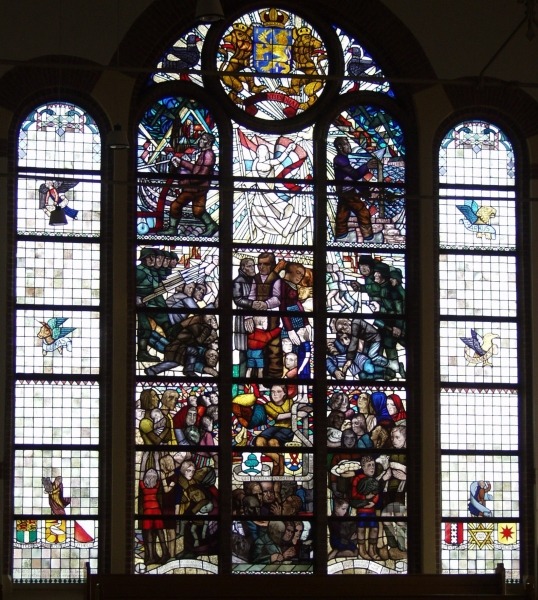
    We frequently read or hear about “Plan 1913”. What is meant by that? It is the plan or intention to festively commemorate the joyous event of 100 years ago. Is there reason for this? Those who still ask this provide proof that they have forgotten what they learned at school regarding the history of our fatherland. The only thing that can be offered as an excuse is that for many, their school years lie far behind them and oral tradition is no longer heard.
    It was in 1863, when the fiftieth anniversary of the Netherlands’ Independence was celebrated in Aalten, that things were quite different. Back then, there was hardly a family where one did not hear from the lips of grandparents about the sad times our ancestors lived through as long as the French were in charge here. Incidents that had personally affected a family were recounted, but now, 50 years later, much of that is covered by the veil of oblivion.

    In general, therefore, we wish to recall a few facts that history has recorded. The 17th century (1600–1700) is called the “Golden Age” of our history; the 18th century (1700–1800), the “century of decay”.

    What was the cause of that decay? People began to rest on the laurels achieved by their ancestors. A spirit of enterprise was no longer to be found. In idleness, people began to enjoy the accumulated wealth and were afraid to give up anything that might contribute to the promotion of the country’s prosperity. No funds were made available for the army and navy, and the prestige of the once-mighty Republic of the United Netherlands dwindled from year to year.

    In the eyes of other European states, we no longer counted. Furthermore, dissatisfaction with the administration arose, fuelled by the revolutionary spirit that manifested itself in France—so much so that the revolutionaries, called Patriots, acted hostily towards Stadtholder William V and his supporters, called Orangists.

    The French Period

    When the great Revolution had taken place in France, and the revolutionaries had put the King and Queen to death, the Patriots called in the help of the French to drive out the Stadtholder here as well. In 1795, they marched into our country with a large army and were received with cheers by the revolutionaries.

    The government was unable to stop them because the army was not properly equipped and the fortifications were dilapidated. The money needed for their maintenance had been cut, but now they could give the French 100 million guilders, which they demanded for the help and assistance they had provided. William V fled to England, and his opponents took the place of the former government officials.

    Now, the French could have left again, but they did not think of it. Time and again, when the French soldiers here were well-fed and clothed, they were exchanged for a ragged, starving bunch, to recover their strength here at the expense of the citizenry. Their influence on the course of affairs in this country meanwhile increased more and more, until they took the entire administration into their own hands.

    In France, there was great confusion until it finally succeeded for a lawyer’s son from Corsica, named Napoleon Bonaparte, to create some order. He was a brave general and a capable warrior, who defeated the armies of the states that had declared war on France and prescribed humiliating peace terms to his enemies. In 1804, he had himself proclaimed Emperor, and two years later he sent his brother, Louis Napoleon, here to rule over our country as King.

    Heavy Sacrifices

    The alliance with France cost us heavy sacrifices. The English, who were at war with the French, now became our enemies as well and took possession of almost all our colonies and robbed our merchant ships, which meant our trade was as good as gone. One already had to pay a quarter of one’s income in taxes, and yet Napoleon demanded more.

    Napoleon had had his brother Louis proclaimed king here in the expectation that he would submit entirely to his will. However, he was disappointed in this. Louis came here with the intention of promoting the prosperity of his kingdom as much as possible and protecting the people from further oppression. He showed this, among other things, by refusing to introduce conscription and by tacitly allowing smuggling with England.

    To hit England, Napoleon had strictly forbidden all trade with that country. Now that Louis did not support him enough in this, he forced him to abdicate (1810), and Holland was annexed by France. Our country now became a French province and thus ceased to be an independent kingdom. The government was now organised on a French footing. The Dutch language had to gradually disappear. French had to be learned in schools, and newspapers also had to appear in French.

    An army of customs officers occupied the coast and ensured that when a ship with English goods arrived, the cargo was burned. Indische goods, such as coffee, tea, tobacco, and rice, rose astonishingly in price as a result. The impoverished citizenry managed with a decoction of toasted rye bread instead of using coffee, and instead of tobacco, people smoked walnut leaves. To replace sugar, people set themselves to making sugar from the sweet sap of beets.

    Many wealthy citizens became poor, and those who had to live off their interest, as well as numerous orphanages and charitable institutions, suffered want when Napoleon had the interest on the national debt “tiered”—that is, he only acknowledged one-third of it. Those who, for example, were entitled to 300 guilders in interest only received 100 guilders. No more was earned, but more had to be paid, causing poverty to pinch; hundreds of houses were sold for demolition, magnificent country estates were disposed of for a trifle, horses and carriages were abolished, and servants dismissed. In Amsterdam, grass grew on the streets.

    Fighting for Napoleon

    But the Frenchman did not just take goods; he also demanded blood. Napoleon needed soldiers to fight for him in all corners of Europe and now forced our boys to serve in his armies. He introduced conscription, which for us was something unheard of. In our previous wars, there were always enough volunteers to defend the fatherland, but now it was determined by lot who had to take up arms. Thus, numerous families saw their beloved relatives head off to foreign lands, never to see them again.

    Yet no one dared to complain, or they would make the acquaintance of prison. Secret spies crept around everywhere to pick up every suspicious word, and the police often forced their way into homes and opened letters to hear someone’s opinion of the Emperor. Books and newspapers were not allowed to appear before they had been approved.

    Yet this oppression also had its good side. The people now forgot their old party squabbles and felt united again and yearned for salvation. Napoleon’s power had reached its peak. Only England and Russia still defied him; otherwise, he ruled over all of Europe. Russia, too, would now feel his blows. With an army of more than half a million, he marched thither, but for every twenty soldiers, nineteen died miserably in Russia’s snowfields. The approximately fifteen thousand Dutchmen also never returned to their fatherland.

    “Oranje boven” (Orange up/Long live Orange)

    After this outcome, the Counts of Hogendorp, Van Limburg Styrum, and Van der Duijn van Maasdam secretly hatched plans to shake off the French yoke. After the Battle of Leipzig, in which Napoleon was defeated, the signal for the uprising was given by adorning oneself with the orange colour, which was previously punishable by death. The French soldiers watched, bewildered, and did not have the courage to resist.

    Prussia and the Cossacks offered help, and on 15 November 1813, the cry “Oranje boven” already rang through Amsterdam’s streets, and two days later in The Hague. On 21 November, Van Hogendorp and Van der Duijn van Maasdam accepted the provisional government, and on 30 November, the Prince of Orange, son of the expelled Stadtholder William V, set foot on land at Scheveningen, where he was cheered by the crowd with unprecedented enthusiasm. Two days later, he was proclaimed Sovereign Prince in Amsterdam.

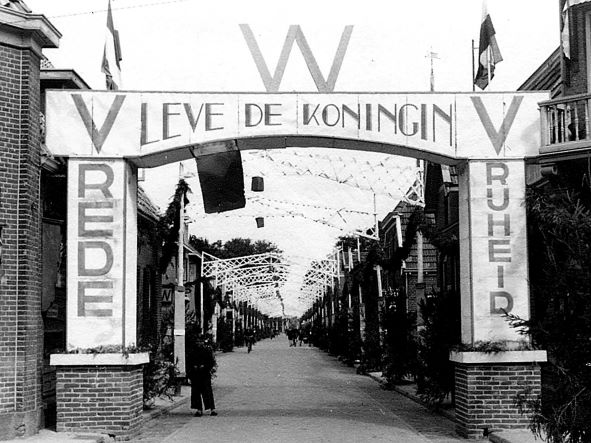
    The French slunk away, and the Netherlands was free. That is one hundred years ago now, and all that time we have been spared from enemies crossing our borders. There is, therefore, reason to festively commemorate the Netherlands’ deliverance with thanks to God. Let us value our freedom, for no greater disaster can befall a people than when they are dominated by strangers. At the centenary of our independence to be celebrated within the municipality of Aalten on 28 August next, let our age-old motto therefore ring out loudly: “Oranje boven”.

    Source


  • The Belgian Revolt (1830–1832)

    The Belgian Revolt (1830–1832)

    After the Allied powers definitively defeated Napoleon in 1815, the Northern and Southern Netherlands were unified. The new Kingdom of the Netherlands was ruled by King William I. However, problems soon arose between the south and the north. There were significant political, economic, cultural, and religious differences.

    National Militia Call-up

    On February 15, 1827, the Provincial Gazette of Gelderland published a Decree in which 460 men from Gelderland, including twelve from Aalten, were summoned to appear at the ‘Government Building’ in Arnhem at 8:00 AM on February 27 as reservists of the National Militia. As of March 1, they were required to be ‘under arms.’ A number of them would not return alive.

    The men from Aalten called up were:

    7th Infantry Division

    13th Infantry Division

    More residents of Aalten served, as evidenced by the decorations awarded later (see further on in this article). However, we do not yet have a complete overview of them. Further information is therefore welcome.

    The Ten Days’ Campaign

    In August 1830, the Belgians revolted. At the end of September, an army was sent from the North to restore order. The Belgian resistance proved more stubborn than expected, and after a few days, the army was forced to withdraw from Brussels.

    To avenge this defeat, King William I sent a larger force to Belgium on August 2, 1831. France decided to intervene and sent an army of 40,000 men to the Southern Netherlands. Consequently, William I withdrew his army. All in all, the conflict had lasted 10 days.

    The Ten Days’ Campaign took place from August 2–12, 1831. The military operation was led by Prince William of Orange (the later King William II), who agreed to an armistice on August 12, 1831, after the Belgians surrendered Leuven. In the following week, the Dutch troops withdrew to North Brabant. Only the Citadel of Antwerp remained occupied under the command of Chassé (‘General Bayonet’) until the capitulation in December 1832.

    In 1937, G.H. Rots wrote in the Aaltensche Courant about the Ten Days’ Campaign:

    “Peace arrived, and the population returned to their labors. But peace would not last forever. The struggle between the Northern and Southern provinces ignited, and known as the ten days’ campaign, battle had to be joined once more. Once again, young men from Aalten marched off to join the struggle. This conflict was not particularly bloody, and most returned safely to their homes.”

    Those who had participated in that ten days’ campaign received a medal. In our youth, there were two veterans in Aalten who wore this decoration. During national festivities, they would be seated in a landau, drawn by two horses, and took the place of honor in the procession. The names of these last Aalten veterans were Lorijn and Loohuis. The medal of the latter is now in the possession of Mr. J.S.S. Prins.”

    The Citadel of Antwerp

    Shortly after the uprising in 1830, a portion of the Dutch military had retreated to Antwerp. At the end of October, General Chassé concentrated them in the citadel. This garrison was reinforced after August 1831. On December 24, 1832, General Chassé surrendered to the French army, which had been called to aid by the Belgians, following heavy artillery bombardments and a 25-day siege.

    The French Marshal Gérard also demanded the important Scheldt forts Lillo and Liefkenshoek. These were no longer under Chassé’s command, so they could not be negotiated. Gérard then offered the choice between surrendering the forts or taking the soldiers to France as prisoners of war. Only William I could provide a solution. He refused.

    Prisoners of War

    On December 29 and 30, 1832, over 4,500 Dutch soldiers departed for Northern France as prisoners of war. However, because France and the Netherlands were not at war with each other, they were effectively hostages. The journey took eight days of marching through Zwijndrecht, Melsele, St.-Niklaas, Lokeren, Deinze, Desselgem, Kortrijk, Menen, Ypres, Vlamertinge, Poperinge, Steenvoorde, and Cassel. On January 5, Saint-Omer was reached via Arques. Part of the Infantry continued to Béthune, another part with the Artillery and Engineers to Hesdin, and the Navy to Aire.

    On May 21, 1833, the Convention of London brought about a partial lifting of the state of war. The prisoners of war were to be released. On June 8, four French frigates, three corvettes, and one brig set sail from Dunkirk for Vlissingen. A day later, they made landfall in Vlissingen and marched to Middelburg that same day.

    It would take until 1838 before the Dutch King William I sullenly threw in the towel. With the signing of the Treaty of London in 1839, the separation of Belgium became a fact.

    Awards

    All those who had been under arms and were deemed to have participated in the military operations during the Ten Days’ Campaign were decorated with the Metal Cross. This commemorative medal, also known as the ‘Hasselt Cross,’ was awarded in recognition of their proven loyalty to King and Fatherland. The bronze crosses were struck from the metal of the cannons captured from the Belgian Army of the Meuse during the Battle of Hasselt on August 8, 1831.

    By Royal Decree of May 31, 1833, King William I of the Netherlands instituted the Antwerp Medal 1832. This was to be awarded as a “reward to those who, during the siege of the Citadel of Antwerp in the period from November 28 to December 24, 1832, served in the citadel and subordinate forts (Vlaamsche Hoofd, Burcht, Zwijndrecht, and Austruweel), as well as on the flotilla on the Scheldt before Antwerp.”

    Decorated Aalten residents

    A number of Aalten residents are known to have been decorated with the Metal Cross (MK) for their participation in the Ten Days’ Campaign and/or the Citadel Medal (CM) for the defense of the Antwerp citadel. Below are the names and decorations currently known to us.

    • MK: Jan Anthonij Bekink (1812-1898), lived in the Peperstraat.
    • MK: Joan Henricus (Jan Hendrik) Bennink (1807-1832), lived on the Prinsenstraat. He was a flanker with the 2nd Battalion of the 14th Infantry Division when he passed away in a hospital in ‘s-Hertogenbosch.
    • MK: Dirk Jan Hoornenborg (1807-1876), born at Nieuw Hoornenborg on the Haart, lived in Gorssel from approximately 1845 and passed away in Kring van Dorth.
    • MK: Johannes Christianus Kötcher (1807-1876), lived in Bredevoort.
    • MK: Hendrik Jan Loohuis (1812-1905), lived the final years of his life in the Avondvrede Rest Home.
    • MK: Petrus Bernardus Smit (1807-1876), lived on the Hogestraat.
    • MK+CM: Tonij Stapelkamp (1807-1889), lived on the Hogestraat.
    • CM: Paulus Lorijn (1811-1899), came to Aalten from Wageningen in 1844 and lived successively at the Piepert, Heurne, and the Roman Catholic hospital on the Hogestraat.
    • CM: Roelof Somsen (1808-1891), lived on the Pennings farm in Dale.
  • The French Period (1795–1813)

    The French Period (1795–1813)

    In 1937, G.H. Rots described in a series of articles how things transpired in Aalten in former times. Regarding the years of the French occupation, he wrote:

    “During the French period, Aalten enjoyed the blessings (?) of French rule. The slogan ‘Liberty, Equality, and Fraternity’ was prevalent at the time, and the liberty tree was planted on the Market Square in Aalten. A new municipal government was appointed, new laws and regulations were established; in short, a different spirit blew through the government buildings. The Batavian Republic was founded, and the House of Orange was finished.

    French soldiers were also billeted in Aalten, with all the associated calamities. Although the majority were pro-Orange, people did not dare to express their opinions, and the new regime was accepted. This situation lasted from 1795 to 1799. Secretly, a large part of the population loathed the French occupation.

    False hope

    Then, in 1799, rumors circulated that a Dutch nobleman, A.R. van Heeckeren, also known as Suideras, had crossed the eastern borders at the head of a large army as a liberator and was victoriously driving the French out of the villages.

    In other parts of the country, there were also incursions by the English and Russians, who were engaged in war with the French, and thus also with the Batavian Republic. The Orange supporters regained courage, and when Suideras marched into Winterswijk on September 5 and allowed the Orange flag to flutter from the tower once more, Aalten also prepared to receive the liberator.

    Great excitement took hold of the population. A certain Jan Derk Hoopman arrived with an axe and already began to chop down the liberty tree. In the afternoon, Suideras arrived in Aalten. The bells were rung. A large crowd welcomed the liberator while singing and dancing. People adorned themselves with Orange, believing that the suffering was finally over. It proved to be a false hope, for the French did not allow themselves to be easily defeated by Suideras.

    By the following day, word arrived that a French army was approaching, and indeed, the French General Girod arrived in Aalten with his troops. Jan Derk Hoopman fled, and likely many others took to their heels as well, as house searches were conducted and heavy punishments were meted out. The joy had thus been short-lived. High taxes had to be paid, and earnings were meager.

    The ministers held religious services in the open air. For instance, Reverend Westerbeek van Eerten climbed onto a farm cart and encouraged his fellow believers, who had gathered near the ‘De Pol‘ house.

    A state of decline set in. The pressure of French rule became increasingly heavy. Young men had to draw lots for French conscription, and when Napoleon needed soldiers for his campaign to Russia, Aalten also had to provide a contingent. They left, never to return. Their remains rest beneath the soil of the Russian steppes, or they perished in the cold waters of the Berezina.

    Liberation

    Until 1813. Napoleon was defeated in the Battle of the Nations at Leipzig. The Prussians entered our country. The Prince of Orange arrived in our country from England, and once again the cry was ‘Orange Above’. There was jubilation in Aalten once more. The bells were rung again, and now the Orange flag would continue to fly.

    One of the Orange scions, Prince Frederick, was at school in Berlin. Having heard of the revolution in the Netherlands, he traveled by stagecoach to The Hague. The route followed the great postal road, which we have described previously. The border crossing took place at the Heurne, and when the population heard that Prince Frederick would pass through Aalten, they went to meet the carriage, unhitched the horses, and pulled the coach through Aalten amidst loud cheering as far as the Zelhemseweg, to the spot where the lime tree stands. Well, that tree was planted then as a memorial to that event, and later the lime tree was established as the official coat of arms of Aalten.

    Once more, the boys from Aalten would have to march against the French. When Napoleon escaped from Elba and equipped a large army to reclaim his former glory, the Netherlands had to place its army alongside the allies against him. Young men from Aalten also fought in the Battle of Waterloo. We know what became of Napoleon’s fate then. It had been his final convulsion.”

    Source


    • ‘From Aalten’s Past’, by G.H. Rots, Aaltensche Courant, 11 March 1938 (via Delpher)
  • Bredevoort Gunpowder Tower Disaster

    Bredevoort Gunpowder Tower Disaster

    12 July 1646

    On Sunday, July 12, 1646, around four o’clock in the afternoon, the gunpowder tower of Bredevoort Castle, containing 320 barrels of gunpowder, was struck by lightning. Forty people were killed and an unknown number were injured in the ensuing explosion.

    The tower caught fire upon impact. The explosion was so violent that the Ambthuis (administrative house) also collapsed. The town suffered extensive damage from the explosion, and almost all houses lost their roof tiles and windows. The houses surrounding the castle had collapsed. For three days, survivors were sought beneath the rubble using shovels and pickaxes.

    In 1938, G.H. Rots wrote a series of articles in the Aaltensche Courant about the history of the municipality of Aalten. Regarding the gunpowder tower disaster in Bredevoort, he wrote:

    “The year 1646 was once again a disastrous year for Bredevoort. It was the 12th of July, and an oppressive heat hung over the town. Dark clouds gathered, and everything indicated that a severe thunderstorm was imminent. And indeed, lightning soon cleaved the sky, followed by heavy claps of thunder. And suddenly, a terrible blow, followed by a dreadful sound.

    Lightning had struck the gunpowder tower, causing the gunpowder present (320 tons) to explode. The entire tower was blown apart, as was the nearby Ambthuis; tiles were torn from almost all houses, and windows were blown in by the air pressure. The number of deaths in that disaster amounted to 19 at the castle and the Ambthuis alone. There were also numerous deaths in other houses in the town.”

    Victims

    “The deceased included, among others, the Governor of the city Willem van Haersolte and his spouse, the Drostinne Cathrijne van Brakel and her eight children, and her niece Berentjen van Brakel. Furthermore, Joh. van Langen, lieutenant to Georg Ernst Count of Bronkhorst, and also his French mistress (sic) Jeanne van Sédan. An elderly woman present there, Maria Glazen, along with the manservant and the maid, were also among the victims.

    The sentry on duty, named Hendrik Otterpoëll, was buried under the ruins. In other parts of the town, the house of Jan Stenneken was destroyed. He and his wife Marycken van der Halle were killed. The names of the dead in other parts of the town were Derk Trix, ensign, Harmen ter Male, F. zum Moorelagen, Bailiff of Winterswijk, and his wife Janne Beerninck, with her sister Christine Beerninck, widow of the late N. Brinkhorst, judge of Haaksbergen.

    The house of Berent Grimme was destroyed; his wife and four children lost their lives. The house of Casper Evers was hit, under which three people were killed, named Arent Hamaeker, a child of Berent Maes, and a child of Herman Broekman. Under the house of Derrick ter Woerle Wiltschut, three of his children were killed, as well as the soldier Gerrit Jansen and Jan Schulten.

    We have specifically mentioned these names because one might perhaps derive names of those living today from them.”

    The deceased who lay under the rubble of the Ambthuis were laid out on July 15 at the home of the widow of the late minister D.J. Verhagen. The drost (bailiff) with his wife and eight children were buried on the morning of Thursday, July 16, in the choir of St. George’s Church. It is not clear how many people remained under the rubble. In total, forty people died that day. The sources make no mention of the number of victims who were injured.

    One son of Drost Wilhelm van Haersolte survived the disaster. Anthony, as he was named, happened not to be home that day: he was staying in Zwolle. He continued the family line in Zwolle and founded the Haersolte Almshouse there, which is assumed to be connected to the disaster in Bredevoort.

    Sources


    • ‘From Aalten’s Past’, by G.H. Rots, Aaltensche Courant, 18 February 1938 (via Delpher)
    • Wikipedia
  • Fortified Town Bredevoort

    Fortified Town Bredevoort

    The fortified town of Bredevoort has a history dating back to (at least) the year 945. At that time, Bredevoort was nothing more than a passable crossing amidst a largely impenetrable swamp. It was, however, a very important passage, as Bredevoort was situated on the major trade route from Bocholt to Zutphen.

    In the 13th and 14th centuries, Bredevoort developed further into an important fortified town. In 1350, Bredevoort was granted minting rights, and in 1388, it even officially received city rights, marking the first mention of the city of Bredevoort: ‘onse borch, huys ende stat tot Bredervoert‘ (our castle, house, and city at Bredevoort).

    During the Eighty Years’ War (1568-1648), Bredevoort became involved in the fighting between the States and Spanish troops and was besieged and captured several times. After the siege by Maurice of Nassau (the later Prince of Orange) in 1597, a strong States garrison was stationed in the town. The bond with the Dutch Royal House has remained consistently strong over time. King Willem-Alexander still holds the official title ‘Lord of Bredevoort’.

    The garrison town of Bredevoort became part of the eastern line of defense, and plans were subsequently made to reinforce the city. The fortress was strengthened and enlarged; a wide moat was constructed around the six bastions: Vreesniet, Treurniet, Onversaegt, Stoltenborg, Welgemoed, and Ossenkop.

    The remains of the fortifications on the north-western side of Bredevoort were designated as a National Monument in 1967 (numbers 6874 and 6875).

    Historical Description

    In 1938, G.H. Rots wrote a series of articles in the Aaltensche Courant regarding the history of the municipality of Aalten. He wrote the following about the Bredevoort fortress:

    “The historian Sloet mentions that ‘Breitenfurt’ was already spoken of in 945. In old documents, one also reads of ‘Breitenfurt’, ‘Breyden-Oort’, ‘Bredevoorde’, or ‘Breevoort’. In daily conversation, it is still sometimes called ‘Brevoort’. The word itself indicates a connection of higher grounds over low grounds, water, marshes, etc. For all around Bredevoort was low land, full of reeds and rushes, which was passable during very dry summers, and even then only on the highest parts. And there, between those marshes, was a raised mound upon which the strong fortress ‘Breevoort’ was built in earlier times. In diameter, it was approximately 300 meters, or about 10,000 m2. But a great deal has transpired on that small spot over the centuries.”

    In the year just mentioned, 945, the town had to pay eight ounces of silver annually to the monastery in Fulda. Because the fortress was surrounded by marshes, it was one of the strongest strongholds and nearly impossible to capture. There were two access roads: the ‘Aalterpoort‘ on the north-west side, roughly where the Roman Catholic school stands today. The road through the Koppele was only constructed in the last century. Before then, one always had to take the detour around the Koppele. In the east was the ‘Misterpoort‘. Some writers also refer to it as the ‘Münsterpoort’.

    The Lordship of Bredevoort included the jurisdictions of Aalten, Winterswijk, and Dinxperlo and was originally the possession of the bishops of Utrecht. One of the bishops, named Godefroy van Rhenen, founded the castle at Bredevoort, which stood on the site where ‘t Zand is now located. To this castle or court belonged several manorial estates, including the Havezate de Pol near Aalten. Several contributions regarding this manorial system and related matters have appeared, including in Mr. J. A. Nijhof’s book ‘Bijdrage tot de Vaderlandsche Geschiedenis’ (Contribution to National History), and it is also discussed at length in B. Stegeman’s well-known book ‘Het kerspel Winterswijk’. Anyone wishing to know more should consult that book in the library of the Gebr. de Boer company.

    In 1238, the Counts of Loon came into possession of the Lordship. One of those counts, Herman van Loon, transferred the property as a fief in 1246 to Otto van Nassau, Count of Gelre and Zutphen. In the Battle of Tekelenburg in 1276, Herman van Loon was victorious; he captured his opponent, Count Engelbert van der Mark, and took him to the castle at Bredevoort.

    That Count van der Mark soon met his end there; he died of boredom and homesickness. His son, however, Everhard van der Mark, took revenge and captured Bredevoort in 1278, destroying the castle and subsequently transporting his father’s body to Kappenberg. Through the intervention of the Bishop of Münster, Everhard, a peace treaty was soon established between Count Everhard van der Mark and Herman van Loon, in which the Count of Loon pledged not to rebuild the castle until he had made a two-year journey to the Holy Land (the days of the Crusades).

    A short time later, another transaction seems to have taken place, for in 1284 the owner was Baldewinn van Steinfurt, who sold half of the property—namely the northern part of the castle with the associated lands in Aalten—to Bishop Everhard of Münster. However, the lineage of the Counts of Loon became extinct at the beginning of the 14th century, and when the last descendant was carried to the grave, discord arose over the inheritance. The then Bishop of Münster, Ludwig, and Reinald of Gelre both laid claim to the inheritance of the Counts of Loon. It even came to fighting, and both aforementioned potentates brought their armies into battle array, fighting each other to the death.

    Reinald of Gelre had his sights set on Bredevoort, and in 1326, he entered the fortress victoriously. Peace was signed at Coesfeld, and by that peace treaty, Bredevoort became the property of Reinald of Gelre. In 1388, the Lordship was transferred as a pledge to Hendrik van Gemen, who had to pay the sum of 3,000 French shields, which was approximately 6,300 guilders in Dutch currency.

    Later, with the consent of the States of Gelderland, the pledge was transferred to Jacob van Bronkhorst, Lord of Anholt. Finally, in 1580, the Lordship was transferred as a pledge to Prince William I. His successors continued this possession in the same manner. Finally, in 1732, upon the division of the inheritance of William III between the King of Prussia and William Charles Henry Friso, the Lordship of Bredevoort was awarded to the latter. It then formed part of the domains of the House of Orange-Nassau under the management of a steward, who reported annually to the Prince’s councilors and auditors.

    The Prince appointed a drossaard (bailiff), as well as a judge with their deputies. A stadtholder, land scribe, and advocate-fiscal were also appointed. Every fortnight, a court day for civil matters was held in the Lordship for the four jurisdictions mentioned above. The courts consisted of the drossaard or his deputy, the land scribe or secretary, and two assessors or ‘keurnooten’. Furthermore, the government of the city of Bredevoort rested with two mayors.

    As we have already noted, Bredevoort was a strong fortress due to its natural location. In addition to the castle, there were very good bastions. (A ‘gabion book’ of the former fortress is still kept in the State Archives depot in Arnhem. Anyone wishing to know more details should go and browse there).

    While Bredevoort was a strong fortress due to its natural location, it was not a walled fortress until 1545. The well-known and famous commander Maarten van Rossum ensured that the fortress was further reinforced. Around the aforementioned year, he had the moat dug and a rampart constructed. The portion of the moat that still exists was therefore dug nearly 400 years ago. It must have been incredibly busy around the fortress. A few years ago, to combat unemployment, a large part of the moat was filled in with soil from the raised ramparts. A small piece of the rampart has been preserved as a historical site.

    Inside the gates, the situation was also different than it is today. There were narrow streets and alleys. In the cellars of many houses, there were escape or shelter tunnels. During the demolition of an old cellar a few years ago, such a shelter tunnel was revealed. It is also claimed that there was an underground passage from ‘t Walfort Castle to Bredevoort. During previous excavations at ‘t Zand, such a passage is said to have been discovered. However, people did not dare to venture far into it due to the foul or toxic air present. It would be worthwhile to pay attention to this when digging sewers. That there were underground shelters is certain, but we doubt the existence of a connecting road as mentioned above.

    The noise of war and military activity echoed within the fortress for centuries. Even into the 18th century, three companies of infantry were garrisoned in Bredevoort under the command of a commander, who had a major under him. Especially during the Eighty Years’ War, things were intense in and around Bredevoort. In the late sixteenth century, the Spanish held the fortress. On the first of October 1597, Prince Maurice arrived before Bredevoort with his army. He summoned the garrison, which consisted of only two banners of infantry, to surrender. But they replied that they would keep their weapons for God and the King until their final breath. The Spanish relied on the natural strength of the fortress. Prince Maurice then laid siege to Bredevoort.

    As mentioned, there were two access dikes to Bredevoort, but Prince Maurice had a third access road constructed through the Koppele. That road through the marsh was made with sand and brushwood. The sand was brought in bags by the soldiers. In just 8 days, that road, 500 paces in length, was completed. It was then possible to take a height across the moat, suitable for placing 20 pieces of artillery. A murderous fire was then opened upon the fortress. But the besieged defended themselves bravely, and many attackers were killed.

    The fortress walls suffered greatly from the cannon fire, and several cracks and breaches had already appeared, yet the garrison still did not surrender. The moat was an obstacle to bringing troops to the front of the ramparts and walls. But Prince Maurice was resourceful, and he had his men build a floating bridge, a kind of cork or rush bridge. This was placed in the moat, providing access to the rampart and creating two points of attack. Count Solms led that attack on the eastern side, from the direction of the Broek. But the resistance was not yet broken. The besieged returned the enemy fire with cannon and muskets. The besiegers were also pelted with stones, and many stormers bit the dust. But it could not last much longer; the attacks became increasingly fierce until finally, a drummer from the city appeared on the wall and gave a signal that they wished to negotiate. But an enemy bullet struck him, and the drummer, who came with peaceful intentions, was killed by a bullet.

    The inhabitants of the fortress renewed the attempt to negotiate. They held up sticks with hats, but the besiegers paid no attention to this. Then the women went onto the ramparts to testify to the will to surrender. It is incomprehensible that the besiegers still paid no heed to this. Did they fear a trap, or was it the cruelty of that era that demanded blood? In any case, Maurice’s sailors stormed the stone bastion, entered the fortress, and immediately killed 70 people. The survivors fled to the castle, which was immediately surrendered unconditionally by treaty on October 9th. Prince Maurice spared the lives of all, but stipulated a sum of money for his troops, which was later waived.

    Except for the castle and 20 houses, all buildings, including the church, had burned down. The Spanish commander Domiaan Gardot was granted mercy, although he was initially to be executed. During the Spanish occupation, this Gardot had made himself hated by the citizenry.

    Prince Maurice, who had entered the gates of Bredevoort victoriously, stayed in Bredevoort for only a few days. He moved further north. A few months earlier, he had taken Groenlo, and now he went via Groenlo to the Overijssel region to make conquests there. Bredevoort kept a small garrison, and the population worked with all their might to rebuild the burned houses. But hardly had the building begun when fire broke out again, and of the approximately 20 houses that had been spared during the siege, 14 burned down, leaving only 6 houses.

    There was bitter suffering then. The church had to be rebuilt, but the means were lacking, and letters of appeal were sent to sister congregations for support. However, they did not lose heart. They began rebuilding the church and the burned houses, and gradually the town had habitable houses again. But it was and remained wartime, and dangers threatened from all sides.

    In 1606, the Spanish appeared before the city again. It was Shrove Tuesday, and people wanted to celebrate in the city. The soldiers, in particular, were out on the town. There was celebration and merriment, and the soldiers drank heavily. And while they were having fun, the enemy crept up. The Spanish commander Du Terrail arrived quietly from Oldenzaal with 1,200 men and appeared before the city gates in the evening. The guard was on duty, and they were told that the newcomers were soldiers of Prince Maurice being pursued by the Spanish. They lied to the guard and even claimed they had captured a Spanish lieutenant. They requested permission to stay under the protection of the fortress. The guard sent a message to headquarters, and while deliberations were taking place there, it was realized they had been deceived. The population was already fleeing to the castle, and the Spanish were already storming the gates, blowing them up, and before anyone fully realized what was happening, the enemy army was already entering the town.

    The Shrove Tuesday joy was cruelly disrupted. The Spanish soldiers killed everyone they encountered, including many women. The minister’s wife also fell victim to the killers. The castle, however, offered a safe refuge for the citizens and soldiers who had fled there. The bridge over the moat surrounding the castle was destroyed, making it temporarily safe within the thick walls. The Spanish were fired upon from the castle, and help also arrived from outside. Count Henry of Nassau appeared with an army from Zutphen and other fortresses, and on March 22nd, the Spanish were forced to surrender. The Spanish commander Du Terrail negotiated a free retreat, which was granted to him provided he returned the booty and prisoners that had already been transported to Oldenzaal. The Spanish did not show themselves again, and the worst suffering was over.

    The year 1646 was another year of disaster for Bredevoort. It was July 12th, and an oppressive heat hung over the city. Dark clouds gathered, and everything indicated that a heavy thunderstorm was imminent. And indeed, lightning soon cleaved the sky, followed by heavy claps of thunder. And suddenly, a tremendous blast, followed by a terrible sound. Lightning had struck the gunpowder tower, causing the stored gunpowder (320 tons) to explode. The entire tower was blown apart, as was the nearby Administrative House (Ambthuis); tiles were ripped off almost all houses, and windows were blown in by the air pressure. The number of deaths in that disaster was 19 at the castle and the Administrative House alone. There were also numerous deaths in other houses in the city.

    The year was 1672. War had broken out with the Bishop of Münster and Cologne, England, and France. The general-watchmaster of the Bishop of Münster crossed the borders with 2,000 men and laid siege to Bredevoort. The garrison consisted of 500 men, and 20 pieces of artillery stood on the ramparts. In the warehouse was a stock of 20 lasts of rye and 1,800 barrels of gunpowder. The commander of the garrison, Adriaan van Keppel, had repeatedly asked the Deputies of the County of Zutphen for reinforcements of supplies, but in vain. From June 13th to 18th, the fortress was bombarded. The garrison began to mutiny. The women in the city also began to grumble. Rumors spread that the Prince of Orange had been defeated with his army. Fear took hold of the garrison, and on June 18th, the city surrendered, although according to experts, this had not been necessary. The garrison marched away, and fortunately, no looting occurred.”

    Sources


  • Bredevoort Castle

    Bredevoort Castle

    ‘t Zand, Bredevoort (destroyed)

    Bredevoort Castle was a fortress in the heart of the eponymous town and former Lordship of Bredevoort in the County of Zutphen within the Duchy of Guelders. It was one of the most significant castles in Gelderland. During the 13th and 14th centuries, Bredevoort Castle played a major role in the struggle between Guelders and Münsterland.

    The castle was first mentioned in 1188 on a list of properties belonging to the Diocese of Cologne as “Castrum Breidervort“. At that time, the castle was a site of contention. Consequently, it had multiple owners, leading to a centuries-long struggle for control. In 1238, the castle came into the hands of Ludolf van Steinfurt and Herman van Lohn as a shared inheritance. The castle was to be fortified, with both parties sharing the costs. In 1278, the fortress was destroyed by Count Everhard I von der Mark during an act of revenge. Following this, the castle remained a ruin for 23 years. A deed of sale from 1284 refers to the “area castri Bredevort”.

    After years of conflict over Bredevoort between Münster and Guelders, the castle eventually returned to the hands of Count Herman van Lohn II in 1301. In that year, the bishops of Münster and Cologne pledged to assist Herman van Lohn with the restoration of the fortress. In the turbulent times that followed, the fortress frequently changed hands between Münster and Guelders through combat or sale. The bishops of Münster and Cologne were required to jointly fund the reconstruction of Bredevoort Castle.

    After centuries of fighting over the castle, the Bishop of Münster abandoned the struggle and sought peace negotiations. Following years of negotiation, peace was finally signed on June 28, 1326, with the Treaty of Wesel. This significant treaty was also signed by the cities of Zutphen, Groenlo, Emmerich, and Arnhem. As a result, Reinoud II of Guelders acquired the pledge of the jurisdictions in Winterswijk, Aalten, and Dinxperlo, as well as the County of Bredevoort. This move definitively incorporated the area into Gelderland.

    Floor plan

    In 1562, the lord of the manor of Bredevoort, Diederik van Bronckhorst-Batenburg, Lord of Anholt, commissioned a floor plan of the castle at Bredevoort. This plan also described the functions and structural condition of the various components. Measurements were recorded in Rhineland feet. A Rhineland foot is over 31 cm long. The castle was a rectangle measuring 42 m long and 36 m wide. The walls were approximately 65 cm thick. An earthen rampart surrounded the castle, with roundels at the corners. The rampart was approximately 2 m wide.

    Explanations of the descriptions on the floor plan (translated from old script):

    1. This vault will collapse if it is not repaired soon.
    2. Here is the staircase leading to the knights’ hall.
    3. This wall is dilapidated. The vertical beams are rotted at the bottom. This is a large hall: 47 feet long and 23 feet wide, measured from the inside. Beneath it is a cellar. The floor consists of beams and planks and is finished with floor tiles. There is only one attic above the hall.
    4. This is a staircase to enter the large hall.
    5. This is the kitchen, 21 feet long and 23 feet wide. Beneath it is a cellar of the same size as the cellar under the large hall.
    6. This shed was built by Drost Isendoorn. The walls are masonry set between beams.
    7. This is the rampart that runs around the castle.
    8. This is a very dilapidated shed, much like a pigsty.
    9. The prison tower. It is 38 feet square (measured from the outside). The walls are 8½ feet thick. [This tower was likely used later as a powder tower, Ed.]
    10. Here are two roundels.
    11. The Drost’s chamber (Maarschalcksekamer) above the gate. [The name ‘Maarschalckse kamer’ dates from the period 1534-1555 when Marshal Maarten van Rossum was Drost of Bredevoort, Ed.]
    12. This is the chapel.
    13. From here, the hearth of the knights’ hall is stoked.
    14. This is the knights’ hall. The room is 36 feet long and 19 feet wide. Below this are the rooms of the burgrave (castle warden) and the steward. The gate entrance is also located below here.
    15. This wall is in good condition, as far as it can be seen above the rampart.
    16. This wall is built between wooden beams and has a thickness of half a brick. [The bricks used were ‘kloostermoppen’ of approximately 14 cm in width, Ed.]
    17. A dilapidated spiral staircase.
    18. Another room. Below this is a laundry room. Because the rampart rests against the laundry room, the wall is rotted. The stones are loose.
    19. This wall is largely built between wooden beams and is very dilapidated.
    20. This contains the grain mill and the baking ovens. Above is the servant’s room, with two attics and a chimney.
    21. This is where the Drost sleeps. The room is 28 feet long and 23 feet wide. Beneath it is a meat cellar.
    22. This room is divided in two. The floor is made of wood. The meat cellar also lies beneath this area.
    23. This upper room is called the salon (state room, armory). Below it is the armor room.
    24. Here the rampart touches the wall, causing the wall to let in moisture and show defects. The wall is very thick, and if the water could be kept out, it would likely provide some improvement.
    25. These two rooms, as well as the granary, are located above the bakehouse and brewhouse.
    26. This drawing was made in Arnhem after everything was measured as accurately as possible. The drawing is fairly accurate. However, in reality, some parts are slightly larger than depicted here, such as the chapel, the spiral staircase in the courtyard, and the prison tower.

    External Appearance

    Not much is known about exactly how Bredevoort Castle looked. While drawings of the castle exist, they are partly based on assumptions and imagination.

    The castle was built on a sandy ridge of approximately 42 x 26 meters, making it one of the larger castles in the Netherlands. Old maps show the main fortress to be a typical concentric castle, featuring double moats and a thick curtain wall. It included an outer bailey with heavy corner towers and a rectangular castle wall equipped with four corner towers, three of which were later lowered to become roundels.

    The castle and the town were separated by a double moat. Access to the castle from the town was via a bridge. One had to pass through two gates, the second of which was equipped with a barbican, and finally a gatehouse in the curtain wall before reaching the inner courtyard. Within the fortress, various buildings stood around a spacious inner court. These depictions changed over time, and the appearance and stature of the castle would have been altered frequently throughout the centuries due to conflict, war, city fires, and other causes.

    3D reconstruction of Bredevoort Castle, based on a drawing by Jacobus Craandijk from 1882.

    Destroyed

    The castle was heavily damaged by the Gunpowder Tower Disaster in 1646. Following this, the castle dominated the cityscape as a ruin for over 150 years until around the end of the 18th century. The last known mention of a visible ruin dates to 1791, recorded in the Bredevoort church council minutes when William V viewed the remains during his visit to Bredevoort. The main building (excluding the outer bailey, roundels, and curtain wall) had dimensions of approximately 42 x 36 meters. This made it one of the larger castles in the Netherlands.

    Remains

    Today, the remains of the castle—in the form of foundations, vaults, tunnels, and rubble—lie beneath and around the ‘t Zand square and the Hozenstraat in the heart of the town. In the spring of 2009, during archaeological research around the former school on ‘t Zand, part of the foundations was uncovered. Wall remains between 2.5 and 4 meters thick were found. On ‘t Zand square, foundations of the barbican were discovered. The contours of this gatehouse have been made visible in the paving with brass-colored bands.

    Sources