
Gertrud van Myllendonk (1552–1612), also known as Geertruida van Millendonck, was a noble administrator in the German-Dutch border region. She was Lady of Drachenfels, Königswinter, and Anholt, and for thirty years the pledge-holder of the Lordship of Bredevoort (1582–1612).
Her reign took place in the midst of the Eighty Years’ War (1568–1648). While the region was torn apart by violence between Spain and the emerging Dutch Republic, she attempted to keep her territories out of the line of fire through a strict policy of neutrality. Although she was personally Roman Catholic and pro-Spanish, she took no side politically. In 1612, she transferred her rights over Bredevoort to Prince Maurice of Orange.
Early years and marriage
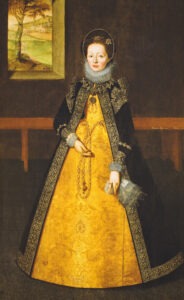
Gertrud van Myllendonk was born in 1552 at Myllendonk Castle, near Düsseldorf. She was the daughter of Dietrich von Myllendonk and Theodora van Bronckhorst-Gronsveld. Through her father, she inherited various properties and noble titles along the Rhine.
On 13 May 1576, Gertrud married Jacob van Bronckhorst-Batenburg, the Lord of Anholt, in Anholt. At that time, his family held the Lordship of Bredevoort in pledge. This meant they governed the castle, the town, and the surrounding area in exchange for substantial loans they had provided to the sovereign. The couple had three children:
- Dirk IV van Bronckhorst-Batenburg-Anholt (24 March 1578 – 16 June 1649), later Count of Bronckhorst, Baron of Batenburg, and Lord of Anholt, Moyland, and Bahr.
- Johan Jakob van Bronckhorst-Batenburg (12 August 1579 – 19 October 1530), later Count of Batenburg and Anholt, and military commander.
- Elisabeth van Bronckhorst-Batenburg (Aalten, February 1582 – 1629), married Willem van Ketteler, Lord of Lage, in 1613.
Family life was short-lived. Jacob fought in Spanish service and was severely wounded in September 1582 during fighting near Lochem. He succumbed to his injuries a short time later at the age of 29 at the Castle of Bredevoort. Gertrud was left a widow at the age of thirty with three young children.
Administration and neutrality policy
After her husband’s death in 1582, Van Myllendonk took over the administration of the Lordship of Anholt and the pledge of Bredevoort. During this period, the front between the Spanish and States armies ran straight through the Achterhoek. Although she was personally Roman Catholic and pro-Spanish, she chose a strictly neutral stance for strategic reasons to prevent looting and quartering in the countryside.
In doing so, she continued the policy of her father-in-law, Diederik van Bronckhorst-Batenburg. He had attempted to keep the territories out of the conflict by declaring that the Spanish king possessed no sovereign rights over Anholt and Bredevoort. Although the neutrality of Anholt was respected internationally, this did not apply to Bredevoort. Due to its strategic location and strong fortifications, Bredevoort remained a military target for both parties.
Administrative crisis in Winterswijk
Van Myllendonk’s reign was threatened not only by external armies but also by internal political tensions. In Winterswijk, which fell under the jurisdiction of the Lordship of Bredevoort, the pledge-holder was not without controversy.
A direct power struggle arose when Johan Rump was appointed as guardian of Winterswijk without her involvement. In response, the bailiff of Bredevoort appointed by Van Myllendonk took firm action: he had Rump arrested and installed a counter-candidate, Otto Volmer. This intervention led to escalation and unrest in the region. To de-escalate the situation, Van Myllendonk deployed her personal agent from Brussels and Antwerp, Gottfried Gerardi. Only after Jacob Vockink was installed as the new guardian did peace return to the Winterswijk administration.
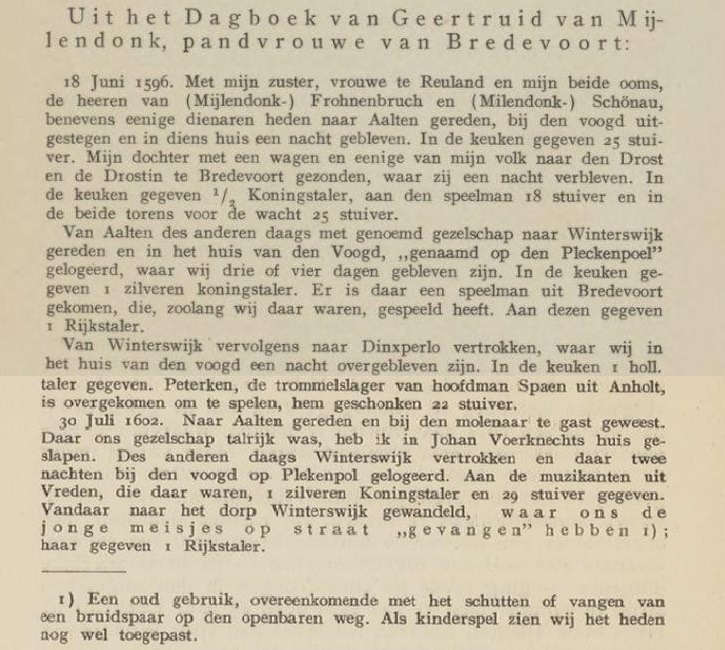
The Siege of Bredevoort in 1597 and the aftermath
Gertrud’s neutrality policy ultimately failed to hold when a Spanish garrison took possession of the Bredevoort fortress. Like the States’ military leadership, Gertrud wanted these troops gone as quickly as possible, but she did not receive permission for this from the Spanish Governor-General Parma.
During the Siege of Bredevoort in 1597, Prince Maurice of Orange surrounded the city with a States army. Gertrud made an urgent appeal to Maurice to respect her pledge rights and spare the city, but the Spanish occupiers refused to surrender. The subsequent shelling and the final assault caused enormous destruction in the city and at the castle.
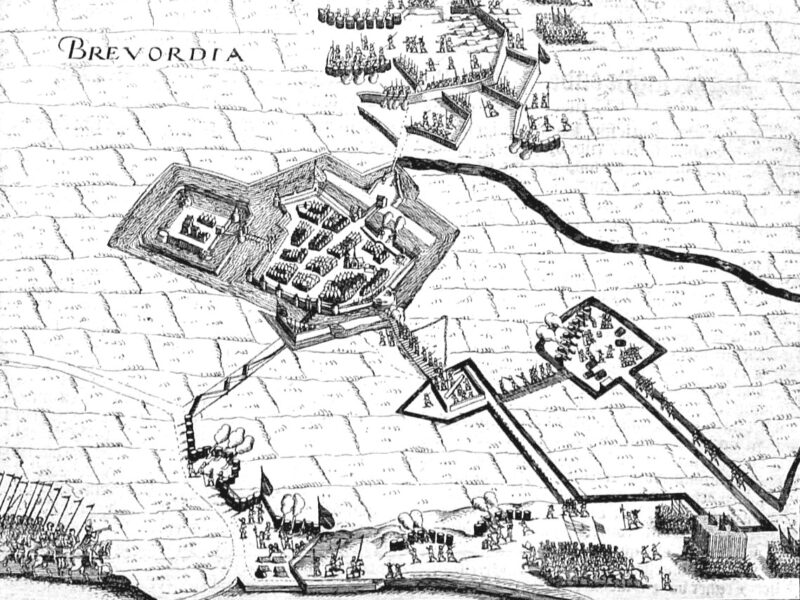
Despite this defeat, Gertrud continued to fight legally for her possessions. Successfully: in 1602, the States of Gelderland temporarily returned the Lordship of Bredevoort to her. Her eldest son, Dirk IV, then proposed a radical solution: the complete demolition (dismantling) of the fortifications of Bredevoort. His logic was that an undefendable city would no longer attract armies, which would provide peace for the local population. Prince Maurice and the States of Gelderland, however, put a stop to this. Maurice had gone to too much trouble to capture the strategic border barrier and rejected the demolition.
Transfer and death
Financial and political pressure on the pledge increased in the following years. On 20 October 1612, the States of Gelderland and Gertrud van Myllendonk reached a final agreement. The outstanding pledge was financially settled, and the Lordship of Bredevoort was officially transferred to Prince Maurice, who thereby became the new pledge-holder.
Just over a month after this transfer, on 23 November 1612, Gertrud van Myllendonk passed away at the age of sixty in Anholt. Her sons continued the noble titles, with her second son, Johan Jakob, later playing a prominent role as Imperial Field Marshal during the Thirty Years’ War.
Sources
- H.A. Hauer: Breevoort can ick vergeten niet, second edition, 1993
- Bailiff and Inheritors of Bredevoort, 1608–1794 (archieven.nl)
- Wikipedia