
In the course of the last century, excavation work repeatedly led to the discovery of the mortal remains of old-time residents of Aalten.
A burial vault collapsed
Nieuwe Aaltensche Courant, 9 July 1920
AALTEN – Throughout the whole of Thursday, Kosterstraat (= Köstersbulte, OA) held the full attention of the Aalten public. People stood in dense crowds around a particular spot close to the iron church gates, opposite the building of the Geld. Ov. Bankvereeniging. There were whispers of a burial vault, skulls, and so forth. The police kept the public, especially inquisitive youngsters, at a proper distance.
What had happened? In the morning, a heavy lorry belonging to Mr Jos. Driessen had driven right alongside the gates whilst swerving to avoid another cart. The driver naturally had no idea – as will indeed be the case for most inhabitants of Aalten – that he was driving over a section of the old churchyard that had formerly been laid out around the church. The remains of this churchyard were most clearly observable at the time “Elim” was built, where it was one vast charnel house beneath the ground.
It caught the attention of a passer-by that a sizeable “dent” had appeared in the street, which seemed to be growing steadily larger. Others were called over, and it now appeared as though a section of the ground had caved in. The municipal surveyor was summoned, as was the police, and by the time they turned up, the dent had become a large hole; rubble and mud had fallen onto a wooden coffin, which had collapsed as a result, revealing bones – there was no longer any room for doubt: a burial vault had collapsed.
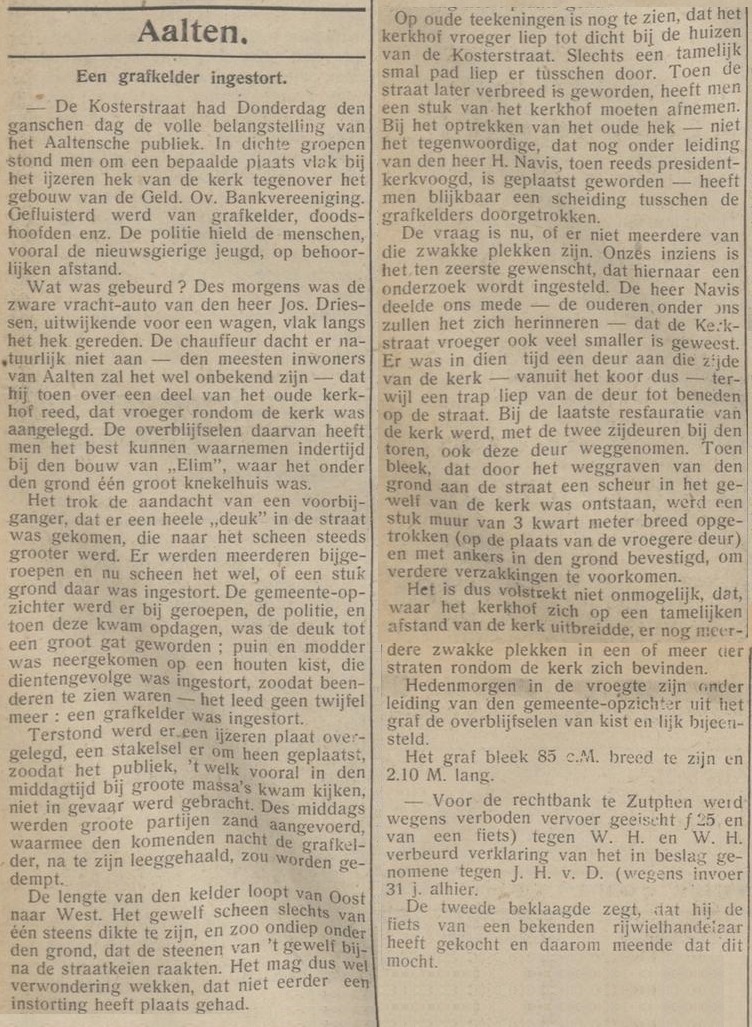
An iron plate was immediately placed over it, and a hoarding erected around it, so that the public, who came to look in great numbers particularly during the afternoon, were not put in danger. During the afternoon, large quantities of sand were brought in, with which the burial vault was to be filled in during the coming night, after having been emptied.
The length of the vault runs from east to west. The brick arch appeared to be only a single brick thick, and so shallowly subterranean that the bricks of the arch almost touched the cobblestones of the street. It may therefore give cause for wonder that a collapse had not occurred sooner.
Old drawings still show that the churchyard used to extend close to the houses on Kosterstraat. Only a fairly narrow path ran between them. When the street was widened later on, a piece of the churchyard had to be taken away. When the old gates were erected – not the current ones, which were installed under the supervision of Mr H. Navis, who was already president-churchwarden at the time – a division was apparently driven straight through the burial vaults.
The question now is whether there might be more of these weak spots. In our view, it is highly desirable that an investigation be launched into this. Mr Navis informed us – as the older ones among us will remember – that Kerkstraat also used to be much narrower.
In those days, there was a door on that side of the church – that is to say, leading from the chancel – while a flight of steps ran from the door down to the street. During the last restoration of the church, this door was removed along with the two side doors near the tower. When it became apparent that digging away the ground by the street had caused a crack to form in the vaulting of the church, a section of wall three quarters of a metre wide was erected (on the site of the former door) and secured into the ground with anchors to prevent further subsidence.
It is therefore by no means impossible that, given the churchyard extended a considerable distance from the church, further weak spots exist in one or more of the streets surrounding the church.
Early this morning, under the direction of the municipal surveyor, the remains of the coffin and the corpse were gathered from the grave. The grave proved to be 85 cm wide and 2.10 m long.
Urns containing cremated human bones
De Grondwet, 21 October 1884
AALTEN, 25 Sept. Near this village, on one of the highest points of a continuous stretch of arable land known as “den Esch”, workmen digging for gravel recently found, at a depth of 2 metres upon the gravel bed and at fairly equal distances from one another, 3 brown earthenware urns in the shape of fishbowls, filled with cremated human bones; the shards and bones of one of these were collected and preserved, whilst the workmen, upon discovering anything similar, will endeavour to leave it undamaged and have it preserved.
Skeletons found at ’t Blik
Graafschapbode, 14 July 1925
AALTEN – During the groundwork for a newly to be constructed dwelling at ’t Blik, some 5 fully intact skeletons have been found. Some older inhabitants of Aalten, who know of it from their fathers, say that a troop of French and a troop of German soldiers passed through here in 1813, having been quartered in the church here for a considerable time.
A German cook named Hopio, who cooked poorly and meddled with the food, is said to have been killed. The others had then recounted the next morning: “Hopio ist kaput gemacht” (Hopio has been done for). Other soldiers who succumbed to exhaustion at the time were also buried at this spot, so it is highly probable that further skeletons lie there.
Skeletons of a man and horses
Nieuwsblad van het Zuiden, 2 August 1929
In Aalten, whilst laying the foundations for a house to be built, the skeletons of a man and two horses have been found.
Petrified human head in Barlo
Aaltensche Courant, 21 April 1939
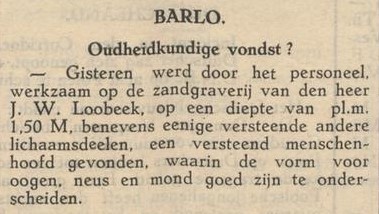
Yesterday, the personnel working at the sand quarry of Mr J.W. Loobeek found, at a depth of approx. 1.50 m, a petrified human head along with several other petrified body parts, in which the shapes for the eyes, nose, and mouth can be clearly distinguished.
Urn found
Aaltensche Courant, 16 October 1945
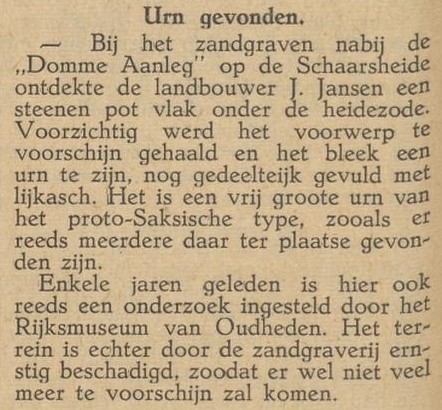
Whilst digging for sand near the „Domme Aanleg” on the Schaarsheide, the farmer J. Jansen discovered a stone pot just beneath the heather turf. The object was carefully extracted and proved to be an urn, still partially filled with funeral ashes. It is a fairly large urn of the Proto-Saxon type, several of which have already been found at that location.
A few years ago, an excavation was also carried out here by the National Museum of Antiquities (Rijksmuseum van Oudheden). However, the site has been severely damaged by the sand quarrying, meaning that not much more is likely to come to light.
Path between the old Helenakerk and Elim House
Circa 1955
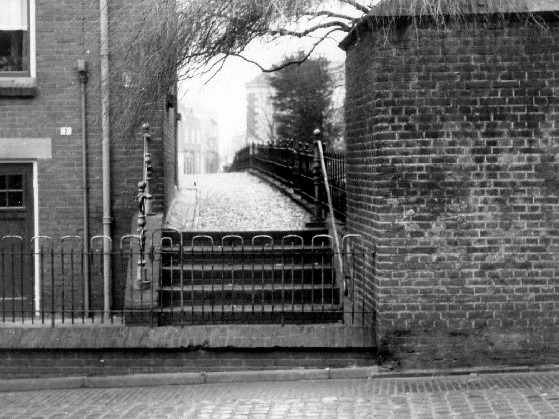
Adjacent we see the ‘trepkes’ (steps) between the old Helenakerk and Elim House. This path was excavated and widened around 1955. During the excavation of the steps, numerous bone fragments came to light from old-time residents of Aalten who had been buried there in the old churchyard.
Burial vault in the old Helenakerk
16 October 1973
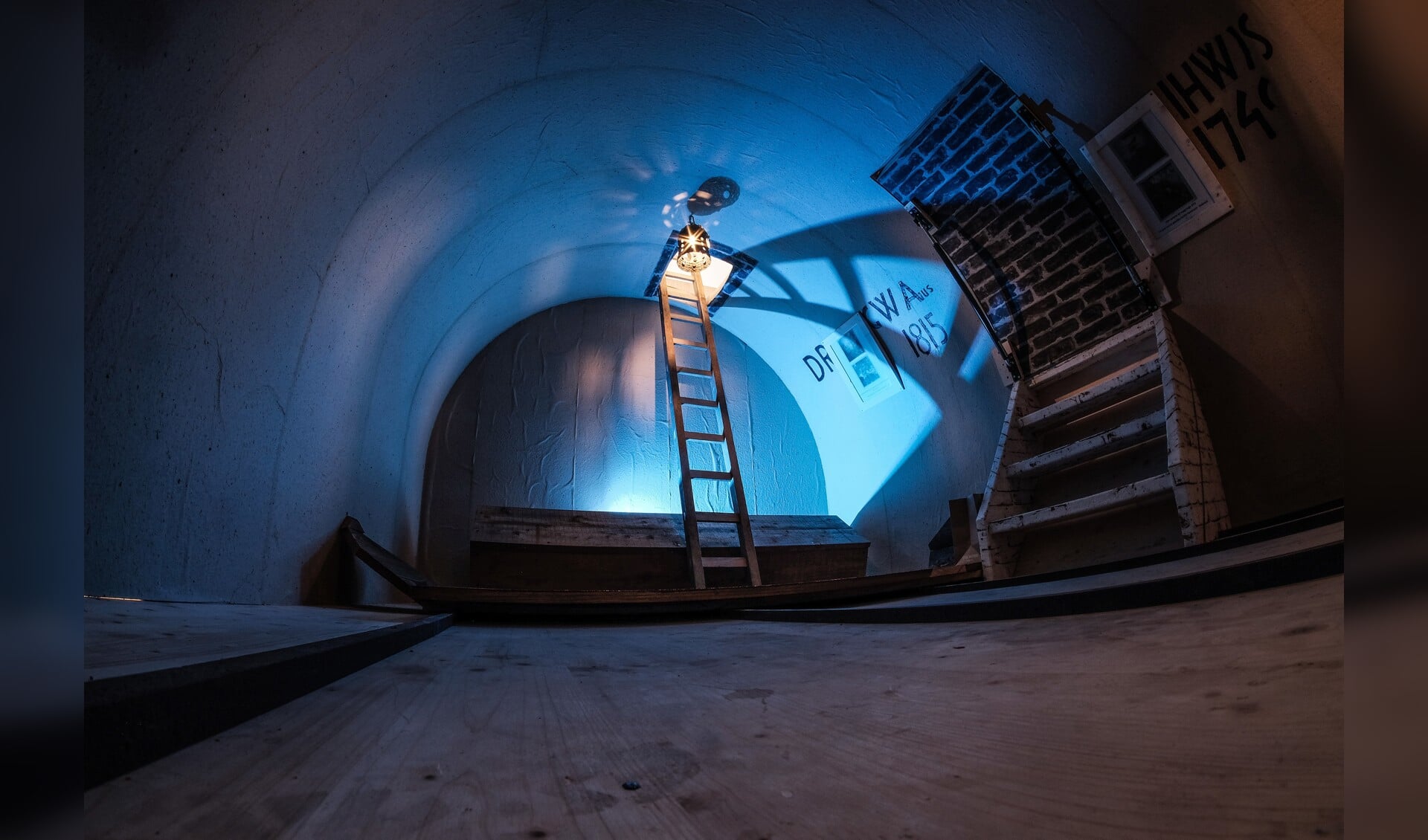
In 1973, whilst carrying out work in the Oude Helenakerk, carpenter Henk Heijnen discovered a burial vault beneath the floor of the chancel. An outsider had claimed that the ‘last priest’ had been buried where Heijnen was working, together with his golden chalice. Heijnen wanted to know more about this and did indeed discover a burial vault at that spot. The vault did not contain a golden chalice, however, but the coffins and remnants of three sets of mortal remains, with initials and dates on the wall. Decades later, Heijnen made a replica of the burial vault.