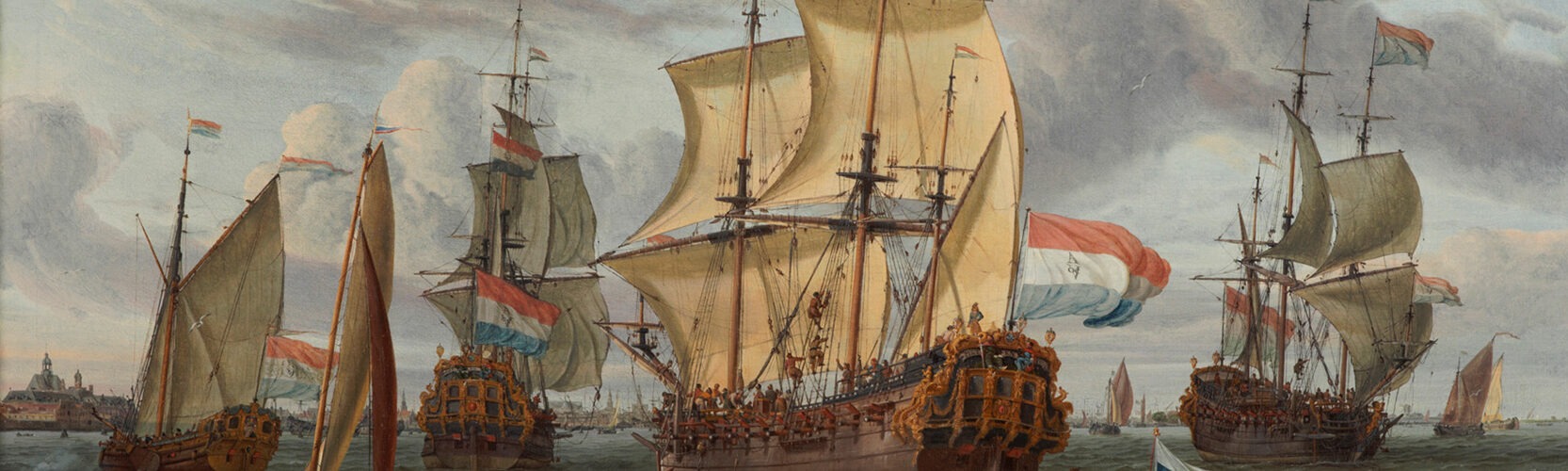
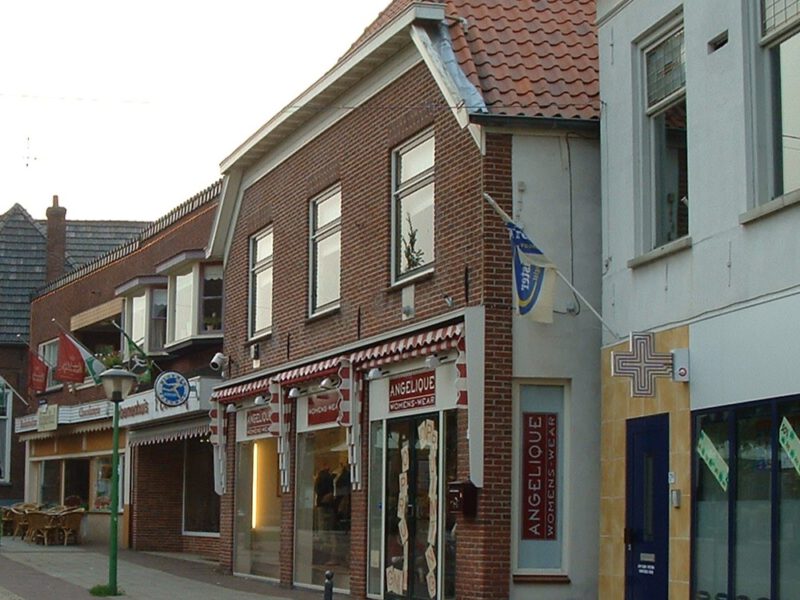
In the year 1660, a certain Hendrick Janszen ‘van Brevoort’ came with his wife and four children (3, 12, 16 and 17 years old) to New Amsterdam, now New York. At that time there was no official surname, and in archives someone was mentioned with first name, patronymic (Janszen, or ‘son of Jan’) and the place where they came from (in this case ‘Brevoort’). They had left Amsterdam on 8/9 March 1660 with the ship De Moesman and arrived before 30 May.
We do not yet have more information about the Bredevoort origin of this Hendrick Janszen. Do you? Then we would like to hear from you !
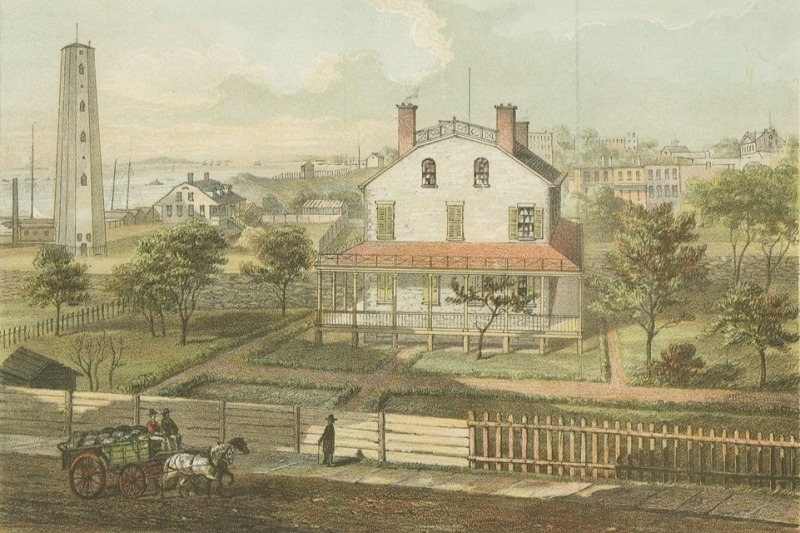
Brevoort Estate, between 54th and 55th Street, near 1st Avenue, 1866. Photo: The Museum of the City of New York
Hendrick’s son Jan Hendrick (1644-1714) used the surname Brevoort from 1696 onwards. In the centuries that followed, the Brevoort family in New York would grow into a well-known family with prestige and wealth.
Jan Hendrick Brevoort bought land in Harlem, where he held the position of overseer in 1678 and 1679. In the early 18th century, he exchanged Harlem for the south of Manhattan. At his death, he left his farm in the ‘Bowery‘ to his children. His son Hendrick (1670-1718) eventually owned most of the land, which then belonged to his son, also named Hendrick (1711-1771). He further expanded the property to 30 hectares. When the Brevoort family split up their possessions and sold most of them, this gave them a fortune. The head of the family was Henry Brevoort (1747-1841).
Henry Brevoort Jr.
Henry Brevoort Jr. (1782-1848) and his wife Laura Brevoort-Carson had a mansion built on the remainder of their land, at 5th Avenue and 9th Street. This area was on the rise and the Brevoorts took a prominent position in it. Henry Jr. was known as a literary spirit and he was friends and corresponded with the writer Washington Irving (1783-1859). In addition, he was a municipal councillor for many years.
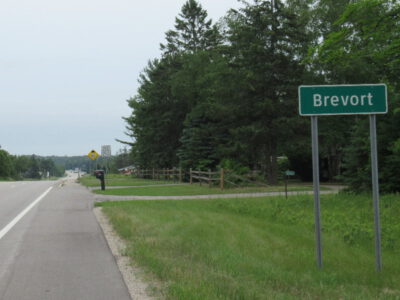
Henry Jr. was adventurous and traveled a lot. For example, he accompanied Lewis and Clark on their expedition to the Pacific Northwest from 1803 to 1806 and spent much time in the North American wilderness, working for John Jacob Astor’s American Fur Company. In the north of the state of Michigan, in Mackinac County, there is a hamlet called Brevort (pictured left), named after Henry, who explored the area in 1845, along with his friend Washington Irving.
In the city of New York in particular, various places, streets and buildings still refer to the Brevoort family. Here are a few examples.
The bend in Broadway
Characteristic of American cities is the rectangular street pattern. However, deviations from this pattern also occur. If you study the street pattern of New York, you will see, for example, that Broadway, one of the most famous streets in the world, also makes a bend. According to tradition, this would be due to one man, who was determined to defend his country.
The 35-hectare farm of Henry Brevoort Sr. was located on the outskirts of the city in the early 19th century. As the population of New York increased, the city government announced plans in 1815 to extend Broadway in a straight line to 23rd Street. However, this would cut through Brevoort’s land. He protested and the city council gave in: Broadway was diverted, so that the orchards of Brevoort’s farm, where 10th Street is today, were spared.
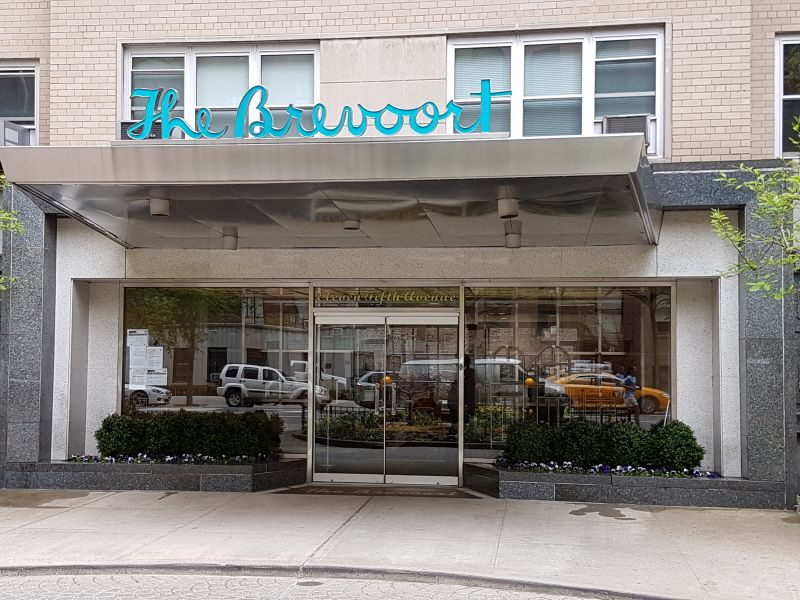
The Brevoort apartment complex, Manhattan
In the Greenwich Willage neighborhood, in the heart of Manhattan, there is an apartment complex called ‘The Brevoort’ at the beginning of 5th Avenue. The complex was built in 1955 and has 20 floors and 277 apartments. The building replaced the famous ‘Hotel Brevoort‘, once one of the leading hotels in New York. This is where the rich and famous and sometimes even royal guests stayed. The hotel was also known for the legendary parties that took place there. Aviation pioneer Charles Lindbergh received the Orteig prize of 25,000 dollars in this hotel for his solo flight over the Atlantic Ocean.
One of the most famous residents of the current apartment complex ‘The Brevoort’ was Buddy Holly. He lived there in 1958-1959, from his marriage until his fatal end. He recorded the so-called Apartment Tapes here.
Traces of Brevoort in Brooklyn
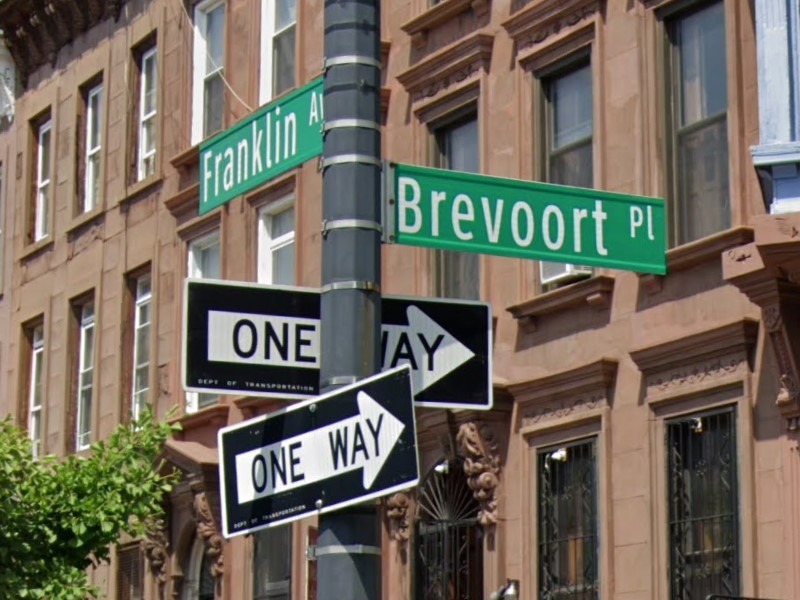
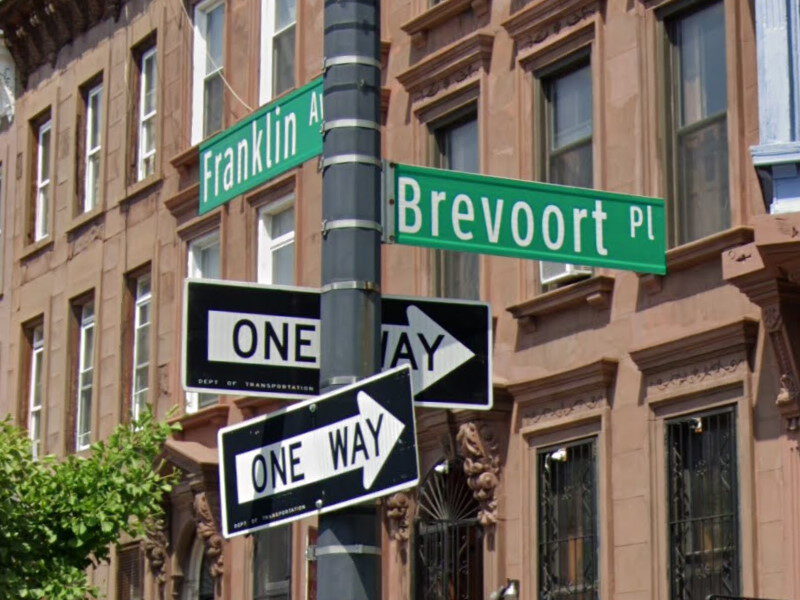
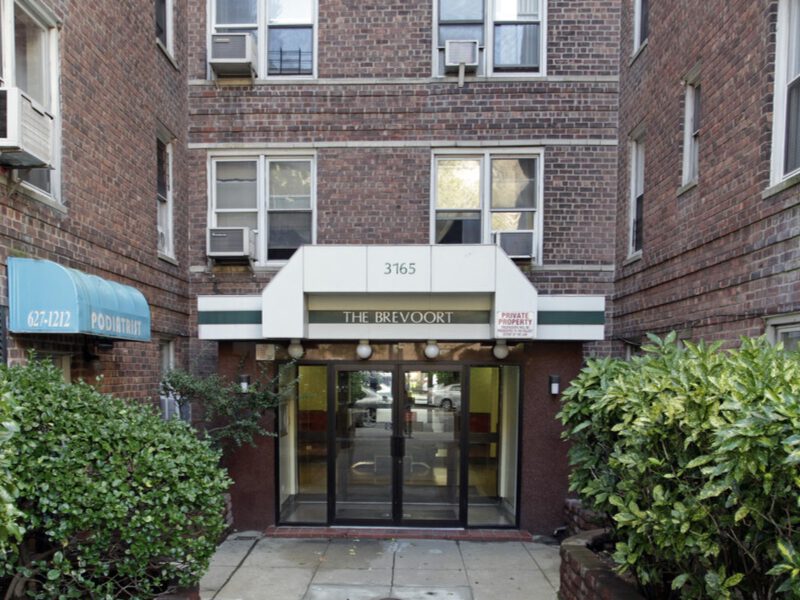
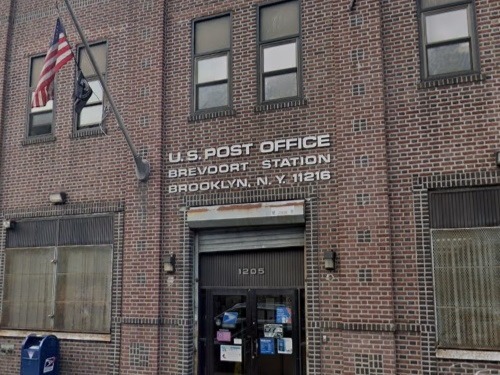
There are also several places in the borough of Brooklyn where family members of the Brevoorts once owned land. This includes a street (Brevoort Place), an apartment complex (the Brevoort Houses – 13 seven-storey buildings with a total of 896 apartments), a Brevoort Playground and a Brevoort Post Office.
Brevoort Place, Brooklyn
Brevoort Houses, Brooklyn
U.S. Post Office Brevoort Station, Brooklyn
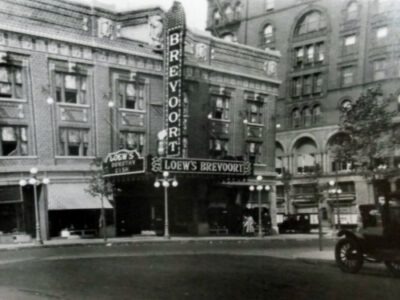
Brevoort Theatre, Brooklyn
Although this theater has long since disappeared, it is still worth a mention. The Brevoort Theater once stood on the corner of Bedford Avenue and Brevoort Place. When it opened in 1918, it was Brooklyn’s largest movie theater, with 1,800 seats and another 700 on the balcony. The theater also had a stage and an orchestra pit.
Although it was mainly shown in films in the first decades, the Brevoort Theatre became famous around 1960 because many well-known artists performed there, including James Brown, Jackie Wilson, Otis Redding, Smokey Robinson & The Miracles, The Four Tops, The Temptations, Marvin Gaye, Stevie Wonder, The Supremes, Sam & Dave, Dionne Warwick, Gladys Knight & the Pips and Pattie LaBelle & the Bluebells. However, this period did not last long. The theater closed its doors for good in the 60s of the last century and was demolished in 1968.
The verponding was a tax on real estate introduced in Gelderland in 1651 to replace the older schildschatting. This tax was levied on lands, farms, houses, and mills that generated income, with the aim of strengthening provincial finances. Wastelands, such as uncultivated common lands (markegronden), were exempt from this levy. The verponding remained in effect as a tax system in Gelderland until 1805.
Administration and Registration
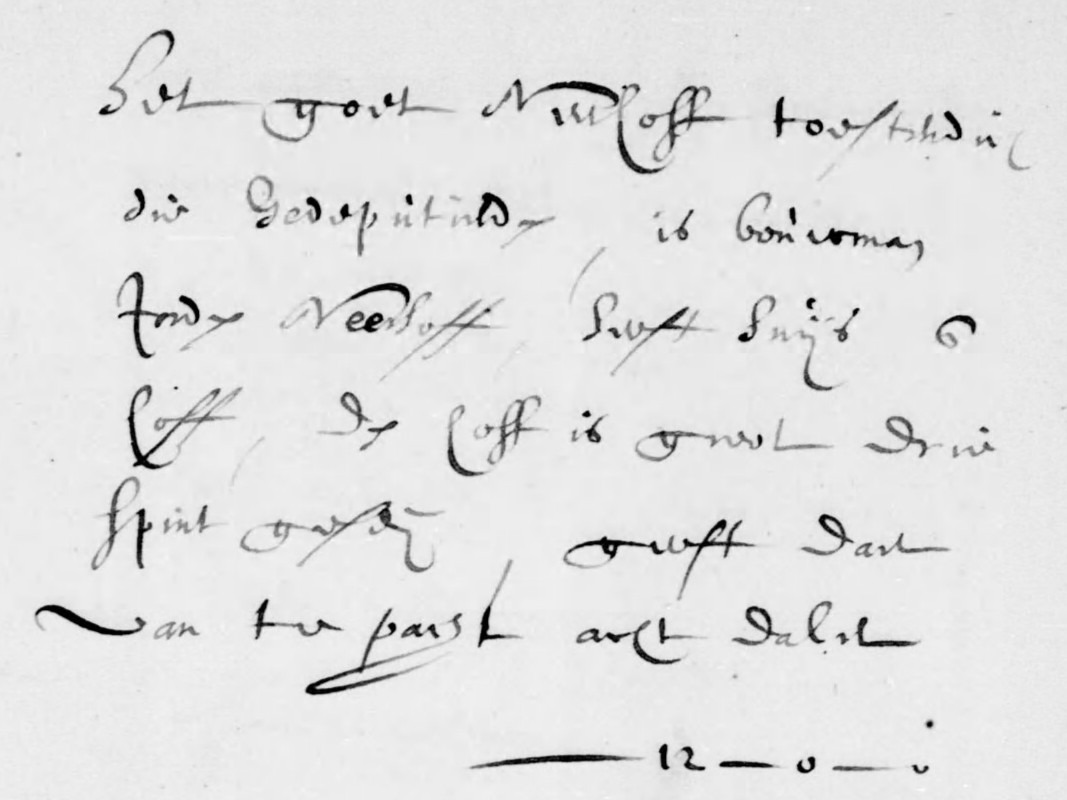
Fragment from the verponding register for the rural district of Dale near Aalten, c. 1650
The term ‘verponding’ or ‘pondschatting’ likely refers to a tax assessment originally expressed in the unit of account ‘pond’ (pound). Data regarding the verponding was recorded in so-called verpondingskohieren (tax registers). These registers were compiled by local officials, such as bailiffs, sub-bailiffs, and rotmeesters, who were responsible for recording all real estate and its estimated value. The registers provide valuable historical information regarding the number of houses per location and their owners: nobility, church, or citizens. Additionally, they contain data on the size of holdings, lease structures, and ownership relationships.
Calculation
In the Quarter of Zutphen, to which Aalten and Bredevoort belonged, the amount of the verponding was determined based on the lease or rental value and the burdens resting on a property. For lands and farmsteads, the tax amounted to a sixth penny (or 1/6) of the taxable lease value; for houses and mills, this was a ninth penny (1/9) of the taxable rental value. If a property was not leased or rented but used by the owner themselves, the value was determined based on comparable properties that were leased or rented. Everyone was obliged to provide correct information and to show any lease contracts; negligence could result in a fine.
Collection and Payment
The collection of the verponding followed a strict schedule: the assessment, also known as ‘maning’ (summons), took place in November, and payment was to be completed before the end of February. The tax could be calculated in various ways, and several deductions were possible, for example, for maintenance. Taxpayers received ‘maancedulen’ (payment notices) stating the amount due. The collected pennies were transferred by the collectors to the receiver of the Quarter. Furthermore, the district, the city, and the Quarter could levy additional surcharges (opcenten) on top of the base amount.
Verponding Register of 1647
The Verponding Register of 1647 is a frequently used source for historical research. At the time the verponding registers were compiled, Gerhard Kreynck (1612-1692) was the mayor of Zutphen. Kreynck had a great interest in historical documentation and made copies of important archives, including the verponding register, city accounts, and fief registers.
The Verponding Register of 1647 was transcribed in an abbreviated form by Kreynck around 1650, which later became known as the Kreynck Transcript. The historical significance of the register lies in the fact that it is one of the first systematically established tax registers in Gelderland. The register provides insight into the economic situation of the region in the mid-17th century. The original register has been preserved and can be found in the National Archives in Arnhem.
Genealogiedomein: images and transcriptions of the verponding registers for Aalten and Bredevoort.
R. Wartena et al., Farm Names in the Achterhoek. From the verponding register of c. 1650, Kreynck transcript, publication East Gelderland Journal for Farm Research (link).
H.K. Roessingh, How are the Gelderland verponding registers from the mid-17th century structured? Sources for local historical research, Contributions and Communications of Gelre LXIII (Arnhem 1968/1969), pp. 61-71.
H.K. Roessingh, Sheaf tithes, seed tithes, and money tithes in Gelderland in the 17th and 18th centuries, Contributions and Communications of Gelre LXIII (Arnhem 1968/1969), pp. 72-98.
Gunpowder Tower Disaster Bredevoort 1646, 3D impression by Paul van Druten
On Sunday, July 12, 1646, around four o’clock in the afternoon, the gunpowder tower of Bredevoort Castle, containing 320 barrels of gunpowder, was struck by lightning. Forty people were killed and an unknown number were injured in the ensuing explosion.
The tower caught fire upon impact. The explosion was so violent that the Ambthuis (administrative house) also collapsed. The town suffered extensive damage from the explosion, and almost all houses lost their roof tiles and windows. The houses surrounding the castle had collapsed. For three days, survivors were sought beneath the rubble using shovels and pickaxes.
In 1938, G.H. Rots wrote a series of articles in the Aaltensche Courant about the history of the municipality of Aalten. Regarding the gunpowder tower disaster in Bredevoort, he wrote:
“The year 1646 was once again a disastrous year for Bredevoort. It was the 12th of July, and an oppressive heat hung over the town. Dark clouds gathered, and everything indicated that a severe thunderstorm was imminent. And indeed, lightning soon cleaved the sky, followed by heavy claps of thunder. And suddenly, a terrible blow, followed by a dreadful sound.
Lightning had struck the gunpowder tower, causing the gunpowder present (320 tons) to explode. The entire tower was blown apart, as was the nearby Ambthuis; tiles were torn from almost all houses, and windows were blown in by the air pressure. The number of deaths in that disaster amounted to 19 at the castle and the Ambthuis alone. There were also numerous deaths in other houses in the town.”
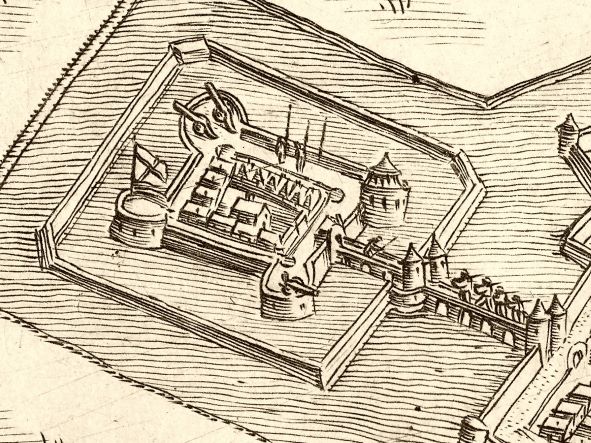
Bredevoort Castle in 1597
Victims
“The deceased included, among others, the Governor of the city Willem van Haersolte and his spouse, the Drostinne Cathrijne van Brakel and her eight children, and her niece Berentjen van Brakel. Furthermore, Joh. van Langen, lieutenant to Georg Ernst Count of Bronkhorst, and also his French mistress (sic) Jeanne van Sédan. An elderly woman present there, Maria Glazen, along with the manservant and the maid, were also among the victims.
The sentry on duty, named Hendrik Otterpoëll, was buried under the ruins. In other parts of the town, the house of Jan Stenneken was destroyed. He and his wife Marycken van der Halle were killed. The names of the dead in other parts of the town were Derk Trix, ensign, Harmen ter Male, F. zum Moorelagen, Bailiff of Winterswijk, and his wife Janne Beerninck, with her sister Christine Beerninck, widow of the late N. Brinkhorst, judge of Haaksbergen.
The house of Berent Grimme was destroyed; his wife and four children lost their lives. The house of Casper Evers was hit, under which three people were killed, named Arent Hamaeker, a child of Berent Maes, and a child of Herman Broekman. Under the house of Derrick ter Woerle Wiltschut, three of his children were killed, as well as the soldier Gerrit Jansen and Jan Schulten.
We have specifically mentioned these names because one might perhaps derive names of those living today from them.”
The deceased who lay under the rubble of the Ambthuis were laid out on July 15 at the home of the widow of the late minister D.J. Verhagen. The bailiff with his wife and eight children were buried on the morning of Thursday, July 16, in the choir of the St. George’s Church. It is not clear how many people remained under the rubble. In total, forty people died that day. The sources make no mention of the number of victims who were injured.
One son of Drost Wilhelm van Haersolte survived the disaster. Anthony, as he was named, happened not to be home that day: he was staying in Zwolle. He continued the family line in Zwolle and founded the Haersolte Almshouse there, which is assumed to be connected to the disaster in Bredevoort.
Sources
‘From Aalten’s past’, by G.H. Rots, Aaltensche Courant, 18 February 1938 (Delpher)
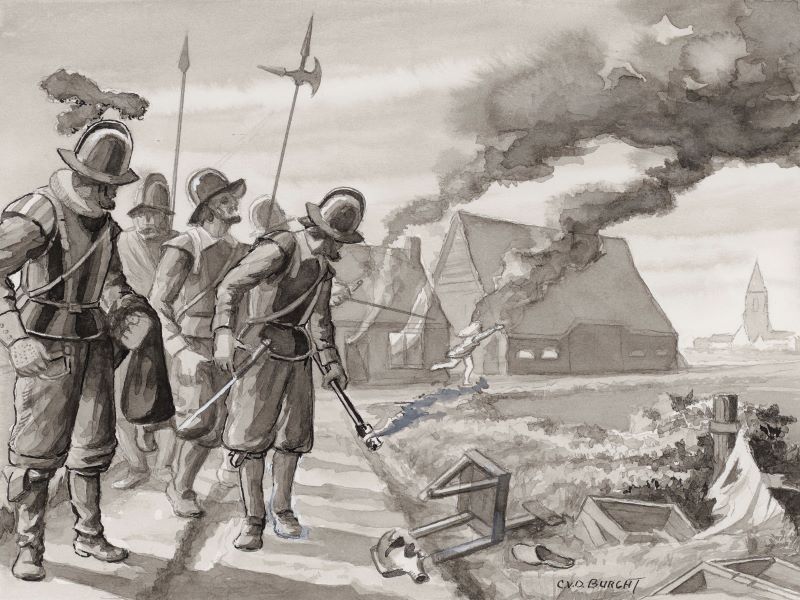
In earlier centuries, the population of Aalten regularly suffered from forced contributions. A forced contribution (brandschatting) is a (usually high) sum of money that a village or region had to pay to passing troops to prevent them from looting and burning the village or region.
The soldiers in question usually received irregular pay and were primarily paid from these forced contributions. If the amounts could not be raised, the troops felt entitled to looting and other misconduct. Since multiple armies often passed through a region during wartime, the imposition of this ‘war tax’ usually led to bitter poverty. Additionally, the population often suffered from roaming, dismissed mercenaries.
This practice plagued many areas not only in the Middle Ages, but also during various wars in the 16th, 17th, and 18th centuries. In the peripheral areas of the Republic of the Seven United Netherlands, for example, such as North Brabant, Limburg, and the eastern border regions, it led to a major economic and demographic decline during these centuries.
Looting, forced contributions, and rape by Spanish soldiers, by C. van der Burght (Source: Zeeland Archives)
Historical Description
In 1938, G.H. Rots wrote a series of articles in the Aaltensche Courant about the history of the municipality of Aalten. He wrote the following about forced contributions in Aalten:
“In the years before 1597, the year of the conquest of Bredevoort by Prince Maurice, Bredevoort had regularly been in the possession of the Spaniards. However, one should not think that there was peace and quiet in the Ambt of Bredevoort at that time. Troops regularly passed through and stayed in Bredevoort and the associated districts. The village of Aalten suffered particularly from these passing troops. There was little dispute over property rights. The soldiers simply took whatever they liked, and the Ambt of Aalten was repeatedly levied for forced contributions, i.e., ordered to hand over a number of horses, cows, or money to the passing troops.
One could also strike a deal with the marauding bands and prevent the seizure of livestock and horses by paying a sum of money. As evidence of how Aalten suffered under these repeated raids and robberies, the following is mentioned in that regard.
On March 2, 1582, English horsemen arrived in Aalten and took 16 people prisoner. These prisoners were released after paying a ransom of 2,000 guilders.
An honorable citizen named Hondarp, however, was transported to Zutphen but was later released for a ransom of 200 dalers. The son of the aforementioned Hondarp was taken prisoner on October 17 while he was in Doetinchem. He had ridden to Doetinchem on horseback, and it seems his appearance suggested he did not lack means, as he was able to regain his freedom upon payment of 100 dalers and the surrender of his horse.
On December 1 of that year, soldiers from Lochem arrived and demanded 100 dalers to prevent looting. Things did not go well for Hondarp, as on January 15, 1583, he was taken prisoner along with his wife and son. They could only extract 60 dalers from him, for which they finally regained their freedom. In March of that year, another group of soldiers from Doetinchem arrived and stole a number of horses ‘at the Pas’. The owners were able to buy them back for 51 dalers, except for the best horse, which the soldiers took with them.
On May 29, the people from Doetinchem returned and stole a horse and a cow, but this time no ransom was paid, probably with the thought: if they get no money, they won’t return so quickly. But the next day it was the same story again; 3 horses were stolen. The ransom decreased, as they only had to pay 9 dalers, with which the soldiers were satisfied.
However, looting was in the blood of the garrison at Doetinchem, as they repeatedly came to Aalten. On June 18, they stole three horses; the ransom was 13½ dalers.
On the 10th, they were back again, and now they demanded 3 horses, 2 cows, 2 heifers, and 3 bulls. The heifers were slaughtered and valued at 10 dalers. The rest were bought back for 10 imperial guilders and the bulls for 10 dalers.
On June 14, one horse was stolen, which was bought back for 3 dalers and 18 stuivers. It would get even worse, for only two days later, soldiers from Bergh, Doetinchem, and Nijmegen arrived and stole 41 horses, 4 oxen, 33 cows, and 37 head of barren cattle. Only a portion of these could be bought back for 674 dalers.
And now more robberies followed. On July 19, 20 horses were taken by soldiers from Bronckhorst. On August 11, another 6 horses. On September 14, soldiers from Ulft stole 3 cows, for which a ransom of 15 dalers was paid by the owner.
On September 17, a company of soldiers led by a certain Stael arrived and seized 11 cows, 40 horses, 40 head of large cattle, and 12 oxen. They took the best livestock with them, and the rest was bought back for 419 dalers. Until now, it had always been livestock, but on December 15, soldiers from Lochem arrived and demanded 8 horses and 2 carts of buckwheat. On March 15 of the following year, a carter with a wagon of rye, drawn by 2 horses, drove through the IJzerlo field. Some horsemen from Bergh and Doetinchem seized everything, and the carter saw his property taken away.
Now they began taking heads of households prisoner again. They were released for a ransom or in exchange for other prisoners languishing in the dungeon at Bredevoort. Immediately after Whitsun, a large raid was undertaken, and many horses and cows were seized and partially bought back. Subsequently, on June 9, June 20, and June 24, there were repeated raids and thefts of horses and livestock.
And the measure was not yet full. The population of Aalten had a hard time, for on July 13 and 14, 1584, 15 people were taken prisoner in the municipality of Aalten and 600 head of cattle and horses were stolen. The prisoners were released for a ransom of 1,100 guilders. Who can fathom the sorrow of the population in those days?
Because of all these mentioned raids, people became fearful. They hardly dared to go outside with a horse, ox, or other animal; danger lurked from all sides. Soldiers were stationed in all the surrounding fortresses, and whenever they needed something, they went out looting. It was in the middle of harvest time, but the farmers left the grain in the fields; why should they harvest? Soon the enemy and also the State soldiers would come—for in this regard it was ‘six of one and half a dozen of the other’—and steal their possessions.
There were also farmers who fled and tried to find a living in regions further to the east. Those who remained here complained to the village authorities, but what could they do! In those years, a certain Jan Holstein was the advocate (voogd) of Aalten. He addressed petitions to the Lady of Anholt. It seems, however, that she was also powerless to end the situation. It was wartime, and the soldiers, mostly mercenaries and volunteers, demanded money, food, and drink on time. And when the army leadership could not provide that on time, the soldiers tried to obtain it themselves through looting and robbery. The population became the victim.”
Billeting
“Added to all that misery was the fact that garrisons were relieved of soldiers by billeting them with farmers and village residents. The people themselves had almost nothing to eat, and when soldiers were billeted, they would act out if they did not receive enough food. If people had provisions, they were largely hidden, otherwise everything would be seized. To make matters worse, an extra tax was imposed on the population. The Lady of Anholt needed money, and the Stewards traveled around to collect the funds; but everywhere there was poverty and want.
Then it would seem as if peace would return, and nothing would be heard for a year. But suddenly it would flare up again. As in the summer of 1586, the looting began once more. The Aalten farmers then pursued the looters as far as Enschede and Oldenzaal. They wanted their stolen cattle back. They had to return empty-handed, and the suffering was almost unbearable.
One of the worst afflictions was when the soldiers brought their wives and children with them. Then they also had to be given something to eat. In January 1587, such a troop was to be partially billeted in Aalten. Fear struck the hearts of the population. It was heard that they were mercenaries from Wallonia in Belgium, who were notorious for their ferocity and cruelty. Outposts had already been sent out because it was suspected that Geuzen soldiers were in the vicinity. On a Sunday morning, such an outpost troop of 20 men arrived in Aalten, led by the landdrost Thieseling. They moved on to Bocholt, where a Spanish cavalry unit had arrived under the command of Colonel Taxis.
Reconnaissance had determined that no State or Geuzen soldiers were to be seen, and so it was agreed to ride back to Groenlo and then carry out the billeting. But between Aalten and Bocholt, they were suddenly ambushed by the Geuzen soldiers, and a fierce battle broke out. The Geuzen were victorious, and the fear remained. The dreaded billeting did not happen.
Near Bredevoort, there seem to have been fertile meadows in addition to marshes. Specifically, there was a town meadow at the Swanebroek and several private grazing lands. But in 1587, everything had been grazed bare by the enemies’ horses, the meadows were completely ruined by riding, and afterwards a period of rain came and everything was flooded, so that no hay could be harvested that year. While they had been spared billeting in the spring, in December of that year a large number of horsemen suddenly arrived from Groenlo and stole horses, cows, and pigs. Sixty molders of rye and buckwheat were also to their liking, along with 43 wagonloads of unthreshed grain.
On March 26, 1588, it was a number of State soldiers who looted in Aalten. Thus, the population was bitten first by the cat and then by the tomcat. The advocate of Aalten, Jan Holstein, wrote a letter on June 9, 1588, to Godfried Gerardi, advisor to the Lady of Anholt, in which he recalls the situation in Aalten. The harvest cannot be safely brought in. Citizens of Aalten have been taken prisoner and are being held hostage elsewhere. There is no money to ransom these people.
On July 4, 1588, an army of 2,000 infantrymen (foot soldiers) and 300 horsemen approached Aalten. They entered the village, and the residents fled fearfully into their houses. What would happen to them now? The command was held by the Spanish governor and field commander Verdugo and Count Herman van den Berg. It appeared, however, that they were just passing through towards Bocholt-Recklinghausen, so Aalten was spared billeting or robberies this time.
The Lady of Anholt considered ways to end the robberies. She needed money to pay the soldiers’ wages and therefore decided to introduce an extra levy (extra tax). But of course, you can’t pluck feathers from a frog. Aalten had to provide an extra 70 dalers, and the advocate of Aalten wrote to the Lady that he did not know how he would collect this sum, which had been easy to pay in the past, at this time. The population is starving, horses and cows are almost non-existent, and what remains is being stolen.
Yes, my readers, who can fathom the depth of misery of the unfortunate population, for not only the mentioned afflictions hit the people. It is as if everything conspired to complete the system of destruction, for while the crops promised somewhat of a good harvest, a violent storm arose accompanied by heavy hail and destroyed all the crops standing in the fields. How deeply our ancestors had to drain the cup of misery is indescribable and cannot be understood by us, who do complain about bad times.
For even more atrocities were to occur. The hordes of soldiers who roamed about and often indulged in strong drink threatened women and daughters with dishonor if they were not given what they demanded. In 1597, Bredevoort was taken by Prince Maurice. The change in government had come, but it did not bring the protection of home and property. It remained restless in the Ambt of Bredevoort. The fortunes of war fluctuated, but soldiers were soldiers; one group might be slightly better than the other, but on average they could all be painted with the same brush.”
Twelve Years’ Truce
“Only in 1609, when the Twelve Years’ Truce was made, could the population catch its breath again. With the changing fortunes of war, religious disputes had also flared up. As long as the Spanish domination existed, the Reformers could not show themselves openly. No sooner had the tide of war turned than the change in the churches also took place. The victors took measures against the vanquished that, in hindsight, are indefensible.
After the Twelve Years’ Truce, the conflict began to flare up again. In Groenlo, there was still a garrison of Spanish soldiers. That was a breeding ground for bad elements. They roamed the rural districts and again stole everything they could. The new Lord of this municipality, Prince Maurice and later Frederick Henry, was constantly petitioned for protection. Finally, on July 17, 1627, Frederick Henry decided to rush to the aid of his subjects in the County. A significant military force of 55 squadrons of cavalry, 168 companies of foot soldiers, and 75 cannons entered the County, coming from the direction of Emmerich. The siege of Groenlo was laid, and a fierce battle erupted there between besiegers and besieged.
After the siege had lasted a month, Frederick Henry took the city and thereby established the rule in the County. For thirty days, Frederick Henry stayed in Groenlo and visited the surrounding places. Aalten also received an official visit from Frederick Henry. He encouraged the population. Since then, a member of the House of Orange has never made an official visit to Aalten. If a street or square in Aalten ever needs to be named again, it might well be named after this liberator of Aalten territory. For afterwards, peace returned, except for small robberies compared to the past, until the peace was signed in 1648, ending the Eighty Years’ War.”
In the southeast of England, at the mouth of the Thames, lies the town of Canvey Island. Four centuries ago, it was in danger of disappearing into the sea, until in 1622 the Dutch came to the rescue with their ‘water management skills’. After a successful reclamation, many Dutch workers continued to live there, perhaps including one or more Oud-Aalten residents.
In the early 17th century, Sir Henry Appleton, the most important landowner on Canvey Island at the time, met the Dutchman Joas Croppenburg. He proposed to drain Canvey Island in the same way as had been done in Amsterdam. In 1622, several landowners of Canvey Island signed an agreement and Croppenburg hired another Dutchman, Cornelius Vermuyden, to reclaim the island.
Vermuyden recruited between two and three hundred compatriots to get the job done. They built a series of seawalls and successfully made Canvey Island habitable by reclaiming 15 kilometres of land by embanking the island with locally mined chalk, limestone and heavy swamp clay.
Dutch colony
After Canvey Island was drained and available for both agriculture and living, many of the Dutch workers who had helped reclaim the land decided to settle there permanently. A Dutch colony developed on Canvey Island within a few years. Dutch even remained the official language in Canvey until about 1700.
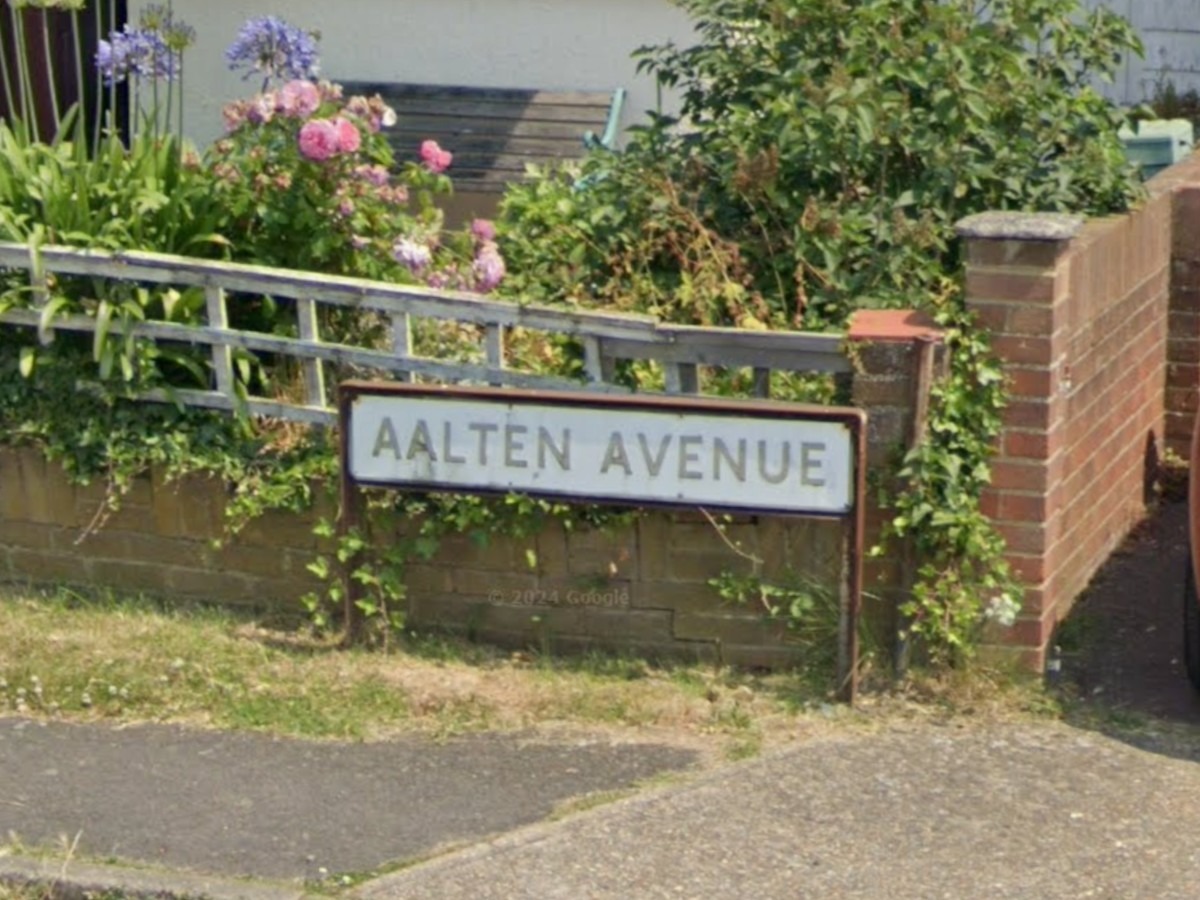
The Dutch settlers named all kinds of roads in their settlement after places in their homeland. There is an Aalten Avenue, Zelham Drive, Goirle Avenue, Haarlem Road, Urmond Road and Waalwyk Drive, among others.
As yet, no tangible connection has been found between this history and specific Oud-Aalten residents who would have been involved. Hopefully, relevant information about this will one day ‘surface’!
During the 17th and 18th centuries, over two hundred men from Aalten and Bredevoort enlisted on ships of the Dutch East India Company (VOC). Some were still minors; many never returned. What prompted them to trade the rural Achterhoek for a dangerous sea voyage to the East, thousands of kilometers from home?
The VOC and its administration
The VOC (1602–1795) was the world’s first multinational and grew into a powerful colonial enterprise with trade monopolies and its own military force. In nearly two hundred years, over 4,700 ships departed for Asia. In the 18th century alone, approximately 655,000 people were aboard VOC ships.1 Only a small portion came from the Achterhoek. From the records, we know over 200 names of men from Aalten and Bredevoort who entered the service of the VOC.
That we know this is thanks to the meticulous personnel administration. Personal details, roles, ships, destinations, and the reason for leaving service were recorded in the so-called ship’s pay ledgers. These sources have largely been preserved and can be consulted online via the website of the National Archives. The table at the bottom of this article was compiled based on these records.2
Aalten and the VOC: involved from the beginning
The involvement of Aalten residents with the VOC did not only begin when men enlisted as soldiers or sailors. An Aalten native played a notable role as early as its founding in 1602. Wessel Schenk, born in Aalten and later a merchant in Amsterdam, invested 30,000 guilders in the new company at that time. This made him one of the largest shareholders of the VOC.3
The service was risky: more than half died en route or in Asia, while only a third demonstrably returned alive. Enlistments took place throughout the 17th and 18th centuries, with slight peaks in the 1720s and 1760–70.
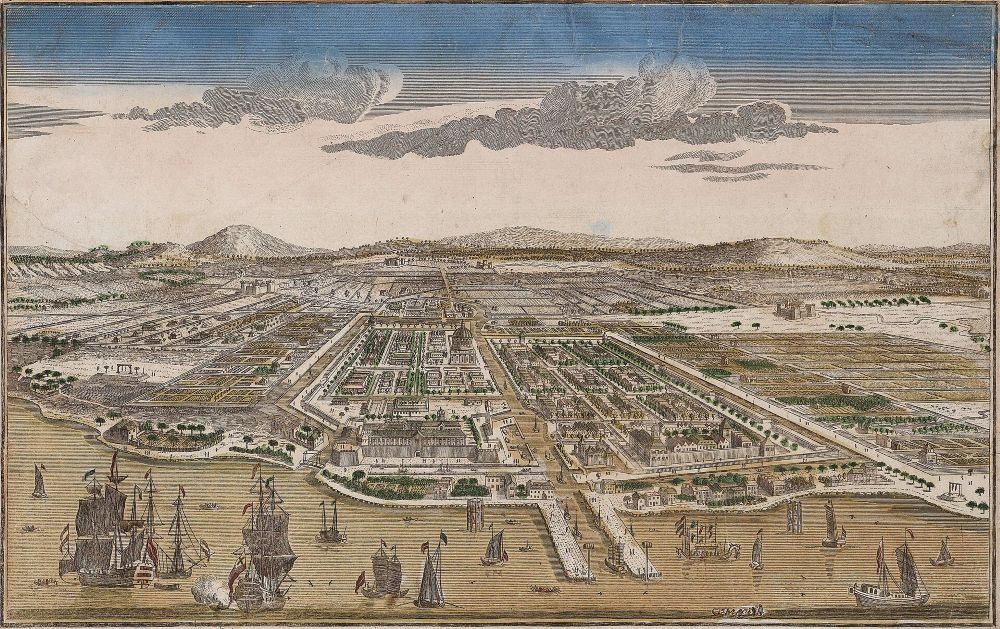
Optical print of Batavia in 1780 (source: Wikipedia)
Motives for departure
Why did these men choose an uncertain existence at sea? For many, it was a matter of poverty or a lack of prospects: a steady income with the VOC offered security. For others, the urge for adventure and independence played a role, a chance to see the world and escape the constraints of rural life.4
Military roles
Nearly half of the men from Aalten and Bredevoort held a military position. Until 1755, there was a garrison in Bredevoort5, which may have played a role in this. For military personnel, the VOC presumably offered the opportunity to utilize their experience with weapons and discipline, often for better pay and with more career prospects. At the same time, it is equally possible that men with experience in the civic guard were deployed for such roles. The departure of the garrison from Bredevoort seems to have had no demonstrable influence on the number of enlistments.
Names and data
The table below contains the details of individuals from Aalten and Bredevoort who were in the service of the VOC. Some individuals are listed multiple times because they made several voyages. This table is not flawless and is likely not exhaustive. For some individuals, it is not certain that they actually originated from Aalten or Bredevoort, as the origin is sometimes difficult to read and spelling varies. Partly for this reason, names are undoubtedly missing, but possibly also because parts of the administration have been lost.
The 📜 behind each name contains a link to the relevant entry in the National Archives, where the scan of the original document can also be viewed. A 🌳 refers to the family tree of the person in question on FamilySearch (free account required), where known – work in progress!
At the beginning of the 17th century, Wessel Schenk and his half-brother Salomon Voerknecht from Aalten were among the largest grain traders in Europe. Their activities spanned from Amsterdam to Danzig, Königsberg, Genoa, and even the New World. Other family members were also active in trade and entered into marriages that strengthened their position. What began in Aalten grew into a network with international influence.
The Schenk / Voerknecht family
In the mid-16th century, a certain Jenneken ter Woert lived in Aalten. From her first marriage to Salcke Schenk, she had two children: Gertruid and Wessel Schenk. Around 1568, she remarried Johan Voerknecht, with whom she had four children: Salomon, Hans, Judith, and Anna Voerknecht.12
In 1575, Johan Voerknecht was a keurnoot (lay judge) of the Bredevoort court3, a position indicating social standing. Whether the family belonged to the Aalten ‘elite’ is unknown to us. However, it is striking that all the children later became successful in trade or married partners of distinction. This suggests a connection to influential networks that enhanced their social and economic opportunities.
Merchants in Amsterdam, Danzig and Königsberg
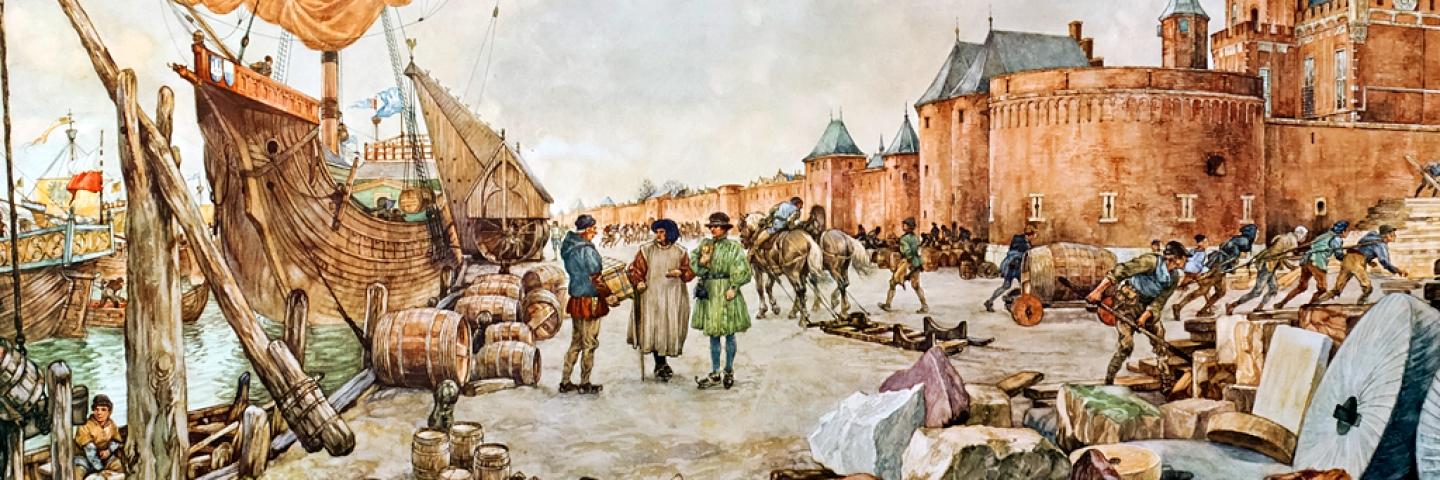
From the late 15th century, merchants in the Low Countries specialized in the transport of bulk goods, especially grain and salt. This trade, known as the moedernegotie (mother of all trades), formed the economic foundation of Holland for centuries and made Amsterdam the most important staple market in Europe.4
The Schenk-Voerknecht family also benefited from this. They maintained close ties with the Hanseatic cities of Danzig (Gdańsk) and Königsberg (Kaliningrad). Some family members even settled there, either temporarily or permanently.
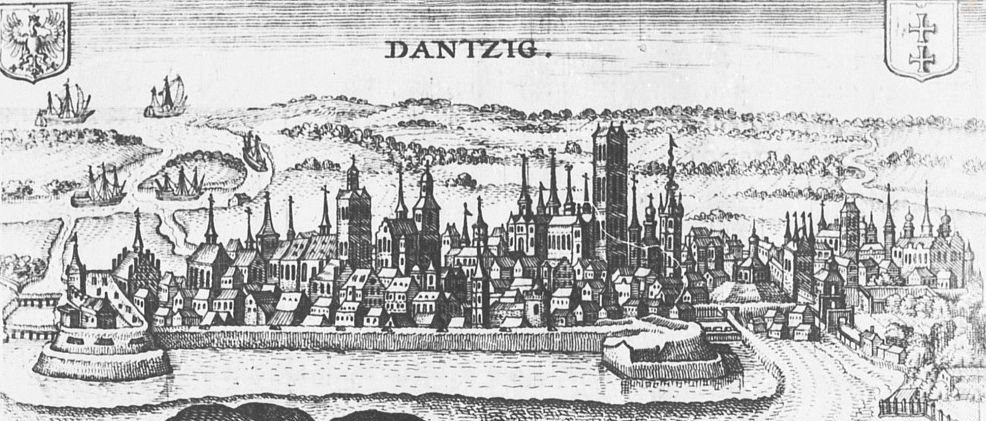
Danzig, 1628 AD
The Schenk and Voerknecht children grew up during the Eighty Years’ War (1568–1648), yet they managed to break into international trade regardless. The period of the Twelve Years’ Truce (1609–1621) provided favorable conditions: a brief phase of peace and armistice. Eastern Netherlands had eight garrison towns (including Bredevoort) that were in constant need of forage, particularly grain. This was not only for bread but also for the production of beer.
Wessel Schenk was a grain merchant and did good business in the Achterhoek during that period. He was also active in the trade route from Danzig to Genoa, Italy.5 His half-brother Salomon Voerknecht was likewise a very successful merchant.
Largest carriers from Amsterdam to the Mediterranean, 1590–1620:
Carriers
Total
Shipments
With a partner
Jasper Quinget
201
197
4
Jan and Philippo Calandrini
91
25
66
Guillelmo Bartolotti
66
42
24
Caspar van Ceulen
63
35
28
Isaac la Maire
56
42
14
Willem Willemss
49
48
1
Salomon Voerknecht
45
13
32
Wessel Schenck
30
25
5
Biographies of family members
Wessel Schenk
Born around 1566 in Aalten. In 1606, he lived on the Breestraat in Amsterdam. In archival documents, he is referred to as a “merchant lord.” Other sources indicate that he also regularly stayed in Danzig.
Upon its founding in 1602, Schenk was one of the largest shareholders of the Dutch East India Company (VOC). He also saw opportunities in the New World. Together with his nephew Jan Holscher, he invested in expeditions to New Netherland, in the northeast of the present-day US. In 1614, he was a co-founder of the New Netherland Company, the predecessor of the West India Company.6
In 1609, he included in his will that he would leave 4,000 guilders to the poor of his birthplace, Aalten. Because he was often traveling, he had a will drawn up in 1616, leaving his affairs in Amsterdam to his nephew Jan Holscher.
In 1619, Wessel, as a citizen of Danzig, contractually transferred the annual income from two Aalten farms (Lutke Grievinck and Goorhuis) by proxy to his sister’s daughter Gertruid Tols, widow of Johan Brunss.7 In 1632, he was back in Danzig and sold by proxy “a garden or courtyard with timber structures in two parcels” outside the Regulierspoort in Amsterdam. He must have died shortly thereafter, presumably unmarried.8
Gertruid Schenk
Born around 1565 in Aalten. Around 1584, she married Albert (?) Hengst van Juchteren in Anholt. After 1590, she remarried Henrick Toll. In 1600, she lived on the Nieuwe Zeedijk in Amsterdam. Gertruid was also active in the family business. In 1616, Gertruid and her brother Wessel received a letter of recommendation from the States-General addressed to the city council of Danzig—a sign that their commercial position was officially recognized. Gertruid passed away after 1628.9
Salomon Voerknecht
Born around 1568 in Aalten. In 1597, he married Jannetje Hooft in Amsterdam. She was a descendant of a prominent Amsterdam merchant family that produced one of the greatest Dutch writers of the Golden Age: Pieter Corneliszoon Hooft. Father-in-law Jan Pietersz Hooft was a brother of the mayor of Amsterdam, Cornelis Pietersz Hooft, and through this marriage, he also became the brother-in-law of the later mayor Volckert Overlander.
In 1618, Salomon, on his own behalf and as proxy for Judith and Hans Voerknecht, sold a piece of land, the Bullensche maat in Lintelo, to Roelof Damme and Catharina Smitz. In 1619, he sold—partly on behalf of his wife, and as proxy for his sister Judith, widow of De Marez, and brother Hans (“citizen of Danzig“)—their parental home in Aalten near the churchyard, including the courtyard and land, to Wessel Brethouwer and Mechteld Machtes.
In 1637, Salomon was a senior merchant in the service of the VOC in Batavia. He had gone from Danzig to the East Indies and remarried a widow there. On October 24, 1637, in Batavia, “weak in body but still sound of mind,” he recorded his last will and presumably died shortly thereafter. His eldest son Johan became the deputy bailiff of Amsterdam in 1656.10
Hans Voerknecht
Born around 1569 in Aalten. Hans Voerknecht (also called Schenk) was likewise active in trade. In 1605, he was mentioned as a merchant in Amsterdam, along with Salomon Voerknecht and Wessel Schenk. In 1608, he was in Danzig, and in 1619, he was even recorded as a citizen of that city. He presumably died there not long after.11
Judith Voerknecht
Born around 1569 in Aalten. Around 1585, she married Daniel de Marez, a merchant in Danzig. He is immortalized in an almost life-sized painting of the De Marez and De Schilder families. While in surrounding countries only monarchs had themselves immortalized in this manner, here powerful merchants displayed their status. In 1619, her brother Salomon sold the parental home in Aalten on her behalf (and that of other heirs).12
Anna Voerknecht
Born around 1571 in Aalten. Around 1590, she married the merchant Joost Grevinckhoff, also from Aalten. A deed from the court at Bredevoort from 1615 mentions that Seigneur Wessel Schenk sold a large number of lands and tenant farms on behalf of Joost and Anna, who were then residing in Königsberg. The deed concerns a debt settlement: Joost and Anna were deeply in debt, primarily to Anna’s brother, Seigneur Salomon Voerknecht, “citizen and merchant in Amsterdam” (Seigneur was the title of address for wealthy merchants at that time). Because they could not pay, they transferred their entire property in Aalten—including their house, land, and hereditary rights—to Salomon and his wife Joanna Hooft.13
Jan Holscher
Born around 1584 in Dülmen (near Münster). In 1601, he came to Amsterdam, where he entered the service of his uncle, the merchant Wessel Schenk. Although he managed his uncle’s business, he also traded independently. He held shares in a company that traded with Guyana. Together with his uncle, he also participated in the Hans Claesz Company. In 1613, Thijs Volckertsz Mossel sailed for this company to the Hudson River. In 1612, Jan Holscher married Elisabeth de Hardouin from Rouen in Amsterdam.14
The Capture of Bredevoort in 1572 was the conquest of the fortified town of Bredevoort by a Sea Beggar (Geuzen) army led by William van den Bergh during the Eighty Years’ War. The siege lasted from 9 June to 20 June and resulted in the successful seizure of the town by the besieging forces. This operation was part of William of Orange’s second invasion, aimed at opposing the ‘Spanish’ Army of Flanders.
During the Eighty Years’ War, Bredevoort was under Spanish authority. However, from the autumn of 1570, rumours circulated in the Achterhoek of an imminent attack by insurgents, known as the Geuzen. Until 1572, this remained merely a threat. Following the Capture of Brielle on 1 April 1572, Count William van den Bergh, the brother-in-law of William of Orange, assembled an army of approximately 5,000 men in Wesel. His objective was to undertake a campaign through the Achterhoek and along the IJssel. This campaign was marked by the plundering of churches and monasteries, among other targets.
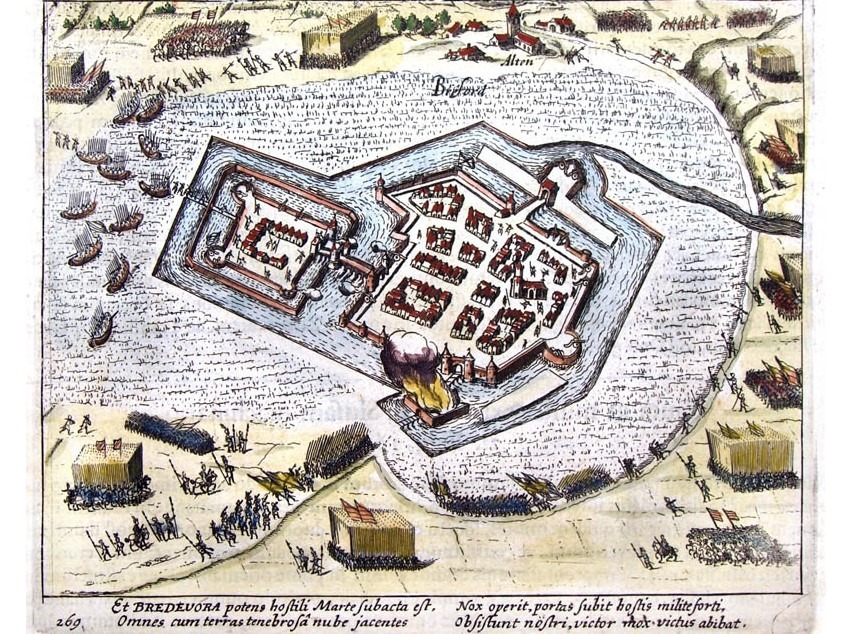
Fortress Bredevoort, etching by Willem Baudartius (1606)
Siege
On 9 June, a trumpeter appeared before the city gate to demand the town’s surrender on behalf of William of Orange. The choice was simple: swear an oath of allegiance to the Prince, or face battle. The demand was accompanied by harsh warnings; should they choose to fight, the town would face an assault in which neither property nor life would be spared. The Drost (Bailiff), Jasper van Broeckhuijsen, replied that they first wished to await the opinion of the pandheer (mortgage holder), Dirk van Bronkhorst-Batenburg.
Meanwhile, William van den Bergh captured the city of Zutphen the following day and sent letters to the towns that had not yet been conquered, inviting them to Zutphen to swear the oath to the Prince. The Bailiff of Bredevoort advised the citizens to go, but this advice was not followed.
Van Broeckhuijsen eventually managed to convince the pandheer in Anholt that Bredevoort was incapable of defending itself against such superior numbers. Van Broeckhuijsen then travelled to Zutphen to negotiate. On 19 June, a treaty was concluded in which the house, town, and lordship were surrendered to the Prince, though the pandheer would retain his rights.
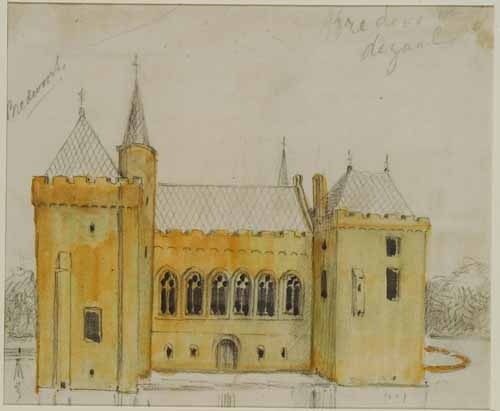
Bredevoort Castle, by Jacobus Craandijk
Capture
On 20 June, Bredevoort was captured and occupied by Gisbert van Heerde and his regiment of French troops. Jasper van Broeckhuijsen and all officials of the lordship were dismissed, and Jacob van der Capellen was subsequently installed as the new Bailiff. The remainder of the army advanced westward to capture Doetinchem. However, peace was short-lived.
In the meantime, Don Frederick was approaching with a large army for a punitive campaign, and by November, Bredevoort was once again a theatre of conflict. On 20 November, Jacob van Bronkhorst, son of the Lord of Anholt, retook the town for the pro-Spanish forces of the Duke of Alba and his son Don Frederick. A month later, the Geuzen plundered Bredevoort Castle, the Schaer Monastery, St George’s Church, and the St James’s Church in Winterswijk.
Following the Massacre of Zutphen, Van den Bergh fled to Germany, accompanied by the Geuzen who had been stationed in Bredevoort. They took five cannons and ammunition from the town. The pandheer Dirk van Bronkhorst-Batenburg now openly declared his Spanish sympathies. Bredevoort would remain under the Spanish flag until the siege of 1597 by Maurice of Nassau, the future Prince of Orange.
The fortified town of Bredevoort has a history dating back to (at least) the year 945. At that time, Bredevoort was nothing more than a passable crossing amidst a largely impenetrable swamp. It was, however, a very important passage, as Bredevoort was situated on the major trade route from Bocholt to Zutphen.
In the 13th and 14th centuries, Bredevoort developed further into an important fortified town. In 1350, Bredevoort was granted minting rights, and in 1388, it even officially received city rights, marking the first mention of the city of Bredevoort: ‘onse borch, huys ende stat tot Bredervoert‘ (our castle, house, and city at Bredevoort).
During the Eighty Years’ War (1568-1648), Bredevoort became involved in the fighting between the States and Spanish troops and was besieged and captured several times. After the siege by Maurice of Nassau (the later Prince of Orange) in 1597, a strong States garrison was stationed in the town. The bond with the Dutch Royal House has remained consistently strong over time. King Willem-Alexander still holds the official title ‘Lord of Bredevoort’.
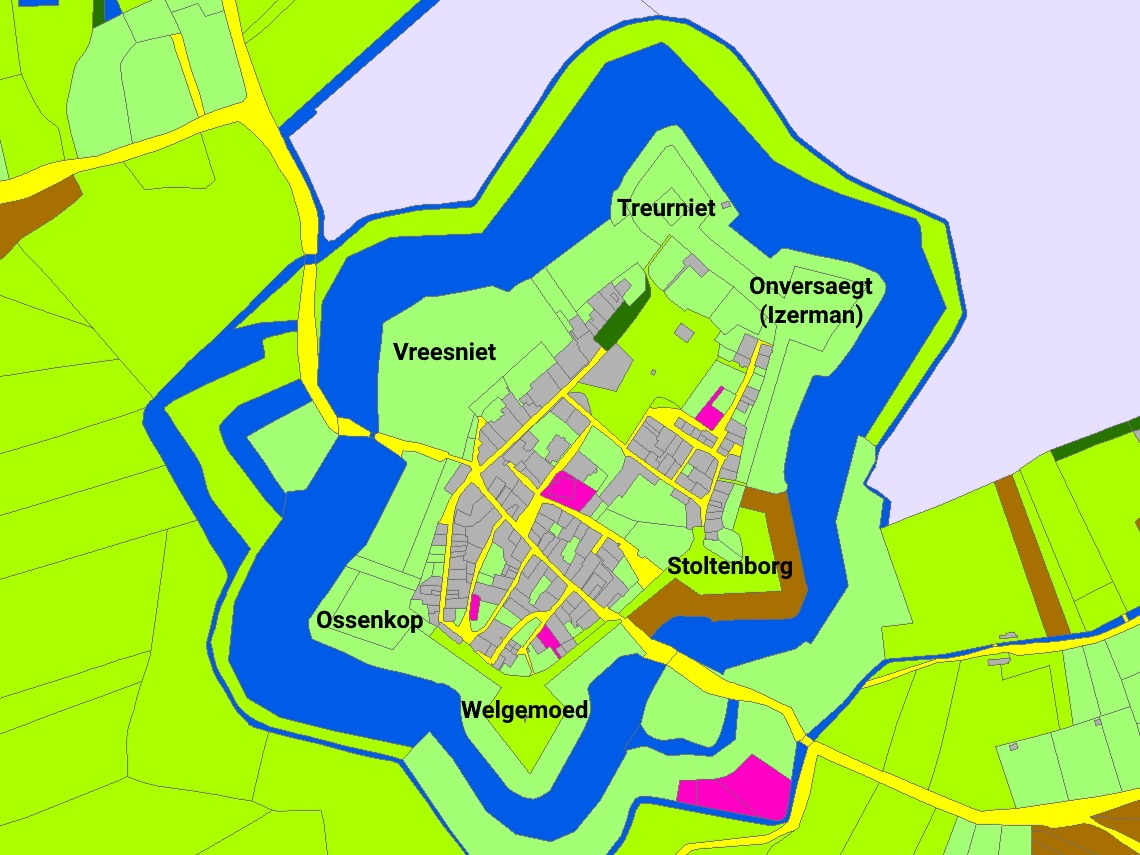
Bastions of Bredevoort, map: hisgis.nl
The garrison town of Bredevoort became part of the eastern line of defense, and plans were subsequently made to reinforce the city. The fortress was strengthened and enlarged; a wide moat was constructed around the six bastions: Vreesniet, Treurniet, Onversaegt, Stoltenborg, Welgemoed, and Ossenkop.
The remains of the fortifications on the north-western side of Bredevoort were designated as a National Monument in 1967 (numbers 6874 and 6875).
Historical Description
In 1938, G.H. Rots wrote a series of articles in the Aaltensche Courant regarding the history of the municipality of Aalten. He wrote the following about the Bredevoort fortress:
“The historian Sloet mentions that ‘Breitenfurt’ was already spoken of in 945. In old documents, one also reads of ‘Breitenfurt’, ‘Breyden-Oort’, ‘Bredevoorde’, or ‘Breevoort’. In daily conversation, it is still sometimes called ‘Brevoort’. The word itself indicates a connection of higher grounds over low grounds, water, marshes, etc. For all around Bredevoort was low land, full of reeds and rushes, which was passable during very dry summers, and even then only on the highest parts. And there, between those marshes, was a raised mound upon which the strong fortress ‘Breevoort’ was built in earlier times. In diameter, it was approximately 300 meters, or about 10,000 m2. But a great deal has transpired on that small spot over the centuries.”
In the year just mentioned, 945, the town had to pay eight ounces of silver annually to the monastery in Fulda. Because the fortress was surrounded by marshes, it was one of the strongest strongholds and nearly impossible to capture. There were two access roads: the ‘Aalterpoort‘ on the north-west side, roughly where the Roman Catholic school stands today. The road through the Koppele was only constructed in the last century. Before then, one always had to take the detour around the Koppele. In the east was the ‘Misterpoort‘. Some writers also refer to it as the ‘Münsterpoort’.
The Lordship of Bredevoort included the jurisdictions of Aalten, Winterswijk, and Dinxperlo and was originally the possession of the bishops of Utrecht. One of the bishops, named Godefroy van Rhenen, founded the castle at Bredevoort, which stood on the site where ‘t Zand is now located. To this castle or court belonged several manorial estates, including the Havezate de Pol near Aalten. Several contributions regarding this manorial system and related matters have appeared, including in Mr. J. A. Nijhof’s book ‘Bijdrage tot de Vaderlandsche Geschiedenis’ (Contribution to National History), and it is also discussed at length in B. Stegeman’s well-known book ‘Het kerspel Winterswijk’. Anyone wishing to know more should consult that book in the library of the Gebr. de Boer company.
In 1238, the Counts of Loon came into possession of the Lordship. One of those counts, Herman van Loon, transferred the property as a fief in 1246 to Otto van Nassau, Count of Gelre and Zutphen. In the Battle of Tekelenburg in 1276, Herman van Loon was victorious; he captured his opponent, Count Engelbert van der Mark, and took him to the castle at Bredevoort.
That Count van der Mark soon met his end there; he died of boredom and homesickness. His son, however, Everhard van der Mark, took revenge and captured Bredevoort in 1278, destroying the castle and subsequently transporting his father’s body to Kappenberg. Through the intervention of the Bishop of Münster, Everhard, a peace treaty was soon established between Count Everhard van der Mark and Herman van Loon, in which the Count of Loon pledged not to rebuild the castle until he had made a two-year journey to the Holy Land (the days of the Crusades).
A short time later, another transaction seems to have taken place, for in 1284 the owner was Baldewinn van Steinfurt, who sold half of the property—namely the northern part of the castle with the associated lands in Aalten—to Bishop Everhard of Münster. However, the lineage of the Counts of Loon became extinct at the beginning of the 14th century, and when the last descendant was carried to the grave, discord arose over the inheritance. The then Bishop of Münster, Ludwig, and Reinald of Gelre both laid claim to the inheritance of the Counts of Loon. It even came to fighting, and both aforementioned potentates brought their armies into battle array, fighting each other to the death.
Reinald of Gelre had his sights set on Bredevoort, and in 1326, he entered the fortress victoriously. Peace was signed at Coesfeld, and by that peace treaty, Bredevoort became the property of Reinald of Gelre. In 1388, the Lordship was transferred as a pledge to Hendrik van Gemen, who had to pay the sum of 3,000 French shields, which was approximately 6,300 guilders in Dutch currency.
Later, with the consent of the States of Gelderland, the pledge was transferred to Jacob van Bronkhorst, Lord of Anholt. Finally, in 1580, the Lordship was transferred as a pledge to Prince William I. His successors continued this possession in the same manner. Finally, in 1732, upon the division of the inheritance of William III between the King of Prussia and William Charles Henry Friso, the Lordship of Bredevoort was awarded to the latter. It then formed part of the domains of the House of Orange-Nassau under the management of a steward, who reported annually to the Prince’s councilors and auditors.
The Prince appointed a drossaard (bailiff), as well as a judge with their deputies. A stadtholder, land scribe, and advocate-fiscal were also appointed. Every fortnight, a court day for civil matters was held in the Lordship for the four jurisdictions mentioned above. The courts consisted of the drossaard or his deputy, the land scribe or secretary, and two assessors or ‘keurnooten’. Furthermore, the government of the city of Bredevoort rested with two mayors.
As we have already noted, Bredevoort was a strong fortress due to its natural location. In addition to the castle, there were very good bastions. (A ‘gabion book’ of the former fortress is still kept in the State Archives depot in Arnhem. Anyone wishing to know more details should go and browse there).
While Bredevoort was a strong fortress due to its natural location, it was not a walled fortress until 1545. The well-known and famous commander Maarten van Rossum ensured that the fortress was further reinforced. Around the aforementioned year, he had the moat dug and a rampart constructed. The portion of the moat that still exists was therefore dug nearly 400 years ago. It must have been incredibly busy around the fortress. A few years ago, to combat unemployment, a large part of the moat was filled in with soil from the raised ramparts. A small piece of the rampart has been preserved as a historical site.
Inside the gates, the situation was also different than it is today. There were narrow streets and alleys. In the cellars of many houses, there were escape or shelter tunnels. During the demolition of an old cellar a few years ago, such a shelter tunnel was revealed. It is also claimed that there was an underground passage from ‘t Walfort Castle to Bredevoort. During previous excavations at ‘t Zand, such a passage is said to have been discovered. However, people did not dare to venture far into it due to the foul or toxic air present. It would be worthwhile to pay attention to this when digging sewers. That there were underground shelters is certain, but we doubt the existence of a connecting road as mentioned above.
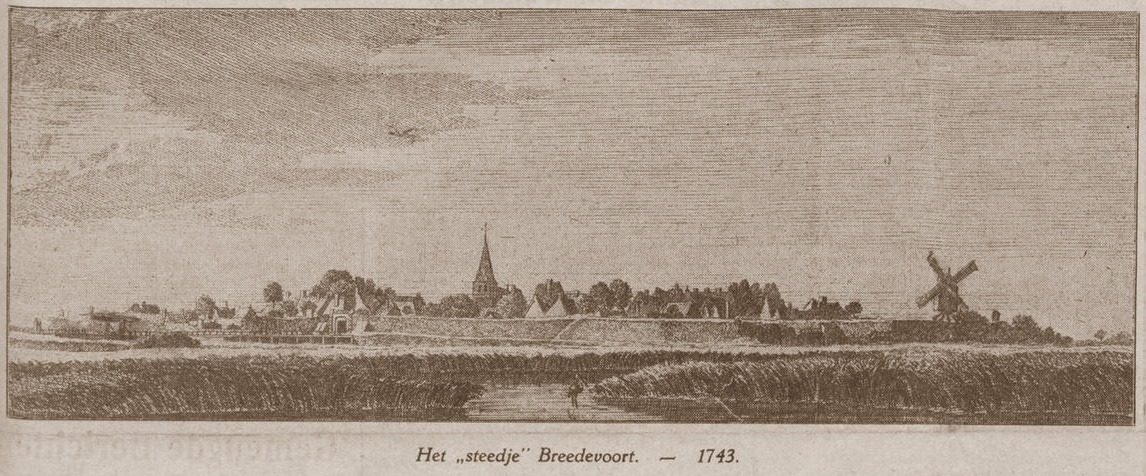
Illustration by Jan de Beijer from 1743, featuring the Ossenkop bastion in the foreground and the Aalterpoort to its left
The noise of war and military activity echoed within the fortress for centuries. Even into the 18th century, three companies of infantry were garrisoned in Bredevoort under the command of a commander, who had a major under him. Especially during the Eighty Years’ War, things were intense in and around Bredevoort. In the late sixteenth century, the Spanish held the fortress. On the first of October 1597, Prince Maurice arrived before Bredevoort with his army. He summoned the garrison, which consisted of only two banners of infantry, to surrender. But they replied that they would keep their weapons for God and the King until their final breath. The Spanish relied on the natural strength of the fortress. Prince Maurice then laid siege to Bredevoort.
As mentioned, there were two access dikes to Bredevoort, but Prince Maurice had a third access road constructed through the Koppele. That road through the marsh was made with sand and brushwood. The sand was brought in bags by the soldiers. In just 8 days, that road, 500 paces in length, was completed. It was then possible to take a height across the moat, suitable for placing 20 pieces of artillery. A murderous fire was then opened upon the fortress. But the besieged defended themselves bravely, and many attackers were killed.
The fortress walls suffered greatly from the cannon fire, and several cracks and breaches had already appeared, yet the garrison still did not surrender. The moat was an obstacle to bringing troops to the front of the ramparts and walls. But Prince Maurice was resourceful, and he had his men build a floating bridge, a kind of cork or rush bridge. This was placed in the moat, providing access to the rampart and creating two points of attack. Count Solms led that attack on the eastern side, from the direction of the Broek. But the resistance was not yet broken. The besieged returned the enemy fire with cannon and muskets. The besiegers were also pelted with stones, and many stormers bit the dust. But it could not last much longer; the attacks became increasingly fierce until finally, a drummer from the city appeared on the wall and gave a signal that they wished to negotiate. But an enemy bullet struck him, and the drummer, who came with peaceful intentions, was killed by a bullet.
The inhabitants of the fortress renewed the attempt to negotiate. They held up sticks with hats, but the besiegers paid no attention to this. Then the women went onto the ramparts to testify to the will to surrender. It is incomprehensible that the besiegers still paid no heed to this. Did they fear a trap, or was it the cruelty of that era that demanded blood? In any case, Maurice’s sailors stormed the stone bastion, entered the fortress, and immediately killed 70 people. The survivors fled to the castle, which was immediately surrendered unconditionally by treaty on October 9th. Prince Maurice spared the lives of all, but stipulated a sum of money for his troops, which was later waived.
Except for the castle and 20 houses, all buildings, including the church, had burned down. The Spanish commander Domiaan Gardot was granted mercy, although he was initially to be executed. During the Spanish occupation, this Gardot had made himself hated by the citizenry.
Prince Maurice, who had entered the gates of Bredevoort victoriously, stayed in Bredevoort for only a few days. He moved further north. A few months earlier, he had taken Groenlo, and now he went via Groenlo to the Overijssel region to make conquests there. Bredevoort kept a small garrison, and the population worked with all their might to rebuild the burned houses. But hardly had the building begun when fire broke out again, and of the approximately 20 houses that had been spared during the siege, 14 burned down, leaving only 6 houses.
There was bitter suffering then. The church had to be rebuilt, but the means were lacking, and letters of appeal were sent to sister congregations for support. However, they did not lose heart. They began rebuilding the church and the burned houses, and gradually the town had habitable houses again. But it was and remained wartime, and dangers threatened from all sides.
In 1606, the Spanish appeared before the city again. It was Shrove Tuesday, and people wanted to celebrate in the city. The soldiers, in particular, were out on the town. There was celebration and merriment, and the soldiers drank heavily. And while they were having fun, the enemy crept up. The Spanish commander Du Terrail arrived quietly from Oldenzaal with 1,200 men and appeared before the city gates in the evening. The guard was on duty, and they were told that the newcomers were soldiers of Prince Maurice being pursued by the Spanish. They lied to the guard and even claimed they had captured a Spanish lieutenant. They requested permission to stay under the protection of the fortress. The guard sent a message to headquarters, and while deliberations were taking place there, it was realized they had been deceived. The population was already fleeing to the castle, and the Spanish were already storming the gates, blowing them up, and before anyone fully realized what was happening, the enemy army was already entering the town.
The Shrove Tuesday joy was cruelly disrupted. The Spanish soldiers killed everyone they encountered, including many women. The minister’s wife also fell victim to the killers. The castle, however, offered a safe refuge for the citizens and soldiers who had fled there. The bridge over the moat surrounding the castle was destroyed, making it temporarily safe within the thick walls. The Spanish were fired upon from the castle, and help also arrived from outside. Count Henry of Nassau appeared with an army from Zutphen and other fortresses, and on March 22nd, the Spanish were forced to surrender. The Spanish commander Du Terrail negotiated a free retreat, which was granted to him provided he returned the booty and prisoners that had already been transported to Oldenzaal. The Spanish did not show themselves again, and the worst suffering was over.
The year 1646 was another year of disaster for Bredevoort. It was July 12th, and an oppressive heat hung over the city. Dark clouds gathered, and everything indicated that a heavy thunderstorm was imminent. And indeed, lightning soon cleaved the sky, followed by heavy claps of thunder. And suddenly, a tremendous blast, followed by a terrible sound. Lightning had struck the gunpowder tower, causing the stored gunpowder (320 tons) to explode. The entire tower was blown apart, as was the nearby Administrative House (Ambthuis); tiles were ripped off almost all houses, and windows were blown in by the air pressure. The number of deaths in that disaster was 19 at the castle and the Administrative House alone. There were also numerous deaths in other houses in the city.
The year was 1672. War had broken out with the Bishop of Münster and Cologne, England, and France. The general-watchmaster of the Bishop of Münster crossed the borders with 2,000 men and laid siege to Bredevoort. The garrison consisted of 500 men, and 20 pieces of artillery stood on the ramparts. In the warehouse was a stock of 20 lasts of rye and 1,800 barrels of gunpowder. The commander of the garrison, Adriaan van Keppel, had repeatedly asked the Deputies of the County of Zutphen for reinforcements of supplies, but in vain. From June 13th to 18th, the fortress was bombarded. The garrison began to mutiny. The women in the city also began to grumble. Rumors spread that the Prince of Orange had been defeated with his army. Fear took hold of the garrison, and on June 18th, the city surrendered, although according to experts, this had not been necessary. The garrison marched away, and fortunately, no looting occurred.”
Bredevoort Castle, 3D impression by Paul van Druten
Bredevoort Castle was a fortress in the heart of the eponymous town and former Lordship of Bredevoort in the County of Zutphen within the Duchy of Guelders. It was one of the most significant castles in Gelderland. During the 13th and 14th centuries, Bredevoort Castle played a major role in the struggle between Guelders and Münsterland.
The castle was first mentioned in 1188 on a list of properties belonging to the Diocese of Cologne as “Castrum Breidervort“. At that time, the castle was a site of contention. Consequently, it had multiple owners, leading to a centuries-long struggle for control. In 1238, the castle came into the hands of Ludolf van Steinfurt and Herman van Lohn as a shared inheritance. The castle was to be fortified, with both parties sharing the costs. In 1278, the fortress was destroyed by Count Everhard I von der Mark during an act of revenge. Following this, the castle remained a ruin for 23 years. A deed of sale from 1284 refers to the “area castri Bredevort”.
After years of conflict over Bredevoort between Münster and Guelders, the castle eventually returned to the hands of Count Herman van Lohn II in 1301. In that year, the bishops of Münster and Cologne pledged to assist Herman van Lohn with the restoration of the fortress. In the turbulent times that followed, the fortress frequently changed hands between Münster and Guelders through combat or sale. The bishops of Münster and Cologne were required to jointly fund the reconstruction of Bredevoort Castle.
After centuries of fighting over the castle, the Bishop of Münster abandoned the struggle and sought peace negotiations. Following years of negotiation, peace was finally signed on June 28, 1326, with the Treaty of Wesel. This significant treaty was also signed by the cities of Zutphen, Groenlo, Emmerich, and Arnhem. As a result, Reinoud II of Guelders acquired the pledge of the jurisdictions in Winterswijk, Aalten, and Dinxperlo, as well as the County of Bredevoort. This move definitively incorporated the area into Gelderland.
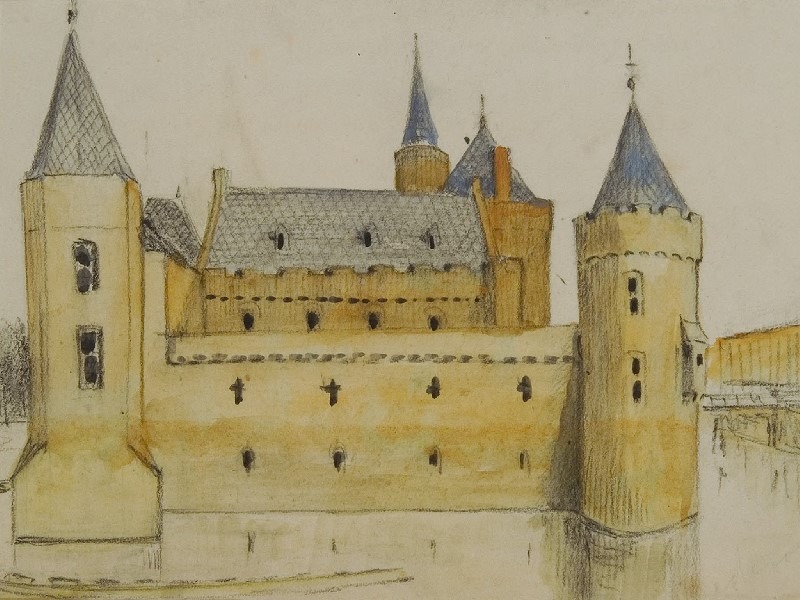
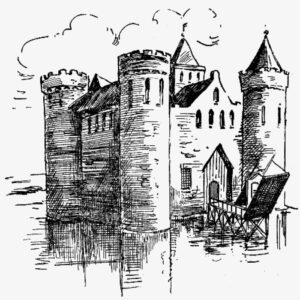
In 1882, J. Craandijk produced two drawings intended to represent Bredevoort Castle. Whether these are accurate, however, remains a matter of debate. Bredevoort Castle, ‘the Hall’
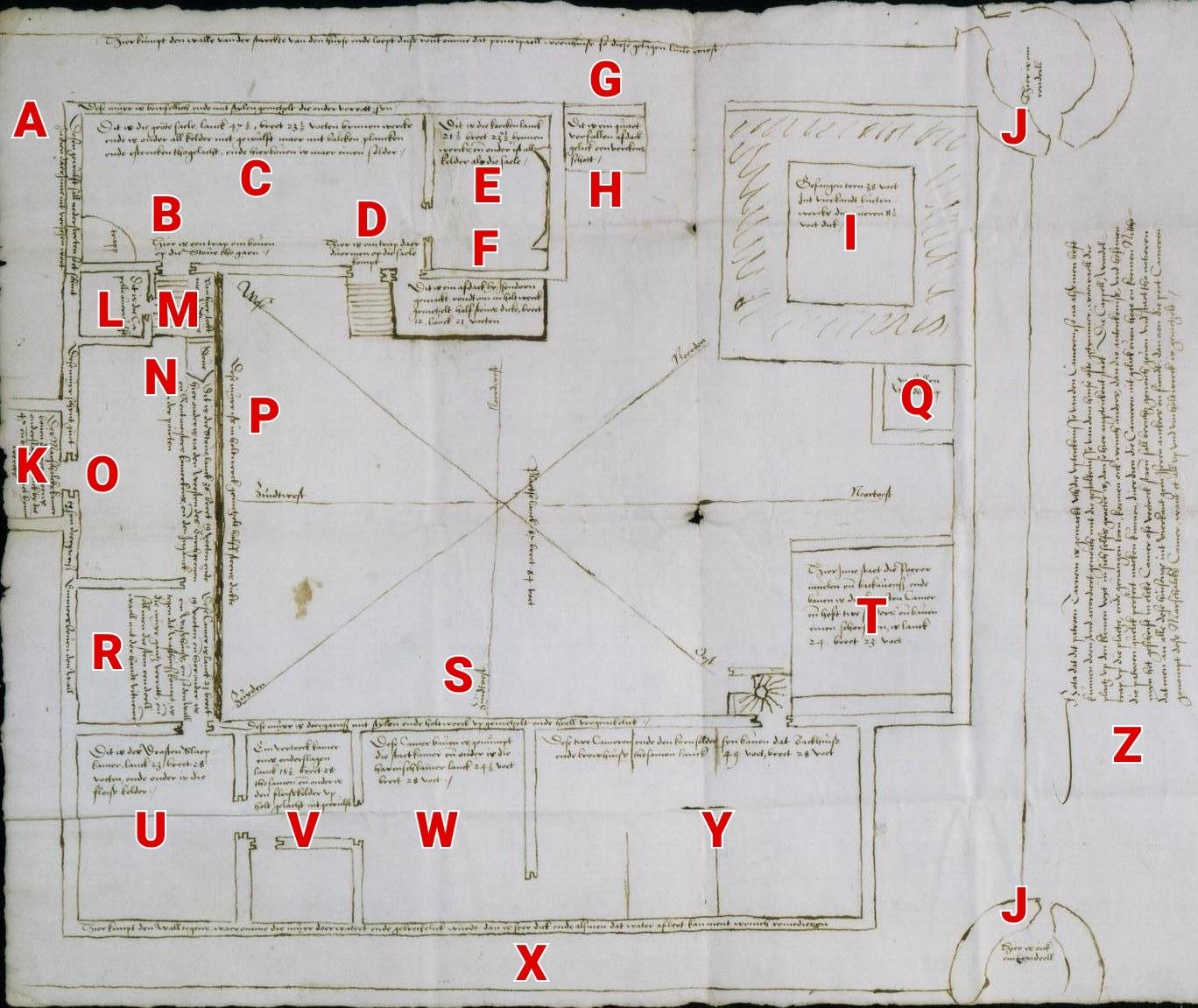
Floor plan
In 1562, the lord of the manor of Bredevoort, Diederik van Bronckhorst-Batenburg, Lord of Anholt, commissioned a floor plan of the castle at Bredevoort. This plan also described the functions and structural condition of the various components. Measurements were recorded in Rhineland feet. A Rhineland foot is over 31 cm long. The castle was a rectangle measuring 42 m long and 36 m wide. The walls were approximately 65 cm thick. An earthen rampart surrounded the castle, with roundels at the corners. The rampart was approximately 2 m wide.
Floor plan of Bredevoort Castle, 1562
Explanations of the descriptions on the floor plan (translated from old script):
This vault will collapse if it is not repaired soon.
Here is the staircase leading to the knights’ hall.
This wall is dilapidated. The vertical beams are rotted at the bottom. This is a large hall: 47 feet long and 23 feet wide, measured from the inside. Beneath it is a cellar. The floor consists of beams and planks and is finished with floor tiles. There is only one attic above the hall.
This is a staircase to enter the large hall.
This is the kitchen, 21 feet long and 23 feet wide. Beneath it is a cellar of the same size as the cellar under the large hall.
This shed was built by Drost Isendoorn. The walls are masonry set between beams.
This is the rampart that runs around the castle.
This is a very dilapidated shed, much like a pigsty.
The prison tower. It is 38 feet square (measured from the outside). The walls are 8½ feet thick. [This tower was likely used later as a powder tower, Ed.]
Here are two roundels.
The Drost’s chamber (Maarschalcksekamer) above the gate. [The name ‘Maarschalckse kamer’ dates from the period 1534-1555 when Marshal Maarten van Rossum was Drost of Bredevoort, Ed.]
This is the chapel.
From here, the hearth of the knights’ hall is stoked.
This is the knights’ hall. The room is 36 feet long and 19 feet wide. Below this are the rooms of the burgrave (castle warden) and the steward. The gate entrance is also located below here.
This wall is in good condition, as far as it can be seen above the rampart.
This wall is built between wooden beams and has a thickness of half a brick. [The bricks used were ‘kloostermoppen’ of approximately 14 cm in width, Ed.]
A dilapidated spiral staircase.
Another room. Below this is a laundry room. Because the rampart rests against the laundry room, the wall is rotted. The stones are loose.
This wall is largely built between wooden beams and is very dilapidated.
This contains the grain mill and the baking ovens. Above is the servant’s room, with two attics and a chimney.
This is where the Drost sleeps. The room is 28 feet long and 23 feet wide. Beneath it is a meat cellar.
This room is divided in two. The floor is made of wood. The meat cellar also lies beneath this area.
This upper room is called the salon (state room, armory). Below it is the armor room.
Here the rampart touches the wall, causing the wall to let in moisture and show defects. The wall is very thick, and if the water could be kept out, it would likely provide some improvement.
These two rooms, as well as the granary, are located above the bakehouse and brewhouse.
This drawing was made in Arnhem after everything was measured as accurately as possible. The drawing is fairly accurate. However, in reality, some parts are slightly larger than depicted here, such as the chapel, the spiral staircase in the courtyard, and the prison tower.
Not much is known about exactly how Bredevoort Castle looked. While drawings of the castle exist, they are partly based on assumptions and imagination.
The castle was built on a sandy ridge of approximately 42 x 26 meters, making it one of the larger castles in the Netherlands. Old maps show the main fortress to be a typical concentric castle, featuring double moats and a thick curtain wall. It included an outer bailey with heavy corner towers and a rectangular castle wall equipped with four corner towers, three of which were later lowered to become roundels.
The castle and the town were separated by a double moat. Access to the castle from the town was via a bridge. One had to pass through two gates, the second of which was equipped with a barbican, and finally a gatehouse in the curtain wall before reaching the inner courtyard. Within the fortress, various buildings stood around a spacious inner court. These depictions changed over time, and the appearance and stature of the castle would have been altered frequently throughout the centuries due to conflict, war, city fires, and other causes.
Destroyed
The castle was heavily damaged by the Gunpowder Tower Disaster in 1646. Following this, the castle dominated the cityscape as a ruin for over 150 years until around the end of the 18th century. The last known mention of a visible ruin dates to 1791, recorded in the Bredevoort church council minutes when William V viewed the remains during his visit to Bredevoort. The main building (excluding the outer bailey, roundels, and curtain wall) had dimensions of approximately 42 x 36 meters. This made it one of the larger castles in the Netherlands.
Bredevoort Castle in 1597
Remains
Today, the remains of the castle—in the form of foundations, vaults, tunnels, and rubble—lie beneath and around the ‘t Zand square and the Hozenstraat in the heart of the town. In the spring of 2009, during archaeological research around the former school on ‘t Zand, part of the foundations was uncovered. Wall remains between 2.5 and 4 meters thick were found. On ‘t Zand square, foundations of the barbican were discovered. The contours of this gatehouse have been made visible in the paving with brass-colored bands.
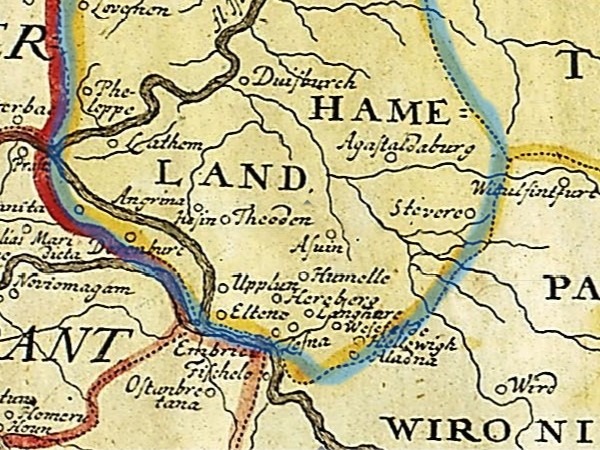
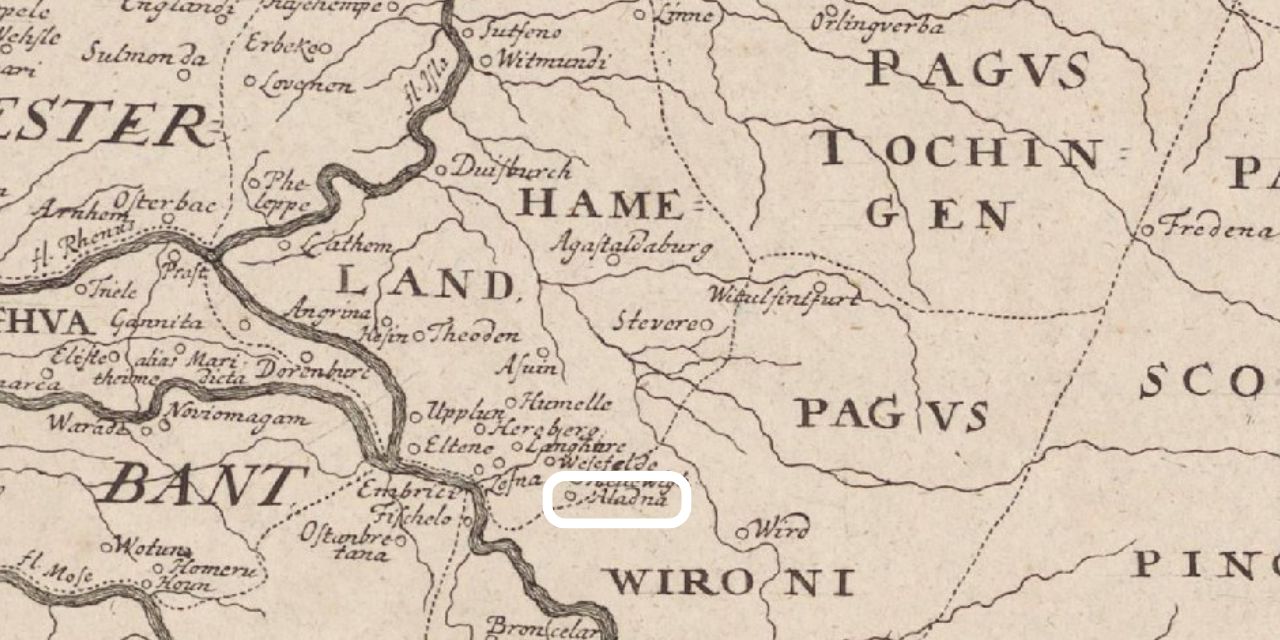
Historical sources reveal that Aalten was mentioned in 1152 as the parish of Aladon1. This indicates that a church existed at that time, which was presumably located on the same site as the current Old Helenakerk. A mention from 828 (Aladna)2 is not undisputed, although such an early dating for Aalten is certainly possible from an archaeological perspective. Indeed, traces of human habitation from that period have been found both at De Hoven and on the Damstraat.
Burial Ground
In the late 19th and early 20th centuries, a large number of objects were collected during excavation work on Damstraat. Among the finds are 15 pots of widely varying shapes, some of which are beautifully decorated.
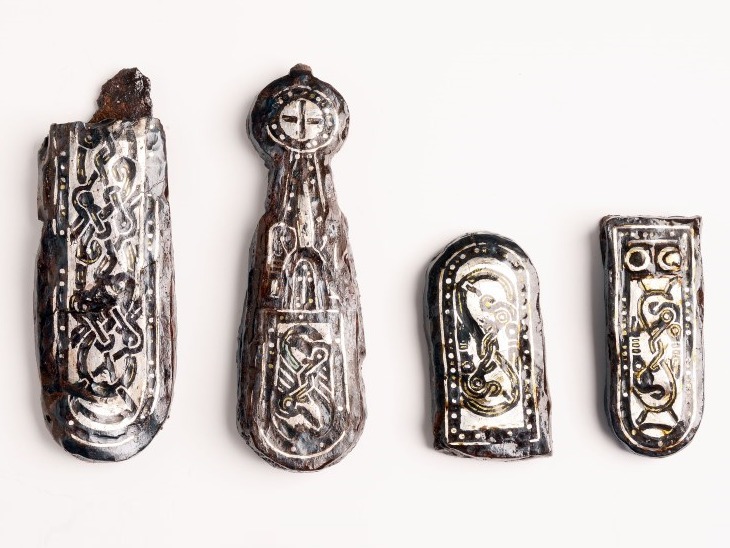
In 1932, under the direction of Professor A.E. van Giffen, a burial ground was uncovered in Aalten behind the Manschot factory, now Manschotplein. Spearheads, stirrups, a shield boss, several small pots, and ten silver links from a belt were found.3 It is not unlikely that these finds originate from the grave of a single warrior.
Part of the Damstraat was likely a Merovingian-Frankish burial ground around the year 800. The Merovingians were a dynasty of Frankish kings. The site has been heavily disturbed by house construction.
Belt fitting, found at Damstraat in Aalten
Medieval Cellar
Naturally, a burial ground is associated with a settlement. You will understand that we were very curious about where this settlement was located. In recent decades, a working group from the archaeological society A.D.W. has closely monitored excavation and construction activities in and around the current center of Aalten. In 1981, this resulted in the discovery of a cellar from the 12th century. The find was made in the renovated premises of what was then the Welkamp company (Bredevoortsestraatweg 5). No remains were found of the farmhouse of which the cellar was a part. However, the cellar itself yielded a wealth of information.
Because the cellar had been destroyed by fire, all objects present at the time of the fire were recovered within it. A total of six pots were found which, given their size, must have been used as storage jars. Unfortunately, five of the six pots were broken. A handle from a saucepan, in the shape of an animal head, was also found. Iron slag and a piece of lime indicate a smithy in the vicinity. It is possible that two hinges found were manufactured in this smithy.
Bone remains showed that horses, sheep or goats, cattle, and pigs were kept. Charred grain remains of oats, wheat, and rye were found in a soil sample. With this find, the mention from 1152 was archaeologically confirmed. Several imported shards from Germany point to a dating in the second quarter of the 12th century.4
Settlement
Although this find was important in itself, no traces had yet been found of the older settlement associated with the burial ground. However, during the redevelopment of De Hoven in December 1982, traces of a Frankish-Merovingian settlement were discovered. The remains of a sunken hut from the 9th century5 are an indication that Aalten already existed at that time, albeit under a different name.
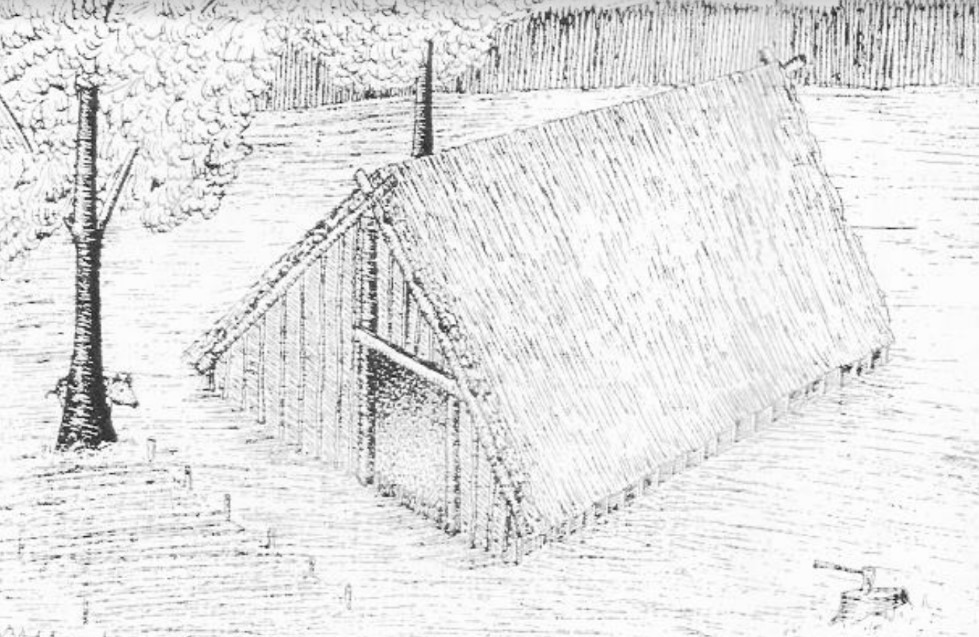
A sunken hut should be imagined as a rectangular pit topped by a gable roof. Usually, these sunken huts had a craft function (e.g., a weaving hut) or a storage function. Only the larger ones were possibly also used as dwellings.
This is what the Aalten hut bowl could have looked like (sketch made by Willem Doodeheefver)
After the sunken hut was abandoned, the pit was used as a refuse pit. A large number of bones from the same livestock as in the cellar find were discovered here. The discovery of bone remains from a deer indicates a minor role for hunting. Furthermore, charred grains and seeds such as barley, rye, emmer wheat (a prehistoric grain type), oats, lentils (possibly peas or vetch), pale-yellow hemp-nettle, goosefoot, and sheep’s sorrel were found.
From the fact that pottery types found in the sunken hut also occur in the burial ground, we may conclude that both are contemporaneous. It is therefore not far-fetched to assume that the people who lived at De Hoven buried their dead at the current Damstraat.
Second Find
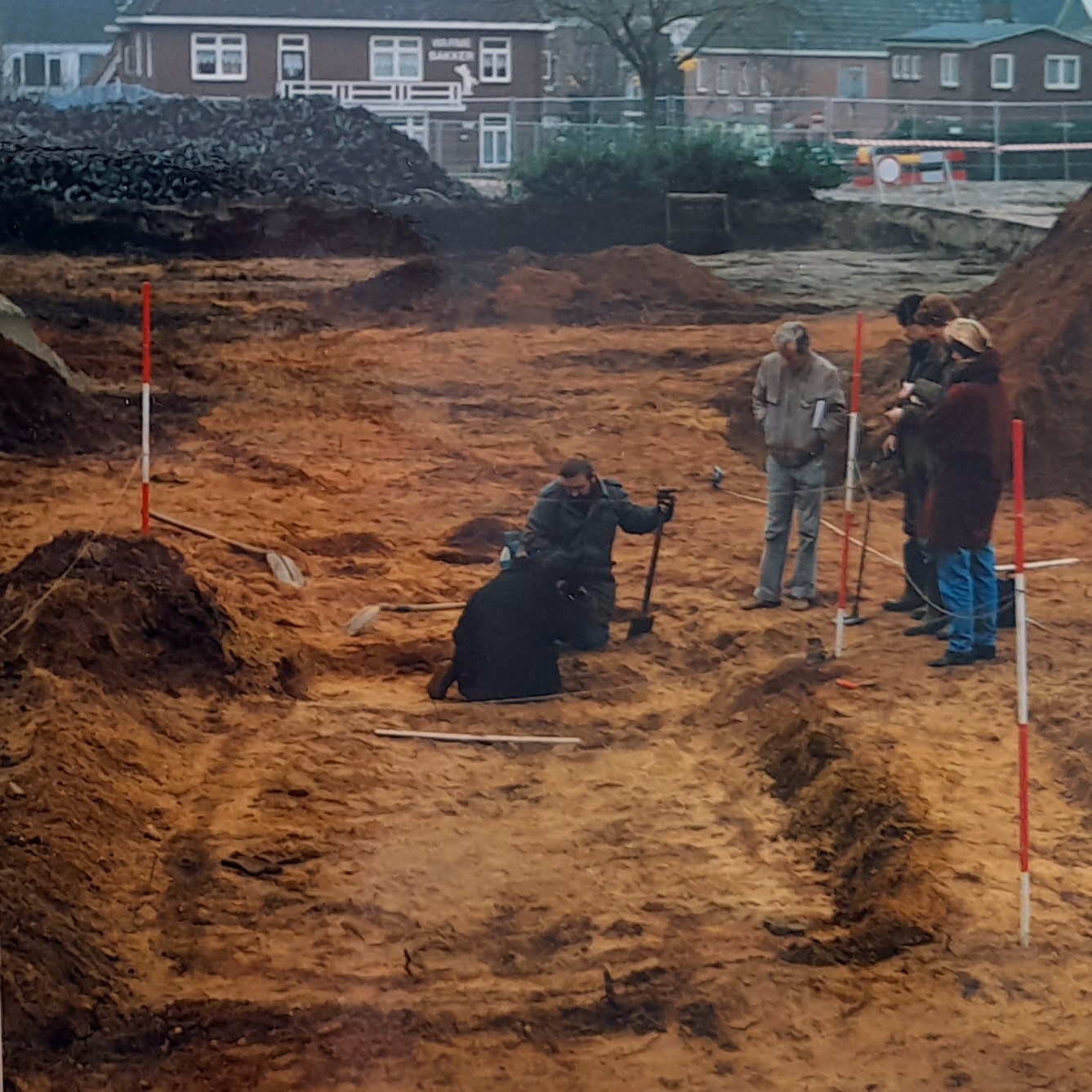
In December 1992, during work at De Hoven, not far from the previous site, remains of a sunken hut were found again, this time probably dating from the 8th century. This sunken hut was found on the grounds of De Hoven where road builder Jaartsveld was carrying out excavation work for the construction of a new parking lot.6
This sunken hut was quite small and had almost certainly been the workshop of a weaver. A groove on the side of the pattern found indicated where the loom had stood. Spindle whorls and clay balls that served as weights for the loom were also found. The sunken hut was smaller than the one discovered in 1982. That one may have been a hut where a family lived.
Archaeological research at De Hoven, 1992. Photo: Peter Rhebergen
Willem Doodeheefver, one of the amateur archaeologists involved in the research, told a reporter:
“You know it is an area in the vicinity of which something has been found before. You could see it very clearly during the excavation. Suddenly, in the red sand, the black imprints became visible where posts used to stand. That is always a huge surprise.”
The National Service for Archaeological Heritage (ROB) recognized the importance of the finds and asked the Soil Research Working Group of the Archaeological Society A.D.W. to continue the investigation. An employee of Jaartsveld specifically returned from vacation to further excavate the site using a loader. Several new finds were made during this process. Many of the aforementioned finds can be viewed in the museum on the Markt.
Origin of the place name
Several theories circulate regarding the origin of the name Aalten. But what are they based on and how credible are they? Old Aalten delved into history to discover more about this.
From historical sources, we know that Aalten was mentioned in 1152 as the parish of Aladon.1 However, there are indications that the village may have been mentioned much earlier, namely as Aladna in a charter from 828.2 Whether this mention actually refers to the current Aalten is still a subject of discussion. Nevertheless, archaeologists consider such an early dating certainly possible. Indeed, traces of human habitation from that time have been found both at De Hoven and on Damstraat.3 In this article, we delve into this ancient mention and examine two different theories.
The deed of gift of Geroward
The charter from 828 describes how, on February 7 of that year, a certain Geroward donated all his possessions, including those in Aladna, to the St. Martin’s Church in ‘Traiectum Veteri’ (Utrecht). Little is known about Geroward’s identity, but he must have been a man of standing. He was presumably a Frankish nobleman in the service of the Carolingian Emperor Louis the Pious, son of Charlemagne.
The original charter has not been preserved. What we know about it comes from later copies and transcriptions. The most important source is the ‘Cartulary of Radboud’, compiled in the Abbey of Egmond in the 12th or 13th century. This register contains copies of charters related to the Diocese of Utrecht. Later, this collection was included in the ‘Oorkondenboek van het Sticht Utrecht tot 1301’, compiled by S. Muller Fz. and H.T. Obreen.
Below are the Latin text and the English translation of the charter in question.
Source text
Dum unusquisque presens seculum inhabitat, necessitate nimia cogitur, ut finem suum Dei solo judicio previdere et preoccupare bonis operibus studeat, ne eum inopinata et improvisa mors inveniat.
Idcirco ego Gerouuardus, filius Landuuardi, trado ad ecclesiam sancti Martini, in Traiecto Veteri constituta[m], quicquid mihi hereditatis jure accessit in villa Langhara et in Ellenuuih et in Aladna et in Uuazefelde et in Humelle et in Theodon et in Hesim et in Asnon, cum omnibus adjacentiis, pratis, pascuis, silvis, aquis aquarumve decursibus, necnon et mancipia, quorum hec existunt vocabula: Feginuuard et uxor ejus Liutburn, Meginrauan et uxor ejus Vuerinhild, Albuuard et mater ejus Sigiuuih, Uulfbald et Hadagrim, Grimbald et uxor ejus Adaluuih, Garoberd et uxor ejus Folcuuihc, Arnolf et uxor ejus Adalgard, Saxani et uxor ejus Harduuih Vuerinbald et mater ejus Gerild, Heiegbrath et uxor ejus Meginfrid, Vuarbald et uxor ejus Geruuih, Adalgod et Marcuui, Saxini et Radini, Vulfini et uxor ejus Liuduuar, Odilgard et filius ejus Heriman, Aldric et filius ejus Landric, Gelo et Marcrad, Hungrim et uxor ejus Liuduuih, Aluuih et Seolo, Egbald et Tadhild.
Acta est autem publice in villa Embrici, anno XV imperii domni Hludouuici imperatoris, incarnationis vero Dominice anno DCCCXXVIII, die VII Idus Februarii, coram testibus, qui hanc traditionem presentialiter confirmatam viderunt similiter et vestituram, quorum nomina subter notantur.
Ego Geraccarus jubente domno meo Friderico episcopo scripsi et subscripsi.
Translation
While every man dwells in this earthly life, he is driven by a great necessity to foresee his end only through God’s judgment and to prepare for it through good works, lest death overtake him unexpectedly and unprepared.
Therefore, I, Geroward, son of Landward, transfer to the church of Saint Martin, located in Old Traiectum, everything that has come to me by hereditary right in the villages of Langhara, Ellenwih, Aladna, Wazefelde, Humelle, Theodon, Hesim, and Asnon, with all associated lands, meadows, pastures, forests, waters, and watercourses.
Likewise, I transfer the serfs, whose names are as follows: Feginward and his wife Liutburn, Meginravan and his wife Werinhild, Albward and his mother Sigiwih, Wulfbald and Hadagrim, Grimbald and his wife Adalwih, Garoberd and his wife Folcwih, Arnolf and his wife Adalgard, Saxani and his wife Hardwih, Werinbald and his mother Gerild, Heiegbrath and his wife Meginfrid, Warbald and his wife Gerwih, Adalgod and Marcwi, Saxini and Radini, Wulfini and his wife Liudwar, Odilgard and her daughter Heriman, Aldric and his son Landric, Gelo and Marcrad, Hungrim and his wife Liudwih, Alwih and Seolo, Egbald and Tadhild.
This transfer took place publicly in the settlement of Embrici, in the fifteenth year of the reign of Emperor Louis(Hludowicus), and in the year 828 after the incarnation of our Lord, on February 7, in the presence of witnesses who confirmed this transfer and the associated settlement. Their names are listed below.
I, Geraccarus, have written and signed this by order of my lord, Bishop Frederick.
Where was ‘Aladna’ located?
There are two theories regarding the exact location of the places mentioned in the charter:
The Hamaland theory: According to this view, Geroward’s possessions were located in the area that would later become known as the Carolingian county of Hamaland. The place names mentioned in the deed are linked by historians to contemporary locations in the Liemers and the Achterhoek. Within this theory, ‘Aladna’ is identified as the current Aalten.
The North French theory: Another interpretation suggests that the mentioned places were not in the Netherlands, but in Northern France. In this scenario, Aladna would refer to the current Alette, a place in the Pas-de-Calais department. The other place names from the charter would also be located in this area.4
Interpretations of the place names in both theories:
In the eastern regions of the Netherlands, however, it is assumed that the Hamaland theory is the most likely. It is not without reason that the municipality of Aalten named a road after this mention: the Aladnaweg. And in the municipality of Montferland, a street is named after Geroward: the Gerwardstraat in Klein-Azewijn. The theory is centuries old: around 1730, Johann Friedrich Falken created a historical map of ‘the Netherlands in late Roman times’, on which he drew the county of Hamaland, including Aladna.
Map of the former county of Hamaland in late Roman times, created by Johann Friedrich Falken, ca. 1730 5
Conclusion
The mention of Aladna in 828 remains an interesting subject of discussion. Many people consider the Hamaland theory to be the most likely explanation (or is that perhaps mainly wishful thinking?), but the North French interpretation cannot be entirely ruled out. Hopefully, future archaeological and historical research can provide more clarity regarding this early mention.
Origin of the place name
Several theories circulate regarding the origin of the name Aalten. But what are they based on and how credible are they? Old Aalten delved into history to discover more about this.
Deze website gebruikt cookies voor een optimale ervaring en analyse van bezoekgegevens. Ga je hiermee akkoord? Zonder toestemming werken sommige onderdelen van de site mogelijk minder goed.
Functioneel
Always active
De technische opslag of toegang is strikt noodzakelijk voor het legitieme doel het gebruik mogelijk te maken van een specifieke dienst waarom de abonnee of gebruiker uitdrukkelijk heeft gevraagd, of met als enig doel de uitvoering van de transmissie van een communicatie over een elektronisch communicatienetwerk.
Voorkeuren
De technische opslag of toegang is noodzakelijk voor het legitieme doel voorkeuren op te slaan die niet door de abonnee of gebruiker zijn aangevraagd.
Statistieken
De technische opslag of toegang die uitsluitend voor statistische doeleinden wordt gebruikt.De technische opslag of toegang die uitsluitend wordt gebruikt voor anonieme statistische doeleinden. Zonder dagvaarding, vrijwillige naleving door je Internet Service Provider, of aanvullende gegevens van een derde partij, kan informatie die alleen voor dit doel wordt opgeslagen of opgehaald gewoonlijk niet worden gebruikt om je te identificeren.
Marketing
De technische opslag of toegang is nodig om gebruikersprofielen op te stellen voor het verzenden van reclame, of om de gebruiker op een site of over verschillende sites te volgen voor soortgelijke marketingdoeleinden.