Category: Government

  • Arnoldus Florentinus Roelvink, LL.M.

    Arnoldus Florentinus Roelvink, LL.M.

    Mayor (1818–1861) and Notary

    Arnoldus Florentinus Roelvink was born on 23 December 1789 in Borculo, the son of Bernard Andreas Roelvink and Harmina Abbink. On 12 November 1817, he married Elzabé Maria Theodora ten Cate (Neede, 21 July 1798) in Bredevoort; she was the daughter of Tieleman ten Cate and Anna Jacoba Roelvink. The couple had seven children together.

    Roelvink was a notary, and following the French period, he was also appointed in 1813 as the first mayor of the municipality of Bredevoort. When this municipality was merged with Aalten in 1818, Roelvink became the mayor of the merged municipality of Aalten. He held this position until his death on 6 January 1861.

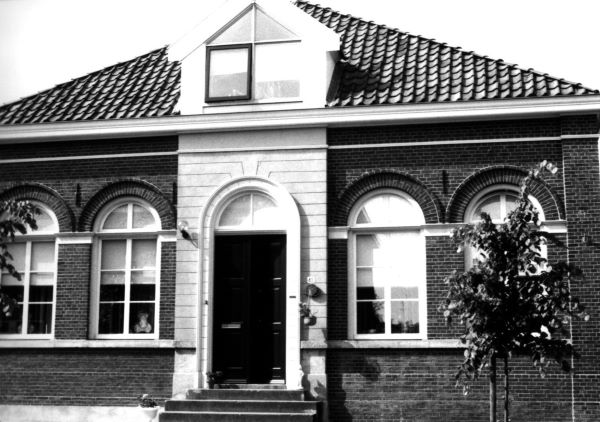
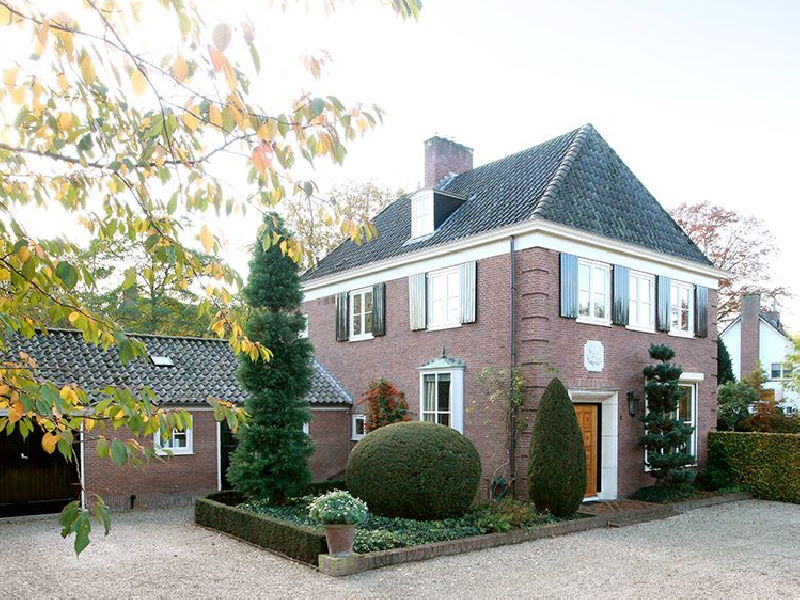
    Roelvink lived with his family in the villa at ‘t Zand in Bredevoort, which is known today as Sint Bernardus. Roelvinkstraat in Bredevoort is named after him.

    Roelvink was succeeded as mayor of Aalten by his son, Mr Leonard Roelvink.

  • Christiaan Casper Stumph

    Christiaan Casper Stumph

    Mayor (1811–1818)

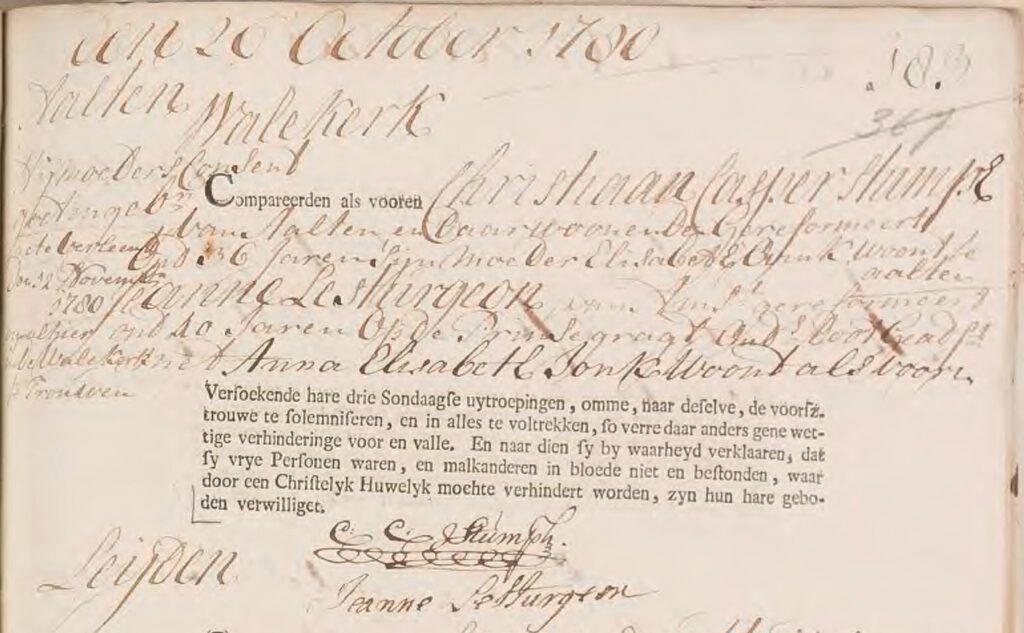
    Christiaan Caspar Stumph was baptized in Aalten on February 14, 1745, as the son of Abraham Stumph and Elisabeth Ovink. On November 12, 1780, he married Jeanne Lesturgeon. They had at least one child, Abraham Antoni. This son drowned in the Slingebeek at the age of 34. Popular belief held that his death was related to a broken heart.

    In 1795, Stumph was accused of the attack on Ten Holte and imprisoned. He was released a month later as his guilt could not be proven.

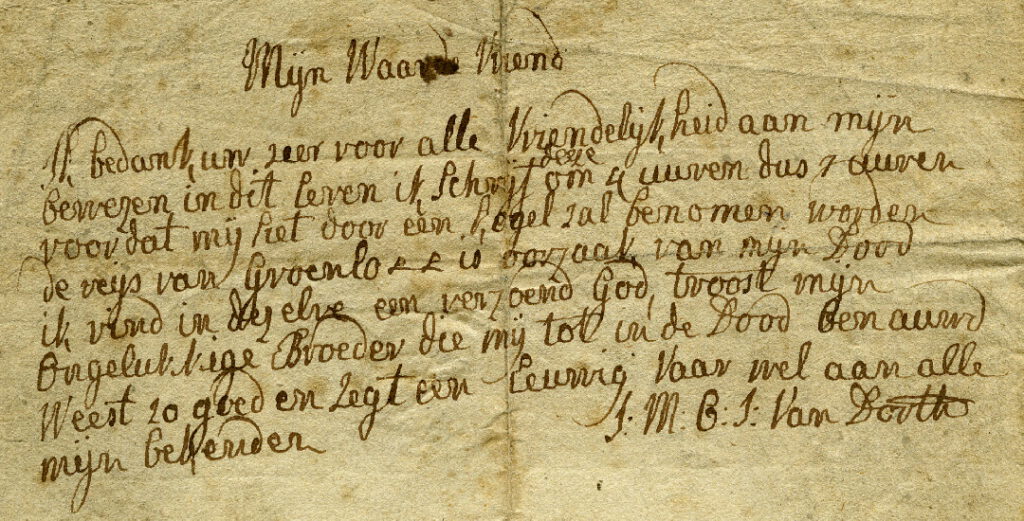
    Stumph was a close friend of the Freule van Dorth, who was executed in Winterswijk in 1799. Seven hours before her death, she wrote him a letter: “My Dear Friend, I thank you very much for all the kindness shown to me in this life. I write [this] at 4 o’clock, thus 7 hours before [life] shall be taken from me by a bullet. The journey from Groenlo etc. is the cause of my death. I find in the same a reconciled God; comfort my Unfortunate Brother who is distressed for me until Death. Be so kind as to say an Eternal Farewell to all my acquaintances. J.M.C.J. van Dorth.

    The first mayor of Aalten

    Following the annexation of our country by France on July 10, 1810, the entire administrative power was restructured and centralized according to the French model. A departmental organization was established, headed by a prefect for the departments, a sub-prefect for the districts, and a maire (mayor) for the municipalities.

    On March 12, 1811, Christiaan Caspar Stumph was appointed maire of the Canton of Aalten. He is therefore considered the first mayor of the municipality of Aalten. He held this position until January 1, 1818, when a new administrative regulation was established.

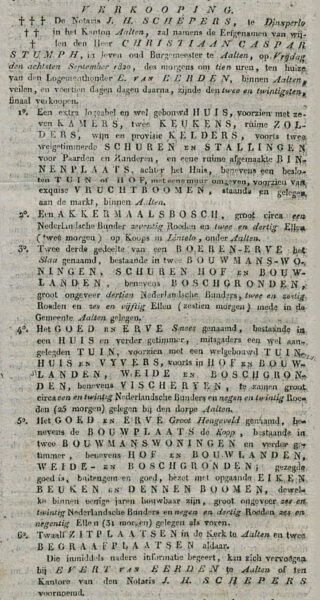
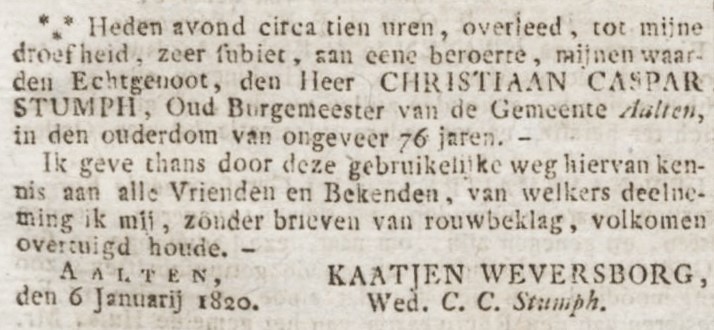
    Stumph lived at the Smees. He was a person of independent means and an organist in Aalten, a man of integrity with many noble objectives. On May 14, 1819, at the age of 74, he married 30-year-old Caatjen Weversborg in Aalten. As far as is known, their marriage remained childless.

    Christiaan Casper Stumph was a man who frequently endeavored to put an end to existing abuses. One of his greatest grievances was the practice of burial inside the church or in the churchyard within the village. Indeed, this often led to unimaginable situations. On several occasions, subsidences occurred in the church floor, and the owners of these graves failed to carry out the necessary repairs. For weeks, the pews near the hole in question would be uninhabitable. Consequently, a regulation was established stating that churchwardens, in cases of negligence, were permitted to contract out the necessary repairs, whereby the plot in question would revert to the church.

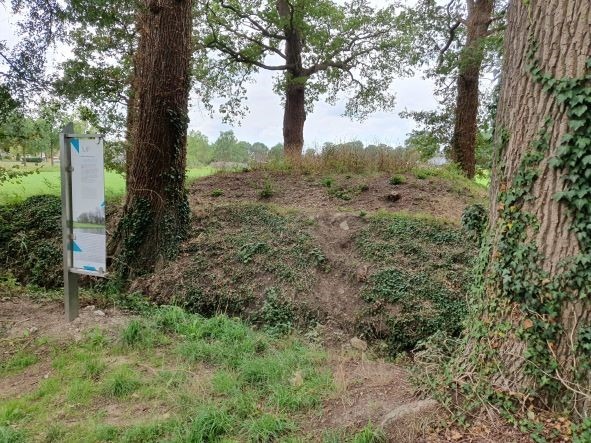
    Burial mound at ‘het Smees’

    The condition of the cemetery around the church was also frequently poor. Because burials had not been conducted at a “sufficient” depth for a long time, bones regularly came to the surface. A bone collector gathered these remains from time to time for two bushels of rye per year and threw them into the “Beenhalle,” a small building in the churchyard on the Market side. If the stock became too large, it was cleared out, and the walls were cleaned and repaired where necessary.

    With the improvement of social conditions and higher hygiene standards, changes slowly but surely occurred in this area, including the obligation to make graves sufficiently deep. A law to prohibit burial within towns and villages, following foreign examples, could not yet find favor in our country. People could not bring themselves to take the major step of breaking with all traditions and leaving the dead “just anywhere in the ground” far outside the village.

    Stumph was a proponent of burial outside the village; he decided to have an “Outer Cemetery” created in one of the Smees meadows. In 1818, the foundation deed and will were drawn up. Christiaan Casper Stumph passed away on January 6, 1820. According to his last wish, he was buried at the old Smees. This site is still recognizable today as a burial mound, located on Nannielaantje.

    Mayor Stumph was succeeded by Mr. Arnoldus Florentinus Roelvink.

    Recommended reading


    ‘Van Maire Stumph tot Burgemeester Stapelkamp’, by Leo van der Linde

  • Bailiffs of the Lordship of Bredevoort

    Bailiffs of the Lordship of Bredevoort

    In the Late Middle Ages, a landdrost, drost, or drossaard (bailiff) was an official who represented the sovereign lord in a specific area. Their duties included maintaining public order, legislation, the administration of justice, and the defence of the assigned territory. During the French period, the term landdrost was introduced for a Dutch administrative official who governed a specific region.

    Below are chronological overviews of the bailiffs and the acting bailiffs of the Lordship of Bredevoort, respectively.

    Sources


    • E.M. Smilda, Voorlopige lijst van namen van bestuursambtenaren in de voormalige heerlijkheid Bredevoort (Provisional list of names of administrative officials in the former lordship of Bredevoort), published in: Jaarboek Archief van de Graafschap 1980-1981, pp. 68-70, ISBN 906011-256-3.
    • National Archives, Archives of the Nassau Domain Council, inv. no. 685 (Official Record Book / Ambtboek).
    • Dr. L. Schmitz: Urkunden des fürstlich Salm-Salm’schen Archives in Anholt, Münster 1902
    • Wikipedia
  • Joseph Gerard van der Schaaf

    Joseph Gerard van der Schaaf

    Vrederechter, kantonrechter

    Joseph Gerard van der Schaaf was born on 3 March 1798 in Utrecht, the son of Jacobus Hendrik van der Schaaf and Magdalena Noijon. On 27 March 1836, he married Johanna Hendrina van der Sluis in Hattem.

    He served as a District Judge (kantonrechter) in Aalten from 1838 to 1855. Previously, he was a Justice of the Peace (vrederechter) in Aalten, from which position he was honourably discharged.

    Joseph Gerard van der Schaaf died on 21 October 1877 in Velp.

  • Frederik Willem Jacob Immink

    Frederik Willem Jacob Immink

    Frederik Willem Jacob Immink was born on 24 August 1822 in Ootmarsum, the son of the Reverend Petrus Immink and Aleida van Laer. On 18 July 1854, he married Anna Beatrix Scheij (Oldenzaal, 29 July 1821) in Borculo.

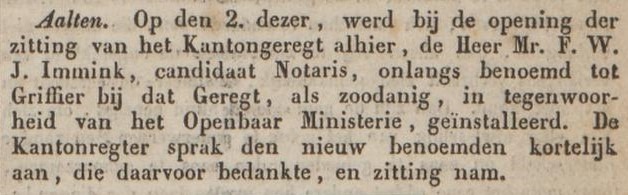
    From 1852 to 1855, he was the Clerk of the Court at the District Court in Aalten. Subsequently, he served as District Judge in Aalten from 1855 to 1877. Following this period, he was appointed District Judge in Groenlo.

    His residences included addresses on Landstraat, Markt, Damstraat, and Bredevoortsestraatweg.

    Frederik Willem Jacob Immink died on 25 March 1893 in Groenlo at the age of 70.

  • Abraham Casper Salomon ten Bokkel

    Abraham Casper Salomon ten Bokkel

    Advocate, notary, land clerk, Justice of the Peace, acting Mayor of Aalten, and deputy bailiff.

    Abraham Casper Salomon ten Bokkel was born on 1 November 1761 in Bodegraven, the son of the Reverend Theodorus ten Bokkel (baptised in Aalten on 23 June 1728) and Margaretha van Hoeij. Ten Bokkel studied in Harderwijk (enrolled in 1786).

    On 29 April 1787, he married Gesina Geertruid Schaars (Aalten, 15 March 1767) in Terborg. This marriage produced four daughters, two of whom died shortly after birth:

    1. Cornelia Theodora (Aalten, 03-08-1795 – Aalten, 17-11-1795)
    2. Cornelia Theodora (Aalten, 07-08-1799 – Dinxperlo, 04-12-1866)
    3. Stephanetta Hendrika Wilhelmina (Aalten, 18-01-1801 – Amsterdam, 07-01-1885)
    4. Aurelia Margaretha (Aalten, 08-03-1804 – Aalten, 10-05-1804)

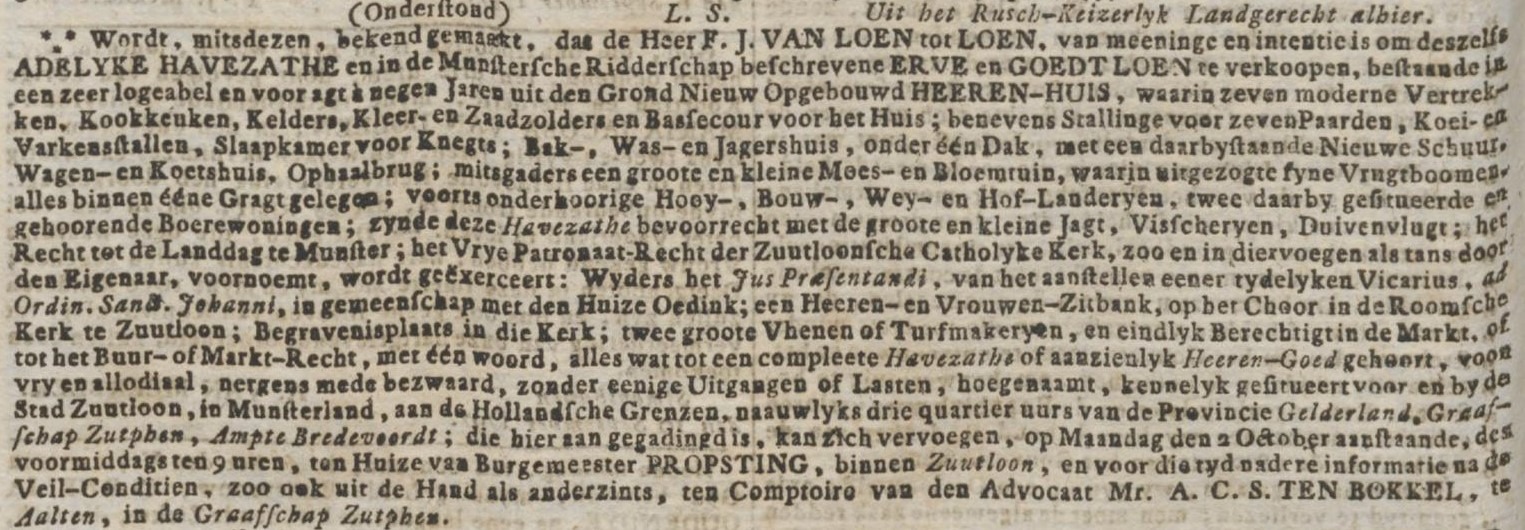
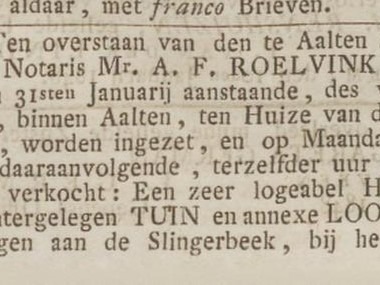
    An advertisement from 1797 was found in which Ten Bokkel is mentioned as an advocate involved in the sale of the substantial Lohn House, just across the border in Südlohn (D). In 1803, a similar advertisement was discovered concerning the sale of Sinderen House.

    In 1823, Ten Bokkel lived on Landstraat in Aalten, at what is now number 17.

    Abraham Casper Salomon ten Bokkel died on 29 May 1831 in Dinxperlo.

  • Liberal Gift of 1748

    Liberal Gift of 1748

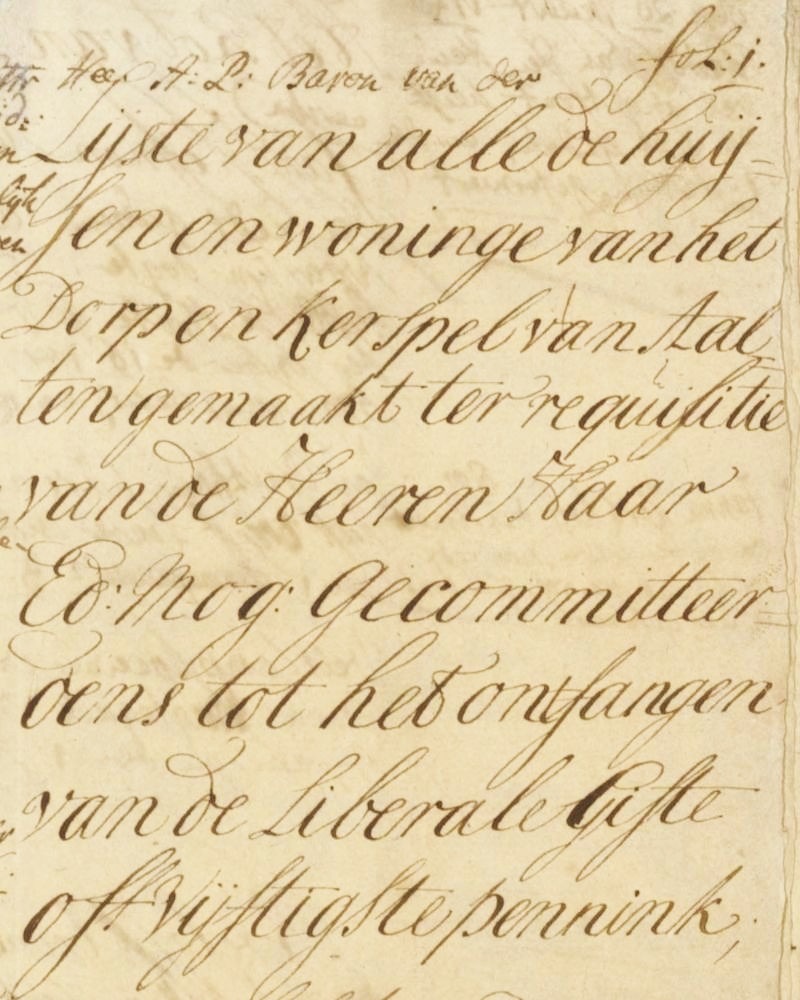
    The Liberal Gift was a one-time tax introduced in the Republic of the Seven United Netherlands in September 1747 to cover the escalating defense costs caused by the war with France.

    Background

    During the War of the Austrian Succession (1740–1748), the Republic was involved in a conflict against France and Spain as an ally of Great Britain and Austria. The military threat increased significantly in 1747 when French troops occupied large parts of the Southern Netherlands and even parts of the Republic, including Zeeland and Maastricht.

    The Republic was poorly prepared for a large-scale war and was in a deep financial crisis. To finance the military expenditures, a one-time tax was established: the Liberal Gift, also known as the fiftieth penny.

    What was the Liberal Gift?

    The tax was called a ‘liberal’ or ‘voluntary’ gift, but in practice, it was not entirely optional. Every household—both poor and wealthy—was expected to contribute. The wealthy had to pay two percent of their assets (hence the name fiftieth penny). Those who possessed less than 500 guilders could determine for themselves how much they ‘furnished’ (gave). Residents had to declare under oath how much they owned. The contribution to the Liberal Gift could then be paid in four installments.

    Registration of the Liberal Gift in Aalten and Bredevoort

    The collection of the Liberal Gift took place in 1748 and was meticulously recorded in special registers (tax rolls). In the parish of Aalten, the registration was organized by village and rural districts, and further subdivided by ‘rot’ (district). The tax roll for the town of Bredevoort is likewise subdivided by district.

    In the tax rolls, information was recorded per house, such as:

    • Names of the residents
    • (Sometimes) the farm name
    • Number of resident children (above and below 16 years of age)
    • Assets (more or less than 500 guilders)
    • Whether they paid anything and in which installments this was fulfilled

    Scans of the tax rolls for the collection of the Liberal Gift in the lordship of Bredevoort can be consulted here.

    Historical value

    Thanks to this detailed registration, the Liberal Gift offers a unique insight into the composition of households and the prosperity of former Aalten residents in 1748. It not only shows where people lived—down to the district or farm level—but also provides an impression of the economic conditions within the community.

  • Three fires in the Willemstraat

    Three fires in the Willemstraat

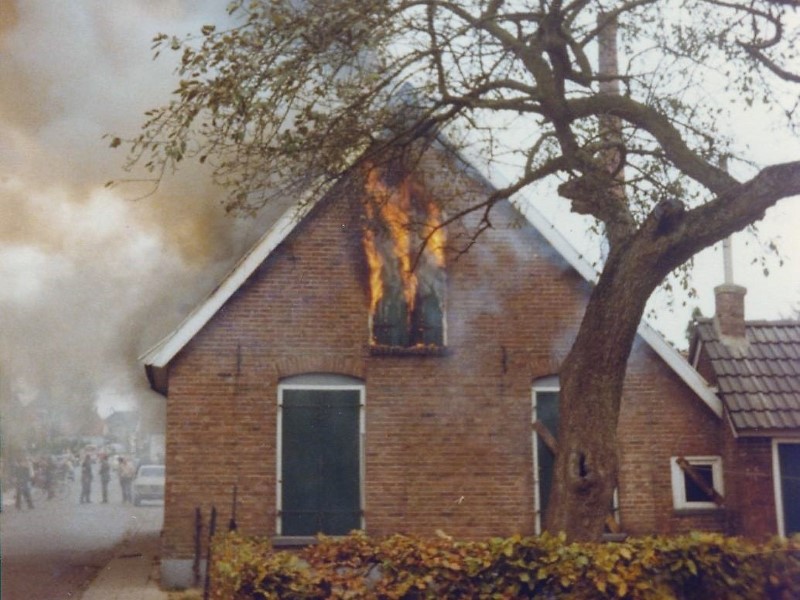
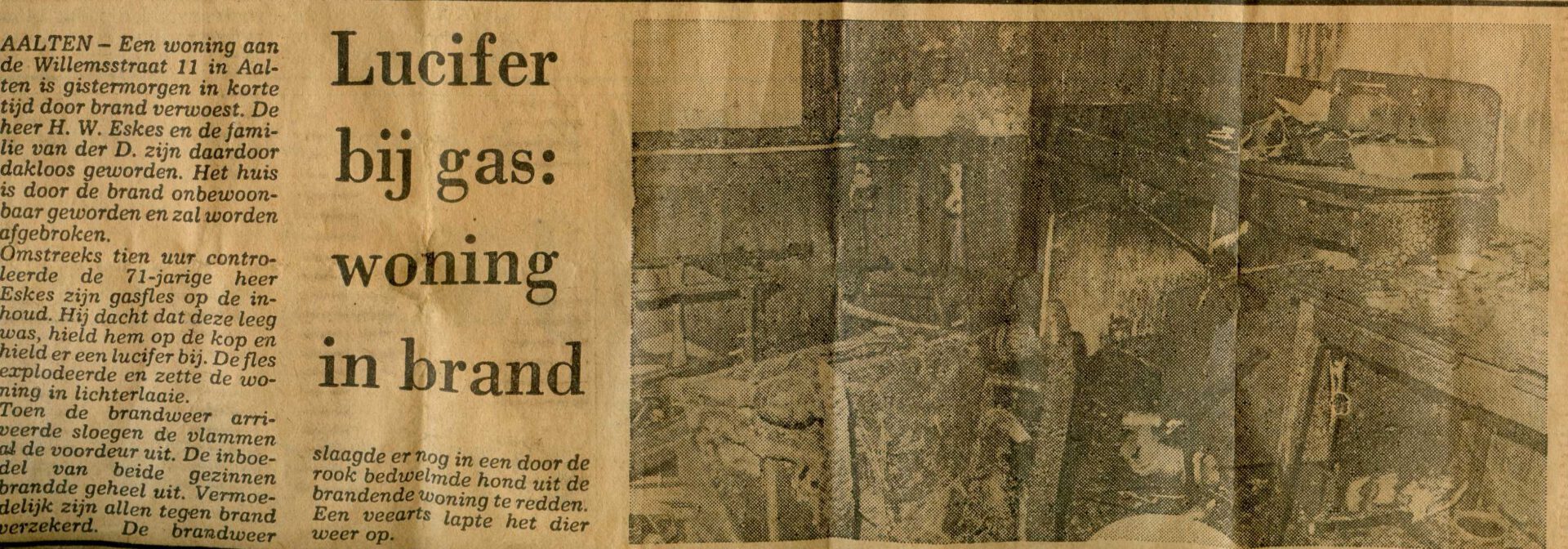
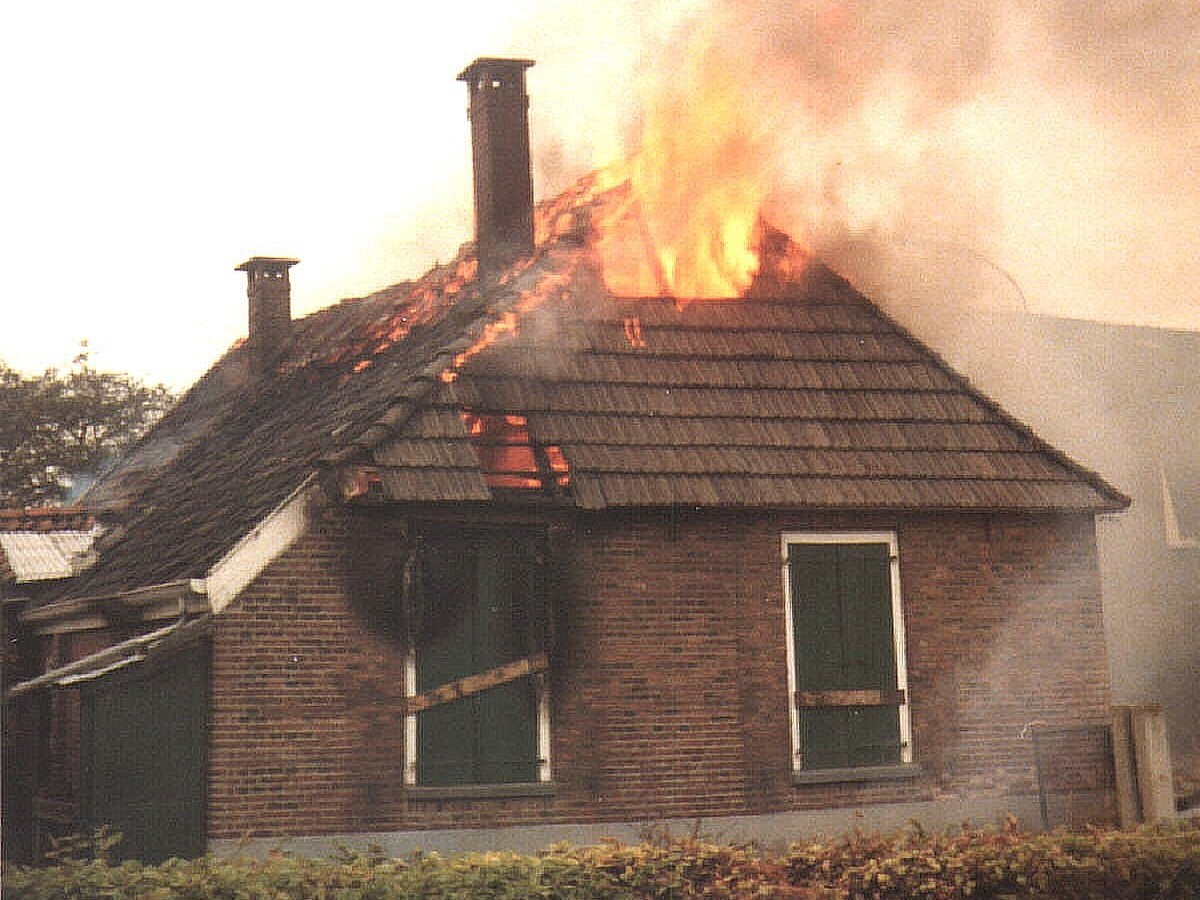
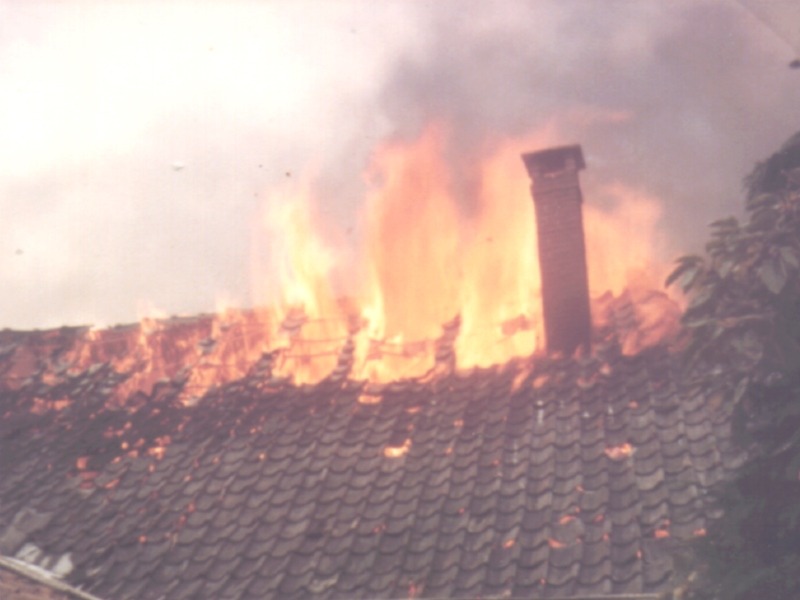
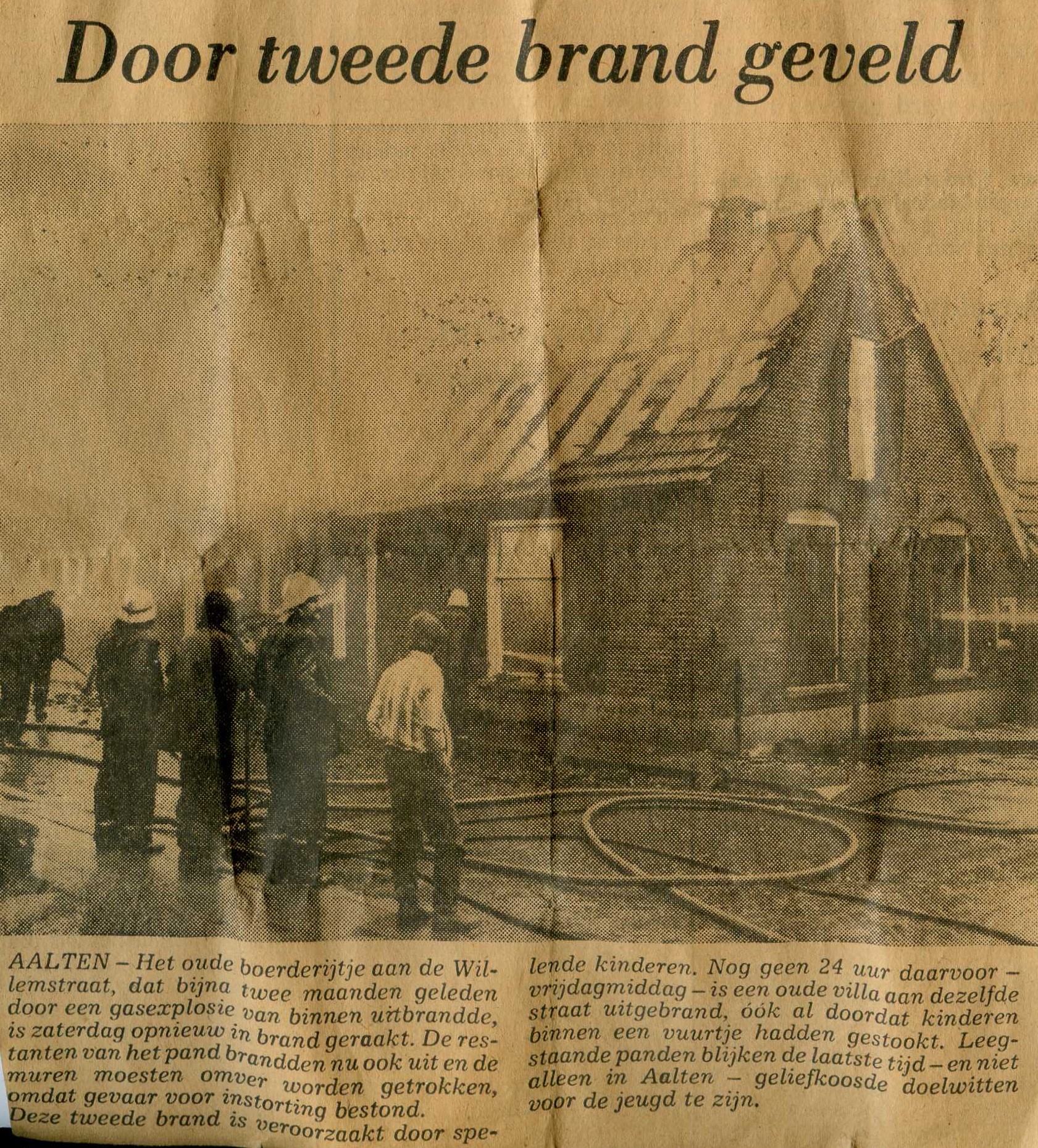
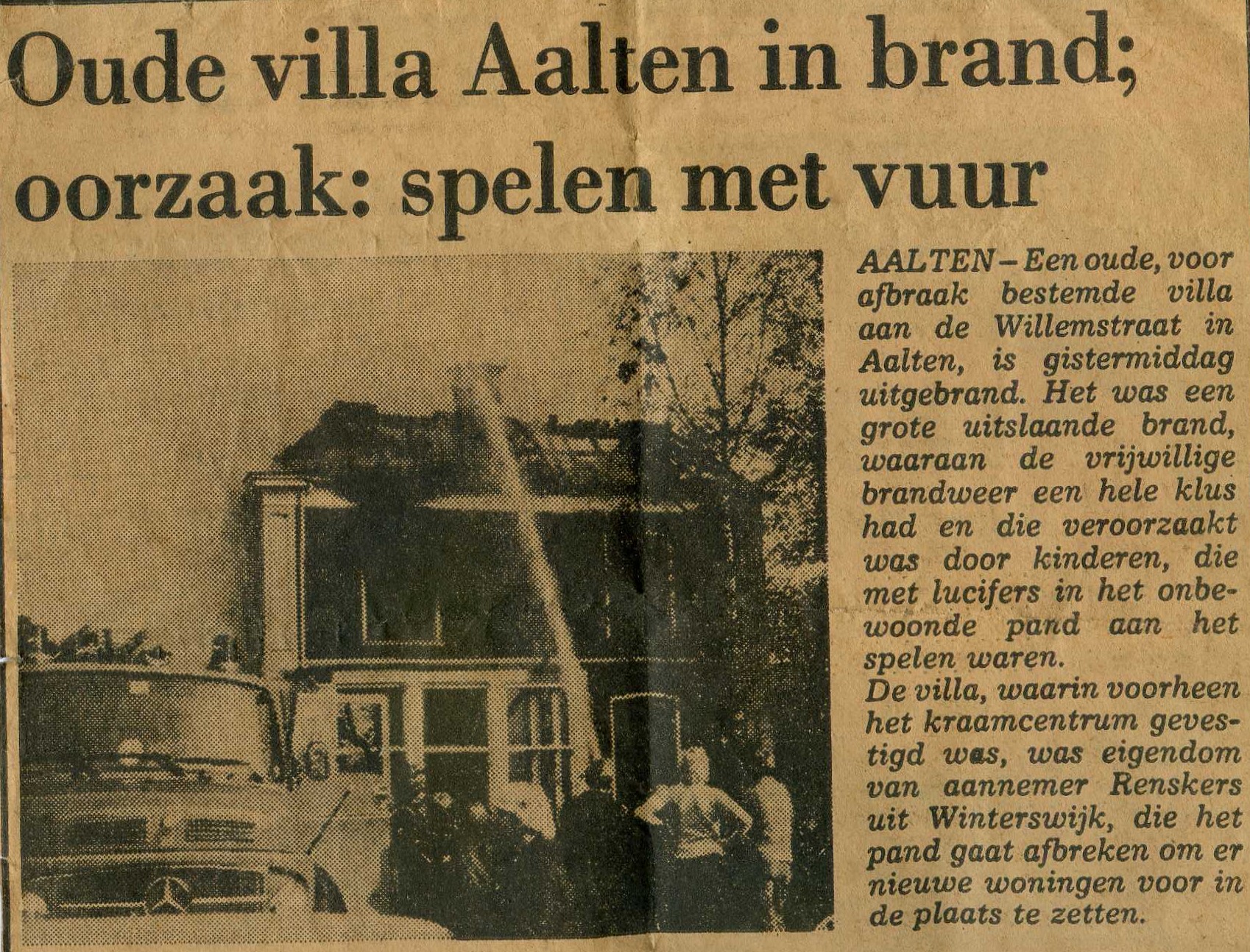
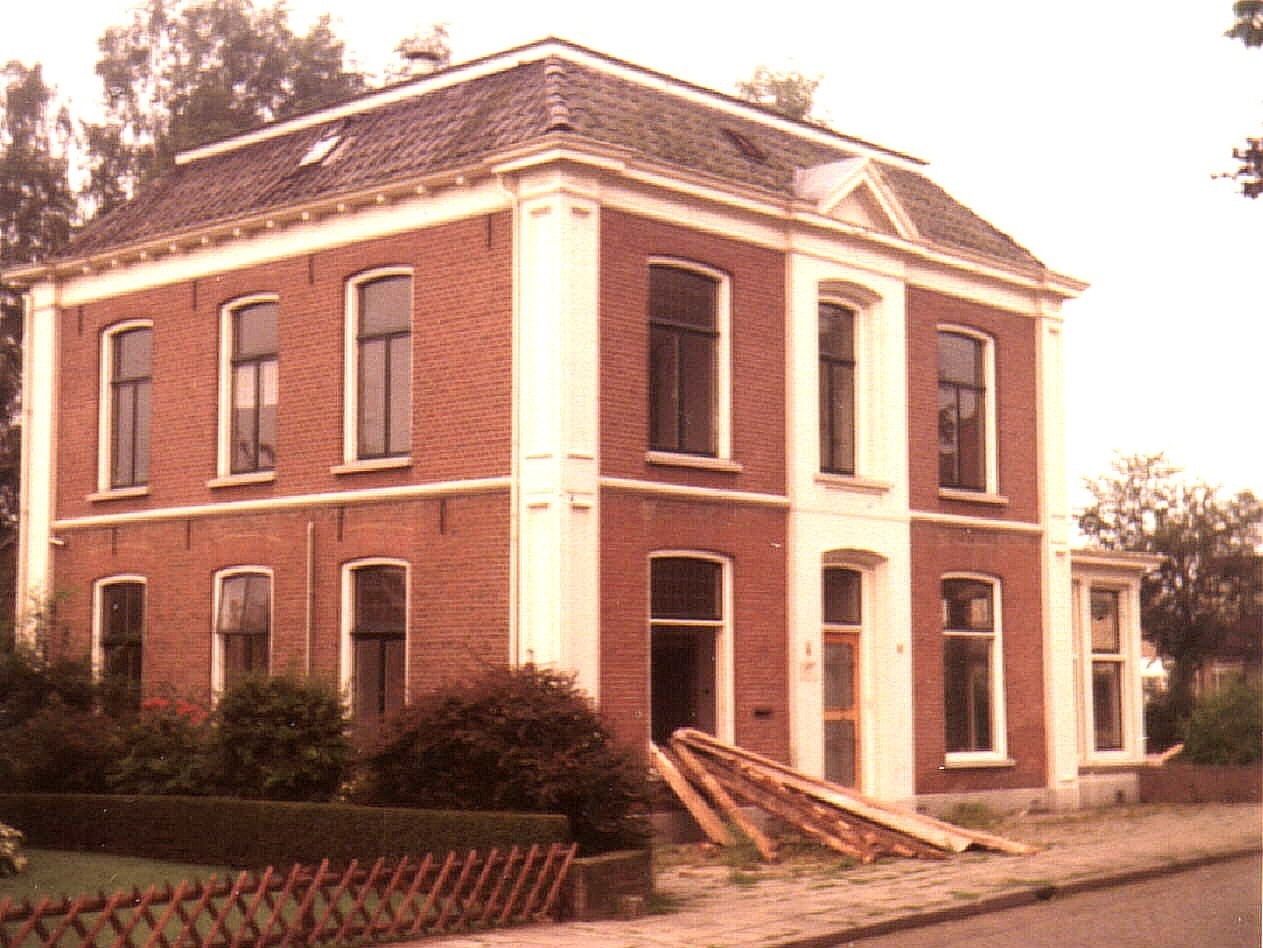
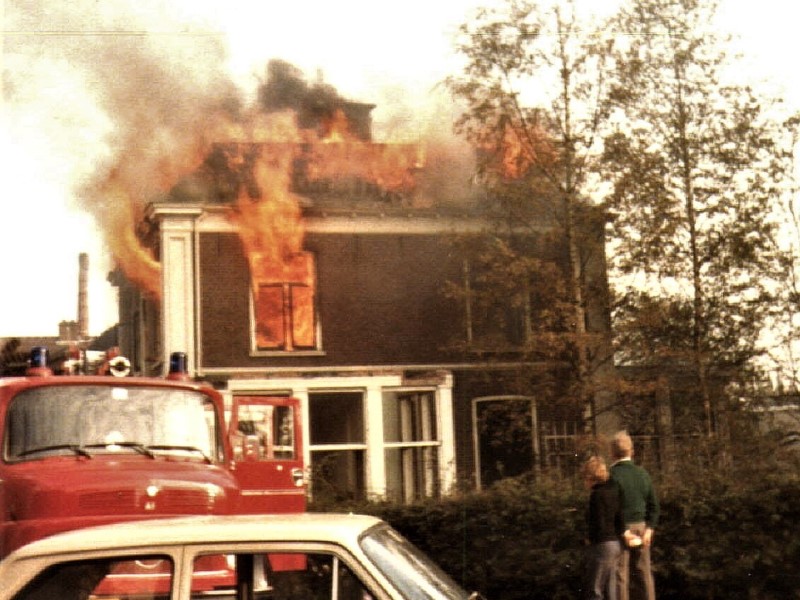
    Photos and newspaper articles by T. Korthout.

    In 1978, the Willemstraat was startled by fire three times in a short period, twice in the home of Mr. Eskes and the Van der Donk family, at number 11, and also in the former Maternity Center at number 19.

  • Rickety police garage collapsed

    Rickety police garage collapsed

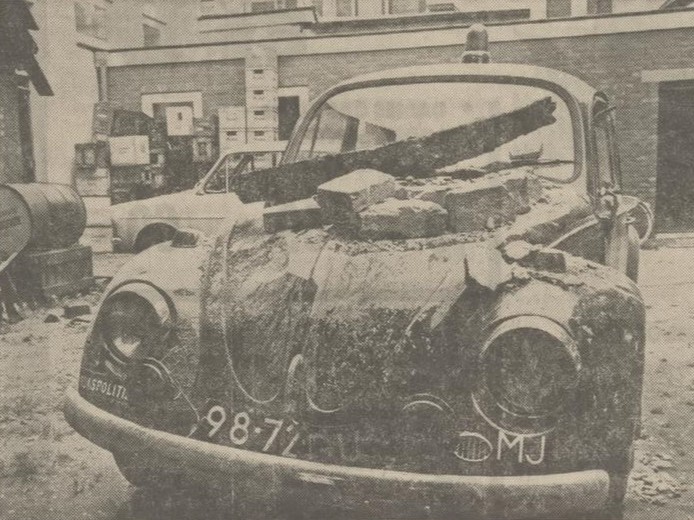
    AALTEN — With a resounding thud, the garage of the old police station in the Peperstraatje collapsed yesterday. The rickety structure was unable to serve out its time. Within the foreseeable future, the new police station on the Polstraat will be completed, and the restoration of the building currently serving as the police station can begin. It will then house several municipal offices. The national police in Aalten will likely not be too distressed about the destroyed garage.

    They will, however, be concerned about the car that was parked in the garage at the moment it gave way. The police report drawn up regarding the incident states that the vehicle was quite seriously damaged. It is further unknown whether a report was filed against the owner of the property for neglecting maintenance obligations. In that case, it would be the municipality that should be held responsible for the damage to national property.

    Source


    • Daily newspaper Tubantia, 30 October 1970 (Delpher)
  • Aalten Budget Closes at Nearly Nine Million

    Aalten Budget Closes at Nearly Nine Million

    Dagblad Tubantia, 18 January 1966

    It is truly no wonder that the explanatory memorandum accompanying the 1966 budget for the municipality of Aalten begins with the words: We are pleased to inform you… For not only is the budget for ordinary services balanced at an amount of nearly nine million guilders (including f 26,600 for unforeseen expenditures), there is also limited room for the execution of capital works. And that is a sound that not all municipalities can produce.

    For those capital works, apart from the sewage treatment plant and sewerage, the primary consideration is to resume the restoration of the streets in the old town center, with priority to be given specifically to the Prinsenstraat.

    That is not to say that everything is coming up roses. Due to a shortage of land ready for construction, there is a threat of stagnation in housing development, while it is expected that the upcoming expansion of the treatment plant will place a heavy burden on the population, who will then likely see the sewage charges to be paid approximately doubled.

    Expansive and Pluriform

    The fact that the budget is balanced is partly due to a more adjusted allowance from the municipal fund regarding the social care component starting in 1966, as a result of which the general allowance from this fund, in addition to the general increase by raising the allowance percentage, could be estimated at around f 160,000 higher.

    An amount of f 60,000 is available for interest and depreciation on new capital expenditures for 1966. This amount is too small to enable a smooth completion of many necessary works, while furthermore the “lending ceiling” established by the government acts as a hindrance. To this end, a multi-year plan was drawn up, in which the streets and roads requiring improvement in the coming years were included.

    Regarding the acute shortage of building land, the Mayor and Aldermen state that preparations for making land ready for construction have already been made in various places, but that execution must still wait because agreement had not yet been reached with the owners regarding several plots. The acquisition of land through amicable means, according to the memorandum, is clearly becoming a problem in more and more municipalities, forming a serious stumbling block in the attempt to fully realize an “expansive and pluriform construction policy.”

    One Each Year

    The memorandum further speaks of the sporadic issuance of urgency declarations for the construction of new schools. The Mayor and Aldermen would consider themselves fortunate if one new school could be built each year over a series of years. They do, however, express their satisfaction that with the completion of the gymnasium at the ULO school and the already intensively used hall of the lower agricultural school, it will soon no longer be necessary to use other locations unsuitable for this purpose, once the municipal gymnasium on the Dalweg is also completed.

    Satisfaction is further expressed regarding the administrative contact established between Winterswijk, Lichtenvoorde, Groenlo, Eibergen, Neede, and Aalten. Although there is only mention of contact and no formal body was created, this cooperation is also of value within the framework of broader regional bodies.

    In Detail

    To remain in style, after these more “general considerations” regarding the budget, we would like to proceed to the discussion of specific parts, without, as they say, being exhaustive.

    Slaughterhouse: It is expected that, after the extensive renovation, this will be self-supporting due to the intensive use for export slaughtering.

    Drinking Water Supply: Around April 1966, approximately 125 properties of the Heurne-IJzerlo plan will be connected to the water supply network. On the work program of the water company, 150 properties are estimated for Aalten in 1966.

    Public Housing: Despite the fact that an average of 100 homes per year have been completed in recent years, the housing shortage is not being reduced. The construction of so-called Bogaers houses outside the quota is also hindered by the shortage of land ready for construction.

    Ring Road: Specifications for the improvement are ready. It is possible that preparatory work, such as the felling of trees, can still take place this year. The road will be provided with a layer of asphalt over its full width, including the existing cycle path.

    Kemena Expansion Plan: Waiting for necessary land purchases. For this, however, the approval of the partial expansion plan must first be awaited.

    Paving of Dirt Roads: In 1935, 68.90 kilometers were paved, bringing the total of paved dirt roads from 49.430 km to 56.32 km. The paving of the Boshoeveweg and parts of the Kriegerdijk and Bodendijk is in preparation.

    Education

    O.L. School Aalten: The possibilities for replacing existing old schools with new ones are so slim that there can be no question of replacing the school for the time being.

    R.K. School Aalten: The original plan for the construction of an 8-classroom school has been changed to the construction of two 6-classroom schools. Final applications have not yet been submitted.

    Groen van Prinsterer School: An urgency declaration for the construction of three classrooms has been obtained. The possibility of achieving a six-classroom school through industrial construction methods is being investigated.

    Allowance per Pupil: This will be significantly increased for 1966, namely for the private G.L.O. f 70.- (f 64) per pupil, for the private ULO f 125.- (f 102), and for the private special L.O. f 135 (f 125) per pupil. The amounts stated in parentheses are those for 1965.

    Recreation VVV

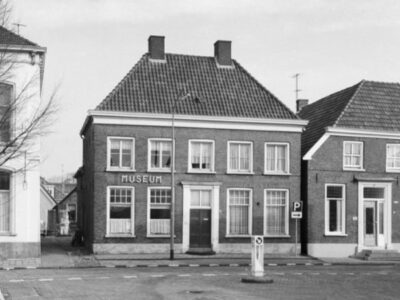
    The ideal would be a new VVV office in the old building on the Markt, where the Local History Museum is already located. The collection would then be even better presented; perhaps this can be realized in the foreseeable future due to the departure of the current resident.

    The establishment of a motel at the intersection of the Bredevoortseweg with the new Hamaland route would be appreciated. This would create an attractive recreation center between Aalten and Bredevoort, with the swimming pool, the municipal estate “‘t Walfort“, the summer cottage area, and the municipal campsite in the immediate vicinity.

    Industry: Did not develop to the same extent in 1965 as in previous years. The number of male employees has hardly increased, which may partly be a result of the commute to Germany, which currently amounts to 70 men and 40 women from the municipality.

    Sources


  • Night Watch & Constables

    Night Watch & Constables

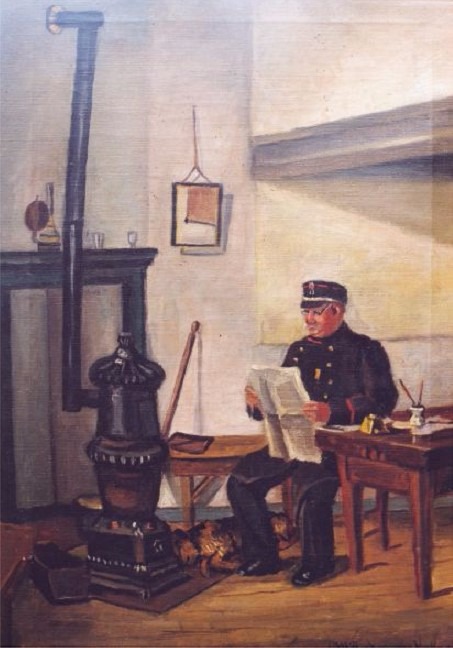
    In 1937, G.H. Rots described in a series of articles how things were done in Aalten in former times. Regarding the ‘night watch’ and the constables (veldwachters) in Aalten, he wrote the following:

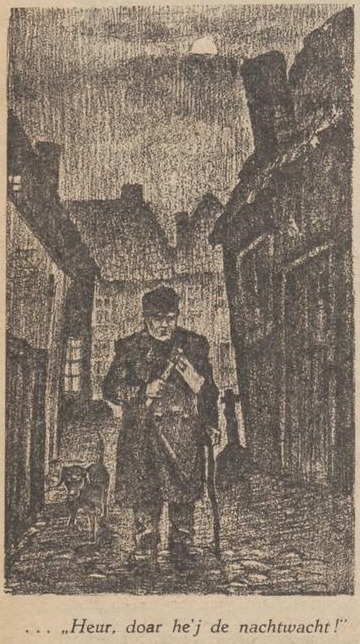
    “When the population of Aalten had found rest in the arms of Morpheus, they were watched over at night. The night watchman made his rounds and, accompanied by his faithful dog and with a thick rattan cane in hand, patrolled Aalten’s streets. He also served as a ‘knocker-up’; that is, if certain people needed to be woken early, he was the man who ensured it happened.

    For many years, the night watchman carried a rattle, and every time the tower clock was heard, the rattle was spun and the night watchman called out the hour that had struck. For example, at twelve o’clock, he would cry: ‘The clock has twelve, twelve has the clock!’. It was eventually realised that such customs were not conducive to the residents’ night’s rest, and the practice was subsequently abolished.

    For monitoring purposes, check-clocks were mounted at several points in the village, designed so that the authorities could verify whether the night watchmen had performed their duty. In turbulent times, or whenever the authorities deemed it necessary, the night watchman was reinforced by a ‘watch’. Each rot (ward) had to provide one man to stand guard. The ‘watch’ was stationed in the building where Mr ter Maat’s barbershop is now located.

    The permanent night watchman thus had the assistance of these men, and they accompanied him on patrol. When it was pitch black, it sometimes happened that such a greenhorn assistant-watchman lost his way and ended up in a refuse heap or a manure pit. It is well known that this circuit through the village—the rattling aside—was not entirely silent, and one could hear the night watchman approaching from afar. For thieves and other ruffians, this was the signal to take to their heels or go into hiding.”

    Since 1 January 1915, the night watchman in Aalten has been a thing of the past. One of the last night watchmen in Aalten was Jan te Slaa, better known as the town crier ‘Jan met de Panne’.

    spine-chilling stories

    “The old night watchmen could tell spine-chilling stories of what they had experienced at night. Hearing these tales made one’s skin crawl. For instance, it was said that ‘behind the hedges in the Heuksken’, a woman dressed in white wandered every night. And then there was that mysterious light in the charnel house at the churchyard. Sometimes, mysterious animals were encountered that made Aalten’s streets unsafe.
    Then there were the ‘premonitions’ of fire. If a fire broke out in the village, one of the night watchmen had sometimes seen a ‘red glow’ above the site weeks in advance. This happened quite often, as Aalten had a certain ‘reputation’ when it came to fires. There were occasions when fires broke out three days in a row. The ‘red glow’ must have been seen quite frequently then.

    The belief in witches and ghosts had not entirely vanished in the last century, so these ghost stories were often believed. According to folk belief, witches held meetings at night, and in the Aalter Esch, there was a spot used as a nocturnal witch’s dwelling. That piece of land, situated roughly halfway between the Linde and the Lichtenvoordscheweg, was called the ‘heksenbeddestëe’ (witches’ bedstead). It was a patch of no man’s land that no one claimed. The night watchmen were not afraid of any of this, and through their heroic stance against these mysterious things, they commanded great respect from the population. Undeniably, quite apart from the above, the night watchman performed good service, and many viewed the abolition of the night watch with regret.”

    Constables

    “And then there was the police surveillance. Jan Steven Schaars Prins was well known as a State Constable (Rijks-Veldwachter). Merely mentioning his name was enough to strike fear into people. The youth would retreat into their shells at the sound of his name, and naughty rascals could be sent to bed with it. But Schaars Prins was also someone held in awe by adults. His mere appearance helped to restore order, and when he took action, order was immediately reinstated.

    A formidable man, then, who certainly faced his share of trouble. Often he set out alone to fine dangerous poachers, but he also showed his strength against more serious criminals. The arrest of two escaped German murderers in 1875 earned him an honourable distinction from the German government.

    On one occasion, he is said to have been overpowered by superior force; poachers in the Aalter Goor tied him to a tree, and he was only freed a few hours later by a passer-by.

    In the middle of the last century, Jan te Hoonte and Constable Beernink were known as the municipal police. They were appointed at a salary of 145 guilders a year. Not too many official reports (proces-verbalen) were drawn up, for if a case had to be heard at the court in Zutphen, they had to make the journey to Zutphen on foot as witnesses. Fining a poacher, however, was another matter, as it yielded an extra reward, which was quite welcome alongside the aforementioned salary.

    The constable went to the town hall in the morning to ask if there was ‘anything special’ to report. Sometimes it was a message for a local resident, but usually, the Mayor had nothing on the agenda, and the constable would go to tend his farm; if something significant happened, one could find the constable out in the fields.”

    Sources


    • ‘From Aalten’s past’, by G.H. Rots, Aaltensche Courant, 26 November 1937 (Delpher)
    • Het Vaderland, 7 March 1876 (Delpher)
  • Gravediggers

    Gravediggers

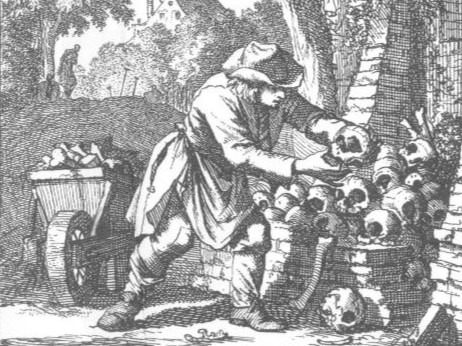
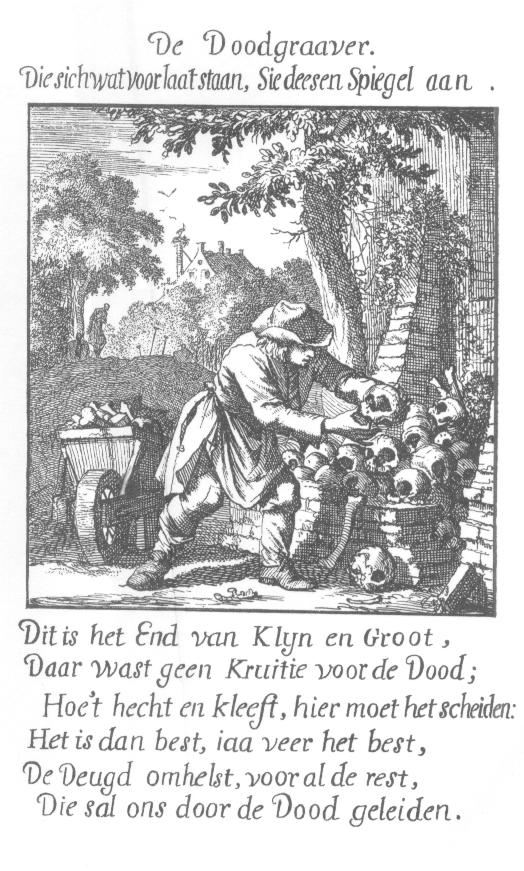
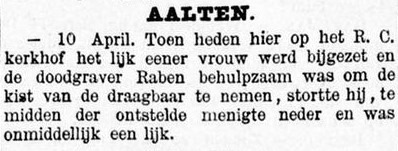
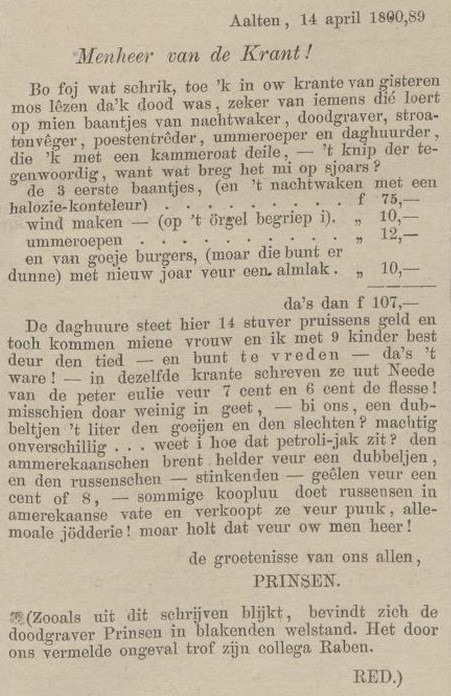
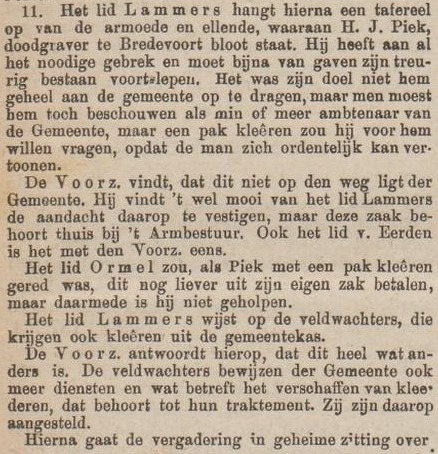
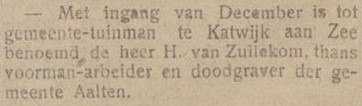
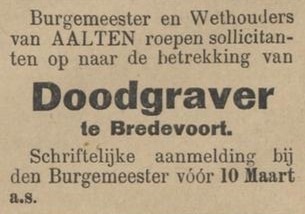
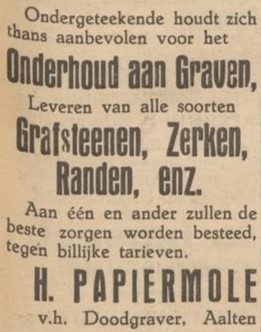
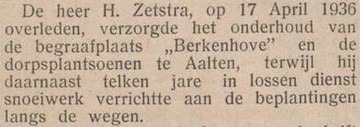
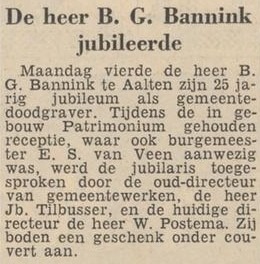
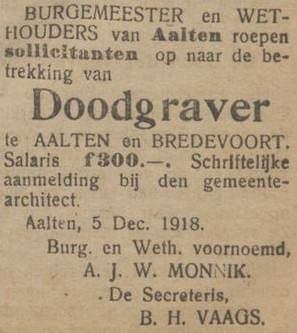
    The task of the gravedigger was to dig graves for the dead. In rural areas, this duty was often outsourced to impoverished villagers or combined with other roles: sextons, night watchmen, or schoolmasters performed the gravedigging alongside their primary occupation. The office of gravedigger provided only a modest (supplementary) income.

    Some well-known gravediggers in Aalten and Bredevoort (incomplete list):

    Aalten

    * They resided in the ‘gravedigger’s cottage’ near the Old General Cemetery.

    Bredevoort

    Newspaper reports

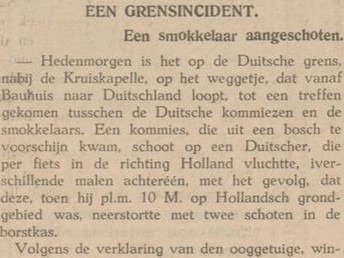
  • A Border Incident

    A Border Incident

    A Smuggler Shot

    This morning, on the German border near the Kruiskapelle, on the small road leading from Bauhuis to Germany, an encounter took place between German customs officers and smugglers. A customs officer, emerging from a forest, fired several consecutive shots at a German who was fleeing by bicycle toward Holland, with the result that, when he was approximately 10 m onto Dutch territory, he collapsed with two gunshot wounds to the chest.

    According to the statement of the eyewitness, shopkeeper Bauhuis, the customs officer must still have been shooting when the smuggler was already on Dutch territory. If this is the case, and the statement is very pertinent, it signifies an instance of border violation that will likely have further consequences.

    The Eyewitness’s Story

    When we asked Bauhuis about the circumstances of the case, he informed us of the following:

    Around 7 o’clock this morning, three German smugglers headed toward the German border. Just as they were briefly on German territory, a young German customs officer emerged from a forest and attempted to detain the smugglers. Two of them fled toward Germany, one toward Holland. The latter was pursued by the customs officer.

    During this pursuit, he fired about twenty shots, even when the fugitive had already arrived on Dutch territory. When he had crossed the border by approximately 10 meters, he collapsed, hit in two places on the right side of the chest by revolver bullets.

    His statement was firm that shots had been fired at the smuggler who was already on Dutch territory. He was also of the opinion that the customs officer, a very young man who had presumably arrived only recently, did not know exactly where the border lay at that location.

    When the man was shot, Bauhuis stated, I was under the impression that he was going to die soon, and since I would rather not have him in the house, I made him a bed of straw on German territory, where we laid him down. I should not have done that, because later the German police took custody of him and transported him to the hospital in Wesel.

    This naturally complicates the investigation from the Dutch side, as it is no longer possible to determine exactly what the situation was when the man fell.

    Meanwhile, a different explanation is being given from the German side. The matter is being investigated. The leadership of this is in the hands of the detachment commander of the Marechaussee here, Sergeant G. v. Buren. During the initial investigation, the acting Mayor, Alderman F.H. Somsen, was present at the scene.

    Source


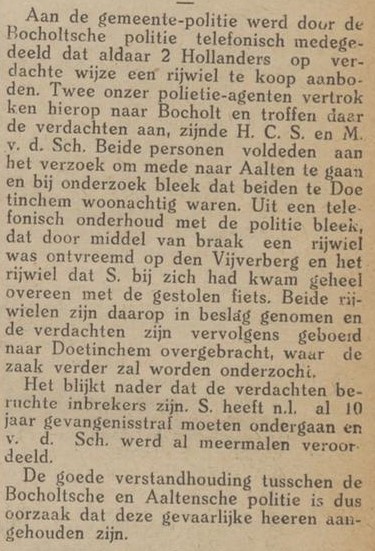
  • Good cooperation between Aalten and Bocholt police

    Good cooperation between Aalten and Bocholt police

    The municipal police were informed by telephone by the Bocholt police that two Dutchmen were suspiciously offering a bicycle for sale there. Two of our police officers subsequently left for Bocholt and found the suspects there, namely H. C. S. and M. v. d. Sch. Both individuals complied with the request to accompany them to Aalten, and an investigation revealed that both were residents of Doetinchem.

    A telephone conversation with the police revealed that a bicycle had been stolen from the Vijverberg by means of a break-in, and the bicycle S. had in his possession matched the stolen bike exactly. Both bicycles were then seized, and the suspects were subsequently taken in handcuffs to Doetinchem, where the case will be further investigated. It further appears that the suspects are notorious burglars. S. has already served 10 years in prison, and v.d. Sch. has been convicted on several occasions.

    The good relationship between the Bocholt and Aalten police is therefore the reason these dangerous gentlemen have been apprehended.

    Source


    • Nieuwe Winterswijksche Courant, 19 March 1926 (Delpher)
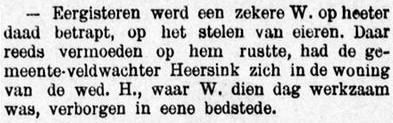
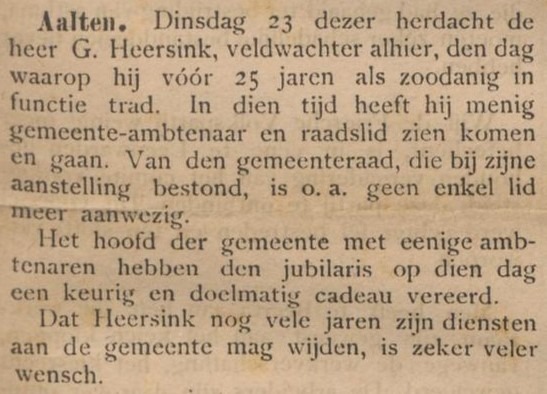
  • Gerrit Heersink

    Gerrit Heersink

    Gerrit Heersink was born on 13 May 1846 in Hummelo, the son of day labourer Jan Willem Heersink and Berendina Eenink. On 8 May 1873, he married Aleida Gesina Prinsen in Aalten. Nine children were born from this marriage.

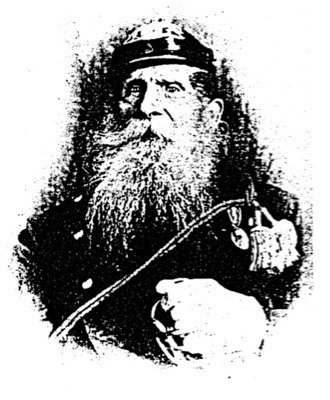
    Heersink served as a ‘veldwachter’ (rural constable) in Aalten for nearly five decades. He lived with his family on the Kattenberg, on what is now Berkenhovestraat. His brother Lammert ran a bakery just a stone’s throw away.

    In early 1920, Gerrit Heersink moved to Haaksbergen, where he passed away on 27 December 1920 at the age of 74.

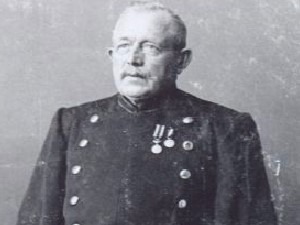
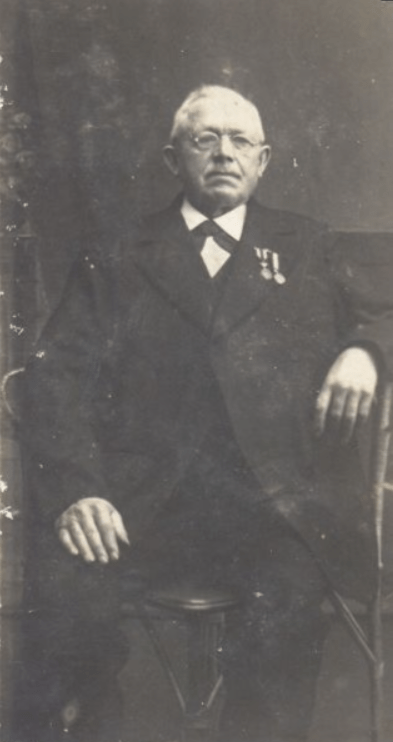
    Gerrit Heersink (1846–1920), wearing the medal awarded to him in 1912 to mark his 40th anniversary of service as a constable.
    Gerrit Heersink (1846–1920), wearing the medal awarded to him in 1912 to mark his 40th anniversary of service as a constable.
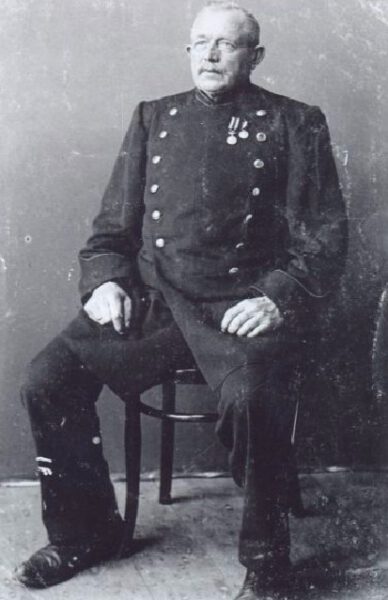
    Gerrit Heersink in 1912, on the occasion of his 40th anniversary in office as a constable in Aalten.
    Gerrit Heersink in 1912, on the occasion of his 40th anniversary in office as a constable in Aalten.
  • The Ecclesiastical Situation in Aalten

    The Ecclesiastical Situation in Aalten

    De Graafschapbode, 19 March 1887

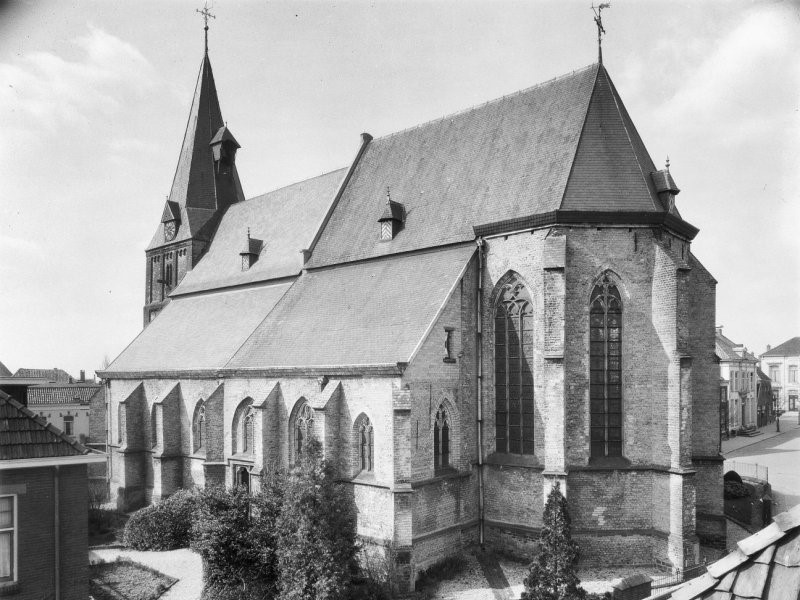
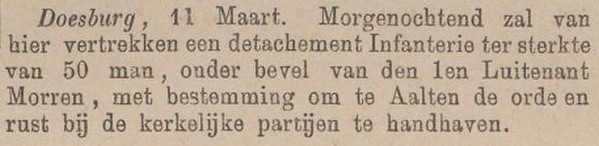
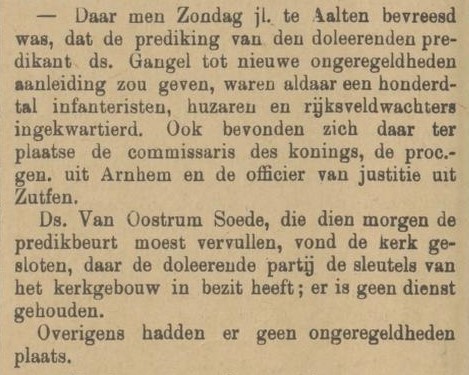
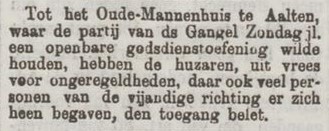
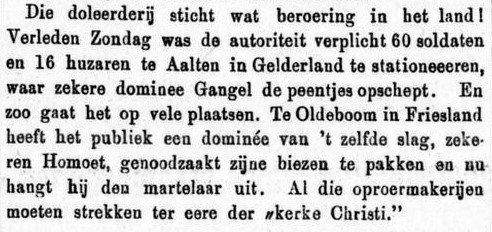
    Every now and then, the newspapers report fragments about the withdrawal of Gangel with his consistory, of suspension, dismissal, the keeping of church doors closed, riot, soldiers, hussars, etc., etc., and with all that, the matter continues at a snail’s pace. When will this change? One says it will remain so, another that the church may well remain closed for another 6 weeks, a third speaks of compromising, but despite all that: no progress is made. What can be done about this?

    A clear explanation of the matters, decisive action, indeed taking possession of the church. All well and good, but show us the way to achieve this. Well, through this writing, we wish to attempt to set you on the right track and point out the path the congregation must take.

    Mr. Gangel, former minister of the Dutch Reformed Congregation in Aalten, has seceded with his consistory, in other words, shaken off the Synodal yoke, as His Honor is pleased to call it. Previously, a part of the consistory, namely 3 persons who also functioned as churchwardens, resigned as members of the consistory, but retained their positions as churchwardens until the classical board, acting in the capacity of the consistory, suspended and later dismissed said gentlemen from their membership as members of the Dutch Reformed Church in Aalten.

    It goes without saying that when someone has been dismissed as a member of the church, there can no longer be any question of being allowed or able to retain the management of the church, etc. After all, churchwardens are not owners of the church and its assets, but are merely elected by the notables as managers; see: General Regulations on the management of ecclesiastical assets and funds of the Reformed congregations in the Netherlands and the supervision thereof: 1 Oct. 1870.

    These churchwardens are currently preventing the ministry of lawful ministers who must appear before the congregation, thereby withholding gifts from the poor and effectively preventing the collection of offerings for the maintenance of public worship.

    For two Sundays now, the congregation has come to a closed church door, and twice lawful ministers have been prevented from performing their duties. We admire the calmness of the congregation in this matter, but we cannot guarantee that this will remain so for much longer. The parties are becoming increasingly sharp and hostile toward one another; it causes strife between members of the same household, and there is no longer any talk of brotherhood.

    Who is the cause of this? None other than these churchwardens and the grieving consistory with their leader, Gangel.

    But does the congregation have no rights? Certainly. The right rests with the members of the congregation, in the following manner: The lawful voting members elect the notables, the notables elect the churchwardens, and these take upon themselves the management. Where the churchwardens have now resigned of their own accord, or have been dismissed or removed from office, the election of new churchwardens must proceed without delay.

    In the case of Aalten, the congregation will first have to supplement or completely renew the list of notables, and these new notables will appoint the Messrs. churchwardens. These new churchwardens take over the management from the old ones, and matters are settled. In the event of resistance to this lawful order, one can turn to the classical board and further to the provincial board.

    If all this is of no avail, as seems to be the case in Aalten, and the dismissed churchwardens keep the doors of the communal property closed, then the members simply act as the rightful claimants and take possession of the church. By this, we do not mean to conquer the church by force, for there is no question of conquest when one is the rightful owner, but one should then call upon the judicial (civil) power. A church must not remain closed to the people on regular days of worship as long as there are churchgoers and lawful ministers to attend. See further on this the Church Regulations of 1 October 1870.

    Sources


    • De Graafschapbode, 19 March 1887 (Delpher)
  • Fight in the Prison

    Fight in the Prison

    On 27 February 1880, a man who had served his prison sentence in Bocholt was escorted by a gendarme to the Dutch border near Aalten. Thanks to the excellent cooperation between the Dutch and Prussian border police, he was duly received at the border crossing by rijksveldwachter (national constable) Schaars Prins from Aalten, to be handed over to the Dutch justice system, which also had a bone to pick with him.

    The transport to Aalten took place by carriage. Upon arrival there, the man was taken to the house of detention. Everything proceeded quietly and orderly, until an individual who – as it later turned out – had followed the carriage at a trot, entered the prison.

    When asked what he was doing there, a life-and-death struggle suddenly ensued between the prisoner and his friend on one side, and Schaars Prins, municipal constable Heersink, and the coincidentally present municipal messenger Gerhard Rots on the other.

    After a few truncheons had been shattered across the bodies of the attacking rogues, Rots dealt out several blows with a type of frying pan, which was bent completely out of shape as a result. In this fight, the constables sustained only a few scratches and bruises, but the stout-hearted Rots was actually bitten on his nose, his hand, and in a certain hind part of his body.

    Schaars Prins, who a few years earlier had been decorated by the German Emperor following an encounter with criminals in Aalten – who, having escaped from the prison in Bocholt, were nabbed by that moustachioed officer – held his ground firmly once again, yet would have been cut down with his own sabre had it not been for Rots.

    In the end, all turned out well – the audacious rescue attempt failed, and the friends were put under lock and key. They were transported to Zutphen to have their case heard there and, undoubtedly, to receive their just deserts.

    Sources


    • Zutphense Courant, 1 March 1880 (Delpher)
    • Zutphense Courant, 2 March 1880 (Delpher)
  • Administration of Justice in Aalten (1810-1877)

    Administration of Justice in Aalten (1810-1877)

    During the French occupation of our country (1795-1813), a significant change occurred in the existing legal order. After the Netherlands was annexed to France by Napoleon Bonaparte in 1810, French legislation was also introduced here.

    Justice of the Peace Court

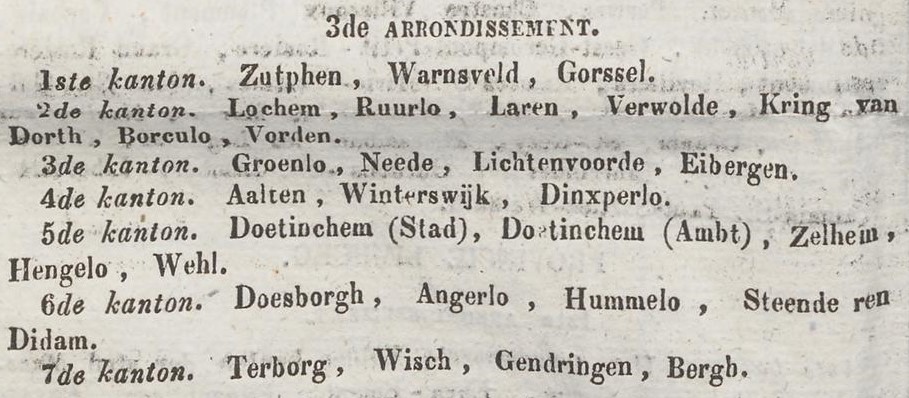
    By Imperial Decree of July 9, 1810, the Netherlands was divided into departments, districts, cantons, and municipalities. A justice of the peace court was established in every main town of a canton, including Aalten. The canton of Aalten consisted of the municipalities of Aalten and Dinxperlo.

    The task of the justice of the peace was to resolve conflicts peacefully before they were brought before a ‘real’ judge, in order to save a great deal of expense. In addition, the justice of the peace had the authority to handle small, low-cost cases. Other powers of the justice of the peace lay primarily in personal and family law.

    Cantonal Court

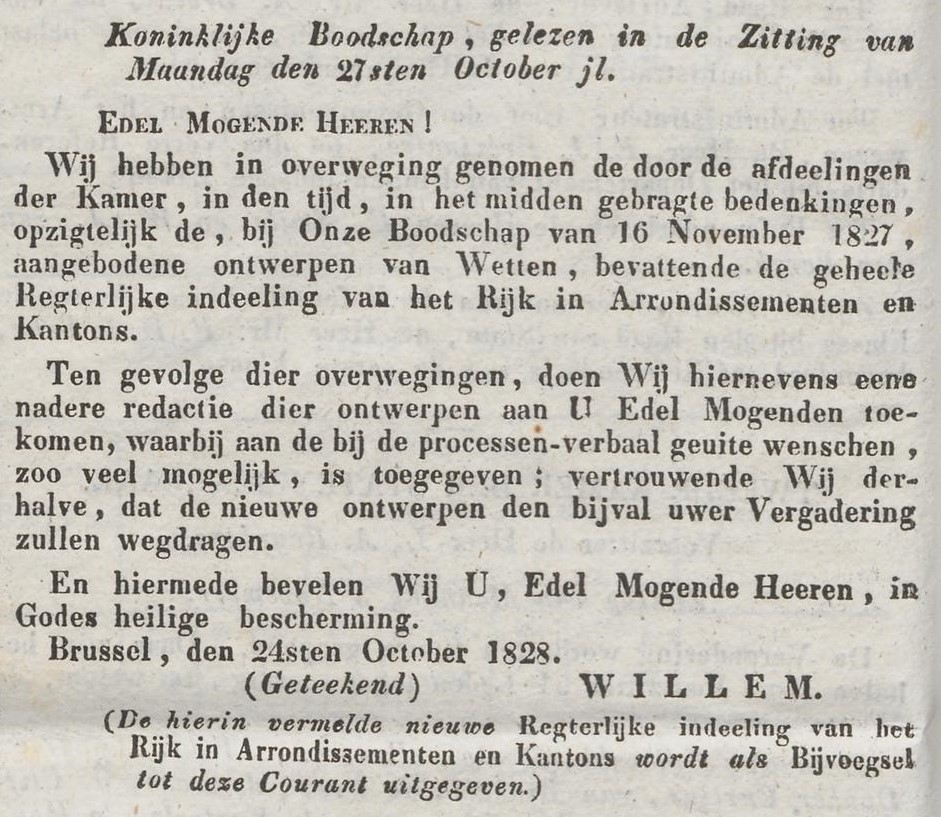
    In 1838, the legal system was reorganized again, and the justice of the peace was replaced by the cantonal judge. The justice of the peace courts of Aalten and Winterswijk were then merged into the Aalten cantonal court. This court covered the fourth canton of the third district (Zutphen) of the Gelderland Court of Appeal and was classified as a fifth-class subdistrict court based on the Act of July 1, 1830.
    The Aalten cantonal court held its sessions in the town hall on the Markt. In 1861, a cantonal house of detention was built in Prinsenstraat, with six cells and a jailer’s residence.
    The Aalten cantonal court was abolished in 1877. From that moment on, the municipalities of Aalten and Winterswijk belonged to the canton of Groenlo. The municipality of Dinxperlo was transferred to the canton of Terborg.

    Archive

    In 1968, the archive of the former Aalten cantonal court was transferred to the State Archives in Gelderland, along with the oldest part of the Groenlo archive. In 1961, the transfer of the Public Prosecution Service archive, which was still located in the Aalten town hall, took place.

    Judges and clerks of the justice of the peace and cantonal court in Aalten 1811-1877 (still incomplete)

    Additions are welcome!

    Term of officeJustice of the PeaceDetails
    ?Jan Izak Huinink (1739-1822)
    ?Abraham Casper Salomon ten Bokkel (1761-1831)lawyer, notary, land clerk, justice of the peace, temporary mayor of Aalten, and deputy bailiff
    ??
    Term of officeCantonal JudgeDetails
    1838-1855Joseph Gerard van der Schaaff (1798-1877)formerly justice of the peace in Aalten, honorably discharged
    1855-1877Frederik Willem Jacob Immink (1822-1893)formerly clerk of the Aalten cantonal court, subsequently subdistrict judge in Groenlo
    Term of officeClerkDetails
    1811Campegius Lambertus Vitringa (1786-1864)formerly a lawyer in Arnhem, subsequently clerk in Harderwijk
    Jan Willem te Gussinklo (1787-1829)
    1838-1839Jan Derk Schepers (1800-1848)formerly clerk of the justice of the peace court in Aalten, subsequently municipal tax collector in Dinxperlo
    1839-1843Jillis van Beuil (1803-1843)formerly a letter collector in Aalten, died in office
    1843-1852Bernard Andries Roelvink (1818-1882)formerly substitute prosecutor at the district court in Zutphen, subsequently notary in Aalten
    1852-1855Frederik Willem Jacob Immink (1822-1893)formerly a lawyer in Borculo, subsequently cantonal judge in Aalten
    1855-1877Cornelis Philippus Jacobus Penning (1817-1888)former position unknown, placed on redundancy pay in 1877 due to the abolition of the Aalten cantonal court
  • Aalten Constituency

    Aalten Constituency

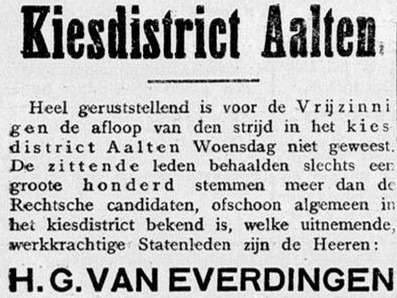
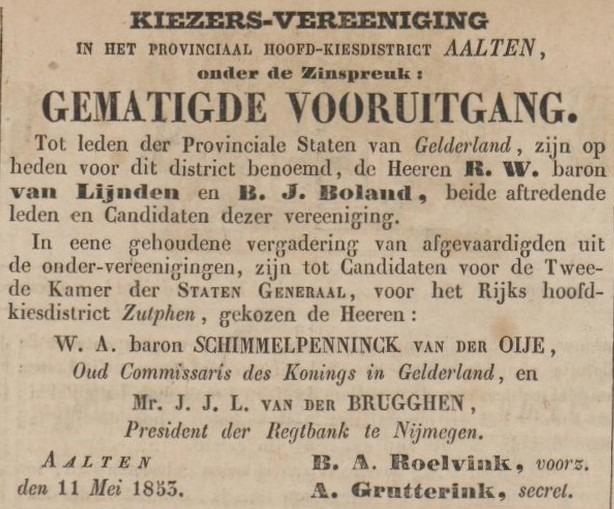
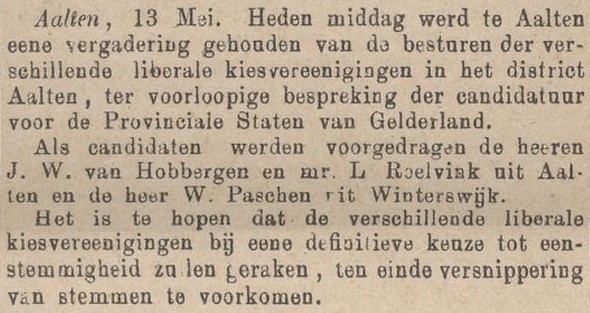
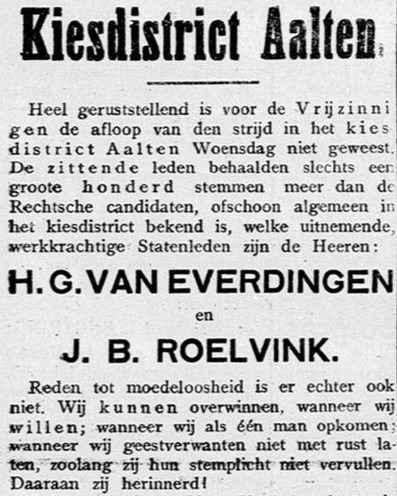
    From 1852 to 1919, the Aalten electoral district was one of the sixteen Gelderland electoral districts for the Provincial Council. The district comprised the municipalities of Aalten, Winterswijk, and Dinxperlo and held three seats.

    Following the constitutional revision of 1848, which for the first time enabled direct elections of the Provincial Council under census suffrage (voting rights for men who met a certain income requirement)1 – and the Provincial Act of 1850, Gelderland was divided into sixteen districts in 1852, including Aalten.2

    With the introduction of universal male suffrage in 1917 and the Elections Act of 1919, the elections of April 10, 1919, were the first to use proportional representation within a single province-wide constituency, after which the Aalten electoral district ceased to exist.3

    Origin and background

    During the reign of King William I (1772–1843), provincial governments were appointed bodies in which nobility and local notables held seats without election. It was only with the constitutional revision of 1848 that members of the Provincial Council could be directly elected, albeit still on the basis of census suffrage.1

    Establishment of the Aalten electoral district

    In 1850, the Provincial Act came into effect, which determined, among other things, how members of the Provincial Council were elected. Two years later, the Act regulating the division of provinces into electoral districts of November 5, 1852 (Bulletin of Acts and Decrees No. 197) established the final division: Gelderland was split into sixteen electoral districts, including Aalten.2

    Abolition and transition to proportional representation

    The constitutional revision of 1917 introduced universal male suffrage and heralded the abolition of the district system. The Elections Act of 1919 put an end to small electoral districts and introduced a single province-wide constituency with proportional representation in all provinces. This system was first applied during the Gelderland elections of April 10, 1919, at which point the Aalten electoral district ceased to exist.3

    Delegates

    Some well-known Council members representing the Aalten electoral district: 1

    1853–1860: Mr. Rudolph Willem graaf van Lynden (1808–1876)

    1853–1877: Bernhard Jan Boland (1804–1888)

    18531882: Mr. Bernard Andries Roelvink (1818–1882)

    1853–1892: Mr. Wilhelm Arnold Roelvink (1822–1917)

    1860–1885: Jan van der Zande (1819–1885)

    1877–1885: John Bernard William Maitland (1826–1894)

    1886–1892: Jacobus Wilhelmus van Hopbergen (1817–1913)

    1892–1898: Georg Ludwig Carl Heinrich Baud (1858–1921)

  • The Lime Tree, the Coat of Arms of Aalten

    The Lime Tree, the Coat of Arms of Aalten

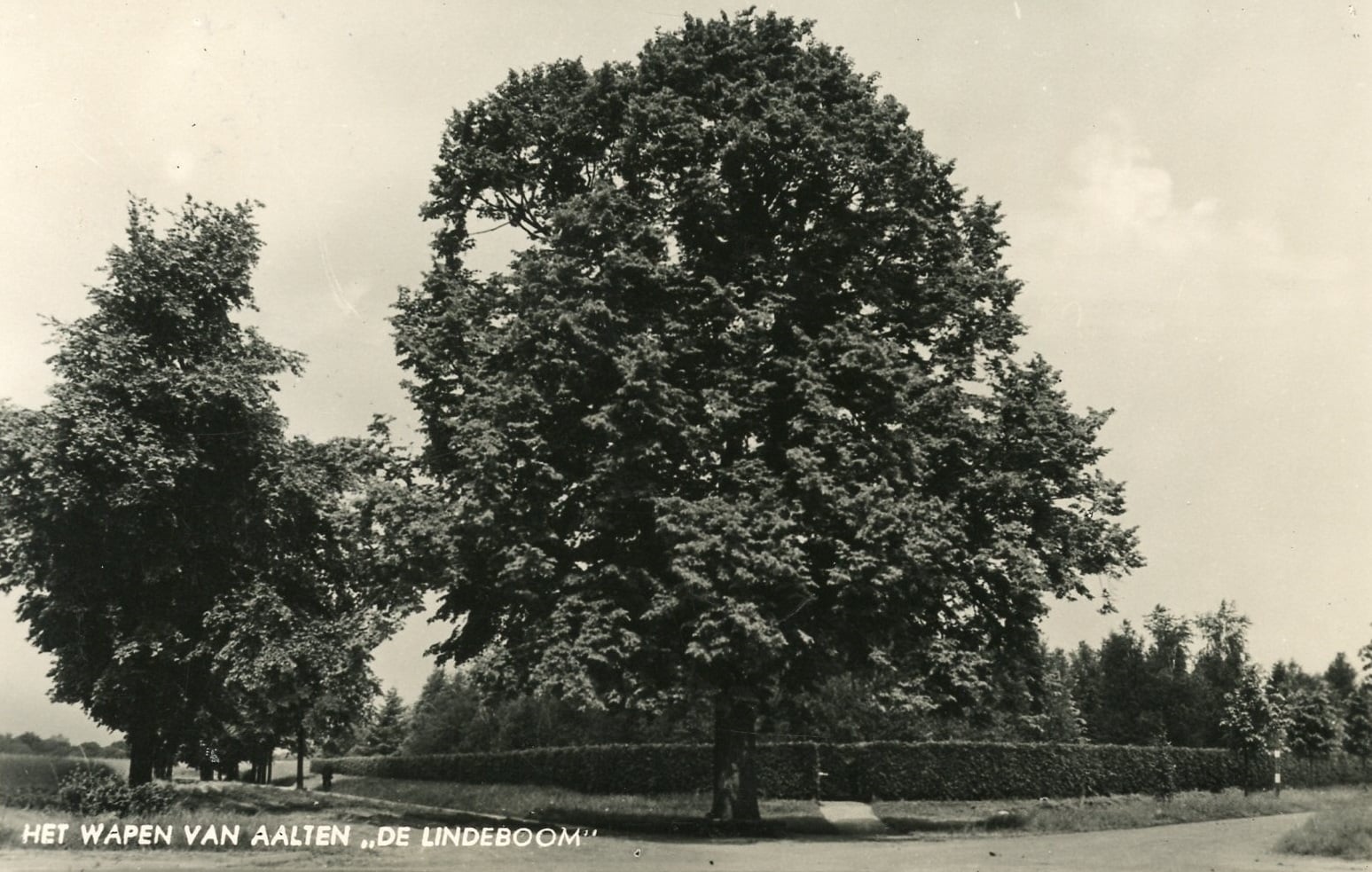
    For nearly two centuries, the municipality of Aalten bore a lime tree (lindeboom) in its official coat of arms. In 2005, Aalten merged with Dinxperlo, which meant a new municipal coat of arms had to be created. Nevertheless, the lime tree remains a central symbol in the local identity.

    The coat of arms for the municipality of Aalten was applied for on 3 October 1815 by the then mayor, Christiaan Casper Stumph, and according to his accompanying note, it must have appeared on very old judicial documents. Before that time, the mayor had been obliged to make use of his own family coat of arms. The “very old judicial documents” turned out to be a stamp that Aalten had used as a municipality between 1795 and 1798, until it was incorporated into the Bailiwick (Ambt) of Bredevoort, which used a seal bearing the letters “AB”.

    Following the establishment of the Kingdom of the Netherlands, the High Council of Nobility (Hoge Raad van Adel) drew up guidelines for the registration of municipal coats of arms in 1816. On 7 October 1818, the first official coat of arms was granted to the municipality of Aalten by Royal Decree.

    The description of Aalten’s first coat of arms reads:

    “Of silver charged with a green tree, standing on a ground of the same.”

    Origin and meaning

    The origin of the tree coat of arms is unclear, although there appears to be a connection with surrounding towns. In ancient times, Bredevoort and Groenlo also bore a tree in their coats of arms, as does the nearby German city of Bocholt, which still uses a tree in its emblem today.

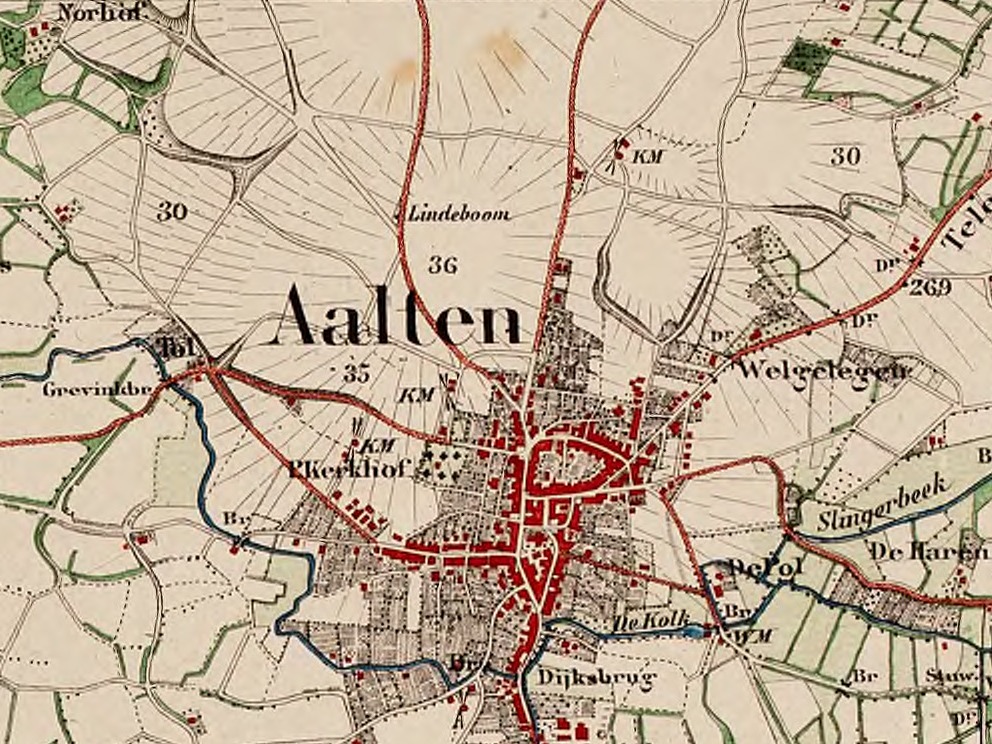
    The exact reason why the Aalten administration chose a lime tree at the beginning of the 19th century is not documented. It could have been a liberty tree, or it may have been derived from a freestanding lime tree on the Aalten Es near Berkenhove Cemetery, which stood there as early as the 18th century, was replanted in the first half of the 19th century, and replanted once more after World War II.

    The choice of a lime tree aligns with a broad Western European tradition. Since the Middle Ages, the lime tree served in many villages as a court-tree (dingboom) or justice-lime (gerechtslinde). Beneath this central tree, administrators and judges gathered to dispense public justice. The symbol thus referred directly to local jurisdiction and the self-governance of the place of origin.

    The Municipal Reorganisation (2005)

    On 1 January 2005, the municipalities of Aalten and Dinxperlo merged to form the new municipality of Aalten. According to the guidelines of the High Council of Nobility, the heraldic elements of both former municipalities had to be combined into a new design.

    On 8 June 2010, the new, composite coat of arms was officially established by Royal Decree. The shield was divided horizontally:

    • Upper half: The original green lime tree of Aalten on a silver field.
    • Lower half: The two crossed swords with golden nooses from the old coat of arms of Dinxperlo (originally granted in 1897), placed on a black field.
    • Crest: Since then, the shield has been surmounted by a golden count’s coronet (three leaves and two pearls).

    The Aalten Lime Tree in Delfshaven

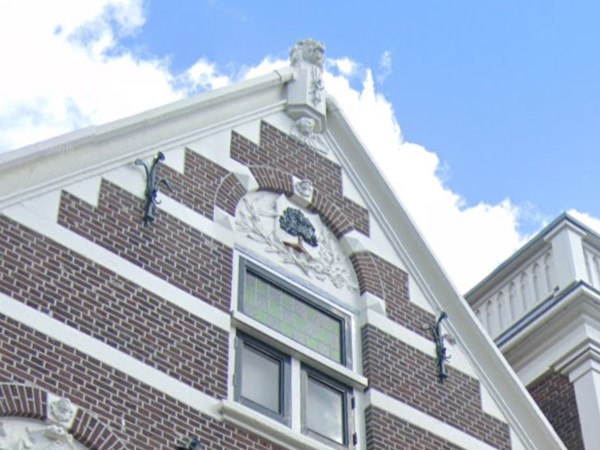
    An interesting example of the Aalten coat of arms outside the Achterhoek can be found in Rotterdam-Delfshaven. On Havenstraat stands a building dating from 1886, which features a gable stone depicting the old coat of arms of Aalten.

    Sources


    • High Council of Nobility (The Hague): Register van Overheidswapens, registration dated 7 October 1818 (Municipality of Aalten) and revision dated 8 June 2010.
    • Municipality of Aalten: Council resolutions and correspondence with the High Council of Nobility regarding the alteration of the coat of arms (procedure 2005–2010).
    • Wikipedia