Category: Government

  • The Murder of Aunt Tannemaat

    The Murder of Aunt Tannemaat

    On the early morning of January 12, 1770, the neighbors of the Vosheurne farm in Lintelo were startled by a disturbing report. “The aunt is dead, she is very bloody, she may well have smashed her head,” resident Harmen Brunsink shouted. Extensive forensic investigation by the Court of Bredevoort revealed a story of a family conflict that degenerated into murder and would end with a gruesome execution.

    Tensions in the House

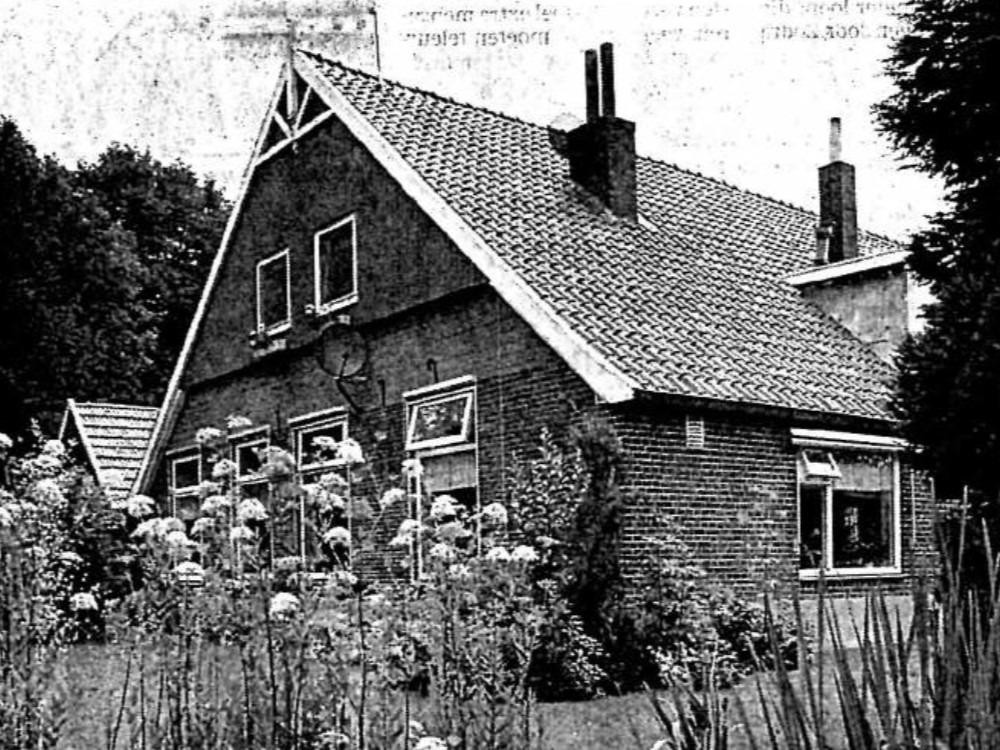
    Hendersken Tannemaat, born in 1705, had lived on the Vosheurne her entire life. Her niece, Gijsberta Deemshof, born in 1739 in Doesburg as the daughter of Hendersken’s sister Johanna, was raised by her ‘moeje’ (aunt) Hendersken from the age of three. In 1761, Gijsberta married Harmen Brunsink, born in 1729 at the Bekink farm in IJzerlo. After their marriage, Harmen moved in with Gijsberta and her unmarried aunt at the Vosheurne.

    Initially, Hendersken lived with the young couple in exchange for board. In June 1768, however, she transferred all her possessions to Harmen and Gijsberta in exchange for room and board and all necessary care for the rest of her life. This was a common arrangement at the time between elderly people and their children—in this case, her niece and husband. Harmen and Gijsberta solemnly promised to fulfill this obligation.

    However, the relationship between Harmen and the aunt deteriorated over the years, and tensions arose in the house. The aunt reportedly told Harmen several times that she wanted to undo the agreement “because you treat me so poorly!”

    A Mysterious Death
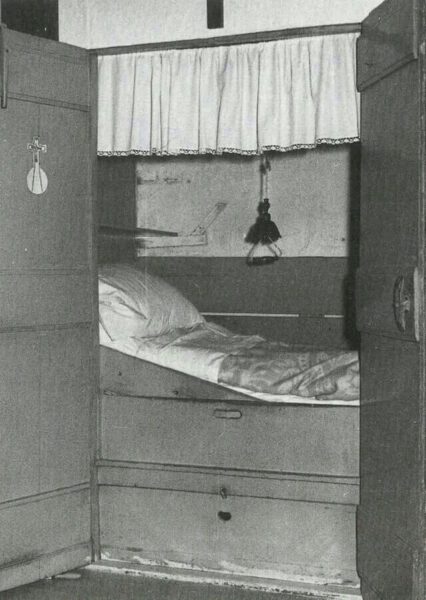
    A box bed (photo for illustration)
    A box bed (photo for illustration)

    On that fateful morning of January 12, 1770, Harmen frantically gathered the neighbors because the aunt was dead. It was customary in this region for neighbors to be called upon in the event of a death to arrange practical matters, such as the funeral and the ‘verhennekleden’—undressing the deceased and shrouding them in grave clothes. When the neighbor women entered the bedroom, they found Hendersken dead in her box bed, her hands folded over her chest. Her nose and arms were blue, and when her cap fell off, they discovered flour in her hair and blood seeping down her neck.

    Gijsberta stated that she had used the flour to staunch the bleeding. Harmen added that the bruises were likely because the aunt suffered from scurvy, and that Hendersken had probably hit her head on the sharp edges of the bed plank. But the story did not add up. The neighbors did not trust it and brought the matter to the attention of the Court of Bredevoort.

    The Investigation

    Two days after Hendersken’s death, court officials arrived at the Vosheurne with two surgeons. Upon arrival, it appeared the body had already been coffined. In the presence of Harmen and Gijsberta, the surgeons examined the body. They discovered several severe injuries and bruises to the head. The injuries made it clear that an accident was out of the question. Suspicion immediately fell on Harmen and Gijsberta, who lived with Hendersken at the Vosheurne and could not provide a convincing account of what had happened.

    Both suspects denied any involvement and claimed they had found Hendersken dead on the floor in front of her box bed that morning. They claimed to have placed her on the bed, sprinkled flour on her head to stop the bleeding, and put on her cap. However, their statements contradicted each other. Harmen had told the neighbors that he had found Hendersken dead in bed, not on the floor.

    Voluntarily and without resistance, they went to Aalten, where they were taken into custody for further questioning. When the numerous head wounds were discussed, Harmen stated that these might have been the result of an epileptic seizure. Hendersken supposedly hit her head against the bed plank, the flax comb chair, the small chests, a trunk, or the beer stand. He also suggested that someone from outside the house could have broken in, as the house was in poor condition.

    Further Investigation

    On January 16, the Court, assisted by a doctor, a surgeon, and a prosecutor, returned to the Vosheurne with the suspects. Hendersken’s bedroom was meticulously examined.

    The box bed showed a large bloodstain on the bed plank at the head end, as if the blood had splashed against the plank. But it had no sharp edges, as Harmen had claimed. Due to long-term use, the plank was actually rounded, and no sharp edges were found inside the box bed either. Other furniture in the room—small chests, a trunk, and a flax comb chair—showed no traces of blood. Nothing was found under the box bed either.

    The doctor and the surgeon then examined the body even more closely. They stated primarily that there was a slight bruise on the nose, as well as severe bruising on both elbows, arms, and hands, beneath which coagulated, extravasated blood was found. These bruises could only have been caused by an external factor.

    Not only on the right side of the head, at the level of the temple, were the external coverings and fleshy parts bruised, wounded, and destroyed down to the bone, but similar bruises and wounds were visible on the left side, albeit to a lesser extent. Two openings or wounds were discovered on the left side of the skull and one on the right, each about the size of a shilling. Upon loosening the external parts, it appeared that the skull had a fracture on the right side and that on the left side, the end of the skull bone was severely bent downwards and partially broken.

    After sawing through and removing the skullcap, several ruptures were found. Due to these fractures and bone pressed outwards, the brain, particularly on the left side, was severely damaged. On both sides of the head, especially the left, extravasated blood was present on and under the dura mater and also within the brain itself. Furthermore, all blood vessels were completely filled with blood. This combination of injuries had inevitably caused her death.

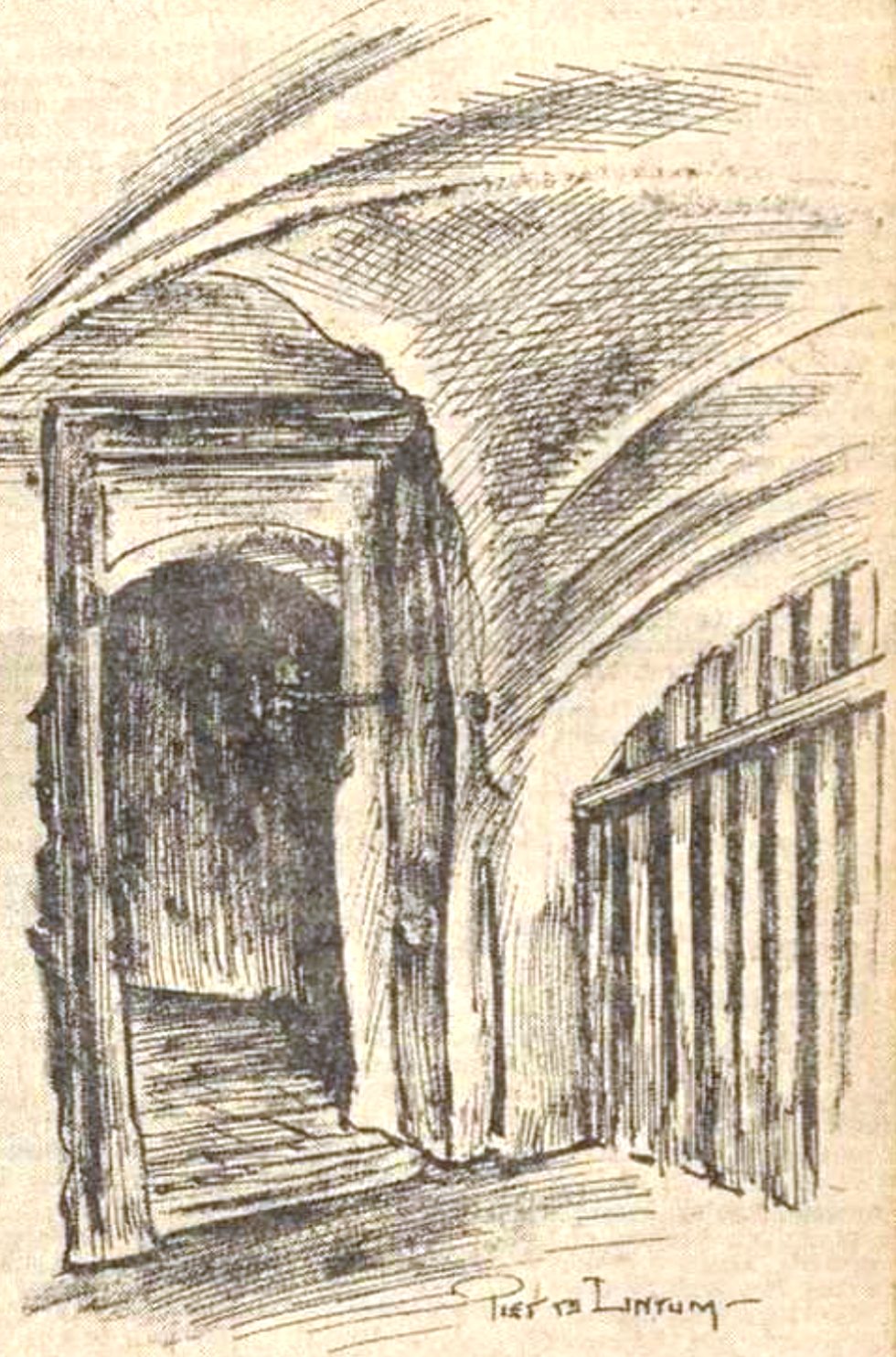
    Although the suspects continued to maintain their innocence, the suspicions raised against them were only strengthened by these findings. From the situation on-site and the condition of the corpse, there was no longer any doubt that a murder had been committed. Such a thing could not happen unnoticed in a small cottage like that of the suspects, while they claimed to know nothing. The suspects were then transferred to the prison in the Ambtshuis in Bredevoort.
    Harmen’s Confession

    During the subsequent interrogations, Harmen and Gijsberta initially stuck to their story: Hendersken had died in an accident. But the evidence against them mounted. On January 19, a week after the murder, Harmen broke under the pressure and confessed what had really happened: He stated that he acted alone, without the help of his wife. He had previously said to his wife in bed: “There lies such a small pebble, I shall strike her five or six times on the head with it, then she will be gone, then the quarreling will be out of the house, then we can live in peace and unity.”

    Around four hours before sunrise, he had risen, lit the lamp, went to Hendersken’s room, and hung the lamp on a nail above the box bed. Upon entering the room, the aunt woke up from the light. Thereupon, Harmen jumped into bed with her, sat astride her, held her head with his left hand, and struck her five or six times on the head with the pebble with his right hand, until she lay dead under his hands.

    Gijsberta reportedly tried to stop him, but without success. When the aunt was dead and bleeding heavily, he ordered his wife to sprinkle flour on her head and wash off the blood. Afterwards, he called the neighbors. The stone with which he had struck her, he threw into the ditch behind the oven, near the spot where they fetched water.

    Statement of Gijsberta

    Gijsberta made her confession on January 20 and 22. She stated regarding her unhappy marriage: “Oh, how unfortunate I am! I married my husband against the wishes of my entire family, and from the beginning of our marriage, he has lived poorly with me.”

    In the early morning of January 12, her husband, before he even rose, had said to her: “I will no longer have the quarreling in the house, I want to take decisive action, I shall get a pebble, and give the Aunt but one blow to the head with it, then she will be gone, and then the quarreling will be out of the house.” She was very upset by this, but he tried to reassure her, kissed her, and said: “Do not be dismayed, let me take decisive action, she is an old person, then we can have a peaceful life.”

    He even came to her bed with gin and said: “You must drink plenty of gin, and you must be half-drunk, otherwise you would be too dismayed; we must now bite through a sour apple; but you must never betray me, even if I should happen to die, and you get another husband, then you must never say to him that I murdered your own blood.”

    She then said to him: “Could you bring yourself to kill my own flesh and blood; if it comes down to it, then I must say it,” to which he had replied: “I will nevertheless take decisive action, I want the quarreling out of the house.”

    When her husband was already in the aunt’s room and began striking her, he called Gijsberta to come there. She then went to the room, grabbed his linen smock to pull him away from the aunt, and said: “Fie, fie, what are you doing!” She added that her husband had forced her to be present, saying: “otherwise you might go and report me later.”

    Gijsberta also stated that she had long been afraid to lie in bed with him, fearing he would attack her with a knife. That night, too, a knife lay in his trousers in front of the bed. She therefore also said to him: ”I am afraid that you will do me harm.” To which he assured her: “Oh no, I will never do you harm.”

    She also confessed that her husband could not bear it if she was kind to the aunt, and that she had had constant sorrow with her husband since the aunt lived with them.

    Gijsberta stated from the outset that she did not help carry out this gruesome deed. She also did not know what her husband used to beat the aunt to death, only that in the morning, while fetching water in the ditch in front of the house by the willows, she saw a gray pebble lying in the water that had not been there before.

    Both suspects finally confessed that the aunt had never suffered from epilepsy. The neighbors and friends had also never heard of it, except only after her death.

    The Verdict
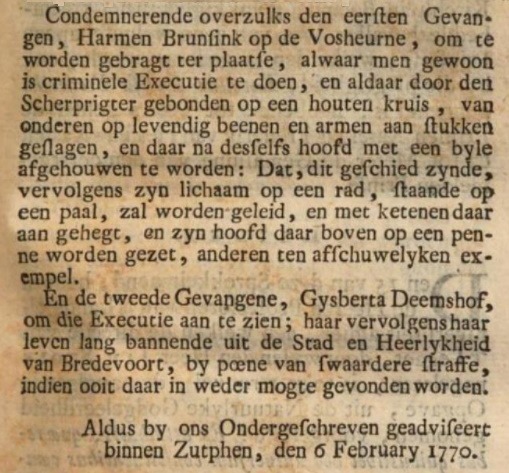
    The Court of the Lordship of Bredevoort ruled that everything indicated that Harmen Brunsink, on the night of January 11 to 12, 1770, had murdered Hendersken Tannemaat, a defenseless person estimated to be nearly seventy years old, lying on her bed in his house, in a gruesome manner, deliberately and with premeditation. Gijsberta was charged with failing to dissuade her husband, where possible, from this abhorrent intention.

    Harmen was sentenced to death: “to be brought to the place where criminal executions are customarily performed, and there to be bound by the executioner on a wooden cross, to have his legs and arms broken to pieces from the bottom up while alive, and thereafter to have his head severed with an axe. That, this having been done, his body shall subsequently be laid upon a wheel, standing on a post, and fastened thereto with chains, and his head set upon a spike above it, as a hideous example to others.” This punishment is called breaking on the wheel.

    On February 10, the residents of Dinxperlo were summoned to the Hollenberg to erect the post and the wheel for the execution and to make the noose. Most refused or did not show up and were fined 30 thalers per person. 18 persons consented and erected the post and the wheel.

    The sentence was carried out on the Hollenberg on February 12, 1770.

    Gijsberta escaped the death penalty but was required to witness her husband’s execution. Subsequently, she was banished for life from the city and Lordship of Bredevoort. She remarried in 1776 in Silvolde to Jacob Kok and reportedly died in 1813.

    Sources


    • Nieuwe Nederlandsche jaerboeken, of Vervolg der merkwaerdigste geschiedenissen, die voorgevallen zyn in de Vereenigde Provincien […]. Fifth volume. MDCCLXX, published by the heirs of F. Houttuyn in Amsterdam, P. van der Eyk and D. Vygh in Leiden, 1770 (link)
    • Old Judicial Archive of Bredevoort
  • The Vagrant Hunter

    The Vagrant Hunter

    In an era when the government provided little to no poor relief, many people were left at the mercy of begging. They roamed from place to place, struggling to make ends meet. During the eighteenth century, the number of vagrants increased significantly. Because these individuals were often regarded as a nuisance by the authorities, and churches lacked the resources to offer them a chance at a better life, the office of the ‘armenjager’ (‘vagrant hunter’ or ‘parish beadle’) was established. This ‘official’ was employed by the local government but often led an impoverished existence himself.

    Appointment of Vagrant Hunter Willem Hondarp in 1768

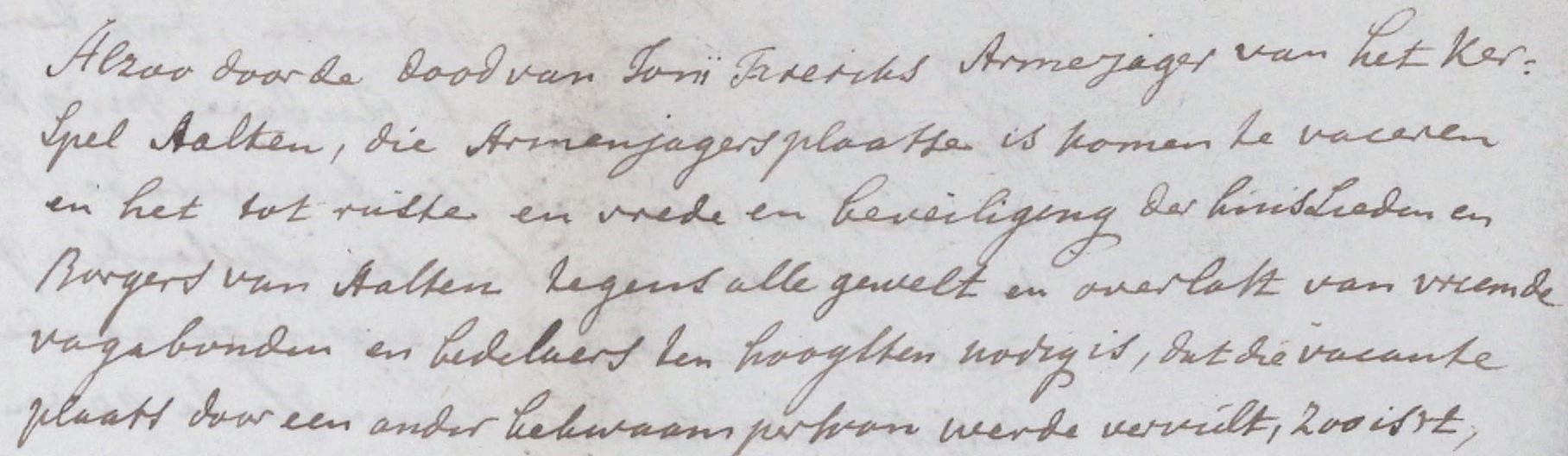
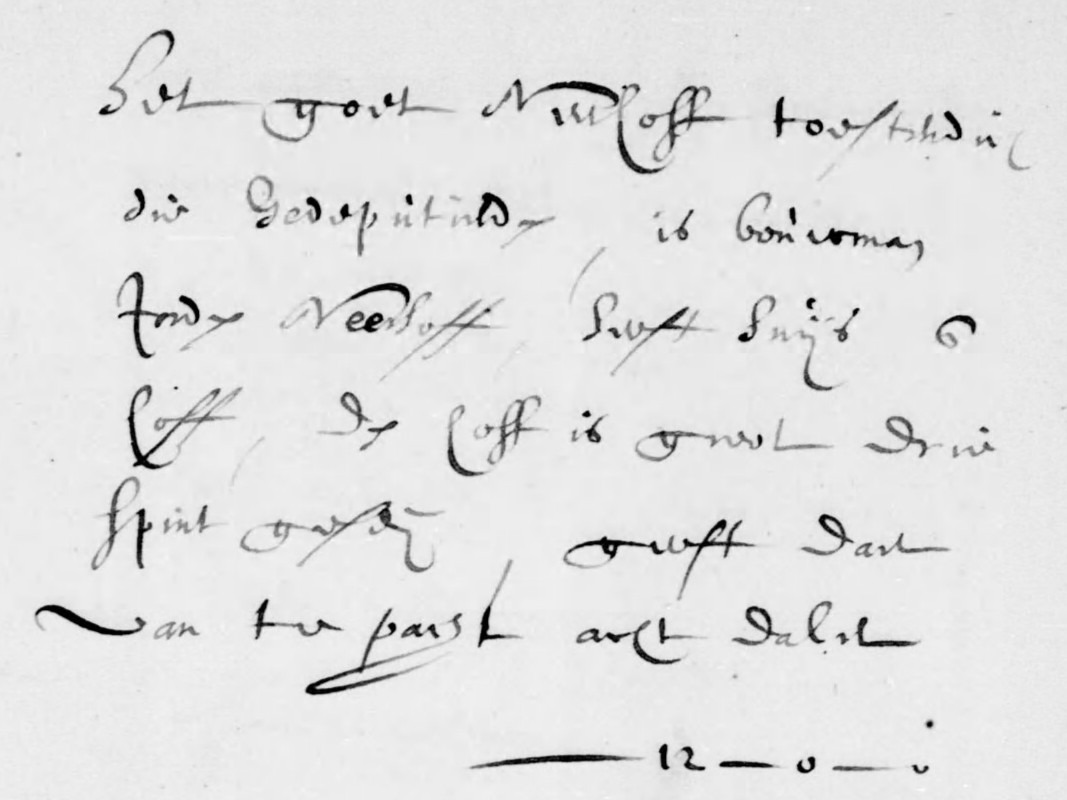
    The image below is a fragment from the deed in which, following the death of Antoni Freriks on 5 January 1768, the appointment of Willem Hondarp as vagrant hunter was recorded. The deed also outlines the duties of the office. A complete translation of the transcription follows:

    Appointment Willem Hondarp as vagrant hunter in Aalten, 10 March 1768

    “Whereas, due to the death of Toni Frederiks, Vagrant Hunter of the parish of Aalten, said position has become vacant; and whereas it is of the highest necessity for the peace, quiet, and security of the husbandmen and citizens of Aalten against all violence and nuisance from foreign vagabonds and beggars that this vacant position be filled by another capable person: I have, upon the good testimony given to me of the fearlessness of the person of Willem Hondarp, appointed the same Will. Hondarp, as I hereby appoint him by virtue of these presents, as Vagrant Hunter of the parish of Aalten, upon such emoluments as have been given from of old and are still given. Commanding the aforementioned Willem Hondarp to cause all foreign beggars, vagabonds, and tramps to depart forthwith from the parish of Aalten and indeed from this Lordship; and should any be found who commit any violence or protest, to resist them with force and, if possible, to bring them to the Lord’s prison within Bredevoort.

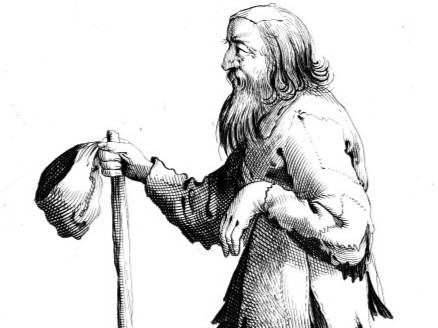
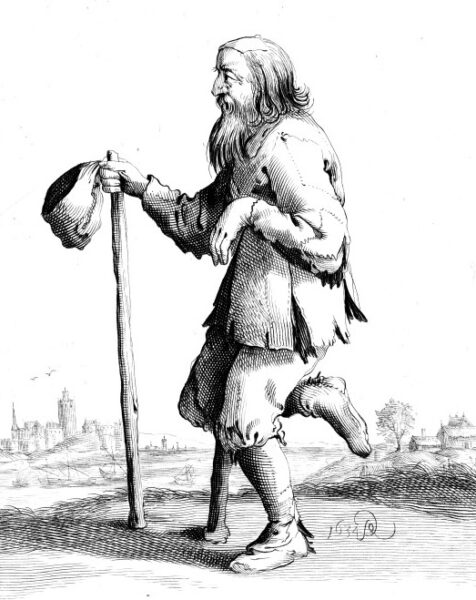
    Vagrant, by Pieter Quast, 1634. Etching: Rijksmuseum Amsterdam.
    Vagrant, by Pieter Quast, 1634. Etching: Rijksmuseum Amsterdam.

    Further commanding him that he shall tolerate no collections, whether by strangers or residents, unless they be provided with a proper note or attestation from the officer or, in the absence of the stadtholder of this Lordship; and to allow those so provided to pass and repass freely and unhindered. Furthermore, in the event that the voogd [warden] or deputy warden should require him, Willem Hondarp, in any exploit and should call or have him called for that purpose, he shall immediately go with said warden or deputy warden and obey and assist him to the best of his ability. Furthermore, to pass through the neighbourhoods from time to time and take care that no nuisance is caused to the husbandmen by any person; further to apprehend and bring in, if possible, all foreign and unauthorised hunters hunting in this Lordship, and should he know any whom he could not bring in, to report them to the officer or his stadtholder, and further to do all that a faithful and orderly Vagrant Hunter is obliged to do, and to take care as much as possible that no complaints arise from the husbandmen.

    However, should it happen that the same Willem Hondarp should fall short in any matter and should request proper assistance from the husbandmen, and such assistance be refused him, he shall give notice of that refusal to the officer or to his stadtholder.

    All this until our revocation. Given at Walfort House, the 10th of March 1768, and signed by my own hand as Drossard of this Lordship and confirmed with my customary seal.

    Signed: Ad. de Pallandt”

    Legal Proceedings

    On 20 February 1804, a court case was held in Bredevoort against Jan Willem Brusse(n), vagrant hunter. On 23 December, at the house of Goormans in Barlo, he had ‘murderously assaulted’ Willem Beskers. Brusse had struck him on the elbow with a sabre, wounding him so severely that he could no longer use that arm. Brusse confessed but claimed that when he asked Willem Beskers for proof that he was permitted to collect alms, Beskers attacked him. Brusse maintained he had acted only in self-defence. Fine: 25 guilders.

  • The execution of Klaas Nijman

    The execution of Klaas Nijman

    Klaas Nijman was baptized on January 16, 1698, in Dinxperlo as the son of Fredrik Nijman and Berentjen Eppink. At the age of fifteen, he left his parental home and began a wandering existence as a ‘beggar and vagabond’. In 1722, he was sentenced in Rhenen to a stay in a house of correction for violence and theft. His release was followed by banishment from the province of Utrecht.

    Nijman then returned to the Achterhoek, where he sowed fear among the population, particularly in the vicinity of Dinxperlo and Aalten. He begged and stole, threatened people, and did not hesitate to use brute force. In 1729, he set fire to several houses and was arrested.

    On October 3, 1729, following a trial in Bredevoort at ‘t Zand, Klaas Nijman was sentenced to death. He was taken to the Hollenberg, where he was strangled and subsequently set on fire. This gruesome punishment served as a deterrent to others. Nijman was 32 years old at the time.

    Sentence

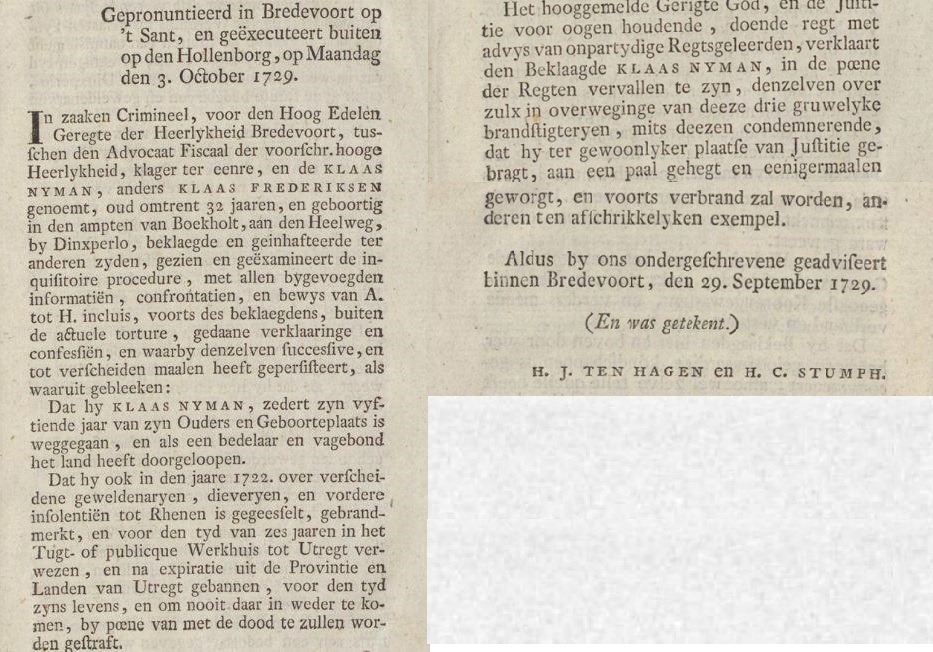
    The following 18th-century text describes his crimes and sentence:

    Pronounced in Bredevoort at ’t Sant, and executed outside on the Hollenberg, on Monday, October 3, 1729.

    In Criminal cases, before the Most Noble Court of the Lordship of Bredevoort, between the Advocate Fiscal of the aforementioned High Lordship, complainant of the one part, and KLAAS NYMAN, otherwise called KLAAS FREDERIKSEN, aged about 32 years, and born in the district of Bocholt, at the Heelweg, near Dinxperlo, defendant and prisoner of the other part, having seen and examined the inquisitorial procedure, with all attached information, confrontations, and evidence from A. to H. inclusive, furthermore the defendant’s declarations and confessions made outside of actual torture, and in which he has successively and at various times persisted, from which it has appeared:

    That he, KLAAS NYMAN, since his fifteenth year has left his Parents and Birthplace, and has wandered the land as a beggar and vagabond. That he was also in the year 1722, for various acts of violence, thefts, and further insolences at Rhenen, flogged, branded, and committed for the term of six years to the House of Correction or public Workhouse at Utrecht, and after expiration banished from the Province and Lands of Utrecht for the term of his life, and never to return therein, upon pain of being punished with death.

    That having been released from the aforementioned House of Correction or Workhouse about three-quarters of a year ago, yet the penalties of banishment remaining in force, he thereupon, or some time thereafter, returned to Dinxperlo, and continued in his bold beggaries and acts of violence. That he there, for a trifle on the public road near Dinxperlo, cut open the mouth of one DIRK WENSINK with a knife.

    That he likewise, after his aforementioned release, again committed various thefts, such as of ironwork and an axe, and of linen, such as a pillowcase or sheet on the other side of Doesburg at the Steege; and also a shirt from the garden at HENDRIK te Loo or Kistershuis, between Dinxper and the Bredenbroek, and further as by the Reformations. That he, KLAAS NYMAN, has also for years past been notorious and held in suspicion by many inhabitants under Dinxperlo and Aalten, as being of no good and committing much evil.

    That he also, following the . . . . of the sentence at Rhenen, was held suspect there of having committed very grave offenses. That the defendant, through his . . . . and malicious conduct and questionable language which he used here and there, has kept the good husbandman and the inhabitants in the countryside, and especially around Dinxperlo and Aalten and the surrounding area, in a state of constant anxiety and fear. That when he came to beg, he was not satisfied with what is ordinarily given to a beggar, although he was often given even more, and went away from the houses muttering to himself.

    That this anxiety and fear among the inhabitants has doubled and reached its peak since fire broke out in the Parish of Aalten in this year 1729, and that further and even more burnings of houses close by followed. Such that several inhabitants ordered their people that, if KLAAS NYMAN came to their houses, they should just give him whatever he wanted, to gain his friendship and not to anger him, and that several people, out of fear of arsons, had to keep night watches at their houses during the night, whereby even some hamlets were placed in a state of near alarm.

    That he, the defendant KLAAS NYMAN, is also the one who has come to such exceedingly wicked crimes that in the past Summer in the Parishes of Aalten and Dinxperlo, of this same year 1729, from June 13 to August 29, and thus within the span of a quarter-year, he has set fire to three houses, one after the other, and by no means the smallest, which houses were also totally burned down, and of which the corpora delictorum are known.

    Namely, on June 13, the house at Lensink, under Aalten on the Esch at Yserlo, where he set a piece of white or spongy peat on fire by means of a tinderbox, flint, and tobacco pipe, and with that burning peat at the back on that side of the house where the wind was blowing against the house at the time, caused the fire. That eight days prior he had also set the same house Lensink on fire, and that it had already been burning, but that it was then still extinguished by the occupants.

    Secondly, the house at Welink, also under Aalten on the Esch at Yserlo, on June 20, where he carried out the fire in the same manner as at Lensink with a piece of ignited spongy peat, and therewith set the house on fire from behind. That for both his arsons, at Lensink and Welink, he gives as his reason that he had done so to create anxiety and terror in the neighborhood, or among the people.

    Thirdly, the house at Grevink, at ‘t Rexwinkel in the hamlet of Heurne, under Dinxperlo, on August 29, in the evening around 10 o’clock, when he caused the fire there with an ignited fuse made of linen rags, in the straw that lay at the back on the corner partition of the house. That in this aforementioned house Grevink, when it caught fire, a young woman in childbed, who had not yet been in childbed for two days, lay on the bed, and who by great fortune still having the strength to get off the bed, still escaped the fire. That he, KLAAS, gives as his reason for this arson at Grevink that he had done so because the same aforementioned woman in childbed, a long time ago when she was still unmarried, had given him a piece of pancake that had been too small for him.

    That at Welink and at the last-mentioned Grevink, several pieces of live Cattle, harvested Grain crops, and further items were also burned and consumed.
    That he, the Defendant, is furthermore convicted by four sworn credible witnesses, although he himself has tried to deny it telle quelle, that on August 31 last he spoke those grim words at the house of ARENT OOSTENDORP, in the hamlet of Heurne, under Dinxperlo, that this or that corner would shortly be a poor corner.

    That he furthermore has threatened to set fire to the house of the drummer boy within Dinxperlo, and has stood by and persisted in this, that if he had not been captured, he would indeed have done it, and similar terrible threats and dangerous utterances of the Defendant, as the information and confessions herein further set forth.

    The highly-mentioned Court, keeping God and Justice before its eyes, doing right with the advice of impartial Legal Experts, declares the Defendant KLAAS NYMAN to have incurred the penalty of the Law, condemning him for the same in consideration of these three gruesome arsons, that he be brought to the usual place of Justice, fastened to a stake and somewhat strangled, and furthermore shall be burned, as a terrifying example to others.

    Thus advised by us undersigned within Bredevoort, September 29, 1729.

    (And was signed.)

    H.J. TEN HAGEN and H.C. STUMPH

    Source


    • Legal Treatises on Corporal Crimes by a prominent Legal Expert (Jan Jacob van Hasselt), published in Amsterdam by Hendrik Gartman, 1781 (link)
  • A tax history from the year 1717

    A tax history from the year 1717

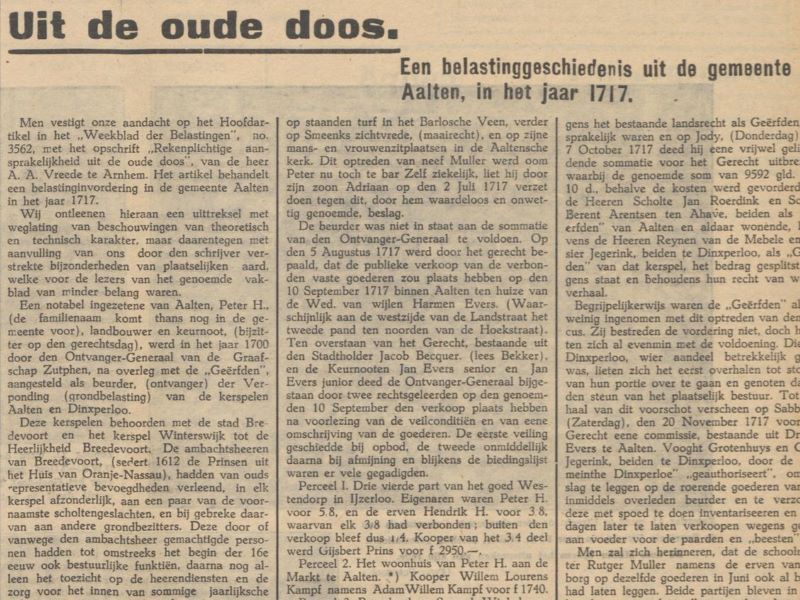
    Aaltensche Courant, February 28, 1941

    Our attention has been drawn to the lead article in the “Weekblad der Belastingen,” no. 3562, titled “Accountable liability from the old days,” by Mr. A. A. Vreede of Arnhem. The article discusses a tax collection in the municipality of Aalten in the year 1717. We have derived an excerpt from this, omitting considerations of a theoretical and technical nature, but conversely supplementing it with details of a local nature provided to us by the author, which were of less interest to the readers of the aforementioned trade journal.

    A notable resident of Aalten, Peter Huijninck, farmer and lay judge (assessor on the court day), was appointed in the year 1700 by the Receiver-General of the County of Zutphen, after consultation with the “Heirs,” as collector (receiver) of the Verponding (land tax) for the parishes of Aalten and Dinxperloo.

    These parishes, along with the town of Bredevoort and the parish of Winterswijk, belonged to the Lordship of Bredevoort. The lords of the manor of Bredevoort (since 1612 the Princes of the House of Orange-Nassau) had traditionally granted representative powers, in each parish separately, to a few of the most prominent bailiff families, and failing that, to other landowners. These persons authorized by or on behalf of the lord of the manor also held administrative functions until approximately the beginning of the 16th century; thereafter, they only oversaw the corvée labor and the collection of certain annual revenues, which later included some liability for the receipt of the land tax. Related to this was the fact that the appointment of a receiver took place in consultation with these authorized persons, referred to above as “Heirs,” and that the provision of security by an appointee was required in the deeds of guarantee of that time for the benefit of the Receiver-General and for the service of the Heirs.

    These documents, like all other voluntary deeds as well as judicial deeds, were established by a declaration in a court session. The court, consisting of the bailiff (judge) or the Stadtholder (deputy judge), two lay judges (assessors), and a Landsschrijver (clerk), was seated in Bredevoort, but held sessions alternately in each parish where necessary. Upon the appointment of Peter Huijninck as collector, his brother Hendrik Huijninck acted as guarantor, and in the deed of guarantee, various fixed assets of both were pledged as security for the administration.

    For several years things went well, but gradually the collector became negligent with the collection, and an increasing backlog arose in the remittance of funds to the office of the County in Zutphen. At the repeated insistence of the Receiver-General, temporary improvements occurred occasionally; for instance, the lay judge Peter Huijninck, in his capacity as collector, requested on Mercury (Wednesday) April 21, 1717, at the Court Day in Aalten, to seize the real estate of Jan ten Heetbrink the Younger and of Mechtelt Brethouwer, widow of Derk Nachtegaal, due to overdue land tax, but no lasting improvement followed.

    It was common knowledge in Aalten that this situation could not continue and that legal action against the negligent collector was inevitable. It is therefore understandable that the heirs of the since-deceased guarantor Hendrik Huijninck feared that the real estate pledged by him would also be targeted. As a result, on Venery (Friday), June 18, 1717, the collector Peter Huijninck and his spouse Geesken Locken appeared before the court, stating that the aforementioned heirs were bothering them daily by insisting on measures to keep them indemnified, and hereby pledged a one-fourth share in the estate and property Westendorp in IJzerlo and two-thirds in the Snoejenbos, located on the Haart, as far as Arent Snoejenbos has it under lease, so that the heirs could recover any damages from it.

    This happened just in time, for only ten days later on Luno (Monday), June 28, 1717, a representative of the Receiver-General Hendrik van Essen appeared before the court to issue an executory summons against the collector Peter Huijninck, inviting him to settle a sum of 17,134 guilders, 1 stiver, and 10 deniers at the office of the County within ten days, as arrears for the years 1713–1716, and threatening a judicial sale of the fixed assets pledged in the guarantee deed. A copy of the summons was served the following day by the bailiff (court officer or bailiff), Jan Keunen, to the collector, speaking with his wife Geesken Locken.

    Now the heirs of the guarantor, who did not yet feel safe despite the deed of June 17, were truly struck with fear, for that very same day, schoolmaster Rutger Muller of Aalten, son-in-law of the deceased Hendrik Huijninck, appeared before the court on their behalf to seize the movable property of Peter Huijninck, as well as the crops and the manure rights of lands leased by him, also his peat pond and the peat standing on it in the Barlosche Veen, furthermore on Smeenk’s mowing rights, and on his men’s and women’s seats in the Aalten church. This action by nephew Muller was finally too much for uncle Peter. Being ill himself, he had his son Adriaan file an objection on July 2, 1717, against this seizure, which he called worthless and illegal.

    The collector was unable to comply with the summons of the Receiver-General. On August 5, 1717, the court determined that the public sale of the pledged fixed assets would take place on September 10, 1717, in Aalten at the house of the widow of the late Harmen Evers. (Probably on the west side of the Landstraat, the second building north of the Hoekstraat). In the presence of the Court, consisting of the Stadtholder Jacob Becquer (Becker, ed.) and the lay judges Jan Evers senior and Jan Evers junior, the Receiver-General, assisted by two legal experts, conducted the sale on the aforementioned September 10 after reading the conditions of sale and a description of the properties. The first auction was by bidding, the second immediately thereafter by Dutch auction, and according to the bidding list, there were many interested parties.

    • Lot 1. Three-fourths part of the Westendorp estate in IJzerloo. The owners were Peter Huijninck for 5/8, and the heirs of Hendrik Huijninck for 3/8, of which each had pledged 3/8; thus 1/4 remained outside the sale. The buyer of the 3/4 share was Gijsbert Prins for 2,950 guilders.
    • Lot 2. The home of Peter Huijninck at the Market in Aalten 1. Buyer Willem Lourens Kampf on behalf of Adam Willem Kampf for 1,740 guilders.
    • Lot 3. Farmland at Smeenk-Winkel, one and a half schepel. Buyer Derk Neerhof for 505 guilders.
    • Lot 4. A piece of farmland at Smeenk-Winkel, size not mentioned, buyer Willem Eppink for 480 guilders.
    • Lot 5. Six schepel of land, called the Wijntjesstuk, buyer Adam Willem Kampf for 465 guilders.
    • Lot 6. Four pieces of garden land in Smeenkgoorden, size not mentioned, buyer as before for 205 guilders.
    • Lot 7. The Dalshof, size not mentioned, buyer as before for 230 guilders.
    • Lot 8. The Horsterkamp in Linteloo, size not mentioned, buyer Jan Evers for 600 guilders.
    • Lot 9. The Grevincksweide near Aalten, size not mentioned, buyer Jan te Bokkel for 470 guilders.
    • Lot 10. The lease corn of the pledged separate lots, as well as the annual fee, the services, and the small leases owed by the farmer of Westendorp, all for the current year; buyer Jan Arentsen for 95 guilders.
    • Lot 11. The lease corn in sheaves of three-fourths of Westendorp stored in the farmer’s dwelling; buyers Wessel Broekhuys for 55 guilders and Jan Arentsen for 25 guilders. The owner of lots 2–7 was the collector Peter Huijninck, and of lots 8–9, the heirs of the guarantor Hendrik Huijninck.

    Immediately after the second auction, the final award followed, at least in name, for nearly five weeks later on October 14, the Receiver-General had it declared before the Court that a higher bid had been made for lots 3 and 4 at Smeenkwinkel by the Dowager van Nagell tot Ampsen, née Baroness van Coeverden, and that the first buyers could be dismissed. These men, the farmers Neerhof and Eppink, did not remain silent and filed a protest with the Court on October 18, along with the declaration that they faithfully followed the conditions of sale and would quietly continue to cultivate and sow the purchased land. It is to be hoped for them that they were not disappointed.

    The total proceeds amounted to 7,542 guilders, so that the initial backlog of over 17,134 guilders was reduced to over 9,592 guilders. It would be logical for the Receiver-General to attempt to recover this remainder from the collector’s other assets as much as possible and, if necessary, have it collected from the negligent taxpayers by means of a new collector. However, he followed another very unusual path. Since the so-called Heirs were also liable according to the manorial law of Bredevoort, he issued a summons to the Heirs of Aalten and Dinxperloo immediately after the auction, without specifying certain individuals, which summons was served to the bailiff as the judge of the common lands.

    Reinier Jurrien Baron van Coeverden and Walfaerdt 2 was at that time the representative of the Lord of the Manor with the titles of Hofrigter, Verwalter, Bailiff, and Judge. The Receiver-General then had it investigated which persons were liable as Heirs according to the existing national law, and on Jody (Thursday), October 7, 1717, he had a virtually identical summons issued before the Court, whereby the aforementioned sum of 9,592 gld. 1 st. 10 d., plus costs, was claimed from the Gentlemen Bailiff Jan Roerdink and Bailiff Berent Arentsen at Ahave, both as “Heirs” of Aalten and residing there, as well as the Gentlemen Reynen van de Mebele and Rosier Jegerink, both in Dinxperloo, as “Heirs” of that parish, the amount split according to the statement and subject to their right of recourse.

    Understandably, the “Heirs” were very little pleased with this action by the Treasury. They did not contest the claim, but they were in no hurry to pay either. Those from Dinxperloo, whose share was relatively small, were the first to be persuaded to pay their portion and enjoyed the support of the local administration. To recover this advance, a commission appeared before the Court on Sabbathy (Saturday), November 20, 1717, consisting of Dr. Jur. Evers of Aalten, Vooght Grotenhuys, and Garrit Jegerink, both of Dinxperloo, “authorized” by the “Gemeinthe Dinxperloe,” to seize the movable property of the meanwhile deceased collector and to request that it be inventoried urgently and sold two days later due to a lack of fodder for the horses and “beasts.”

    It will be remembered that schoolmaster Rutger Muller, on behalf of the heirs of the guarantor, had also had the same goods seized in June. Both parties continued to dispute each other’s rights in a lengthy procedure. The Court did go to the house of the Widow Peter Huijninck on Monday, Nov. 22, for the inventory, but the sale did not take place for the time being, although provision will have been made for the livestock. More than half a year later, on June 24, 1718, at the insistence of the aforementioned Muller, the Court ordered the Bailiff and the Under-Bailiff in Aalten to store the seized goods in a neutral place after inventory at the house of Jan Janknegt, one of the court officers. Furthermore, the Protocol contains no more details about this case.

    The Heirs of Aalten remained passive for the time being, so the Receiver-General deemed it advisable to put more pressure on them. After three months, on Jovis (Thursday), January 6, 1718, Hendrik Casper Stumph, “Doctor of Laws” in Aalten, appeared before the Court as the serving advocate for the Receiver-General and requested the setting of a “clear fixed day” for the judicial sale of their fixed assets.

    The deed mentions:

    • the windmill (in the Esch), held in fief from the Count of Bentem;
    • a part of the manorial estate Hunink;
    • a part of the estate Boeink (Winterswijk);
    • a part of the estate Bouwmeester, as well as some lots of the estate Rigterink;
    • a house and garden in Aalten;
    • the watermill;
    • the Hof te Ahave (the estate De Pol in Aalten) with subordinate properties;
    • a part of the estate Rikkert in Haart-Heurne;
    • a part of Bennink; two parts of Het Slaa in Haart-Heurne.

    The auction was set for March 8, 1718, again at the house of the Widow Evers, at two o’clock in the afternoon.

    Both Heirs now saw that the matter was becoming serious and that they would have to pay up. In the meantime, order had also been established from the official side. The old collector Peter Huijninck had died at the end of October, and another Aalten resident, Adam Willem Kampf (also written Campf and Cempf), was temporarily charged with the observation of the collector’s office. He moved into the house at the Market of his predecessor, which he might have already bought in advance at the judicial auction, and on March 12, 1718, he and his spouse Gesina Smits passed a deed of guarantee, in which the estate Bulsink in Linteloo and the lots purchased at the judicial sale of the late Peter Huijninck were also pledged, while Dr. Jan Casper Evers acted as guarantor, pledging the Busscher Kamp, located between Aalten and Bredevoort, for Kampf’s administration.

    The overdue tax was now collected with due speed as much as possible, and finally, Bailiff Roerdink and Bailiff Arentsen seem to have emerged without too much damage.

    After a few months, the temporary collector received a permanent appointment with the official title of “Receiver.” Beforehand, however, conditions had been set on both sides. The appointee had to take over the administration of his predecessor as it stood and pledge his guarantee to an amount of 1,000 guilders for the indemnification of the Heirs, should they so desire; on November 30, 1718, his guarantee deed was supplemented to that effect. In return, his minor son Seger Adolph became an assistant to his father with the prospect of later becoming his successor, so that on the same November 30, the receiver Kampf took an oath of office for himself and also for his aforementioned son. The young Kampf, however, later became a mayor elsewhere.

    Footnotes


    1. The property on the east side of the market square with an exit in the Peperstraat, bordering to the north on the plot where the café Keizer is currently located, and to the south adjacent to the house of Gijsbert Grevinck, which on the other side bordered the brewery with front garden of Lemmert Te Kavestede. According to an inscription on a gable stone, this last plot was renovated in 1799 by Lourens Becking and Willemina Geertruid Schaars into a home, distillery, and agricultural barn. ↩︎
    2. “Walfaerdt” is likely a variation of “Walvoort,” the name of the well-known manor house located between Aalten and Bredevoort. The spelling “Walfort,” which was later used officially and in surnames, is said to be incorrect, while the pronunciation “Walvoort” is correct. ↩︎

    Source


  • Land Tax Register (Verponding)

    Land Tax Register (Verponding)

    The verponding was a tax on real estate introduced in Gelderland in 1651 to replace the older schildschatting. This tax was levied on lands, farms, houses, and mills that generated income, with the aim of strengthening provincial finances. Wastelands, such as uncultivated common lands (markegronden), were exempt from this levy. The verponding remained in effect as a tax system in Gelderland until 1805.

    Administration and Registration

    The term ‘verponding’ or ‘pondschatting’ likely refers to a tax assessment originally expressed in the unit of account ‘pond’ (pound). Data regarding the verponding was recorded in so-called verpondingskohieren (tax registers). These registers were compiled by local officials, such as bailiffs, sub-bailiffs, and rotmeesters, who were responsible for recording all real estate and its estimated value. The registers provide valuable historical information regarding the number of houses per location and their owners: nobility, church, or citizens. Additionally, they contain data on the size of holdings, lease structures, and ownership relationships.

    Calculation

    In the Quarter of Zutphen, to which Aalten and Bredevoort belonged, the amount of the verponding was determined based on the lease or rental value and the burdens resting on a property. For lands and farmsteads, the tax amounted to a sixth penny (or 1/6) of the taxable lease value; for houses and mills, this was a ninth penny (1/9) of the taxable rental value. If a property was not leased or rented but used by the owner themselves, the value was determined based on comparable properties that were leased or rented. Everyone was obliged to provide correct information and to show any lease contracts; negligence could result in a fine.

    Collection and Payment

    The collection of the verponding followed a strict timetable: the assessment, also known as a ‘maning’ (reminder), took place in November, and payment had to be made before the end of February. The tax could be calculated in various ways, and several deductions were possible, for example, for maintenance. Taxpayers received ‘maancedulen’ (assessment notices), which stated the amount due. The collected monies were handed over by the collectors to the receiver of the Quarter. In addition, both the ‘ambt’ (district) and the city and the Quarter could levy extra surcharges on top of the basic amount.

    Verponding Register of 1647

    The Verpondingskohier of 1647 is a frequently used source for historical research. At the time the verpondingskohieren were compiled, Gerhard Kreynck (1612-1692) was mayor of Zutphen. Kreynck had a great interest in historical documentation and made copies of important archives, including the verpondingskohier, city accounts, and feudal registers.

    The Verpondingskohier of 1647 was transcribed by Kreynck in an abbreviated form around 1650, which later became known as Kreynck’s Transcript. The historical significance of the register lies in the fact that it is one of the first systematically compiled tax registers of Gelderland. The register provides insight into the economic situation of the region in the mid-17th century. The original register has been preserved and can be found in the National Archives in Arnhem.

    Sources and Literature


    • Erfgoedcentrum Zutphen
    • Genealogiedomein: afbeeldingen en transcripties van de verpondingskohiers voor Aalten en Bredevoort.
    • R. Wartena e.a., Boerderijnamen in de Achterhoek. Uit het verpondingskohier van ca. 1650, afschrift Kreynck, publicatie Oost Gelders Tijdschrift voor Boerderijonderzoek (link).
    • H.K. Roessingh, Hoe zijn de Gelderse verpondingskohieren uit het midden van de 17de eeuw ingericht? Bronnen voor het lokaal-historisch onderzoek, Bijdragen en Mededelingen van Gelre LXIII (Arnhem 1968/1969), pag. 61-71.
    • H.K. Roessingh, Garfpacht, zaadpacht en geldpacht in Gelderland in de 17e en 18e eeuw, Bijdragen en Mededelingen van Gelre LXIII (Arnhem 1968/1969), pag. 72-98.