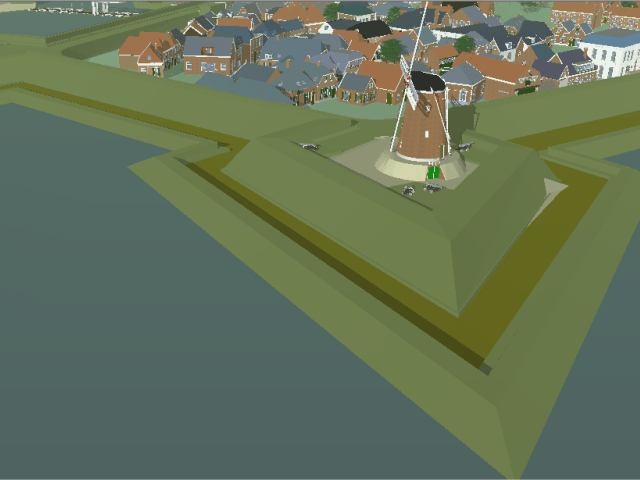
Bastion Welgemoed (‘Stout-hearted’) is a former bastion located on the southern edge of the town of Bredevoort. It was part of the fortifications of Bredevoort. Because the Prins van Oranje windmill was built upon it, the bastion was spared from dismantling, making it Bredevoort’s only surviving bastion.
The bastion is no longer easily recognisable. It was once eight metres high and equipped with three cavaliers (katten) plus a breastwork. Due to the excavation of the breastwork, the bastion now stands six metres high. The lower rampart has also been removed, and the surrounding moats have been filled in.
Reconstruction
The image shows a reconstruction of Bastion Welgemoed, illustrating its position relative to the houses that stand there today. The lower rampart situated in front of the bastion is also visible. The section on the right is the part that remains today as a shapeless mound. The curtain wall (courtine) on the left of the image has largely disappeared; only a rise near St George’s Church remains as a final vestige of the main rampart that once ran towards Bastion Ossenkop.
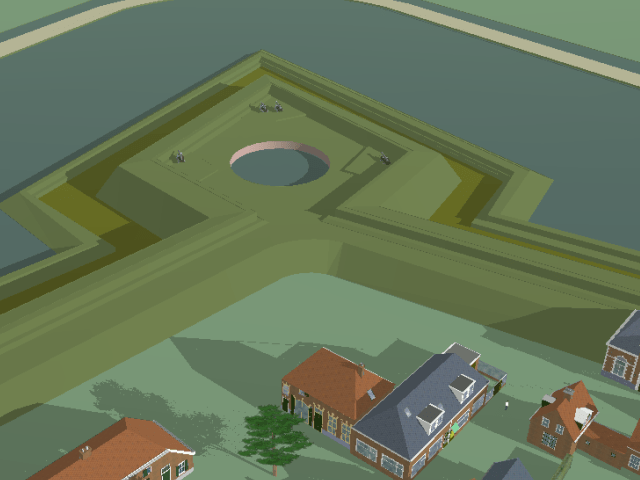
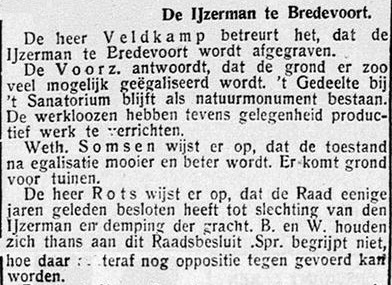
Bastion Onversaegt (‘Undaunted’), popularly known as Izerman, was one of the six bastions of Bredevoort. It was situated to the north-east of the town, near the site of ’t Kleuterbastion school on Izermanstraat, and formed part of the Bredevoort fortifications. The bastion was excavated and levelled during the 1930s.
On the grounds of ’t Kleuterbastion (nursery school) and the adjacent football pitch lay the eight-metre-high ‘solid’ bastion, equipped with three cavaliers (katten) in each corner. The terreplein was accessible via ramps (oprillen) from Hozenstraat, and possibly via ’t Zand.
Reconstruction
The image shows a reconstruction of Bastion Onversaegt. It illustrates the bastion’s position relative to the houses that stand there today, with the Breede Huus on the left and a corner of the Meestershuus on the right. Some maps suggest that this bastion was equipped with a water reservoir. This is not certain, however, as many houses in Bredevoort possessed their own wells.
The tip of this bastion was located approximately on the centre circle of the football pitch. The flanking streets next to the Kleuterbastion run parallel to the original shape of the bastion. The position of the curtain wall (courtine) between the school and the Breede Huus is still clearly visible today by the line of the hedge. This curtain wall connected the bastion with the adjacent Bastion Treurniet. The outlines of the filled-in moat are still clearly visible on aerial photographs, and remnants of this singel (moat/canal) still exist today.
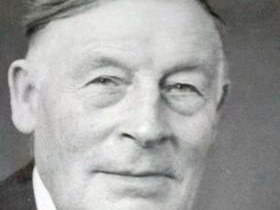
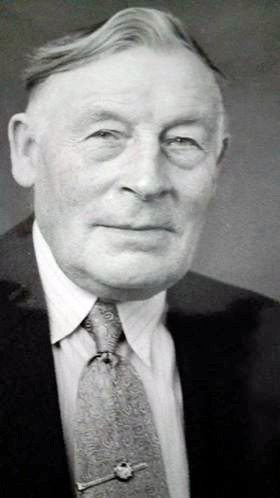
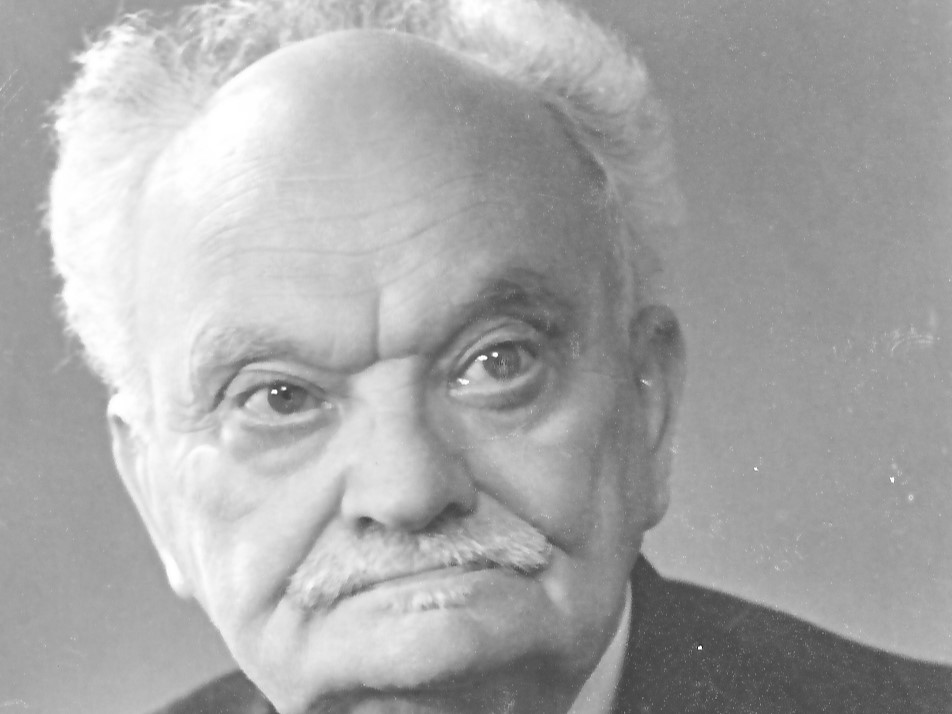
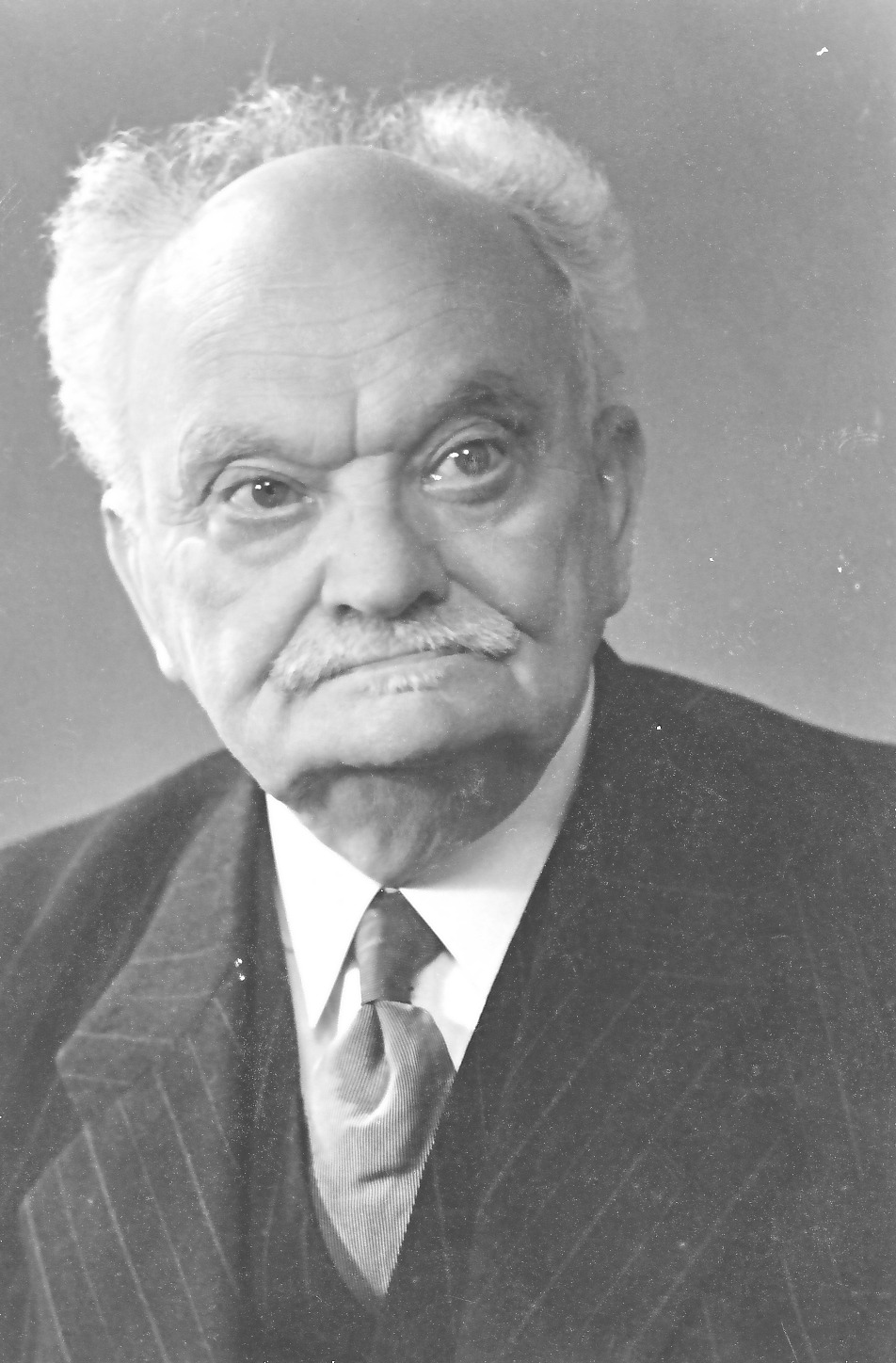
Bernard Huinink served as an alderman (wethouder) for the PvdA (Labour Party) in Aalten for many years. Consequently, his nickname was ‘Rooien Huunink’ (Red Huinink). The turbulent council meetings involving Willem te Gussinklo (alias ‘Piepkes Willem’) of the AR (Anti-Revolutionary Party) became legendary.
Bernard Huinink was born on 11 February 1886 in Aalten (Hogestraat 64), the son of Herman Huinink and Janna Geertruid Obrink. On 8 February 1912, he married Grada Wilhelmina Schepers in Aalten. They settled in Ormelstraat.
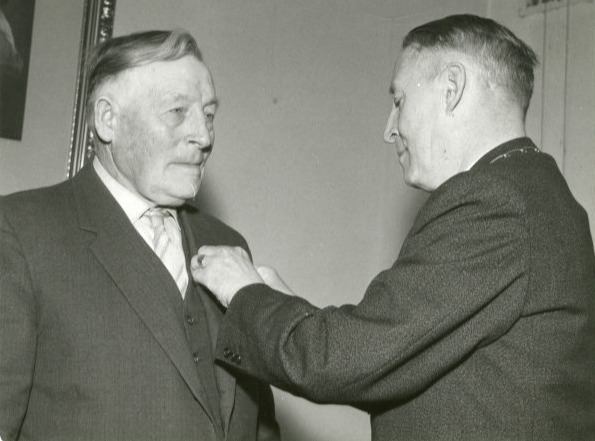
In 1919, at the age of 33, Bernard Huinink took his seat on the Aalten municipal council. He would hold that seat for nearly 45 years, initially for the SDAP and later for the PvdA. In September 1959, he celebrated his 40th anniversary as a council member and received a Royal distinction. In 1964, Huinink, the ‘father of the council’ (nestor), stood down ‘on account of his advanced age’ (77). He was succeeded by his 37-year-old son, Jan Huinink, of Admiraal de Ruyterstraat 21, who was the manager of the local PTT office (postal and telecommunications).
Bernard Huinink being invested with a Royal distinction by Mayor E.S. van Veen.
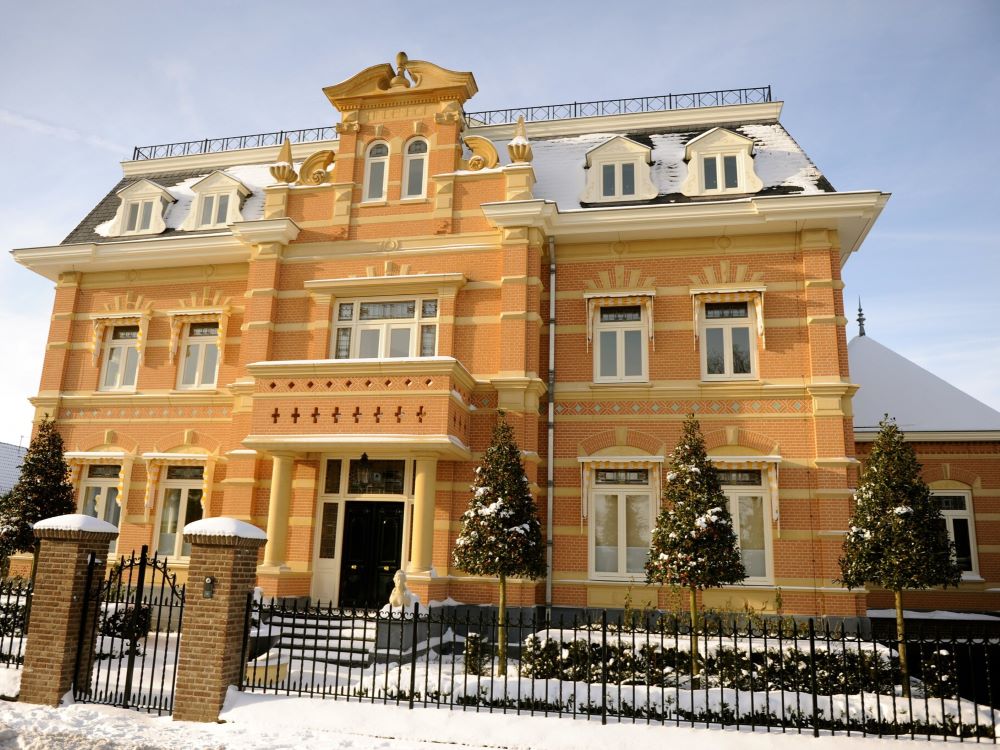
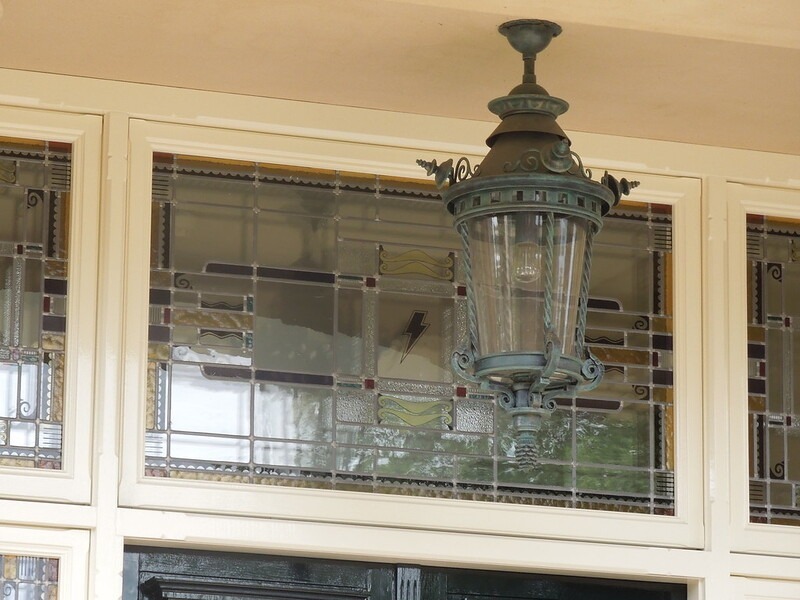
This villa, designed in the nineteenth-century Neo-Renaissance style, was completed in 2012. Its architecture is inspired by the historic Aalten director’s villa, de Beukenhof. As a tribute to the ‘original’, the name Lindenhof adorns the facade of this mansion. The house was commissioned by living rock legend Angus Young, guitarist of AC/DC, and his wife, Ellen van Lochem, who is originally from Aalten.
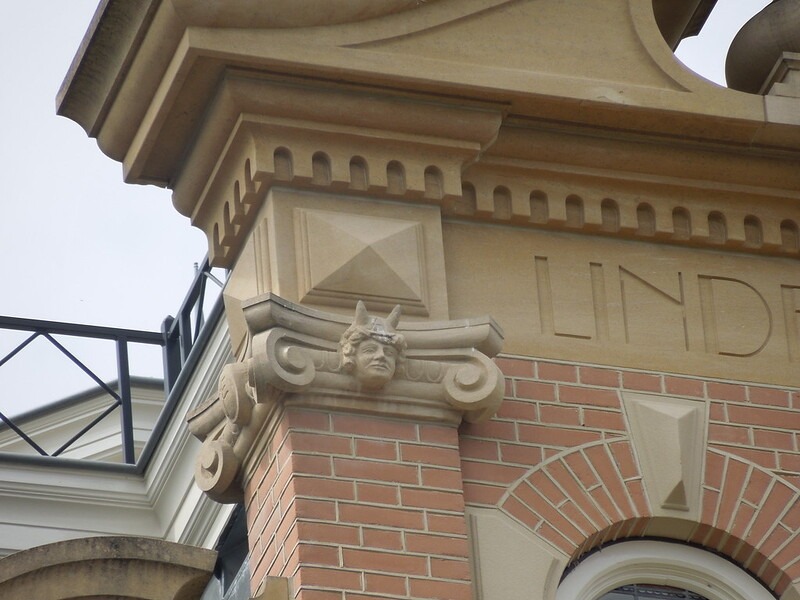
The enormous house features three floors above ground and a recording studio for the musician underground. Several architectural jokes have been incorporated into the facade as subtle references to the master of the house. For instance, at the top of the facade, on both sides of the house name, there is a sculpted head featuring devil’s horns. Many fans immediately associate this with the cover of the 1979 album Highway To Hell. The stained-glass window above the front door incorporates a lightning bolt, taken directly from the band’s logo.
Publicity
Since the construction plans were announced, many articles about this house and its owners have been published online, in newspapers, and in magazines. In 2023, an article appeared in Nieuwe Revu which once again explained how Angus Young ended up in Aalten (link).
Previously, the so-called Wijkgebouw (community centre) stood on this plot.
During the Eighty Years’ War, the population of East Gelderland was regularly plagued by roaming armies. Plundering, extortion, and rape drove the farmers and villagers to despair. Jan Holstein was the Bailiff of Aalten at the time, and although he was largely powerless, he did stand up for the people of Aalten and did his best to put an end to the looting.
In 1588, peace negotiations were underway between the Duke of Parma and Queen Elizabeth of England, the latter of whom also attempted to involve the States. Referring to this, Holstein wrote to Gotfried Gerardi, advisor to the lady of the manor of Anholt: “I only hope that the long-desired peace may be established; then these poor sheep might find courage again. For the most part, they plow the land with the cows they have left and work like mules. We are deep in debt and can no longer obtain money; my credit has also run out. May God grant us a solution before the harvest, so that the grain can be safely gathered. Otherwise, I would not know what to do.”
G.H. Rots wrote in 1938 about how Jan Holstein lost his life:
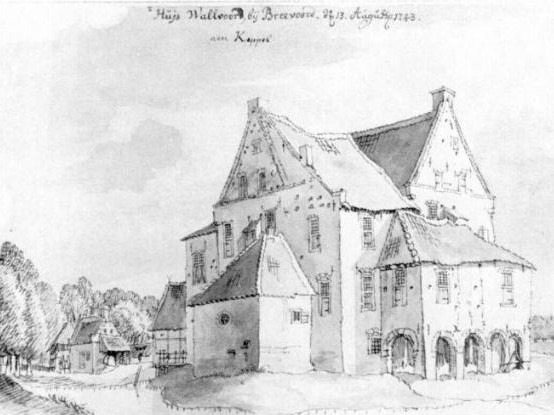
Manor ‘t Walfort, Jan de Beijer, 1743
“The Bailiff of Aalten, Jan or Johan Holstein, who repeatedly stood up for the population of Aalten, died in a peculiar manner. We read in ‘Het Oude Kerspel Winterswijk’ that on June 11, 1589, a christening feast was held at the home of a certain Grevink at ‘t Walfort near Aalten, where the Bailiff of Aalten was present, serving as the child’s godfather. Also present were the Lords of ‘t Walfort and Lintelo (the Lords of Lintelo were also the owners of ‘t Walfort).
The Bailiff of Aalten had received a promotion; following the death of ‘Hendrik van den Bungard’, he had become the Land Clerk of the Lordship of Bredevoort. This appears to have been a thorn in the side of the Lords of Lintelo; at any rate, a dispute began on the subject, during which Holstein noticed that the Van Lintelo brothers were not easy men to deal with.
Holstein attempted to leave the banquet table unnoticed and slipped under the table. He crawled on hands and knees toward the door and made a quick escape. However, Diederik van Lintelo noticed this, pursued Holstein, and hurled all sorts of insults at him. The argument escalated. Holstein maintained that the Lady of the Manor had the right to appoint Land Clerks, while Diederik van Lintelo attributed that right to the Nobles of the Lordship. This resulted in a physical altercation, during which Diederik van Lintelo drew a short sword and wounded Holstein. The injury was so severe that the Bailiff died three days later.”
This case was brought before the Bredevoort court on August 5 of that year. The accused was not present. He had fled to Bocholt and was hiding there. He was sentenced to death in absentia and ordered to pay a fine of 1,000 guilders to the Lady of the Manor. To collect this money, the tenants of Diederik van Lintelo were informed that they had to pay their rent to the Lady’s steward until the sum of the fine was collected.
Those tenants were ‘Ruwenhoeven’, Hendrik Penmenger, ‘Winkelhorstinck’, ‘Swijtinck’, ‘Lanckhof’, ‘den Herinck’, and ‘den Poll’. Through the mediation of several influential persons, including the Prior of Schaer Monastery, Johanna van Dort, and Hendrik and Clara van Lintelo, efforts were made to obtain a pardon. That pardon was granted, but he was still required to pay the fine.
Herman Poelhuis, the bailiff of Dinxperlo, was appointed as the bailiff of Aalten. It appears this was a temporary appointment, as in 1605, Lubbert Spaltman is mentioned as the bailiff of Aalten.”
Sources
Het oude kerspel Winterswijk, by B. Stegeman, 1927 (Delpher)
‘Uit Aalten’s verleden’, by G.H. Rots, Aaltensche Courant, March 4, 1938 (Delpher)
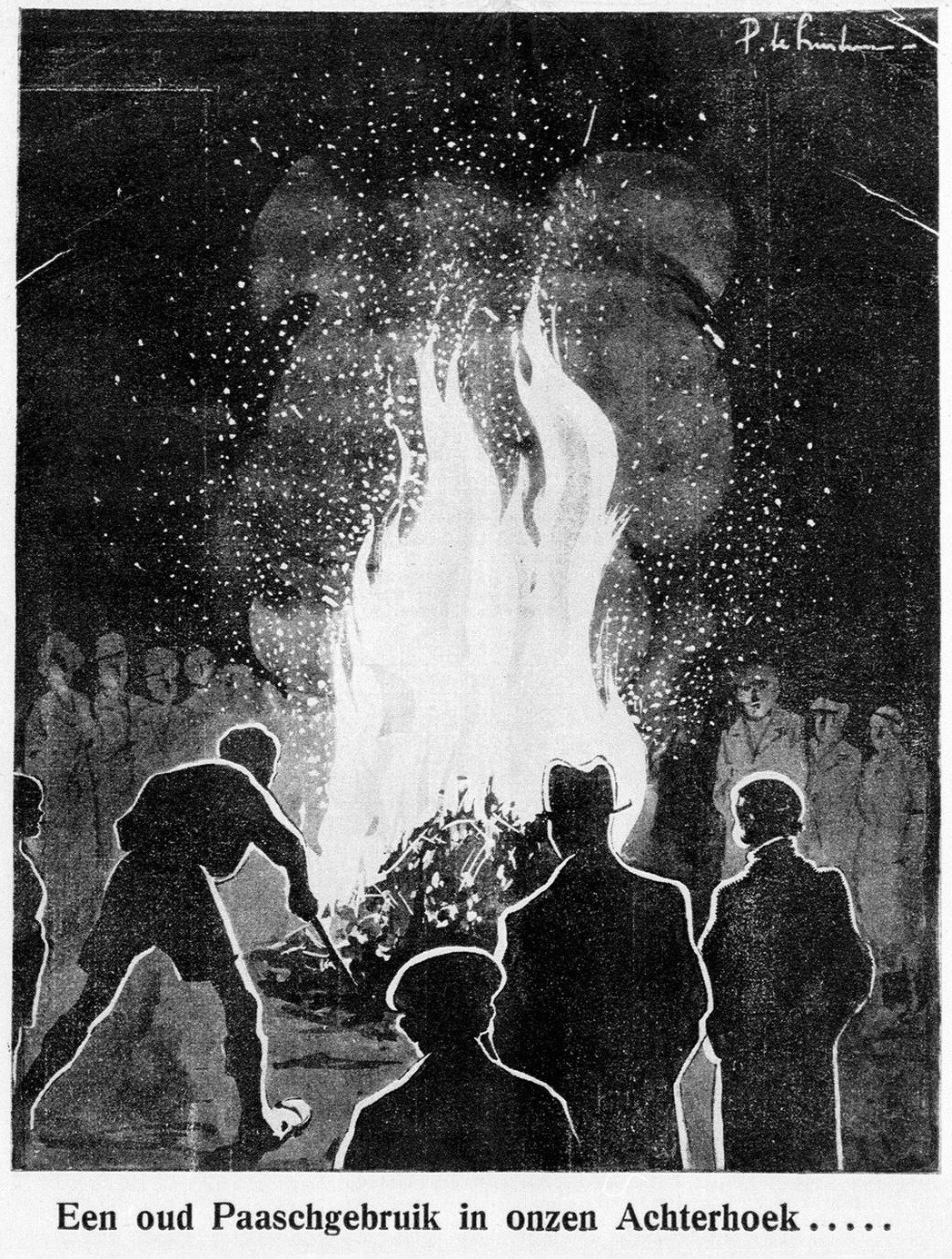
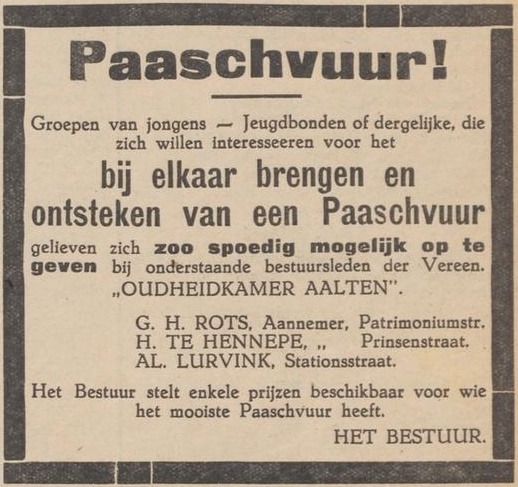
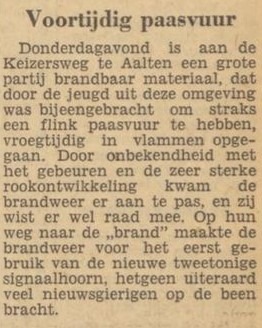
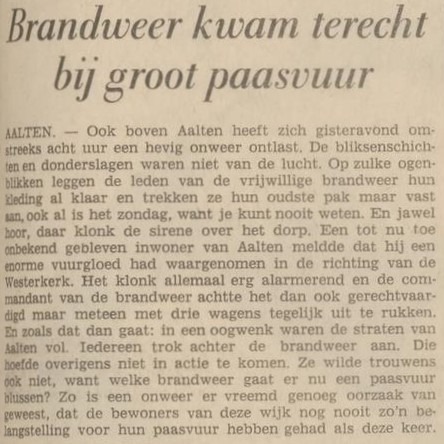
An Easter bonfire is a type of bonfire lit during Easter in parts of Europe. For this purpose, wood is collected and placed in a large pile, which is sometimes dozens of meters high. As darkness falls, the entire stack is set ablaze.
The spectacle often attracts many spectators and is usually a true community event. Originally, it was a Germanic festival dedicated to Ostara, the goddess of spring. After Christianization, the tradition was given a Christian interpretation.
Easter bonfire, illustration from 1934 by Piet te Lintum
Easter Bonfire in Aalten
G.H. Rots described the Aalten Easter bonfire tradition in 1937 as follows:
“Every spring as Easter approached, the boys from a ‘rot‘ (= district/neighborhood) gathered to discuss plans for the ‘Easter fire.’ They appointed a board, in which the treasurer in particular played a significant role.
They went from house to house to ask if people had anything left for the Easter fire. Those who had no wood usually offered a small contribution in hard cash, forming a ‘fund.’ The treasurer had to manage this fund, which could sometimes amount to thirty cents. It occasionally happened that the treasurer used the fund, or part of it, for his own purposes. Then there was trouble brewing. Sometimes heavy fighting broke out, and mutual quarrels were the order of the day.
But the end of the story was always: there was an Easter fire. Every district had such a fire, and it was all about who had the largest one. It was not uncommon for one group of boys to head out late at night to hijack wood from another group and supplement their own supply with it.
The fire was lit on Easter Sunday. In the middle was a pole, above which a tar barrel was hung, causing the fire to flare up high. And so, one could see several fires burning around Aalten, a spectacle that had numerous onlookers.”
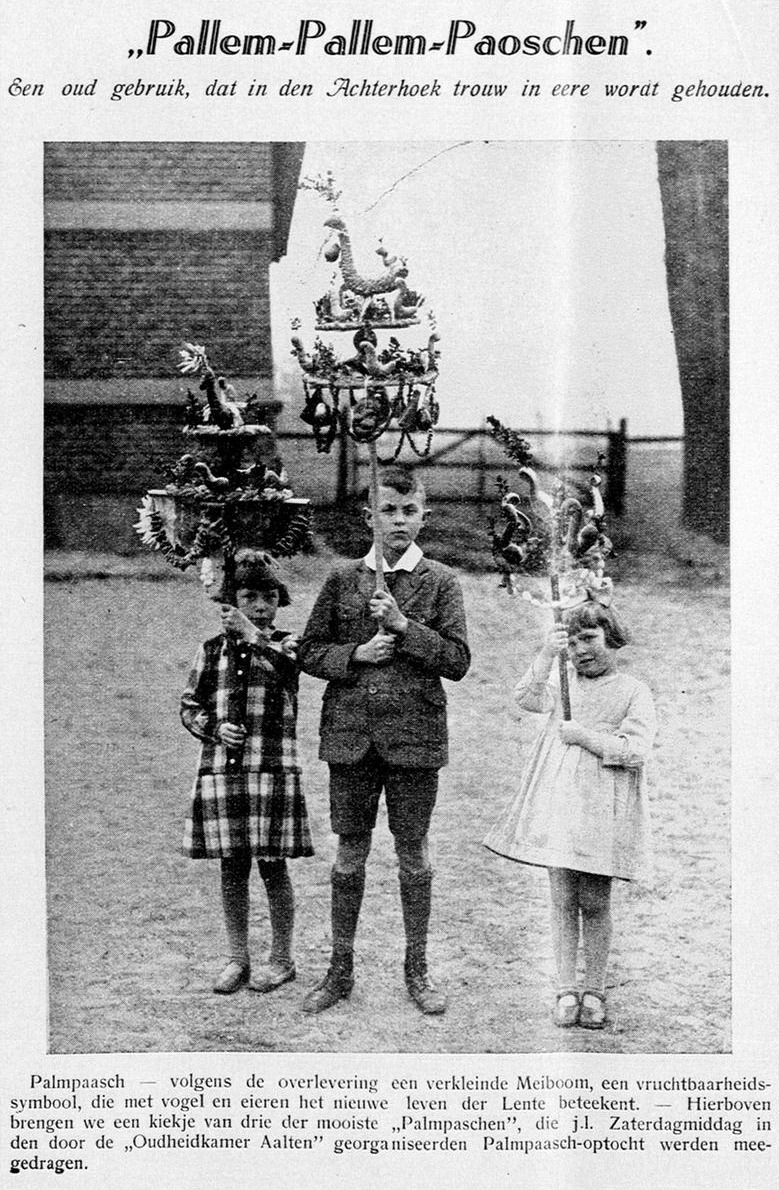
Palm Sunday
“Egg throwing was still frequently done by small children in the morning. If they wanted them to be a beautiful brown color, they were boiled in chicory porridge. On Palm Sunday, one could see the children walking with beautifully decorated pine branches, so-called ‘palmpaschen,’ while the children sang Palm Sunday songs, including this one:
Eikorij, eikorij, When it is one more Sunday, we get an Easter egg. One egg is no egg. Two eggs is an Easter egg.
These types of songs were sometimes supplemented in other municipalities. These songs are mentioned in folkloric contributions regarding Easter customs.”
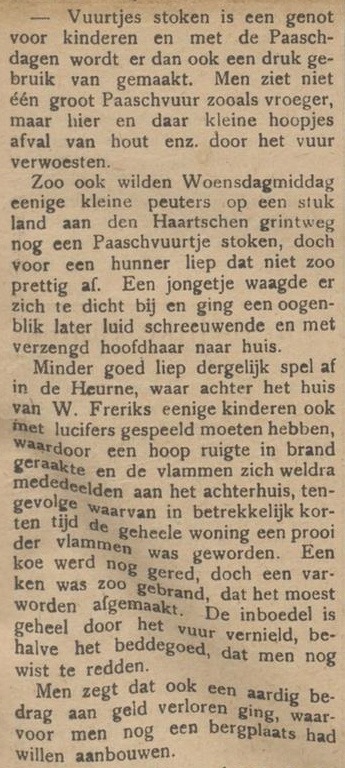
Aaltensche Courant, 6 April 1907Aaltensche Courant, 9 April 1935Dagblad Tubantia, 15 April 1960Dagblad Tubantia, 12 April 1966De Graafschapbode, 15 April 1930
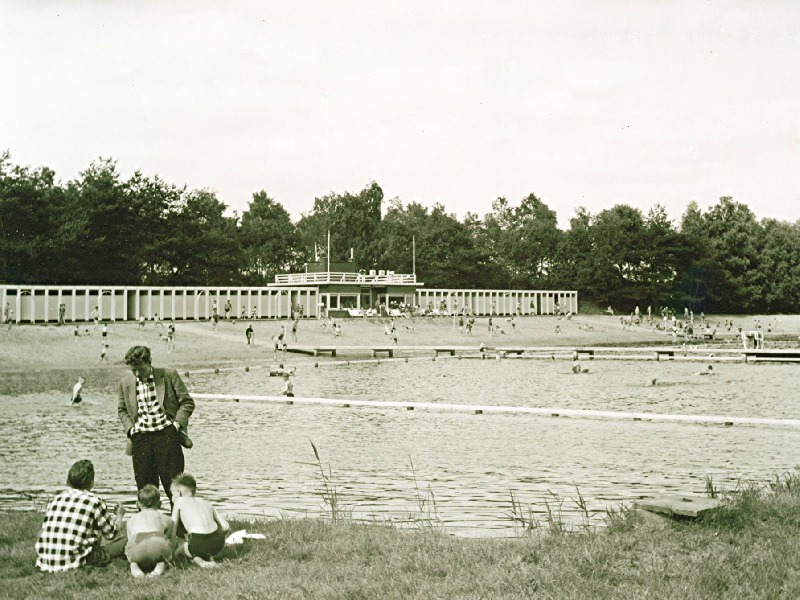
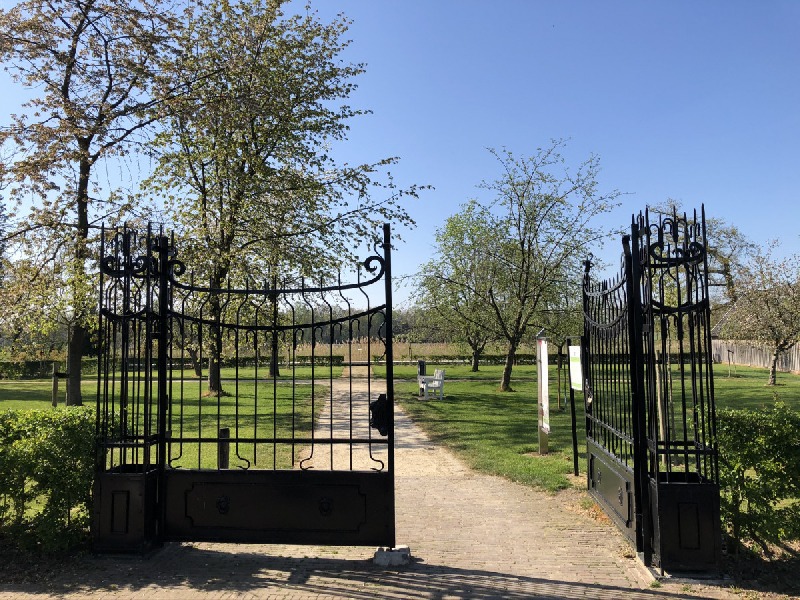
‘t Walfort Swimming Pool is located halfway between Aalten and Bredevoort and features an indoor pool and an outdoor pool with a sandy bottom (natural pool). The outdoor pool was constructed during the crisis years of the last century as a job creation project. The swimming pool was initially assigned the address Hessenweg 4.
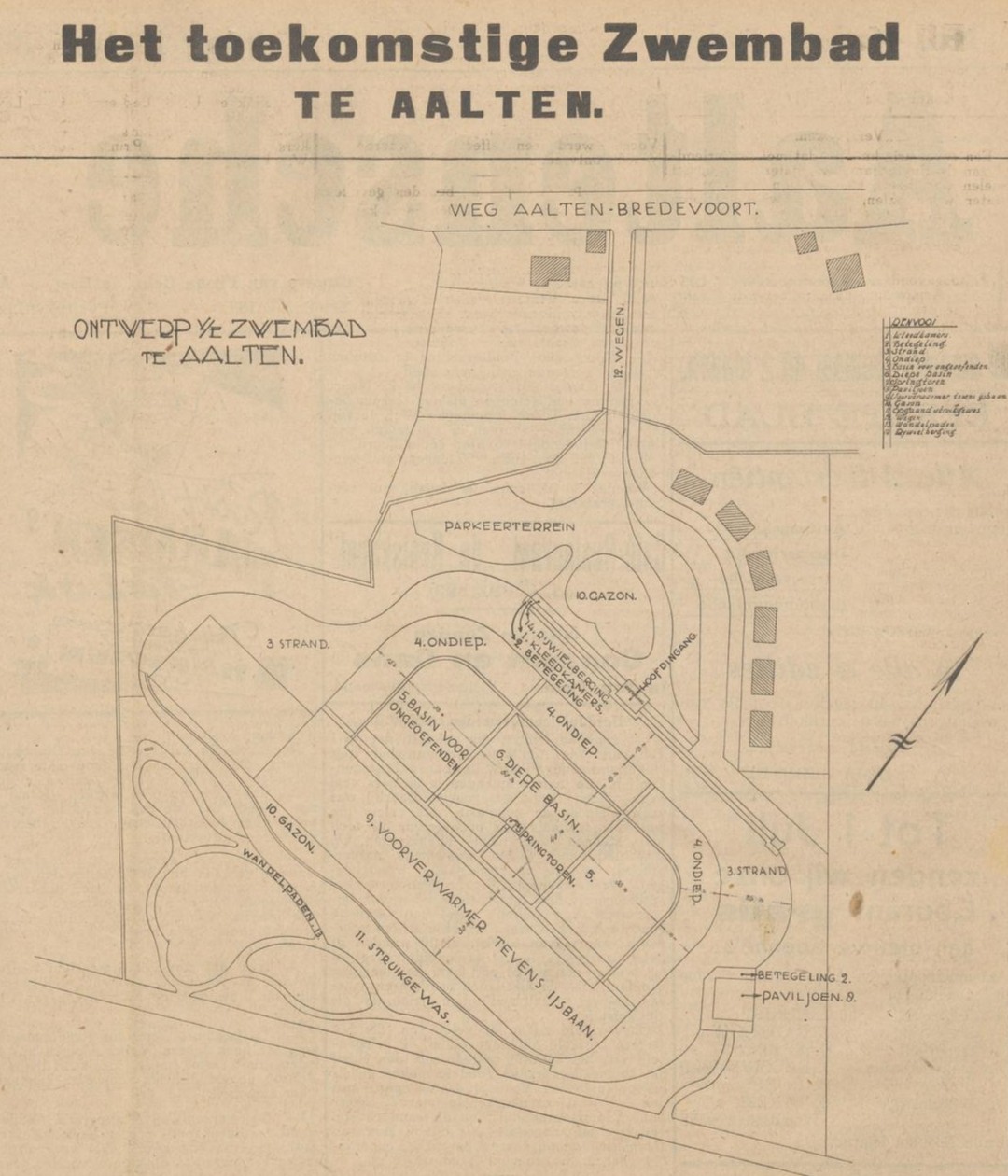
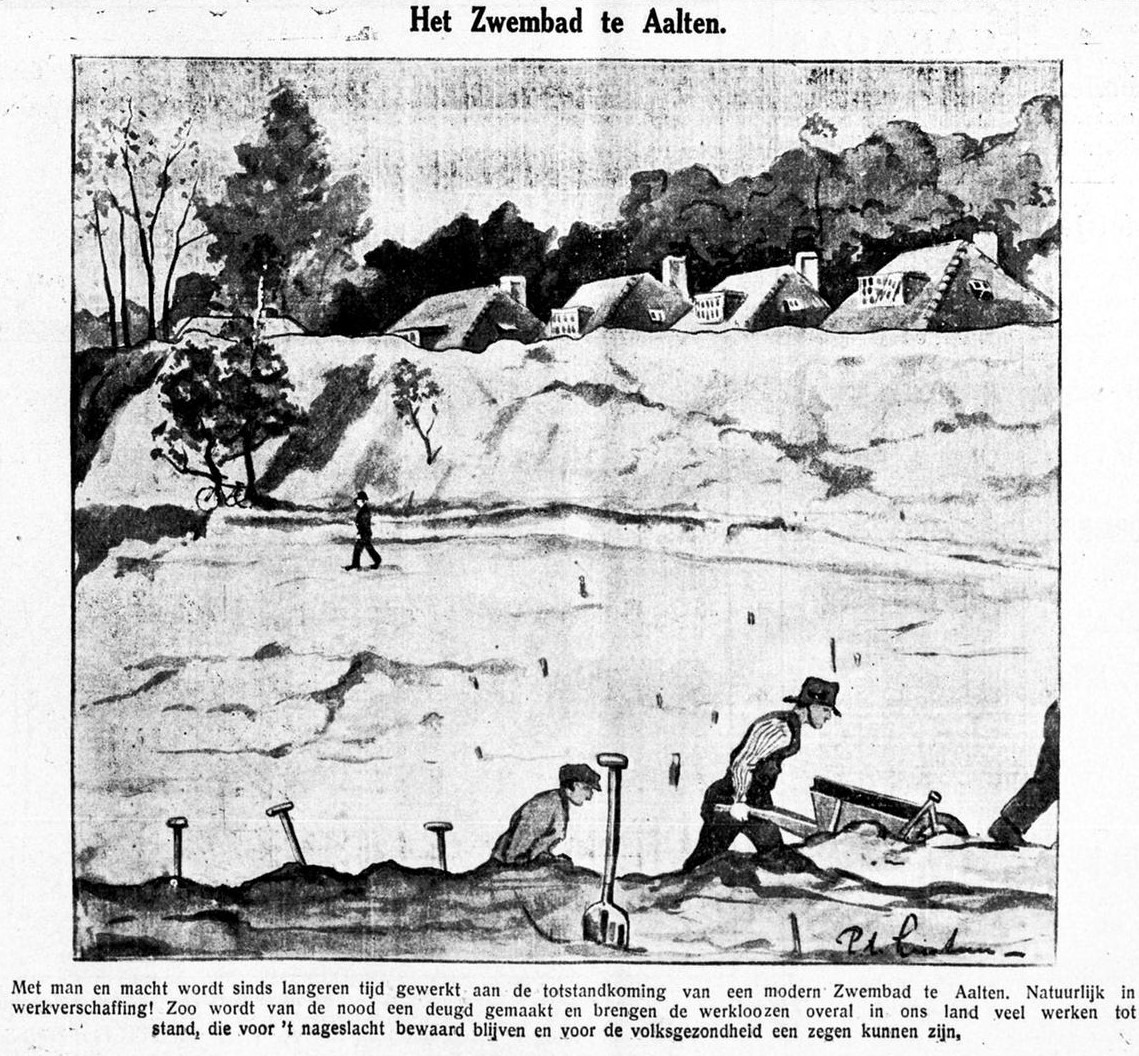
On June 10, 1933, the Aalten municipal council decided“to create a large modern Swimming and Sunbathing Pool, with a long wide beach on the Dennenoord site”. Approximately one hectare of meadow was added to that site, bringing the total area to about 4.5 ha.
Established
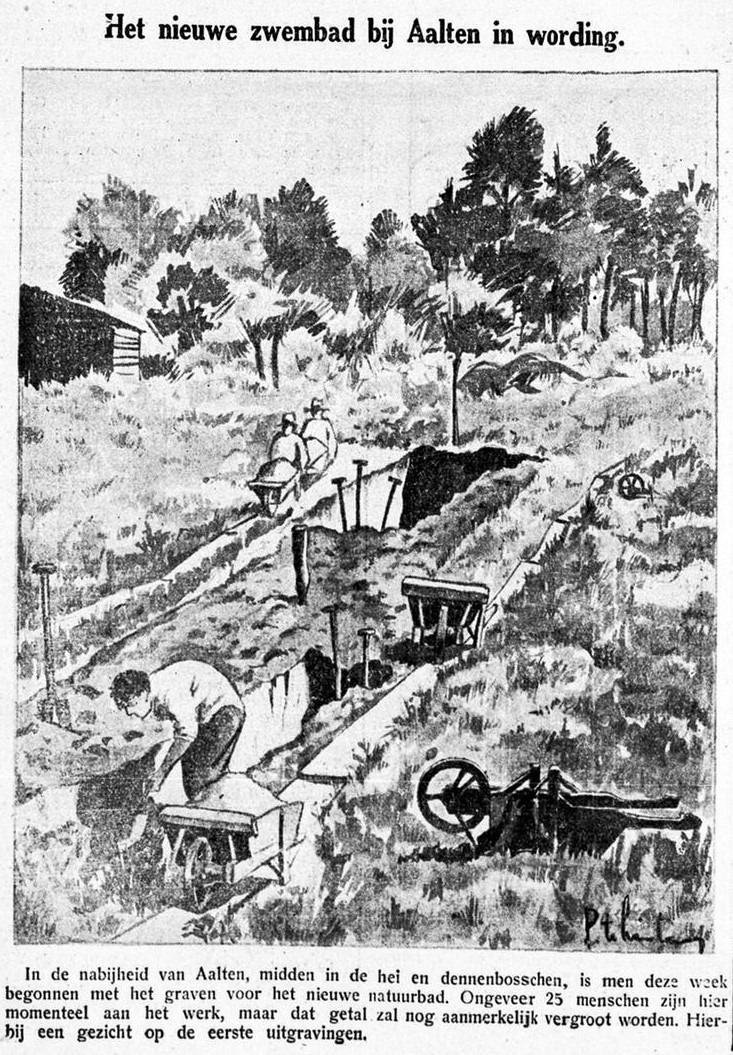
On July 17, 1933, the first spade went into the ground. Approximately one hundred unemployed people participated in the creation of the natural pool. In total, they moved no less than 45,000 m³ of sand using only wheelbarrows. The sand from the pool was used to raise the embankment that surrounds the pool.
The swimming pool was fed by spring water and constantly refreshed from three wells, which had been drilled to a depth of 15 meters. The excess water was diverted into a small ditch, which eventually flowed into the Slingebeek stream.
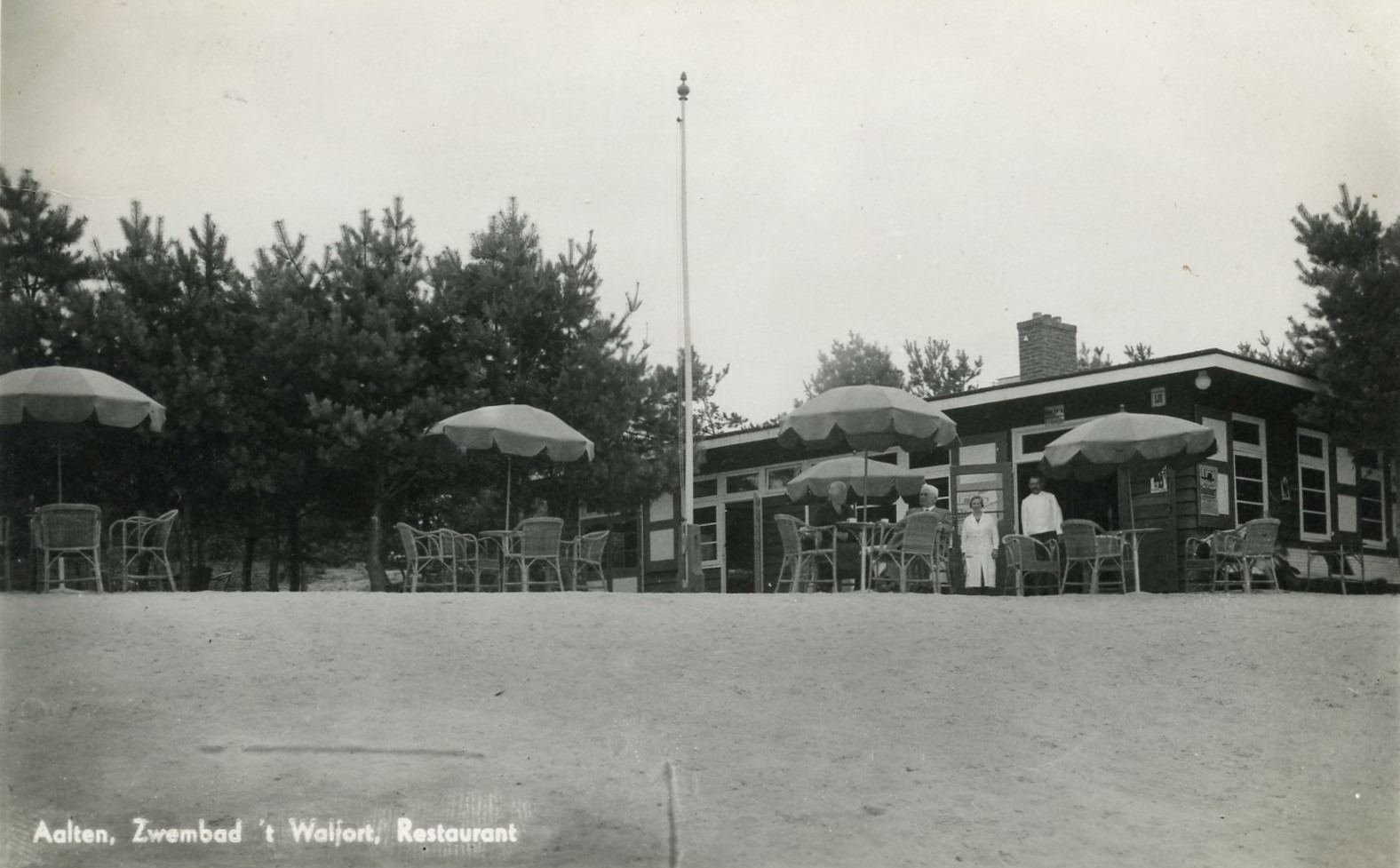
There was a pavilion that served as a simple catering facility and also housed the necessary ‘machinery’. This wooden building had served elsewhere in the municipality until 1928 as housing for the Military Police. After these police troops were withdrawn, the municipality had moved this ‘barracks’ to Dennenoord, “where it could be used by those in need of rest to enjoy the pine air.”
Opening
The Graafschapbode of June 22, 1934, contained an extensive report of the opening. Here we read, among other things, the following:
“Thus, the opening of the ‘t Walfort Swimming Pool in Aalten, located on the road between Aalten and Bredevoort, fringed by heavy trees, amidst a piece of old Achterhoek history, has now become a fact. It had been long awaited and the finishing took more time than originally expected. Now it lies there in its full glory, ready to receive thousands of visitors. At this opening, we may express our joy that this piece of work has now been put into use in such a way that we can give it our full cooperation and sympathy.”
Among the many invited guests were “the Board of Mayor and Aldermen, the executors and contractors (J. de Nooij in Bennekom, who performed the ground drilling; De Vries, Harlingen sanitary works; Kroese, Enschedé: making the pulse wells; Van Lochem, Ten Have, and the other Aalten contractors and executors), Ir. Ratelband, Messrs. Tilbusscher and Rollman, the Mayors and Aldermen of Winterswijk, Wisch, Lichtenvoorde, Dinxperlo, Gendringen and Bocholt, the numbers 2 of the double lists for the board, the members of the Council, the heads of schools, Miss Ten Heuvel of the Christian Domestic Science School and Miss Vreeman, Head of the Nursery School, the Ministers, Priest, Leader of the Israelite Community, Chairman of the Christian Reformed Church, the Doctors, Veterinarians, Postmaster, National Tax Collector, Notary, Station Master, the boards of Aaltens Belang, Bredevoorts Belang and the Neighborhood Interests, the board of Floralia, the Chief Overseer and the Overseers of the Netherlands Heath Company, Dr. L.A. Veeger, Public Health Inspector in Nijmegen, Dr. Bloemendaal, Pharmaceutical Inspector in Velp, who performed the water testing also in connection with Weil’s disease, the National Inspector of Job Creation, the board of the Winterswijk Water Sports Association, the press, the Directors of the Municipal Utilities (Gas Factory, Slaughterhouse), the former Secretary, the former Aldermen Ten Dam and Obbink, the municipal police and the marechaussée, the board of the Dutch Swimming Federation and the boards of the gymnastics associations in Aalten and Bredevoort.”
Speech by Mayor Monnik
The official opening was performed by Mayor A.J.W. Monnik. In his opening speech, he said, among other things:
“Thanks to the illustrious example of our sister municipality Winterswijk, the thought also arose here: ‘would it not be possible to establish a bathing and swimming facility on our own municipal grounds?’ The world crisis, which is felt so severely in the businesses in our municipality, required our municipal administration to repeatedly look for substantial, preferably useful work projects, in order to provide labor to the many unemployed who are so sensitively affected by the crisis.”
“The local authority also has a duty to ensure the proper conduct of bathing life, so that no abuses can creep in. Under the guise of hygiene, immorality is unfortunately increasing in our country and leading to moral decay. Let us ensure that the healthy, pure, fresh air of life, given to us by God to serve Him and thus be happy, is not polluted into an atmosphere in which healthy living becomes a complete impossibility.”
Subsequently, the chairman of the ‘t Walfort Bathing and Swimming Facility Foundation, Mr. M. Ackerman, also gave a speech in which he addressed the staff of the new swimming pool, among others:
“Mr. Happel, we are pleased to welcome you as our pool manager. We also wish the other gentlemen and Miss Top that they may work pleasantly under their chief, Mr. Happel, for the prosperity of our beautiful facility.”
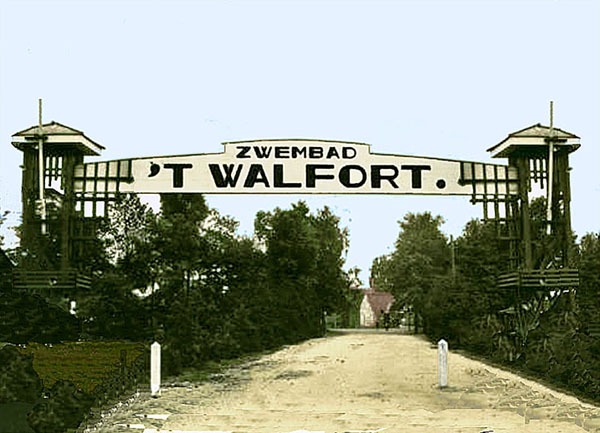
“While the mayor cut the ribbon, the music association De Eendracht played two verses of the Wilhelmus. Then they proceeded through the main entrance and there the beautiful foundation lay in all its beauty before the eyes of the guests. Following this, a tour of the grounds was made under the guidance of Messrs. Tilbusscher and Rollman, Municipal Architect and Municipal Overseer. Afterwards, everyone gathered in the Pavilion, where refreshments were offered and where Ir. Ratelband gave an explanation of the technical part.
At 7 o’clock this evening, all the unemployed who gave their strength to the realization through job creation have been invited with their wives. The mayor will give a speech, refreshments will also be offered to them, and then a tour of the grounds will also be made with them.”
Mixed Swimming
Mixed bathing was initially prohibited, meaning men and women each had their ‘own’ side. In 1946, a request from ‘Roman Catholic Youth and Class Organizations’ was discussed in the municipal council. The council decided, as a trial and after consultation with the swimming pool board, “that mixed swimming and staying on the beach in swimwear is permitted, provided that strict supervision is maintained and unconditional action is taken against any excesses”.
Opening on Sundays
Until 1958, ‘t Walfort swimming pool was closed on Sundays. A year earlier, a proposal to open the pool on hot Sundays had been voted down. A few weeks later, on a sweltering Sunday afternoon, hundreds of Aalten residents stormed the pool to swim en masse—contrary to the prevailing rules. In April 1958, the municipal council decided that the pool could be opened on summer Sundays from 2 to 4 o’clock.
Indoor Pool
In 1995, ‘t Walfort swimming pool was expanded with an indoor pool, consisting of a competition pool, recreational pool, instruction pool, and a toddler pool. The competition pool measures 25×12.5 meters and has five lanes.
Owners
This overview is incomplete.
Year
Plot
Owner
Description
1852
C-1540
Jan Baron van Pallandt
36,380 m² heath
1860
C-1540
Hendrik Willem Oosterman, farmer
36,380 m² heath
1874
C-1540
Jan Willem Oosterman, farmer
36,380 m² heath
1923
C-4414
The Municipality of Aalten
38,190 m² heath & pines
1937
C-4625
The Municipality of Aalten
44,040 m² swimming pool & pavilion
1968
C-5237
The Municipality of Aalten
46,836 m² natural pool, pavilion, garage
1985
P-163
The Municipality of Aalten
8,570 m² house, forest, swimming pool, cultivated land
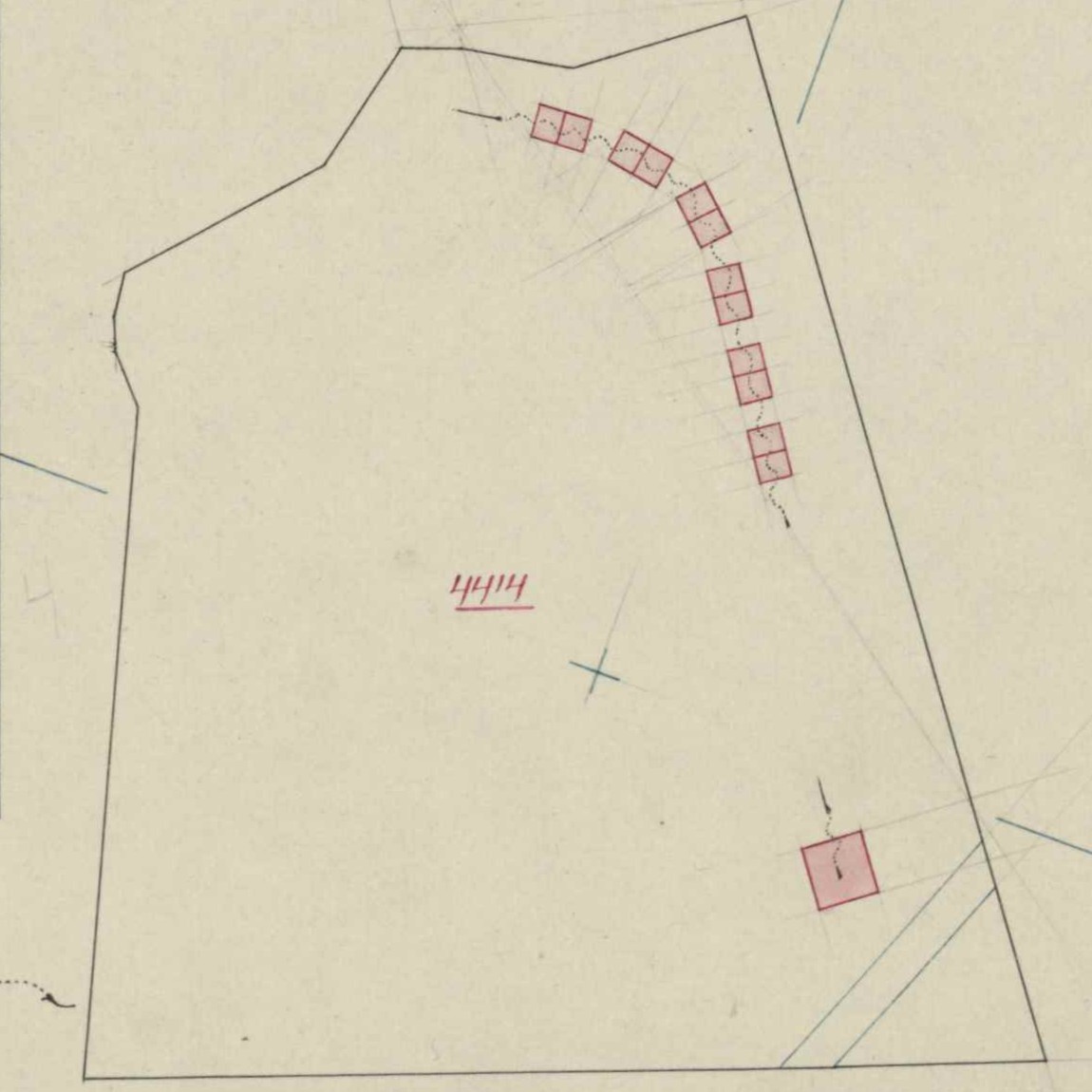
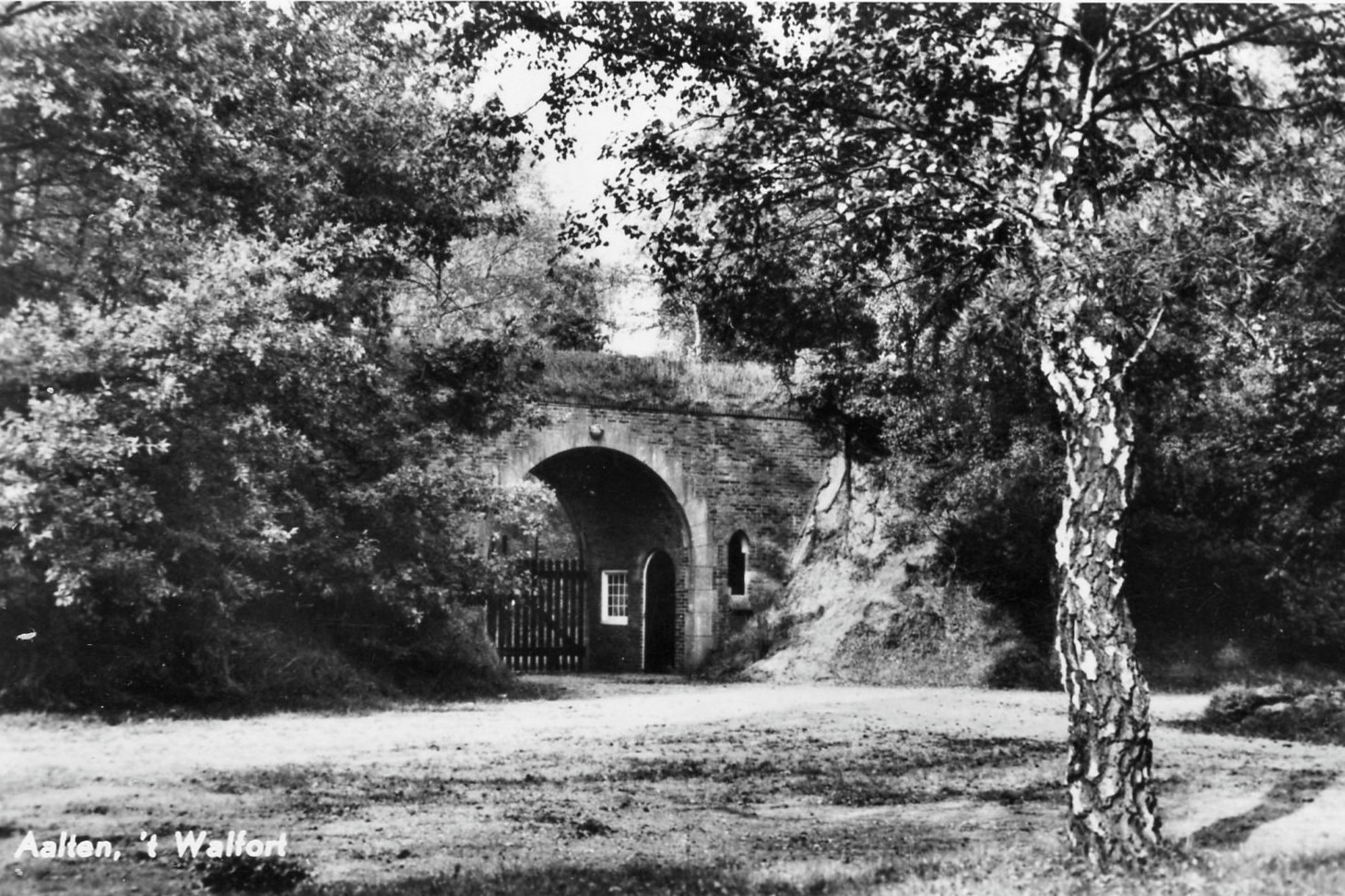
Fragment of cadastral map, 1928 (parcel C-4414)Aaltensche Courant, June 16, 1933Graafschapbode, August 4, 1933Graafschapbode, October 23, 1933Entrance gate ‘t Walfort Swimming Pool, 1934Entrance gate ‘t Walfort Swimming Pool, later‘t Walfort Swimming Pool, Restaurant
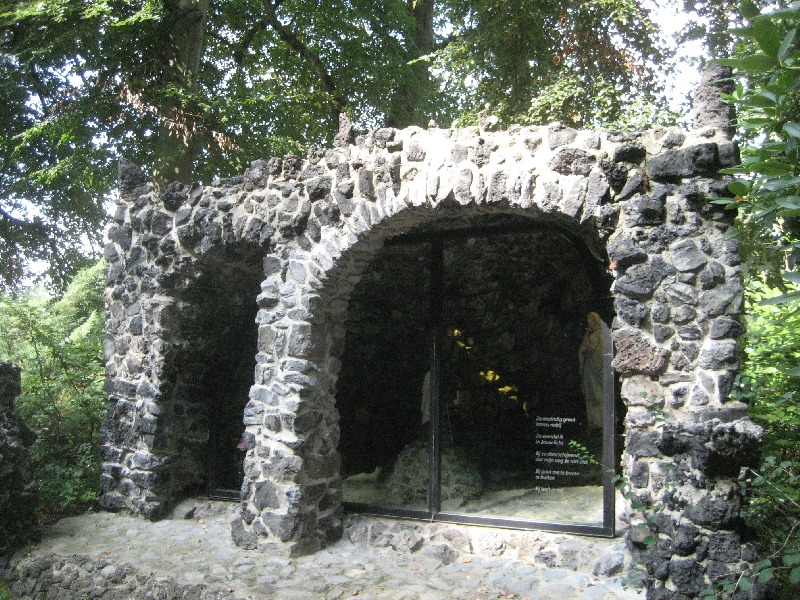
A Lourdes Grotto, dating from 1912, is located in the Vestingpark in Bredevoort. It is a (small) replica of the famous cave near the French city of Lourdes. The Bredevoort Lourdes Grotto is made of lava stone and stands on the remains of a lower rampart of the Vreesniet bastion, next to the Tea House on the Grote Gracht. It is a municipal monument.
After Mary reportedly appeared to the girl Bernadette in Lourdes in 1858, ‘Lourdes Grottos‘ were created all over the world with statues in honor of Mary and the girl. This was also the case in Bredevoort, in the former garden of the Sint Bernardus monastery.
The Bredevoort Lourdes Grotto was built by order of the Franciscan Sisters of Thuine. The construction date of the Lourdes Grotto was unknown for a long time. However, in 2010, an inscription was discovered during renovation work: ‘B. Elschot May 1, 1912’.
Procession Park
At the beginning of the last century, a procession park was laid out in the garden behind Sint Bernardus, where the Lourdes Grotto is located. Here, local Roman Catholics could perform religious ritual acts undisturbed in the open air. Processions were not permitted on the public roads in Aalten.
The sacramental procession took place here on the second Sunday after Pentecost. People walked from the monastery to the Lourdes Grotto. Paths that were not used were decorated with floral patterns by girls. After 1967, these processions ceased as a result of ecclesiastical changes. The Lourdes Grotto fell into disuse and crumbled. Vandalism did the rest.
In 1985, the last nuns left the Sint Bernardus monastery. Subsequently, the Bredevoorts Belang association purchased the monastery park to preserve it as a city park. The park was extensively renovated in 2015/2016. The park is open to the public from sunrise to sunset.
Restoration
At the beginning of this century, the grotto was little more than an overgrown pile of stones. However, in 2010, the Bredevoort Lourdes Grotto was restored to its former glory. The restoration of the grotto cost 12,000 euros. Windows now protect the statues and candles from vandals and inclement weather, and there are niches for candles. With a solemn inauguration ceremony, the Lourdes Grotto was put back into use: as religious heritage, but also as a place of devotion.
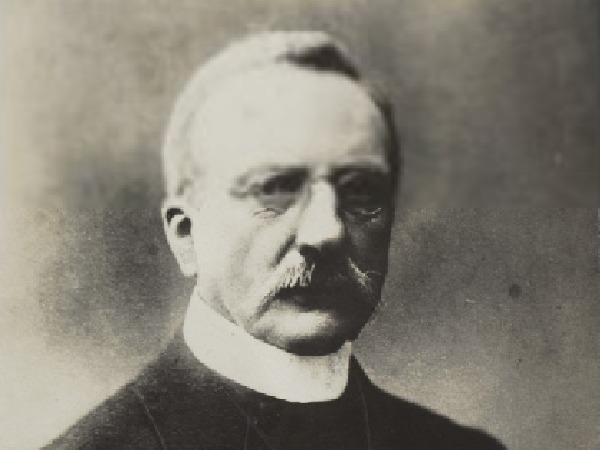
Jan Derk Stegeman was born on 26 July 1875 in Dedemsvaart, the son of religious education teacher Frederik Stegeman and Janna Harmina te Winkel. He attended the municipal gymnasium in Doetinchem and subsequently studied for a year at the Municipal University of Amsterdam, followed by several years at the University of Utrecht.
After Stegeman was admitted to the gospel ministry in the Dutch Reformed Church (Nederlandse Hervormde Kerk) by the provincial church board of Friesland in May 1899, he was ordained on 3 September of that same year as minister of the Reformed parish of Nieuw Amsterdam by the Reverend J.C. van Hoeve, minister in Schoonebeek.
Aalten
On 24 August 1899, Jan Derk Stegeman married Hendrika van Dorp (born in Zoetermeer, 24-10-1873) in The Hague. Together they had six children. In 1913, he moved to Aalten as a minister for the Reformed parish. From 1920 onwards, he dedicated himself to the Reformed school, serving as chairman of the board from 1920 to 1946. He lived in the Reformed rectory on Whemerstraat.
The Reverend Stegeman was known as a highly witty and striking personality. He enjoyed an excellent relationship with his colleagues, who affectionately nicknamed him ‘the bishop’. In September 1929, he celebrated his 30th anniversary in office, and in 1964 his 65th anniversary—just a year before he turned 90! In 1955, the Reformed school on Varsseveldsestraatweg was named after him: the ‘Ds. Stegemanschool‘.
Nieuwe Veendammer Courant, 14 January 1913
Retirement
Following his retirement (emeritaat), Stegeman remained active in many fields, including conducting pastoral visits to the elderly, supporting the temperance movement, and nursing the sick. He also frequently filled pulpits as a guest preacher. For many years, he was the treasurer of the classical missionary society within the Zutphen classis, secretary of the board of the Juliana School, a board member of the Breukelaar School, and a board member of the Aalten branch of the Netherlands Bible Society.
Furthermore, Stegeman was a highly active member of the editorial board of the weekly magazine De Wachter. He also authored the books Aan mijne gemeente (“To My Congregation”, published by Gebr. De Boer, 1938) and Van rijke dingen (“Of Rich Things”, published by De Graafschap, 1941).
Ruurd Faber (Veenhuizen, 28-08-1912 – Assen, 07-07-1992) was a Dutch politician representing the ARP. He was born the son of Anne Faber (1875–1948; from 1932 director of the first asylum of the Rijkswerkinrichtingen [state labour colonies] in Veenhuizen) and Hermina Klein (1879–1973). On 15-05-1941, he married Aukje Fokje Wijngaard (The Hague, 27-05-1918) in Assen.
At the beginning of his career, Faber worked as an inspector for a life insurance company. During the Second World War, he was involved in the resistance, for which he was arrested and imprisoned in the detention centre in Assen. Following the liberation, he was released and subsequently became head of the Politieke Opsporingsdienst (POD – Political Investigation Service) in Assen. After some time, Faber became a prosecuting officer (Officier-fiscaal) at the Assen Chamber of the Bijzonder Gerechtshof (Special Court of Justice) in Leeuwarden. Later, he also held other positions at the Ministry of Justice and the Ministry of Social Work.
In 1960, he became Mayor of Ulrum, and from 1962 to 1963 he additionally served as acting Mayor of Leens. In 1965, Faber was appointed Mayor of Dantumadeel. There, he gained a reputation as a “large-calibre social worker”.
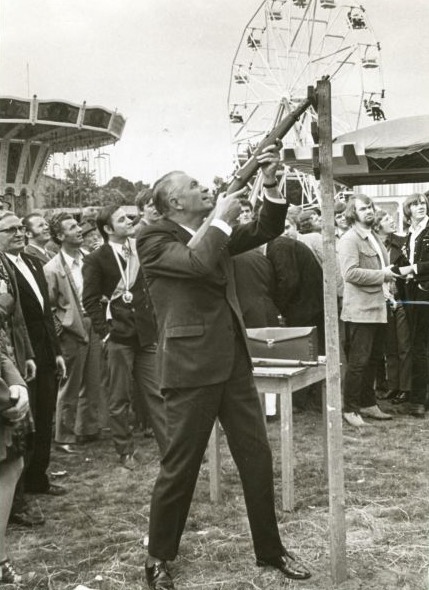
In 1971, he succeeded Hendrik Haverkamp as Mayor of Aalten and held this position until 1975.
Ruurd Faber passed away in 1992 at the age of 79.
He was succeeded as Mayor of Aalten by Doeke Bekius.
Mayor Faber fires the first shot at the 1971 Marksmen’s Festival (Schuttersfeest)
Willem te Gussinklo Sr. (1852–1920) was one of the key figures in the history of the horn-working industry in Aalten. Initially, he made German pipes and handles for walking sticks and umbrellas. Later, he focused on the production of buttons.
Willem te Gussinklo was born on 13 November 1852 at house number 284 (Markt 3) in Aalten, the son of shopkeeper Willem te Gussinklo and Josina Aleida Mierdink. On 26 May 1887, he married Maria Jacoba Gangel (a sister of the Reverend Gangel). Around 1890, they moved into a stately villa on Willemstraat.
Willem learned the craft of horn working from his brother-in-law, Gerrit Peters. Together with Wessel Becking, he started a pipe factory. However, in 1884 their paths crossed and they went their separate ways. Following the unsuccessful partnership with Becking, Willem te Gussinklo manufactured German pipes and handles for walking sticks and umbrellas.
Buttons
Around 100 years ago, companies had emerged in Germany and England that manufactured buttons from horn. Inspired by this example, Willem began making horn buttons in 1905, a first for the Netherlands. Soon afterwards, his son Willem te Gussinklo Jr. (known as ‘Piepkes Willem’) joined the company, developing into an innovative entrepreneur.
Te Gussinklo’s first factory was located at ’t Dal in Aalten, which is now Willemstraat.
Willem te Gussinklo Sr. passed away on 21 June 1920 and is buried at the Old Cemetery on Varsseveldsestraatweg in Aalten.
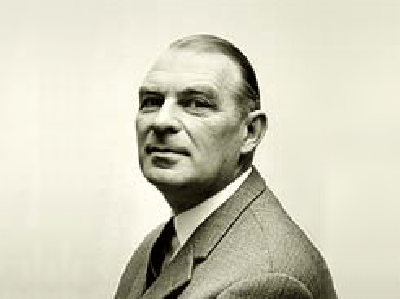
Willem te Gussinklo Jr. (1888–1969), nicknamed ‘Piepkes Willem’, was one of the key figures in the history of the horn-working industry in Aalten. He was the director of Dutch Button Works in Bredevoort.
Willem te Gussinklo Jr. was born on 18 May 1888 at house number 239a in Aalten, which is approximately where the JAWI garage is located today. He was the son of pipe manufacturer Willem te Gussinklo (Sr.) and Maria Jacoba Gangel (a sister of the Reverend Gangel). On 7 July 1914, Willem Jr. married Engelina Arriana van Houte in Zwolle (Overijssel).
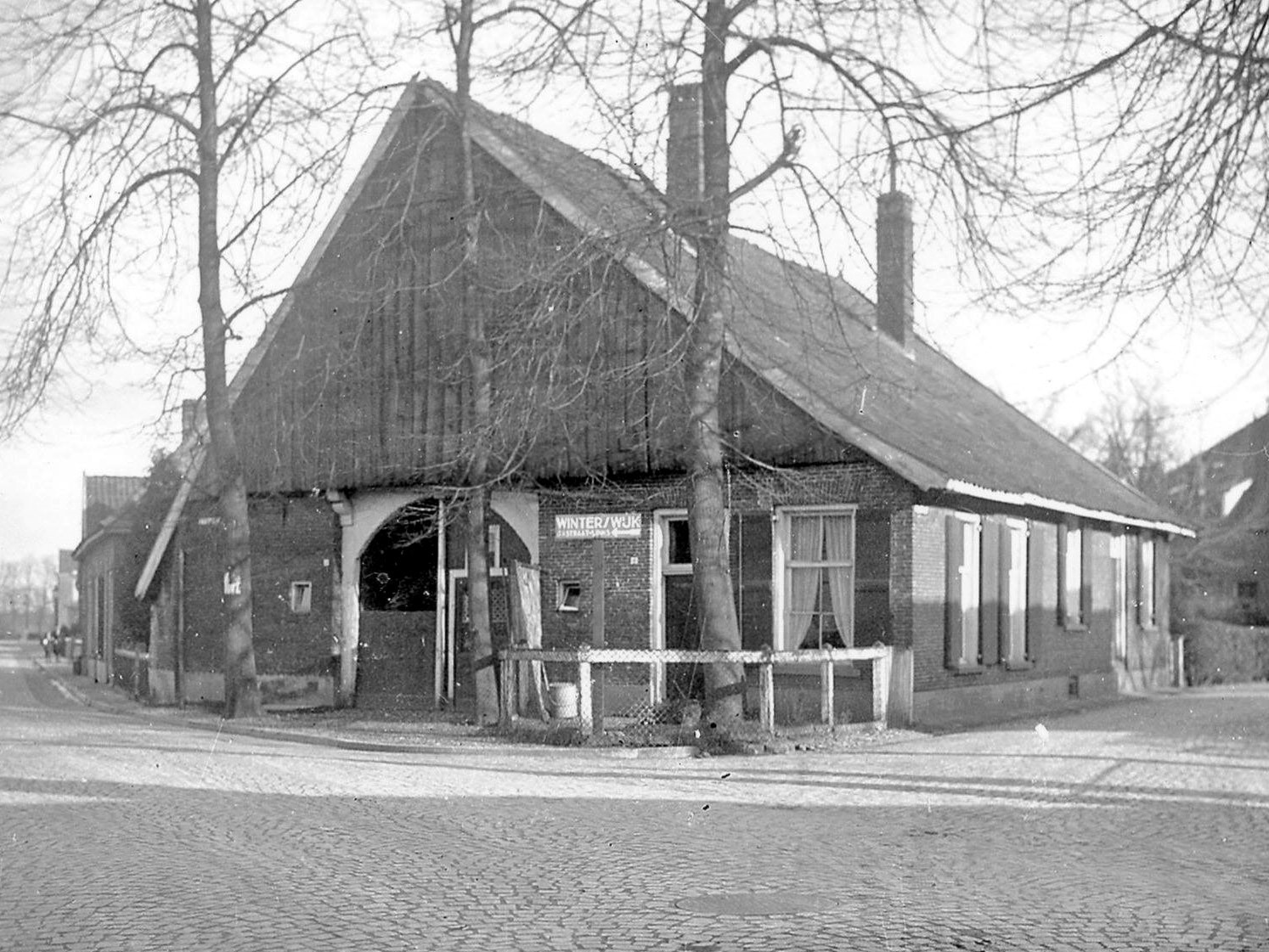
Around 1960, a little woman with the peculiar nickname ‘Knonnepoetse’ lived in Aalten. She resided in the Luutenshuus, a centuries-old farmhouse on the corner of Polstraat and Haartsestraat, which was demolished in 1962 to make way for the extension of Polstraat.
On their way to school, children would dare each other to knock on her windows. A furious old woman, who spoke half-German, would then come storming out. The children were absolutely terrified of her.
Guste Mina
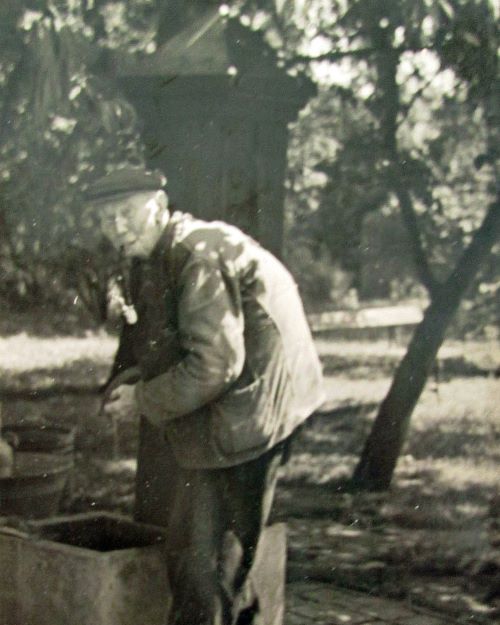
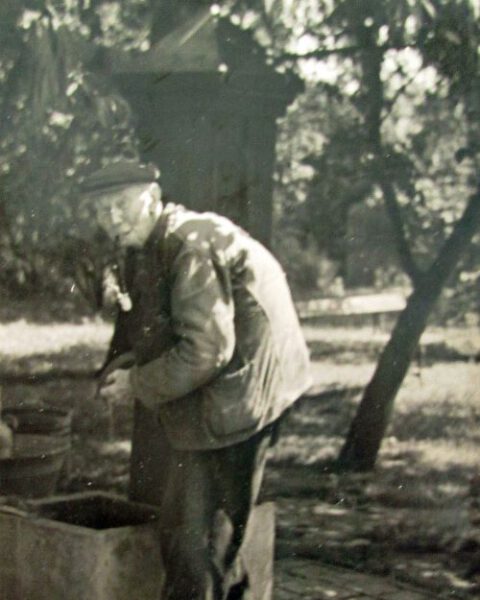
In local parlance, she was also known as Guste Mina. She was said to be of Polish origin and had fled to Germany around the wartime period. She later married a man from Aalten named Koskamp.
This man Koskamp was “on the wrong side” during the war (fout). He used to walk around the village with a rifle slung around his neck. He referred to this rifle as ‘seine Kanone’ (his cannon). He cleaned his rifle frequently, often saying: “I just need to polish my Kanone.” After his death, the little woman inherited the nickname ‘Knonnepoetse’ (Cannon Polisher). The name had therefore originally been intended for her husband.
The couple initially lived on the corner of Stationsstraat and Admiraal de Ruyterstraat in Aalten, in Lurvink’s old house. This property was later demolished, and Nijman established his petrol station there—later Veneman petrol station, and currently the café-takeaway ‘De Admiraal’. The Koskamp couple subsequently moved to the Luutenshuus.
The ‘Luutenshuus’, demolished in 1962
Who was she?
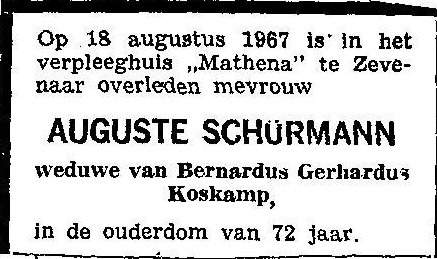
Her real name was Auguste Koskamp-Schürmann. She was born in Sterkrade (Germany) and married Bernardus Gerhardus Koskamp in Aalten in 1919. Around 1920, they lived in the village of Aalten at address A211a, which was later renumbered to B215a. This address presumably later became, or is currently, Hogestraat 60a.
In the 1967 Directory of the Municipality of Aalten, she is listed at the address Polstraat 17a. On 18 August of that same year, Auguste passed away in a nursing home in Zevenaar. She was buried alongside her husband at Berkenhove Cemetery.
‘Knonnepoetse’ did not have an easy life; she was quick to anger. The local youth knew this and took advantage of it. Bullying was something that very much occurred in those days as well.
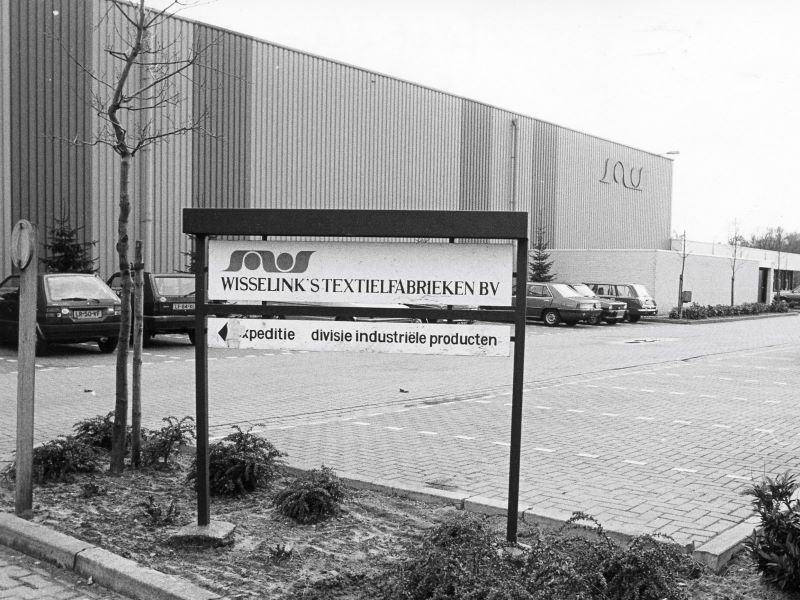
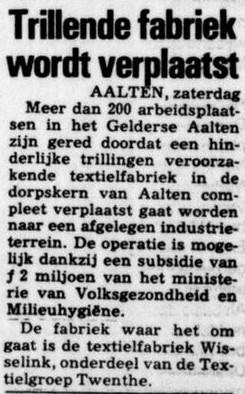
The textile weaving mill Wisselink Textiles, formerly Gebr. Driessen, had been part of the Textielgroep Twente since 1960. They manufactured products such as technical textiles, tent canvases, and flag bunting. For years, the company was located on Dijkstraat, but its presence in the village centre caused excessive noise and vibration nuisance.
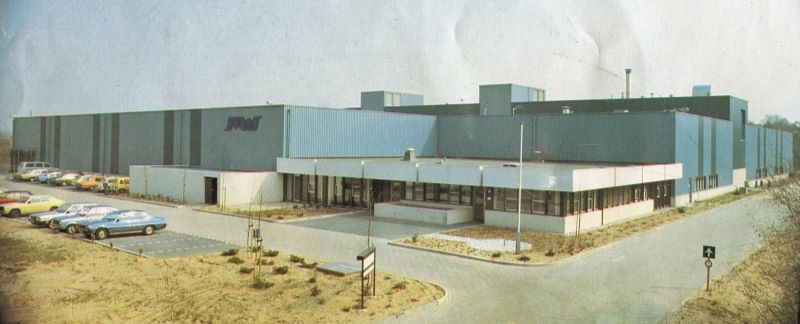
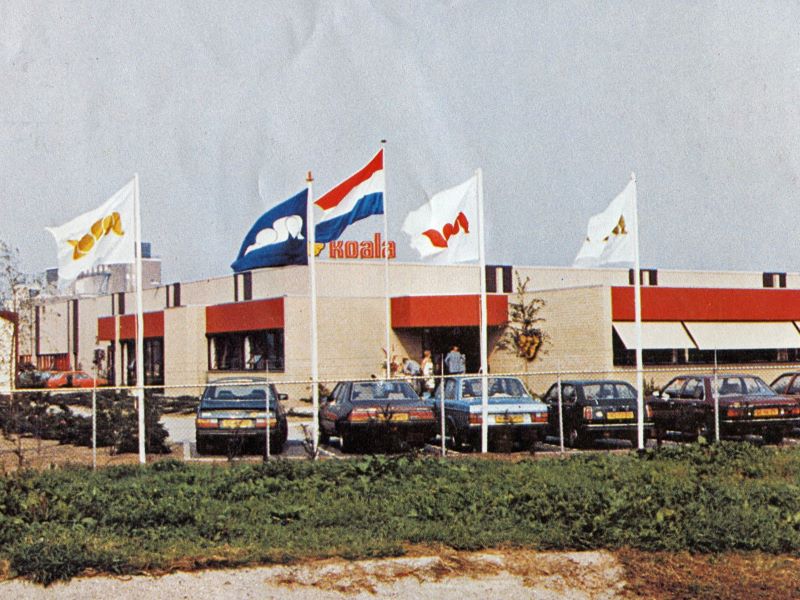
Consequently, the factory relocated in 1981 to new premises on Eerste Broekdijk, within the ’t Broek industrial estate. Its sister company, Koala Tricotagefabriek, moved to Industriestraat. This relocation ensured the preservation of over 200 jobs.
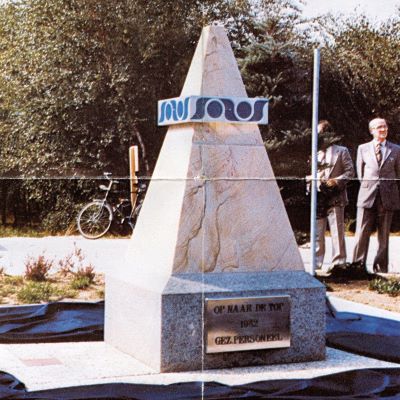
The official opening of the new building was performed by the then Queen’s Commissioner for Gelderland, Mr Geertsema. The collective staff presented the company with a pyramid-shaped sculpture with a flattened top, inscribed: ‘OP NAAR DE TOP’ (Onwards to the Top). However, Wisselink never quite reached that summit.
The Most Modern in Europe
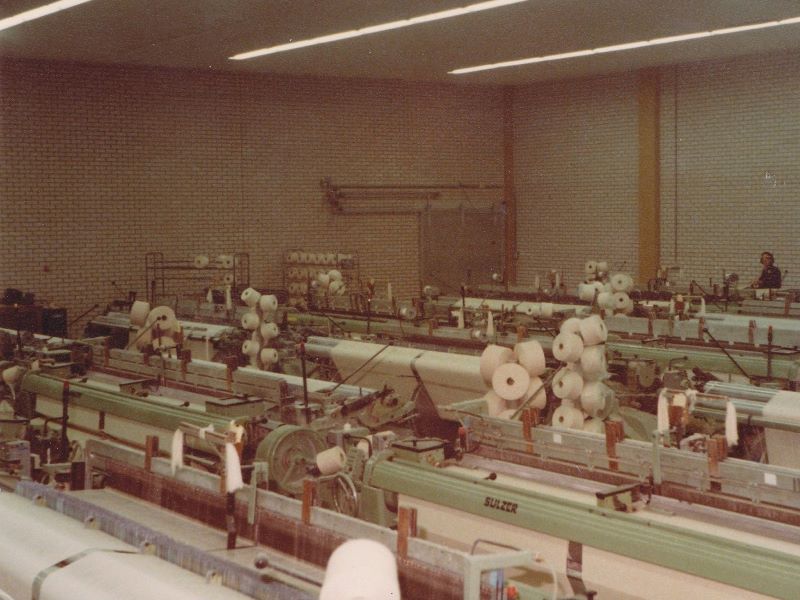
At the time, the new weaving mill was by far the most modern in Europe. It initially housed 76 state-of-the-art Sulzer projectile weaving machines and 20 older Picanol looms. The directors were, in succession, Messrs Schukkink, Van der Gronden (interim), Defourney, and Brouwer.
The company organised several staff parties a year. Highlights included sports days with sister companies from Enschede, Weerselo, Hengelo, and Bree (Belgium). The group’s centenary celebration at the Theaterhotel in Almelo was also a grand event. Wisselink had its own shooting club, ‘WIA’ (Wisselink Textiel Aalten), which was affiliated with the Aalten Shooting Association.
Despite the festivities, the textile industry demanded hard work: shift work, dust, and noise… above all, a lot of noise!
Takeover and Closure
Eventually, Wisselink faced financial difficulties. By 1997, the workforce had dwindled to 93 people—significantly fewer than in previous years. Following several painful reorganisations, the curtain finally fell in 2002. The company was taken over by the German firm Setex. A year later, the entire production was moved to the headquarters in Dingden, Germany. On 31 March 2003, the Aalten factory closed, and the building on Eerste Broekdijk was left vacant.
Some years after the closure, the premises were purchased by Kaemingk Season Decorations. The former production facility was repurposed as a warehouse. In 2015, the building was demolished and replaced by a new, larger warehouse built by Kaemingk.
Invention
On 16 August 1980, the Dutch newspaper De Telegraaf reported on a new invention by the Wisselink textile factory:
‘Schulp’ without buttons designed for soldiers
In the future, soldiers can literally crawl into their shells (schulp). ‘Schulp’ is the name of the tent developed for the army by order of the Ministry of Defence. It is a two-person, single-roof tent for mobile use—quick to pitch and lightweight.
The latter is thanks to a new type of tent canvas, KSOOI/Wetfold, an invention by the Wisselink textile factory in Aalten. It is a lightweight cotton fabric provided with a so-called multi-porous coating (MPC).
Bivouacking becomes a lot easier because of it. The unique feature of this canvas is that it does not leak if touched during a rain shower or if it is folded and packed while soaking wet.
Thanks to an ingenious tensioning system, only two pegs are needed to set up the shelter. What more could a soldier want during field exercises in harsh weather conditions?
It is not just soldiers who can benefit from the tent designed by Mick Schmidt; a civilian version was also produced. It was awarded the 1986-’87 ANWB prize for the best tent design of the year.
Perhaps the greatest advantage of the tent is that it does not consist of two halves. There is not a single button on it. The only thing that might cause an argument is which of the two has to carry the thing on their knapsack.
Video
In 1990, FilmAalten made film recordings inside the Wisselink textile weaving mill:
De Telegraaf, 16 August 1980Wisselink’s Textielfabrieken BV, Aalten (1982)Staff gift at the opening of the new factoryWeaving mill, November 1982 (Photo: Clemens Wijkamp)
Formerly Koala Tricotagefabriek, manufacturer of underwear.
The Algemeen Dagblad wrote on 15 March 1989:
FROM JANSEN & TILANUS TO KOALA BODY FASHION
Koala Body Fashion is the new name of the manufacturer of the underwear and nightwear brand Jansen & Tilanus. This operating company of the Textielgroep Twente holds a 10 per cent share of the Dutch market. Koala — formerly Koala Tricotagefabriek — hopes that with this change of name, the company’s upward trend will continue.
In 1987, profits rose by 10 per cent compared to the previous year. Although managing director H. ter Balkt does not expect this percentage to have been achieved in 1988, there is once again talk of substantial growth. He cites responding as quickly as possible to consumer desires as the most important prerequisite for this.
Because nightwear and underwear have increasingly become an essential part of fashion in recent years, they are subject to new trends, rages, and developments. “An increasing portion of turnover is determined by products that did not exist six months earlier. In such a situation, you cannot work with long delivery times,” says Ter Balkt.
In honour of its 70th anniversary, Koala Body Fashion is the first company in the Netherlands to deposit ƒ1,000 into a fund established by the Enschede University of Applied Sciences (Hogeschool Enschede). This fund is intended to enable the international exchange of lecturers and students in the field of textiles in the future. Koala is making an identical amount available for the best graduation project at the Higher Technical School for the Garment Industry (HTS voor de Konfektie Industrie) in Amsterdam.
And Het Parool wrote on 1 September 1995:
Textile company moves to Asia
Textielgroep Twenthe is going to move its garment manufacturing activities to Southeast Asia. Other activities may also disappear from the Netherlands in the course of the year. Due to persistent losses, further reorganisations are not ruled out. In the first half of this year, the textile group suffered a loss of 4.5 million guilders.
Seventy people work at Koala Body Fashion in Aalten. The garment workshop is the main cause of the persistent losses.
According to a statement from the company, relocation is inevitable from the point of view of reducing cost prices and increasing flexibility. Efforts are being made to find a new location in Southeast Asia.
A social plan has been drawn up for the forty staff members who will be made redundant. Approximately thirty people will remain in Aalten. They will focus on the manufacture of highly fashion-sensitive products for which a short delivery time is necessary.
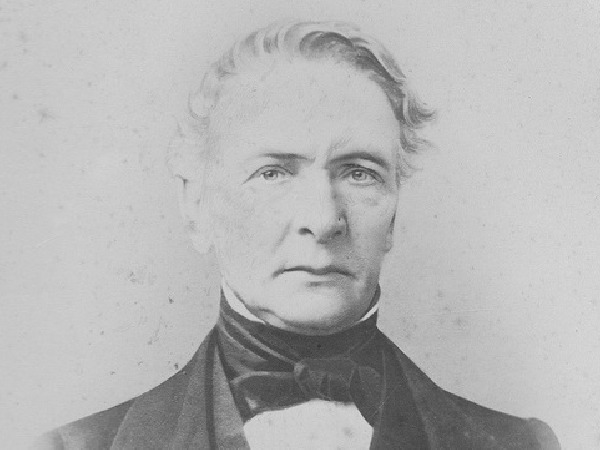
Johan Bernard Anton (known as Anton) Driessen (Bocholt, December 5, 1797 – Aalten, March 7, 1879) was a prominent textile manufacturer in Aalten. Anton descended from a textile dynasty in Bocholt. His father Herman (1765–1817) was also a textile manufacturer, as was his brother Peter Driessen (1756–1843), who also served as an alderman and second mayor of Bocholt.
After their father’s death, Anton and his younger brother Joseph founded the textile company ‘Gebrüder Driessen‘. In 1826, Anton and Joseph Driessen submitted a request to King William I to establish a textile factory in Aalten. The motives for the Driessen brothers’ request were the increased import duties in the Netherlands. They had chosen Aalten ‘as this place was best suited for this purpose‘.
They requested permission to establish a fustian weaving mill and bleachery, as well as a cotton spinning mill and dye works. The Driessen brothers were granted permission for the establishment on the condition that it be located within the village center of Aalten.
Not long after, their cousin Heinrich Driessen also requested permission from the King, which was likewise granted.
In Aalten
Anton moved to Aalten in 1826. He initially lived with Meijerink in the Kerkstraat. His brother Joseph remained in Bocholt, where they maintained a branch office.
The company started “in the Barn and Garden Room of Mr. Bonninghoff”. This most likely referred to the house at Markt 18 belonging to the justice of the peace G.J. te Gussinklo, who had purchased the Borninkhof farm in 1804. Owners were often referred to by the name of their farm.
For the processing of the yarn, Anton Driessen relied on the many home workers living in the area. Furthermore, the municipal report of 1826 mentions, among other things: “Several households have settled here, primarily from Bocholt“. The report for 1827 mentions for the first time that, alongside agriculture as the primary source of livelihood, much fustian was woven for the manufacturers from Bocholt. There were approximately 218 fustian weavers at that time, “performing the work in their homes“.
On November 22, 1827, Anton Driessen married Isabella Dees in Bocholt.
In that same year, the cotton spinning mill was moved from Bonninghoff’s barn and garden room to a better-equipped building in the center of the village. Driessen had purchased a house there from Manus Scholten, located at the site of the current address Landstraat 25.
Opregte Haarlemsche Courant, 29 November 1827Markt 18, AaltenLandstraat 25, Aalten
However, the relocation did not proceed without incident. Two neighbors, the schoolmaster H. Schotman and the farmer W. Obrink, submitted a formal objection to the municipal council, fearing noise nuisance and fire hazards. The municipality, however, rejected their objections. The two neighbors did not leave it at that and subsequently addressed their grievances to the Governor of the province of Gelderland. However, the Governor also saw no reason to give “any follow-up” to their objections.
At the end of 1827, Anton Driessen was able to begin converting the house into a spinning mill. The new premises had an upper floor, which, along with the ground floor, was designated as workspace. Machines were installed on both levels.
Beekhuize
Villa ‘Beekhuize’, Dijkstraat 14, Aalten
In 1833, Anton wished to build a new residence. To this end, he had purchased a house from the Degenaar heirs at the end of the Landstraat—now called Dijkstraat. He intended to demolish that house and build a new, modern residence with a warehouse, barn, and stables on the site. For this, however, he required more space than the existing plot. Anton Driessen submitted a plan to the municipal council with the request, “since the beautification of a Village is always one of the most pleasant duties of a Local government, to kindly grant the same, and consequently to support the undersigned in his intention as much as possible”.
To realize Anton’s plans, both the stream and the street had to be diverted. Furthermore, a new bridge was required. Because the piles of the old bridge had almost decayed, the construction of the new bridge was not only highly necessary, but according to Driessen, the relocation was also less costly. In addition to diverting the stream and building a new bridge, Driessen also needed land for his plans. To this end, he exchanged a piece of land with the municipality. Negotiations regarding these matters lasted several years.
In March 1835, Driessen was able to begin construction. For the production of the necessary bricks, he had meanwhile requested permission to establish a brickyard on the Schaarsheide and to excavate a three-hectare site. Due to the poor state of the roads in East Gelderland at that time, it was more practical and economical to set up a field kiln near the construction site than to purchase bricks elsewhere.
The stately villa that Anton Driessen had built on the current Dijkstraat is known to every resident of Aalten as Beekhuize.
‘Geweven goed. De textielgeschiedenis van Aalten en Bredevoort’ (Woven Goods: The Textile History of Aalten and Bredevoort), H. de Beukelaer and J.G. ter Horst
After the Union of Utrecht , freedom of religion prevailed in the Netherlands. As a result, many Jews came to the Netherlands at the beginning of the 17th century. The first Jews in Aalten were documented around 1630. At that time, Aalten was a small, isolated and closed agricultural-artisan village community with a poor and still highly superstitious population.
People looked strangely at the Jews with their different religion, customs and clothing. The local population considered them strangers for a long time. Until the Napoleonic era, the number of Jews was limited to four families, who lived in the remote streets of the village of Aalten. The profession was usually ‘merchant’.
Bredevoort
As early as 1631, Bredevoort had Jewish residents. At the time, they lived mainly around the Hozenstraat, where they also had their own cemetery, popularly called ‘De Timp’. Around 1700, a Jewish merchant in manufactures set up a house synagogue in Bredevoort. In 1714, this house synagogue moved to a more spacious location, a large stone barn on the Ganzenmarkt between Hozenstraat and Gasthuisstraat. This barn is still there. Jews from Aalten and Lichtenvoorde also visited this synagogue.
Until 1821 the community was still part of Winterswijk, but in 1830 it became an independent municipality. Around 1830, a real synagogue was built on the Vismarkt.
Around 1800, the Jewish community in Bredevoort had almost as many members as the Aalten community, but steadily declined in size in the course of the 19th century. In 1900 there were not enough members to hold regular services and the Bredevoort congregation was merged with that of Aalten.
The building on the Vismarkt served as a synagogue until the beginning of the First World War. Around 1920 the synagogue was converted into a residence. Nowadays the building is a municipal monument.
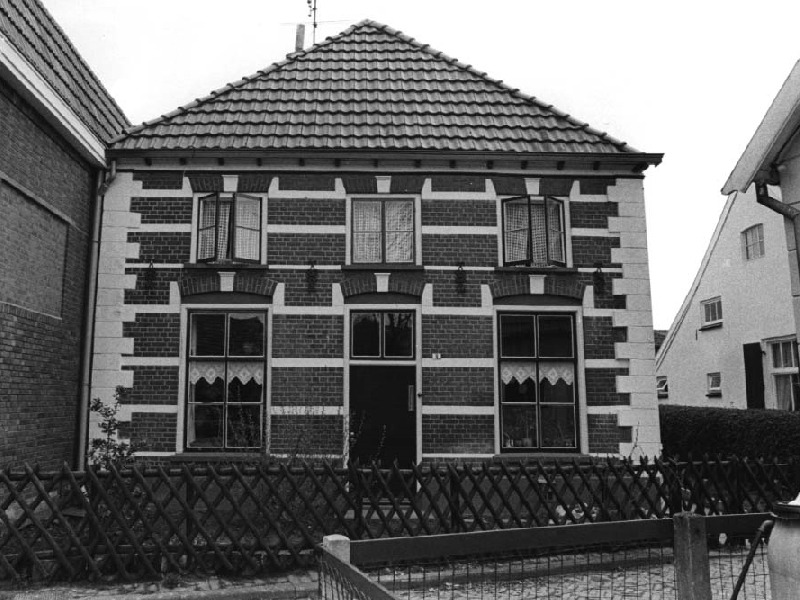
Former synagogue Vismarkt 9, Bredevoort
Aalten
It was not until 1776 that a ‘Jewish church’ in Aalten was first mentioned. That must also have been a house synagogue. Between 1800 and 1850, the number of Jewish communities in Aalten grew from 39 to 70, mainly due to the expansion of the family in the existing Jewish families: the number of households hardly increased.
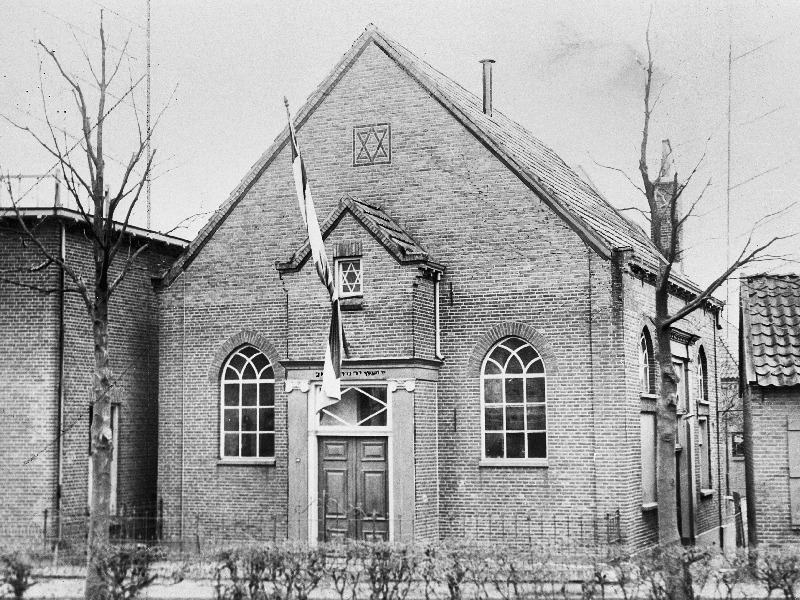
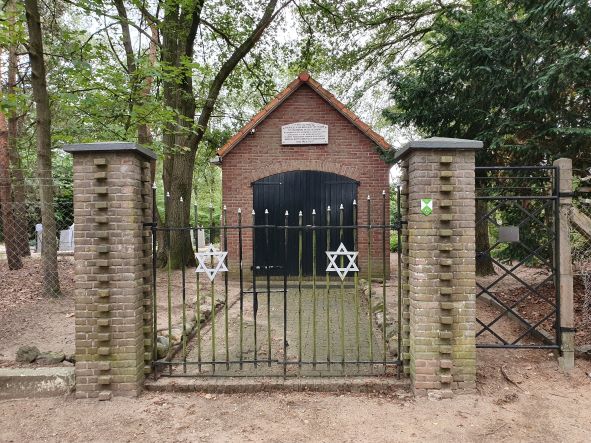
In 1857 the synagogue on the Stationsstraat was put into use. The Jewish community acquired ownership of the cemetery on Haartsestraat in 1852, but had already been used there (we do not know for how long) to bury the dead.
In the period 1870-1900, the number of Jewish inhabitants in Aalten decreased from 80 to 50. This must be explained by local circumstances: the number of Jews who had to earn a living with a small business had become too large for the hardly grown population of Aalten (which even decreased slightly due to emigration) due to the strong growth in the preceding years. Some of the Jews from Aalten therefore also moved away, especially to the larger cities in the east of the Netherlands (Arnhem, Zutphen, Deventer).
Only when the total population of Aalten started to increase again, the number of people working in the small trade could also grow again. And that happened, not only because of birth surplus, but for the first time in a long time also because of the settlement of new families.
Synagogue, Stationsstraat 7, Aalten
Entrance Jewish cemetery, Aalten
Around 1900
At the beginning of 1900, the church board had three members. There was a religious school with one teacher and a ritual bath. In addition to a funeral association for men, Aalten had a women’s society that offered help in case of illness and death.
The Jewish community in Aalten was religious, although some may have done a little more about it than others. Social control did play a role in this. However, the Sabbath rules were not always strictly observed for economic reasons.
The Jewish community in Aalten consisted mainly of cattle traders and butchers. The fact that many within the small congregation belonged to the same professional group often led to quarrels, which were often fought out in or near the synagogue. These tensions and quarrels, between ritual butchers who had to determine whether a cow was kosher, and between butchers who wanted to sell, were just as much a part of the Jewish culture in Aalten as the mutual aid in case of illness and poverty.
Integration
In the 17th and 18th centuries, Jews were still tolerated as foreigners, but in the 19th century a process of integration gradually took place. This led to the fact that the Jews were an accepted minority in the early 20th century. For example, they held board positions in associations such as Aaltens Belang, the Oudheidkamer and the Feestgebouw.
Marcus Gans was co-founder of the Peters en Gans pipe factory on the former Gasthuisstraat. Jewish cattle traders were involved as shareholders in the establishment of the dairy . The public school had Jewish teachers, the Aalten Orchestra Society, the Thalia drama society and Symphonia had Jewish members. Jewish members were part of the Aalten branch of the National Crisis Committee and the volunteer fire brigade.
Most Jewish children also had non-Jewish friends and the older ones were also usually friendly with non-Jews. The municipal council was officially represented at official events in Jewish circles.
Pipe factory Peters & Gans (right), Gasthuisstraat, ca. 1910
Refugees from Germany
In the years after 1933, a stream of refugees started from Germany. After the Reichskristallnacht in 1938, this flow increased sharply. A small part of those who were admitted to the Netherlands were allowed to settle in Aalten. Most were sent to special refugee camps that had been set up in various places in the country.
On 1 January 1942, Aalten had 17 inhabitants with German nationality (which, by the way, they had officially lost on 25 November 1941: the German refugees had effectively become stateless citizens). In the first weeks and months of the German occupation, everything remained quiet in Aalten. Measures taken against the Jews did not directly affect the Jewish community in Aalten in the first year. What would have consequences in the long run was the registration of all Jewish residents in the autumn of 1940. 63 cards were sent to Arnhem.
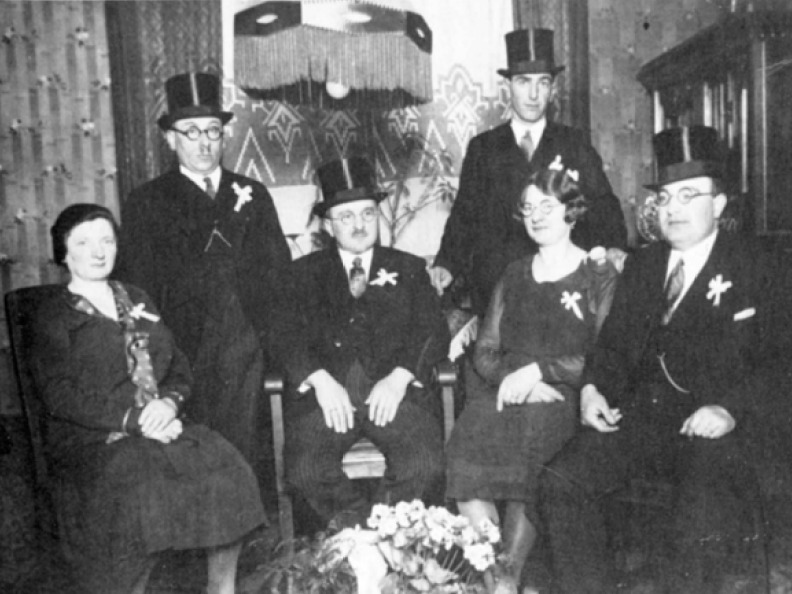
Members of the Jewish community of Aalten in 1932
Choices
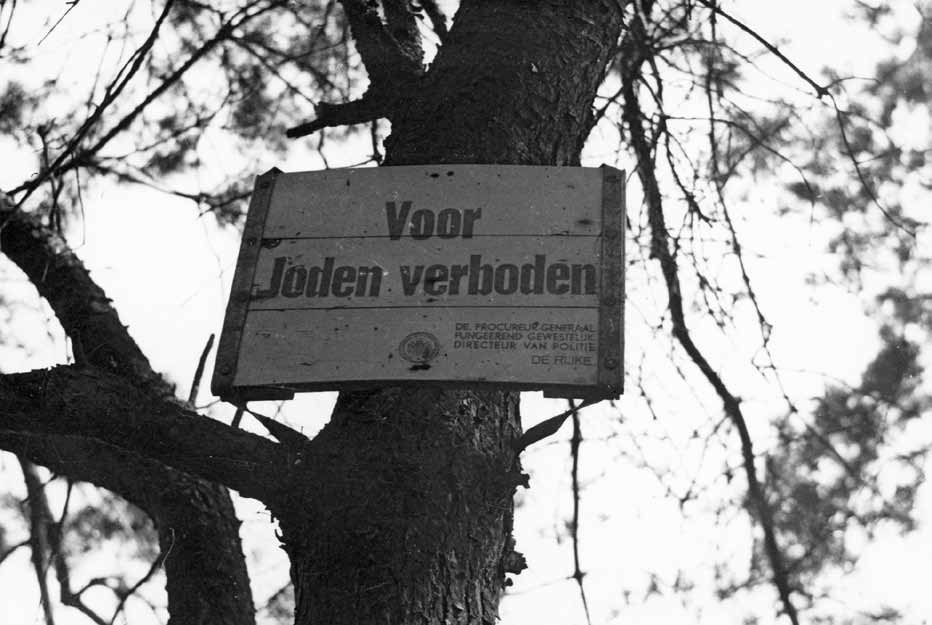
Prohibition at the entrance of the Loohuis
In 1941, the expulsion of Jews from public life began. First there were fewer and fewer advertisements from Jewish shopkeepers in the newspapers, then came the regulations that forbade them to participate in public meetings and access to public spaces. Jewish pupils were banned from education. In the same year 1941, the first Jewish victim fell from the Jewish community in Aalten as a result of a raid.
The list of prohibitions and obligations that applied specifically to Jews continued to grow and in the summer of 1942 the deportations began. They had to decide whether or not to go into hiding. Those who did not opt for the latter were deployed for what was called ‘the expansion of work in the east’ and – as we know afterwards – murdered in the gas chambers.
Hiding
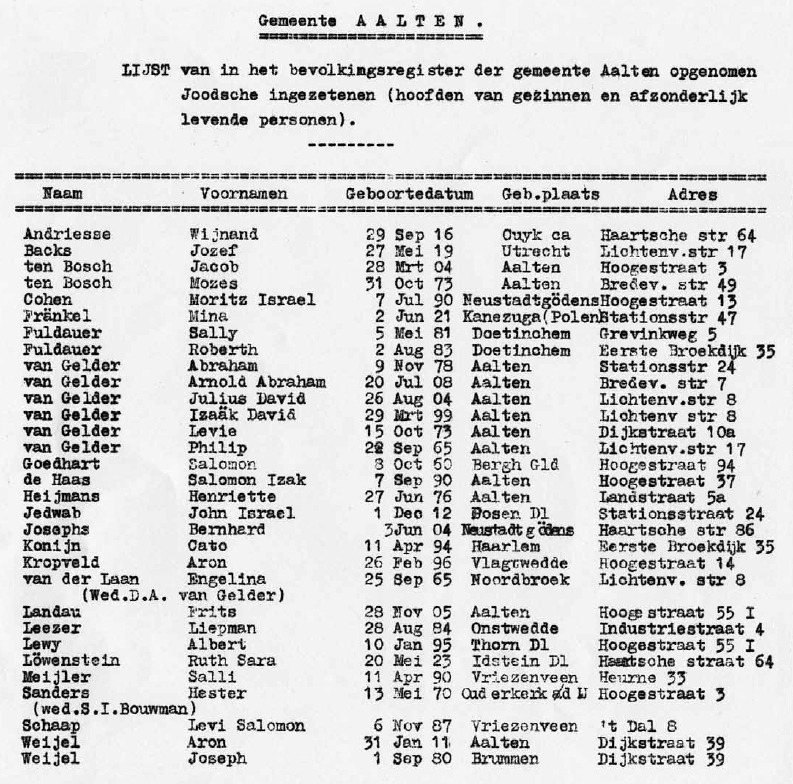
On 13 July 1942, the overview of the Jews in Aalten was sent in five copies to the Zentralstelle für jüdische Auswanderung in Amsterdam. That was the beginning of the end.
With the exception of the NSB members, the non-Jewish population of Aalten generally behaved helpfully. In retrospect, however, one can say that both Jews and non-Jews underestimated the danger and did not see the severity of the measures.
On 4 October 1942, 10 Jews from Aalten, family members of Jews who had been transferred to Westerbork from a number of closed labour camps, were put on a transport to the transit camp and from there to Poland. Shortly afterwards they were removed from the population register ‘because they left for abroad’.
Within a month of that, 37 Jews from Aalten were in hiding. They were also removed from the population register with the addition v.o.w. (left, unknown whereto). At the beginning of 1943, another 15 Jews from Aalten went into hiding. The other 25 were deported via Vught or Westerbork. This made Aalten officially Judenrein on 10 April 1943.
List of Jewish residents of Aalten, 1942
Victims
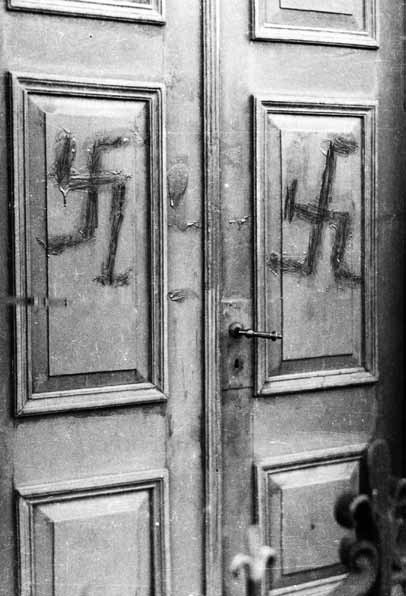
Graffiti synagogue in Aalten
The houses of the deported families were emptied (for the benefit of German Bombengeschädigte) and rented out again. Outstanding bills and transport costs were paid by Lippmann and Rosenthal, the bank in Amsterdam where all Jewish assets were housed.
In 1941 people went into hiding temporarily, but from October 1942 the hiding took on a permanent character. Not everyone returned from hiding.
Of the 52 Jews in hiding, three eventually died during their hiding period and six were arrested, deported and murdered after being betrayed. There have also been Jews who were born in Aalten, who may or may not have spent a large part of their lives there, but who lived elsewhere in the Netherlands during the occupation due to relocation. The information about their fate is not complete. If we count them, the number of victims from Aalten is much larger than the 34 of whom we know for sure.
After the war
The 46 members of the Jewish community in Aalten who had survived the war were distraught. Many had lost a large part of their family and no longer owned anything. Their attempts to get some of their former possessions back did not always meet with cooperation and often met with reluctance.
The number of Jews in Aalten steadily declined after the war. Young people left for Israel or to the west of the country, the older ones died. In 1965 the number was 28, in 1981 21, and now there are only a few.
Hint
The National Hiding Museum in Aalten tells the great history of resistance, hiding and freedom before, during and after the Second World War with ‘small’ stories. The museum examines the choices and dilemmas of ordinary citizens on the Dutch-German border and uses the stories of the past to have a conversation about today.
In the east of the Netherlands, the concept of naoberschap is widely known. This phenomenon, also referred to as neighborly duty or neighborly aid, refers to the tradition in which neighbors support one another during both joyful and sorrowful events.
In 1874, J. ter Gouw, with the cooperation of E.F. Avenarius, a teacher in Lintelo, and Is. de Waal, a former minister in Aalten, described the customs and duties of the naoberschap as they were common in Aalten at that time.1 The article is presented below.
N.B. In the original article, naoberschap is spelled with oa. Because we are Old Aalten and the article concerns Aalten, we have chosen to adapt this term to the WALD spelling, thus using ao.2
“Although these customs are still in vogue in the municipality of Aalten, they nevertheless belong to the olden days. They are remnants of ancestral morals, mere fragments that still live on there, but which may also disappear after only a few years.“
New Construction
‘Foezel’ as thanks for the (naober) help
When building a new home, the future resident visits eight or twelve of the nearest neighbors and asks them if they wish to be his “naober.” This is usually accepted, as a refusal is considered an insult, and terminating the naoberschap also signifies the breaking off of all mutual social interaction.
Mutual obligations rest upon the naobers. For instance, every naober is obliged to help erect the wooden frames and the roof free of charge when a house is being built. In the evening, the naober youth then place the May trees (a few pines) in front of the house, for which the owner must treat them.
This is followed by a so-called “rigtemaal” (topping out meal) for the naobers, who also take this opportunity to give the new building a name, by which name the resident is subsequently called, and often better known than by his family name.
Before the new home is occupied, the naober women, or their daughters or servants, arrive with baskets full of peat and wood to “aan te bueten” the fire, which is to say: to light it. And if the new resident is among the needy, his more affluent naobers often bring him such a large quantity of fuel that he can provide for his hearth for several months.
J. ter Gouw
Marriage
When a young man or young woman is to enter into marriage, the other young people from the naoberschap go to the residents with whom the newlyweds will take up residence, before the second marriage banns take place, and ask the bridegroom or the bride if they may “make it beautiful.” This beautification consists of planting four tall pine trees in front of the door, which are interconnected with arches, wound with palm, and adorned with small flags of colored paper; while in the center a crown is hung, wound with cut paper and decorated with gilded eggs. Inside this crown hangs a wooden dove, as the symbol of love, which is neatly covered with gold paper.
These wedding crowns are held in high honor and preserved for as long as possible. At many farms, one can still see the crowns that were hung at their grandfathers’ weddings.
The fetching of the bridegroom or the bride to bring them to their destined home is also performed by the naober youth. The wagon is decorated with greenery and often drawn by four horses; the girls from the naoberschap take their places upon it, and while singing or rather shouting out: “To Austria we wish to sail, almost across the heath, etc.”, they set off on their way.
If it is a bridegroom fetching his bride, he sits at the front of the wagon smoking a long Gouda pipe — if possible a steel pipe, decorated by his naober girls with red, white, and blue silk ribbon. Now, that is of course long out of fashion; bridegrooms now smoke cigars or do not smoke at all. But in the time of pipes, a bridegroom had to smoke. I have seen some who actually belonged to the non-smokers, and yet sat with the bridegroom’s pipe between their teeth during the ‘bride’s tears’ and at the wedding, and had to pack and light it every now and then.
Upon arriving at the bride’s home, a bouquet of colored and gilded paper is fastened to the left side of his hat, so that many would take him for a coachman with a cockade on his hat. The bride receives a similar bouquet on the left side of her chest.
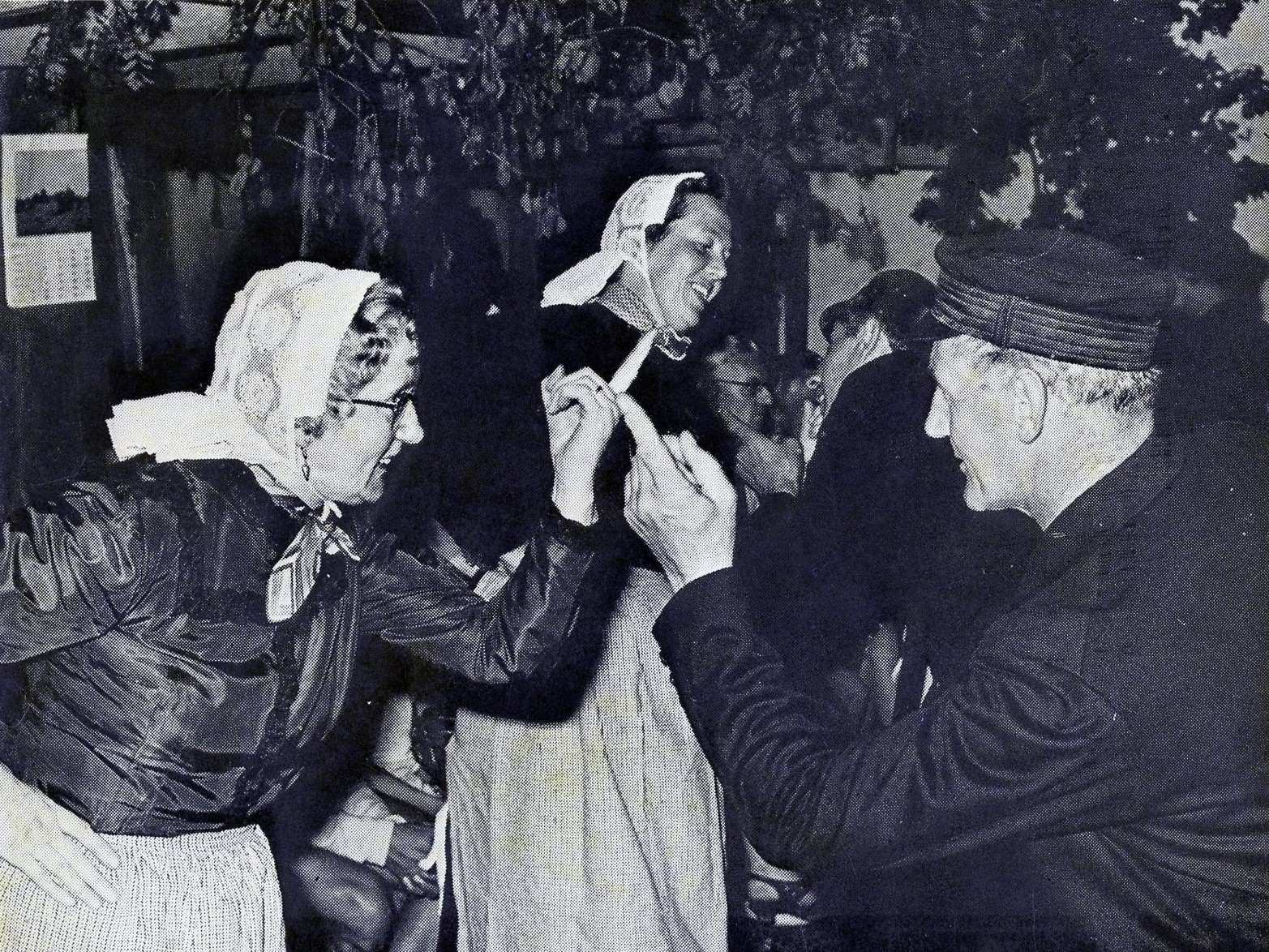
Achterhoek peasant wedding; they dance the ‘Driekusman‘
Once some bread and coffee have been consumed, the bride is led to the wagon by a naober boy and the bridegroom by a naober girl, while the other naober boys fetch the “bride’s cow” from the stable and lead it behind the wagon. If the bride’s parents are well-to-do people, the naober boys take the liberty of also bringing some sausage, bacon, meat, chickens, and more of that nature for the newlyweds.
Often, the bride’s cupboard, well-stocked with rolls of linen, napkins, and table linens, along with eight or twelve chairs, a spinning wheel, and a reel, has already been brought to the future home the day before.
When the bridal wagon has arrived there, the naober youth spend not only the evening but also a large part of the night drinking “foesel” (gin) and shouting out all kinds of songs, for one cannot call it singing, and finally return to their homes to pay for the frequent use of that “plague drink,” as some call it, with headaches and listlessness the following day.
Sometimes the wedding or “broedlagt” follows weeks, even months later, or is combined with the ‘kinderbier’ (child-beer) of the first offspring.
J. ter Gouw
Death
In the event of a death, the obligations of the naobers are even more numerous. As soon as someone dies in a household, one of the nearest naobers is notified, if none are present, and he immediately goes around the entire naoberschap; thereafter, the naobers go together to the house of the deceased to “verhennekleeden” the dead, which is: to remove their clothes and shroud them in the burial garment.
The next day, the passing of the deceased is tolled, and the naobers must announce the death to the family, even up to a distance of five hours away. In the evening, two or three naobers bring the coffin and place the body inside. If the deceased died of a contagious disease, or if the unpleasant odor already indicates decomposition, he is given a glass of “plague drink.” But this is then also the only gin used in a house of mourning.
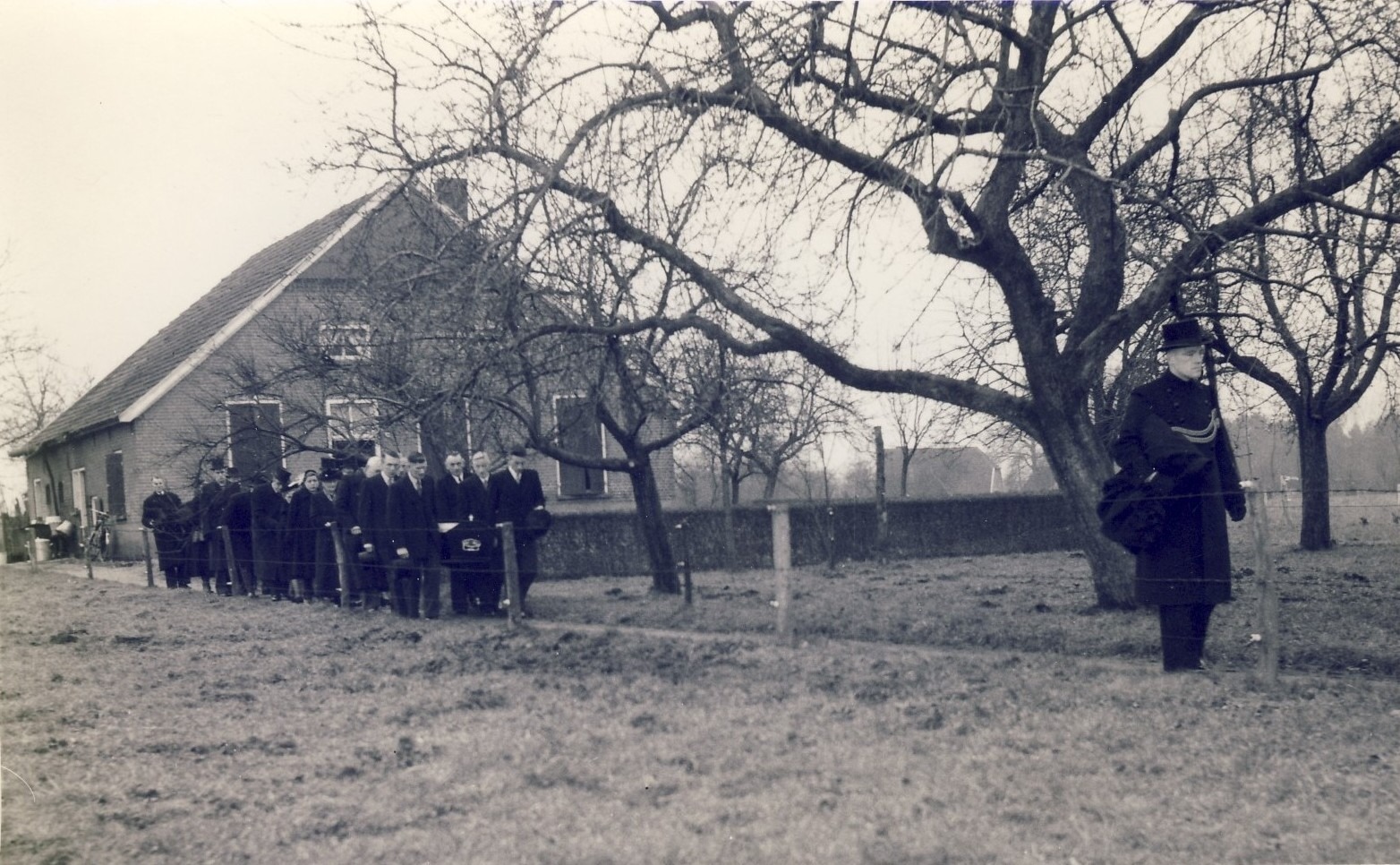
Funeral of Gerhard Aalbers, 1954. Departure from ‘t Slat in IJzerlo. From right to left: 1 gravedigger Rensink; 2 Gerrit Hengeveld of de Smit; 3 Herman Lammers of Lurvink; 4 Bernard Nijman of de Scheel; 5 ?; 6 Johan Lammers of ‘t Nije Loo; 7 Johan Kraaijenbrink of de Wikker; 8 Hendrik van Eerden; 9 mother Betje; 10 Annie; 13 Derk H.; 12 ?; 14 Derk W.; 15 ?
From the time of death until the funeral, the naobers manage everything. They must take the grain required for the funeral meal to the mill and provide everything else that is needed. The naober women must sift the flour and bake bread, and because of this, there is a bustle in the house of mourning that is bothersome to the relatives, who would prefer to be alone with their beloved dead. One can form an idea of that bustle when one knows that more than a hundred households may be invited to a funeral or ‘groeve’.
(This was the case with one of my farmers, who was quite well-to-do but still had only a small farm, when there was a ‘groeve’ at the house upon the death of his elderly mother. On that occasion, four mud of rye were baked, yielding 75 loaves of bread, and since the bread was intended for four people, they had counted on three hundred eaters. Furthermore, the following was purchased: one full Leiden cheese and one nearly full, together 33 old pounds; twelve old pounds of coffee, and 1.25 old pounds of white sugar lumps. A barrel of beer was ordered from the brewer, which they expected would not be sufficient. The bell-ringers drank three guilders’ worth of gin.)
On the day of the funeral, at ten o’clock in the morning, the body is placed on “den deel” (the threshing floor), and the coffin is opened far enough so that the face of the dead is visible. The naober women now pour coffee and present bread to the guests, while that naober woman whose husband must drive the body to the cemetery has the privilege of serving the immediate family, and thus every naober woman has her specific task according to her rank and status.
After all the guests, which include the naobers and the residents of het rot (the district), have satisfied themselves with bread and coffee, everyone goes to the threshing floor to see the deceased for the last time. If a minister is present, he gives a speech by the open coffin; he seeks to comfort the bereaved, reminds everyone of the memento mori, and concludes with an appropriate prayer.
Now the coffin is placed on the back of a wagon, and the two closest relatives of the deceased sit at the foot of the coffin, followed by the next two, and so on until all seats are occupied. The women have a black rain cloak or ‘folie’ hanging over their heads and know how to indicate their relationship to the deceased very precisely by covering themselves entirely or partially with it.
The procession to the grave forms a long, sometimes endless line, as not only the relatives but also the naobers and those belonging to the ‘rot’ follow the body, and moreover, as soon as the funeral procession approaches the village, many from there also join in; so that not infrequently one hundred and fifty men, women, and children take part in that procession.
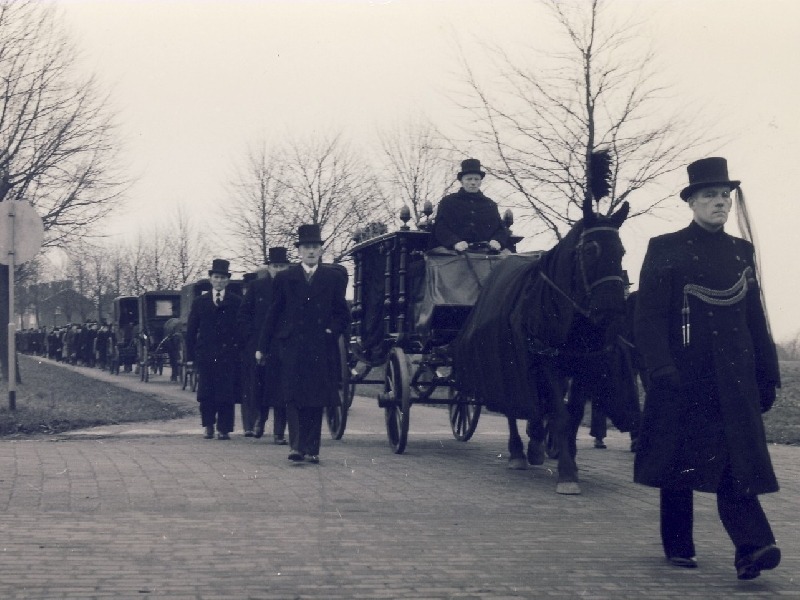
Funeral procession of Gerhard Aalbers from ‘t Slat in IJzerlo
From the moment the procession comes into view of the village until it has left the cemetery again, all the bells are tolled, and from the grave, they go to the brewer, where a few drink tea, but most drink beer, and the latter in very generous amounts. From the brewer, they return to the house of mourning; here bread and coffee are consumed once more, and the ceremony is concluded.
But the next day, a small after-reflection follows. Already at the crack of dawn, the poor stand at the door (fifty or a hundred sometimes) to be able to carry away “a morsel” from the house of mourning. They are given the not very carefully sifted bran from the consumed rye and the leftover bread.
In the afternoon, the naober women come to the house of mourning once more; they again consume coffee and a sandwich, and thereafter each gathers her borrowed cups, saucers, knives, etc., and departs with the customary: “I wish you the best.”
Lintelo, E.F. Avenarius
In the village
What has been communicated by my friend Avenarius, and to which I have added a few remarks, specifically concerns the naoberschap among the country folk. In the center of the municipality, one has the same theme but with some variation.
Upon moving into a home, an offer soon comes from the naobers who belong to the house (according to a choice once made) to “aan te bueten a fire,” i.e., to light it. This being accepted and the hour determined, the naobers send daughters or maidens (servants) with fuel — “kluwen” or dredged peat from one, wood from the other — and everything is piled up at the empty hearth, as if it were to be set ablaze immediately. If one wishes to make it truly beautiful, a wreath of colored paper is placed over everything. After this “fire-lighting,” a glass of “foesel” (gin) is immediately expected, and if there is something to go with it, all the better; thereafter the naobers themselves are “geneugd” (invited), and consequently, the heads of the families are received for “a cup of coffee” with “kluntje” (sugar lump), currant bread, and finally “foesel with sugar” (gin with sugar).
Also after the conclusion of a wedding and funeral, the naobers are invited in the same manner, and then Jew and Christian, Roman Catholic and non-Roman Catholic, rich and poor, sit together in brotherly friendship; and such an evening leaves pleasant memories behind, while one feels newly inclined to perform for one another all the services that the duties of naoberschap prescribe.
Within the town, funerals are generally not arranged on such a large scale as we have just heard; yet the gathering is sometimes so numerous that the minister, who leads in prayer before the refreshments are consumed, must sometimes place himself between two spacious rooms in order to be heard in both. It even happens that a third room is necessary, where the guests must then make do with a few sounds from a distance.
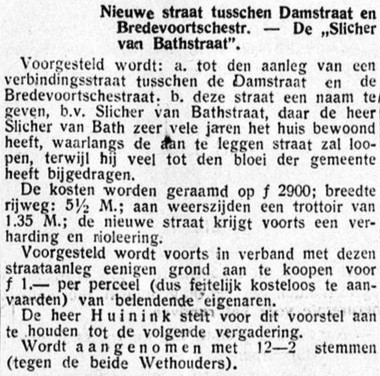
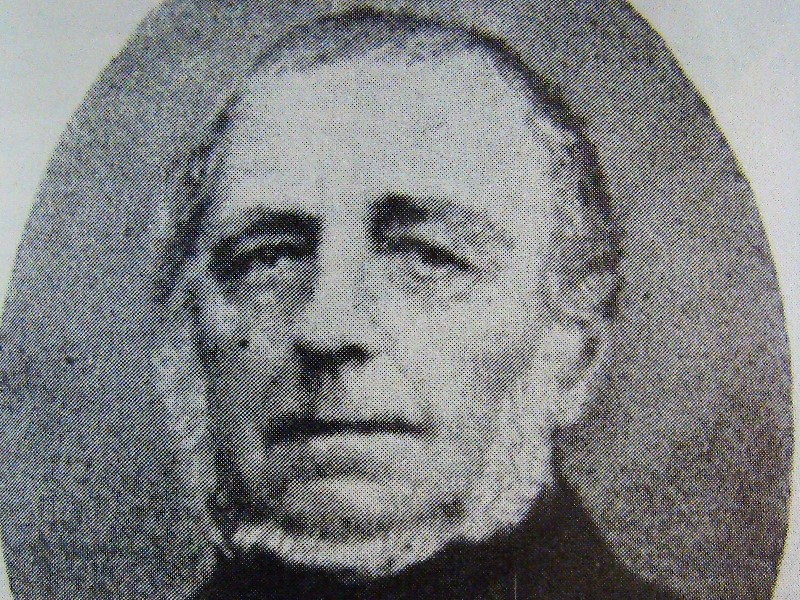
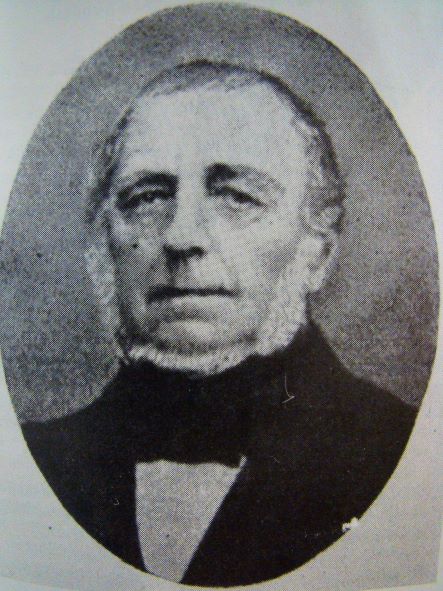
Adriaan Pieter Slicher van Bath (Middelburg, 1838-06-07 – Aalten, 1933-11-18) was a local notable and benefactor who contributed significantly to the Aalten community. He had resided in Aalten since 1867 and married Johanna Geertruida (‘Nannie’) van Hopbergen (1849–1924) here in 1874. She was a daughter of the local landowner Major J.W. van Hopbergen (1817–1913).
A street and a lane in Aalten are named after this couple. On the corner of the Slicher van Bathstraat and the Bredevoortsestraatweg, we still find their former residence, villa ‘Welgelegen‘. Furthermore, every resident of Aalten is familiar with the Nannielaantje, which runs across their former estate, the ‘Smees’ property.
Offspring
Their son Willem Antonie (‘Toon’) Slicher, born in 1881, and Anna Becking, born in 1883, married in Aalten in 1908 and were the parents of Professor B.H. Slicher van Bath in Wageningen. The title ‘Van Bath’, a small seigniory at Rilland-Bath in Zeeland, was intended to be inherited by B.H. Slicher’s uncle, but was transferred to his grandson by the grandfather for personal reasons.
In memoriam
On November 20, 1933, the Zutphense Courant published this report from Aalten:
“After an illness of several months, our oldest resident, Mr. A.P. Slicher van Bath, passed away here on Saturday evening at the advanced age of 95.
Mr. Slicher van Bath, who had already lived here for a normal lifetime, sailed a large part of the world’s oceans on a sailing ship in his younger years. After initially working at the Greenwich Observatory, he was sent out on behalf of English interests to conduct meteorological observations for the benefit of sailing. During these voyages, he visited St. Helena, the Cape of Good Hope, India, Australia, and Cape Horn, among others.
After settling here, Mr. A.P. Slicher van Bath was very active in the interests of this region. Among other things, he provided the initial impetus for the establishment of the Geld. Overijselsche Mij. van Landbouw, the Coöp. Zuivelfabriek (Cooperative Dairy Factory), the gasfabriek (gasworks), and the Geld.-Overijs. Locaal Spoorweg (Local Railway). ‘Floralia’, which has now existed for over 50 years, owed its origin to Mr. Slicher. No effort or expense was too much for him when it concerned ‘Floralia’, and when he was no longer able to involve himself in its management, this association received his significant donations every summer.
For many years, Mr. Slicher was chairman and later honorary chairman of the local department of ‘t Nut, and as such, the bewaarschool (nursery school) was his great passion. This institution also benefited from his substantial financial support every year.
Mr. Slicher was also a member of the Provincial Council of Gelderland for several years. Furthermore, until his 90th year, the deceased was an observer for the Meteorological Institute in De Bilt and, until the present, a correspondent for ‘Arti et Amicitiae’.
It is certainly noteworthy that Mr. Slicher’s memory remained excellent until the very end and that he continued to take an interest in all major world events.
With the passing of Mr. Slicher van Bath, a very well-known Aalten personality is gone, and numerous associations and institutions will deeply miss his great support.
The interment will take place on Wednesday afternoon at 3:00 PM at the Oude Begraafplaats (Old Cemetery) here.”
Johann Heinrich Joseph (known as Heinrich) Driessen (Bocholt, 10-07-1794 – Aalten, 04-07-1879) was a prominent textile manufacturer in Aalten. Heinrich descended from a Bocholt textile dynasty. He was the only son of Peter Driessen and Maria Hölscher. His father held a distinguished position in the Prussian town, just across the border from Aalten. In addition to being a textile manufacturer, he served there as a magistrate and, from 1797 to 1811, as deputy mayor.
Heinrich received a thorough education at the Jesuit College in Amsterdam and spoke excellent French, so that in 1812, when Napoleon’s troops passed through Bocholt, he was the only one capable of acting as an interpreter between the municipal authorities and the French generals.
Peter Driessen & Sohn
In 1810, Heinrich joined his father’s business. On December 2, 1820, he married Lisette Sträter in Rheine (Germany), a descendant of another prominent textile family. They had nine sons and two daughters. In 1826, he was entrusted with the management of the firm Peter Driessen & Sohn.
In that same year, his cousins Anton and Joseph Driessen submitted a request to King William I to establish a textile factory in Aalten, which was granted by William I. Not long after, Heinrich Driessen also requested permission from the King to settle in Aalten. The firm Peter Driessen & Sohn also received the requested establishment permit.
In Aalten
His father Peter continued to live in Bocholt while his son Heinrich settled in Aalten. He initially lived with the Meijerink family on Kerkstraat, one of the few remaining Catholic families in Aalten, in the same building as his cousin Anton Driessen.
In Aalten, Heinrich established a branch of his father Peter Driessen’s fustian trade and hand-spinning mill. They already owned the necessary land in Aalten and Varsseveld, and in 1826 he expanded his activities to Groenlo. There, Heinrich had purchased a house from De Heyder. That house was converted into a spinning mill. He made the yarn spun there available to home weavers who processed it into cloth.
Opregte Haarlemsche Courant, 7 December 1820Nederlandsche Staatscourant, 30 August 1851
Heinrich was an enterprising man. By 1832, he had approximately 500 linen weavers in Aalten and the surrounding area working for him, and three years later, along with Blijdenstein in Enschede, he was among the largest fustian manufacturers in the eastern Netherlands. He was one of the first in the Netherlands to utilize steam in his bleachery.
‘Den veursten Dreessen’
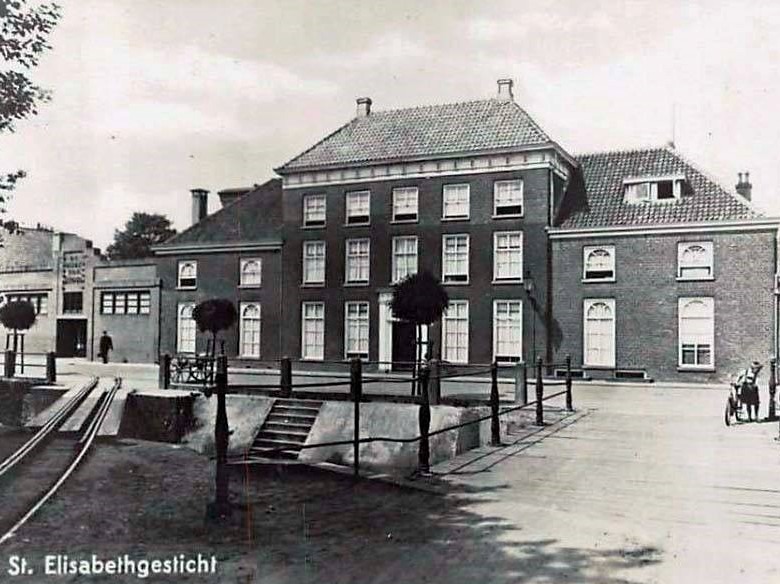
In 1837, he had a grand residence built at the beginning of Dijkstraat. For this reason, he was popularly known as ‘den veursten Dreessen’ (the front Driessen), while his cousin Anton, who built Beekhuize a little further along, was called ‘den achtersten Dreessen’ (the rear Driessen). Heinrich’s eldest son, Theodoor, laid the first stone on June 29, 1837. Business premises were also located at the residence, primarily serving as storage for yarns and woven fabrics. These fabrics were transported by a wagon, often pulled by an ox, to the bleachery in Dale. The driver bore the fitting nickname Ossen Willem (Oxen William). After Heinrich’s death, the house was repurposed as a convent.
Heinrich’s house on Dijkstraat, later St. Elizabeth’s Convent
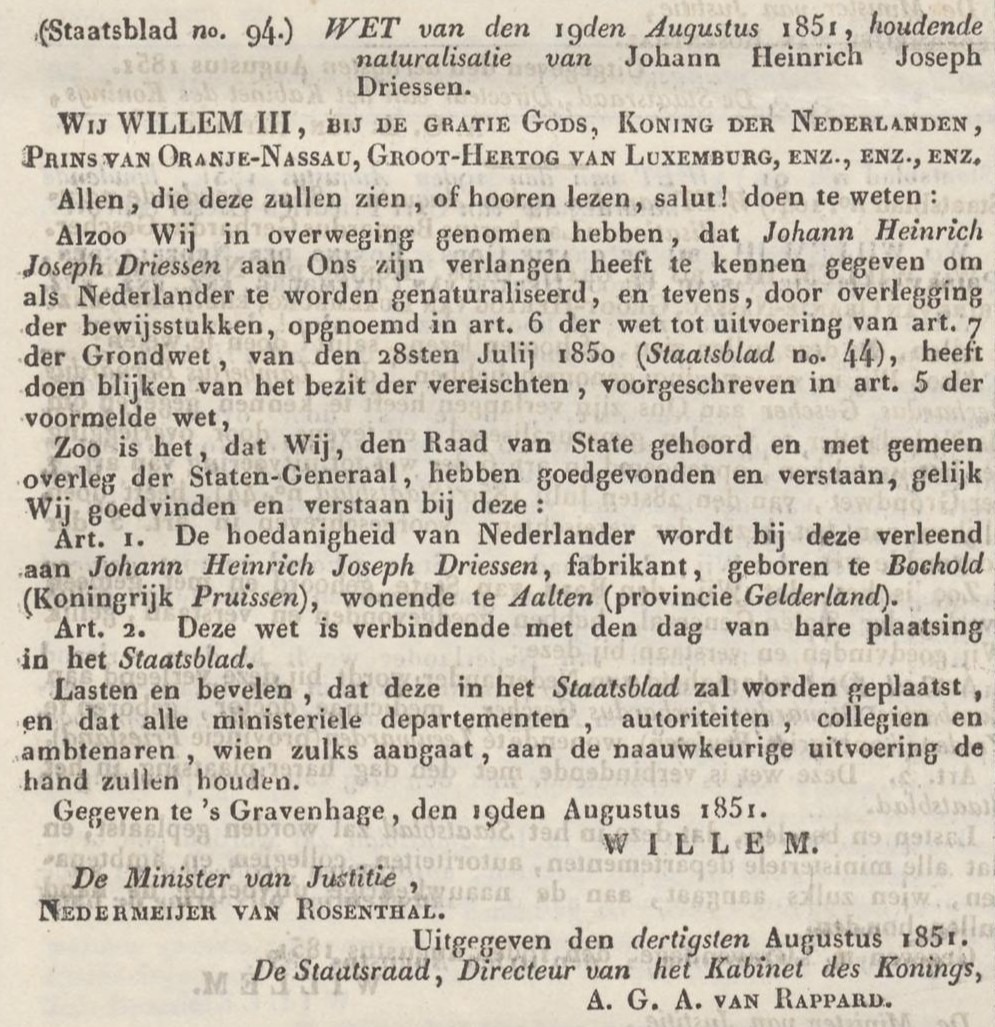
Following his father’s death in 1843, Heinrich became the sole owner of Peter Driessen & Sohn. His eldest son Theodor (1821-1878) was then placed in charge of the management in Bocholt. In 1851, King William III granted Heinrich Dutch nationality.
In 1849, Heinrich established a steam spinning mill on Hogestraat in Aalten, the first of its kind in the Achterhoek region. This was soon expanded with several ‘power looms’ (steam-driven weaving looms). After this factory burned down on the night of August 19 to 20, 1859, he did not rebuild the business.
Algemeen Handelsblad, 22 August 1859
To Leiden
Heinrich shifted his focus to Leiden. There, in 1846, together with his nephew (his sister’s son), the soap boiler Ignatz van Wensen, he had purchased the declining textile printing and dyeing works De Heyder & Co., later known as the Leidsche Katoenmaatschappij (Leiden Cotton Company). He had his second son Louis (1823-1904) come over from England to take charge in Leiden. With the knowledge he had acquired in Manchester, Louis soon managed to make the company profitable.
Heinrich’s son Eduard (1824-1895) continued to look after the company’s interests in Aalten. Initially, the bleachery there remained operational, but over time Eduard primarily focused on the trade in cotton and yarns. The branch in Bocholt, managed by Theodor, was closed after he and his brother Peter (1832-1895) started a blue-dyeing and printing works there in 1854, named the firm Theodor and Peter Driessen.
Catholic
Old Roman Catholic church on Dijkstraat, destroyed by fire in 1893
The Driessen family was also of great significance to the Aalten Catholic community, which had been a minority in the Reformed village since the Reformation of 1596. Not only through their prestige and influence, but also through various donations from the Driessens, the Catholic church in Aalten was able to grow into a fully-fledged church community. Both Heinrich and his cousin Anton played important roles as churchwardens and overseers of the poor, roles that were continued by their descendants.
Heinrich Driessen was very strong-willed in his conduct and often followed his own path in ecclesiastical matters as well. For instance, during the disputes between the Catholics and the Reformed in 1842 regarding the ringing of the bells. Pastor G.H.J. Wansing of Aalten wrote a letter about this to the Archpriest of Gelderland, M. Terwindt, which was co-signed by the churchwardens Th.W. Meijerink, H. Vulting, and A. Driessen. Heinrich Driessen, although a member of the church board, had not signed this letter and addressed two personal letters to Terwindt himself.
What stands out in these letters is that he stated, among other things, that the pastor seemed a priori prejudiced against Aalten and expressed the hope that the Aalten parish would receive a new shepherd who would be to everyone’s liking. He requested Terwindt to take his reflections into consideration when making his choice and assured him that he preferred to employ everything that was conducive to the honor of their holy religion. But at the same time, Driessen wrote that—because the old pastor showed him the greatest respect and because he himself esteemed the pastor as a man whose moral conduct could serve as an example to an entire province—he trusted that it would also please the Archpriest that the contents of the letters never be disclosed to others.
New church
A subsequent problem arose when it was decided around 1853 to build a new church. This led to serious disagreements within the church board. For instance, churchwarden Heinrich Driessen again found it necessary to act independently by contacting the Archbishop behind the backs of the other board members. In a letter to the Archbishop, he referred to the approval the latter had given to the plans for the construction of the church, on the condition that the confessional or confessionals be placed inside the church and not in the sacristy or in separate extensions on the side walls. Based on that condition, a plan had been sent to the King for approval.
However, during Driessen’s absence, the tendering for the church had taken place, in which an extension was nevertheless planned, contrary to the archiepiscopal approval. An extension to the church for the purpose of the confessional would, according to Heinrich, only disfigure a church. He had tried to convince the pastor of this, but had not succeeded. Driessen preferred to see the confessional inside the church, as was common in the Münsterland, rather than in an extension. According to him, the error could still be rectified, even though the masonry on that side was already in full swing. In his letter to the Archbishop, he therefore requested that instructions be given to the church board as soon as possible. The outcome of the matter is unknown. This action, however, is characteristic of Heinrich Driessen, who was apparently accustomed to getting his way and took the necessary steps on his own initiative to achieve it.
Wealthy
At the end of his life, Heinrich was a wealthy man. He held shares in spinning mills in Enschede, Gronau, and Rheine. Rheine was his wife’s birthplace, and her relatives managed textile enterprises there. Furthermore, he owned many lands and farms in the vicinity of Aalten, Varsseveld, and Bocholt.
Heinrich reached the advanced age of nearly 85 years. Several of his children and grandchildren entered the textile industry.
Nijver in het groen. Twee eeuwen industriële ontwikkeling in Achterhoek en Liemers, H. de Beukelaer
St.-Helena’s ommegang. De geschiedenis van de Aaltense katholieken, H. de Beukelaer
Geweven goed. De textielgeschiedenis van Aalten en Bredevoort, Aalten 1992, H. de Beukelaer en J.G. ter Horst
Stammbuch und Chronik der Familien Driessen, Giessing, van Wensen, Schwartz, Sträter, Hölscher, F. Schwartz
Beheer toestemming
Deze website gebruikt cookies voor een optimale ervaring en analyse van bezoekgegevens. Ga je hiermee akkoord? Zonder toestemming werken sommige onderdelen van de site mogelijk minder goed.
Functioneel
Always active
De technische opslag of toegang is strikt noodzakelijk voor het legitieme doel het gebruik mogelijk te maken van een specifieke dienst waarom de abonnee of gebruiker uitdrukkelijk heeft gevraagd, of met als enig doel de uitvoering van de transmissie van een communicatie over een elektronisch communicatienetwerk.
Voorkeuren
De technische opslag of toegang is noodzakelijk voor het legitieme doel voorkeuren op te slaan die niet door de abonnee of gebruiker zijn aangevraagd.
Statistieken
De technische opslag of toegang die uitsluitend voor statistische doeleinden wordt gebruikt.De technische opslag of toegang die uitsluitend wordt gebruikt voor anonieme statistische doeleinden. Zonder dagvaarding, vrijwillige naleving door je Internet Service Provider, of aanvullende gegevens van een derde partij, kan informatie die alleen voor dit doel wordt opgeslagen of opgehaald gewoonlijk niet worden gebruikt om je te identificeren.
Marketing
De technische opslag of toegang is nodig om gebruikersprofielen op te stellen voor het verzenden van reclame, of om de gebruiker op een site of over verschillende sites te volgen voor soortgelijke marketingdoeleinden.