The Driessen family is a lineage of textile entrepreneurs, originally from Bocholt, just across the border in Germany. Members of the family were active as textile manufacturers in Bocholt, Aalten, and Leiden. It is a Catholic family, which was included in the Nederland’s Patriciaat (Blue Book) in 1961.
The recorded lineage begins with Rutger Driessen, a weaver in Bocholt. In 1667, he paid taxes, but by 1672 he was considered too poor to be subject to taxation. Little is known about his son Johann Driessen (1663–after 1713) and grandson Gerard Driessen (1702–after 1738).
The family’s social ascent began with Gerard’s son Bernard Driessen (1731–1772). He traded in textiles, which he purchased from home-weaving farmers around Bocholt and sold in Holland. The family likely owes its rise to the fact that, due to their poverty, they could not become members of the Boomsidenambt, the guild of cotton weavers. Guild members were prohibited from trading fabrics that had not been woven by fellow members. As the Driessens were not part of the guild, they were not bound by this rule and could trade freely in cotton produced by home-weavers.
Thanks to this trade, Bernard became so prosperous that he was appointed schepen (alderman) of Bocholt, marking the family’s entry into the urban patriciate. However, he died at the age of 41 during a business trip to The Hague, before he could further strengthen his position.
Expansion of the Textile Trade
Two of Bernard’s sons continued the trade and expanded it significantly by employing hundreds of home-weavers: Peter Driessen (1756–1843) and Hermann Driessen (1765–1817). Initially, they worked together, but they later went their separate ways. Both brothers became very wealthy.
Both married daughters of Johann Jacob Hölscher, a member of the cotton weavers’ guild and also an alderman of Bocholt. Peter married Elisabeth Hölscher, and Hermann married her sister Gertrud. These marriages demonstrated that the Driessen family had by then integrated into the local elite. Consequently, Peter Driessen served as the second mayor of Bocholt for fourteen years (1797–1811) and, in 1813, he was a member of the council of the Rees district during the Napoleonic era. In 1841, in his advanced years, he received a Prussian distinction: the Ritter des Roten Adlerordens (Knight of the Order of the Red Eagle), 4th class.
From Trade to Manufacture
Peter Driessen had approximately 500 home-weavers working for him around Bocholt. These weavers were formally independent but reliant on the ‘reder’ (merchant-manufacturer) who supplied the yarn and financed the loom. The rise of centralised workshops—precursors to factories—made it possible to exercise greater supervision over production. Looms could henceforth be used continuously. In this way, the merchant became a manufacturer or ‘fabriqueur’.
Settling in Aalten
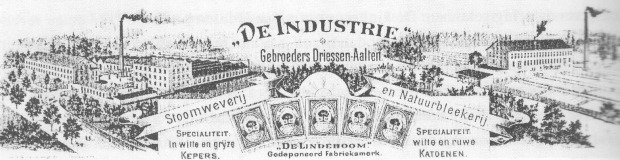
To protect Dutch industry from British imports, King William I introduced an import duty of 25% to 45% on cotton fabrics in 1823. This made exports from Bocholt to the Netherlands virtually impossible. To circumvent this levy, two Driessen cousins settled in Aalten, just across the border: Heinrich Driessen (1794–1879, son of Mayor Peter) and Anton Driessen (1797–1879, son of Hermann). In Aalten, they established various textile enterprises, including a steam weaving mill and a bleachery.
Over a period of more than 140 years (1826–1969), the Driessen manufacturers developed into the most significant employers in Aalten and the surrounding area. The factory buildings and private residences of the Driessens defined the village’s appearance. Until the second half of the 20th century, these manufacturers left a significant mark on the social and economic life of Aalten.
Sources
‘Geweven goed. De textielgeschiedenis van Aalten en Bredevoort’, H. de Beukelaer and J.G. ter Horst
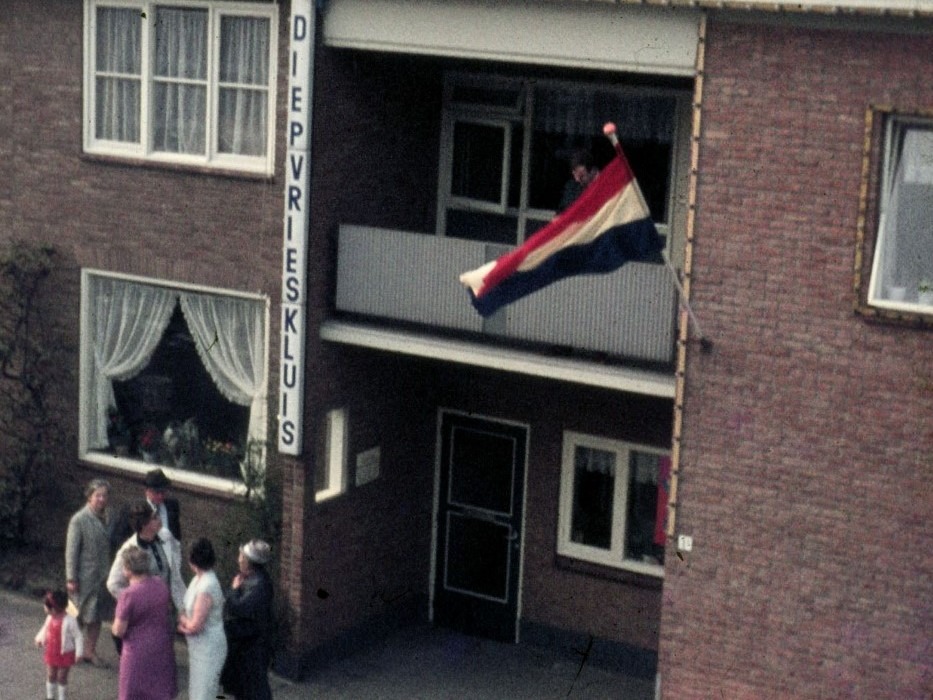
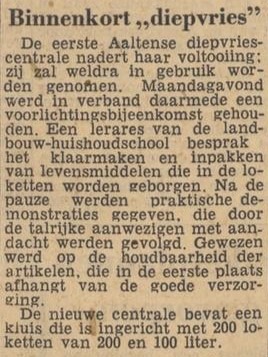
In the 1950s and 60s, so-called communal freezers emerged in the Netherlands, particularly in rural areas. These were facilities, often established on a cooperative basis, where residents of villages or rural districts could rent one or more lockers to freeze food.
The communal freezers provided a solution at a time when most households did not yet have their own freezer. Home-grown vegetables and fruit, or meat from home slaughtering, were primarily stored there.
In 1962, the Netherlands had approximately 700 of these communal freezers. However, their use declined rapidly in the 1970s, when the freezer became a common household appliance.
Locations
There were also communal freezers in the municipality of Aalten. Some well-known examples (provisional list, April 2025):
Aalten, Haartsestraat 1/1: A communal freezer was located beneath the premises of the Ten Have family. The building was demolished around 2003.
Ten Have’s freezer-locker plant, Haartsestraat, ca. 1969 (photo: L. Lievers)
Do you have any additions or corrections to this list, or photos of (vanished) communal freezers in Aalten? Do you know if anything has been preserved? Please let us know!
Newspaper reports
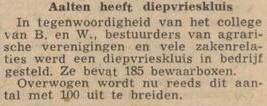
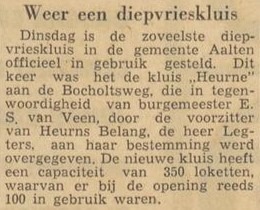
Dagblad Tubantia, 21 January 1958Zutphens Dagblad, 8 February 1958
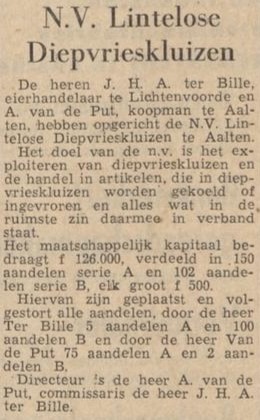
Dagblad Tubantia, 9 December 1959Dagblad Tubantia, 19 April 1963
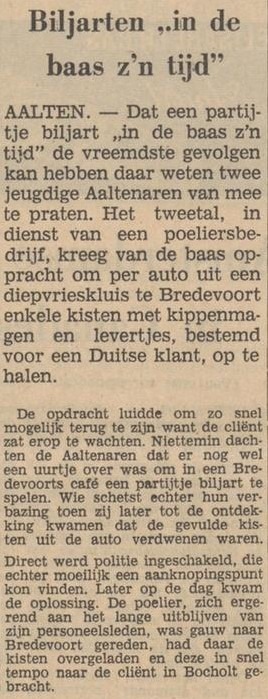
Dagblad Tubantia, 11 February 1966
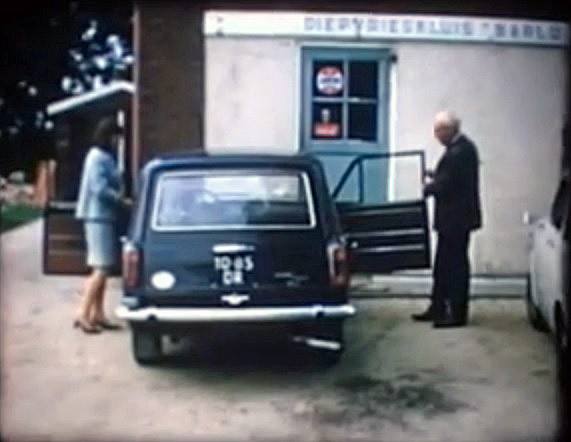
Onnink’s communal freezer in Barlo, ca. 1969 (photo: willempie133)
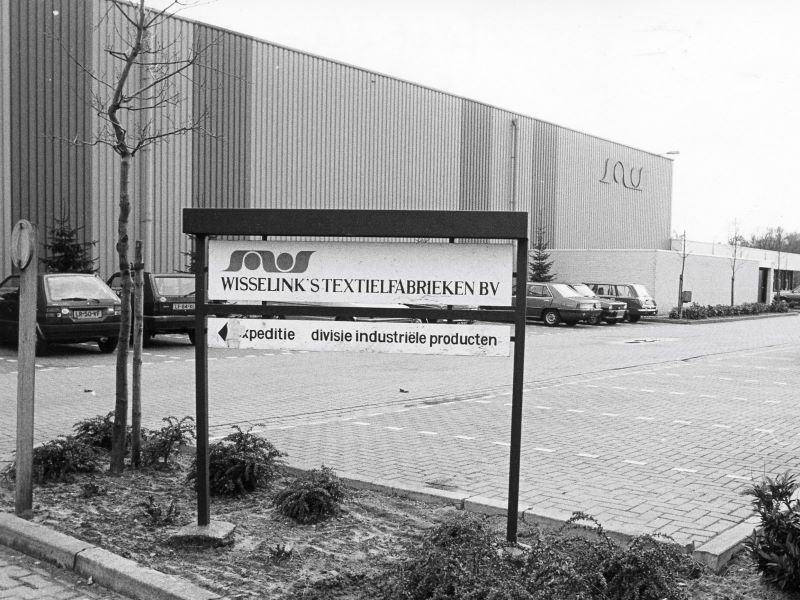
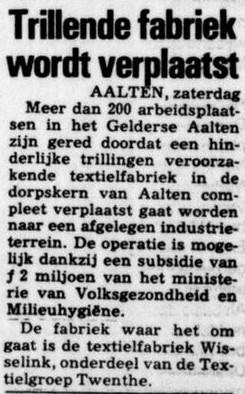
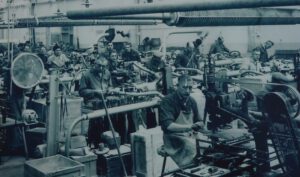
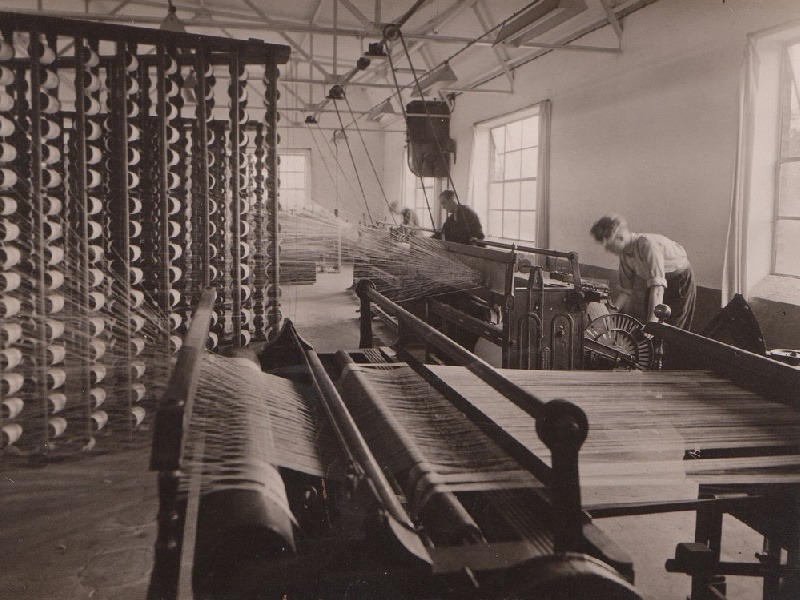
The textile weaving mill Wisselink Textiles, formerly Gebr. Driessen, had been part of the Textielgroep Twente since 1960. They manufactured products such as technical textiles, tent canvases, and flag bunting. For years, the company was located on Dijkstraat, but its presence in the village centre caused excessive noise and vibration nuisance.
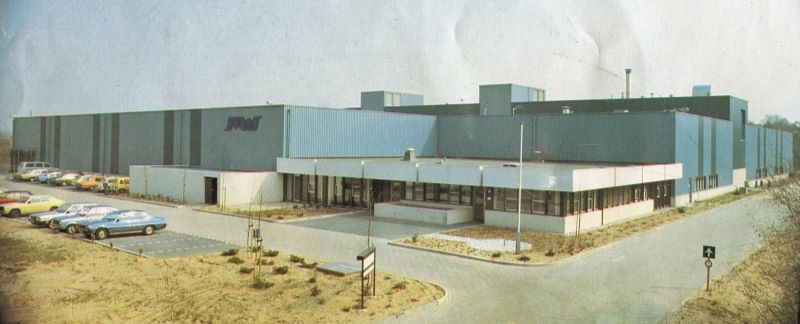
Consequently, the factory relocated in 1981 to new premises on Eerste Broekdijk, within the ’t Broek industrial estate. Its sister company, Koala Tricotagefabriek, moved to Industriestraat. This relocation ensured the preservation of over 200 jobs.
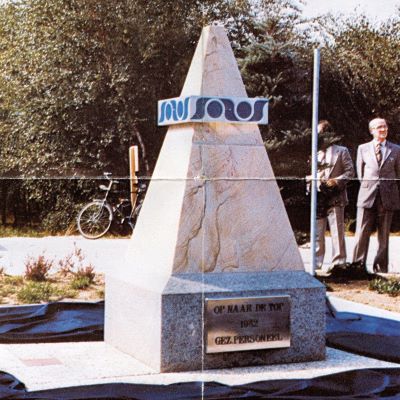
The official opening of the new building was performed by the then Queen’s Commissioner for Gelderland, Mr Geertsema. The collective staff presented the company with a pyramid-shaped sculpture with a flattened top, inscribed: ‘OP NAAR DE TOP’ (Onwards to the Top). However, Wisselink never quite reached that summit.
The Most Modern in Europe
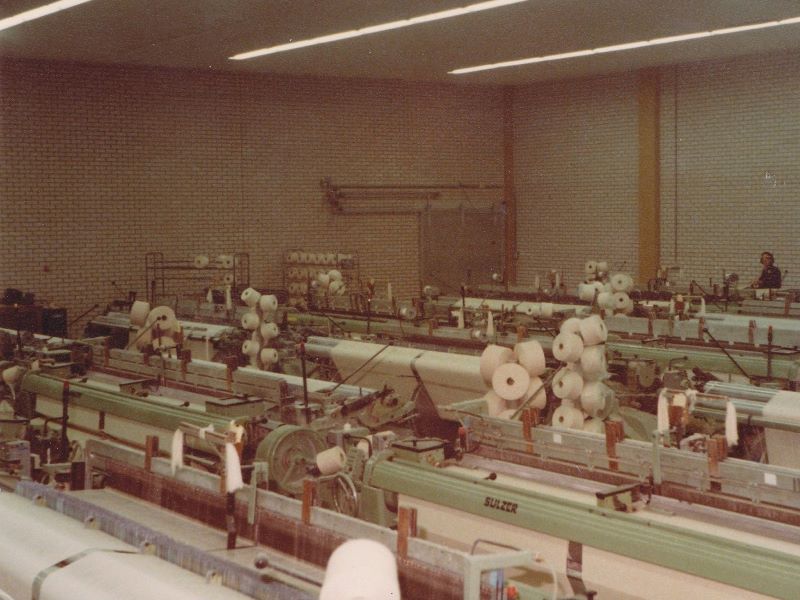
At the time, the new weaving mill was by far the most modern in Europe. It initially housed 76 state-of-the-art Sulzer projectile weaving machines and 20 older Picanol looms. The directors were, in succession, Messrs Schukkink, Van der Gronden (interim), Defourney, and Brouwer.
The company organised several staff parties a year. Highlights included sports days with sister companies from Enschede, Weerselo, Hengelo, and Bree (Belgium). The group’s centenary celebration at the Theaterhotel in Almelo was also a grand event. Wisselink had its own shooting club, ‘WIA’ (Wisselink Textiel Aalten), which was affiliated with the Aalten Shooting Association.
Despite the festivities, the textile industry demanded hard work: shift work, dust, and noise… above all, a lot of noise!
Takeover and Closure
Eventually, Wisselink faced financial difficulties. By 1997, the workforce had dwindled to 93 people—significantly fewer than in previous years. Following several painful reorganisations, the curtain finally fell in 2002. The company was taken over by the German firm Setex. A year later, the entire production was moved to the headquarters in Dingden, Germany. On 31 March 2003, the Aalten factory closed, and the building on Eerste Broekdijk was left vacant.
Some years after the closure, the premises were purchased by Kaemingk Season Decorations. The former production facility was repurposed as a warehouse. In 2015, the building was demolished and replaced by a new, larger warehouse built by Kaemingk.
Invention
On 16 August 1980, the Dutch newspaper De Telegraaf reported on a new invention by the Wisselink textile factory:
‘Schulp’ without buttons designed for soldiers
In the future, soldiers can literally crawl into their shells (schulp). ‘Schulp’ is the name of the tent developed for the army by order of the Ministry of Defence. It is a two-person, single-roof tent for mobile use—quick to pitch and lightweight.
The latter is thanks to a new type of tent canvas, KSOOI/Wetfold, an invention by the Wisselink textile factory in Aalten. It is a lightweight cotton fabric provided with a so-called multi-porous coating (MPC).
Bivouacking becomes a lot easier because of it. The unique feature of this canvas is that it does not leak if touched during a rain shower or if it is folded and packed while soaking wet.
Thanks to an ingenious tensioning system, only two pegs are needed to set up the shelter. What more could a soldier want during field exercises in harsh weather conditions?
It is not just soldiers who can benefit from the tent designed by Mick Schmidt; a civilian version was also produced. It was awarded the 1986-’87 ANWB prize for the best tent design of the year.
Perhaps the greatest advantage of the tent is that it does not consist of two halves. There is not a single button on it. The only thing that might cause an argument is which of the two has to carry the thing on their knapsack.
Video
In 1990, FilmAalten made film recordings inside the Wisselink textile weaving mill:
De Telegraaf, 16 August 1980Wisselink’s Textielfabrieken BV, Aalten (1982)Staff gift at the opening of the new factoryWeaving mill, November 1982 (Photo: Clemens Wijkamp)
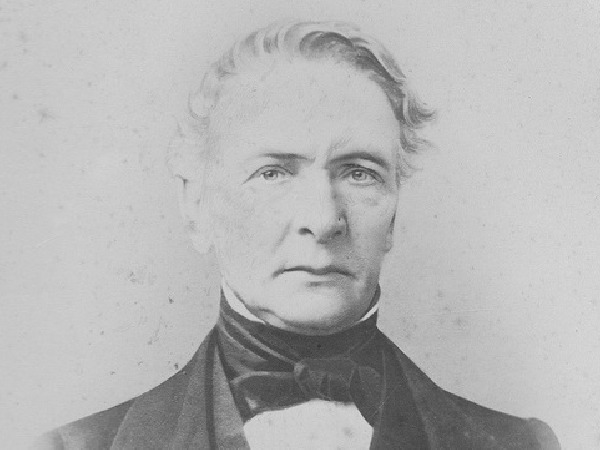
Johan Bernard Anton (known as Anton) Driessen (Bocholt, December 5, 1797 – Aalten, March 7, 1879) was a prominent textile manufacturer in Aalten. Anton descended from a textile dynasty in Bocholt. His father Herman (1765–1817) was also a textile manufacturer, as was his brother Peter Driessen (1756–1843), who also served as an alderman and second mayor of Bocholt.
After their father’s death, Anton and his younger brother Joseph founded the textile company ‘Gebrüder Driessen‘. In 1826, Anton and Joseph Driessen submitted a request to King William I to establish a textile factory in Aalten. The motives for the Driessen brothers’ request were the increased import duties in the Netherlands. They had chosen Aalten ‘as this place was best suited for this purpose‘.
They requested permission to establish a fustian weaving mill and bleachery, as well as a cotton spinning mill and dye works. The Driessen brothers were granted permission for the establishment on the condition that it be located within the village center of Aalten.
Not long after, their cousin Heinrich Driessen also requested permission from the King, which was likewise granted.
In Aalten
Anton moved to Aalten in 1826. He initially lived with Meijerink in the Kerkstraat. His brother Joseph remained in Bocholt, where they maintained a branch office.
The company started “in the Barn and Garden Room of Mr. Bonninghoff”. This most likely referred to the house at Markt 18 belonging to the justice of the peace G.J. te Gussinklo, who had purchased the Borninkhof farm in 1804. Owners were often referred to by the name of their farm.
For the processing of the yarn, Anton Driessen relied on the many home workers living in the area. Furthermore, the municipal report of 1826 mentions, among other things: “Several households have settled here, primarily from Bocholt“. The report for 1827 mentions for the first time that, alongside agriculture as the primary source of livelihood, much fustian was woven for the manufacturers from Bocholt. There were approximately 218 fustian weavers at that time, “performing the work in their homes“.
On November 22, 1827, Anton Driessen married Isabella Dees in Bocholt.
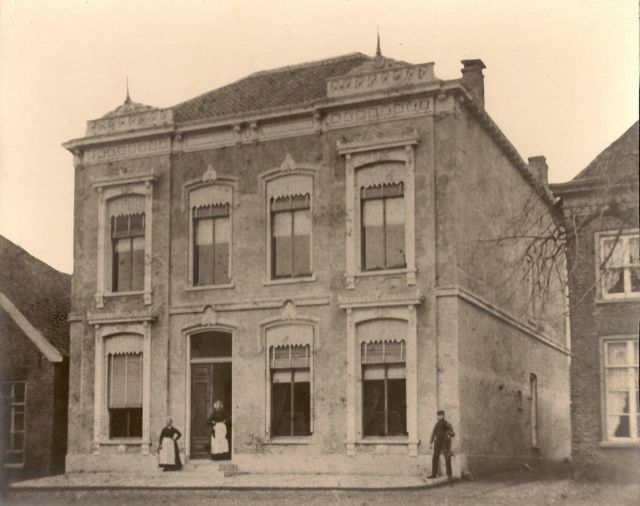
In that same year, the cotton spinning mill was moved from Bonninghoff’s barn and garden room to a better-equipped building in the center of the village. Driessen had purchased a house there from Manus Scholten, located at the site of the current address Landstraat 25.
Opregte Haarlemsche Courant, 29 November 1827Markt 18, AaltenLandstraat 25, Aalten
However, the relocation did not proceed without incident. Two neighbors, the schoolmaster H. Schotman and the farmer W. Obrink, submitted a formal objection to the municipal council, fearing noise nuisance and fire hazards. The municipality, however, rejected their objections. The two neighbors did not leave it at that and subsequently addressed their grievances to the Governor of the province of Gelderland. However, the Governor also saw no reason to give “any follow-up” to their objections.
At the end of 1827, Anton Driessen was able to begin converting the house into a spinning mill. The new premises had an upper floor, which, along with the ground floor, was designated as workspace. Machines were installed on both levels.
Beekhuize
Villa ‘Beekhuize’, Dijkstraat 14, Aalten
In 1833, Anton wished to build a new residence. To this end, he had purchased a house from the Degenaar heirs at the end of the Landstraat—now called Dijkstraat. He intended to demolish that house and build a new, modern residence with a warehouse, barn, and stables on the site. For this, however, he required more space than the existing plot. Anton Driessen submitted a plan to the municipal council with the request, “since the beautification of a Village is always one of the most pleasant duties of a Local government, to kindly grant the same, and consequently to support the undersigned in his intention as much as possible”.
To realize Anton’s plans, both the stream and the street had to be diverted. Furthermore, a new bridge was required. Because the piles of the old bridge had almost decayed, the construction of the new bridge was not only highly necessary, but according to Driessen, the relocation was also less costly. In addition to diverting the stream and building a new bridge, Driessen also needed land for his plans. To this end, he exchanged a piece of land with the municipality. Negotiations regarding these matters lasted several years.
In March 1835, Driessen was able to begin construction. For the production of the necessary bricks, he had meanwhile requested permission to establish a brickyard on the Schaarsheide and to excavate a three-hectare site. Due to the poor state of the roads in East Gelderland at that time, it was more practical and economical to set up a field kiln near the construction site than to purchase bricks elsewhere.
The stately villa that Anton Driessen had built on the current Dijkstraat is known to every resident of Aalten as Beekhuize.
‘Geweven goed. De textielgeschiedenis van Aalten en Bredevoort’ (Woven Goods: The Textile History of Aalten and Bredevoort), H. de Beukelaer and J.G. ter Horst
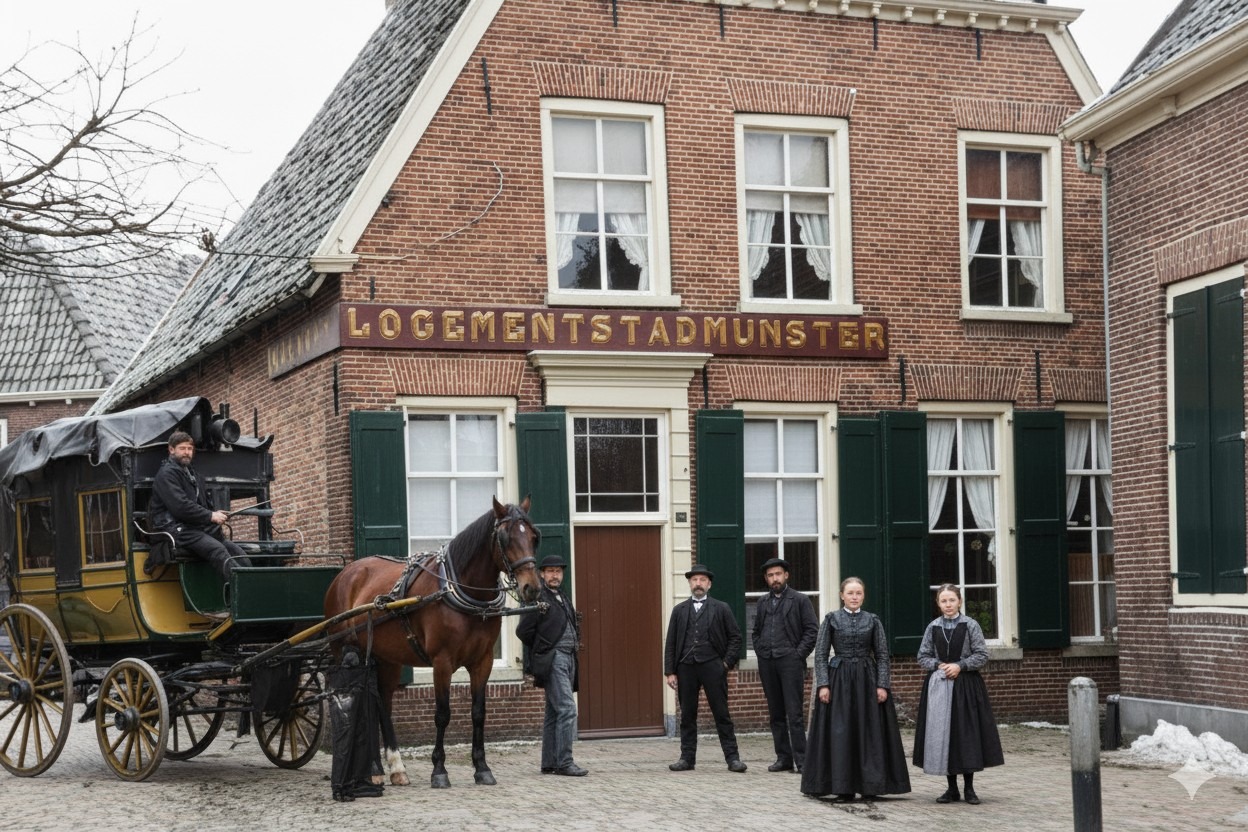
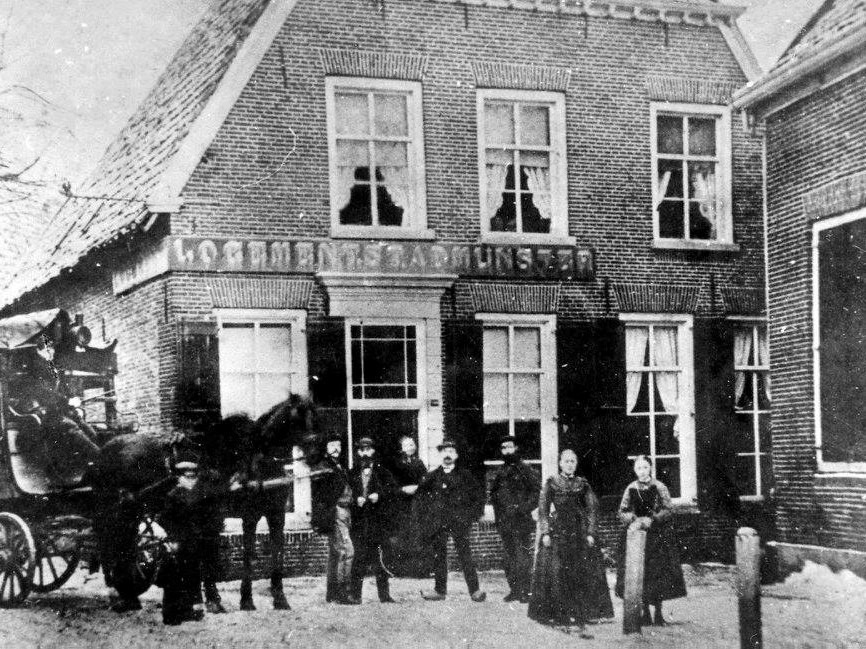
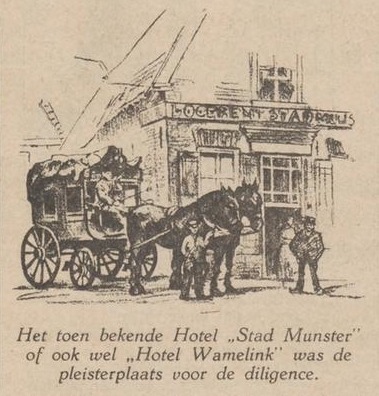
Stad Munster Lodging House in Peperstraat, Aalten (image AI-generated based on an old photograph).
Stad Munster Lodging House was once an important rest stop for travellers and mail coaches. It stood in Peperstraat, situated between the former post office and ‘De Postiljon’, opposite Stegers. Following the municipal reorganisation of 1816, it briefly served as a courthouse (Rechthuis). In 1873, the building was completely destroyed by fire and was never rebuilt.
A Coaching Inn for the Diligence
In previous centuries, when the mail coach—or diligence—was the official mode of transport, ‘Logement Stad Munster’ (also known as ‘Hotel Wamelink’) functioned as a coaching inn for the diligence and a place of rest for weary travellers. Those embarking on a long journey who could afford it would board at Hotel Wamelink, after which the journey continued, jolting and bumping towards its destination. Those with less to spend put on their ‘steffels’ (boots) and undertook the journey on foot; a walk to Arnhem or Zutphen was no rarity in those days. People had the time. Stad Munster welcomed travellers of all kinds, such as a manufacturer from Armentières in France, a merchant from Stadlohn, and a clerk on foot from Oosterwijk. Three English factory workers from Manchester, Ashton, and Oldham once stayed there for two months.
The Wamelink Family
In 1823, Johanna Maria Martha Mensinck was registered at this address as the lodging house keeper. She was the widow of Gerrit Jan Wamelink, who had passed away in 1822. Johanna died in 1854. Their son, Lambertus Hermanus Wamelink, continued the business. In 1852, at the age of 39, he had married Johanna Catharina Heming. After her death in 1854, he remarried Wilhelmina Louisa Hendrina Meijrink in 1856.
Fire
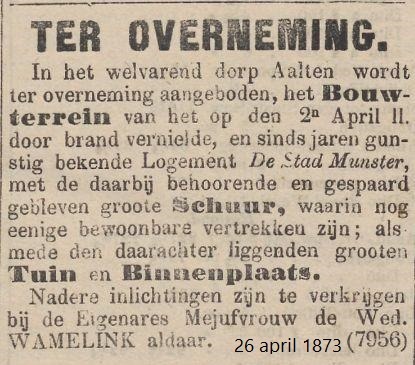
On 2 April 1873, a violent thunderstorm broke out over Aalten. Labourers in the fields fled into barns and garden sheds. Thunder rolled incessantly and lightning filled the sky. Suddenly, a loud crack was heard, and shortly thereafter, everyone could hear the tolling of the fire bell in the church tower above the sound of the rain. A lightning strike had hit the building next to the lodging house, which was occupied by Mr Van Eerden and the national tax collector, Mr Boudewijn.
By the time the fire wardens arrived, both buildings were engulfed in flames. The fire engines could do little against such a blaze. The old lodging house—the pride of the Wamelinks, who had lived there since the beginning of the 18th century—burnt to the ground, as did the adjacent house on the corner of Kerkstraat. The lodging house was never rebuilt, and the site has remained an open passage between Peperstraat and Het Hoge Blik ever since.
Owners
This overview is incomplete.
Year
Plot
Owner
Description
1832
I-1152
widow of Gerrit Jan Wamelink
490 m² house, barn
1858
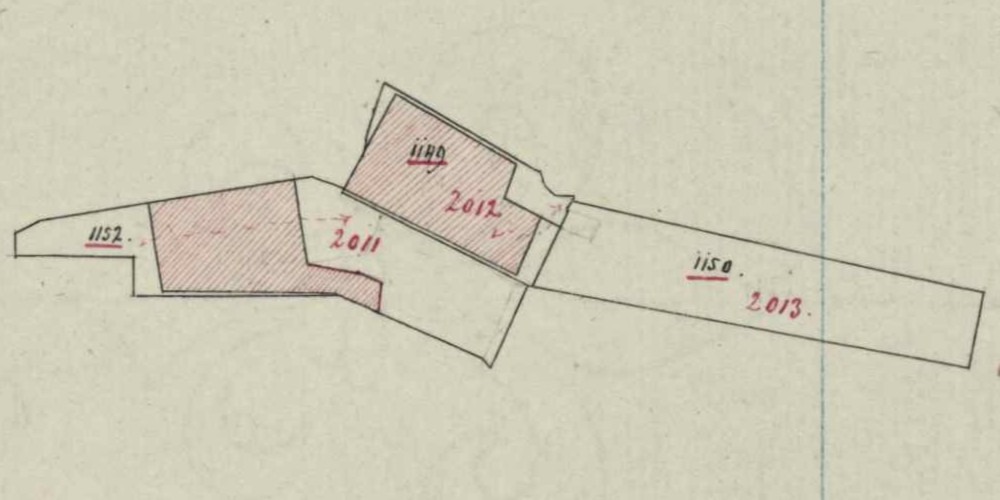
I-2011 I-2012
widow of Gerrit Jan Wamelink heirs of Lambertus Hermanus Wamelink
490 m² house, yard 260 m² barn, stabling
1863
I-2011 I-2012
Wilhelmina Louisa Hendrina Meijerink, lodging house keeper
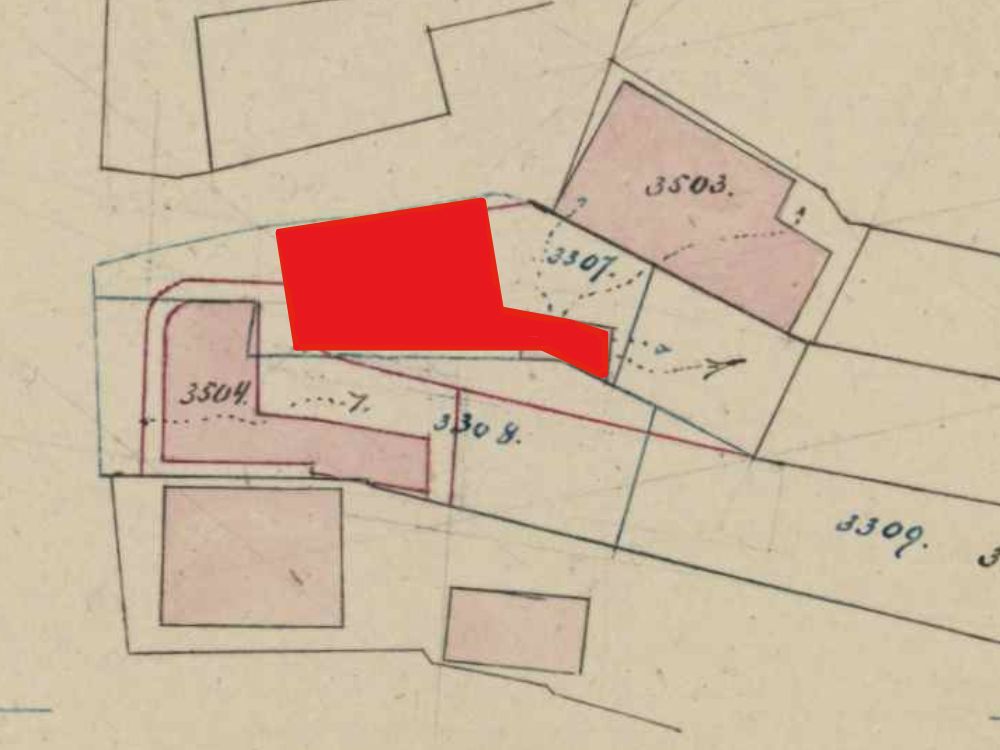
Fragment cadastral map, 1858 (plot I-2011)Contours of the former Stad Munster Lodging House, taken from a cadastral auxiliary map from 1858, projected onto a map from 1879.Illustration: Piet te LintumDe Tijd, 26 April 1873
Bredevoortsestraatweg 109, Aalten (no longer extant)
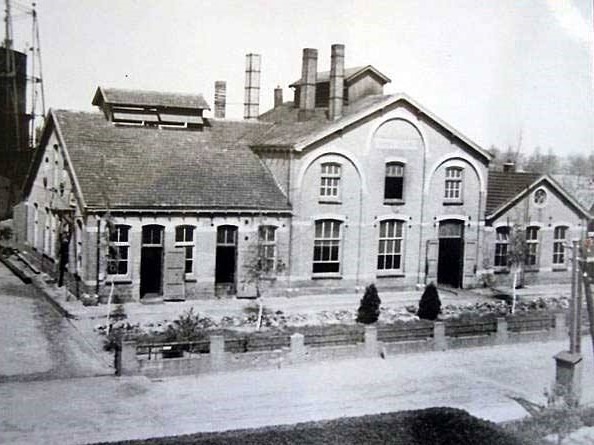
At the beginning of the twentieth century, there was a growing demand for modern energy supplies in the Netherlands. Until then, many households and businesses relied on oil and paraffin lamps for lighting, and on wood or coal for heating and cooking. Gas lighting was seen as a major advancement.
As in many other places, it was decided to build a gasworks in Aalten to provide households, businesses, and street lighting with gas. The arrival of the plant marked a significant step in the modernisation of local infrastructure, though it also brought its share of challenges.
The Production Process
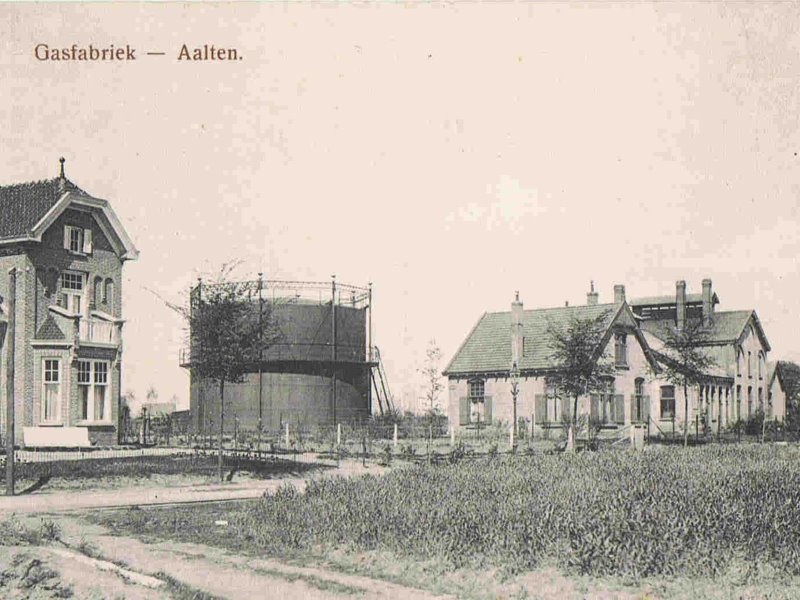
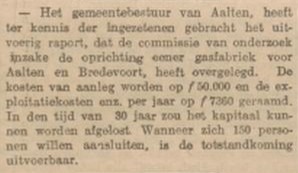
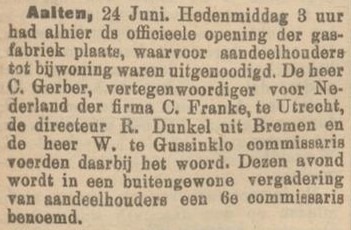
In 1905, the decision was made to build a ‘coal gas plant’ in Aalten. Two years later, in 1907, it was put into operation. The plant produced gas through the dry distillation of coal. This process involved heating coal in the absence of oxygen, releasing gas that could be captured for distribution.
The raw gas contained various impurities, such as tar, ammonia, and sulphur compounds. These were removed through condensation and chemical purification. The purified gas was then stored in a large gas holder and guided through a network of underground pipes to homes and businesses, where it was used for lighting, cooking, and heating.
Installation of the Gas Grid
The installation of the gas grid caused considerable disruption. Streets frequently had to be dug up to lay the pipes, leading to many complaints from residents.
Until the end of 1908, people complained about the poor state of the roads and the inconvenience caused by the works. Nevertheless, the use of gas quickly became popular, and the gasworks grew into an essential utility within the municipality.
In 1919, the municipality of Aalten took over the gasworks for a sum of ƒ 115,000, plus ƒ 29,602.87 for infrastructure such as piping and gas meters.
Gas Tokens
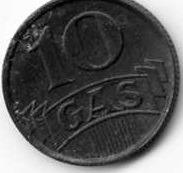
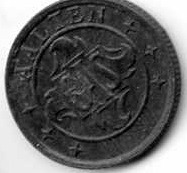
Until the 1950s, some households had a gas meter that worked with special gas tokens. This system, intended to prevent payment arrears, was also used in Winterswijk. The Aalten gas token was a zinc coin with a value of 10 cents. If the gas ran out, a new token had to be inserted into the meter.
With the advent of the geyser, this system fell into disuse. The pilot light of these appliances had to burn continuously, which was not permitted in combination with a token meter. Around 1955-1958, gas tokens completely disappeared, partly due to the introduction of the national natural gas network.
The End of the Gasworks
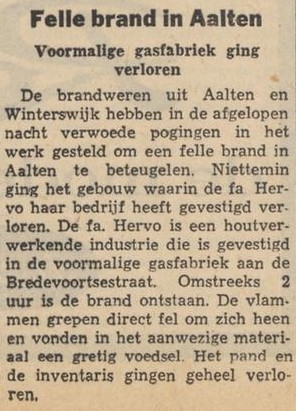
The discovery of the natural gas field in Slochteren marked the end of local gasworks, including the one in Aalten. The building then served various temporary functions, such as a technical school and later a furniture factory (Fa. Hervo), until the building was destroyed by fire in 1964.
After its closure, the soil was found to be severely contaminated with hazardous substances such as sulphur and cyanide. The remediation of the site was only fully completed decades later, in 2009.
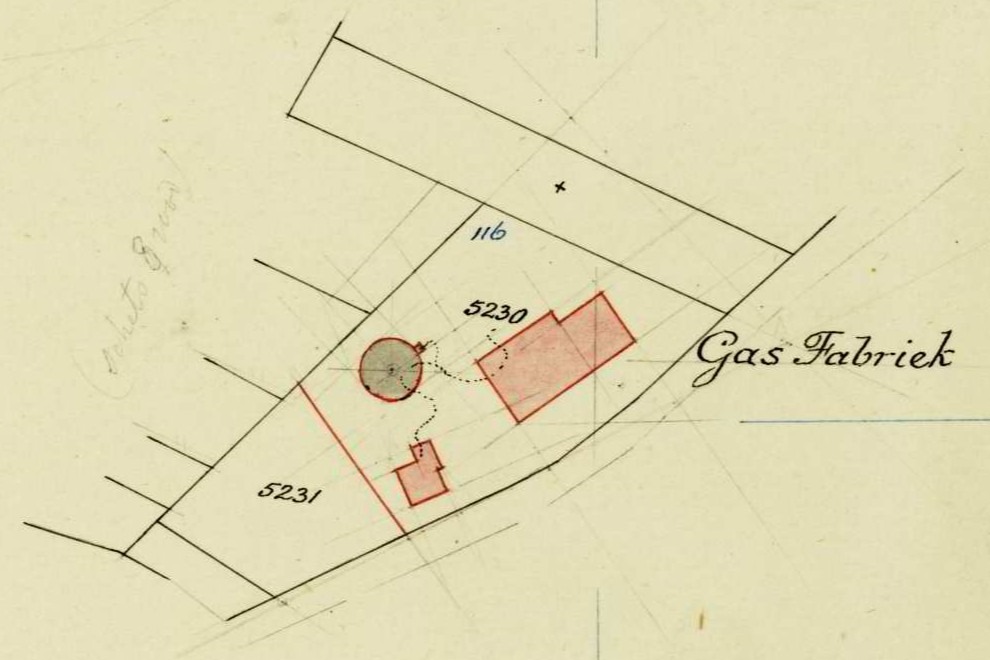
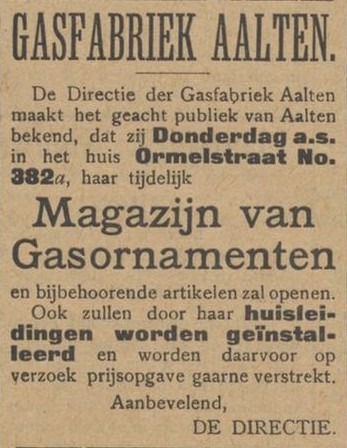
Aalten Gasworks with the gas holder in the middle, ca. 1920Fragment cadastral map, 1908Het Vaderland, 16 August 1904Aaltensche Courant, 19 December 1906 (Ormelstraat 382a)Zutphensche Courant, 26 June 1907Nieuwe Winterswijksche Courant, 7 August 1964
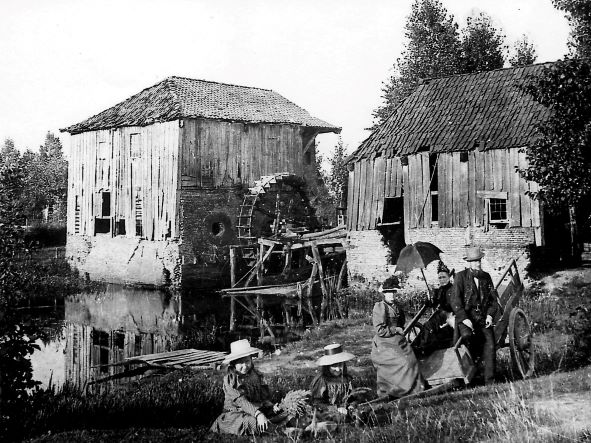
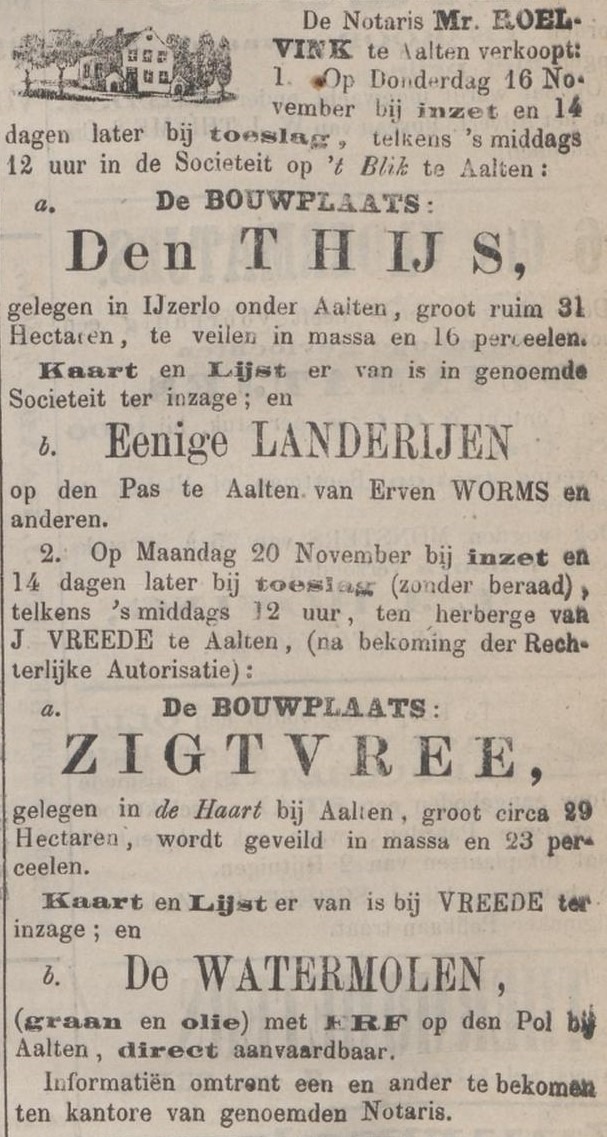
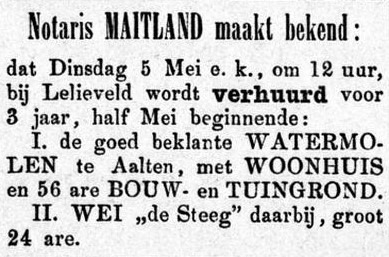
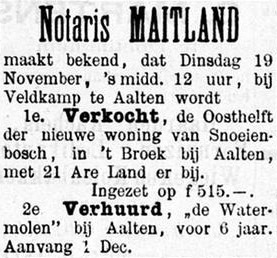
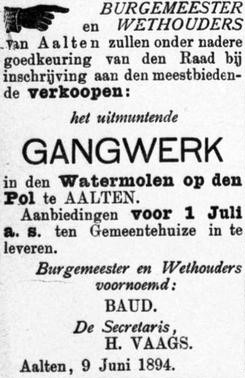
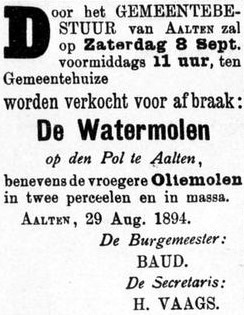
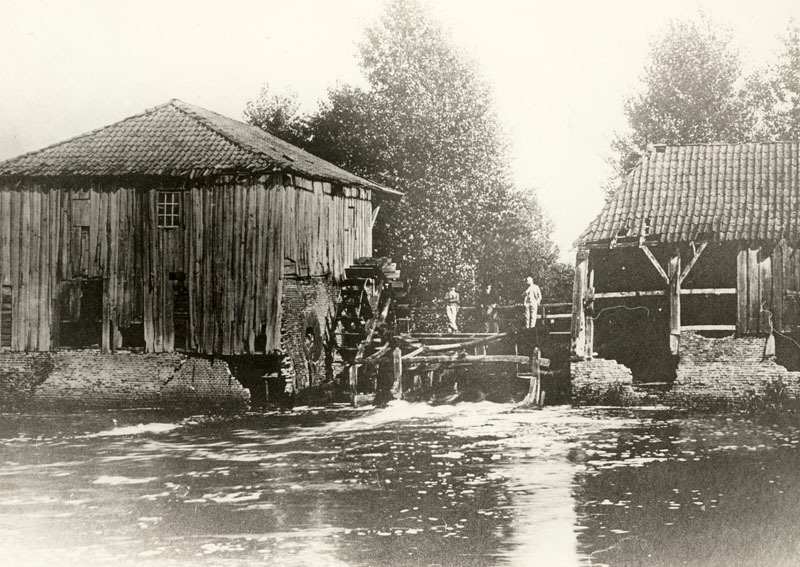
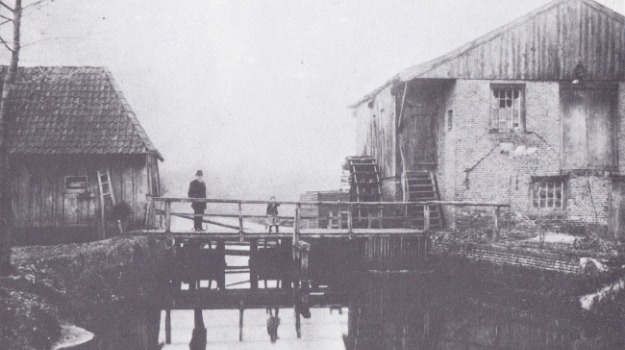
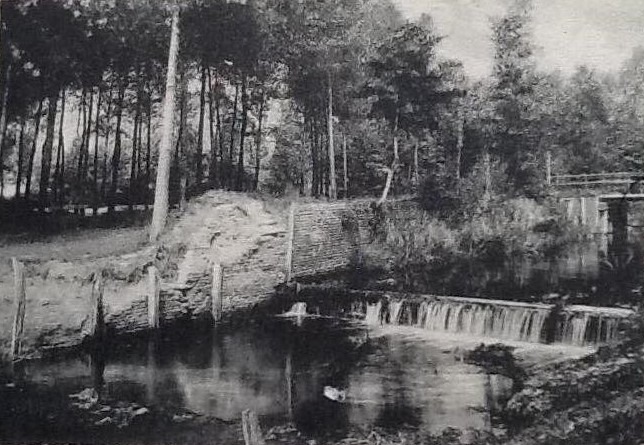
For centuries, a watermill stood on the Slingebeek stream near the De Ahof manor, approximately at the location of the current stone bench erected by Aaltens Belang. At the beginning of the 20th century, the dilapidated mill was demolished. The mill featured wheels on both sides of the stream: on the south bank stood the oil mill (with a wheel of 4.42 m Ø) and on the north bank was the bark mill (with a wheel of 4.66 m Ø), with the corn mill situated above it.
The watermill was likely built shortly after 1500, possibly due to a transfer of manorial milling rights from the Grevinkhof in Dale to De Ahof, which later also came into the possession of the Grevink family. The first mentions of the mill date from 1502, including records concerning income for the steward.
In 1562, the mill was described as a ruin, yet it repeatedly appears in the archives in later years. B.D. Rots writes in his book ‘Aalten en Bredevoort in vervlogen tijden’ that around 1700, the watermill was owned by the House of Orange, who leased it to a miller. On 9 February 1707, De Ahof, along with “the hereditary lease of the Aalten Watermill”, passed into the hands of the Arentsen/Arentzen family.
In 1739, the owners Bernardus Arentzen and Gerrit Jan Heusinkveld complained about competition from the numerous horse mills around Aalten, while they constantly incurred costs to keep the watermill in good repair. In 1758, it is noted that the city council of Bredevoort had the right, in the event of flooding, to raise the sluice gates at De Ahof and take them to their city.
Around 1830, the corn mill had two undershot wheels and three sets of millstones, while the oil mill had one wheel and three stampers. During water shortages, the mills could also be driven by horses. Although the mill had three undershot wheels, a small overshot wheel with a separate leat could be deployed for the corn mill during low water levels from 1840 onwards.
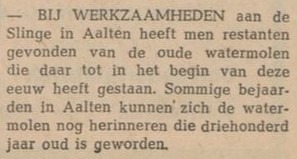
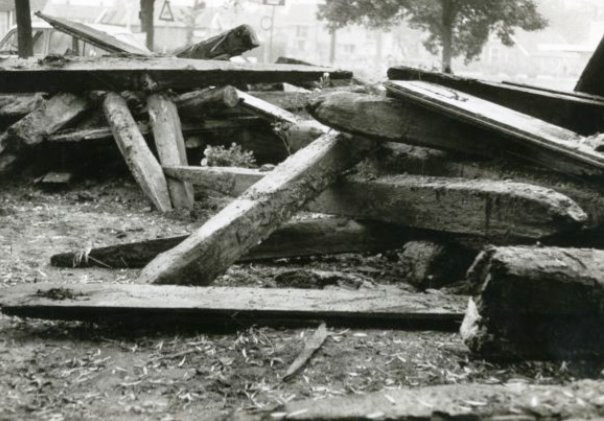
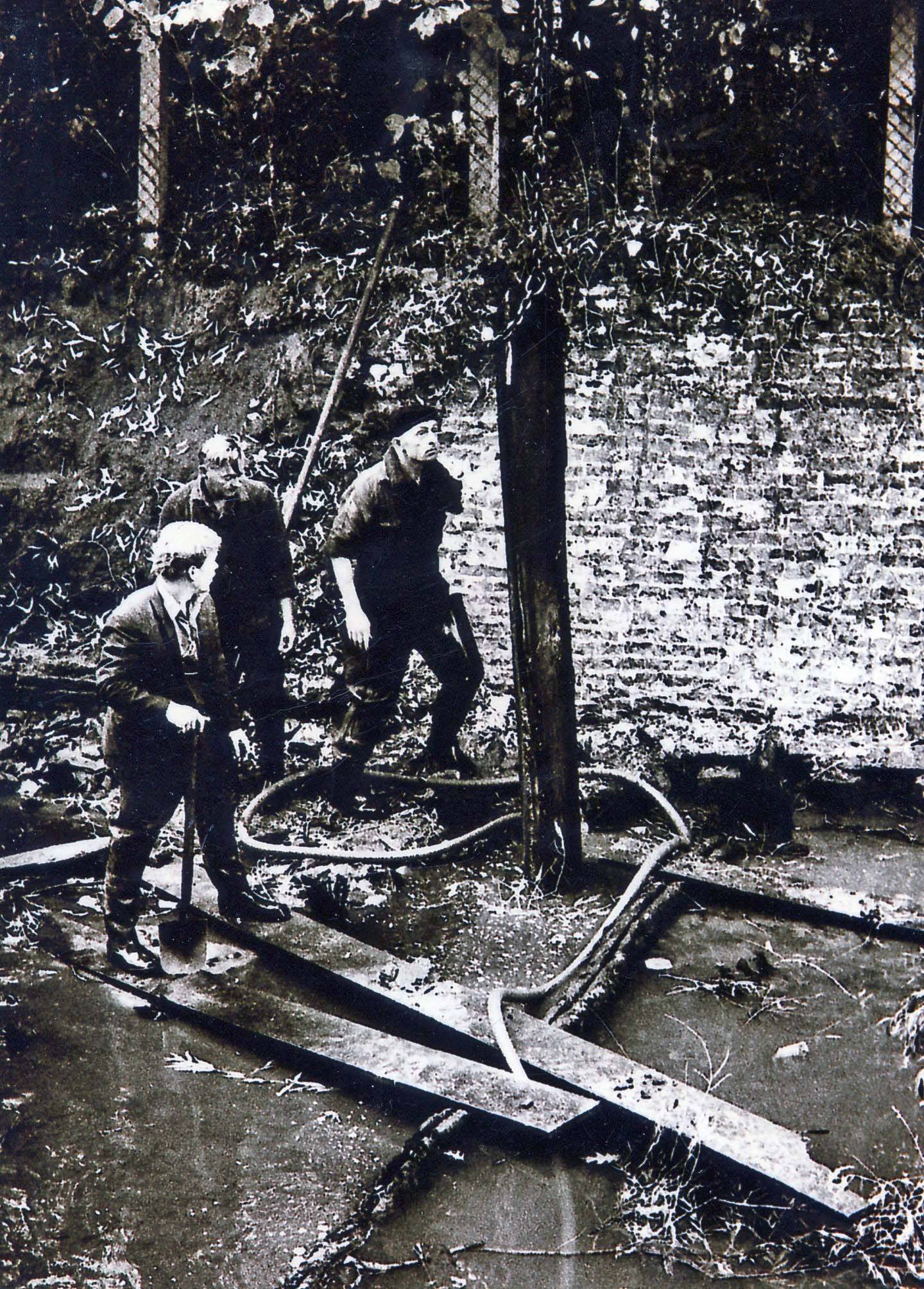
The mill finally disappeared around 1900; only the wheel of the corn mill remained at that time. Photographs from that era show that the entire complex had fallen into decay. During works on the Slinge in 1969, approximately 200 foundation piles were removed. Today, only a remnant of a wall serves as a reminder of the watermill.
Owners
Overview is incomplete.
Year
Plot
Owner
Description
1832
I-182 I-228
Roelof Arentzen, assessor
470 m² mill & yard 920 m² mill & yard
1851
I-182 I-228
Engelbarta Hendrica Arendsen and Gezina Arendsen, widow of J.W. te Gussinklo
470 m² mill & yard 920 m² mill & yard
1854
I-1918 I-1968
Engelbarta Hendrica Arendsen and Gezina Arendsen, widow of J.W. te Gussinklo
470 m² grain mill & yard 178 m² mill & yard
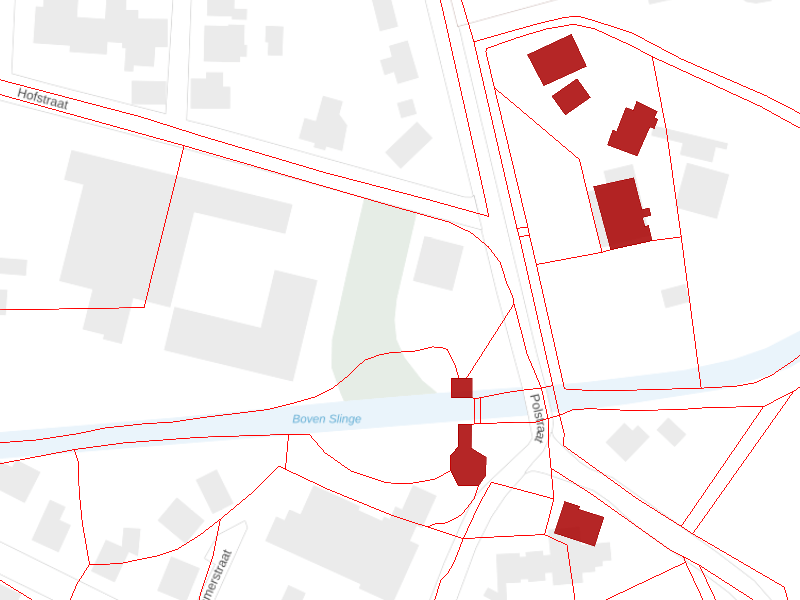
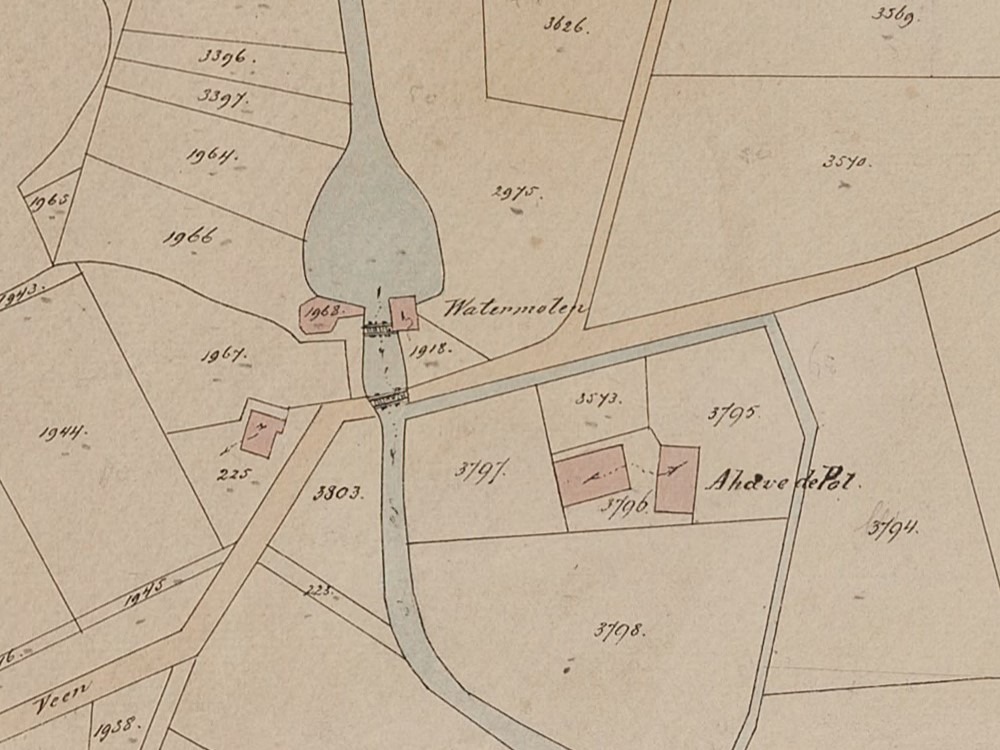
Location of the watermill, with De Ahof at the top right. All red buildings on this map were, according to 1832 land registry data, owned by Roelof Arentzen, assessor in Aalten. The red lines represent the plot boundaries at the time, which also clearly show the course of the former moat around De Ahof.
Newspaper reports
Zutphensche Courant, 11 November 1876Graafschapbode, 2 May 1885
Graafschapbode, 16 November 1889Graafschapbode, 20 June 1894
Graafschapbode, 5 September 1894Nieuwe Winterswijksche Courant, 31 October 1969
Fragment of the cadastral map, 1883 (North is to the right)Remnants of the watermill on the Pol, 1906Remnants of the watermill, found around 1970Remnants of the watermill being cleared away
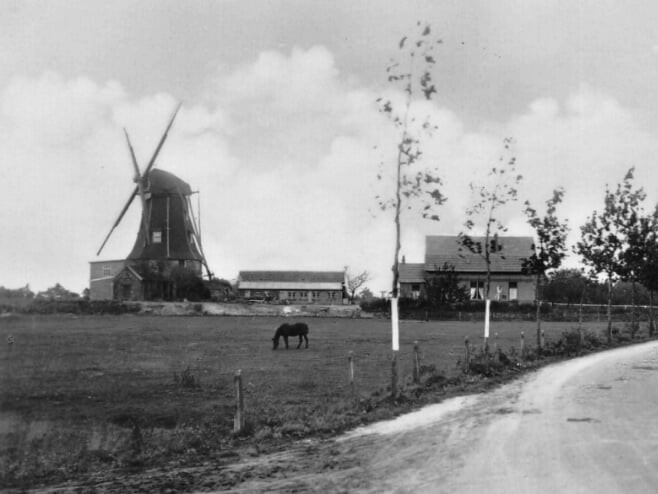
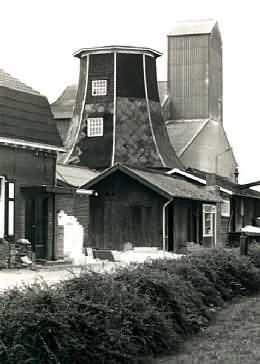
From 1856, an octagonal smock mill (mound mill) stood on the Lichtenvoordsestraatweg in Barlo, which in the twentieth century grew into a milling facility and compound feed business owned by the Grevink family. The mill was dismantled in 1944 and was ultimately lost to fire in 1986.
In 1853, voices were raised in Barlo suggesting that a mill should also be established in this rural district. Initially, a water-powered mill was considered. However, research revealed that the Zilverbeek did not provide sufficient water flow per hour. Consequently, a windmill was built in 1856, located a few hundred meters further north. It was an octagonal smock mill, specifically a mound mill type.
The method of propulsion consistently kept pace with the times. From 1887, the mill was powered by a steam engine, which made way for a gas engine in 1925. When electricity became available in Barlo in 1934, the electric motor proved to be a significant asset.
The last miller was J.W.F. Grevink — secretly nicknamed Jan Willem Fluweel. As early as 1928, he opened a bakery and grocery store next to the mill.
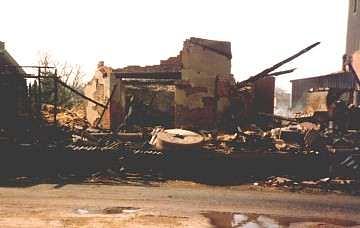
The mill had already been dismantled by 1944. Without its sails, the fire insurance premium was lower. In the early morning of March 29, 1986, a fire broke out that put a permanent end to this mill. Prompt intervention by the fire department prevented an adjacent pig barn from being lost to the flames. The cause of the fire remains unknown.
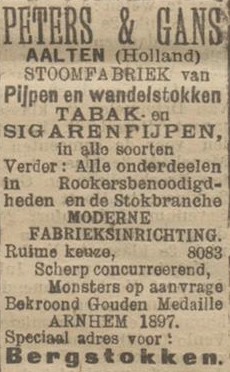
The firm Peters & Gans (PEGA) was one of the companies in Aalten active in the horn industry, which was unique within the Netherlands. At PEGA, pipes, walking sticks, and snuffboxes were manufactured.
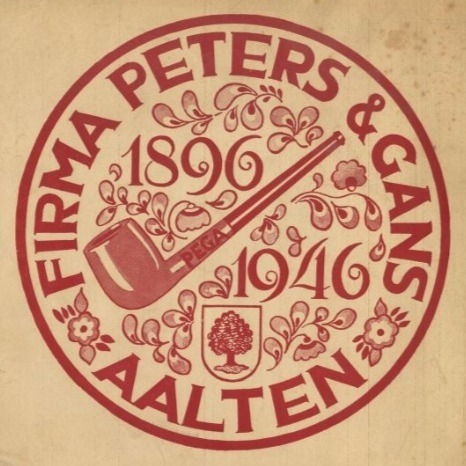
In 1896, Johannes Peters left his father’s horn workshop at Köstersbulte and entered into a partnership with Marcus Gans, a Jewish merchant. Gans financed the firm named PEGA (Peters & Gans). The pipe factory was initially located next to Peters’ residence on what was then Gasthuisstraat (now Haartsestraat).
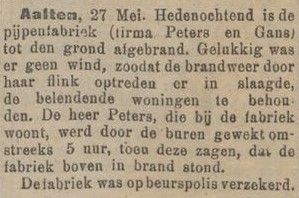
Alongside German pipes for German reservists, walking sticks with horn handles were manufactured. After the factory was completely destroyed by fire in 1917, Johannes Peters established his pipe factory on Admiraal de Ruyterstraat. Instead of German pipes, production shifted primarily to briar pipes (bruyèrepijpen).
In 1931, the Graafschapbode published an article regarding “The Aalten Horn Industry,” and wrote the following about Peters & Gans:
“We visited the factory of the firm Peters & Gans in Aalten, manufacturer of horn, imitation horn, and wooden pipes, and of the typical German pipes with many horn decorations, of walking sticks and… of snuffboxes! Beautiful snuffboxes, manufactured entirely from horn, which find a market among the mining population of Sweden and Germany.
This firm, which saw its products awarded a gold medal as early as 1897, manufactures a great variety of smoking articles, namely the wooden pipes used by everyone, imitation horn pipes, cigar and cigarette holders, while this factory focuses particularly on the large-scale manufacture of mouthpieces for pipes, among others for the Gouda “clay” pipes (doorrookkoppen). These mouthpieces are made of horn or imitation horn, often in connection with so-called Weichsel wood or scented wood, which enhances the ‘taste’ of the smoking.
The typical long German pipe is a ‘specialité de la maison’ of this factory!
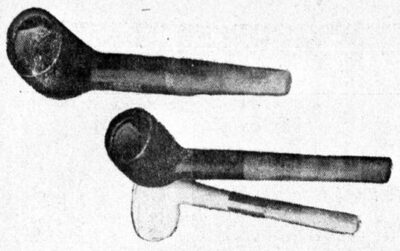
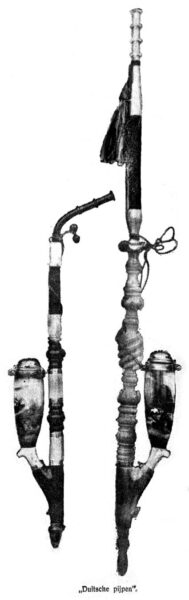
Some pipes from Peters & Gans Co.
As is evident from one of the accompanying photos, such a pipe consists of a concatenation of artfully crafted horn components; the workmen who make these artfully crafted pipe specimens are true sculptors in the horn trade! Americans, in particular, enjoy buying these pipes, which they take with them as a memento of Holland… to then tell their compatriots that all of Holland smokes from these remarkable pipes! The firm Peters & Gans wishes it were true!
„German pipes”
It is, however, a pipe from which one ought to smoke in the entourage of an old farmhouse or amidst a cosy furnishing from several decades ago, preferably wearing a black suit and a skullcap (calotje)! It is precisely this distinct character of this old-fashioned pipe that is its charm at the same time; it is worth the effort to hang it as an ornament on a pipe rack and to smoke from it for curiosity’s sake from time to time. These ‘German pipes’ find their market in Holland and furthermore, as we already noted, go much to America and also to Germany. They are, therefore, actually Dutch ‘German’ pipes.
The horn components of these pipes are manufactured on the lathe. Besides pipes and snuffboxes, the firm Peters & Gans is a supplier of walking sticks, in which they deal wholesale; they specialise in the cheap and middle-range, make mountain sticks for the Valkenburg tourists, rattan sticks for the cattle markets, modern gentlemen’s walking sticks, with horn or imitation horn knobs or decorations.
A widely used material nowadays, as the partner assured us, is the Tahiti rattan from the Dutch East Indies, a light and strong stick that is very flexible. The wooden sticks mostly come from Central Europe; they generally already have the hook shape roughly applied, after which the sticks are first left to become bone-dry and subsequently shipped to our country. Because they then already somewhat resemble walking sticks, the tax authorities charge them at the border with 8% import duty, which the firm Peters & Gans finds a very incorrect practice, as here the raw material for the Dutch industry is being taxed!”
40th Anniversary
In 1936, the firm Peters & Gans celebrated its 40th anniversary. The Aaltensche Courant then wrote the following:
“Today 40 years ago, 1 May 1896, the deed of incorporation of the firm Peters & Gans was passed here. The founding of this firm was purely a result of local conditions. The elders among our readers will surely still remember that in the eighteen-fifties, the horn industry was founded here locally by Mr B. Vaags. He then processed the dense part of the horns; the open part was actually waste for pipe fabrication. This waste was later made productive by Mr A. ten Dam by applying it to the manufacture of combs. This comb fabrication took such a flight that soon the roles were reversed (de bordjes werden verhangen), and the pipe manufacturers then bought the tips from the comb factory.
The father of the current eldest founding partner, Mr Joh.s Peters, was one of the first servants of B. Vaags; he began his own business on the Hoogestraat, later in the premises on the corner of the Markt. Some 20 workmen found employment here then. In 1896, Mr Peters ceased his business. His son, Mr Joh.s Peters, then founded the business, which through association with Mr M. Gans, received the company name Peters & Gans.
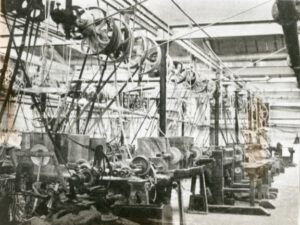
This business was run on a much more modern footing. In place of the primitive treadle movement came the motor-driven power. In 1900, Mr Gans retired from the firm. On 27 May 1917, the factory on the Gasthuisstraat was totally destroyed by fire and not rebuilt, but already in June, the business was continued in the former furniture factory of Mr Vreede, which through addition and renovation had been adapted to the requirements and needs of the business.
Primarily pipes were manufactured; the raw materials were mainly the pieces of the horns unusable at the comb factory. Alongside pipes, walking sticks were manufactured; the market area for both products was, until the war, located mainly across the border.
Now, however, the roles are reversed and the company imports more than the export amounts to; the own production has had to be reduced to a minimum. A great contrast with the mobilisation years when demand exceeded production. The genuine pipe turning as it happened in the past was a beautiful, yet very difficult trade and required, besides dexterity, taste and initiative.
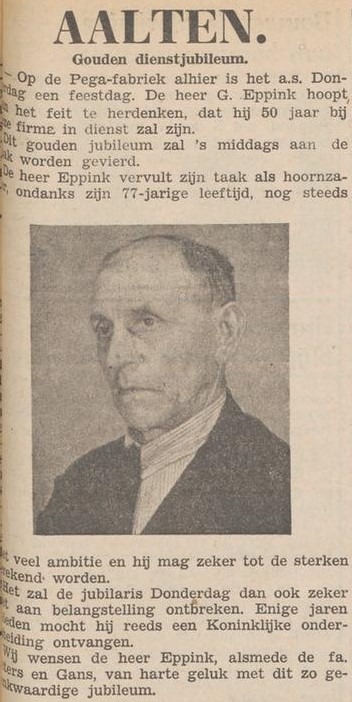
Many have found a sphere of work in the factory of the firm during these 40 years. One of the oldest workmen, who has been employed there almost since the founding, is Mr G. Eppink.
The tobacco pipe is the main article that the business is currently pushing; the smokers will likely not be strangers to the well-known briar ‘Pega’ pipes. The wooden ‘bowls’ are imported roughly; the ‘tips’ or mouthpieces are of own manufacture. Alongside the briar pipes, the so-called German pipes are still manufactured, which in certain regions still find a market, and the firm Peters & Gans is in its district actually the only one that can meet the demand for this article.
Mr Joh.s Peters, who has taken his two sons into the firm, is despite his 69 years still regularly active for the flourishing of his business with a vitality that many a younger man will envy him.
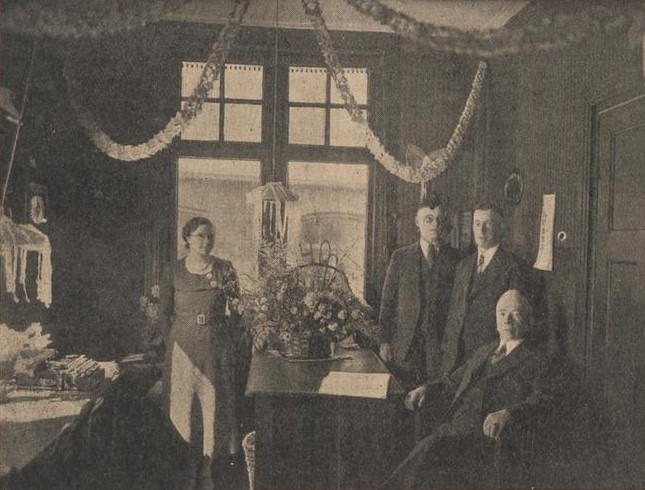
Today is a day of celebration for the partners and staff; undoubtedly the outing to Emmerich will be enjoyed, and the ups and downs of the business will surely pass in review. We gladly congratulate the partners on this anniversary and link to it the wish that their business may enjoy a steady flourishing.”
The celebrating family.
In 1953, the newspaper Tubantia wrote:
“The small pipe factory of the firm Peters and Gans still exists and pipes are still being manufactured, yet in the main, this business has nonetheless switched over to wholesaling, including in all kinds of related smoking articles.”
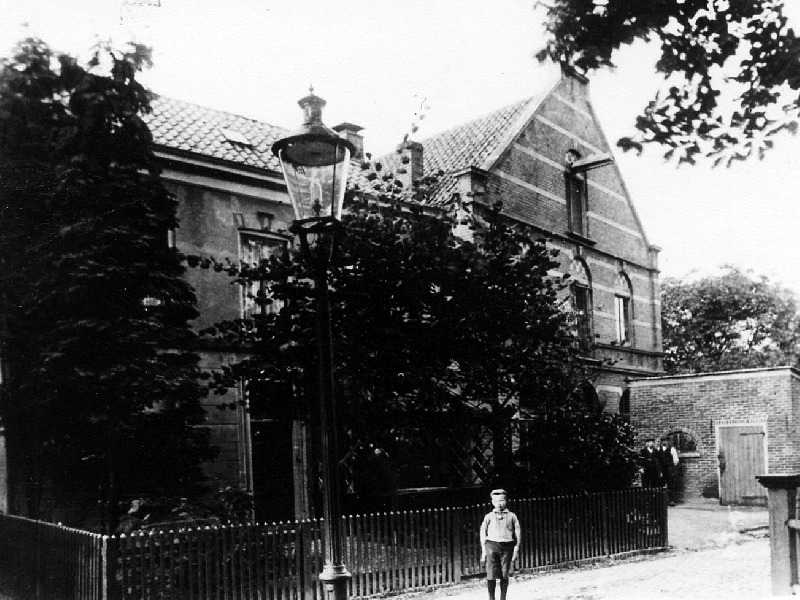
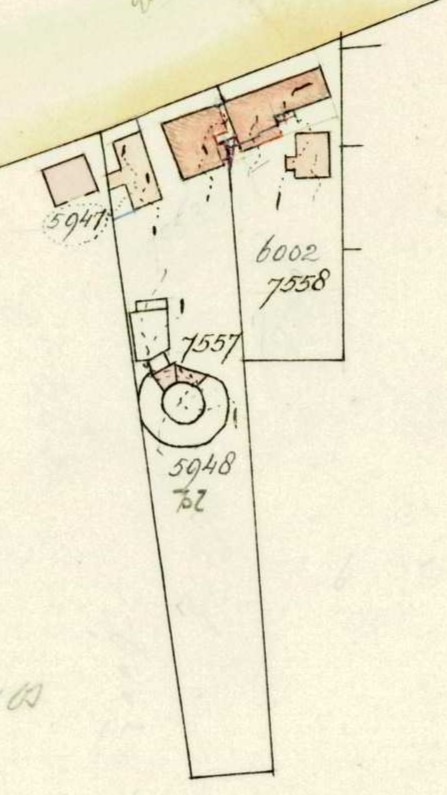
House of Joh. Peters and pipe factory on Gasthuisstraat in Aalten Fragment cadastral map, 1951 (plot I-7558), on Admiraal de RuyterstraatLimburger Koerier, 7 July 1910Zutphensche Courant, 29 May 1917Anniversary logo, 1896–1946Aaltensche Courant, 7 February 1950
Aalten is de enige plaats in Nederland waar een hoornindustrie was gevestigd. Men maakte hier producten van buffelhoorn, zoals pijpen, kammen, knopen, seinfluitjes, naaldenkokers en messenheften.Buffels werden niet gedood of speciaal gefokt voor het hoorn.Vrijwel al het materiaal werd gebruikt en wat overbleef ging over de akkers. Met de intrede van kunststof en massaproductie na de Tweede Wereldoorlog verdween deze industrie.
Horn turners
Family ties had a strong influence on the emergence of the horn industry. From 1855, five horn turners began in Aalten: Bernard Vaags, Gerrit Peters, Abraham ten Dam, Willem te Gussinklo, and Wessel Becking.
Bernard Vaags ging op Wanderschaft naar Duitsland en kwam in Ruhla (Thüringen) in de leer bij een hoorndraaier. Toen hij in Aalten was teruggekeerd kocht hij een eenvoudige voetdraaibank en begon de allereerste hoorndraaierij. In een opkamertje in de schoenmakerij van zijn ouders ‘in den Dijk aan de beek te Aalten’ (Dijkstraat 9) maakte hij onderdelen voor Duitse pijpen van buffelhoorn. In 1860 trouwde Vaags met Dora Willemina Prins. Zij werd ook hoorndraaier en werd Piepen Deurken genoemd. Zij gingen wonen naast Bernards oudershuis (Dijkstraat 7).
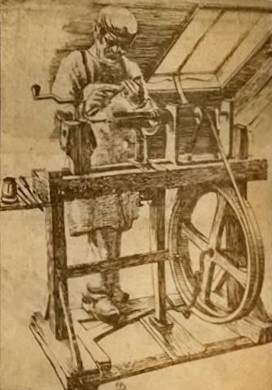
Pipe turning was manual, pedal-operated, and skilled craftsmanship. Here is an example of an Aalten treadle lathe from 1880.
German pipes
Gerrit Peters, zoon van een leerlooier, ging na Bernard Vaags ook in de leer in Thüringen. Hij werkte vanaf 1863 aan de Hogestraat. In 1866 trouwde Gerrit met de welgestelde Josina Aleida te Gussinklo en trok bij haar in. Het pand besloeg de hele lengte van de Köstersbulte, van het woongedeelte aan de Markt tot aan de Landstraat, waar hij zijn hoornwerkplaats vestigde. Hij maakte lange pijpenstelen en onderdelen voor de Duitse pijp. In Duitsland werden porseleinen pijpenkoppen aan de stelen bevestigd en de pijpen verhandeld.
Combs
Comb factory Ten Dam & Manschot
Na het overlijden van Vaags in 1868, pakte zijn opvolger Abraham ten Dam de zaken grondig aan. Het huisindustrietje werd een echte fabriek, aan de Stegge. In 1871 stichtte hij samen met zijn zwager Bernard Manschot kammenfabriek Ten Dam & Manschot aan de Damstraat.
It was the first and only factory in the Netherlands to make combs: white, black, and naturally coloured decorative combs, Mexican combs, nit combs, and moustache combs. These were made from buffalo horn, imported from countries including Brazil, India, and Thailand (then known as Siam). The manufacturing process generated even more dust and stench than pipe making.
A revolutionary development in the production process was the switch to steam power, replacing traditional hand and foot power. In local parlance, it became known as ‘d’n Kamstoom’ (the Comb Steam). By 1920, the comb factory employed about 200 people, including women and children.
Handles and knife hilts
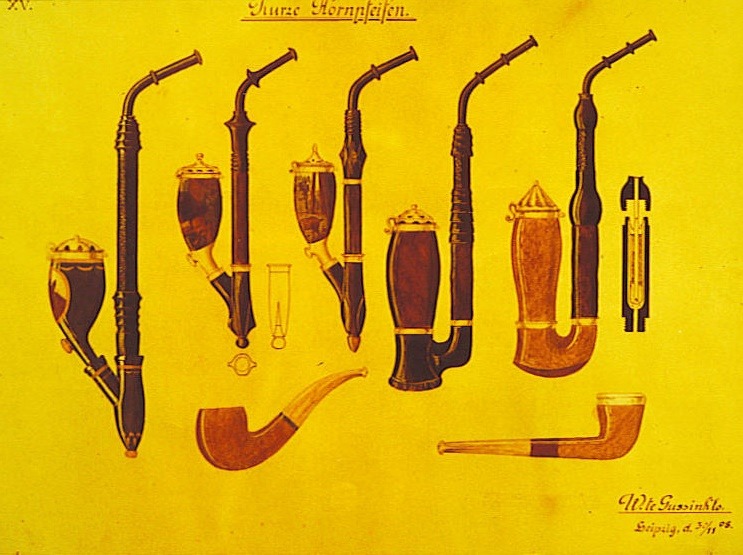
German pipes, W. te Gussinklo
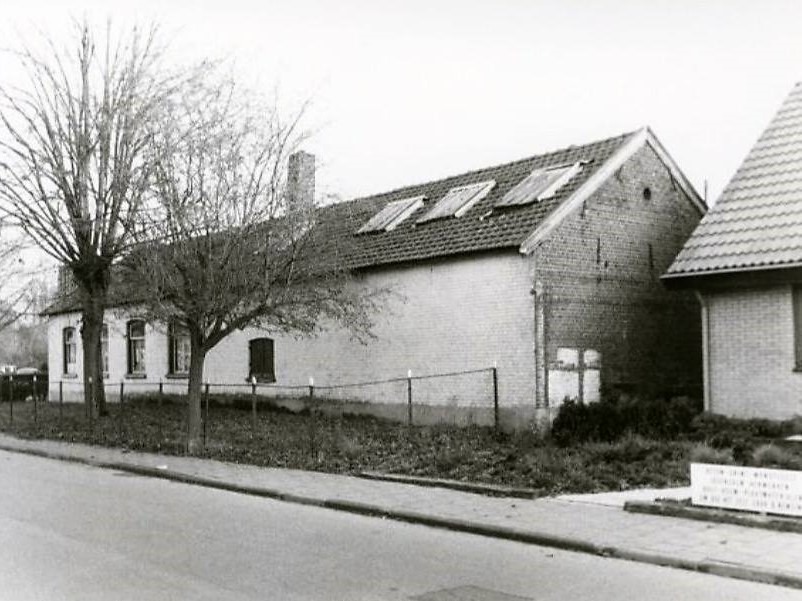
Willem te Gussinklo en Wessel Becking leerden de kneepjes van het vak bij Gerrit Peters. Zij werkten korte tijd samen, maar gingen in 1884 apart verder. Na de mislukte samenwerking ging Wessel Becking in 1880 verder met Bernardus Gerhardus Vaags, neef en naamgenoot van Bernard Vaags. Becking & Vaags maakte pijpenstelen en later ook messenheften. Toen de verkoop van de Duitse pijpen terugliep, produceerde de fabriek korte bruyèrepijpen. De pijpenfabriek in de Hoekstraat staat er nog steeds!
Johannes Peters verliet de werkplaats van zijn vader aan de Köstersbult en sloot in 1896 een vennootschap met Marcus Gans, een Joodse koopman. Gans financierde de firma genaamd PEGA (Peters & Gans). De pijpenfabriek stond naast Peters’ woning aan de toenmalige Gasthuisstraat (nu Haartsestraat). Naast Duitse pijpen voor Duitse reservisten werden wandelstokken met hoornen handvaten vervaardigd. Nadat de fabriek in 1917 totaal uitbrandde, vestigde Johannes Peters zijn pijpenfabriek aan de Admiraal de Ruyterstraat. In plaats van Duitse pijpen werden er vooral bruyèrepijpen gemaakt.
Buttons
Dutch Button Works, Bredevoort
Na de mislukte samenwerking met Wessel Becking maakte Willem te Gussinklo Duitse pijpen en handvatten voor wandelstokken en paraplu’s. In Duitsland en Engeland waren rond 1900 bedrijven ontstaan die uit hoorn knopen produceerden. Met dat voorbeeld voor ogen begon Willem in het jaar 1905 met het maken van hoornen knopen, een primeur voor Nederland. Al snel kwam zoon Willem te Gussinklo jr. (Piepkes Willem) in de firma, die zich ontwikkelde als innovatief ondernemer.
De eerste fabriek van Te Gussinklo stond aan ‘t Dal in Aalten, de tegenwoordige Willemstraat. Vanwege de toenemende vraag naar knopen verhuisde het bedrijf in 1924 naar de oude weverij van Van Eijck in Bredevoort. Daar ging de productie van knopen van start. Het internationale bedrijf N.V. Dutch Button Works (DBW) exporteerde naar Engeland, Ierland en Amerika en was ook de grootste (hoorn)onderneming in Aalten.
After World War II, the production of horn buttons declined. In 1976, this last branch of horn processing was forced to close down. This marked the definitive end of 120 years of the horn industry in Aalten.
Video
Source: Euregionetwerk Industriecultuur
It rained pipe stems
Paulien Andriessen, a great-granddaughter of Gerrit Peters, became curious about her great-grandfather’s craft. He was the second horn turner in Aalten. Where had he learned the trade, and to whom did he sell those pipe stems? How did the Aalten horn turners and their successors fare?
“When I passed my final exams, my uncle gave me a pipe as a gift. My mother and my sisters smoked pipes, so I didn’t find it strange at all. It was a ladies’ pipe with a slender stem, a small white porcelain bowl, and a horn mouthpiece. I had to smoke it a few times, my uncle explained, and then a beautiful picture would appear on the pipe bowl. So, I started smoking quite heavily, as I was curious about that picture. It took a few pipes, but to my delight, my smoking habit was rewarded. A picture appeared. It was a little bird, a dove.”
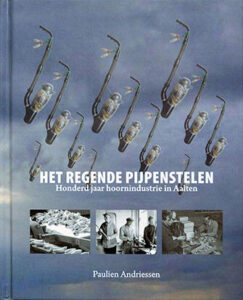
In 2011, a book she authored was published by Fagus Publishers, titled ‘Het regende pijpenstelen, Honderd jaar hoornindustrie in Aalten’ (It Rained Pipe Stems: One Hundred Years of the Horn Industry in Aalten) (ISBN: 9789078202806)
The textile industry in Aalten was deeply rooted in the centuries-old tradition of domestic weaving and flax processing. In the 19th century, this craft grew into a flourishing industry, partly thanks to the establishment of German textile families such as the Driessens.
For centuries, flax was cultivated in the Achterhoek and the adjacent Westphalia region, from which linen was woven on farms. This cottage industry led to a lively cross-border trade in woven fabrics.
Numerous farm and street names in Aalten still recall this era, for example: de Weversborg, de Pellewever, de Bleeke, the Vlasspreideweg, and—due to the pure water—the Zilverbekendijk.
The arrival of the Driessens
Import duties on foreign fabrics were increased in 1823 to protect Dutch industry. German textile companies, including the firms Gebrüder Driessen and Peter Driessen & Sohn in Bocholt, moved to the Achterhoek. In 1826, they established themselves in Aalten.
With their arrival in 1826, 56 looms and approximately twenty families from Prussia also came to Aalten. Most of them settled here permanently.
Growth of employment
The number of domestic weavers grew steadily. While the number was 292 in 1828, it had risen to 352 a year later, and in 1833 it was reported: ‘The fustian factories continued strongly, with the factories in Aalten typically employing approximately 630 weavers according to records. Both in this and in the surrounding municipalities of Winterswijk, Dinxperlo, Varsseveld, Lichtenvoorde, etc.’
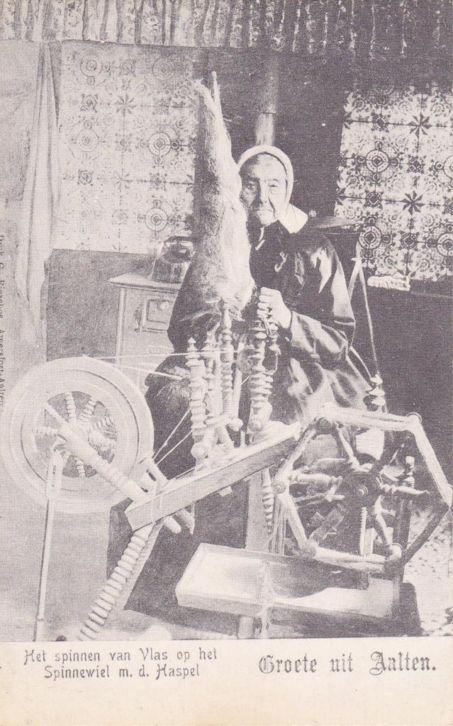
Spinning flax on the spinning wheel
The first factories
In 1829, there were two cotton mills in Aalten ‘which provide work for about 40 people’, including that of the Driessen brothers. In 1830, there were three, with approximately sixty employees.
On August 15, 1829, Jan Gerard Kraak ten Houten, ‘licensed shopkeeper and merchant in Aalten’, informed the Governor of Gelderland of his wish to establish ‘a fustian factory, spinning mill, dye works, and bleachery’ in his hometown, for which he requested permission. The municipal council had no objections to this establishment, ‘considering that the petitioner’s intention is only to have fustian manufactured by weavers at their homes, without erecting a spinning mill, bleachery, or dye works. This ensures sufficient work for the craftsman’, while no other interests are harmed. Ultimately, the King had to decide on the matter. Favorable advice was given by all advisors. It is not known how long this company existed or where it was located.
Sources
Geweven goed, the textile history of Aalten and Bredevoort H. de Beukelaer, J.G. ter Horst – Fagus, 1992
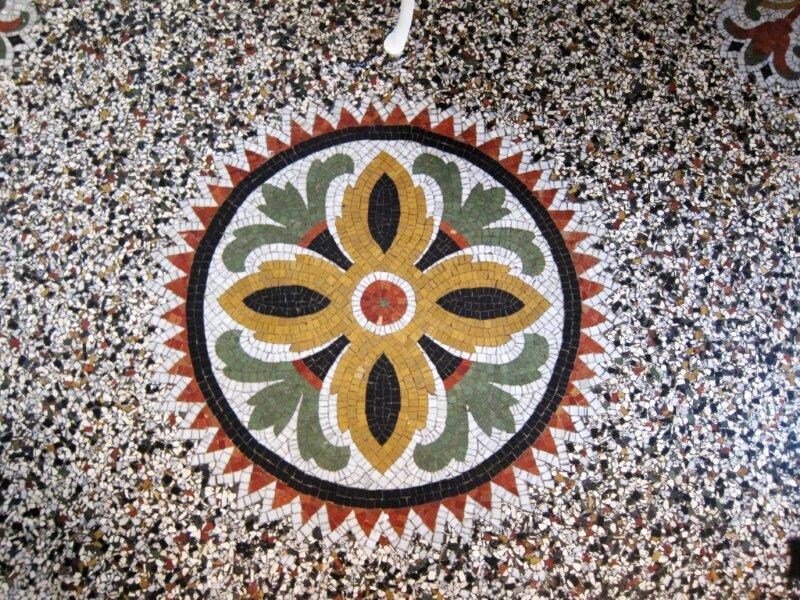
For more than a century, members of the Monasso family have been crafting terrazzo floors in the Achterhoek. The family ended up in Aalten in 1915, after fleeing from Bocholt, Germany, during World War I. Their origins lie in the Northern Italian region of Friuli.
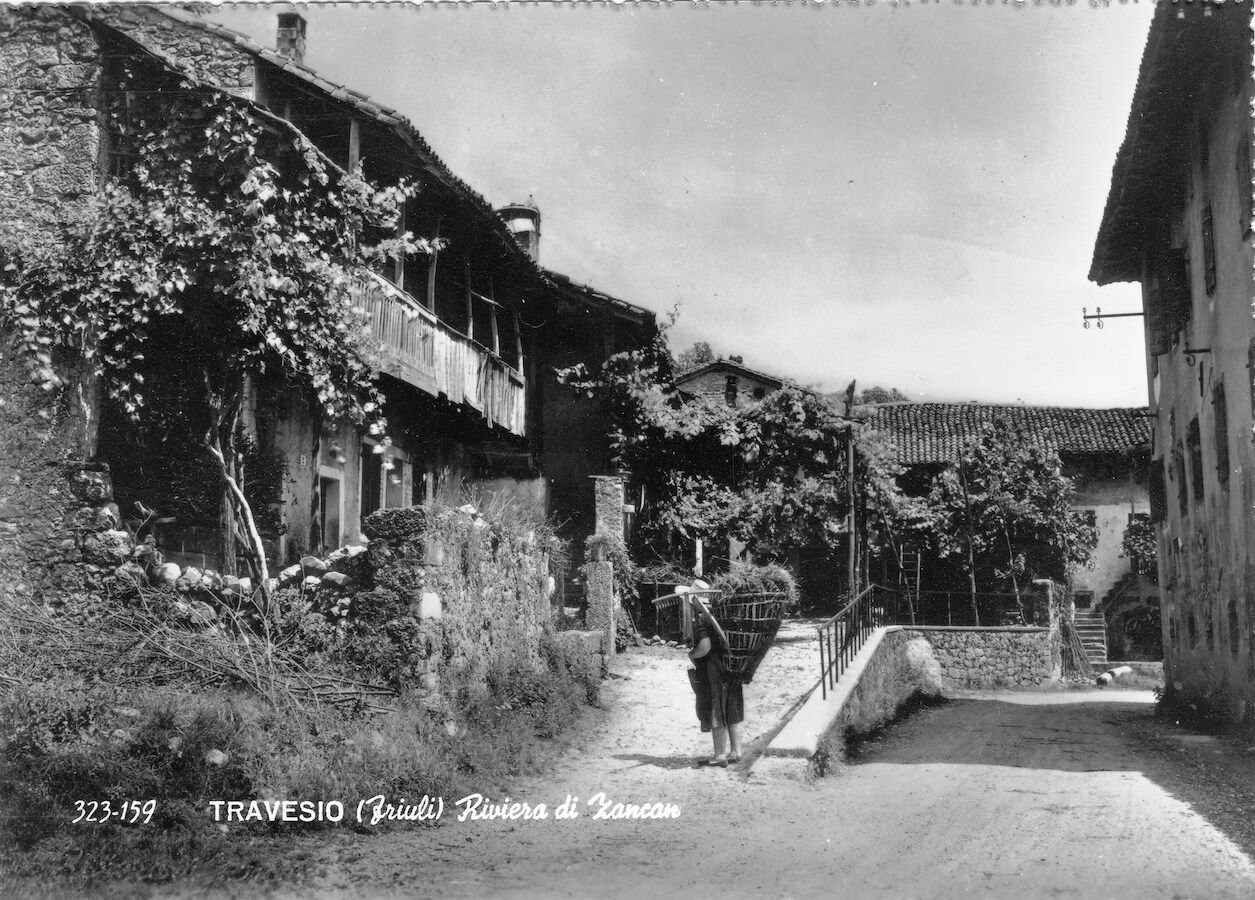
The family hails from the mountain village of Travesio, in the Friuli region. It was an impoverished area plagued by poor soil, earthquakes, floods, and high taxes. Many inhabitants left to find work elsewhere. Friulians were known as skilled craftsmen—foresters, carpenters, stonemasons, and terrazzo workers.
The First Generation
In 1868, Pietro Monasso married Maria Bortolucci in Travesio. They had three sons and four daughters. All three sons learned the terrazzo craft in Italian cities. One of them, Felice Monasso, was once repairing stairs at St Mark’s in Venice as a boy. He received a banknote worth about twenty guilders—a staggering amount for the time—from the newly arriving Pope Leo XIII. He did not spend it, but kept it as a relic.
The three brothers were Giovanni (1869–1939), Felice (1871–1962), and Antonio (1876–1967). They left Friuli at a young age: Giovanni and Antonio at age eleven, and Felice at fourteen.
The village of Travesio in Friuli, Northern Italy, ca. 1900
Work in Germany
Giovanni travelled with fellow villagers to the Balkans to learn the carpentry trade. Felice worked first in Frankfurt, including at the large Odorico terrazzo company, which employed hundreds of Friulian workers. Giovanni and Antonio later joined him in Germany.
From Frankfurt, the brothers went to Münster, where their cousin Bortolucci ran a terrazzo business. They worked there as master journeymen, and there was plenty of work in Westphalia and the Netherlands. On the advice of their boss, they established themselves in 1896 in Bocholt, just across the border from Aalten. There, they started a terrazzo firm together.
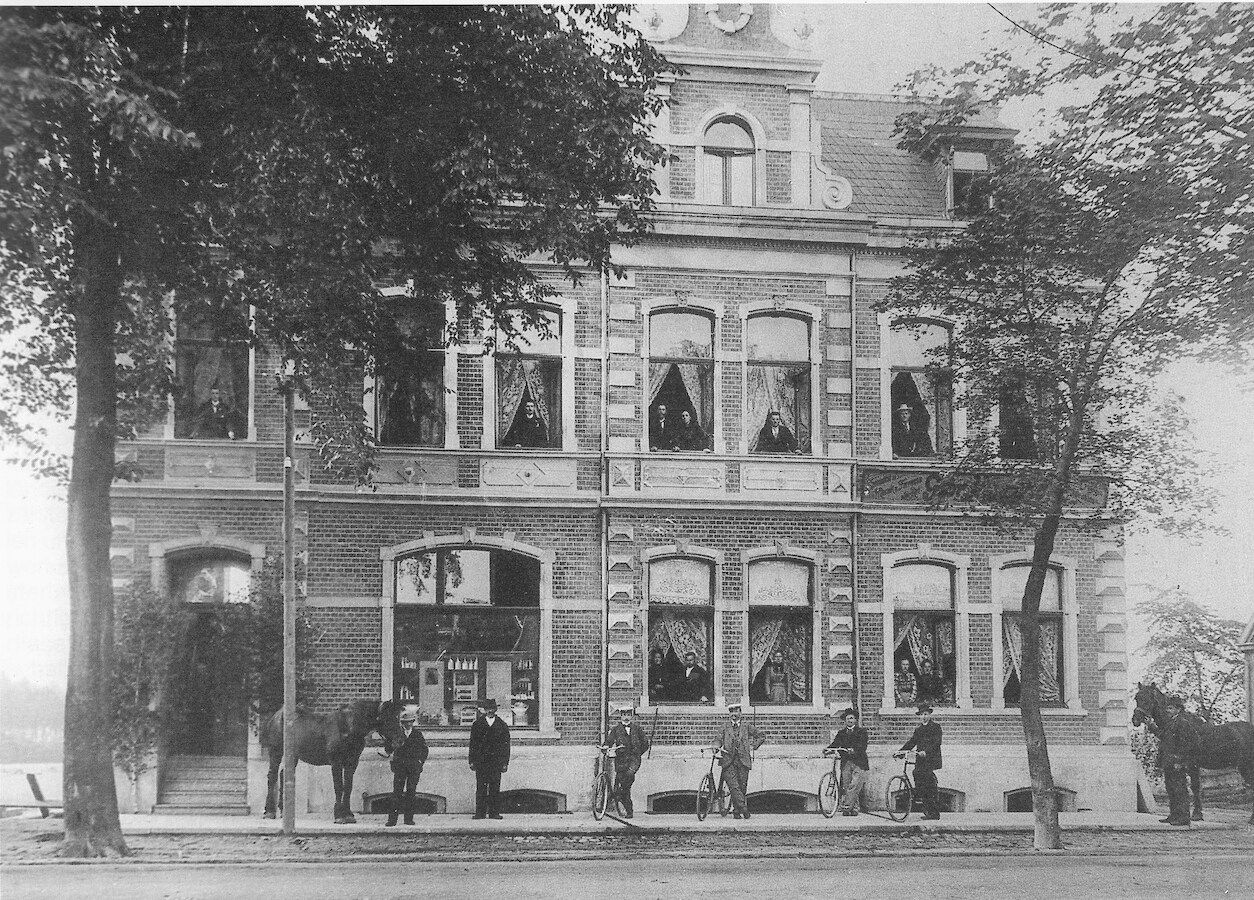
The enterprise flourished. This was the era when wealthy textile barons in Bocholt were building grand houses. With their terrazzo work, the Monassos embellished many a villa on the prestigious Bahnhofstraße. The three families lived together with their staff in a large building on Münsterstraße in Bocholt.
Members of the three Monasso families, the landlord, and journeymen in front of and inside their home on Münsterstraße in Bocholt
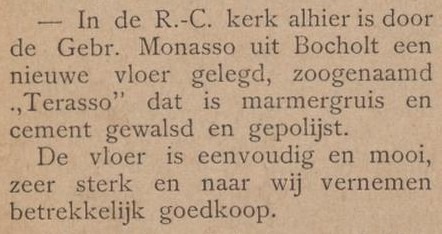
The firm ‘Gebrüder Monasso’ had plenty of work, including in the Achterhoek. As early as 1897, they laid a terrazzo floor in the Catholic St George’s Church in Bredevoort.
Aaltensche Courant, 29 October 1898
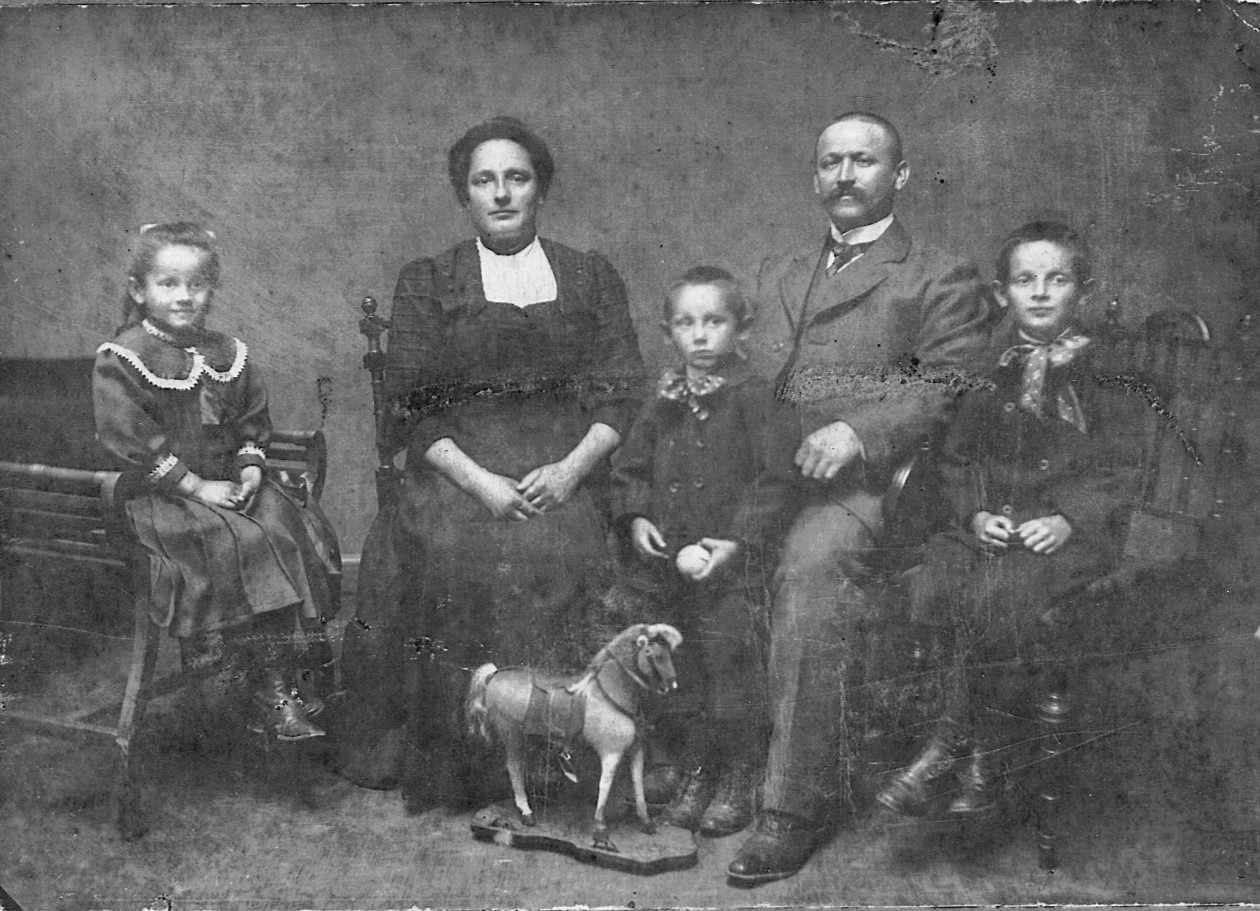
On 22 November 1899, Giovanni Monasso married Angela Chivilò (1879–1951) in Italy. Together they had four sons and two daughters.
Flight to Aalten (1915)
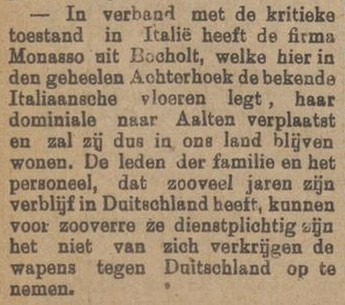
World War I began on July 28, 1914. Italy sided with the Allies, and the Germans saw this as a betrayal. An anti-Italian atmosphere emerged in Germany. Italian workers were insulted and sometimes even mistreated on construction sites. The three Monasso families decided to flee to Aalten, just across the border in the neutral Netherlands. In effect, they were asylum seekers.
Nieuwe Winterswijksche Courant, 22 May 1915
It was a somber procession that departed Bocholt for Aalten before dawn on 19 May 1915. A horse and cart full of household goods was followed by twenty Italians. Three children remained behind in Bocholt: two because they were too ill to travel and one because he wanted to finish his year at the gymnasium.
In Aalten, they spent the first night at Vultink’s lodging house on Dijkstraat. The following day, Giovanni and Antonio moved into a house on Landstraat, and Felice into Bredevoortsestraatweg. Antonio and his wife found a home on Haartsestraat shortly thereafter. The then Mayor Monnik arranged for residency permits. The children who had stayed behind joined their families later.
A New Life in Aalten
Giovanni demonstrated his entrepreneurial spirit by registering within a few days at Sociëteit Schiller, where local businessmen met. His brothers followed a week later. Within a short time, the Monassos were working again. They laid floors in homes, shops, schools, and churches in Aalten and the surrounding area, bringing in skilled terrazzo workers from Italy as staff.
Giovanni Monasso (1869–1939) and his family
They did not yet use machines or electric tools; everything was made by hand. Terrazzo floors were laid on-site, which was arduous work. Stairs, countertops, and other components were made in the workshop using moulds and were subsequently installed in kitchens or halls.
Around 1920, Giovanni established his business on Parallelweg in Aalten. In the mid-1950s, they moved to the adjacent Staringstraat, where a new showroom was opened in 1969.
Felice established a terrazzo business in Winterswijk in 1922; Antonio followed in 1932 with a branch in Doetinchem.
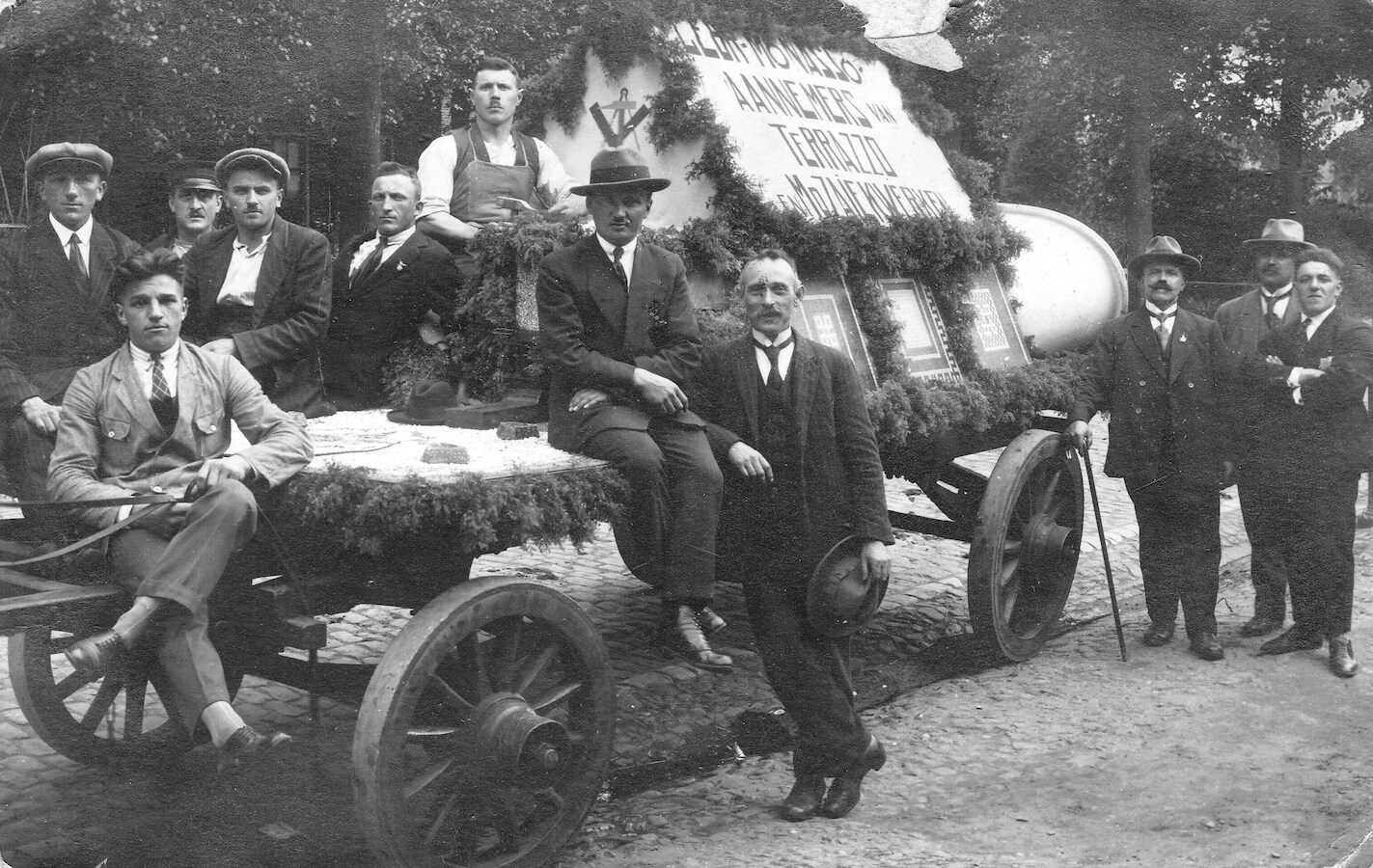
Aalten, 1924 – Members of the Monasso family with a float used in a parade where craftsmen presented themselves
Later Generations
The second and third generations also remained active in the craft. In the decades following World War II, sons and grandsons took over the work. All four of Giovanni’s sons became terrazzo workers and married Dutch women.
Business thrived for decades. In the 1960s and 1970s, demand decreased due to the rise of synthetic floors and steel countertops. Nevertheless, the family business endured. The Monassos combined traditional techniques with modern methods, specialising not only in floors but also in worktops, thresholds, window sills, and restorations.
Current Company in Aalten
In 1982, Richard Monasso, Giovanni’s grandson, took over the company in Aalten. The business moved to Industriestraat. In the 21st century, terrazzo became popular once again. Richard Monasso now works on exclusive projects at home and abroad; his work can be found in a department store in London, a restaurant in Paris, and a villa in Greece.
Willem Monasso
In 1996, Willem Monasso, son of Giovanni Monasso and Angela Chivilò, spoke about his youth:
Wilhelm Franz Joseph (Willem) Monasso (1916–2001) was born in Aalten but returned to Italy with his mother as a child. They lived with an uncle who owned grape plantations. He attended primary school there. He did not learn Italian there, but so-called Furlan, a regional language that differs as much from Italian as Frisian does from Dutch.
At the age of ten, they returned to the Netherlands. Back in Aalten, Willem had to start again in the first grade. He left school after the fourth grade to enter the terrazzo trade.
On his mother’s side, the Monasso family owned a wine bottling plant and a silk plantation. They regularly had barrels of white wine from their region of origin in Italy shipped over. The first barrel always went to the parish priest of Aalten.
During World War II, Willem was the only Aalten resident allowed to have a radio because he held Italian nationality. Naturally, the occupiers did not allow him to listen to the English ‘Oranje’ station, but he did so in secret anyway, along with half the neighborhood.
Willem Monasso could tell captivating stories about his former work in the perfect Aalten dialect. Initially, countertops were made on-site in a formwork built by a carpenter. Later, this was done in the workshop, and they were transported to their destination by a small truck. The terrazzo technique requires great craftsmanship and is incredibly labour-intensive. Throughout the region, many beautiful Monasso floors can still be found in churches, hospitals, monasteries, schools, and scholten farms.
At the beginning of the 17th century, Wessel Schenk and his half-brother Salomon Voerknecht from Aalten were among the largest grain traders in Europe. Their activities spanned from Amsterdam to Danzig, Königsberg, Genoa, and even the New World. Other family members were also active in trade and entered into marriages that strengthened their position. What began in Aalten grew into a network with international influence.
The Schenk / Voerknecht family
In the mid-16th century, a certain Jenneken ter Woert lived in Aalten. From her first marriage to Salcke Schenk, she had two children: Gertruid and Wessel Schenk. Around 1568, she remarried Johan Voerknecht, with whom she had four children: Salomon, Hans, Judith, and Anna Voerknecht.12
In 1575, Johan Voerknecht was a keurnoot (lay judge) of the Bredevoort court3, a position indicating social standing. Whether the family belonged to the Aalten ‘elite’ is unknown to us. However, it is striking that all the children later became successful in trade or married partners of distinction. This suggests a connection to influential networks that enhanced their social and economic opportunities.
Merchants in Amsterdam, Danzig and Königsberg
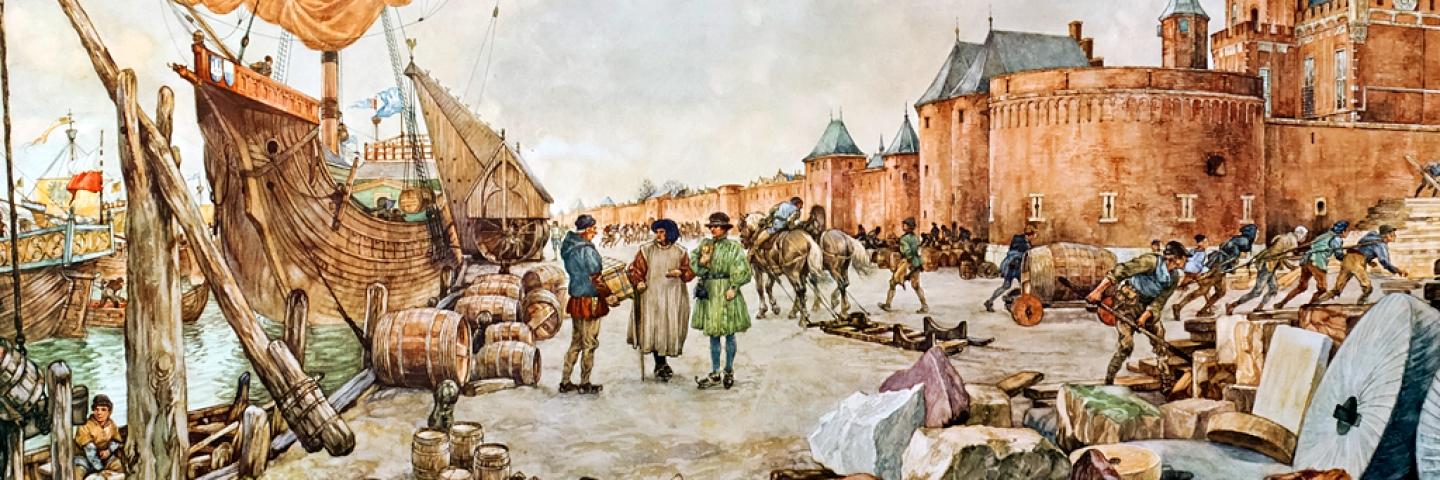
From the late 15th century, merchants in the Low Countries specialized in the transport of bulk goods, especially grain and salt. This trade, known as the moedernegotie (mother of all trades), formed the economic foundation of Holland for centuries and made Amsterdam the most important staple market in Europe.4
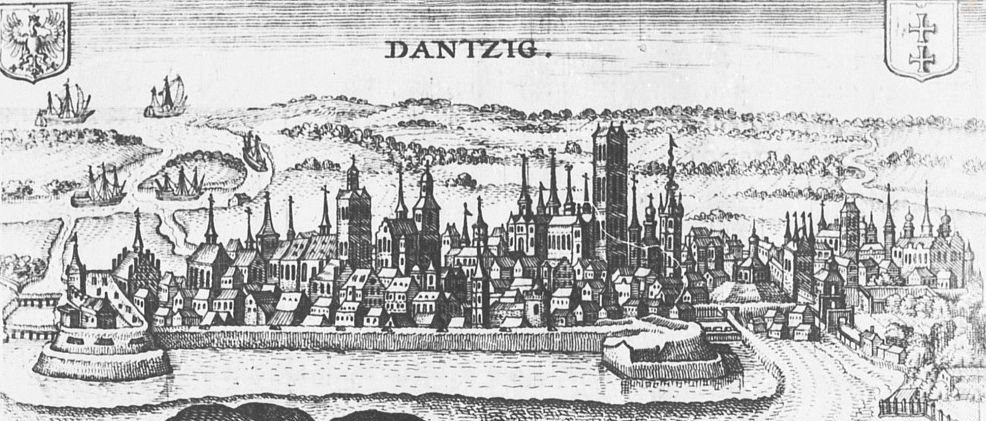
The Schenk-Voerknecht family also benefited from this. They maintained close ties with the Hanseatic cities of Danzig (Gdańsk) and Königsberg (Kaliningrad). Some family members even settled there, either temporarily or permanently.
Danzig, 1628 AD
The Schenk and Voerknecht children grew up during the Eighty Years’ War (1568–1648), yet they managed to break into international trade regardless. The period of the Twelve Years’ Truce (1609–1621) provided favorable conditions: a brief phase of peace and armistice. Eastern Netherlands had eight garrison towns (including Bredevoort) that were in constant need of forage, particularly grain. This was not only for bread but also for the production of beer.
Wessel Schenk was a grain merchant and did good business in the Achterhoek during that period. He was also active in the trade route from Danzig to Genoa, Italy.5 His half-brother Salomon Voerknecht was likewise a very successful merchant.
Largest carriers from Amsterdam to the Mediterranean, 1590–1620:
Carriers
Total
Shipments
With a partner
Jasper Quinget
201
197
4
Jan and Philippo Calandrini
91
25
66
Guillelmo Bartolotti
66
42
24
Caspar van Ceulen
63
35
28
Isaac la Maire
56
42
14
Willem Willemss
49
48
1
Salomon Voerknecht
45
13
32
Wessel Schenck
30
25
5
Biographies of family members
Wessel Schenk
Born around 1566 in Aalten. In 1606, he lived on the Breestraat in Amsterdam. In archival documents, he is referred to as a “merchant lord.” Other sources indicate that he also regularly stayed in Danzig.
Upon its founding in 1602, Schenk was one of the largest shareholders of the Dutch East India Company (VOC). He also saw opportunities in the New World. Together with his nephew Jan Holscher, he invested in expeditions to New Netherland, in the northeast of the present-day US. In 1614, he was a co-founder of the New Netherland Company, the predecessor of the West India Company.6
In 1609, he included in his will that he would leave 4,000 guilders to the poor of his birthplace, Aalten. Because he was often traveling, he had a will drawn up in 1616, leaving his affairs in Amsterdam to his nephew Jan Holscher.
In 1619, Wessel, as a citizen of Danzig, contractually transferred the annual income from two Aalten farms (Lutke Grievinck and Goorhuis) by proxy to his sister’s daughter Gertruid Tols, widow of Johan Brunss.7 In 1632, he was back in Danzig and sold by proxy “a garden or courtyard with timber structures in two parcels” outside the Regulierspoort in Amsterdam. He must have died shortly thereafter, presumably unmarried.8
Gertruid Schenk
Born around 1565 in Aalten. Around 1584, she married Albert (?) Hengst van Juchteren in Anholt. After 1590, she remarried Henrick Toll. In 1600, she lived on the Nieuwe Zeedijk in Amsterdam. Gertruid was also active in the family business. In 1616, Gertruid and her brother Wessel received a letter of recommendation from the States-General addressed to the city council of Danzig—a sign that their commercial position was officially recognized. Gertruid passed away after 1628.9
Salomon Voerknecht
Born around 1568 in Aalten. In 1597, he married Jannetje Hooft in Amsterdam. She was a descendant of a prominent Amsterdam merchant family that produced one of the greatest Dutch writers of the Golden Age: Pieter Corneliszoon Hooft. Father-in-law Jan Pietersz Hooft was a brother of the mayor of Amsterdam, Cornelis Pietersz Hooft, and through this marriage, he also became the brother-in-law of the later mayor Volckert Overlander.
In 1618, Salomon, on his own behalf and as proxy for Judith and Hans Voerknecht, sold a piece of land, the Bullensche maat in Lintelo, to Roelof Damme and Catharina Smitz. In 1619, he sold—partly on behalf of his wife, and as proxy for his sister Judith, widow of De Marez, and brother Hans (“citizen of Danzig“)—their parental home in Aalten near the churchyard, including the courtyard and land, to Wessel Brethouwer and Mechteld Machtes.
In 1637, Salomon was a senior merchant in the service of the VOC in Batavia. He had gone from Danzig to the East Indies and remarried a widow there. On October 24, 1637, in Batavia, “weak in body but still sound of mind,” he recorded his last will and presumably died shortly thereafter. His eldest son Johan became the deputy bailiff of Amsterdam in 1656.10
Hans Voerknecht
Born around 1569 in Aalten. Hans Voerknecht (also called Schenk) was likewise active in trade. In 1605, he was mentioned as a merchant in Amsterdam, along with Salomon Voerknecht and Wessel Schenk. In 1608, he was in Danzig, and in 1619, he was even recorded as a citizen of that city. He presumably died there not long after.11
Judith Voerknecht
Born around 1569 in Aalten. Around 1585, she married Daniel de Marez, a merchant in Danzig. He is immortalized in an almost life-sized painting of the De Marez and De Schilder families. While in surrounding countries only monarchs had themselves immortalized in this manner, here powerful merchants displayed their status. In 1619, her brother Salomon sold the parental home in Aalten on her behalf (and that of other heirs).12
Anna Voerknecht
Born around 1571 in Aalten. Around 1590, she married the merchant Joost Grevinckhoff, also from Aalten. A deed from the court at Bredevoort from 1615 mentions that Seigneur Wessel Schenk sold a large number of lands and tenant farms on behalf of Joost and Anna, who were then residing in Königsberg. The deed concerns a debt settlement: Joost and Anna were deeply in debt, primarily to Anna’s brother, Seigneur Salomon Voerknecht, “citizen and merchant in Amsterdam” (Seigneur was the title of address for wealthy merchants at that time). Because they could not pay, they transferred their entire property in Aalten—including their house, land, and hereditary rights—to Salomon and his wife Joanna Hooft.13
Jan Holscher
Born around 1584 in Dülmen (near Münster). In 1601, he came to Amsterdam, where he entered the service of his uncle, the merchant Wessel Schenk. Although he managed his uncle’s business, he also traded independently. He held shares in a company that traded with Guyana. Together with his uncle, he also participated in the Hans Claesz Company. In 1613, Thijs Volckertsz Mossel sailed for this company to the Hudson River. In 1612, Jan Holscher married Elisabeth de Hardouin from Rouen in Amsterdam.14