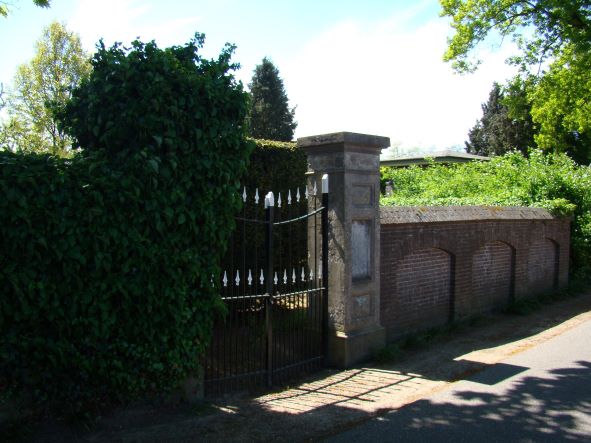
The Jewish Cemetery on Prins Mauritsstraat in Bredevoort was established around 1830, concurrently with the adjacent general cemetery. The site became available following the dismantling of the fortifications on the eastern side of the town.
The last Jews from Bredevoort to be interred at this cemetery were siblings Levi and Sara Sander. Both passed away in 1938, shortly after one another. The cemetery is not open to the public.
Two Jewish cemeteries
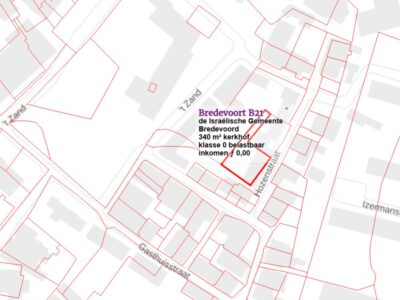
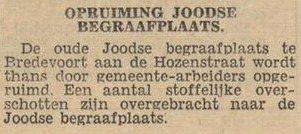
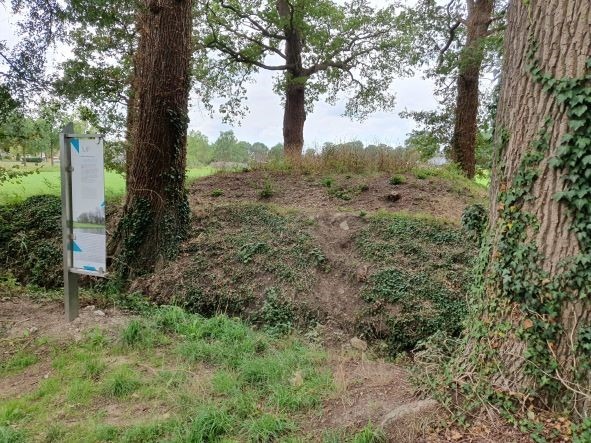
Bredevoort once had two Jewish cemeteries. The oldest was located on the former castle grounds behind Hozenstraat 5. In 1953, this site was sold to the municipality of Aalten for housing construction. The remains and tombstones were then transferred to the second cemetery on the Prins Mauritsstraat.
Location of the former Jewish cemetery on Hozenstraat
Maintenance and Restoration
Initially, the cemetery was maintained by the municipality. Since 2018, volunteers from the Bredevoorts Belang association have been responsible for mowing the grass and keeping the walls and the 12 gravestones free of climbing plants. In 2022, restoration work began to repair cracks in the walls, renew the pointing, and refurbish the gate.
The Jewish cemetery of Aalten, located on Haartsestraat, has a rich history dating back to the beginning of the 19th century. Although the site officially became the property of the Jewish community in 1852, there are indications that the cemetery had been in use since approximately 1820.
The cemetery is situated in a wooded area and is enclosed by sturdy fencing. The older section consists of a low, densely wooded hill with scattered funerary monuments. To the east lies the newer section, which is characterized by an orthogonal layout.
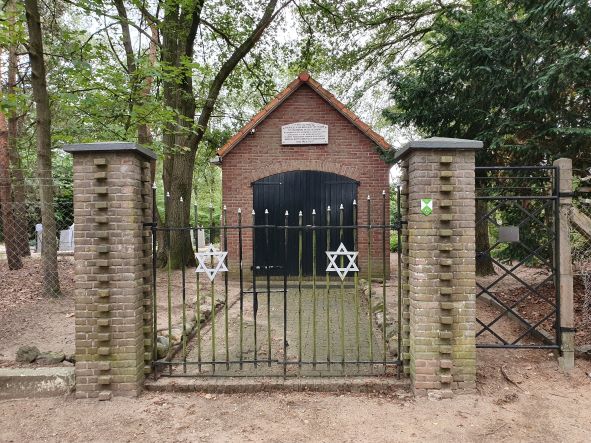
There are approximately seventy gravestones on the grounds, varying in age and design. At the entrance on Haartsestraat stands a metaheerhuis (mortuary), a ritual building used for the purification of the deceased according to Jewish traditions.
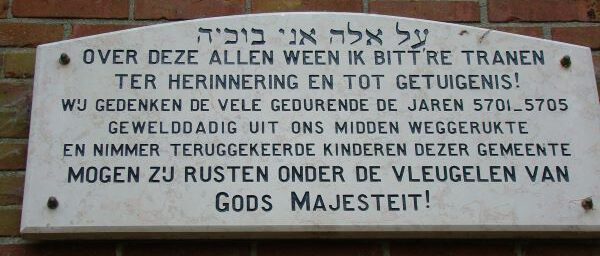
During World War II, the cemetery was damaged, but it was restored after the war. In memory of the Jewish children from the municipality who were deported and killed during the war, a plaque has been placed on the facade of the metaheerhuis.
At the beginning of the 20th century, the Old Cemetery on the Varsseveldsestraatweg became increasingly enclosed by the expanding development of the village of Aalten. This made the establishment of a new general cemetery necessary.
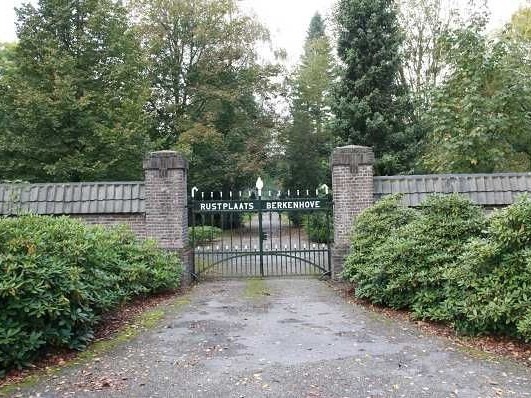
In 1920, the municipality purchased the Oosterman farm near ’t Walfort with the intention of creating a new general cemetery there. This plan ultimately did not proceed. Instead, a suitable site was found on the Romienendiek, where the ‘Berkenhove’ cemetery was brought into use in 1923.
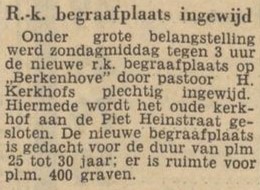
The original section of Berkenhove is enclosed between Romienendiek, Barloseweg, and Koningsweg. Over the years, the cemetery has been expanded regularly. In 1960, a Catholic section was added because the Roman Catholic cemetery on Piet Heinstraat had reached capacity. The new Roman Catholic cemetery was consecrated by Father Kerkhofs. The priest himself found his final resting place there in 1964.
The oldest part of Berkenhove features an orthogonal layout, with rows of graves along a central path, surrounded by a rich variety of trees and shrubs. The cemetery was later extended to the northern side of the Koningsweg.
Funeral Centre and Crematorium
Located at Berkenhove is a modern funeral centre and crematorium, managed by GUV. In 2015, a scattering field called ‘De Akker’ (The Field) was established adjacent to the cemetery, providing space for the scattering of ashes, urn graves, and a columbarium wall.
War Victims
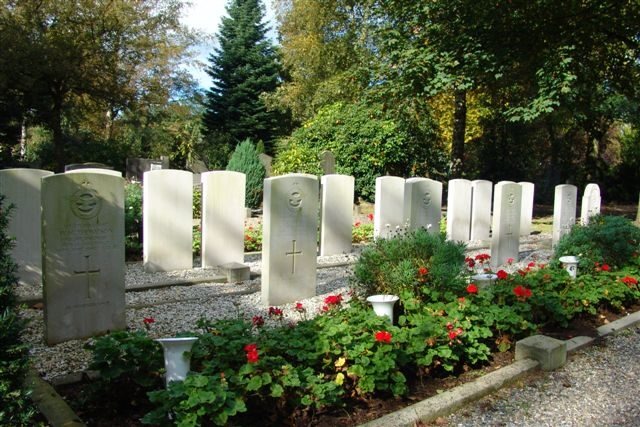
A lasting memorial to their sacrifice for our regained freedom are the 18 uniform headstones in this cemetery. These mark the graves of five British airmen who crashed in IJzerlo and 12 British soldiers from the ground forces who fell during the liberation of Aalten in April 1945. Alongside the graves of the British war victims lies the grave of resistance fighter Cornelis (Kees) Ruizendaal.
Furthermore, dozens of other graves of war victims can be found at Berkenhove. Many of these graves are marked as such.
Located on the former ‘t Smees estate at the Nannielaantje is a unique burial mound. The estate was once owned by Christiaan Caspar Stumph and his wife Jeanne Lesturgeon. Stumph served as the first mayor of Aalten from 1811 to 1818. The municipal secretary’s office was also situated on the estate.
It was Stumph’s wish to find his final resting place here. He was frustrated by the poor conditions of burials within or near churches. In 1818, during the Romantic era, he arranged a ‘private outdoor cemetery’ for himself and his relatives.
His last will and testament read as follows:
“After my death, I wish and desire to be of no harm to my fellow man. As our national government remains backward in putting an end to burials inside churches and in churchyards within towns—as is done in France, Germany, Italy, and elsewhere—and in directing them to spacious burial grounds outside, I have (…) caused a site to be prepared in one of the Smees meadows, specifically the one adjacent to Smees Hoflanden. This small plot of land, my property, I will and desire to be respected and honoured as a sanctuary after my passing.”
Those Buried Here
On 28 July 1818, at 5 o’clock in the morning, son Abraham Antonij Stumph was buried at this outdoor cemetery. He was 34 years old and a notary by profession. He had drowned in the Slingebeek stream. Local legend suggested his death was linked to a broken heart. A year later, the 74-year-old Christiaan Caspar Stumph married 30-year-old Caatje Weversborg, the daughter of the tenant farmer at ‘t Smees. In January 1820, eight months after this marriage, Stumph himself was buried at ‘t Smees in accordance with his will.
Following them, several others were interred in this meadow location: friend and VOC (Dutch East India Company) captain Johan Christiaan Rost with his wife (a daughter of Stumph from Bredevoort), their young daughter, and two grandsons. The last known owner of the mound passed away in 1913. The Municipality of Aalten has arranged for the Stichting Vrijwillig Landschapsbeheer Achterhoek (Achterhoek Voluntary Landscape Management Foundation) to maintain the burial mound.
For an overview of the individuals buried in the mound, please visit Findagrave.
The Aaltensche Courant wrote on 1 June 1948:
The history of the old burial mound at the Nannielaantje in Aalten
Walking into the „Nannielaantje” from the Haartsestraat (known to older residents of Aalten as „Smeeslaantje”) and crossing the narrow bridge, one sees on the left, roughly opposite the „Aalten’s Belang” bench in the meadow, a square mound. It is overgrown with several heavy oaks and surrounded by ditches, which have gradually become almost level with the surrounding land.
Most residents of Aalten will not know what this square mound actually is, and few are aware that it is an old burial mound, let alone any further details.
Having happened upon the „Deed of Foundation” for this cemetery recently, it seemed interesting to share some information with readers, for the well-known „hump” in the Nannielaantje is indeed a burial ground.
A former mayor of Aalten, C. C. Stumph, strongly disagreed with the continued practice of burying people in and around churches. Consequently, he created his own burial place in the „Smees meadows”. In the „Deed of Foundation”, dated 2 May 1818, everything is precisely described. The maintenance of this cemetery was arranged and the compensation for it established.
Including the entire „Deed of Foundation” would require too much space. A few passages follow here:
„After my death, I wish and desire to be of no harm to my fellow man. However, as our National Government remains backward in—as in Germany, France, Italy, and elsewhere—ceasing burials within Churches and in Churchyards within towns and referring them to more spacious burial grounds outside: I have, so that my earthly remains may be entrusted to the Earth undisturbed! and my Bones may rest in Peace, already for several years, caused a Private Outdoor Cemetery to be prepared for myself in one of the Smees meadows, specifically the one against Smees Hoflanden.
This small plot of ground, my property, I will and desire that after my death, it shall be respected and honoured as a Sanctuary in a certain respect, by whomsoever, be it my Heir or Heirs, or legal successor! Declaring the same hereby as forever inalienable and untransferable.
And so that this Cemetery, in the order it currently is, or shall be at my passing, be continuously maintained annually in the future, I attach and bind to it (for and to settle the costs of that maintenance) that dagmat [day’s mowing] of land in which it is situated.
With the maintenance and upkeep after my death, the resident or residents of the dwelling house standing on Smees shall be and remain charged! who shall also for this purpose enjoy the annual proceeds of that dagmat of land or the (…), and the meadow on both sides along the ditches belonging to that dagmat and along the stream growing soft-wood timber, free of charge; also with the promise to be allowed to cut and use the grass on that Cemetery, and also of the ditches belonging thereto and to that dagmat, twice a year, however, sparing the
weeping willows or other shrubs or flowers thereon, these being an exception to the aforementioned soft-wood timber, and furthermore the right to allow two cows to graze in that meadow after the grass has been mown, in the aftermath or late grass, with the Beasts brought therein by or on behalf of the Owner of that meadow, also to be grazed free of charge.”
In the remainder of the document, the minister of the Reformed Church was charged with supervision. „The Minister or Ministers of the Reformed Congregation of Aalten at the time are invited and urgently requested to kindly take upon themselves the Supervisions! Granting for that purpose the faculty, in the event of no proper maintenance and supervision: without any consultation or notice, to entrust that maintenance with the attached enjoyment thereof to a more diligent and vigilant subject!”
After several further provisions, the deed ends as follows: „Thus disposed and drawn up this second of May 1818, following his signature, was signed: C. C. Stumph.” This Mayor Stumph, who passed away a few years later, is not the only person buried here.
Information regarding this was received from a relative who still possesses the old Bible and other family papers:
A sister of Mayor Stumph, Christina Petronella, born in 1786, was married to one Johan Christiaan Rost, born 15-12-1766. (This Rost originally came from Germany. He lived at „’t Smees”, which was later sold to Mr Slicher van Bath). They died in 1827 and 1835 respectively and were both buried at „’t Smees”.
The Rost-Stumph couple had 4 children:
Henriette Willemina Christina Theodora, born 21-6-1817 (she later married Dr Servaas van Leuven, the father of the late Dr Adriaan van Leuven).
Willemina Johanna, born 11-06-1819
Louisa Benjamina
Elisa Charlotte, born 13-03-1823
Two of these children, namely Willemina Johanna and Elisa Charlotte, died in 1835 and 1826 respectively and were both buried at „’t Smees”. Dr Servaas van Leuven had 10 children. He lived in the building on Bredevoortsestraat where the Volksslagerij (People’s Butchery) is now located. Of these 10 children, two died at a very young age and were also buried at „’t Smees”. These were:
Johannes Adrianes, born 23-03-1839 and died 06-04-1840
Karel, born 10-01-1861 and died 18-08-1862
These were therefore two brothers of Dr Adriaan van Leuven.
It is therefore known with certainty that 7 people are buried at the „’t Smees” cemetery. It is understood that there are plans to provide a fence for this old burial mound, which is now often used as a playground by the youth.
Bredevoortsestraatweg 109, Aalten (no longer extant)
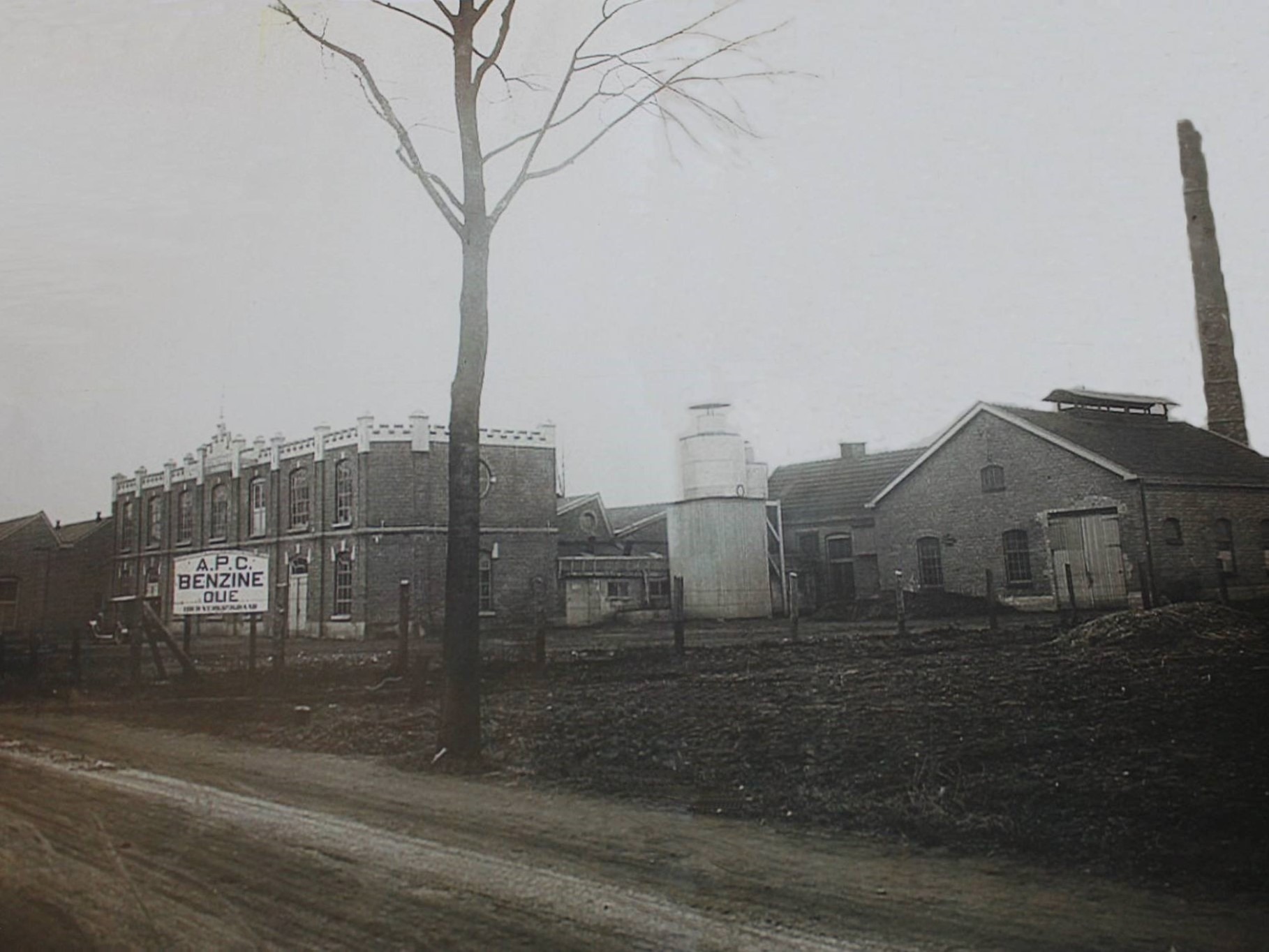
At the beginning of the twentieth century, there was a growing demand for modern energy supplies in the Netherlands. Until then, many households and businesses relied on oil and paraffin lamps for lighting, and on wood or coal for heating and cooking. Gas lighting was seen as a major advancement.
As in many other places, it was decided to build a gasworks in Aalten to provide households, businesses, and street lighting with gas. The arrival of the plant marked a significant step in the modernisation of local infrastructure, though it also brought its share of challenges.
The Production Process
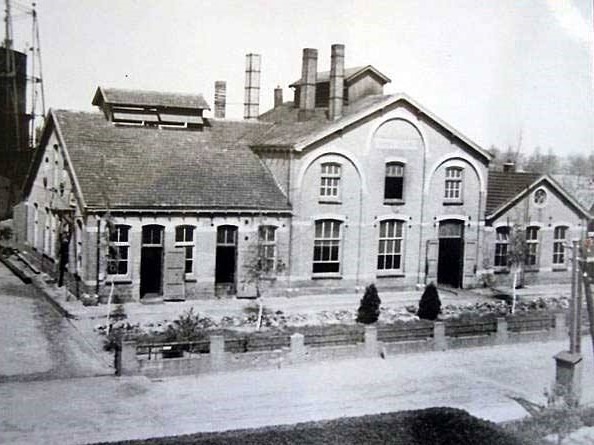
In 1905, the decision was made to build a ‘coal gas plant’ in Aalten. Two years later, in 1907, it was put into operation. The plant produced gas through the dry distillation of coal. This process involved heating coal in the absence of oxygen, releasing gas that could be captured for distribution.
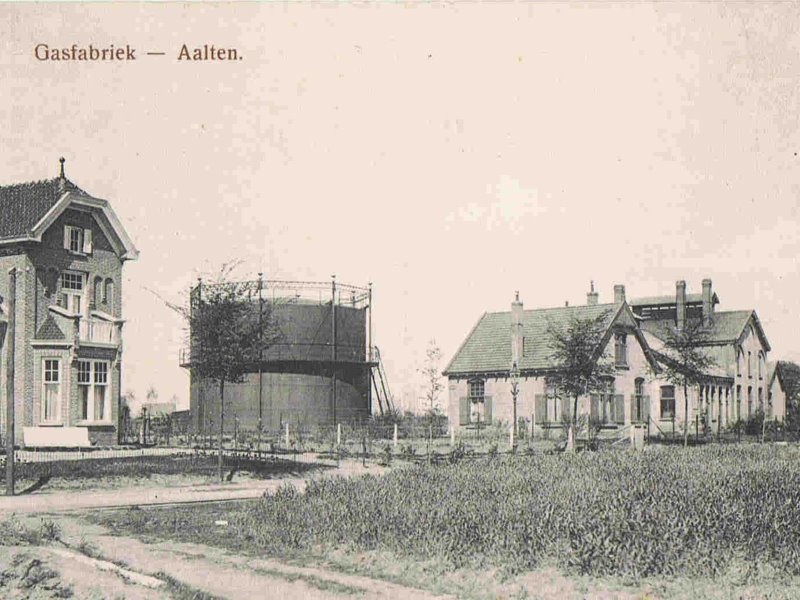
The raw gas contained various impurities, such as tar, ammonia, and sulphur compounds. These were removed through condensation and chemical purification. The purified gas was then stored in a large gas holder (gasometer) and guided through a network of underground pipes to homes and businesses, where it was used for lighting, cooking, and heating.
Installation of the Gas Grid
The installation of the gas grid caused considerable disruption. Streets frequently had to be dug up to lay the pipes, leading to many complaints from residents.
Until the end of 1908, people complained about the poor state of the roads and the inconvenience caused by the works. Nevertheless, the use of gas quickly became popular, and the gasworks grew into an essential utility within the municipality.
In 1919, the municipality of Aalten took over the gasworks for a sum of ƒ 115,000, plus ƒ 29,602.87 for infrastructure such as piping and gas meters.
Gas Tokens
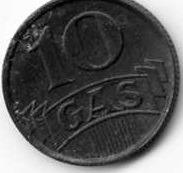
Until the 1950s, some households had a gas meter that operated with special gas tokens. This system, intended to prevent payment arrears, was also used in Winterswijk. The Aalten gas token was a zinc coin with a value of 10 cents. When the gas ran out, a new token had to be inserted into the meter.
With the arrival of the geyser (water heater), this system fell into disuse. The pilot light of these appliances had to burn continuously, which was not permitted in combination with a coin meter. Around 1955–1958, gas tokens disappeared completely, partly due to the introduction of the national natural gas grid.
The End of the Gasworks
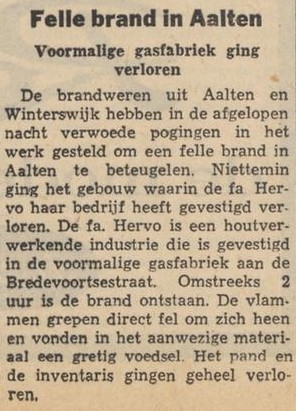
The discovery of the natural gas field in Slochteren marked the end of local gasworks, including the one in Aalten. The building subsequently served various temporary functions, such as a technical school and later a furniture factory (Fa. Hervo), until the premises were destroyed by fire in 1964.
After its closure, the soil was found to be severely contaminated with hazardous substances such as sulphur and cyanide. The remediation of the site was only fully completed decades later, in 2009.
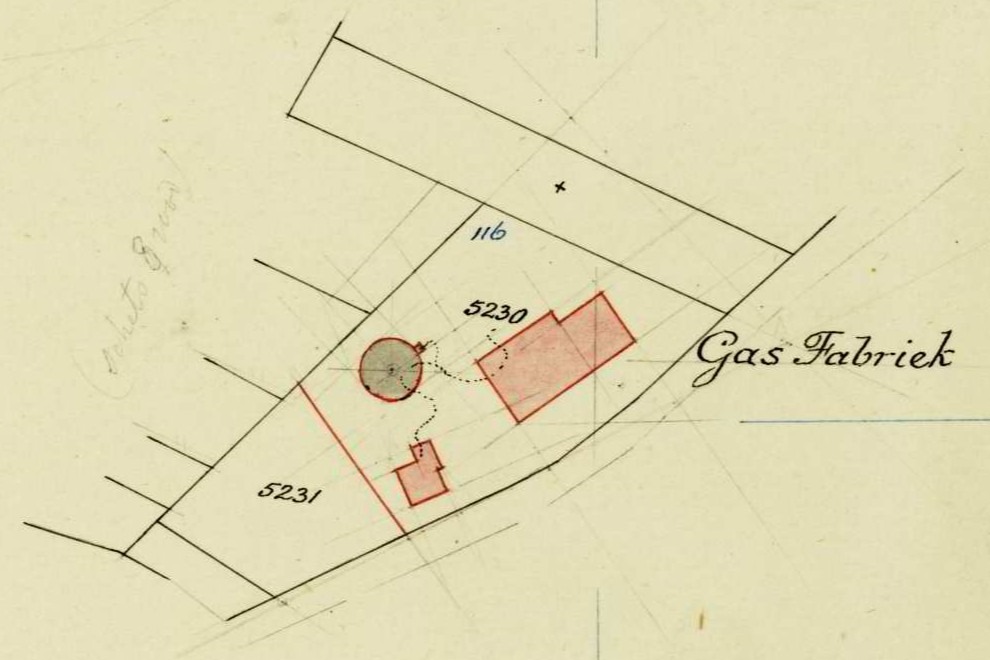
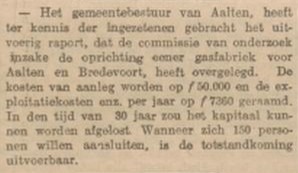
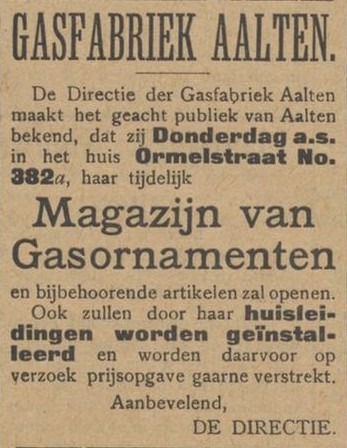
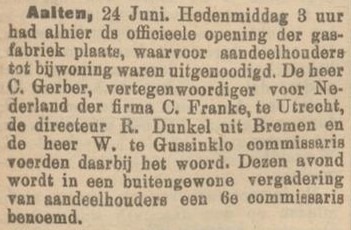
Aalten Gasworks with the gas holder in the centre, ca. 1920.Fragment cadastral map, 1908Het Vaderland, 16 August 1904Aaltensche Courant, 19 December 1906 (Ormelstraat 382a)Zutphensche Courant, 26 June 1907Nieuwe Winterswijksche Courant, 7 August 1964
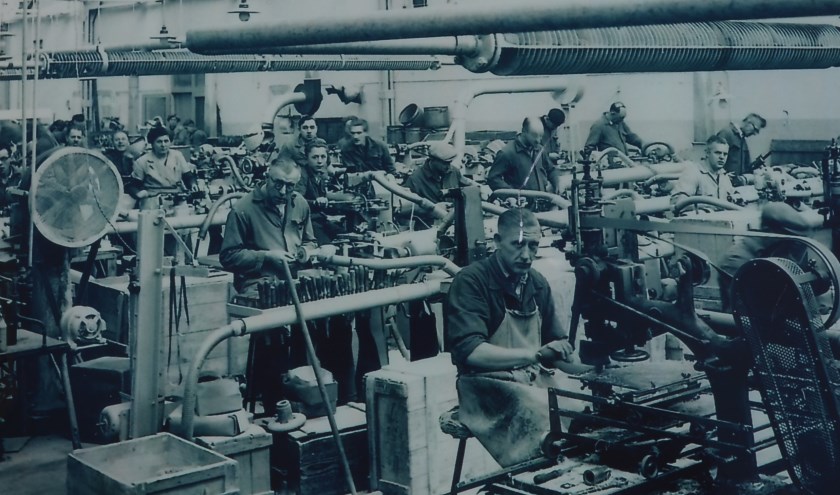
Dutch Button Works was a button factory in Bredevoort that existed from 1884 until 1976. During its heyday, approximately 270 people were employed by the company; at the time of its closure, the workforce numbered about 44.
The Horn Industry
Several button industries already existed in the Netherlands during the 19th century. The oldest in this field was established in 1815, though it primarily produced fabric buttons, particularly linen ones. Around 1900, companies in Germany and England began producing buttons from horn. Following this example, Willem te Gussinklo began manufacturing horn buttons in 1905. This was a first for the Netherlands: the first factory for buffalo horn buttons. Soon, his son Willem te Gussinklo Jr. (known as “Piepkes Willem”) joined the firm, developing into an innovative entrepreneur.
Te Gussinklo’s first factory was located at ’t Dal in Aalten, today’s Willemstraat. Production was initially entirely manual, with buttons made one by one. Due to increasing demand, he purchased the old Van Eijck weaving mill in Bredevoort in 1924, where button production commenced.
At that time, Bredevoort still had its own railway station. Every so often, a wagonload of horns would arrive from India, destined for the Bredevoort button industry. As the years passed, manufacturing became increasingly mechanised. Using machines built by the company’s own technicians, the product was eventually manufactured partly or entirely automatically. Slices, known as rondelles (blanks), were sawn from the horn. For this, both the solid tips of the buffalo horn and the hollow sections were utilised.
Export
The export of buttons was of great importance. Trade was primarily focused on English-speaking countries—England, Ireland, and North America—where Dutch Button Works enjoyed a fine reputation. Until the 1920s, the buttons produced were exclusively intended for men’s suits. However, when demand fell during the crisis of the early 1930s, ladies’ buttons were put into production as compensation, almost simultaneously with the manufacture of bone buttons. Bone buttons were intended for undergarments. Besides buttons, the factory in Bredevoort also manufactured walking sticks—specifically, the knob or handle and the tip were crafted from horn.
A few years after the Ten Dam & Manschot comb factory in Aalten ceased operations, DBW also took up the production of combs. During World War II, the company shifted to processing domestic horn. Besides buttons, ashtrays and bird figurines were popular items. Stag horn was used to manufacture buttons for hunting jackets, and discs of stag horn were fashioned into small ashtrays or candle holders on rosewood bases.
Before the war, DBW also had branches in Germany: in Berlin and Bocholt. After 1945, the company experienced a peak period. The third generation, W.A. te Gussinklo, joined the management. Demand for buttons was high. Many home workers were occupied with sewing buttons onto cards. The horn buttons found their way to garment factories. Sales representatives would travel with a “model jacket” made of various pieces of fabric sewn together—a multicoloured patchwork. On each piece of fabric, the most suitable buttons for that specific material were sewn.
In 1959, the company celebrated its 75th anniversary. At that time, there were over a hundred employees, excluding home workers. Due to increasing automation, the company achieved high turnover with fewer staff. In the second half of the 1950s, horn was largely superseded by plastics. In 1963, the management of DBW, together with an English button factory, took over the largest button factory in Germany.
Decline
The company suffered a heavy blow in 1968 when the director, W.A. te Gussinklo, died at the age of 51, just six months before his father. He was succeeded by his wife, B.A. te Gussinklo-Zandbergen. When her son H.J. Gussinklo Ohmann completed his studies at the technical university in Eindhoven a year later, he also joined the management. By then, the production system was entirely focused on plastic buttons (polyester), which the company had started producing itself around 1960. In the long run, however, it proved extremely difficult to remain competitive. Despite great efforts to keep the company running, they were forced to close DBW in 1976.
The municipality of Aalten purchased the complex in 1977, and it was resold to the firms Van Wezel and Voltman-Riviera. Later, the Albert ten Bruin car dealership was located here for many years.
Repurposing
At a municipal information evening in July 2008, the Vereniging Bredevoorts Belang (Bredevoort Interest Association) made a plea for the preservation and restoration of this characteristic building. They stated: “This building is the only remaining, tangible, and visible intact industrial heritage that Bredevoort still possesses, providing residents with a link to its extensive textile history. The factory building, still in its original state, has a striking, beautiful facade featuring the typical elements of an industrial building built in the third quarter of the nineteenth century.” The non-monumental parts were demolished in 2019. The monumental building has since been repurposed to house apartments and a supermarket.
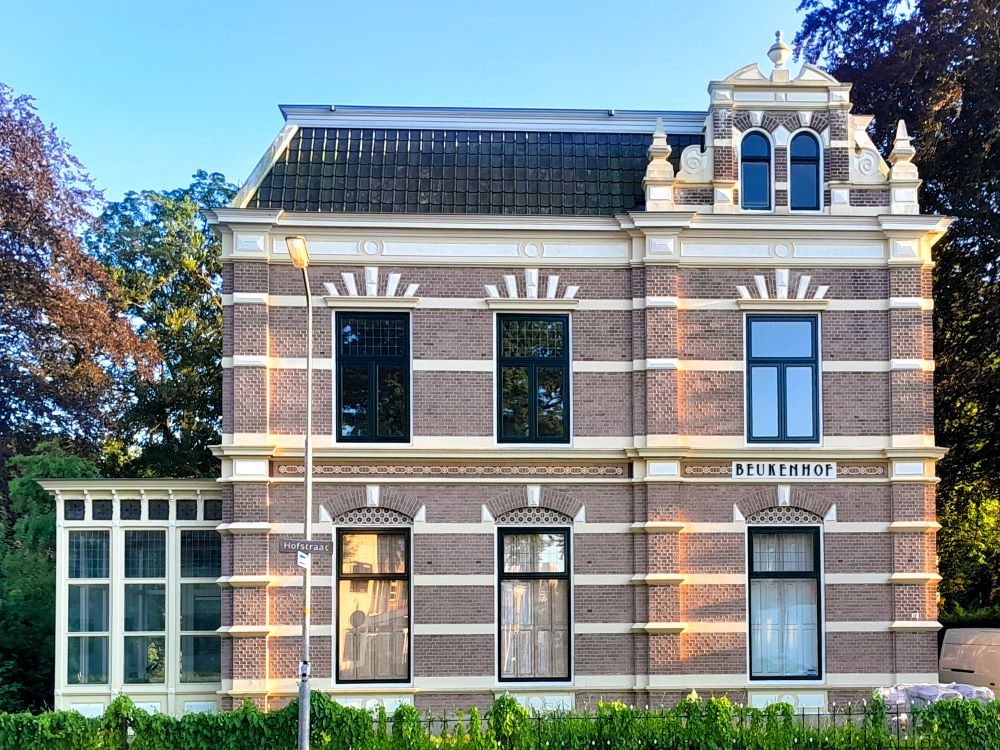
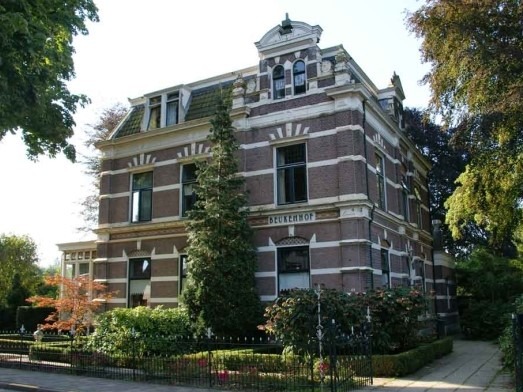
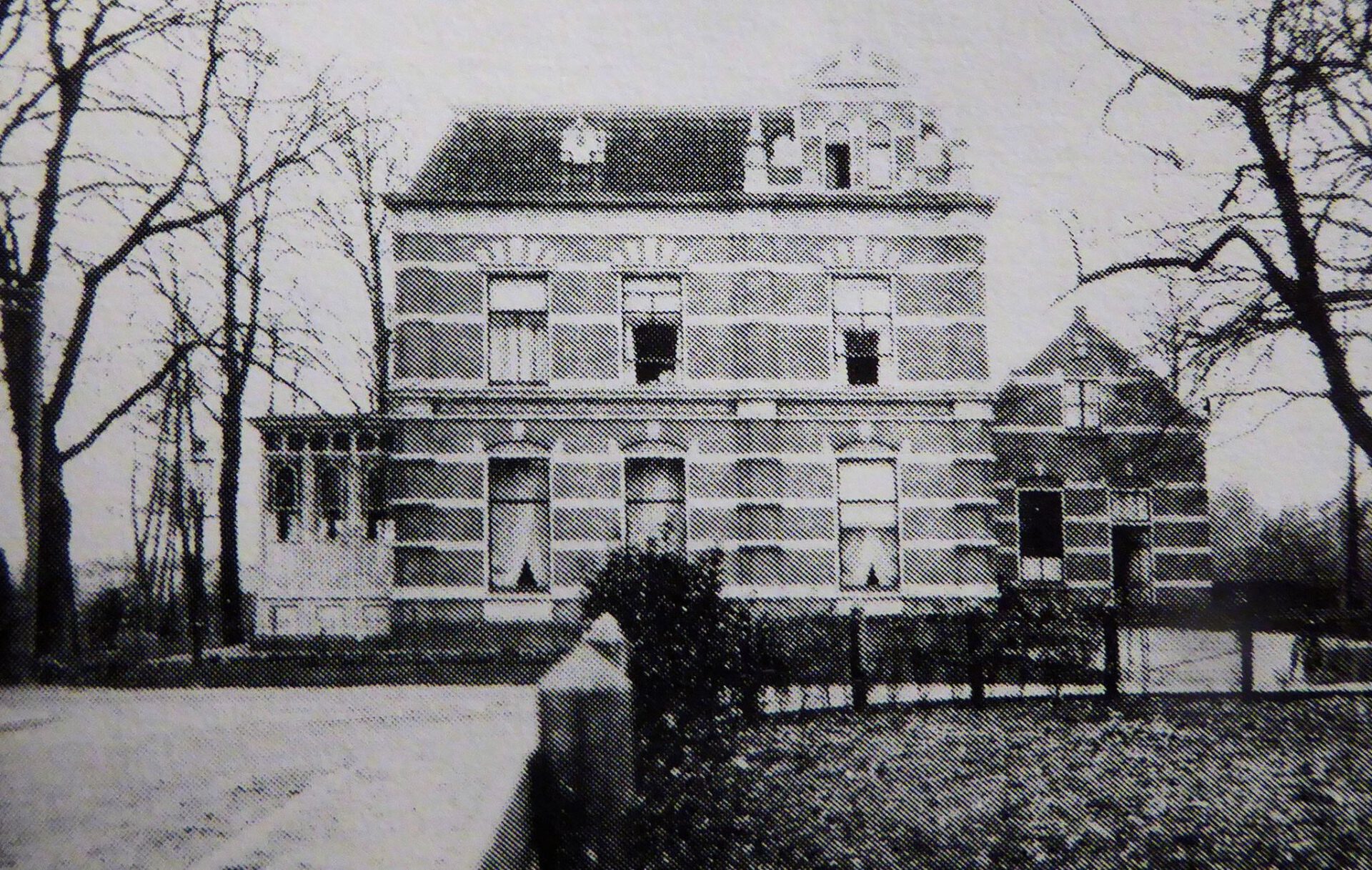
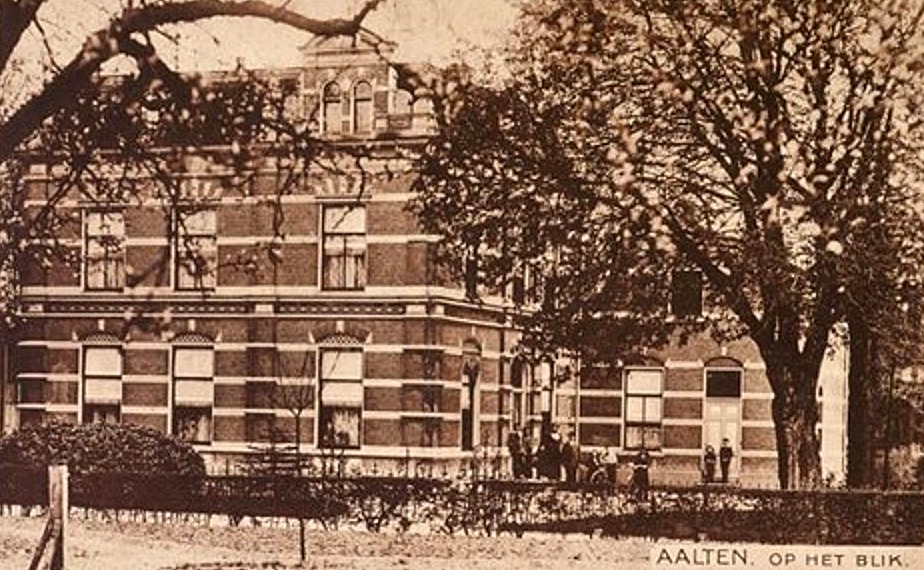
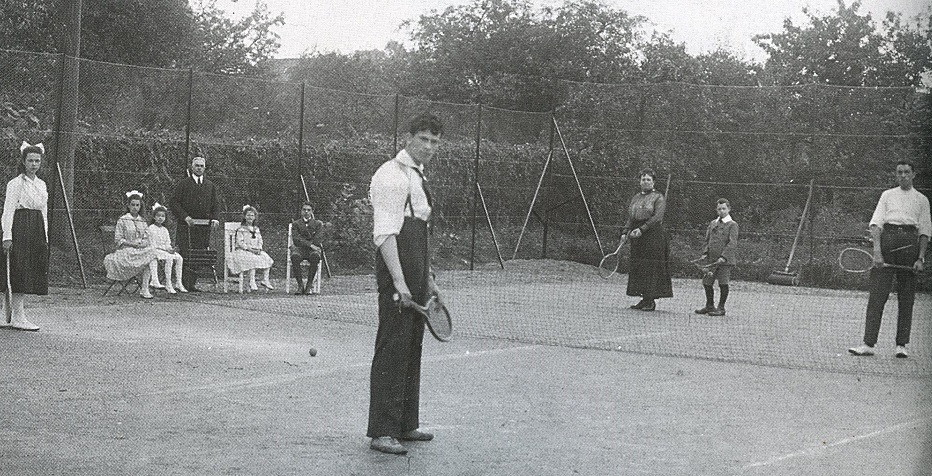
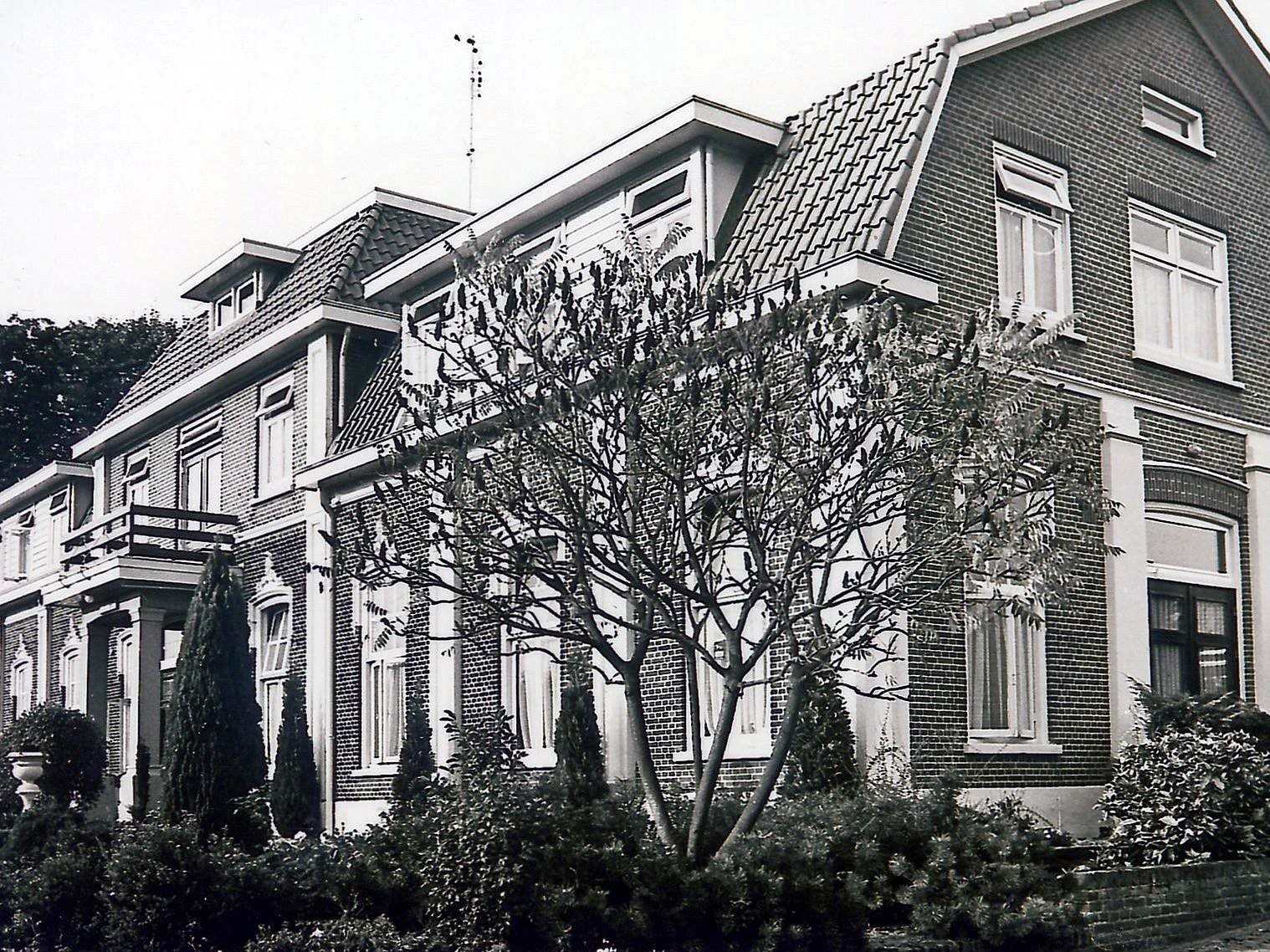
This director’s villa was built in 1893–1894 by textile manufacturer Herman Driessen, concurrently with the former steam weaving mill situated next door. In later years, the stately villa served as a foster home for Estinea for a long time. Behind the house once lay what was likely the first tennis court in Aalten.
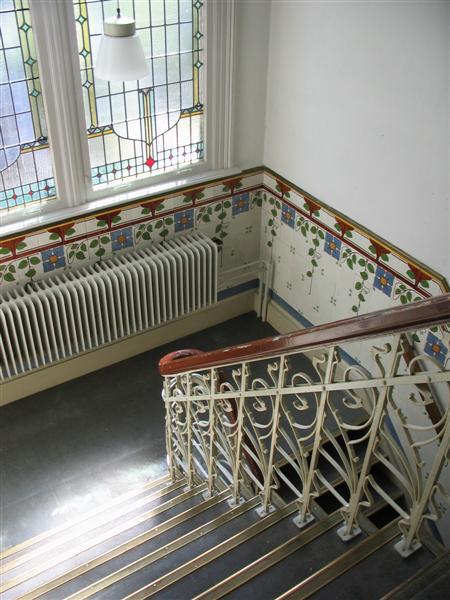
The villa is constructed in a Neo-Renaissance style and features 10 bedrooms across the first and second floors. It is a national monument and retains many monumental details, including a very fine staircase with original Art Nouveau-patterned tiles and various original stained-glass windows. This characteristic property is currently in private hands and is undergoing restoration.
In 2015, Jalf Flach wrote to Old Aalten:
“I recently rediscovered a text I wrote 25 years ago following an interview with Mrs Bella Driessen. In 1893, the Hofstraat was still called ‘Het Blik’, and in that year, a steam weaving mill and a house were erected there, which would be occupied by members of the Driessen family for the next 75 years. It was not until 1953 that the house was named ‘Beukenhof’ by one of its residents. But by then, the house already had an eventful history behind it.
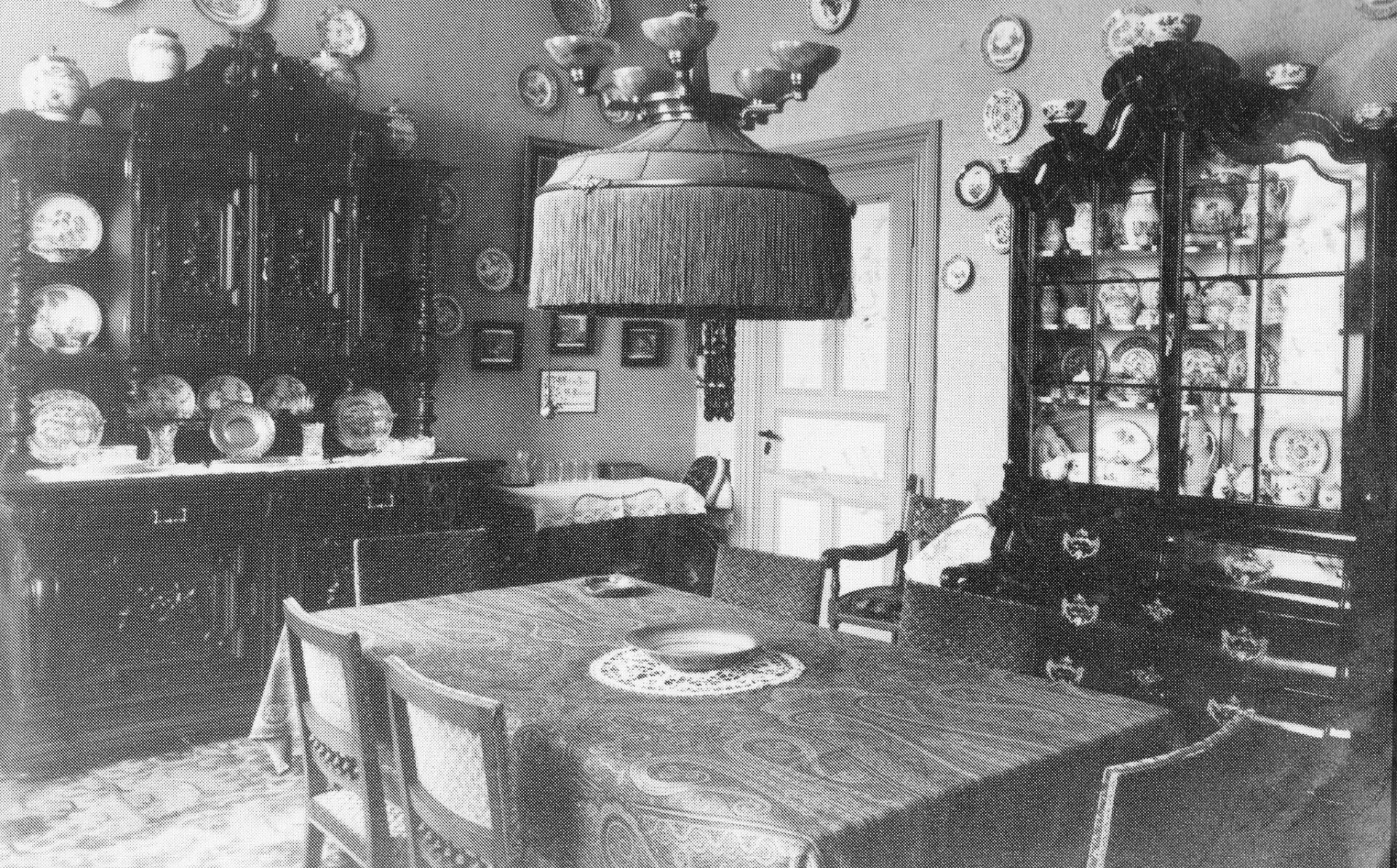
Bella Driessen lived in the house from her early childhood until 1969, when the factory closed and the house changed hands. That is a period of over 60 years. In those days, the Beukenhof was a true patrician residence, as is evident from the interior photograph she kindly lent me. In later years, she occupied the small house that had been built onto the main building, which, much to her sorrow, was demolished in 1976 when the house was converted into a foster home. That brought an end to what was colloquially and irreverently referred to as ‘Bella’s pimple’.
Mrs Driessen’s stories about the war years were fascinating. There were a couple of magnificent stained-glass windows in the stairwell. One depicted the weir on the Smees, and the other, the cathedral of Malmédy, from where her mother originated. After a German soldier had first shot through them because of a breach of blackout regulations, they were completely destroyed during a bombing raid on Aalten. For the remainder of the war, planks were nailed over them, and the residents, billeted German soldiers, and evacuees had to find their way in the dark.
After the war, simpler stained-glass windows were installed, which still adorn the staircase in an Art Nouveau style today and, together with the beautiful tiles and wrought-iron bannisters, give the building a unique character.”
Staircase (photo provided by Jalf Flach)Dining room (photo provided by Jalf Flach)1920. The Driessen family playing a game of tennis on what was likely the first tennis court in Aalten, behind the Beukenhof. (photo from “De Slinge(r)bal. 1946-1996. 50 years of Altec tennis club”)
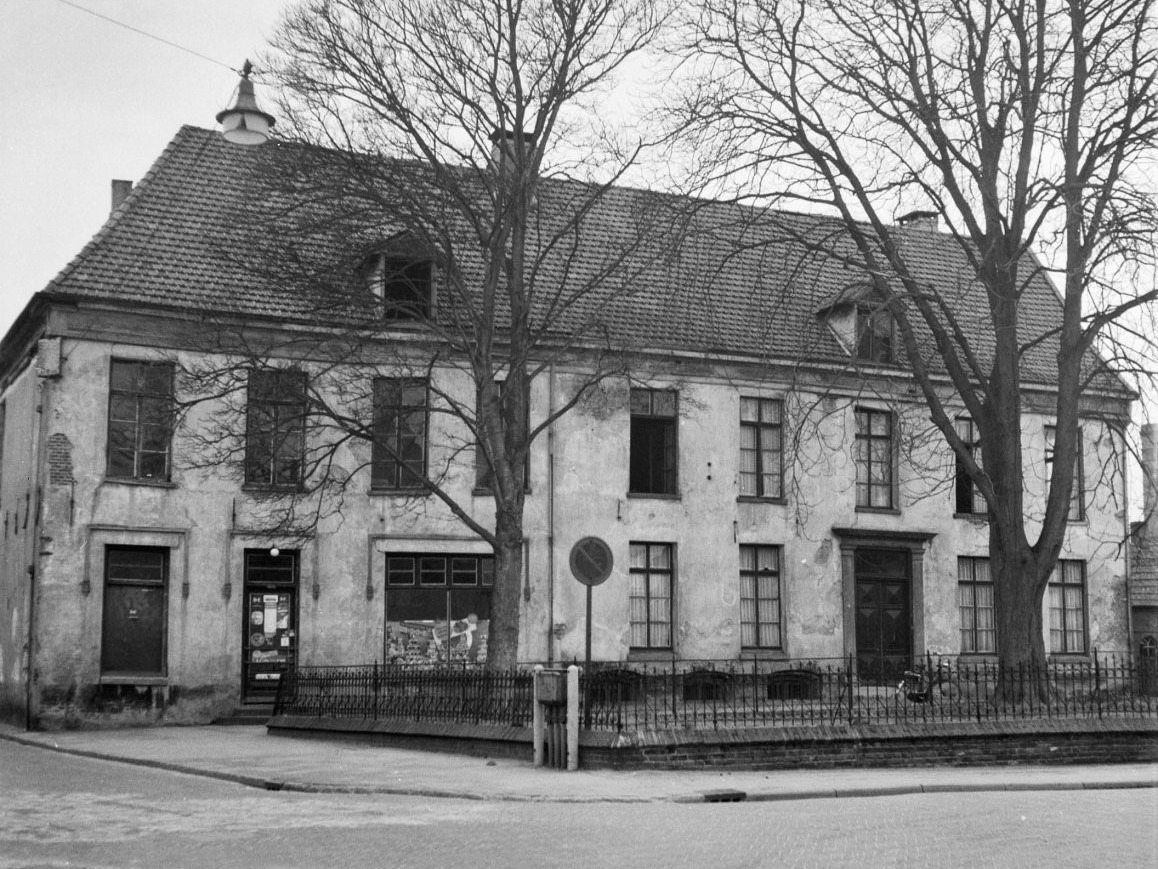
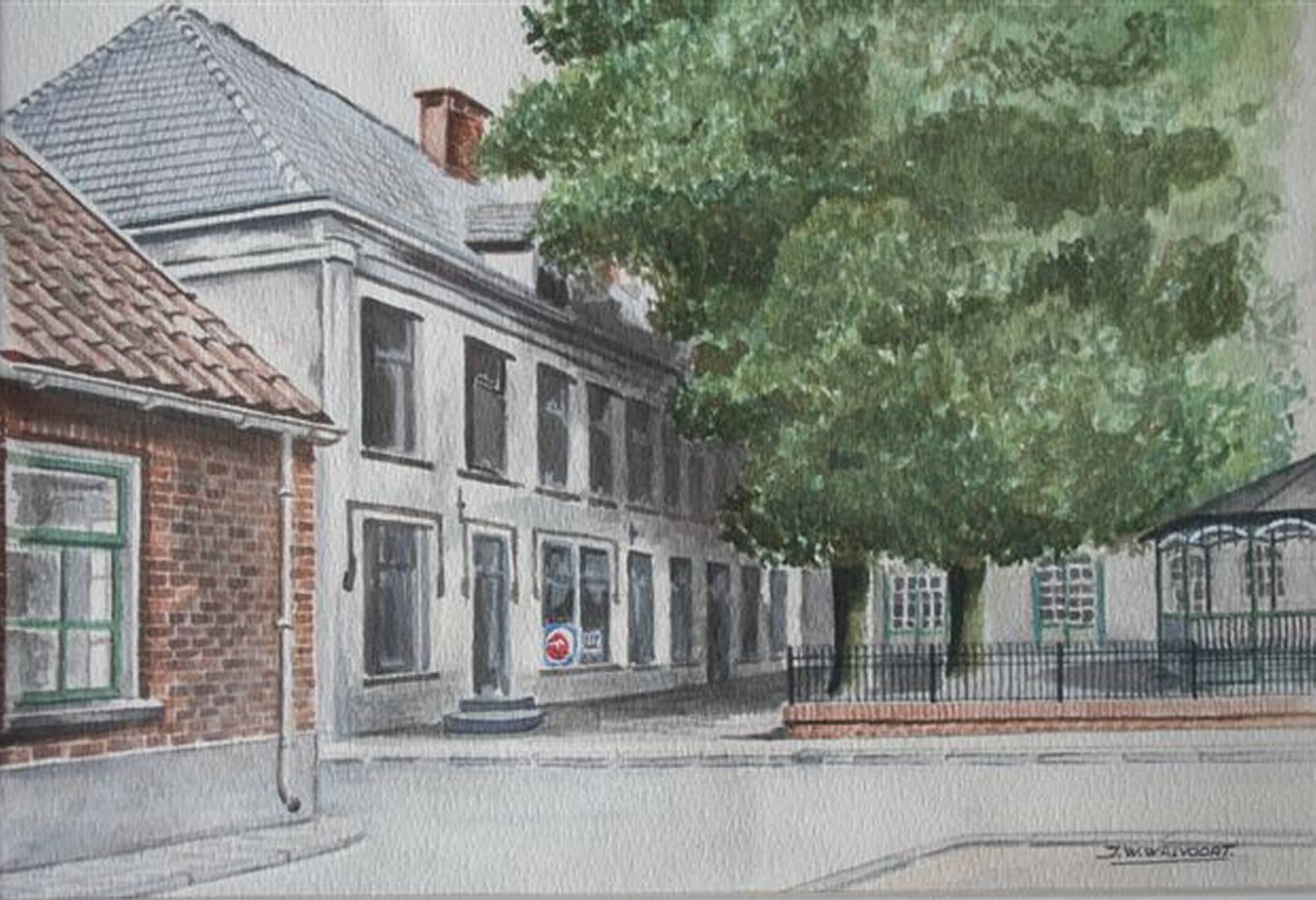
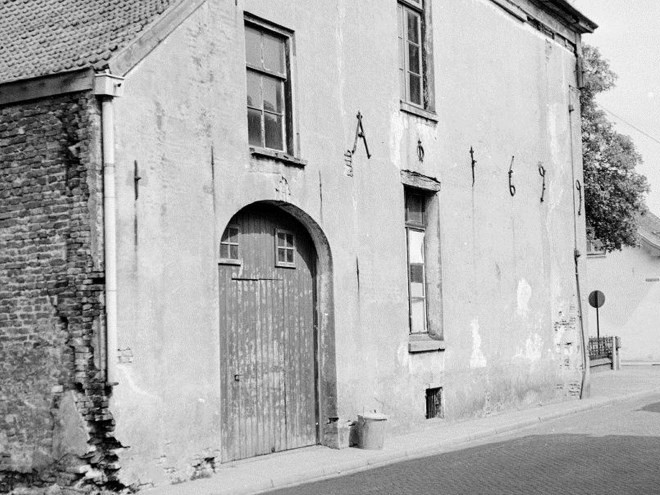
According to its wall anchors, the original Ambthuis (Administrative House) dated from 1699. For a century, it served as the centre of power for the Heerlijkheid (Lordship) of Bredevoort. The Ambthuis was also known as the Mauritshuis, as Prince Maurice had clearly left an unforgettable impression on the local inhabitants.
Chief Court
Following the gunpowder tower disaster of 1646, the town and lordship of Bredevoort had been left without an ambthuis (a building combining a courthouse and a town hall). It would take over fifty years before a new one was constructed. The building was likely connected to the Misterpoort, the city gate situated opposite the house. The building also served as the hoofdgerecht (chief court) of the lordship. While courts existed in Aalten and Winterswijk as well, serious offences were always tried in Bredevoort, with the drost (bailiff) presiding as judge.
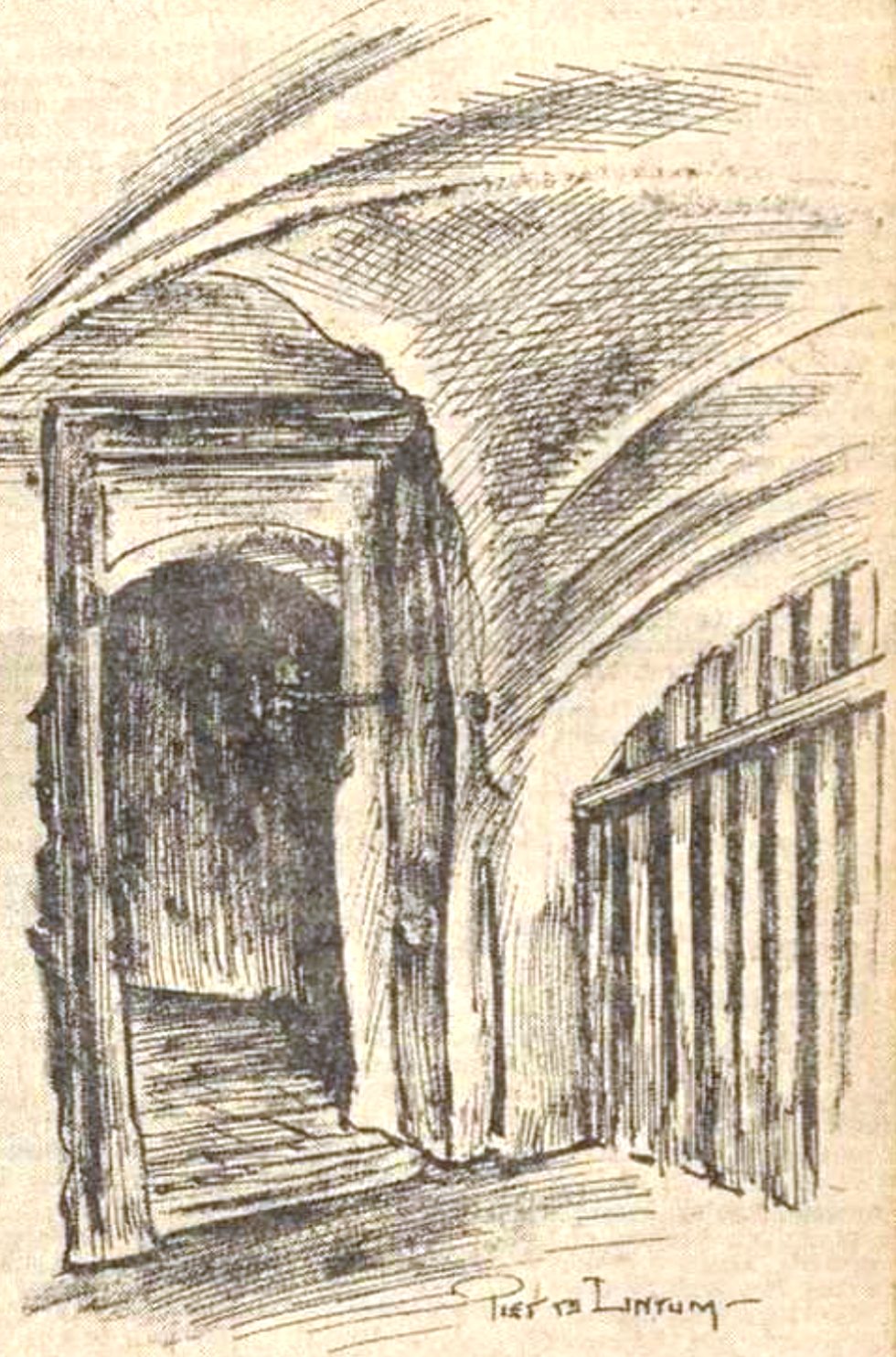
The cellars contained several dungeons (cachots), cells, and a torture chamber equipped with the necessary implements. Those sentenced to death were held in a cell devoid of daylight and fresh air. If a suspect refused to confess, the threat of the torture chamber was often enough to secure a plea of guilt. Sentences were traditionally pronounced on ’t Zand. In the case of a death sentence, the condemned was immediately taken to the Galgenbulte (Gallows Hill) on the Hollenberg for execution. Usually, this meant hanging from the gallows that had stood there for centuries, waiting for its victims. It is said that the gallows could be seen from the Aalterpoort. For the local population, such executions were a sensation, and people from all over Bredevoort and Aalten would turn out to witness the event.
Other Functions
After the French period, the building lost its original function and was used for various purposes, including as a shop for the Catholic cooperative. This cooperative was founded by the workers’ association in 1920. In the past, Catholics would frequent this shop, while those of other faiths would go to the other cooperative further down Landstraat.
The Ambthuis was demolished around 1963. The cellars of the Ambthuis, which included two prison cells, were still located beneath the shop. In 1964, the foundation stone was laid for the construction of the Betting furniture store on this site. This building was in turn demolished in 2009, after Betting moved to new premises on Prins Mauritsstraat.
New Construction
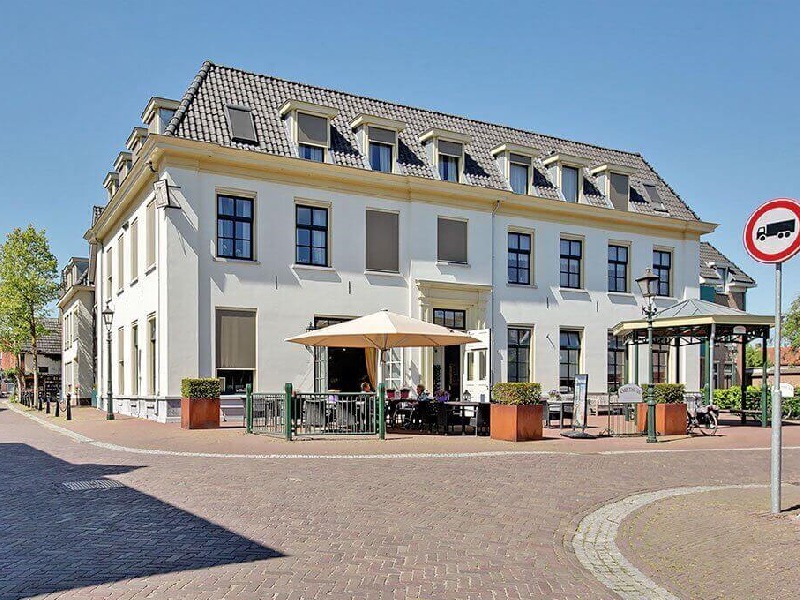
Today, the site of the old Ambthuis is occupied by a care apartment complex consisting of twenty apartments and a restaurant. The new building was again given the name ‘Ambthuis’. In terms of its exterior, the new building bears many similarities to its illustrious predecessor. A replica of the historic sundial was attached to the building, and a replica of the bandstand was placed in front of it. An original gable stone from the old Ambthuis was built into the front facade, bearing the inscription: “Die kan lide haet en nijt, die overwint in korten tijd” (He who can endure hate and envy, shall overcome in a short time).
Ambthuis Bredevoort, painted by Willy WalvoortLandstraat side of the old Ambthuis in Bredevoort, ‘Anno 1699’.Cellar of the Ambtshuis, drawing by Piet te LintumThe new ‘Ambthuis’ in Bredevoort
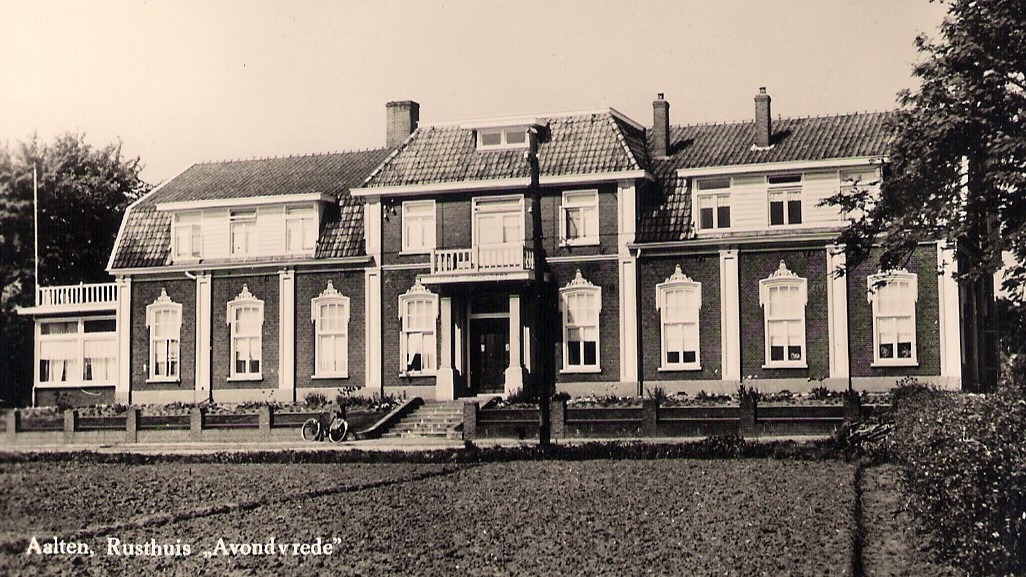
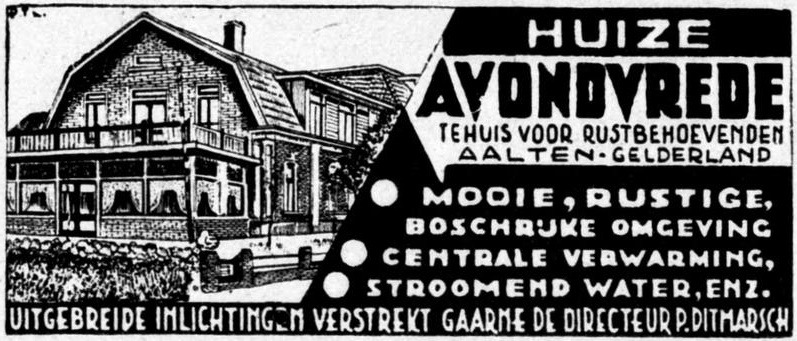
Avondvrede Rest Home on Hogestraat was opened in 1885 as the ‘Home for Elderly Men and Women’ of the Reformed Church in Aalten. Over time, the building served various functions: a nursing home, a temporary hospital, and later a group home. Today, the premises are used as a residential location by care provider Estinea.
The home was opened in October 1885 and was partly set up as a farm. Residents who were able to do so worked on the accompanying lands to provide for their own maintenance. Until 1904, the Reformed Church also managed a Guesthouse / Poorhouse on the former Gasthuisstraat (now Haartsestraat). In that year, its residents moved to the rest home on Hogestraat.
Hospital
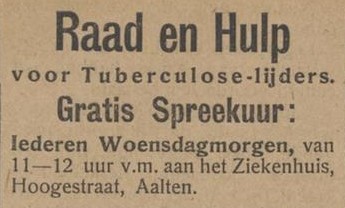
In 1904, the Dutch Reformed Association for Nursing was founded. A few years later, this association took the initiative to establish a hospital within the rest home. The hospital was opened in the course of 1909. It was intended for patients with non-contagious diseases, particularly acute conditions. Nursing costs ranged from f 0.80 to f 1.50 per day.
In the first year, twelve patients were admitted, four of whom passed away, totaling 166 nursing days. In 1910, there were eight patients with 222 nursing days, and in 1911, seven patients with 343 nursing days. The number of patients decreased in the following years, and the number of nursing days became significantly lower. In 1912, there were only 59 nursing days. The year 1915 still counted 134 nursing days, and 1916 only 35 with two patients. Data from the period thereafter is missing.
In the early 1930s, plans were again made to house a hospital in the rest home, but the crisis years made further implementation difficult. During World War II, the building functioned as an emergency hospital for a period of time.
From Avondvrede to ’t Hoge Veld
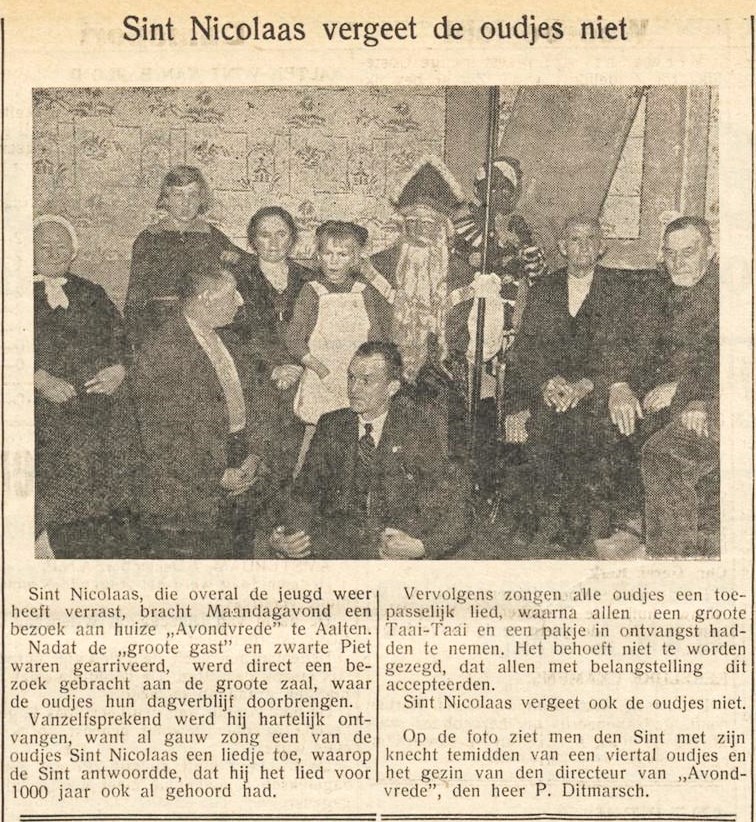
In 1935, the building was renovated and modernized and given the name ‘Avondvrede’. In 1967, the Reformed churches of Aalten, Bredevoort, and Lichtenvoorde jointly established the Reformed Foundation for Elderly Centers Aalten, later renamed the ’t Hoge Veld Elderly Center Foundation. The last residents of Avondvrede moved to the newly built ‘t Hoge Veld elderly center in Aalten in 1970.
Cederhof
After the departure of the elderly residents, the building was given a new purpose. On November 2, 1970, it was officially opened as a group home under the name Cederhof, the first residential facility in Aalten for people with intellectual disabilities. The building is currently used as a residential location by care provider Estinea.
Advertisement for ‘Huize Avondvrede’, by Piet te LintumAaltensche Courant, July 11, 1916De Graafschapper, December 8, 1937Residents of Huize Avondvrede, 1967
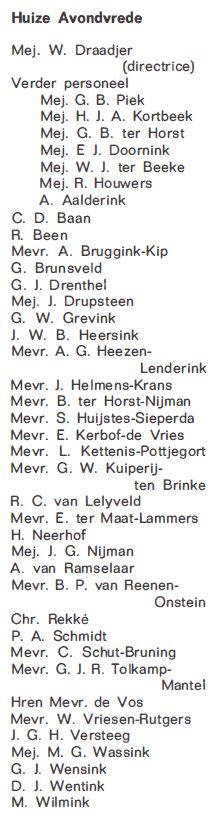
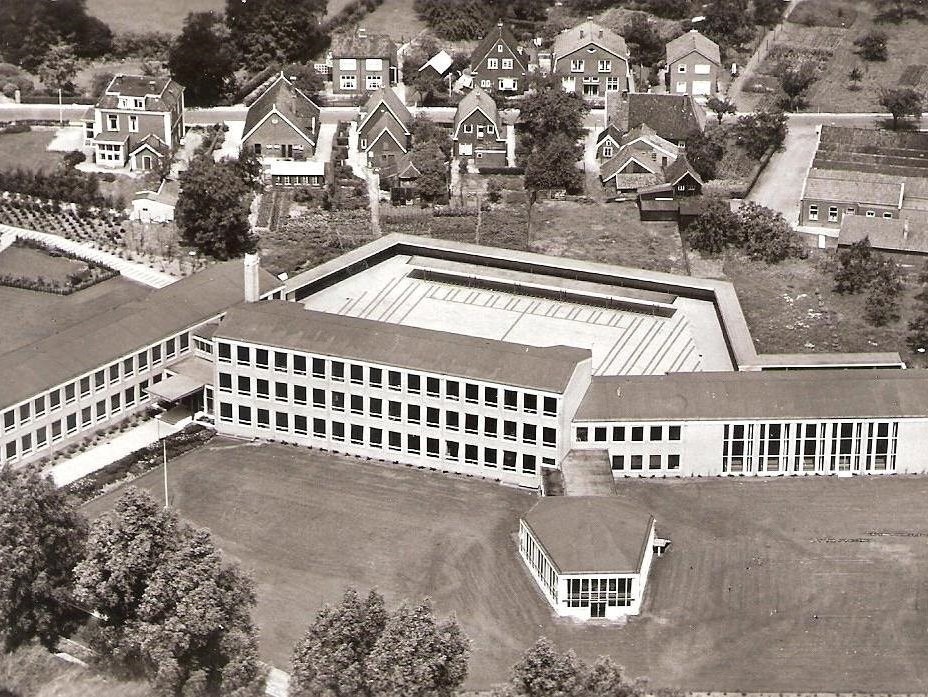
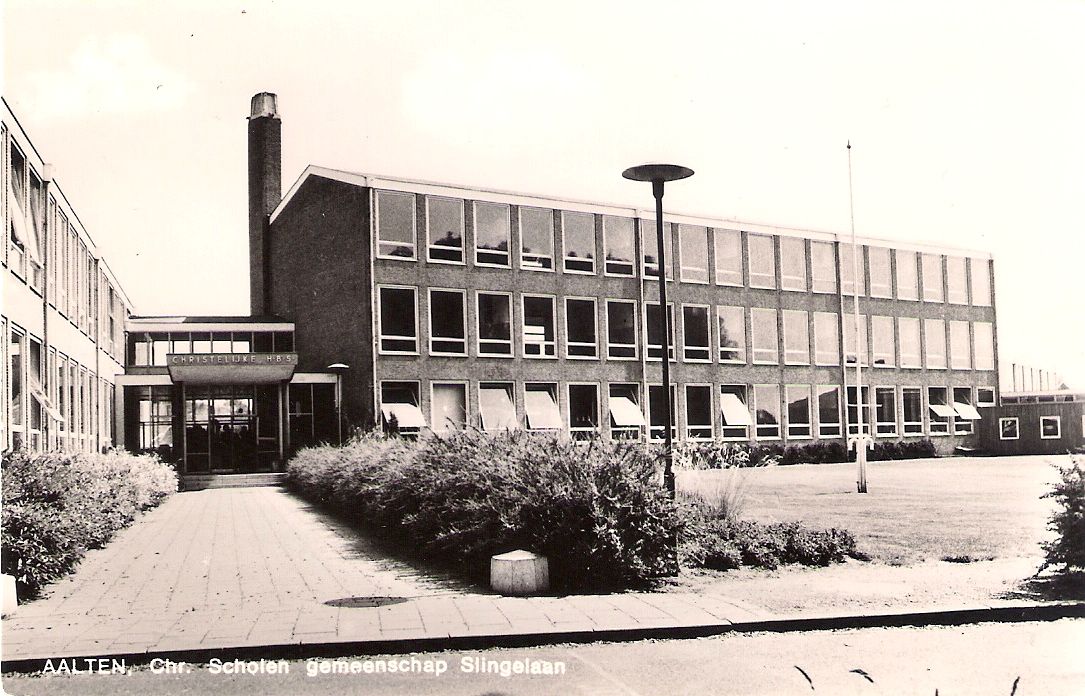
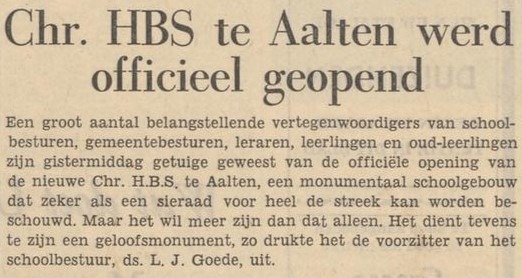
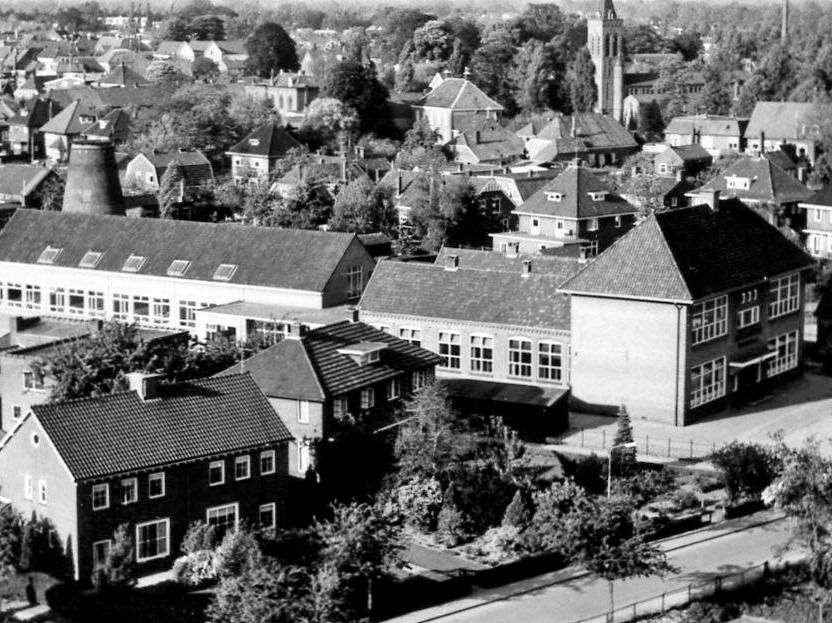
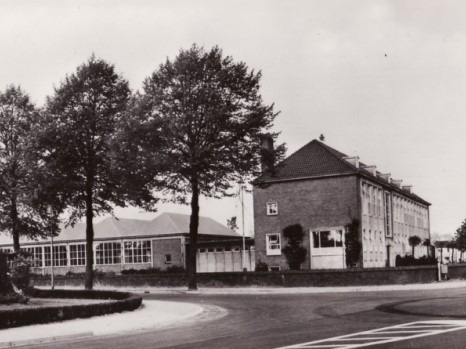
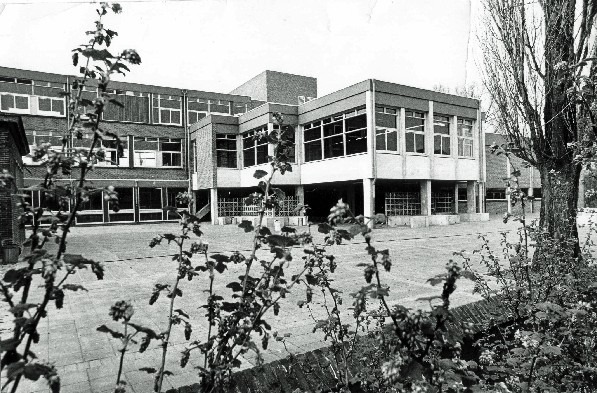
The Hogere Burgerschool (HBS) on Slingelaan in Aalten was opened in 1959. The school replaced the temporary accommodation on Haartsestraat and, from then on, provided a permanent home for Christian secondary education within the municipality.
De HBS in Aalten bestond sinds 1955, toen de eerste leerlingen hun intrek namen in het gebouw van de voormalige Huishoudschool aan de Haartsestraat. Voor die tijd waren christelijke HBS-leerlingen aangewezen op Arnhem of Zutphen.
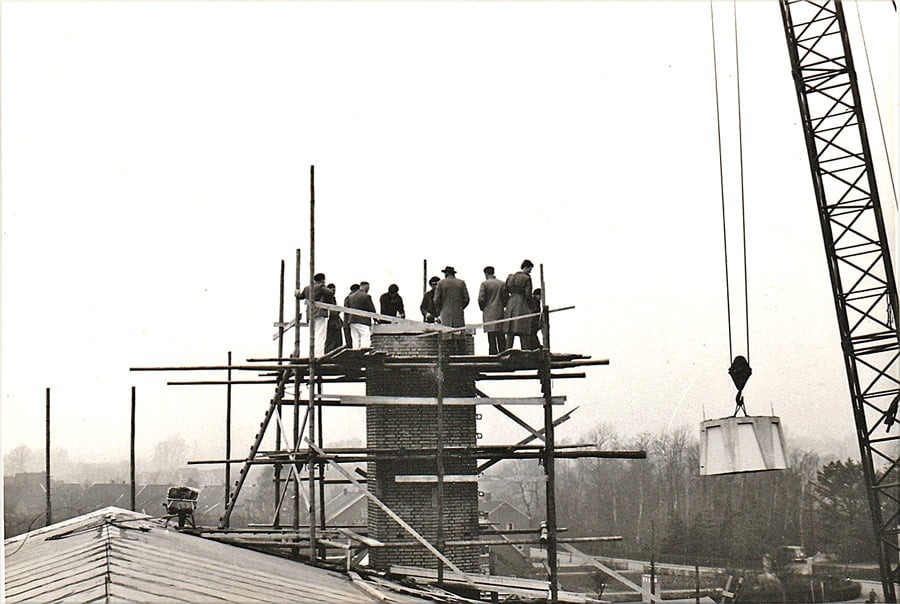
Construction on Slingelaan
De bouwkosten van de nieuwe school bedroegen circa ƒ 1.500.000. Een bijzonderheid was destijds dat de school op ruim 400 betonnen palen kwam te staan. De bodem van het terrein was nogal drassig omdat de Slingebeek er had gestroomd.
Architecture and Design
The building was designed in the so-called ‘shake-hands’ style: a business-like, sober architectural style in which modern materials such as concrete, natural stone, and glass were combined with traditional yellow brick.
De architecten waren Hendrik Geels (1903–1978) uit Arnhem en Willem Hebly (1908–1996) uit Aalten. Hebly had eerder in Aalten de Technische School aan de Ludgerstraat en de Landbouwschool aan de Lijsterbeslaan ontworpen.
The design comprised a three-storey central section, two wings of two storeys positioned almost at right angles, and a hexagonal canteen built partially below ground level. The entire complex was erected on a spacious plot, with bicycle sheds situated along the boundary.
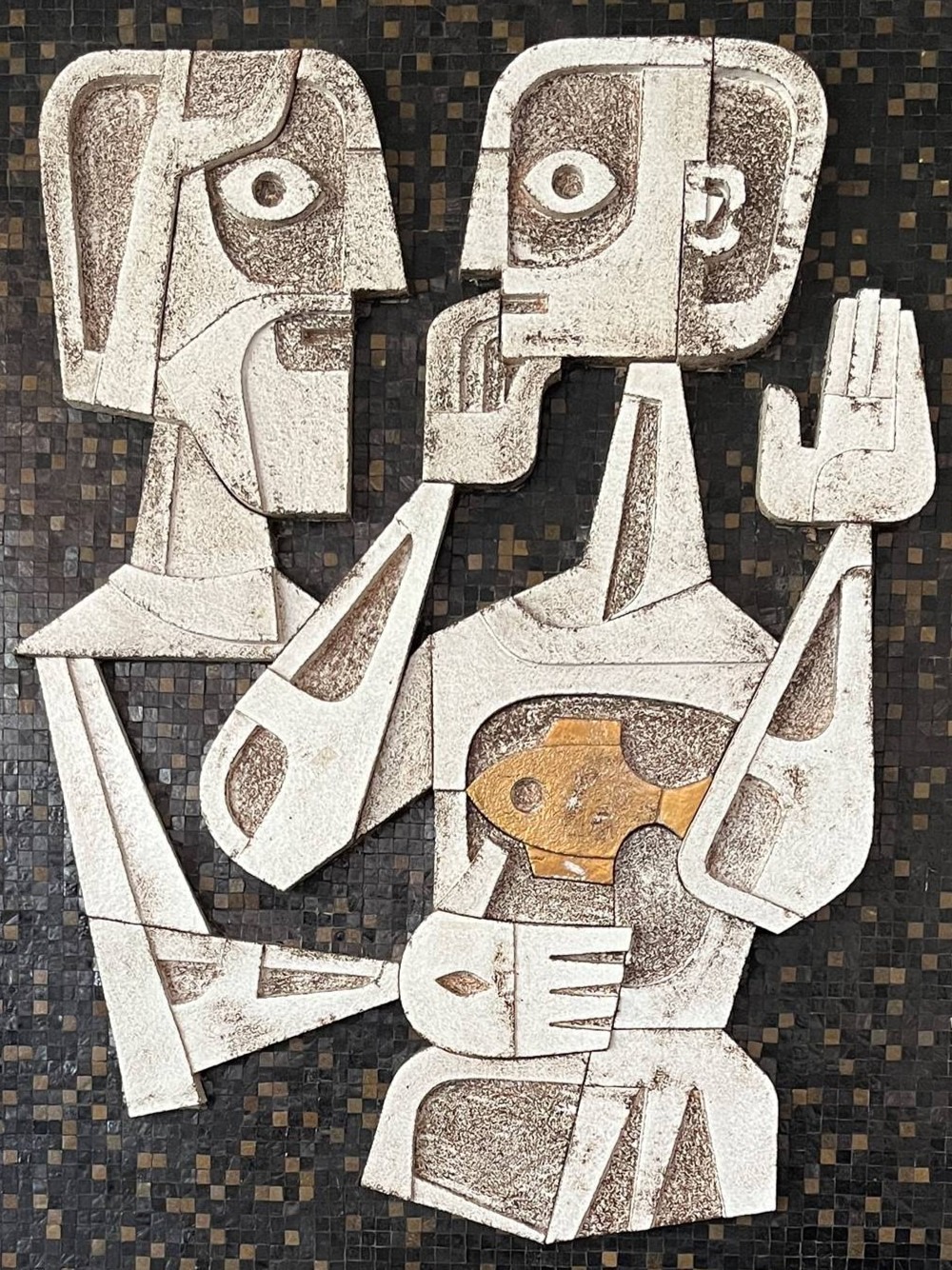
Inside, extensive use was made of fair-faced brickwork, and many floors are made of slate. The concrete skeleton is partially visible and painted. The classrooms feature steel pivot windows in wooden frames. Glass display cases are positioned between the classrooms and the corridors. Artworks in mosaic and relief were also added, including work by the art teacher Harry Dercksen.
Expansions followed in 1971–1972, 1995–1996, and 2001–2002, each carried out with respect for the original design.
Mergers and Educational Reform
In 1967 fuseerde de HBS met de MULO tot de Christelijke Scholengemeenschap Aalten (CSA). Een jaar later, in 1968, trad de Mammoetwet in werking. Daarmee verdween de term HBS en werd deze vervangen door HAVO en VWO.
School buildings from the post-war reconstruction period in the ‘shake-hands’ style are becoming increasingly rare. The building on Slingelaan is remarkable because it has remained highly authentic; subsequent renovations have hardly affected the original design. Furthermore, the building has always retained its educational function.
In 2025, the Gelders Genootschap advised that the school building be designated as a municipal monument. On 18 September 2025, the Environmental Quality Committee of the Municipality of Aalten also issued a positive recommendation. It is now up to the municipal council to make a final decision.
Construction of the HBS on Slingelaan in full swingDagblad Tubantia, 19 November 1960Relief by Harry Dercksen (Photo: Roy Oostendorp, Gelders Genootschap)
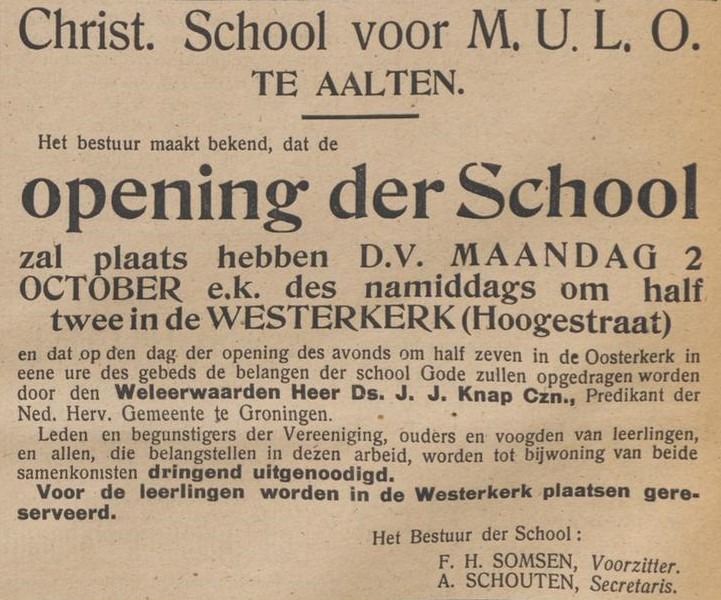
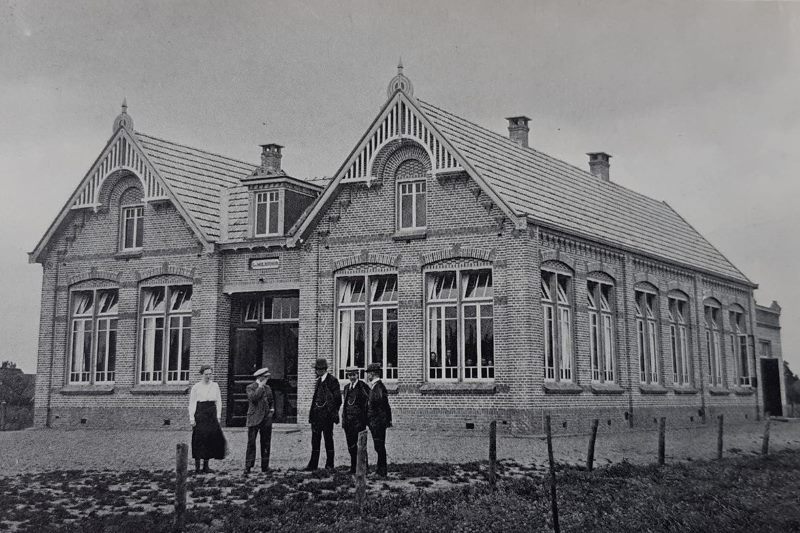
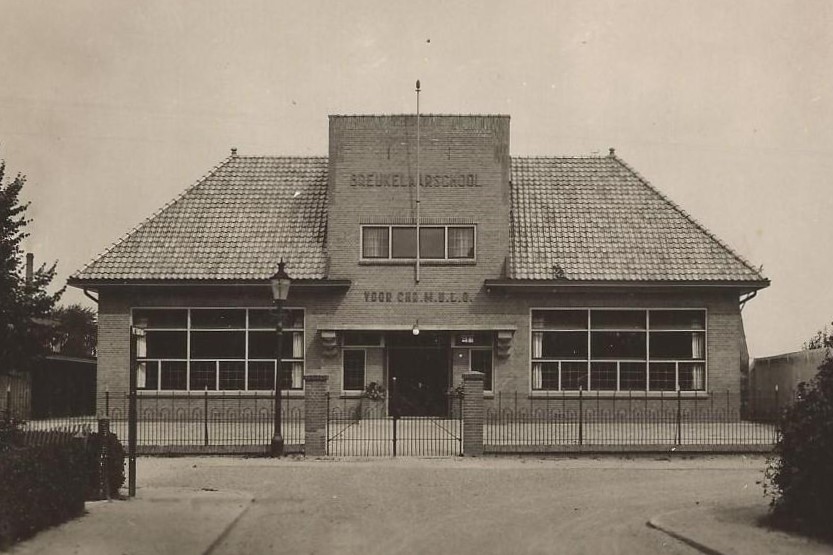
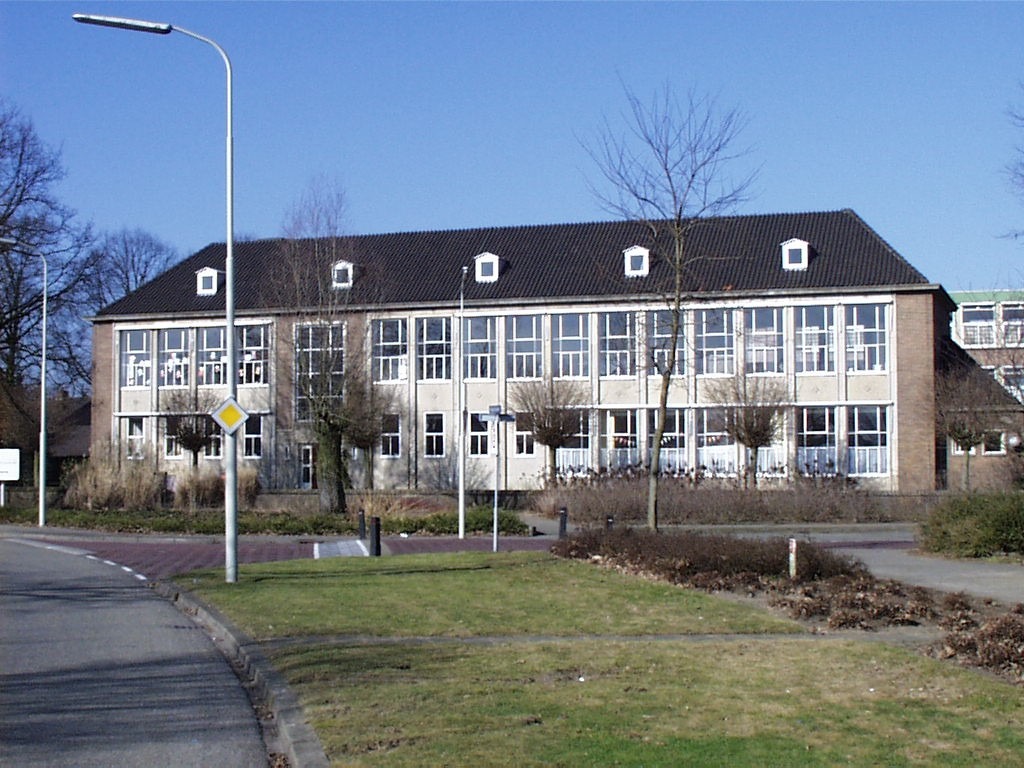
The Christian MULO in Aalten was established in 1916 in the so-called Tackshuis and moved into a new building on Stationsstraat, known as the Breukelaarschool, in 1918. In 1967, the school merged into the Christelijke Scholengemeenschap Aalten (CSA) and eventually became part of Schaersvoorde. The building has since been converted for residential use.
The first lessons of the MULO (Meer Uitgebreid Lager Onderwijs — Junior Secondary Education) were held in the Tackshuis on Gasthuisstraat (now Haartsestraat).
The school’s first headteacher was Adriaan Jacobus van Oosten, who served from 1916 to 1921. When he and his family arrived in Aalten, neither a school building nor a residence was available. The family was temporarily housed in the gravedigger’s cottage near the cemetery on Varsseveldsestraat, moving shortly thereafter to the upper floor of the Tackshuis.
The school began its first year with six classes and 36 pupils, a number that exceeded all expectations.
New Construction on Stationsstraat
It soon became clear that a dedicated building was necessary. A plot of land on Stationsstraat was purchased for approximately 1,400 guilders from Messrs Smits Sr. and Bulten, in an area then known as ‘Het Rot’. A new school building was erected here, with its front facing Piet Heinstraat.
The school was named the Breukelaarschool, after Rev. Johannes Breukelaar, a pioneer of Christian education in Aalten and son of Rev. Derk Breukelaar. In June 1918, Rev. Breukelaar himself performed the official opening.
Expansions and Changes
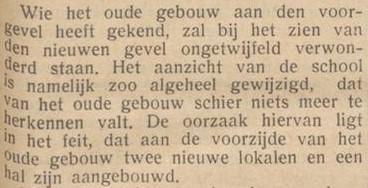
In 1933, the school building was extended on the street side with two classrooms and a hall. Later, the building was completely transformed and modernised again. During this process, an upper storey was added to the main building on the street side.
Mergers and Educational Reform
In 1967, the MULO merged with the HBS to form the Christelijke Scholengemeenschap Aalten (CSA). A year later, in 1968, the Mammoetwet (‘Mammoth Act’) came into effect, replacing the term MULO with MAVO.
In 1993, the CSA merged with the other secondary schools in Aalten—the Christelijke Scholengemeenschap Langenhave and the Technical School—to form Christelijk College Schaersvoorde. Around 2006, the school moved to a new building on Landbouwstraat.
Repurposing
By the turn of the century, the building no longer met modern standards. Along with the former LTS and domestic science school, it was decided to build a new VMBO school on Landbouwstraat.
Following the completion of the new school—the “Stationsplein location”—around 2006, the main body of the building on Piet Heinstraat was converted into four apartments. The original section at the rear was demolished and replaced by a new rear extension. A small residential square, named Breukelaarplein, was created on the land behind the building as a tribute to the founder of Christian MULO education in Aalten.
De Graafschapper, 26 September 1916The Breukelaarschool shortly after opening in 1918, with the staff.The ‘Christian Mulo School’ following the first expansion in 1933. Nieuwe Aaltensche Courant, 1 December 1933
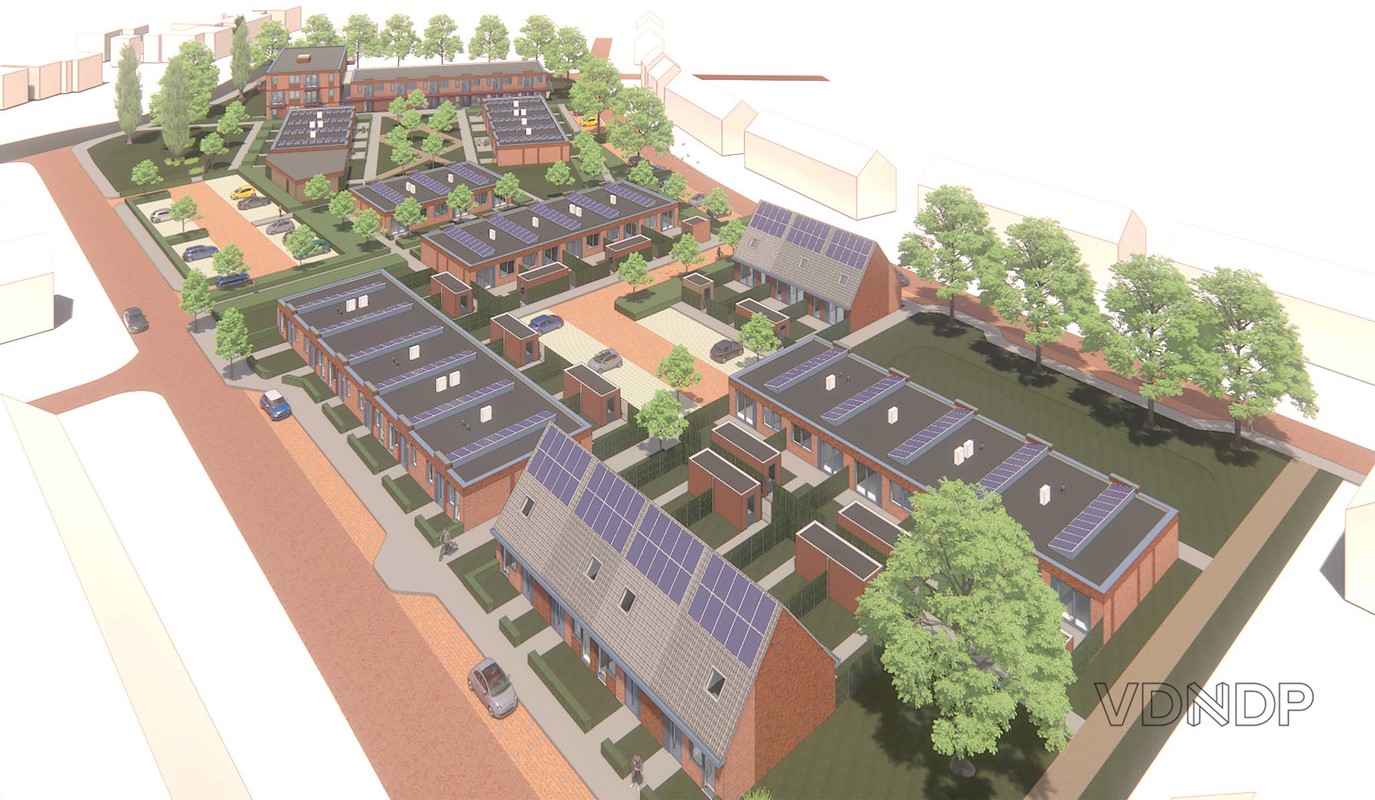
The Christian Technical School on Polstraat in Aalten was officially opened in 1955. The striking building, designed by Aalten architect Wim Hebly, provided Junior Technical Education (Lager Technisch Onderwijs or LTS). It was demolished in 2007; in 2023/2024, a complex containing 56 social housing units was erected on the site.
On 8 December 1948, the first general meeting of the Foundation for Christian Vocational Education in Aalten took place. In September 1950, permission was granted to establish a technical school.
The first lessons were held in the former gasworks on Bredevoortsestraatweg, which housed the carpentry and machine benchwork departments. At that time, the number of pupils stood at 55. Theory lessons took place in classrooms at the Christian MULO (junior secondary school) and the Dutch Reformed School.
Moving to a Dedicated School Building
On 19 December 1950, the Municipality of Aalten made 4,000 m² of land on Polstraat available. In 1951, theory lessons were moved to the Irene building. In 1952, the Ministry of Education approved the sketch plan for a new school building designed by Wim Hebly. The tendering process followed in 1953.
Construction began on 5 November 1953 and included two practical classrooms, a construction shed, two theory classrooms, a drawing room, an auxiliary gymnasium-cum-canteen, and offices for the headteacher, staff, and administration. The official opening took place on 10 June 1955.
Stained-Glass Window
A notable feature of the school was the stained-glass windows, created in 1955 by the Amsterdam glazier Jan Ooms (1915–1975) in close collaboration with architect Hebly. Ooms was known for his use of bold colours and modern techniques.
When the school was demolished in 2007, the windows were salvaged. Following restoration, they were given a new home in the central hall of Christelijk College Schaersvoorde in Aalten.
Expansions
In 1956, preparations began to expand the school as the duration of the course was extended from two to three years. A new classroom plan was drawn up for this purpose. In the following years, further practical and theory classrooms were added.
Merger and Demolition
In 1993, the Technical School merged with the other secondary schools in Aalten—the Christelijke Scholengemeenschap Aalten (CSA) and the Christelijke Scholengemeenschap Langenhave—to form Christelijk College Schaersvoorde. Around 2006, the school moved to a new building on Landbouwstraat, near the railway station. The old complex on Polstraat was demolished in 2007.
The site remained vacant for a long period until a new-build project comprising 56 social housing units was completed in 2023/2024.
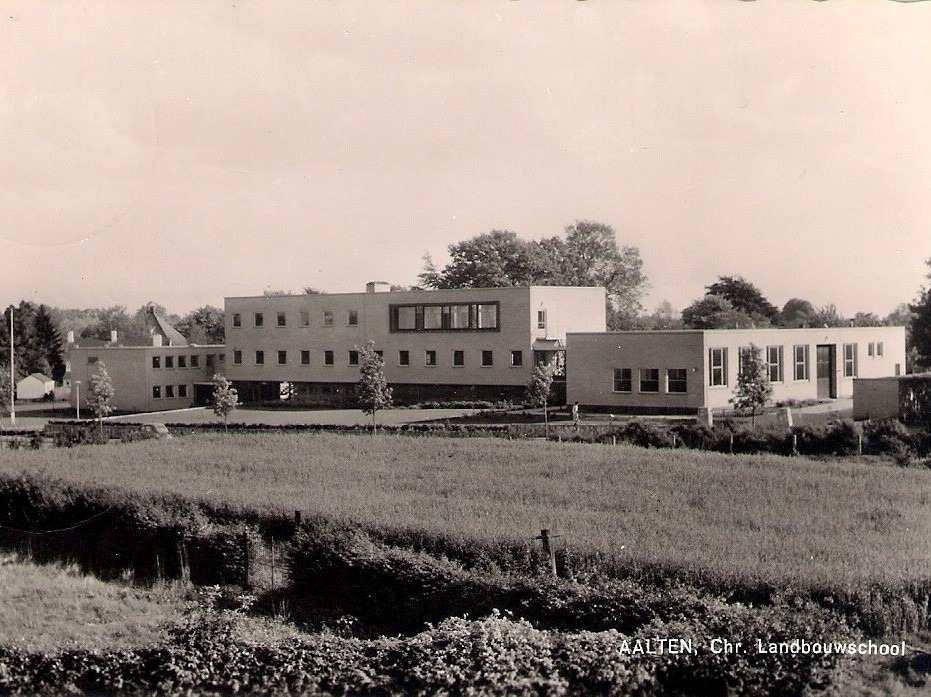
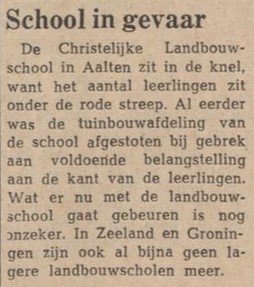
The Christian Junior Agricultural and Horticultural School in Aalten was opened on 5 September 1962. The school was designed by the Aalten architect Wim Hebly. At the time, it was the flagship of the Ministry of Agriculture; the school was frequently visited by foreign guests brought in from The Hague.
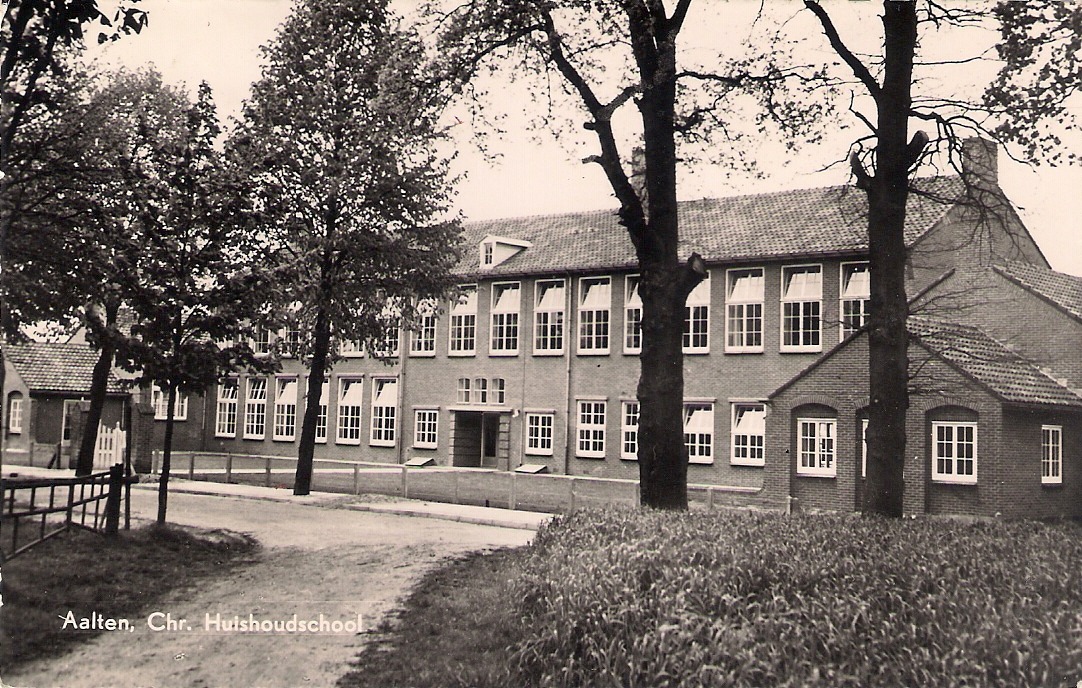
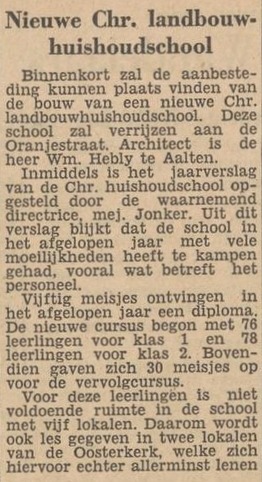
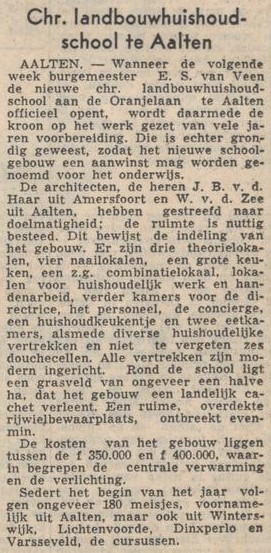
For decades, the Huishoudschool (Domestic Science School) on Oranjelaan in Aalten served as a training centre for girls in domestic duties. The building was constructed in 1956 and officially opened in the summer of 1958.
The domestic science school in Aalten had existed since 1928, but in 1958 it moved into its new premises at Oranjelaan 7. The old building on Haartsestraat, where the school was previously located, was subsequently vacated and used temporarily by the Hogere Burgerschool (HBS).
Education and School Life
The school was officially known as the Christian Agricultural Domestic Science School and was popularly referred to as the Oranjeschool.
The new building offered considerably more light and space than its predecessor. Large windows with wooden glazing bars ensured that the classrooms were flooded with light. Practical rooms were equipped for cooking, laundering, and ironing, featuring what was modern equipment for the time, including both electric and gas cookers.
Pupils received instruction in various domestic tasks. Anatomy lessons were also provided, given by figures such as Dr Knol. Great emphasis was placed on cleanliness and discipline. Outside Miss Jonker’s room stood a so-called “punishment bench”; if she opened her door, you had to explain exactly why you were sitting there.
Over the years, the curriculum evolved to include vocational training such as INAS (Institutional Assistant), KVJV (Child and Youth Care), LEAO (Junior Economic and Administrative Education), MDGO (Intermediate Service and Healthcare Education), and AW (General Education).
Architecture
The 1956 school building was characterised by its tall windows and a functional layout that complemented the practical nature of the education provided. The bright, airy feel of the classrooms was typical of the architectural style of that period.
Mergers and Succession
Over time, the domestic science school evolved alongside broader educational developments. In 1989, the school merged with the Agricultural School to form the Christelijke Scholengemeenschap Langenhave. In 1993, this institution joined other secondary schools in Aalten to become part of Christelijk College Schaersvoorde.
Repurposing
After its educational function ceased, the building was given a new purpose. In the twenty-first century, the complex was converted into a residential development containing eight apartments. Five homes are situated in the main building, while three single-storey dwellings were created in the wings to the left and right. During this process, the characteristic facades with their tall windows were largely preserved.
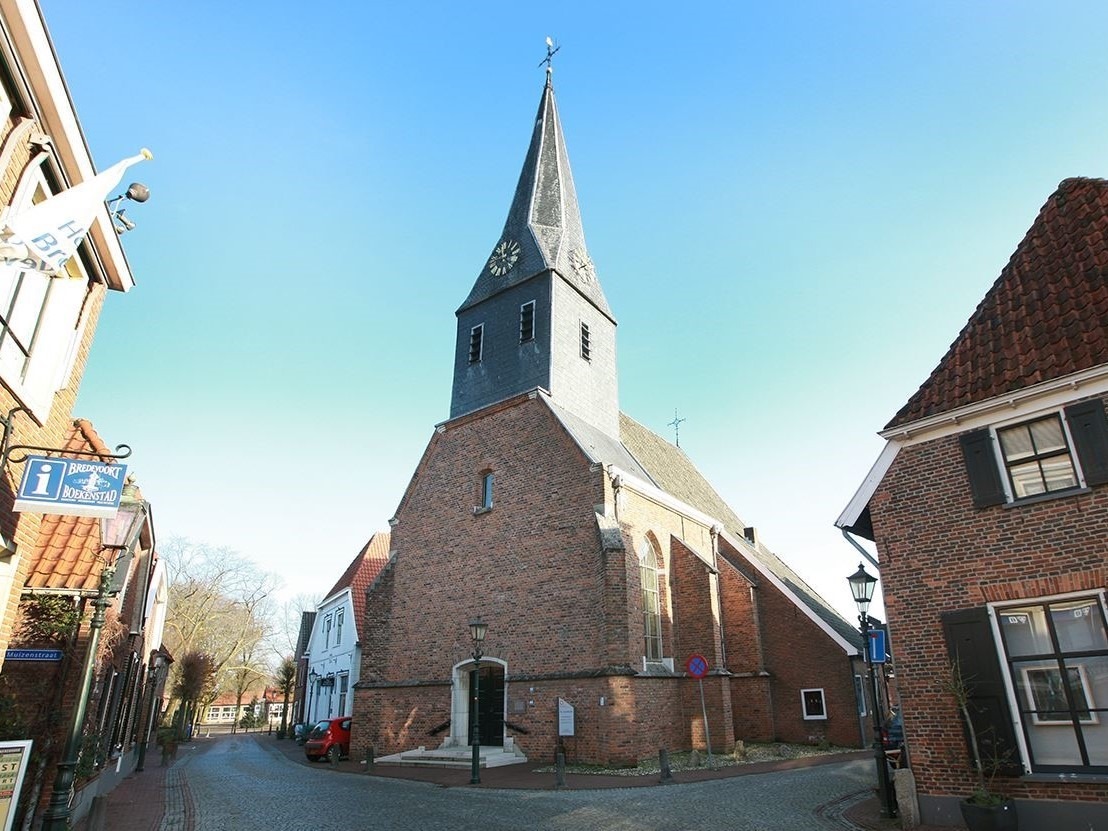
The Sint-Joriskerk (Saint George’s Church) is a late-Gothic church in Bredevoort, the foundations of which date back to 1316. The church is dedicated to Saint George, the patron saint of the borgmannen (castellans) of Bredevoort. A characteristic feature is the tower’s finial: a statue of Saint George and the Dragon instead of a traditional weathercock. On the east side of the church, there is a so-called ‘melaatsenraampje'(leper window). In earlier times, worshippers with contagious diseases used this window to follow the mass.
Early History
The oldest foundations of the church date from 1316, and the building may have served as a chapel for the castle of Bredevoort in its earliest years. During the Siege of Bredevoort in 1597 by Prince Maurice, the old (and larger) church burned down completely, and the vaults collapsed. The following year, the people of Bredevoort submitted a request to the classis of Zutphen to build a new church: “Die van Bredeforts soln met request an desen quartier verzoekcken assistentie tott reaparatie hearder Kapellene” (Those of Bredevoort shall request assistance from this quarter for the repair of their chapel). Reconstruction in the Gothic style began in 1599.
Expansions
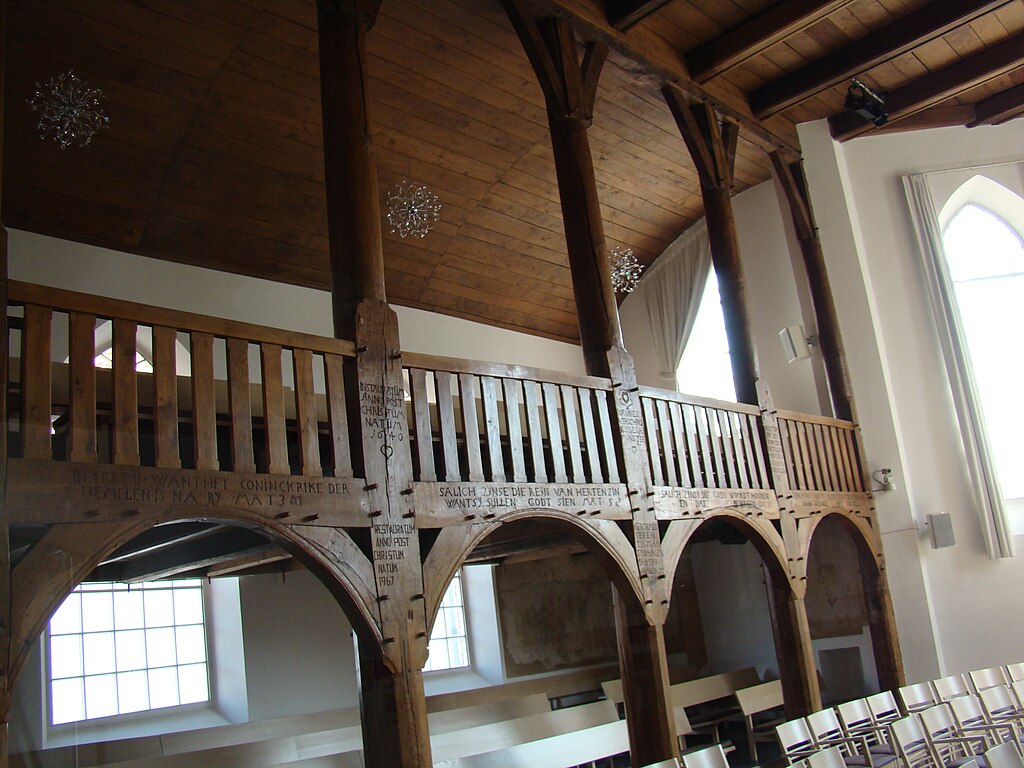
Following the reconstruction, the church underwent various expansions. In 1600, after another fire, a tower was added. In 1639, the chapel was enlarged and broken out on the north side. Using the same stones, the wall was rebuilt several metres further out. Later expansions followed in the form of the boerenzolder (farmers’ loft) and the orgelzolder (organ loft). This extension, including the loft, is clearly visible. Biblical proverbs are inscribed in the beams of the farmers’ loft, such as: “Salich zijn se die rein van herte zin want sij zullen Godt zien” (Blessed are the pure in heart, for they shall see God).
Powder Tower Disaster of 1646
On 12 July 1646, lightning struck the castle’s powder tower. The resulting explosion destroyed a large part of the town, and forty people were killed. The castle was turned into a ruin, and the church also sustained significant damage. Eleven victims, including the Drost of Bredevoort, his wife, and eight of their children, were buried in the choir (the eastern part of the church).
The church was rebuilt, though smaller than its predecessor. In 1672, Captain Satink donated a Rococo pulpit featuring his family coat of arms, as well as a copper lectern bearing the arms of the Holy Roman Empire.
Renovations
The church has undergone various renovations over the centuries. During the French period, features such as a wooden vault and a floor of Bentheimer sandstone were added. The church also received new pews, and the floor level was raised. In 1832, the church pews were painted white.
In 1849, the wooden plank ceiling was replaced with a lime ceiling. In 1858, a catechism room was added, for which King William III donated 200 guilders. The walls of the church were re-plastered in 1868, and this plaster layer was removed again during the restoration of 1949. In 1869, the tower was repaired. In 1882, five stained-glass windows were replaced by cast-iron ones. Three years later, two more cast-iron examples were installed in the farmers’ loft.
In 1889, the catechism room was extended with an annex. During a thorough renovation in 1896, the façade received new doors, a rose window, two small gable windows, and an iron cross. The commemorative stone is now placed on the inside of the wall of the organ loft. In 1920, the spire was renewed.
Post-War Restorations
After the Second World War, the church was in poor condition. Following a large-scale restoration, the church was put back into use in 1967. During a restoration in 2006, the subsided gravestones and the natural stone floor were repaired. It was discovered that a number of the stones had been laid upside down, likely during the French period; these have since been properly repositioned. During the work, several historical finds were made, including coins, human remains, and stained glass. Furthermore, a stone from the Republic of the Seven United Netherlands was found.
Research revealed that two of the stones that had been laid upside down belonged to the Bredevoort Drost, Wilhelm van Haersolte, and his family. They perished along with almost all their children during the powder tower disaster of 1646. Only their son, Anthony, had survived the disaster. In 2010, his descendants donated 3,000 euros to the restoration committee.
Bells and Clock
The Sint-Joriskerk houses three bells. The oldest, a monumental klepklok (chiming bell) from 1454, was borrowed from the Schaer Monastery in 1596. After the monastery was destroyed during the siege of 1597, this bell remained in the church. Wilhelm van Haersolte tot Elsen donated the brandklok (fire bell), cast in 1644. The luidklok (ringing bell) dates from 1731 and, according to old tradition, is rung daily at 8:00, 12:00, and 21:00. Historically, the town gates were opened at 8:00 and closed at 21:00, and 12:00 was mealtime.
In 1942, the church received a new clockwork. The old clockwork from 1666 will soon be on display in the Sint-Joriskerk again. In 1980, the small carillon of three bells was reinstalled.
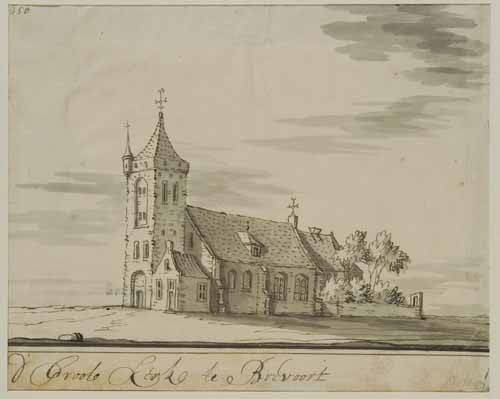
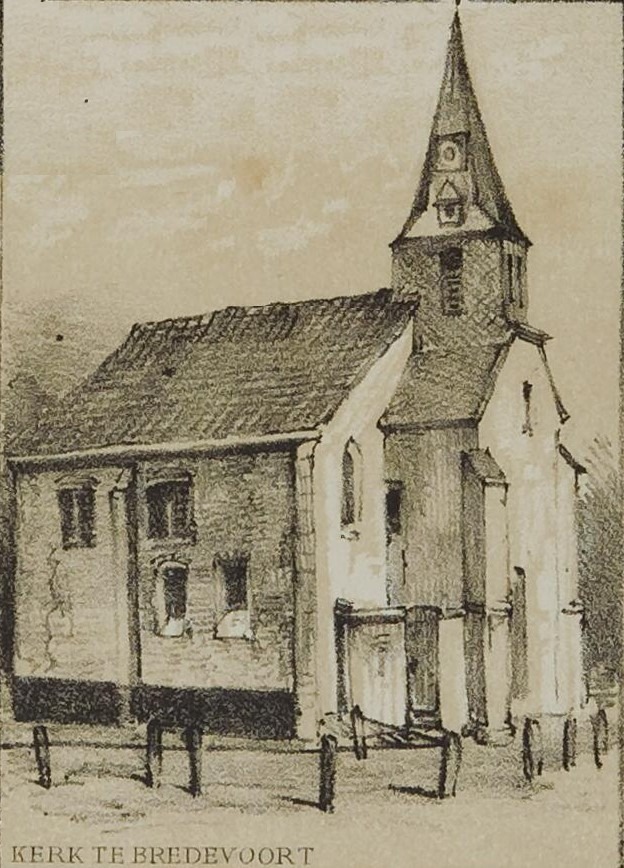
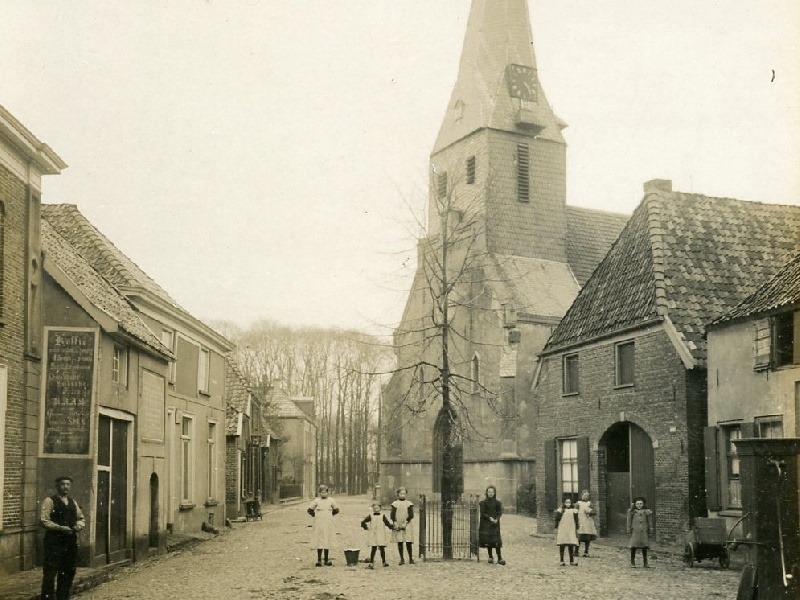
The great church of Bredevoort, 1687, bu Jacobus Stellingwerff (source: Gelders Archief)Saint George’s Church in the 19th century, then still plastered, by P.A. Schipperus (source: Gelders Archief)Market square in Bredevoort with St George’s Church, c. 1912Farmers’ loft
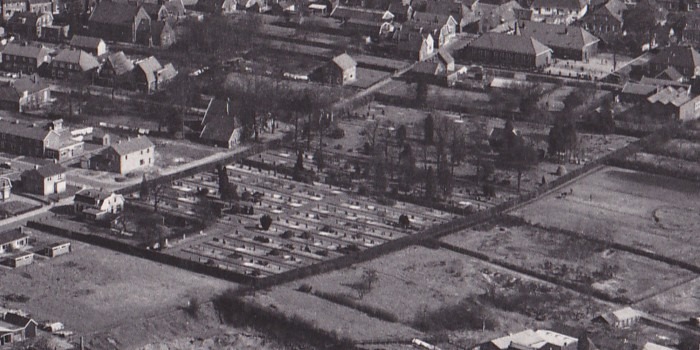
In 1827, King Willem I decreed by law that, as of 1829, cemeteries had to be established outside built-up areas. In Aalten, a site was designated for this purpose on Varsseveldsestraatweg, then known as Melkersweg.
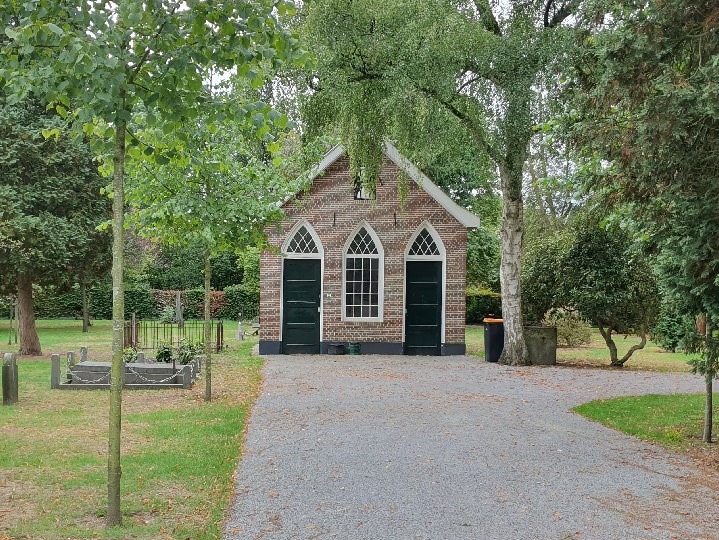
The cemetery was later extended to the west. The oldest section is characterised by relatively empty lawns with scattered old funerary monuments and a small lychgate (baarhuisje). The western part has a more structured, orthogonal layout.
Begin 20e eeuw raakte de Oude Begraafplaats steeds meer omsloten door de oprukkende bebouwing van het dorp. Dit leidde tot de behoefte aan een nieuwe begraafplaats. In 1923 werd begraafplaats Berkenhove aan de Romienendiek in gebruik genomen.
Although the Old Cemetery has since taken on the function of a ‘tranquillity park’, it is still sporadically used for interring the deceased in existing family graves.
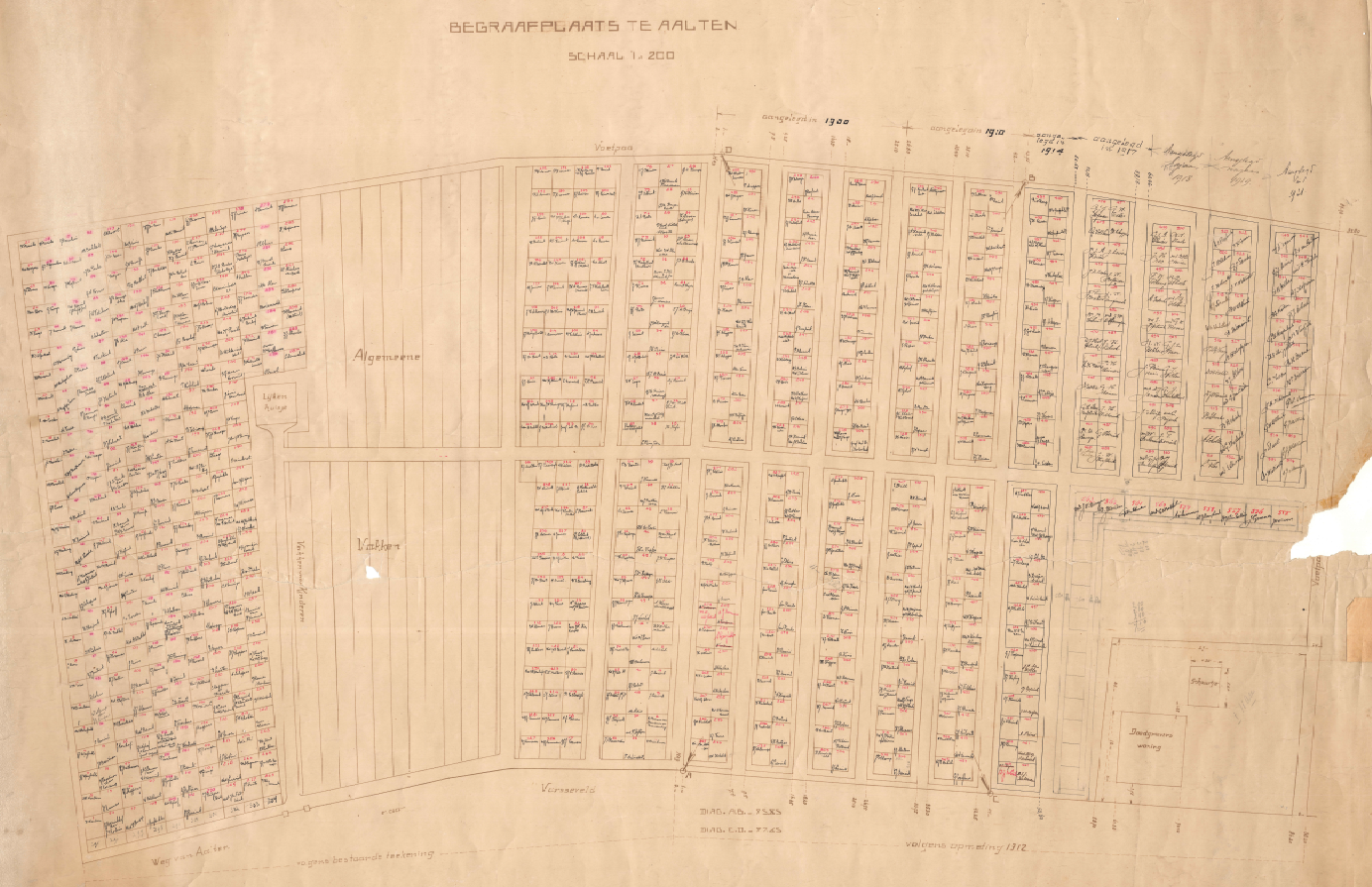
A map is available providing an overview of all graves and those interred from circa 1921; click the thumbnail below for a large, legible version (PDF):
Old General Cemetery Aalten, 1921
Commemorative Column
In het kader van 70 jaar bevrijding werd in 2015 op de Oude Begraafplaats een gedenkzuil geplaatst ter herdenking aan alle Aaltense soldaten die in mei 1940 op en rond de Grebbeberg hebben gevochten. Zeven Aaltense militairen verloren daarbij het leven. Hun namen en foto’s zijn op de gedenkzuil vereeuwigd.
Roman Catholic Cemetery
When the cemetery on Varsseveldsestraatweg was established, the Catholic community in Aalten insisted that a separate section be designated and consecrated for them. The municipality purchased a piece of land for this purpose across the street, on the corner with Molenstraat.
Deze kleine katholieke begraafplaats raakte echter al na dertig jaar vol. In 1868 werd een nieuwe R.K. begraafplaats aan de Piet Heinstraat in gebruik genomen. Het voormalige katholieke begraafplaatsje aan de Varsseveldsestraatweg kreeg later de functie van plantsoen. De graven van ten minste 50 Aaltense katholieken zijn echter nooit geruimd.
In 2015, the site was redesigned at the initiative of local residents to better reflect its historical significance. An information panel has been placed at the location highlighting the history of the cemetery.
Owners
Overview is incomplete.
Year
Plot
Owner
Description
1832
I-1409 I-1436
The Municipality of Aalten
4.430 m² (Protestant) churchyard 720 m² (R.C.) churchyard
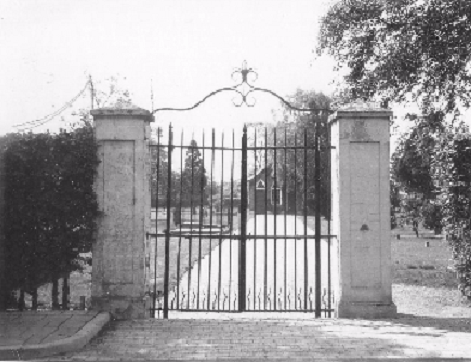
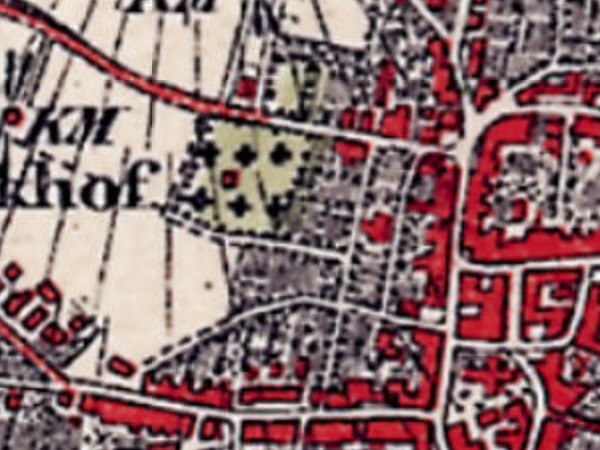
In the late 1860s, the small Roman Catholic cemetery on the corner of Varsseveldsestraatweg and Molenstraat reached its capacity. This created a need for a new cemetery for the Catholic community in Aalten.
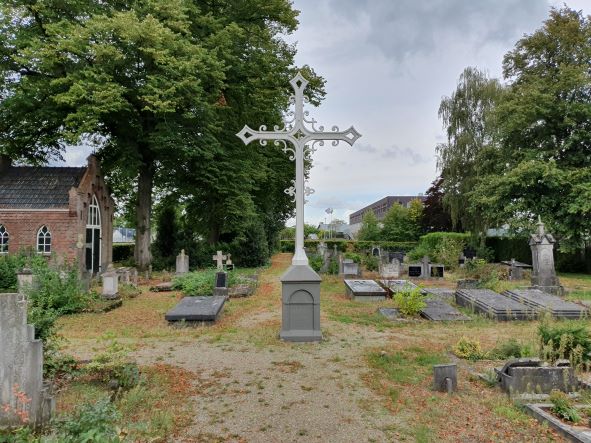
In 1868, Anton Driessen, a textile manufacturer in Aalten, donated a plot of land on what is now Piet Heinstraat to the church to be established as a cemetery. In addition to the land, he donated an iron Calvary cross and an iron gate, both of which still stand today. Anton also stipulated that his family be buried in a contiguous plot next to the cross. The mortuary on the cemetery grounds dates from 1888.
Lack of space and closure
A century later, this cemetery also became full, and there was no room for expansion. From 1960 onwards, Catholic deceased were therefore buried in the new Roman Catholic section of the Berkenhove cemetery.
In the early 1970s, the cemetery on Piet Heinstraat was officially closed. The site was transferred to the municipality of Aalten for the symbolic amount of one guilder.
Notable graves
Several prominent Catholic former residents of Aalten rest in this cemetery, including various members of the Driessen textile family. This family is inextricably linked to the textile history of Aalten and had a major influence on the emancipation of the Roman Catholic population in the municipality.
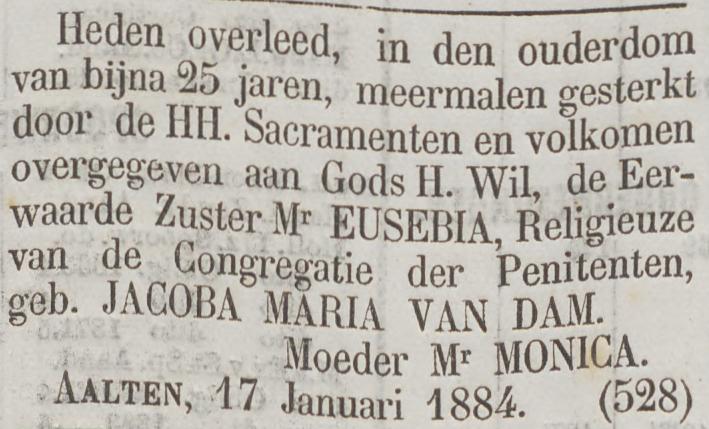
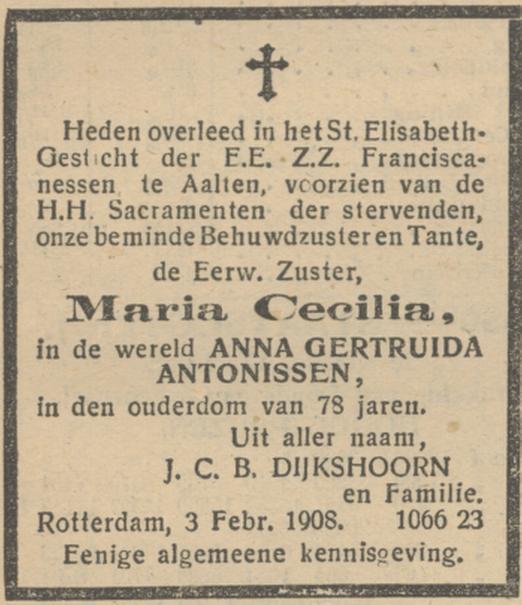
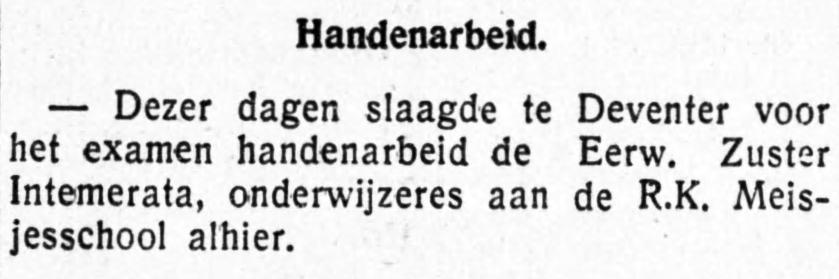
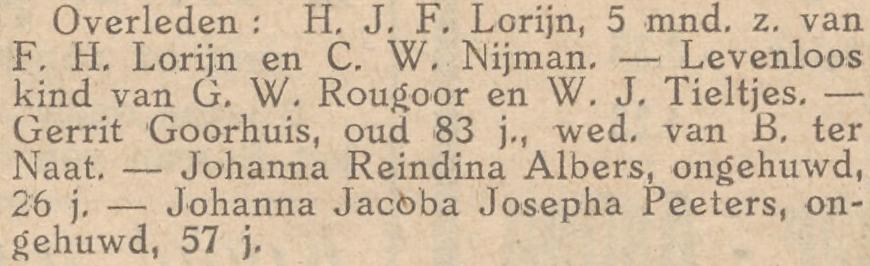
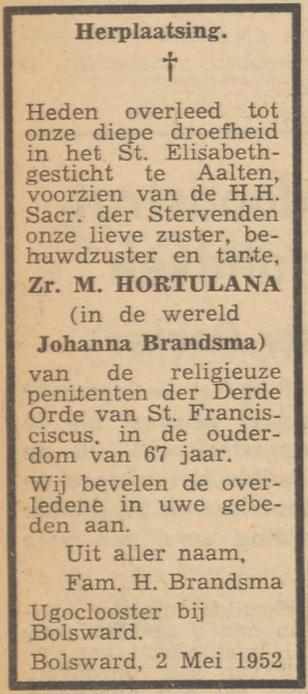
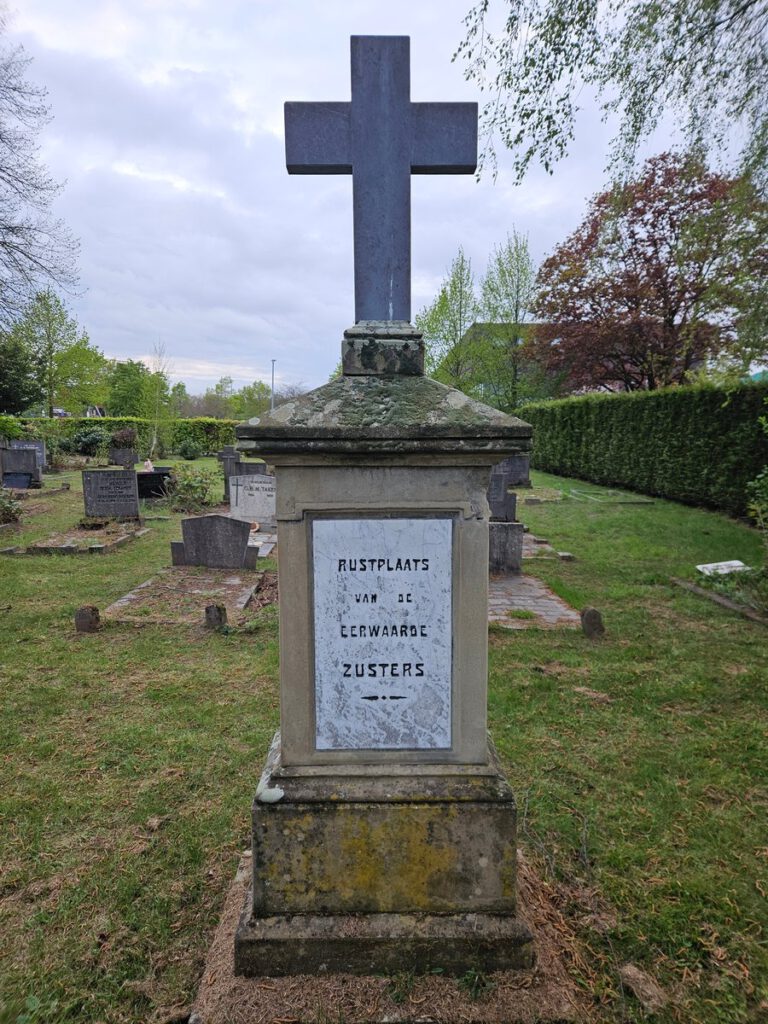
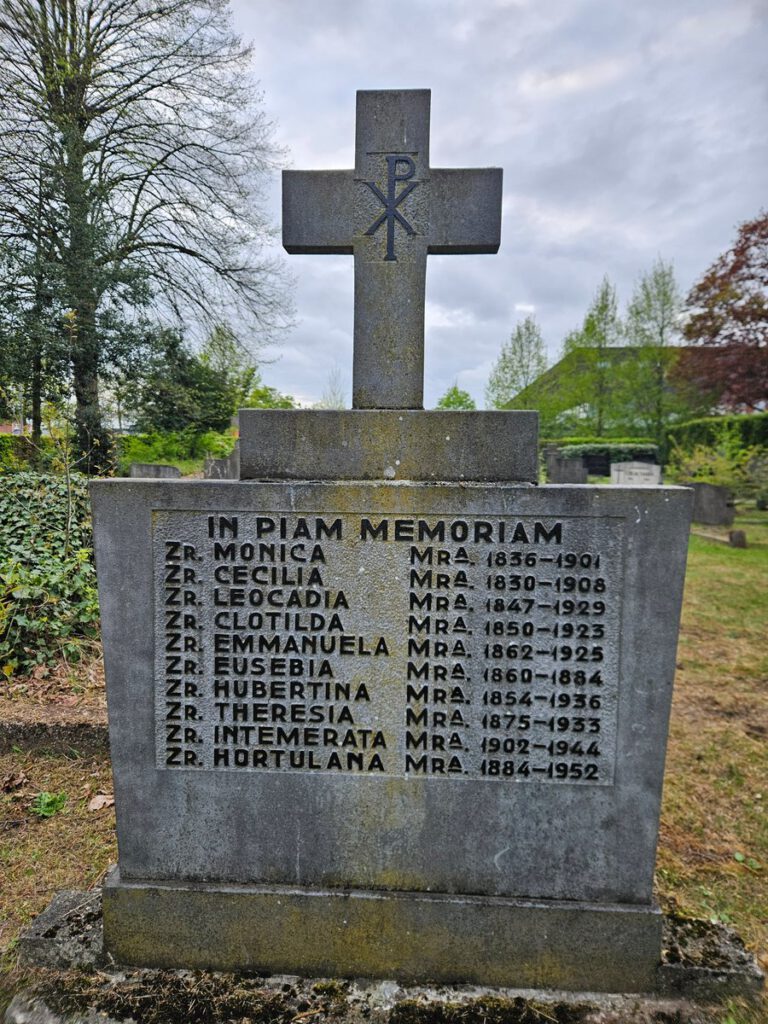
The grave of Pastor Van Rooijen, who died on January 23, 1945, during a bombardment of Dijkstraat, is also located here. Additionally, there are graves of the sisters from the former Saint Elizabeth Convent on Dijkstraat. They provided primary education at the Saint Joseph School and nursed the sick of all faiths.
De Tijd, 22 January 1884De Maasbode, 7 February 1908Aaltensche Courant, 24 July 1925Aaltensche Courant, 31 May 1929De Amstelbode, 13 May 1931De Maasbode, 16 May 1931
De Graafschapbode, 29 August 1932Aaltensche Courant, 5 May 1933Ons Noorden, 8 May 1952
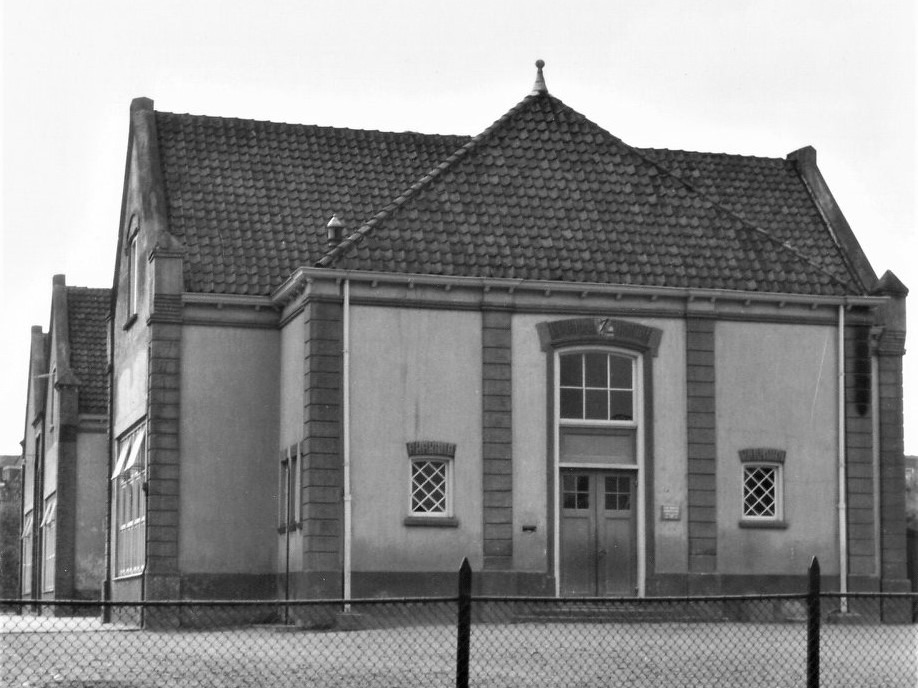
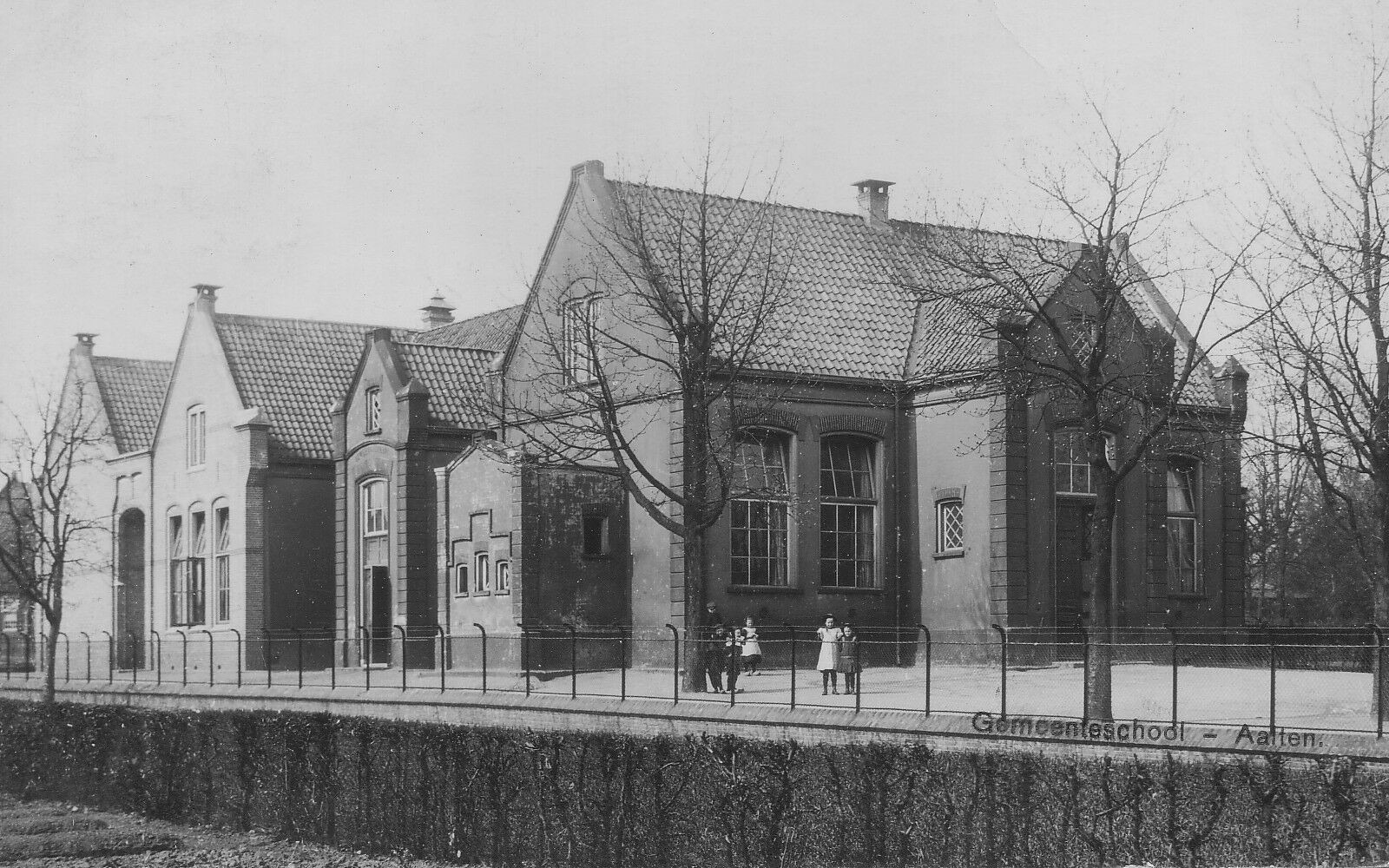
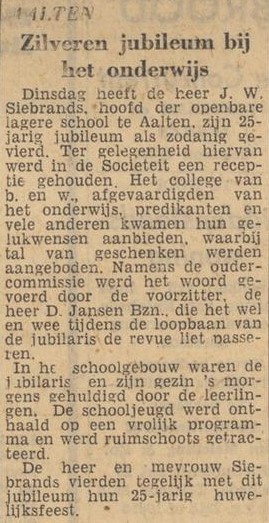
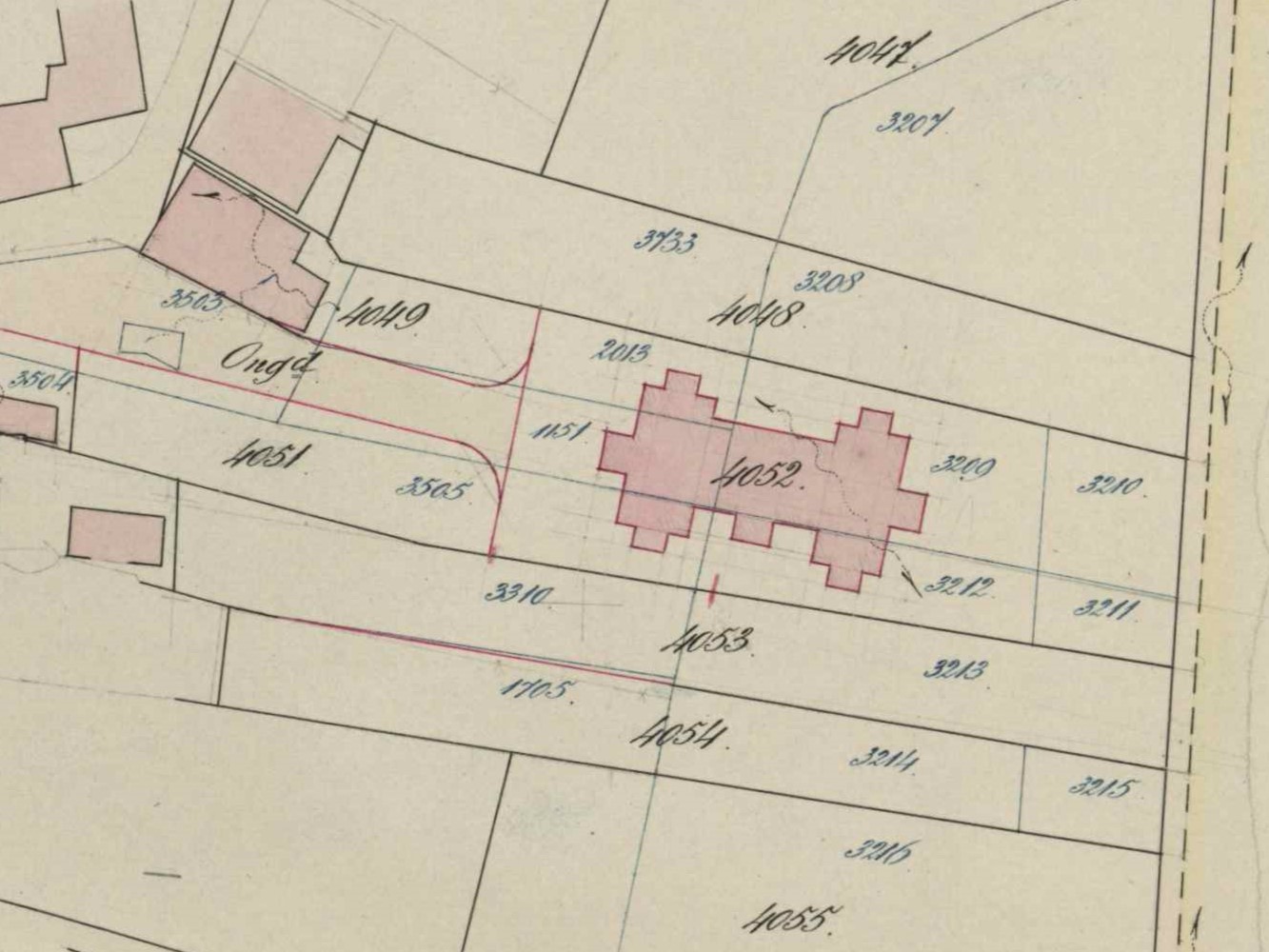
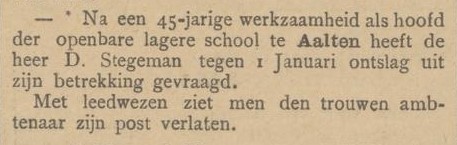
De Openbare Lagere School aan de Herenstraat in Aalten werd opgericht in 1884. De nieuwe school verving daarmee de aloude dorpsschool aan de Landstraat. Hoofden der school waren door de tijd heen de heren Stegeman, Veenstra, Bennink, de Lange, van Rugge, Brunt, Siebrands, van Zeijl en Leferink.
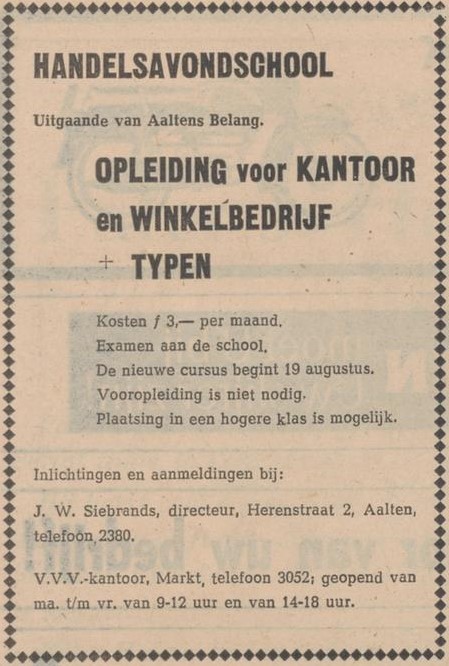
In the 1960s, classes from the Commercial Evening School were also held here three nights a week.
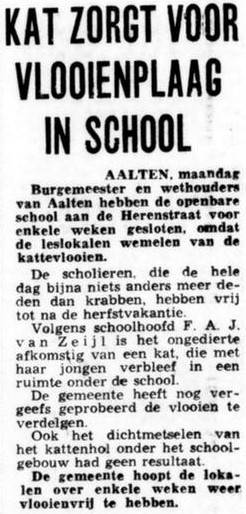
In October 1974, the school had to temporarily close its doors due to a flea infestation. The cause was discovered to be a litter of cats living underneath the school building.
Closure
In 1976 werd een nieuwe openbare basisschool in Aalten in gebruik genomen aan de Wehmerstraat. Deze kreeg later de naam ‘Openbare Basisschool De Slinger‘.
Upon leaving the old building, the schoolchildren sang the following lines during a noisy parade to the tune of ‘Yellow Submarine’: “Where we’re going is the new school, on Wehmerstraat, where it looks so grand. Ninety years old is our school on Herenstraat, in a tumbledown state, etc.”
In 1977, the old school on Herenstraat was demolished, and the site was converted into a car park, known today as ’t Hoge Blik.
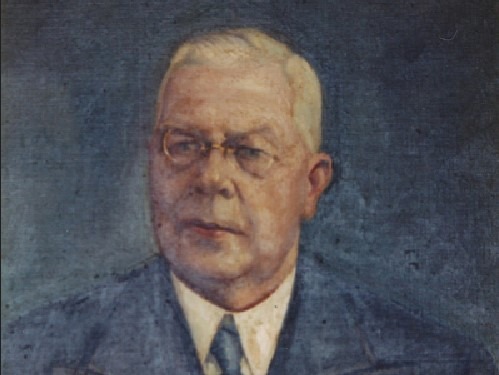
Josephus Walter Julius Driessen (Aalten, 07-01-1870 – Aalten, 12-12-1938) was a textile manufacturer who contributed significantly to the Aalten community.
Jos. Driessen is buried at the old R.C. cemetery on Piet Heinstraat in Aalten.
His significance to Aalten was evident from the report published by De Graafschapbode following his passing:
How is Mr. Driessen doing? This question was asked day after day over the last few weeks; at times the answer would be: “Today the condition is slightly more favorable”, but then again: “Things are not so well at ‘t Blik!” Yet, whoever asked the question, it was always followed by: “It is to be hoped that he recovers and may be spared for a few more years for his family, his factory, and for our municipality!” Alas, it was not meant to be! In recent days, the condition became increasingly serious, and on Monday evening, the news reached us that Mr. Jos. Driessen had passed away from us forever.
The news of Mr. Driessen’s passing will be received with great sadness in wide circles. Naturally, it is first and foremost a great blow to his family, his children, and grandchildren, for whom the deceased was the center—the great magnet within the family circle who drew everyone to him and who so loved to gather the entire family around him. With what interest and warmth he shared in the lives of his married children’s families. How all the grandchildren adored their Grandpa!
The weaving mill, founded on April 1, 1894, was brought to great prosperity over the years through his energy. From a “little weaving shed,” as Mr. Driessen himself called it, the factory steadily increased in size under his leadership and developed—in recent years with the cooperation of his sons—into the flourishing N.V. Herman Driessen & Zn., which, in addition to its weaving mill, now also has its lingerie, ready-to-wear, and knitwear departments. Until recently, it was the nearly 69-year-old director who was always the first at the office in the morning. Always punctual and hardworking himself, he rightly expected the same from the staff. Furthermore, Mr. Driessen Sr. was always interested in the interests of all who worked in the business, and not only in the interests of the employees themselves, but also in those of their families, all of whom he knew exactly. Proof of this is certainly the medical care for staff and family members as arranged at H. Driessen & Zn. The entire staff, from high to low, will learn of the passing of their eldest leader with great regret, and the eldest director will surely be greatly missed in the factory every day.
In addition to business concerns, which became increasingly large and difficult especially in the post-war years and demanded more and more of him, Mr. Driessen showed great interest in everything concerning his place of residence. Since its founding on December 14, 1898, he was a board member and very soon became chairman of the association “Aaltens Belang.” This association was especially his great love and for which he performed an immense amount of work. The chairman always came forward with new proposals and new ideas in the interest of, or for the beautification of, our town and the Achterhoek in general.
What has been achieved in the 40 years of this association’s existence is largely due to his initiative. How Mr. Driessen had looked forward for years to the 40th anniversary of A. B. on December 14 of this year!
Alas! Instead of a festive commemoration, the association is plunged into deep mourning. The board of “Aaltens Belang” will terribly miss its energetic chairman. In addition to this association, Mr. Driessen held the chairmanship of the “Oudheidkamer Aalten” and of the association for hospital nursing “Steunt Elkander,” both of which also had his warm interest. Furthermore, Mr. Driessen was a director of the Geld. Westf. Stoomtram Mij. and vice-chairman of the Supervisory Board of the Coöp. Middenstandsbank Aalten, a board member of the Prov. Geldersche V.V.V., vice-chairman of the B.V.L., and a member or board member of numerous other associations. Mr. Driessen was also briefly a member of the Provincial Council of Gelderland. Mr. Driessen would not easily be absent from a meeting of one of these associations, and telling of his character is what one of his children claimed of him: “Pa is not happy unless he has at least 3 meetings a week!” Mr. Driessen took the lead at numerous official festivals and events. His fellow members of these various committees know how every program item was prepared minute by minute, but also how the program could then finally be executed exactly and the event succeeded.
On August 30, 1930, the mayor informed Mr. Driessen that H. M. the Queen had appointed him a Knight in the Order of Orange-Nassau. This was a recognition of Mr. Driessen’s great merits, in which countless residents rejoiced along with him and his family. In September 1937, the 40th anniversary of N.V. H. Driessen & Zn., as well as the 40th wedding anniversary of Mr. and Mrs. Driessen—Beckmann, was commemorated with great splendor. On this occasion, it was again evident in a spontaneous and heartfelt manner how authorities, citizens, staff, and business relations shared in this jubilee. These were unforgettable days for Mr. Driessen, which he was fortunately still able to experience in good health.
During the last year, but especially the last few months, things were no longer going well. However difficult it was for the so industrious Mr. Driessen, he had to withdraw more and more from his work and take rest. Even sooner than initially expected, his ailment increased in severity and the end came.
With Mr. Jos. Driessen, a resident has passed away who loved his place of residence very much and to whom Aalten owes a great deal. His name will surely remain in grateful memory for many for a long time. The solemn funeral service will take place this coming Friday morning.
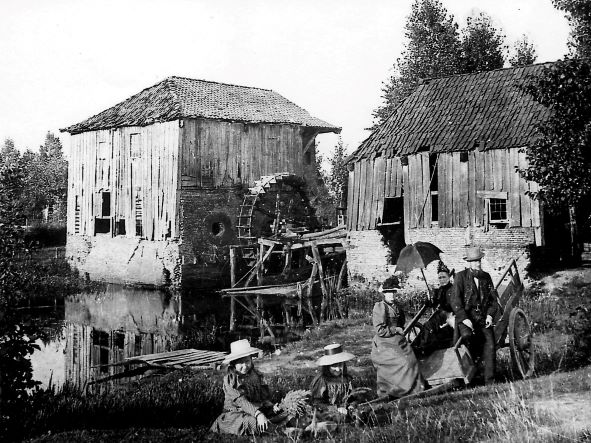
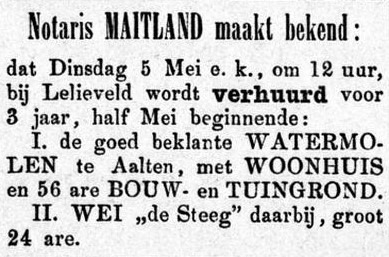
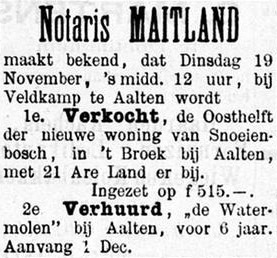
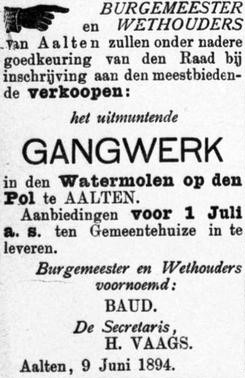
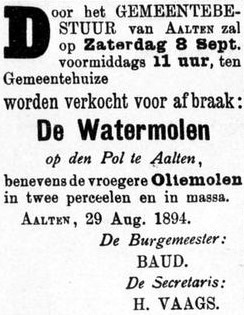
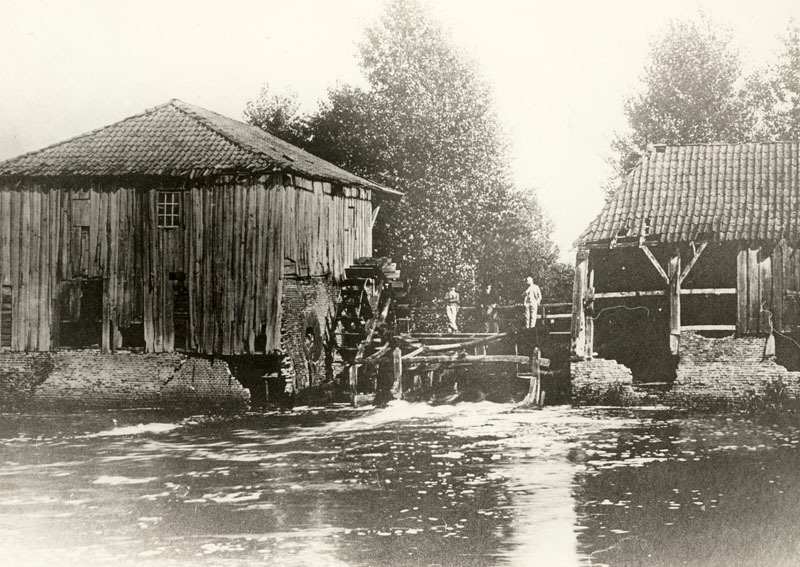
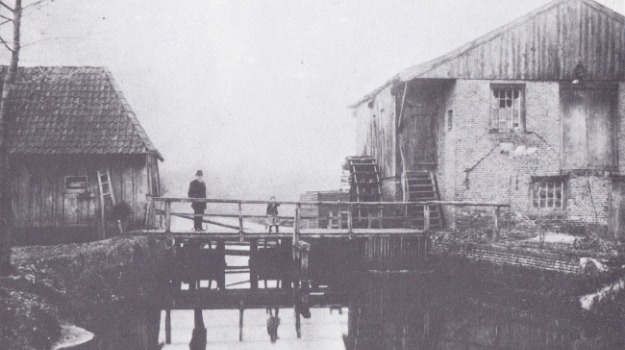
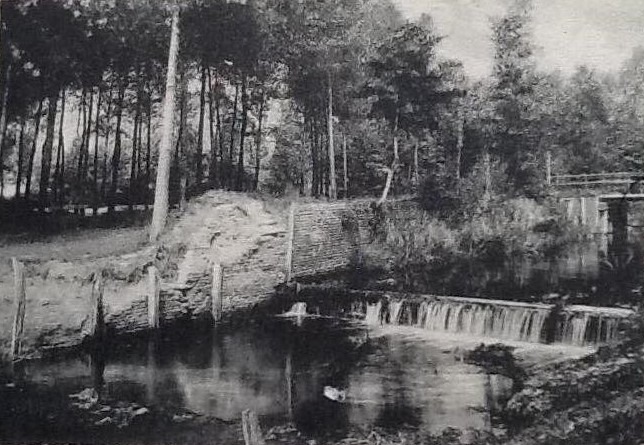
For centuries, a watermill stood on the Slingebeek stream near the De Ahof manor, approximately at the location of the current stone bench erected by Aaltens Belang. At the beginning of the 20th century, the dilapidated mill was demolished. The mill featured wheels on both sides of the stream: on the south bank stood the oil mill (with a wheel of 4.42 m Ø) and on the north bank was the bark mill (with a wheel of 4.66 m Ø), with the corn mill situated above it.
The watermill was likely built shortly after 1500, possibly due to a transfer of manorial milling rights from the Grevinkhof in Dale to De Ahof, which later also came into the possession of the Grevink family. The first mentions of the mill date from 1502, including records concerning income for the steward.
In 1562, the mill was described as a ruin, yet it repeatedly appears in the archives in later years. B.D. Rots writes in his book ‘Aalten en Bredevoort in vervlogen tijden’ that around 1700, the watermill was owned by the House of Orange, who leased it to a miller. On 9 February 1707, De Ahof, along with “the hereditary lease of the Aalten Watermill”, passed into the hands of the Arentsen/Arentzen family.
In 1739, the owners Bernardus Arentzen and Gerrit Jan Heusinkveld complained about competition from the numerous horse mills around Aalten, while they constantly incurred costs to keep the watermill in good repair. In 1758, it is noted that the city council of Bredevoort had the right, in the event of flooding, to raise the sluice gates at De Ahof and take them to their city.
Around 1830, the corn mill had two undershot wheels and three sets of millstones, while the oil mill had one wheel and three stampers. During water shortages, the mills could also be driven by horses. Although the mill had three undershot wheels, a small overshot wheel with a separate leat could be deployed for the corn mill during low water levels from 1840 onwards.
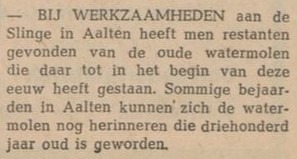
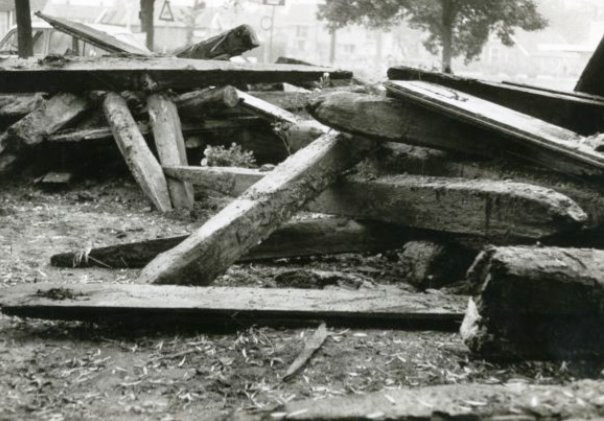
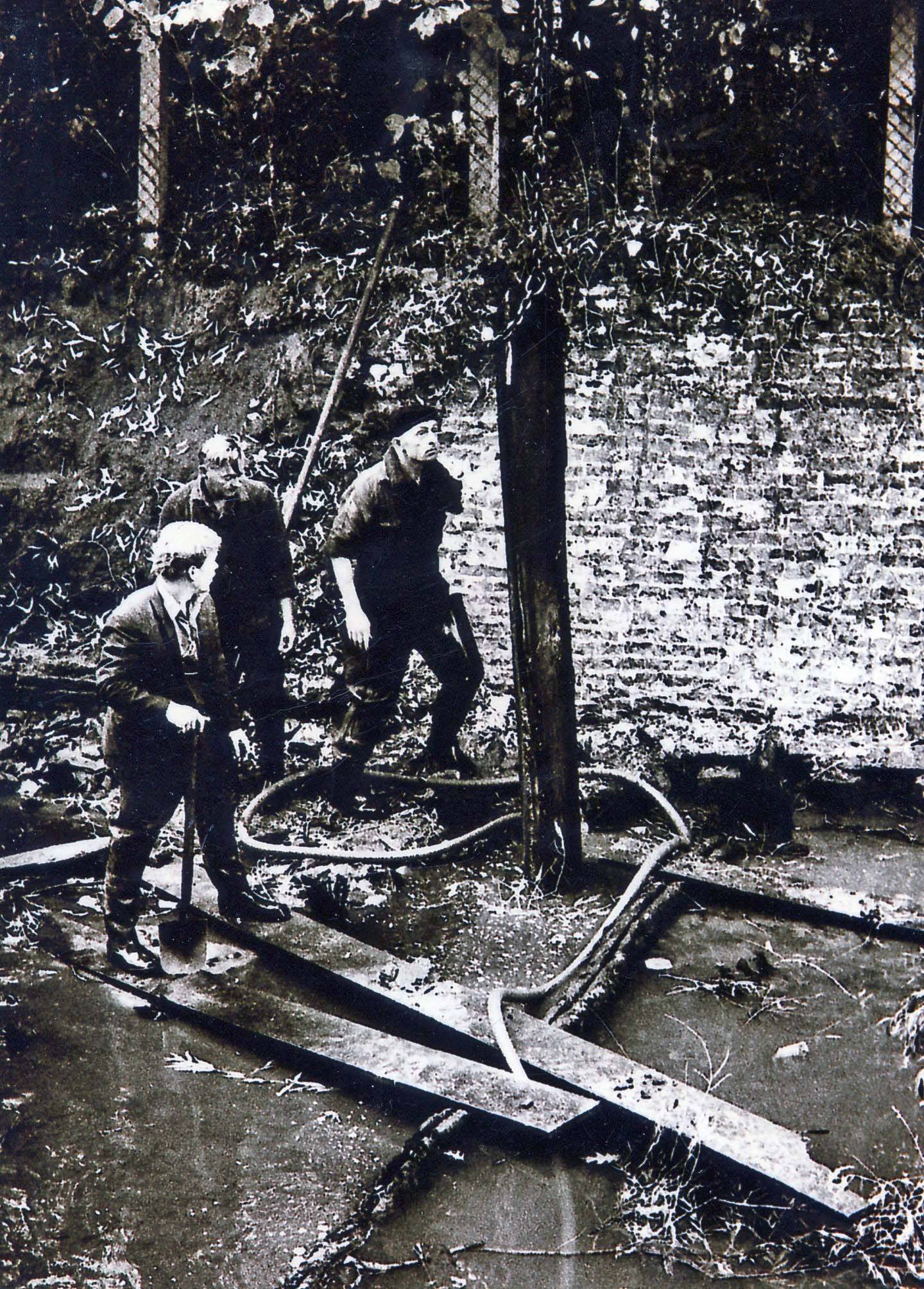
The mill finally disappeared around 1900; only the wheel of the corn mill remained at that time. Photographs from that era show that the entire complex had fallen into decay. During works on the Slinge in 1969, approximately 200 foundation piles were removed. Today, only a remnant of a wall serves as a reminder of the watermill.
Owners
Overview is incomplete.
Year
Plot
Owner
Description
1832
I-182 I-228
Roelof Arentzen, assessor
470 m² mill & yard 920 m² mill & yard
1851
I-182 I-228
Engelbarta Hendrica Arendsen and Gezina Arendsen, widow of J.W. te Gussinklo
470 m² mill & yard 920 m² mill & yard
1854
I-1918 I-1968
Engelbarta Hendrica Arendsen and Gezina Arendsen, widow of J.W. te Gussinklo
470 m² grain mill & yard 178 m² mill & yard
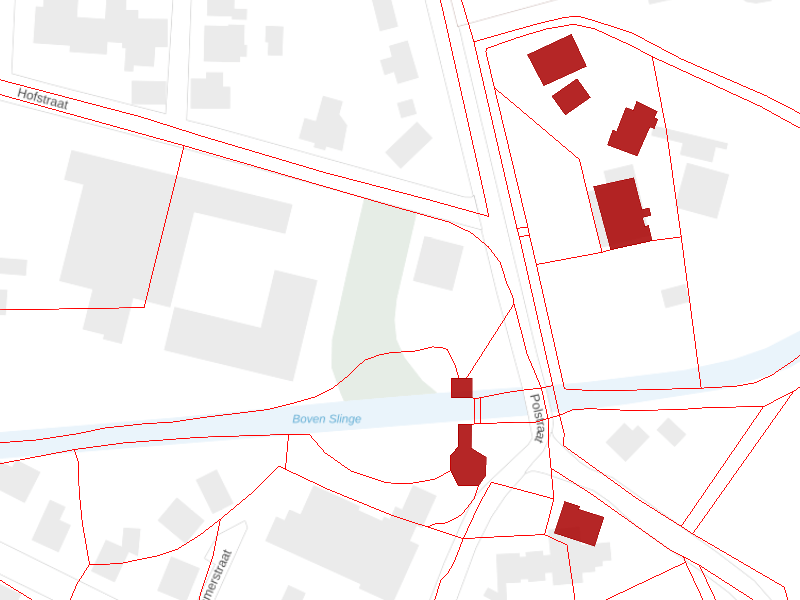
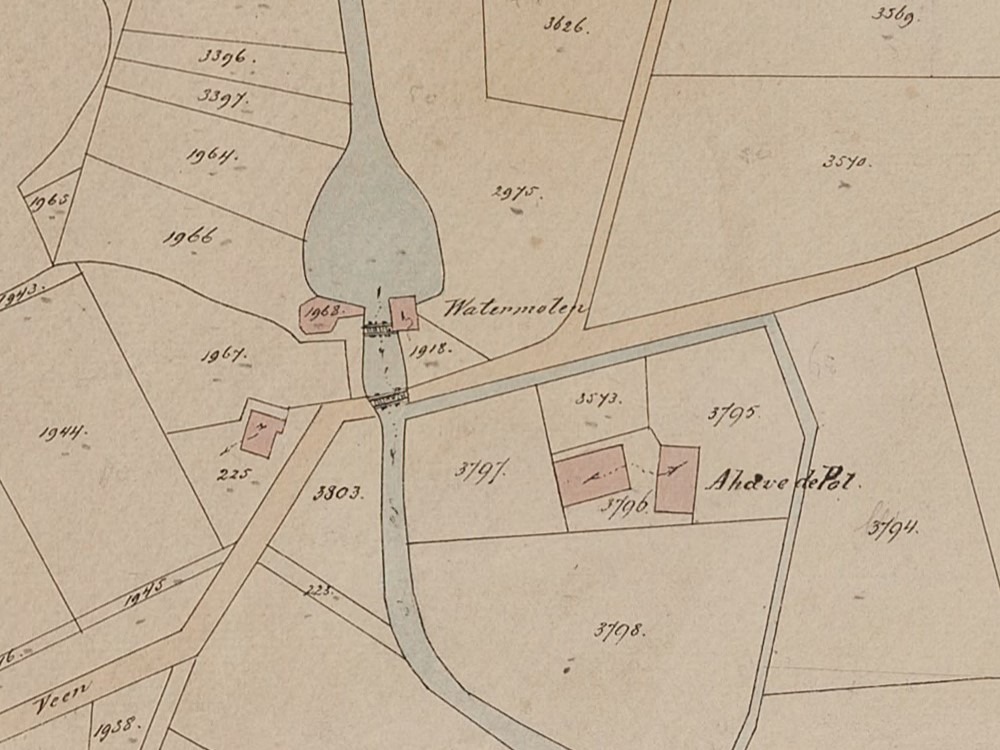
Location of the watermill, with De Ahof at the top right. All red buildings on this map were, according to 1832 land registry data, owned by Roelof Arentzen, assessor in Aalten. The red lines represent the plot boundaries at the time, which also clearly show the course of the former moat around De Ahof.
Newspaper reports
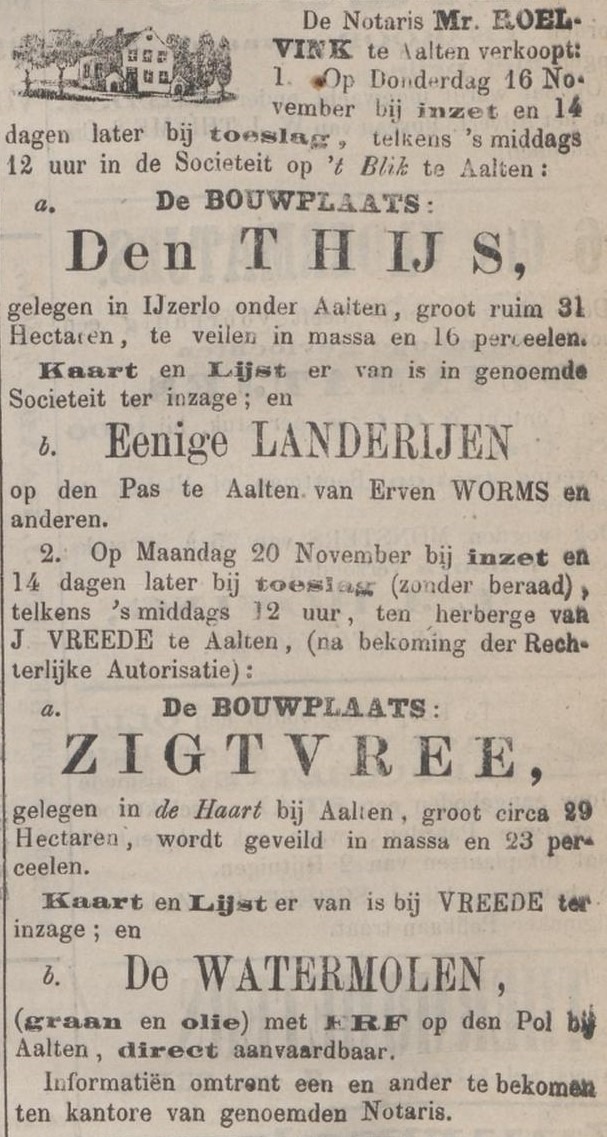
Zutphensche Courant, 11 November 1876Graafschapbode, 2 May 1885
Graafschapbode, 16 November 1889Graafschapbode, 20 June 1894
Graafschapbode, 5 September 1894Nieuwe Winterswijksche Courant, 31 October 1969
Fragment of the cadastral map, 1883 (North is to the right)Remnants of the watermill on the Pol, 1906Remnants of the watermill, found around 1970Remnants of the watermill being cleared away
Beheer toestemming
Deze website gebruikt cookies voor een optimale ervaring en analyse van bezoekgegevens. Ga je hiermee akkoord? Zonder toestemming werken sommige onderdelen van de site mogelijk minder goed.
Functioneel
Always active
De technische opslag of toegang is strikt noodzakelijk voor het legitieme doel het gebruik mogelijk te maken van een specifieke dienst waarom de abonnee of gebruiker uitdrukkelijk heeft gevraagd, of met als enig doel de uitvoering van de transmissie van een communicatie over een elektronisch communicatienetwerk.
Voorkeuren
De technische opslag of toegang is noodzakelijk voor het legitieme doel voorkeuren op te slaan die niet door de abonnee of gebruiker zijn aangevraagd.
Statistieken
De technische opslag of toegang die uitsluitend voor statistische doeleinden wordt gebruikt.De technische opslag of toegang die uitsluitend wordt gebruikt voor anonieme statistische doeleinden. Zonder dagvaarding, vrijwillige naleving door je Internet Service Provider, of aanvullende gegevens van een derde partij, kan informatie die alleen voor dit doel wordt opgeslagen of opgehaald gewoonlijk niet worden gebruikt om je te identificeren.
Marketing
De technische opslag of toegang is nodig om gebruikersprofielen op te stellen voor het verzenden van reclame, of om de gebruiker op een site of over verschillende sites te volgen voor soortgelijke marketingdoeleinden.