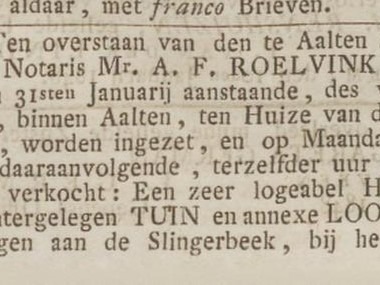
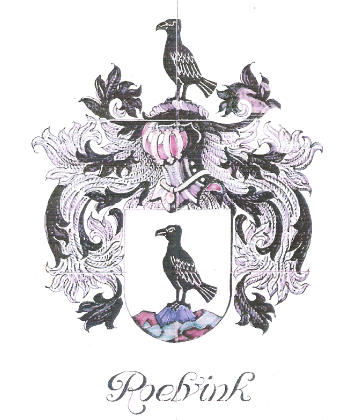
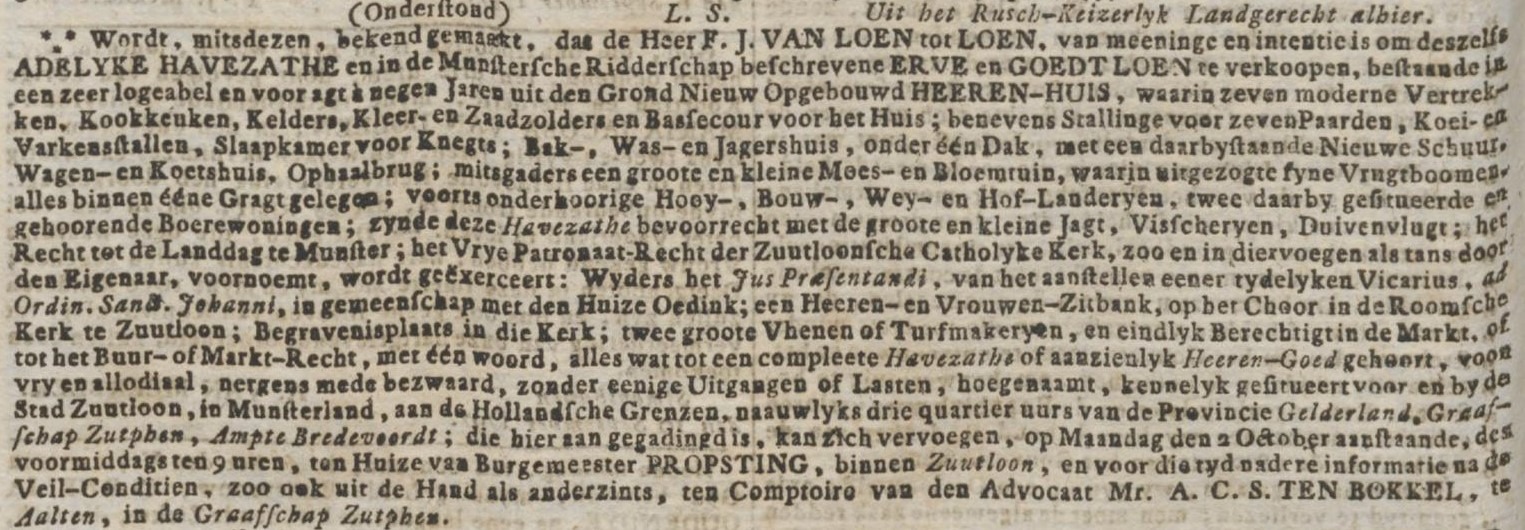
Arnoldus Florentinus Roelvink was born on 23 December 1789 in Borculo, the son of Bernard Andreas Roelvink and Harmina Abbink. On 12 November 1817, he married Elzabé Maria Theodora ten Cate (Neede, 21 July 1798) in Bredevoort; she was the daughter of Tieleman ten Cate and Anna Jacoba Roelvink. The couple had seven children together.
Roelvink was a notary, and following the French period, he was also appointed in 1813 as the first mayor of the municipality of Bredevoort. When this municipality was merged with Aalten in 1818, Roelvink became the mayor of the merged municipality of Aalten. He held this position until his death on 6 January 1861.
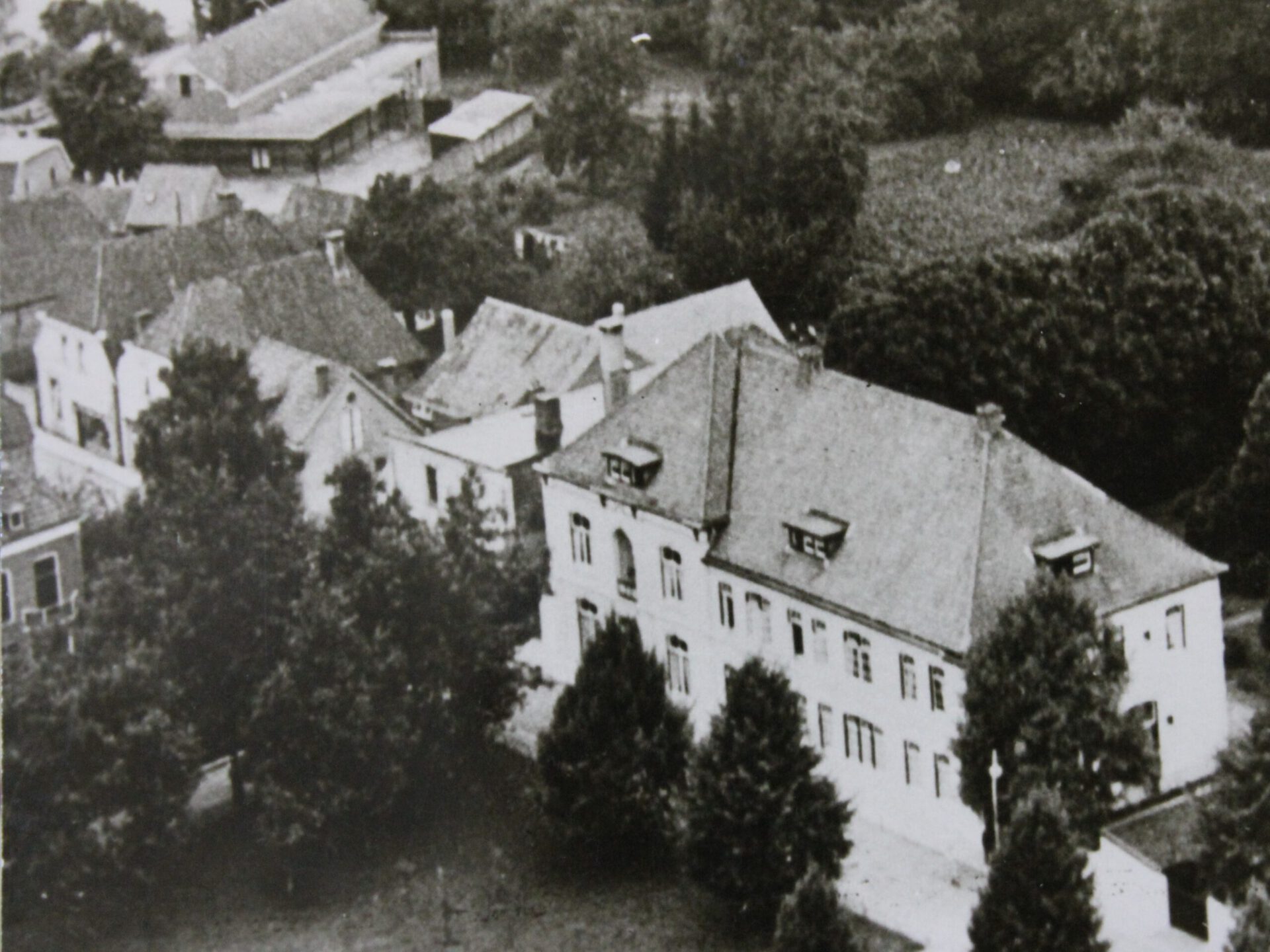
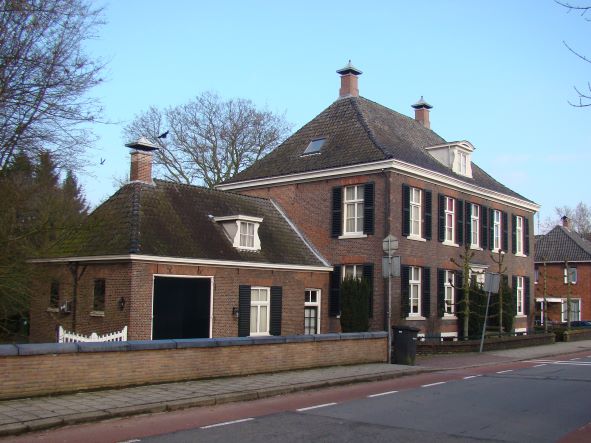
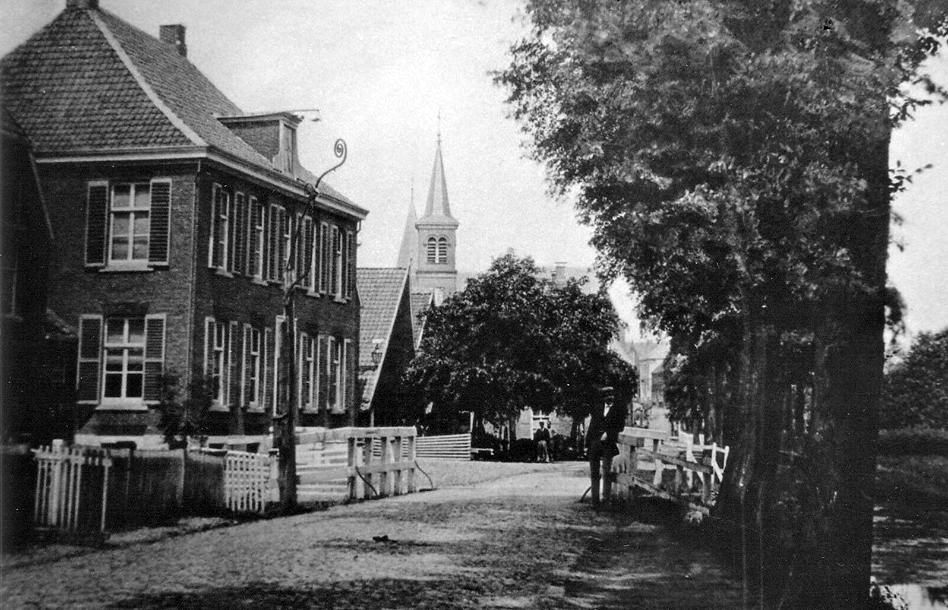
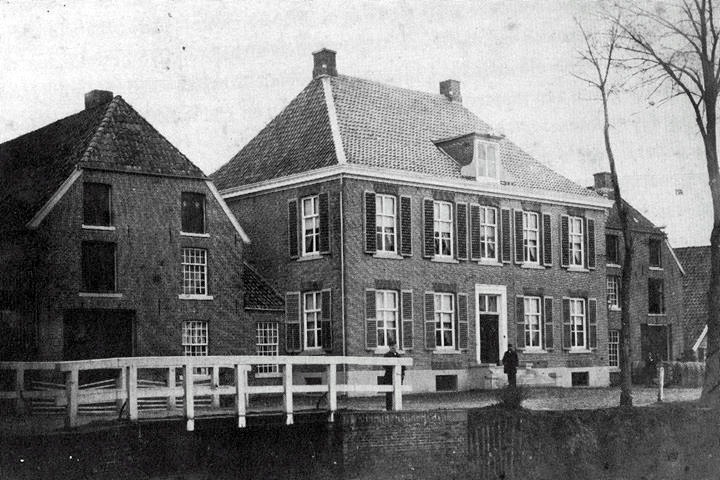
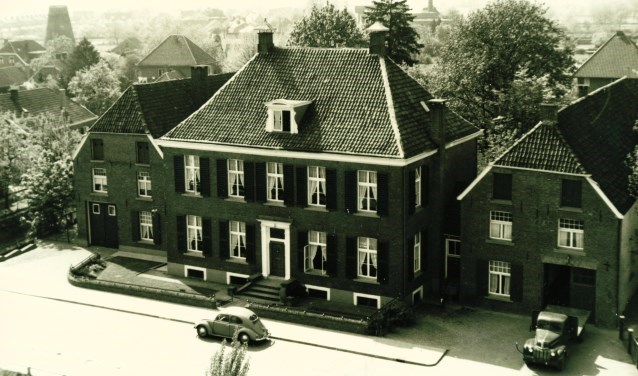
Roelvink lived with his family in the villa at ‘t Zand in Bredevoort, which is known today as Sint Bernardus. Roelvinkstraat in Bredevoort is named after him.
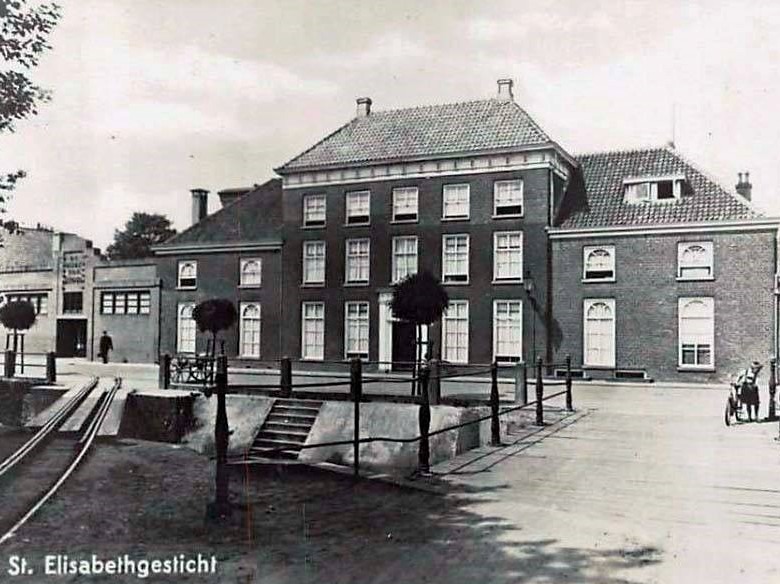
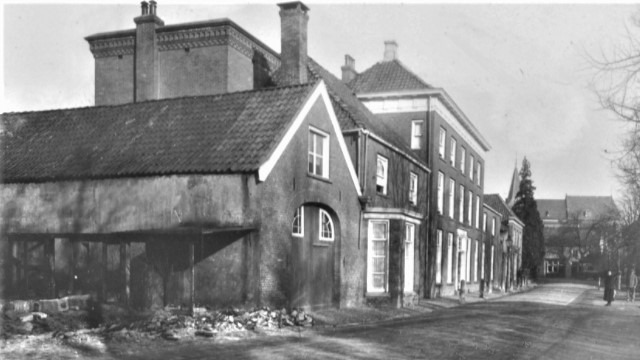
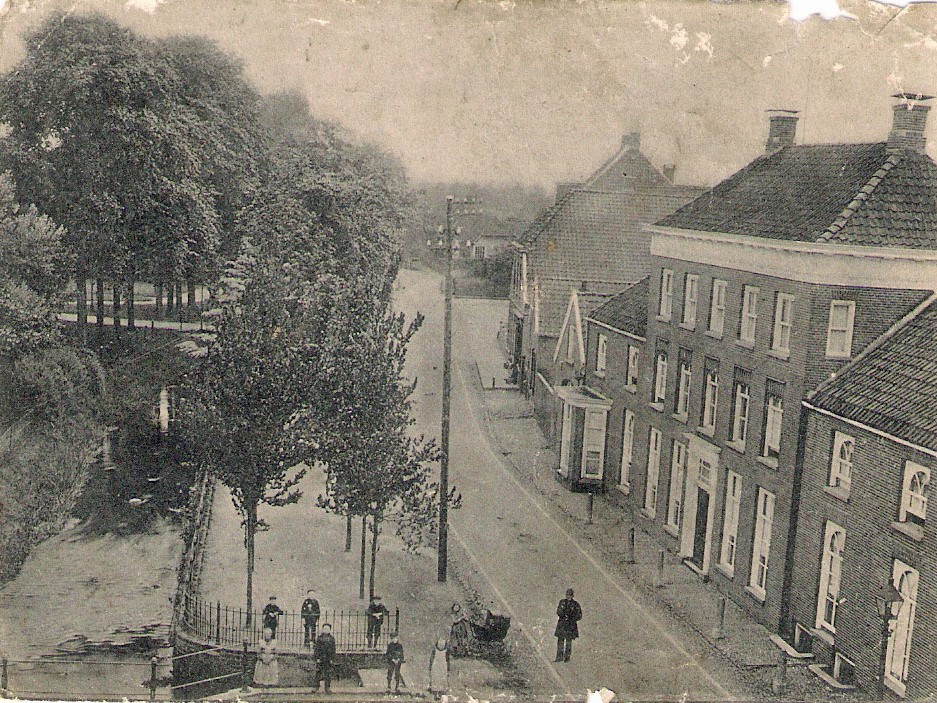
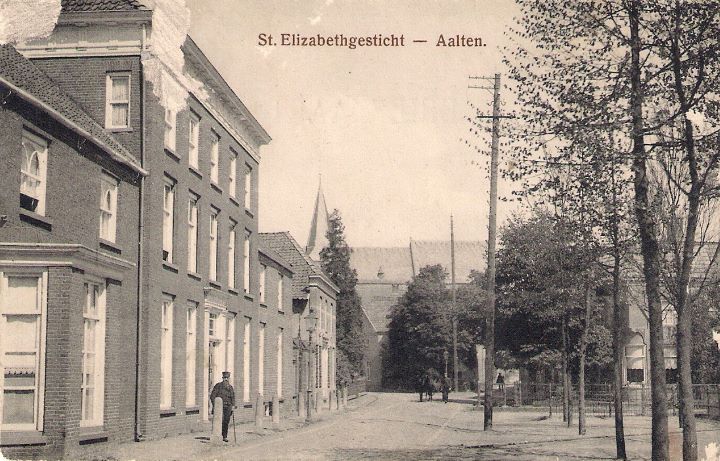
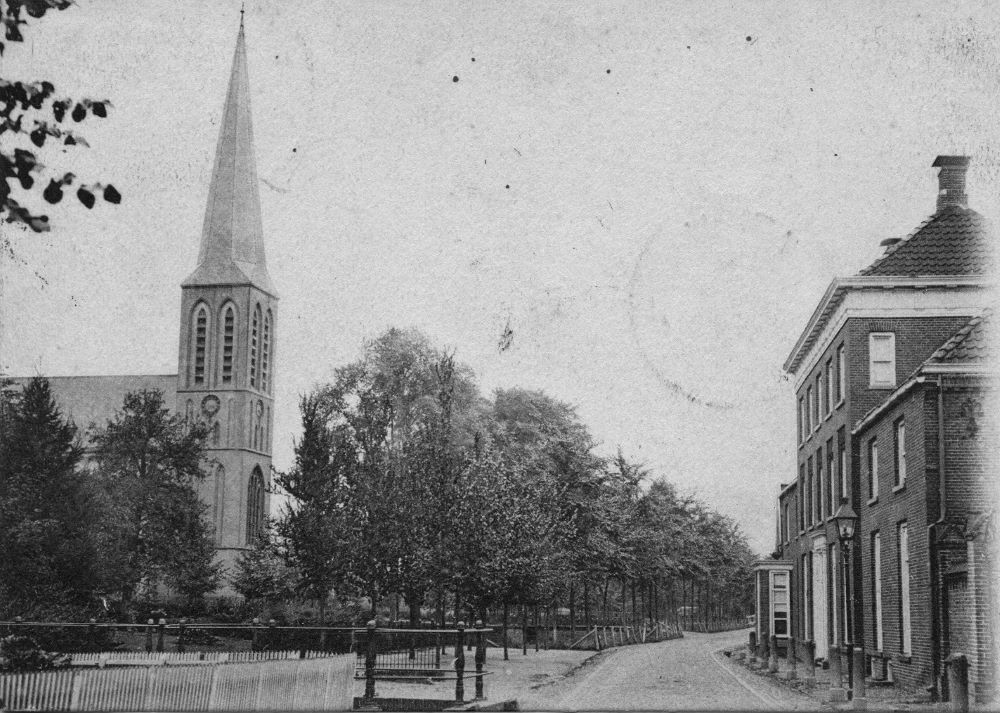
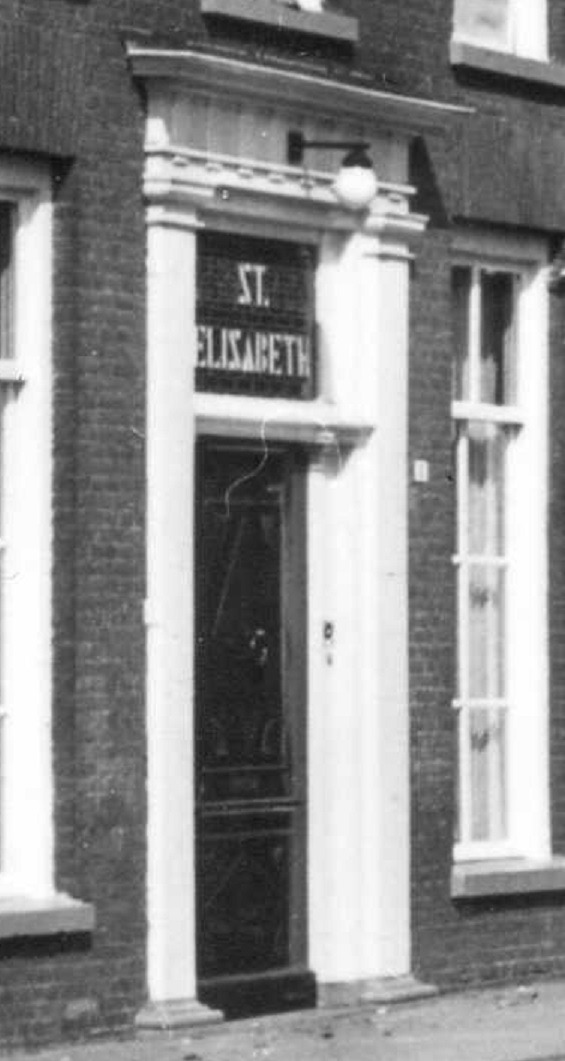
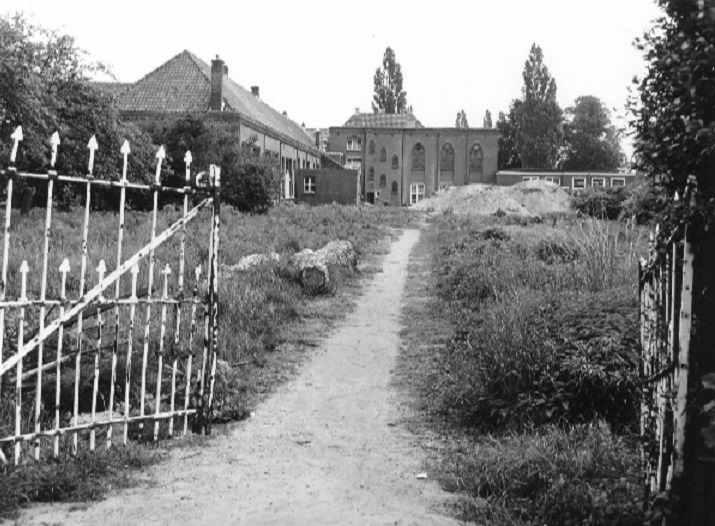
The Elisabeth Monastery in Aalten was originally the residence of textile manufacturer Johann Heinrich Joseph (Heinrich) Driessen (Bocholt, 10/07/1794 – Aalten, 04/07/1879). On 29 June 1837, his eldest son Theodoor laid the foundation stone.
Heinrich was also known as “Den veursten Driessen” (The front Driessen); his cousin Anton also lived on what was then Landstraat, in Villa Beekhuize, slightly further south of the town centre, and was therefore known as “d’n achtersten Dreessen” (The rear Driessen).
Business premises were also established on the property, which served primarily as storage for yarns and woven fabrics. These fabrics were transported by wagon, usually pulled by an ox, to the bleachery in Dale. The driver carried the fitting nickname ‘Ossen Willem’ (Ox Willem).
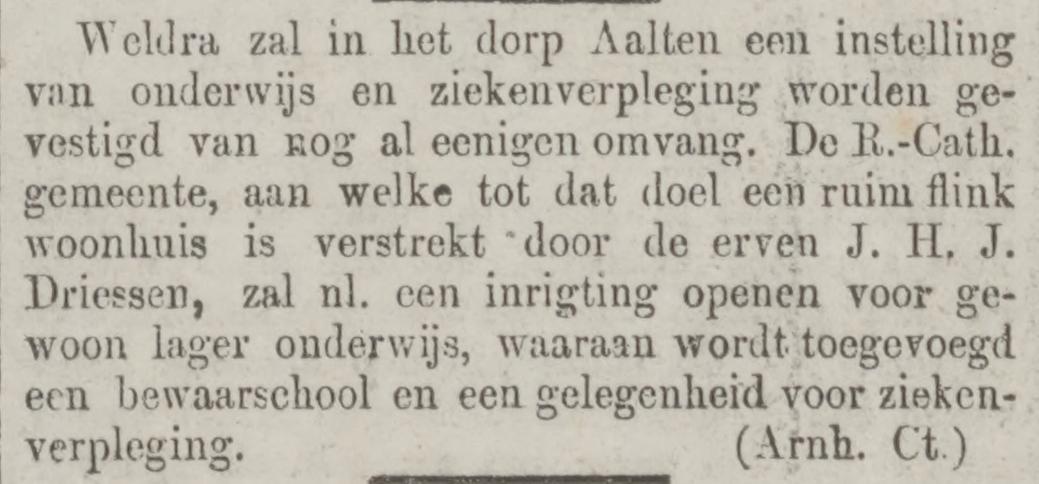
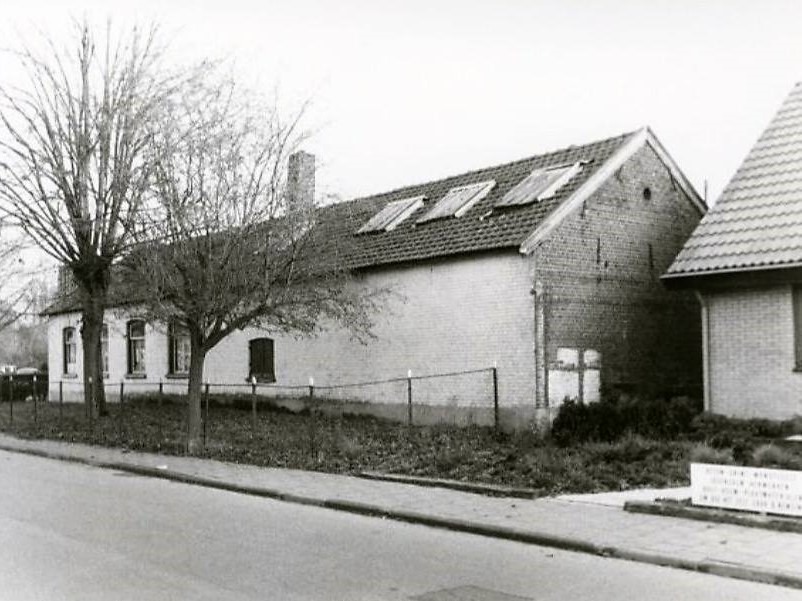
After Heinrich’s death, the house came into the possession of the Roman Catholic Church, after which it was put into use as a convent for nuns. On 30 May 1882, six sisters were brought to Aalten from Lichtenvoorde-Groenlo station in a carriage drawn by four horses. The convent was named after Heinrich’s wife, Elisabeth. Locally, it was also referred to as the St Elisabeth Institute.
Education and Nursing
For eighty years, the sisters provided education here to the Catholic school children of Aalten. The sisters’ ‘sewing and knitting school’ was also based there. Not everyone held pleasant memories of the nuns. The sewing and knitting school, later the Fashion Vocational School, was highly regarded. Partly for this reason, it was not only Catholics who knitted there, but people of all denominations.
On 23 December 1962, the last sisters left for a convent in Bennebroek. Later, the convent served as accommodation for guest workers.
On 20 December 1980, a small fire broke out in the completely boarded-up building. Just as a ‘foundation stone’ had once been laid, the last stone was removed shortly after the fire. The building made way for the Parish Centre. This has since disappeared as well and has been replaced by an apartment building named ‘Kloosterhof’ (Convent Court).
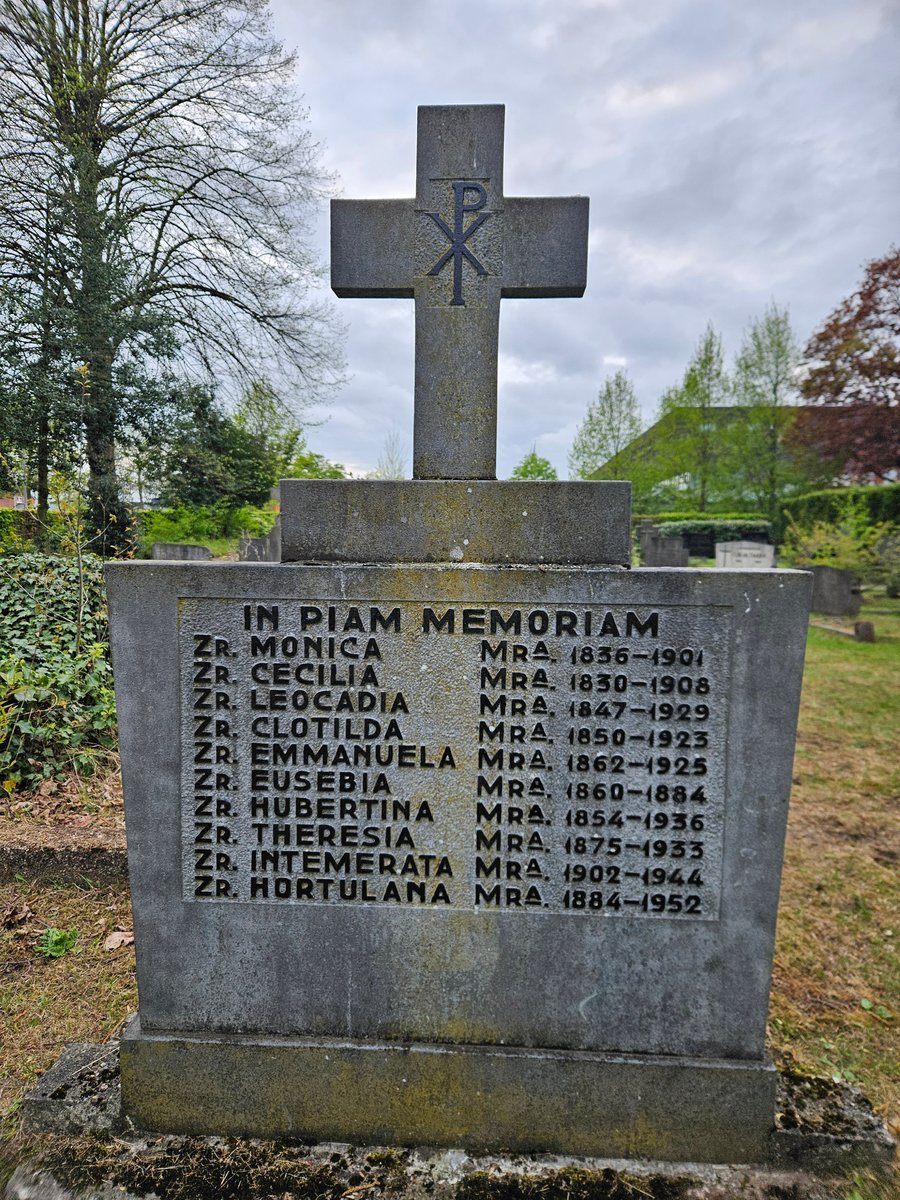
AALTEN, 29 May – Tomorrow, the 30th, will mark 50 years since the Franciscan Sisters of St. Lucia, Rotterdam (now the Motherhouse Bennebroek) arrived in Aalten. This event will be solemnly commemorated. Following Holy Mass, a large general reception will be held starting from 10 o’clock. On 30 May 1882, the sisters were met in Lichtenvoorde by Parish Priest P. Bosman and Mr Eduard Driessen. The procession was conducted in carriages drawn by pairs of horses. The J. H. J. Driessen family made their house and grounds available to the sisters. A nursery and sewing school were established here immediately. On 1 August 1884, primary education for girls commenced, followed by education for boys in July 1886. The school currently has 258 pupils, and the nursery school has 68. In the fashion vocational school, newly built in 1928, instruction is given to 30 girls in summer and 60 in winter. One of the sisters, namely Sister Hubertina, has been here in Aalten since 30 June 1884.
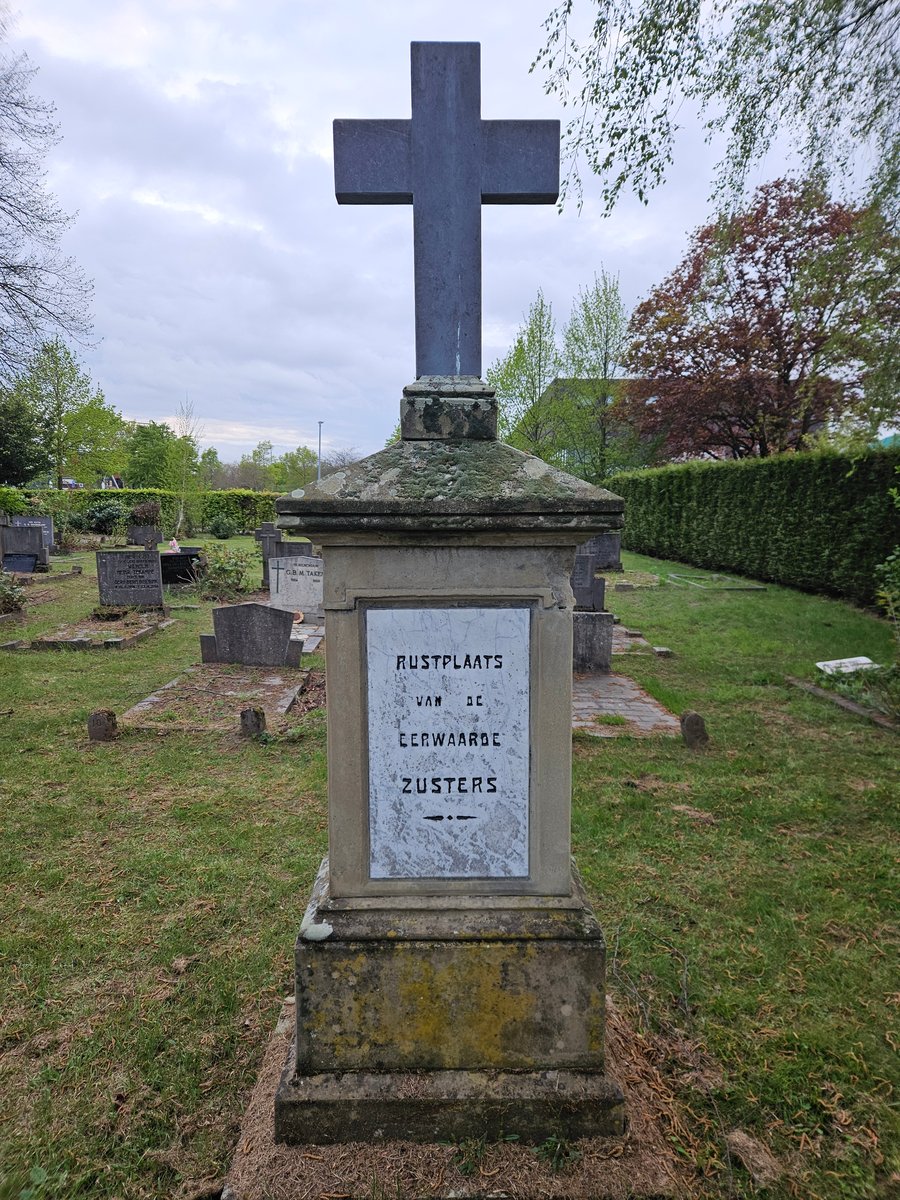
Arnhemsche Courant, 3 January 1882St Elisabeth’s Convent, Dijkstraat, Aalten St Elisabeth’s Institute, Aalten Front door of St Elisabeth’s Convent, Aalten Rear entrance of St Elisabeth’s Convent and St Jozef’s School, c.1975 Roman Catholic cemetery Piet Heinstraat, Aalten – Sisters St Elisabeth’s Convent (1) Roman Catholic cemetery Piet Heinstraat, Aalten – Sisters St Elisabeth’s Convent (2)
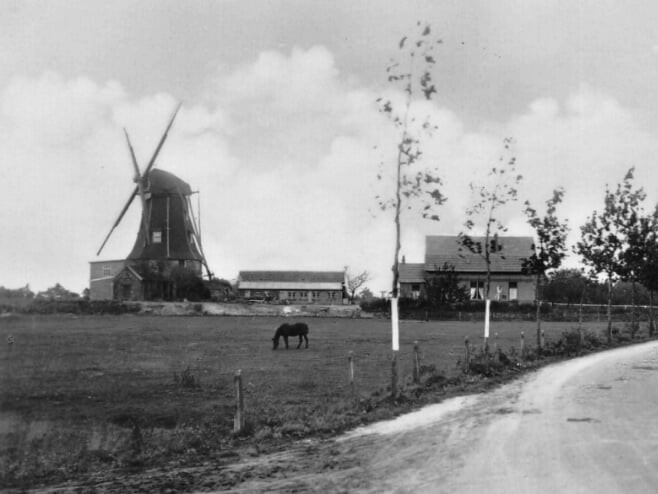
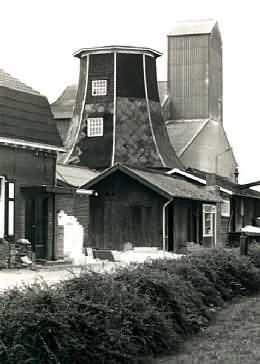
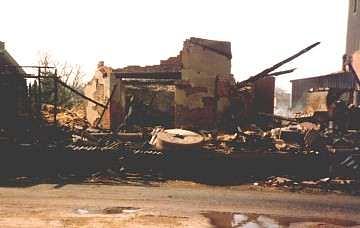
From 1856, an octagonal smock mill (mound mill) stood on the Lichtenvoordsestraatweg in Barlo, which in the twentieth century grew into a milling facility and compound feed business owned by the Grevink family. The mill was dismantled in 1944 and was ultimately lost to fire in 1986.
In 1853, voices were raised in Barlo suggesting that a mill should also be established in this rural district. Initially, a water-powered mill was considered. However, research revealed that the Zilverbeek did not provide sufficient water flow per hour. Consequently, a windmill was built in 1856, located a few hundred meters further north. It was an octagonal smock mill, specifically a mound mill type.
The method of propulsion consistently kept pace with the times. From 1887, the mill was powered by a steam engine, which made way for a gas engine in 1925. When electricity became available in Barlo in 1934, the electric motor proved to be a significant asset.
The last miller was J.W.F. Grevink — secretly nicknamed Jan Willem Fluweel. As early as 1928, he opened a bakery and grocery store next to the mill.
The mill had already been dismantled by 1944. Without its sails, the fire insurance premium was lower. In the early morning of March 29, 1986, a fire broke out that put a permanent end to this mill. Prompt intervention by the fire department prevented an adjacent pig barn from being lost to the flames. The cause of the fire remains unknown.
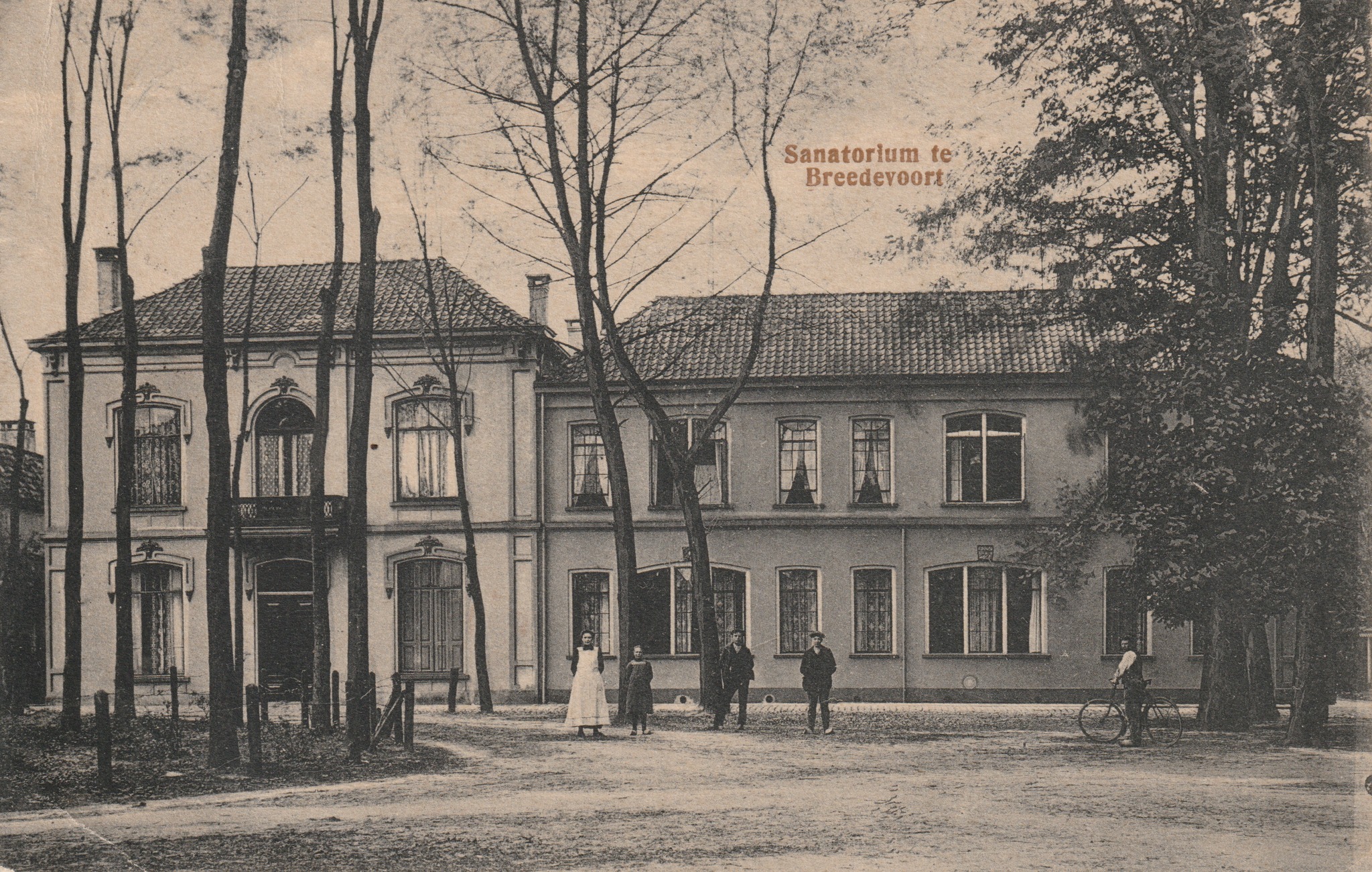
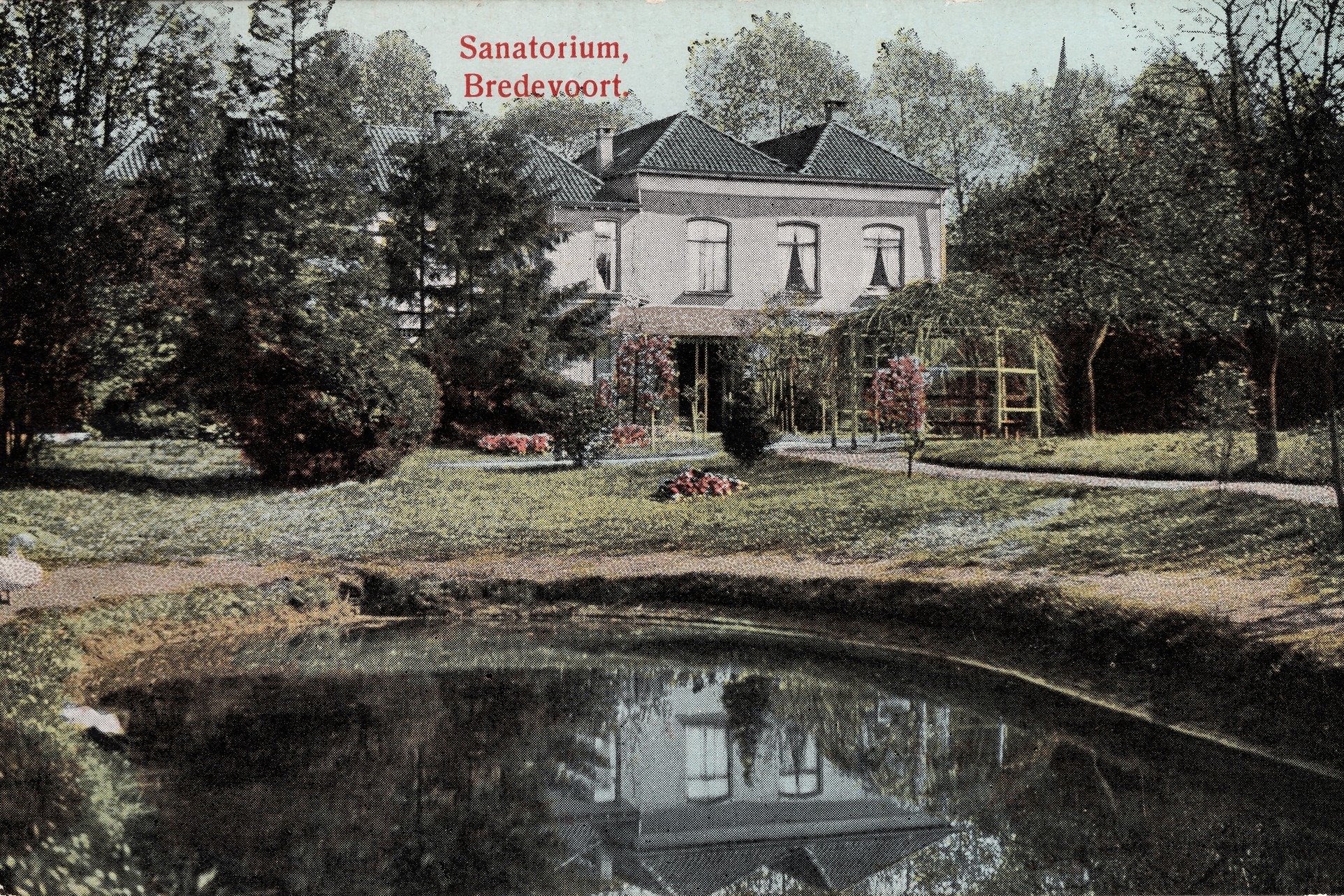
St Bernardus House is a distinctive building on ’t Zand, the central square of Bredevoort. The building has a rich history, having served as a residence, a sanatorium, and a nursing home.
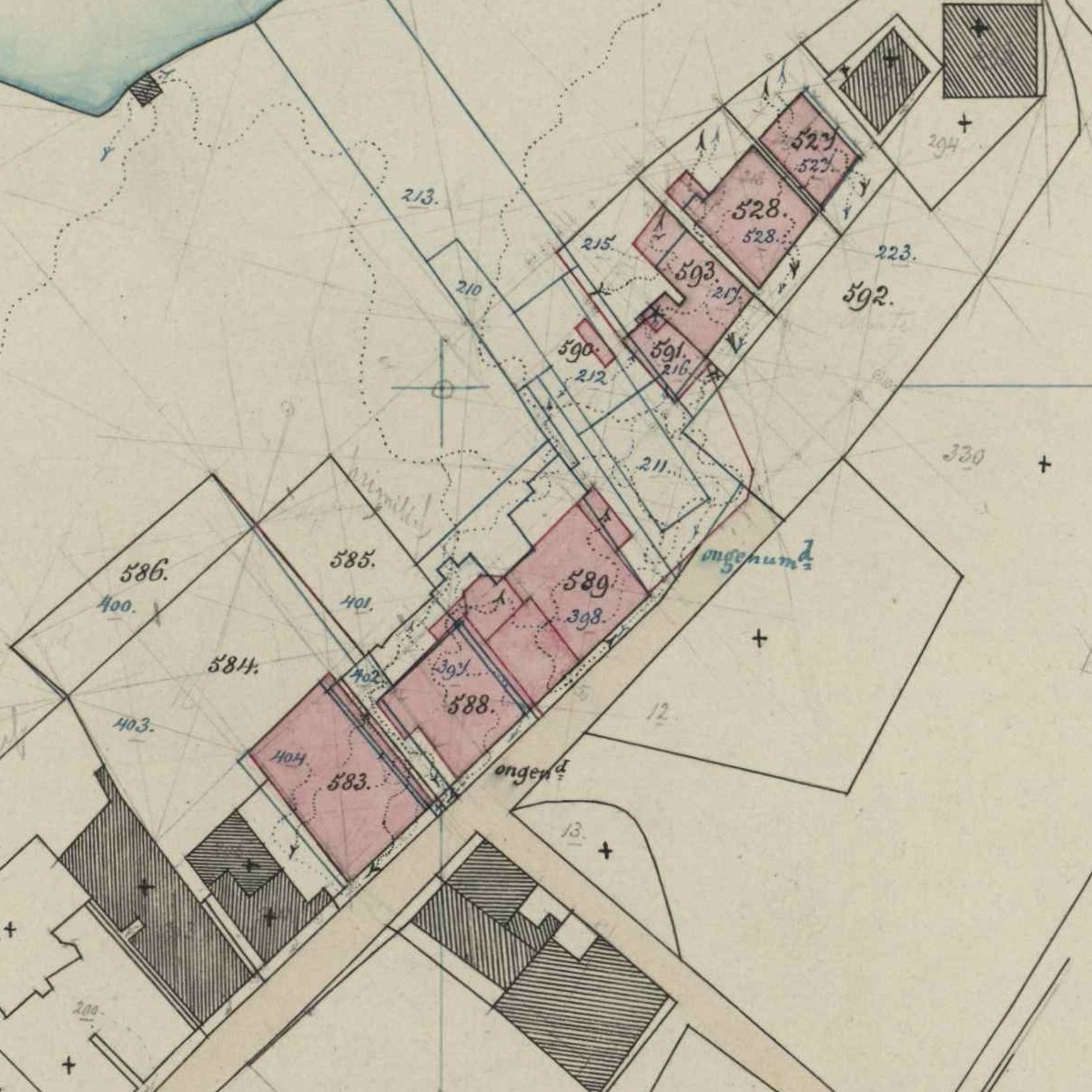
The building was originally commissioned by Jan Satink, a lieutenant colonel in the States Army, Regiment of Nationals. It was erected on the site where the outer bailey of Bredevoort Castle once stood. In 1800, the house passed into the possession of the Roelvink family through inheritance. Arnoldus Florentinus Roelvink, a scion of this family, served as the mayor of Bredevoort from 1813.
In 1897, the building was purchased by Father Bernardus Mulders. The priest was a man of means and acquired the former steward’s house with his own funds. His goal, he wrote, was to offer “his poor children” a Catholic education. Because Catholic schools were costly at the time, he devised a clever solution: he brought nuns to Bredevoort, who established a convent and a sanatorium in the steward’s house. Nuns were an economical option as they received no salary, having dedicated their lives to God.
Under the management of the Franciscan Sisters of Thuine, the ‘R.K. Sanatorium St. Bernardus Gesticht’ (Roman Catholic St. Bernardus Sanatorium Institute) was established. He named the convent-sanatorium after his own patron saint, Saint Bernard of Clairvaux. With the profits from the sanatorium, the priest started a primary school: the Sint Joannesschool.
The sanatorium was intended for wealthy patients, as the nursing costs were high, ranging from f 1.50 to f 2.20 per day. Medical expenses and pharmacy costs were charged at 10 guilders per month. Second-class patients paid f 7.50.
From 1907, people came to Bredevoort from all over the country to recover in the sanatorium. They often stayed for months. During the day, they would lie in bed in an open-air pavilion (lighal), even in winter, completely wrapped up. In the garden of Sint Bernardus—now the Vestingpark (Fortress Park)—there were at least ten of these pavilions, with their open sides facing the sun. Two of these have been preserved and are now designated as national monuments (rijksmonumenten).
The sanatorium remained in use until 1933. Afterwards, the building was repurposed as a nursing home for the elderly. In 1938, the Sisters of Thuine were succeeded by the Sisters of St. Joseph from Amersfoort. The last sisters left Bredevoort in 1985.
In 1988, a large-scale renovation and expansion of the building was carried out by the Stichting Verzorgingstehuis St. Bernardus (St. Bernardus Nursing Home Foundation). The nursing home eventually moved to the newly rebuilt Ambthuis in 2008.
Villa Beekhuize serves as a reminder of the heyday of the textile industry in the village of Aalten.
Textile manufacturer Anton Driessen initially lived with the Meijerink family on Kerkstraat upon his arrival in Aalten. Later, he purchased a property on Landstraat. In 1833, Anton Driessen wished to build a new residence. To this end, he had purchased a house from the Degenaar estate at the end of Landstraat—the present-day Dijkstraat. He intended to demolish that house and construct a new, modern home on the site, complete with a warehouse, barn, and stables. However, he required more space than the existing plot provided. Anton Driessen subsequently submitted a proposal to the municipal authorities.
This plan necessitated the diversion of both the stream and the street. Furthermore, a new bridge was required. Because the piles of the old bridge had nearly rotted away, the construction of a new bridge was not only highly necessary but, according to Driessen, the relocation would also be less costly. In addition to diverting the stream and building a new bridge, Driessen also required land for his plans. To this end, he exchanged a plot of land with the municipality. Negotiations regarding the aforementioned matters lasted several years. Construction finally commenced in March 1835.
In addition to Anton Driessen, his nephew Heinrich also built a house on what was then Landstraat. Heinrich Driessen positioned a generous residence closer to the town centre, for which his eldest son, Theodoor, laid the foundation stone on 29 June 1837. Ever since, locals have referred to the two properties as ‘d’n veursten’ (the front) and ‘d’n achtersten Dreessen’ (the rear Driessen).
Owners
Overview is incomplete.
Year
Plot
Owner
Description
1832
I-1231 I-1233
Jan Berend Lohuis
199 m² house & yard 2.250 m² garden
Residents
1813
Aalten 37
Johannes Degenaar (Aalten, 25-10-1779), weaver son Evert Degenaar (Aalten, 10-05-1744), weaver father
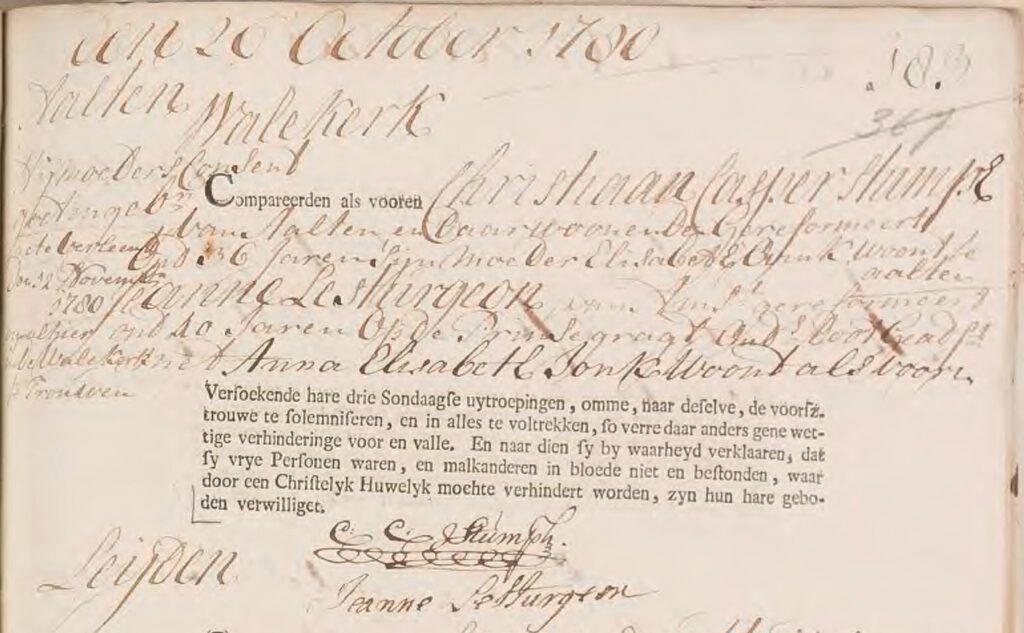
Christiaan Caspar Stumph was baptized in Aalten on February 14, 1745, as the son of Abraham Stumph and Elisabeth Ovink. On November 12, 1780, he married Jeanne Lesturgeon. They had at least one child, Abraham Antoni. This son drowned in the Slingebeek at the age of 34. Popular belief held that his death was related to a broken heart.
In 1795, Stumph was accused of the attack on Ten Holte and imprisoned. He was released a month later as his guilt could not be proven.
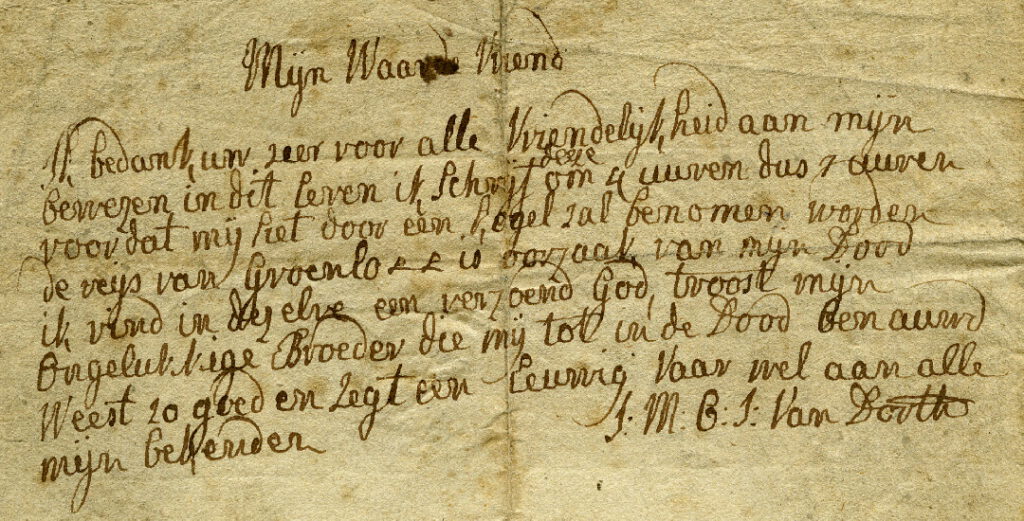
Stumph was a close friend of the Freule van Dorth, who was executed in Winterswijk in 1799. Seven hours before her death, she wrote him a letter: “My Dear Friend, I thank you very much for all the kindness shown to me in this life. I write [this] at 4 o’clock, thus 7 hours before [life] shall be taken from me by a bullet. The journey from Groenlo etc. is the cause of my death. I find in the same a reconciled God; comfort my Unfortunate Brother who is distressed for me until Death. Be so kind as to say an Eternal Farewell to all my acquaintances. J.M.C.J. van Dorth.”
Marriage Record Amsterdam, 12 November 1780
The first mayor of Aalten
Following the annexation of our country by France on July 10, 1810, the entire administrative power was restructured and centralized according to the French model. A departmental organization was established, headed by a prefect for the departments, a sub-prefect for the districts, and a maire (mayor) for the municipalities.
On March 12, 1811, Christiaan Caspar Stumph was appointed maire of the Canton of Aalten. He is therefore considered the first mayor of the municipality of Aalten. He held this position until January 1, 1818, when a new administrative regulation was established.
Stumph lived at the Smees. He was a person of independent means and an organist in Aalten, a man of integrity with many noble objectives. On May 14, 1819, at the age of 74, he married 30-year-old Caatjen Weversborg in Aalten. As far as is known, their marriage remained childless.
Christiaan Casper Stumph was a man who frequently endeavored to put an end to existing abuses. One of his greatest grievances was the practice of burial inside the church or in the churchyard within the village. Indeed, this often led to unimaginable situations. On several occasions, subsidences occurred in the church floor, and the owners of these graves failed to carry out the necessary repairs. For weeks, the pews near the hole in question would be uninhabitable. Consequently, a regulation was established stating that churchwardens, in cases of negligence, were permitted to contract out the necessary repairs, whereby the plot in question would revert to the church.
Burial mound at ‘het Smees’
The condition of the cemetery around the church was also frequently poor. Because burials had not been conducted at a “sufficient” depth for a long time, bones regularly came to the surface. A bone collector gathered these remains from time to time for two bushels of rye per year and threw them into the “Beenhalle,” a small building in the churchyard on the Market side. If the stock became too large, it was cleared out, and the walls were cleaned and repaired where necessary.
With the improvement of social conditions and higher hygiene standards, changes slowly but surely occurred in this area, including the obligation to make graves sufficiently deep. A law to prohibit burial within towns and villages, following foreign examples, could not yet find favor in our country. People could not bring themselves to take the major step of breaking with all traditions and leaving the dead “just anywhere in the ground” far outside the village.
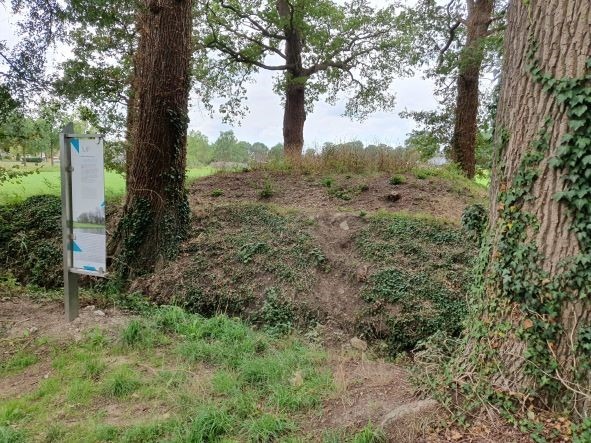
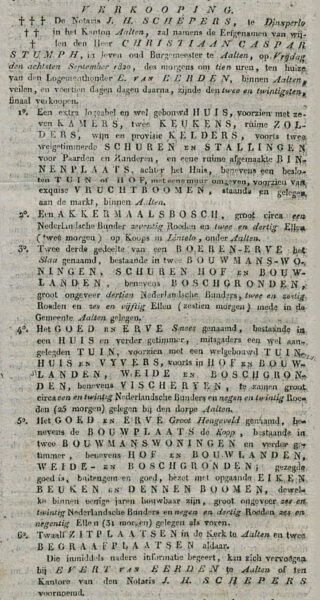
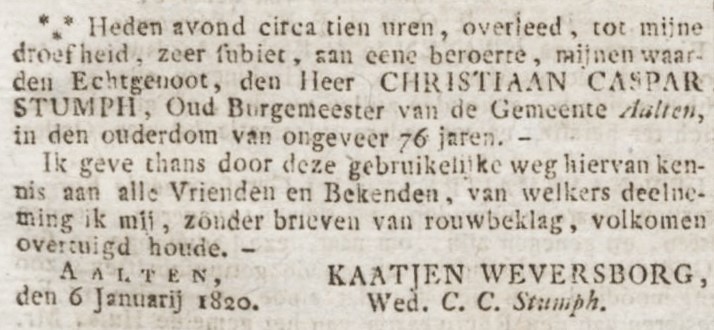
Stumph was a proponent of burial outside the village; he decided to have an “Outer Cemetery” created in one of the Smees meadows. In 1818, the foundation deed and will were drawn up. Christiaan Casper Stumph passed away on January 6, 1820. According to his last wish, he was buried at the old Smees. This site is still recognizable today as a burial mound, located on Nannielaantje.
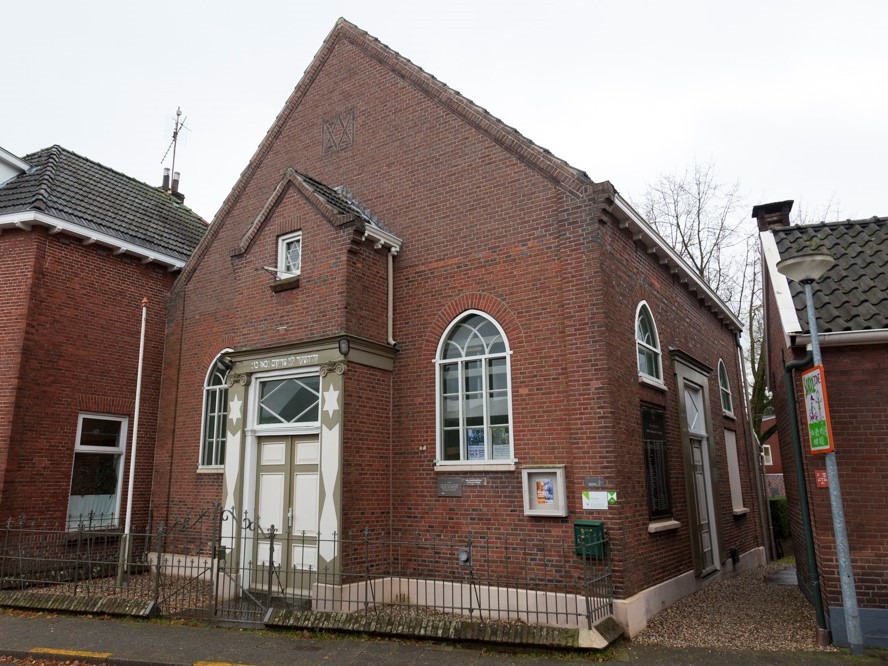
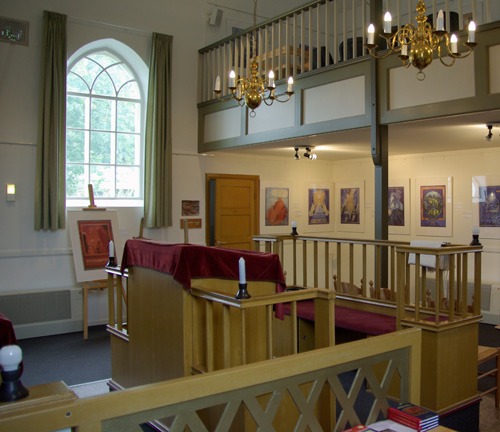
In the centre of Aalten is a small, well-restored, and beautifully furnished synagogue, which formed the centre of Jewish life in this Achterhoek municipality for nearly a century. The building is currently owned by a foundation, the Friends of the Aalten Synagogue.
By the mid-19th century, the Jewish congregation in Aalten had grown so much in number that a residential house became too small for the weekly Sabbath services. The community wanted their own shul, not only for religious services but also for the education of the youth. Consequently, a synagogue was built in 1857. It was a simple rectangular building with no architectural distinction, yet functional for the Jewish congregation in Aalten, which was still far from wealthy but strictly Orthodox. Nothing is known about the architect.
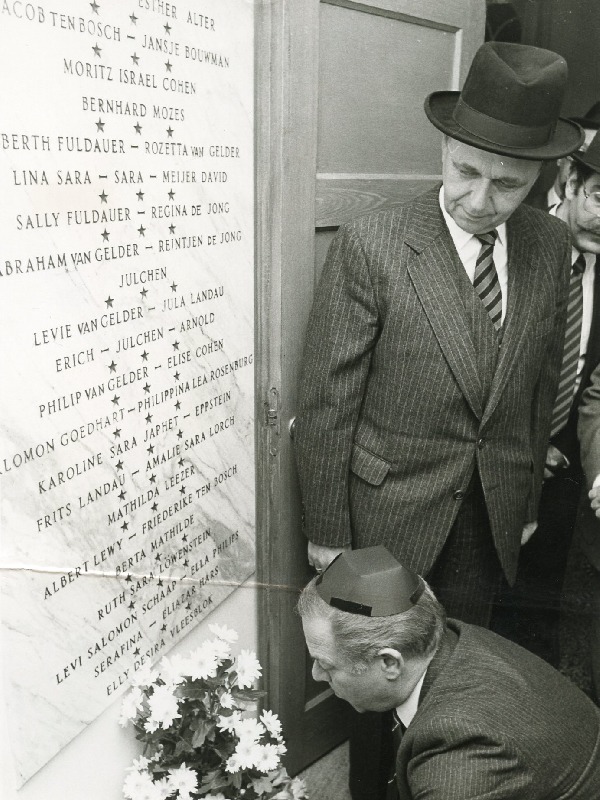
The synagogue became the centre of a lively community life, which lasted until the catastrophe that befell all Jewish communities during the years of the German occupation. The members of the congregation who were unable to go into hiding in time were deported and murdered.
World War II
During the occupation, two attempts were made to set fire to the synagogue. The synagogue was largely plundered and gutted to convert the building for ammunition storage. While the interior of the building was destroyed, the Torah scrolls and ritual objects were hidden in time and thus preserved. After the war, the scrolls of the law were returned to the building. The synagogue was repaired, funded by the proceeds from the sale of the chazzan’s house (since 1948, the congregation could no longer afford the salary for a cantor).
However, a large proportion of the congregation members who survived the war moved elsewhere, meaning the Jewish community had no chance to flourish again. Increasingly, they failed to achieve the required number of men (minyan) to hold services. The synagogue fell into disuse and was in danger of falling into decay.
Restoration
In 1984, the building was sold to the Friends of the Aalten Synagogue Foundation (Stichting Vrienden van de Aaltense Synagoge). This foundation took on the responsibility for a thorough restoration. On 29 December 1986, the synagogue was rededicated with a solemn Hanukkah celebration.
There are features well worth seeing on both the interior and the exterior. Inside, these include the Holy Ark, four Torah scrolls, the Tablets of the Law, the ner tamid, the menorah, the hanukkiah, the bimah, the women’s gallery, and the mikveh. On the exterior, these comprise the inscription above the door, the mezuzah, and the plaque on the right-hand side of the outer wall.
The Aalten synagogue can be visited regularly during the summer months.
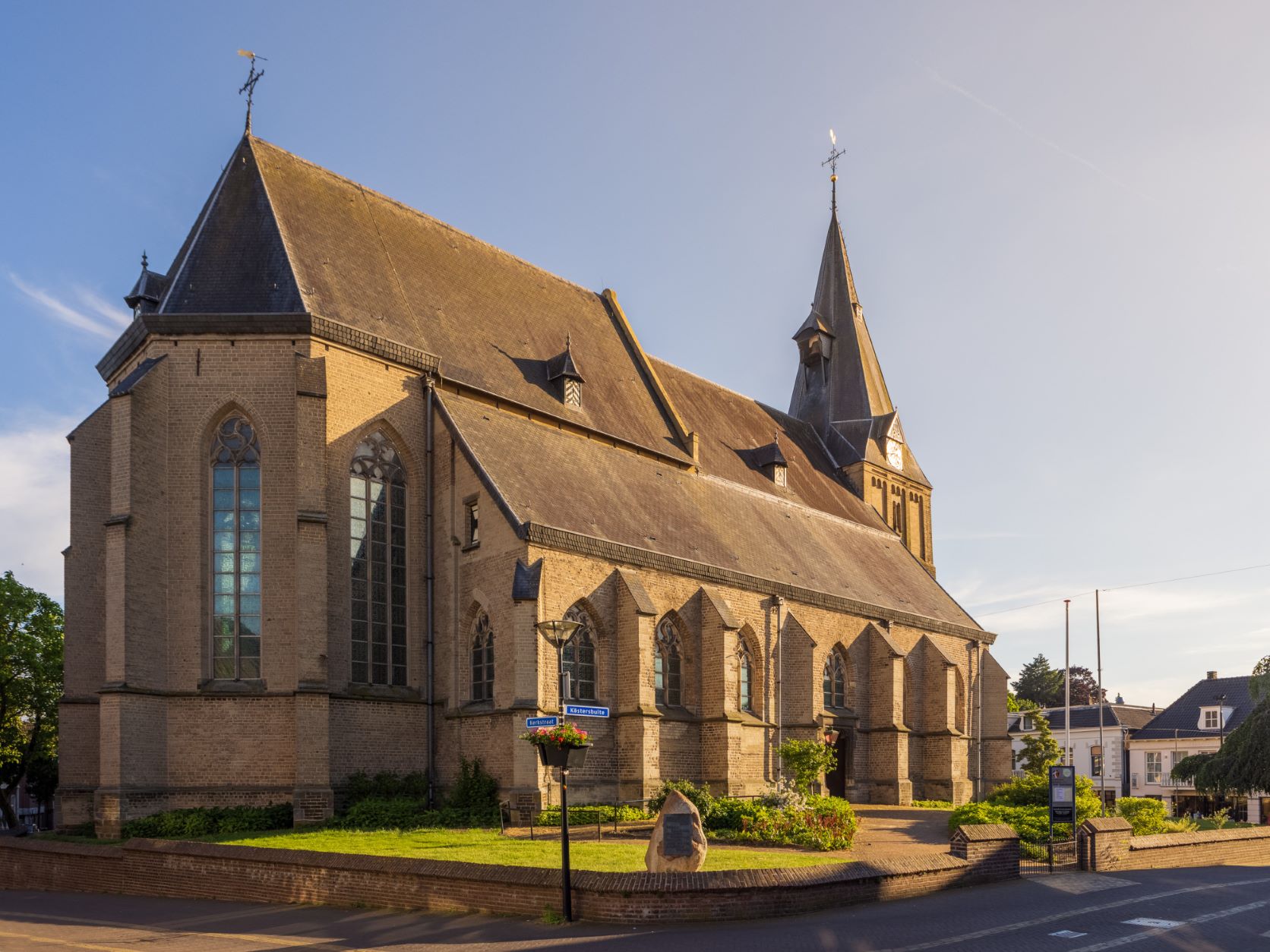
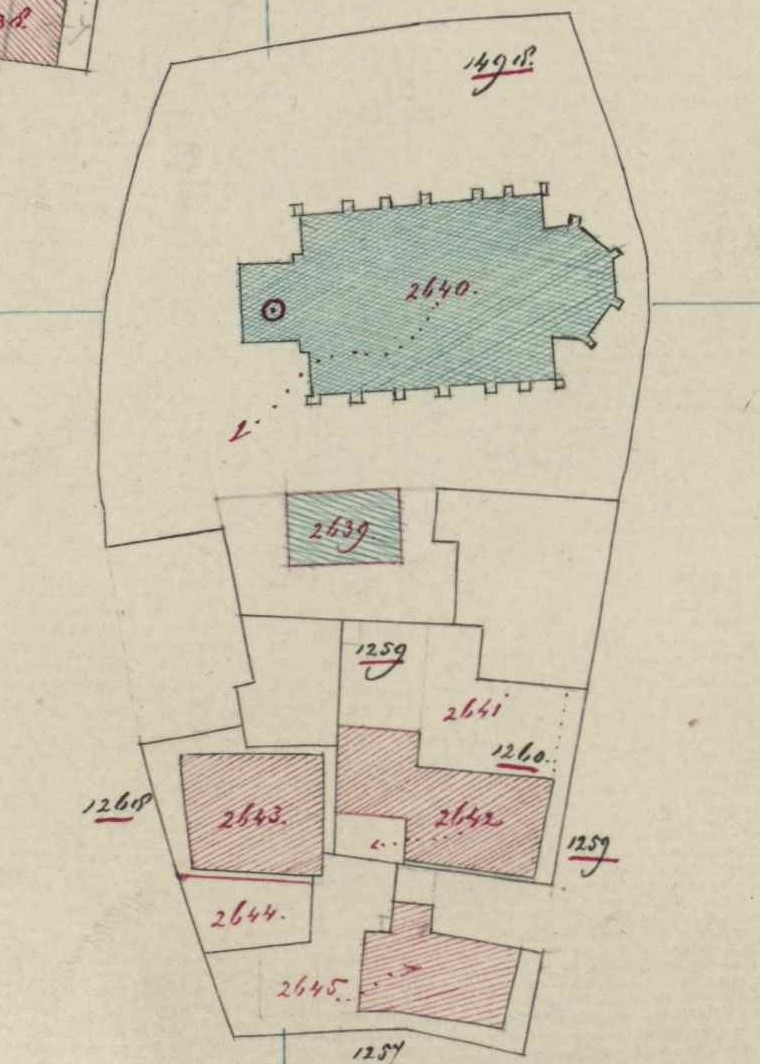
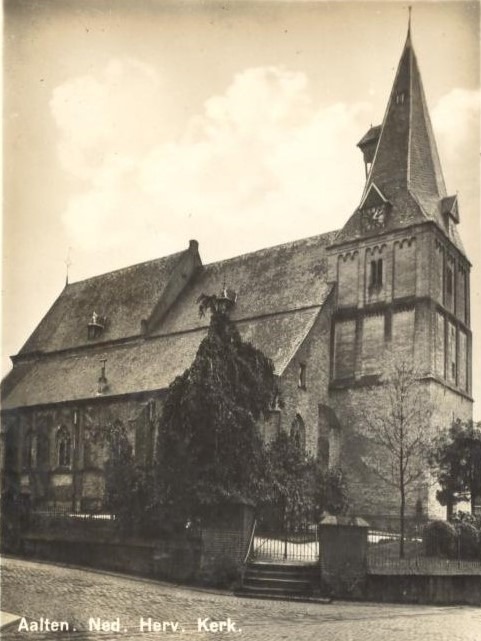
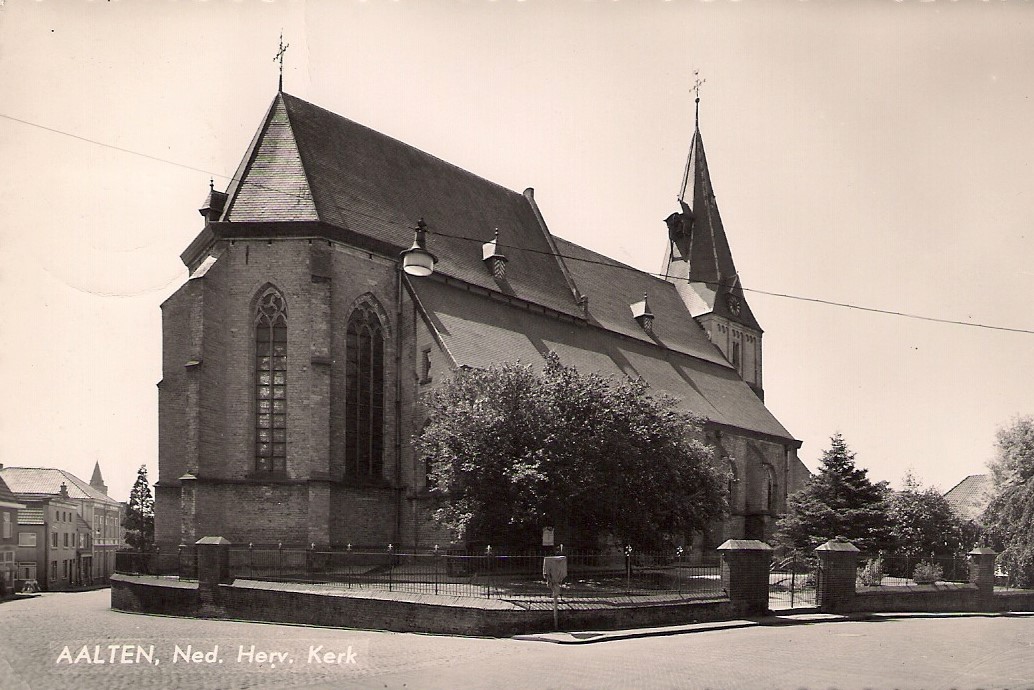
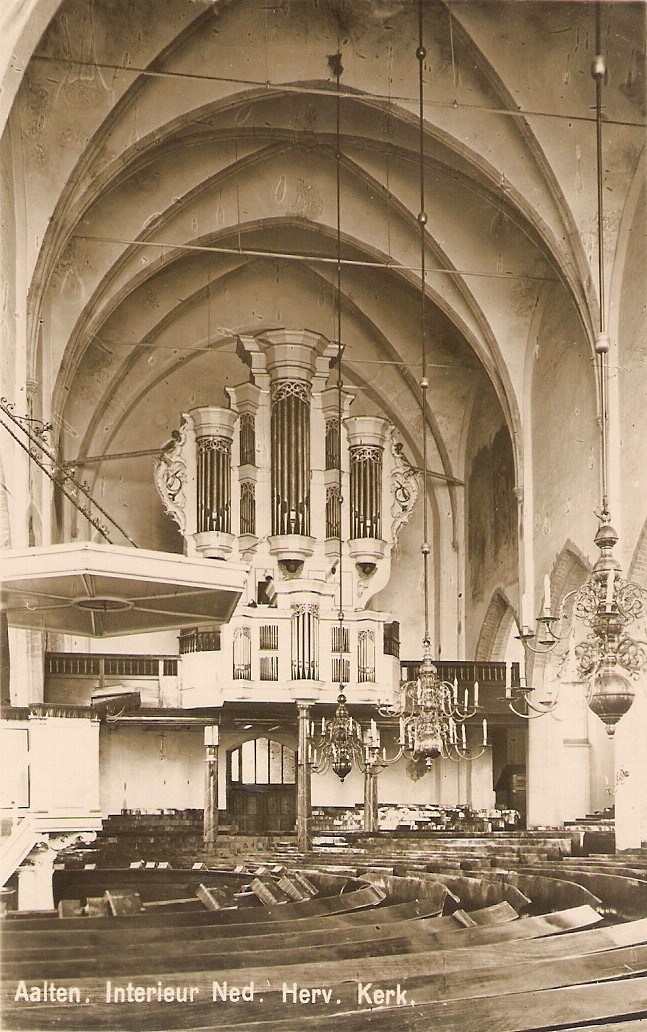
In the centre of Aalten, St Helen’s Church has stood for centuries as the oldest and most distinctive building in the town. This Late Gothic pseudo-basilica with its Romanesque tower is a monument of immeasurable historical and emotional significance. Countless residents of Aalten have been baptised and married here, found solace within its walls, and have been laid to rest from this church.
History
Around the year 800, when the Saxons were subjugated by Charlemagne, he decreed that every community should provide a so-called ‘hoofdhof’ (head court) for the construction of a church. In the settlement of Aladna, the ancient name for Aalten, this was likely a piece of land belonging to the later Havezate de Ahof.
The first small church on this site was presumably built in the Carolingian style, a precursor to Romanesque architecture. The church was dedicated to Saint Helen, the mother of the Roman Emperor Constantine the Great, who converted to Christianity.
In the 12th century, a Late Romanesque tower was added to this first church. The Romanesque architectural style is characterized by heavy, massive walls with small round-arched windows. In contrast to the later Gothic style, Romanesque architecture features little ornamentation. The tower is constructed entirely of tuff, a soft volcanic stone that was widely used in these regions at the time for building churches and castles. The spire takes the form of a so-called constricted needle spire.
Between 1470 and 1483, the three-aisled nave of the church was built, also from tuff. This part of the church was executed in the Late Gothic style, characteristic of the 15th century, with large windows featuring pointed arches that point, as it were, toward heaven. The higher choir on the east side of the church dates from the period between 1440 and 1450. In the late 15th and early 16th centuries, murals were applied to the vaults and walls.
Reformation
Until the end of the 16th century, the parish of Aalten fell under the Diocese of Münster. With the conquest of Bredevoort—the administrative center of the lordship of the same name to which Aalten belonged—by Prince Maurice on October 8, 1597, the Reformation also reached this region.
At that time, Pastor Theunissen, a native of Bocholt, served the Aalten church. He fiercely resisted the reform. According to tradition, however, he had to flee in 1601 to the Burlo monastery, or according to others, to Rhede. He later died in Warendorf, where the small but valuable monstrance he had taken from Aalten reportedly remained until the middle of the 19th century.
Presumably, shortly after 1597, the stone Stations of the Cross depicting the Passion of Christ were also removed. The stations, likely created around 1530 by the Westphalian sculptor Heinrich Brabender, disappeared but were rediscovered in the 19th century. Today, they can be admired in the Museum Catharijneconvent in Utrecht.
The then-chaplain of Aalten, Anthonius van Keppel, originally from Doetinchem, was mentioned in 1602 as the first minister of the Aalten church community, which had recently converted to Protestantism. How did this come about? To expand the Reformation to the countryside, the cooperation of the local Roman Catholic clergy was required. In 1598, many of them were summoned to appear at the classical assembly in Zutphen. The clergy from Aalten were also present. At this meeting, the attending pastors and vicars were required to renounce the Catholic religion and profess that the Reformed religion was the true one.
In the classical assembly of 1603 in Zutphen, the participants from Aalten, Winterswijk, and Zeddam declared their willingness to conform to the conditions set for them. By 1633, the number of members was sufficient to proceed with the establishment of a church council.
Shared use
After the conquest of the Achterhoek in 1672 by troops of the Bishop of Münster, the churches of Aalten, Winterswijk, and Dinxperlo were given to the Minorite fathers by the episcopal commissioner. The Reformed congregation in Aalten reached an agreement with the occupiers. This arrangement meant that Catholics and Protestants could use the church in Aalten alternately. However, a short time later, the use of the church building was forbidden to the Protestants. This situation did not last long. At Pentecost 1674, the Münster troops left Aalten and the church became available to the Reformed congregation once again.
Disturbances
In early 1750, the quiet town of Aalten was shaken by a series of striking religious phenomena. During church services, people burst into tears, sighed loudly, or collapsed as if they had lost consciousness. Some even spoke of encounters with angels or attacks by the devil. These events drew national attention and would go down in history as the Aaltense beroeringen (Aalten disturbances).
Doleantie (Schism)
In 1834, the movement of the so-called ‘Afscheiding’ (Secession)—manifesting through the departure of Rev. H. de Cock and the church council of Ulrum (Gr) from the Dutch Reformed Church—gained some following in Aalten. By 1840, the circle in Aalten had grown sufficiently to found a congregation. A few decades later, the movement of the so-called Doleantie emerged within the Dutch Reformed Church.
Restorations
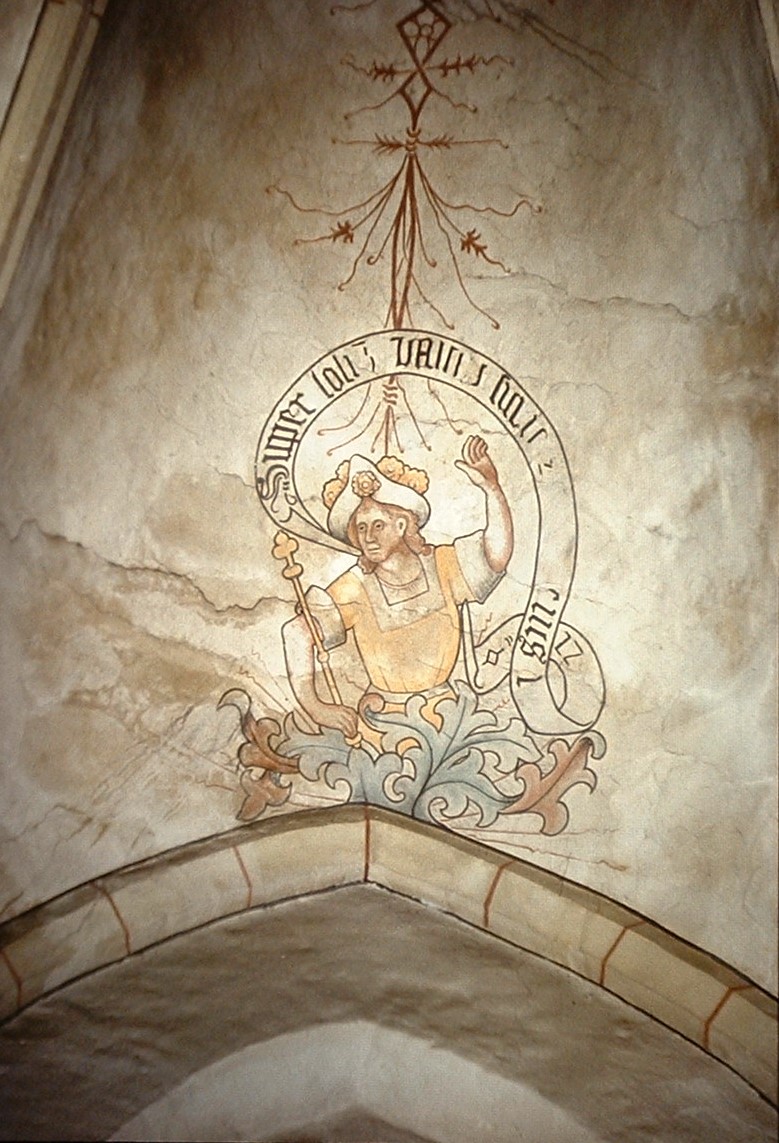
In 1973, the plaster layer in the church was restored. Beneath the six to seven layers of whitewash, exceptional paintings were discovered. These murals include depictions of the twelve apostles, a representation of the Last Judgment, the Coronation of Mary, and—highly unique in Western Europe—an image of Emperor Constantine the Great together with his mother Helena, the namesake of the church. The paintings were subsequently restored.
Burial vault
Also in 1973, carpenter Henk Heijnen discovered a burial vault under the choir during work, containing three coffins with human remains. The vault was quickly resealed by order of the church board, but before that happened, Heijnen had already climbed inside and accurately measured and photographed everything. In 2019, he completed a wooden replica of the burial vault.
Death knell
For centuries, the bells of the Oude Sint Helenakerk in Aalten have tolled at set times to inform the population of deaths, a practice known as ‘overluiden‘.
Owners
This overview is incomplete.
Year
Plot
Owner
Description
1832
I-1498
the Reformed Church of Aalten
3,060 m² church & yard
1862
I-2640
the Reformed Church of Aalten
2,966 m² church & yard
1882
I-3735
the Reformed Church of Aalten
2,924 m² church & yard
1911
I-5447
the Reformed Church of Aalten
2,938 m² church, catechism room & yard
1914
I-5613
the Reformed Church of Aalten
2,720 m² church & garden
1959
I-8339
the Reformed Church of Aalten
3,085 m² church, house & yard
1963
I-8941
the Reformed Church of Aalten
2,925 m² church, house, yard, park, part. community center, road
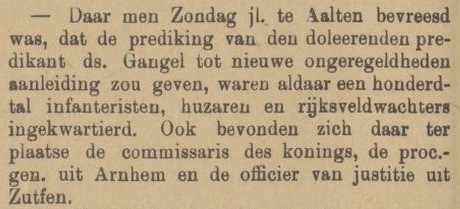
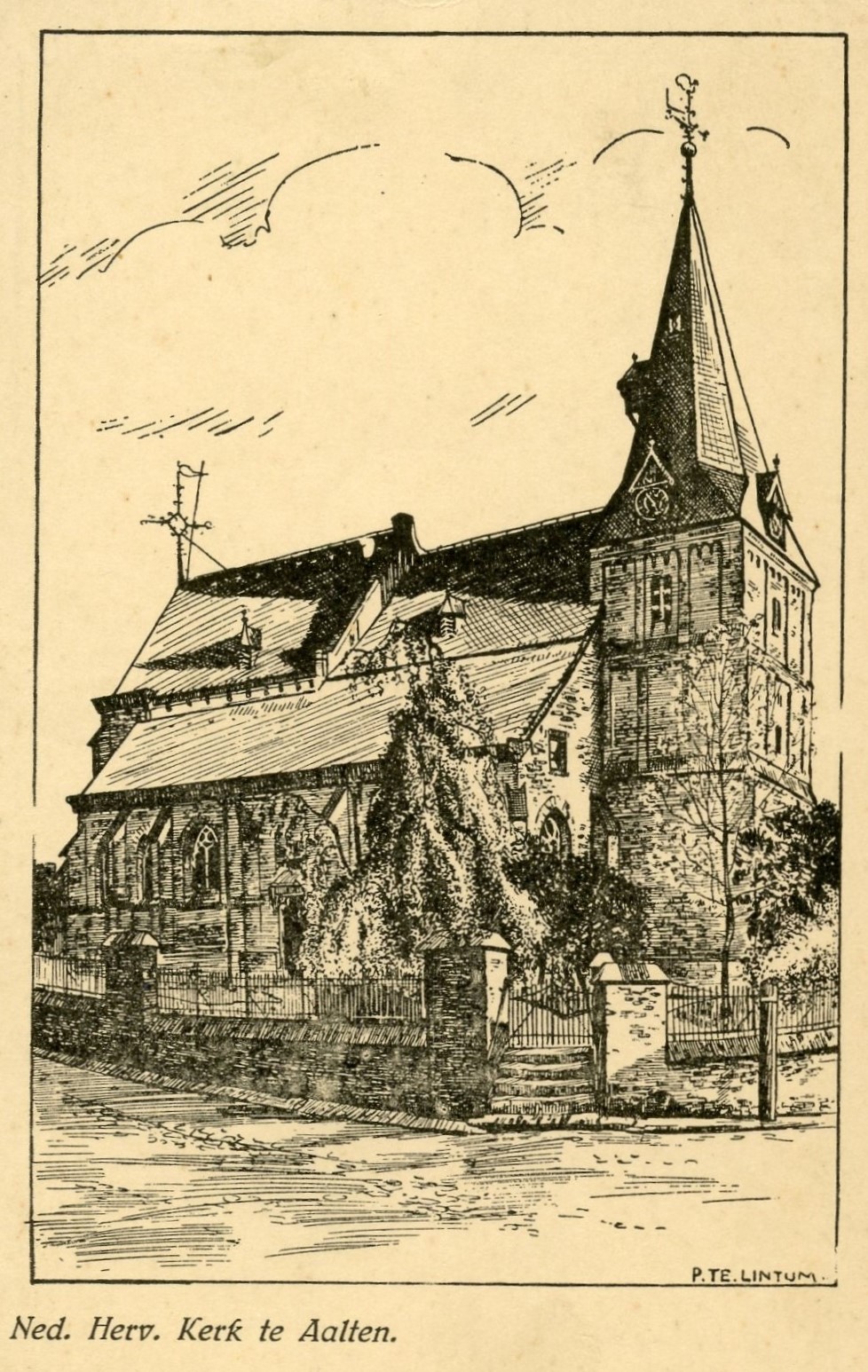
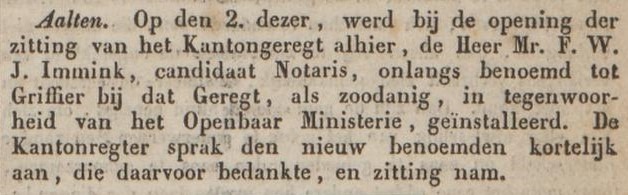
Fragment of cadastral map, 1862Tubantia, 16 March 1887Old St Helen’s Church, Aalten, illustration by Piet te LintumInterior Old St Helen’s Church, AaltenMural in the Old St Helen’s Church
Joseph Gerard van der Schaaf was born on 3 March 1798 in Utrecht, the son of Jacobus Hendrik van der Schaaf and Magdalena Noijon. On 27 March 1836, he married Johanna Hendrina van der Sluis in Hattem.
He served as a District Judge (kantonrechter) in Aalten from 1838 to 1855. Previously, he was a Justice of the Peace (vrederechter) in Aalten, from which position he was honourably discharged.
Joseph Gerard van der Schaaf died on 21 October 1877 in Velp.
Frederik Willem Jacob Immink was born on 24 August 1822 in Ootmarsum, the son of the Reverend Petrus Immink and Aleida van Laer. On 18 July 1854, he married Anna Beatrix Scheij (Oldenzaal, 29 July 1821) in Borculo.
From 1852 to 1855, he served as Clerk of the Court (griffier) at the District Court in Aalten. Subsequently, he served as a District Judge (kantonrechter) in Aalten from 1855 to 1877. Following this period, he was appointed District Judge in Groenlo.
Advocate, notary, land clerk, Justice of the Peace, acting Mayor of Aalten, and deputy bailiff.
Abraham Casper Salomon ten Bokkel was born on 1 November 1761 in Bodegraven, the son of the Reverend Theodorus ten Bokkel (baptised in Aalten on 23 June 1728) and Margaretha van Hoeij. Ten Bokkel studied in Harderwijk (enrolled in 1786).
On 29 April 1787, he married Gesina Geertruid Schaars (Aalten, 15 March 1767) in Terborg. This marriage produced four daughters, two of whom died shortly after birth:
An advertisement from 1797 was found in which Ten Bokkel is mentioned as an advocate involved in the sale of the substantial Lohn House, just across the border in Südlohn (D). In 1803, a similar advertisement was discovered concerning the sale of Sinderen House.
Sale of Lohn House – Rotterdamse Courant, 12 September 1797
In 1823, Ten Bokkel lived on Landstraat in Aalten, at what is now number 17.
Abraham Casper Salomon ten Bokkel died on 29 May 1831 in Dinxperlo.
Abraham Antonij Stumph was born on February 4, 1784, in Aalten, as the son of the first mayor of Aalten, Christiaan Casper Stumph, and Jeanne Lesturgeon.
Abraham Antonij Stumph passed away on July 23, 1818, in Aalten. He had drowned in the Slingebeek at the age of 34. Local folklore suggested that his death was related to a broken heart. His body was buried on the family estate ‘t Smees, in the burial mound on the Nannielaantje.
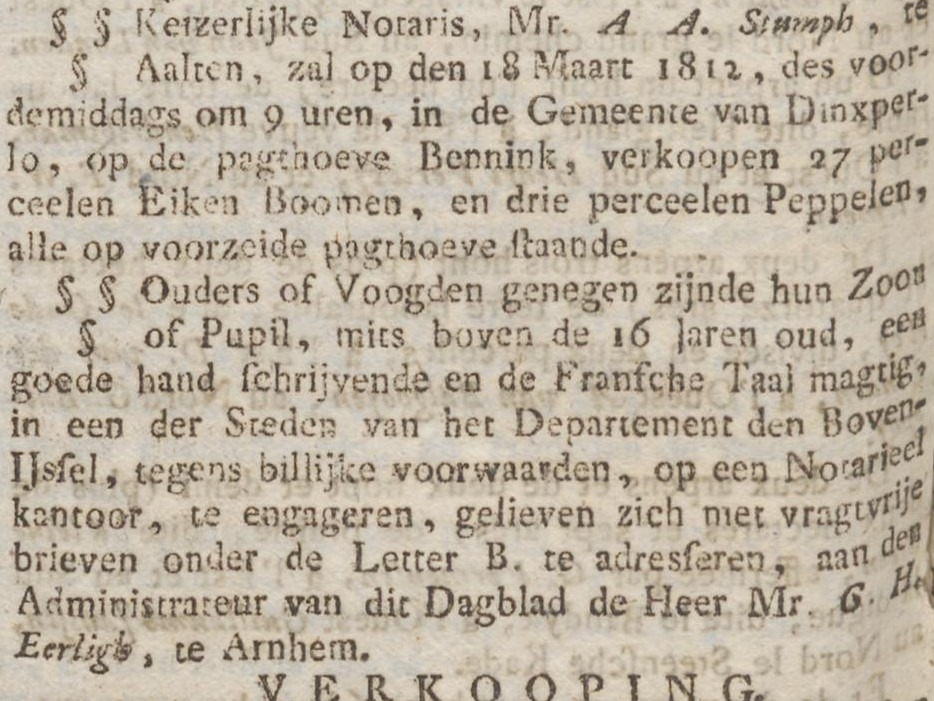
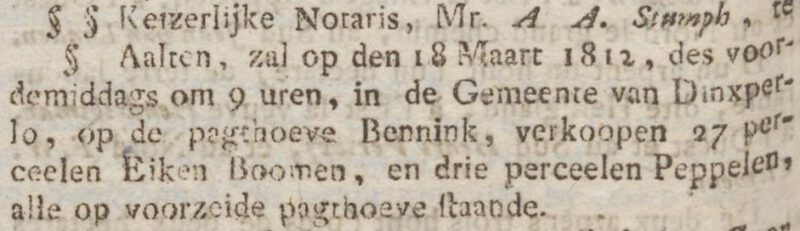
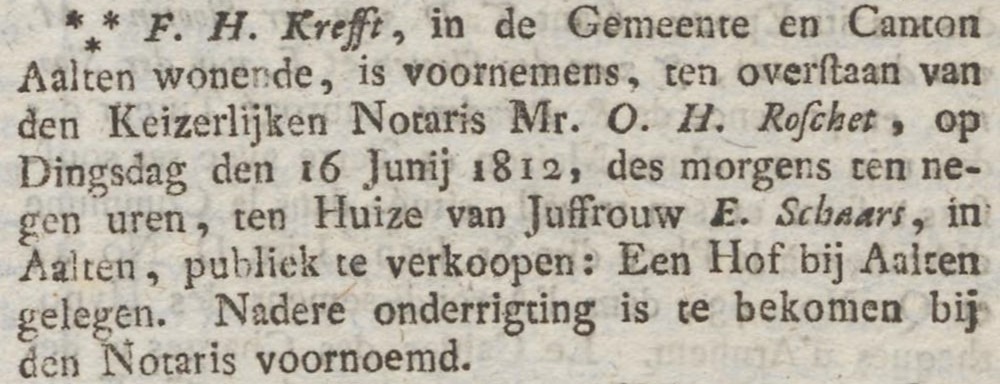
Staatkundig Dagblad van het Departement van den Boven-IJssel, March 10, 1812
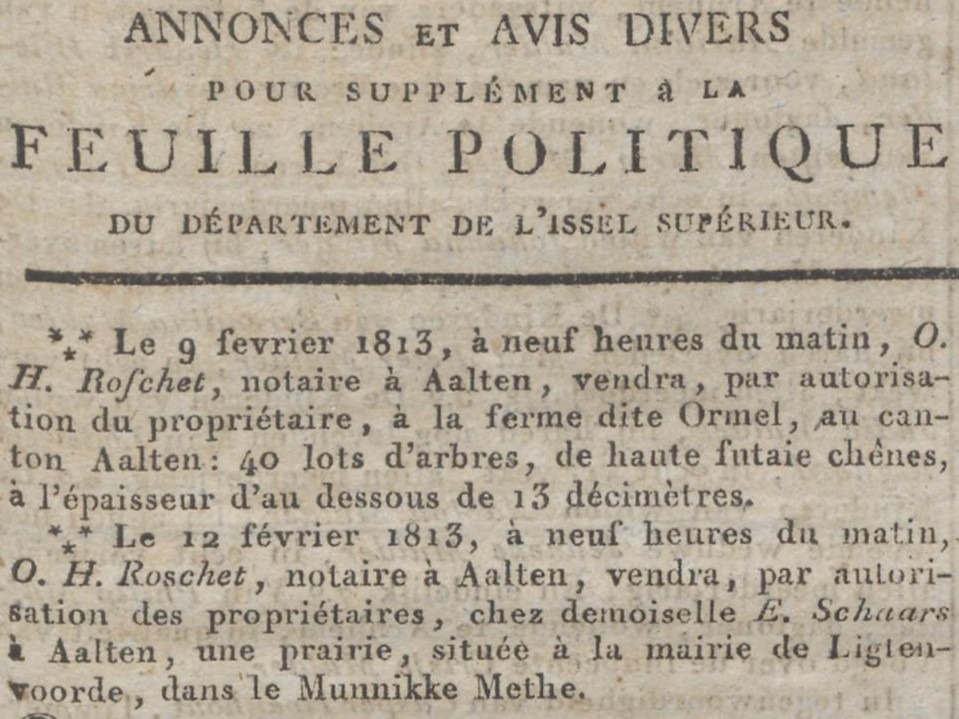
Otto Hendrik Roschet was begin 19e eeuw ‘keizerlijk notaris’ in het kanton Aalten. Hij werd op 24 november 1769 gedoopt in Arnhem, als zoon van Willem Hendrik Roschet, rentmeester van landgoed ‘t Loo in Apeldoorn, en Arnolda Elisabeth Wakker. De achternaam werd oorspronkelijk geschreven als ‘Rochet’.
De eerste vermelding die wij hebben gevonden van O.H. Rochet in Aalten dateert uit 1809, in de Franse tijd, met als beroep ‘advocaat’. In 1812 werd hij bij keizerlijk decreet benoemd tot notaris in het canton Aalten. In 1813 woonde hij aan de Kerkstraat.
Zijn jongere broer Theodorus Gerardus had zich in 1802 in Aalten gevestigd als apotheker, maar overleed in 1804 op 28-jarige leeftijd aan “eene zware rotkoorts”. Of Otto Hendrik toen ook al in Aalten woonde, is ons onbekend.
De laatste vermelding van Roschet als notaris te Aalten die wij vonden dateert uit 1815. De eerstvolgende vermelding van hem vonden we in de Arnhemsche Courant van 6 februari 1816, waarin hij wordt vermeld als rentmeester van ‘t Loo in Apeldoorn. Vervolgens werd hij in de Arnhemsche Courant van 4 april 1816 vermeld als burgemeester ad interim van Apeldoorn.
Otto Hendrik Roschet overleed op 21 november 1824 op 55-jarige leeftijd op ‘t Loo in Apeldoorn. Hij was daar op dat moment opziener en kapitein bij de garnizoenscompagnie.
Staatkundig Dagblad van het Departement van den Boven-IJssel, 13 juni 1812Feuille Politique du Département de l’Issel-Supérieur, 2 februari 1813Opregte Haarlemsche Courant, 27 november 1824
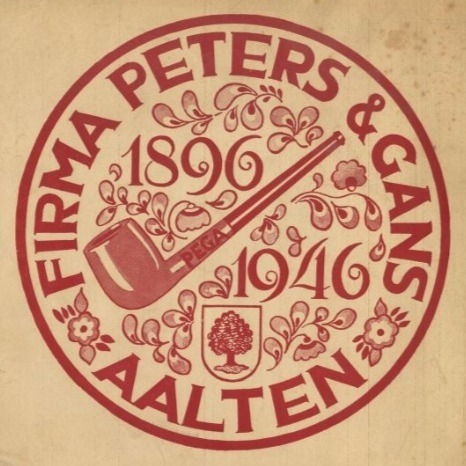
The firm Peters & Gans (PEGA) was one of the companies in Aalten active in the horn industry, which was unique within the Netherlands. At PEGA, pipes, walking sticks, and snuffboxes were manufactured.
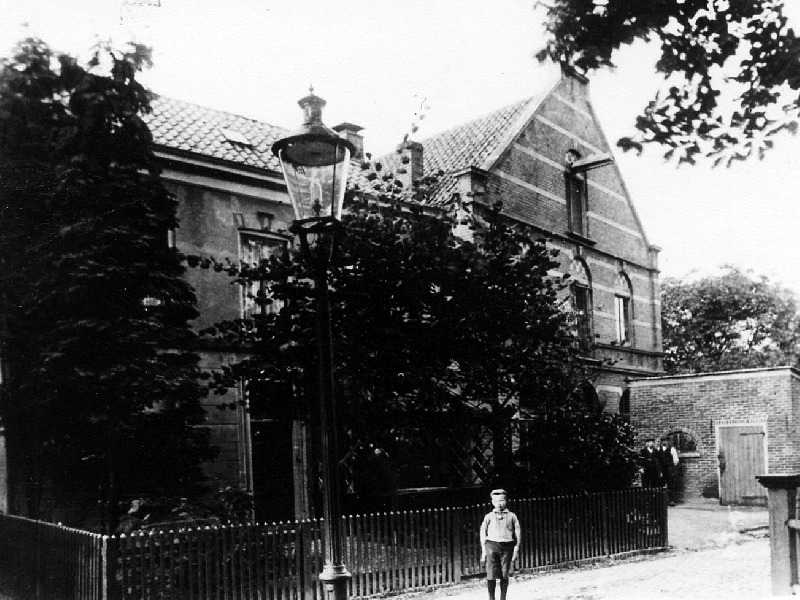
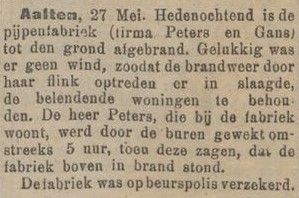
In 1896, Johannes Peters left his father’s horn workshop at Köstersbulte and entered into a partnership with Marcus Gans, a Jewish merchant. Gans financed the firm named PEGA (Peters & Gans). The pipe factory was initially located next to Peters’ residence on what was then Gasthuisstraat (now Haartsestraat).
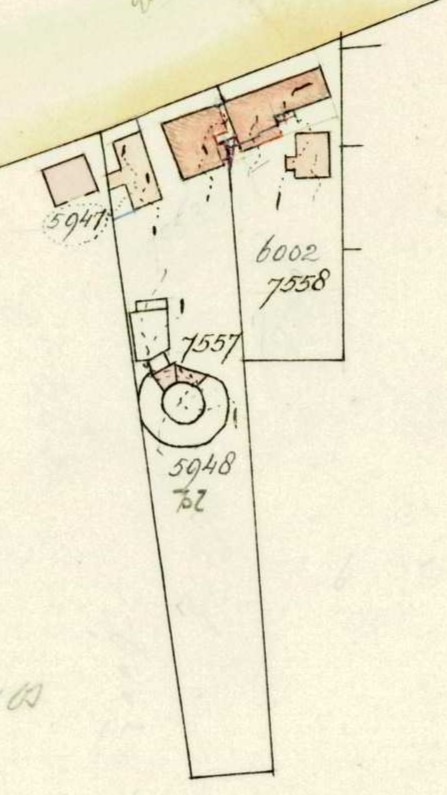
Alongside German pipes for German reservists, walking sticks with horn handles were manufactured. After the factory was completely destroyed by fire in 1917, Johannes Peters established his pipe factory on Admiraal de Ruyterstraat. Instead of German pipes, production shifted primarily to briar pipes (bruyèrepijpen).
In 1931, the Graafschapbode published an article regarding “The Aalten Horn Industry,” and wrote the following about Peters & Gans:
“We visited the factory of the firm Peters & Gans in Aalten, manufacturer of horn, imitation horn, and wooden pipes, and of the typical German pipes with many horn decorations, of walking sticks and… of snuffboxes! Beautiful snuffboxes, manufactured entirely from horn, which find a market among the mining population of Sweden and Germany.
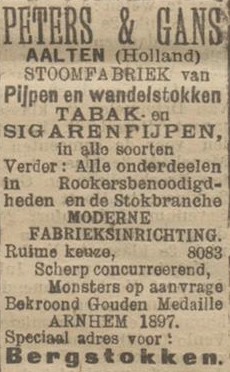
This firm, which saw its products awarded a gold medal as early as 1897, manufactures a great variety of smoking articles, namely the wooden pipes used by everyone, imitation horn pipes, cigar and cigarette holders, while this factory focuses particularly on the large-scale manufacture of mouthpieces for pipes, among others for the Gouda “clay” pipes (doorrookkoppen). These mouthpieces are made of horn or imitation horn, often in connection with so-called Weichsel wood or scented wood, which enhances the ‘taste’ of the smoking.
The typical long German pipe is a ‘specialité de la maison’ of this factory!
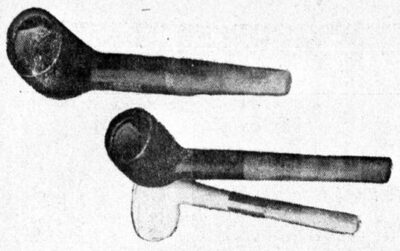
Some pipes from Peters & Gans Co.
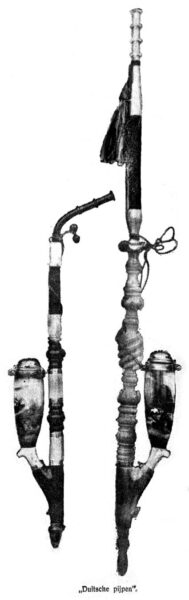
As is evident from one of the accompanying photos, such a pipe consists of a concatenation of artfully crafted horn components; the workmen who make these artfully crafted pipe specimens are true sculptors in the horn trade! Americans, in particular, enjoy buying these pipes, which they take with them as a memento of Holland… to then tell their compatriots that all of Holland smokes from these remarkable pipes! The firm Peters & Gans wishes it were true!
„German pipes”
It is, however, a pipe from which one ought to smoke in the entourage of an old farmhouse or amidst a cosy furnishing from several decades ago, preferably wearing a black suit and a skullcap (calotje)! It is precisely this distinct character of this old-fashioned pipe that is its charm at the same time; it is worth the effort to hang it as an ornament on a pipe rack and to smoke from it for curiosity’s sake from time to time. These ‘German pipes’ find their market in Holland and furthermore, as we already noted, go much to America and also to Germany. They are, therefore, actually Dutch ‘German’ pipes.
The horn components of these pipes are manufactured on the lathe. Besides pipes and snuffboxes, the firm Peters & Gans is a supplier of walking sticks, in which they deal wholesale; they specialise in the cheap and middle-range, make mountain sticks for the Valkenburg tourists, rattan sticks for the cattle markets, modern gentlemen’s walking sticks, with horn or imitation horn knobs or decorations.
A widely used material nowadays, as the partner assured us, is the Tahiti rattan from the Dutch East Indies, a light and strong stick that is very flexible. The wooden sticks mostly come from Central Europe; they generally already have the hook shape roughly applied, after which the sticks are first left to become bone-dry and subsequently shipped to our country. Because they then already somewhat resemble walking sticks, the tax authorities charge them at the border with 8% import duty, which the firm Peters & Gans finds a very incorrect practice, as here the raw material for the Dutch industry is being taxed!”
40th Anniversary
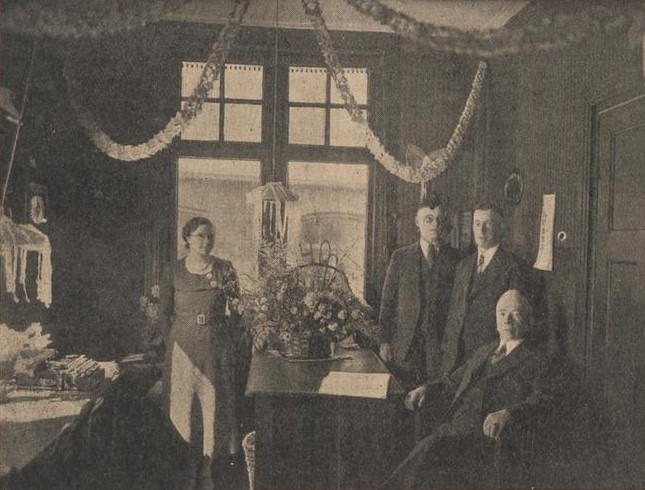
In 1936, the firm Peters & Gans celebrated its 40th anniversary. The Aaltensche Courant then wrote the following:
“Today 40 years ago, 1 May 1896, the deed of incorporation of the firm Peters & Gans was passed here. The founding of this firm was purely a result of local conditions. The elders among our readers will surely still remember that in the eighteen-fifties, the horn industry was founded here locally by Mr B. Vaags. He then processed the dense part of the horns; the open part was actually waste for pipe fabrication. This waste was later made productive by Mr A. ten Dam by applying it to the manufacture of combs. This comb fabrication took such a flight that soon the roles were reversed (de bordjes werden verhangen), and the pipe manufacturers then bought the tips from the comb factory.
The father of the current eldest founding partner, Mr Joh.s Peters, was one of the first servants of B. Vaags; he began his own business on the Hoogestraat, later in the premises on the corner of the Markt. Some 20 workmen found employment here then. In 1896, Mr Peters ceased his business. His son, Mr Joh.s Peters, then founded the business, which through association with Mr M. Gans, received the company name Peters & Gans.
This business was run on a much more modern footing. In place of the primitive treadle movement came the motor-driven power. In 1900, Mr Gans retired from the firm. On 27 May 1917, the factory on the Gasthuisstraat was totally destroyed by fire and not rebuilt, but already in June, the business was continued in the former furniture factory of Mr Vreede, which through addition and renovation had been adapted to the requirements and needs of the business.
Primarily pipes were manufactured; the raw materials were mainly the pieces of the horns unusable at the comb factory. Alongside pipes, walking sticks were manufactured; the market area for both products was, until the war, located mainly across the border.
Now, however, the roles are reversed and the company imports more than the export amounts to; the own production has had to be reduced to a minimum. A great contrast with the mobilisation years when demand exceeded production. The genuine pipe turning as it happened in the past was a beautiful, yet very difficult trade and required, besides dexterity, taste and initiative.
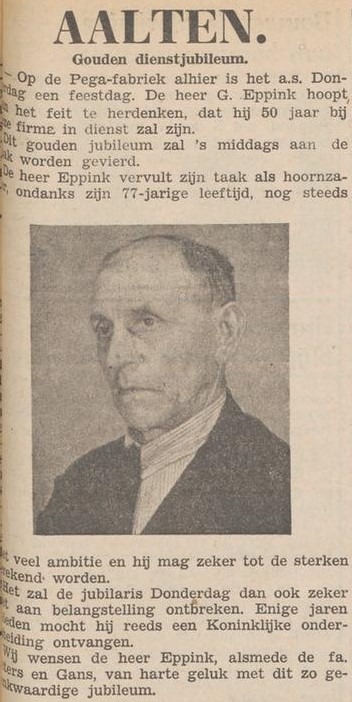
Many have found a sphere of work in the factory of the firm during these 40 years. One of the oldest workmen, who has been employed there almost since the founding, is Mr G. Eppink.
The tobacco pipe is the main article that the business is currently pushing; the smokers will likely not be strangers to the well-known briar ‘Pega’ pipes. The wooden ‘bowls’ are imported roughly; the ‘tips’ or mouthpieces are of own manufacture. Alongside the briar pipes, the so-called German pipes are still manufactured, which in certain regions still find a market, and the firm Peters & Gans is in its district actually the only one that can meet the demand for this article.
Mr Joh.s Peters, who has taken his two sons into the firm, is despite his 69 years still regularly active for the flourishing of his business with a vitality that many a younger man will envy him.
Today is a day of celebration for the partners and staff; undoubtedly the outing to Emmerich will be enjoyed, and the ups and downs of the business will surely pass in review. We gladly congratulate the partners on this anniversary and link to it the wish that their business may enjoy a steady flourishing.”
The celebrating family.
In 1953, the newspaper Tubantia wrote:
“The small pipe factory of the firm Peters and Gans still exists and pipes are still being manufactured, yet in the main, this business has nonetheless switched over to wholesaling, including in all kinds of related smoking articles.”
House of Joh. Peters and pipe factory on Gasthuisstraat in Aalten Fragment cadastral map, 1951 (plot I-7558), on Admiraal de RuyterstraatLimburger Koerier, 7 July 1910Zutphensche Courant, 29 May 1917Anniversary logo, 1896–1946Aaltensche Courant, 7 February 1950
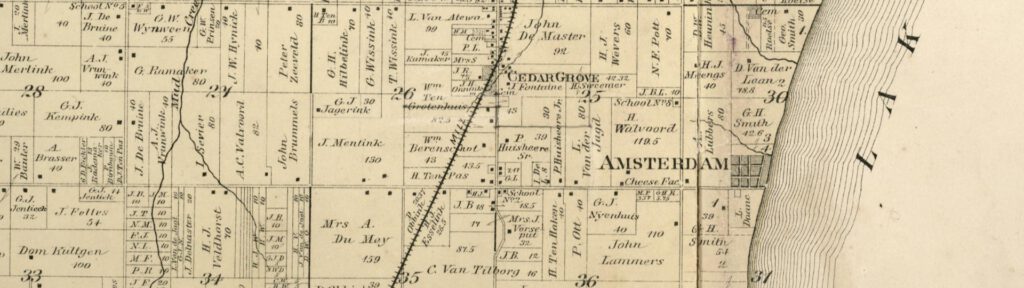
Map of Amsterdam and surroundings, Sheboygan County, 1889 (image: University of Wisconsin–Madison)
In the 19th century, thousands of Achterhoekers emigrated to the United States in search of land, freedom and new opportunities. Among them was the Walvoord family. They were among the early European pioneers who sought refuge in the fertile but unexplored territories of Wisconsin.
The family name Walvoort/Walvoord comes from manor house ‘t Walfort in Aalten. Scott Anthony Walvoord, who lives in the United States and is a descendant of emigrants from the Achterhoek, has spent years researching his roots. On his website he has collected an enormous amount of information about the Walvoort/Walvoord families, in the Netherlands and the US.
The information below is mostly taken from Scott Walvoord’s website.
Ancestors of ‘The Founding Five’
Scott has been able to distinguish five branches of the Walvoort family that have emigrated to America. He calls these the ‘Founding Five’. They are all grandsons of Derk and Janna Walvoort, three brothers and two of their nephews. Most Walvoords and Walvoorts living in America today descend from this ‘Founding Five’.
Salomon Walvoord (Winterswijk, 21 April 1778) married in 1801 Maria Elisabeth Klumpenhouwer (Dinxperlo, 21 June 1781). They went to live on the Gantvoort farm in Barlo and had ten children there. Maria died on January 6, 1840 at the age of 58. Salomon then moved with his youngest daughter, Janna Diena (1825) to the adjacent farm Leeland. On May 1, 1846, Salomon moved in again, he moved in with his eldest son Hendrik (1802) who lived on a farm in Vragender. There he died on 8 June 1848 at the age of 70.
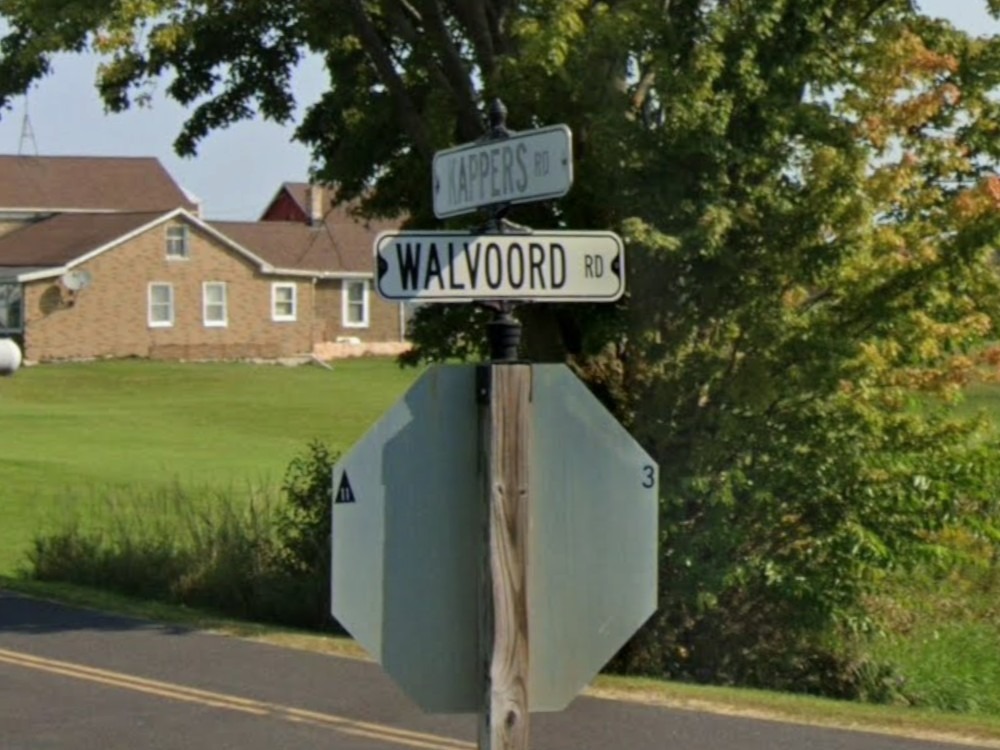
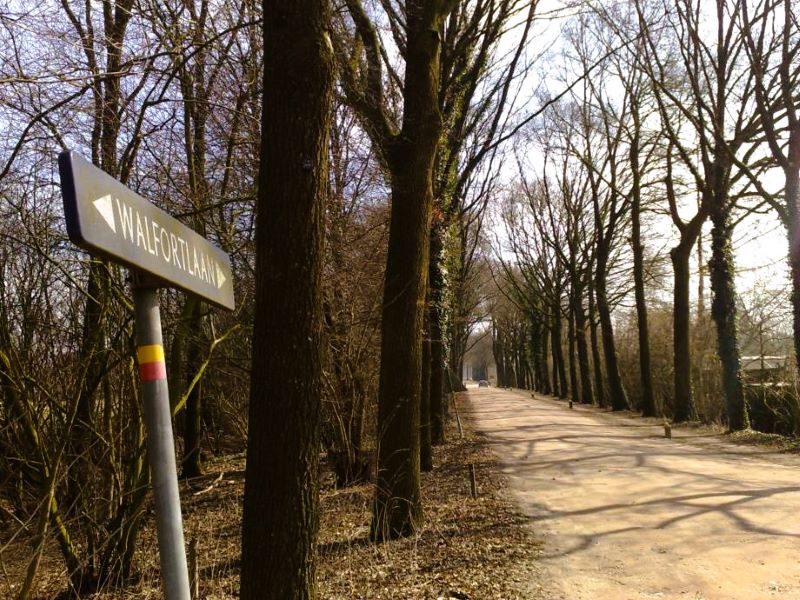
Walfortlaan, Aalten (photo: Google Streetview)Walvoord Road, Sheboygan (photo: Google Streetview)
Hendrik Walvoord (1802-1865)
Hendrik (Aalten, 21-03-1802) was tall, dark and slender as a young man. He married three times, twice to sisters, daughters of Garrit Doornink and Dersken Wesselink. His first marriage was with Teunisken Doornink (Vragender, 16-02-1800). They married in 1824 and he moved in with his parents-in-law. Together they had two children, Gerrit Jan (Vragender, 22 January 1826) and Derk Antoni (Vragender, 24 July 1827). Derk Antoni died on January 24, 1828, at the age of six months. Five months later, Teunisken died on June 22, 1828, at the age of only 27.
Hendrik’s eldest son Gerrit Jan was cradled in the same cradle as Hendrik’s youngest sister, Janna Diena (Gerrit Jan’s aunt, born only one year earlier).
Hendrik remarried on 24 July 1829 to Teunisken’s sister, Johanna Berendina Doornink (1806). Together they had a son, Antoni (Tonie) (Vragender, 29 April 1830). But Tonie died on January 23, 1833 at the age of two, while staying with his grandfather and grandmother in Barlo (Gantvoort farm). They may have taken care of Tonie temporarily because of the death of his mother, ten days earlier, on 13 January 1833 in Vragender, at the age of only 26 years.
Hendrik’s third marriage took place on 4 May 1833 to Johanna Berendina Walvoord (1816). She was a daughter of Antonij Walvoord and Willemina Geertruid Konings. Hendrik and Johanna had two daughters together, Johanna Wilhelmina (1834) and Theodora Maria (1835). Theodora died at the age of five on November 29, 1840. Mother Johanna died on July 27, 1839 in Vragender, 27 years old.
Emigration to America
After the death of his parents, Hendrik Walvoord, three times a widower, left the Netherlands for America in 1849. He had made some investments with his inheritance before crossing the Atlantic and had six thousand dollars with him.
Hendrik’s nephew Gerrit Jan Walvoord (Lichtenvoorde, 1816), not to be confused with Hendrik’s son of the same name, took over the family farm in Vragender. Later, in 1870, Gerrit Jan also emigrated with his family to America where he joined his son Toni Willem (William) Walvoord (Lintelo, 1843) in Nebraska. William had preceded his father and had sent back enthusiastic messages from bountiful prairie land.
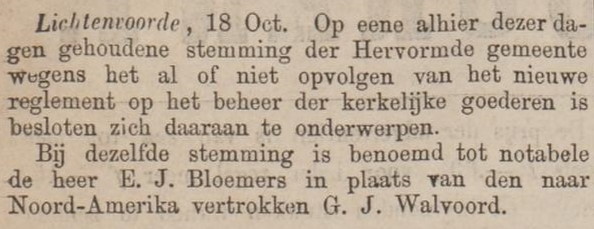
Zutphensche Courant, 20 October 1870 (source: Delpher)
Hendrik left with his youngest sister, 24-year-old Janna Diena Walvoord, on the sailing ship Hector from Rotterdam to New York and arrived on 16 September. In America, he joined his son Gerrit Jan in Pittsburgh, Pennsylvania. Gerrit Jan had preceded his father and sister a few years earlier. Immediately afterwards, the whole family moved to Holland, Sheboygan County in Wisconsin, where Henry purchased 65 acres of wooded land and began developing a farm, which he expanded from time to time. Shortly after arriving in the US, he acquired 49 shares in the Holland Trading Company, which was engaged in the trade and transport of timber.
After coming to Wisconsin, Henry sold plots of land to new immigrants in a region he had called Amsterdam. It would take some time for the authorities to officially recognize this name. Every lot he sold had a view of Lake Michigan. Hendrik also became known as a timber merchant. He needed a jetty for boats, which came to collect the wood. He rented a dredger from the government and dredged a small port two meters deep. There, piles of wood were waiting for boats.
Every day, two or three ships left the jetty, loaded with wood. There were usually four or five ships in the bay at the same time. Seven or eight teams of men dragged the wood to the pier (according to Tony Walvoord, 80+ years old, who told all this to Louise Walvoord). Although the original pier has disappeared, the wooden piles of Walvoord’s pier are still visible. Hendrik not only owned shares in the timber company and the jetty, he had also bought a shop and large plots of land near Amsterdam.
Henry Walvoord co-founded the Presbyterian Church at Cedar Grove in 1853 and served as an elder for many years. On March 17, 1855, Henry became an American citizen. Two days later, his son Gerrit Jan did the same.
On July 11, 1856, Hendrik lost his only son Gerrit Jan, who drowned in Lake Michigan at the age of thirty. Henry bought a plot of land for a cemetery that is now in the village of Cedar Grove (Walvoord Cemetery) and buried his son there.
Hendrik Walvoord died on 21 December 1865. After his death, his land was inherited by Gerrit Jan’s children (Henry, Jane, Mary, Tonia, and Delia). Henry, his grandson, inherited 32 hectares and the granddaughters each inherited 16 hectares. In addition, Henry received all movable property from his grandfather, namely: horses, cattle, wagons and furniture. The four granddaughters each received $15 for a cow and another $300 when they turned twenty-one. When he turned twenty-one, Henry received the rest of his grandfather’s property (mortgages, notes, securities, credits, and money). When Tonia died, her brother Henry bought her land.
Gerrit Jan Walvoord (1826-1856)
Gerrit Jan Walvoord (Vragender, 22 January 1826) was spry and clever, a man of quick action. He was tall and slim, had black hair and good looking. At the age of twenty, he left his native country to seek his fortune in the New World. His father, Henry, would follow him later. Gerrit Jan may have sailed from Rotterdam to Baltimore with the ship Garrone. He first settled in Pittsburgh, Pennsylvania, where he farmed and also worked in the coal mines. There he married a German girl, Anna Maria Engel Nolten, who had emigrated to America with her brother in 1846.
Their eldest son, Henry, was born in Pittsburgh in 1847. When Henry was about two years old, in the fall of 1849, the Walvoord family moved to Sheboygan County, Wisconsin. They settled in the small settlement of Amsterdam on Lake Michigan, southeast of the village of Cedar Grove. The Walvoords had a shop there and shipped wood from the pier.
Gerrit Jan Walvoord was not allowed to enjoy his new home for long. While he was measuring wood on the aforementioned pier, he accidentally drowned, thirty years old. No one saw the accident. He was found in the water. According to one story, Gerrit Jan heard a ship approaching while he was eating. He jumped off the table, ran to the harbor, climbed over the wood on the pier and lost his balance. He fell into the water, which was very cold, and although he was a good swimmer, the wood that had also slipped into the water kept him down and he drowned. Gerrit Jan died in Lake Michigan on July 11, 1856 and was buried in Walvoord Cemetery.
At his death, Gerrit Jan left behind a family with five children. Son Henry was eight at the time of the accident. Gerrit Jan’s daughters were Jane, Mary, Tonia and Delia. Delia, the youngest, was only three months old when her father died. Soon after, the case on the pier would cause the Walvoord family even more suffering. In January 1857, the shop and home burned down and the family lost most of their possessions and almost everything they had invested there.
The elder Hendrik Walvoord had money and bought some land. Both his family and Gerrit Jan’s family moved to a farm near Amsterdam. The house was built for the two families and they lived there together for some time. Henry Walvoord (son of Gerrit Jan) was married there.
Janna Diena Walvoord (1825–1894)
Janna Diena (Jane) Walvoord (born 27 June 1825) was the youngest sister of Hendrik Walvoord. Jane came to America in 1849 with her brother Henry. After arriving in America, she married a man also named Walvoord: Derk Antonij (Dirk Tony) Walvoord (Lichtenvoorde, 1820). Jane died on October 8, 1894 in Holland, Sheboygan. Jane and Dirk Tony had three sons: Garrett, Tony and William.
Garrett married Delia Huenink in 1886 and had six children: Jennie, Minnie, Anna, Elmer, Alice and Della. Tony married Janna Pot in 1886 and had four children: Antoinette, Mabel, Agnes and Alvin. Tony’s second marriage in 1900 to Sarah Hilbelink produced no children. William married Jennie Flipse in 1892, an older sister of Mary Flipse who later married a distant cousin of William’s, John Garrett Walvoord. William and Jennie had five children: Louis, Clarence, Marion, Esther, and Harvey.
Walvoord Cemetery
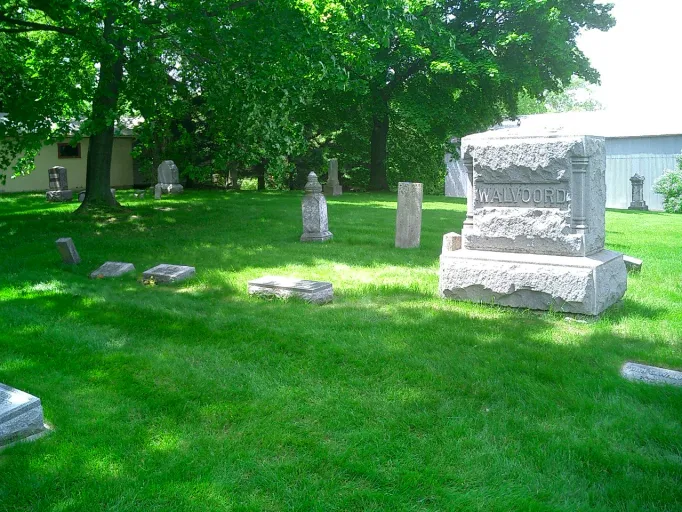
On 11 July 1856, Hendrik Walvoord (1802-1865) lost his only son Gerrit Jan, who had drowned in Lake Michigan at the age of thirty. In his will, Henry reserved an acre of land (about 0.4 hectares) for a family cemetery in section 26 of Holland Township. As stated in the will:
“First, I give and bequeath to the children of my son Gerrit Jan Walvoord (deceased) and to their children who may be born and their grandchildren, great-grandchildren, in a word to the descendants of the said children of my son Gerrit Jan Walvoord (deceased), an acre of land lying and located in the County of Sheboygan and the State of Wisconsin, known and described as follows: …” (then the exact location is described).
Walvoord Cemetery, Cedar Grove, Wisconsin (photo: FindAGrave)
So according to Henry’s will, every descendant of Gerrit Jan Walvoord (“down to posterity”) could be buried on this family plot. Over time, the Walvoord Cemetery was surrounded by Cedar Grove as the village grew. Today, the cemetery is located in downtown Cedar Grove on Main Street.
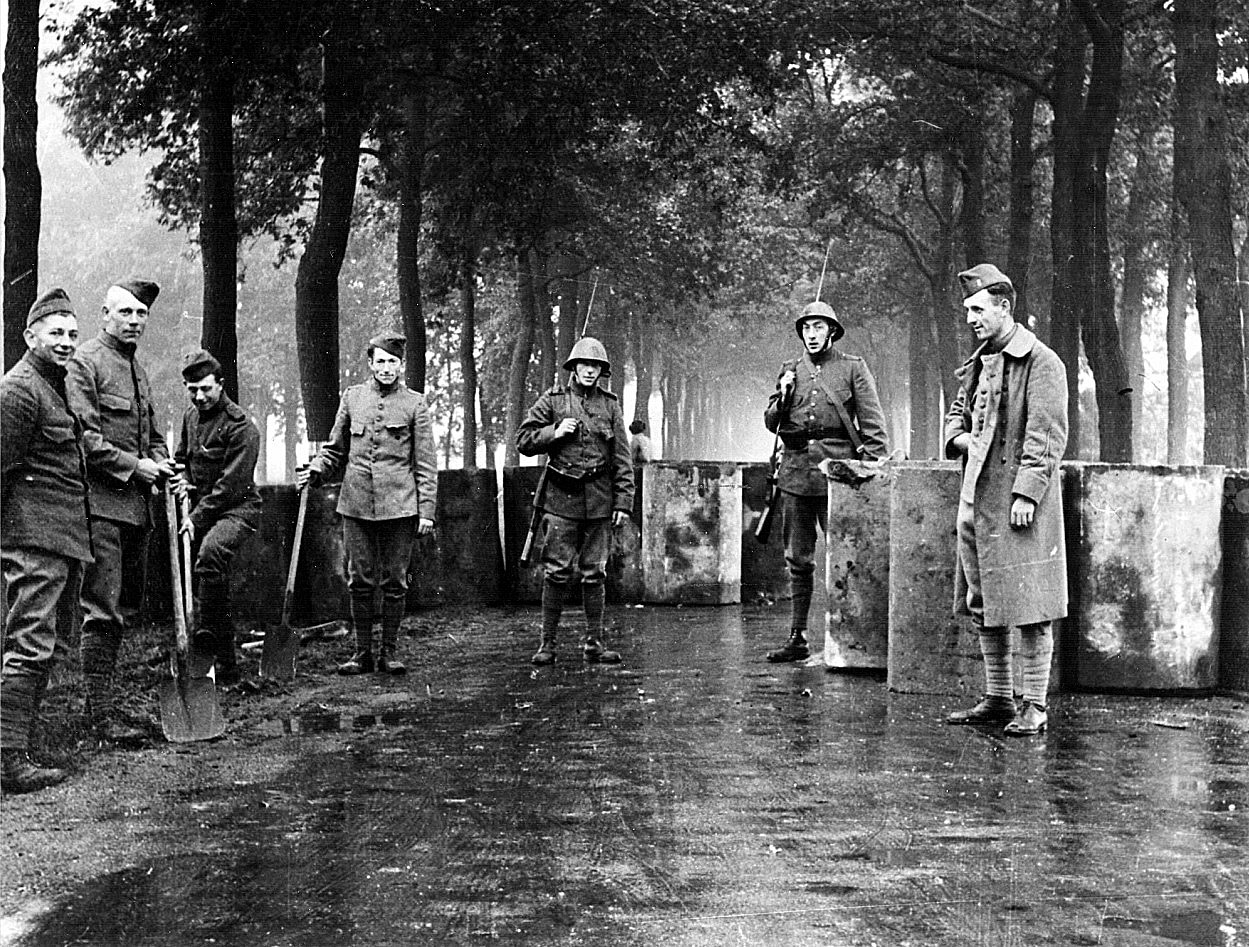
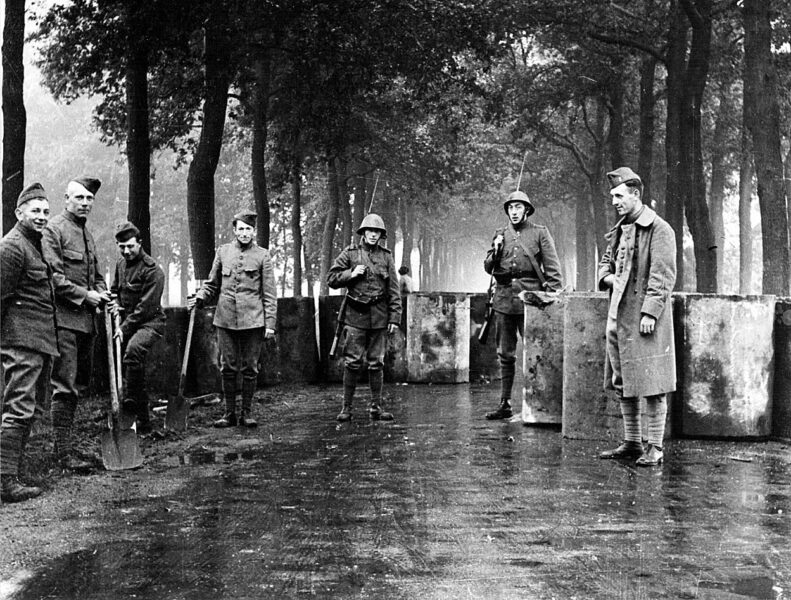
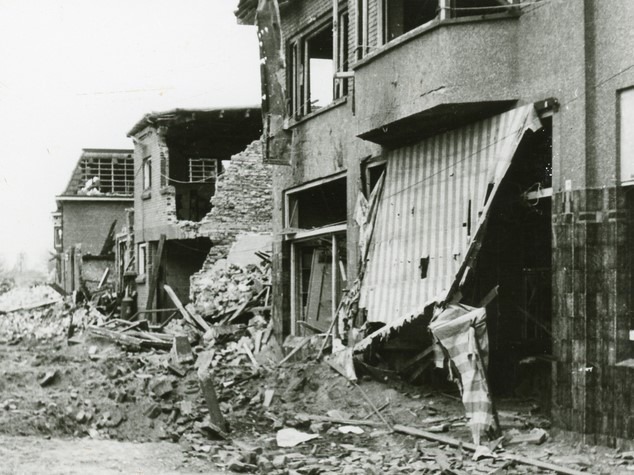
In April 1939, a border guard detachment of 36 men was stationed in Aalten, housed in farms. Sand filled tubes are placed here and there as obstacles. Around 1 September, at the beginning of the Second World War, several hundred residents of Aalten left by train for the various garrison places. On 9 May 1940, the municipal architect was instructed to install barricades on several roads.
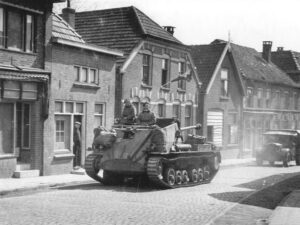
On 10 May, German army units thundered into Aalten. The soldiers stationed around farms offer no resistance. A few days later, Dutch prisoners of war are seen being transported to Germany in open trucks. Four people from Aalten are killed at the Grebbeberg. A group of five hundred returned prisoners of war are enthusiastically welcomed in the party building and then travel on by train.
Two hundred and fifty Rotterdam children stayed here in the summer months. This was also the case in 1941. A lot of (young) people go to work in Germany because it earns well. There is already a lot on the coupon. Food production comes under control, for which Aalten is divided into three districts, each under a local office holder.
People in hiding
In the summer of 1942, the first people in hiding came to Aalten to evade the Arbeidseinsatz. Shortly before, the first group of employees of Dutch Button Works in Bredevoort had themselves photographed neatly in their suits with a view to employment in Germany. A group from the Driessen textile factory is also deployed.
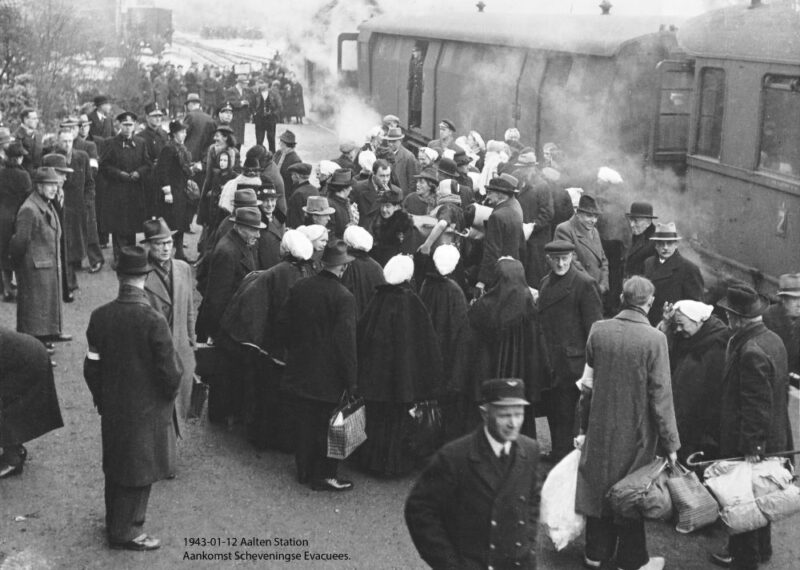
About five hundred Scheveningen evacuees found shelter here in January 1943. Almost all of them belong to the Reformed Church. In Winterswijk there are eight hundred, all Reformed. Once every three weeks a Scheveningen pastor stays here who also leads a church service.
Hostages
The Germans increased the pressure to get men to dig. The most intimidating thing was the detention of 12 hostages on October 18. The next day, 550 men leave for Zevenaar. Ten days later, another seven men are taken hostage and 250 people report. The pastors and R.C. clergy had made an appeal to ‘show mercy and charity towards those who are in immediate danger of death’.
By circular, a representative group of municipal residents insists on a repayment scheme. It will come. A pastor in Zevenaar will be there at all times for support and spiritual care. But there is also a clandestine stencil circulating with the call to ask oneself ‘whether it is responsible to cooperate in the enemy’s defences, as a result of which many more than eleven human lives (…) will soon be lost.’
The last months
A few moments from the last three dark months: Individual food collectors keep coming, but a committee ‘Aid to the West’ also manages to collect a few cartloads of mainly grain. Doctor Der Weduwen succeeds in transferring sick people from camp Rees to the emergency hospital in Avondvrede on the Hogestraat. Serious cases go to the hospital set up in the boys’ boarding school in Harreveld. Der Weduwen is killed when his car is shot at from the air.
A drama is taking place around a resistance group that is hiding in the abandoned farm ‘De Bark‘. Close to the door, in ‘Somsenhuus‘, Germans were billeted while seven Allied pilots were in hiding there. The total number of soldiers in Aalten at this time is estimated at about four thousand.
Liberation
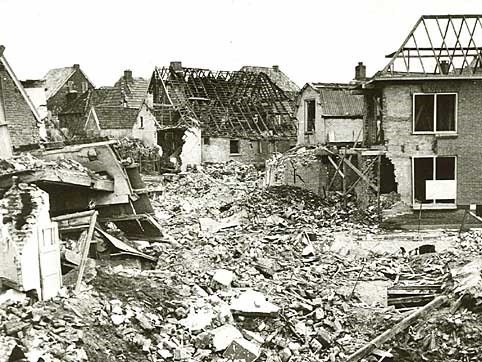
In the last days of March, it is clear that the denouement is near. How hard will there be fighting? Many leave the village, others seek protection in their shelter. There were still German soldiers roaming around. Then, on Good Friday, March 30, early in the morning, the English tanks rolled into Aalten from Germany. Here and there, Germans still put up fierce resistance. Ten British were killed on that day, in Barlo seven people were killed in a grenade hit in an air-raid shelter. Sadness and joy, Aalten has been liberated.
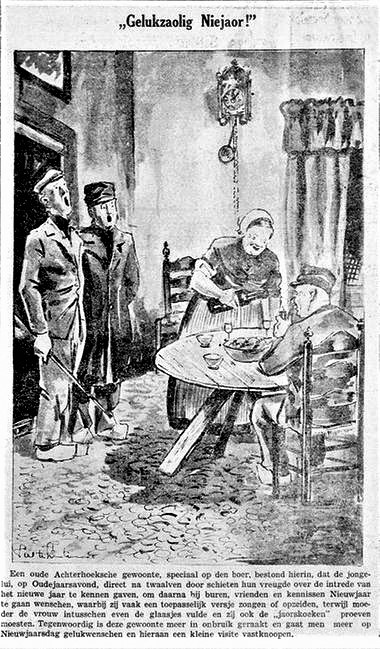
In 1937, G.H. Rots described in a series of articles how things were in Aalten in former times. Regarding New Year’s Eve and Day, he wrote:
“Towards the end of the year, one could see two men walking with a large ‘arm basket’, going from house to house in the village. They were the night watchmen selling almanacs. Not a single household was without an almanac, especially the Zutphen almanac. By offering and selling the almanacs, the night watchmen simultaneously provided the residents with the opportunity to give an unsolicited contribution for the guarding of their property at night. Depending on the financial means of the residents, the aforementioned literature was paid for above the asking price.”
New Year’s Eve
“Then came New Year’s Eve. The cafés had permission to stay open until one o’clock in the morning. The transition from the old to the new year was then celebrated in these establishments, mainly by the local youth. Once the clock had struck twelve, the night watchmen began to deliver their New Year’s wishes. They started with the municipal secretary. A song was sung during this process. The rounds were made to several notables and café owners. It goes without saying that the night watchmen were followed by a large group of curious onlookers, who diligently sang along… and there were free drinks.”
And now the song that the Night Watch and their followers sang on New Year’s Eve:
The old year has now passed by, The new has now arrived. So I wish you with a joyful heart, And you, and all the pious: A new spirit in the new year And a pious life together, So let us praise God here.
How many began the previous year In good health with us, Who have indeed through death Spun out their thread of life. They live in eternity, Life is still prepared for us, So let us now praise God.
It is God who brought forth the light, Who makes the sun and moon rise, To show us the passage of day and night, And month and year. Let us for the past year With thanks to the Supreme Blesser, Praise the God of ages.
The first two stanzas were original creations. The third is from the Evangelical Hymns no. 159 verse 1. Verse 3 of that hymn was also occasionally sung.
One can imagine that these New Year’s greetings on New Year’s Night took quite some time, and the solemnity of it likely faded, especially towards the end of the rounds, particularly as the sound of spirits played the leading role. But for the elderly, the memory of this event is not lost. Especially when reading these articles, the old incidents are recalled and discussed once more, and many look back with nostalgia to the days of yore, remembering, during sleepless nights or when watching over the sick or injured in the quiet of the living room, the monotonous step of the man who traversed Aalten’s streets: “Hark, there is the night watchman!”
“On New Year’s Day, the youth were active again. They and the poorer folk went from house to house to wish people a Happy New Year. One can understand that the population was glad when noon arrived, as it was no longer applicable after that. The downside of all this was that King Alcohol swayed his scepter on those days. In the numerous cafés and taverns, many sacrifices were made to that monarch. Gin was cheap. There were several gin distilleries or ‘branderijen’ in Aalten. Four of these distilleries can still be named. It is no wonder, then, that the use of strong spirits was prevalent on almost all occasions.”
Carbide Shooting
In parts of the eastern Netherlands, including Aalten, it is a tradition to shoot carbide on New Year’s Eve. A small amount of carbide (calcium carbide) is placed in a milk churn, paint tin, or modified gas cylinder, water or saliva is added, and the churn is sealed with a (plastic) ball. Ethyne gas forms, and after waiting about 30 seconds, the gas is ignited through a small touch-hole (or with a spark plug). The gas explodes with a booming bang, launching the ball out of the churn, where it can land dozens of meters away.
The history of carbide shooting is not well known. The tradition may date back to Germanic Yule festivals. In the 19th century, it was customary in both rural and urban areas to make noise on special days. Carbide shooting likely evolved from this practice.
Before acetylene gas was available in cylinders, most village blacksmiths used carbide for welding. It was therefore easy to obtain.
New Year’s Eve, a day like any other. Yet, around four o’clock in the afternoon, many become restless. It is about to happen. There is no other day in the year when we check the clock so often. Outside, in the twilight, we smell the frying of ‘oliebollen’ in the thin winter air. Among children between the ages of four and twelve, a certain tension can be sensed. Tomorrow is the day. Then they will go ‘winning the New Year’.
Winning the New Year in exchange for a treat is a very old custom whose origins are difficult to trace. In our region, it occurs in the former Lordship of Bredevoort, but not in the Roman Catholic enclave of Lichtenvoorde-Groenlo. It possibly relates to religion and the practices surrounding it.
Long before the Reformation, November 11 was an important day: Saint Martin’s Day. According to legend, he gave half of his red cloak to a beggar. He was the patron saint of Utrecht, among other places. The city’s coat of arms is a red-and-white divided shield—red from his cloak and white from his undergarment after he cut part of his cloak away with his sword. This gesture strongly appealed to the popular imagination. As a folk saint, he was venerated and depicted as a rider on a white horse. This was true not only in neighboring Germany but also in the south of our country, in North Holland, Groningen, and Friesland. On his feast day, a mock Saint on a white horse would lead a lantern procession through villages and towns, distributing treats. In Bocholt, just across the border, there was a large lantern procession through a completely darkened city in 1988 and later years. A fairy-tale sight. Upon arriving at the Market, he stood there on a white horse in front of the beautiful town hall, bathed in spotlights. A martial figure. All the children were allowed to walk past him and receive a bag of sweets.
It is not inconceivable that after the Reformation, people wanted to move away from the veneration of saints. A ‘Sint’ was out of fashion. At a meeting of the Zutphen classis in 1668, much was discussed. They wanted to abolish bird shooting, goose pulling, ‘boksebier’, and other irregularities. These were called superstition, or ‘popish insolence’. It is possible that a shift occurred from November 11 to January 1 so as not to forget the children and the needy. Perhaps also because New Year’s Day moved several times on the calendar. Such shifts happened frequently. Moreover, Saint Martin himself had already replaced an old Germanic autumn festival with thank-offerings for the harvest to Wodan.
When shifting the date, other special days had to be taken into account. Saint Nicholas was not an option. This may be how they arrived at January 1. It is an assumption, but not an unlikely one. At that time, they were also troubled by Saint Nicholas; Calvinist ministers wished to do away with it thoroughly. They did not succeed. Bird shooting also continued.
Originally, in the countryside, laborers went to the farmer and his wife—their employers—to wish them a Happy New Year. Belief in omens was strong. If the person delivering the wish was a woman or girl, one was assured of a fertile year with many heifer calves. It seemed almost a competition to be the first to deliver the good wishes. It still is to some extent. There was a firm belief that the wished-for luck would return to the one who spoke the wish first. This was duly rewarded.
In times of great poverty, which were frequent, it could happen that food items were given. It is known that during times of potato shortages, people gave a few potatoes. These were then taken home in a knotted red handkerchief. In the last century, children went out in groups in the neighborhood to ‘win the New Year’. After speaking the good wishes, red handkerchiefs were spread out on the chairs in the kitchen, and all sorts of treats appeared: peanuts, a ‘pöfferken’, ‘opzettertjes’, meringues, figs, an ‘oliebol’ or currant bun, and an apple. Over the years, many customs have disappeared, but ‘winning the New Year’ has remained in our border region.
It has, however, adapted to the times. No red handkerchiefs spread out on chairs with rush mats. Between 1950 and 1980, plastic conquered the world. The red handkerchiefs have made way for well-filled plastic bags, sometimes prepared by businessmen or charitable institutions.
Nowadays, fireworks play an important role on New Year’s Eve. Twenty-five years ago, New Year’s Day was more important. It had to happen on the first day of the new year. Excitement for the children. First to the neighbors. What abundance when they saw thirty or more bags lying on the kitchen counter there. After speaking the good wishes, hands went up almost automatically to take the ‘toete’ (bag).
The older boys would grab their bikes and rush from one house to the next. Formerly with a shoebox under the luggage strap, later with a plastic bag on the handlebars. They were told to look people in the eye and speak politely, but they didn’t allow themselves much time to talk. It was as if they sensed it might be the last time. Once home, the harvest was sorted and placed in portions. Eating until you were sick was something you did on the way. Mother would also start rummaging through it. Cookies went into a tin and sweets into a jar. You could snack on it for a month. It seemed as if that variety symbolized a great number of wishes.
In our time, the fun ends when children are in the first year of secondary school. At most, they shout as they cycle past: ‘Happy New Year, do you have the bags ready?’
Sources
‘From Aalten’s Past’, by G.H. Rots, Aaltensche Courant, 19 November 1937 (via Delpher, part IV & part VI)
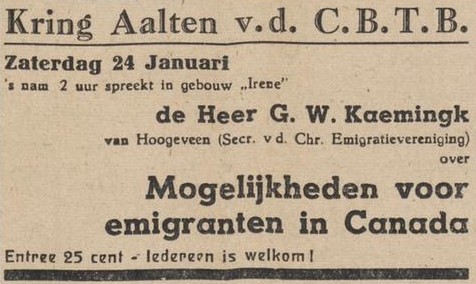
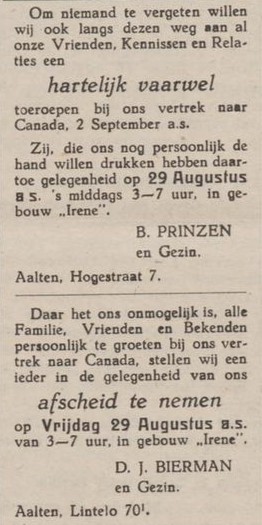
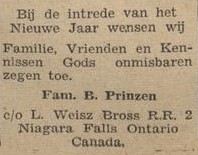
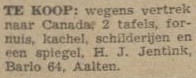
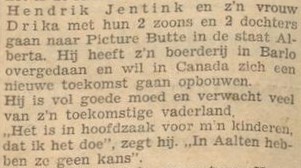
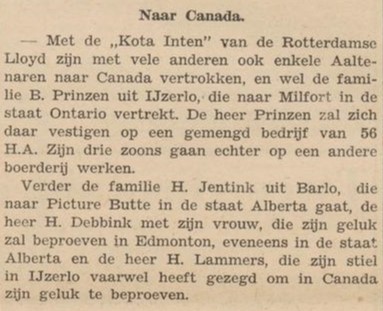
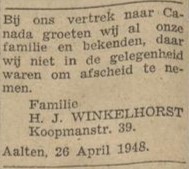
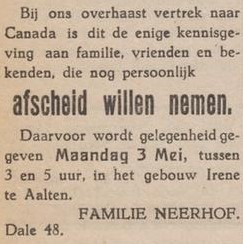
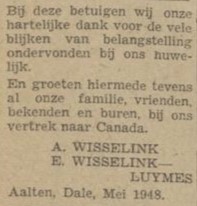
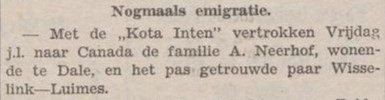
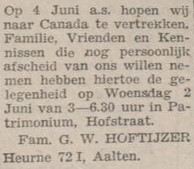
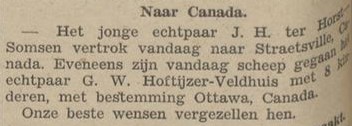
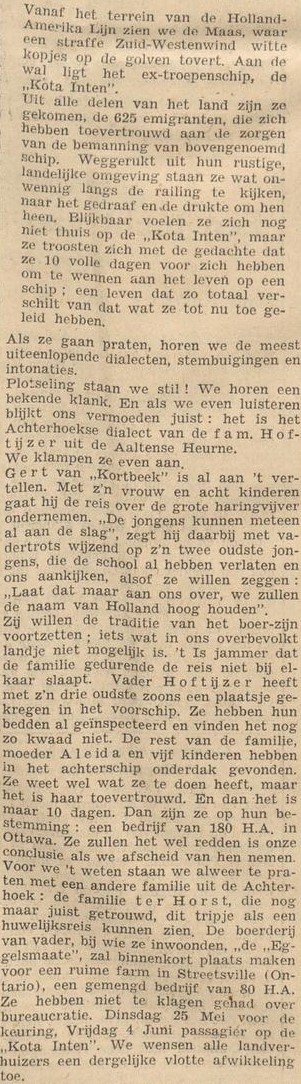
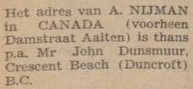
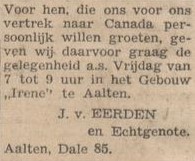
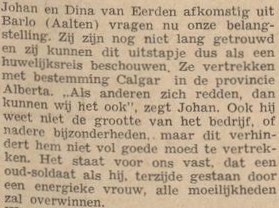
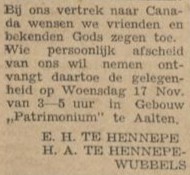
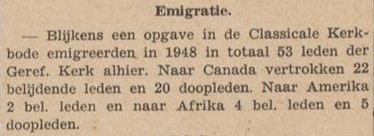
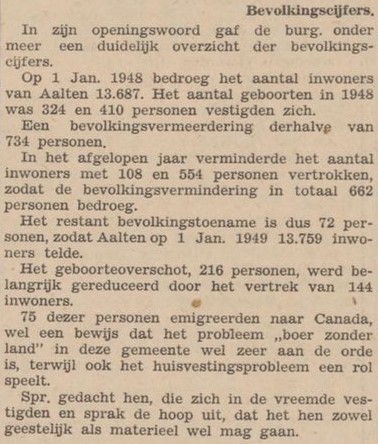
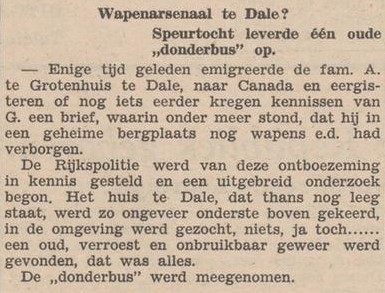
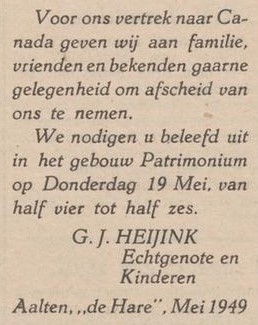
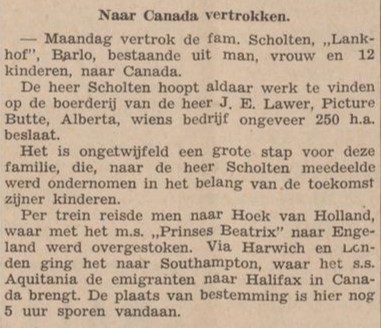
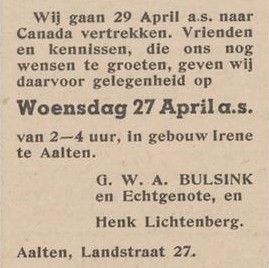
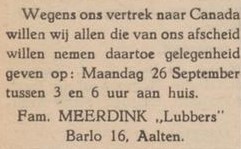
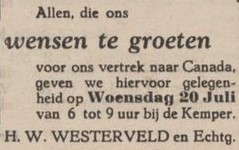
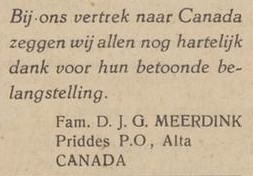
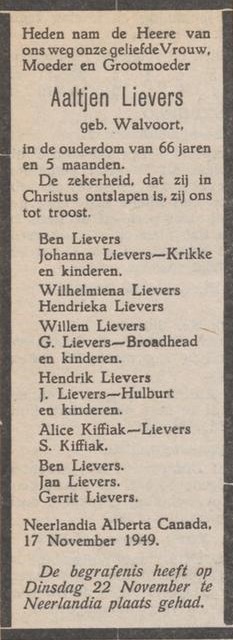
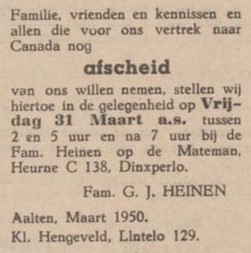
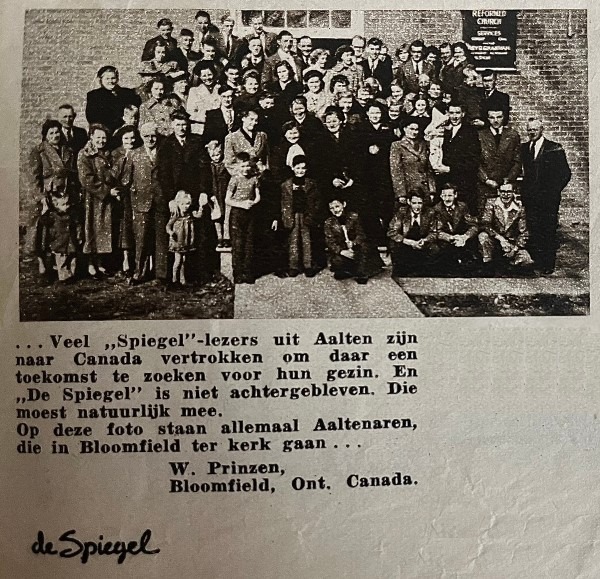
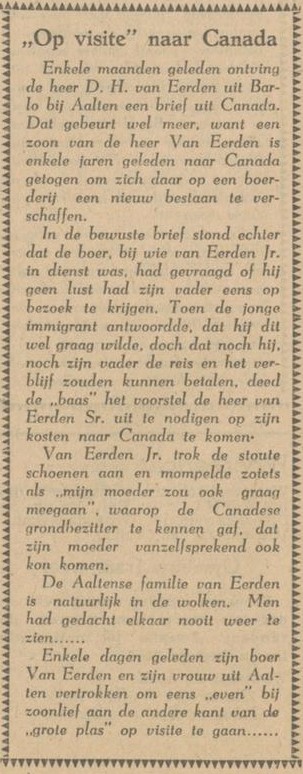
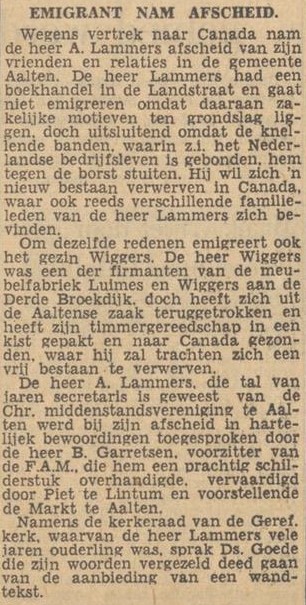
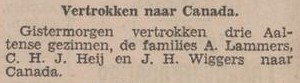
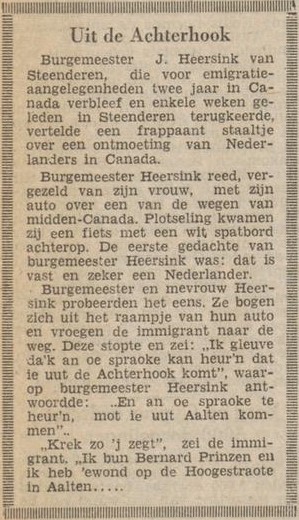
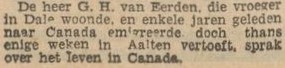
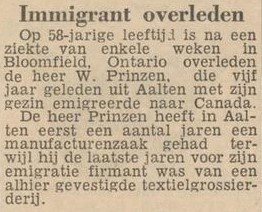
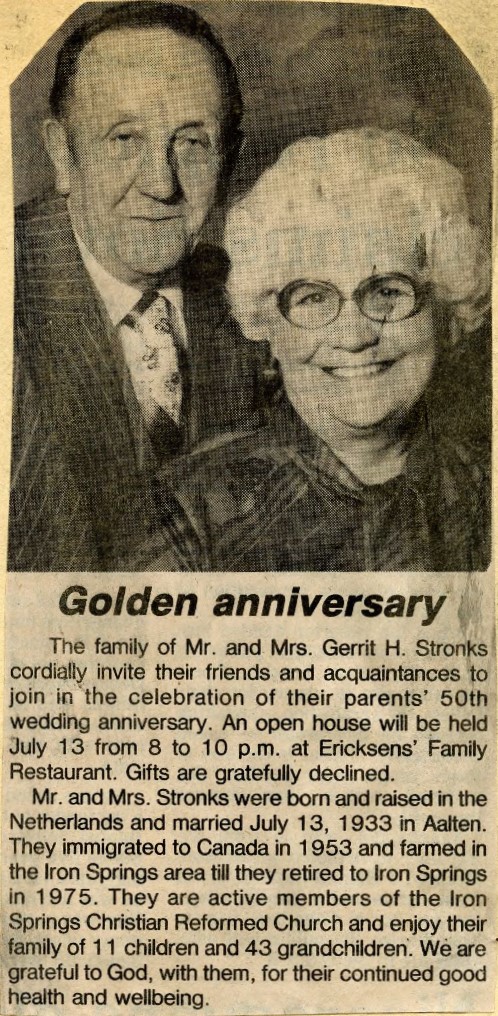
After the Second World War, several hundred people from Aalten emigrated to Canada. Here you will find a number of newspaper clippings on this subject, including advertisements from emigrants saying goodbye to their loved ones in the Netherlands.
Aaltensche Courant, 26 August 1947De Graafschapper, 3 January 1948Aaltensche Courant, 20 January 1948De Graafschapper, 31 March 1948 Graafschapper, 10 April 1948Aaltensche Courant, 13 April 1948De Graafschapper, 26 April 1948Aaltensche Courant, 30 April 1948De Graafschapper, 7 May 1948Aaltensche Courant, 11 May 1948De Graafschapper, 26 May 1948
Aaltensche Courant, 4 June 1948De Graafschapper, 7 June 1948De Graafschapper, 7 August 1948De Graafschapper, 11 August 1948De Graafschapper, 18 August 1948De Graafschapper, 13 November 1948Aaltensche Courant, 4 January 1949Aaltensche Courant, 14 January 1949Aaltensche Courant, 13 May 1949
Aaltensche Courant, 17 May 1949Aaltensche Courant, 11 March 1949Aaltensche Courant, 26 April 1949Aaltensche Courant, 23 September 1949Aaltensche Courant, 15 July 1949Aaltensche Courant, 18 October 1949Aaltensche Courant, 25 November 1949Aaltensche Courant, 28 March 1950Weekly magazine ‘De Spiegel’, 17-23 January 1954
Dagblad Tubantia, 24 April 1951Tubantia, 18 June 1952Zutphens Dagblad, 19 June 1952Tubantia, 21 September 1953Zutphens Dagblad, 30 January 1954Tubantia, 13 March 1956Fam. Stronks, Iron Springs, Alberta, 1983
The Land Registry is a valuable source of information for Old Aalten. This body records who owns land and buildings, what rights are attached to them, and the exact boundaries of each plot.
The Land Registry has officially existed in the Netherlands since 1832, but its origins lie in the Napoleonic era (1810–1811), when the entire country was surveyed and parcels were registered by name to ensure fair land taxation.
For quick orientation on cadastral information around 1832, we consult HisGIS. For cadastral data from the mid-19th century onwards, we use the Kadaster Archiefviewer (subscription required). This allows us to look back through the registers from approximately 1850 to 1985. For current parcel numbers, we consult the (commercial) website kadastrale kaart.
Researching cadastral information is often quite a puzzle; by combining these sources, a fairly complete and reliable picture usually emerges.
Information in the Land Registry
Auxiliary maps – We track parcel boundaries through time using (historical) cadastral maps. The Kadaster Archiefviewer contains the most important historical maps and registers, making it possible to follow changes step-by-step via so-called auxiliary maps.
Cadastral ledgers – The ledgers contain the owner, the use (e.g., house, yard, pasture, or factory), area, and subsequent mutations for each parcel.
Please note: mutations are recorded by fiscal year (the administrative year of registration). The actual change—such as construction, subdivision, or demolition—often took place 1 to 2 years earlier!
Example
This is an example of the kind of overview you often see for cadastral properties on Old Aalten:
Year
Plot
Owner
Description
1832
B-222
Berend Hendrik Ubbink, carpenter
460 m² garden
1859
B-293
Berend Hendrik Ubbink, carpenter
120 m² barn & yard
1901
B-293
Johannes Antonius te Walvaart, farmer
120 m² house & yard
Year: usually the fiscal year (year of registration).
Parcel: the parcel number; this could change over time, for example, due to subdivision or consolidation with other parcels.
Owner: self-explanatory.
Description: area and use, according to the ledger.
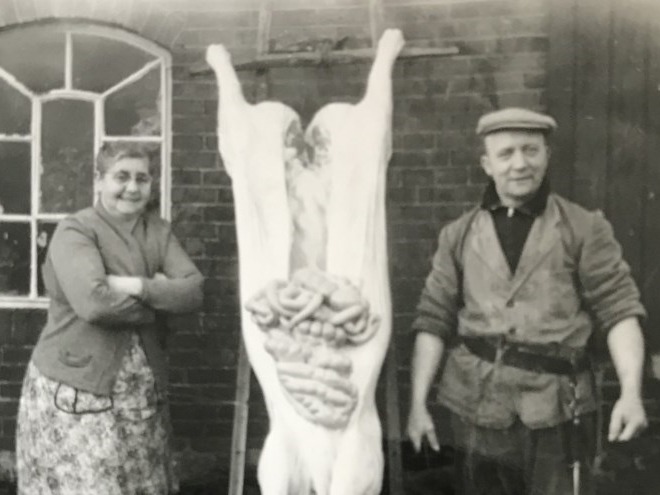
In former times, November was the season for slaughtering. At that time, slaughtering did not yet take place at slaughterhouses, but simply on the farmer’s yard. It was usually outsourced to a ‘home slaughterer’, a butcher who performed the slaughter at the client’s home. Regarding home slaughtering in Aalten and the customs surrounding it, G.H. Rots wrote the following in 1937:
“The busiest and most significant days of the year were when slaughtering had to take place. When November arrived in the land, the slaughtering period began. The ‘wieme’ (drying rack) was empty, and in every household, people thought about slaughtering one or more pigs or a ‘small beast’. The home slaughterers had their hands full.
If the slaughtering had taken place in the morning, the ‘fat-praisers’ would arrive around half past eleven. The neighbors would then judge whether the ‘kidneys were well-covered in fat’. The thickness of the bacon was estimated, and finally the lady of the house appeared with the ‘bottle’, for teetotalers were unknown in those days. On slaughter days, people made sure they had something ‘in the bottle’. The slaughterers received their first ‘drink’ in the morning, the fat-praisers in the afternoon, and in the evening came the great celebration: the slaughter visit.”
Drika Wijnveen-Stapelkamp and home slaughterer Bertus ter Maat
How the slaughtering process worked
In the 1950s and 1960s, it was still permitted to perform home slaughtering yourself. A large boiler pot with plenty of water was brought to a boil. The pig was killed using a captive bolt pistol, which fired a pin into its head. The pig became unconscious. The animal’s throat was then slit, and the blood was collected in a special flat pan.
The pig was cleaned and doused with boiling water so that the hair could be removed more easily, a process known as ‘scraping’ the pig. The animal was then hung from a ‘ladder’ and cut open.
The entrails were collected in a large tub. The intestines were cleaned. First, they were rinsed with water and then scraped clean so they could be used to make sausage. The intestines were tied shut with sausage pins and hung from the ceiling.
Every part of the pig was used. The head meat was used to make ‘head cheese’ or brawn. The sausages and hams were hung from the ceiling to dry. Slaughtering and processing a pig took a week of work but provided meat for personal use for an entire year. One way to prevent meat from spoiling was salting. The meat was placed in a tub of salt, and the salt was rubbed thoroughly into the meat. Meat could also be preserved in canning jars. This allowed the meat to be kept for many months.
A well-known home slaughterer in Aalten and the surrounding area was Bertus ter Maat. The above interview with the then 77-year-old Aalten resident was filmed in 1991 by FilmAalten.
Slaughter visit
Regarding the slaughter visit, Rots wrote: “Those slaughter visits were the social evenings for the population. Neighbors would gather and enjoy each other’s company. It began with a cup of coffee and a rusk. Then the bottle appeared on the table. On those evenings, the events of the time were discussed. One person knew this, another had heard that, and a third had ‘recently read the newspaper’, and thus knew for certain. And the women told each other the secrets of the civil registry and related matters. Meanwhile, the hostess would invite them again: ‘Have another drink’. ‘The pigs turned out well’. And finally, when it was time to go home, everyone was in the merriest of moods.
One should not imagine that all the pigs that had been fattened were intended for personal use, as you can understand. At least one pig had to be sold, and from the other that was kept, the hams or gammons were also sold, because keeping the hams yourself ‘was just for the sake of using them up’; no, they had to be turned into cash. And if a heifer or ‘bull’ was slaughtered, the nagelhout (smoked beef) was certainly sold. There were several buyers who salted and smoked these finer meats and sent them to the larger towns. The money the pigs brought in was often intended for the payment of hay, mortgage interest, etc., or at least for extraordinary expenses.”
Sources
‘From Aalten’s Past’, by G.H. Rots, Aaltensche Courant, 5 November 1937 (via Delpher)
Photo: collection Leo van der Linde, with thanks to Anton Stapelkamp
Deze website gebruikt cookies voor een optimale ervaring en analyse van bezoekgegevens. Ga je hiermee akkoord? Zonder toestemming werken sommige onderdelen van de site mogelijk minder goed.
Functioneel
Always active
De technische opslag of toegang is strikt noodzakelijk voor het legitieme doel het gebruik mogelijk te maken van een specifieke dienst waarom de abonnee of gebruiker uitdrukkelijk heeft gevraagd, of met als enig doel de uitvoering van de transmissie van een communicatie over een elektronisch communicatienetwerk.
Voorkeuren
De technische opslag of toegang is noodzakelijk voor het legitieme doel voorkeuren op te slaan die niet door de abonnee of gebruiker zijn aangevraagd.
Statistieken
De technische opslag of toegang die uitsluitend voor statistische doeleinden wordt gebruikt.De technische opslag of toegang die uitsluitend wordt gebruikt voor anonieme statistische doeleinden. Zonder dagvaarding, vrijwillige naleving door je Internet Service Provider, of aanvullende gegevens van een derde partij, kan informatie die alleen voor dit doel wordt opgeslagen of opgehaald gewoonlijk niet worden gebruikt om je te identificeren.
Marketing
De technische opslag of toegang is nodig om gebruikersprofielen op te stellen voor het verzenden van reclame, of om de gebruiker op een site of over verschillende sites te volgen voor soortgelijke marketingdoeleinden.