Category: Emigration

  • Bones found

    Bones found

    In the course of the last century, excavation work repeatedly led to the discovery of the mortal remains of old-time residents of Aalten.

    A burial vault collapsed

    Nieuwe Aaltensche Courant, 9 July 1920

    AALTEN – Throughout the whole of Thursday, Kosterstraat (= Köstersbulte, OA) held the full attention of the Aalten public. People stood in dense crowds around a particular spot close to the iron church gates, opposite the building of the Geld. Ov. Bankvereeniging. There were whispers of a burial vault, skulls, and so forth. The police kept the public, especially inquisitive youngsters, at a proper distance.

    What had happened? In the morning, a heavy lorry belonging to Mr Jos. Driessen had driven right alongside the gates whilst swerving to avoid another cart. The driver naturally had no idea – as will indeed be the case for most inhabitants of Aalten – that he was driving over a section of the old churchyard that had formerly been laid out around the church. The remains of this churchyard were most clearly observable at the time “Elim” was built, where it was one vast charnel house beneath the ground.

    It caught the attention of a passer-by that a sizeable “dent” had appeared in the street, which seemed to be growing steadily larger. Others were called over, and it now appeared as though a section of the ground had caved in. The municipal surveyor was summoned, as was the police, and by the time they turned up, the dent had become a large hole; rubble and mud had fallen onto a wooden coffin, which had collapsed as a result, revealing bones – there was no longer any room for doubt: a burial vault had collapsed.
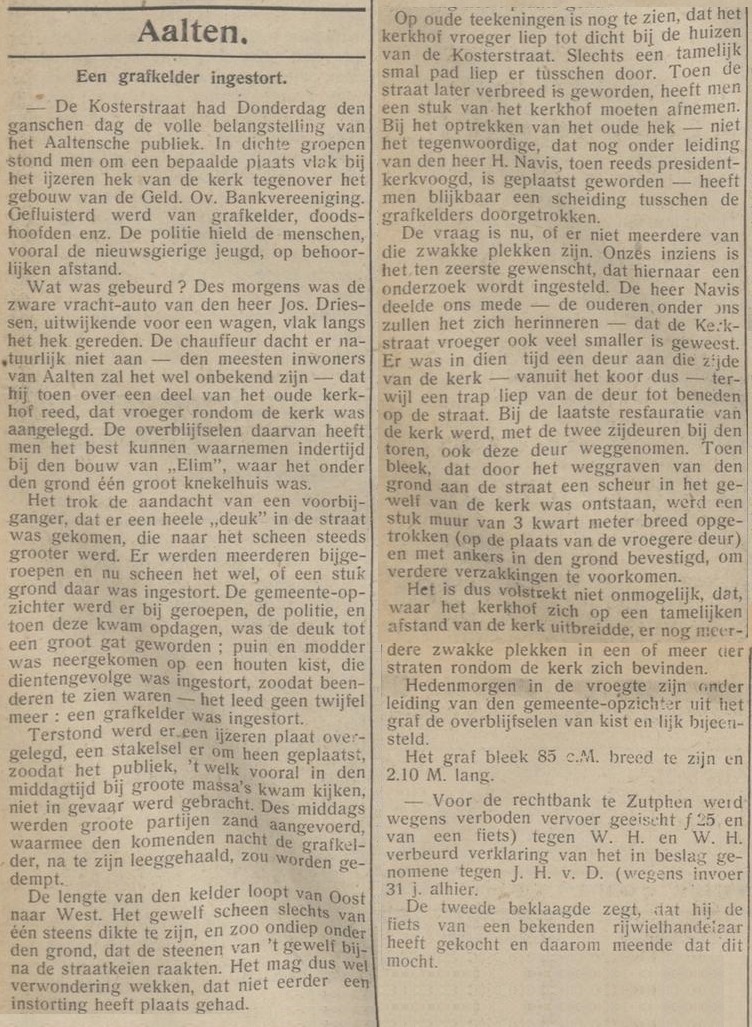
    An iron plate was immediately placed over it, and a hoarding erected around it, so that the public, who came to look in great numbers particularly during the afternoon, were not put in danger. During the afternoon, large quantities of sand were brought in, with which the burial vault was to be filled in during the coming night, after having been emptied.

    The length of the vault runs from east to west. The brick arch appeared to be only a single brick thick, and so shallowly subterranean that the bricks of the arch almost touched the cobblestones of the street. It may therefore give cause for wonder that a collapse had not occurred sooner.

    Old drawings still show that the churchyard used to extend close to the houses on Kosterstraat. Only a fairly narrow path ran between them. When the street was widened later on, a piece of the churchyard had to be taken away. When the old gates were erected – not the current ones, which were installed under the supervision of Mr H. Navis, who was already president-churchwarden at the time – a division was apparently driven straight through the burial vaults.

    The question now is whether there might be more of these weak spots. In our view, it is highly desirable that an investigation be launched into this. Mr Navis informed us – as the older ones among us will remember – that Kerkstraat also used to be much narrower.

    In those days, there was a door on that side of the church – that is to say, leading from the chancel – while a flight of steps ran from the door down to the street. During the last restoration of the church, this door was removed along with the two side doors near the tower. When it became apparent that digging away the ground by the street had caused a crack to form in the vaulting of the church, a section of wall three quarters of a metre wide was erected (on the site of the former door) and secured into the ground with anchors to prevent further subsidence.

    It is therefore by no means impossible that, given the churchyard extended a considerable distance from the church, further weak spots exist in one or more of the streets surrounding the church.

    Early this morning, under the direction of the municipal surveyor, the remains of the coffin and the corpse were gathered from the grave. The grave proved to be 85 cm wide and 2.10 m long.
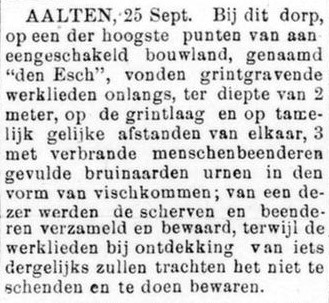
    Urns containing cremated human bones

    De Grondwet, 21 October 1884

    AALTEN, 25 Sept. Near this village, on one of the highest points of a continuous stretch of arable land known as “den Esch”, workmen digging for gravel recently found, at a depth of 2 metres upon the gravel bed and at fairly equal distances from one another, 3 brown earthenware urns in the shape of fishbowls, filled with cremated human bones; the shards and bones of one of these were collected and preserved, whilst the workmen, upon discovering anything similar, will endeavour to leave it undamaged and have it preserved.

    Skeletons found at ’t Blik

    Graafschapbode, 14 July 1925

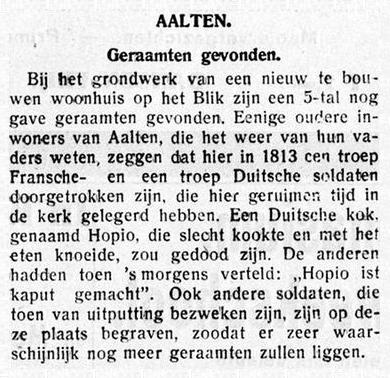
    AALTEN – During the groundwork for a newly to be constructed dwelling at ’t Blik, some 5 fully intact skeletons have been found. Some older inhabitants of Aalten, who know of it from their fathers, say that a troop of French and a troop of German soldiers passed through here in 1813, having been quartered in the church here for a considerable time.

    A German cook named Hopio, who cooked poorly and meddled with the food, is said to have been killed. The others had then recounted the next morning: “Hopio ist kaput gemacht” (Hopio has been done for). Other soldiers who succumbed to exhaustion at the time were also buried at this spot, so it is highly probable that further skeletons lie there.
    Skeletons of a man and horses

    Nieuwsblad van het Zuiden, 2 August 1929

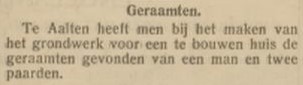
    In Aalten, whilst laying the foundations for a house to be built, the skeletons of a man and two horses have been found.

    Petrified human head in Barlo

    Aaltensche Courant, 21 April 1939

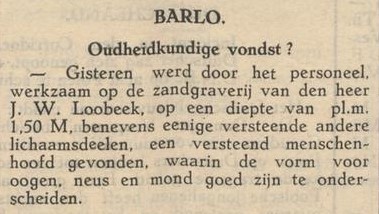
    Yesterday, the personnel working at the sand quarry of Mr J.W. Loobeek found, at a depth of approx. 1.50 m, a petrified human head along with several other petrified body parts, in which the shapes for the eyes, nose, and mouth can be clearly distinguished.
    Urn found

    Aaltensche Courant, 16 October 1945

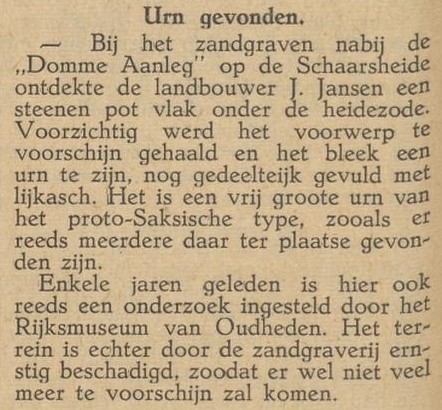
    Whilst digging for sand near the „Domme Aanleg” on the Schaarsheide, the farmer J. Jansen discovered a stone pot just beneath the heather turf. The object was carefully extracted and proved to be an urn, still partially filled with funeral ashes. It is a fairly large urn of the Proto-Saxon type, several of which have already been found at that location.

    A few years ago, an excavation was also carried out here by the National Museum of Antiquities (Rijksmuseum van Oudheden). However, the site has been severely damaged by the sand quarrying, meaning that not much more is likely to come to light.

    Path between the old Helenakerk and Elim House

    Circa 1955

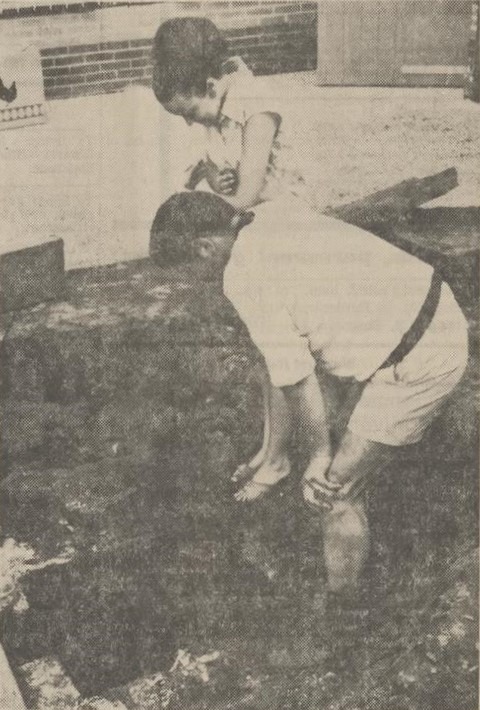
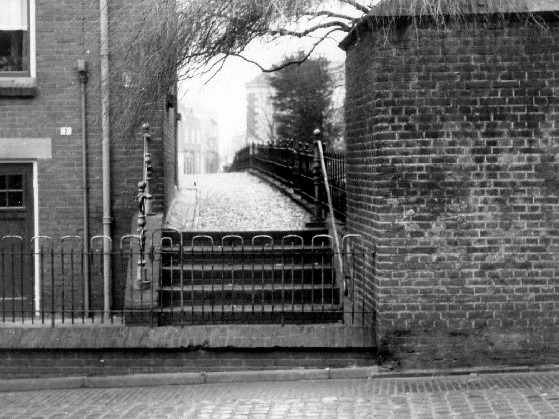
    Adjacent we see the ‘trepkes’ (steps) between the old Helenakerk and Elim House. This path was excavated and widened around 1955. During the excavation of the steps, numerous bone fragments came to light from old-time residents of Aalten who had been buried there in the old churchyard.
    Burial vault in the old Helenakerk

    16 October 1973

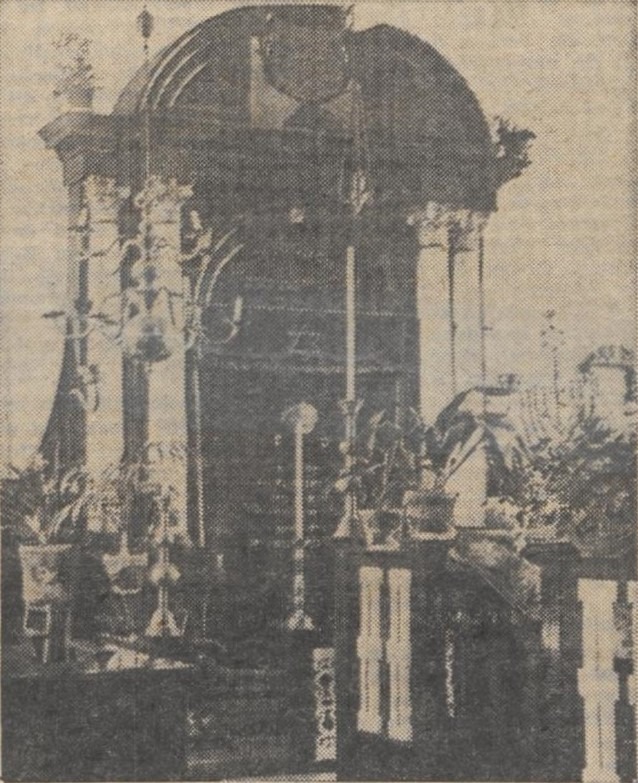
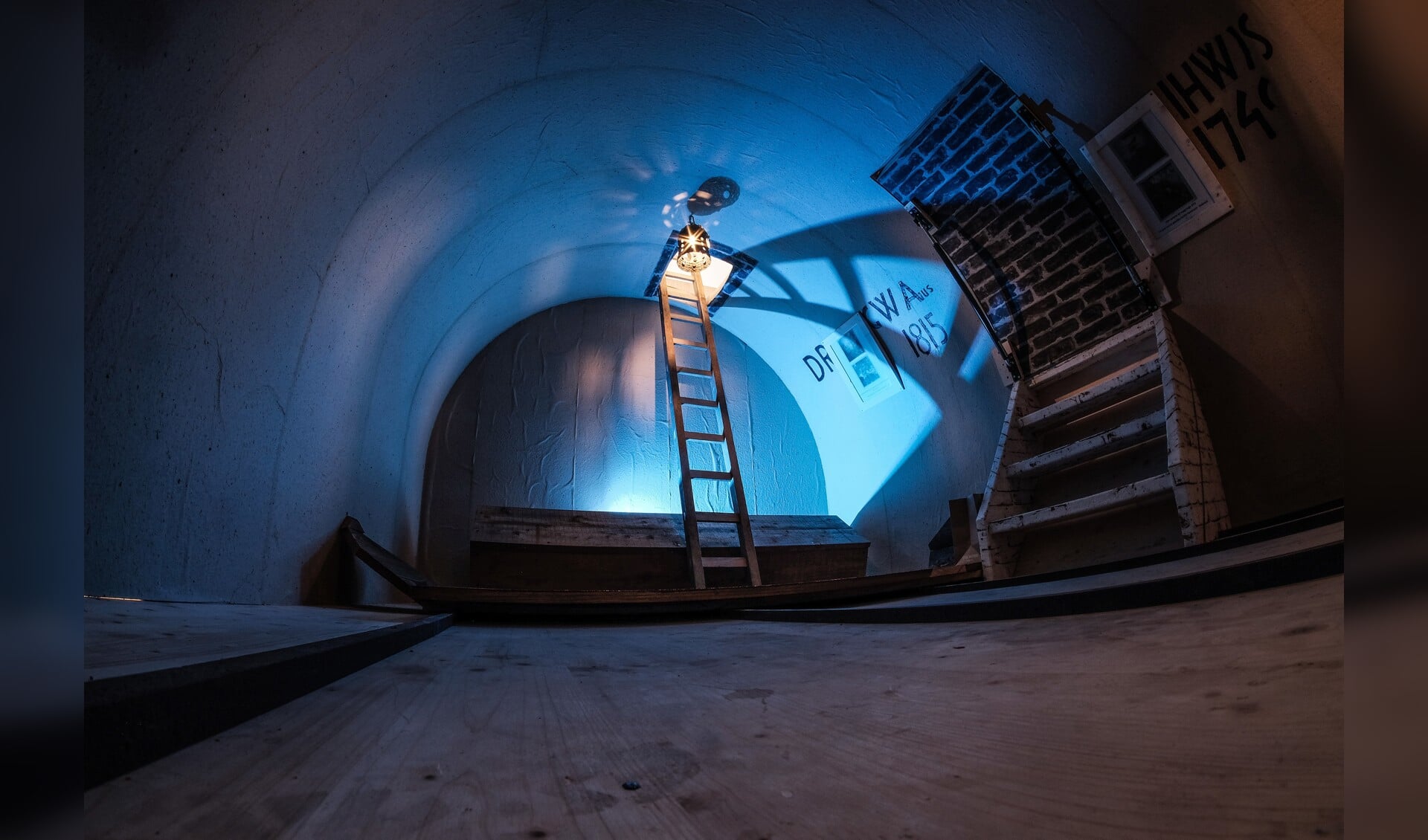
    In 1973, whilst carrying out work in the Oude Helenakerk, carpenter Henk Heijnen discovered a burial vault beneath the floor of the chancel. An outsider had claimed that the ‘last priest’ had been buried where Heijnen was working, together with his golden chalice. Heijnen wanted to know more about this and did indeed discover a burial vault at that spot. The vault did not contain a golden chalice, however, but the coffins and remnants of three sets of mortal remains, with initials and dates on the wall. Decades later, Heijnen made a replica of the burial vault.
  • The burial vault in the Old St Helen’s Church in Aalten

    The burial vault in the Old St Helen’s Church in Aalten

    In 1973, during restoration work at the Old St Helen’s Church in Aalten, carpenter Henk Heijnen stumbled upon a burial vault beneath the choir containing three coffins with human remains. At the order of the church board, the vault was swiftly resealed. However, before this happened, Heijnen had already climbed inside to meticulously measure and photograph everything. In 2019, Heijnen completed a wooden replica of the burial vault.
    The Discovery in 1973

    On October 16, 1973, the then 23-year-old carpenter Henk Heijnen was involved in restoration and maintenance work at the Old St Helen’s Church. The floor of the choir had been removed, leaving only sand. During the work, he was visited by Jan Tinnevelt from the Kattenberg, who asked if they were searching for the golden chalice. According to legend, this chalice was buried alongside the last priest of the Old St Helen’s Church. Heijnen’s boss at the time ushered Tinnevelt out.

    However, Tinnevelt was persistent, returning at least three more times to ask if anything had been found. This prompted Heijnen to start digging at the spot under the choir that Tinnevelt had pointed out. He soon struck a brick vault. Together with his boss, he used a sledgehammer to create a hole in the structure. Heijnen enlarged the opening until he could descend into the space using a ladder. Below, he found a burial vault containing three partially decayed coffins. Of the deceased, only dust and hair remained. He did not find a golden chalice…

    Measured and Resealed

    As always, Heijnen had a folding rule, a carpenter’s pencil, and paper with him. Before the vault was closed again, he measured the space precisely, noted the dimensions and initials, and made sketches and photographs of the vault, the inscriptions, and the dates. On the wall of the vault were the initials IHW with the year 1746, GWA with the year 1815, and DR, without a date. He preserved all these notes and images.

    Meanwhile, his employer had informed the church council. Around ten o’clock that evening, the members of the church board arrived at the church, accompanied by the Reverend Van der Heiden. The minister pointed out that no one should descend into the vault as it would constitute grave robbery. Because the restoration was being carried out without the involvement of the National Heritage Agency (Monumentenzorg) and there were fears that the work would be halted, Heijnen was sworn to strict secrecy. At the request of the church board, he had to seal the manhole with concrete as soon as possible.

    While he was closing the opening, Jan Tinnevelt entered the church once more. Upon realising what had been found, he was again politely requested to leave.

    In the week following the discovery, work began on laying the new natural stone floor in the choir, permanently sealing the access to the burial vault. Only Heijnen’s notes and his employer’s photographs remained as a source. Shortly after the completion of the choir, national news channels reported the discovery of a burial vault in the Old St Helen’s Church; it is not known who leaked this information.

    Research and Replica

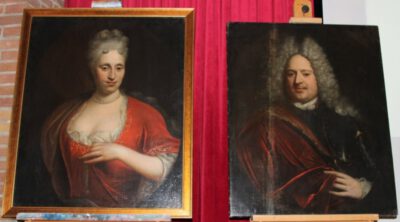
    The portraits of Lambert Joost van Hambroick and his wife Mechteld Anna Bentinck-Van Diepenheim, photo: Lydia ter Welle
    The portraits of Lambert Joost van Hambroick and his wife Mechteld Anna Bentinck-Van Diepenheim, photo: Lydia ter Welle

    It was only years later, during a trip to Israel with his wife, that Henk Heijnen visited a burial vault in Jerusalem. This gave him the idea to build a replica of the burial vault in the Old St Helen’s Church.

    He produced new construction drawings and came into contact with Herbert Welling from Bocholt and Thaddeus van Eijck from Bredevoort, both of whom were interested in cultural heritage. The trio hit it off, and their combined research led them to the historian J. Grooteboer from Borne.

    They discovered that Lambert Joost von Hambroick and his wife Mechteld Anna Bentinck van Diepenheim were closely connected to St Helen’s Church. In 1706, they donated two silver communion cups to the Aalten church, which were later found in a safe within the church.

    Who Was Buried in the Vault?

    Based on the research, it was determined that the following individuals were buried in the vault:

    • Judith Hambroick Welvelde († 1746)
      The connection to the Welvelde and Hambroick families is still visible in the church via the Welvelde coat of arms, which features a wolf’s head.
    • Gerharda Wilhelmina Arentsen (1777–1815)
      She had purchased the burial vault at a later date. She was the daughter of the sister of Mayor Christiaan Caspar Stumph and the granddaughter of Roelof Arentsen, the scholte (local official) of De Ahof.
    • Rev. De Roy († 1762/1785)
      Uncertainty remains regarding the initials DR. They were linked to a Reverend De Roy. However, in the second half of the 18th century, there were two ministers of that name: Philippus de Roy (1733–1762) and his son Adrianus Rudolphus de Roy (1762–1785). Which of the two might be buried in the vault remains unknown for now.

    Completion of the Replica

    In 2019, Heijnen completed a wooden replica of the burial vault. Two employees from Broekhout used his drawings to recreate the frame exactly. Heijnen personally handled the painting, including the initials and other details. The replica was later put on public display in the Helenahuis, opposite the church on Landstraat.
    Thaddeus van Eijck produced a film titled “Verscholen erfgoed in beeld” (Hidden Heritage Portrayed), which documents the entire process surrounding the replica: from the initial notes and research to the craftsmanship with which the burial vault was reconstructed.

    At the presentation of the replica in 2019, Heijnen mentioned that he still always carried his folding rule, even when sitting in church on Sundays, and that he felt nervous if he did not have it on him. That habit led to an extraordinary result: a booklet, a film, the recovery of two silver communion cups, and a skilfully and accurately crafted replica of the burial vault in the Old St Helen’s Church. Hidden heritage, beautifully brought to light.

    A report on the presentation of the replica of the Old St Helen’s Church burial vault on the Market Square in Aalten. Video: RTV Slingeland / Henk Nijenhuis
  • Deep well rediscovered near mill in Aalten

    Deep well rediscovered near mill in Aalten

    Dagblad Tubantia, 5 August 1969

    The engaged couple Ossendorf-Hubers in Aalten has no reason to feel down. On the contrary! Their engagement will soon be followed by marriage, and they are already busy furnishing a brand-new home on Molenstraat. And yet, this very house gives Mr. Ossendorf and his future wife reason to be careful not to literally end up in the well—the well found in the garden just behind the house, which is nearly fourteen meters deep.

    At this location—as the name Molenstraat suggests—the Aalten mill once stood, the last remains of which were removed last year in the spring. Now, four beautiful homes stand there. The well is over a hundred years old and is constructed of heavy masonry. It belonged to the mill, and the former miller, Mr. Klomps, recalled that the well was to be found somewhere in this vicinity. The future residents of the houses were also informed. All four houses are currently still vacant, but work is already well underway in the gardens. In these gardens, four heavy millstones have since been found.

    Mr. Ossendorf also went in search of such objects and the well. After a few “test drillings,” it did not take long before both the millstone and the well were located. That is to say: the well was covered with a millstone. With great effort, the stone—which was no longer in very good condition—was removed in pieces, and the couple then gazed into the depths. According to local residents, the well must have supplied the entire neighborhood with water in the latter part of the previous century. The water is currently at a depth of about thirteen meters. Consequently, the houses will not be much troubled by groundwater. Following tradition, this mill was also built on the highest part of the village.

    The well has a diameter of one meter, and climbing bolts have been bricked into the wall, allowing one to descend. Since its rediscovery, no one has yet ventured this experiment. It is unknown what will happen to the deep well. Filling it in or developing it into a beautiful antique well with a lever, for example. That is still a matter of consideration. The latter seems appealing, but in the back of one’s mind, there is also the thought of filling it in before any accidents occur.

    Source


  • Rise of the textile industry in Aalten

    Rise of the textile industry in Aalten

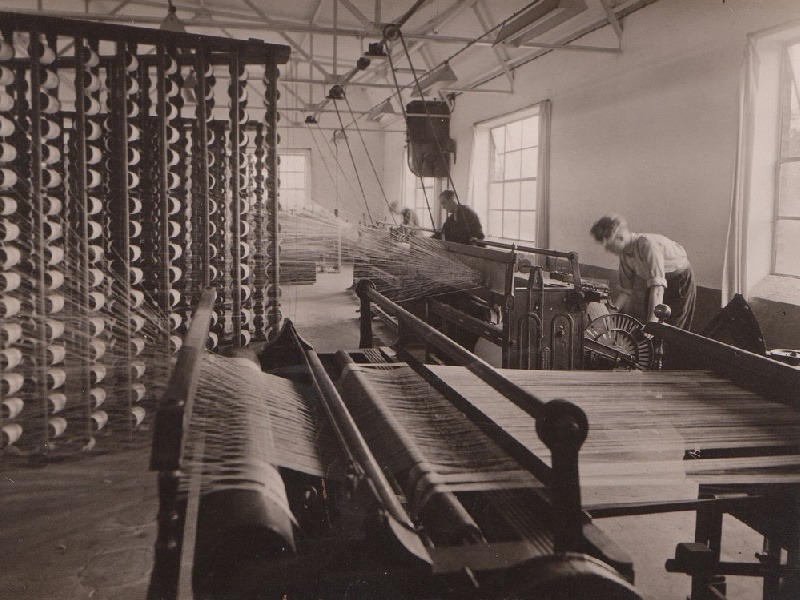
    The textile industry in Aalten was deeply rooted in the centuries-old tradition of domestic weaving and flax processing. In the 19th century, this craft grew into a flourishing industry, partly thanks to the establishment of German textile families such as the Driessens.

    For centuries, flax was cultivated in the Achterhoek and the adjacent Westphalia region, from which linen was woven on farms. This cottage industry led to a lively cross-border trade in woven fabrics.

    Numerous farm and street names in Aalten still recall this era, for example: de Weversborg, de Pellewever, de Bleeke, the Vlasspreideweg, and—due to the pure water—the Zilverbekendijk.

    The arrival of the Driessens

    Import duties on foreign fabrics were increased in 1823 to protect Dutch industry. German textile companies, including the firms Gebrüder Driessen and Peter Driessen & Sohn in Bocholt, moved to the Achterhoek. In 1826, they established themselves in Aalten.

    With their arrival in 1826, 56 looms and approximately twenty families from Prussia also came to Aalten. Most of them settled here permanently.

    Growth of employment

    The number of domestic weavers grew steadily. While the number was 292 in 1828, it had risen to 352 a year later, and in 1833 it was reported: ‘The fustian factories continued strongly, with the factories in Aalten typically employing approximately 630 weavers according to records. Both in this and in the surrounding municipalities of Winterswijk, Dinxperlo, Varsseveld, Lichtenvoorde, etc.’

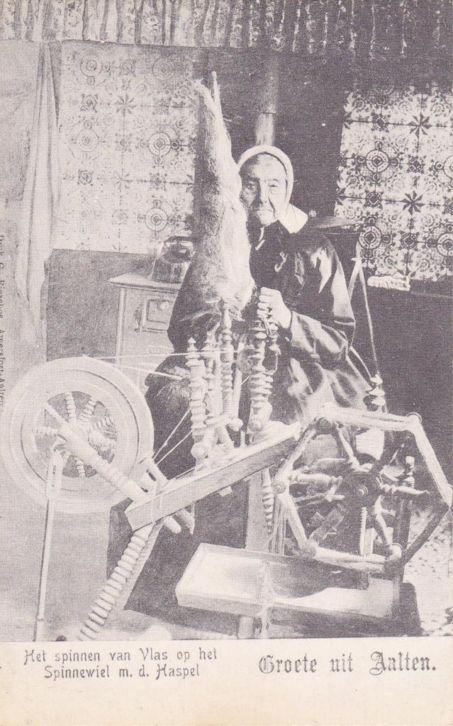
    Spinning flax
    Spinning flax on the spinning wheel

    The first factories

    In 1829, there were two cotton mills in Aalten ‘which provide work for about 40 people’, including that of the Driessen brothers. In 1830, there were three, with approximately sixty employees.

    On August 15, 1829, Jan Gerard Kraak ten Houten, ‘licensed shopkeeper and merchant in Aalten’, informed the Governor of Gelderland of his wish to establish ‘a fustian factory, spinning mill, dye works, and bleachery’ in his hometown, for which he requested permission. The municipal council had no objections to this establishment, ‘considering that the petitioner’s intention is only to have fustian manufactured by weavers at their homes, without erecting a spinning mill, bleachery, or dye works. This ensures sufficient work for the craftsman’, while no other interests are harmed. Ultimately, the King had to decide on the matter. Favorable advice was given by all advisors. It is not known how long this company existed or where it was located.

    Sources


    • Geweven goed, the textile history of Aalten and Bredevoort
      H. de Beukelaer, J.G. ter Horst – Fagus, 1992
  • Modern-day Robin Hood

    Modern-day Robin Hood

    GROENLO — The Groenlo cantonal judge, Mr H. J. Steenbergen, was confronted yesterday afternoon with a modern-day Robin Hood. The youthful J. P. from Bredevoort had turned back the clock centuries and had gone hunting in Aalten armed with a bow and arrow. But since the days of Robin Hood have long since passed and legislation today is entirely different, he came into conflict with the hunting laws.

    With this primitive weaponry, P. had terrorised a plot of woodland between the Walvoortweg, the Stationsstraat, and the Bredevoortsestraat. The forest is named Het Zwarte Woud (The Black Forest) — a name that fitted wonderfully with the adventurous atmosphere in which historians have shrouded the gallant followers of King Richard the Lionheart.

    The Bredevoort archer had set his sights on creatures walking through life on two or four legs and on anything winged soaring through the air, but he went from hunter to hunted when the police caught him in their sights. It then appeared that P. was no true follower of the great hero from the exciting story. He dropped the bow and made off. However, he lacked the cunning and the speed of Robin Hood, who was always too slippery for his pursuers, and so P. — after handing his arrows to a friend — fell into the trap. His adventure was over.

    Sheepish

    P. looked at the cantonal judge sheepishly when the latter made him understand that he had made himself guilty of illegal hunting. That his game would have such far-reaching consequences and also financial repercussions took him by surprise. Somewhat crestfallen, he managed to blurt out that it was not hunting he was after, but purely the sport. The sensation that shooting with a bow and arrow provided him pushed the rules and regulations far into the background. “You did shoot at animals with it, though,” asked Mr Steenbergen. “Tried to, but I wasn’t very successful,” P. answered. He had bought the bow in Germany.

    The cantonal judge had put the weapon to the test and had come to the conclusion that it was a dangerous piece of equipment. “The heavy arrows, tipped with a metal point, whizzed hard through the air,” he said. Mr Steenbergen also inquired why P. had run away. “Didn’t you feel very well?” he asked. “I don’t know,” P. stammered.

    The public prosecutor, Mr J. Punt, was of the opinion that someone roaming the fields with such hunting gear is clearly hunting. He felt this deserved no encouragement, and in order to deter other Wilhelm Tell figures, he demanded a fine of 60 guilders or 6 days’ detention, and the forfeiture of the bow and arrows. The cantonal judge declared that P. would have acted more wisely by joining an archery association, and if such an opportunity had existed in Aalten, he would have been inclined to let P. keep the bow and arrow. However, that possibility does not exist, and therefore Mr Steenbergen deemed it necessary to confiscate the weapon. He sentenced P. to a fine of 30 guilders or 3 days.

    Sources


    • Tubantia, 9 oktober 1968 (Delpher)
  • Zeskamp (1968)

    Zeskamp (1968)

    Event

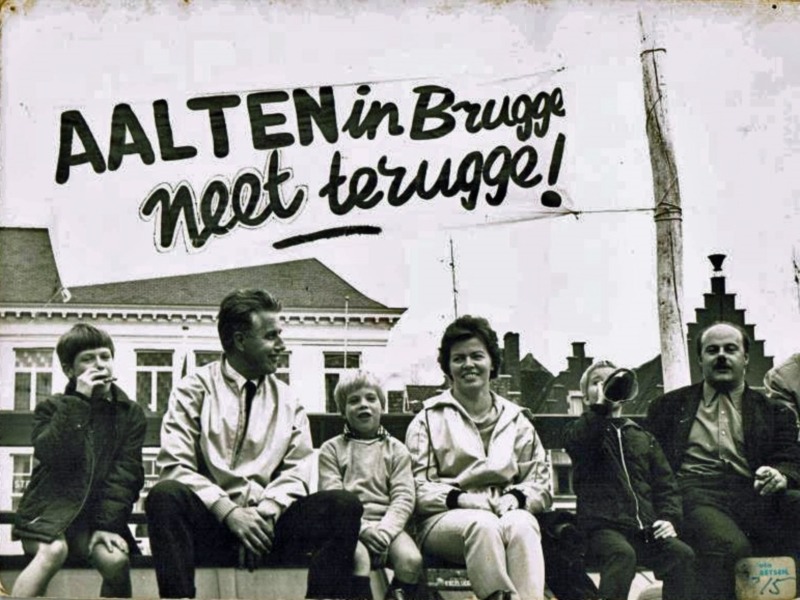
    In 1968, Aalten put itself on the map by participating in the popular TV event ‘Zeskamp’ (Hexathlon). At the time, the municipality had approximately 12,000 inhabitants. The textile industry was in decline, and outside the built-up area, farming remained the primary way of life. During this period, Aalten was a pillarized village. However, Zeskamp appears to have brought about a turning point.

    Zeskamp was a sporting event organized by the NCRV and the Belgian BRT, which they broadcast live on TV. At the time, it attracted millions of viewers, making it one of the most-watched TV programs. There were participants from six different locations: three from the Netherlands and three from Belgium.

    Residents participated en masse and with great enthusiasm. People of various religious and ideological backgrounds worked together. For the first time, they truly met and got to know one another. In this way, imaginary walls were broken down.

    The competitions were held on six Saturday evenings, each time in one of the participating locations. In Aalten, the Market Square served as the arena.

    Ultimately, Aalten advanced to the final in Zutphen and won! The participants were honored with a parade through the village.

    See also:

  • Aalten has big plans

    Aalten has big plans

    Nieuwe Winterswijksche Courant, 27 February 1967

    Demolition of buildings on the Market Square – New town hall and cultural center on the site of the old festival building.

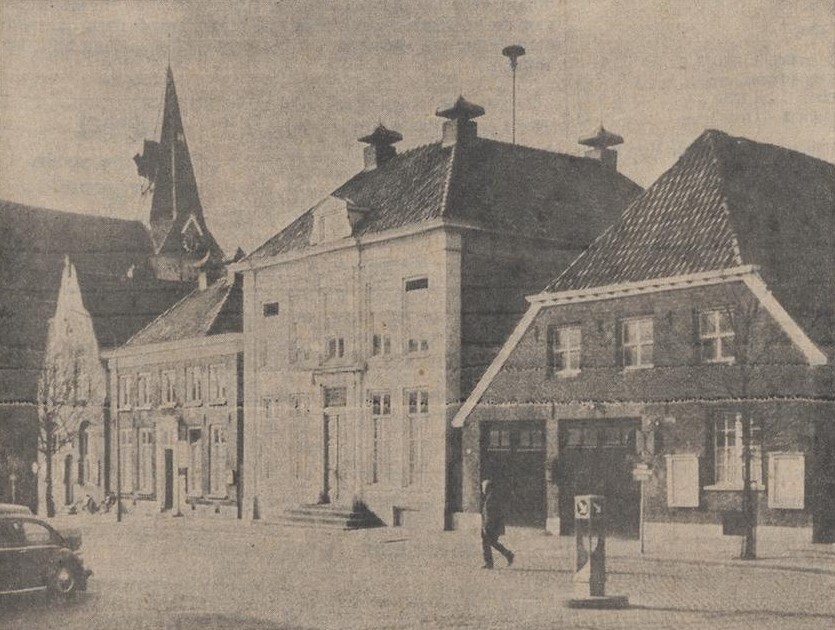
    The municipality of Aalten has commissioned an ambitious structural plan that will give the Aalten village center a completely different appearance. According to this plan, several well-known buildings on the Market Square, including the old town hall (see photo), will have to disappear. In their place, a kiosk, bus station, and small shops will be established.

    The old festival building on the Pol will have to disappear according to the plan, and a modern new Town Hall and a Cultural Center are envisioned for this location.

    Furthermore, new streets have been projected, which will require quite a few breakthroughs. Realizing all these plans will likely take several decades. But in any case, the residents of Aalten will then know what to expect.

    It is sound policy to guide the future growth of the village in a timely, well-considered manner. One remaining question is whether the old Town Hall is actually allowed to be demolished; “Monumentenzorg” (Heritage Netherlands) might object.

    The latest insights regarding the construction of a new post office point toward new construction on the site of the existing office. The grounds near the monastery, which were initially intended for this purpose, will soon serve as a parking lot.

    Land is available north of the Ringweg for a general Christian hospital that may be assigned to Aalten. Expansion of the industrial estate is possible in a northerly direction up to the railway line, and finally, land is available near the Keizersbeek where farmers who are “displaced” by the land consolidation can settle.

    Sources


  • Address Directories

    Address Directories

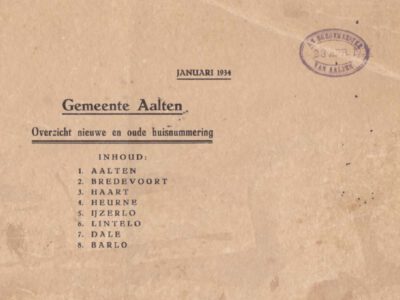
    The address books of the municipality of Aalten from 1934 and 1967 constitute a valuable source of information for historians and family researchers. These reference works contain an overview of all addresses and their residents in Aalten at the time, including Bredevoort and the surrounding rural districts.

    1934 Address Book: Introduction of street names

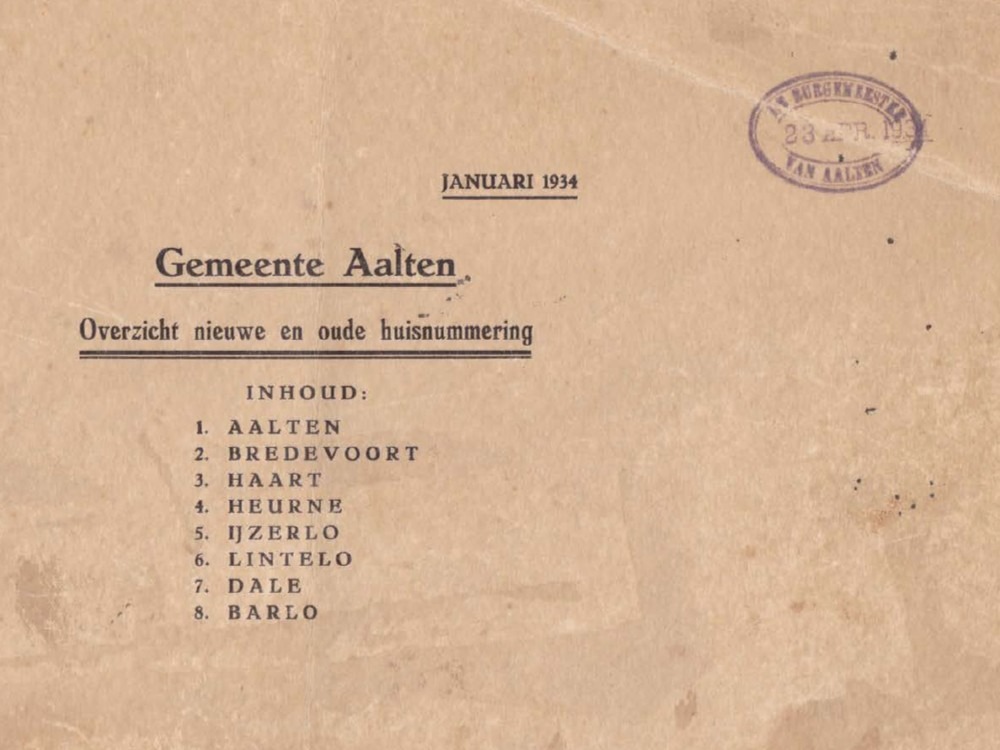
    Until well into the 20th century, addresses in the municipality of Aalten consisted of the name of the village center or rural district, followed by a house number. As the number of dwellings increased, the house numbering changed several times over the years. In 1933, official street names and house numbers were established for the first time in the built-up areas of Aalten and Bredevoort.

    To provide insight into these changes, a guide was published in January 1934 containing an overview of the new and old house numbering. House numbers in the rural districts were also adjusted once again.

    1967 Address Book: Further changes and growth

    In februari 1967 verscheen de zevende editie van het Adresboek der gemeente Aalten, uitgegeven door Aaltens Belang. Deze uitgave bevat een voorwoord, waarin onder andere valt te lezen:

    “Since the 6th edition of our address book in December 1963, there have again been major migrations within this municipality, and the number of new streets has grown even further. Moreover, several streets have been completely renumbered. However, the most significant changes occurred in the rural districts. Until now, for example, we had numbers 1 through 162 in Barlo. Now the rural districts, just like the streets in the centers of Aalten and Bredevoort, have been numbered by road. In the future, this will of course be much easier, but it will take a generation before the new names and numbers are fully established. We have therefore also listed the old numbers behind the new ones.”

    The 1967 address book is available as a PDF file and can be downloaded here:

    Appeal: Do you have old address books?

    Several address books were published in the period leading up to 1967, but unfortunately, we do not possess these editions. Do you have a copy of an older address book and would you allow us to scan it for our historical research? If so, please contact us!

  • Rabobank Drive-through Counter

    Rabobank Drive-through Counter

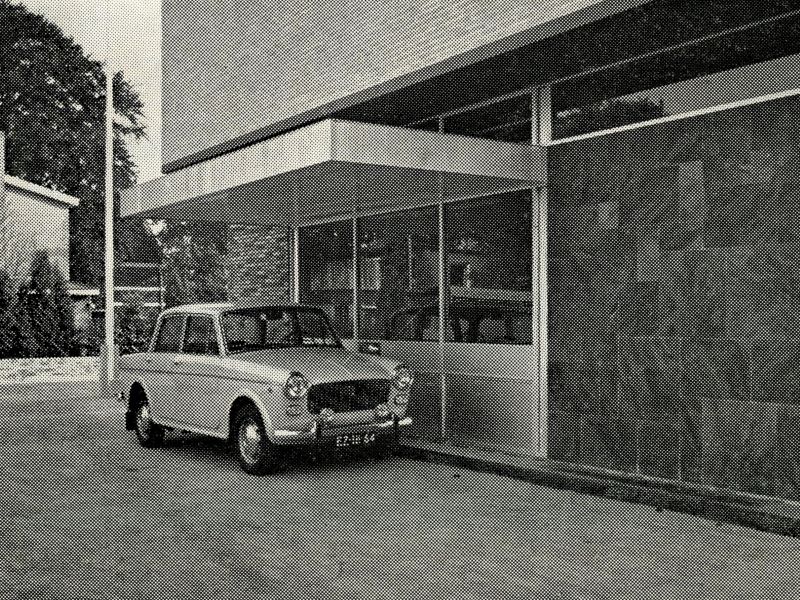
    In 1965, Aalten enjoyed a national scoop. The Rabobank on Hofstraat opened that year and featured the very first drive-through counter in the Netherlands.

    “That our bank knows how to keep up with the times is evident from this photograph, which depicts the modern, fully automatic outdoor counter—or, if you will, the drive-through counter.

    This counter is located in the front façade under a canopy. Motorists no longer need to step out of their cars to come inside to settle their financial affairs. Sitting in their cars, they can handle their banking via a microphone and an ingenious switching system.

    Here, it truly applies: one has the microphone, the other the steering wheel, and between them, the counter. This is how business is done at an outdoor counter. Naturally, non-motorists can also make use of this outdoor facility.”

    Rabobank drive-through counter, Aalten, 1965

    Drive-through counter

    From a conversation with former director J. Beun in April 2014, by Ina Brethouwer:

    “Upon my arrival in 1959, the Coöperatieve Boerenleenbank was growing, but the Kerkstraat location was an old building. It either had to be renovated or replaced by a new building. There were plans for a merger with the Middenstandsbank, but we had to deal with two fierce opponents. Much attention was paid to these customers of the Middenstandsbank.

    Behind the old bank, as seen from Kerkstraat, lay many small allotments. This is the land where the Rabobank on Hofstraat stands today. A long series of discussions with all the owners followed, and all the plots were bought up.

    Developments continued, and construction of the new bank began in the early sixties. We could not find the specific flooring we wanted for the new building in the Netherlands, so we visited Germany several times. There, we repeatedly encountered the Autoschalter.

    And so, Aalten secured the Dutch premiere of the Autoschalter, the outdoor counter for cars. You drove up in your car and were served via a drawer. You placed your items in the drawer, there was a speaker-and-microphone link, the drawer was pulled inside, and the requested items were then pushed back out to you.

    The new bank building was constructed eight metres back from the road with a view to future expansion. During construction, provision was also made for a second automatic counter underground in the basement. However, that development did not proceed, not even in Germany, due to the advent of bank cards and other equipment.

    The merger of the two Aalten banks went ahead. The new name became: Coöperatieve Aaltense Boerenleenbank Middenstandsbank. It all went well; it was a proportional distribution and never became a matter of prestige.”

  • Jewish life in Aalten

    Jewish life in Aalten

    New Israelite Weekly, January 29, 1965

    There is still a synagogue in Aalten. In recent weeks, one could read about it in both the national and international press. Seldom before can this Beth Haknesseth have been so much in the public eye. A procession of journalists has flocked to Aalten. “I can’t bear to see another journalist,” I noted from the lips of one of Aalten’s Jews. They travelled to Aalten because the synagogue has been defaced. It was but one incident among a multitude of anti-Semitic expressions reported in the Netherlands and abroad in recent weeks. One could have learned of those other incidents as well—though not in this publication. One simply cannot keep up with them all.

    And not only that: anti-Semitism is not a question of us. It is a disease that proliferates and proliferates, usually in silence, occasionally openly. We ourselves are less upset as long as there is no survival involved, than the groups among whom the tumor rages. We ourselves have become more self-aware, more self-confident. On the one hand, it is because of the appalling that we had to go through only a generation ago — and what could happen to us even worse — because of the stimulating effect that the existence of the State of Israel exerts on us.

    Perhaps these are the reasons that in Aalten there has been hardly any interest from our organizations — only Chief Rabbi E. Berlinger and the Permanent Committee showed their sympathy. The lack of interest on our part is in stark contrast to the dozens of letters that have been received from non-Jewish quarters. This can be read in one of the letters: “… Since the war, only since the war have many people, including myself, taken into account, not only what has been done to a part of our people in particular, without us having done or being able to do anything of significance against it (?)… And now this: what am I to do — how can we, non-Jewish fellow citizens, undo this insult, this terrible blow to the barely healed, so deeply damaged face. That’s the reason I have to write!!”.

    In Aalten, people take note of the letters, of the verbal interest. Is it doing them good? Undeniably, it provides support. All the more fiercely one feels that there has been hardly any reaction from our side. What hardly causes a stir in the relatively large Jewish communities in the West, is still the talk of the town in Aalten. It is not surprising, the cold one is only small. What kind of support can one give each other? Not that there is fear, not at all. In Aalten, too, the defacing of the synagogue is considered an incident. But still…

    Only nine families make up the chilly Aalten. Nine families with a total of 28 souls, seven of whom are children. They do not view the smearing of the shul, the destruction of the stones in the cemetery in Winterswijk with a shrug of the shoulders. Because there is a connection between one and the other. They are not unrelated facts. The police investigation has finally shown that those who caused destruction in the cemetery of Winterswijk are the same as those who smeared the synagogue in Aalten. It has been proven by comparison of the manuscripts and chemical investigations of the chalk that was used for chalking. But no matter how active the Aalten police are, there is no question yet that the active anti-Semites could be arrested.

    Requirements only

    There is another synagogue in Aalten. But shul services are held only sporadically on Shabbath. And only with shul services can one actively prove one’s Judaism in the small kehilloth . Until last year, the services still took place every Shabbath. But in the last five years, three shul visitors have died and some young people have left elsewhere. Only when these young people come over to Aalten is there sometimes a service on Shabbath. However, the synagogue is now only populated on Jamiem Towien.

    Nevertheless, Aalten still had its own chazan until 1948. He left for America. He was the last of the many excellent chazanim that this kehilla has known in its long history. Since his departure, one of the people from Aalten acted as Sjeliach Tsibboer. During the Jamiem Noraiem one of the young people comes from Amsterdam. It is no longer possible in Aalten to appoint his own chazan — apart from the question of where he should come from. The cold cannot pay his salary from the tax revenue.

    “The Permanent Committee demands a share of this proceeds, the Arnhem district demands a share of the money. And people forget that we have to maintain our shul and that we have to take care of (our) large cemetery. Money is demanded of us, but what do we get in return? If we have a bar mitzvah, we have to beg for the arrival of a chazan. The bill will come later. If we need someone for a lewaje, the bill will be presented later: ƒ 0.25 per car kilometer, beyond the requirement that is not on the bill.”

    Butcher knows better

    There is another synagogue in Aalten. It is hardly used anymore. There is no more chazan. They have been to Aalten. Some were also mohel, most also sjocheet. This has sometimes led to skirmishes in Aalten. Because the four kosher butchers in pre-war Aalten did not agree with the shechete’s decisions. If the shochete said: the cow is treife, then the butchers knew better. The sjochetim then got all kinds of things thrown at their heads. One of them, Levi Gasan, small in stature and slender, was very afraid of the wrath of the butchers. When he found a cow treife, he quietly left the abattoir, ran the last few meters to the door and only then shouted: “The cow is treife!, because he expected to have a cleaver thrown at the head if he said it to the face of the butchers. His work plus the fear of life preservation was honored in those years with 1800 guilders a year. The respective chief rabbis did not exactly understand the butchers in Aalten either. Chief Rabbi Levisson in particular turned against them.

    “The chief rabbis were authorities. If they held an inspection once every six months, people were nervous. They decided in more areas than they formally had to decide. They did not want butchers as parnassims. They kept an eye on the administrative decisions of the parnassim. They interfered with the salaries. And no one dared to contradict the chief rabbi”. Nevertheless, the Aalten parnassim often quarreled with the chief rabbi. They blamed them a lot. But these reproaches never reached the chief rabbi. He was back in Arnhem by then. On the heads of the chazanim the wrath of the parnassim was discharged. They received criticism in many areas: also that they did not provide sufficient education. It also happened because some church members had more knowledge than the chazan. Because there were many chewres in Aalten. They are no longer there. The children receive an hour of Jewish lessons every week. For youth meetings they have to travel to Winterswijk.

    Things have sometimes been tough in Aalten. The taxes were low. Those who paid a dime more counted themselves among the prominent ones. Many rights were derived from that dime. In Shul people bid against each other to obtain a mitzvah. Partly because of this, the parnassim sometimes knew better what the income of the congregation members was than the inspector of taxes. Perhaps that is also why people were so committed to being elected parnas. The elections were in reality a get-together. But despite the battle for the kawod, there was great cohesion. The quarrel of one day was settled the next.

    Quarrel

    But there were frequent arguments. Because the Jewish community of Aalten consisted largely of cattle shochriem. On Friday evenings they quarreled with each other in shul because one had bought a cow from a farmer that had been promised to the other. On Shabbath morning, the quarrel was settled in shul. On Shabbath afternoon they visited each other, also to hear each other out. Shabbath evening people wished each other “gut woch”.

    Aalten, which had eighty Jewish souls before the war and one hundred and forty souls shortly before the war; of whom many German refugees, was always a pious cold. “On Shabbath, all Jewish businesses were closed here. No Jew worked. That would not have been possible. The population had not taken that. It once happened that a Jewish representative of a Jewish firm from Amsterdam visited a shopkeeper on Shabbath in Aalten. He was thrown out of the store and his monster suitcase was thrown after him. “On Shabbath there is no Jew in my house,” he was shouted at. There is still a synagogue in Aalten…

    M. KOPUIT

    This article was written with the help of Mr. J. Weyel and Mr. S.I. de Haas of Aalten.

    Source


  • The Spanish Sword ‘Tholeta’

    The Spanish Sword ‘Tholeta’

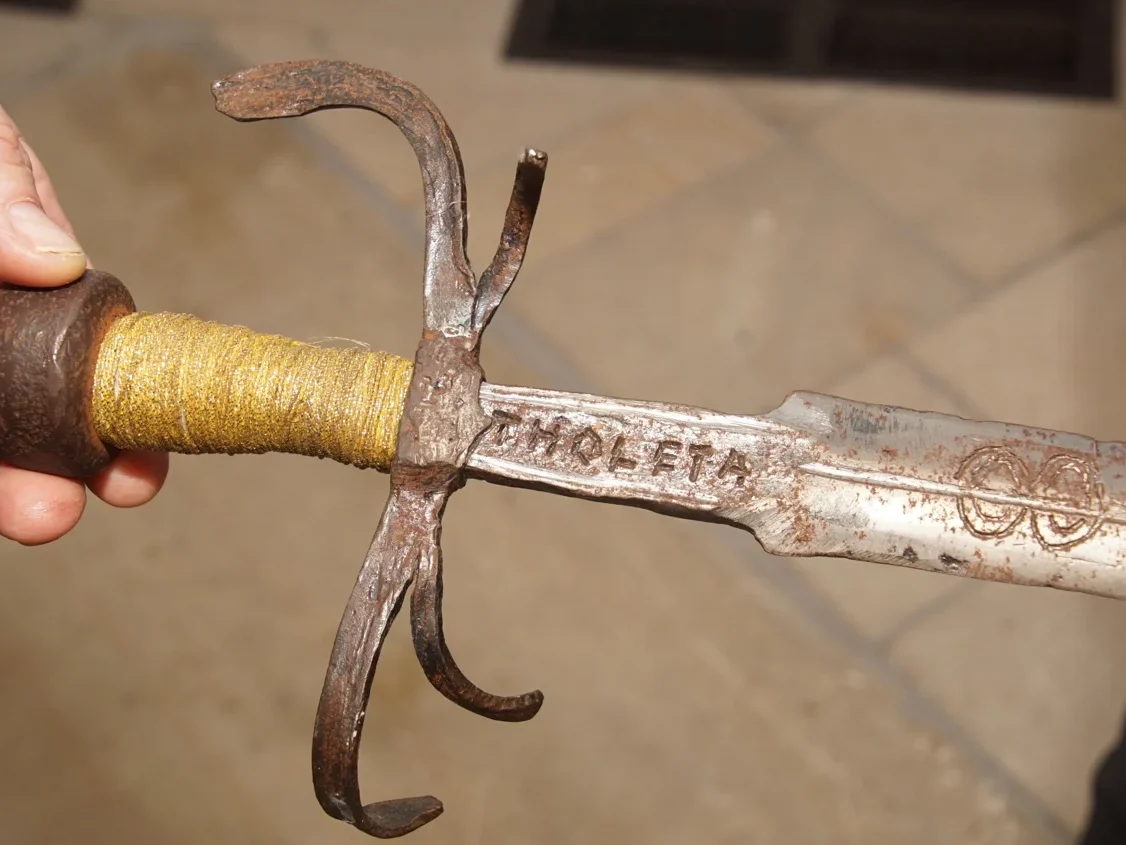
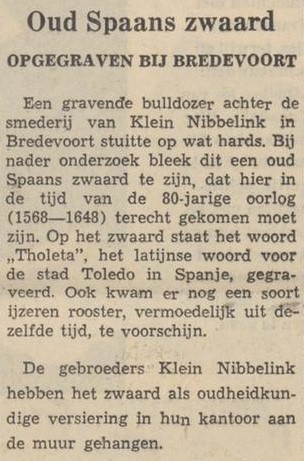
    In 1964, during excavation work for the construction of a new workshop on the premises of the Klein Nibbelink smithy, various items were discovered, including remnants of walls, moat fill, wooden posts, and an iron fire grate. However, the most impressive find was a Spanish sword from the Eighty Years’ War, bearing the inscription ‘Tholeta’, the Latin name for the city of Toledo in Spain.

    Johan Klein Nibbelink currently has the sword in his possession and tells about it in the video below.

    Sources


  • The Netherlands in the year 2000

    The Netherlands in the year 2000

    Nieuwe Winterswijksche Courant, 23 October 1963

    Workers will then earn around ƒ 15,000 – Smaller towns (including Winterswijk-Aalten) merged into large cities – Further industrial revolution with possibilities currently beyond imagination!

    One can indulge in the most elaborate fantasies regarding the rise in labor productivity in the near future, but with normal, steady development over the next 37 years, real income per capita will be 2.5 to 3 times greater than in 1963. The amount available for spending exceeds our imagination: a worker currently earning ƒ 6,000 per year will then have more than ƒ 15,000 to spend.

    Prof. P. de Wolff, director of the Central Planning Bureau, presented this as a topic for discussion to the participants of the “Netherlands in the Year 2000” conference of the Netherlands Discussion Centre in Oosterbeek. He had calculated that by the year 2000, the population of our country would number 20 million souls. Prof. Jac. P. Thijsse of the Institute of Social Studies in The Hague also based his work on this figure. In his plans, he concluded, among other things, that by 2000, perhaps 95 percent of the population would live in cities. These people would not only live in cities, but according to his vision, there would be many cities in the Netherlands outside the Randstad Holland with 750,000 to one million inhabitants. He had assumed a density of 50 people per hectare. This relatively high population density need not hinder the “livability” of the cities, as this is a matter of quality in urban planning and housing construction.

    The Netherlands in the year 2000
    The Netherlands in the year 2000, according to Prof. Jac. P. Thijsse

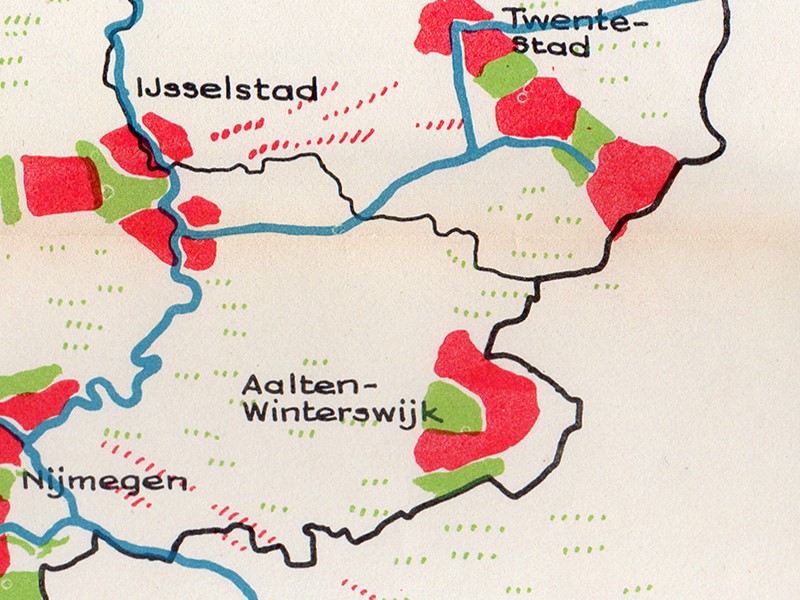
    Prof. Thijsse stated that to accommodate the expected population growth, it is necessary to begin building 125,000 homes per year immediately. Using a map of the Netherlands in 2000, he showed that cities are hubs within an area with a radius of fifty kilometers. He had also formed “ring cities” from, among others, Apeldoorn, Deventer, and Zutphen; Arnhem-Nijmegen; Winterswijk-Aalten; and Enschede-Hengelo-Almelo, disregarding provincial borders. He also anticipated that national borders would no longer exist by then. In this regard, he pointed to the large city formed by the towns of Sittard, Geleen, Heerlen, the German city of Aachen, and the surrounding areas.

    According to Prof. Thijsse, not a single airport in our country is in the right location. He had projected the major airport of 2000 onto the Wadden Sea, which was yet to be reclaimed. If the Netherlands maintains its function, as currently derived from transport to and from the European hinterland, Prof. Thijsse envisioned new port and industrial areas in the Western Scheldt and on the land yet to be reclaimed between Den Helder and Wieringen.

    In his economic vision for the future, Prof. de Wolff assumed that no major conflicts or enormous depressions would occur in the coming 37 years. He calculated that if productivity increases by 2.7 to 3.25 percent per year and working hours are reduced to 35 hours per week, gigantic tasks must be completed in the Netherlands, given the then-altered composition of the workforce.

    How the industrial revolution will proceed cannot yet be foreseen, but this development will be completely different from what is currently imagined. Perhaps certain types of labor will become so scarce that, for example, clothes will no longer be washed but thrown away, and washing dishes will likewise no longer be feasible. Perhaps people will then have to perform auxiliary tasks themselves during part of their free time, such as washing cars and painting houses. Prof. de Wolff also saw major tasks for the government and could find no room to lower taxes over the next 37 years. Not even if the defense budget were to disappear because the concept of war had become obsolete.

    Sources


  • Swimming Pool War in Aalten

    Swimming Pool War in Aalten

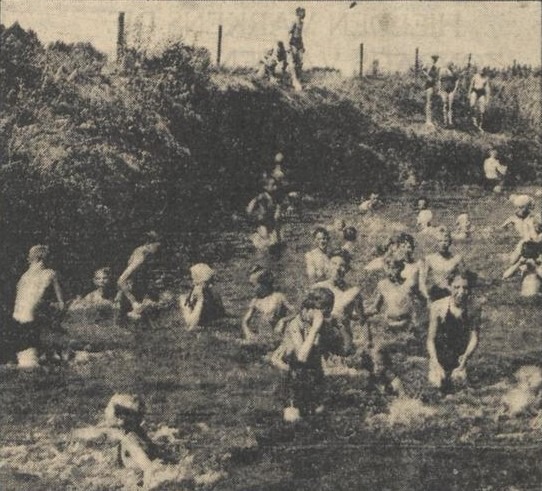
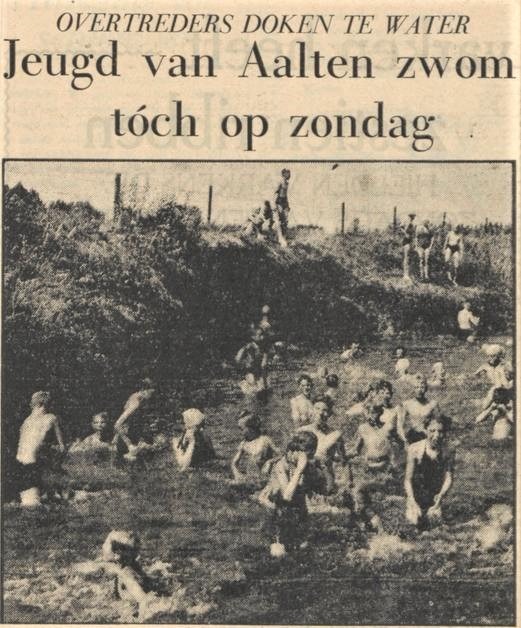
    Sunday, July 7, 1957, was a sweltering day. Consequently, many residents of Aalten wished to take a cooling dip in the ‘t Walfort swimming pool. At the time, however, it was not permitted to open the pool on Sundays. Hundreds of residents disagreed and marched to the pool that afternoon. The youth climbed over the fence, and older residents forced entry into the pool. Moments later, the crowd dove into the refreshing water, and the hastily summoned police were powerless to intervene!

    Stampede at ‘t Walfort

    Nieuwe Winterswijksche Courant, July 8, 1957

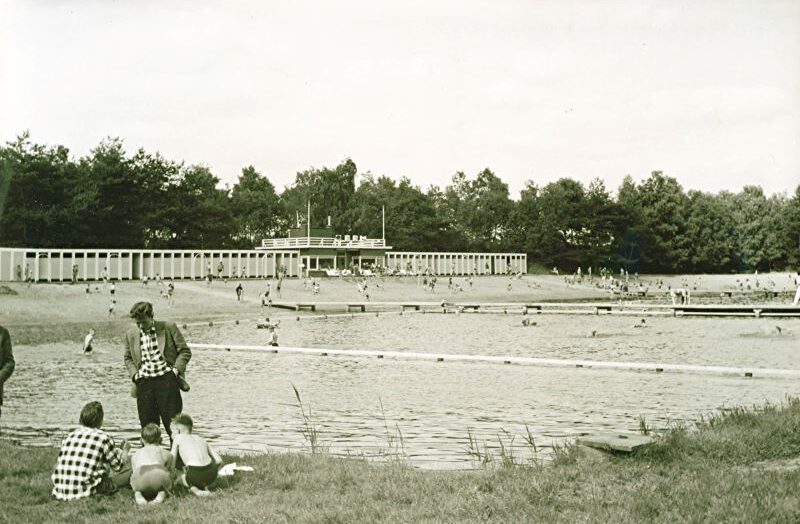
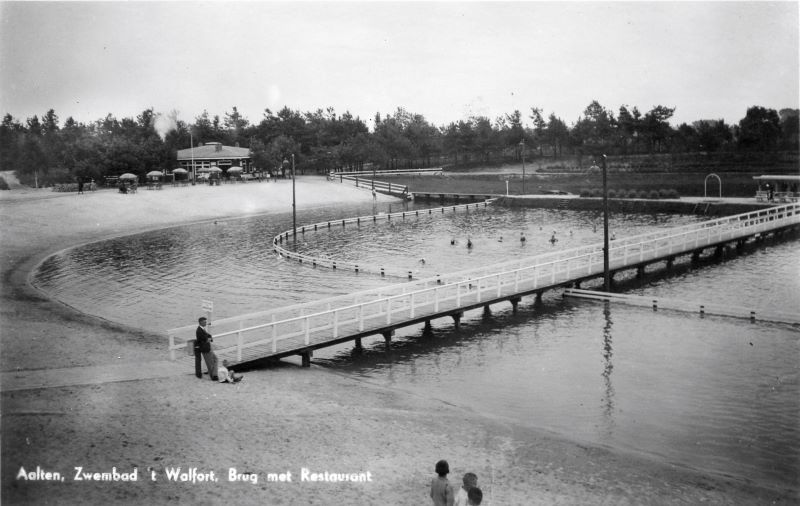
    Aalten possesses a beautiful natural swimming pool, ‘t Walfort. However, swimming is not permitted on Sundays. The predominantly right-wing Christian municipal council recently decided, by a majority of a few votes, that the pool must remain closed on Sundays. This decision has greatly irritated a large portion of the Aalten population, who do not share the motives behind this resolution. This irritation was further exacerbated last Sunday by the extreme heat, which created a longing for a cooling bath.

    On Sunday afternoon, young and old alike flocked to ‘t Walfort in great numbers, where they initially stood before the closed gate, protesting against the municipal executive for withholding this pool from the more liberal Protestant segment of the population, as well as Catholics, Jews, etc., while it was sweltering. Soon, the youth began climbing over the pool’s enclosure, and before long, older individuals were kicking in the wooden fences to force access to the pool. Moments later, the entire crowd—numbering in the hundreds—dove into the refreshing water.

    When the hastily summoned police and several board members of the pool arrived, they were faced with a fait accompli! The police could do very little; it was impossible for them to get all those people out of the water. Finally, Alderman Obbink of the Anti-Revolutionary Party (A.R.) delivered a speech, which, however, fell on deaf ears. The people simply held fundamentally different views than the municipal executive and continued swimming calmly.

    After several hours of swimming, the pool board made another appeal to the swimmers: they had had their chance, and the pool had to be closed again. This appeal was successful: in a sporting manner, everyone left the pool, and shortly thereafter, Sunday rest was restored to the swimming pool. However, the municipal executive of Aalten is faced with a problem; it is now clear that, regardless of how this matter is framed on principle, a large part of the population disagrees and believes that the interference with their freedom on Sundays goes too far.

    Naturally, the municipal executive made its decision to keep the swimming pool closed on Sundays based on grounds that were serious to many council members. However, Alderman Obbink promised “to look into this matter once more” for those who cannot share the Council’s fundamental considerations.

    Aalten Swimming Pool remains closed on Sundays

    Tubantia, July 9, 1957

    At the proposal of the Mayor and Aldermen of Aalten, this body met with the board of the “‘t Walfort” swimming pool to discuss the incidents of last Sunday, when the youth of Aalten stormed the pool. The pool board indicated that it fully respects the council’s decision to keep the pool closed on Sundays and that it condemns Sunday’s actions; the latter in contrast to rumors suggesting that the pool board had cooperated with the demonstration.

    The municipality will issue a serious warning during the course of this week against entering the swimming pool on Sundays. The necessary measures will be taken. We further understand that the council factions of the K.V.P., P.v.d.A., and Gemeentebelangen will not submit a new proposal to open “‘t Walfort” on Sundays this season. Since no new proposal can be expected from other parties either, it is almost certain that the pool will remain closed on Sundays this season.

    Warning

    Tubantia, July 11, 1957

    The acting mayor of Aalten, Alderman W.B. Obbink, has announced following the demonstration that took place on and around the swimming pool on Sunday that, should the disturbances recur, they will not hesitate to take criminal measures. This publication was issued following a statement from the board of ‘t Walfort. It reads as follows: “The board of the ‘t Walfort’ bathing and swimming facility, meeting on July 8, 1957, discussed the disturbances that occurred on and around the swimming pool last Sunday. It deeply regrets this reaction to a decision that was reached in a perfectly legal manner and unanimously expresses its disapproval of this subversive conduct. It strongly urges the population, especially the youth, to respect the Council’s decision, to refrain from vandalism, and to comply with the decision in a sporting manner.”

    Aalten Council revises decision

    Tubantia, April 16, 1958

    This coming summer, residents of Aalten will be able to go swimming in their own ‘t Walfort pool at four o’clock on warm Sunday afternoons. Last night, the municipal council decided that the pool will be open from 3:00 PM to 7:00 PM on summer Sundays. A corresponding proposal, submitted on behalf of the K.V.P. and Gemeentebelangen factions, was adopted after a calm debate by 9 votes to 6.

    The decision itself was not a surprise, but the relatively large majority the proposal received was. Unlike last June, when a similar proposal was rejected by 8 votes to 7, all three Christian Historical (C.H.) council members now voted in favor. The Anti-Revolutionary Party (A.R.) remained steadfastly opposed. As is well known, last summer, a few weeks after the council’s rejection, ‘t Walfort was stormed by hundreds of Aalten residents on a sweltering Sunday afternoon, after which swimming took place for several hours.

    Disturbed peace of mind jeopardizes Sunday rest

    Last night’s debate did not open any new perspectives. It was essentially a brief repetition of the arguments that were presented extensively and sometimes passionately on June 30 of last year. This time, the council finished its discussion within half an hour. Mr. Luiten, faction leader of the A.R., called it less than edifying that another proposal to open the swimming pool on summer Sunday afternoons has already been submitted.

    If we were to make a different decision now, people might think we are giving in to opposition from the streets. He once again explained the pros and cons, admitting that mass swimming in the stream creates unacceptable conditions, but stated he did not see why, in a municipality like Aalten with its wealth of natural beauty, the swimming pool must also be open on Sundays. In his view, a piece of Sunday rest is lost because of it.

    Mr. H.L. Obbink (C.H.) clarified why he would take a different position this time than last year. The events of that time proved that the peace of mind of the population can be so disturbed if the swimming pool remains closed that the Sunday rest itself could be jeopardized. This had led him to decide to revise his position. Mr. Huinink (Labor) again raised the argument of Sunday labor in the service of the police, railways, etc., which is also performed by Anti-Revolutionaries.

    (“Only necessary labor,” Mr. Heinen stipulated), and called the attitude of the A.R. typically Aalten. In a municipality like Varsseveld, the situation is quite different. What was proclaimed 50 years ago no longer applies today. He believed that the Sunday rest would not be jeopardized by the opening of the swimming pool.

    Not through resistance

    Mr. Wijkamp (K.V.P.) stated that the irregularities of last summer were not the reason for bringing the proposal forward again; it was already certain then that another attempt would be made before the new swimming season.

    After Mr. Brethouwer (C.H.) explained why he would vote in favor (“swimming in the stream at Lintelo certainly does not benefit the Sunday rest”), Mr. Heinen (A.R.) expressed his surprise at the changed attitude of Mr. Obbink and especially of the K.V.P., which a few years ago was even opposed to mixed swimming. Mr. Lurvink (K.V.P.) replied that moral welfare was certainly as important as the sanctification of the Sabbath. After brief replies, in which Mr. Wijkamp requested strict police action against swimming in the stream, the vote was taken.

    After Mayor Van Veen announced the result, Mr. Ter Linde (P.v.d.A.) addressed the population over the heads of the council with a request to make appropriate use of the swimming pool and to prevent any excesses. The Mayor and Aldermen will now consult further with the swimming pool board regarding the implementation of the decision.

    Sources


  • Old Christmas Traditions

    Old Christmas Traditions

    Several excerpts from the Java-bode, December 22, 1956

    Christmas: A Christian holiday, yet many customs originate from paganism. In modified forms, they have withstood the test of time.

    Already several days before Christmas, a festive mood awakens in people, reaching its peak during the Christmas days. It is no coincidence that the Christmas tree, holly, and mistletoe are popular then, and that Christmas bread, Christmas wreaths, and other Christmas pastries enhance the festive joy. It is seldom considered that such items and customs originate from ancient paganism.

    In the past, our ancestors celebrated the Yule feast around this time, the festival of fertility, in honor of the return of the light. The shortest day had passed, and the days began to lengthen again. Sacrificial meals were held, and sacrificial fires blazed high in the sacred forests. Christmas is a Christian holiday, but all those customs emerged from pagan soil and have, more or less modified, remained and been adopted by modern man.

    It is difficult to link Christmas customs to a specific day, as what occurs here on Christmas Day takes place elsewhere on December 26th or even on Epiphany. Some customs, such as eating certain types of cookies and pastries, are in vogue throughout that entire period between Christmas and Epiphany. In general, it can be said that in the rural Netherlands, Christmas Day is the holy day, a day of reflection and meditation, while Boxing Day is used more as a day for going out or visiting.

    Achterhoek

    Among the elderly in the Achterhoek, the superstition still lives that on Christmas Eve “Derk met de bèèr” rides around, destroying everything left lying outside. In many places, all agricultural tools are still stored in the barn and the yard is cleaned…

    In many families in the Achterhoek, something extra is eaten on Christmas Eve, and this custom is reminiscent of the old name “dikkevretsavond” (gluttony evening). In farming families, pancakes fried with sausage are often served. A mocking rhyme that points to an extra treat goes: “Kasaventjen, Kasaventjen, dan gaat ‘t er bie ons op. Dan slacht mien va ‘nen pekkelhering en ik, ik kriege de kop”.

    In Aalten, people eat “pilleweggeskes” on Christmas Eve, small spherical “weggen” (loaves) on which two dough pills are placed in a cross shape. Children still know an old begging song: “Pilleweggen-aovend, offert geld, Geft de kleine kinder wat, Geft de groten ‘ne schop vör ‘t gat!”

    The aforementioned two dough pills in a cross shape did not originally belong on this Christmas pastry. They were placed there when the common people no longer understood the name “pilleweg.” A “pil” is a godchild or baptized child, and the “pillegift” in the form of a “pillewegge” was a baptismal gift. It was also a reminder of the pagan bread offering made to ward off the demons of the childbed. Anise, caraway, and cinnamon drove the gods away with their strong scent.

    The fact that “pillewegen” are given as gifts on Christmas Eve likely finds its origin in the veneration of Mary as a woman in labor. The custom of eating walnuts on Christmas Eve in the cozy domestic family circle (in Aalten, for example) is still in vogue.

    Source


  • War Memorial

    War Memorial

    Whemerstraat, Aalten

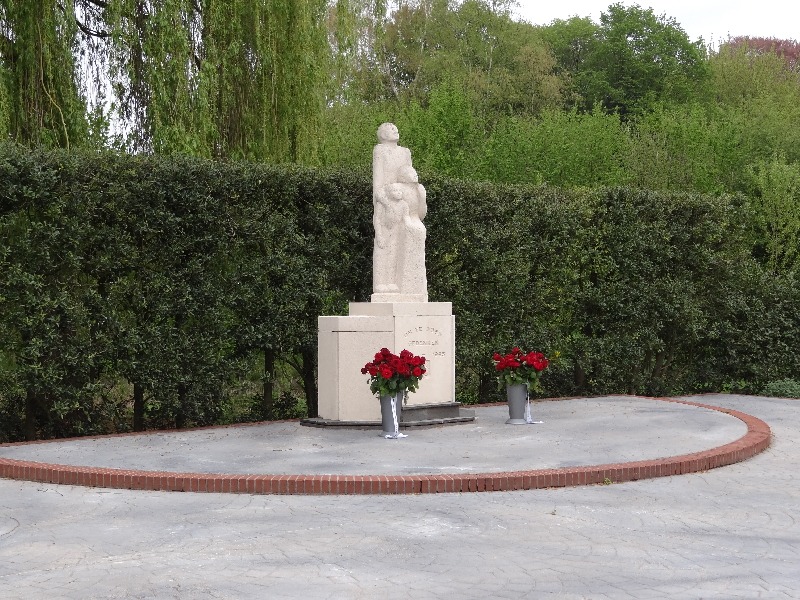
    The war memorial on the Wheme was erected in memory of all fellow citizens who died during the occupation years as a result of acts of war. The memorial also commemorates the liberation.

    The establishment of the memorial was an initiative of the Monument Foundation 1940-1945 committee. Immediately after the liberation, the population of Aalten felt the need to honour the war victims with a monument.

    The monument consists of a statue of a male figure with a woman and child. The sculpture of French limestone is placed on a terrace. The pedestal consists of masonry, concrete and natural stone. The memorial is 1 meter 31 high, 1 meter 43 wide and 90 centimeters deep.

    The monument was unveiled on 16 June 1956 by Hendrik Jan (Uncle Jan) Wikkerink, leader of the former resistance movement in Aalten.

    The text on the pedestal reads:

    OM TE DOEN
    GEDENKEN
    1940 1945

    (‘TO COMMEMORATE’)

    The group faces south from where the tribulation, but also the deliverance, came. Artist Bé Thoden van Velzen described the sculpture as follows: “… representing man, woman and child, as a symbol of the entire Dutch people, expectantly looking forward to liberation, unbowed and unweakened.”

    Features


    FunctionListed
    Disclosure1956

    Sources


  • Johannes Korten went to Canada

    Johannes Korten went to Canada

    Zutphens Dagblad, 4 February 1956

    He is working on a new life there

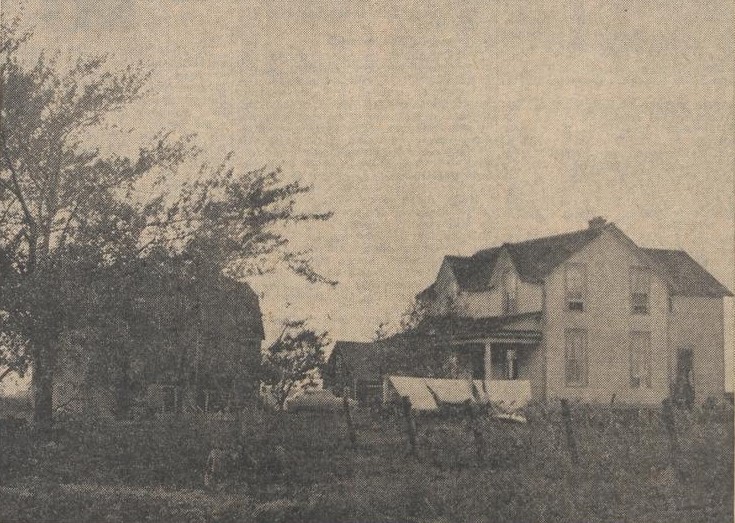
    Winter 1951 in the Netherlands, an important meeting about a burning issue. A meeting that may have escaped the attention of the Dutch people and certainly did not have a report in the press, but whose results have been no less drastic in the life of a family, rooted by generations in the familiar surroundings of our beautiful Graafschap. The meeting was a family gathering of the Kortens at the parental farm “Lensink” below Aalten.

    The subject is familiar to many families in the Dutch countryside: what to do when the children grow up, get married and want to stand on their own two feet, have their own farm? A problem, although not new, but increasingly topical as the population increases, land is lost due to the construction of industries and the construction of roads, expansion of cities and airports. A problem for which no reclamations can provide a solution, tragic because of its unsolvability in its own country.

    Lensink

    “Lensink” is a farm, twelve hectares in size, where father Korten and his family already got the most out of it. A farm, which gives an existence to one family, but can no longer be divided. Under the roof of the familiar farm, a decision was made on that day of 1951. If no solution could be found in their own country, they would try it across the borders. Many had already gone before, including to Canada, also from their own area. And the reports heard from overseas about the experiences there raised hopes that perhaps a solution to their problem would be found.

    It must have been a melancholy farewell in the autumn of that year. Farewell to the farm, the familiar surroundings, to the children who stayed behind because other ties bound them in the old country. A melancholy perhaps hidden behind the excitement of the big event and the nervousness of the preparations, but also gilded by the expectations of an uncertain future. Have those expectations been met? Was the solution found in Canada that was no longer available in the Netherlands?

    In the autumn of 1955, four years after leaving the Netherlands, Korten will answer that question in the affirmative. In his cautious way, he will point out what was achieved at that time, with an open eye for the difficulties that lie ahead, but also with confidence in his own abilities and grateful for the horizons that have been opened up for him and especially for his children. Perhaps there will be those who, seeing the results, say that it is easy to achieve success with such a bunch of big children. But does that make any difference? In the Netherlands it might have been achieved only partially or never. The young families will have to struggle longer to get this far, may have to make more sacrifices for it and have more difficult early years. But they have the strength of youth.

    How Korten is doing now

    In October 1951, the family arrived in Canada and traveled on to a small town in Southern Ontario, not far from Hamilton. An old acquaintance from Aalten made sure that the family found work and shelter on a fruit farm, while a place was found for the family of a married son on a farm nearby. Korten stayed there for two years. The children were given work in fruit and tobacco cultivation, where good wages are earned during the summer through long days. The joint income was saved and in the summer of 1953 the time had already come to look around for companies for sale.

    By that time, Korten will have become accustomed to the big difference between the Netherlands and Canada, where farms are offered for sale in abundance. Good and bad, cheap and expensive, big and small. He drove around with his sons for many hours, visiting companies, before he had made his choice. The available financial resources imposed limitations, the company had to be large enough for his family and offer development opportunities for the future…

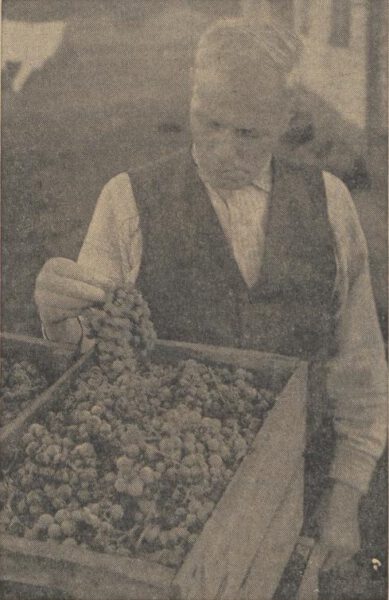
    If someone had told Korten before his departure from the Netherlands that he could once again call a vast vineyard his own, he would have laughed at him. But that unexpected happened, because in November, barely two years after his departure, the family moved into a farm, large 45 hectares, half of which were with grapes; the company that Korten had chosen. One can imagine that it means quite a change for a Dutch farmer of the mixed farm when he exchanges his place among the cows for a life in the middle of the vines, especially if he has no experience with grape growing.

    The Kortens were in that position. A lot of adaptation was demanded of them again, much was and still has to be learned. Neighbors in this region, where many grapes are grown, gave advice and Korten now also knows that he can turn to the Information Service for advice. The pruning in the winter, tethering in the spring, the watering and tillage, the harvest, everything was new and strange. Gradually they grow into it and learn the tricks of the trade and the demands it makes.

    Warden’s and Niagara’s, Concords, Fredonia’s and Diamond’s, grape varieties that each require their own care, are names that no longer sound strange to them. And that’s what this company needs more than anything else: expertise. Several times during the last few years it has changed hands, it was neglected and polluted when it was moved into. Production is still below normal, which is not only due to the fact that most of the vineyard is still young and not at full production. Pruning should be improved and old trunks removed. The buildings should be refurbished, but in Korten’s eyes that can wait a while. First production must be brought up to standard. And that already requires enough time and capital.

    For his sales, Korten has a contract with a wine factory in the area. The price he receives for his grapes is fixed in the spring and is different for the varieties. Over the past year, these prices ranged from $80 to $100 per ton. These grapes are processed into wines and grape juices. Some varieties are more popular than others and Korten can count himself lucky with a considerable variety in the varieties on his farm, which ensures that he is more assured of good sales than when only a few varieties are grown. He sells a small part of the harvest as hand grapes to wholesalers or directly to the public. Although he can charge more for this, it also takes more work and time to prepare the baskets. Moreover, this sales are very limited.

    Grape cultivation is subject to significant risks, such as frost and hail damage, plant diseases, bird and insect damage, against which the grower can only partially insure or arm himself. Sales do not cause Korten any headaches and he gets a good price for his product. For sales, the Canadian grape grower is to a considerable extent dependent on exports to the United States, where production is regularly increasing. However, much has already been done in the field of marketing organization by grape growers’ associations.

    However, it does not look like there will be any major difficulties in marketing in the future. On the Niagara Peninsula, where Canadian grape cultivation is concentrated and where Korten has his business, the same phenomenon is occurring that our own country knows so well: more and more land is being taken up for industrialization and the area cultivated with grapes is also declining. This region, so ideally suited for climate and soil type, has a great attraction for industry due to its location in a densely populated part of this country and the presence of excellent transport facilities. Although this development is not in the general interest of fruit cultivation in this region and there is talk of setting up regional plans to steer this in the right direction, it means a guarantee for the grower for sales in the future.

    In addition to the vineyards, the company has more than 20 hectares of arable land and grassland. Originally, this was all in grass, but Korten only has two dairy cows and two heifers and decided to tear up part of the grassland. On the arable land, he now grows wheat, oats, corn and tomatoes, the last crop on a supply contract with a cannery. The cattle are also in such a state that he would like to keep more cows, especially because he needs the manure so much on the farm. But he is not yet sufficiently well equipped to be able to put money into this now. It is still “all hands on deck” to meet the obligations that have been entered into with the purchase of the company and also to develop the company.

    The boys work with others whenever they can be missed, either in the construction company or in tobacco cultivation. Despite the heavy burdens, however, there is the satisfaction of building a life and the confidence in a future without fear of the problem that drove them to Canada: what are the boys going to do? There is now sufficient space for development on their own farm and beyond. Mother Korten now makes her own wine, not much but from “own cultivation” and good taste, to taste on special occasions. And on those occasions, she and her husband will sometimes reminisce about the time in Aalten, on the “Lensink”, where a son now holds sway and a young family grows up.

    Do you have interesting stories about family members who emigrated from Aalten to Canada? Send us a message!

    Sources


  • Messages from Canada

    Messages from Canada

    Dagblad Tubantia, 1955

    Four years ago, Marinus Rhebergen from Aalten left for Canada and he is currently on holiday in his hometown for a few months.

    “Canada is, it is said, the land of unlimited opportunities, but don’t think that every immigrant in Canada will become rich in a few years. Don’t even think that everyone who emigrates to Canada will have acquired a position there within a few years, as it would never have been possible in the Netherlands. There are exceptions, there are people who are extremely lucky and have acquired a strong position within a few years, but…. They remain exceptional cases.”

    This is according to Marinus Rhebergen from the Richterinkstraat in Aalten, who emigrated to Canada four years ago and returned yesterday for a holiday stay in Aalten, where his parents and other relatives live. Four years ago, Marinus left, together with his friend Constant de Jong, also from Aalten. It was actually a bit of an adventure for Marinus and Constant. Both had jobs and both were single. They did not have many worries. The unknown attracted them and they did not lack entrepreneurial spirit. One day we left, just like that, hoping for a blessing.

    “When we arrived in Canada,” Marinus told us, “we had to get some money in our pockets. After we came ashore, we decided to step into the first factory we saw. It was a textile factory. Beforehand we had “tossed”, where it turned out in such a way that, if only one man was needed, it would be my turn first. I was lucky in that first factory. The director – an Englishman – could use people. He spoke highly of the good relations that had always existed between the English and the Dutch people. Of course I was wise enough not to talk about the wars with England. After a few days, the director came to tell me that he also had work for my friend. That’s how we both started working in the same company.”

    In the office

    However, Marinus did not want to stay in the textile factory. He looked for a job in an office and finally succeeded in a place in the north of Ontario. “I had a good job there,” Marinus said. “There was one objection to it; I was the only Dutchman in that place and that was not pleasant. The mentality of the Canadians is very different from that of the Dutch and when push comes to shove, you will always remain Dutch there. Whether you like it or not, you always keep your Dutch sense of sociability and community practice.”

    Marinus has now gone to Aalten. For how long? Oh, he doesn’t know that yet. He is not tied to anything. He has quit the job in Canada. His boss there gave him a beautiful certificate and said that the office chair is ready for him at all times. However, Marinus does not want to be isolated among the Canadians again as a Dutchman. Somewhere else in Canada, he will soon try his luck again.

    Getting ahead

    Marinus has spoken to numerous Dutch people in Canada in the past four years, including several former Aalten residents. They are doing pretty well, of course some better than others. “In general,” says Marinus, “someone who has a small business or a small farm in the Netherlands should not think that he will be able to work in Canada within a few years. Many who were so-called small self-employed in the Netherlands, are also self-employed in Canada. If one wants to take giant steps on the road to fortune, one must fully adapt to the Canadians. That means, adopting their good qualities, but also the bad ones. Then one gets a lot of relationships and that is of enormous importance, but not moral.

    Constant de Jong, who left at the same time as Marinus, still works in the same factory. He was less able than Marinus to change, because he married there a few years after arriving in Canada. And Constant is a man with Dutch responsibility; A married man should not go on adventures. Marinus has remained loyal to the bachelor life.

    Voortman family

    Marinus Rhebergen often visited the Voortman family in Canada. This was not only caused by the fact that there are four boys in this family, with whom it is pleasant to talk, the wife of Voortman Sr. comes from Aalten. Mr. Voortman, who was a widower, remarried in Hamilton to Ms. Cato te Brake, who left for Canada a few years ago. The Voortman family, says Marinus Rhebergen, first lived in Picton for a number of years. After several years of hard work and considerable savings, Mr. Voortman decided to buy his own house.

    He succeeded in Hamilton, where there was a large house for sale in the center of the city. Mr. Voortman became the owner of this building and decided to furnish it partly as a guest house. Business went very well almost from the start. According to Marinus Rhebergen, this was mainly due to the good reputation that the boarding house received. They were mainly unmarried Dutch immigrants, who boarded with the Voortman family.

    They had a good time there. Not only was good food and drink provided, but a lot of attention was also paid to creating a cozy atmosphere. In general, the Canadian boarding houses do not excel in conviviality. The Canadians are less fond of domestic traffic than the Dutch and this is also evident from the design of their homes.

    Boarding houses

    Especially the unmarried Dutch immigrant does not have an easy time in Canada. Financially, if he knows how to get things done, he can get by, but earning money alone does not make the emigration successful, one must also feel at home in the new environment.

    Unmarried people in Canada are dependent on boarding houses. “That’s not all,” says Marinus. “There is almost no domestic traffic and you miss the cozy atmosphere of the Dutch families. The Dutch immigrants also often have boarders, but one drawback is that a Dutch family sometimes has eight to ten boarders. That sometimes makes the flush thin.”

    The young people, who have their boarding house with the Voortman family, all feel at ease in Canada and that is also the case with the young men, who spend a few pleasant hours here in the evening after work.

    Other immigrants from Aalten

    Marinus Rhebergen also met many other immigrants in Canada. Of course, he mainly visited Dutch people from Aalten. Mr . J. Bierman from Lintelo initially worked on a farm in southern Ontario for a few years. A few years ago, he bought a farm in Cochrane, in northern Ontario. The land was cheap and is good. A disadvantage is that people live quite lonely in the north and that the winter is long there. Mr. Bierman mainly grows a lot of potatoes. The farm is about 500 hectares in size.

    Mr . G.C. Stronks, formerly living on the Hogestraat in Aalten, works in Burlington on a market garden. He is currently building a house himself.

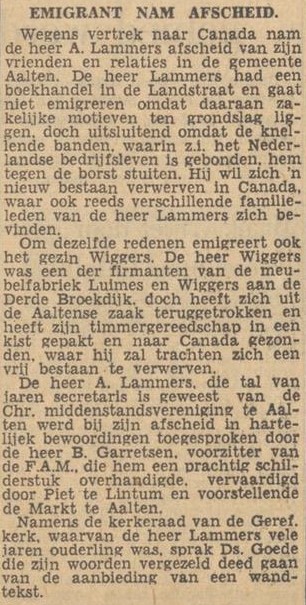
    Mr . Ant. Lammers, who had a bookstore in Aalten on the Landstraat, lives with his family in Hamilton. Mr. Lammers was first a pioneer for a few years, but now has permanent work in a printing house and bookstore. So he has ended up back in his own industry.

    Mr . J. Wiggers, one of the directors of the furniture factory Luimes and Wiggers in Aalten, has been living in Smithfield near Trenton for several years. Mr. Wiggers is a craftsman who is also greatly appreciated for his work in Canada. He has mainly focused on taking care of interiors of homes. He has built a beautiful house for his own family. Mr. Wiggers takes on the finishing of homes in Canada.

    Mr . H. Winkelhorst, who lived in Aalten on the Koopmanstraat, now owns a farm in Smithfield. He has now bought the company, which he had rented for several years.

    Mr. Bertus Prinzen, who ran a grocery store on the Hogestraat in Aalten, and was one of the first emigrants from Aalten, has a large farm in Jarvis – a cattle farm. Mr. Prinsen has numerous positions in public life in Jarvis. He is a source of information for many immigrants.

    Mr. Bernard Prinsen from IJzerlo, has a good farm in Bloomfield near Picton. It is a mixed farm. His son also works on the farm, after he had first worked for the General Motors for a few years.

    Mr. Willem Prinzen, who lived in Aalten on the Willemstraat, works for a construction company, together with one of his sons. His other sons also have good work. The W. Prinsen family lives in Bloomfield, where they have bought a house. In Aalten, Mr. Prinsen was a wholesaler in textiles.

    The brothers Geert, Arie and Wim Lammers from Aalten have found well-paid work in Canadian factories.

    Do you have interesting stories about family members who emigrated from Aalten to Canada? Send us a message!

    Sources


  • Adventurous couple

    Adventurous couple

    The emigration story of Willy Bulten and Peter Klaassen (1955)

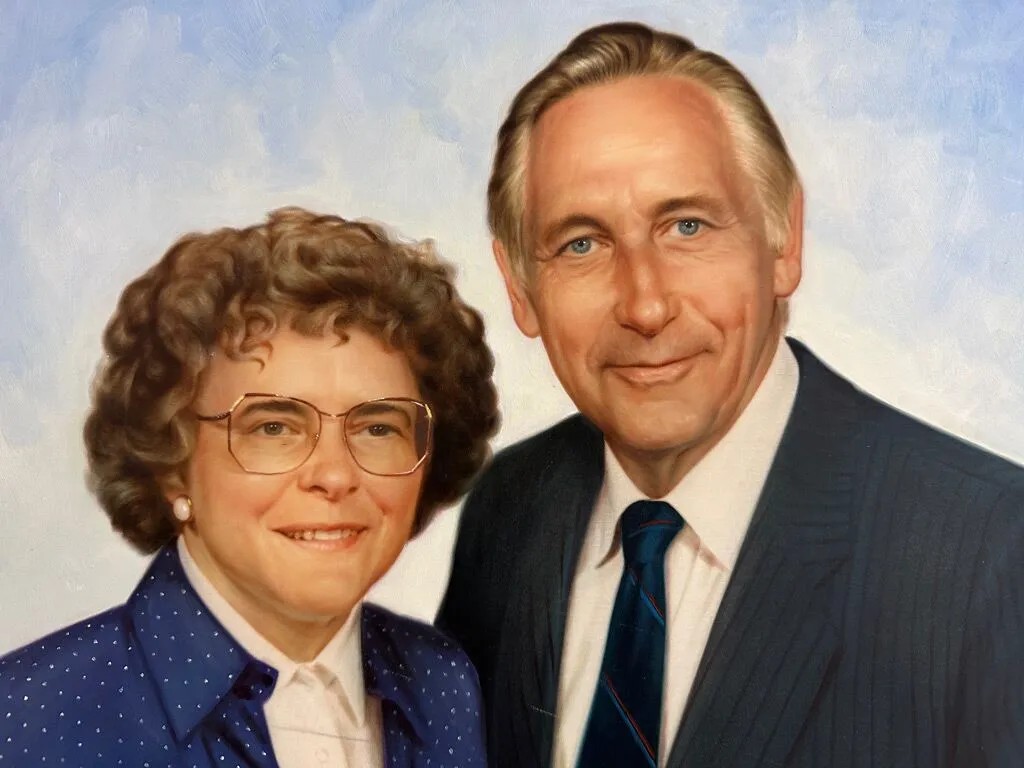
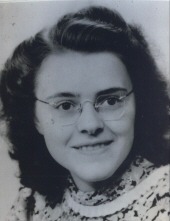
    Wilhelmina Adriana Bulten (1928-2020)
    Willy Bulten

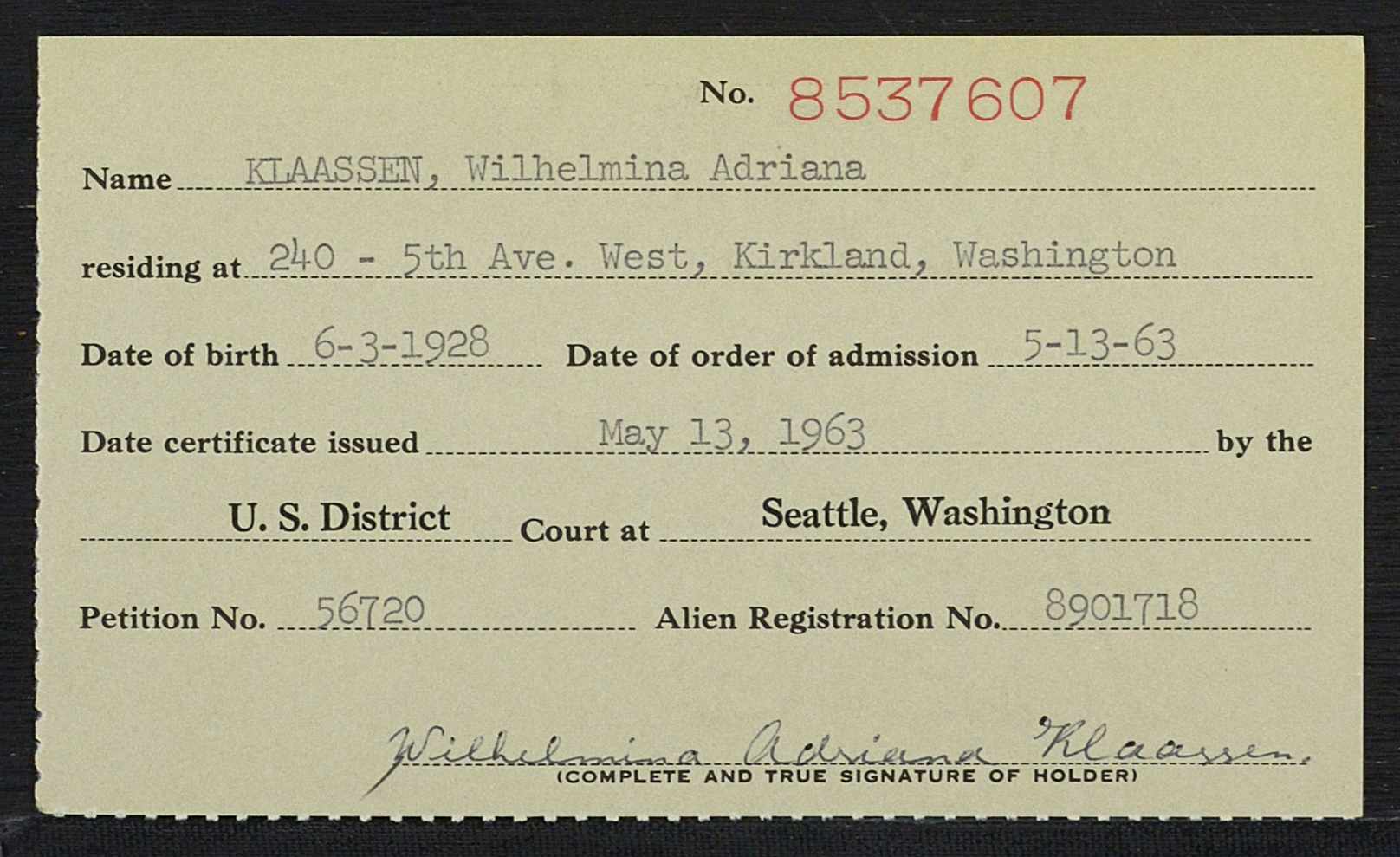
    Wilhelmina Adriana (Willy) Bulten was born on June 3, 1928 in Aalten. Willy loved to read and that helped her get through the five difficult years of the Nazi occupation. The kitchen of her parental home was bombed during the war, forcing the Bulten family to move. She helped her mother in the family’s flower shop, while her father ran a successful landscaping business.

    After the war, Willy went to study to become a teacher in Rotterdam. During this period she got into a relationship with the handsome Peter Klaassen from Susteren (Limburg). Peter was conscripted into the Dutch army after the Second World War and served in the Dutch East Indies for two years. They married on July 12, 1954 and made their honeymoon on a motorcycle through Europe.

    The housing market and the labor market in the Netherlands were challenging in the post-war years for the ambitious couple who wanted to explore the world. Like many before them, they sought their fortune abroad and considered emigrating to Australia, Canada or the United States. In 1955, an opportunity arose to move to the US. The adventurous couple boarded a ship in Rotterdam, bound for New York, followed by a train journey across America.

    They settled in the town of Mount Vernon, just north of Seattle, in the state of Washington. They later moved to Kirkland, Washington. In 1963, they became American citizens. They had four children: Paul, Annely, Janine and John.

    In 1971, their thirst for adventure and discovery led the Klaassen family to drive across America to Fairfax, Virginia. Willy became principal of the Commonwealth Christian School there. In 1979 she founded the Appletree Private School, where toddlers up to group 3 received education and care. Parents were enthusiastic about this new school with the knowledgeable, energetic and cheerful headmistress with her charming Dutch accent. It was such a success that she opened a second branch in Northern Virginia a few years later. After two decades, she said goodbye to the Appletree Schools to spend more time reading, traveling with Peter, enjoying the beauty of the Chesapeake Bay, and visiting family.

    Peter passed away in 2018 and Willy in 2020. They were buried at Flint Hill Cemetery in Oakton, Virginia.

  • Granny Lammers back from Canada

    Granny Lammers back from Canada

    As scratchy and as cheerful as she left Aalten six months ago to visit her relatives in Canada, Mrs. wed. Lammers-Bulsink, better known in Aalten as “grandma Lammers”, arrived back at her home in the Willemstraat.

    On November 30 of last year, this energetic woman, of whom one can hardly believe that she will turn 84 this year, left with the Rhine Dam to Canada to visit her children, grandchildren and great-grandchildren, who emigrated to Canada after the war and had written several times in letters: “Grandma, you should be able to see, how we have it here”.

    Granny Lammers, after some consideration, accepted this invitation and left for Canada at the end of last year. She visited her many family members, who had a hard time imagining that “granny” really came to watch, and also gave her eyes a good feast. She also met other former Aalten residents in Canada. The visit of their elderly mother and grandmother was a surprise for the children and grandchildren in Canada, bigger than one could have imagined there.

    Granny Lammers, who had a pleasant time in Canada, traveled back on May 14 with the Rijndam. Yesterday she arrived in Rotterdam, where she was picked up by her children. She then drove by car to Aalten, where she arrived last night at seven o’clock. She had to shake many hands of family, neighbors and acquaintances upon arrival. She had had a good time in Canada, she said.

    Last night, the Lammers family, who live in the Netherlands, met in an intimate circle in the “Irene” building. There grandma told about her experiences and she knew how to do this in a very entertaining way, so that everyone could get an idea of the circumstances under which the “Canadian branch” of the Lammers family lives.

    When grandma Lammers left Aalten, she took an audio tape with her for the family in Canada, on which words spoken by the Aalten family members were recorded. The playing of this tape caused a lot of joy and surprise in the Canadian family circle. Granny Lammers also brought a soundtrack from Canada. For example, last night in the family meeting, the voices of the relatives in Canada were heard. It turned out that many had not yet forgotten the Aalten dialect.

    Do you have interesting stories about family members who emigrated from Aalten to Canada? Send us a message!

    Source


    • Dagblad Tubantia, 25 May 1955 (Delpher)
  • From IJzerlo to Tres Arroyos

    From IJzerlo to Tres Arroyos

    Dagblad Tubantia, April 26, 1955

    Herman Prinzen family (9 people) emigrates to Argentina

    “That will be the last coffee you receive from us,” says Herman Prinzen from IJzerlo near Aalten, as he places a steaming cup of coffee on the table. It is quiet in the large kitchen of the “Linquenda” farm—a kitchen that appears larger than ever before because practically no paintings remain on the walls. An attempt was made to decorate the wall somewhat with an old, weathered mirror, which was not particularly successful, and otherwise, only a lone Biblical daily calendar hangs on the wallpaper.

    Through the kitchen window, one can look out over the IJzerlo es, which lies flat and bare, trying to bask in the meager rays of sunlight. The wind fiercely blows the loose sand from the fields across the plowed land. Herman Prinzen, the 48-year-old farmer, stares outside. “We have lived here for about eighteen years now,” he says, perhaps more to himself than to us. “We won’t be here for eighteen days anymore, not even eight….”

    Learning Spanish was not easy

    “In Argentina, they speak Spanish!” says one of Prinzen’s young daughters. “Have you ever heard anyone speak Spanish?” “No,” we must confess. “Has Saint Nicholas never visited you then? He comes from Spain, doesn’t he?” “Spanish is a difficult language,” says Prinzen. “Leerink—Wim Leerink, so to speak, from Kerkstraat in Aalten—taught us some Spanish. Boy, it wasn’t easy, and we still don’t know much of it.” “But come,” he continues, turning his gaze away from the es that has been shrouded in drifting sand for hours—“my work there is done”—“I will tell you about our upcoming emigration.”

    And then farmer Herman Prinzen begins his story. It is a story whose essence will bring a radical change to his life, and not only to his, but to that of his wife, Mrs. Prinzen-Kämink, and their seven children, the oldest of whom is sixteen and the youngest not yet a year old, crowing with delight in the stroller. “You know Grandpa Brunsveld,” Prinzen notes. “Everyone here knows Grandpa Brunsveld, after all. He is a born and bred IJzerlo man, and when it is his birthday, many people come to visit.”

    “That was on November 24 of last year. My wife and I were sitting and talking with him late in the afternoon when Mr. Kämink, a cousin of my wife, also came in. Kämink is a senior board member of the Christian Emigration Center, and you can imagine that the conversation soon turned to emigration. Not long ago, Kämink had visited Argentina and several other countries to inform himself about the immigration possibilities there.” “Perhaps there is a perspective for you there as well,” he said.

    “We didn’t think much more about it, but a few days later we received a letter from him. He had indeed been thinking about it. To be brief, he wrote that in Argentina, at the Protestant Christian school, there is a boarding house for which they are looking for a caretaker. “Is that something for you?” he wrote. That question was not as strange as it might seem at first glance. After all, here in IJzerlo I am primarily a farmer, but for ten years I was also the caretaker of the community building “Ons aller belang.” The white smock was already in the suitcase….”

    “Is our task here perhaps finished?”

    “That letter from Kämink never let go of my wife and me. There is, Kämink wrote, an urgent need for a caretaker. We are not the kind of people—neither my wife nor I—who are afraid to leave for another country or to face a somewhat unknown future. We viewed Kämink’s letter from a matter of principle. Like this: “Is it perhaps the case that our task here, in the Aalten rural district of IJzerlo, is finished and that a new future and a new task await us in another and foreign land?” “Yes,” says Mrs. Prinzen, “that is how we approached this matter.”

    “Now, you must not think,” Prinzen continues, “that the problem was simple for us. We have lived in this farmhouse for many years together with my wife’s parents, who have now grown old. Would it be right for us to leave and leave our parents alone in the evening of their lives?” “You understand, this is a “heavy” matter to consider.”

    “However, our parents said: “If you believe that there is a future for you and the children in Argentina, then you certainly must not let that pass because of us. We must not hold you back, even though we are old. We trust that if you are given a task in Argentina, we will also be cared for.” When our parents accepted this so faithfully, I said that evening: “What do you think, wife, how should we handle this?” “We should just go, Herman,” she said. “Everything is being made easy for us….” That was around Christmas.”

    The boat departs Thursday

    “We then wrote to Kämink in Hoogeveen, and he arranged everything else. This coming Thursday we depart by boat. We will be traveling for about four weeks. Then we will arrive in Buenos Aires, the capital of Argentina. We then have to travel another eight hours by bus before we reach Tres Arroyos, our new place of residence. As I said, I will become the caretaker of a boarding house there. It is located 50 meters from the school and ten minutes from the church. So we are not moving to an uninhabited region.”

    “Many immigrants live in Tres Arroyos, by the way. They are not recent immigrants. There are quite a few whose parents or grandparents already immigrated to Argentina, yet they have, as I have read in letters I received from Argentina, always maintained the Dutch national character. Even at school, lessons in the Dutch language are still given for a few hours a week. The head of the school wrote that to me.”

    “Usually about eighty children stay in the boarding house. The distance from home to school is too great to travel daily, and therefore the children stay in the boarding house from April to December. They have four months of vacation, from December through March. Then they go home. Those are the summer months in Argentina. During that vacation, I have the opportunity to work in agriculture in Argentina. Two of our daughters, Christina and Johanna, are going to work in the boarding house in Tres Arroyos. One stays at home to help mother, and the others either go to school or stay at home because they are still too young for school. We have four girls and three boys. That is the whole story.”

    “Whether we are dreading it? No, not anymore,” says Prinzen. “We have made the decision and now believe that our life’s path will be continued over there, in Argentina. The same sun shines there as here in the IJzerlo es, and the same God reigns there as in the Netherlands. We have had a few busy days. Almost everything is packed now, however. A few more days and then we go.” “Oh yes, you might want to know what will happen to our parents? They are also being cared for. Our trust has not been put to shame, because a cousin of ours, Wim Kämink, is getting married on May 6 and will come to live here on the farm. He will not only take care of the business but also, together with his wife, look after his grandpa and grandma. So, in this respect too, everything will turn out well. We are very grateful for that.”

    Reading tip: blog by Lara Droogleever Fortuyn from 2017: “In Tres Arroyos, cheese and meat come together”

    Sources