Category: Doleantie

  • Ambthuis (Administrative House)

    Ambthuis (Administrative House)

    Landstraat 17, Bredevoort
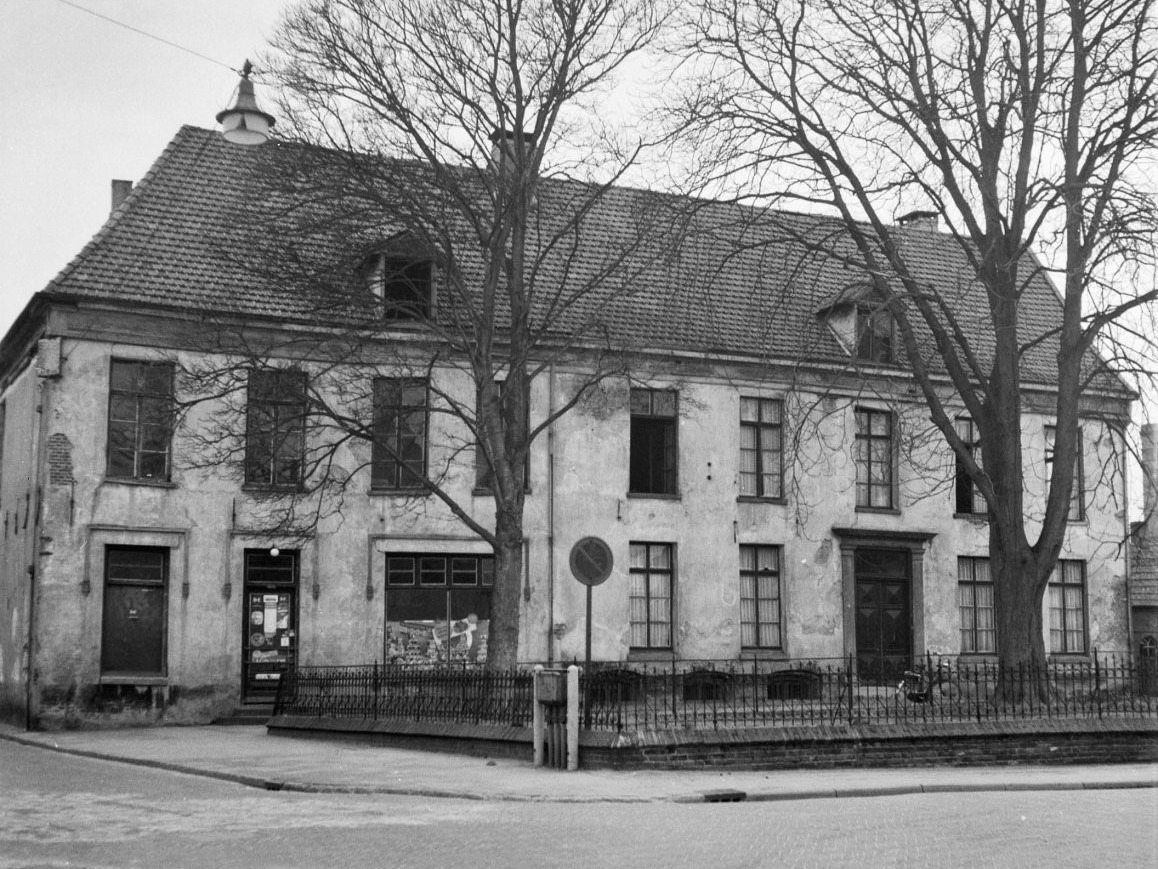
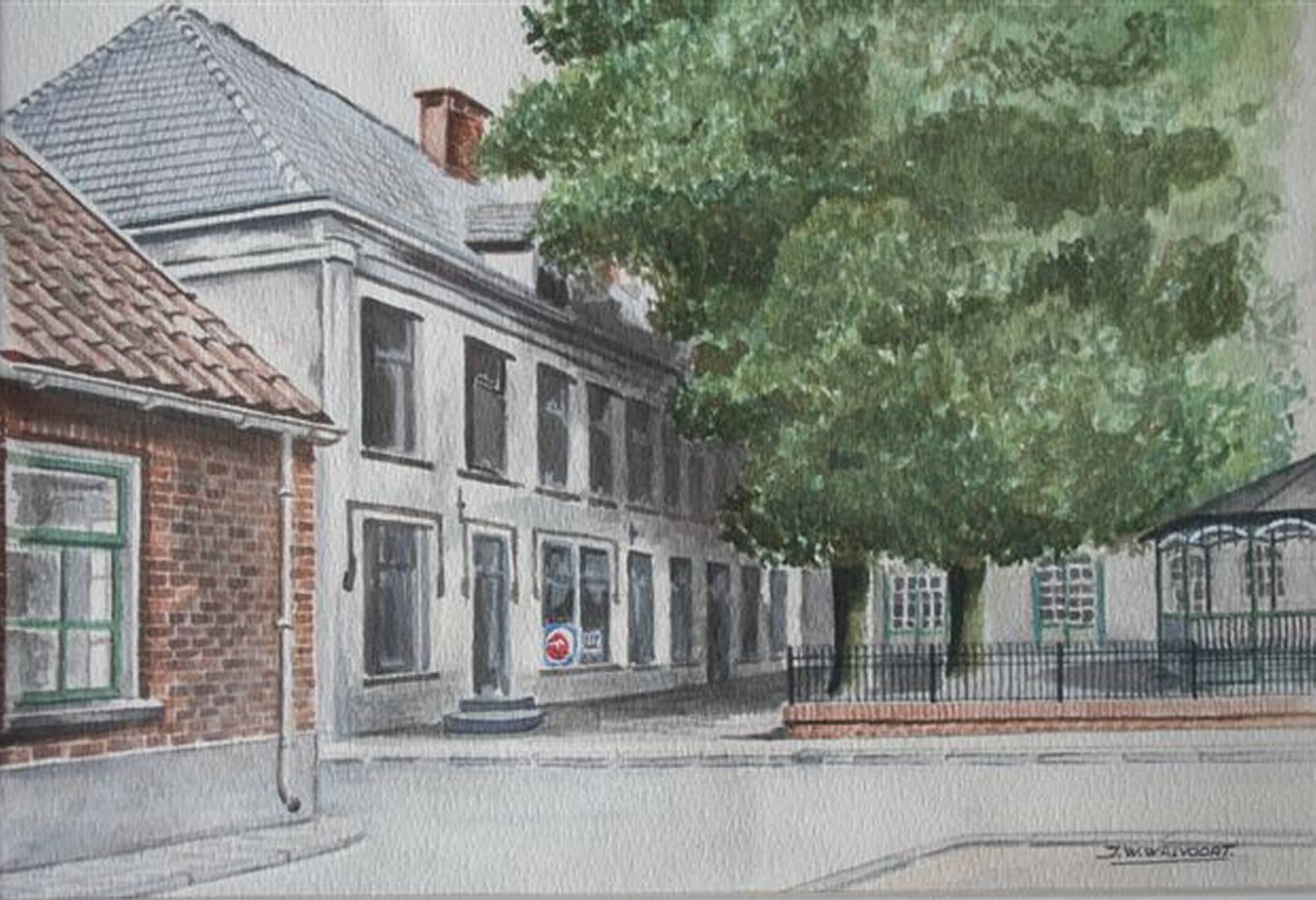
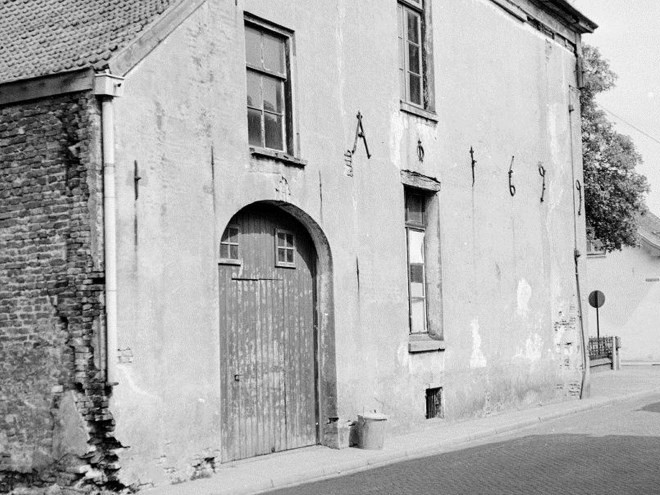
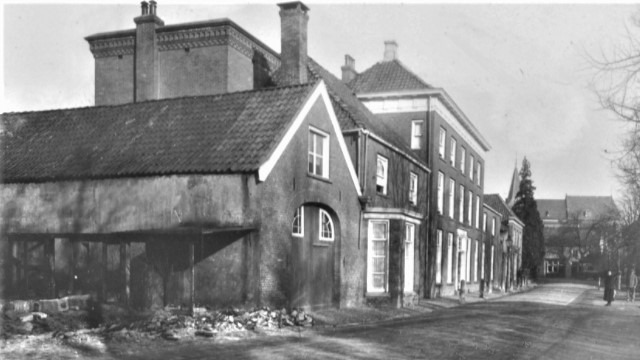
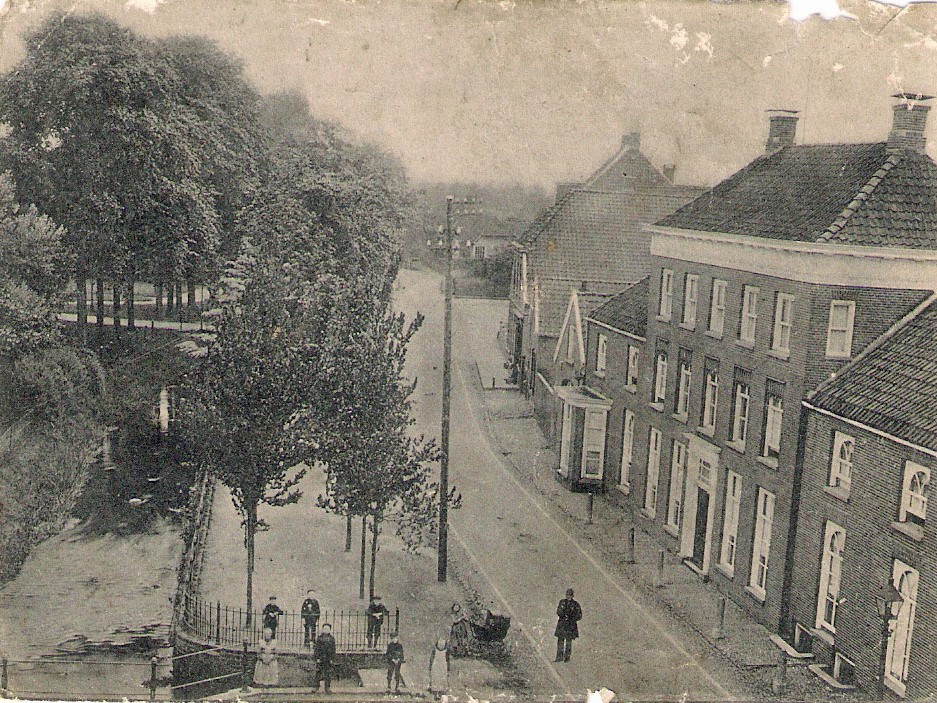
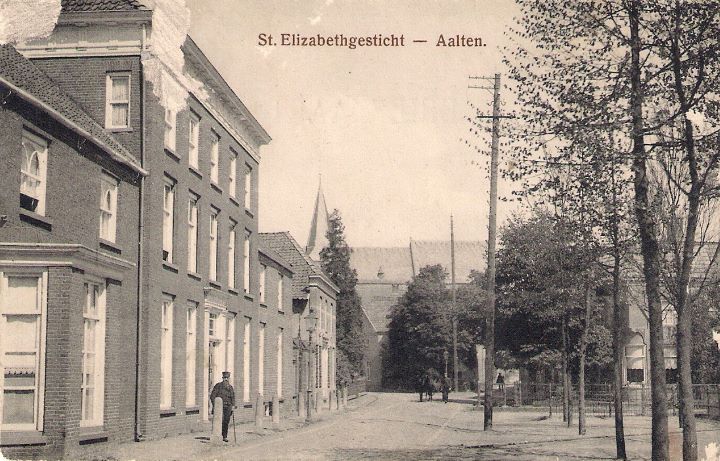
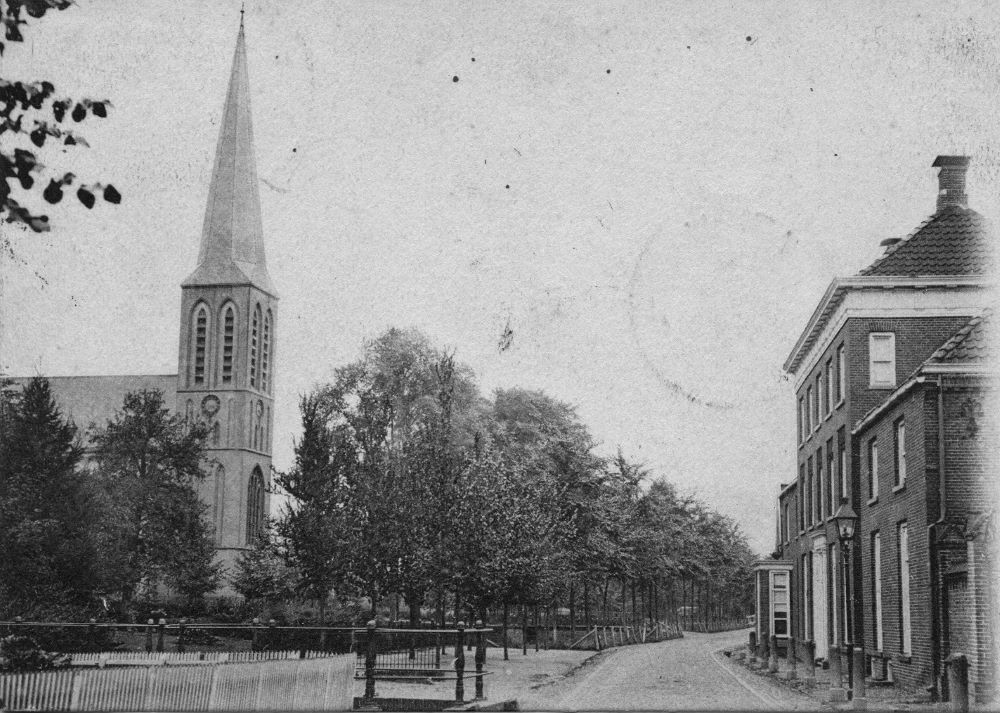
    According to its wall anchors, the original Ambthuis (Administrative House) dated from 1699. For a century, it served as the centre of power for the Heerlijkheid (Lordship) of Bredevoort. The Ambthuis was also known as the Mauritshuis, as Prince Maurice had clearly left an unforgettable impression on the local inhabitants.

    Chief Court

    Following the gunpowder tower disaster of 1646, the town and lordship of Bredevoort had been left without an ambthuis (a building combining a courthouse and a town hall). It would take over fifty years before a new one was constructed. The building was likely connected to the Misterpoort, the city gate situated opposite the house.
    The building also served as the hoofdgerecht (chief court) of the lordship. While courts existed in Aalten and Winterswijk as well, serious offences were always tried in Bredevoort, with the drost (bailiff) presiding as judge.

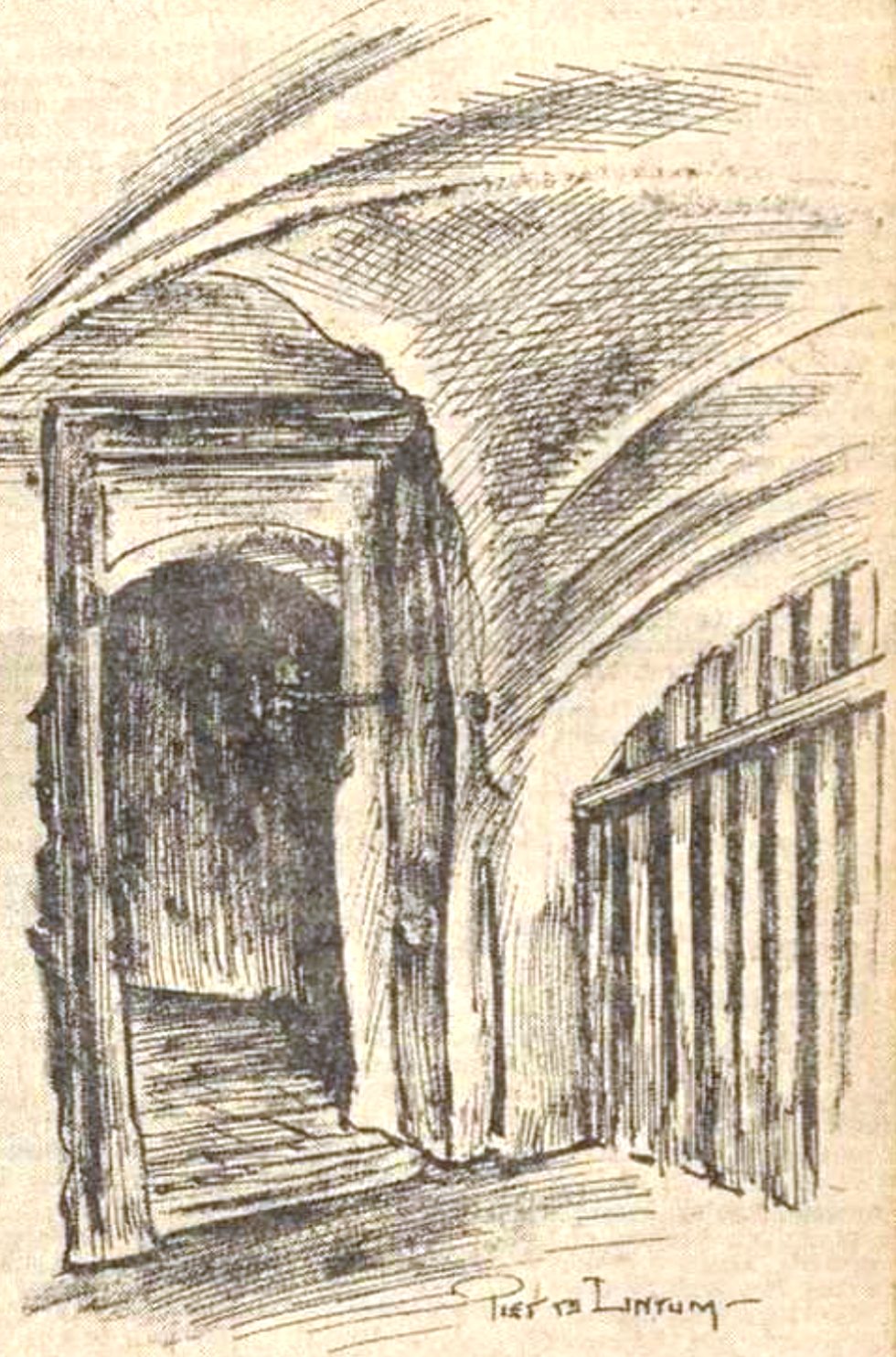
    The cellars contained several dungeons (cachots), cells, and a torture chamber equipped with the necessary implements. Those sentenced to death were held in a cell devoid of daylight and fresh air. If a suspect refused to confess, the threat of the torture chamber was often enough to secure a plea of guilt. Sentences were traditionally pronounced on ’t Zand. In the case of a death sentence, the condemned was immediately taken to the Galgenbulte (Gallows Hill) on the Hollenberg for execution. Usually, this meant hanging from the gallows that had stood there for centuries, waiting for its victims. It is said that the gallows could be seen from the Aalterpoort. For the local population, such executions were a sensation, and people from all over Bredevoort and Aalten would turn out to witness the event.

    Other Functions

    After the French period, the building lost its original function and was used for various purposes, including as a shop for the Catholic cooperative. This cooperative was founded by the workers’ association in 1920. In the past, Catholics would frequent this shop, while those of other faiths would go to the other cooperative further down Landstraat.

    The Ambthuis was demolished around 1963. The cellars of the Ambthuis, which included two prison cells, were still located beneath the shop. In 1964, the foundation stone was laid for the construction of the Betting furniture store on this site. This building was in turn demolished in 2009, after Betting moved to new premises on Prins Mauritsstraat.

    New Construction

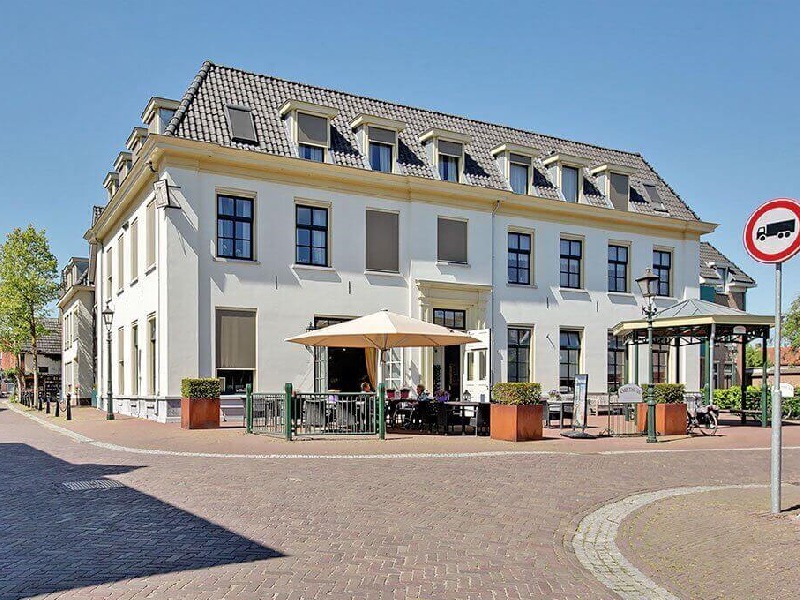
    Today, the site of the old Ambthuis is occupied by a care apartment complex consisting of twenty apartments and a restaurant. The new building was again given the name ‘Ambthuis’. In terms of its exterior, the new building bears many similarities to its illustrious predecessor. A replica of the historic sundial was attached to the building, and a replica of the bandstand was placed in front of it. An original gable stone from the old Ambthuis was built into the front facade, bearing the inscription: “Die kan lide haet en nijt, die overwint in korten tijd” (He who can endure hate and envy, shall overcome in a short time).


    Owners

    This overview is incomplete.

    YearPlotOwnerDescription
    1832B-104Jan Barend Top, bleacher390 m² house & yard

    Residents

    Population register 1823-1838

    Bredevoort 16

    Johannes Bernadus Top (Weseke/D, 28-07-1749)
    Hermina Legeschaar (Kruiskapel/D, 28-11-1789)

    Population register 1838-1850

    Bredevoort 8

    Johannes Bernadus Top (Weseke/D, 28-07-1749)
    Hermina Legeschaar (Kruiskapel/D, 28-11-1789)

    Population register 1850-1870

    There’s still a gap in our information here…

    Population register 1870-1880

    Bredevoort 10

    Jean Leander van Eijck (Sint-Niklaas/B, 25-11-1808 – Bredevoort, 25-02-1888)

    Population register 1880-1890

    Bredevoort 17

    Jean Leander van Eijck (Sint-Niklaas/B, 25-11-1808 – Bredevoort, 25-02-1888)

    Next (head) resident, daughter:

    Johanna Christina Theodora van Eijck (Bredevoort, 18-06-1848)

    Population register 1890-1900

    Bredevoort 11

    Johanna Christina Theodora van Eijck (Bredevoort, 18-06-1848)

    Population register 1900-1910

    Bredevoort 9 > 9

    Johanna Christina Theodora van Eijck (Bredevoort, 18-06-1848)

    Population register 1910-1920

    Bredevoort 9

    Johanna Christina Theodora van Eijck (Bredevoort, 18-06-1848)

    Next residents (1918-1922):

    Bredevoort 9 > 225

    Carl Rotthoff (Castrop/D, 24-12-1872), engineer
    Antonia Johanna Josepha Maria Sevink (Bredevoort, 05-07-1879)

    Address directory 1934

    Bredevoort 225 > Landstraat 17

    Co-op Shop “Eigen Hulp”

    Address directory 1967

    Landstraat 17

    W.H. Betting
    Mej. J.W. Betting

    Features


    Cadastral no.B-1824
    FunctionGovernment building,
    Residential house,
    Shop
    Year of construction1699
    Demolitionca. 1963
    Year of
    current building
    2010
  • Avondvrede Rest Home

    Avondvrede Rest Home

    Hogestraat 84, Aalten

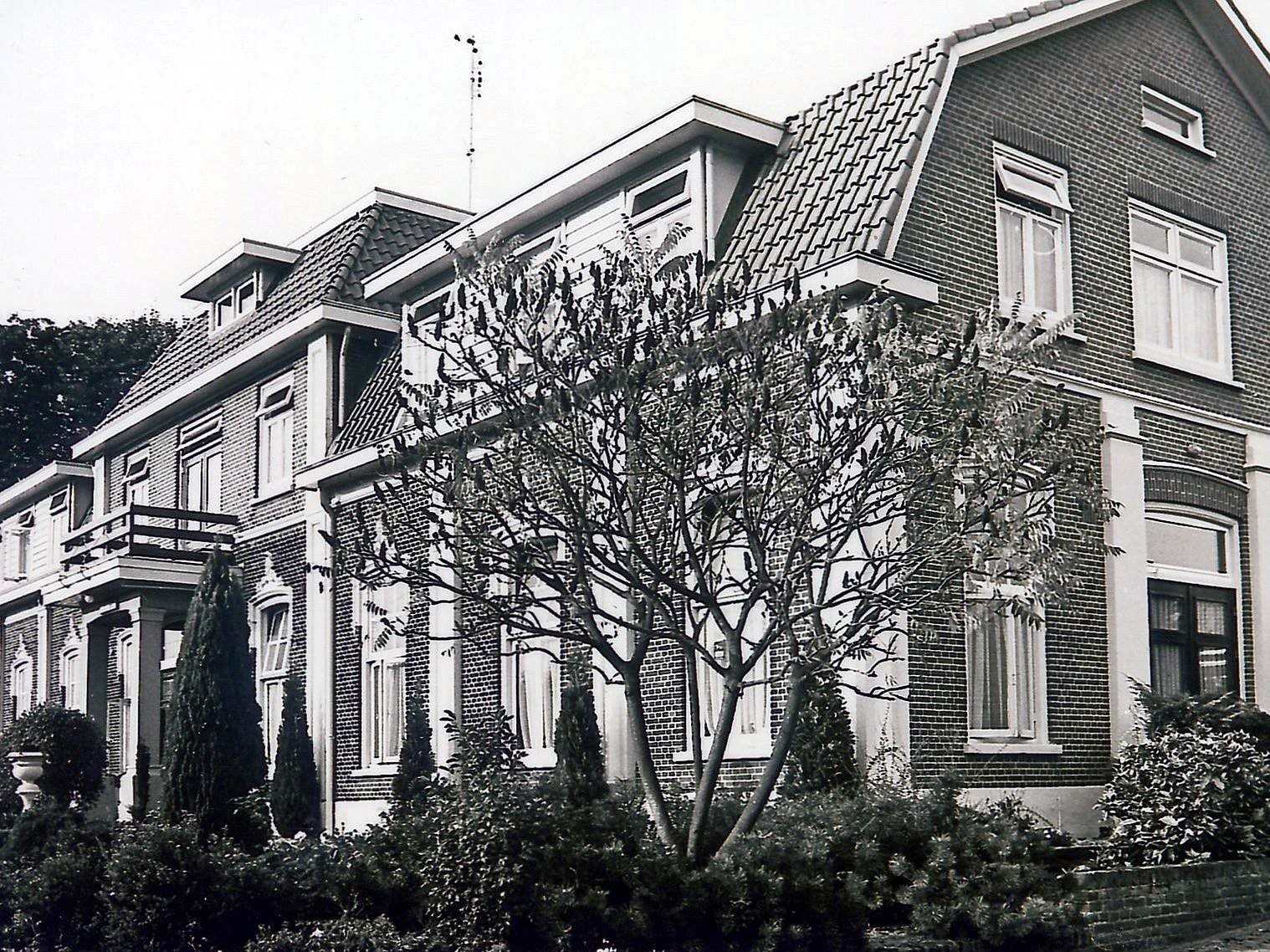
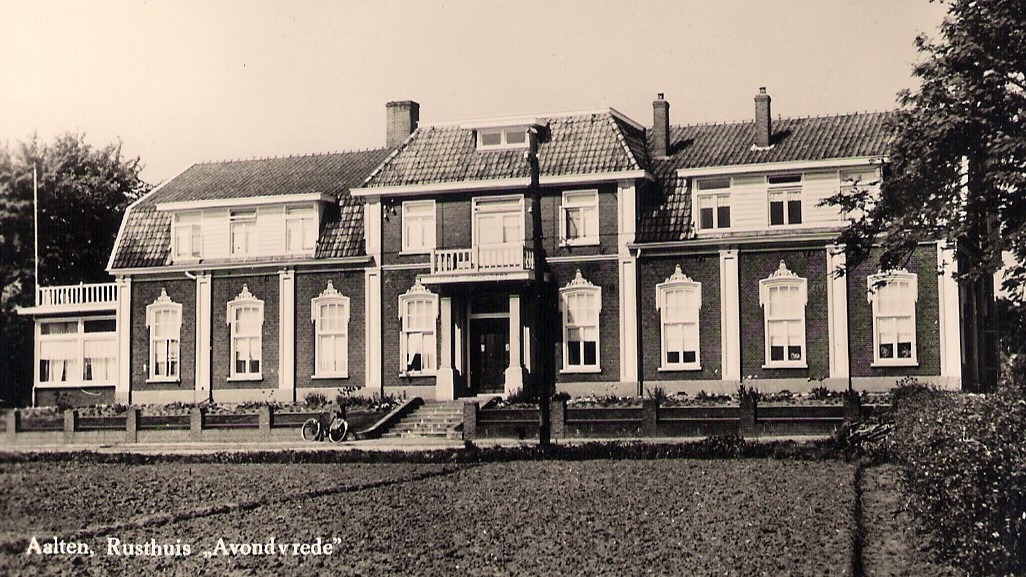
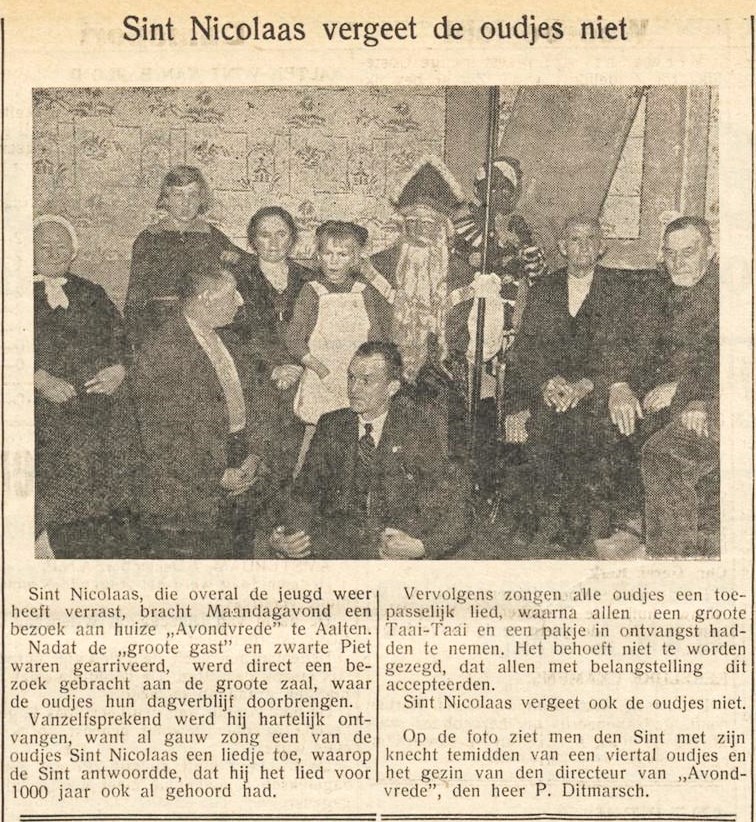
    Avondvrede Rest Home on Hogestraat was opened in 1885 as the ‘Home for Elderly Men and Women’ of the Reformed Church in Aalten. Over time, the building served various functions: a nursing home, a temporary hospital, and later a group home. Today, the premises are used as a residential location by care provider Estinea.

    The home was opened in October 1885 and was partly set up as a farm. Residents who were able to do so worked on the accompanying lands to provide for their own maintenance. Until 1904, the Reformed Church also managed a Guesthouse / Poorhouse on the former Gasthuisstraat (now Haartsestraat). In that year, its residents moved to the rest home on Hogestraat.

    Hospital

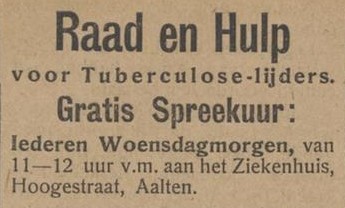
    In 1904, the Dutch Reformed Association for Nursing was founded. A few years later, this association took the initiative to establish a hospital within the rest home. The hospital was opened in the course of 1909. It was intended for patients with non-contagious diseases, particularly acute conditions. Nursing costs ranged from f 0.80 to f 1.50 per day.

    In the first year, twelve patients were admitted, four of whom passed away, totaling 166 nursing days. In 1910, there were eight patients with 222 nursing days, and in 1911, seven patients with 343 nursing days. The number of patients decreased in the following years, and the number of nursing days became significantly lower. In 1912, there were only 59 nursing days. The year 1915 still counted 134 nursing days, and 1916 only 35 with two patients. Data from the period thereafter is missing.

    In the early 1930s, plans were again made to house a hospital in the rest home, but the crisis years made further implementation difficult. During World War II, the building functioned as an emergency hospital for a period of time.

    From Avondvrede to ’t Hoge Veld

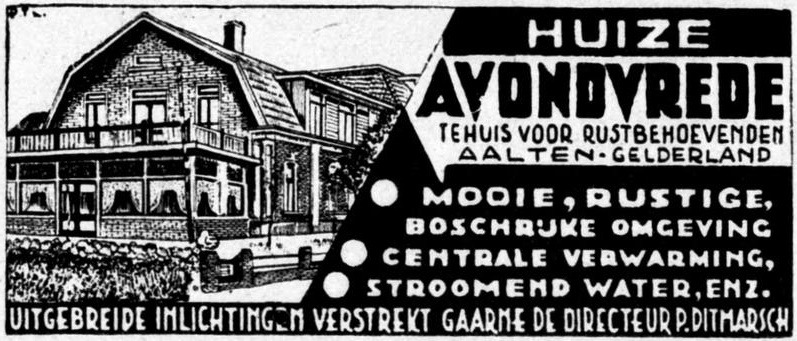
    In 1935, the building was renovated and modernized and given the name ‘Avondvrede’. In 1967, the Reformed churches of Aalten, Bredevoort, and Lichtenvoorde jointly established the Reformed Foundation for Elderly Centers Aalten, later renamed the ’t Hoge Veld Elderly Center Foundation. The last residents of Avondvrede moved to the newly built ‘t Hoge Veld elderly center in Aalten in 1970.

    Cederhof

    After the departure of the elderly residents, the building was given a new purpose. On November 2, 1970, it was officially opened as a group home under the name Cederhof, the first residential facility in Aalten for people with intellectual disabilities. The building is currently used as a residential location by care provider Estinea.


    Owners

    This overview is incomplete.

    YearPlotOwnerDescription

    Residents

    Population register 1880-1890

    “Avondvrede Rest Home”

    Aalten 138a

    Willem de Wijn (Alkmaar, 1851-03-18), Rest home father
    Janke van den Brink (Ameland, 1844-03-20), Rest home mother

    Population register 1890-1900

    Aalten 132

    Roelof Klompenhouwer (Aalten, 1842-09-28)
    Dora Willemina Tolkamp (Haart, 1845-12-25)

    Population register 1900-1910

    “Avondvrede Rest Home”

    Aalten 155 > A200

    Roelof Klompenhouwer (Aalten, 1842-09-28), farmer
    Dora Willemina Tolkamp (Haart, 1845-12-25)

    Next residents:

    Hendrik Memelink (Vorden, 1855-09-27), farmer
    Jesperina Margaretha Colstee (Bredevoort, 1848-10-16)

    Population register 1910-1920

    Aalten A200 > B204

    Hendrik Memelink (Vorden, 1855-09-27), farmer
    Jesperina Margaretha Colstee (Bredevoort, 1848-10-16)

    Next residents:

    Aalten B204

    Hendrik te Kolste (Aalten, 1888-02-02), factory worker
    Leide Goorhuis (Aalten, 1889-03-21)

    Address directory 1934

    Aalten B204 > Hoogestraat 84

    H. te Kolste (manager ‘Avondvrede’)

    Address directory 1967

    Hogestraat 84

    Huize “Avondvrede”
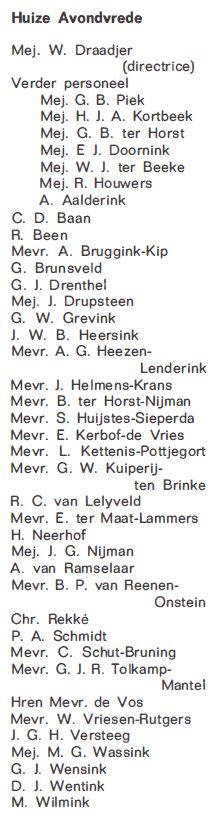
    Ms. W. Draadjer, director

    Features


    Cadastral no.K-1208
    FunctionHome
    Year of construction1885
    Listedno
  • HBS / CSA / Schaersvoorde

    HBS / CSA / Schaersvoorde

    Slingelaan 28, Aalten

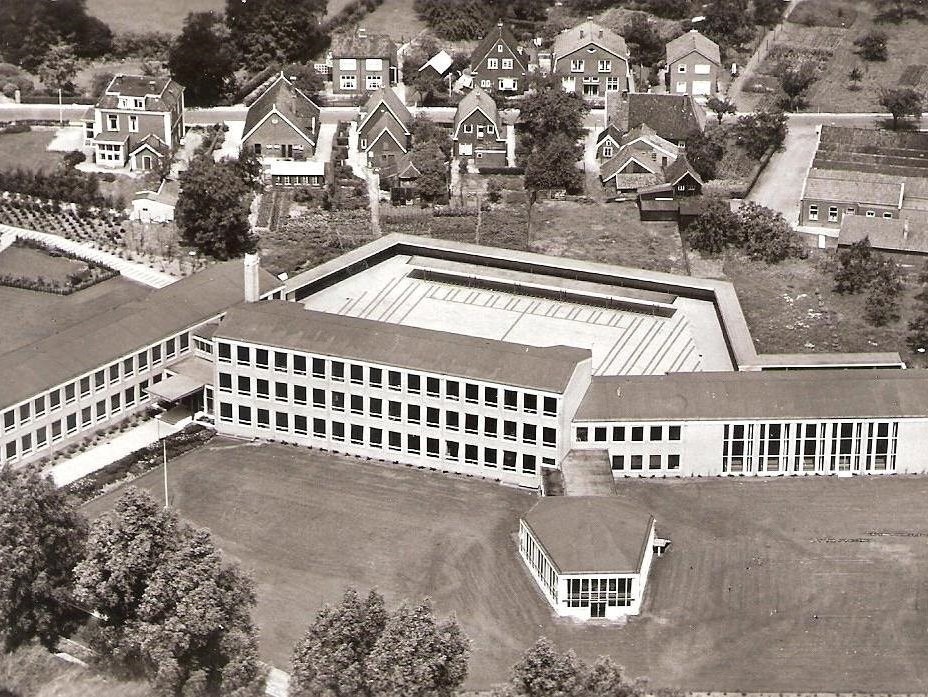
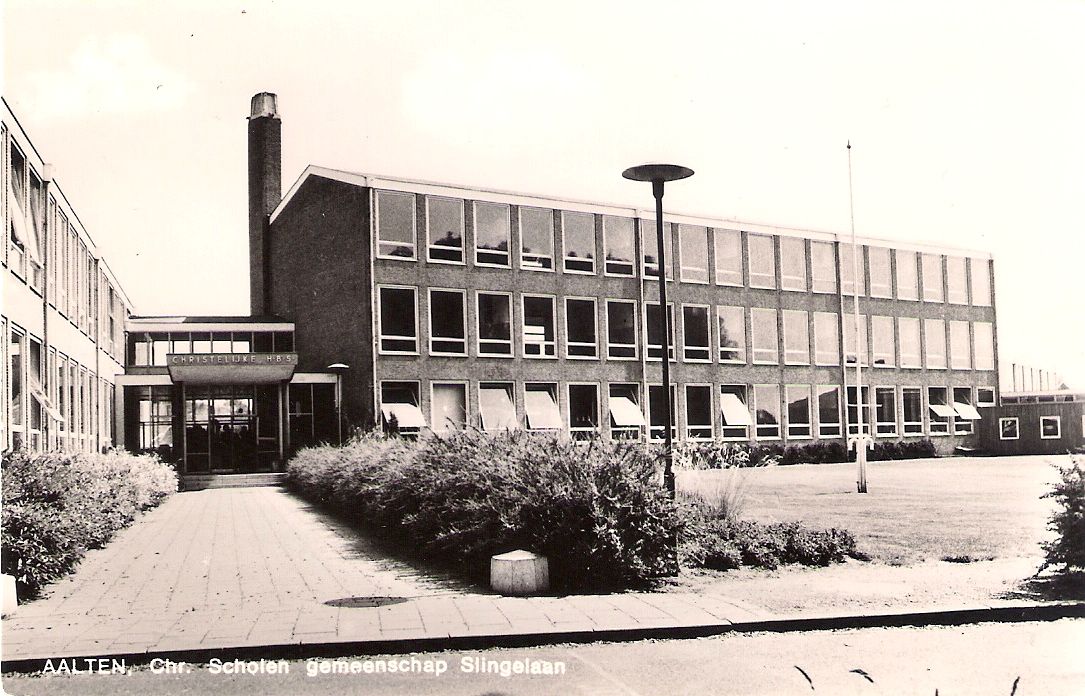
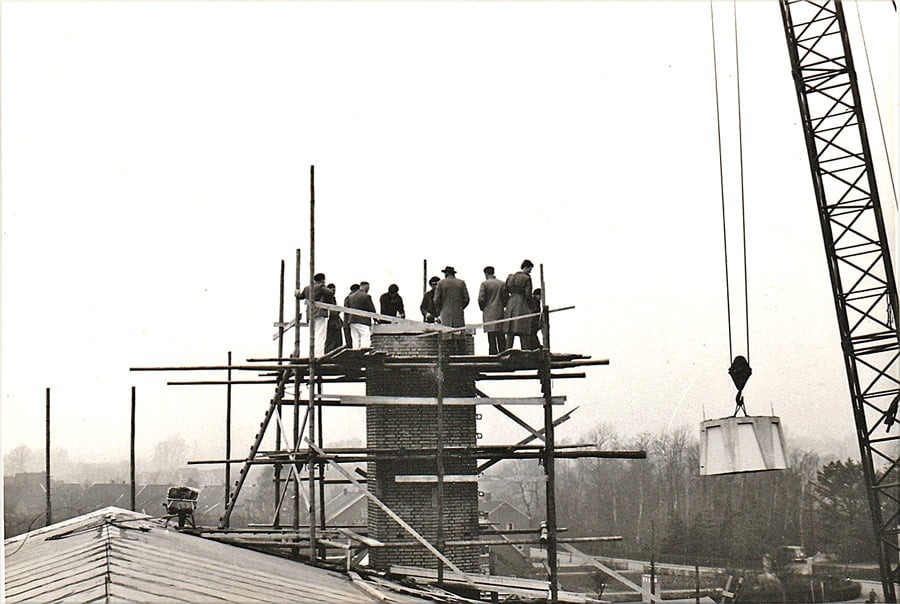
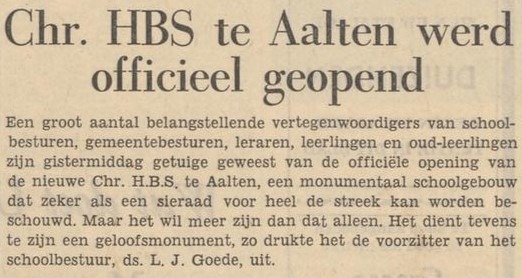
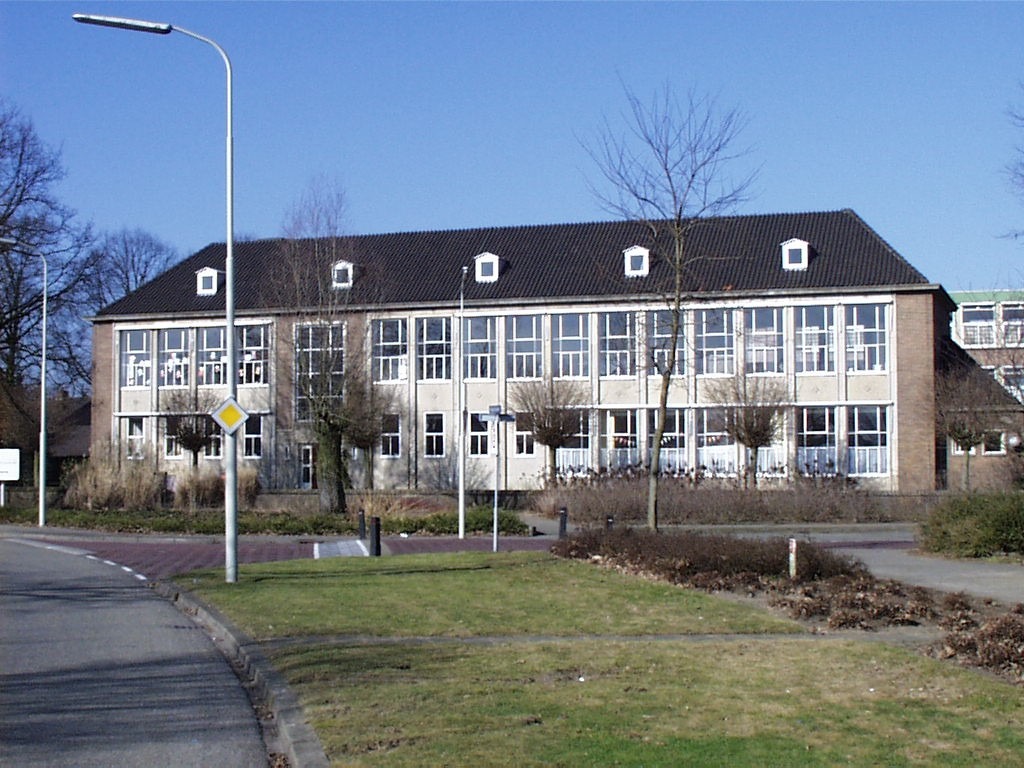
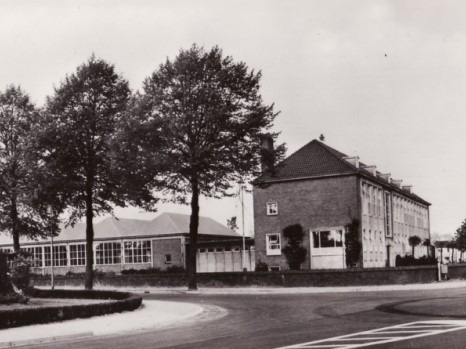
    The Hogere Burgerschool (HBS) on Slingelaan in Aalten was opened in 1959. The school replaced the temporary accommodation on Haartsestraat and, from then on, provided a permanent home for Christian secondary education within the municipality.

    De HBS in Aalten bestond sinds 1955, toen de eerste leerlingen hun intrek namen in het gebouw van de voormalige Huishoudschool aan de Haartsestraat. Voor die tijd waren christelijke HBS-leerlingen aangewezen op Arnhem of Zutphen.

    Construction on Slingelaan

    De bouwkosten van de nieuwe school bedroegen circa ƒ 1.500.000. Een bijzonderheid was destijds dat de school op ruim 400 betonnen palen kwam te staan. De bodem van het terrein was nogal drassig omdat de Slingebeek er had gestroomd.

    Architecture and Design

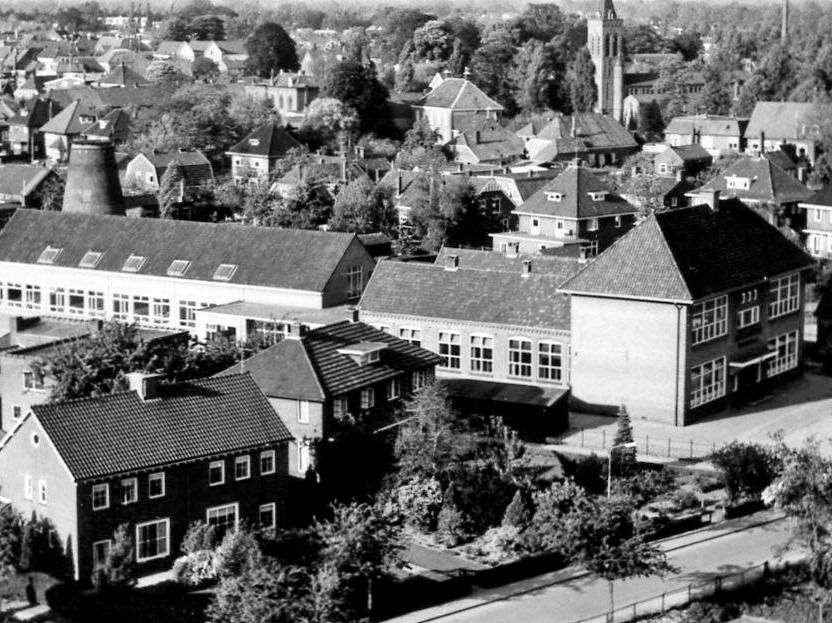
    The building was designed in the so-called ‘shake-hands’ style: a business-like, sober architectural style in which modern materials such as concrete, natural stone, and glass were combined with traditional yellow brick.

    De architecten waren Hendrik Geels (1903–1978) uit Arnhem en Willem Hebly (1908–1996) uit Aalten. Hebly had eerder in Aalten de Technische School aan de Ludgerstraat en de Landbouwschool aan de Lijsterbeslaan ontworpen.

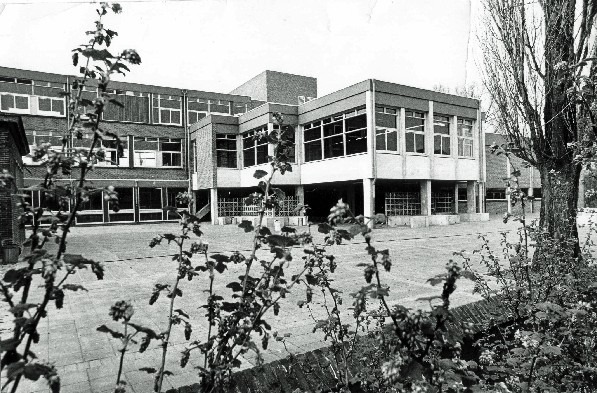
    The design comprised a three-storey central section, two wings of two storeys positioned almost at right angles, and a hexagonal canteen built partially below ground level. The entire complex was erected on a spacious plot, with bicycle sheds situated along the boundary.

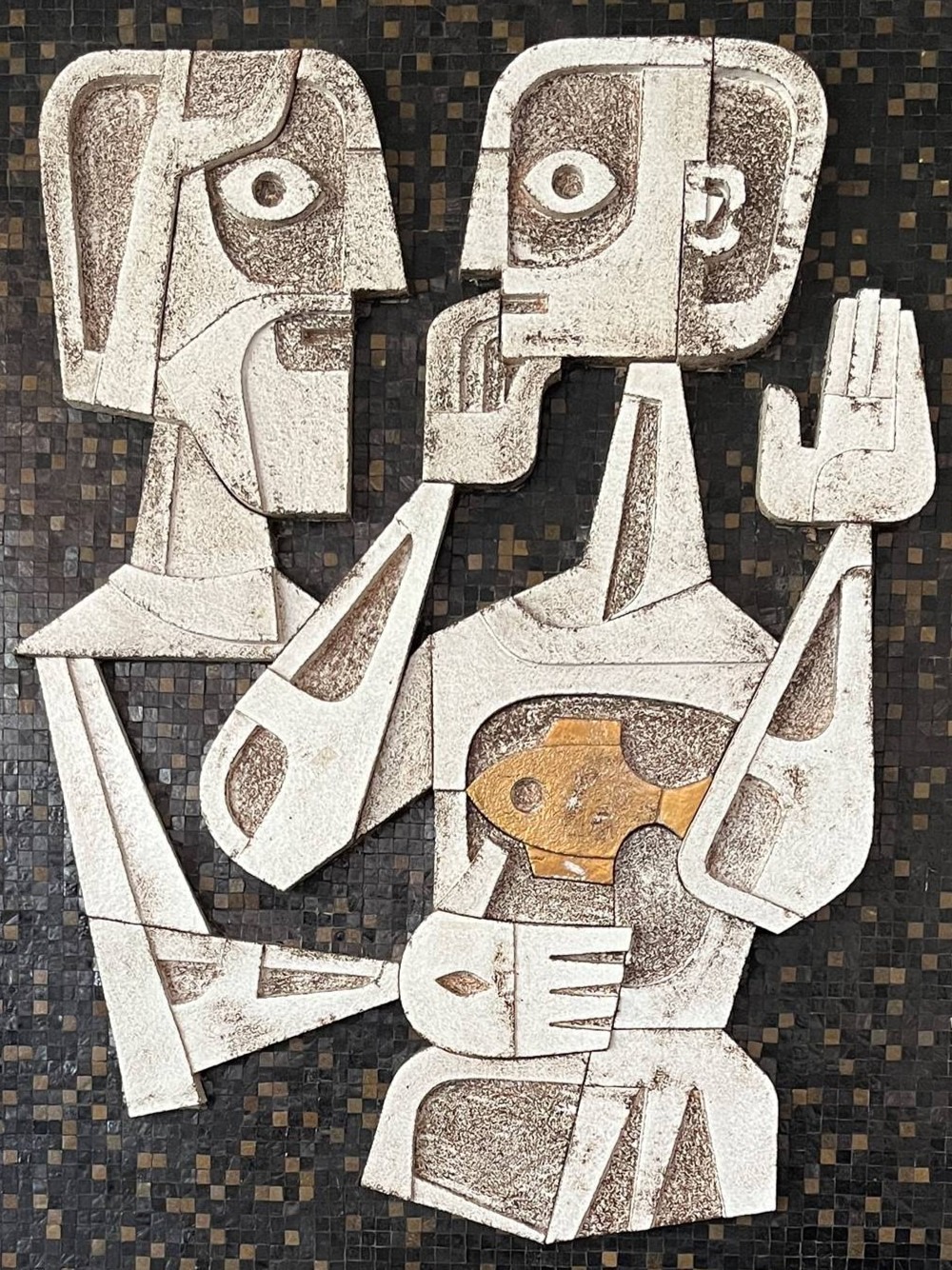
    Inside, extensive use was made of fair-faced brickwork, and many floors are made of slate. The concrete skeleton is partially visible and painted. The classrooms feature steel pivot windows in wooden frames. Glass display cases are positioned between the classrooms and the corridors. Artworks in mosaic and relief were also added, including work by the art teacher Harry Dercksen.

    Expansions followed in 1971–1972, 1995–1996, and 2001–2002, each carried out with respect for the original design.

    Mergers and Educational Reform

    In 1967 fuseerde de HBS met de MULO tot de Christelijke Scholengemeenschap Aalten (CSA). Een jaar later, in 1968, trad de Mammoetwet in werking. Daarmee verdween de term HBS en werd deze vervangen door HAVO en VWO.

    In 1993 fuseerde de CSA met de andere middelbare scholen in Aalten – de Christelijke Scholengemeenschap Langenhave en de Technische School – tot het Christelijk College Schaersvoorde.

    Monumental Status

    School buildings from the post-war reconstruction period in the ‘shake-hands’ style are becoming increasingly rare. The building on Slingelaan is remarkable because it has remained highly authentic; subsequent renovations have hardly affected the original design. Furthermore, the building has always retained its educational function.

    In 2025, the Gelders Genootschap advised that the school building be designated as a municipal monument. On 18 September 2025, the Environmental Quality Committee of the Municipality of Aalten also issued a positive recommendation. It is now up to the municipal council to make a final decision.


    Archives

    Address directory 1967

    Slingelaan 28

    Chr. H.B.S.

    Features


    Cadastral no.K-367
    FunctionSecondary school
    Year of construction1959
    ArchitectH. Geels / W. Hebly
    Listedno
  • MULO / MAVO

    MULO / MAVO

    Piet Heinstraat 4, Aalten (repurposed)

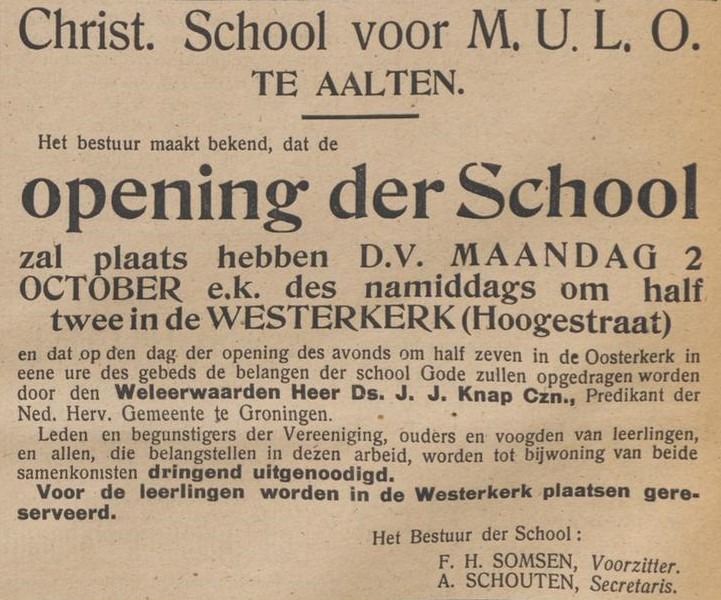
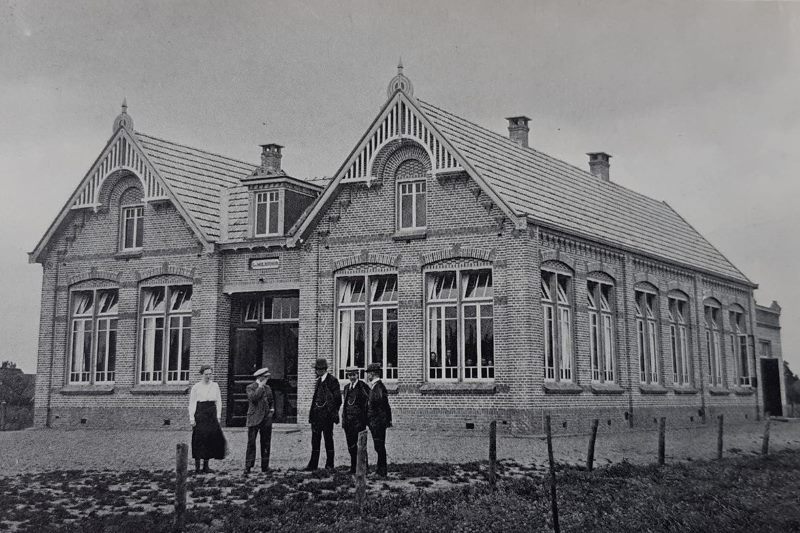
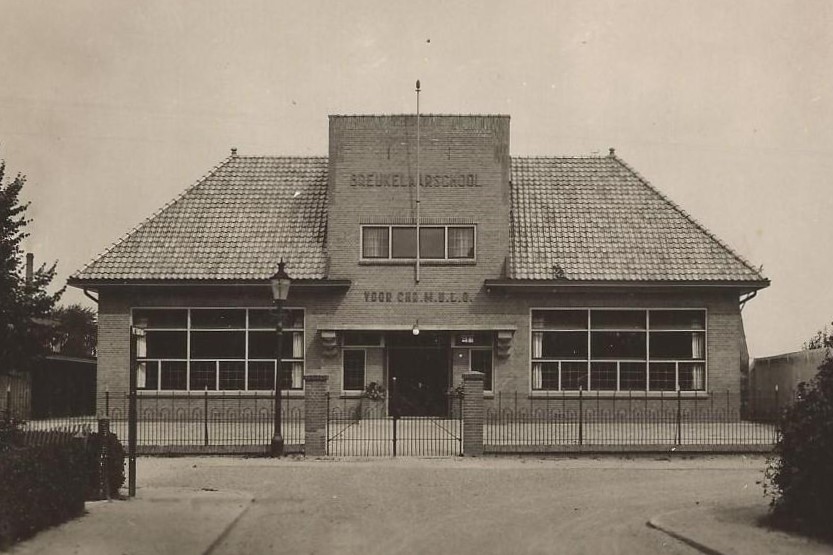
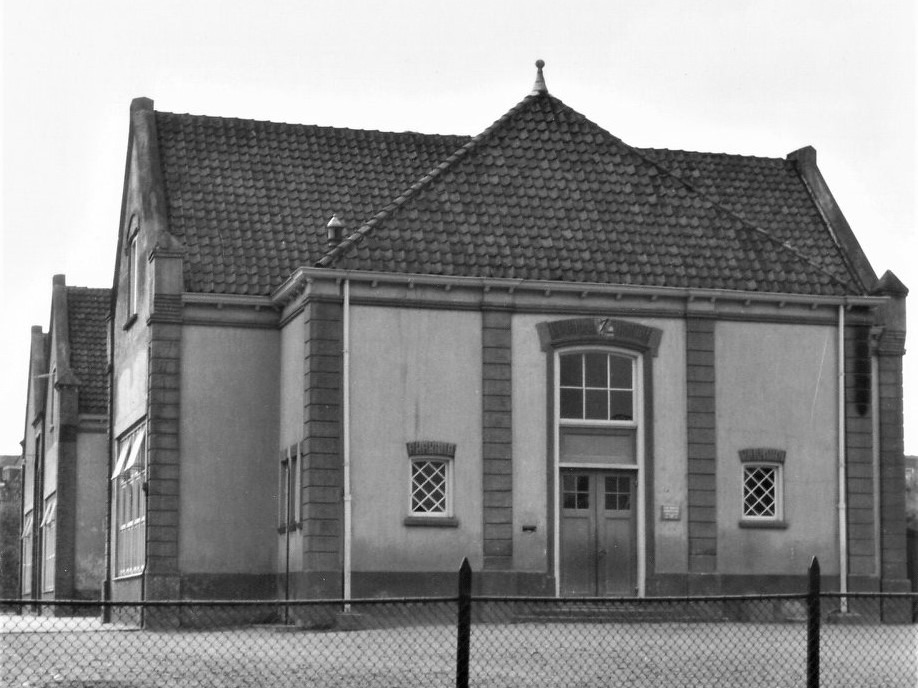
    The Christian MULO in Aalten was established in 1916 in the so-called Tackshuis and moved into a new building on Stationsstraat, known as the Breukelaarschool, in 1918. In 1967, the school merged into the Christelijke Scholengemeenschap Aalten (CSA) and eventually became part of Schaersvoorde. The building has since been converted for residential use.

    The first lessons of the MULO (Meer Uitgebreid Lager Onderwijs — Junior Secondary Education) were held in the Tackshuis on Gasthuisstraat (now Haartsestraat).

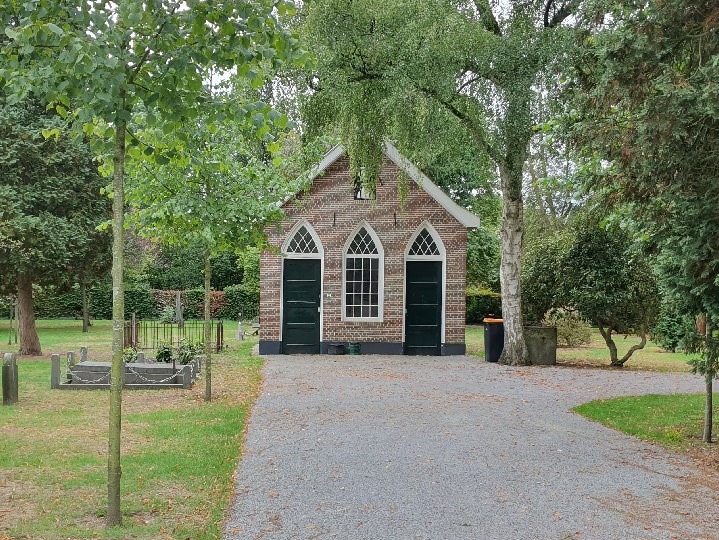
    The school’s first headteacher was Adriaan Jacobus van Oosten, who served from 1916 to 1921. When he and his family arrived in Aalten, neither a school building nor a residence was available. The family was temporarily housed in the gravedigger’s cottage near the cemetery on Varsseveldsestraat, moving shortly thereafter to the upper floor of the Tackshuis.

    The school began its first year with six classes and 36 pupils, a number that exceeded all expectations.

    New Construction on Stationsstraat

    It soon became clear that a dedicated building was necessary. A plot of land on Stationsstraat was purchased for approximately 1,400 guilders from Messrs Smits Sr. and Bulten, in an area then known as ‘Het Rot’. A new school building was erected here, with its front facing Piet Heinstraat.

    The school was named the Breukelaarschool, after Rev. Johannes Breukelaar, a pioneer of Christian education in Aalten and son of Rev. Derk Breukelaar. In June 1918, Rev. Breukelaar himself performed the official opening.

    Expansions and Changes

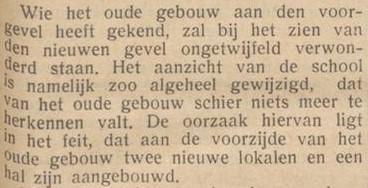
    In 1933, the school building was extended on the street side with two classrooms and a hall. Later, the building was completely transformed and modernised again. During this process, an upper storey was added to the main building on the street side.

    Mergers and Educational Reform

    In 1967, the MULO merged with the HBS to form the Christelijke Scholengemeenschap Aalten (CSA). A year later, in 1968, the Mammoetwet (‘Mammoth Act’) came into effect, replacing the term MULO with MAVO.

    In 1993, the CSA merged with the other secondary schools in Aalten—the Christelijke Scholengemeenschap Langenhave and the Technical School—to form Christelijk College Schaersvoorde. Around 2006, the school moved to a new building on Landbouwstraat.

    Repurposing

    By the turn of the century, the building no longer met modern standards. Along with the former LTS and domestic science school, it was decided to build a new VMBO school on Landbouwstraat.

    Following the completion of the new school—the “Stationsplein location”—around 2006, the main body of the building on Piet Heinstraat was converted into four apartments. The original section at the rear was demolished and replaced by a new rear extension. A small residential square, named Breukelaarplein, was created on the land behind the building as a tribute to the founder of Christian MULO education in Aalten.


    Archives

    Address directory 1934

    Aalten A97 > Piet Heinstraat 4

    Chr. Ulo-school

    Address directory 1967

    Piet Heinstraat 4

    Chr. U.L.O. School

    Features


    Cadastral no.K-2882
    FunctionSecondary school,
    Residential housing
    Year of construction1918
    Renovation2005
    Listedno
  • Technical School (LTS)

    Technical School (LTS)

    Polstraat 25, Aalten (no longer extant)

    The Christian Technical School on Polstraat in Aalten was officially opened in 1955. The striking building, designed by Aalten architect Wim Hebly, provided Junior Technical Education (Lager Technisch Onderwijs or LTS). It was demolished in 2007; in 2023/2024, a complex containing 56 social housing units was erected on the site.

    On 8 December 1948, the first general meeting of the Foundation for Christian Vocational Education in Aalten took place. In September 1950, permission was granted to establish a technical school.

    The first lessons were held in the former gasworks on Bredevoortsestraatweg, which housed the carpentry and machine benchwork departments. At that time, the number of pupils stood at 55. Theory lessons took place in classrooms at the Christian MULO (junior secondary school) and the Dutch Reformed School.

    Moving to a Dedicated School Building

    On 19 December 1950, the Municipality of Aalten made 4,000 m² of land on Polstraat available. In 1951, theory lessons were moved to the Irene building. In 1952, the Ministry of Education approved the sketch plan for a new school building designed by Wim Hebly. The tendering process followed in 1953.

    Construction began on 5 November 1953 and included two practical classrooms, a construction shed, two theory classrooms, a drawing room, an auxiliary gymnasium-cum-canteen, and offices for the headteacher, staff, and administration. The official opening took place on 10 June 1955.

    Stained-Glass Window

    A notable feature of the school was the stained-glass windows, created in 1955 by the Amsterdam glazier Jan Ooms (1915–1975) in close collaboration with architect Hebly. Ooms was known for his use of bold colours and modern techniques.

    When the school was demolished in 2007, the windows were salvaged. Following restoration, they were given a new home in the central hall of Christelijk College Schaersvoorde in Aalten.

    Expansions

    In 1956, preparations began to expand the school as the duration of the course was extended from two to three years. A new classroom plan was drawn up for this purpose. In the following years, further practical and theory classrooms were added.

    Merger and Demolition

    In 1993, the Technical School merged with the other secondary schools in Aalten—the Christelijke Scholengemeenschap Aalten (CSA) and the Christelijke Scholengemeenschap Langenhave—to form Christelijk College Schaersvoorde. Around 2006, the school moved to a new building on Landbouwstraat, near the railway station. The old complex on Polstraat was demolished in 2007.

    The site remained vacant for a long period until a new-build project comprising 56 social housing units was completed in 2023/2024.


    Archives

    Address directory 1967

    Polstraat 25

    Chr. Techn. School

    Features


    Cadastral no.D-5431
    FunctionSecondary school
    Year of construction1955
    ArchitectW. Hebly
    Demolition2007
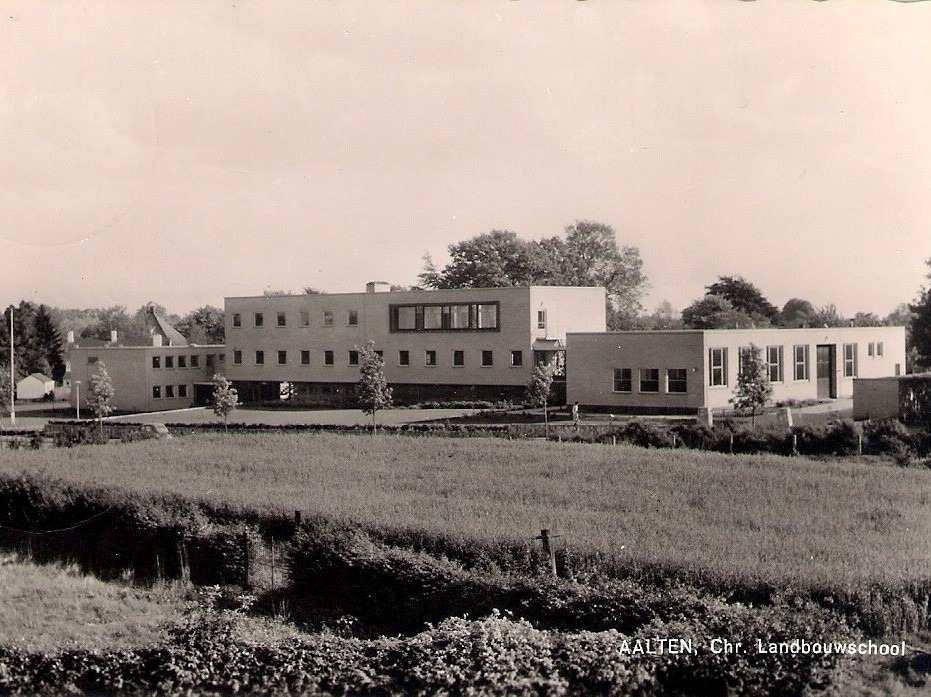
  • Agricultural School

    Agricultural School

    Lijsterbeslaan 3, Aalten (no longer extant)

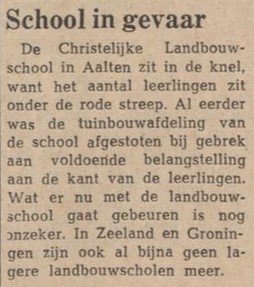
    The Christian Junior Agricultural and Horticultural School in Aalten was opened on 5 September 1962. The school was designed by the Aalten architect Wim Hebly. At the time, it was the flagship of the Ministry of Agriculture; the school was frequently visited by foreign guests brought in from The Hague.

    In 1989, the agricultural school merged with the domestic science school to form the Christelijke Scholengemeenschap Langenhave, which in turn merged into Christelijk College Schaersvoorde in 1993.

    The building was demolished in the late 1990s to make way for residential housing.


    Archives

    Address directory 1967

    Lijsterbeslaan 3

    Chr. Junior Agricultural School

    Features


    FunctionSecondary school
    Year of construction1962
    ArchitectW. Hebly
    Demolition< 2000
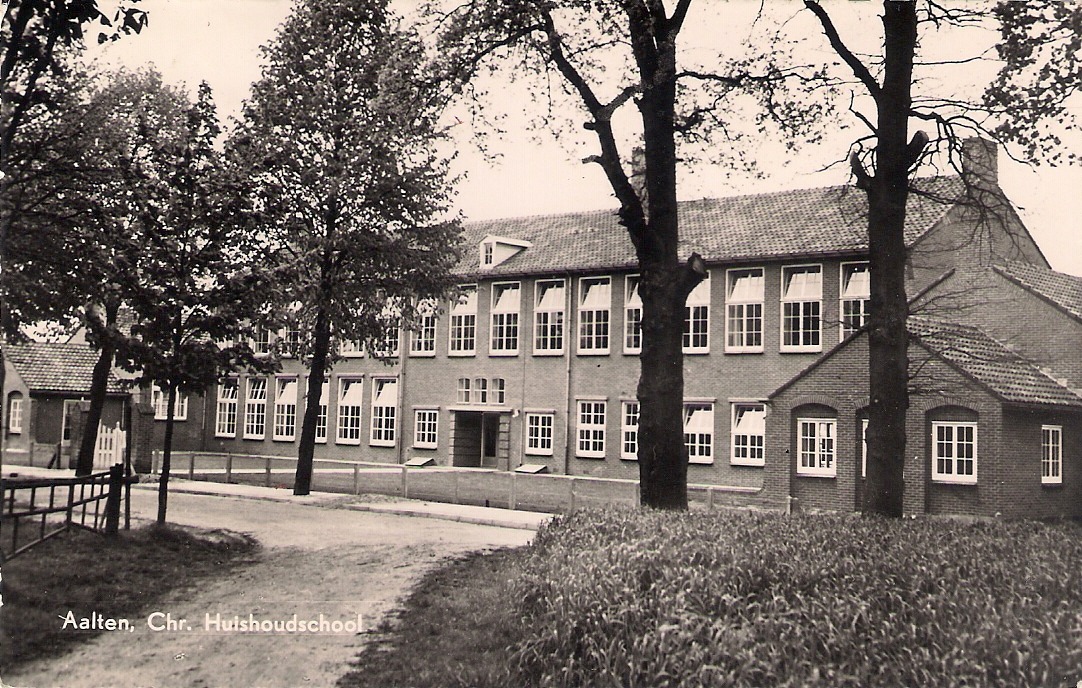
  • Domestic Science School

    Domestic Science School

    Oranjelaan 7, Aalten (repurposed)

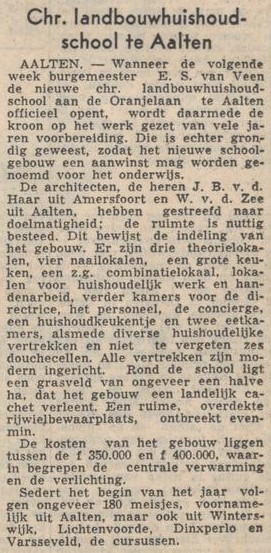
    For decades, the Huishoudschool (Domestic Science School) on Oranjelaan in Aalten served as a training centre for girls in domestic duties. The building was constructed in 1956 and officially opened in the summer of 1958.

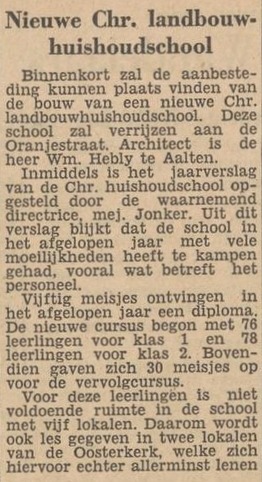
    The domestic science school in Aalten had existed since 1928, but in 1958 it moved into its new premises at Oranjelaan 7. The old building on Haartsestraat, where the school was previously located, was subsequently vacated and used temporarily by the Hogere Burgerschool (HBS).

    Education and School Life

    The school was officially known as the Christian Agricultural Domestic Science School and was popularly referred to as the Oranjeschool.

    The new building offered considerably more light and space than its predecessor. Large windows with wooden glazing bars ensured that the classrooms were flooded with light. Practical rooms were equipped for cooking, laundering, and ironing, featuring what was modern equipment for the time, including both electric and gas cookers.

    Pupils received instruction in various domestic tasks. Anatomy lessons were also provided, given by figures such as Dr Knol. Great emphasis was placed on cleanliness and discipline. Outside Miss Jonker’s room stood a so-called “punishment bench”; if she opened her door, you had to explain exactly why you were sitting there.

    Over the years, the curriculum evolved to include vocational training such as INAS (Institutional Assistant), KVJV (Child and Youth Care), LEAO (Junior Economic and Administrative Education), MDGO (Intermediate Service and Healthcare Education), and AW (General Education).

    Architecture

    The 1956 school building was characterised by its tall windows and a functional layout that complemented the practical nature of the education provided. The bright, airy feel of the classrooms was typical of the architectural style of that period.

    Mergers and Succession

    Over time, the domestic science school evolved alongside broader educational developments. In 1989, the school merged with the Agricultural School to form the Christelijke Scholengemeenschap Langenhave. In 1993, this institution joined other secondary schools in Aalten to become part of Christelijk College Schaersvoorde.

    Repurposing

    After its educational function ceased, the building was given a new purpose. In the twenty-first century, the complex was converted into a residential development containing eight apartments. Five homes are situated in the main building, while three single-storey dwellings were created in the wings to the left and right. During this process, the characteristic facades with their tall windows were largely preserved.


    Archives

    Address directory 1967

    Oranjelaan 7

    Chr. Agricultural Domestic Science School

    Features


    Cadastral no.I-12841/12849
    FunctionSecondary school,
    Residential housing
    Year of construction1956
    Listedno
    Oranjelaan 7, Aalten (Domestic Science School) – Zutphens Dagblad, 18 May 1957
    Zutphens Dagblad, 18 May 1957
  • St George’s Church, Bredevoort

    St George’s Church, Bredevoort

    Markt 3, Bredevoort

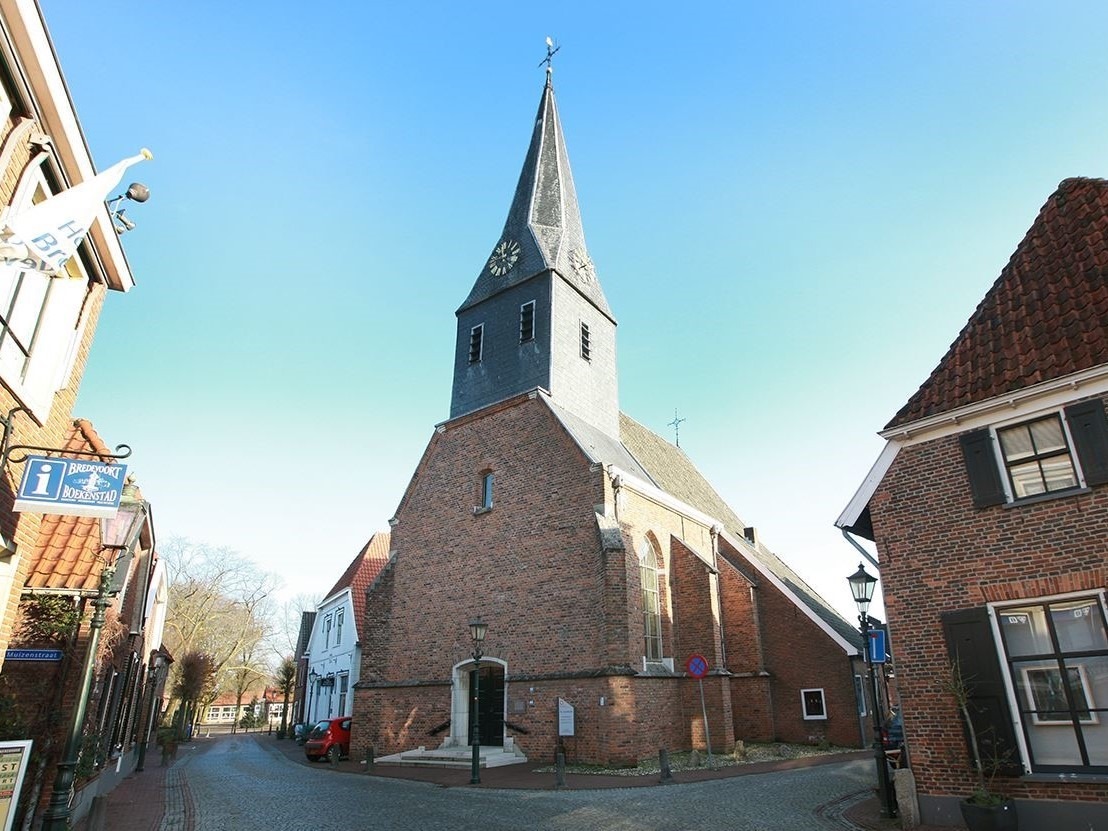
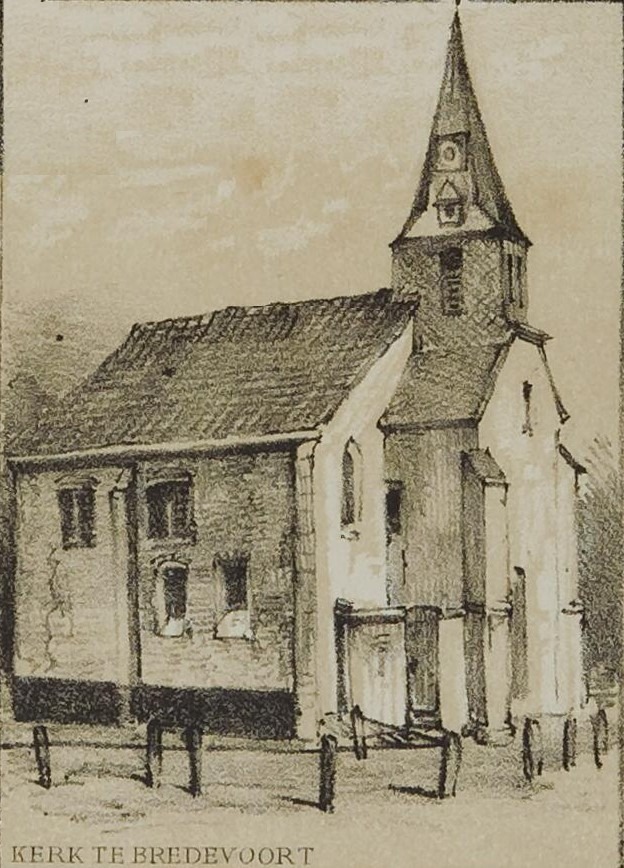
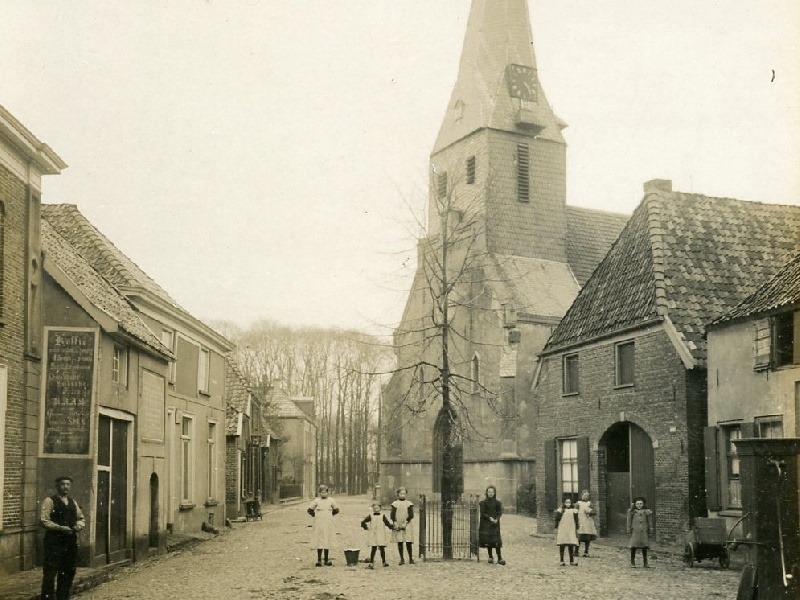
    The Sint-Joriskerk (Saint George’s Church) is a late-Gothic church in Bredevoort, the foundations of which date back to 1316. The church is dedicated to Saint George, the patron saint of the borgmannen (castellans) of Bredevoort. A characteristic feature is the tower’s finial: a statue of Saint George and the Dragon instead of a traditional weathercock. On the east side of the church, there is a so-called ‘melaatsenraampje'(leper window). In earlier times, worshippers with contagious diseases used this window to follow the mass.

    Early History

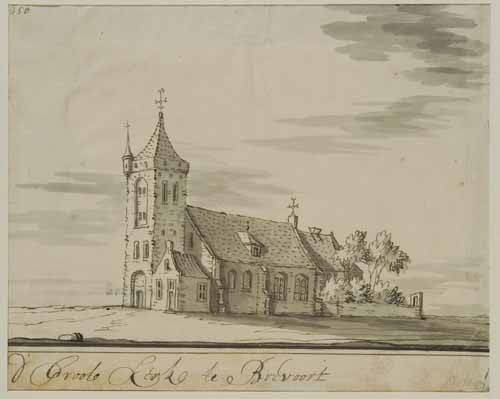
    De oudste fundamenten van de kerk stammen uit 1316, en mogelijk diende het gebouw in haar vroegste jaren als kapel op het kasteel van Bredevoort. Tijdens het Beleg van Bredevoort in 1597 door Prins Maurits is de oude (en grotere) kerk volledig afgebrand en zijn de gewelven ingestort. Het jaar erop richtten de Bredevoorters een verzoek aan de classis Zutphen om weer een nieuwe kerk te bouwen: “Die van Bredeforts soln met request an desen quartier verzoekcken assistentie tott reaparatie hearder Kapellene”. In 1599 begon men met de herbouw in gotische stijl.

    Expansions

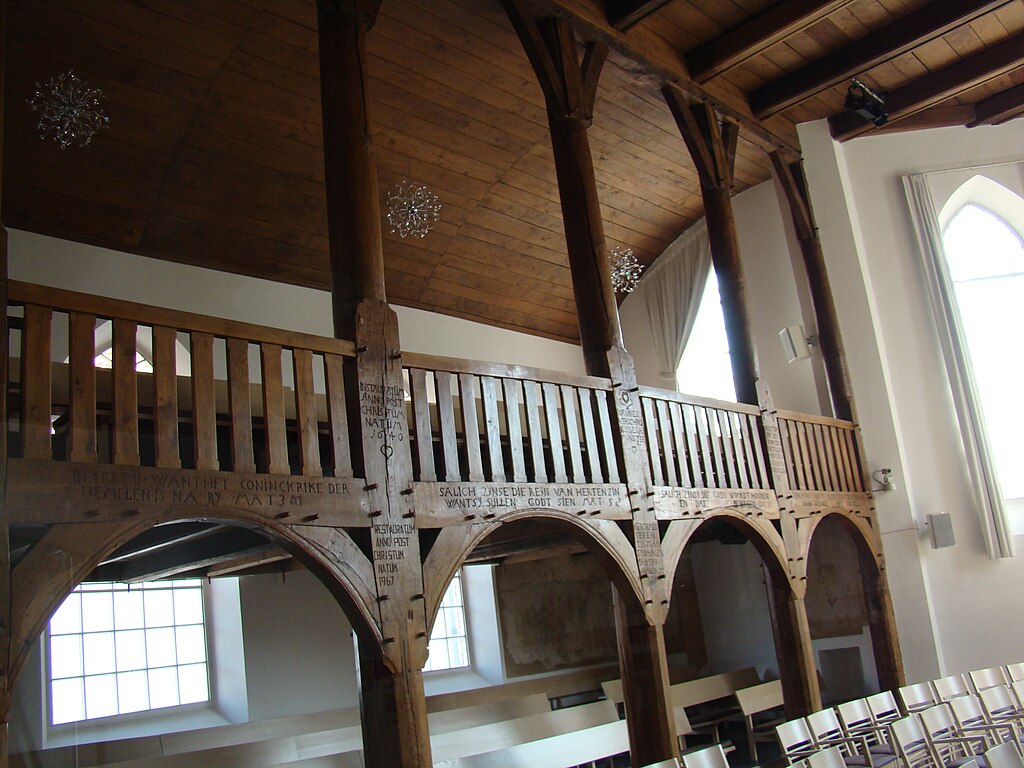
    Following the reconstruction, the church underwent various expansions. In 1600, after another fire, a tower was added. In 1639, the chapel was enlarged and broken out on the north side. Using the same stones, the wall was rebuilt several metres further out. Later expansions followed in the form of the boerenzolder (farmers’ loft) and the orgelzolder (organ loft). This extension, including the loft, is clearly visible. Biblical proverbs are inscribed in the beams of the farmers’ loft, such as: “Salich zijn se die rein van herte zin want sij zullen Godt zien” (Blessed are the pure in heart, for they shall see God).

    Powder Tower Disaster of 1646

    Op 12 juli 1646 sloeg de bliksem in de kruittoren van het kasteel. De ontploffing die volgde verwoestte een groot deel van de stad. Veertig mensen kwamen om. Het kasteel was in een ruïne veranderd en ook de kerk liep aanzienlijke schade op. Elf slachtoffers, waaronder de drost van Bredevoort en zijn vrouw en acht van hun kinderen, werden in het koor (het oostelijk gedeelte van de kerk) begraven.

    The church was rebuilt, though smaller than its predecessor. In 1672, Captain Satink donated a Rococo pulpit featuring his family coat of arms, as well as a copper lectern bearing the arms of the Holy Roman Empire.

    Renovations

    De kerk heeft door de eeuwen heen verschillende renovaties ondergaan. In de Franse tijd werden onder andere een houten gewelf en een vloer van Bentheimer steen toegevoegd. Ook kreeg de kerk toen nieuwe banken en werd de vloer opgehoogd. In 1832 werden de kerkbanken wit geschilderd.

    In 1849, the wooden plank ceiling was replaced with a lime ceiling. In 1858, a catechism room was added, for which King William III donated 200 guilders. The walls of the church were re-plastered in 1868, and this plaster layer was removed again during the restoration of 1949. In 1869, the tower was repaired. In 1882, five stained-glass windows were replaced by cast-iron ones. Three years later, two more cast-iron examples were installed in the farmers’ loft.

    In 1889, the catechism room was extended with an annex. During a thorough renovation in 1896, the façade received new doors, a rose window, two small gable windows, and an iron cross. The commemorative stone is now placed on the inside of the wall of the organ loft. In 1920, the spire was renewed.

    Post-War Restorations

    After the Second World War, the church was in poor condition. Following a large-scale restoration, the church was put back into use in 1967. During a restoration in 2006, the subsided gravestones and the natural stone floor were repaired. It was discovered that a number of the stones had been laid upside down, likely during the French period; these have since been properly repositioned. During the work, several historical finds were made, including coins, human remains, and stained glass. Furthermore, a stone from the Republic of the Seven United Netherlands was found.

    Research revealed that two of the stones that had been laid upside down belonged to the Bredevoort Drost, Wilhelm van Haersolte, and his family. They perished along with almost all their children during the powder tower disaster of 1646. Only their son, Anthony, had survived the disaster. In 2010, his descendants donated 3,000 euros to the restoration committee.

    Bells and Clock

    De Sint-Joriskerk herbergt drie klokken. De oudste, een monumentale klepklok uit 1454, werd in 1596 geleend van het klooster Schaer. Na de vernietiging van het klooster, tijdens de belegering van 1597, is deze klok altijd blijven hangen. Wilhelm van Haersolte tot Elsen schonk de brandklok, gegoten in 1644. De luidklok dateert van 1731 en wordt volgens oude traditie dagelijks om 8.00 uur, 12.00 uur en 21.00 geluid. De stadspoorten werden vroeger om 8.00 uur geopend en om 21.00 uur gesloten. Etenstijd was om 12.00 uur.

    In 1942 kreeg de kerk een nieuw uurwerk. Het oude uurwerk uit 1666 is binnenkort weer te bezichtigen in de Sint-Joriskerk. In 1980 werd het kleine carillon van drie klokjes herplaatst.


    Owners

    Overview is incomplete.

    YearPlotOwnerDescription
    1832B-80de Hervormde Kerk Bredevoord280 m² church

    Features


    Cadastral no.B-1199
    FunctionChurch
    Year of construction14th/17th century
    MonumentNational Monument

    Sources

  • Old General Cemetery Aalten

    Old General Cemetery Aalten

    Varsseveldsestraatweg 21, Aalten

    In 1827, King Willem I decreed by law that, as of 1829, cemeteries had to be established outside built-up areas. In Aalten, a site was designated for this purpose on Varsseveldsestraatweg, then known as Melkersweg.

    The cemetery was later extended to the west. The oldest section is characterised by relatively empty lawns with scattered old funerary monuments and a small lychgate (baarhuisje). The western part has a more structured, orthogonal layout.

    Begin 20e eeuw raakte de Oude Begraafplaats steeds meer omsloten door de oprukkende bebouwing van het dorp. Dit leidde tot de behoefte aan een nieuwe begraafplaats. In 1923 werd begraafplaats Berkenhove aan de Romienendiek in gebruik genomen.

    Although the Old Cemetery has since taken on the function of a ‘tranquillity park’, it is still sporadically used for interring the deceased in existing family graves.

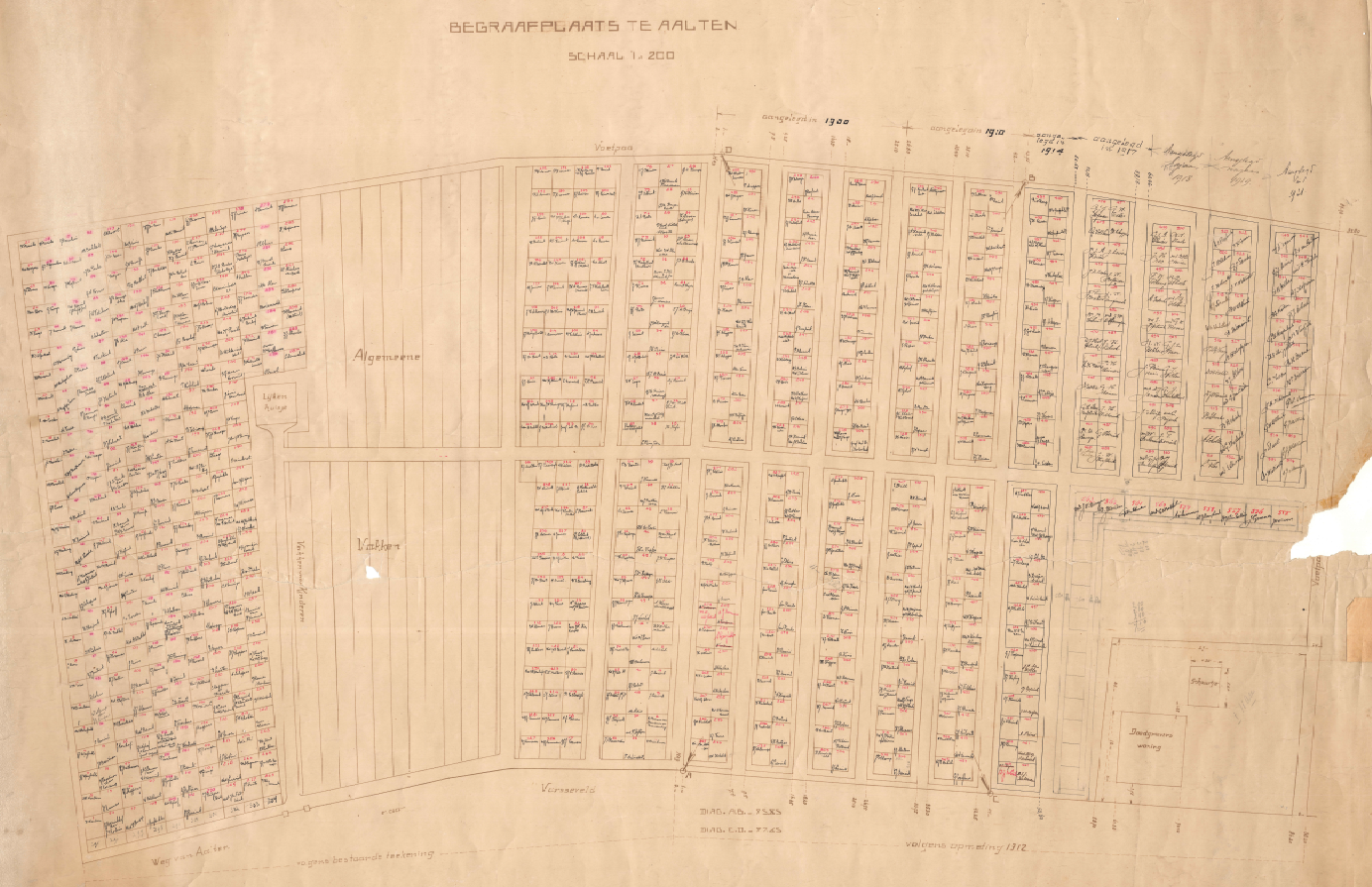
    A map is available providing an overview of all graves and those interred from circa 1921; click the thumbnail below for a large, legible version (PDF):

    Old General Cemetery Aalten, 1921
    Old General Cemetery Aalten, 1921

    Commemorative Column

    In het kader van 70 jaar bevrijding werd in 2015 op de Oude Begraafplaats een gedenkzuil geplaatst ter herdenking aan alle Aaltense soldaten die in mei 1940 op en rond de Grebbeberg hebben gevochten. Zeven Aaltense militairen verloren daarbij het leven. Hun namen en foto’s zijn op de gedenkzuil vereeuwigd.

    Roman Catholic Cemetery

    When the cemetery on Varsseveldsestraatweg was established, the Catholic community in Aalten insisted that a separate section be designated and consecrated for them. The municipality purchased a piece of land for this purpose across the street, on the corner with Molenstraat.

    Deze kleine katholieke begraafplaats raakte echter al na dertig jaar vol. In 1868 werd een nieuwe R.K. begraafplaats aan de Piet Heinstraat in gebruik genomen. Het voormalige katholieke begraafplaatsje aan de Varsseveldsestraatweg kreeg later de functie van plantsoen. De graven van ten minste 50 Aaltense katholieken zijn echter nooit geruimd.

    In 2015, the site was redesigned at the initiative of local residents to better reflect its historical significance. An information panel has been placed at the location highlighting the history of the cemetery.


    Owners

    Overview is incomplete.

    YearPlotOwnerDescription
    1832I-1409
    I-1436
    The Municipality of Aalten4.430 m² (Protestant) churchyard
    720 m² (R.C.) churchyard

    Features


    Cadastral no.K-466
    FunctionCemetery
    ListedGemeentelijk
    monument

    View the graves on Findagrave.

  • Roman Catholic Cemetery Aalten

    Roman Catholic Cemetery Aalten

    Piet Heinstraat, Aalten

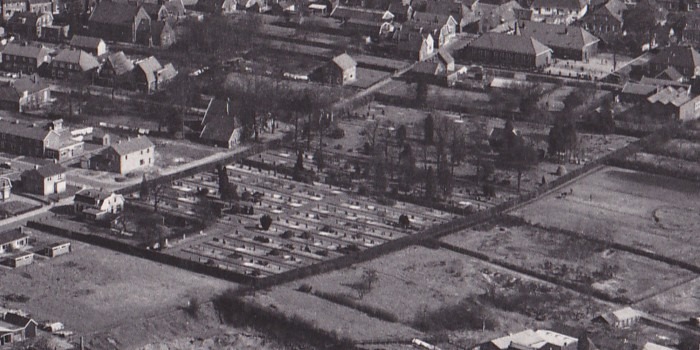
    In the late 1860s, the small Roman Catholic cemetery on the corner of Varsseveldsestraatweg and Molenstraat reached its capacity. This created a need for a new cemetery for the Catholic community in Aalten.

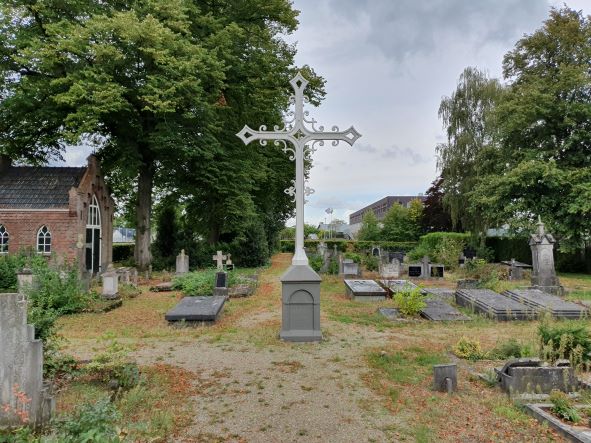
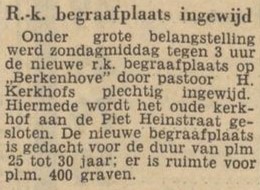
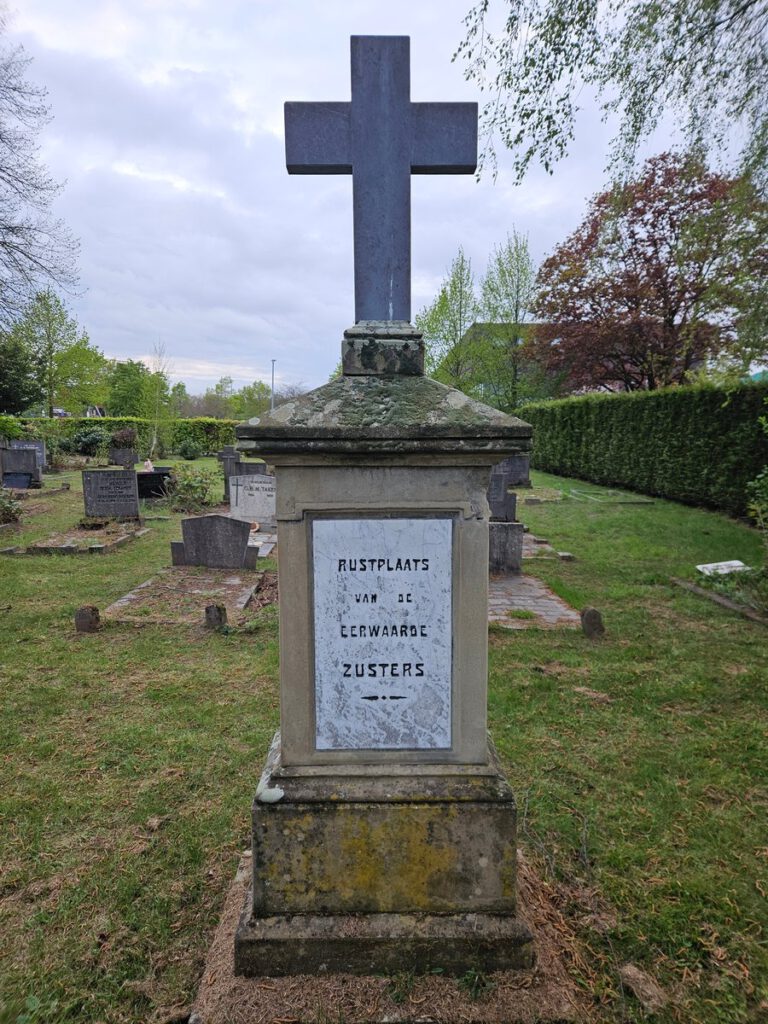
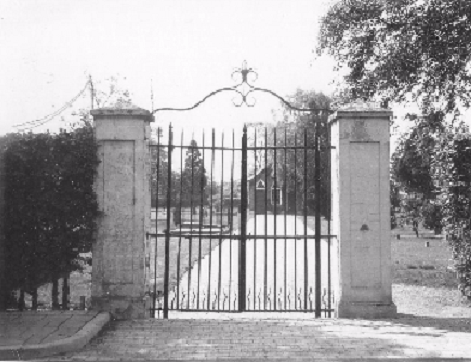
    In 1868, Anton Driessen, a textile manufacturer in Aalten, donated a plot of land on what is now Piet Heinstraat to the church to be established as a cemetery. In addition to the land, he donated an iron Calvary cross and an iron gate, both of which still stand today. Anton also stipulated that his family be buried in a contiguous plot next to the cross. The mortuary on the cemetery grounds dates from 1888.

    Lack of space and closure

    A century later, this cemetery also became full, and there was no room for expansion. From 1960 onwards, Catholic deceased were therefore buried in the new Roman Catholic section of the Berkenhove cemetery.

    In the early 1970s, the cemetery on Piet Heinstraat was officially closed. The site was transferred to the municipality of Aalten for the symbolic amount of one guilder.

    Notable graves

    Several prominent Catholic former residents of Aalten rest in this cemetery, including various members of the Driessen textile family. This family is inextricably linked to the textile history of Aalten and had a major influence on the emancipation of the Roman Catholic population in the municipality.

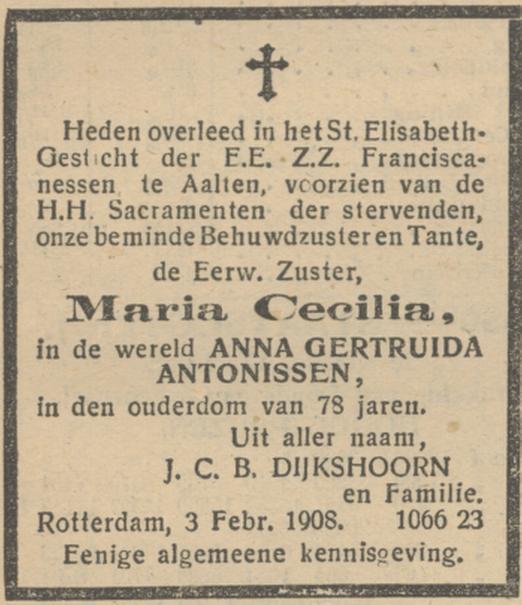
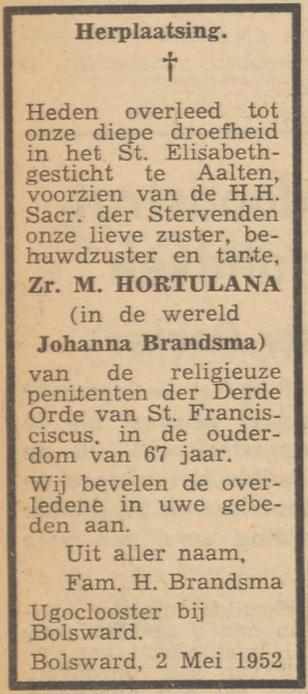
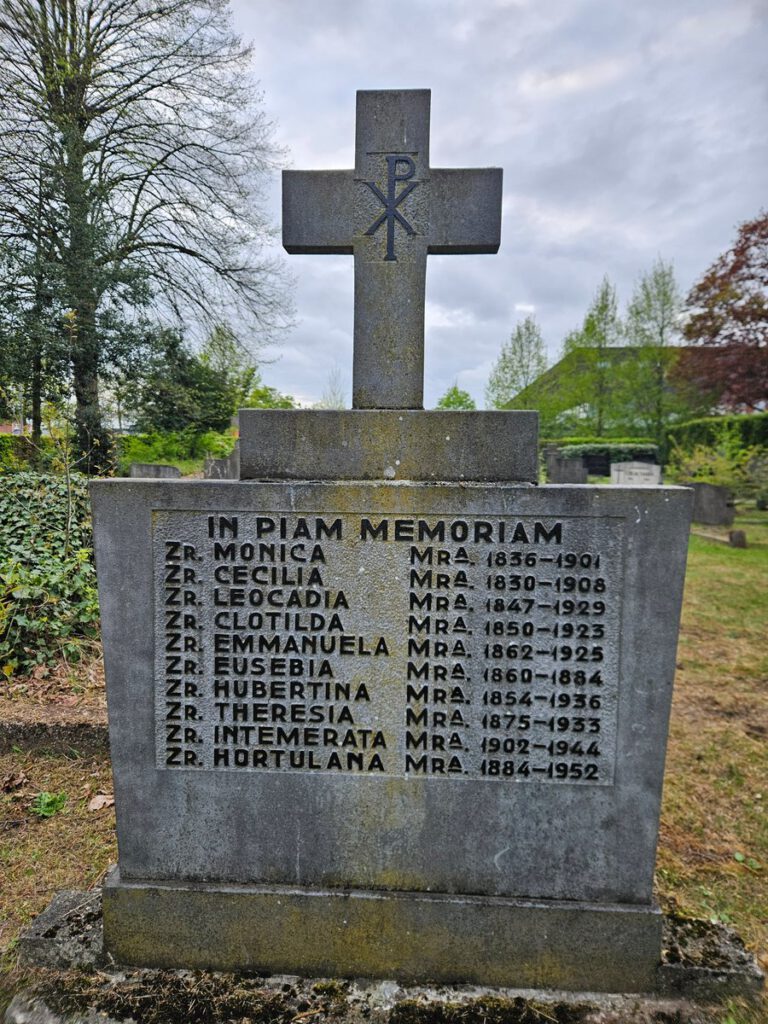
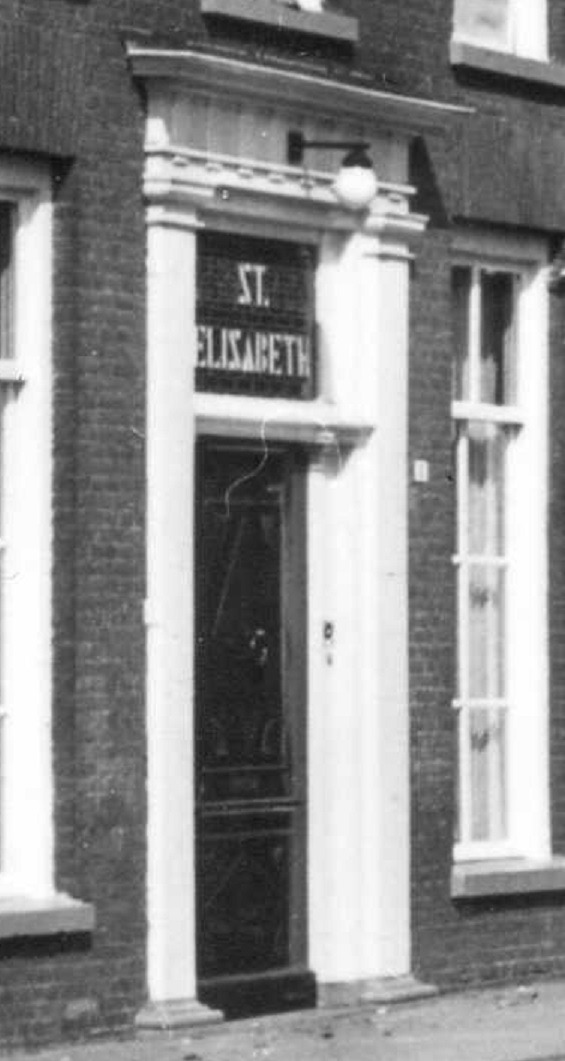
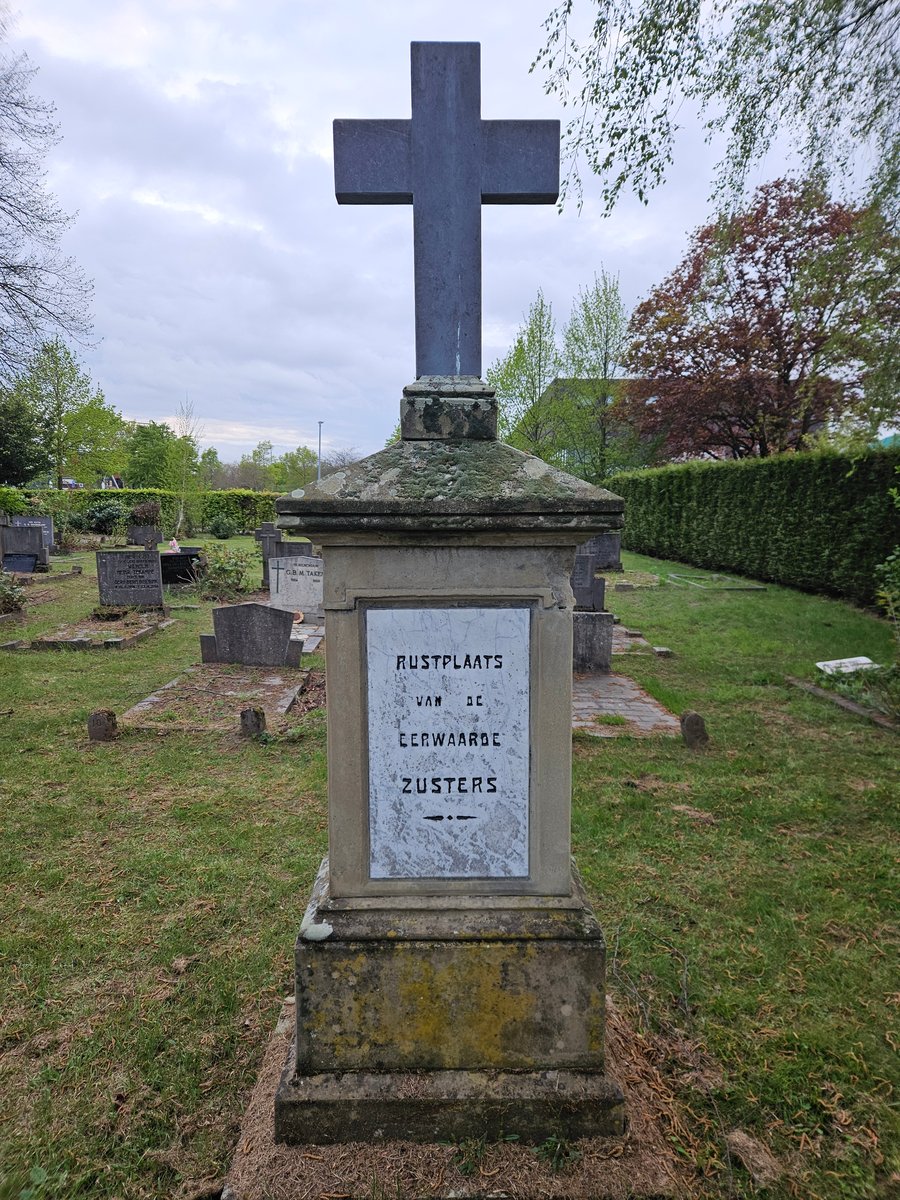
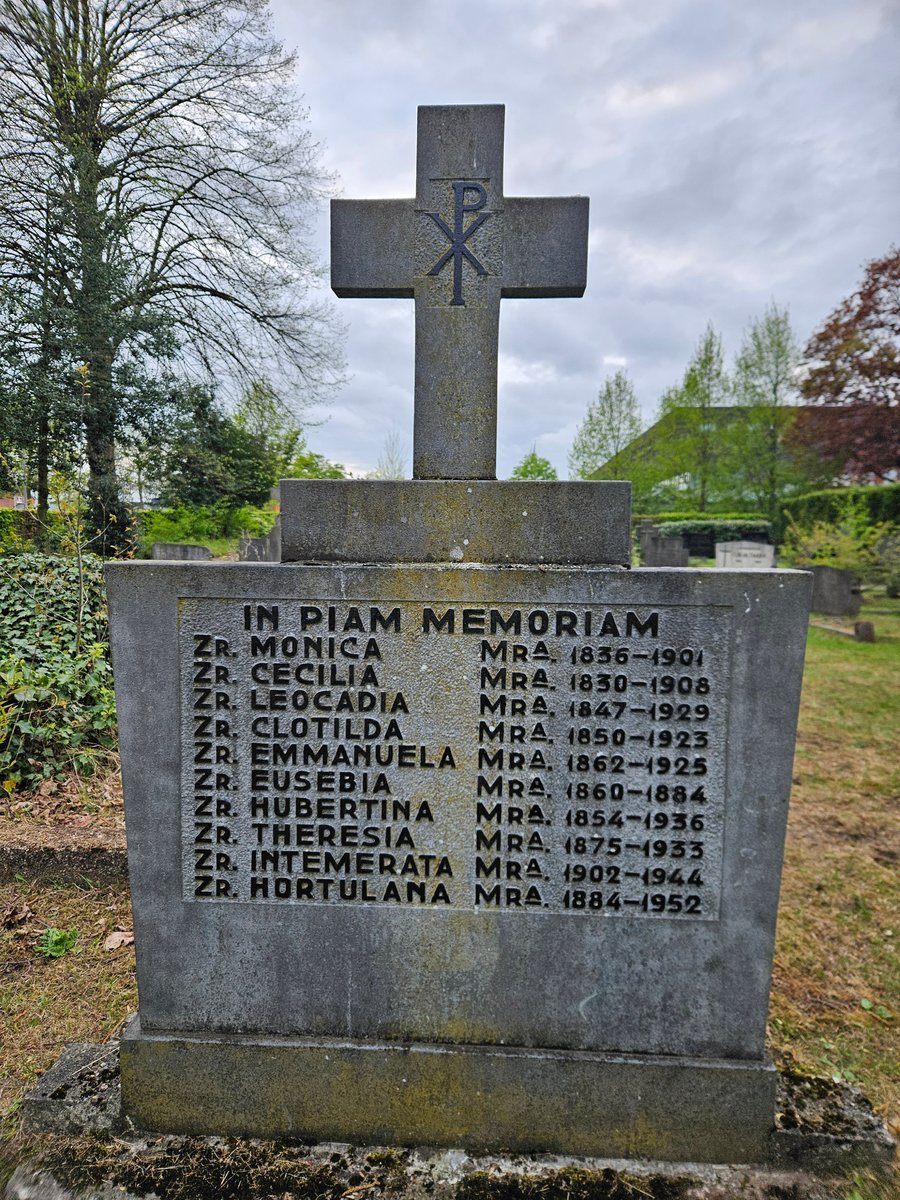
    The grave of Pastor Van Rooijen, who died on January 23, 1945, during a bombardment of Dijkstraat, is also located here. Additionally, there are graves of the sisters from the former Saint Elizabeth Convent on Dijkstraat. They provided primary education at the Saint Joseph School and nursed the sick of all faiths.

    Some of the sisters buried here:


    Features


    Cadastral no.K-711
    FunctionCemetery
    Establishment1868
    ListedMunicipal
    monument

    View the graves, as far as they are known, on Findagrave.

  • Public Primary School Herenstraat

    Public Primary School Herenstraat

    Herenstraat 4, Aalten (no longer extant)

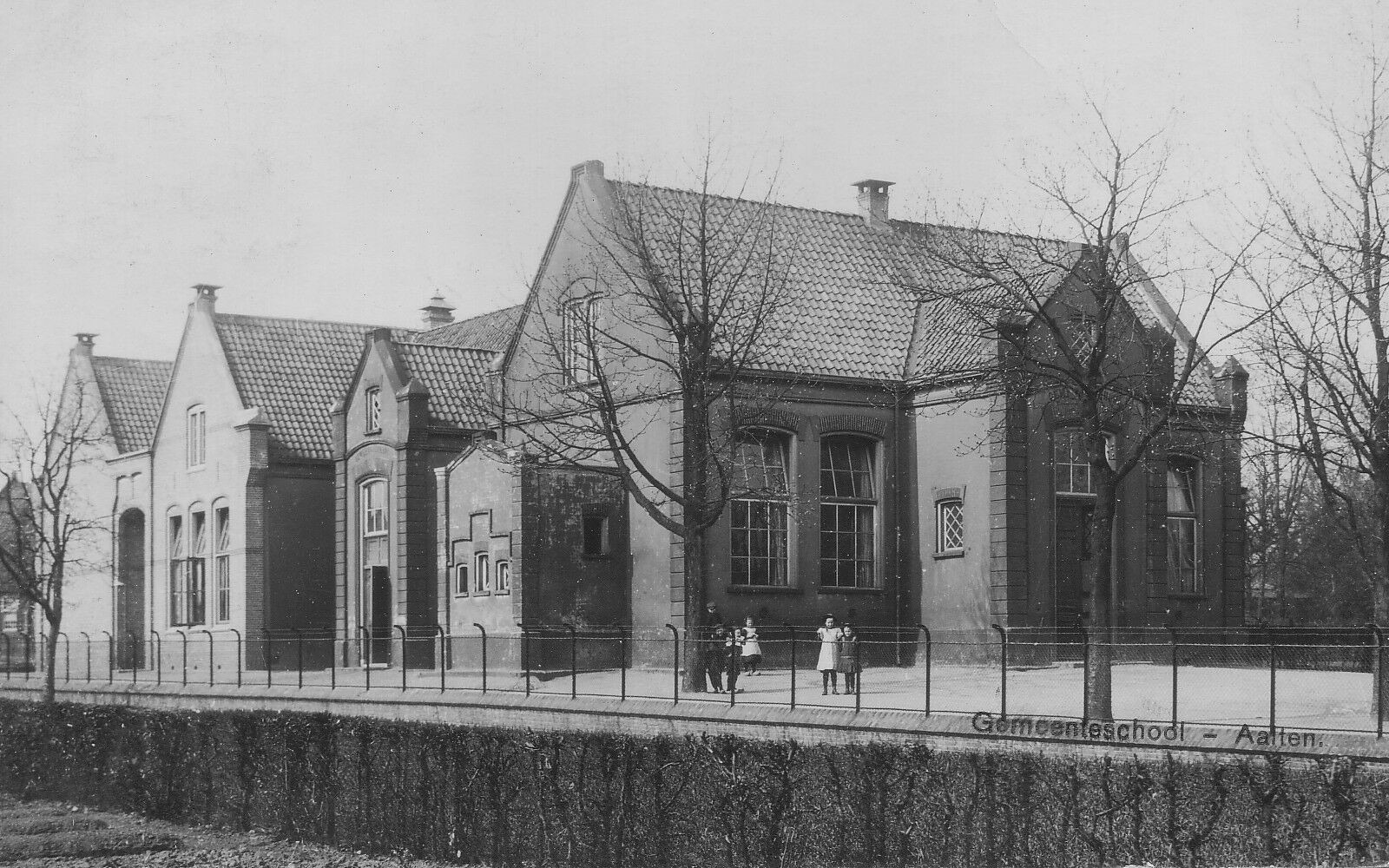
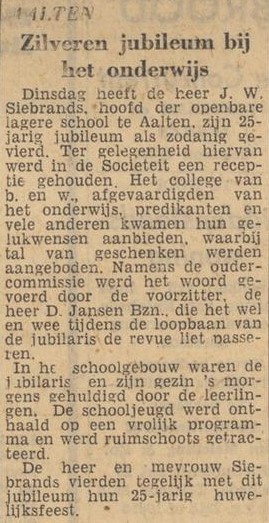
    De Openbare Lagere School aan de Herenstraat in Aalten werd opgericht in 1884. De nieuwe school verving daarmee de aloude dorpsschool aan de Landstraat. Hoofden der school waren door de tijd heen de heren Stegeman, Veenstra, Bennink, de Lange, van Rugge, Brunt, Siebrands, van Zeijl en Leferink.

    Tijdens de bezettingsjaren was de school korte tijd in gebruik als ‘Fallschirm-Armee Waffenschule’.

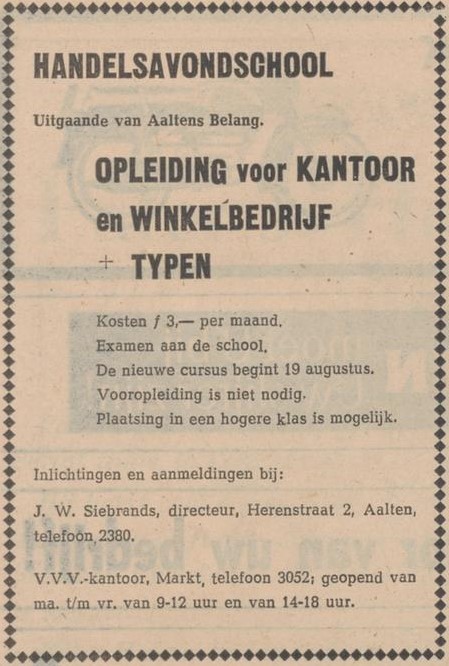
    In the 1960s, classes from the Commercial Evening School were also held here three nights a week.

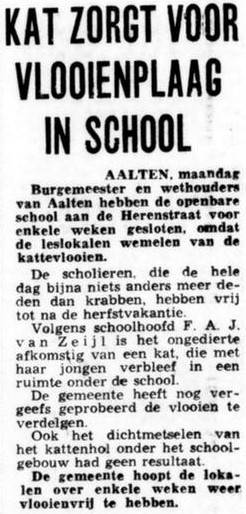
    In October 1974, the school had to temporarily close its doors due to a flea infestation. The cause was discovered to be a litter of cats living underneath the school building.

    Closure

    In 1976 werd een nieuwe openbare basisschool in Aalten in gebruik genomen aan de Wehmerstraat. Deze kreeg later de naam ‘Openbare Basisschool De Slinger‘.

    Upon leaving the old building, the schoolchildren sang the following lines during a noisy parade to the tune of ‘Yellow Submarine’: “Where we’re going is the new school, on Wehmerstraat, where it looks so grand. Ninety years old is our school on Herenstraat, in a tumbledown state, etc.”

    In 1977, the old school on Herenstraat was demolished, and the site was converted into a car park, known today as ’t Hoge Blik.

    Features


    Cadastral no.I-13311
    FunctionPrimary school
    Year of construction1884
    Demolition1977
  • Joseph Driessen

    Joseph Driessen

    Textile manufacturer

    Josephus Walter Julius Driessen (Aalten, 07-01-1870 – Aalten, 12-12-1938) was a textile manufacturer who contributed significantly to the Aalten community.

    He was a son of Herman Anton Frans Carl Maria Driessen and Anna Maria Theodora Muhren, and a grandson of Anton Driessen. On September 7, 1897, he married Maria Anna Elisa Josepha Beckmann in Malmédy (Wallonia).

    Joseph Driessen was the director of Stoomweverij Herman Driessen & Zoon and resided in villa Beukenhof on ‘t Blik (now Hofstraat).

    Jos. Driessen is buried at the old R.C. cemetery on Piet Heinstraat in Aalten.

    His significance to Aalten was evident from the report published by De Graafschapbode following his passing:

    How is Mr. Driessen doing? This question was asked day after day over the last few weeks; at times the answer would be: “Today the condition is slightly more favorable”, but then again: “Things are not so well at ‘t Blik!” Yet, whoever asked the question, it was always followed by: “It is to be hoped that he recovers and may be spared for a few more years for his family, his factory, and for our municipality!” Alas, it was not meant to be! In recent days, the condition became increasingly serious, and on Monday evening, the news reached us that Mr. Jos. Driessen had passed away from us forever.

    The news of Mr. Driessen’s passing will be received with great sadness in wide circles. Naturally, it is first and foremost a great blow to his family, his children, and grandchildren, for whom the deceased was the center—the great magnet within the family circle who drew everyone to him and who so loved to gather the entire family around him. With what interest and warmth he shared in the lives of his married children’s families. How all the grandchildren adored their Grandpa!

    The weaving mill, founded on April 1, 1894, was brought to great prosperity over the years through his energy. From a “little weaving shed,” as Mr. Driessen himself called it, the factory steadily increased in size under his leadership and developed—in recent years with the cooperation of his sons—into the flourishing N.V. Herman Driessen & Zn., which, in addition to its weaving mill, now also has its lingerie, ready-to-wear, and knitwear departments. Until recently, it was the nearly 69-year-old director who was always the first at the office in the morning. Always punctual and hardworking himself, he rightly expected the same from the staff. Furthermore, Mr. Driessen Sr. was always interested in the interests of all who worked in the business, and not only in the interests of the employees themselves, but also in those of their families, all of whom he knew exactly. Proof of this is certainly the medical care for staff and family members as arranged at H. Driessen & Zn. The entire staff, from high to low, will learn of the passing of their eldest leader with great regret, and the eldest director will surely be greatly missed in the factory every day.

    In addition to business concerns, which became increasingly large and difficult especially in the post-war years and demanded more and more of him, Mr. Driessen showed great interest in everything concerning his place of residence. Since its founding on December 14, 1898, he was a board member and very soon became chairman of the association “Aaltens Belang.” This association was especially his great love and for which he performed an immense amount of work. The chairman always came forward with new proposals and new ideas in the interest of, or for the beautification of, our town and the Achterhoek in general.

    What has been achieved in the 40 years of this association’s existence is largely due to his initiative. How Mr. Driessen had looked forward for years to the 40th anniversary of A. B. on December 14 of this year!

    Alas! Instead of a festive commemoration, the association is plunged into deep mourning. The board of “Aaltens Belang” will terribly miss its energetic chairman. In addition to this association, Mr. Driessen held the chairmanship of the “Oudheidkamer Aalten” and of the association for hospital nursing “Steunt Elkander,” both of which also had his warm interest. Furthermore, Mr. Driessen was a director of the Geld. Westf. Stoomtram Mij. and vice-chairman of the Supervisory Board of the Coöp. Middenstandsbank Aalten, a board member of the Prov. Geldersche V.V.V., vice-chairman of the B.V.L., and a member or board member of numerous other associations. Mr. Driessen was also briefly a member of the Provincial Council of Gelderland. Mr. Driessen would not easily be absent from a meeting of one of these associations, and telling of his character is what one of his children claimed of him: “Pa is not happy unless he has at least 3 meetings a week!” Mr. Driessen took the lead at numerous official festivals and events. His fellow members of these various committees know how every program item was prepared minute by minute, but also how the program could then finally be executed exactly and the event succeeded.

    On August 30, 1930, the mayor informed Mr. Driessen that H. M. the Queen had appointed him a Knight in the Order of Orange-Nassau. This was a recognition of Mr. Driessen’s great merits, in which countless residents rejoiced along with him and his family. In September 1937, the 40th anniversary of N.V. H. Driessen & Zn., as well as the 40th wedding anniversary of Mr. and Mrs. Driessen—Beckmann, was commemorated with great splendor. On this occasion, it was again evident in a spontaneous and heartfelt manner how authorities, citizens, staff, and business relations shared in this jubilee. These were unforgettable days for Mr. Driessen, which he was fortunately still able to experience in good health.

    During the last year, but especially the last few months, things were no longer going well. However difficult it was for the so industrious Mr. Driessen, he had to withdraw more and more from his work and take rest. Even sooner than initially expected, his ailment increased in severity and the end came.

    With Mr. Jos. Driessen, a resident has passed away who loved his place of residence very much and to whom Aalten owes a great deal. His name will surely remain in grateful memory for many for a long time. The solemn funeral service will take place this coming Friday morning.

    Sources

  • Watermill on the Pol

    Watermill on the Pol

    Polstraat, Aalten (no longer extant)

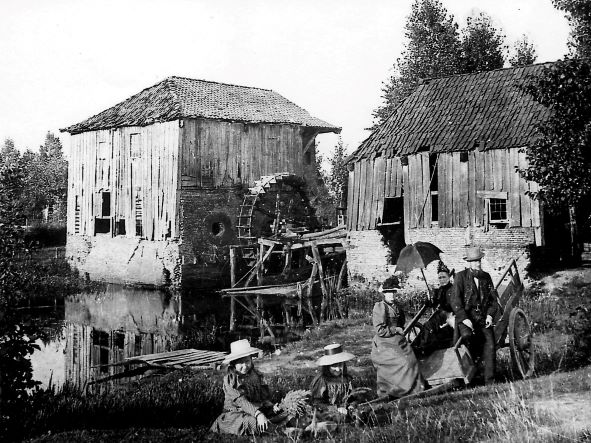
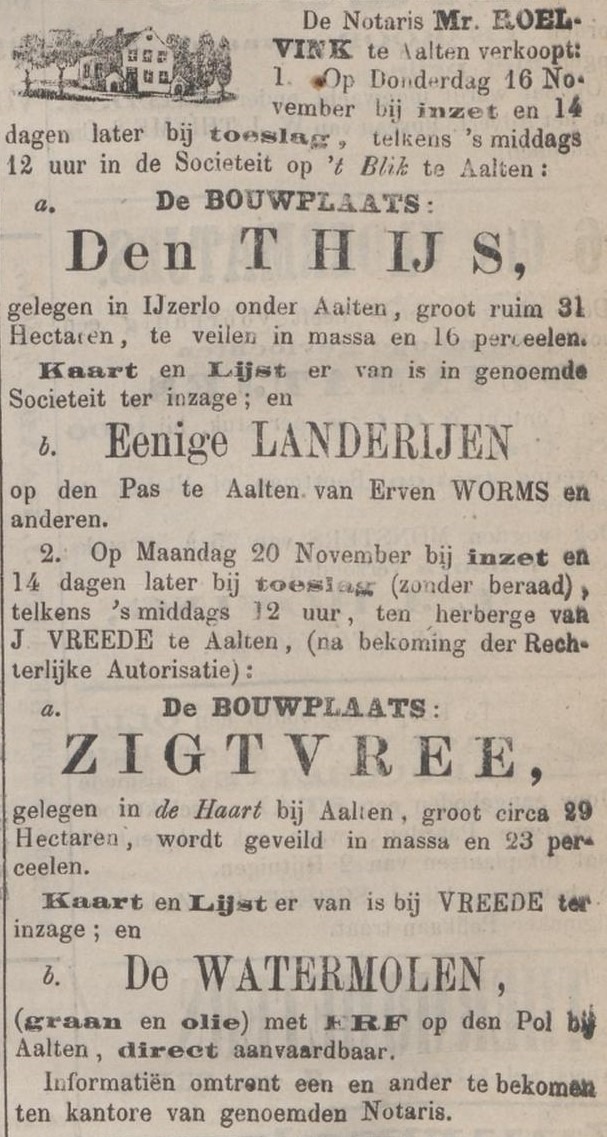
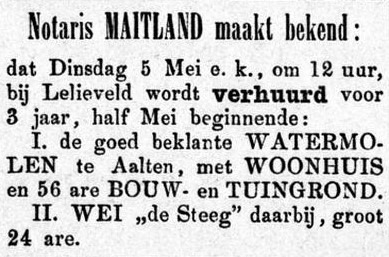
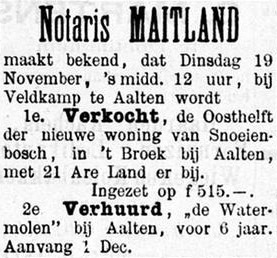
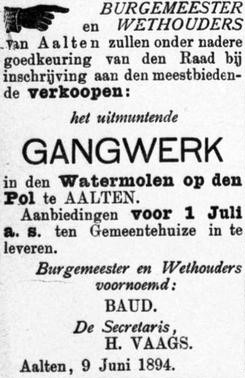
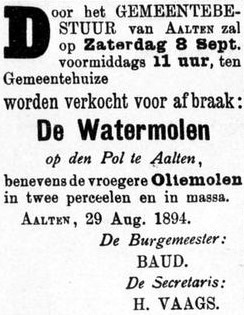
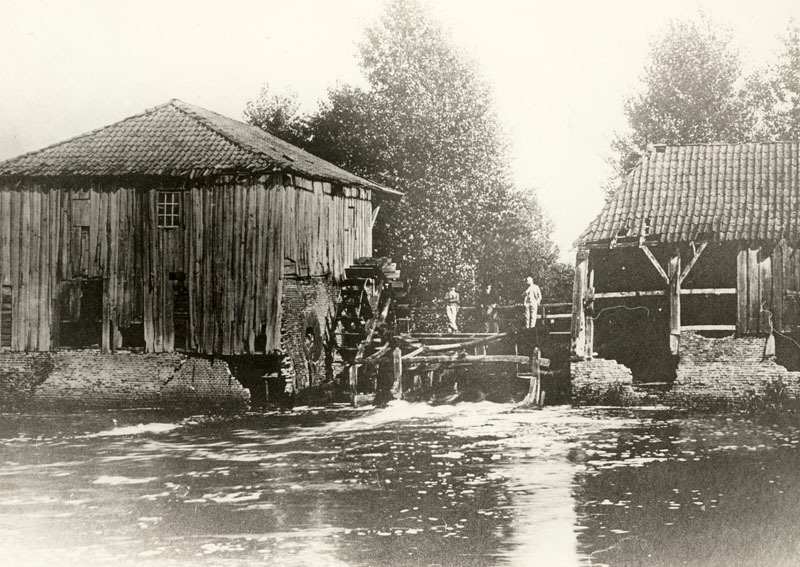
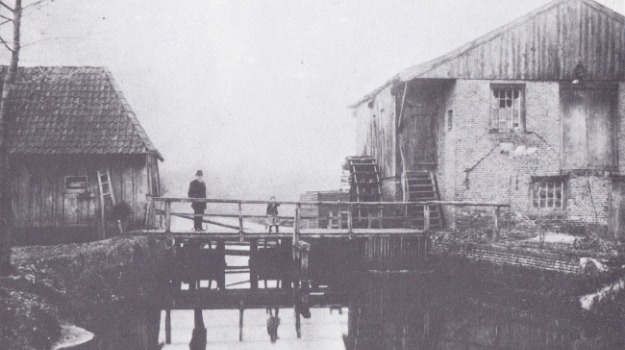
    For centuries, a watermill stood on the Slingebeek stream near the De Ahof manor, approximately at the location of the current stone bench erected by Aaltens Belang. At the beginning of the 20th century, the dilapidated mill was demolished. The mill featured wheels on both sides of the stream: on the south bank stood the oil mill (with a wheel of 4.42 m Ø) and on the north bank was the bark mill (with a wheel of 4.66 m Ø), with the corn mill situated above it.

    The watermill was likely built shortly after 1500, possibly due to a transfer of manorial milling rights from the Grevinkhof in Dale to De Ahof, which later also came into the possession of the Grevink family. The first mentions of the mill date from 1502, including records concerning income for the steward.

    In 1562, the mill was described as a ruin, yet it repeatedly appears in the archives in later years. B.D. Rots writes in his book ‘Aalten en Bredevoort in vervlogen tijden’ that around 1700, the watermill was owned by the House of Orange, who leased it to a miller. On 9 February 1707, De Ahof, along with “the hereditary lease of the Aalten Watermill”, passed into the hands of the Arentsen/Arentzen family.

    In 1739, the owners Bernardus Arentzen and Gerrit Jan Heusinkveld complained about competition from the numerous horse mills around Aalten, while they constantly incurred costs to keep the watermill in good repair. In 1758, it is noted that the city council of Bredevoort had the right, in the event of flooding, to raise the sluice gates at De Ahof and take them to their city.

    Around 1830, the corn mill had two undershot wheels and three sets of millstones, while the oil mill had one wheel and three stampers. During water shortages, the mills could also be driven by horses. Although the mill had three undershot wheels, a small overshot wheel with a separate leat could be deployed for the corn mill during low water levels from 1840 onwards.

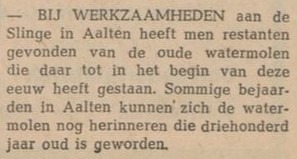
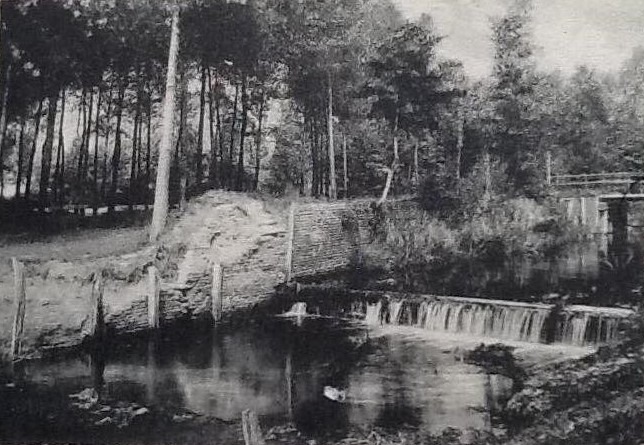
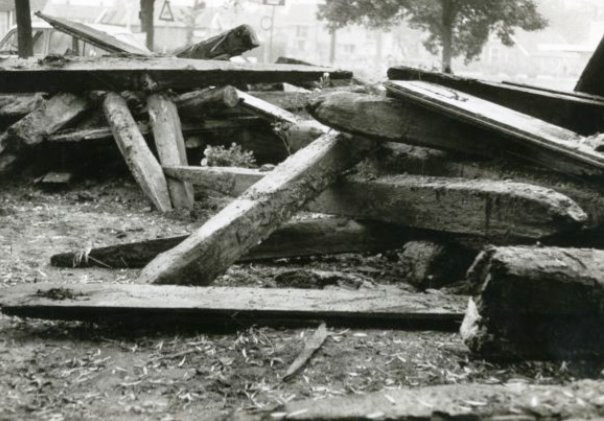
    The mill finally disappeared around 1900; only the wheel of the corn mill remained at that time. Photographs from that era show that the entire complex had fallen into decay. During works on the Slinge in 1969, approximately 200 foundation piles were removed. Today, only a remnant of a wall serves as a reminder of the watermill.


    Owners

    Overview is incomplete.

    YearPlotOwnerDescription
    1832I-182
    I-228
    Roelof Arentzen, assessor470 m² mill & yard
    920 m² mill & yard
    1851I-182
    I-228
    Engelbarta Hendrica Arendsen and
    Gezina Arendsen, widow of J.W. te Gussinklo
    470 m² mill & yard
    920 m² mill & yard
    1854I-1918
    I-1968
    Engelbarta Hendrica Arendsen and
    Gezina Arendsen, widow of J.W. te Gussinklo
    470 m² grain mill & yard
    178 m² mill & yard

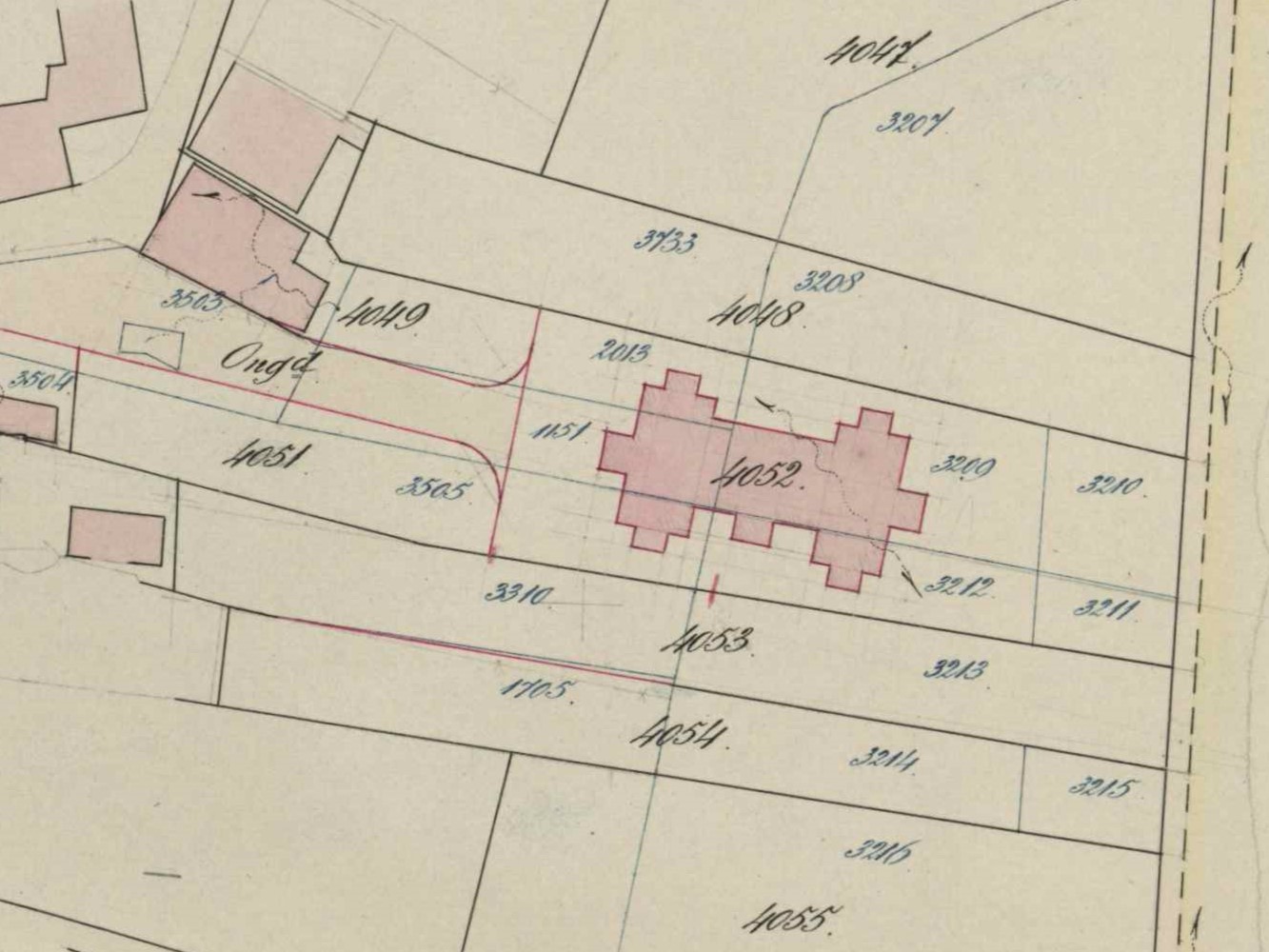
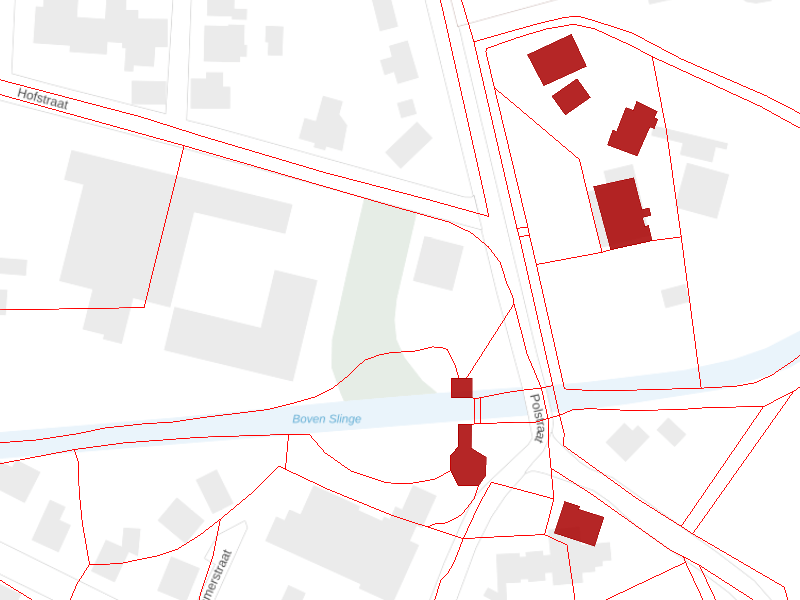
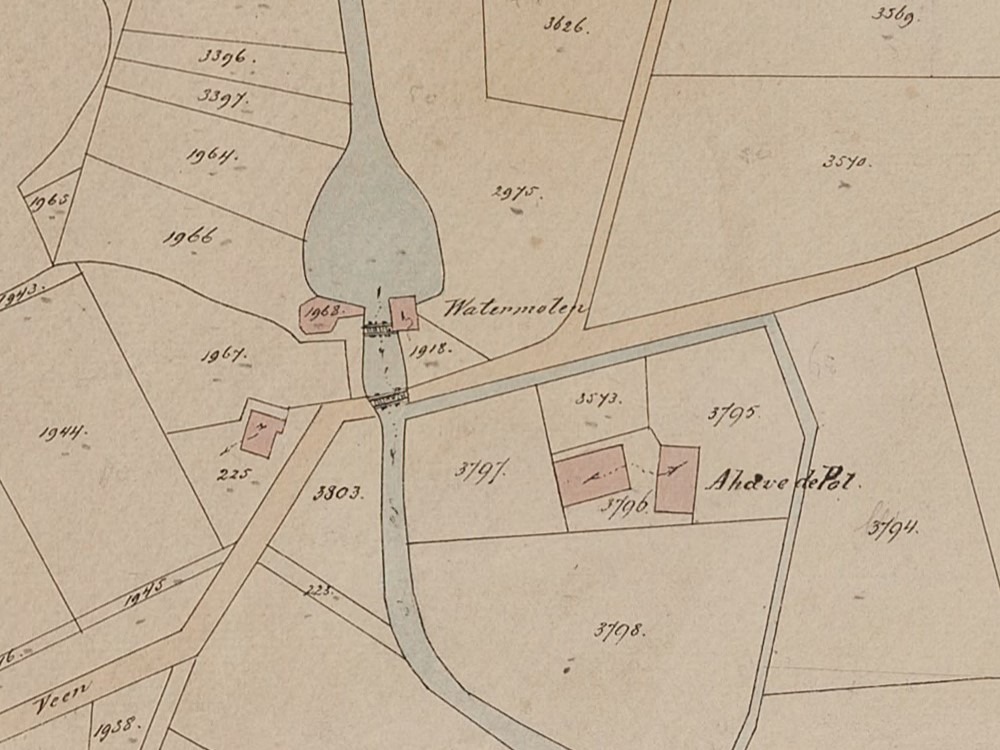
    Location of the watermill, with De Ahof at the top right. All red buildings on this map were, according to 1832 land registry data, owned by Roelof Arentzen, assessor in Aalten. The red lines represent the plot boundaries at the time, which also clearly show the course of the former moat around De Ahof.


    Newspaper reports

    Features


    Cadastral no.I-12213/8533
    FunctionWatermill
    Year of constructionc. 1500
    Demolitionc. 1900

    Sources

  • Arnoldus Florentinus Roelvink, LL.M.

    Arnoldus Florentinus Roelvink, LL.M.

    Mayor (1818–1861) and Notary

    Arnoldus Florentinus Roelvink was born on 23 December 1789 in Borculo, the son of Bernard Andreas Roelvink and Harmina Abbink. On 12 November 1817, he married Elzabé Maria Theodora ten Cate (Neede, 21 July 1798) in Bredevoort; she was the daughter of Tieleman ten Cate and Anna Jacoba Roelvink. The couple had seven children together.

    Roelvink was a notary, and following the French period, he was also appointed in 1813 as the first mayor of the municipality of Bredevoort. When this municipality was merged with Aalten in 1818, Roelvink became the mayor of the merged municipality of Aalten. He held this position until his death on 6 January 1861.

    Roelvink lived with his family in the villa at ‘t Zand in Bredevoort, which is known today as Sint Bernardus. Roelvinkstraat in Bredevoort is named after him.

    Roelvink was succeeded as mayor of Aalten by his son, Mr Leonard Roelvink.

  • St Elisabeth’s Convent

    St Elisabeth’s Convent

    Dijkstraat 8, Aalten

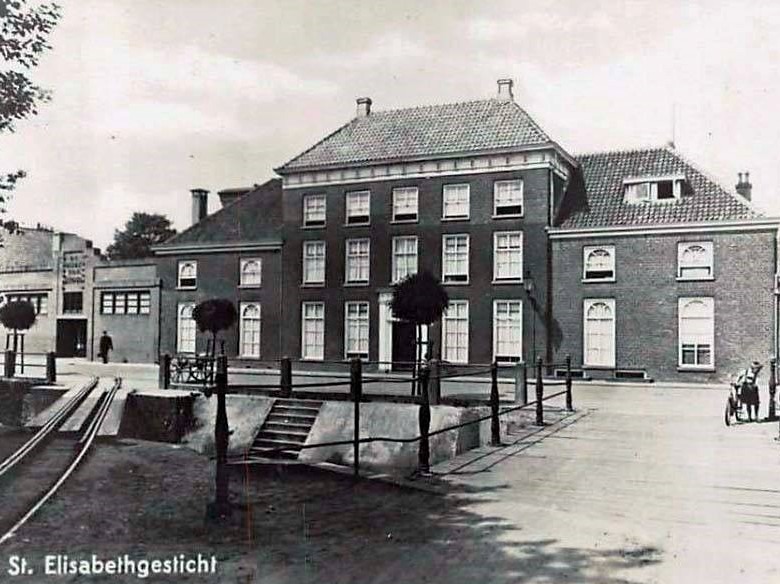
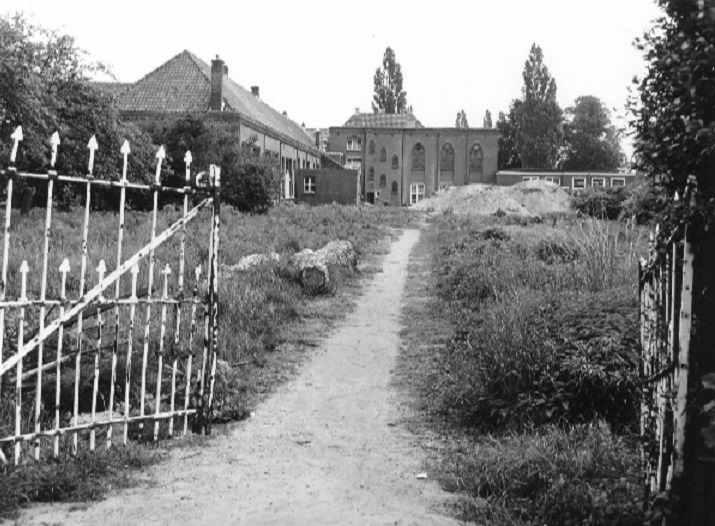
    The Elisabeth Monastery in Aalten was originally the residence of textile manufacturer Johann Heinrich Joseph (Heinrich) Driessen (Bocholt, 10/07/1794 – Aalten, 04/07/1879). On 29 June 1837, his eldest son Theodoor laid the foundation stone.

    Heinrich was also known as “Den veursten Driessen” (The front Driessen); his cousin Anton also lived on what was then Landstraat, in Villa Beekhuize, slightly further south of the town centre, and was therefore known as “d’n achtersten Dreessen” (The rear Driessen).

    Business premises were also established on the property, which served primarily as storage for yarns and woven fabrics. These fabrics were transported by wagon, usually pulled by an ox, to the bleachery in Dale. The driver carried the fitting nickname ‘Ossen Willem’ (Ox Willem).

    After Heinrich’s death, the house came into the possession of the Roman Catholic Church, after which it was put into use as a convent for nuns. On 30 May 1882, six sisters were brought to Aalten from Lichtenvoorde-Groenlo station in a carriage drawn by four horses. The convent was named after Heinrich’s wife, Elisabeth. Locally, it was also referred to as the St Elisabeth Institute.

    Education and Nursing

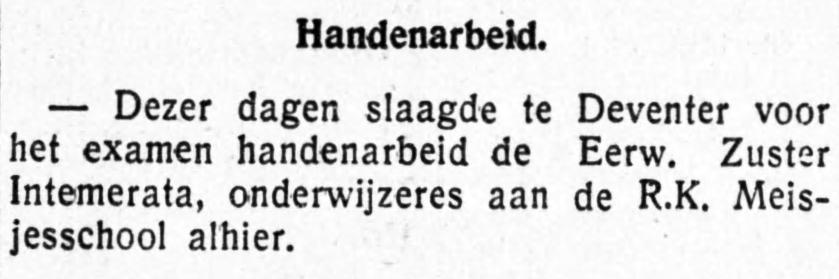
    For eighty years, the sisters provided education here to the Catholic school children of Aalten. The sisters’ ‘sewing and knitting school’ was also based there. Not everyone held pleasant memories of the nuns. The sewing and knitting school, later the Fashion Vocational School, was highly regarded. Partly for this reason, it was not only Catholics who knitted there, but people of all denominations.

    On 23 December 1962, the last sisters left for a convent in Bennebroek. Later, the convent served as accommodation for guest workers.

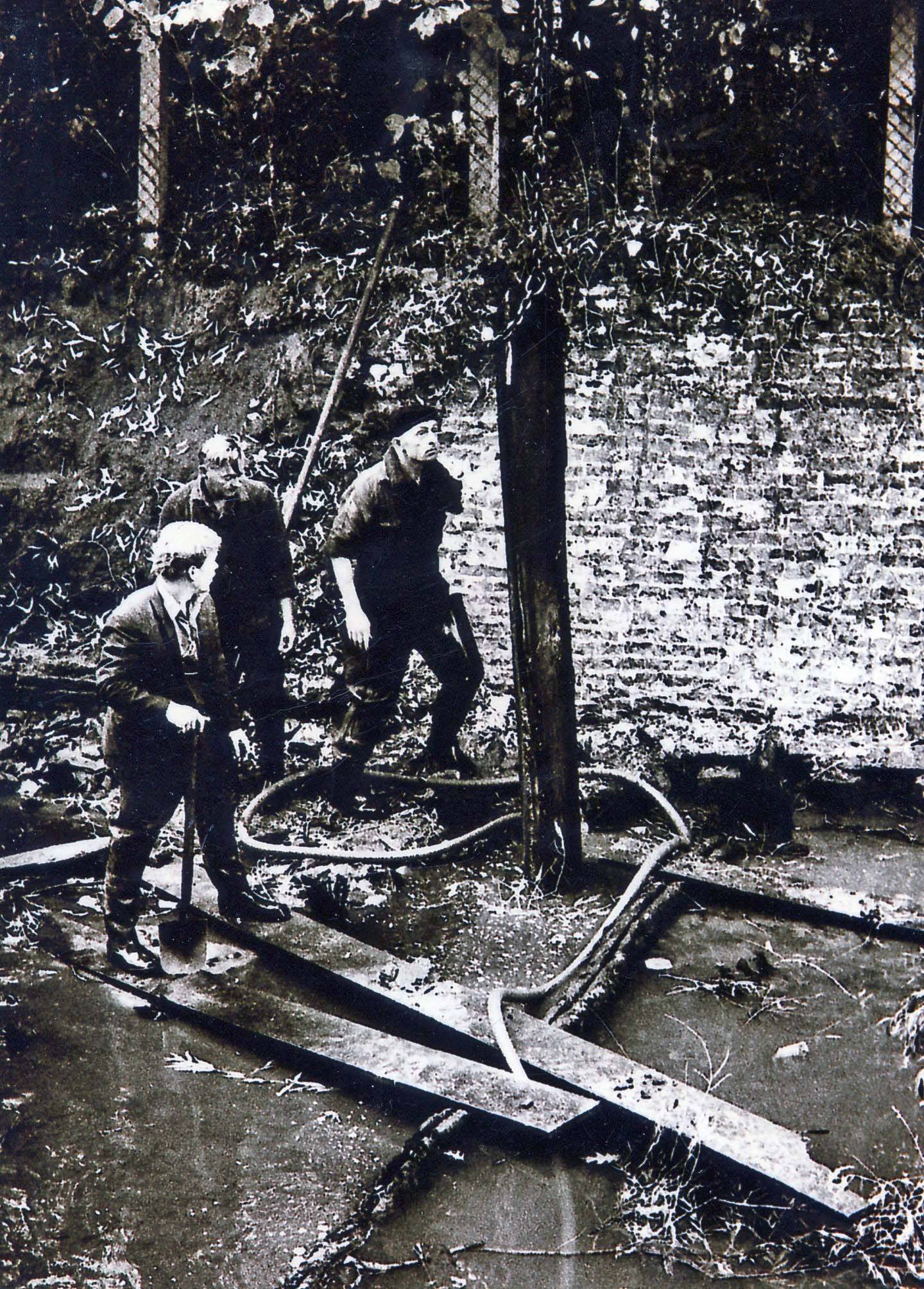
    On 20 December 1980, a small fire broke out in the completely boarded-up building. Just as a ‘foundation stone’ had once been laid, the last stone was removed shortly after the fire. The building made way for the Parish Centre. This has since disappeared as well and has been replaced by an apartment building named ‘Kloosterhof’ (Convent Court).

    Zutphensche Courant, 30 May 1932 (link):

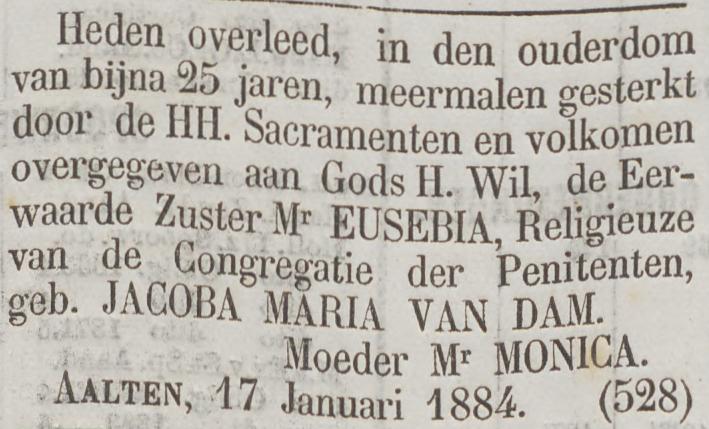
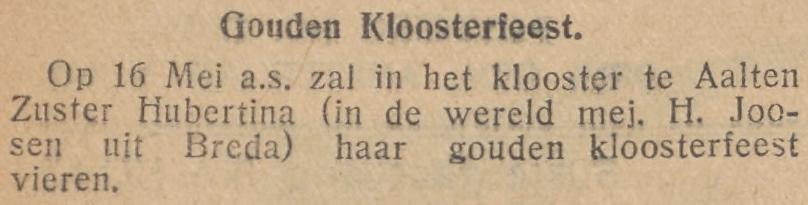
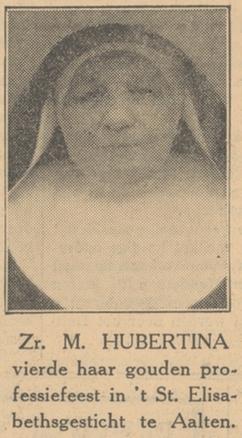
    AALTEN, 29 May – Tomorrow, the 30th, will mark 50 years since the Franciscan Sisters of St. Lucia, Rotterdam (now the Motherhouse Bennebroek) arrived in Aalten. This event will be solemnly commemorated. Following Holy Mass, a large general reception will be held starting from 10 o’clock. On 30 May 1882, the sisters were met in Lichtenvoorde by Parish Priest P. Bosman and Mr Eduard Driessen. The procession was conducted in carriages drawn by pairs of horses. The J. H. J. Driessen family made their house and grounds available to the sisters. A nursery and sewing school were established here immediately. On 1 August 1884, primary education for girls commenced, followed by education for boys in July 1886. The school currently has 258 pupils, and the nursery school has 68. In the fashion vocational school, newly built in 1928, instruction is given to 30 girls in summer and 60 in winter. One of the sisters, namely Sister Hubertina, has been here in Aalten since 30 June 1884.


    Owners

    Overview is incomplete.

    YearPlotOwnerDescription
    1832I-1208Peter Driessen, merchant in Bocholt410 m² house & yard

    Residents

    1813

    Aalten 45

    Gerrit Peters (Heerde, 25-07-1769), tanner

    1 man
    1 woman
    1 son
    4 daughters
    1 old woman

    Population register 1823-1838

    Aalten 45

    Gerrit Peters (Heerde, 24-09-1769), tanner
    Johanna Margreta ten Dam (Aalten, 29-10-1774)

    Next residents:

    Johan Hend. Joseph Driessen (Bocholt/D, 10-07-1794), merchant
    Marie Carolina Elisabeth Sträter (Rheine/D, 13-03-1803)

    Population register 1838-1850

    Aalten 44

    Johan Henrich Joseph Driessen (Bocholt/D, 10-07-1794), manufacturer & merchant
    Marie Caroline Elisabeth Sträter (Rheine/D, 13-03-1803)

    Population register 1850-1860

    Aalten 44

    Johan Henrich Joseph Driessen (Bocholt/D, 10-07-1794), merchant
    Maria Carolina Elisabeth Sträter (Rheine/D, 13-03-1803)

    Population register 1860-1870

    Aalten 44

    Johan Henrich Joseph Driessen (Bocholt/D, 10-07-1794), manufacturer
    Maria Carolina Elisabeth Josephina Sträter (Rheine/D, 13-03-1803)

    Population register 1870-1880

    Aalten 61

    Johann Heinrich Joseph Driessen (Bocholt/D, 10-07-1794), manufacturer

    Next (head) resident (1879-1882):

    Bernhard Heinrich Groot Langenhoff (Dingden/D, 13-09-1833), servant

    Population register 1880-1890

    Aalten 66

    Bernhard Heinrich Groot Langenhoff (Dingden/D, 13-09-1833), farmer

    Next (head) resident (1882-1901):

    Barbara Elizabeth Elzeman (Gouda, 06-10-1835), sister of charity

    Population register 1890-1900

    Aalten 65

    Barbera Elisabeth Elseman (Gouda, 06-10-1835)

    Population register 1900-1910

    Aalten 82 > A20

    Barbera Elisabeth Elseman (Gouda, 06-10-1835)

    Next (head) resident:

    Geertje Ruijter (Westwoud, 08-01-1857)

    Population register 1910-1920

    Aalten A20

    Geertje Ruijter (Westwoud, 08-01-1857), Mother Superior

    Next (head) resident:

    Aalten A20 > A6

    Aafke van der Werf (Bolsward, 21-10-1872), nurse

    Address directory 1934

    Aalten A6 > Dijkstraat 8

    Convent

    Address directory 1967

    Dijkstraat 8

    Former Convent

    Features


    Cadastral no.I-11429
    FunctionResidential,
    Convent
    Year of construction1837
    Demolitionca. 1981

    Sources

  • Grevink Mill

    Grevink Mill

    Lichtenvoordsestraatweg 77, Barlo (verdwenen)

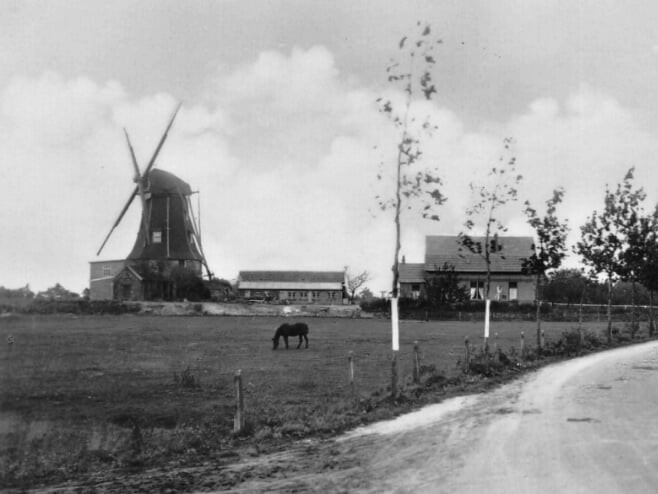
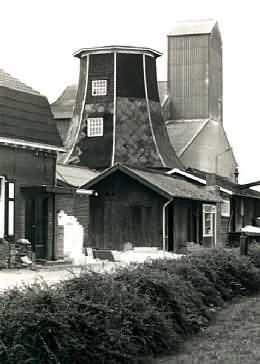
    From 1856, an octagonal smock mill (mound mill) stood on the Lichtenvoordsestraatweg in Barlo, which in the twentieth century grew into a milling facility and compound feed business owned by the Grevink family. The mill was dismantled in 1944 and was ultimately lost to fire in 1986.

    In 1853, voices were raised in Barlo suggesting that a mill should also be established in this rural district. Initially, a water-powered mill was considered. However, research revealed that the Zilverbeek did not provide sufficient water flow per hour. Consequently, a windmill was built in 1856, located a few hundred meters further north. It was an octagonal smock mill, specifically a mound mill type.

    The method of propulsion consistently kept pace with the times. From 1887, the mill was powered by a steam engine, which made way for a gas engine in 1925. When electricity became available in Barlo in 1934, the electric motor proved to be a significant asset.

    The last miller was J.W.F. Grevink — secretly nicknamed Jan Willem Fluweel. As early as 1928, he opened a bakery and grocery store next to the mill.

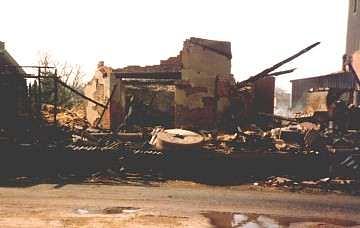
    The mill had already been dismantled by 1944. Without its sails, the fire insurance premium was lower. In the early morning of March 29, 1986, a fire broke out that put a permanent end to this mill. Prompt intervention by the fire department prevented an adjacent pig barn from being lost to the flames. The cause of the fire remains unknown.


    Address history

    Population register 1900-1910

    Barlo 79

    Mill

    Address directory 1934

    Barlo 75 > 108

    Grain mill

    Address directory 1967

    Barlo 108 > Lichtenvoordsestraatweg 77

    Mill

    Features


    Cadastral no.N-705/704
    FunctionWindmill
    Year of construction1856
    Burned down1986

    Sources

  • St Bernardus

    St Bernardus

    ‘t Zand 23, formerly ‘t Zand 15, Bredevoort

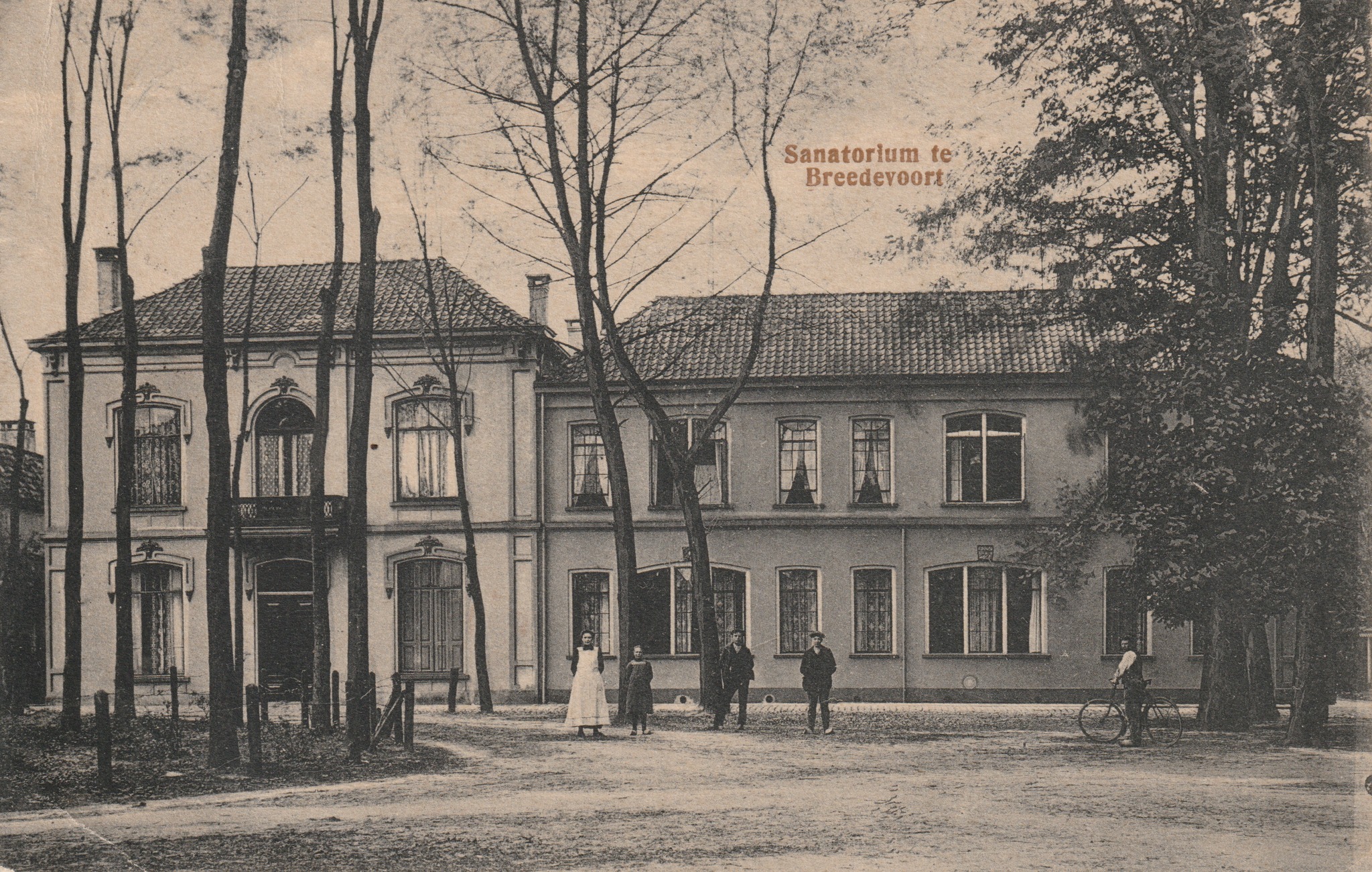
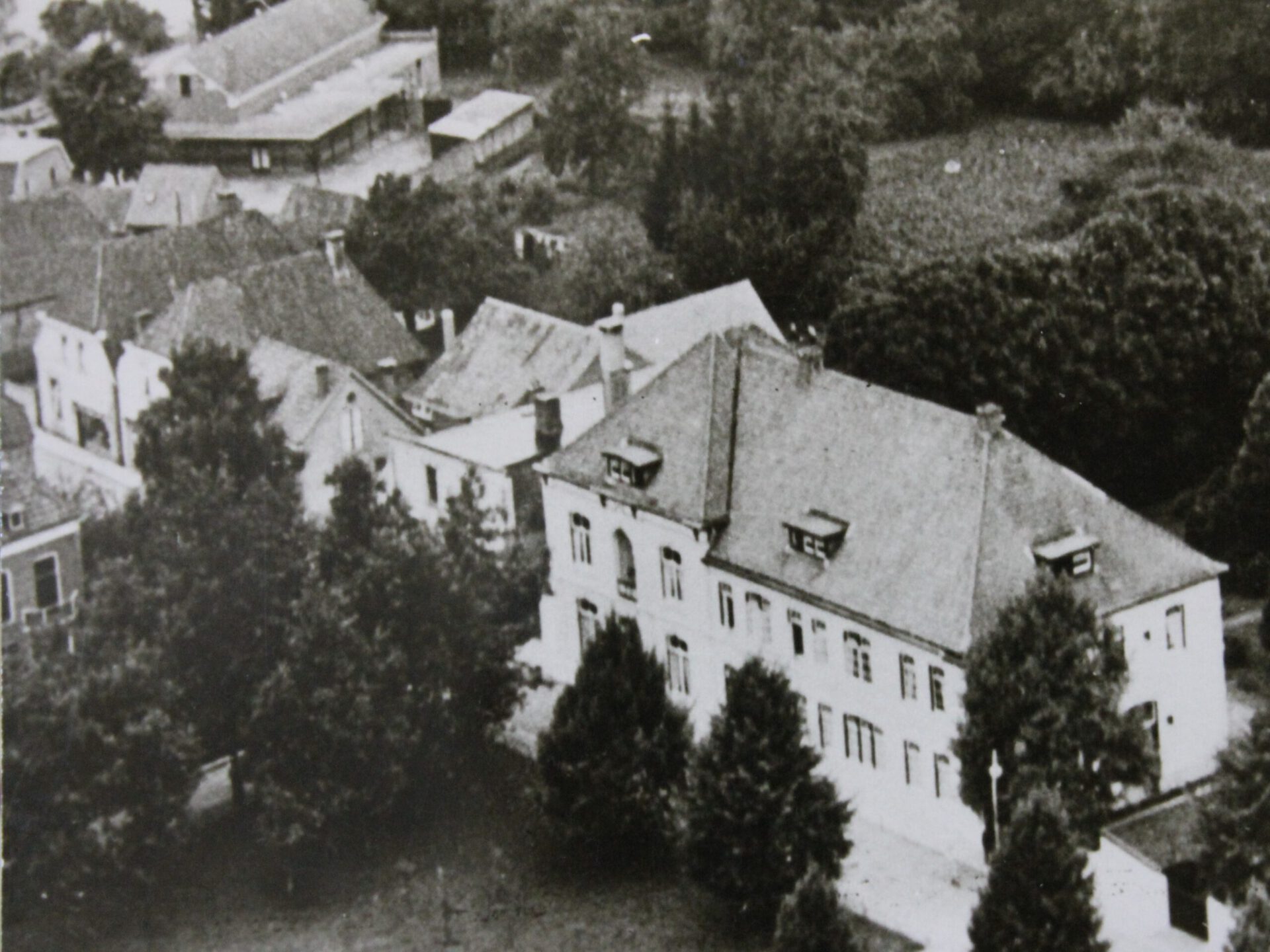
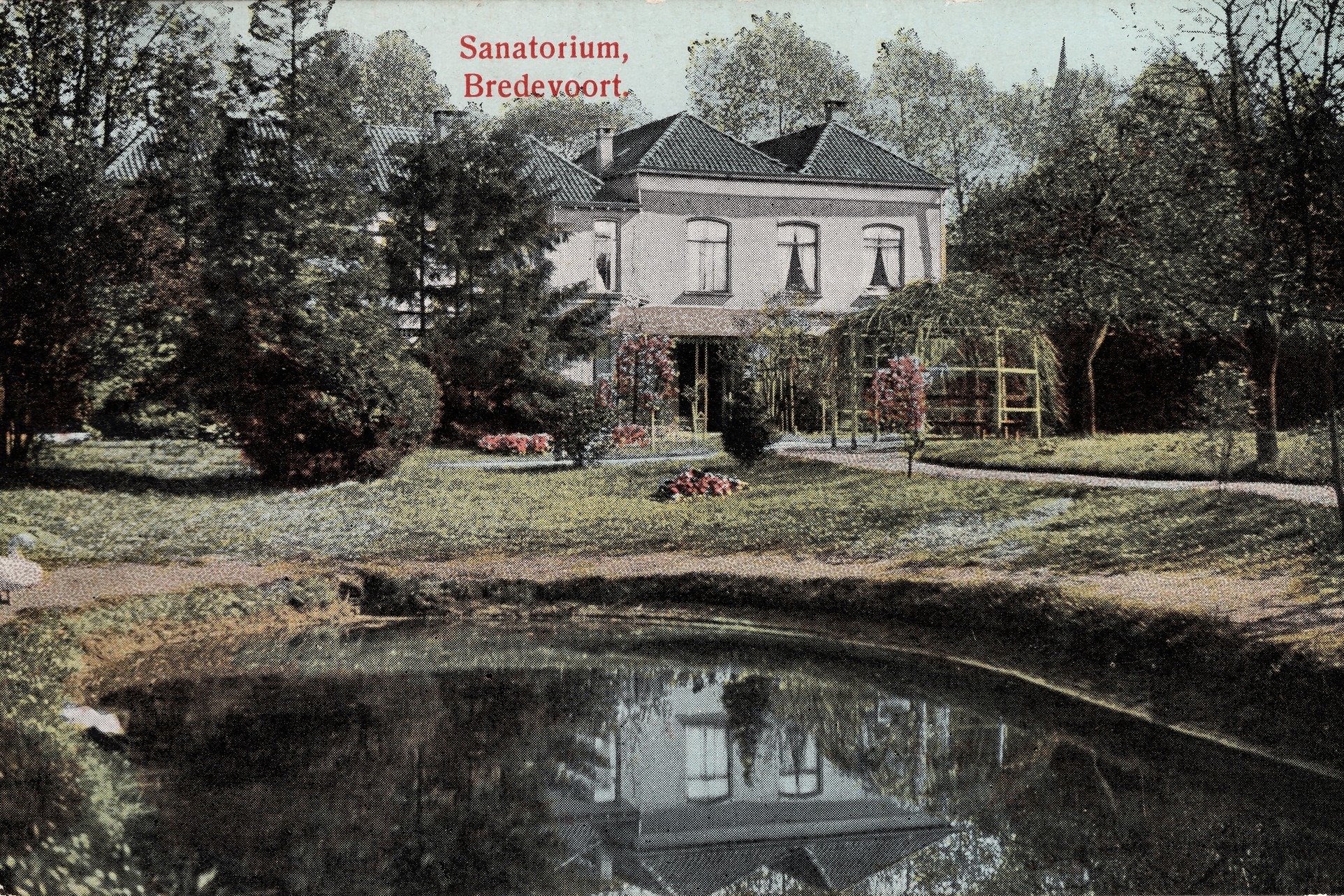
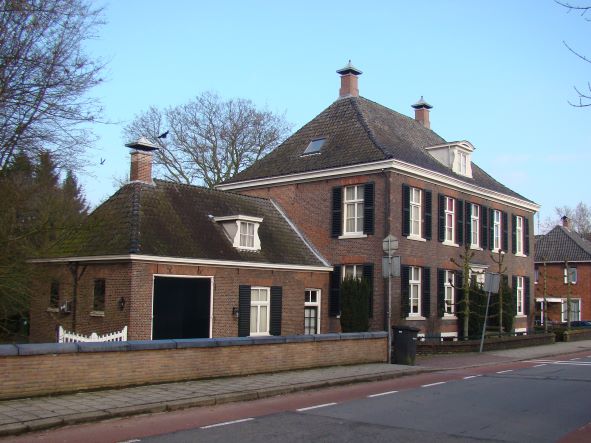
    St Bernardus House is a distinctive building on ’t Zand, the central square of Bredevoort. The building has a rich history, having served as a residence, a sanatorium, and a nursing home.

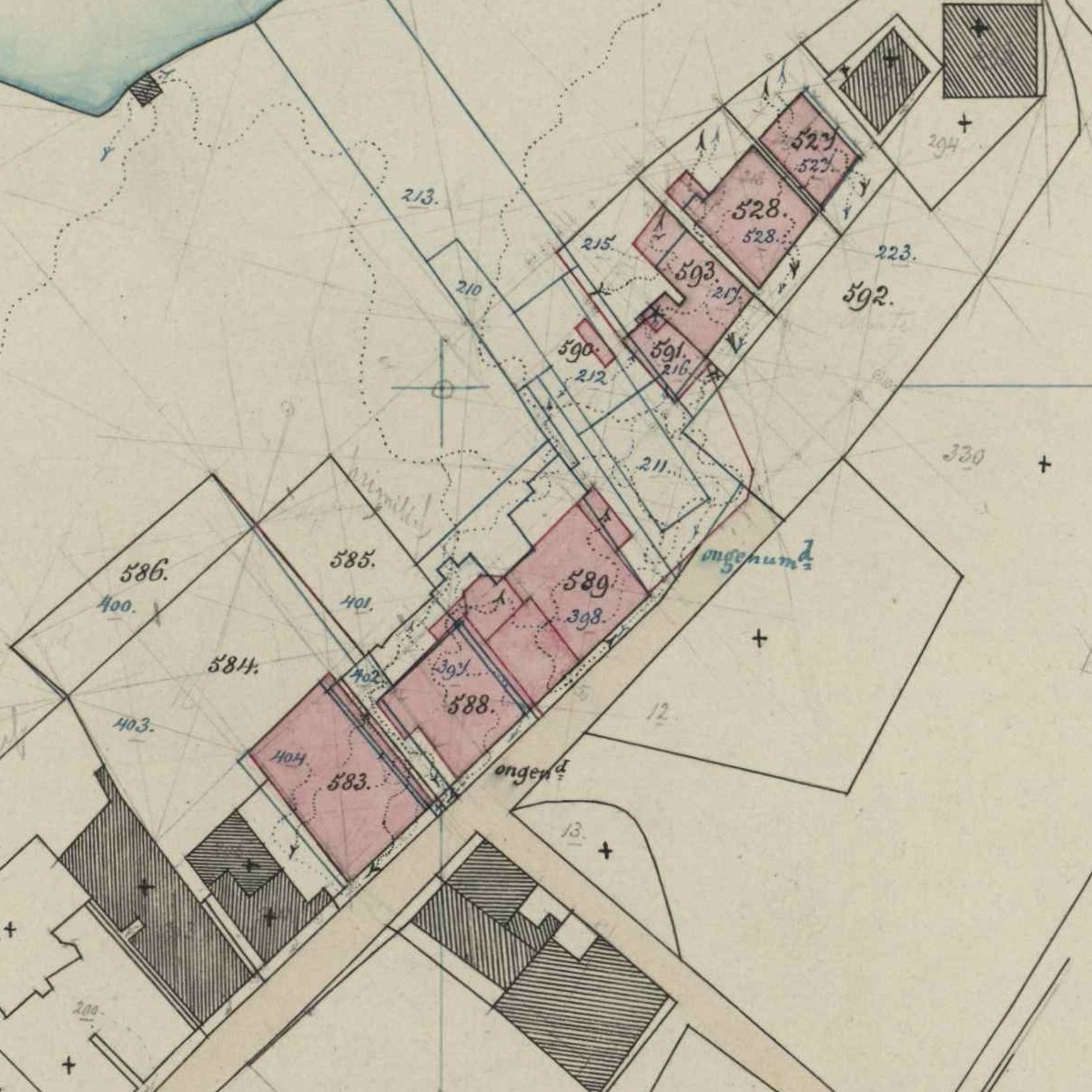
    The building was originally commissioned by Jan Satink, a lieutenant colonel in the States Army, Regiment of Nationals. It was erected on the site where the outer bailey of Bredevoort Castle once stood. In 1800, the house passed into the possession of the Roelvink family through inheritance. Arnoldus Florentinus Roelvink, a scion of this family, served as the mayor of Bredevoort from 1813.

    In 1897, the building was purchased by Father Bernardus Mulders. The priest was a man of means and acquired the former steward’s house with his own funds. His goal, he wrote, was to offer “his poor children” a Catholic education. Because Catholic schools were costly at the time, he devised a clever solution: he brought nuns to Bredevoort, who established a convent and a sanatorium in the steward’s house. Nuns were an economical option as they received no salary, having dedicated their lives to God.

    Under the management of the Franciscan Sisters of Thuine, the ‘R.K. Sanatorium St. Bernardus Gesticht’ (Roman Catholic St. Bernardus Sanatorium Institute) was established. He named the convent-sanatorium after his own patron saint, Saint Bernard of Clairvaux. With the profits from the sanatorium, the priest started a primary school: the Sint Joannesschool.

    The sanatorium was intended for wealthy patients, as the nursing costs were high, ranging from f 1.50 to f 2.20 per day. Medical expenses and pharmacy costs were charged at 10 guilders per month. Second-class patients paid f 7.50.

    From 1907, people came to Bredevoort from all over the country to recover in the sanatorium. They often stayed for months. During the day, they would lie in bed in an open-air pavilion (lighal), even in winter, completely wrapped up. In the garden of Sint Bernardus—now the Vestingpark (Fortress Park)—there were at least ten of these pavilions, with their open sides facing the sun. Two of these have been preserved and are now designated as national monuments (rijksmonumenten).

    The sanatorium remained in use until 1933. Afterwards, the building was repurposed as a nursing home for the elderly. In 1938, the Sisters of Thuine were succeeded by the Sisters of St. Joseph from Amersfoort. The last sisters left Bredevoort in 1985.

    In 1988, a large-scale renovation and expansion of the building was carried out by the Stichting Verzorgingstehuis St. Bernardus (St. Bernardus Nursing Home Foundation). The nursing home eventually moved to the newly rebuilt Ambthuis in 2008.

    Since 2020, the building has had a new destination: it is used as the boutique hotel & brasserie De Heerlyckheid.


    Owners

    Overview is incomplete.

    YearPlotOwnerDescription
    1832B-209
    B-208
    Arnoldus Florentinus Roelvink,
    mayor of Aalten and
    Bredevoort in Bredevoort
    550 m² house & garden
    220 m² house & garden
    1877B-397
    B-380
    Bernard Andries Roelvink,
    clerk at the cantonal court
    235 m² house & garden
    552 m² house & garden
    1887B-588
    B-589
    Leonard Roelvink, mayor240 m² house & yard
    280 m² coach house, kitchen, stables & yard
    1898B-588
    B-589
    Hermann Schepers, schoemaker240 m² house & yard
    280 m² coach house, kitchen, stables & yard
    1901B-734R.C. church of Bredevoort21.023 m² house, sheds, yard & garden
    1909B-792R.C. church of Bredevoort13.373 m² house, hospital,
    shed & garden
    1952B-979R.C. church of Bredevoort13.538 m² house, stables,
    hospital & garden
    1988B-1265St. Verzorgingshuis Sint Bernardus 2.760 m² “BWT”

    Features


    Cadastral no.B-1963
    FunctionResidential property,
    Sanatorium,
    Retirement home,
    Hospitality
    Year of construction1764
    MonumentMunicipal
    monument

    Residents

    Period 1823-1850

    Bredevoort 45

    Arnoldus Florentinus Roelvink (Borculo, 23-12-1789), mayor
    Elzabé Maria Theodora ten Cate (Neede, 21 juli 1798)

    Bredevoort 46

    Theodora Sophia Roelvink (Bredevoort, 09-11-1760)

    Period 1838-1850

    Bredevoort 77

    Arnoldus Florentinus Roelvink (Borculo, 23-12-1789), mayor
    Elzabé Maria Theodora ten Cate (Neede, 21 juli 1798)

    Bredevoort 78

    Theodora Sophia Roelvink (Bredevoort, 09-11-1760)

    Period 1850-1860

    Bredevoort 77

    Arnoldus Florentinus Roelvink (Borculo, 23-12-1789), mayor
    Elzabe Maria Theodora ten Cate (Neede, 21 juli 1798)

    Bredevoort 78

    Theodora Sophia Roelvink (Bredevoort, 09-11-1760)

    Period 1860-1870

    Bredevoort 77

    Elzabe Maria Theodora ten Cate (Neede, 21 juli 1798)

    Bredevoort 78

    ?

    Period 1870-1880

    Bredevoort 84

    Elzabe Maria Theodora ten Cate (Neede, 21 juli 1798)

    Bredevoort 85

    Leonard Roelvink (Bredevoort, 30-04-1833), mayor
    Christina Paschen (Winterswijk, 27-03-1848)

    Period 1880-1890

    Bredevoort 101

    Elzabe Maria Theodora ten Cate (Neede, 21 juli 1798)

    Bredevoort 102

    Leonard Roelvink (Bredevoort, 30-04-1833), mayor
    Christina Paschen (Winterswijk, 27-03-1848)

    Period 1890-1900

    Bredevoort 85a

    Heinrich Nuijken (Gahlen/D, 11-09-1833)
    Anna Velthacke (Vreden/D, 16-05-1834)

    Bredevoort 85

    Christina Paschen (Winterswijk, 27-03-1848)

    Next residents:

    Hermann Schepers (Weseke/D, 17-08-1828), schoemaker
    Elisabeth Dieckmann (Alpen/D, 24-12-1840)

    Period 1900-1910

    Bredevoort 83a

    Heinrich Nuijken (Gahlen/D, 11-09-1833)
    Anna Velthacke (Vreden/D, 16-05-1834)

    Next residents:

    Catharina Niemeijer (Salzbergen/D, 28-11-1856)

    Here follows a long list of nurses and schoolteachers.

    Continued list of residents:

    Bredevoort 83a > 084

    More (a.o.) foster sisters, teachers, sisters of charity, as well as patients.

    Bredevoort 83 > 85

    Hermann Schepers (Weseke/D, 17-08-1828), schoemaker
    Elisabeth Dieckmann (Alpen/D, 24-12-1840)

    Period 1910-1920

    Bredevoort 84 > 60

    ?

    Bredevoort 85 > 61

    Hermann Schepers (Weseke/D, 17-08-1828), schoemaker
    Elisabeth Dieckmann (Alpen/D, 24-12-1840)

    Address directory 1934

    Bredevoort 60 > ‘t Zand 15

    St Bernard’s Institution

    Address directory 1967

    ‘t Zand 23

    St Bernard’s Institution

  • Beekhuize

    Beekhuize

    Dijkstraat 14, Aalten

    Villa Beekhuize serves as a reminder of the heyday of the textile industry in the village of Aalten.

    Textile manufacturer Anton Driessen initially lived with the Meijerink family on Kerkstraat upon his arrival in Aalten. Later, he purchased a property on Landstraat. In 1833, Anton Driessen wished to build a new residence. To this end, he had purchased a house from the Degenaar estate at the end of Landstraat—the present-day Dijkstraat. He intended to demolish that house and construct a new, modern home on the site, complete with a warehouse, barn, and stables. However, he required more space than the existing plot provided. Anton Driessen subsequently submitted a proposal to the municipal authorities.

    This plan necessitated the diversion of both the stream and the street. Furthermore, a new bridge was required. Because the piles of the old bridge had nearly rotted away, the construction of a new bridge was not only highly necessary but, according to Driessen, the relocation would also be less costly. In addition to diverting the stream and building a new bridge, Driessen also required land for his plans. To this end, he exchanged a plot of land with the municipality. Negotiations regarding the aforementioned matters lasted several years. Construction finally commenced in March 1835.

    In addition to Anton Driessen, his nephew Heinrich also built a house on what was then Landstraat. Heinrich Driessen positioned a generous residence closer to the town centre, for which his eldest son, Theodoor, laid the foundation stone on 29 June 1837. Ever since, locals have referred to the two properties as ‘d’n veursten’ (the front) and ‘d’n achtersten Dreessen’ (the rear Driessen).


    Owners

    Overview is incomplete.

    YearPlotOwnerDescription
    1832I-1231
    I-1233
    Jan Berend Lohuis199 m² house & yard
    2.250 m² garden

    Residents

    1813

    Aalten 37

    Johannes Degenaar (Aalten, 25-10-1779), weaver son
    Evert Degenaar (Aalten, 10-05-1744), weaver father

    1 man
    1 woman
    1 father
    3 boys

    Population register 1823-1837

    Aalten 37

    Hendrika Luijten (Aalten, 16-09-1784), widow of Johannes Degenaar

    Next residents:

    Aalten 37

    Johannes Bernardus Antonius Driessen (Bocholt, 05-12-1797 – Aalten, 07-03-1879)
    Isabella Lodewika Antoinetta Dees (Bocholt, 04-11-1800 – Aalten, 15-12-1879)

    Population register 1838-1851

    Aalten 35

    Johannes Bernardus Antonius Driessen (Bocholt, 05-12-1797 – Aalten, 07-03-1879)
    Isabella Lodewika Antoinetta Dees (Bocholt, 04-11-1800 – Aalten, 15-12-1879)

    Population register 1850-1861

    “Landstraat”

    Aalten 35

    Johan Bernard Anton Driessen (Bocholt, 05-12-1797 – Aalten, 07-03-1879)
    Isabella Lodewika Antonetta Dees (Bocholt, 04-11-1800 – Aalten, 15-12-1879)

    Population register 1860-1870

    Aalten 35

    Joh. Bernard Anton Driessen (Bocholt, 05-12-1797 – Aalten, 07-03-1879)
    Isabella Lodewika Antonetta Dees (Zutphen, 04-11-1800 – Aalten, 15-12-1879)

    Population register 1870-1880

    Aalten 54

    Johan Bernard Anton Driessen (Bocholt, 05-12-1797 – Aalten, 07-03-1879)
    Isabella Lodewika Antonetta Dees (Zutphen, 04-11-1800 – Aalten, 15-12-1879)

    Next (head) resident:

    Helena Dorothea Elisabeth Driessen (Aalten, 09-06-1840 – Aalten, 21-04-1918)

    Population register 1880-1890

    Aalten 57

    Helena Dorothea Elisabeth Driessen (Aalten, 09-06-1840 – Aalten, 21-04-1918)

    Next residents:

    Johannes Henricus Lambertus van den Hurck (Den Bosch, 14-11-1840), office clerk
    Wilhelmina Philomena Maria Kroes (Den Bosch, 30-07-1844)

    Next (head) resident:

    Helena Dorothea Elisabeth Driessen (Aalten, 09-06-1840 – Aalten, 21-04-1918), widow of Johannes Antonius van Basten Batenburg

    Population register 1890-1900

    Aalten 57

    Helena Dorothea Elisabeth Driessen (Aalten, 09-06-1840 – Aalten, 21-04-1918)

    Population register 1900-1910

    Aalten A79 > A23

    Helena Dorothea Elisabeth Driessen (Aalten, 09-06-1840 – Aalten, 21-04-1918)

    Population register 1910-1920

    Aalten A23

    Helena Dorothea Elisabeth Driessen (Aalten, 09-06-1840 – Aalten, 21-04-1918)

    Next resident:

    Aalten A23 > A9

    Maria Petronella Johanna Koster (Epe, 21-11-1881)

    Address directory 1934

    Aalten A8/1 > Dijkstraat 14

    H.J.A.M. Driessen

    Address directory 1967

    Dijkstraat 14

    H.J.A.M. Driessen

    Features


    Cadastral no.I-11032
    FunctionHouse
    Year of construction1835
    ListedNational monument

    Sources

  • Christiaan Casper Stumph

    Christiaan Casper Stumph

    Mayor (1811–1818)

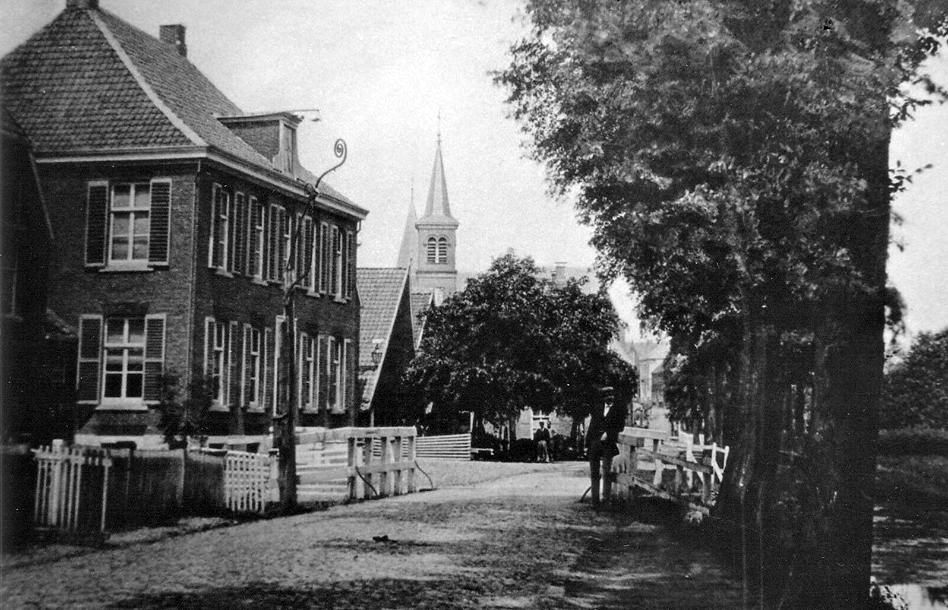
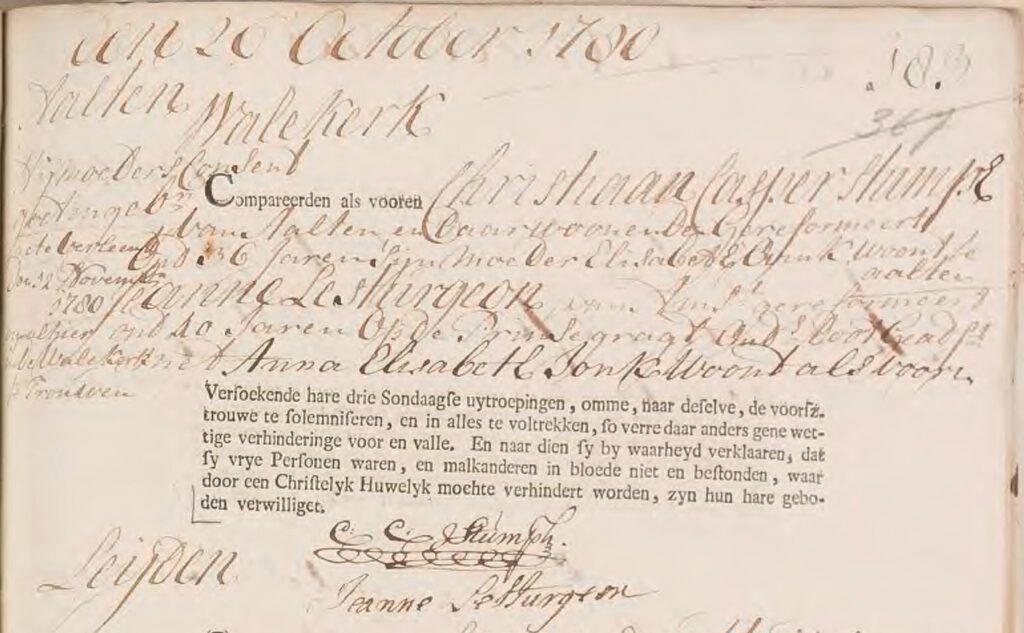
    Christiaan Caspar Stumph was baptized in Aalten on February 14, 1745, as the son of Abraham Stumph and Elisabeth Ovink. On November 12, 1780, he married Jeanne Lesturgeon. They had at least one child, Abraham Antoni. This son drowned in the Slingebeek at the age of 34. Popular belief held that his death was related to a broken heart.

    In 1795, Stumph was accused of the attack on Ten Holte and imprisoned. He was released a month later as his guilt could not be proven.

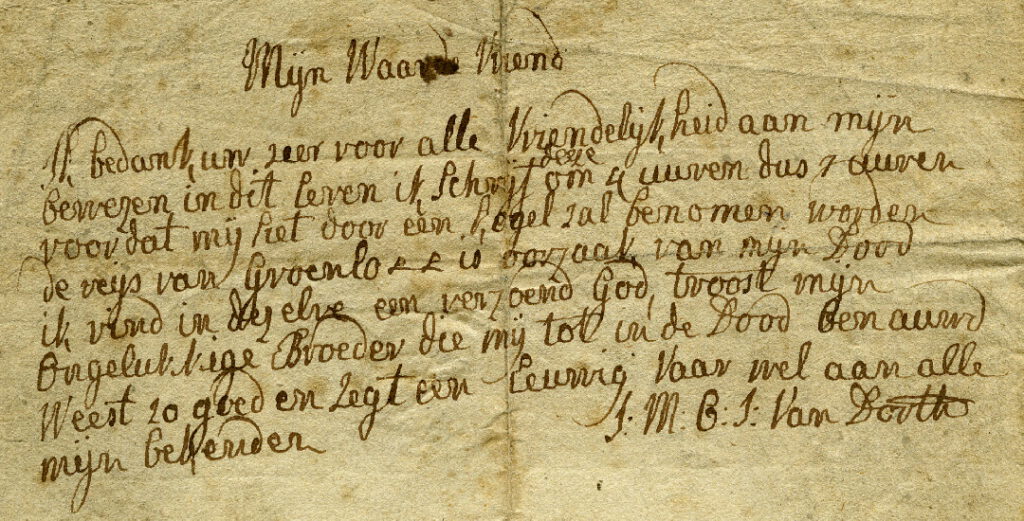
    Stumph was a close friend of the Freule van Dorth, who was executed in Winterswijk in 1799. Seven hours before her death, she wrote him a letter: “My Dear Friend, I thank you very much for all the kindness shown to me in this life. I write [this] at 4 o’clock, thus 7 hours before [life] shall be taken from me by a bullet. The journey from Groenlo etc. is the cause of my death. I find in the same a reconciled God; comfort my Unfortunate Brother who is distressed for me until Death. Be so kind as to say an Eternal Farewell to all my acquaintances. J.M.C.J. van Dorth.

    The first mayor of Aalten

    Following the annexation of our country by France on July 10, 1810, the entire administrative power was restructured and centralized according to the French model. A departmental organization was established, headed by a prefect for the departments, a sub-prefect for the districts, and a maire (mayor) for the municipalities.

    On March 12, 1811, Christiaan Caspar Stumph was appointed maire of the Canton of Aalten. He is therefore considered the first mayor of the municipality of Aalten. He held this position until January 1, 1818, when a new administrative regulation was established.

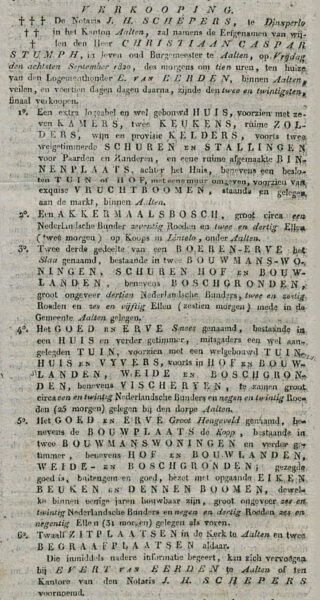
    Stumph lived at the Smees. He was a person of independent means and an organist in Aalten, a man of integrity with many noble objectives. On May 14, 1819, at the age of 74, he married 30-year-old Caatjen Weversborg in Aalten. As far as is known, their marriage remained childless.

    Christiaan Casper Stumph was a man who frequently endeavored to put an end to existing abuses. One of his greatest grievances was the practice of burial inside the church or in the churchyard within the village. Indeed, this often led to unimaginable situations. On several occasions, subsidences occurred in the church floor, and the owners of these graves failed to carry out the necessary repairs. For weeks, the pews near the hole in question would be uninhabitable. Consequently, a regulation was established stating that churchwardens, in cases of negligence, were permitted to contract out the necessary repairs, whereby the plot in question would revert to the church.
    Burial mound at ‘het Smees’

    The condition of the cemetery around the church was also frequently poor. Because burials had not been conducted at a “sufficient” depth for a long time, bones regularly came to the surface. A bone collector gathered these remains from time to time for two bushels of rye per year and threw them into the “Beenhalle,” a small building in the churchyard on the Market side. If the stock became too large, it was cleared out, and the walls were cleaned and repaired where necessary.

    With the improvement of social conditions and higher hygiene standards, changes slowly but surely occurred in this area, including the obligation to make graves sufficiently deep. A law to prohibit burial within towns and villages, following foreign examples, could not yet find favor in our country. People could not bring themselves to take the major step of breaking with all traditions and leaving the dead “just anywhere in the ground” far outside the village.

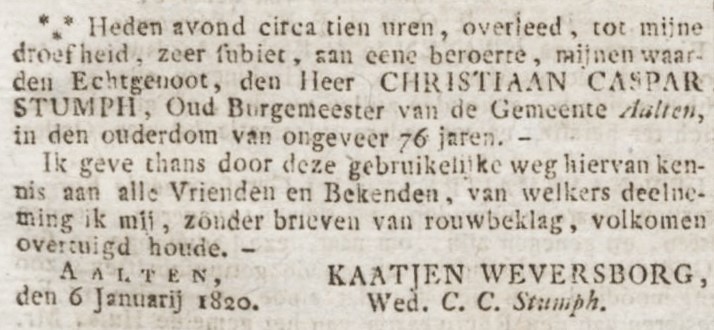
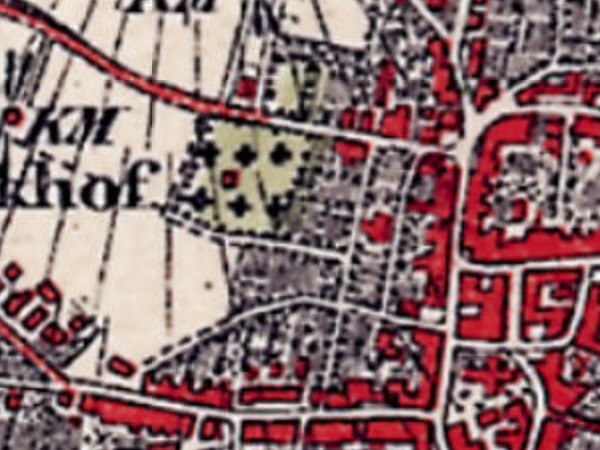
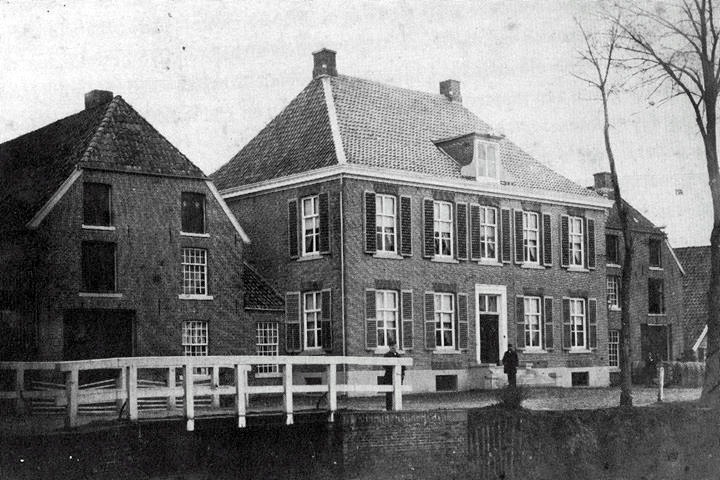
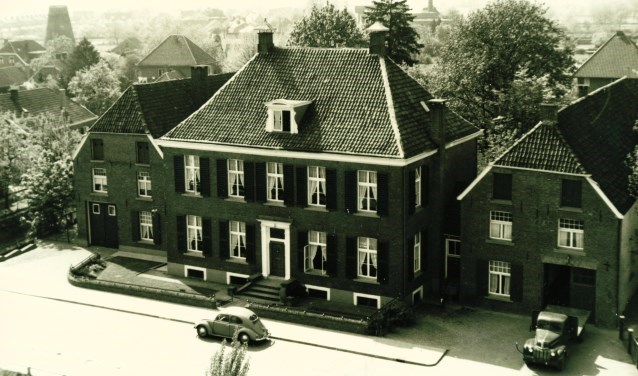
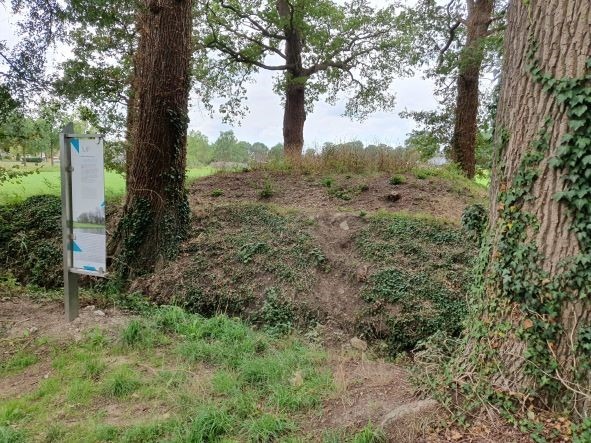
    Stumph was a proponent of burial outside the village; he decided to have an “Outer Cemetery” created in one of the Smees meadows. In 1818, the foundation deed and will were drawn up. Christiaan Casper Stumph passed away on January 6, 1820. According to his last wish, he was buried at the old Smees. This site is still recognizable today as a burial mound, located on Nannielaantje.

    Mayor Stumph was succeeded by Mr. Arnoldus Florentinus Roelvink.

    Leestip


    ‘Van Maire Stumph tot Burgemeester Stapelkamp’, door Leo van der Linde

  • Aalten Synagogue

    Aalten Synagogue

    Stationsstraat 7, Aalten

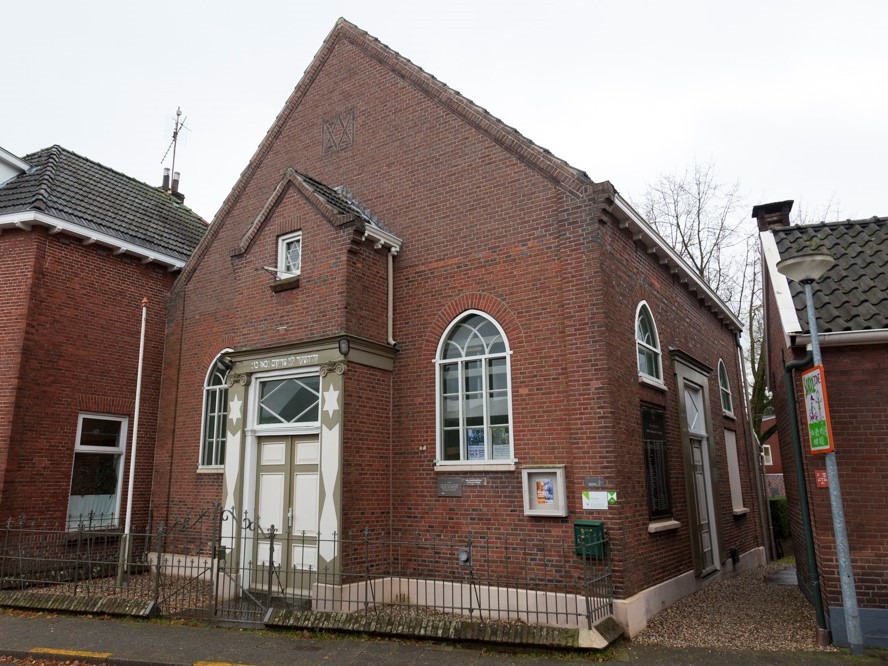
    In the centre of Aalten is a small, well-restored, and beautifully furnished synagogue, which formed the centre of Jewish life in this Achterhoek municipality for nearly a century. The building is currently owned by a foundation, the Friends of the Aalten Synagogue.

    By the mid-19th century, the Jewish congregation in Aalten had grown so much in number that a residential house became too small for the weekly Sabbath services. The community wanted their own shul, not only for religious services but also for the education of the youth. Consequently, a synagogue was built in 1857. It was a simple rectangular building with no architectural distinction, yet functional for the Jewish congregation in Aalten, which was still far from wealthy but strictly Orthodox. Nothing is known about the architect.

    The synagogue became the centre of a lively community life, which lasted until the catastrophe that befell all Jewish communities during the years of the German occupation. The members of the congregation who were unable to go into hiding in time were deported and murdered.

    World War II

    During the occupation, two attempts were made to set fire to the synagogue. The synagogue was largely plundered and gutted to convert the building for ammunition storage. While the interior of the building was destroyed, the Torah scrolls and ritual objects were hidden in time and thus preserved. After the war, the scrolls of the law were returned to the building. The synagogue was repaired, funded by the proceeds from the sale of the chazzan’s house (since 1948, the congregation could no longer afford the salary for a cantor).

    However, a large proportion of the congregation members who survived the war moved elsewhere, meaning the Jewish community had no chance to flourish again. Increasingly, they failed to achieve the required number of men (minyan) to hold services. The synagogue fell into disuse and was in danger of falling into decay.

    Restoration

    In 1984, the building was sold to the Friends of the Aalten Synagogue Foundation (Stichting Vrienden van de Aaltense Synagoge). This foundation took on the responsibility for a thorough restoration. On 29 December 1986, the synagogue was rededicated with a solemn Hanukkah celebration.

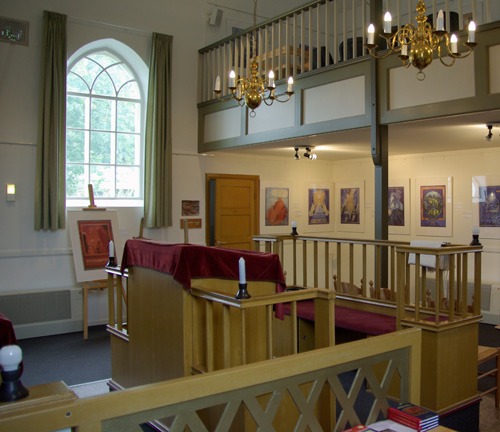
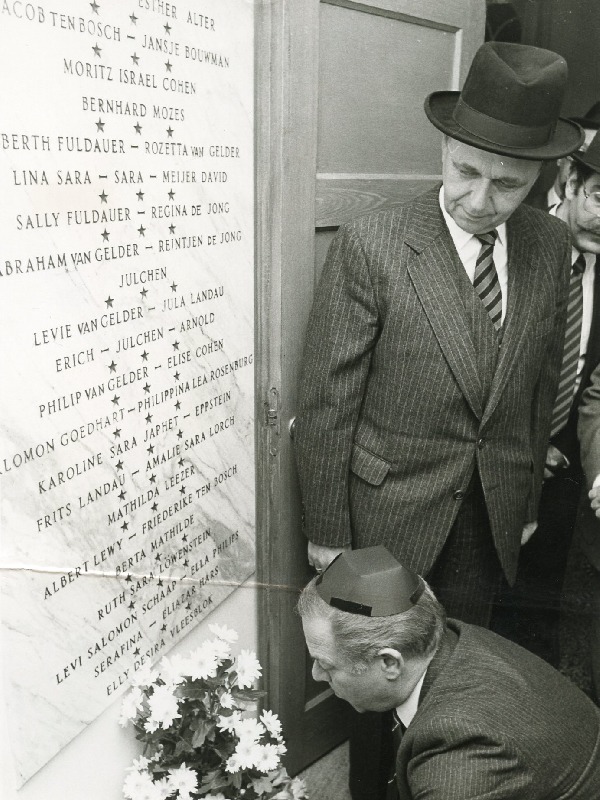
    There are features well worth seeing on both the interior and the exterior. Inside, these include the Holy Ark, four Torah scrolls, the Tablets of the Law, the ner tamid, the menorah, the hanukkiah, the bimah, the women’s gallery, and the mikveh. On the exterior, these comprise the inscription above the door, the mezuzah, and the plaque on the right-hand side of the outer wall.

    The Aalten synagogue can be visited regularly during the summer months.

    Features


    Cadastral no.I-11944
    FunctionSynagogue
    Year of construction1857
    ListedMunicipal
    monument