Traveling—whether through one’s own country or abroad—is a pastime of all ages and all peoples. Traveling and the writing of travelogues also took place in Overijssel. The Deventer scholar Mr. G. Dumbar wrote extensively about our country in the 18th century, including Gelderland. In the ‘Tegenwoordige Staat van alle Volkeren’ (Gelderland section), he describes towns and villages in the Achterhoek, from which we derive several insights. Starting at Borculo and moving toward Lichtenvoorde, we shall recount how Dumbar viewed the old lands of the County.
Much has changed; the heathlands and peat bogs have largely disappeared. The treacherous sandy tracks have been replaced by excellent paved roads. The impoverished, hut-like farmhouses have been transformed into proper dwellings for both man and livestock. Many forests have likewise vanished, and along with this progression over the last two centuries, numerous noble houses have gone as well. Towns and villages have changed, yet not so much that they have lost the prominence they already held to this day.
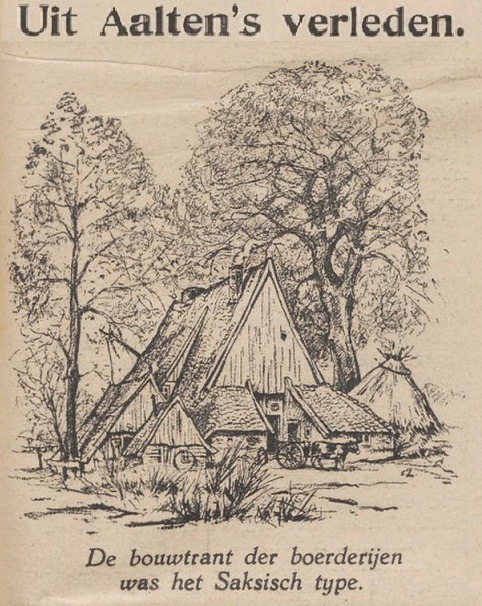
Illustration by Piet te Lintum from the article ‘Boerenleven‘
The Lordship of Bredevoort
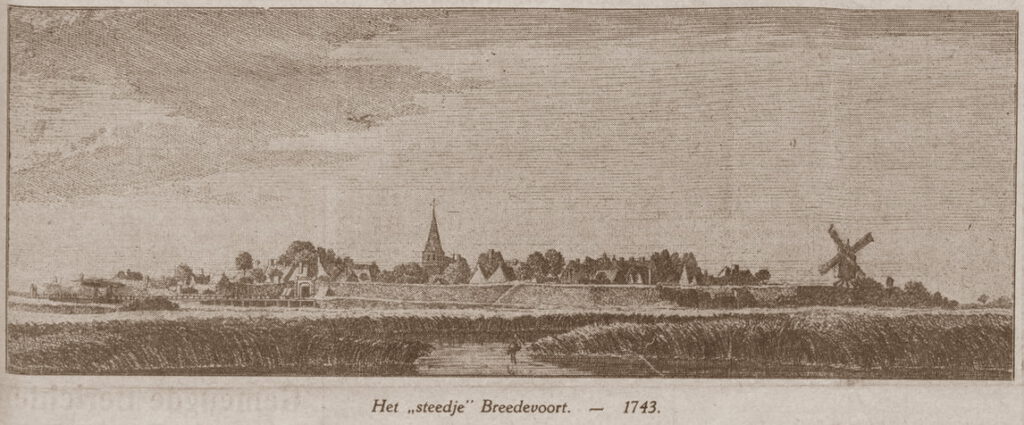
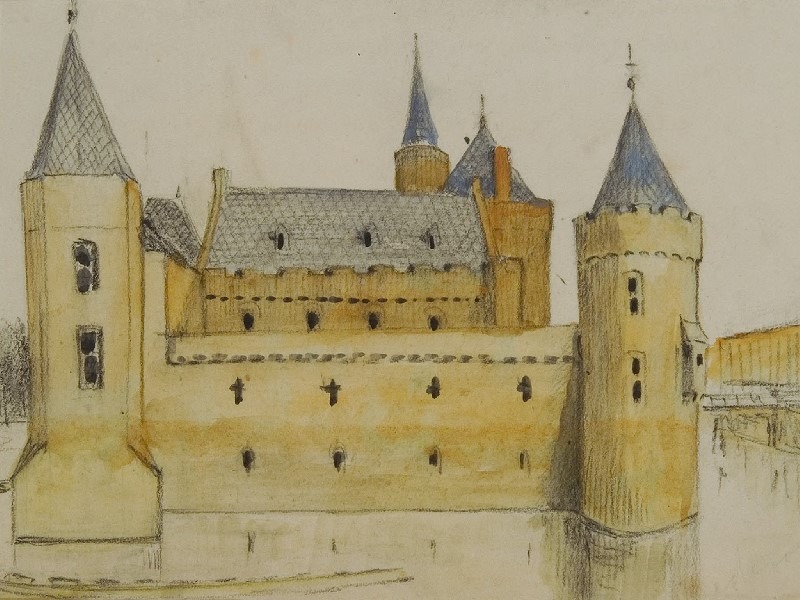
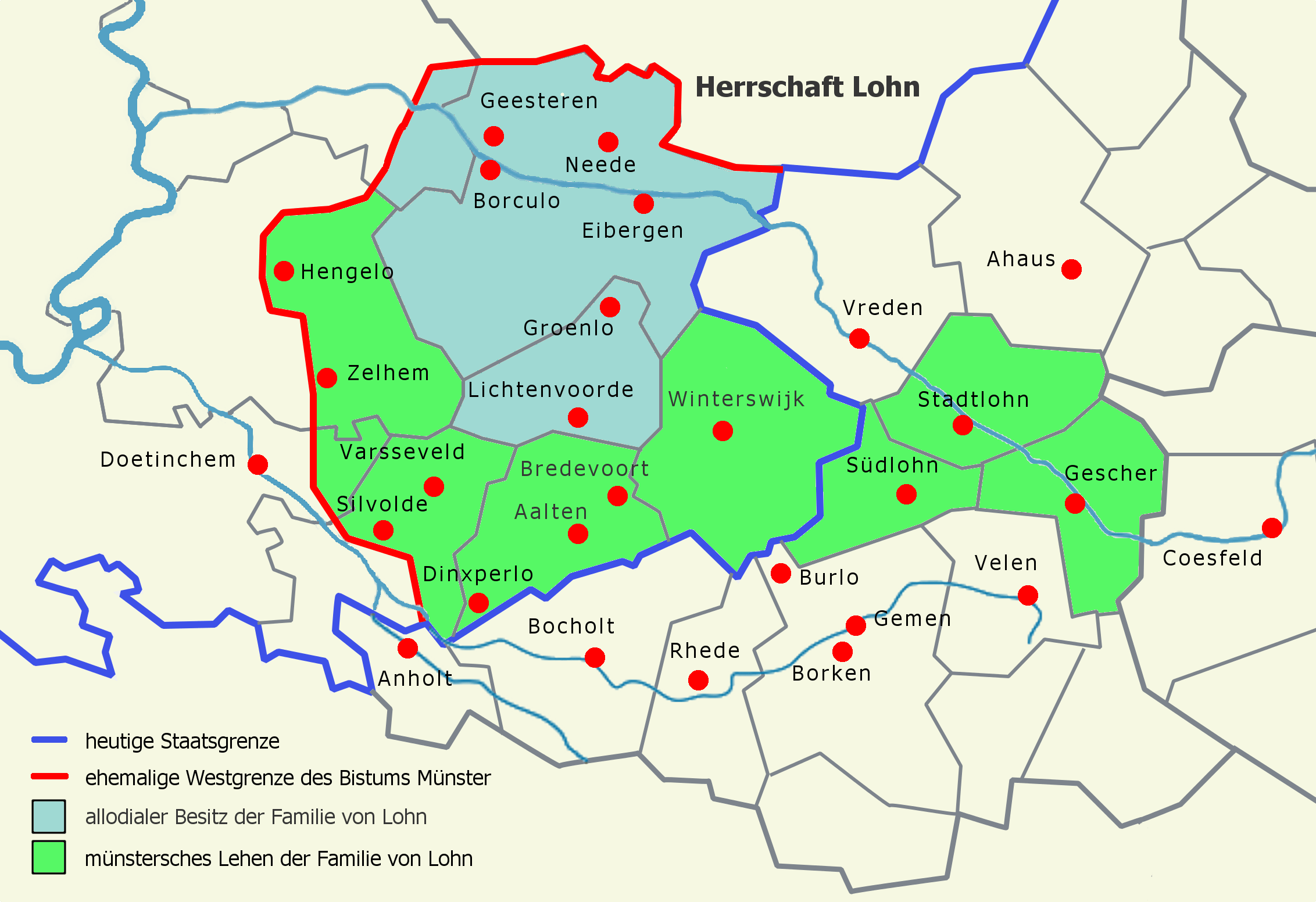
From Neede, he moves on to the Lordship of Bredevoort, of which we read that it is of great antiquity. In 1245, the Castle of Bredevoort was granted as a fief by Herman, Count of Loon, to Otto of Nassau, Count of Gelre and Zutphen. William, Duke of Jülich and Gelre, pledged the fief in 1388 to Hendrik van Gemen for three thousand French Shields. Jacob van Bronckhorst later held the same right of pledge with the consent of the States of Gelderland. However, having chosen the side of the enemy in 1580, the town, along with the castle and the Lordship of Bredevoort, was given to Prince William I. His descendants still held the Lordship in 1741.
The Town of Bredevoort
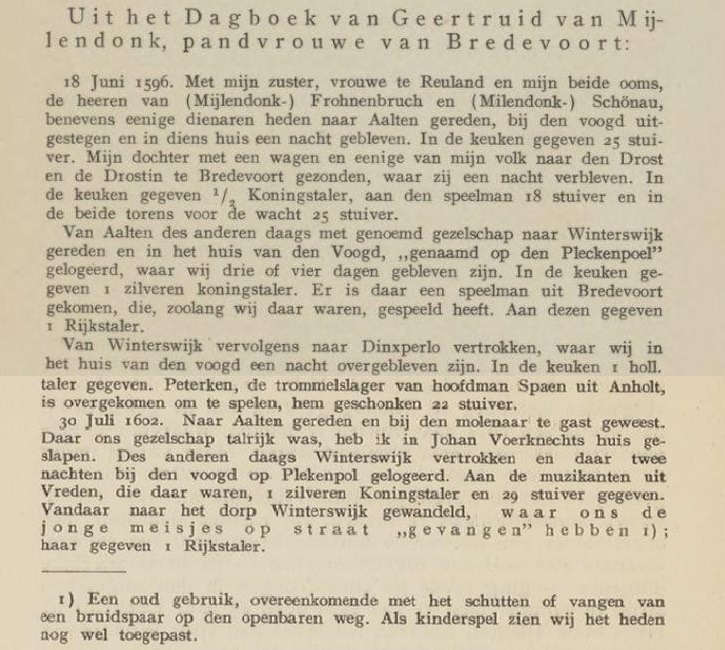
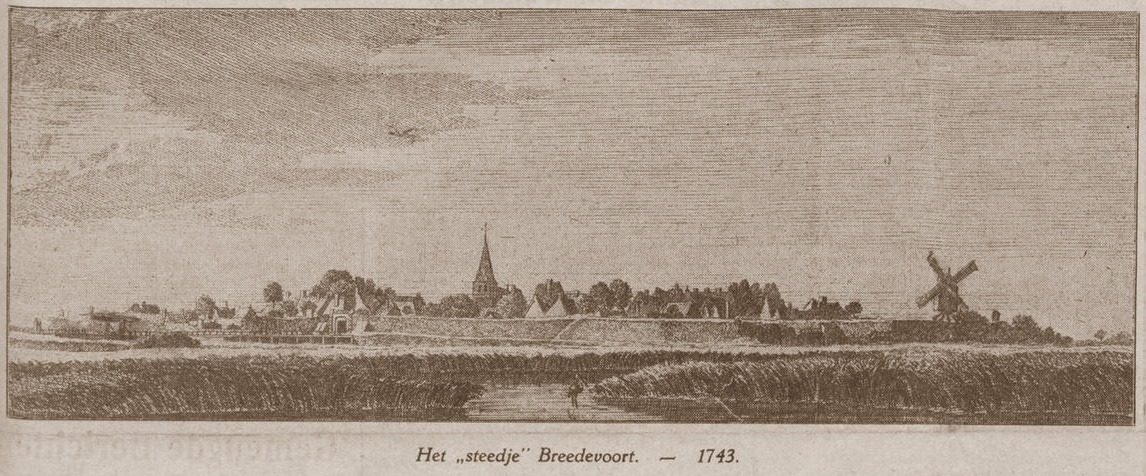
As for the town of Bredevoort, conditions in 1741 were better than they are today. At that time, it was home to the bailiff and the Richter, as well as two deputies, a Stadtholder, an Advocate-Fiscal, a Landscribe, and a Commander. Furthermore, several officers resided there. All these high-ranking gentlemen spent a great deal of money in the small town, which must have appeared very distinguished at the time. The common man living in the villages of Winterswijk—notably the largest village in all of Gelderland at the time!—Aalten, and Dinxperlo, had to dance to the tune of the bailiff of Bredevoort and his clique.
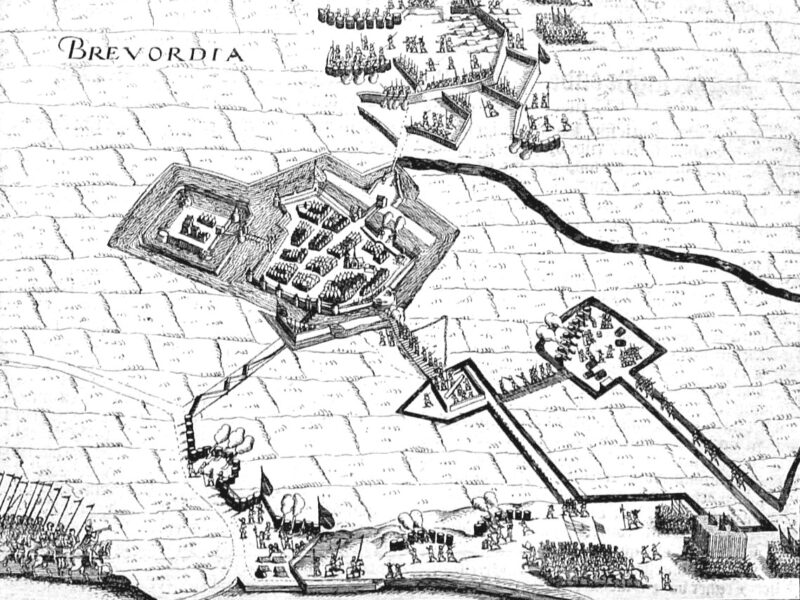
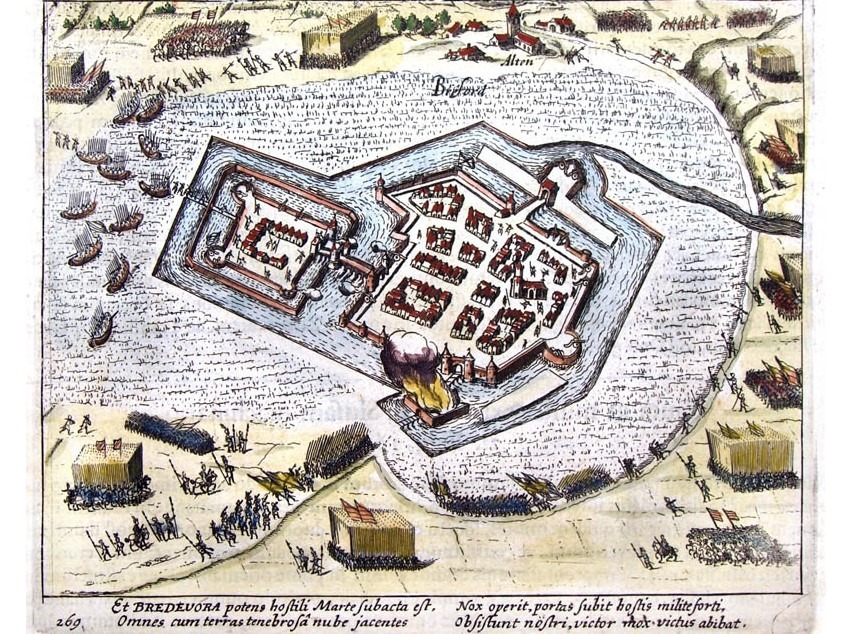
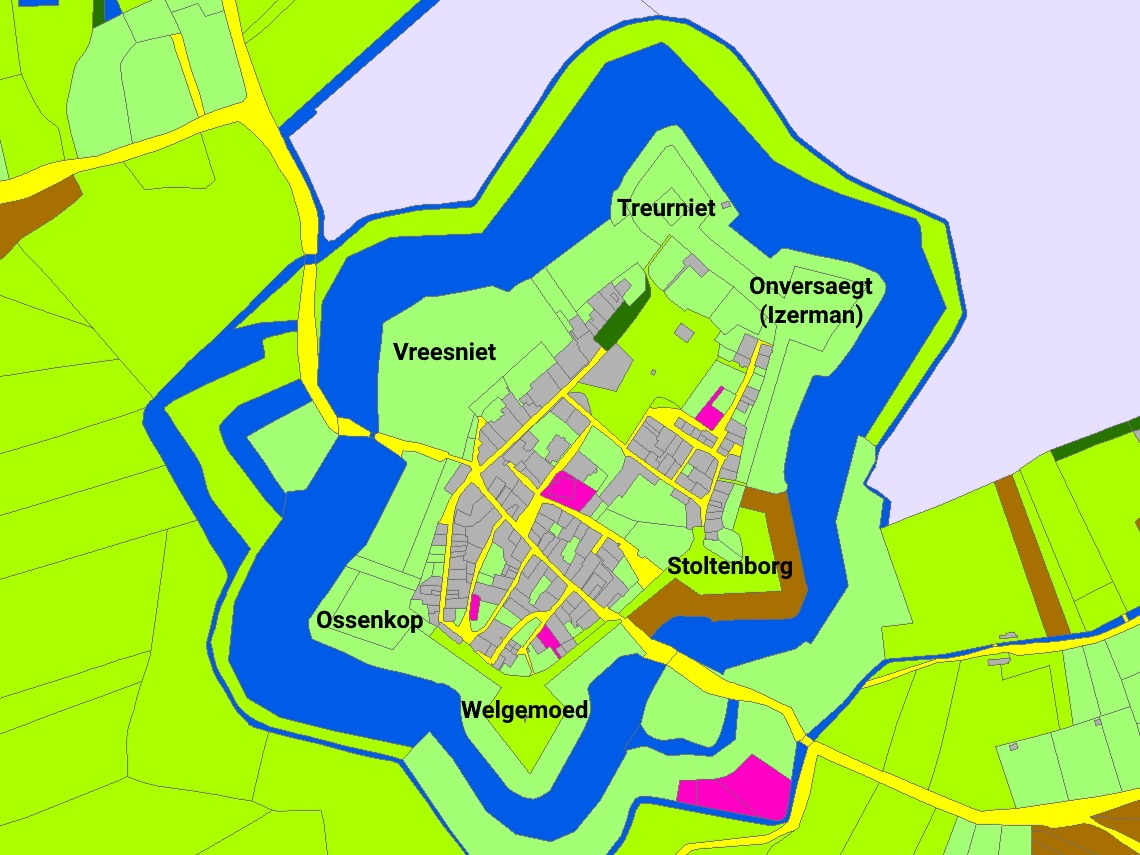
Bredevoort itself was said to be very strong in 1741. The surrounding lands consisted entirely of marshland, where no one dared to venture. Moreover, three companies of infantry were stationed there; where all these people were sheltered remains a mystery to me.
The citizens of Bredevoort made the outsiders from Winterswijk and Aalten feel that they were of a superior class. When it was bitterly cold in winter and the frost was hard, the people of Aalten and Winterswijk were required to come and chop ice for the ice cellars. The mail had to be delivered by the men of Winterswijk and Aalten for nothing. Additionally, a wagonload of twig brooms had to be delivered to Bredevoort every year. If a hunt for thieves, robbers, vagabonds, or wolves was to be held, the people of Aalten and Winterswijk were allowed to beat the bushes and carry the rifles, while enduring the insults of the gentlemen. How the people of Winterswijk and Aalten must have rejoiced when the French in 1795 put an end to this state of affairs.
Meanwhile, we now write 1951, and it must be said: the two Cinderellas, Winterswijk and Aalten, have become fine maidens since 1741 and are in a state of glowing prosperity. It is, however, the irony of history that the stepmother, Bredevoort, is now sometimes treated somewhat stepmotherly herself. When one walks across her uneven cobblestone streets, one cannot help but feel pity for the outgrown lady of two centuries ago.
Aalten Surpassed Bredevoort
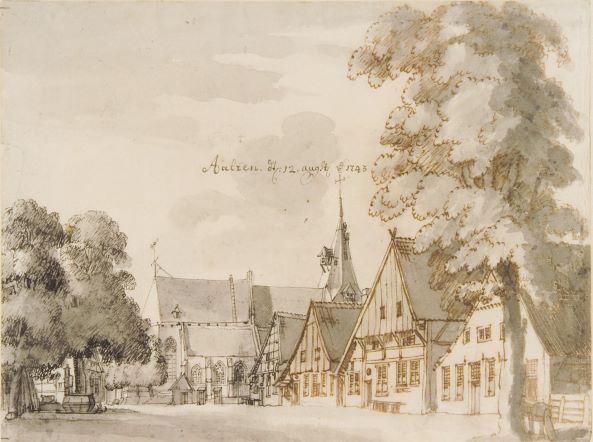
Markt Square, Aalten by Jan de Beijer, 1743
When the modern textile industry emerged, Aalten was the favorite. The Driessen family from Bocholt were the founders of Aalten’s rise, establishing themselves here as early as 1826. They attracted other industries. Although there were some dark pages in the previous century, Aalten turned the tables and is now the leader in the former Lordship of Bredevoort. Naturally, the municipality currently faces concerns as great as those of its sister municipalities, but that does not change the fact that Aalten has truly come into its own.
It is, meanwhile, astonishing how much marshland, how many vast heaths, and how many wild forests existed in 1741. If history had not been faithfully recorded and if we did not have more sources at our disposal, one could hardly believe that such conditions existed. Today, one sees prosperous lands and lush pastures that are a delight to the eye.
What we have described here is approximately all that is told of the Achterhoek. It is little. However, one must not forget that in 1741, someone from Amsterdam regarded the region we have described as a kind of jungle, which he preferred to stay as far away from as possible. It is therefore quite understandable that in earlier centuries, the population of East Gelre was much more closely related to Germany in economic and geographical terms than to the Dutch West. The attitude of the Germans has brought about a great change in this regard in recent years.
Klaas Nijman was baptized on January 16, 1698, in Dinxperlo as the son of Fredrik Nijman and Berentjen Eppink. At the age of fifteen, he left his parental home and began a wandering existence as a ‘beggar and vagabond’. In 1722, he was sentenced in Rhenen to a stay in a house of correction for violence and theft. His release was followed by banishment from the province of Utrecht.
Nijman then returned to the Achterhoek, where he sowed fear among the population, particularly in the vicinity of Dinxperlo and Aalten. He begged and stole, threatened people, and did not hesitate to use brute force. In 1729, he set fire to several houses and was arrested.
On October 3, 1729, following a trial in Bredevoort at ‘t Zand, Klaas Nijman was sentenced to death. He was taken to the Hollenberg, where he was strangled and subsequently set on fire. This gruesome punishment served as a deterrent to others. Nijman was 32 years old at the time.
Sentence
The following 18th-century text describes his crimes and sentence:
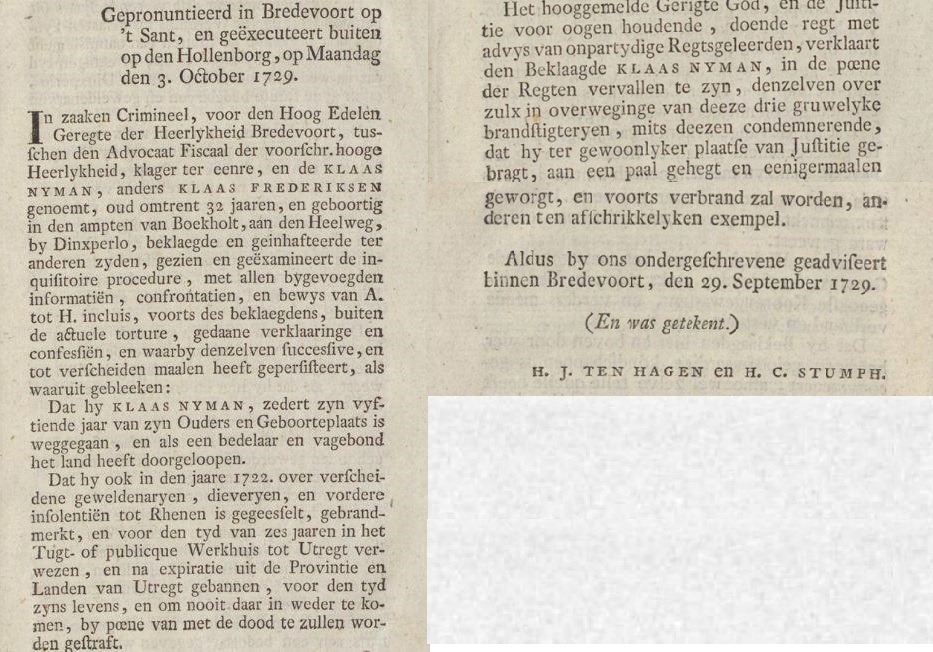
Pronounced in Bredevoort at ’t Sant, and executed outside on the Hollenberg, on Monday, October 3, 1729.
Verdict Klaas Nijman
In Criminal cases, before the Most Noble Court of the Lordship of Bredevoort, between the Advocate Fiscal of the aforementioned High Lordship, complainant of the one part, and KLAAS NYMAN, otherwise called KLAAS FREDERIKSEN, aged about 32 years, and born in the district of Bocholt, at the Heelweg, near Dinxperlo, defendant and prisoner of the other part, having seen and examined the inquisitorial procedure, with all attached information, confrontations, and evidence from A. to H. inclusive, furthermore the defendant’s declarations and confessions made outside of actual torture, and in which he has successively and at various times persisted, from which it has appeared:
That he, KLAAS NYMAN, since his fifteenth year has left his Parents and Birthplace, and has wandered the land as a beggar and vagabond. That he was also in the year 1722, for various acts of violence, thefts, and further insolences at Rhenen, flogged, branded, and committed for the term of six years to the House of Correction or public Workhouse at Utrecht, and after expiration banished from the Province and Lands of Utrecht for the term of his life, and never to return therein, upon pain of being punished with death.
That having been released from the aforementioned House of Correction or Workhouse about three-quarters of a year ago, yet the penalties of banishment remaining in force, he thereupon, or some time thereafter, returned to Dinxperlo, and continued in his bold beggaries and acts of violence. That he there, for a trifle on the public road near Dinxperlo, cut open the mouth of one DIRK WENSINK with a knife.
That he likewise, after his aforementioned release, again committed various thefts, such as of ironwork and an axe, and of linen, such as a pillowcase or sheet on the other side of Doesburg at the Steege; and also a shirt from the garden at HENDRIK te Loo or Kistershuis, between Dinxper and the Bredenbroek, and further as by the Reformations. That he, KLAAS NYMAN, has also for years past been notorious and held in suspicion by many inhabitants under Dinxperlo and Aalten, as being of no good and committing much evil.
That he also, following the . . . . of the sentence at Rhenen, was held suspect there of having committed very grave offenses. That the defendant, through his . . . . and malicious conduct and questionable language which he used here and there, has kept the good husbandman and the inhabitants in the countryside, and especially around Dinxperlo and Aalten and the surrounding area, in a state of constant anxiety and fear. That when he came to beg, he was not satisfied with what is ordinarily given to a beggar, although he was often given even more, and went away from the houses muttering to himself.
That this anxiety and fear among the inhabitants has doubled and reached its peak since fire broke out in the Parish of Aalten in this year 1729, and that further and even more burnings of houses close by followed. Such that several inhabitants ordered their people that, if KLAAS NYMAN came to their houses, they should just give him whatever he wanted, to gain his friendship and not to anger him, and that several people, out of fear of arsons, had to keep night watches at their houses during the night, whereby even some hamlets were placed in a state of near alarm.
That he, the defendant KLAAS NYMAN, is also the one who has come to such exceedingly wicked crimes that in the past Summer in the Parishes of Aalten and Dinxperlo, of this same year 1729, from June 13 to August 29, and thus within the span of a quarter-year, he has set fire to three houses, one after the other, and by no means the smallest, which houses were also totally burned down, and of which the corpora delictorum are known.
Namely, on June 13, the house at Lensink, under Aalten on the Esch at Yserlo, where he set a piece of white or spongy peat on fire by means of a tinderbox, flint, and tobacco pipe, and with that burning peat at the back on that side of the house where the wind was blowing against the house at the time, caused the fire. That eight days prior he had also set the same house Lensink on fire, and that it had already been burning, but that it was then still extinguished by the occupants.
Secondly, the house at Welink, also under Aalten on the Esch at Yserlo, on June 20, where he carried out the fire in the same manner as at Lensink with a piece of ignited spongy peat, and therewith set the house on fire from behind. That for both his arsons, at Lensink and Welink, he gives as his reason that he had done so to create anxiety and terror in the neighborhood, or among the people.
Thirdly, the house at Grevink, at ‘t Rexwinkel in the hamlet of Heurne, under Dinxperlo, on August 29, in the evening around 10 o’clock, when he caused the fire there with an ignited fuse made of linen rags, in the straw that lay at the back on the corner partition of the house. That in this aforementioned house Grevink, when it caught fire, a young woman in childbed, who had not yet been in childbed for two days, lay on the bed, and who by great fortune still having the strength to get off the bed, still escaped the fire. That he, KLAAS, gives as his reason for this arson at Grevink that he had done so because the same aforementioned woman in childbed, a long time ago when she was still unmarried, had given him a piece of pancake that had been too small for him.
That at Welink and at the last-mentioned Grevink, several pieces of live Cattle, harvested Grain crops, and further items were also burned and consumed. That he, the Defendant, is furthermore convicted by four sworn credible witnesses, although he himself has tried to deny it telle quelle, that on August 31 last he spoke those grim words at the house of ARENT OOSTENDORP, in the hamlet of Heurne, under Dinxperlo, that this or that corner would shortly be a poor corner.
That he furthermore has threatened to set fire to the house of the drummer boy within Dinxperlo, and has stood by and persisted in this, that if he had not been captured, he would indeed have done it, and similar terrible threats and dangerous utterances of the Defendant, as the information and confessions herein further set forth.
The highly-mentioned Court, keeping God and Justice before its eyes, doing right with the advice of impartial Legal Experts, declares the Defendant KLAAS NYMAN to have incurred the penalty of the Law, condemning him for the same in consideration of these three gruesome arsons, that he be brought to the usual place of Justice, fastened to a stake and somewhat strangled, and furthermore shall be burned, as a terrifying example to others.
Thus advised by us undersigned within Bredevoort, September 29, 1729.
(And was signed.)
H.J. TEN HAGEN and H.C. STUMPH
Source
Legal Treatises on Corporal Crimes by a prominent Legal Expert (Jan Jacob van Hasselt), published in Amsterdam by Hendrik Gartman, 1781 (link)
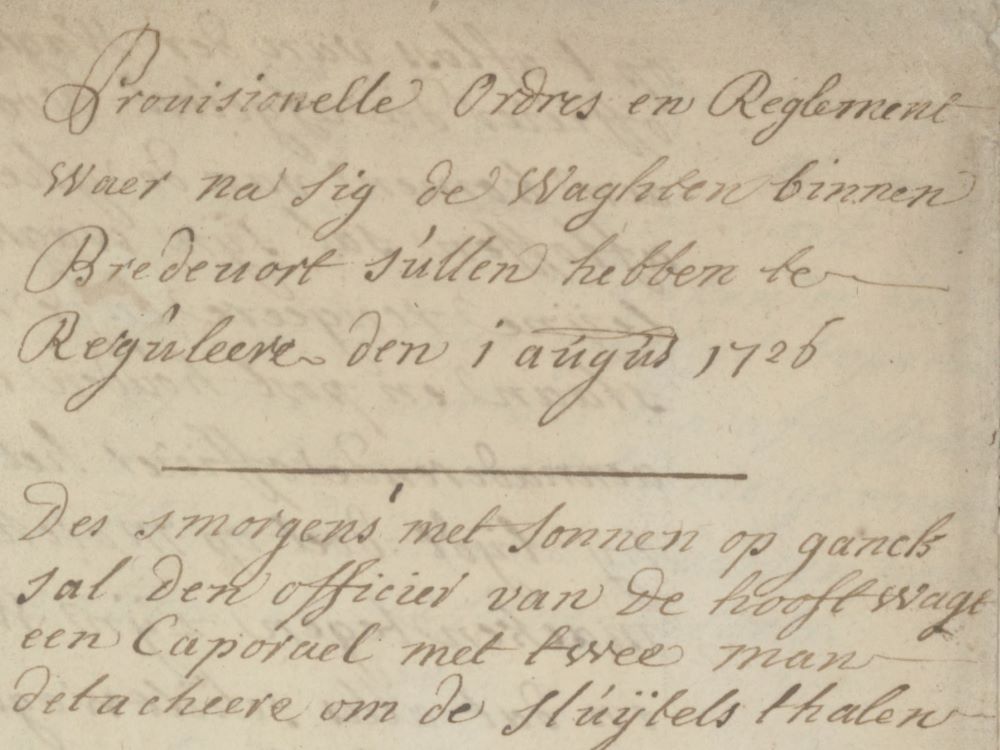
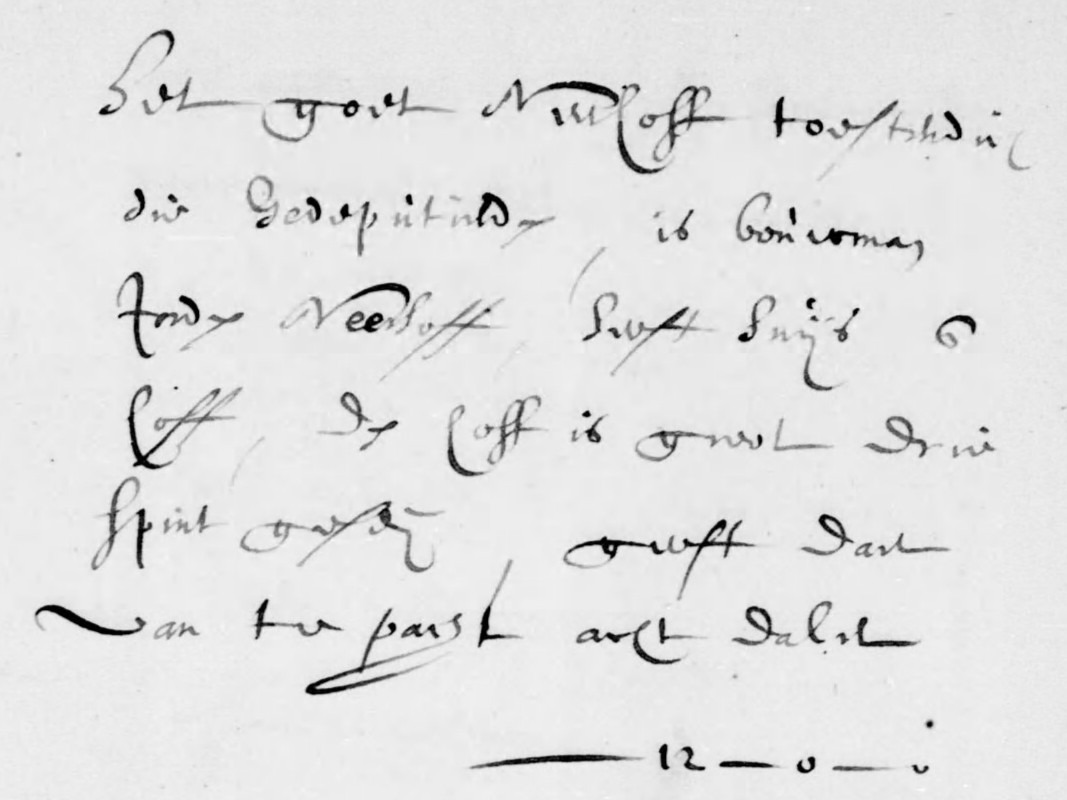
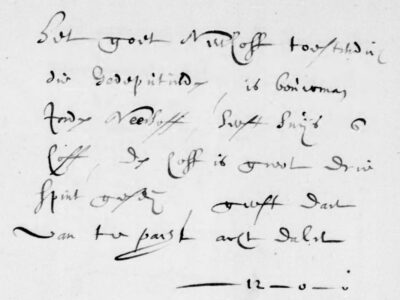
The text below is a transcription of the original handwritten regulations, as literal as possible, including variations in spelling, but with added punctuation to improve readability. The text contains a number of words or concepts that we did not recognize (highlighted in yellow) and may have been misinterpreted. Therefore: errors excepted and corrections are welcome.
Fragment of the scanned document
Provisional Orders and Regulations according to which the guards within Bredevoort shall regulate themselves, August 1, 1726.
In the morning at sunrise, the officer of the main guard shall detach a corporal with two men to fetch the keys.
When the keys arrive, the officer shall arrange the guard under arms, have the march beaten, and detach the sergeant and as many men as shall be necessary. And at the Munsterspoort, the sergeant shall detach the corporal so that every time a drawbridge is lowered and the keys have passed, it is raised again until the field is scouted and the posts are set out.
The gates being opened, the keys shall be returned in the same manner as they were fetched.
Upon the changing of the guard, the officer being relieved shall, upon the arrival of the one who is to relieve him, arrange his guard in a line and have the march beaten and hold post until the approaching officer has the body of men he leads1 march up and form a front opposite his guard, and ensures all sentries are relieved and inspects whether anything is missing from the cannons and batteries2 and whether the guardhouses, sentry boxes, and the rampart are cleared of all filth and found in a state fit for duty, and whether the patrol sticks and whatever else is required for the guardhouses are present with the guard, and that the officer being relieved has handed over the orders observed at his post to the relieving officer. When all this is done and the sentries are relieved and have joined the guard, the relieved officer shall march off to the market and there thank the men; at the same time that the relieved troop marches off, the relieving officer, having arranged his men in a line, shall beat the march and take up post in the same place.
The sergeants of the guard shall remain at their posts for 24 hours. From the main guard only two men, and from the Munster Gate only one, may be given leave to fetch food, but from the opening of the gates in the morning until eight o’clock, as well as during the time when the sentries are relieved, none.
No soldiers are to be allowed outside the gates without a gate pass, written or signed by the Commander; the gate passes shall be held by the officer and, when the soldier returns, given back; if they do not return and the passes are collected, they shall be brought to the Commander with the evening report. The sergeant of the Munster Gate shall send the collected passes to the main guard.
The guards and sentries shall take good care that no damage is done to the timber or palisades on the national fortifications, nor any fishing done in the moats around, or grass mown on the ramparts or counterscarps, without a note or order from the Commander. Also, the sentries and patrols shall ensure that no elevation occurs on the excavated grounds around the fortifications, nor any trenches shifted, and that no filth is made on the ramparts.
The commanding officer of the main guard shall have all foreign passengers brought to the commander. The sergeant of the Munster Gate shall have the same brought to the main guard, but for persons of quality, he shall ask the servants for their names and status and where they are staying, and if they have no servant with them, he shall ask them directly and immediately inform the Commander.
In the afternoon from twelve to one o’clock and on Sundays during the sermon, the outermost drawbridges at the gates shall be raised.
The officer shall provide a written report to the Commander at twelve o’clock in the afternoon and in the evening after the closing of the gate. The parole and orders that may have been given to the guards that day residing there in the morning when relieved shall be reported verbally. The sergeant of the Munster Gate shall have a report made to the officer of the main guard at half past eleven in the morning, in the evening before the gate closes, and in the morning after the opening of the gate.
The sentries both at the barriers and on the ramparts shall call out to and warn one another when they see more than two or three men with arms, or more people than usual, approaching from outside. The sentries at the barrier shall immediately close it and raise the bridge, calling to the nearest sentry to have the guard come to examine the situation and report to the Commander as found. The guard shall ensure that a capable man is always stationed at the barriers.
No foreign passengers shall be allowed on the ramparts or works without special order from the Commander. The sentries shall also take heed that no one enters the faussebraye, and also that no disorder occurs outside or near their posts, such as the breaking of lines placed in the gardens, and they shall always carry their arms while walking and not smoke tobacco.
No foreign beggars shall be allowed into the city, and if any deserters should arrive very early in the morning, they shall remain in the main guard until they have been examined by the Commander.
The sentries shall not allow more than one at a time of the carts or wagons coming from outside to pass over the bridge. Also, no carts or wagons may be left standing before the guard or inside the gate, but a clear space must always be kept, both before the guard and the gates; care must also be taken that the national boat lies locked, inspecting it before the closing of the gates.
No beasts or horses are to be allowed on the fortifications; if any are found on the national works, they shall be brought to the guard and the release fee paid, according to the order of their Noble Mightinesses.
The Ceremonial is to be observed according to the Regulations.
In the evening at sunset, the officer, as a warning to the people who still wish to go out or in, shall have the roll-call beaten and detach a corporal with two men to fetch the keys. And when they arrive, the officer shall arrange the guard under arms, have the march beaten, and continue this until the gates are closed, and then set out the night posts and send the keys back to the Commander. Just as they were fetched when the gates were opened and closed, the officer himself shall be present to ensure that the gates are properly closed.
If a gate is opened at night, the officer shall take care that nothing other than the wicket of the barrier is opened and that once the keys have passed, it is closed again, just as as soon as the keys are over the drawbridge, it is immediately raised again, detaching the necessary men for that purpose. The wicket of the outermost barrier being opened, he shall have it inspected who is outside the gate and, if found to be in order, shall allow those for whom the gates were opened to enter, but taking care that no barrier is opened nor drawbridge lowered before the outermost is well closed and the officer is informed of what has occurred. For the Munster Gate, a corporal with four men from the main guard shall come.
The tattoo shall be beaten at half past nine in the summer and at nine o’clock in the winter.
In the evening, the officer shall have a corporal and two men inspect the inns and have the soldiers of the garrison go to their quarters; half an hour later, he shall inspect them again to see if any had dared to come there, and if so found, they shall be brought to the guard under arrest.
The corporals shall bring their sentries to their posts themselves by day and by night and ensure that the orders given are properly handed over at their posts; to that end, the corporals of the main guard shall inspect the sentry at the bastion, marching up as the sentries of his guard are relieved around the rampart, ensuring that everything is in good order and that no damage is done to the national works. The corporal at the Munster Gate shall march up with the sentry at the Mill Bastion and so forth, observing the rampart all around. What is mentioned in this article, and especially that the sentries of the Munster Gate are relieved at the stroke of eleven, they shall for that purpose stand the first posts from nine to ten o’clock in the morning and then relieve every two hours, namely from ten to twelve and so on.
The officer of the main guard shall send a man around the rampart every two hours, namely at half past ten, half past twelve, half past two in the morning and subsequently every two hours by day and by night, to ensure that no damage is done to the national works, whether by children whom he shall order off the rampart, or dogs or chickens or other harmful creatures which he shall shoot dead. This article shall also be observed by all corporals and sentries performing relief. The sergeant of the Munster Gate shall send a man around the rampart every two hours by day and by night, namely at half past eleven, half past one, half past three in the afternoon and subsequently every two hours.
The officer of the guard shall be responsible for ensuring that every sentry at his post knows all the orders that have been given so that they are properly executed3. To this end, the officers of the main guard shall inspect the posts of both the main guard and the Munster Gate and instruct them on all orders, just as the sergeant of the Munster Gate shall instruct his sentries and visit their posts, for which he shall be held accountable.
The officer on guard shall perform the grand round before twelve o’clock at night. The sergeant of the Munster Gate shall perform the visiting round between twelve and three, and the sergeant of the main guard shall perform the day round before the reveille.
The Commander or major, wishing to inspect the posts by day or by night, shall not need to go to the guard first but shall take with them the sentry for the Commander, who may be relieved for that time.
In case of alarm or fire, the Commander is to be informed immediately, and in the meantime, the officer of the guard shall detach the sergeant with six men there. The guard that is to mount shall first report to the main guard and the Company at the parade ground on the Sand.
All further orders not specified herein shall be regulated according to the ordinances and regulations established of old.
Article 21 of the guard is to be changed in so far that the sentries shall be relieved every hour at night and this shall continue until the guards are relieved in the morning; at the Aelterpoort to begin at eleven o’clock in the evening, until 12, until 1, until 2 and so on from hour to hour; at the Munster Gate to begin at half past ten in the evening, half past eleven, half past twelve and so on from hour to hour.
The officer of the guard shall ensure that the corporals themselves bring the sentries to their posts. And the corporals of the guards shall keep their route around the rampart from each gate, as ordered in Article 21, taking care that if a sentry is not found alert at their post, they shall be relieved and placed under arrest.
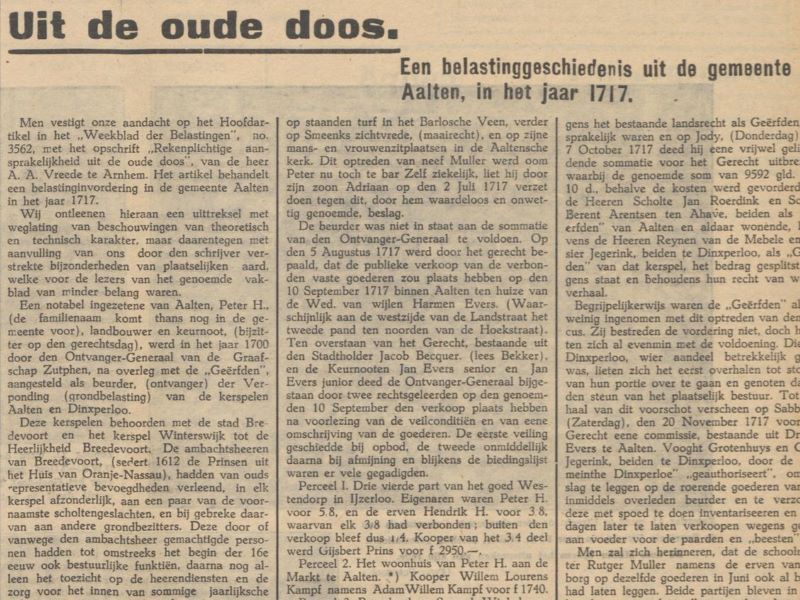
Our attention has been drawn to the lead article in the “Weekblad der Belastingen,” no. 3562, titled “Accountable liability from the old days,” by Mr. A. A. Vreede of Arnhem. The article discusses a tax collection in the municipality of Aalten in the year 1717. We have derived an excerpt from this, omitting considerations of a theoretical and technical nature, but conversely supplementing it with details of a local nature provided to us by the author, which were of less interest to the readers of the aforementioned trade journal.
A notable resident of Aalten, Peter Huijninck, farmer and lay judge (assessor on the court day), was appointed in the year 1700 by the Receiver-General of the County of Zutphen, after consultation with the “Heirs,” as collector (receiver) of the Verponding (land tax) for the parishes of Aalten and Dinxperloo.
These parishes, along with the town of Bredevoort and the parish of Winterswijk, belonged to the Lordship of Bredevoort. The lords of the manor of Bredevoort (since 1612 the Princes of the House of Orange-Nassau) had traditionally granted representative powers, in each parish separately, to a few of the most prominent bailiff families, and failing that, to other landowners. These persons authorized by or on behalf of the lord of the manor also held administrative functions until approximately the beginning of the 16th century; thereafter, they only oversaw the corvée labor and the collection of certain annual revenues, which later included some liability for the receipt of the land tax. Related to this was the fact that the appointment of a receiver took place in consultation with these authorized persons, referred to above as “Heirs,” and that the provision of security by an appointee was required in the deeds of guarantee of that time for the benefit of the Receiver-General and for the service of the Heirs.
These documents, like all other voluntary deeds as well as judicial deeds, were established by a declaration in a court session. The court, consisting of the bailiff (judge) or the Stadtholder (deputy judge), two lay judges (assessors), and a Landsschrijver (clerk), was seated in Bredevoort, but held sessions alternately in each parish where necessary. Upon the appointment of Peter Huijninck as collector, his brother Hendrik Huijninck acted as guarantor, and in the deed of guarantee, various fixed assets of both were pledged as security for the administration.
For several years things went well, but gradually the collector became negligent with the collection, and an increasing backlog arose in the remittance of funds to the office of the County in Zutphen. At the repeated insistence of the Receiver-General, temporary improvements occurred occasionally; for instance, the lay judge Peter Huijninck, in his capacity as collector, requested on Mercury (Wednesday) April 21, 1717, at the Court Day in Aalten, to seize the real estate of Jan ten Heetbrink the Younger and of Mechtelt Brethouwer, widow of Derk Nachtegaal, due to overdue land tax, but no lasting improvement followed.
It was common knowledge in Aalten that this situation could not continue and that legal action against the negligent collector was inevitable. It is therefore understandable that the heirs of the since-deceased guarantor Hendrik Huijninck feared that the real estate pledged by him would also be targeted. As a result, on Venery (Friday), June 18, 1717, the collector Peter Huijninck and his spouse Geesken Locken appeared before the court, stating that the aforementioned heirs were bothering them daily by insisting on measures to keep them indemnified, and hereby pledged a one-fourth share in the estate and property Westendorp in IJzerlo and two-thirds in the Snoejenbos, located on the Haart, as far as Arent Snoejenbos has it under lease, so that the heirs could recover any damages from it.
This happened just in time, for only ten days later on Luno (Monday), June 28, 1717, a representative of the Receiver-General Hendrik van Essen appeared before the court to issue an executory summons against the collector Peter Huijninck, inviting him to settle a sum of 17,134 guilders, 1 stiver, and 10 deniers at the office of the County within ten days, as arrears for the years 1713–1716, and threatening a judicial sale of the fixed assets pledged in the guarantee deed. A copy of the summons was served the following day by the bailiff (court officer or bailiff), Jan Keunen, to the collector, speaking with his wife Geesken Locken.
Now the heirs of the guarantor, who did not yet feel safe despite the deed of June 17, were truly struck with fear, for that very same day, schoolmaster Rutger Muller of Aalten, son-in-law of the deceased Hendrik Huijninck, appeared before the court on their behalf to seize the movable property of Peter Huijninck, as well as the crops and the manure rights of lands leased by him, also his peat pond and the peat standing on it in the Barlosche Veen, furthermore on Smeenk’s mowing rights, and on his men’s and women’s seats in the Aalten church. This action by nephew Muller was finally too much for uncle Peter. Being ill himself, he had his son Adriaan file an objection on July 2, 1717, against this seizure, which he called worthless and illegal.
The collector was unable to comply with the summons of the Receiver-General. On August 5, 1717, the court determined that the public sale of the pledged fixed assets would take place on September 10, 1717, in Aalten at the house of the widow of the late Harmen Evers. (Probably on the west side of the Landstraat, the second building north of the Hoekstraat). In the presence of the Court, consisting of the Stadtholder Jacob Becquer (Becker, ed.) and the lay judges Jan Evers senior and Jan Evers junior, the Receiver-General, assisted by two legal experts, conducted the sale on the aforementioned September 10 after reading the conditions of sale and a description of the properties. The first auction was by bidding, the second immediately thereafter by Dutch auction, and according to the bidding list, there were many interested parties.
Lot 1. Three-fourths part of the Westendorp estate in IJzerloo. The owners were Peter Huijninck for 5/8, and the heirs of Hendrik Huijninck for 3/8, of which each had pledged 3/8; thus 1/4 remained outside the sale. The buyer of the 3/4 share was Gijsbert Prins for 2,950 guilders.
Lot 2. The home of Peter Huijninck at the Market in Aalten 1. Buyer Willem Lourens Kampf on behalf of Adam Willem Kampf for 1,740 guilders.
Lot 3. Farmland at Smeenk-Winkel, one and a half schepel. Buyer Derk Neerhof for 505 guilders.
Lot 4. A piece of farmland at Smeenk-Winkel, size not mentioned, buyer Willem Eppink for 480 guilders.
Lot 5. Six schepel of land, called the Wijntjesstuk, buyer Adam Willem Kampf for 465 guilders.
Lot 6. Four pieces of garden land in Smeenkgoorden, size not mentioned, buyer as before for 205 guilders.
Lot 7. The Dalshof, size not mentioned, buyer as before for 230 guilders.
Lot 8. The Horsterkamp in Linteloo, size not mentioned, buyer Jan Evers for 600 guilders.
Lot 9. The Grevincksweide near Aalten, size not mentioned, buyer Jan te Bokkel for 470 guilders.
Lot 10. The lease corn of the pledged separate lots, as well as the annual fee, the services, and the small leases owed by the farmer of Westendorp, all for the current year; buyer Jan Arentsen for 95 guilders.
Lot 11. The lease corn in sheaves of three-fourths of Westendorp stored in the farmer’s dwelling; buyers Wessel Broekhuys for 55 guilders and Jan Arentsen for 25 guilders. The owner of lots 2–7 was the collector Peter Huijninck, and of lots 8–9, the heirs of the guarantor Hendrik Huijninck.
Immediately after the second auction, the final award followed, at least in name, for nearly five weeks later on October 14, the Receiver-General had it declared before the Court that a higher bid had been made for lots 3 and 4 at Smeenkwinkel by the Dowager van Nagell tot Ampsen, née Baroness van Coeverden, and that the first buyers could be dismissed. These men, the farmers Neerhof and Eppink, did not remain silent and filed a protest with the Court on October 18, along with the declaration that they faithfully followed the conditions of sale and would quietly continue to cultivate and sow the purchased land. It is to be hoped for them that they were not disappointed.
The total proceeds amounted to 7,542 guilders, so that the initial backlog of over 17,134 guilders was reduced to over 9,592 guilders. It would be logical for the Receiver-General to attempt to recover this remainder from the collector’s other assets as much as possible and, if necessary, have it collected from the negligent taxpayers by means of a new collector. However, he followed another very unusual path. Since the so-called Heirs were also liable according to the manorial law of Bredevoort, he issued a summons to the Heirs of Aalten and Dinxperloo immediately after the auction, without specifying certain individuals, which summons was served to the bailiff as the judge of the common lands.
Reinier Jurrien Baron van Coeverden and Walfaerdt 2 was at that time the representative of the Lord of the Manor with the titles of Hofrigter, Verwalter, Bailiff, and Judge. The Receiver-General then had it investigated which persons were liable as Heirs according to the existing national law, and on Jody (Thursday), October 7, 1717, he had a virtually identical summons issued before the Court, whereby the aforementioned sum of 9,592 gld. 1 st. 10 d., plus costs, was claimed from the Gentlemen Bailiff Jan Roerdink and Bailiff Berent Arentsen at Ahave, both as “Heirs” of Aalten and residing there, as well as the Gentlemen Reynen van de Mebele and Rosier Jegerink, both in Dinxperloo, as “Heirs” of that parish, the amount split according to the statement and subject to their right of recourse.
Understandably, the “Heirs” were very little pleased with this action by the Treasury. They did not contest the claim, but they were in no hurry to pay either. Those from Dinxperloo, whose share was relatively small, were the first to be persuaded to pay their portion and enjoyed the support of the local administration. To recover this advance, a commission appeared before the Court on Sabbathy (Saturday), November 20, 1717, consisting of Dr. Jur. Evers of Aalten, Vooght Grotenhuys, and Garrit Jegerink, both of Dinxperloo, “authorized” by the “Gemeinthe Dinxperloe,” to seize the movable property of the meanwhile deceased collector and to request that it be inventoried urgently and sold two days later due to a lack of fodder for the horses and “beasts.”
It will be remembered that schoolmaster Rutger Muller, on behalf of the heirs of the guarantor, had also had the same goods seized in June. Both parties continued to dispute each other’s rights in a lengthy procedure. The Court did go to the house of the Widow Peter Huijninck on Monday, Nov. 22, for the inventory, but the sale did not take place for the time being, although provision will have been made for the livestock. More than half a year later, on June 24, 1718, at the insistence of the aforementioned Muller, the Court ordered the Bailiff and the Under-Bailiff in Aalten to store the seized goods in a neutral place after inventory at the house of Jan Janknegt, one of the court officers. Furthermore, the Protocol contains no more details about this case.
The Heirs of Aalten remained passive for the time being, so the Receiver-General deemed it advisable to put more pressure on them. After three months, on Jovis (Thursday), January 6, 1718, Hendrik Casper Stumph, “Doctor of Laws” in Aalten, appeared before the Court as the serving advocate for the Receiver-General and requested the setting of a “clear fixed day” for the judicial sale of their fixed assets.
a part of Bennink; two parts of Het Slaa in Haart-Heurne.
The auction was set for March 8, 1718, again at the house of the Widow Evers, at two o’clock in the afternoon.
Both Heirs now saw that the matter was becoming serious and that they would have to pay up. In the meantime, order had also been established from the official side. The old collector Peter Huijninck had died at the end of October, and another Aalten resident, Adam Willem Kampf (also written Campf and Cempf), was temporarily charged with the observation of the collector’s office. He moved into the house at the Market of his predecessor, which he might have already bought in advance at the judicial auction, and on March 12, 1718, he and his spouse Gesina Smits passed a deed of guarantee, in which the estate Bulsink in Linteloo and the lots purchased at the judicial sale of the late Peter Huijninck were also pledged, while Dr. Jan Casper Evers acted as guarantor, pledging the Busscher Kamp, located between Aalten and Bredevoort, for Kampf’s administration.
The overdue tax was now collected with due speed as much as possible, and finally, Bailiff Roerdink and Bailiff Arentsen seem to have emerged without too much damage.
After a few months, the temporary collector received a permanent appointment with the official title of “Receiver.” Beforehand, however, conditions had been set on both sides. The appointee had to take over the administration of his predecessor as it stood and pledge his guarantee to an amount of 1,000 guilders for the indemnification of the Heirs, should they so desire; on November 30, 1718, his guarantee deed was supplemented to that effect. In return, his minor son Seger Adolph became an assistant to his father with the prospect of later becoming his successor, so that on the same November 30, the receiver Kampf took an oath of office for himself and also for his aforementioned son. The young Kampf, however, later became a mayor elsewhere.
Footnotes
The property on the east side of the market square with an exit in the Peperstraat, bordering to the north on the plot where the café Keizer is currently located, and to the south adjacent to the house of Gijsbert Grevinck, which on the other side bordered the brewery with front garden of Lemmert Te Kavestede. According to an inscription on a gable stone, this last plot was renovated in 1799 by Lourens Becking and Willemina Geertruid Schaars into a home, distillery, and agricultural barn. ↩︎
“Walfaerdt” is likely a variation of “Walvoort,” the name of the well-known manor house located between Aalten and Bredevoort. The spelling “Walfort,” which was later used officially and in surnames, is said to be incorrect, while the pronunciation “Walvoort” is correct. ↩︎
One of the last known witch trials in Bredevoort, and perhaps even in the Netherlands, was the trial of Marry Hoernemans in 1675. She successfully passed the water ordeal, after which she walked home with her head held high, her innocence proven once and for all.
In the seventeenth century, it was believed that witches were women who had made a pact with the devil. They were said to have received supernatural powers in exchange for renouncing God and His saints. It was believed that witches could, for example, churn butter from a ditch, make people infertile, or cause crops to fail.
Women who fell outside social norms – for instance, unmarried women without children – ran an increased risk of being accused of witchcraft. In the event of unexplained occurrences, such as illness or fire, they were often singled out as the culprits. It was then up to the accused to prove her innocence, often through a witch trial.
A certain Marry, the second wife of Hendrik Hoernemans, lived in Bredevoort in 1675. From his first marriage, Hendrik had a son named Jan. As often happens, the stepson did not get along well with his stepmother, and they frequently quarrelled. Jan repeatedly told others that his stepmother was a witch.
Marry was furious about this accusation and went to court. She presented the problem but added that she did not want the judge to punish her stepson. However, she requested to undergo a so-called water ordeal to prove she was not a witch. The judge deemed it unnecessary: “Surely everyone knows you are not a witch,” he said. “Your son surely didn’t mean it that way and made those remarks in his anger.” Marry, however, was not to be swayed. She was determined to pass the test.
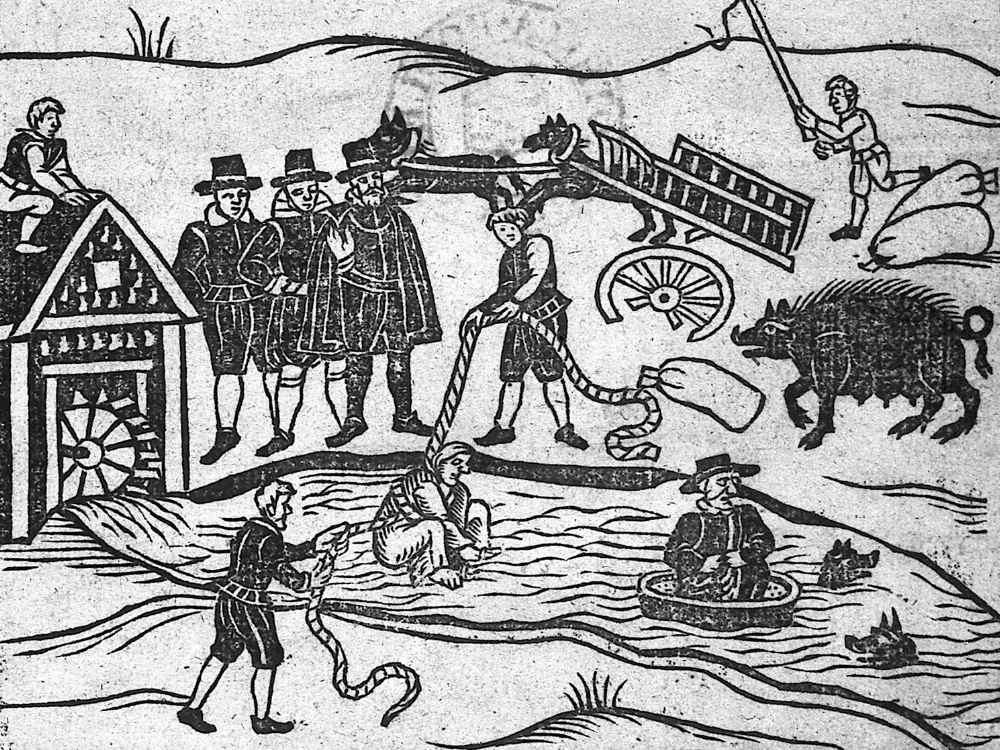
At her insistence, the judge agreed, and on 26 July 1675, the water ordeal was carried out. As was customary in witch trials, Marry was completely stripped. Her hands and feet were bound together, and the executioner, along with his assistant, threw her into the water three times.
Marry sank like a stone every time, and if she hadn’t been pulled up repeatedly, she would certainly have drowned. According to folk belief, a real witch would float because she was supported by the devil. Marry sank – and was therefore not a witch. Afterwards, Marry dressed and went home satisfied without saying another word. It was now proven that she was not a witch and that her stepson was a liar.
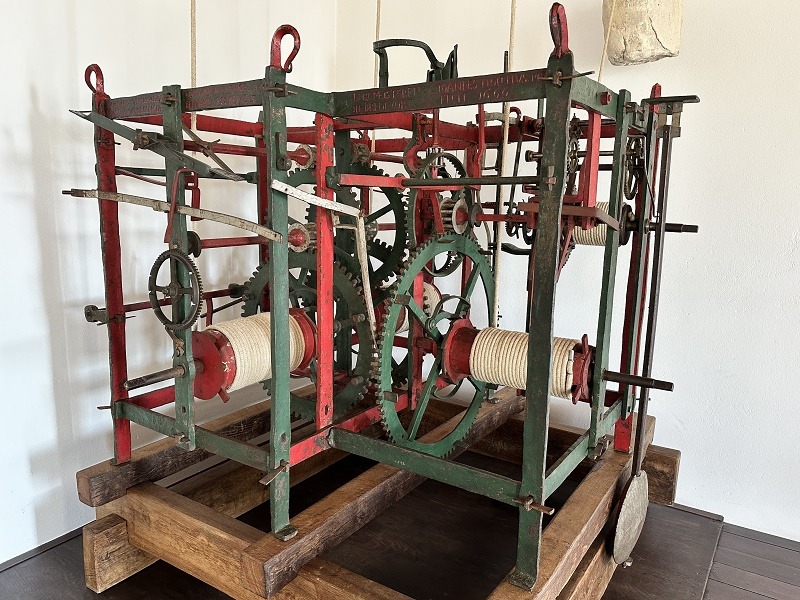
Late in 1664, the Bredevoort church council commissioned Joannes Holthus to construct a new clockwork mechanism for the church tower, as the old one was worn out. It was installed in 1666, marking the beginning of an eventful history that ultimately concluded right where it once began: the Sint Joriskerk (St George’s Church) in Bredevoort.
In the year 1664, the Netherlands was still the Republic of the Seven United Provinces. Johan de Witt governed the country and Michiel de Ruyter ruled the high seas. In the eastern corner of Guelders lay the small town of Bredevoort. Joannes Verschage was the minister here, and Gerhard van Hengel and Bernard Ecckervelt served as the churchwardens.
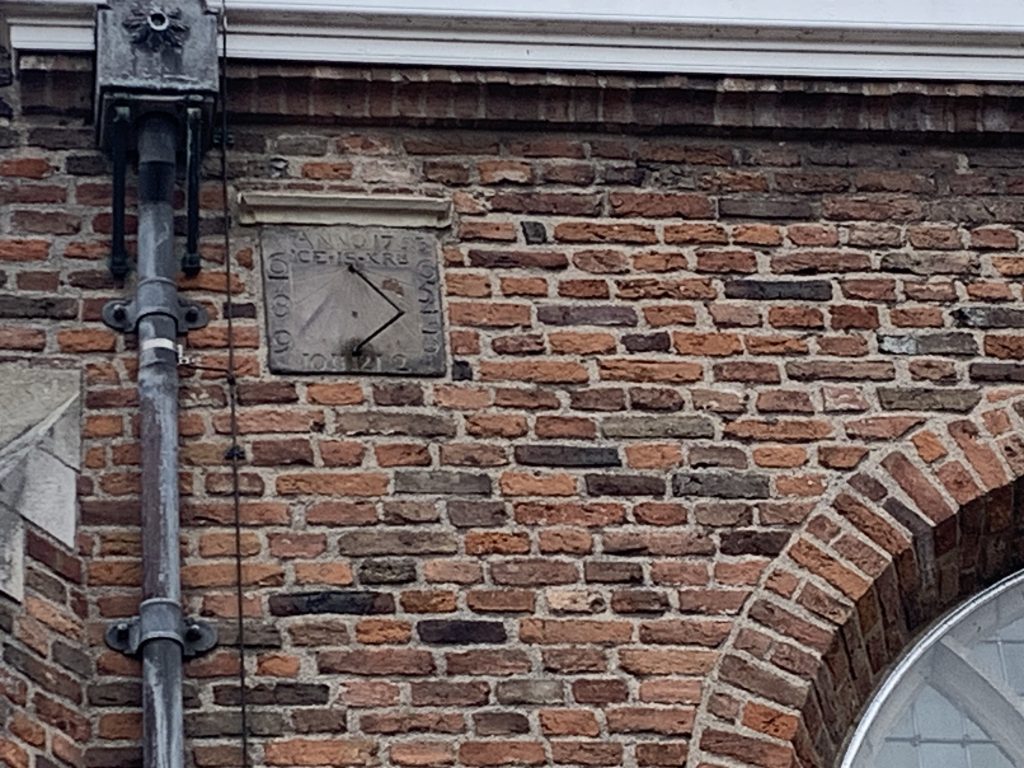
If you wanted to know roughly what time it was back then, you looked at the sundial which is still present on the exterior wall of the church. But if the sun was not shining, you depended on the clockwork in the church tower. However, that was not working well; it was dilapidated and out of order, according to the church management. A new clock was required.
Joannes Holthus
The church management entered into negotiations with clockmaker Joannes Holthus from Arnhem. In December 1664, they signed a contract stipulating that Holthus would deliver a clock within eighteen months that would strike the hours and half-hours. The agreed price was 300 Carolus guilders, of which 50 guilders was paid as an advance. The clock was delivered neatly on time; by the summer of 1666, it stood in the tower. Afterwards, however, it emerged that the agreed sum was insufficient.
In 1667, all parties signed for an additional sum of 228 guilders. Yet problems must have arisen regarding the payment. Holthus was forced to litigate in court. He fell into poverty, had to enter service somewhere, and had to leave or give up his children, ultimately dying in penury. Following his death, his daughter Jasperina continued the lawsuit until at least 1692. We do not know the outcome.
Through the centuries
After some time, a striking train was added to the turret clock, which also struck the quarters before and after the hour. A chime (voorspel) that announced the strikes was also introduced. This possibly occurred in 1680, a year that is engraved into the ironwork. In 1886, the clock was restored by Gerrit Jan Heinen from IJzerlo, who lived at the ‘Klokkemaker‘ farmstead.
Following nearly three centuries of faithful service, the clock was replaced in 1942 by a new mechanical turret clock. The old clock went to Aalten, where it spent a period gathering dust in the fire station. Afterwards, it ended up in the Aalten Oudheidkamer (historical museum), which was later incorporated into the Frerikshuus Museum and ultimately the Nationaal Onderduikmuseum. In 2017, the clock became a municipal monument.
Back to Bredevoort
However, the Bredevoort clock no longer fitted the museum’s concept, and an alternative location had to be found for it — preferably a place where the public could admire it. At the beginning of 2025, local interest group Bredevoorts Belang took over the turret clock. Reinstalling it in the tower of the Sint Joriskerk was no longer possible. The church’s interior committee proposed placing the clock in the church loft (boerenzolder), and the church council agreed.
The 1666 clock by Joannes Holthus now takes pride of place in the church loft, and everything is still in working order!
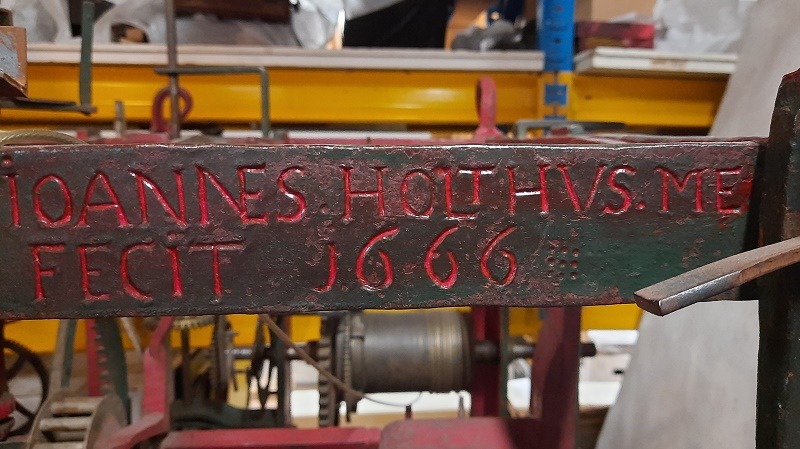
The 1666 Bredevoort turret clock (photo: Ap te Winkel)The sundial on the Sint Joriskerk (photo: Jos Wessels)A forged strip with inscription (photo: Ap te Winkel)
Technical Description
The turret clock consists of two interconnected segments. The segment containing the striking trains is 120 cm long, 65 cm wide, and 104 cm high. The section with the time train (gaande werk) and the chime mechanism (speelwerk) is 81 cm long, 58 cm wide, and 104 cm high. The following texts have been applied to forged strips:
“JOANNES HOLTHUS ME FECIT (made me) 1666. JOANNES VERSCHAGÆ PASTOR HUIUS ECCLESIÆ (shepherd of this church) GERHARD VAN HENGEL DR. BERNARD ECCKERVELT KERKMEISTEREN IN BREDEVORT“.
The clock is equipped with a double striking train, which kept Bredevoort on time by striking on both the hours and the half-hours. Furthermore, fifteen minutes before and after the hours, four tones resonated from three bells.
The corner posts are decorated with a beautifully forged scroll. The connections consist primarily of cotter pins. The entire mechanism stands on a wooden platform (beun). A large block of sandstone functions as the driving weight; this stone is almost certainly original. The stone hangs from a rope of braided hemp, as does all the other ropework. The entire mechanism works perfectly.
The clock is described in the book: Achterhoekse klokken en uurwerkmakers, by J.L. Sellink, A.F. Abbink, and R.E. Wiggers, (ISBN 90-9003816-7). On page 8, Mr Wiggers writes about the clock, stating among other things: “The escapement consists of a Graham escapement with a tooth shape according to Schwilgué; this must have been built in after 1715. The chime, however, appears to be original and constructed directly in 1666. The current position for the time train is also authentic, and its winding arbor is likewise identical to the other three arbors.”
In the year 1660, a certain Hendrick Janszen ‘van Brevoort’ came with his wife and four children (3, 12, 16 and 17 years old) to New Amsterdam, now New York. At that time there was no official surname, and in archives someone was mentioned with first name, patronymic (Janszen, or ‘son of Jan’) and the place where they came from (in this case ‘Brevoort’). They had left Amsterdam on 8/9 March 1660 with the ship De Moesman and arrived before 30 May.
We do not yet have more information about the Bredevoort origin of this Hendrick Janszen. Do you? Then we would like to hear from you !
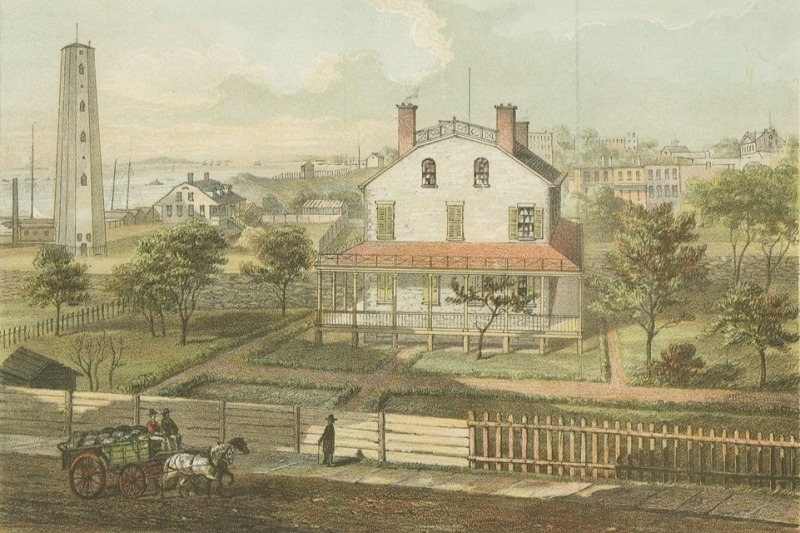
Brevoort Estate, between 54th and 55th Street, near 1st Avenue, 1866. Photo: The Museum of the City of New York
Hendrick’s son Jan Hendrick (1644-1714) used the surname Brevoort from 1696 onwards. In the centuries that followed, the Brevoort family in New York would grow into a well-known family with prestige and wealth.
Jan Hendrick Brevoort bought land in Harlem, where he held the position of overseer in 1678 and 1679. In the early 18th century, he exchanged Harlem for the south of Manhattan. At his death, he left his farm in the ‘Bowery‘ to his children. His son Hendrick (1670-1718) eventually owned most of the land, which then belonged to his son, also named Hendrick (1711-1771). He further expanded the property to 30 hectares. When the Brevoort family split up their possessions and sold most of them, this gave them a fortune. The head of the family was Henry Brevoort (1747-1841).
Henry Brevoort Jr.
Henry Brevoort Jr. (1782-1848) and his wife Laura Brevoort-Carson had a mansion built on the remainder of their land, at 5th Avenue and 9th Street. This area was on the rise and the Brevoorts took a prominent position in it. Henry Jr. was known as a literary spirit and he was friends and corresponded with the writer Washington Irving (1783-1859). In addition, he was a municipal councillor for many years.
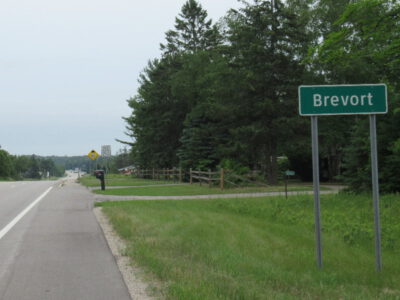
Henry Jr. was adventurous and traveled a lot. For example, he accompanied Lewis and Clark on their expedition to the Pacific Northwest from 1803 to 1806 and spent much time in the North American wilderness, working for John Jacob Astor’s American Fur Company. In the north of the state of Michigan, in Mackinac County, there is a hamlet called Brevort (pictured left), named after Henry, who explored the area in 1845, along with his friend Washington Irving.
In the city of New York in particular, various places, streets and buildings still refer to the Brevoort family. Here are a few examples.
The bend in Broadway
Characteristic of American cities is the rectangular street pattern. However, deviations from this pattern also occur. If you study the street pattern of New York, you will see, for example, that Broadway, one of the most famous streets in the world, also makes a bend. According to tradition, this would be due to one man, who was determined to defend his country.
The 35-hectare farm of Henry Brevoort Sr. was located on the outskirts of the city in the early 19th century. As the population of New York increased, the city government announced plans in 1815 to extend Broadway in a straight line to 23rd Street. However, this would cut through Brevoort’s land. He protested and the city council gave in: Broadway was diverted, so that the orchards of Brevoort’s farm, where 10th Street is today, were spared.
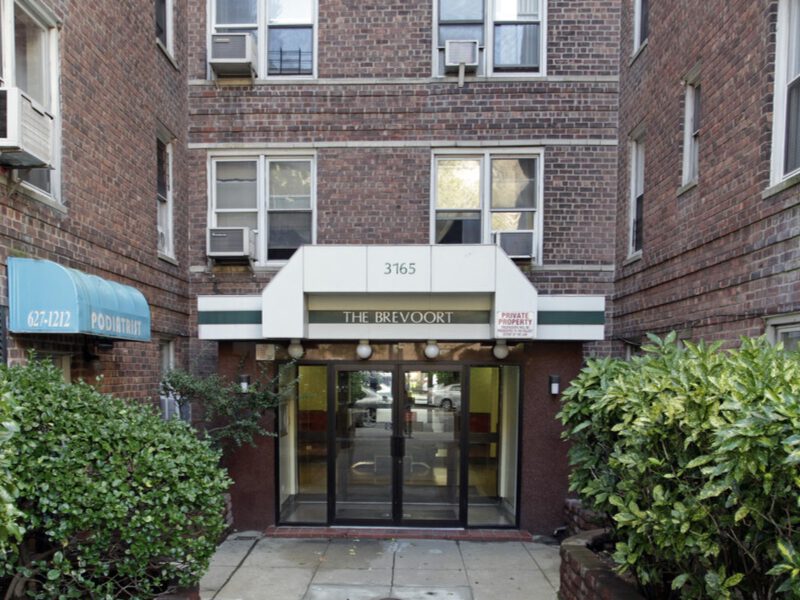
The Brevoort apartment complex, Manhattan
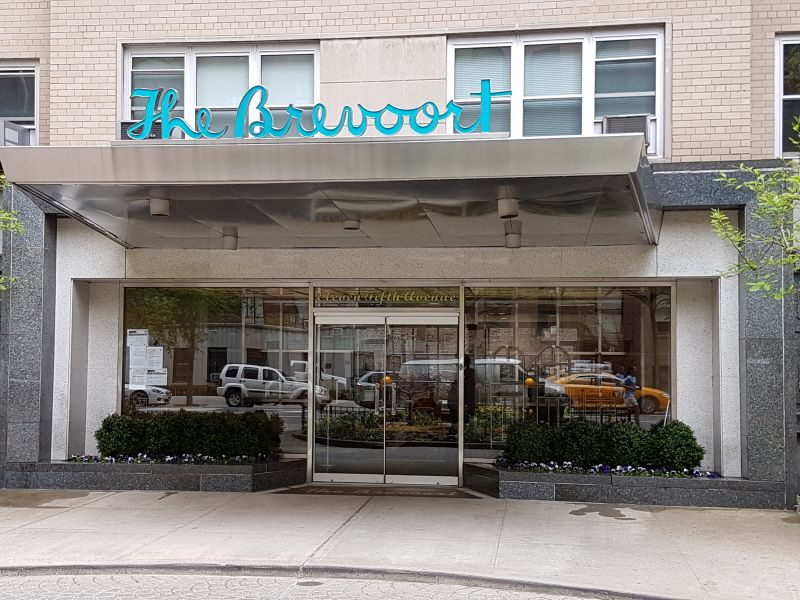
In the Greenwich Willage neighborhood, in the heart of Manhattan, there is an apartment complex called ‘The Brevoort’ at the beginning of 5th Avenue. The complex was built in 1955 and has 20 floors and 277 apartments. The building replaced the famous ‘Hotel Brevoort‘, once one of the leading hotels in New York. This is where the rich and famous and sometimes even royal guests stayed. The hotel was also known for the legendary parties that took place there. Aviation pioneer Charles Lindbergh received the Orteig prize of 25,000 dollars in this hotel for his solo flight over the Atlantic Ocean.
One of the most famous residents of the current apartment complex ‘The Brevoort’ was Buddy Holly. He lived there in 1958-1959, from his marriage until his fatal end. He recorded the so-called Apartment Tapes here.
Traces of Brevoort in Brooklyn
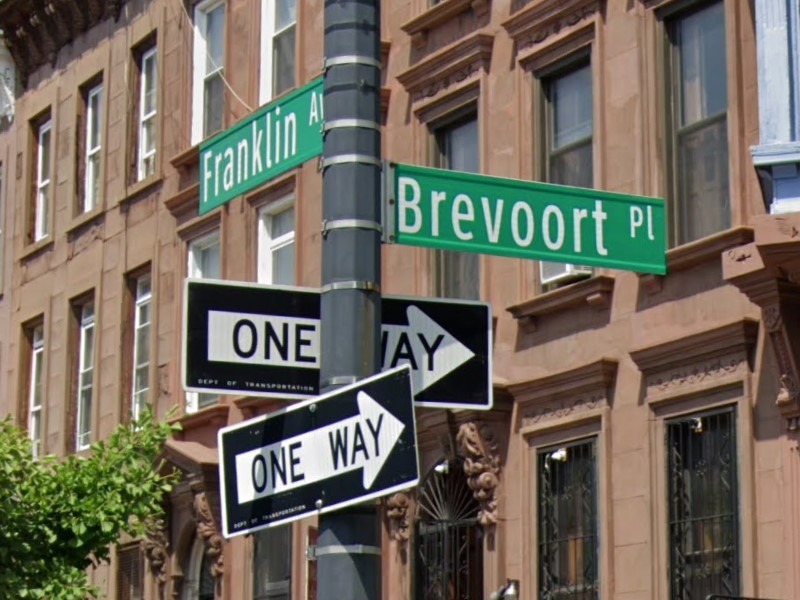
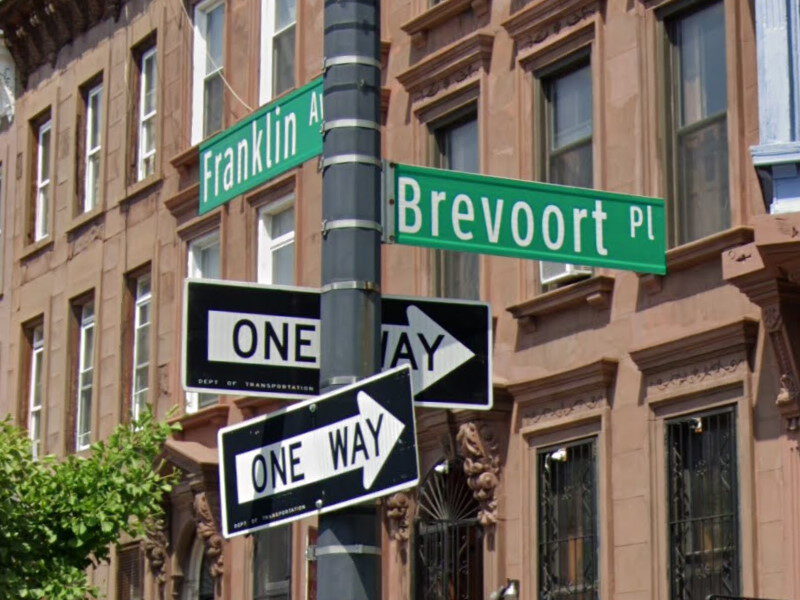
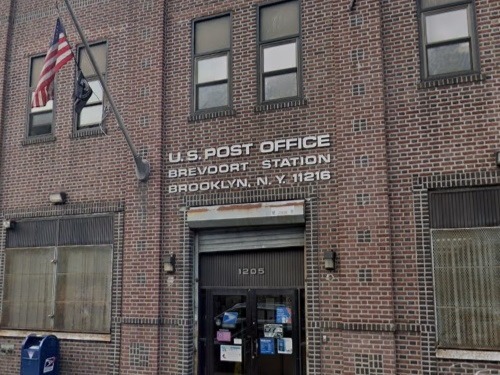
There are also several places in the borough of Brooklyn where family members of the Brevoorts once owned land. This includes a street (Brevoort Place), an apartment complex (the Brevoort Houses – 13 seven-storey buildings with a total of 896 apartments), a Brevoort Playground and a Brevoort Post Office.
Brevoort Place, Brooklyn
Brevoort Houses, Brooklyn
U.S. Post Office Brevoort Station, Brooklyn
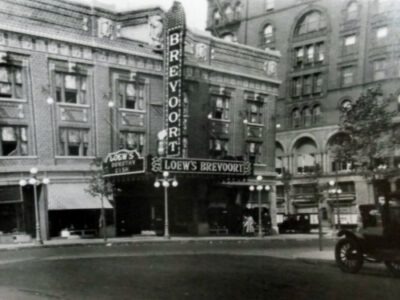
Brevoort Theatre, Brooklyn
Although this theater has long since disappeared, it is still worth a mention. The Brevoort Theater once stood on the corner of Bedford Avenue and Brevoort Place. When it opened in 1918, it was Brooklyn’s largest movie theater, with 1,800 seats and another 700 on the balcony. The theater also had a stage and an orchestra pit.
Although it was mainly shown in films in the first decades, the Brevoort Theatre became famous around 1960 because many well-known artists performed there, including James Brown, Jackie Wilson, Otis Redding, Smokey Robinson & The Miracles, The Four Tops, The Temptations, Marvin Gaye, Stevie Wonder, The Supremes, Sam & Dave, Dionne Warwick, Gladys Knight & the Pips and Pattie LaBelle & the Bluebells. However, this period did not last long. The theater closed its doors for good in the 60s of the last century and was demolished in 1968.
The verponding was a tax on real estate introduced in Gelderland in 1651 to replace the older schildschatting. This tax was levied on lands, farms, houses, and mills that generated income, with the aim of strengthening provincial finances. Wastelands, such as uncultivated common lands (markegronden), were exempt from this levy. The verponding remained in effect as a tax system in Gelderland until 1805.
Administration and Registration
Fragment from the verponding register for the rural district of Dale near Aalten, c. 1650
The term ‘verponding’ or ‘pondschatting’ likely refers to a tax assessment originally expressed in the unit of account ‘pond’ (pound). Data regarding the verponding was recorded in so-called verpondingskohieren (tax registers). These registers were compiled by local officials, such as bailiffs, sub-bailiffs, and rotmeesters, who were responsible for recording all real estate and its estimated value. The registers provide valuable historical information regarding the number of houses per location and their owners: nobility, church, or citizens. Additionally, they contain data on the size of holdings, lease structures, and ownership relationships.
Calculation
In the Quarter of Zutphen, to which Aalten and Bredevoort belonged, the amount of the verponding was determined based on the lease or rental value and the burdens resting on a property. For lands and farmsteads, the tax amounted to a sixth penny (or 1/6) of the taxable lease value; for houses and mills, this was a ninth penny (1/9) of the taxable rental value. If a property was not leased or rented but used by the owner themselves, the value was determined based on comparable properties that were leased or rented. Everyone was obliged to provide correct information and to show any lease contracts; negligence could result in a fine.
Collection and Payment
The collection of the verponding followed a strict schedule: the assessment, also known as ‘maning’ (summons), took place in November, and payment was to be completed before the end of February. The tax could be calculated in various ways, and several deductions were possible, for example, for maintenance. Taxpayers received ‘maancedulen’ (payment notices) stating the amount due. The collected pennies were transferred by the collectors to the receiver of the Quarter. Furthermore, the district, the city, and the Quarter could levy additional surcharges (opcenten) on top of the base amount.
Verponding Register of 1647
The Verponding Register of 1647 is a frequently used source for historical research. At the time the verponding registers were compiled, Gerhard Kreynck (1612-1692) was the mayor of Zutphen. Kreynck had a great interest in historical documentation and made copies of important archives, including the verponding register, city accounts, and fief registers.
The Verponding Register of 1647 was transcribed in an abbreviated form by Kreynck around 1650, which later became known as the Kreynck Transcript. The historical significance of the register lies in the fact that it is one of the first systematically established tax registers in Gelderland. The register provides insight into the economic situation of the region in the mid-17th century. The original register has been preserved and can be found in the National Archives in Arnhem.
Genealogiedomein: images and transcriptions of the verponding registers for Aalten and Bredevoort.
R. Wartena et al., Farm Names in the Achterhoek. From the verponding register of c. 1650, Kreynck transcript, publication East Gelderland Journal for Farm Research (link).
H.K. Roessingh, How are the Gelderland verponding registers from the mid-17th century structured? Sources for local historical research, Contributions and Communications of Gelre LXIII (Arnhem 1968/1969), pp. 61-71.
H.K. Roessingh, Sheaf tithes, seed tithes, and money tithes in Gelderland in the 17th and 18th centuries, Contributions and Communications of Gelre LXIII (Arnhem 1968/1969), pp. 72-98.
Anyone delving into the history of the Lordship of Bredevoort will inevitably come across the name Wilhelm van Haersolte tot Elsen. His name is forever linked to one of the most devastating disasters to strike the Achterhoek in the seventeenth century. As an administrator and military officer, he was at the helm of the region during a time of political tension, but it was a natural phenomenon that abruptly ended his life and that of his family.
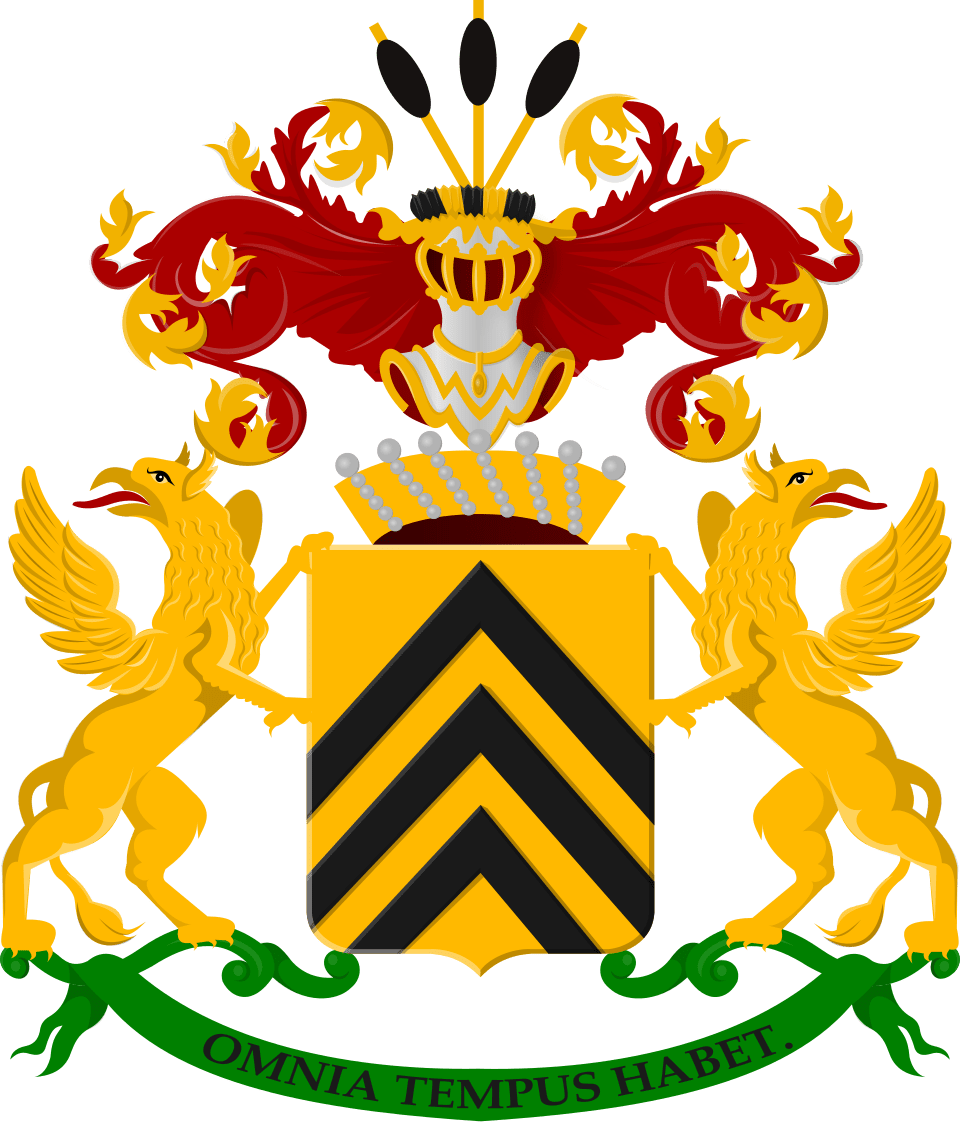
Coat of arms of the Van Haersolte family
Wilhelm van Haersolte was born in Zwolle around the year 1596, the son of Harmen van Haersolte and Anna van Hoeclum. He descended from a prominent noble family from Overijssel and, as was customary in those circles, chose a military career. As an infantry captain, he served in the States Army, the armed forces of the young Republic of the Seven United Provinces.
On 2 February 1630, he married Catharina van Brakel, with whom he would raise a large family. Eight children were born from their marriage, including Anthony (1637), Gerrit (1641), Assuerus (1643), Arent (1644) and Lodwich (1645). Furthermore, in 1638, a year after his appointment, Wilhelm and Catharina purchased the Elsen manor (havezate), which explained the addition of ‘tot Elsen’ to his name.
His bond with the Achterhoek was sealed in 1637. Following the death of his older brother, Arent van Haersolte, Wilhelm was granted the honourable and responsible position of drost and richter (drossard and magistrate) of the Lordship of Bredevoort. This meant that he held both the military command over the fortified town and the civil and judicial administration over the surrounding area, which at the time also included Aalten, Winterswijk and Dinxperlo. For his new role, Van Haersolte and his family moved into the imposing castle of Bredevoort.
Fate on a summer’s day
For nine years, Van Haersolte governed the region with a firm hand. The end of his term of office — and his life — came entirely unexpectedly, however, on 12 July 1646. That day, a severe thunderstorm swept across the Achterhoek. A fierce lightning strike hit the castle’s gunpowder tower, where vast quantities of gunpowder were stored at the time for the defence of the border region.
The ensuing explosion was catastrophic. The castle was virtually wiped off the map in a single blow, and the surrounding town sustained monumental damage. In total, 49 people lost their lives in this Gunpowder Tower Disaster (Kruittorenramp). Among the victims were Wilhelm van Haersolte himself, his wife Catharina and almost all of their children who were present in the castle at that moment.
Following this tragic death, Wilhelm was succeeded as drossard of the Lordship of Bredevoort by Georg Nicolaas van der Lawick.
The family’s legacy
The disaster almost brought an end to this branch of the Van Haersolte family. Only one son, the then six-year-old Anthonie, survived the drama because he happened to be staying elsewhere that day. Thanks to him, the family line did not die out; all modern-day noble descendants bearing the name Van Haersolte are directly descended from this young survivor.
Although the castle was never rebuilt to its former glory, the traces of Wilhelm van Haersolte are still tangible in the region. In the Sint-Joriskerk (St George’s Church) in Bredevoort is a fire bell that he donated to the community in 1644. In addition, during restoration work in the church, the historical tombstones of the drossard and his family members were rediscovered and restored to a place of honour, keeping the memory of this fatal history alive for the residents of the former Lordship of Bredevoort.
Sources
Gelders Archief (Arnhem): Archive of the Nassau Domain Council, inv. no. 685 (Ambtboek), containing the official registrations of the drossards and their appointments in the Lordship of Bredevoort.
Collectie Overijssel (Zwolle): Van Haersolte family archive (Haerst, den Doorn and Zuthem branch), inventory number 0237.1, inv. no. 335. This archive contains the personal and business documents of the noble family.
Staring Instituut:Bredevoort een Heerlijkheid (ISBN 90-9002135-3), an important standard work on the history of the fortified town, the castle and the region.
Transcription of Baptismal and Burial Registers of Bredevoort: Historical church registers containing details regarding the interment of Wilhelm van Haersolte, his wife Catharina van Brakel and their children in the choir of the Sint-Joriskerk following the disaster on 16 July 1646.
Kastelen in Overijssel: Documentation and historical background regarding the Elsen manor, the ancestral estate purchased by the couple in 1638.
Gunpowder Tower Disaster Bredevoort 1646, 3D impression by Paul van Druten
On Sunday, July 12, 1646, around four o’clock in the afternoon, the gunpowder tower of Bredevoort Castle, containing 320 barrels of gunpowder, was struck by lightning. Forty people were killed and an unknown number were injured in the ensuing explosion.
The tower caught fire upon impact. The explosion was so violent that the Ambthuis (administrative house) also collapsed. The town suffered extensive damage from the explosion, and almost all houses lost their roof tiles and windows. The houses surrounding the castle had collapsed. For three days, survivors were sought beneath the rubble using shovels and pickaxes.
In 1938, G.H. Rots wrote a series of articles in the Aaltensche Courant about the history of the municipality of Aalten. Regarding the gunpowder tower disaster in Bredevoort, he wrote:
“The year 1646 was once again a disastrous year for Bredevoort. It was the 12th of July, and an oppressive heat hung over the town. Dark clouds gathered, and everything indicated that a severe thunderstorm was imminent. And indeed, lightning soon cleaved the sky, followed by heavy claps of thunder. And suddenly, a terrible blow, followed by a dreadful sound.
Lightning had struck the gunpowder tower, causing the gunpowder present (320 tons) to explode. The entire tower was blown apart, as was the nearby Ambthuis; tiles were torn from almost all houses, and windows were blown in by the air pressure. The number of deaths in that disaster amounted to 19 at the castle and the Ambthuis alone. There were also numerous deaths in other houses in the town.”
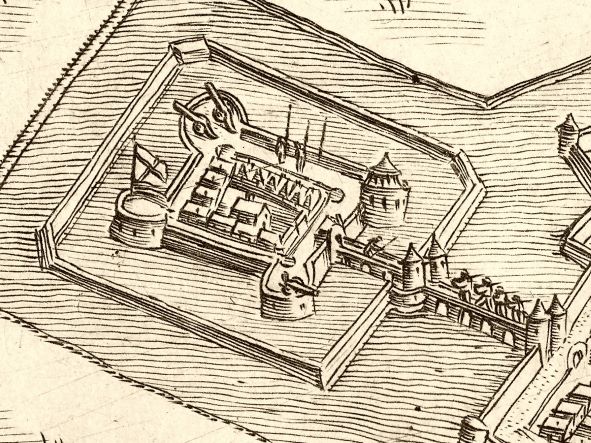
Bredevoort Castle in 1597
Victims
“The deceased included, among others, the Governor of the city Willem van Haersolte and his spouse, the Drostinne Cathrijne van Brakel and her eight children, and her niece Berentjen van Brakel. Furthermore, Joh. van Langen, lieutenant to Georg Ernst Count of Bronkhorst, and also his French mistress (sic) Jeanne van Sédan. An elderly woman present there, Maria Glazen, along with the manservant and the maid, were also among the victims.
The sentry on duty, named Hendrik Otterpoëll, was buried under the ruins. In other parts of the town, the house of Jan Stenneken was destroyed. He and his wife Marycken van der Halle were killed. The names of the dead in other parts of the town were Derk Trix, ensign, Harmen ter Male, F. zum Moorelagen, Bailiff of Winterswijk, and his wife Janne Beerninck, with her sister Christine Beerninck, widow of the late N. Brinkhorst, judge of Haaksbergen.
The house of Berent Grimme was destroyed; his wife and four children lost their lives. The house of Casper Evers was hit, under which three people were killed, named Arent Hamaeker, a child of Berent Maes, and a child of Herman Broekman. Under the house of Derrick ter Woerle Wiltschut, three of his children were killed, as well as the soldier Gerrit Jansen and Jan Schulten.
We have specifically mentioned these names because one might perhaps derive names of those living today from them.”
The deceased who lay under the rubble of the Ambthuis were laid out on July 15 at the home of the widow of the late minister D.J. Verhagen. The bailiff with his wife and eight children were buried on the morning of Thursday, July 16, in the choir of the St. George’s Church. It is not clear how many people remained under the rubble. In total, forty people died that day. The sources make no mention of the number of victims who were injured.
One son of Drost Wilhelm van Haersolte survived the disaster. Anthony, as he was named, happened not to be home that day: he was staying in Zwolle. He continued the family line in Zwolle and founded the Haersolte Almshouse there, which is assumed to be connected to the disaster in Bredevoort.
Sources
‘From Aalten’s past’, by G.H. Rots, Aaltensche Courant, 18 February 1938 (Delpher)
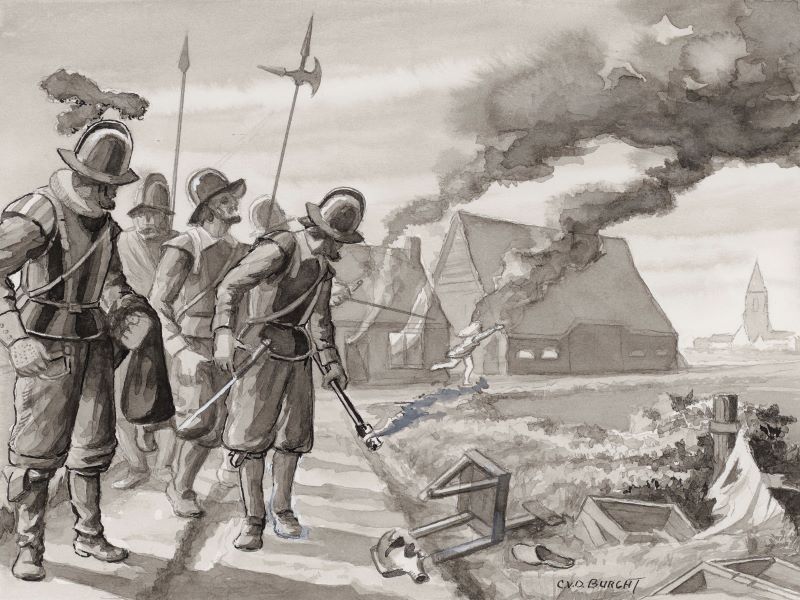
In earlier centuries, the population of Aalten regularly suffered from forced contributions. A forced contribution (brandschatting) is a (usually high) sum of money that a village or region had to pay to passing troops to prevent them from looting and burning the village or region.
The soldiers in question usually received irregular pay and were primarily paid from these forced contributions. If the amounts could not be raised, the troops felt entitled to looting and other misconduct. Since multiple armies often passed through a region during wartime, the imposition of this ‘war tax’ usually led to bitter poverty. Additionally, the population often suffered from roaming, dismissed mercenaries.
This practice plagued many areas not only in the Middle Ages, but also during various wars in the 16th, 17th, and 18th centuries. In the peripheral areas of the Republic of the Seven United Netherlands, for example, such as North Brabant, Limburg, and the eastern border regions, it led to a major economic and demographic decline during these centuries.
Looting, forced contributions, and rape by Spanish soldiers, by C. van der Burght (Source: Zeeland Archives)
Historical Description
In 1938, G.H. Rots wrote a series of articles in the Aaltensche Courant about the history of the municipality of Aalten. He wrote the following about forced contributions in Aalten:
“In the years before 1597, the year of the conquest of Bredevoort by Prince Maurice, Bredevoort had regularly been in the possession of the Spaniards. However, one should not think that there was peace and quiet in the Ambt of Bredevoort at that time. Troops regularly passed through and stayed in Bredevoort and the associated districts. The village of Aalten suffered particularly from these passing troops. There was little dispute over property rights. The soldiers simply took whatever they liked, and the Ambt of Aalten was repeatedly levied for forced contributions, i.e., ordered to hand over a number of horses, cows, or money to the passing troops.
One could also strike a deal with the marauding bands and prevent the seizure of livestock and horses by paying a sum of money. As evidence of how Aalten suffered under these repeated raids and robberies, the following is mentioned in that regard.
On March 2, 1582, English horsemen arrived in Aalten and took 16 people prisoner. These prisoners were released after paying a ransom of 2,000 guilders.
An honorable citizen named Hondarp, however, was transported to Zutphen but was later released for a ransom of 200 dalers. The son of the aforementioned Hondarp was taken prisoner on October 17 while he was in Doetinchem. He had ridden to Doetinchem on horseback, and it seems his appearance suggested he did not lack means, as he was able to regain his freedom upon payment of 100 dalers and the surrender of his horse.
On December 1 of that year, soldiers from Lochem arrived and demanded 100 dalers to prevent looting. Things did not go well for Hondarp, as on January 15, 1583, he was taken prisoner along with his wife and son. They could only extract 60 dalers from him, for which they finally regained their freedom. In March of that year, another group of soldiers from Doetinchem arrived and stole a number of horses ‘at the Pas’. The owners were able to buy them back for 51 dalers, except for the best horse, which the soldiers took with them.
On May 29, the people from Doetinchem returned and stole a horse and a cow, but this time no ransom was paid, probably with the thought: if they get no money, they won’t return so quickly. But the next day it was the same story again; 3 horses were stolen. The ransom decreased, as they only had to pay 9 dalers, with which the soldiers were satisfied.
However, looting was in the blood of the garrison at Doetinchem, as they repeatedly came to Aalten. On June 18, they stole three horses; the ransom was 13½ dalers.
On the 10th, they were back again, and now they demanded 3 horses, 2 cows, 2 heifers, and 3 bulls. The heifers were slaughtered and valued at 10 dalers. The rest were bought back for 10 imperial guilders and the bulls for 10 dalers.
On June 14, one horse was stolen, which was bought back for 3 dalers and 18 stuivers. It would get even worse, for only two days later, soldiers from Bergh, Doetinchem, and Nijmegen arrived and stole 41 horses, 4 oxen, 33 cows, and 37 head of barren cattle. Only a portion of these could be bought back for 674 dalers.
And now more robberies followed. On July 19, 20 horses were taken by soldiers from Bronckhorst. On August 11, another 6 horses. On September 14, soldiers from Ulft stole 3 cows, for which a ransom of 15 dalers was paid by the owner.
On September 17, a company of soldiers led by a certain Stael arrived and seized 11 cows, 40 horses, 40 head of large cattle, and 12 oxen. They took the best livestock with them, and the rest was bought back for 419 dalers. Until now, it had always been livestock, but on December 15, soldiers from Lochem arrived and demanded 8 horses and 2 carts of buckwheat. On March 15 of the following year, a carter with a wagon of rye, drawn by 2 horses, drove through the IJzerlo field. Some horsemen from Bergh and Doetinchem seized everything, and the carter saw his property taken away.
Now they began taking heads of households prisoner again. They were released for a ransom or in exchange for other prisoners languishing in the dungeon at Bredevoort. Immediately after Whitsun, a large raid was undertaken, and many horses and cows were seized and partially bought back. Subsequently, on June 9, June 20, and June 24, there were repeated raids and thefts of horses and livestock.
And the measure was not yet full. The population of Aalten had a hard time, for on July 13 and 14, 1584, 15 people were taken prisoner in the municipality of Aalten and 600 head of cattle and horses were stolen. The prisoners were released for a ransom of 1,100 guilders. Who can fathom the sorrow of the population in those days?
Because of all these mentioned raids, people became fearful. They hardly dared to go outside with a horse, ox, or other animal; danger lurked from all sides. Soldiers were stationed in all the surrounding fortresses, and whenever they needed something, they went out looting. It was in the middle of harvest time, but the farmers left the grain in the fields; why should they harvest? Soon the enemy and also the State soldiers would come—for in this regard it was ‘six of one and half a dozen of the other’—and steal their possessions.
There were also farmers who fled and tried to find a living in regions further to the east. Those who remained here complained to the village authorities, but what could they do! In those years, a certain Jan Holstein was the advocate (voogd) of Aalten. He addressed petitions to the Lady of Anholt. It seems, however, that she was also powerless to end the situation. It was wartime, and the soldiers, mostly mercenaries and volunteers, demanded money, food, and drink on time. And when the army leadership could not provide that on time, the soldiers tried to obtain it themselves through looting and robbery. The population became the victim.”
Billeting
“Added to all that misery was the fact that garrisons were relieved of soldiers by billeting them with farmers and village residents. The people themselves had almost nothing to eat, and when soldiers were billeted, they would act out if they did not receive enough food. If people had provisions, they were largely hidden, otherwise everything would be seized. To make matters worse, an extra tax was imposed on the population. The Lady of Anholt needed money, and the Stewards traveled around to collect the funds; but everywhere there was poverty and want.
Then it would seem as if peace would return, and nothing would be heard for a year. But suddenly it would flare up again. As in the summer of 1586, the looting began once more. The Aalten farmers then pursued the looters as far as Enschede and Oldenzaal. They wanted their stolen cattle back. They had to return empty-handed, and the suffering was almost unbearable.
One of the worst afflictions was when the soldiers brought their wives and children with them. Then they also had to be given something to eat. In January 1587, such a troop was to be partially billeted in Aalten. Fear struck the hearts of the population. It was heard that they were mercenaries from Wallonia in Belgium, who were notorious for their ferocity and cruelty. Outposts had already been sent out because it was suspected that Geuzen soldiers were in the vicinity. On a Sunday morning, such an outpost troop of 20 men arrived in Aalten, led by the landdrost Thieseling. They moved on to Bocholt, where a Spanish cavalry unit had arrived under the command of Colonel Taxis.
Reconnaissance had determined that no State or Geuzen soldiers were to be seen, and so it was agreed to ride back to Groenlo and then carry out the billeting. But between Aalten and Bocholt, they were suddenly ambushed by the Geuzen soldiers, and a fierce battle broke out. The Geuzen were victorious, and the fear remained. The dreaded billeting did not happen.
Near Bredevoort, there seem to have been fertile meadows in addition to marshes. Specifically, there was a town meadow at the Swanebroek and several private grazing lands. But in 1587, everything had been grazed bare by the enemies’ horses, the meadows were completely ruined by riding, and afterwards a period of rain came and everything was flooded, so that no hay could be harvested that year. While they had been spared billeting in the spring, in December of that year a large number of horsemen suddenly arrived from Groenlo and stole horses, cows, and pigs. Sixty molders of rye and buckwheat were also to their liking, along with 43 wagonloads of unthreshed grain.
On March 26, 1588, it was a number of State soldiers who looted in Aalten. Thus, the population was bitten first by the cat and then by the tomcat. The advocate of Aalten, Jan Holstein, wrote a letter on June 9, 1588, to Godfried Gerardi, advisor to the Lady of Anholt, in which he recalls the situation in Aalten. The harvest cannot be safely brought in. Citizens of Aalten have been taken prisoner and are being held hostage elsewhere. There is no money to ransom these people.
On July 4, 1588, an army of 2,000 infantrymen (foot soldiers) and 300 horsemen approached Aalten. They entered the village, and the residents fled fearfully into their houses. What would happen to them now? The command was held by the Spanish governor and field commander Verdugo and Count Herman van den Berg. It appeared, however, that they were just passing through towards Bocholt-Recklinghausen, so Aalten was spared billeting or robberies this time.
The Lady of Anholt considered ways to end the robberies. She needed money to pay the soldiers’ wages and therefore decided to introduce an extra levy (extra tax). But of course, you can’t pluck feathers from a frog. Aalten had to provide an extra 70 dalers, and the advocate of Aalten wrote to the Lady that he did not know how he would collect this sum, which had been easy to pay in the past, at this time. The population is starving, horses and cows are almost non-existent, and what remains is being stolen.
Yes, my readers, who can fathom the depth of misery of the unfortunate population, for not only the mentioned afflictions hit the people. It is as if everything conspired to complete the system of destruction, for while the crops promised somewhat of a good harvest, a violent storm arose accompanied by heavy hail and destroyed all the crops standing in the fields. How deeply our ancestors had to drain the cup of misery is indescribable and cannot be understood by us, who do complain about bad times.
For even more atrocities were to occur. The hordes of soldiers who roamed about and often indulged in strong drink threatened women and daughters with dishonor if they were not given what they demanded. In 1597, Bredevoort was taken by Prince Maurice. The change in government had come, but it did not bring the protection of home and property. It remained restless in the Ambt of Bredevoort. The fortunes of war fluctuated, but soldiers were soldiers; one group might be slightly better than the other, but on average they could all be painted with the same brush.”
Twelve Years’ Truce
“Only in 1609, when the Twelve Years’ Truce was made, could the population catch its breath again. With the changing fortunes of war, religious disputes had also flared up. As long as the Spanish domination existed, the Reformers could not show themselves openly. No sooner had the tide of war turned than the change in the churches also took place. The victors took measures against the vanquished that, in hindsight, are indefensible.
After the Twelve Years’ Truce, the conflict began to flare up again. In Groenlo, there was still a garrison of Spanish soldiers. That was a breeding ground for bad elements. They roamed the rural districts and again stole everything they could. The new Lord of this municipality, Prince Maurice and later Frederick Henry, was constantly petitioned for protection. Finally, on July 17, 1627, Frederick Henry decided to rush to the aid of his subjects in the County. A significant military force of 55 squadrons of cavalry, 168 companies of foot soldiers, and 75 cannons entered the County, coming from the direction of Emmerich. The siege of Groenlo was laid, and a fierce battle erupted there between besiegers and besieged.
After the siege had lasted a month, Frederick Henry took the city and thereby established the rule in the County. For thirty days, Frederick Henry stayed in Groenlo and visited the surrounding places. Aalten also received an official visit from Frederick Henry. He encouraged the population. Since then, a member of the House of Orange has never made an official visit to Aalten. If a street or square in Aalten ever needs to be named again, it might well be named after this liberator of Aalten territory. For afterwards, peace returned, except for small robberies compared to the past, until the peace was signed in 1648, ending the Eighty Years’ War.”
In the southeast of England, at the mouth of the Thames, lies the town of Canvey Island. Four centuries ago, it was in danger of disappearing into the sea, until in 1622 the Dutch came to the rescue with their ‘water management skills’. After a successful reclamation, many Dutch workers continued to live there, perhaps including one or more Oud-Aalten residents.
In the early 17th century, Sir Henry Appleton, the most important landowner on Canvey Island at the time, met the Dutchman Joas Croppenburg. He proposed to drain Canvey Island in the same way as had been done in Amsterdam. In 1622, several landowners of Canvey Island signed an agreement and Croppenburg hired another Dutchman, Cornelius Vermuyden, to reclaim the island.
Vermuyden recruited between two and three hundred compatriots to get the job done. They built a series of seawalls and successfully made Canvey Island habitable by reclaiming 15 kilometres of land by embanking the island with locally mined chalk, limestone and heavy swamp clay.
Dutch colony
After Canvey Island was drained and available for both agriculture and living, many of the Dutch workers who had helped reclaim the land decided to settle there permanently. A Dutch colony developed on Canvey Island within a few years. Dutch even remained the official language in Canvey until about 1700.
The Dutch settlers named all kinds of roads in their settlement after places in their homeland. There is an Aalten Avenue, Zelham Drive, Goirle Avenue, Haarlem Road, Urmond Road and Waalwyk Drive, among others.
Photo: Google Streetview, 2024
As yet, no tangible connection has been found between this history and specific Oud-Aalten residents who would have been involved. Hopefully, relevant information about this will one day ‘surface’!
During the 17th and 18th centuries, over two hundred men from Aalten and Bredevoort enlisted on ships of the Dutch East India Company (VOC). Some were still minors; many never returned. What prompted them to trade the rural Achterhoek for a dangerous sea voyage to the East, thousands of kilometers from home?
The VOC and its administration
The VOC (1602–1795) was the world’s first multinational and grew into a powerful colonial enterprise with trade monopolies and its own military force. In nearly two hundred years, over 4,700 ships departed for Asia. In the 18th century alone, approximately 655,000 people were aboard VOC ships.1 Only a small portion came from the Achterhoek. From the records, we know over 200 names of men from Aalten and Bredevoort who entered the service of the VOC.
That we know this is thanks to the meticulous personnel administration. Personal details, roles, ships, destinations, and the reason for leaving service were recorded in the so-called ship’s pay ledgers. These sources have largely been preserved and can be consulted online via the website of the National Archives. The table at the bottom of this article was compiled based on these records.2
Aalten and the VOC: involved from the beginning
The involvement of Aalten residents with the VOC did not only begin when men enlisted as soldiers or sailors. An Aalten native played a notable role as early as its founding in 1602. Wessel Schenk, born in Aalten and later a merchant in Amsterdam, invested 30,000 guilders in the new company at that time. This made him one of the largest shareholders of the VOC.3
The service was risky: more than half died en route or in Asia, while only a third demonstrably returned alive. Enlistments took place throughout the 17th and 18th centuries, with slight peaks in the 1720s and 1760–70.
Optical print of Batavia in 1780 (source: Wikipedia)
Motives for departure
Why did these men choose an uncertain existence at sea? For many, it was a matter of poverty or a lack of prospects: a steady income with the VOC offered security. For others, the urge for adventure and independence played a role, a chance to see the world and escape the constraints of rural life.4
Military roles
Nearly half of the men from Aalten and Bredevoort held a military position. Until 1755, there was a garrison in Bredevoort5, which may have played a role in this. For military personnel, the VOC presumably offered the opportunity to utilize their experience with weapons and discipline, often for better pay and with more career prospects. At the same time, it is equally possible that men with experience in the civic guard were deployed for such roles. The departure of the garrison from Bredevoort seems to have had no demonstrable influence on the number of enlistments.
Names and data
The table below contains the details of individuals from Aalten and Bredevoort who were in the service of the VOC. Some individuals are listed multiple times because they made several voyages. This table is not flawless and is likely not exhaustive. For some individuals, it is not certain that they actually originated from Aalten or Bredevoort, as the origin is sometimes difficult to read and spelling varies. Partly for this reason, names are undoubtedly missing, but possibly also because parts of the administration have been lost.
The 📜 behind each name contains a link to the relevant entry in the National Archives, where the scan of the original document can also be viewed. A 🌳 refers to the family tree of the person in question on FamilySearch (free account required), where known – work in progress!
At the beginning of the 17th century, Wessel Schenk and his half-brother Salomon Voerknecht from Aalten were among the largest grain traders in Europe. Their activities spanned from Amsterdam to Danzig, Königsberg, Genoa, and even the New World. Other family members were also active in trade and entered into marriages that strengthened their position. What began in Aalten grew into a network with international influence.
The Schenk / Voerknecht family
In the mid-16th century, a certain Jenneken ter Woert lived in Aalten. From her first marriage to Salcke Schenk, she had two children: Gertruid and Wessel Schenk. Around 1568, she remarried Johan Voerknecht, with whom she had four children: Salomon, Hans, Judith, and Anna Voerknecht.12
In 1575, Johan Voerknecht was a keurnoot (lay judge) of the Bredevoort court3, a position indicating social standing. Whether the family belonged to the Aalten ‘elite’ is unknown to us. However, it is striking that all the children later became successful in trade or married partners of distinction. This suggests a connection to influential networks that enhanced their social and economic opportunities.
Merchants in Amsterdam, Danzig and Königsberg
From the late 15th century, merchants in the Low Countries specialized in the transport of bulk goods, especially grain and salt. This trade, known as the moedernegotie (mother of all trades), formed the economic foundation of Holland for centuries and made Amsterdam the most important staple market in Europe.4
The Schenk-Voerknecht family also benefited from this. They maintained close ties with the Hanseatic cities of Danzig (Gdańsk) and Königsberg (Kaliningrad). Some family members even settled there, either temporarily or permanently.
Danzig, 1628 AD
The Schenk and Voerknecht children grew up during the Eighty Years’ War (1568–1648), yet they managed to break into international trade regardless. The period of the Twelve Years’ Truce (1609–1621) provided favorable conditions: a brief phase of peace and armistice. Eastern Netherlands had eight garrison towns (including Bredevoort) that were in constant need of forage, particularly grain. This was not only for bread but also for the production of beer.
Wessel Schenk was a grain merchant and did good business in the Achterhoek during that period. He was also active in the trade route from Danzig to Genoa, Italy.5 His half-brother Salomon Voerknecht was likewise a very successful merchant.
Largest carriers from Amsterdam to the Mediterranean, 1590–1620:
Carriers
Total
Shipments
With a partner
Jasper Quinget
201
197
4
Jan and Philippo Calandrini
91
25
66
Guillelmo Bartolotti
66
42
24
Caspar van Ceulen
63
35
28
Isaac la Maire
56
42
14
Willem Willemss
49
48
1
Salomon Voerknecht
45
13
32
Wessel Schenck
30
25
5
Biographies of family members
Wessel Schenk
Born around 1566 in Aalten. In 1606, he lived on the Breestraat in Amsterdam. In archival documents, he is referred to as a “merchant lord.” Other sources indicate that he also regularly stayed in Danzig.
Upon its founding in 1602, Schenk was one of the largest shareholders of the Dutch East India Company (VOC). He also saw opportunities in the New World. Together with his nephew Jan Holscher, he invested in expeditions to New Netherland, in the northeast of the present-day US. In 1614, he was a co-founder of the New Netherland Company, the predecessor of the West India Company.6
In 1609, he included in his will that he would leave 4,000 guilders to the poor of his birthplace, Aalten. Because he was often traveling, he had a will drawn up in 1616, leaving his affairs in Amsterdam to his nephew Jan Holscher.
In 1619, Wessel, as a citizen of Danzig, contractually transferred the annual income from two Aalten farms (Lutke Grievinck and Goorhuis) by proxy to his sister’s daughter Gertruid Tols, widow of Johan Brunss.7 In 1632, he was back in Danzig and sold by proxy “a garden or courtyard with timber structures in two parcels” outside the Regulierspoort in Amsterdam. He must have died shortly thereafter, presumably unmarried.8
Gertruid Schenk
Born around 1565 in Aalten. Around 1584, she married Albert (?) Hengst van Juchteren in Anholt. After 1590, she remarried Henrick Toll. In 1600, she lived on the Nieuwe Zeedijk in Amsterdam. Gertruid was also active in the family business. In 1616, Gertruid and her brother Wessel received a letter of recommendation from the States-General addressed to the city council of Danzig—a sign that their commercial position was officially recognized. Gertruid passed away after 1628.9
Salomon Voerknecht
Born around 1568 in Aalten. In 1597, he married Jannetje Hooft in Amsterdam. She was a descendant of a prominent Amsterdam merchant family that produced one of the greatest Dutch writers of the Golden Age: Pieter Corneliszoon Hooft. Father-in-law Jan Pietersz Hooft was a brother of the mayor of Amsterdam, Cornelis Pietersz Hooft, and through this marriage, he also became the brother-in-law of the later mayor Volckert Overlander.
In 1618, Salomon, on his own behalf and as proxy for Judith and Hans Voerknecht, sold a piece of land, the Bullensche maat in Lintelo, to Roelof Damme and Catharina Smitz. In 1619, he sold—partly on behalf of his wife, and as proxy for his sister Judith, widow of De Marez, and brother Hans (“citizen of Danzig“)—their parental home in Aalten near the churchyard, including the courtyard and land, to Wessel Brethouwer and Mechteld Machtes.
In 1637, Salomon was a senior merchant in the service of the VOC in Batavia. He had gone from Danzig to the East Indies and remarried a widow there. On October 24, 1637, in Batavia, “weak in body but still sound of mind,” he recorded his last will and presumably died shortly thereafter. His eldest son Johan became the deputy bailiff of Amsterdam in 1656.10
Hans Voerknecht
Born around 1569 in Aalten. Hans Voerknecht (also called Schenk) was likewise active in trade. In 1605, he was mentioned as a merchant in Amsterdam, along with Salomon Voerknecht and Wessel Schenk. In 1608, he was in Danzig, and in 1619, he was even recorded as a citizen of that city. He presumably died there not long after.11
Judith Voerknecht
Born around 1569 in Aalten. Around 1585, she married Daniel de Marez, a merchant in Danzig. He is immortalized in an almost life-sized painting of the De Marez and De Schilder families. While in surrounding countries only monarchs had themselves immortalized in this manner, here powerful merchants displayed their status. In 1619, her brother Salomon sold the parental home in Aalten on her behalf (and that of other heirs).12
Anna Voerknecht
Born around 1571 in Aalten. Around 1590, she married the merchant Joost Grevinckhoff, also from Aalten. A deed from the court at Bredevoort from 1615 mentions that Seigneur Wessel Schenk sold a large number of lands and tenant farms on behalf of Joost and Anna, who were then residing in Königsberg. The deed concerns a debt settlement: Joost and Anna were deeply in debt, primarily to Anna’s brother, Seigneur Salomon Voerknecht, “citizen and merchant in Amsterdam” (Seigneur was the title of address for wealthy merchants at that time). Because they could not pay, they transferred their entire property in Aalten—including their house, land, and hereditary rights—to Salomon and his wife Joanna Hooft.13
Jan Holscher
Born around 1584 in Dülmen (near Münster). In 1601, he came to Amsterdam, where he entered the service of his uncle, the merchant Wessel Schenk. Although he managed his uncle’s business, he also traded independently. He held shares in a company that traded with Guyana. Together with his uncle, he also participated in the Hans Claesz Company. In 1613, Thijs Volckertsz Mossel sailed for this company to the Hudson River. In 1612, Jan Holscher married Elisabeth de Hardouin from Rouen in Amsterdam.14
Gertrud van Myllendonk (1552–1612), also known as Geertruida van Millendonck, was a noble administrator in the German-Dutch border region. She was Lady of Drachenfels, Königswinter, and Anholt, and for thirty years the pledge-holder of the Lordship of Bredevoort (1582–1612).
Her reign took place in the midst of the Eighty Years’ War (1568–1648). While the region was torn apart by violence between Spain and the emerging Dutch Republic, she attempted to keep her territories out of the line of fire through a strict policy of neutrality. Although she was personally Roman Catholic and pro-Spanish, she took no side politically. In 1612, she transferred her rights over Bredevoort to Prince Maurice of Orange.
Early years and marriage
Gertrud van Myllendonk (1552–1612)
Gertrud van Myllendonk was born in 1552 at Myllendonk Castle, near Düsseldorf. She was the daughter of Dietrich von Myllendonk and Theodora van Bronckhorst-Gronsveld. Through her father, she inherited various properties and noble titles along the Rhine.
On 13 May 1576, Gertrud married Jacob van Bronckhorst-Batenburg, the Lord of Anholt, in Anholt. At that time, his family held the Lordship of Bredevoort in pledge. This meant they governed the castle, the town, and the surrounding area in exchange for substantial loans they had provided to the sovereign. The couple had three children:
Elisabeth van Bronckhorst-Batenburg (Aalten, February 1582 – 1629), married Willem van Ketteler, Lord of Lage, in 1613.
Family life was short-lived. Jacob fought in Spanish service and was severely wounded in September 1582 during fighting near Lochem. He succumbed to his injuries a short time later at the age of 29 at the Castle of Bredevoort. Gertrud was left a widow at the age of thirty with three young children.
Administration and neutrality policy
After her husband’s death in 1582, Van Myllendonk took over the administration of the Lordship of Anholt and the pledge of Bredevoort. During this period, the front between the Spanish and States armies ran straight through the Achterhoek. Although she was personally Roman Catholic and pro-Spanish, she chose a strictly neutral stance for strategic reasons to prevent looting and quartering in the countryside.
In doing so, she continued the policy of her father-in-law, Diederik van Bronckhorst-Batenburg. He had attempted to keep the territories out of the conflict by declaring that the Spanish king possessed no sovereign rights over Anholt and Bredevoort. Although the neutrality of Anholt was respected internationally, this did not apply to Bredevoort. Due to its strategic location and strong fortifications, Bredevoort remained a military target for both parties.
Administrative crisis in Winterswijk
Van Myllendonk’s reign was threatened not only by external armies but also by internal political tensions. In Winterswijk, which fell under the jurisdiction of the Lordship of Bredevoort, the pledge-holder was not without controversy.
A direct power struggle arose when Johan Rump was appointed as guardian of Winterswijk without her involvement. In response, the bailiff of Bredevoort appointed by Van Myllendonk took firm action: he had Rump arrested and installed a counter-candidate, Otto Volmer. This intervention led to escalation and unrest in the region. To de-escalate the situation, Van Myllendonk deployed her personal agent from Brussels and Antwerp, Gottfried Gerardi. Only after Jacob Vockink was installed as the new guardian did peace return to the Winterswijk administration.
“From the diary of Geertruid van Mijlendonk”, 18 June 1596
The Siege of Bredevoort in 1597 and the aftermath
Gertrud’s neutrality policy ultimately failed to hold when a Spanish garrison took possession of the Bredevoort fortress. Like the States’ military leadership, Gertrud wanted these troops gone as quickly as possible, but she did not receive permission for this from the Spanish Governor-General Parma.
During the Siege of Bredevoort in 1597, Prince Maurice of Orange surrounded the city with a States army. Gertrud made an urgent appeal to Maurice to respect her pledge rights and spare the city, but the Spanish occupiers refused to surrender. The subsequent shelling and the final assault caused enormous destruction in the city and at the castle.
Siege of Bredevoort, 1597
Despite this defeat, Gertrud continued to fight legally for her possessions. Successfully: in 1602, the States of Gelderland temporarily returned the Lordship of Bredevoort to her. Her eldest son, Dirk IV, then proposed a radical solution: the complete demolition (dismantling) of the fortifications of Bredevoort. His logic was that an undefendable city would no longer attract armies, which would provide peace for the local population. Prince Maurice and the States of Gelderland, however, put a stop to this. Maurice had gone to too much trouble to capture the strategic border barrier and rejected the demolition.
Transfer and death
Financial and political pressure on the pledge increased in the following years. On 20 October 1612, the States of Gelderland and Gertrud van Myllendonk reached a final agreement. The outstanding pledge was financially settled, and the Lordship of Bredevoort was officially transferred to Prince Maurice, who thereby became the new pledge-holder.
Just over a month after this transfer, on 23 November 1612, Gertrud van Myllendonk passed away at the age of sixty in Anholt. Her sons continued the noble titles, with her second son, Johan Jakob, later playing a prominent role as Imperial Field Marshal during the Thirty Years’ War.
Sources
H.A. Hauer: Breevoort can ick vergeten niet, second edition, 1993
The Capture of Bredevoort in 1572 was the conquest of the fortified town of Bredevoort by a Sea Beggar (Geuzen) army led by William van den Bergh during the Eighty Years’ War. The siege lasted from 9 June to 20 June and resulted in the successful seizure of the town by the besieging forces. This operation was part of William of Orange’s second invasion, aimed at opposing the ‘Spanish’ Army of Flanders.
During the Eighty Years’ War, Bredevoort was under Spanish authority. However, from the autumn of 1570, rumours circulated in the Achterhoek of an imminent attack by insurgents, known as the Geuzen. Until 1572, this remained merely a threat. Following the Capture of Brielle on 1 April 1572, Count William van den Bergh, the brother-in-law of William of Orange, assembled an army of approximately 5,000 men in Wesel. His objective was to undertake a campaign through the Achterhoek and along the IJssel. This campaign was marked by the plundering of churches and monasteries, among other targets.
Fortress Bredevoort, etching by Willem Baudartius (1606)
Siege
On 9 June, a trumpeter appeared before the city gate to demand the town’s surrender on behalf of William of Orange. The choice was simple: swear an oath of allegiance to the Prince, or face battle. The demand was accompanied by harsh warnings; should they choose to fight, the town would face an assault in which neither property nor life would be spared. The Drost (Bailiff), Jasper van Broeckhuijsen, replied that they first wished to await the opinion of the pandheer (mortgage holder), Dirk van Bronkhorst-Batenburg.
Meanwhile, William van den Bergh captured the city of Zutphen the following day and sent letters to the towns that had not yet been conquered, inviting them to Zutphen to swear the oath to the Prince. The Bailiff of Bredevoort advised the citizens to go, but this advice was not followed.
Van Broeckhuijsen eventually managed to convince the pandheer in Anholt that Bredevoort was incapable of defending itself against such superior numbers. Van Broeckhuijsen then travelled to Zutphen to negotiate. On 19 June, a treaty was concluded in which the house, town, and lordship were surrendered to the Prince, though the pandheer would retain his rights.
Bredevoort Castle, by Jacobus Craandijk
Capture
On 20 June, Bredevoort was captured and occupied by Gisbert van Heerde and his regiment of French troops. Jasper van Broeckhuijsen and all officials of the lordship were dismissed, and Jacob van der Capellen was subsequently installed as the new Bailiff. The remainder of the army advanced westward to capture Doetinchem. However, peace was short-lived.
In the meantime, Don Frederick was approaching with a large army for a punitive campaign, and by November, Bredevoort was once again a theatre of conflict. On 20 November, Jacob van Bronkhorst, son of the Lord of Anholt, retook the town for the pro-Spanish forces of the Duke of Alba and his son Don Frederick. A month later, the Geuzen plundered Bredevoort Castle, the Schaer Monastery, St George’s Church, and the St James’s Church in Winterswijk.
Following the Massacre of Zutphen, Van den Bergh fled to Germany, accompanied by the Geuzen who had been stationed in Bredevoort. They took five cannons and ammunition from the town. The pandheer Dirk van Bronkhorst-Batenburg now openly declared his Spanish sympathies. Bredevoort would remain under the Spanish flag until the siege of 1597 by Maurice of Nassau, the future Prince of Orange.
The Calvary Mount (Calvarieberg) was reportedly located on the highest part of the ‘Aaltense Es’ (a type of historical communal open field), near the present-day Berkenhove cemetery and the water tower. Historians suspect that in the Late Middle Ages, this spot formed the terminus of a Stations of the Cross featuring thirteen stone stations, which depicted the Passion of Christ.
A Calvary Mount, also known as a Mount of Calvary, is an artificial hill on which the crucifixion of Christ is depicted. The name refers to Golgotha (Calvaria = skull), the hill outside Jerusalem where, according to the Gospels, Jesus was crucified. Calvary Hills were common across large parts of Catholic Europe.
Stations of the Cross
Although the original location of the Aalten stations is unknown, historians believe that in the Late Middle Ages, the Stations of the Cross led upwards from the Oude Helenakerk (Old St Helen’s Church) across the es to Calvary Hill. One theory suggests that the first station stood near the Oude Helenakerk and that the remaining stations were positioned along the sloping path across the Aalten es. By walking from the church past the stations to Calvary Hill, Aalten believers could symbolically follow Jesus’s path to his execution.
The final station is thought to have been located near the current water tower, on one of the highest points in Aalten, which was also situated along the ancient trade route (volkerenweg) between Bocholt and Zutphen.
The 13 Aalten Stations of the Cross in the Museum Catharijneconvent in Utrecht
“den Berch van Calvarien”
A file from 1580–1581 has been preserved in the Gelders Archive in Arnhem: an inventory of the possessions of the Nazareth (Schaer) monastery near Bredevoort. Prior Johan van Vueren was commissioned by the Guelders authorities to survey the monastic lands. The possessions of Nazareth had been confiscated during the transition of Guelders to the Reformation. From then on, the revenues were used to fund the training of orthodox Protestant ministers and schoolmasters. On the Aalten Es, north of the village, lay a plot of land, about which Van Vueren noted:
“Master Sander ter Woert with his brother-in-law have (…) a piece of land situated in the Aalten Esche near the Berch van Calvarien, measuring 11 and a half schepel of sown land.”
Procession Park
In 2023, plans emerged to create a procession park at the beginning of the Barloseweg, featuring replicas of the Aalten Stations of the Cross and Bible-related vegetation. For the maintenance of this park, a water tap was already installed, which has since been named the ‘Calvariebron’ (Calvary Spring).
In the Late Middle Ages, a series of thirteen Stations of the Cross depicting the Passion of Christ was erected in Aalten. The stations are believed to have been crafted around 1530 by the Westphalian sculptor Heinrich Brabender. They vanished during the Reformation at the end of the 16th century, but were rediscovered in 1859. The Aalten Stations of the Cross are unique of their kind in the Low Countries. Today, they can be admired in the Museum Catharijneconvent in Utrecht.
Origin of the Devotion to the Stations of the Cross
Towards the end of the Middle Ages, devotion to the Stations of the Cross emerged as a means for the faithful to contemplate the suffering of Christ. The stations depicted the various events that took place during Christ’s journey to Mount Golgotha, where he was crucified. The earliest Stations of the Cross were established by pilgrims who had visited the Holy Land – present-day Israel. The stations were presumably intended to re-enact the journey and served as a status symbol for the founder. By reciting the corresponding prayers at each station, the faithful could earn indulgences, just as they would on an actual pilgrimage.
The Aalten Stations of the Cross
In the Late Middle Ages, thirteen stone Stations of the Cross were placed in Aalten. These square, sculpted reliefs are crafted from Baumberg sandstone, measure approximately 60 by 60 cm, and are about 10 cm thick.
The erection of the Aalten Stations of the Cross must be viewed within the context of the veneration of the Cross in this region, particularly in Westphalia, where Stations of the Cross were common in the Middle Ages. The reliefs were likely made around 1530 in Münster, which was an important centre for Westphalian sculpture at the time. The style of the stations bears a strong resemblance to the work of Johann Brabender, who took over his father Heinrich’s workshop in 1538. Similar stations were discovered in 1934 in the domestic chapel of Havixbeck Castle, near Münster.
The Van Lintelo family may have been involved in the founding of the Aalten Stations of the Cross. In the first half of the 16th century, father and son Evert van Lintelo served as drossards (bailiffs) of the Lordship of Bredevoort, under which Aalten fell. Bernhard van Lintelo (died 1511), a nephew of Evert senior and cousin of Evert junior, was a canon in Münster and a pilgrim to the Holy Land. Given that Evert senior died in 1529, it is a compelling assumption that he bequeathed money for the creation of the Aalten Stations of the Cross.
Calvary Mount
The original location of the Stations of the Cross is unknown. According to one theory, the stations were built into the churchyard wall or positioned along an access road to the church. Another theory suggests that the first station stood near the Oude Helenakerk (Old St Helen’s Church), while the remaining stations were placed along the sloping path through the Aalten Es (communal open field). The final station is thought to have been located near the current water tower, on one of the highest points in Aalten – a spot that was reportedly called Calvary Mount at the time.
In the Volontaire Protocollen (voluntary registers) of Bredevoort, a mention of the Stations of the Cross on the Aalten Es can be found dated 5 February 1638:
“(…) a piece of arable land (…) situated on the Aalten Esch by the Stations of the Cross (Kruijsswech), with one side adjacent to Bruijninck Land, with one end also adjacent to Bruininck Land, and the other end adjacent to the Heelweg (…)”
Disappearance and Rediscovery
Until the end of the 16th century, the parish of Aalten fell under the Bishopric of Münster. However, with the capture of Bredevoort – the administrative centre of the eponymous lordship to which Aalten belonged – by Prince Maurice on 8 October 1597, the Reformation began in this region as well. This led to the removal of Catholic symbols, including the Aalten Stations of the Cross.
The stations were preserved, however, albeit in an unexpected location. In 1800, the house at Kerkstraat 15 in Aalten was purchased by Roman Catholics, who converted the building into a presbytery and church. In 1859, the property was sold to the manufacturer Eduard Driessen, who had it demolished and rebuilt into a residence. It was on this occasion that the reliefs were discovered. They were found to have been placed upside down and used as a kitchen floor.
On 28 August 1870, Driessen donated the reliefs to the Archbishopric Museum in Utrecht.
Religious Heritage
Today, the Aalten Stations of the Cross form part of the permanent exhibition at the Museum Catharijneconvent in Utrecht. The reliefs are considered the most complete and earliest known example of Stations of the Cross in the Low Countries. As religious cultural heritage, they are of national significance and constitute an important part of the religious heritage of Aalten.
Below are the thirteen Aalten Stations of the Cross. The images are sourced from the website of the Museum Catharijneconvent in Utrecht, photographs by Ruben de Heer (click to enlarge).
01 | Ecce Homo: Pilate presents Christ to the people
02 | Christ is condemned by Pilate
03 | Christ is made to bear the Cross
04 | Christ falls from the steps of Pilate’s house
05 | Christ meets his mother Mary
06 | Simon of Cyrene helps Christ carry the Cross
07 | Christ meets Veronica
08 | Christ falls outside the city gate of Jerusalem
09 | Christ falls at the foot of Calvary Hill
10 | Longinus pierces the side of the deceased Christ
The fortified town of Bredevoort has a history dating back to (at least) the year 945. At that time, Bredevoort was nothing more than a passable crossing amidst a largely impenetrable swamp. It was, however, a very important passage, as Bredevoort was situated on the major trade route from Bocholt to Zutphen.
In the 13th and 14th centuries, Bredevoort developed further into an important fortified town. In 1350, Bredevoort was granted minting rights, and in 1388, it even officially received city rights, marking the first mention of the city of Bredevoort: ‘onse borch, huys ende stat tot Bredervoert‘ (our castle, house, and city at Bredevoort).
During the Eighty Years’ War (1568-1648), Bredevoort became involved in the fighting between the States and Spanish troops and was besieged and captured several times. After the siege by Maurice of Nassau (the later Prince of Orange) in 1597, a strong States garrison was stationed in the town. The bond with the Dutch Royal House has remained consistently strong over time. King Willem-Alexander still holds the official title ‘Lord of Bredevoort’.
Bastions of Bredevoort, map: hisgis.nl
The garrison town of Bredevoort became part of the eastern line of defense, and plans were subsequently made to reinforce the city. The fortress was strengthened and enlarged; a wide moat was constructed around the six bastions: Vreesniet, Treurniet, Onversaegt, Stoltenborg, Welgemoed, and Ossenkop.
The remains of the fortifications on the north-western side of Bredevoort were designated as a National Monument in 1967 (numbers 6874 and 6875).
Historical Description
In 1938, G.H. Rots wrote a series of articles in the Aaltensche Courant regarding the history of the municipality of Aalten. He wrote the following about the Bredevoort fortress:
“The historian Sloet mentions that ‘Breitenfurt’ was already spoken of in 945. In old documents, one also reads of ‘Breitenfurt’, ‘Breyden-Oort’, ‘Bredevoorde’, or ‘Breevoort’. In daily conversation, it is still sometimes called ‘Brevoort’. The word itself indicates a connection of higher grounds over low grounds, water, marshes, etc. For all around Bredevoort was low land, full of reeds and rushes, which was passable during very dry summers, and even then only on the highest parts. And there, between those marshes, was a raised mound upon which the strong fortress ‘Breevoort’ was built in earlier times. In diameter, it was approximately 300 meters, or about 10,000 m2. But a great deal has transpired on that small spot over the centuries.”
In the year just mentioned, 945, the town had to pay eight ounces of silver annually to the monastery in Fulda. Because the fortress was surrounded by marshes, it was one of the strongest strongholds and nearly impossible to capture. There were two access roads: the ‘Aalterpoort‘ on the north-west side, roughly where the Roman Catholic school stands today. The road through the Koppele was only constructed in the last century. Before then, one always had to take the detour around the Koppele. In the east was the ‘Misterpoort‘. Some writers also refer to it as the ‘Münsterpoort’.
The Lordship of Bredevoort included the jurisdictions of Aalten, Winterswijk, and Dinxperlo and was originally the possession of the bishops of Utrecht. One of the bishops, named Godefroy van Rhenen, founded the castle at Bredevoort, which stood on the site where ‘t Zand is now located. To this castle or court belonged several manorial estates, including the Havezate de Pol near Aalten. Several contributions regarding this manorial system and related matters have appeared, including in Mr. J. A. Nijhof’s book ‘Bijdrage tot de Vaderlandsche Geschiedenis’ (Contribution to National History), and it is also discussed at length in B. Stegeman’s well-known book ‘Het kerspel Winterswijk’. Anyone wishing to know more should consult that book in the library of the Gebr. de Boer company.
In 1238, the Counts of Loon came into possession of the Lordship. One of those counts, Herman van Loon, transferred the property as a fief in 1246 to Otto van Nassau, Count of Gelre and Zutphen. In the Battle of Tekelenburg in 1276, Herman van Loon was victorious; he captured his opponent, Count Engelbert van der Mark, and took him to the castle at Bredevoort.
That Count van der Mark soon met his end there; he died of boredom and homesickness. His son, however, Everhard van der Mark, took revenge and captured Bredevoort in 1278, destroying the castle and subsequently transporting his father’s body to Kappenberg. Through the intervention of the Bishop of Münster, Everhard, a peace treaty was soon established between Count Everhard van der Mark and Herman van Loon, in which the Count of Loon pledged not to rebuild the castle until he had made a two-year journey to the Holy Land (the days of the Crusades).
A short time later, another transaction seems to have taken place, for in 1284 the owner was Baldewinn van Steinfurt, who sold half of the property—namely the northern part of the castle with the associated lands in Aalten—to Bishop Everhard of Münster. However, the lineage of the Counts of Loon became extinct at the beginning of the 14th century, and when the last descendant was carried to the grave, discord arose over the inheritance. The then Bishop of Münster, Ludwig, and Reinald of Gelre both laid claim to the inheritance of the Counts of Loon. It even came to fighting, and both aforementioned potentates brought their armies into battle array, fighting each other to the death.
Reinald of Gelre had his sights set on Bredevoort, and in 1326, he entered the fortress victoriously. Peace was signed at Coesfeld, and by that peace treaty, Bredevoort became the property of Reinald of Gelre. In 1388, the Lordship was transferred as a pledge to Hendrik van Gemen, who had to pay the sum of 3,000 French shields, which was approximately 6,300 guilders in Dutch currency.
Later, with the consent of the States of Gelderland, the pledge was transferred to Jacob van Bronkhorst, Lord of Anholt. Finally, in 1580, the Lordship was transferred as a pledge to Prince William I. His successors continued this possession in the same manner. Finally, in 1732, upon the division of the inheritance of William III between the King of Prussia and William Charles Henry Friso, the Lordship of Bredevoort was awarded to the latter. It then formed part of the domains of the House of Orange-Nassau under the management of a steward, who reported annually to the Prince’s councilors and auditors.
The Prince appointed a drossaard (bailiff), as well as a judge with their deputies. A stadtholder, land scribe, and advocate-fiscal were also appointed. Every fortnight, a court day for civil matters was held in the Lordship for the four jurisdictions mentioned above. The courts consisted of the drossaard or his deputy, the land scribe or secretary, and two assessors or ‘keurnooten’. Furthermore, the government of the city of Bredevoort rested with two mayors.
As we have already noted, Bredevoort was a strong fortress due to its natural location. In addition to the castle, there were very good bastions. (A ‘gabion book’ of the former fortress is still kept in the State Archives depot in Arnhem. Anyone wishing to know more details should go and browse there).
While Bredevoort was a strong fortress due to its natural location, it was not a walled fortress until 1545. The well-known and famous commander Maarten van Rossum ensured that the fortress was further reinforced. Around the aforementioned year, he had the moat dug and a rampart constructed. The portion of the moat that still exists was therefore dug nearly 400 years ago. It must have been incredibly busy around the fortress. A few years ago, to combat unemployment, a large part of the moat was filled in with soil from the raised ramparts. A small piece of the rampart has been preserved as a historical site.
Inside the gates, the situation was also different than it is today. There were narrow streets and alleys. In the cellars of many houses, there were escape or shelter tunnels. During the demolition of an old cellar a few years ago, such a shelter tunnel was revealed. It is also claimed that there was an underground passage from ‘t Walfort Castle to Bredevoort. During previous excavations at ‘t Zand, such a passage is said to have been discovered. However, people did not dare to venture far into it due to the foul or toxic air present. It would be worthwhile to pay attention to this when digging sewers. That there were underground shelters is certain, but we doubt the existence of a connecting road as mentioned above.
Illustration by Jan de Beijer from 1743, featuring the Ossenkop bastion in the foreground and the Aalterpoort to its left
The noise of war and military activity echoed within the fortress for centuries. Even into the 18th century, three companies of infantry were garrisoned in Bredevoort under the command of a commander, who had a major under him. Especially during the Eighty Years’ War, things were intense in and around Bredevoort. In the late sixteenth century, the Spanish held the fortress. On the first of October 1597, Prince Maurice arrived before Bredevoort with his army. He summoned the garrison, which consisted of only two banners of infantry, to surrender. But they replied that they would keep their weapons for God and the King until their final breath. The Spanish relied on the natural strength of the fortress. Prince Maurice then laid siege to Bredevoort.
As mentioned, there were two access dikes to Bredevoort, but Prince Maurice had a third access road constructed through the Koppele. That road through the marsh was made with sand and brushwood. The sand was brought in bags by the soldiers. In just 8 days, that road, 500 paces in length, was completed. It was then possible to take a height across the moat, suitable for placing 20 pieces of artillery. A murderous fire was then opened upon the fortress. But the besieged defended themselves bravely, and many attackers were killed.
The fortress walls suffered greatly from the cannon fire, and several cracks and breaches had already appeared, yet the garrison still did not surrender. The moat was an obstacle to bringing troops to the front of the ramparts and walls. But Prince Maurice was resourceful, and he had his men build a floating bridge, a kind of cork or rush bridge. This was placed in the moat, providing access to the rampart and creating two points of attack. Count Solms led that attack on the eastern side, from the direction of the Broek. But the resistance was not yet broken. The besieged returned the enemy fire with cannon and muskets. The besiegers were also pelted with stones, and many stormers bit the dust. But it could not last much longer; the attacks became increasingly fierce until finally, a drummer from the city appeared on the wall and gave a signal that they wished to negotiate. But an enemy bullet struck him, and the drummer, who came with peaceful intentions, was killed by a bullet.
The inhabitants of the fortress renewed the attempt to negotiate. They held up sticks with hats, but the besiegers paid no attention to this. Then the women went onto the ramparts to testify to the will to surrender. It is incomprehensible that the besiegers still paid no heed to this. Did they fear a trap, or was it the cruelty of that era that demanded blood? In any case, Maurice’s sailors stormed the stone bastion, entered the fortress, and immediately killed 70 people. The survivors fled to the castle, which was immediately surrendered unconditionally by treaty on October 9th. Prince Maurice spared the lives of all, but stipulated a sum of money for his troops, which was later waived.
Except for the castle and 20 houses, all buildings, including the church, had burned down. The Spanish commander Domiaan Gardot was granted mercy, although he was initially to be executed. During the Spanish occupation, this Gardot had made himself hated by the citizenry.
Prince Maurice, who had entered the gates of Bredevoort victoriously, stayed in Bredevoort for only a few days. He moved further north. A few months earlier, he had taken Groenlo, and now he went via Groenlo to the Overijssel region to make conquests there. Bredevoort kept a small garrison, and the population worked with all their might to rebuild the burned houses. But hardly had the building begun when fire broke out again, and of the approximately 20 houses that had been spared during the siege, 14 burned down, leaving only 6 houses.
There was bitter suffering then. The church had to be rebuilt, but the means were lacking, and letters of appeal were sent to sister congregations for support. However, they did not lose heart. They began rebuilding the church and the burned houses, and gradually the town had habitable houses again. But it was and remained wartime, and dangers threatened from all sides.
In 1606, the Spanish appeared before the city again. It was Shrove Tuesday, and people wanted to celebrate in the city. The soldiers, in particular, were out on the town. There was celebration and merriment, and the soldiers drank heavily. And while they were having fun, the enemy crept up. The Spanish commander Du Terrail arrived quietly from Oldenzaal with 1,200 men and appeared before the city gates in the evening. The guard was on duty, and they were told that the newcomers were soldiers of Prince Maurice being pursued by the Spanish. They lied to the guard and even claimed they had captured a Spanish lieutenant. They requested permission to stay under the protection of the fortress. The guard sent a message to headquarters, and while deliberations were taking place there, it was realized they had been deceived. The population was already fleeing to the castle, and the Spanish were already storming the gates, blowing them up, and before anyone fully realized what was happening, the enemy army was already entering the town.
The Shrove Tuesday joy was cruelly disrupted. The Spanish soldiers killed everyone they encountered, including many women. The minister’s wife also fell victim to the killers. The castle, however, offered a safe refuge for the citizens and soldiers who had fled there. The bridge over the moat surrounding the castle was destroyed, making it temporarily safe within the thick walls. The Spanish were fired upon from the castle, and help also arrived from outside. Count Henry of Nassau appeared with an army from Zutphen and other fortresses, and on March 22nd, the Spanish were forced to surrender. The Spanish commander Du Terrail negotiated a free retreat, which was granted to him provided he returned the booty and prisoners that had already been transported to Oldenzaal. The Spanish did not show themselves again, and the worst suffering was over.
The year 1646 was another year of disaster for Bredevoort. It was July 12th, and an oppressive heat hung over the city. Dark clouds gathered, and everything indicated that a heavy thunderstorm was imminent. And indeed, lightning soon cleaved the sky, followed by heavy claps of thunder. And suddenly, a tremendous blast, followed by a terrible sound. Lightning had struck the gunpowder tower, causing the stored gunpowder (320 tons) to explode. The entire tower was blown apart, as was the nearby Administrative House (Ambthuis); tiles were ripped off almost all houses, and windows were blown in by the air pressure. The number of deaths in that disaster was 19 at the castle and the Administrative House alone. There were also numerous deaths in other houses in the city.
The year was 1672. War had broken out with the Bishop of Münster and Cologne, England, and France. The general-watchmaster of the Bishop of Münster crossed the borders with 2,000 men and laid siege to Bredevoort. The garrison consisted of 500 men, and 20 pieces of artillery stood on the ramparts. In the warehouse was a stock of 20 lasts of rye and 1,800 barrels of gunpowder. The commander of the garrison, Adriaan van Keppel, had repeatedly asked the Deputies of the County of Zutphen for reinforcements of supplies, but in vain. From June 13th to 18th, the fortress was bombarded. The garrison began to mutiny. The women in the city also began to grumble. Rumors spread that the Prince of Orange had been defeated with his army. Fear took hold of the garrison, and on June 18th, the city surrendered, although according to experts, this had not been necessary. The garrison marched away, and fortunately, no looting occurred.”
The year 2026 marks exactly seven centuries since the political map of the eastern Achterhoek was drawn. On 28 June 1326, the Treaty of Wesel and an astronomical mortgage sum put an end to the ‘Bredevoorter Fehde’ (the Feud of Bredevoort). Consequently, the Lordship of Bredevoort – including the jurisdictions of Aalten, Winterswijk, and Dinxperlo – came under Guelders control. This is a reconstruction of a bitter, four-year war of attrition that would change the region forever.
Anyone looking at the national borders around Aalten today will see a historical relic that leads straight back to the Middle Ages. The fact that this region belongs to Gelderland, rather than Germany, is due to geopolitical entanglements in the early fourteenth century. Until 1316, the border area was ruled by the Counts of Lohn. When Count Herman II of Lohn died childless that year, the county vanished, creating a power vacuum around the strategic castle of Bredevoort.
Even then, Bredevoort Castle was a flashpoint. Half of it had been held by the Bishopric of Münster since 1284; the other half was inherited by Otto of Ahaus in 1316. Troops belonging to Ludwig II, the Prince-Bishop of Münster, immediately occupied the entire castle. Although the Count of Guelders, Reinald I, also laid claim to the territory, he did not intervene militarily straight away. Instead, he concluded a three-year truce. It was only under his successor, Reinald II, that the conflict escalated into a true status war, with Guelders receiving active support from Count William III of Holland.
In the summer of 1322, Reinald II managed to capture Bredevoort Castle in a surprise attack. To offset the expenses incurred, he marched through the Münster lands with 700 knights and infantry, plundering as they went. This heralded a ruthless four-year guerrilla war.
Sleeping knights and a captured bishop
The conflict was characterised by lightning raids and heavy casualties. One of the most remarkable confrontations took place in March 1323 near the town of Dülmen. A military unit from Borken, supporting the Bishop of Münster, surprised the Guelders army while the knights were asleep. The Borken forces deliberately killed the knights’ horses. Encased in their heavy armour, the Guelders warriors were virtually defenceless without their mounts; 86 knights and squires were killed, and a hundred knights were captured for ransom.
However, the tables turned quickly. In May 1323, Prince-Bishop Ludwig II of Münster himself was captured by Engelbert II van der Mark, an ally of Guelders. The bishop was only released in November of that year, following the payment of an astronomical ransom of 5,000 silver marks.
Bredevoort Castle in 1597
The peace that followed was short-lived. As soon as the bishop was free, he recaptured Bredevoort. By 1324, the armies faced each other once more near Coesfeld. It had become a full-blown European conflict: Reinald II had assembled an army of 7,000 cavalry, backed by the King of Bohemia, the Counts of Flanders, Holland, Artois, Van der Mark, Jülich, and Van den Bergh, as well as the Bishops of Liège and Utrecht. Münster was supported by troops from Osnabrück, the Lords of Lippe, the Counts of Waldeck and Sayn, and a host of Frisians, Hessians, Thuringians, and Franks.
As the armies stood face-to-face near Coesfeld, a massive pitched battle loomed. However, King John of Bohemia and Count William III of Holland managed to persuade the sparring factions to reach a compromise, leading to the signing of a treaty on 1 September 1324. The Bishop of Utrecht subsequently delivered a binding, yet nuanced, arbitration on the claims in Deventer. Münster demanded that Guelders renounce its rights to Bredevoort, the Honborn jurisdiction, and the Reken estate. The Bishop of Utrecht ruled that both parties had to defer to the feudal overlord regarding Bredevoort. He was unable to rule on the remaining territories due to ancient feuds, though Münster was awarded 500 marks in damages.
Since this ruling did not resolve the underlying tensions, the war flared up again unabated in early 1325. This led to the brutal destruction of the Münster-held part of the town of Vreden by Guelders troops on 3 January 1325.
The Treaty of Wesel (1326)
By 1326, both sides were financially and militarily exhausted. Mediated by Count Dietrich of Cleves and his brother John, the parties reached a definitive agreement in the Hanseatic city of Wesel.
The peace terms dictated that Bredevoort Castle was permanently awarded to Reinald II of Guelders. In return, the Count of Guelders had to return the occupied Lordship of Bermentfelde (present-day Barnsfeld near Südlohn) to Münster, in exchange for 3,500 marks in compensation.
It was here that the decisive financial mechanism came into play: bankrupt from the earlier ransoms and years of warfare, the Bishopric of Münster could not afford to pay these 3,500 marks. As security (a pledge) for this sum, the bishop mortgaged the jurisdictions of Winterswijk, Aalten, and Dinxperlo, along with the corresponding county court (vrijgraafschap), to Guelders. On 28 June 1326, this official peace treaty was signed, co-sealed by the Guelders towns of Zutphen, Groenlo, Arnhem, and Emmerich.
The legacy of an outstanding debt
The treaty stipulated that Münster could redeem the pledge — and thus regain governance over the three parishes — at any time by repaying the mortgage sum to the magistrates (schepenen) of Wesel. However, over the following centuries, Münster never managed to raise the funds.
What began as a temporary mortgage thus became a permanent arrangement. The Lordship of Bredevoort remained permanently part of Guelders territory and later formed the Bailiwick (Ambt) of Bredevoort. The borders of these medieval jurisdictions are still visible today in the municipal boundaries of the eastern Achterhoek. An unredeemed debt from 1326 thus determined that the residents of Aalten, Winterswijk, and Dinxperlo are Gelderlanders today, and not Westphalians.
[Compas, T. / Mijn Gelderland] De geschiedenis van de Heerlijkheid Bredevoort. Available via: mijngelderland.nl
[Genealogy.net] GenWiki: Amt Ahaus. Available via: genealogy.net
Printed Sources and Literature
Arend, J.P. & Van Rees, O. (1840-1871). Algemeene geschiedenis des vaderlands, van de vroegste tijden tot op heden. Amsterdam: J.F. Schleijer.
Nijhoff, I.A. (1830-1875). Gedenkwaardigheden uit de geschiedenis van Gelderland. Arnhem: Is. An. Nijhoff.
Rabich, A. (2010). Die Regionalgeschichte von Dülmen und Umgebung. Dülmen: Laumann-Verlag.
Schmidt, F. (1903). Die Bredevorter Fehde zwischen Geldern und Münster (1319-1326). Münster: Wulf.
Scholz, K. (1995). Das Stift Alter Dom St. Pauli in Münster. Berlin/New York: Walter de Gruyter.
Spaen la Lecq, W.A. van (1801-1805). Oordeelkundige inleiding tot de historie van Gelderland (4 delen). Utrecht: Wild en Altheer.
Wisplinghoff, E. (1992). Germania Sacra: Historisch-statistische Beschreibung der Kirche des alten Reichs. Berlin/New York: Walter de Gruyter.
Beheer toestemming
Deze website gebruikt cookies voor een optimale ervaring en analyse van bezoekgegevens. Ga je hiermee akkoord? Zonder toestemming werken sommige onderdelen van de site mogelijk minder goed.
Functioneel
Always active
De technische opslag of toegang is strikt noodzakelijk voor het legitieme doel het gebruik mogelijk te maken van een specifieke dienst waarom de abonnee of gebruiker uitdrukkelijk heeft gevraagd, of met als enig doel de uitvoering van de transmissie van een communicatie over een elektronisch communicatienetwerk.
Voorkeuren
De technische opslag of toegang is noodzakelijk voor het legitieme doel voorkeuren op te slaan die niet door de abonnee of gebruiker zijn aangevraagd.
Statistieken
De technische opslag of toegang die uitsluitend voor statistische doeleinden wordt gebruikt.De technische opslag of toegang die uitsluitend wordt gebruikt voor anonieme statistische doeleinden. Zonder dagvaarding, vrijwillige naleving door je Internet Service Provider, of aanvullende gegevens van een derde partij, kan informatie die alleen voor dit doel wordt opgeslagen of opgehaald gewoonlijk niet worden gebruikt om je te identificeren.
Marketing
De technische opslag of toegang is nodig om gebruikersprofielen op te stellen voor het verzenden van reclame, of om de gebruiker op een site of over verschillende sites te volgen voor soortgelijke marketingdoeleinden.