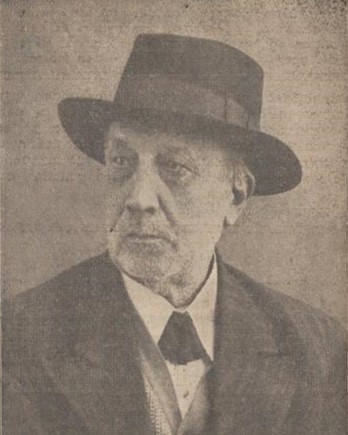
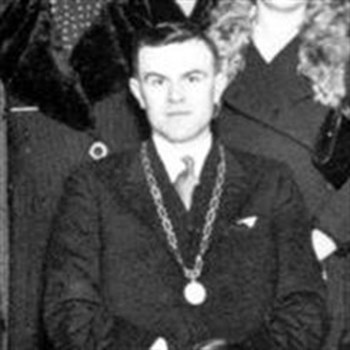
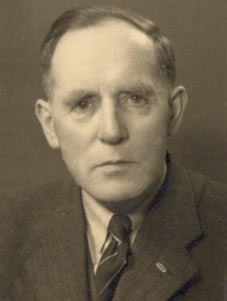
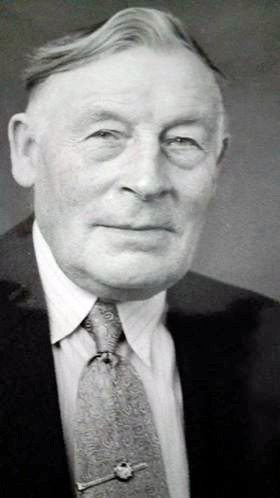
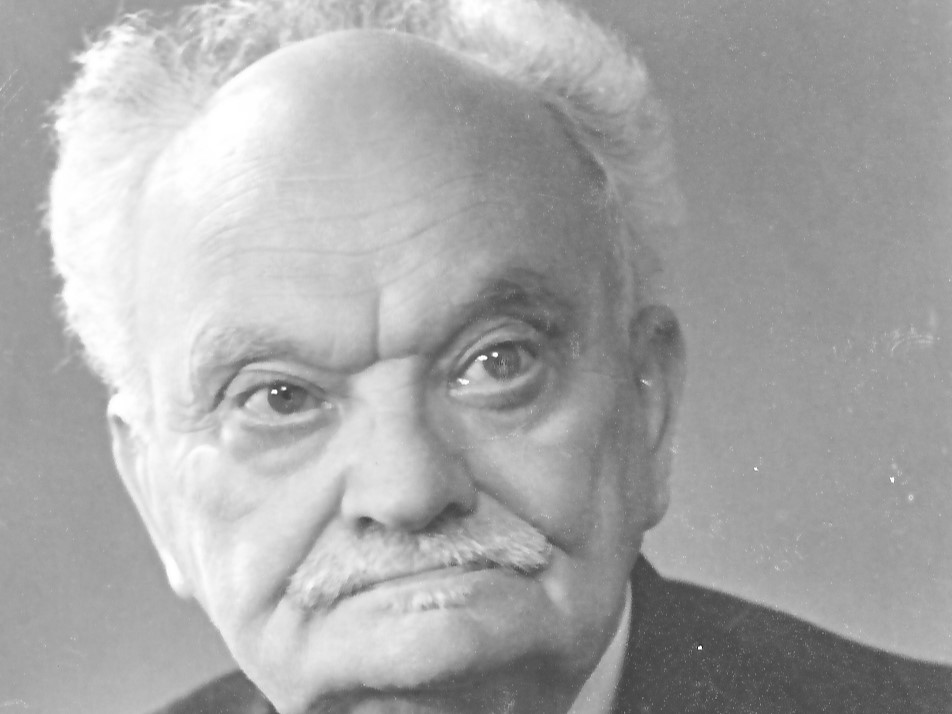
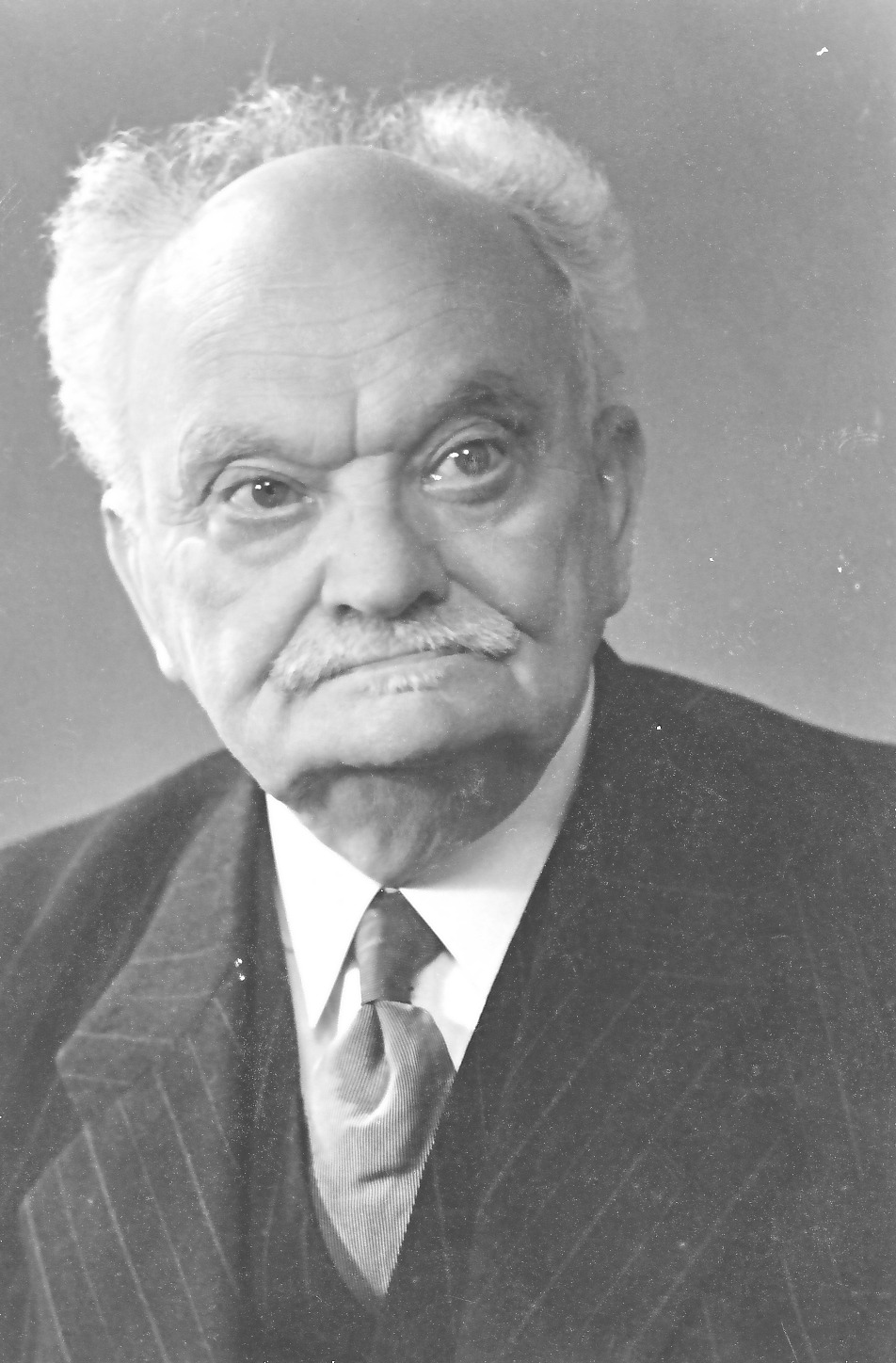
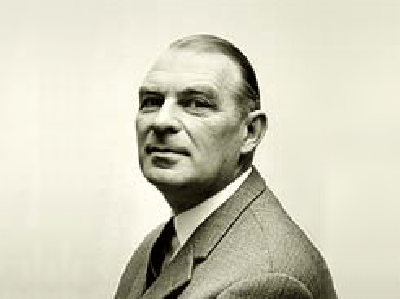
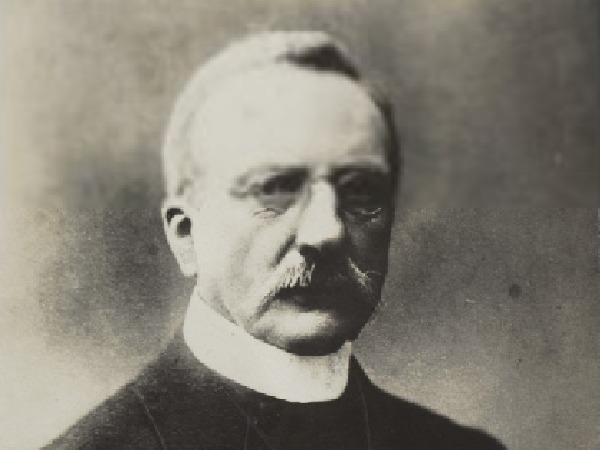
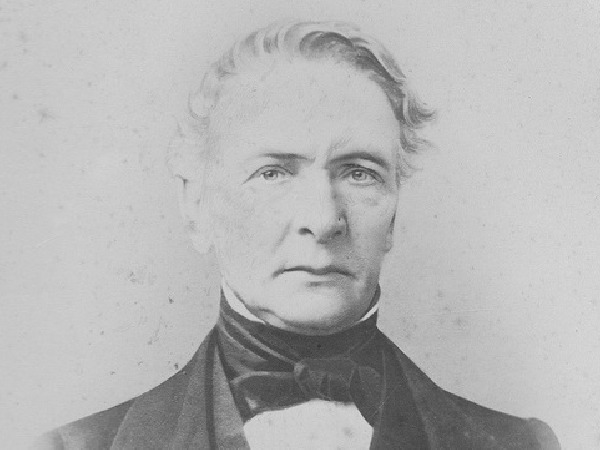
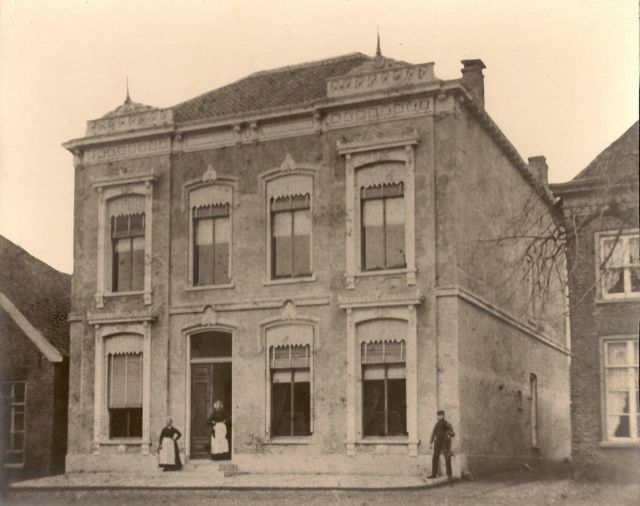
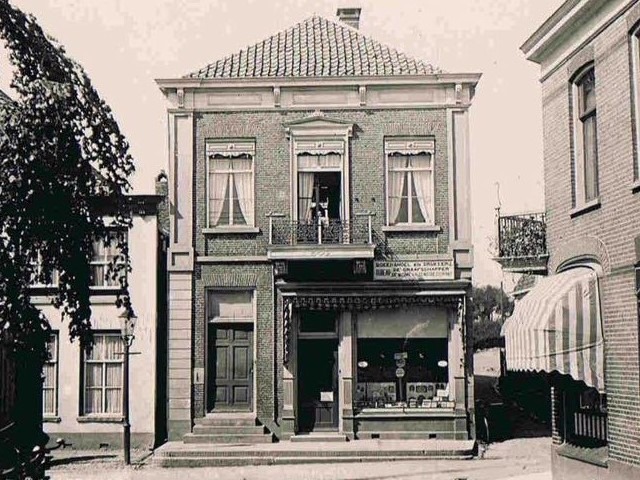
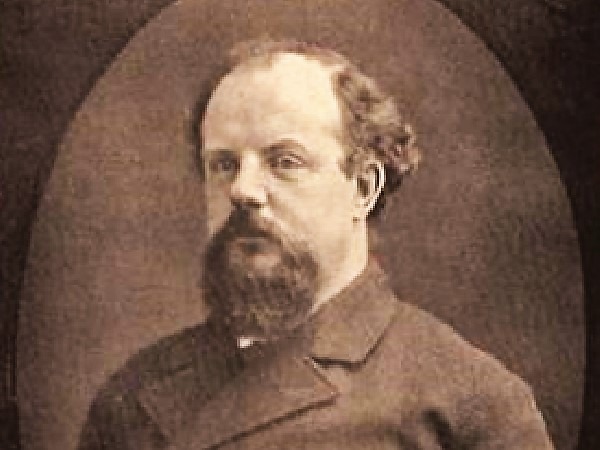
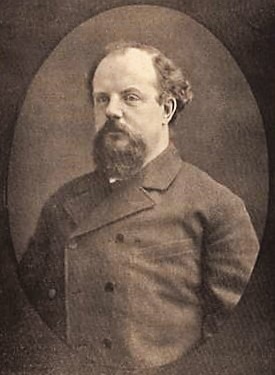
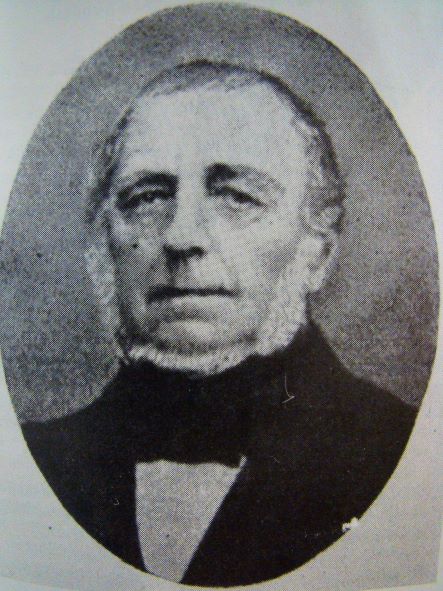
Warnar Willem Marinus Moll was born on August 17, 1857, in Bredevoort. He passed away on November 18, 1937, in Winterswijk.
The Aaltensche Courant wrote the day after his death:
A well-known figure from our municipality passed away on Wednesday at the age of over 80. Mr. W.W.M. Moll, a former teacher—the always cheerful and vigorous elderly gentleman—passed away at the hospital in Winterswijk after a few days of illness.
Since time immemorial, ‘Master Moll’ served education in Bredevoort, and he saw the majority of Bredevoort’s residents in the school benches. Outside of school, Mr. Moll participated intensely in social life, serving public life in many capacities.
His greatest passion was undoubtedly the Tuberculosis Association, which was based in Aalten. For many years, he was the driving force behind this association. Furthermore, he served for years as the chairman of the Butter Factory and Bredevoorts Belang, and held board positions in the livestock fund, the association for hospital nursing, the Zwanenbroek commission, etc. From its founding until 1922, he was a director of the Geld.-Westf. Tramweg Mij. Mr. Moll was one of those who gave the initial impetus for the founding of this company. Additionally, the deceased held the chairmanship of the committee for the prevention of truancy, a position he had already filled for a great many years.
Bredevoort in the first place, and the municipality of Aalten, lose in Mr. Moll a fellow citizen who did a great deal for the interests of his place of residence. On Monday afternoon, the remains will be interred at the general cemetery in Bredevoort. Undoubtedly, many will feel compelled to pay their last respects to the deceased.
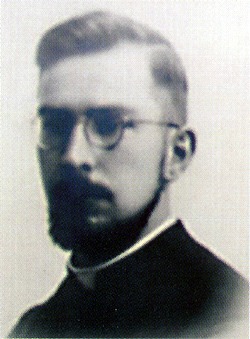
Jan de Vries (Bredevoort, March 21, 1911 – Bafwasende, December 19, 1964) was the son of Johan de Vries, station master of the tram station in Bredevoort, and his wife Aleida Wensink. He served for many years as a Roman Catholic missionary in the Belgian Congo (present-day Zaire), where he was murdered in 1964.
At the age of 12, he left for Bergen op Zoom to attend the Juvenate of the Priests of the Sacred Heart of Jesus; after completing this education, he took his vows on September 8, 1930. He subsequently studied philosophy in Liesbosch and theology in Hees (Nijmegen). On July 14, 1935, Jan was ordained as a priest.
Missionary in the Belgian Congo
On August 27, 1937, he left for the Belgian Congo, where he became a traveling missionary in the Archdiocese of Stanleyville. There, he traveled through the jungle from village to village, a period he described in the children’s book Waar het oerwoud ruist (Where the Jungle Rustles, 1938). Later, he became the director of several schools in Avakubi, where he conducted a choir, and served as novice master in Bafwasende, where he trained brothers from the Belgian Congo. In his final years, he was a mission superior and parish priest of Lubutu and Batama. In 1960, De Vries returned to Bredevoort to celebrate the silver jubilee of his priesthood.
These film recordings were likely made at that time:
Bafwasende Massacre 1964
In that same year, the Congo gained independence, and a civil war broke out when the Simbas rebelled against the new government. De Vries was on a retreat in Stanleyville but immediately returned to his mission in Batama. There, on October 31, 1964, he was captured and mistreated by the rebels along with four brothers and two sisters. They were among twenty-seven people transported by truck to Bafwasende.
On November 25, the priests were sentenced to death by a kind of military tribunal. On November 27, they were taken to the banks of the Lindi River near the village of Bafwasende. The women who remained behind heard machine-gun fire. The women were eventually liberated by mercenaries on December 19.
The death of Jan de Vries made a profound impact on Bredevoort. That same year, a memorial stone was placed in the local RC church. When his house was demolished a few years later to create access to a newly planned street, the municipality of Aalten decided (presumably in 1969) to name this street Pater Jan de Vriesstraat.
Sources
Nazareth, Bredevoort en zijn katholieken – Jos Wessels, Uitgeverij Fagus, 1997 (ISBN 90-70017 16-4)
Pater Jan de Vries, een man met een missie – Hans de Graaf 2014, Uitgeverij Lammers Dtp
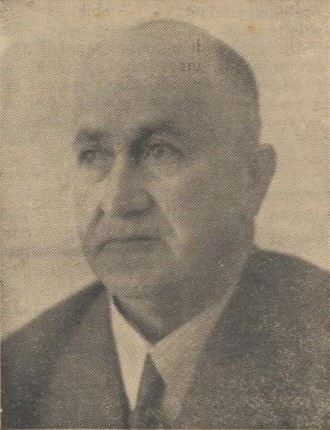
Gerrit Jan Prinsen was born on 14 August 1888 at house number 242 in Aalten (Lichtenvoordsestraatweg 16), the son of night watchman Gerrit Jan Prinsen and Dela ter Maat. He passed away on 7 June 1941 in Aalten. Gerrit Jan Prinsen was buried at Berkenhove Cemetery.
At the time, the Aaltensche Courant wrote the following about him:
At the age of 52, Mr G.J. Prinsen, sworn estate agent and valuer, has passed away. A severe illness, which he battled for over eight months whilst being lovingly nursed by his wife, brought an end to his earthly life on Saturday 7 June.
A few weeks ago, we sat by his sickbed, hoping along with him that the spring sun might soon arrive and bring a restoration of his strength. God has ordained it otherwise, and may the knowledge that it was His will now bring comfort to his widow and family.
Our municipality has lost a good citizen in Mr Prinsen. Not as one who sought to make a name for himself, but as one to whom people listened. This was clearly expressed in the words of the chairman of the Aalten’s Belang association at the most recent annual general meeting: “…though in the future we shall sorely miss him, who was one of our most active members, and to whose advice at our meetings everyone listened with close attention.”
As chief churchwarden (president-kerkvoogd) of the Dutch Reformed congregation and chairman of the Organ Committee, Mr Prinsen played a major part in the complete restoration of the church organ. Furthermore, the deceased was a member of the Board of Directors of the Middenstandsbank, to which ever-growing institution he gladly devoted his time.
In his professional capacity, Mr Prinsen handled several major transactions and, as a structural designer and builder, gave various properties a new lease of life over the years. For instance, acting on instructions from the company, he purchased the land for the water tower near the Lindeboom (the lime tree in the coat of arms of Aalten). He was also ever willing to assist the common man, consistently winning their trust through his helpfulness and fairness. May the certainty that his memory will live on gratefully in many hearts serve as a consolation to his bereaved family.
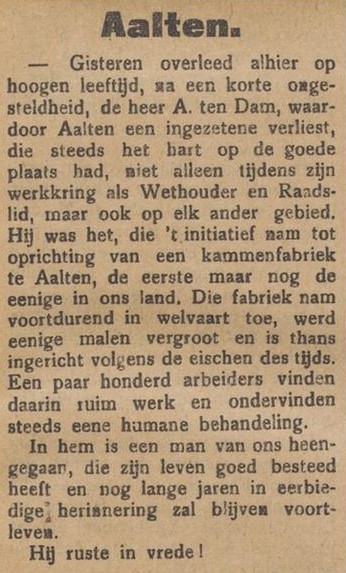
Abraham (Bram) ten Dam was born on 14 July 1834 in Kerkstraat in Aalten, the son of silversmith Harmen Jan ten Dam and Petronella Johanna Gerber. On 6 June 1861, he married Elisabeth Manschot.
In 1871, Abraham and his brother-in-law Bernard Manschot founded a comb factory on Damstraat in Aalten: Ten Dam & Manschot. They lived opposite each other on Bredevoortsestraatweg; Bram in the house that now characterises the Van Panhuis physiotherapy clinic, and Bernard in the white villa across the road. Bram’s son (and successor), Herman, commissioned the construction of the house at Bredevoortsestraatweg 52.
Ten Dam also served as a local councillor and alderman in the municipality of Aalten.
Abraham ten Dam passed away on 1 February 1915, at the age of 80, and was buried at the Old Cemetery in Aalten.
Izaak Antonie de Moor, born on May 31, 1905, in Goedereede, was appointed mayor of Breskens in 1939. In 1941, he joined the N.S.B. there. After ‘Dolle Dinsdag‘ (Mad Tuesday), he fled to Aalten, where he took over the mayoral duties from September 18, 1944, during the period when Mayor Monnik was in hiding. When things became too difficult for him a few days before the liberation, he fled to Grijpskerk, where he was arrested upon liberation. After 1½ years of internment, he was provisionally released.
On March 10, 1947, De Moor stood trial before the war tribunal in Groenlo. The charges were as follows: group leader and sub-district leader of the N.S.B., neighborhood head of the N.V.D., member of the N.A.F. during his term in Breskens; taking the oath of allegiance to Mussert; organizing N.V.D. training afternoons; threatening the municipal messenger J.J. Bliek; applying for a weapons permit from the Representative of the Reich Commissioner; stating, when returning Dutch soldiers to Germany as prisoners of war: “They deserve no better; they have done nothing but sabotage”; distributing the publications Volk en Vaderland and De Zeeuwsche Stroom; cooperating with the labor deployment for coastal defense works; and providing a training course for mayors in Goes.
The term of office in Aalten
The summons regarding his term of office in Aalten included the following charges: cooperating with the O.T. labor deployment in Zevenaar and Bocholt; calling in the assistance of the Landwacht to check for people in hiding, for the requisitioning of bicycles, and for the arrest of a person in hiding at Te Giffel. Furthermore, the accused dismissed all municipal officials who were in hiding and informed the Sicherheitspolizei in Doetinchem of the arrest of three individuals, including B.H. Wikkerink, for engaging in illegal activities. Finally, he called in the assistance of the Grüne Polizei stationed in Aalten in connection with the arrest of the Baruch family, a Jewish family in hiding.
The accused explained that by accepting the office of mayor in Aalten, he had intended to be of as much service as possible to the population. The president: “You have given all your strength to the German, and thus enemy, cause for the destruction of both the Dutch material and spiritual resistance. When you saw in Breskens who and what the Germans were, you should no longer have acted as mayor in Aalten.” The accused: “I had to choose between being a member of the Landwacht or a mayor. I had no desire for the Landwacht.” The president: “You could also have chosen another path: neither.”
The discussion then turned to why the accused had been present on October 10, 1944, when the S.S. had conducted a raid in Aalten and the detained persons were brought to the community center. The accused: “The S.S. intended to cordone off the churches. I knew this would cause much unrest in Aalten, so I tried to make amends where possible. In some cases, I was able to do something in favor of those detained.” The accused denied having ordered the arrest of the six hostages. “In the report to Doetinchem,” the accused stated, “I did declare it. The late Mr. v.d. Glas, the Landwacht commander, gave the order to arrest the hostages. As mayor, I was required to report it.”
The president: “Why did you attempt to compile a new population register, when you knew that the old one had been deliberately disappeared? You were in every respect a mindless tool in the hands of the Germans.” Furthermore, the speaker pointed out how dangerous it was to inform Vossers that the municipal secretary, Bijlsma, had made off with the municipal papers and documents, and to tell the aforementioned Vossers where B. was likely located. President: “You were a convinced and fierce member of the N.S.B.” The accused: “Not fierce, I was an idealist. I considered it my calling and task to do something for the Dutch people.”
After the various points of the indictment during his term in Breskens were addressed, the arrest of the Baruch family, who were in hiding in Aalten, was finally discussed. The accused admitted to having acted incautiously. He had mentioned it in a conversation with the Grüne Polizei. The president: “You knew yourself what kind of beasts the G.P. were.” The accused: “It did not sink in at that moment. I was able to prevent the Oberleutnant from having the three Jews in question shot. At my insistence, they were to be transported to Doetinchem. As the liberation approached, they were able to remain in Aalten. And upon my departure, I told Tilbusscher that the Jews could be released immediately, which is what happened.”
Verdict
The accused, who had no defense counsel, said in his closing statement that he is now back in the workforce. He appealed for the clemency of the Tribunal. “I have had a lesson for life. Moreover, my house in Breskens was bombed, and my 17 years of pension are gone. I was a civil servant heart and soul; I admit to having been completely wrong. Give me the opportunity now to care for my family again,” he exclaimed.
After deliberation, the president stated that it would be fair to impose an internment longer than the pre-trial detention. However, the Tribunal wished to take into account the circumstances in which the accused currently finds himself. The following measures were imposed upon him: internment equal to the pre-trial detention; disqualification from holding any public or semi-public office; deprivation of both voting rights; and confiscation of his radio.
De Moor passed away on February 17, 1984, at the age of 78, in Warnsveld.
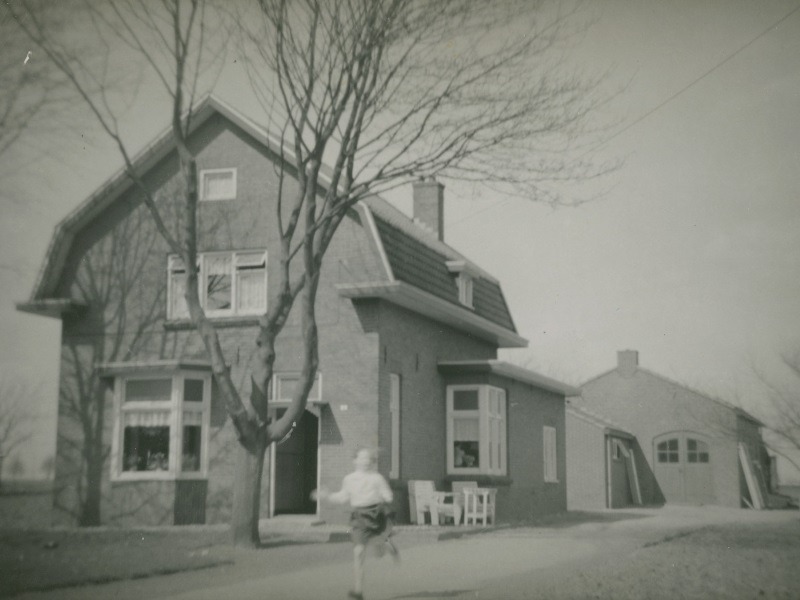
In the early morning of 21 September 1943, Piet Hoogenkamp, the assistant of the Aalten general practitioner and resistance fighter Joop der Weduwen, placed a package in front of the house with address Patrimoniumstraat 12 in Aalten. Resistance leader Hendrik Jan Wikkerink alias Uncle Jan lives at that address with his family. The doorbell rings.
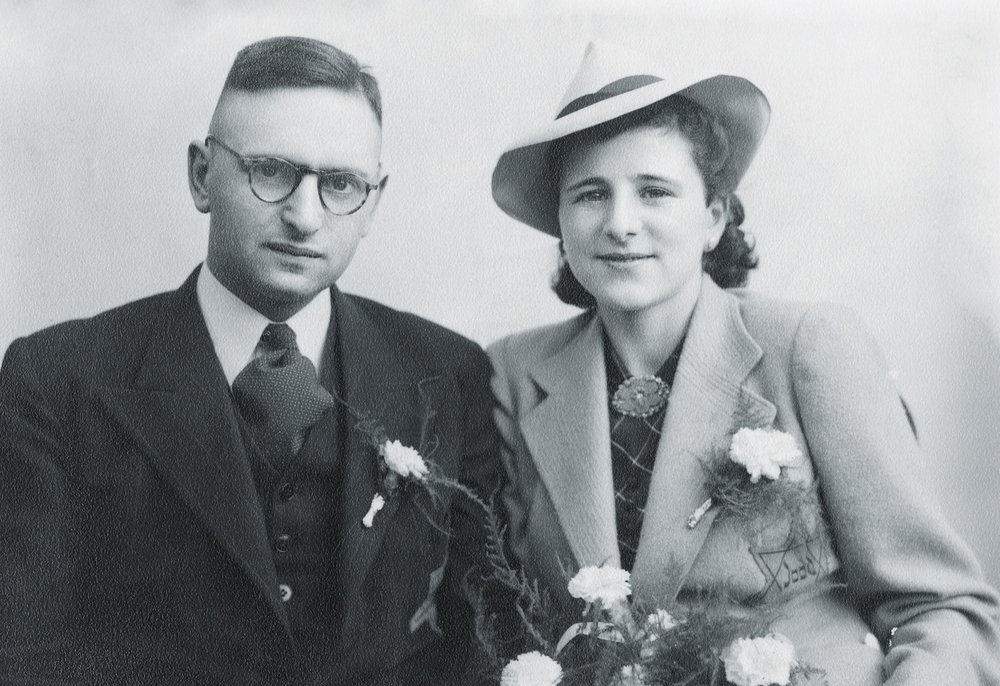
The package turns out to be a newborn baby. He is the son of Lena Jedwab-Kropveld and Yitzack Jedwab, rabbi (pastor) of the Jewish community in Aalten. From mid-1942 the couple was in hiding on the De Ronde farm of the Veldboom family in Lintelo. Resistance leader Uncle Jan and doctor Der Weduwen have agreed in advance to lay the foundling.
Foundling
Daughter Jo Wikkerink later told about this:
“We knew that the delivery was coming and the baby would be brought to us. Father and mother only told the oldest three. The youngest knew nothing. They could not talk past their mouths. Father and mother waited in the dark room in the evening. It seemed to the neighborhood as if they had gone to bed. When the doorbell rang, they knew the baby was there. They got the youngest out of bed and shouted in surprise: “Come and see what is there now!”
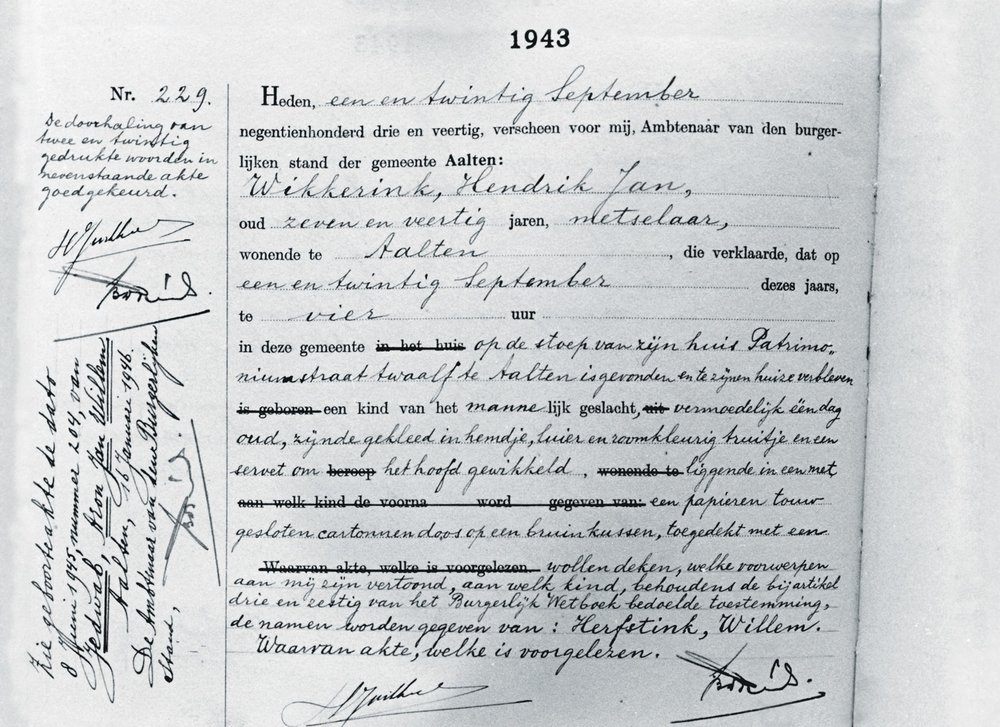
The Jewish child was therefore born in hiding and was registered three days later by Mrs. Dela Wikkerink-Eppink with the name ‘Willem Herfstink’ and registered as such in the birth register of the municipality of Aalten. The name was chosen symbolically. Willem refers to Queen Wilhelmina, Herfstink to the first day of autumn (21 September) and the Saxon suffix ‘ink’ means ‘belonging to the yard or family of’.
Because only a few people – such as doctors – were allowed to be on the street at one o’clock in the morning, four o’clock in the morning was given as the time when the baby was found. This made the investigation into the origin of the child considerably more difficult. “I sometimes came home late at night with a big belly by train. Then I had ‘contraband’ with me as if I was heavily pregnant. When Wimke was put on the sidewalk, they said: “That’s what they say, but it must be one of the girls.”
Declared Aryan
The next day, the municipal doctor on duty, Dr. Knol, had to examine the foundling. The baby was not circumcised and therefore he issued the declaration that the child was 100% Aryan. “The next day father immediately went to Schepers, who lived diagonally across from us (he worked at Paske). Father knew: if I tell it there, everyone in Aalten will know it immediately. Behind us, next to Vossers, lived an NSB woman. She was on her knees in front of Wimke’s crib to see if he had any Aryan features.”
Lennie and Yitzchak had meanwhile moved to another hiding place in Lintelo. In June 1944, the resistance moved them in a hay-covered wagon to the house of Bernard and Gesina Wevers in the hamlet of Dale, behind the Ringweg, just outside the village of Aalten.
Initially, they did not want to take the Jedwab couple into their home because they were already sheltering evacuees. A minister of the Reformed Church changed the pious Calvinists’ minds: he preached that the persecuted should be helped.
Bernard, a carpenter, built them a room behind the closet where they spent all their time. Mrs. Wevers cooked for her Jewish guests as much as possible according to kosher rules.
In the meantime, Willem had been lovingly taken into the family of the Wikkerink family. Especially mother Dela and eldest daughter Lien Wikkerink took care of ‘Wimke’ as they called him. Dela Wikkerink regularly walked with the baby in the pram to the hiding place of the Jewish parents in Dale. She often took some fruit from the vegetable garden with her in her bag. There were people in Aalten who said: “What does Mrs. Wikker always have to do with Wevers?”
Towards the end of the war, two German soldiers were billeted in the Wevers house. While the soldiers were in the house, Lena and Yitzack sat in chairs in their hidden room and were not allowed to move or make a sound, sometimes for days.
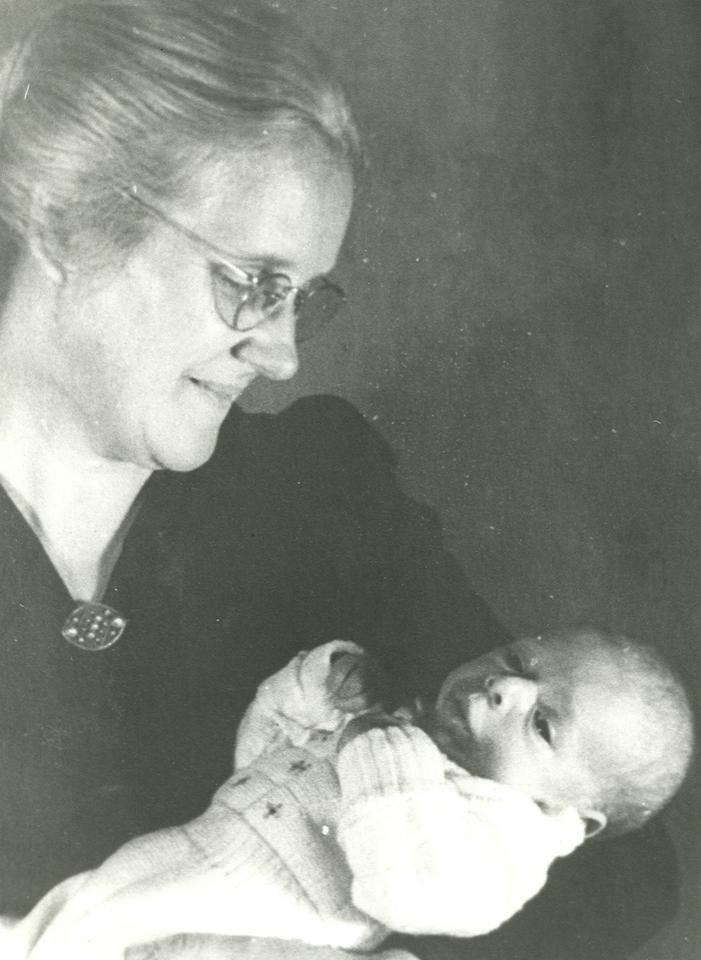
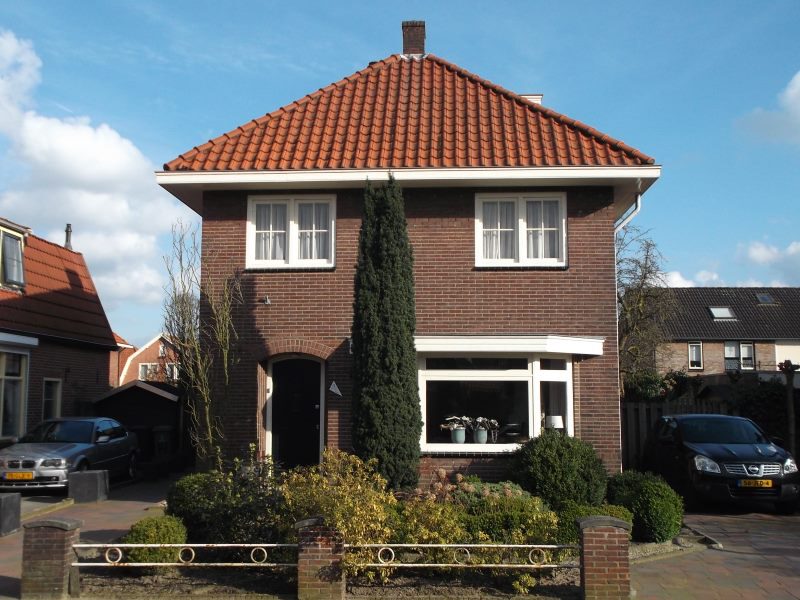
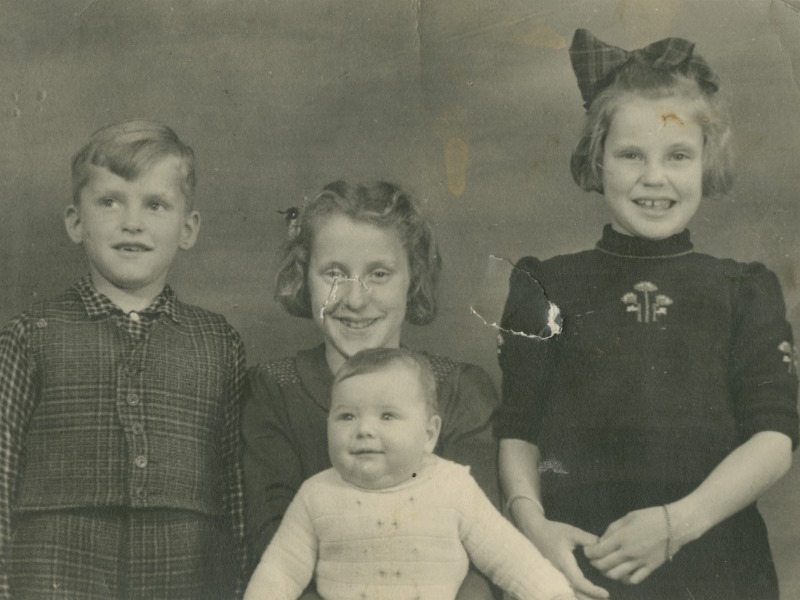
Dela Wikkerink-Eppink with Aron Jedwab alias Willem HerfstinkPatrimoniumstraat 12, AaltenKoningsweg 2, Dale (source)Yitzchak Jedwab and Lena Kropveld – wedding photo, March 1942Aron Jedwab with Dick, Jannie and Ina Wikkerink, 1943 (source)Birth certificate ‘Willem Herfstink’, 21 September 1943
After the war
After the liberation in March 1945, the family was reunited and the little one was given his real name: Aron Jan Willem Jedwab. The name Willem remained and the second first name Jan refers to his rescuer Jan Wikkerink. Queen Wilhelmina came to Aalten soon after the war and visited the Wikkerink family to honour them for their actions in the resistance. Jo Bulsink-Wikkerink: “I can still see Wilhelmina. She slapped my grandfather on the shoulder and said: Wikkerink, you have a brave son.”
The young child Willem hardly knew his own parents. Jo Wikkerink – the second daughter in the family – then moved in with the Jedwab family for a year, so that Willem could get used to his own parents and new environment a little easier. The Jedwab family emigrated to the US in 1947 and there they changed their surname to Jade.
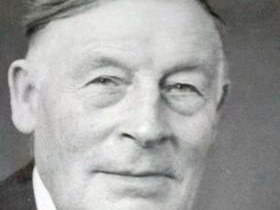
Antoon Stapelkamp was born on 27 February 1886 at house number 162 (Hogestraat 26) in Aalten and passed away on 19 January 1960 in Utrecht. He was the son of Gerrit Jan Stapelkamp, a factory worker and smallholder, and Hendrika te Sligte. On 12 June 1913, Antoon married Johanna Aleida Stronks, with whom he had five daughters and two sons.
Stapelkamp grew up in a strict Calvinist (gereformeerd) family with four children in Aalten. After completing his education at the Christian primary school, he had to start contributing to the family income at the age of twelve. He joined the Ten Dam and Manschot button and comb factory, which had been established in Aalten since 1872. His father already worked there, and a few years later, the company also employed his younger brother Herman.
Encouraged by their parents, both boys attended evening classes for further education. However, only the youngest managed to obtain diplomas and pursue a career in teaching. Antoon continued to make horn combs at Ten Dam and Manschot for more than twenty years.
At the age of fourteen, Stapelkamp witnessed a debate between the Enschede-based socialist J.F. Tijhof and H. Verveld, the chairman of the interdenominational Dutch Christian Textile Workers’ Union ‘Unitas’. Impressed by Verveld’s performance, he signed up as a youth member of the local branch that Verveld had founded in Aalten. However, this branch proved unsustainable.
Administrative Career
Membership of the Calvinist Young Men’s Association (Gereformeerde Jongelingsvereniging), the breeding ground for administrative talent within the orthodox Protestant community, was of great importance to Stapelkamp’s social and political development. Apart from serving as secretary and chairman of the Aalten branch, he was a board member of the Gelderland section of the Dutch Association of Young Men’s Societies on a Calvinist Foundation.
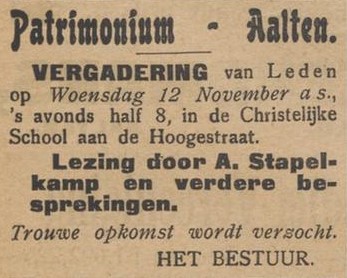
In the local branch of the workers’ association Patrimonium, his administrative qualities were quickly noticed, which led to his election as secretary in 1903. He declined, however, believing that at seventeen, he was too young and inexperienced. Eleven years later, he would accept this very position.
In 1914, Stapelkamp and a few friends from Patrimonium founded the Association of Christian Hornworkers, a local trade union that joined the CNV (National Federation of Christian Trade Unions) as an independent organisation on 1 March 1914. He took on the role of secretary himself. However, the trade union was too small to have a future, and the Hornworkers’ Union soon collapsed. Stapelkamp subsequently founded an Aalten branch of the Dutch Union of Christian Factory and Transport Workers (NBCFHT). Once again, he became the secretary.
After a period as an active member and executive of the NBCFHT, he became a member of the CNV executive board in 1931. The Stapelkamp family relocated to The Hague, where the federation had established a new headquarters. This marked the end of Stapelkamp’s nascent membership of the Anti-Revolutionary Party (ARP) in the Aalten municipal council.
Aaltensche Courant, 8 November 1913
CNV Chairman
In 1935, he was appointed chairman. He attempted to chart an independent course for the CNV and exert influence on government policy, which was heavily focused on austerity. Although he shared the general policy direction of the Colijn cabinets, he frequently disagreed with the specific measures introduced.
During the occupation years, Stapelkamp developed into a forceful chairman. Led by him, the CNV followed a course of evasive adaptation during the first year of the occupation, keeping contact with the occupying forces to an absolute minimum and rejecting structural reforms. In November 1940, Stapelkamp accepted an invitation from the Deutsche Arbeitsfront to go on a study tour to Germany. This decision would be held against him for a long time.
On 30 June 1941, Stapelkamp was arrested alongside approximately ninety other prominent anti-revolutionaries. Until December 1942, he was detained successively in the Schoorl, Buchenwald, Haaren, and St. Michielsgestel camps. After his release, Stapelkamp was a driving force behind the underground ‘Internal Contact Group’. He also restored relations with representatives of other employee and employer organisations.
Following World War II, Stapelkamp was reappointed chairman of the CNV, a position he held until his resignation in 1947. Furthermore, he served as:
Member of the Senate of the States-General, from 20 November 1945 to 4 June 1946
Alderman (for Social Affairs) of Utrecht, from November 1945 to 2 September 1946
Member of the House of Representatives of the States-General, from 4 June 1946 to 3 July 1956
Member of the Provincial Council of Utrecht, from 20 June 1946 to 4 July 1950
In early 1960, Stapelkamp fell ill with neglected diabetes. He died from subsequent complications.
Publications
Pseudonym: ‘Socius’.
‘Mag boycot onder de toelaatbare strijdmiddelen in den economischen strijd worden gerangschikt?’ in: Verslag van de veertiende algemeene vergadering van het Christelijk Nationaal Vakverbond (Utrecht 1929) 57-70;
‘De christelijke vakbeweging: vrucht van het verleden; eisch van het heden; levensvoorwaarde voor de toekomst’ (Utrecht 1945);
‘Dr. H. Colijn en het sociale leven’ in: Een groot vaderlander. Dr. H. Colijn herdacht door tijdgenooten (Leiden 1947);
‘Het sociale beleid van het kabinet-Drees’ (Den Haag z.j.);
‘Verantwoorde emigratie’ (Den Haag 1951);
‘De gemeenten en de werkgelegenheidspolitiek’ (Den Haag 1953);
‘De banier opnieuw geheven. Geschiedenis van het Christelijk Nationaal Vakverbond in Nederland in de jaren van de tweede wereldoorlog’ (met J. Schipper, Hoorn 1956).
Literature
‘Om te doen gedenken. Verslag van de buitengewone vergadering van het C.N.V. en van de receptie-samenkomst ter gelegenheid van het afscheid van K. Kruithof als voorzitter en het optreden van A. Stapelkamp als zoodanig’ (Utrecht 1935);
‘Onze nieuwe voorzitter’ in: De Gids, 31.10.1935;
Verslag 22e algemene vergadering Christelijk Nationaal Vakverbond gehouden op donderdag 24 en vrijdag 25 juli 1947 (Hoorn 1947) 38-61;
Trouw, 20.1.1960; J. Schipper, ‘In dankbare herinnering’ in: De Gids, 6.2.1960;
‘Stapelkamp ter nagedachtenis’ in: De Gids, 6.2.1960;
Bernard Huinink served as an alderman (wethouder) for the PvdA (Labour Party) in Aalten for many years. Consequently, his nickname was ‘Rooien Huunink’ (Red Huinink). The turbulent council meetings involving Willem te Gussinklo (alias ‘Piepkes Willem’) of the AR (Anti-Revolutionary Party) became legendary.
Bernard Huinink was born on 11 February 1886 in Aalten (Hogestraat 64), the son of Herman Huinink and Janna Geertruid Obrink. On 8 February 1912, he married Grada Wilhelmina Schepers in Aalten. They settled in Ormelstraat.
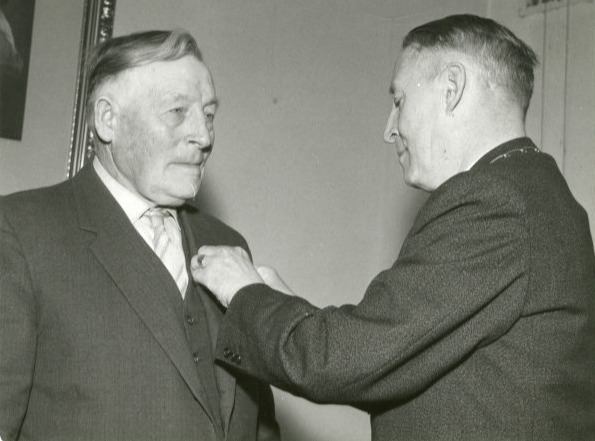
In 1919, at the age of 33, Bernard Huinink took his seat on the Aalten municipal council. He would hold that seat for nearly 45 years, initially for the SDAP and later for the PvdA. In September 1959, he celebrated his 40th anniversary as a council member and received a Royal distinction. In 1964, Huinink, the ‘father of the council’ (nestor), stood down ‘on account of his advanced age’ (77). He was succeeded by his 37-year-old son, Jan Huinink, of Admiraal de Ruyterstraat 21, who was the manager of the local PTT office (postal and telecommunications).
Bernard Huinink being invested with a Royal distinction by Mayor E.S. van Veen.
During the Eighty Years’ War, the population of East Gelderland was regularly plagued by roaming armies. Plundering, extortion, and rape drove the farmers and villagers to despair. Jan Holstein was the Bailiff of Aalten at the time, and although he was largely powerless, he did stand up for the people of Aalten and did his best to put an end to the looting.
In 1588, peace negotiations were underway between the Duke of Parma and Queen Elizabeth of England, the latter of whom also attempted to involve the States. Referring to this, Holstein wrote to Gotfried Gerardi, advisor to the lady of the manor of Anholt: “I only hope that the long-desired peace may be established; then these poor sheep might find courage again. For the most part, they plow the land with the cows they have left and work like mules. We are deep in debt and can no longer obtain money; my credit has also run out. May God grant us a solution before the harvest, so that the grain can be safely gathered. Otherwise, I would not know what to do.”
G.H. Rots wrote in 1938 about how Jan Holstein lost his life:
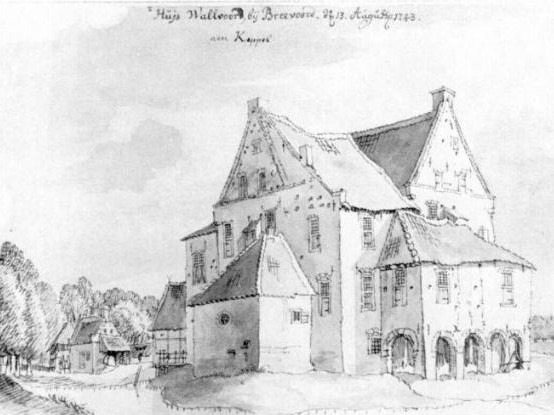
Manor ‘t Walfort, Jan de Beijer, 1743
“The Bailiff of Aalten, Jan or Johan Holstein, who repeatedly stood up for the population of Aalten, died in a peculiar manner. We read in ‘Het Oude Kerspel Winterswijk’ that on June 11, 1589, a christening feast was held at the home of a certain Grevink at ‘t Walfort near Aalten, where the Bailiff of Aalten was present, serving as the child’s godfather. Also present were the Lords of ‘t Walfort and Lintelo (the Lords of Lintelo were also the owners of ‘t Walfort).
The Bailiff of Aalten had received a promotion; following the death of ‘Hendrik van den Bungard’, he had become the Land Clerk of the Lordship of Bredevoort. This appears to have been a thorn in the side of the Lords of Lintelo; at any rate, a dispute began on the subject, during which Holstein noticed that the Van Lintelo brothers were not easy men to deal with.
Holstein attempted to leave the banquet table unnoticed and slipped under the table. He crawled on hands and knees toward the door and made a quick escape. However, Diederik van Lintelo noticed this, pursued Holstein, and hurled all sorts of insults at him. The argument escalated. Holstein maintained that the Lady of the Manor had the right to appoint Land Clerks, while Diederik van Lintelo attributed that right to the Nobles of the Lordship. This resulted in a physical altercation, during which Diederik van Lintelo drew a short sword and wounded Holstein. The injury was so severe that the Bailiff died three days later.”
This case was brought before the Bredevoort court on August 5 of that year. The accused was not present. He had fled to Bocholt and was hiding there. He was sentenced to death in absentia and ordered to pay a fine of 1,000 guilders to the Lady of the Manor. To collect this money, the tenants of Diederik van Lintelo were informed that they had to pay their rent to the Lady’s steward until the sum of the fine was collected.
Those tenants were ‘Ruwenhoeven’, Hendrik Penmenger, ‘Winkelhorstinck’, ‘Swijtinck’, ‘Lanckhof’, ‘den Herinck’, and ‘den Poll’. Through the mediation of several influential persons, including the Prior of Schaer Monastery, Johanna van Dort, and Hendrik and Clara van Lintelo, efforts were made to obtain a pardon. That pardon was granted, but he was still required to pay the fine.
Herman Poelhuis, the bailiff of Dinxperlo, was appointed as the bailiff of Aalten. It appears this was a temporary appointment, as in 1605, Lubbert Spaltman is mentioned as the bailiff of Aalten.”
Sources
Het oude kerspel Winterswijk, by B. Stegeman, 1927 (Delpher)
‘Uit Aalten’s verleden’, by G.H. Rots, Aaltensche Courant, March 4, 1938 (Delpher)
Jan Derk Stegeman was born on 26 July 1875 in Dedemsvaart, the son of religious education teacher Frederik Stegeman and Janna Harmina te Winkel. He attended the municipal gymnasium in Doetinchem and subsequently studied for a year at the Municipal University of Amsterdam, followed by several years at the University of Utrecht.
After Stegeman was admitted to the gospel ministry in the Dutch Reformed Church (Nederlandse Hervormde Kerk) by the provincial church board of Friesland in May 1899, he was ordained on 3 September of that same year as minister of the Reformed parish of Nieuw Amsterdam by the Reverend J.C. van Hoeve, minister in Schoonebeek.
Aalten
On 24 August 1899, Jan Derk Stegeman married Hendrika van Dorp (born in Zoetermeer, 24-10-1873) in The Hague. Together they had six children. In 1913, he moved to Aalten as a minister for the Reformed parish. From 1920 onwards, he dedicated himself to the Reformed school, serving as chairman of the board from 1920 to 1946. He lived in the Reformed rectory on Whemerstraat.
The Reverend Stegeman was known as a highly witty and striking personality. He enjoyed an excellent relationship with his colleagues, who affectionately nicknamed him ‘the bishop’. In September 1929, he celebrated his 30th anniversary in office, and in 1964 his 65th anniversary—just a year before he turned 90! In 1955, the Reformed school on Varsseveldsestraatweg was named after him: the ‘Ds. Stegemanschool‘.
Nieuwe Veendammer Courant, 14 January 1913
Retirement
Following his retirement (emeritaat), Stegeman remained active in many fields, including conducting pastoral visits to the elderly, supporting the temperance movement, and nursing the sick. He also frequently filled pulpits as a guest preacher. For many years, he was the treasurer of the classical missionary society within the Zutphen classis, secretary of the board of the Juliana School, a board member of the Breukelaar School, and a board member of the Aalten branch of the Netherlands Bible Society.
Furthermore, Stegeman was a highly active member of the editorial board of the weekly magazine De Wachter. He also authored the books Aan mijne gemeente (“To My Congregation”, published by Gebr. De Boer, 1938) and Van rijke dingen (“Of Rich Things”, published by De Graafschap, 1941).
Ruurd Faber (Veenhuizen, 28-08-1912 – Assen, 07-07-1992) was a Dutch politician representing the ARP. He was born the son of Anne Faber (1875–1948; from 1932 director of the first asylum of the Rijkswerkinrichtingen [state labour colonies] in Veenhuizen) and Hermina Klein (1879–1973). On 15-05-1941, he married Aukje Fokje Wijngaard (The Hague, 27-05-1918) in Assen.
At the beginning of his career, Faber worked as an inspector for a life insurance company. During the Second World War, he was involved in the resistance, for which he was arrested and imprisoned in the detention centre in Assen. Following the liberation, he was released and subsequently became head of the Politieke Opsporingsdienst (POD – Political Investigation Service) in Assen. After some time, Faber became a prosecuting officer (Officier-fiscaal) at the Assen Chamber of the Bijzonder Gerechtshof (Special Court of Justice) in Leeuwarden. Later, he also held other positions at the Ministry of Justice and the Ministry of Social Work.
In 1960, he became Mayor of Ulrum, and from 1962 to 1963 he additionally served as acting Mayor of Leens. In 1965, Faber was appointed Mayor of Dantumadeel. There, he gained a reputation as a “large-calibre social worker”.
In 1971, he succeeded Hendrik Haverkamp as Mayor of Aalten and held this position until 1975.
Ruurd Faber passed away in 1992 at the age of 79.
He was succeeded as Mayor of Aalten by Doeke Bekius.
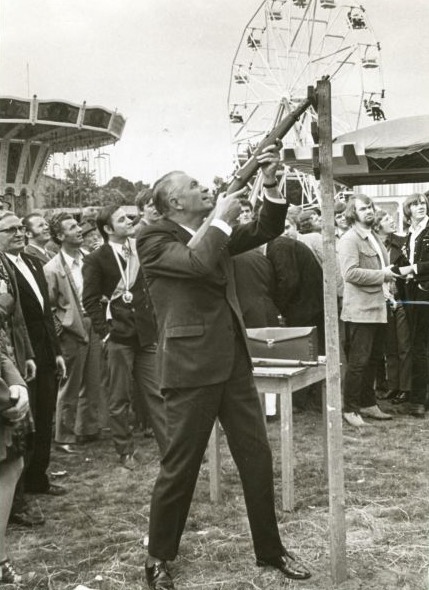
Mayor Faber fires the first shot at the 1971 Marksmen’s Festival (Schuttersfeest)
Willem te Gussinklo Sr. (1852–1920) was one of the key figures in the history of the horn-working industry in Aalten. Initially, he made German pipes and handles for walking sticks and umbrellas. Later, he focused on the production of buttons.
Willem te Gussinklo was born on 13 November 1852 at house number 284 (Markt 3) in Aalten, the son of shopkeeper Willem te Gussinklo and Josina Aleida Mierdink. On 26 May 1887, he married Maria Jacoba Gangel (a sister of the Reverend Gangel). Around 1890, they moved into a stately villa on Willemstraat.
Willem learned the craft of horn working from his brother-in-law, Gerrit Peters. Together with Wessel Becking, he started a pipe factory. However, in 1884 their paths crossed and they went their separate ways. Following the unsuccessful partnership with Becking, Willem te Gussinklo manufactured German pipes and handles for walking sticks and umbrellas.
Buttons
Around 100 years ago, companies had emerged in Germany and England that manufactured buttons from horn. Inspired by this example, Willem began making horn buttons in 1905, a first for the Netherlands. Soon afterwards, his son Willem te Gussinklo Jr. (known as ‘Piepkes Willem’) joined the company, developing into an innovative entrepreneur.
Te Gussinklo’s first factory was located at ’t Dal in Aalten, which is now Willemstraat.
Willem te Gussinklo Sr. passed away on 21 June 1920 and is buried at the Old Cemetery on Varsseveldsestraatweg in Aalten.
Willem te Gussinklo Jr. (1888–1969), nicknamed ‘Piepkes Willem’, was one of the key figures in the history of the horn-working industry in Aalten. He was the director of Dutch Button Works in Bredevoort.
Willem te Gussinklo Jr. was born on 18 May 1888 at house number 239a in Aalten, which is approximately where the JAWI garage is located today. He was the son of pipe manufacturer Willem te Gussinklo (Sr.) and Maria Jacoba Gangel (a sister of the Reverend Gangel). On 7 July 1914, Willem Jr. married Engelina Arriana van Houte in Zwolle (Overijssel).
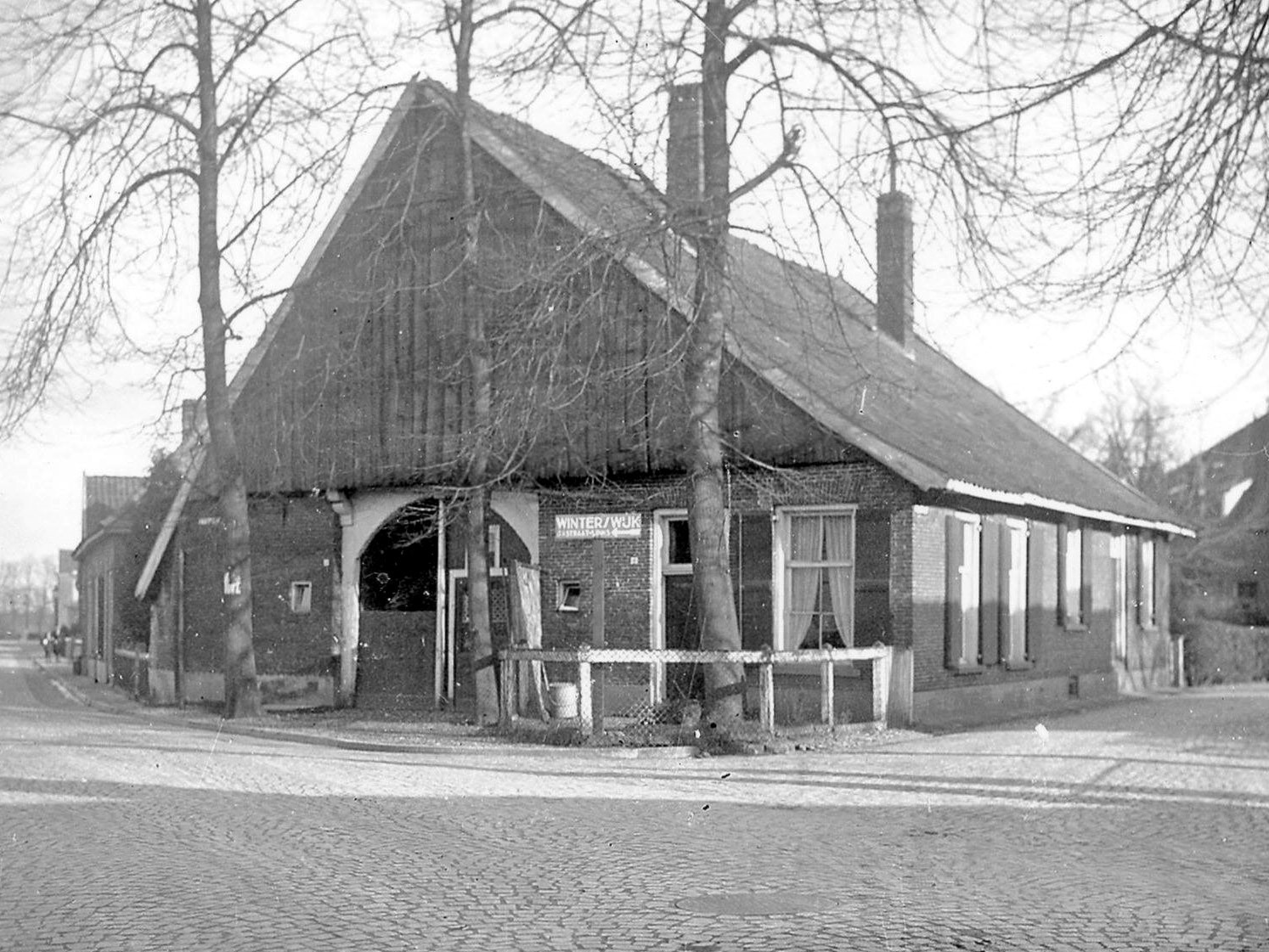
Around 1960, a little woman with the peculiar nickname ‘Knonnepoetse’ lived in Aalten. She resided in the Luutenshuus, a centuries-old farmhouse on the corner of Polstraat and Haartsestraat, which was demolished in 1962 to make way for the extension of Polstraat.
On their way to school, children would dare each other to knock on her windows. A furious old woman, who spoke half-German, would then come storming out. The children were absolutely terrified of her.
Guste Mina
In local parlance, she was also known as Guste Mina. She was said to be of Polish origin and had fled to Germany around the wartime period. She later married a man from Aalten named Koskamp.
This man Koskamp was “on the wrong side” during the war (fout). He used to walk around the village with a rifle slung around his neck. He referred to this rifle as ‘seine Kanone’ (his cannon). He cleaned his rifle frequently, often saying: “I just need to polish my Kanone.” After his death, the little woman inherited the nickname ‘Knonnepoetse’ (Cannon Polisher). The name had therefore originally been intended for her husband.
The couple initially lived on the corner of Stationsstraat and Admiraal de Ruyterstraat in Aalten, in Lurvink’s old house. This property was later demolished, and Nijman established his petrol station there—later Veneman petrol station, and currently the café-takeaway ‘De Admiraal’. The Koskamp couple subsequently moved to the Luutenshuus.
The ‘Luutenshuus’, demolished in 1962
Who was she?
Her real name was Auguste Koskamp-Schürmann. She was born in Sterkrade (Germany) and married Bernardus Gerhardus Koskamp in Aalten in 1919. Around 1920, they lived in the village of Aalten at address A211a, which was later renumbered to B215a. This address presumably later became, or is currently, Hogestraat 60a.
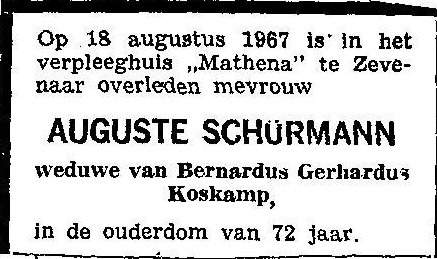
In the 1967 Directory of the Municipality of Aalten, she is listed at the address Polstraat 17a. On 18 August of that same year, Auguste passed away in a nursing home in Zevenaar. She was buried alongside her husband at Berkenhove Cemetery.
‘Knonnepoetse’ did not have an easy life; she was quick to anger. The local youth knew this and took advantage of it. Bullying was something that very much occurred in those days as well.
Johan Bernard Anton (known as Anton) Driessen (Bocholt, December 5, 1797 – Aalten, March 7, 1879) was a prominent textile manufacturer in Aalten. Anton descended from a textile dynasty in Bocholt. His father Herman (1765–1817) was also a textile manufacturer, as was his brother Peter Driessen (1756–1843), who also served as an alderman and second mayor of Bocholt.
After their father’s death, Anton and his younger brother Joseph founded the textile company ‘Gebrüder Driessen‘. In 1826, Anton and Joseph Driessen submitted a request to King William I to establish a textile factory in Aalten. The motives for the Driessen brothers’ request were the increased import duties in the Netherlands. They had chosen Aalten ‘as this place was best suited for this purpose‘.
They requested permission to establish a fustian weaving mill and bleachery, as well as a cotton spinning mill and dye works. The Driessen brothers were granted permission for the establishment on the condition that it be located within the village center of Aalten.
Not long after, their cousin Heinrich Driessen also requested permission from the King, which was likewise granted.
In Aalten
Anton moved to Aalten in 1826. He initially lived with Meijerink in the Kerkstraat. His brother Joseph remained in Bocholt, where they maintained a branch office.
The company started “in the Barn and Garden Room of Mr. Bonninghoff”. This most likely referred to the house at Markt 18 belonging to the justice of the peace G.J. te Gussinklo, who had purchased the Borninkhof farm in 1804. Owners were often referred to by the name of their farm.
For the processing of the yarn, Anton Driessen relied on the many home workers living in the area. Furthermore, the municipal report of 1826 mentions, among other things: “Several households have settled here, primarily from Bocholt“. The report for 1827 mentions for the first time that, alongside agriculture as the primary source of livelihood, much fustian was woven for the manufacturers from Bocholt. There were approximately 218 fustian weavers at that time, “performing the work in their homes“.
On November 22, 1827, Anton Driessen married Isabella Dees in Bocholt.
In that same year, the cotton spinning mill was moved from Bonninghoff’s barn and garden room to a better-equipped building in the center of the village. Driessen had purchased a house there from Manus Scholten, located at the site of the current address Landstraat 25.
Opregte Haarlemsche Courant, 29 November 1827Markt 18, AaltenLandstraat 25, Aalten
However, the relocation did not proceed without incident. Two neighbors, the schoolmaster H. Schotman and the farmer W. Obrink, submitted a formal objection to the municipal council, fearing noise nuisance and fire hazards. The municipality, however, rejected their objections. The two neighbors did not leave it at that and subsequently addressed their grievances to the Governor of the province of Gelderland. However, the Governor also saw no reason to give “any follow-up” to their objections.
At the end of 1827, Anton Driessen was able to begin converting the house into a spinning mill. The new premises had an upper floor, which, along with the ground floor, was designated as workspace. Machines were installed on both levels.
Beekhuize
Villa ‘Beekhuize’, Dijkstraat 14, Aalten
In 1833, Anton wished to build a new residence. To this end, he had purchased a house from the Degenaar heirs at the end of the Landstraat—now called Dijkstraat. He intended to demolish that house and build a new, modern residence with a warehouse, barn, and stables on the site. For this, however, he required more space than the existing plot. Anton Driessen submitted a plan to the municipal council with the request, “since the beautification of a Village is always one of the most pleasant duties of a Local government, to kindly grant the same, and consequently to support the undersigned in his intention as much as possible”.
To realize Anton’s plans, both the stream and the street had to be diverted. Furthermore, a new bridge was required. Because the piles of the old bridge had almost decayed, the construction of the new bridge was not only highly necessary, but according to Driessen, the relocation was also less costly. In addition to diverting the stream and building a new bridge, Driessen also needed land for his plans. To this end, he exchanged a piece of land with the municipality. Negotiations regarding these matters lasted several years.
In March 1835, Driessen was able to begin construction. For the production of the necessary bricks, he had meanwhile requested permission to establish a brickyard on the Schaarsheide and to excavate a three-hectare site. Due to the poor state of the roads in East Gelderland at that time, it was more practical and economical to set up a field kiln near the construction site than to purchase bricks elsewhere.
The stately villa that Anton Driessen had built on the current Dijkstraat is known to every resident of Aalten as Beekhuize.
‘Geweven goed. De textielgeschiedenis van Aalten en Bredevoort’ (Woven Goods: The Textile History of Aalten and Bredevoort), H. de Beukelaer and J.G. ter Horst
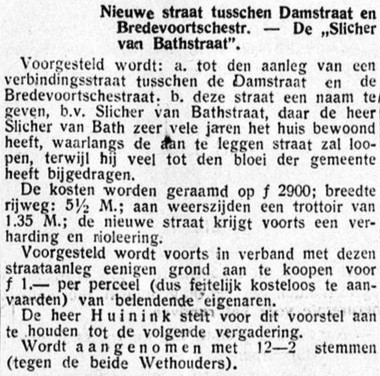
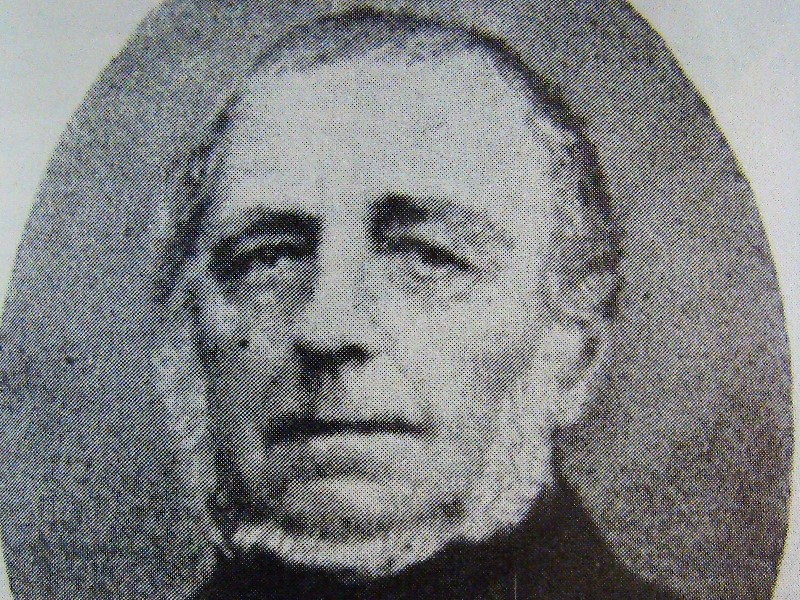
Adriaan Pieter Slicher van Bath (Middelburg, 1838-06-07 – Aalten, 1933-11-18) was a local notable and benefactor who contributed significantly to the Aalten community. He had resided in Aalten since 1867 and married Johanna Geertruida (‘Nannie’) van Hopbergen (1849–1924) here in 1874. She was a daughter of the local landowner Major J.W. van Hopbergen (1817–1913).
A street and a lane in Aalten are named after this couple. On the corner of the Slicher van Bathstraat and the Bredevoortsestraatweg, we still find their former residence, villa ‘Welgelegen‘. Furthermore, every resident of Aalten is familiar with the Nannielaantje, which runs across their former estate, the ‘Smees’ property.
Offspring
Their son Willem Antonie (‘Toon’) Slicher, born in 1881, and Anna Becking, born in 1883, married in Aalten in 1908 and were the parents of Professor B.H. Slicher van Bath in Wageningen. The title ‘Van Bath’, a small seigniory at Rilland-Bath in Zeeland, was intended to be inherited by B.H. Slicher’s uncle, but was transferred to his grandson by the grandfather for personal reasons.
In memoriam
On November 20, 1933, the Zutphense Courant published this report from Aalten:
“After an illness of several months, our oldest resident, Mr. A.P. Slicher van Bath, passed away here on Saturday evening at the advanced age of 95.
Mr. Slicher van Bath, who had already lived here for a normal lifetime, sailed a large part of the world’s oceans on a sailing ship in his younger years. After initially working at the Greenwich Observatory, he was sent out on behalf of English interests to conduct meteorological observations for the benefit of sailing. During these voyages, he visited St. Helena, the Cape of Good Hope, India, Australia, and Cape Horn, among others.
After settling here, Mr. A.P. Slicher van Bath was very active in the interests of this region. Among other things, he provided the initial impetus for the establishment of the Geld. Overijselsche Mij. van Landbouw, the Coöp. Zuivelfabriek (Cooperative Dairy Factory), the gasfabriek (gasworks), and the Geld.-Overijs. Locaal Spoorweg (Local Railway). ‘Floralia’, which has now existed for over 50 years, owed its origin to Mr. Slicher. No effort or expense was too much for him when it concerned ‘Floralia’, and when he was no longer able to involve himself in its management, this association received his significant donations every summer.
For many years, Mr. Slicher was chairman and later honorary chairman of the local department of ‘t Nut, and as such, the bewaarschool (nursery school) was his great passion. This institution also benefited from his substantial financial support every year.
Mr. Slicher was also a member of the Provincial Council of Gelderland for several years. Furthermore, until his 90th year, the deceased was an observer for the Meteorological Institute in De Bilt and, until the present, a correspondent for ‘Arti et Amicitiae’.
It is certainly noteworthy that Mr. Slicher’s memory remained excellent until the very end and that he continued to take an interest in all major world events.
With the passing of Mr. Slicher van Bath, a very well-known Aalten personality is gone, and numerous associations and institutions will deeply miss his great support.
The interment will take place on Wednesday afternoon at 3:00 PM at the Oude Begraafplaats (Old Cemetery) here.”
Johann Heinrich Joseph (known as Heinrich) Driessen (Bocholt, 10-07-1794 – Aalten, 04-07-1879) was a prominent textile manufacturer in Aalten. Heinrich descended from a Bocholt textile dynasty. He was the only son of Peter Driessen and Maria Hölscher. His father held a distinguished position in the Prussian town, just across the border from Aalten. In addition to being a textile manufacturer, he served there as a magistrate and, from 1797 to 1811, as deputy mayor.
Heinrich received a thorough education at the Jesuit College in Amsterdam and spoke excellent French, so that in 1812, when Napoleon’s troops passed through Bocholt, he was the only one capable of acting as an interpreter between the municipal authorities and the French generals.
Peter Driessen & Sohn
In 1810, Heinrich joined his father’s business. On December 2, 1820, he married Lisette Sträter in Rheine (Germany), a descendant of another prominent textile family. They had nine sons and two daughters. In 1826, he was entrusted with the management of the firm Peter Driessen & Sohn.
In that same year, his cousins Anton and Joseph Driessen submitted a request to King William I to establish a textile factory in Aalten, which was granted by William I. Not long after, Heinrich Driessen also requested permission from the King to settle in Aalten. The firm Peter Driessen & Sohn also received the requested establishment permit.
In Aalten
His father Peter continued to live in Bocholt while his son Heinrich settled in Aalten. He initially lived with the Meijerink family on Kerkstraat, one of the few remaining Catholic families in Aalten, in the same building as his cousin Anton Driessen.
In Aalten, Heinrich established a branch of his father Peter Driessen’s fustian trade and hand-spinning mill. They already owned the necessary land in Aalten and Varsseveld, and in 1826 he expanded his activities to Groenlo. There, Heinrich had purchased a house from De Heyder. That house was converted into a spinning mill. He made the yarn spun there available to home weavers who processed it into cloth.
Opregte Haarlemsche Courant, 7 December 1820Nederlandsche Staatscourant, 30 August 1851
Heinrich was an enterprising man. By 1832, he had approximately 500 linen weavers in Aalten and the surrounding area working for him, and three years later, along with Blijdenstein in Enschede, he was among the largest fustian manufacturers in the eastern Netherlands. He was one of the first in the Netherlands to utilize steam in his bleachery.
‘Den veursten Dreessen’
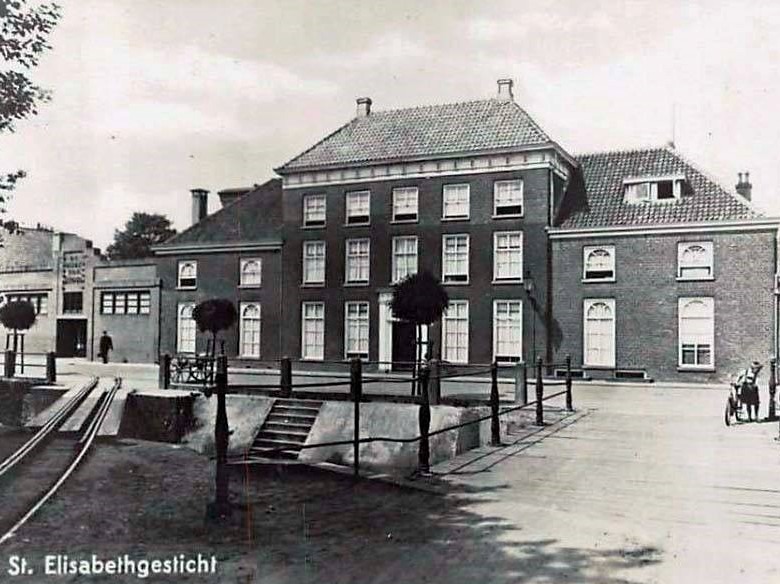
In 1837, he had a grand residence built at the beginning of Dijkstraat. For this reason, he was popularly known as ‘den veursten Dreessen’ (the front Driessen), while his cousin Anton, who built Beekhuize a little further along, was called ‘den achtersten Dreessen’ (the rear Driessen). Heinrich’s eldest son, Theodoor, laid the first stone on June 29, 1837. Business premises were also located at the residence, primarily serving as storage for yarns and woven fabrics. These fabrics were transported by a wagon, often pulled by an ox, to the bleachery in Dale. The driver bore the fitting nickname Ossen Willem (Oxen William). After Heinrich’s death, the house was repurposed as a convent.
Heinrich’s house on Dijkstraat, later St. Elizabeth’s Convent
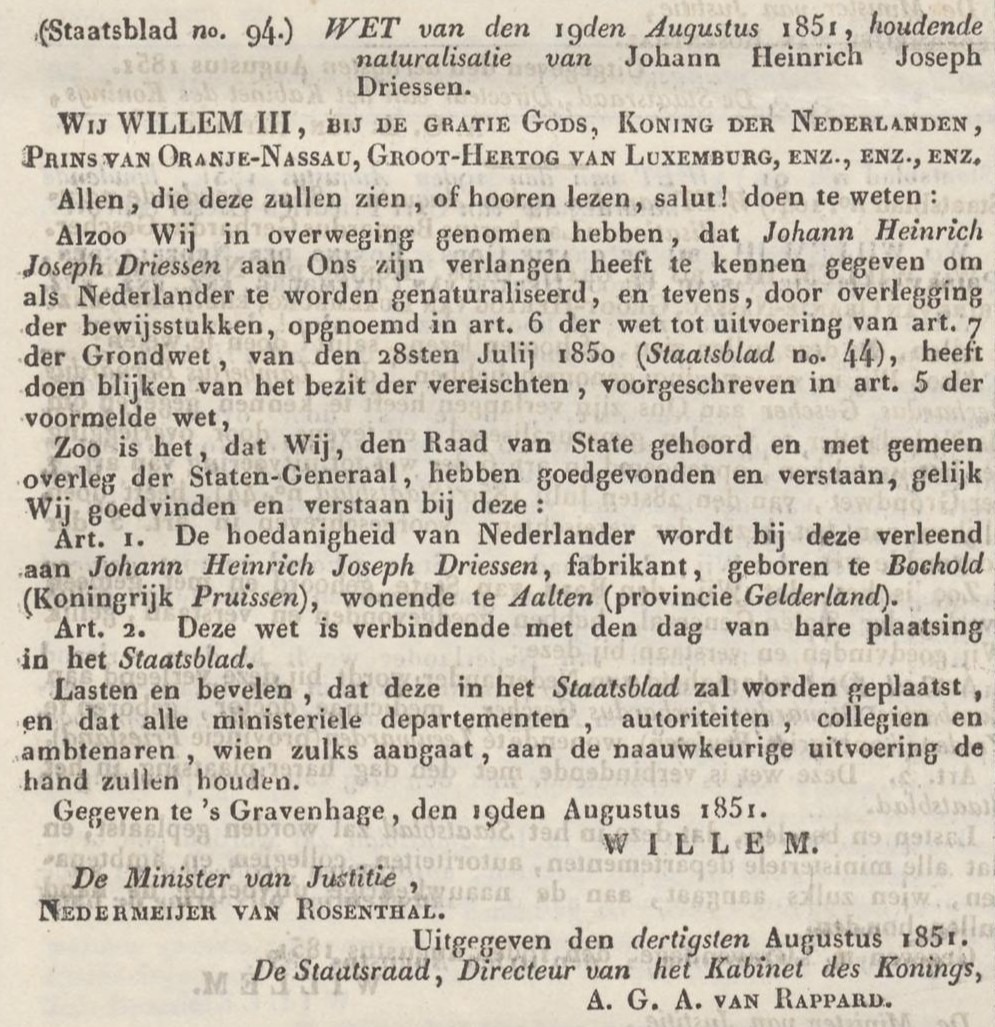
Following his father’s death in 1843, Heinrich became the sole owner of Peter Driessen & Sohn. His eldest son Theodor (1821-1878) was then placed in charge of the management in Bocholt. In 1851, King William III granted Heinrich Dutch nationality.
In 1849, Heinrich established a steam spinning mill on Hogestraat in Aalten, the first of its kind in the Achterhoek region. This was soon expanded with several ‘power looms’ (steam-driven weaving looms). After this factory burned down on the night of August 19 to 20, 1859, he did not rebuild the business.
Algemeen Handelsblad, 22 August 1859
To Leiden
Heinrich shifted his focus to Leiden. There, in 1846, together with his nephew (his sister’s son), the soap boiler Ignatz van Wensen, he had purchased the declining textile printing and dyeing works De Heyder & Co., later known as the Leidsche Katoenmaatschappij (Leiden Cotton Company). He had his second son Louis (1823-1904) come over from England to take charge in Leiden. With the knowledge he had acquired in Manchester, Louis soon managed to make the company profitable.
Heinrich’s son Eduard (1824-1895) continued to look after the company’s interests in Aalten. Initially, the bleachery there remained operational, but over time Eduard primarily focused on the trade in cotton and yarns. The branch in Bocholt, managed by Theodor, was closed after he and his brother Peter (1832-1895) started a blue-dyeing and printing works there in 1854, named the firm Theodor and Peter Driessen.
Catholic
Old Roman Catholic church on Dijkstraat, destroyed by fire in 1893
The Driessen family was also of great significance to the Aalten Catholic community, which had been a minority in the Reformed village since the Reformation of 1596. Not only through their prestige and influence, but also through various donations from the Driessens, the Catholic church in Aalten was able to grow into a fully-fledged church community. Both Heinrich and his cousin Anton played important roles as churchwardens and overseers of the poor, roles that were continued by their descendants.
Heinrich Driessen was very strong-willed in his conduct and often followed his own path in ecclesiastical matters as well. For instance, during the disputes between the Catholics and the Reformed in 1842 regarding the ringing of the bells. Pastor G.H.J. Wansing of Aalten wrote a letter about this to the Archpriest of Gelderland, M. Terwindt, which was co-signed by the churchwardens Th.W. Meijerink, H. Vulting, and A. Driessen. Heinrich Driessen, although a member of the church board, had not signed this letter and addressed two personal letters to Terwindt himself.
What stands out in these letters is that he stated, among other things, that the pastor seemed a priori prejudiced against Aalten and expressed the hope that the Aalten parish would receive a new shepherd who would be to everyone’s liking. He requested Terwindt to take his reflections into consideration when making his choice and assured him that he preferred to employ everything that was conducive to the honor of their holy religion. But at the same time, Driessen wrote that—because the old pastor showed him the greatest respect and because he himself esteemed the pastor as a man whose moral conduct could serve as an example to an entire province—he trusted that it would also please the Archpriest that the contents of the letters never be disclosed to others.
New church
A subsequent problem arose when it was decided around 1853 to build a new church. This led to serious disagreements within the church board. For instance, churchwarden Heinrich Driessen again found it necessary to act independently by contacting the Archbishop behind the backs of the other board members. In a letter to the Archbishop, he referred to the approval the latter had given to the plans for the construction of the church, on the condition that the confessional or confessionals be placed inside the church and not in the sacristy or in separate extensions on the side walls. Based on that condition, a plan had been sent to the King for approval.
However, during Driessen’s absence, the tendering for the church had taken place, in which an extension was nevertheless planned, contrary to the archiepiscopal approval. An extension to the church for the purpose of the confessional would, according to Heinrich, only disfigure a church. He had tried to convince the pastor of this, but had not succeeded. Driessen preferred to see the confessional inside the church, as was common in the Münsterland, rather than in an extension. According to him, the error could still be rectified, even though the masonry on that side was already in full swing. In his letter to the Archbishop, he therefore requested that instructions be given to the church board as soon as possible. The outcome of the matter is unknown. This action, however, is characteristic of Heinrich Driessen, who was apparently accustomed to getting his way and took the necessary steps on his own initiative to achieve it.
Wealthy
At the end of his life, Heinrich was a wealthy man. He held shares in spinning mills in Enschede, Gronau, and Rheine. Rheine was his wife’s birthplace, and her relatives managed textile enterprises there. Furthermore, he owned many lands and farms in the vicinity of Aalten, Varsseveld, and Bocholt.
Heinrich reached the advanced age of nearly 85 years. Several of his children and grandchildren entered the textile industry.
Willem Antoon (Wim) Mateman (Aalten, 07-05-1945 – Rijswijk, 08-06-2019) was a Dutch politician. On behalf of the CDA (Christian Democratic Appeal), he was a member of the House of Representatives of the States-General (Tweede Kamer) from 1979 to 1998. From 2003 to 2018, Mateman served as an alderman, municipal councillor, and head of the CDA parliamentary group in the municipality of Rijswijk.
Mateman trained as a teacher in civics and economics (MO-staatsinrichting and MO-staathuishoudkunde). He subsequently studied sociology at the Catholic University of Nijmegen. During his student years, he co-founded the Student Trade Union Movement (Studentenvakbeweging) in Nijmegen. Following his studies, Mateman became a teacher of economics, civics, and social studies at the Christian secondary school in Zutphen. From 1970 onwards, he was a member of the Provincial States of Gelderland and a member of the municipal council of Aalten on behalf of the Christian Historical Union (CHU). He also became an alderman in Aalten.
In the 1977 general election, Mateman stood as a candidate for the CDA but was not directly elected. Later that year, he was offered the opportunity to take a seat in the House, but he declined. Two years later, Mateman entered parliament after all via a mid-term vacancy. He was sworn in on 28 August 1979. In the House, his portfolio included trade policy, defence, and domestic governance.
Wim Mateman belonged to the conservative wing of the CDA. He was deeply disappointed when he had to leave the House because the new party leadership sought to refresh the parliamentary group. Consequently, Mateman did not stand for re-election in the 1998 general election.
In 2003, he became the Alderman for Finance and Land Affairs for the CDA in the South Holland municipality of Rijswijk. In May 2014, the CDA left the Rijswijk municipal executive, and he returned to the municipal council, where he became leader of the CDA parliamentary group. He retired from local politics in 2018.
Mateman was married and had two children. He was appointed a Knight in the Order of the Netherlands Lion in 1992 and a Knight in the Order of Orange-Nassau in 1998. In 1992, he was also named Pipe Smoker of the Year.
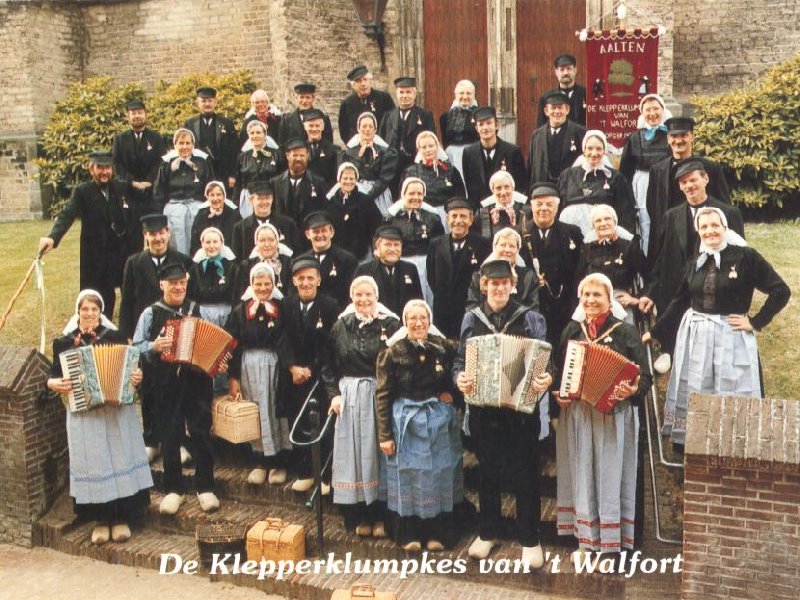
The Klepperklumpkes van ’t Walfort was a folkloristic dance group from Aalten. The group was founded on 10 May 1954 with the objective of preserving Gelderland’s regional folklore for future generations. Members of the group were dressed in authentic Gelderland (Achterhoek) traditional costume, as it was worn around 1900.
The dance repertoire consisted of approximately 35 traditional dances, mostly from the Achterhoek and Twente regions, which also date back to that era. The most well-known dances include the Driekesman, Pot met bonen (Pot of beans), and the Hôksebarger, performed, of course, in polished wooden clogs.
A Welcome Guest
The Klepperklumpkes was an active association. Over the past decades, they performed in various institutions, at street markets, and in many countries. They were a welcome guest at festivals in Belgium, Denmark, Germany, England, France, Austria, Slovakia, Spain, Sweden, and Switzerland, among others. They even performed in China.
During their peak years, the Klepperklumpkes organised a large international festival in Aalten every four years, featuring many foreign guests. These guests were hosted by local families, providing many with a unique introduction to the international dancers and their respective folklore.
In their final years, the dance group rehearsed in the hall of café Setz.
After nearly 70 years, the Klepperklumpkes disbanded in 2022. In their final years, the number of activities had gradually declined; many members were getting older, physical stamina was decreasing, and there was a lack of new members joining.
Doeke Bekius (Gauw, 14 November 1922 – Haart, 8 June 2013) was a Dutch politician, representing successively the Anti-Revolutionary Party (ARP) and the Christian Democratic Appeal (CDA).
Bekius was born and grew up in the Frisian village of Gauw, near Sneek. After completing his ULO (advanced elementary education), he joined the municipality of Wymbritseradeel at the age of sixteen, a rural municipality surrounding Sneek that comprised 28 villages. In 1946, he moved to the municipality of Zutphen. With the experience gained there, he accepted the position of Head of General Affairs at the municipality of Apeldoorn in 1951. In July 1961, he became Mayor of Westdongeradeel, which was followed in December 1966 by his appointment as Mayor of Kollumerland en Nieuwkruisland.
Mayor in the municipality of Aalten
In mid-1976, Bekius accepted the mayoralty of the municipality of Aalten, succeeding Mayor Faber. He considered the small town of Bredevoort to be a gift, an inspiring assignment. In 1988, he was appointed ‘honorary drossard’ (eredrost) there.
After his retirement, he continued to reside within the municipality of Aalten. He remained a member of both Bredevoorts Belang and Haarts Belang (local community interest groups). Furthermore, he dedicated himself to the Vereniging van Kleine Kernen (VKK – Association of Small Communities) Gelderland. At the end of 1987, he started there as an advisor to the board; he soon joined as a board member and subsequently served as its chairman for many years.
Bekius lived and passed away in the hamlet of Haart, in the municipality of Aalten. On 14 June, his funeral took place in his birthplace of Gauw.
He was succeeded as Mayor of Aalten by Tijme Bouwers.