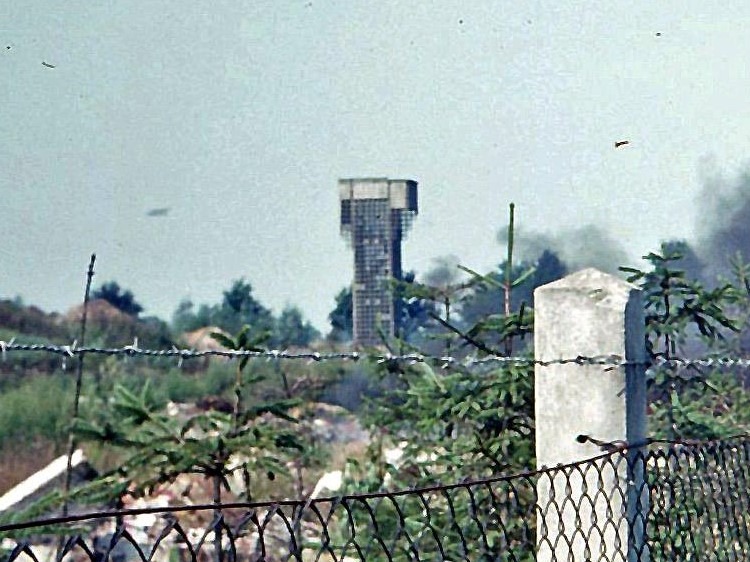
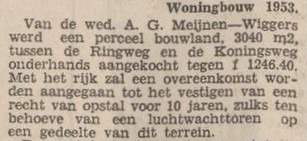
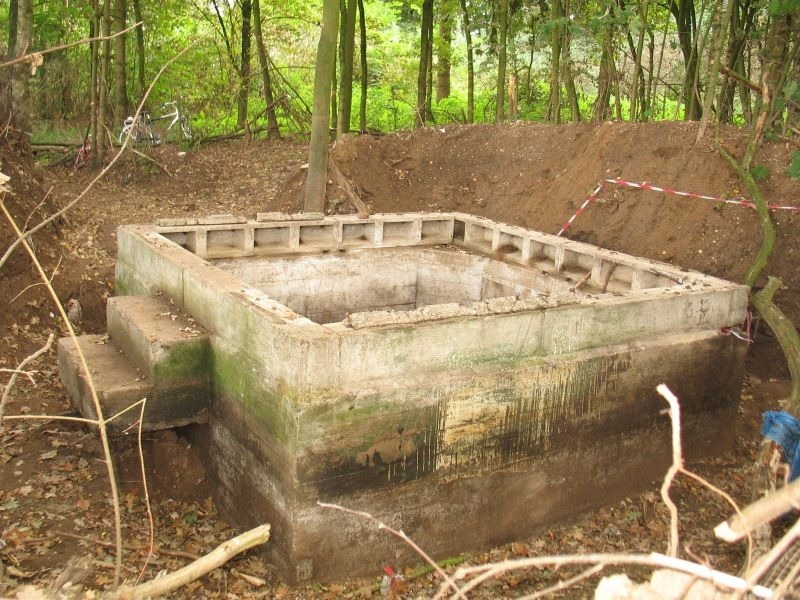
The Air Watchtower in Aalten was a concrete watchtower that was part of the national network of air watchtowers that was established in the Netherlands during the Cold War. The tower was located on the Koningsweg, on the outskirts of the village, and was intended to detect enemy aircraft flying lower than the radar systems could detect.
The Aalten air watchtower was a so-called ‘honeycomb construction tower’, recognizable by its characteristic honeycomb structure, a construction that offered both stability and strength. The tower, built of reinforced concrete, was fourteen meters high and the head of the tower was an open observation cabin with a hiding corner to protect against shrapnel. Neighboring municipalities such as Varsseveld and Winterswijk also had high lookouts, but not as characteristic as those in Aalten.
Searching for the enemy
The air watchtower in Aalten, codenamed ‘Isaac 1’, was inaugurated in 1953, at a time when the tension of the Cold War led to heightened preparedness. The tower was part of a network of 276 lookouts spread throughout the Netherlands and fell under the Air Guard Service Corps (KLD), a part of the Royal Netherlands Air Force that was under the Air Defense command. The Aalten tower was part of the command center KLD Deventer.
The purpose of the towers was to visually detect enemy, especially Russian, aircraft that flew below 200 meters and therefore remained out of range of radar equipment.
Crew and equipment
The crew of the tower consisted of two men who, regardless of the weather conditions, observed the airspace. Women were excluded from these tasks at the time. The crew members wore uniforms and were equipped with headphones and a mouth microphone. The observation was done with the help of a tripod equipped with a scope and a pointing needle. The ranks in the Aalten air guard consisted of soldier, soldier first class, corporal and sergeant. Mr. H.J. Prinzen from Aalten was local commander for a while.
The crew was trained to warn the surrounding towers in case of emergency and via a hotline also the command center. The staff was in an underground, nuclear-free bunker in Deventer. The tower was not continuously manned; only during exercises. Every two weeks there was a theory evening for aircraft recognition at a location in Aalten or Winterswijk.
Recruitment of volunteers
On May 20, 1953, a recruitment meeting was held by the Air Guard Service in the Society on the Hofstraat in Aalten. Commander Ruseler from Deventer provided information to the men who had been called up for this purpose. As an incentive to sign up, exemption from military service or participation in the Population Protection was offered. A number of men volunteered and joined the KLD.
Removal and demolition
With the advent of more modern control systems and improved radar equipment, the need for visual perception became smaller and smaller in the 1960s. This eventually led to the dissolution of the Air Guard Service. The Aalten air watchtower was demolished in 1970, a spectacle that attracted a lot of interest from the local population. The heavy concrete foundation of the tower is still hidden underground and is a silent reminder of this chapter in history.
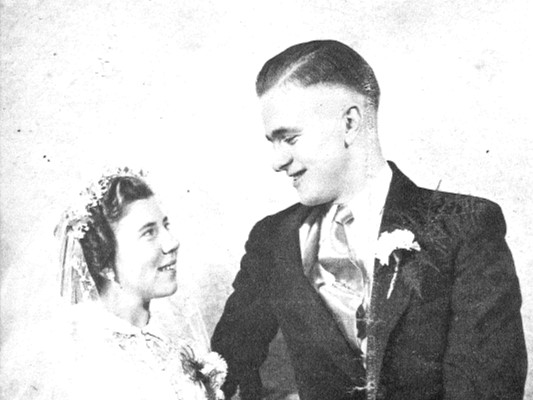
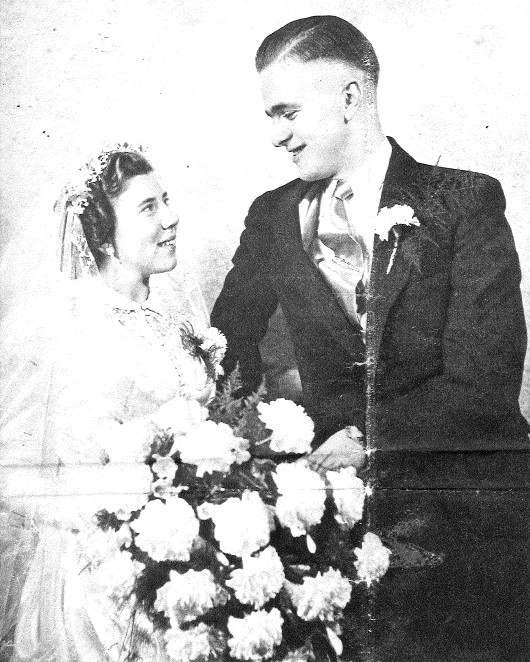
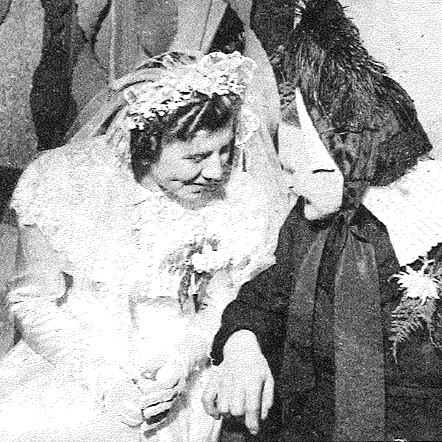
In 1951, Johan Bosman and Riek Kraaijenbrink briefly returned from Canada to their native region for the church blessing of their marriage in the Oosterkerk in Aalten.
We are sitting across from Johan Bosman from Barlo, a rural district in the municipality of Aalten. He has been away for over 2½ years as an emigrant in Canada; he is back in his native region for a short time. One can see that he has been abroad. It is noticeable in the generous cut of his clothing; it is also evident in the look in his eyes, which are clearly accustomed to larger proportions…
Characteristic in this regard is what he tells us about his arrival in Aalten by bus a few weeks ago: “Everything seemed incredibly small; the roads were so narrow and winding… I honestly thought the houses had all been pushed together…”
Today Johan Bosman is the groom! And Riek Kraayenbrink from Varsseveld, the girl he had already met before his departure for Canada, is the bride. Both had emigrated to Canada a few years ago—separately. They have returned together to have their marriage blessed in church here, in their native country.
Land hunger
There is a hunger for land in Aalten and the surrounding rural districts. For many farmers’ sons, there is no more land available, and therefore no means of subsistence. Consequently, many men and young families from Aalten and the surrounding area have already emigrated. And even now, many are ready to depart later this spring.
Johan Bosman left in April 1948, alone. Saying goodbye to home, and to his girl, had been difficult for him. But the prospect that Riek and her parents would also follow soon gave him courage. Johan worked alternately, on a freelance basis, sometimes on the land, sometimes in the factory. “You change jobs or professions quite easily there,” says Bosman. “Here, you don’t do that so quickly.”
In the meantime, Riek had crossed over to Canada in 1949 with her parents and six brothers. As soon as possible, the young lovers made an appointment to meet. But that is simply not so easy in a strange and large country. Love, however, makes one determined. Chatham, in Southern Ontario, was the meeting place. He traveled there from Montreal by train; she hitchhiked by car!
The girl found a position in Chatham, where she immediately had the opportunity to learn the English language. Johan went to work “nearby.” They celebrated their engagement within Riek’s family circle.
Marrying in Aalten!
Their plan was to marry in the autumn of 1951. But in Aalten! Because they wanted to experience this great event in the familiar surroundings of their native region, amidst Johan’s family and mutual friends. Moreover, they felt this was still the best time for a visit to the Netherlands. Would it still be possible in a few years, when they might have more worries?
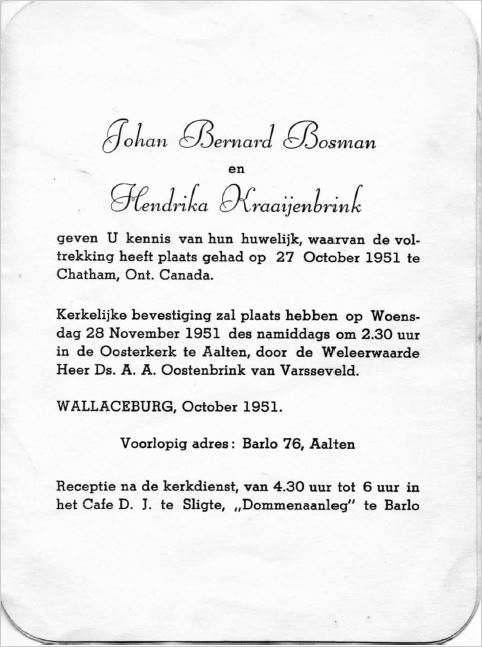
Johan requested his parents to arrange the necessary formalities for their marriage in Aalten. However, he received word back that a civil marriage ceremony was no longer possible for him in the Netherlands as a non-resident. The young couple then decided to have at least the church wedding take place in Aalten. On October 27 last, they were married by law in Chatham. After that, they traveled to the Netherlands as soon as possible, where they arrived on November 22.
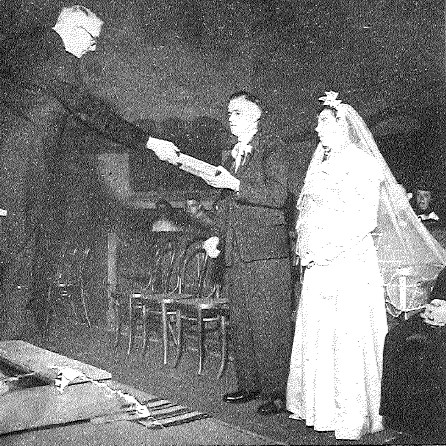
And on a stormy, dark autumn afternoon in December, the couple received the church blessing of their marriage in the Oosterkerk in Aalten. “Blessed is he whose help is the God of Jacob,” was the text that Rev. A.A. Oostenbrink, Reformed minister in Varsseveld, had chosen for his wedding sermon.
What must have gone through these young people’s minds during this solemn hour! Did the bride not think of her mother, who sympathized with her from afar, and of her father who was no longer able to experience this day? And will the groom, looking around the church, not have realized for a moment that this day, and this short stay in the Netherlands, signifies a final reunion with many who are sitting here around him?…
Back!
Yes, because they are going back! They enjoyed seeing parents and friends again; but staying here, no, that was no longer possible. The bride likes managing the household in Canada very much. “It’s all done more with electricity there,” she says. “Everything is arranged much more practically.”
To our question of whether the couple is already provided with a house in Canada, the groom answers: “We don’t have a house yet. If I can find a suitable farmer who has work for me, then we will find shelter on the farm. If I can find a good job at the factory, then we will rent a few rooms in the city. For newlyweds, there are still possibilities in Canada in this regard. But one day I hope to be able to buy a farm myself, because that is ultimately why I emigrated.”
These words characterize the man who speaks them. They characterize the man Johan Bosman, who is cut from the tough wood of emigration. They also characterize the situation in a country where there are opportunities, where there is still a future for young people…
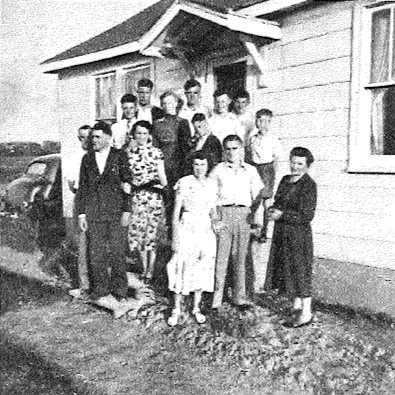
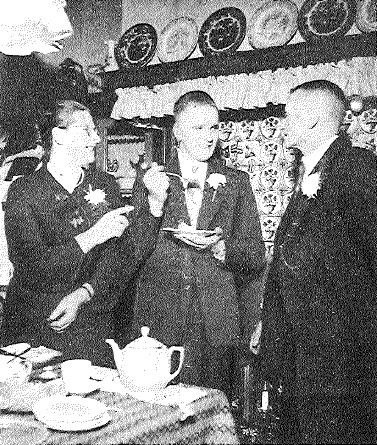
The Bosman-Kraaijenbrink bridal couple, who came to the Netherlands specifically from Canada to have their marriage blessed in church here. The wedding dress is made of satin, trimmed with lace and small pearls, and was brought from Canada. On the engagement day of Johan and Riek, at the home of the Kraaijenbrink family in Wallaceburg.After the church blessing, the bridal couple receives a Bible from the hands of Rev. A.A. Oostenbrink. Johan Bosman with his parents in the kitchen, where Mother quickly slips him some treats, just like in the old days…A private chat between the bride and her seventy-seven-year-old grandmother.Wedding card Johan Bosman and Riek Kraaijenbrink
Do you have interesting stories about family members who emigrated from Aalten to Canada? Send us a message!
Lately, there has been much talk about emigration. It is a longing for adventure that makes many look forward to a new homeland! Emigration can be a bitter necessity. Which factors play a role in the emergence of plans to emigrate? From the municipality of Aalten in East Gelderland, very many are departing for another country. We have investigated the causes and motives, and we wrote this article as a result.
When, shortly after the liberation, our people began to realize that with the current population growth there would eventually no longer be employment for many in our own country, the government spoke reassuring words and argued that the solution to the problem lay largely in industrialization. The word industrialization became a kind of magic word with which the looming specter of unemployment could be combated. Indeed, new industries have been established, including in rural areas, but this industrial establishment does not provide a definitive solution.
One of the reasons for this is that not enough factories are being established to provide work for everyone. Industrialization in rural areas is not actually progressing as desired. The number of workers who are in fact redundant in the villages and in the rural districts is much larger than one might think at first glance. In the past half-century, farms have been split several times, sometimes in two, but also in three, depending on the number of children who had to find work in the agricultural sector. Now, as far as splitting is concerned, one is practically at one’s wit’s end. Therefore, it was reasoned, other work should be made available, especially for the sons of farmers.
Thus, the idea of industrial establishment in rural areas arose. This industrialization has only partially succeeded and, as many expect, will not provide the solution in the future either, for where, one wonders, is the money for the large investments to come from? After all, nowadays one must bear the great risk associated with establishing a new industry oneself, while, when profits are made, the tax authorities claim a significant portion of them. Industrialization thus becomes anything but an attractive proposition.
Not to the factory…
Another side of the matter is that transferring workers from the agricultural sector to industry is not easy. Many from the countryside hesitate to work in a factory, where one must stay indoors practically all day and where, it is feared, a significant part of one’s own independence disappears. In Dinxperlo, for example, several industries were established after the war, but not enough workers can be found in the town itself, although according to statistics, they are present.
Here we naturally touch upon another side of the problem, namely that on many small farms there are more workers than necessary for performing the tasks on those farms. The consequence of this is that the income from the farm must serve to support four or five adults, while normally there is only a profitable existence to be found for at most two full-fledged workers.
From an economic perspective, it is entirely logical that emigration is the result of the situation described above. People foresee that, especially in large families, it will eventually be impossible to earn a living in agriculture, while they shrink back from industry or see no prospects there, given the current financial difficulties and the government’s policy.
When one also considers that in 1886 the Doleantie in Aalten caused many to move from the Dutch Reformed Church to the later Reformed Church, one understands all the better why we drew certain conclusions above.
On an even larger scale
In Aalten, emigration is currently the order of the day. From many families, one or more persons have departed since the liberation. They wrote letters about their findings in the new homeland, and the result is that family members, as well as neighbors, were also inspired to emigrate. Furthermore, those who have already emigrated often arrange for work in the new country.
Many have already departed from Aalten for Canada this year, but, as we were informed, more than 200 people will follow in 1951. These are not only farmers but also businesspeople. The latter no longer feel like working for the tax authorities, as some of them confided to us. Added to this is the fact that they no longer see future opportunities for their children and ultimately want to provide for this future themselves, rather than seeing it as a task for the state.
Most emigrants have so far departed for Canada, but several have also already gone to New Zealand and Australia. As a rule, the men go to these latter countries alone first, find work and a home there, and then have their wives and children join them. Next year, many more residents of Aalten will depart. If the conditions for emigration are not changed, a large exodus from Aalten is expected to take place in 1952.
It is striking that in certain regions of our country, emigration is greater than in other areas. The cause? It appears that in East Gelderland, the most emigrants in recent years have departed from Aalten. Although several important industries are also found there, Aalten is for the most part agricultural. Farm splitting is no longer possible there. Emigration is the talk of the town.
Upon closer inspection, it is notable that practically all emigrants from Aalten belong to the Reformed Churches, which in this town of approximately 14,000 inhabitants has more than 5,000 members. However, in other places in East Gelderland as well, most prospective emigrants belong to the Reformed Churches. Are there causes to be identified for this as well?
No material regarding this matter is available in statistics or from opinion research, but it appears that most emigrants come from certain circles. In general, members of the Reformed Churches are members of the Anti-Revolutionary Party, the party that has offered the greatest opposition to post-war government policy. Moreover, the future of the children is also a driving force here. These arguments—no prospects and no employment for the children—consistently emerge in an investigation into the motives and causes of emigration.
History
There is, at least as far as Aalten is concerned, a third cause. This lies in history. Around the middle of the last century, a large emigration from East Gelderland took place to the United States of America, primarily from Aalten and Winterswijk. The main causes then were the great impoverishment and unemployment during and after the Napoleonic era (the failure of the potato crop in 1845 and later years had been a disaster), which made many look for a better existence. People had heard that opportunities for this existed in America, especially through the cultivation of lands issued by the State for that purpose.
Furthermore, many from Aalten and Winterswijk belonging to the “Seceders” participated in the emigration due to the restriction of religious freedom imposed on them by the government and because of the treatment they experienced from many fellow citizens due to their religious standpoint. For instance, the lease of a farm or land was repeatedly terminated for the “Seceders.”
A large group of them departed in 1845. However, on Lake Erie, their ship caught fire and all those on board perished in the flames or in the water. They had almost reached the destination of their journey. A large number of members of the seceded congregation of the Keurhorst near Varsseveld were among these emigrants.
In 1853, 25 emigrants departed from Aalten. In 1854, however, the number already amounted to 194, while 39 departed in 1855. We provide some figures for the following years below: 1856: 62, 1857: 50, 1858: 44, 1868: 118, 1869: 206, 1870: 36, and 1879: 84. The population of the municipality of Aalten at that time was approximately 5,000. It is therefore no wonder that almost all old Aalten residents have family in America.
Travelogue of a Dutch emigrant, Hendrik Jan Tuininga, who visits the old homeland –and also Aalten – with his wife and daughter .
In the last 4 years, many former Dutchmen living in America have made this trip, either over England or by “Holland America Line“. Many of these have no urge to report in a newspaper about what trip they had, or how they found the old homeland with their family and friends. And yet, if there is anyone who wants to do the pleasure of the “Friend of the People” to report something about it, I never skip reading such travel descriptions. For the latter reason, and because the Friend of the People also wants to give its readers of such a nature, I have also proceeded to recount our journey, which my wife and I and our youngest daughter Gertrude, did with the three of us, here.
Departure from Orange City
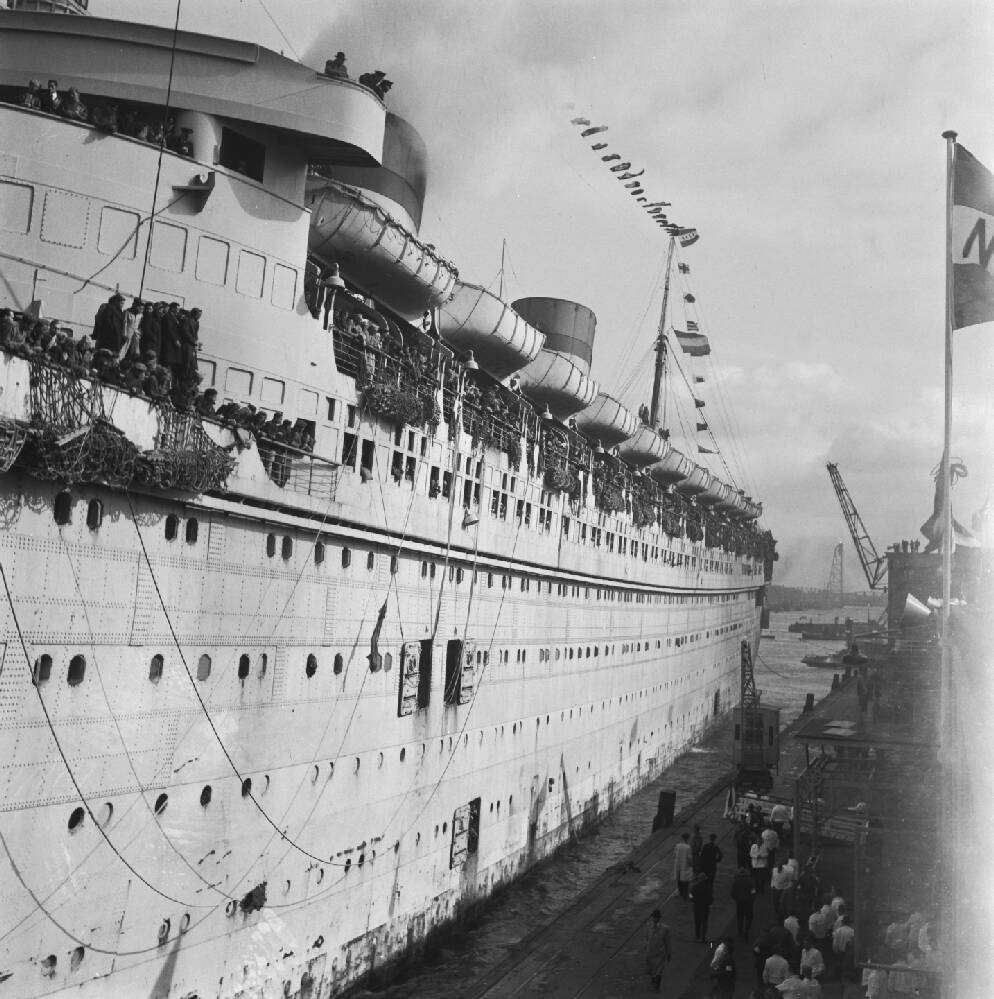
Arrival of the Nieuw Amsterdam in Rotterdam (1946)
On Friday afternoon about 2 o’clock we were leaving Orange City, when our son Harry van Boyden picked us up and brought us on the train in the evening, which left 6.01 from Sheldon. In Madison the train stopped for coffee for 20 minutes, it was then 5.10 a.m. It was wet everywhere on the land. We stopped for a few days with our son in Chicago, and after seeing some peculiarities, we went by train to Hoboken, and stopped another night in Paterson, and saw New York a little, and went on board the “Nieuw Amsterdam” on the 28th of April, a huge ship, 700 feet long and 108 feet wide. I think this boat is 60 to 70 feet high from the steering bridge to the waterline.
We heard that the Society had made 16 million last year. The travel costs are high, but the food and service is rata. In 1908 we gave 200 guilders for a ticket per person from Rotterdam to Rock Valley, lowa, then 80 dollars and per second class. The weather was also nice, and one has this free of charge, and then one can enjoy the other thing. One then makes pleasant acquaintance with many passengers, with some so that one never forgets each other. We had Sunday morning service of the Word, by a businessman.
It was Saturday morning, May 6, when we moored at the pier in Rotterdam of the Holland America Line. First our luggage checked by the commies and then our return tickets were arranged. Then we saw my sister Mrs. W. Obbink van Aalten soon and after having lunch in a café, we went together to the Maas station by taxi, to get off at 4 o’clock in the afternoon at Aalten, Gelderland.
Aalten
In Aalten and surrounding villages we saw many houses missing among the others, which had been bombed and many where they were building and many were also finished. The ordinances there are such that when a new house is built, it must be absolutely modern. But in old houses, even if they are neat houses, almost everything is still primitive. In Arnhem, where there was also so much bombing, almost everything has been rebuilt.
In Aalten kerkten we ‘s zondags, waar zooveel jongens op een zondagmiddag door de Duitschers werden opgehaald voor de werkkampen. In Aalten worden des zomers elke zaterdagavond om half negen straatpredikaties gehouden, om de beurt; de eene zaterdagavond door de predikant der Geref. Kerk, den heer Jan Nawijn en de volgende zaterdagavond door een der Darbisten broeders. Ik heb van beiden genoten.
Er zijn in Aalten drie groote kerkgebouwen die aan de Gereformeerden toebehoren; een groote Hervormde kerk; een Darbisten bijeenkomst en een Roomsche kerk en een Synagoge. Zoover ik weet zijn er in Aalten geen die bij de uitgetredenen behooren. Aalten is alleszins godsdienstig.
The surroundings of Aalten are beautiful. I have never seen such a tree growth anywhere. Oak trees so beautiful and straight and a whole beautiful avenue.
The conditions of the worker have improved enormously compared to 50 years ago. At a certain age, they are provided with a pension. The civil servants with 55 years, the ordinary workman 60 and 65 and then it is not allowed to work with others, which is paid. There is also a free Saturday afternoon in the Netherlands. Almost everything can be bought freely again, everything, except coffee. People live generously again, a big difference from the past. Cake and candy are well used. Coffee is scarce and is therefore drunk with 8/10ths hot milk.
There was a nervous thought about the Communists. And they all wanted to go to America. We have recommended it to few.
Amsterdam
We visited the capital of the Netherlands, Amsterdam. This is one of the most beautiful cities in Holland, with its four large long canals, Prinsengracht, Keizergracht, Heerengracht and Singel and with its many bridges. Is there any city in the world that has so many bridges? Amsterdam can regulate its own water level, because it has a complete lock system.
Amsterdam’s Jewish quarter is deserted. I was told, people who lived in that neighborhood, that in the evening and at night one could hear women and children screaming when the Germans picked up carloads to Germany. And on the way, I was told, they put a hose in the tank or truck where they were sitting and let it go full throttle, so that they arrived dead in Germany, and were immediately consumed in ovens.
The houses in the Jodenbreestraat are still there. One can see that what wanted to burn was demolished during the war years. And yet Israel is blind, and has a lid on her face. Hope in the Lord, you remnant, if Israel is in need, there will be deliverance. His goodness is very great. He will once set all Israel free from iniquities on the prayers of the remnant (from Ps. 130).
Friesland
On a Sunday morning we went by bus to Makkum for church. Here we saw a rather famous shipyard, whose director did business with Palestine Jews. Four 70-ton fishing boats were now made. One was ready and would sail to Palestine the next day under its own power, with a Jewish crew and a Jewish David’s flag on.
We spent a lot of time in Bolsward, where family lived there and many friends from my school youth and also until I was eighteen, where we sailed to Amsterdam as turnsmen. Where now Mr. Jurian Kok is captain and owner. The ship that Kok bought from my father and is now 50 years old is still sailing. It was a great pleasure to see the forecastle and aft cabin for the last time.
We also spent a day with Ulbe Faber and watched in Wieringermeer. Much has been suffered there, but God also helped out of it by restoring the flooded polder and allowing rich crops to grow again.
Back home
After having enjoyed a lot with my wife’s brother Klaas van der Kooi and wife in Longerhou, we went from there to Aalten at the end of June and then again on the Holland America Line in Rotterdam, to leave June 30 with the Veendam, at 3 o’clock in the afternoon. We had great friends on the outward journey. On the return trip we will not soon forget friends Mr. Bakker of Amsterdam and Mrs. van der Lely of Naaldwijk.
We are back in Orange City. If we can do it again, we won’t stop it. It was also beautiful at sea both trips. If you go and can, go in the spring. Holland is a beautiful country, and its spring is typical.
German workers received a pound of coffee for Christmas; Dutch staff later received a rixdollar…
While one of the German girls employed at a textile factory in Aalten was recently the cause of a sensational incident (she defaced the Dutch flag with a swastika), German textile workers in Aalten have once again been the catalyst for an event that has caused quite a stir in the quiet village, as two textile factories were involved.
Sixteen German girls are employed at a textile factory in Dijkstraat. As Christmas approached, they began to ponder a surprise they could provide for their relatives across the border. It had to be coffee, was the general opinion!
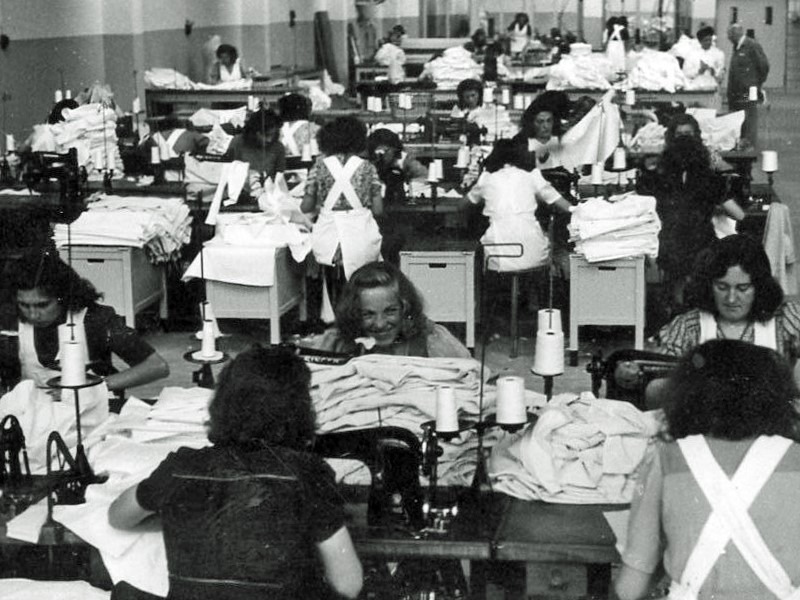
Girls at work at the Driessen textile factory, Hofstraat. Photo for illustrative purposes.
The German girls enlisted the help of a staff member from Aalten, who knew just how to manage it. He, in turn, went to a businessman who proved able and willing to supply 16 pounds of coffee—one pound for each of the German girls. That evening, the girls cheerfully headed home by bus with their coffee. However, on that same bus were 19 female workers from a textile factory in Hofstraat.
Understandably, they were none too pleased that their friends could take coffee home for “Weihnachten” while they could not. The matter was promptly raised the following day with the management in Hofstraat. They felt they could do little else but promise each of their German workers a pound of coffee as well. And the 19 pounds of coffee indeed materialised.
But the difficulties did not end there! The Dutch staff had caught wind of the Christmas gift and now began to demand coffee too. After all, coffee is an item that has been very scarce in this country of late. The management of the Hofstraat factory restored industrial peace by giving every staff member a bonus of ƒ2.50. With that, the whole matter seemed to be settled.
However, with so many people involved, it was almost inevitable that the police and the C.C.D. (Central Investigation Service) would hear of the case. The latter has since launched an investigation, which has already led to an official report (proces-verbaal) being filed against the management of the textile factory in Hofstraat. A second report followed for the granting of a bonus without the permission of the Board of Government Mediators. An official report has also been filed against the shopkeeper involved.
We understand that the reason the German girls were able to export the coffee is that the Dutch customs, contrary to standing orders, allowed the coffee to pass; it was apparently assumed that it could be exported freely as long as its value was below ƒ15. The German customs had already promised the German girls that they would make an exception in view of the approaching Christmas holiday.
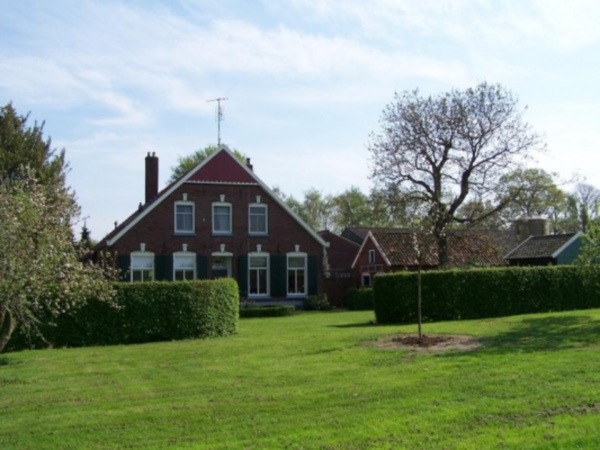
It was 1949 and the Scholten family, consisting of father Hendrik Willem Scholten, mother Grada Everdina Scholten-Kemink and their twelve (!) children, lived on “Lankhof” farm in Barlo. Of the twelve children, seven boys and five girls, the eldest was 22 and the youngest 7 years old.
Son Roelof, born in 1940, recalled in a 2015 interview the nervousness that prevailed in the family during World War II. It was a very dangerous time. They also hid people in the attic. The Germans often came to check if they could find anyone. When bombs fell at night, they all went to the air-raid shelter and protected themselves as best they could.
After the war, the Scholten couple felt the desire to seek their fortune in Canada, not primarily for their own future, but especially for that of their children. A major reason was the population growth in the Netherlands; the country was becoming full!
In the Achterhoek, too, almost all available land had already been brought into cultivation. While it was customary for the eldest son to take over his father’s farm, the other sons were unable to start their own businesses due to a lack of agricultural land. If they wanted to spread their wings, they had to seek their fortune elsewhere.
In 1949, the Scholten family decided to take the plunge and emigrate to Canada. Hendrik Willem leased out the business in Barlo, because you never knew. In case they became homesick, it was good not to burn all their bridges behind them.
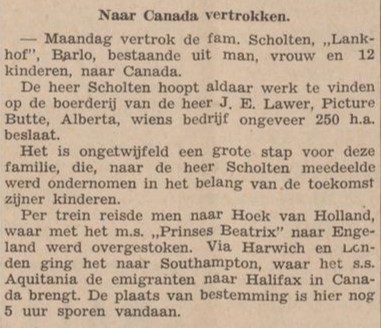
Aaltensche Courant, 11 March 1949Lankhof farm in Barlo
The long journey
In the night from Sunday to Monday, March 7, 1949, the Scholten couple departed from Barlo with twelve children by train to Rotterdam. It was the first part of the long journey they still had ahead of them. For the move, they took an army truck and a trailer. On it were three wooden containers with their remaining possessions.
During the course of the morning, they embarked on the “Prinses Beatrix”, the ferry to Harwich. They were part of a group of 220 people from all parts of the country. They were mainly farmers with their families, who were going to start a new life on the other side of the Atlantic Ocean.
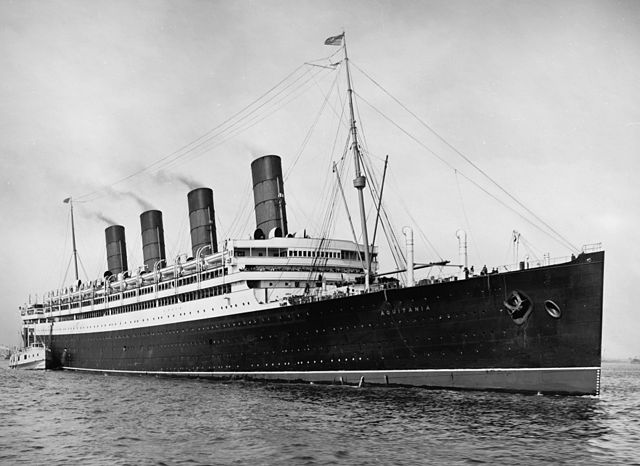
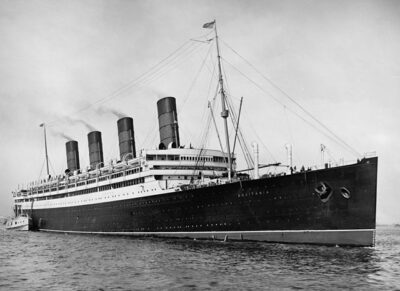
RMS Aquitania
From Harwich, they traveled further by train to London, where the enterprising group stayed overnight. Then they went by ship to Southampton to transfer there to the “Aquitania”, a large passenger ship of the Cunard White Star Line.
The “Aquitania” was a 46,000-ton ship and was, after the “Queen ships”, also of the Cunard White Star Line, the largest ship in the world. It could carry 1,500 passengers and the crossing to Halifax in Canada took about six days. It was the only steamship in the world with four funnels. A minor detail? Certainly not! There was a time when emigrants insisted on sailing on ships with many funnels. Some travel agencies showed prospective travelers photos where an extra funnel had been added to a ship… The more funnels, the greater the safety, believed the inexperienced emigrants.
In any case, the 220 Dutch people in tourist class, with small dormitories for six to twelve people, would have a decent crossing. From Halifax, the Scholten family would then have to spend another five days on the train to reach their destination via Medicine Hat and Lethbridge: the town of Picture Butte in the Canadian province of Alberta.
Destination reached
The Scholten family arrived in Picture Butte by train on March 18. It was very cold. Upon arrival, it seemed as if all 500 residents of the town were present. Perhaps they thought World War III was starting when an army truck rolled out of the train car. They settled in two barracks just north of Picture Butte, on the farm of J.E. Lawlor.
The conditions in those barracks were not ideal. It was just as cold inside as it was outside. Father and mother slept in one of the barracks, which also contained the kitchen. The children all slept in the other barrack. Father placed double beds on top of each other with about 60 centimeters between them. The girls slept on one side and the boys on the other. There was a dressing area at the front.
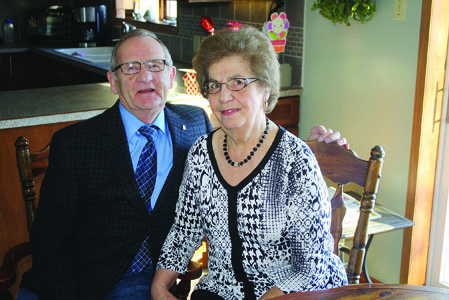
Roelof & Diny Scholten, 2016
In the beginning, it was difficult. The wage was about $0.25 per hour. Father and mother worried a lot in those years about how they could buy enough food for the family. Although the local supermarkets, Woodruff and Stella-Lacey, were very helpful. They could buy on credit there and sometimes they even received something for free. But in the winter, there was very little work. The boys went to Burmis and worked there at the lumber yard. Even though they earned hardly any money, they at least had a place to stay, clothing, and food.
About three years after arriving in Canada, the Scholten family moved to another farm, just east of Picture Butte. They stayed there for a year and grew beets. Then, in 1953, Hendrik Willem bought a farm about seven kilometers from Picture Butte, with about 130 hectares of land. Roelof went to school in Picture Butte and also helped his father on the farm. Some of his brothers also became farmers, and some chose other professions. Two became teachers and moved to another part of Alberta. Roelof remained on his parents’ farm and helped his father with the farming work.
The Exodus of Dutch emigrants to Canada does not seem to be coming to an end for the time being. All these people are here squeezed out of their narrow boundaries and swallowed up by the great country on the other side of the ocean, with its enormous surface area, for whom this population growth is no more than a drop in a bucket.
It is a strong belief in a good future and an indestructible enthusiasm for Canada with its enormous opportunities that stimulates the departure of these Dutch farmers. But it is also the spirit of their forefathers, the pioneers of the East and the West, that lives on in these tough workers of polder land and field and in which the true tractor’s blood of the Dutchman does not deny itself.
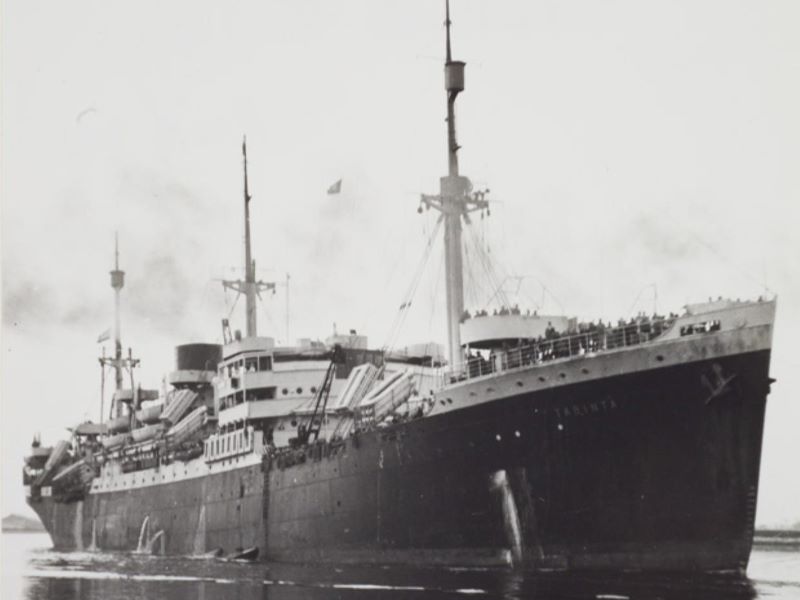
Emigrant ship ‘Tabinta’
Saying goodbye
Every time a ship with emigrants leaves and we witness this departure, we are reminded of the well-known saying: “To say goodbye is to die a little.” Because for most of these emigrants, this departure means a forever farewell to the country where they once stood. And since it is not the worst part of our people that emirates, the departure is felt as a loss.
A lot of heart-touching scenes often take place here. Weeping mothers who can only tear themselves away from their sons with difficulty when they have to embark, but also fathers who say goodbye to their children with tears in their eyes, while the other family members usually have difficulty controlling themselves. This is not an exaggerated sentimentality. Rather, it is a demonstration of affection that leaves nothing to be desired in terms of authenticity.
This time it is the “Tabinta” of the Mij. The Netherlands, which will bring a large contingent of emigrants to Canada. It is the second departure in a month to Canada, proof that progress is starting to be made in the implementation of the emigration plans. This year they hope to bring 10,000 people to Canada with the “Kota Inten” and the “Tabinta” and next year they even want to double this number.
Today is a particularly beautiful day for sailing. The emigrants have come to Rotterdam from all parts of the country and the Achterhoek is also represented.
People
Hendrik Winkelhorst from Aalten wants to take the big step and look for a livelihood in Canada. His wife Grada goes with him, of course, as do the three children: Willemien, Arie and Wim. Their destination is Ontario and they arrive at a mixed farm of 50 hectares. Hendrik has abandoned his brother, where he has been working as a driver lately, and he hopes to exchange his car for a tractor there. Here in Holland it became too scary for him. Too much bureaucracy. Things will get better in Canada, he believes. He will write to his family members when things are going well for him, but also when things are going badly for him. However, he is in good spirits. What others succeed in, he will also succeed.
The 22-year-old Albert te Winkel from Barlo meets us with a cheerful smile. He is not the least impressed by this departure. The Oosterink farm in Barlo will now have to do without him. He worked there for no less than 41/2 years. So he knows how to get things done, by the way he is one of ten at home and then you learn that early on, he says. He does not yet know at which farmer he will be put to work there. He does know the destination and that is West Meath, in Ontario. He also tells us that he will look for a wife in Canada. He thinks there are enough of them there. We wish him every success with this.
De Graafschapper, 9 April 1948
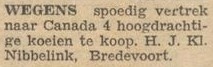
Blacksmith Klein Nibbelink from Bredevoort abandoned his forge today – to escort his son Hendrik out. Hendrik is already on the ship, but his father tells us that Hendrik is 24 years old and had his own company in Bredevoort. Henry saw little future here, but hopes to find it in Duchess in Alberta. Hendrik is not married yet, so he only has to take care of himself. Father Nibbelink believes that he will succeed.
Jan Hendrik Geurkink of the Krosenbrink in Miste, is the Benjamin of the Achterhoekers. He is only 18 years old, has worked at home on the farm and attended agricultural school. It is getting too stuffy for him here and although he is still very young, he wants to try it in Canada. His sister is not so sure that this will work, but in this case he can always come back, she says. Moreover, Jan Geurkink comes to the same farm as Hendrik Klein Nibbelink. There is plenty of work for both of them, because it is a mixed farm of 285 hectares.
There is also a person in hiding from Aalten on the boat. It is Maarten Schinkelshoek from Rotterdam, who had been in hiding in Aalten for a long time on the farm of the Wed. Luiten, “‘t Olde Mulder“. He learned a lot there and wants to put that into practice in Canada. He has already made friends with the other boys from Aalten. The three of them get along quite well.
Farewell!!
Around 5 o’clock the “Tabinta” blows its steam whistle for the third time. This is the signal to leave. When the ship detaches itself from the quay, the Wilhelmus is played. As always, a solemn and moving moment, which the emigrants will not easily forget. Slowly the distance between the ship and the people left behind increases, until it disappears from sight forever. There they go, into the distances unknown to them. Our best wishes accompany them in this.
Our region has once again paid its toll on emigration. Several other Achterhoekers left for Canada with the Tabinta, but it was not possible for us to have a personal interview with all of them, nor did we have the names of all the Achterhoek emigrants at our disposal.
Do you have interesting stories about family members who emigrated from Aalten to Canada? Send us a message!
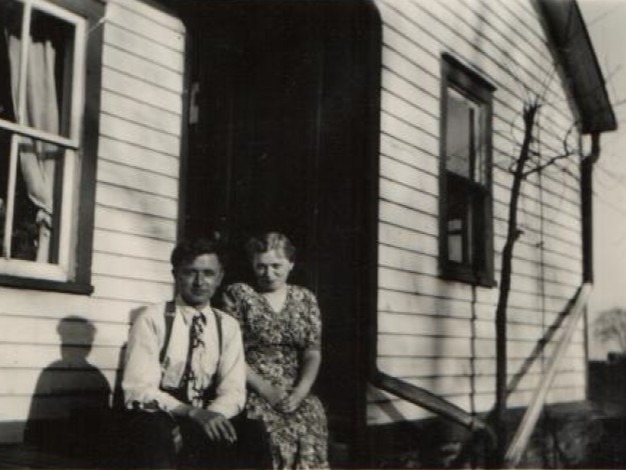
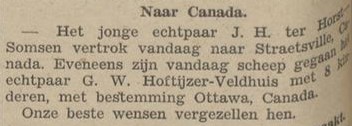
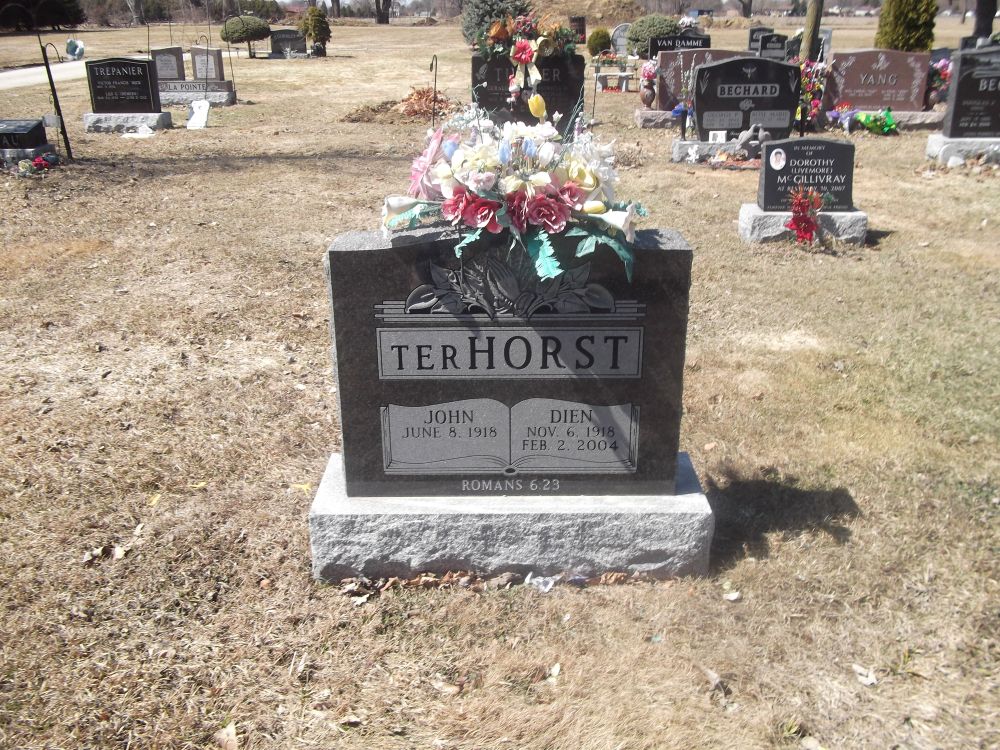
Young farming couple Ter Horst-Somsen saw no future in the Netherlands
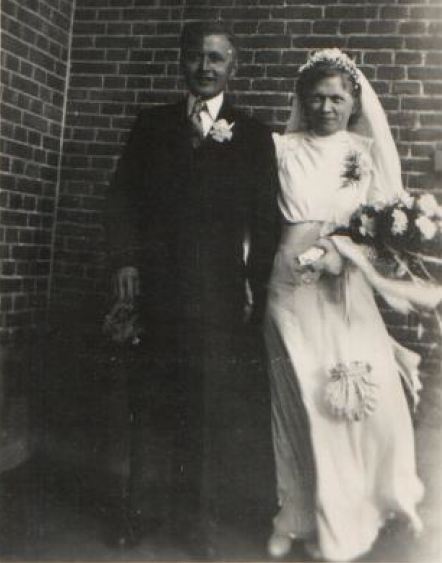
On June 8, 1918, Johan Hendrik ter Horst was born on the Egelsmaat farm in the rural district of Lintelo, near Aalten. Everdina Geertruida (Dien) Somsen was born on 6 November 1918 on the Olde Kleuver farm in the district Haart, also near Aalten. On April 1, 1948, Johan and Dien married in Aalten.
The young couple wanted to farm, but there was no room for them on either family farm – the older brothers took over the farm, as usual. So they had to find another farm, but that turned out not to be easy. When they were selected for a farm in the polder, they saw only one choice: to emigrate.
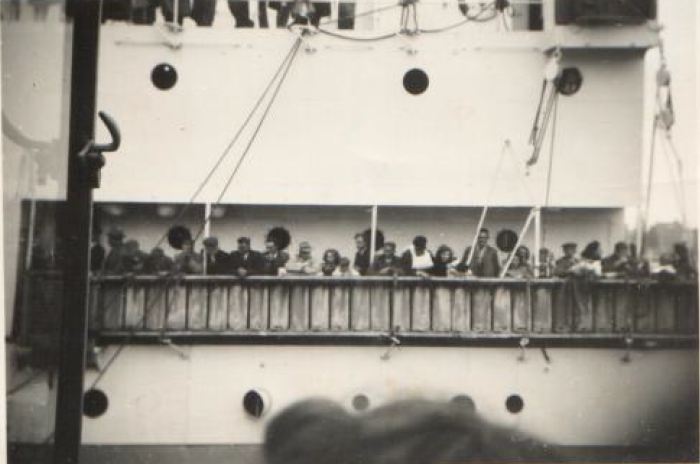
Shortly after their marriage, the young couple left for Canada by ship on June 4, 1948. They settled in the area around Chatham and Wilkesport, in the province of Ontario. There they ran a dairy farm during their working lives. Their marriage remained childless.
Dien died in 2004 and was given her final resting place in the cemetery of Wallaceburg, Ontario. Johan followed her in 2013 and was buried with his wife.
Aaltensche Courant, 4 June 1948Photo: A. VrieselaarPhoto: A. VrieselaarPhoto: A. VrieselaarPhoto: Findagrave
Do you have interesting stories about family members who emigrated from Aalten to Canada? Send us a message!
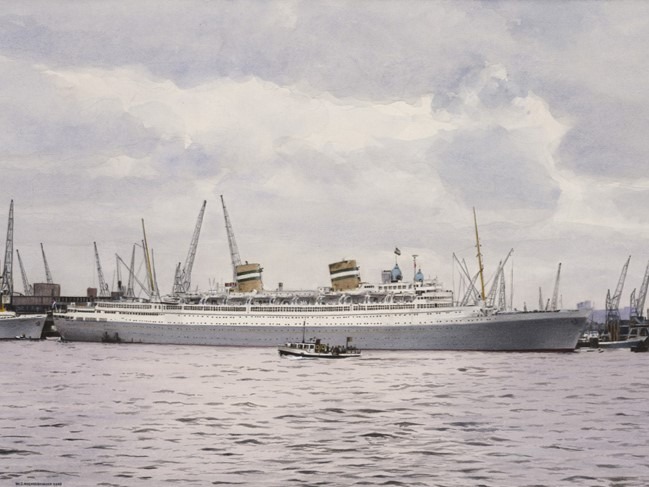
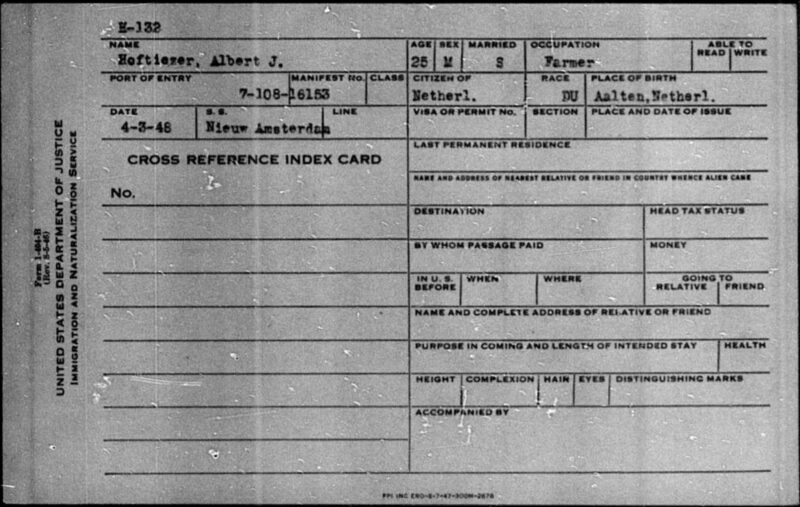
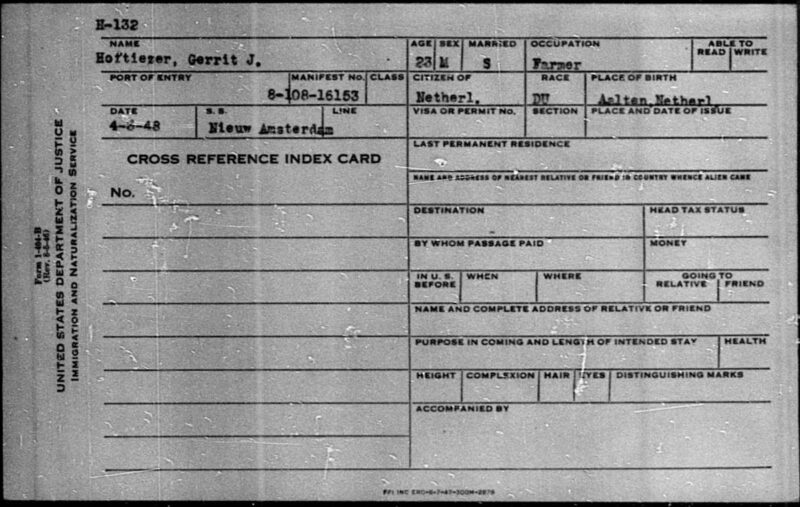
A few months ago, Johan Hoftiezer from the Aaltense Heurne was still working in the Noordoostpolder, and around that time his cousin Jan Hoftiezer, also from the Heurne, was still quietly milking the cows of farmer Westerveld from IJzerlo. Now, these two Aalten boys are looking at the black and white lines of the “Nieuw Amsterdam,” the flagship of the Holland-America Line, which will take them to America. On the occasion of their departure, both Hoftiezer families from “Meirika” and “‘t Oude Hondorp” came from Aalten to Rotterdam by bus last Friday to see Johan and Jan off.
The ‘Nieuw Amsterdam’ of the Holland-America Line
They stand somewhat awkwardly on the Wilhelminakade, marveling at the immense dimensions of this proud sea castle that will soon carry their two relatives to the other side of the ocean, to America, the land of unlimited possibilities. With hands above their heads, they peer over the waters of the Maas, which cuts Rotterdam in two like a silver snake, and their eyes seek out the busy shipping traffic on Rotterdam’s great river. Meanwhile, embarkation is in full swing, and Jan and Johan also prepare to go on board. “It is not easy,” says mother Hoftiezer, “to give up your child, but it is for his future and there are many more opportunities there.”
A moment later, we also go on board, as we wish to ask Johan and Jan a few more questions. Through a labyrinth of corridors and stairs, we finally reach the boat deck and find our future emigrants there. Johan worked in the Noordoostpolder for 2½ years. “It was good there,” he says, “but it would have taken another 5 or 6 years before I would have been eligible to lease a farm, and in Aalten you certainly stand no chance.”
Jan has always been a farmhand but has never sought work as far away as his cousin. “During the war I had to go into hiding, and after the war I worked in IJzerlo. Of course, I have no chance here in Holland either. We are not married and not even engaged, so we are not leaving behind weeping wives or fiancées.”
They further tell us that they are going to Woodstock, in the state of Minnesota. They previously corresponded with the Kruisselbrink family, who used to live at “Groot Kappers” and who have acted as their guarantors. They will be employed on a mixed farm of 200 hectares. “That is at least a bit larger than back home, because we only have 7 hectares at home,” Johan says laconically.
When the bell rings, visitors must leave the ship, and we take our leave of the two cousins. “Give everyone in Aalten our regards via the newspaper,” Johan asks, and we confirm this. Slowly, two tugboats begin to pull the colossus toward the middle of the river. Those staying behind on the quay wave scarves and handkerchiefs, and the “Nieuw Amsterdam” disappears into a haze of smoke. For the two Aalten boys, the journey to America has begun. They will have to work hard there, but we are convinced that they will uphold the name of their village, Aalten, in Minnesota. Safe travels, a prosperous voyage, and much success is wished to them.
Passenger card ‘Nieuw Amsterdam’, Albert J. Hoftiezer
Passenger card ‘Nieuw Amsterdam’, Gerrit J. Hoftiezer
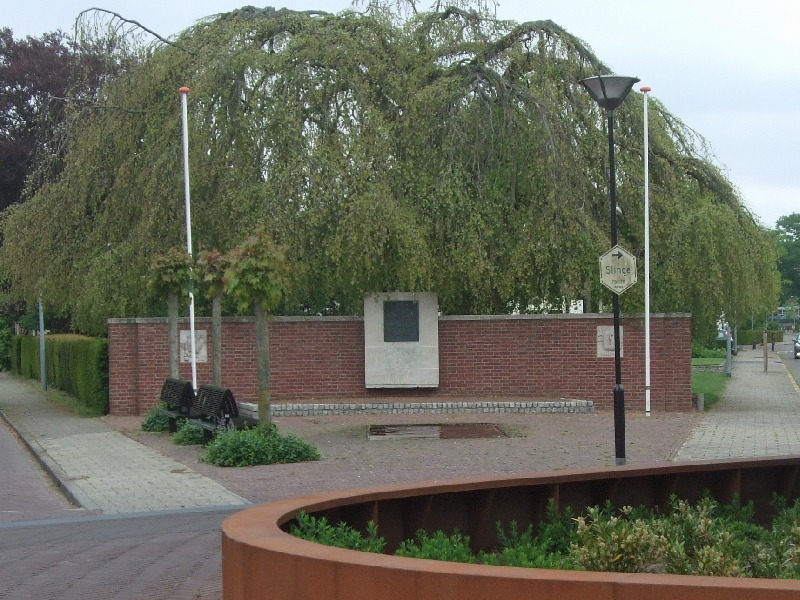
The memorial for people in hiding (Onderduikersmonument) on Stationsstraat is an expression of gratitude from those who were once in hiding to the people of Aalten for their hospitality, and to the members of the Resistance who were the driving force behind finding accommodation for them.
The monument consists of a brick memorial wall with a fountain. A bronze plaque and two sculpted fragments of natural stone are set into the memorial wall.
The monument was unveiled on 4 October 1947 by Mrs D.G. Wikkerink-Eppink, the wife of Resistance leader Hendrik Jan (Ome Jan) Wikkerink.
The text on the plaque reads (translated from Dutch):
PRESENTED TO THE MUNICIPALITY OF AALTEN BY PERSONS IN HIDING WHO DURING THE YEARS OF OCCUPATION 1940-1945 FOUND A SAFE HAVEN HERE.
The sculpted fragments bear the text of Psalm 91:5 and 6.
The text of the left fragment reads:
THOU SHALT NOT BE AFRAID FOR THE TERROR BY NIGHT, NOR FOR THE ARROW THAT FLIETH BY DAY; NOR FOR THE PESTILENCE THAT WALKETH IN DARKNESS, NOR FOR THE DESTRUCTION THAT WASTETH AT NOONDAY.
The text of the right fragment reads:
FOR HE SHALL COVER THEE WITH HIS FEATHERS, AND UNDER HIS WINGS SHALT THOU TRUST.
The sculpture on the left depicts three studded boots belonging to the barbarian horde, threatening to trample a young, sprouting fruit. This symbolises the overwhelming force and occupation, portraying the vulnerability of young life that continues to germinate despite the danger. The fragment on the right depicts a pelican with outspread wings, protecting its nest and young. The pelican is a Christian symbol of total self-sacrifice; according to legend, the bird feeds its young with its own blood. It symbolises the contribution of the resistance in the struggle against the occupier. The waning swastika in the background represents the transience of the threat.
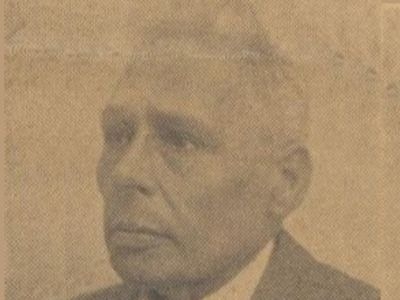
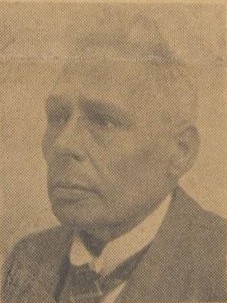
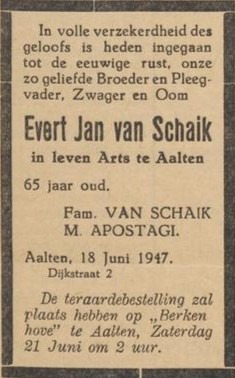
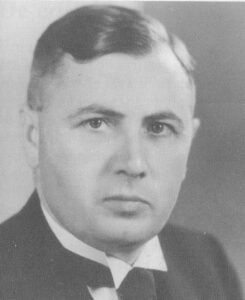
Evert Jan van Schaik (1881–1947) was a doctor in Aalten from 1912 to 1946. He was renowned for his expertise, dedication and humility, always prioritising the welfare of his patients and the community. Van Schaik remained unmarried and passed away in 1947 at the age of 65.
Evert Jan van Schaik was born on 30 November 1881 in Wapenveld, in the municipality of Heerde, the son of Paul van Schaik, a minister in the Christian Reformed Church, and Maria van de Kamp. Due to his father’s profession, the family relocated several times during his early childhood: first to Hoofddorp (1882), then to Middelharnis (1884) and later to Nieuw-Lekkerland (1890).
After completing primary school, Evert Jan attended the Reformed Gymnasium in Amsterdam. He subsequently studied medicine at the Municipal University of Amsterdam, where he obtained his medical degree in 1912.
Doctor in Aalten
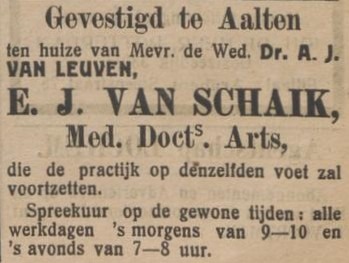
On 9 December of that same year, 1912, he settled in Aalten, taking over the general practice of Doctor Van Leuven, who had passed away shortly before. Initially, he resided at the De Roskam hotel on the Landstraat. A few years later, he moved to the former Roman Catholic presbytery on the Dijkstraat, where four of his unmarried sisters later came to live with him.
Much like his predecessor, Doctor Van Schaik quickly gained appreciation for his expertise and commitment. He enjoyed the deep trust of his patients and built a solid reputation. His approach to his work was characterised by thorough conscientiousness. He took almost no holidays, running his practice for years on end without even considering taking time off.
Although he dedicated himself almost entirely to his medical practice, he also took an interest in church and state affairs. This interest was backed by extensive knowledge, though he chose not to seek the spotlight.
Recognition and Final Years
In 1937, on the occasion of his silver jubilee as a general practitioner in Aalten, a committee formed by local residents organised a celebration in his honour. Van Schaik was praised for his faithful devotion and quiet strength, as someone who never sought prominence but always put his patients and the community first. His great humility made him a beloved figure to many.
However, the demanding practice took a heavy toll on his strength. A few years after his jubilee, he received assistance from Doctor D.N. Visser. As his health declined, Van Schaik gradually handed over more of his workload. In January 1946, he retired from his medical duties permanently, at which point Doctor Visser took over the practice entirely.
Evert Jan van Schaik passed away in Aalten on 18 June 1947 at the age of 65. He was laid to rest at the Berkenhove cemetery.
Dr. Evert Jan van Schaik (1881–1847)De Graafschapper, 11 December 1912Aaltensche Courant, 20 June 1947
The list below contains emigrants from the municipality of Aalten who emigrated to Canada , most of them after the Second World War. Some of them have since died. We try to find their grave on findagrave.com as much as possible. This list is far from complete. Work in progress, errors reserved, additions and corrections are welcome!
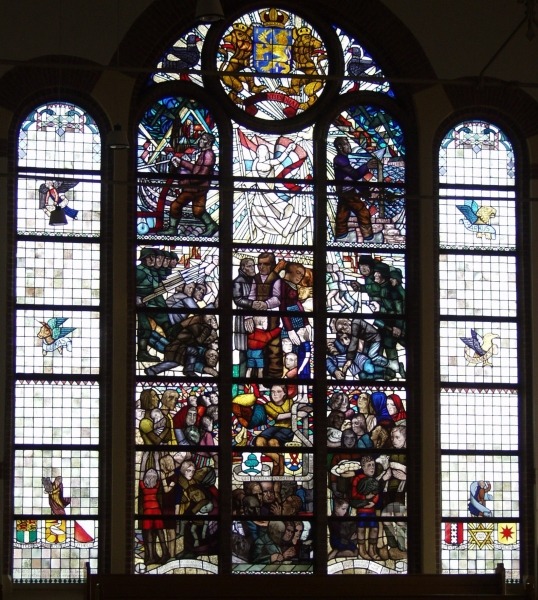
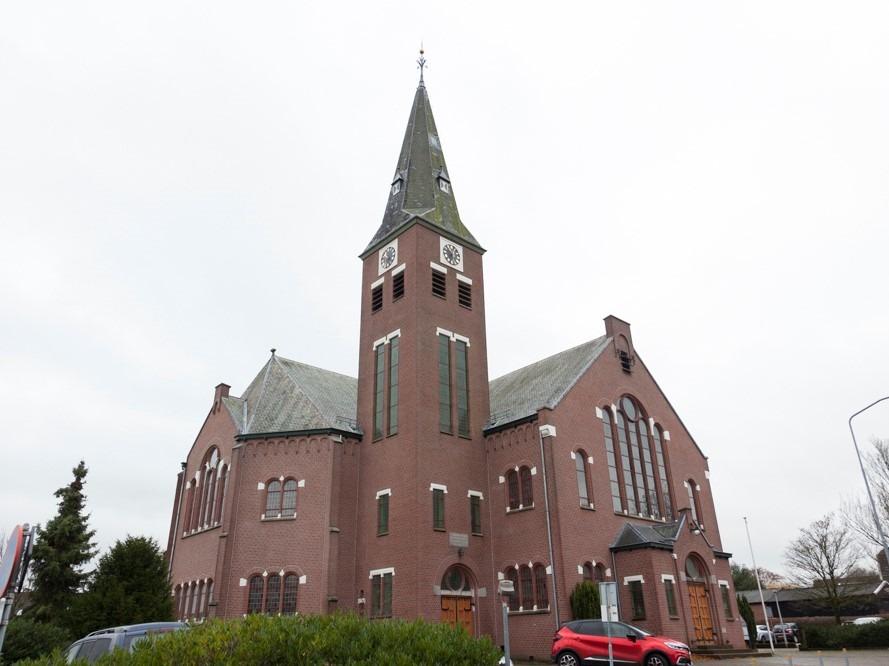
The Oosterkerk in Aalten houses a monumental stained-glass window dating from 1946. The window was gifted by a committee from the Reformed Church of Rotterdam-Kralingen, on behalf of the churches and the Jewish community, as a token of thanks for the assistance provided by the people of Aalten during World War II to those in hiding (onderduikers), Jewish fellow citizens, the starving, and hundreds of children from Rotterdam.
Rev. Thomas Delleman (1898–1977)
Thomas Delleman (1898–1977) served as a minister in Aalten from 1930 to 1938 before moving to Rotterdam-Kralingen. Following the Bombing of Rotterdam in May 1940, he took the initiative to arrange for children from his new parish to stay in Aalten for a holiday. During the war years, a total of approximately 800 children from Rotterdam were taken in by host families in Aalten.
Delleman contributed in other ways as well. He ensured that young men wishing to evade the Arbeitseinsatz (forced labour) could go into hiding in Aalten. Furthermore, in 1943, around 500 evacuees from Scheveningen were accommodated in Aalten. During the ‘Hunger Winter’, trains carrying food regularly departed from Aalten for the west of the country.
This dedication made a profound impression in Rotterdam and led to the formation of a committee after the liberation to thank the people of Aalten.
Origin of the Commemorative Window
Initially, the intention was to place the window in the Westerkerk, as more than forty young men had been arrested there during a roundup (razzia) in 1944. However, all the windows in the Oosterkerk had been shattered after a V1 rocket landed nearby in January 1945. Consequently, it was decided to install the window in the Oosterkerk instead.
The window was designed by the Rotterdam artist Marius Richters (1878–1955) and executed by glazier Henri van Lamoen (1900–1949). With a height of eight metres and a width of over three metres, it is one of the largest stained-glass windows in the Achterhoek. Richters utilised bold colours and clear, almost narrative scenes that express both the threat of war and the warmth of the relief efforts.
The window was installed in the front facade of the Oosterkerk and officially unveiled by Rev. Delleman on 13 July 1946. The ceremony was broadcast live on the radio by the NCRV.
Design
The window is over eight metres high and three metres wide, set within a trifora.
Commemorative Window in the Oosterkerk, Aalten
At the top: The coat of arms of the Netherlands with the motto “Je maintiendrai”. Below this is the Dutch Maiden, holding the flag in her right hand and a burning torch in her left. On either side stand a farmer and a bricklayer, referring to the post-war reconstruction.
Central: A farmer and his wife, symbolising the people of Aalten, surrounded by children and a person in hiding. From both sides, German soldiers with bayonets march into the scene.
Bottom left: Emaciated women and children pleading for help.
Bottom right: A group of people who have been helped, returning home supplied with foodstuffs.
Bottom centre: The coat of arms of Aalten featuring the linden tree and the coat of arms of the House of Orange, with a scroll reading: “Uit dankbaarheid voor hulp in oorlogstijd, soli Deo gloria” (In gratitude for help in wartime, to God alone the glory). Biblical texts are incorporated elsewhere in the window.
In 1947, two side windows were added to either side of the main window. These feature the symbols of the four Evangelists, images of Moses and Isaiah, and at the bottom, the coats of arms of Rotterdam, Scheveningen, Utrecht, Amsterdam, Kralingen, and a Star of David.
At the base of the side windows are lines of verse by Muus Jacobse (pseudonym of the poet Klaas Heeroma):
Maar als ik leven mag tot de bevrijding en juichen op het overwinningsfeest, God, doe mij dan dit weten, wat voorbijging aan nood en leed is niet vergeefs geweest.
(But if I may live until the liberation and rejoice at the victory feast, God, then let me know this: that the hardship and suffering which passed was not in vain.)
Current Status
The commemorative window can still be seen in the Oosterkerk. When the church was repurposed as a residential care location in 2021, it was formally agreed that the window would be preserved. This ensures the window remains not only an artwork of exceptional scale but also a lasting war monument and a tangible reminder of the aid and hospitality offered by Aalten during World War II.
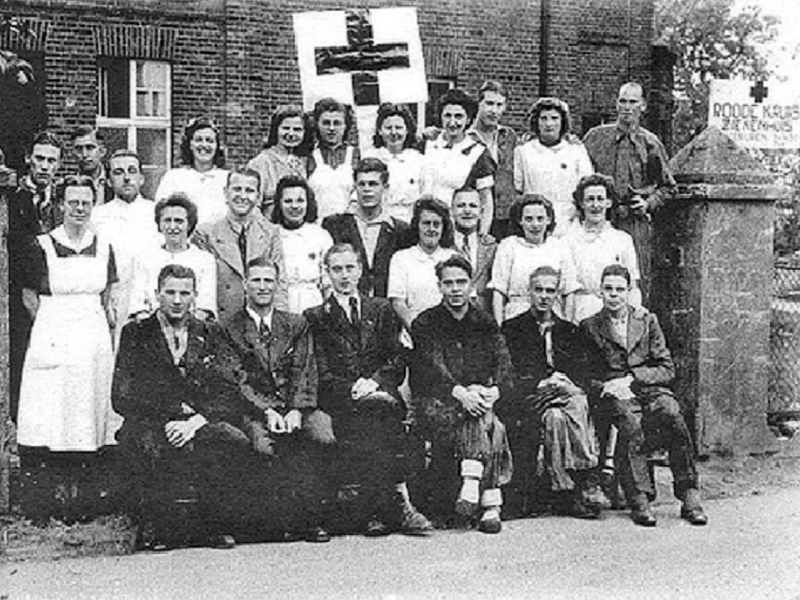
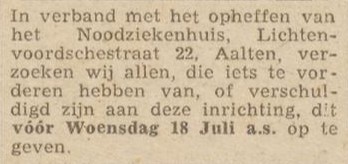
Now that the emergency hospital in Aalten is closing its doors, it is fitting for us to pause for a few moments to reflect on the origin and work of this institution, which served as a blessed outcome for countless Dutch forced labourers and prisoners from concentration camps. As is known, the initiative for its founding was taken under the auspices of the Red Cross, by Dr J. der Weduwen and Mr Cl. Driessen.
Staff of the Aalten Emergency Hospital
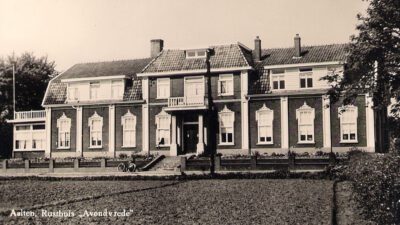
The necessity for its establishment became acutely apparent at the end of November, when some of the victims of the train bombardment near Bocholt had to be admitted in Aalten. When Dr J. der Weduwen arrived at the Avondvrede retirement home on 5 December 1944 with 22 liberated prisoners from Rees, the situation presented nearly insurmountable difficulties. Beds, food, and trained staff—everything was lacking.
The residents of the home, on that memorable St. Nicholas Eve for the ex-prisoners, brotherly shared their pancakes, oliebollen (doughnuts), and chocolate (!) with the newcomers. By exerting every effort, they succeeded in providing the battered patients with proper care. Mr and Mrs Ditmarsch, deeply moved by the fate of these people, did everything possible.
With emotion, many will remember Sister A. Bol, who died of diphtheria and performed true miracles for her patients during this time. After her death, it proved necessary, given the danger of contagion, to attach expert personnel to the emergency hospital. Sister Schaafsma and Sister Doesburg were entrusted with the management under the supervision of Dr P. Hogenkamp, who took over the medical work of Dr der Weduwen following the tragic passing of this beloved doctor.
Avondvrede Retirement Home, Hogestraat, Aalten
Although more space was made available at Avondvrede, the capacity of the hospital proved too small, as one also had to take into account war victims from the local area; therefore, the hospital was relocated to the Patrimonium building. In cooperation with the U.V.V., I.K.O., and the Red Cross, the material side of the work was taken care of. After the final bombardment, the Patrimonium building became unusable, and it was decided to liquidate the hospital, as the majority of the patients, under the leadership of Sister Schaafsma, preferred to leave for the North.
Sister Doesburg remained at her post with a few patients, and the hospital was moved back to Avondvrede. From there, they departed once more—joined by a number of victims from the bombardment in Bocholt—to the building on the Lichtenvoordsestraat, which still serves as an emergency hospital today. About twenty patients were housed in the cellars there. Enormous support was received from the surrounding hamlets.
De Graafschapper, 14 July 1945
In the beginning, the conditions were extremely primitive. Later, everything improved. Special praise is due to the girls of Aalten, who performed nursing work without any prior training. Just before the liberation, some victims of the liberation battles were admitted. An unforgettable moment was, of course, the arrival of the first ‘Tommy’ (British soldier) who was brought into the hospital.
And now the work has come to an end. The large stream of repatriates, for whom they had prepared as their final task, did not arrive, and the now well-equipped emergency hospital is disappearing in these coming days. (Why not make it a permanent hospital?) A piece of Aalten’s war history is hereby concluded, but many will continue to remember this work with gratitude.
I can imagine that as a former Achterhoeker, born and raised in our beautiful region, you are very curious about news from our region and how we are all doing here. It will be a pleasure for me to inform you from time to time of what has happened here and what is going to happen. Let me start by telling you that we have generally come off well here in our Achterhoek. The Tommies who came in here from the direction of Bocholt just before Easter were amazed by the friendly, apparently still prosperous country. into which, after the debris fields of Germany, they were suddenly transferred.
Liberation parade Stationsstraat, 1945
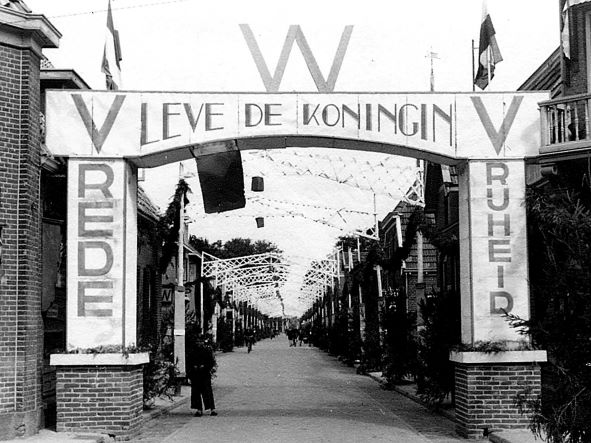
“You see here again an undamaged house,” said one to me, “and you see friendly people again, who laugh and wave at you! We have experienced that differently in recent months” Still, it was not given to us as a gift, don’t think so. The last six months in particular have been quite haunted here. Also in the political field. It was raid after raid. Greens, blacks, land guards, Gestapo, S.S., we have experienced all that beauty in its different variations here. Anyway, you have experienced that yourself in the city. so you know all about it. Let me rather tell you how we celebrated the liberation here, when it became known that our entire people was freed from slavery.
I can tell you best about Aalten, where I happened to experience it myself, but I am sure that the same enthusiasm prevailed throughout the Achterhoek. You should come to Winterwijk today, which was worn out for a hotbed of the party, right? It only now becomes clear what a “thin” layer of the population there actually kept the terror going, because there is no municipality in the Achterhoek, where you see flags as exuberantly as right there.
‘Uncle’ Jan Wikkerink
The music was immediately on his feet, you get that. In the afternoon a whole procession with children and the elderly followed through the decorated streets and it was a joy to hear a Dutch march again. The case stopped for a moment in front of Jan Wikkerink’s house. You may remember them from school in the past. And otherwise I just say “Uncle Jan”, then at least every person in hiding in the Achterhoek knows who it is. Well, that musical tribute at his doorstep was, in my opinion, exactly right. Because that’s just an ordinary contractor, isn’t it? but what a lot that man has achieved during the war years, so secretly gone.
He was quietly district head of the National Organization for People in Hiding and made sure that all those boys stayed alive and, if possible, out of the hands of the slave hunters. He and his men housed countless people there, (you know that there in Aalten they have the name hadden. dat there were as many people in hiding as inhabitants?) and where it was necessary to provide all those people with ration cards, not only city people, but also a lot of Jews and everything else, with the Gestapo on their heels, den Achterhoek came fleeing in. In cooperation with the Knock teams, many distribution offices in our area have been honored with a fruitful visit and Oome Jan always had the quiet, cautious leadership of them.
Dela Wikkerink-Eppink with Aron Jedwab alias Willem Herfstink
It was therefore no surprise when one night a child was abandoned on his doorstep. After all, he knew what to do with everything and everyone and he was simply the big placement agency, apparently also for babies. Anyway, the little one didn’t have to go far, he stayed at the same address, i.e. on the other side of the front door, where he was lovingly welcomed. It was exactly on the 21st of September and so the foundling was officially registered at the town hall the next morning with a straight face under the name Willem Herfstink . (After all, the suffix “ink” means “the son of” in Achterhoeksch). But on the first day of the liberation, the “Son of Autumn” returned to his own address, namely to the Jew master, who was very happy with his wife that they had kept their little one safe in such a dangerous time. You understand that that card was again pierced with real Achterhoek cleverness. The doctor had taken the child of the parents in hiding straight to Uncle Jan, who was already waiting for it behind the door.
It was a shock to the whole region when they finally got hold of Uncle Jan. If the whole region heard about it as soon as possible, because the captivity lasted only a few hours. The knock team could have put it right sooner, but they had to wait a while for the doctor for the chloroform and the sergeant on duty of the military police also had to rehearse how he should be intoxicated as really as possible. But then it was done, only the doctor was still busy for an hour and a half to call the good sergeant back to life, because the boys had worked him a bit too enthusiastically with the chloroform-dot.
Dr. der Weduwen
The quiet figure of Uncle Jan had since disappeared from sight, but he now had so much more time for his illegal work. The Germans were furious as usual and knew nothing better to do than to throw a few hand grenades into his house in impotent rage, which of course burned down in the end. But better the house than Uncle Jan, everyone said comforted, and so the music of the week was a spontaneous tribute from the whole population. And it was certainly also with the approval of the whole village, when later a few songs were played in front of the house of the late Dr. of the Widows, who gave so much clandestine help and in particular was a lifesaver for many boys in the camps of Bocholt and Rees. The Achterhoek knows how to celebrate, but also to sympathize with those for whom the party is impossible due to harrowing memories.
At the end of my letter, I will tell you one more example of this, which will do you good. It was in one of the rural districts that the music association went around the farms with blaring festivities. But there was a shadow over this rural district. On the last day before the liberation, a direct hit in an air-raid shelter had snatched five children from one family, with two older evacuees, from their lives. The site of that disaster was on the main road, where the procession passed. But a hundred yards from that place the music fell silent, and they went on in silence. And there at that burned-out shelter that chorale of the 103rd Psalm was played in the moving silence of all neighbors: Like the grass is our ephemeral life… Then they quietly moved on and only at a great distance from that place the festive music was resumed.
I am writing this to you because I know it will do you good. The war has not hardened us and made us numb. There is still room in the heart of the Achterhoek for compassion and quiet piety.
List of war victims from the municipality of Aalten, according to official data from the Municipal Secretariat. (supplemented with full first names and explanation by the editors of Old Aalten)
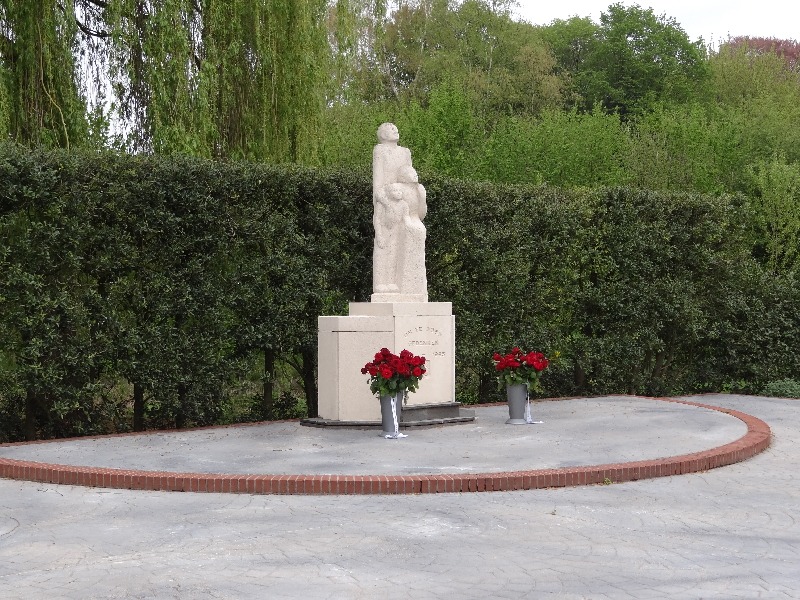
Immediately after the liberation, there was a need among the population of Aalten to honour the war victims with a monument. In 1956, the monument was unveiled on the Wheme, in memory of all Aalten civilians who died during the occupation years as a result of acts of war. The statue was made by artist Bé Thoden van Velzen.
The monument consists of a statue of a male figure with a woman and child. The sculpture of French limestone is placed on a terrace. The pedestal consists of masonry, concrete and natural stone. The memorial is 1 meter 31 high, 1 meter 43 wide and 90 centimeters deep.
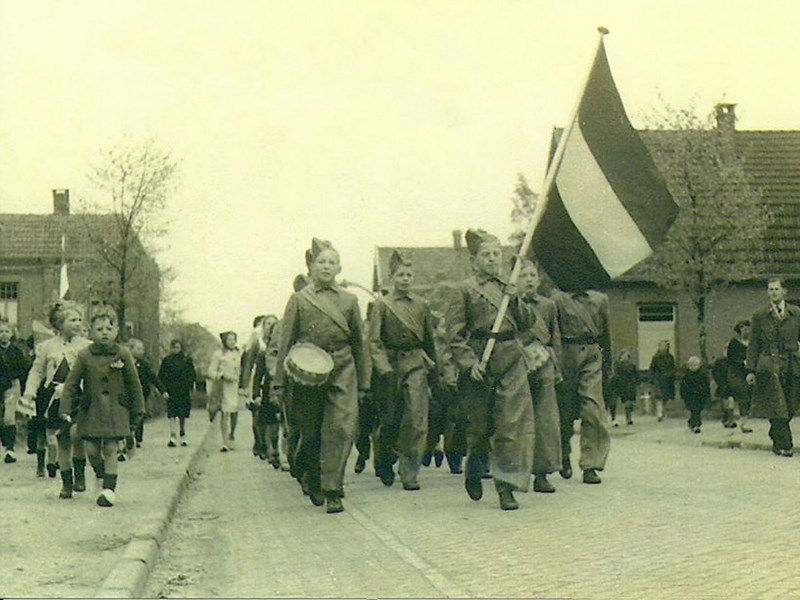
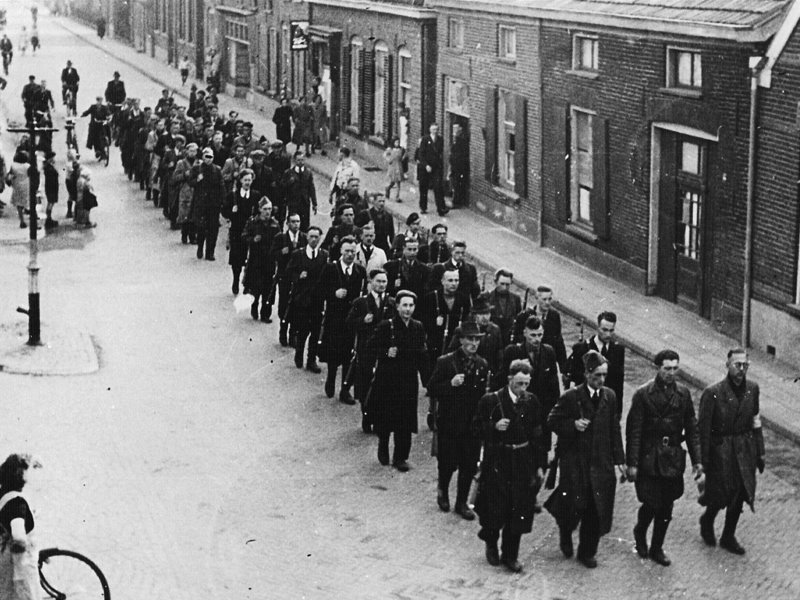
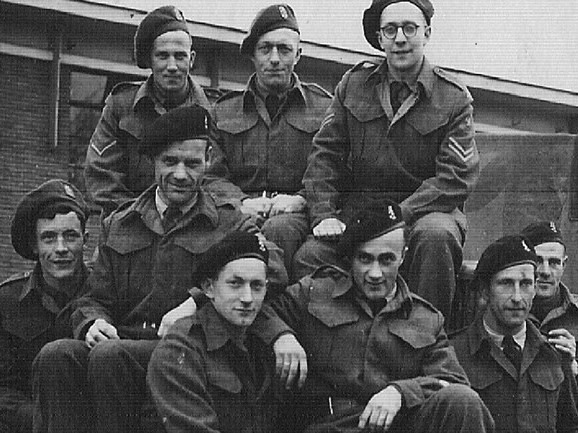
During the liberation of the Achterhoek, the Dutch National Battalion was established in Aalten on 15 April 1945. A unit that consisted of members of former Achterhoek assault groups, at that time officially called Binnenlandse Strijdkrachten (Domestic Forces), and people in hiding who had found a safe haven in Aalten and the surrounding area. The men had volunteered after a call from the Canadians. In no time they had about 400 war volunteers at their disposal, good for three companies.
Everyone knows the Princess Irene Brigade. Founded in 1941 and consisting of Dutch soldiers who had escaped to England, Dutch volunteers who were already abroad and so-called Engelandvaarders; men who made the crossing to England on their own to fight against the Germans from there. The Irene Brigade moved north from the invasion beaches, fought in France, Belgium and Zeeland and fought its last battles in the Bommelerwaard near Hedel shortly before the liberation. Less well known is the ‘Achterhoek’ unit that fought with the Canadians during their advance to the north.
Photo: Foto Garretsen, J. Bloemendal
Photo: A.Ph. de Keijzer
Canadians ask for and get help
The Dutch National Battalion (DNB) had its home base in the Julianaschool in Aalten, renamed ‘Prins Bernhard Kazerne’ for the occasion. With their knowledge of the area, the members of the DNB provided valuable services to the Canadians. Equipped and armed by the Canadians, the soldiers of the DNB advanced up the IJssel, via Doesburg, Steenderen and Gorssel.
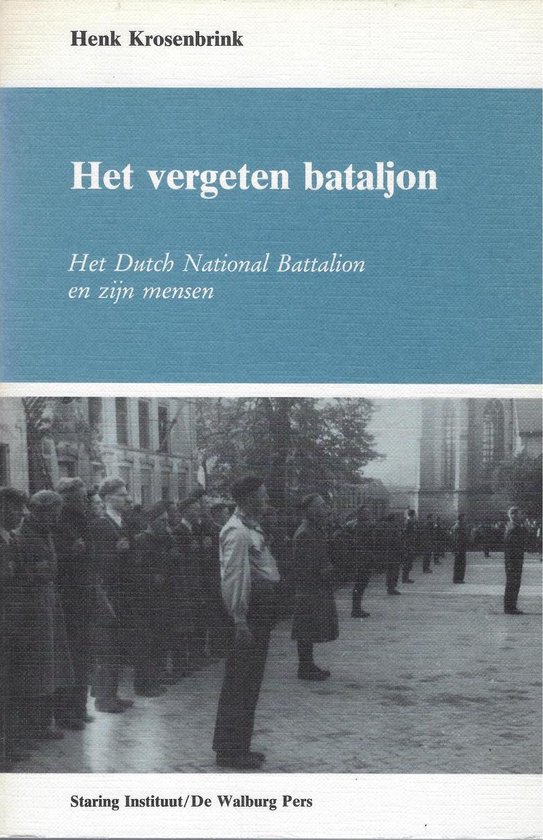
The men guarded the bridges over the IJssel and moved on to Apeldoorn. “Fierce fighting and fierce resistance,” says Arnold Somsen, member of the DNB, from Aalte in the book ‘The Forgotten Battalion’, published by the Staring Institute. “After that, it was now the end of April, the liberation army moved in the direction of Harderwijk, Bunschoten and Spakenburg. We were housed in a school. Standing guard in the evening. The Germans were still in Eemnes. So close by. Gunfights and hand grenades back and forth…”
After the liberation, the DNB was assigned to the Infantry Regiment of the Royal Netherlands Army. With that, the ‘Aalten’ battalion officially ceased to exist.
On the Piepersweg in the Aaltense Heurne there is a memorial in memory of a tragic accident that took place shortly after the liberation of Aalten. The monument was erected in memory of three young boys who died in the accident.
On the afternoon of 4 April 1945, just a few days after the liberation, the boys Wim Schenk (8 years old), his brother Henk Schenk (6 years old) and their friend Wim Wisselink (5 years old) were playing outside.
In a dry ditch along the Bocholtsestraatweg they found a projectile. Unaware of the danger, they threw it at each other. At one point, one of the boys threw the projectile against the wall of a nearby house, after which it exploded.
The consequences were horrible. Wim Schenk died on the spot. His brother Henk and Wim Wisselink were seriously injured and were taken to a military emergency hospital in Barlo, where they died shortly after each other.
Booklet and monument
In 2011 a booklet about this dramatic event was published entitled ‘Spelend de dood in’, written by Louis Veldhuis.
Seventy years after the accident, in 2015, relatives of the Schenk family unveiled a monument at the site of the tragedy. It consists of a pedestal with images of the three boys and was designed by artist Ans Braamskamp.
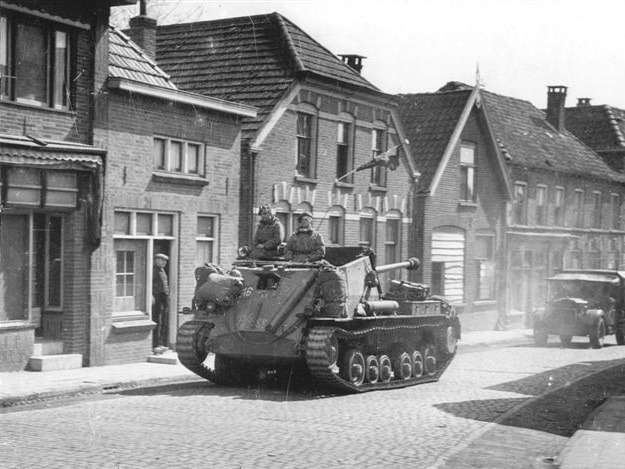
At the end of the Second World War, on Good Friday, March 30, 1945 , Aalten was liberated by British troops. This liberation was part of the large-scale Allied advance through the eastern Netherlands, immediately after crossing the Rhine during Operation Plunder. The liberators belonged to the 1st Battalion Grenadier Guards and the 3rd Battalion Irish Guards, both part of the 32nd Guards Brigade within the Guards Armoured Division of the British Army. 1
Advance to Aalten
At the end of March 1945, the Guards entered the Achterhoek from Germany. The Grenadier Guards formed the vanguard and advanced along the Bocholtsestraatweg towards Aalten and then on to Enschede, with the Irish Guards as mechanized infantry in their wake. 2 The advance was hampered by destroyed bridges, minefields and fierce resistance from retreating German units.
The King’s Company of the Grenadier Guards was ordered to advance towards the centre of Aalten via the so-called ‘centre line’. However, important bridges turned out to have been blown up by the Germans. The bridge on the Bodendijk was partly still intact and Major Baker, commander of the King’s Company, led his men over it. 3
When they arrived at the railway, the men encountered fierce resistance and were bombarded with mortar fire and grenades. The fight with the enemy had disastrous consequences for the liberators: several soldiers were killed, including platoon commander Andrew Duncan. 4
Around midnight, another two soldiers of the Irish Guards were killed because their vehicle hit a mine in the then Dijkstraat (now Plein Zuid). The explosion led to a fierce fire in which the old café Vultink burned down completely. The next day, March 31, 1945, two engineers of the Royal Engineers were killed while clearing mines. 5
Losses and cemetery
Of the total of 13 British soldiers who died, 12 are buried in the Berkenhove general cemetery in Aalten. Platoon commander Andrew Duncan is buried in the Reichswald Forest War Cemetery near Kleve. Thanks to historical research, photos of twelve of these soldiers have now also been found. This literally gave the liberators a face. 6
After the liberation
Immediately after the liberation, the Aaltensche Courant appeared again. Shortly after the liberation on April 4, three boys, eight-year-old Wim Schenk, his six-year-old brother Henk and five-year-old Wim Wisselink found a projectile in a dry ditch on the Bocholtsestraatweg. They decided to test the projectile and threw it against the wall of a house. The three children were killed. 7
In honour of the efforts of the King’s Company, the bridge over the Keizersbeek was named the King’s Company Bridge. The ceremony took place on May 5, 2008 and was attended by, among others, veteran Walter Price, who actually served in this unit in 1945. 8
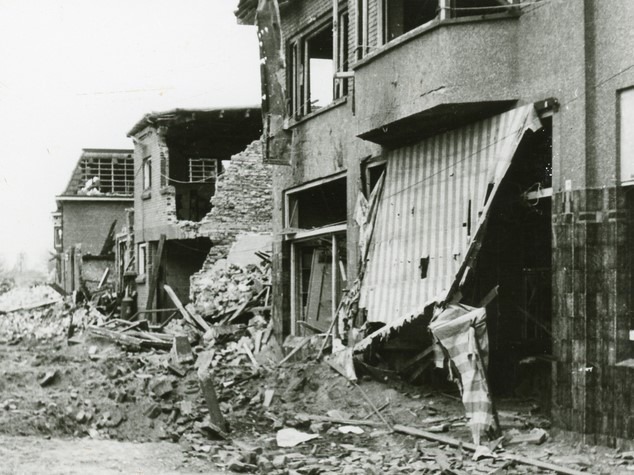
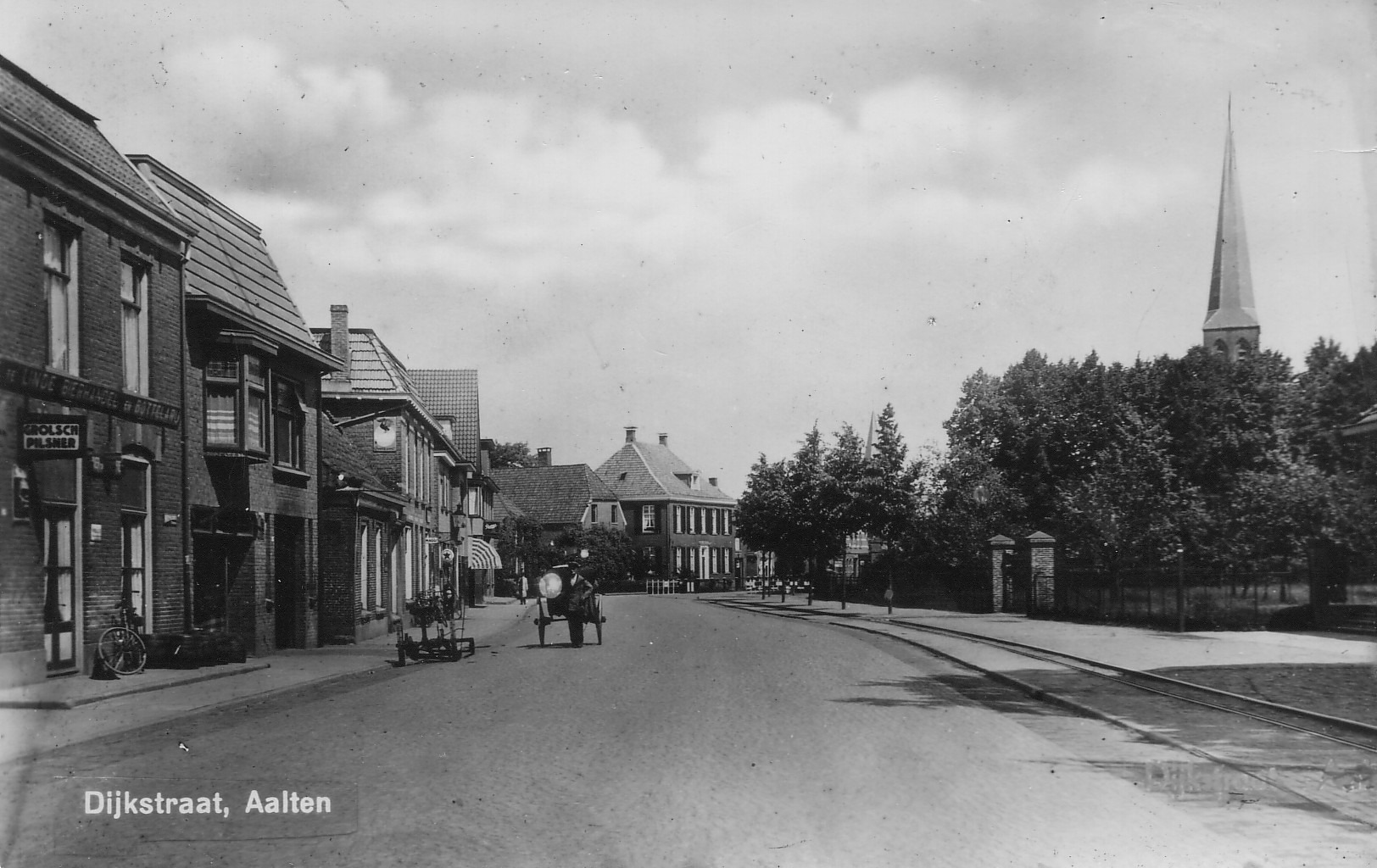
On 24 March 1945, a bombing raid took place in the Dijkstraat in Aalten. The factories on the Dijkstraat were the target. There were at least 18 to 19 fatalities. However, the exact number isnot known to date.
The Dijkstraat in Aalten, before the bombing of 24 March 1945
Shortly before the end of the Second World War, on Saturday 24 March 1945, planes suddenly screeched down over Aalten. Almost immediately the whistling sound of the falling bombs was heard. Part of the textile factory and Driessen’s office was bombed flat. The factory of the Aalten Tricotage Factory (ATF) also turned into a mess. From the bridge on the Dijkstraat to the railway, houses were completely destroyed, others had suffered very serious damage. The consequences were terrible.
Victims
At blacksmith Umbach’s, the cellar, where father Umbach (43 yrs.) and three of his children (13 yrs. 10 yrs and 5 yrs.) were hiding, was hit by a direct hit. All perished. The mother of the family and another son barely survived by crawling under a table in the kitchen. A little further on, the Te Linde-Wechelaar couple (both 68 years old) and their 40-year-old son were killed. At Koelman’s house, father Henricus Wilhelmus (55 yrs.) and daughter (20 yrs.) were killed. Johannes Henricus Antonius Tepe (50 yrs.), Maria Johanna Christina Leemhorst (34 yrs.), Anton Lamers (73 yrs.), Annie Kamphuis (15 yrs.), Henk van Mechelen (15 yrs.) are also among the victims. Furthermore, three evacuees, namely Catharina van Ingen (79 yrs.), Catharina Hendrika Stokking (25 yrs.) and an unknown 15-year-old girl from Haarlem.
In the Aaltensche Courant of May 4, 1945 and in the book “Er op of er onder” (by W.P. Nederkoorn and G.J.B. Stork) two more victims are mentioned: M.J. Praster-Polman (28 yrs.) and a certain G.A. van der Meulen (44 yrs.).
‘Er op of er onder’, W.P. Nederkoorn and G.J.B. Stork
Beheer toestemming
Deze website gebruikt cookies voor een optimale ervaring en analyse van bezoekgegevens. Ga je hiermee akkoord? Zonder toestemming werken sommige onderdelen van de site mogelijk minder goed.
Functioneel
Always active
De technische opslag of toegang is strikt noodzakelijk voor het legitieme doel het gebruik mogelijk te maken van een specifieke dienst waarom de abonnee of gebruiker uitdrukkelijk heeft gevraagd, of met als enig doel de uitvoering van de transmissie van een communicatie over een elektronisch communicatienetwerk.
Voorkeuren
De technische opslag of toegang is noodzakelijk voor het legitieme doel voorkeuren op te slaan die niet door de abonnee of gebruiker zijn aangevraagd.
Statistieken
De technische opslag of toegang die uitsluitend voor statistische doeleinden wordt gebruikt.De technische opslag of toegang die uitsluitend wordt gebruikt voor anonieme statistische doeleinden. Zonder dagvaarding, vrijwillige naleving door je Internet Service Provider, of aanvullende gegevens van een derde partij, kan informatie die alleen voor dit doel wordt opgeslagen of opgehaald gewoonlijk niet worden gebruikt om je te identificeren.
Marketing
De technische opslag of toegang is nodig om gebruikersprofielen op te stellen voor het verzenden van reclame, of om de gebruiker op een site of over verschillende sites te volgen voor soortgelijke marketingdoeleinden.