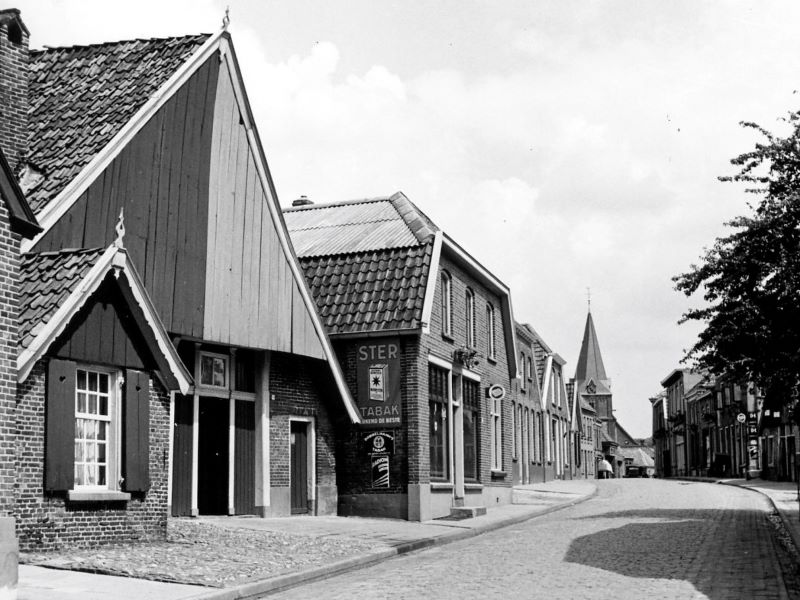
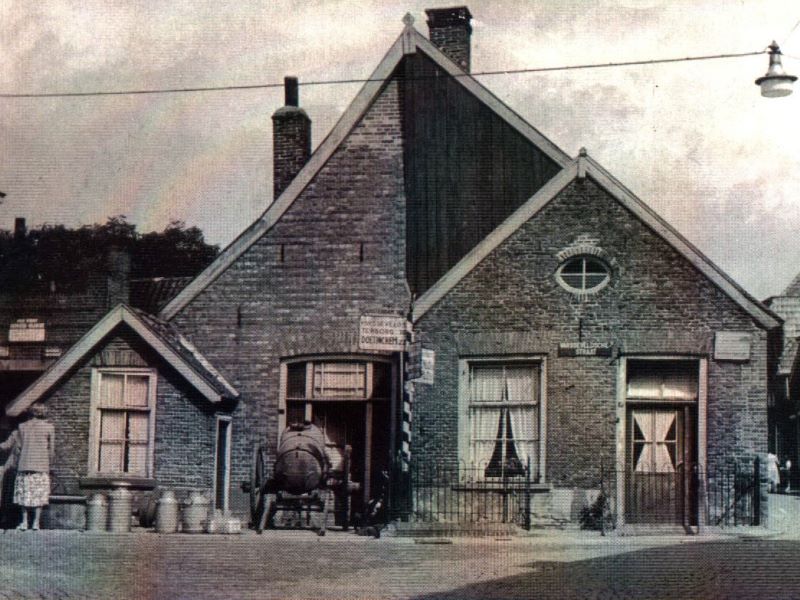
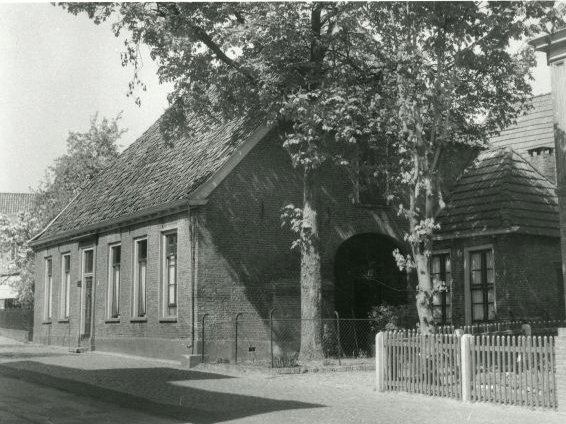
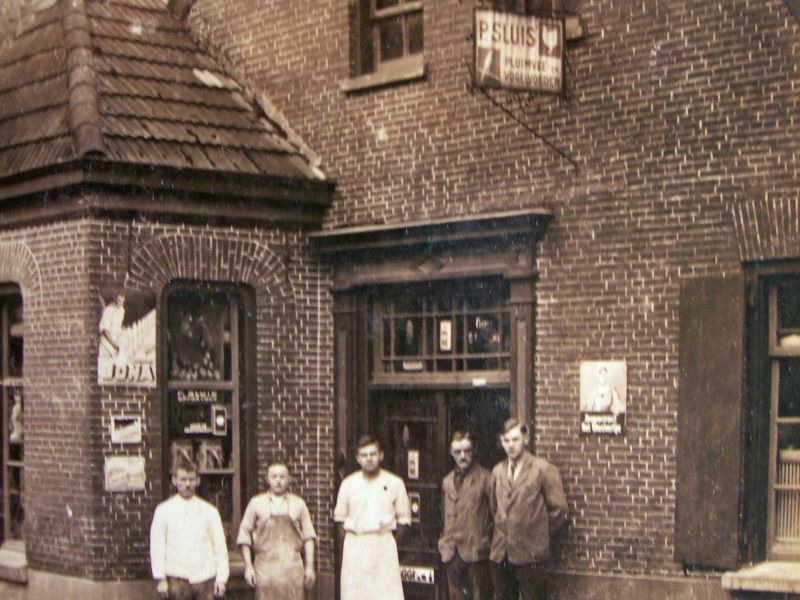
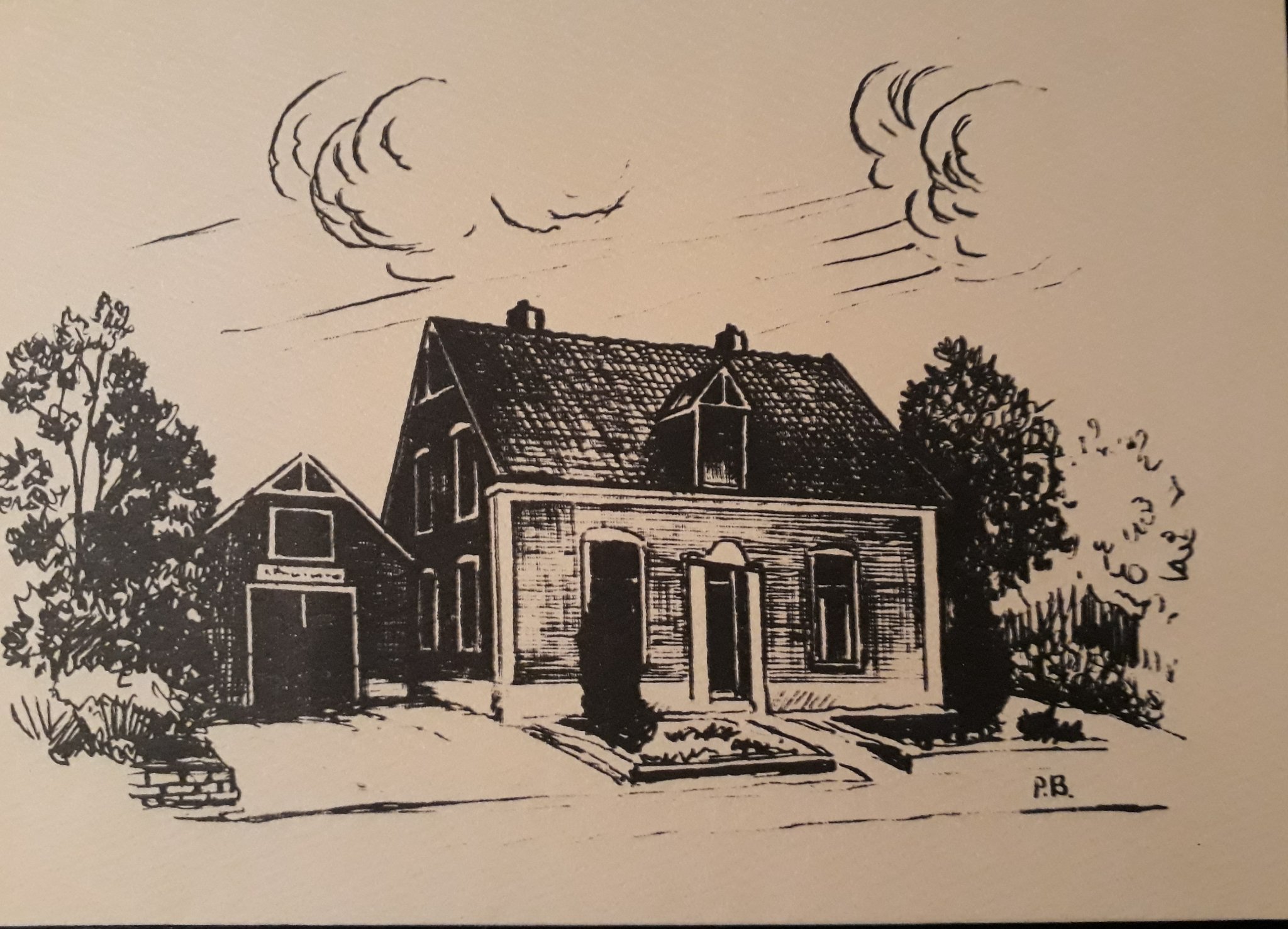
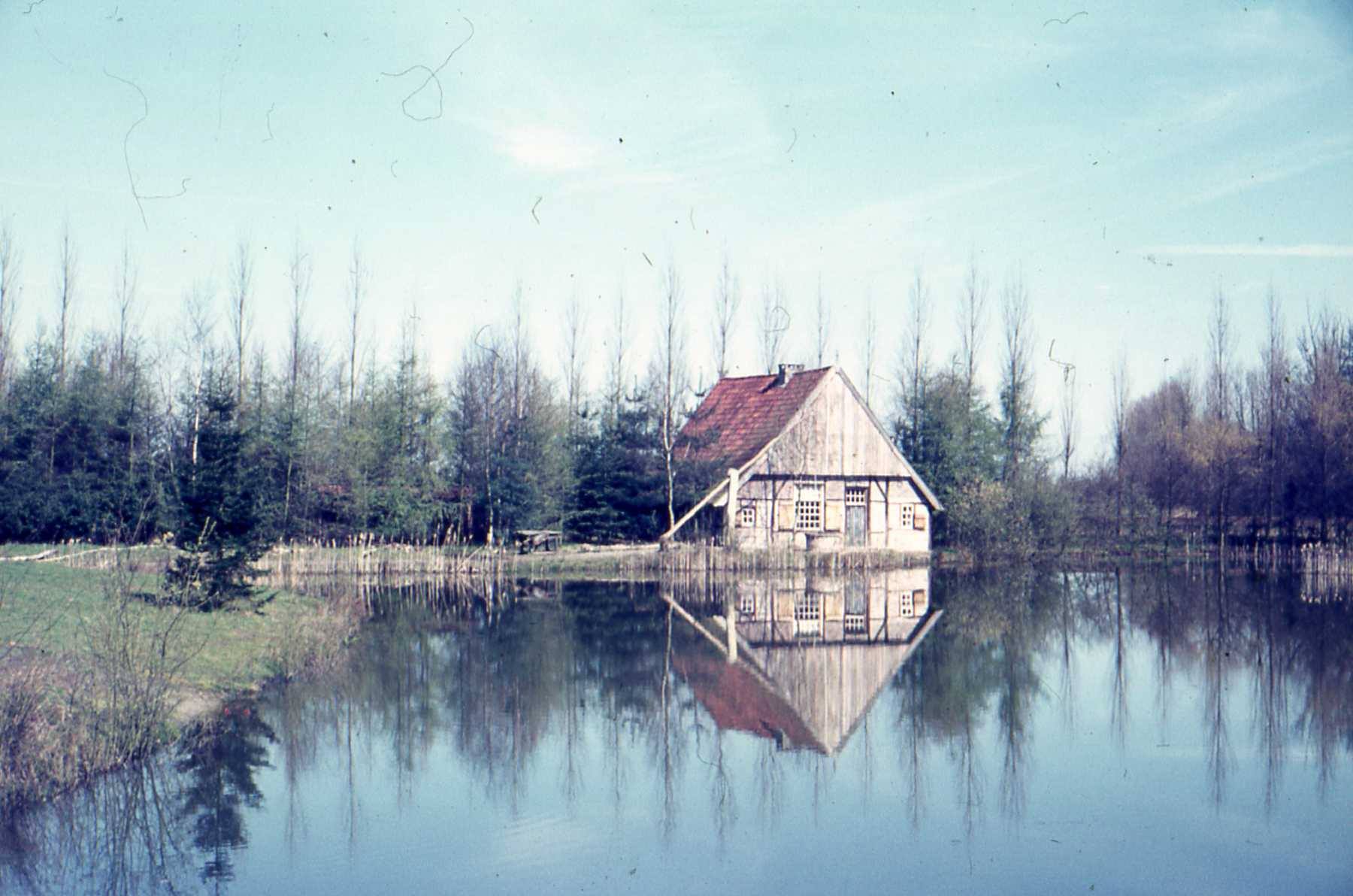
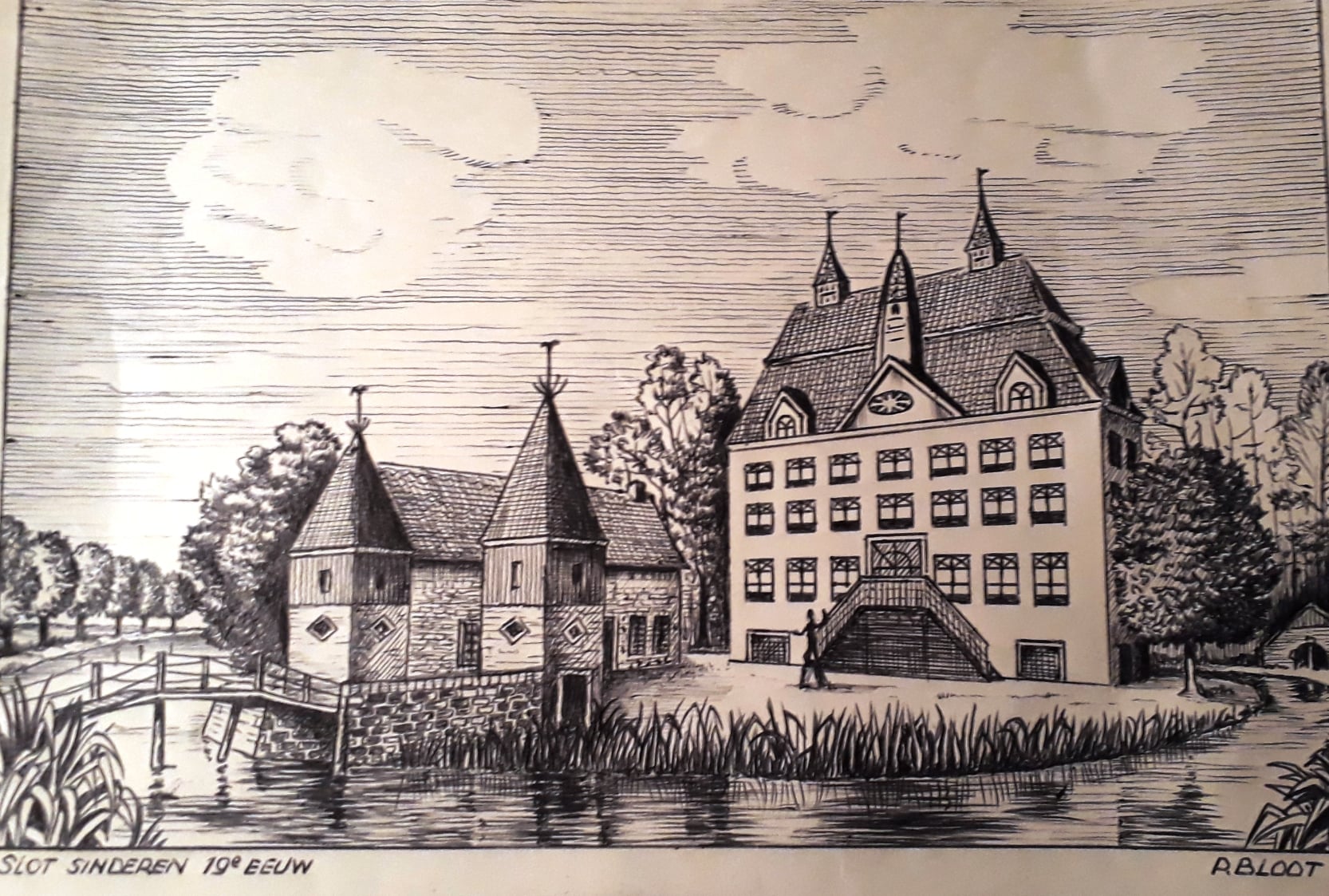
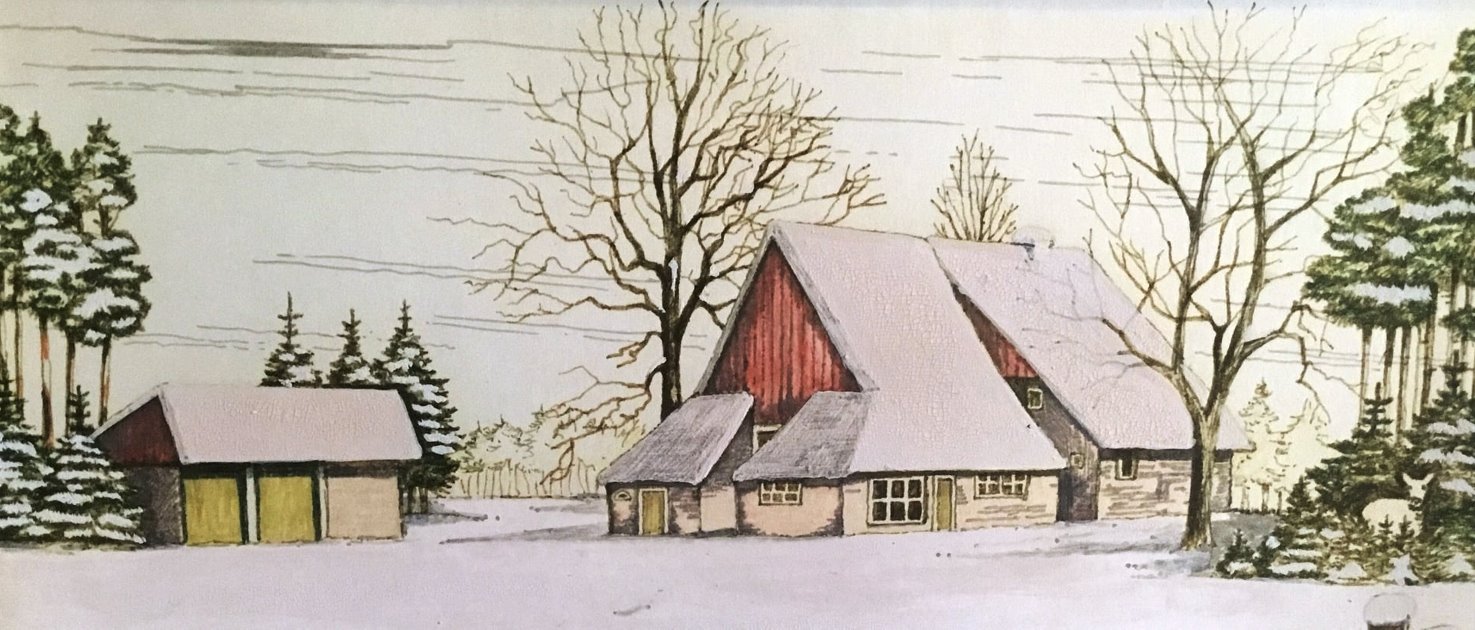
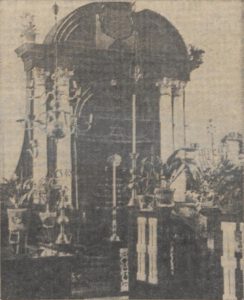
An ‘oorman’, sometimes referred to as ‘oormenneke’, is a room that was built onto some (village) farmhouses, where the elderly parents of the residents lived out their final years. Today, one might use the term ‘granny annex’ or ‘sheltered housing’. Sometimes, an oorman was also rented by a single person. It was a small room measuring approximately two by two and a half metres, in which a box bed (alkoof) served as a sleeping area.
The last oorman in Aalten was located at numbers 38/40 Hogestraat.
Regarding the origin of the term oorman, E.M. Smilda writes the following in Aalten en Bredevoort in oude ansichten:
“In my view, the name oorman should certainly not be considered as being derived from the idea that ‘just as a person’s ears protrude, so an oorman is an extension protruding from the farmhouse’. On the contrary, it is named after the occupant, as is customary in this region. Spelt more accurately, the little dwelling is called an oirman. In one of his plays, [the famous Dutch poet] Vondel has a character ask: ‘Do you then have no oir?’ By oir, heir is meant. In the end-room built onto a farmhouse, the older man who did indeed have an oir could spend the final years of his life. He was the oirman, lived there, still helped out a bit here and there, and received free board and lodging. In the whole of the Netherlands, this original name oirman occurs exclusively in Aalten.”
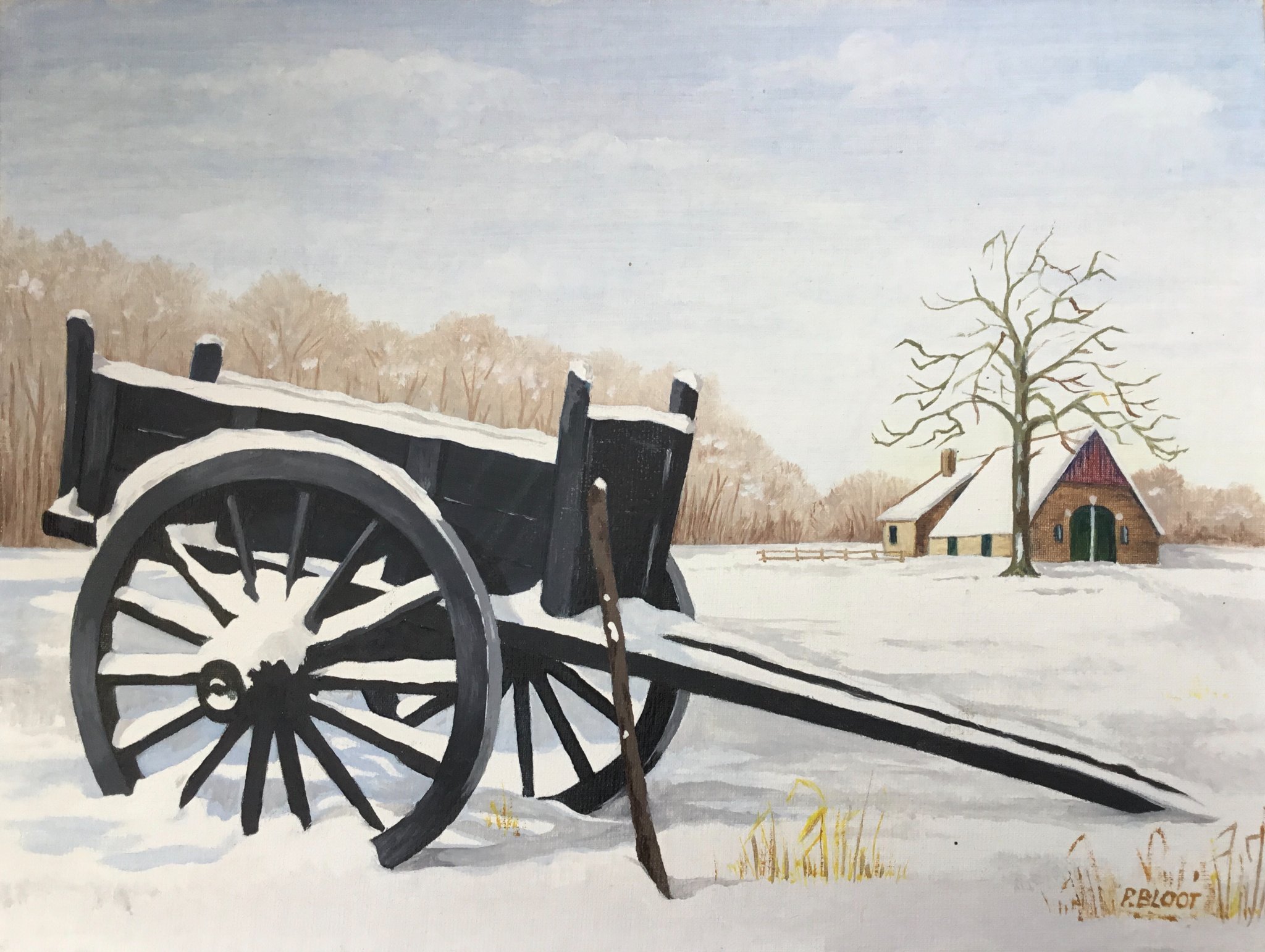
Pieter (Piet) Bloot (1924–1982) came to Aalten from the bombed city of Rotterdam in the summer of 1940 as a sixteen-year-old boy. On the initiative of the Calvinist (gereformeerde) minister Th. Delleman—formerly a minister in Aalten and later in Rotterdam-Kralingen—an appeal was published in the Aalten church magazine to offer Rotterdam children from affected families a carefree summer holiday. Piet was one of the fortunate ones.
What began as a holiday turned into a five-year stay. During this period, Bloot worked in the horn industry in Aalten. Because he had a passion for drawing, he returned to Rotterdam after the liberation, where he studied commercial drawing at the Academy of Fine Arts.
However, Piet could no longer settle in Rotterdam and returned to the Achterhoek region at the end of 1947. He went to work for the electrical installation company ERBA Van Lochem in Aalten. In September 1949, he met Johanna Wildenbeest, who was born at the De Kiefte farmhouse in De Heurne. They married in 1952 and had three children.
In the early 1950s, Bloot and his colleague Leendert Rhebergen started their own business at the bottom of the Hogestraat: Rhebergen en Bloot, an electrical installation company with a shop selling electrical appliances.
Piet Bloot passed away on 30 January 1982, aged 57, and was buried at the Berkenhove cemetery.
Publications
In 2016, the Fagus publishing house released Zo ik niet had geloofd, brieven van mijn moeder (Had I Not Believed: Letters from My Mother), based on around 160 letters and postcards his mother had sent him from Rotterdam between 1940 and 1945, supplemented by his own memories. Bloot is also featured in Kunstig Aalten (2021), an overview of artists from Aalten compiled by Leo van der Linde.
In the early 1980s, Poland was in the midst of a severe economic crisis. There were great shortages, and many basic necessities were rationed. Under the motto ‘Help the Poles through the winter’, aid campaigns were set up throughout the Netherlands. One of these was the ‘Pak van je hart’ (A Load off your Mind) solidarity campaign, in which lorry drivers collaborated with churches to provide the Polish population with food and clothing parcels. Aalten was not to be left behind and organised several aid shipments to the small town of Koronowo.
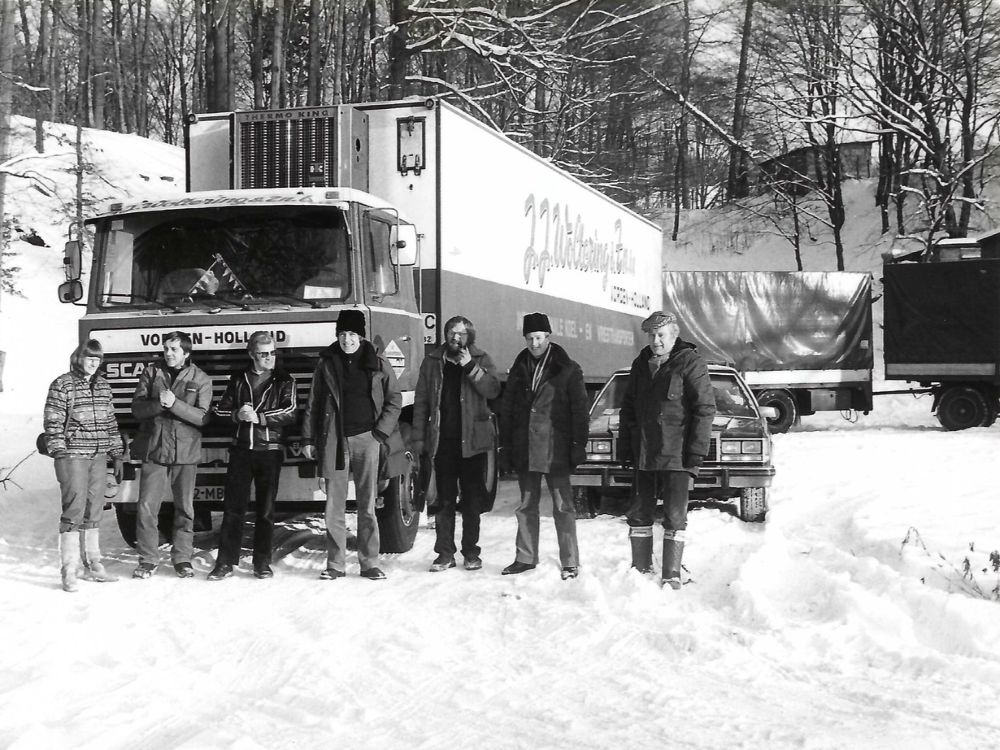
The Aalten team that travelled to Poland, photographed at the side of a road in the snowy landscape. From left to right: Mrs De Bruijne, T. Westerveld, H. Neerhof, J. Epema, D. Kuiperij; P. van Meggelen, and Rev. C. Gros. The photo was taken by Mr W. Hofs.
In December 1981, the following article appeared in a newspaper:
Tonny Westerveld, of Bevrijding 49, was one of the people who took part in the transport to Poland as a relief driver. The drivers of the first two lorries were Dick Kuiperij and Henk Neerhof. For Tonny Westerveld, who despite having ten years of experience as an international haulage driver, it was the first time he had driven to Poland.
On Saturday 18 December, the convoy departed at three o’clock in the morning, and seven hours later, they arrived at Helmstedt at the border between the Federal Republic of Germany and the GDR (East Germany). The formalities there took quite some time, as it was about two o’clock in the afternoon before they were able to leave.
Approximately three hours later, they reached the Polish border. Things went much faster there. The officials were required to open parcels, which they did with a few, but otherwise they finished very quickly—perhaps partly due to the many official documents with municipal stamps that could be shown, as Westerveld surmised.
The journey through Poland was hindered by heavy snowfall during the final few hundred kilometres. About 50 kilometres across the border in Łagów, they stayed overnight, but not at the location previously agreed upon; when they reported to the police, they were told they could spend the night at a different establishment.
On Sunday afternoon at around half past four, the convoy arrived in Bydgoszcz, where they were joined by a female guide, Mirca. The committee members had already been in contact with her a few weeks earlier, and she was well-informed about the situation.
In Koronowo
It was around eight o’clock on Sunday evening when they arrived in Koronowo. The priest they reported to was stunned when he saw the two large lorries; he could hardly believe his eyes, thinking that no one was allowed to enter the country.
The Aalteners requested help for the following morning. “You do wonder how long it will take to unload,” says Westerveld. Both vehicles were carrying 34 tonnes of cargo: 12 tonnes of clothing and 22 tonnes of foodstuffs. Of this, 28 to 29 tonnes were to be unloaded in Koronowo. The remainder was to be unloaded in Bydgoszcz. However, by the next morning, 12 Poles were ready to help, and by ten o’clock, that number had grown to about thirty.
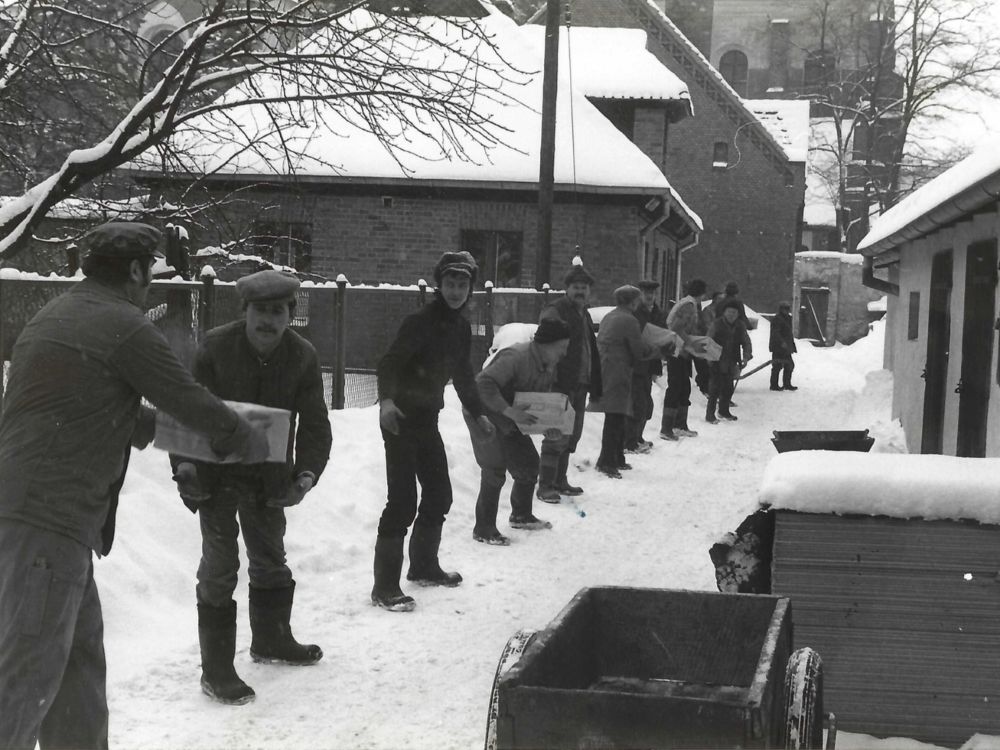
Residents of Koronowo help unload the lorries. The goods were stored in a church building, and the priest would personally oversee the distribution.
“The people there were busy with something they didn’t quite understand,” as Westerveld put it. They were utterly amazed. By twelve o’clock, the goods destined for Koronowo had been unloaded, and the return journey via Bydgoszcz could begin. There, they met the minister of the Evangelical congregation, who looked at the Aalteners with no less astonishment than the priest from Koronowo. He had not yet expected any aid, and with increasingly bewildered looks, he watched the items being removed from the vehicles and piled up before his eyes. Finally, the medicines and syringes they had brought were delivered to the Warminsky Hospital in Bydgozcz.
The Return Journey
For the drivers, the question now was: how do we get out of the city as quickly as possible? But hospital staff were already waiting with a car to guide the Aalteners along the shortest route out of the city towards Poznań. They spent the night in their vehicles at a car park somewhere. It was very cold—about 23 to 24 degrees below zero.
On Tuesday morning, the journey continued after breakfast. They had brought various food supplies for the road. When visiting the homes of Polish residents, the meals they brought were heated up, but they could also fry an egg or make coffee themselves along the way if necessary.
About eighty kilometres from the border, they discovered an English motorist whose car had broken down. However, the Aalteners were unable to help him. To their great surprise, they saw a vehicle from the Dutch roadside assistance (ANWB) passing by. The situation was explained to the occupants, and the problem was subsequently resolved. The roadside assistance officers belonged to the large convoy that had returned to the Netherlands earlier, but they had been in Poland for about nine days because some had lost their passports and had travelled to Warsaw to make arrangements.
When asked: “What is the atmosphere like in Poland?” the answer was: “Fearful.” The people are unimaginably afraid. But it was immediately added: “They are also exceptionally hospitable.” On Wednesday 23 December at one o’clock in the afternoon, the two lorries and their occupants arrived safely back in Aalten.
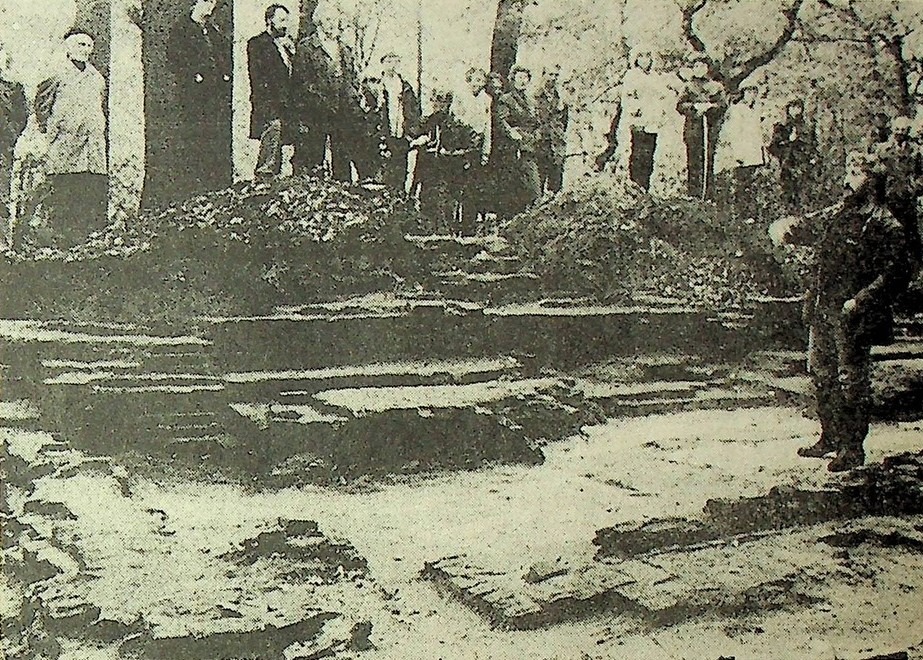
The group keenly inspected the remains of the brick kiln.
Mr H. Hofs from Varsseveld described the uncovering of the remains of an old ticheloven (brick kiln) in the hamlet of ’t Klooster near Bredevoort as a unique find. The kiln dates from 1708. The archaeological fieldwork group of the Antiquarian Working Community of Aalten, Dinxperlo, and Wisch (ADW) has been working for quite some time to carefully uncover the remains of the brick kiln.
The site of the old brick kiln was found partly thanks to Mr W. Lobeek, who used to live on the Götter farmstead. It was this former resident of ’t Klooster who was able to welcome at least eighty interested visitors to the excavation site on Saturday morning. The level of interest was so high that another excursion to ’t Klooster will be organised this coming Saturday. Mr R. Wartena, the regional archivist and an ADW board member, gave an introductory talk on what is known about the brick kiln.
It is virtually certain that this concerns the kiln of Matthijs van ’t Waliën. In return for his services – the planting of a large forest – he received, among other things, approval to build and operate a brick kiln here. The clay was allowed to be dug on the grounds of the monastery. Matthijs, however, was unable to meet his obligations. Many trees died immediately, and the severe winter of 1709 ensured that a third of the trees bit the dust.
Without ceremony
He saw no way to replant the trees, and in those days, protecting employment was not a priority. In 1719, Matthijs was forced to demolish the brick kiln within six months and to remove the bricks within a year. According to the agreement, the waarmanshuis (a worker’s or overseer’s cottage) had to remain standing. No trace of this cottage has been found so far. It is possible, however, that the Götter farmstead is the former waarmanshuis.
The kiln was indeed demolished, but apparently no further than ground level. The floor, with a surface area of 9 by 11 metres, and some small walls have remained, and the clay pits are also still clearly recognisable. Mr Hofs shared some details about the excavations, which the working group has been engaged in since July 1979. The investigations have yielded good results so far, even though they had hoped to find a few more traces in the immediate vicinity of the kiln.
The working group has mapped the remains and will cover them up again shortly. If they were to remain exposed to the open air, not much of them would be left.
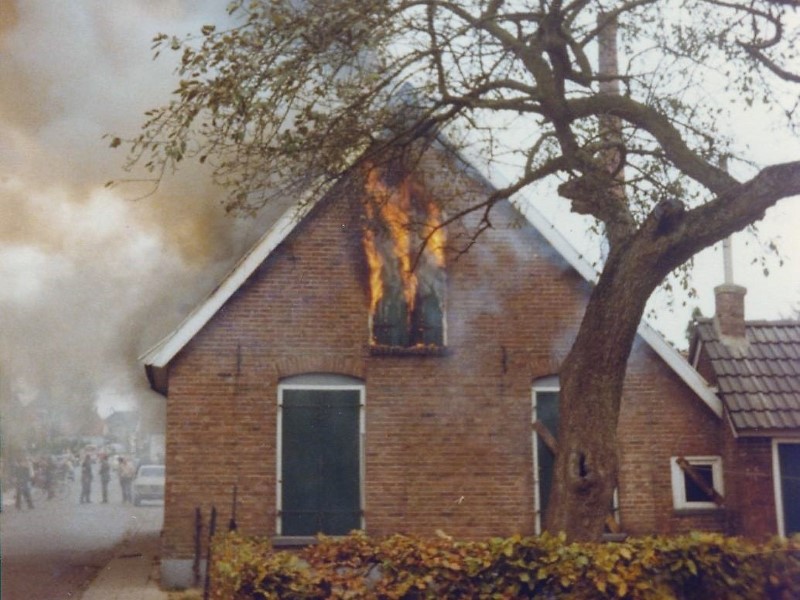
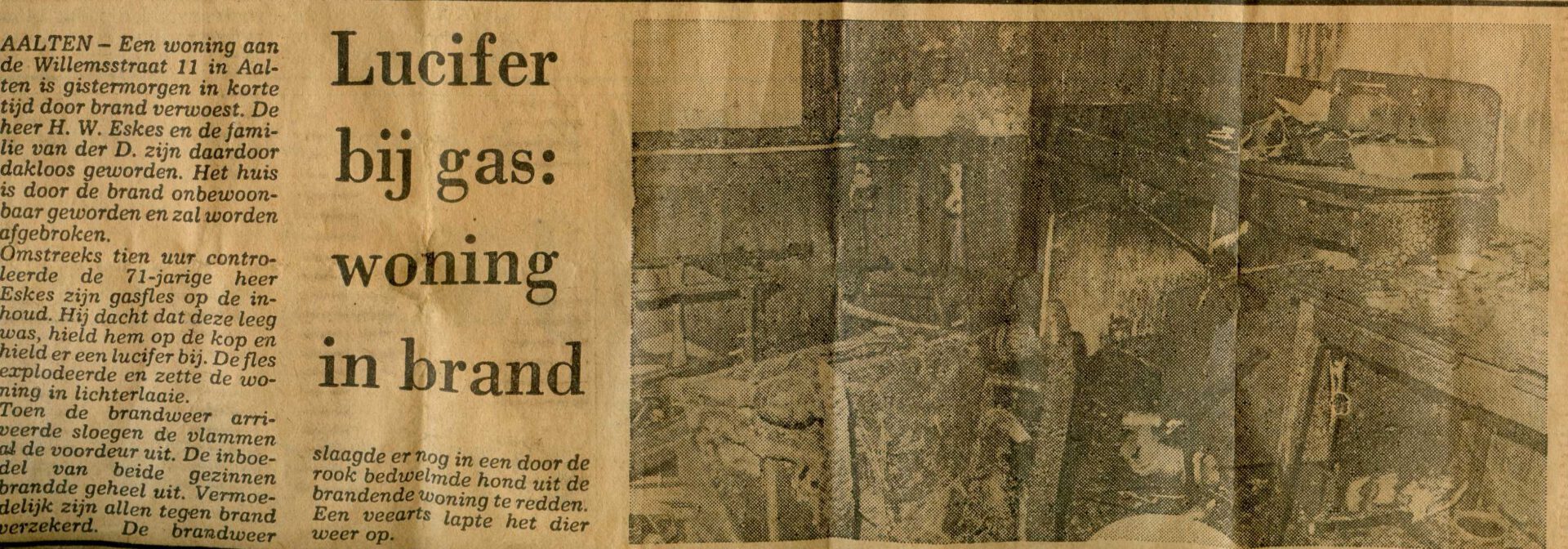
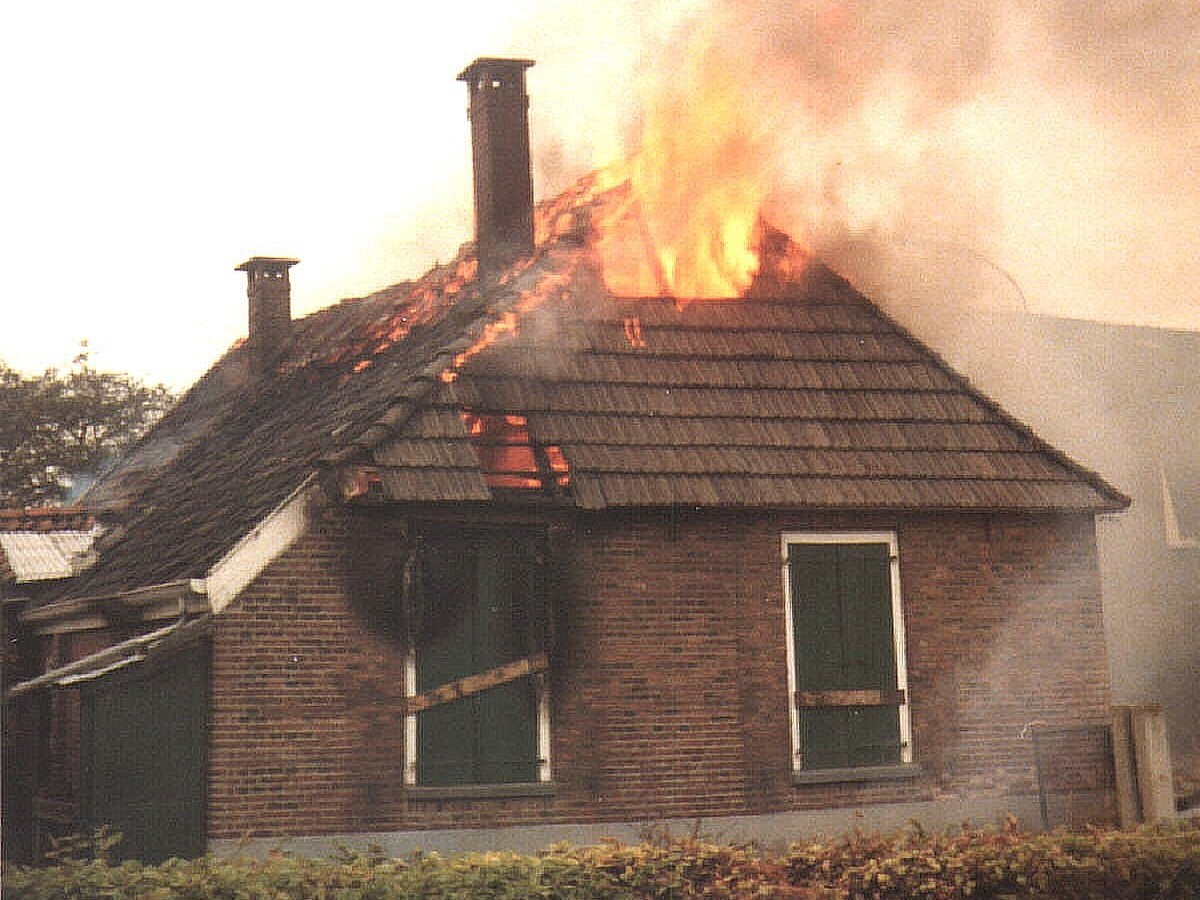
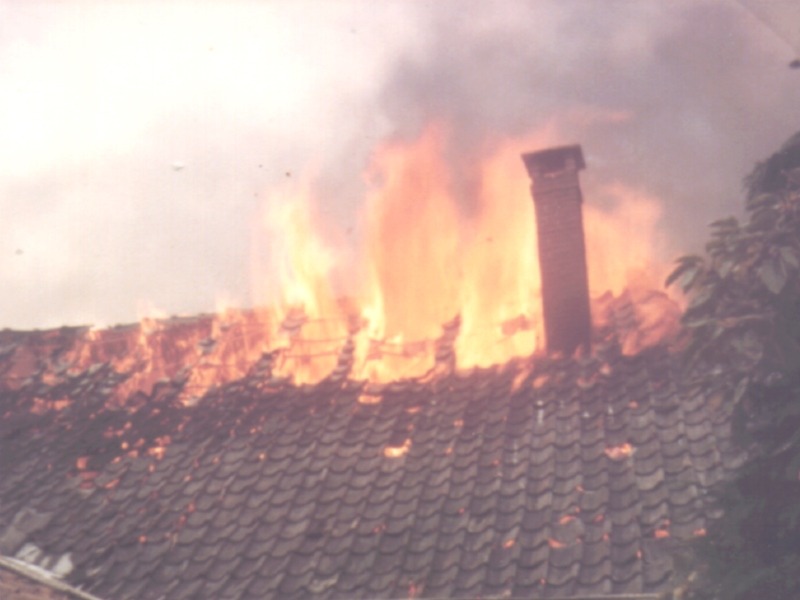
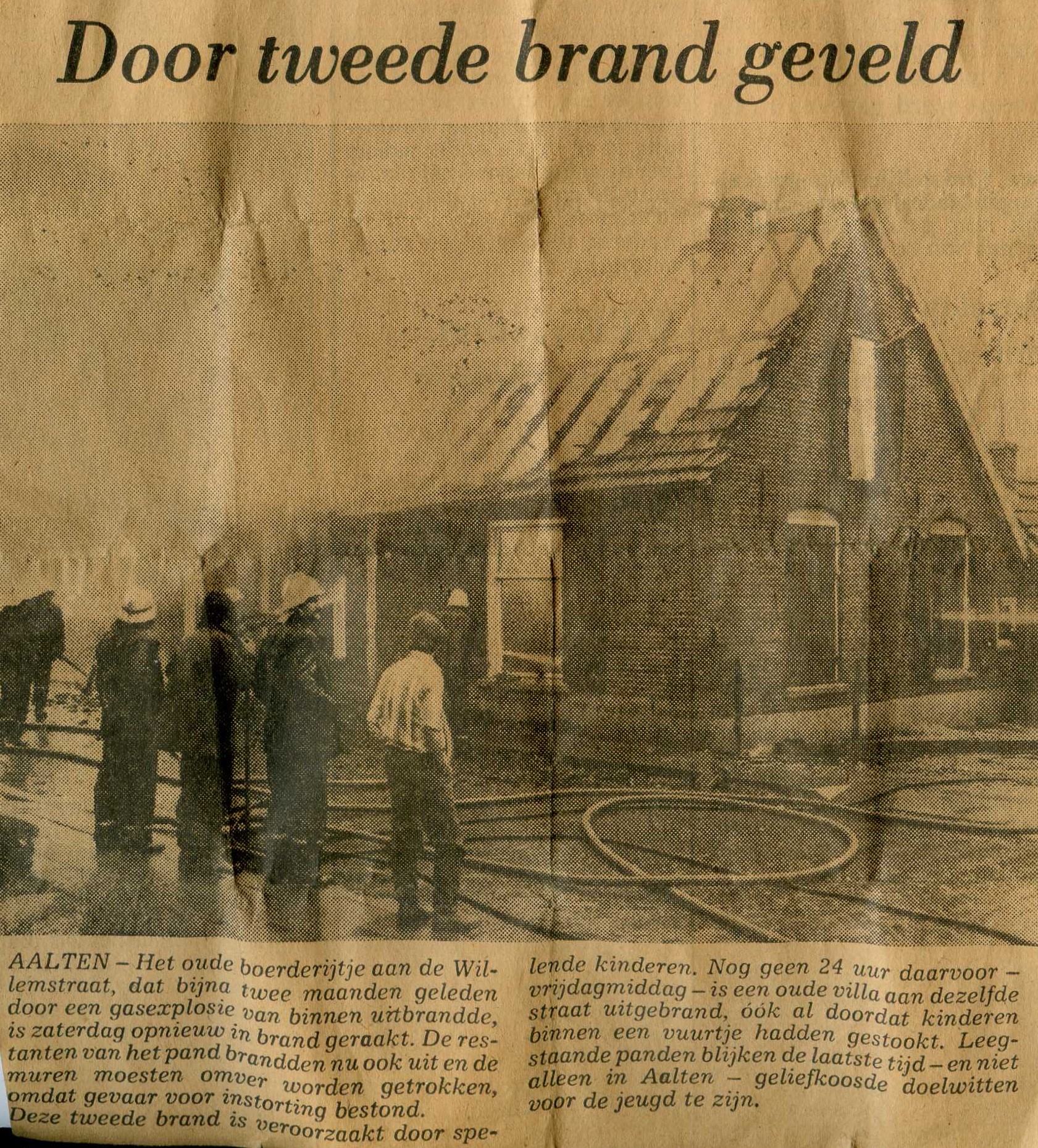
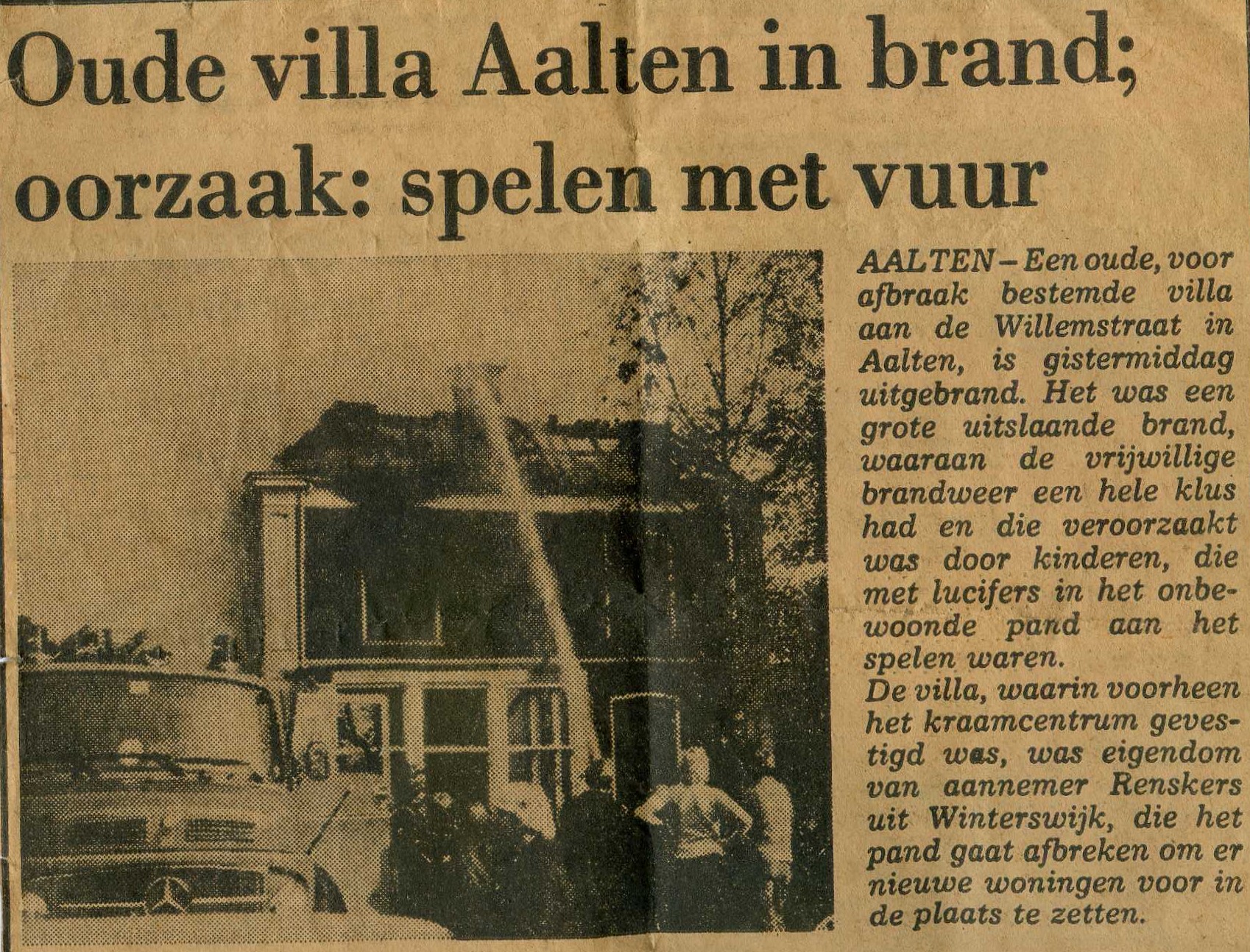
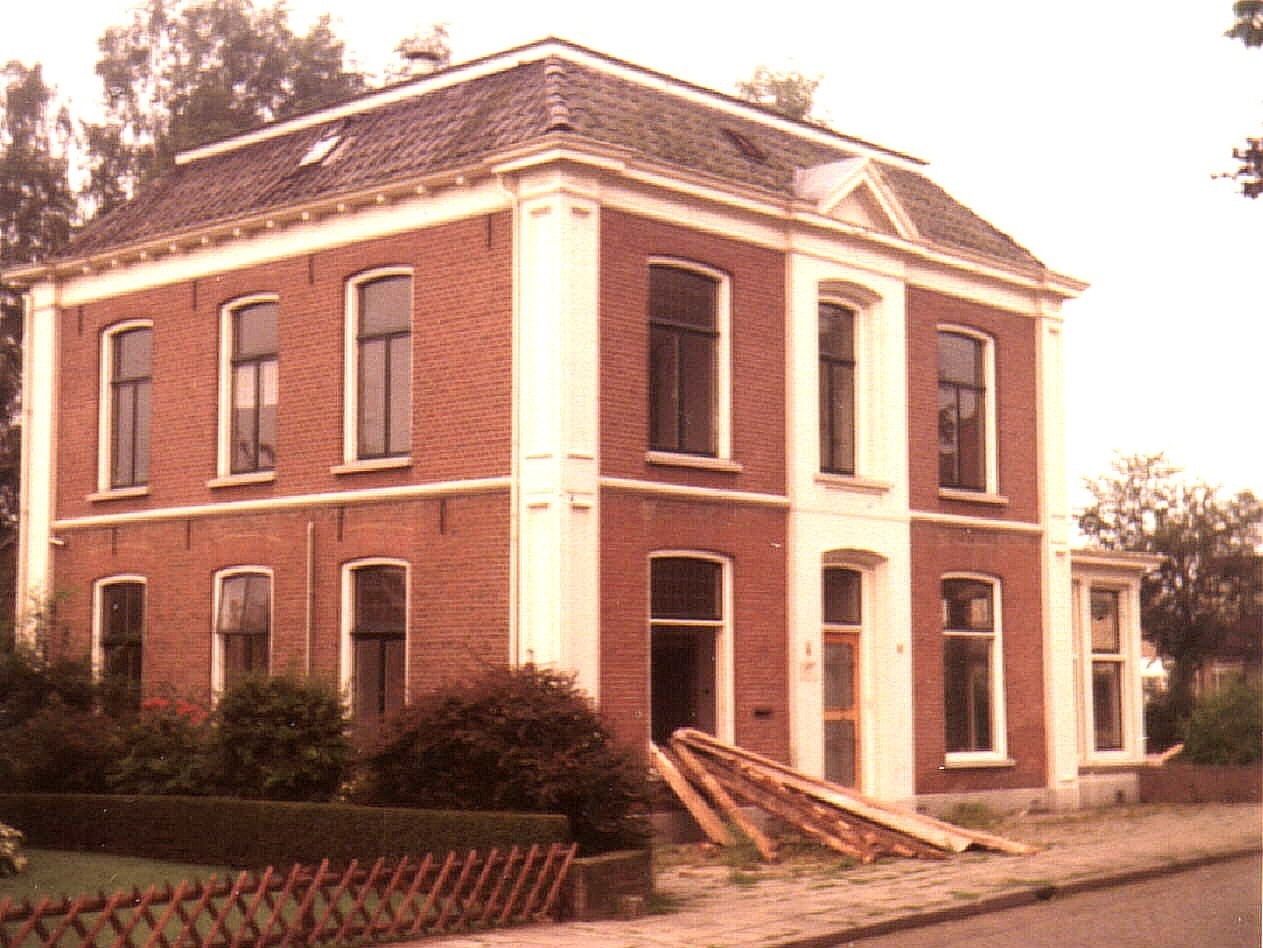
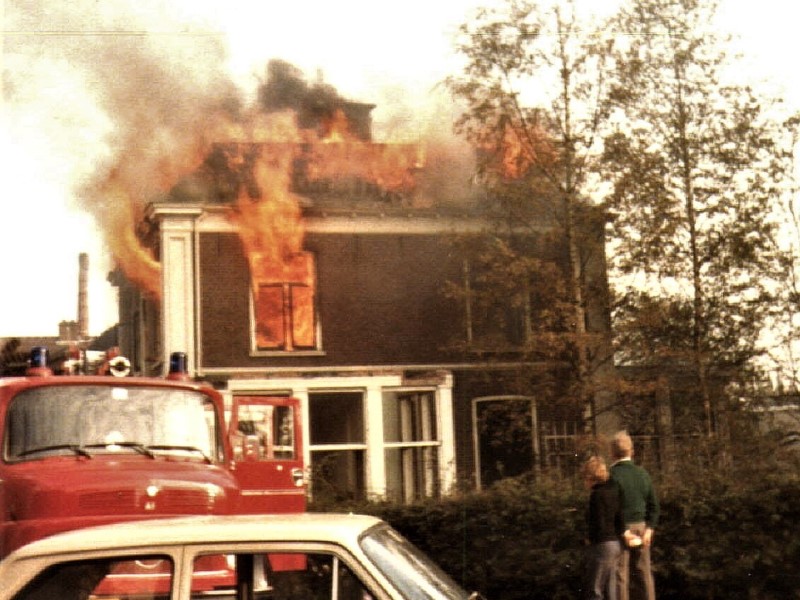
In 1978, the Willemstraat was startled by fire three times in a short period, twice in the home of Mr. Eskes and the Van der Donk family, at number 11, and also in the former Maternity Center at number 19.
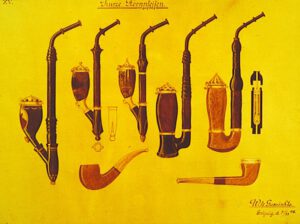
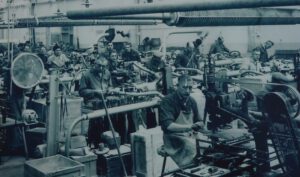
Aalten is de enige plaats in Nederland waar een hoornindustrie was gevestigd. Men maakte hier producten van buffelhoorn, zoals pijpen, kammen, knopen, seinfluitjes, naaldenkokers en messenheften.Buffels werden niet gedood of speciaal gefokt voor het hoorn.Vrijwel al het materiaal werd gebruikt en wat overbleef ging over de akkers. Met de intrede van kunststof en massaproductie na de Tweede Wereldoorlog verdween deze industrie.
Horn turners
Family ties had a strong influence on the emergence of the horn industry. From 1855, five horn turners began in Aalten: Bernard Vaags, Gerrit Peters, Abraham ten Dam, Willem te Gussinklo, and Wessel Becking.
Bernard Vaags ging op Wanderschaft naar Duitsland en kwam in Ruhla (Thüringen) in de leer bij een hoorndraaier. Toen hij in Aalten was teruggekeerd kocht hij een eenvoudige voetdraaibank en begon de allereerste hoorndraaierij. In een opkamertje in de schoenmakerij van zijn ouders ‘in den Dijk aan de beek te Aalten’ (Dijkstraat 9) maakte hij onderdelen voor Duitse pijpen van buffelhoorn. In 1860 trouwde Vaags met Dora Willemina Prins. Zij werd ook hoorndraaier en werd Piepen Deurken genoemd. Zij gingen wonen naast Bernards oudershuis (Dijkstraat 7).
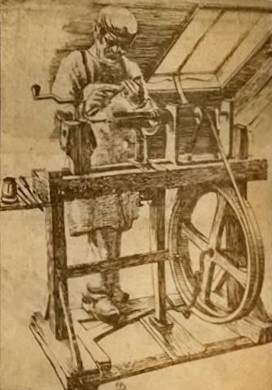
Pipe turning was manual, pedal-operated, and skilled craftsmanship. Here is an example of an Aalten treadle lathe from 1880.
German pipes
Gerrit Peters, zoon van een leerlooier, ging na Bernard Vaags ook in de leer in Thüringen. Hij werkte vanaf 1863 aan de Hogestraat. In 1866 trouwde Gerrit met de welgestelde Josina Aleida te Gussinklo en trok bij haar in. Het pand besloeg de hele lengte van de Köstersbulte, van het woongedeelte aan de Markt tot aan de Landstraat, waar hij zijn hoornwerkplaats vestigde. Hij maakte lange pijpenstelen en onderdelen voor de Duitse pijp. In Duitsland werden porseleinen pijpenkoppen aan de stelen bevestigd en de pijpen verhandeld.
Combs
Comb factory Ten Dam & Manschot
Na het overlijden van Vaags in 1868, pakte zijn opvolger Abraham ten Dam de zaken grondig aan. Het huisindustrietje werd een echte fabriek, aan de Stegge. In 1871 stichtte hij samen met zijn zwager Bernard Manschot kammenfabriek Ten Dam & Manschot aan de Damstraat.
It was the first and only factory in the Netherlands to make combs: white, black, and naturally coloured decorative combs, Mexican combs, nit combs, and moustache combs. These were made from buffalo horn, imported from countries including Brazil, India, and Thailand (then known as Siam). The manufacturing process generated even more dust and stench than pipe making.
A revolutionary development in the production process was the switch to steam power, replacing traditional hand and foot power. In local parlance, it became known as ‘d’n Kamstoom’ (the Comb Steam). By 1920, the comb factory employed about 200 people, including women and children.
Handles and knife hilts
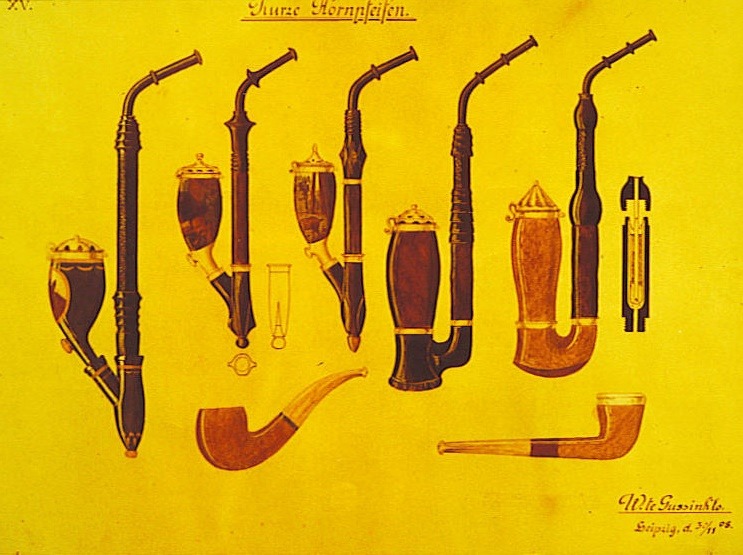
German pipes, W. te Gussinklo
Willem te Gussinklo en Wessel Becking leerden de kneepjes van het vak bij Gerrit Peters. Zij werkten korte tijd samen, maar gingen in 1884 apart verder. Na de mislukte samenwerking ging Wessel Becking in 1880 verder met Bernardus Gerhardus Vaags, neef en naamgenoot van Bernard Vaags. Becking & Vaags maakte pijpenstelen en later ook messenheften. Toen de verkoop van de Duitse pijpen terugliep, produceerde de fabriek korte bruyèrepijpen. De pijpenfabriek in de Hoekstraat staat er nog steeds!
Johannes Peters verliet de werkplaats van zijn vader aan de Köstersbult en sloot in 1896 een vennootschap met Marcus Gans, een Joodse koopman. Gans financierde de firma genaamd PEGA (Peters & Gans). De pijpenfabriek stond naast Peters’ woning aan de toenmalige Gasthuisstraat (nu Haartsestraat). Naast Duitse pijpen voor Duitse reservisten werden wandelstokken met hoornen handvaten vervaardigd. Nadat de fabriek in 1917 totaal uitbrandde, vestigde Johannes Peters zijn pijpenfabriek aan de Admiraal de Ruyterstraat. In plaats van Duitse pijpen werden er vooral bruyèrepijpen gemaakt.
Buttons
Dutch Button Works, Bredevoort
Na de mislukte samenwerking met Wessel Becking maakte Willem te Gussinklo Duitse pijpen en handvatten voor wandelstokken en paraplu’s. In Duitsland en Engeland waren rond 1900 bedrijven ontstaan die uit hoorn knopen produceerden. Met dat voorbeeld voor ogen begon Willem in het jaar 1905 met het maken van hoornen knopen, een primeur voor Nederland. Al snel kwam zoon Willem te Gussinklo jr. (Piepkes Willem) in de firma, die zich ontwikkelde als innovatief ondernemer.
De eerste fabriek van Te Gussinklo stond aan ‘t Dal in Aalten, de tegenwoordige Willemstraat. Vanwege de toenemende vraag naar knopen verhuisde het bedrijf in 1924 naar de oude weverij van Van Eijck in Bredevoort. Daar ging de productie van knopen van start. Het internationale bedrijf N.V. Dutch Button Works (DBW) exporteerde naar Engeland, Ierland en Amerika en was ook de grootste (hoorn)onderneming in Aalten.
After World War II, the production of horn buttons declined. In 1976, this last branch of horn processing was forced to close down. This marked the definitive end of 120 years of the horn industry in Aalten.
Video
Source: Euregionetwerk Industriecultuur
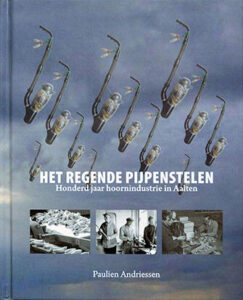
It rained pipe stems
Paulien Andriessen, a great-granddaughter of Gerrit Peters, became curious about her great-grandfather’s craft. He was the second horn turner in Aalten. Where had he learned the trade, and to whom did he sell those pipe stems? How did the Aalten horn turners and their successors fare?
“When I passed my final exams, my uncle gave me a pipe as a gift. My mother and my sisters smoked pipes, so I didn’t find it strange at all. It was a ladies’ pipe with a slender stem, a small white porcelain bowl, and a horn mouthpiece. I had to smoke it a few times, my uncle explained, and then a beautiful picture would appear on the pipe bowl. So, I started smoking quite heavily, as I was curious about that picture. It took a few pipes, but to my delight, my smoking habit was rewarded. A picture appeared. It was a little bird, a dove.”
In 2011, a book she authored was published by Fagus Publishers, titled ‘Het regende pijpenstelen, Honderd jaar hoornindustrie in Aalten’ (It Rained Pipe Stems: One Hundred Years of the Horn Industry in Aalten) (ISBN: 9789078202806)
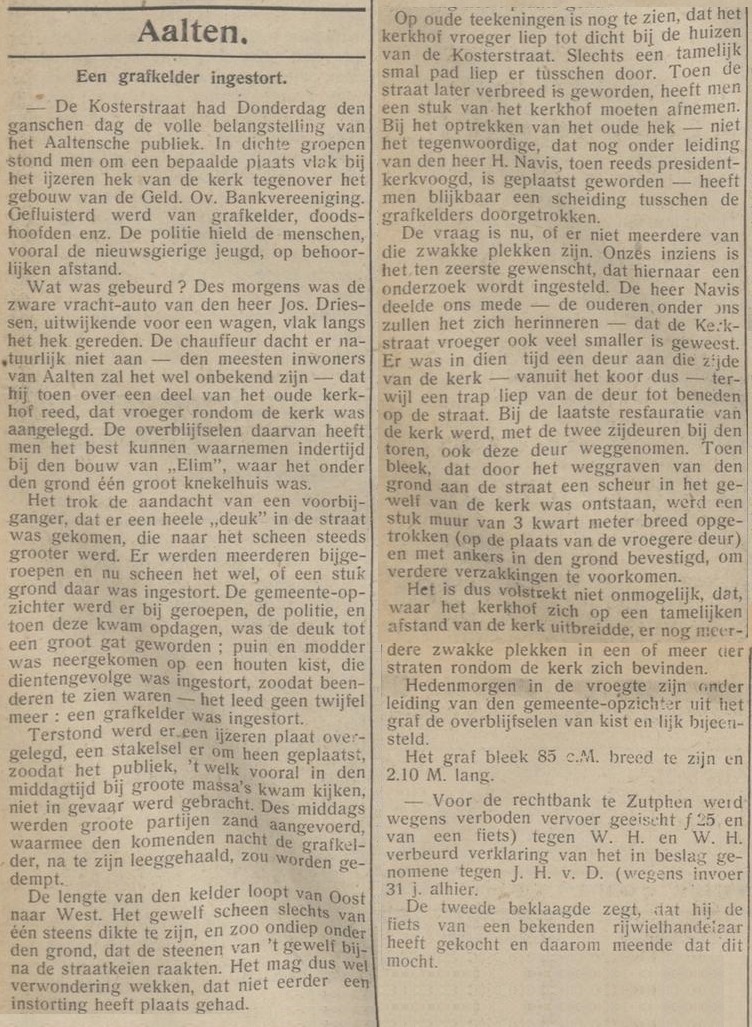
In the course of the last century, excavation work repeatedly led to the discovery of the mortal remains of old-time residents of Aalten.
A burial vault collapsed
Nieuwe Aaltensche Courant, 9 July 1920
AALTEN – Throughout the whole of Thursday, Kosterstraat (= Köstersbulte, OA) held the full attention of the Aalten public. People stood in dense crowds around a particular spot close to the iron church gates, opposite the building of the Geld. Ov. Bankvereeniging. There were whispers of a burial vault, skulls, and so forth. The police kept the public, especially inquisitive youngsters, at a proper distance.
What had happened? In the morning, a heavy lorry belonging to Mr Jos. Driessen had driven right alongside the gates whilst swerving to avoid another cart. The driver naturally had no idea – as will indeed be the case for most inhabitants of Aalten – that he was driving over a section of the old churchyard that had formerly been laid out around the church. The remains of this churchyard were most clearly observable at the time “Elim” was built, where it was one vast charnel house beneath the ground.
It caught the attention of a passer-by that a sizeable “dent” had appeared in the street, which seemed to be growing steadily larger. Others were called over, and it now appeared as though a section of the ground had caved in. The municipal surveyor was summoned, as was the police, and by the time they turned up, the dent had become a large hole; rubble and mud had fallen onto a wooden coffin, which had collapsed as a result, revealing bones – there was no longer any room for doubt: a burial vault had collapsed.
Nieuwe Aaltensche Courant, 9 July 1920
An iron plate was immediately placed over it, and a hoarding erected around it, so that the public, who came to look in great numbers particularly during the afternoon, were not put in danger. During the afternoon, large quantities of sand were brought in, with which the burial vault was to be filled in during the coming night, after having been emptied.
The length of the vault runs from east to west. The brick arch appeared to be only a single brick thick, and so shallowly subterranean that the bricks of the arch almost touched the cobblestones of the street. It may therefore give cause for wonder that a collapse had not occurred sooner.
Old drawings still show that the churchyard used to extend close to the houses on Kosterstraat. Only a fairly narrow path ran between them. When the street was widened later on, a piece of the churchyard had to be taken away. When the old gates were erected – not the current ones, which were installed under the supervision of Mr H. Navis, who was already president-churchwarden at the time – a division was apparently driven straight through the burial vaults.
The question now is whether there might be more of these weak spots. In our view, it is highly desirable that an investigation be launched into this. Mr Navis informed us – as the older ones among us will remember – that Kerkstraat also used to be much narrower.
In those days, there was a door on that side of the church – that is to say, leading from the chancel – while a flight of steps ran from the door down to the street. During the last restoration of the church, this door was removed along with the two side doors near the tower. When it became apparent that digging away the ground by the street had caused a crack to form in the vaulting of the church, a section of wall three quarters of a metre wide was erected (on the site of the former door) and secured into the ground with anchors to prevent further subsidence.
It is therefore by no means impossible that, given the churchyard extended a considerable distance from the church, further weak spots exist in one or more of the streets surrounding the church.
Early this morning, under the direction of the municipal surveyor, the remains of the coffin and the corpse were gathered from the grave. The grave proved to be 85 cm wide and 2.10 m long.
Urns containing cremated human bones
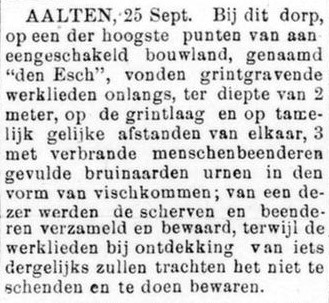
De Grondwet, 21 October 1884
AALTEN, 25 Sept. Near this village, on one of the highest points of a continuous stretch of arable land known as “den Esch”, workmen digging for gravel recently found, at a depth of 2 metres upon the gravel bed and at fairly equal distances from one another, 3 brown earthenware urns in the shape of fishbowls, filled with cremated human bones; the shards and bones of one of these were collected and preserved, whilst the workmen, upon discovering anything similar, will endeavour to leave it undamaged and have it preserved.
Skeletons found at ’t Blik
Graafschapbode, 14 July 1925
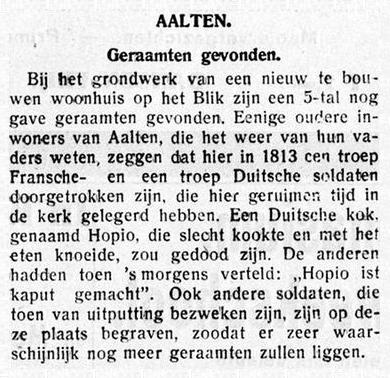
AALTEN – During the groundwork for a newly to be constructed dwelling at ’t Blik, some 5 fully intact skeletons have been found. Some older inhabitants of Aalten, who know of it from their fathers, say that a troop of French and a troop of German soldiers passed through here in 1813, having been quartered in the church here for a considerable time.
A German cook named Hopio, who cooked poorly and meddled with the food, is said to have been killed. The others had then recounted the next morning: “Hopio ist kaput gemacht” (Hopio has been done for). Other soldiers who succumbed to exhaustion at the time were also buried at this spot, so it is highly probable that further skeletons lie there.
In Aalten, whilst laying the foundations for a house to be built, the skeletons of a man and two horses have been found.
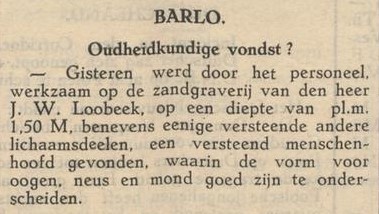
Petrified human head in Barlo
Aaltensche Courant, 21 April 1939
Yesterday, the personnel working at the sand quarry of Mr J.W. Loobeek found, at a depth of approx. 1.50 m, a petrified human head along with several other petrified body parts, in which the shapes for the eyes, nose, and mouth can be clearly distinguished.
Urn found
Aaltensche Courant, 16 October 1945
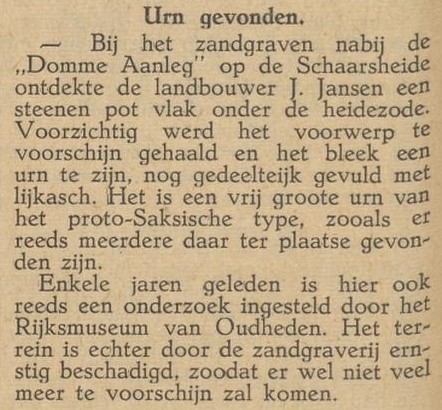
Whilst digging for sand near the „Domme Aanleg” on the Schaarsheide, the farmer J. Jansen discovered a stone pot just beneath the heather turf. The object was carefully extracted and proved to be an urn, still partially filled with funeral ashes. It is a fairly large urn of the Proto-Saxon type, several of which have already been found at that location.
A few years ago, an excavation was also carried out here by the National Museum of Antiquities (Rijksmuseum van Oudheden). However, the site has been severely damaged by the sand quarrying, meaning that not much more is likely to come to light.
Path between the old Helenakerk and Elim House
Circa 1955
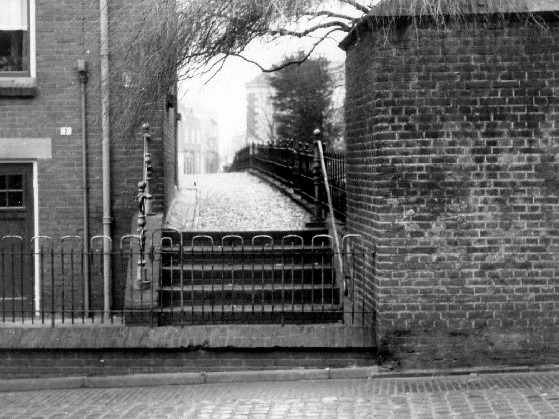
Adjacent we see the ‘trepkes’ (steps) between the old Helenakerk and Elim House. This path was excavated and widened around 1955. During the excavation of the steps, numerous bone fragments came to light from old-time residents of Aalten who had been buried there in the old churchyard.
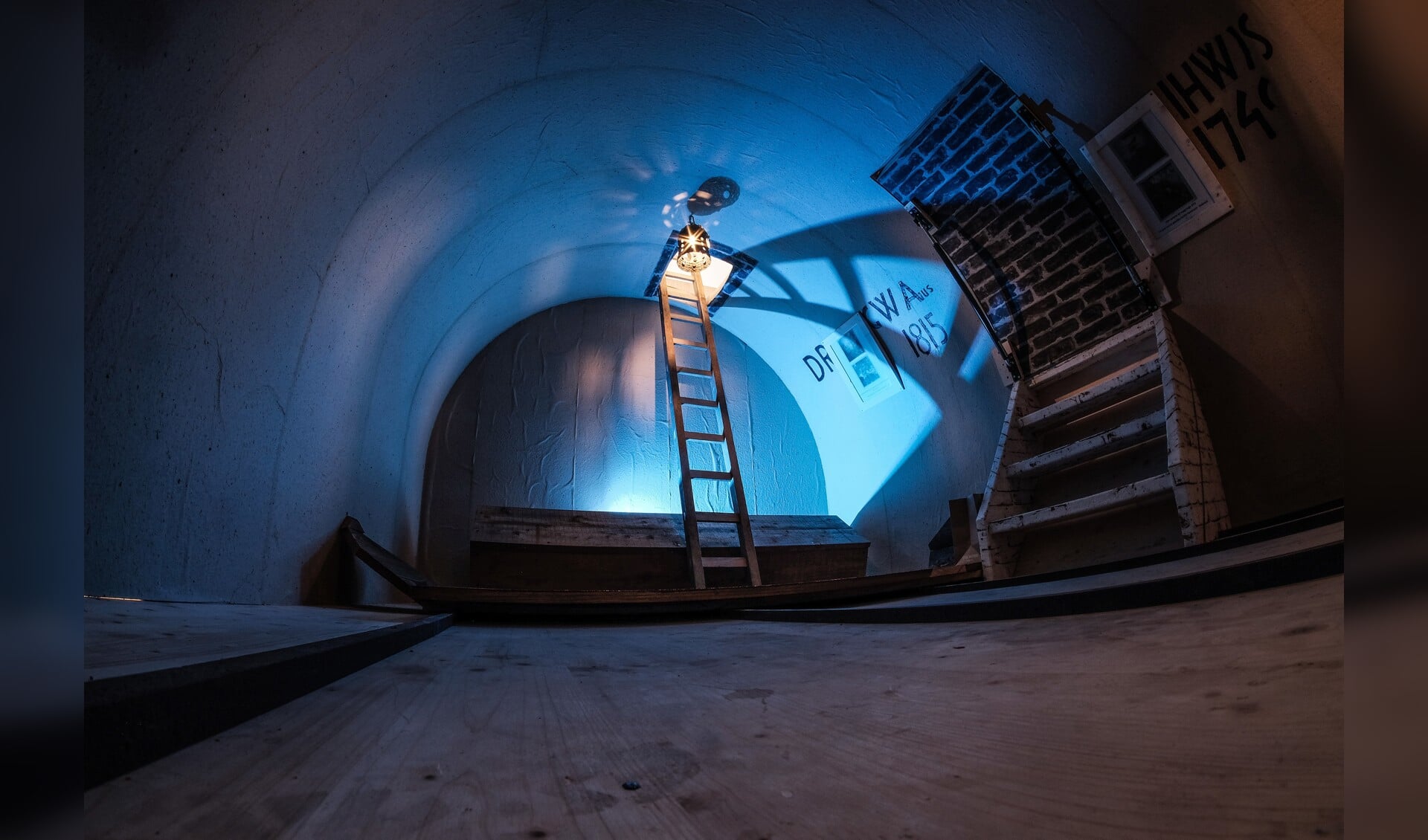
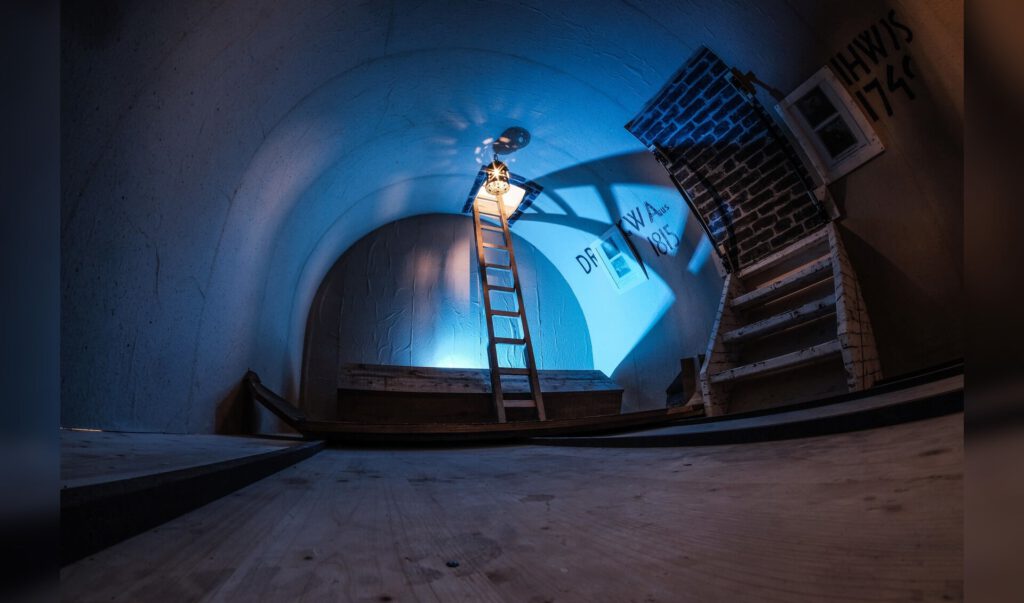
Replica of the burial vault in the old Helenakerk in Aalten, photo: Aalten Vooruit, 4 October 2024
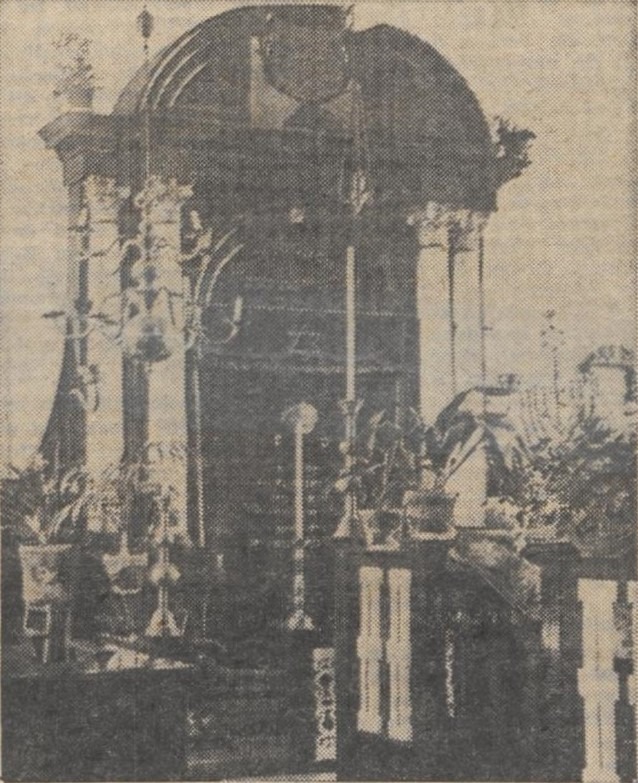
Burial vault in the old Helenakerk
16 October 1973
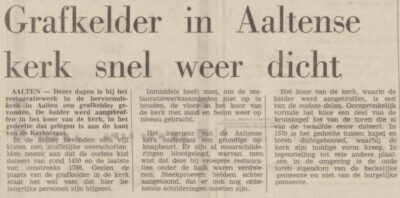
In 1973, whilst carrying out work in the Oude Helenakerk, carpenter Henk Heijnen discovered a burial vault beneath the floor of the chancel. An outsider had claimed that the ‘last priest’ had been buried where Heijnen was working, together with his golden chalice. Heijnen wanted to know more about this and did indeed discover a burial vault at that spot. The vault did not contain a golden chalice, however, but the coffins and remnants of three sets of mortal remains, with initials and dates on the wall. Decades later, Heijnen made a replica of the burial vault.
In 1973, during restoration work at the Old St Helen’s Church in Aalten, carpenter Henk Heijnen stumbled upon a burial vault beneath the choir containing three coffins with human remains. At the order of the church board, the vault was swiftly resealed. However, before this happened, Heijnen had already climbed inside to meticulously measure and photograph everything. In 2019, Heijnen completed a wooden replica of the burial vault.
The Discovery in 1973
On October 16, 1973, the then 23-year-old carpenter Henk Heijnen was involved in restoration and maintenance work at the Old St Helen’s Church. The floor of the choir had been removed, leaving only sand. During the work, he was visited by Jan Tinnevelt from the Kattenberg, who asked if they were searching for the golden chalice. According to legend, this chalice was buried alongside the last priest of the Old St Helen’s Church. Heijnen’s boss at the time ushered Tinnevelt out.
However, Tinnevelt was persistent, returning at least three more times to ask if anything had been found. This prompted Heijnen to start digging at the spot under the choir that Tinnevelt had pointed out. He soon struck a brick vault. Together with his boss, he used a sledgehammer to create a hole in the structure. Heijnen enlarged the opening until he could descend into the space using a ladder. Below, he found a burial vault containing three partially decayed coffins. Of the deceased, only dust and hair remained. He did not find a golden chalice…
Measured and Resealed
As always, Heijnen had a folding rule, a carpenter’s pencil, and paper with him. Before the vault was closed again, he measured the space precisely, noted the dimensions and initials, and made sketches and photographs of the vault, the inscriptions, and the dates. On the wall of the vault were the initials IHW with the year 1746, GWA with the year 1815, and DR, without a date. He preserved all these notes and images.
Meanwhile, his employer had informed the church council. Around ten o’clock that evening, the members of the church board arrived at the church, accompanied by the Reverend Van der Heiden. The minister pointed out that no one should descend into the vault as it would constitute grave robbery. Because the restoration was being carried out without the involvement of the National Heritage Agency (Monumentenzorg) and there were fears that the work would be halted, Heijnen was sworn to strict secrecy. At the request of the church board, he had to seal the manhole with concrete as soon as possible.
While he was closing the opening, Jan Tinnevelt entered the church once more. Upon realising what had been found, he was again politely requested to leave.
Dagblad Tubantia, 2 March 1974
In the week following the discovery, work began on laying the new natural stone floor in the choir, permanently sealing the access to the burial vault. Only Heijnen’s notes and his employer’s photographs remained as a source. Shortly after the completion of the choir, national news channels reported the discovery of a burial vault in the Old St Helen’s Church; it is not known who leaked this information.
Research and Replica
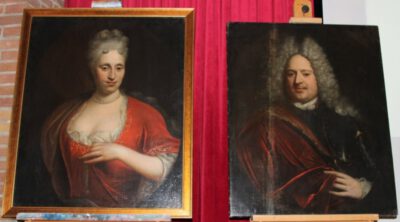
The portraits of Lambert Joost van Hambroick and his wife Mechteld Anna Bentinck-Van Diepenheim, photo: Lydia ter Welle
It was only years later, during a trip to Israel with his wife, that Henk Heijnen visited a burial vault in Jerusalem. This gave him the idea to build a replica of the burial vault in the Old St Helen’s Church.
He produced new construction drawings and came into contact with Herbert Welling from Bocholt and Thaddeus van Eijck from Bredevoort, both of whom were interested in cultural heritage. The trio hit it off, and their combined research led them to the historian J. Grooteboer from Borne.
They discovered that Lambert Joost von Hambroick and his wife Mechteld Anna Bentinck van Diepenheim were closely connected to St Helen’s Church. In 1706, they donated two silver communion cups to the Aalten church, which were later found in a safe within the church.
Replica of the burial vault in St Helen’s Church in Aalten, photo: Aalten Vooruit, 4 October 2024
Who Was Buried in the Vault?
Based on the research, it was determined that the following individuals were buried in the vault:
Judith Hambroick Welvelde († 1746) The connection to the Welvelde and Hambroick families is still visible in the church via the Welvelde coat of arms, which features a wolf’s head.
Gerharda Wilhelmina Arentsen (1777–1815) She had purchased the burial vault at a later date. She was the daughter of the sister of Mayor Christiaan Caspar Stumph and the granddaughter of Roelof Arentsen, the scholte (local official) of De Ahof.
Rev. De Roy († 1762/1785) Uncertainty remains regarding the initials DR. They were linked to a Reverend De Roy. However, in the second half of the 18th century, there were two ministers of that name: Philippus de Roy (1733–1762) and his son Adrianus Rudolphus de Roy (1762–1785). Which of the two might be buried in the vault remains unknown for now.
Completion of the Replica
In 2019, Heijnen completed a wooden replica of the burial vault. Two employees from Broekhout used his drawings to recreate the frame exactly. Heijnen personally handled the painting, including the initials and other details. The replica was later put on public display in the Helenahuis, opposite the church on Landstraat.
Thaddeus van Eijck produced a film titled “Verscholen erfgoed in beeld” (Hidden Heritage Portrayed), which documents the entire process surrounding the replica: from the initial notes and research to the craftsmanship with which the burial vault was reconstructed.
At the presentation of the replica in 2019, Heijnen mentioned that he still always carried his folding rule, even when sitting in church on Sundays, and that he felt nervous if he did not have it on him. That habit led to an extraordinary result: a booklet, a film, the recovery of two silver communion cups, and a skilfully and accurately crafted replica of the burial vault in the Old St Helen’s Church. Hidden heritage, beautifully brought to light.
A report on the presentation of the replica of the Old St Helen’s Church burial vault on the Market Square in Aalten. Video: RTV Slingeland / Henk Nijenhuis
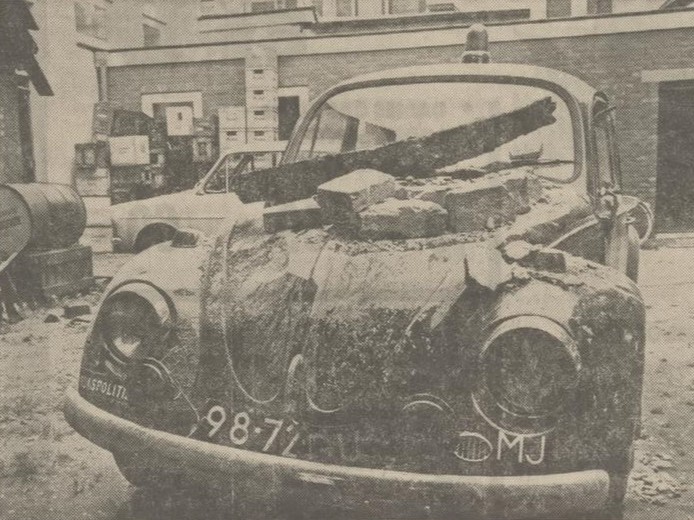
AALTEN — With a resounding thud, the garage of the old police station in the Peperstraatje collapsed yesterday. The rickety structure was unable to serve out its time. Within the foreseeable future, the new police station on the Polstraat will be completed, and the restoration of the building currently serving as the police station can begin. It will then house several municipal offices. The national police in Aalten will likely not be too distressed about the destroyed garage.
They will, however, be concerned about the car that was parked in the garage at the moment it gave way. The police report drawn up regarding the incident states that the vehicle was quite seriously damaged. It is further unknown whether a report was filed against the owner of the property for neglecting maintenance obligations. In that case, it would be the municipality that should be held responsible for the damage to national property.
Source
Daily newspaper Tubantia, 30 October 1970 (Delpher)
Margriet, weekly magazine for women and girls, 7 February 1970
Which woman-of-the-year deserves our tribute in the form of a golden Margriet? Whom may we honor with this gold for her selflessness, her helpfulness, her charity? You answered this question with so many letters that the editors of Margriet, after reading and re-reading all your spontaneous stories, simply had to decide to award more than one golden Margriet: there were no fewer than FIVE!
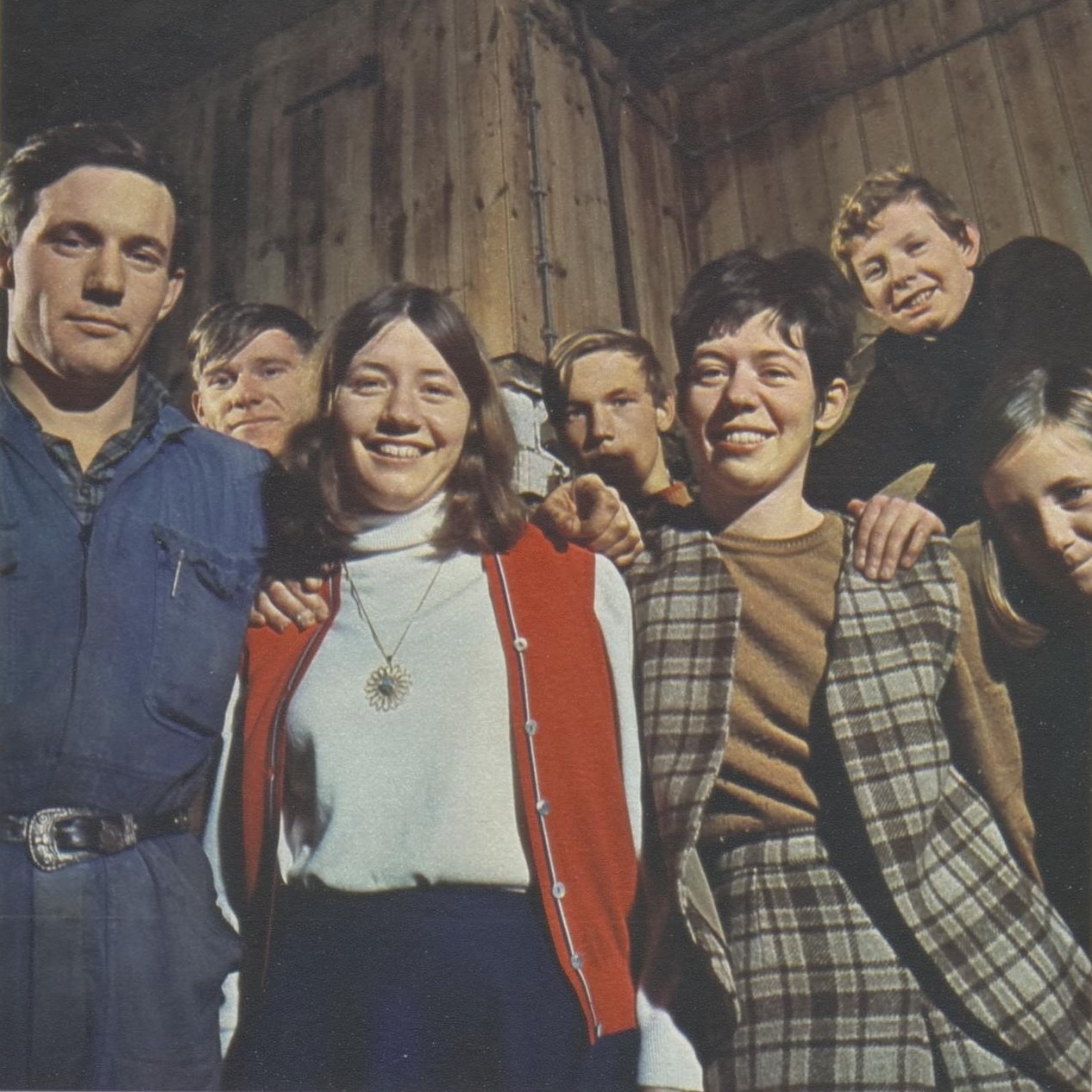
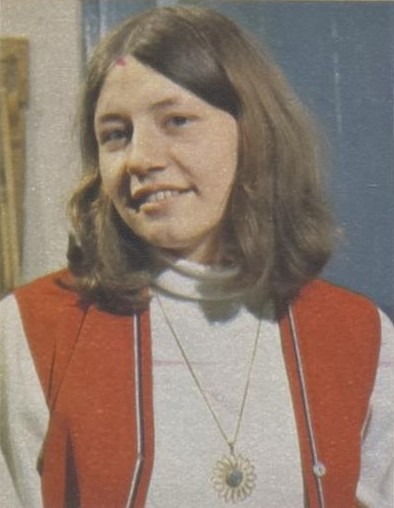
Fourth Golden Margriet: the rock and mainstay in this family of seven orphans
Aalten; the Hessenweg is a rather hard-to-find path, far behind the newest housing estates of this southern corner of the Achterhoek. To the side of that Hessenweg: a small farm. The property consists of a few cows, a few pigs, a few hectares of land. A young man in blue overalls is working with a tractor; some children are running around. There is no farmer, no farmer’s wife. But in the kitchen-diner there is a scent of freshly brewed coffee, and a girl, small in stature but sturdy, is busy juggling eggs, bread, and bacon to set an evening table for seven hungry mouths.
Joke ter Maat from Aalten
Her name is Joke ter Maat, 18, and she is the rock and mainstay of this family of seven orphans, of whom she is one herself. Her sister Riet: “Mother has been dead since ’61. And in ’69, father also passed away. Joke ensures that everything at home runs smoothly. For years now. She literally does everything, except for the real men’s work that needs to be done on a small farm like this. My brothers do that. The brothers are 23 years old.”
The farm is only small; they have jobs on the side. Riet also works “outside the home”; together, the three of them ensure that the business and family have the necessary financial resources. “But we can only do that because our Joke takes everything else off our hands,” these children say. For Dick (16), Gerard (14), and Ada (11), Joke is also, and perhaps primarily, a second and very caring mother.
“Since father passed away, it has actually become doubly difficult for her,” the older brothers feel. “She has now become the sole pivot around which everything revolves. And in fact, we leave almost everything to her. We decide on major financial expenditures among the older ones, and even then she has the final word; we trust her yes or no. If she didn’t do all this, our little family really wouldn’t be able to stay together as well as we do now…”
To all these praises, Joke herself hardly comments; she laughs and pulls up the chairs. And she doesn’t even sit at the head of the table…
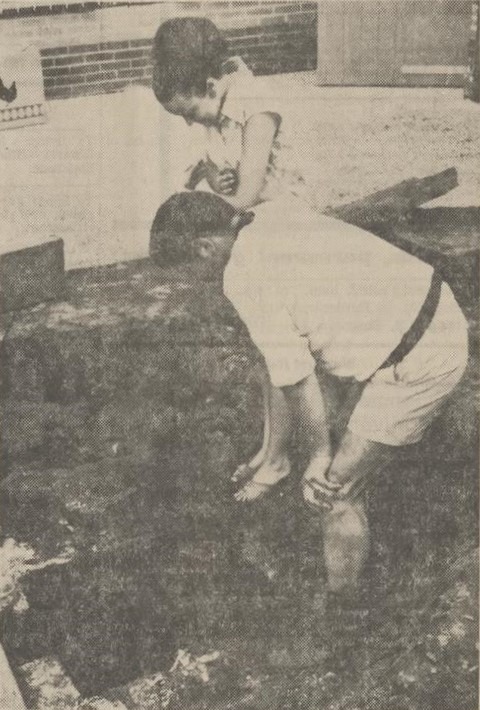
The engaged couple Ossendorf-Hubers in Aalten has no reason to feel down. On the contrary! Their engagement will soon be followed by marriage, and they are already busy furnishing a brand-new home on Molenstraat. And yet, this very house gives Mr. Ossendorf and his future wife reason to be careful not to literally end up in the well—the well found in the garden just behind the house, which is nearly fourteen meters deep.
At this location—as the name Molenstraat suggests—the Aalten mill once stood, the last remains of which were removed last year in the spring. Now, four beautiful homes stand there. The well is over a hundred years old and is constructed of heavy masonry. It belonged to the mill, and the former miller, Mr. Klomps, recalled that the well was to be found somewhere in this vicinity. The future residents of the houses were also informed. All four houses are currently still vacant, but work is already well underway in the gardens. In these gardens, four heavy millstones have since been found.
Mr. Ossendorf also went in search of such objects and the well. After a few “test drillings,” it did not take long before both the millstone and the well were located. That is to say: the well was covered with a millstone. With great effort, the stone—which was no longer in very good condition—was removed in pieces, and the couple then gazed into the depths. According to local residents, the well must have supplied the entire neighborhood with water in the latter part of the previous century. The water is currently at a depth of about thirteen meters. Consequently, the houses will not be much troubled by groundwater. Following tradition, this mill was also built on the highest part of the village.
The well has a diameter of one meter, and climbing bolts have been bricked into the wall, allowing one to descend. Since its rediscovery, no one has yet ventured this experiment. It is unknown what will happen to the deep well. Filling it in or developing it into a beautiful antique well with a lever, for example. That is still a matter of consideration. The latter seems appealing, but in the back of one’s mind, there is also the thought of filling it in before any accidents occur.
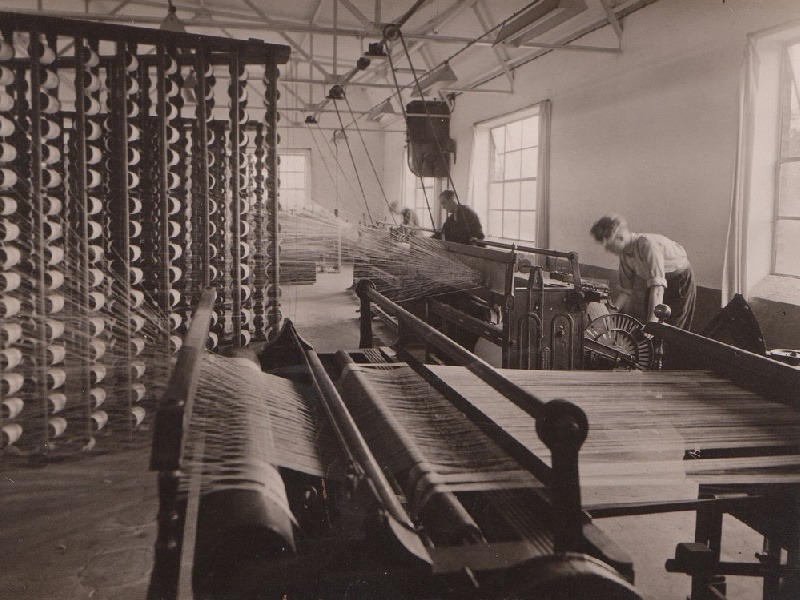
The textile industry in Aalten was deeply rooted in the centuries-old tradition of domestic weaving and flax processing. In the 19th century, this craft grew into a flourishing industry, partly thanks to the establishment of German textile families such as the Driessens.
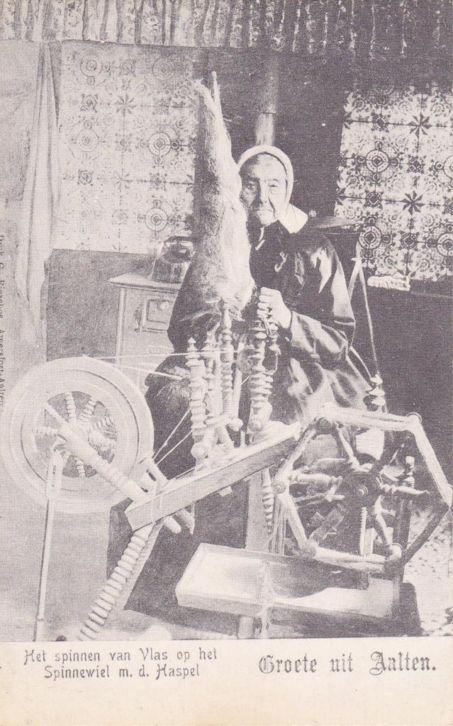
For centuries, flax was cultivated in the Achterhoek and the adjacent Westphalia region, from which linen was woven on farms. This cottage industry led to a lively cross-border trade in woven fabrics.
Numerous farm and street names in Aalten still recall this era, for example: de Weversborg, de Pellewever, de Bleeke, the Vlasspreideweg, and—due to the pure water—the Zilverbekendijk.
The arrival of the Driessens
Import duties on foreign fabrics were increased in 1823 to protect Dutch industry. German textile companies, including the firms Gebrüder Driessen and Peter Driessen & Sohn in Bocholt, moved to the Achterhoek. In 1826, they established themselves in Aalten.
With their arrival in 1826, 56 looms and approximately twenty families from Prussia also came to Aalten. Most of them settled here permanently.
Growth of employment
The number of domestic weavers grew steadily. While the number was 292 in 1828, it had risen to 352 a year later, and in 1833 it was reported: ‘The fustian factories continued strongly, with the factories in Aalten typically employing approximately 630 weavers according to records. Both in this and in the surrounding municipalities of Winterswijk, Dinxperlo, Varsseveld, Lichtenvoorde, etc.’
Spinning flax on the spinning wheel
The first factories
In 1829, there were two cotton mills in Aalten ‘which provide work for about 40 people’, including that of the Driessen brothers. In 1830, there were three, with approximately sixty employees.
On August 15, 1829, Jan Gerard Kraak ten Houten, ‘licensed shopkeeper and merchant in Aalten’, informed the Governor of Gelderland of his wish to establish ‘a fustian factory, spinning mill, dye works, and bleachery’ in his hometown, for which he requested permission. The municipal council had no objections to this establishment, ‘considering that the petitioner’s intention is only to have fustian manufactured by weavers at their homes, without erecting a spinning mill, bleachery, or dye works. This ensures sufficient work for the craftsman’, while no other interests are harmed. Ultimately, the King had to decide on the matter. Favorable advice was given by all advisors. It is not known how long this company existed or where it was located.
Sources
Geweven goed, the textile history of Aalten and Bredevoort H. de Beukelaer, J.G. ter Horst – Fagus, 1992
GROENLO — The Groenlo cantonal judge, Mr H. J. Steenbergen, was confronted yesterday afternoon with a modern-day Robin Hood. The youthful J. P. from Bredevoort had turned back the clock centuries and had gone hunting in Aalten armed with a bow and arrow. But since the days of Robin Hood have long since passed and legislation today is entirely different, he came into conflict with the hunting laws.
With this primitive weaponry, P. had terrorised a plot of woodland between the Walvoortweg, the Stationsstraat, and the Bredevoortsestraat. The forest is named Het Zwarte Woud (The Black Forest) — a name that fitted wonderfully with the adventurous atmosphere in which historians have shrouded the gallant followers of King Richard the Lionheart.
The Bredevoort archer had set his sights on creatures walking through life on two or four legs and on anything winged soaring through the air, but he went from hunter to hunted when the police caught him in their sights. It then appeared that P. was no true follower of the great hero from the exciting story. He dropped the bow and made off. However, he lacked the cunning and the speed of Robin Hood, who was always too slippery for his pursuers, and so P. — after handing his arrows to a friend — fell into the trap. His adventure was over.
P. looked at the cantonal judge sheepishly when the latter made him understand that he had made himself guilty of illegal hunting. That his game would have such far-reaching consequences and also financial repercussions took him by surprise. Somewhat crestfallen, he managed to blurt out that it was not hunting he was after, but purely the sport. The sensation that shooting with a bow and arrow provided him pushed the rules and regulations far into the background. “You did shoot at animals with it, though,” asked Mr Steenbergen. “Tried to, but I wasn’t very successful,” P. answered. He had bought the bow in Germany.
The cantonal judge had put the weapon to the test and had come to the conclusion that it was a dangerous piece of equipment. “The heavy arrows, tipped with a metal point, whizzed hard through the air,” he said. Mr Steenbergen also inquired why P. had run away. “Didn’t you feel very well?” he asked. “I don’t know,” P. stammered.
The public prosecutor, Mr J. Punt, was of the opinion that someone roaming the fields with such hunting gear is clearly hunting. He felt this deserved no encouragement, and in order to deter other Wilhelm Tell figures, he demanded a fine of 60 guilders or 6 days’ detention, and the forfeiture of the bow and arrows. The cantonal judge declared that P. would have acted more wisely by joining an archery association, and if such an opportunity had existed in Aalten, he would have been inclined to let P. keep the bow and arrow. However, that possibility does not exist, and therefore Mr Steenbergen deemed it necessary to confiscate the weapon. He sentenced P. to a fine of 30 guilders or 3 days.
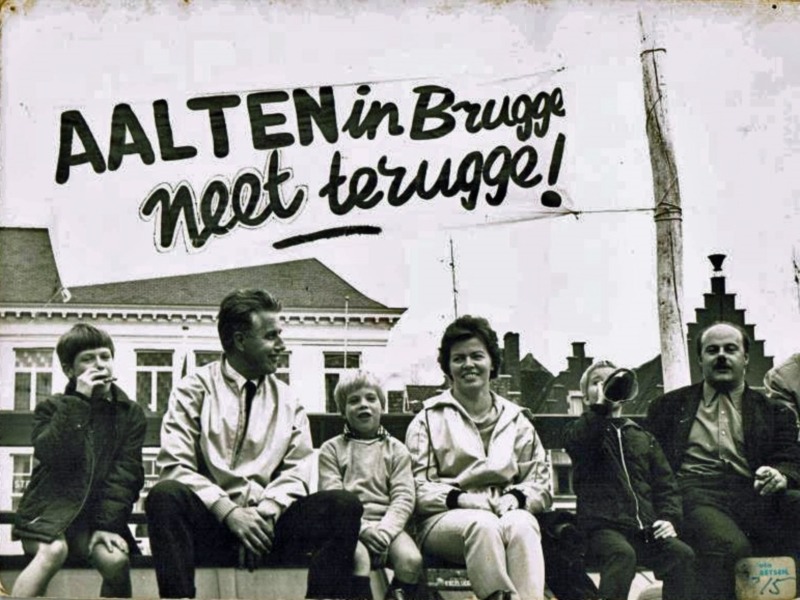
In 1968, Aalten put itself on the map by participating in the popular TV event ‘Zeskamp’ (Hexathlon). At the time, the municipality had approximately 12,000 inhabitants. The textile industry was in decline, and outside the built-up area, farming remained the primary way of life. During this period, Aalten was a pillarized village. However, Zeskamp appears to have brought about a turning point.
Zeskamp was a sporting event organized by the NCRV and the Belgian BRT, which they broadcast live on TV. At the time, it attracted millions of viewers, making it one of the most-watched TV programs. There were participants from six different locations: three from the Netherlands and three from Belgium.
Residents participated en masse and with great enthusiasm. People of various religious and ideological backgrounds worked together. For the first time, they truly met and got to know one another. In this way, imaginary walls were broken down.
The competitions were held on six Saturday evenings, each time in one of the participating locations. In Aalten, the Market Square served as the arena.
Ultimately, Aalten advanced to the final in Zutphen and won! The participants were honored with a parade through the village.
Demolition of buildings on the Market Square – New town hall and cultural center on the site of the old festival building.
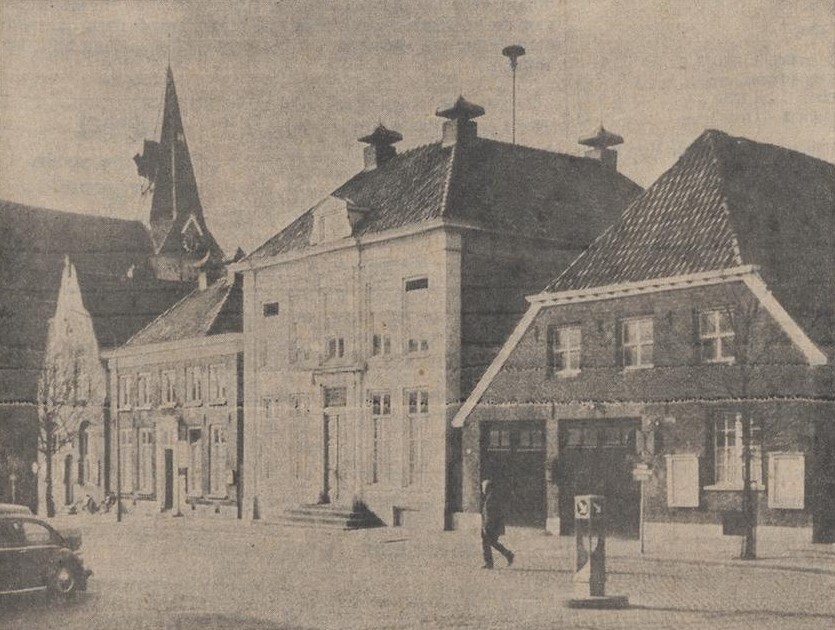
The municipality of Aalten has commissioned an ambitious structural plan that will give the Aalten village center a completely different appearance. According to this plan, several well-known buildings on the Market Square, including the old town hall (see photo), will have to disappear. In their place, a kiosk, bus station, and small shops will be established.
Aalten Market Square with the old town hall, 1967
The old festival building on the Pol will have to disappear according to the plan, and a modern new Town Hall and a Cultural Center are envisioned for this location.
Furthermore, new streets have been projected, which will require quite a few breakthroughs. Realizing all these plans will likely take several decades. But in any case, the residents of Aalten will then know what to expect.
It is sound policy to guide the future growth of the village in a timely, well-considered manner. One remaining question is whether the old Town Hall is actually allowed to be demolished; “Monumentenzorg” (Heritage Netherlands) might object.
The latest insights regarding the construction of a new post office point toward new construction on the site of the existing office. The grounds near the monastery, which were initially intended for this purpose, will soon serve as a parking lot.
Land is available north of the Ringweg for a general Christian hospital that may be assigned to Aalten. Expansion of the industrial estate is possible in a northerly direction up to the railway line, and finally, land is available near the Keizersbeek where farmers who are “displaced” by the land consolidation can settle.
The address books of the municipality of Aalten from 1934 and 1967 constitute a valuable source of information for historians and family researchers. These reference works contain an overview of all addresses and their residents in Aalten at the time, including Bredevoort and the surrounding rural districts.
1934 Address Book: Introduction of street names
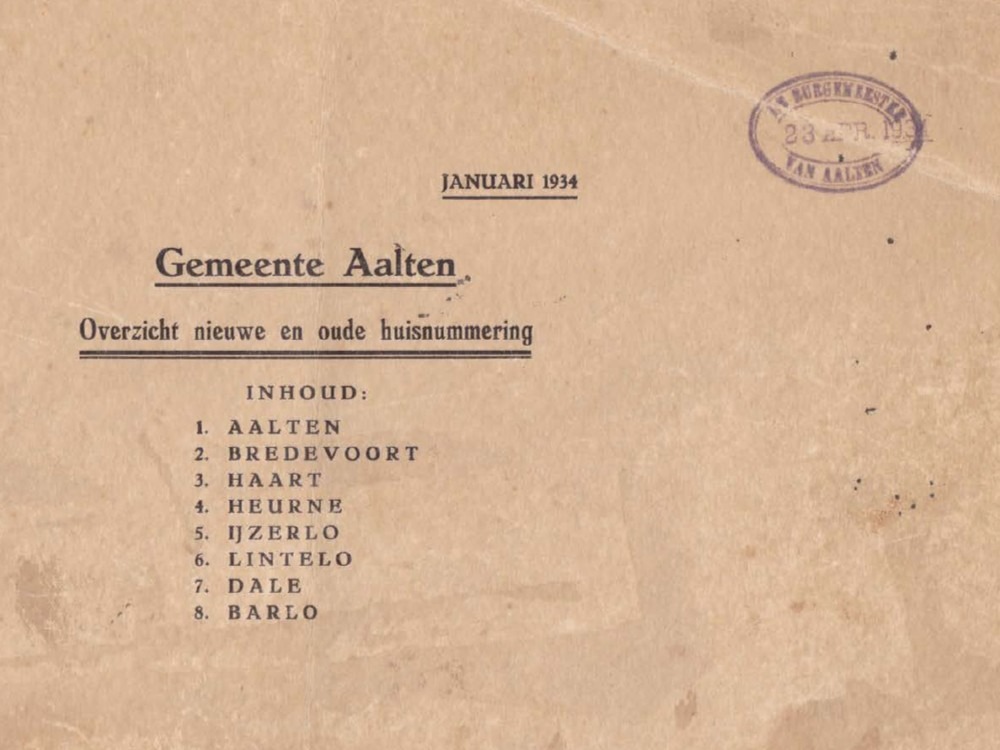
Address directory Aalten municipality, 1934
Until well into the 20th century, addresses in the municipality of Aalten consisted of the name of the village center or rural district, followed by a house number. As the number of dwellings increased, the house numbering changed several times over the years. In 1933, official street names and house numbers were established for the first time in the built-up areas of Aalten and Bredevoort.
To provide insight into these changes, a guide was published in January 1934 containing an overview of the new and old house numbering. House numbers in the rural districts were also adjusted once again.
1967 Address Book: Further changes and growth
In februari 1967 verscheen de zevende editie van het Adresboek der gemeente Aalten, uitgegeven door Aaltens Belang. Deze uitgave bevat een voorwoord, waarin onder andere valt te lezen:
“Since the 6th edition of our address book in December 1963, there have again been major migrations within this municipality, and the number of new streets has grown even further. Moreover, several streets have been completely renumbered. However, the most significant changes occurred in the rural districts. Until now, for example, we had numbers 1 through 162 in Barlo. Now the rural districts, just like the streets in the centers of Aalten and Bredevoort, have been numbered by road. In the future, this will of course be much easier, but it will take a generation before the new names and numbers are fully established. We have therefore also listed the old numbers behind the new ones.”
The 1967 address book is available as a PDF file and can be downloaded here:
Several address books were published in the period leading up to 1967, but unfortunately, we do not possess these editions. Do you have a copy of an older address book and would you allow us to scan it for our historical research? If so, please contact us!
It is truly no wonder that the explanatory memorandum accompanying the 1966 budget for the municipality of Aalten begins with the words: We are pleased to inform you… For not only is the budget for ordinary services balanced at an amount of nearly nine million guilders (including f 26,600 for unforeseen expenditures), there is also limited room for the execution of capital works. And that is a sound that not all municipalities can produce.
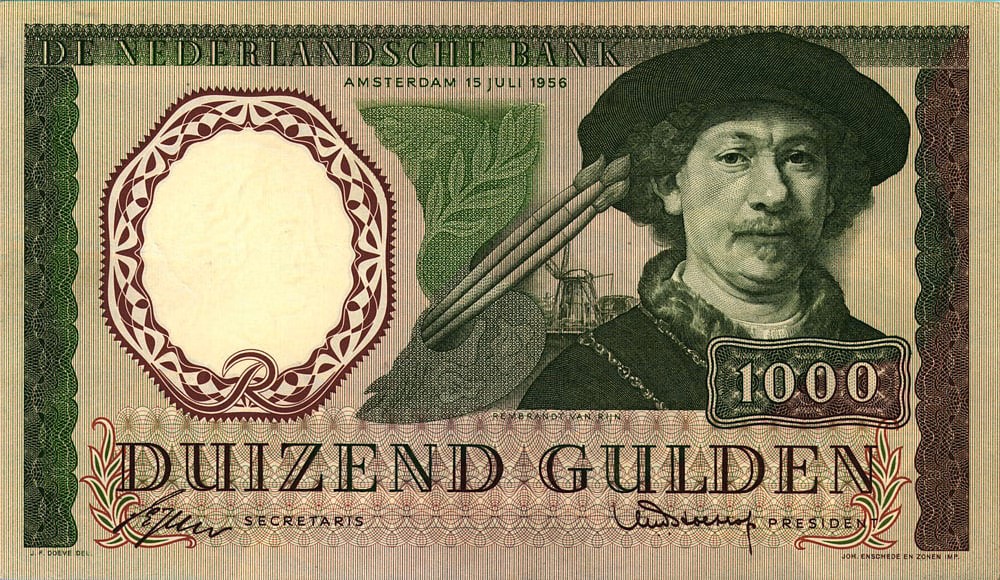
1000 guilder banknote, 1956 (for illustration)
For those capital works, apart from the sewage treatment plant and sewerage, the primary consideration is to resume the restoration of the streets in the old town center, with priority to be given specifically to the Prinsenstraat.
That is not to say that everything is coming up roses. Due to a shortage of land ready for construction, there is a threat of stagnation in housing development, while it is expected that the upcoming expansion of the treatment plant will place a heavy burden on the population, who will then likely see the sewage charges to be paid approximately doubled.
Expansive and Pluriform
The fact that the budget is balanced is partly due to a more adjusted allowance from the municipal fund regarding the social care component starting in 1966, as a result of which the general allowance from this fund, in addition to the general increase by raising the allowance percentage, could be estimated at around f 160,000 higher.
An amount of f 60,000 is available for interest and depreciation on new capital expenditures for 1966. This amount is too small to enable a smooth completion of many necessary works, while furthermore the “lending ceiling” established by the government acts as a hindrance. To this end, a multi-year plan was drawn up, in which the streets and roads requiring improvement in the coming years were included.
Regarding the acute shortage of building land, the Mayor and Aldermen state that preparations for making land ready for construction have already been made in various places, but that execution must still wait because agreement had not yet been reached with the owners regarding several plots. The acquisition of land through amicable means, according to the memorandum, is clearly becoming a problem in more and more municipalities, forming a serious stumbling block in the attempt to fully realize an “expansive and pluriform construction policy.”
One Each Year
The memorandum further speaks of the sporadic issuance of urgency declarations for the construction of new schools. The Mayor and Aldermen would consider themselves fortunate if one new school could be built each year over a series of years. They do, however, express their satisfaction that with the completion of the gymnasium at the ULO school and the already intensively used hall of the lower agricultural school, it will soon no longer be necessary to use other locations unsuitable for this purpose, once the municipal gymnasium on the Dalweg is also completed.
Satisfaction is further expressed regarding the administrative contact established between Winterswijk, Lichtenvoorde, Groenlo, Eibergen, Neede, and Aalten. Although there is only mention of contact and no formal body was created, this cooperation is also of value within the framework of broader regional bodies.
In Detail
To remain in style, after these more “general considerations” regarding the budget, we would like to proceed to the discussion of specific parts, without, as they say, being exhaustive.
Slaughterhouse: It is expected that, after the extensive renovation, this will be self-supporting due to the intensive use for export slaughtering.
Drinking Water Supply: Around April 1966, approximately 125 properties of the Heurne-IJzerlo plan will be connected to the water supply network. On the work program of the water company, 150 properties are estimated for Aalten in 1966.
Public Housing: Despite the fact that an average of 100 homes per year have been completed in recent years, the housing shortage is not being reduced. The construction of so-called Bogaers houses outside the quota is also hindered by the shortage of land ready for construction.
Slaughterhouse, Industriestraat
Ring Road: Specifications for the improvement are ready. It is possible that preparatory work, such as the felling of trees, can still take place this year. The road will be provided with a layer of asphalt over its full width, including the existing cycle path.
Kemena Expansion Plan: Waiting for necessary land purchases. For this, however, the approval of the partial expansion plan must first be awaited.
Paving of Dirt Roads: In 1935, 68.90 kilometers were paved, bringing the total of paved dirt roads from 49.430 km to 56.32 km. The paving of the Boshoeveweg and parts of the Kriegerdijk and Bodendijk is in preparation.
Education
Public Primary School Herenstraat
O.L. School Aalten: The possibilities for replacing existing old schools with new ones are so slim that there can be no question of replacing the school for the time being.
R.K. School Aalten: The original plan for the construction of an 8-classroom school has been changed to the construction of two 6-classroom schools. Final applications have not yet been submitted.
Groen van Prinsterer School: An urgency declaration for the construction of three classrooms has been obtained. The possibility of achieving a six-classroom school through industrial construction methods is being investigated.
Allowance per Pupil: This will be significantly increased for 1966, namely for the private G.L.O. f 70.- (f 64) per pupil, for the private ULO f 125.- (f 102), and for the private special L.O. f 135 (f 125) per pupil. The amounts stated in parentheses are those for 1965.
Recreation VVV
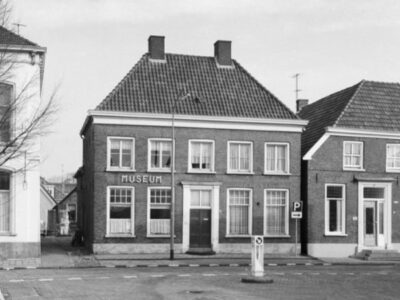
The ideal would be a new VVV office in the old building on the Markt, where the Local History Museum is already located. The collection would then be even better presented; perhaps this can be realized in the foreseeable future due to the departure of the current resident.
The establishment of a motel at the intersection of the Bredevoortseweg with the new Hamaland route would be appreciated. This would create an attractive recreation center between Aalten and Bredevoort, with the swimming pool, the municipal estate “‘t Walfort“, the summer cottage area, and the municipal campsite in the immediate vicinity.
Industry: Did not develop to the same extent in 1965 as in previous years. The number of male employees has hardly increased, which may partly be a result of the commute to Germany, which currently amounts to 70 men and 40 women from the municipality.
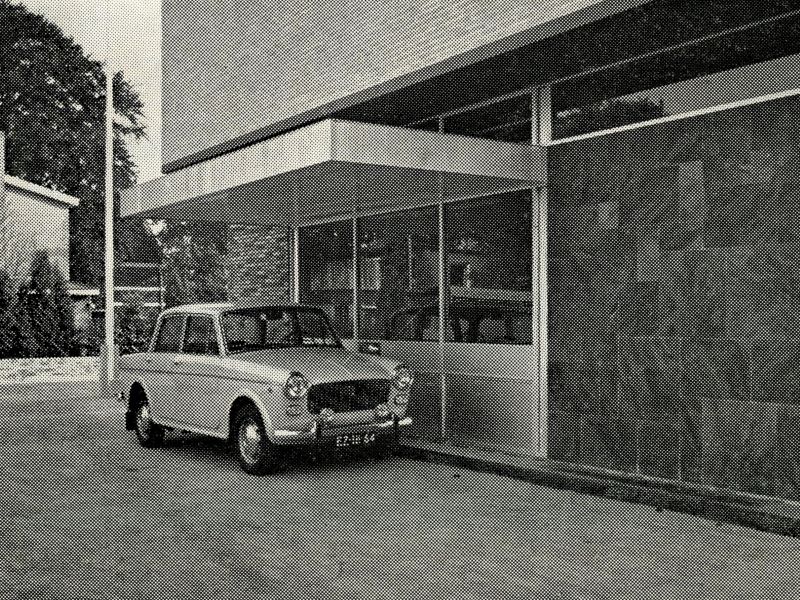
In 1965, Aalten enjoyed a national scoop. The Rabobank on Hofstraat opened that year and featured the very first drive-through counter in the Netherlands.
“That our bank knows how to keep up with the times is evident from this photograph, which depicts the modern, fully automatic outdoor counter—or, if you will, the drive-through counter.
This counter is located in the front façade under a canopy. Motorists no longer need to step out of their cars to come inside to settle their financial affairs. Sitting in their cars, they can handle their banking via a microphone and an ingenious switching system.
Here, it truly applies: one has the microphone, the other the steering wheel, and between them, the counter. This is how business is done at an outdoor counter. Naturally, non-motorists can also make use of this outdoor facility.”
Drive-through counter
From a conversation with former director J. Beun in April 2014, by Ina Brethouwer:
“Upon my arrival in 1959, the Coöperatieve Boerenleenbank was growing, but the Kerkstraat location was an old building. It either had to be renovated or replaced by a new building. There were plans for a merger with the Middenstandsbank, but we had to deal with two fierce opponents. Much attention was paid to these customers of the Middenstandsbank.
Behind the old bank, as seen from Kerkstraat, lay many small allotments. This is the land where the Rabobank on Hofstraat stands today. A long series of discussions with all the owners followed, and all the plots were bought up.
Developments continued, and construction of the new bank began in the early sixties. We could not find the specific flooring we wanted for the new building in the Netherlands, so we visited Germany several times. There, we repeatedly encountered the Autoschalter.
And so, Aalten secured the Dutch premiere of the Autoschalter, the outdoor counter for cars. You drove up in your car and were served via a drawer. You placed your items in the drawer, there was a speaker-and-microphone link, the drawer was pulled inside, and the requested items were then pushed back out to you.
The new bank building was constructed eight metres back from the road with a view to future expansion. During construction, provision was also made for a second automatic counter underground in the basement. However, that development did not proceed, not even in Germany, due to the advent of bank cards and other equipment.
The merger of the two Aalten banks went ahead. The new name became: Coöperatieve Aaltense Boerenleenbank Middenstandsbank. It all went well; it was a proportional distribution and never became a matter of prestige.”
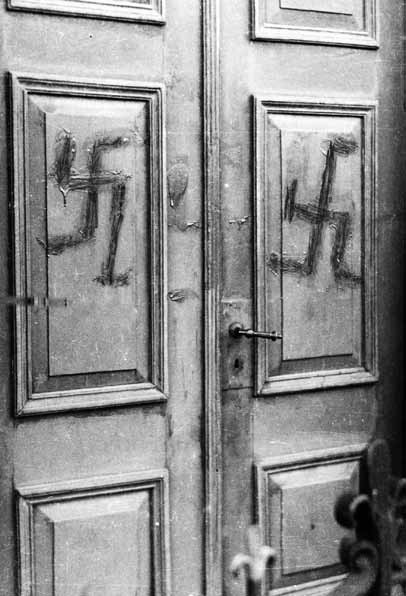
There is still a synagogue in Aalten. In recent weeks, one could read about it in both the national and international press. Seldom before can this Beth Haknesseth have been so much in the public eye. A procession of journalists has flocked to Aalten. “I can’t bear to see another journalist,” I noted from the lips of one of Aalten’s Jews. They travelled to Aalten because the synagogue has been defaced. It was but one incident among a multitude of anti-Semitic expressions reported in the Netherlands and abroad in recent weeks. One could have learned of those other incidents as well—though not in this publication. One simply cannot keep up with them all.
And not only that: anti-Semitism is not a question of us. It is a disease that proliferates and proliferates, usually in silence, occasionally openly. We ourselves are less upset as long as there is no survival involved, than the groups among whom the tumor rages. We ourselves have become more self-aware, more self-confident. On the one hand, it is because of the appalling that we had to go through only a generation ago — and what could happen to us even worse — because of the stimulating effect that the existence of the State of Israel exerts on us.
Synagogue in Aalten defaced
Perhaps these are the reasons that in Aalten there has been hardly any interest from our organizations — only Chief Rabbi E. Berlinger and the Permanent Committee showed their sympathy. The lack of interest on our part is in stark contrast to the dozens of letters that have been received from non-Jewish quarters. This can be read in one of the letters: “… Since the war, only since the war have many people, including myself, taken into account, not only what has been done to a part of our people in particular, without us having done or being able to do anything of significance against it (?)… And now this: what am I to do — how can we, non-Jewish fellow citizens, undo this insult, this terrible blow to the barely healed, so deeply damaged face. That’s the reason I have to write!!”.
In Aalten, people take note of the letters, of the verbal interest. Is it doing them good? Undeniably, it provides support. All the more fiercely one feels that there has been hardly any reaction from our side. What hardly causes a stir in the relatively large Jewish communities in the West, is still the talk of the town in Aalten. It is not surprising, the cold one is only small. What kind of support can one give each other? Not that there is fear, not at all. In Aalten, too, the defacing of the synagogue is considered an incident. But still…
Only nine families make up the chilly Aalten. Nine families with a total of 28 souls, seven of whom are children. They do not view the smearing of the shul, the destruction of the stones in the cemetery in Winterswijk with a shrug of the shoulders. Because there is a connection between one and the other. They are not unrelated facts. The police investigation has finally shown that those who caused destruction in the cemetery of Winterswijk are the same as those who smeared the synagogue in Aalten. It has been proven by comparison of the manuscripts and chemical investigations of the chalk that was used for chalking. But no matter how active the Aalten police are, there is no question yet that the active anti-Semites could be arrested.
Requirements only
There is another synagogue in Aalten. But shul services are held only sporadically on Shabbath. And only with shul services can one actively prove one’s Judaism in the small kehilloth . Until last year, the services still took place every Shabbath. But in the last five years, three shul visitors have died and some young people have left elsewhere. Only when these young people come over to Aalten is there sometimes a service on Shabbath. However, the synagogue is now only populated on Jamiem Towien.
The synagogue in Aalten, 1965
Nevertheless, Aalten still had its own chazan until 1948. He left for America. He was the last of the many excellent chazanim that this kehilla has known in its long history. Since his departure, one of the people from Aalten acted as Sjeliach Tsibboer. During the Jamiem Noraiem one of the young people comes from Amsterdam. It is no longer possible in Aalten to appoint his own chazan — apart from the question of where he should come from. The cold cannot pay his salary from the tax revenue.
“The Permanent Committee demands a share of this proceeds, the Arnhem district demands a share of the money. And people forget that we have to maintain our shul and that we have to take care of (our) large cemetery. Money is demanded of us, but what do we get in return? If we have a bar mitzvah, we have to beg for the arrival of a chazan. The bill will come later. If we need someone for a lewaje, the bill will be presented later: ƒ 0.25 per car kilometer, beyond the requirement that is not on the bill.”
Butcher knows better
There is another synagogue in Aalten. It is hardly used anymore. There is no more chazan. They have been to Aalten. Some were also mohel, most also sjocheet. This has sometimes led to skirmishes in Aalten. Because the four kosher butchers in pre-war Aalten did not agree with the shechete’s decisions. If the shochete said: the cow is treife, then the butchers knew better. The sjochetim then got all kinds of things thrown at their heads. One of them, Levi Gasan, small in stature and slender, was very afraid of the wrath of the butchers. When he found a cow treife, he quietly left the abattoir, ran the last few meters to the door and only then shouted: “The cow is treife!, because he expected to have a cleaver thrown at the head if he said it to the face of the butchers. His work plus the fear of life preservation was honored in those years with 1800 guilders a year. The respective chief rabbis did not exactly understand the butchers in Aalten either. Chief Rabbi Levisson in particular turned against them.
“The chief rabbis were authorities. If they held an inspection once every six months, people were nervous. They decided in more areas than they formally had to decide. They did not want butchers as parnassims. They kept an eye on the administrative decisions of the parnassim. They interfered with the salaries. And no one dared to contradict the chief rabbi”. Nevertheless, the Aalten parnassim often quarreled with the chief rabbi. They blamed them a lot. But these reproaches never reached the chief rabbi. He was back in Arnhem by then. On the heads of the chazanim the wrath of the parnassim was discharged. They received criticism in many areas: also that they did not provide sufficient education. It also happened because some church members had more knowledge than the chazan. Because there were many chewres in Aalten. They are no longer there. The children receive an hour of Jewish lessons every week. For youth meetings they have to travel to Winterswijk.
Things have sometimes been tough in Aalten. The taxes were low. Those who paid a dime more counted themselves among the prominent ones. Many rights were derived from that dime. In Shul people bid against each other to obtain a mitzvah. Partly because of this, the parnassim sometimes knew better what the income of the congregation members was than the inspector of taxes. Perhaps that is also why people were so committed to being elected parnas. The elections were in reality a get-together. But despite the battle for the kawod, there was great cohesion. The quarrel of one day was settled the next.
Quarrel
But there were frequent arguments. Because the Jewish community of Aalten consisted largely of cattle shochriem. On Friday evenings they quarreled with each other in shul because one had bought a cow from a farmer that had been promised to the other. On Shabbath morning, the quarrel was settled in shul. On Shabbath afternoon they visited each other, also to hear each other out. Shabbath evening people wished each other “gut woch”.
Aalten, which had eighty Jewish souls before the war and one hundred and forty souls shortly before the war; of whom many German refugees, was always a pious cold. “On Shabbath, all Jewish businesses were closed here. No Jew worked. That would not have been possible. The population had not taken that. It once happened that a Jewish representative of a Jewish firm from Amsterdam visited a shopkeeper on Shabbath in Aalten. He was thrown out of the store and his monster suitcase was thrown after him. “On Shabbath there is no Jew in my house,” he was shouted at. There is still a synagogue in Aalten…
M. KOPUIT
This article was written with the help of Mr. J. Weyel and Mr. S.I. de Haas of Aalten.
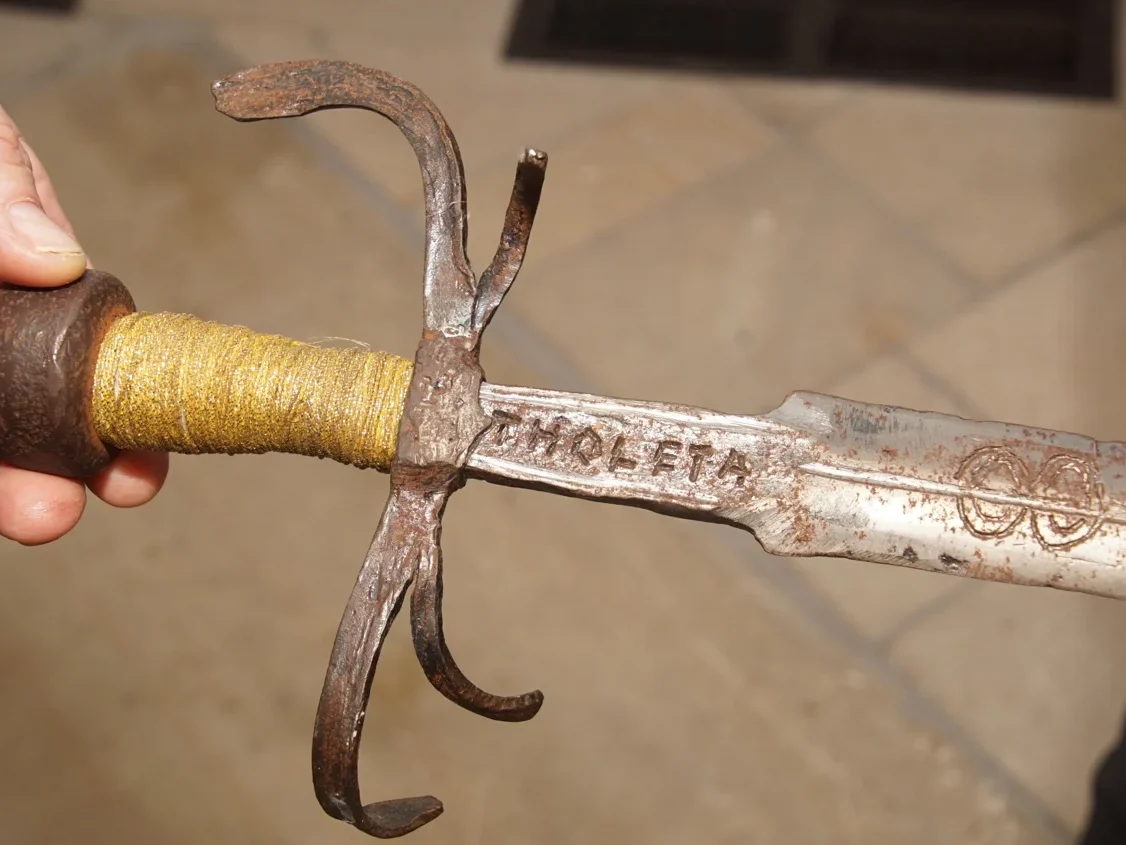
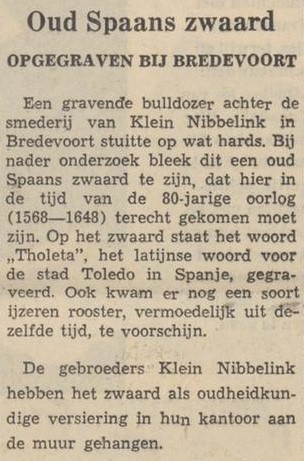
In 1964, during excavation work for the construction of a new workshop on the premises of the Klein Nibbelink smithy, various items were discovered, including remnants of walls, moat fill, wooden posts, and an iron fire grate. However, the most impressive find was a Spanish sword from the Eighty Years’ War, bearing the inscription ‘Tholeta’, the Latin name for the city of Toledo in Spain.
Johan Klein Nibbelink currently has the sword in his possession and tells about it in the video below.
Nieuwe Winterswijksche Courant, 12 October 1964
Sources
Nieuwe Winterswijksche Courant, 12 October 1964 (Delpher)
Deze website gebruikt cookies voor een optimale ervaring en analyse van bezoekgegevens. Ga je hiermee akkoord? Zonder toestemming werken sommige onderdelen van de site mogelijk minder goed.
Functioneel
Always active
De technische opslag of toegang is strikt noodzakelijk voor het legitieme doel het gebruik mogelijk te maken van een specifieke dienst waarom de abonnee of gebruiker uitdrukkelijk heeft gevraagd, of met als enig doel de uitvoering van de transmissie van een communicatie over een elektronisch communicatienetwerk.
Voorkeuren
De technische opslag of toegang is noodzakelijk voor het legitieme doel voorkeuren op te slaan die niet door de abonnee of gebruiker zijn aangevraagd.
Statistieken
De technische opslag of toegang die uitsluitend voor statistische doeleinden wordt gebruikt.De technische opslag of toegang die uitsluitend wordt gebruikt voor anonieme statistische doeleinden. Zonder dagvaarding, vrijwillige naleving door je Internet Service Provider, of aanvullende gegevens van een derde partij, kan informatie die alleen voor dit doel wordt opgeslagen of opgehaald gewoonlijk niet worden gebruikt om je te identificeren.
Marketing
De technische opslag of toegang is nodig om gebruikersprofielen op te stellen voor het verzenden van reclame, of om de gebruiker op een site of over verschillende sites te volgen voor soortgelijke marketingdoeleinden.