German workers received a pound of coffee for Christmas; Dutch staff later received a rixdollar…
While one of the German girls employed at a textile factory in Aalten was recently the cause of a sensational incident (she defaced the Dutch flag with a swastika), German textile workers in Aalten have once again been the catalyst for an event that has caused quite a stir in the quiet village, as two textile factories were involved.
Sixteen German girls are employed at a textile factory in Dijkstraat. As Christmas approached, they began to ponder a surprise they could provide for their relatives across the border. It had to be coffee, was the general opinion!
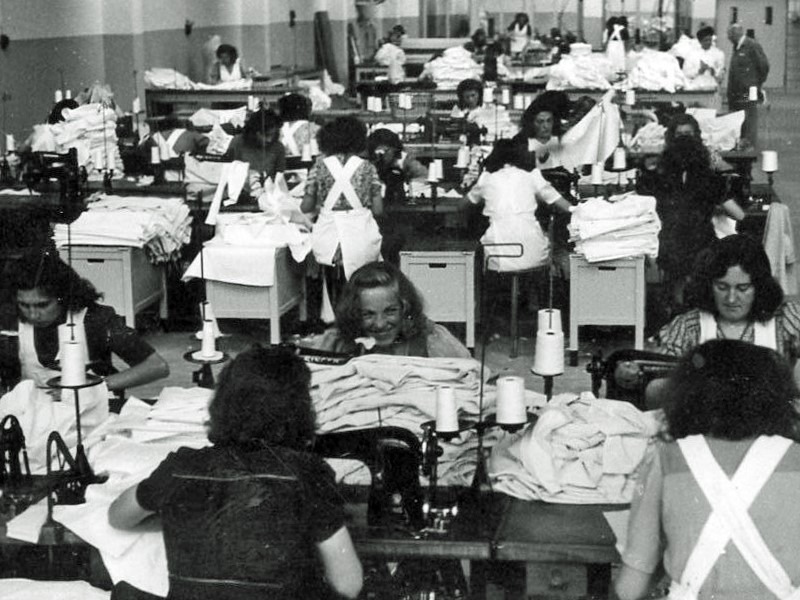
Girls at work at the Driessen textile factory, Hofstraat. Photo for illustrative purposes.
The German girls enlisted the help of a staff member from Aalten, who knew just how to manage it. He, in turn, went to a businessman who proved able and willing to supply 16 pounds of coffee—one pound for each of the German girls. That evening, the girls cheerfully headed home by bus with their coffee. However, on that same bus were 19 female workers from a textile factory in Hofstraat.
Understandably, they were none too pleased that their friends could take coffee home for “Weihnachten” while they could not. The matter was promptly raised the following day with the management in Hofstraat. They felt they could do little else but promise each of their German workers a pound of coffee as well. And the 19 pounds of coffee indeed materialised.
But the difficulties did not end there! The Dutch staff had caught wind of the Christmas gift and now began to demand coffee too. After all, coffee is an item that has been very scarce in this country of late. The management of the Hofstraat factory restored industrial peace by giving every staff member a bonus of ƒ2.50. With that, the whole matter seemed to be settled.
However, with so many people involved, it was almost inevitable that the police and the C.C.D. (Central Investigation Service) would hear of the case. The latter has since launched an investigation, which has already led to an official report (proces-verbaal) being filed against the management of the textile factory in Hofstraat. A second report followed for the granting of a bonus without the permission of the Board of Government Mediators. An official report has also been filed against the shopkeeper involved.
We understand that the reason the German girls were able to export the coffee is that the Dutch customs, contrary to standing orders, allowed the coffee to pass; it was apparently assumed that it could be exported freely as long as its value was below ƒ15. The German customs had already promised the German girls that they would make an exception in view of the approaching Christmas holiday.
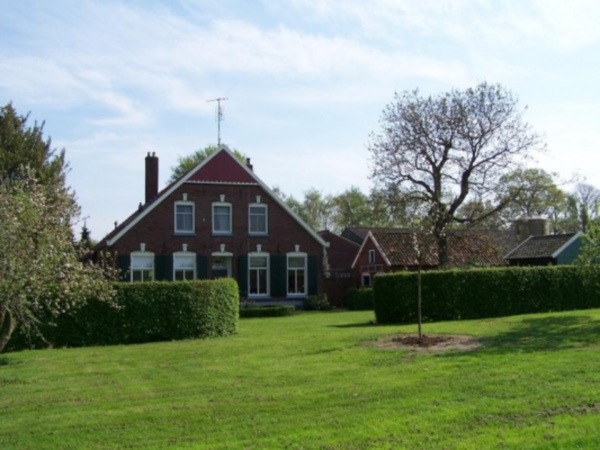
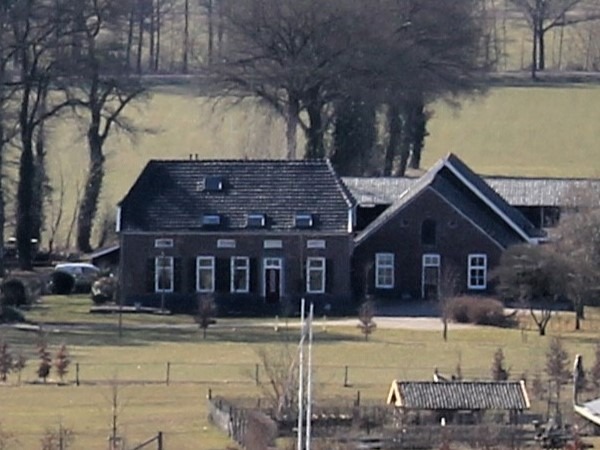
It was 1949 and the Scholten family, consisting of father Hendrik Willem Scholten, mother Grada Everdina Scholten-Kemink and their twelve (!) children, lived on “Lankhof” farm in Barlo. Of the twelve children, seven boys and five girls, the eldest was 22 and the youngest 7 years old.
Son Roelof, born in 1940, recalled in a 2015 interview the nervousness that prevailed in the family during World War II. It was a very dangerous time. They also hid people in the attic. The Germans often came to check if they could find anyone. When bombs fell at night, they all went to the air-raid shelter and protected themselves as best they could.
After the war, the Scholten couple felt the desire to seek their fortune in Canada, not primarily for their own future, but especially for that of their children. A major reason was the population growth in the Netherlands; the country was becoming full!
In the Achterhoek, too, almost all available land had already been brought into cultivation. While it was customary for the eldest son to take over his father’s farm, the other sons were unable to start their own businesses due to a lack of agricultural land. If they wanted to spread their wings, they had to seek their fortune elsewhere.
In 1949, the Scholten family decided to take the plunge and emigrate to Canada. Hendrik Willem leased out the business in Barlo, because you never knew. In case they became homesick, it was good not to burn all their bridges behind them.
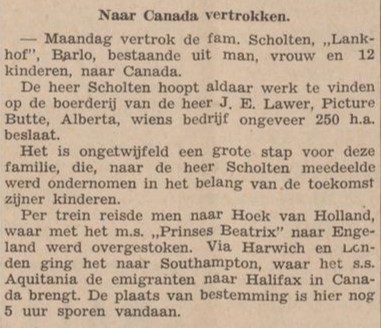
Aaltensche Courant, 11 March 1949Lankhof farm in Barlo
The long journey
In the night from Sunday to Monday, March 7, 1949, the Scholten couple departed from Barlo with twelve children by train to Rotterdam. It was the first part of the long journey they still had ahead of them. For the move, they took an army truck and a trailer. On it were three wooden containers with their remaining possessions.
During the course of the morning, they embarked on the “Prinses Beatrix”, the ferry to Harwich. They were part of a group of 220 people from all parts of the country. They were mainly farmers with their families, who were going to start a new life on the other side of the Atlantic Ocean.
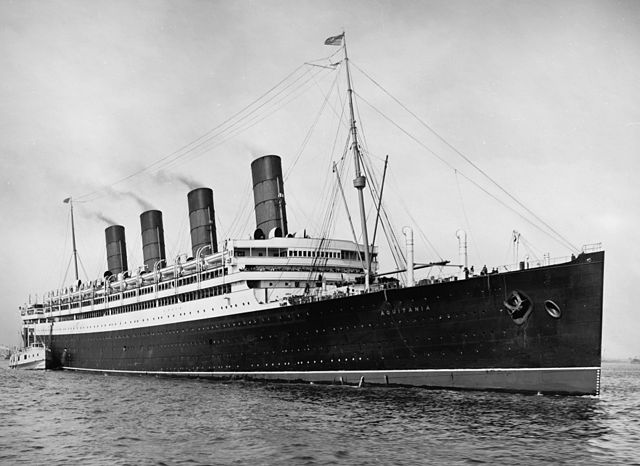
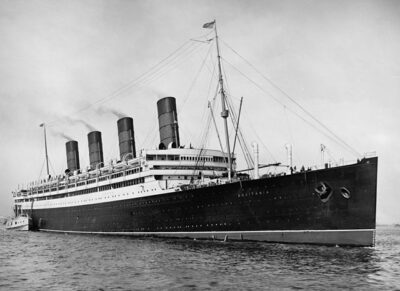
RMS Aquitania
From Harwich, they traveled further by train to London, where the enterprising group stayed overnight. Then they went by ship to Southampton to transfer there to the “Aquitania”, a large passenger ship of the Cunard White Star Line.
The “Aquitania” was a 46,000-ton ship and was, after the “Queen ships”, also of the Cunard White Star Line, the largest ship in the world. It could carry 1,500 passengers and the crossing to Halifax in Canada took about six days. It was the only steamship in the world with four funnels. A minor detail? Certainly not! There was a time when emigrants insisted on sailing on ships with many funnels. Some travel agencies showed prospective travelers photos where an extra funnel had been added to a ship… The more funnels, the greater the safety, believed the inexperienced emigrants.
In any case, the 220 Dutch people in tourist class, with small dormitories for six to twelve people, would have a decent crossing. From Halifax, the Scholten family would then have to spend another five days on the train to reach their destination via Medicine Hat and Lethbridge: the town of Picture Butte in the Canadian province of Alberta.
Destination reached
The Scholten family arrived in Picture Butte by train on March 18. It was very cold. Upon arrival, it seemed as if all 500 residents of the town were present. Perhaps they thought World War III was starting when an army truck rolled out of the train car. They settled in two barracks just north of Picture Butte, on the farm of J.E. Lawlor.
The conditions in those barracks were not ideal. It was just as cold inside as it was outside. Father and mother slept in one of the barracks, which also contained the kitchen. The children all slept in the other barrack. Father placed double beds on top of each other with about 60 centimeters between them. The girls slept on one side and the boys on the other. There was a dressing area at the front.
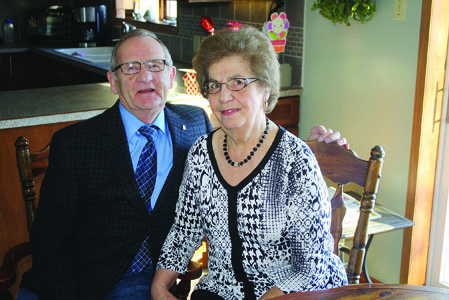
Roelof & Diny Scholten, 2016
In the beginning, it was difficult. The wage was about $0.25 per hour. Father and mother worried a lot in those years about how they could buy enough food for the family. Although the local supermarkets, Woodruff and Stella-Lacey, were very helpful. They could buy on credit there and sometimes they even received something for free. But in the winter, there was very little work. The boys went to Burmis and worked there at the lumber yard. Even though they earned hardly any money, they at least had a place to stay, clothing, and food.
About three years after arriving in Canada, the Scholten family moved to another farm, just east of Picture Butte. They stayed there for a year and grew beets. Then, in 1953, Hendrik Willem bought a farm about seven kilometers from Picture Butte, with about 130 hectares of land. Roelof went to school in Picture Butte and also helped his father on the farm. Some of his brothers also became farmers, and some chose other professions. Two became teachers and moved to another part of Alberta. Roelof remained on his parents’ farm and helped his father with the farming work.
During his visit to East Gelderland next week, Prince Bernhard will also visit the old fortress of Bredevoort. Bredevoort has been a pledged city of the House of Orange since Frederick Henry conquered it for the States, and the current members of the House of Orange still hold the title of Lord of Bredevoort. In connection with this, we recently visited Bredevoort, where we had an interview with one of the local historians, who shared interesting details about the past of this ancient town.
Little is known about the earliest history of Bredevoort. It was traditionally a possession of the Lords of Anholt. It is likely that a church was established around the 14th century near the castle, which probably dated back to much earlier times. The region was impoverished, which was hardly surprising, as bands of wandering soldiers regularly moved back and forth robbing and plundering, with the defenseless rural inhabitants suffering the most. During the Eighty Years’ War, before the Twelve Years’ Truce, it even occurred that the residents of Winterswijk had to seek safety within the walls of Bredevoort.
The conquest by Prince Maurice
In 1598, Prince Maurice laid siege to Bredevoort and captured it after a siege; however, Bredevoort paid a heavy price for its newly acquired freedom, as the entire town burned down, with the exception of the Castle, which stood on the site where the Dutch Reformed school is now located. To replace the Church, which also burned down completely at that time, the Church that still stands in Bredevoort today was built. A unique feature of this Church is that the tower, unlike those of other churches, was not built next to the Church but on top of it, resting entirely on an oak base. During the upcoming church restoration, this will be replaced with concrete. The historical value of this Church is also evident from the fact that it is listed as a national monument, meaning this institution will also contribute to the restoration costs.
Around 1600, Bredevoort changed hands again as the Spaniards retook possession of the fortress. To them, Bredevoort was nothing more than a den of thieves from which they terrorized the region. This situation lasted until 1627, when the States commissioned Frederick Henry to reconquer Bredevoort. He performed his task in such a manner that the States, in appreciation of his services, granted him the Seigniory of Bredevoort as private property. From that time on, the House of Orange has always held the title of Lord of Bredevoort.
This also explains why East Gelderland, specifically Winterswijk, Aalten, and Dinxperlo, extends so far into Germany. This entire area belonged to the Seigniory of Bredevoort and thus came into the possession of the House of Orange, and consequently the Netherlands, with the conquest of Bredevoort.
One might wonder why Frederick Henry did not also conquer Anholt, which was also connected to Bredevoort, but the explanation lies in the fact that the Lords of Anholt were related to the House of Orange, and he likely spared them for that reason.
Seigniorial rights
Through the possession of Bredevoort, the House of Orange acquired Seigniorial Rights here, such as the milling right. This meant that within the Seigniory of Bredevoort, milling was only permitted at the mill in Bredevoort, the watermill at De Pol in Aalten, and the watermill near Den Helder in Winterswijk. Regarding the milling right, it is known that in 1868, an official lease agreement signed by Frederick himself was still in the possession of the Heusinkveld family in Bredevoort, granting them the right to lease the mill in Bredevoort from generation to generation. It is a pity that this lease agreement has been lost.
Naturally, other members of the House of Orange were also Lords of Bredevoort. Well-known stewards came from the Roelvink family, which is still known today, and some of its members later served as Mayor of Aalten.
William V in Bredevoort
It is known that Stadtholder William V also once visited Bredevoort. The minutes of the Dutch Reformed Church mention that he donated several Golden Riders for the poor of Bredevoort.
The French Period
During the French period, everything belonging to the Seigniory was sold. Large-scale landownership, as it is still known today around Winterswijk, dates from that time. Entire areas were then sold for sometimes only a few guilders. Some of the new owners found themselves in difficulty with their newly acquired property because they were unable to cultivate everything, so they planted forests instead; thus, large areas of forest near Winterswijk date from that time, which is consistent with the fact that most of the Winterswijk forest is approximately 150 years old. After the French period, the House of Orange never regained these lands, so they have only held the title since then.
The House of Orange does not appear to have made any official visits to Bredevoort since that time, likely because Bredevoort is relatively poor in historical buildings and institutions. However, that the ties were never completely severed was evident in 1900 when H.M. Queen Wilhelmina made ƒ 100 available for the restoration of the Church in Bredevoort.
H.R.H. Prince Bernhard in East Gelderland
Yesterday, the final day of H.R.H. Prince Bernhard’s visit to East Gelderland flew by once again as the Prince’s open Cadillac traveled under the radiant summer sun through one of the most scenic parts of our country, past ripening grain, busy farmers, cheering and singing schoolchildren, and an enthusiastic population; once again, the Wilhelmus sounded many times, and the Prince raised his hand in greeting countless times with a charming smile on his tanned face; once again, it became a true triumphal procession.
On this third day, H.R.H. departed from Ruurlo, arriving in Zieuwent around a quarter to nine at the farmhouse of farmer Weelink, which dates from 1737. After the Prince had briefly toured the farm, he proceeded at pace to Harreveld, where a group of young people waited in suspense at the Roman Catholic Reformatory; surrounded by hundreds of pupils from the Reformatory, H.R.H. was received and addressed by the chairman of the Reformatory board.
Lichtenvoorde prepared a grand welcome for H.R.H.; many thousands, again adorned with the national colors, saw the procession arrive in the thousand-year-old town, preceded by ten motorcyclists from the local Motor Club. The Prince stepped out in front of the Roman Catholic rectory. Inside the rectory, the Prince listened for about fifteen minutes to the Pastor-Dean of Groenlo, who gave a presentation on Roman Catholic spiritual life in East Gelderland.
Preceded once again by the Lichtenvoorde motorcyclists, the procession left the old town. At the border of the municipality of Aalten, Mayor E. S. van Veen took a seat beside the Prince, and they proceeded to Bredevoort, the old pledged city of the House of Orange; the Prince stopped here for only a few moments, where he spoke briefly with baker Helmink.
Two cousins meet on the boat after not having seen each other for 13 years
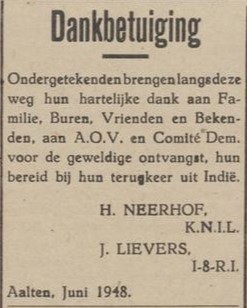
Great joy prevailed on Wednesday in the Neerhof and Lievers families when their sons returned home safe and healthy after 13 and 2½ years of service in the Far East, respectively. Maypoles and greenery, waving flags—everything pointed to a joyful return. We had the pleasure of hearing some details from both young men.
Henk Neerhof
First, we hear from Private H. Neerhof, K.N.I.L. We found Henk surrounded by family members and friends, and upon our request to tell us something about his experiences, we were told the following:
„After my training in Nijmegen, I left for the Indies in August 1935, destined for Bandoeng. Until the Japanese invasion, I was always stationed here in garrison. After a hard struggle, I was taken prisoner of war along with many others and transferred to the well-known penal camp at Tjilatjap. Here we got to know the Japanese as a cringing, submissive people, brutal and sadistic in their actions, but also deathly afraid of their superiors.
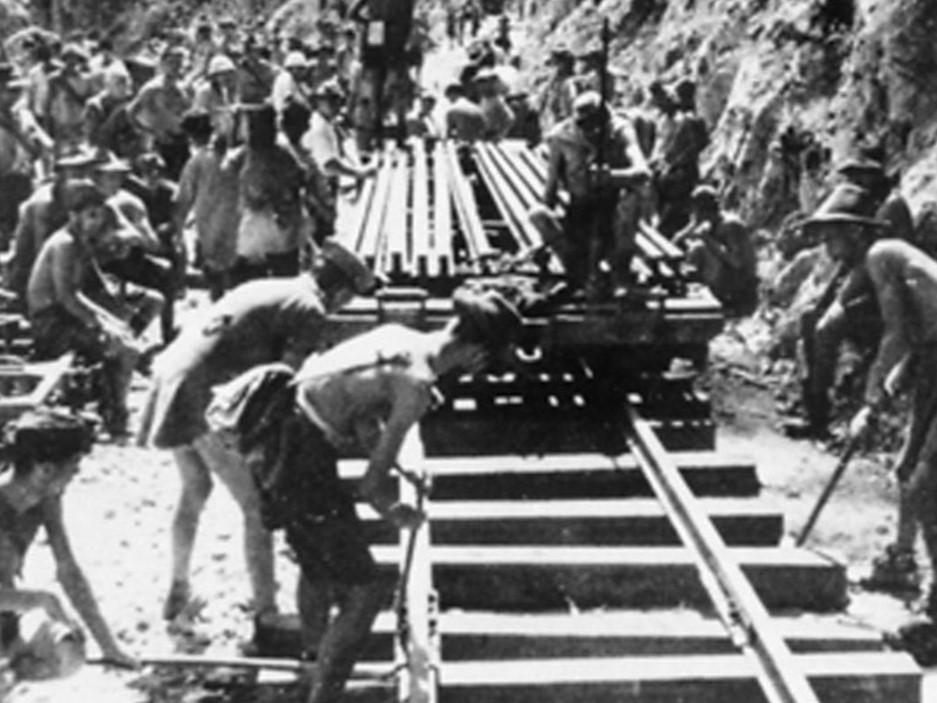
After this time in the camp, we were transferred to Thailand and here the path of suffering began: working on the ‘death line’, the Burma Railway, which lasted 1½ years. From here I was taken to Japan, where I spent two years as a miner in the coal mines on the island of Kyushu. It is easy to understand that this time was also far from rosy.
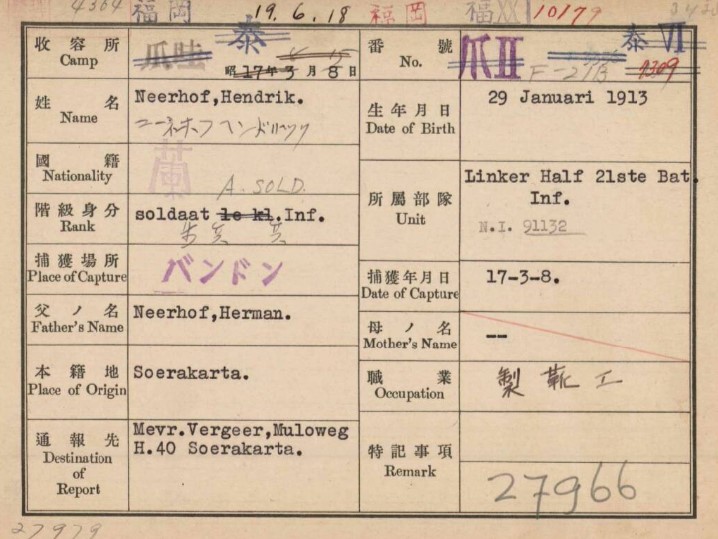
Japanese internment card Hendrik Neerhof, source: National Archive
There I finally experienced the liberation in 1945, a liberation I will never forget. It was the Americans who delivered us from all that misery. With our exhausted bodies, we jumped and danced. Americans, great guys! It was simply exhilarating.
KNIL soldiers working on the Burma Railway
Everyone was transferred to Nagasaki on an American aircraft carrier, the city that had been hit by the atomic bomb some time before. The effect of this was terrible; everything had virtually disappeared, it was a scorched remnant of a city, covered with a thick layer of ash. From here I was finally dispatched to Balikpapan, where I had a good time. Here I was incorporated into a normal company again.
And now I am home again, with six months’ leave. I felt really strange towards everything here; it is so small and narrow-minded, you really have to get used to it again. I am happy to be home. The festive reception, everything decorated, and a serenade from the A.O.V.—it was wonderful.”
Finally, Henk mentioned that he will return to the Indies again. We wish him a very pleasant leave and, for later, a good voyage and a safe arrival in the Indies.
Jan Lievers
As the second returnee from the Indies, we were able to greet Private 1st Class Jan Lievers. Jan left for the Indies as a volunteer in October 1945 and was assigned to I-8-R.I. After training in Ermelo, Jan ended up in Malacca via England, as the first Dutch troops were not yet allowed to set foot on Indonesian soil. Stationed in an old rubber plantation at Lubok Kiab, he underwent heavy jungle training.
At the end of February 1946, they set foot ashore at Batavia, the first Dutch brigade to arrive in the Indies. After serving in and around Batavia, he participated in the police action from Padang.
Jan was able to tell us much about the beauty and splendor of our Indies; that alone would be enough to fill a book. He had a lot of contact with the native population, who were generally very well-disposed towards our boys. „I consider it a privilege that I was able to experience all this,” Jan said, „I will always have pleasant memories of my time in service.”
Aaltensche Courant, 11 June 1948
Besides the joyful entry into Aalten, Jan was especially struck by the extraordinary reception given to the returning soldiers in IJmuiden and Amsterdam. Thousands of people were out on the streets; it was grand. „I am, of course, very happy to be home again; it is now a matter of getting back to work as soon as possible.” We also wish Jan all the best and much happiness in the future.
Return from the East
De Graafschapper, 5 July 1948
On Saturday, our fellow townsmen, the volunteers Stronks (Haart 10) and Weevers (1st Broekdijk), returned from the Indies. Mr. Neerhof (Trompstraat) also returned. He stayed in the tropics for 13 years. Upon his return, the A.O.V. performed a serenade. We hope to return to this in more detail in tomorrow’s edition.
Home again after 13 years
De Graafschapper, 6 July 1948
In 1935, the brothers H. and J.H. Neerhof left for the Indies as members of the KNIL. Now, after 13 years, both have returned home safely. Because of this special event, we paid them a visit to congratulate them on their safe return. It appeared that both had led a quiet and good life until 1942.
When the war broke out, both were taken prisoner of war. Both ended up at the so-called Death Railway, the railway line from Thailand to Indo-China. One on one side and the other on the other side. However, they never had the opportunity to speak to each other there. J.H. Neerhof then went to Indo-China, where he remained until the end of the war. He was full of praise for the treatment he received from the French there.
H. Neerhof was transferred from Thailand to Japan, where he went to work in the coal mines of Kyushu. After the capitulation, he was transferred via Nagasaki—where he saw the destruction caused by the atomic bomb—to the Philippines. In Manila, he spent 2 months in quarantine with the Americans. After that, he returned to the Indies, where his brother had also returned in the meantime.
On April 23, they met again in Batavia for the first time in 13 years. About 6 weeks ago, H. Neerhof came home, and on Saturday, J.H. Neerhof arrived. Both stated they were very moved by the homecoming prepared for them here. A fantastic homecoming, as they stated several times.
The Exodus of Dutch emigrants to Canada does not seem to be coming to an end for the time being. All these people are here squeezed out of their narrow boundaries and swallowed up by the great country on the other side of the ocean, with its enormous surface area, for whom this population growth is no more than a drop in a bucket.
It is a strong belief in a good future and an indestructible enthusiasm for Canada with its enormous opportunities that stimulates the departure of these Dutch farmers. But it is also the spirit of their forefathers, the pioneers of the East and the West, that lives on in these tough workers of polder land and field and in which the true tractor’s blood of the Dutchman does not deny itself.
Saying goodbye
Every time a ship with emigrants leaves and we witness this departure, we are reminded of the well-known saying: “To say goodbye is to die a little.” Because for most of these emigrants, this departure means a forever farewell to the country where they once stood. And since it is not the worst part of our people that emirates, the departure is felt as a loss.
A lot of heart-touching scenes often take place here. Weeping mothers who can only tear themselves away from their sons with difficulty when they have to embark, but also fathers who say goodbye to their children with tears in their eyes, while the other family members usually have difficulty controlling themselves. This is not an exaggerated sentimentality. Rather, it is a demonstration of affection that leaves nothing to be desired in terms of authenticity.
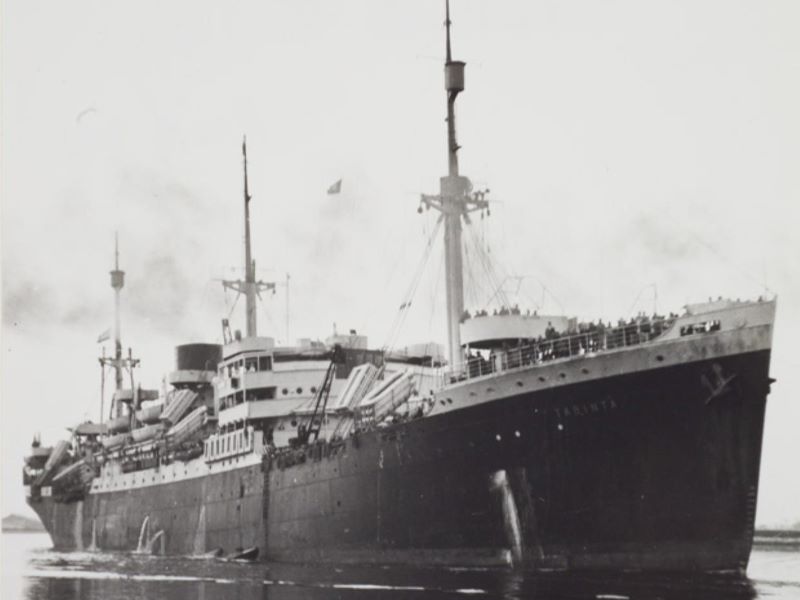
This time it is the “Tabinta” of the Mij. The Netherlands, which will bring a large contingent of emigrants to Canada. It is the second departure in a month to Canada, proof that progress is starting to be made in the implementation of the emigration plans. This year they hope to bring 10,000 people to Canada with the “Kota Inten” and the “Tabinta” and next year they even want to double this number.
Emigrant ship ‘Tabinta’
Today is a particularly beautiful day for sailing. The emigrants have come to Rotterdam from all parts of the country and the Achterhoek is also represented.
People
Hendrik Winkelhorst from Aalten wants to take the big step and look for a livelihood in Canada. His wife Grada goes with him, of course, as do the three children: Willemien, Arie and Wim. Their destination is Ontario and they arrive at a mixed farm of 50 hectares. Hendrik has abandoned his brother, where he has been working as a driver lately, and he hopes to exchange his car for a tractor there. Here in Holland it became too scary for him. Too much bureaucracy. Things will get better in Canada, he believes. He will write to his family members when things are going well for him, but also when things are going badly for him. However, he is in good spirits. What others succeed in, he will also succeed.
The 22-year-old Albert te Winkel from Barlo meets us with a cheerful smile. He is not the least impressed by this departure. The Oosterink farm in Barlo will now have to do without him. He worked there for no less than 41/2 years. So he knows how to get things done, by the way he is one of ten at home and then you learn that early on, he says. He does not yet know at which farmer he will be put to work there. He does know the destination and that is West Meath, in Ontario. He also tells us that he will look for a wife in Canada. He thinks there are enough of them there. We wish him every success with this.
De Graafschapper, 9 April 1948
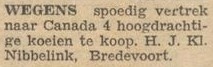
Blacksmith Klein Nibbelink from Bredevoort abandoned his forge today – to escort his son Hendrik out. Hendrik is already on the ship, but his father tells us that Hendrik is 24 years old and had his own company in Bredevoort. Henry saw little future here, but hopes to find it in Duchess in Alberta. Hendrik is not married yet, so he only has to take care of himself. Father Nibbelink believes that he will succeed.
Jan Hendrik Geurkink of the Krosenbrink in Miste, is the Benjamin of the Achterhoekers. He is only 18 years old, has worked at home on the farm and attended agricultural school. It is getting too stuffy for him here and although he is still very young, he wants to try it in Canada. His sister is not so sure that this will work, but in this case he can always come back, she says. Moreover, Jan Geurkink comes to the same farm as Hendrik Klein Nibbelink. There is plenty of work for both of them, because it is a mixed farm of 285 hectares.
There is also a person in hiding from Aalten on the boat. It is Maarten Schinkelshoek from Rotterdam, who had been in hiding in Aalten for a long time on the farm of the Wed. Luiten, “‘t Olde Mulder“. He learned a lot there and wants to put that into practice in Canada. He has already made friends with the other boys from Aalten. The three of them get along quite well.
Farewell!!
Around 5 o’clock the “Tabinta” blows its steam whistle for the third time. This is the signal to leave. When the ship detaches itself from the quay, the Wilhelmus is played. As always, a solemn and moving moment, which the emigrants will not easily forget. Slowly the distance between the ship and the people left behind increases, until it disappears from sight forever. There they go, into the distances unknown to them. Our best wishes accompany them in this.
Our region has once again paid its toll on emigration. Several other Achterhoekers left for Canada with the Tabinta, but it was not possible for us to have a personal interview with all of them, nor did we have the names of all the Achterhoek emigrants at our disposal.
Do you have interesting stories about family members who emigrated from Aalten to Canada? Send us a message!
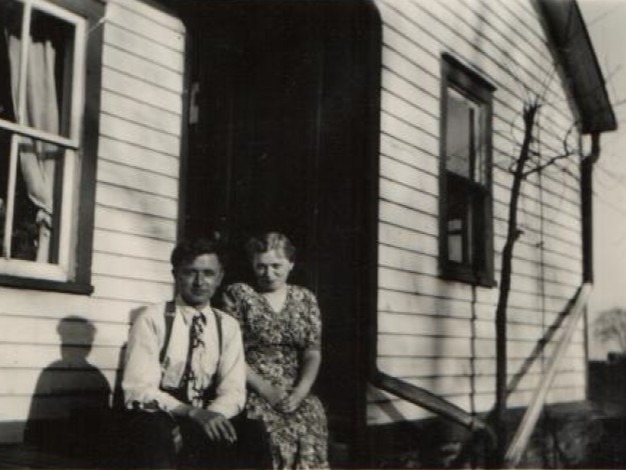
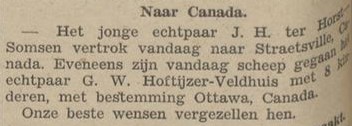
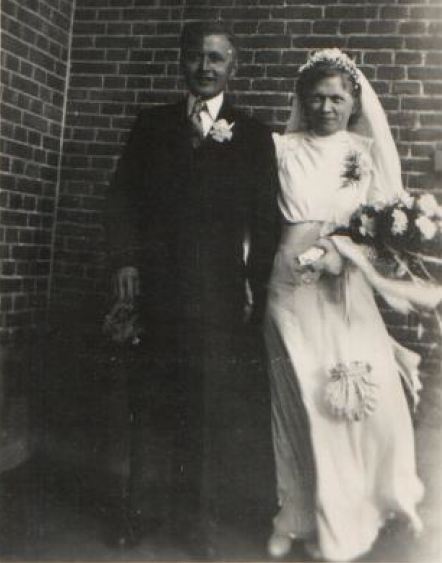
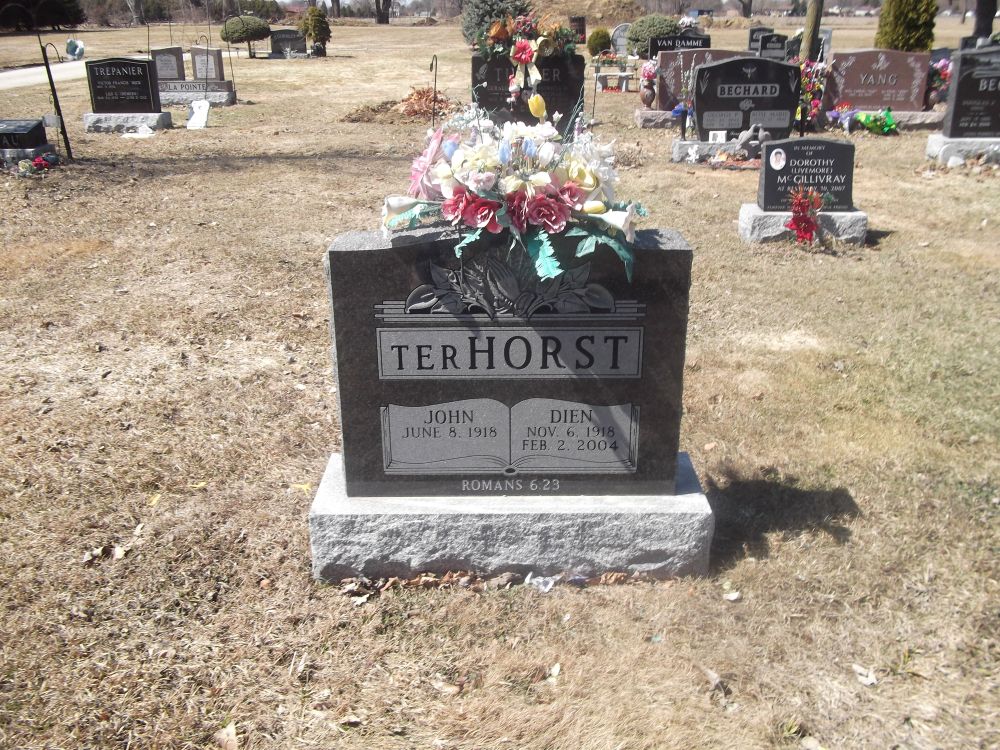
On June 8, 1918, Johan Hendrik ter Horst was born on the Egelsmaat farm in the rural district of Lintelo, near Aalten. Everdina Geertruida (Dien) Somsen was born on 6 November 1918 on the Olde Kleuver farm in the district Haart, also near Aalten. On April 1, 1948, Johan and Dien married in Aalten.
The young couple wanted to farm, but there was no room for them on either family farm – the older brothers took over the farm, as usual. So they had to find another farm, but that turned out not to be easy. When they were selected for a farm in the polder, they saw only one choice: to emigrate.
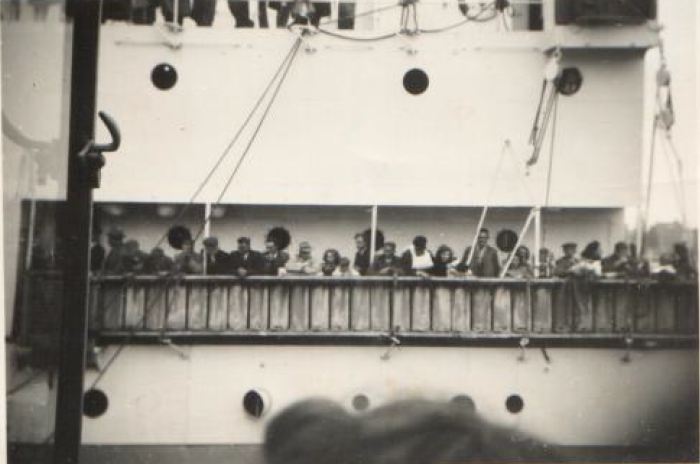
Shortly after their marriage, the young couple left for Canada by ship on June 4, 1948. They settled in the area around Chatham and Wilkesport, in the province of Ontario. There they ran a dairy farm during their working lives. Their marriage remained childless.
Dien died in 2004 and was given her final resting place in the cemetery of Wallaceburg, Ontario. Johan followed her in 2013 and was buried with his wife.
Aaltensche Courant, 4 June 1948Photo: A. VrieselaarPhoto: A. VrieselaarPhoto: A. VrieselaarPhoto: Findagrave
Do you have interesting stories about family members who emigrated from Aalten to Canada? Send us a message!
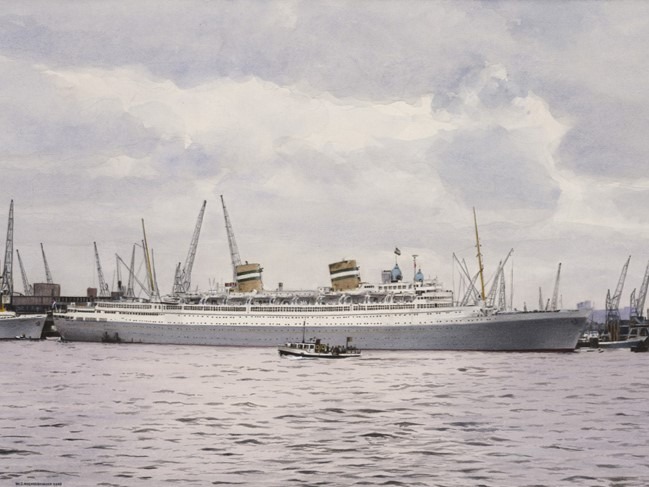
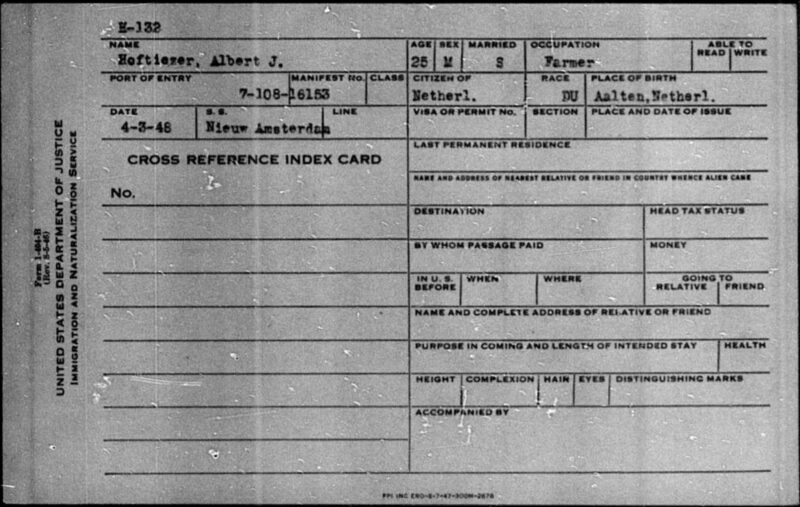
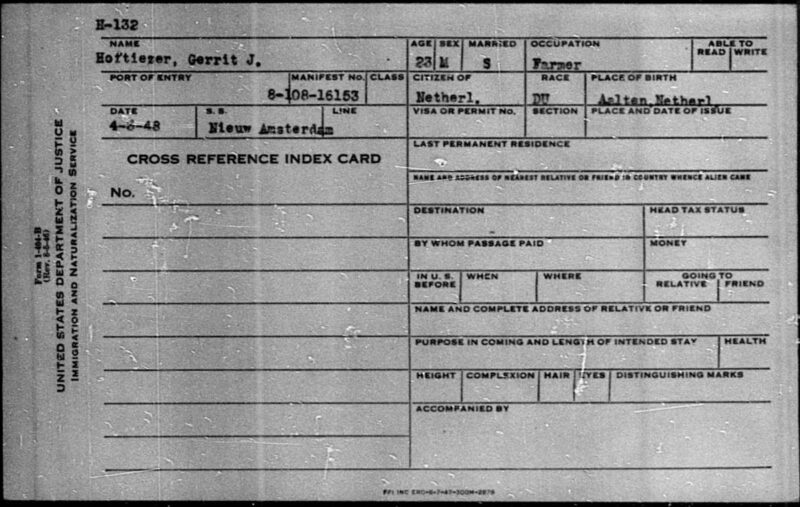
A few months ago, Johan Hoftiezer from the Aaltense Heurne was still working in the Noordoostpolder, and around that time his cousin Jan Hoftiezer, also from the Heurne, was still quietly milking the cows of farmer Westerveld from IJzerlo. Now, these two Aalten boys are looking at the black and white lines of the “Nieuw Amsterdam,” the flagship of the Holland-America Line, which will take them to America. On the occasion of their departure, both Hoftiezer families from “Meirika” and “‘t Oude Hondorp” came from Aalten to Rotterdam by bus last Friday to see Johan and Jan off.
The ‘Nieuw Amsterdam’ of the Holland-America Line
They stand somewhat awkwardly on the Wilhelminakade, marveling at the immense dimensions of this proud sea castle that will soon carry their two relatives to the other side of the ocean, to America, the land of unlimited possibilities. With hands above their heads, they peer over the waters of the Maas, which cuts Rotterdam in two like a silver snake, and their eyes seek out the busy shipping traffic on Rotterdam’s great river. Meanwhile, embarkation is in full swing, and Jan and Johan also prepare to go on board. “It is not easy,” says mother Hoftiezer, “to give up your child, but it is for his future and there are many more opportunities there.”
A moment later, we also go on board, as we wish to ask Johan and Jan a few more questions. Through a labyrinth of corridors and stairs, we finally reach the boat deck and find our future emigrants there. Johan worked in the Noordoostpolder for 2½ years. “It was good there,” he says, “but it would have taken another 5 or 6 years before I would have been eligible to lease a farm, and in Aalten you certainly stand no chance.”
Jan has always been a farmhand but has never sought work as far away as his cousin. “During the war I had to go into hiding, and after the war I worked in IJzerlo. Of course, I have no chance here in Holland either. We are not married and not even engaged, so we are not leaving behind weeping wives or fiancées.”
They further tell us that they are going to Woodstock, in the state of Minnesota. They previously corresponded with the Kruisselbrink family, who used to live at “Groot Kappers” and who have acted as their guarantors. They will be employed on a mixed farm of 200 hectares. “That is at least a bit larger than back home, because we only have 7 hectares at home,” Johan says laconically.
When the bell rings, visitors must leave the ship, and we take our leave of the two cousins. “Give everyone in Aalten our regards via the newspaper,” Johan asks, and we confirm this. Slowly, two tugboats begin to pull the colossus toward the middle of the river. Those staying behind on the quay wave scarves and handkerchiefs, and the “Nieuw Amsterdam” disappears into a haze of smoke. For the two Aalten boys, the journey to America has begun. They will have to work hard there, but we are convinced that they will uphold the name of their village, Aalten, in Minnesota. Safe travels, a prosperous voyage, and much success is wished to them.
Passenger card ‘Nieuw Amsterdam’, Albert J. Hoftiezer
Passenger card ‘Nieuw Amsterdam’, Gerrit J. Hoftiezer
Although it cannot be said that the municipality of Aalten experienced particularly shocking events in 1947, this does not alter the fact that encouraging activity was deployed in various fields. For instance, agenda items relating to housing construction were handled in several council meetings. Additionally, the municipal administration ensured the improvement of various roads, the electric street lighting was taken in hand, and finally, the reinstatement of the piglet market on Monday, 8 September, must not be forgotten.
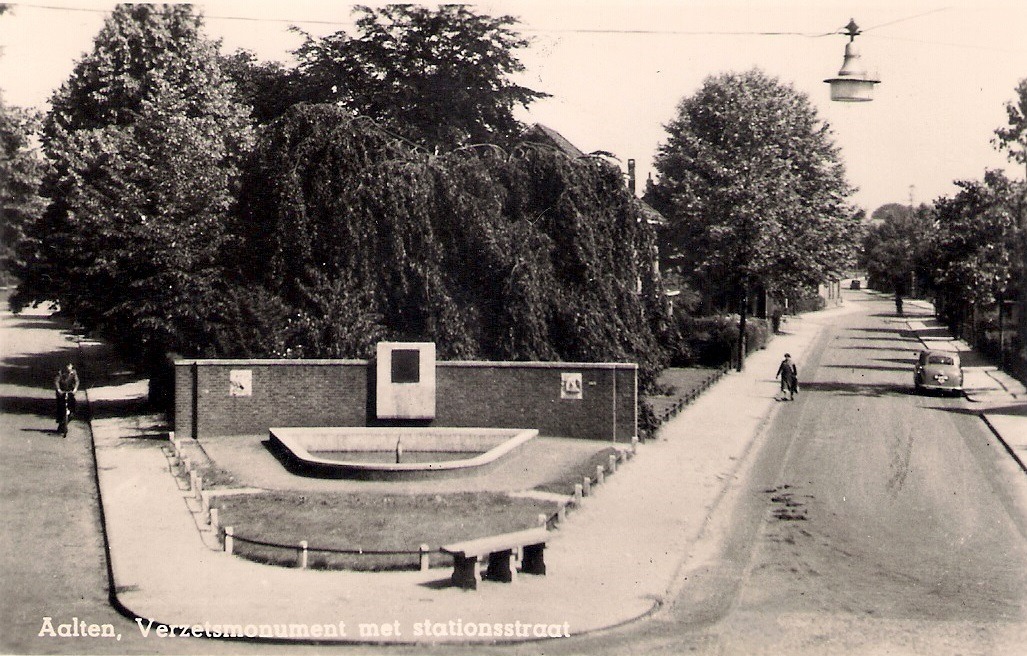
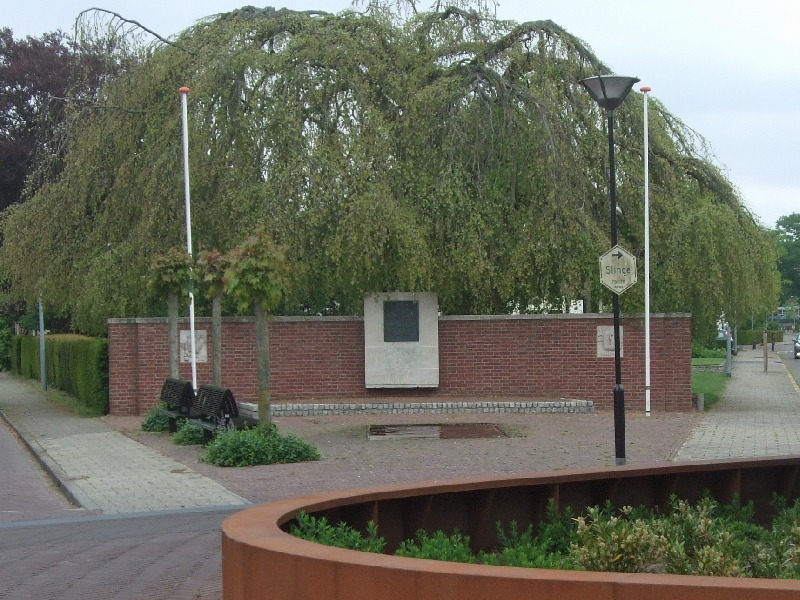
Monument for People in Hiding, Stationsstraat
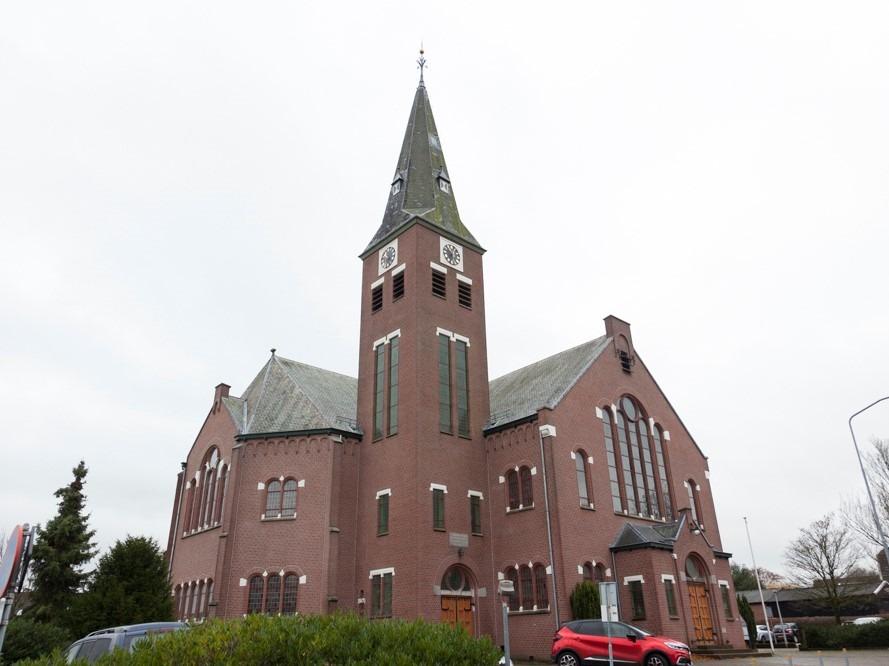
Events that were of importance to the entire municipality further included the unveiling of the monument for the former people in hiding, the commissioning of the church bells (and the lighting of the clock faces on the timepiece in the Dutch Reformed Church), and the improved connections with other places through the new timetable of the Dutch Railways and the services with the buses of the G.T.M. and the Veldhuis firm. Also, the 12th census was held this year on 31 May, which revealed, among other things, that Aalten counts 6,642 women and 6,943 men, totaling 13,585 inhabitants.
However, the various associations were not idle either. The V.V.V. (Tourist Office) provided several campsites this year, which were even temporarily visited by foreign guests, and it also took charge of organizing the concert by the Arnhem Orchestra Association. The C.C.C. continued providing its cultural evenings, which proved to meet a need. The same can also be said of the periodic organ concerts given by Mr. Sj. Mook on the organ of the Dutch Reformed Church.
Musical life in general experienced a certain revival, in which we recall the initiative of the Aalten Orchestra Association, the concerts at the ‘t Walfort Swimming Pool, and the various vocal and musical performances; in the latter, a tendency became noticeable to replace large plays with singing or music to increase interest in this art form. In the field of art, we should further remember the exhibition of paintings and watercolors produced by Messrs. P. te Lintum and D. Lemcke.
The Reformed Church in Bredevoort (Koppelkerk), initially still without a tower.
In ecclesiastical life, the construction of the Reformed Church in Bredevoort was an event of importance, with the so-called “first stone” being laid on 22 July. The Christian Reformed Church commemorated the reinstatement of the offices this year, a fact that took place 50 years ago. The commemorative service was held on 26 August, during which former ministers Rev. J.W. Polman and Rev. J. Tolsma, among others, spoke. Earlier, on 12 May, the 12½-year anniversary of Rev. J. van Dijken’s ministry was commemorated in this church, and finally, 1947 was the year of the induction of Rev. Kroneman and Rev. Goede and the departure of Chaplain Van Renswoude. In his place came Father Wartenberg, who in turn was succeeded by Father Bouwman.
Furthermore, a committee from the Dutch Reformed Church campaigned for the “community center,” while the Reformed Youth Council did very good work with the organization of the “drop-in evenings” and the youth leader conferences.
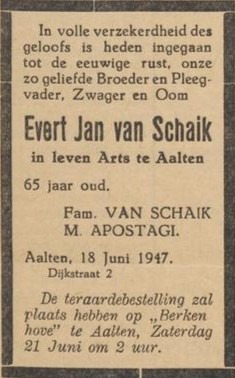
The generally respected and skilled physician Dr. E.J. van Schaik in Aalten passed away in the summer of this year.
As for the other associations, there was no lack of initiative and activity here either. Various associations were founded, such as the association for Artificial Insemination, a branch of the Christian Union of Government Personnel, and a branch of the Christian Union of Metalworkers. Within the framework of this activity by associations, the Concours-Hippique, organized by the Rural Riding Association, and the Cattle Breeding Day, initiated by the Union of Breeding Associations from this municipality, must also be mentioned.
Numerous were the anniversaries, of individuals, factories, and associations alike, which were so many illustrations of diligent industry and admirable perseverance. Additionally, some businesses were reopened, for example, the furniture factory of the firm Luimes & Wiggers, and the warehouse of the firm Ackerman and Kamphuis, or established, such as Van Katwijk’s Paper and Cardboard Processing Industries N.V., by which the municipality of Aalten gained another industry.
Contrasting with the latter, however, is the departure of the Aalten Knitting Factory, which began operating in Doesburg this year. As a sign of activity, the workshop of the B.L.O. school (Special Primary Education) should not go unmentioned here; however small in scale it may be, it aims to contribute its part to the aftercare of underprivileged children.
Something that has not happened every day is the departure of several families who wished to settle in Canada. However, it appears that many more families will follow this example next year. And finally, we wish to mention here the passing of Dr. E.J. van Schaik, in the night of 17 to 18 June, with whom a very well-known figure from our village passed away.
The memorial for people in hiding (Onderduikersmonument) on Stationsstraat is an expression of gratitude from those who were once in hiding to the people of Aalten for their hospitality, and to the members of the Resistance who were the driving force behind finding accommodation for them.
The monument consists of a brick memorial wall with a fountain. A bronze plaque and two sculpted fragments of natural stone are set into the memorial wall.
The monument was unveiled on 4 October 1947 by Mrs D.G. Wikkerink-Eppink, the wife of Resistance leader Hendrik Jan (Ome Jan) Wikkerink.
The text on the plaque reads (translated from Dutch):
PRESENTED TO THE MUNICIPALITY OF AALTEN BY PERSONS IN HIDING WHO DURING THE YEARS OF OCCUPATION 1940-1945 FOUND A SAFE HAVEN HERE.
The sculpted fragments bear the text of Psalm 91:5 and 6.
The text of the left fragment reads:
THOU SHALT NOT BE AFRAID FOR THE TERROR BY NIGHT, NOR FOR THE ARROW THAT FLIETH BY DAY; NOR FOR THE PESTILENCE THAT WALKETH IN DARKNESS, NOR FOR THE DESTRUCTION THAT WASTETH AT NOONDAY.
The text of the right fragment reads:
FOR HE SHALL COVER THEE WITH HIS FEATHERS, AND UNDER HIS WINGS SHALT THOU TRUST.
The sculpture on the left depicts three studded boots belonging to the barbarian horde, threatening to trample a young, sprouting fruit. This symbolises the overwhelming force and occupation, portraying the vulnerability of young life that continues to germinate despite the danger. The fragment on the right depicts a pelican with outspread wings, protecting its nest and young. The pelican is a Christian symbol of total self-sacrifice; according to legend, the bird feeds its young with its own blood. It symbolises the contribution of the resistance in the struggle against the occupier. The waning swastika in the background represents the transience of the threat.
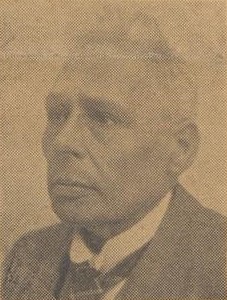
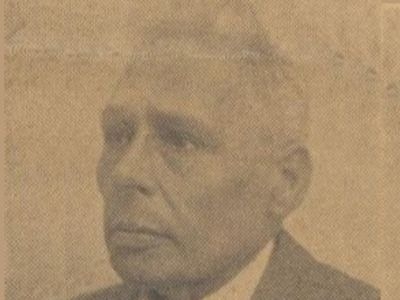
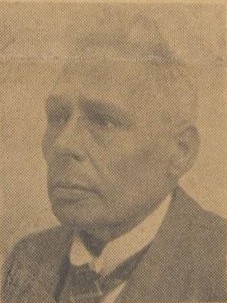
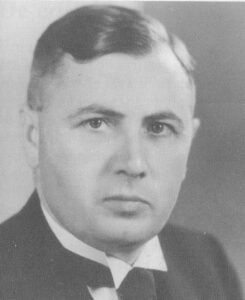
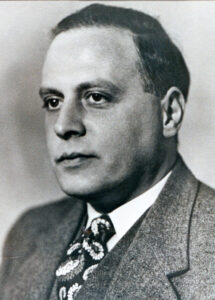
Evert Jan van Schaik (1881–1947) was a doctor in Aalten from 1912 to 1946. He was renowned for his expertise, dedication and humility, always prioritising the welfare of his patients and the community. Van Schaik remained unmarried and passed away in 1947 at the age of 65.
Evert Jan van Schaik was born on 30 November 1881 in Wapenveld, in the municipality of Heerde, the son of Paul van Schaik, a minister in the Christian Reformed Church, and Maria van de Kamp. Due to his father’s profession, the family relocated several times during his early childhood: first to Hoofddorp (1882), then to Middelharnis (1884) and later to Nieuw-Lekkerland (1890).
After completing primary school, Evert Jan attended the Reformed Gymnasium in Amsterdam. He subsequently studied medicine at the Municipal University of Amsterdam, where he obtained his medical degree in 1912.
Doctor in Aalten
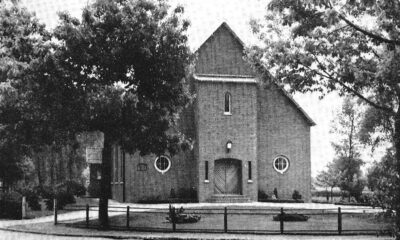
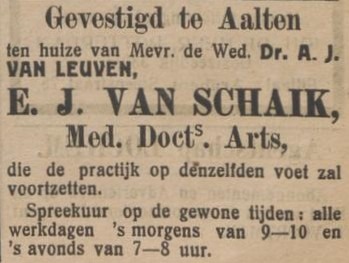
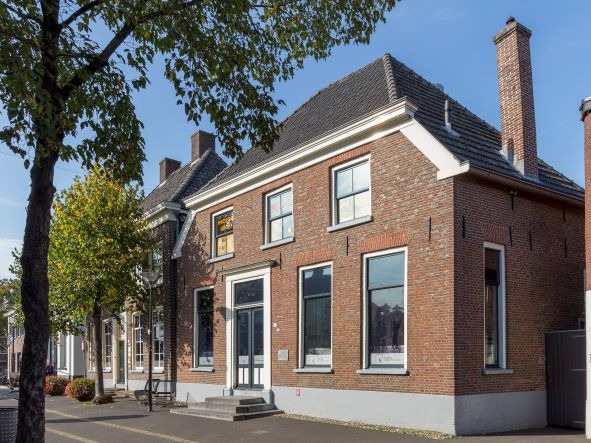
On 9 December of that same year, 1912, he settled in Aalten, taking over the general practice of Doctor Van Leuven, who had passed away shortly before. Initially, he resided at the De Roskam hotel on the Landstraat. A few years later, he moved to the former Roman Catholic presbytery on the Dijkstraat, where four of his unmarried sisters later came to live with him.
Much like his predecessor, Doctor Van Schaik quickly gained appreciation for his expertise and commitment. He enjoyed the deep trust of his patients and built a solid reputation. His approach to his work was characterised by thorough conscientiousness. He took almost no holidays, running his practice for years on end without even considering taking time off.
Although he dedicated himself almost entirely to his medical practice, he also took an interest in church and state affairs. This interest was backed by extensive knowledge, though he chose not to seek the spotlight.
Recognition and Final Years
In 1937, on the occasion of his silver jubilee as a general practitioner in Aalten, a committee formed by local residents organised a celebration in his honour. Van Schaik was praised for his faithful devotion and quiet strength, as someone who never sought prominence but always put his patients and the community first. His great humility made him a beloved figure to many.
However, the demanding practice took a heavy toll on his strength. A few years after his jubilee, he received assistance from Doctor D.N. Visser. As his health declined, Van Schaik gradually handed over more of his workload. In January 1946, he retired from his medical duties permanently, at which point Doctor Visser took over the practice entirely.
Evert Jan van Schaik passed away in Aalten on 18 June 1947 at the age of 65. He was laid to rest at the Berkenhove cemetery.
Dr. Evert Jan van Schaik (1881–1847)De Graafschapper, 11 December 1912Aaltensche Courant, 20 June 1947
Throughout the centuries, the Church has been the bearer of culture. Especially in rural areas, the influence of the Church on cultural development has been very significant. Anyone wishing to learn about and research the history of a village can find a wealth of information in the church archives, as the Church has long stood as the center of village life.
Various influences have caused the Church to gradually relinquish this position and lose its central role. Large groups turned away from the Church, which had nothing more to offer them, and continued their lives outside of any ecclesiastical connection.
Church life had become stagnant and no longer brought people into contact with spiritual movements as it had done throughout the centuries. The church building still stood in the midst of the village community, but it no longer took part in the community itself. It had lost its evangelizing character. But our old Church has not weathered the storms of centuries for nothing. Now, too, it will find its place again in the heart of the community.
Community Center
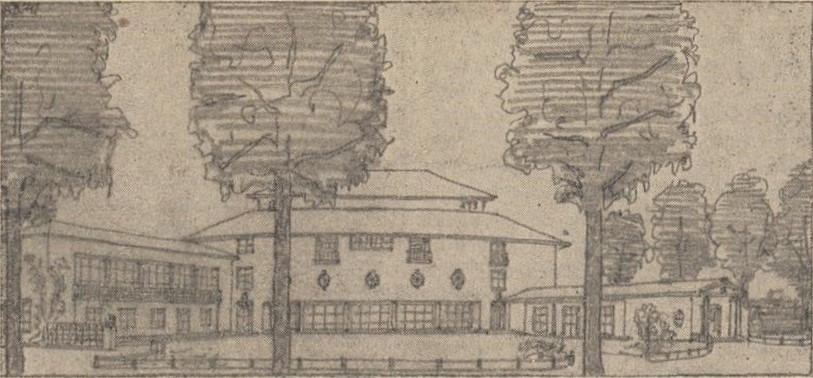
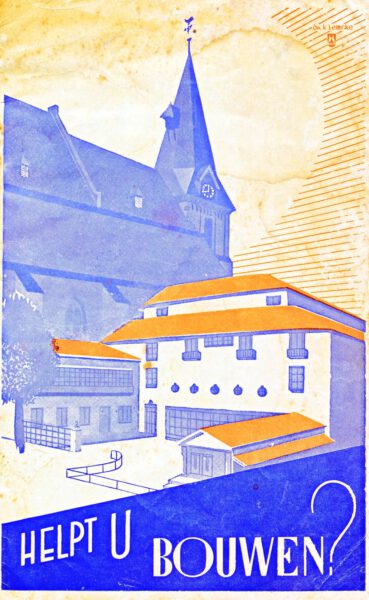
Viewed in this light, the plans for the “Community Center” in Aalten are of great significance. For here, the Church takes upon its shoulders a task of immense importance and great cultural value. It will not be an easy task to carry out this plan, but the Church has accomplished greater things. Once again, the Church will take up its cultural mission by establishing a “Community Center,” a building where community life can find a home and where there is also ample opportunity to organize pleasant evenings.
More and more, the conclusion is being reached that the halls currently available in Aalten are not fully suitable for this purpose, so that the opportunity to provide some guidance for recreation has been lacking until now.
No one who has observed rural recreation in recent years will deny that a certain degree of guidance or direction is necessary. The theater troupes that come to the villages are often third- or fourth-rate companies that can no longer attract audiences even in provincial towns and are now trying to earn their living in the villages. The way our boys and girls spend their free time is a problem that urgently requires a solution.
The plans
The committee appointed by the Churchwardens to prepare the plans for the establishment of such a building has already consulted with the Synodal Building Committee, “Church and World,” and the Reformed Youth Council. The architect, Ir. Boeken, has created a design that takes full account of the various purposes for which the building will be used. There will be a proper theater hall with a projection booth.
Regarding the availability of the building, the intention is to adopt a very broad perspective. Non-church organizations will also be able to use it, although the general guidelines of the Synod will be decisive. No decision has yet been made regarding the location where the building will be erected, although the Wheme is being strongly considered. It is hoped that architectural considerations will ensure it fits into the village atmosphere.
Thus, work is proceeding diligently on the plans for the establishment of this “Community Center.” And although it will likely be several years before the first stone can be laid, we must praise the initiative and courage of the Churchwardens for taking this step. On Sunday evening, at a congregational meeting, Rev. F.J. Pop, chairman of “Church and World,” will speak on the topic “Church and World and Community Center.”
The list below contains emigrants from the municipality of Aalten who emigrated to Canada , most of them after the Second World War. Some of them have since died. We try to find their grave on findagrave.com as much as possible. This list is far from complete. Work in progress, errors reserved, additions and corrections are welcome!
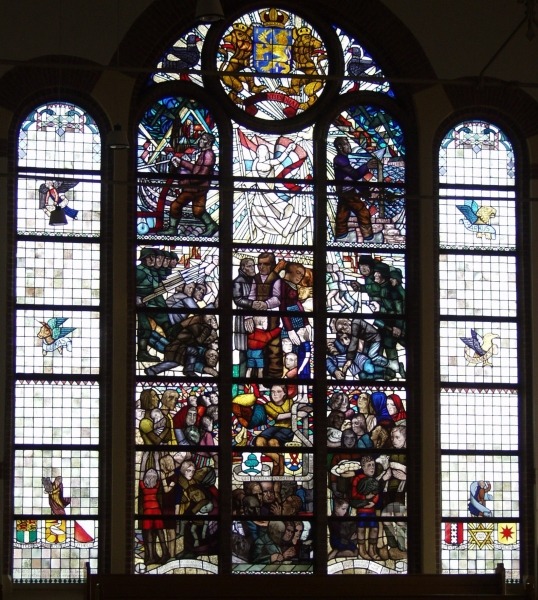
The Oosterkerk in Aalten houses a monumental stained-glass window dating from 1946. The window was gifted by a committee from the Reformed Church of Rotterdam-Kralingen, on behalf of the churches and the Jewish community, as a token of thanks for the assistance provided by the people of Aalten during World War II to those in hiding (onderduikers), Jewish fellow citizens, the starving, and hundreds of children from Rotterdam.
Rev. Thomas Delleman (1898–1977)
Thomas Delleman (1898–1977) served as a minister in Aalten from 1930 to 1938 before moving to Rotterdam-Kralingen. Following the Bombing of Rotterdam in May 1940, he took the initiative to arrange for children from his new parish to stay in Aalten for a holiday. During the war years, a total of approximately 800 children from Rotterdam were taken in by host families in Aalten.
Delleman contributed in other ways as well. He ensured that young men wishing to evade the Arbeitseinsatz (forced labour) could go into hiding in Aalten. Furthermore, in 1943, around 500 evacuees from Scheveningen were accommodated in Aalten. During the ‘Hunger Winter’, trains carrying food regularly departed from Aalten for the west of the country.
This dedication made a profound impression in Rotterdam and led to the formation of a committee after the liberation to thank the people of Aalten.
Origin of the Commemorative Window
Initially, the intention was to place the window in the Westerkerk, as more than forty young men had been arrested there during a roundup (razzia) in 1944. However, all the windows in the Oosterkerk had been shattered after a V1 rocket landed nearby in January 1945. Consequently, it was decided to install the window in the Oosterkerk instead.
The window was designed by the Rotterdam artist Marius Richters (1878–1955) and executed by glazier Henri van Lamoen (1900–1949). With a height of eight metres and a width of over three metres, it is one of the largest stained-glass windows in the Achterhoek. Richters utilised bold colours and clear, almost narrative scenes that express both the threat of war and the warmth of the relief efforts.
The window was installed in the front facade of the Oosterkerk and officially unveiled by Rev. Delleman on 13 July 1946. The ceremony was broadcast live on the radio by the NCRV.
Design
The window is over eight metres high and three metres wide, set within a trifora.
Commemorative Window in the Oosterkerk, Aalten
At the top: The coat of arms of the Netherlands with the motto “Je maintiendrai”. Below this is the Dutch Maiden, holding the flag in her right hand and a burning torch in her left. On either side stand a farmer and a bricklayer, referring to the post-war reconstruction.
Central: A farmer and his wife, symbolising the people of Aalten, surrounded by children and a person in hiding. From both sides, German soldiers with bayonets march into the scene.
Bottom left: Emaciated women and children pleading for help.
Bottom right: A group of people who have been helped, returning home supplied with foodstuffs.
Bottom centre: The coat of arms of Aalten featuring the linden tree and the coat of arms of the House of Orange, with a scroll reading: “Uit dankbaarheid voor hulp in oorlogstijd, soli Deo gloria” (In gratitude for help in wartime, to God alone the glory). Biblical texts are incorporated elsewhere in the window.
In 1947, two side windows were added to either side of the main window. These feature the symbols of the four Evangelists, images of Moses and Isaiah, and at the bottom, the coats of arms of Rotterdam, Scheveningen, Utrecht, Amsterdam, Kralingen, and a Star of David.
At the base of the side windows are lines of verse by Muus Jacobse (pseudonym of the poet Klaas Heeroma):
Maar als ik leven mag tot de bevrijding en juichen op het overwinningsfeest, God, doe mij dan dit weten, wat voorbijging aan nood en leed is niet vergeefs geweest.
(But if I may live until the liberation and rejoice at the victory feast, God, then let me know this: that the hardship and suffering which passed was not in vain.)
Current Status
The commemorative window can still be seen in the Oosterkerk. When the church was repurposed as a residential care location in 2021, it was formally agreed that the window would be preserved. This ensures the window remains not only an artwork of exceptional scale but also a lasting war monument and a tangible reminder of the aid and hospitality offered by Aalten during World War II.
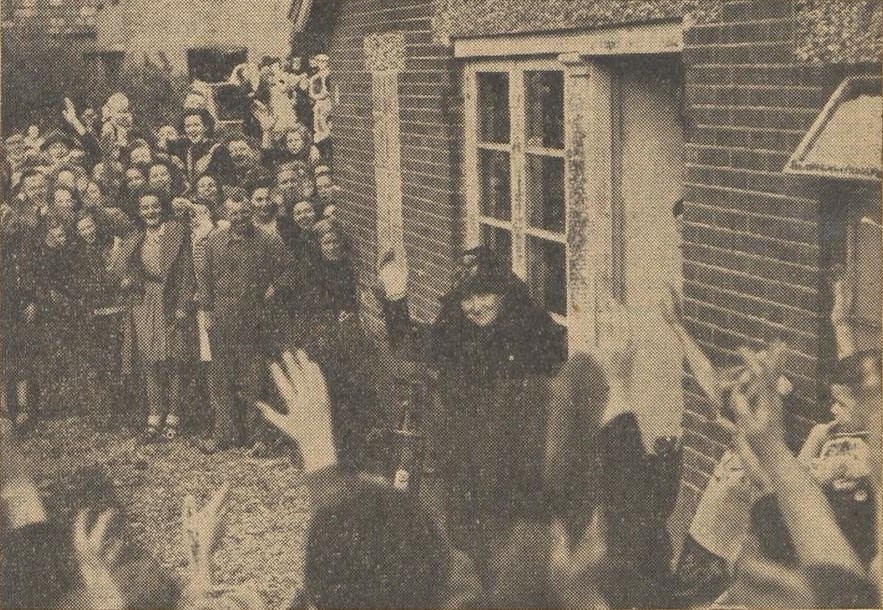
Quite unexpectedly, H.M. the Queen paid a visit to our municipality. On Wednesday afternoon, the cars carrying H.M. the Queen, her secretary, Miss Geldern, and her secretary, Mr. Kohnstam, arrived from the direction of Dinxperlo and stopped in front of the home of the alderman of Aalten, Mr. H. J. Wikkerink, better known in illegal circles by the name of “Oome Jan”.
“Oome Jan” has a respectable record of service in the underground movement during the years of occupation and currently resides in his workshop “Nooit Gedacht”, as the Germans, out of rage that they could not capture “Oome Jan”, set fire to his house next door. The Wikkerink family had been informed of the royal visit only moments before.
Her Majesty, who arrived around one o’clock, stayed for more than half an hour in the home of “Oome Jan” and enjoyed a cup of tea with relish. Meanwhile, several prominent workers from the illegal movement had gathered in the living room and were soon engaged in a busy conversation with Her Majesty.
H.M. leaves the emergency dwelling “Nooitgedacht” in Aalten
From the conversations, it appeared that She was already aware of the important work carried out here in the Achterhoek during the war years, and She inquired with interest about various details. Both “Oome Jan” and Messrs. Lichtenberg of the L.O. and Allersma of the K.P. spoke of the underground work and the dangerous tasks that had to be completed. They also recalled the spontaneous cooperation of the population and the aid to the West in the form of wagonloads of rye bread, which were sent at a very low price.
A charming detail was also the presence of Mrs. Jedwab with her young son, who at the time had been left as a foundling on the doorstep of “Oome Jan’s” home while the parents were in hiding. This Jewish boy was then lovingly taken in and given the name Willem Herfstink, as autumn had just made its entry that day. Rev. Kuijper also spoke of the razzia, which was held on January 29, 1944, in the Reformed Church, during which 42 people in hiding were arrested and only a few were able to escape. The mayor, who was also present at “Oome Jan’s”, also shared some information about the events of the past years.
Originally, it had been H.M.’s intention during her journey through these regions to visit the “Somsenhuus”, the farm of Mr. Prinsen in IJzerlo, where so much underground work was performed in recent years. Members of the K.P. found shelter here for a long time, as did a number of English pilots who awaited liberation here. This farm burned down after the liberation due to a lightning strike. This visit did not take place. Between Dinxperlo and Aalten, the cars turned into a side road near the Prinsenboschje, where the party had some refreshments in the car.
A massive crowd had gathered in front of “Oome Jan’s” home, where the monarch was heartily cheered. Upon her departure, the Wilhelmus was enthusiastically sung. This day will surely remain long in the memory of “Oome Jan” and his comrades, who so often risked their lives in the struggle against the oppressor and did so much for our people and fatherland.
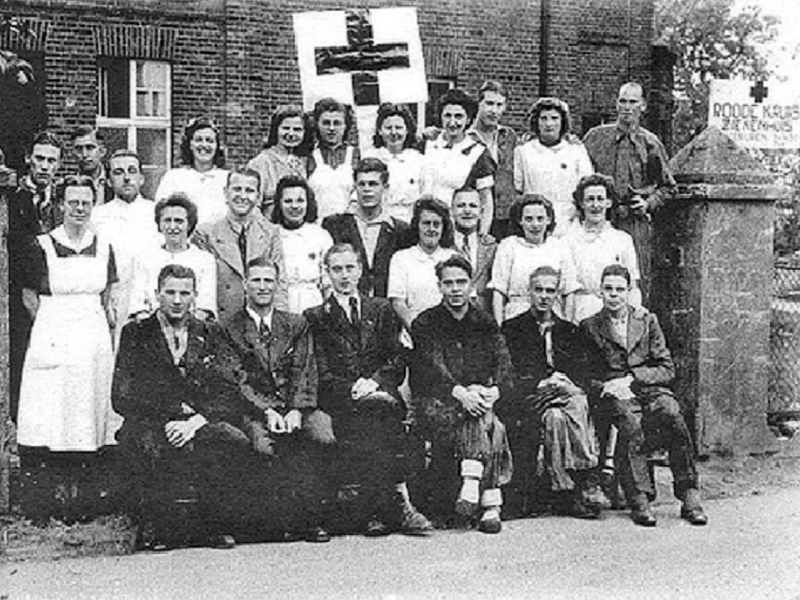
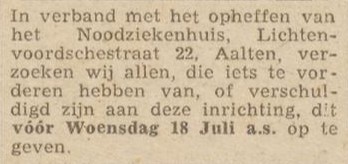
Now that the emergency hospital in Aalten is closing its doors, it is fitting for us to pause for a few moments to reflect on the origin and work of this institution, which served as a blessed outcome for countless Dutch forced labourers and prisoners from concentration camps. As is known, the initiative for its founding was taken under the auspices of the Red Cross, by Dr J. der Weduwen and Mr Cl. Driessen.
Staff of the Aalten Emergency Hospital
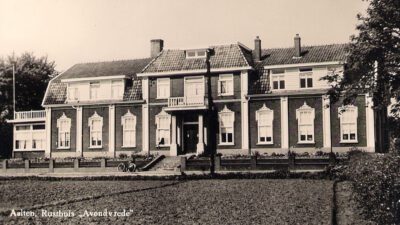
The necessity for its establishment became acutely apparent at the end of November, when some of the victims of the train bombardment near Bocholt had to be admitted in Aalten. When Dr J. der Weduwen arrived at the Avondvrede retirement home on 5 December 1944 with 22 liberated prisoners from Rees, the situation presented nearly insurmountable difficulties. Beds, food, and trained staff—everything was lacking.
The residents of the home, on that memorable St. Nicholas Eve for the ex-prisoners, brotherly shared their pancakes, oliebollen (doughnuts), and chocolate (!) with the newcomers. By exerting every effort, they succeeded in providing the battered patients with proper care. Mr and Mrs Ditmarsch, deeply moved by the fate of these people, did everything possible.
With emotion, many will remember Sister A. Bol, who died of diphtheria and performed true miracles for her patients during this time. After her death, it proved necessary, given the danger of contagion, to attach expert personnel to the emergency hospital. Sister Schaafsma and Sister Doesburg were entrusted with the management under the supervision of Dr P. Hogenkamp, who took over the medical work of Dr der Weduwen following the tragic passing of this beloved doctor.
Avondvrede Retirement Home, Hogestraat, Aalten
Although more space was made available at Avondvrede, the capacity of the hospital proved too small, as one also had to take into account war victims from the local area; therefore, the hospital was relocated to the Patrimonium building. In cooperation with the U.V.V., I.K.O., and the Red Cross, the material side of the work was taken care of. After the final bombardment, the Patrimonium building became unusable, and it was decided to liquidate the hospital, as the majority of the patients, under the leadership of Sister Schaafsma, preferred to leave for the North.
Sister Doesburg remained at her post with a few patients, and the hospital was moved back to Avondvrede. From there, they departed once more—joined by a number of victims from the bombardment in Bocholt—to the building on the Lichtenvoordsestraat, which still serves as an emergency hospital today. About twenty patients were housed in the cellars there. Enormous support was received from the surrounding hamlets.
De Graafschapper, 14 July 1945
In the beginning, the conditions were extremely primitive. Later, everything improved. Special praise is due to the girls of Aalten, who performed nursing work without any prior training. Just before the liberation, some victims of the liberation battles were admitted. An unforgettable moment was, of course, the arrival of the first ‘Tommy’ (British soldier) who was brought into the hospital.
And now the work has come to an end. The large stream of repatriates, for whom they had prepared as their final task, did not arrive, and the now well-equipped emergency hospital is disappearing in these coming days. (Why not make it a permanent hospital?) A piece of Aalten’s war history is hereby concluded, but many will continue to remember this work with gratitude.
On Friday, another session of the Military Court was held in the council chamber of the town hall. Major Jhr. Mr. van Nispen tot Sevenaer served as president, while Mr. Arriëns acted as military prosecutor.
Behind closed doors, the case against H.A. v. T. was handled first; he was sentenced to 1 year in prison for a sex offense, of which 8 months were suspended with a probation period of 3 years.
Also behind closed doors, the case of F.K. Meijnen was heard, who was sentenced to 9 months in a reform school for looting. The defense counsel in this case was Mr. Voorink from Winterswijk. A. Meijnen, who had stolen cigars and tobacco while clearing rubble from a bombed house, was sentenced after a plea by Mr. Voorink to 3 months in prison with a probation period of 2 years.
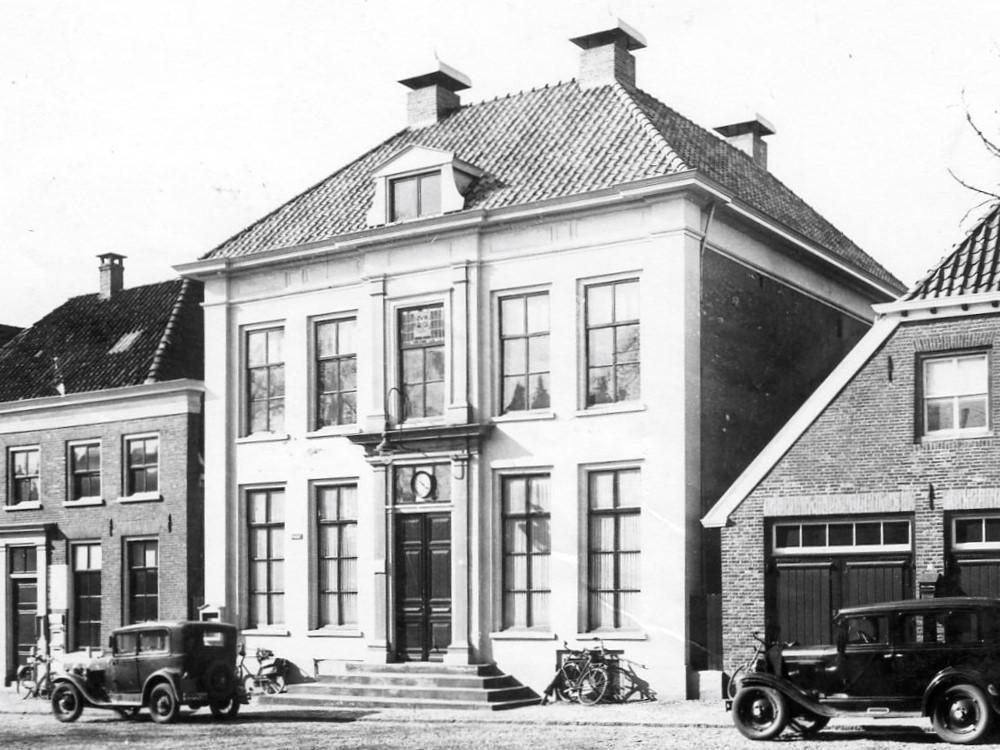
The Town Hall on the Markt in Aalten
E.J. ter Heurne is accused of having taken a lady’s bicycle belonging to Miss J.W. Wesselink. The defendant denies taking the bicycle. According to him, he stored the vehicle after it had been abandoned by an SS man. In view of the bicycle requisitioning, he removed the tires and the saddle. This occurred in October 1944. Miss D. Kuijntjes is heard as a witness for the defense, confirming the defendant’s account. She had even ridden the bicycle.
A debate ensued between the defense counsel and the court regarding the circumstances of this case. No clarity could be reached, as the stolen bicycle was only taken months after October. The case is therefore adjourned to hear several more witnesses.
Meanwhile, M. Wensink appears before the court to answer for the fact that he gave 4 kg of bacon for a stolen bicycle. The defendant denied knowing that the bicycle was stolen property, which the military prosecutor did not find very credible, given the demand: 3 months suspended with a probation period of 2 years and a fine of ƒ 500. The court, however, judged otherwise and acquitted the defendant.
A certain Melitz, an SS man, appeared to have stored a nice amount of fertilizer. Now that he has disappeared, a number of farmers examined the matter and brought the fertilizer to their lands. This brought them before the court, which sentenced them to fines ranging from ƒ 25 or 25 days, while one was acquitted. After mutual consultation, they immediately “opened their purses.” At least it wasn’t a black market price.
H.J. te Grotenhuis needed several items, including a bread knife, a pair of bloomers, and a few cow halters, and stole these from various people. This is the same person who recently attacked an N.B.S. man with a knife during his arrest after escaping. Te Grotenhuis did not make a very reliable impression and is apparently not fully accountable for his actions. The court evidently took this into account and sentenced him to 6 months in prison.
After this, the case of E.J. ter Heurne was resumed. The bicycle was wheeled in and examined by the owner, Miss Wesselink. She declared that it was indeed her bicycle. A.J. Wentink, heard as a witness, stated that he had seized the bicycle in question from ter Heurne. He also recognized the bicycle. The defense witness Miss Kuijntjes also came to view the bicycle and could only partially recognize it. The bicycle she saw at ter Heurne’s in October was in better condition. After the municipal supervisor R. Hoogeveen was also heard as a witness in this case, the military prosecutor demanded a prison sentence of 2 years. The court reduced it by half, so ter Heurne will have to serve 1 year for this offense. Arnoldus Florentinus Voorink also pleaded in this case.
The following defendants have quite a lot on their conscience. A sheep was stolen and slaughtered; about 50 eggs were snatched, as well as a number of chickens and a quantity of tobacco leaves still in the field. Suspected of this are the brothers A.H. and H.J. Bettink in association with H. Dibbets, who in turn, together with T.W. Jansink, stole sheep’s wool and, with one of the Bettink brothers, approximately 500 kg of potatoes.
Messrs. Bettink and Dibbets also worked for their own account. For instance, H.J. Bettink pilfered two shirts, a pair of socks, and a quantity of tobacco while clearing rubble at the house of F.J. te Linde; H. Dibbets took a watch, a shirt, a pair of socks, spools of sewing thread, and a deck of playing cards. Finally, the father of the brothers, H.J. Bettink Sr., was the underlying cause of the thefts of the sheep and the potatoes and had to answer for intentional incitement.
The boys readily confessed to the charges, but Bettink Sr. declared that everything was a lie. The claim that he had encouraged the thefts was pure fabrication. On the contrary, he had always set a good example for the boys and forbidden them to steal. This statement caused quite some hilarity, given the man’s record. The sentences were far from lenient. A.H. Bettink received 3 years, with credit for time served in pre-trial detention.
T.W. Jansink was sentenced to 6 months, while a report will still be issued regarding H. Dibbets on the possibility of placing him in a youth prison. A psychiatric report will be issued for H.J. Bettink Jr., as he was considered to have significantly diminished responsibility. H.J. Bettink Sr. reaped the bitter fruits of his good intentions and will not be able to keep his sons on the right path for the next few years. He was sentenced to 4 years.
Next to stand trial as a victim of his own good intentions was E.J. van de Lende, who, while clearing rubble from the house of F.J. te Linde, had taken a pair of men’s trousers, a piece of lining fabric, and a remnant to keep them safe and out of the hands of the Germans. This happened on 24 March. In the meantime, however, a skirt had already been made from the fabric, which the court took very seriously. He had also forgotten to return the items. The goods were only returned once the case was in the hands of the police. This forgetfulness cost him 8 months in prison, and the goods must be returned.
At the conclusion of the session, the president, Major Jhr. Mr. van Nispen tot Sevenaer, paid tribute to Sergeant Bruggeman, whose excellent work and very good official reports greatly facilitated the work of the court.
I can imagine that as a former Achterhoeker, born and raised in our beautiful region, you are very curious about news from our region and how we are all doing here. It will be a pleasure for me to inform you from time to time of what has happened here and what is going to happen. Let me start by telling you that we have generally come off well here in our Achterhoek. The Tommies who came in here from the direction of Bocholt just before Easter were amazed by the friendly, apparently still prosperous country. into which, after the debris fields of Germany, they were suddenly transferred.
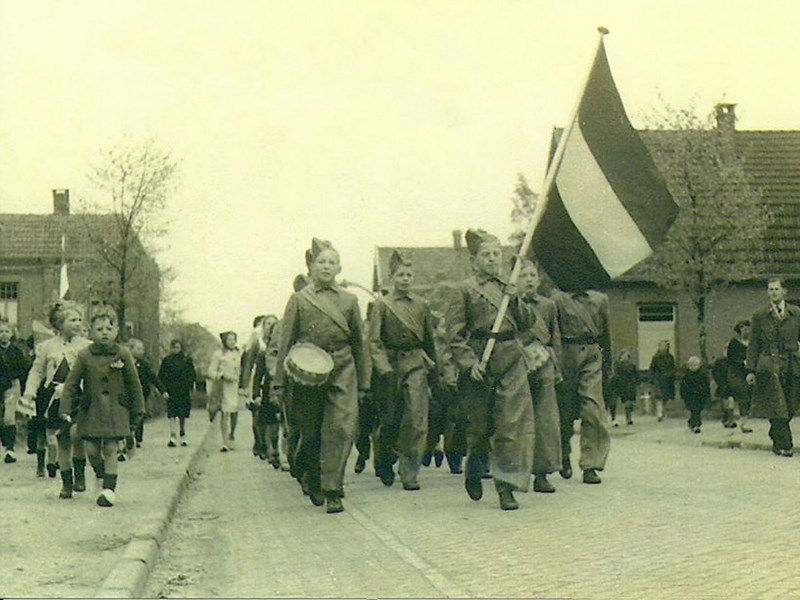
Liberation parade Stationsstraat, 1945
“You see here again an undamaged house,” said one to me, “and you see friendly people again, who laugh and wave at you! We have experienced that differently in recent months” Still, it was not given to us as a gift, don’t think so. The last six months in particular have been quite haunted here. Also in the political field. It was raid after raid. Greens, blacks, land guards, Gestapo, S.S., we have experienced all that beauty in its different variations here. Anyway, you have experienced that yourself in the city. so you know all about it. Let me rather tell you how we celebrated the liberation here, when it became known that our entire people was freed from slavery.
I can tell you best about Aalten, where I happened to experience it myself, but I am sure that the same enthusiasm prevailed throughout the Achterhoek. You should come to Winterwijk today, which was worn out for a hotbed of the party, right? It only now becomes clear what a “thin” layer of the population there actually kept the terror going, because there is no municipality in the Achterhoek, where you see flags as exuberantly as right there.
‘Uncle’ Jan Wikkerink
The music was immediately on his feet, you get that. In the afternoon a whole procession with children and the elderly followed through the decorated streets and it was a joy to hear a Dutch march again. The case stopped for a moment in front of Jan Wikkerink’s house. You may remember them from school in the past. And otherwise I just say “Uncle Jan”, then at least every person in hiding in the Achterhoek knows who it is. Well, that musical tribute at his doorstep was, in my opinion, exactly right. Because that’s just an ordinary contractor, isn’t it? but what a lot that man has achieved during the war years, so secretly gone.
He was quietly district head of the National Organization for People in Hiding and made sure that all those boys stayed alive and, if possible, out of the hands of the slave hunters. He and his men housed countless people there, (you know that there in Aalten they have the name hadden. dat there were as many people in hiding as inhabitants?) and where it was necessary to provide all those people with ration cards, not only city people, but also a lot of Jews and everything else, with the Gestapo on their heels, den Achterhoek came fleeing in. In cooperation with the Knock teams, many distribution offices in our area have been honored with a fruitful visit and Oome Jan always had the quiet, cautious leadership of them.
Dela Wikkerink-Eppink with Aron Jedwab alias Willem Herfstink
It was therefore no surprise when one night a child was abandoned on his doorstep. After all, he knew what to do with everything and everyone and he was simply the big placement agency, apparently also for babies. Anyway, the little one didn’t have to go far, he stayed at the same address, i.e. on the other side of the front door, where he was lovingly welcomed. It was exactly on the 21st of September and so the foundling was officially registered at the town hall the next morning with a straight face under the name Willem Herfstink . (After all, the suffix “ink” means “the son of” in Achterhoeksch). But on the first day of the liberation, the “Son of Autumn” returned to his own address, namely to the Jew master, who was very happy with his wife that they had kept their little one safe in such a dangerous time. You understand that that card was again pierced with real Achterhoek cleverness. The doctor had taken the child of the parents in hiding straight to Uncle Jan, who was already waiting for it behind the door.
It was a shock to the whole region when they finally got hold of Uncle Jan. If the whole region heard about it as soon as possible, because the captivity lasted only a few hours. The knock team could have put it right sooner, but they had to wait a while for the doctor for the chloroform and the sergeant on duty of the military police also had to rehearse how he should be intoxicated as really as possible. But then it was done, only the doctor was still busy for an hour and a half to call the good sergeant back to life, because the boys had worked him a bit too enthusiastically with the chloroform-dot.
Dr. der Weduwen
The quiet figure of Uncle Jan had since disappeared from sight, but he now had so much more time for his illegal work. The Germans were furious as usual and knew nothing better to do than to throw a few hand grenades into his house in impotent rage, which of course burned down in the end. But better the house than Uncle Jan, everyone said comforted, and so the music of the week was a spontaneous tribute from the whole population. And it was certainly also with the approval of the whole village, when later a few songs were played in front of the house of the late Dr. of the Widows, who gave so much clandestine help and in particular was a lifesaver for many boys in the camps of Bocholt and Rees. The Achterhoek knows how to celebrate, but also to sympathize with those for whom the party is impossible due to harrowing memories.
At the end of my letter, I will tell you one more example of this, which will do you good. It was in one of the rural districts that the music association went around the farms with blaring festivities. But there was a shadow over this rural district. On the last day before the liberation, a direct hit in an air-raid shelter had snatched five children from one family, with two older evacuees, from their lives. The site of that disaster was on the main road, where the procession passed. But a hundred yards from that place the music fell silent, and they went on in silence. And there at that burned-out shelter that chorale of the 103rd Psalm was played in the moving silence of all neighbors: Like the grass is our ephemeral life… Then they quietly moved on and only at a great distance from that place the festive music was resumed.
I am writing this to you because I know it will do you good. The war has not hardened us and made us numb. There is still room in the heart of the Achterhoek for compassion and quiet piety.
One of these days brought a peculiar surprise for the Houwers family at “Neerhof” in Dale. They received a letter from a Frenchman who sought and found refuge there for about three weeks, but was then unfortunately dragged away by cruel S.S. men, as was the person in hiding from Apeldoorn, Henk, who also became a victim. A third fugitive managed to escape.
Around mid-July of last year, our Remy arrived at the Houwers’. “Good people?” was his first question. One immediately noticed by the peculiar accent that he was a foreigner. There was not much time for talking, and therefore he was quickly transported to the attic, where he passed the time peeling potatoes and shelling beans. The greatest difficulty was the difference in language, so that he could only make himself understood to the daughter, a teacher. But then, sometimes, exciting stories would emerge.
‘t Neerhof, Elshoekweg 6 in Dale
He was, so he said, a French non-commissioned officer who had fought in Madagascar, Africa, and French Indo-China, among other places. In 1940, he was unfortunately one of the first prisoners of war to be taken. However, there was no soldier in the entire camp more industrious than Remy. He soon won the trust of his guards. Consequently, he was moved to a factory in Krefeld. By feigning illness, he had to go to the toilet abnormally often. This gave him the opportunity to make plans for his escape. He had already tried this three times before, but they had always caught him again before he reached France.
In his workshop, he made a compass from an old tin-opener. A razor blade, which had been magnetized with a knife, was attached to a bachelor button. He put a bit of radium on the North Pole of the magnet so he could orient himself, even at night. Cigarettes were saved and exchanged for a civilian suit. He made his final preparations, paid “honor” to his “illness” one last time, and then escaped through the toilet window. After a journey of 4 days, during which he took catnaps under the thorns by day and fled North by night, aided by his compass, he safely crossed the border. Towards morning he reached the Houwers’, where he was so well received that he decided to stay here.
He stayed at “’t Neerhof” for three weeks, and then he was caught for the fifth time and taken to Arnhem. After this, as he writes in his letter, he was imprisoned in a camp near Bocholt. In September, however, he was moved and ended up in Münster. But here it soon became too hot for the Germans, because “the bunch of idiots,” as Hitler once expressed in his speech, kept advancing in their direction. They were thus forced to move away, and now their goal was Bremen. But on the way, Remy writes, I had no desire to follow them any further; in other words: for the fifth time, our friend managed to escape. And this time he had more luck, for a week after his last flight, the Americans came to liberate him and brought him safely back to his birthplace; Palalda, in the Pyrenees.
The letter was written on April 18, 1945, and reached its destination on May 9. We sincerely congratulate the Houwers family, who did so much for this young man, on this letter, and we hope that the other person in hiding, Henk, who was first taken to Amersfoort and then ended up in Germany, may also soon return to native soil, along with all the others who are still there.
Nationaal Onderduikmuseum
During World War II, Aalten was a sanctuary for a large number of onderduikers (people in hiding). To record and keep the memory of this part of history alive, the National Hiding Museum was established in Aalten. The museum focuses on showing and documenting the stories of those in hiding and the people who helped them. It shows how ordinary people can demonstrate courage and humanity in extraordinary circumstances.
The museum is partly located in a building with a special history: Markt 12. At the time, this was the home of a family with children. People in hiding were concealed in the attic, and the cellar was a shelter for local residents, while the living room was requisitioned by the occupier as the ‘Ortskommandantur’.
List of war victims from the municipality of Aalten, according to official data from the Municipal Secretariat. (supplemented with full first names and explanation by the editors of Old Aalten)
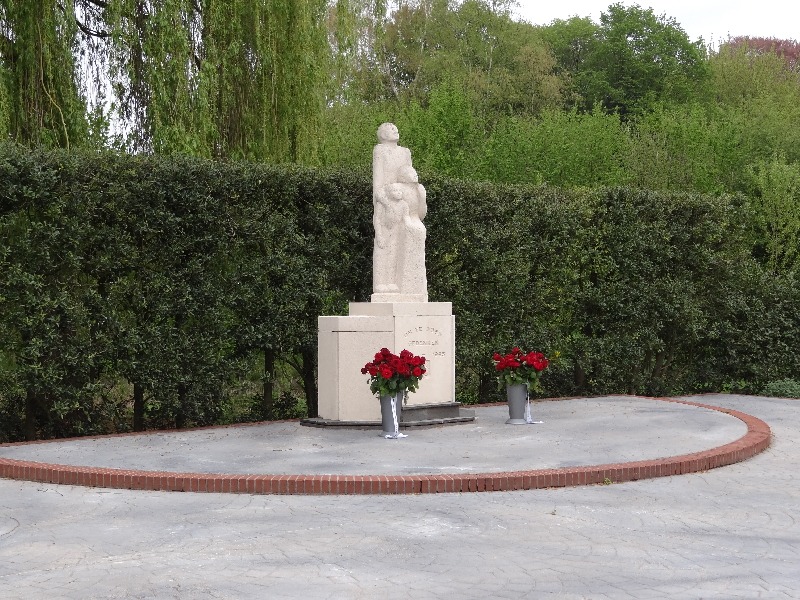
Immediately after the liberation, there was a need among the population of Aalten to honour the war victims with a monument. In 1956, the monument was unveiled on the Wheme, in memory of all Aalten civilians who died during the occupation years as a result of acts of war. The statue was made by artist Bé Thoden van Velzen.
The monument consists of a statue of a male figure with a woman and child. The sculpture of French limestone is placed on a terrace. The pedestal consists of masonry, concrete and natural stone. The memorial is 1 meter 31 high, 1 meter 43 wide and 90 centimeters deep.
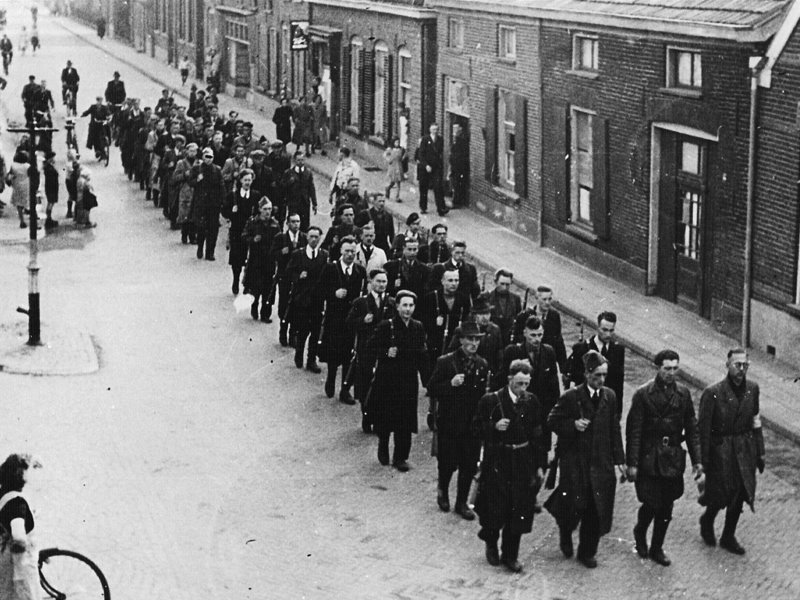
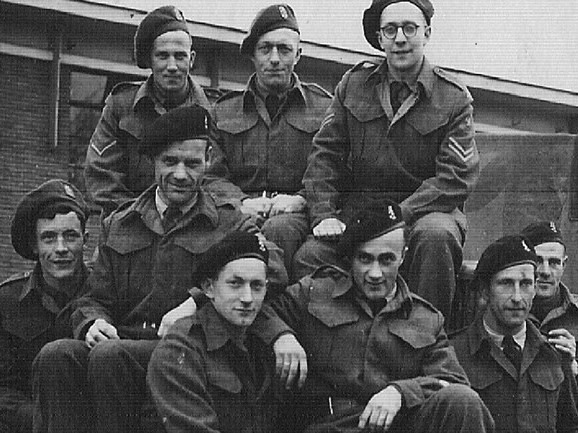
During the liberation of the Achterhoek, the Dutch National Battalion was established in Aalten on 15 April 1945. A unit that consisted of members of former Achterhoek assault groups, at that time officially called Binnenlandse Strijdkrachten (Domestic Forces), and people in hiding who had found a safe haven in Aalten and the surrounding area. The men had volunteered after a call from the Canadians. In no time they had about 400 war volunteers at their disposal, good for three companies.
Everyone knows the Princess Irene Brigade. Founded in 1941 and consisting of Dutch soldiers who had escaped to England, Dutch volunteers who were already abroad and so-called Engelandvaarders; men who made the crossing to England on their own to fight against the Germans from there. The Irene Brigade moved north from the invasion beaches, fought in France, Belgium and Zeeland and fought its last battles in the Bommelerwaard near Hedel shortly before the liberation. Less well known is the ‘Achterhoek’ unit that fought with the Canadians during their advance to the north.
Photo: Foto Garretsen, J. Bloemendal
Photo: A.Ph. de Keijzer
Canadians ask for and get help
The Dutch National Battalion (DNB) had its home base in the Julianaschool in Aalten, renamed ‘Prins Bernhard Kazerne’ for the occasion. With their knowledge of the area, the members of the DNB provided valuable services to the Canadians. Equipped and armed by the Canadians, the soldiers of the DNB advanced up the IJssel, via Doesburg, Steenderen and Gorssel.
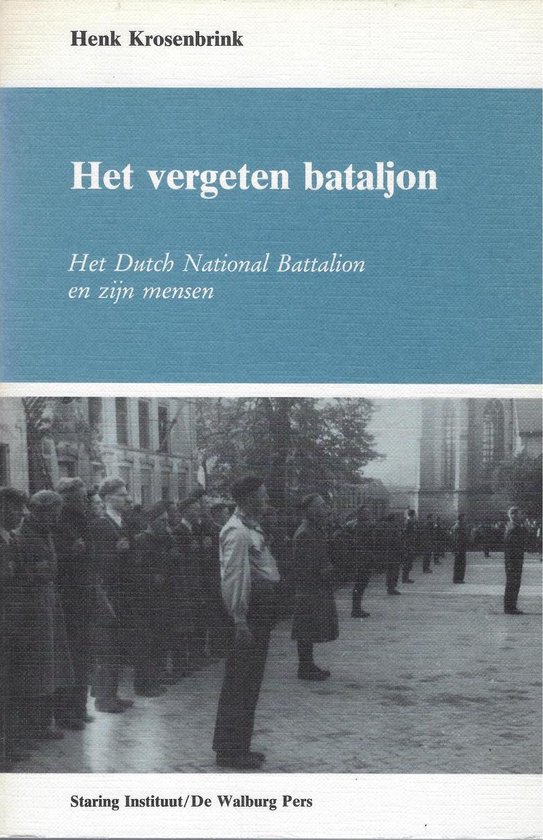
The men guarded the bridges over the IJssel and moved on to Apeldoorn. “Fierce fighting and fierce resistance,” says Arnold Somsen, member of the DNB, from Aalte in the book ‘The Forgotten Battalion’, published by the Staring Institute. “After that, it was now the end of April, the liberation army moved in the direction of Harderwijk, Bunschoten and Spakenburg. We were housed in a school. Standing guard in the evening. The Germans were still in Eemnes. So close by. Gunfights and hand grenades back and forth…”
After the liberation, the DNB was assigned to the Infantry Regiment of the Royal Netherlands Army. With that, the ‘Aalten’ battalion officially ceased to exist.
Deze website gebruikt cookies voor een optimale ervaring en analyse van bezoekgegevens. Ga je hiermee akkoord? Zonder toestemming werken sommige onderdelen van de site mogelijk minder goed.
Functioneel
Always active
De technische opslag of toegang is strikt noodzakelijk voor het legitieme doel het gebruik mogelijk te maken van een specifieke dienst waarom de abonnee of gebruiker uitdrukkelijk heeft gevraagd, of met als enig doel de uitvoering van de transmissie van een communicatie over een elektronisch communicatienetwerk.
Voorkeuren
De technische opslag of toegang is noodzakelijk voor het legitieme doel voorkeuren op te slaan die niet door de abonnee of gebruiker zijn aangevraagd.
Statistieken
De technische opslag of toegang die uitsluitend voor statistische doeleinden wordt gebruikt.De technische opslag of toegang die uitsluitend wordt gebruikt voor anonieme statistische doeleinden. Zonder dagvaarding, vrijwillige naleving door je Internet Service Provider, of aanvullende gegevens van een derde partij, kan informatie die alleen voor dit doel wordt opgeslagen of opgehaald gewoonlijk niet worden gebruikt om je te identificeren.
Marketing
De technische opslag of toegang is nodig om gebruikersprofielen op te stellen voor het verzenden van reclame, of om de gebruiker op een site of over verschillende sites te volgen voor soortgelijke marketingdoeleinden.