Aalten
Owners
This overview is incomplete.
| Year | Plot | Owner | Description |
|---|---|---|---|
| m² |
Residents
Address directory 1967
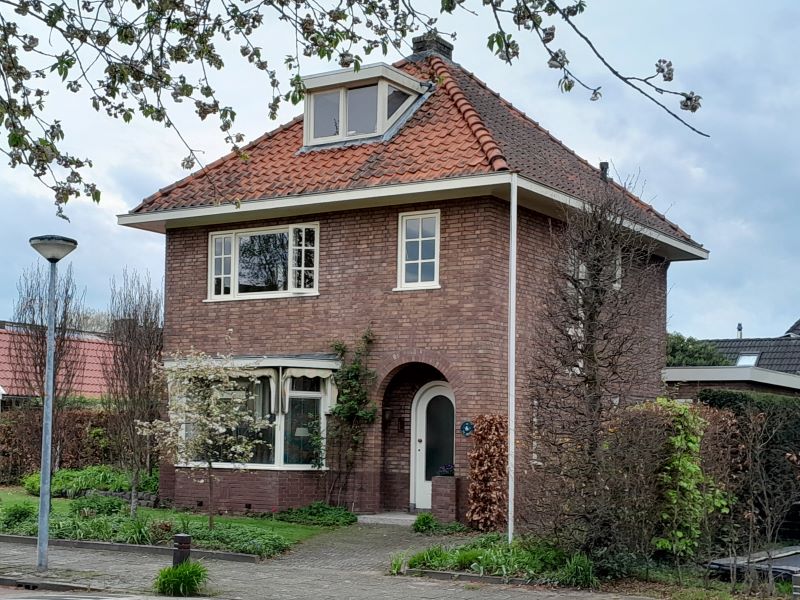
Patrimoniumstraat 33
H.J. te Brake
Features
| Cadastral no. | I-13290 |
| Function | House |
| Year of construction | 1920 |
| Listed | no |
Aalten
This overview is incomplete.
| Year | Plot | Owner | Description |
|---|---|---|---|
| m² |
Patrimoniumstraat 33
H.J. te Brake
| Cadastral no. | I-13290 |
| Function | House |
| Year of construction | 1920 |
| Listed | no |
IJzerlo
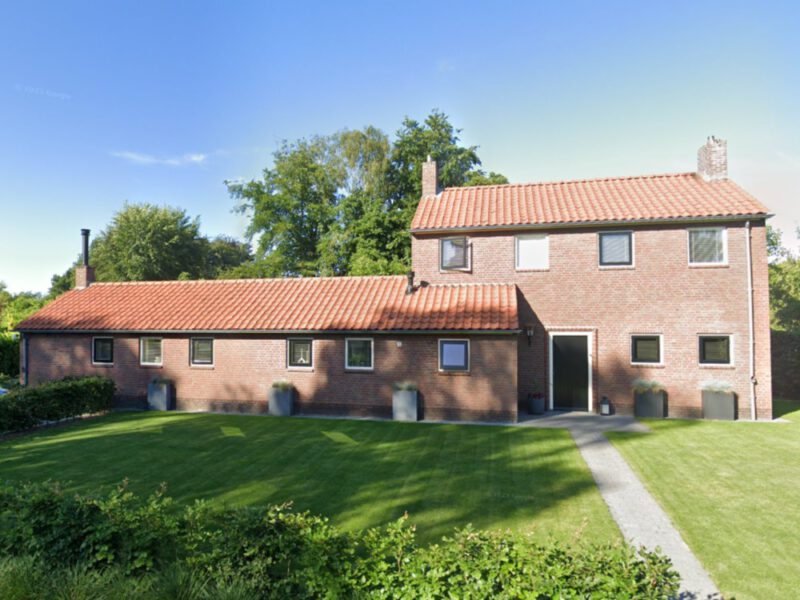
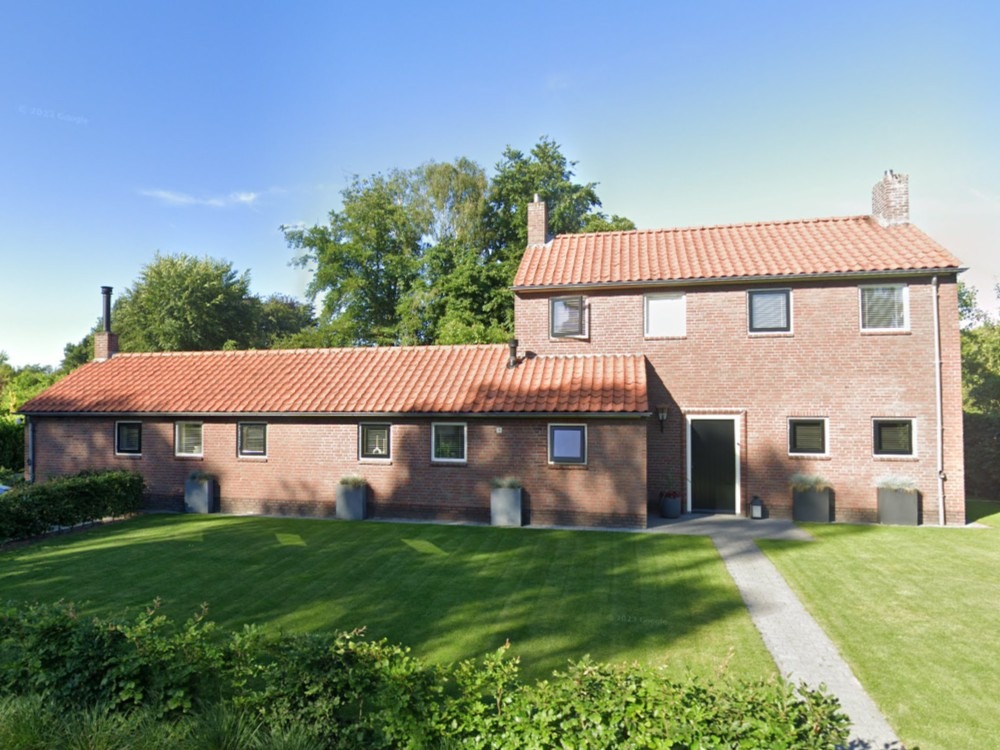
A former freezer building of approximately 50 m² is also located on the plot, currently in use as a storage shed.
This overview is incomplete.
| Year | Plot | Owner | Description |
|---|---|---|---|
| m² |
IJzerlo 112/1 > Kruisdijk 16
J.C. Tolkamp
| Cadastral no. | S-128 |
| Function | House |
| Year of construction | 1954 |
| Listed | no |
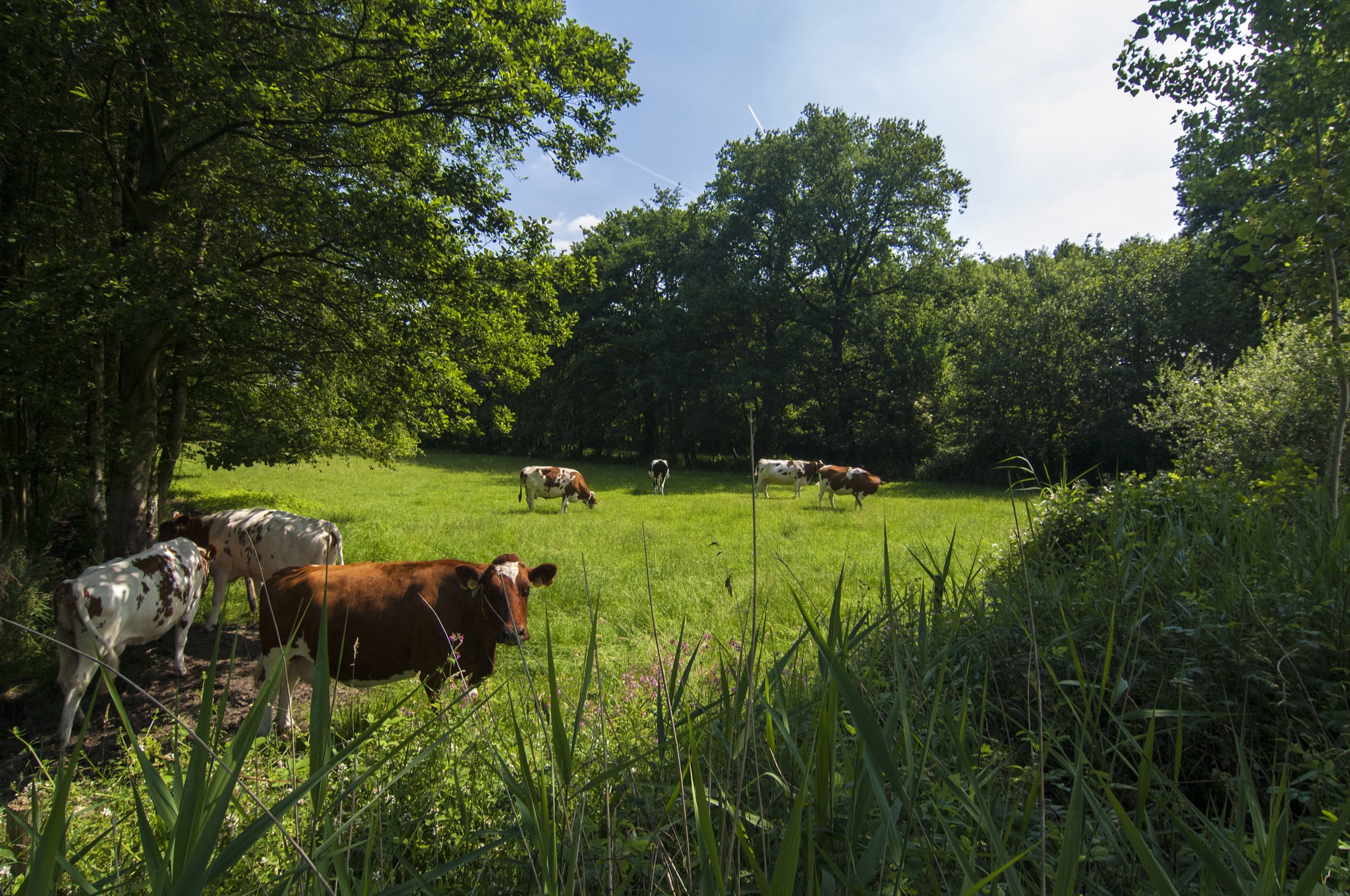
In the second half of the 20th century, a large-scale land consolidation process took place in the municipality of Aalten. During this radical process, agricultural lands were reorganized to enable more efficient operations. The objective was to create larger and more accessible plots for farmers, with less fragmentation and improved infrastructure. However, this change also had significant consequences for the landscape and nature.
Due to inheritance divisions and changes in ownership over the centuries, agricultural plots had become increasingly smaller and more irregular. It became progressively difficult for farmers to work efficiently. The solution was land consolidation. This involved merging and reorganizing plots so that agricultural businesses could operate more effectively. This was achieved through:
The traditional Achterhoek ‘coulisse’ landscape, with its alternation of small fields, meadows, and hedgerows, was affected in many places by land consolidation. This varied and small-scale landscape, which gave the area its picturesque character, gave way to larger, more efficiently designed agricultural plots. As a result, many hedgerows, copses, and dirt tracks disappeared.
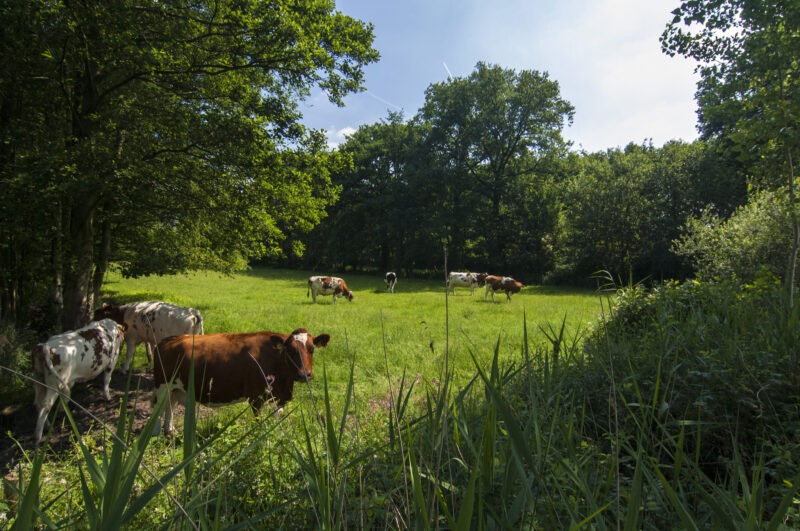
This reorganization allowed farmers to work more easily with modern machinery, but it also made the landscape more open and uniform. Roads such as the Eskesweg and the Aladnaweg were constructed to make agricultural lands more accessible, but this came at the expense of old dirt tracks and characteristic plot boundaries.
In addition to the changes in the landscape, water management was also adjusted. Streams and ditches were straightened and deepened to drain water more quickly. While this prevented flooding, it led to drought issues in some areas. Much of the wetland nature disappeared, which had consequences for biodiversity.
Despite the benefits for agriculture, part of Aalten’s traditional landscape was lost. The small-scale and varied character of the region gave way to larger-scale agricultural lands with less room for nature and historical landscape elements.
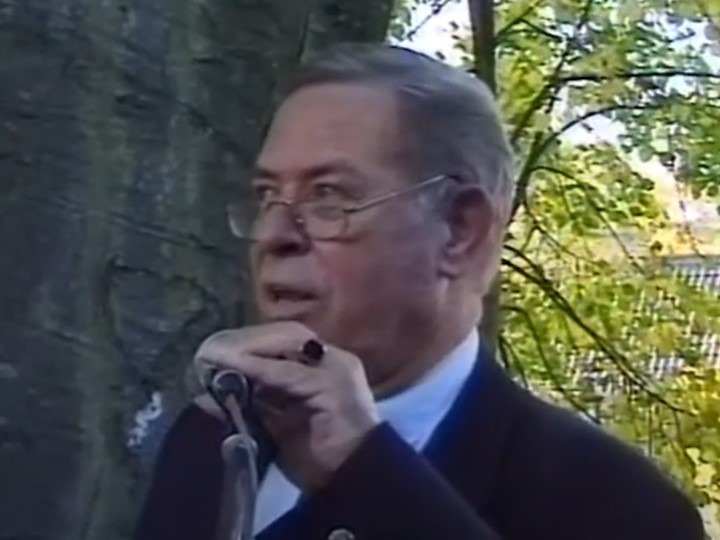
Cantonal Court Judge and Bookseller
Johan (known as Hans) Pruim was born in Hilversum in 1931. From 1959 to 1987 he was a corporate lawyer, and from 1987 to 1990 he practised as a solicitor in The Hague. Subsequently, from 1990 to 1997, he held the position of cantonal court judge in Terborg. He lived with his wife, Loeki, at Beekhuize, the former residence of textile manufacturer Driessen on Dijkstraat in Aalten. Loeki ran a hotel there.
After his retirement as a judge, he and his wife moved to Hozenstraat 2 in Bredevoort. There, they opened a bookshop and antiquarian bookstore.
In Bredevoort, Mr Pruim was active as a board member of the Hameland Bookbinders’ Guild (Boekbindersgilde Hameland). In 1997, he wrote a booklet entitled ‘Een spijl in het hek’ (A Bar in the Fence). This booklet details the history of the recapture of Bredevoort from the Spaniards by Prince Maurice in 1597. During the Eighty Years’ War, Bredevoort was surrounded by marshes. By utilising cork mats, Prince Maurice and his troops managed to recapture Bredevoort. During the presentation of the booklet, several copies featuring a cork cover were presented to Councillor Udo-van Helden and the honorary bailiff (eredrost) of Bredevoort, former Mayor Bekius.
Mr Pruim also rendered outstanding service to the elderly care organisation Stichting Zorgcombinatie Marga Klompé. From 1993, he was involved in guiding the merger between the care homes in Winterswijk, and from 1995, he served as Chairman of the Supervisory Board. In that role, he dedicated himself with great devotion to the well-being of those who live and work within Zorgcombinatie Marga Klompé. Following his retirement in 2006, he continued to support the foundation as Honorary Chairman.
After a period of declining health, Hans Pruim, LL.M., passed away on 4 May 2014 at the age of 83. He was buried at the Berkenhove cemetery.

This page is still ‘under construction’…
De voormalige heerlijkheid Bredevoort maakte oorspronkelijk deel uit van het graafschap Lohn, dat vermoedelijk in de 11e eeuw is ontstaan. Dit graafschap omvatte in 1152 de kerspelen Lohn, Winterswijk, Aalten, Varsseveld, Zelhem en Hengelo (G). In hun streven naar onafhankelijkheid kwamen de graven van Lohn in conflict met de bisschop van Münster, wiens leenheerschappij zij in 1152 tenslotte moesten erkennen. De burcht Bredevoort was in 1246 voor de helft eigendom van graaf Herman van Lohn, die in dat jaar zijn deel in leen opdroeg aan graaf Otto van Gelre.
Upon the death of the last Count of Lohn in 1316, his territory disintegrated. The parishes of Varsseveld and Silvolde went to the Lord of Wisch; the parishes of Zelhem and Hengelo had already been sold to Guelders. In 1316, the Bishop of Münster purchased half of Bredevoort Castle, along with its share of Lohnish rights, from Otto van Ahaus, one of the heirs. The other half of the castle had already been in episcopal possession since 1284.
This purchase led to a dispute between Münster and Guelders, resulting in a war in 1324. Count Reinald of Guelders invaded the Bishopric of Münster and was defeated at Coesfeld, though he had already conquered Bredevoort. At the peace treaty concluded in Wesel in 1326, Reinald retained Bredevoort and received the jurisdictions of the surrounding parishes of Aalten, Dinxperlo, and Winterswijk as a pledge. The Bishop of Münster was entitled to redeem this pledge at any time for 3,500 gold marks, which, however, never occurred. From 1326 onwards, the area became an independent territory administered by a ducal official.
In 1388, William of Jülich, as Duke of Guelders, pledged his castle, town, and the District of Bredevoort with its three parishes to Lord Henry III of Gemen in exchange for a substantial loan. Successive generations of this family remained pledge-holders of the lordship until 1492, when the pledge passed to his heirs and subsequently to the Counts of Bentheim-Steinfurt. It was not until 1526 that Duke Charles of Guelders redeemed the pledge and took the lordship back under his own administration. In 1534, he entrusted Bredevoort to his commander Marten van Rossum, who received the lordship as a pledge in 1545 from Emperor Charles V, the legal successor to the Dukes of Guelders.
When Van Rossum died in 1555, the pledge passed via Johan van Isendoorn to Hendrik van Isendoorn à Blois, who received the pledge sum back in 1562. King Philip II of Spain, acting as Duke of Guelders, then pledged the lordship for 50,000 Flemish shields to his vassal Dietrich van Bronckhorst-Batenburg. He was the Lord of neighboring Anholt in Westphalia, who already possessed many properties and rights within the Lordship of Bredevoort.
After the Reformation, the Lords of Anholt remained Roman Catholic and aligned with the Spanish side. Consequently, Bredevoort was besieged and conquered by Prince Maurice of Nassau in 1597. Lady Gertrud von Milendonck, the widow of Jacob van Bronckhorst-Batenburg, had the lordship returned to her by the Republic in 1602. However, the pledge was redeemed by the States of Gelderland in 1612 and subsequently taken over by Prince Maurice.
Many archival documents concerning the period 1526-1612 are located in the Bredevoort Collection within the Fürstlich Salm-Salmsches Archiv at the Wasserburg Anholt near Isselburg (D). Older documents from before 1562 were likely transferred to their house archive at the time by order of the Anholt pledge-holders as evidence of their rights. After the termination of the
In 1697, Bredevoort was granted as a free lordship to King-Stadtholder William III, whose heirs possessed it until 1795.
Van het Rijksarchief in Friesland werd in 1986 uit de collectie van het Fries Genootschap het reglement voor de poortwachters te Bredevoort van 1726 ontvangen.
In het huisarchief van de voormalige herberg De Leste Stuver te Bredevoort, berustend te Aalten, bevindt zich o.a. een almanak, gebruikt door de Stadhouder of de Landschrijver als zakagenda in de periode 1737/38.
In 1646 werd het kasteel te Bredevoort verwoest tengevolge van blikseminslag in de kruittoren. Het duurde ruim 50 jaar, eer nieuwe huisvesting werd gerealiseerd. In 1699 verrees aan de Landstraat te Bredevoort een nieuwe kanselarij, het Ambthuis.
After the Batavian Revolution in 1795, the possessions of the House of Orange were declared forfeit; the Lordship of Bredevoort was placed under civil administration. In 1798, the lordships were officially abolished. The former municipalities of Aalten, Bredevoort, Dinxperlo, and Winterswijk were established in 1795 and abolished in 1798. Following the abolition of the lordships in 1798, the former municipality of Lichtenvoorde was added to the District of Bredevoort and separated from it again in 1802.
In 1994, Dr. G.J.H. Krosenbrink of Winterswijk donated a report concerning the administrative organization of the old District, prepared for the new District administration in the period 1798-1802, originating from the then-district board member H. Willink Azn. of Winterswijk.
Het Ambt Bredevoort bleef als bestuurlijke eenheid in stand tot de Franse overheersing. In de jaren 1811 en 1812 werd het opgedeeld in de Mairieën Aalten, Bredevoort, Dinxperlo en Winterswijk.
Het archief van het Ambt werd bewaard op de kanselarij, het Ambthuis te Bredevoort. In 1795 werd het op last van het Provisioneel Bewind in beslag genomen en geïnventariseerd, waarna het onder het beheer werd gesteld van de secretaris van de Municipaliteit van Aalten. Na de Franse overheersing werden bij het herstel van het Nederlands bestuur bescheiden uit het archief gelicht en overgedragen aan de nieuwe gemeenten Aalten, Dinxperlo en Winterswijk. Ook de voormalige rentmeester J.B. Roelvink van de Nassause Domeinen behield het kanselarij-archief onder zich, dat in 1985 helaas door een rechtsopvolger werd vernietigd.
Bredevoort was originally a small ‘borgman’ town based on the Westphalian model. The noble defenders of the castle lived in fortified houses on the outer bailey, which consequently took on the character of a fortress. In the neighboring Bishopric of Münster, such ‘borgmannen’ exercised authority and jurisdiction over their staff and the serf inhabitants of the castle complexes they managed in Horstmar and Nienborg.
Upon the transfer of Bredevoort in 1326, the Bishop of Münster released his Bredevoort ‘borgmannen’ from their oath so they could enter Guelders’ service. In 1503, the Bredevoort ‘borgmannen’ obtained similar privileges from the then-pledge-holder, Everwijn van Steinfurt. However, no city rights for Bredevoort have survived. The military and administrative role of the ‘borgmannen’ ended after the defense was entrusted to a garrison during the 16th century.
The daily administration of the Lordship of Bredevoort rested with the Drost (Bailiff). Following the Münster occupation during the war years 1672-1674, a separate urban administration of a stadtholder and regents of the city of Bredevoort existed briefly within the walls. The Drost often also served as the Richter (Judge). Jurisdiction was provided by the Richter with two ‘keurnoten’ (assessors). The court was held once every two weeks in Aalten, Bredevoort, and Winterswijk. Court days for Dinxperlo were held in Aalten.
Jurisdiction in the city of Bredevoort was exercised by the Richter of the lordship with two ‘keurnoten’, as in the other parishes. Other officials at the court were the Land Scribe (secretary) and the Advocate-Fiscal (public prosecutor). The Land Scribe also served as the secretary to the Drost. Since the latter usually did not reside in the lordship, the Land Scribe often also acted as his deputy as acting-Drost or Stadtholder. Bredevoort had a fortress commander, the “Commandeur der Forteresse”. This position was often combined with that of acting-Drost in a single person. Furthermore, there was a whole series of lower officials, including a gauger, a tool sharpener, a surveyor, and armenjagers (rural constables).
Due to the fact that members of the noble Van Pallandt family and the related families of Van Lintelo and Van Coeverden held the position of Drost of Bredevoort for a long time, a large number of documents concerning Bredevoort matters from the period 1638-1796 are also found in the archive of House Keppel, likewise held at the Gelders Archief in Arnhem.
The last Drost of the District of Bredevoort, since the Batavian Revolution in 1795, was the Winterswijk citizen W. Paschen Gzn. of Winterswijk. His accounts for the period August 1808 – March 1811 were audited and deposited in Winterswijk on September 4, 1812, by the joint mayors of Aalten, Bredevoort, Dinxperlo, and Winterswijk. As early as 1811, Paschen, as temporary mayor of Winterswijk, requested the former Land Scribe to transfer documents concerning Winterswijk matters. According to a letter in the archive of the Municipality of Winterswijk, a chest of archival records was transported by wheelbarrow from Aalten to Winterswijk in 1813. The selection process at the time was somewhat arbitrary, so other Bredevoort documents also ended up in Winterswijk. Steward J.B. Roelvink also transferred Bredevoort documents to the Mayor of Winterswijk in 1815. Incidentally, Lichtenvoorde was only part of the District during the years 1798-1802.
Since 1612, officials were appointed by the Nassau Domain Council. For appointment data, see the so-called ‘Ambtboek’, held in the archive of the aforementioned Domain Council at the National Archives in The Hague. Information on appointments in the District of Bredevoort can also be found in the archive of the Drost and Geërfden, inv. nos. 22-33, and in the archival collection Local Government Winterswijk, inv. no. 14. Through the Drosten, many personnel records also ended up in the Keppel house archive, held at the Gelders Archief in Arnhem.
Besides the city of Bredevoort, the lordship consisted of three judicial districts, which coincided with the three parishes of Aalten, Dinxperlo, and Winterswijk. In each parish, a ‘voogd’ (warden) and one or two ‘ondervoogden’ (sub-wardens) were appointed, acting as intermediaries between the inhabitants of the parishes and the administration in Bredevoort. Each parish consisted of a village and a number of rural districts, called guilds, which were divided into wards. These were headed by ward and guild masters, who were responsible for the further dissemination of messages and the execution of orders. Additionally, each rural district had a messenger, an office tied to a specific farm.
Financial matters were handled per parish by the local ‘geërfden’ (landed stakeholders). These representatives of the population were delegated per village and rural district and were accountable to the Drost. The town of Bredevoort had its own Steward, who acted on behalf of the local ‘geërfden’. Each parish had its own collector of the ‘verponding’ (land tax). In Bredevoort, the ward masters sometimes acted collectively as collectors of the ‘verponding’. The churchwardens in each parish, responsible for managing the capital and property of the local church, were elected from the ‘geërfden’ and had to provide accounts to the Drost and their fellow ‘geërfden’. Alongside the ‘diaconie’ as a church institution, there was also a secular institution for poor relief, the ‘provisorie’. Like the churchwardens, ‘provisoren’ were elected from the ‘geërfden’ and were required to account for their management in the same manner.
Teacher
Catharina Cecilea (Cato) Kothuis was born on 23 November 1908 at house no. 8 in Aalten (Landstraat 4), as the daughter of brushmaker Johannes Kothuis and Helena Theodora Vultink.
Cato Kothuis lived with her sister at Landstraat 4. Both sisters remained unmarried. Cato was known as a remarkable woman: deeply religious, yet simultaneously broad-minded. For many years, she was a teacher at the St. Jozef Roman Catholic School, where she taught generations of children. During lessons, she would accompany the class singing on a heavy electric organ, which produced a rather wailing sound.
Cato Kothuis passed away on 30 March 2001. She was buried at Berkenhove Cemetery.
Further information would be welcome!
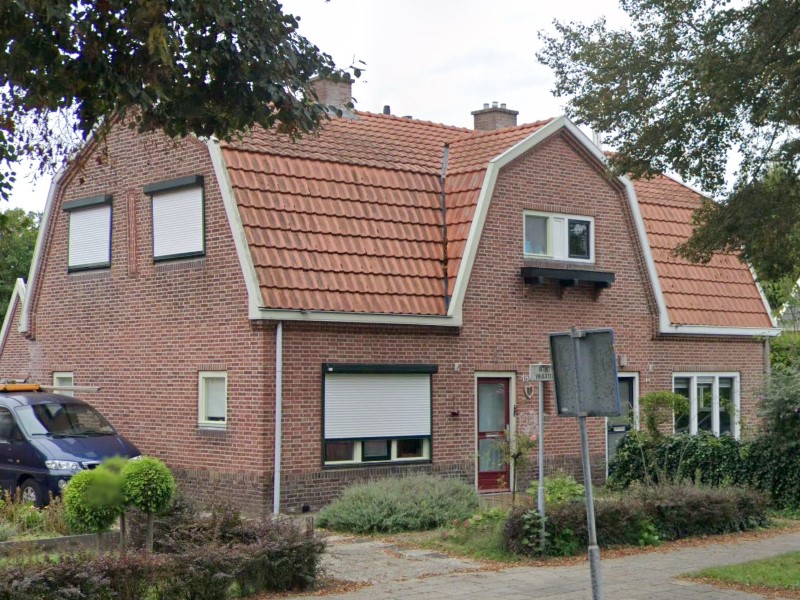
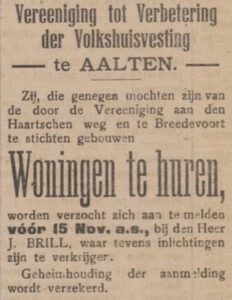
‘Vereniging tot Verbetering der Volkshuisvesting’
In the 19th and early 20th centuries, many Dutch people lived in appalling conditions. During the course of the 19th century, this prompted citizens and workers to establish public housing associations.
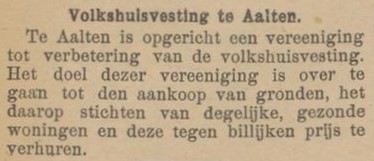
In 1912, a committee was formed in Aalten under the leadership of Mayor Monnik to establish an association for the improvement of public housing. The establishment took place the following year.
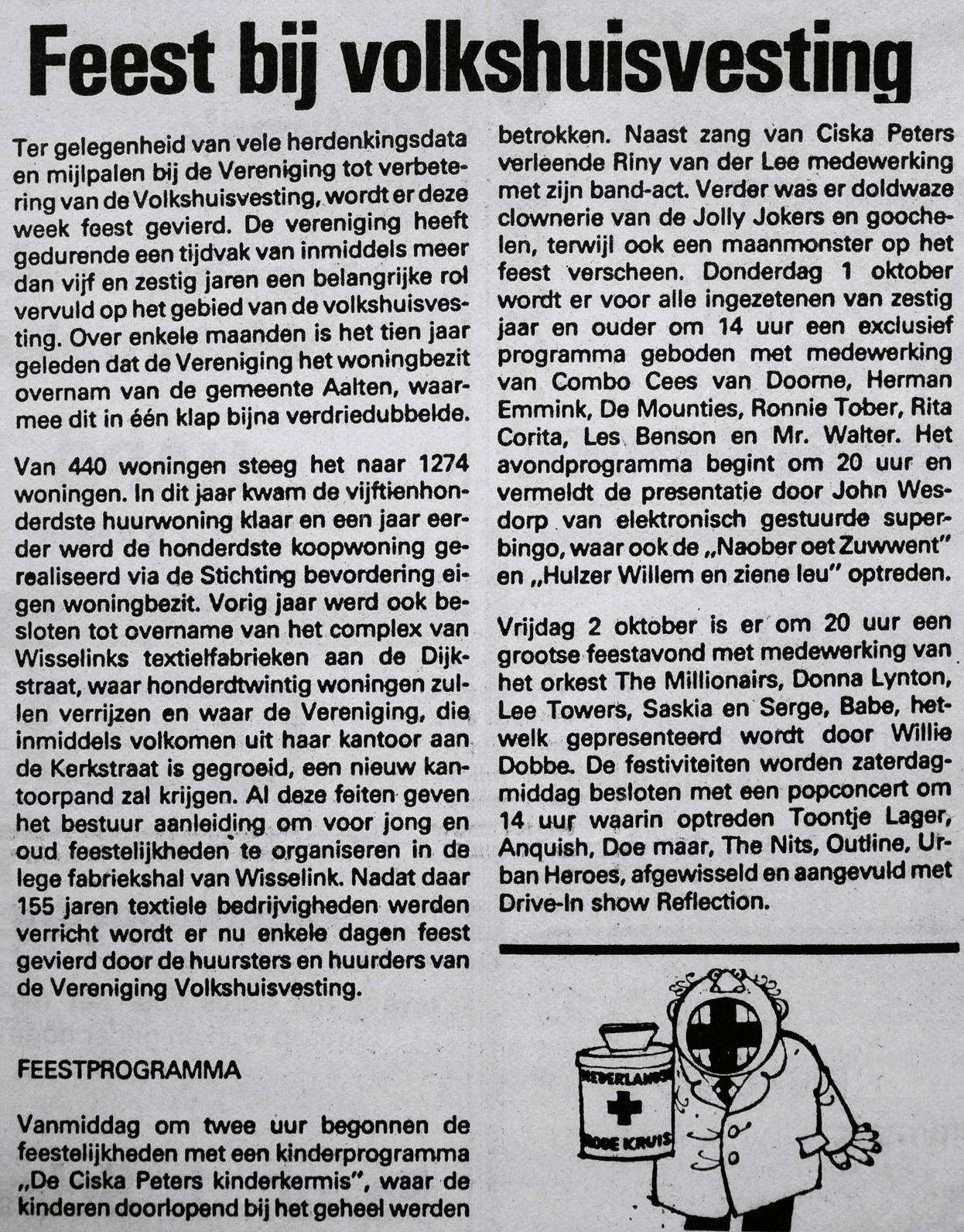
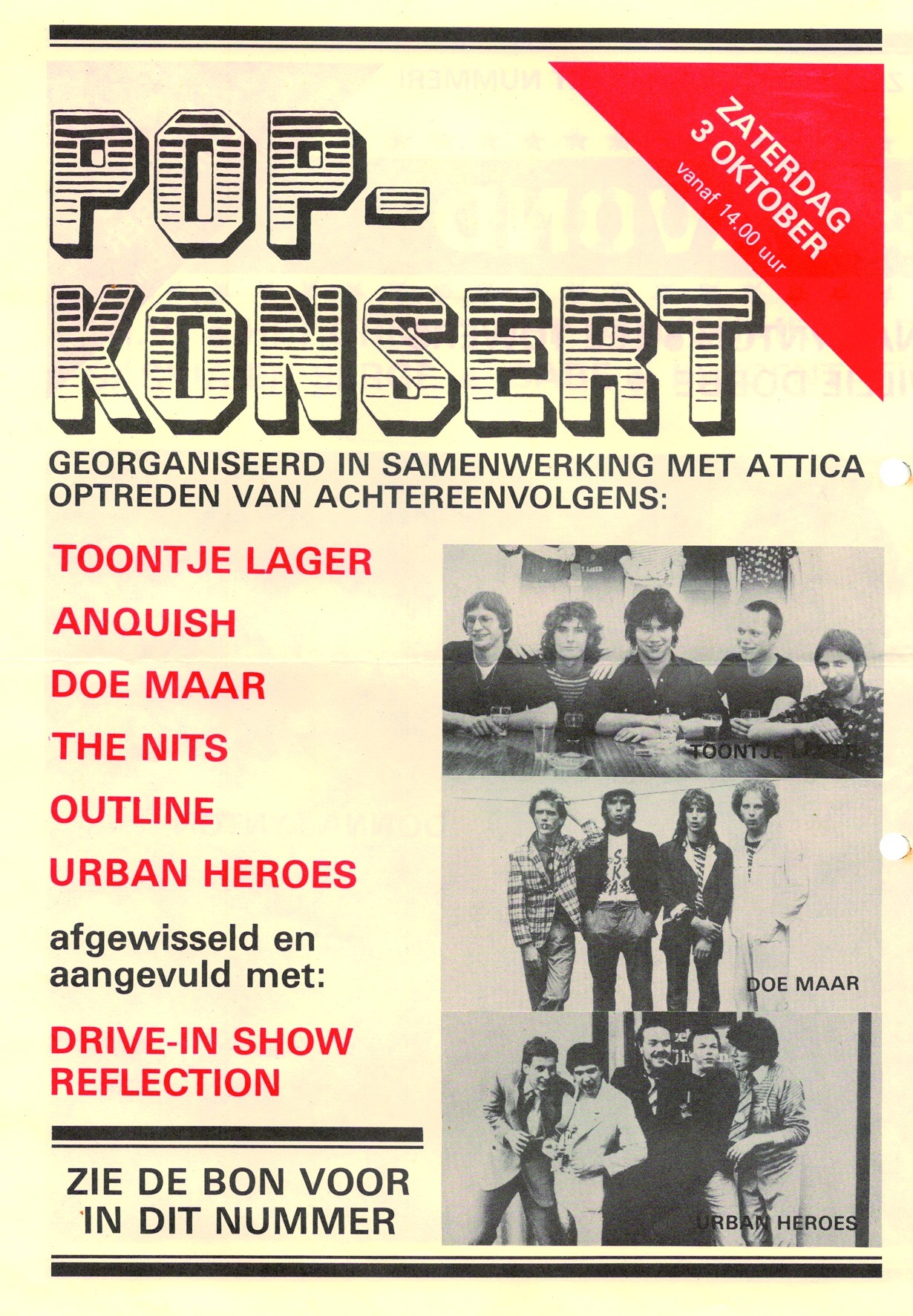
In 1981, the Wisselink textile factory on the Dijkstraat moved to the industrial estate. On the vacated site, 120 homes were built, the current Driessenshof. However, before the former weaving mill was demolished, the ”Vereniging tot Verbetering der Volkshuisvesting’ (Association for the Improvement of Public Housing) organised an extensive programme of festivities there for the people of Aalten:
In 1995, the associations in Aalten, Groenlo, and Winterswijk, which together owned 6,700 homes, decided to merge under the name De Woonplaats. A few years later, a merger followed with De Volkswoning in Enschede (5,100 homes). Two years later, the head office moved from Groenlo to Enschede. In 2022, De Woonplaats owned almost 17,000 homes, of which approximately 2,300 were in the municipality of Aalten.
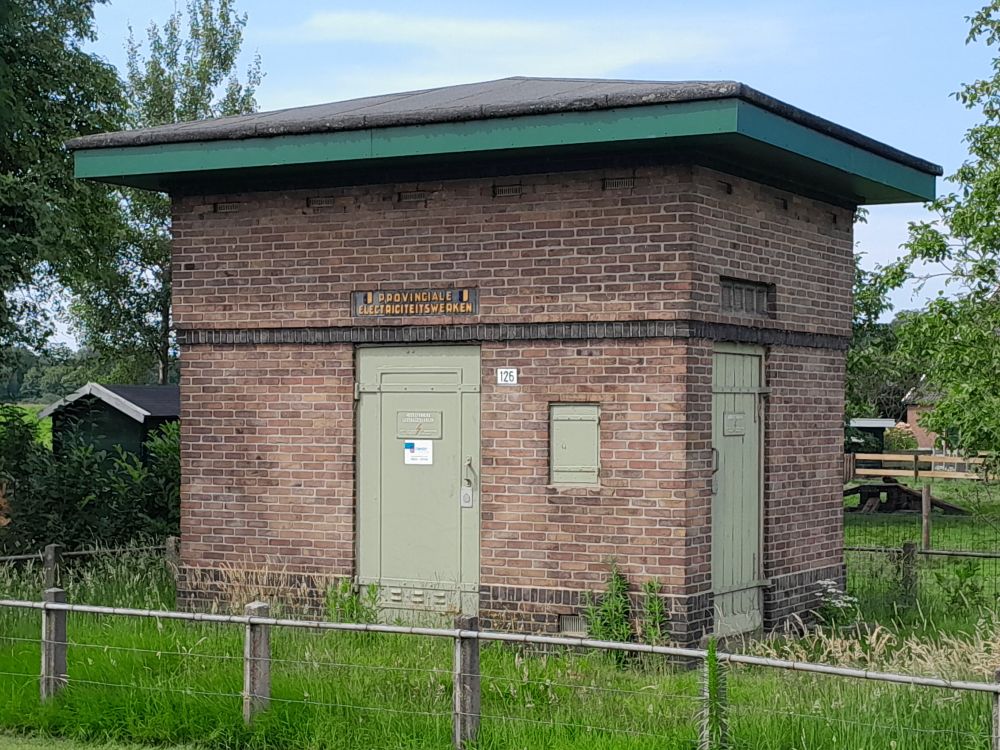
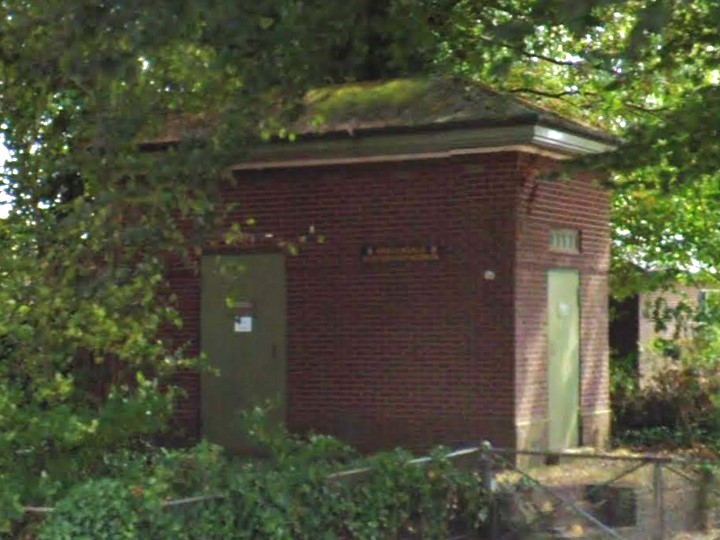
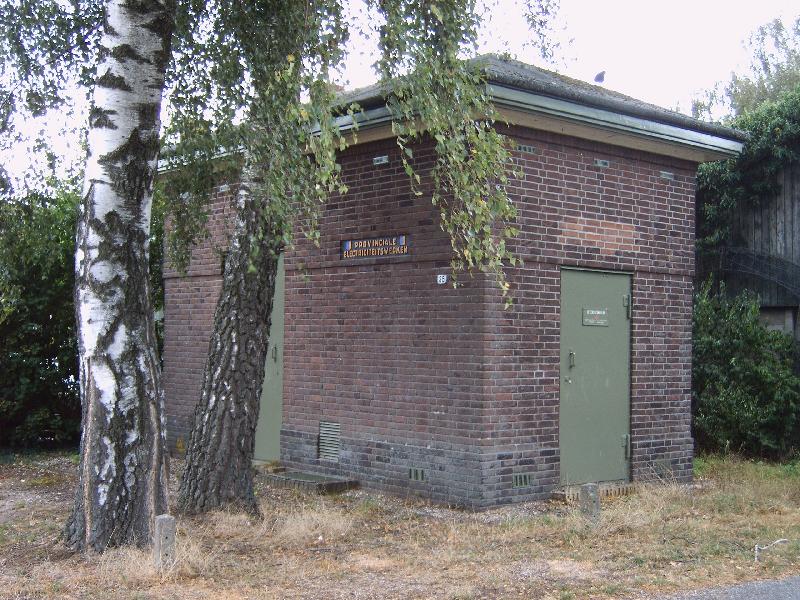
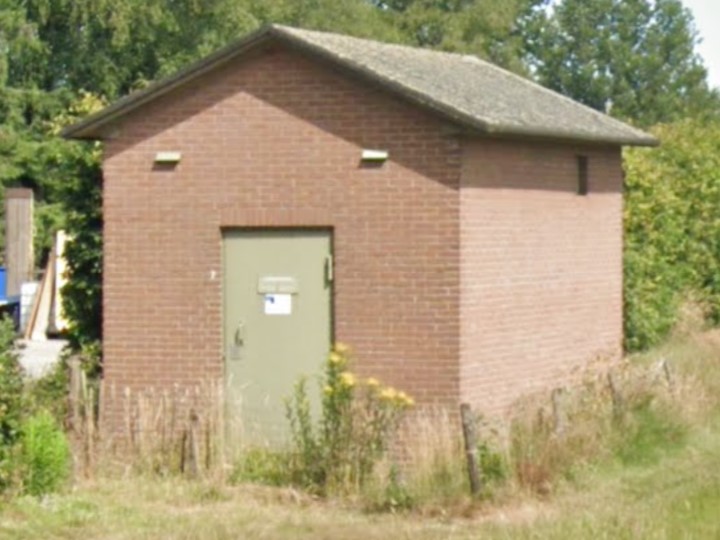
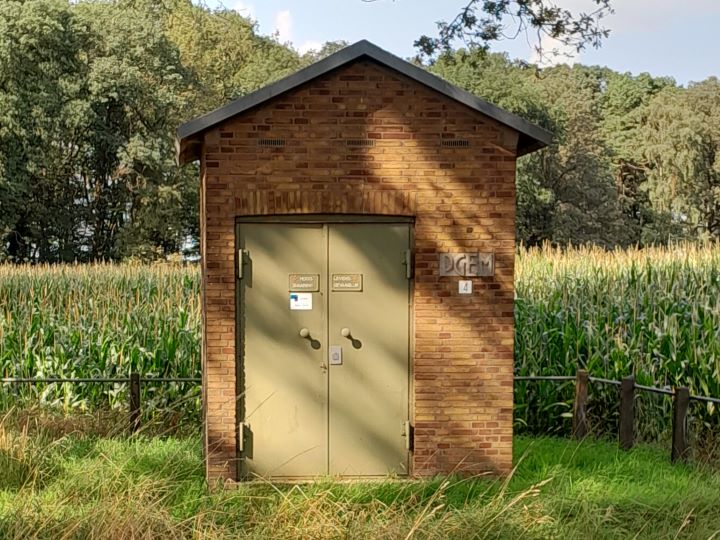
Dozens of transformer substations, also known as ‘trafohuisjes’, are spread across the municipality of Aalten. These substations are designed to convert (transform) high voltage (10,000 Volts) into a lower voltage (230/400 Volts) that can be used in our homes and businesses.
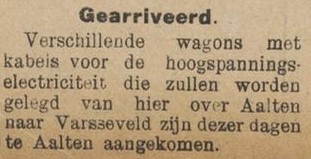
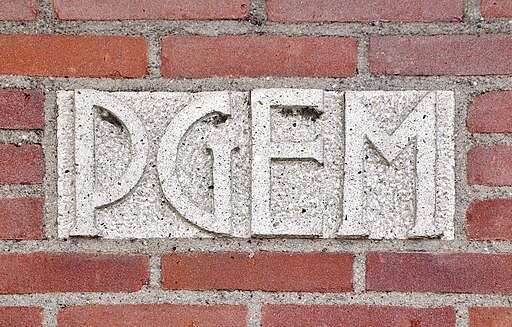
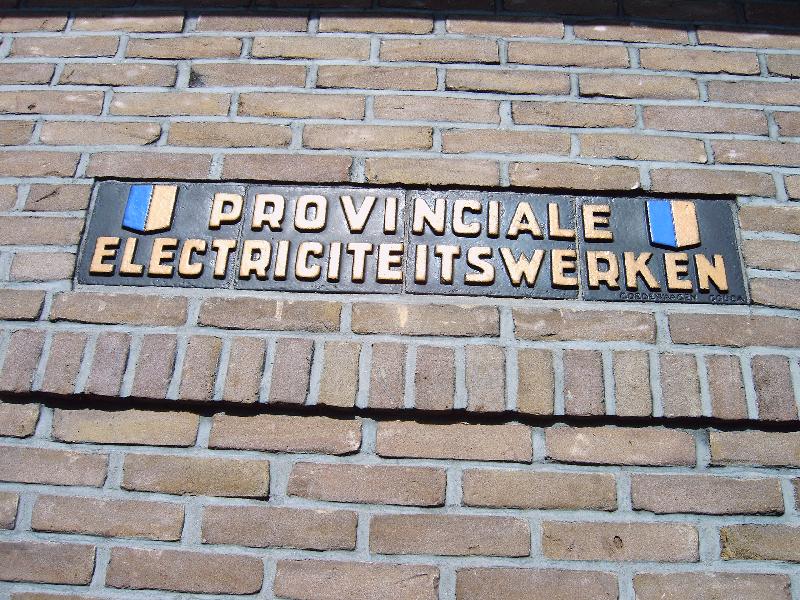
The first transformer substations were built in the early 1920s by the Provinciale Gelderse Electriciteits Maatschappij (PGEM). In 1994, PGEM merged into Nuon and was split up in 2009. The current grid operator is called Liander.
The oldest transformer substations were designed by Gerrit Versteeg (1872-1938), who was the in-house architect of PGEM at the time. They incorporate influences from the Hague School, the Amsterdam School, and Frank Lloyd Wright.
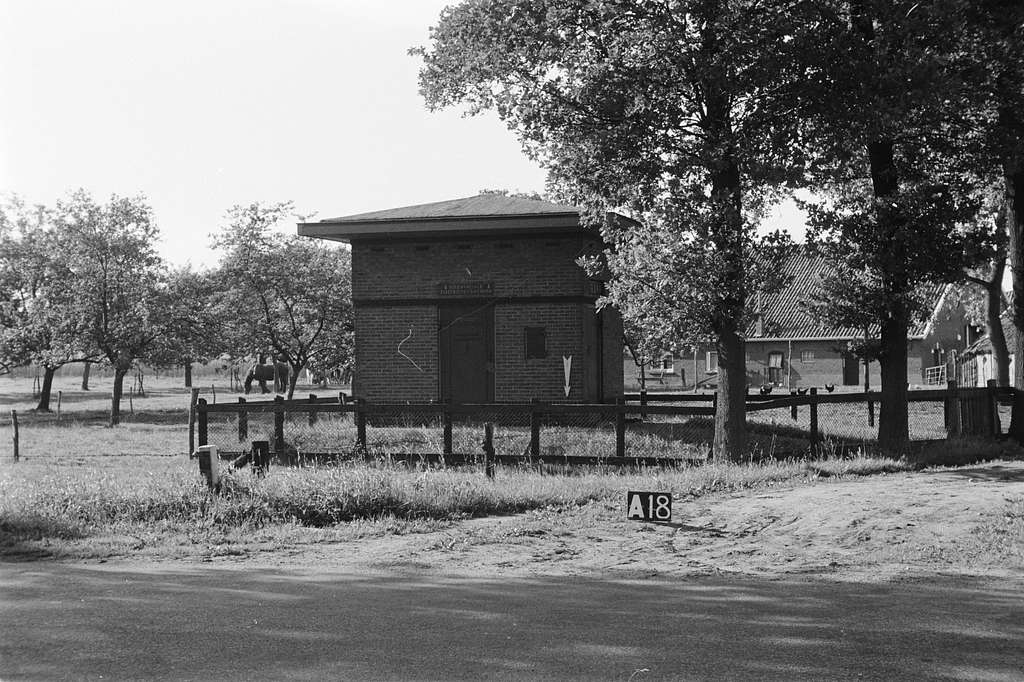
The buildings are often distinctive brick structures, usually with a rectangular floor plan and a single story with a hip roof, gable roof, or flat roof. The doors are frequently made of green-painted steel. The substations feature an inlaid nameplate made of concrete or tiles (from the Goedewaagen company in Gouda).
The older transformer substations have a significant visual value. From a cultural-historical perspective, the buildings commemorate the electrification of the municipality of Aalten. Newer substations (from approximately the early 1980s onwards) usually have a purely functional design and are therefore not of interest from a cultural-historical point of view.
Many historical transformer substations in the Netherlands have been designated as (municipal) monuments. As of yet, no transformer substation is included on the monument list of the municipality of Aalten.
Below is a list of all transformer substations in the municipality of Aalten, as far as we are aware (April 2025). A number of older substations may be of cultural-historical value and could potentially qualify for protected status. Substations built up to and including 1980 are also displayed on the map.
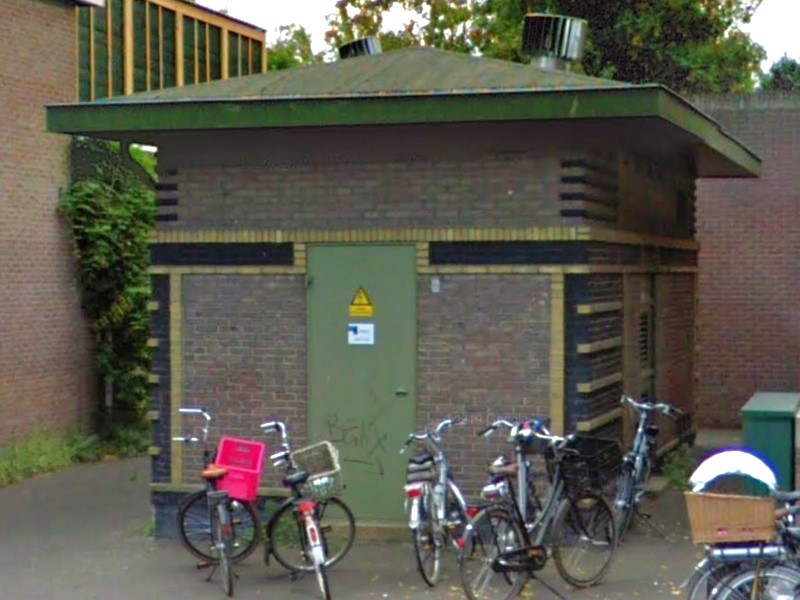
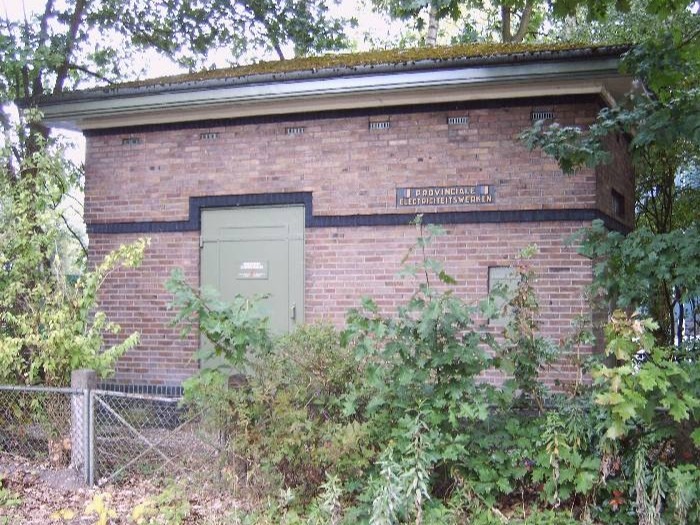
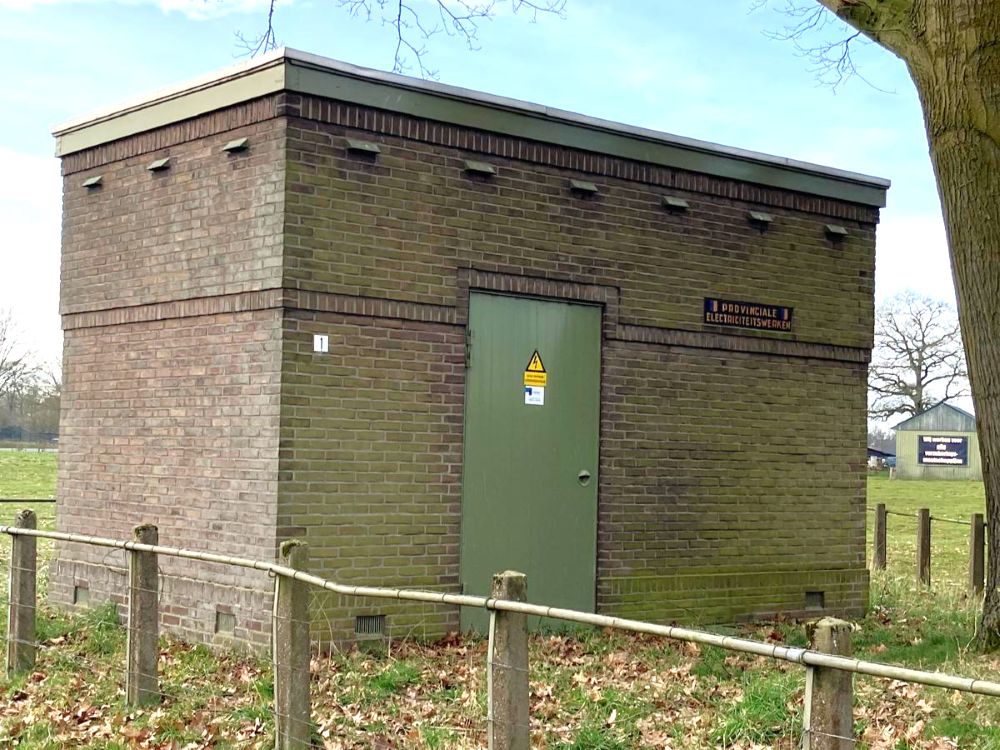
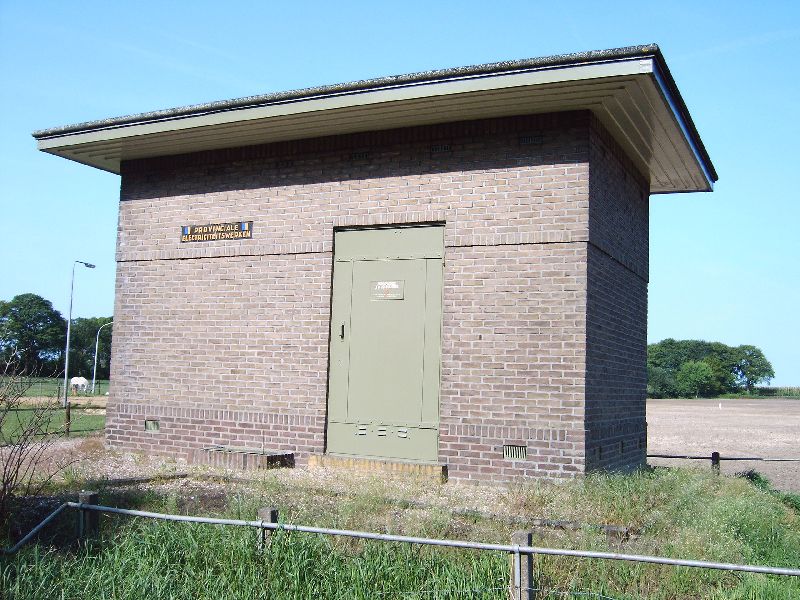
| Adres | Kern/Buurtschap | Bouwjaar |
|---|---|---|
| Admiraal de Ruyterstraat 1 TR | Aalten | 1978 |
| Ambachtsstraat 1 TR | Aalten | 1982 |
| Andromeda 32 TR | Aalten | 1972 |
| Bevrijding 1 TR | Aalten | 1977 |
| Bodendijk 54 TR | Aalten | 1975 |
| Boomkampstraat 1 TR | Aalten | 1966 |
| Bredevoortsestraatweg 65 TR | Aalten | 1978 |
| Bredevoortsestraatweg 94 TR | Aalten | 1939 |
| Bredevoortsestraatweg 118 TR | Aalten | 1976 |
| Broekstraat 17 TR | Aalten | 1988 |
| De Hare 5 TR | Aalten | 1981 |
| Dennenoord 7 TR | Aalten | 1970 |
| Dinxperlosestraatweg 44 TR | Aalten | 1964 |
| Dinxperlosestraatweg 54 TR | Aalten | 1980 |
| Dinxperlosestraatweg 62 TR | Aalten | 1971 |
| Dinxperlosestraatweg 79 TR | Aalten | 1930 |
| Frankenstraat 6 TR | Aalten | 1966 |
| Grevinkweg 2 TR | Aalten | 1975 |
| Grote Maote 170 TR | Aalten | 1983 |
| Haartsestraat 6 TR | Aalten | 1923 |
| Het Verzet 28 TR | Aalten | 1981 |
| Karel Doormanstraat 14 TR | Aalten | 1969 |
| Keizersweg 51 TR | Aalten | 1963 |
| Kemenaweg 50 TR | Aalten | 1972 |
| Koopmanstraat 85 TR | Aalten | 1984 |
| Lage Blik 26 TR | Aalten | 1983 |
| Lage Veld 32 TR | Aalten | 1974 |
| Meiberg 23 TR | Aalten | 1960 |
| Mercurius 5 TR | Aalten | 2011 |
| Mercurius 7 TR | Aalten | 1972 |
| Molenkamp bij 35 | Aalten | 1963 |
| Neptunus 16 TR | Aalten | 1972 |
| Nijverheidsweg 42 TR | Aalten | 2011 |
| Nijverheidsweg 61 TR | Aalten | 1985 |
| Nijverheidsweg 87 TR | Aalten | 1966 |
| Oranjelaan 7 TR | Aalten | 1940 |
| Orion 31 TR | Aalten | 1971 |
| Piet Heinstraat 46 TR | Aalten | 1927 |
| Prinsenstraat 31 TR | Aalten | 1966 |
| Ringweg 19 TR | Aalten | 1952 |
| Rondweg Zuid 1 TR | Aalten | 2011 |
| Stationsstraat 8 TR | Aalten | 1974 |
| ’t Slaa 31 TR | Aalten | 1990 |
| Tramstraat 1 TR | Aalten | 1968 |
| Tubantenstraat 2 TR | Aalten | 1971 |
| Varsseveldsestraatweg 82 TR | Aalten | 1965 |
| Vierde Broekdijk 19 TR | Aalten | 1997 |
| Vlierbeslaan 22 TR | Aalten | 1979 |
| Vondelstraat 11 TR | Aalten | 1968 |
| Barloseweg 6 TR | Barlo | 1977 |
| Lichtenvoordsestraatweg 83 TR | Barlo | 1934 |
| ’t Villeken 9 TR | Barlo | 1952 |
| Bekendijk 12 TR | Bredevoort | 2011 |
| Izermanstraat 2 TR | Bredevoort | 1972 |
| Kleine Gracht 1 TR | Bredevoort | 1950 |
| Landstraat 1 TR | Bredevoort | 1952 |
| Prins Mauritsstraat 13 TR | Bredevoort | 1925 |
| Stadsbroek 71 TR | Bredevoort | 1994 |
| Boterdijk 7 TR | Dale | 1970 |
| Romienendiek 7 TR | Dale | 2018 |
| Buninkdijk 4 | Haart | 1967 |
| Griesdijk 2 | Heurne | 1960 |
| Hondorpweg 7 TR | Heurne | 1967 |
| Dinxperlosestraatweg 102 TR | IJzerlo | 1966 |
| Dinxperlosestraatweg 122 | IJzerlo | 1970 |
| Klokkemakersweg bij 1 | IJzerlo | 1980 |
| Kruisdijk 35 TR | IJzerlo | 1940 |
| Gendringseweg 4 | Lintelo | 1980 |
| Gendringseweg 23 TR | Lintelo | 1950 |
| Heuvelweg 1 TR | Lintelo | 1933 |
| Kolenbroekweg 1 | Lintelo | 1950 |
| Schooldijk 7 TR | Lintelo | 1950 |
| Sondernweg 21 TR | Lintelo | 1952 |
| Varsseveldsestraatweg 126 TR | Lintelo | 1931 |
| Brussendijk 2 TR | De Heurne | 1939 |
| Caspersstraat 10 TR | De Heurne | 1965 |
| Giebinkslat 6 TR | De Heurne | 1966 |
| Lage Heurnseweg 29 TR | De Heurne | 1980 |
| Aaldersbeeklaan 53 TR | Dinxperlo | 1970 |
| Aaldershuuslaan 2 TR | Dinxperlo | 1972 |
| Aaldershuuslaan 56 TR | Dinxperlo | 2011 |
| Aaltenseweg 61 TR | Dinxperlo | 1973 |
| Alfred Mozerhof 7 TR | Dinxperlo | 1966 |
| Anholtseweg 6 TR | Dinxperlo | 1952 |
| Anholtseweg 38 TR | Dinxperlo | 1993 |
| Beggelderdijk 16 TR | Dinxperlo | 2011 |
| Bernard IJzerdraatstraat 30 TR | Dinxperlo | 1973 |
| De Klumpender 10 TR | Dinxperlo | 1982 |
| De Maten 9 TR | Dinxperlo | 1979 |
| De Ruiterij 20 TR | Dinxperlo | 1975 |
| Ds. van Dijkstraat 15 TR | Dinxperlo | 1968 |
| Europastraat 2 TR | Dinxperlo | 1971 |
| Helmkamp 25 TR | Dinxperlo | 1988 |
| Het Slat 5 TR | Dinxperlo | 1966 |
| Hogestraat 32 TR | Dinxperlo | 1950 |
| Industriestraat 1 TR | Dinxperlo | 1951 |
| Industriestraat 3 TR | Dinxperlo | 1958 |
| Industriestraat 8 TR | Dinxperlo | 1957 |
| Industriestraat 12 TR | Dinxperlo | 1978 |
| Julianastraat 43 TR | Dinxperlo | 1966 |
| Keminksweide 68 TR | Dinxperlo | 1972 |
| Kerkhofplein 3 TR | Dinxperlo | 1939 |
| Keupenstraat 17 TR | Dinxperlo | 1972 |
| Meniststraat 7 TR | Dinxperlo | 1971 |
| Nassaustraat 20 TR | Dinxperlo | 1970 |
| Nieuwstraat 8 TR | Dinxperlo | 1980 |
| Nieuwstraat 52 TR | Dinxperlo | 1979 |
| Terborgseweg 94 TR | Dinxperlo | 1970 |
| Welinkweg 39 TR | Dinxperlo | 1957 |
| Weversstraat 3 TR | Dinxperlo | 1939 |
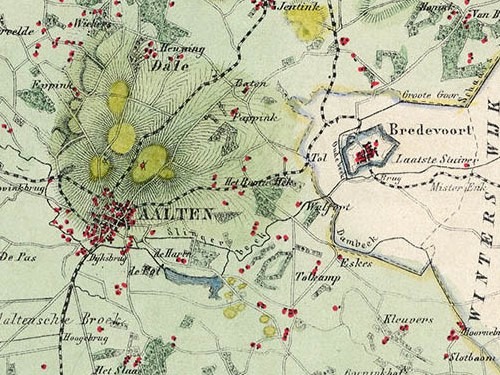
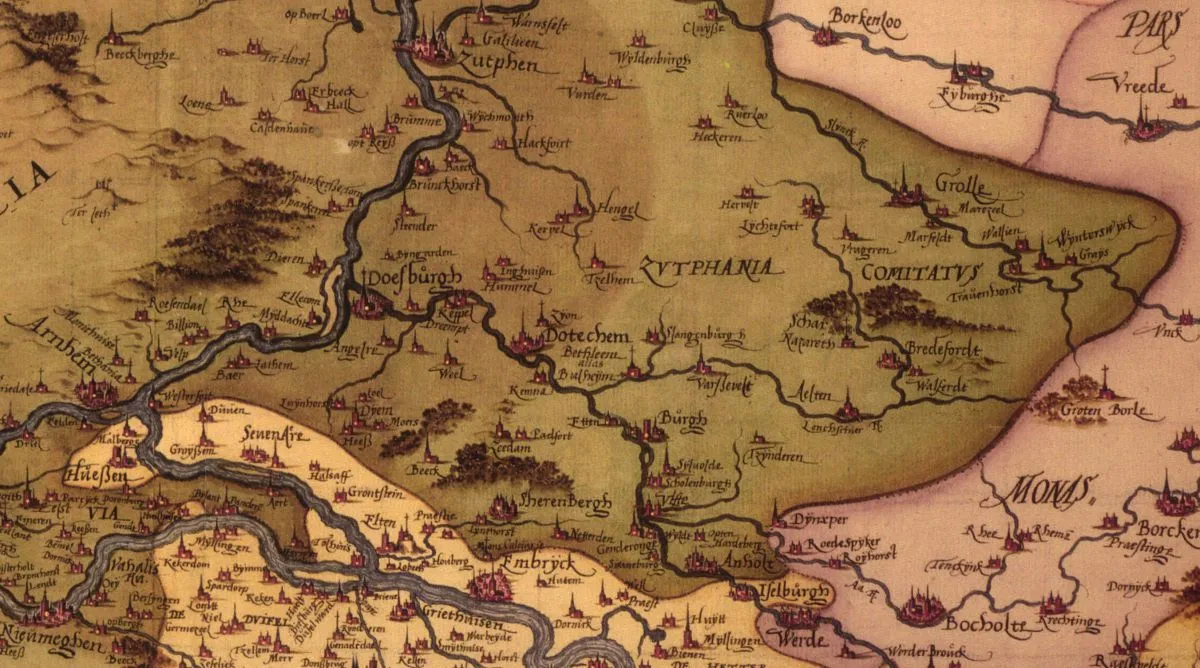
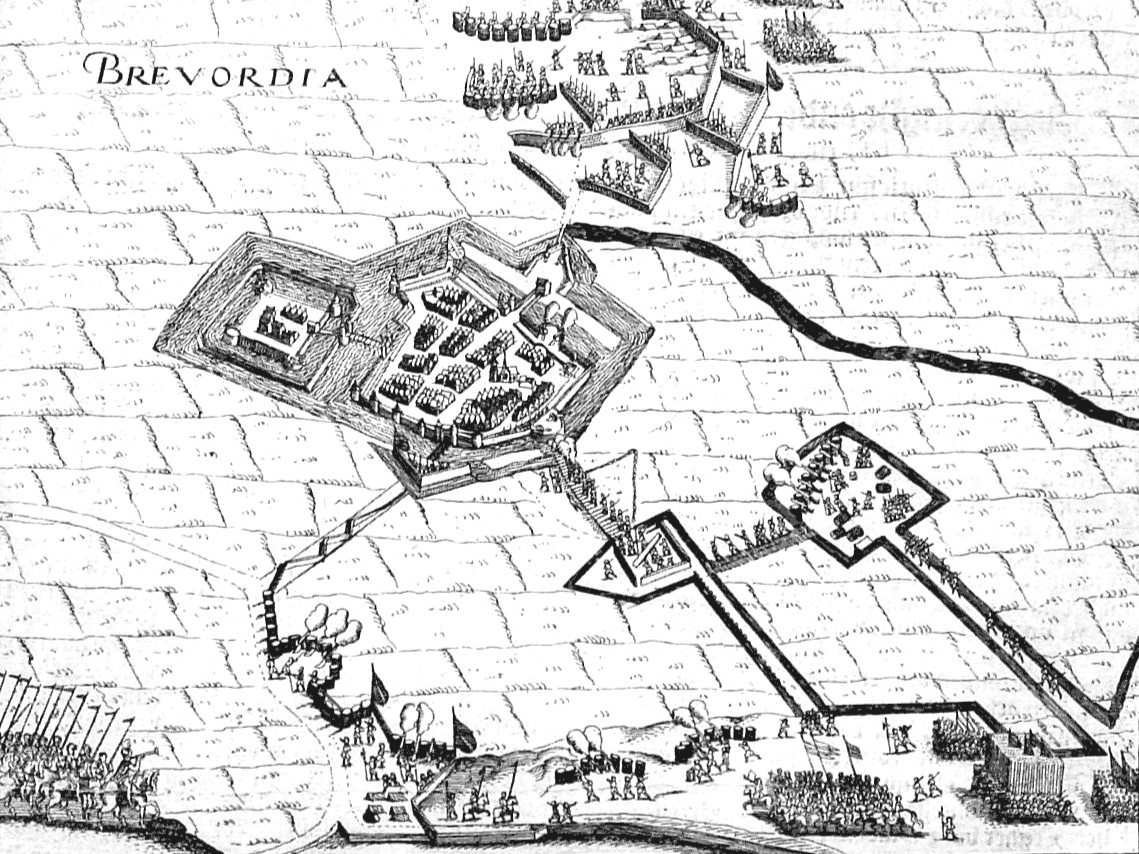
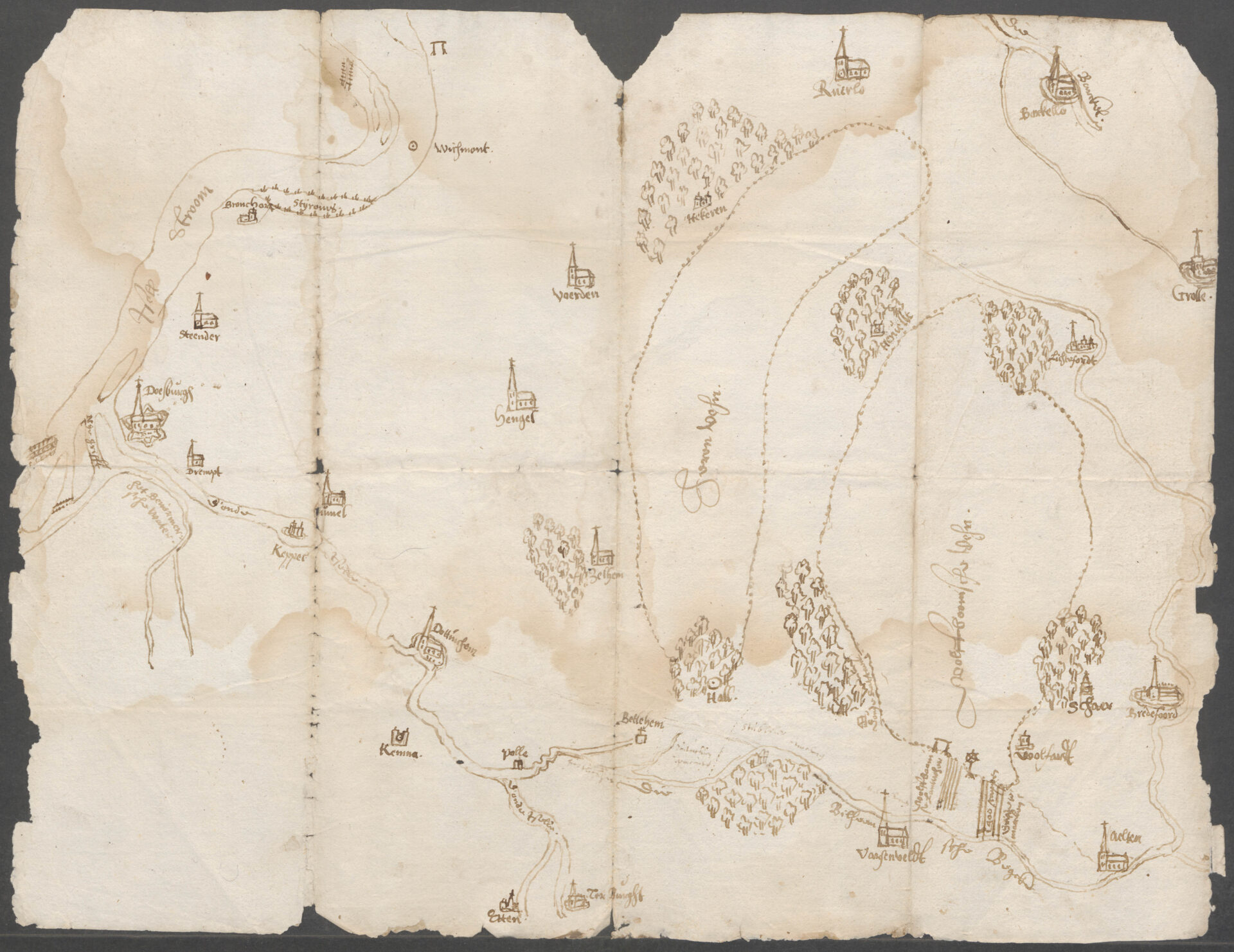
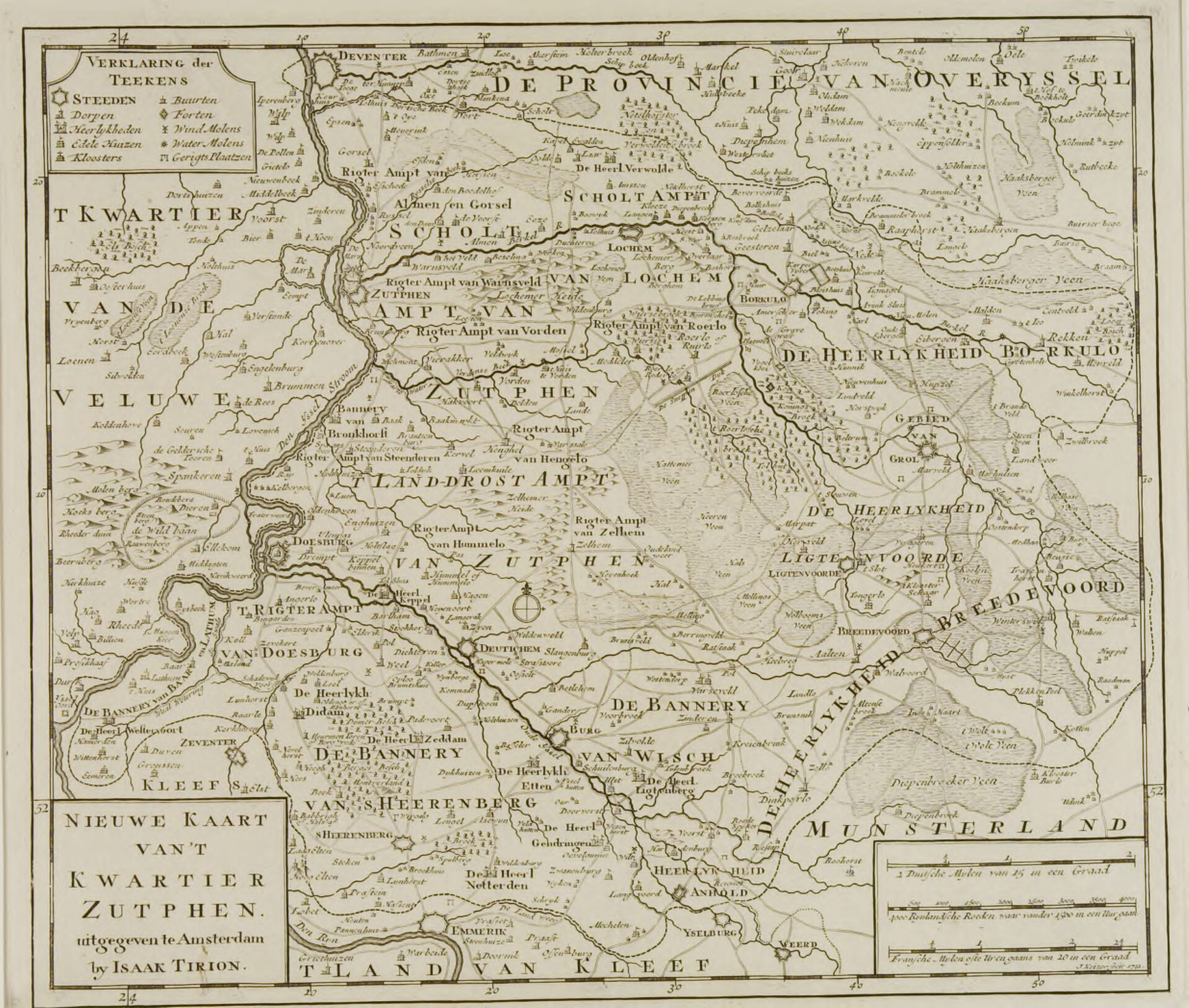
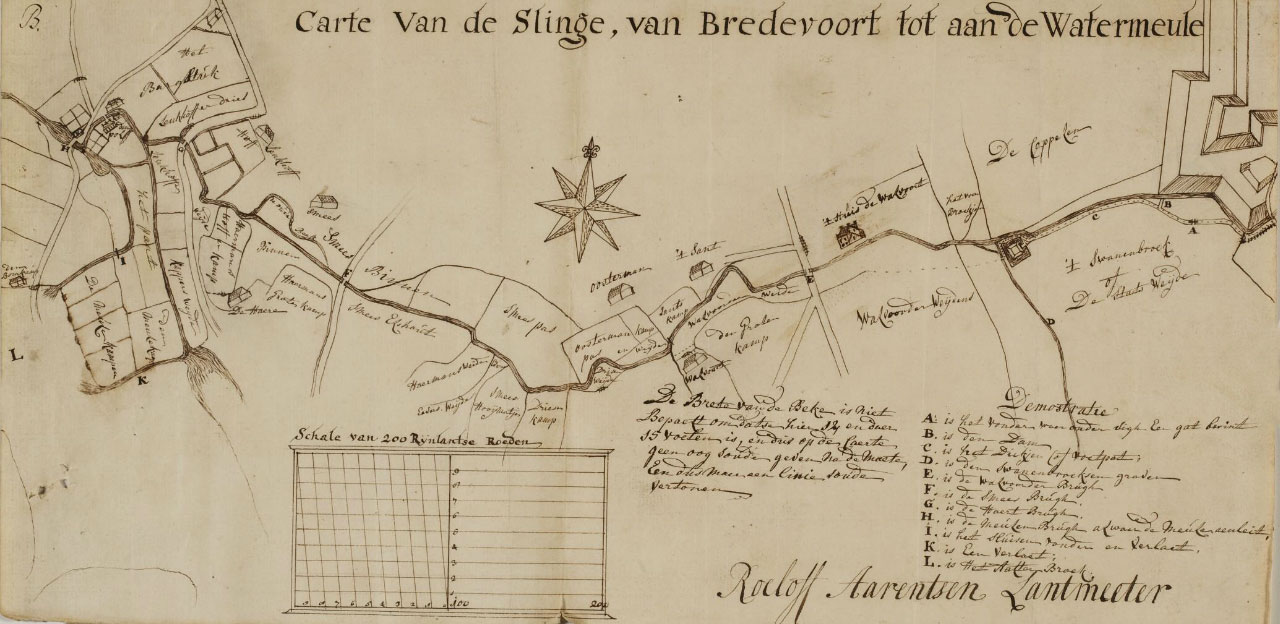
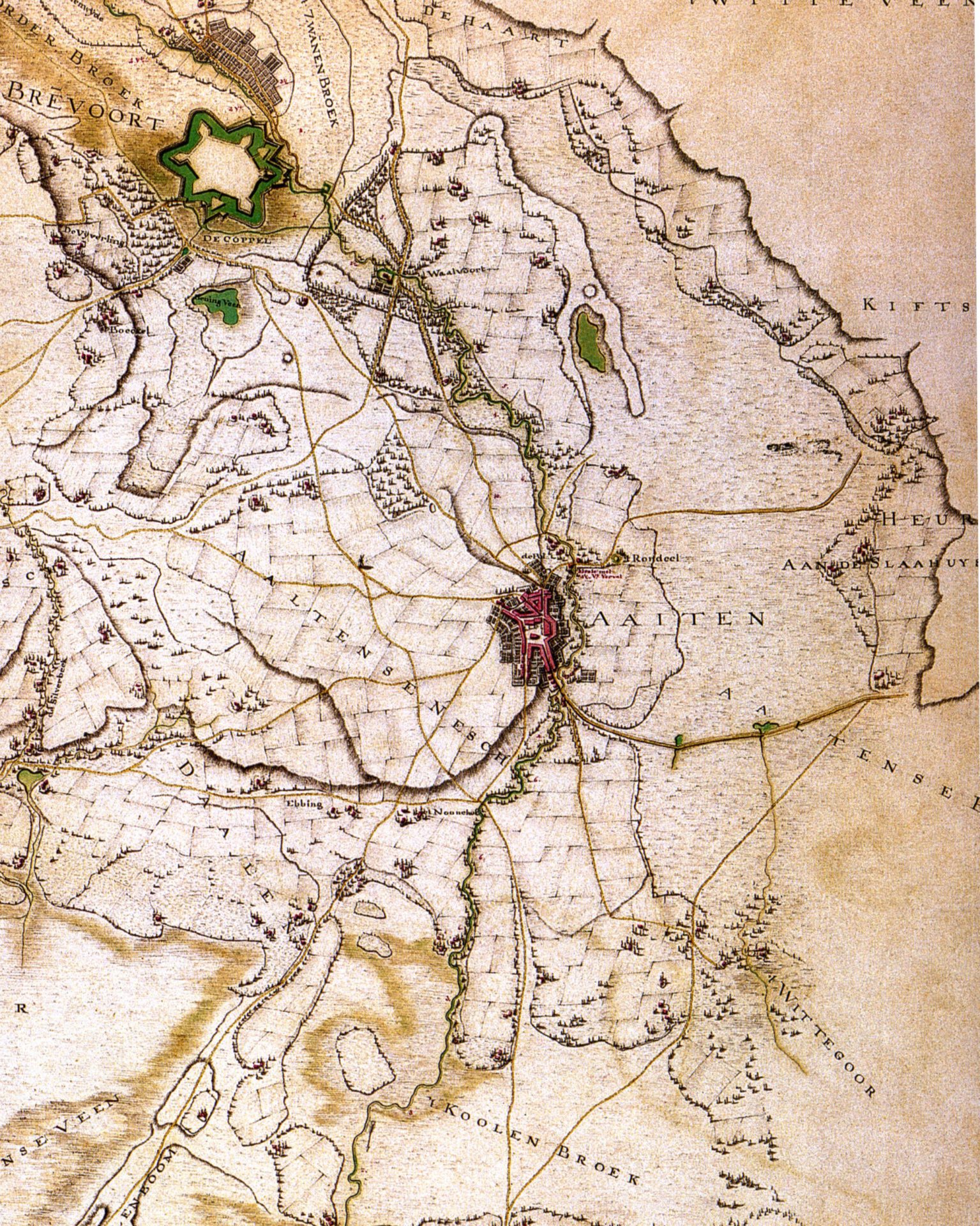
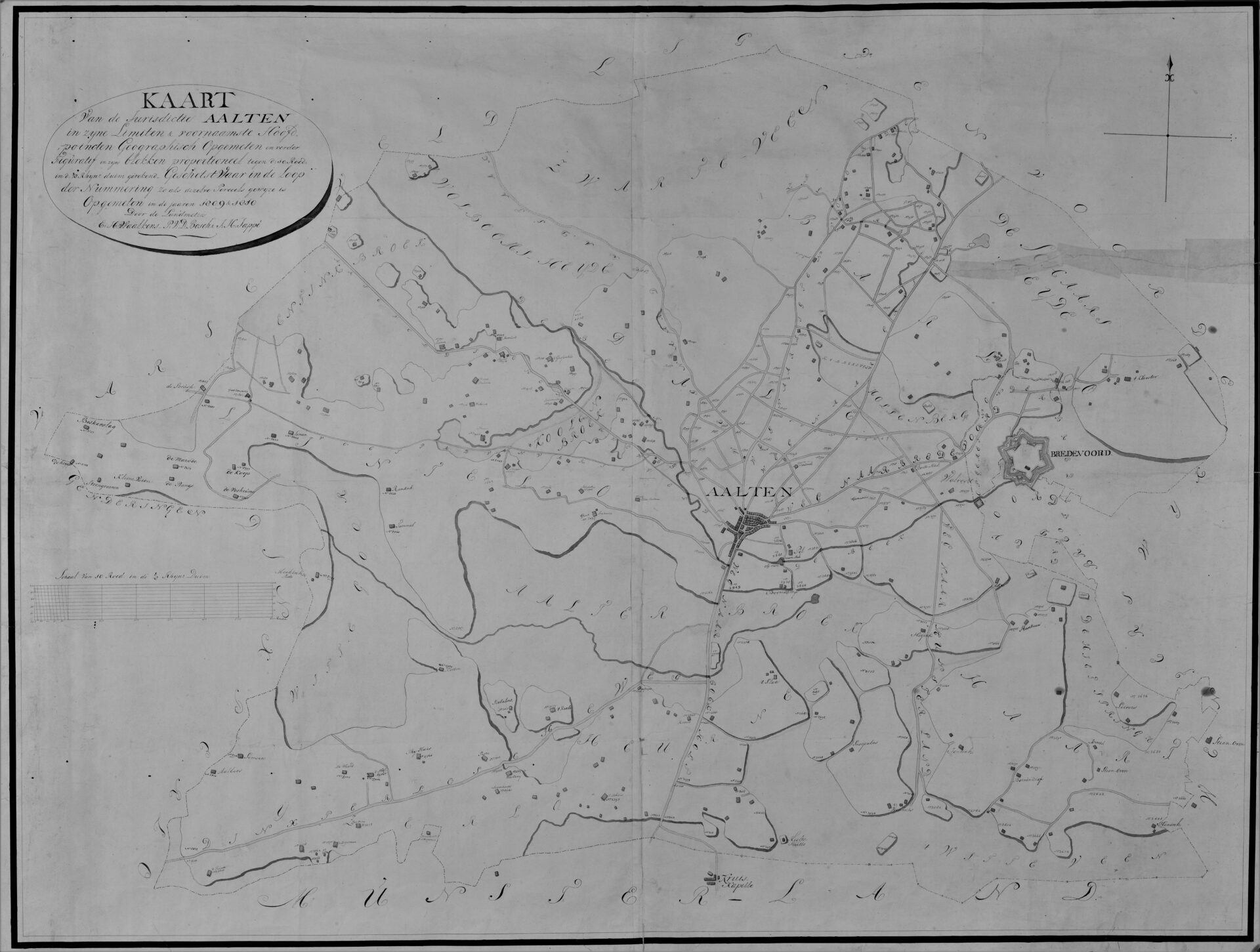
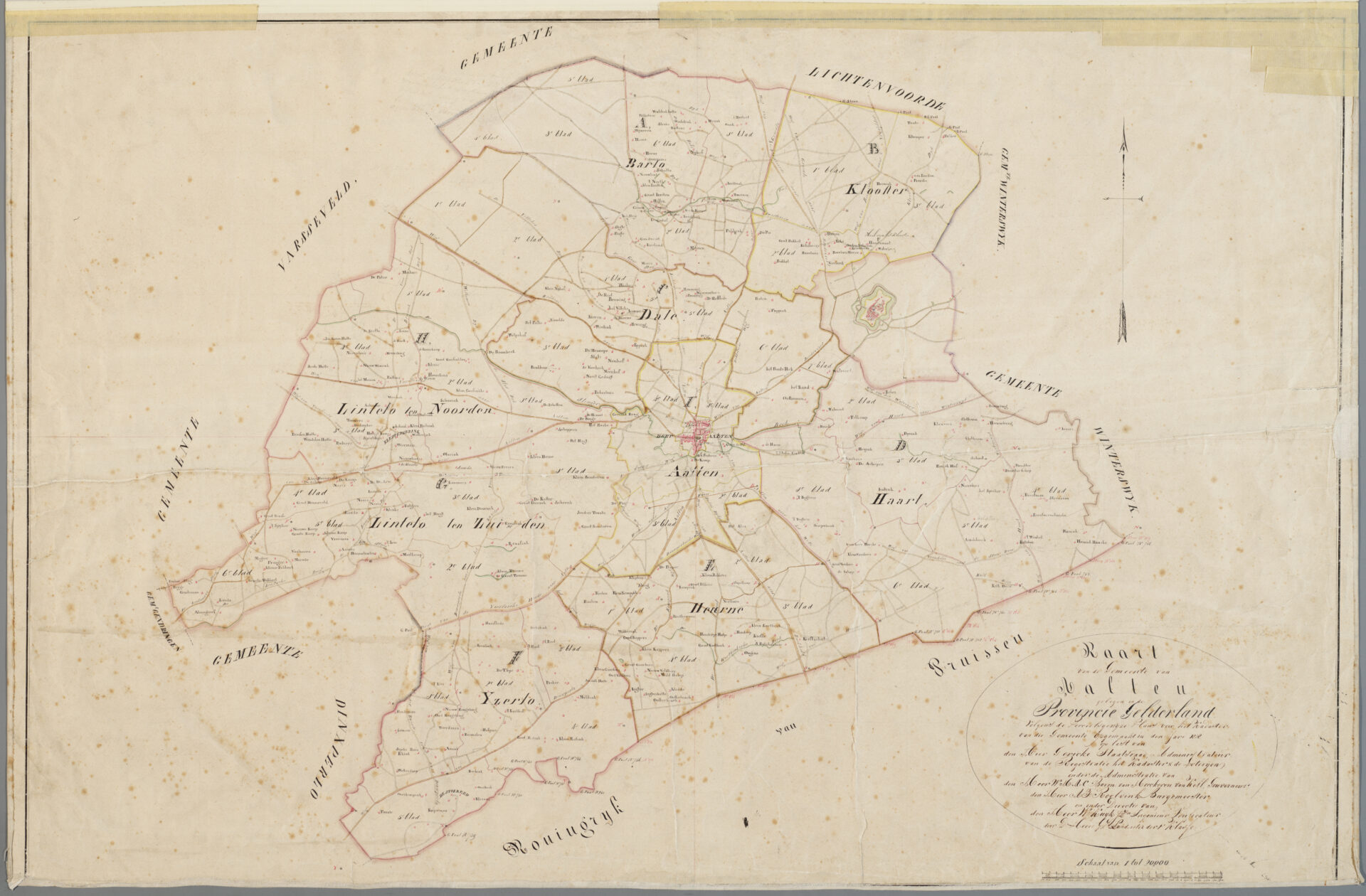
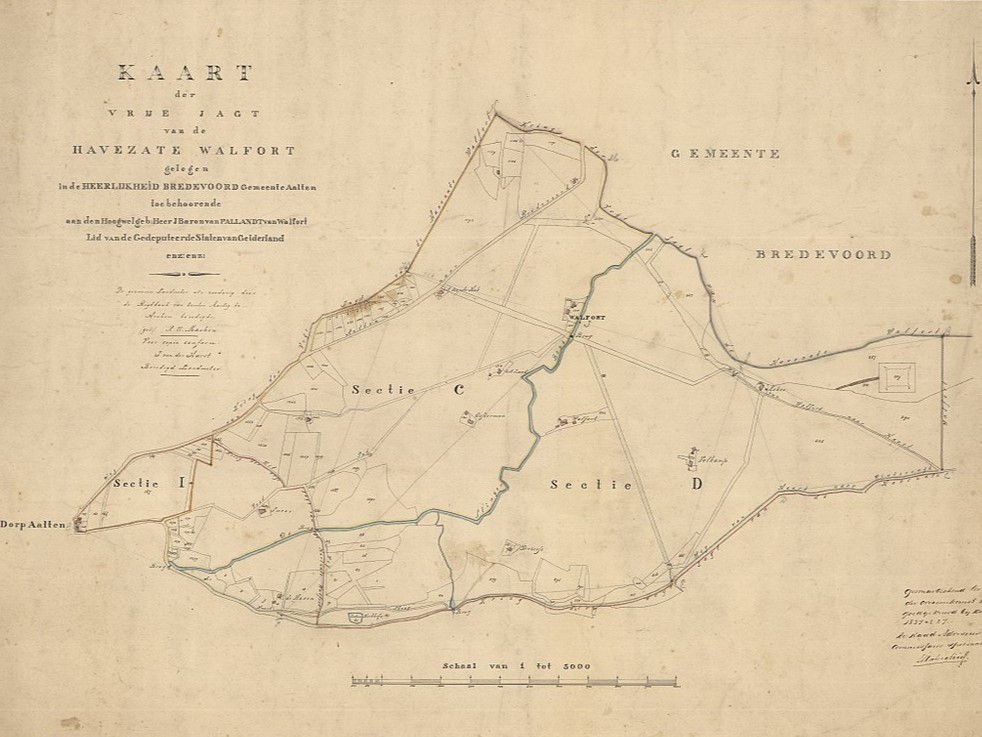
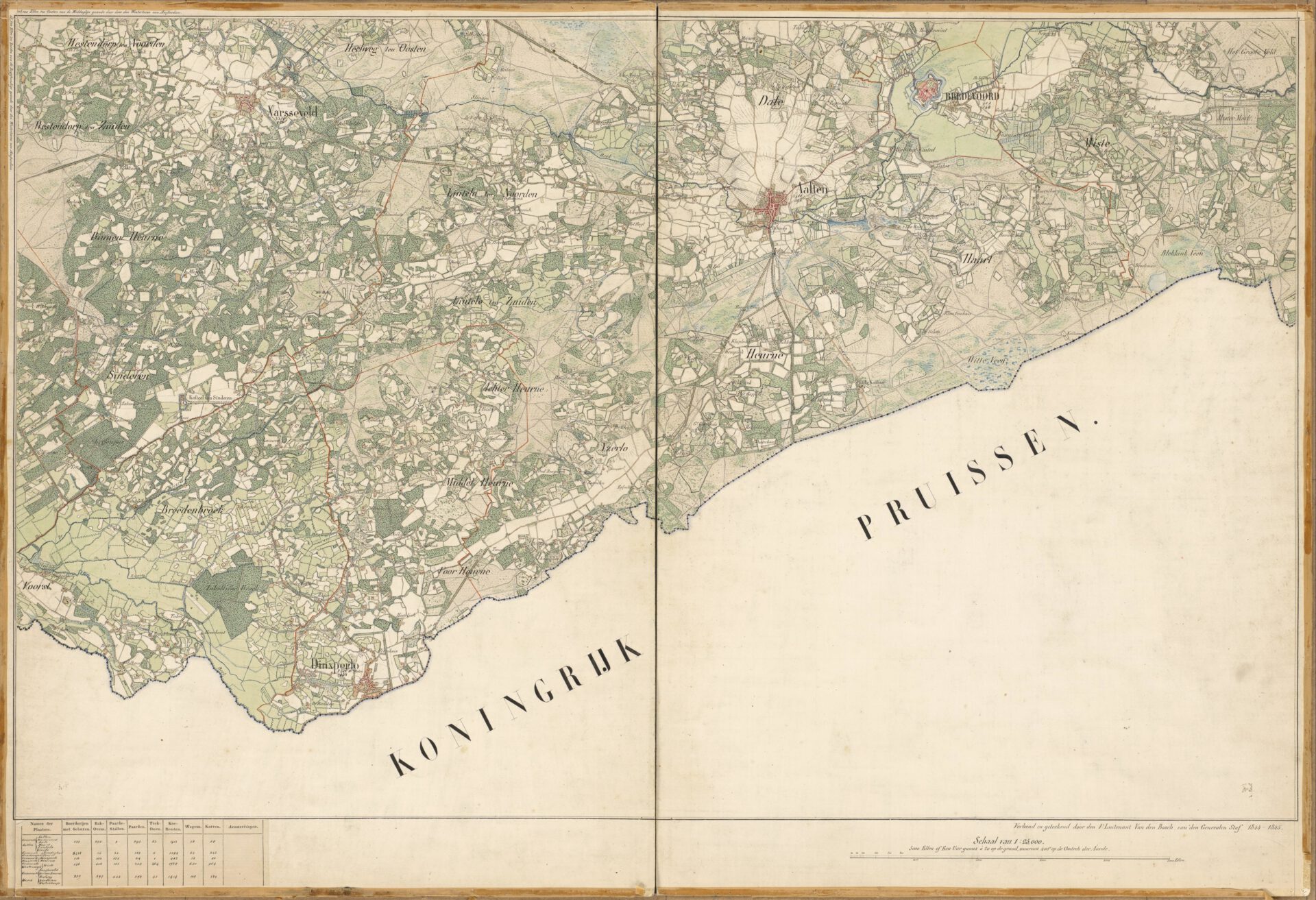
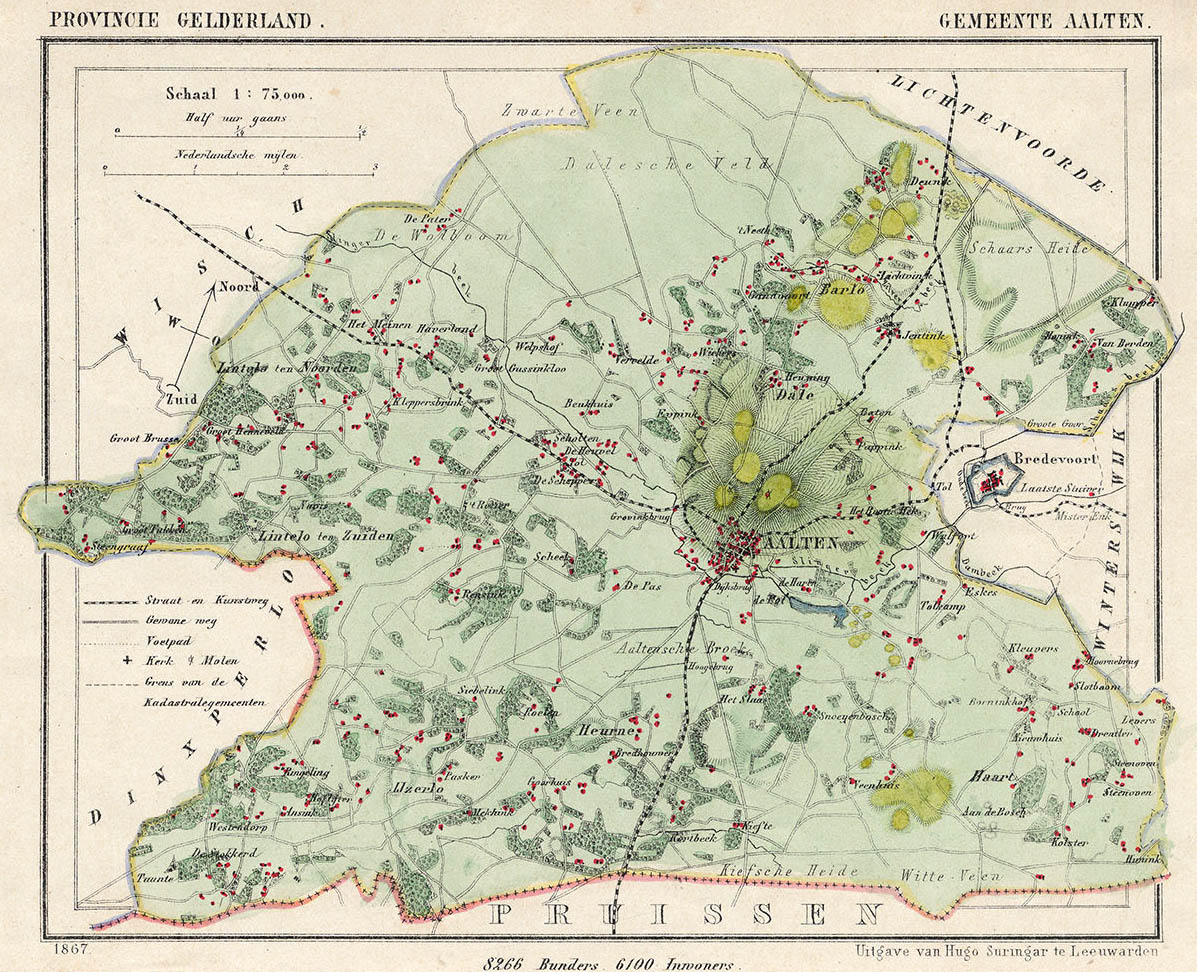
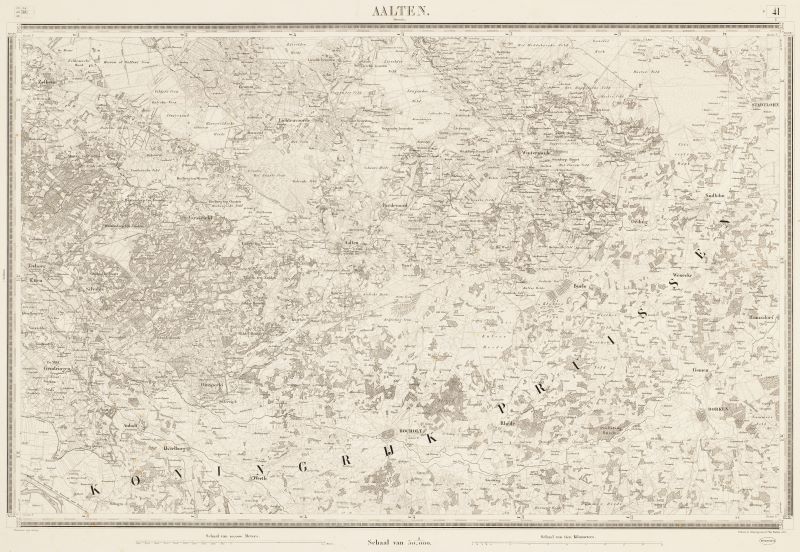
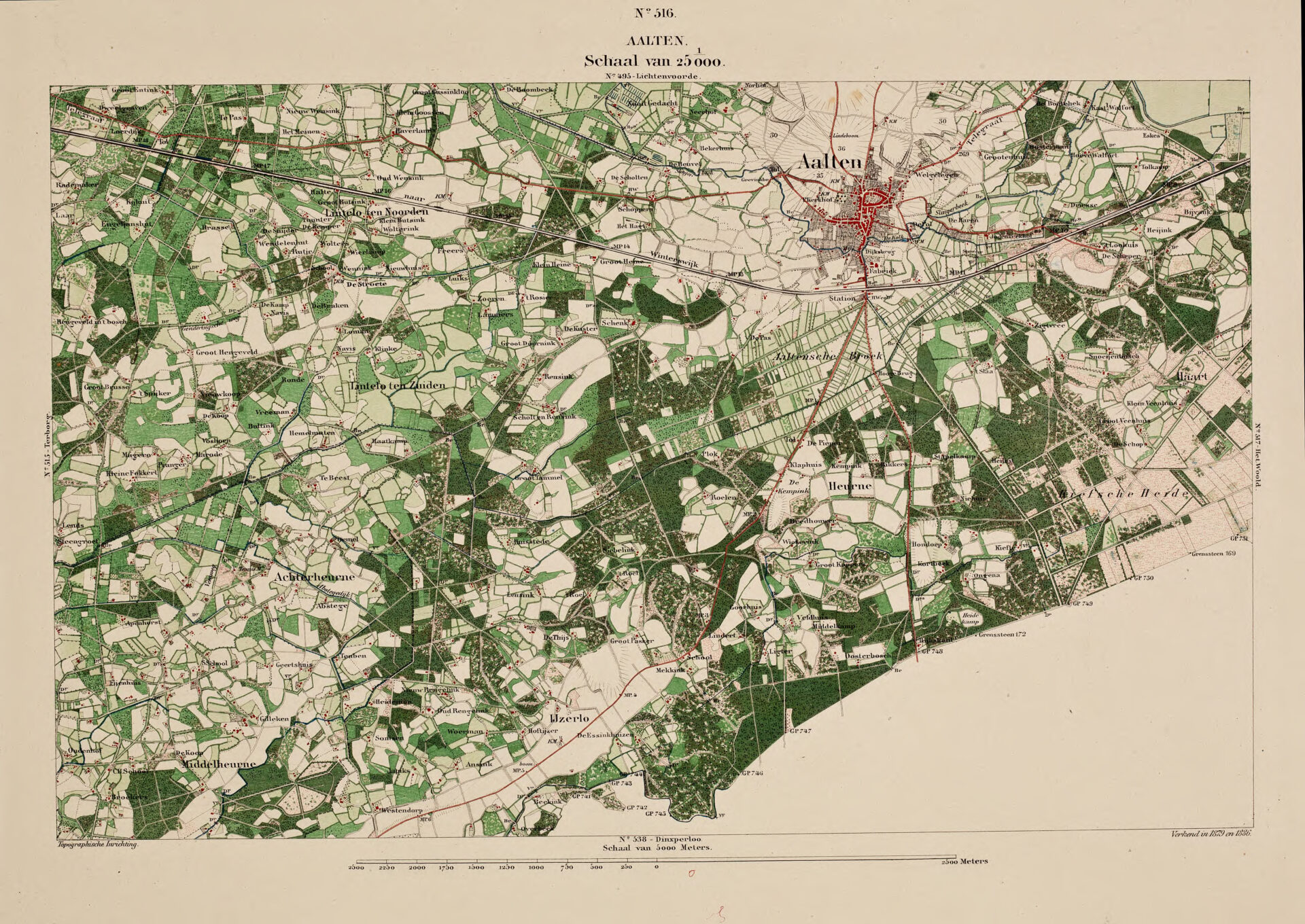
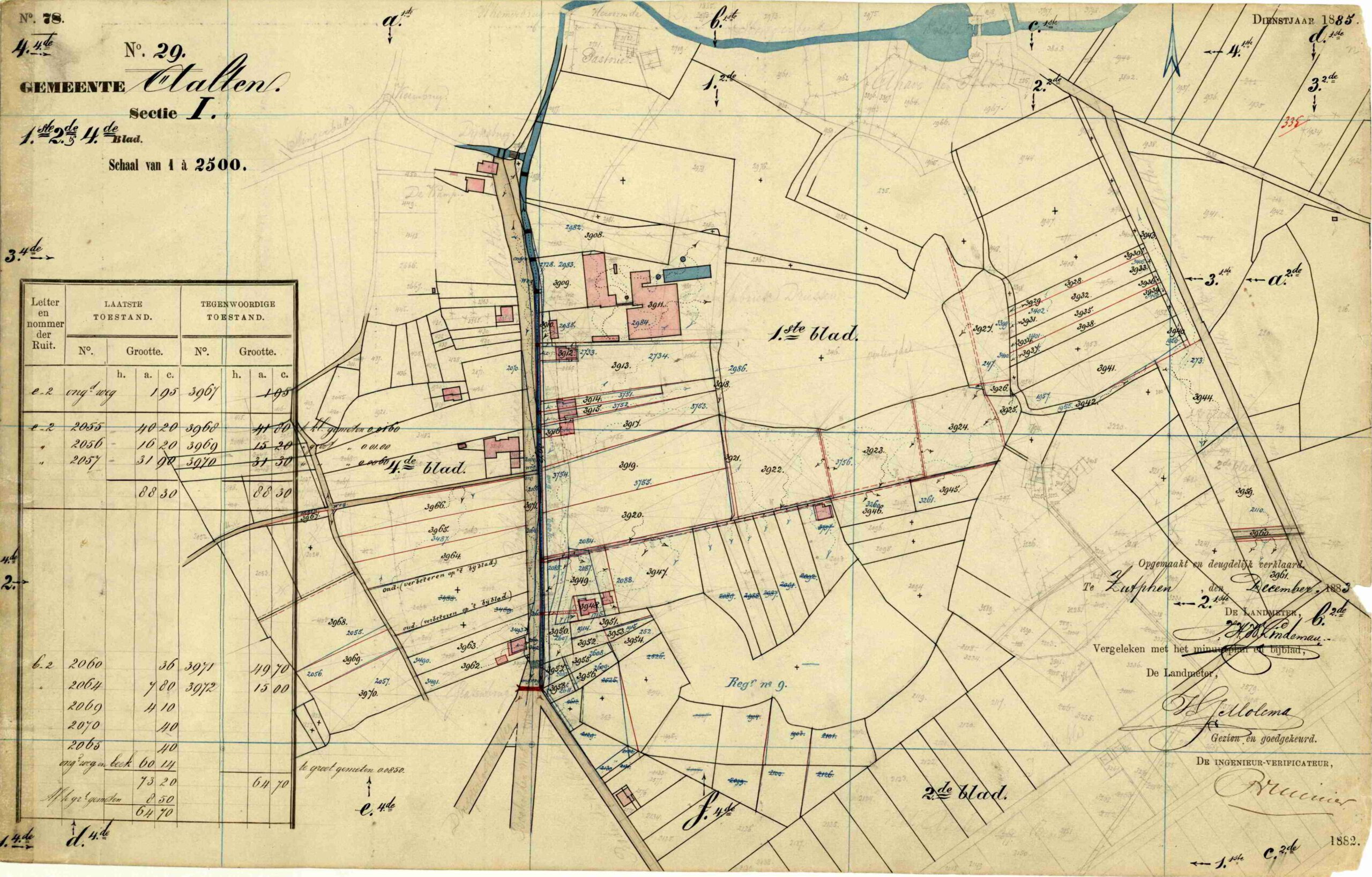
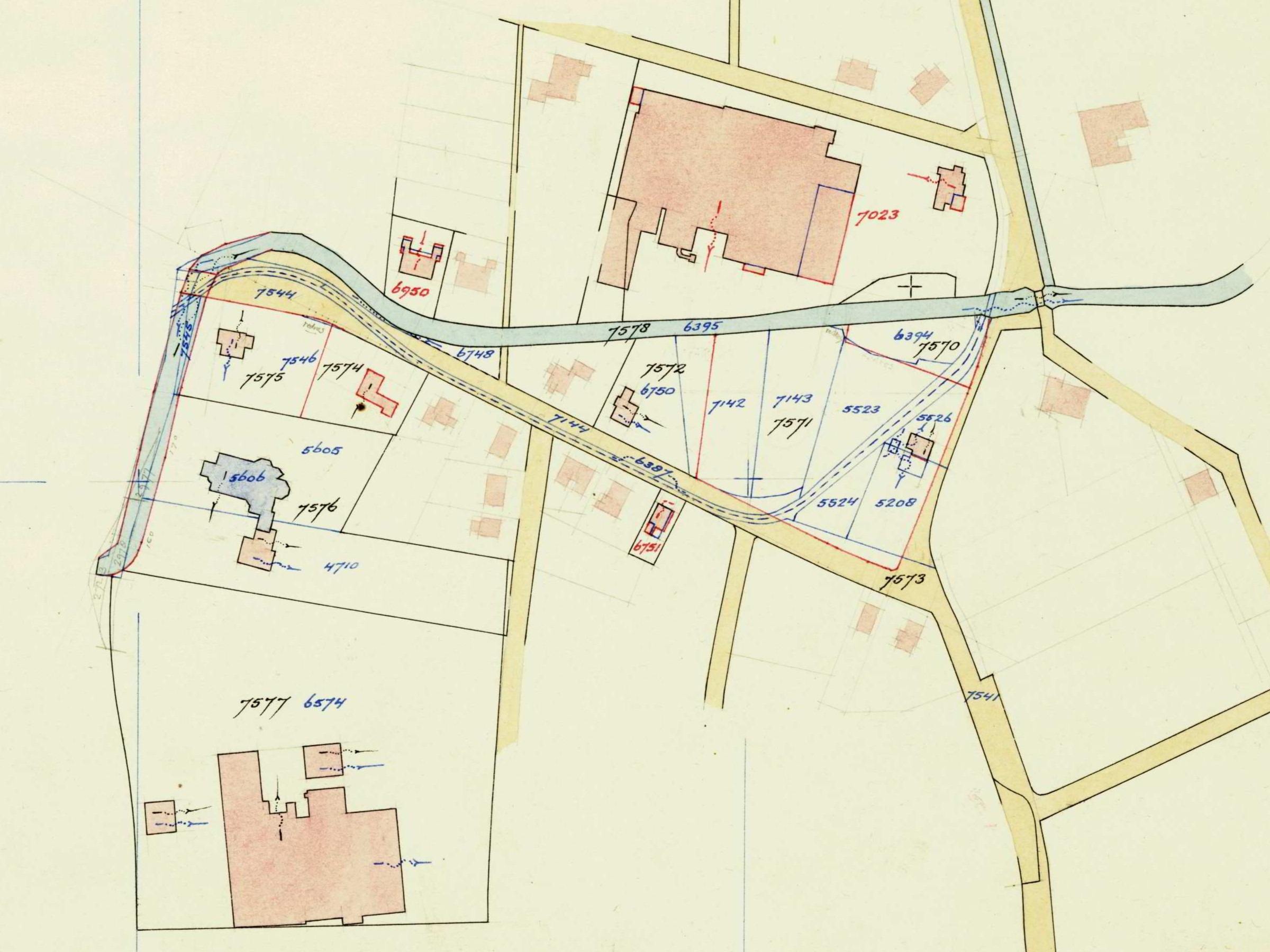
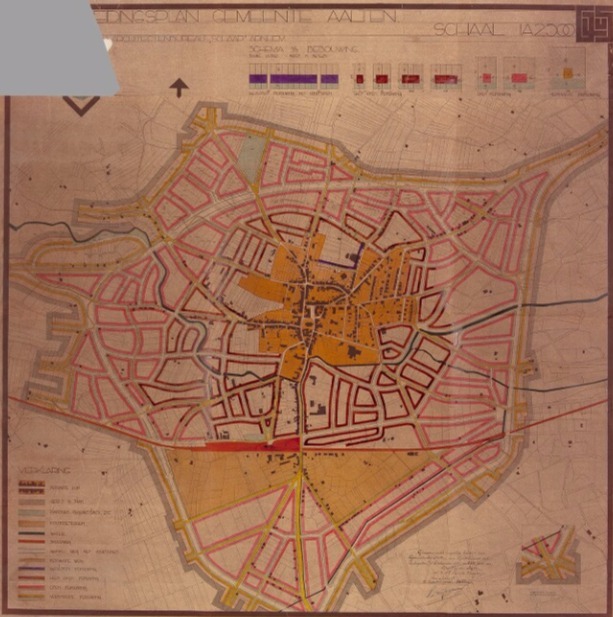
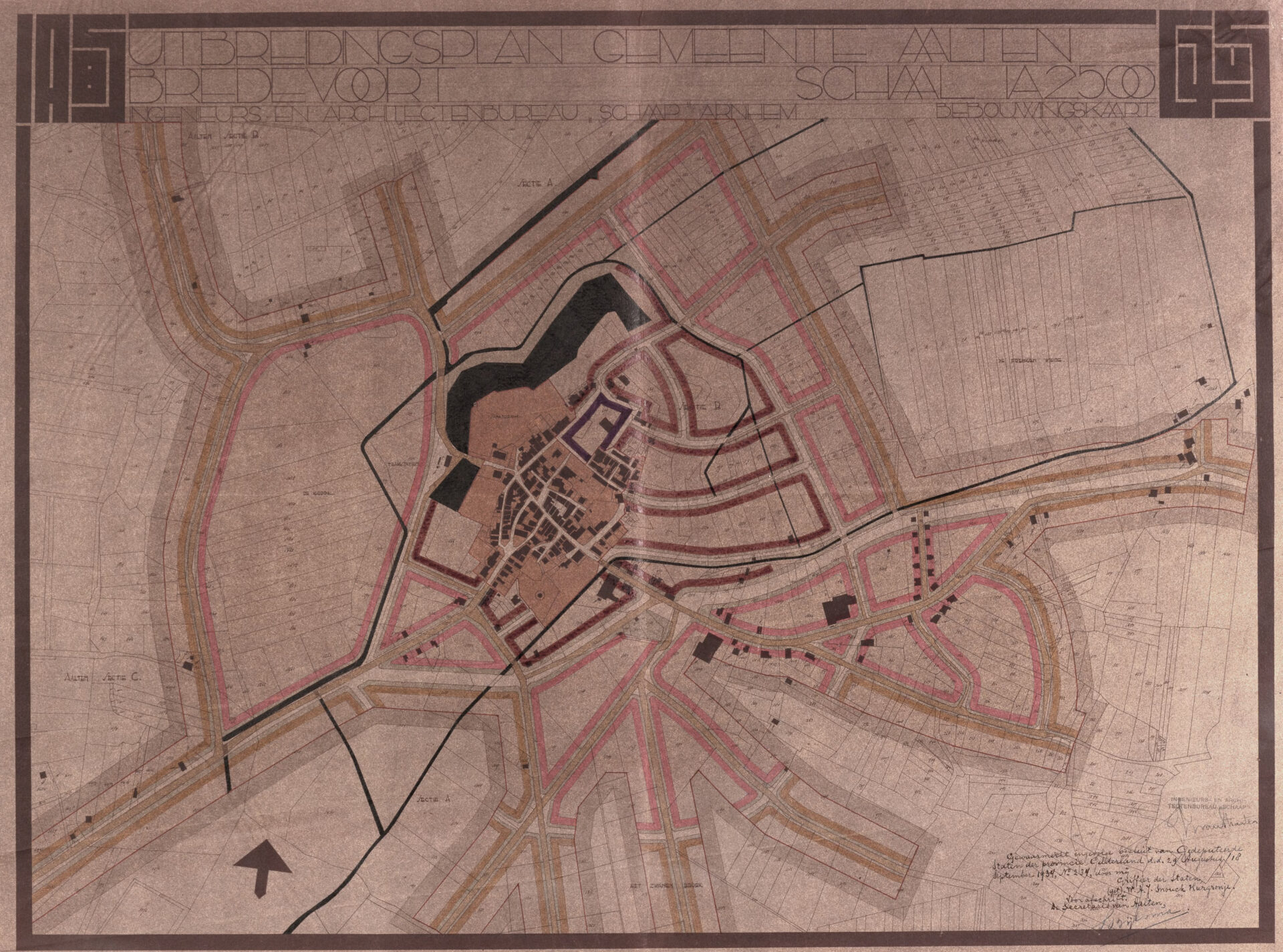
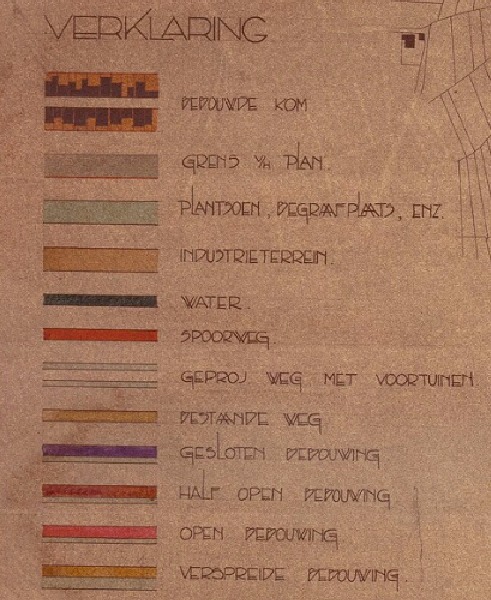
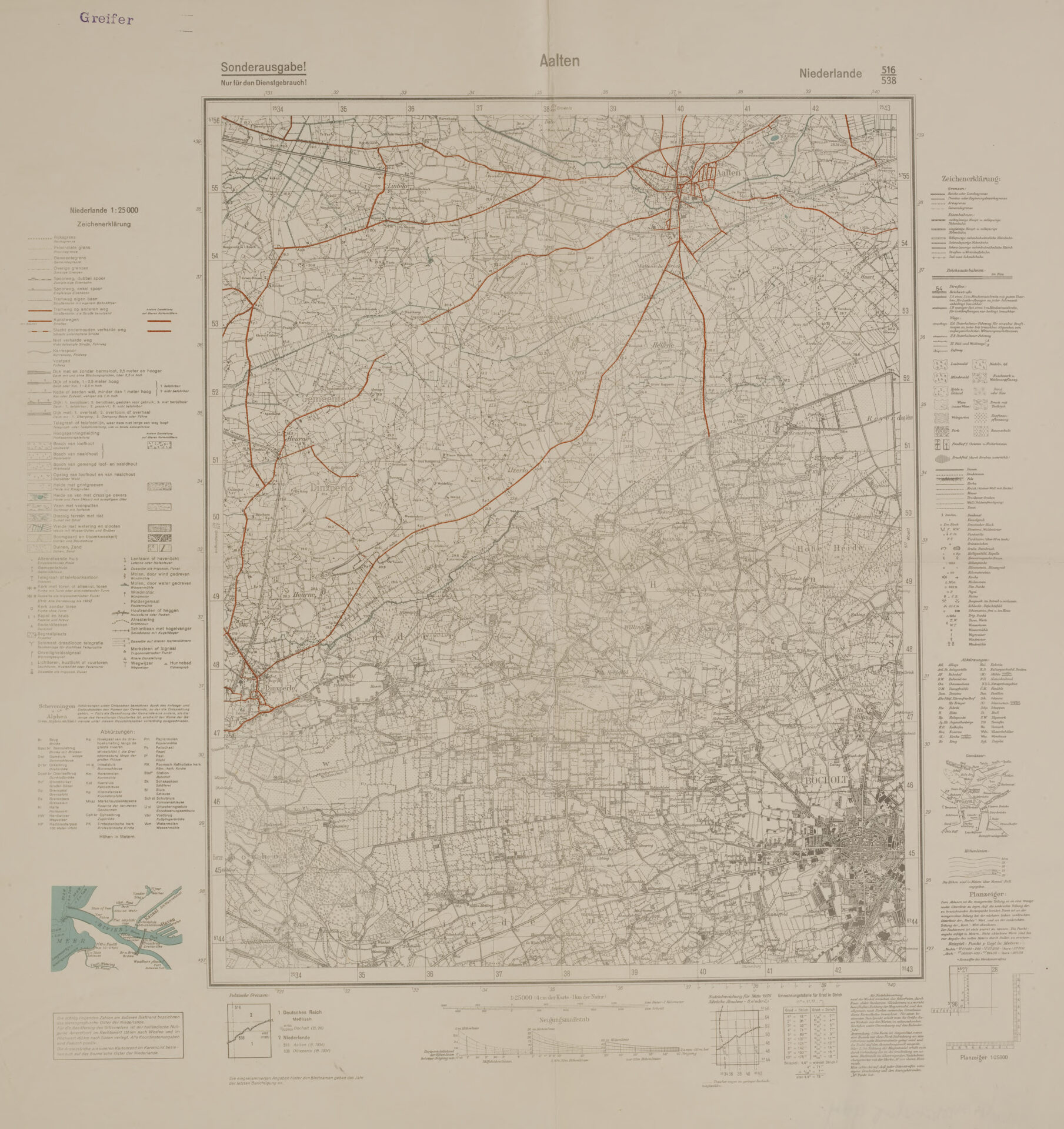
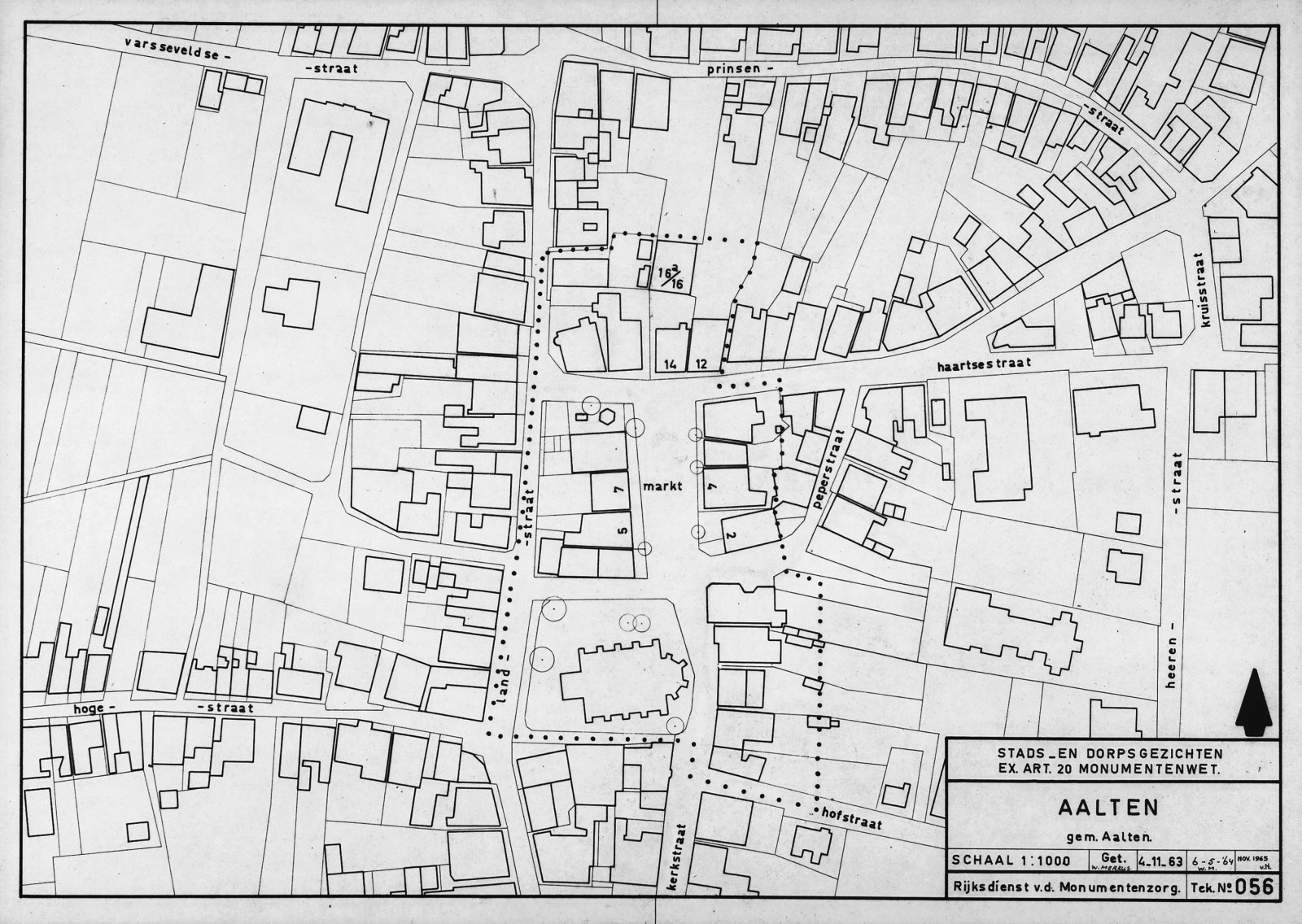
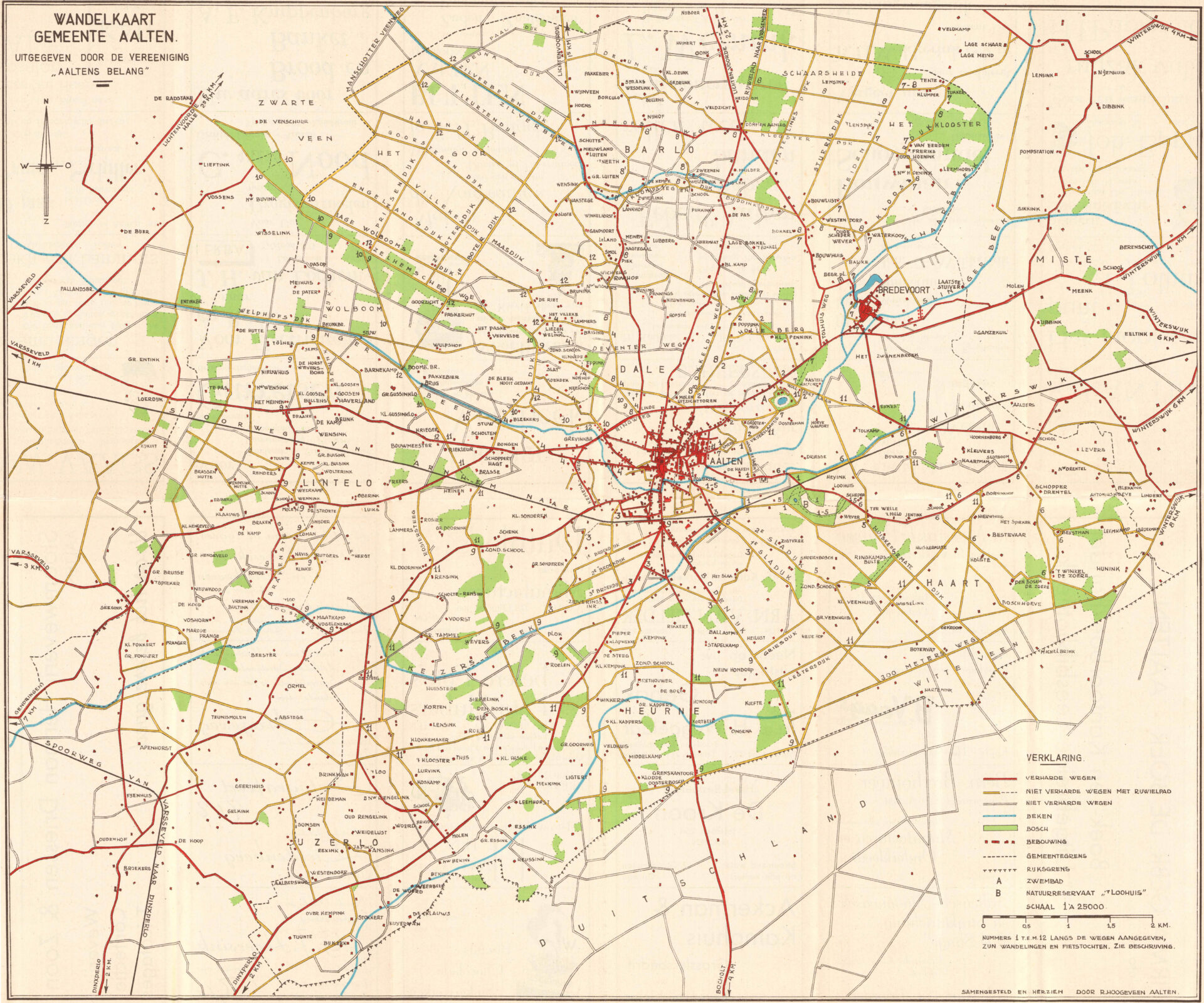
Here you will find a collection of various historical maps of—or featuring—Aalten and Bredevoort, dating from the 16th to the 20th century. Click on an image to enlarge it.
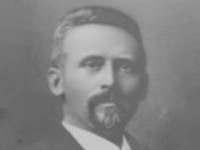
Municipal Overseer and Architect
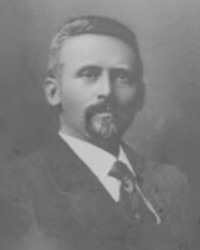
Jan Brill (1878–1924) served as the municipal overseer and architect in Aalten from 1906 to 1924. He designed various residential and commercial buildings throughout the municipality and was remembered after his passing as an honest, sincere, and humane individual who enjoyed great trust and appreciation.
Jan Brill was born on 23 April 1878 in Wildervank, the son of Cornelis Jacobus Brill and Roelfina Fennechina Prummel. On 6 July 1909, he married Anna Imke Oostingh in Winschoten. The couple had two daughters and one stillborn child.
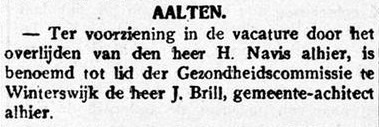
In 1903, Brill was appointed municipal architect of Winterswijk. His appointment as municipal overseer and architect of Aalten followed in 1906. Additionally, in 1922, he was appointed a member of the Health Commission in Winterswijk, and in early 1924, he became the secretary-treasurer of the Oude IJssel Water Board, Slingebeken Section.
Brill initially lived at Prinsenstraat 42. Following his marriage, he and his wife moved to Ormelstraat 23 (Klein Beth San). During his years in Aalten, he designed several characteristic buildings in and around the town, including various private houses and shop premises.
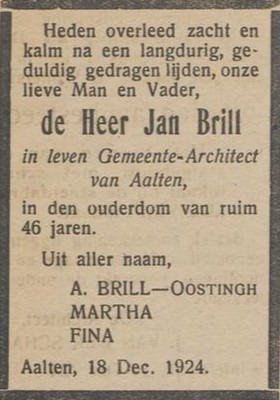
Brill struggled with health problems for a considerable time, during which his duties were temporarily assumed by others. A few months before his death, he returned from Arnhem, where he had presumably been receiving medical care. He lost consciousness the evening before his passing and died in Aalten on 18 December 1924, aged 46.
There was a large turnout for the funeral: attendees included the mayor and aldermen, the town clerk, council members, municipal police, administrative officials, and municipal workers, as well as many friends and local residents. Tributes were paid at the graveside by Rev. J. Thomson (Varsseveld), Mayor A.J.W. Monnik, and H.J.G. ten Dam.
According to reports, Brill was remembered for his honest and sincere conduct, being highly valued by his superiors and humane in his interactions with staff; his irreproachable integrity and the courage with which he bore his illness were explicitly noted.
Brill found his final resting place at the Old Cemetery on the Varsseveldsestraatweg in Aalten.
As municipal architect of Aalten, Brill’s designs included:

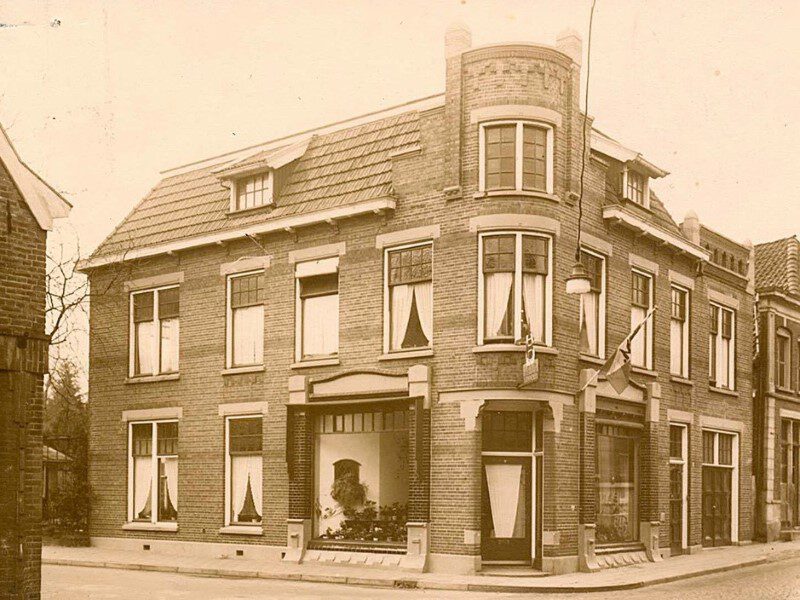
Köstersbulte, Aalten
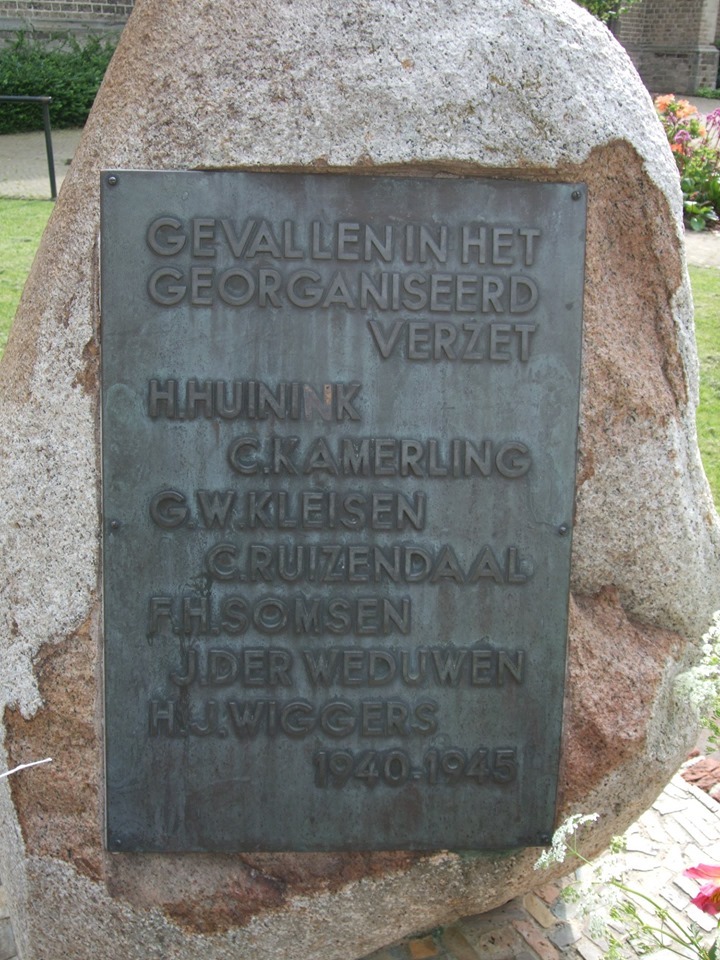
On the lawn of the Old St Helen’s Church on the Markt in Aalten stands a special memorial stone. The bronze plaque on the stone lists the names of seven resistance fighters within the organized resistance in Aalten.
Resistance during World War II (1940-1945) only developed over the course of the war. As the German occupiers’ measures became stricter, small groups emerged that resisted the occupation, initially with limited means. As the war progressed, more and more people faced difficulties. These small resistance groups grew in strength due to increasing membership and the networks that formed between various resistance cells.
Within the resistance, two main currents could be distinguished. The first group was the National Organization for Help to People in Hiding (LO). This group organized hiding places for Jews, for men who refused to work for the enemy in Germany, and for resistance fighters who had to go into hiding. The LO was dependent on sufficient ration coupons for the food supply to the people in hiding . The second group, the Knokploegen (KP), took care of that. This armed group carried out raids on distribution offices, tried to sabotage the enemy at vital points and in the last phase of the war prepared to assist the Allied troops in the liberation of the Netherlands.
In the Achterhoek, especially in the region of Aalten, Lichtenvoorde and Winterswijk, the resistance was particularly active. Some of the resistance fighters lost their lives during the war. Those who survived the harsh time did not feel like heroes. Many testified to the fear they would carry with them for the rest of their lives. The courageous acts of the resistance are recorded in several books.
The names of the fallen (click on the links for more information):
General Practitioner, Knight of the Order of Orange-Nassau
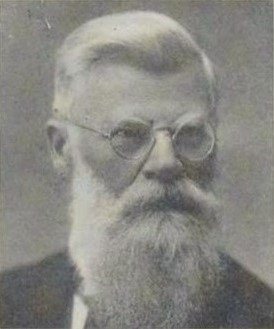
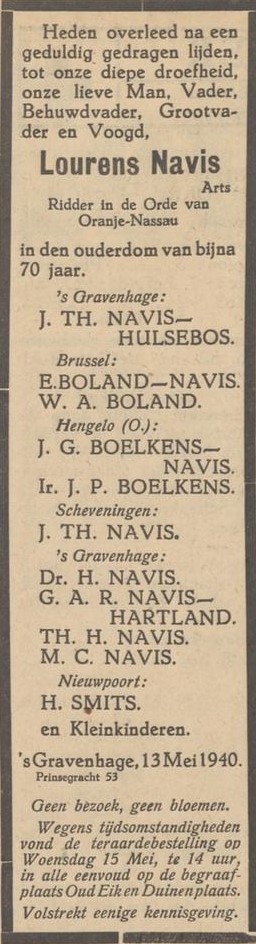
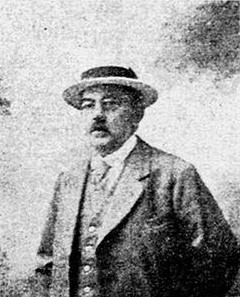
Lourens Navis was born on 28 May 1870 as Lourens Schokkin at the Borninkhof farm in the rural district of Haart (Aalten), son of the unmarried Janna Geertruid Schokkin. A few months later, on 12 August 1870, his mother married the schoolteacher Hendrik Navis, who recognised Lourens as his child, thereby legitimising him as his son. They went to live on the Kattenberg in Aalten, currently Lichtenvoordsestraatweg 11. The family later moved to the corner of Landstraat/Markt.
In 1900, Navis established a practice as a GP at Prinsegracht 53 in The Hague. On 30 January 1902, he married Johanna Theodora Hulsebos. Six children were born from this marriage: Elisabeth (1903), Janna Geertruid (1904), Johanna Theodora (1906), Hendrik (1909), Thomas Haulog (1913), and Margaretha Catharina (1919).
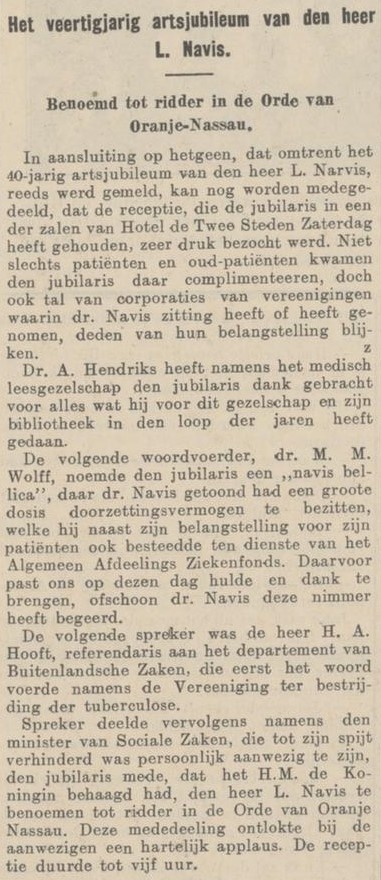
On his 40th anniversary as a doctor, he was appointed Knight of the Order of Orange-Nassau in recognition of his extensive services to society.
Lourens Navis passed away on 13 May 1940 in The Hague and was buried there at the Oud Eik en Duinen cemetery.
Pieter Hendrikus Boer was born on 2 September 1862 in Hollandscheveld, in the municipality of Hoogeveen. On 1 April 1899, he married Margaretha Dorothea Harjes, who was twelve years his junior. He passed away on 22 January 1927 and was buried at the Old Cemetery on the Varsseveldsestraatweg.
Although his surname appeared in the official archives as ‘Boer’, he named his printing business in Aalten ‘De Boer’. Perhaps because this name is much more common and everyone referred to him that way regardless?
It had already been known for some time that Mr P.H. de Boer was seriously indisposed, yet it must have come as an unexpected shock to many when it was announced on Saturday evening that the patient had passed away. Mr De Boer, known locally as “De Boer van de Krante” (De Boer of the Newspaper), was a highly prominent and well-known figure in our town and the neighbouring municipalities.
In October 1894, he and his brother started the first printing business in Aalten on a very modest scale in the Ormelstraat. Originally, they only published a small church service notice sheet (Predikbeurtenblaadje), but in 1896 the Aaltensche Courant appeared for the first time. A few years later, this newspaper was also published under the titles Dinxperlosche-, Lichtenvoordsche- and Varsseveldsche Courant.
From the Ormelstraat, the business was relocated to the house where Mr Wagterveld currently resides. Later still, it moved to the Kruisstraat, the current premises, where manual power eventually had to make way for motorised power. In 1902, a branch was established in Winterswijk, and the Nieuwe Winterswijksche Courant began publication. Meanwhile, the bookshop also flourished increasingly, transforming a small enterprise into a substantial business.
In his family life, Mr De Boer was not so fortunate. The passing of his wife and his only daughter affected him deeply. It was perhaps due to these circumstances that an outsider might have gained the impression of a quiet, reserved personality. However, those who knew Mr De Boer more closely knew that beneath it all beat a warm heart for his children, his staff, and various institutions in which the deceased took an interest. With the passing of Mr De Boer, Aalten has lost a fine citizen.
Teacher
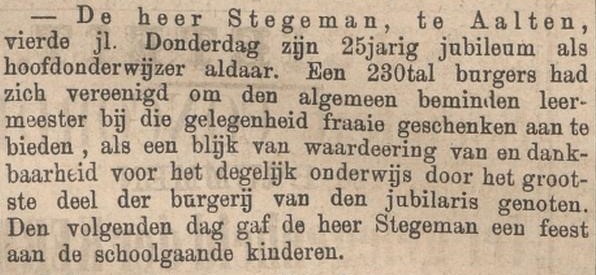
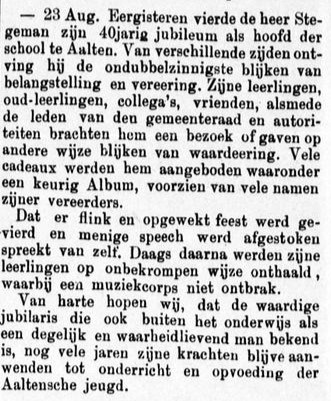
During the second half of the 19th century, Dirk Stegeman served as headteacher at the Public Primary School for 45 years, first on Landstraat and from 1886 on Herenstraat in Aalten.
Dirk Stegeman was born on July 4, 1830, in the rural district of Tonden near Brummen, as the son of shoemaker Johannes Stegeman and Johanna Evers. He married Hendrietta Engelina van Heuven on November 25, 1854, in Ruurlo. No fewer than 11 children were born from this marriage, two of whom died at a young age.
Dirk Stegeman passed away on June 6, 1910, in Deventer at the age of 79.
In 1937, G.H. Rots described how things were in Aalten in former times in a series of articles. Regarding the school, he wrote:
“In the village of Aalten, all children attended a single school. There was no division. Children of all religious backgrounds sat side by side on the school benches. The school was located in a building on Landstraat next to the Reformed Church. The guardroom was downstairs and the school was on the upper floor. Master Stegeman ruled the roost there. Together with two assistant teachers, the youth of Aalten were educated. With six children to a bench, there were about 60 to 70 pupils per teacher in the winter. Every morning the classroom doors were opened, and the head of the school offered a prayer.
Order in the classroom was maintained with the rod, for those who would not listen were disciplined with a piece of wood. And Master Stegeman kept them in awe. But he was a hardworking man and spared no effort to ensure the education was as good as possible. Evening school provided a good opportunity to impart some knowledge to children who had to leave school early. Then the master had a smaller class and the teaching was more informal.”
Please note: Dirk Stegeman should not be confused with Reverend Jan Derk Stegeman, after whom the Stegemanschool was later named.

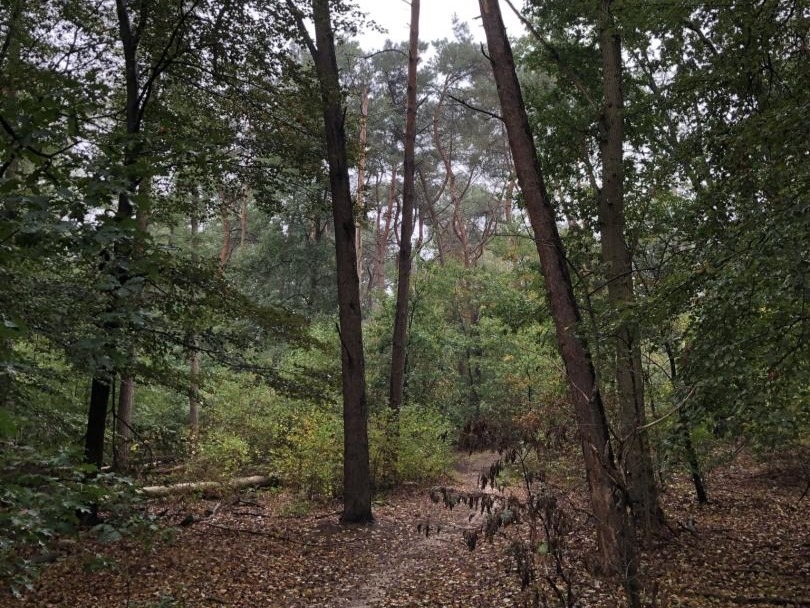
The Ringkampsbulten is a small nature reserve in the Aalten hamlet of Haart, situated between Kriegerdijk and Huiskermatedijk. The area consists of mixed woodland on partly hilly terrain. The cover-sand ridge within the forest sits at 41 metres above NAP (Normal Amsterdam Peil), making it the highest point in the municipality of Aalten.
In 1932, it was thought that the site might be a burial mound (grafheuvel), but a small test excavation revealed it to be a natural hill. However, an urn dating from the Iron Age (up to the Early Roman period) was found outside the hill itself, suggesting that the historical associations are not entirely misplaced.
The cover-sand ridge consists of mixed forest with a high percentage of conifers. The lower, damper section to the south of the ridge primarily contains deciduous trees, including many alders. Along the walking path on the southern side, there is avenue planting in the form of pedunculate oaks.
The Ringkampsbulten is part of the Gelders Natuurnetwerk (Nature Network of Gelderland). The area is surrounded by agricultural land, making it a unique oasis for both flora and fauna. Measures have been taken to develop the woodland into a ‘natural stepping stone’, with the aim of promoting high biodiversity. This involves pursuing a varied forest structure with edges rich in texture and open clearings. Species that benefit from such a stepping stone include the White Admiral and the Purple Emperor butterflies.
The site has developed into a valuable piece of nature where rare plants and animals can flourish. For walkers and nature enthusiasts, De Ringkampsbulten offers a peaceful spot to enjoy the landscape, featuring beautiful views and varied vegetation. It is a lesser-known but cherished piece of nature among local residents, partly due to its tranquillity and small scale.
Architect
Willem Hebly was born on October 17, 1908, in Rotterdam. At the end of 1934, he established himself in Aalten as an architect. Hebly was responsible for the design of a large number of homes, retail properties, commercial buildings, farms, and schools, and so forth, in Aalten and the surrounding area. Many of these buildings continue to enhance the streetscape today.
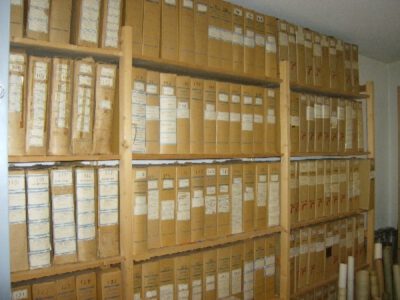
The architectural firm founded by Willem Hebly was dissolved in 1995. In early 2011, his son Just Hebly, successor to his father Willem and himself a retired architect, decided to entrust his architectural archive to the Erfgoedcentrum Achterhoek en Liemers (ECAL) in Doetinchem. He was requested to write a brief historical overview regarding this. Portions of this account are presented below:
In 1934, Willem Hebly graduated as an architect from the Academy of Architecture in Rotterdam. During those years of crisis, it was very difficult to establish oneself as an architect in Rotterdam, as existing firms strictly protected their market against newcomers.
A brother of Willem, Gon Hebly, was in Aalten at that time as an employee of an accounting firm to audit the books at the Dutch Button Works in Bredevoort. In the local newspaper he read at his hotel, he discovered a recruitment notice for a qualified architect in Aalten. He clipped the advertisement and took it home for his brother Willem.
After consulting with his family and fiancée, Willem decided to travel to Aalten and report to the secretary of the then Aalten contractors’ association, Mr. Vreeman on the Meiberg in Aalten. It was he who had placed the notice. He was very surprised that an architect from Rotterdam responded to the advertisement in the local Aalten newspaper. He explained that the notice had actually been a ‘spite advertisement’ aimed at a former carpenter colleague who had recently started posing as an architect and was correcting his deficiencies at the expense of former contractor colleagues.
Willem was surprised by this information but did not let it discourage him. From a close acquaintance of his father, to whom he conveyed greetings, he received more information about Aalten. Indeed, there was no graduated architect in Aalten, while there were regular high-quality clients, particularly for better-quality housing in the private sector. Regarding the character of the people of the Achterhoek, he was informed that it differed considerably from that of Rotterdammers. However, once you had won the trust of the population, you could do no wrong in the eyes of the people of Aalten.
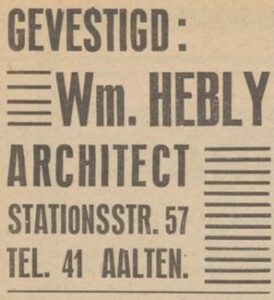
Through this acquaintance, he also obtained an address where he could potentially find temporary board and lodging, namely with the widow Mrs. Lammers on the Stationsstraat. He reported there immediately. Besides being able to rent a room with full board, she also put him in touch with Jan Ackerman, who had purchased a plot of land next to her home on which he wished to build a residence with commercial premises. The day could not have ended better. Delighted, he returned home to his family and his fiancée, Lenie Bosman.
He did not have to think long about a final decision after receiving his first commission from Jan Ackerman to establish himself in Aalten as an architect. It became a very modern house by Aalten standards of the time, which has been a National Monument since 2002. Apparently, the design of Jan Ackerman’s home appealed to many residents of Aalten, given the many commissions that followed.
Soon he also received a commission for the construction of a home for Henk te Paske at Plein Zuid. He was a building materials merchant and a friend of Jan Ackerman. Shortly thereafter, he also commissioned the construction of two semi-detached homes on the Whemerstraat in Aalten. Willem was able to rent one of those houses (Whemerstraat 7). He married in 1936 and lived there until 1967, raising a family with nine children. In the early years, he used the largest bedroom as his office.
After the years of crisis and war, there was plenty of work to be done, including much reconstruction of bombed homes and farms. The office space soon became too small, which is why it was moved to the upper floor of a large home on the Bredevoortsestraat belonging to Mrs. Manschot. Soon there was employment for three to four staff members, including architectural draftsmen and supervisors.
Willem Hebly belonged to the era when the architect functioned as the pivot in the construction process. He therefore saw himself not only as the designing architect for his clients but also as their technical advisor and confidant in all matters concerning construction: following the design, the specifications with technical drawings, the cost estimation, the tendering process, the working drawings, the project management, and supervision of the execution.
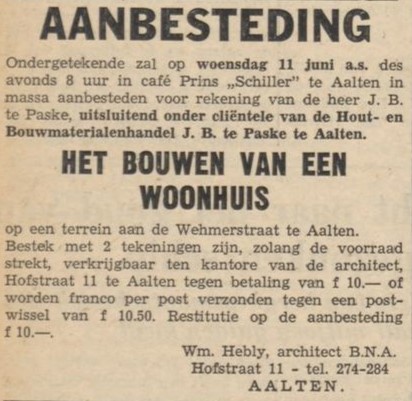
In 1957, Willem’s eldest son Just Hebly joined the now new office on the Hofstraat in Aalten as an apprentice draftsman. After a year, Just left for Rotterdam to gain experience and continue his studies. After obtaining his HTS diploma, Just did not yet feel inclined to return to his father’s employment, but chose to work for the Nicolai architectural firm in Emmen.
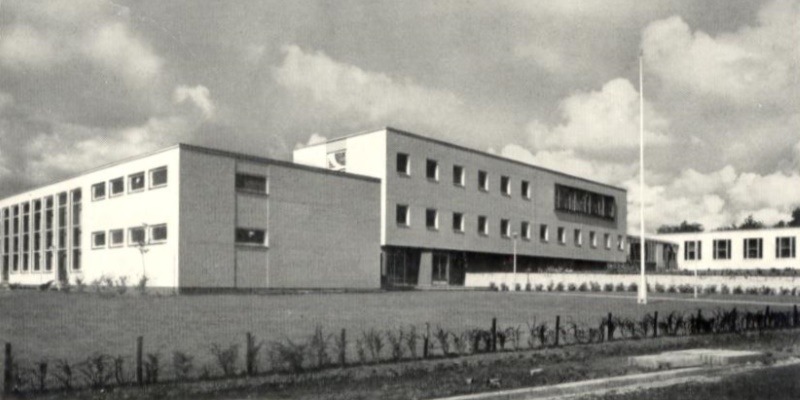
In the mid-sixties, there was plenty of work. The baby boomers from 1946 were entering the workforce. Every village and town was working on expansion plans. Construction systems were developed for housing and school building. Willem Hebly had already achieved significant results in the field of school construction in Aalten: the LTS (Lower Technical School), the HBS (Secondary School) in collaboration with the Geels firm from Arnhem, and the lower agricultural school. The first and last schools have since been demolished. The latter school was the pride of the Ministry of Agriculture; the school was visited by foreign guests from The Hague.
During that time, Willem Hebly came into contact with the Nuyt and Heikens architectural firm in Vlaardingen. They had developed a construction system for kindergartens and primary schools using the so-called Simplex element. This was an element made of aerated concrete, 60 cm wide and the height of a classroom. In 1964, both firms entered into a partnership under the name Buro Rationeel Bouwen, or BRB.
Soon Willem Hebly was entirely occupied by the activities of BRB. During that time, it was also decided to expand the existing architectural firm with a branch office in Beilen (Drenthe).
In the mid-sixties, Willem Hebly approached his son Just, who was enjoying his time in Emmen, with the request to become a partner in his architectural firm. After careful consultation within the family, the firm ‘Architectenbureau Wm en M.J. Hebly’ was established.
Just Hebly joined as a partner in 1965, in what some outsiders considered an ‘easy ride’. In reality, he had to buy in at a high price so that Willem Hebly could fund his retirement provision. Furthermore, Willem did not want to disadvantage his other eight children by favoring his eldest son. It was therefore hard work for Just, combined with studying in the evenings for his architect’s diploma. One of Just Hebly’s first designs was the home for his parents on the Bonifaciusstraat in Aalten.
In 1972, Willem Hebly suffered a heart attack, resulting in Just Hebly taking over his activities in BRB as well.
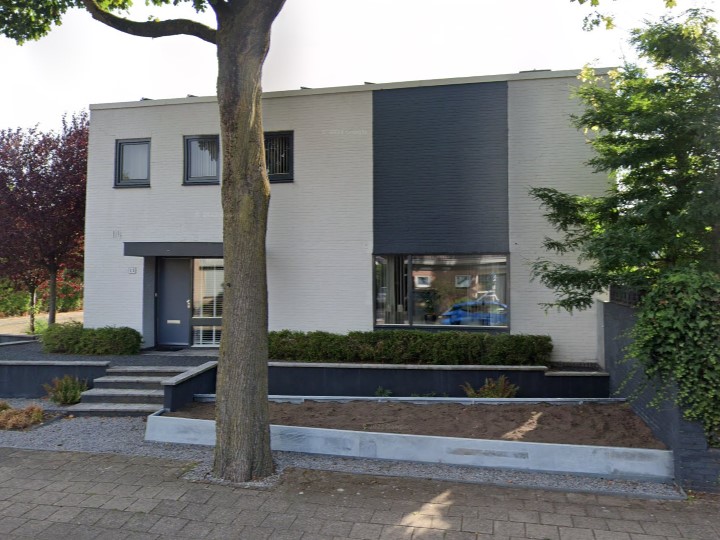
At the end of the 1970s, the Bureau Rationeel Bouwen (BRB) was dissolved. During the course of the 1980s, employment in the construction industry continued to decline. The Hebly architectural firm moved from Aalten to Winterswijk in 1986. In the second half of the 1980s, employment in the construction world deteriorated even further. Redundancy procedures had to be initiated for a number of employees.
In the early 1990s, Just completed the remaining commissions on his own. Sixty years after its founding, the Hebly architectural firm closed its doors in 1995.
Willem Hebly passed away on January 7, 1996, at the age of 87. He and his wife are buried at Berkenhove cemetery in Aalten.
Christian Reformed Minister
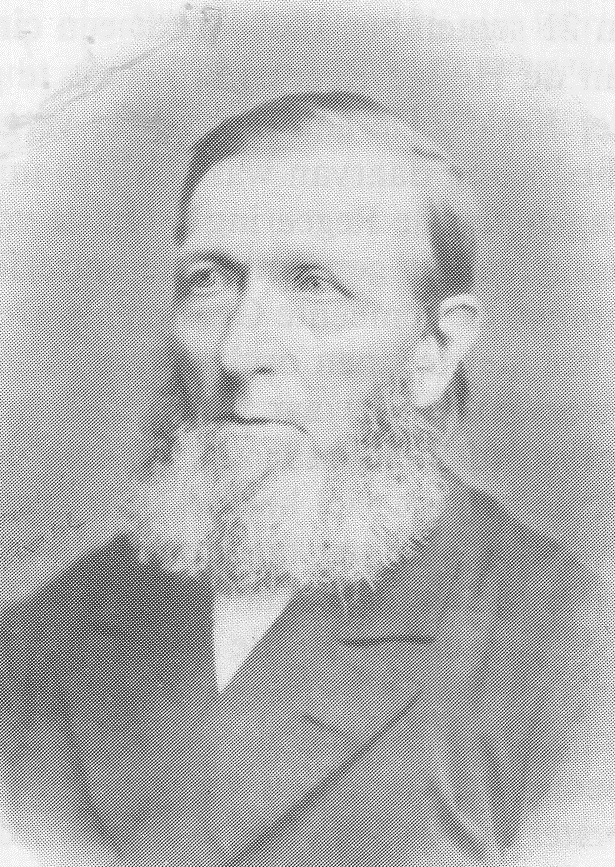
Derk Breukelaar was born on 28 December 1814 in Varsseveld, the son of ‘chair turner’ Wessel Breukelaar and Grada Johanna te Rietstap. In 1847, he married Janna Hendrika Pennings (born in Aalten, 12 November 1825) in Aalten. Nine children were born from this marriage.
Following the foundation of the Christian Secession Congregation (Christelijke Afgescheidene Gemeente) in Aalten in July 1843, the young faith community sought to call a minister. On the advice of Reverend Brummelkamp, the young Derk Breukelaar from Varsseveld was invited. He accepted and moved to Ommen to study under Rev. A.C. van Raalte (1811–1876)—one of the first Secessionist ministers in the country.
After completing his studies, Breukelaar was ordained on 24 September 1846 as the minister of the congregation in Aalten. This would remain his only parish; he served there for 44 years until his retirement in 1888. When Rev. Wildenbeest of Varsseveld passed away suddenly in 1852, that congregation extended a call to him. Initially, he accepted, but—realising he was then the only Secessionist minister in the Achterhoek region—he eventually declined and remained committed to the church in Aalten, though he also worked extensively in the surrounding areas.
Breukelaar lived with his family in a small farmhouse called ’t Grotenhuis, located on present-day Hessenweg just outside the village. Here, he grew his own food to supplement his modest stipend of 225 guilders, which later rose to 600 guilders per year. Parishioners also contributed in kind by bringing food, such as meat and potatoes, to his home. Catechism classes were also held at ’t Grotenhuis, as there was no room for them in the church. During busy periods, such as the harvest, his wife took over the teaching of these classes.
Evangelism was very close to the minister’s heart. This was the reason Derk Breukelaar took the initiative to establish several Sunday schools, through which he reached not only the children but also their parents. For children in the outlying hamlets, Sunday school was held at someone’s farmhouse so that the children did not have to travel all the way to the village. Later, long after Breukelaar’s death, various Sunday school buildings would be erected in the rural districts surrounding Aalten.
In 1868, Breukelaar founded the Reformed Young Men’s Association „Uw Koninkrijk kome” (Thy Kingdom Come).
The late 1870s were not the easiest years for the minister. In 1876, his wife passed away, and a few years later, he became involved in the “School Struggle” (schoolstrijd) in Aalten as the chairman of the school board.
Nevertheless, Breukelaar received much appreciation. On his fortieth anniversary in office in 1886, his congregation presented him with a States Bible on a beautifully crafted wooden lectern. On the same joyous occasion, the classis (regional church council) presented him with an engraving depicting ‘Golgotha’. When he retired in 1888, his catechism pupils gave him a tea service and a cake set as a gift.
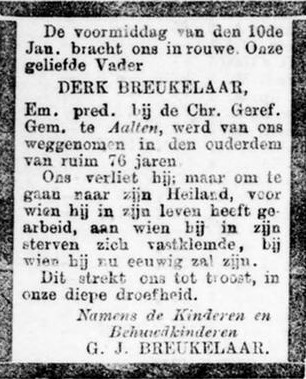
Reverend Breukelaar passed away on 10 January 1891 in Aalten at the age of 76. He was buried at the Old Cemetery on the Varsseveldsestraatweg. The church council honoured him with a funerary monument. The inscription on the gravestone, which is now barely legible, is noteworthy for its curious use of the church name ‘Christian Secession Congregation’ (instead of ‘Christian Reformed Congregation’).
Three of his sons followed in his footsteps and also became ministers: Gerrit Jan, Willem, and Johannes. The latter is regarded as the founder of Christian education in Aalten. In June 1918, Johannes himself opened the Breukelaar School on Piet Heinstraat, which was named after him.

“Elk dörpken hef zien eigen klinkers, zien eigen spreuken en woordenschat.” (Every village has its own vowels, its own sayings, and vocabulary). This sentence is displayed on the façade of the Aalten library. It is a line from the song “Hier in de Achterhoek” (Here in the Achterhoek), by Rocco Ostermann and Matthijs Stronks. And it is entirely accurate.
The Achterhoek dialect, a variant of Low Saxon (Nedersaksisch), has traditionally been spoken in the north-east of the Netherlands and the north of Germany. Within the Achterhoek region, every municipality, and sometimes even every village, has its own nuances in the dialect, which is colloquially referred to as ‘plat’.

The Aalten dialect possesses many ancient words and expressions that do not exist in Standard Dutch.
[To be developed: we are considering a description of the general characteristics that define the Aalten / Achterhoek dialect, perhaps including a few examples, but not an exhaustive glossary. Suggestions for this section are welcome!]
In Aalten, the dialect still plays an important role in the daily lives of many residents. You can still frequently hear Aalten dialect spoken at home, on the street, in shops, and during local events. Many Aalten residents were raised bilingually, speaking the dialect at home and Standard Dutch at school.
Although the Aalten dialect is still spoken, younger generations are mastering it to a lesser degree. They often speak an ‘Achterhoek-flavoured’ version of Dutch, in which many of the typical old words and expressions used daily by their ancestors have disappeared. This development presents a challenge for the preservation of the dialect.
The Aalten dialect is an important part of the local cultural heritage and forms a vivid link with the past. The history and daily life of Aalten are brought to life in stories, songs, and poems written in the dialect. The Aalten dialect thus contributes to the unique identity of the community.
To prevent the Achterhoek dialect from fading away, efforts are being made to pass it on to new generations. This is done, for example, through regional language projects in schools and cultural associations. These initiatives are essential to keeping the dialect vibrant and ensuring that it does not disappear, despite the influence of Standard Dutch and other modern languages.
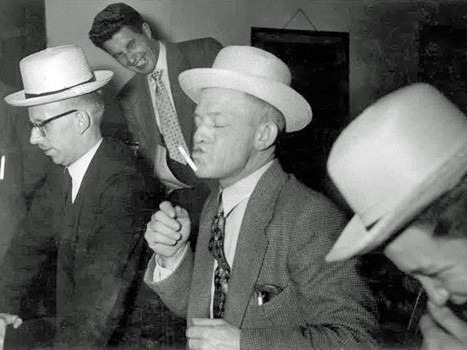
We can hardly imagine it nowadays, but in the last century, competitions were organised in which participants competed against each other in various disciplines related to the smoking of cigars and cigarettes.
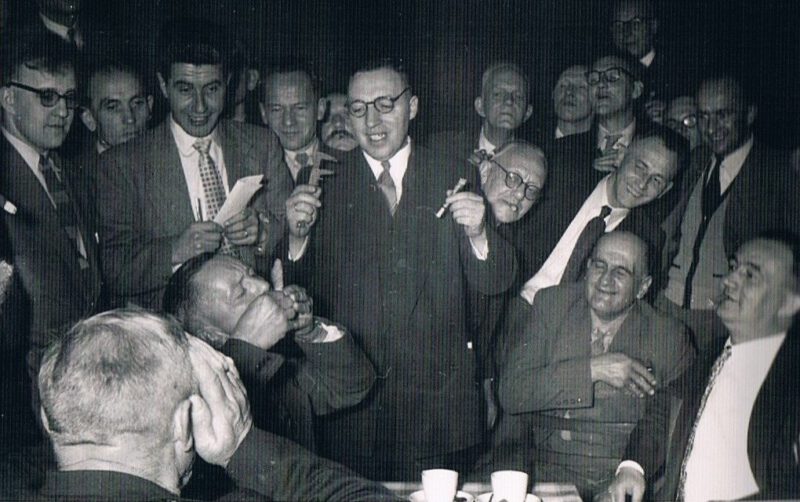
The Arnhemsche Courant wrote on 6 March 1908:
In the Catholic circle in Aalten, a smoking competition was held in slow and fast smoking. Mr J. Betting received the first prize for fast smoking, smoking his cigar in 7 minutes, and in slow smoking, the 1st prize was won by H. Weijkamp, who took an hour and 45 minutes over his pipe of tobacco. A useful way to pass the time as well!
In the 1960s, Dick Fries organised smoking competitions in Aalten. On the right, you can see a photo of the “Throwing a cigarette butt in the air and catching it in the mouth” event.
On 21 March 1961, the Dagblad Tubantia wrote:
Mr E. Jentink, Lintelo 67, became the champion cigar smoker of Aalten on Monday evening, for the time being for a year. He won this title during the annual smoking competition held at the Sociëteit on the Hofstraat. As is known, this competition is about the longest cone of ash on a 110 mm cigar. Mr Jentink managed to produce one of no less than 104 mm, however 1 mm shorter than last year’s champion.
The interest in this smoking festival grows every year and had already grown to over 200 participants yesterday. It went without saying that when the command “fire” was given around half-past eight and the brand was lit in over 200 cigars simultaneously, all were soon shrouded in dense mists.
It cost the participants effort to see how far his neighbour was progressing with the ash cone. It did not take long, however, before exclamations of “Oh, what a shame, I’ve lost it” rang through the hall.
After about an hour, there were only a few left who could be eligible for the championship. Very carefully, an attempt was still made to take one last puff in order to stretch for another millimetre. The result, however, was usually a couple of “glowing” fingers and an avalanche of ash over their clothing.
When the last cone had fallen and the balance could be made, it turned out that Mr Jentink had become champion with 104 mm. Mr A. Pokhuizen occupied second place with a cone of 103 mm. For the third prize, there were two candidates, namely Mr A. Driessen and Mr W. Winkelhorst, each with a cone of 102 mm.
After this battle, the participants were treated to a somewhat “lighter” programme, namely with a performance by Rudi Carell and Dick Harris.
Dagblad Tubantia, 19 March 1963:
With an ash cone of exactly 100 mm, Mr G. te Lindert, Lankhofstraat 23, became the champion cigar smoker of Aalten last night. It was certainly not an easy task for Geert, because more than 200 hopefuls competed with him for this title. It was the tenth time in succession that this competition was held.
Little has changed, however, over the course of the years. This was hardly possible, for since the first time this competition was held, this gathering has been at the centre of attention. Only the occasion with which numerous participants enter the fray has grown larger annually. For many, it is no longer a “gamble,” as they practise busily months in advance, and many let their nails grow longer to be able to hold the “butt” for as long as possible.
The sociability of the evening and the tension are certainly no less. From the moment the over 200 cigars go “into the fire,” a deathly silence prevails in the hall. “Shrouded in mists,” the jury members move between the tables to use the callipers where necessary.
“Skew burners” and “curvers” are already plentiful halfway through the competition. Familiar phenomena yesterday were again the avalanches of ash, under which a face, lapel, or jacket were often buried.
Geert te Lindert, a true lover of the cigar, succeeded in bringing the ash cone to 100 mm before it fell. How tense the battle was is proven by the 99½ mm ash cone that his competitor, and last year’s cup holder, Mr D.A. Driessen managed to produce. With a cone of 99 mm, Mr L.C. Rodenburg, who also won prizes last year, took third place.
After this exciting battle, a sociable evening was made of it with the cooperation of Lubbert van Gortel and Kees Schilperoort. The NCRV broadcaster recorded the competition for broadcast in the radio newspaper.
Dagblad Tubantia, 9 March 1965:
With an ash cone of exactly 100 mm, Mr A. Driessen became the winner on Monday evening of the annual and 12th smoking competition, which was held to great interest in the sociëteit. When the starting signal was given at a quarter to eight, the fire was lit in over 200 substantial cigars at once.
Within a few minutes, the smoke was so thick you could cut it, and the participants could hardly distinguish their neighbour. Of course, that was not necessary, as everyone had enough to do with themselves. Especially when the ash cone increases in length, and then often tends to start pulling askew, no one has any need to interfere with their neighbour’s smoking art.
It becomes different when, after half an hour, the first “victims” see their ash cone fall into pieces with a face of “Oh, what a shame.” Then the dropouts gather in large numbers around the survivors who, often at the cost of a blister and twisting themselves into all sorts of contortions, try to add a few millimetres to the wobbly cone by taking a few more puffs. It becomes deathly quiet in the hall, and the tension can be read on the faces.
So too last night, when all attention was focused on the smoking art of Mr Driessen, who finally succeeded in emerging from the smoke screen as the winner. Last year, he also won the 1st prize. If he succeeds in winning the championship again next year, he will become the definitive owner of the challenge cup.
In second place finished Mr H. Arentsen with a cone of 99½ mm. Mr J. Pluimers came in third place with a cone of 99 mm.
After the smoke screen had cleared somewhat, the participants were treated to a cheerful programme, provided by a cabaret company from Apeldoorn, under the motto: “Lachen is troef” (Laughter is trump).
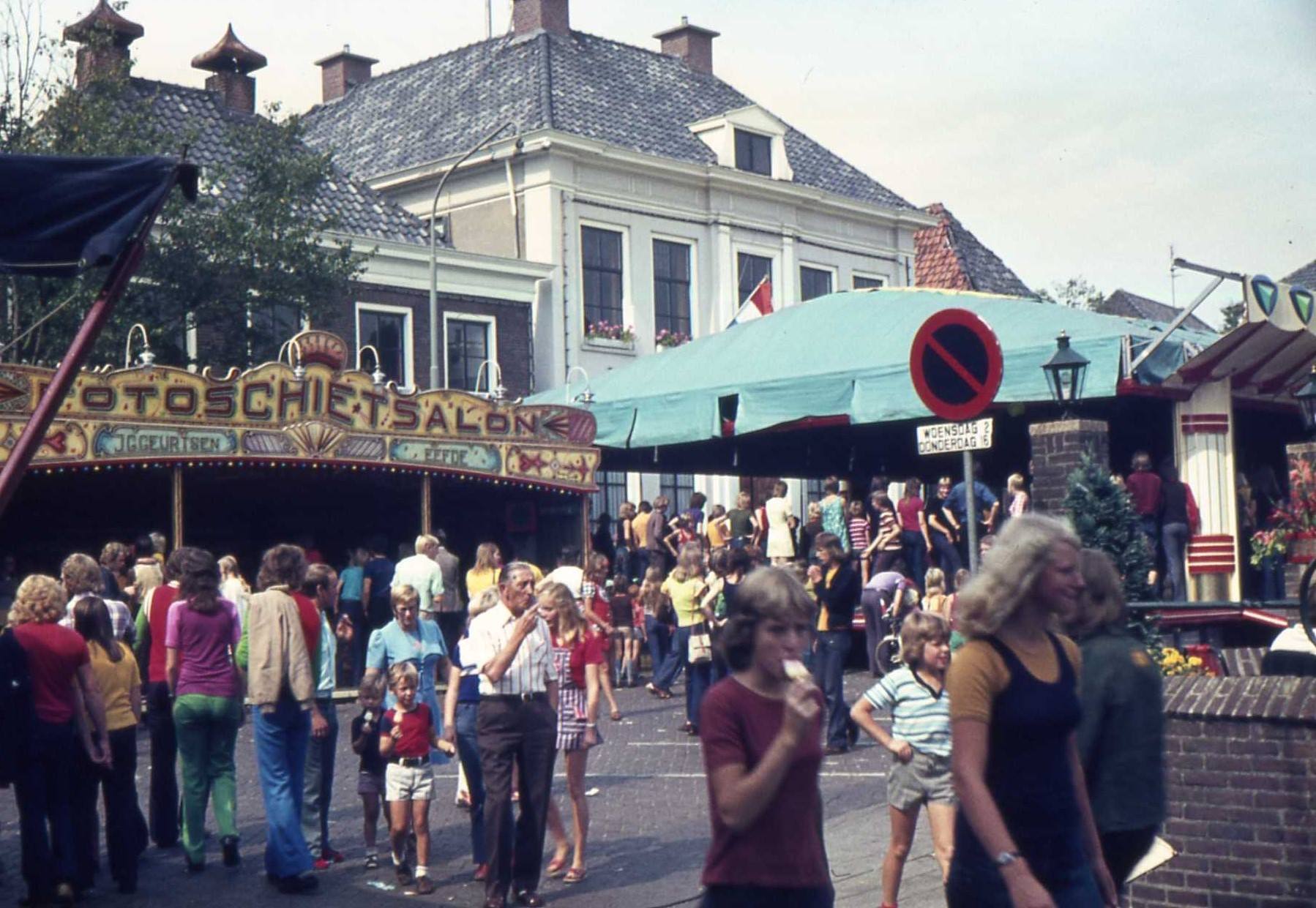
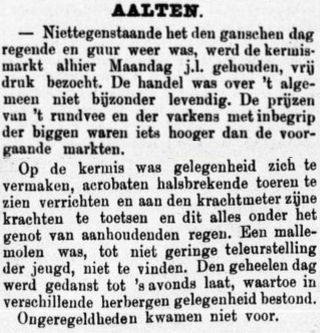
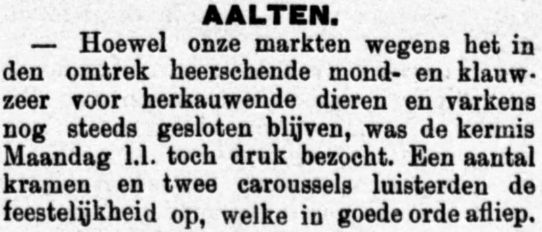
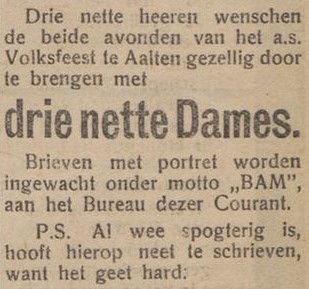
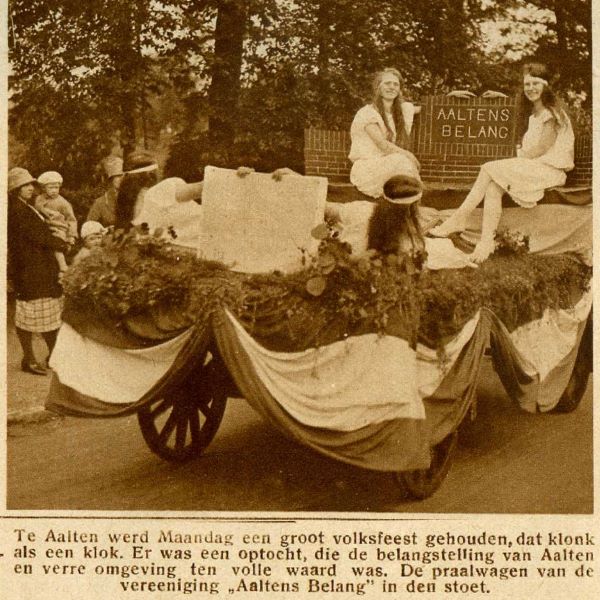
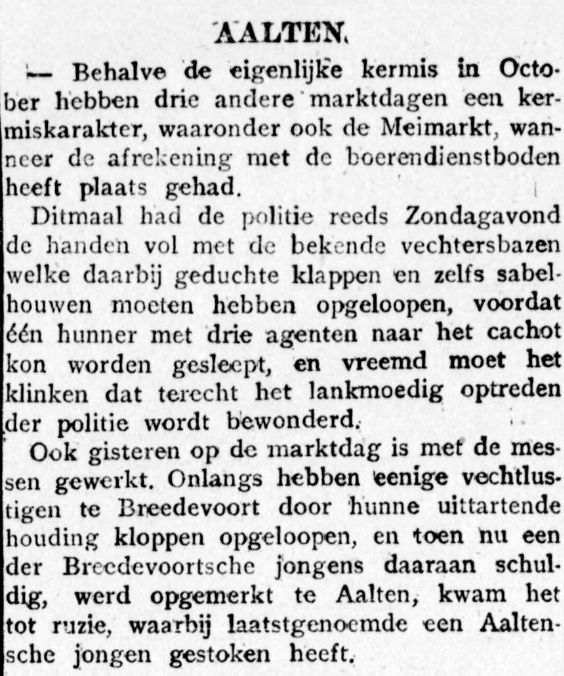
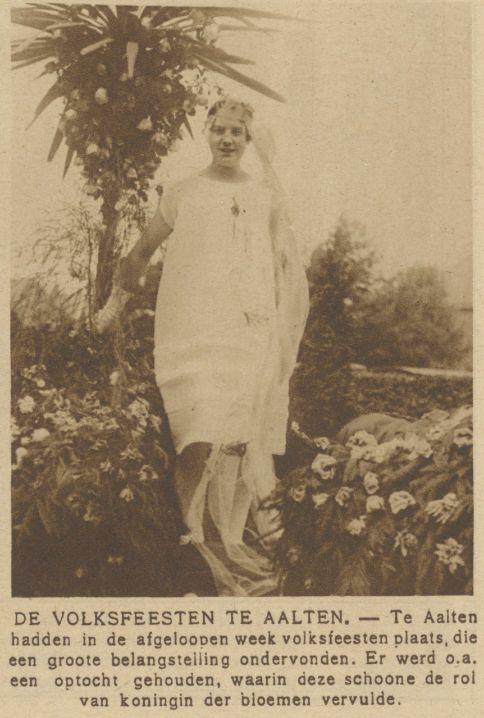
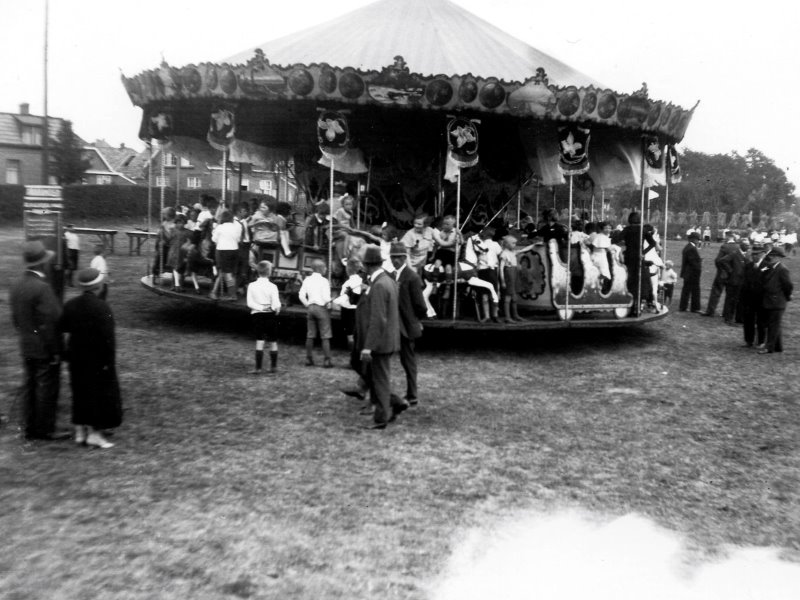
The Aalten Volksfeest is an event that many residents of Aalten look forward to every year. Nowadays, it is celebrated during the third weekend of September. In earlier years, it was also celebrated on other dates. The folk festival is also often referred to as the ‘kermis’ (fair). However, the actual fair, meaning the attractions, is nowadays called the ‘lunapark’.
For many decades, the king shooting and the fair were held on the grounds near the Community Hall / ‘De Pol’. Nowadays, however, these activities take place in the center, primarily on the Markt and the Hoge Blik.1
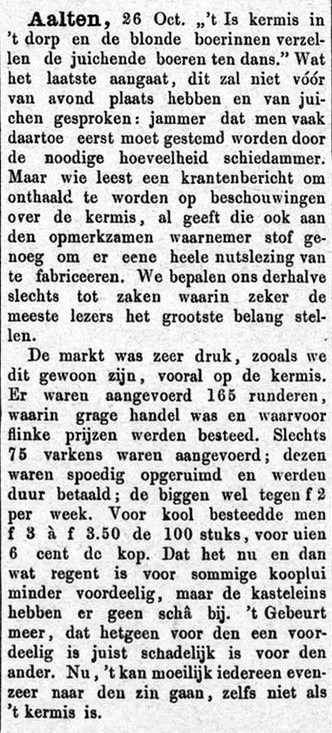
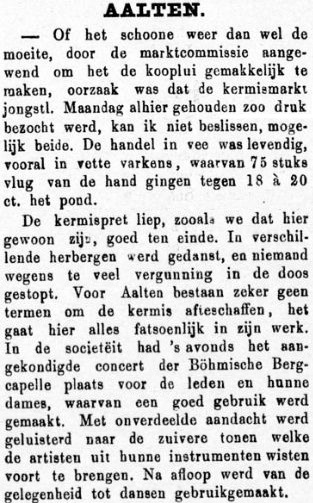
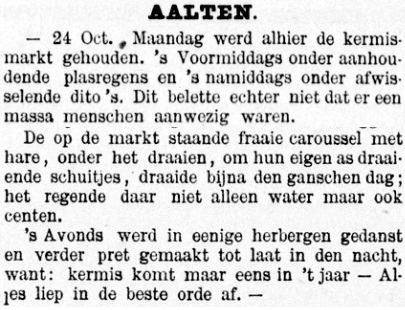
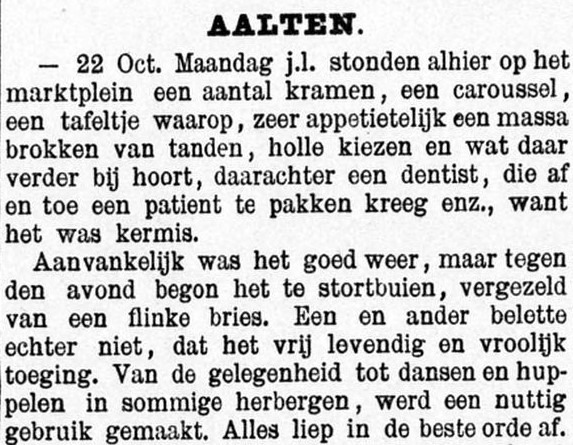
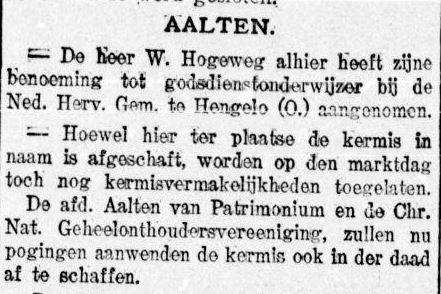
The oldest mention of the fair in Aalten dates back to 1835. That year, the ‘Geldersche Volks-almanak’ mentioned that the fair in Aalten would take place on October 19.2
In the ‘Eleventh report on the state and activities of the Dutch association for the abolition of strong drink’, published in 1855, it is written: “the fair in Aalten is insignificant, mostly children’s joy”.3
Medals are often a material reminder of an event in the past. This also applies to the small medal depicted here:
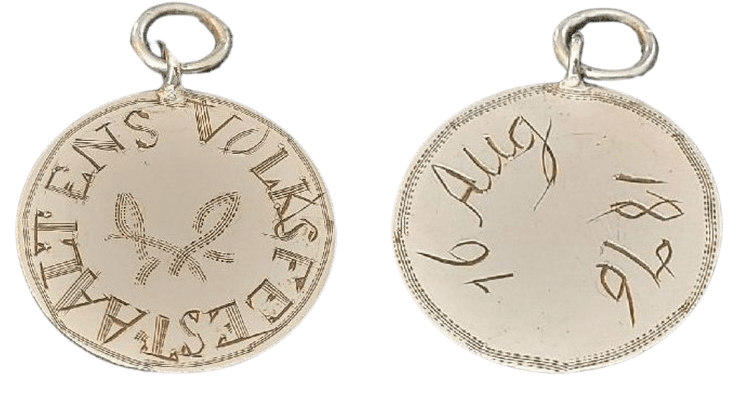
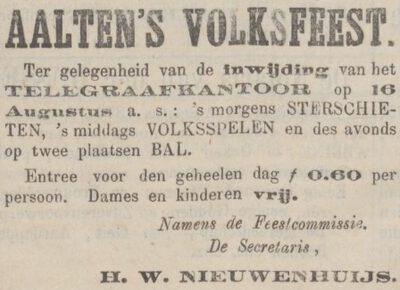
The medal consists of a silver plate with a diameter of 22 mm, to which an eyelet has been soldered. The front is engraved with the text: AALTENS VOLKSFEEST, with a ribbon surrounded by a border of stripes. On the reverse is the date 16 Aug 1876, within a border of small lines and stripes. The edge of the medal is serrated; the plate is presumably a ground-down coin. It is striking that the engraving was carried out quite amateurishly.
Regarding the occasion for the folk festival, the Zutphensche Courant of August 12, 1876, reports: the opening of the Telegraph Office in Aalten. The precise reason for the production of the medal is unknown; it may have been awarded as a prize during the star shooting.4
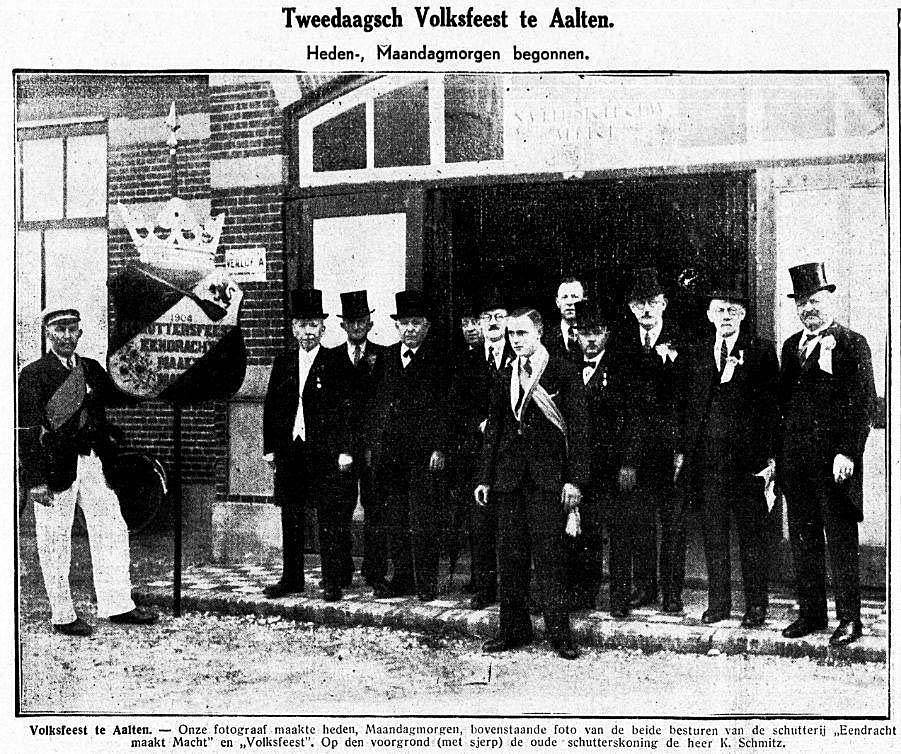
In September 1973, a ‘Volksfeest Committee’ was established, created by the merger of the Community Hall, the Schuttersvereniging (Marksmen’s Association), and the Fair Committee. Later, this became the ‘Stichting Volksfeest Aalten’. Ten years later, Wout Delleman (1927), Jan Willem Bilderbeek (1920), and Johan Diederik Beskers (1918) appeared before notary Obbink for the establishment of Stichting Volksfeest Aalten (SVA).
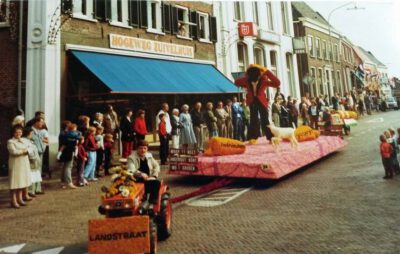
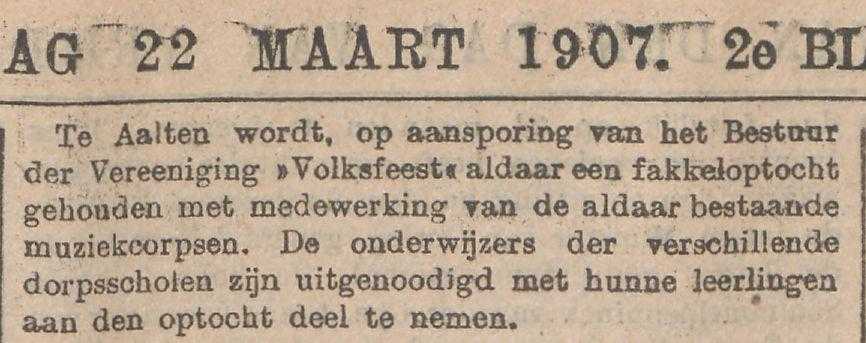
The core activities of Stichting Volksfeest have hardly changed in 50 years. Long before SVA was established, a festival, then called a fair, was organized every year. Children’s games, a lantern parade, king shooting, and the Allegorical parade are traditionally part of the ‘festival for everyone’. The locations have changed several times, and the Volksfeest has also moved from June to the third weekend of September.
Previously, the Volksfeest was held from Thursday to Saturday. Since 2014, Sunday has been added to the program with Frühshoppen.
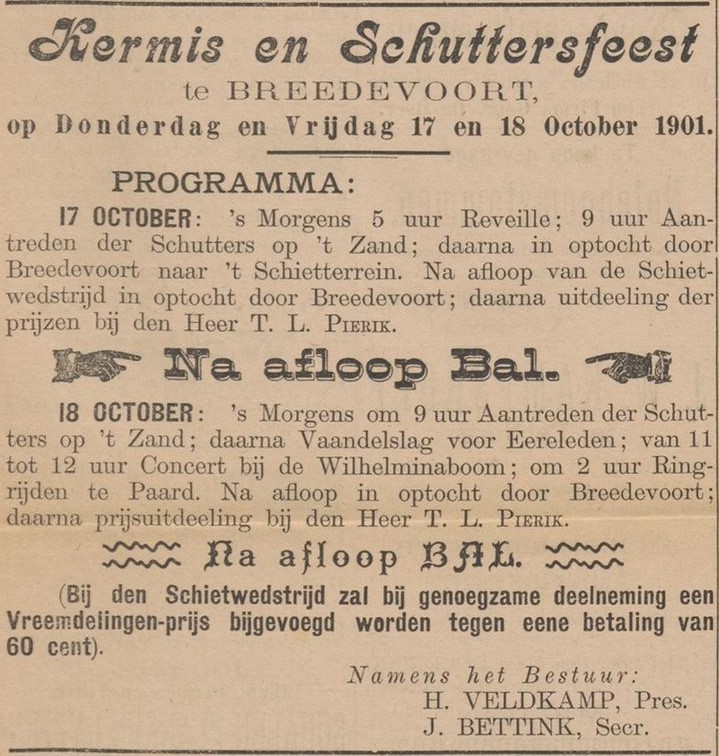
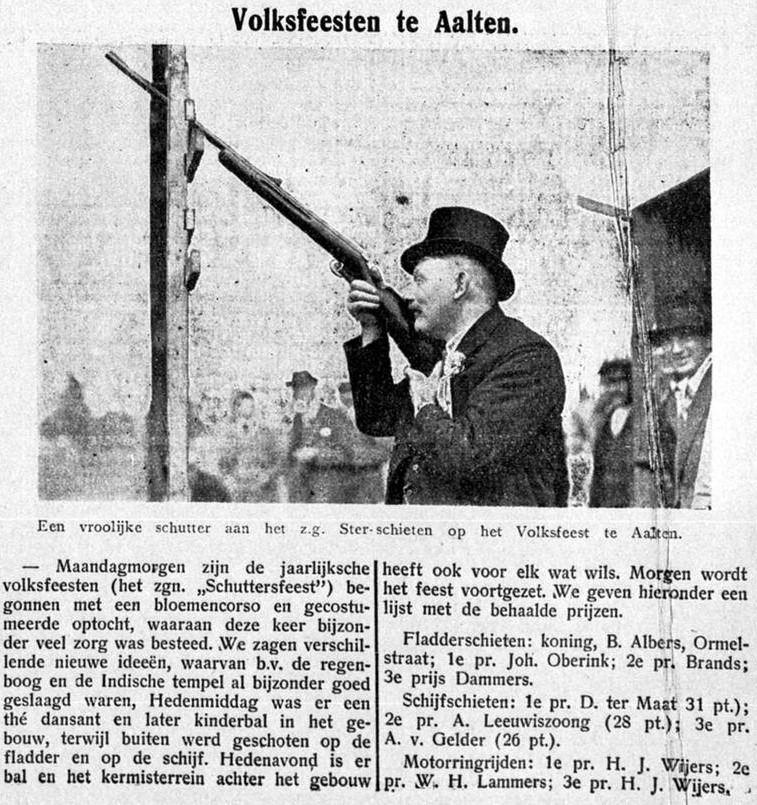
The tradition of king shooting has been known in Aalten since well into the last century. In addition to king shooting, Aalten also had ‘fladder’ and target shooting, and bird clubbing for ladies. Furthermore, at the beginning of the last century, one could also participate in ring tilting on horseback or bicycle.
The winners of the shooting competitions on Friday may call themselves king, queen, and youth king/queen of Aalten for a year. The following day, they are driven around in a carriage or cabriolet during the allegorical parade to greet the public. This is followed by the tribute to the flag by the flag wavers of St. Helena on the Markt.
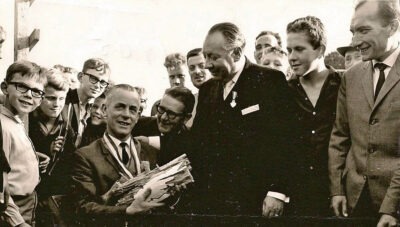
A traditional part of the folk festival is the king shooting or bird shooting. King shooting is an old custom found in large parts of Europe. King shooting originates from the schuttersfeest, the annual festive folk entertainment of the local marksmen’s guild.
(click to enlarge) 5