Category: Population

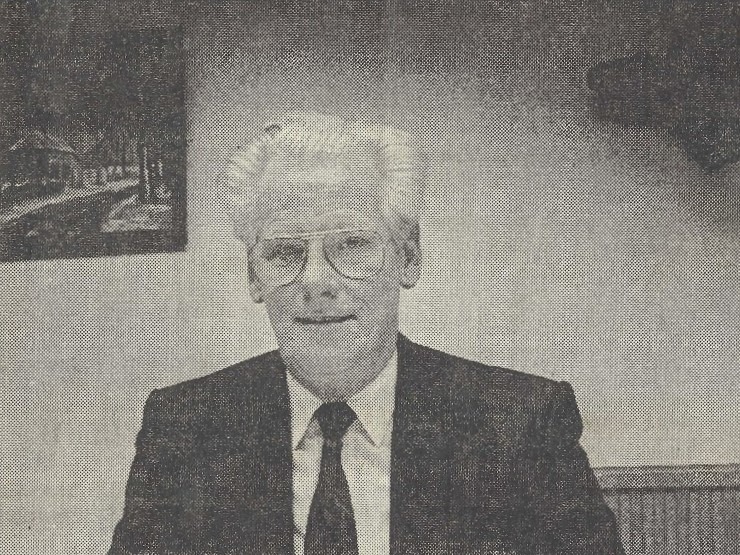
  • Bernard Leezer

    Bernard Leezer

    Nieuw Israëlitisch Weekblad, 26 March 1993

    by Loeki Abram
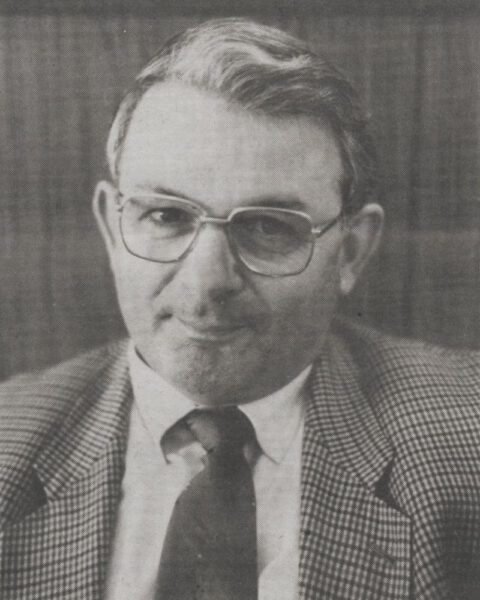
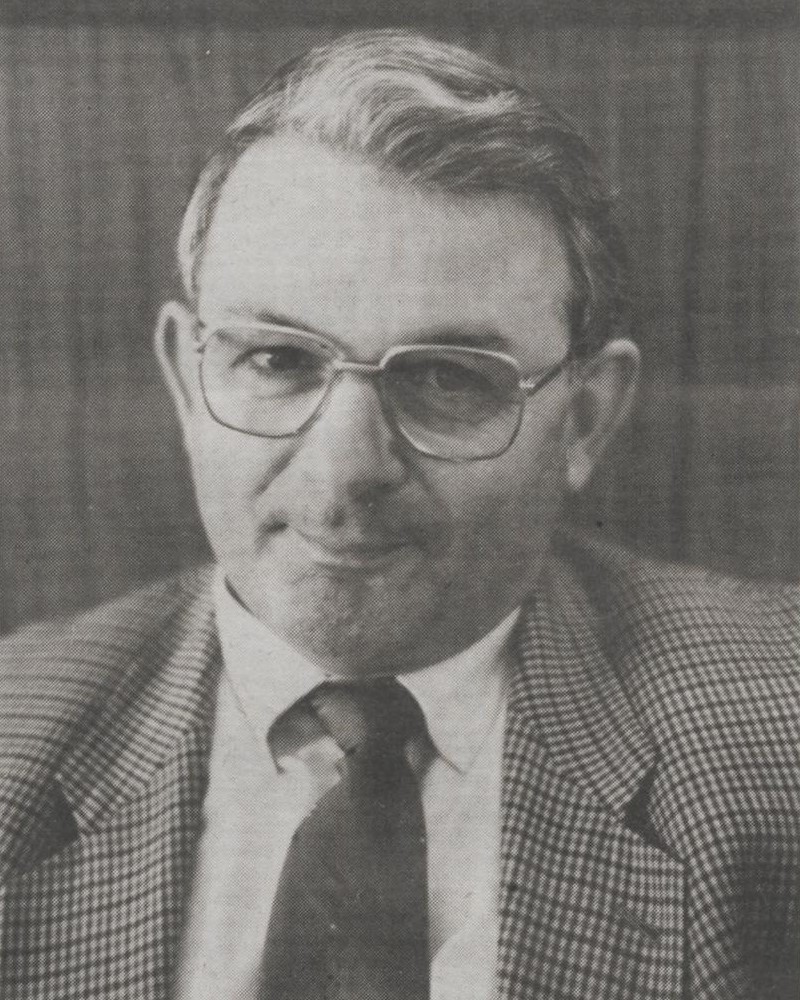
    Bernard Leezer (57) lives in Aalten in the Achterhoek. Although he ran a butcher’s shop for twenty-six years, he does not really consider himself a butcher. He is a father of three sons and a daughter, and a grandfather of two. A conversation about meat, hiding from the Nazis, and football

    “Both my parents have passed away. My father was a cattle dealer and my mother came from a well-to-do family in Wilhelmshaven in Northern Germany. She didn’t really suit my father at all. He was a stubborn man from Groningen who didn’t care much for etiquette. It caused friction. If my father came home and forgot to wash his hands before dinner, all hell would break loose. Of course, he wasn’t the type to just let himself be pushed around, so he’d fight back. And then my mother would say: ‘Na und wie bist du denn, wie bist du denn überhaupt?’ Mother spoke German at home. She spoke fluent Dutch too, but she hardly ever used it. I was raised bilingual.”

    “My mother’s father was a horse dealer. She always used to go to the tennis court in a pony and trap. Anyone who did that back then belonged to the upper class. That’s why I always say my parents only met out of necessity. She fled to the Netherlands in 1932 with her two children—both my father and mother had been married before. My father had six children from his first marriage. Two of his children, one with a husband and child, were gassed. I am the only child from the second marriage.”

    “My mother was a dominant woman. She always protected her own children, while my father’s children had to take a back seat. They had to fend for themselves from an early age. Of course, it wasn’t easy for them to accept a woman who wasn’t their mother either. Father was the kind of man who, for the sake of peace, would just think: Never mind. Let it be.”

    “I was heavily influenced by my mother. If I wanted to go on holiday, she would say: ‘Du brauchst nicht so weit weg, wenn etwas passiert. When you are old enough, you will look for a wife and go to work.’ I became a butcher against my will. I actually wanted to be a pilot. Mother wouldn’t hear of it. So a butcher it was, but I’m not really a butcher at heart. I’m too emotional. I am against ritual slaughter because I believe an animal has the right to be stunned. God gave us the animals. Fair enough, but does a beast have to suffer that much pain before we scoff it down?”

    “The first Jews to be rounded up were the Fuldauers. They lived right near us. They were taken away by PC Dijke from Aalten. He was a small, fanatical bloke. The Fuldauer family walked along packed to the rafters, and he walked in front, loosely wheeling his bicycle by his side, leading those people to the community hall. That’s where the Jews were gathered before being transported to Westerbork. People were standing outside the slaughterhouse, and they said: ‘Alright Dijke, you can keep that up all day, can’t you?’ Then my mother said: ‘It’s time. We have to leave.’ After the war, that Dijke fellow came into our shop once. I walked around the counter and said: ‘Get out, Dijke, and never come back, or we’ll cleave you in two.’ He was the man who took away the first Jidden from Aalten, and he just strolled in as if nothing had happened.”

    “Kees Ruizendaal, nicknamed Zwarte Kees (Black) Kees)—also a policeman, but a good one—helped us find a hiding place. He was later executed by firing squad in Doesburg. First, I stayed with my half-sister Helga at the Klein-Entink farm, and later with my parents at Hendrik Groot-Nibbelink’s place on the Stroete in Lintelo. We were hidden with three orphans. They were practically children themselves. Drika, the oldest, was 26; Hendrik and Bernard were in their early twenties. To me, they are heroes. You know what would have happened to them if we’d been caught. They were Christian people. They did what they did out of love, not for the money. I think about that often. I find what they did incredible. Hendrik passed away last year. The vicar gave a beautiful sermon. I went and sat in the refreshment room. I felt that if I looked at the vicar, I’d get such a massive lump in my throat. I couldn’t well let myself go like that as a grown man, could I?”

    “While we were in hiding, I used to go outside with Hendrik at night once it was dark. Next to the farmhouse stood an old apple tree. It leaned terribly and had to be propped up. Between the props was a tiny patch of land. If Hendrik had sown rye that day, for instance, I would go and sow rye on that little patch of land at night. He was my great role model; that’s why I was so heartbroken when the man died. He was like a father to me.”

    “I spent a lot of time with the cows or with the horse. The Germans requisitioned Lies—that was her name—at one point. She was a right handful. She bit and kicked everyone except me. I could practically sleep right next to her. Hendrik managed to fetch Lies back because the Germans couldn’t control her. I was so happy she was back. At least I could cuddle her again. Drika used to play games with me. My father was too old to play with me. He was terrified that something would happen to me. I don’t know if he would have survived it. He was completely barmy about me. Later on, when I started going out and came home late, he could never go to sleep. He always stayed awake and would say: ‘Where on earth is that boy?’ My mother was more down-to-earth.”

    “For a while—when it became too dangerous at Groot-Nibbelink’s—we also stayed with the Pennings family in Varsseveld. They were a very devout Christian family. During the war, he would go to Delft with a horse and cart to fetch glass. He sat on the box with the reins in one hand and a Bible in the other. Pennings had nine children. I often sit by the brook now, thinking: what must have gone through that man’s mind. He had to keep the peace in his family, keep us calm, and keep a cool head himself. The house was searched once at Pennings’ place. We were hidden under the straw along with sixteen other Jews and people from the underground resistance. One of those ‘blacks’ [NSB/collaborators] stood with his great boots right on my mother’s hand. He crushed her whole hand. Pennings was downstairs playing the organ: Abide with Me. Every time I hear that hymn, it takes me right back.”

    “We hid with true Christians, and later I went to a Christian school. But I never felt the urge to become a Christian. My half-sister Helga joined the Reformed Church. Well, that took a few drops of water, but that was about the extent of it. Truly, you can have a stable full of Trakehner and Hanoverian horses, but if you put an Arabian among them, it stands out. You cannot deny who you are. The first thing people say is: ‘That’s a real Jewish trick.’ At home, my father and mother kept Jewish life alive for me. My mother wasn’t particularly pious. My father was orthodox. His whole life, even during the war, he never ate gasser (non-kosher meat). You are a Jid, and there’s no escaping it. I’ve always said: ‘I was born a Jid, and I’ll die a Jid.’

    “I couldn’t live in Israel because of the heat, but when I’m in Eretz, I love it. We go there regularly because our daughter lives there. When I go to shul here, I think pff, but there I think it’s wonderful. Afterwards, you stand around having a nice little schmooze with a group. You can’t do that here anymore. You could before the war. Before the war, about a hundred Jews lived in Aalten. After the war, we struggled to form a minyan. It’s just a completely different atmosphere. You can’t imagine walking down the street in Aalten wearing a kippah nowadays.”

    “I can’t say I was frightened at the time. I can only remember that after the war, when I was at school, I was scared to death of the postman. I went to the Groen van Prinsterer school. It was an old-fashioned school with a very long corridor, with the toilets at the far end. If I came out of the toilet and Mr Terbrake was standing at the other end of the corridor in his postman’s uniform, I’d be rooted to the spot because I thought I’d seen a ‘black’. That’s what happens when you’ve spent years being told: ‘They’ll kill you.’ Terbrake would quickly go to Miss Jonker and say: ‘Bennie’s frozen at the end of the corridor.’ She would come and get me. She’d put an arm around me and take me back to class.”

    “The Groen van Prinsterer was a fantastic school. It was a Christian school. I never once heard the word ‘Jew’ used as an insult there. It was quite a different story at the public school. I had to have remedial lessons because at eleven years old, I couldn’t even read or write. While in hiding, we did read little booklets, and when the war ended, my father said: ‘He reads like there’s no tomorrow.’ But you mustn’t forget that if you read me a booklet like that a thousand times, I’ll eventually know it by heart. At first, they fell for it, but the moment a different book was put in front of me, I couldn’t make head or tail of it.”

    “During the war, I wasn’t aware that it was a matter of life or death. No one can tell me that an eight-year-old boy understands that. We were told: ‘You mustn’t go outside because people are walking around out there who will kill you.’ That doesn’t really sink in for a child. You can tell a dog a thousand times: ‘Leave that alone.’ And eventually, it won’t touch it anymore. But as for why it’s forbidden—it doesn’t understand that.”
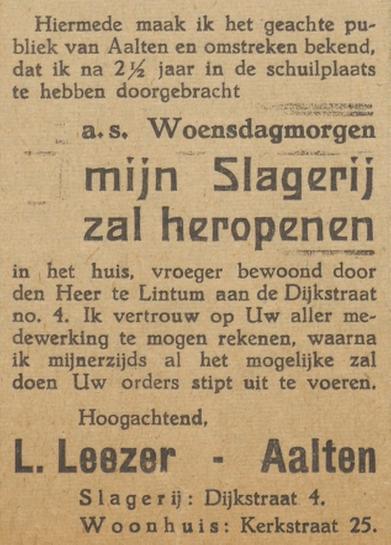
    “During the final period of the war, we stayed with Hendrik on the Stroete again. We lived there for the first few months after the liberation too, because we no longer had a house. My mother went looking for her furniture. She managed to get a lot of it back. My father took out a loan from a Christian church. He was a bit casual about paying it back; years later, we still received a final notice. Right after the war, he put an advert in the newspaper: ‘After two and a half years in hiding, I am reopening my butcher’s shop. My father wasn’t a good butcher. He was a cattle dealer. A proper trader. Very much a case of: one, two, up you get, just sign for that beast.”

    “After primary school, I went to the technical secondary school. I didn’t want to go at all, but my mother said: ‘Du sollst ein Handwerk lernen.’ I ended up getting a whole load of diplomas. Alongside that, I always did a lot of sport: tennis, hockey, and football. My father wouldn’t give me money for football boots. ‘You’ll just have to earn it,’ he said. I always had to help my father, but I never got paid for it. My brother-in-law ran an emergency slaughterhouse. If there was an emergency slaughter in the middle of the night, he’d ring and wake me up, and I’d go and help him. I didn’t get any money for that either, but I did get the head, the tongue, the udder, and the liver, and I sold those. That’s how I bought my football boots.”

    “I played as a semi-professional for De Graafschap. I moved from Aalten Football Club to Winterswijk Football Club. WVC was an elitist club. Because I went to school in Winterswijk and was in the school team, I caught people’s eyes. When I moved from Aalten to Winterswijk, I was called a ‘rotten Jew’. Why? I was turning my back on Aalten. WVC was an elite club, and they hated them. I was a really fast right winger. But I was very slightly built. They only had to tap my ankle and I’d go rolling over thirty-four times. Later on, I played centre-forward too. I was actually too small for it, but I’d always go tumbling to the ground, and that would get the referee on our side. I played two seasons for De Graafschap, until one day I was kicked out of the match by Dick Tol, nicknamed ‘the gnarled’.”
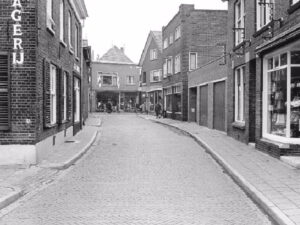
    “In the end, I ran a butcher’s shop for 26 years. Looking back now, I say: ‘I’d never want to do it again.’ A hundred grams of this, a hundred grams of that. Never again, though I did have some fun. Especially in the early sixties, we got a lot of German customers. Meat was cheaper in the Netherlands than in Germany. You had to be careful not to give the Germans preferential treatment, otherwise you’d get earfuls from the Dutch. Dutch customers were always served immediately by my assistant or my wife. Even if there were three Germans ahead of them, a Dutch person was served first. I’d make a joke of it and say: ‘Kurt, ich hilf dir’.”

    “In the evenings, the restaurant owners from Bocholt would come in and order ten or fifteen racks of pork chops. There were a few customs officers who always came to get meat. They never had to pay. When they came by, they’d say: ‘Blimey, I’m on duty again tonight.’ And then in the evening, I’d get in my little Opel, take out the spare wheel, put the racks of chops in, and pop right over the border. I could always drive straight through. My wife knew nothing about it, and I thought: what she doesn’t know won’t hurt her. It was a time of adventure and wheeling and dealing.”
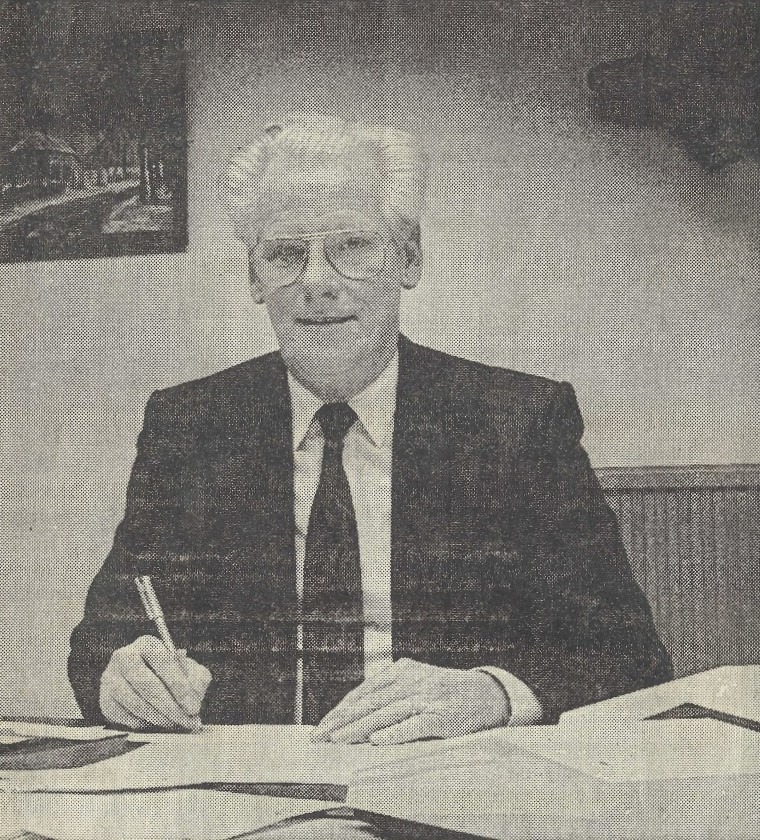
    Source


  • Jan Elferink

    Jan Elferink

    Dagblad Tubantia, 24 March 1987

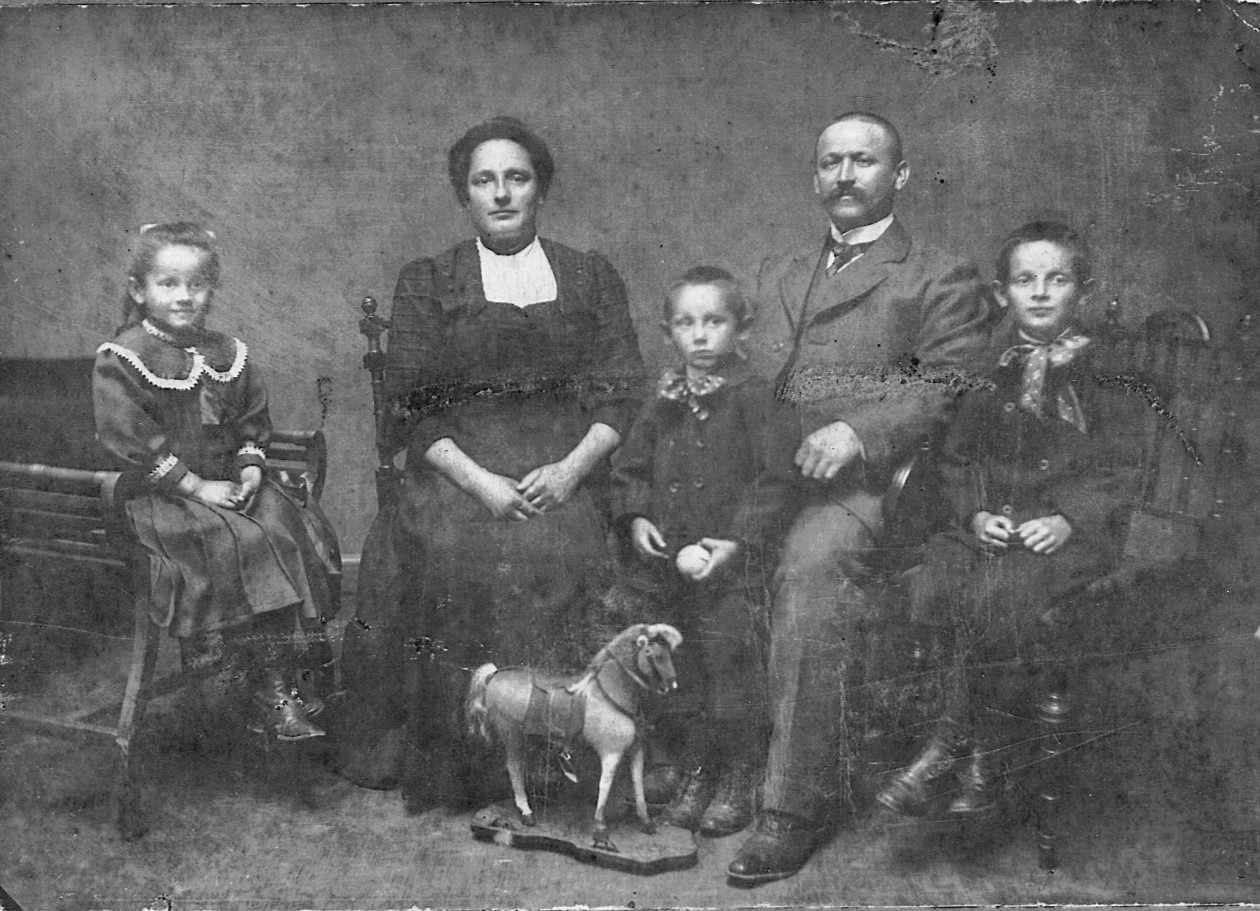
    BREDEVOORT – If you do not know him, it would never cross your mind for a single moment that this man’s profession might be that of a bank manager. Bank managers are generally expected to walk around with permanent pound signs in their eyes, but Jan Elferink certainly does not fit that mould. He is witty, always up for a laugh, a fast talker, and never caught off guard. Yet the residents of Bredevoort who deal with Jan Elferink on a business level know that beneath this jovial friendliness lies a sharp businessman—a man who truly knows what he is talking about when it comes to financial matters.

    He certainly learned that over the course of his 42-year banking career. This year, Jan is stepping down. As of 1 September, after he has shown his successor, G.W. te Brinke, the ropes, he will take early retirement. “I am 60 now, and the years beyond sixty are precious. That is why I am bowing out. I still have plenty to keep me occupied. I’ve already told my wife: if I do the work during the day that I currently do in the evenings, I will at least have a few evenings a week to myself,” Elferink says, explaining his departure.

    It was 42 years ago when, at the age of 18, he started at the Raiffeisenbank in Lichtenvoorde. “I had always wanted to do that. But when I finished secondary school (ulo) in 1943, my father told me I had to help out in his painting business. Both of my brothers had been conscripted for forced labour in Germany, so I had no choice.”
    However, the war was barely over when Jan saw his chance. The post-war monetary reform meant that banks had to take on extra staff. On 1 October 1945, he was hired, and exactly a year later, he transferred to the bank in Bredevoort. “When I first arrived here, I thought: I’ll gain a few years of experience and then move on to another town. But it never came to that. We feel very much at home here in Bredevoort. Happily, we were fully accepted into the community.”
    For twelve years, Jan cycled back and forth between Lichtenvoorde and Bredevoort every day, until he married in 1958 and became a true Bredevoorter. You can certainly call him that when you see how deeply integrated he has become in the Bredevoort community.

    A hardheaded business

    In 1963, Jan was appointed manager of the bank in Bredevoort. “Banking is a hardheaded money business. That really consumes your time. Perhaps that is why, as a counterweight, I took on all those pleasant and social activities outside of my work.”

    When Jan begins to list the activities he is or has been involved in, he takes quite some time. The local folk festival, the gondola pageant, the ice rink, board member of the school association, board member of St Bernardus, and so the list goes on. And that is leaving aside all the “ad hoc things” he occupies himself with, such as conducting charity auctions, organising carnival gatherings for the Zonnebloem charity, acting as a compere for the traditional brass band in Lichtenvoorde, and performing as a buutreedner (comic orator) during the carnival season.

    “I wanted to call it a day when my partner, Bonekamp from Lichtenvoorde, stopped. But so many requests came in from all sides that I still write a new comic monologue every year. All of that keeps you going. From a young age, I’ve loved being a bit of a rebel. That was already the case at school, and later at the amateur dramatics society, which I joined when I was only fourteen.” His penchant for fun is also well known among his fellow bank managers, who know him affectionately as “Enerink from Smallevoort”.

    Elferink makes no secret of the fact that the work of a bank manager in a small community like Bredevoort is rather different from that in a large city. “Here, you are not just engaged financially, but socially too.” Elferink has seen the banking world change dramatically in over forty years: from a small room with a single desk and a safe where savings books were updated by hand, to an exceptionally modern, automated office building where the entire money trade takes place, but where holidays, insurance, and securities are sold as well.

    G. te Brinke now manager

    BREDEVOORT – As of 1 July, G.W. te Brinke from Lochem will join the Rabobank in Bredevoort as its new manager. Te Brinke was born and raised in Zelhem and is 41 years old. He began his banking career in Doetinchem in 1966 and has been working in Lochem since 1977.

  • Piet Bloot

    Piet Bloot

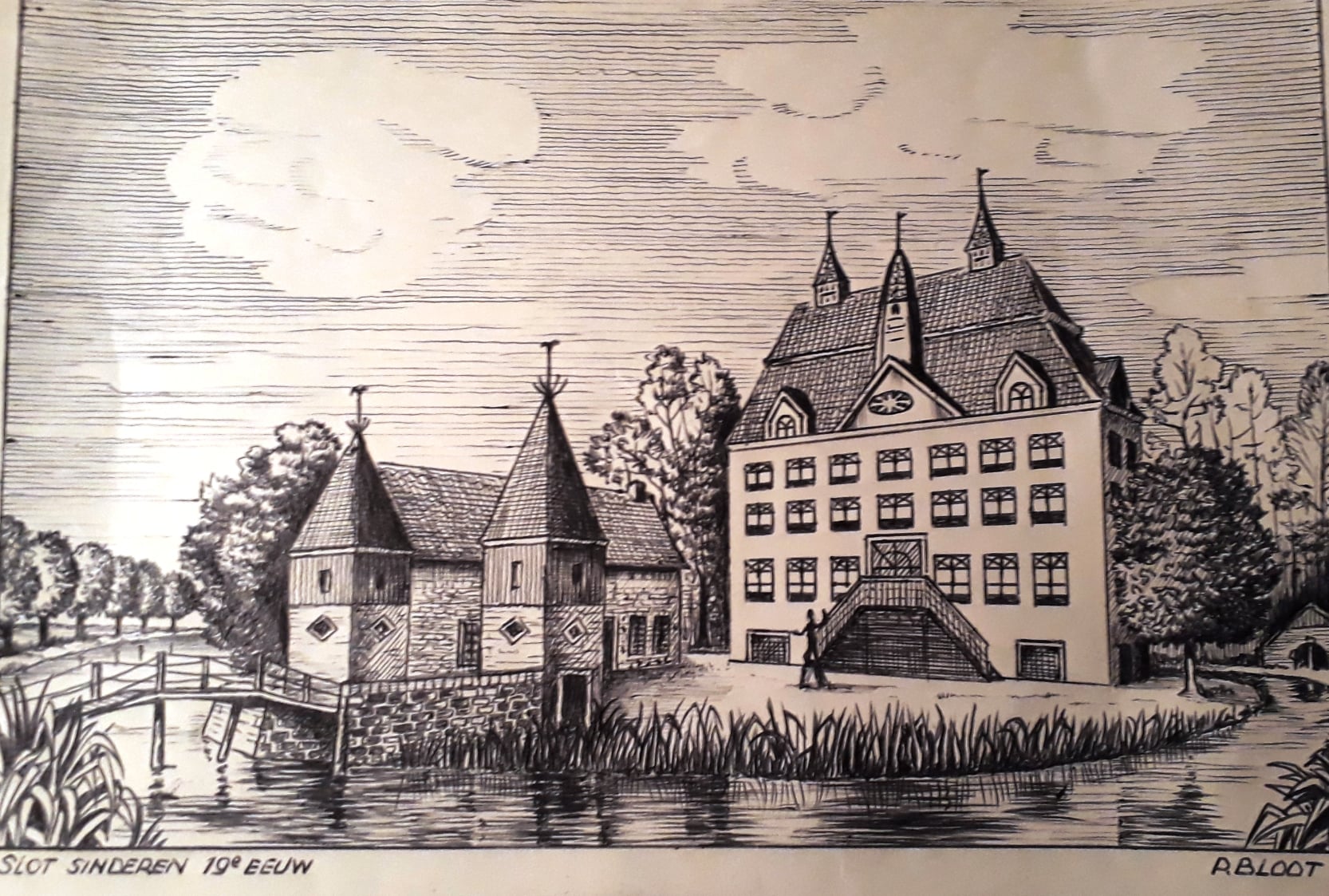
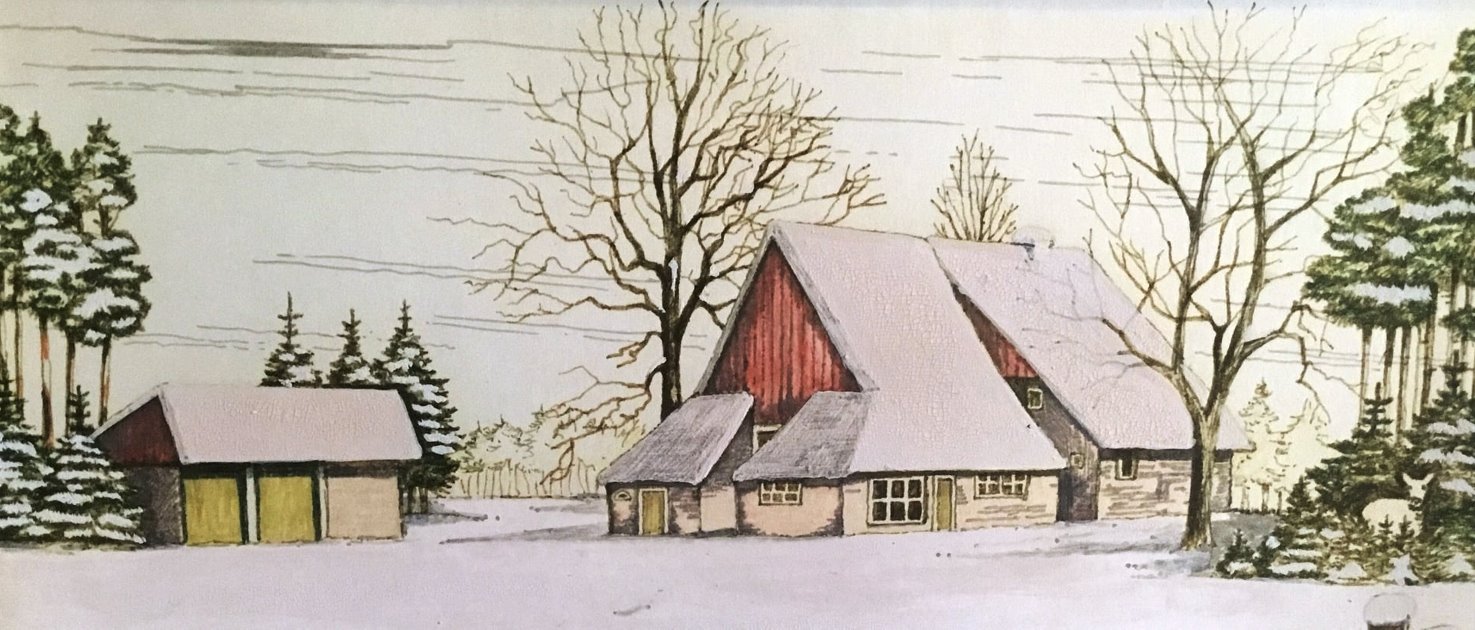
    Pieter (Piet) Bloot (1924–1982) came to Aalten from the bombed city of Rotterdam in the summer of 1940 as a sixteen-year-old boy. On the initiative of the Calvinist (gereformeerde) minister Th. Delleman—formerly a minister in Aalten and later in Rotterdam-Kralingen—an appeal was published in the Aalten church magazine to offer Rotterdam children from affected families a carefree summer holiday. Piet was one of the fortunate ones.

    What began as a holiday turned into a five-year stay. During this period, Bloot worked in the horn industry in Aalten. Because he had a passion for drawing, he returned to Rotterdam after the liberation, where he studied commercial drawing at the Academy of Fine Arts.

    However, Piet could no longer settle in Rotterdam and returned to the Achterhoek region at the end of 1947. He went to work for the electrical installation company ERBA Van Lochem in Aalten. In September 1949, he met Johanna Wildenbeest, who was born at the De Kiefte farmhouse in De Heurne. They married in 1952 and had three children.

    In the early 1950s, Bloot and his colleague Leendert Rhebergen started their own business at the bottom of the Hogestraat: Rhebergen en Bloot, an electrical installation company with a shop selling electrical appliances.

    Piet Bloot passed away on 30 January 1982, aged 57, and was buried at the Berkenhove cemetery.

    Publications

    In 2016, the Fagus publishing house released Zo ik niet had geloofd, brieven van mijn moeder (Had I Not Believed: Letters from My Mother), based on around 160 letters and postcards his mother had sent him from Rotterdam between 1940 and 1945, supplemented by his own memories. Bloot is also featured in Kunstig Aalten (2021), an overview of artists from Aalten compiled by Leo van der Linde.


    Gallery

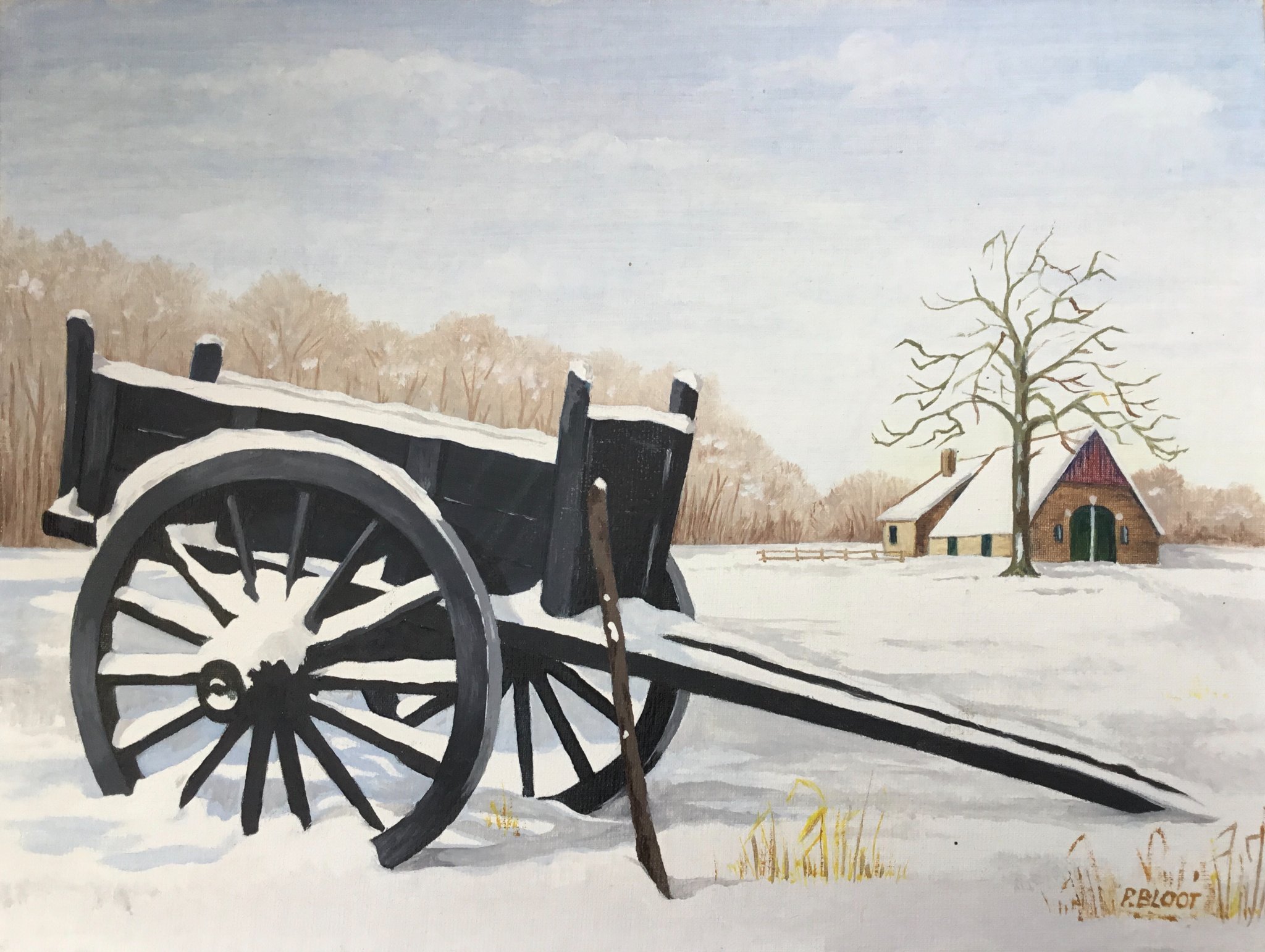
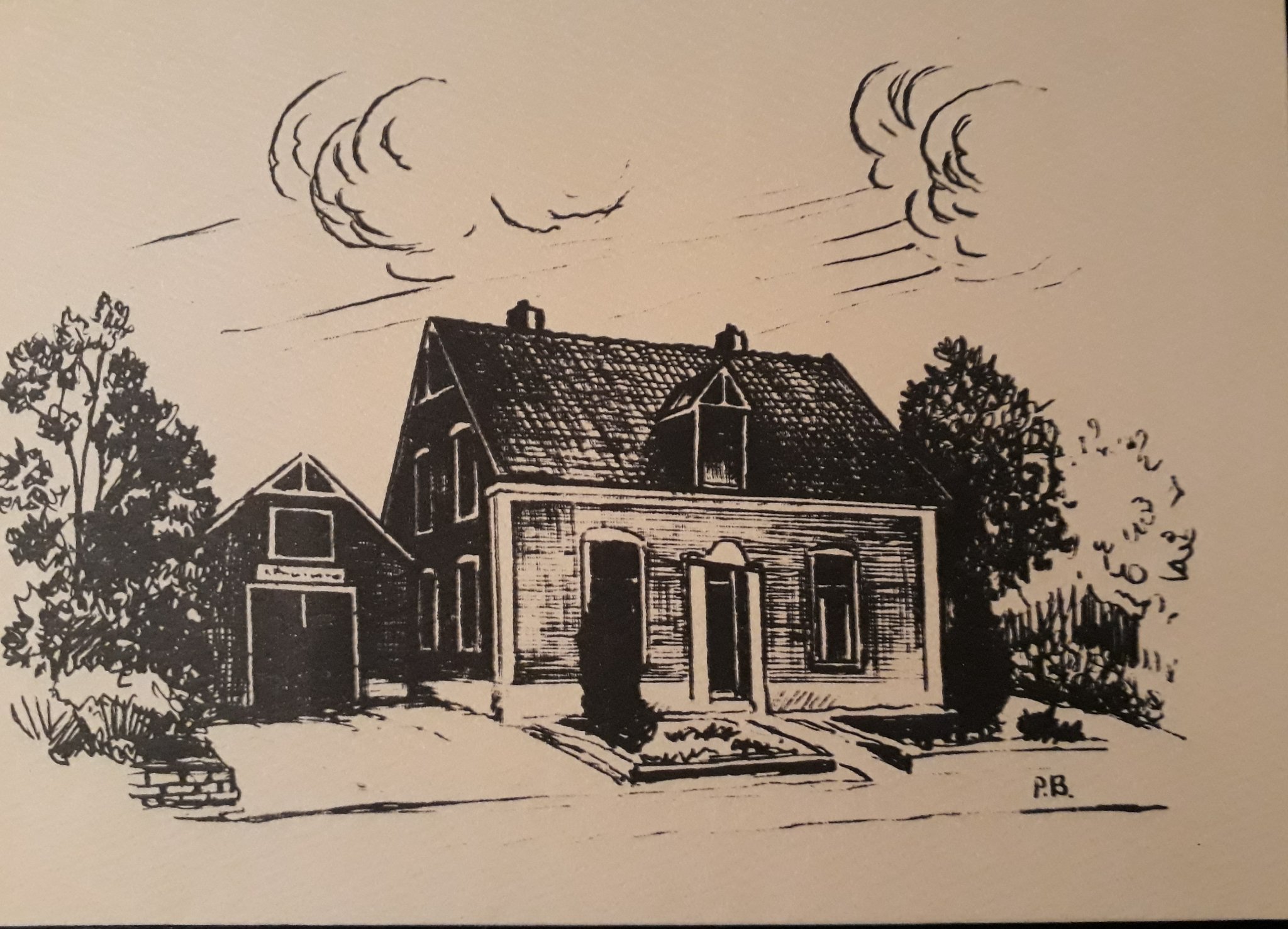
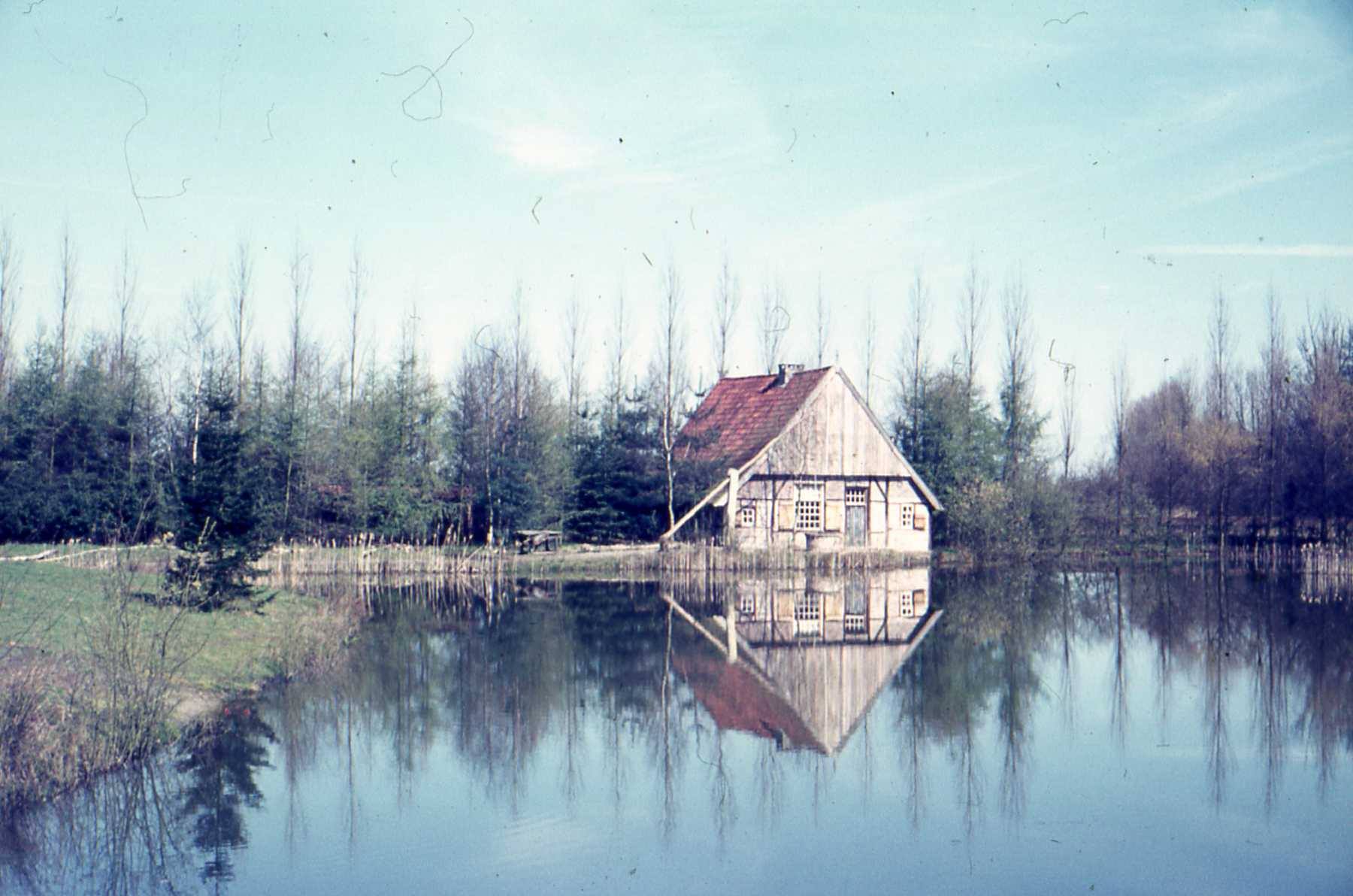
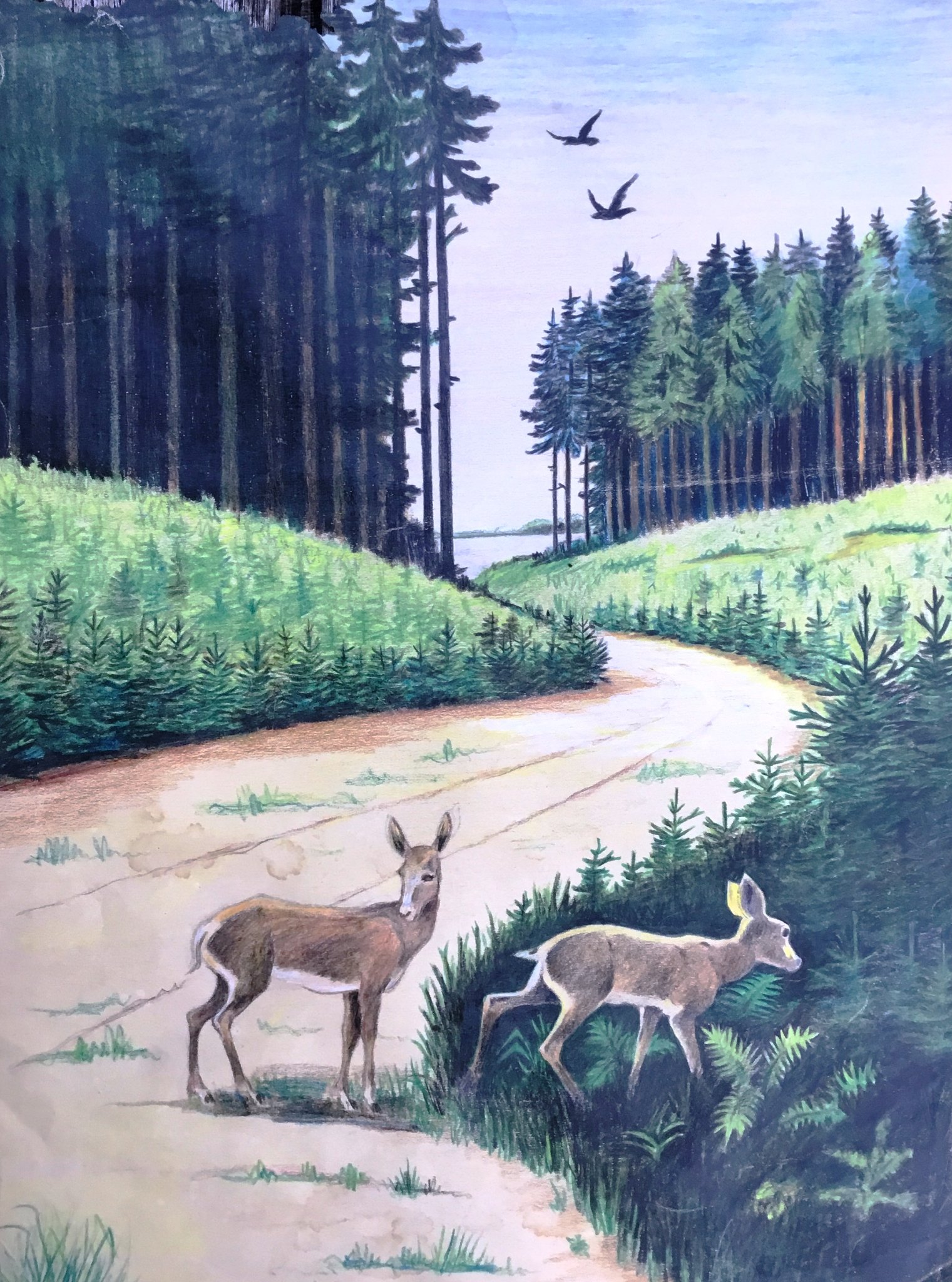
    A selection of works by Piet Bloot:

  • G.J. Kaemingk, inventor of ‘electric education’

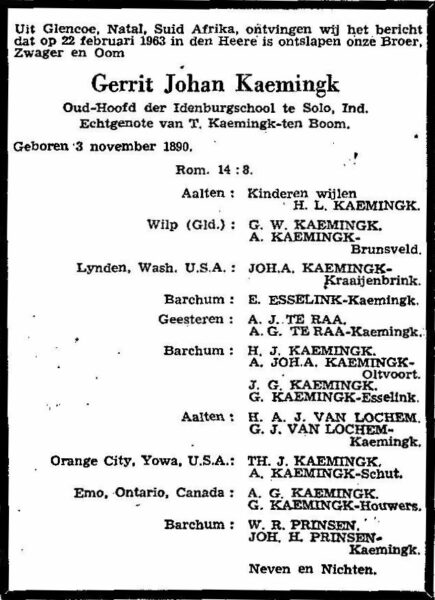
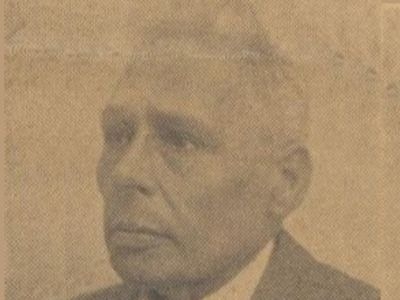
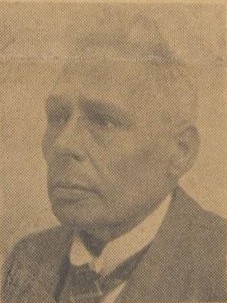
    G.J. Kaemingk, inventor of ‘electric education’

    Schoolmaster became world traveler and inventor

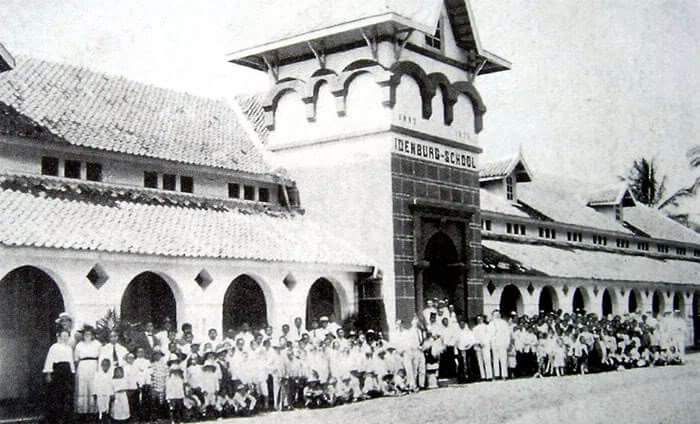
    Gerrit Johan Kaemingk was born on November 2, 1890, at Overbeek in IJzerlo, son of Theodor Johann Kaemingk and Johanna Hendrika Pennings. In 1917, the then 27-year-old teacher left the Netherlands to work in the ‘far Indies’.

    The journey was indeed very long, as World War I had blocked the normal travel routes. After a four-month journey via Iceland, America, Honolulu, Japan, and China, he finally reached his ideal. There, he became, among other things, head of the Idenburg School in Solo (Surakarta).

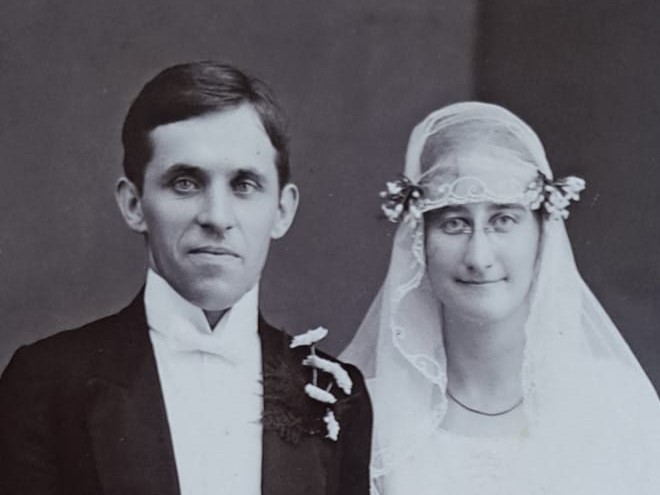
    Kaemingk married Geertruida Johanna Sophia (Truus) ten Boom in 1921.

    After twenty years, he retired and set out on another journey. On his way to the Netherlands, he wanted to see South Africa. He arrived there in 1937. And because he did not yet consider himself ‘worn out’, he became a temporary teacher there. Before he could realize his plan to return to the Netherlands, World War II broke out.

    As a result, it was not until the summer of 1953 that he saw his native country again. The twice-retired teacher stayed temporarily in Hoogeveen with his brother Gerrit Willem Kaemingk (1887-1979), who was then chairman of the Christian Emigration Center in Drenthe.

    Invention of electric education, the ‘Elucator’

    Once back in the Netherlands, Kaemingk presented his invention, namely ‘electric education’. He called his method “Elucator“, a combination of electricity and educator (or educator). He had applied for a patent for his invention in South Africa. It worked as follows:

    Using a battery, a low-voltage current is passed through two insulated pointing sticks. With one stick, a location is pointed out on a map, and with the other, one of the place names listed in a row on the right of the map. If the correct location is pointed out, this is signaled by a light or sound signal. Conversely, one can also search for the correct location for a given place name.

    In addition to geography, Kaemingk had also designed maps for subjects such as drawing, language instruction, reading lessons, botany, and history. In total, about 50 maps could be compiled. The Elucator and its accessories could be carried in a handy box that easily fit into a briefcase. With this, he had developed an educational method that was said to have several advantages. For instance, the teacher would have become (virtually) redundant. The child could study alone at home or in class, and any error was immediately corrected.

    The Elucator was considered particularly suitable for (countries such as) South Africa, where children living in remote areas found it difficult to attend a school. However, a number of educational experts in Utrecht, who were introduced to Mr. Kaemingk’s invention, were also enthusiastic. Children found the Elucator to be ‘a relatively inexpensive parlor game with many possibilities’. The visual connection, which was directly established here between an object and a word, a plant and its name, or a sum and its result, seemed to ‘have a very favorable effect on the child’s comprehension’.

    Back to South Africa

    After his visit to the Netherlands, he returned to South Africa, where two of his sons-in-law had a farm. He passed away on February 22, 1963, in Glencoe, Natal, South Africa.

  • Evert Jan van Schaik

    Evert Jan van Schaik

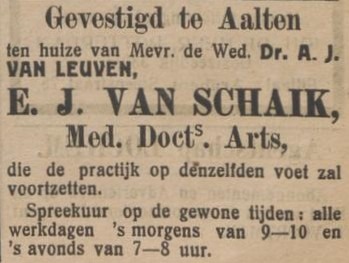
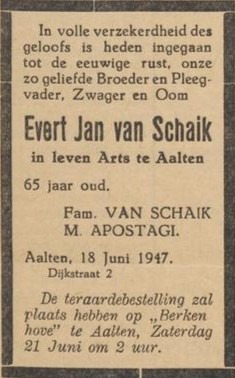
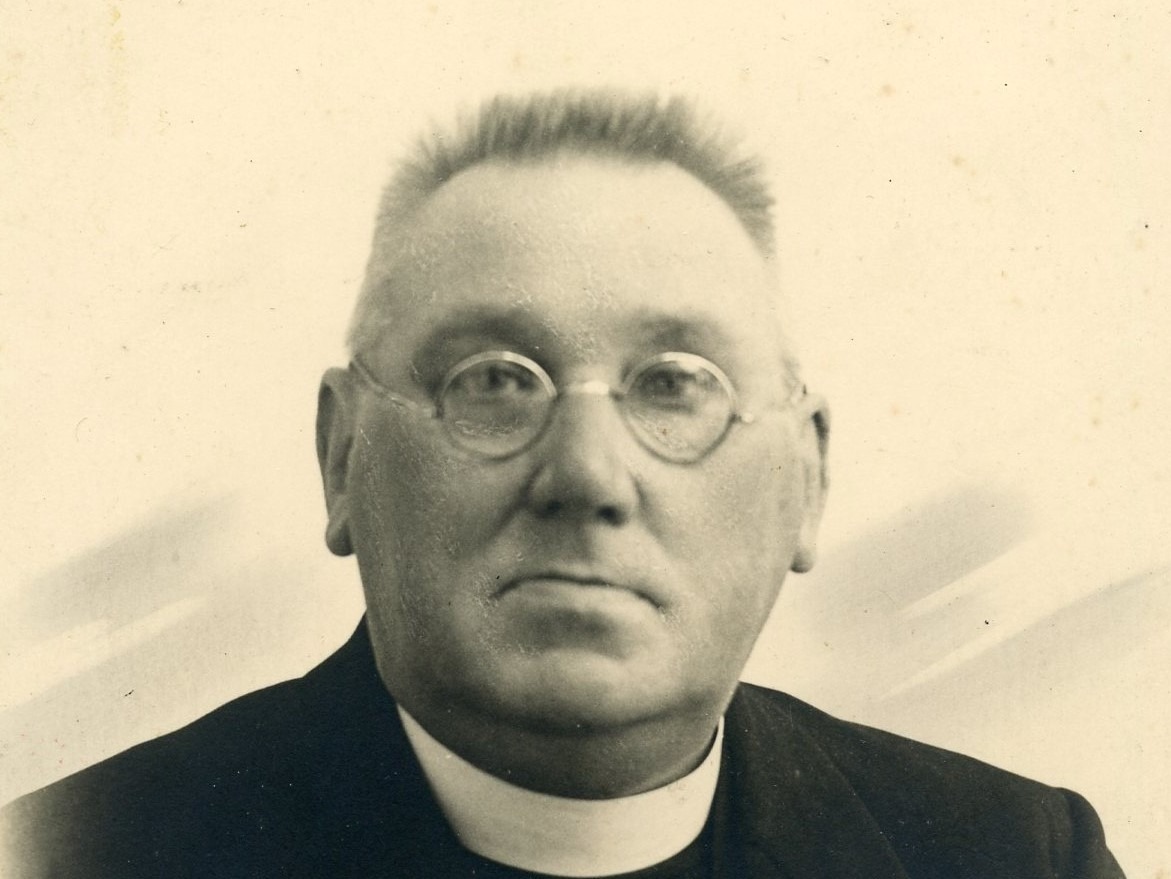
    Evert Jan van Schaik (1881–1947) was a doctor in Aalten from 1912 to 1946. He was renowned for his expertise, dedication and humility, always prioritising the welfare of his patients and the community. Van Schaik remained unmarried and passed away in 1947 at the age of 65.

    Evert Jan van Schaik was born on 30 November 1881 in Wapenveld, in the municipality of Heerde, the son of Paul van Schaik, a minister in the Christian Reformed Church, and Maria van de Kamp. Due to his father’s profession, the family relocated several times during his early childhood: first to Hoofddorp (1882), then to Middelharnis (1884) and later to Nieuw-Lekkerland (1890).

    After completing primary school, Evert Jan attended the Reformed Gymnasium in Amsterdam. He subsequently studied medicine at the Municipal University of Amsterdam, where he obtained his medical degree in 1912.

    Doctor in Aalten

    On 9 December of that same year, 1912, he settled in Aalten, taking over the general practice of Doctor Van Leuven, who had passed away shortly before. Initially, he resided at the De Roskam hotel on the Landstraat. A few years later, he moved to the former Roman Catholic presbytery on the Dijkstraat, where four of his unmarried sisters later came to live with him.

    Much like his predecessor, Doctor Van Schaik quickly gained appreciation for his expertise and commitment. He enjoyed the deep trust of his patients and built a solid reputation. His approach to his work was characterised by thorough conscientiousness. He took almost no holidays, running his practice for years on end without even considering taking time off.

    Although he dedicated himself almost entirely to his medical practice, he also took an interest in church and state affairs. This interest was backed by extensive knowledge, though he chose not to seek the spotlight.

    Recognition and Final Years

    In 1937, on the occasion of his silver jubilee as a general practitioner in Aalten, a committee formed by local residents organised a celebration in his honour. Van Schaik was praised for his faithful devotion and quiet strength, as someone who never sought prominence but always put his patients and the community first. His great humility made him a beloved figure to many.

    However, the demanding practice took a heavy toll on his strength. A few years after his jubilee, he received assistance from Doctor D.N. Visser. As his health declined, Van Schaik gradually handed over more of his workload. In January 1946, he retired from his medical duties permanently, at which point Doctor Visser took over the practice entirely.

    Evert Jan van Schaik passed away in Aalten on 18 June 1947 at the age of 65. He was laid to rest at the Berkenhove cemetery.

  • Pastor Van Rooijen

    Pastor Van Rooijen

    Parish Priest (1916-1945)

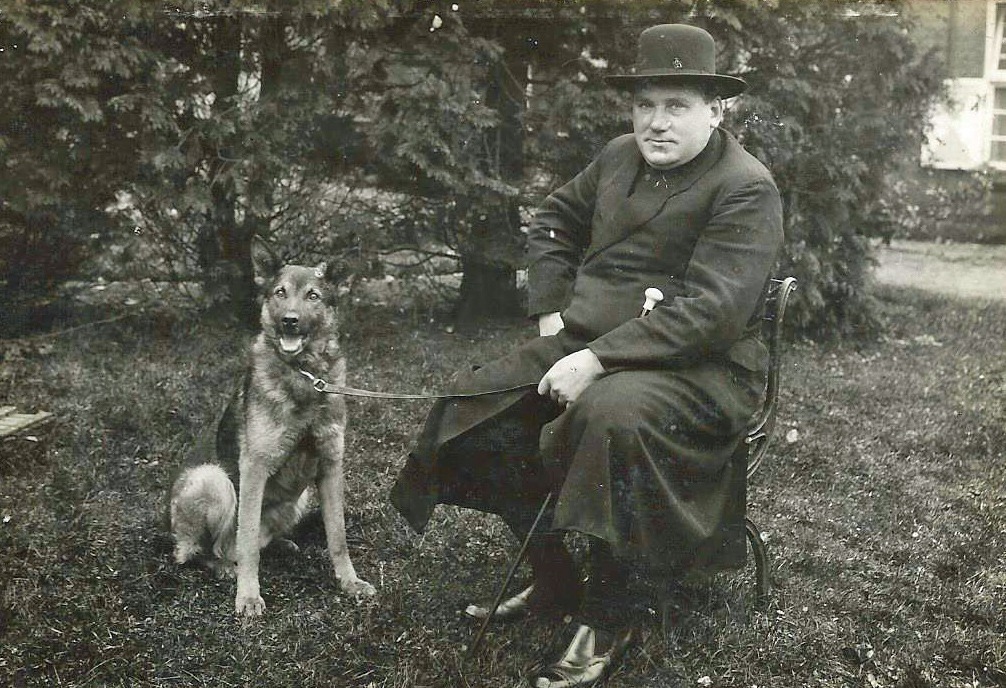
    Pastor Christianus Franciscus Bonifatius van Rooijen (1876–1945) was a well-loved figure. He commanded great respect not only among his parishioners but also among the Jewish residents of Aalten. During his walks with his loyal German Shepherd, Frits, he would tip his hat and greet Jewish fellow citizens with a slight bow.

    Bombing Raid

    On the afternoon of Sunday, 28 January 1945, many people were gathered in the Roman Catholic Church for the Benediction (Lof). Suddenly, a number of ‘Jabos’ (Allied fighter-bombers) broke through the cloud cover and dropped their bomb load. On the Kemena, Admiraal de Ruijterstraat, and Stationsstraat, the damage was limited to property.

    At the Roman Catholic Church, however, the consequences were more severe. One bomb fell in front of the church, and another struck the rectory. Panic ensued, and the blast pressure caused statues to fall from their niches and walls to collapse.

    The churchgoers escaped unharmed, though they were covered in dust and many suffered bruises and abrasions. There was a massive bomb crater in front of the main entrance to the church. However, the bomb that had struck the rectory had more tragic consequences.

    The pastor’s housekeeper, 57-year-old Johanna Maria Klein Rouweler, was severely injured and passed away a few days later in the emergency hospital in Harreveld. Pastor Van Rooijen also lost his life and was not discovered until hours later that night. His death touched the hearts of residents of all denominations, and his funeral at the Roman Catholic cemetery on Piet Heinstraat was attended by a great many people.

    20th Anniversary of Priesthood

    In 1936, Pastor Van Rooijen celebrated 20 years in the priesthood, and De Graafschapbode newspaper devoted an article to this anniversary:

    “Tuesday, 8 December, will mark 20 years since the Reverend Pastor Van Rooijen was installed here as successor to Pastor Wubbels, who departed for Dalfsen. On this milestone in the pastoral life of Pastor Van Rooijen, we requested him to tell us a little about the past two decades. Although His Reverence did not consider 20 years an official milestone usually celebrated, he was kindly prepared to provide us with some information and to pose for our illustrator.

    Pastor Van Rooijen was born on 13 February 1876 in Utrecht. After attending school there, he completed his studies at the Seminaries in Culemborg and Rijssenburg. His first post as curate was Oosterhout (Gelderland), a position he later exchanged for the Twente industrial centre of Enschede. From there, Curate Van Rooijen was installed as Parish Priest here on 8 December 1916.

    Over the past 20 years, the jubilarian has experienced all the ups and downs—in recent years, especially many ‘downs’. He worked here alone until 23 August 1935. On that date, he received the assistance of Curate J. Snoeren.

    When we speak of the ‘downs’, we know we have touched upon a subject very dear to His Reverence’s heart. It is well known, even among those of other faiths, that Pastor Van Rooijen personally does a great deal to alleviate the suffering of his parishioners, but also how indignant he often is when young people, who earn a decent wage, show so little willingness to contribute.

    A well-known example is the daily provision of a free glass of milk to children at the Roman Catholic school who are in need. This milk distribution has been running for two years now and is undoubtedly of great benefit to the general health of the younger generation. The ‘Hulp in Nood’ (Help in Need) fund of the Roman Catholic Workers’ Association, to which members contribute a small weekly amount to assist one another in emergencies (childbirth, illness, etc.), is also an initiative of the jubilarian. In the previous financial year, 385 guilders were raised in this manner.

    Pastor Van Rooijen was particularly satisfied with the house visits he and the curate have made over the past 14 days, with the twofold purpose of assessing the situation in various households and collecting donations for the provision of clothing, blankets, and, if possible, a Christmas gift for needy families. To date, these visits have already raised over 800 guilders—more than His Reverence had dared to hope. That this should be so successful precisely in this 20th year will undoubtedly bring the jubilarian great satisfaction.

    We shall suffice by mentioning that in these 20 years, the Roman Catholic Church has received a hot-air heating system, and during this time, the fashion vocational school and various sports associations have flourished.”

    Sources


    • Graafschapbode, 4 December 1936 (Delpher)
  • Johannes der Weduwen

    Johannes der Weduwen

    ‘Doctor of the resistance’

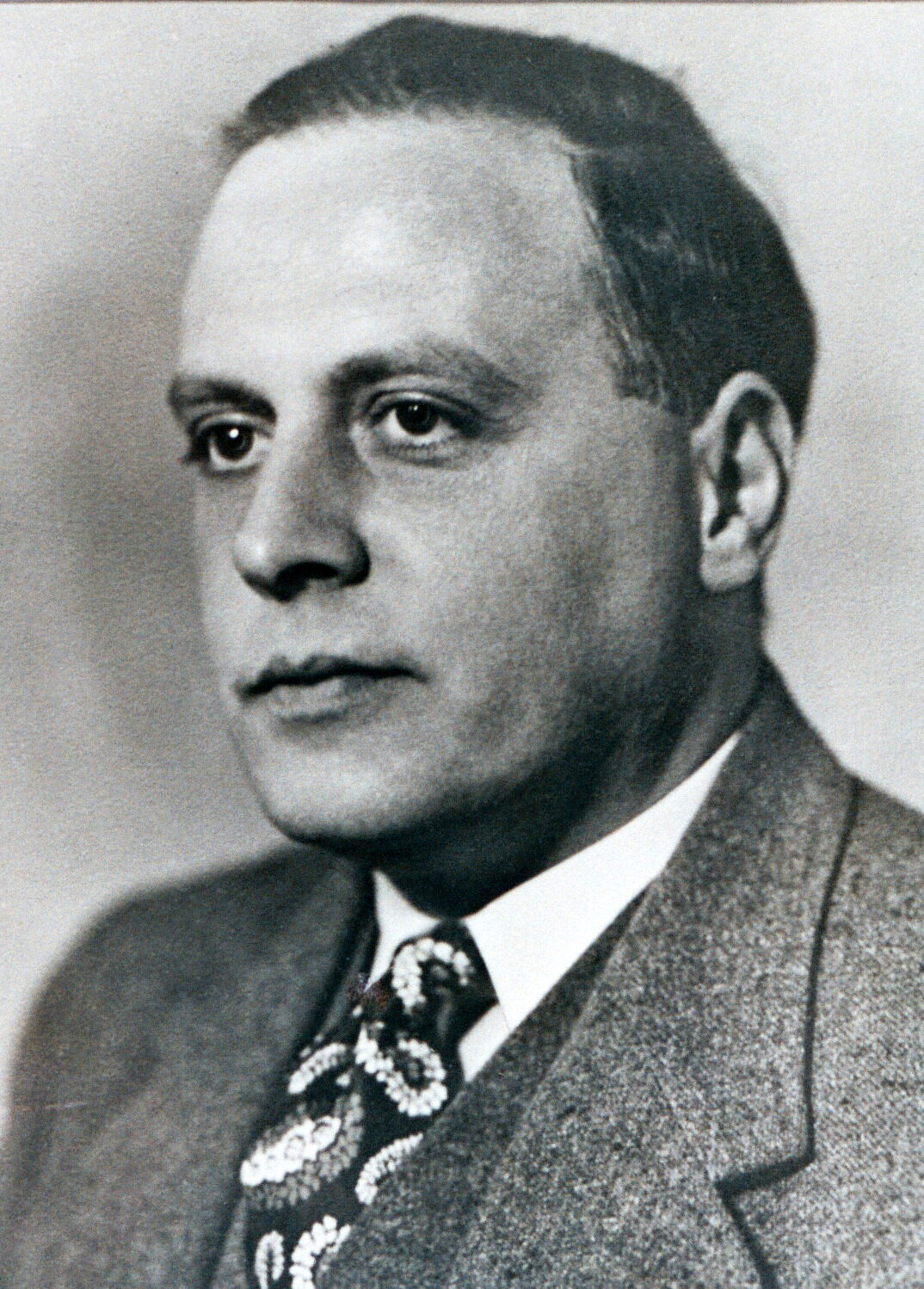
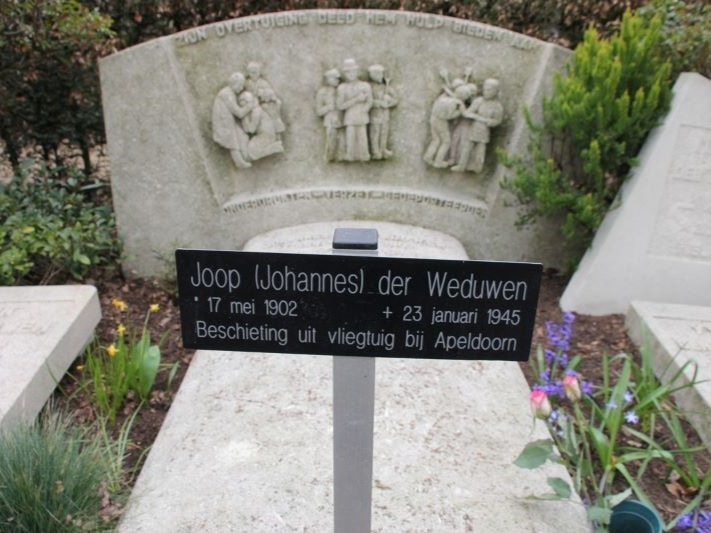
    Johannes (Joop) der Weduwen was a popular general practitioner in Aalten. On January 23, 1945, he came near Apeldoorn to die after being shot at by an Allied plane, at least according to the German authorities.

    Joop der Weduwen was born on May 17, 1902 in Aalten. He studied at the Gymnasium in Doetinchem, later at the University of Utrecht, where he took his medical exam and then obtained his doctorate in medicine. He showed himself to be a worthy successor to his father and established himself here as a doctor.

    From the beginning of the war, Joop der Weduwen became involved in the resistance in the Achterhoek. He actively offered help to people who were wanted by the Germans. His family included two young men who refused to do labor service. If English planes were shot down and the crew was injured, he offered them medical assistance. For a robbery at the distribution office in Borculo , his car was ‘stolen’. He helped Jewish people in hiding on various farms in the area. He also played a role in the abandonment of the Jewish baby ‘Wíllem Herfstink’ at the house of resistance leader ‘Uncle Jan’ Wikkerink.

    Assistance to forced labourers

    In the last winter of the war, Joop der Weduwen felt closely involved with the forced labourers who had to do their slave work under inhumane conditions, especially in Camp Rees . That camp was just across the border in Germany. As a representative of the Dutch Red Cross, he negotiated with Peter Röhrig, the commander known as the executioner of Rees to remove the sick and wounded.

    He tried to transfer as many people as possible to Aalten, where ‘Huize Avondvrede‘ on the Hogestraat had been set up as an emergency hospital. Many were also transported by car from the GP to the Emergency Hospital in Harreveld. Some sick people stayed at his home temporarily and then went into hiding.

    On 19 January 1945, Doctor Der Weduwen, accompanied by two SS men from the Rees camp, left for The Hague for an official meeting with high-ranking German officers and the mayor there. On behalf of the Red Cross, he pleaded for better conditions for the forced labourers, many of whom came from The Hague and Rotterdam. The men had to spend the nights on the bare floors in draughty and damp wooden sheds, had meager clothes and hardly got anything to eat. To improve their inhuman existence somewhat, he asked for straw bags, among other things.

    Fateful return journey

    During the return trip to Aalten, on January 23, 1945, the car he was in was fired upon by an Allied fighter plane near Apeldoorn around five o’clock in the afternoon, at least according to the German authorities.

    His lifeless body was found badly mutilated in a dry ditch, where he had tried to take cover. He had lost a lot of blood and had died on the spot. The car was undamaged. There were strong rumors that the Germans deliberately attacked him because he had become too troublesome. Joop der Weduwen was 43 years old.

    Willem van Houtum, Apeldoorn’s war chronicler, wrote about it in his diary on 23 January:

    “A doctor from Aalten, who interfered a lot with the condition of the deportees in Rees, died of German indifference. The doctor left for The Hague last Friday with two Germans in a car. He wanted to plead with high authorities for the improvement of the treatment of our compatriots in Rees and so on. It was to no avail. As a result, they returned on Tuesday. They were shot at by an English plane on the concrete road near Hoog Soeren. The doctor got out of the car in a hurry to take cover but collapsed badly injured. The two Germans took away the wallet, wallet and so on and drove on to the Ortskommandant in Apeldoorn. He refused to transport the doctor because it was a civilian. So the two Krauts drove on to Aalten and handed over the wallet and so on to the doctor’s wife. This in turn could not provide transport either. She called in the help of a family member in Apeldoorn. With the help of the police, he succeeded in having the body (the doctor had died of excessive blood loss) transferred to Aalten. Due to the many shelling, the concrete section of the Amersfoortseweg near Hoog Soeren is already popularly called ‘Dodenweg’.”

    Police report

    Tuesday 23 January 1945, 17.00 hours, report no. 23.
    Informs Zegers in Nieuw Millingen that a man has just been shot dead by guns. A car is also on fire. Criminal Investigation Department, Feldgendarmerie, Pol. Officer and L.B.D. notified. The body is picked up by the L.B.D. (= Air Protection Service) and transferred to the hospital on the Sprengenweg.

    Wednesday 24 January 1945, 5.45 p.m., report no. 24.
    With regard to the mutation of the report of the order police of 23-01-1945 at 17.00 hours, detective Adema reports that the body of the said person was picked up by the L.B.D. and laid out in the morgue of the hospital on the Sprengenweg. It has been identified as Dr. Johan der Weduwen, living at Landstraat 4, in Aalten. His brother-in-law Wissink, living at Stationsstraat 25 here, has been informed of this, who takes care of warning the family and the funeral.

    Funeral

    On Saturday, January 27, Joop der Weduwen was buried with great interest to Berkenhove cemetery in Aalten. The procession counted at least 1000 people. Previously, a funeral service had been held in the Old Helena Church under the leadership of Rev. J.D. Stegeman, emeritus pastor in Aalten. On behalf of the forced labourers, Mr Dijkgraaf from The Hague spoke a word of thanks and farewell.

    Friends, patients and villagers had a special memorial stone made in front of his grave in gratitude and to honor him. The text on the monument reads: “His conviction made him offer help to the oppressed – resistance – deportees.”

    His name is also mentioned on the memorial stone for the fallen in the organized resistance on the Markt in Aalten, next to the Old Helena Church.

    On March 31, 2023, a Stolperstein was laid in front of the house where Joop der Weduwen lived, Landstraat 41 in Aalten.

    Sources


  • ‘Uncle Jan’ Wikkerink

    ‘Uncle Jan’ Wikkerink

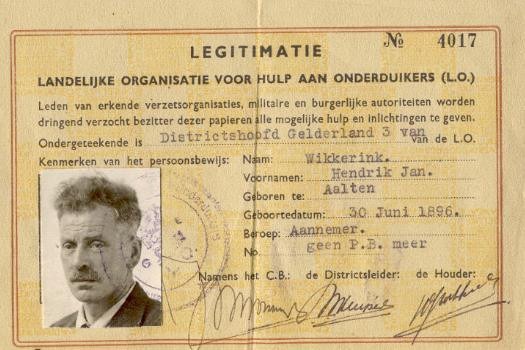
    Hendrik Jan Wikkerink (30 June 1896 – 18 January 1981), known by his alias ‘Uncle Jan’ (‘Ome Jan’), was a key resistance leader in Aalten during World War II. In 1942, in his home on the Patrimoniumstraat in Aalten, he helped found the Landelijke Organisatie voor Hulp aan Onderduikers (LO – National Organisation for Aid to People in Hiding), working alongside figures such as ‘Aunt Riek’ (‘Tante Riek’) from Winterswijk.

    Resistance Work

    Throughout the war, ‘Uncle Jan’ was actively involved in the resistance. He helped escaped prisoners of war and downed Allied airmen flee via Belgium to England. He also arranged hiding places for Jewish citizens and Dutch nationals who refused to work for the German occupying forces.

    With the courage and support of many farmers, he provided shelter for those in hiding. The LO coordinated safe houses and the distribution of food ration coupons. A well-known story is that of the Jewish baby, Willem Herfstink. The newborn was the son of the Aalten rabbi, Jedwab. The couple was in hiding in Lintelo, but the baby could not remain at that location. With ‘Uncle Jan’s’ knowledge, the child was left on his doorstep as a ‘foundling’. This staged discovery meant that the child—subsequently named Willem—was given shelter with the Wikkerink family.

    ‘Uncle Jan’ narrowly survived the war. On 15 October 1944, he and two people in hiding were arrested by the Germans at his own home and imprisoned in the marechaussee (military police) barracks on the Ringweg. That same afternoon, he was liberated by resistance ‘action squads’ (knokploegen) and went into hiding on a farm in Vragender. Two days later, the occupiers took out their anger on the ‘terrorist’s’ home. They threw hand grenades inside, which set the house on fire. However, the local fire brigade managed to limit the damage.

    Awards and Recognition

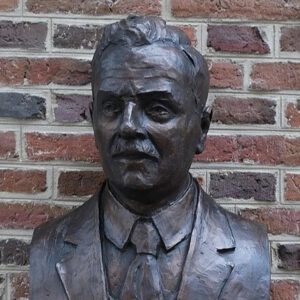
    Because of his respectful demeanour and deep-rooted values, he remained an undisputed leading figure even after the war. Following the liberation, Queen Wilhelmina visited the Wikkerink couple to personally thank them for their brave courage and loyalty. He was knighted in the Netherlands and also received medals of honour from both French President De Gaulle and American President Eisenhower. In 1978, Hendrik Jan Wikkerink and his wife, Dela Gesina, were recognised by Yad Vashem as ‘Righteous Among the Nations’. It is fitting that his bust stands in the hall of the Nationaal Onderduikmuseum in Aalten.

    ‘Uncle Jan’ Wikkerink is buried at Berkenhove Cemetery.

  • Bernardus Gerhardus Vaags

    Bernardus Gerhardus Vaags

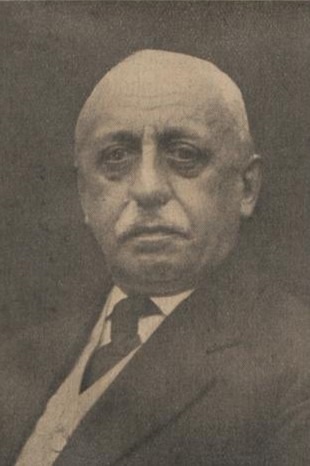
    Bernardus Gerhardus Vaags was born on 19 June 1855 at Dijkstraat 9 in Aalten, the son of Gerrit Willem Vaags and Willemina Geertruid Becking. He was the co-founder of the Becking & Vaags pipe factory and additionally held various civic and social positions. He passed away on 5 May 1936.

    On 20 August 1891, he married Hermanna Johanna Petronella ten Dam in Aalten. The couple settled at Landstraat 12. Three children were born from this marriage: Gerrit Willem (1893), Elisabeth (1896) and Abraham (1902).

    Vaags co-founded the Becking & Vaags pipe factory in Aalten, which developed into a flourishing enterprise within the horn-working industry – a sector that was unique within the Netherlands. When the company’s export opportunities declined after the First World War, the business was liquidated.

    Alongside his commercial activities, Vaags was highly active in the community: he was a board member of the Aalten Branch of the Maatschappij tot Nut van ’t Algemeen (Society for the Public Good), and for many years served as its treasurer and representative at the general meetings. He also held the positions of chairman and secretary of the local Reading Society and was a warm supporter of the Public Library.

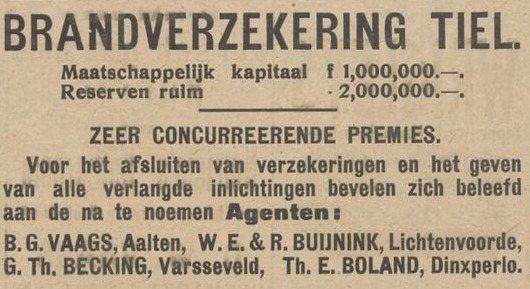
    Furthermore, he dedicated himself to the Ten Hietbrink’s Bewaarschool (nursery school) and served as an agent for the Nederlandse Maatschappij voor Brandverzekering (Netherlands Fire Insurance Company) in Tiel, a position he held for more than 45 years.

    Bernardus Gerhardus Vaags passed away in Aalten on 5 May 1936 at the age of 80. His funeral took place at the Old Cemetery on Varsseveldsestraatweg.

    Sources


  • Gerrit Heersink

    Gerrit Heersink

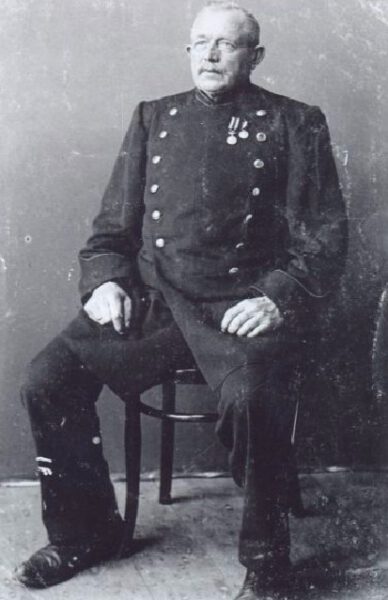
    Gerrit Heersink was born on 13 May 1846 in Hummelo, the son of day labourer Jan Willem Heersink and Berendina Eenink. On 8 May 1873, he married Aleida Gesina Prinsen in Aalten. Nine children were born from this marriage.

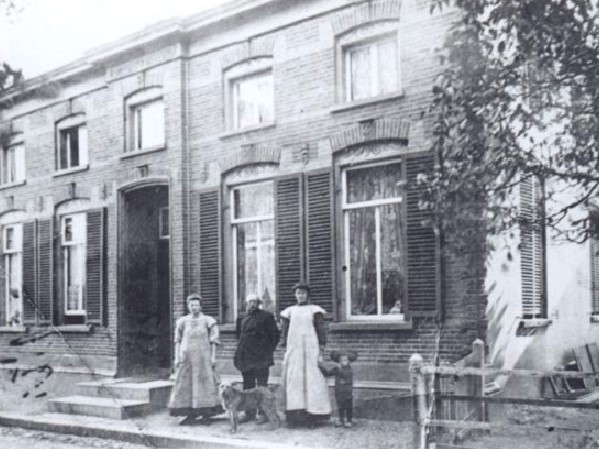
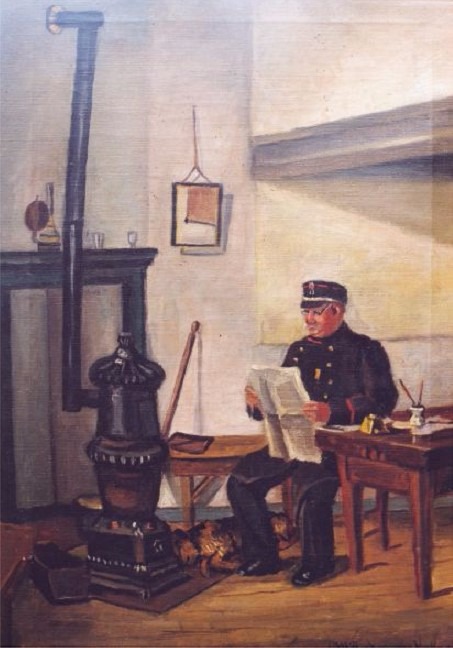
    Heersink served as a ‘veldwachter’ (rural constable) in Aalten for nearly five decades. He lived with his family on the Kattenberg, on what is now Berkenhovestraat. His brother Lammert ran a bakery just a stone’s throw away.

    In early 1920, Gerrit Heersink moved to Haaksbergen, where he passed away on 27 December 1920 at the age of 74.

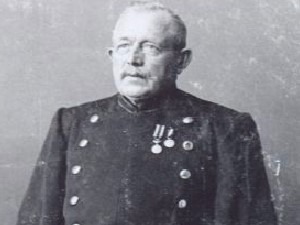
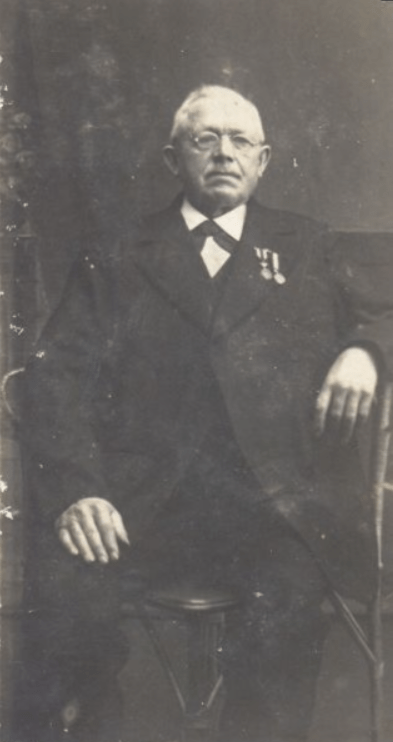
    Gerrit Heersink (1846–1920), wearing the medal awarded to him in 1912 to mark his 40th anniversary of service as a constable.
    Gerrit Heersink (1846–1920), wearing the medal awarded to him in 1912 to mark his 40th anniversary of service as a constable.
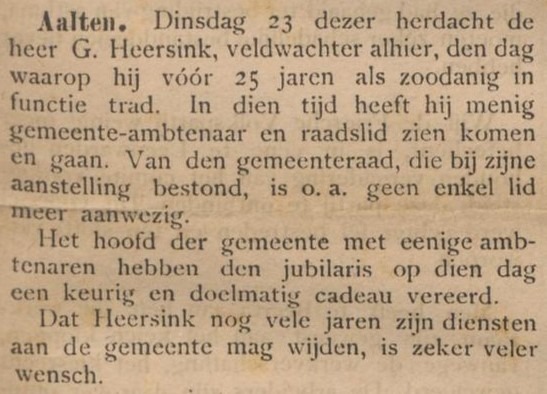
    Gerrit Heersink in 1912, on the occasion of his 40th anniversary in office as a constable in Aalten.
    Gerrit Heersink in 1912, on the occasion of his 40th anniversary in office as a constable in Aalten.
  • Monasso: Italian Terrazzo Workers in Aalten

    Monasso: Italian Terrazzo Workers in Aalten

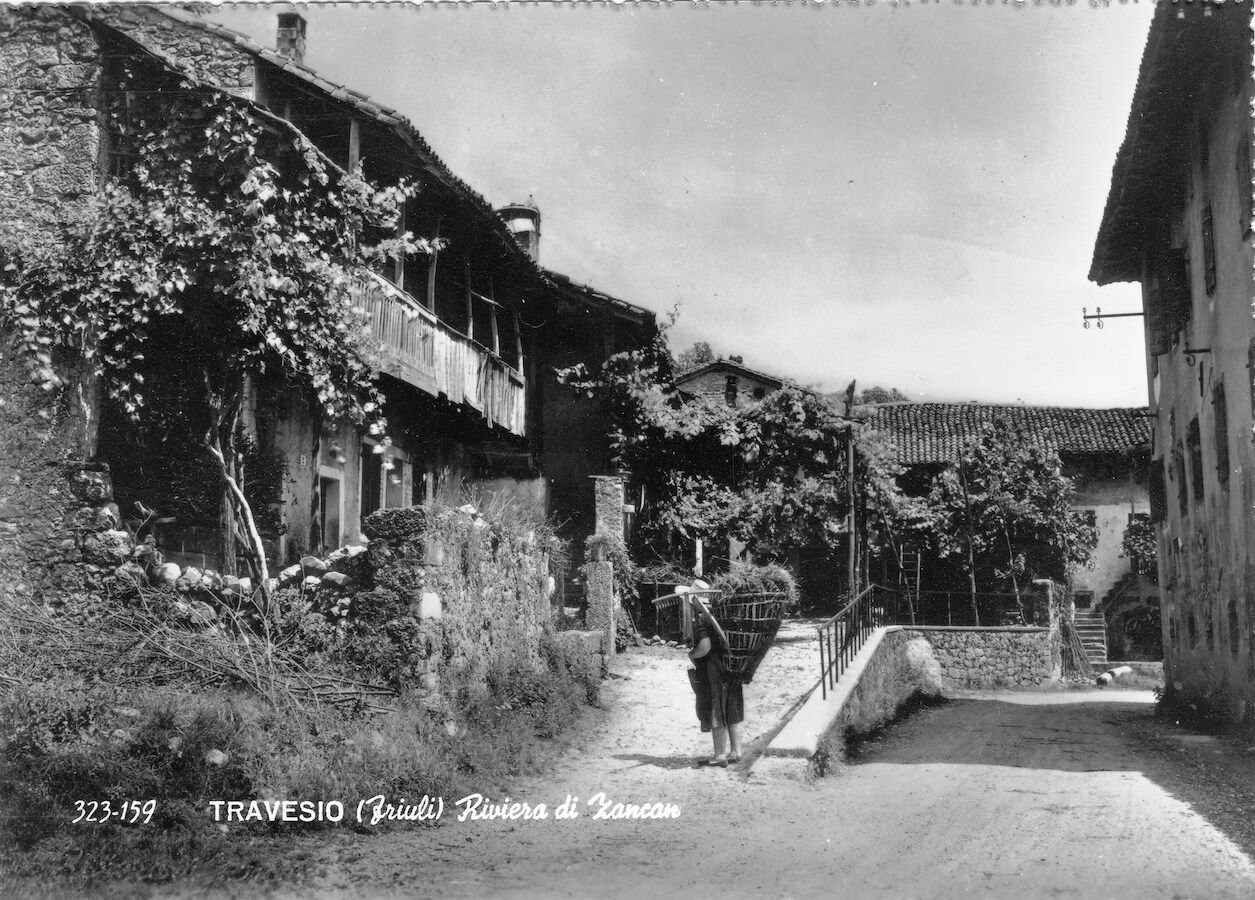
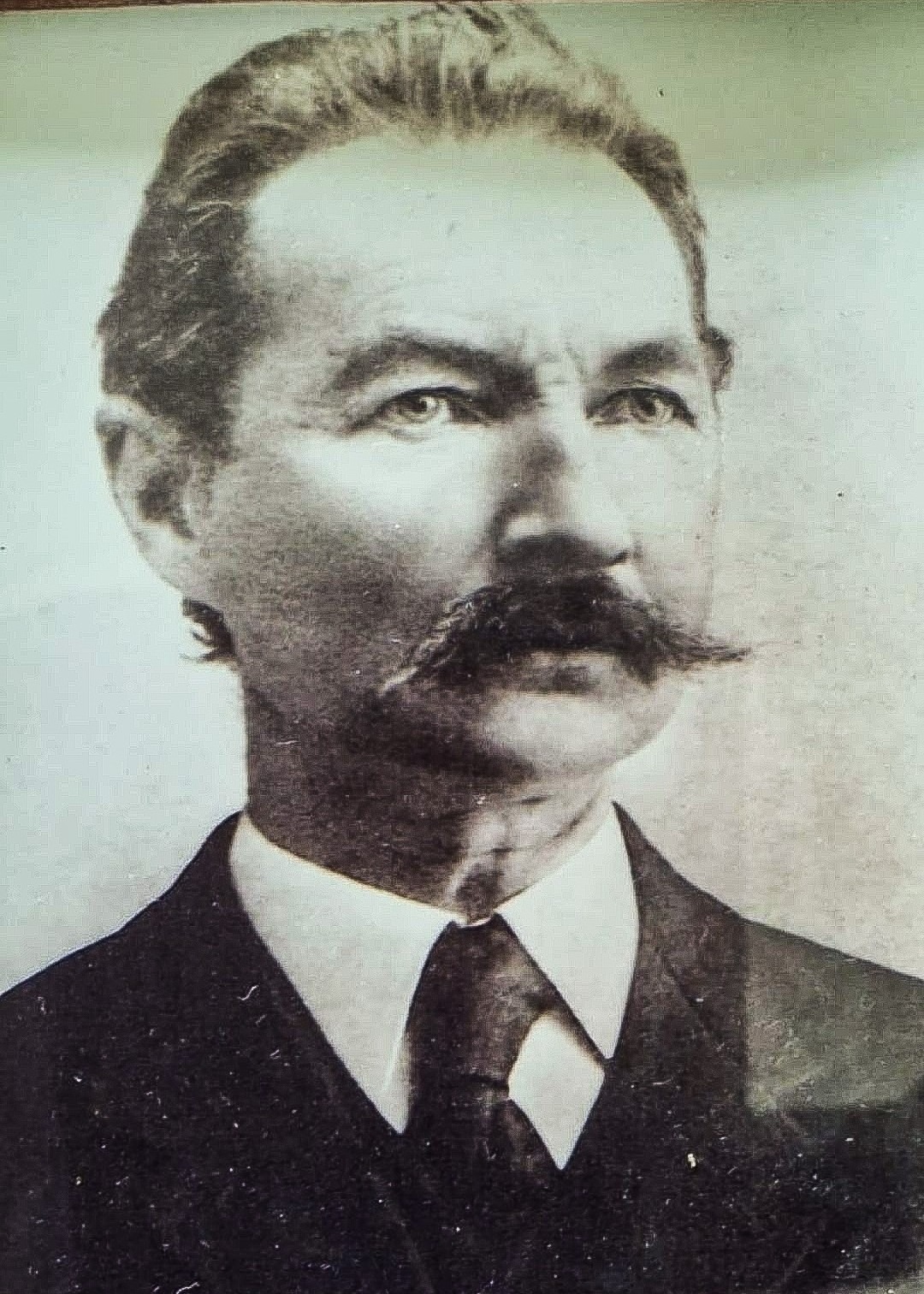
    For more than a century, members of the Monasso family have been crafting terrazzo floors in the Achterhoek. The family ended up in Aalten in 1915, after fleeing from Bocholt, Germany, during World War I. Their origins lie in the Northern Italian region of Friuli.

    The family hails from the mountain village of Travesio, in the Friuli region. It was an impoverished area plagued by poor soil, earthquakes, floods, and high taxes. Many inhabitants left to find work elsewhere. Friulians were known as skilled craftsmen—foresters, carpenters, stonemasons, and terrazzo workers.

    The First Generation

    In 1868, Pietro Monasso married Maria Bortolucci in Travesio. They had three sons and four daughters. All three sons learned the terrazzo craft in Italian cities. One of them, Felice Monasso, was once repairing stairs at St Mark’s in Venice as a boy. He received a banknote worth about twenty guilders—a staggering amount for the time—from the newly arriving Pope Leo XIII. He did not spend it, but kept it as a relic.

    The three brothers were Giovanni (1869–1939), Felice (1871–1962), and Antonio (1876–1967). They left Friuli at a young age: Giovanni and Antonio at age eleven, and Felice at fourteen.

    Work in Germany

    Giovanni travelled with fellow villagers to the Balkans to learn the carpentry trade. Felice worked first in Frankfurt, including at the large Odorico terrazzo company, which employed hundreds of Friulian workers. Giovanni and Antonio later joined him in Germany.

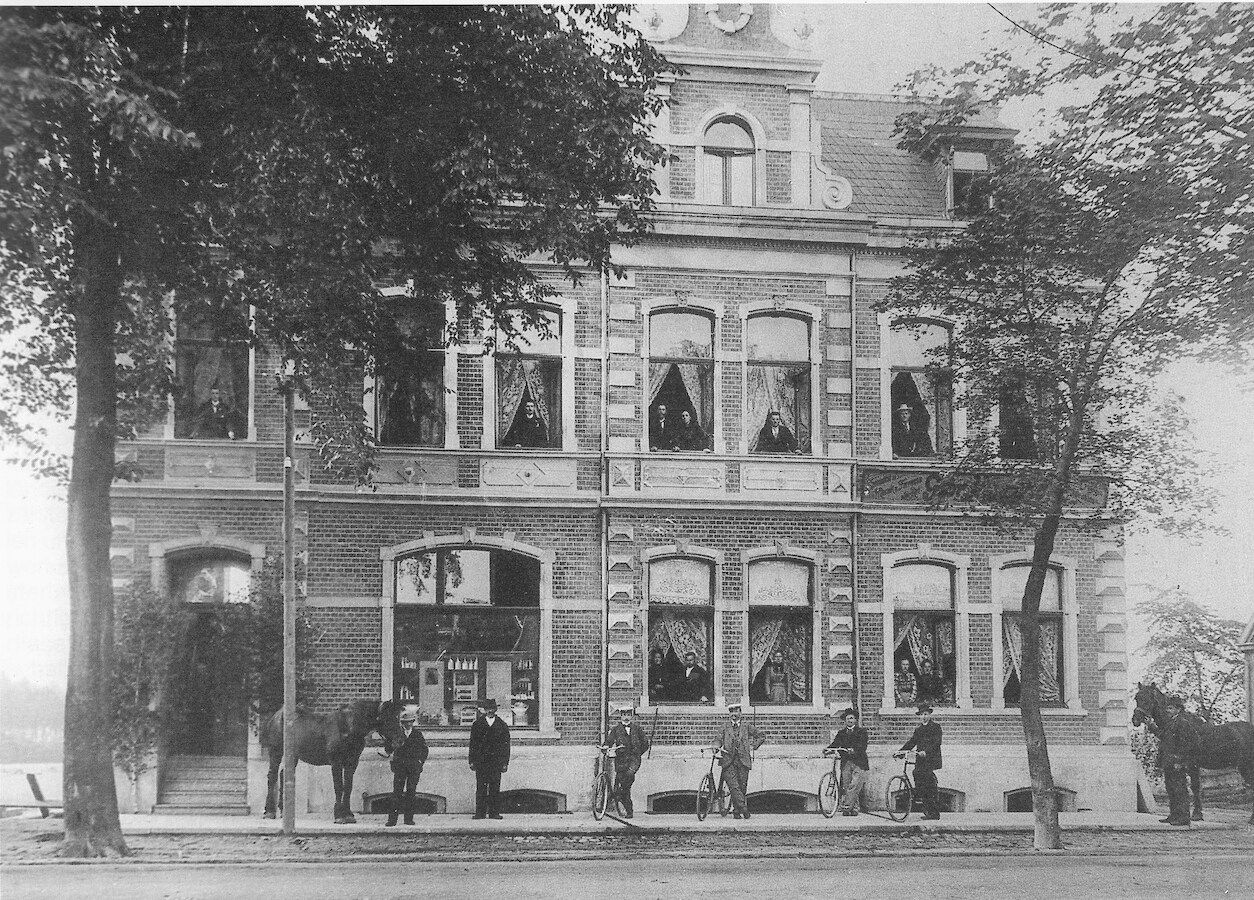
    From Frankfurt, the brothers went to Münster, where their cousin Bortolucci ran a terrazzo business. They worked there as master journeymen, and there was plenty of work in Westphalia and the Netherlands. On the advice of their boss, they established themselves in 1896 in Bocholt, just across the border from Aalten. There, they started a terrazzo firm together.

    The enterprise flourished. This was the era when wealthy textile barons in Bocholt were building grand houses. With their terrazzo work, the Monassos embellished many a villa on the prestigious Bahnhofstraße. The three families lived together with their staff in a large building on Münsterstraße in Bocholt.

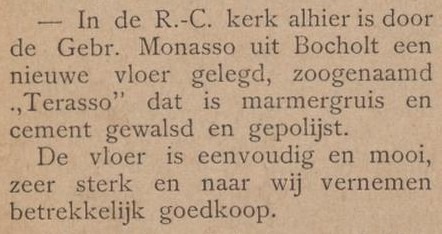
    The firm ‘Gebrüder Monasso’ had plenty of work, including in the Achterhoek. As early as 1897, they laid a terrazzo floor in the Catholic St George’s Church in Bredevoort.

    On 22 November 1899, Giovanni Monasso married Angela Chivilò (1879–1951) in Italy. Together they had four sons and two daughters.

    Flight to Aalten (1915)

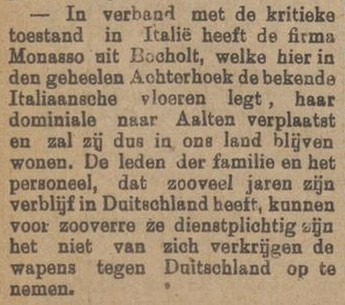
    World War I began on July 28, 1914. Italy sided with the Allies, and the Germans saw this as a betrayal. An anti-Italian atmosphere emerged in Germany. Italian workers were insulted and sometimes even mistreated on construction sites. The three Monasso families decided to flee to Aalten, just across the border in the neutral Netherlands. In effect, they were asylum seekers.

    It was a somber procession that departed Bocholt for Aalten before dawn on 19 May 1915. A horse and cart full of household goods was followed by twenty Italians. Three children remained behind in Bocholt: two because they were too ill to travel and one because he wanted to finish his year at the gymnasium.

    In Aalten, they spent the first night at Vultink’s lodging house on Dijkstraat. The following day, Giovanni and Antonio moved into a house on Landstraat, and Felice into Bredevoortsestraatweg. Antonio and his wife found a home on Haartsestraat shortly thereafter. The then Mayor Monnik arranged for residency permits. The children who had stayed behind joined their families later.

    A New Life in Aalten

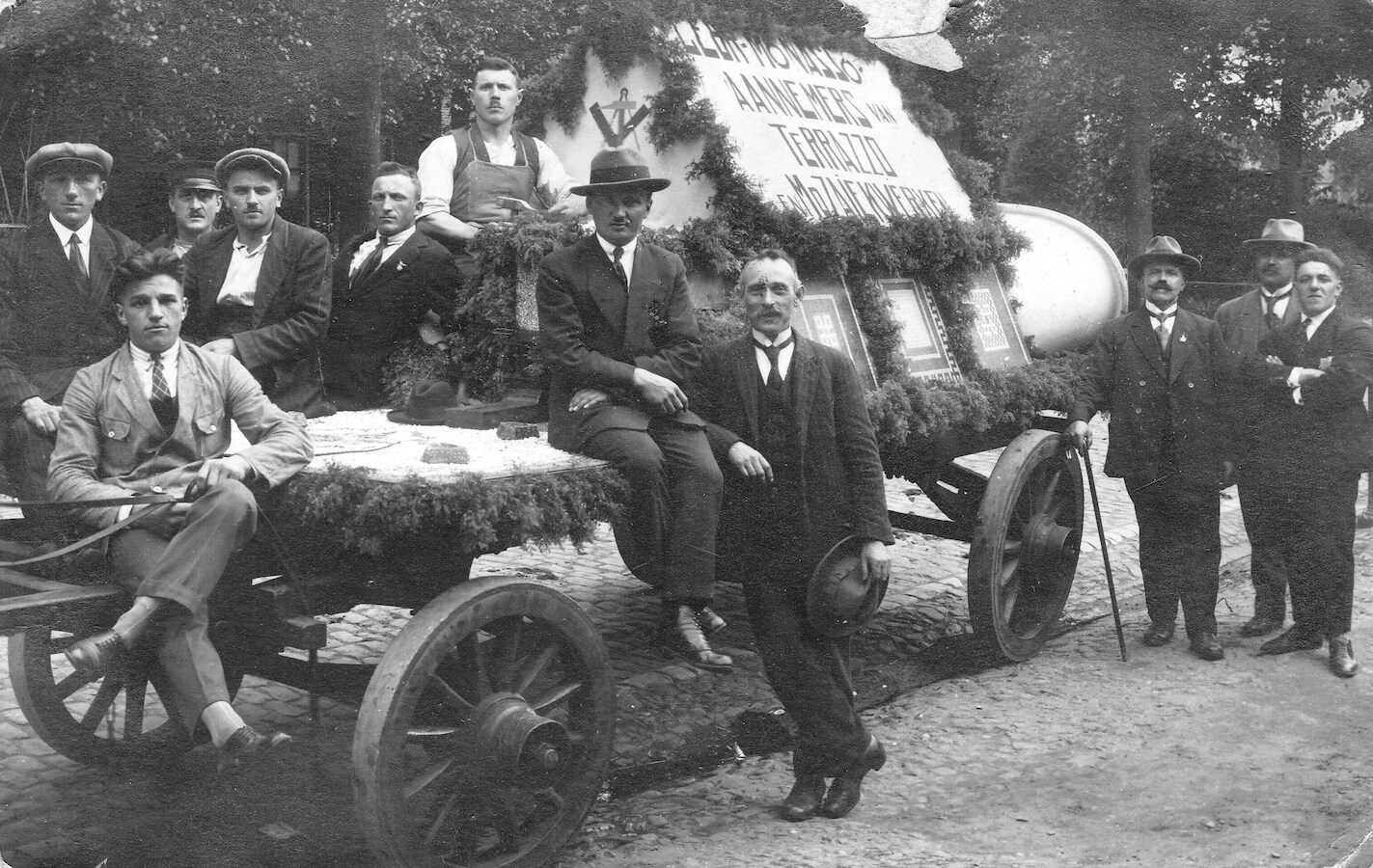
    Giovanni demonstrated his entrepreneurial spirit by registering within a few days at Sociëteit Schiller, where local businessmen met. His brothers followed a week later. Within a short time, the Monassos were working again. They laid floors in homes, shops, schools, and churches in Aalten and the surrounding area, bringing in skilled terrazzo workers from Italy as staff.

    They did not yet use machines or electric tools; everything was made by hand. Terrazzo floors were laid on-site, which was arduous work. Stairs, countertops, and other components were made in the workshop using moulds and were subsequently installed in kitchens or halls.

    Around 1920, Giovanni established his business on Parallelweg in Aalten. In the mid-1950s, they moved to the adjacent Staringstraat, where a new showroom was opened in 1969.

    Felice established a terrazzo business in Winterswijk in 1922; Antonio followed in 1932 with a branch in Doetinchem.

    Later Generations

    The second and third generations also remained active in the craft. In the decades following World War II, sons and grandsons took over the work. All four of Giovanni’s sons became terrazzo workers and married Dutch women.

    Business thrived for decades. In the 1960s and 1970s, demand decreased due to the rise of synthetic floors and steel countertops. Nevertheless, the family business endured. The Monassos combined traditional techniques with modern methods, specialising not only in floors but also in worktops, thresholds, window sills, and restorations.

    Current Company in Aalten

    In 1982, Richard Monasso, Giovanni’s grandson, took over the company in Aalten. The business moved to Industriestraat. In the 21st century, terrazzo became popular once again. Richard Monasso now works on exclusive projects at home and abroad; his work can be found in a department store in London, a restaurant in Paris, and a villa in Greece.

    Willem Monasso

    In 1996, Willem Monasso, son of Giovanni Monasso and Angela Chivilò, spoke about his youth:

    Wilhelm Franz Joseph (Willem) Monasso (1916–2001) was born in Aalten but returned to Italy with his mother as a child. They lived with an uncle who owned grape plantations. He attended primary school there. He did not learn Italian there, but so-called Furlan, a regional language that differs as much from Italian as Frisian does from Dutch.

    At the age of ten, they returned to the Netherlands. Back in Aalten, Willem had to start again in the first grade. He left school after the fourth grade to enter the terrazzo trade.

    On his mother’s side, the Monasso family owned a wine bottling plant and a silk plantation. They regularly had barrels of white wine from their region of origin in Italy shipped over. The first barrel always went to the parish priest of Aalten.

    During World War II, Willem was the only Aalten resident allowed to have a radio because he held Italian nationality. Naturally, the occupiers did not allow him to listen to the English ‘Oranje’ station, but he did so in secret anyway, along with half the neighborhood.

    Willem Monasso could tell captivating stories about his former work in the perfect Aalten dialect. Initially, countertops were made on-site in a formwork built by a carpenter. Later, this was done in the workshop, and they were transported to their destination by a small truck. The terrazzo technique requires great craftsmanship and is incredibly labour-intensive. Throughout the region, many beautiful Monasso floors can still be found in churches, hospitals, monasteries, schools, and scholten farms.

  • Wilhelm Albertus Lammers

    Wilhelm Albertus Lammers

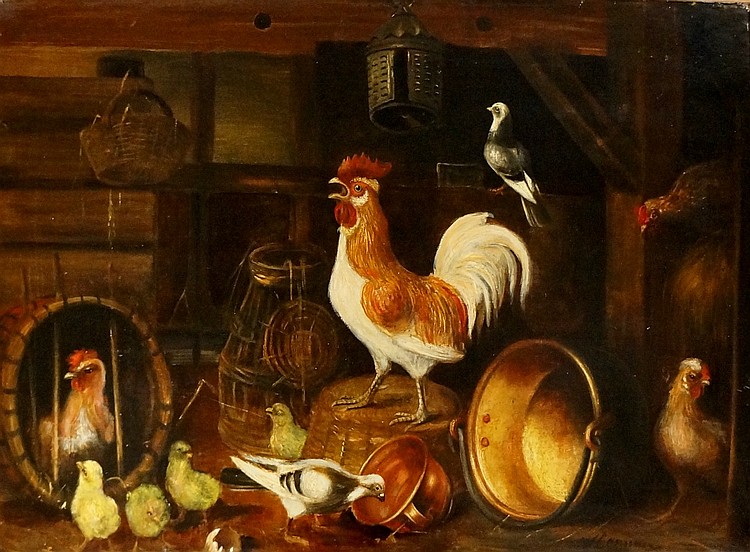
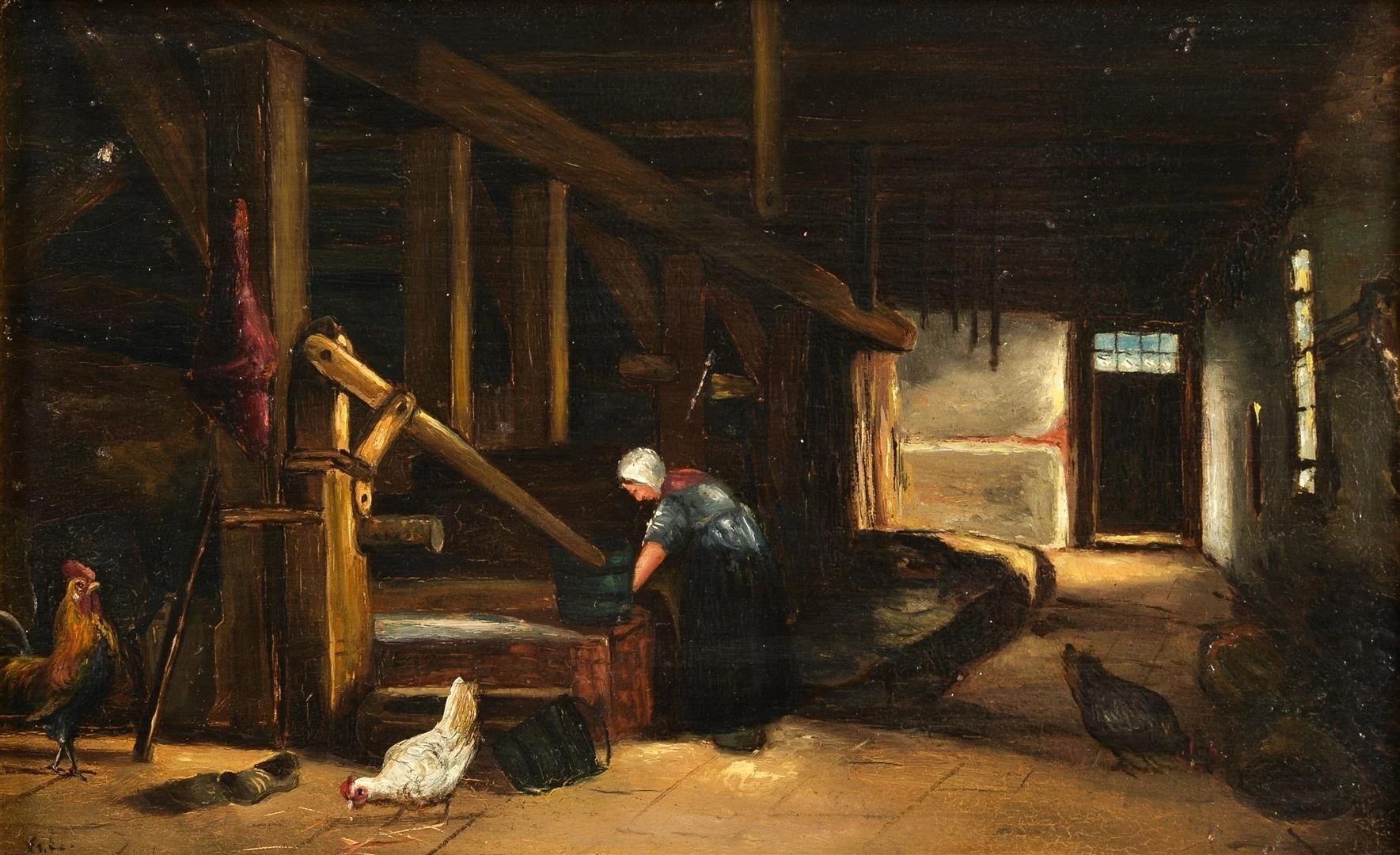
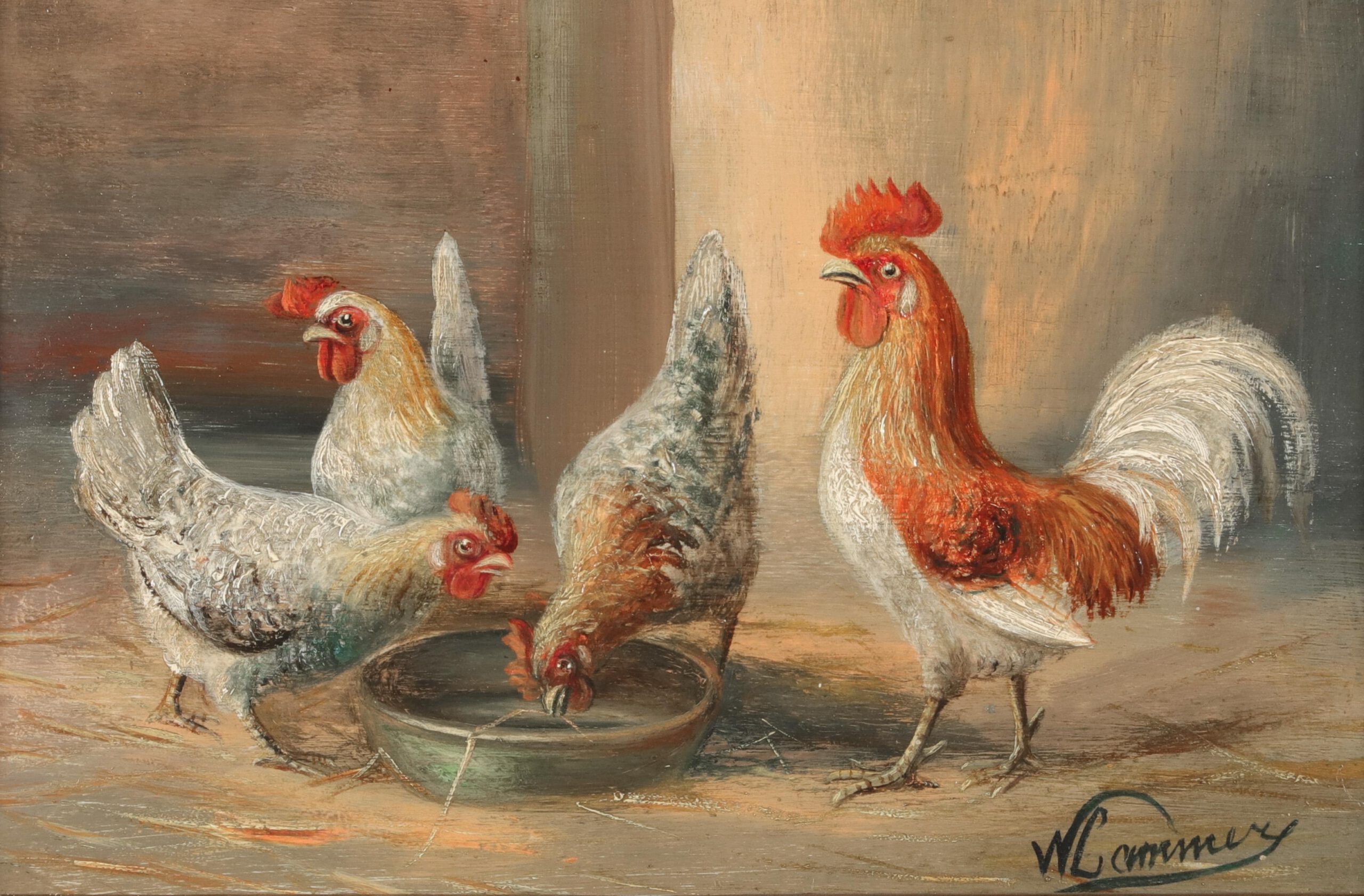
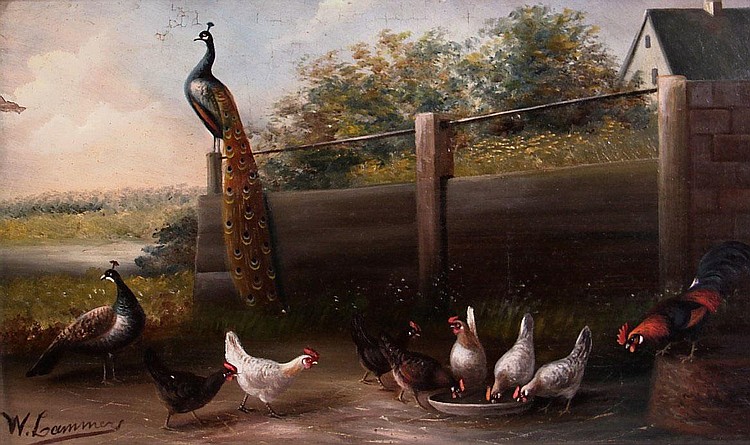
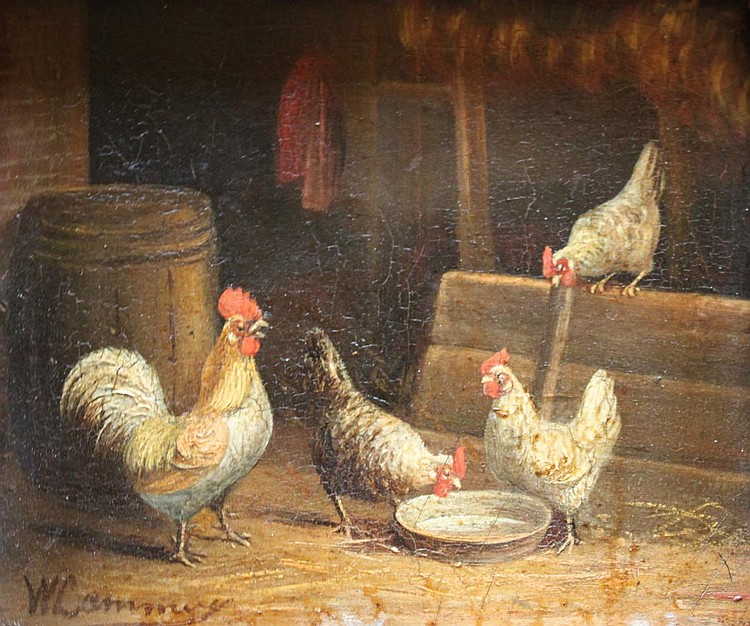
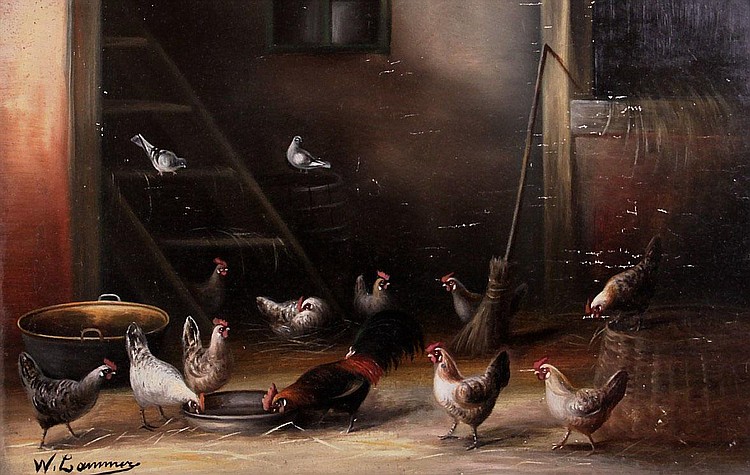
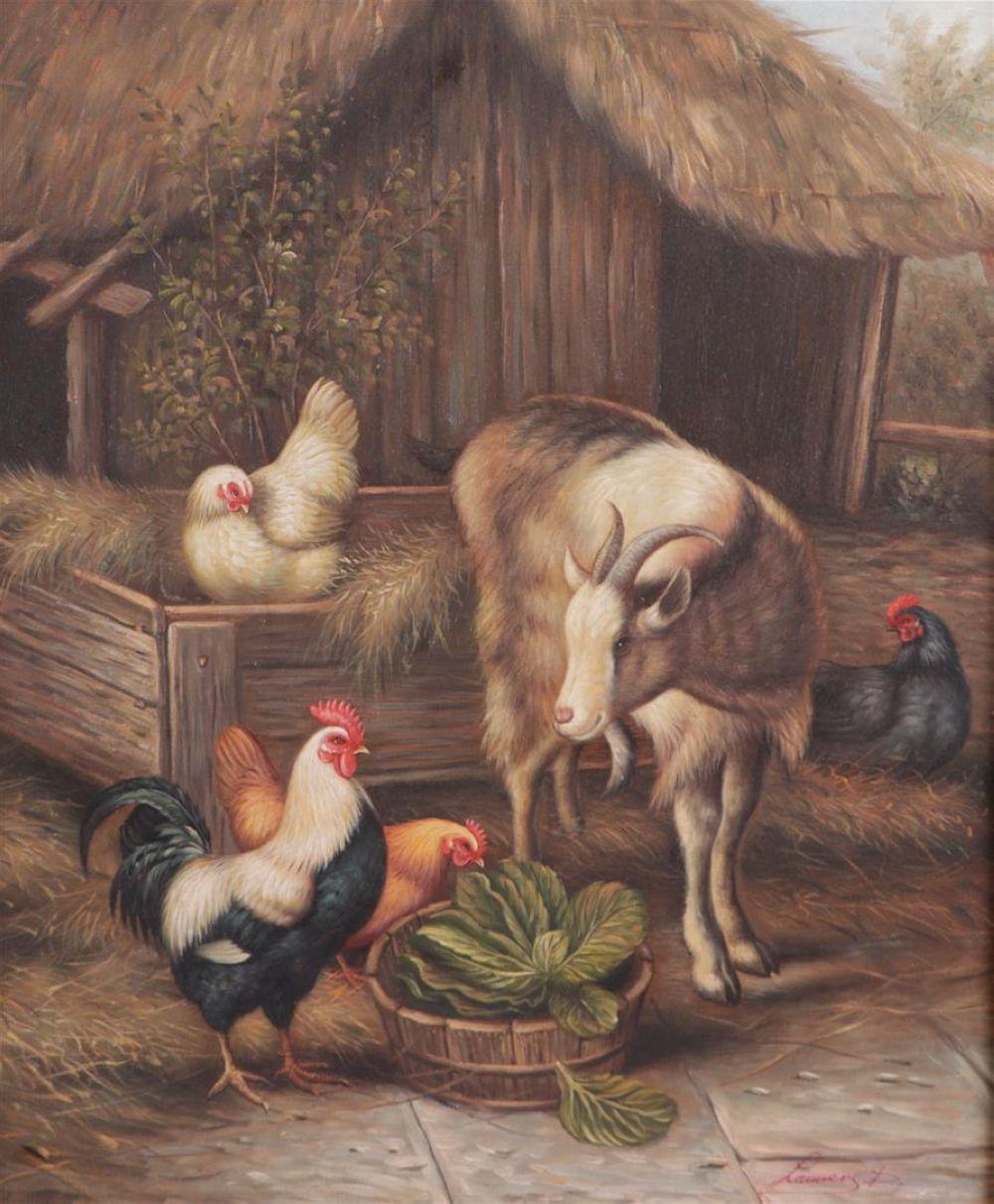
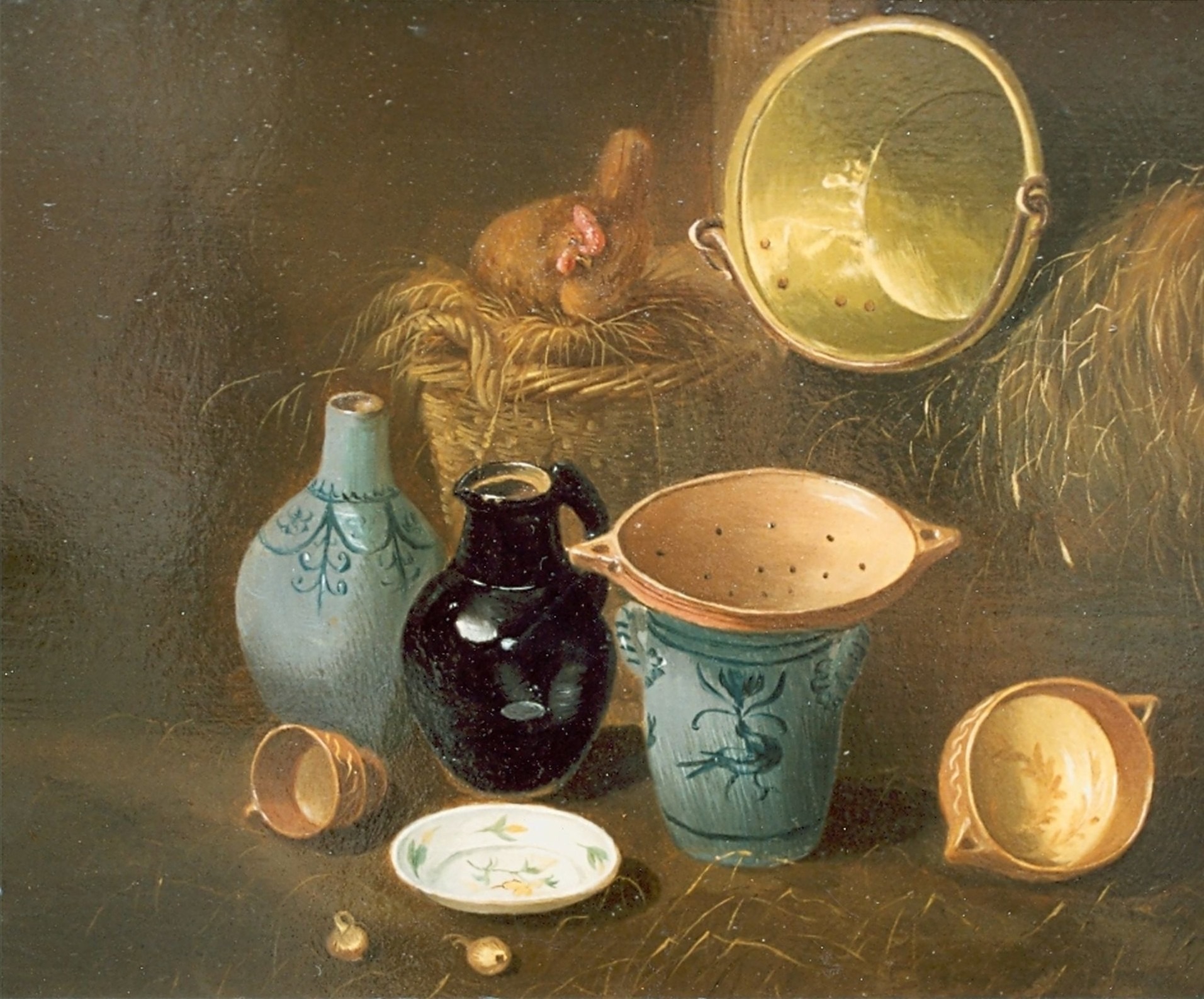
    Wilhelm Albertus (Willem) Lammers (Aalten, 1857 – Ginneken, 1913) was a Dutch painter with a remarkable specialisation: poultry scenes. Until the end of the 19th century, hardly any attention was paid to the living conditions of poultry. Chickens typically slept in a farm barn or in trees. The painter managed to capture this vividly on canvas.

    Lammers was born on 3 April 1857 at the Schulenkamp farm in the Dale hamlet near Aalten, as the son of Albertus Lammers and Theodora Huls. The family moved several times within Aalten – first to Kerkstraat, then to Dijkstraat and Hoekstraat. Willem Lammers was initially a shoemaker by trade. In 1880, he left for Gaanderen, and a few years later, he lived in Amsterdam.

    In 1887, the Court-Martial in ‘s-Hertogenbosch sentenced him to four months of military detention for desertion. Upon his registration, his occupation was recorded as painter, his religion as Roman Catholic, his height as 1.66 m, with blonde hair, blue eyes, and a curly beard.

    On 24 July 1890, Lammers married Wilhelmina van den Akker in Breda. The couple lived briefly in Aalten (Dijkstraat) and moved to Breda in April 1891. Eight children were born there: seven daughters—one of whom was stillborn—and one son. Lammers passed away on 4 February 1913 in Ginneken (municipality of Breda).

    Arts

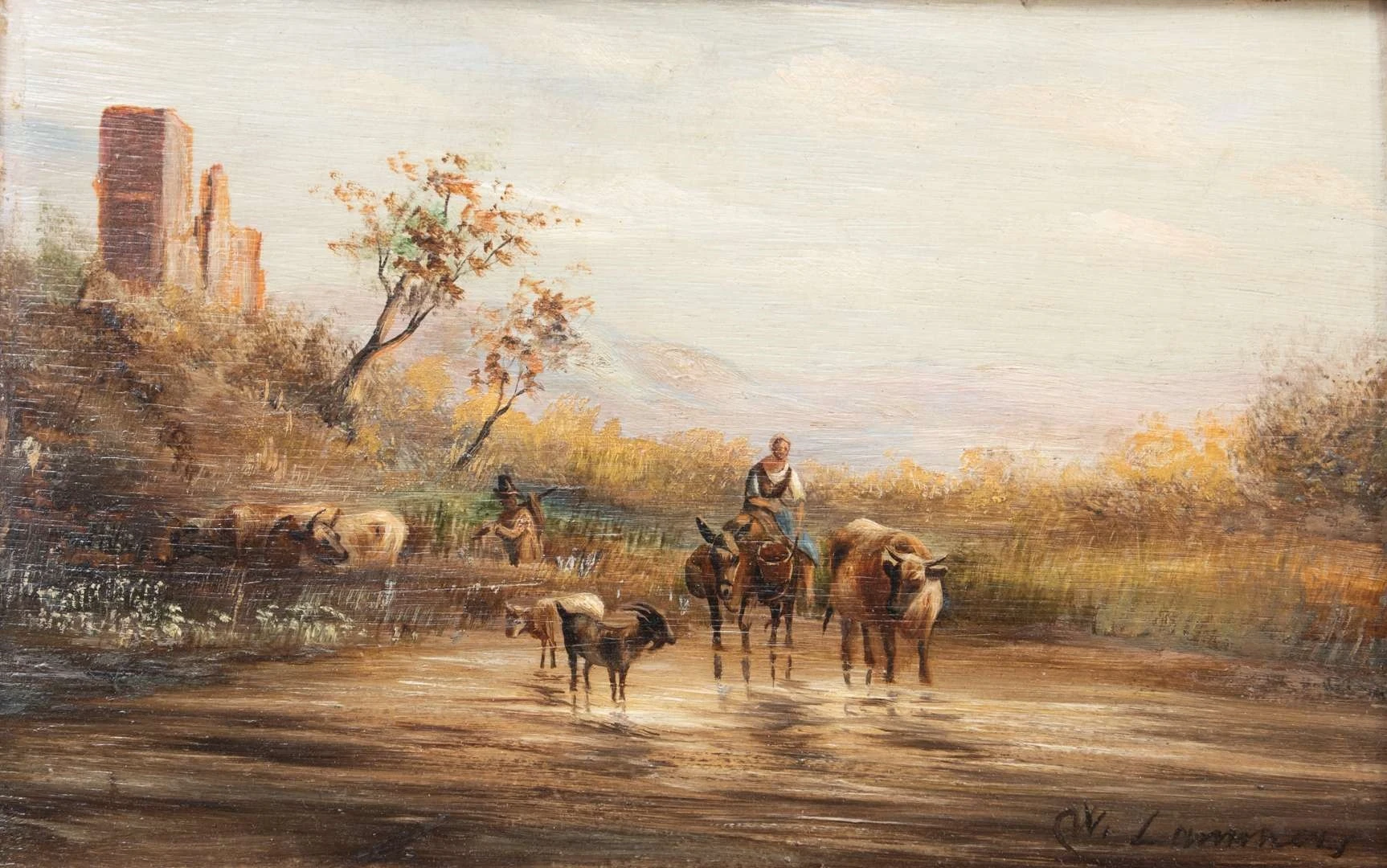
    As an artist, Lammers was self-taught. He worked mainly in oil on canvas or panel, mostly in small to medium formats. His scenes depict chickens, chicks, and cockerels in their daily environment: around the feeding area, by the haystack, or inside a barn. He signed his work as “W.A. Lammers”, “W. Lammers”, or with the monogram “W.L.”.

    Gallery

    A selection of the work of Wilhelm Albertus Lammers:

  • Herman Driessen

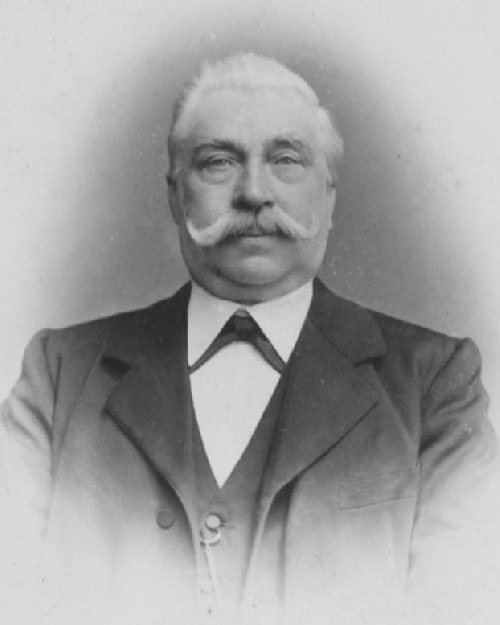
    Herman Driessen

    Textile manufacturer

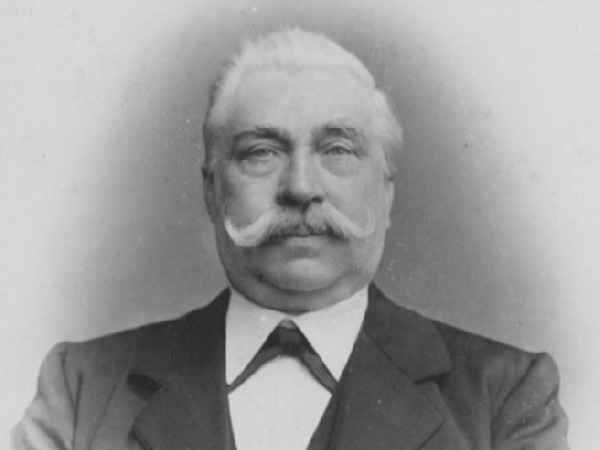
    Herman Anton Frans Carl Maria Driessen (Aalten, 1831-09-22 – Aalten, 1911-05-20) was a textile manufacturer of great significance to Aalten’s textile history. He was the son of textile manufacturer Anton Driessen and Isabella Dees. In 1862, he married Anna Maria Theodora Mühren, a merchant’s daughter, in Neuenkirchen near Rheine (Germany).

    Around 1863, he and his wife moved into a newly built house on the corner of Landstraat and Hoekstraat, at the location where his father had operated a cotton mill from 1827 to 1862.

    In 1893, Herman Driessen retired from the management of Gebroeders Driessen. Together with his son Joseph, he founded a modern steam weaving mill with 34 looms at ‘het Blik’ on Hofstraat: the NV Stoomweverij Herman Driessen & Zoon, often abbreviated as HDZ. Alongside the factory, Herman’s new home was also built: the stately Villa Beukenhof.

    Herman Driessen is buried at the old Roman Catholic cemetery on Piet Heinstraat in Aalten.

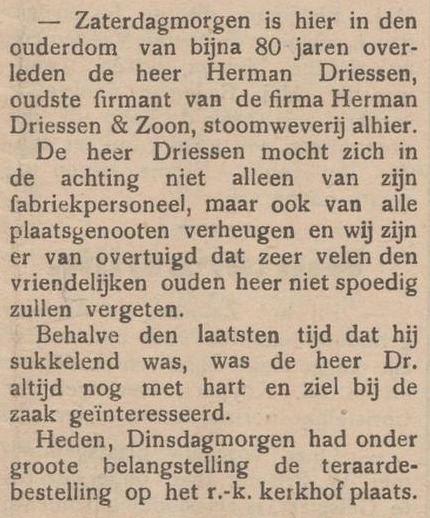
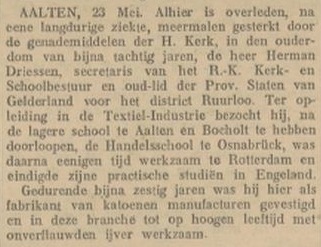
    Hermann A.F.C.M. Driessen – Aaltensche Courant, 24 May 1911
    Aaltensche Courant, 24 May 1911
    Hermann A.F.C.M. Driessen – De Maasbode, 24 May 1911
    Maasbode, 24 May 1911
  • Vagrant from Bredevoort sent to Veenhuizen as punishment

    Vagrant from Bredevoort sent to Veenhuizen as punishment

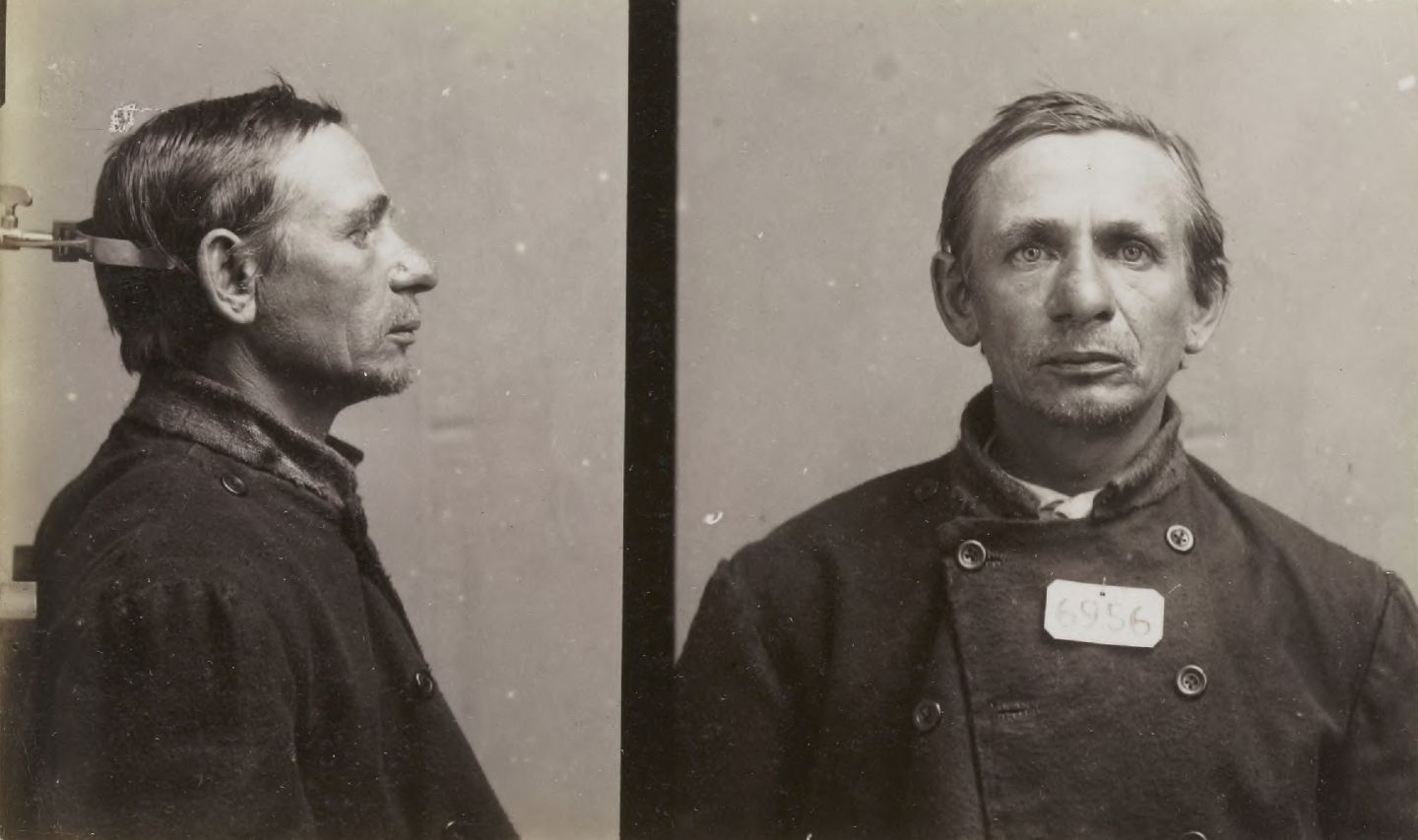
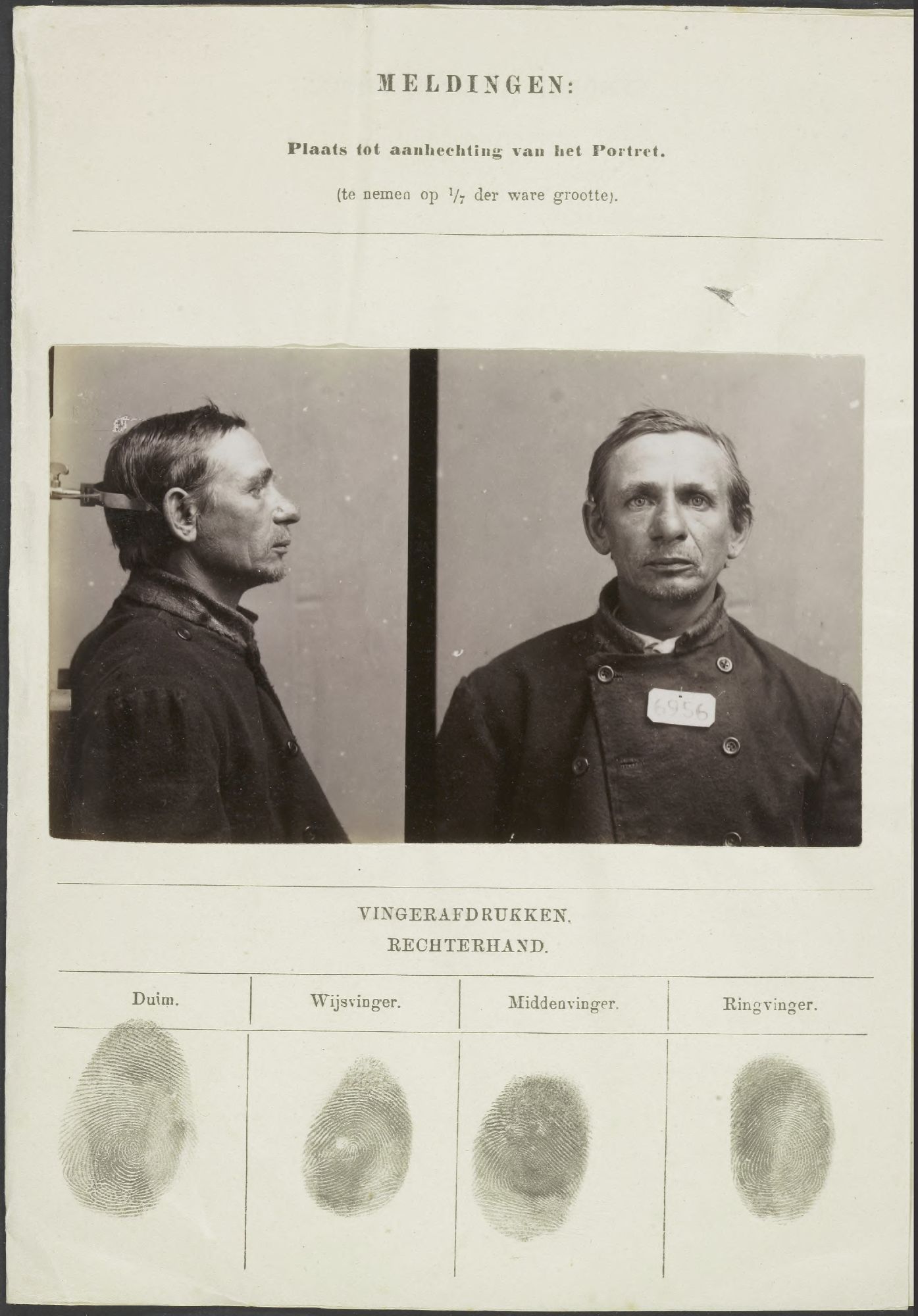
    Bernardus Hendrikus Bloemers, opname Veenhuizen I, 22-06-1896

    Bernardus Hendrikus Bloemers was born on March 12, 1845, in Bredevoort, house number 7a, in the vicinity of the Misterstraat and Bekendijk. He was a son of Johannes Arnoldus Hendrikus Bloemers and Theodora Sessink. The family lived briefly on the Ambthuiswal, but departed for Terborg in December 1847.

    Bernard’s life was no bed of roses. In 1896, he was arrested for vagrancy and, as punishment, admitted to the State Workhouse Veenhuizen I in Drenthe.

    A wandering existence

    The population register shows that Bernard certainly did not lead a settled life. From the age of sixteen, he stayed in numerous places, interspersed in his younger years with temporary returns to the parental home in Terborg:

    • 1861–1862: ‘Esheren in Prussia’ (Esserden near Rees?)
    • 1862–1864: Vethuizen, municipality of Bergh, as a farmhand on a farm
    • 1867: Tegelen, Limburg
    • 1867–1868: Beek near Sterkrade in Prussia (now Duisburg-Beeck)
    • 1869: to Sterkrade again
    • 1870: working as an iron molder near Ulft, after which he left for Isselburg
    • 1872: Liège, Belgium.

    Around 1873, Bernard married Johanna Francina Kok, born on January 21, 1848, in Oer near Ulft, presumably in Dinslaken. In 1877, he was recorded as “Bernardus Hendrikus Blummer” in the population register of Oosterhout near Tilburg, where he lived with his family, with the profession of sand molder. A few years later, they lived in Nijmegen, on the Steenstraat.

    As far as is known, the couple had four sons:

    1. Johannes Hermanus (Dinslaken, 1874 – 1876)
    2. Johannes Arnoldus (Dinslaken, 1875)
    3. Johannes Hermanus (Oosterhout, 1877 – Rotterdam, 1962)
    4. Bernardus (Nijmegen, 1880 – Rotterdam, 1949).

    In December 1883, the family left for Breda, and only a month later for ‘s-Hertogenbosch. In the population register, there is a difficult-to-read note behind Bernard’s name, possibly: “tried on October 9, 1884, in Utrecht”. Later, the family appeared in Rotterdam, where they seemed to settle permanently. Johanna passed away there in 1909.

    It is striking that Bernard reappeared in Nijmegen in 1895 — without his family, coming from Zwolle. Why he left his family remains a matter of speculation. Poverty likely played a significant role. The frequent moves possibly point to an uncertain existence, in which one constantly sought better prospects — or fled from debts and problems.

    In any case, Bernard’s life was no bed of roses, and the fact that he had fallen on hard times was confirmed shortly thereafter.

    Admission to Veenhuizen

    On June 22, 1896, Bernard was admitted to the Veenhuizen I State Workhouse for vagrancy. Upon entry, a description card was drawn up, featuring photographs, fingerprints, and a precise description of his appearance.

    It is also mentioned that at that time he had no fixed place of residence (Nijmegen was noted as his last place of residence). His profession was ‘iron molder’, he had no identity papers, and was unmarried (!). He had been convicted of vagrancy in ‘s-Hertogenbosch. He had already been convicted twice before for the same offense.

    The description card contains a detailed account of his physical characteristics, including his height (1 meter 51.9). His nose was broad, protruding, ‘with much blood showing through from below’ and with a scar on the right nostril.

    What happened to Bernard after that remains unknown. We do not know if he ever left Veenhuizen, nor where or when he died.

    Stay in the State Workhouse in Veenhuizen

    State Workhouse Veenhuizen 1 (the First Asylum) was a closed penal institution for men who had been convicted of begging or vagrancy. In this large-scale complex, discipline and labor were central.

    The purpose of the institution was not only retribution, but also to effectively “combat vagrancy and begging” by purging society of individuals considered a nuisance and instilling discipline in them through forced labor.

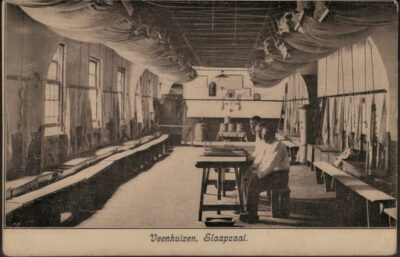
    Daily life was strict and sober under a military regime. Violations of the internal rules were punished with a stay in the punishment cell or a reduction in rations. The residents, referred to as wards, wore mandatory asylum clothing, slept in large communal wards, and were put to work six days a week. The labor consisted of heavy land reclamation on the heath or indoor work in workshops, such as weaving mats and repairing mailbags.

  • Derk Lijsen (1767–1838)

    Derk Lijsen (1767–1838)

    Derk Lijsen was baptised in Aalten on 20 December 1767, the son of Jan Lijsen (1736–1800) and Elisabeth Buunk (1739–1772). In 1797, he married Janna Geziena Degenaar, who also hailed from Aalten, after which the couple settled in Zutphen. Following the birth of their second child, Janna passed away. Derk remarried in 1804 to Sara Stakebrand, with whom he had four more children. He died on 26 October 1838 in his hometown of Zutphen.

    Lijsen built a strong reputation in Zutphen as a master carpenter and architect, partly due to his network within the Reformed Church. His craftsmanship did not go unnoticed; he received commissions from the highest social circles. For instance, he carried out a minor renovation at Het Loo Palace for King Louis Napoleon (1778–1846)—he was tasked with plastering over (!) the paintings by Daniël Marot (ca. 1661–1752). Furthermore, in 1813, he produced a design (which remained unexecuted) for Napoleon Bonaparte’s (1769–1821) imperial stud farm in Borculo.

    ‘De Wildeman’ and Public Works

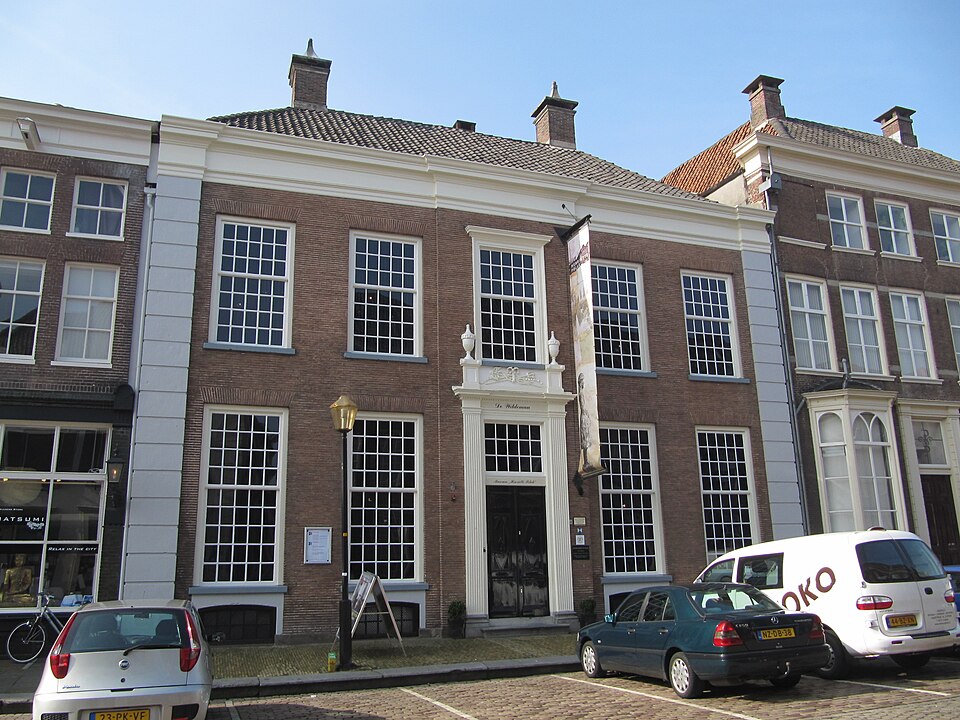
    In 1804/1805, Lijsen was responsible for an extensive renovation of the front house of the prestigious residence ‘De Wildeman’ on Zaadmarkt in Zutphen, forging the exterior and interior into a visual unity. Although this was likely not his first commission, it is considered his earliest known work.

    Various public commissions followed in the subsequent years. In 1818, Lijsen designed the first town hall of Winterswijk and was responsible for the construction and adaptation of classrooms in Warnsveld and the province of Overijssel. He also designed a villa in Dieren for a brother of the well-known statesman Johan Rudolph Thorbecke, a project completed in 1840.

    De Wildeman, Zaadmarkt Zutphen, 2011
    De Wildeman, Zaadmarkt Zutphen, 2011 (Photo: M.M. Minderhoud, CC BY-SA 4.0)

    Ecclesiastical Architecture

    Lijsen was particularly active in church construction. He oversaw renovations to the Reformed Church in Vorden (1825 and 1836), the Broederenkerk (1826) and the Evangelical Lutheran church (1832) in Zutphen, as well as the schuurkerk (barn church) in Baak (1836). The Reformed Church of Dedemsvaart (1834) was also of his design. He provided the churches of Warnsveld and Dedemsvaart with a radial seating plan, in which the pews were arranged in a circle around the pulpit.

    His final major commission concerned the Jacobskerk (St James’s Church) in Winterswijk in 1838. He drew up the building specifications for a large-scale renovation, including masonry and carpentry work, a new pulpit, and a fresh coat of paint. However, he did not live to see the execution; he passed away shortly after completing the plans.

    Style and Monumental Status

    Lijsen worked entirely in the Neoclassical style, following the fashion of his time. His designs were sober and symmetrical, almost without exception constructed in brick. A rare departure from this rigid style can be found in the lancet windows he applied during the renovation of several churches. The quality of his work is evidenced by the fact that all surviving buildings on which Lijsen demonstrably worked are now protected as national (rijksmonument) or municipal monuments.

    A Family of Master Builders

    Derk Lijsen was not the only talented builder in his family. His brother Hendrik Jan Lijsen (1765–1838) rose to become the overseer of Het Loo Palace. In addition to various building works around the palace, including the design of ‘Het Kleine Loo’ (1830), Hendrik Jan was responsible for the construction of the Grift Canal between Apeldoorn and Hattem (1829).

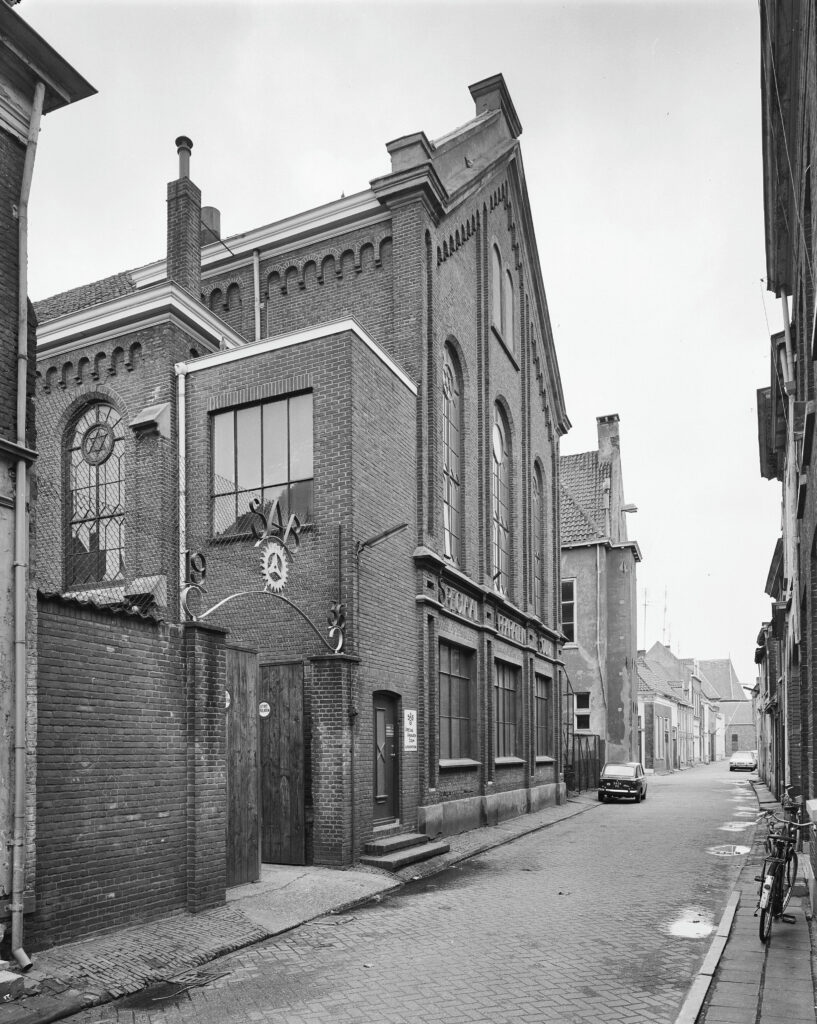
    The tradition continued through the following generations. Four works are attributed to Derk’s son, Jan Lijsen (1805–1883), though these have since vanished. However, the most famous architect in the family became Derk’s grandson of the same name, Derk Lijsen (1835–1922). Between 1865 and 1908, he left a significant mark on the appearance of Zutphen and its surroundings with striking buildings such as the synagogue (1879), the labourers’ housing for David Evekink’s Foundation (1880–1896), the Buitensociëteit (1891), and the Groot Graffel asylum (1900–1908).

  • Wilhelm van Haersolte

    Wilhelm van Haersolte

    Anyone delving into the history of the Lordship of Bredevoort will inevitably come across the name Wilhelm van Haersolte tot Elsen. His name is forever linked to one of the most devastating disasters to strike the Achterhoek in the seventeenth century. As an administrator and military officer, he was at the helm of the region during a time of political tension, but it was a natural phenomenon that abruptly ended his life and that of his family.

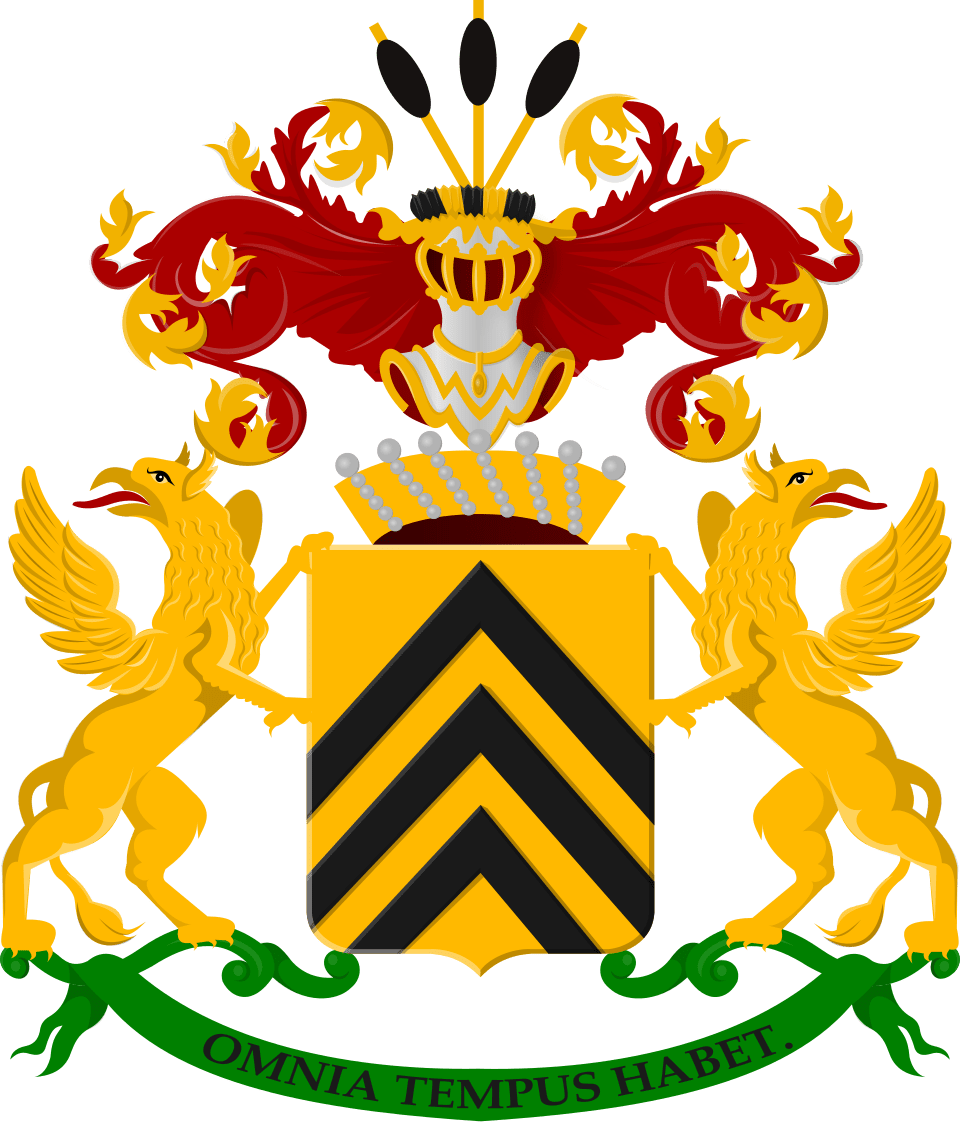
    Coat of arms of the Van Haersolte family
    Coat of arms of the Van Haersolte family

    Wilhelm van Haersolte was born in Zwolle around the year 1596, the son of Harmen van Haersolte and Anna van Hoeclum. He descended from a prominent noble family from Overijssel and, as was customary in those circles, chose a military career. As an infantry captain, he served in the States Army, the armed forces of the young Republic of the Seven United Provinces.

    On 2 February 1630, he married Catharina van Brakel, with whom he would raise a large family. Eight children were born from their marriage, including Anthony (1637), Gerrit (1641), Assuerus (1643), Arent (1644) and Lodwich (1645). Furthermore, in 1638, a year after his appointment, Wilhelm and Catharina purchased the Elsen manor (havezate), which explained the addition of ‘tot Elsen’ to his name.

    His bond with the Achterhoek was sealed in 1637. Following the death of his older brother, Arent van Haersolte, Wilhelm was granted the honourable and responsible position of drost and richter (drossard and magistrate) of the Lordship of Bredevoort. This meant that he held both the military command over the fortified town and the civil and judicial administration over the surrounding area, which at the time also included Aalten, Winterswijk and Dinxperlo. For his new role, Van Haersolte and his family moved into the imposing castle of Bredevoort.

    Fate on a summer’s day

    For nine years, Van Haersolte governed the region with a firm hand. The end of his term of office — and his life — came entirely unexpectedly, however, on 12 July 1646. That day, a severe thunderstorm swept across the Achterhoek. A fierce lightning strike hit the castle’s gunpowder tower, where vast quantities of gunpowder were stored at the time for the defence of the border region.

    The ensuing explosion was catastrophic. The castle was virtually wiped off the map in a single blow, and the surrounding town sustained monumental damage. In total, 49 people lost their lives in this Gunpowder Tower Disaster (Kruittorenramp). Among the victims were Wilhelm van Haersolte himself, his wife Catharina and almost all of their children who were present in the castle at that moment.

    Following this tragic death, Wilhelm was succeeded as drossard of the Lordship of Bredevoort by Georg Nicolaas van der Lawick.

    The family’s legacy

    The disaster almost brought an end to this branch of the Van Haersolte family. Only one son, the then six-year-old Anthonie, survived the drama because he happened to be staying elsewhere that day. Thanks to him, the family line did not die out; all modern-day noble descendants bearing the name Van Haersolte are directly descended from this young survivor.

    Although the castle was never rebuilt to its former glory, the traces of Wilhelm van Haersolte are still tangible in the region. In the Sint-Joriskerk (St George’s Church) in Bredevoort is a fire bell that he donated to the community in 1644. In addition, during restoration work in the church, the historical tombstones of the drossard and his family members were rediscovered and restored to a place of honour, keeping the memory of this fatal history alive for the residents of the former Lordship of Bredevoort.

    Sources


    • Gelders Archief (Arnhem): Archive of the Nassau Domain Council, inv. no. 685 (Ambtboek), containing the official registrations of the drossards and their appointments in the Lordship of Bredevoort.
    • Collectie Overijssel (Zwolle): Van Haersolte family archive (Haerst, den Doorn and Zuthem branch), inventory number 0237.1, inv. no. 335. This archive contains the personal and business documents of the noble family.
    • Staring Instituut: Bredevoort een Heerlijkheid (ISBN 90-9002135-3), an important standard work on the history of the fortified town, the castle and the region.
    • Transcription of Baptismal and Burial Registers of Bredevoort: Historical church registers containing details regarding the interment of Wilhelm van Haersolte, his wife Catharina van Brakel and their children in the choir of the Sint-Joriskerk following the disaster on 16 July 1646.
    • Kastelen in Overijssel: Documentation and historical background regarding the Elsen manor, the ancestral estate purchased by the couple in 1638.
    • Wikipedia
  • People from Aalten in the service of the VOC

    People from Aalten in the service of the VOC

    During the 17th and 18th centuries, over two hundred men from Aalten and Bredevoort enlisted on ships of the Dutch East India Company (VOC). Some were still minors; many never returned. What prompted them to trade the rural Achterhoek for a dangerous sea voyage to the East, thousands of kilometers from home?

    The VOC and its administration

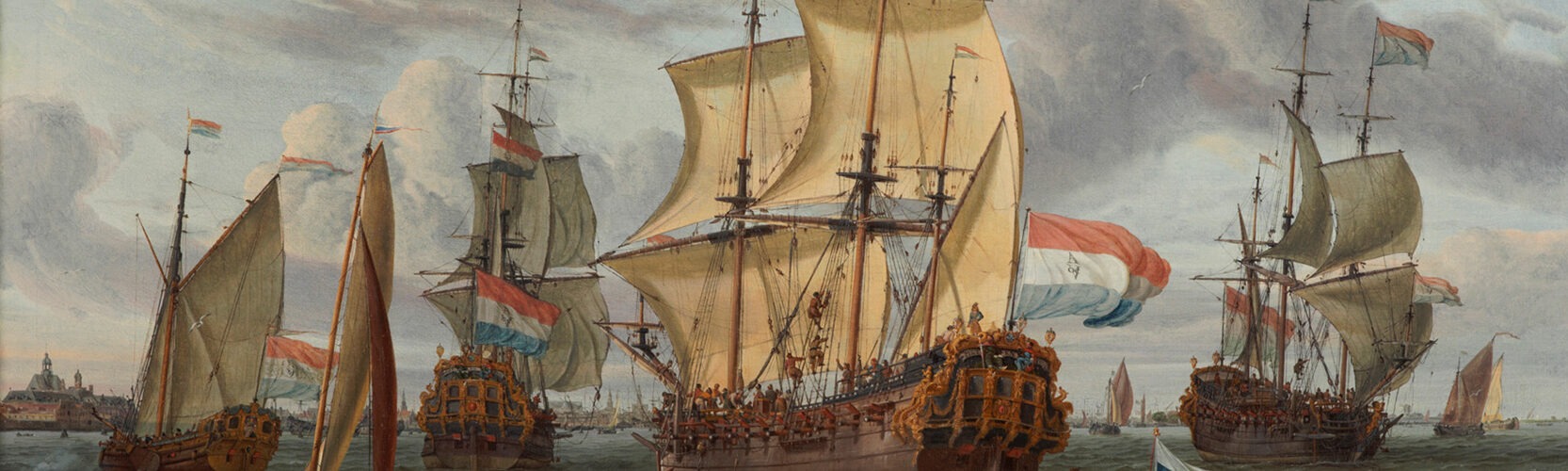
    The VOC (1602–1795) was the world’s first multinational and grew into a powerful colonial enterprise with trade monopolies and its own military force. In nearly two hundred years, over 4,700 ships departed for Asia. In the 18th century alone, approximately 655,000 people were aboard VOC ships.1 Only a small portion came from the Achterhoek. From the records, we know over 200 names of men from Aalten and Bredevoort who entered the service of the VOC.

    That we know this is thanks to the meticulous personnel administration. Personal details, roles, ships, destinations, and the reason for leaving service were recorded in the so-called ship’s pay ledgers. These sources have largely been preserved and can be consulted online via the website of the National Archives. The table at the bottom of this article was compiled based on these records.2

    Aalten and the VOC: involved from the beginning

    The involvement of Aalten residents with the VOC did not only begin when men enlisted as soldiers or sailors. An Aalten native played a notable role as early as its founding in 1602. Wessel Schenk, born in Aalten and later a merchant in Amsterdam, invested 30,000 guilders in the new company at that time. This made him one of the largest shareholders of the VOC.3

    What do the data reveal?

    The data show that by far the majority of passengers from Aalten and Bredevoort departed for Batavia. Other destinations included Ceylon, Bengal, Cape of Good Hope, Tuticorin, and China.

    The service was risky: more than half died en route or in Asia, while only a third demonstrably returned alive. Enlistments took place throughout the 17th and 18th centuries, with slight peaks in the 1720s and 1760–70.

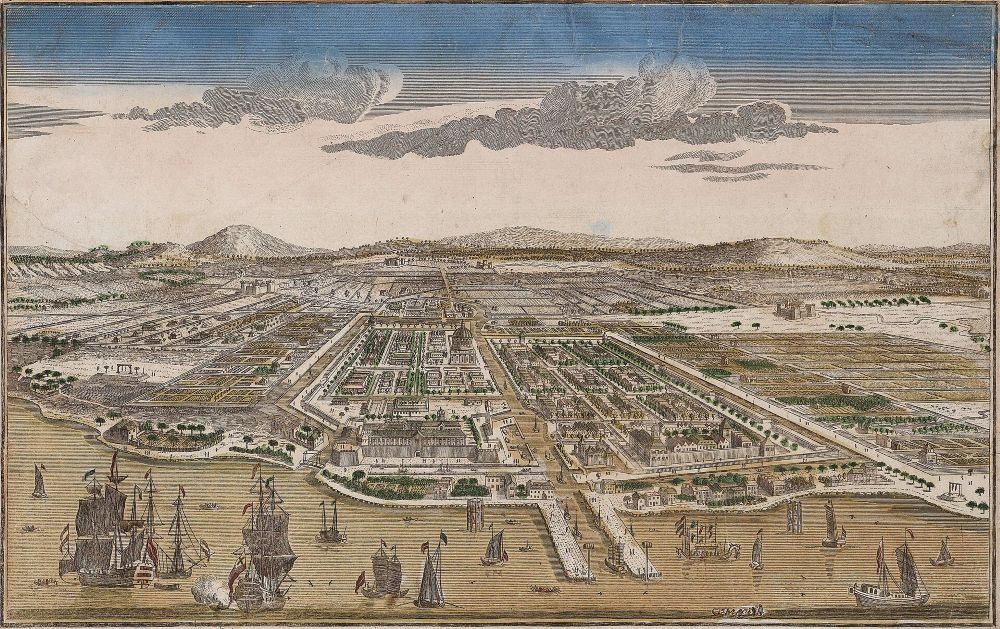
    Optical print of Batavia in 1780
    Optical print of Batavia in 1780 (source: Wikipedia)

    Motives for departure

    Why did these men choose an uncertain existence at sea? For many, it was a matter of poverty or a lack of prospects: a steady income with the VOC offered security. For others, the urge for adventure and independence played a role, a chance to see the world and escape the constraints of rural life.4

    Military roles

    Nearly half of the men from Aalten and Bredevoort held a military position. Until 1755, there was a garrison in Bredevoort5, which may have played a role in this. For military personnel, the VOC presumably offered the opportunity to utilize their experience with weapons and discipline, often for better pay and with more career prospects. At the same time, it is equally possible that men with experience in the civic guard were deployed for such roles. The departure of the garrison from Bredevoort seems to have had no demonstrable influence on the number of enlistments.

    Names and data

    The table below contains the details of individuals from Aalten and Bredevoort who were in the service of the VOC. Some individuals are listed multiple times because they made several voyages. This table is not flawless and is likely not exhaustive. For some individuals, it is not certain that they actually originated from Aalten or Bredevoort, as the origin is sometimes difficult to read and spelling varies. Partly for this reason, names are undoubtedly missing, but possibly also because parts of the administration have been lost.

    The 📜 behind each name contains a link to the relevant entry in the National Archives, where the scan of the original document can also be viewed. A 🌳 refers to the family tree of the person in question on FamilySearch (free account required), where known – work in progress!

    AchternaamVoornaamHerkomstVertrekSchipBestemmingBeroepUit dienstRedenDetails
    AndriesseJoannesAlten1721AmsterdamBataviaSoldaat1727Gerepatrieerd📜 🌳
    AndrieszHendrikAlten1734Hof niet Altijd WinterBataviaSoldaat1734Overleden📜
    ArendseSalomonAalte1736NoordwaddinxveenBataviaTweede meester1744Gerepatrieerd📜 🌳
    ArendseWillemAalten1718AmstelveenBataviaAdelborst1721Gerepatrieerd📜
    ArentszWillemAelten1722MeerhuizenCeylonLanspassaat1726Gerepatrieerd📜
    BalsterheinHendrikAlten1722OostrustBataviaBosschieter1722Kamer Amsterdam📜
    BarreveldHendrikAltem1737RuiterBataviaMatroos1738Kamer Amsterdam📜
    BeckingJohannes ChristiaanBreedvoort in gelderland1758StandvastigheidBataviaTweede chirurgijn1759Gerepatrieerd📜 🌳
    BekkingJohannes ChristiaanBredevoort1760WildrijkBataviaTweede meester1762Gerepatrieerd📜 🌳
    BekkingJohannes ChristiaanBredevoort1763LapienenburgBataviaOppermeester1766Gerepatrieerd📜 🌳
    BekkingJohannes ChristiaanBredevoort1767TulpenburgBataviaOppermeester1768Gerepatrieerd📜 🌳
    BekkingSalomonBreedevoort1763LapienenburgBataviaJongen1765Overleden📜 🌳
    BeuckelaerCoen AdriaensenAltene1685VrijheidBataviaSoldaat??📜
    BeuckelaerCornelisAltene1699IJsselmondeBataviaMatroos??📜
    BeumerBarendAalte1744SpanderswoudBataviaSoldaat1747Overleden📜
    BlokCasperAlten1726StadwijkBataviaSoldaat1728Overleden📜
    Bokkel, tenHarmenBrevoort1728SusannaBataviaLanspassaat1736Gerepatrieerd📜 🌳
    Bockel, tenHarmeBrevorst1737MeerlustBataviaSoldaat1737Overleden📜 🌳
    Bokkel, teMatthijsAalten1733KrooswijkBataviaOpperchirurgijn1743Overleden📜
    BosJohanAalden1753HuigenwaardBataviaSoldaat1776Overleden📜
    BouwmeesterEngelbertAalte1776DankbaarheidBataviaSoldaat1776Kamer Amsterdam📜
    Brakel, vanBarentBreevoort1749VoorzichtigheidBataviaSoldaat1749Overleden📜
    Brakel, vanWarnarBreevaart1745RijnhuizenBataviaOnderzeilmaker1746Overleden📜
    BramenkamAnthonAalden1789TrinconomaleCeylonSoldaat1794Laatste vermelding📜
    BremerAnthonijAalten1716BarneveldBataviaSoldaat1719Overleden📜
    BrethouwerDirkAalten1710Huis te NieuwburgBataviaOnderbarbier1713Overleden📜 🌳
    BroekhuijsenWillemAelten1726BoekenrodeBataviaDerde meester1729Gerepatrieerd📜 🌳
    BuijsinkJoostAlten1715SchellenbergBataviaSoldaat1727Gerepatrieerd📜
    BulsingBarent HendrikAlthen1769WelgelegenBataviaTweede meester1770Overleden📜 🌳
    Bus, deJanBreedevoort1748GeldermalsenBataviaCommandeur van de Soldaten1749Overleden📜
    Busch, tenAllard JacobszBrevoort1729JacobaBataviaJongen1730Overleden📜
    CappersDirkAlten1700BambeekBataviaDerde chirurgijn1702Schip vergaan📜
    CefrijHendrikAalten buijten zutphen1719Huis de VlotterBataviaSoldaat1739Overleden📜
    Chavonnes, deLouisBrevoort1700EllemeetBataviaOnderkoopman1703Overleden📜
    ClaéeJohannesAlten1728StadwijkBataviaMatroos1741Overleden📜
    CleefJan DirkseBrevoort1690BrandenburgCeylonSoldaat1696Overleden📜
    CoenenAdam HarmsseBredevoort1769Vrouwe Petronella MariaBataviaSoldaat1771Overleden📜
    Coeverde, vanJanAalte1737BatavierBataviaBosschieter1739Gerepatrieerd📜
    Coeverden, vanGerritAlthe1718Huis de VlotterBataviaSergeant1720Overleden📜
    Coeverden, vanJanAalten1705Hof van IlpendamBataviaAdelborst1706Overleden📜
    Coeverden, vanMatthijsAelten1707VrijburgBataviaSoldaat1720Gerepatrieerd📜
    Coeverden, vanMatthijsAlten1721Schonenberg?Korporaal1725Overleden📜
    Coeverden, vanWesselAelten1724TheodoraCeylonSoldaat1725Overleden📜
    DammanStoffelAlten1760LuxemburgBataviaBosschieter1761Overleden📜
    DeunkHenrickAlten1719JohannaBataviaOndermeester1721Gerepatrieerd📜
    Dijk, vanHendrikBrevoort1773HoolwerfBataviaSoldaat1780Overleden📜
    DonkersPieterBreevoort1726OudenaardeBataviaSoldaat1733Gerepatrieerd📜
    EntingRouloff JacobusBredevoort1783ZeeduinBataviaJongmatroos1785Schip vergaan📜 🌳
    EntinkAbrahamBredevoort1771VelsenCeylonMatroos1794Laatste vermelding📜 🌳
    EntinkDanielBreedevoort1765OranjezaalBengalenSoldaat1767Overleden📜 🌳
    EntinkIsaak JacobusBreedenvoort1761OosterbeekBengalenSergeant1766Gerepatrieerd📜 🌳
    EntinkJan HendrikBrevoort1750Gustaaf WillemBataviaOndermeester1760Gerepatrieerd📜 🌳
    EntinkLodewijkBredevoort1756StadwijkBataviaDerde meester1758Gerepatrieerd📜 🌳
    EntinkLodewijkBredevoort1759SlotenBataviaTweede meester1764Schip vergaan📜 🌳
    EntinkWillemBreedevoort1762AmstelveenBataviaKonstabelsmaat1763Overleden📜 🌳
    EversJacob AdolphBredevoort1776BotBataviaZiekentrooster1779Overleden📜 🌳
    EversJohannes TheodorusBredevoort in’t graafschap zutphen1776KanaanBataviaSergeant1777Overleden📜
    EvertWillemAlthem1756BevalligheidBengalenDerde meester1757Gerepatrieerd📜 🌳
    EverseWillemAalten1759Huis te ManpadBengalenOndermeester1762Gerepatrieerd📜 🌳
    EverseWillemAalten1763GiessenburgCeylonOppermeester1765Gerepatrieerd📜 🌳
    EversWillemAalten1780MorgensterCeylonMatroos1785Weggelopen📜 🌳
    EvertsDavidBreedevoort1724MidlooCeylonSergeant1730Vrijburger📜 🌳
    FerietHendrikAalthen1773Bovenkerker PolderBengalenBosschieter1775Gerepatrieerd📜
    FlorinLaurensAalten1739MagdalenaBataviaSoldaat1750Overleden📜
    FredriksHarmanusAelten1767WoestduinBataviaTweede meester1768Overleden📜
    FredriksHermanAltem1727ValkenisseCeylonSoldaat1727Overleden📜
    GansvoortJanAalten1751ImmagondaBengalenTweede meester1753Gerepatrieerd📜 🌳
    GantvoortJanAalten1753BevalligheidBengalenTweede meester1755Gerepatrieerd📜 🌳
    GantvoortJanAalten1756AmstelveenBataviaTweede meester1792Overleden📜 🌳
    GerritseJan DirkBreedevoort1767SchagenBataviaTweede meester1768Overleden📜
    GielinkJanAalten1724MeerhuizenBataviaOnderkuiper1731Gerepatrieerd📜
    GijsbertsBastiaanBredevoort1775VrijheidBataviaSoldaat1780Overleden📜 🌳
    GijsbertszPieterBredevoort1733HogersmildeBataviaAdelborst1734Overleden📜
    GlasemakerSimonBrevoort1739PatmosBataviaMatroos1762Overleden📜
    GraeffBartelBreevort1734Hof niet Altijd WinterBataviaSoldaat1739Overleden📜
    GroepinghHendrikBrevoort1742NieuwerkerkBataviaAdelborst1743Overleden📜
    GroosoisBarentAelten1707MeervlietKaapSoldaat1708Gerepatrieerd📜
    GussenkloDirkAalten1756SlotenChinaZiekentrooster1757Overleden📜
    Haar, in derHendrickAlen in west phalen1693SchoondijkBataviaSoldaat1693Overleden📜
    Haar, terWillemAalte1755SparenrijkBataviaOndermeester1756Overleden📜
    HaartmanGerritAalte1769ScholtenburgBataviaHuistimmerman1771Overleden📜
    HamerlinckPieterAltene1698Huis te Kraaiestein????📜
    HanszJacobAalten1710Prins EugeniusBataviaKonstabel1714Gerepatrieerd📜
    HarkingJacobBrevoort1711MosselBataviaOnderbarbier1713Overleden📜 🌳
    HarmsJohan HendrikAltien1783BerkhoutBataviaMatroos1784Weggelopen📜
    HasseltWillemBrevoort1721StrijkebolleBataviaSoldaat1725Overleden📜 🌳
    HeijnHendrik JanAalten1700BrandenburgBataviaSoldaat1705Overleden📜
    HeijneJanAalte1703BerkelBataviaBottelier1707Gerepatrieerd📜
    HeijnenBenjaminAelten1757VelsenBataviaZiekentrooster1759Gerepatrieerd📜
    HeijnenJanAlten1693FaamCeylonAdelborst1695Overleden📜
    HeijnenJanAalten1709OegstgeestBataviaBotteliersmaat1714Gerepatrieerd📜
    HendriksLucasBreevoort1717NesserakBataviaSoldaat1718Overleden📜
    HendrikszPaulusBrevoort1725HeesburgBataviaKorporaal1731Gerepatrieerd📜
    HenkampGerrit JanBreedevoort1764OuderamstelBataviaLeggermaker1766Overleden📜
    HenrijFrans BernardusBreevoort1706ZoelenBataviaAdelborst1708Overleden📜
    HenrijSteven JanBreevoort1706ZoelenBataviaSoldaat1706Overleden📜
    HeuninghBarentAalten1711DonkervlietBataviaSoldaat1721Gerepatrieerd📜
    HijneBenjaminAlthen1762LeimuidenBataviaZiekentrooster1764Gerepatrieerd📜
    HofmanJohannesBrevoort1745SchellagBataviaAssistent1747Overleden📜
    HopmanGerritAalte1767WoestduinBataviaZiekentrooster1769Gerepatrieerd📜
    HopmanGerritAalthen1769Bovenkerker PolderBengalenZiekentrooster1771Gerepatrieerd📜
    HopmanGerritAalte1771GeinwensCeylonZiekentrooster1772Overleden📜
    HouthuijsGerrit JanAalten1757VlietlustCeylonSoldaat1761Weggelopen📜
    JacobszJanAlten1764BaarzandeBataviaMatroos1765Overleden📜
    JanknegtGerrit JanAlten in gelderlant1723BorsseleCeylonSoldaat1746Overleden📜
    JangknegtHendrik WillemAlten1763ImmagondaBataviaSoldaat1774Gerepatrieerd📜 🌳
    JanknegtHendrik WillemAalse in gelderland1774RodenrijsBataviaPatroontasmaker1774Absent bij afvaart (overleden)📜 🌳
    Jansen KnegtGerritAlten1709‘t GhijnBataviaAdelborst1710Overleden📜
    JansseBernardusAelte1764Vrouwe GeertruidaBataviaHuistimmerman1767Overleden📜
    JansseJanAalden1772LandskroonCeylonBosschieter1774Gerepatrieerd📜
    JanszPopkeAalte1773AmsterdamBataviaJongmatroos1775Overleden📜
    JaspersJohannesBrevort in gelderlandt1730HaaksburgBataviaTweede chirurgijn1731Overleden📜
    JasperszLucas JohannesBrevoort1752BloemendaalBataviaDerde meester1762Overleden📜
    KalffHendrikBrevoort1716NoordbeekBataviaDerde barbier1718Schip vergaan📜
    KalffUlrich HenrichBrevoort1719StandvastigheidBataviaSoldaat1723Overleden📜
    KappersHendrickAlten1721AmsterdamBataviaSoldaat1723Overleden📜
    KasperszGerrit JanAelten1724BerkenrodeBataviaSoldaat1725Overleden📜
    KlompsDirkAeltem1763Gouverneur-generaalBataviaLuitenant (militair)1771Overleden📜
    KluijtmanHendrikAlten1724BoekenrodeBataviaSoldaat1735Gerepatrieerd📜
    KoelmanJanAelten1723HeinkenszandBataviaMatroos1725Overleden📜
    KoelmanJanAalten1724LuchtenburgBataviaMatroos1725Kamer Zeeland📜
    KolwagenEngelbertusAltan1762BaarzandeBataviaMatroos1769Gerepatrieerd📜
    KompffZeger Adolph CasperAlten1764AmerongenBataviaSoldaat1764Overleden📜
    KoolwageGerritAltene1690Lands WelvarenBatavia???📜
    KooningJacob WillemBredevoorde1740HogersmildeBataviaSoldaat1740Overleden📜
    KosGerritBreevoort1754HerstelderBataviaSoldaat1762Overleden📜
    KosteHendrik MatthijsAltene1754Huis te BoedeBataviaBosschieter1757Gerepatrieerd📜
    KrakkeHendrikAlten1772Bartha PetronellaKaapSoldaat1780Vrijburger📜
    KriebelHendrikAalten1783ZeeduinBataviaMatroos1787Gerepatrieerd📜
    KumpelJoannesAlten1723WesterdijkshornBataviaSoldaat1724Overleden📜
    LievesAnthonijAalte1745LeidenBataviaSoldaat1745Overleden📜
    Lodewijkus la RosJohannes PieterBreevoort1746PatmosBataviaSoldaat1747Overleden📜
    LuijtingGoosenBrefoort1721Vaderland GetrouwBataviaSoldaat1729Overleden📜
    MarcusJosephAlten1780BataviaBataviaMatroos1779Absent bij afvaart📜
    MarkelingBarendBreevoort1737Petronella AlidaBataviaGrofsmid1738Kamer Enkhuizen📜
    MarkelingBarendBrevoort1737Petronella AlidaKaapGrofsmid1744Overleden📜
    MarrenbergJoostBreevoort1721VrieswijkCeylonBosschieter1724Gerepatrieerd📜
    MartenseIsaakAalten1719BarneveldBataviaSoldaat1721Gestraft📜
    MartenszClaasBrevoort1711HorstendaalBataviaBosschieter1715Gerepatrieerd📜
    MeijJan HendrikAlten1737WickenburgBataviaAdelborst1746Gerepatrieerd📜
    MeijerDeetloff AsmusAlten1767TulpenburgBataviaSoldaat1767Overleden📜
    MeijerFredrikAlten1771KronenburgBataviaMatroos1771Absent bij afvaart📜
    MeijeringhFredrikAlten1777ForeestBataviaSoldaat1781Overleden📜
    MeijneCarsienBrevoort1693KarthagoBatavia???📜
    MekmanJanAlten1730KnapenburgCeylonMatroos1732Overleden📜
    MentinghStevenBrevoort1705DriebergenBataviaOnderbarbier1706Overleden📜
    MentinkHermanusBreedevoort1769Bovenkerker PolderBengalenOnderkuiper1770Overleden📜
    MierdinkWesselAalten1761VoorlandBataviaOnderkuiper1761Absent bij afvaart📜
    MijnenGerrit JanBrevoort1760Gouverneur-generaalBataviaSoldaat1760Kamer Amsterdam📜
    MijnenGerrit JanBrevoort1760RenswoudeCeylonSoldaat1761Overleden📜
    MoesmanJohan HendrikAlen1771GeinwensCeylonMatroos1771Overgeplaatst📜
    MoesmanJohan HendrikAlen1771KronenburgBataviaMatroos1773Gerepatrieerd📜
    MoesmanJohan HendrikAalden1775VrijheidBataviaMatroos1777Gerepatrieerd📜
    MoesmanJohan HendrikAalten1777Bovenkerker PolderBengalenBosschieter1779Gerepatrieerd📜
    MosmanJan HendrikAalden1773HonkoopBataviaMatroos1775Gerepatrieerd📜
    MosmanJohan HendrikAalden1779WakkerheidBataviaMatroos1785Gerepatrieerd📜
    NeerJoostBreevoort1763Vrouwe ElisabethBataviaSoldaat1764Overleden📜
    NielantReijnardAltem in gelderlant1728Adelaar?Soldaat??📜
    NiewetsJohannesBrevoort1737DuifjeBataviaKoksmaat1738Overleden📜
    NoltingJanBreedevoorde1741BosbeekBataviaSoldaat1749Gestraft📜
    OrmeJanAalten1774DelfshavenBataviaHooploper1775Overleden📜
    OrmeJanAalsen1775Jonge HellingmanBataviaHooploper1775Kamer Delft📜
    PieterszJacobBreevoort1734MeermondCeylonBosschieter1742Vermist📜
    PieterszJanAalten1749WildrijkBataviaSoldaat1749Overleden📜
    PommerHarmen JanBrevoort1742AdrichemBataviaSoldaat1747Gerepatrieerd📜
    PommerHarmen JanBreevoort1749Rust en WerkBataviaSoldaat1751Overleden📜
    PommerJanBreedevoort1730Lage PolderBatavia?1742Gerepatrieerd📜
    PommerJanBreevoort1743HoopBataviaSoldaat1743Overleden📜
    PothuijsBarendAalten1785ZoutmanBataviaSoldaat1789Overleden📜
    PothuijsBarendAltan1788Vrouwe Katharina JohannaBataviaBosschieter1789Kamer Hoorn📜
    PrinsBernardusAalthe1756Vrouwe Petronella MariaBataviaKorporaal1757Overleden📜
    PrinsGijsbertus ArnoldusAlten1773HonkoopBataviaTweede meester1775Overleden📜 🌳
    ProspertsErnstBreevoord1725LinschotenBataviaSoldaat1730Overleden📜
    ReijndersAbraham DavidsBrevoort1730‘t Vliegend hartBataviaHooploper1735Gerepatrieerd📜
    RijtmansGerritAlten1779Willem FrederikBataviaSoldaat1780Overleden📜
    RoedolfHarmanusBreedewoort1754SlotenBataviaJongmatroos1766Overleden📜
    RondelAnthonijAalthe1774OuwerkerkBataviaSoldaat1774Absent bij afvaart📜
    SatinckFlorisBredewaart1732PaddenburgBataviaOnderkoopman1735Overleden📜 🌳
    SatinkFlorisBreedevoort1725SpieringBataviaSergeant1727Gerepatrieerd📜 🌳
    SatinkFlorisBrevoort1729JacobaBataviaAssistent1730Gerepatrieerd📜 🌳
    ScakinoNicolaasBreevoort1760Gouverneur-generaalBataviaSoldaat1791Overleden📜
    SchenkGijsbertAalten1710Huis te NieuwburgBataviaSoldaat1716Overleden📜
    SchenkHarmenAalte komm:1713DiemenCeylonKorporaal1723Overleden📜
    SchenkHendrikAalte1745EindhoefBataviaSoldaat1745Overgeplaatst📜
    SchenkHendrikAaldi1746Huis te RensburgBataviaSoldaat1747Laatste vermelding📜
    SchenkJohannes JosephusAlteren1770VlissingenBataviaMatroos1770Absent bij afvaart📜
    SchenkJohannis JosephusAlteren1770WoestduinBataviaMatroos1770Absent bij afvaart📜
    SchinckGerritAlten in ‘t graafschap zutphen1686SpierdijkBataviaAdelborst1688Overleden📜
    SchinkHarmanAalten1700LekCeylonSoldaat1712Gerepatrieerd📜
    SchoonmanAnthoonAlten1759Huis te ManpadBengalenSoldaat1760Kamer
    Amsterdam
    📜
    SchreuderHendrikAelten in hanoverse1767WalenburgBataviaMatroos1768Overleden📜
    SchrijverJannisBrevoort1682Prins Willem HendrikBataviaKoksmaat??📜
    SchutAntonieBrevoort1716DoornikBataviaOnderbarbier1717Overleden📜
    SenecaJan BabtistAlten1761KronenburgBataviaJongmatroos1763Overleden📜
    SenkJohann CoenraadAlten1783TritonBataviaMatroos1793Laatste vermelding📜
    SleeterMijnoldAlten1753LuxemburgBataviaSoldaat1754Overleden📜
    SlotboAnthonijAalte1746Huis te ManpadBataviaSoldaat1752Weggelopen📜
    SlotboomGerrit JanBredevoort1739BeekvlietBataviaDerde meester1741Schip vergaan📜
    SmeenkBarentAalten1700BrandenburgBataviaSoldaat1706Overleden📜
    SmetJan TjerkBreedevoort1775NoordbeekKaapMatroos1776Gerepatrieerd📜
    SmitJan TjerkBrevoorde1773MarsBataviaHooploper1775Gerepatrieerd📜
    SmitJan TjerkBreedevoord1780Juno?Bottelier??📜
    SmithJan TjerkBreedevoort1777Willem de VijfdeCeylonMatroos1779Gerepatrieerd📜
    StarrenbergJanBrevoort1734KerkwijkBataviaJongen1739Schip vergaan📜
    StarrenbergJoostBrevoort1725GaasperdamBataviaSchiemansmaat1726Gerepatrieerd📜
    StarrenbergJoostBrevoort1727CastricumBataviaSchieman1728Gerepatrieerd📜
    StarrenbergJoostBrevoort1729OostrustBataviaSchieman1733Overleden📜
    SteekeDirekBreedevoort1713Herstelde LeeuwBataviaJongen1721Gerepatrieerd📜
    SteendekkerHendrik Daniel GotliebAlten1777Huis te KrooswijkBataviaHooploper1778Kamer Amsterdam📜
    Steenvoort, vanBartAalten1738VisBataviaMatroos1738Overleden📜
    StemerHendrikBrevoort1728MijndenBataviaOndermeester1747Overleden📜
    SterkBernardusAeltun1763LapienenburgBataviaDerde meester1766Gerepatrieerd📜
    SterkBernardusAalte1767TulpenburgBataviaTweede meester1767Overleden📜
    SterkJanAlten1779Jonge HugoBataviaMatroos1780Overleden📜
    StompAarnold ChristiaanBrevoort1738VoorduinBataviaKorporaal1738Overleden📜
    SwartenkortBarentBreedevoort in gelderland1787Slot CapelleBataviaKorporaal1788Overleden📜
    SwingerJacob JacobseBreijde voort1676AmerikaBataviaBosschieter??📜
    TerbeekHendrikAalte1737NieuwlandBataviaDerde meester1738Gerepatrieerd📜
    TerbeestHend.Alten in gelderland1707ZandenburgBataviaAdelborst1708Overleden📜
    TerroeleHarmenAalten1696OvernesBataviaSoldaat1699Overleden📜
    TielstedJoostBrevoort1708MeervlietBataviaOnderbarbier1708Overleden📜 🌳
    TimmermanGerardus LambertusBrevoort1779DolfijnBataviaMatroos1784Overleden📜 🌳
    TimmermanJan DirkBreevoort1763VelsenBataviaKorporaal1768Overleden📜 🌳
    ValentijnMilnesBrevoorde1677AlexanderBataviaAdelborst??📜
    VeenTheodorus LaurensBredervoort1777DolfijnBataviaHoogloper1778Overleden📜
    VeltkampOtto Adam AdolfAalten1771Huis te BijwegBataviaJongmatroos1771Overleden📜 🌳
    VerbeekHendricusAlte in gelderland1742HofwegenBataviaBottelier1745Overleden📜
    VerschagenJohannesBrevoort1680AfrikaBataviaAdelborst1695Vermist📜
    VerschoorJurgenAlten1731Kasteel van WoerdenBataviaSoldaat1732Kamer Amsterdam📜
    VerschoorJurgenAlten1731Huis te MarquetteBataviaSoldaat1740Overleden📜
    VerwersHendrickBreevoort1700Generale VredeBataviaMatroos1703Gerepatrieerd📜
    VerwersHendrikBrevoort1700BrandenburgBataviaMatroos1701Kamer Amsterdam📜
    VissenEverardusBreevoort1737LandskroonBataviaSoldaat1738Overleden📜
    VisserEvertBrevaart1731OostrustBataviaAdelborst1735Gerepatrieerd📜
    Vliet, terCarelBrevoort1689BantamBataviaSoldaat1696Overleden📜
    Voort, van derHoets CarelBreevoort1706DonauBataviaSoldaat1712Gerepatrieerd📜
    VreesWillemAalten1767Jonge LieveBataviaOndertimmerman1769Overleden📜
    Vries, deBarendAlten1740DiemermeerBataviaSoldaat1749Overleden📜
    Vulpen, vanHarmeAalden1787BelvlietBataviaSoldaat1793Laatste vermelding📜
    WaerCenpte TilandeBrevoort1637ZwolleBataviaSoldaat1638Laatste vermelding📜
    WassingJanBrevoort1735HaamstedeBataviaSoldaat1737Overleden📜
    WassinkHendrikAlten1762AmstelveenBataviaKok1763Schip vergaan📜
    WeelingHarmanusAalten1748HerculesCeylonSoldaat1750Overleden📜
    WeelingHermanusAalten1748WesthovenBataviaSoldaat1749Kamer
    Amsterdam
    📜
    WeeninkJanBreedevoort1740HofvlietBataviaDerde meester1742Gerepatrieerd📜
    WeeninkJanBrevoord1743HeuvelBataviaDerde meester1754Overleden📜
    WelpshofAarnoldAalten1716BarneveldBataviaAdelborst1723Gerepatrieerd📜
    WeningPeter IsaakBredevoort1763‘s Lands WelvarenBataviaMatroos1766Overleden📜
    WienekesJan DirkAlten1724BoekenrodeBataviaSoldaat1725Overleden📜
    WikkerHendrikAlten1729MidlooBataviaSoldaat1733Overleden📜
    WillemseCoenraedBrevoort1718HaftenBataviaSoldaat1721Vermist📜
    WillemshofArnoldusAelten1724BerkenrodeBataviaKorporaal1727Overleden📜
    WillemszDirckBrevoort1721StadwijkBataviaSoldaat1723Overleden📜
    WillemszJurrianBreevoort1716MeerhuizenBataviaMatroos1717Overleden📜
    WilpshofJanAalten1717Prins EugeniusBataviaSoldaat1719Overleden📜
    Winter, deJanAltene1718BerbicesBataviaAdelborst1719Overleden📜
    WisseBarrentBrevoort1675AardenburgTuticorinAdelborst??📜
    WissingBarentBreevoord1675AardenburgTuticorinAdelborst??📜
    Wolff, deJohannesAalten1773PallasBataviaJongmatroos1773Overleden📜
    WoortJurriaanBrevoort1771LeiderdorpBataviaMetselaar1772Overleden📜 🌳
    WoortsJanBredevoort1752VlietlustBataviaDerde meester1758Gerepatrieerd📜 🌳
    WoortsJanBredevoort1761LiefdeBataviaSoldaat1761Overleden📜 🌳
    WormsWijnandAalten1770Oud HaarlemBataviaDerde meester1771Overleden📜 🌳
    Wulffen, vanGerritBrevoort1733CastricumBataviaKorporaal1735Overleden📜
    Zanten, vanJanAalten1752Admiraal de RuyterBataviaSoldaat1753Overleden📜
  • Gertrud van Myllendonk

    Gertrud van Myllendonk

    Gertrud van Myllendonk (1552–1612), also known as Geertruida van Millendonck, was a noble administrator in the German-Dutch border region. She was Lady of Drachenfels, Königswinter, and Anholt, and for thirty years the pledge-holder of the Lordship of Bredevoort (1582–1612).

    Her reign took place in the midst of the Eighty Years’ War (1568–1648). While the region was torn apart by violence between Spain and the emerging Dutch Republic, she attempted to keep her territories out of the line of fire through a strict policy of neutrality. Although she was personally Roman Catholic and pro-Spanish, she took no side politically. In 1612, she transferred her rights over Bredevoort to Prince Maurice of Orange.

    Early years and marriage

    Gertrud van Myllendonk was born in 1552 at Myllendonk Castle, near Düsseldorf. She was the daughter of Dietrich von Myllendonk and Theodora van Bronckhorst-Gronsveld. Through her father, she inherited various properties and noble titles along the Rhine.

    On 13 May 1576, Gertrud married Jacob van Bronckhorst-Batenburg, the Lord of Anholt, in Anholt. At that time, his family held the Lordship of Bredevoort in pledge. This meant they governed the castle, the town, and the surrounding area in exchange for substantial loans they had provided to the sovereign. The couple had three children:

    • Dirk IV van Bronckhorst-Batenburg-Anholt (24 March 1578 – 16 June 1649), later Count of Bronckhorst, Baron of Batenburg, and Lord of Anholt, Moyland, and Bahr.
    • Johan Jakob van Bronckhorst-Batenburg (12 August 1579 – 19 October 1530), later Count of Batenburg and Anholt, and military commander.
    • Elisabeth van Bronckhorst-Batenburg (Aalten, February 1582 – 1629), married Willem van Ketteler, Lord of Lage, in 1613.

    Family life was short-lived. Jacob fought in Spanish service and was severely wounded in September 1582 during fighting near Lochem. He succumbed to his injuries a short time later at the age of 29 at the Castle of Bredevoort. Gertrud was left a widow at the age of thirty with three young children.

    Administration and neutrality policy

    After her husband’s death in 1582, Van Myllendonk took over the administration of the Lordship of Anholt and the pledge of Bredevoort. During this period, the front between the Spanish and States armies ran straight through the Achterhoek. Although she was personally Roman Catholic and pro-Spanish, she chose a strictly neutral stance for strategic reasons to prevent looting and quartering in the countryside.

    In doing so, she continued the policy of her father-in-law, Diederik van Bronckhorst-Batenburg. He had attempted to keep the territories out of the conflict by declaring that the Spanish king possessed no sovereign rights over Anholt and Bredevoort. Although the neutrality of Anholt was respected internationally, this did not apply to Bredevoort. Due to its strategic location and strong fortifications, Bredevoort remained a military target for both parties.

    Administrative crisis in Winterswijk

    Van Myllendonk’s reign was threatened not only by external armies but also by internal political tensions. In Winterswijk, which fell under the jurisdiction of the Lordship of Bredevoort, the pledge-holder was not without controversy.

    A direct power struggle arose when Johan Rump was appointed as guardian of Winterswijk without her involvement. In response, the bailiff of Bredevoort appointed by Van Myllendonk took firm action: he had Rump arrested and installed a counter-candidate, Otto Volmer. This intervention led to escalation and unrest in the region. To de-escalate the situation, Van Myllendonk deployed her personal agent from Brussels and Antwerp, Gottfried Gerardi. Only after Jacob Vockink was installed as the new guardian did peace return to the Winterswijk administration.

    The Siege of Bredevoort in 1597 and the aftermath

    Gertrud’s neutrality policy ultimately failed to hold when a Spanish garrison took possession of the Bredevoort fortress. Like the States’ military leadership, Gertrud wanted these troops gone as quickly as possible, but she did not receive permission for this from the Spanish Governor-General Parma.

    During the Siege of Bredevoort in 1597, Prince Maurice of Orange surrounded the city with a States army. Gertrud made an urgent appeal to Maurice to respect her pledge rights and spare the city, but the Spanish occupiers refused to surrender. The subsequent shelling and the final assault caused enormous destruction in the city and at the castle.

    Despite this defeat, Gertrud continued to fight legally for her possessions. Successfully: in 1602, the States of Gelderland temporarily returned the Lordship of Bredevoort to her. Her eldest son, Dirk IV, then proposed a radical solution: the complete demolition (dismantling) of the fortifications of Bredevoort. His logic was that an undefendable city would no longer attract armies, which would provide peace for the local population. Prince Maurice and the States of Gelderland, however, put a stop to this. Maurice had gone to too much trouble to capture the strategic border barrier and rejected the demolition.

    Transfer and death

    Financial and political pressure on the pledge increased in the following years. On 20 October 1612, the States of Gelderland and Gertrud van Myllendonk reached a final agreement. The outstanding pledge was financially settled, and the Lordship of Bredevoort was officially transferred to Prince Maurice, who thereby became the new pledge-holder.

    Just over a month after this transfer, on 23 November 1612, Gertrud van Myllendonk passed away at the age of sixty in Anholt. Her sons continued the noble titles, with her second son, Johan Jakob, later playing a prominent role as Imperial Field Marshal during the Thirty Years’ War.

    Sources